
Grade 9 Science Worksheets
6,926 worksheets
Dynamic Systems Worksheet | AP Science Grade 9 Assessment PDF
JCreated byJ.S SheetsLearning Objectives
- Understand how to represent and analyze temporally changing systems using time-series data.
- Identify the role of feedback loops, rates, and equilibrium concepts in dynamic systems.
- Interpret empirical data to discern transient versus steady-state behaviors.
Also included in: Grade 9 Science Lesson Group | AP Standards Practice Bundle
Instant download

Molecules & Lattices Worksheet | NGSS Grade 9 Science Assessment
 Created bySkylark Worksheets
Learning Objectives
- Explain how particle arrangement and electrical forces influence bulk properties of solids.
- Compare ionic lattices, covalent networks, and molecular solids using evidence from melting point, conductivity, hardness, and solubility.
- Use particle-level reasoning to predict changes in behavior when a solid is heated or dissolved.
Also included in: Chemical Reactions & Structure of Matter Lesson Bundle | Grade 9 Science | NGSS +1 more
Instant download

Physical vs Chemical Changes Grade 9 Science Worksheets
 Created bySunny Desk Resources
Learning Objectives
- Distinguish physical changes from chemical changes using evidence of new substances.
- Explain how melting, freezing, and crushing can change phase or form without changing the substances present.
- Use conservation of identity language to describe what happens to a material during a physical change.
Also included in: Phase Changes, Chemical Reactions & Atomic Structure Lesson Bundle | Grade 9 Science | Alberta +1 more
Instant download

Physical vs Chemical Changes Worksheet Grade 9 Science Activity NGSSS
 Created byPrism Point Learning
Learning Objectives
- Differentiate physical changes from chemical changes by identifying whether new substances form
- Use physical and chemical properties to predict how matter may behave during observations
- Explain evidence from changes in color, texture, temperature, and product formation
Instant download
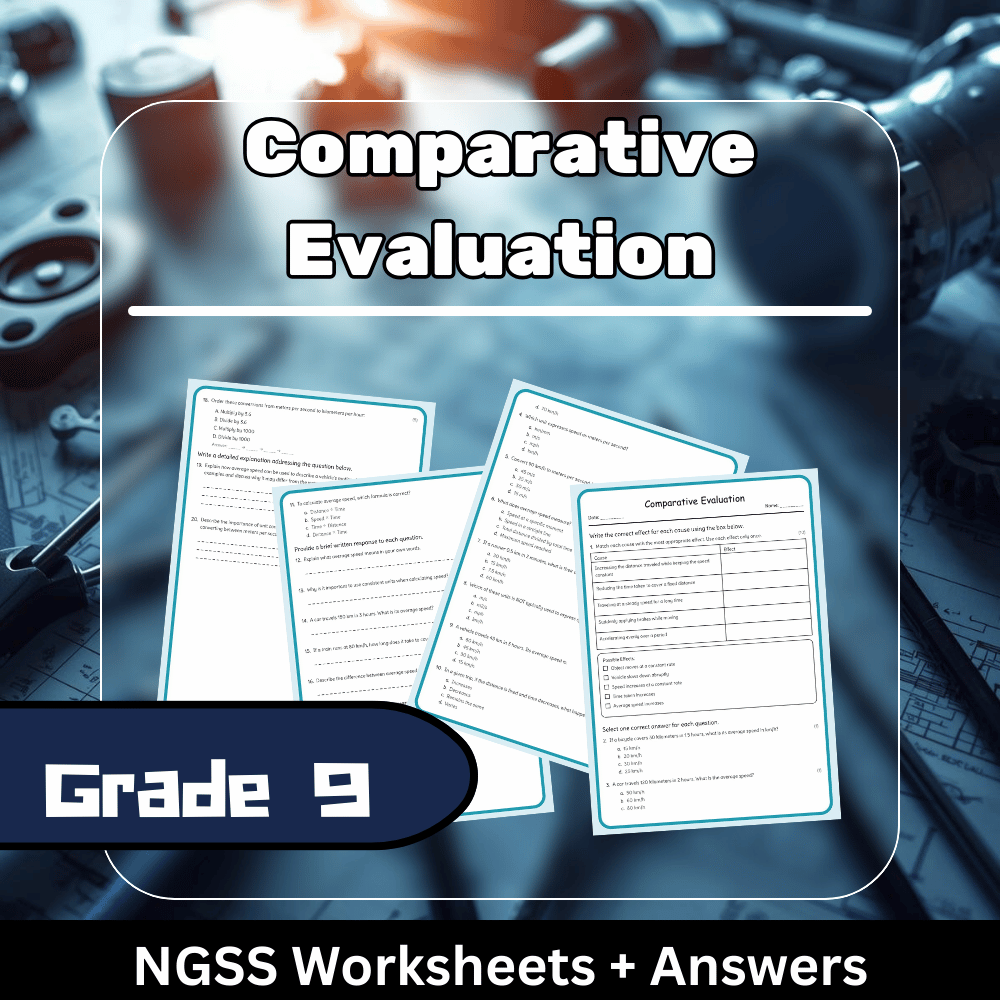
Grade 9 Science | Comparative Evaluation Worksheet (NGSS Aligned, PDF)
 Created byBright Mind Resources
Learning Objectives
- Understand the role of quantitative and qualitative criteria in evaluating alternative designs.
- Learn to use matrices and decision frameworks to compare system performance, cost, and environmental impacts.
- Analyze uncertainties and stakeholder priorities to make reasoned choices among options.
Instant download

Grade 9 Measurement Accuracy Worksheet | Practice & PDF
 Created byClear Sky Classroom
Learning Objectives
- Explain how appropriate units, calibrated instruments, and consistent recording affect measurement accuracy.
- Use significant figures to reflect the precision justified by a measuring device and method.
- Convert between common units and determine reasonable uncertainty ranges for fair comparisons.
Instant download
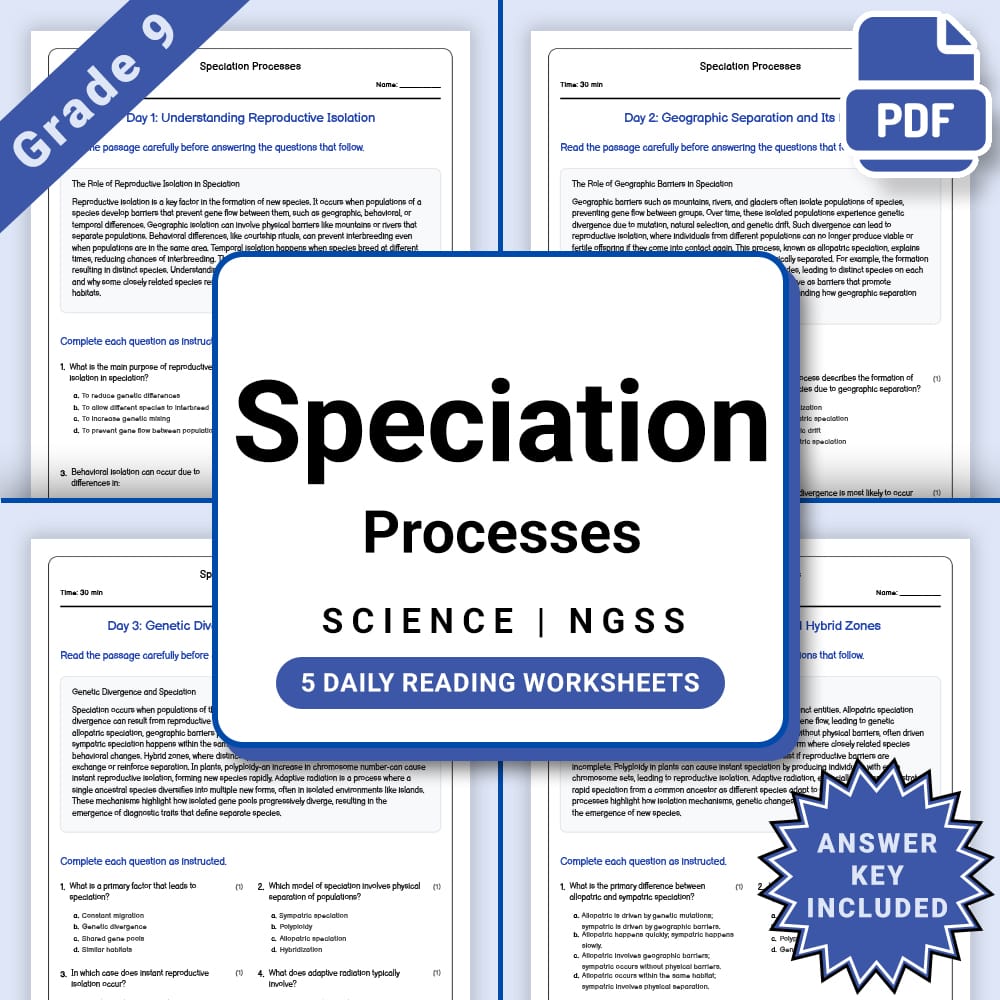
Grade 9 Science – Speciation Processes Worksheet(PDF + Answer Key)
 Created byCopper Leaf Classroom
Learning Objectives
- Understand the mechanisms of reproductive isolation
- Identify the different models of speciation
- Recognize examples of speciation like hybrid zones and polyploidy
Instant download

Grade 9 Science – Control Criteria Worksheet (AP Standards) (PDF)
 Created byEvergreen Desk Education
Learning Objectives
- Define control criteria used in causal inference, including variable isolation, replication, and baseline characterization.
- Explain how appropriate reference conditions and counterfactuals strengthen causal interpretations.
- Identify how residual confounding and uncontrolled variation weaken causal claims, even when patterns appear.
Also included in: Grade 9 Scientific Reasoning & Uncertainty in Science Lesson Bundle AP +1 more
Instant download
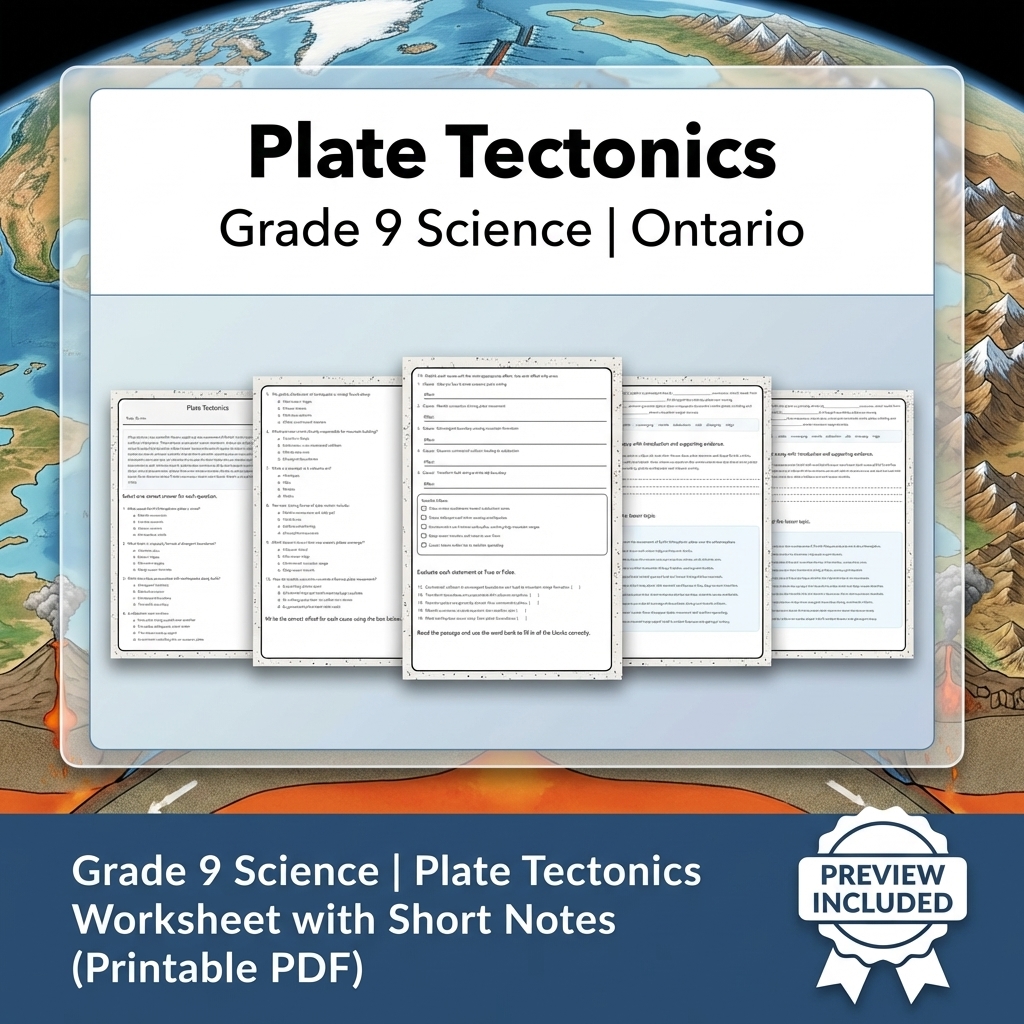
Grade 9 Science | Plate Tectonics Worksheet with Short Notes (Printable PDF)
 Created byMeadowlark Worksheets
Learning Objectives
- Explain the mechanisms of plate tectonics, including divergent, convergent, and transform boundaries.
- Describe the processes of subduction and continental collision and their surface expressions.
- Link mantle convection and slab pull to the movement of lithospheric plates and their geological consequences.
Also included in: Grade 9 Science Lesson Group Bundle | Ontario Curriculum Worksheets
Instant download
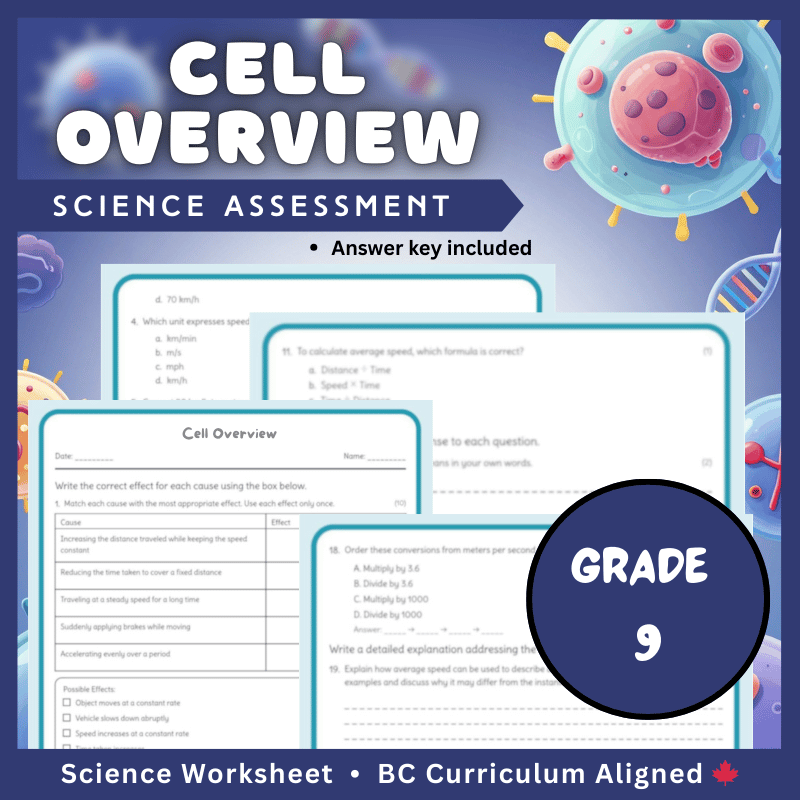
Grade 9 Science | Cell Overview Worksheet (PDF) Aligned with BC Standards
Created byBright Mind ResourcesLearning Objectives
- Understand the basic functions of a cell and its organelles.
- Identify the structures within a cell and their specific roles.
- Explain how cell structure relates to its function.
Instant download

Grade 9 Chromosomes and DNA Worksheet | Practice & Assessment PDF
Created byClear Sky ClassroomLearning Objectives
- Explain how the structure of DNA relates to how genetic information is copied and transmitted
- Describe how chromosomes, gene loci, and karyotypes help scientists organize genetic information
- Compare nuclear genomes with organelle genomes and predict how this can affect inheritance
Instant download

Grade 9 Bond Types Worksheet | BC Practice & Assessment PDF
Created byClear Sky ClassroomLearning Objectives
- Differentiate ionic, covalent, and metallic bonding based on electron behavior
- Connect bond type to observable properties such as melting point, conductivity, and solubility
- Use bond type vocabulary to explain why materials behave the way they do
Instant download

Carbon Records Worksheet | Grade 9 Science Activities
Created byPrism Point LearningLearning Objectives
- Explain how carbon records from ice cores, marine sediments, and terrestrial proxies can reconstruct past atmospheric and carbon-cycle changes.
- Interpret how isotopes, gas ratios, and carbon flux evidence can be linked to temperature variations over time.
- Distinguish natural variability from recent anthropogenic increases using multiple lines of proxy and instrumental evidence.
Also included in: Earth and Space Systems Lesson Bundle | Grade 9 Science | BC Framework +1 more
Instant download

Comparative Evaluation Worksheet | Grade 9 Science printable PDF NGSS assessment
Learning Objectives
- Understand the criteria used in evaluating design solutions quantitatively and qualitatively.
- Learn to interpret and create decision matrices and assessment frameworks.
- Recognize the importance of considering life-cycle costs, environmental impacts, and performance metrics in system evaluation.
Also included in: Grade 9 Science Engineering Design Lesson Bundle | NGSS Framework +1 more
Instant download

Grade 9 Science – Enzyme Regulation Worksheet (TEKS) (PDF)
Created byEvergreen Desk EducationLearning Objectives
- Explain how allosteric control, inhibition (competitive and noncompetitive), and covalent modification regulate enzyme activity.
- Describe how environmental factors (temperature and pH) influence enzyme conformation and reaction rate.
- Evaluate how feedback inhibition and gene expression changes help maintain metabolic balance.
Instant download

Grade 9 Science – Energy Pathways Daily Reading Worksheet | AP Standards
Created byBright Mind ResourcesLearning Objectives
- Understand how Earth's radiative balance influences climate.
- Identify different energy transfer processes such as conduction, convection, and radiation.
- Analyze how differential heating drives atmospheric circulation and weather variability.
Also included in: Grade 9 Earth Systems Science Daily Reading Worksheets Lesson Bundle | AP +2 more
Instant download

Grade 9 Science | Energy Transfer Worksheet | BC Aligned
 Created byLumora Learning
Learning Objectives
- Explain how mechanical systems transfer energy through work, collisions, and friction.
- Describe how energy converts between kinetic, potential, and thermal forms in systems.
- Identify examples of energy transfer, such as braking a bicycle or compressing a spring.
Instant download

Kinematic Equations Practice Worksheet | Grade 9 Science Review
Created byPrism Point LearningLearning Objectives
- Use constant-acceleration kinematic equations to relate displacement, time, initial and final velocity, and acceleration.
- Apply the equations to vertical free-fall and horizontal/projectile motion using correct sign conventions for direction.
- Solve for unknown variables by choosing the appropriate kinematic form and substituting values consistently.
Also included in: Grade 9 Work, Energy & Forces Science Lesson Bundle Ontario Curriculum
Instant download
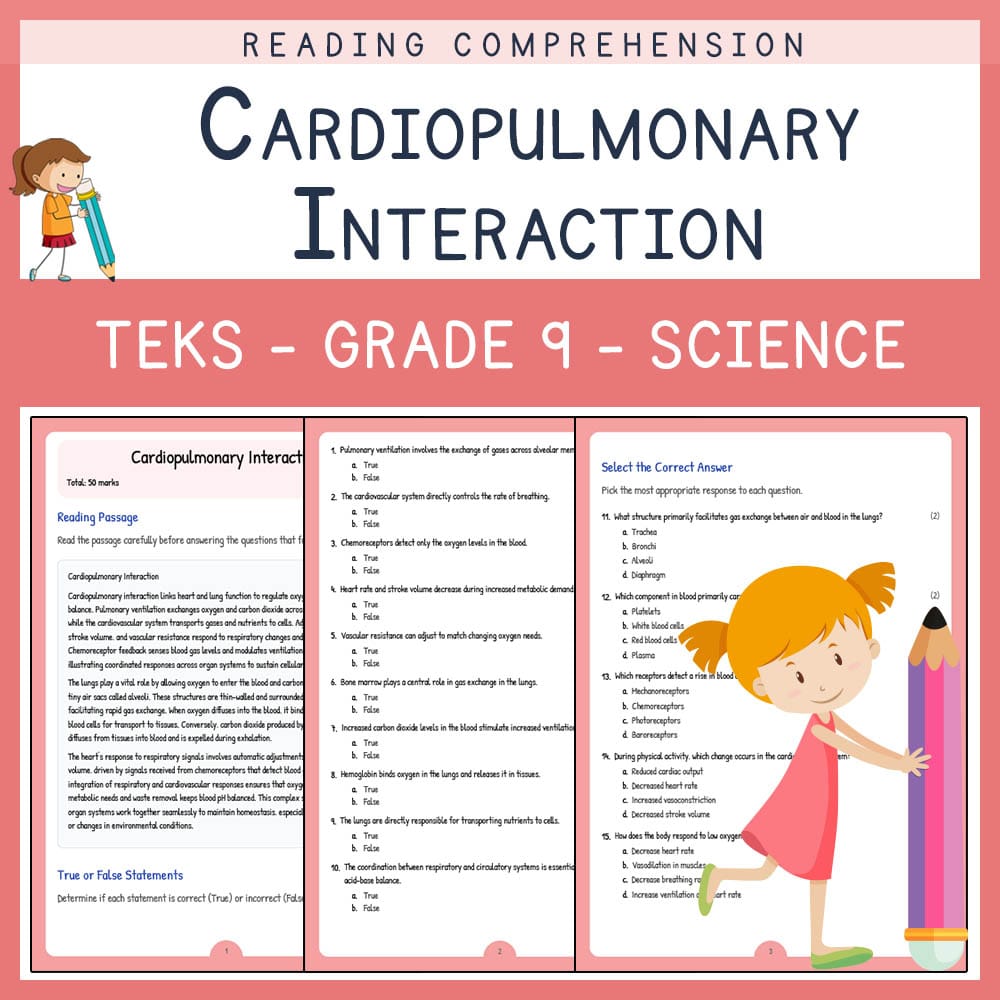
Grade 9 Science | Cardiopulmonary Interaction Worksheet | TEKS Aligned
Created byLumora LearningLearning Objectives
- Explain how the heart and lungs work together to supply oxygen and remove carbon dioxide.
- Identify the roles of pulmonary ventilation and cardiovascular transport in maintaining homeostasis.
- Describe how chemoreceptors regulate respiratory and circulatory responses to blood gas levels.
Instant download

Rock Cycle Practice Worksheets | Grade 9 Science Assessment
Created byPrism Point LearningLearning Objectives
- Explain how melting, crystallization, weathering, erosion, deposition, and metamorphism connect to form the rock cycle.
- Describe how energy sources and relative rates influence transitions in the rock cycle.
- Use observable field evidence (foliation, sedimentary layering, igneous intrusions) to identify rock-cycle processes.
Also included in: Grade 9 Earth and Space Science Lesson Bundle Worksheets | Ontario
Instant download

Grade 9 Science | Matter Cycling in Ecosystems Worksheet | California Standards
Created byLumora LearningLearning Objectives
- Explain how matter cycles through ecosystems as producers, consumers, and decomposers transform nutrients and release elements back to the environment.
- Use the idea of conservation of matter to describe how chemical elements move across trophic levels.
- Differentiate the roles of photosynthesis/chemical building, feeding and respiration/excretion, and decomposition in nutrient cycling.
Instant download

Grade 9 Enzyme Basics Daily Reading Worksheet | TEKS Biology Science
 Created byBRIGHT PATH RESOURCES
Learning Objectives
- Explain how enzymes lower activation energy to speed up reactions
- Use key vocabulary (enzyme, substrate, active site, activation energy, catalyst, transition state)
- Describe how enzyme–substrate specificity depends on protein structure
Also included in: Grade 9 Metabolism and Energy Processes Biology Worksheets Bundle | TEKS +1 more
Instant download

Grade 9 Science | Reaction Conservation in Chemistry - Reading Comprehension
 Created byCoral Reef Learning
Learning Objectives
- Understand the principle of conservation of atoms in chemical reactions
- Identify how atoms are rearranged during reactions
- Differentiate between exothermic and endothermic reactions based on energy transfer
Instant download

Grade 9 Science | Orbital Cycles Worksheet | BC Standards
Created byLumora LearningLearning Objectives
- Understand the relationships among Earth's, Sun's, and Moon's orbits that produce lunar phases, seasons, and tides.
- Explain how Earth's axial tilt and orbital eccentricity influence climate and seasonal variations.
- Describe the gravitational interactions between Earth, Moon, and Sun that generate tidal patterns.
Also included in: Grade 9 Science | Earth Systems Unit Bundle | BC Aligned Worksheets
Instant download

Grade 9 Science | Reaction Quantities in Chemistry - Daily Reading Comprehension
Created byCoral Reef LearningLearning Objectives
- Understand what coefficients in balanced chemical equations represent
- Interpret ratios of coefficients to determine relative amounts of reactants and products
- Relate symbolic coefficients to real-world mass relationships in chemical reactions
Also included in: Matter and Chemical Change Lesson Bundle – Grade 9 Science Alberta +1 more
Instant download

Grade 9 Science | Carbon Pathways - Daily Reading Comprehension
Created byCoral Reef LearningLearning Objectives
- Identify and describe major carbon reservoirs on Earth
- Understand the fluxes that transfer carbon among different reservoirs
- Explain the role of biological processes like photosynthesis and respiration
Instant download

Grade 9 Science Worksheet | Gene Expression TEKS (PDF) for Practice
Created byEvergreen Desk EducationLearning Objectives
- Explain how transcription and translation convert DNA information into a functional protein.
- Identify the roles of key molecules involved in gene expression (RNA polymerase, mRNA, ribosome, tRNA).
- Describe how regulation at transcriptional and translational stages affects when and how much a gene is expressed.
Instant download
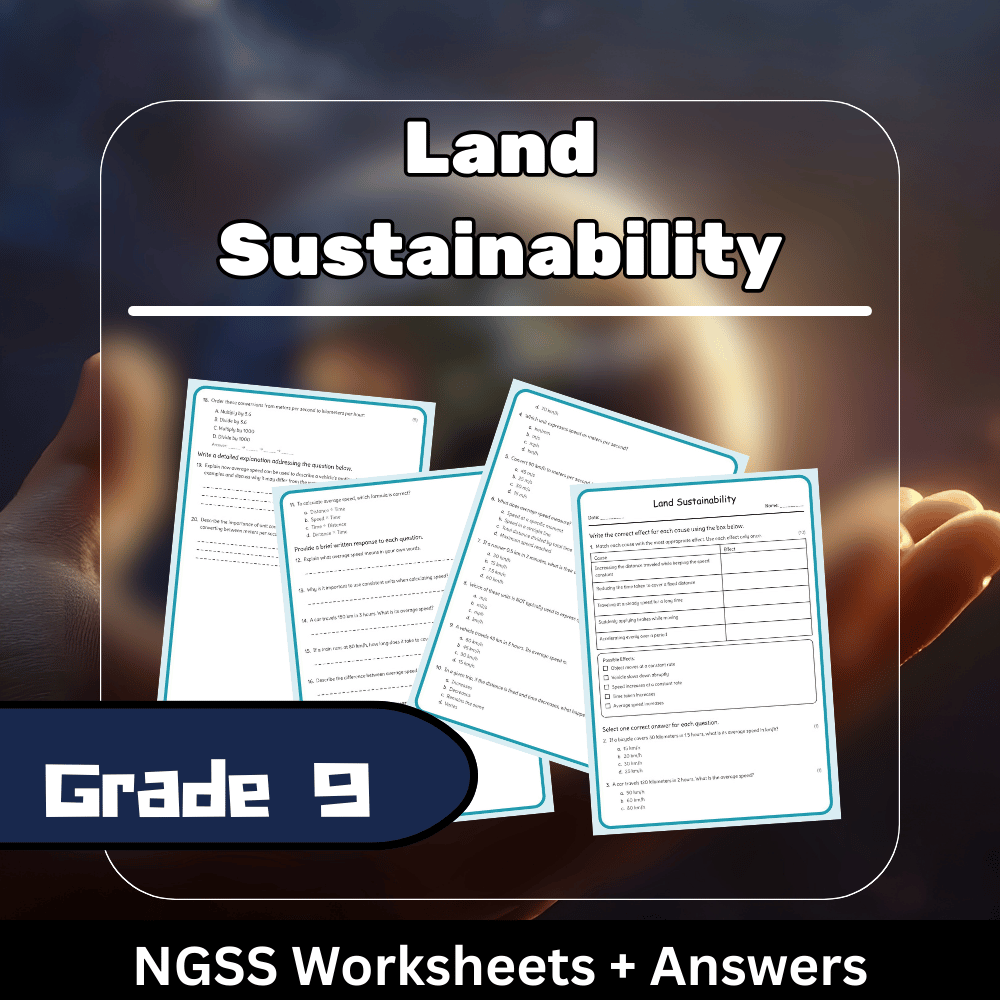
Grade 9 Science | Land Sustainability NGSS Worksheet (Answer Key) PDF
Created byBright Mind ResourcesLearning Objectives
- Understand the key concepts of land and water interactions in ecosystems.
- Identify practices that contribute to soil conservation and watershed management.
- Analyze trade-offs among agricultural productivity, biodiversity, and watershed health.
Instant download

Grade 9 Science | Integrated Analysis Worksheet (Alberta Standards) (PDF)
Created byEvergreen Desk EducationLearning Objectives
- Use kinematic relations to describe motion with acceleration along a straight line
- Apply net force reasoning (force balances) to predict changes in velocity and stopping behavior
- Combine energy considerations with friction and incline/grade effects to estimate stopping distance
Instant download
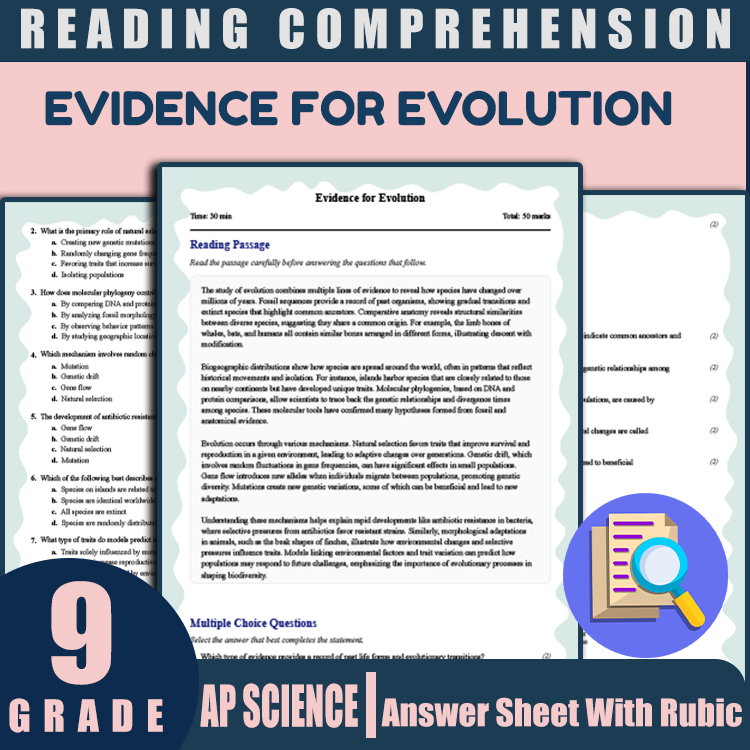
9th Grade Science | Evidence for Evolution Reading Worksheet & Answer Key (PDF)
JCreated byJ.S SheetsLearning Objectives
- Understand and interpret multiple lines of evidence supporting evolution, including fossil records, comparative anatomy, biogeography, and molecular data.
- Describe mechanisms such as natural selection, genetic drift, gene flow, and mutation that influence evolution and adaptation.
- Evaluate scenarios like antibiotic resistance and environmental adaptations in the context of evolutionary principles.
Instant download

Grade 9 Chemical Properties Worksheet | Ontario Science + Answer Key
Created byClear Sky ClassroomLearning Objectives
- Describe chemical properties as tendencies to undergo specific chemical changes.
- Identify evidence of chemical change (gas evolution, precipitate formation, permanent color change, and energy exchange).
- Differentiate chemical changes from physical changes using observation-based reasoning.
Instant download

Grade 9 Science | Gravity & Orbits - Daily Reading Comprehension
Created byCoral Reef LearningLearning Objectives
- Understand the basic concepts of gravity
- Learn how gravity influences the motion of planets and moons
- Recognize the patterns of orbit in the solar system
Instant download

Human Impacts on Ecosystem Services Reading | Grade 9 TEKS Science
Created byBRIGHT PATH RESOURCESLearning Objectives
- Identify the main idea and key details about human impacts on biodiversity and ecosystem services.
- Explain how human actions can change habitats and species interactions.
- Describe how changes in biodiversity can affect ecosystem services such as pollination and water purification.
Also included in: Grade 9 Ecology Environmental Science Reading Worksheets Bundle | TEKS +1 more
Instant download

Grade 9 Science – Meiosis & Genetic Variation | Daily Reading Worksheet
Created byBright Mind ResourcesLearning Objectives
- Describe the process of meiosis and how it contributes to genetic diversity.
- Identify key events during meiosis such as crossing over and independent assortment.
- Explain how meiosis results in genetically unique gametes and offspring.
Also included in: Selection Grade 9 Science Daily Reading Worksheets Lesson Bundle | FL NGSSS +1 more
Instant download

Grade 9 Science | Periodic Patterns Worksheet | California Standards
Created byLumora LearningLearning Objectives
- Explain how atomic structure (especially outer electron arrangement) creates repeating patterns on the periodic table.
- Use periodic table groups and periods to predict trends in reactivity and typical ion charge.
- Justify how similar electron configurations lead to similar chemical behavior across a group.
Instant download
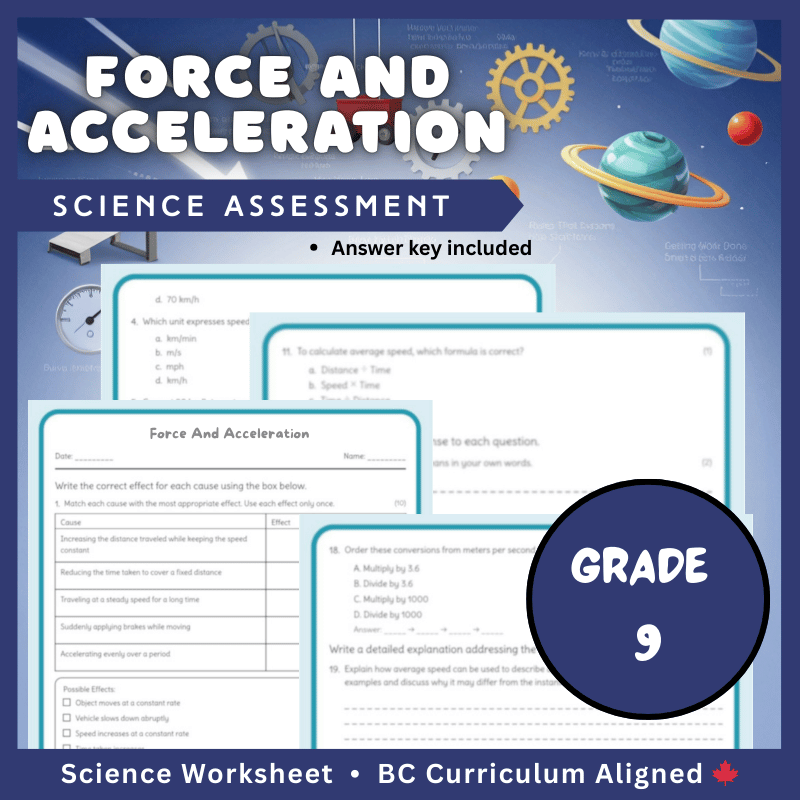
Grade 9 Science | Force and Acceleration Worksheet + Answer Key (PDF)
Created byBright Mind ResourcesLearning Objectives
- Explain the relationship between net force, mass, and acceleration.
- Describe how the direction of force affects the acceleration of an object.
- Calculate acceleration given net force and mass using the proportional rule.
Instant download
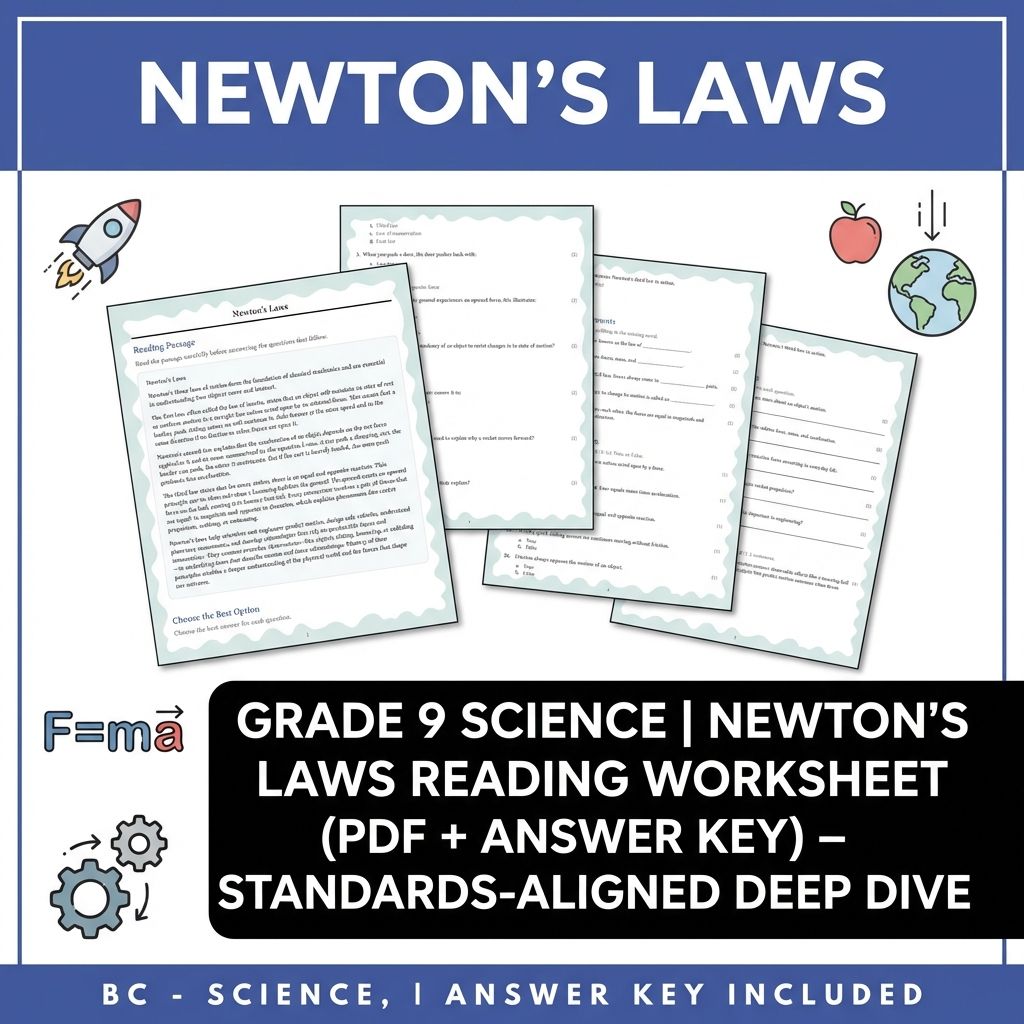
Grade 9 Science | Newton's Laws Worksheet (PDF + Answer Key)
JCreated byJ.S SheetsLearning Objectives
- Understand and describe Newton's three laws of motion.
- Connect observable motions, such as a puck sliding or bouncing ball, to Newtonian principles.
- Explain how forces and interactions predict motion outcomes.
Instant download

Cell Functions and Homeostasis Worksheets: Grade 9 Life Science
Created byBRIGHT PATH RESOURCESLearning Objectives
- Explain how cell membranes regulate transport of nutrients and wastes
- Describe how cells use energy to power chemical reactions needed for growth
- Use models to predict how cells maintain internal balance and respond to environmental changes
Also included in: Grade 9 Life Science Worksheets Bundle: Energy, Genetics & Ecosystems +1 more
Instant download

Climate Variability Worksheets | Long-Term Data Grade 9 Science
Created byBRIGHT PATH RESOURCESLearning Objectives
- Explain how climate variability is identified by comparing many weather measurements over time
- Differentiate climate variability from persistent climate change
- Interpret how ocean-atmosphere shifts can change regional weather patterns
Also included in: Grade 9 Earth Science Worksheets Bundle: Climate, Cycles & Space +1 more
Instant download

Gravity and Orbital Motion Worksheets | Grade 9 Science
Created byBRIGHT PATH RESOURCESLearning Objectives
- Explain how gravity provides the centripetal force that keeps objects in curved orbits
- Describe how orbital speed and distance relate as an object moves around a central body
- Use observations of repeating sky patterns to connect them to regular orbital periods
Also included in: Grade 9 Earth Science Worksheets Bundle: Climate, Cycles & Space +1 more
Instant download

Carbon & Water Cycles: Reservoirs and Feedbacks Worksheets Grade 9
Created byBRIGHT PATH RESOURCESLearning Objectives
- Explain how exchange rates between reservoirs change carbon in the atmosphere over time.
- Distinguish short-term cycling from slow geologic movement of carbon through rocks.
- Describe how temperature and precipitation control when water stored in ice or groundwater returns to the cycle.
Also included in: Grade 9 Earth Science Worksheets Bundle: Climate, Cycles & Space +1 more
Instant download

Ecosystem Interaction Cascades Worksheets: Grade 9 Life Science
Created byBRIGHT PATH RESOURCESLearning Objectives
- Explain how predation, competition, and mutualism are represented in ecosystem interaction networks.
- Analyze how changes in one population can cascade through food and resource relationships.
- Interpret how abiotic factors like water, temperature, and nutrients affect survival and growth.
Also included in: Grade 9 Life Science Worksheets Bundle: Energy, Genetics & Ecosystems +1 more
Instant download

Grade 9 Particle Model of Matter Worksheet | Alberta Science Chemistry
Created byBRIGHT PATH RESOURCESLearning Objectives
- Describe matter using a particulate model with discrete particles
- Explain how particle motion and spacing relate to diffusion
- Use kinetic energy and collisions to justify differences between solids, liquids, and gases
Instant download

Grade 9 Observable Properties & Material Identification | Alberta Science
Created byBRIGHT PATH RESOURCESLearning Objectives
- Define observable properties and explain why they are useful for identifying materials.
- Distinguish between physical properties and ways we measure or describe them.
- Use examples of colour, hardness, conductivity, density, and solubility to classify substances.
Instant download

Grade 9 Electrical Safety Standards and Codes Worksheet | Alberta Science
Created byBRIGHT PATH RESOURCESLearning Objectives
- Explain why electrical safety standards exist and what hazards they reduce
- Identify what grounding, overcurrent protection, and insulation are meant to do
- Interpret basic device label terms (grounding, rating, and approved use) in everyday scenarios
Instant download

Grade 9 Series and Parallel Mixed Circuits Worksheet | Alberta Science
Created byBRIGHT PATH RESOURCESLearning Objectives
- Distinguish series and parallel connections in a mixed (combined) circuit
- Predict how voltage and current behave within series vs. parallel branches
- Use circuit reasoning to trace where current can split and where it must remain the same
Instant download

Grade 9 Breeding Strategies, Inheritance & Regulation Science Worksheet
Created byBRIGHT PATH RESOURCESLearning Objectives
- Identify cause-and-effect links between propagation choices and genetic diversity.
- Explain how chromosomes and Mendelian patterns can transmit selected traits.
- Describe variation sources and how selection can change trait frequencies in populations over generations.
Instant download

Grade 9 Acid Deposition & Limestone Chemistry Worksheet | Alberta Science
Created byBRIGHT PATH RESOURCESLearning Objectives
- Identify observable evidence of chemical change from acid deposition on limestone
- Explain particulate and atomic ideas for how acids affect carbonate minerals
- Use mass conservation ideas to describe measurable mass changes across a system boundary
Instant download
About Grade 9 Science Worksheets
Find Science worksheets built for Grade 9. All 6,926 cover core skills, practice, and review, each an instant PDF download.
Every worksheet on MyTeachingSheets is created by independent teacher-authors and reviewed before publication. All resources download as printable PDFs for classroom, homework, or at-home practice, and many include answer keys. Preview any worksheet free before buying.