
Grade 9 Science Worksheets
6,926 worksheets
Grade 9 Bond Formation Worksheet | Practice & Assessment PDF
 Created byClear Sky Classroom
Learning Objectives
- Explain how electron behavior leads to ionic and covalent bond formation.
- Compare how ionic and covalent bonding affect material properties such as melting point and conductivity.
- Use an atomic model to predict how substances respond to stress (breaking apart).
Instant download

Grade 9 Plate Tectonics Worksheet | Ontario Science with Answer Key
Created byClear Sky ClassroomLearning Objectives
- Explain how plate motions at divergent, convergent, and transform boundaries produce distinct surface features and hazards
- Describe how subduction and continental collision contribute to volcanism and mountain building
- Use earthquake and volcanic arc patterns to support the idea that lithospheric plates interact
Instant download

Grade 9 Chemical Bonding Worksheet | NGSS Chemistry Science Activity
 Created byBRIGHT PATH RESOURCES
Learning Objectives
- Understand the concept of ionic bonding and electron transfer
- Identify properties of ionic compounds
- Differentiate between ionic and covalent bonds
Also included in: Atomic Structure & Chemical Reactions Lesson Bundle | Grade 9 Science | NGSS +1 more
Instant download

Separating Mixtures Using Physical Properties Worksheets Grade 9
 Created byPrism Point Learning
Learning Objectives
- Differentiate homogeneous and heterogeneous mixtures using particle-level descriptions
- Identify physical properties used by common mixture separation methods
- Match filtration, distillation, magnetic separation, and decanting to properties
Also included in: Matter and Chemical Change Lesson Bundle | Grade 9 Science | Ontario +1 more
Instant download

Environmental Health Worksheets: Chronic Disease Grade 9 Science
Created byPrism Point LearningLearning Objectives
- Explain how environmental exposures can contribute to chronic disease
- Describe how dose–response relationships affect health risk
- Identify vulnerability factors that change health outcomes
Also included in: Grade 9 Science Lesson Bundle: Human Homeostasis & Cell Systems | Ontario +1 more
Instant download

Grade 9 Stellar Evolution Worksheet | NGSS Space Science Activity & Notes
Created byBRIGHT PATH RESOURCESLearning Objectives
- Understand the different stages of star formation and evolution.
- Identify key features of the Hertzsprung-Russell diagram.
- Describe the processes leading to different stellar end states such as white dwarfs, neutron stars, and black holes.
Also included in: Space Science Evolution & Timescales Daily Reading Grade 9 Lesson Bundle | NGSS +1 more
Instant download

Grade 9 Science Worksheet – Combined Circuits Practice (Alberta Standards) (PDF)
 Created bySilver Birch Teaching
Learning Objectives
- Simplify mixed (series-parallel) circuit networks by identifying equivalent resistances
- Apply Ohm’s law and series/parallel rules to determine current and voltage trends in combined circuits
- Trace current paths through branches to analyze how loads behave in real systems
Also included in: Grade 9 Electrical Circuits and Energy Science Lesson Bundle (Alberta) +1 more
Instant download

Weather Data Patterns Worksheet | Grade 9 Science Activities
Created byPrism Point LearningLearning Objectives
- Explain how temperature, humidity (dew point), wind, and air pressure relate to observable weather patterns.
- Use weather data trends and short-term variability to distinguish typical weather from changing climate signals.
- Interpret relationships in datasets using reasoning about air mass movement and energy exchange near Earth’s surface.
Instant download

Earth's Planetary Layers and Evidence Worksheets Grade 9 Science
Created byPrism Point LearningLearning Objectives
- Identify Earth’s main layers and their changing physical conditions
- Compare lithosphere and asthenosphere using mechanical behavior
- Explain how seismic waves reveal Earth’s internal structure
Also included in: Earth and Space Systems Lesson Bundle – Grade 9 Science Ontario +1 more
Instant download
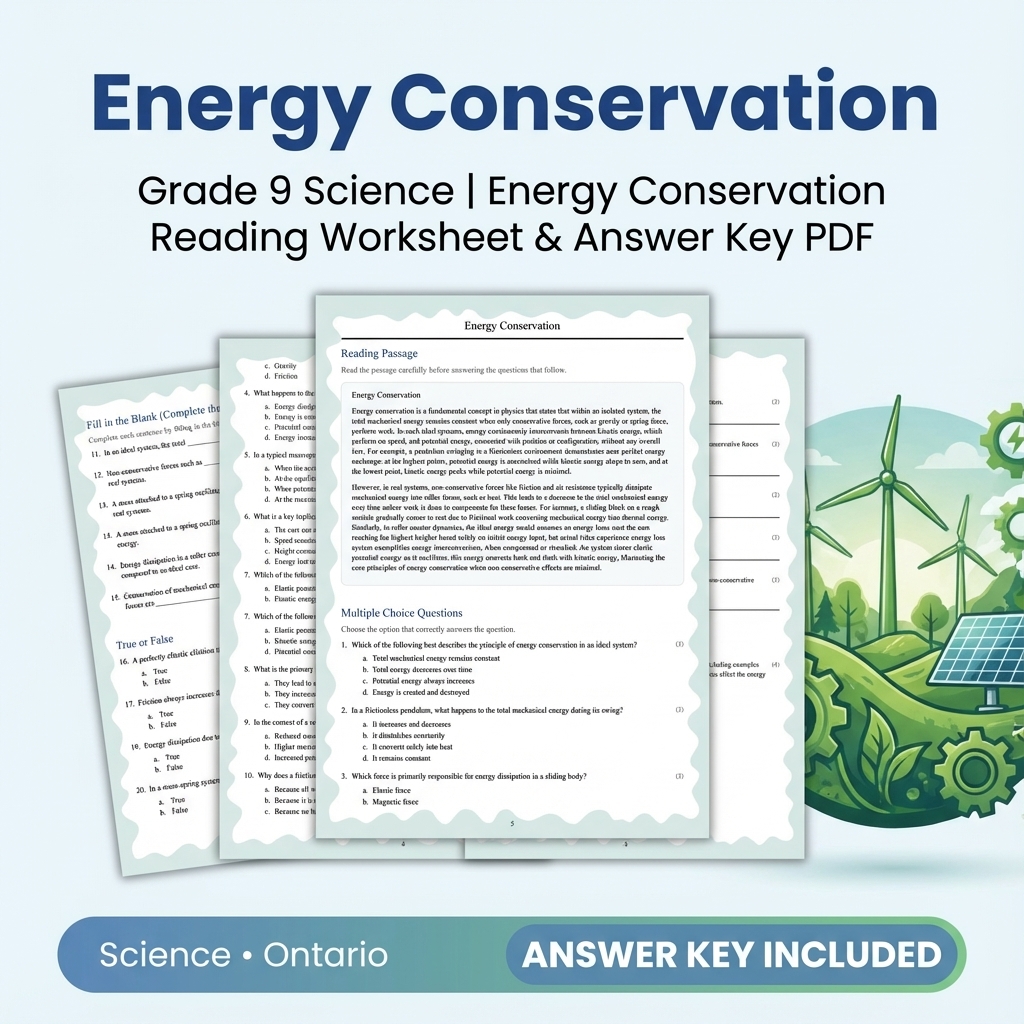
Grade 9 Science | Energy Conservation Reading Worksheet & Answer Key PDF
JCreated byJ.S SheetsLearning Objectives
- Understand the principles of mechanical energy conservation in ideal systems.
- Explain how kinetic and potential energies interconvert in systems with negligible non-conservative forces.
- Identify the effects of non-conservative forces like friction on energy dissipation.
Also included in: Grade 9 Science Unit | Force, Motion & Energy Worksheets & Answer Keys Bundle +1 more
Instant download

Grade 9 Science – Genetic Variation Sources Worksheet (PDF) Alberta Standards
Created bySilver Birch TeachingLearning Objectives
- Identify major sources of genetic variation, including mutation, recombination, gene flow, and chromosomal rearrangements.
- Explain how these processes change allele combinations and allele frequencies within and between populations.
- Evaluate how human actions (e.g., introductions, managed breeding, hybridization) can affect genetic diversity and evolutionary outcomes.
Also included in: Grade 9 Genetics and Reproduction Science Lesson Bundle Worksheets – Alberta +1 more
Instant download

Grade 9 Decision Modeling in Science NGSS Scientific Practices Worksheet
Created byBRIGHT PATH RESOURCESLearning Objectives
- Understand the role of systems and decision models in environmental science.
- Explore how scenario analysis, cost-benefit, and lifecycle assessments inform mitigation strategies.
- Analyze trade-offs among greenhouse gas reduction, health, and economic development.
Also included in: Energy & Env Grade 9 Science Daily Reading Worksheets Lesson Bundle | NGSS +1 more
Instant download

Chemical Change Evidence Worksheets Grade 9 Science
Created byPrism Point LearningLearning Objectives
- Identify observable evidence that indicates a chemical change
- Distinguish chemical changes from physical changes
- Explain how reactants become products through bond rearrangement
Also included in: Matter and Chemical Change Lesson Bundle | Grade 9 Science | Ontario +1 more
Instant download
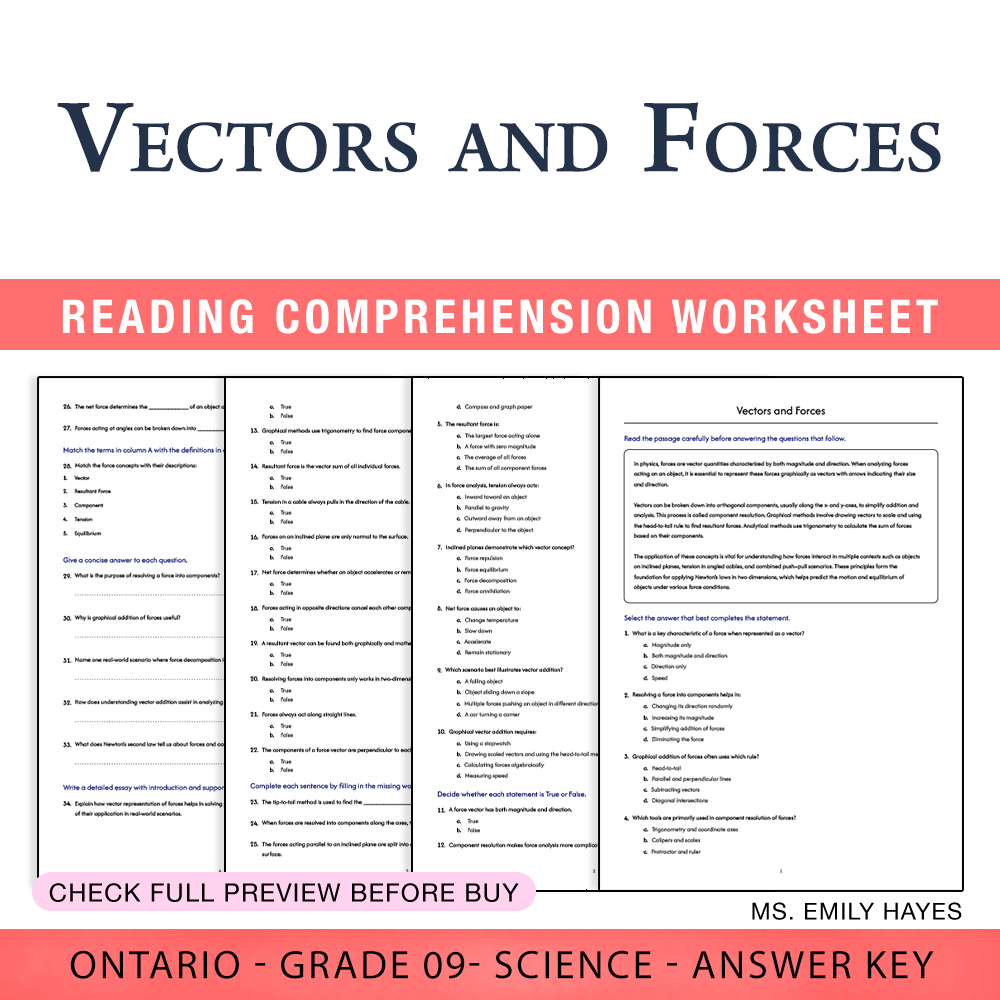
9th Grade Science | Vectors and Forces Worksheet (PDF + Answer Key)
 Created byCopper Leaf Classroom
Learning Objectives
- Understand how to represent forces as vectors including magnitude and direction
- Learn to resolve forces into components using graphical and analytical methods
- Calculate the resultant of combined forces and analyze their effects
Instant download

Grade 9 Science – Understanding the Rock Cycle | Daily Reading Worksheet
 Created byBright Mind Resources
Learning Objectives
- Describe the processes involved in the rock cycle, including melting, crystallization, weathering, erosion, deposition, and metamorphism.
- Explain how plate tectonics influence the formation and transformation of rocks.
- Identify observable evidence in the field, such as foliated textures and layering, that supports the rock cycle.
Also included in: Grade 9 Earth & Space Science Daily Reading Worksheets Lesson Bundle | Ontario +1 more
Instant download

Chemical Formulas and Definite Composition Worksheets Grade 9
Created byPrism Point LearningLearning Objectives
- Interpret chemical formulas to identify fixed elemental ratios
- Explain the law of definite composition using chemical formulas
- Compare ionic and covalent bonding using electron behavior
Also included in: Matter and Chemical Change Lesson Bundle | Grade 9 Science | Ontario +1 more
Instant download

Element Identity and Atomic Structure Worksheets Grade 9 Science
Created byPrism Point LearningLearning Objectives
- Explain how proton number determines an element's identity
- Identify elements using chemical symbols and atomic models
- Distinguish metallic and nonmetallic elements using physical traits
Also included in: Matter and Chemical Change Lesson Bundle | Grade 9 Science | Ontario +1 more
Instant download
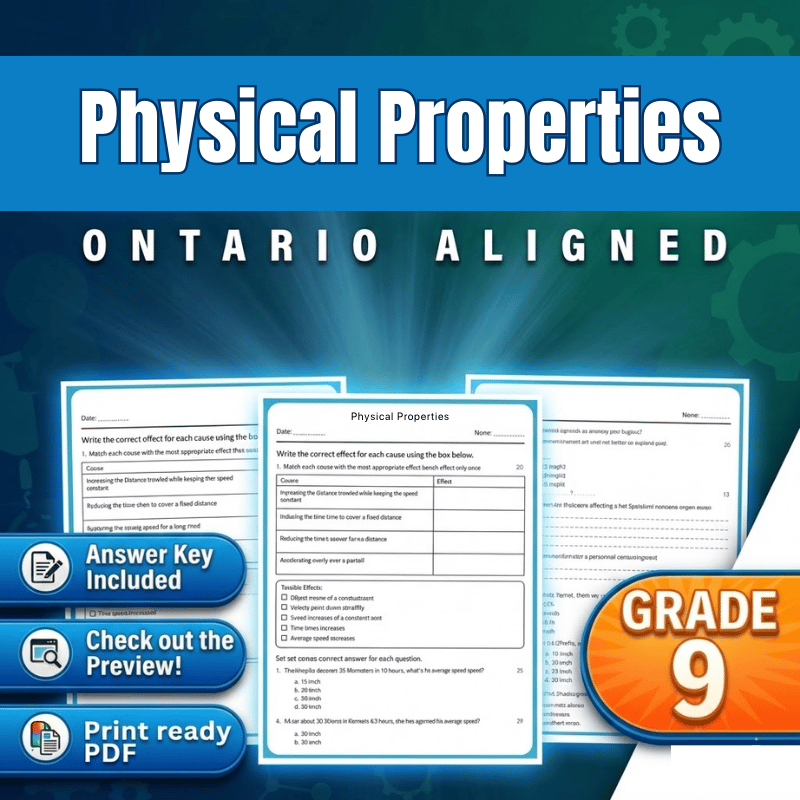
Grade 9 Science Worksheet – Physical Properties (Ontario, Science) PDF
Created byBright Mind ResourcesLearning Objectives
- Define physical properties as observable or measurable characteristics that do not change chemical identity.
- Identify examples of physical properties such as density, melting point, boiling point, colour, hardness, and conductivity.
- Explain how physical properties are used to classify and separate materials.
Instant download

Immune System Worksheets: Innate and Adaptive Immunity Grade 9
Created byPrism Point LearningLearning Objectives
- Identify physical barriers that protect the body from pathogens
- Explain how macrophages and inflammation support innate immunity
- Describe how antigen recognition activates adaptive immune responses
Also included in: Grade 9 Science Lesson Bundle: Human Homeostasis & Cell Systems | Ontario +1 more
Instant download

Population Genetics Worksheet | AP Science Grade 9 Practice
JCreated byJ.S SheetsLearning Objectives
- Understand the mechanisms that cause allele frequencies to change in populations, including selection, drift, migration, and mutation.
- Explain the Hardy-Weinberg equilibrium as a null model for population genetics.
- Describe how fitness landscapes and selection coefficients influence evolution.
Also included in: Grade 9 Science | DNA and Ecosystems Lesson Group Bundle
Instant download
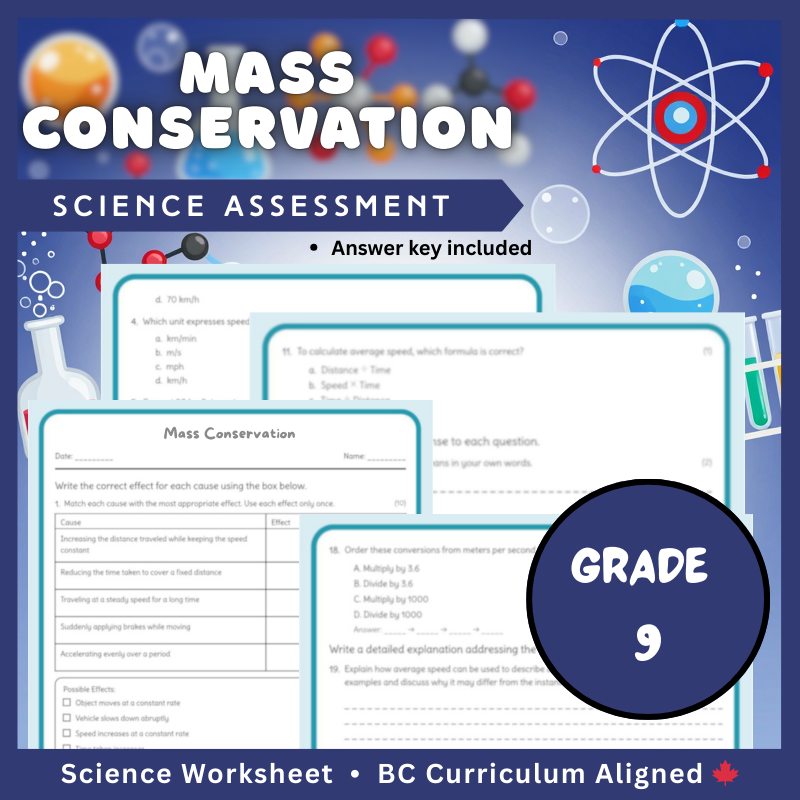
Grade 9 Science | Mass Conservation Worksheet + Answer Key (PDF)
Created byBright Mind ResourcesLearning Objectives
- Explain the law of conservation of mass and its significance in chemistry.
- Identify how balanced chemical equations reflect mass conservation.
- Relate measurable mass changes to molecular rearrangements during reactions.
Instant download

Grade 9 Science Worksheet | Balancing Equations (PDF) with Alberta Standards
 Created byEvergreen Desk Education
Learning Objectives
- Explain how balancing a chemical equation enforces conservation of atoms.
- Use coefficients to determine reactant and product atom counts on both sides of an equation.
- Connect balanced equations to measurable mass relationships in real-world reactions.
Instant download

Physical Changes and Energy in Phase Transitions Worksheets Grade 9
Created byPrism Point LearningLearning Objectives
- Describe physical changes without altering chemical identity
- Classify common phase changes as reversible or irreversible
- Explain energy transfer during melting, freezing, and condensation
Also included in: Matter and Chemical Change Lesson Bundle | Grade 9 Science | Ontario +1 more
Instant download

Grade 9 Science | Error Sources in Scientific Experiments - Reading Comp.
 Created byCoral Reef Learning
Learning Objectives
- Understand key concepts related to Science
- Apply knowledge through practice questions
- Demonstrate comprehension of the material
Also included in: Science Practices Lesson Bundle – Grade 9 Science, Advanced Placement Reading +1 more
Instant download

Grade 9 Science – Tissue Structure Daily Reading Worksheet + Answer Key
JCreated byJ.S SheetsLearning Objectives
- Identify different types of epithelial tissue and understand their functions.
- Describe the structure and support roles of connective tissues.
- Explain how muscle tissues generate force and movement.
Also included in: Grade 9 Science Lesson Bundle | TEKS Aligned Daily Reading Worksheets +1 more
Instant download

Climate Variability Worksheet Grade 9 Science NGSSS Weather Climate
Created byEvergreen Desk EducationLearning Objectives
- Explain how climate variability differs from long-term climate trends
- Describe how ocean-atmosphere interactions (El Niño and La Niña) redistribute heat and moisture
- Use evidence from multiple timescales and regions to distinguish natural variability from sustained climate change
Instant download

Friction and Fluid Drag Worksheets Grade 9 Physics
Created byPrism Point LearningLearning Objectives
- Distinguish static friction from kinetic friction during motion
- Apply the friction approximation F = μN to resistive forces
- Describe how speed, area, and density affect fluid drag
Also included in: Physics: Forces and Energy Lesson Bundle | Grade 9 Science | Ontario +1 more
Instant download
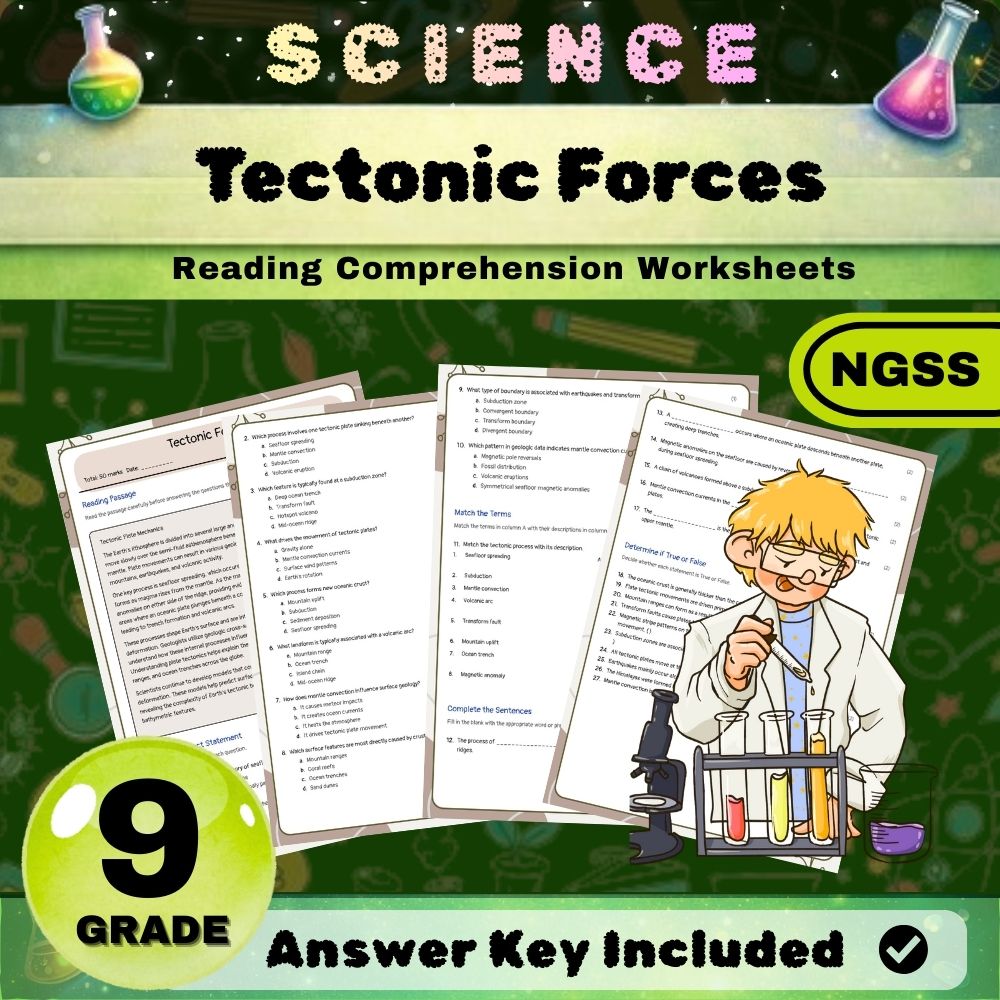
Grade 9 Science – Tectonic Forces Worksheet (NGSS) – PDF
 Created byMaple Path Learning
Learning Objectives
- Explain the mechanisms of seafloor spreading, subduction zones, and volcanic arc systems.
- Model Earth's internal processes, including mantle convection and crustal deformation.
- Analyze geologic cross-sections and seafloor magnetic anomaly patterns as evidence for plate tectonics.
Also included in: Grade 9 Science | Earth's Systems NGSS Unit Bundle (NGSS-Aligned Instruction) +1 more
Instant download

Grade 9 Science Worksheet | Balancing Equations (PDF) – Ontario Standards
Created byEvergreen Desk EducationLearning Objectives
- Explain why chemical equations must be balanced to reflect conservation of atoms and mass
- Interpret reactants, products, and coefficients in a chemical equation
- Balance simple equations using particle counts represented by coefficients
Also included in: Grade 9 States & Energy to Chemical Reactions Science Lesson Bundle (Ontario) +1 more
Instant download

Grade 9 Science – DNA to Proteins Daily Reading Worksheet | California Standards
Created byBright Mind ResourcesLearning Objectives
- Understand the structure and components of DNA
- Explain how DNA transcribes into RNA
- Describe how proteins are assembled from amino acids
Also included in: Evolution Grade 9 Science Daily Reading Worksheets Lesson Bundle | CA Standards +1 more
Instant download

Grade 9 Science | Molecular Geometry Worksheet (PDF) – BC Standards
Created byEvergreen Desk EducationLearning Objectives
- Use VSEPR electron-pair repulsion to predict the 3D shape of common molecules.
- Connect molecular geometry to polarity and intermolecular forces.
- Relate molecular shape to macroscopic properties such as boiling point and solubility.
Instant download

Grade 9 Science – Model-Data Fit Worksheet (AP Standards + Practice)
Created byEvergreen Desk EducationLearning Objectives
- Use residual plots and graphical overlays to evaluate how well a model matches empirical data
- Interpret patterns in residuals to diagnose systematic errors, heteroscedasticity, and missing variables
- Select appropriate goodness-of-fit ideas and justify whether to accept, modify, or reject a model
Also included in: Grade 9 Scientific Reasoning & Uncertainty in Science Lesson Bundle AP +1 more
Instant download

Grade 9 Science — Sources of Genetic Variation Worksheet PDF + Answer Key
 Created byThe Resource Hub
Learning Objectives
- Define and identify sources of genetic variation including mutation, recombination, gene flow, and chromosomal rearrangements.
- Explain how different sources of variation contribute to genetic diversity and evolution.
- Analyze examples of genetic variation mechanisms in real-world or regional contexts.
Also included in: Grade 9 Science Lesson Bundle | Reproduction and Heredity Worksheets +1 more
Instant download

Apparent Motion of the Sky Worksheets | Grade 9 Earth & Space
Created byPrism Point LearningLearning Objectives
- Explain how Earth’s rotation produces daily apparent sky motion
- Explain how Earth’s revolution produces yearly sky changes
- Interpret altitude and azimuth for rising celestial objects
Also included in: Earth and Space Systems Lesson Bundle – Grade 9 Science Ontario +1 more
Instant download

Grade 9 Science – Carbon Pathways & Reservoirs | Daily Reading Worksheet
 Created byQuiet Forest Education
Learning Objectives
- Identify the major carbon reservoirs in the Earth's system
- Understand the fluxes that transfer carbon among different reservoirs
- Describe the importance of each reservoir in the global carbon cycle
Also included in: Earth and Space Systems Grade 9 Science Daily Worksheets Bundle | Ontario +1 more
Instant download

Grade 9 Science Worksheet Natural Selection | Standards-Aligned Practice
JCreated byJ.S SheetsLearning Objectives
- Explain how variation, inheritance, and differential survival/reproduction lead to natural selection.
- Use the idea of fitness to predict how trait frequencies may change over generations.
- Distinguish natural selection from individual “life changes” and connect it to adaptation.
Also included in: Grade 9 Evolution, Genetics, and Ecosystems Science Lesson Bundle +1 more
Instant download

Ecosystem Change And Resilience Worksheet | Grade 9 Science Practice
Created byPrism Point LearningLearning Objectives
- Explain how disturbances can change ecosystem interactions and environmental conditions.
- Describe how feedback processes and recovery rates influence whether an ecosystem returns to its original state.
- Use evidence from population trends and community structure to argue for gradual versus rapid ecosystem shifts.
Instant download

Free-Body Diagrams Worksheets Grade 9 Physics Newton's Second Law
Created byPrism Point LearningLearning Objectives
- Identify external forces acting on an isolated object
- Draw force arrows using consistent direction and coordinate conventions
- Calculate net force from multiple forces acting on an object
Also included in: Physics: Forces and Energy Lesson Bundle | Grade 9 Science | Ontario +1 more
Instant download

Grade 9 Lunar Phases Worksheet | BC Use Practice PDF
Created byClear Sky ClassroomLearning Objectives
- Explain how the geometry between the Sun, Earth, and Moon determines lunar phase appearance from Earth.
- Describe how the synodic month relates to the predictable cycle of lunar phases.
- Use phase terminology (new, waxing, first quarter, waxing gibbous, full, waning) to interpret what fraction of the Moon’s disk is illuminated.
Instant download

Stellar Origins Worksheet for Grade 9 Science | Standards-Aligned Practice
JCreated byJ.S SheetsLearning Objectives
- Explain how stars produce elements through nuclear fusion.
- Describe the process by which explosive stellar events disperse matter into space.
- Connect stellar life cycles to the chemical composition of Earth and planets.
Also included in: Grade 9 Earth and Space Science Lesson Bundle: California Standards +1 more
Instant download
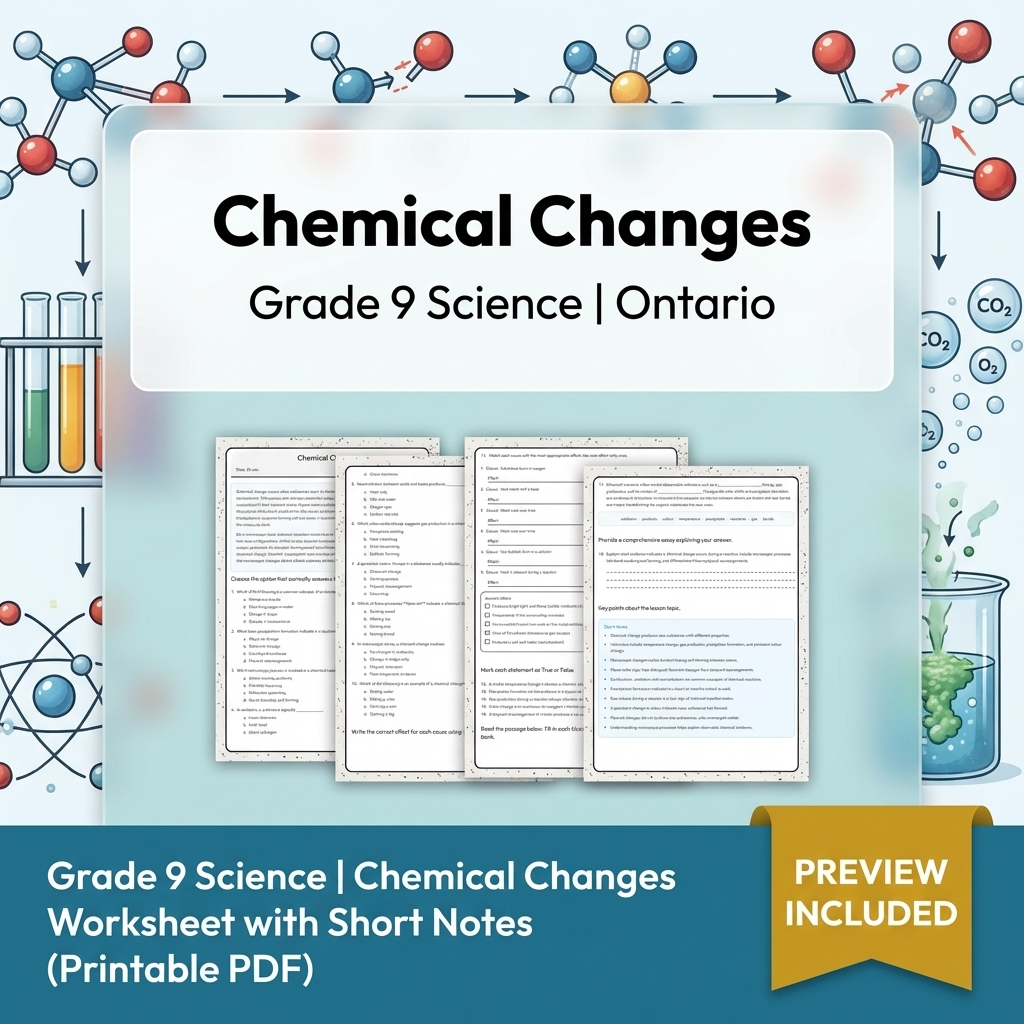
Grade 9 Science | Chemical Changes Worksheet with Short Notes (Printable PDF)
 Created byMeadowlark Worksheets
Learning Objectives
- Understand what constitutes a chemical change and how it produces new substances.
- Identify various indicators of chemical change such as temperature change, gas production, precipitate formation, and colour change.
- Distinguish observable chemical evidence from physical rearrangement of matter.
Also included in: Grade 9 Science Lesson Group Bundle | Ontario Curriculum Worksheets
Instant download

Alleles and Inheritance Worksheet Grade 9 Science Activity | NGSSS
Created byPrism Point LearningLearning Objectives
- Explain how alleles (gene variants) are inherited and how they influence traits
- Differentiate genotype and phenotype using dominance and recessiveness
- Describe how multiple alleles in a population and multiple genes can cause continuous variation
Also included in: Grade 9 Evolution, Genetics & Ecology Lesson Bundle | Florida NGSSS
Instant download
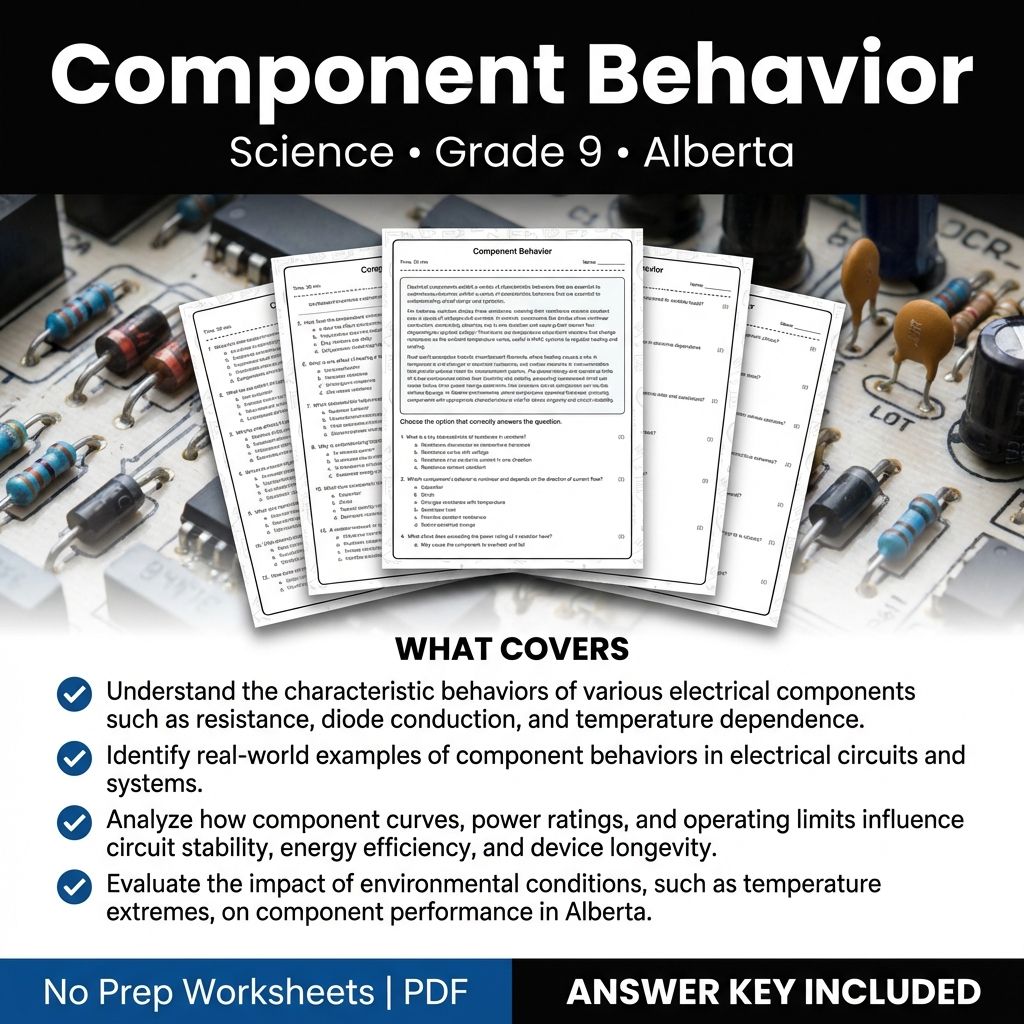
Component Behavior Worksheet for Grade 9 Science | Alberta Standards
Created byCoral Reef LearningLearning Objectives
- Understand the characteristic behaviors of various electrical components such as resistance, diode conduction, and temperature dependence.
- Identify real-world examples of component behaviors in electrical circuits and systems.
- Analyze how component curves, power ratings, and operating limits influence circuit stability, energy efficiency, and device longevity.
Instant download

Newtonian Motion Worksheet | NGSS Grade 9 Science Assessment
 Created bySkylark Worksheets
Learning Objectives
- Explain Newton’s three laws and relate net force, mass, and acceleration for objects moving under a constant mass assumption.
- Use vector reasoning and free-body diagrams to determine net force from multiple forces and their components.
- Solve quantitative problems by predicting acceleration and motion when forces act in different directions.
Also included in: Newtonian Motion, Momentum & Forces Lesson Bundle | Grade 9 Science | ngss +1 more
Instant download
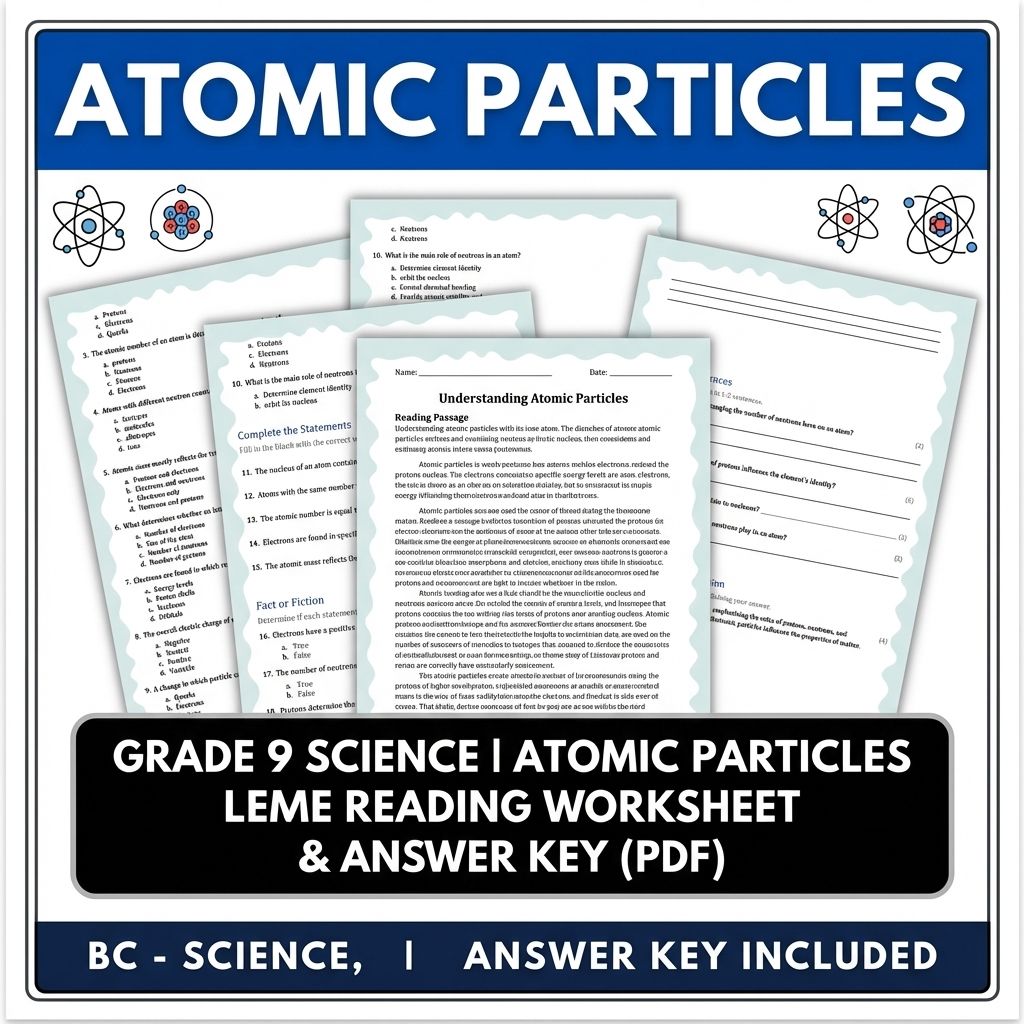
Grade 9 Science | Atomic Particles Reading Worksheet & Answer Key (PDF)
JCreated byJ.S SheetsLearning Objectives
- Understand the structure and components of an atom, including protons, neutrons, and electrons.
- Identify how the number of protons determines the element identity.
- Explain the significance of electron arrangement in chemical behavior and bonding.
Instant download

Graphing Motion Worksheet | Grade 9 Science Activities
Created byPrism Point LearningLearning Objectives
- Interpret displacement–time, velocity–time, and acceleration–time graphs by using slope and area.
- Explain how changes in slope on a motion graph relate to changing acceleration.
- Choose correct axis labels and scales to compare different motion profiles accurately.
Also included in: Forces, Motion & Energy Lesson Bundle | Grade 9 Science (Alberta)
Instant download

Particle Theory Practice Worksheet | Grade 9 Science Review
Created byPrism Point LearningLearning Objectives
- Explain how particle motion, spacing, and forces account for the macroscopic properties of solids, liquids, and gases.
- Describe how temperature relates to average kinetic energy and how that affects diffusion and gas pressure.
- Use particle interactions to predict how matter changes state and responds to heating or cooling.
Also included in: Grade 9 Chemistry Test Prep Science Lesson Bundle: Ontario Framework
Instant download

Renal Regulation Worksheet | Grade 9 Science Activities
Created byPrism Point LearningLearning Objectives
- Explain how the nephron supports filtration, reabsorption, and secretion to regulate water and electrolytes.
- Describe how ADH and the renin–angiotensin–aldosterone system respond to blood volume and osmolarity cues.
- Connect renal transport processes to changes in blood pressure and internal fluid balance.
Instant download
About Grade 9 Science Worksheets
Find Science worksheets built for Grade 9. All 6,926 cover core skills, practice, and review, each an instant PDF download.
Every worksheet on MyTeachingSheets is created by independent teacher-authors and reviewed before publication. All resources download as printable PDFs for classroom, homework, or at-home practice, and many include answer keys. Preview any worksheet free before buying.