
Grade 9 Science Worksheets
6,926 worksheets
Grade 9 Science – Climate Modeling & Earth System | Daily Reading Worksheet
 Created byBright Mind Resources
Learning Objectives
- Understand the purpose and importance of climate models.
- Identify key components and feedback mechanisms in climate models.
- Develop skills to comprehend scientific passages related to climate science.
Also included in: Grade 9 Science Worksheets: Space-to-Climate Lesson Bundle | Calif. Standards +1 more
Instant download

Grade 9 Science | Energy in Changes Worksheet | General Standards
 Created byLumora Learning
Learning Objectives
- Compare physical and chemical changes using system–surroundings energy transfer and particle-level explanations
- Determine whether a process is endothermic or exothermic based on the direction of heat flow and temperature changes
- Use particle motion, arrangement, and bond rearrangement ideas to explain observed temperature behavior
Instant download

Measurement Accuracy Assessment | General Grade 9 Science Standards
 Created byPrism Point Learning
Learning Objectives
- Understand the importance of appropriate scales, calibrated instruments, and units in measurement.
- Explain how significant figures reflect measurement precision and how to record data consistently.
- Recognize the importance of converting units accurately and expressing uncertainty ranges for fair comparisons.
Also included in: Grade 9 Scientific Inquiry Practices Science Lesson Bundle: General
Instant download

Energy Conversion Worksheet for Grade 9 Science | Assessment & Student Practice PDF
Learning Objectives
- Understand various devices and processes involved in energy conversion.
- Analyze the efficiency and energy bookkeeping during different energy transfer processes.
- Identify examples of photovoltaic cells, thermoelectric modules, and electrochemical cells.
Also included in: Grade 9 Science Energy Bundle | NGSS Lesson Worksheets +1 more
Instant download

Grade 9 Science – Understanding Vectors & Forces | Daily Reading Worksheet
Created byBright Mind ResourcesLearning Objectives
- Define vectors and understand their properties.
- Interpret force vectors in graphical and analytical formats.
- Resolve vectors into components along axes.
Also included in: Grade 9 Work, Energy & Forces Science Daily Reading Lesson Bundle | Ontario +1 more
Instant download

Energy Conservation Worksheet | Grade 9 Science Printable PDF Assessment
Learning Objectives
- Understand the concept of energy conservation within closed and open systems.
- Identify different forms of energy transfer and their representations.
- Apply mathematical models to analyze energy flow in electrical and chemical systems.
Also included in: Grade 9 Science Energy Bundle | NGSS Lesson Worksheets +1 more
Instant download
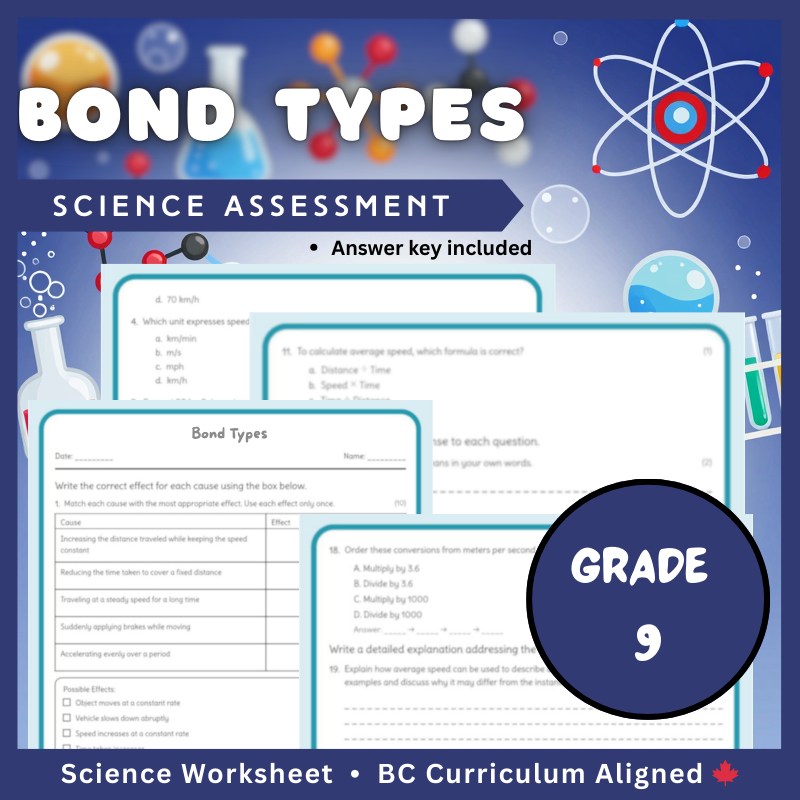
Grade 9 Science – Bond Types Worksheet (Worksheet + Answer Key) | BC Standards
Created byBright Mind ResourcesLearning Objectives
- Identify and describe different types of chemical bonds: ionic, covalent, and metallic.
- Explain how electron arrangements influence material properties.
- Recognize bond types from characteristic properties and behaviors.
Instant download

Grade 9 Friction and Drag Worksheet | NGSS Practice PDF
 Created byClear Sky Classroom
Learning Objectives
- Explain how friction and aerodynamic drag oppose motion and convert mechanical energy into thermal energy
- Use coefficients of friction and drag concepts to predict how surface texture, normal force, and speed affect resistance
- Interpret real-world examples (vehicles, sports equipment, pipelines, wind turbines) using qualitative cause-and-effect reasoning
Instant download

Genetic Transmission Worksheet | AP Science | Grade 9 Practice
JCreated byJ.S SheetsLearning Objectives
- Explain the mechanisms of inheritance, including chromosomal behavior during meiosis and Mendelian patterns.
- Identify deviations such as incomplete dominance, codominance, and linkage, and understand their effects on traits.
- Use pedigree analysis, Punnett squares, and probability calculations to predict genotypic and phenotypic ratios.
Also included in: Grade 9 Science | DNA and Ecosystems Lesson Group Bundle
Instant download

Feedback Principles Worksheet for Grade 9 Science | Standards-Aligned Practice
JCreated byJ.S SheetsLearning Objectives
- Explain how homeostatic feedback loops maintain internal stability using sensors, control centers, and effectors.
- Differentiate negative feedback from positive feedback based on how each responds to deviations from a set point.
- Apply feedback principles to real physiological examples such as blood pressure regulation and blood clotting.
Instant download

Comparative Structures Assessment | TEKS Grade 9 Science Worksheet
Created byPrism Point LearningLearning Objectives
- Understand how organelle forms vary across different cell types and taxa.
- Identify examples of structural adaptations in cellular organelles.
- Explain the functional significance of morphological differences in organelles.
Instant download

Fossil Records Worksheet | Grade 9 Science Activities
Created byPrism Point LearningLearning Objectives
- Explain how fossil records and stratigraphic layers can provide evidence about the timing of past life.
- Distinguish relative age (stratigraphy) from absolute age (radiometric dating) in fossil interpretation.
- Describe how taphonomy and preservation bias affect which organisms appear in the fossil record.
Also included in: Grade 9 Evolution & Speciation Lesson Bundle | TEKS Science
Instant download

Grade 9 Science – Tissue Types Worksheet (PDF) BC Standards
 Created byEvergreen Desk Education
Learning Objectives
- Differentiate the four major tissue types (epithelial, connective, muscle, and nervous) by structure and function.
- Explain how cell specialization within tissues supports organ-level capabilities.
- Use evidence from a scientific description to identify tissue type and predict likely function.
Instant download

Grade 9 Population Trait Variation Worksheet | California Science Activity
Created byEvergreen Desk EducationLearning Objectives
- Explain how allele frequency differences within a population can produce variation in traits among individuals.
- Describe how random processes, heritable mutations, and gene interactions contribute to population-level trait diversity.
- Use natural selection to predict how allele frequencies and trait distributions may change over generations.
Instant download

Circulatory Transport Test Prep Worksheet | Grade 9 Science
Created byPrism Point LearningLearning Objectives
- Explain how the cardiovascular system delivers oxygen and nutrients while removing metabolic wastes
- Describe the structure and function of the heart valves and major blood vessel types
- Use basic haemodynamics ideas (cardiac output and vascular resistance) to explain how blood flow changes with body needs
Also included in: Grade 9 Body Systems and Cells Science Ontario Lesson Bundle Test Prep
Instant download
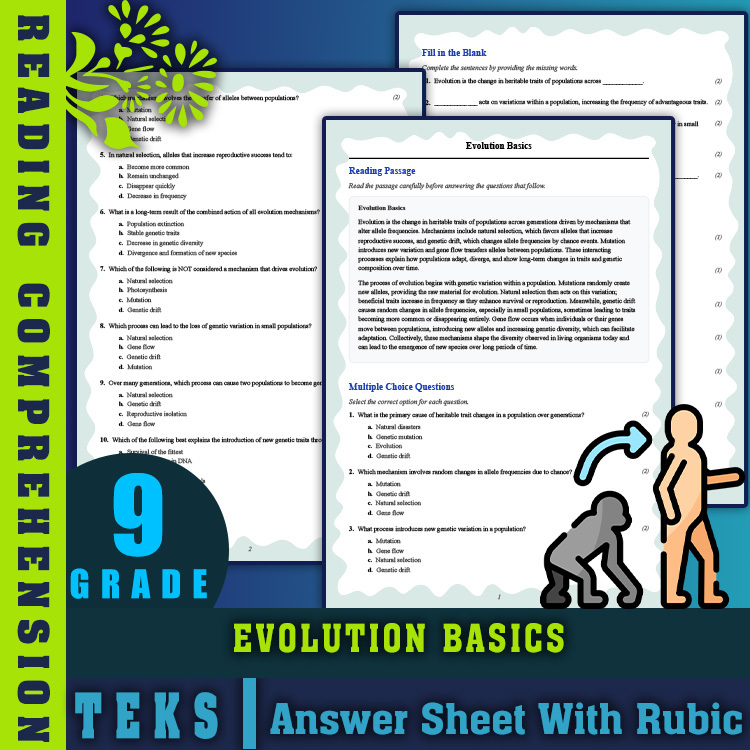
9th Grade Science Reading Worksheet | Evolution Basics with PDF Answer Key
JCreated byJ.S SheetsLearning Objectives
- Understand the fundamental concepts of biological evolution and its mechanisms.
- Explain how natural selection, genetic drift, mutation, and gene flow contribute to evolution.
- Analyze examples of evolution in populations over time.
Instant download

Grade 9 Science | Molecular Inheritance Worksheet | AP Aligned
Created byLumora LearningLearning Objectives
- Understand the molecular mechanisms of DNA replication, transcription, RNA processing, and translation.
- Link sequence variations and mutations to changes in gene expression and protein function.
- Use molecular models and sequence reasoning to predict phenotypic effects of allelic changes.
Also included in: Grade 9 Science | Biology and Ecosystems Custom Bundle | AP Worksheets
Instant download

Population Regulation Practice Worksheet | Grade 9 Science NGSS Review
Created byPrism Point LearningLearning Objectives
- Explain how carrying capacity and density-dependent/independent factors regulate population size
- Describe how competition, predation, and disease affect population dynamics and community composition
- Use basic mathematical ideas (like logistic growth) to interpret population regulation patterns
Also included in: Grade 9 Ecosystem Dynamics Science Lesson Bundle: NGSS Review Worksheets
Instant download

Grade 9 Science – Glycolysis & Cellular Metabolism | Daily Reading Worksheet
Created byBright Mind ResourcesLearning Objectives
- Understand the basic process of glycolysis.
- Identify key molecules involved in glycolysis.
- Explain the importance of glycolysis in cellular energy production.
Also included in: Photosynthesis Grade 9 Science Daily Reading Worksheets Lesson Bundle | TEKS +2 more
Instant download

Grade 9 Collision Safety Worksheet | NGSS Practice & PDF
Created byClear Sky ClassroomLearning Objectives
- Understand how impulse and force-time relationships influence collision mitigation strategies.
- Identify and describe engineering methods such as crumple zones, airbags, and helmets used to reduce peak forces during impacts.
- Analyze force-time graphs and evaluate the effectiveness of different collision mitigation approaches.
Also included in: Grade 9 Newtonian Motion and Forces Science Practice Lesson Bundle – NGSS +1 more
Instant download

Science Worksheet Design Cycle Grade 9 | Standards-Aligned Assessment
JCreated byJ.S SheetsLearning Objectives
- Explain the steps of a design cycle and how evidence leads to redesign.
- Use criteria and constraints to evaluate potential engineering solutions.
- Apply design-cycle reasoning to a protective gear example (e.g., a helmet).
Also included in: Grade 9 Engineering Design Cycle Science Lesson Bundle: General Framework +1 more
Instant download

Grade 9 Science Worksheet | Energy and Matter Flow (PDF) - General Standards
Created byEvergreen Desk EducationLearning Objectives
- Explain how energy flows one direction through food chains and why energy decreases at each trophic level.
- Describe how matter cycles through biological systems by rearranging atoms during processes such as photosynthesis and cellular respiration.
- Use evidence such as trophic level relationships and changing biomass to interpret energy and matter movement in ecosystems.
Also included in: Grade 9 Ecology, Inheritance, and Cell Functions Science Lesson Bundle (General) +1 more
Instant download

Coastal Dynamics Worksheet | AP Science Grade 9 Assessment PDF
JCreated byJ.S SheetsLearning Objectives
- Understand the processes of coastal erosion, sediment transport, and shoreline response to natural forces.
- Analyze the impact of sea-level change on coastal morphology and habitats.
- Evaluate the effects of human modifications and engineered structures on coastal systems.
Instant download

Grade 9 Science | Comparative Structures in Cells - Daily Reading Comprehension
 Created byCoral Reef Learning
Learning Objectives
- Understand the specialized functions of the smooth endoplasmic reticulum in different cell types.
- Identify the relationship between organelle structure and its function in the cell.
- Recognize the significance of cellular adaptations at the organelle level.
Instant download

Grade 9 Science | Genetic Data Worksheet (TEKS) Practice & Assessment (PDF)
Created byEvergreen Desk EducationLearning Objectives
- Interpret genotype and phenotype frequencies to infer likely inheritance patterns.
- Connect molecular evidence (PCR markers, single nucleotide variants, sequencing reads) to genotype identification.
- Use expected genetic ratios and family information to evaluate inheritance, linkage, heterozygosity, and selection.
Instant download

Grade 9 Impact Evaluation Worksheet | Review & Practice PDF
Created byClear Sky ClassroomLearning Objectives
- Explain why impact evaluation must consider benefits, risks, tradeoffs, and unintended consequences over time.
- Identify common categories of impacts (environmental, health, resource use) and how engineers can mitigate harm.
- Use evidence-based criteria to compare alternatives and make a reasoned recommendation.
Instant download
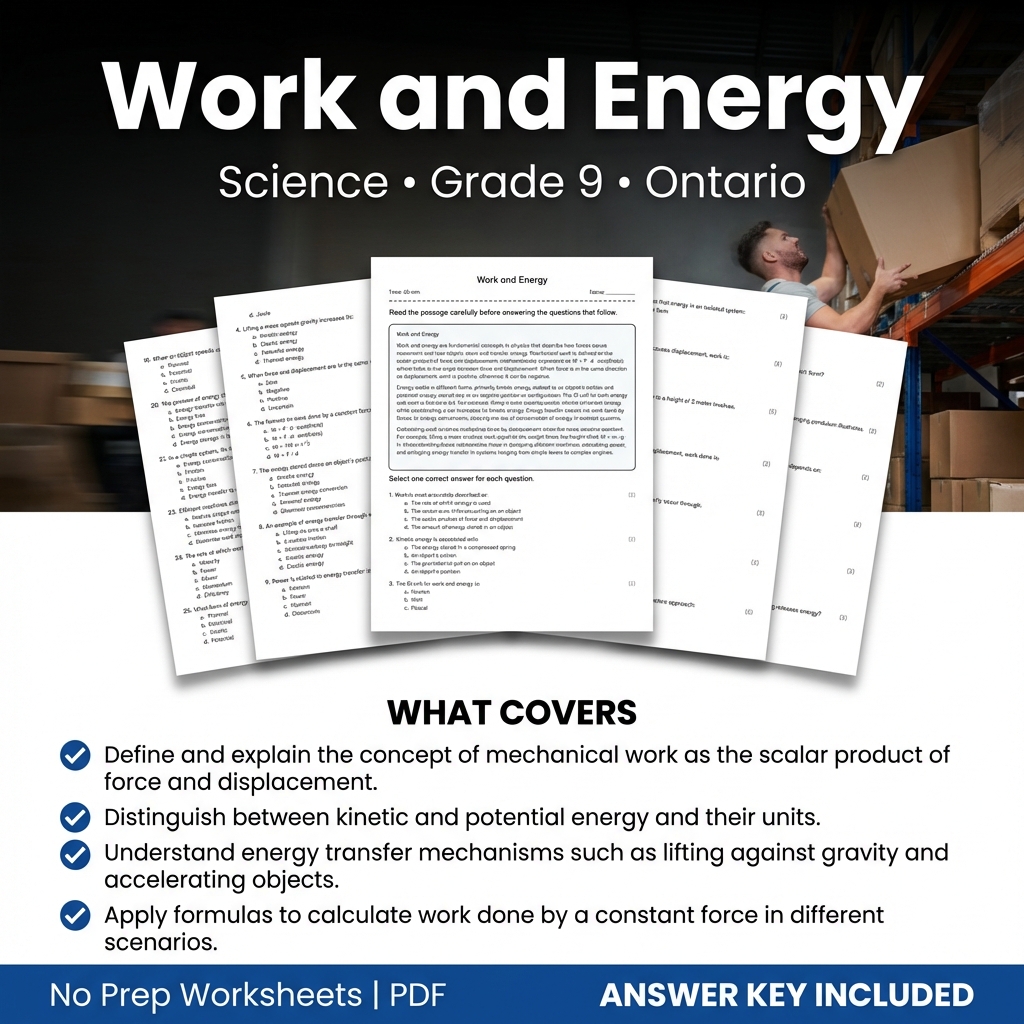
Work and Energy Worksheet for Grade 9 Science | Ontario Standards
Created byCoral Reef LearningLearning Objectives
- Define and explain the concept of mechanical work as the scalar product of force and displacement.
- Distinguish between kinetic and potential energy and their units.
- Understand energy transfer mechanisms such as lifting against gravity and accelerating objects.
Instant download

Grade 9 Reaction Design Worksheet | NGSS Practice PDF
Created byClear Sky ClassroomLearning Objectives
- Understand how temperature, pressure, concentration, and catalysts influence chemical reactions.
- Apply principles of equilibrium and kinetics to optimize reaction conditions.
- Interpret equilibrium constants and reaction-rate expressions to predict product distribution.
Also included in: Grade 9 Reaction Stoichiometry and Energy Science Lesson Bundle (NGSS) +1 more
Instant download

Heat Transfer Modes Worksheet Grade 9 Science NGSSS Thermal Energy
Created byEvergreen Desk EducationLearning Objectives
- Explain how heat energy transfers through conduction, convection, and radiation
- Identify evidence in everyday situations that supports each heat transfer mode
- Compare and contrast conduction, convection, and radiation using key physical ideas
Instant download

Grade 9 Evolving Knowledge Worksheet | Practice & Review NGSS PDF
Created byClear Sky ClassroomLearning Objectives
- Explain how scientific knowledge depends on evidence, models, and measurement rather than a single fixed method.
- Identify how limitations of instruments and assumptions in models can influence scientific conclusions.
- Analyze how peer evaluation and new measurements can change or strengthen scientific understanding.
Instant download

Grade 9 Science Worksheet on Chromosomes and DNA (PDF) | Alberta Standards
Created byEvergreen Desk EducationLearning Objectives
- Describe the double-helix structure of DNA and explain how base pairing encodes genetic information.
- Explain how DNA is organized into chromosomes and how loci and recombination affect inheritance.
- Differentiate nuclear genomes from organelle genomes and connect chromosome number/karyotypes to genetics.
Instant download
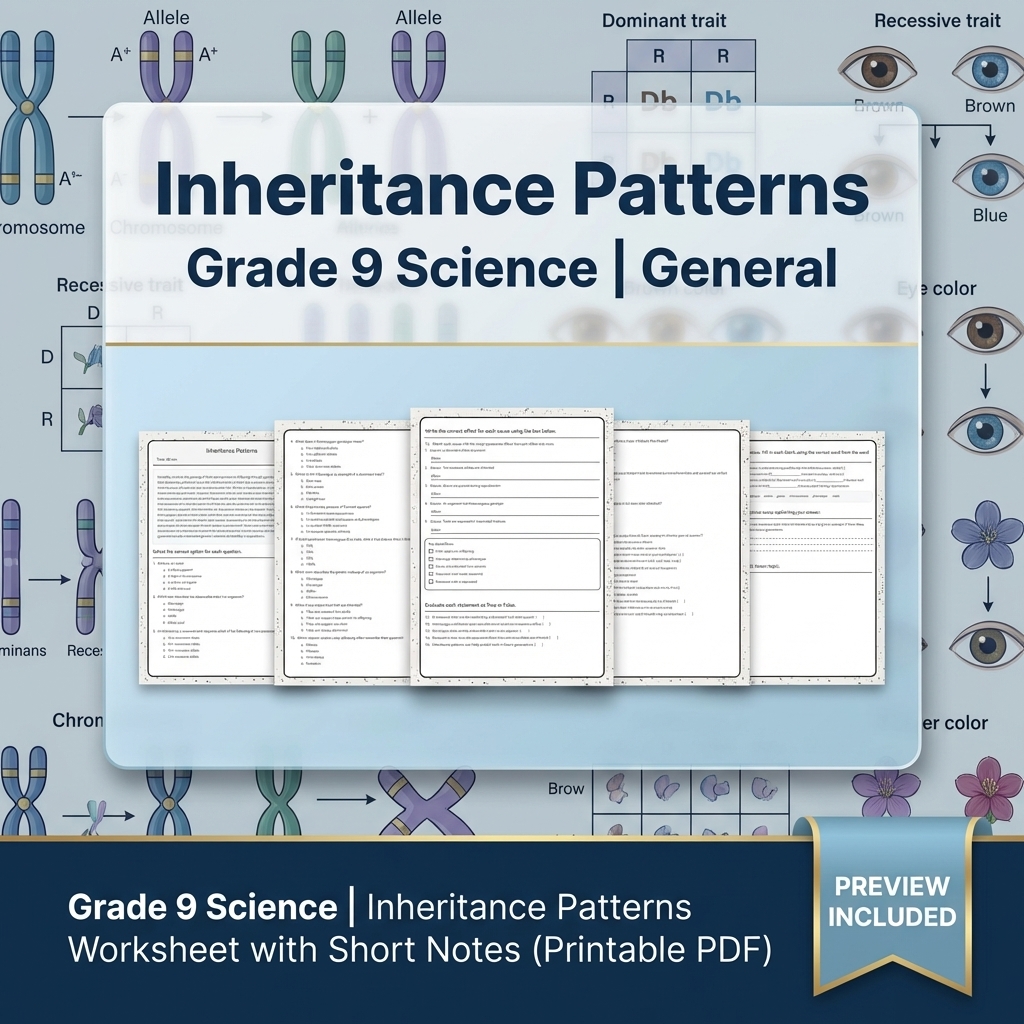
Grade 9 Science | Inheritance Patterns Worksheet with Short Notes
 Created byMeadowlark Worksheets
Learning Objectives
- Understand how genes and alleles influence inherited traits.
- Explain the difference between dominant and recessive traits.
- Interpret genotype and phenotype relationships in heredity.
Also included in: Grade 9 Ecology, Genetics & Cells Science Lesson Bundle | General Framework +1 more
Instant download
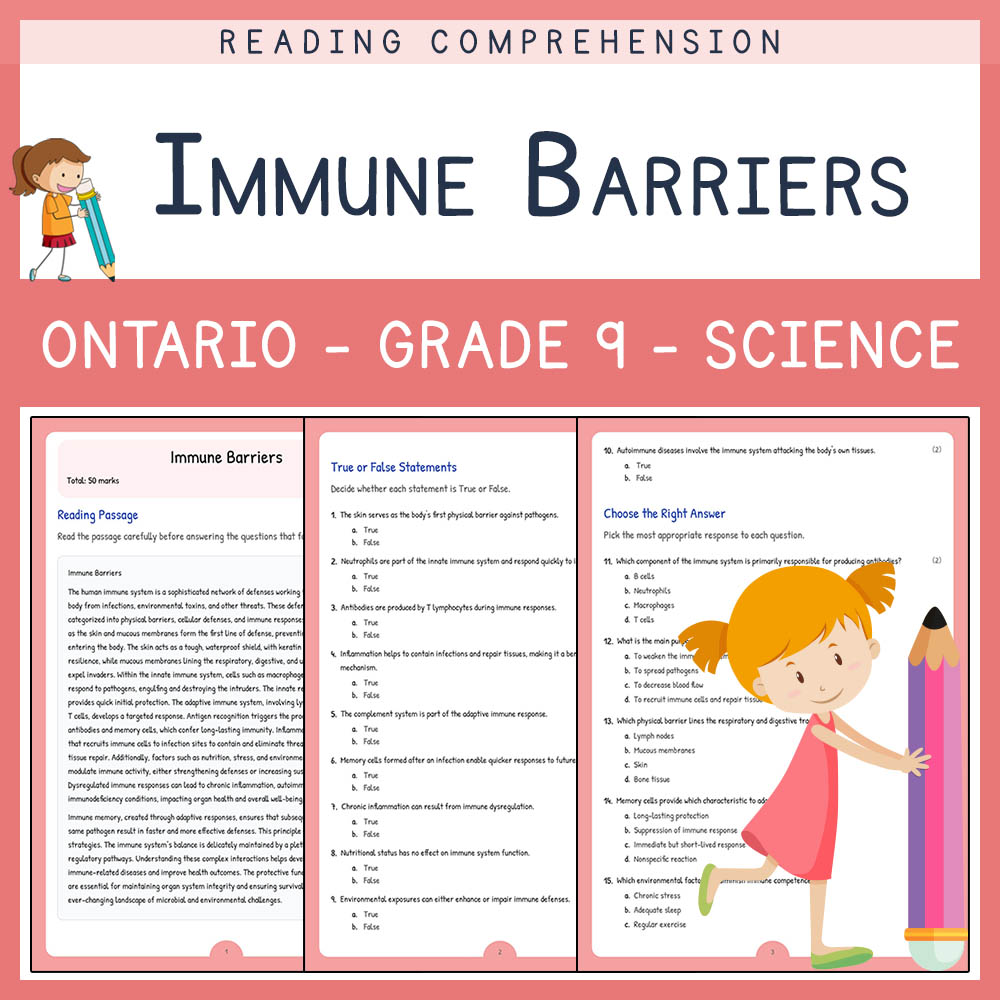
Grade 9 Science Assessment | Immune Barriers Worksheet Elena | Ontario
Created byLumora LearningLearning Objectives
- Describe the physical and cellular defenses that protect against pathogens.
- Explain the roles of innate and adaptive immunity in immune response.
- Identify mechanisms of inflammation and immune memory formation.
Also included in: Grade 9 Science | Life Systems Lesson Bundle | Ontario Framework
Instant download
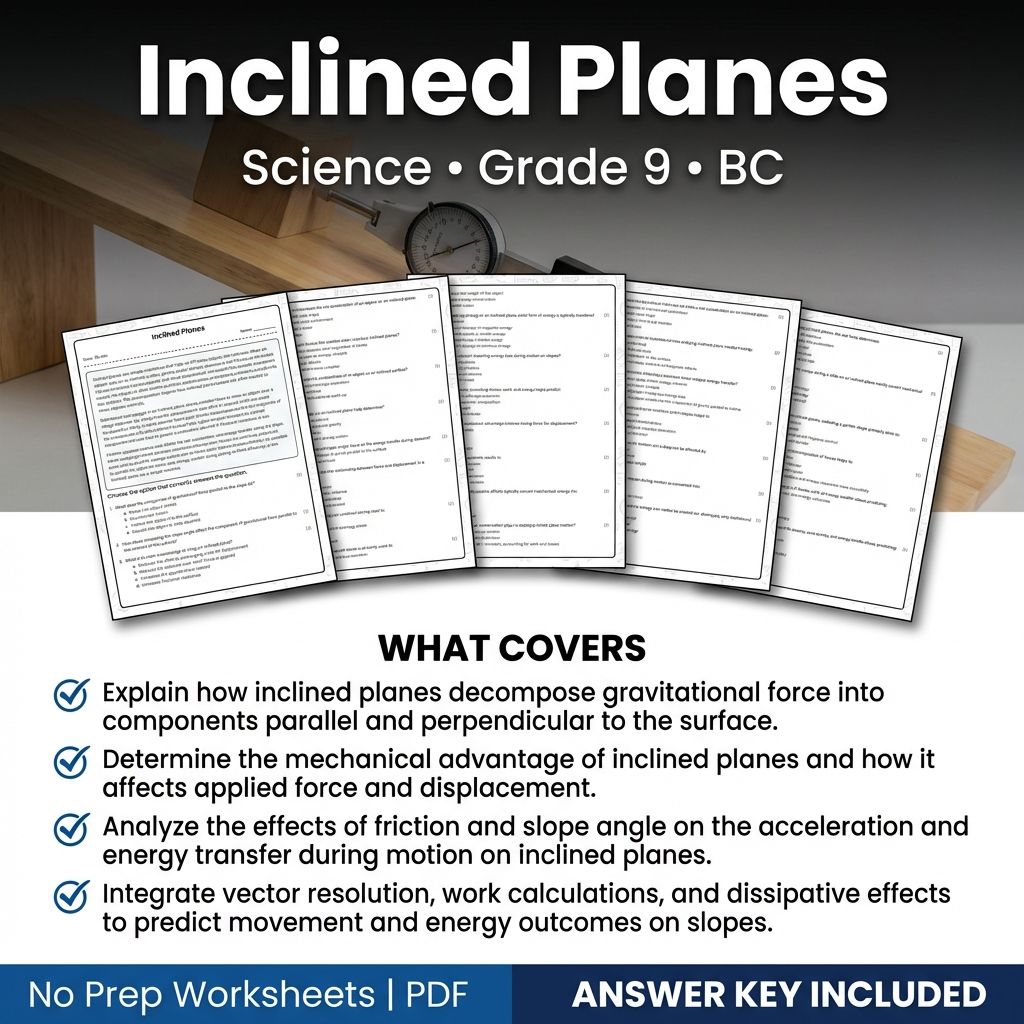
Inclined Planes Worksheet for Grade 9 Science | BC Standards
Created byCoral Reef LearningLearning Objectives
- Explain how inclined planes decompose gravitational force into components parallel and perpendicular to the surface.
- Determine the mechanical advantage of inclined planes and how it affects applied force and displacement.
- Analyze the effects of friction and slope angle on the acceleration and energy transfer during motion on inclined planes.
Instant download

Grade 9 Ecosystem Cycling Worksheet | NGSS Practice PDF
Created byClear Sky ClassroomLearning Objectives
- Explain how carbon and nitrogen cycle through biotic and abiotic parts of ecosystems
- Describe trophic transfer and how stoichiometry constrains population growth and biodiversity
- Predict how perturbations such as nutrient enrichment, habitat alteration, and invasive species can change community structure and material turnover
Also included in: Grade 9 Biology and Ecosystems Science Lesson Bundle for Advanced Placement (AP) +1 more
Instant download

Resource Impacts and Sustainability Worksheets Grade 9 Science
Created byPrism Point LearningLearning Objectives
- Analyze how resource extraction alters habitats and landforms
- Evaluate evidence about pollution transport and cumulative effects
- Compare sustainability criteria for renewable and nonrenewable resources
Also included in: Earth and Space Systems Lesson Bundle – Grade 9 Science Ontario +1 more
Instant download

Cell Architecture Worksheet | NGSS Grade 9 Science Printable PDF
Learning Objectives
- Describe how nucleic acid sequences determine amino acid chains and three-dimensional protein structures.
- Connect molecular coding and folding to organelle architecture such as ribosomes, endoplasmic reticulum, and mitochondria.
- Identify functional roles of proteins like hemoglobin and membrane transport proteins in cells.
Also included in: Grade 9 Science Lesson Bundle: From Molecules to Organisms NGSS Structures +1 more
Instant download

Evidence Overview Worksheet | Grade 9 Science Activities
Created byPrism Point LearningLearning Objectives
- Explain how multiple lines of evidence (fossils, anatomy, and molecules) support evolutionary relationships.
- Describe how homologous and analogous structures provide different clues about shared ancestry versus convergent evolution.
- Use fossil sequences and molecular comparisons to infer patterns of descent with modification and timing of divergence.
Also included in: Grade 9 Evolution & Speciation Lesson Bundle | TEKS Science
Instant download

Grade 9 Science | Light Reactions - Daily Reading Comprehension
Created byCoral Reef LearningLearning Objectives
- Understand the process of light reactions in photosynthesis
- Identify the key components involved in light reactions
- Explain how photon energy is converted into chemical energy
Instant download
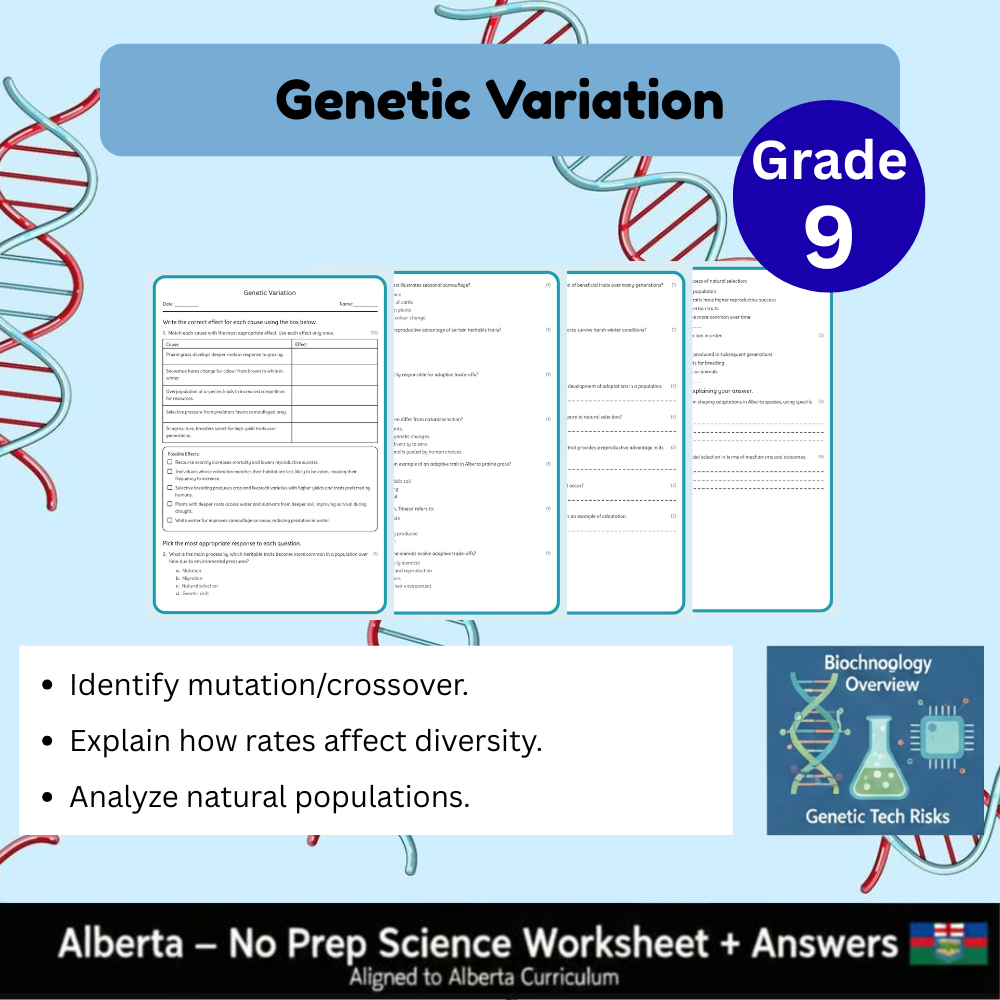
Grade 9 Science – Sources of Genetic Variation Worksheet (PDF)
Created byBright Mind ResourcesLearning Objectives
- Identify the main sources of genetic variation such as mutation, recombination during meiosis, gene flow, and chromosomal rearrangements.
- Explain how mutation rates and types influence genetic diversity.
- Analyze examples of genetic variation in natural and managed populations.
Instant download

Grade 9 Science | Limiting Reactants Worksheet (PDF) – BC Standards
Created byEvergreen Desk EducationLearning Objectives
- Explain what a limiting reactant is and how it controls the maximum amount of product formed.
- Calculate theoretical yield from balanced mole ratios and molar masses.
- Distinguish actual yield from theoretical yield and compute percent yield.
Instant download

Earth's Axial Tilt & Day Length Worksheets Grade 9 Science
 Created byBRIGHT PATH RESOURCES
Learning Objectives
- Explain how Earth’s axial tilt and Earth–Sun geometry cause seasonal changes
- Describe how daylight length and sun angle affect the amount of solar energy received
- Use orbital and tilt ideas to predict how day length changes across seasons and latitudes
Also included in: Grade 9 Earth Science Worksheets Bundle: Climate, Cycles & Space +1 more
Instant download

Grade 9 Science – Simple Machines Daily Reading Worksheet | Ontario Standards
Created byBright Mind ResourcesLearning Objectives
- Understand key concepts related to Science
- Apply knowledge through practice questions
- Demonstrate comprehension of the material
Also included in: Grade 9 Work, Energy & Forces Science Daily Reading Lesson Bundle | Ontario +1 more
Instant download

Science Grade 9 Worksheet: Design Communication Practice – Standards-Aligned
JCreated byJ.S SheetsLearning Objectives
- Explain how labeled diagrams help communicate design component relationships and load paths.
- Use test data and uncertainty to compare results against design requirements and criteria.
- Write clear reasoning that links observed outcomes to design decisions, including trade-offs.
Also included in: Grade 9 Engineering Design Cycle Science Lesson Bundle: General Framework +1 more
Instant download

Grade 9 Science | Balancing Equations in Chemistry - Daily Reading Practice
Created byCoral Reef LearningLearning Objectives
- Understand the concept of conservation of atoms during chemical reactions.
- Identify the number of each type of atom before and after a reaction.
- Learn why balancing chemical equations is essential for accurate scientific representation.
Also included in: Matter and Chemical Change Lesson Bundle – Grade 9 Science Alberta +1 more
Instant download

Grade 9 Solar System Scales Worksheet | California Standards Practice PDF
Created byClear Sky ClassroomLearning Objectives
- Explain how scale and distance affect how the solar system appears from Earth
- Use basic measurement ideas (relative scale, brightness, and apparent motion) to infer orbital properties
- Distinguish between physical distance/size and observational perspective when interpreting sky observations
Instant download

Grade 9 Science | Biodiversity Change Worksheet | NGSSS Aligned
Created byLumora LearningLearning Objectives
- Explain how biodiversity (species diversity and genetic variation) supports ecosystem stability.
- Describe how environmental change can shift population sizes and species interactions.
- Analyze how human activities can increase or reduce biodiversity and influence ecosystem functions.
Instant download

Integrated Physiology Worksheet | NGSS Grade 9 Science Assessment
 Created byCedar Grove Learning
Learning Objectives
- Explain how molecular, cellular, and organ-level interactions contribute to organismal health and disease.
- Interpret data from biochemical assays, histology, and organ function metrics to understand physiological properties.
- Link genetic variations to cellular responses and organ system performance in clinical and natural contexts.
Instant download
About Grade 9 Science Worksheets
Find Science worksheets built for Grade 9. All 6,926 cover core skills, practice, and review, each an instant PDF download.
Every worksheet on MyTeachingSheets is created by independent teacher-authors and reviewed before publication. All resources download as printable PDFs for classroom, homework, or at-home practice, and many include answer keys. Preview any worksheet free before buying.