
Grade 9 Science Worksheets
6,926 worksheets
Solution Behaviour Test Prep Worksheet | Grade 9 Science Ontario
 Created byPrism Point Learning
Learning Objectives
- Describe dissolution using solute–solvent interactions and solvation in qualitative terms.
- Differentiate saturated, unsaturated, and supersaturated solutions using examples and qualitative concentration descriptors.
- Explain how temperature and agitation affect solubility and how concentration changes relate to separation by evaporation or crystallization.
Also included in: Grade 9 Chemistry Test Prep Science Lesson Bundle: Ontario Framework
Instant download
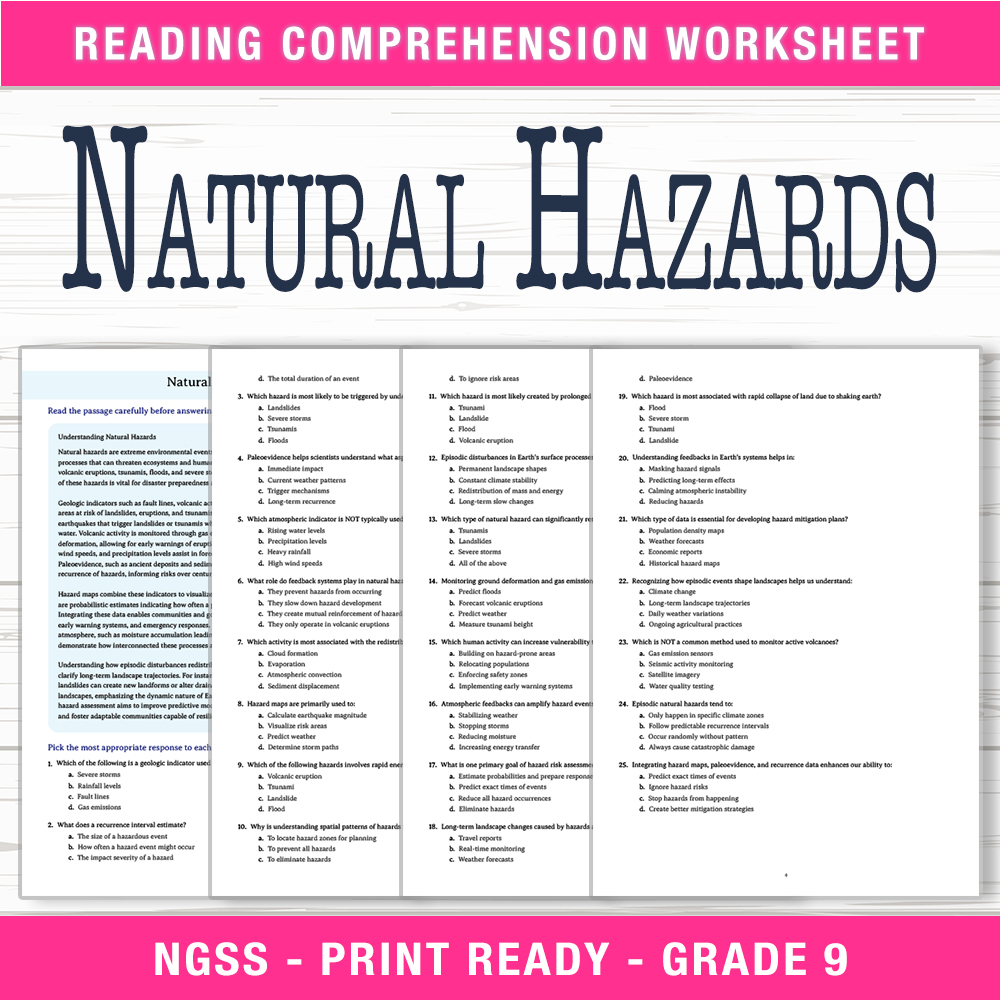
Grade 9 Science | Natural Hazards Worksheet (PDF + Answer Key)
 Created byRiverstone Classroom
Learning Objectives
- Understand the types of natural hazards such as landslides, volcanic eruptions, tsunamis, floods, and severe storms.
- Analyze how geologic and atmospheric indicators are used to assess hazard origin, frequency, and potential impacts.
- Evaluate the spatial patterns, triggering mechanisms, and feedback systems involved in natural hazard events.
Also included in: Grade 9 Science Unit | Earth Processes & Climate Worksheet Bundle
Instant download

Reaction Categories Worksheet for Grade 9 Science | Standard-Aligned Practice
JCreated byJ.S SheetsLearning Objectives
- Identify and describe the four main categories of chemical reactions.
- Recognize characteristic reactant patterns and products for each reaction type.
- Classify chemical reactions based on their reorganization of atoms and bonds.
Instant download

Grade 9 Science – Electrical Safety Standards | Daily Reading Worksheet
 Created byBright Mind Resources
Learning Objectives
- Understand key concepts related to Science
- Apply knowledge through practice questions
- Demonstrate comprehension of the material
Also included in: Grade 9 Electrical Circuits & Electromagnetism Science Lesson Bundle | Alberta +1 more
Instant download
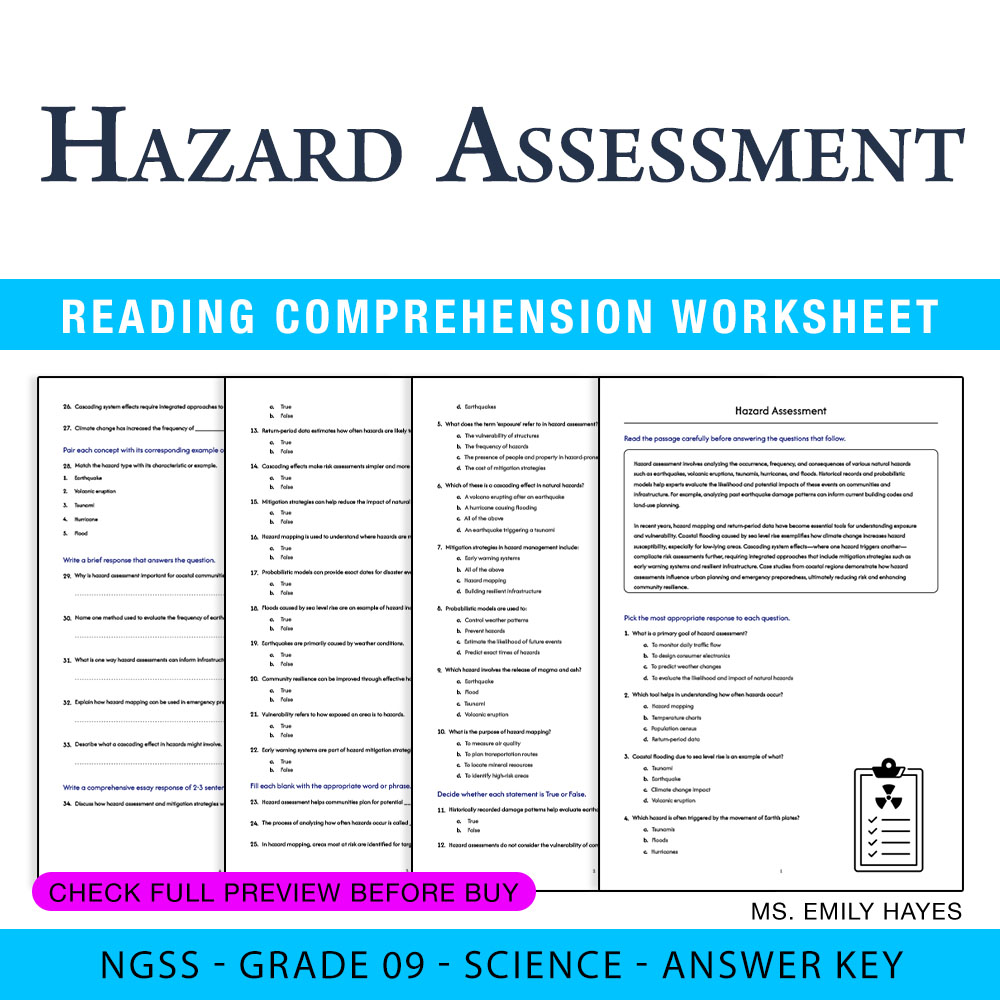
Grade 9 Science | Hazard Assessment Worksheet (PDF+ Answer Key)
 Created byCopper Leaf Classroom
Learning Objectives
- Understand how to evaluate hazard risks using historical data and probabilistic models.
- Identify different natural hazards and analyze their potential impacts on communities and infrastructure.
- Apply hazard mapping, return-period data, and mitigation strategies to assess susceptibility and plan responses.
Instant download
Grade 9 Science Mass Measurement Worksheet with Short Notes | PDF
 Created byMeadowlark Worksheets
Learning Objectives
- Understand how mass measurements reflect conservation of matter during physical and chemical changes.
- Identify factors influencing measured mass such as gases escaping and external forces.
- Explain the importance of system boundaries in mass measurement experiments.
Also included in: Grade 9 Science Lesson Bundle | BC Framework Focused Worksheets +1 more
Instant download
Grade 9 Science | Balancing Equations Worksheet with Short Notes (Printable PDF)
Created byMeadowlark WorksheetsLearning Objectives
- Understand the purpose of balancing chemical equations in illustrating atomic conservation.
- Identify and write correctly balanced chemical equations using coefficients.
- Learn to interpret the symbols and state indicators in chemical equations.
Also included in: Grade 9 Science Lesson Bundle | BC Framework Focused Worksheets +1 more
Instant download
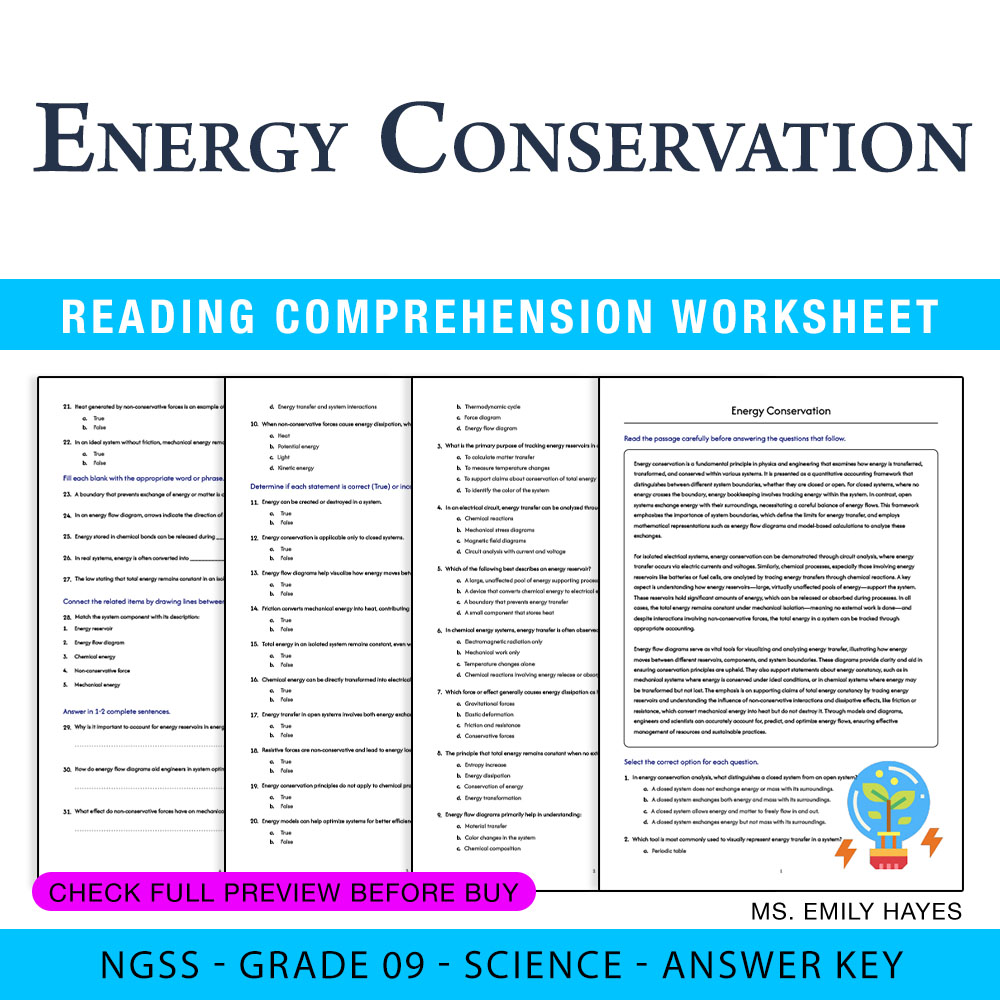
Grade 9 Science | Energy Conservation Worksheet (PDF + Answer Key)
Created byCopper Leaf ClassroomLearning Objectives
- Understand the concept of energy conservation within closed and open systems.
- Identify and analyze energy flow diagrams and their components.
- Apply mathematical representations to model energy transfer and reservoirs.
Instant download

Molecules & Lattices Test Prep Practice | Grade 9 Science
Created byPrism Point LearningLearning Objectives
- Compare ionic lattices, covalent networks, and molecular solids using particle arrangement and electrical interactions.
- Predict how melting point, electrical conductivity, hardness, and solubility relate to interparticle forces.
- Use evidence from material properties to identify the likely structure of an unknown solid.
Also included in: Grade 9 Reaction Stoichiometry and Rates Science Lesson Bundle | NGSS
Instant download
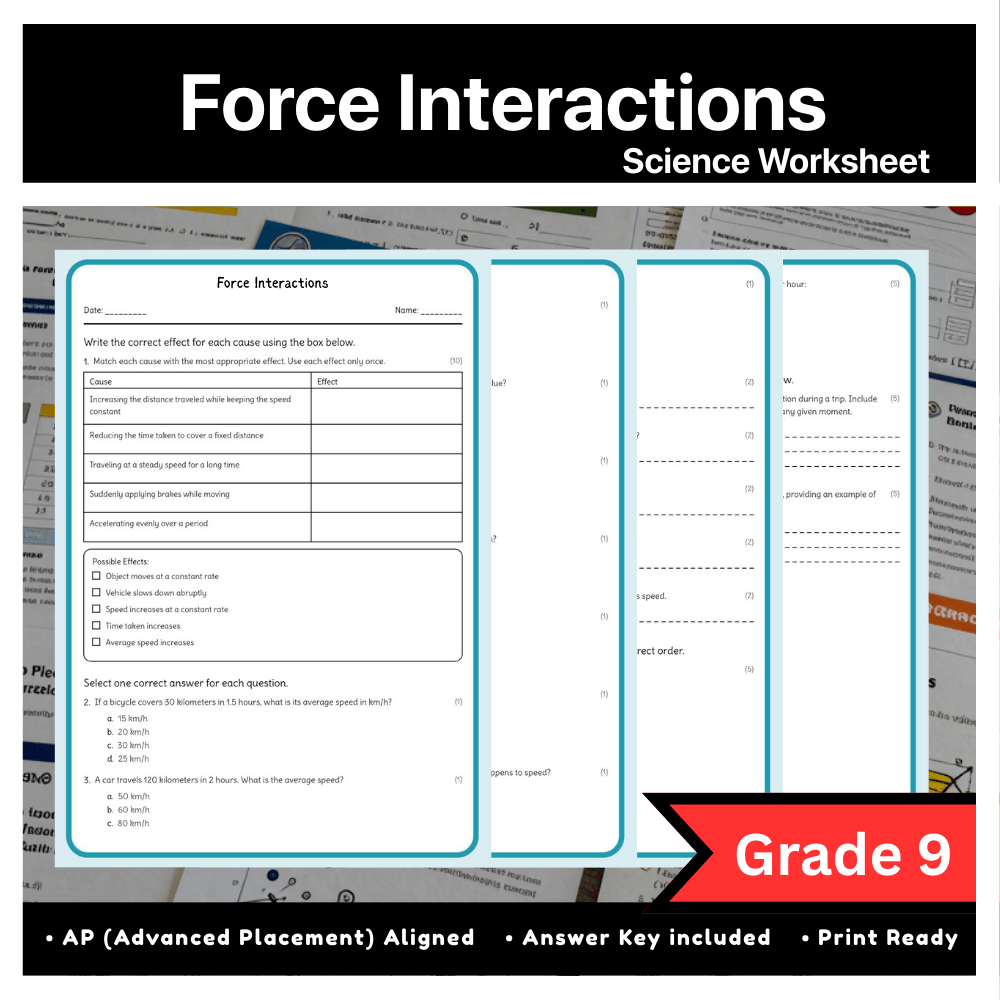
Grade 9 Science | Force Interactions Worksheet (AP Standard) – PDF
Created byBright Mind ResourcesLearning Objectives
- Explain how net external forces affect the motion of objects.
- Interpret force diagrams and free-body diagrams to analyze interactions.
- Use Newton's laws to describe scenarios involving contact and field forces.
Instant download

Mitosis and Meiosis Worksheets: Chromosome Roles Grade 9 Science
 Created bySunny Desk Resources
Learning Objectives
- Compare the purposes of mitosis and meiosis in cell division.
- Explain how chromosome pairing and segregation produce haploid gametes.
- Identify how nondisjunction can change chromosome number and lead to genetic variation or disorders.
Also included in: Genetics & Heredity Lesson Bundle | Grade 9 Science | Alberta Framework +1 more
Instant download

Grade 9 Constraints Trade-Offs Worksheet | Practice & PDF
 Created byClear Sky Classroom
Learning Objectives
- Explain the difference between constraints and criteria in engineering design.
- Identify common trade-offs among cost, time, materials, safety, and reliability.
- Use criteria weighting to justify a design choice under given constraints.
Instant download

Energy Transfer in Earth Systems Worksheets | Grade 9 Science
Created byPrism Point LearningLearning Objectives
- Explain how solar energy and internal heat drive Earth-system change
- Describe conduction, convection, and radiation as thermal energy transfer methods
- Connect energy gradients to atmospheric and ocean circulation
Also included in: Earth and Space Systems Lesson Bundle – Grade 9 Science Ontario +1 more
Instant download

Celestial Cycles Worksheets | Grade 9 Earth & Space Science
Created byPrism Point LearningLearning Objectives
- Explain how Earth’s rotation produces day and night
- Differentiate solar and sidereal periods using reference points
- Describe gravitational interactions that produce predictable tidal cycles
Also included in: Earth and Space Systems Lesson Bundle – Grade 9 Science Ontario +1 more
Instant download

Microscopy Basics Worksheet for Grade 9 Science – Standards-Aligned Practice
JCreated byJ.S SheetsLearning Objectives
- Explain the roles of magnification, resolution, and contrast in microscopy image quality
- Compare how light microscopes and electron microscopes create magnified images
- Use scale bars and preparation/staining information to interpret micrographs accurately
Instant download

Measurement Practices Worksheet Grade 9 Science NGSSS Lab Skills
 Created byEvergreen Desk Education
Learning Objectives
- Explain how scientific measurements use appropriate tools, units, and consistent reference standards to create usable data.
- Distinguish between precision and accuracy and interpret what each term implies about measurement results.
- Describe how repeatability and calibration improve the reliability of experimental data.
Instant download

Science Grade 9 Worksheet Inheritance Patterns | Standards-Aligned Practice
JCreated byJ.S SheetsLearning Objectives
- Explain how genes and alleles determine genotypes and phenotypes
- Use dominant and recessive relationships to predict inheritance patterns
- Apply genotype-to-phenotype reasoning to interpret heredity evidence across generations
Also included in: Grade 9 Ecosystems & Heredity Science Lesson Bundle – General Framework +1 more
Instant download

Grade 9 Science – Investigation Design Controls | Daily Reading Worksheet
Created byBright Mind ResourcesLearning Objectives
- Understand the importance of variables in scientific investigations.
- Identify independent and dependent variables in an experiment.
- Learn how controlling variables enhances the reliability of experimental results.
Also included in: Uncertainty in Graphs & Evidence Lesson Bundle | Grade 9 Science General +1 more
Instant download

Grade 9 Science – Uncertainty in Graphs Reading Worksheet | Standards-Aligned
Created byBright Mind ResourcesLearning Objectives
- Understand what error bars and uncertainty bands represent in scientific graphs.
- Interpret measurement uncertainty and its impact on data patterns.
- Analyze whether differences in data are meaningful considering uncertainty.
Also included in: Uncertainty in Graphs & Evidence Lesson Bundle | Grade 9 Science General +1 more
Instant download

Grade 9 Science – Newton's Laws & Motion | Daily Reading Worksheet
Created byBright Mind ResourcesLearning Objectives
- Understand the concept of inertia and objects staying at rest or in uniform motion
- Identify examples of Newton's first law in everyday life
- Explain how forces influence the motion of objects
Also included in: Grade 9 Forces, Motion & Energy Science Lesson Bundle for Daily Reading | BC +1 more
Instant download

Grade 9 Science | Tides and Gravity Worksheet | NGSSS Aligned
 Created byLumora Learning
Learning Objectives
- Explain how gravity and Earth–Moon–Sun geometry create ocean tides
- Describe how the Moon’s orbit changes tidal timing into a lunar-day cycle
- Compare spring tides and neap tides using the relative positions of the Moon and Sun
Instant download

Rock Transformations Worksheet | NGSS Science Grade 9 Practice PDF
JCreated byJ.S SheetsLearning Objectives
- Describe the processes involved in the rock cycle, including melting, crystallization, erosion, and metamorphism.
- Identify examples of rock transformations, such as basalt formation, sandstone deposition, and schist metamorphism.
- Explain how rates, pressure-temperature conditions, and radiometric ages influence the sequencing of rock cycle events.
Also included in: Grade 9 Earth Systems and Geologic Processes Science Lesson Bundle: NGSS +1 more
Instant download
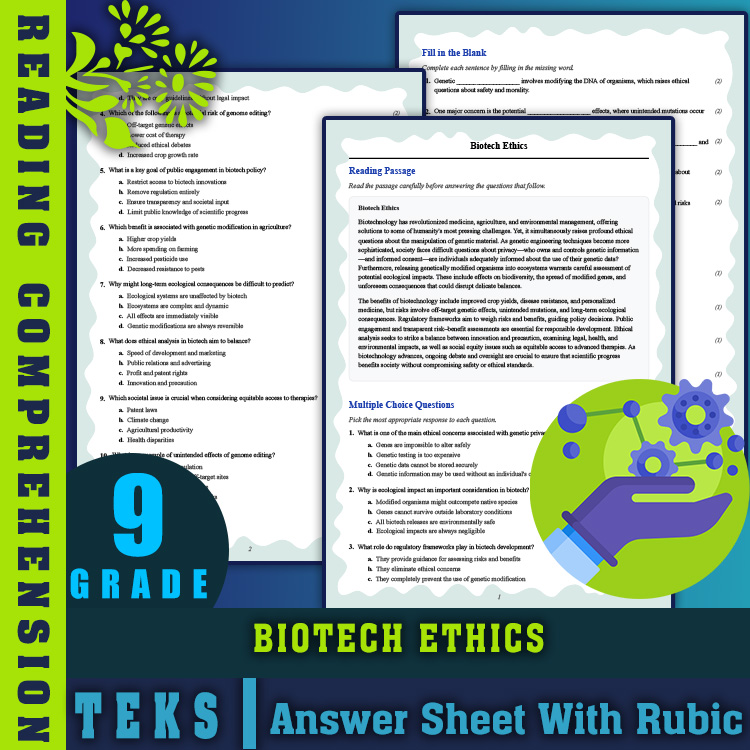
Grade 9 Science | Biotech Ethics Reading Worksheet (PDF + Answer Key)
JCreated byJ.S SheetsLearning Objectives
- Understand key ethical issues related to biotechnology, including privacy, informed consent, and ecological impact.
- Analyze societal implications and regulatory frameworks involved in biotech development.
- Evaluate the benefits and risks associated with manipulating genetic material.
Instant download

Grade 9 Greenhouse Effect Worksheet | NGSS Practice & PDF
Created byClear Sky ClassroomLearning Objectives
- Explain how greenhouse gases absorb and re-emit infrared radiation to influence Earth’s energy balance
- Describe how the altitude where infrared radiation escapes to space affects temperature
- Compare predictions about temperature changes on Earth versus airless bodies using greenhouse-effect reasoning
Instant download

Circuit Types Worksheet | Alberta Standards Grade 9 Science Practice
JCreated byJ.S SheetsLearning Objectives
- Identify the differences between series and parallel circuits in terms of current and voltage.
- Explain how components share current and voltage in series and parallel arrangements.
- Analyze the behavior of lighting strings versus household receptacle networks.
Also included in: Grade 9 Electrical Circuits & Magnetism Science Lesson Bundle – Alberta
Instant download

Grade 9 Science | Net Force Causes Worksheet | General Standard
Created byLumora LearningLearning Objectives
- Explain how Newton’s concept of net force relates to changes in motion (speed and/or direction).
- Distinguish balanced forces from unbalanced forces using the idea of net force.
- Predict the direction of acceleration from the direction of net force.
Instant download

Human Impacts Worksheet for Grade 9 Science | NGSS-Aligned Assessment
JCreated byJ.S SheetsLearning Objectives
- Analyze how land-use change, invasive species, pollution, and resource extraction affect biodiversity and ecosystems.
- Interpret empirical data from case studies such as deforestation, coral reef degradation, and agricultural runoff.
- Evaluate trade-offs among conservation efforts, provisioning services, and socio-ecological outcomes.
Also included in: Grade 9 Nutrient Cycling & Trophic Dynamics Science – Lesson Bundle NGSS +1 more
Instant download

Grade 9 Mountain Building Worksheet | Practice & Standards PDF
Created byClear Sky ClassroomLearning Objectives
- Explain how crustal shortening and thickening during orogeny create major mountain belts.
- Describe how metamorphism and isostatic adjustment contribute to uplift and long-term landscape change.
- Use geologic evidence such as structural cross sections, uplift rates, and thermochronology to link plate convergence to surface topography and erosion.
Also included in: Grade 9 Earth and Space Sciences Science lesson bundle (AP framework) +1 more
Instant download

Human Impacts Worksheet | NGSS Grade 9 Science Assessment
 Created bySkylark Worksheets
Learning Objectives
- Explain how land-use change, invasive species, pollution, and resource extraction can alter biodiversity and ecosystem functioning
- Interpret cause-and-effect relationships using empirical indicators (e.g., species abundance, water quality, oxygen levels)
- Evaluate trade-offs among conservation actions, provisioning services, and socioecological outcomes
Also included in: Grade 9 Science Full-Year Bundle | NGSS Worksheets & Assessments
Instant download

Grade 9 Science Engineering Framing Constraints Worksheet | NGSS Activity
 Created byAmber Owl Education
Learning Objectives
- Identify functional requirements, stakeholder criteria, and measurable constraints when framing an engineering challenge.
- Explain how social impacts, economic limits, regulatory restrictions, and environmental constraints interact in engineering design choices.
- Evaluate conceptual approaches by checking that objectives can be met within safety margins and available resources.
Also included in: Grade 9 Science Engineering Design and Computational Modeling Lesson Bundle +1 more
Instant download

Representation Models Worksheet | AP Science Modeling Skills Grade 9
Created byPrism Point LearningLearning Objectives
- Describe how different model representations (equations, graphs, schematic diagrams, and computational approximations) capture system behavior.
- Evaluate models using criteria such as representational fidelity, parsimony, and predictive scope.
- Explain how mapping between model components and measurable observables supports interpretation of evidence.
Instant download

Grade 9 Science | Humidity and Clouds Worksheet | NGSSS Aligned
Created byLumora LearningLearning Objectives
- Explain how moisture content and lifting/cooling of air lead to cloud formation through condensation
- Use relative humidity to describe how close air is to saturation and predict likely condensation
- Describe how latent heat release influences temperature and atmospheric stability
Instant download

Grade 9 Combined Circuits Worksheet | Practice & Assessment PDF
Created byClear Sky ClassroomLearning Objectives
- Differentiate series and parallel behavior in mixed (combined) circuits using current and voltage relationships
- Simplify combined circuits by identifying series/parallel sections and calculating equivalent resistance
- Trace current paths and infer load sharing and potential fault effects in real systems
Instant download

Grade 9 Science | Microscope Modeling Worksheet | BC Standards
Created byLumora LearningLearning Objectives
- Understand how different types of microscopes reveal cell structures.
- Identify the uses of diagrammatic and physical models in microscopy.
- Explain the relationship between microscopic observations and cellular functions.
Instant download

Grade 9 Science | Net Force & Acceleration - Daily Reading Comprehension
 Created byCoral Reef Learning
Learning Objectives
- Understand the concept of net force and how it affects motion
- Identify net force in various simple situations
- Explain how different forces combine to produce acceleration
Instant download

Mendelian Patterns Worksheet | Punnett Squares & Genetics | Grade 9 NGSS
Created byAmber Owl EducationLearning Objectives
- Use Mendelian single-gene ideas (dominant vs. recessive alleles) to predict genotype and phenotype outcomes from crosses.
- Interpret Punnett squares to determine expected genotype and phenotype ratios.
- Explain how segregation and independent assortment affect inheritance probabilities in monohybrid and dihybrid crosses.
Also included in: Grade 9 Science Genetics & Variation Lesson Bundle: NGSS Aligned +1 more
Instant download
Grade 9 Science – Force and Acceleration Daily Reading Worksheet + Answer Key
JCreated byJ.S SheetsLearning Objectives
- Understand the concept of force and how it influences motion
- Explain the relationship between net force, mass, and acceleration
- Identify different types of forces acting on objects
Also included in: Grade 9 Science Lesson Bundle | Physics and Energy Concept Worksheets +1 more
Instant download

Grade 9 Science | Metabolic Regulation Worksheet + Answer Key (AP Standard)
Created byBright Mind ResourcesLearning Objectives
- Understand the mechanisms that regulate metabolic pathways, including allosteric control, covalent modification, and compartmentalization.
- Explain the role of feedback inhibition and hormonal signals in balancing catabolism and anabolism.
- Model how enzyme kinetics and substrate concentrations influence pathway rates and system robustness.
Instant download

Grade 9 Science – Understanding the Rock Cycle | Daily Reading Worksheet
 Created byQuiet Forest Education
Learning Objectives
- Identify different types of rocks (igneous, metamorphic, sedimentary).
- Describe the processes involved in the rock cycle.
- Recognize the characteristics of each type of rock.
Also included in: Earth and Space Systems Grade 9 Science Daily Worksheets Bundle | Ontario +1 more
Instant download

Grade 9 Science | Understanding Dynamic Systems - Daily Reading Comprehension
Created byCoral Reef LearningLearning Objectives
- Define what a dynamic system is and identify its key characteristics.
- Explain how systems change over time using simple examples.
- Recognize basic patterns of behavior in time-series data.
Also included in: Science Practices Lesson Bundle – Grade 9 Science, Advanced Placement Reading +1 more
Instant download

Surface Processes Worksheet | NGSS Grade 9 Science Assessment
Created bySkylark WorksheetsLearning Objectives
- Explain how chemical and physical weathering influence sediment supply and soil development.
- Analyze how climate forcing and hydrologic inputs shape surface process rates and patterns across landscapes.
- Compare erosion and deposition landforms (hillslopes, floodplains, alluvial fans, and coasts) using cause-and-effect reasoning.
Also included in: Grade 9 Science Lesson Bundle Earth Systems & Tectonic Forces | NGSS +1 more
Instant download

Membrane Transport Mechanisms and Gradients Worksheets Grade 9 Science
Created byPrism Point LearningLearning Objectives
- Describe how molecules cross membranes by diffusion and active transport
- Compare channel and carrier proteins in facilitated diffusion
- Explain how membrane potential affects ion movement
Also included in: Grade 9 Science Lesson Bundle: Human Homeostasis & Cell Systems | Ontario +1 more
Instant download
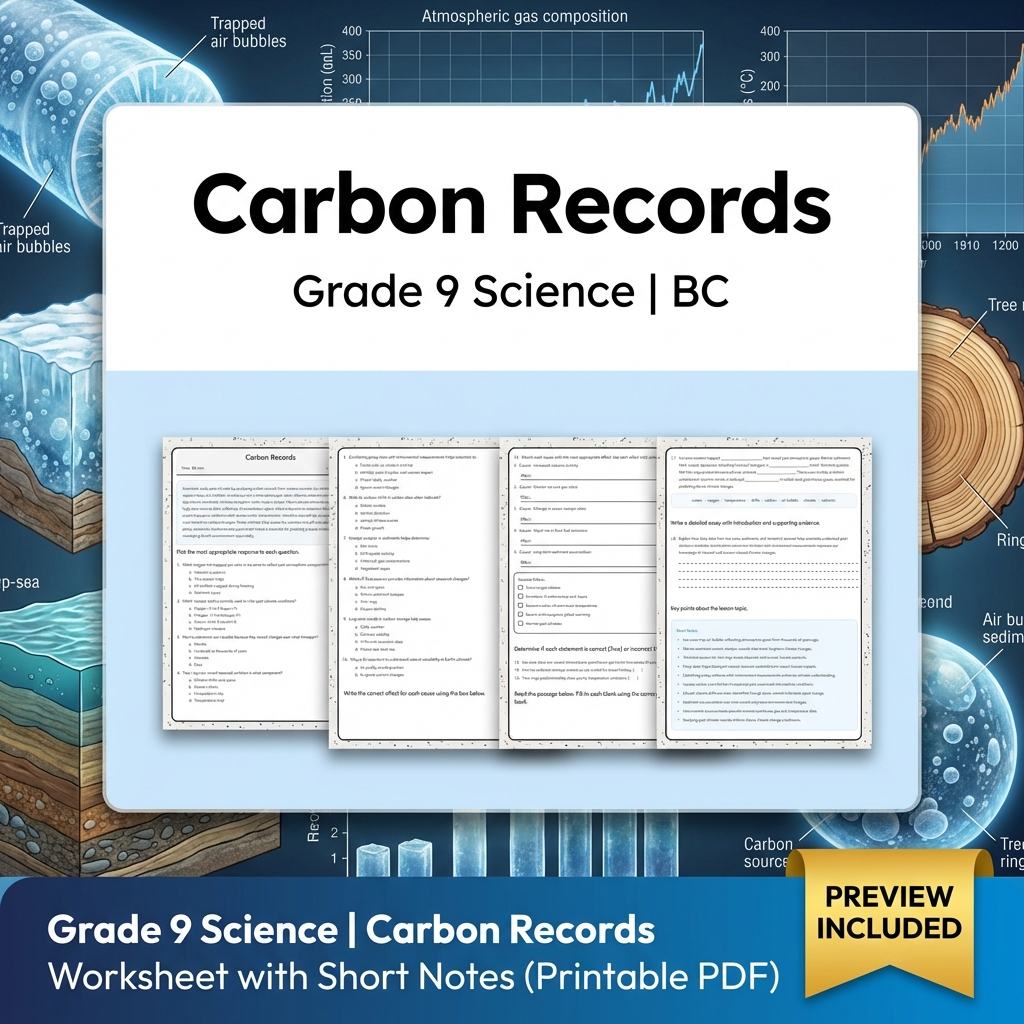
Grade 9 Science | Carbon Records Worksheet with Short Notes (Printable PDF)
Created byMeadowlark WorksheetsLearning Objectives
- Understand how ice cores, sediments, and proxies reveal past atmospheric compositions.
- Interpret ratios of gases and isotopes in understanding climate history.
- Analyze proxy data to distinguish natural variability from human impact.
Also included in: Grade 9 Science | BC Framework Lesson Bundle on Earth Systems & Climate +1 more
Instant download

Grade 9 Ecosystem Interaction Networks Worksheet | General Practice PDF
Created byClear Sky ClassroomLearning Objectives
- Explain how predation, competition, and mutualism affect population sizes and community structure.
- Connect environmental factors (water, temperature, nutrients) to survival and growth in ecosystems.
- Interpret interaction networks to predict how changes in one population can cascade through others.
Instant download

Grade 9 Science | Mountain Building Crustal Shortening & Uplift
Created byCoral Reef LearningLearning Objectives
- Understand the process of crustal shortening during mountain formation.
- Identify key features associated with mountain-building processes.
- Explain how crustal deformation affects surface topography and regional climate.
Also included in: Earth and Space Sciences Daily Reading Lesson Bundle – Grade 9 Science AP +1 more
Instant download

Balancing Chemical Equations Worksheet | Conservation of Atoms Grade 9
Created bySunny Desk ResourcesLearning Objectives
- Explain how balancing a chemical equation enforces conservation of atoms and mass
- Interpret balanced equations to determine correct reactant-to-product particle ratios
- Connect coefficients in chemical formulas to measurable mass relationships
Also included in: Phase Changes, Chemical Reactions & Atomic Structure Lesson Bundle | Grade 9 Science | Alberta +1 more
Instant download

Grade 9 Science — Worksheet MCQ Paper for Mastering Quantifying Uncertainty
 Created byThe Resource Hub
Learning Objectives
- Understand the concepts of random and systematic uncertainty in data analysis.
- Learn how to quantify uncertainty using statistical descriptors like standard deviation and standard error.
- Apply propagation methods to estimate uncertainty in combined calculations.
Also included in: Grade 9 Science Practices Lesson Bundle for AP Standards +1 more
Instant download

Grade 9 Science – Orbital Parameters & Tidal Effects | Daily Reading Worksheet
Created byBright Mind ResourcesLearning Objectives
- Identify and describe key orbital parameters such as eccentricity, axial tilt, and precession.
- Explain how gravitational forces from the Moon and Sun influence tides.
- Relate orbital dynamics to changes in climate, day length, and tidal patterns over time.
Also included in: Grade 9 Earth & Space Science Daily Reading Worksheets Lesson Bundle | Ontario +1 more
Instant download
About Grade 9 Science Worksheets
Find Science worksheets built for Grade 9. All 6,926 cover core skills, practice, and review, each an instant PDF download.
Every worksheet on MyTeachingSheets is created by independent teacher-authors and reviewed before publication. All resources download as printable PDFs for classroom, homework, or at-home practice, and many include answer keys. Preview any worksheet free before buying.