
Grade 9 Science Worksheets
6,926 worksheets
Rock Transformations Worksheet | NGSS Science Grade 9 Practice PDF
JCreated byJ.S SheetsLearning Objectives
- Describe the processes involved in the rock cycle, including melting, crystallization, erosion, and metamorphism.
- Identify examples of rock transformations, such as basalt formation, sandstone deposition, and schist metamorphism.
- Explain how rates, pressure-temperature conditions, and radiometric ages influence the sequencing of rock cycle events.
Also included in: Grade 9 Earth Systems and Geologic Processes Science Lesson Bundle: NGSS +1 more
Instant download
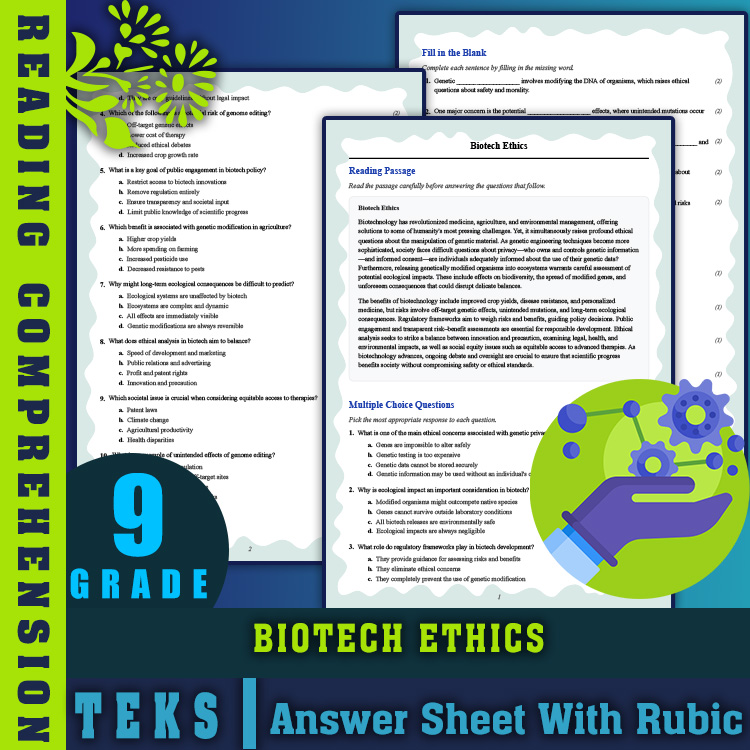
Grade 9 Science | Biotech Ethics Reading Worksheet (PDF + Answer Key)
JCreated byJ.S SheetsLearning Objectives
- Understand key ethical issues related to biotechnology, including privacy, informed consent, and ecological impact.
- Analyze societal implications and regulatory frameworks involved in biotech development.
- Evaluate the benefits and risks associated with manipulating genetic material.
Instant download

Grade 9 Greenhouse Effect Worksheet | NGSS Practice & PDF
 Created byClear Sky Classroom
Learning Objectives
- Explain how greenhouse gases absorb and re-emit infrared radiation to influence Earth’s energy balance
- Describe how the altitude where infrared radiation escapes to space affects temperature
- Compare predictions about temperature changes on Earth versus airless bodies using greenhouse-effect reasoning
Instant download

Circuit Types Worksheet | Alberta Standards Grade 9 Science Practice
JCreated byJ.S SheetsLearning Objectives
- Identify the differences between series and parallel circuits in terms of current and voltage.
- Explain how components share current and voltage in series and parallel arrangements.
- Analyze the behavior of lighting strings versus household receptacle networks.
Also included in: Grade 9 Electrical Circuits & Magnetism Science Lesson Bundle – Alberta
Instant download

Grade 9 Science | Net Force Causes Worksheet | General Standard
 Created byLumora Learning
Learning Objectives
- Explain how Newton’s concept of net force relates to changes in motion (speed and/or direction).
- Distinguish balanced forces from unbalanced forces using the idea of net force.
- Predict the direction of acceleration from the direction of net force.
Instant download

Human Impacts Worksheet for Grade 9 Science | NGSS-Aligned Assessment
JCreated byJ.S SheetsLearning Objectives
- Analyze how land-use change, invasive species, pollution, and resource extraction affect biodiversity and ecosystems.
- Interpret empirical data from case studies such as deforestation, coral reef degradation, and agricultural runoff.
- Evaluate trade-offs among conservation efforts, provisioning services, and socio-ecological outcomes.
Also included in: Grade 9 Nutrient Cycling & Trophic Dynamics Science – Lesson Bundle NGSS +1 more
Instant download

Grade 9 Mountain Building Worksheet | Practice & Standards PDF
Created byClear Sky ClassroomLearning Objectives
- Explain how crustal shortening and thickening during orogeny create major mountain belts.
- Describe how metamorphism and isostatic adjustment contribute to uplift and long-term landscape change.
- Use geologic evidence such as structural cross sections, uplift rates, and thermochronology to link plate convergence to surface topography and erosion.
Also included in: Grade 9 Earth and Space Sciences Science lesson bundle (AP framework) +1 more
Instant download

Human Impacts Worksheet | NGSS Grade 9 Science Assessment
 Created bySkylark Worksheets
Learning Objectives
- Explain how land-use change, invasive species, pollution, and resource extraction can alter biodiversity and ecosystem functioning
- Interpret cause-and-effect relationships using empirical indicators (e.g., species abundance, water quality, oxygen levels)
- Evaluate trade-offs among conservation actions, provisioning services, and socioecological outcomes
Also included in: Grade 9 Science Full-Year Bundle | NGSS Worksheets & Assessments
Instant download

Grade 9 Science Engineering Framing Constraints Worksheet | NGSS Activity
 Created byAmber Owl Education
Learning Objectives
- Identify functional requirements, stakeholder criteria, and measurable constraints when framing an engineering challenge.
- Explain how social impacts, economic limits, regulatory restrictions, and environmental constraints interact in engineering design choices.
- Evaluate conceptual approaches by checking that objectives can be met within safety margins and available resources.
Also included in: Grade 9 Science Engineering Design and Computational Modeling Lesson Bundle +1 more
Instant download

Representation Models Worksheet | AP Science Modeling Skills Grade 9
 Created byPrism Point Learning
Learning Objectives
- Describe how different model representations (equations, graphs, schematic diagrams, and computational approximations) capture system behavior.
- Evaluate models using criteria such as representational fidelity, parsimony, and predictive scope.
- Explain how mapping between model components and measurable observables supports interpretation of evidence.
Instant download

Grade 9 Science | Humidity and Clouds Worksheet | NGSSS Aligned
Created byLumora LearningLearning Objectives
- Explain how moisture content and lifting/cooling of air lead to cloud formation through condensation
- Use relative humidity to describe how close air is to saturation and predict likely condensation
- Describe how latent heat release influences temperature and atmospheric stability
Instant download

Grade 9 Combined Circuits Worksheet | Practice & Assessment PDF
Created byClear Sky ClassroomLearning Objectives
- Differentiate series and parallel behavior in mixed (combined) circuits using current and voltage relationships
- Simplify combined circuits by identifying series/parallel sections and calculating equivalent resistance
- Trace current paths and infer load sharing and potential fault effects in real systems
Instant download

Grade 9 Science | Microscope Modeling Worksheet | BC Standards
Created byLumora LearningLearning Objectives
- Understand how different types of microscopes reveal cell structures.
- Identify the uses of diagrammatic and physical models in microscopy.
- Explain the relationship between microscopic observations and cellular functions.
Instant download

Grade 9 Science | Net Force & Acceleration - Daily Reading Comprehension
 Created byCoral Reef Learning
Learning Objectives
- Understand the concept of net force and how it affects motion
- Identify net force in various simple situations
- Explain how different forces combine to produce acceleration
Instant download

Mendelian Patterns Worksheet | Punnett Squares & Genetics | Grade 9 NGSS
Created byAmber Owl EducationLearning Objectives
- Use Mendelian single-gene ideas (dominant vs. recessive alleles) to predict genotype and phenotype outcomes from crosses.
- Interpret Punnett squares to determine expected genotype and phenotype ratios.
- Explain how segregation and independent assortment affect inheritance probabilities in monohybrid and dihybrid crosses.
Also included in: Grade 9 Science Genetics & Variation Lesson Bundle: NGSS Aligned +1 more
Instant download
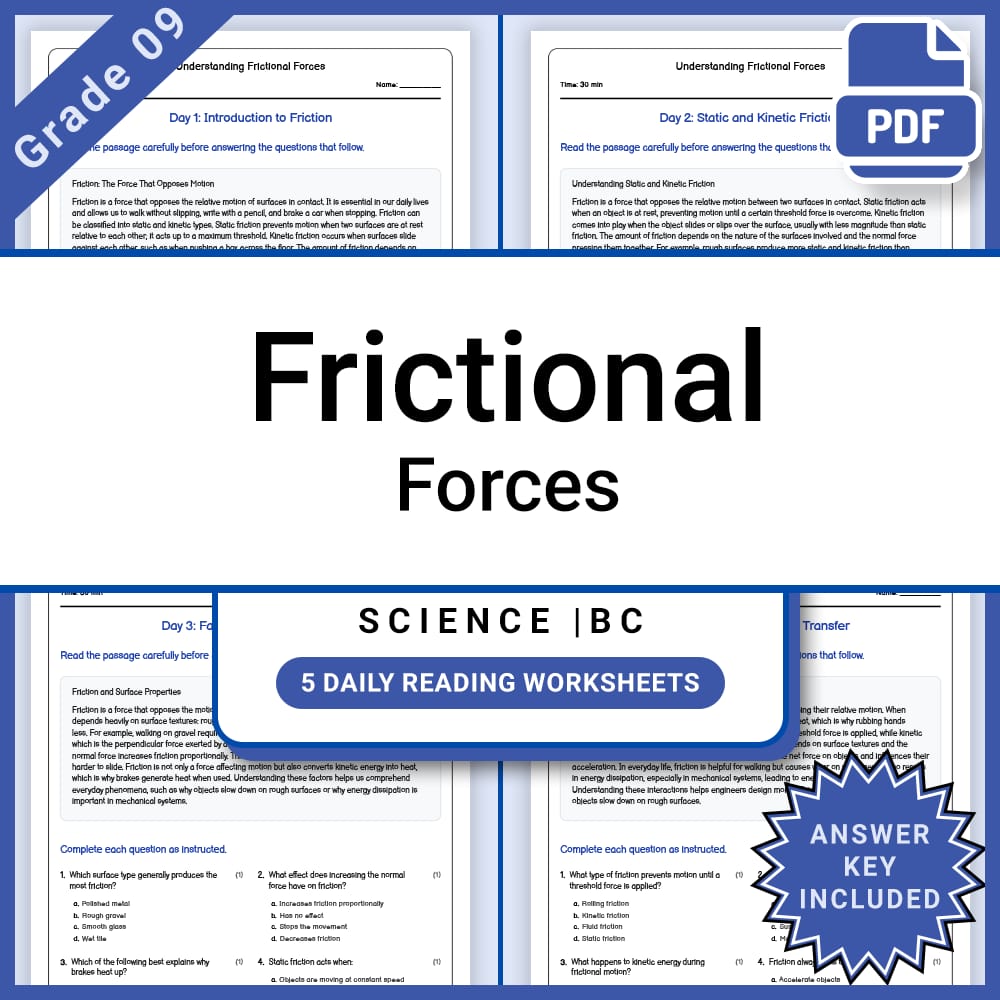
Grade 9 Science – Force and Acceleration Daily Reading Worksheet + Answer Key
JCreated byJ.S SheetsLearning Objectives
- Understand the concept of force and how it influences motion
- Explain the relationship between net force, mass, and acceleration
- Identify different types of forces acting on objects
Also included in: Grade 9 Science Lesson Bundle | Physics and Energy Concept Worksheets +1 more
Instant download

Grade 9 Science | Metabolic Regulation Worksheet + Answer Key (AP Standard)
 Created byBright Mind Resources
Learning Objectives
- Understand the mechanisms that regulate metabolic pathways, including allosteric control, covalent modification, and compartmentalization.
- Explain the role of feedback inhibition and hormonal signals in balancing catabolism and anabolism.
- Model how enzyme kinetics and substrate concentrations influence pathway rates and system robustness.
Instant download

Grade 9 Science – Understanding the Rock Cycle | Daily Reading Worksheet
 Created byQuiet Forest Education
Learning Objectives
- Identify different types of rocks (igneous, metamorphic, sedimentary).
- Describe the processes involved in the rock cycle.
- Recognize the characteristics of each type of rock.
Also included in: Earth and Space Systems Grade 9 Science Daily Worksheets Bundle | Ontario +1 more
Instant download

Grade 9 Science | Understanding Dynamic Systems - Daily Reading Comprehension
Created byCoral Reef LearningLearning Objectives
- Define what a dynamic system is and identify its key characteristics.
- Explain how systems change over time using simple examples.
- Recognize basic patterns of behavior in time-series data.
Also included in: Science Practices Lesson Bundle – Grade 9 Science, Advanced Placement Reading +1 more
Instant download

Surface Processes Worksheet | NGSS Grade 9 Science Assessment
Created bySkylark WorksheetsLearning Objectives
- Explain how chemical and physical weathering influence sediment supply and soil development.
- Analyze how climate forcing and hydrologic inputs shape surface process rates and patterns across landscapes.
- Compare erosion and deposition landforms (hillslopes, floodplains, alluvial fans, and coasts) using cause-and-effect reasoning.
Also included in: Grade 9 Science Lesson Bundle Earth Systems & Tectonic Forces | NGSS +1 more
Instant download

Membrane Transport Mechanisms and Gradients Worksheets Grade 9 Science
Created byPrism Point LearningLearning Objectives
- Describe how molecules cross membranes by diffusion and active transport
- Compare channel and carrier proteins in facilitated diffusion
- Explain how membrane potential affects ion movement
Also included in: Grade 9 Science Lesson Bundle: Human Homeostasis & Cell Systems | Ontario +1 more
Instant download
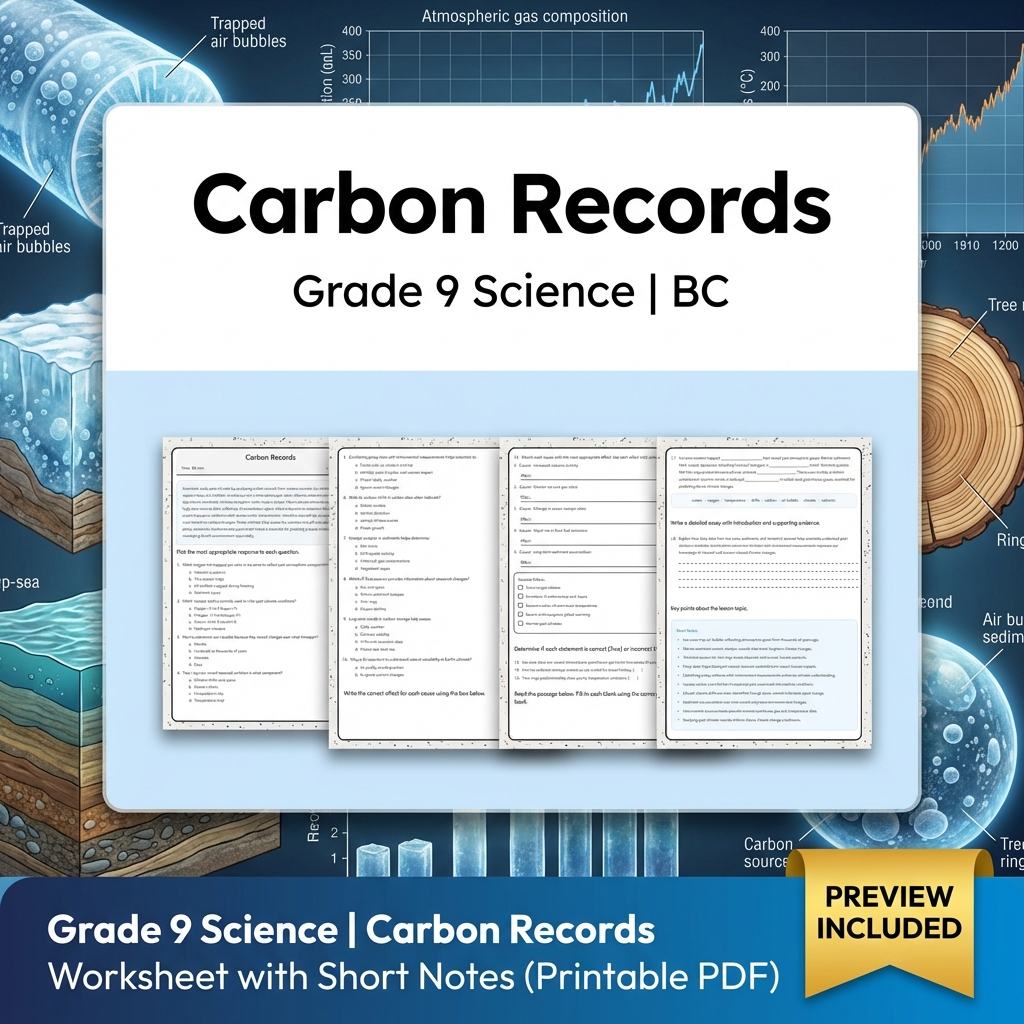
Grade 9 Science | Carbon Records Worksheet with Short Notes (Printable PDF)
 Created byMeadowlark Worksheets
Learning Objectives
- Understand how ice cores, sediments, and proxies reveal past atmospheric compositions.
- Interpret ratios of gases and isotopes in understanding climate history.
- Analyze proxy data to distinguish natural variability from human impact.
Also included in: Grade 9 Science | BC Framework Lesson Bundle on Earth Systems & Climate +1 more
Instant download

Grade 9 Ecosystem Interaction Networks Worksheet | General Practice PDF
Created byClear Sky ClassroomLearning Objectives
- Explain how predation, competition, and mutualism affect population sizes and community structure.
- Connect environmental factors (water, temperature, nutrients) to survival and growth in ecosystems.
- Interpret interaction networks to predict how changes in one population can cascade through others.
Instant download

Grade 9 Science | Mountain Building Crustal Shortening & Uplift
Created byCoral Reef LearningLearning Objectives
- Understand the process of crustal shortening during mountain formation.
- Identify key features associated with mountain-building processes.
- Explain how crustal deformation affects surface topography and regional climate.
Also included in: Earth and Space Sciences Daily Reading Lesson Bundle – Grade 9 Science AP +1 more
Instant download

Balancing Chemical Equations Worksheet | Conservation of Atoms Grade 9
 Created bySunny Desk Resources
Learning Objectives
- Explain how balancing a chemical equation enforces conservation of atoms and mass
- Interpret balanced equations to determine correct reactant-to-product particle ratios
- Connect coefficients in chemical formulas to measurable mass relationships
Also included in: Phase Changes, Chemical Reactions & Atomic Structure Lesson Bundle | Grade 9 Science | Alberta +1 more
Instant download

Grade 9 Science — Worksheet MCQ Paper for Mastering Quantifying Uncertainty
 Created byThe Resource Hub
Learning Objectives
- Understand the concepts of random and systematic uncertainty in data analysis.
- Learn how to quantify uncertainty using statistical descriptors like standard deviation and standard error.
- Apply propagation methods to estimate uncertainty in combined calculations.
Also included in: Grade 9 Science Practices Lesson Bundle for AP Standards +1 more
Instant download

Grade 9 Science – Orbital Parameters & Tidal Effects | Daily Reading Worksheet
Created byBright Mind ResourcesLearning Objectives
- Identify and describe key orbital parameters such as eccentricity, axial tilt, and precession.
- Explain how gravitational forces from the Moon and Sun influence tides.
- Relate orbital dynamics to changes in climate, day length, and tidal patterns over time.
Also included in: Grade 9 Earth & Space Science Daily Reading Worksheets Lesson Bundle | Ontario +1 more
Instant download

Grade 9 Science – Climate Modeling & Earth System | Daily Reading Worksheet
Created byBright Mind ResourcesLearning Objectives
- Understand the purpose and importance of climate models.
- Identify key components and feedback mechanisms in climate models.
- Develop skills to comprehend scientific passages related to climate science.
Also included in: Grade 9 Science Worksheets: Space-to-Climate Lesson Bundle | Calif. Standards +1 more
Instant download

Grade 9 Science | Energy in Changes Worksheet | General Standards
Created byLumora LearningLearning Objectives
- Compare physical and chemical changes using system–surroundings energy transfer and particle-level explanations
- Determine whether a process is endothermic or exothermic based on the direction of heat flow and temperature changes
- Use particle motion, arrangement, and bond rearrangement ideas to explain observed temperature behavior
Instant download

Measurement Accuracy Assessment | General Grade 9 Science Standards
Created byPrism Point LearningLearning Objectives
- Understand the importance of appropriate scales, calibrated instruments, and units in measurement.
- Explain how significant figures reflect measurement precision and how to record data consistently.
- Recognize the importance of converting units accurately and expressing uncertainty ranges for fair comparisons.
Also included in: Grade 9 Scientific Inquiry Practices Science Lesson Bundle: General
Instant download

Energy Conversion Worksheet for Grade 9 Science | Assessment & Student Practice PDF
Learning Objectives
- Understand various devices and processes involved in energy conversion.
- Analyze the efficiency and energy bookkeeping during different energy transfer processes.
- Identify examples of photovoltaic cells, thermoelectric modules, and electrochemical cells.
Also included in: Grade 9 Science Energy Bundle | NGSS Lesson Worksheets +1 more
Instant download

Grade 9 Science – Understanding Vectors & Forces | Daily Reading Worksheet
Created byBright Mind ResourcesLearning Objectives
- Define vectors and understand their properties.
- Interpret force vectors in graphical and analytical formats.
- Resolve vectors into components along axes.
Also included in: Grade 9 Work, Energy & Forces Science Daily Reading Lesson Bundle | Ontario +1 more
Instant download

Energy Conservation Worksheet | Grade 9 Science Printable PDF Assessment
Learning Objectives
- Understand the concept of energy conservation within closed and open systems.
- Identify different forms of energy transfer and their representations.
- Apply mathematical models to analyze energy flow in electrical and chemical systems.
Also included in: Grade 9 Science Energy Bundle | NGSS Lesson Worksheets +1 more
Instant download
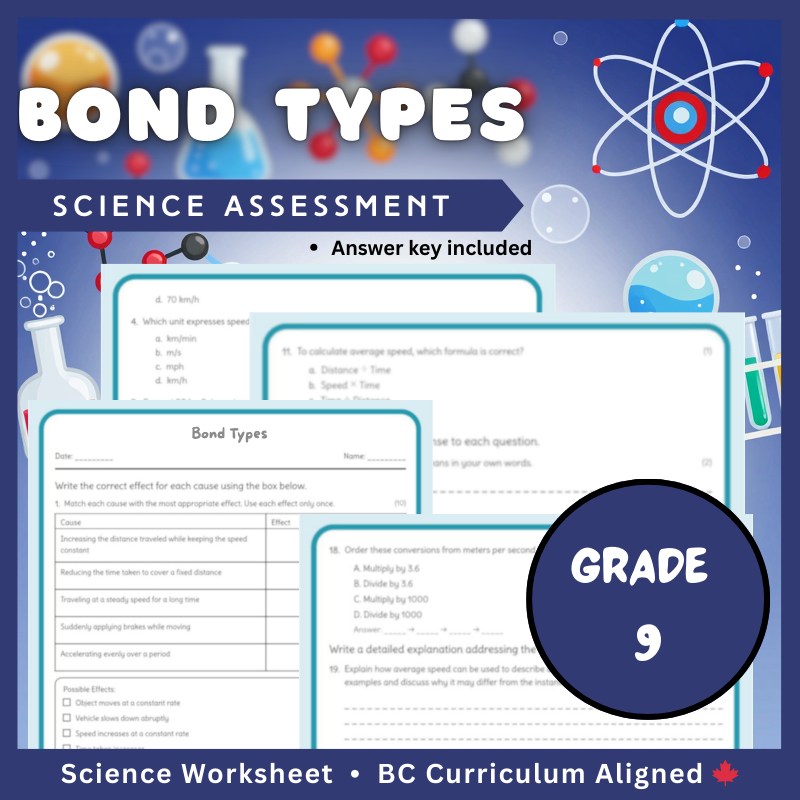
Grade 9 Science – Bond Types Worksheet (Worksheet + Answer Key) | BC Standards
Created byBright Mind ResourcesLearning Objectives
- Identify and describe different types of chemical bonds: ionic, covalent, and metallic.
- Explain how electron arrangements influence material properties.
- Recognize bond types from characteristic properties and behaviors.
Instant download

Grade 9 Friction and Drag Worksheet | NGSS Practice PDF
Created byClear Sky ClassroomLearning Objectives
- Explain how friction and aerodynamic drag oppose motion and convert mechanical energy into thermal energy
- Use coefficients of friction and drag concepts to predict how surface texture, normal force, and speed affect resistance
- Interpret real-world examples (vehicles, sports equipment, pipelines, wind turbines) using qualitative cause-and-effect reasoning
Instant download

Genetic Transmission Worksheet | AP Science | Grade 9 Practice
JCreated byJ.S SheetsLearning Objectives
- Explain the mechanisms of inheritance, including chromosomal behavior during meiosis and Mendelian patterns.
- Identify deviations such as incomplete dominance, codominance, and linkage, and understand their effects on traits.
- Use pedigree analysis, Punnett squares, and probability calculations to predict genotypic and phenotypic ratios.
Also included in: Grade 9 Science | DNA and Ecosystems Lesson Group Bundle
Instant download

Feedback Principles Worksheet for Grade 9 Science | Standards-Aligned Practice
JCreated byJ.S SheetsLearning Objectives
- Explain how homeostatic feedback loops maintain internal stability using sensors, control centers, and effectors.
- Differentiate negative feedback from positive feedback based on how each responds to deviations from a set point.
- Apply feedback principles to real physiological examples such as blood pressure regulation and blood clotting.
Instant download

Comparative Structures Assessment | TEKS Grade 9 Science Worksheet
Created byPrism Point LearningLearning Objectives
- Understand how organelle forms vary across different cell types and taxa.
- Identify examples of structural adaptations in cellular organelles.
- Explain the functional significance of morphological differences in organelles.
Instant download

Fossil Records Worksheet | Grade 9 Science Activities
Created byPrism Point LearningLearning Objectives
- Explain how fossil records and stratigraphic layers can provide evidence about the timing of past life.
- Distinguish relative age (stratigraphy) from absolute age (radiometric dating) in fossil interpretation.
- Describe how taphonomy and preservation bias affect which organisms appear in the fossil record.
Also included in: Grade 9 Evolution & Speciation Lesson Bundle | TEKS Science
Instant download

Grade 9 Science – Tissue Types Worksheet (PDF) BC Standards
 Created byEvergreen Desk Education
Learning Objectives
- Differentiate the four major tissue types (epithelial, connective, muscle, and nervous) by structure and function.
- Explain how cell specialization within tissues supports organ-level capabilities.
- Use evidence from a scientific description to identify tissue type and predict likely function.
Instant download

Grade 9 Population Trait Variation Worksheet | California Science Activity
Created byEvergreen Desk EducationLearning Objectives
- Explain how allele frequency differences within a population can produce variation in traits among individuals.
- Describe how random processes, heritable mutations, and gene interactions contribute to population-level trait diversity.
- Use natural selection to predict how allele frequencies and trait distributions may change over generations.
Instant download

Circulatory Transport Test Prep Worksheet | Grade 9 Science
Created byPrism Point LearningLearning Objectives
- Explain how the cardiovascular system delivers oxygen and nutrients while removing metabolic wastes
- Describe the structure and function of the heart valves and major blood vessel types
- Use basic haemodynamics ideas (cardiac output and vascular resistance) to explain how blood flow changes with body needs
Also included in: Grade 9 Body Systems and Cells Science Ontario Lesson Bundle Test Prep
Instant download
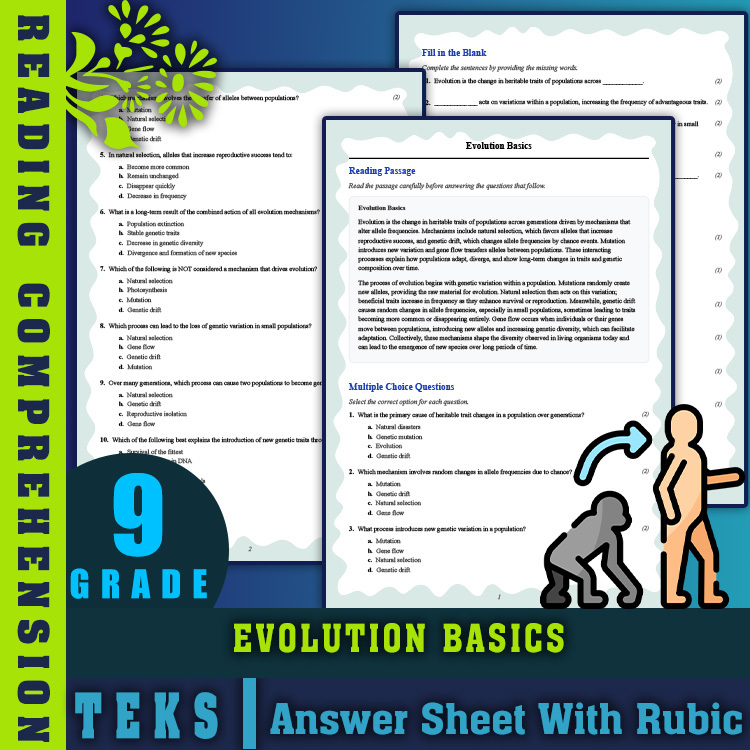
9th Grade Science Reading Worksheet | Evolution Basics with PDF Answer Key
JCreated byJ.S SheetsLearning Objectives
- Understand the fundamental concepts of biological evolution and its mechanisms.
- Explain how natural selection, genetic drift, mutation, and gene flow contribute to evolution.
- Analyze examples of evolution in populations over time.
Instant download

Grade 9 Science | Molecular Inheritance Worksheet | AP Aligned
Created byLumora LearningLearning Objectives
- Understand the molecular mechanisms of DNA replication, transcription, RNA processing, and translation.
- Link sequence variations and mutations to changes in gene expression and protein function.
- Use molecular models and sequence reasoning to predict phenotypic effects of allelic changes.
Also included in: Grade 9 Science | Biology and Ecosystems Custom Bundle | AP Worksheets
Instant download

Population Regulation Practice Worksheet | Grade 9 Science NGSS Review
Created byPrism Point LearningLearning Objectives
- Explain how carrying capacity and density-dependent/independent factors regulate population size
- Describe how competition, predation, and disease affect population dynamics and community composition
- Use basic mathematical ideas (like logistic growth) to interpret population regulation patterns
Also included in: Grade 9 Ecosystem Dynamics Science Lesson Bundle: NGSS Review Worksheets
Instant download

Grade 9 Science – Glycolysis & Cellular Metabolism | Daily Reading Worksheet
Created byBright Mind ResourcesLearning Objectives
- Understand the basic process of glycolysis.
- Identify key molecules involved in glycolysis.
- Explain the importance of glycolysis in cellular energy production.
Also included in: Photosynthesis Grade 9 Science Daily Reading Worksheets Lesson Bundle | TEKS +2 more
Instant download

Grade 9 Collision Safety Worksheet | NGSS Practice & PDF
Created byClear Sky ClassroomLearning Objectives
- Understand how impulse and force-time relationships influence collision mitigation strategies.
- Identify and describe engineering methods such as crumple zones, airbags, and helmets used to reduce peak forces during impacts.
- Analyze force-time graphs and evaluate the effectiveness of different collision mitigation approaches.
Also included in: Grade 9 Newtonian Motion and Forces Science Practice Lesson Bundle – NGSS +1 more
Instant download

Science Worksheet Design Cycle Grade 9 | Standards-Aligned Assessment
JCreated byJ.S SheetsLearning Objectives
- Explain the steps of a design cycle and how evidence leads to redesign.
- Use criteria and constraints to evaluate potential engineering solutions.
- Apply design-cycle reasoning to a protective gear example (e.g., a helmet).
Also included in: Grade 9 Engineering Design Cycle Science Lesson Bundle: General Framework +1 more
Instant download
About Grade 9 Science Worksheets
Find Science worksheets built for Grade 9. All 6,926 cover core skills, practice, and review, each an instant PDF download.
Every worksheet on MyTeachingSheets is created by independent teacher-authors and reviewed before publication. All resources download as printable PDFs for classroom, homework, or at-home practice, and many include answer keys. Preview any worksheet free before buying.