
Grade 9 Science Worksheets
6,926 worksheets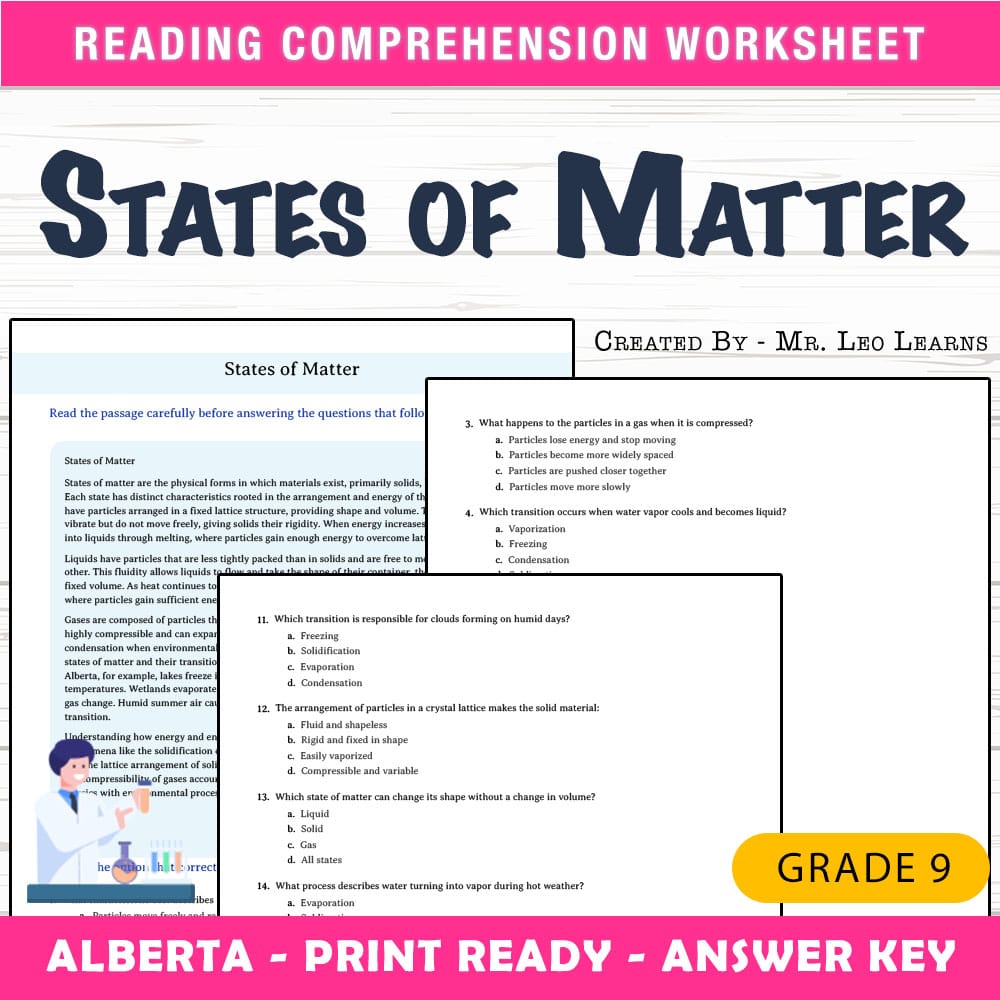
Grade 9 Science — Worksheet MCQ Paper for States of Matter
 Created byThe Resource Hub
Learning Objectives
- Understand the different phases of matter: solid, liquid, and gas.
- Describe the particle arrangement and properties in each state.
- Explain the processes of phase transitions such as freezing, evaporation, and condensation.
Also included in: Grade 9 Science Bundle | Matter and Chemical Change Worksheets Pack +1 more
Instant download

Newtonian Concepts Worksheet for Grade 9 Science | Standards-Aligned Practice
JCreated byJ.S SheetsLearning Objectives
- Understand the fundamental principles of Newton's laws of motion.
- Explain how forces affect the motion of objects in real-world contexts.
- Apply Newtonian reasoning to analyze motion patterns such as erosion control and playground dynamics.
Also included in: Grade 9 Newtonian Motion & Energy Science Lesson Bundle | Alberta
Instant download

Renal Regulation Worksheet for Grade 9 Science | Standards-Aligned Practice
JCreated byJ.S SheetsLearning Objectives
- Explain how glomerular filtration, tubular reabsorption, and secretion work together to regulate fluid and solute balance.
- Describe how antidiuretic hormone (ADH) and the renin–angiotensin–aldosterone system (RAAS) respond to changes in osmolarity and blood volume.
- Use cause-and-effect reasoning to predict how hormonal signals change nephron transport processes and urine output.
Instant download

Hazard Assessment Worksheet | Grade 9 Science printable PDF NGSS aligned
Learning Objectives
- Understand various natural hazards such as earthquakes, volcanoes, tsunamis, hurricanes, and floods.
- Evaluate hazard risks using historical records, probabilistic models, and hazard mapping techniques.
- Analyze factors like exposure, vulnerability, and cascading effects on communities and infrastructure.
Also included in: Grade 9 Science Earth and Human Activity NGSS Lesson Bundle +1 more
Instant download

Grade 9 Science – Computational Modeling & Applications | Reading Worksheet
 Created byBright Mind Resources
Learning Objectives
- Identify key components of a mathematical model used in computational simulations.
- Explain the purpose of parameter estimation and numerical tuning in system modeling.
- Describe how computational models assist in evaluating system performance and design parameters.
Also included in: Engineering Design Grade 9 Science Daily Reading Worksheets Lesson Bundle | NGSS +2 more
Instant download
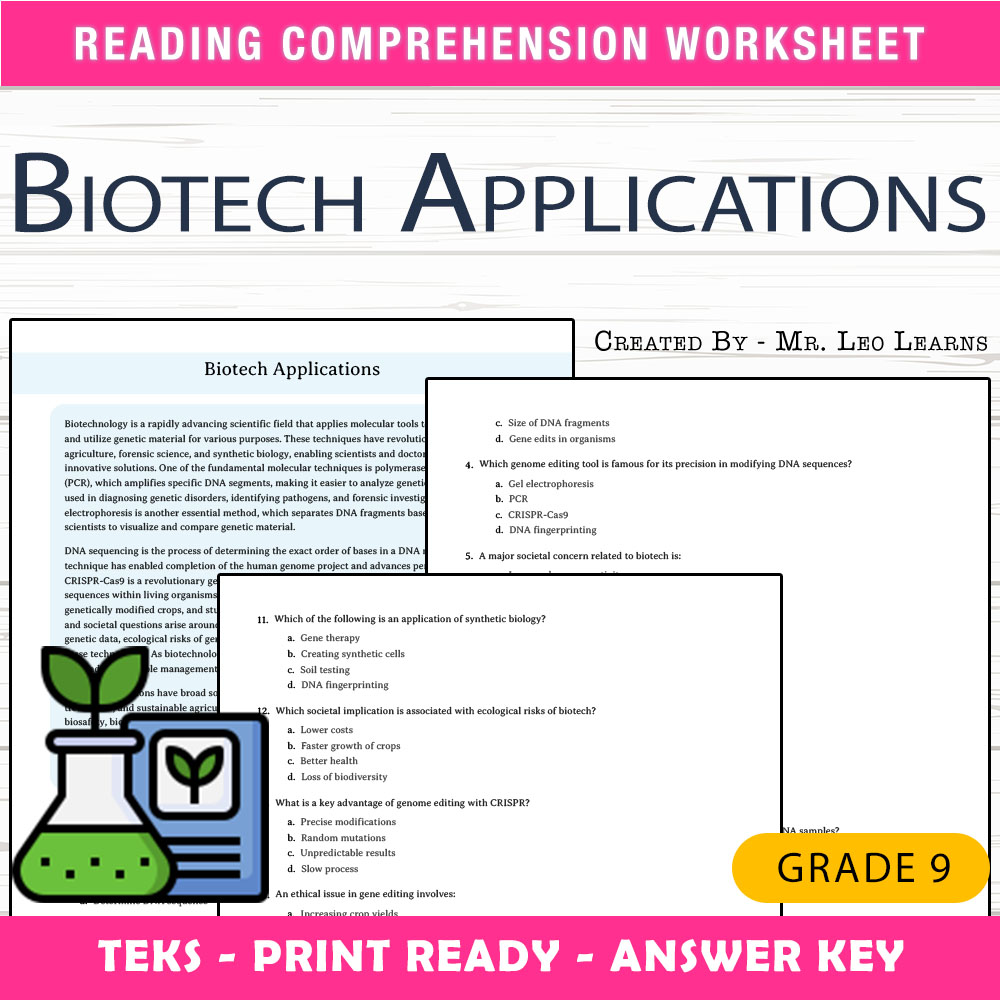
Grade 9 Science — Biotech Applications Worksheet for Mastery
Created byThe Resource HubLearning Objectives
- Understand key molecular techniques used in biotechnology such as PCR, gel electrophoresis, DNA sequencing, and CRISPR genome editing.
- Identify various applications of biotechnology in medicine, agriculture, and forensic science.
- Recognize ethical, legal, and societal considerations related to biotech advances.
Also included in: Grade 9 Science Unit Bundle | Genetics, DNA & Biotechnology Worksheets +1 more
Instant download

Speciation Intro Worksheet | TEKS Grade 9 Science Assessment PDF
JCreated byJ.S SheetsLearning Objectives
- Explain how speciation occurs when populations diverge and stop interbreeding.
- Distinguish allopatric from sympatric speciation and describe how gene flow is affected.
- Identify examples of prezygotic and postzygotic reproductive isolating mechanisms.
Instant download

Ecosystem Change and Resilience Assessment | General Grade 9 Science
 Created byPrism Point Learning
Learning Objectives
- Understand how disturbances impact ecosystem stability and composition.
- Identify factors that influence ecosystem resilience and recovery.
- Analyze evidence from population trends and community changes to infer ecological shifts.
Also included in: Grade 9 Ecology, Genetics, and Cells Science Lesson Bundle – General
Instant download

Wave Speed Relations Frequency and Wavelength Worksheet | Grade 9 Science
JCreated byJ.S SheetsLearning Objectives
- Explain the relationship between wave speed, frequency, and wavelength in a given medium
- Use the equation v = fλ to predict how wavelength changes when frequency changes (and speed stays constant)
- Apply wave speed relations to real-world examples involving pulses and periodic signals
Also included in: Grade 9 Energy, Waves, and Motion Science Lesson Bundle: General Framework +1 more
Instant download

Grade 9 Kinematic Equations Constant Acceleration Worksheet | Ontario
 Created byChalk and Compass
Learning Objectives
- Use constant-acceleration kinematic equations to relate displacement, initial velocity, final velocity, acceleration, and time.
- Apply v = u + at and s = ut + 0.5at² (and related forms) to solve 1D motion problems with consistent sign conventions.
- Distinguish between vertical free-fall and horizontal/projected motion by treating components separately.
Also included in: Grade 9 Science Work, Energy & Forces Lesson Bundle | Ontario +1 more
Instant download

Grade 9 Momentum Conservation Worksheet | NGSS Physics Activities & Notes
 Created byAmber Owl Education
Learning Objectives
- Calculate total linear momentum before and after an interaction and apply conservation of momentum to isolated systems.
- Distinguish elastic and inelastic collisions using quantitative momentum (and energy when appropriate).
- Use two-body momentum and center-of-mass ideas to interpret motion and predict outcomes.
Also included in: Grade 9 Science Forces, Motion, Momentum & Fields Lesson Bundle – NGSS +1 more
Instant download

Grade 9 Science – Mountain Building Worksheet (AP Standard) PDF
 Created byEvergreen Desk Education
Learning Objectives
- Explain how orogenic processes (crustal shortening, thickening, metamorphism, and isostatic adjustment) build mountain belts.
- Use ideas from structural cross sections, uplift rate estimates, and thermochronology to link plate convergence to surface topography.
- Describe how mountain building influences erosion, river incision, sediment delivery, and regional climate over long timescales.
Also included in: Earth Systems & Climate Grade 9 Science Lesson Bundle AP Worksheets +1 more
Instant download

Ecosystem Dynamics Worksheet for Grade 9 Science | AP Standards Practice
JCreated byJ.S SheetsLearning Objectives
- Analyze how multiple factors influence ecosystem responses and stability.
- Understand trophic interactions, feedback loops, and material fluxes in ecosystems.
- Evaluate impacts of climate variability, land-use change, and species introductions on ecosystem services.
Also included in: Grade 9 Science | DNA and Ecosystems Lesson Group Bundle
Instant download

Mendelian Patterns Test Prep Printables | Grade 9 Science
Created byPrism Point LearningLearning Objectives
- Explain how dominant and recessive alleles affect genotype-to-phenotype outcomes in monohybrid crosses.
- Use probability ideas and Punnett squares to predict genotype and phenotype ratios.
- Interpret simple pedigrees and recognize limits of Mendelian patterns when inheritance is not fully simple.
Also included in: Grade 9 Genetics and Inheritance Science Lesson Bundle Review | NGSS
Instant download
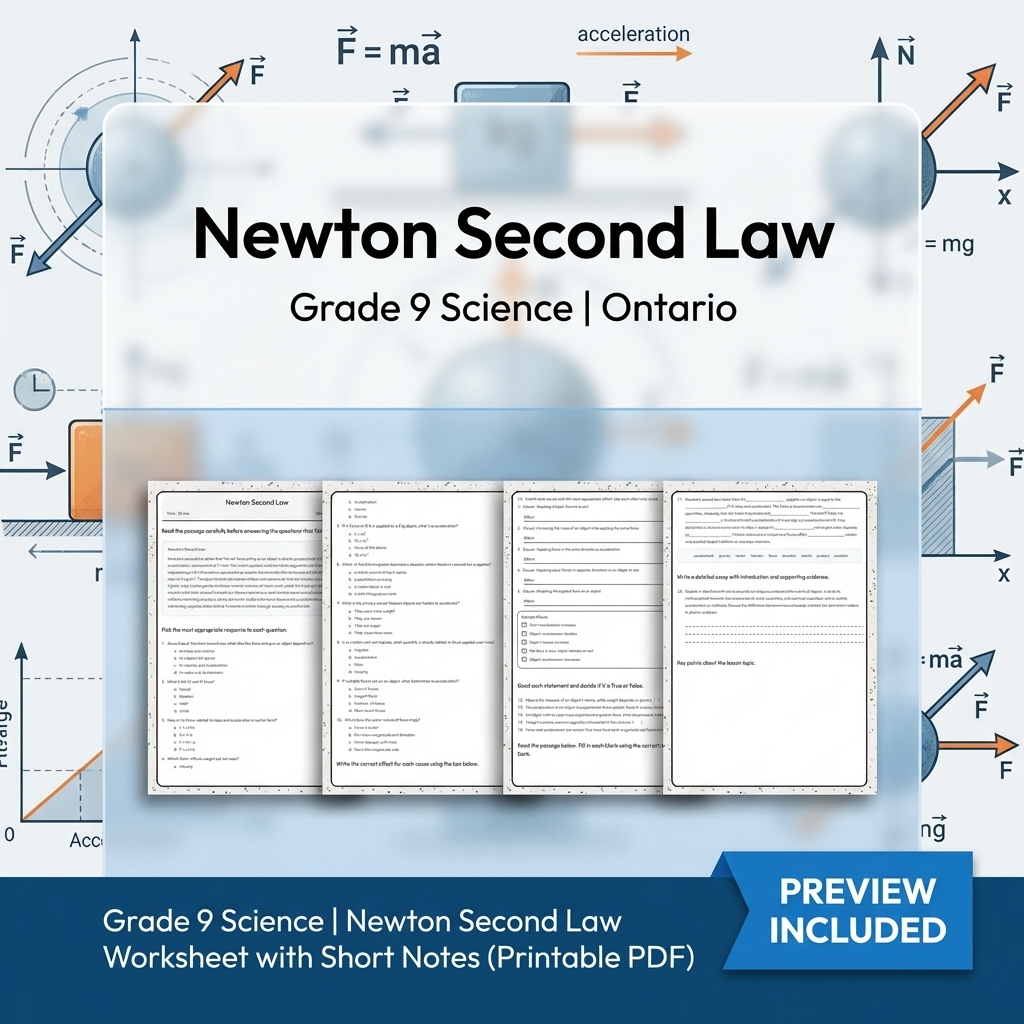
Grade 9 Science | Newton Second Law Worksheet with Short Notes (Printable PDF)
 Created byMeadowlark Worksheets
Learning Objectives
- Explain the relationship between net force, mass, and acceleration as described by Newton's second law.
- Differentiate between mass and weight and understand their implications in force calculations.
- Apply Newton's second law to analyze situations involving accelerating objects, collisions, and multiple forces.
Also included in: Grade 9 Science Lesson Group: Energy, Forces & Motion Worksheets Bundle
Instant download

Grade 9 Design Communication Worksheet | Practice & Assessment PDF
 Created byClear Sky Classroom
Learning Objectives
- Explain how diagrams and data summaries help communicate design decisions and results.
- Use reasoning to connect test outcomes to specific design choices, including trade-offs.
- Interpret and evaluate communication elements such as labels, criteria, uncertainty, and variations.
Instant download

Design Communication Worksheet for Grade 9 Science | Practice
Created byPrism Point LearningLearning Objectives
- Explain how labeled diagrams and data summaries communicate design decisions clearly.
- Use reasoning to connect test results to specific design choices and trade-offs.
- Compare results to criteria and describe uncertainty or variation in measurements.
Instant download

Grade 9 Science | Phylogenetic Trees Worksheet (PDF) TEKS Aligned
Created byEvergreen Desk EducationLearning Objectives
- Explain how phylogenetic trees represent hypothesized evolutionary relationships using common ancestors and branching patterns.
- Differentiate monophyletic, paraphyletic, and polyphyletic groups based on what descendants are included.
- Interpret rooted versus unrooted trees and relate tree structure to direction of descent and relationships.
Instant download

Evolutionary Evidence Worksheet | NGSS Grade 9 Science Assessment
 Created bySkylark Worksheets
Learning Objectives
- Explain how fossil evidence can reveal patterns of descent and change over time.
- Compare homologous structures and predict how similar body plans support common ancestry.
- Interpret molecular sequence similarities and use them to infer relatedness.
Also included in: Grade 9 Science Full-Year Bundle | NGSS Worksheets & Assessments
Instant download

Grade 9 Science | Net Force Analysis - Daily Reading Comprehension
 Created byCoral Reef Learning
Learning Objectives
- Understand the concept of net force and how it affects motion
- Identify forces acting on objects in various scenarios
- Analyze the direction and magnitude of different forces
Also included in: Forces and Motion Mechanical Systems Lesson Bundle | Grade 9 Science Alberta +1 more
Instant download

Grade 9 Communicating Uncertainty Worksheet | NGSS Practice PDF
Created byClear Sky ClassroomLearning Objectives
- Explain how interval estimates and confidence levels communicate uncertainty in scientific measurements.
- Use likelihood language and effect sizes to report inferential results more clearly.
- Interpret visualizations that show variability (e.g., error bars, confidence bands, and distributions).
Also included in: Grade 9 Science Practices Science Lesson Bundle | Advanced Placement (AP) +1 more
Instant download

Grade 9 Science | Earth Material Cycling Worksheet | California Standards
 Created byLumora Learning
Learning Objectives
- Explain how Earth’s matter moves among reservoirs (atmosphere, hydrosphere, geosphere, and biosphere) through geologic and biological processes
- Describe the water cycle and how evaporation, condensation, and precipitation link atmosphere, surface water, and groundwater
- Trace how carbon and nutrients circulate among atmosphere, oceans, organisms, and rocks
Instant download

Grade 9 Science – Cell Essential Functions Reading Worksheet | Standards-Aligned
Created byBright Mind ResourcesLearning Objectives
- Understand the role of cell membranes in regulating transport.
- Identify different functions of cellular components involved in maintaining internal balance.
- Explain how cells respond to environmental changes through structure and function.
Also included in: Cells Genetics & Ecosystems Grade 9 Science Reading Lesson Bundle | General +1 more
Instant download
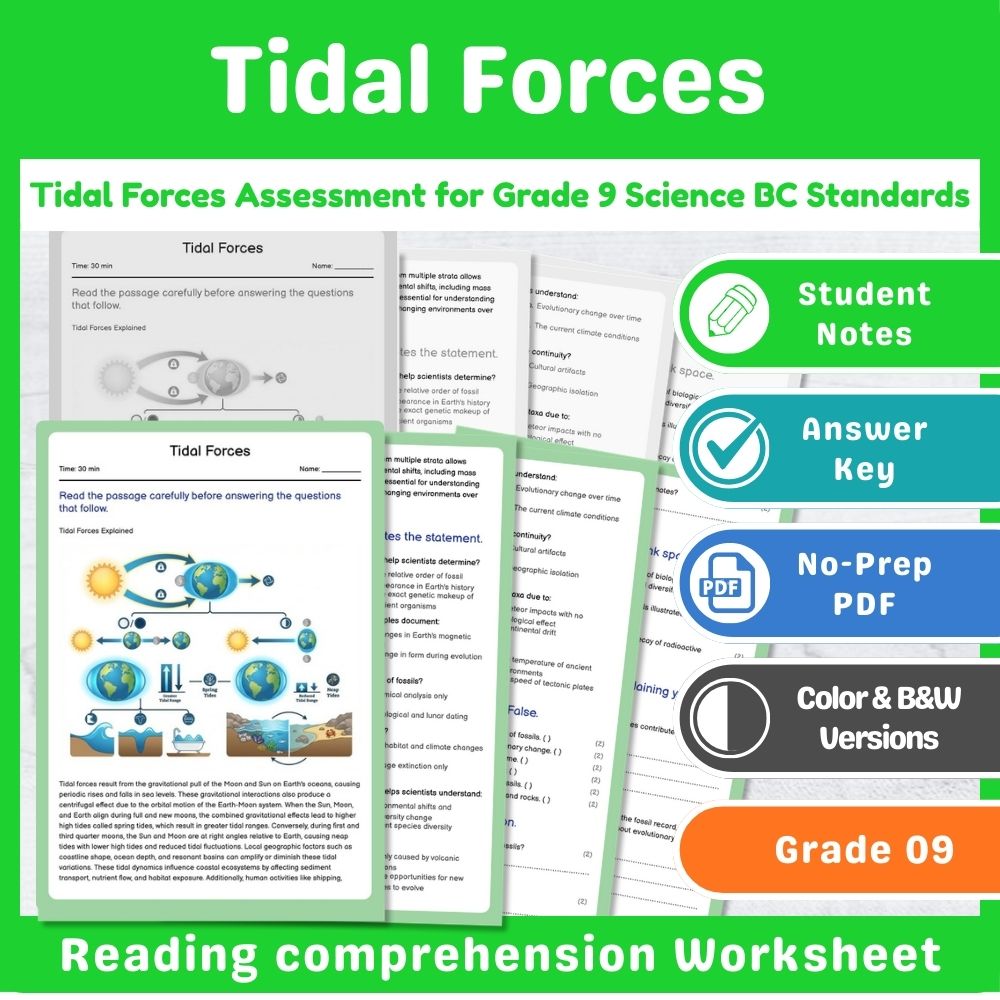
Tidal Forces Assessment for Grade 9 Science BC Standards
Created byPrism Point LearningLearning Objectives
- Explain how gravitational interactions among the Moon, Sun, and Earth produce tidal forces.
- Differentiate between spring and neap tides based on the relative positions of the Sun and Moon.
- Identify factors that influence local tidal amplitudes, including coastline geometry and ocean basin resonances.
Also included in: Grade 9 Science Mini Bundle – Earth & Space Assessment & Activities
Instant download
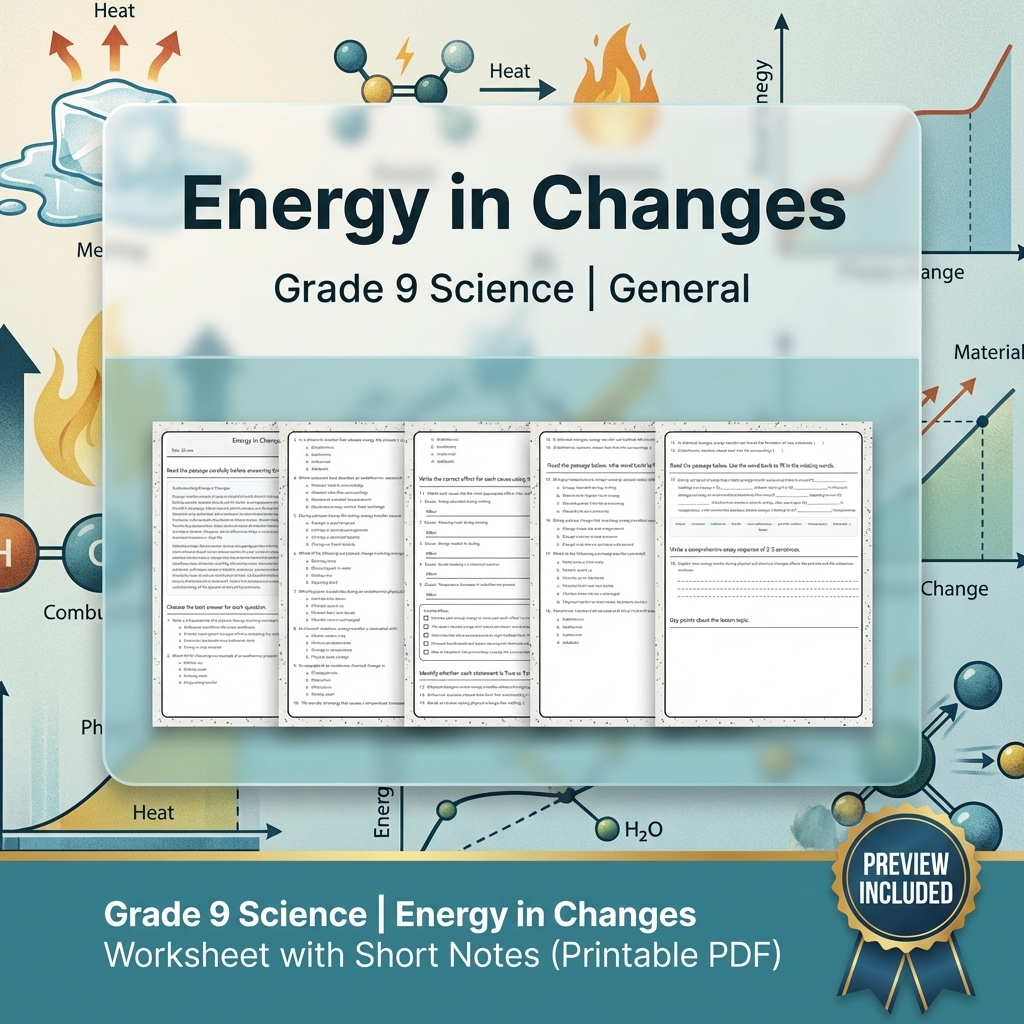
Grade 9 Science | Energy in Changes Worksheet with Short Notes (Printable PDF)
Created byMeadowlark WorksheetsLearning Objectives
- Compare physical and chemical changes in terms of energy transfer.
- Understand the concepts of endothermic and exothermic reactions.
- Describe how energy transfer affects particle motion and bond rearrangements.
Also included in: Grade 9 Motion and Energy Science Lesson Bundle: General Framework +1 more
Instant download

Science Worksheet: Mutation Sources PDF | NGSSS Grade 9 Science Practice
JCreated byJ.S SheetsLearning Objectives
- Explain common sources of mutations, including DNA copying errors and environmental agents
- Differentiate how mutations may be inherited and how they can contribute to genetic variation
- Describe how mutations can affect gene function or regulation
Also included in: Grade 9 Evolution, Genetics, and Ecosystems Science Lesson Bundle +1 more
Instant download

Reaction Balancing Assessment | General Standards + Grade 9 Science
Created byPrism Point LearningLearning Objectives
- Understand the conservation of atoms in chemical reactions.
- Learn how to balance simple chemical equations accurately.
- Explain the significance of coefficients in representing particle ratios.
Instant download

Grade 9 Solution Behaviour Science Worksheet | Ontario Curriculum + Answer Key
Created byClear Sky ClassroomLearning Objectives
- Explain how dissolution occurs through solute–solvent interactions and relate solvation to solution formation
- Describe how temperature and agitation qualitatively affect solubility and the rate of dissolving
- Differentiate saturated, unsaturated, and supersaturated solutions using everyday examples
Instant download
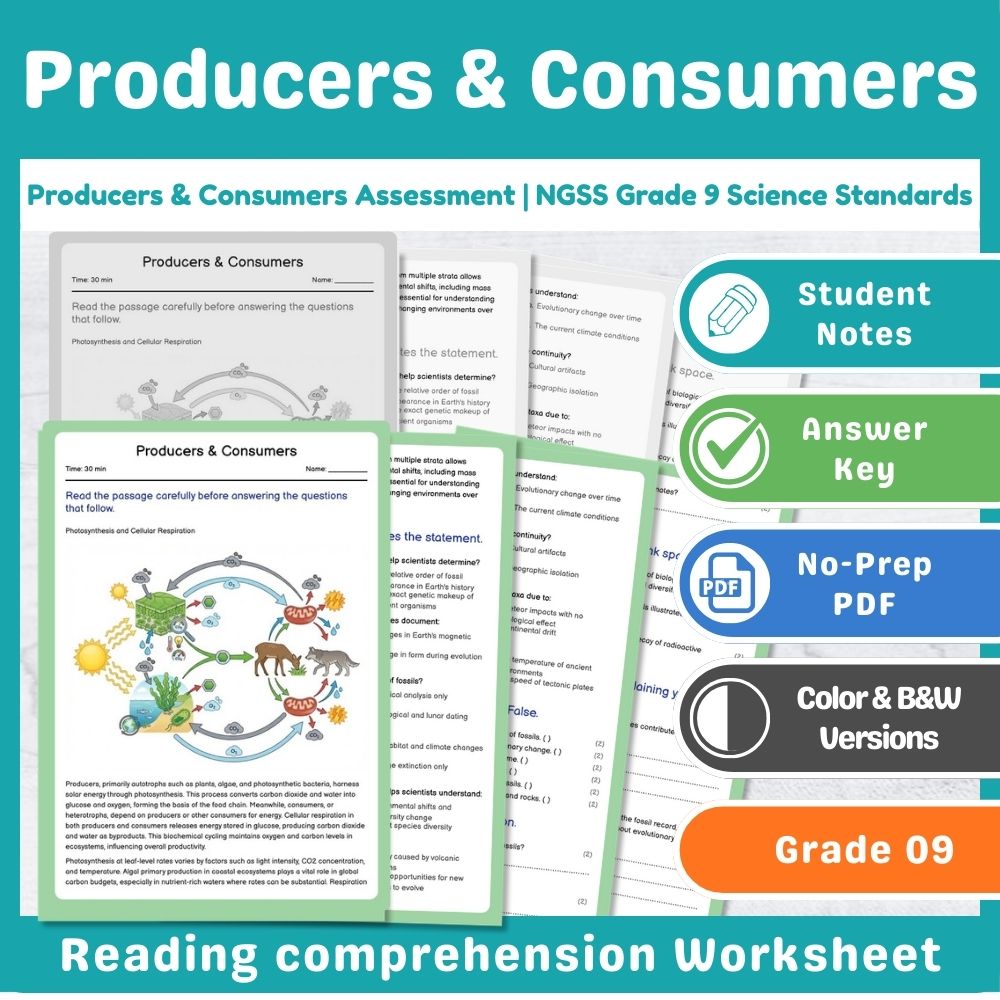
Producers & Consumers Assessment | NGSS Grade 9 Science Standards
Created byPrism Point LearningLearning Objectives
- Explain the roles of producers and consumers in an ecosystem.
- Analyze how photosynthesis and cellular respiration transfer energy and cycle carbon and oxygen.
- Evaluate factors affecting net primary productivity and biomass accumulation.
Instant download

Grade 9 Energy Changes Chemical Reactions Worksheet | NGSS Science Activity
Created byAmber Owl EducationLearning Objectives
- Explain how bond breaking and bond forming relate to changes in potential energy during chemical reactions
- Distinguish endothermic and exothermic reactions using energy diagrams and temperature change
- Use enthalpy change (ΔH) to describe whether a reaction releases or absorbs energy
Also included in: Grade 9 Science Chemical Reactions Lesson Bundle | NGSS +1 more
Instant download
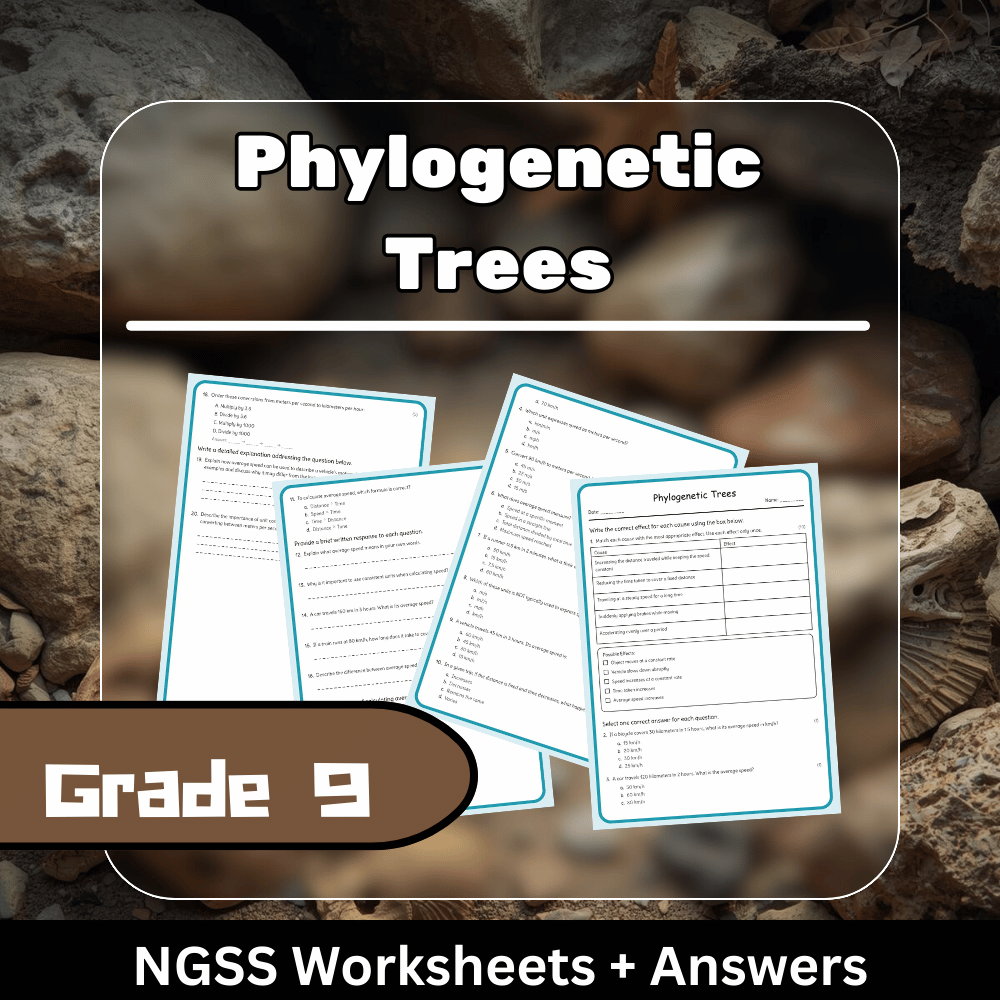
Grade 9 Science – Phylogenetic Trees Worksheet (Answer Key) | NGSS Standards
Created byBright Mind ResourcesLearning Objectives
- Understand the construction of phylogenetic trees based on morphological and molecular data.
- Interpret branching diagrams to infer evolutionary relationships among species.
- Explain cladistic principles such as shared derived characters.
Instant download

Grade 9 Science | Power and Rate of Energy Transfer - Reading Comprehension
Created byCoral Reef LearningLearning Objectives
- Understand the concept of power in the context of energy transfer
- Differentiate between total energy transferred and the rate at which transfer occurs
- Apply the understanding of power to real-life devices and scenarios
Instant download

Grade 9 Science | Circuit Diagrams & Symbols - Daily Reading Comprehension
Created byCoral Reef LearningLearning Objectives
- Understand and identify standard symbols used in circuit diagrams
- Interpret schematic representations of electrical circuits
- Connect circuit symbols to physical components
Also included in: Electricity and Magnetism Lesson Bundle – Grade 9 Science Alberta +1 more
Instant download

Grade 9 Science – Plate Boundaries Worksheet (AP Standard) (PDF)
Created byEvergreen Desk EducationLearning Objectives
- Explain how seafloor age patterns and paleomagnetic stripes provide evidence for seafloor spreading.
- Describe how earthquake distributions reveal the location and type of plate boundary.
- Distinguish divergent, convergent, and transform margins by their mechanisms and characteristic landforms.
Also included in: Earth Systems & Climate Grade 9 Science Lesson Bundle AP Worksheets +1 more
Instant download

Grade 9 Science | Ecosystem Interaction Networks Worksheet | General Standards
Created byLumora LearningLearning Objectives
- Explain how predation, competition, and mutualism connect species in an ecosystem network
- Analyze how environmental factors (water, temperature, nutrients) influence survival, growth, and population sizes
- Describe how changes in one species or resource can cascade through interaction networks and affect stability
Instant download

Newton’s First Law Worksheet | Grade 9 Science | Standards-Aligned Practice
JCreated byJ.S SheetsLearning Objectives
- Explain Newton’s First Law using the idea of inertia and the relationship between net external force and changes in motion
- Distinguish between rest and constant velocity as cases where the net external force is zero
- Use examples involving friction and balanced forces to predict whether an object’s motion will change
Instant download

Evolutionary Evidence Fossil Record Worksheet | NGSS Grade 9 Science
 Created byBRIGHT PATH RESOURCES
Learning Objectives
- Understand the importance of fossils in tracing evolutionary history.
- Identify key examples of transitional fossils such as Tiktaalik.
- Analyze how comparative anatomy supports the theory of evolution.
Also included in: Evolution & Speciation Grade 9 Science Daily Reading Lesson Bundle | NGSS +1 more
Instant download

Reaction Design Worksheet | NGSS Aligned Grade 9 Science Practice
JCreated byJ.S SheetsLearning Objectives
- Understand how temperature, pressure, concentration, and catalysts influence chemical reactions.
- Apply principles of equilibrium and kinetics to optimize reaction conditions.
- Evaluate the effects of selectivity, yield, and side reactions on chemical processes.
Also included in: Grade 9 Chemical Reactions and Atomic Structure Science Lesson Bundle – NGSS +1 more
Instant download

Grade 9 Science – Mass Conservation & Chemical Reactions | Daily Worksheet
 Created byQuiet Forest Education
Learning Objectives
- Understand the principle of conservation of mass in chemical reactions
- Identify examples of mass conservation in sealed systems
- Differentiate between apparent mass changes and true mass conservation
Also included in: Matter and Chemical Change Grade 9 Science Daily Worksheets Bundle | Ontario +1 more
Instant download

Reaction Conservation Worksheet for Grade 9 Science | Standards-Aligned Practice
JCreated byJ.S SheetsLearning Objectives
- Understand the principle of conservation of atoms during chemical reactions.
- Identify how energy changes occur in chemical reactions and their effects.
- Differentiate between exothermic and endothermic reactions with examples.
Also included in: Grade 9 Conservation of Energy and Forces Science Lesson Bundle +1 more
Instant download

Science Grade 9 Balancing Equations Worksheet | Standards-Aligned Assessment
JCreated byJ.S SheetsLearning Objectives
- Explain how balanced chemical equations reflect the conservation of atoms and mass
- Use coefficients and subscripts to represent reactants and products in symbolic form
- Determine missing coefficients by counting atoms on both sides of a chemical equation
Instant download

Grade 9 Science | Greenhouse Feedbacks Worksheet | NGSSS Aligned
Created byLumora LearningLearning Objectives
- Explain how greenhouse gas changes can create feedbacks that amplify or reduce an initial energy imbalance
- Analyze how water vapor and ice/snow albedo can respond to warming and influence Earth’s energy balance
- Describe how clouds and atmospheric circulation can affect the balance between absorbed sunlight and outgoing infrared radiation
Instant download

Mendelian Patterns Worksheet | NGSS Grade 9 Science Assessment
Created bySkylark WorksheetsLearning Objectives
- Use Punnett squares to predict genotype and phenotype ratios in single-gene crosses involving dominant and recessive alleles.
- Interpret probability outcomes in monohybrid and dihybrid inheritance, including how independent assortment affects ratios.
- Compare simple Mendelian expectations with real inheritance patterns (incomplete dominance, codominance, and linked loci).
Also included in: Grade 9 Science Full-Year Bundle | NGSS Worksheets & Assessments
Instant download

Grade 9 Science – Communicating Uncertainty Reading Worksheet | AP Standards
Created byBright Mind ResourcesLearning Objectives
- Understand different ways scientists convey uncertainty in their findings
- Recognize the importance of transparency regarding assumptions and limitations
- Identify various visual and qualitative methods for expressing variability
Also included in: Grade 9 Science Data Analysis Daily Reading Worksheets Lesson Bundle | AP +2 more
Instant download
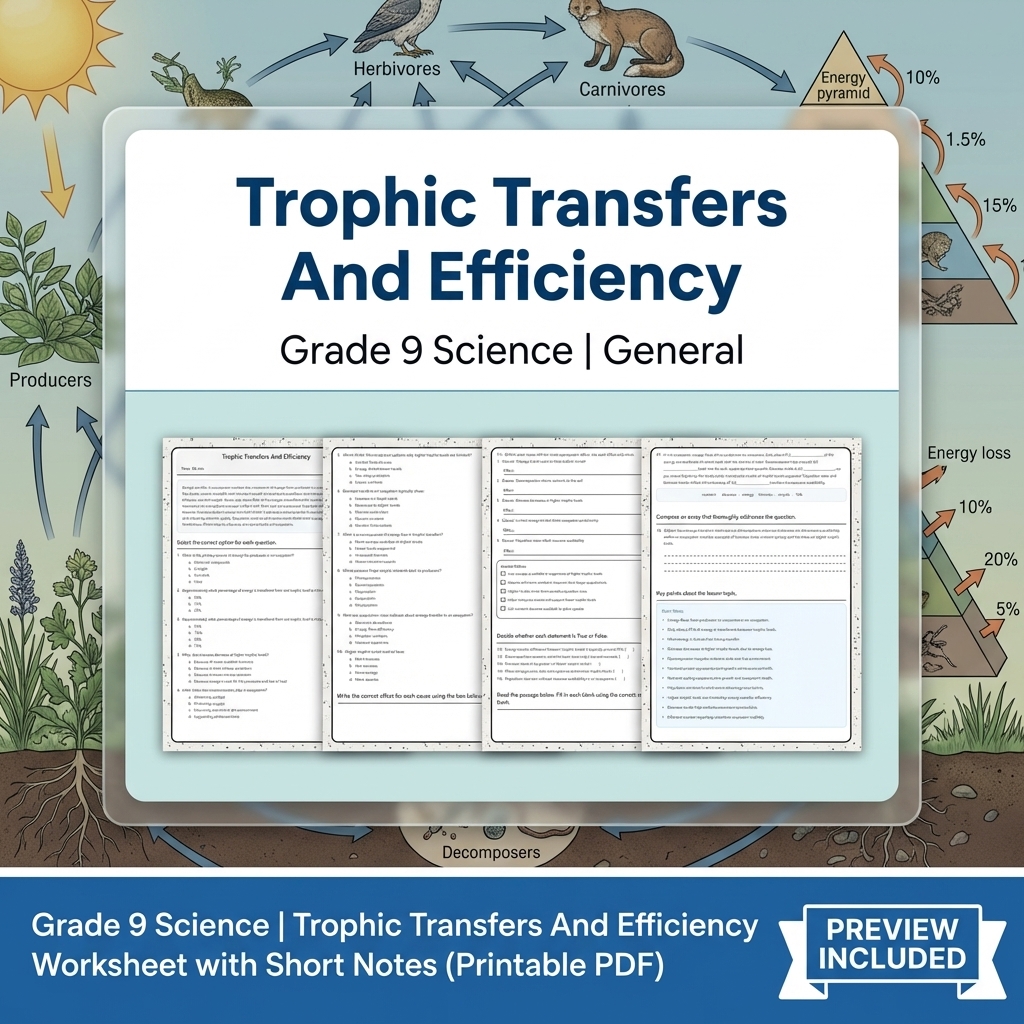
Grade 9 Science | Trophic Transfers And Efficiency Worksheet with Short Notes
Created byMeadowlark WorksheetsLearning Objectives
- Explain how energy is transferred among organisms in an ecosystem.
- Describe the concept of energy transfer efficiency between trophic levels.
- Interpret evidence like biomass trends and nutrient concentrations to understand resource availability.
Also included in: Grade 9 Ecology, Genetics & Cells Science Lesson Bundle | General Framework +1 more
Instant download

Grade 9 Science Worksheet: Carbon Pathways – Standards-Aligned Practice
JCreated byJ.S SheetsLearning Objectives
- Explain how carbon moves among the atmosphere, biosphere, oceans, and geosphere through key fluxes.
- Describe major processes that exchange carbon (photosynthesis, respiration, dissolution, sedimentation, and fossil fuel formation).
- Interpret the idea of carbon residence time and why it matters for understanding budgets.
Instant download

Grade 9 Science | Tissue Types - Daily Reading Comprehension
Created byCoral Reef LearningLearning Objectives
- Understand the main types of tissues: epithelial, connective, muscle, and nervous.
- Identify the cellular composition and extracellular matrix properties of each tissue type.
- Describe the specialized functions of epithelial tissues involved in absorption and secretion.
Instant download

Grade 9 Cell Essential Functions Worksheet | Practice & PDF
Created byClear Sky ClassroomLearning Objectives
- Explain how membranes regulate transport of nutrients and wastes to maintain internal balance in cells.
- Describe how cellular energy use powers chemical reactions needed for growth and repair.
- Use evidence such as uptake rates and growth patterns to connect cell structure and function.
Instant download
About Grade 9 Science Worksheets
Find Science worksheets built for Grade 9. All 6,926 cover core skills, practice, and review, each an instant PDF download.
Every worksheet on MyTeachingSheets is created by independent teacher-authors and reviewed before publication. All resources download as printable PDFs for classroom, homework, or at-home practice, and many include answer keys. Preview any worksheet free before buying.