
Grade 9 Science Worksheets
6,926 worksheets
Earth's Axial Tilt & Day Length Worksheets Grade 9 Science
 Created byBRIGHT PATH RESOURCES
Learning Objectives
- Explain how Earth’s axial tilt and Earth–Sun geometry cause seasonal changes
- Describe how daylight length and sun angle affect the amount of solar energy received
- Use orbital and tilt ideas to predict how day length changes across seasons and latitudes
Also included in: Grade 9 Earth Science Worksheets Bundle: Climate, Cycles & Space +1 more
Instant download

Grade 9 Science – Simple Machines Daily Reading Worksheet | Ontario Standards
 Created byBright Mind Resources
Learning Objectives
- Understand key concepts related to Science
- Apply knowledge through practice questions
- Demonstrate comprehension of the material
Also included in: Grade 9 Work, Energy & Forces Science Daily Reading Lesson Bundle | Ontario +1 more
Instant download

Science Grade 9 Worksheet: Design Communication Practice – Standards-Aligned
JCreated byJ.S SheetsLearning Objectives
- Explain how labeled diagrams help communicate design component relationships and load paths.
- Use test data and uncertainty to compare results against design requirements and criteria.
- Write clear reasoning that links observed outcomes to design decisions, including trade-offs.
Also included in: Grade 9 Engineering Design Cycle Science Lesson Bundle: General Framework +1 more
Instant download

Grade 9 Science | Balancing Equations in Chemistry - Daily Reading Practice
 Created byCoral Reef Learning
Learning Objectives
- Understand the concept of conservation of atoms during chemical reactions.
- Identify the number of each type of atom before and after a reaction.
- Learn why balancing chemical equations is essential for accurate scientific representation.
Also included in: Matter and Chemical Change Lesson Bundle – Grade 9 Science Alberta +1 more
Instant download

Grade 9 Solar System Scales Worksheet | California Standards Practice PDF
 Created byClear Sky Classroom
Learning Objectives
- Explain how scale and distance affect how the solar system appears from Earth
- Use basic measurement ideas (relative scale, brightness, and apparent motion) to infer orbital properties
- Distinguish between physical distance/size and observational perspective when interpreting sky observations
Instant download

Grade 9 Science | Biodiversity Change Worksheet | NGSSS Aligned
 Created byLumora Learning
Learning Objectives
- Explain how biodiversity (species diversity and genetic variation) supports ecosystem stability.
- Describe how environmental change can shift population sizes and species interactions.
- Analyze how human activities can increase or reduce biodiversity and influence ecosystem functions.
Instant download

Integrated Physiology Worksheet | NGSS Grade 9 Science Assessment
 Created byCedar Grove Learning
Learning Objectives
- Explain how molecular, cellular, and organ-level interactions contribute to organismal health and disease.
- Interpret data from biochemical assays, histology, and organ function metrics to understand physiological properties.
- Link genetic variations to cellular responses and organ system performance in clinical and natural contexts.
Instant download

Respiratory Pathways Worksheet for Grade 9 AP Science Biology Activities
 Created byPrism Point Learning
Learning Objectives
- Explain how glycolysis, the citric acid (TCA) cycle, and electron transport work together to produce ATP.
- Compare aerobic and anaerobic outcomes using redox balance and pathway stoichiometries.
- Predict how substrate availability and enzyme regulation affect pathway flux and cellular ATP yield.
Instant download

Grade 9 Science – Introduction to Speciation Daily Worksheet + Answer Key
JCreated byJ.S SheetsLearning Objectives
- Define speciation and explain its role in biodiversity.
- Identify different reproductive barriers that lead to speciation.
- Distinguish between allopatric and sympatric speciation.
Also included in: Grade 9 Science Lesson Bundle | Evolution and Genetics TEKS Framework +1 more
Instant download
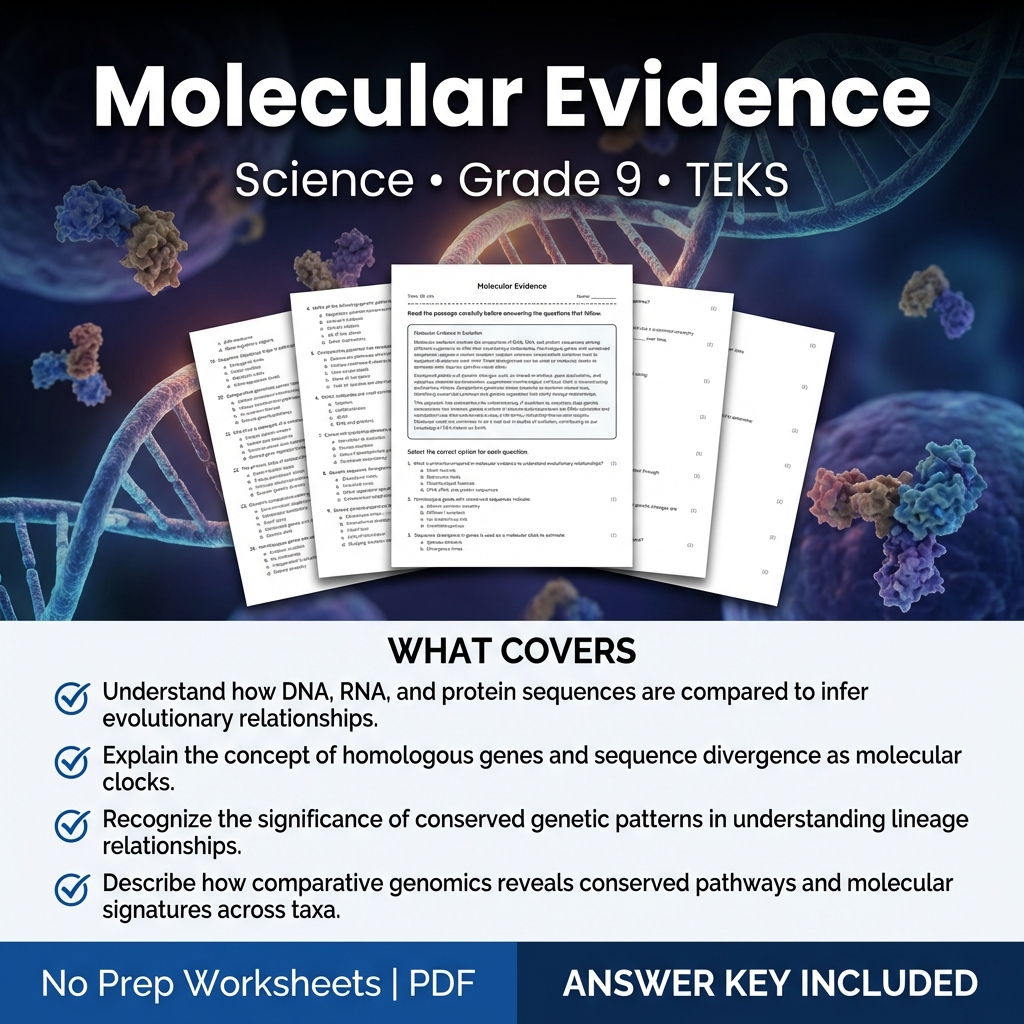
Molecular Evidence Worksheet for Grade 9 Science | TEKS Aligned
Created byCoral Reef LearningLearning Objectives
- Understand how DNA, RNA, and protein sequences are compared to infer evolutionary relationships.
- Explain the concept of homologous genes and sequence divergence as molecular clocks.
- Recognize the significance of conserved genetic patterns in understanding lineage relationships.
Instant download

Hierarchical Organization Worksheet for Grade 9 Science Standards – PDF
JCreated byJ.S SheetsLearning Objectives
- Understand the levels of biological organization from cells to organ systems.
- Identify the functions of tissues, organs, and organ systems in multicellular organisms.
- Explain how components at smaller scales support larger functions in organisms.
Also included in: Grade 9 Evolution, Genetics, and Ecosystems Science Lesson Bundle +1 more
Instant download

Grade 9 Science – Asexual Strategies Worksheet (PDF) Alberta Standards
 Created bySilver Birch Teaching
Learning Objectives
- Describe major asexual reproduction mechanisms (binary fission, budding, spore formation, and vegetative propagation).
- Explain genetic consequences of cloning during asexual reproduction.
- Analyze why asexual strategies may spread quickly in stable environments and why they may be risky when conditions change.
Also included in: Grade 9 Genetics and Reproduction Science Lesson Bundle Worksheets – Alberta +1 more
Instant download

Grade 9 Structure Function Connections Worksheet | Practice & PDF
Created byClear Sky ClassroomLearning Objectives
- Explain how cellular structures support specific functions (information storage, energy conversion, and selective exchange).
- Connect organism-level body structures to the tasks they perform (protection, movement, support).
- Use models and physical properties to justify how form enables a biological function.
Instant download

Grade 9 Science – Speciation & Reproductive Barriers | Daily Reading Worksheet
Created byBright Mind ResourcesLearning Objectives
- Understand the basic concept of speciation and how new species form.
- Identify the different reproductive barriers that lead to speciation.
- Distinguish between allopatric and sympatric speciation.
Also included in: Grade 9 Evolution Science Daily Reading Worksheets Lesson Bundle | TEKS +2 more
Instant download

Grade 9 Science – Human Impacts on Ecosystems Daily Reading Worksheet | NGSS
Created byBright Mind ResourcesLearning Objectives
- Analyze case studies related to land-use change and its effect on biodiversity.
- Interpret empirical data regarding deforestation and ecological consequences.
- Evaluate trade-offs between conservation efforts and human development.
Also included in: Ecosystem Food Webs Grade 9 Science Daily Reading Worksheets Bundle | NGSS +2 more
Instant download

Grade 9 Science | Understanding Net Force - Daily Reading Comprehension
Created byCoral Reef LearningLearning Objectives
- Define net force and explain its role in motion
- Distinguish between balanced and unbalanced forces
- Understand how to resolve forces into components
Instant download

Grade 9 Wave Speed Relations Worksheet | NGSS Practice PDF
Created byClear Sky ClassroomLearning Objectives
- Explain how wave speed relates to frequency and wavelength using v = fλ
- Compare how wave speed depends on medium for different wave types (e.g., sound vs. electromagnetic waves)
- Use wave relationships to predict how changes in frequency or wavelength affect wave propagation
Instant download

Grade 9 Science | Investigation Design Controls Worksheet | General Standards
Created byLumora LearningLearning Objectives
- Identify the independent, dependent, and controlled variables in a science investigation.
- Design an investigation by choosing controls, safety conditions, and an accurate measurement procedure.
- Explain how controlling variables supports valid conclusions from results.
Instant download
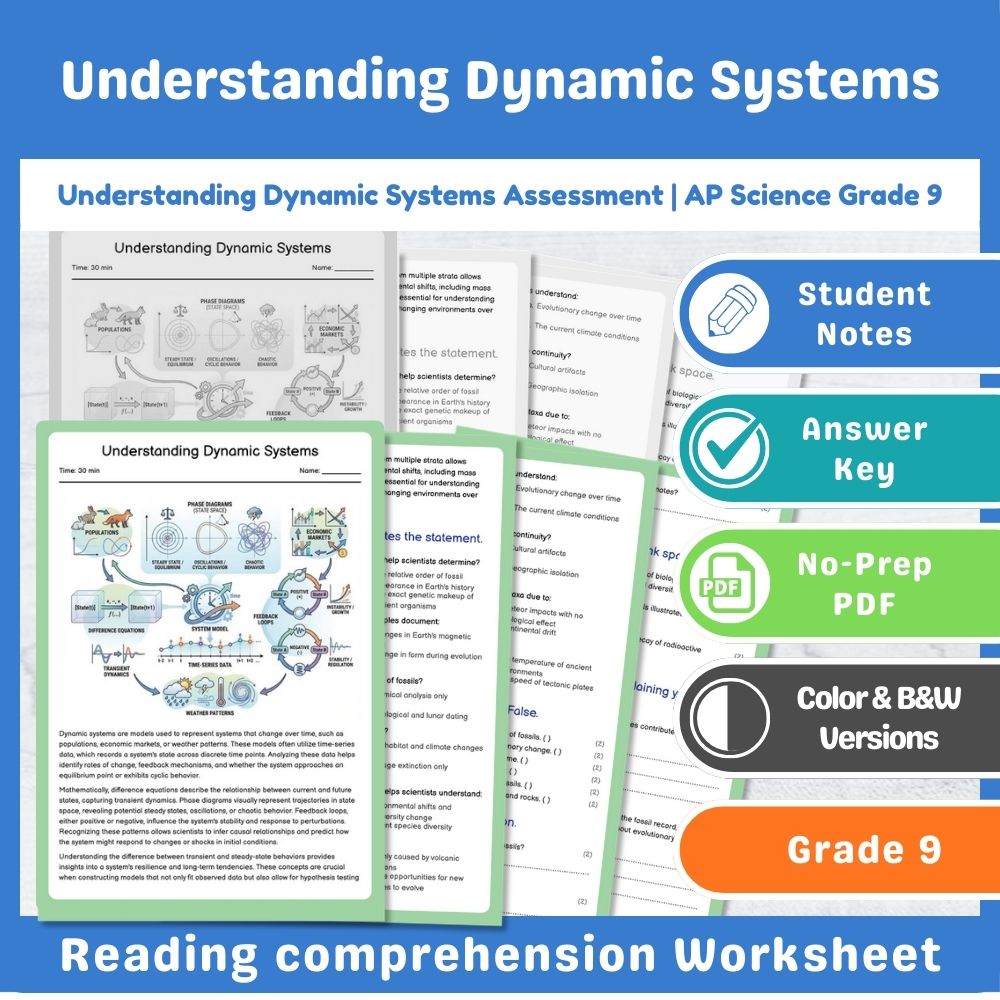
Understanding Dynamic Systems Assessment for Grade 9 Science AP
Created byPrism Point LearningLearning Objectives
- Explain how time-series data can be used to analyze changing systems
- Describe the role of difference equations and phase diagrams in modeling dynamics
- Identify feedback loops, equilibrium points, and causal structures in empirical data
Instant download

Grade 9 Science | Molecular Bonding - Daily Reading Comprehension
Created byCoral Reef LearningLearning Objectives
- Understand the concept of ionic bonding and its properties
- Identify examples of ionic compounds and their characteristics
- Describe how ionic bonds influence material properties
Also included in: Matter and Chemical Change Lesson Bundle – Grade 9 Science Alberta +1 more
Instant download

Reaction Evidence Recognizing New Substances Worksheet for Grade 9 Science
JCreated byJ.S SheetsLearning Objectives
- Identify observable evidence that indicates a chemical reaction has formed new substances.
- Connect reaction evidence (gas, precipitate, color, temperature, odor) to changes in bonding and rearrangement of atoms.
- Differentiate chemical changes from physical changes using evidence from reactions such as oxidation and combustion.
Also included in: Grade 9 Forces, Energy, and Matter Transformations Science lesson bundle +1 more
Instant download

Grade 9 Science Worksheet | Molecular Evidence TEKS (PDF)
 Created byEvergreen Desk Education
Learning Objectives
- Explain how DNA, RNA, and protein sequence similarities can indicate common ancestry.
- Use ideas from molecular clocks to describe how divergence times can be estimated from sequence divergence.
- Interpret how conserved genes, gene duplications, and shared regulatory changes support evolutionary relationships.
Instant download
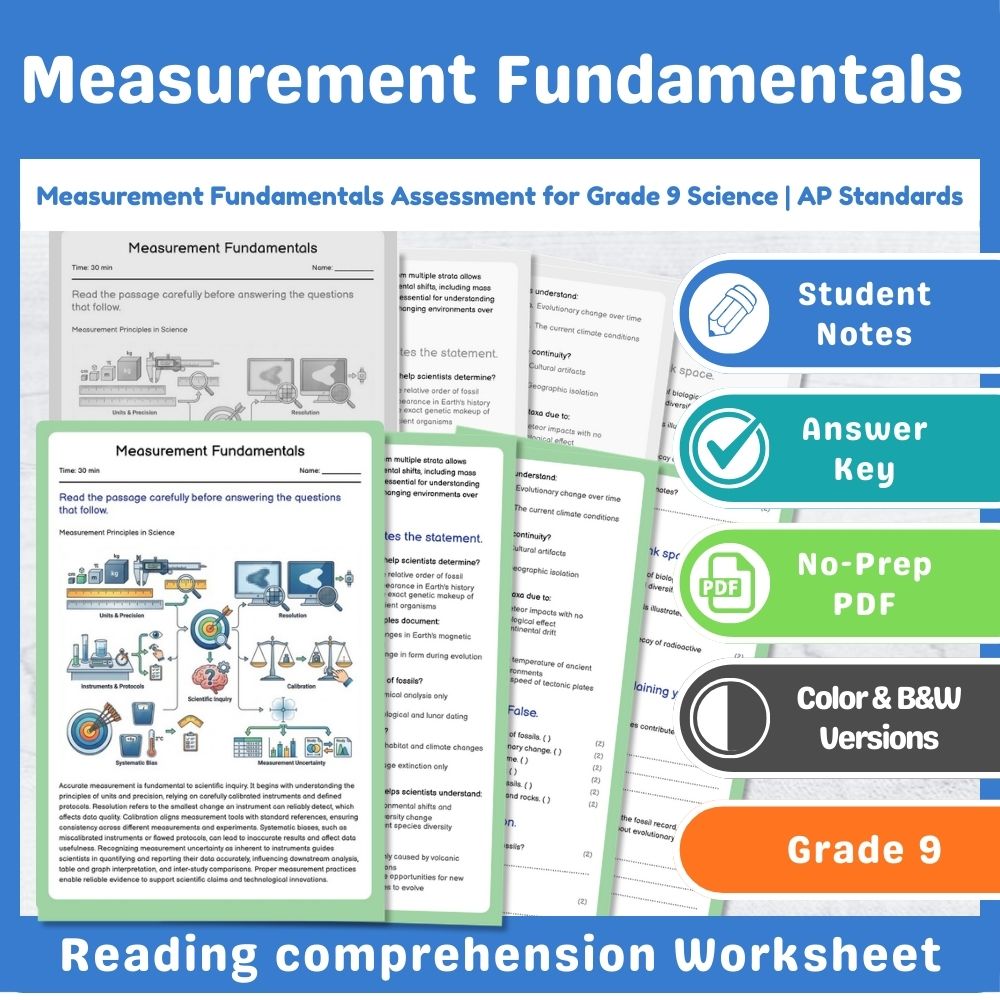
Measurement Fundamentals Assessment for Grade 9 Science | AP Standards
Created byPrism Point LearningLearning Objectives
- Understand the principles of metric measurement and instrument resolution.
- Recognize the importance of calibration in obtaining reliable data.
- Connect raw measurements to data representations and assess measurement uncertainty.
Instant download

Energy Flow Worksheet | TEKS-Aligned Science Practice for Grade 9
JCreated byJ.S SheetsLearning Objectives
- Explain how energy moves directionally through trophic levels from primary producers to consumers and decomposers
- Describe the role of photosynthesis in converting light energy into chemical energy and how it enters food chains
- Interpret why energy transfer is inefficient and how this shapes energy pyramids and population sizes
Instant download

Grade 9 Science | Impulse and Collision Worksheet | BC Aligned
Created byLumora LearningLearning Objectives
- Explain the concept of impulse as force acting over time and its effect on an object's momentum.
- Describe how collisions involve energy transfer and the differences between elastic and inelastic collisions.
- Analyze force-time profiles during collisions to understand impulse magnitude and direction.
Instant download

Grade 9 Science | Reaction Essentials Worksheet | BC Standards
Created byLumora LearningLearning Objectives
- Understand the basic concepts of chemical reactions, including reactants, products, and bond changes.
- Interpret and write symbolic chemical equations, including state symbols and stoichiometric coefficients.
- Explain energy transfer during reactions, distinguishing between energy absorption and release.
Instant download

Light Reactions Assessment | TEKS Grade 9 Science Standards-Aligned
Created byPrism Point LearningLearning Objectives
- Describe the process of light reactions in photosynthesis.
- Identify the roles of pigments, electron flow, and energy carriers.
- Explain how photon energy is converted into chemical energy.
Instant download

Orbital Cycles Worksheet | Grade 9 Science Standards-Aligned
JCreated byJ.S SheetsLearning Objectives
- Explain how Earth's orbital and axial characteristics influence seasons and climate patterns.
- Describe the phases of the Moon and their predictable cycle.
- Understand how gravitational interactions between Earth, Moon, and Sun create tides.
Instant download

Grade 9 Understanding Momentum Conservation Worksheet | NGSS Physics Activity
Created byBRIGHT PATH RESOURCESLearning Objectives
- Define linear momentum and explain its significance in physics.
- Describe the principle of conservation of momentum in isolated systems.
- Distinguish between elastic and inelastic collisions using examples.
Also included in: Newtonian Motion Grade 9 Science Daily Reading Worksheets Lesson Bundle | NGSS +1 more
Instant download
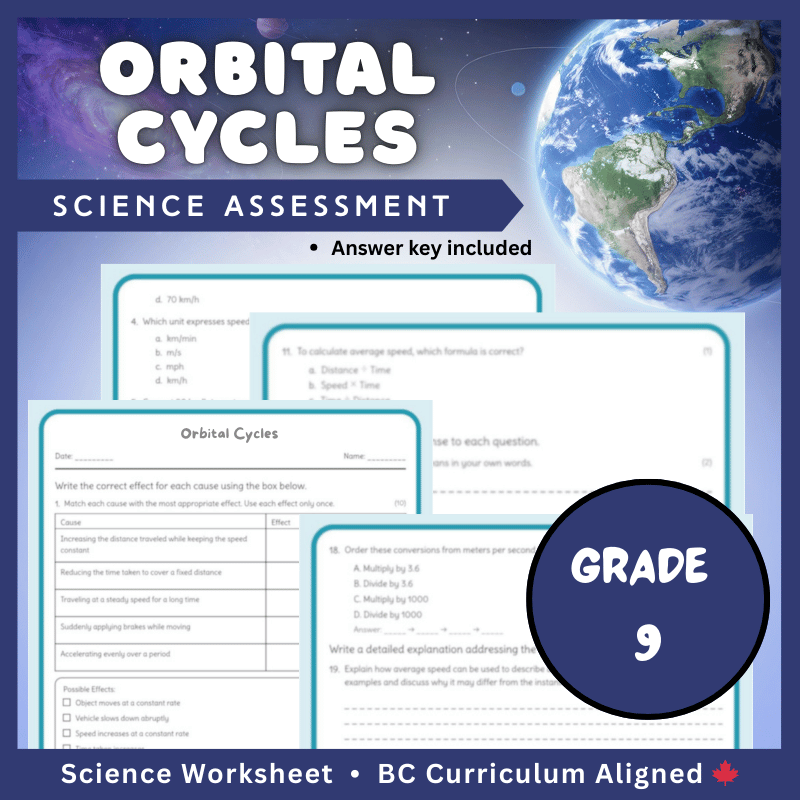
Grade 9 Science | Orbital Cycles Worksheet + Answer Key - BC Standards
Created byBright Mind ResourcesLearning Objectives
- Understand how Earth's and Moon's orbital patterns influence seasonal and lunar phenomena.
- Describe how axial tilt and orbital eccentricity affect climate and seasons.
- Explain the relationship between gravitational forces and tidal patterns.
Instant download

Grade 9 Simple Machines Worksheet | Practice & Assessment PDF
Created byClear Sky ClassroomLearning Objectives
- Explain how simple machines transfer forces to change effort, load, or direction of motion
- Compare ideal mechanical advantage with practical mechanical advantage and account for friction
- Use input and output relationships (force and displacement) to reason about machine performance
Instant download
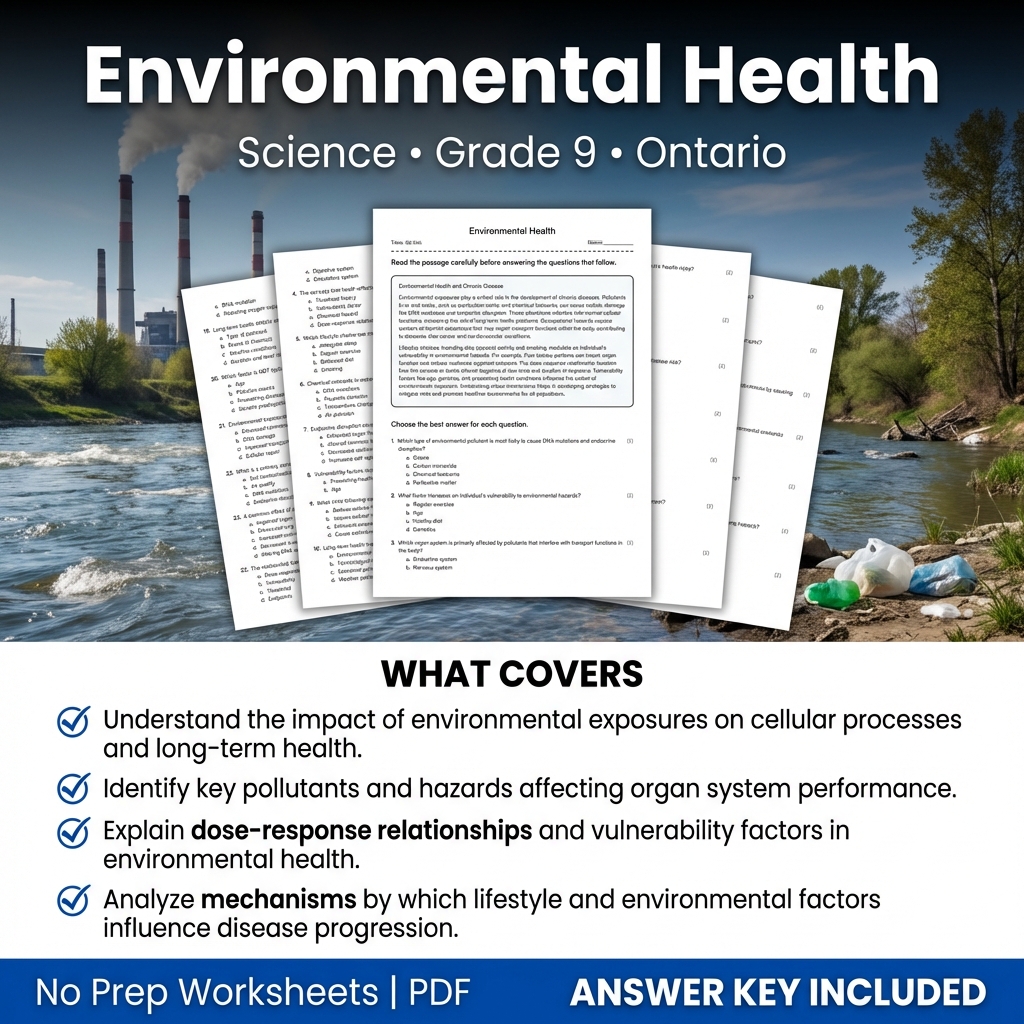
Environmental Health Science Worksheet | Grade 9 Standard Practice
Created byCoral Reef LearningLearning Objectives
- Understand the impact of environmental exposures on cellular processes and long-term health.
- Identify key pollutants and hazards affecting organ system performance.
- Explain dose-response relationships and vulnerability factors in environmental health.
Instant download

Grade 9 Science | Trophic Dynamics - Daily Reading Comprehension
Created byCoral Reef LearningLearning Objectives
- Understand how energy flows through different levels of a food chain
- Identify the structure of food webs and trophic levels
- Explain why energy decreases as it moves up trophic levels
Instant download

Grade 9 Newtonian Concepts Worksheet | Practice & Assessment PDF
Created byClear Sky ClassroomLearning Objectives
- Explain how Newton’s First Law (inertia) relates force to changes in motion
- Use Newton’s Second Law to predict how acceleration depends on net force and mass
- Describe Newton’s Third Law (action–reaction) and apply it to real situations like recoil and anchored structures
Instant download

Physical vs Chemical Changes Worksheet Grade 9 Science NGSSS
Created byEvergreen Desk EducationLearning Objectives
- Differentiate physical properties and chemical properties of matter using examples
- Distinguish physical changes from chemical changes based on evidence
- Interpret observations (color, temperature, texture, gas/product formation) to classify changes
Instant download
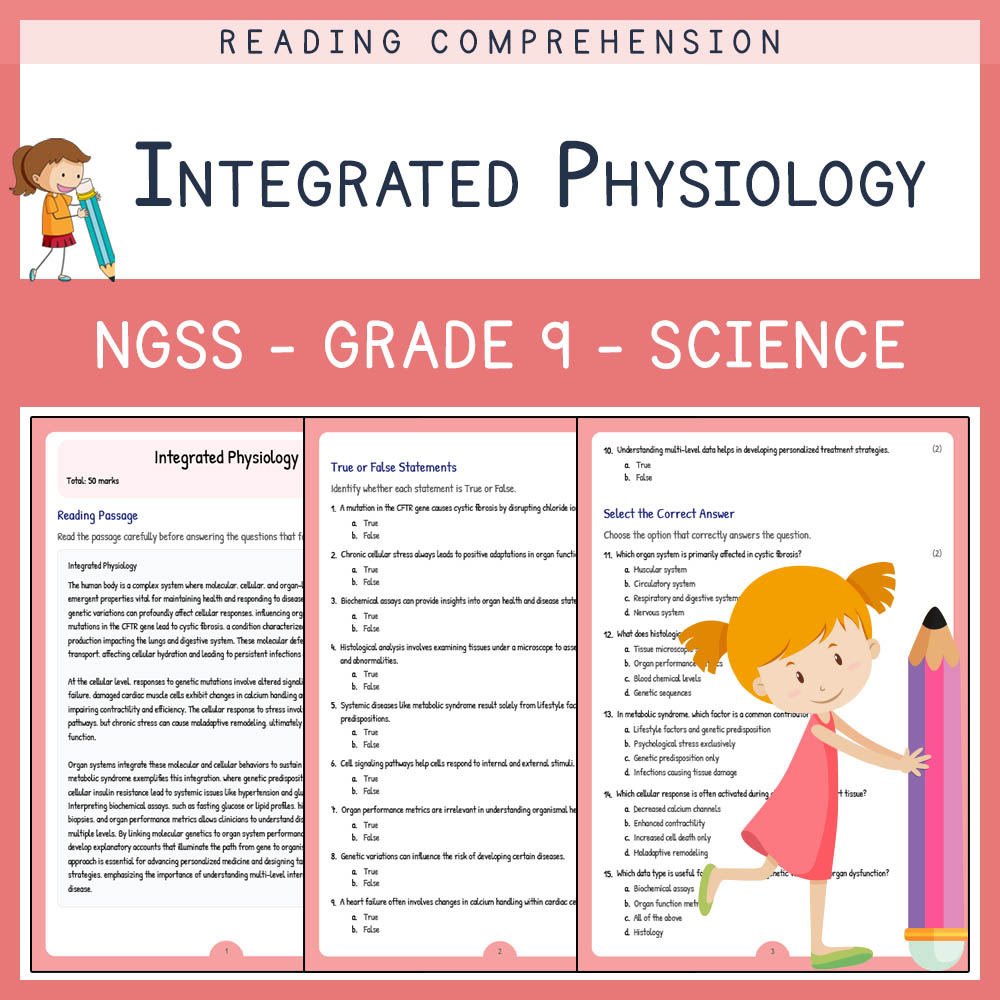
Grade 9 Science | Integrated Physiology Worksheet (Answer Key) NGSS Aligned
Created byLumora LearningLearning Objectives
- Explain how molecular interactions influence cellular functions within organ systems.
- Link genetic variations to specific organ system dysfunctions in clinical scenarios.
- Interpret biochemical assays, histological data, and organ performance metrics to analyze organism health.
Instant download

Tissue Types Worksheet | Grade 9 Science Activities
Created byPrism Point LearningLearning Objectives
- Identify the four major tissue types and match each to its primary function in the body.
- Explain how tissue structure and cell specialization affect the properties of organs.
- Compare epithelial, connective, muscle, and nervous tissues using correct science vocabulary.
Also included in: Cells and Body Systems Lesson Bundle | Grade 9 Science | BC +1 more
Instant download

Grade 9 Science – Earth Seasons Causes & Effects | Daily Reading Worksheet
Created byBright Mind ResourcesLearning Objectives
- Understand the causes of Earth's seasons.
- Identify how Earth's tilt and orbit influence sunlight distribution.
- Describe how day length varies with Earth's position.
Also included in: Earth Systems Grade 9 Science Daily Reading Worksheets Bundle | Florida NGSSS +1 more
Instant download

Wave Properties Worksheet | Assessment Grade 9 Science Printable PDF
Learning Objectives
- Understand the mathematical representations of wave behavior, including amplitude, frequency, wavelength, and phase.
- Relate wave speed to frequency and wavelength through calculations for transverse and longitudinal waves.
- Explain interference and standing waves using sinusoidal functions and superposition.
Also included in: Grade 9 Waves and Their Applications in Technologies for Information Transfer Lesson Bundle +1 more
Instant download

Grade 9 Science | Understanding DNA & Protein Synthesis - Daily Reading Practice
Created byCoral Reef LearningLearning Objectives
- Explain the relationship between DNA and proteins.
- Identify how genetic information is transferred from DNA to proteins.
- Describe the process of gene expression including transcription and translation.
Instant download

Grade 9 Science – Kinetic & Potential Energy | Daily Reading Worksheet
Created byBright Mind ResourcesLearning Objectives
- Understand the concepts of kinetic and potential energy
- Identify examples of kinetic and potential energy in daily life
- Describe how energy transfers between kinetic and potential forms
Also included in: Grade 9 Forces, Energy & Matter Science lesson bundle Florida NGSSS +1 more
Instant download

Grade 9 Science - Force Interactions Worksheet (AP Standards) (PDF)
Created byEvergreen Desk EducationLearning Objectives
- Explain how net external force determines changes in motion using Newton’s second law.
- Use conceptual force diagrams and free-body reasoning to identify contact and field forces.
- Apply net-force summation to calculate the acceleration of systems on inclines and with tension.
Also included in: Grade 9 Motion & Forces Science Lesson Bundle | AP Kinematics & Forces +1 more
Instant download
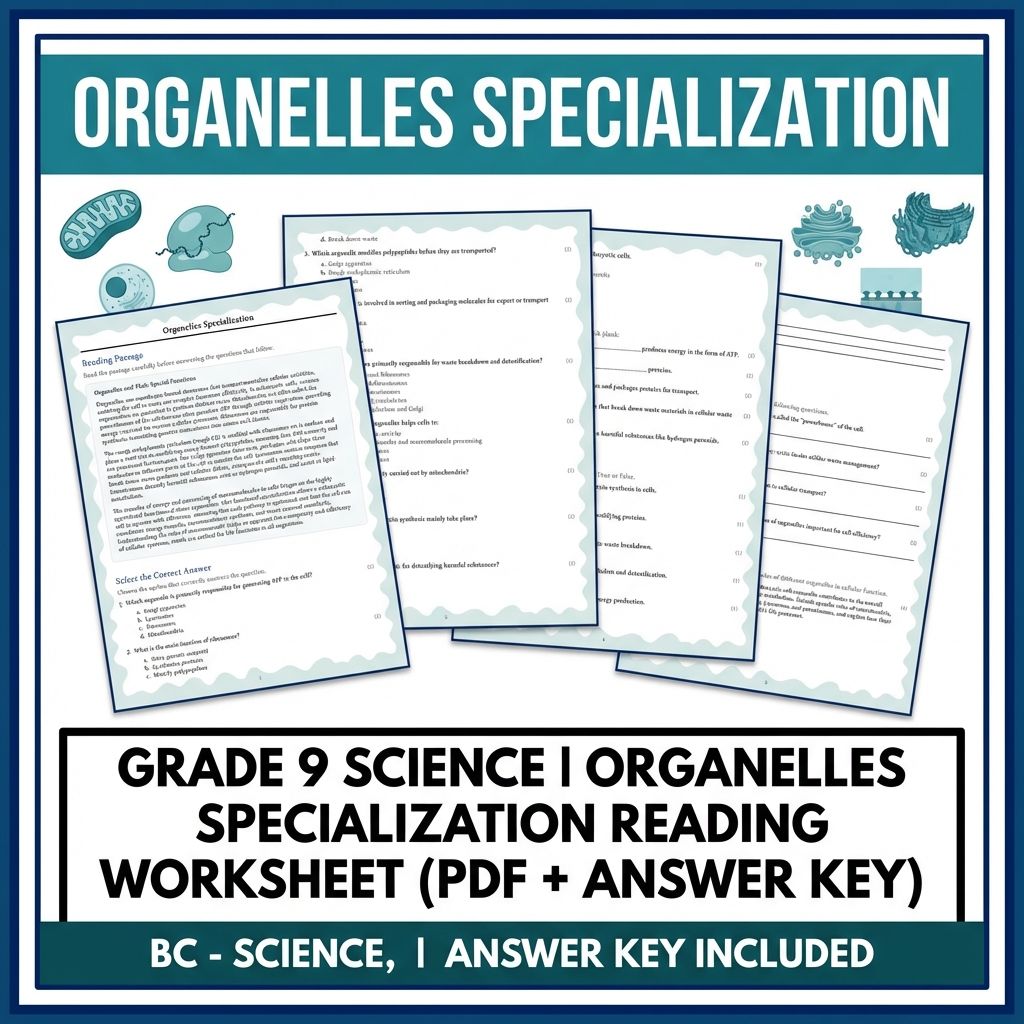
Grade 9 Science | Organelles Specialization Reading Worksheet (PDF + Answer Key)
JCreated byJ.S SheetsLearning Objectives
- Understand the functions of various cell organelles and their roles in cellular activities.
- Describe how organelles work together to support metabolic processes in eukaryotic cells.
- Identify the structural differences and specialization of organelles such as mitochondria, ribosomes, endoplasmic reticulum, Golgi apparatus, lysosomes, and peroxisomes.
Instant download

Argument Structures Worksheet Pack | Grade 9 Science Practice
 Created byBright Quill Resources
Learning Objectives
- Explain how scientific arguments use a claim, evidence, and reasoning (CER) to support explanations.
- Evaluate arguments for coherence, relevance, and attention to alternative explanations.
- Use quantitative evidence and model comparisons to strengthen claims and judge uncertainty and limitations.
Instant download

Grade 9 Graph Interpretation Worksheet | Practice & Assessment PDF
Created byClear Sky ClassroomLearning Objectives
- Interpret displacement–time and velocity–time graphs using slope to determine velocity and acceleration
- Use area under a velocity–time graph to determine displacement
- Identify key graph features such as constant segments, sign changes, discontinuities, and curved motion to describe real physical events
Instant download

Grade 9 Science – Work & Energy Daily Reading Worksheet | Ontario Standards
 Created byQuiet Forest Education
Learning Objectives
- Define mechanical work as the scalar product of force and displacement.
- Calculate work done in simple scenarios involving constant forces.
- Differentiate between kinetic and potential energy.
Also included in: Forces and Energy Grade 9 Science Daily Reading Worksheets Bundle | Ontario +1 more
Instant download

System Efficiency Worksheet | Alberta Grade 9 Science Practice
JCreated byJ.S SheetsLearning Objectives
- Understand the key concepts of energy efficiency in electrical systems.
- Identify common loss mechanisms and their impact on system performance.
- Evaluate strategies for improving system efficiency and reducing environmental impact.
Also included in: Grade 9 Electrical Circuits & Magnetism Science Lesson Bundle – Alberta
Instant download

Molecular Bonding Worksheet | Scientific Practice Grade 9 Alberta Standards
JCreated byJ.S SheetsLearning Objectives
- Identify and differentiate between ionic, covalent, and metallic bonding based on electron interactions.
- Explain how different types of bonding influence the properties of compounds.
- Analyze real-world examples of bonding types and their industrial applications.
Also included in: Grade 9: Chemical Reactions and Matter Science lesson bundle Alberta
Instant download
About Grade 9 Science Worksheets
Find Science worksheets built for Grade 9. All 6,926 cover core skills, practice, and review, each an instant PDF download.
Every worksheet on MyTeachingSheets is created by independent teacher-authors and reviewed before publication. All resources download as printable PDFs for classroom, homework, or at-home practice, and many include answer keys. Preview any worksheet free before buying.