
Grade 9 Science Worksheets
6,926 worksheets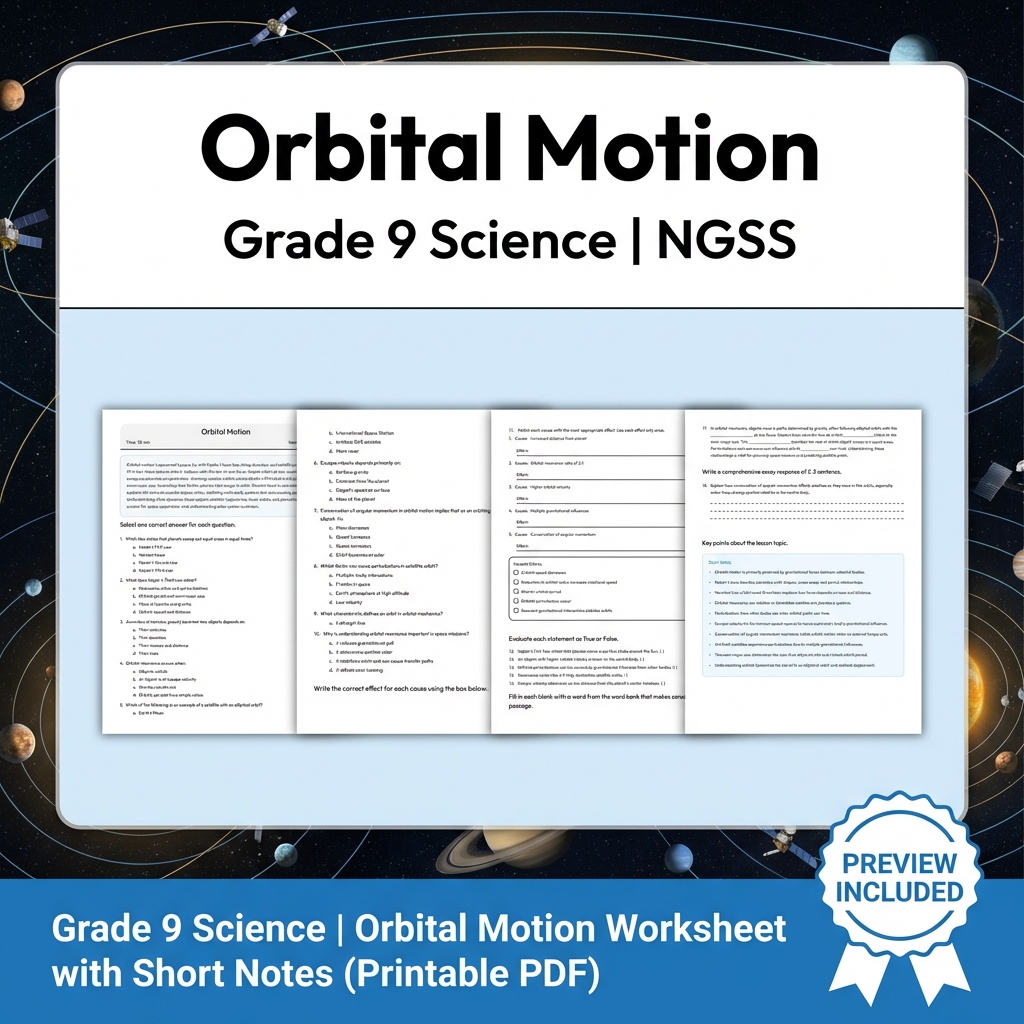
Grade 9 Science | Orbital Motion Worksheet with Short Notes (Printable PDF)
 Created byMeadowlark Worksheets
Learning Objectives
- Explain the principles governing orbital motion, including Kepler's laws and Newton's law of gravitation.
- Calculate relationships between orbital period, semi-major axis, and escape velocity.
- Describe the effects of orbital resonance and perturbations on satellite and planetary stability.
Also included in: Grade 9 Science NGSS Earth’s Place in the Universe Unit Bundle – Worksheet Pack +1 more
Instant download
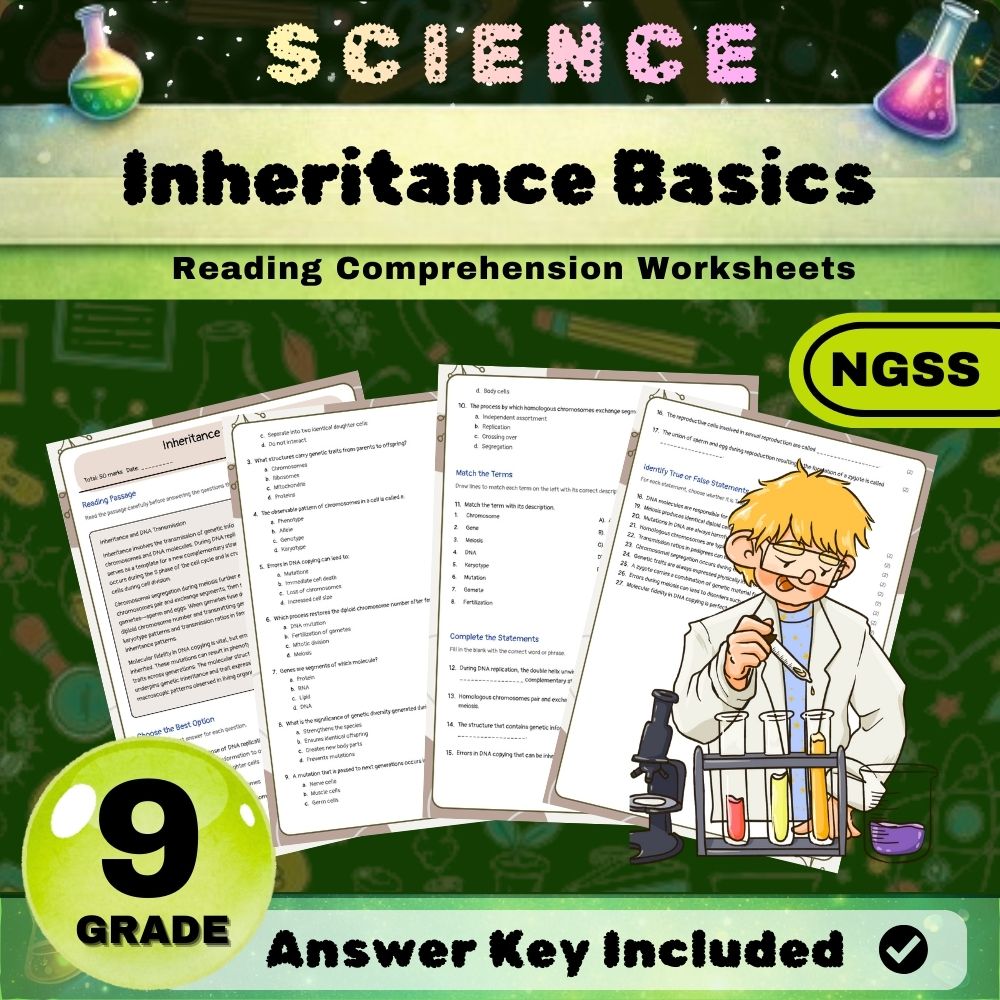
Grade 9 Science | Inheritance NGSS Assessment (Worksheet + Answer Key)
 Created byMaple Path Learning
Learning Objectives
- Explain how DNA replication and chromosomal segregation ensure hereditary information transfer.
- Describe the roles of gametes and zygotes in inheritance.
- Identify observable inheritance patterns such as karyotype patterns and transmission ratios.
Also included in: Grade 9 Science NGSS Heredity Unit | Inheritance & Variation Worksheet Bundle +1 more
Instant download
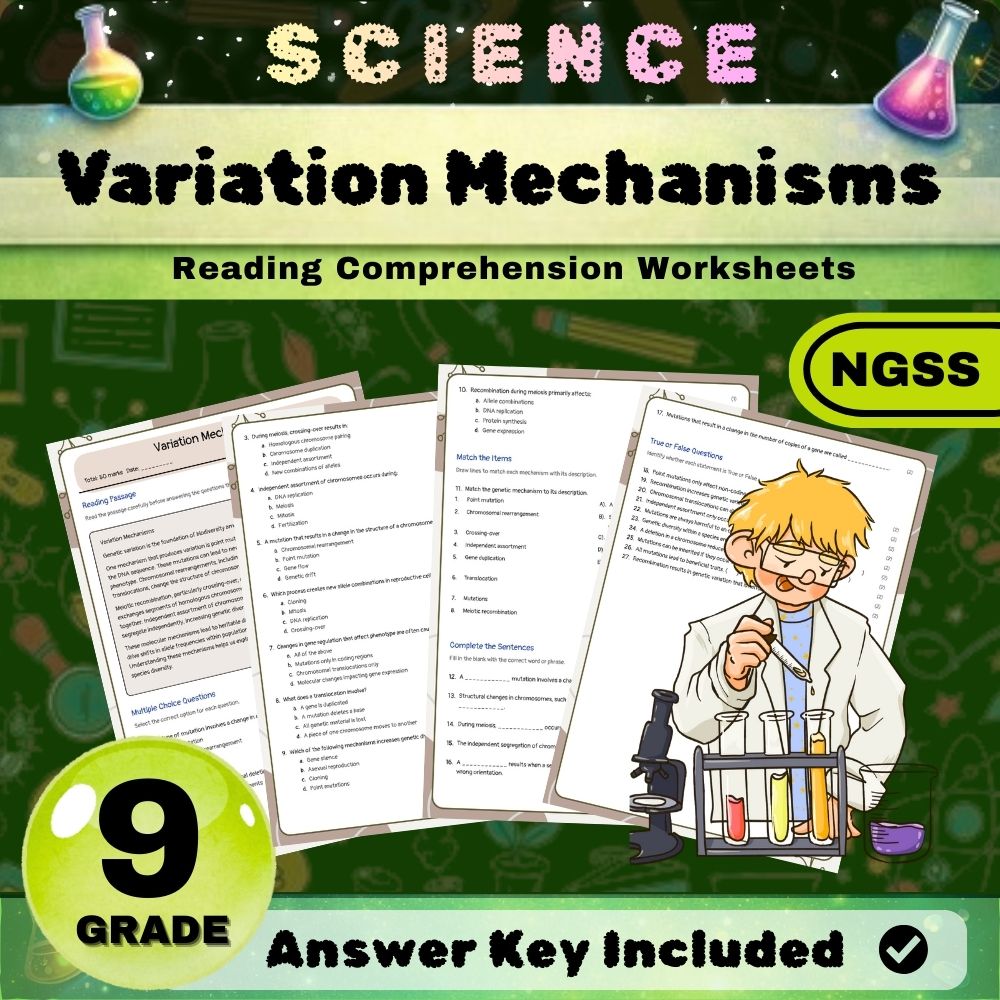
Grade 9 Science | Variation Mechanisms Worksheet (NGSS) (PDF)
Created byMaple Path LearningLearning Objectives
- Describe different genetic mechanisms that generate heritable diversity.
- Explain how mutations, chromosomal rearrangements, and recombination affect allelic variation.
- Connect molecular changes to variations in phenotype and their impact on populations.
Also included in: Grade 9 Science NGSS Heredity Unit | Inheritance & Variation Worksheet Bundle +1 more
Instant download
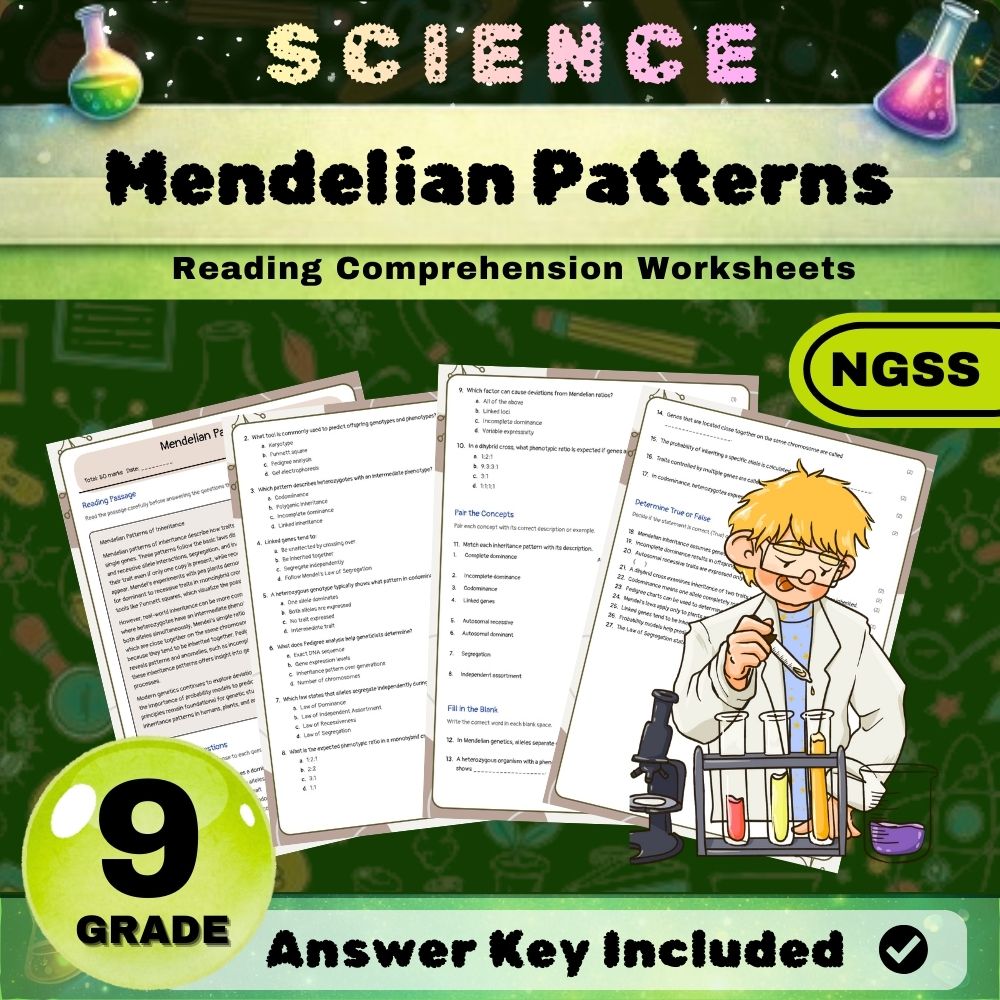
Grade 9 Science | Mendelian Patterns Worksheet (NGSS) (PDF)
Created byMaple Path LearningLearning Objectives
- Describe the principles of single-gene inheritance patterns, including dominance, segregation, and independent assortment.
- Use Punnett squares to predict genotype and phenotype ratios in monohybrid and dihybrid crosses.
- Interpret pedigrees and understand inheritance probabilities and limitations such as incomplete dominance, codominance, and linked loci.
Also included in: Grade 9 Science NGSS Heredity Unit | Inheritance & Variation Worksheet Bundle +1 more
Instant download
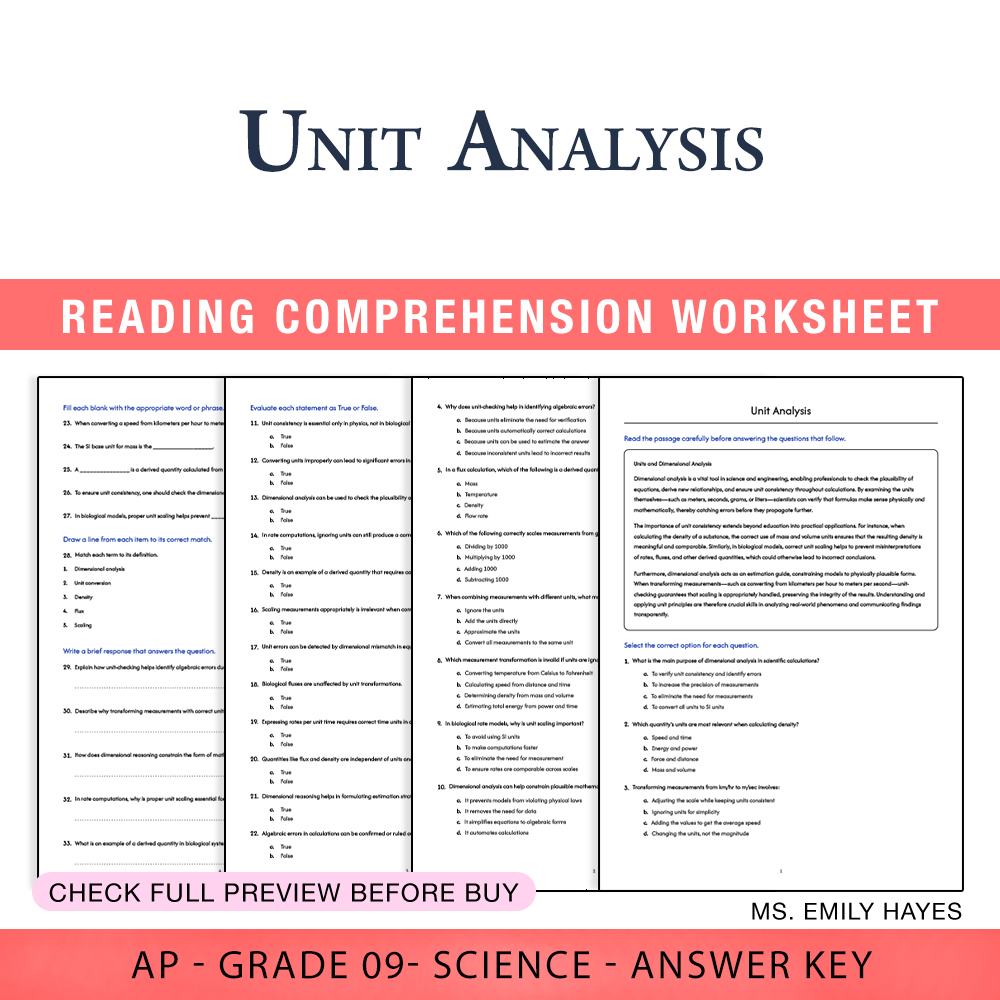
Grade 9 Science | Unit Analysis Worksheet (PDF+ Answer Key)
 Created byCopper Leaf Classroom
Learning Objectives
- Understand the principles of dimensional analysis and apply unit consistency when combining measurements.
- Recognize how unit-checking can reveal algebraic errors in calculations.
- Derive relationships and transform measurements using correct units.
Also included in: Grade 9 Science | Scientific Data Analysis & Inquiry Skills (PDF+ Answer Key) +1 more
Instant download
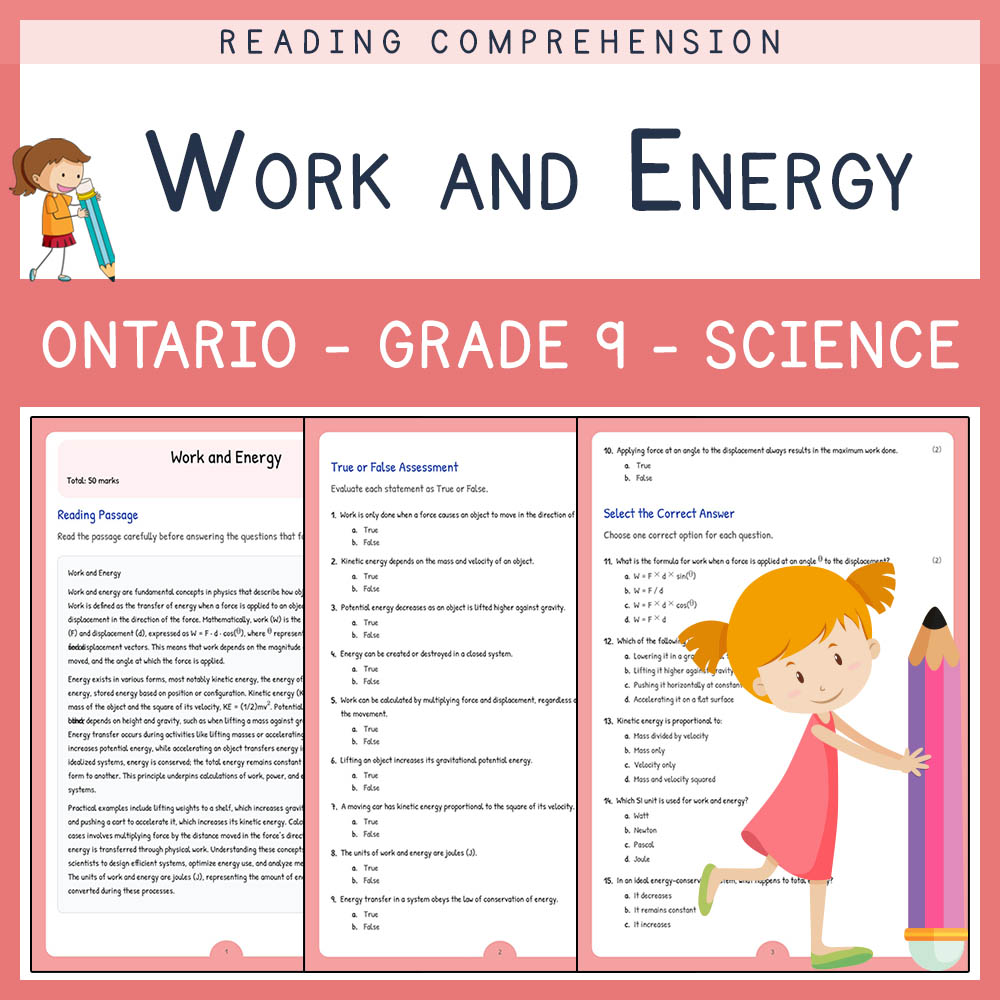
Grade 9 Science Assessment | Work and Energy Worksheet Elena | Ontario Standard
 Created byLumora Learning
Learning Objectives
- Define and distinguish between work, kinetic energy, and potential energy
- Understand the calculation of work for constant forces
- Explain energy transfer in mechanical systems such as lifting and accelerating objects
Instant download

Grade 9 Science–Eclipses Explained Worksheet (BC) | Standard-Aligned Practice
 Created byEvergreen Desk Education
Learning Objectives
- Explain how the Sun, Moon, and Earth alignment creates solar and lunar eclipses
- Compare the order of bodies (relative positions) for solar vs. lunar eclipses
- Describe how orbital inclination affects eclipse frequency and where totality can be observed
Instant download
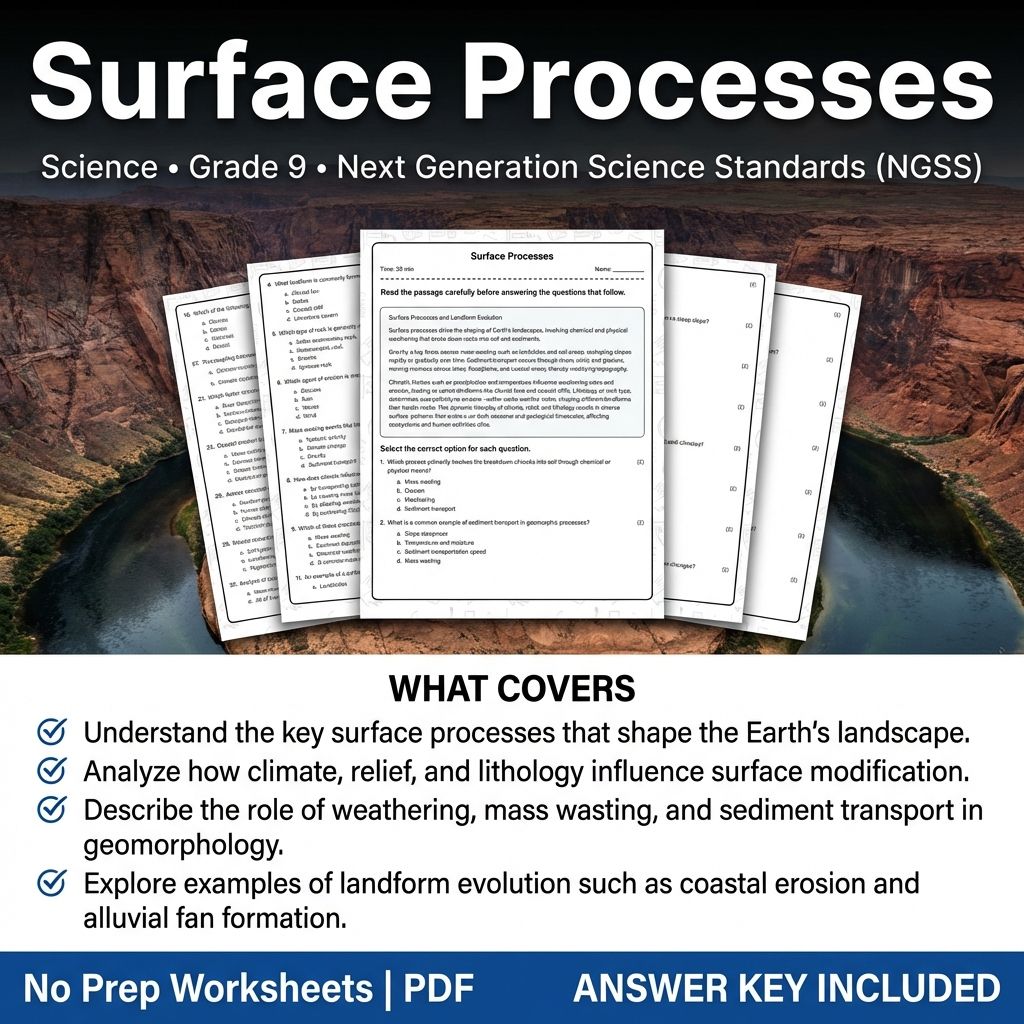
9th Grade Science | Surface Processes Printable Worksheet & Answer Key
 Created byCoral Reef Learning
Learning Objectives
- Understand the key surface processes that shape the Earth's landscape.
- Analyze how climate, relief, and lithology influence surface modification.
- Describe the role of weathering, mass wasting, and sediment transport in geomorphology.
Also included in: Grade 9 Science Unit Bundle – Earth's Processes & Surface Change Worksheets PDF +1 more
Instant download
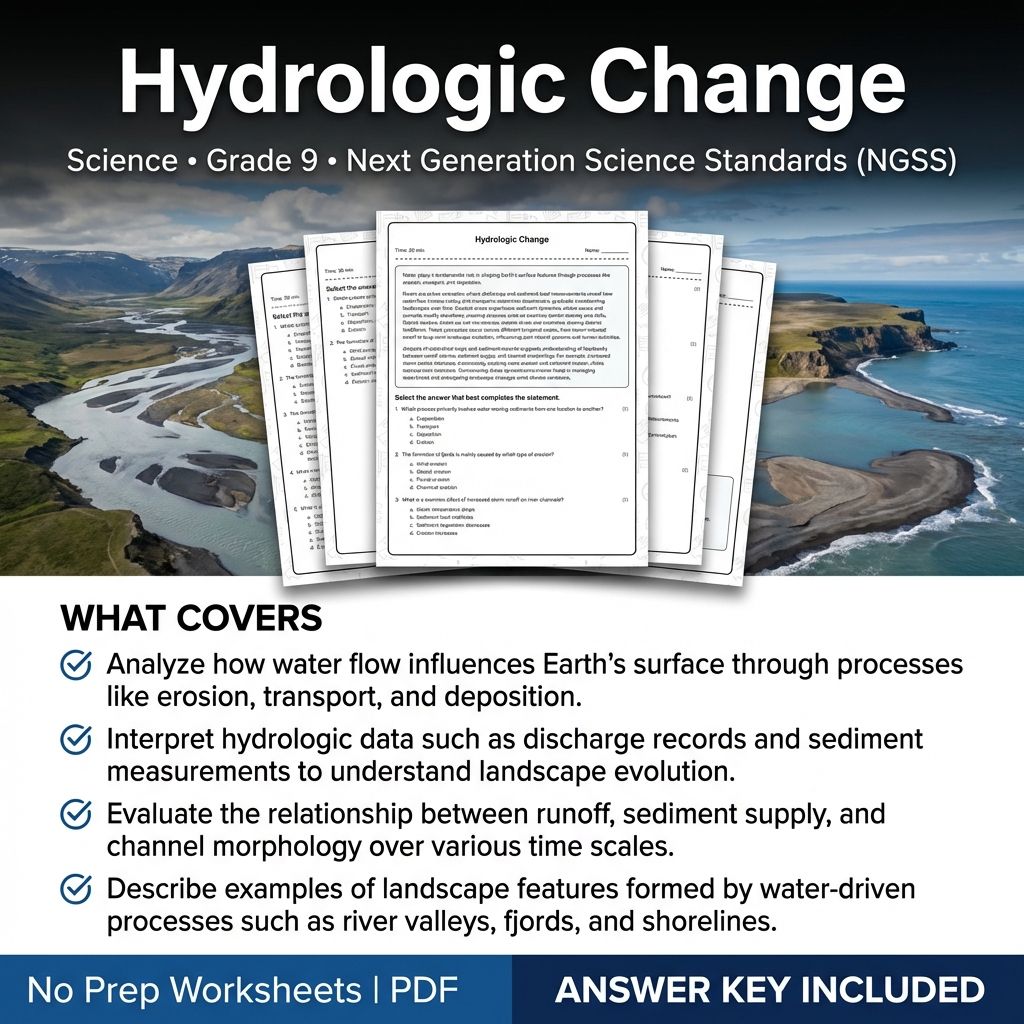
Grade 9 Science | Hydrologic Change Worksheet with Answer Key (Printable PDF)
Created byCoral Reef LearningLearning Objectives
- Analyze how water flow influences Earth's surface through processes like erosion, transport, and deposition.
- Interpret hydrologic data such as discharge records and sediment measurements to understand landscape evolution.
- Evaluate the relationship between runoff, sediment supply, and channel morphology over various time scales.
Also included in: Grade 9 Science Unit Bundle – Earth's Processes & Surface Change Worksheets PDF +1 more
Instant download
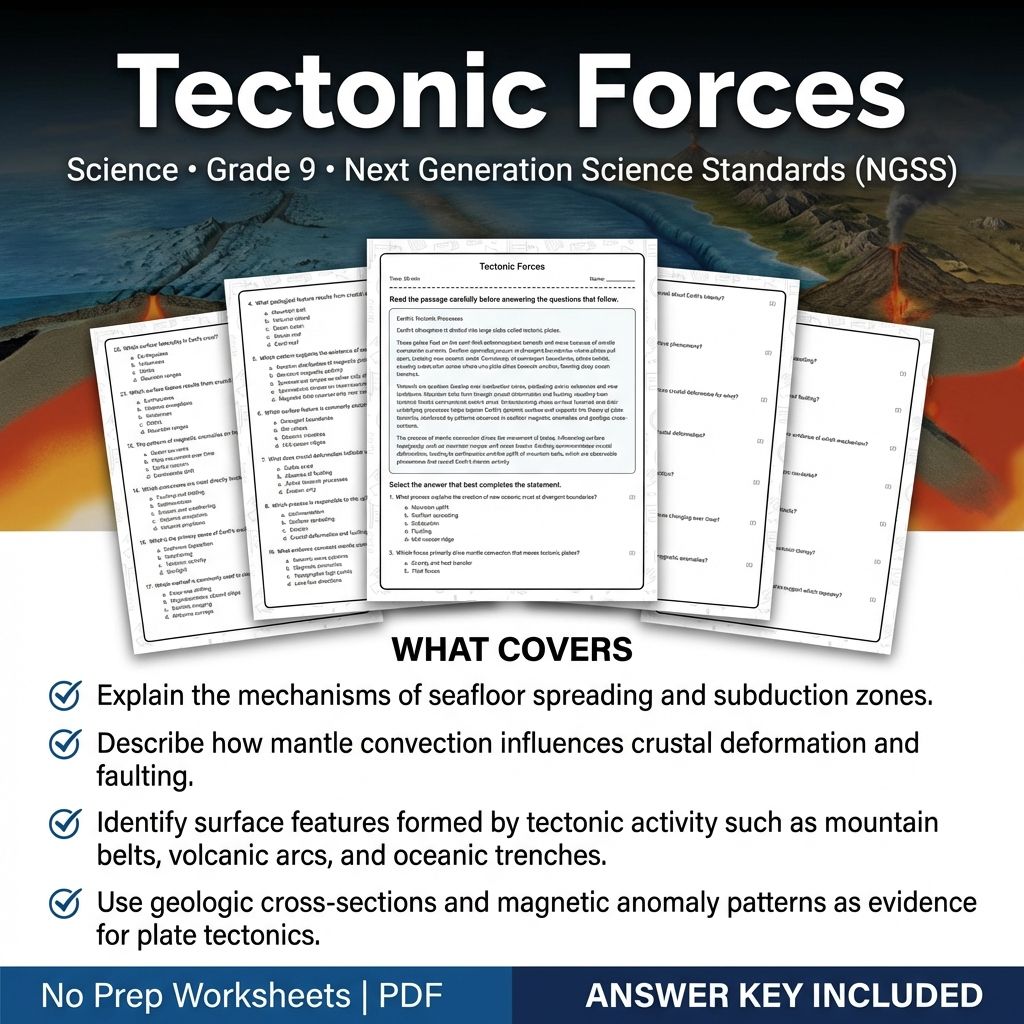
9th Grade Science | Tectonic Forces Worksheet & Answer Key (Printable PDF)
Created byCoral Reef LearningLearning Objectives
- Explain the mechanisms of seafloor spreading and subduction zones.
- Describe how mantle convection influences crustal deformation and faulting.
- Identify surface features formed by tectonic activity such as mountain belts, volcanic arcs, and oceanic trenches.
Also included in: Grade 9 Science Unit Bundle – Earth's Processes & Surface Change Worksheets PDF +1 more
Instant download
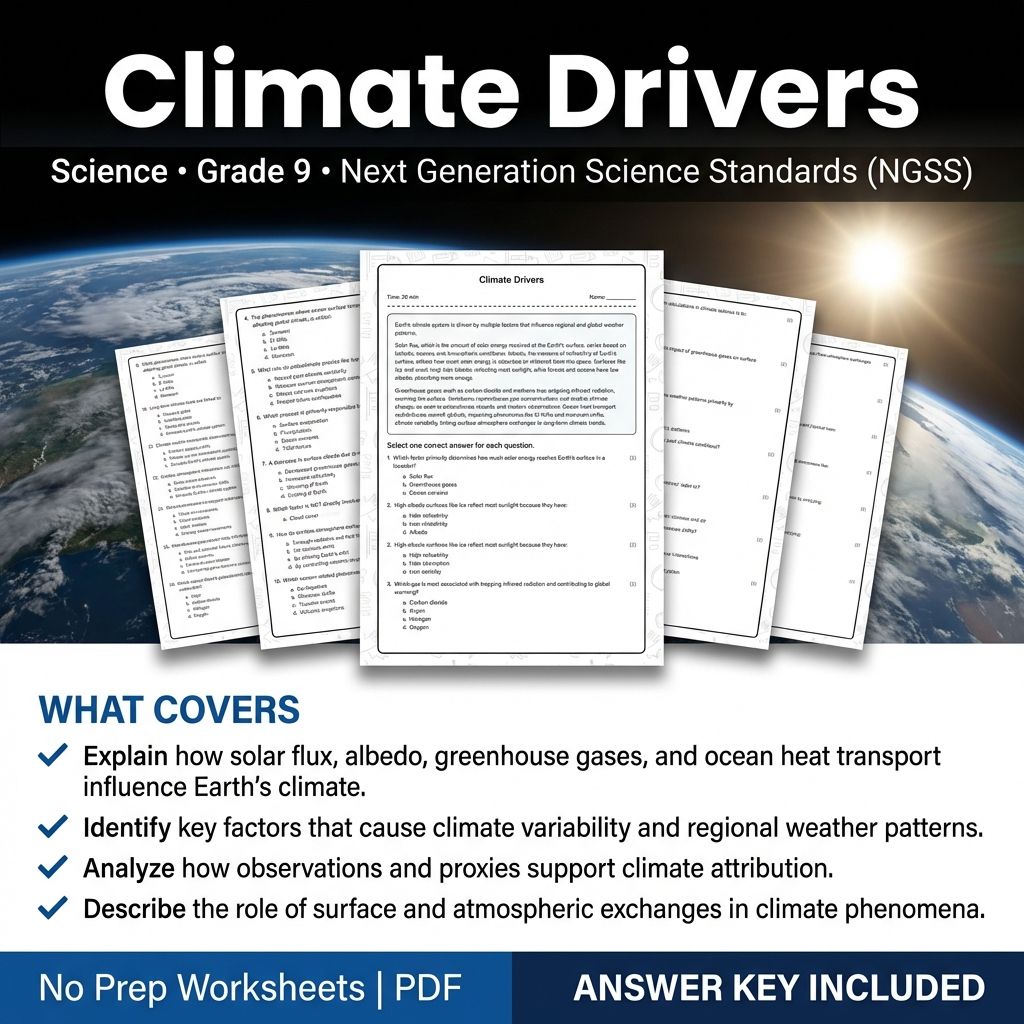
9th Grade Science | Climate Drivers Worksheet + Answer Key (Printable PDF)
Created byCoral Reef LearningLearning Objectives
- Explain how solar flux, albedo, greenhouse gases, and ocean heat transport influence Earth's climate.
- Identify key factors that cause climate variability and regional weather patterns.
- Analyze how observations and proxies support climate attribution.
Also included in: Grade 9 Science Unit Bundle – Earth's Processes & Surface Change Worksheets PDF +1 more
Instant download
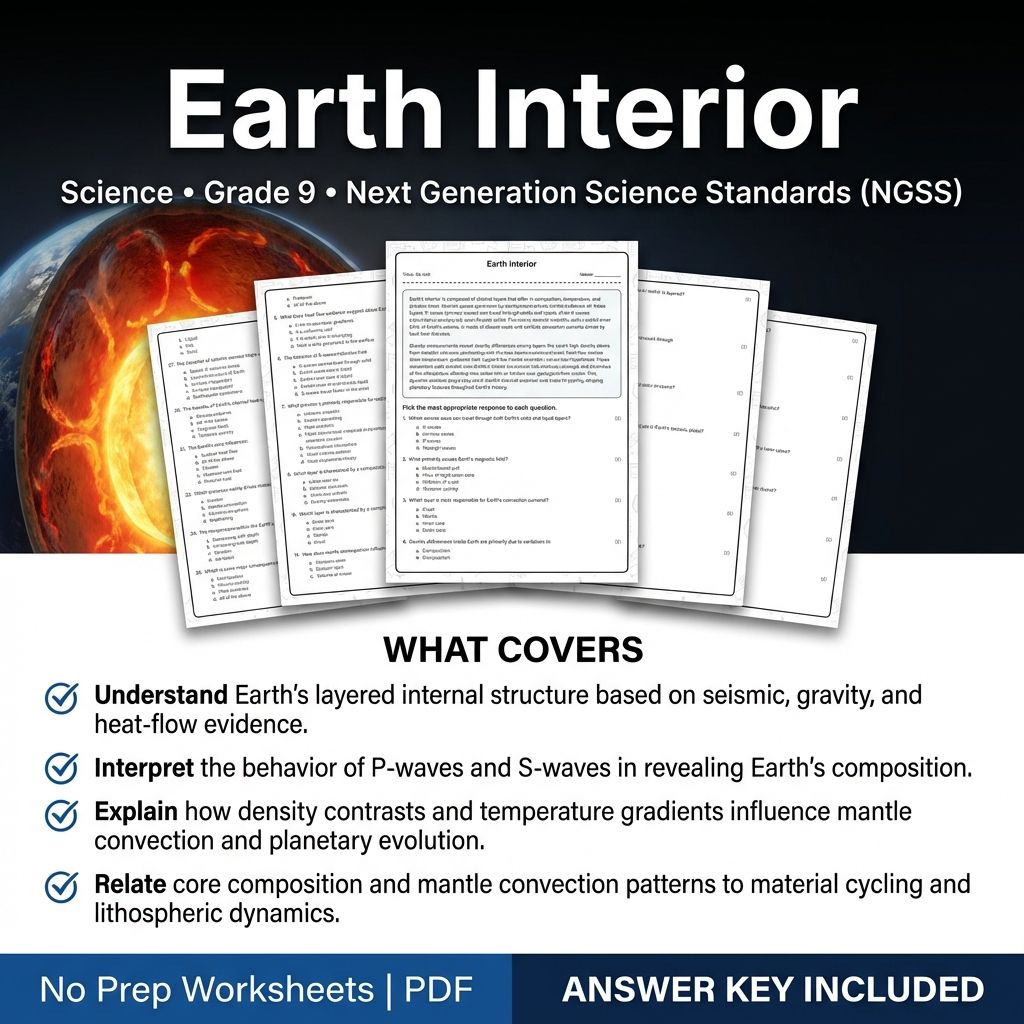
9th Grade Science | Earth's Interior Worksheet & Answer Key (Printable PDF)
Created byCoral Reef LearningLearning Objectives
- Understand Earth's layered internal structure based on seismic, gravity, and heat-flow evidence.
- Interpret the behavior of P-waves and S-waves in revealing Earth's composition.
- Explain how density contrasts and temperature gradients influence mantle convection and planetary evolution.
Also included in: Grade 9 Science Unit Bundle – Earth's Processes & Surface Change Worksheets PDF +1 more
Instant download
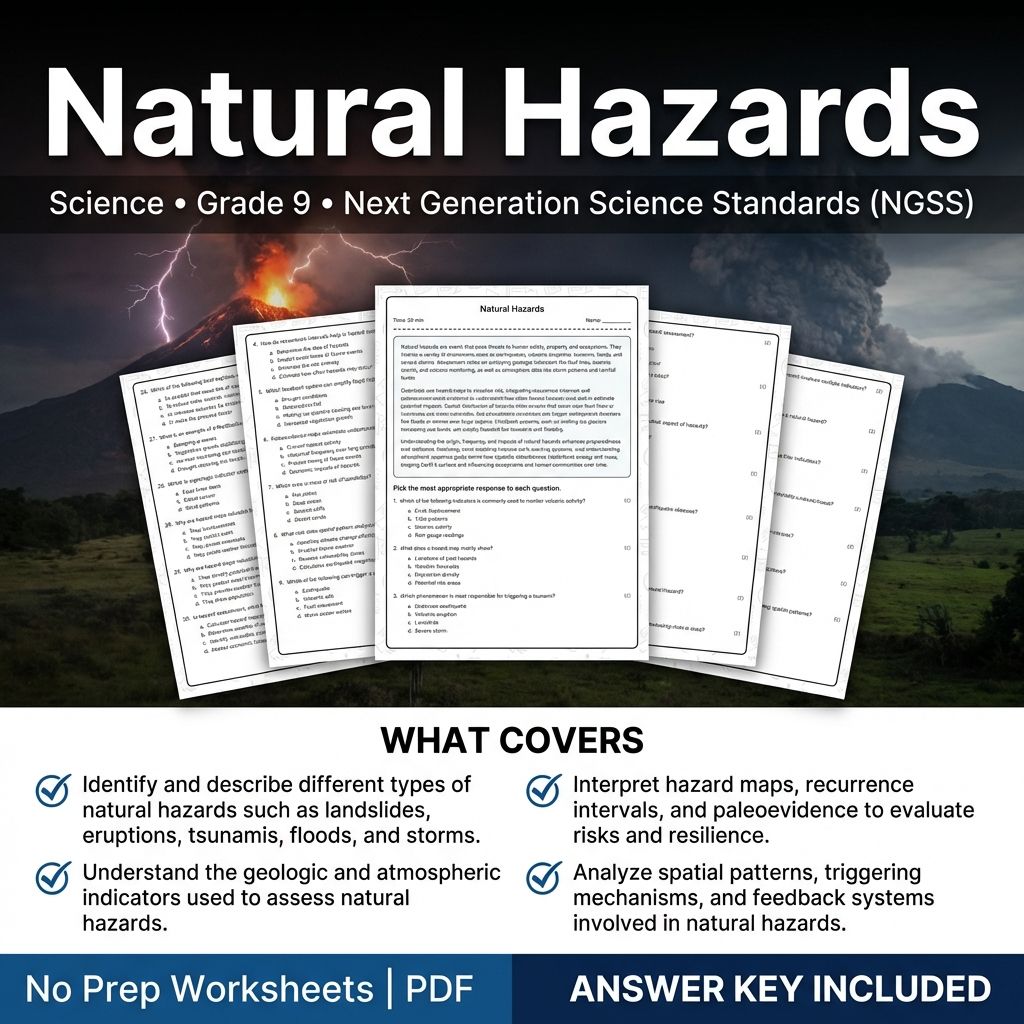
Grade 9 Science | Natural Hazards Worksheet & Answer Key (Printable PDF)
Created byCoral Reef LearningLearning Objectives
- Identify and describe different types of natural hazards such as landslides, eruptions, tsunamis, floods, and storms.
- Understand the geologic and atmospheric indicators used to assess natural hazards.
- Interpret hazard maps, recurrence intervals, and paleoevidence to evaluate risks and resilience.
Also included in: Grade 9 Science Unit Bundle – Earth's Processes & Surface Change Worksheets PDF +1 more
Instant download
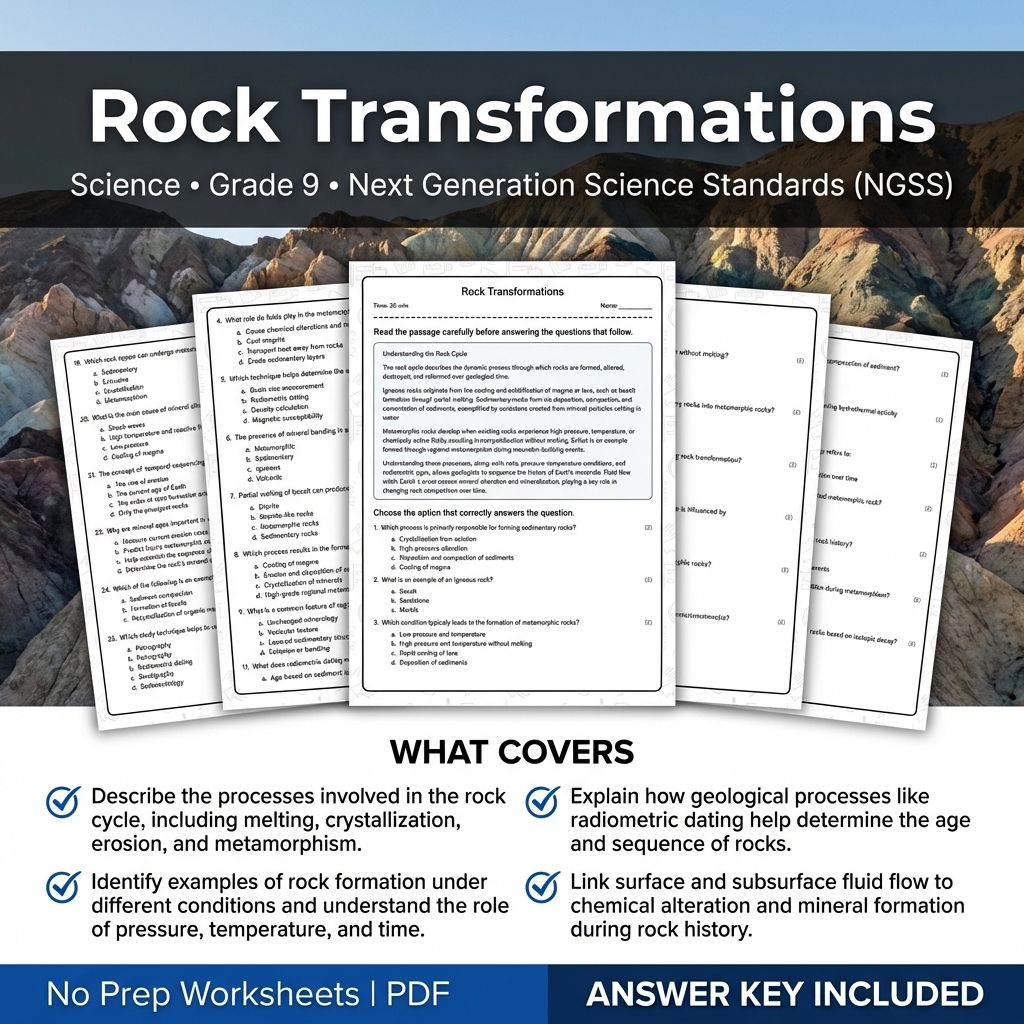
Grade 9 Science Worksheet | Rock Transformations NGSS Practice PDF & Answer Key
Created byCoral Reef LearningLearning Objectives
- Describe the processes involved in the rock cycle, including melting, crystallization, erosion, and metamorphism.
- Identify examples of rock formation under different conditions and understand the role of pressure, temperature, and time.
- Explain how geological processes like radiometric dating help determine the age and sequence of rocks.
Also included in: Grade 9 Science Unit Bundle – Earth's Processes & Surface Change Worksheets PDF +1 more
Instant download

Speciation Processes Worksheet for Grade 9 Science | NGSS Aligned Assessment
JCreated byJ.S SheetsLearning Objectives
- Understand mechanisms of reproductive isolation that lead to speciation.
- Describe models of allopatric and sympatric speciation with examples.
- Explain the role of hybrid zones, polyploidy, and adaptive radiation in speciation.
Also included in: Grade 9 Evolution and Speciation Science Lesson Bundle – NGSS-aligned Worksheets +1 more
Instant download

Evidence for Evolution Worksheet | NGSS Grade 9 Science Practice
JCreated byJ.S SheetsLearning Objectives
- Understand the multiple lines of evidence supporting common ancestry and diversification.
- Identify examples of transitional fossils, homologous structures, and genetic similarities.
- Explain how biogeography and radiometric dating contribute to understanding evolution.
Also included in: Grade 9 Evolution and Speciation Science Lesson Bundle – NGSS-aligned Worksheets +1 more
Instant download

Grade 9 Science Worksheet on Phylogenetic Trees | NGSS Aligned Assessment
JCreated byJ.S SheetsLearning Objectives
- Understand how to construct phylogenetic trees using morphological and molecular data.
- Interpret branching diagrams to analyze evolutionary relationships among species.
- Explain the principles of cladistics, shared derived characters, and tree-building methods.
Also included in: Grade 9 Evolution and Speciation Science Lesson Bundle – NGSS-aligned Worksheets +1 more
Instant download

Mountain Building Worksheet | Grade 9 Science Standards-Aligned PDF
JCreated byJ.S SheetsLearning Objectives
- Describe the geological processes involved in mountain building such as plate convergence, thrust faulting, and crustal uplift.
- Identify different types of mountains and ranges formed by tectonic activity.
- Explain how weathering and erosion shape mountain landscapes over time.
Instant download
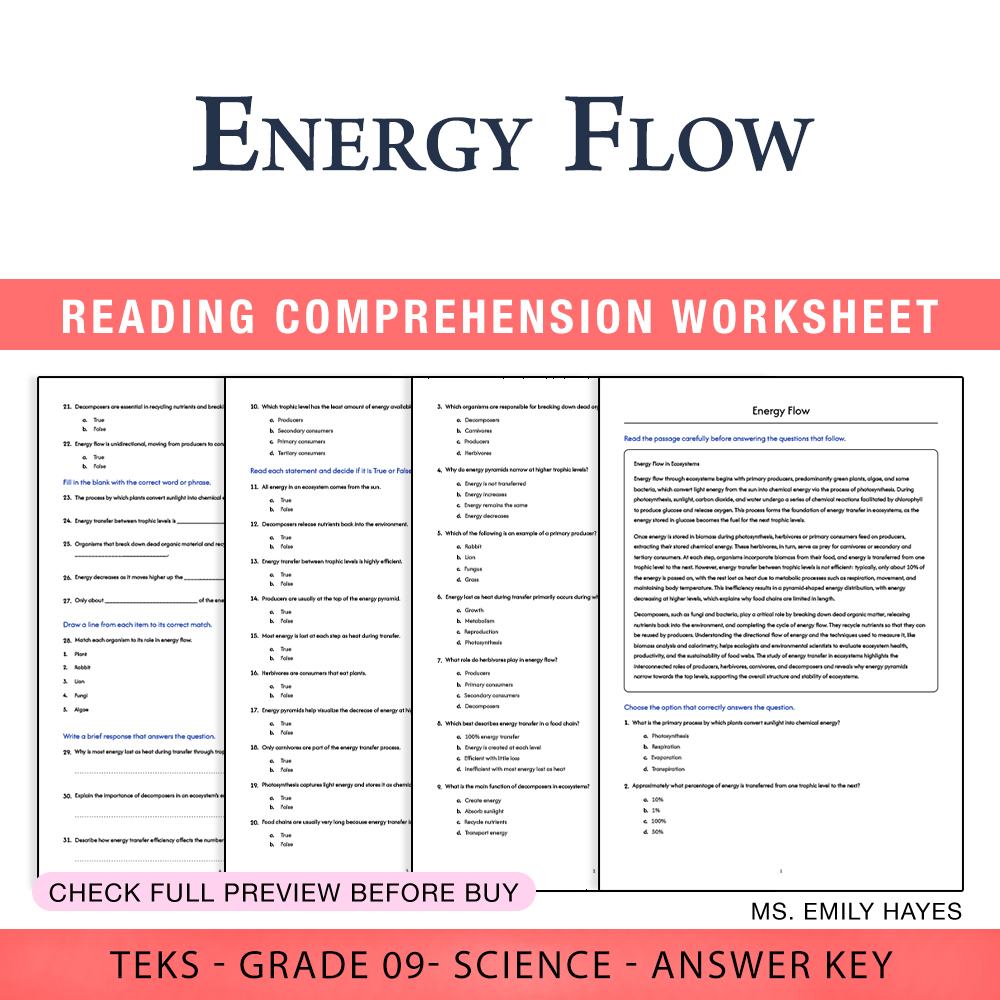
9th Grade Science | Energy Flow Worksheet (PDF+ Answer Key)
Created byCopper Leaf ClassroomLearning Objectives
- Describe how energy moves through ecosystems from producers to consumers and decomposers.
- Explain the process of photosynthesis and how it transfers energy through trophic levels.
- Analyze energy transfer efficiency and how it influences food chain length and population sizes.
Instant download

Orbital Motion Assessment for Grade 9 Science NGSS Standards
 Created byPrism Point Learning
Learning Objectives
- Explain the fundamental principles of orbital motion, including Kepler's laws and Newton's law of gravitation.
- Analyze relationships between orbital period, semi-major axis, and escape velocity.
- Apply concepts of conservation of angular momentum to planetary and satellite motion.
Instant download
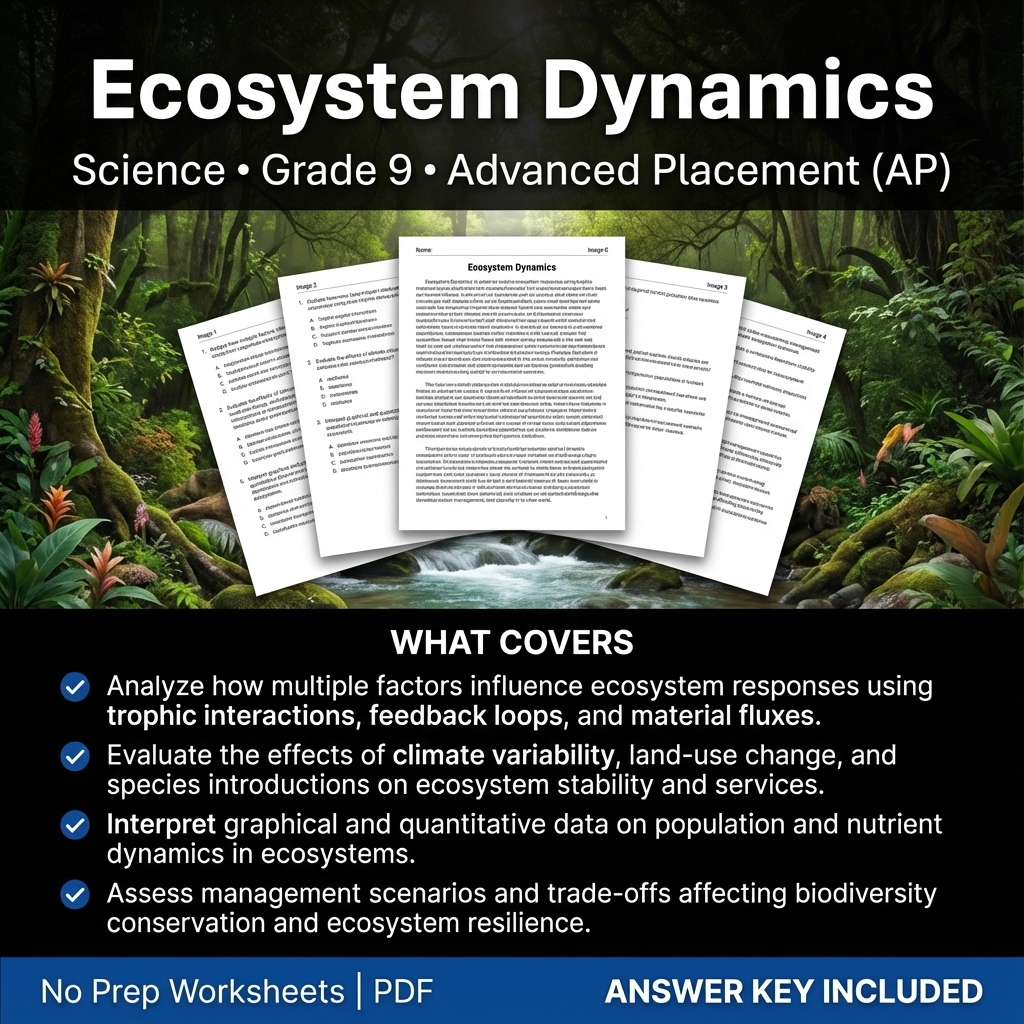
Grade 9 Science | Ecosystem Dynamics Worksheet (Printable PDF + Answer Key)
Created byCoral Reef LearningLearning Objectives
- Analyze how multiple factors influence ecosystem responses using trophic interactions, feedback loops, and material fluxes.
- Evaluate the effects of climate variability, land-use change, and species introductions on ecosystem stability and services.
- Interpret graphical and quantitative data on population and nutrient dynamics in ecosystems.
Also included in: Grade 9 Science Unit Worksheet Bundle | Cell Function to Ecosystem Dynamics +2 more
Instant download
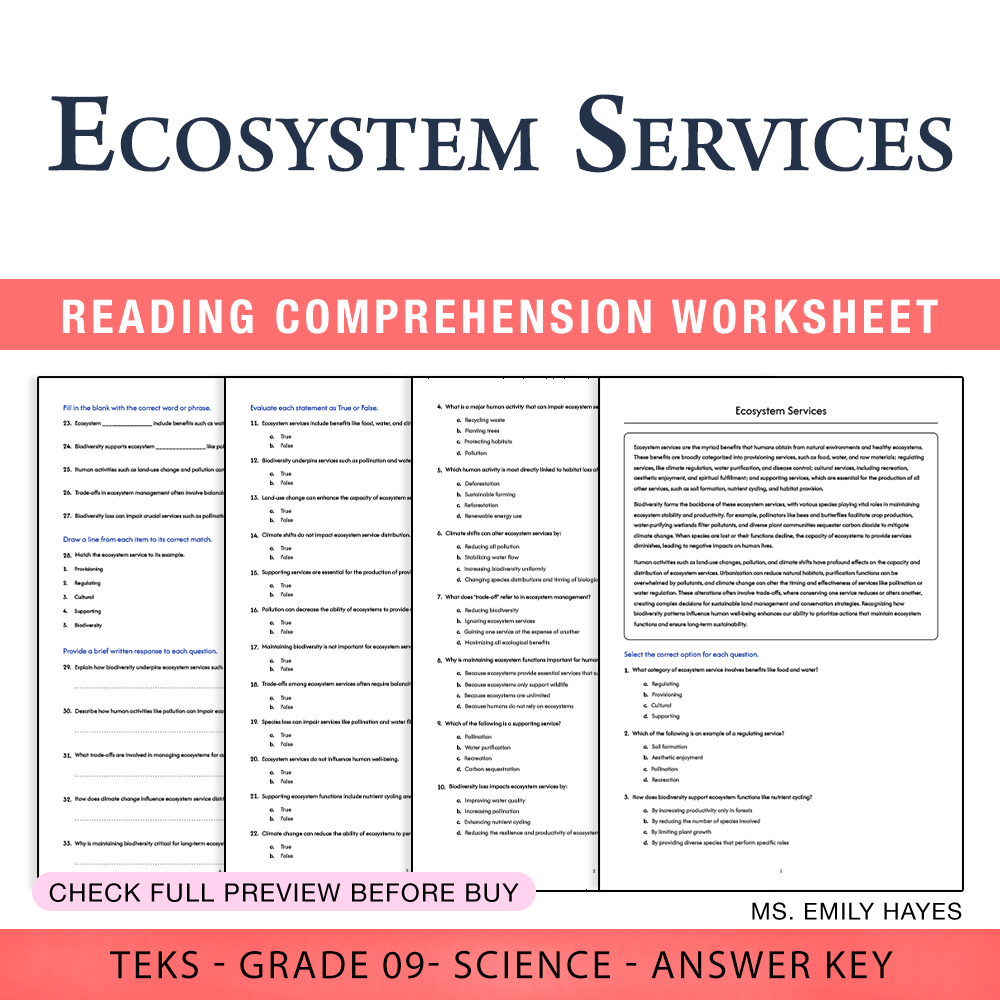
9th Grade Science | Ecosystem Services Worksheet (PDF+ Answer Key)
Created byCopper Leaf ClassroomLearning Objectives
- Explain the concept of ecosystem services and their types.
- Identify the ways biodiversity underpins ecosystem functions.
- Assess the impacts of human activities on ecosystem service capacity.
Instant download
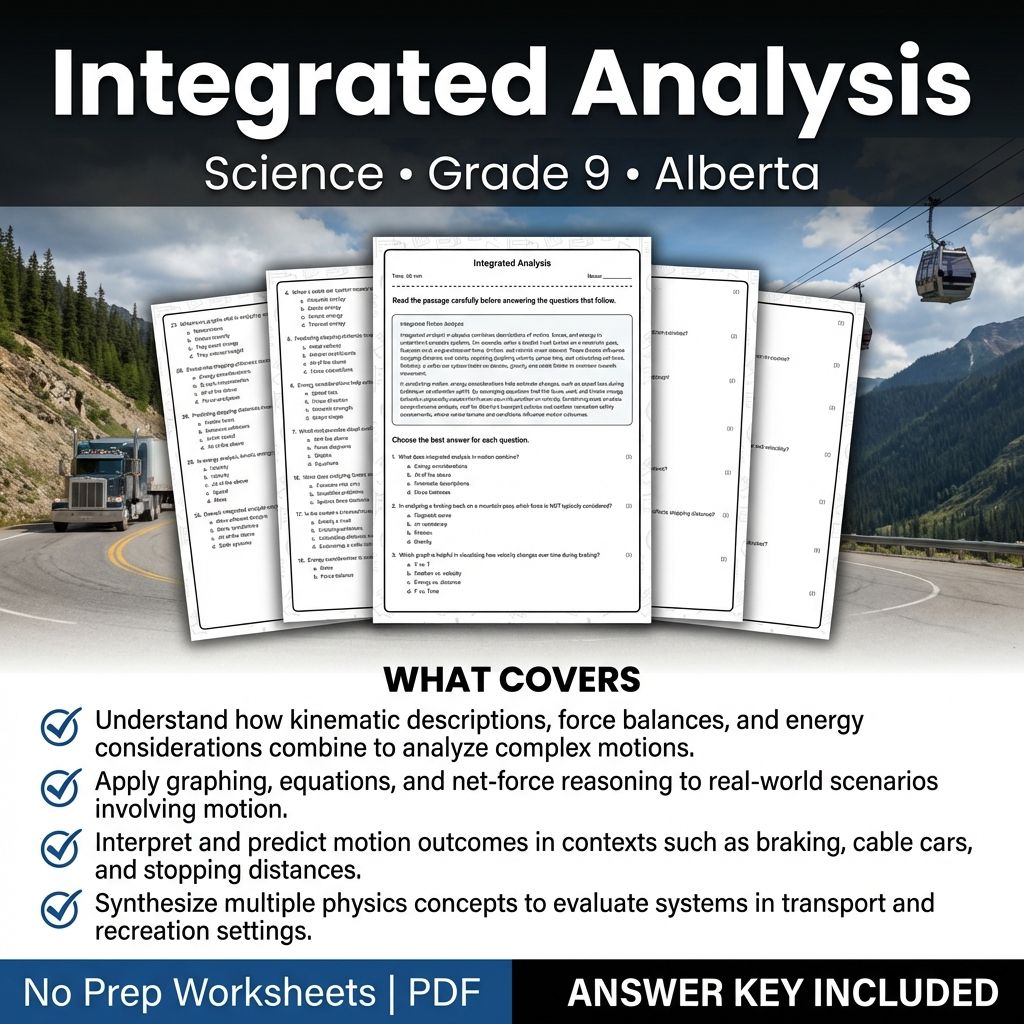
Grade 9 Science Worksheet on Integrated Analysis | Alberta Standards
Created byCoral Reef LearningLearning Objectives
- Understand how kinematic descriptions, force balances, and energy considerations combine to analyze complex motions.
- Apply graphing, equations, and net-force reasoning to real-world scenarios involving motion.
- Interpret and predict motion outcomes in contexts such as braking, cable cars, and stopping distances.
Instant download

Grade 9 Science – Nutrient Cycling & Ecosystem Balance | Daily Reading Worksheet
 Created byBright Mind Resources
Learning Objectives
- Understand the key processes involved in the nitrogen cycle.
- Identify how nitrogen moves through ecosystems.
- Recognize human impacts on nutrient cycling and their consequences.
Also included in: Ecosystem Ecology Grade 9 Science Daily Reading Worksheets Bundle | TEKS +2 more
Instant download

Grade 9 Science – Community Interactions & Ecosystem Relationships | Worksheet
Created byBright Mind ResourcesLearning Objectives
- Understand different types of species interactions such as competition, predation, mutualism, parasitism, and herbivory.
- Recognize the roles of keystone species and ecosystem engineers in community structure.
- Analyze indirect effects in species interactions using network approaches.
Also included in: Ecosystem Ecology Grade 9 Science Daily Reading Worksheets Bundle | TEKS +2 more
Instant download
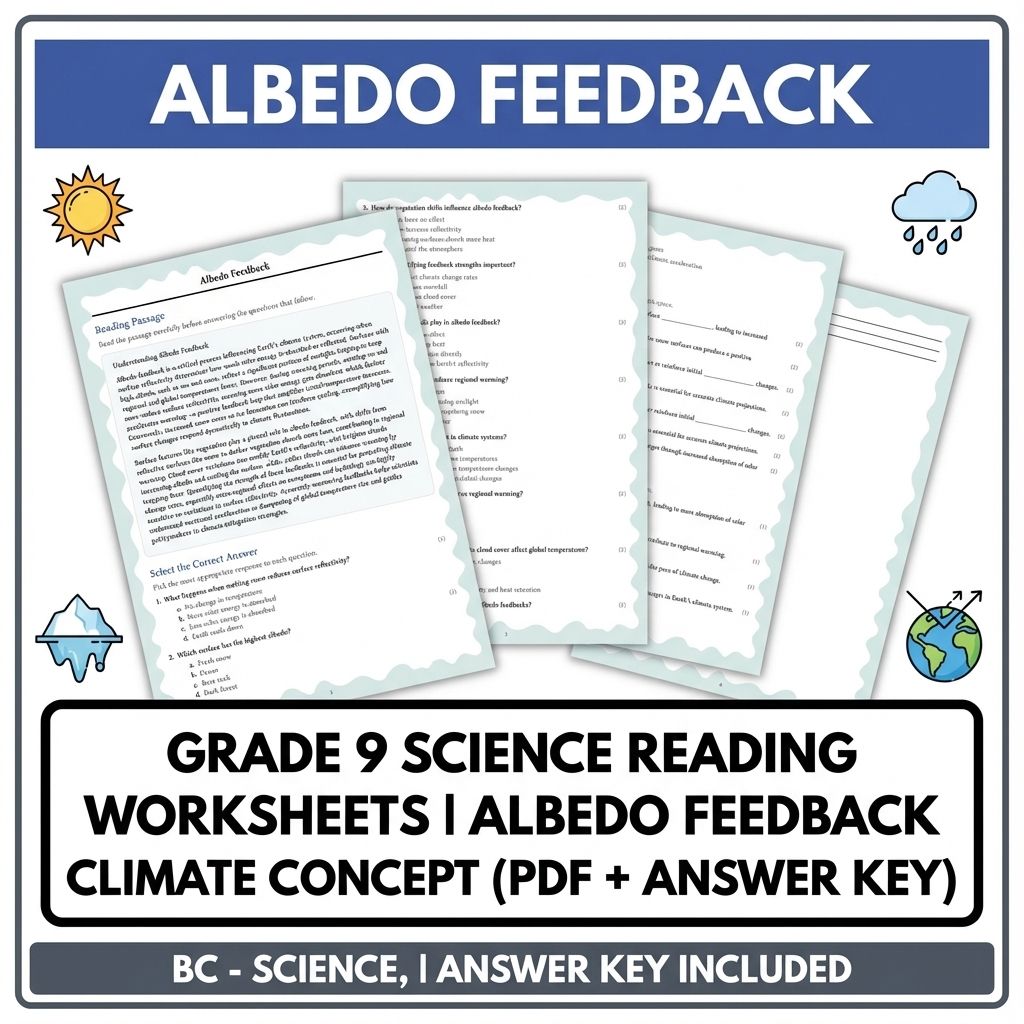
Grade 9 Science Worksheets | Albedo Feedback Climate Concept (PDF + Answer Key)
JCreated byJ.S SheetsLearning Objectives
- Understand the concept of albedo feedback and its role in climate change.
- Identify how surface reflectivity changes affect regional and global temperatures.
- Examine the impacts of melting ice, snow, vegetation shifts, and cloud cover on climate feedbacks.
Instant download
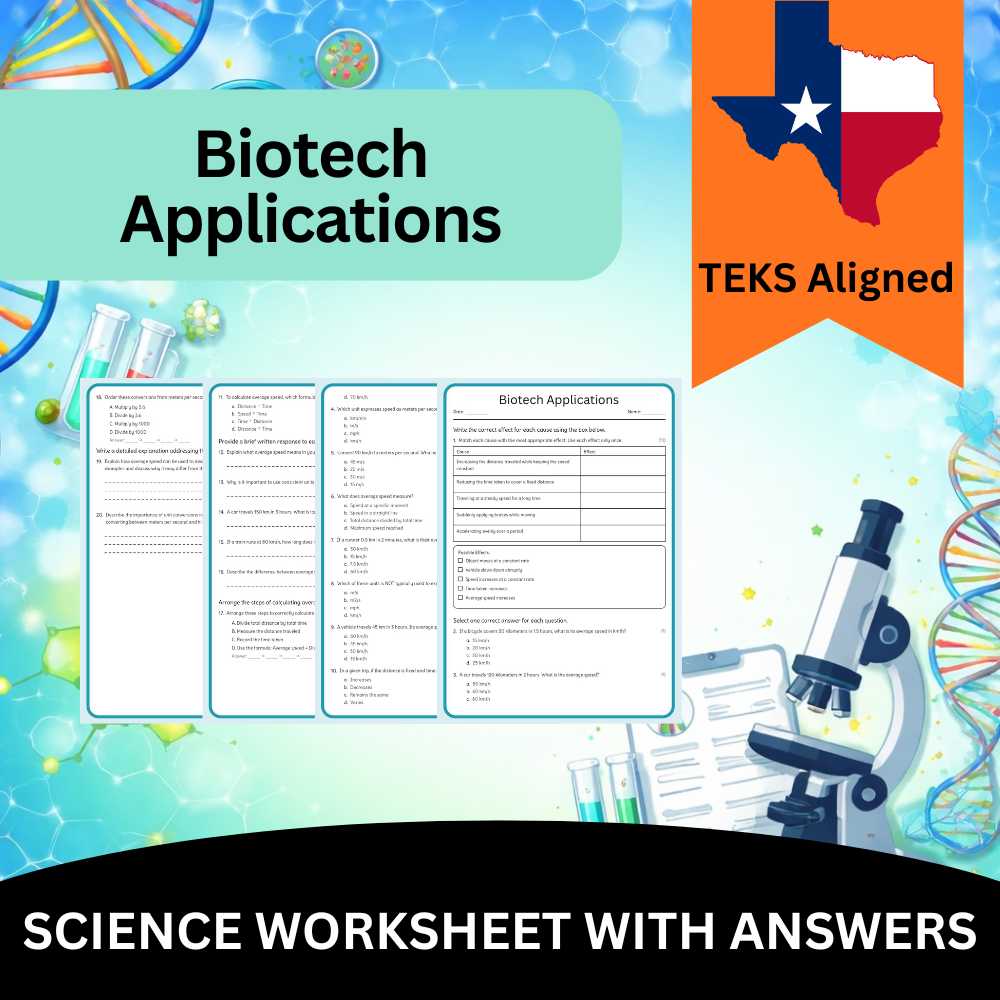
Grade 9 Science – Biotech Applications Worksheet (Worksheet + Answer Key) – TEKS Aligned
Created byBright Mind ResourcesLearning Objectives
- Identify common molecular techniques used in biotechnology applications.
- Explain how techniques like PCR, gel electrophoresis, DNA sequencing, and CRISPR are used in research and medicine.
- Describe various applications of biotechnology in diagnostics, gene therapy, and agriculture.
Also included in: Grade 9 Science Genetics & Biotechnology Unit - TEKS - Aligned (Answer Keys) +3 more
Instant download

Membrane Structure Worksheet | TEKS-Aligned Grade 9 Science Practice
JCreated byJ.S SheetsLearning Objectives
- Explain how the amphipathic phospholipids in the cell membrane form a selectively permeable bilayer
- Describe how integral, peripheral proteins, cholesterol, and carbohydrate chains contribute to membrane function
- Use the fluid mosaic model to predict how membrane components move and how permeability is regulated
Instant download
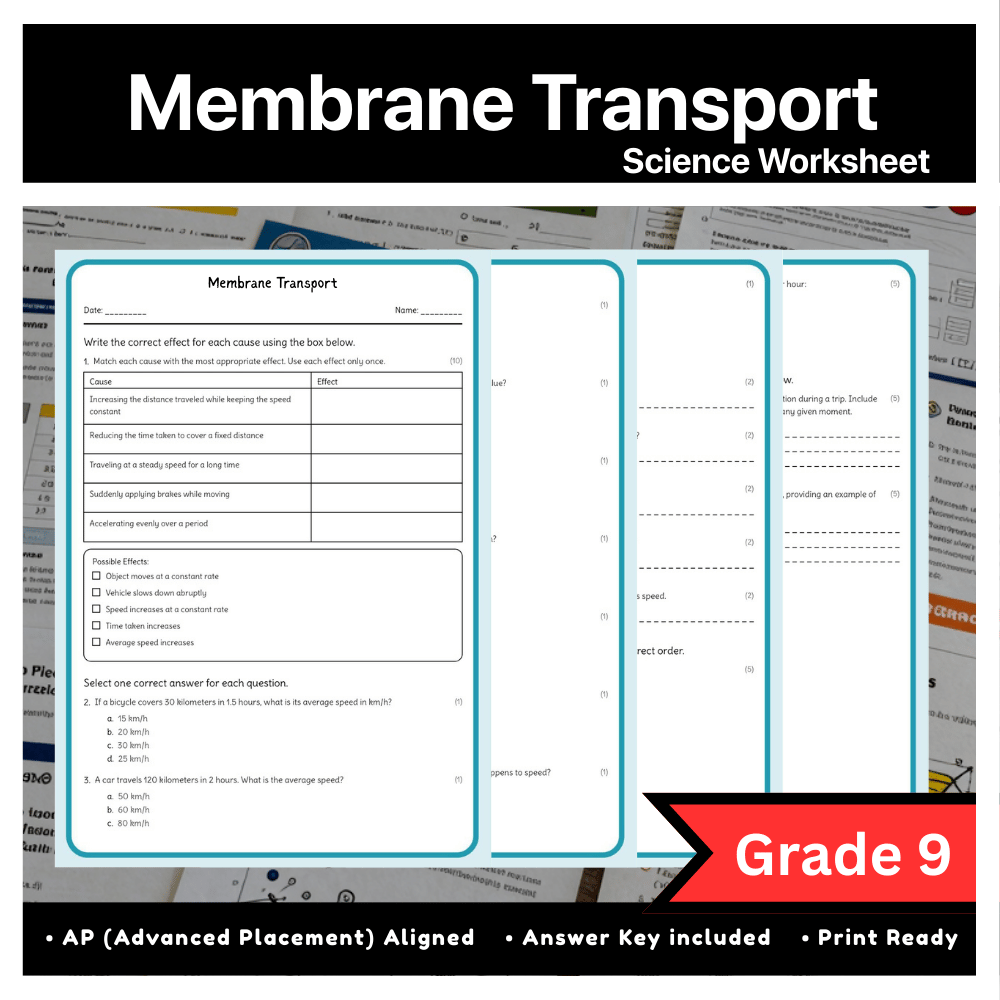
Grade 9 Science | Membrane Transport Worksheet (AP Standards) – PDF
Created byBright Mind ResourcesLearning Objectives
- Describe the mechanisms of passive diffusion, facilitated transport, and active transport across cell membranes.
- Explain how membrane composition and transporters contribute to electrochemical gradients and cellular homeostasis.
- Apply quantitative reasoning about concentration differences and permeability to predict effects on transport and cell function.
Instant download
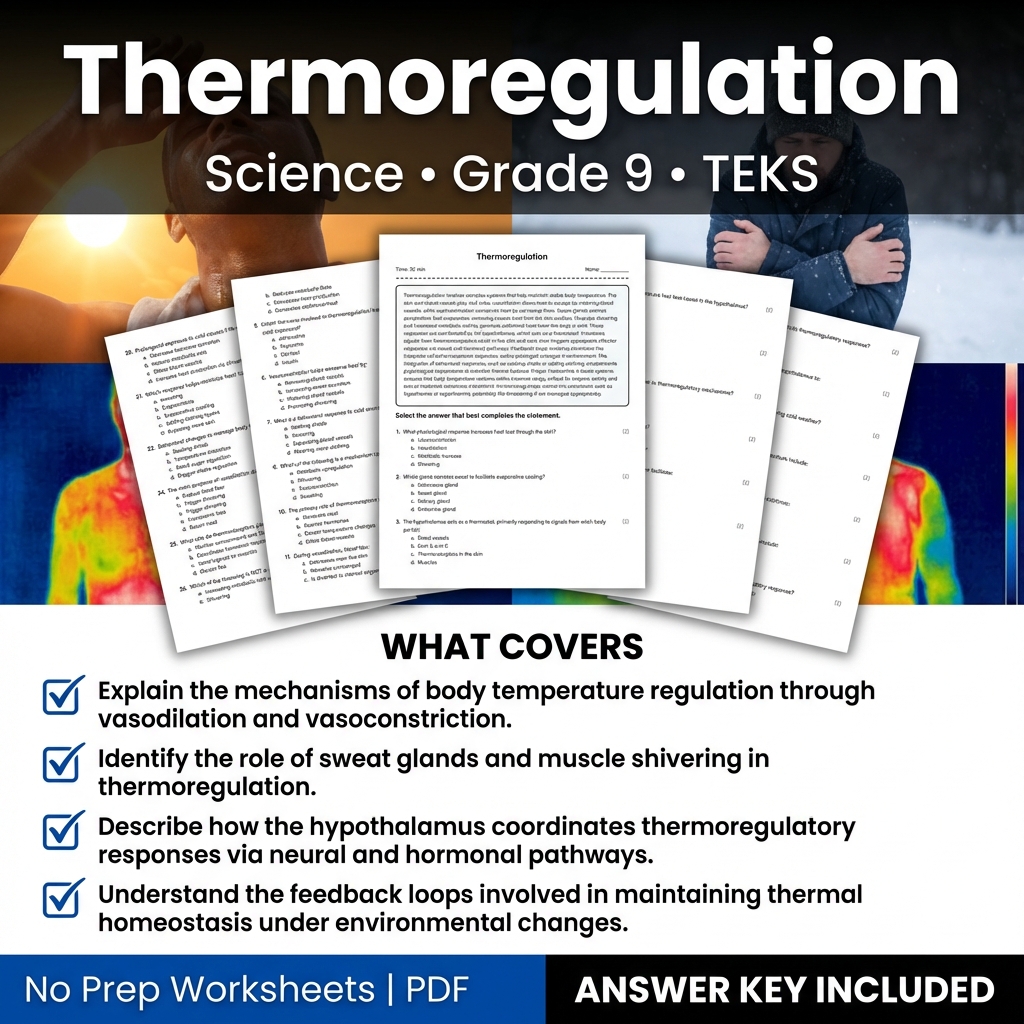
Thermoregulation Worksheet for Grade 9 Science | Standard Practice PDF
Created byCoral Reef LearningLearning Objectives
- Explain the mechanisms of body temperature regulation through vasodilation and vasoconstriction.
- Identify the role of sweat glands and muscle shivering in thermoregulation.
- Describe how the hypothalamus coordinates thermoregulatory responses via neural and hormonal pathways.
Instant download

Grade 9 Science | Wave Properties Worksheet (PDF + Answer Key)
 Created byRiverstone Classroom
Learning Objectives
- Understand the basic properties of waves, including amplitude, frequency, wavelength, and phase.
- Learn how wave speed relates to frequency and wavelength through the formula wave speed = frequency × wavelength.
- Explore how sinusoidal functions and superposition explain interference and standing waves.
Instant download
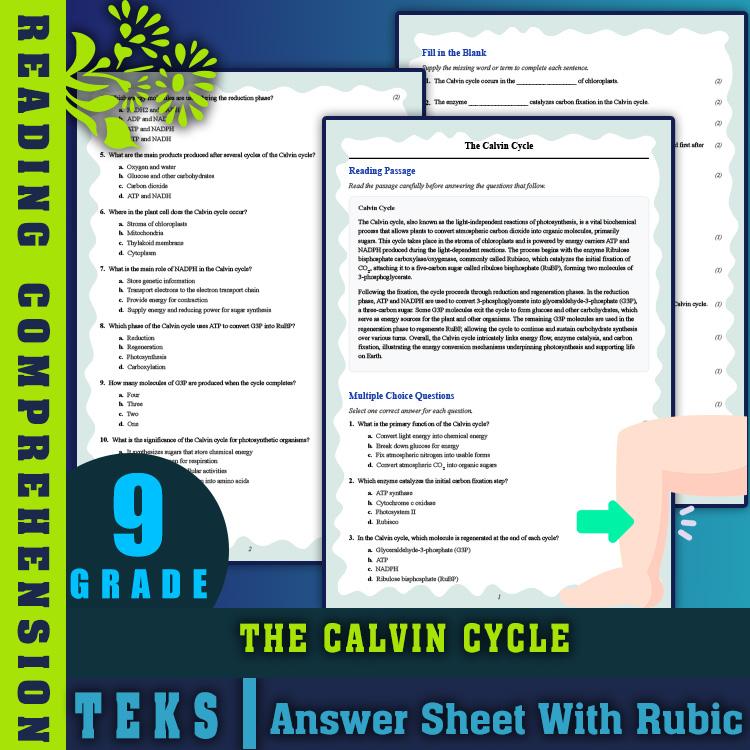
9th Grade Science | The Calvin Cycle Reading Worksheet & Answer Key (PDF)
JCreated byJ.S SheetsLearning Objectives
- Understand the main processes of the Calvin cycle and their significance in photosynthesis.
- Identify the key enzymes and molecules involved in the Calvin cycle.
- Describe how energy from ATP and NADPH is utilized to synthesize sugars during photosynthesis.
Instant download
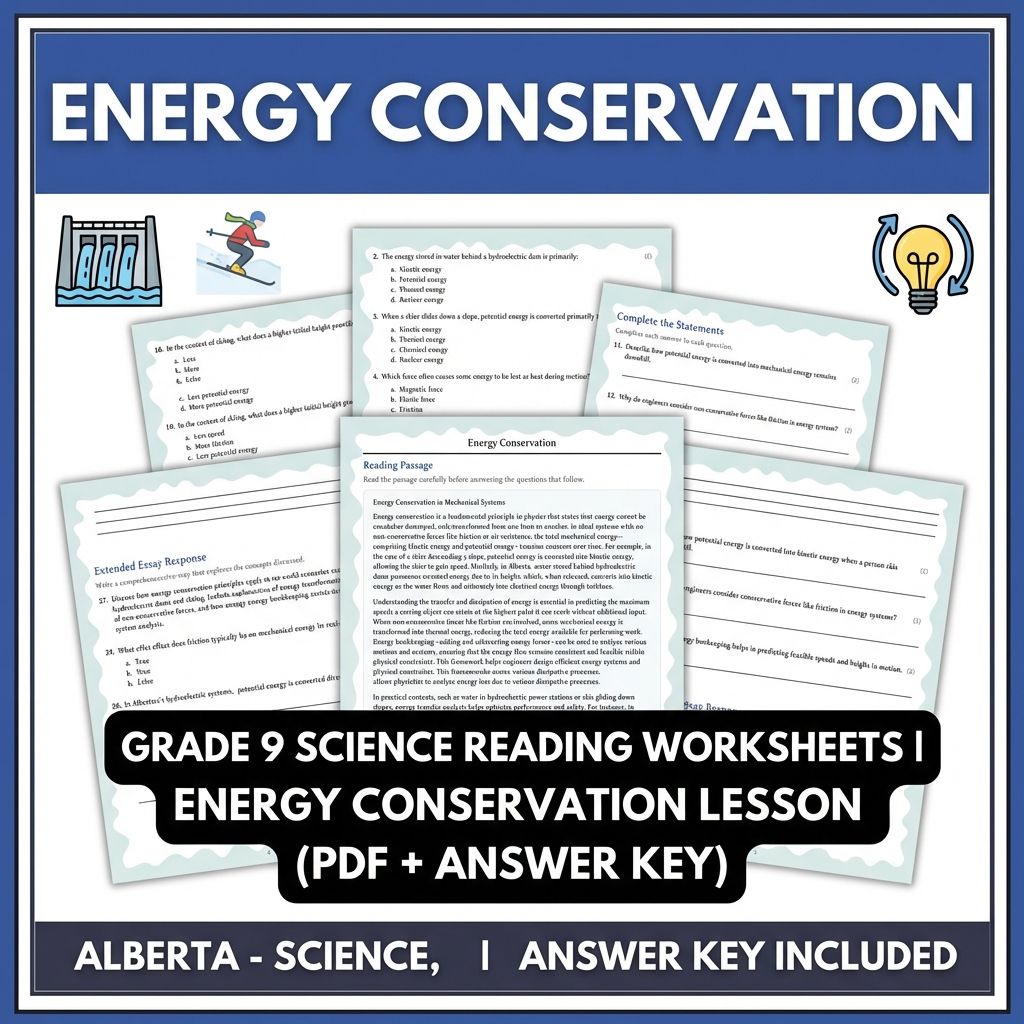
Grade 9 Science Worksheets | Energy Conservation Lesson (PDF + Answer Key)
JCreated byJ.S SheetsLearning Objectives
- Explain the principle of energy conservation in mechanical systems.
- Identify energy transformations in real-world scenarios like hydroelectric dams and skiing.
- Describe the effects of non-conservative forces such as friction on energy transfer.
Also included in: Grade 9 Science Unit Bundle | Motion, Forces & Energy Activities (PDF) +1 more
Instant download
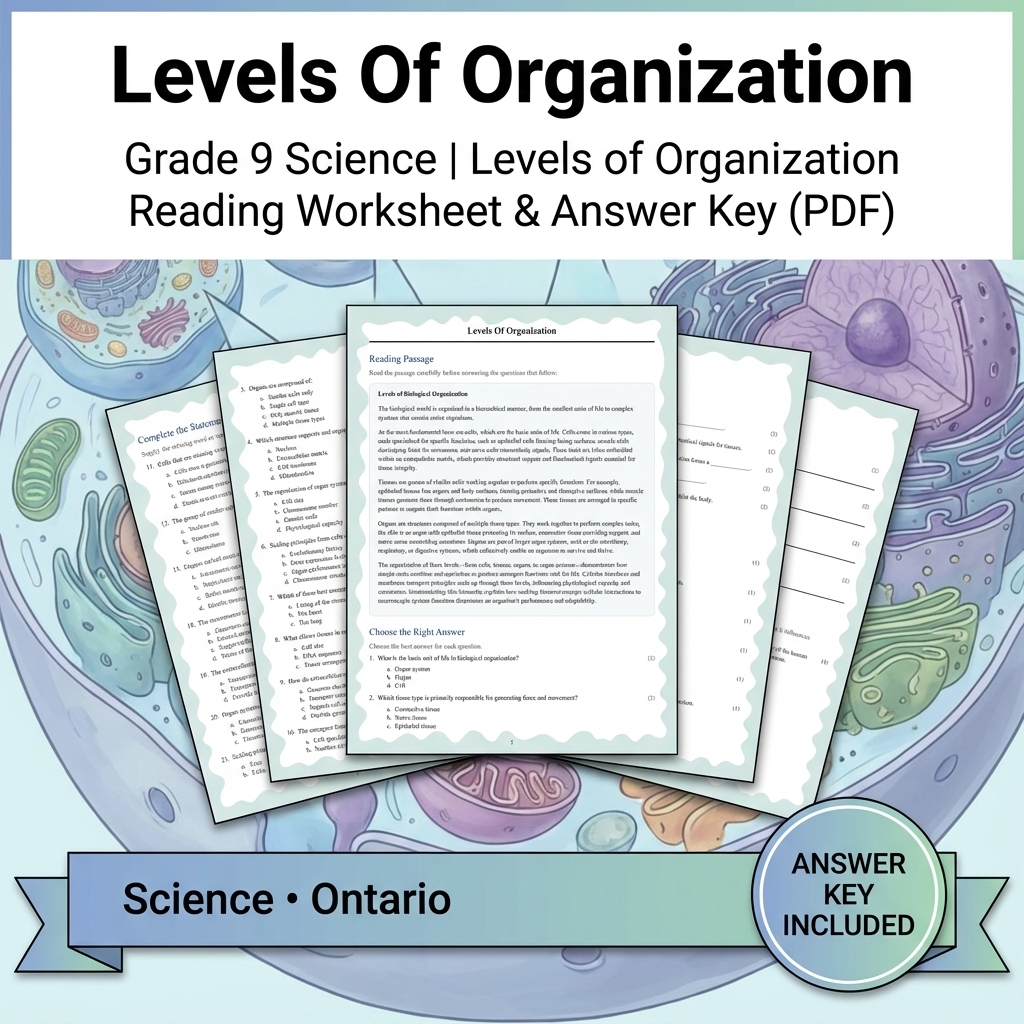
Grade 9 Science | Levels of Organization Reading Worksheet & Answer Key (PDF)
JCreated byJ.S SheetsLearning Objectives
- Explain hierarchical relationships among cells, tissues, organs, and systems using canonical examples.
- Describe how cell specialization and extracellular matrices produce emergent organ functions.
- Understand how tissue arrangement supports organ-level processes and their role in physiological capacity.
Also included in: Grade 9 Science Unit Bundle | Human Body Systems & Cell Functions +1 more
Instant download
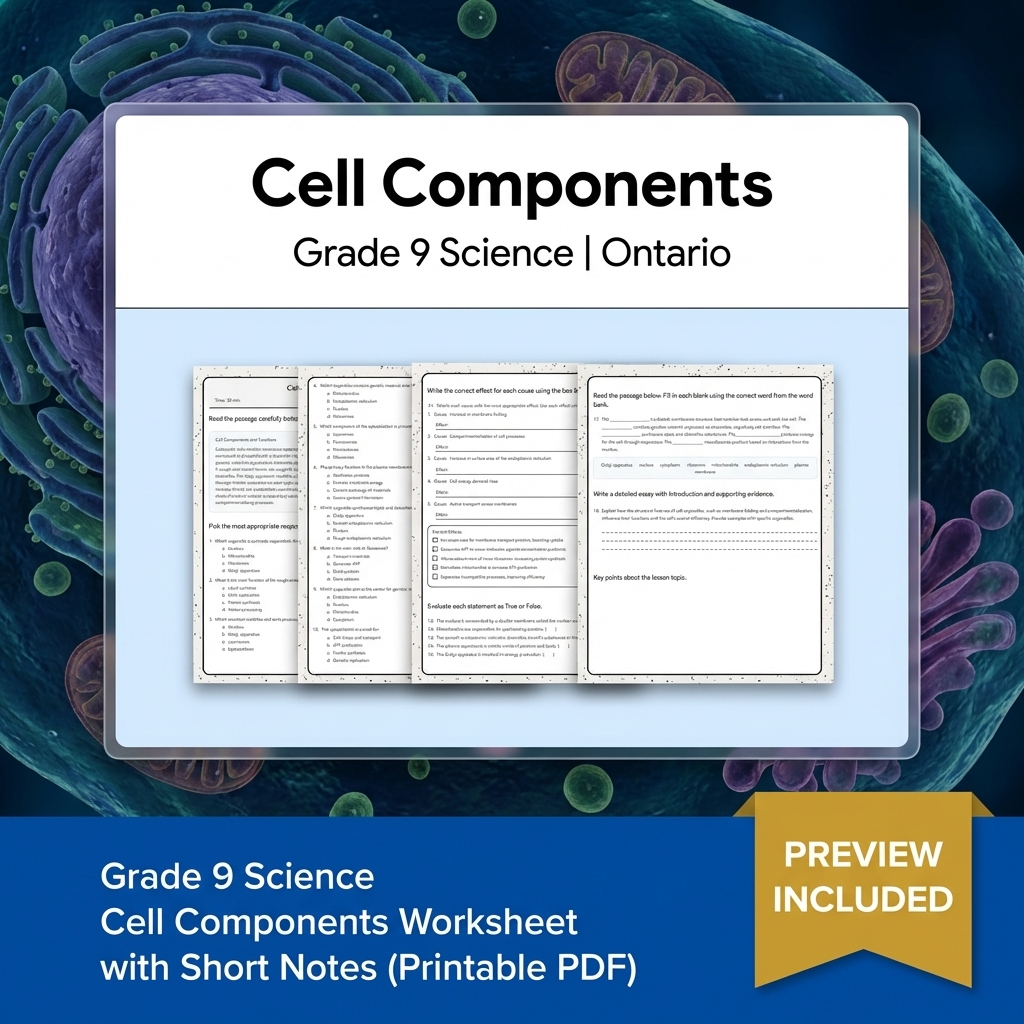
Grade 9 Science Cell Components Worksheet with Short Notes (Printable PDF)
Created byMeadowlark WorksheetsLearning Objectives
- Identify major organelles of eukaryotic cells and their functions.
- Understand how membrane structures influence metabolic rates and exchange.
- Relate cell structure features to their specific roles in the cell.
Instant download

Grade 9 Science – Periodic Table & Properties | Daily Reading Worksheet
Created byBright Mind ResourcesLearning Objectives
- Describe how atomic number relates to an element's position on the periodic table.
- Explain the significance of periodic trends such as reactivity, ion charge, and bonding tendencies.
- Identify patterns in element properties across periods and groups.
Also included in: Science Grade 9 Science Daily Reading Worksheets lesson-bundle | Calif. Stds +1 more
Instant download

Grade 9 Science – Energy Profiles & Chemical Reactions | Daily Reading Worksheet
Created byBright Mind ResourcesLearning Objectives
- Understand the concept of energy profiles for chemical reactions.
- Identify exothermic and endothermic reactions from energy diagrams.
- Describe the significance of activation energy and transition states.
Also included in: Grade 9 Chemical Reactions Science Lesson Bundle: Daily Reading (BC) +1 more
Instant download

Grade 9 Science – Limiting Reactants & Reactions | Daily Reading Worksheet
Created byBright Mind ResourcesLearning Objectives
- Define limiting reactant in a chemical reaction
- Identify the limiting reactant from initial quantities
- Differentiate between theoretical and actual yields
Also included in: Grade 9 Chemical Reactions Science Lesson Bundle: Daily Reading (BC) +1 more
Instant download

Grade 9 Science – Atomic Particles & Structure | Daily Reading Worksheet
Created byBright Mind ResourcesLearning Objectives
- Identify the main subatomic particles within an atom (protons, neutrons, electrons).
- Understand the location of protons, neutrons, and electrons inside an atom.
- Explain how the number of protons determines an element.
Also included in: Grade 9 Chemical Reactions Science Lesson Bundle: Daily Reading (BC) +1 more
Instant download
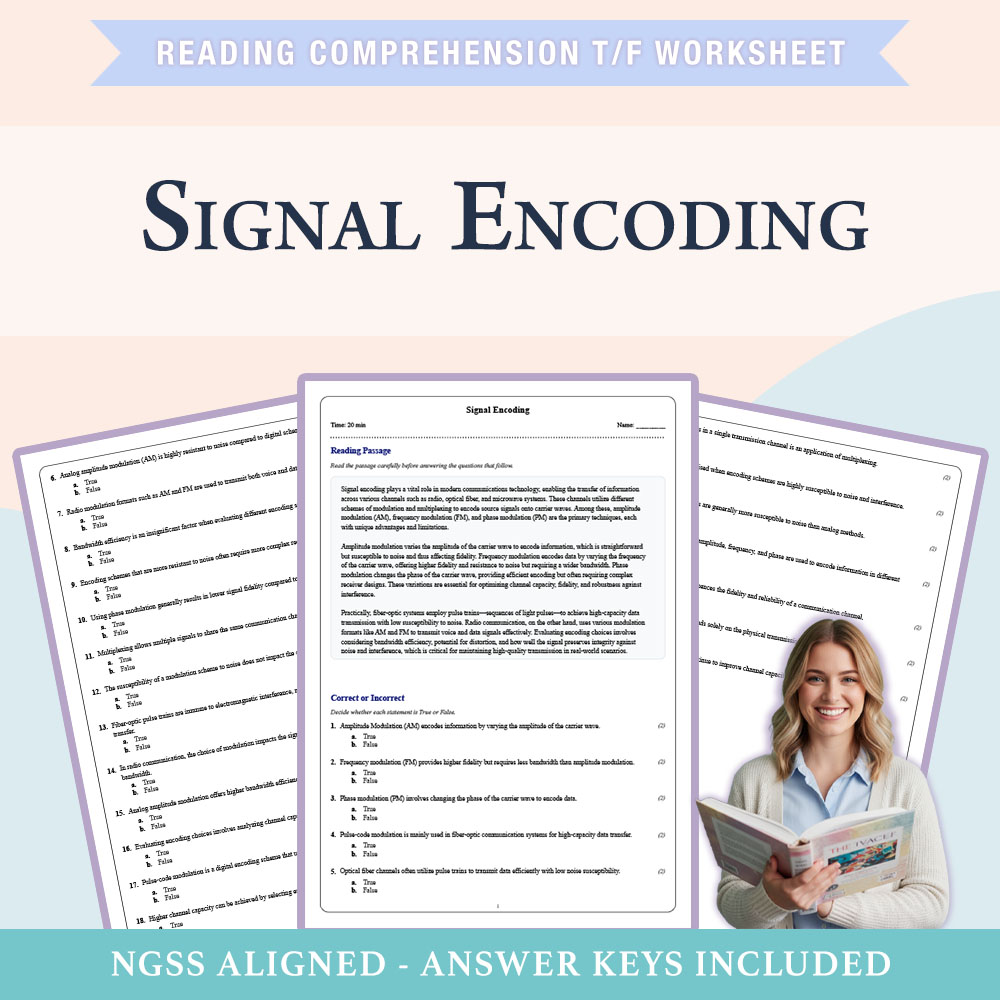
Grade 9 Science | Signal Encoding Worksheet (PDF + Answer Key)
Created byCopper Leaf ClassroomLearning Objectives
- Understand the principles of information encoding through modulation and multiplexing.
- Differentiate between amplitude, frequency, and phase variation techniques used in signal transmission.
- Compare pulse-code modulation and analog amplitude modulation in terms of bandwidth, fidelity, and noise susceptibility.
Also included in: Grade 9 Science Unit| Wave Properties & Electromagnetic Radiation (PDF +Answers) +1 more
Instant download
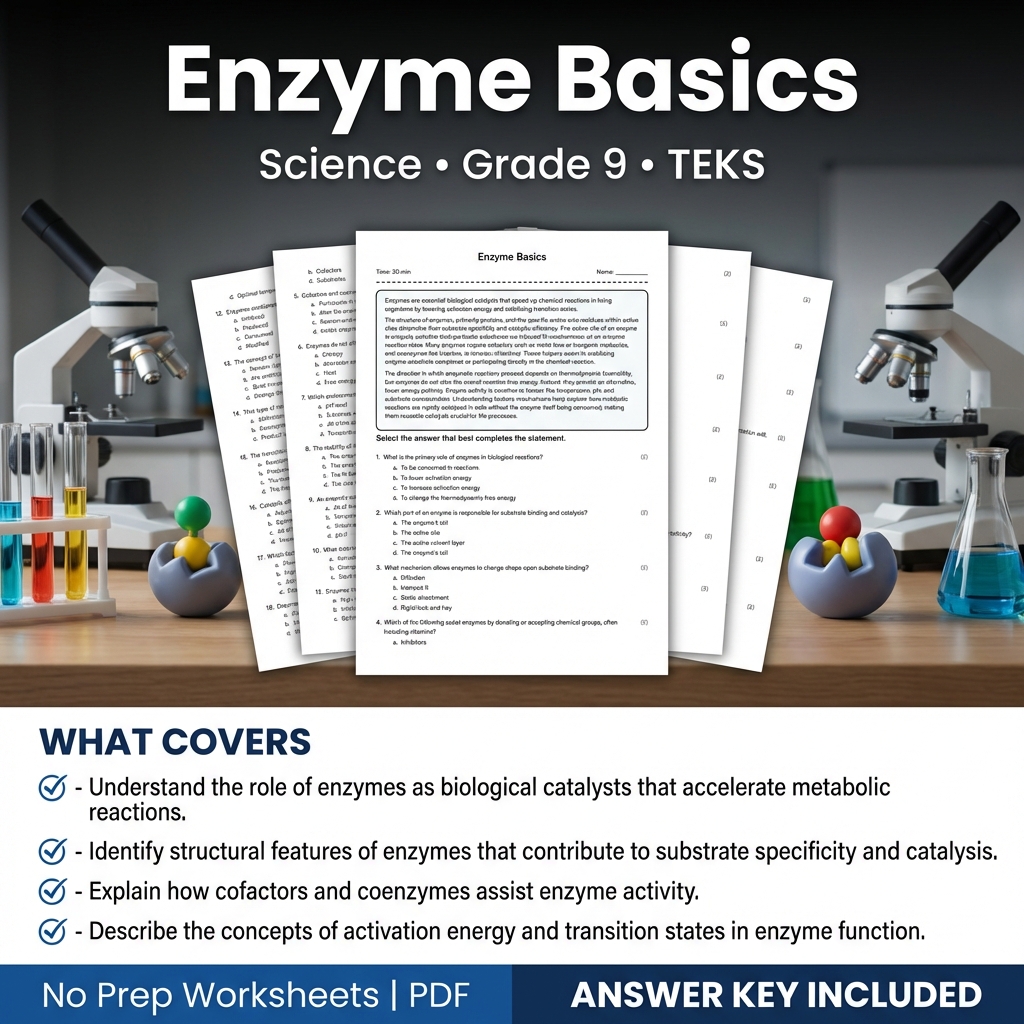
Grade 9 Science Worksheet on Enzyme Basics | TEKS Aligned Practice
Created byCoral Reef LearningLearning Objectives
- Understand the role of enzymes as biological catalysts that accelerate metabolic reactions.
- Identify structural features of enzymes that contribute to substrate specificity and catalysis.
- Explain how cofactors and coenzymes assist enzyme activity.
Instant download
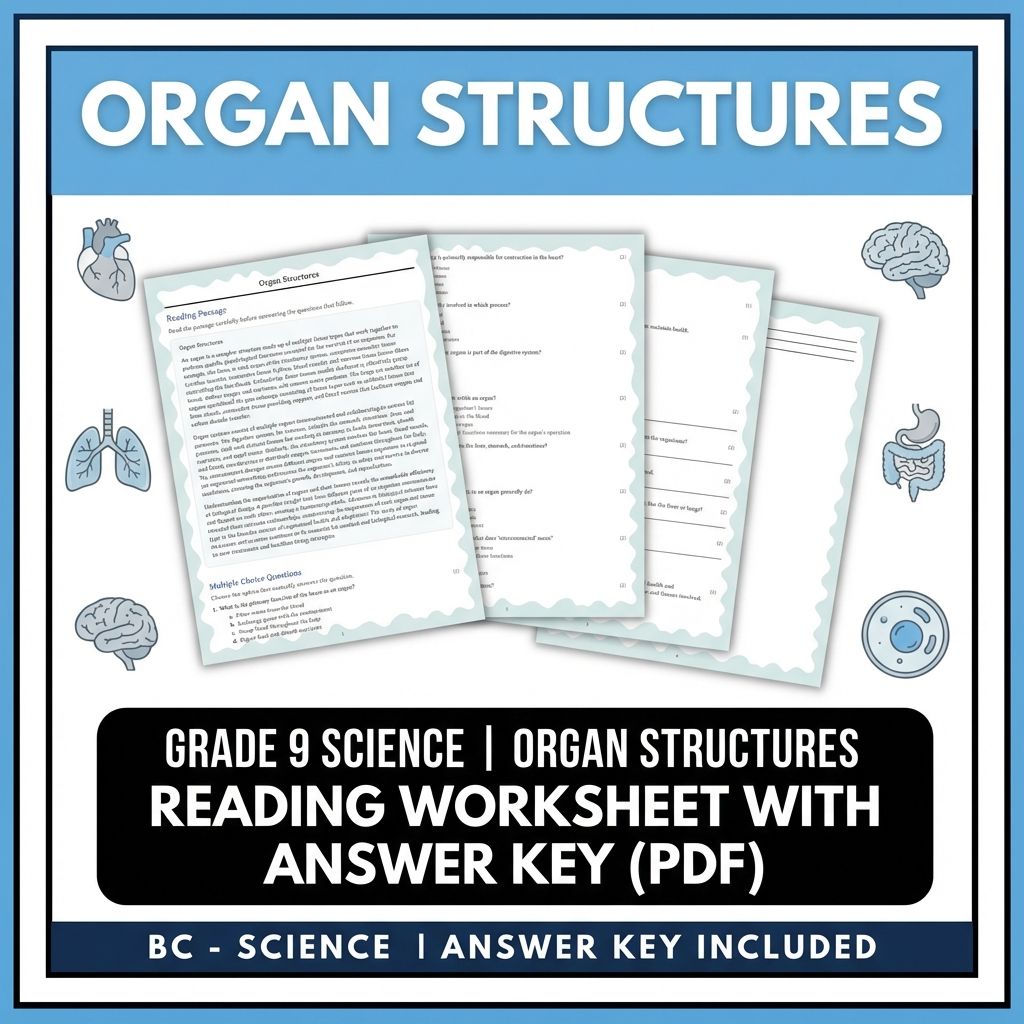
Grade 9 Science | Organ Structures Reading Worksheet with Answer Key (PDF)
JCreated byJ.S SheetsLearning Objectives
- Understand the composition and functions of different organs in the human body.
- Identify the types of tissues that make up organs.
- Explain how organs work together within organ systems to sustain life.
Instant download
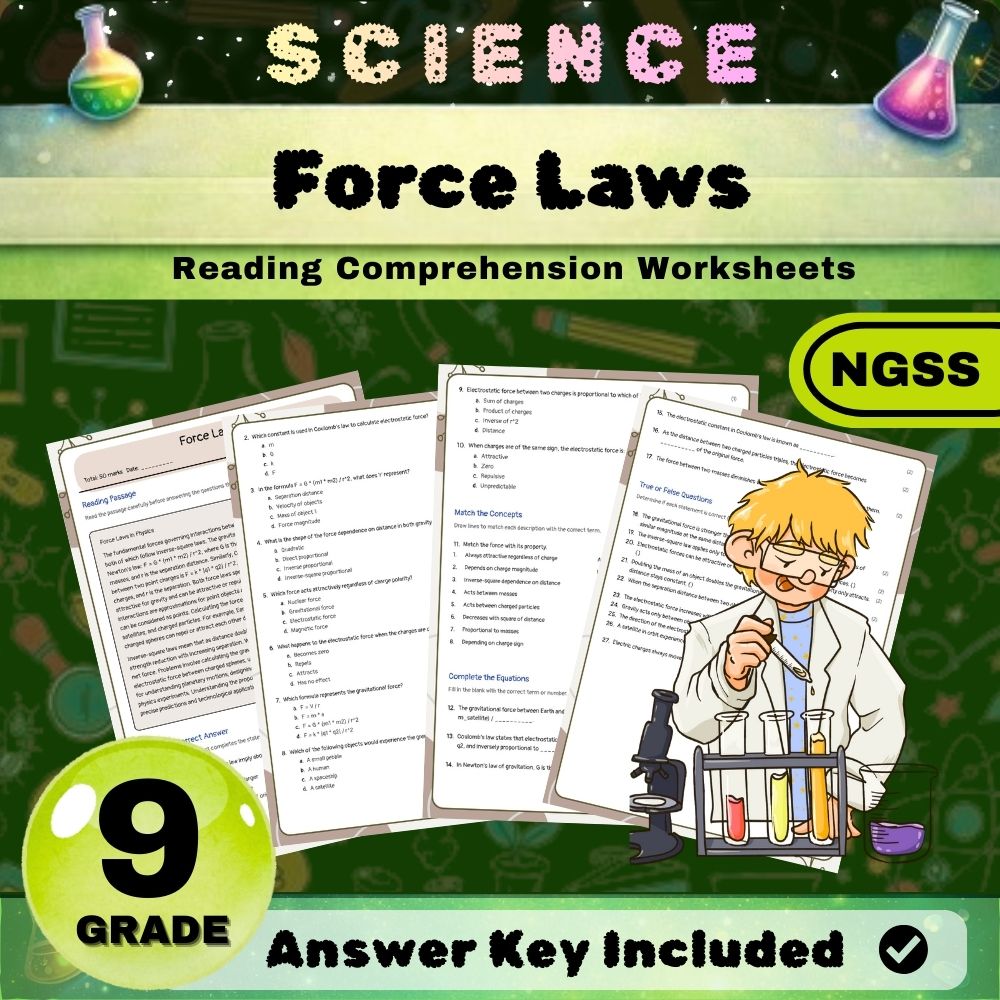
Grade 9 Science | Force Laws Worksheet (NGSS) – PDF
Created byMaple Path LearningLearning Objectives
- Understand the inverse-square dependence of gravitational and electrostatic forces.
- Apply quantitative formulas to calculate the magnitude of forces between objects.
- Determine the direction of forces using vector representations.
Also included in: Grade 9 Science | Motion and Stability Forces & Interactions NGSS Unit Bundle +1 more
Instant download
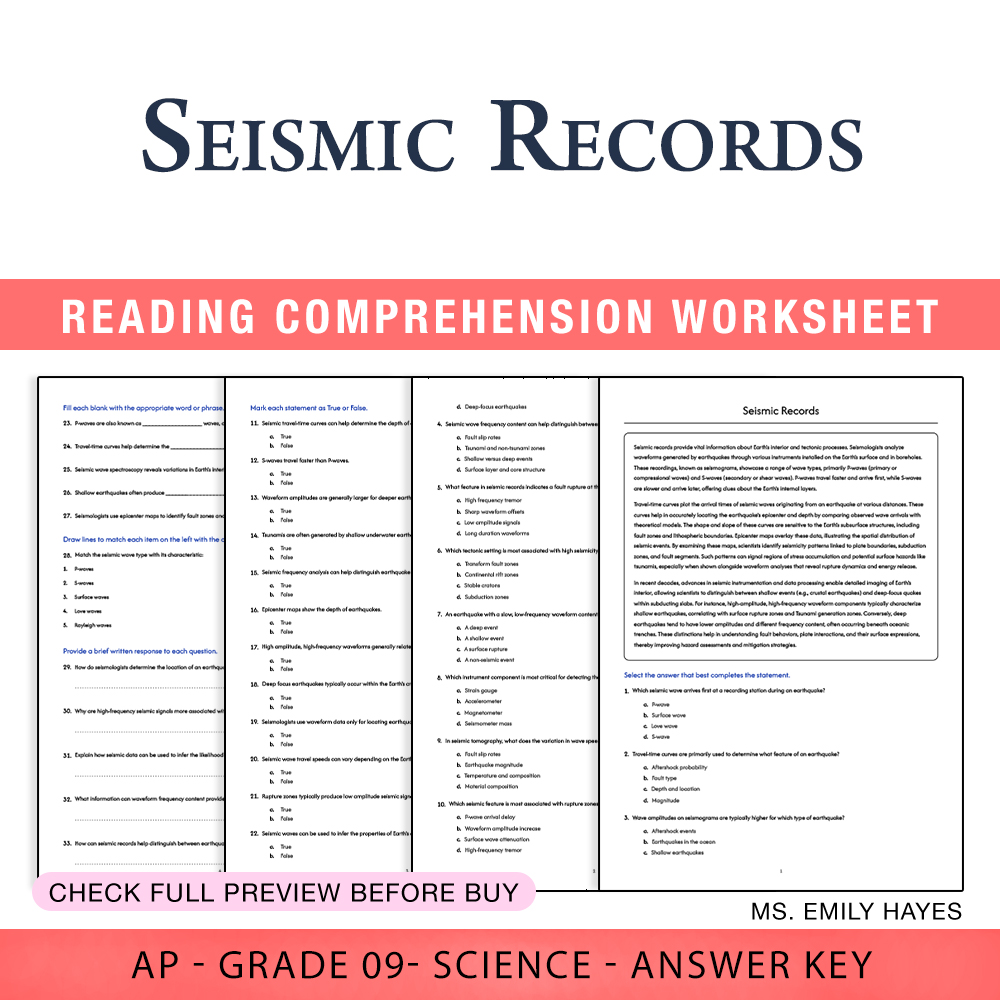
Grade 9 Science | Seismic Records Worksheet (PDF+ Answer Key)
Created byCopper Leaf ClassroomLearning Objectives
- Interpret earthquake waveforms, travel-time curves, and epicenter maps to understand Earth's subsurface structures.
- Compare P- and S-wave arrivals, waveform amplitudes, and frequency content to distinguish shallow versus deep earthquakes.
- Locate rupture zones and relate seismic activity patterns to tectonic plate interactions.
Also included in: Grade 9 Science | Earth and Space Sciences AP Worksheet (PDF + Answer Key) +1 more
Instant download
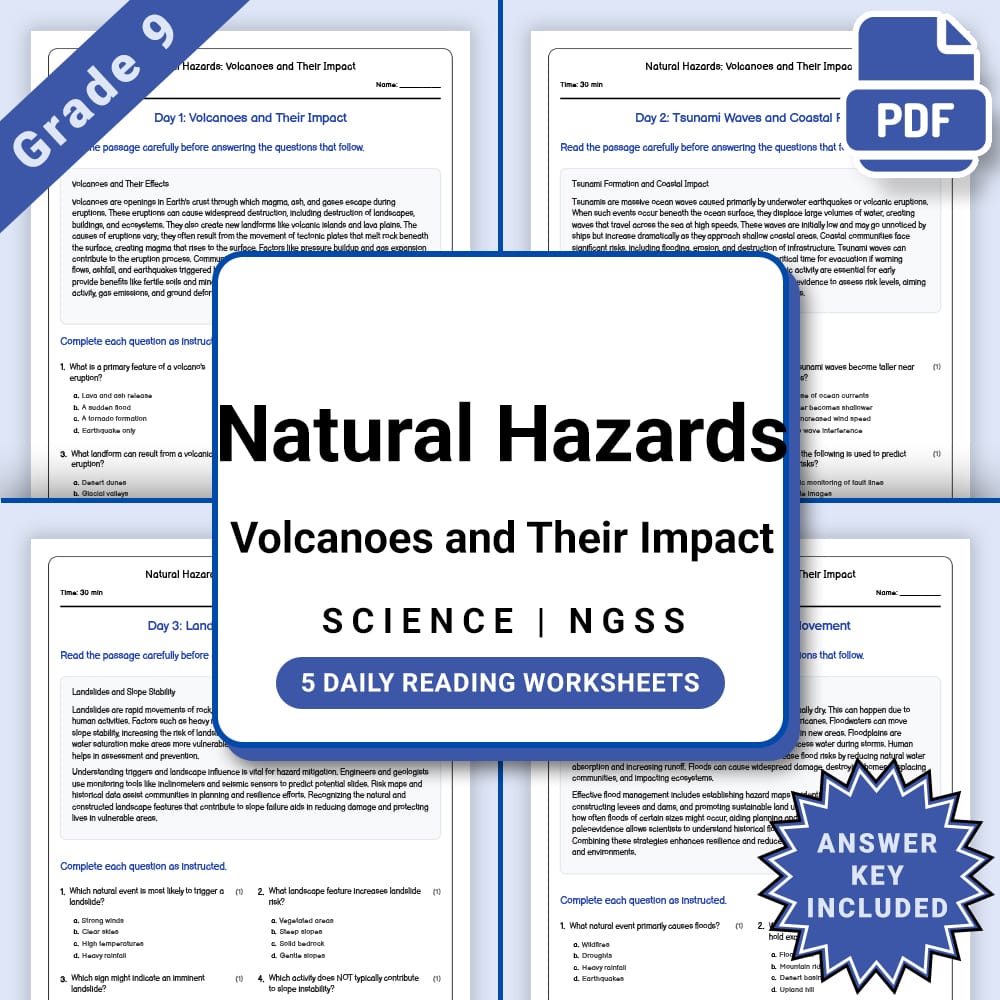
Grade 9 Science – Natural Hazards Volcanoes Worksheet(PDF + Answer Key)
Created byCopper Leaf ClassroomLearning Objectives
- Identify key volcanic hazards and their effects.
- Understand the causes of volcanic eruptions.
- Analyze how volcanoes influence landscapes and communities.
Instant download

Integrated Modeling Worksheet Pack | Grade 9 AP Science Practice
 Created byBright Quill Resources
Learning Objectives
- Explain how integrated models link the geosphere, hydrosphere, atmosphere, and biosphere to simulate environmental change.
- Identify how model parameters influence outputs and why sensitivity matters.
- Describe uncertainty propagation and how it affects projections of climate feedbacks and resource availability.
Instant download
Grade 9 Science | Force Laws Worksheet (NGSS Aligned + PDF) – Science
Created byBright Mind ResourcesLearning Objectives
- Understand the inverse-square relationship in gravitational and electrostatic forces.
- Apply quantitative formulas to calculate the magnitude and direction of forces between objects.
- Use vector analysis to determine net forces in multi-body systems.
Instant download
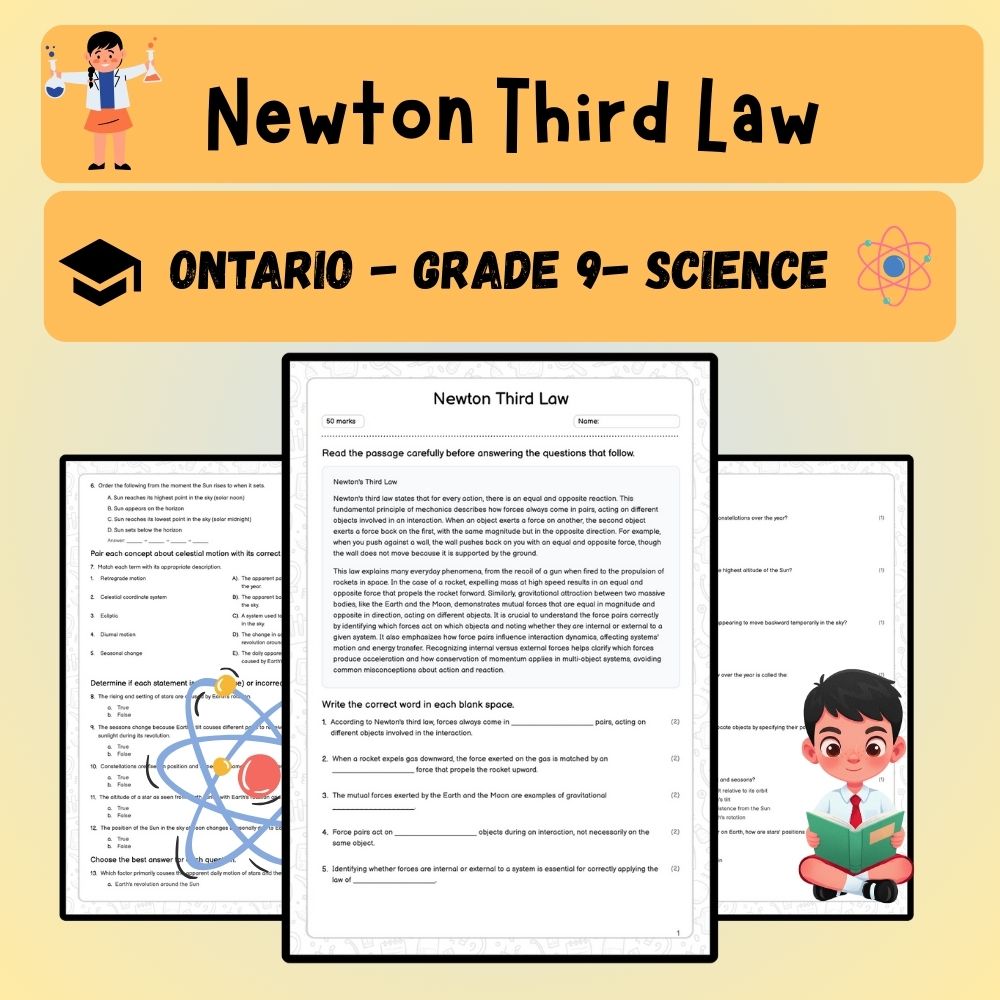
Grade 9 Science | Newton Third Law Worksheet (Worksheet + Answer Key) – Ontario Standards
Created byPrism Point LearningLearning Objectives
- Explain the principle of Newton's third law and identify action–reaction force pairs in various scenarios.
- Analyze common phenomena involving equal and opposite forces applied to different objects.
- Differentiate between internal and external forces when applying Newtonian mechanics to systems.
Also included in: Grade 9 Science Unit | Forces, Motion & Energy Worksheets (Ontario Standards) +1 more
Instant download
About Grade 9 Science Worksheets
Find Science worksheets built for Grade 9. All 6,926 cover core skills, practice, and review, each an instant PDF download.
Every worksheet on MyTeachingSheets is created by independent teacher-authors and reviewed before publication. All resources download as printable PDFs for classroom, homework, or at-home practice, and many include answer keys. Preview any worksheet free before buying.