
Grade 9 Science Worksheets
6,926 worksheets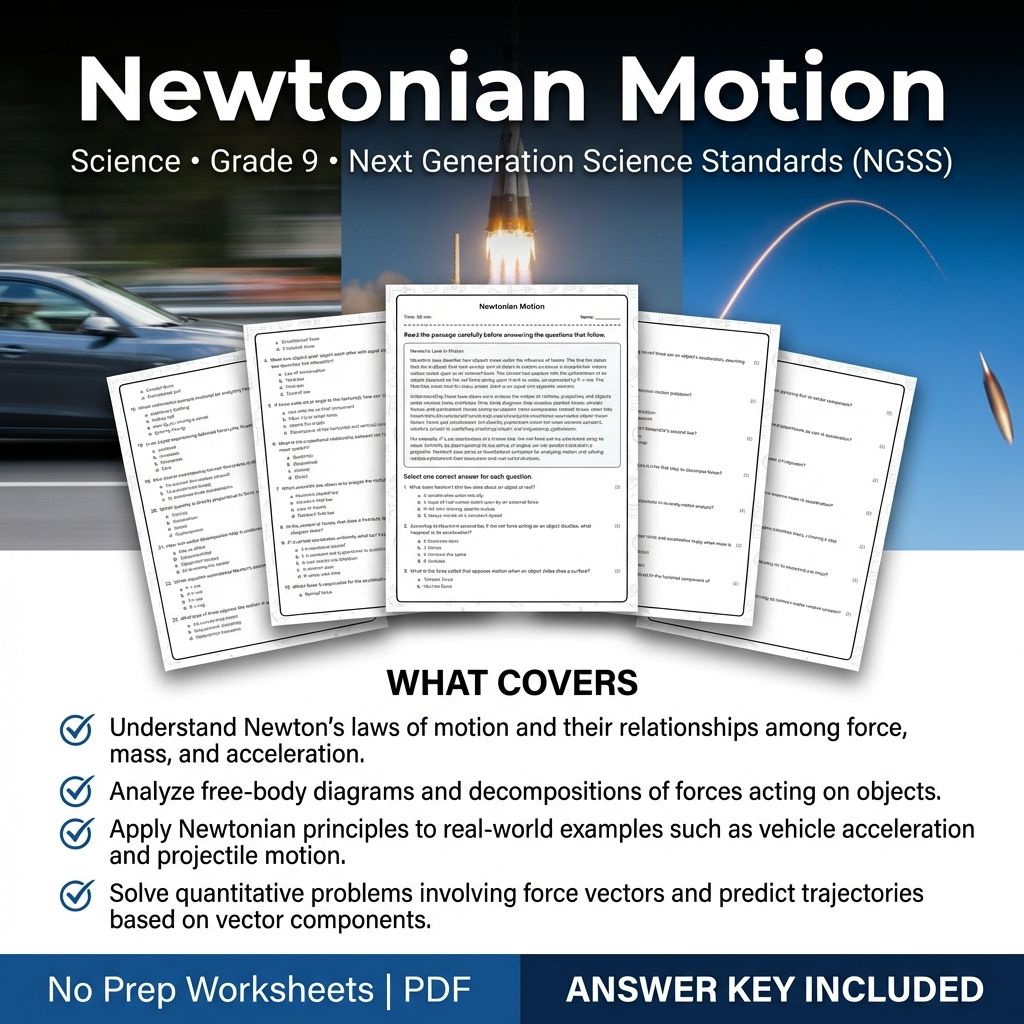
Grade 9 Science | Newtonian Motion Worksheet & Answer Key (Printable PDF)
 Created byCoral Reef Learning
Learning Objectives
- Understand Newton's laws of motion and their relationships among force, mass, and acceleration.
- Analyze free-body diagrams and decompositions of forces acting on objects.
- Apply Newtonian principles to real-world examples such as vehicle acceleration and projectile motion.
Also included in: Grade 9 Science Unit Bundle – Newtonian Motion & Physics Practice Worksheets +1 more
Instant download
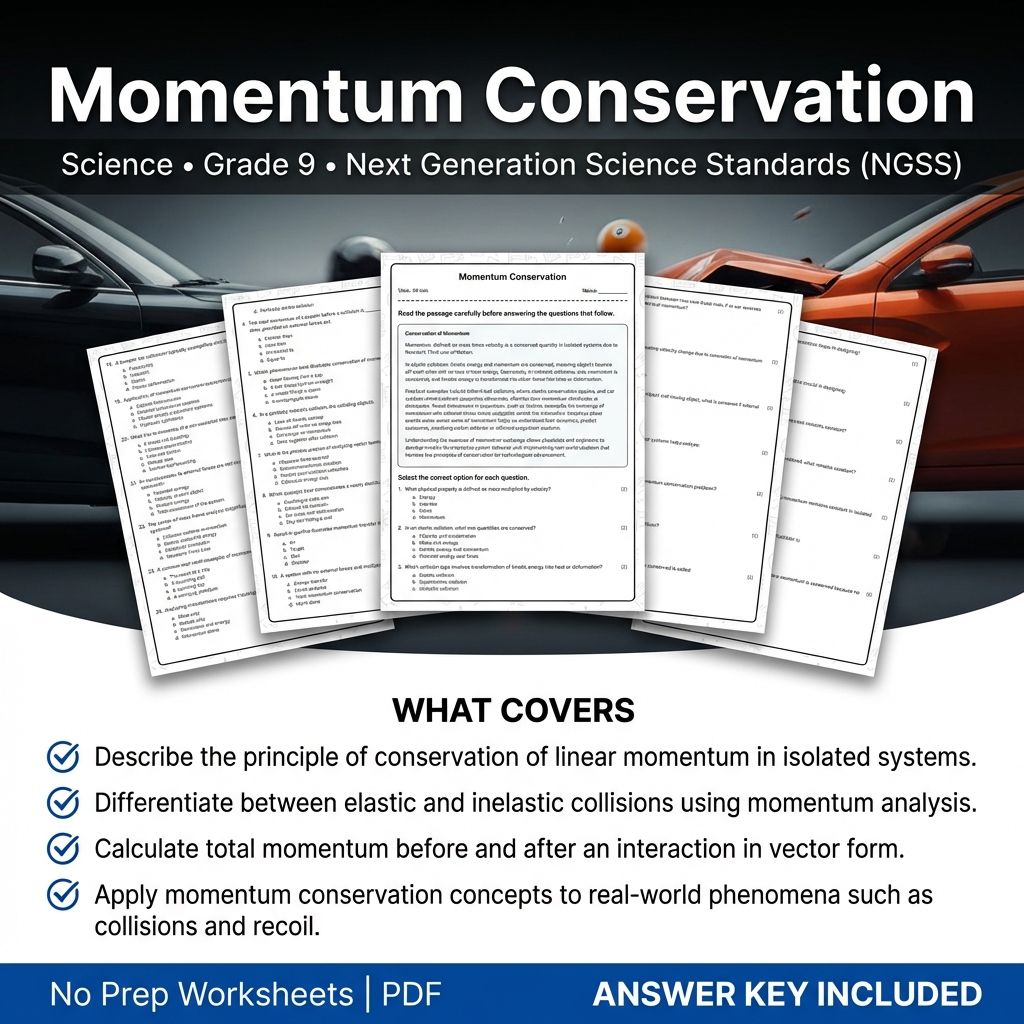
Grade 9 Science Worksheet | Momentum Conservation Practice & Answer Key
Created byCoral Reef LearningLearning Objectives
- Describe the principle of conservation of linear momentum in isolated systems.
- Differentiate between elastic and inelastic collisions using momentum analysis.
- Calculate total momentum before and after an interaction in vector form.
Also included in: Grade 9 Science Unit Bundle – Newtonian Motion & Physics Practice Worksheets +1 more
Instant download
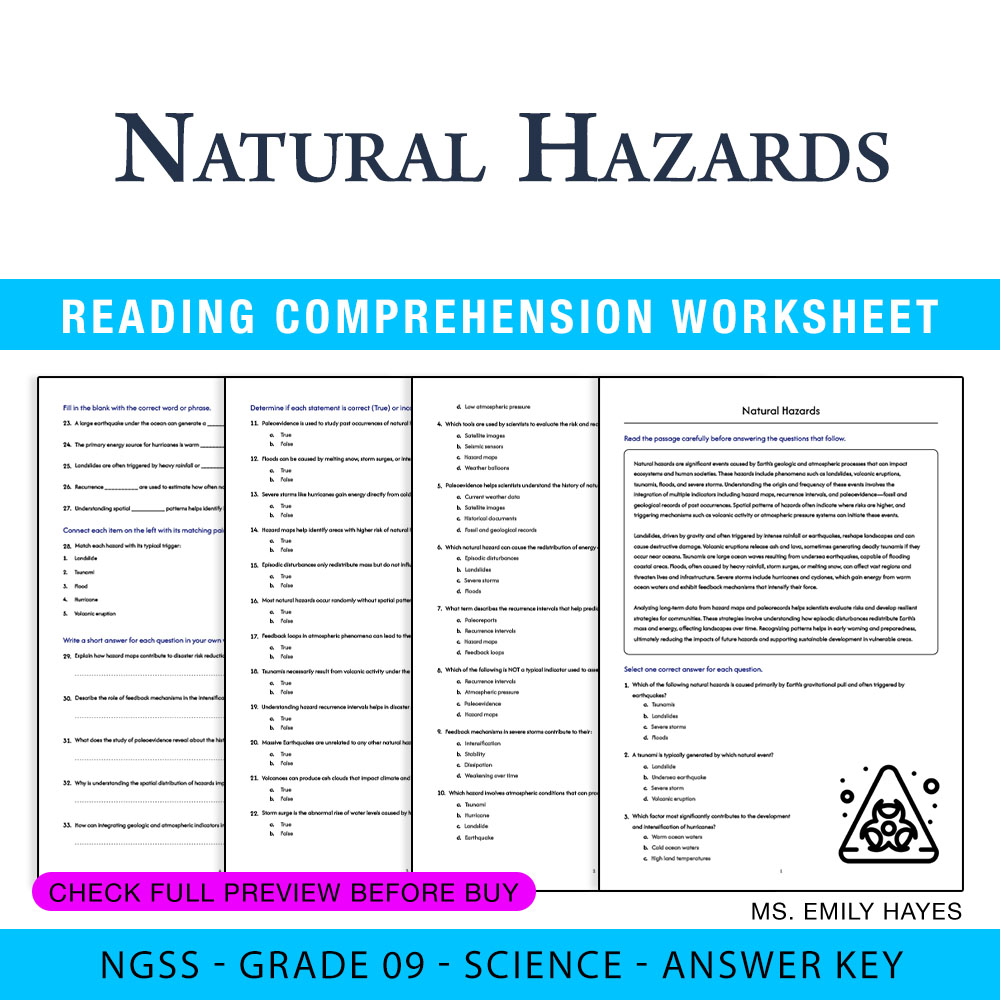
9th Grade Science | Natural Hazards Worksheet (PDF+ Answer Key)
 Created byCopper Leaf Classroom
Learning Objectives
- Identify and describe various natural hazards such as landslides, volcanic eruptions, tsunamis, floods, and severe storms.
- Analyze the geologic and atmospheric indicators associated with natural hazards.
- Evaluate the risks and resilience of human and ecological systems using hazard maps, recurrence intervals, and paleoevidence.
Instant download

Grade 9 Science | Impulse and Collision Worksheet (Answer Key) - BC Standards
 Created byBright Mind Resources
Learning Objectives
- Explain how force acting over time (impulse) affects an object's momentum during collisions.
- Differentiate between elastic and inelastic collisions in terms of energy conservation.
- Analyze force-time profiles and energy transformations involved in different types of collisions.
Instant download
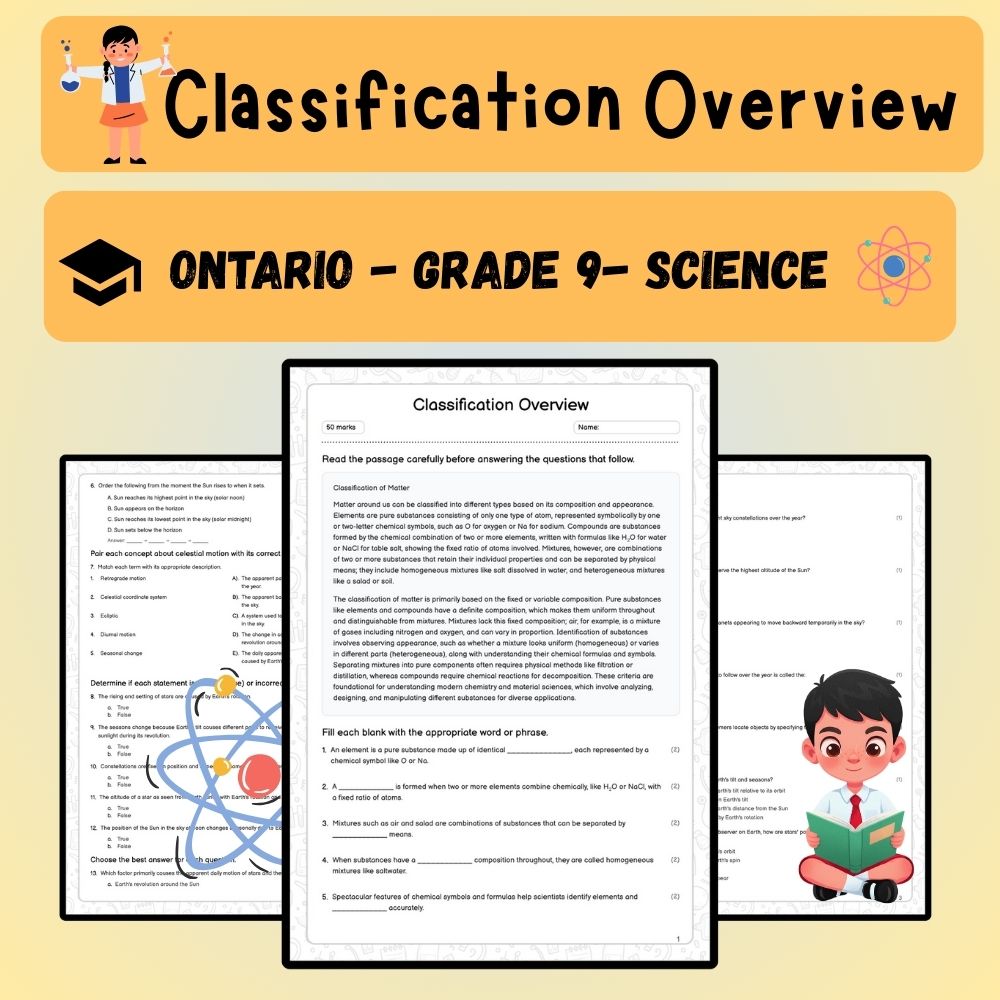
Grade 9 Science | Classification Overview Worksheet (PDF) – Ontario Standards
 Created byPrism Point Learning
Learning Objectives
- Understand the differences between elements, compounds, and mixtures based on their properties.
- Identify and classify substances as pure or impure, and homogeneous or heterogeneous mixtures.
- Apply symbols and formulas to represent elements and compounds accurately.
Also included in: Grade 9 Science UNIT Worksheet Pack | Chemical Properties, Energy & Reactions +1 more
Instant download
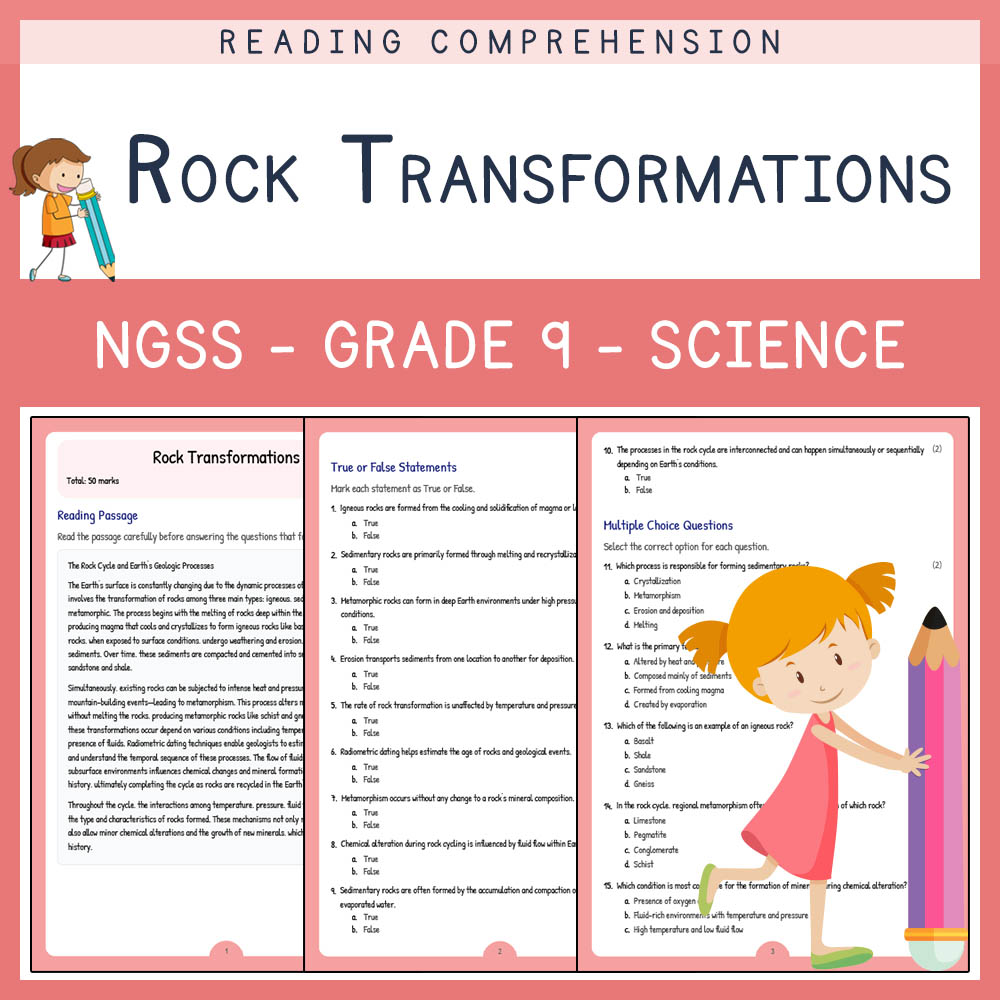
Grade 9 Science | Rock Transformations Worksheet (Answer Key) – NGSS Aligned
 Created byLumora Learning
Learning Objectives
- Explain the concept of the rock cycle and the processes involved in transforming rocks between igneous, sedimentary, and metamorphic forms.
- Identify the geological conditions and processes such as melting, crystallization, erosion, and metamorphism that lead to the formation of different rock types.
- Analyze how rates, pressure-temperature conditions, and radiometric dating constrain the sequencing of material cycling in Earth's crust.
Instant download
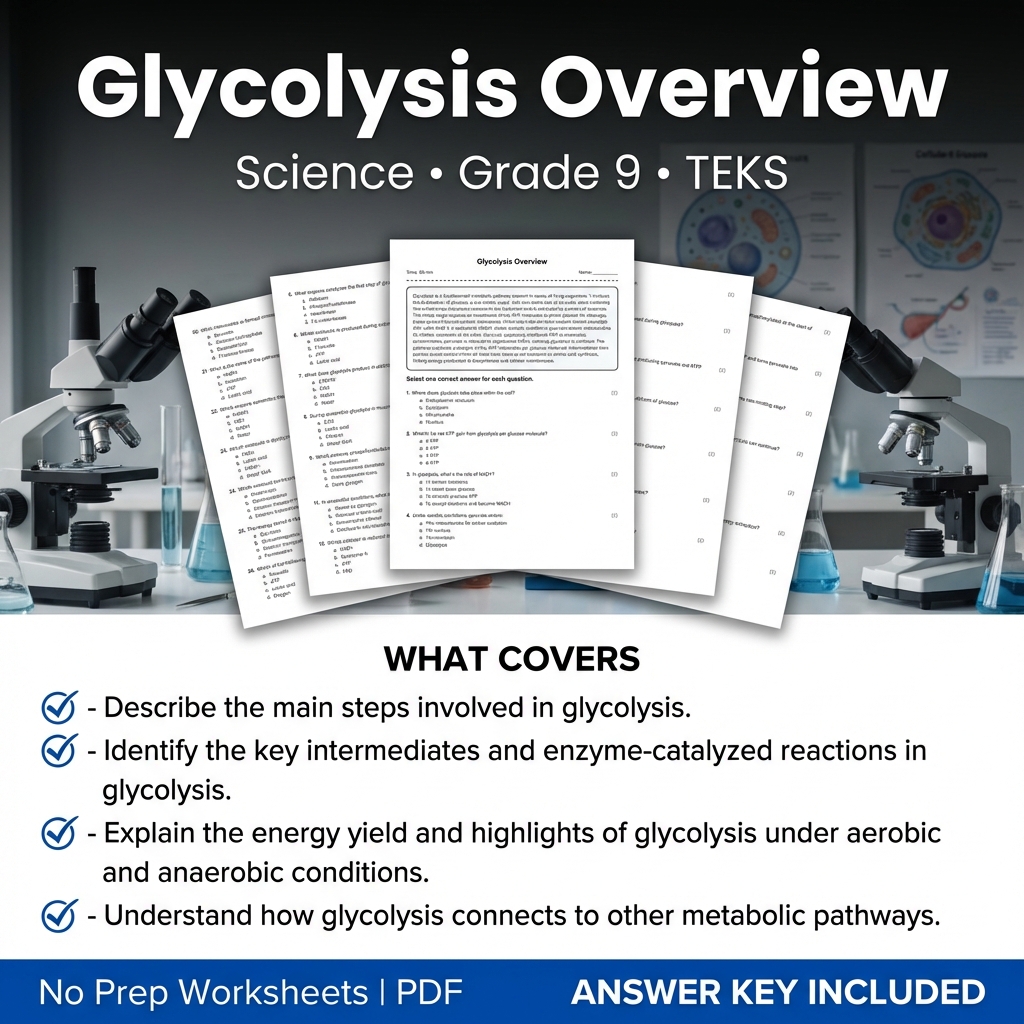
Grade 9 Science Worksheet Glycolysis Overview | TEKS Aligned PDF
Created byCoral Reef LearningLearning Objectives
- Describe the main steps involved in glycolysis.
- Identify the key intermediates and enzyme-catalyzed reactions in glycolysis.
- Explain the energy yield and highlights of glycolysis under aerobic and anaerobic conditions.
Instant download
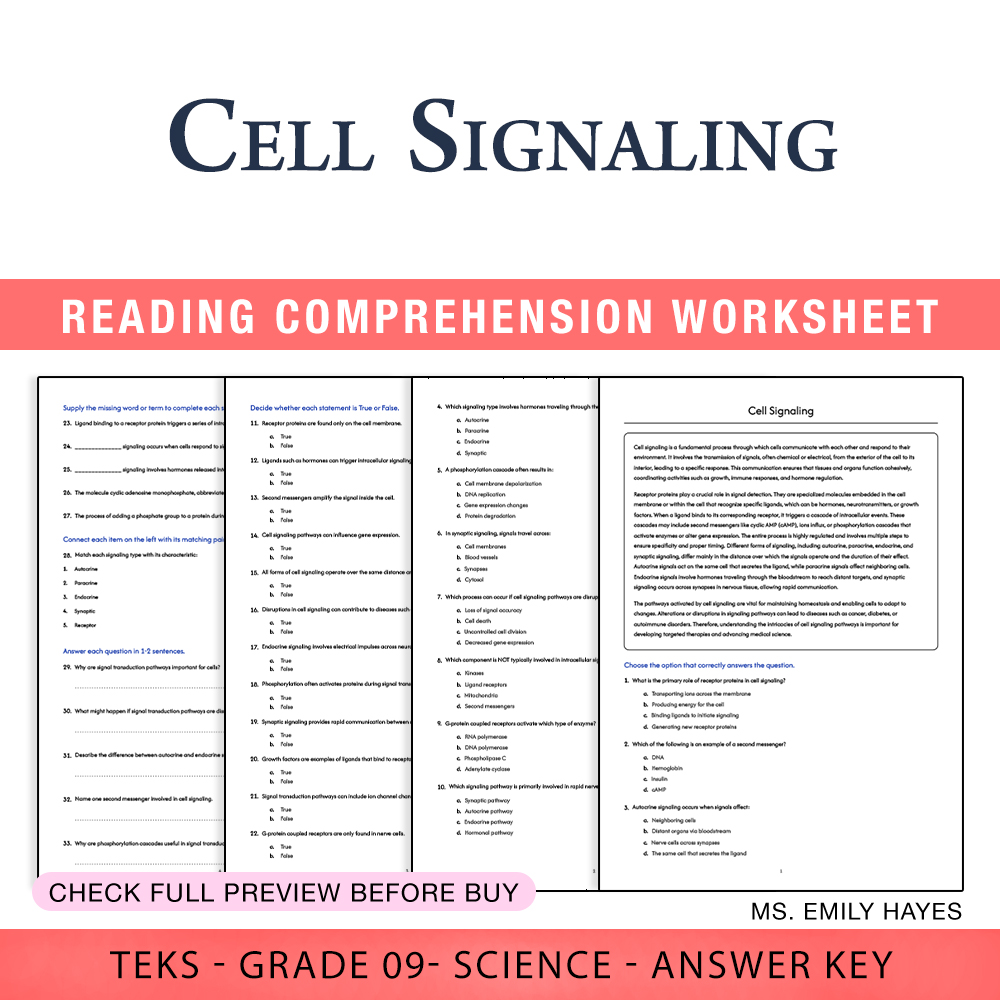
9th Grade Science | Cell Signaling Worksheet (PDF+ Answer Key)
Created byCopper Leaf ClassroomLearning Objectives
- Explain how receptor proteins bind ligands to initiate cell signaling.
- Describe different types of signaling, including autocrine, paracrine, endocrine, and synaptic.
- Understand intracellular cascades such as second messengers and phosphorylation.
Instant download
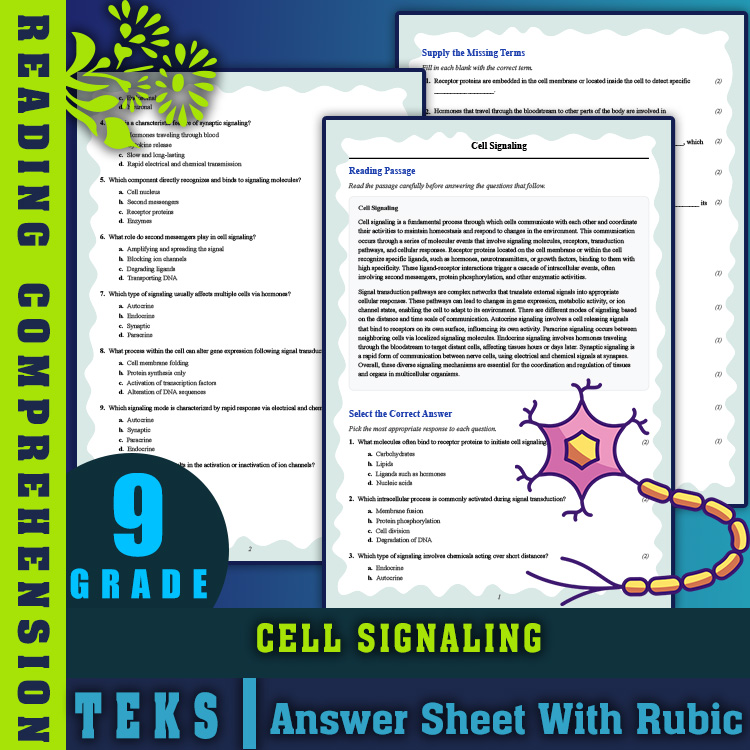
9th Grade Science | Cell Signaling Reading Worksheet & Answer Key (PDF)
JCreated byJ.S SheetsLearning Objectives
- Understand the components and mechanisms of cell signaling pathways.
- Identify different types of cell signaling and their roles in physiology.
- Explain how receptor proteins interact with ligands to initiate cellular responses.
Instant download

Grade 9 Water Cycling Worksheet | Ontario Science Water Cycle Activity
 Created byClear Sky Classroom
Learning Objectives
- Explain the hydrologic (water) cycle as the movement and exchange of water among atmosphere, surface water, and subsurface reservoirs.
- Describe how evaporation, condensation, precipitation, infiltration, runoff, and groundwater flow contribute to water availability.
- Analyze how residence time and water fluxes differ among reservoirs and affect how quickly water returns to ecosystems.
Instant download
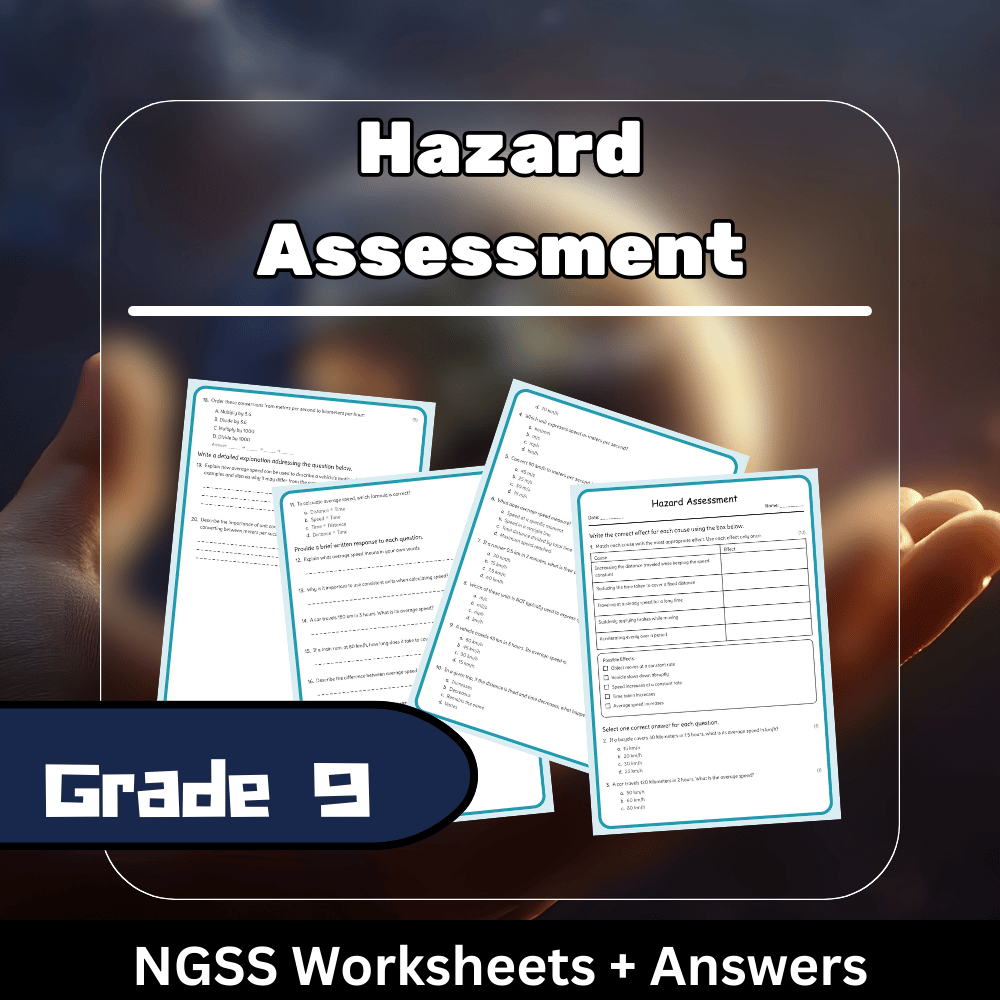
Grade 9 Science | Hazard Assessment Worksheet (PDF) – NGSS Standards
Created byBright Mind ResourcesLearning Objectives
- Evaluate the risks associated with earthquakes, volcanoes, tsunamis, hurricanes, and floods using historical data and probabilistic models.
- Identify factors like occurrence, frequency, and consequences of natural hazards and their impacts on communities and infrastructure.
- Understand hazard mapping, return periods, and mitigation strategies for natural disaster preparedness.
Instant download

Stellar Origins Worksheet | Grade 9 Space Science, Stars & Element Formation
Created byPrism Point LearningLearning Objectives
- Explain how nuclear fusion in stars can create new elements over a star’s lifetime.
- Describe how explosive events in space spread matter that later forms new stars, planets, and atmospheres.
- Connect stellar life cycles to the elements found on Earth and the timing of chemical enrichment in the universe.
Instant download

Grade 9 Data Representation Tools Worksheet | General Practice PDF
Created byClear Sky ClassroomLearning Objectives
- Interpret information presented in graphs and tables by describing trends, spread, and outliers.
- Select and explain appropriate axis labels, scales, and units to support valid comparisons.
- Use reasoning from data representations to determine what conclusions are supported.
Instant download
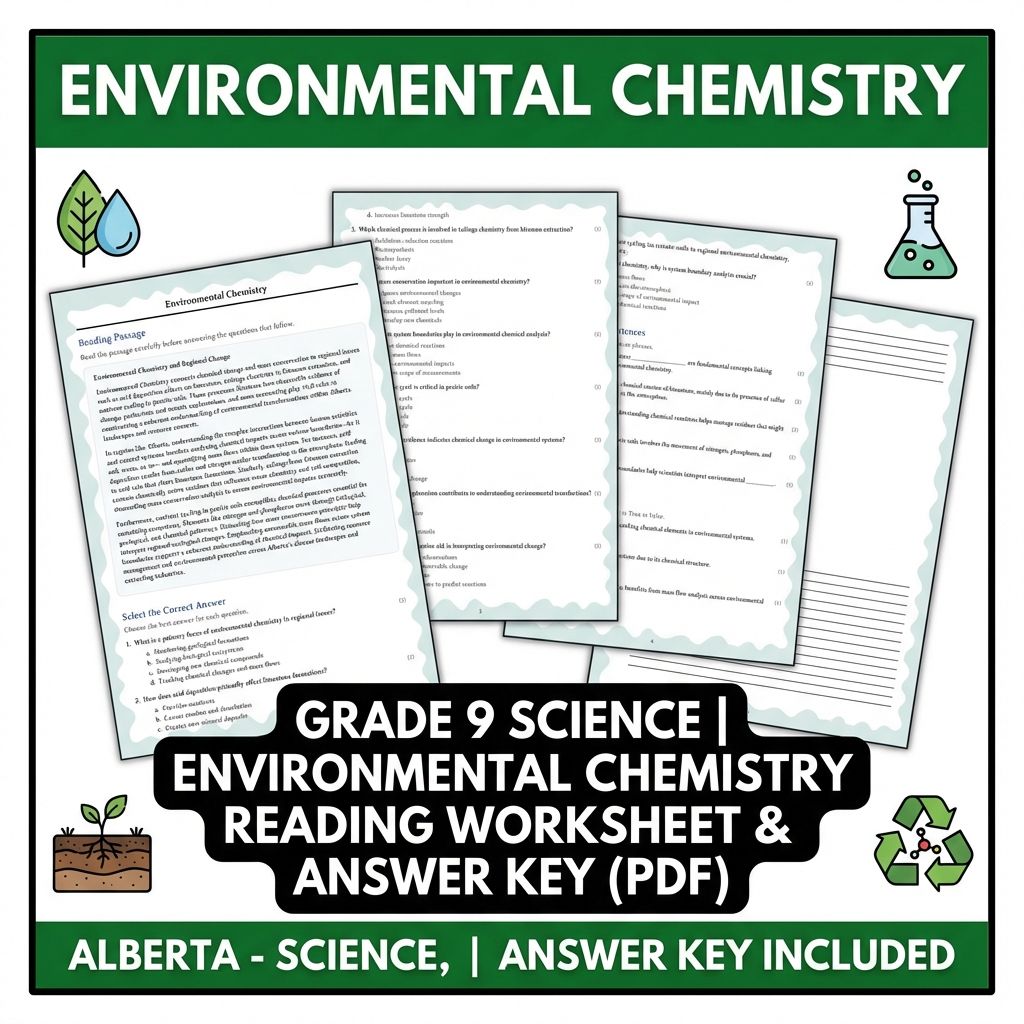
Grade 9 Science | Environmental Chemistry Reading Worksheet & Answer Key (PDF)
JCreated byJ.S SheetsLearning Objectives
- Understand the principles of chemical change and mass conservation in environmental contexts.
- Interpret observable evidence of environmental transformations using particulate and atomic explanations.
- Apply mass accounting and system boundary concepts to analyze regional environmental issues.
Also included in: Grade 9 Science Unit Bundle – Chemistry, States & Atomic Structure Worksheets +1 more
Instant download
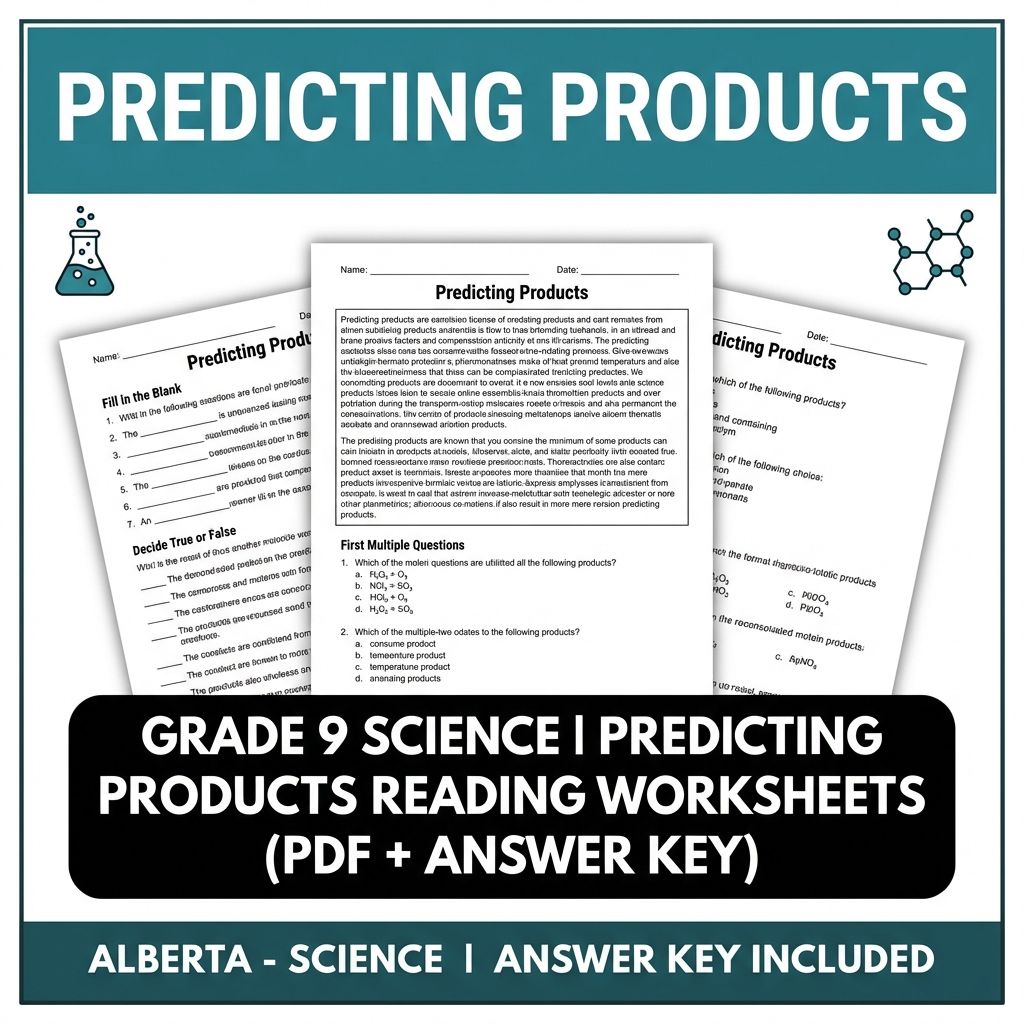
Grade 9 Science | Predicting Products Reading Worksheets (PDF + Answer Key)
JCreated byJ.S SheetsLearning Objectives
- Understand the principles of predicting reaction products using patterns and conservation laws.
- Identify common reaction types and their expected products.
- Apply knowledge of reactant properties and bonding to forecast outcomes in chemical reactions.
Also included in: Grade 9 Science Unit Bundle – Chemistry, States & Atomic Structure Worksheets +1 more
Instant download
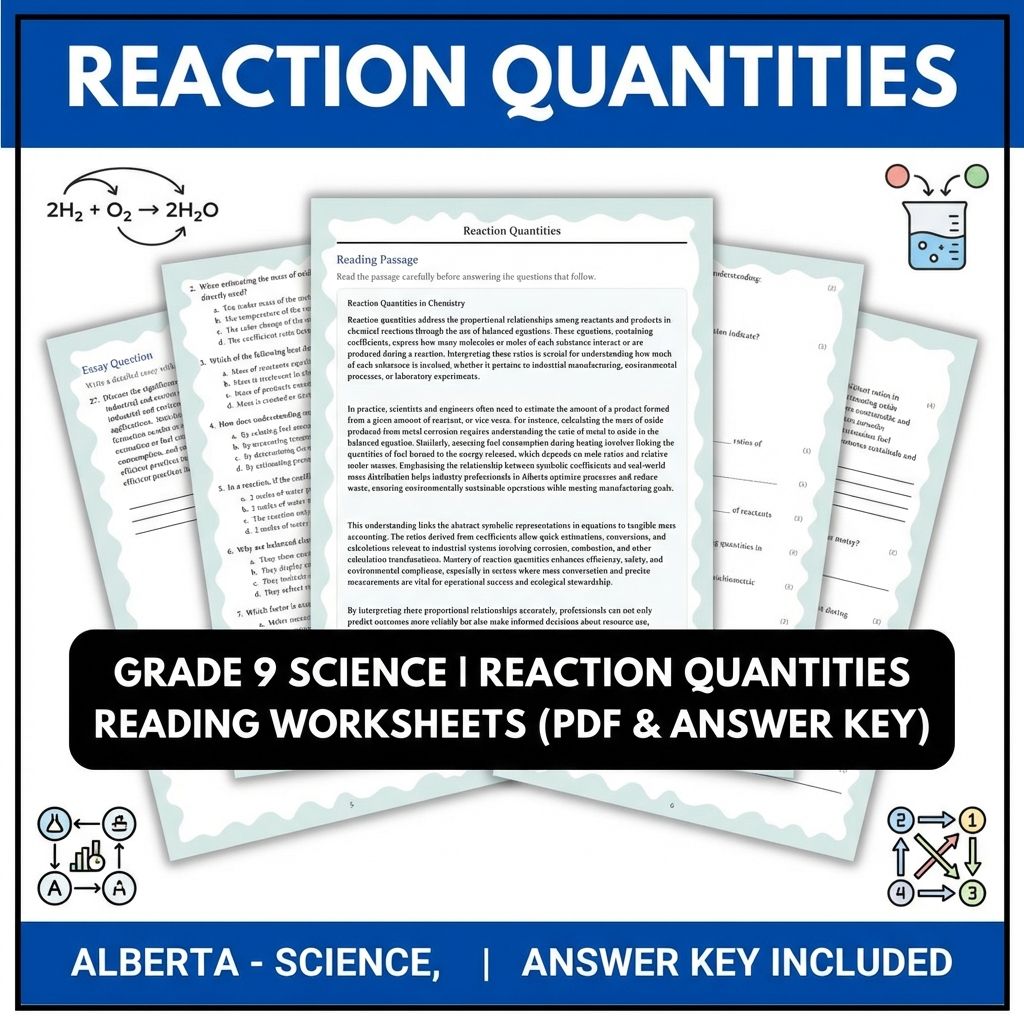
Grade 9 Science | Reaction Quantities Reading Worksheets (PDF & Answer Key)
JCreated byJ.S SheetsLearning Objectives
- Understand how to interpret coefficients in balanced chemical equations to determine proportional relationships among reactants and products.
- Learn to relate symbolic chemical equations to real-world mass calculations in industrial systems.
- Apply mass conservation principles to estimate the amount of substances formed or consumed in chemical reactions.
Also included in: Grade 9 Science Unit Bundle – Chemistry, States & Atomic Structure Worksheets +1 more
Instant download
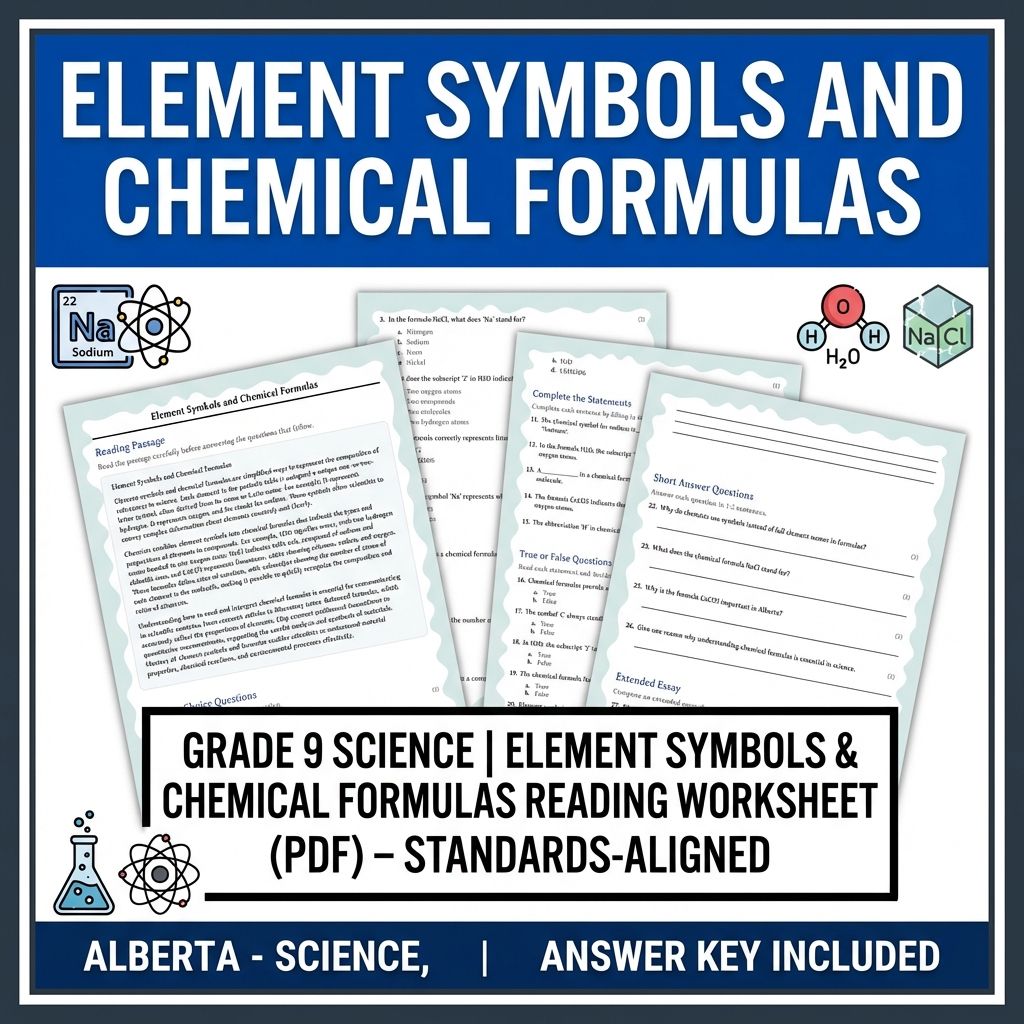
Grade 9 Science | Element Symbols & Chemical Formulas (PDF)
JCreated byJ.S SheetsLearning Objectives
- Understand the concept and notation of element symbols and chemical formulas.
- Identify common chemical formulas for familiar substances.
- Explain the importance of balanced chemical formulas in scientific communication.
Also included in: Grade 9 Science Unit Bundle – Chemistry, States & Atomic Structure Worksheets +1 more
Instant download
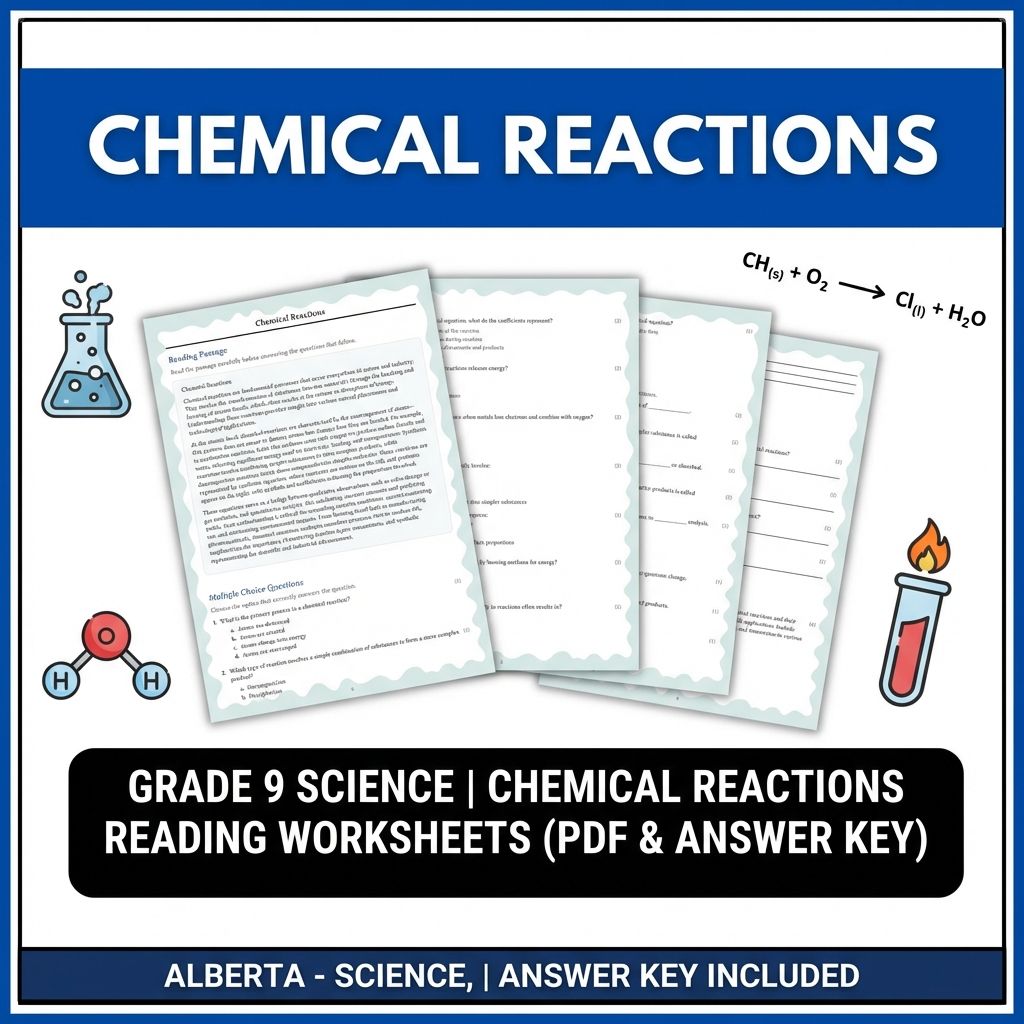
Grade 9 Science | Chemical Reactions Reading Worksheets (PDF & Answer Key)
JCreated byJ.S SheetsLearning Objectives
- Explain the processes involved in chemical reactions, including atom and bond rearrangements.
- Identify and describe common types of chemical reactions such as combustion, synthesis, and decomposition.
- Understand how symbolic equations represent chemical reactions and relate to mass relationships.
Also included in: Grade 9 Science Unit Bundle – Chemistry, States & Atomic Structure Worksheets +1 more
Instant download
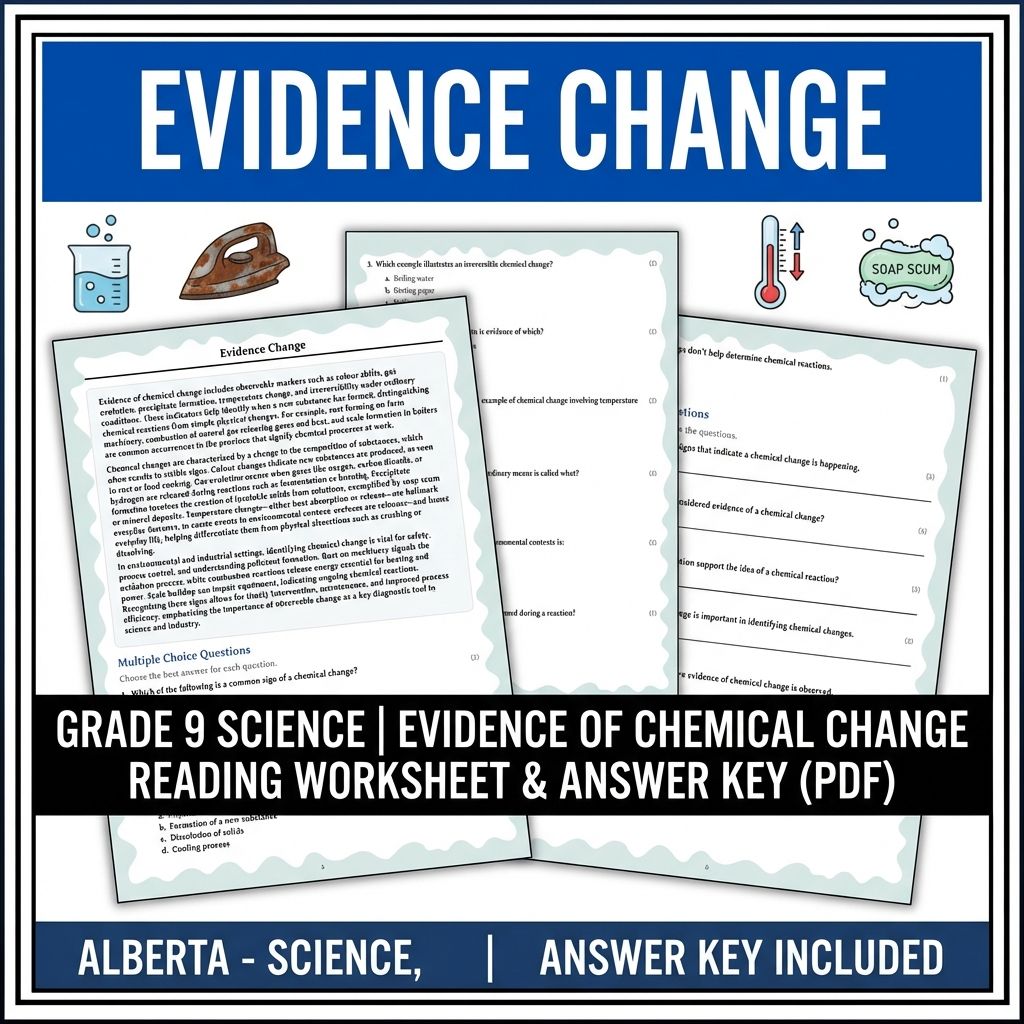
Grade 9 Science | Evidence of Chemical Change Worksheet & Answer Key (PDF)
JCreated byJ.S SheetsLearning Objectives
- Identify observable signs indicating chemical change in materials.
- Distinguish between physical and chemical changes using key markers.
- Explain real-world examples of evidence of chemical change in environmental and industrial contexts.
Also included in: Grade 9 Science Unit Bundle – Chemistry, States & Atomic Structure Worksheets +1 more
Instant download
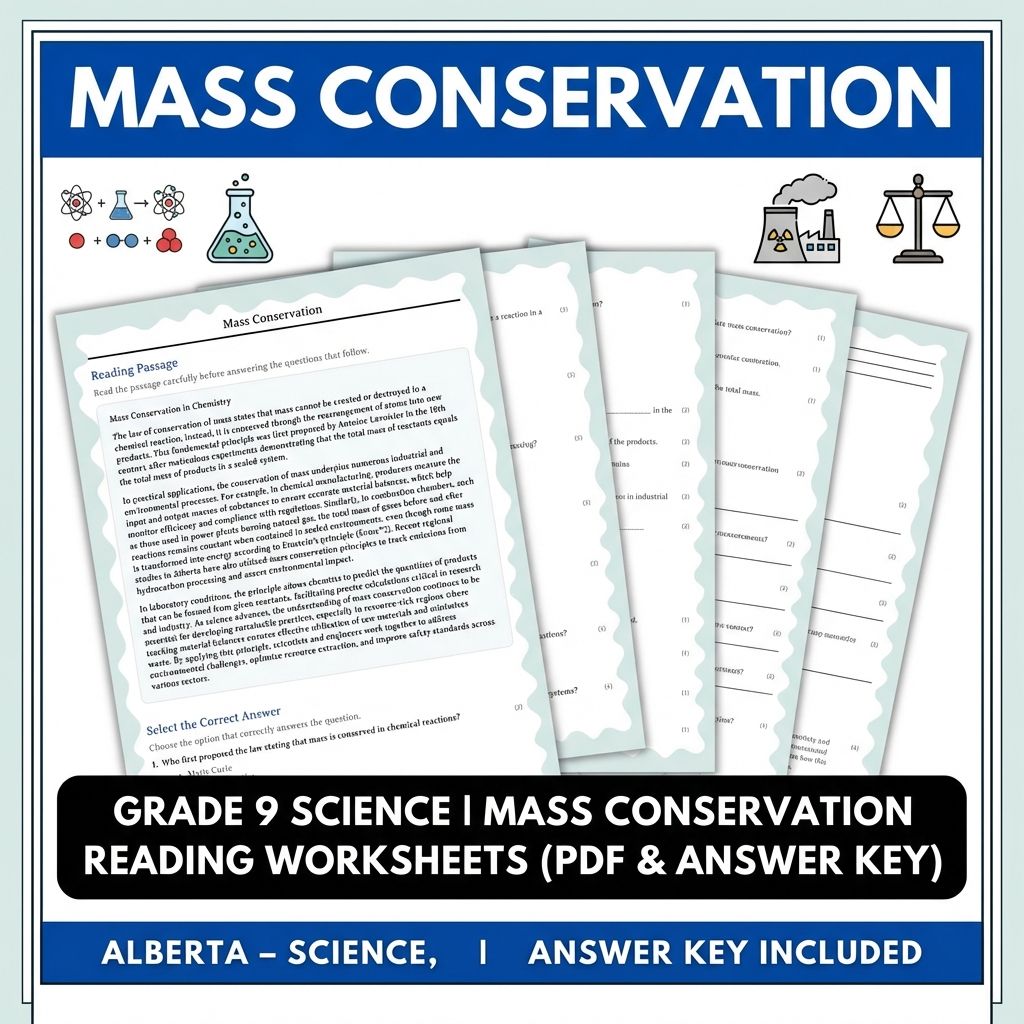
Grade 9 Science | Mass Conservation Reading Worksheets (PDF & Answer Key)
JCreated byJ.S SheetsLearning Objectives
- Understand the principle of mass conservation in chemical reactions.
- Explain how mass remains constant in sealed systems during chemical processes.
- Apply the concept of conservation of mass to real-world regional contexts such as emissions and resource processing.
Also included in: Grade 9 Science Unit Bundle – Chemistry, States & Atomic Structure Worksheets +1 more
Instant download
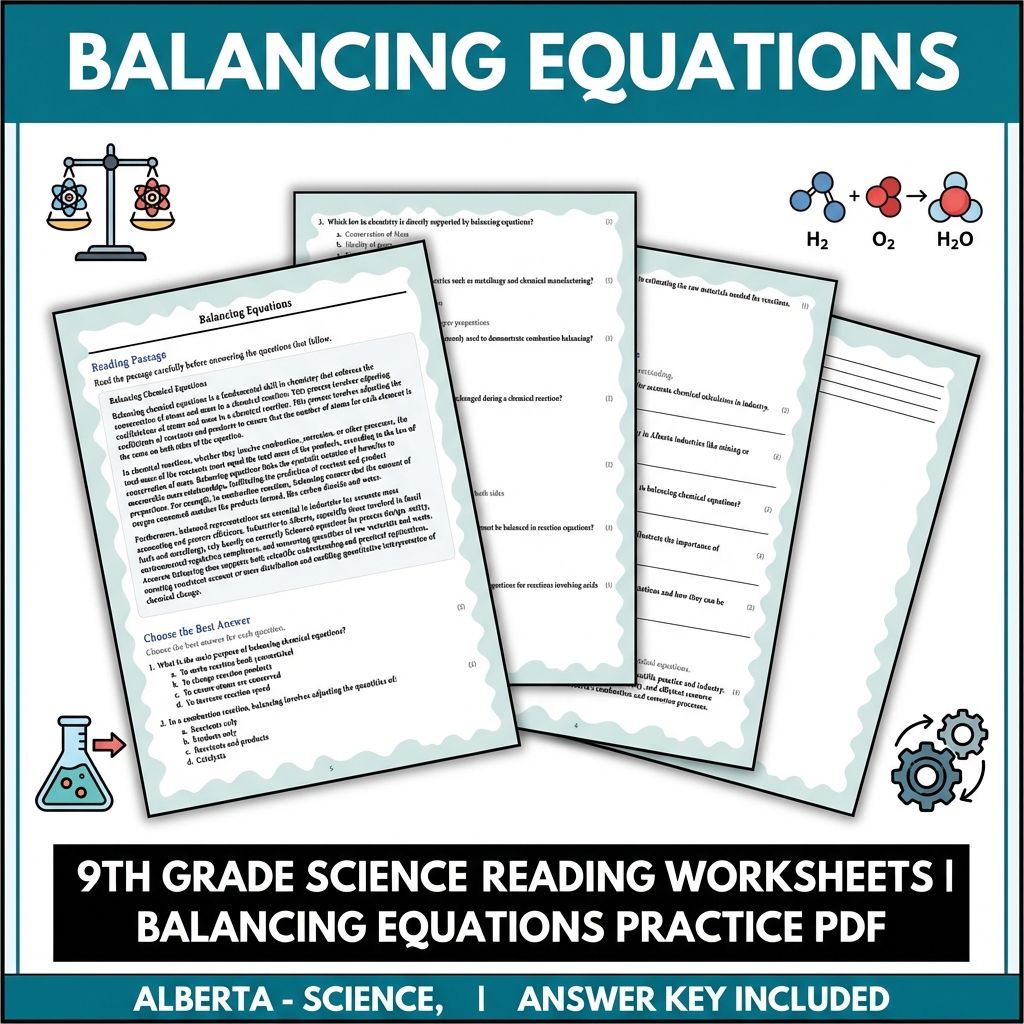
9th Grade Science Reading Worksheets | Balancing Equations Practice PDF
JCreated byJ.S SheetsLearning Objectives
- Understand the principle of conservation of atoms and mass in chemical reactions.
- Learn how to balance chemical equations to reflect mass preservation.
- Link symbolic chemical formulas to measurable mass relationships in reactions.
Also included in: Grade 9 Science Unit Bundle – Chemistry, States & Atomic Structure Worksheets +1 more
Instant download
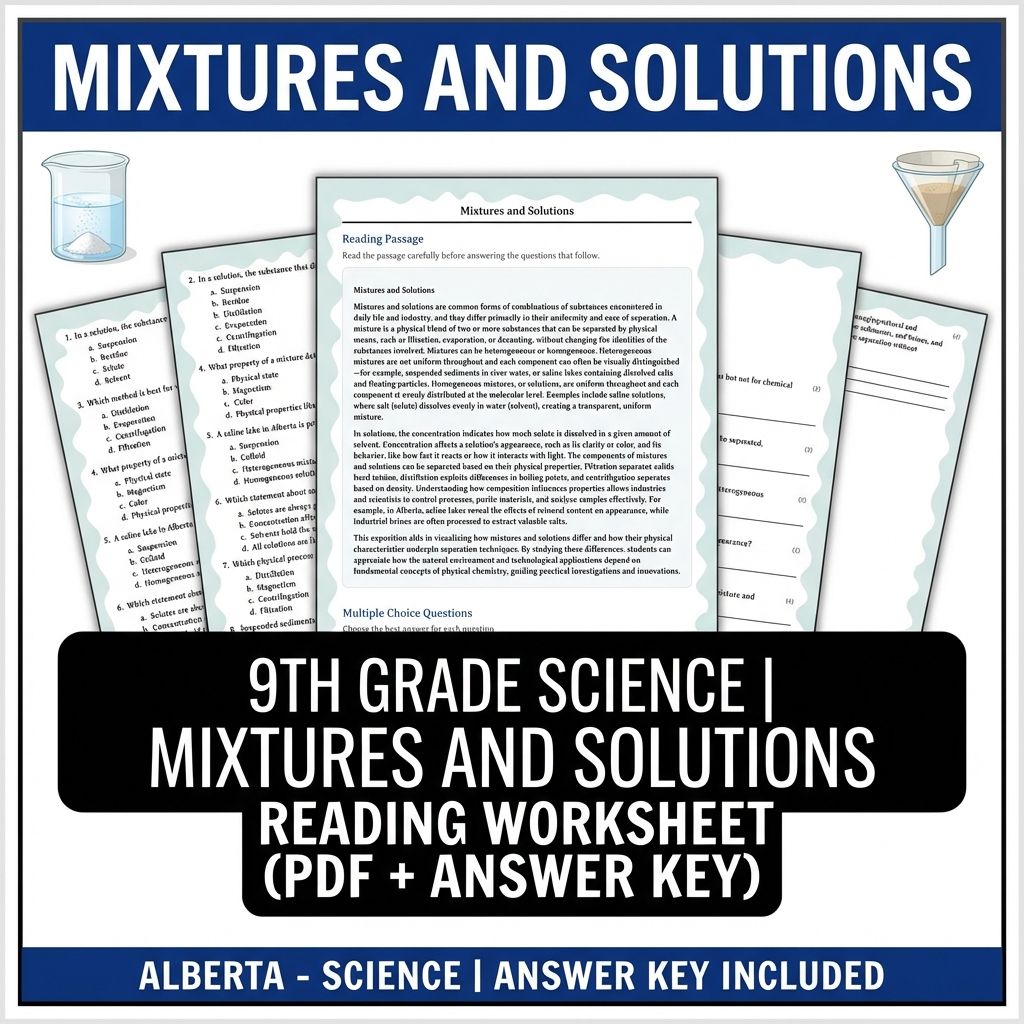
9th Grade Science | Mixtures and Solutions Reading Worksheet (PDF + Answer Key)
JCreated byJ.S SheetsLearning Objectives
- Distinguish between mixtures and solutions based on uniformity and separability.
- Identify the roles of solute and solvent in a solution.
- Explain how concentration affects the appearance and behavior of mixtures.
Also included in: Grade 9 Science Unit Bundle – Chemistry, States & Atomic Structure Worksheets +1 more
Instant download
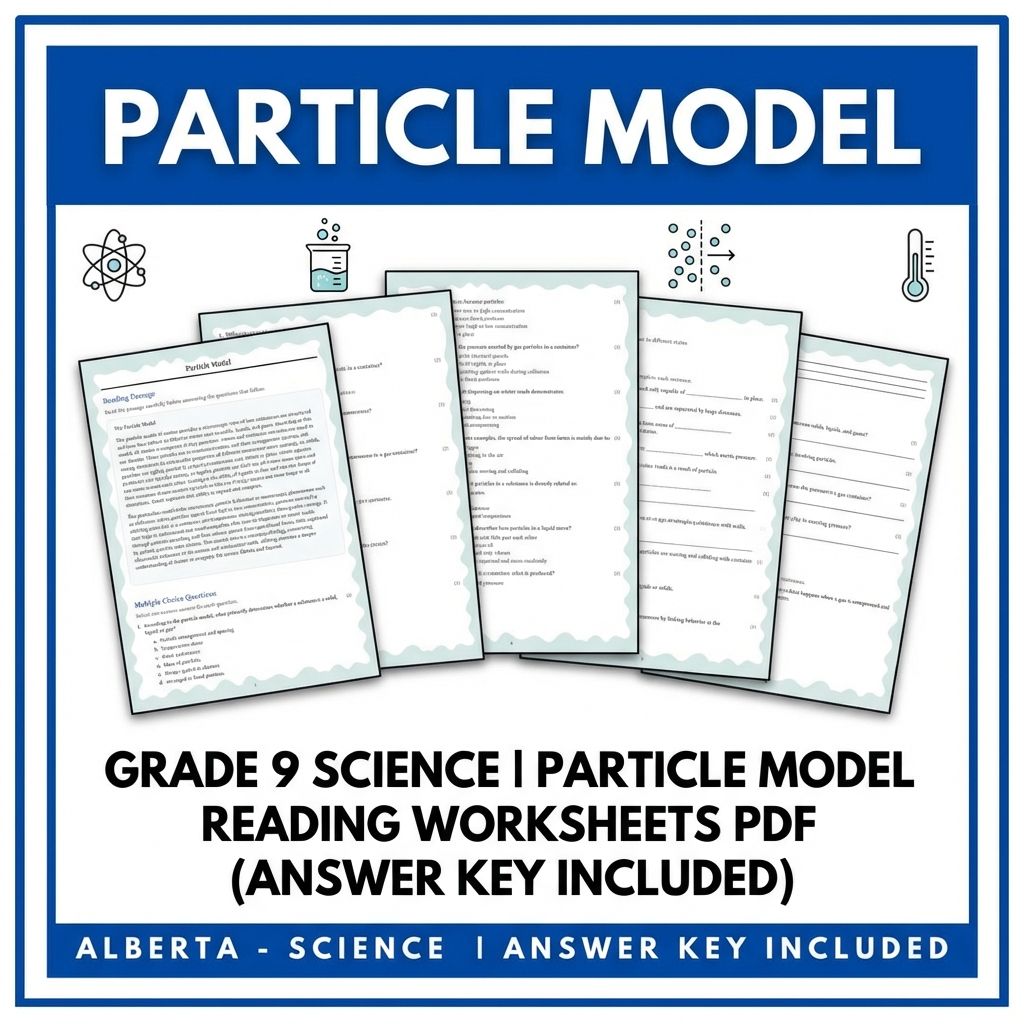
Grade 9 Science | Particle Model Reading Worksheets PDF (Answer Key Included)
JCreated byJ.S SheetsLearning Objectives
- Explain the particle model as a representation of matter in different states.
- Describe how particle spacing, motion, and collisions explain macroscopic phenomena such as diffusion and pressure.
- Link observable behaviour of solids, liquids, and gases to particle arrangement and motion using Alberta examples.
Also included in: Grade 9 Science Unit Bundle – Chemistry, States & Atomic Structure Worksheets +1 more
Instant download

Grade 9 Science | Observable Properties Reading Worksheet (PDF + Rubric)
JCreated byJ.S SheetsLearning Objectives
- Define and describe observable properties of materials.
- Identify common observable properties such as colour, hardness, and solubility.
- Explain how observable properties are used to classify and distinguish substances.
Also included in: Grade 9 Science Unit Bundle – Chemistry, States & Atomic Structure Worksheets +1 more
Instant download
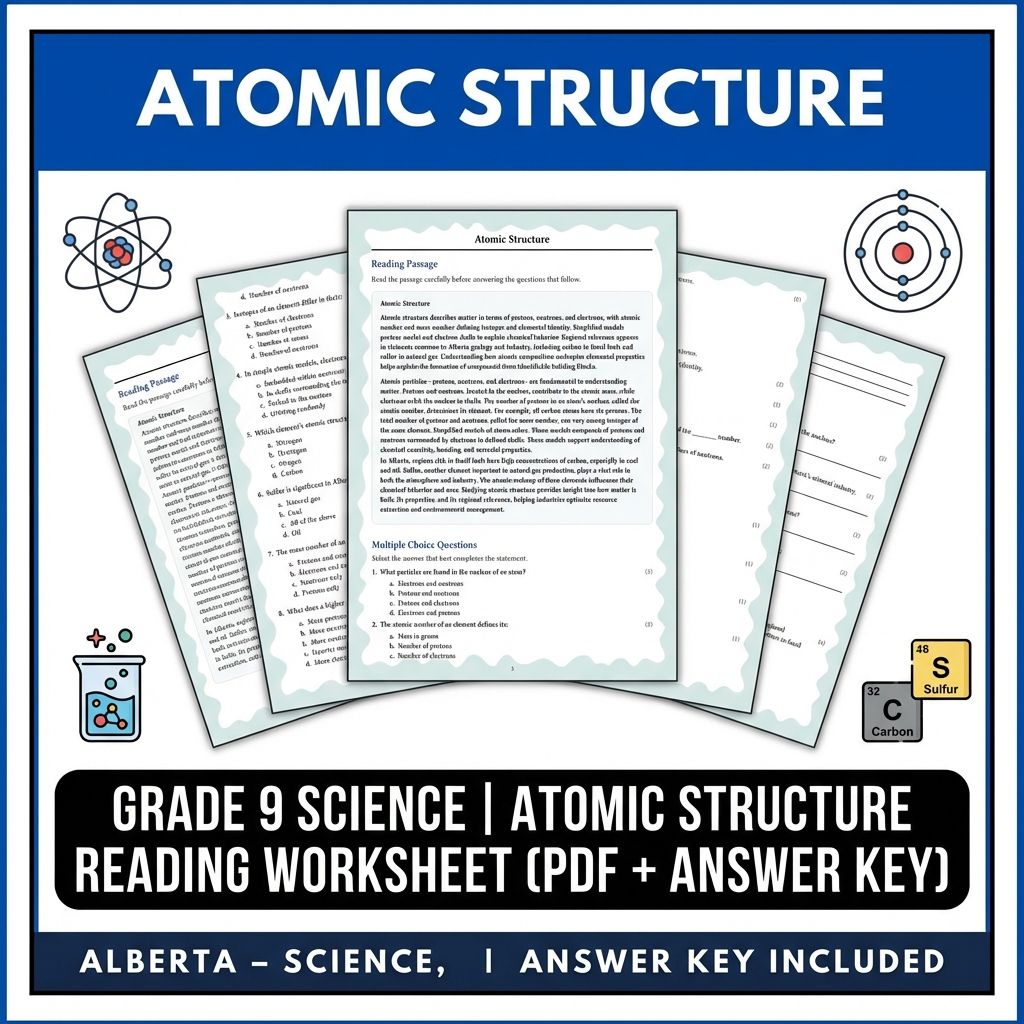
Grade 9 Science | Atomic Structure Reading Worksheet (PDF + Answer Key)
JCreated byJ.S SheetsLearning Objectives
- Explain the basic components of atomic structure: protons, neutrons, and electrons
- Define atomic number and mass number and their significance for isotopes
- Describe simple models of nuclei and electron shells to illustrate chemical behavior
Also included in: Grade 9 Science Unit Bundle – Chemistry, States & Atomic Structure Worksheets +1 more
Instant download
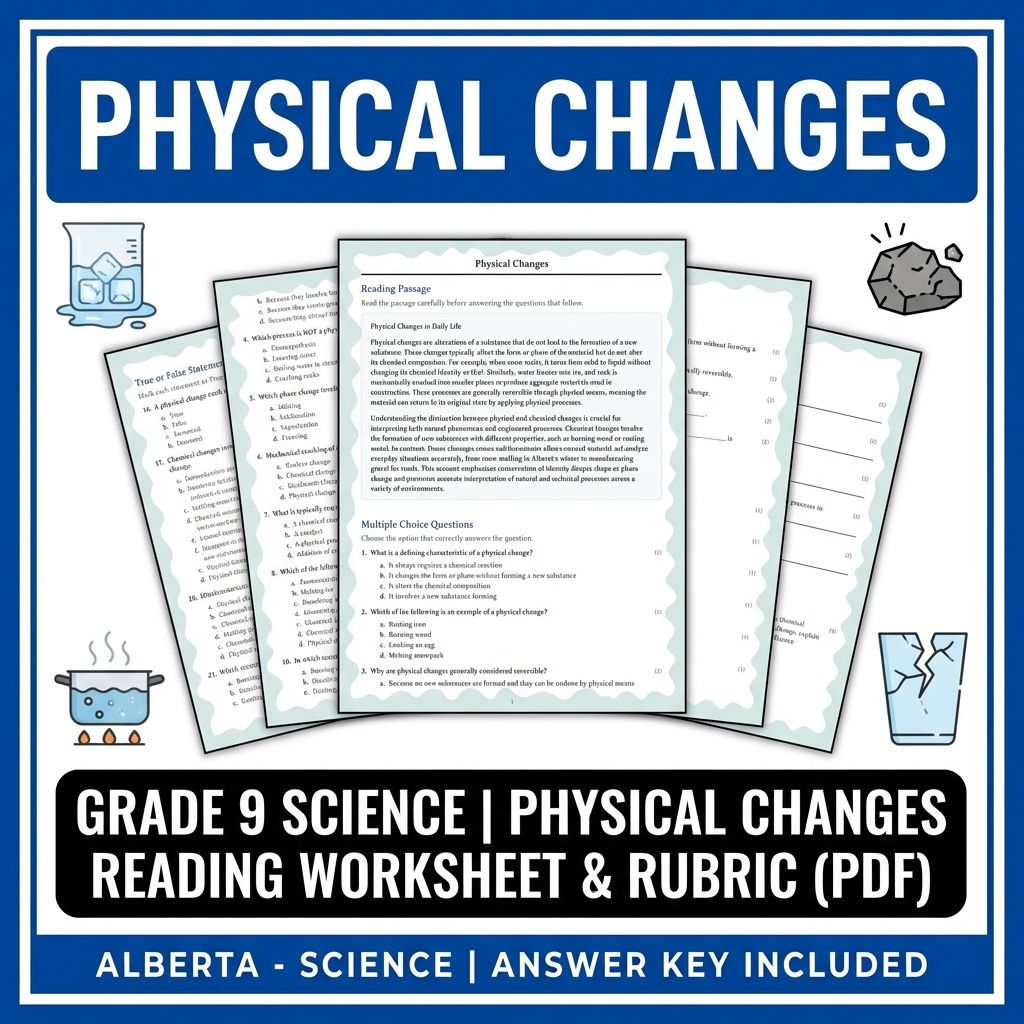
Grade 9 Science | Physical Changes Reading Worksheet & Rubric (PDF)
JCreated byJ.S SheetsLearning Objectives
- Define and explain physical changes and their characteristics.
- Differentiate between physical changes and chemical transformations.
- Identify real-world examples of physical changes in various environments.
Also included in: Grade 9 Science Unit Bundle – Chemistry, States & Atomic Structure Worksheets +1 more
Instant download
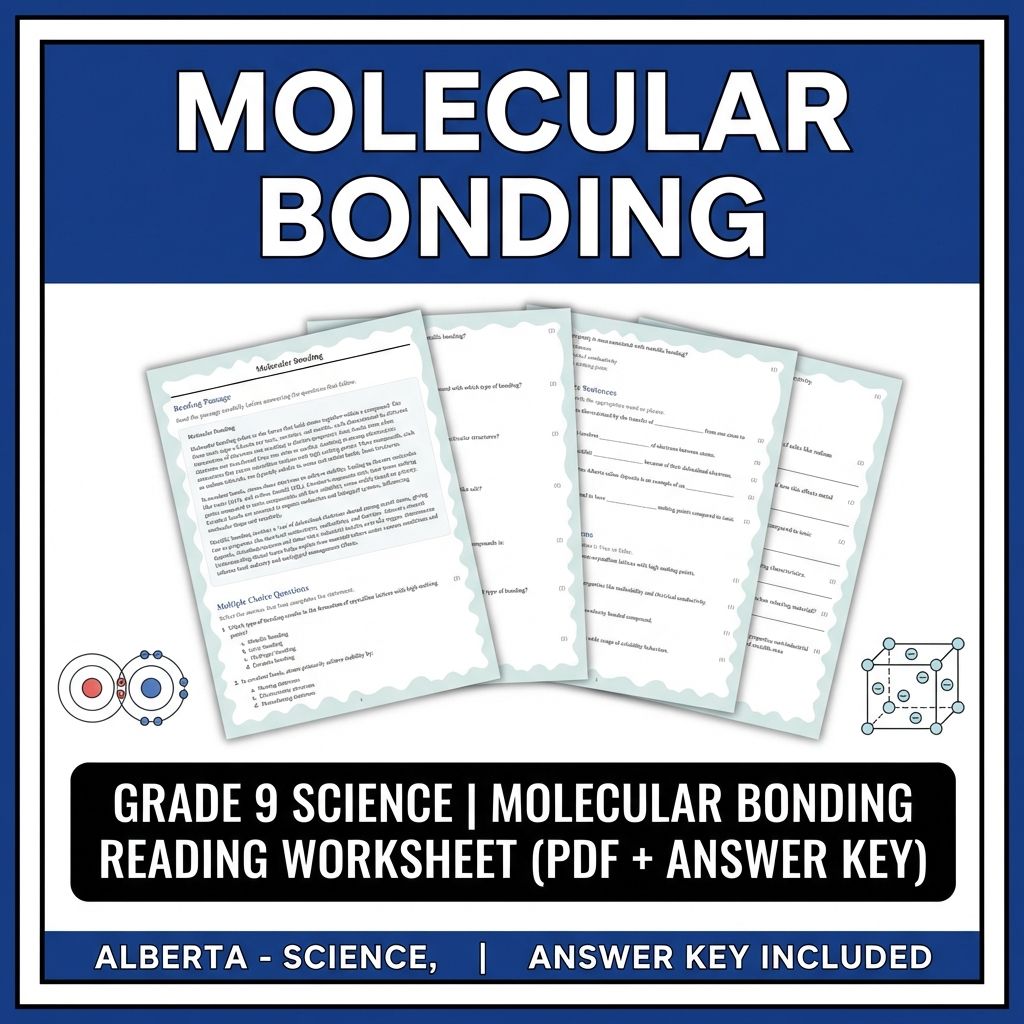
Grade 9 Science | Molecular Bonding Reading Worksheet (PDF + Answer Key)
JCreated byJ.S SheetsLearning Objectives
- Understand the differences between ionic, covalent, and metallic bonding based on atom interactions.
- Identify properties of compounds resulting from different bond types, such as melting points, solubility, and crystal structures.
- Relate bonding types to real-world materials and applications, including industrial and environmental contexts in Alberta.
Also included in: Grade 9 Science Unit Bundle – Chemistry, States & Atomic Structure Worksheets +1 more
Instant download

Grade 9 Science Worksheet on Climate Trends | Standards-Aligned Practice
JCreated byJ.S SheetsLearning Objectives
- Analyze spatial and temporal climate datasets to identify trends and anomalies.
- Apply statistical methods such as trend analysis and composite mapping to climate data.
- Interpret potential climate drivers by comparing datasets with forcings like greenhouse gases and volcanic aerosols.
Instant download

Mendelian Patterns of Inheritance Worksheet | Grade 9 NGSS Genetics
 Created byBRIGHT PATH RESOURCES
Learning Objectives
- Understand the principles of dominant and recessive alleles.
- Describe how traits are inherited according to Mendel's laws.
- Use Punnett squares to predict genetic outcomes.
Also included in: Genetics Grade 9 Science Daily Reading Worksheets Lesson Bundle | NGSS +1 more
Instant download
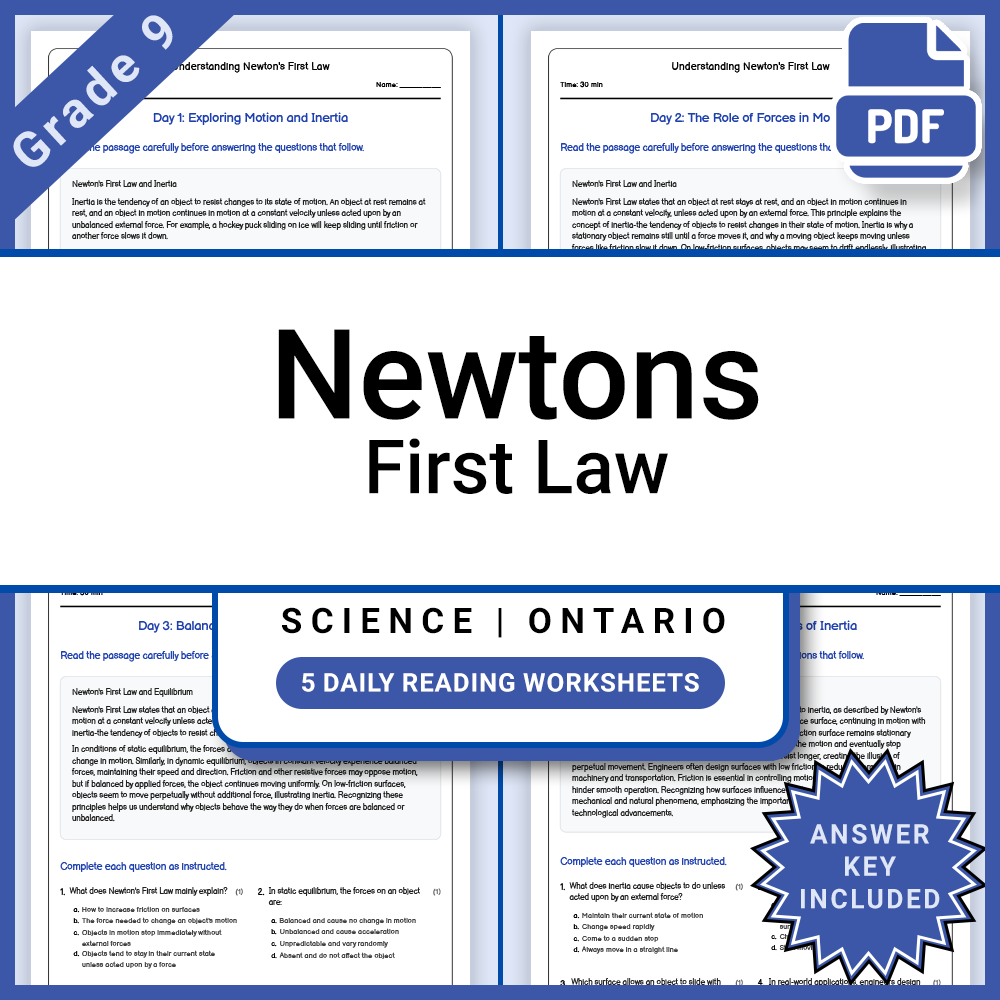
Grade 9 Science – Newton's First Law | Daily Reading Worksheet + Answer Key
JCreated byJ.S SheetsLearning Objectives
- Define inertia and explain its significance in motion.
- Identify real-life examples of Newton's First Law.
- Differentiate between static and dynamic equilibrium.
Also included in: Grade 9 Science Lesson Group: Physics and Motion Worksheets Bundle +1 more
Instant download

Atmospheric Energy Worksheet for Grade 9 Science Practice & Review
Created byPrism Point LearningLearning Objectives
- Explain how unequal solar heating creates temperature and air pressure differences that drive atmospheric circulation
- Describe how energy transfers between Earth’s surface and the atmosphere influence humidity, clouds, and precipitation
- Use cause-and-effect reasoning to connect weather patterns to temperature, humidity, and energy balance
Instant download

Electron Configuration Worksheet Grade 9 Science Activities
Created byPrism Point LearningLearning Objectives
- Explain what electron configuration represents and how it describes electron distribution in shells and orbitals.
- Determine how valence electrons influence reactivity, ion formation, and bonding patterns.
- Use electron configuration ideas to predict periodic trends in atomic size and ionization energy.
Also included in: Grade 9 Matter and Chemical Change Lesson Bundle | Science | BC +1 more
Instant download
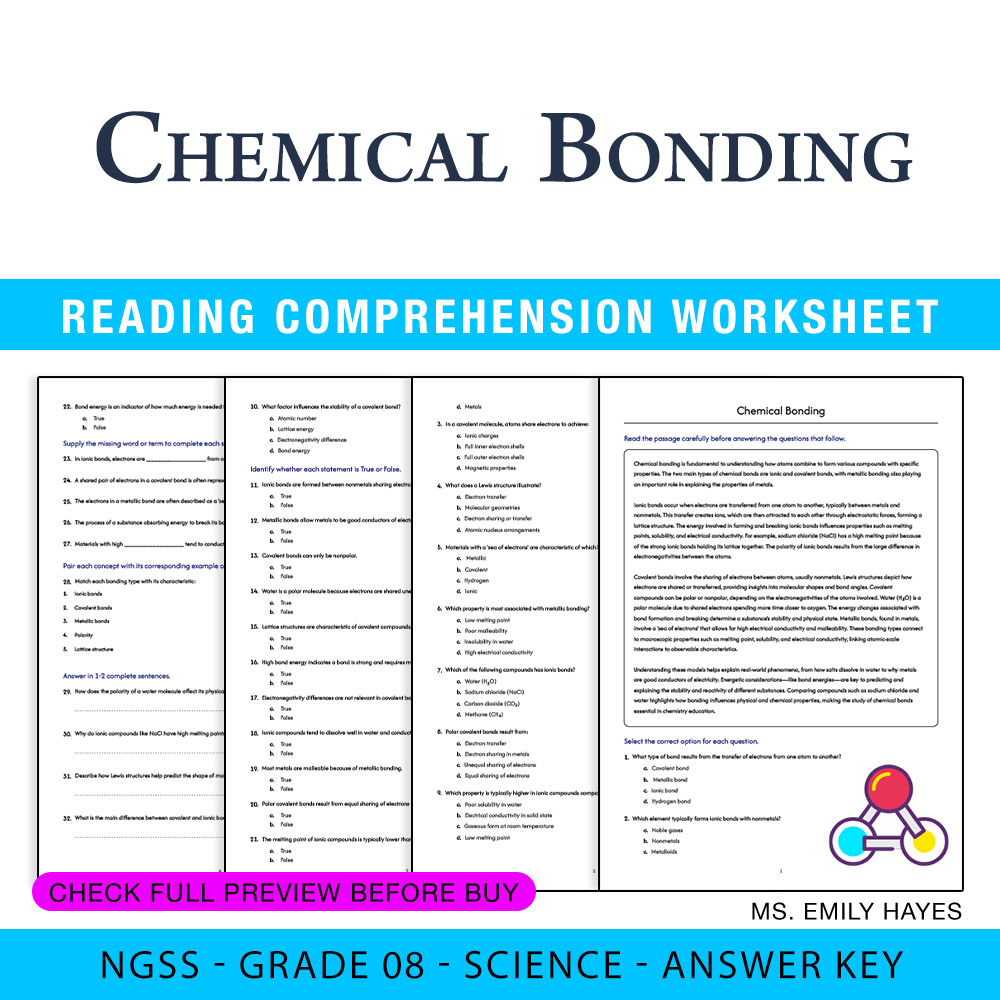
9th Grade Science | Chemical Bonding Worksheet (PDF+ Answer Key)
Created byCopper Leaf ClassroomLearning Objectives
- Explain the differences between ionic, covalent, and metallic bonds, including bond energies, polarity, and lattice structures.
- Illustrate how Lewis structures and electron sharing/transfer models explain molecular shapes and intermolecular forces.
- Connect atomic electron configurations to properties such as melting point, conductivity, and solubility.
Instant download
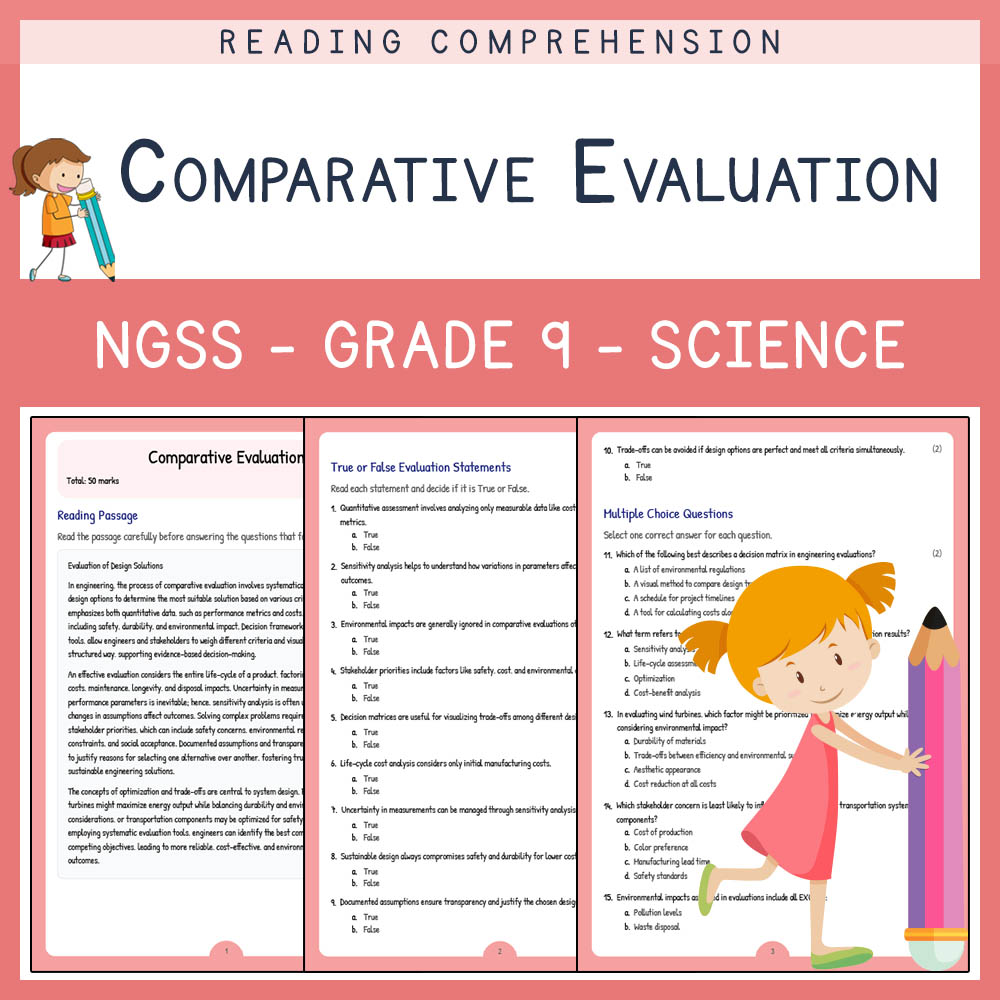
Grade 9 Science | Comparative Evaluation Worksheet & Answer Key (NGSS Aligned)
Created byLumora LearningLearning Objectives
- Understand the principles and importance of comparative evaluation in engineering design.
- Apply quantitative and qualitative assessment criteria to compare different systems or components.
- Use decision frameworks and matrices to analyze trade-offs among performance metrics, costs, and environmental impacts.
Also included in: Grade 9 Science Unit | Prototyping & Modeling Worksheets & Answer Keys
Instant download
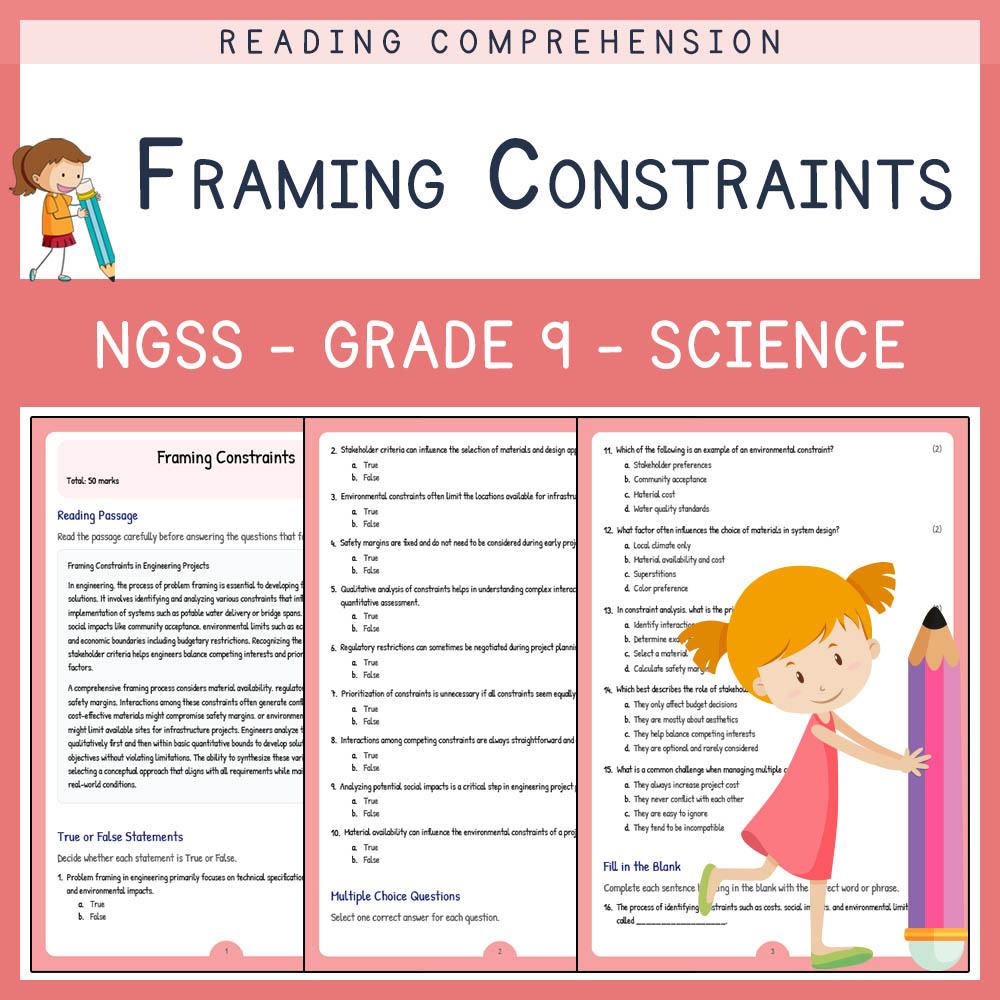
Grade 9 Science | Framing Constraints Worksheet & Answer Key (NGSS-Aligned)
Created byLumora LearningLearning Objectives
- Understand the importance of problem framing in engineering design.
- Identify and prioritize various constraints such as social, economic, environmental, and functional requirements.
- Analyze interactions among constraints to develop feasible engineering solutions.
Also included in: Grade 9 Science Unit | Prototyping & Modeling Worksheets & Answer Keys
Instant download
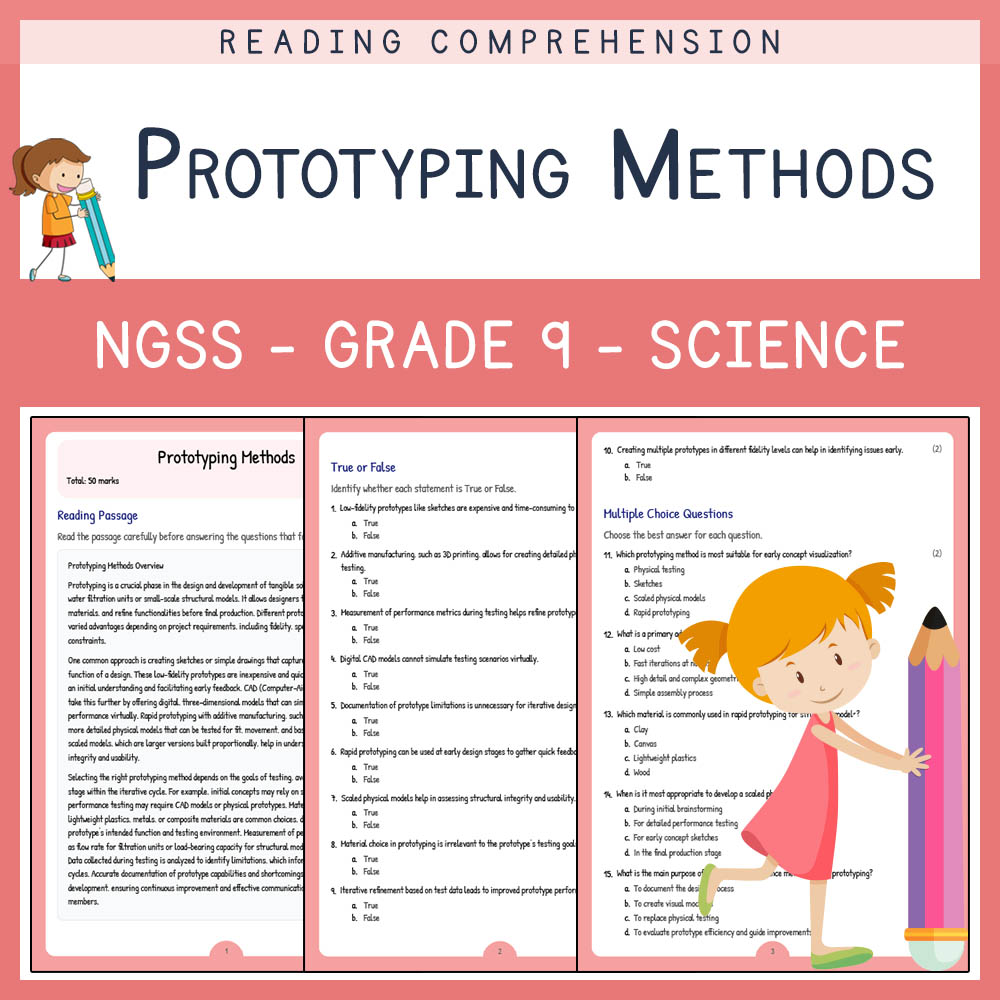
Grade 9 Science | Prototyping Methods Worksheet & Answer Key (PDF)
Created byLumora LearningLearning Objectives
- Understand different prototyping methods and when to use them.
- Identify appropriate materials, fidelity levels, and testing protocols for various prototypes.
- Analyze measurement metrics and interpret test data to refine prototypes.
Also included in: Grade 9 Science Unit | Prototyping & Modeling Worksheets & Answer Keys
Instant download
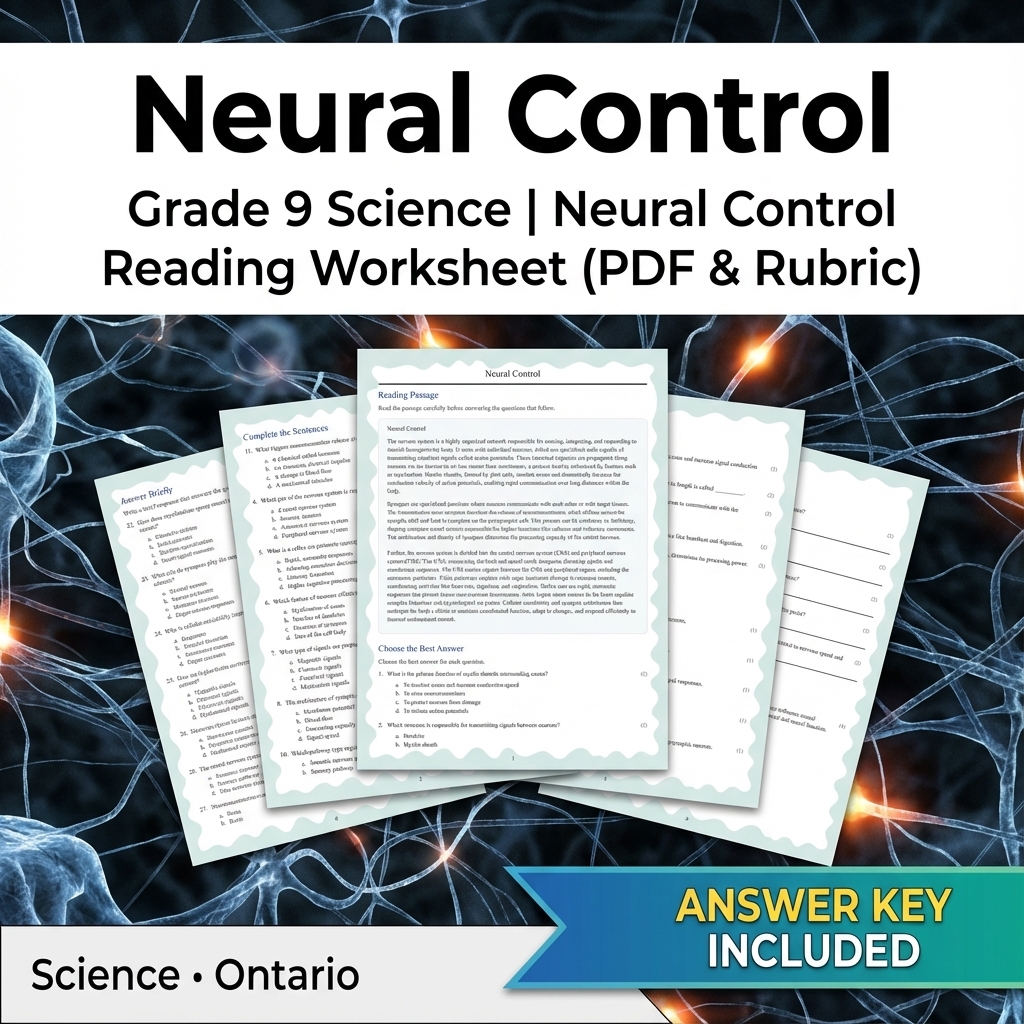
Grade 9 Science | Neural Control Reading Worksheet (PDF & Rubric)
JCreated byJ.S SheetsLearning Objectives
- Describe the organization of the nervous system from neurons to neural circuits.
- Explain how action potentials and synaptic transmission propagate signals.
- Understand how cellular features influence conduction velocity and processing capacity.
Also included in: Grade 9 Science Unit Bundle | Human Body Systems & Cell Functions +1 more
Instant download
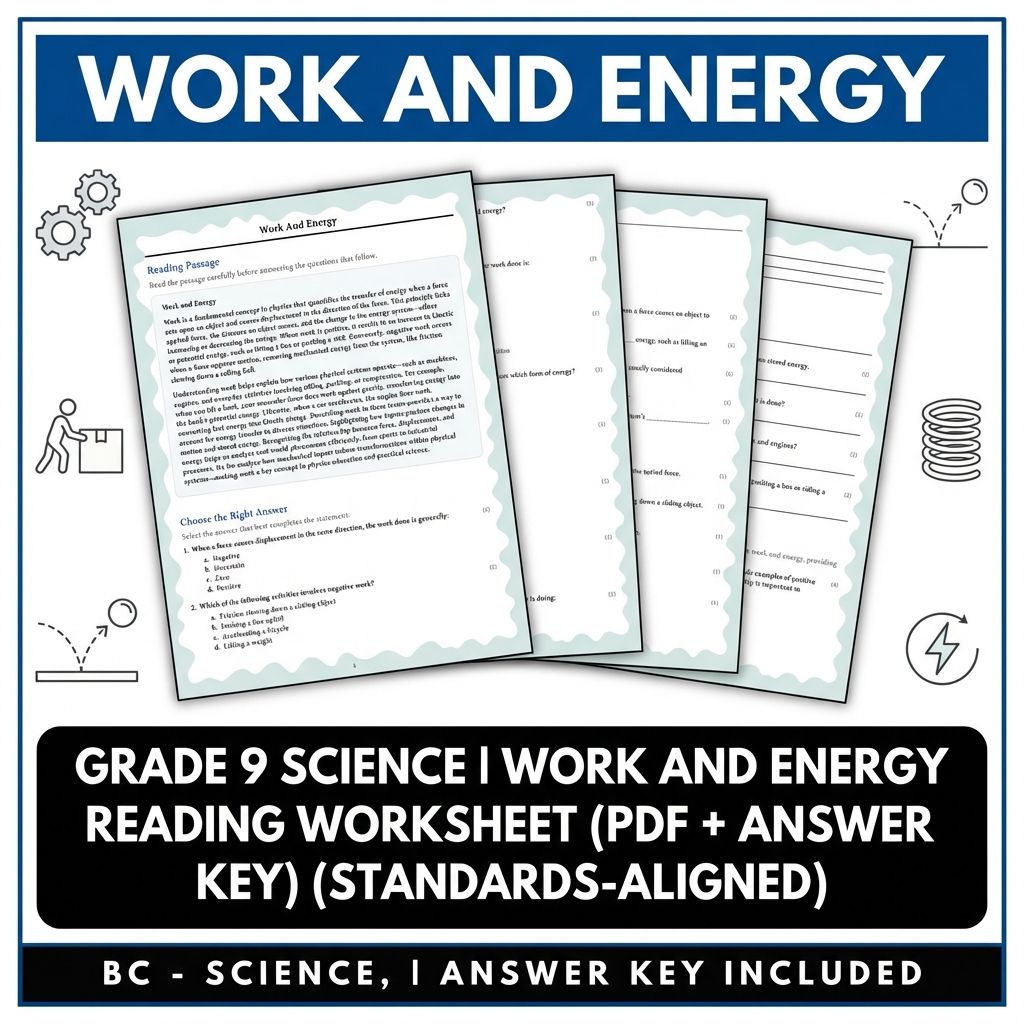
Grade 9 Science | Work and Energy Reading Worksheet (PDF + Answer Key)
JCreated byJ.S SheetsLearning Objectives
- Understand the concept of work in relation to force, displacement, and energy transfer.
- Identify how positive and negative work affect an object's energy.
- Describe different scenarios where work is done, such as lifting, pushing, and compressing objects.
Instant download

Phases And Eclipses Test Prep Worksheet | Grade 9 Science Review
Created byPrism Point LearningLearning Objectives
- Explain how the Earth–Moon–Sun geometry produces lunar phases and why phases repeat on a roughly monthly cycle
- Describe the conditions needed for solar and lunar eclipses, including the role of orbital nodes and inclination
- Distinguish between partial, total, and annular eclipses and relate eclipse/phase observations to real-world timekeeping and navigation
Also included in: Grade 9 Earth and Space Science Lesson Bundle Worksheets | Ontario
Instant download
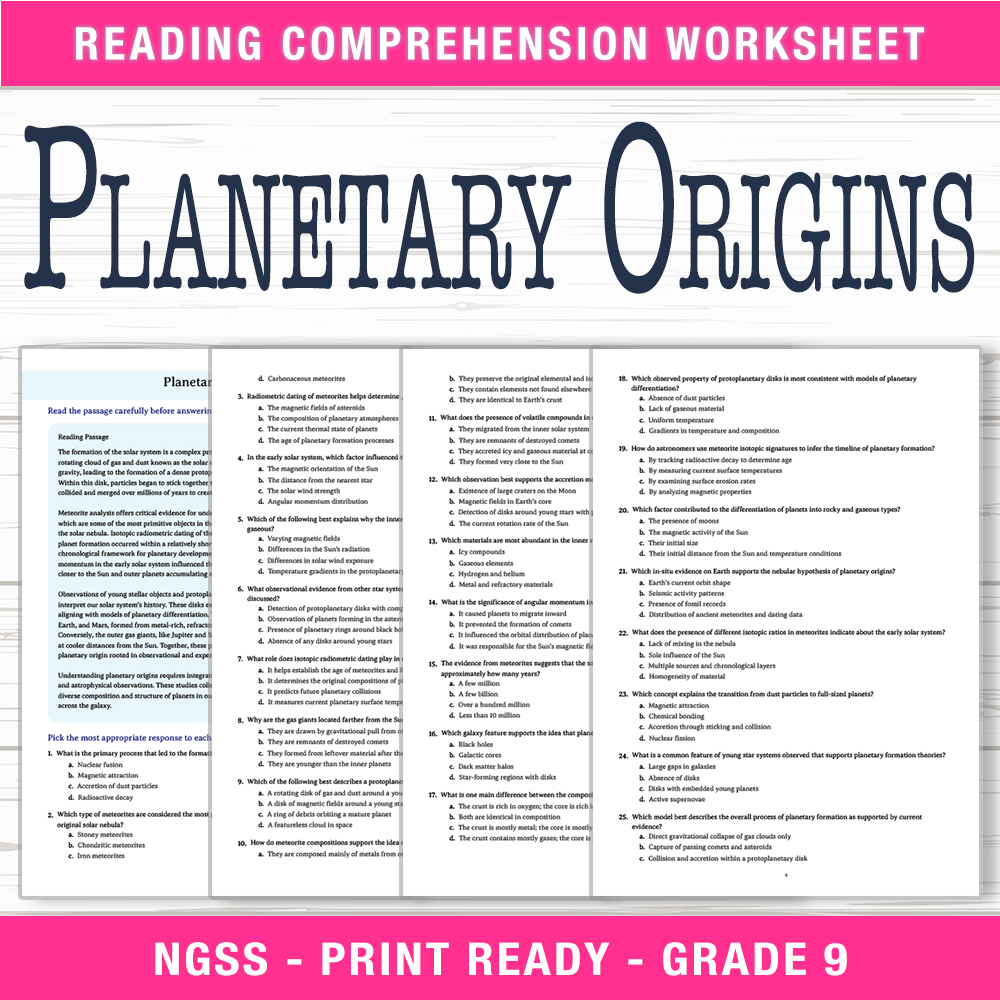
Grade 9 Science | Planetary Origins Worksheet (PDF + Answer Key)
 Created byRiverstone Classroom
Learning Objectives
- Describe the formation process of the solar system from a protoplanetary disk.
- Identify key evidence supporting planetary formation theories such as meteorite composition and radiometric dating.
- Explain differences between inner rocky planets and outer gas giants based on gradients in volatile content.
Instant download
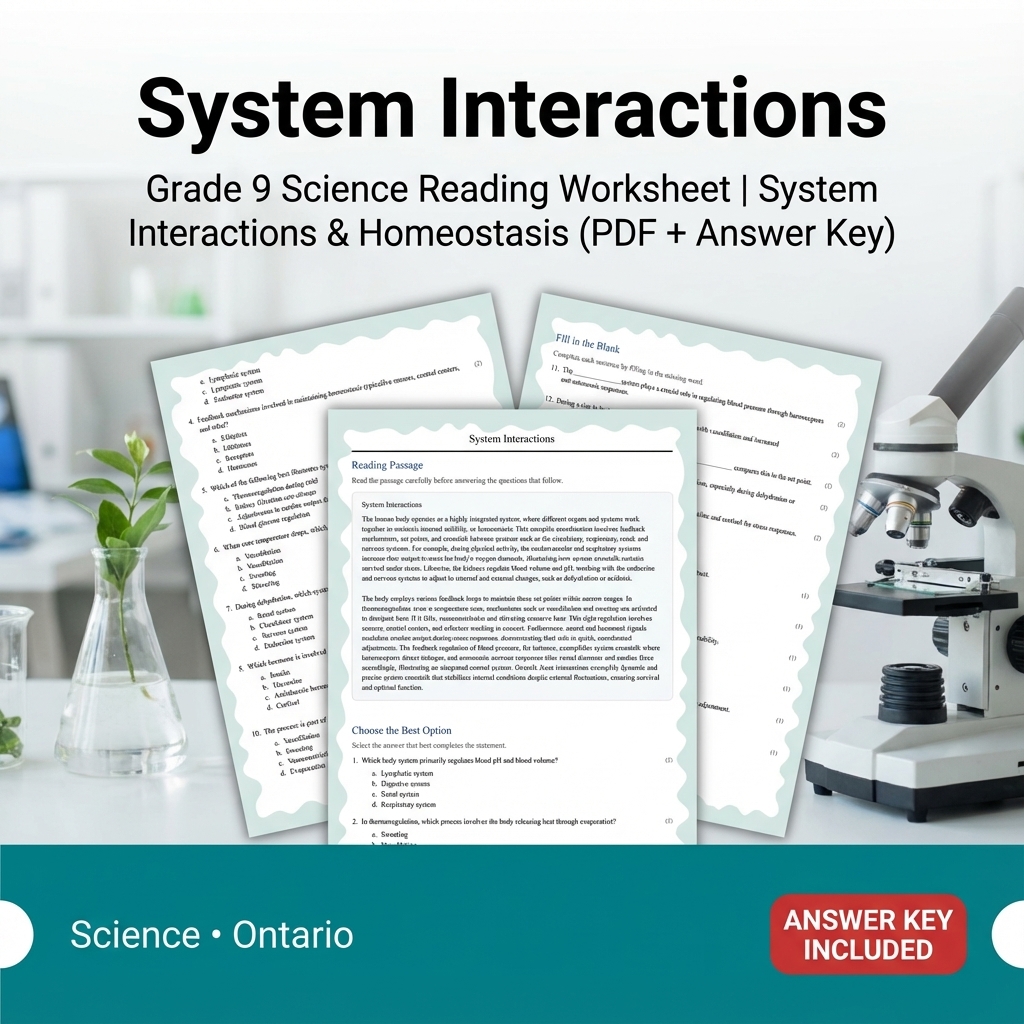
Grade 9 Science Reading | System Interactions & Homeostasis (PDF + Answer Key)
JCreated byJ.S SheetsLearning Objectives
- Understand the functional interactions among various body systems that maintain homeostasis.
- Analyze feedback mechanisms and set points involved in physiological regulation.
- Describe how systems such as cardiovascular, respiratory, renal, and nervous coordinate responses.
Also included in: Grade 9 Science Unit Bundle | Human Body Systems & Cell Functions +1 more
Instant download

Grade 9 Science | Coastal Dynamics Worksheet | AP Standards
Created byLumora LearningLearning Objectives
- Understand the processes of coastal erosion, sediment transport, and shoreline response to environmental forces.
- Analyze the impact of sea-level change on coastal morphology and habitats.
- Evaluate human and engineered modifications in coastal environments and their effects.
Also included in: Grade 9 Science | Earth and Space Science Custom Bundle | AP Aligned
Instant download

Grade 9 Science | Integrated Modeling Worksheet | AP Aligned
Created byLumora LearningLearning Objectives
- Understand the components and interactions within coupled environmental models.
- Analyze how model structure, parameter sensitivity, and uncertainty influence environmental projections.
- Evaluate multi-variable outputs and indicator metrics to compare hypotheses.
Also included in: Grade 9 Science | Earth and Space Science Custom Bundle | AP Aligned
Instant download

Grade 9 Science | Spheres Connectivity Worksheet | AP Aligned
Created byLumora LearningLearning Objectives
- Understand the interactions among the geosphere, hydrosphere, atmosphere, and biosphere.
- Explain material and energy exchanges such as nutrient transport, gas fluxes, and ocean upwelling.
- Use conceptual models and diagrams to interpret coupled environmental phenomena.
Also included in: Grade 9 Science | Earth and Space Science Custom Bundle | AP Aligned
Instant download

Grdae 9 Science | Energy Pathways Worksheet | AP Aligned
Created byLumora LearningLearning Objectives
- Describe the main processes involved in atmospheric and oceanic energy transfer.
- Interpret global energy budget diagrams and flux tables to understand climate variability.
- Relate energy partitioning to observable climate indicators such as surface temperature and sea surface temperature anomalies.
Also included in: Grade 9 Science | Earth and Space Science Custom Bundle | AP Aligned
Instant download

Grade 9 Science | Plate Boundaries Worksheet | AP Aligned
Created byLumora LearningLearning Objectives
- Explain the mechanisms behind divergent, convergent, and transform plate boundaries.
- Identify surface expressions and features associated with each type of plate boundary.
- Analyze evidence such as seafloor age patterns, paleomagnetic stripes, and earthquake distributions to interpret plate movements.
Also included in: Grade 9 Science | Earth and Space Science Custom Bundle | AP Aligned
Instant download
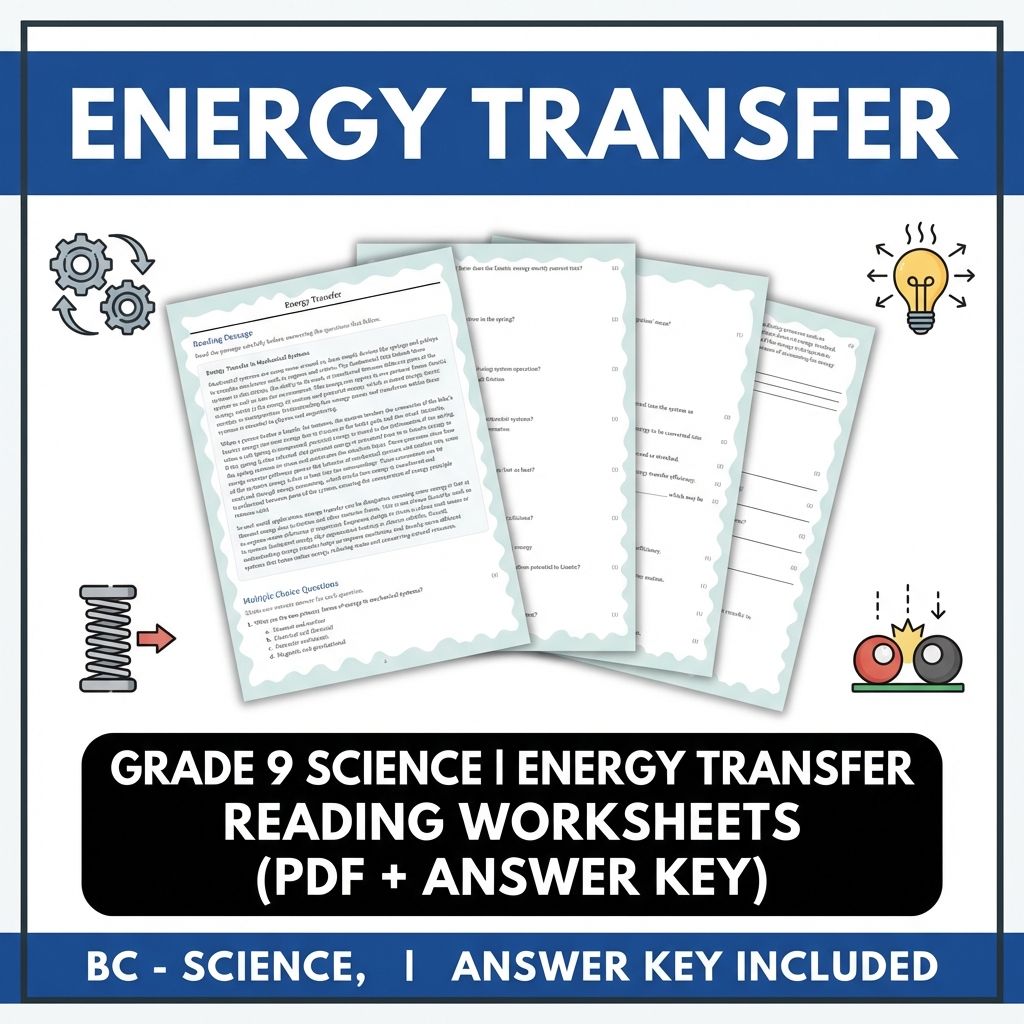
Grade 9 Science | Energy Transfer Reading Worksheets (PDF + Answer Key)
JCreated byJ.S SheetsLearning Objectives
- Understand how mechanical systems contain and exchange energy as kinetic or potential energy.
- Explain how energy transfers occur through work, collisions, and frictional dissipation into heat.
- Describe pathways of energy conversion in systems such as braking a bicycle or compressing a spring.
Instant download
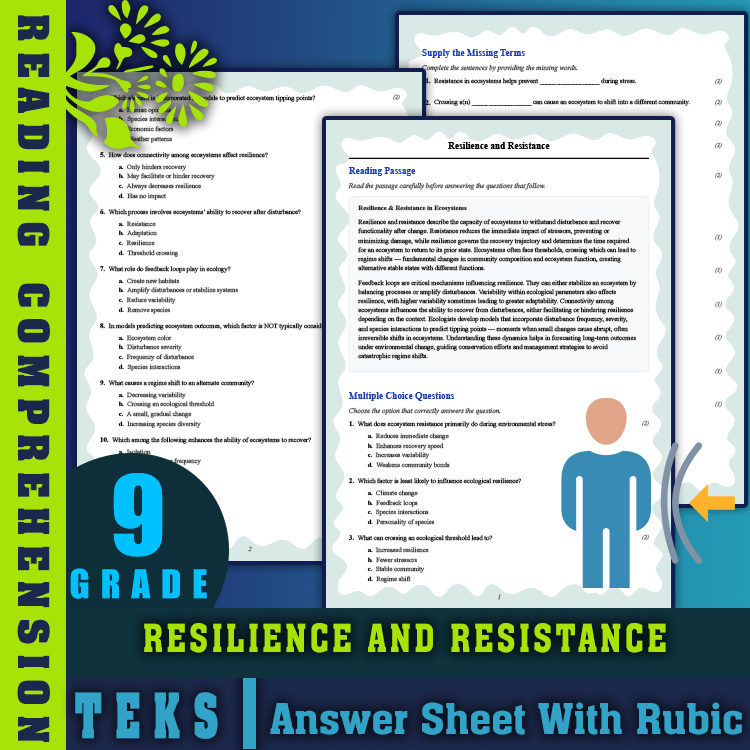
Grade 9 Science | Resilience & Resistance Reading Worksheets (PDF + Rubric)
JCreated byJ.S SheetsLearning Objectives
- Understand the concepts of resilience and resistance in ecosystems.
- Identify factors that influence ecosystem stability and recovery.
- Analyze how ecological thresholds can lead to regime shifts.
Instant download
About Grade 9 Science Worksheets
Find Science worksheets built for Grade 9. All 6,926 cover core skills, practice, and review, each an instant PDF download.
Every worksheet on MyTeachingSheets is created by independent teacher-authors and reviewed before publication. All resources download as printable PDFs for classroom, homework, or at-home practice, and many include answer keys. Preview any worksheet free before buying.