
Grade 9 Science Worksheets
6,986 worksheets
Grade 9 Water Cycling Worksheet | Ontario Science Water Cycle Activity
 Created byClear Sky Classroom
Learning Objectives
- Explain the hydrologic (water) cycle as the movement and exchange of water among atmosphere, surface water, and subsurface reservoirs.
- Describe how evaporation, condensation, precipitation, infiltration, runoff, and groundwater flow contribute to water availability.
- Analyze how residence time and water fluxes differ among reservoirs and affect how quickly water returns to ecosystems.
Instant download

Grade 9 Data Representation Tools Worksheet | General Practice PDF
Created byClear Sky ClassroomLearning Objectives
- Interpret information presented in graphs and tables by describing trends, spread, and outliers.
- Select and explain appropriate axis labels, scales, and units to support valid comparisons.
- Use reasoning from data representations to determine what conclusions are supported.
Instant download
Grade 9 Science | Environmental Chemistry Reading Worksheet & Answer Key (PDF)
JCreated byJ.S SheetsLearning Objectives
- Understand the principles of chemical change and mass conservation in environmental contexts.
- Interpret observable evidence of environmental transformations using particulate and atomic explanations.
- Apply mass accounting and system boundary concepts to analyze regional environmental issues.
Also included in: Grade 9 Science Unit Bundle – Chemistry, States & Atomic Structure Worksheets +1 more
Instant download
Grade 9 Science | Predicting Products Reading Worksheets (PDF + Answer Key)
JCreated byJ.S SheetsLearning Objectives
- Understand the principles of predicting reaction products using patterns and conservation laws.
- Identify common reaction types and their expected products.
- Apply knowledge of reactant properties and bonding to forecast outcomes in chemical reactions.
Also included in: Grade 9 Science Unit Bundle – Chemistry, States & Atomic Structure Worksheets +1 more
Instant download
Grade 9 Science | Reaction Quantities Reading Worksheets (PDF & Answer Key)
JCreated byJ.S SheetsLearning Objectives
- Understand how to interpret coefficients in balanced chemical equations to determine proportional relationships among reactants and products.
- Learn to relate symbolic chemical equations to real-world mass calculations in industrial systems.
- Apply mass conservation principles to estimate the amount of substances formed or consumed in chemical reactions.
Also included in: Grade 9 Science Unit Bundle – Chemistry, States & Atomic Structure Worksheets +1 more
Instant download
Grade 9 Science | Element Symbols & Chemical Formulas (PDF)
JCreated byJ.S SheetsLearning Objectives
- Understand the concept and notation of element symbols and chemical formulas.
- Identify common chemical formulas for familiar substances.
- Explain the importance of balanced chemical formulas in scientific communication.
Also included in: Grade 9 Science Unit Bundle – Chemistry, States & Atomic Structure Worksheets +1 more
Instant download
Grade 9 Science | Chemical Reactions Reading Worksheets (PDF & Answer Key)
JCreated byJ.S SheetsLearning Objectives
- Explain the processes involved in chemical reactions, including atom and bond rearrangements.
- Identify and describe common types of chemical reactions such as combustion, synthesis, and decomposition.
- Understand how symbolic equations represent chemical reactions and relate to mass relationships.
Also included in: Grade 9 Science Unit Bundle – Chemistry, States & Atomic Structure Worksheets +1 more
Instant download
Grade 9 Science | Evidence of Chemical Change Worksheet & Answer Key (PDF)
JCreated byJ.S SheetsLearning Objectives
- Identify observable signs indicating chemical change in materials.
- Distinguish between physical and chemical changes using key markers.
- Explain real-world examples of evidence of chemical change in environmental and industrial contexts.
Also included in: Grade 9 Science Unit Bundle – Chemistry, States & Atomic Structure Worksheets +1 more
Instant download
Grade 9 Science | Mass Conservation Reading Worksheets (PDF & Answer Key)
JCreated byJ.S SheetsLearning Objectives
- Understand the principle of mass conservation in chemical reactions.
- Explain how mass remains constant in sealed systems during chemical processes.
- Apply the concept of conservation of mass to real-world regional contexts such as emissions and resource processing.
Also included in: Grade 9 Science Unit Bundle – Chemistry, States & Atomic Structure Worksheets +1 more
Instant download
9th Grade Science Reading Worksheets | Balancing Equations Practice PDF
JCreated byJ.S SheetsLearning Objectives
- Understand the principle of conservation of atoms and mass in chemical reactions.
- Learn how to balance chemical equations to reflect mass preservation.
- Link symbolic chemical formulas to measurable mass relationships in reactions.
Also included in: Grade 9 Science Unit Bundle – Chemistry, States & Atomic Structure Worksheets +1 more
Instant download
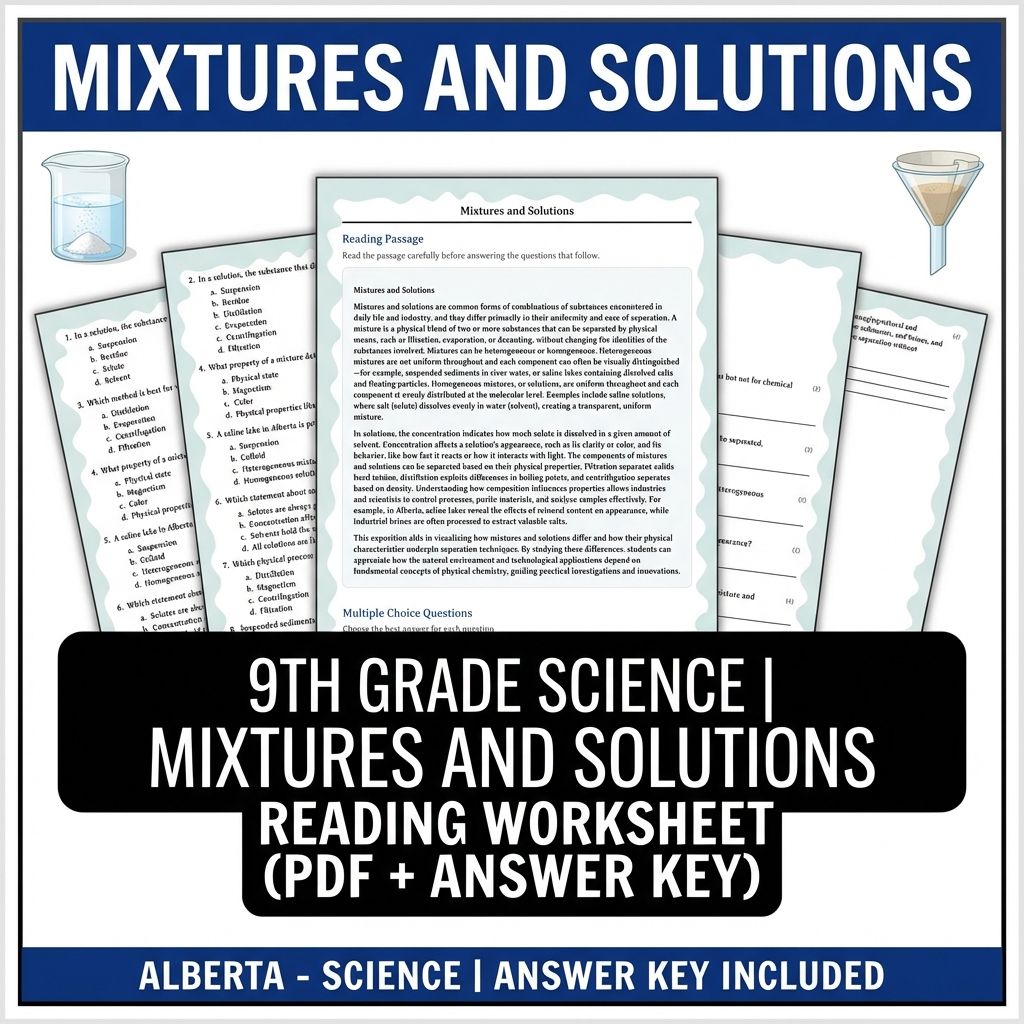
9th Grade Science | Mixtures and Solutions Reading Worksheet (PDF + Answer Key)
JCreated byJ.S SheetsLearning Objectives
- Distinguish between mixtures and solutions based on uniformity and separability.
- Identify the roles of solute and solvent in a solution.
- Explain how concentration affects the appearance and behavior of mixtures.
Also included in: Grade 9 Science Unit Bundle – Chemistry, States & Atomic Structure Worksheets +1 more
Instant download
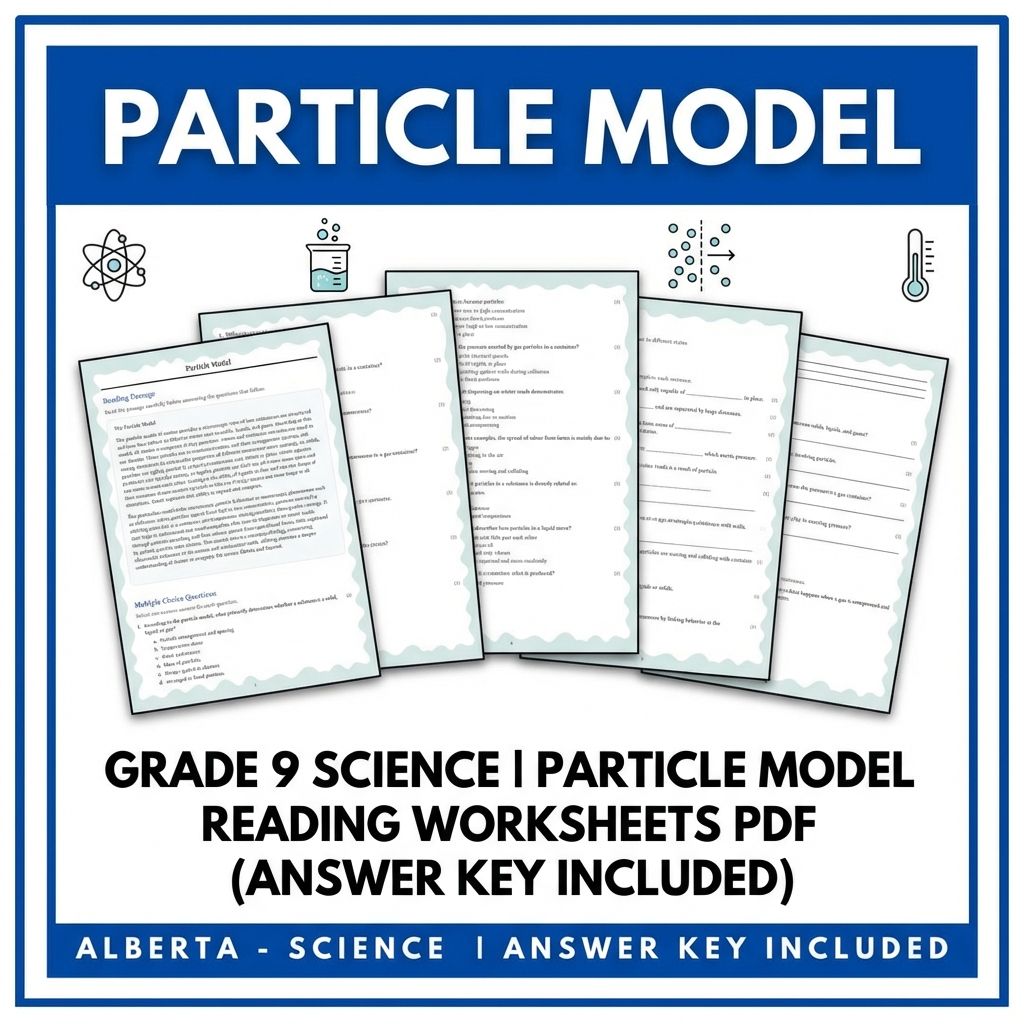
Grade 9 Science | Particle Model Reading Worksheets PDF (Answer Key Included)
JCreated byJ.S SheetsLearning Objectives
- Explain the particle model as a representation of matter in different states.
- Describe how particle spacing, motion, and collisions explain macroscopic phenomena such as diffusion and pressure.
- Link observable behaviour of solids, liquids, and gases to particle arrangement and motion using Alberta examples.
Also included in: Grade 9 Science Unit Bundle – Chemistry, States & Atomic Structure Worksheets +1 more
Instant download

Grade 9 Science | Observable Properties Reading Worksheet (PDF + Rubric)
JCreated byJ.S SheetsLearning Objectives
- Define and describe observable properties of materials.
- Identify common observable properties such as colour, hardness, and solubility.
- Explain how observable properties are used to classify and distinguish substances.
Also included in: Grade 9 Science Unit Bundle – Chemistry, States & Atomic Structure Worksheets +1 more
Instant download
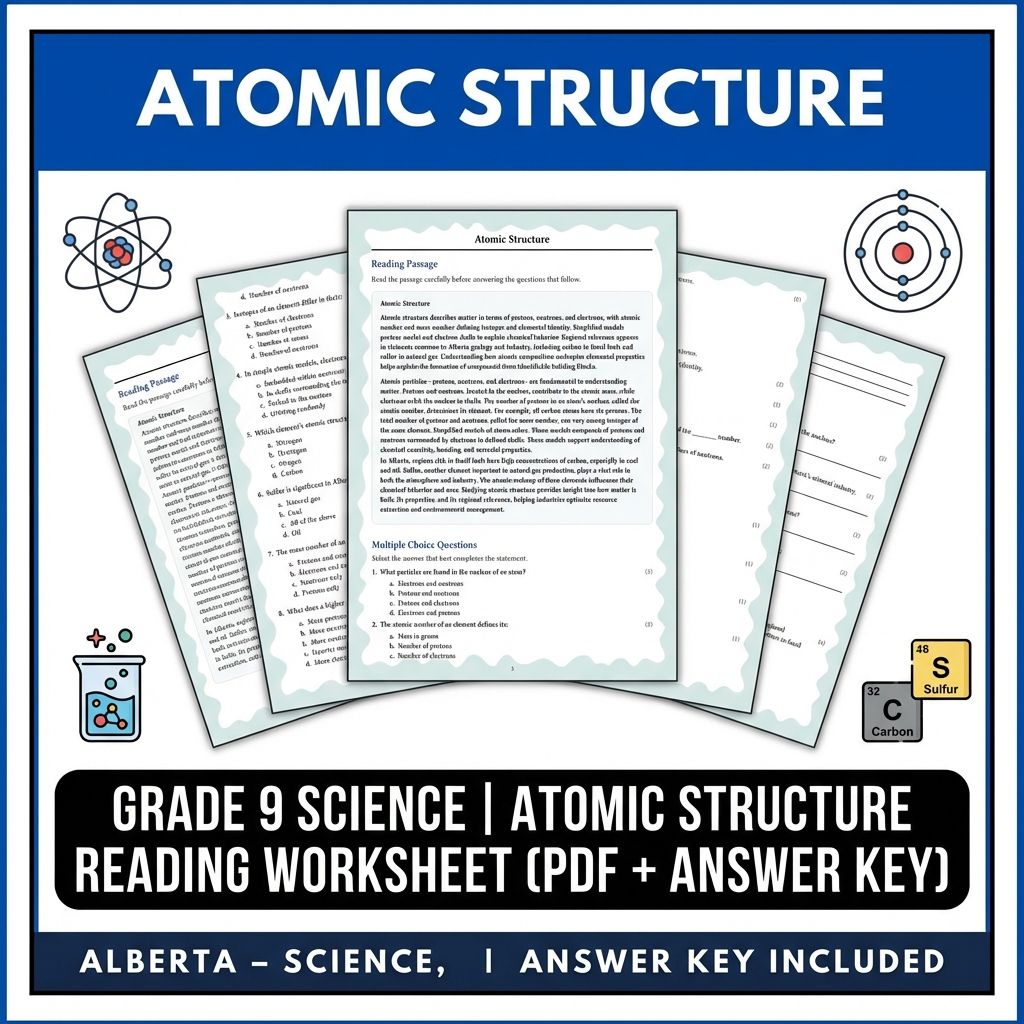
Grade 9 Science | Atomic Structure Reading Worksheet (PDF + Answer Key)
JCreated byJ.S SheetsLearning Objectives
- Explain the basic components of atomic structure: protons, neutrons, and electrons
- Define atomic number and mass number and their significance for isotopes
- Describe simple models of nuclei and electron shells to illustrate chemical behavior
Also included in: Grade 9 Science Unit Bundle – Chemistry, States & Atomic Structure Worksheets +1 more
Instant download
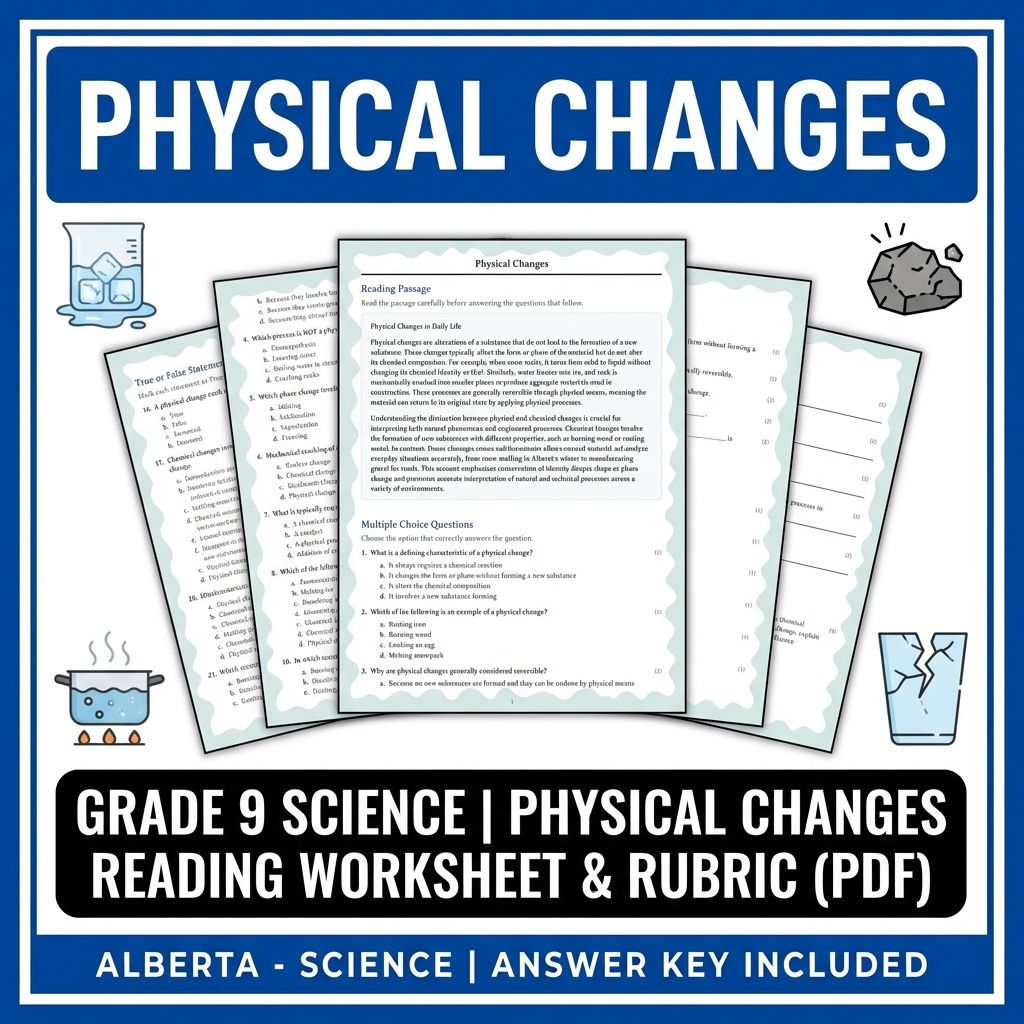
Grade 9 Science | Physical Changes Reading Worksheet & Rubric (PDF)
JCreated byJ.S SheetsLearning Objectives
- Define and explain physical changes and their characteristics.
- Differentiate between physical changes and chemical transformations.
- Identify real-world examples of physical changes in various environments.
Also included in: Grade 9 Science Unit Bundle – Chemistry, States & Atomic Structure Worksheets +1 more
Instant download
Grade 9 Science | Molecular Bonding Reading Worksheet (PDF + Answer Key)
JCreated byJ.S SheetsLearning Objectives
- Understand the differences between ionic, covalent, and metallic bonding based on atom interactions.
- Identify properties of compounds resulting from different bond types, such as melting points, solubility, and crystal structures.
- Relate bonding types to real-world materials and applications, including industrial and environmental contexts in Alberta.
Also included in: Grade 9 Science Unit Bundle – Chemistry, States & Atomic Structure Worksheets +1 more
Instant download
Grade 9 Science – Newton's First Law | Daily Reading Worksheet + Answer Key
JCreated byJ.S SheetsLearning Objectives
- Define inertia and explain its significance in motion.
- Identify real-life examples of Newton's First Law.
- Differentiate between static and dynamic equilibrium.
Also included in: Grade 9 Science Lesson Group: Physics and Motion Worksheets Bundle +1 more
Instant download

Electron Configuration Worksheet Grade 9 Science Activities
 Created byPrism Point Learning
Learning Objectives
- Explain what electron configuration represents and how it describes electron distribution in shells and orbitals.
- Determine how valence electrons influence reactivity, ion formation, and bonding patterns.
- Use electron configuration ideas to predict periodic trends in atomic size and ionization energy.
Also included in: Grade 9 Matter and Chemical Change Lesson Bundle | Science | BC +1 more
Instant download
9th Grade Science | Chemical Bonding Worksheet (PDF+ Answer Key)
 Created byCopper Leaf Classroom
Learning Objectives
- Explain the differences between ionic, covalent, and metallic bonds, including bond energies, polarity, and lattice structures.
- Illustrate how Lewis structures and electron sharing/transfer models explain molecular shapes and intermolecular forces.
- Connect atomic electron configurations to properties such as melting point, conductivity, and solubility.
Instant download
Grade 9 Science | Neural Control Reading Worksheet (PDF & Rubric)
JCreated byJ.S SheetsLearning Objectives
- Describe the organization of the nervous system from neurons to neural circuits.
- Explain how action potentials and synaptic transmission propagate signals.
- Understand how cellular features influence conduction velocity and processing capacity.
Also included in: Grade 9 Science Unit Bundle | Human Body Systems & Cell Functions +1 more
Instant download
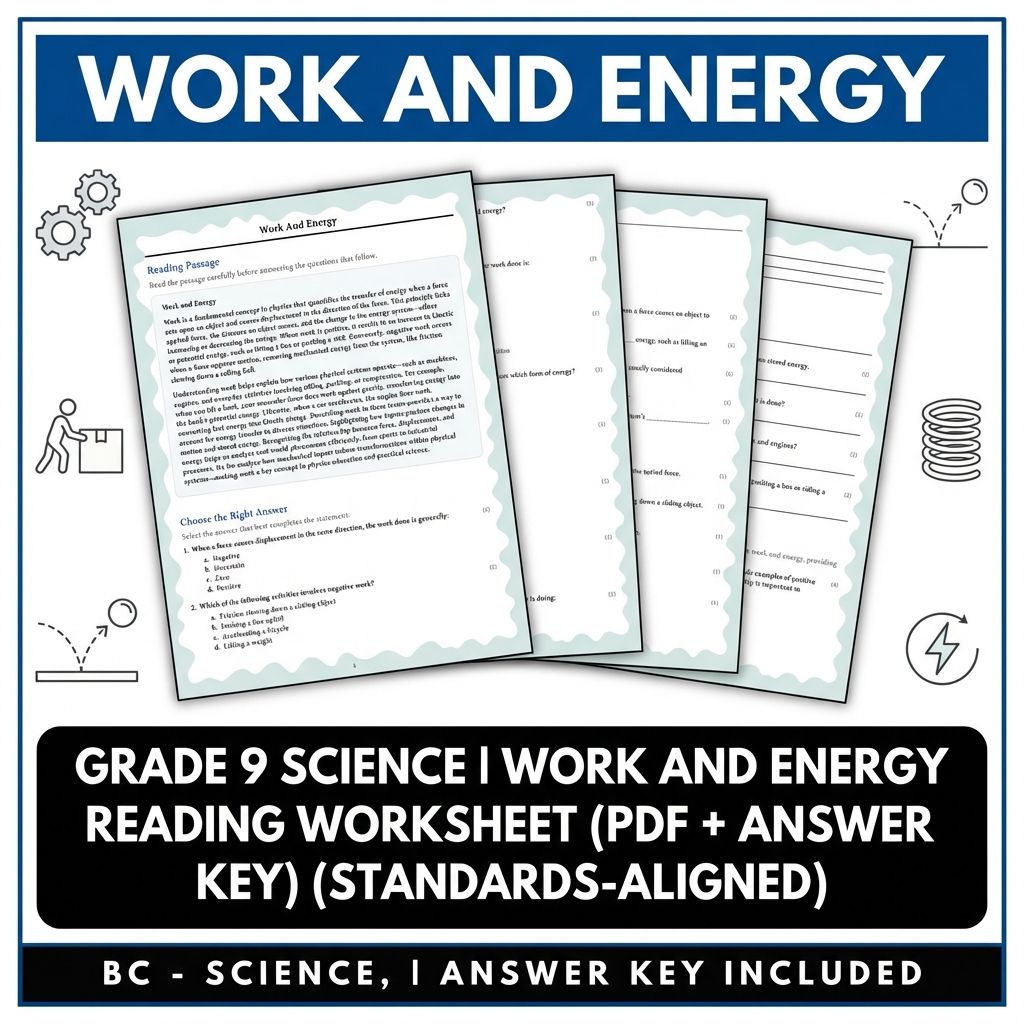
Grade 9 Science | Work and Energy Reading Worksheet (PDF + Answer Key)
JCreated byJ.S SheetsLearning Objectives
- Understand the concept of work in relation to force, displacement, and energy transfer.
- Identify how positive and negative work affect an object's energy.
- Describe different scenarios where work is done, such as lifting, pushing, and compressing objects.
Instant download

Phases And Eclipses Test Prep Worksheet | Grade 9 Science Review
Created byPrism Point LearningLearning Objectives
- Explain how the Earth–Moon–Sun geometry produces lunar phases and why phases repeat on a roughly monthly cycle
- Describe the conditions needed for solar and lunar eclipses, including the role of orbital nodes and inclination
- Distinguish between partial, total, and annular eclipses and relate eclipse/phase observations to real-world timekeeping and navigation
Also included in: Grade 9 Earth and Space Science Lesson Bundle Worksheets | Ontario
Instant download
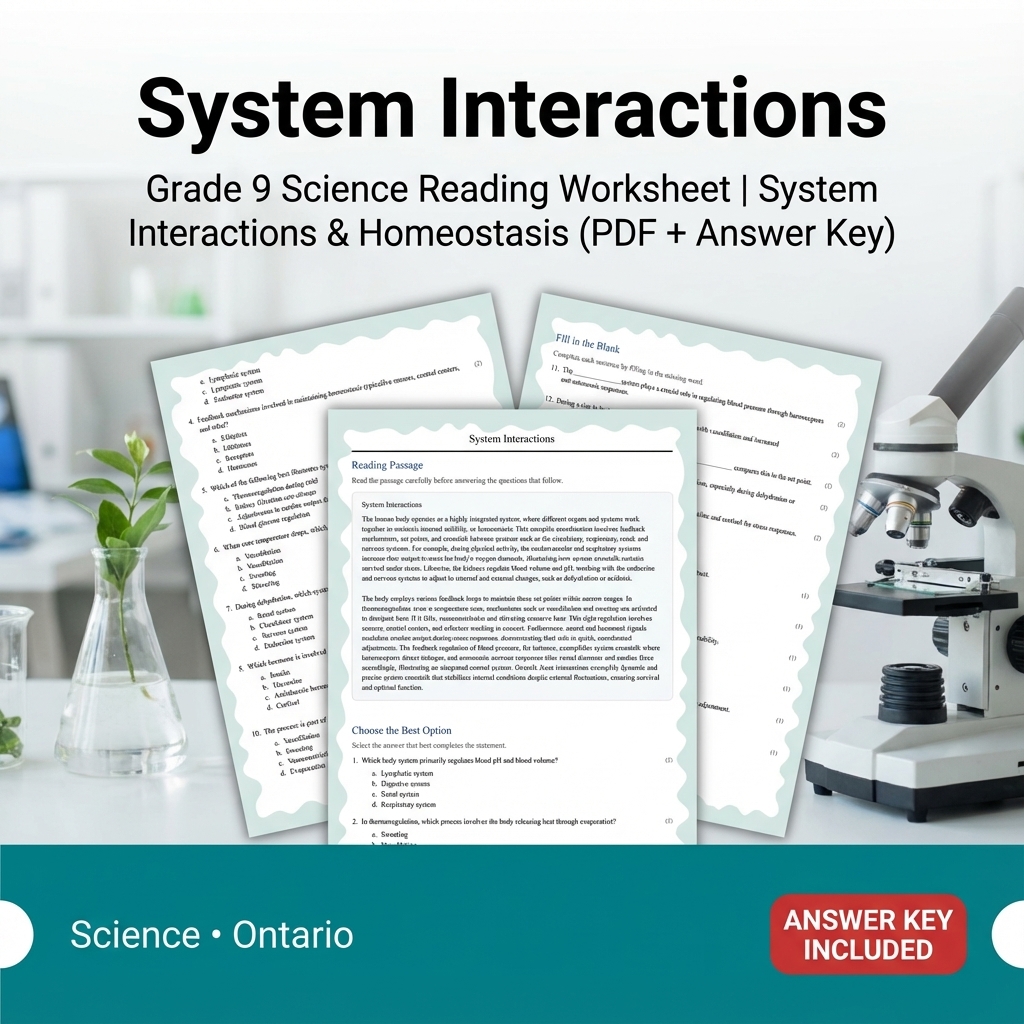
Grade 9 Science Reading | System Interactions & Homeostasis (PDF + Answer Key)
JCreated byJ.S SheetsLearning Objectives
- Understand the functional interactions among various body systems that maintain homeostasis.
- Analyze feedback mechanisms and set points involved in physiological regulation.
- Describe how systems such as cardiovascular, respiratory, renal, and nervous coordinate responses.
Also included in: Grade 9 Science Unit Bundle | Human Body Systems & Cell Functions +1 more
Instant download
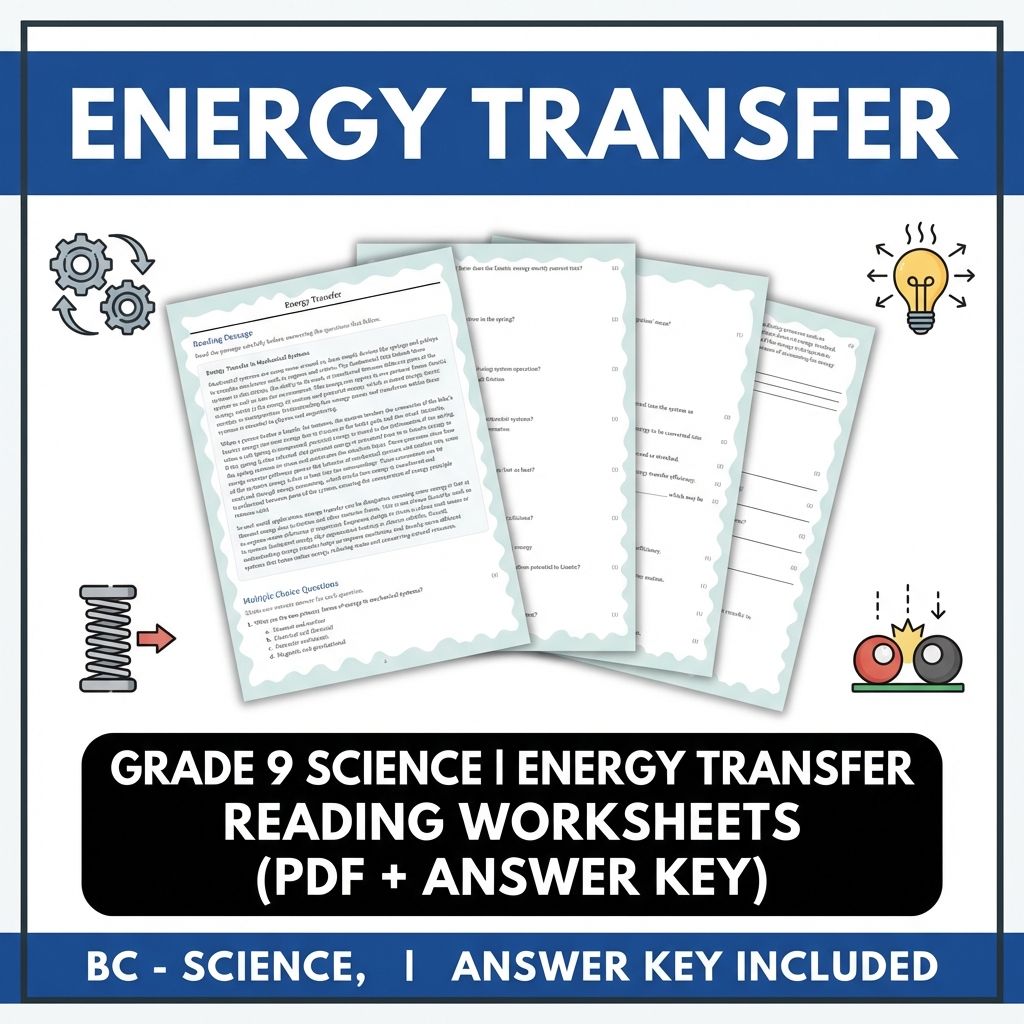
Grade 9 Science | Energy Transfer Reading Worksheets (PDF + Answer Key)
JCreated byJ.S SheetsLearning Objectives
- Understand how mechanical systems contain and exchange energy as kinetic or potential energy.
- Explain how energy transfers occur through work, collisions, and frictional dissipation into heat.
- Describe pathways of energy conversion in systems such as braking a bicycle or compressing a spring.
Instant download
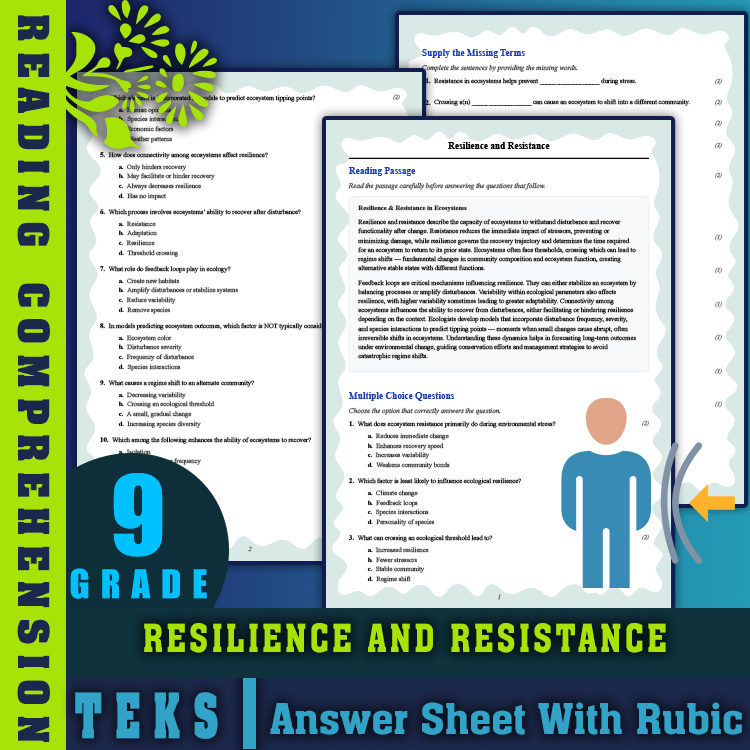
Grade 9 Science | Resilience & Resistance Reading Worksheets (PDF + Rubric)
JCreated byJ.S SheetsLearning Objectives
- Understand the concepts of resilience and resistance in ecosystems.
- Identify factors that influence ecosystem stability and recovery.
- Analyze how ecological thresholds can lead to regime shifts.
Instant download
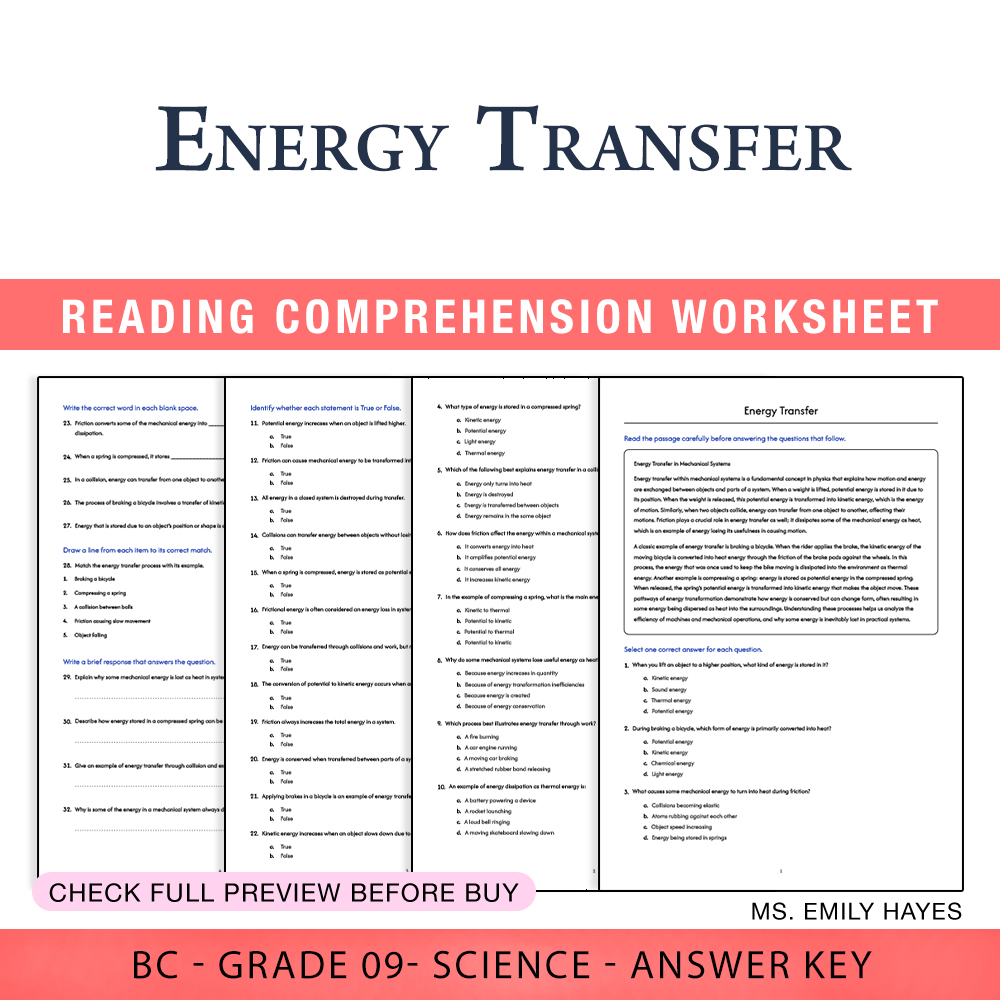
9th Grade Science | Energy Transfer Worksheet (PDF+ Answer Key)
Created byCopper Leaf ClassroomLearning Objectives
- Understand how mechanical systems transfer energy through work, collisions, and friction.
- Explain the transformation of energy from kinetic and potential forms to thermal energy.
- Analyze real-world examples like braking a bicycle or compressing a spring to describe energy conversion pathways.
Also included in: Grade 9 Science Worksheet Bundle | Forces, Energy & Motion (PDF + Answer Key) +1 more
Instant download
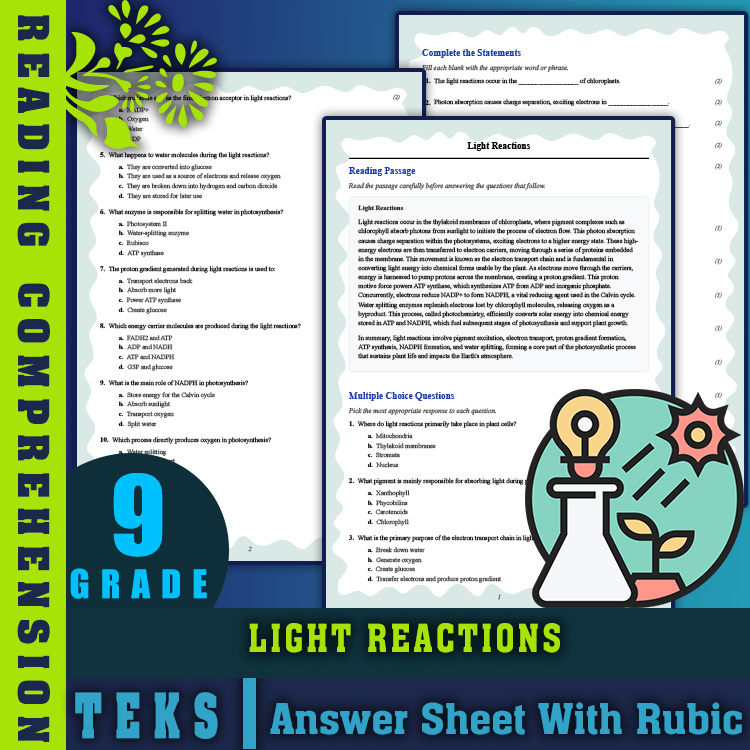
Grade 9 Science | Light Reactions Reading Worksheet & Answer Key (PDF)
JCreated byJ.S SheetsLearning Objectives
- Understand the process of light reactions in photosynthesis
- Identify the roles of pigments, electron transport, and ATP synthase in light-driven energy conversion
- Explain how water splitting replenishes electrons and releases oxygen during photosynthesis
Instant download
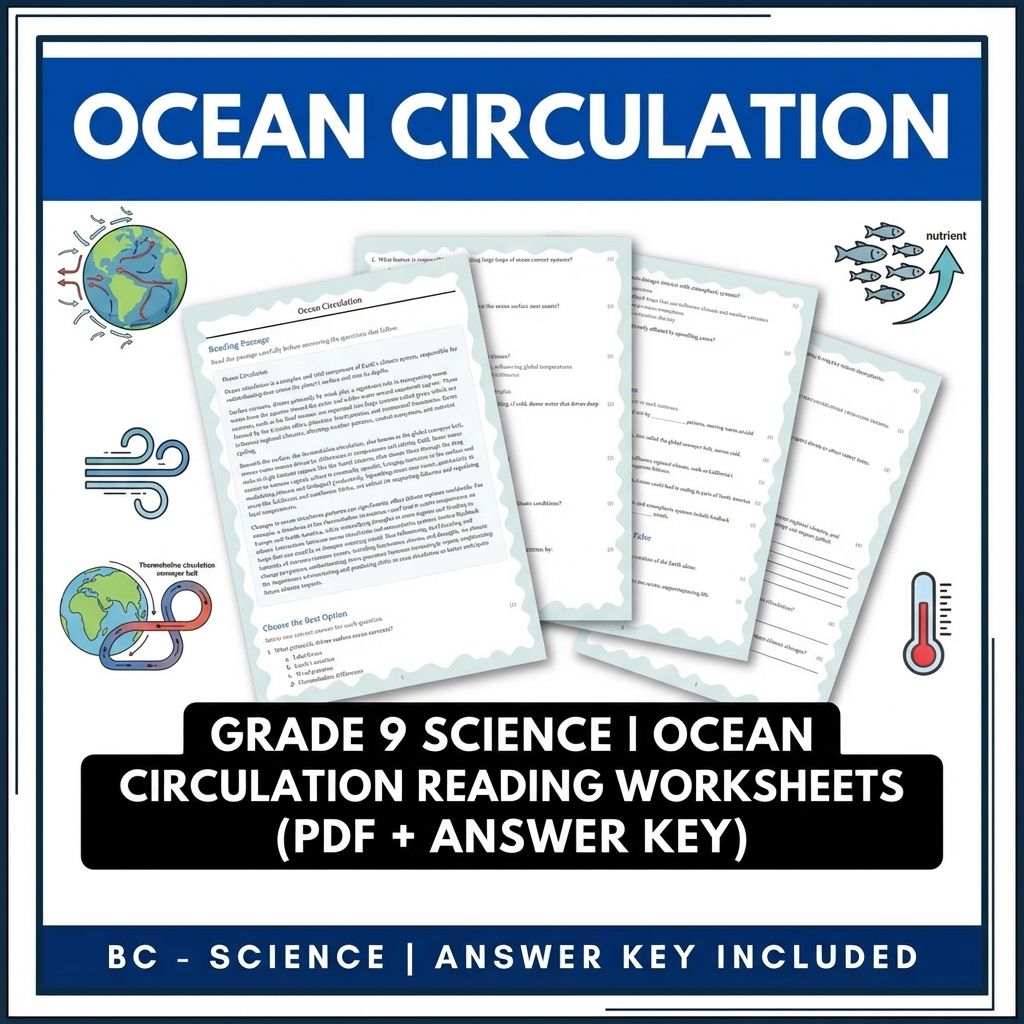
Grade 9 Science | Ocean Circulation Reading Worksheets (PDF + Answer Key)
JCreated byJ.S SheetsLearning Objectives
- Explain the mechanisms driving surface and deep ocean currents and their roles in climate regulation.
- Identify features such as gyres, upwelling zones, and boundary currents and describe their effects on regional environments.
- Describe how changes in ocean circulation patterns can influence climate systems and weather extremes.
Instant download
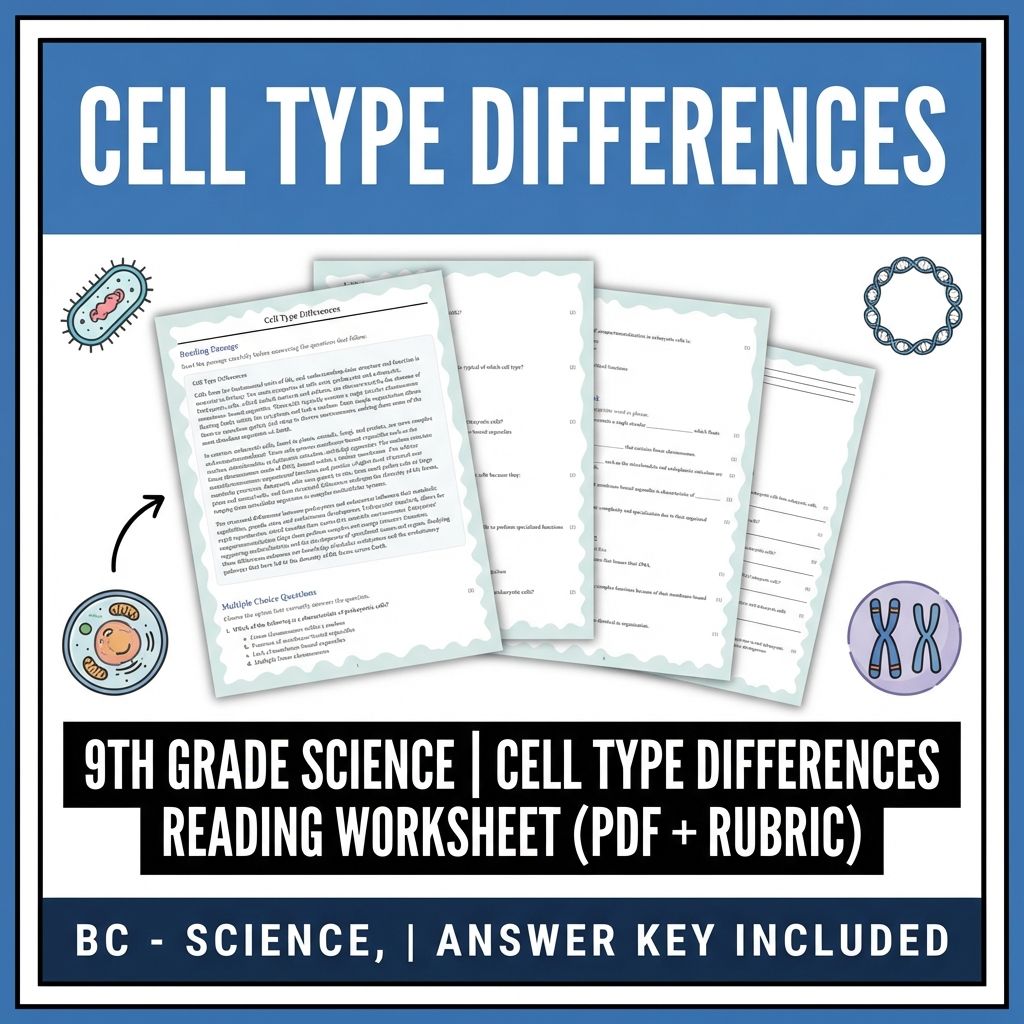
9th Grade Science | Cell Type Differences Reading Worksheet (PDF + Rubric)
JCreated byJ.S SheetsLearning Objectives
- Understand the structural differences between prokaryotic and eukaryotic cells.
- Identify key components found in each cell type and their functions.
- Explain how cell structure relates to biological roles and evolution.
Instant download
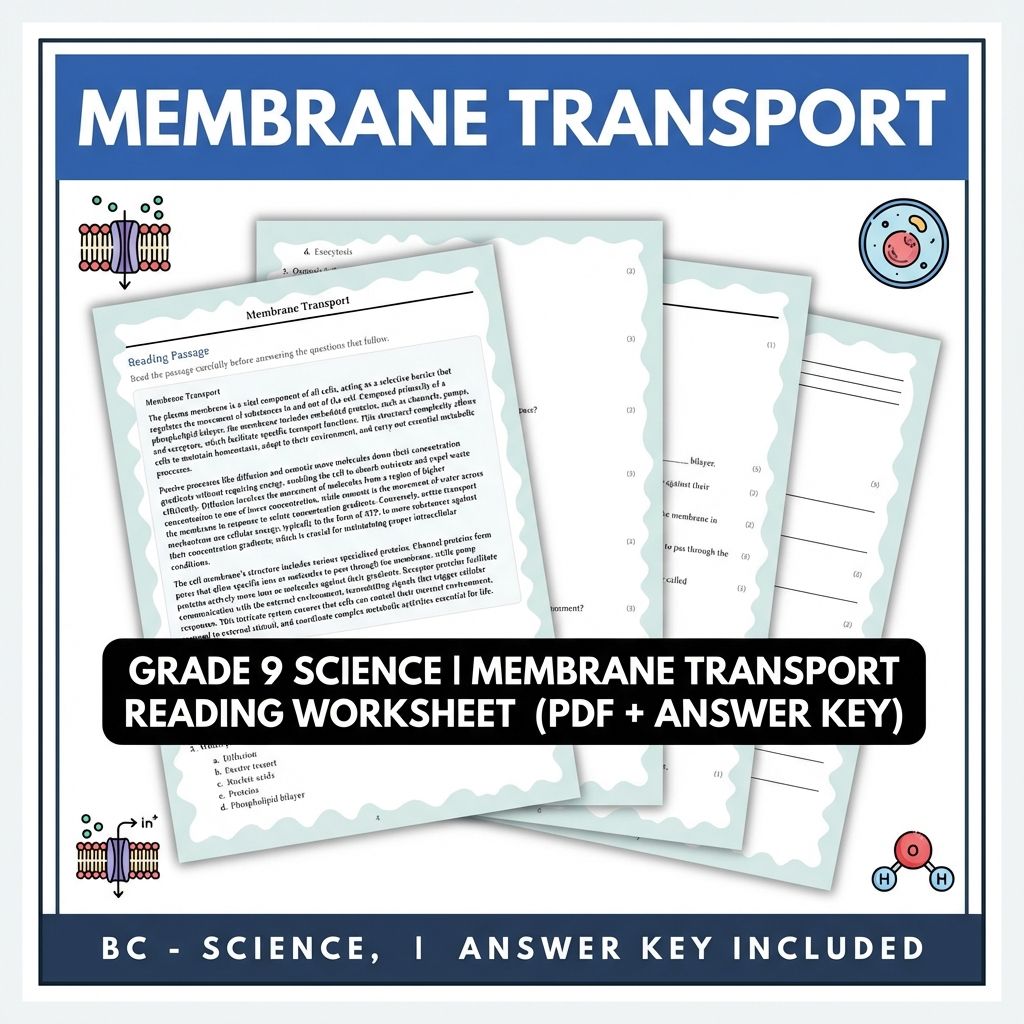
Grade 9 Science | Membrane Transport Reading Worksheet (PDF + Answer Key)
JCreated byJ.S SheetsLearning Objectives
- Understand the structure and function of the plasma membrane in cells.
- Differentiate between passive and active transport processes across cell membranes.
- Identify types of membrane proteins involved in transport and communication.
Instant download
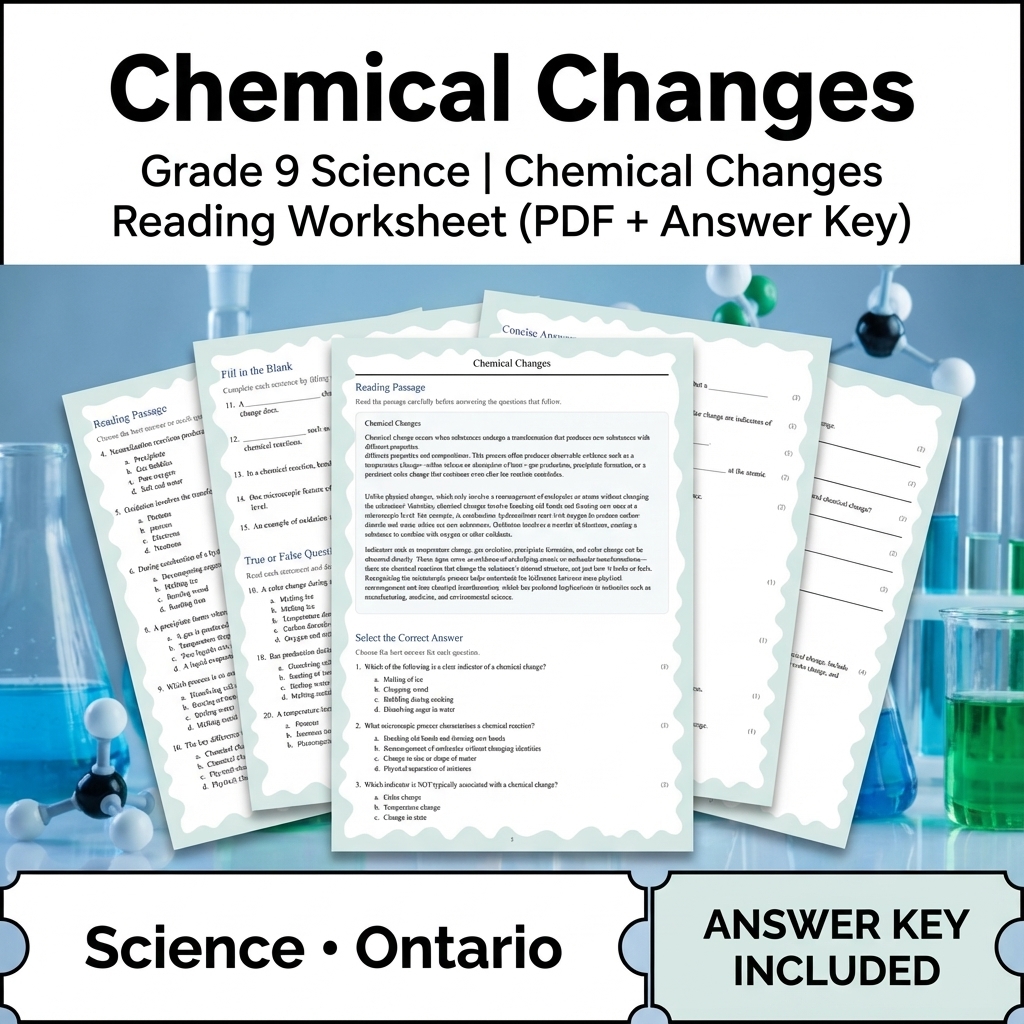
Grade 9 Science | Chemical Changes Reading Worksheet (PDF + Answer Key)
JCreated byJ.S SheetsLearning Objectives
- Understand the concept of chemical change and how it differs from physical change.
- Identify observable indicators of chemical reactions such as temperature change, gas production, precipitate formation, and color change.
- Interpret the microscopic processes involved in chemical reactions and distinguish them from physical rearrangements.
Also included in: Grade 9 Science Unit Bundle | Essential Concepts & Skills (Answer Keys Included) +1 more
Instant download
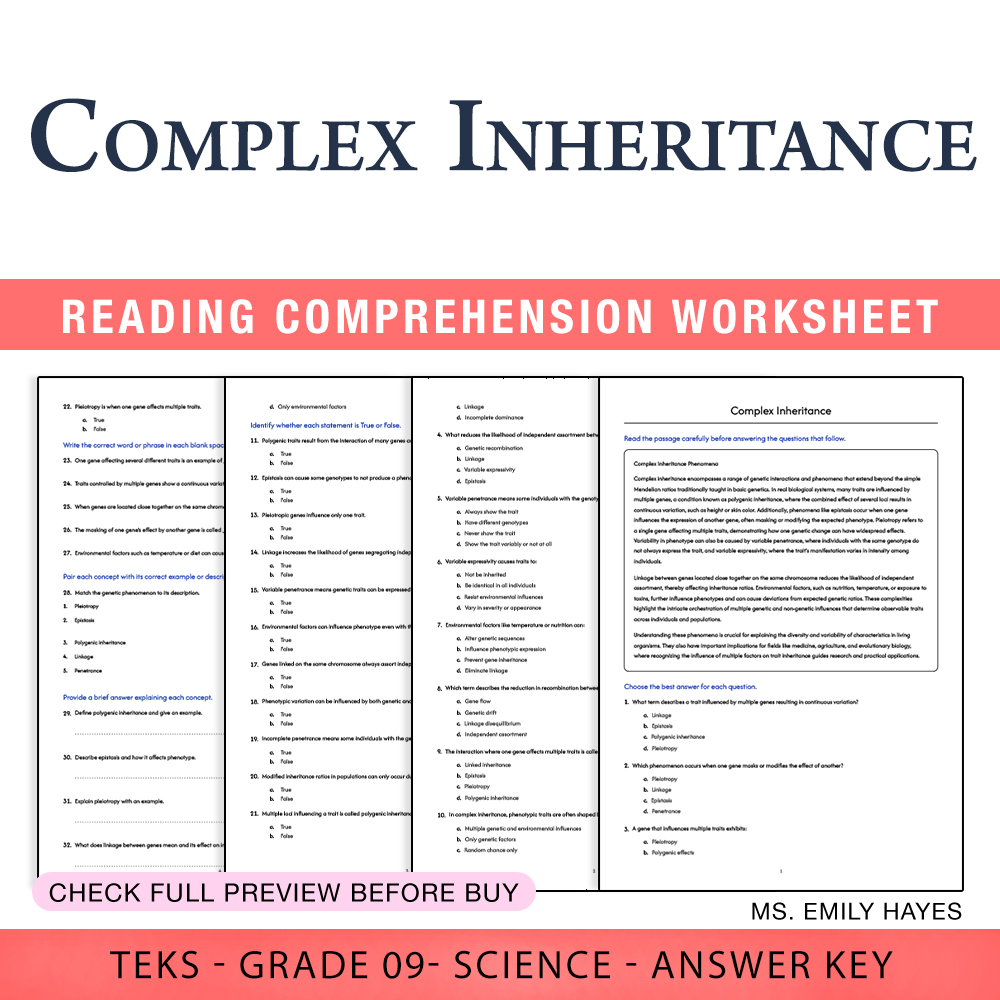
Grade 9 Science | Complex Inheritance Worksheet (PDF+ Answer Key)
Created byCopper Leaf ClassroomLearning Objectives
- Understand the diverse phenomena involved in complex inheritance such as polygenic traits, epistasis, and pleiotropy.
- Explain how variable penetrance and expressivity influence phenotype variation.
- Describe how linkage and environmental factors modify inheritance patterns.
Instant download
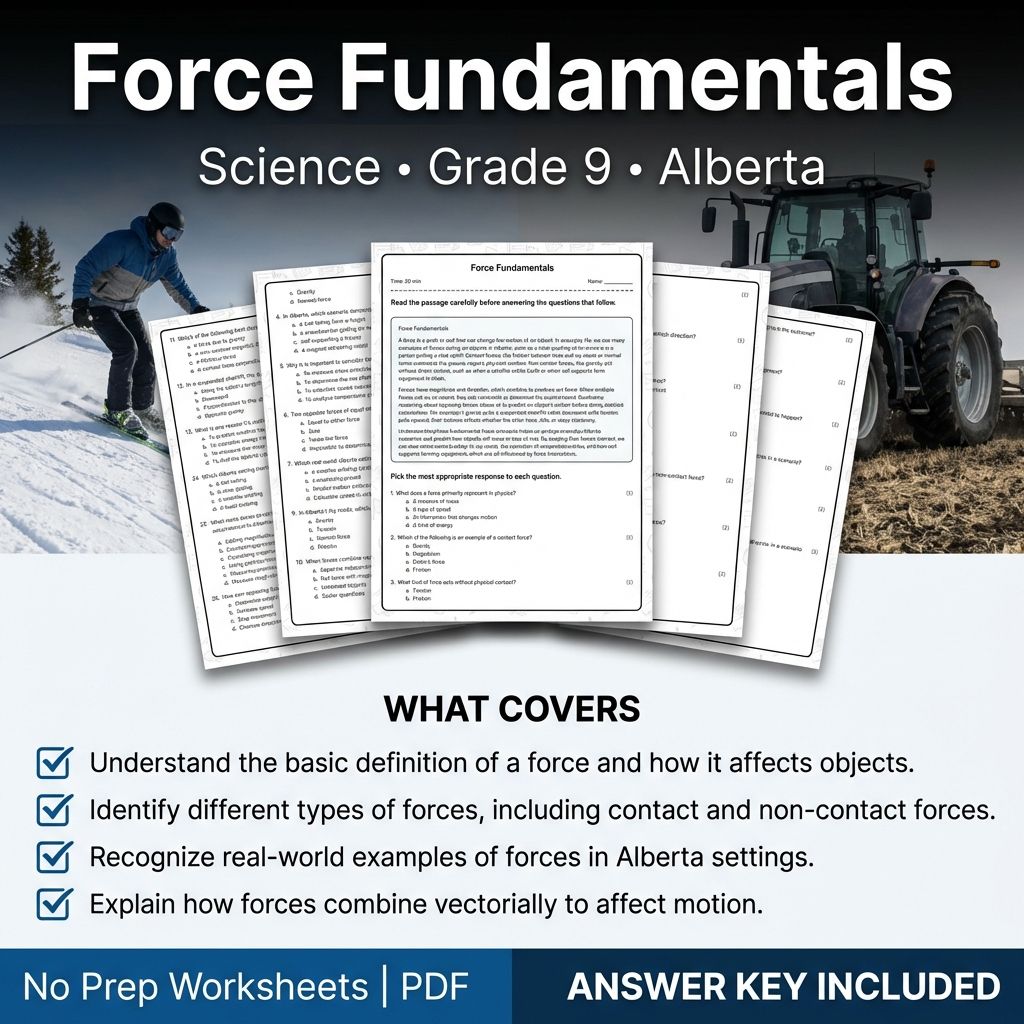
Force Fundamentals Worksheet Grade 9 Science Alberta Standards
 Created byCoral Reef Learning
Learning Objectives
- Understand the basic definition of a force and how it affects objects.
- Identify different types of forces, including contact and non-contact forces.
- Recognize real-world examples of forces in Alberta settings.
Instant download
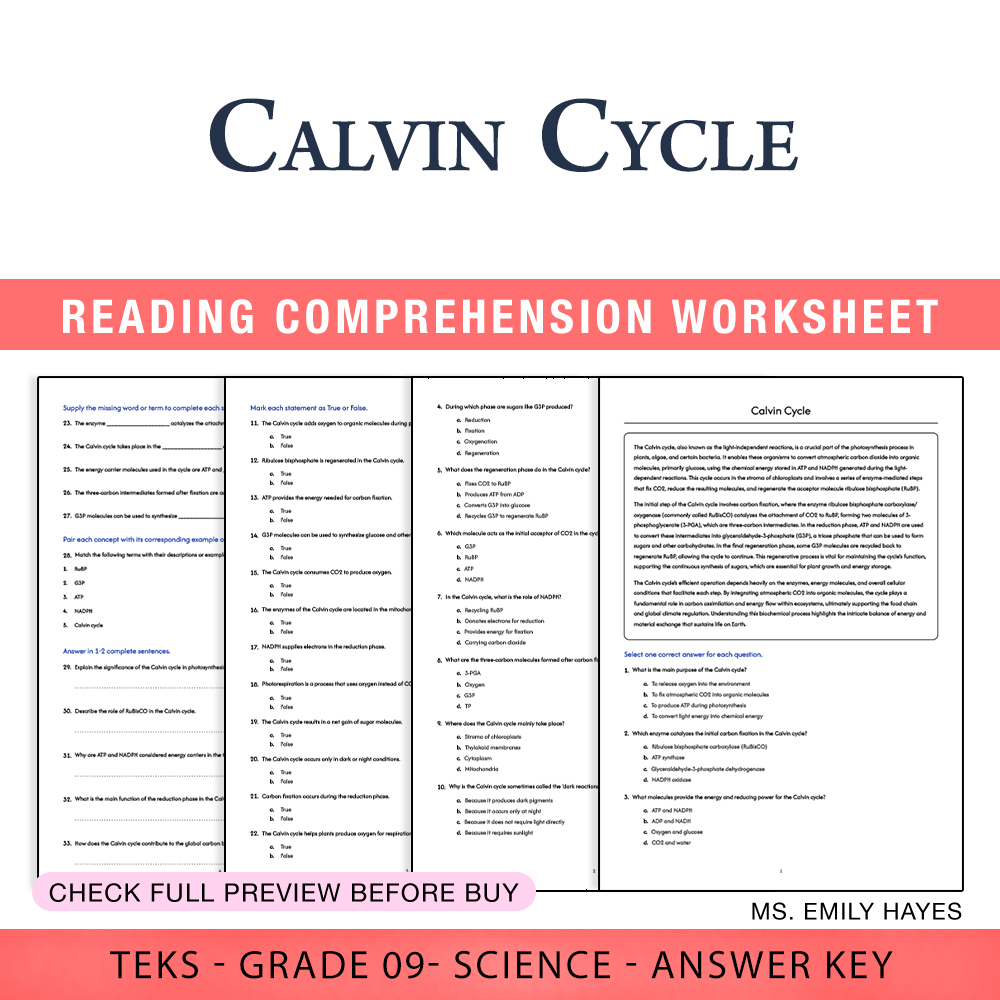
Grade 9 Science | Calvin Cycle Worksheet (PDF+ Answer Key)
Created byCopper Leaf ClassroomLearning Objectives
- Describe the steps and purpose of the Calvin cycle in photosynthesis.
- Explain the role of enzymes such as ribulose bisphosphate carboxylase in carbon fixation.
- Identify the energy carriers ATP and NADPH and their roles in the cycle.
Instant download
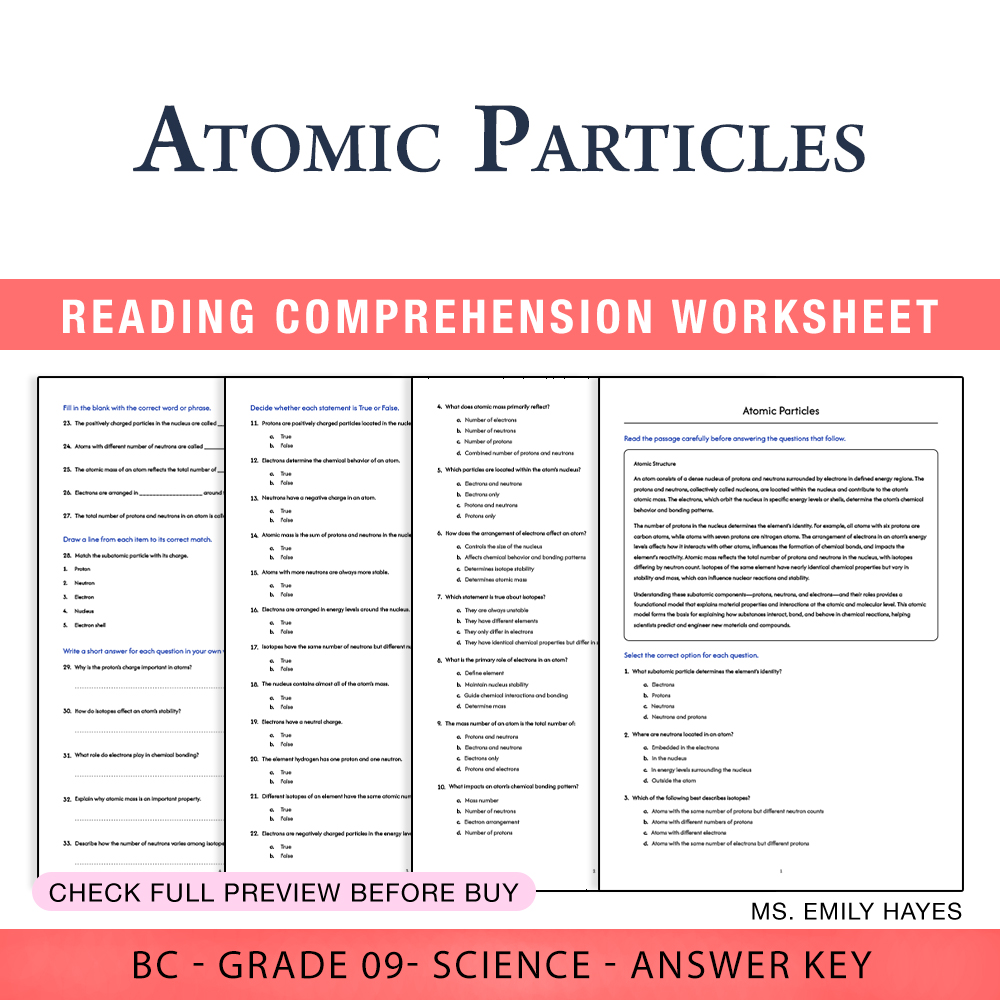
9th Grade Science | Atomic Particles Worksheet (PDF+ Answer Key)
Created byCopper Leaf ClassroomLearning Objectives
- Describe the structure of an atom, including protons, neutrons, and electrons.
- Explain how the number of protons determines the element identity.
- Understand the concept of isotopes and their effect on atomic mass and stability.
Also included in: Grade 9 Science Bundle | Chemistry, Physics & Atomic Concepts (PDF + Answer Key) +1 more
Instant download

Force Basics Worksheet Grade 9 Science | Standards-Aligned Practice PDF
JCreated byJ.S SheetsLearning Objectives
- Distinguish contact forces from non-contact forces using real examples.
- Describe forces qualitatively by identifying magnitude, direction, and point of application.
- Represent interactions between objects and identify action–reaction pairs.
Instant download
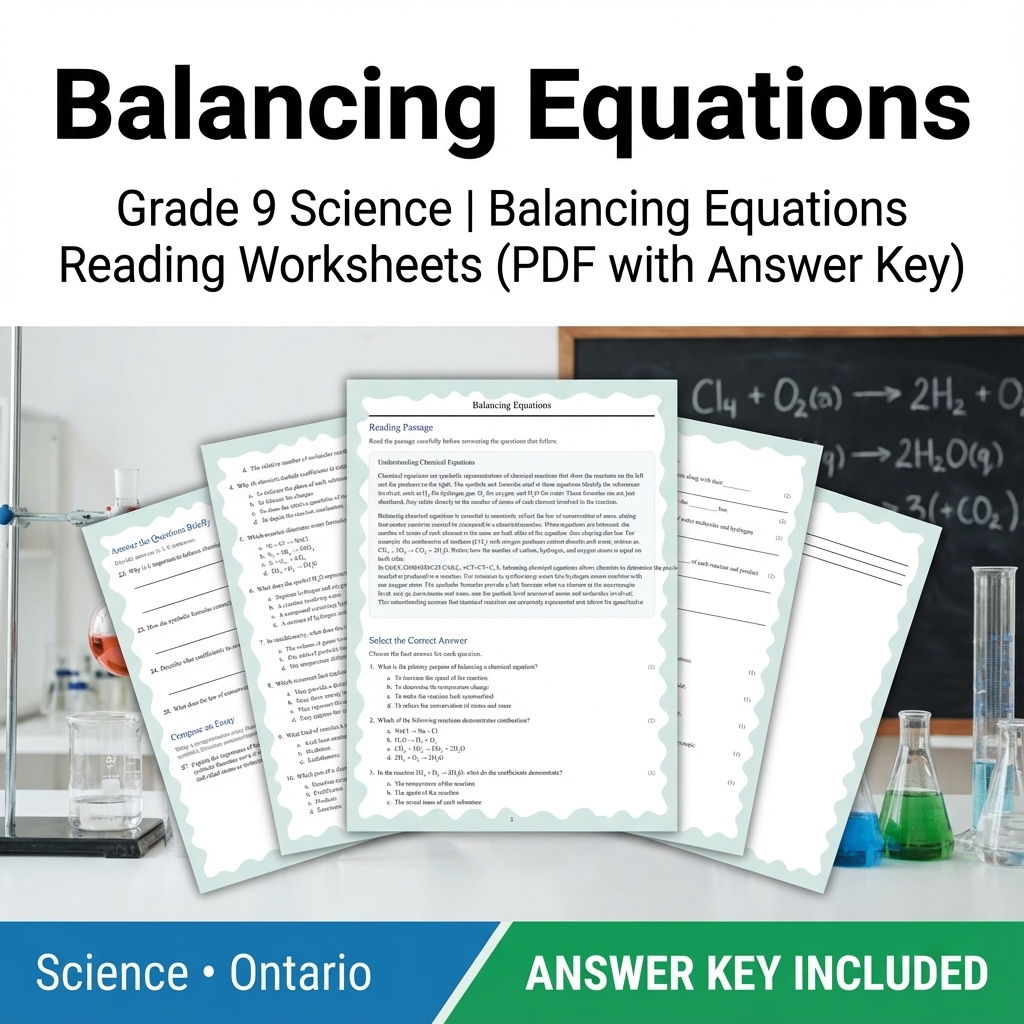
Grade 9 Science | Balancing Equations Reading Worksheets (PDF with Answer Key)
JCreated byJ.S SheetsLearning Objectives
- Understand the symbolic representation of reactants and products in chemical equations.
- Explain the importance of balancing chemical equations to reflect conservation of atoms and mass.
- Identify examples of chemical reactions such as combustion and water formation to demonstrate stoichiometry.
Also included in: Grade 9 Science Unit Bundle | Essential Concepts & Skills (Answer Keys Included) +1 more
Instant download
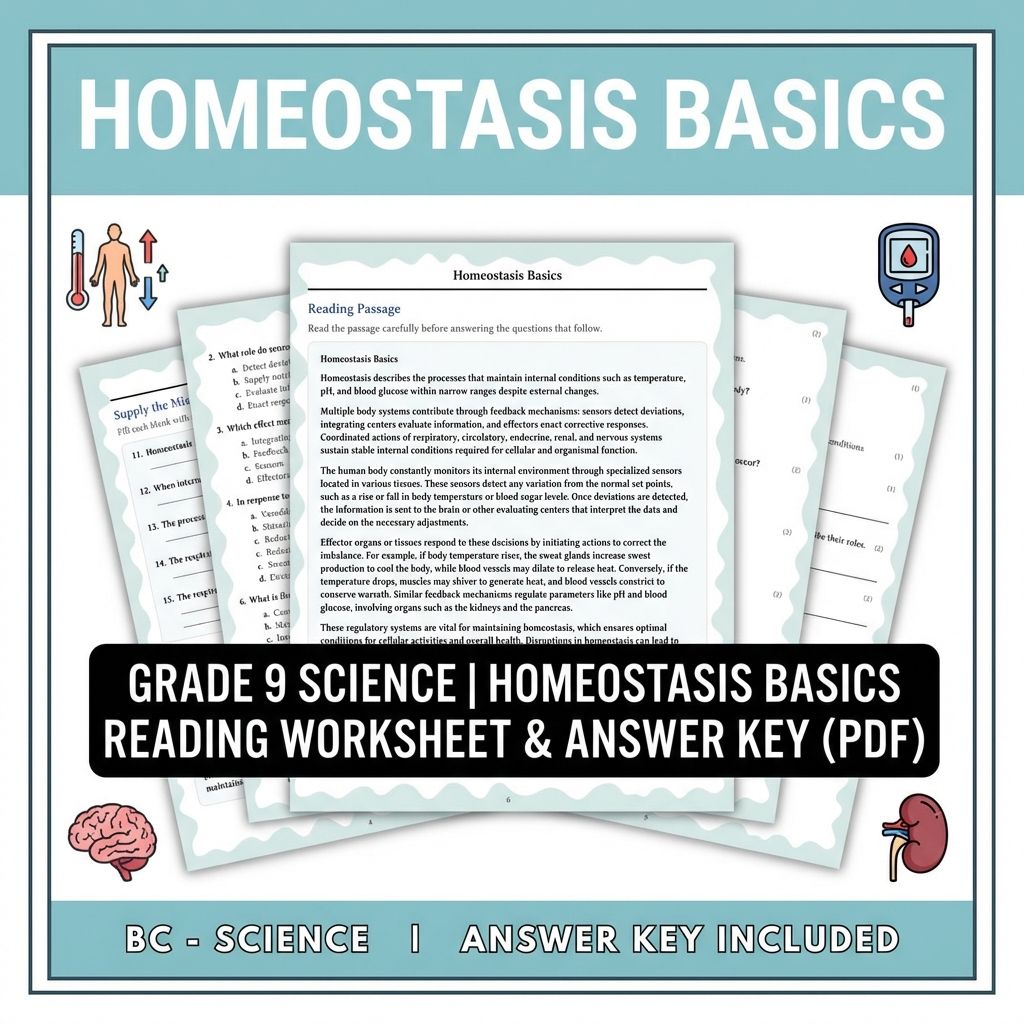
Grade 9 Science | Homeostasis Basics Reading Worksheet & Answer Key (PDF)
JCreated byJ.S SheetsLearning Objectives
- Understand the concept of homeostasis and its importance in maintaining internal body conditions.
- Identify the key body systems involved in homeostasis and their roles.
- Describe feedback mechanisms that help regulate internal environments.
Instant download

Grade 9 Science | Force & Acceleration - Daily Reading Comprehension
Created byCoral Reef LearningLearning Objectives
- Understand the relationship between force, mass, and acceleration
- Interpret vector quantities of force and acceleration
- Analyze net force by summing components
Instant download

Grade 9 Science – Comparative Cell Structures Daily Worksheet + Answer Key
JCreated byJ.S SheetsLearning Objectives
- Identify specialized organelles in various cell types
- Understand how organelle structure relates to cell function
- Explore differences in organelle abundance across tissues
Also included in: Grade 9 Science Lesson Group Bundle TEKS Daily Reading Worksheets +1 more
Instant download

Grade 9 Science | Evidence Overview - Daily Reading Comprehension
Created byCoral Reef LearningLearning Objectives
- Understand how fossils contribute to the evidence for evolution
- Identify the role of anatomical comparisons in evolutionary studies
- Recognize how molecular data is used to assess relatedness among organisms
Instant download

Grade 9 Science – Understanding Adaptive Radiation | Daily Reading Worksheet
 Created byBright Mind Resources
Learning Objectives
- Define adaptive radiation and explain its significance in evolution.
- Identify key features and processes involved in adaptive radiation.
- Analyze examples of adaptive radiation in nature.
Also included in: Grade 9 Evolution Science Daily Reading Worksheets Lesson Bundle | TEKS +2 more
Instant download

Grade 9 Science – Molecular Evidence & Evolution | Daily Reading Worksheet
Created byBright Mind ResourcesLearning Objectives
- Understand the role of DNA, RNA, and proteins in evolutionary studies.
- Learn how sequence similarities and divergences inform common ancestry.
- Explore how molecular clocks estimate divergence times between species.
Also included in: Grade 9 Evolution Science Daily Reading Worksheets Lesson Bundle | TEKS +2 more
Instant download
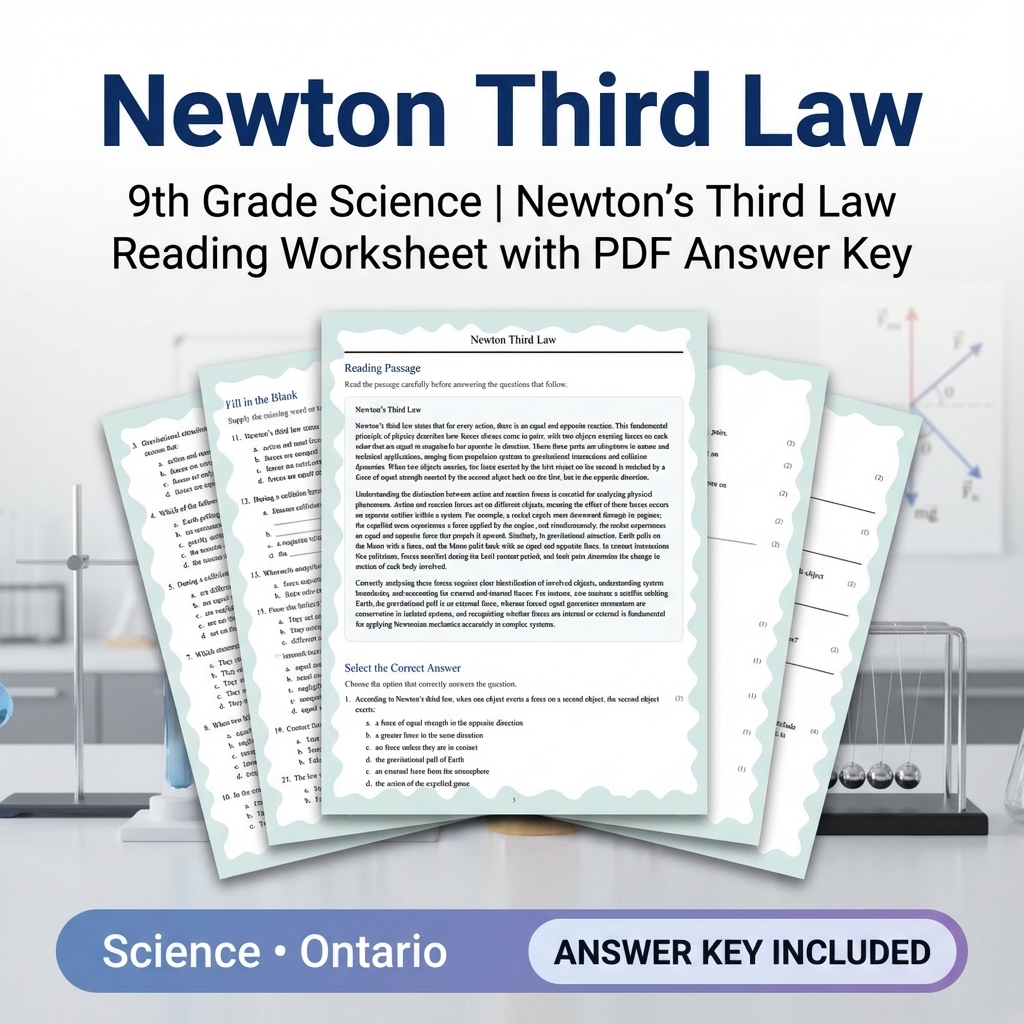
9th Grade Science | Newton’s Third Law Reading Worksheet with PDF Answer Key
JCreated byJ.S SheetsLearning Objectives
- Understand the principle of action–reaction force pairs in Newton's third law.
- Identify examples of force pairs in various physical interactions.
- Distinguish between internal and external forces within multibody systems.
Also included in: Grade 9 Science Unit | Force, Motion & Energy Worksheets & Answer Keys Bundle +1 more
Instant download
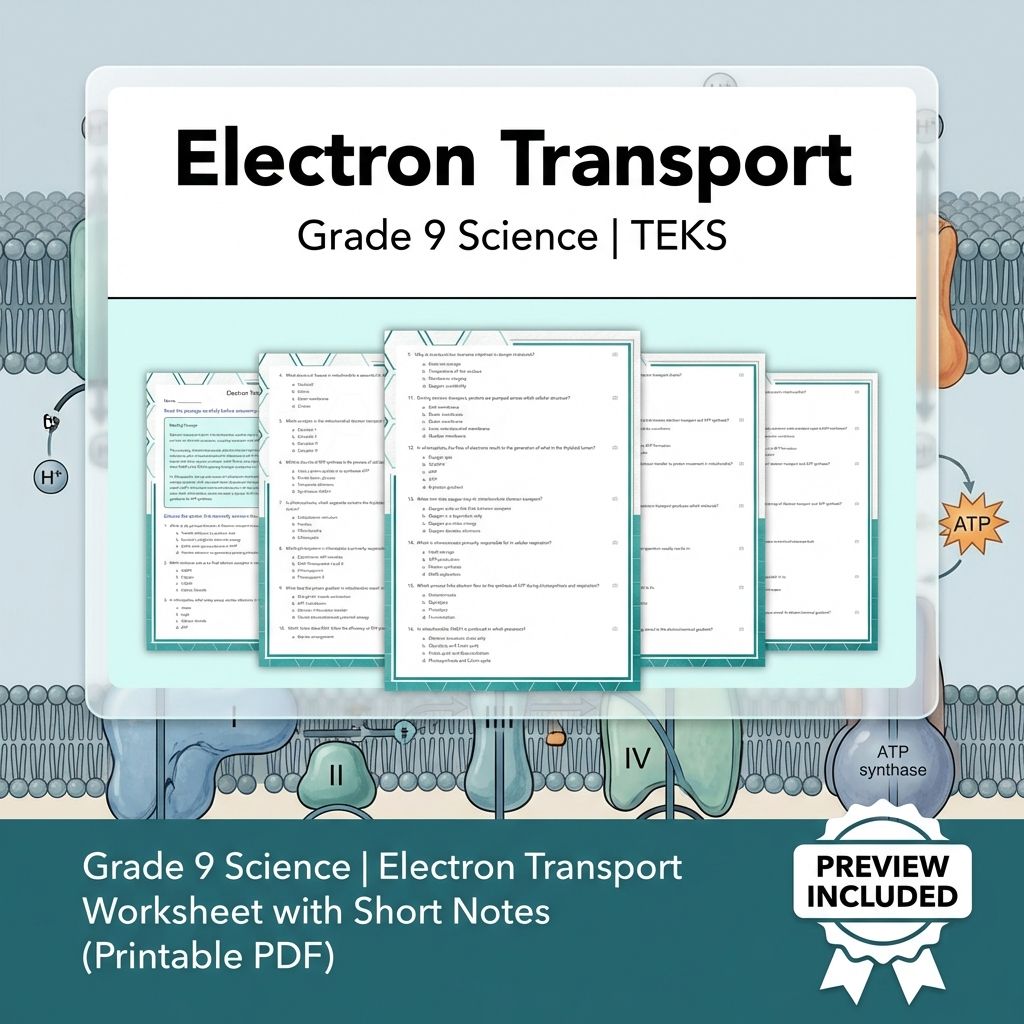
Grade 9 Science | Electron Transport Worksheet with Short Notes (Printable PDF)
 Created byMeadowlark Worksheets
Learning Objectives
- Explain the process of electron transport chains in mitochondria and chloroplasts.
- Identify the role of proton gradients and chemiosmosis in ATP synthesis.
- Differentiate between mitochondrial and thylakoid electron transport systems.
Instant download
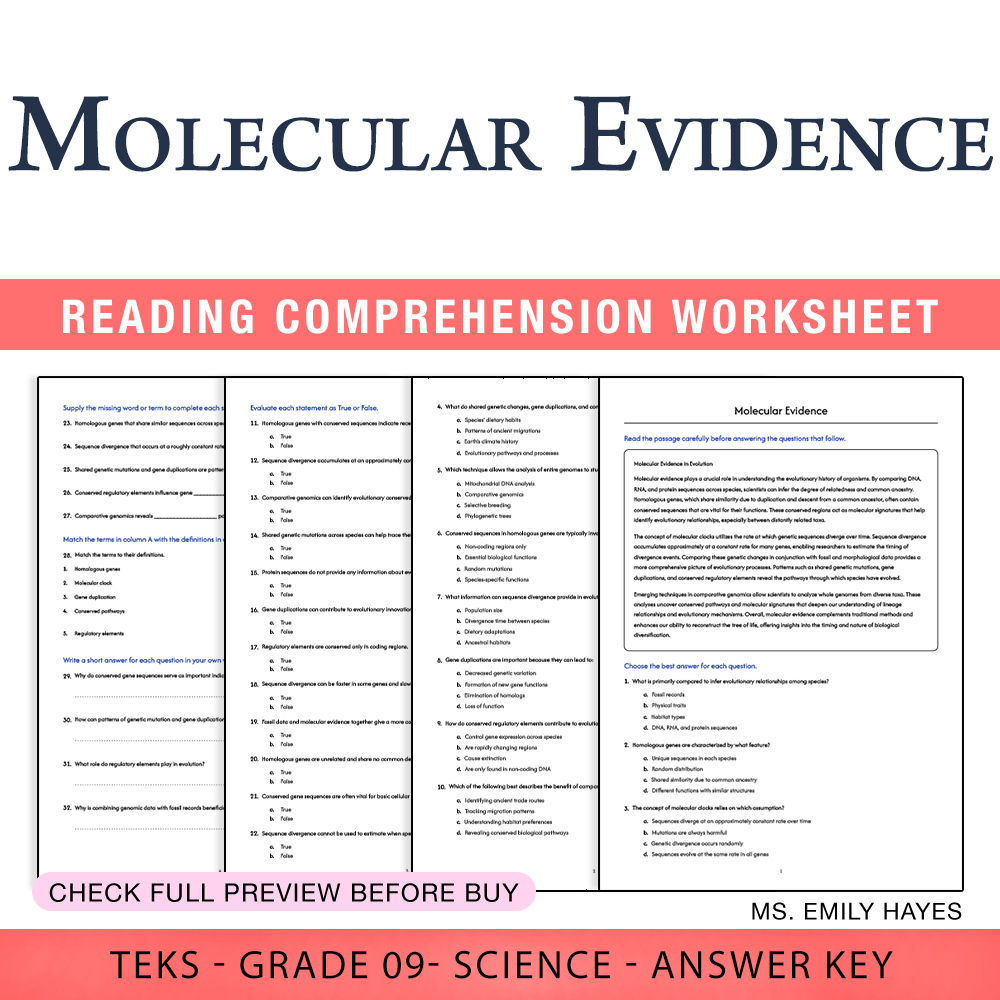
9th Grade Science | Molecular Evidence Worksheet (PDF+ Answer Key)
Created byCopper Leaf ClassroomLearning Objectives
- Understand how DNA, RNA, and protein sequences are used to infer evolutionary relationships.
- Identify the significance of homologous genes and conserved sequences in common ancestry.
- Explain the concept of molecular clocks and how sequence divergence estimates divergence times.
Instant download
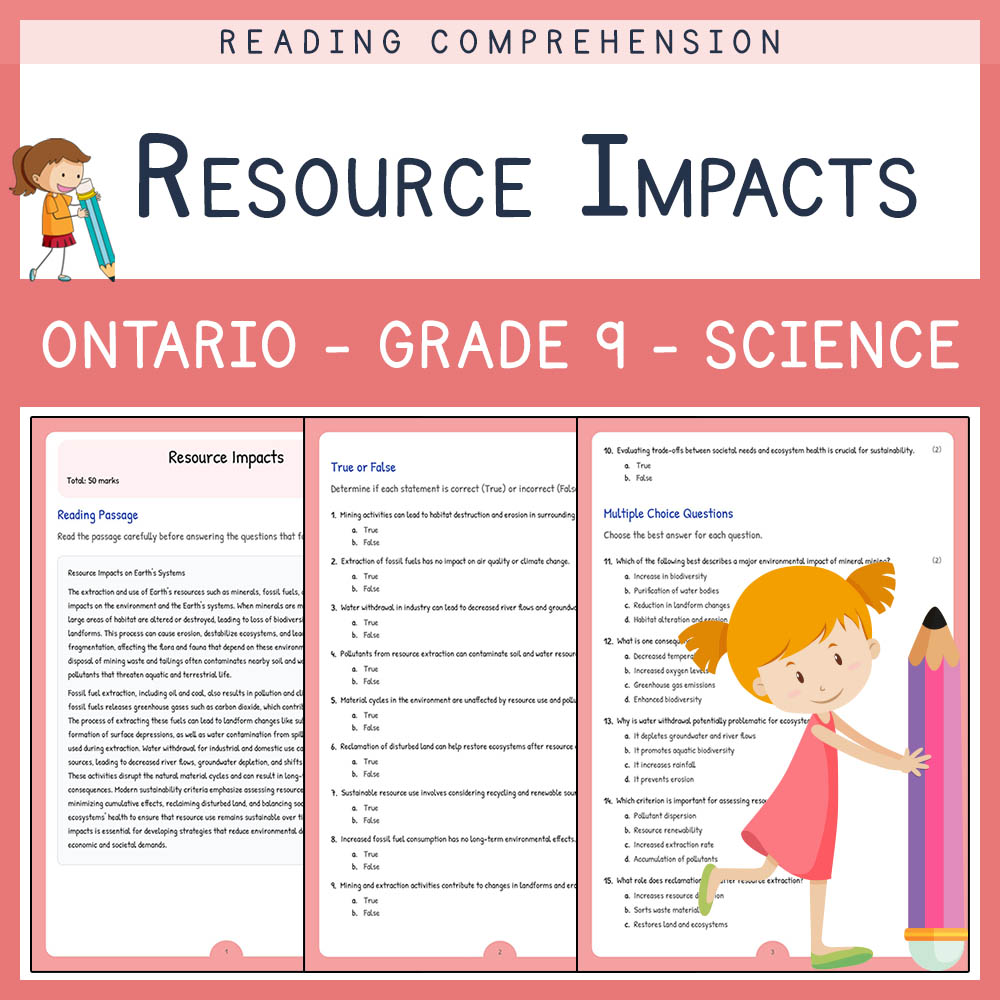
Grade 9 Science | Resource Impacts Worksheet Elena | Ontario Standards
 Created byLumora Learning
Learning Objectives
- Understand how resource extraction impacts ecosystems and landforms.
- Identify the effects of pollution and material cycle shifts due to resource use.
- Evaluate criteria for sustainability including renewability and environmental effects.
Instant download
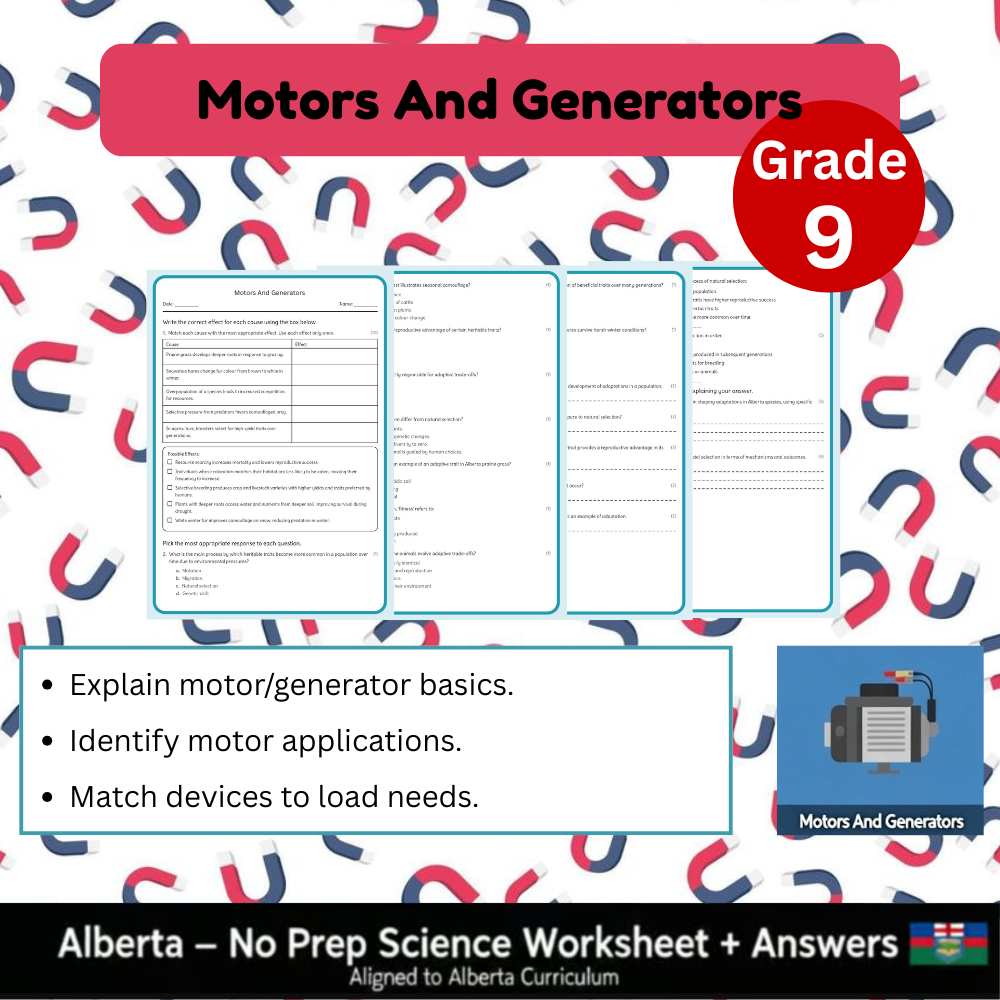
Grade 9 Science | Motors and Generators Practice Worksheet (PDF)
Created byBright Mind ResourcesLearning Objectives
- Describe the basic principles of how electric motors and generators operate.
- Identify different types of motors and their applications.
- Match performance characteristics of electromagnetic devices to load requirements.
Instant download
About Grade 9 Science Worksheets
Find Science worksheets built for Grade 9. All 6,986 cover core skills, practice, and review, each an instant PDF download.
Every worksheet on MyTeachingSheets is created by independent teacher-authors and reviewed before publication. All resources download as printable PDFs for classroom, homework, or at-home practice, and many include answer keys. Preview any worksheet free before buying.