
Grade 9 Science Worksheets
6,986 worksheets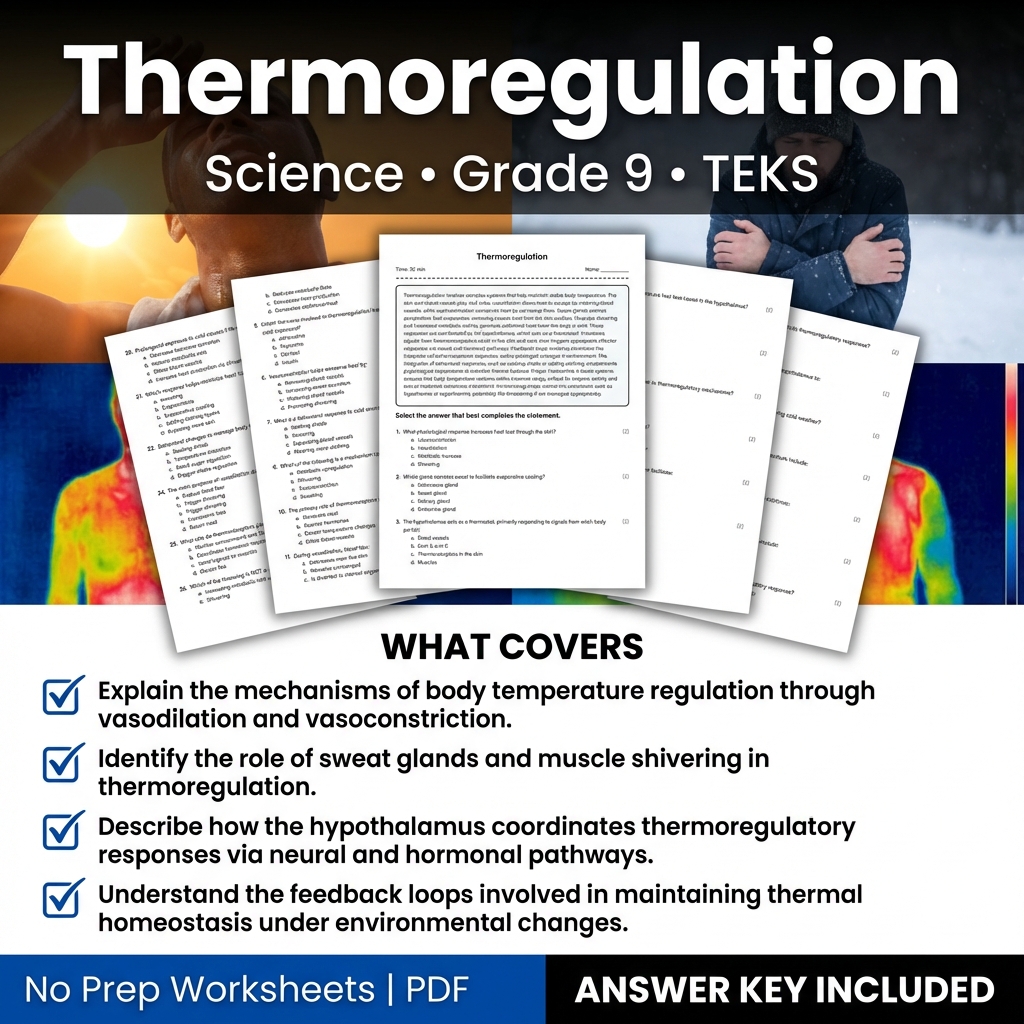
Thermoregulation Worksheet for Grade 9 Science | Standard Practice PDF
 Created byCoral Reef Learning
Learning Objectives
- Explain the mechanisms of body temperature regulation through vasodilation and vasoconstriction.
- Identify the role of sweat glands and muscle shivering in thermoregulation.
- Describe how the hypothalamus coordinates thermoregulatory responses via neural and hormonal pathways.
Instant download
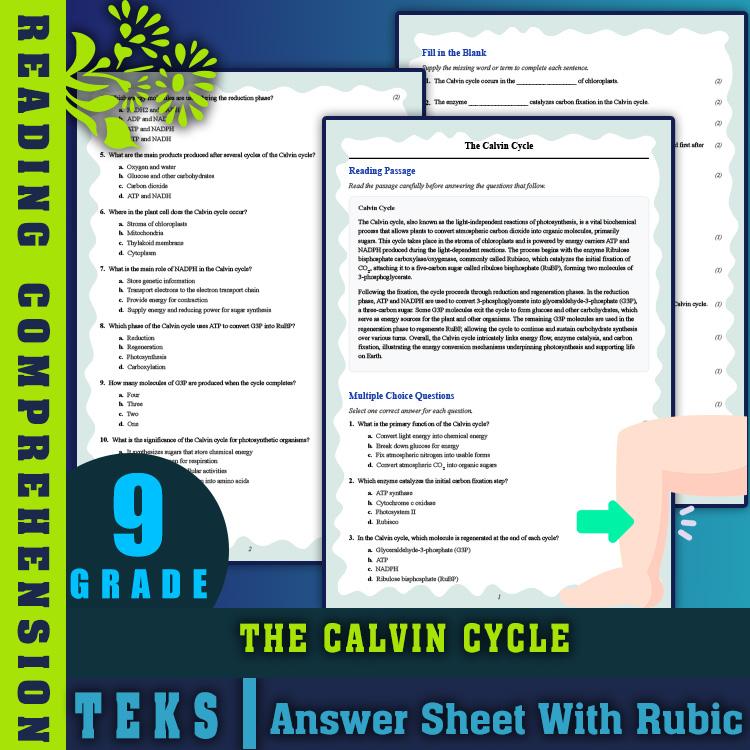
9th Grade Science | The Calvin Cycle Reading Worksheet & Answer Key (PDF)
JCreated byJ.S SheetsLearning Objectives
- Understand the main processes of the Calvin cycle and their significance in photosynthesis.
- Identify the key enzymes and molecules involved in the Calvin cycle.
- Describe how energy from ATP and NADPH is utilized to synthesize sugars during photosynthesis.
Instant download
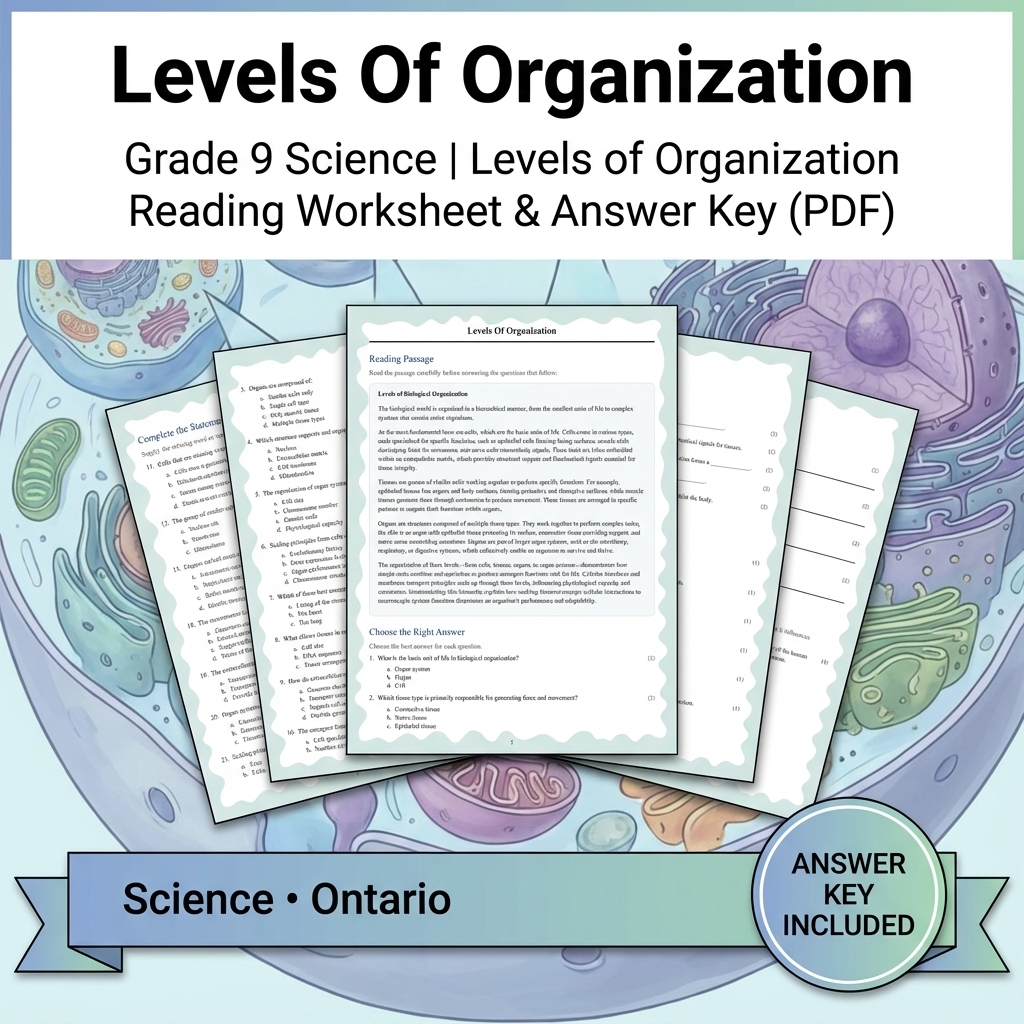
Grade 9 Science | Levels of Organization Reading Worksheet & Answer Key (PDF)
JCreated byJ.S SheetsLearning Objectives
- Explain hierarchical relationships among cells, tissues, organs, and systems using canonical examples.
- Describe how cell specialization and extracellular matrices produce emergent organ functions.
- Understand how tissue arrangement supports organ-level processes and their role in physiological capacity.
Also included in: Grade 9 Science Unit Bundle | Human Body Systems & Cell Functions +1 more
Instant download
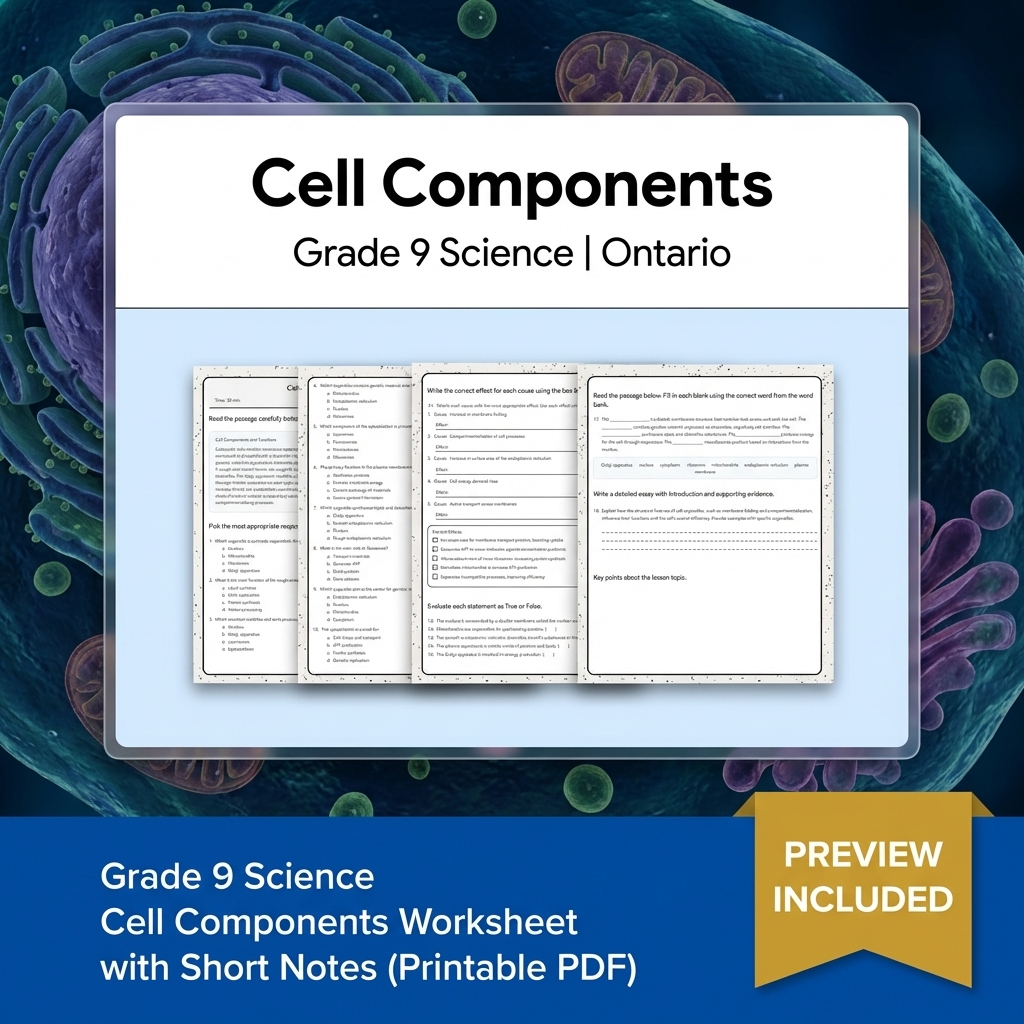
Grade 9 Science Cell Components Worksheet with Short Notes (Printable PDF)
 Created byMeadowlark Worksheets
Learning Objectives
- Identify major organelles of eukaryotic cells and their functions.
- Understand how membrane structures influence metabolic rates and exchange.
- Relate cell structure features to their specific roles in the cell.
Instant download

Grade 9 Science – Energy Profiles & Chemical Reactions | Daily Reading Worksheet
 Created byBright Mind Resources
Learning Objectives
- Understand the concept of energy profiles for chemical reactions.
- Identify exothermic and endothermic reactions from energy diagrams.
- Describe the significance of activation energy and transition states.
Also included in: Grade 9 Chemical Reactions Science Lesson Bundle: Daily Reading (BC) +1 more
Instant download

Grade 9 Science – Limiting Reactants & Reactions | Daily Reading Worksheet
Created byBright Mind ResourcesLearning Objectives
- Define limiting reactant in a chemical reaction
- Identify the limiting reactant from initial quantities
- Differentiate between theoretical and actual yields
Also included in: Grade 9 Chemical Reactions Science Lesson Bundle: Daily Reading (BC) +1 more
Instant download

Grade 9 Science – Atomic Particles & Structure | Daily Reading Worksheet
Created byBright Mind ResourcesLearning Objectives
- Identify the main subatomic particles within an atom (protons, neutrons, electrons).
- Understand the location of protons, neutrons, and electrons inside an atom.
- Explain how the number of protons determines an element.
Also included in: Grade 9 Chemical Reactions Science Lesson Bundle: Daily Reading (BC) +1 more
Instant download
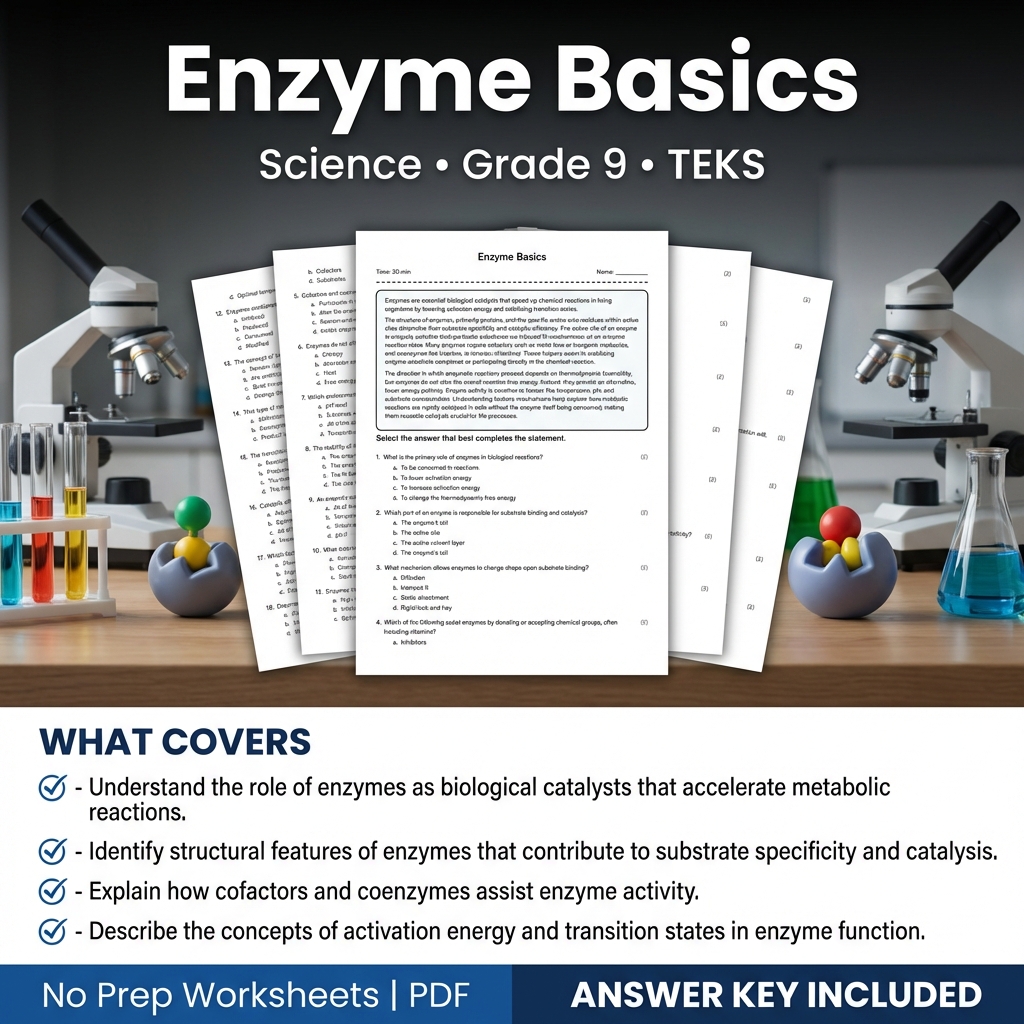
Grade 9 Science Worksheet on Enzyme Basics | TEKS Aligned Practice
Created byCoral Reef LearningLearning Objectives
- Understand the role of enzymes as biological catalysts that accelerate metabolic reactions.
- Identify structural features of enzymes that contribute to substrate specificity and catalysis.
- Explain how cofactors and coenzymes assist enzyme activity.
Instant download
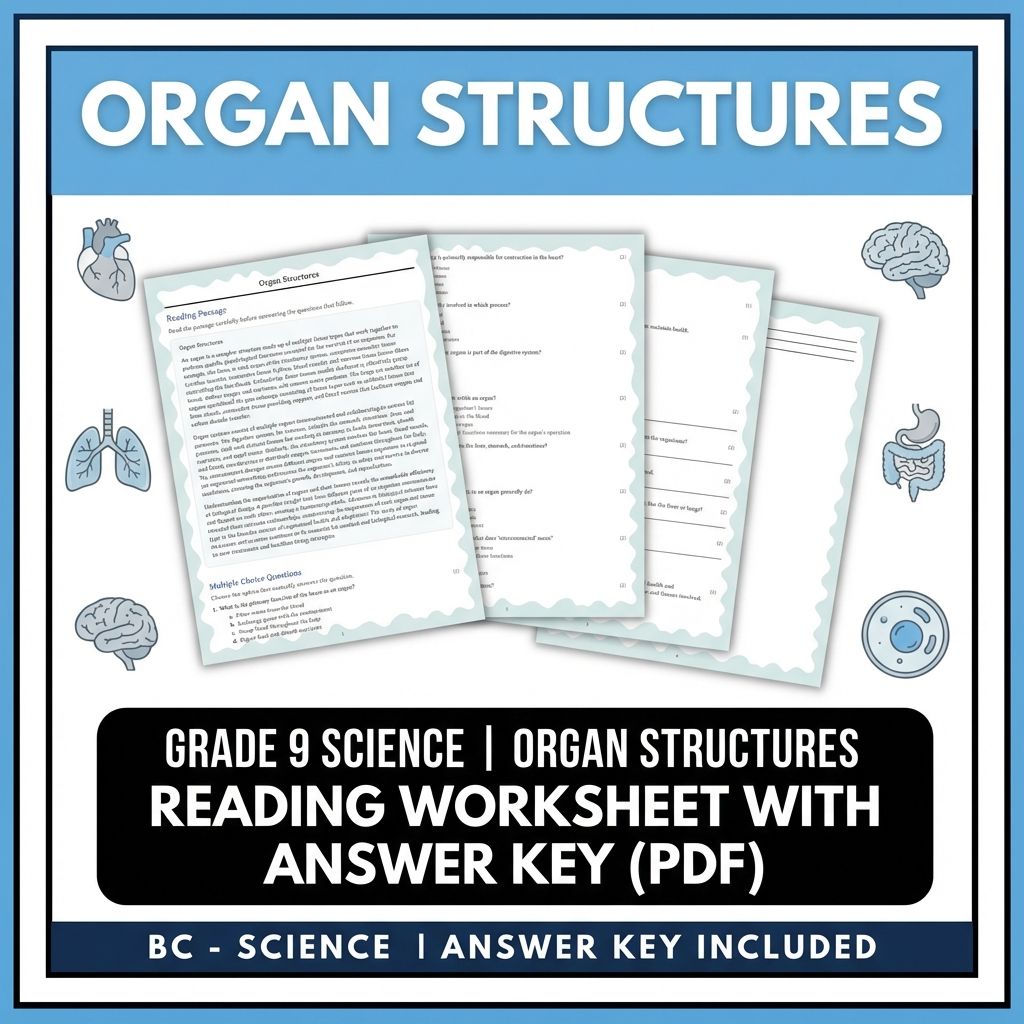
Grade 9 Science | Organ Structures Reading Worksheet with Answer Key (PDF)
JCreated byJ.S SheetsLearning Objectives
- Understand the composition and functions of different organs in the human body.
- Identify the types of tissues that make up organs.
- Explain how organs work together within organ systems to sustain life.
Instant download
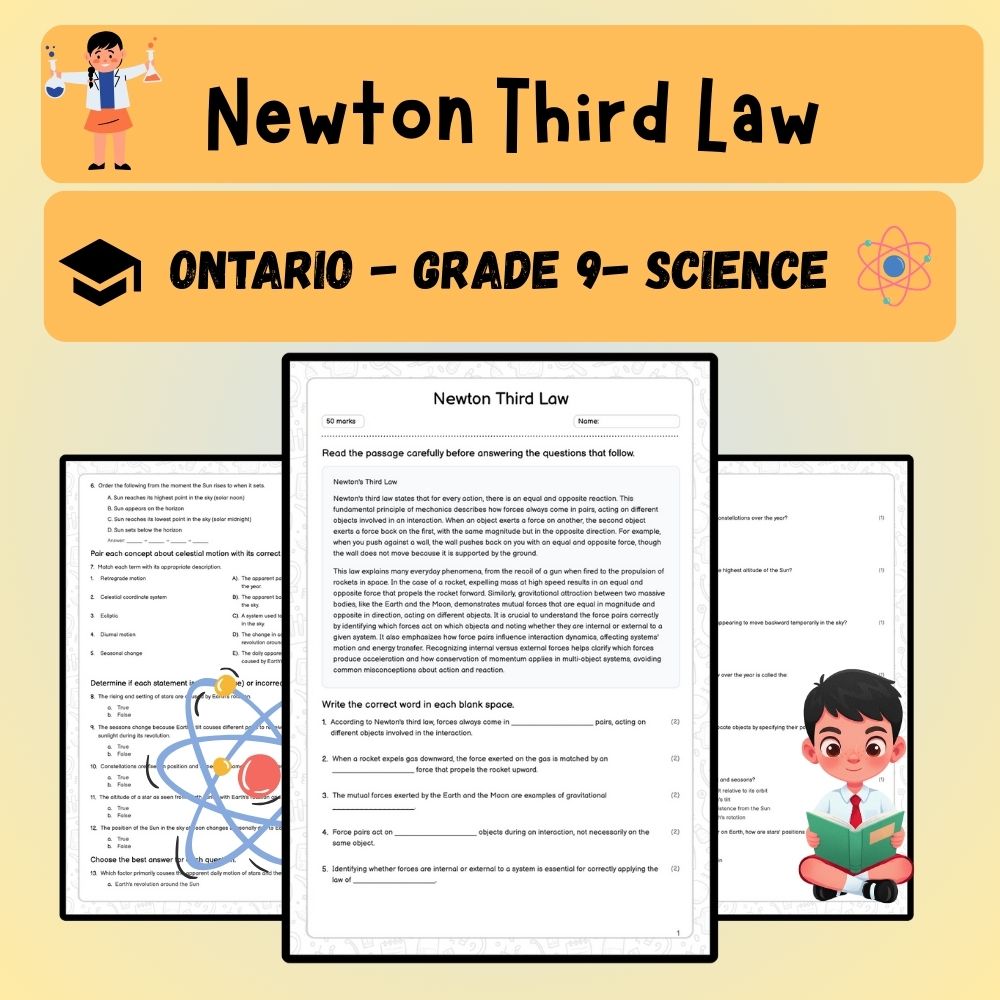
Grade 9 Science | Newton Third Law Worksheet (Worksheet + Answer Key) – Ontario Standards
 Created byPrism Point Learning
Learning Objectives
- Explain the principle of Newton's third law and identify action–reaction force pairs in various scenarios.
- Analyze common phenomena involving equal and opposite forces applied to different objects.
- Differentiate between internal and external forces when applying Newtonian mechanics to systems.
Also included in: Grade 9 Science Unit | Forces, Motion & Energy Worksheets (Ontario Standards) +1 more
Instant download
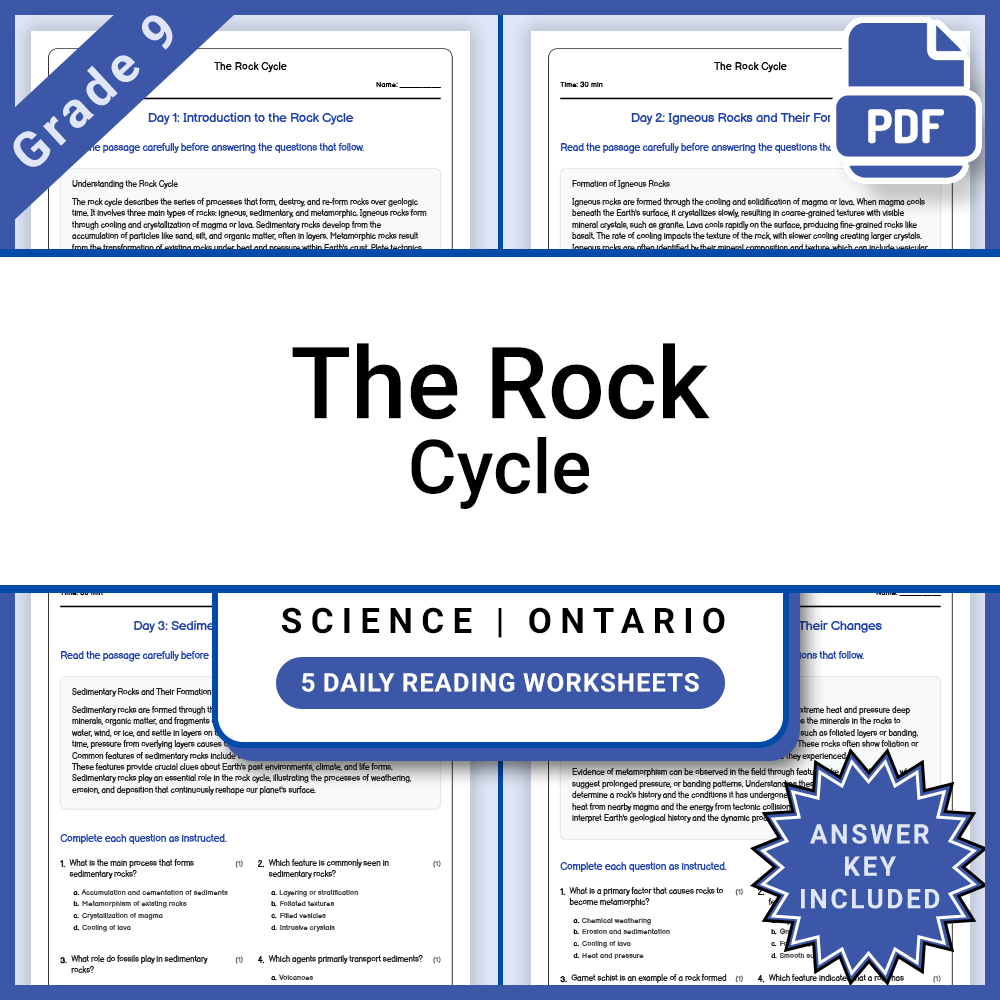
Grade 9 Science – The Rock Cycle Daily Reading Worksheet + Answer Key
JCreated byJ.S SheetsLearning Objectives
- Understand the components and processes involved in the rock cycle
- Identify different types of rocks and how they transform
- Recognize observable evidence of rock cycle processes in the field
Also included in: Grade 9 Science Lesson Group Bundle – Earth Systems & Planetary Concepts +1 more
Instant download

Endothermic and Exothermic Reactions Worksheets | Grade 9 Science
 Created byTeachers Club
Learning Objectives
- Explain energy changes during chemical reactions at the molecular level
- Classify reactions as endothermic or exothermic using evidence
- Interpret ΔH and connect its sign to reaction type
Also included in: Grade 9 Science Worksheets: From Molecules to Organisms NGSS Bundle +1 more
Instant download

Trophic Structure Worksheet | Grade 9 Science Practice
Created byPrism Point LearningLearning Objectives
- Explain how trophic levels (producers, consumers, decomposers) connect through feeding relationships in food chains and webs.
- Describe how energy flow and matter cycling move through trophic groups.
- Evaluate how trophic efficiency and trophic cascades affect ecosystem productivity and species abundance.
Instant download
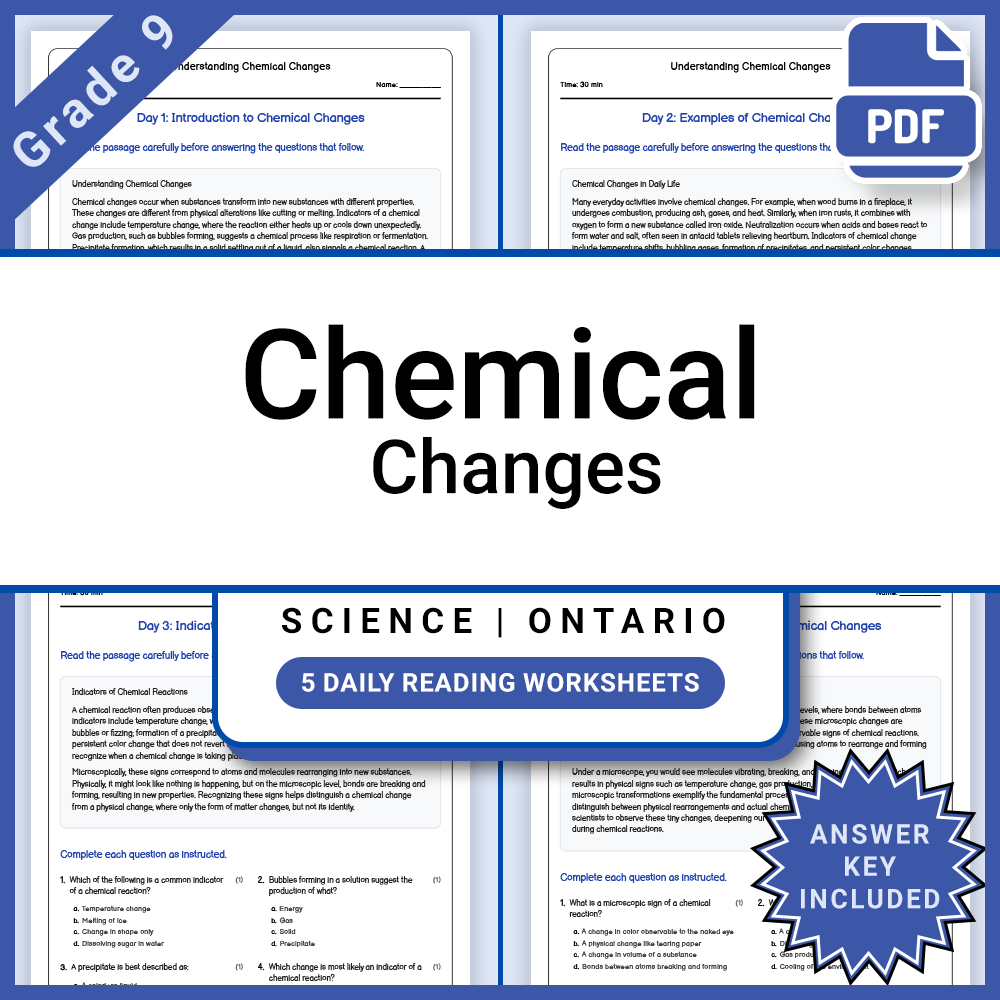
Grade 9 Science – Chemical Changes Daily Reading Worksheet + Answer Key
JCreated byJ.S SheetsLearning Objectives
- Identify signs of chemical reactions
- Differentiate between physical and chemical changes
- Recognize common indicators such as temperature change, gas production, precipitate formation, and colour change
Also included in: Grade 9 Science Lesson Group: Ontario Curriculum Daily Reading Worksheets +1 more
Instant download
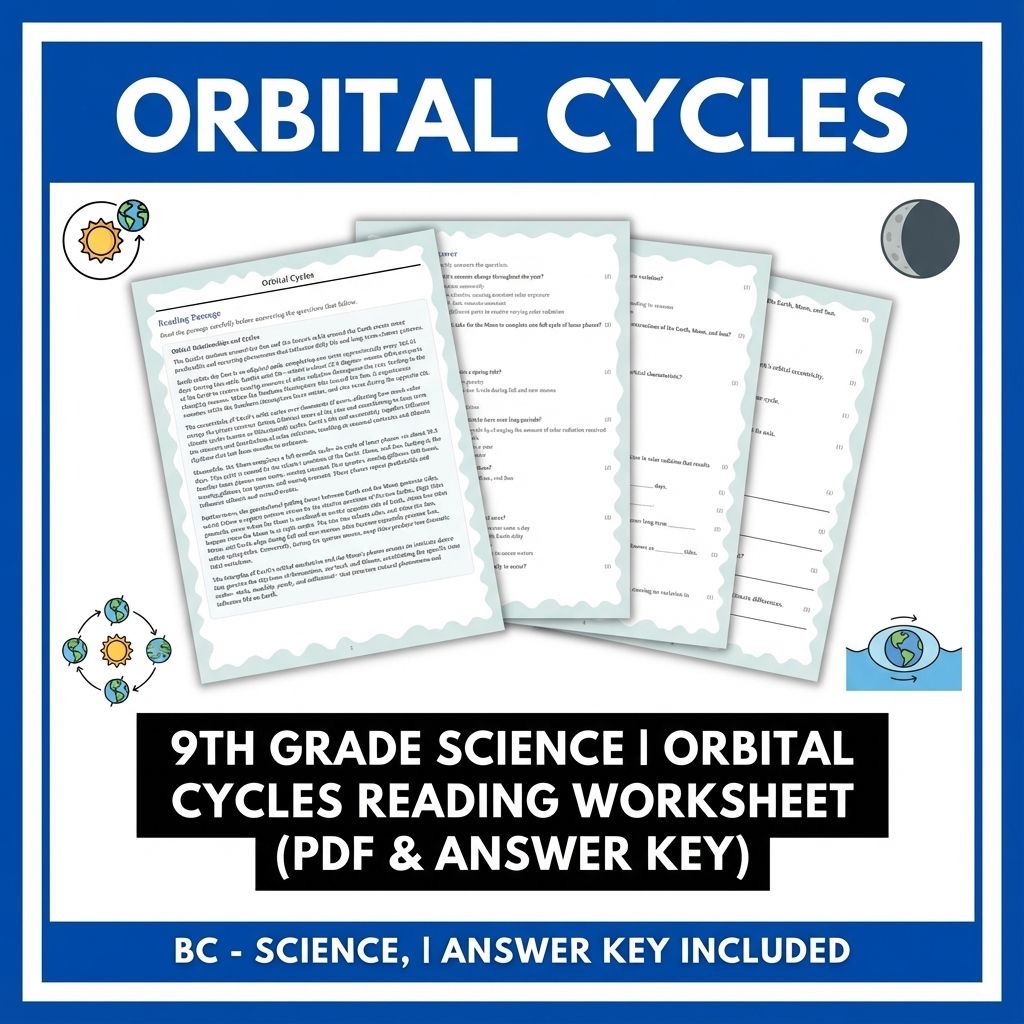
9th Grade Science | Orbital Cycles Reading Worksheet (PDF & Answer Key)
JCreated byJ.S SheetsLearning Objectives
- Explain the orbital relationships among Earth, Sun, and Moon and how they produce phenomena such as seasons, lunar phases, and tides.
- Describe how Earth's axial tilt and orbital eccentricity influence seasonal and climate patterns.
- Identify the causes and predict the patterns of lunar phases and tidal cycles.
Instant download

Grade 9 Science | Control Criteria in Scientific Experiments - Reading Comp.
Created byCoral Reef LearningLearning Objectives
- Understand the importance of variable isolation in experimental design.
- Identify how replication and baseline characterization contribute to causal inference.
- Recognize the impact of uncontrolled variation and residual confounding on experiment validity.
Also included in: Science Practices Lesson Bundle – Grade 9 Science, Advanced Placement Reading +1 more
Instant download
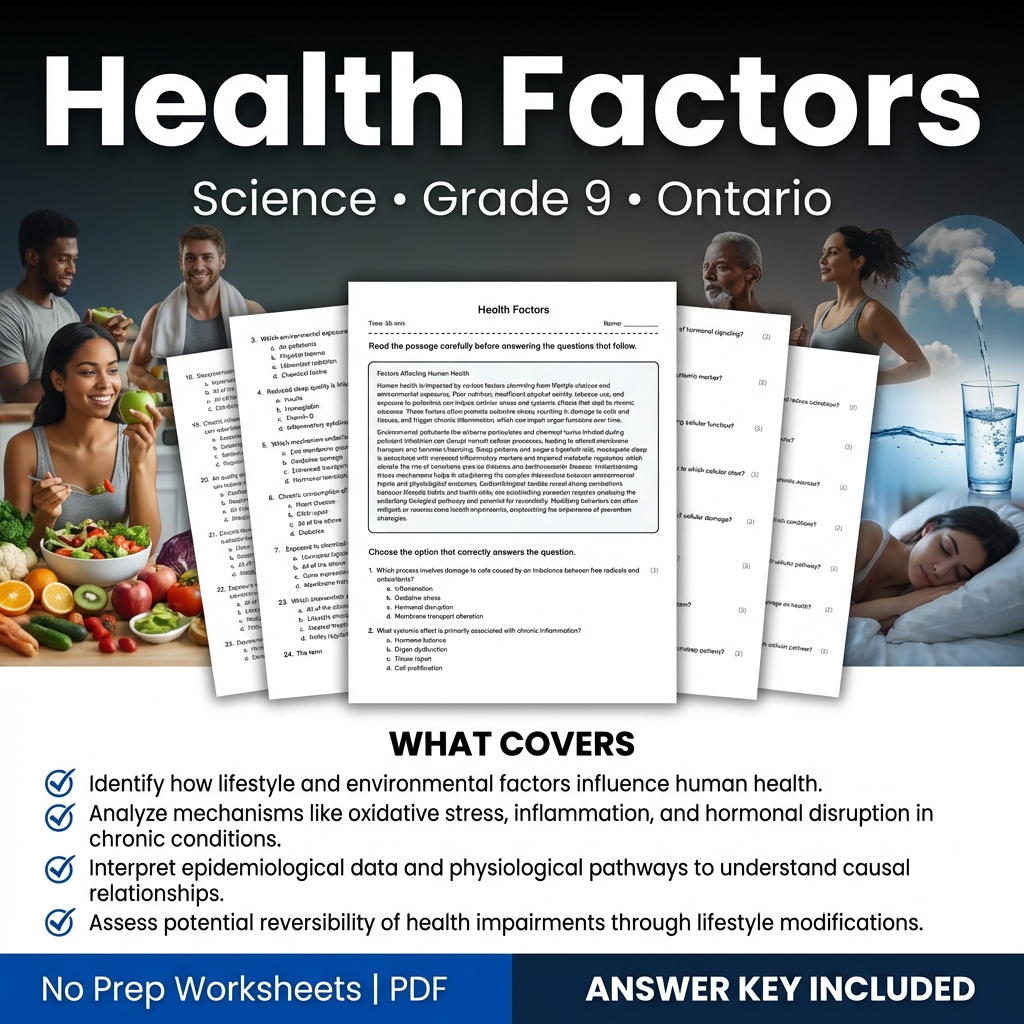
Health Factors Worksheet for Grade 9 Science | Ontario Standards
Created byCoral Reef LearningLearning Objectives
- Identify how lifestyle and environmental factors influence human health.
- Analyze mechanisms like oxidative stress, inflammation, and hormonal disruption in chronic conditions.
- Interpret epidemiological data and physiological pathways to understand causal relationships.
Instant download
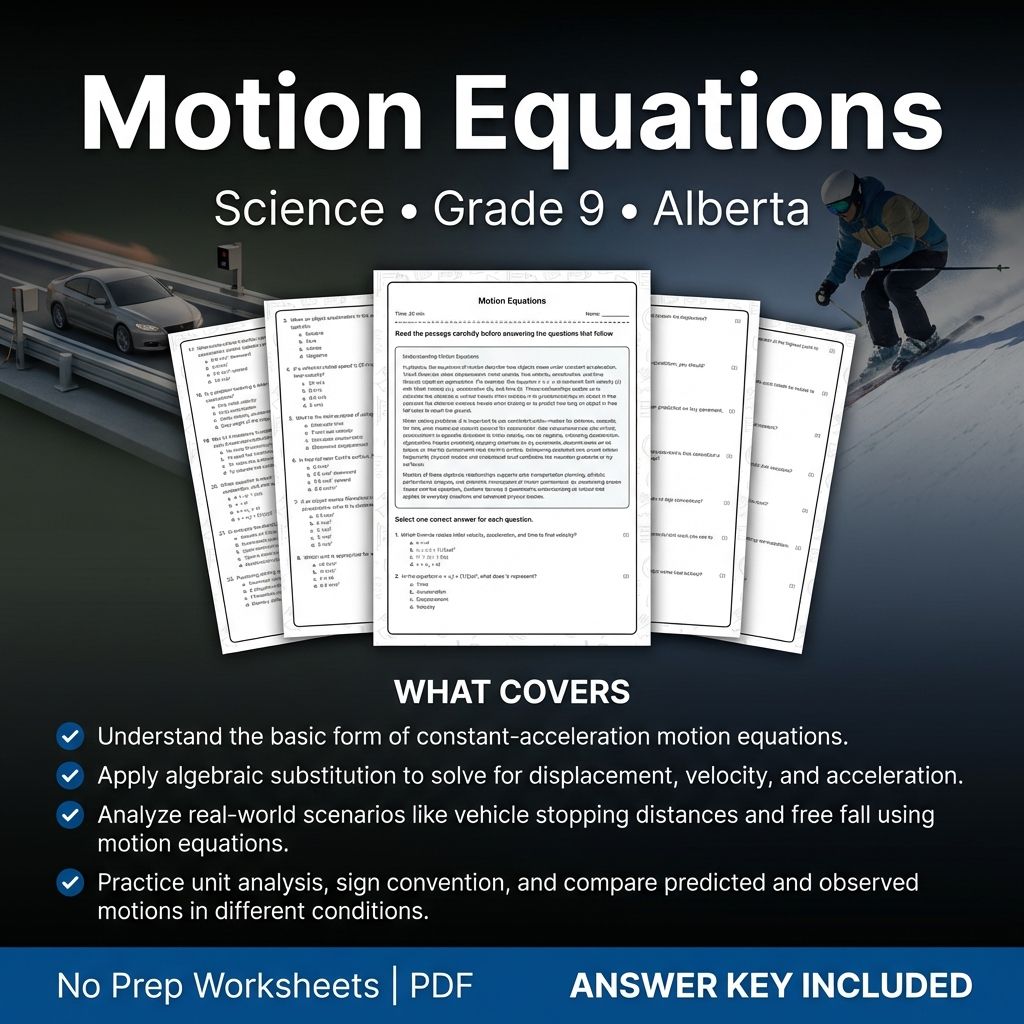
Motion Equations Worksheet | Grade 9 Science | Alberta Standards
Created byCoral Reef LearningLearning Objectives
- Understand the basic form of constant-acceleration motion equations.
- Apply algebraic substitution to solve for displacement, velocity, and acceleration.
- Analyze real-world scenarios like vehicle stopping distances and free fall using motion equations.
Instant download
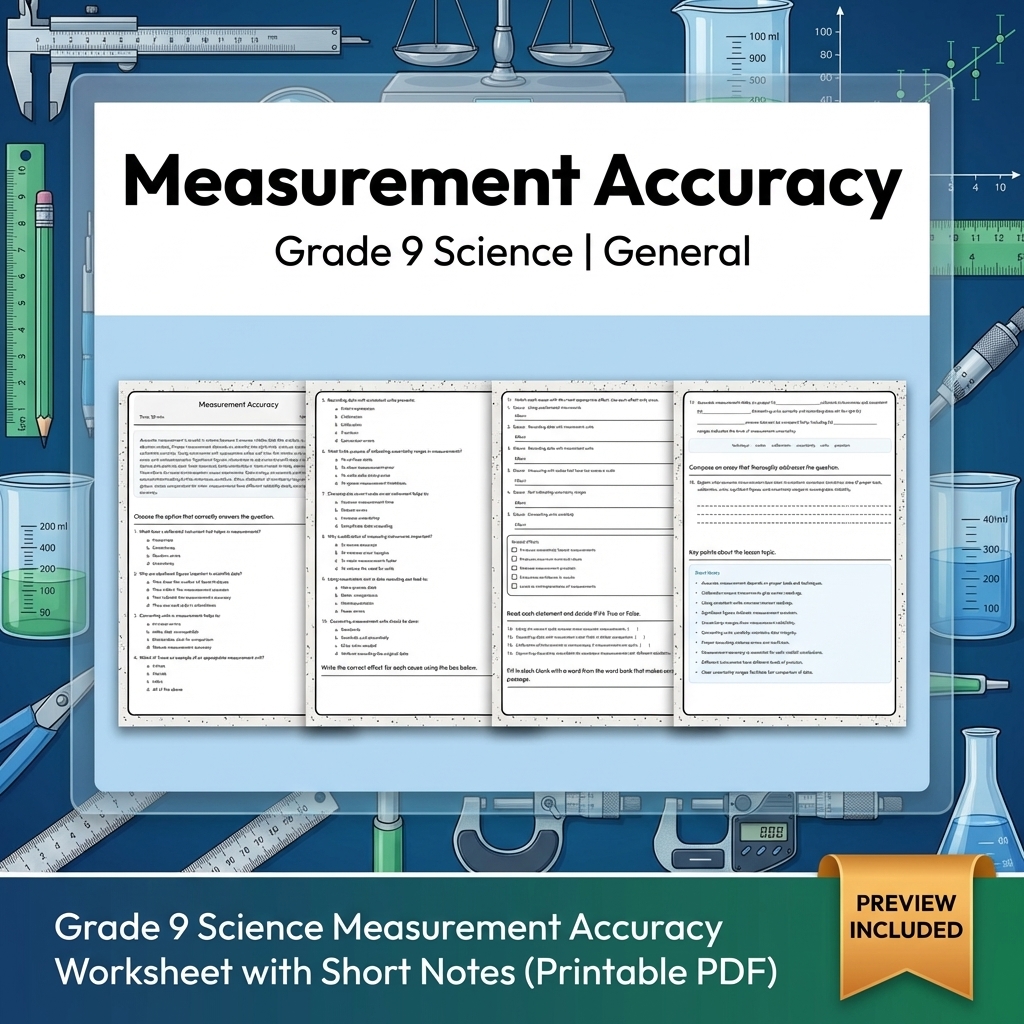
Grade 9 Science Measurement Accuracy Worksheet with Short Notes (Printable PDF)
Created byMeadowlark WorksheetsLearning Objectives
- Understand the importance of appropriate scales, calibration, and units in measurement.
- Explain how significant figures reflect measurement precision.
- Convert between units accurately and record data consistently.
Also included in: Grade 9 Science Uncertainty & Measurement Lesson Bundle: General Framework +1 more
Instant download
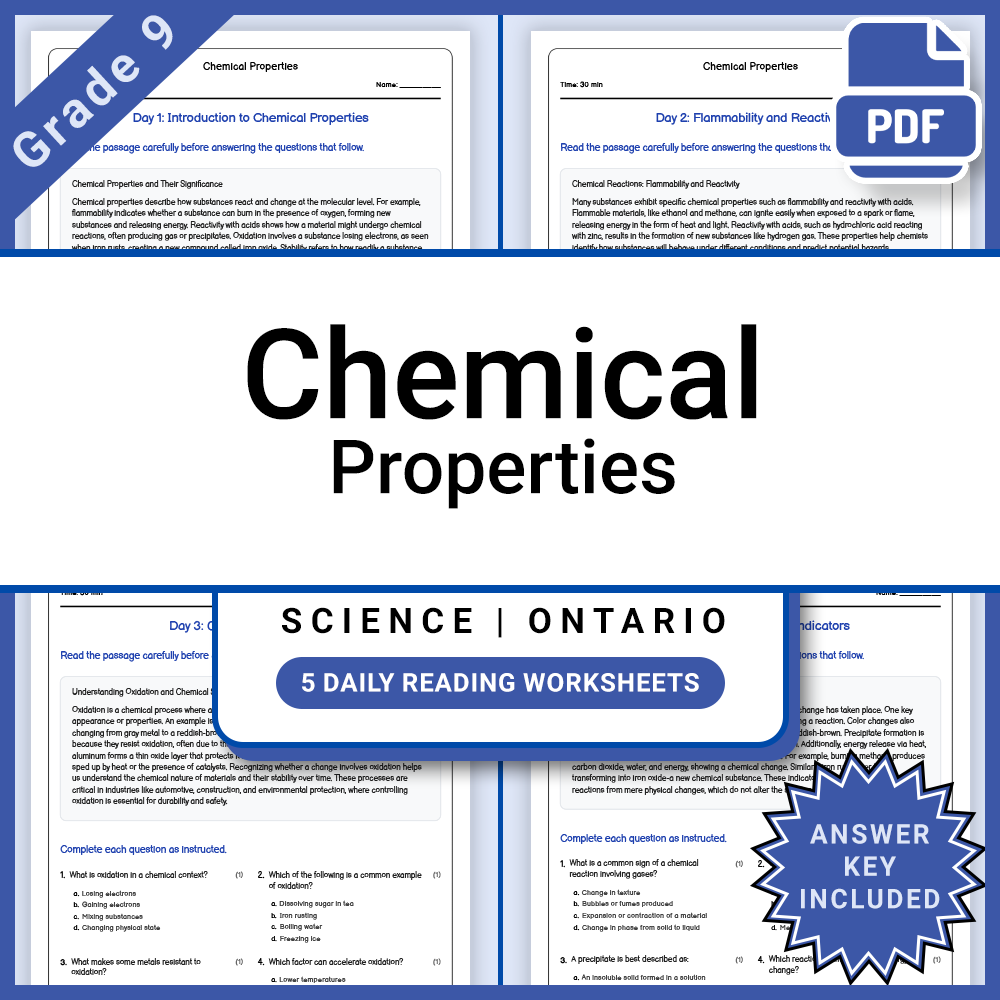
Grade 9 Science – Chemical Properties Daily Reading Worksheet + Answer Key
JCreated byJ.S SheetsLearning Objectives
- Define chemical properties and distinguish them from physical changes.
- Identify examples of chemical properties such as flammability, reactivity with acids, oxidation, and stability.
- Interpret reaction products, gas evolution, precipitate formation, and color changes as indicators of chemical transformations.
Also included in: Grade 9 Science Lesson Group: Ontario Curriculum Daily Reading Worksheets +1 more
Instant download

Grade 9 Science | Circuit Types Worksheet (PDF) – Alberta Standards
 Created bySilver Birch Teaching
Learning Objectives
- Differentiate series and parallel circuit arrangements by describing how current and voltage behave
- Use circuit rules to predict how brightness and load distribution change in series versus parallel circuits
- Interpret simple circuit scenarios involving household wiring and lighting strings
Also included in: Grade 9 Electrical Circuits and Energy Science Lesson Bundle (Alberta) +1 more
Instant download

Grade 9 Science | Motors and Generators Worksheet (Alberta Standards) (PDF)
 Created byEvergreen Desk Education
Learning Objectives
- Explain how electric motors convert electrical energy into mechanical work.
- Describe how generators produce electrical energy using electromagnetic induction.
- Compare motor and generator operation by tracing key energy conversions and magnetic interactions.
Instant download
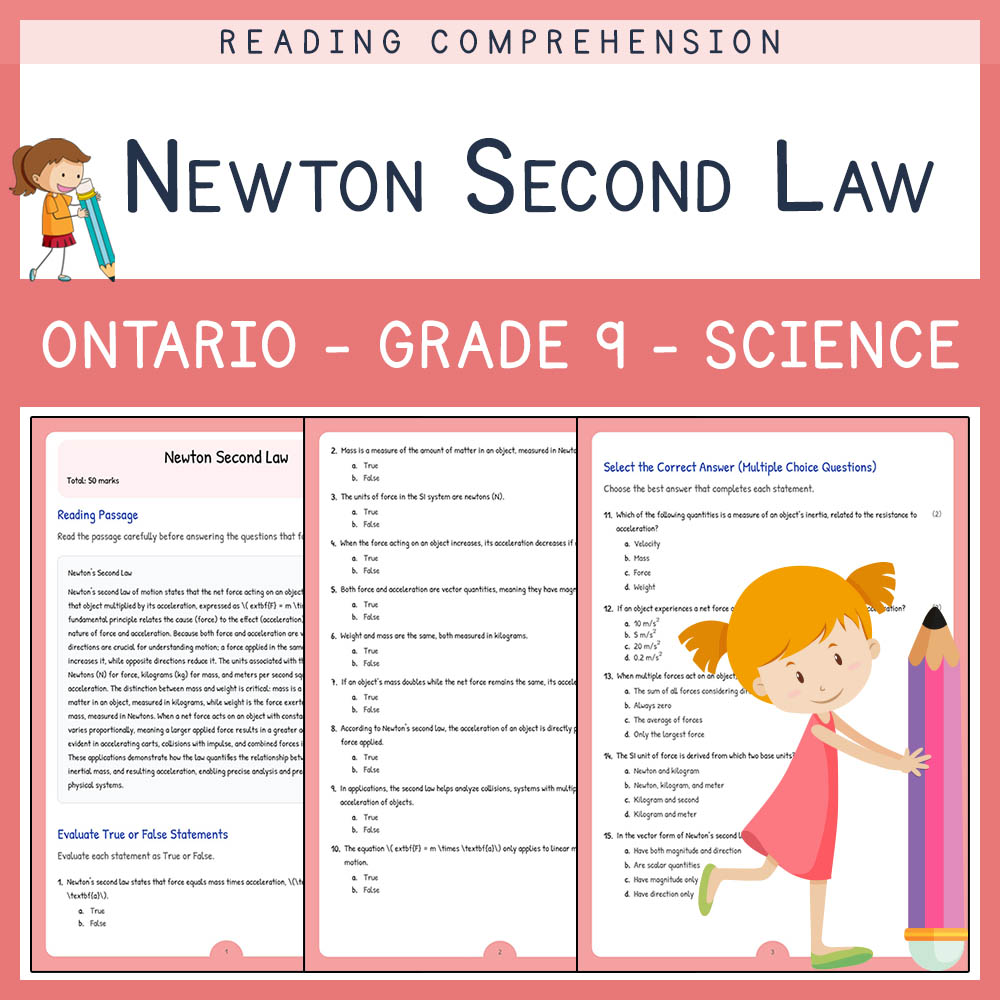
Grade 9 Science Assessment | Newton Second Law Worksheet | Ontario
 Created byLumora Learning
Learning Objectives
- Explain Newton's second law and its formula relating force, mass, and acceleration.
- Differentiate between mass and weight and understand their units.
- Apply the principle of vector quantities in force and acceleration analysis.
Instant download
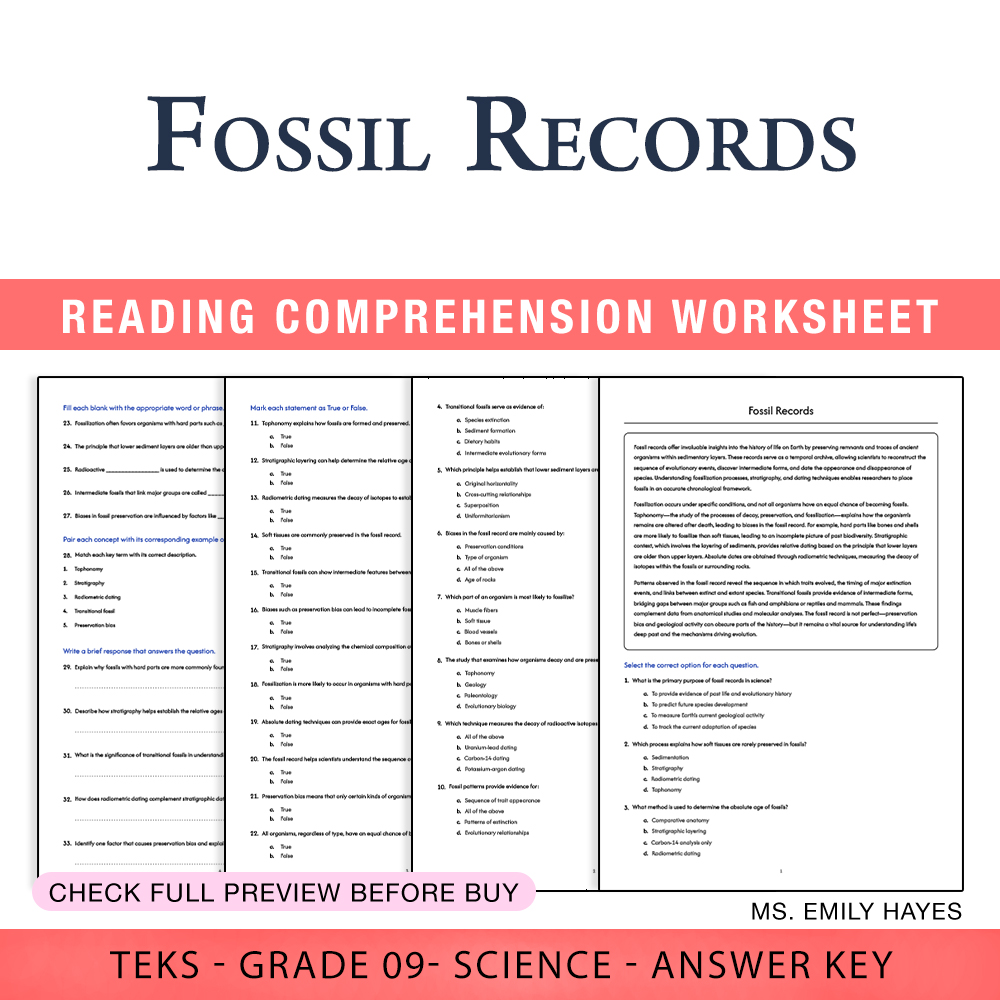
9th Grade Science | Fossil Records Worksheet (PDF+ Answer Key)
 Created byCopper Leaf Classroom
Learning Objectives
- Describe the significance of fossil records in understanding evolutionary history.
- Identify different methods for dating fossils and establishing stratigraphic context.
- Explain how taphonomy and preservation bias influence fossil evidence.
Instant download
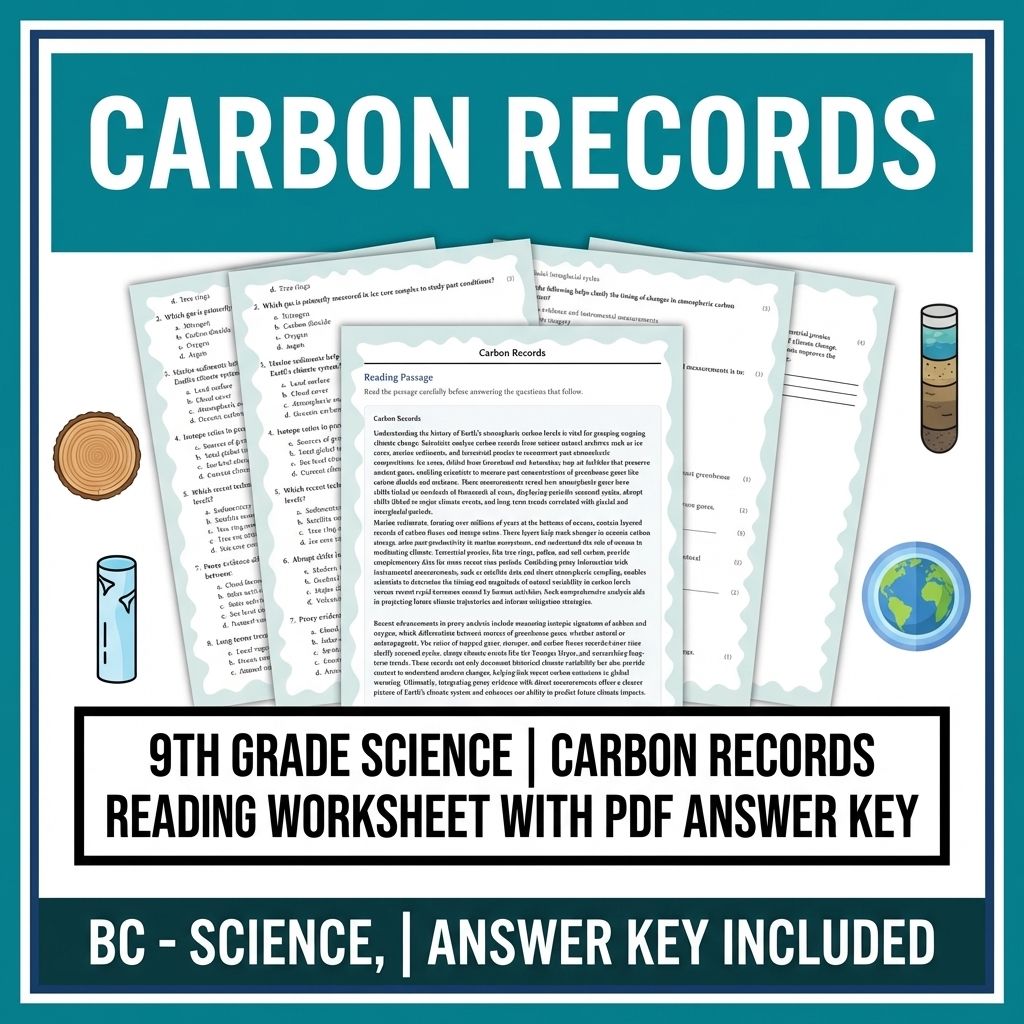
9th Grade Science | Carbon Records Reading Worksheet with PDF Answer Key
JCreated byJ.S SheetsLearning Objectives
- Understand how ice cores, sediments, and proxies inform us about past atmospheric carbon levels.
- Identify the methods used to analyze trapped gases, isotopes, and carbon fluxes in climate research.
- Explain how proxy data and instrumental measurements help distinguish natural variability from recent climate change.
Instant download

Grade 9 Science Worksheet | Microscopy Analysis TEKS (PDF)
Created byEvergreen Desk EducationLearning Objectives
- Interpret microscopy images using scale bars, resolution limits, staining/contrast, and controls
- Differentiate what electron microscopy and fluorescence microscopy can reveal about cells and organelles
- Evaluate claims about cellular processes by comparing image sets over time while accounting for artifacts
Instant download
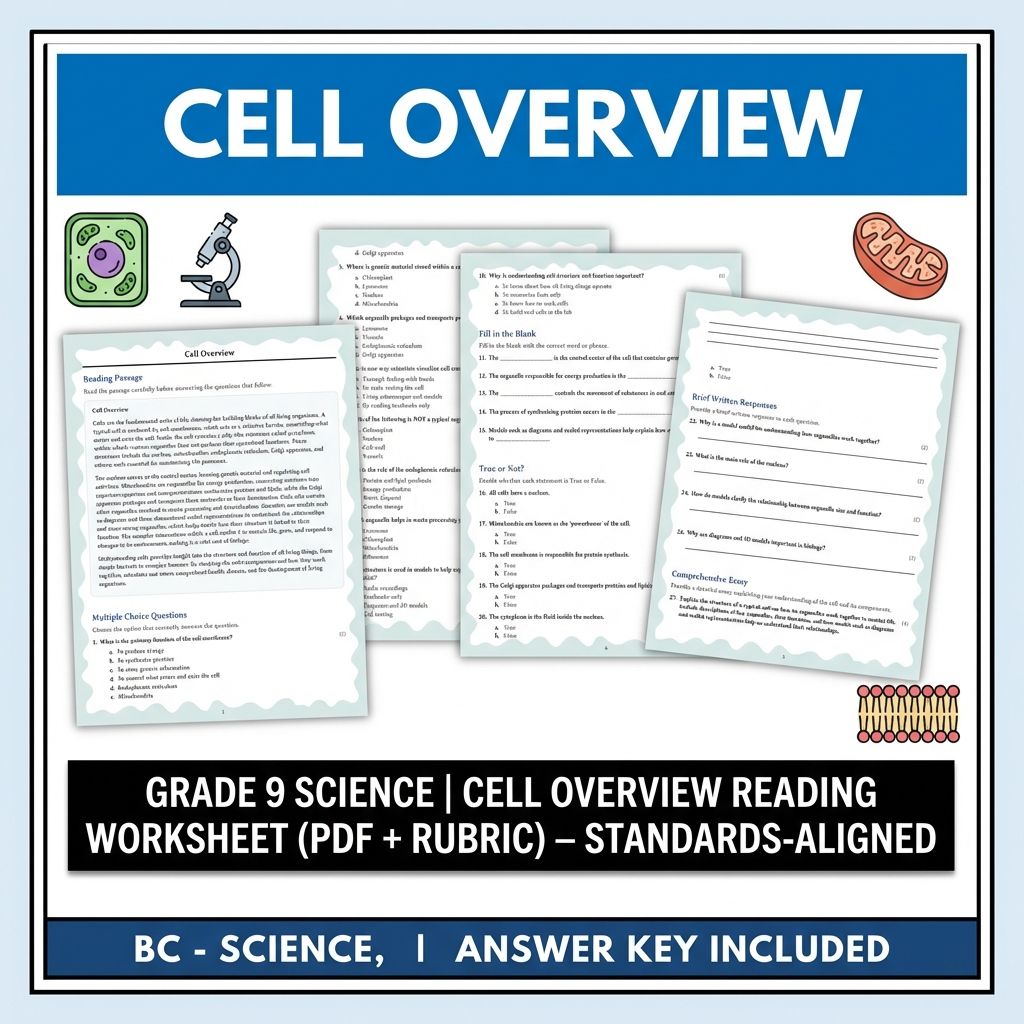
Grade 9 Science | Cell Overview Reading Worksheet (PDF + Rubric)
JCreated byJ.S SheetsLearning Objectives
- Understand the basic structure and functions of a cell.
- Identify the roles of major organelles within a cell.
- Explain how cell structure relates to cell function.
Instant download
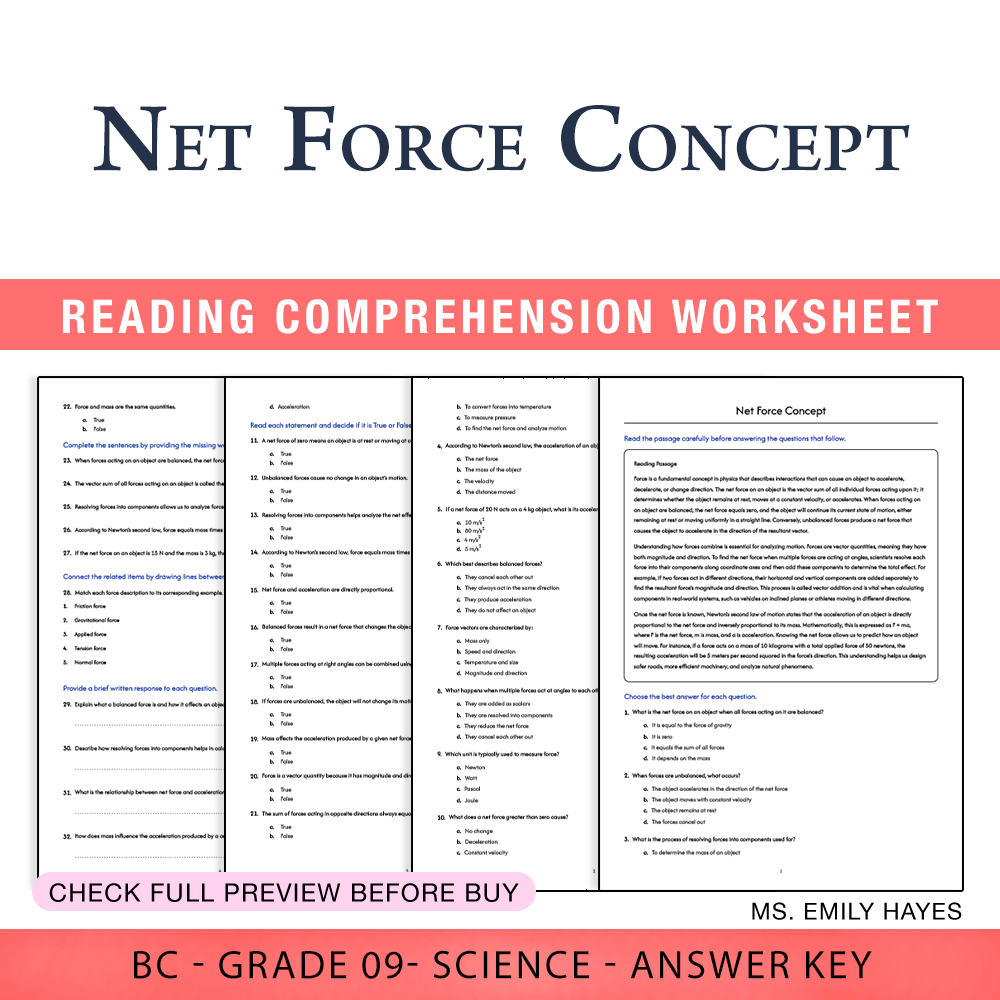
9th Grade Science | Net Force Concept Worksheet (PDF+ Answer Key)
Created byCopper Leaf ClassroomLearning Objectives
- Define and explain the concept of net force and how it affects motion.
- Describe how forces can be resolved into components and summed to find the net effect.
- Calculate the resulting acceleration when given force vectors and mass.
Also included in: Grade 9 Science Worksheet Bundle | Forces, Energy & Motion (PDF + Answer Key) +1 more
Instant download

Grade 9 Science – Earth's Layer Structure Worksheet (Ontario) (PDF)
Created byBright Mind ResourcesLearning Objectives
- Describe Earth's concentric layers, including the crust, mantle, and core.
- Distinguish between lithosphere and asthenosphere in terms of mechanical behavior.
- Explain how density, temperature, and pressure vary with depth in Earth.
Instant download
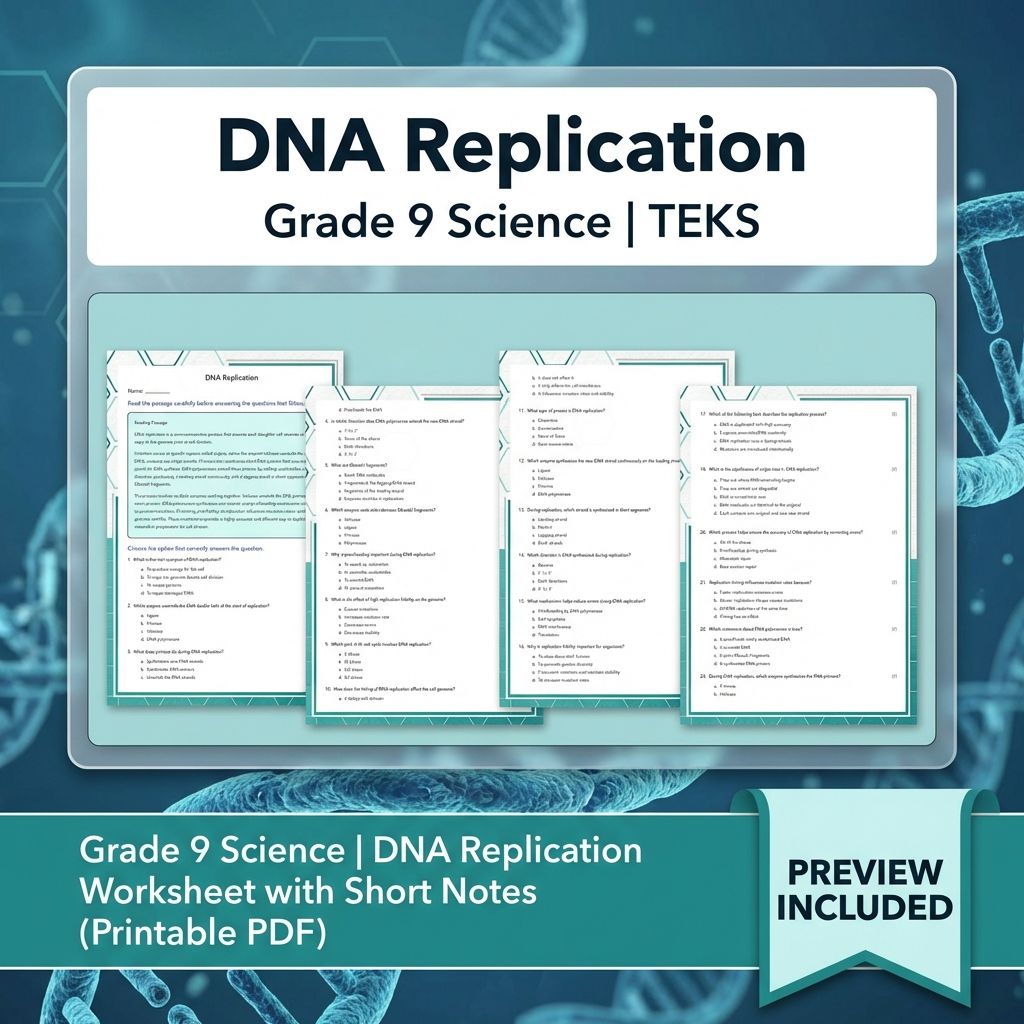
Grade 9 Science | DNA Replication Worksheet with Short Notes (Printable PDF)
Created byMeadowlark WorksheetsLearning Objectives
- Describe the semi-conservative process of DNA replication.
- Identify the roles of enzymes such as helicase, primase, and DNA polymerase in DNA duplication.
- Explain the significance of replication fidelity and timing on genome stability.
Instant download
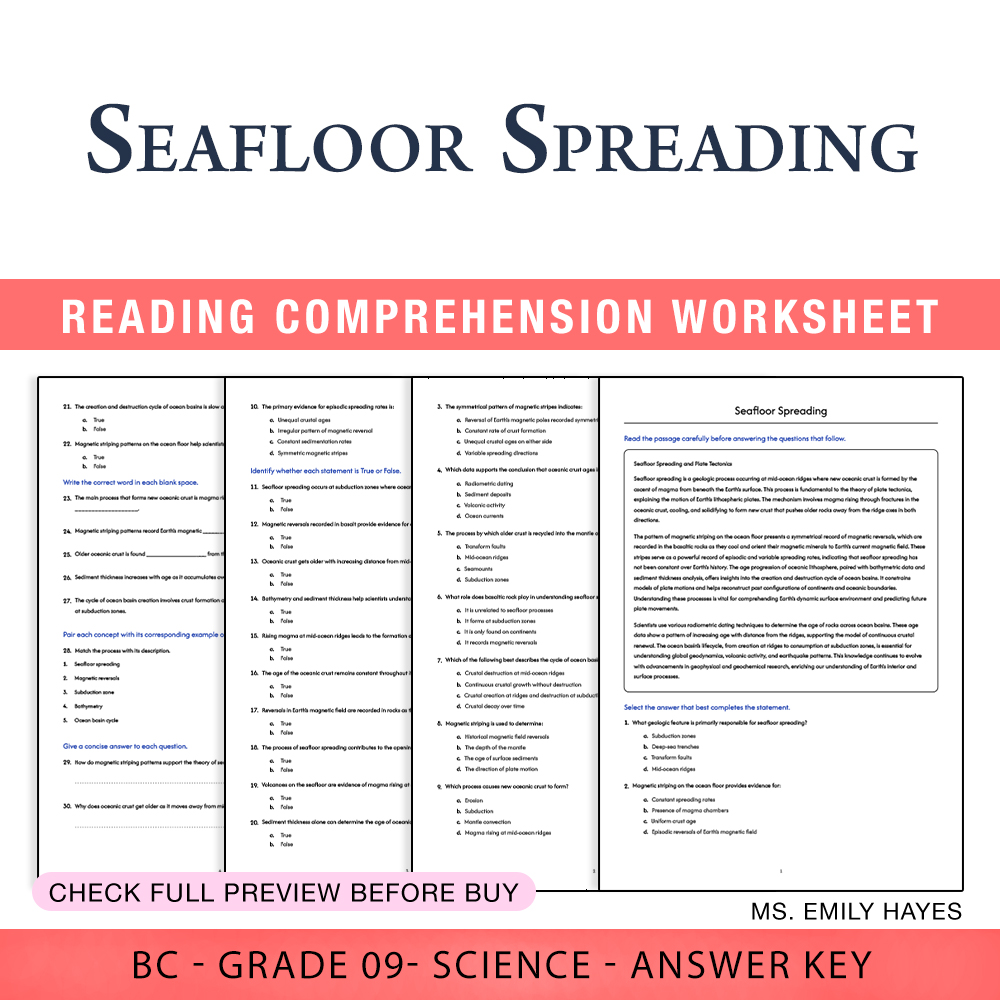
9th Grade Science | Seafloor Spreading Worksheet (PDF+ Answer Key)
Created byCopper Leaf ClassroomLearning Objectives
- Describe the process of seafloor spreading at mid-ocean ridges and how it creates new oceanic crust.
- Explain how magnetic striping provides evidence for episodic spreading rates and plate movements.
- Analyze the age progression of oceanic lithosphere and its implications for ocean basin cycles.
Also included in: Grade 9 Science Worksheet Bundle | Earth's Dynamic Processes (PDF + Answer Key) +1 more
Instant download
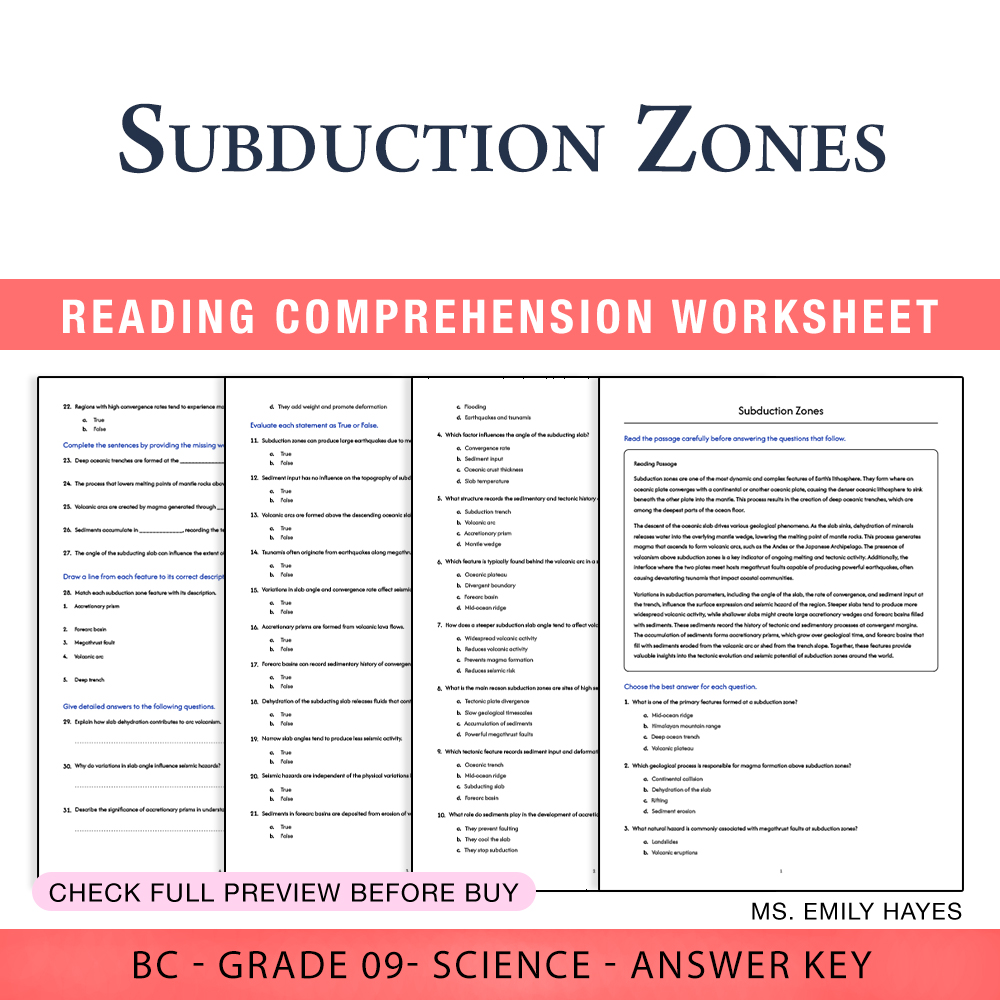
Grade 9 Science | Subduction Zones Worksheet (PDF+ Answer Key)
Created byCopper Leaf ClassroomLearning Objectives
- Understand the geological processes involved in subduction zones and their effects on Earth's surface.
- Identify key features and hazards associated with subduction zones, such as earthquakes, tsunamis, and volcanic activity.
- Explain how variations in subduction parameters influence topography and seismic hazards.
Also included in: Grade 9 Science Worksheet Bundle | Earth's Dynamic Processes (PDF + Answer Key) +1 more
Instant download
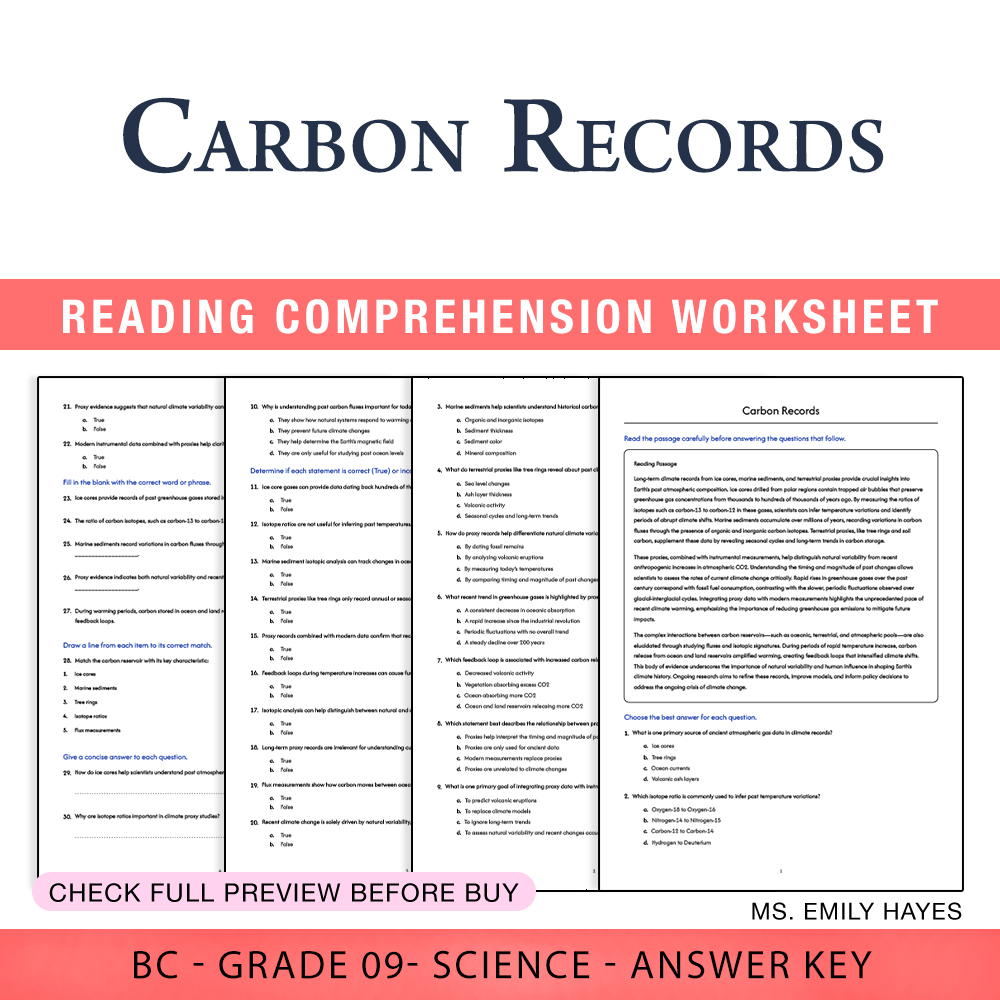
Grade 9 Science | Carbon Records Worksheet (PDF+ Answer Key)
Created byCopper Leaf ClassroomLearning Objectives
- Understand how ice cores, sediments, and proxies record past atmospheric carbon levels.
- Interpret isotope ratios and gas measurements to identify climate patterns and shifts.
- Analyze the relationship between carbon fluxes and global temperature changes.
Also included in: Grade 9 Science Worksheet Bundle | Earth's Dynamic Processes (PDF + Answer Key) +1 more
Instant download
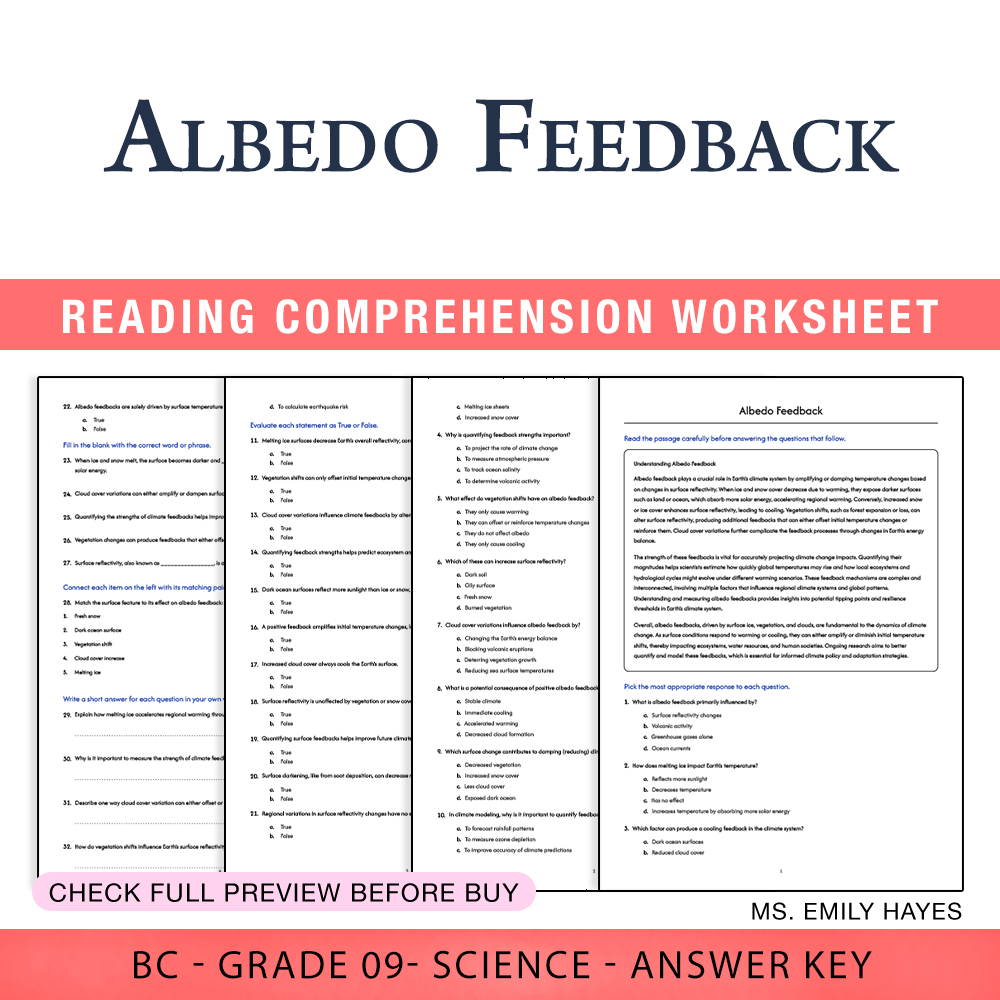
Grade 9 Science | Albedo Feedback Worksheet (PDF+ Answer Key)
Created byCopper Leaf ClassroomLearning Objectives
- Understand the concept of albedo and how surface reflectivity affects climate.
- Identify the various feedback mechanisms related to surface reflectivity changes.
- Analyze the role of ice, snow, vegetation, and clouds in albedo feedback processes.
Also included in: Grade 9 Science Worksheet Bundle | Earth's Dynamic Processes (PDF + Answer Key) +1 more
Instant download
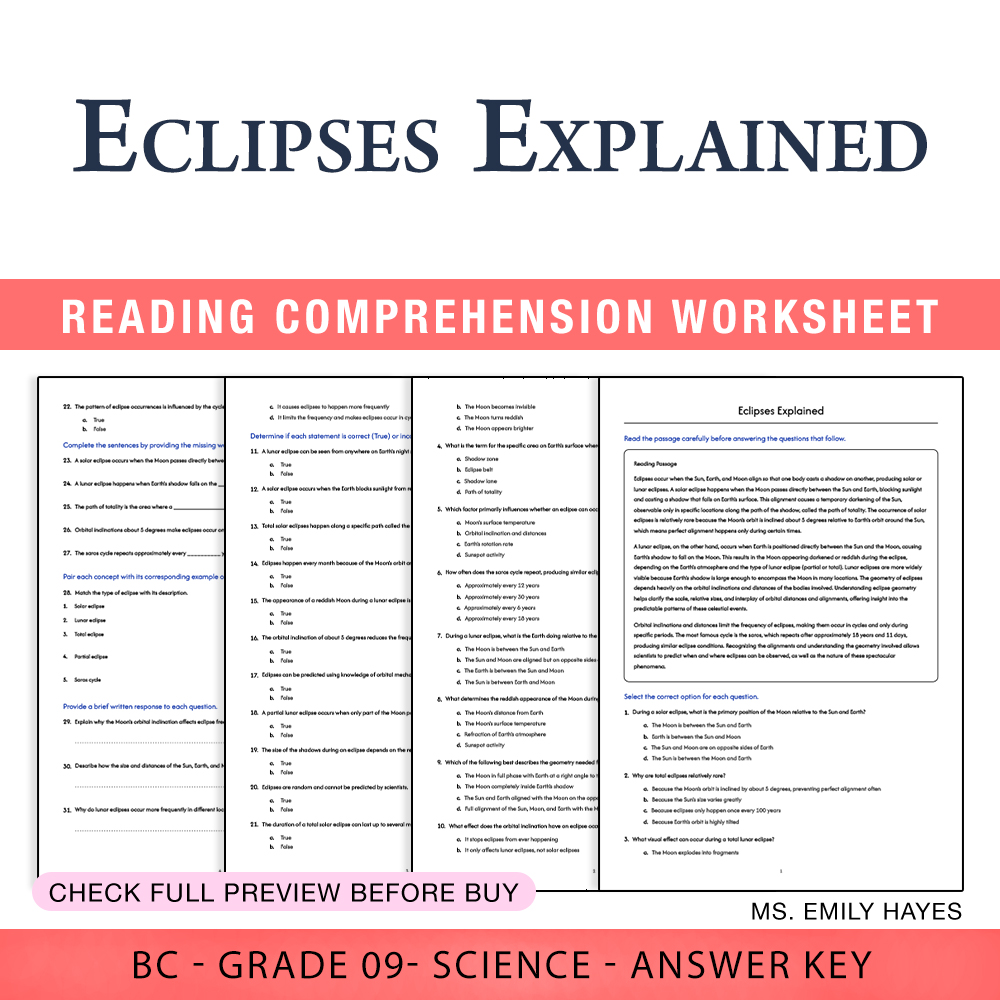
Grade 9 Science | Eclipses Explained Worksheet (PDF+ Answer Key)
Created byCopper Leaf ClassroomLearning Objectives
- Understand the basic geometry of solar and lunar eclipses.
- Identify the positions of the Sun, Earth, and Moon during different types of eclipses.
- Explain how orbital inclinations influence the occurrence and visibility of eclipses.
Also included in: Grade 9 Science Worksheet Bundle | Earth's Dynamic Processes (PDF + Answer Key) +1 more
Instant download
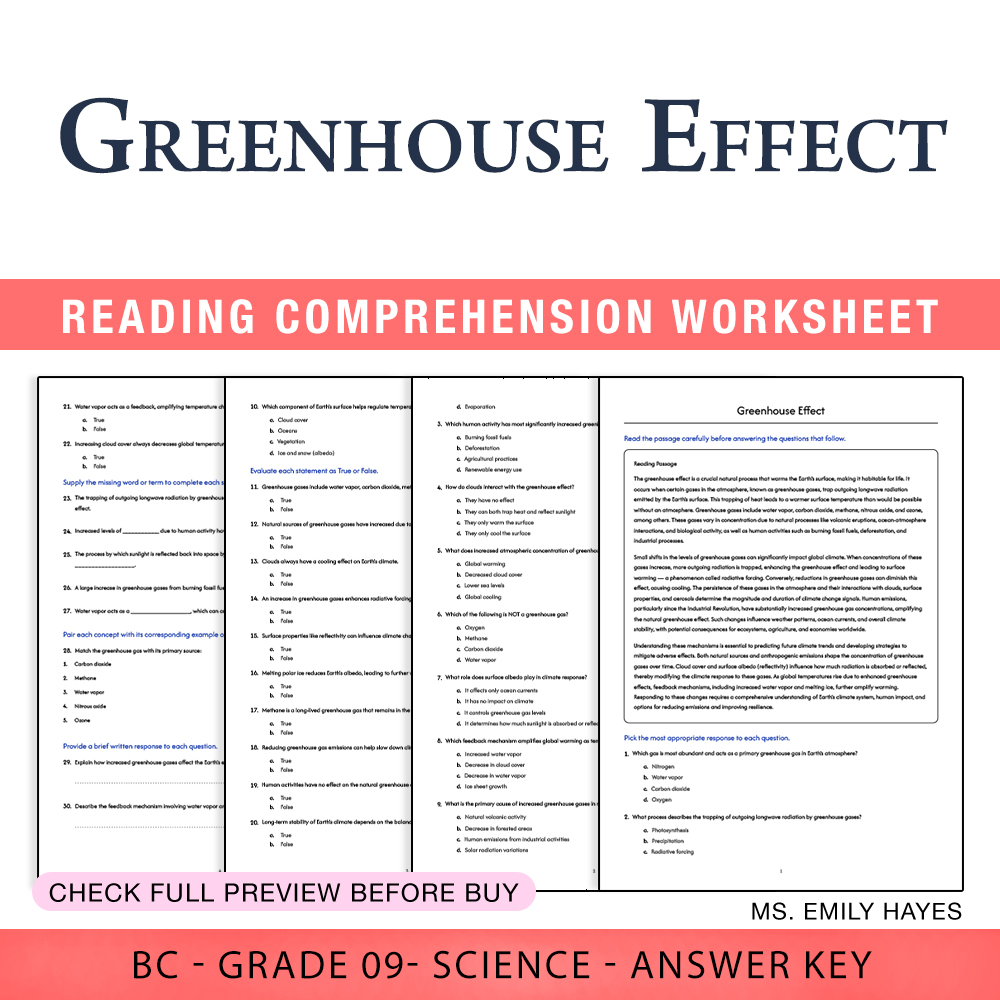
Grade 9 Science | Greenhouse Effect Worksheet (PDF+ Answer Key)
Created byCopper Leaf ClassroomLearning Objectives
- Explain the greenhouse effect and identify key greenhouse gases.
- Analyze how natural and human activities influence Earth's climate.
- Describe how changes in atmospheric composition affect radiative forcing and surface temperature.
Also included in: Grade 9 Science Worksheet Bundle | Earth's Dynamic Processes (PDF + Answer Key) +1 more
Instant download
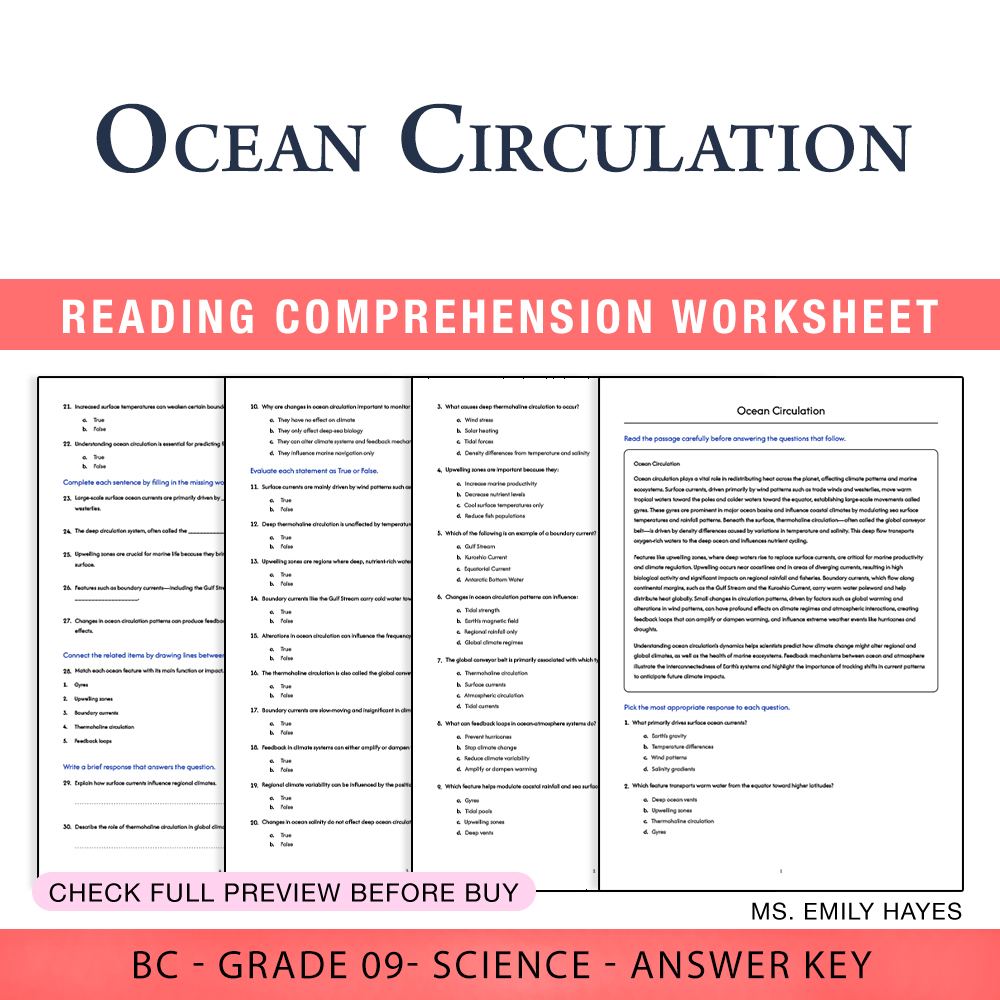
Grade 9 Science | Ocean Circulation Worksheet (PDF+ Answer Key)
Created byCopper Leaf ClassroomLearning Objectives
- Understand the mechanisms driving ocean surface and deep currents.
- Describe features such as gyres, upwelling zones, and boundary currents.
- Explain how ocean circulation influences regional climates and feedback systems.
Also included in: Grade 9 Science Worksheet Bundle | Earth's Dynamic Processes (PDF + Answer Key) +1 more
Instant download
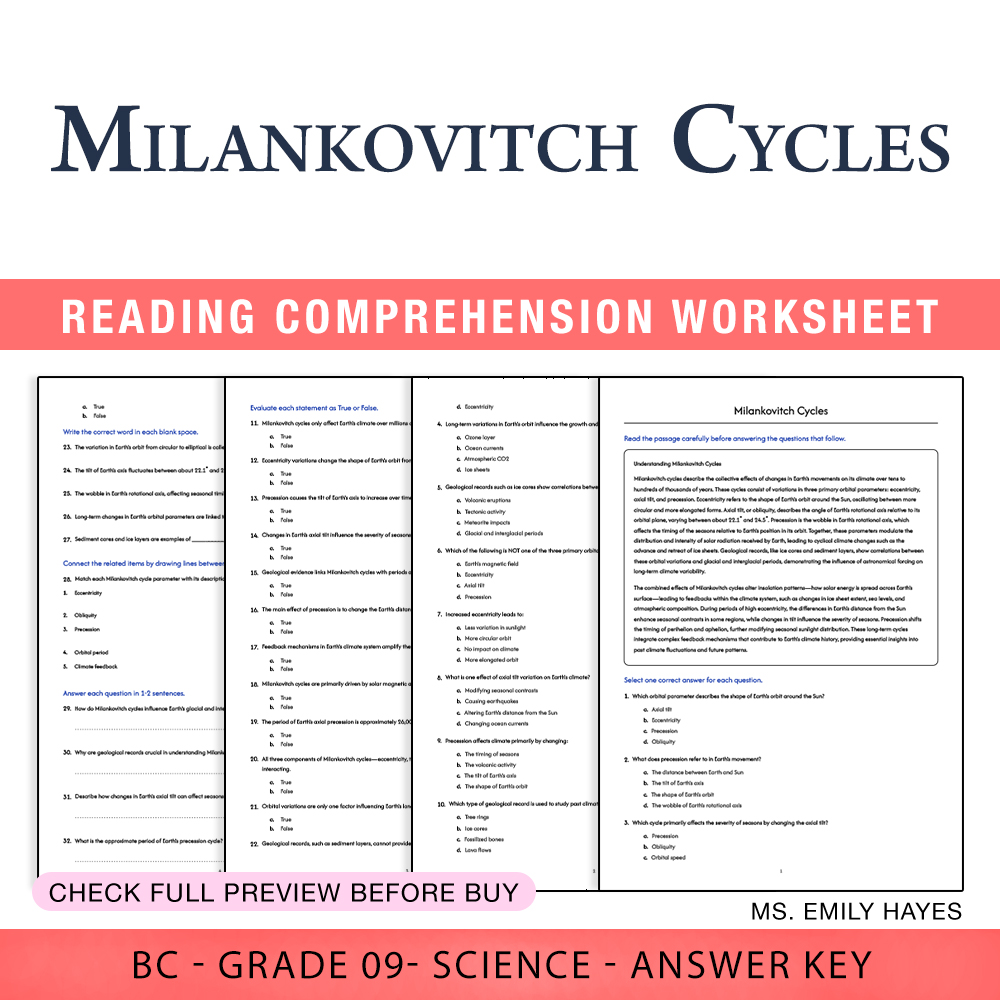
9th Grade Science | Milankovitch Cycles Worksheet (PDF+ Answer Key)
Created byCopper Leaf ClassroomLearning Objectives
- Understand the concept of Milankovitch cycles and their impact on Earth's climate.
- Identify the three main orbital parameters involved in the cycles: eccentricity, axial tilt, and precession.
- Explain how these cycles influence glacial and interglacial periods over long timescales.
Also included in: Grade 9 Science Worksheet Bundle | Earth's Dynamic Processes (PDF + Answer Key) +1 more
Instant download
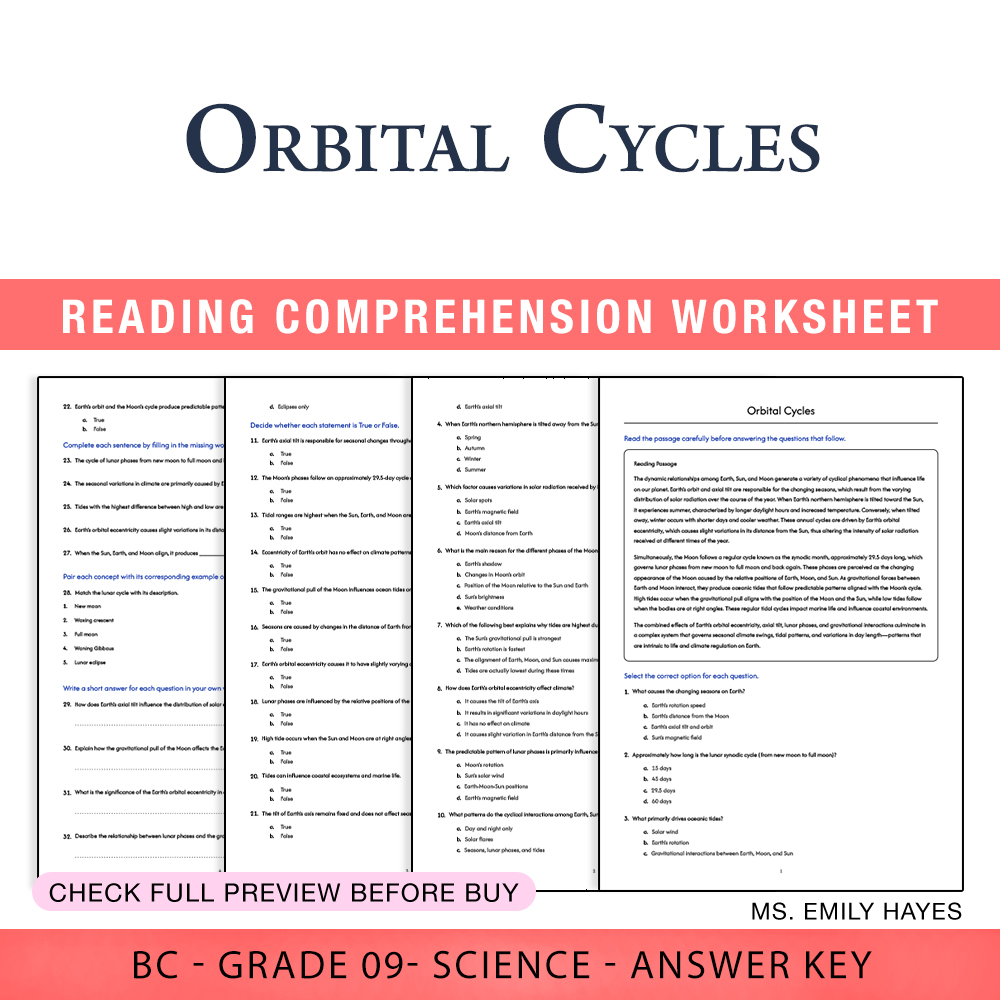
Grade 9 Science | Orbital Cycles Worksheet (PDF+ Answer Key)
Created byCopper Leaf ClassroomLearning Objectives
- Explain how Earth's axial tilt and orbital eccentricity influence seasons and climate cycles.
- Describe the variations in lunar phases and their underlying synodic cycle.
- Analyze how gravitational interactions among Earth, Moon, and Sun produce tidal patterns.
Also included in: Grade 9 Science Worksheet Bundle | Earth's Dynamic Processes (PDF + Answer Key) +1 more
Instant download
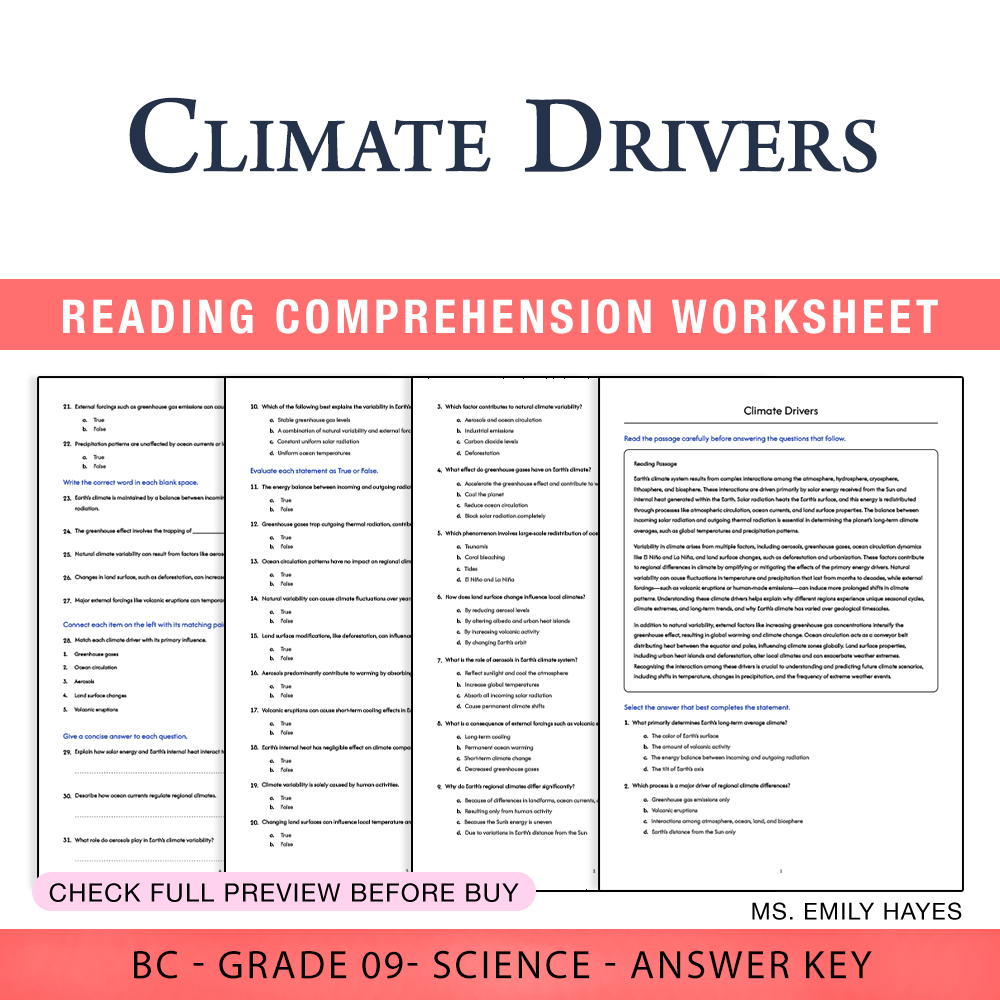
9th Grade Science | Climate Drivers Worksheet (PDF+ Answer Key)
Created byCopper Leaf ClassroomLearning Objectives
- Understand the main components influencing Earth's climate system.
- Identify how energy balance affects climate stability.
- Describe the roles of natural variability and external forcings in climate change.
Also included in: Grade 9 Science Worksheet Bundle | Earth's Dynamic Processes (PDF + Answer Key) +1 more
Instant download
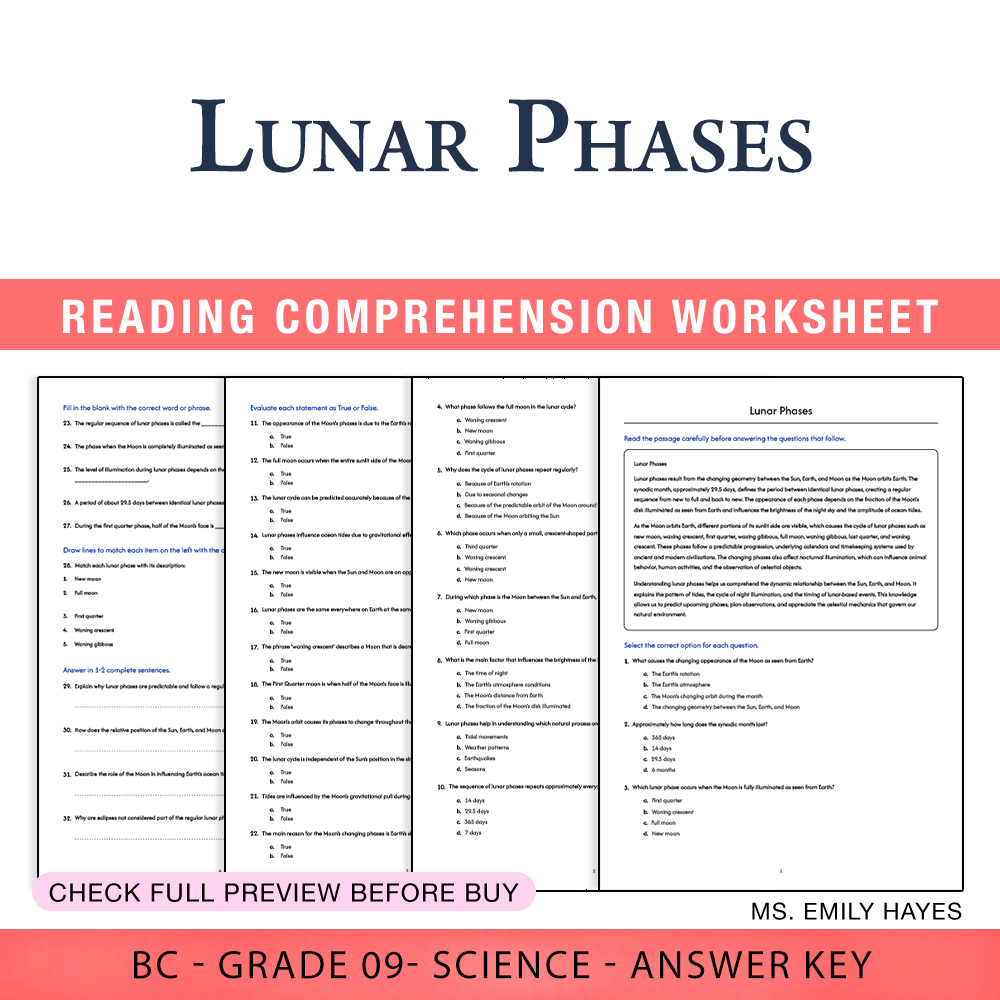
9th Grade Science | Lunar Phases Worksheet (PDF + Answer Key)
Created byCopper Leaf ClassroomLearning Objectives
- Explain the sequence of lunar phases and their causes.
- Describe how the Moon's position affects its visible appearance from Earth.
- Predict the lunar phase based on the geometry between Sun, Earth, and Moon.
Also included in: Grade 9 Science Worksheet Bundle | Earth's Dynamic Processes (PDF + Answer Key) +1 more
Instant download
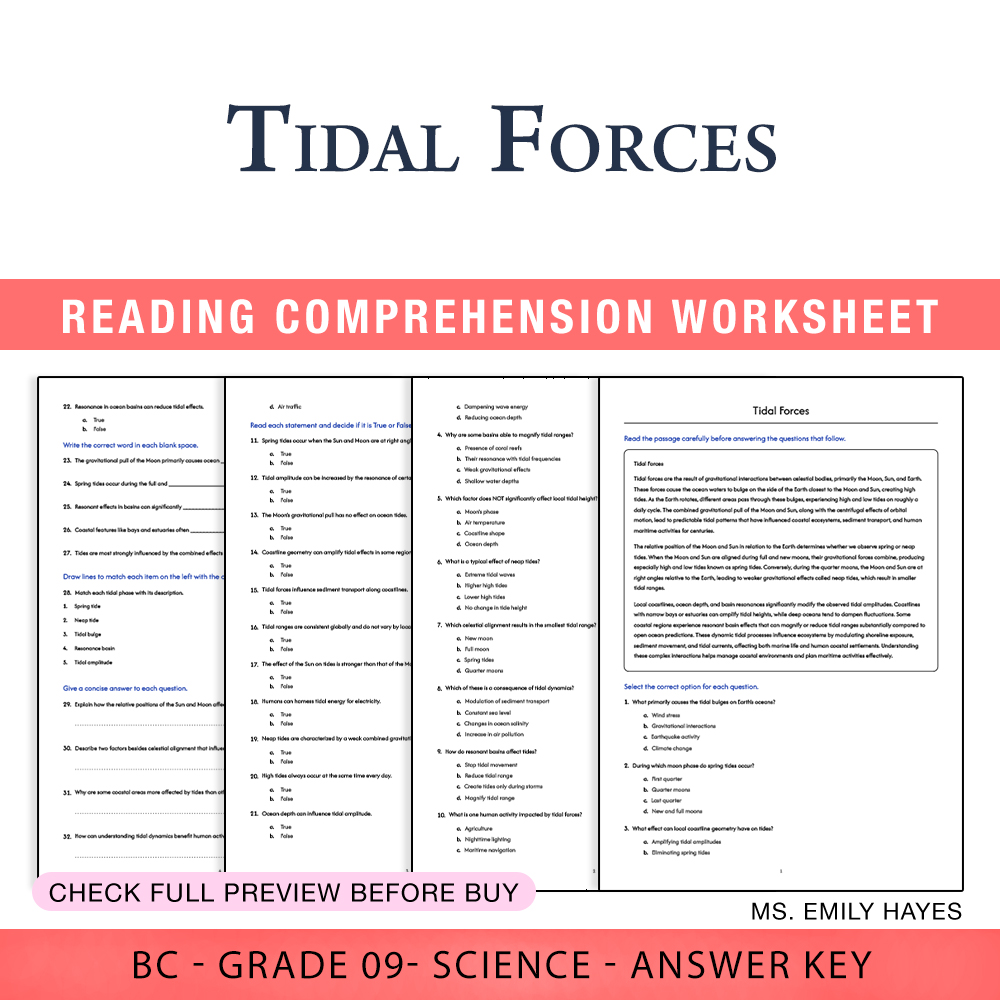
9th Grade Science | Tidal Forces Worksheet (PDF+ Answer Key)
Created byCopper Leaf ClassroomLearning Objectives
- Explain how gravitational interactions among the Moon, Sun, and Earth produce tidal forces.
- Describe the phenomena of spring and neap tides and their relation to celestial alignments.
- Analyze how local geography and basin resonance influence tidal amplitudes.
Also included in: Grade 9 Science Worksheet Bundle | Earth's Dynamic Processes (PDF + Answer Key) +1 more
Instant download

Grade 9 Science | Impulse and Collision Worksheet (Answer Key) - BC Standards
Created byBright Mind ResourcesLearning Objectives
- Explain how force acting over time (impulse) affects an object's momentum during collisions.
- Differentiate between elastic and inelastic collisions in terms of energy conservation.
- Analyze force-time profiles and energy transformations involved in different types of collisions.
Instant download
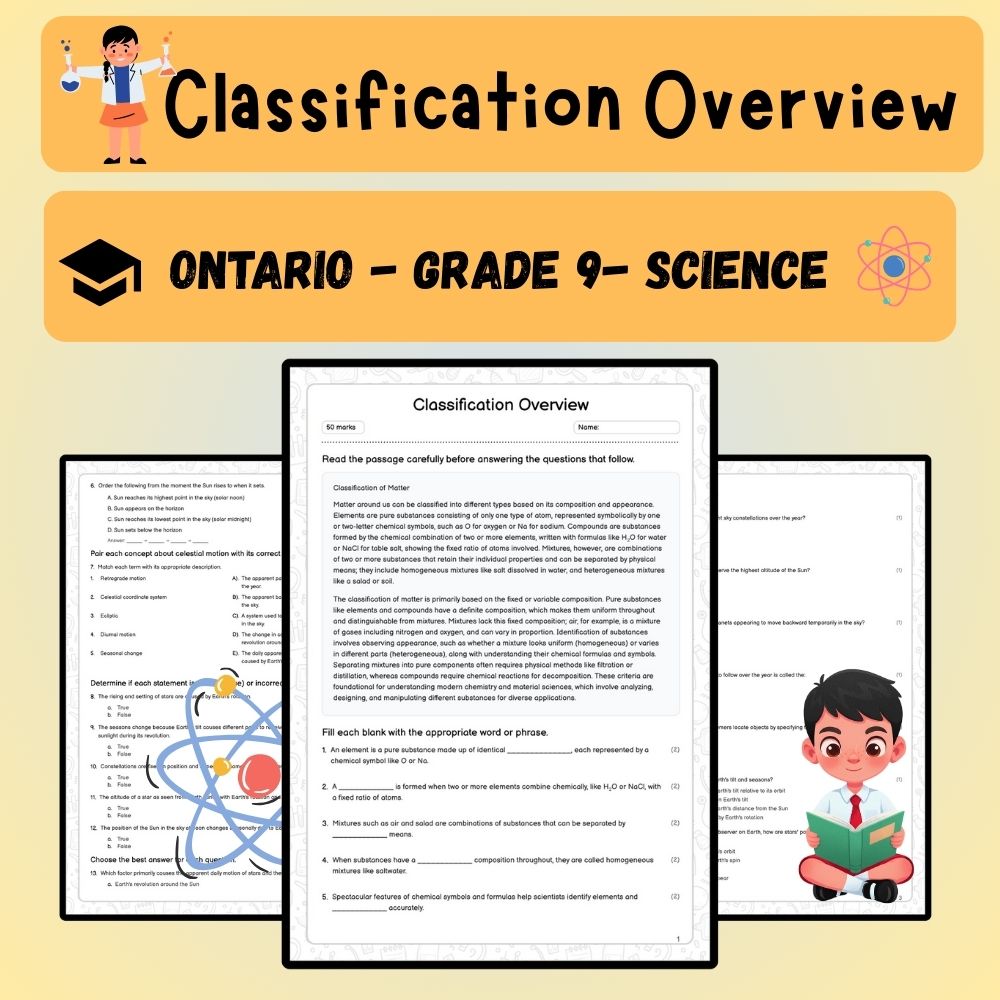
Grade 9 Science | Classification Overview Worksheet (PDF) – Ontario Standards
Created byPrism Point LearningLearning Objectives
- Understand the differences between elements, compounds, and mixtures based on their properties.
- Identify and classify substances as pure or impure, and homogeneous or heterogeneous mixtures.
- Apply symbols and formulas to represent elements and compounds accurately.
Also included in: Grade 9 Science UNIT Worksheet Pack | Chemical Properties, Energy & Reactions +1 more
Instant download
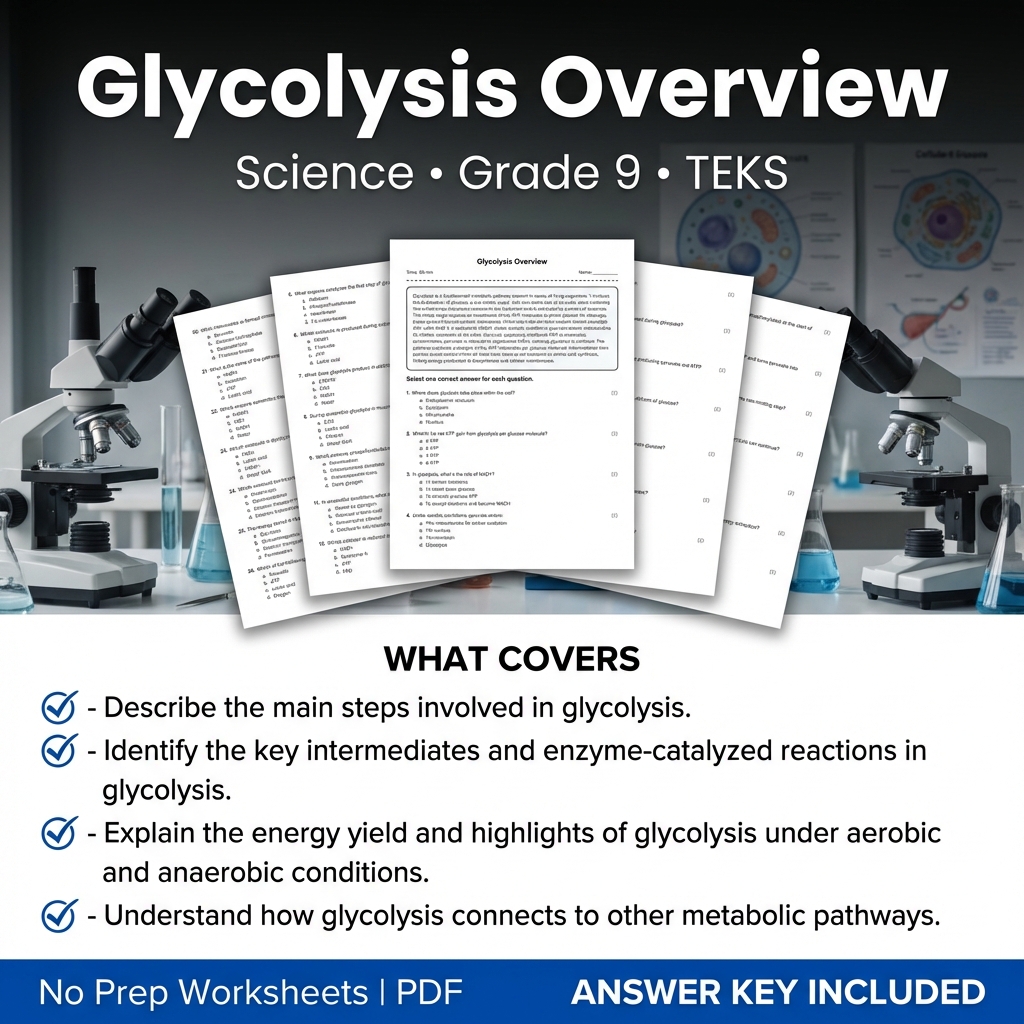
Grade 9 Science Worksheet Glycolysis Overview | TEKS Aligned PDF
Created byCoral Reef LearningLearning Objectives
- Describe the main steps involved in glycolysis.
- Identify the key intermediates and enzyme-catalyzed reactions in glycolysis.
- Explain the energy yield and highlights of glycolysis under aerobic and anaerobic conditions.
Instant download
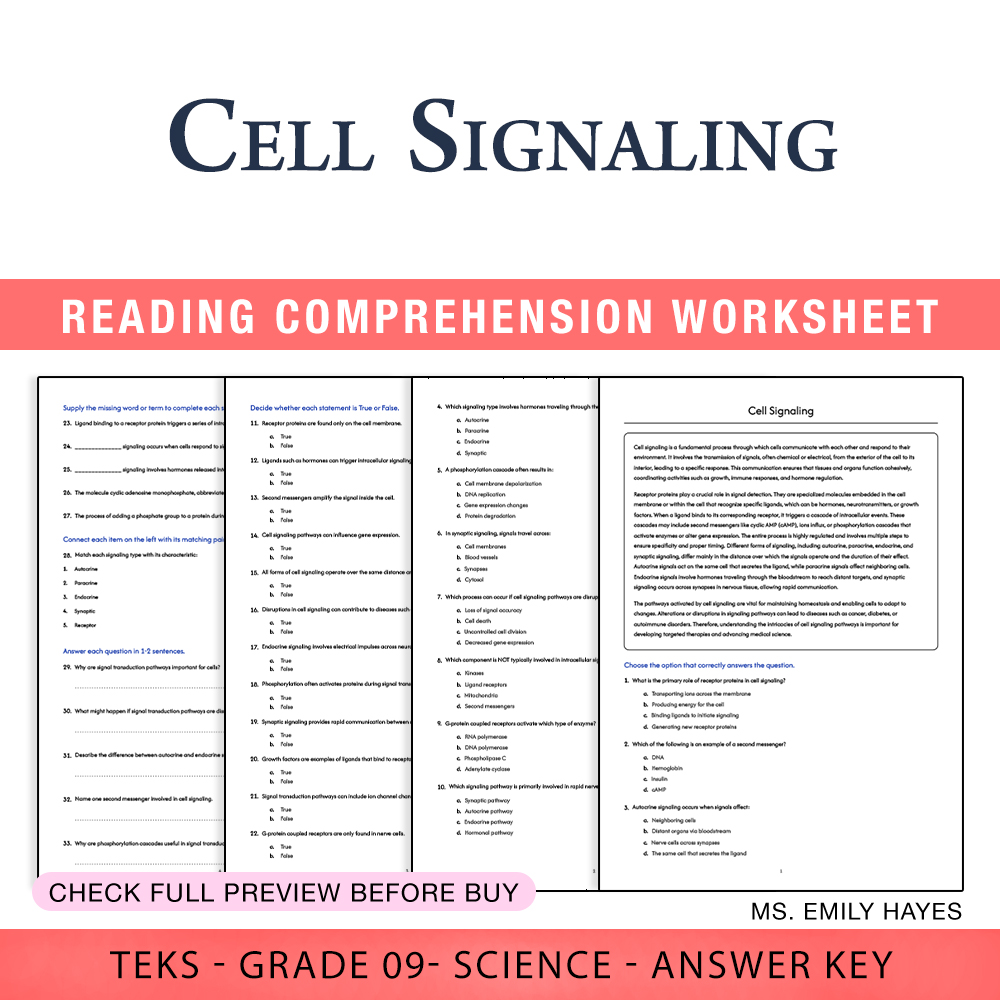
9th Grade Science | Cell Signaling Worksheet (PDF+ Answer Key)
Created byCopper Leaf ClassroomLearning Objectives
- Explain how receptor proteins bind ligands to initiate cell signaling.
- Describe different types of signaling, including autocrine, paracrine, endocrine, and synaptic.
- Understand intracellular cascades such as second messengers and phosphorylation.
Instant download
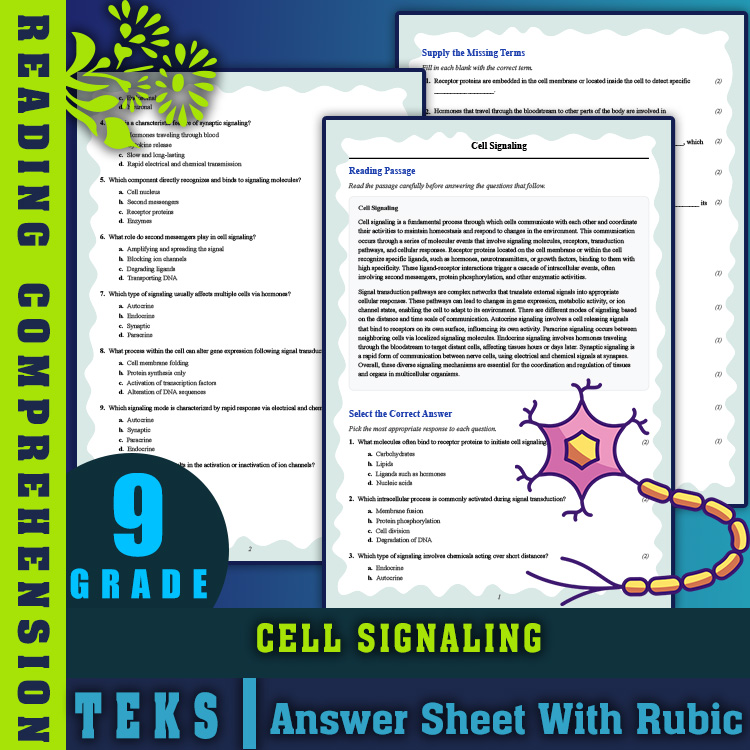
9th Grade Science | Cell Signaling Reading Worksheet & Answer Key (PDF)
JCreated byJ.S SheetsLearning Objectives
- Understand the components and mechanisms of cell signaling pathways.
- Identify different types of cell signaling and their roles in physiology.
- Explain how receptor proteins interact with ligands to initiate cellular responses.
Instant download

Grade 9 Water Cycling Worksheet | Ontario Science Water Cycle Activity
 Created byClear Sky Classroom
Learning Objectives
- Explain the hydrologic (water) cycle as the movement and exchange of water among atmosphere, surface water, and subsurface reservoirs.
- Describe how evaporation, condensation, precipitation, infiltration, runoff, and groundwater flow contribute to water availability.
- Analyze how residence time and water fluxes differ among reservoirs and affect how quickly water returns to ecosystems.
Instant download
About Grade 9 Science Worksheets
Find Science worksheets built for Grade 9. All 6,986 cover core skills, practice, and review, each an instant PDF download.
Every worksheet on MyTeachingSheets is created by independent teacher-authors and reviewed before publication. All resources download as printable PDFs for classroom, homework, or at-home practice, and many include answer keys. Preview any worksheet free before buying.