
Grade 9 Science Worksheets
6,926 worksheets
Genetic Drift Assessment for Grade 9 Science TEKS Standards
 Created byPrism Point Learning
Learning Objectives
- Describe the concept of genetic drift and how it affects populations.
- Identify different events like bottlenecks and founder effects that lead to genetic drift.
- Explain how chance influences genetic variation and evolutionary pathways in small populations.
Instant download
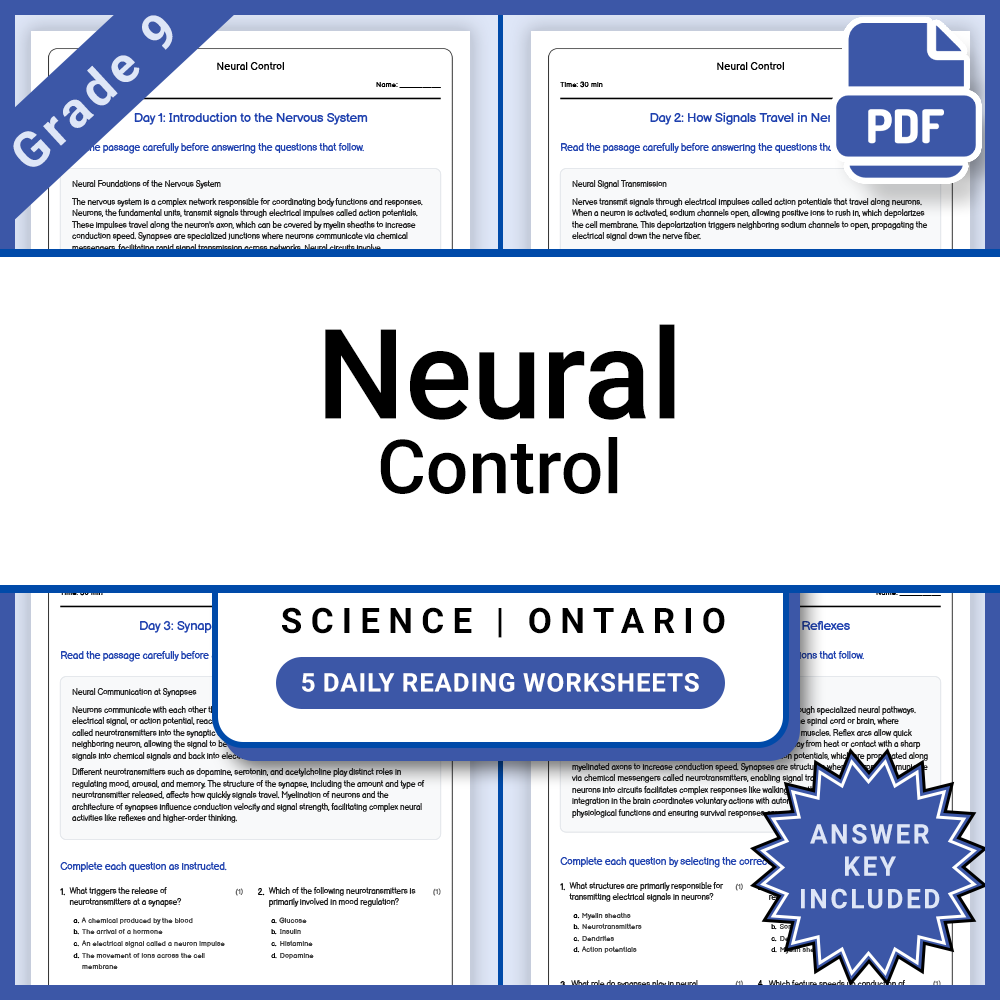
Grade 9 Science – Neural Control Daily Reading Worksheet + Answer Key
JCreated byJ.S SheetsLearning Objectives
- Identify key components of the nervous system such as neurons, synapses, and neural circuits.
- Understand the process of signal propagation via action potentials and synaptic transmission.
- Explain how cellular features like myelination affect conduction velocity.
Also included in: Grade 9 Science Lesson Group | Human Body Systems, Environment & Energy +1 more
Instant download

Collision Safety Worksheet for Grade 9 Science | NGSS Aligned Practice
JCreated byJ.S SheetsLearning Objectives
- Understand the principles of impulse and force-time tradeoffs in collision mitigation.
- Identify and describe methods such as crumple zones, airbags, helmets, padding, and staged deformation for reducing impact forces.
- Analyze force‑time graphs and impulse considerations to evaluate collision safety strategies.
Also included in: Grade 9 Newtonian Motion and Forces Science Lesson Bundle – NGSS Curriculum +1 more
Instant download

Grade 9 Science — Worksheet MCQ Paper for Mastering Paleoclimate Proxies
 Created byThe Resource Hub
Learning Objectives
- Understand the different types of paleoclimate proxies such as ice cores, tree rings, marine sediments, and speleothems.
- Identify proxy indicators used to interpret past climate conditions, including isotopic ratios, growth increments, and microfossil assemblages.
- Relate proxy records to historical climate patterns and recognize the significance of glacial-interglacial cycles and abrupt climate events.
Also included in: Grade 9 Earth and Space Sciences AP Bundle | Science Worksheets and Activities +1 more
Instant download

Grade 9 Science – Chemical Compounds & Bonding | Daily Reading Worksheet
 Created byBright Mind Resources
Learning Objectives
- Understand the concept of chemical compounds and their fixed element ratios
- Learn how to interpret chemical formulas
- Differentiate between covalent and ionic bonding effects
Also included in: Grade 9 Chemistry Science Lesson Bundle Daily Reading Worksheets | Ontario +1 more
Instant download

Chemical Reactions Worksheet | Alberta Grade 9 Science Practice and Assessment
JCreated byJ.S SheetsLearning Objectives
- Understand the different types of chemical reactions such as combustion, synthesis, and decomposition.
- Describe how chemical equations represent reactions and relate to real-world processes.
- Identify reactants and products in symbolic chemical equations.
Also included in: Grade 9: Chemical Reactions and Matter Science lesson bundle Alberta
Instant download
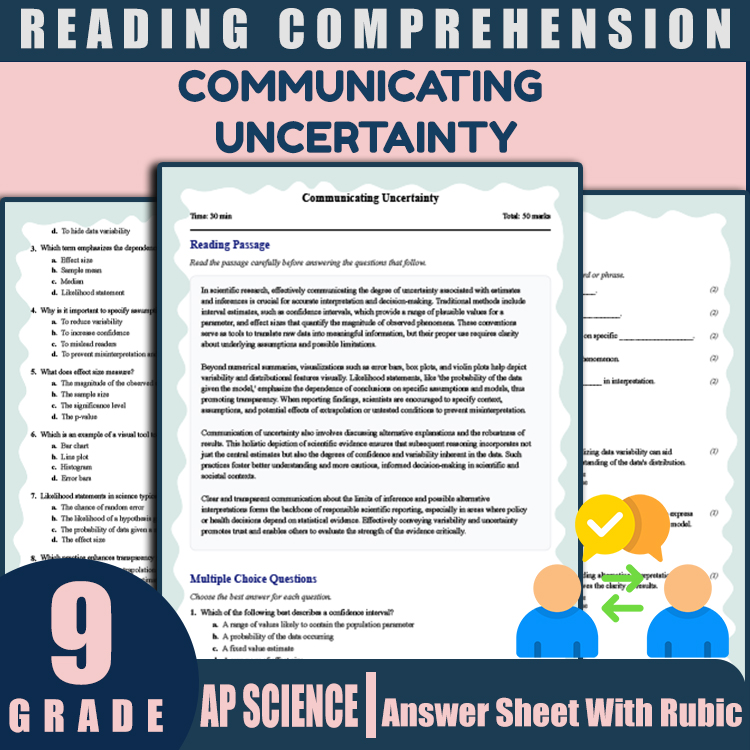
Grade 9 Science Reading Worksheets | Communicating Uncertainty
JCreated byJ.S SheetsLearning Objectives
- Understand the conventions used for conveying quantitative uncertainty and confidence in scientific reports.
- Identify different ways of expressing effect sizes, likelihood statements, and visualizations that display variability.
- Explain the importance of clarity about assumptions, extrapolation limits, and alternative interpretations when reporting numerical findings.
Instant download

Grade 9 Science | Design Cycle Worksheet (PDF) – General Standards
 Created byEvergreen Desk Education
Learning Objectives
- Explain the steps of a design cycle and how evidence guides revisions.
- Identify constraints and criteria in a real-world engineering problem.
- Describe how modeling or prototyping helps test and improve a solution.
Also included in: Grade 9 Engineering Design & Prototype Evidence Science Lesson Bundle: General +1 more
Instant download
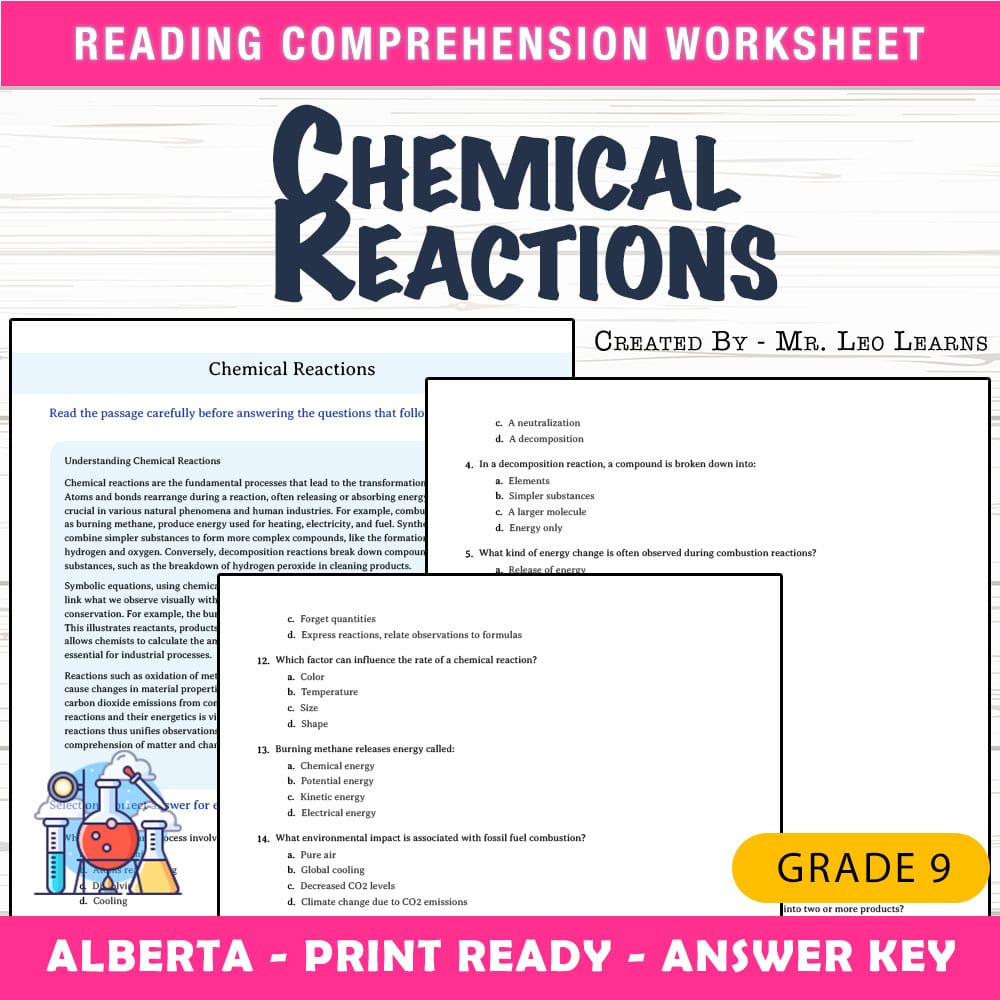
Grade 9 Science — Worksheet MCQ Paper for Mastering Chemical Reactions
Created byThe Resource HubLearning Objectives
- Understand the process of chemical reactions and their types.
- Identify examples of combustion, synthesis, and decomposition reactions.
- Interpret symbolic chemical equations to relate qualitative observations with quantitative data.
Also included in: Grade 9 Science Bundle | Matter and Chemical Change Worksheets Pack +1 more
Instant download

Energy and Matter Flow Assessment for Grade 9 Science – Standards-Aligned Evaluation
Created byPrism Point LearningLearning Objectives
- Understand how energy flows through food chains from producers to consumers.
- Explain how matter cycles through organisms and the environment via processes like photosynthesis and respiration.
- Interpret models and evidence such as trophic level relationships and biomass changes to understand energy and matter transfer.
Also included in: Grade 9 Ecology, Genetics, and Cells Science Lesson Bundle – General
Instant download
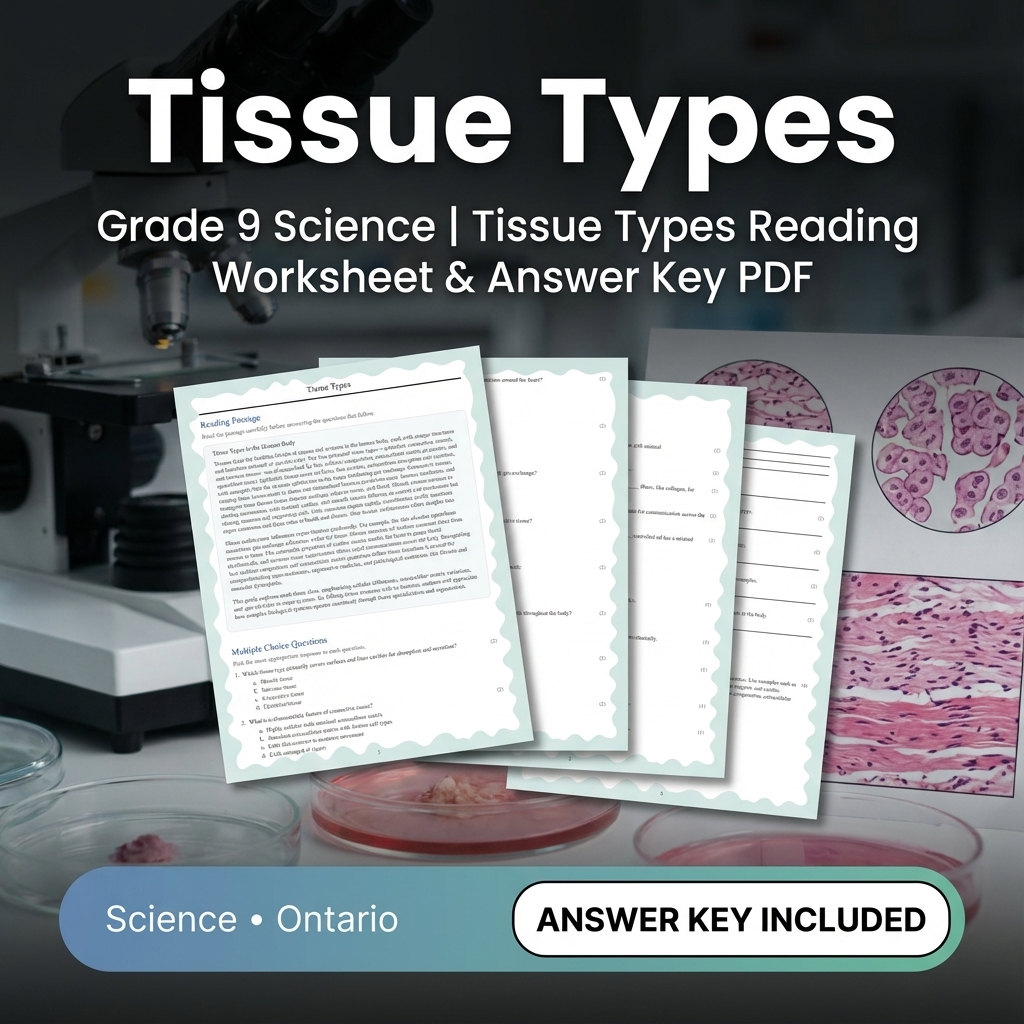
Grade 9 Science | Tissue Types Reading Worksheet & Answer Key PDF
JCreated byJ.S SheetsLearning Objectives
- Identify the four principal tissue types and their cellular components.
- Describe the extracellular matrix differences among tissue classes.
- Explain the specialized functions of epithelial, connective, muscle, and nervous tissues.
Also included in: Grade 9 Science Unit Bundle | Human Body Systems & Cell Functions +1 more
Instant download
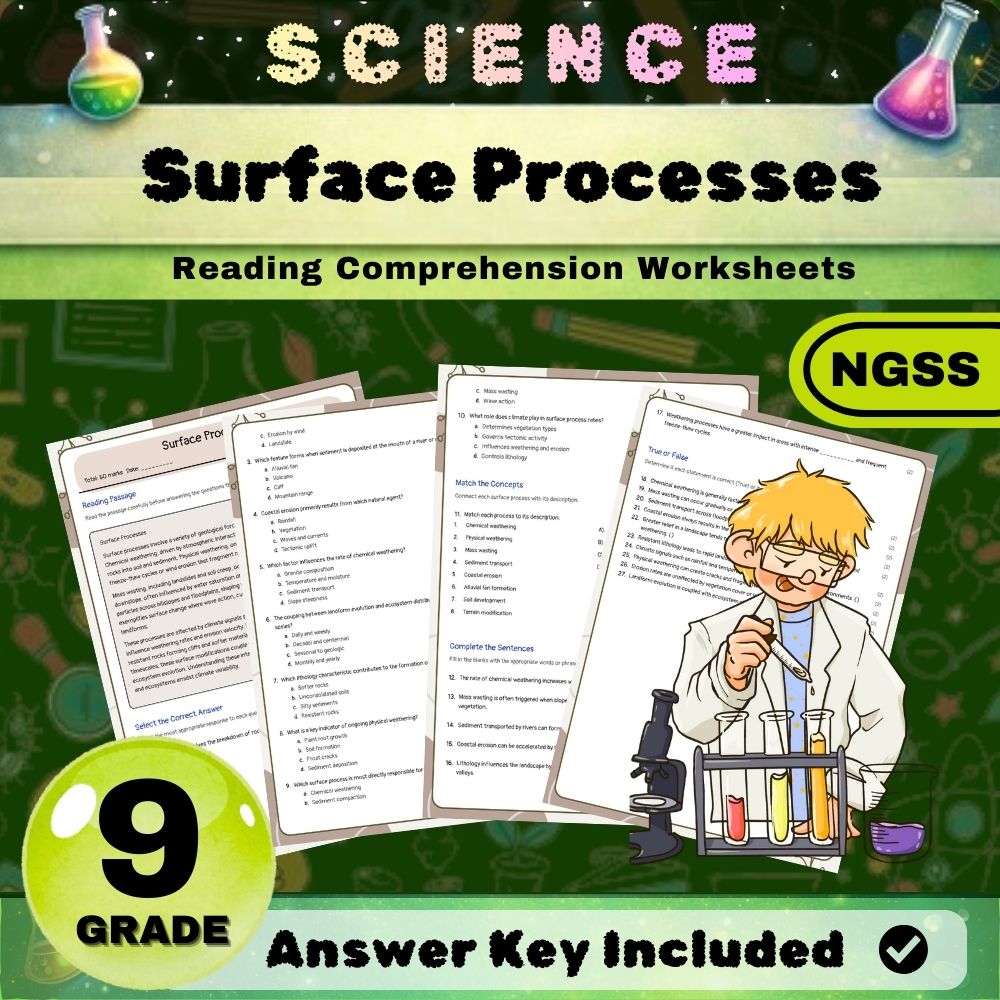
Grade 9 Science - Surface Processes Worksheet (NGSS) PDF
 Created byMaple Path Learning
Learning Objectives
- Understand how atmospheric forcing and hydrologic inputs influence geomorphic change.
- Analyze the roles of chemical and physical weathering, mass wasting, and sediment transport in shaping landforms.
- Explain how climate signals, relief, and lithology contribute to spatial variability in surface modification.
Also included in: Grade 9 Science | Earth's Systems NGSS Unit Bundle (NGSS-Aligned Instruction) +1 more
Instant download

Grade 9 Science – Ecological Niches & Ecosystem Roles | Daily Reading Worksheet
Created byBright Mind ResourcesLearning Objectives
- Understand the concept of an ecological niche
- Identify the components of an organism's niche
- Recognize how niches influence species coexistence
Also included in: Selection Grade 9 Science Daily Reading Worksheets Lesson Bundle | FL NGSSS +1 more
Instant download
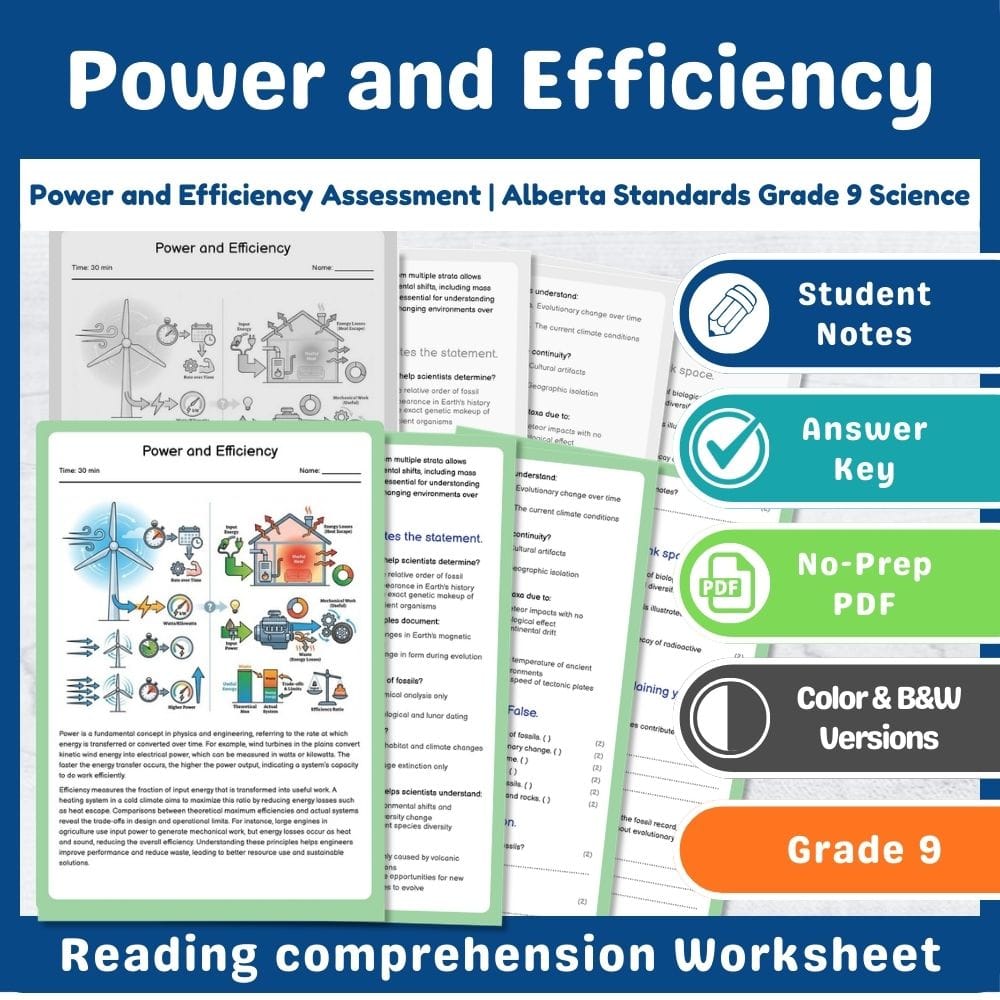
Power and Efficiency Assessment | Alberta Standards Grade 9 Science
Created byPrism Point LearningLearning Objectives
- Understand the concepts of power as the rate of energy transfer in various systems.
- Explain the meaning of efficiency in energy conversion and how it impacts system performance.
- Analyze real-world examples of power and efficiency in engineering applications like turbines, engines, and heating systems.
Also included in: Grade 9 Forces and Motion Science Lesson Bundle Alberta Framework +1 more
Instant download

Comparative Evaluation Worksheet for Grade 9 Science | NGSS Aligned
JCreated byJ.S SheetsLearning Objectives
- Understand the principles of quantitative and qualitative assessment in design solutions.
- Learn to interpret and create comparative matrices for decision-making.
- Evaluate trade-offs among performance metrics such as efficiency, durability, cost, and safety.
Also included in: Grade 9 Engineering Design Modeling Science Lesson Bundle for NGSS +1 more
Instant download

Grade 9 – Organelle Roles in Eukaryotic Cells Daily Worksheet + Answer Key
JCreated byJ.S SheetsLearning Objectives
- Identify major eukaryotic cell organelles and understand their functions.
- Explain the importance of the nucleus and mitochondria in cellular activities.
- Describe how organelles work together to support cell survival and function.
Also included in: Grade 9 Science Lesson Group Bundle TEKS Daily Reading Worksheets +1 more
Instant download
Grade 9 Science | Glucose Balance Worksheet with Short Notes (Printable PDF)
 Created byMeadowlark Worksheets
Learning Objectives
- Understand how insulin and glucagon regulate blood glucose levels.
- Describe the endocrine feedback mechanisms involved in energy homeostasis.
- Identify tissues involved in glucose uptake, storage, and release.
Also included in: Grade 9 Science Lesson Bundle | BC Framework Worksheets (15-Piece Collection) +1 more
Instant download

Energy Transfer Worksheet Practice Test | Grade 9 Science Ontario
Created byPrism Point LearningLearning Objectives
- Describe major energy sources that affect Earth systems, including solar radiation and geothermal heat flow.
- Explain how energy is transferred through conduction, convection, and radiation within the atmosphere and oceans.
- Connect energy gradients to atmospheric and ocean circulation, weathering, and tectonic processes.
Also included in: Grade 9 Earth and Space Science Lesson Bundle Worksheets | Ontario
Instant download
Grade 9 Science – Frictional Forces Daily Reading Worksheet + Answer Key
JCreated byJ.S SheetsLearning Objectives
- Define static and kinetic friction
- Explain how friction opposes motion between surfaces
- Describe how surface properties and normal force influence friction
Also included in: Grade 9 Science Lesson Bundle | Physics and Energy Concept Worksheets +1 more
Instant download
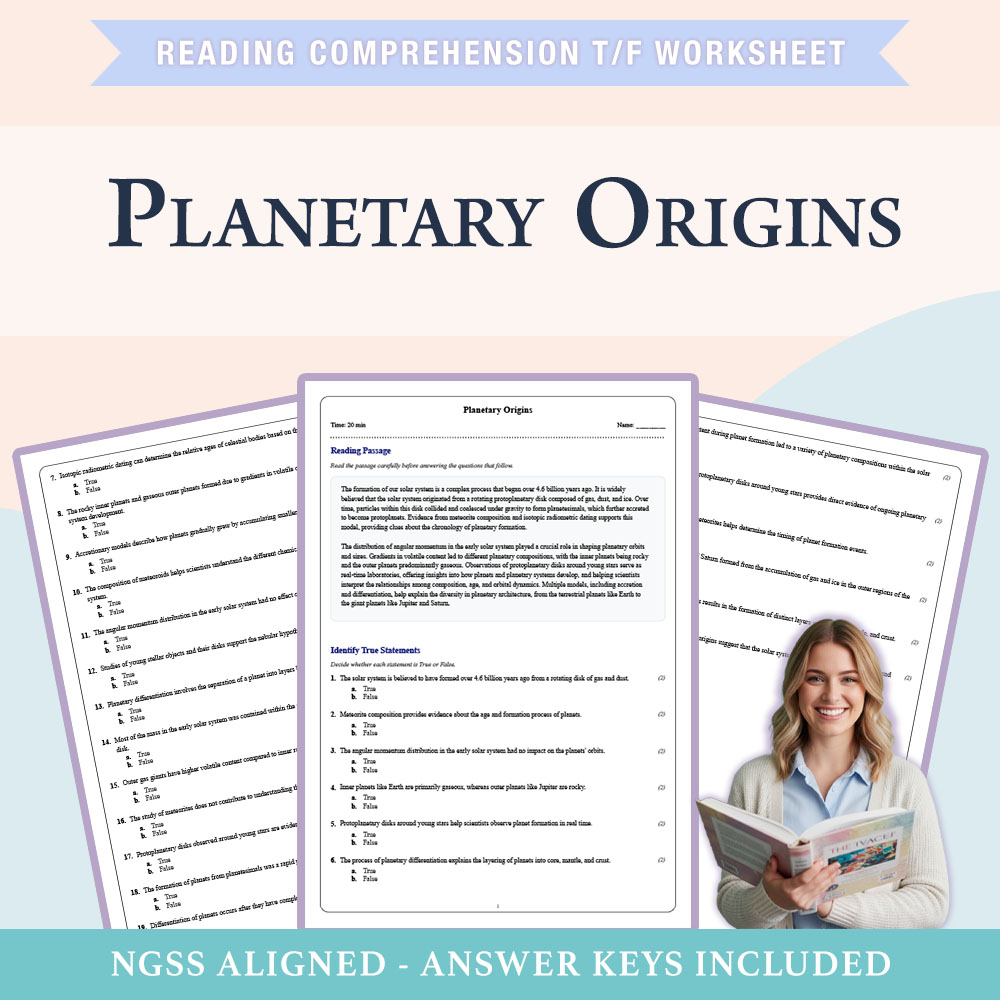
Grade 9 Science | Planetary Origins Worksheet (PDF + Answer Key)
 Created byCopper Leaf Classroom
Learning Objectives
- Understand the processes involved in the formation of the solar system.
- Identify evidence supporting planetary formation theories.
- Differentiate characteristics of inner rocky planets and outer gas giants.
Also included in: Grade 9 Science | Space, Motion & Cosmology Worksheet Bundle (PDF + Answer Key) +1 more
Instant download

Grade 9 Science — Membrane Transport Worksheet MCQ Paper for Mastery
Created byThe Resource HubLearning Objectives
- Describe the mechanisms of passive diffusion, facilitated transport, and active transport across cell membranes.
- Explain how membrane composition and transport proteins contribute to electrochemical gradients and cellular homeostasis.
- Apply quantitative reasoning to predict how changes in concentration gradients and membrane permeability affect transport processes and cell function.
Also included in: Grade 9 Science Biology and Ecosystems Lesson Bundle for AP Curriculum +1 more
Instant download

Grade 9 Science – DNA & Genes: Understanding the Link | Daily Reading Worksheet
Created byBright Mind ResourcesLearning Objectives
- Identify the structure and function of DNA.
- Understand how genes are organized and located on chromosomes.
- Explain the process of inheritance and how genetic information is passed to offspring.
Also included in: Selection Grade 9 Science Daily Reading Worksheets Lesson Bundle | FL NGSSS +1 more
Instant download

Grade 9 TEKS Endoplasmic Reticulum Worksheet | Rough vs Smooth ER
 Created byBRIGHT PATH RESOURCES
Learning Objectives
- Identify evidence in a text that links endoplasmic reticulum structure to cell function
- Compare how smooth and rough endoplasmic reticulum differ in appearance and role
- Use specific vocabulary (organelle, membrane, protein, lipid) to explain structure–function relationships
Also included in: Grade 9 Cell Structure and Function Biology Worksheets Bundle | TEKS +1 more
Instant download

Grade 9 Science – Digestive Absorption & Nutrient Transport | Reading Worksheet
Created byBright Mind ResourcesLearning Objectives
- Understand how mechanical and chemical digestion occurs in the mouth and stomach.
- Describe how nutrients are absorbed across the intestinal epithelium.
- Identify the roles of villi and microvilli in increasing surface area for absorption.
Also included in: Grade 9 Science Daily Reading Worksheets: Body Systems Lesson Bundle | Ontario +1 more
Instant download

Humidity and Clouds Worksheet Grade 9 Science Activity | Weather NGSSS
Created byPrism Point LearningLearning Objectives
- Explain how air cooling and condensation lead to cloud formation
- Use relative humidity to describe how close air is to saturation
- Connect atmospheric stability and vertical motion to different cloud types and precipitation
Also included in: Grade 9 Earth, Weather & Climate Systems Lesson Bundle | Florida ngsss
Instant download
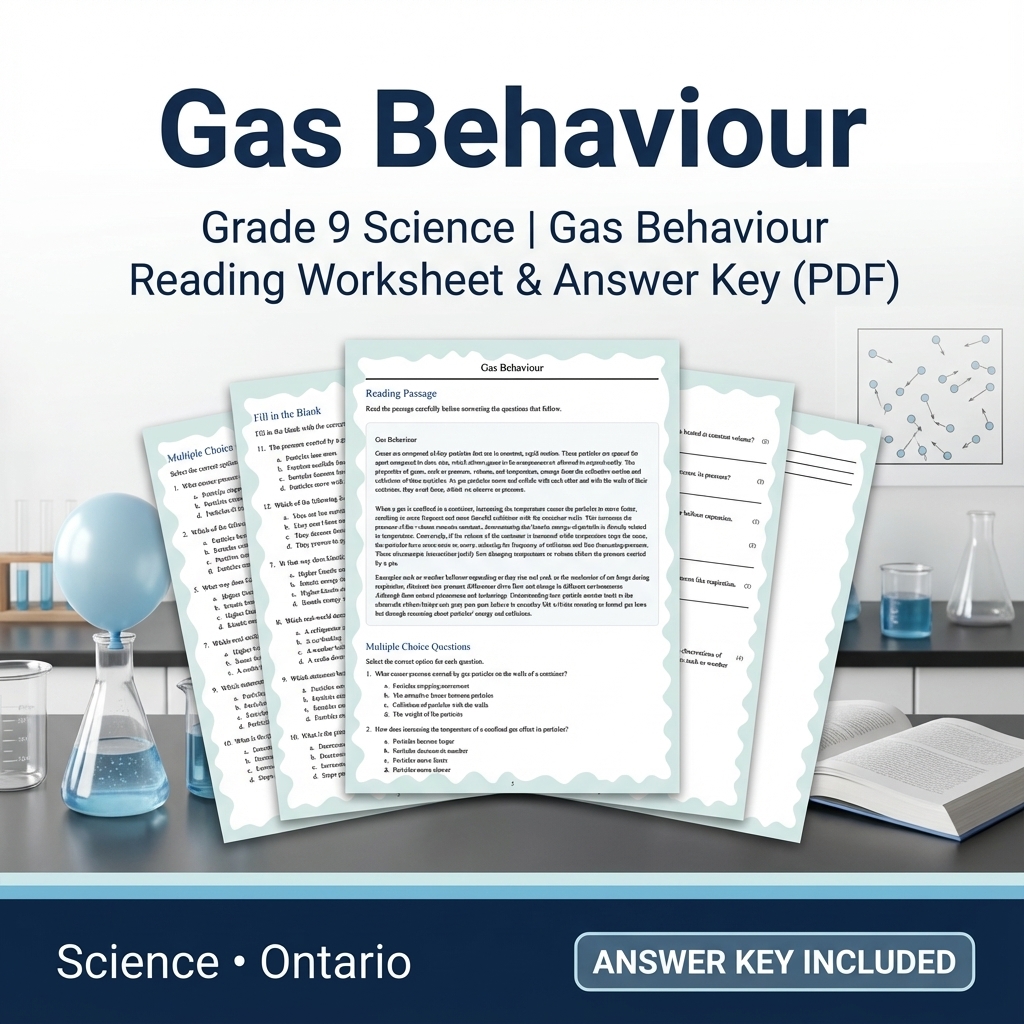
Grade 9 Science | Gas Behaviour Reading Worksheet & Answer Key (PDF)
JCreated byJ.S SheetsLearning Objectives
- Explain how particle collisions relate to pressure in gases
- Describe the relationship between temperature and kinetic energy of gas particles
- Illustrate how volume changes with pressure and temperature based on the particle model
Also included in: Grade 9 Science Unit Bundle | Essential Concepts & Skills (Answer Keys Included) +1 more
Instant download

Environmental Health Test Prep Printables | Grade 9 Science
Created byPrism Point LearningLearning Objectives
- Explain how environmental exposures and lifestyle factors can contribute to chronic disease through biological mechanisms.
- Describe how dose–response and vulnerability factors influence the risk of long-term health outcomes.
- Compare epidemiological and mechanistic evidence for environmental health risks.
Also included in: Grade 9 Body Systems and Cells Science Ontario Lesson Bundle Test Prep
Instant download

Grade 9 Science – Mixtures & Separation | Daily Reading Worksheet
 Created byQuiet Forest Education
Learning Objectives
- Understand the differences between homogeneous and heterogeneous mixtures.
- Identify examples of different mixtures in everyday life.
- Describe physical separation methods such as filtration, distillation, magnetic separation, and decanting.
Also included in: Matter and Chemical Change Grade 9 Science Daily Worksheets Bundle | Ontario +1 more
Instant download

Surface Processes Worksheet for Grade 9 Science | NGSS Printable PDF
Learning Objectives
- Explain how atmospheric and hydrologic forces influence geomorphic change and soil development.
- Analyze the roles of chemical and physical weathering, mass wasting, and sediment transport across different landforms.
- Evaluate how climate signals, relief, and lithology affect surface modification and landform evolution.
Also included in: Grade 9 Earth's Systems Science Lesson Bundle NGSS | Natural Hazards & Geology +1 more
Instant download

Grade 9 Science | Coastal Dynamics & Waves Erosion - Daily Reading Practice
 Created byCoral Reef Learning
Learning Objectives
- Understand how waves contribute to shoreline erosion
- Identify key features of coastal environments affected by wave action
- Analyze the processes of sediment transport along coastlines
Also included in: Earth and Space Sciences Daily Reading Lesson Bundle – Grade 9 Science AP +1 more
Instant download

Grade 9 Science – Glycolysis Overview Daily Reading Worksheet + Answer Key
JCreated byJ.S SheetsLearning Objectives
- Understand the basic process of glycolysis
- Identify key molecules involved in glycolysis
- Recognize the differences in energy production under aerobic and anaerobic conditions
Also included in: Grade 9 Science Lesson Group: Photosynthesis & Metabolism TEKS Bundle +1 more
Instant download
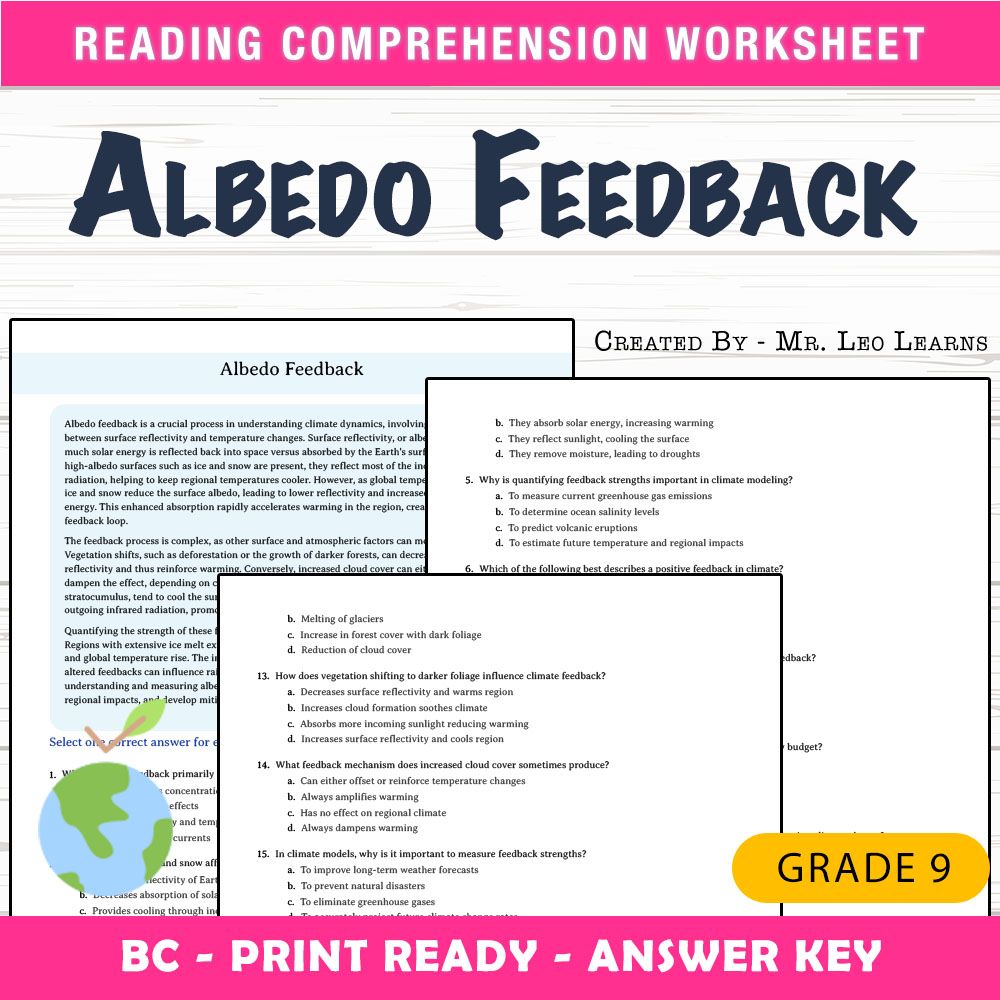
Grade 9 Science — Worksheet MCQ Paper for Mastering Albedo Feedback
Created byThe Resource HubLearning Objectives
- Understand the concept of albedo feedback and its role in climate change.
- Identify factors that influence surface reflectivity and their effects on regional warming.
- Analyze feedback mechanisms such as ice, snow, vegetation, and cloud cover.
Also included in: Grade 9 Science | Earth and Space Systems Unit Worksheet Bundle (BC Framework) +1 more
Instant download

Grade 9 Science – Signal Encoding & Data Transmission | Daily Reading Worksheet
Created byBright Mind ResourcesLearning Objectives
- Understand the concept of signal encoding using modulation and multiplexing
- Identify different methods of encoding signals such as amplitude, frequency, and phase modulation
- Compare different encoding schemes like pulse-code modulation and analog amplitude modulation
Also included in: Grade 9 Wave and Signal Science Daily Reading Lesson Bundle | NGSS +2 more
Instant download

System Interactions Review Worksheet | Grade 9 Science Assessment
Created byPrism Point LearningLearning Objectives
- Explain how body systems coordinate to maintain homeostasis using feedback mechanisms, set points, and coupling between organs.
- Describe circulation–respiration coupling and how neural and renal regulation affect blood flow and blood volume.
- Evaluate how endocrine signaling and autonomic responses work together during stressors to stabilize internal conditions.
Also included in: Grade 9 Body Systems and Cells Science Ontario Lesson Bundle Test Prep
Instant download
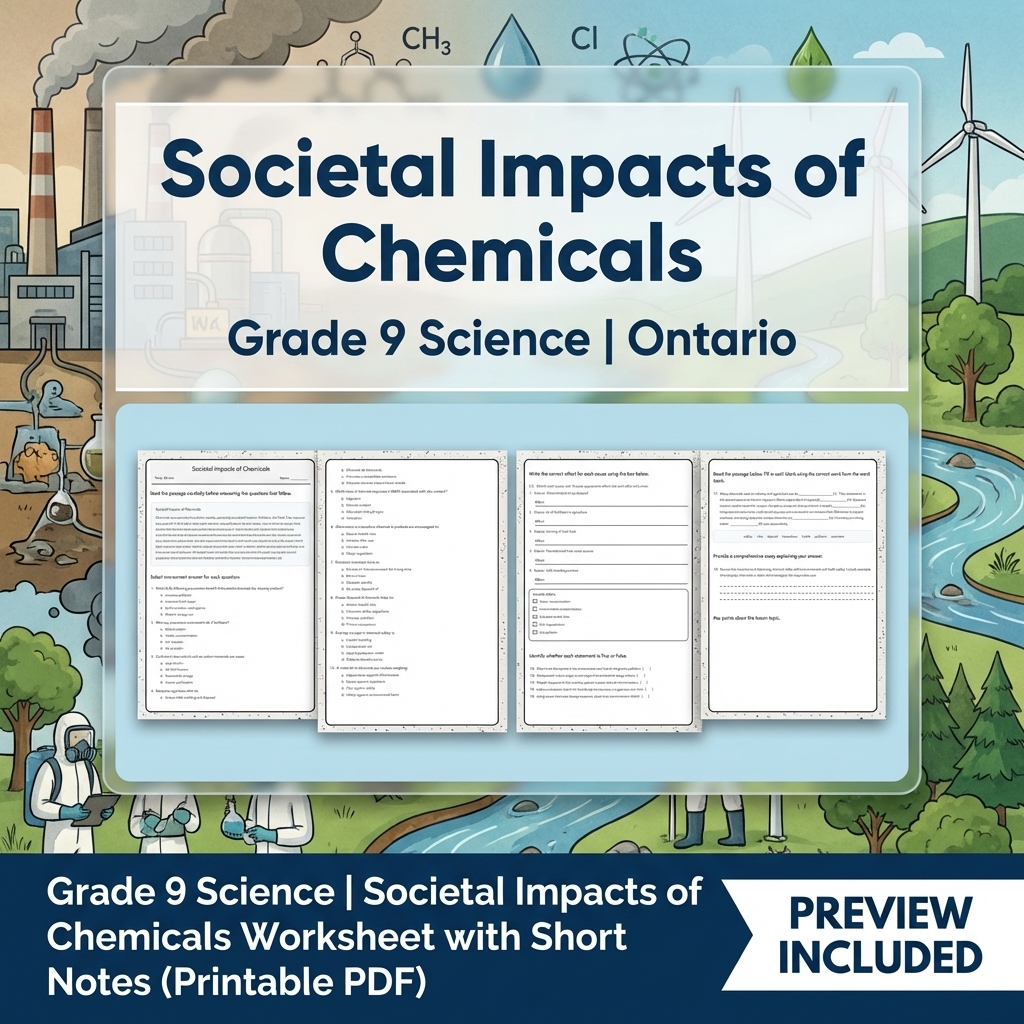
Grade 9 Science | Societal Impacts of Chemicals Worksheet with Short Notes
Created byMeadowlark WorksheetsLearning Objectives
- Understand the societal uses and benefits of common chemicals.
- Assess potential risks and environmental impacts associated with chemical use.
Also included in: Grade 9 Science Lesson Group Bundle | Ontario Curriculum Worksheets
Instant download

Reaction Rates Worksheet for Grade 9 Science | NGSS Aligned Practice
JCreated byJ.S SheetsLearning Objectives
- Explain how collision frequency, activation energy, and reaction pathways influence reaction rates.
- Describe how temperature, concentration, and catalysts modify energy distributions and affect reaction speed.
- Understand and interpret rate laws and reaction order through examples such as bromine-iodide kinetics.
Also included in: Grade 9 Chemical Reactions and Atomic Structure Science Lesson Bundle – NGSS +1 more
Instant download

Grade 9 Science – Renewable Energy Integration Worksheet (Alberta Standards) (PDF)
 Created bySilver Birch Teaching
Learning Objectives
- Explain how wind and solar intermittency affects electrical grid reliability and dispatch planning
- Describe grid balancing mechanisms used to coordinate variable renewable generation
- Evaluate how energy storage and infrastructure upgrades support renewable integration
Also included in: Grade 9 Electrical Circuits and Energy Science Lesson Bundle (Alberta) +1 more
Instant download

Grade 9 Science – Societal Impacts of Chemist | Daily Worksheet
Created byQuiet Forest EducationLearning Objectives
- Understand how household chemicals are used and their benefits
- Identify potential health and environmental risks of common chemicals
- Analyze the routes of chemical exposure and their impacts
Also included in: Matter and Chemical Change Grade 9 Science Daily Worksheets Bundle | Ontario +1 more
Instant download

Crystal Lattices Worksheet | Grade 9 Science Practice
Created byPrism Point LearningLearning Objectives
- Explain what crystal lattices and unit cells are in terms of repeating atomic patterns.
- Compare ionic, metallic, and covalent network lattices using properties like conductivity and hardness.
- Use lattice structure to predict macroscopic behavior of materials.
Also included in: Grade 9 Matter and Chemical Change Lesson Bundle | Science | BC +1 more
Instant download

Grade 9 Science – Displacement & Position Daily Reading Worksheet | AP Standards
Created byBright Mind ResourcesLearning Objectives
- Interpret position–time graphs to determine displacement.
- Describe the relationship between position, displacement, and motion along a straight line.
- Analyze how graphical representations reflect constant and changing velocity.
Also included in: Motion & Forces Grade 9 Science Daily Reading Worksheets Lesson Bundle | AP +2 more
Instant download

Grade 9 Science | Frictional Forces Worksheet | BC Aligned
 Created byLumora Learning
Learning Objectives
- Understand how friction opposes relative motion between surfaces.
- Differentiate between static and kinetic friction and their effects.
- Explain factors influencing the magnitude of frictional forces.
Instant download
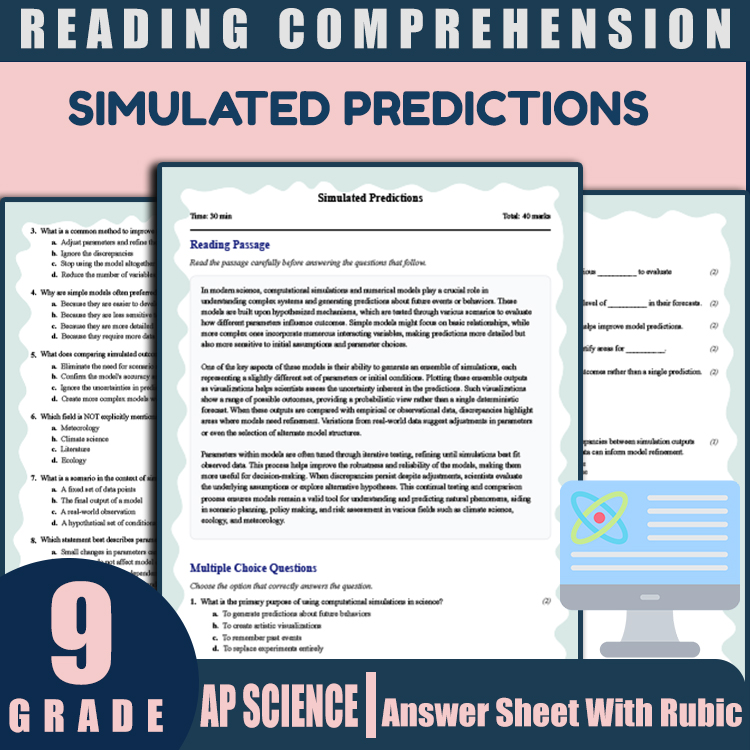
Grade 9 Science | Simulated Predictions Reading Worksheet (PDF with Answer Key)
JCreated byJ.S SheetsLearning Objectives
- Understand the role of computational simulations and models in scientific predictions.
- Explain how scenarios and parameter sensitivity impact forecast outcomes.
- Describe how visualizations and ensembles represent uncertainty in predictions.
Instant download

Grade 9 Science – Structure & Function Connections in Cells | Reading Worksheet
Created byBright Mind ResourcesLearning Objectives
- Identify major cellular organelles and describe their functions
- Explain how cell structures relate to their roles within an organism
- Use models to connect physical features of cells to their biological tasks
Also included in: Cells Genetics & Ecosystems Grade 9 Science Reading Lesson Bundle | General +1 more
Instant download
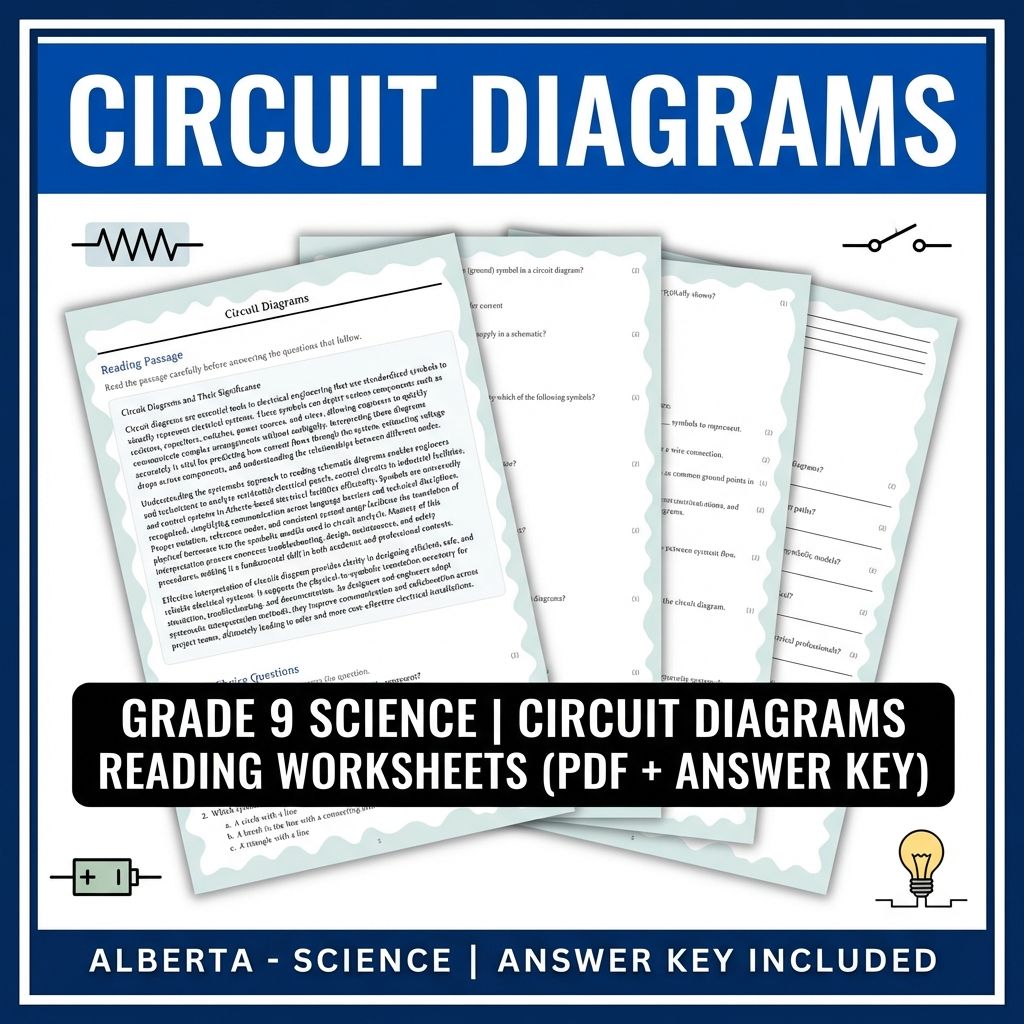
Grade 9 Science | Circuit Diagrams Reading Worksheets (PDF + Answer Key)
JCreated byJ.S SheetsLearning Objectives
- Understand the standardized symbols used in schematic circuit diagrams.
- Interpret circuit diagrams to predict current paths, voltages, and node relationships.
- Translate physical electrical systems into symbolic models for analysis.
Also included in: Grade 9 Science Bundle | Electricity, Energy & Magnetism (PDF + Answer Keys) +1 more
Instant download

Grade 9 Science – Photosynthetic Capture & Energy Transfer | Reading Worksheet
Created byBright Mind ResourcesLearning Objectives
- Understand how pigments absorb light at specific wavelengths
- Analyze the energy transfer process among photosynthetic pigments
- Describe the conversion of light energy into chemical energy in photosystems
Also included in: Grade 9 Daily Reading Science Worksheets Lesson Bundle | AP +2 more
Instant download
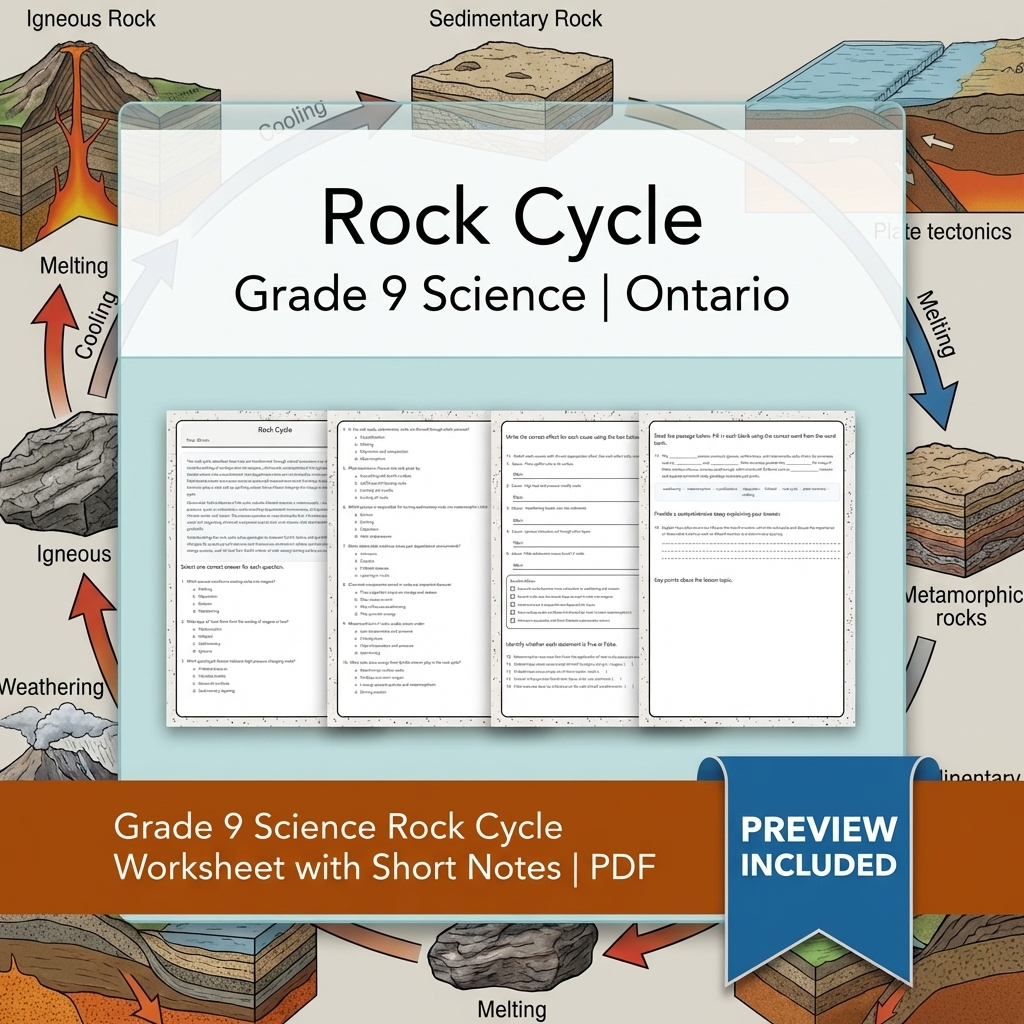
Grade 9 Science Rock Cycle Worksheet with Short Notes | PDF
Created byMeadowlark WorksheetsLearning Objectives
- Describe the processes involved in the rock cycle, including melting, crystallization, weathering, erosion, deposition, and metamorphism.
- Explain how plate tectonics influence the transformation and recycling of rocks.
- Identify observable evidence of the rock cycle in the field, such as foliated textures, layering, and intrusions.
Also included in: Grade 9 Science Lesson Group Bundle | Ontario Curriculum Worksheets
Instant download

Grade 9 Science – Inherited Trait Origins & Genetic Transmission | Worksheet
Created byBright Mind ResourcesLearning Objectives
- Understand the process of genetic transmission from parents to offspring.
- Learn how meiosis contributes to genetic diversity.
- Identify the role of mutations in evolutionary change.
Also included in: Evolution Grade 9 Science Daily Reading Worksheets Lesson Bundle | CA Standards +1 more
Instant download

Nutrient Cycling Worksheet | NGSS Grade 9 Science Practice
JCreated byJ.S SheetsLearning Objectives
- Explain the processes involved in nutrient cycling, including microbial decomposition, fixation, mineralization, and sedimentation.
- Describe how human activities like fertilizer runoff impact nutrient cycles and ecosystems.
- Analyze the effects of changes in nutrient cycling rates on ecosystem productivity, nutrient availability, and soil carbon storage.
Also included in: Grade 9 Nutrient Cycling & Trophic Dynamics Science – Lesson Bundle NGSS +1 more
Instant download
About Grade 9 Science Worksheets
Find Science worksheets built for Grade 9. All 6,926 cover core skills, practice, and review, each an instant PDF download.
Every worksheet on MyTeachingSheets is created by independent teacher-authors and reviewed before publication. All resources download as printable PDFs for classroom, homework, or at-home practice, and many include answer keys. Preview any worksheet free before buying.