
Grade 9 Science Worksheets
6,926 worksheets
Grade 9 Human Influence Worksheet | NGSS Practice PDF
 Created byClear Sky Classroom
Learning Objectives
- Analyze historical atmospheric CO2 records and land-use change data.
- Understand the effects of human activities like fossil fuel combustion and deforestation on climate.
- Interpret indicators such as the Keeling Curve and satellite vegetation data.
Also included in: Grade 9 Sustainability Decision Modeling Science Lesson Bundle NGSS +1 more
Instant download

Grade 9 Force Laws Worksheet | NGSS Practice PDF
Created byClear Sky ClassroomLearning Objectives
- Understand the mathematical relationships governing gravitational and electrostatic forces.
- Apply inverse-square law formulas to calculate magnitudes of forces between masses and charges.
- Predict the direction of forces based on vector principles and charge/mass interactions.
Also included in: Grade 9 Newtonian Motion and Forces Science Practice Lesson Bundle – NGSS +1 more
Instant download

Grade 9 Momentum Conservation Worksheet | Practice & NGSS PDF
Created byClear Sky ClassroomLearning Objectives
- Understand the principle of conservation of linear momentum in isolated systems.
- Differentiate between elastic and inelastic collisions using momentum analysis.
- Calculate total momentum before and after interactions in various scenarios.
Also included in: Grade 9 Newtonian Motion and Forces Science Practice Lesson Bundle – NGSS +1 more
Instant download

Grade 9 Framing Constraints Worksheet | NGSS Practice PDF
Created byClear Sky ClassroomLearning Objectives
- Understand the key factors involved in problem framing for engineering challenges.
- Identify social, economic, and environmental constraints affecting project design.
- Analyze stakeholder criteria and regulatory restrictions in decision-making.
Also included in: Grade 9 Engineering Design Science Lesson Bundle for NGSS: +1 more
Instant download

Grade 9 Hydrologic Change Worksheet | NGSS Practice & PDF
Created byClear Sky ClassroomLearning Objectives
- Understand how water shapes Earth's surface through erosion, transport, and deposition.
- Analyze hydrologic data such as discharge records and sediment measurements.
- Interpret watershed maps to evaluate landscape evolution over time.
Also included in: Grade 9 Earth Systems & Processes Science Lesson Bundle NGSS Practice +1 more
Instant download

Grade 9 Cellular Metabolism Worksheet | NGSS Practice PDF
Created byClear Sky ClassroomLearning Objectives
- Describe the biochemical pathways involved in cellular respiration, including glycolysis, the citric acid cycle, and electron transport.
- Explain the role of ATP in energy transfer and how energy coupling occurs within cells.
- Relate mitochondrial and chloroplast functions to metabolic pathways like respiration and photosynthesis.
Also included in: Grade 9 Cellular Systems & Regulation Science Lesson Bundle NGSS Worksheet Set +1 more
Instant download

Grade 9 Science Grade 9 Worksheet: Trophic Dynamics Worksheet | NGSS Use PDF
Created byClear Sky ClassroomLearning Objectives
- Explain how energy transfer occurs across trophic levels and why energy decreases upward in a food chain.
- Describe the structure of food webs and how predators and prey can regulate each other (top-down control).
- Use trophic pyramids, ecological efficiency, and production-to-biomass ratios to quantify energy loss and productivity.
Also included in: Grade 9 Ecosystem Dynamics Science Lesson Bundle (NGSS) +1 more
Instant download

Grade 9 Integrated Physiology Worksheet | Practice & Assessment PDF
Created byClear Sky ClassroomLearning Objectives
- Understand how molecular, cellular, and organ interactions contribute to physiological functions.
- Link genetic variations to cellular responses and organ system performance in health and disease.
- Interpret multi-level data such as biochemical assays, histology, and organ function metrics.
Also included in: Grade 9 Cellular Systems & Regulation Science Lesson Bundle NGSS Worksheet Set +1 more
Instant download

Grade 9 Cell Architecture Worksheet | NGSS Practice PDF
Created byClear Sky ClassroomLearning Objectives
- Explain how nucleic acid sequences determine amino acid chains and protein structures.
- Connect molecular coding to the architecture of organelles like ribosomes, endoplasmic reticulum, and mitochondria.
- Identify examples of proteins that influence cellular functions, such as hemoglobin and membrane transport proteins.
Also included in: Grade 9 Cellular Systems & Regulation Science Lesson Bundle NGSS Worksheet Set +1 more
Instant download

Grade 9 Stellar Evolution Worksheet | NGSS Practice PDF
Created byClear Sky ClassroomLearning Objectives
- Describe the main stages of stellar evolution from star formation to terminal outcomes.
- Interpret Hertzsprung-Russell diagrams and spectral classifications of stars.
- Explain the processes of nucleosynthesis and element enrichment in the interstellar medium.
Also included in: Grade 9 Stellar Evolution Space Science Lesson Bundle Worksheets | NGSS +1 more
Instant download

Grade 9 Science | Energy Transformations Worksheet | NGSSS Aligned
 Created byLumora Learning
Learning Objectives
- Explain how energy transforms between mechanical, thermal, electrical, and sound forms in real systems.
- Use the idea of energy balance for a chosen system to predict how resistive forces change outcomes.
- Describe how temperature changes can alter material behavior and influence motion.
Instant download
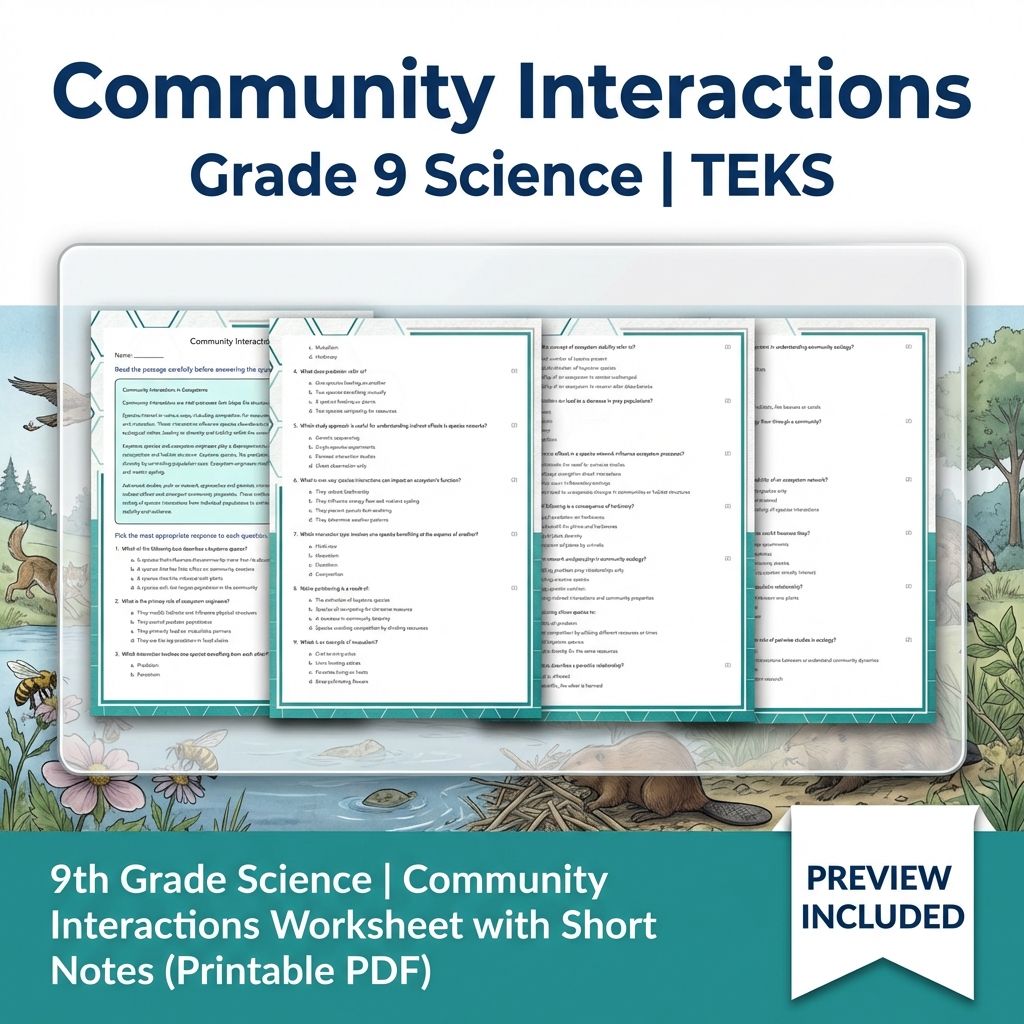
9th Grade Science | Community Interactions Worksheet with Short Notes (PDF)
 Created byMeadowlark Worksheets
Learning Objectives
- Understand the various types of species interactions within a community.
- Identify the roles of keystone species and ecosystem engineers.
- Analyze how species relationships influence community structure and ecosystem stability.
Instant download
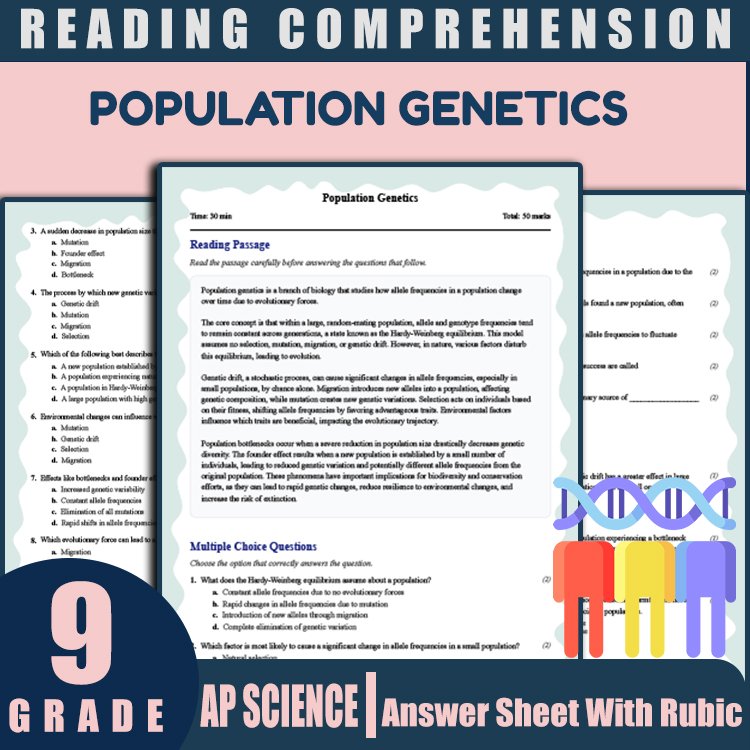
9th Grade Science | Population Genetics Reading Worksheet & Answer Key (PDF)
JCreated byJ.S SheetsLearning Objectives
- Understand the principles of allele frequency changes under various evolutionary forces.
- Describe the Hardy-Weinberg equilibrium and its significance in population genetics.
- Explain the concepts of genetic drift, selection, migration, and mutation.
Instant download

Grade 9 Science Worksheet on Climate Forcing – Ontario Standards (PDF)
 Created byEvergreen Desk Education
Learning Objectives
- Explain how greenhouse gas forcing, albedo changes, aerosol effects, and land-use feedbacks influence Earth’s energy balance.
- Describe basic radiative transfer and the idea of an energy budget imbalance that leads to temperature change.
- Connect human emissions to carbon cycle perturbations and to projected climate responses.
Also included in: Grade 9 Earth and Space Science Lesson Bundle for Ontario Framework +1 more
Instant download

Grade 9 Science | Energy Transfer Worksheet (Ontario Standards) (PDF)
Created byEvergreen Desk EducationLearning Objectives
- Explain how solar radiation, geothermal heat, and radiative balance contribute to energy transfer within Earth systems
- Describe how conduction, convection, and radiation move energy and how gradients drive atmospheric and ocean circulation
- Relate radioactive decay to long-term mantle convection and volcanic activity, contrasting short-term surface exchanges with long-term internal effects
Also included in: Grade 9 Earth and Space Science Lesson Bundle for Ontario Framework +1 more
Instant download

Grade 9 Science Worksheet | Planetary Layers – Ontario Standards (PDF)
Created byEvergreen Desk EducationLearning Objectives
- Describe Earth as concentric layers (crust, mantle, core) and identify key boundaries by their physical properties.
- Compare lithosphere and asthenosphere in terms of mechanical behavior and how that behavior relates to plate tectonics.
- Explain how density, temperature, and pressure change with depth and how these factors influence material phase and motion.
Also included in: Grade 9 Earth and Space Science Lesson Bundle for Ontario Framework +1 more
Instant download

Grade 9 Science | Plate Tectonics Worksheet (Ontario Standard) (PDF)
Created byEvergreen Desk EducationLearning Objectives
- Explain how divergent, convergent, and transform boundaries shape Earth’s surface
- Describe how subduction and continental collision contribute to earthquakes, volcanism, and mountain building
- Connect tectonic driving forces (mantle convection, slab pull) to plate motion and geologic outcomes over time
Also included in: Grade 9 Earth and Space Science Lesson Bundle for Ontario Framework +1 more
Instant download

Grade 9 Science | Rock Cycle Worksheet (Ontario Standards) (PDF)
Created byEvergreen Desk EducationLearning Objectives
- Explain how the rock cycle connects igneous, sedimentary, and metamorphic rocks through specific processes.
- Describe the energy sources and rate factors that drive rock cycle transitions over geologic time.
- Use field evidence (foliation, sedimentary layering, igneous intrusions) to infer which rock-cycle pathway may have occurred.
Also included in: Grade 9 Earth and Space Science Lesson Bundle for Ontario Framework +1 more
Instant download

Grade 9 Science | Resource Impacts Worksheet (Ontario, PDF)
Created byEvergreen Desk EducationLearning Objectives
- Evaluate how extraction and use of Earth resources can alter habitats, landforms, erosion patterns, pollution pathways, and material cycles.
- Compare mineral mining, fossil fuel extraction, and water withdrawal by identifying their likely environmental effects.
- Use sustainability criteria (renewability, cumulative effects, reclamation potential, and trade-offs) to support evidence-based judgments.
Also included in: Grade 9 Earth and Space Science Lesson Bundle for Ontario Framework +1 more
Instant download
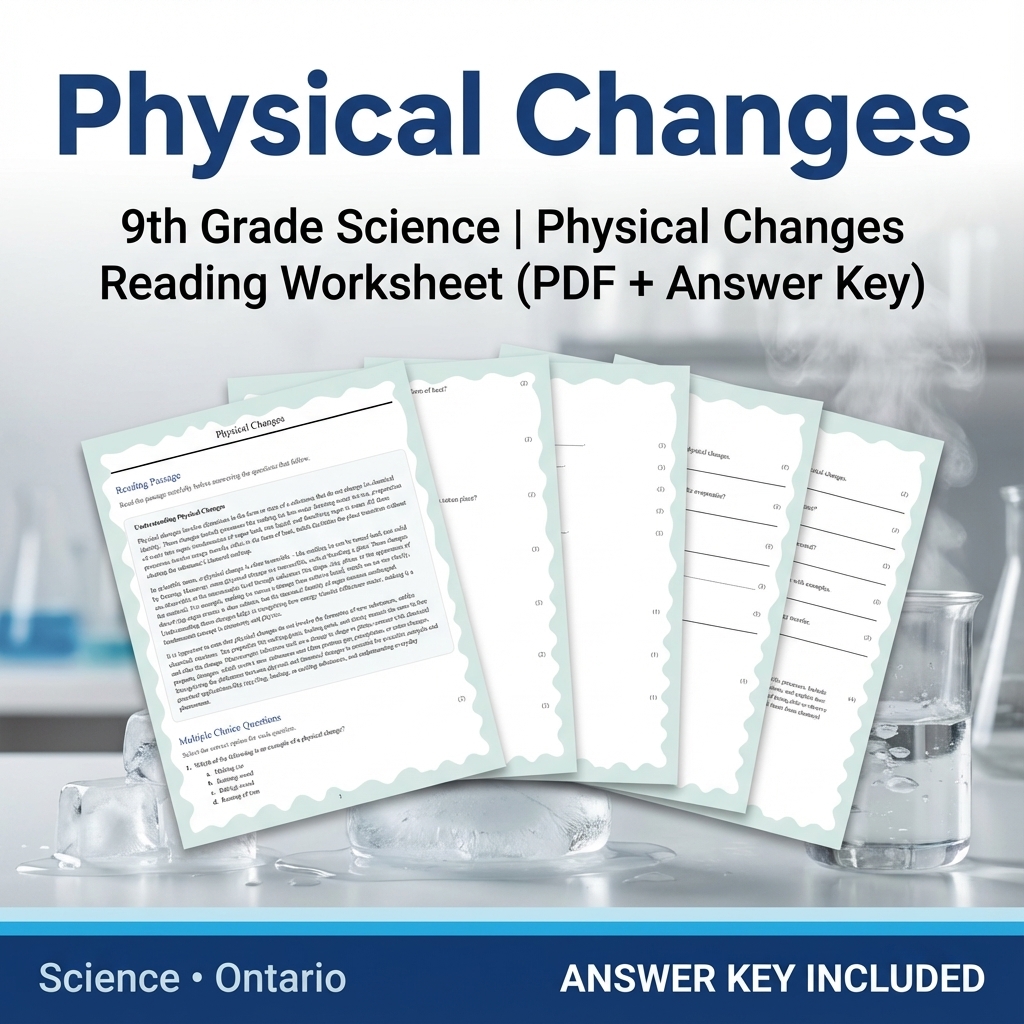
9th Grade Science | Physical Changes Reading Worksheet (PDF + Answer Key)
JCreated byJ.S SheetsLearning Objectives
- Define and distinguish between physical and chemical changes.
- Identify examples of physical changes such as melting, freezing, evaporation, condensation, and dissolution.
- Explain how energy transfer affects phase changes.
Also included in: Grade 9 Science Unit Bundle | Essential Concepts & Skills (Answer Keys Included) +1 more
Instant download
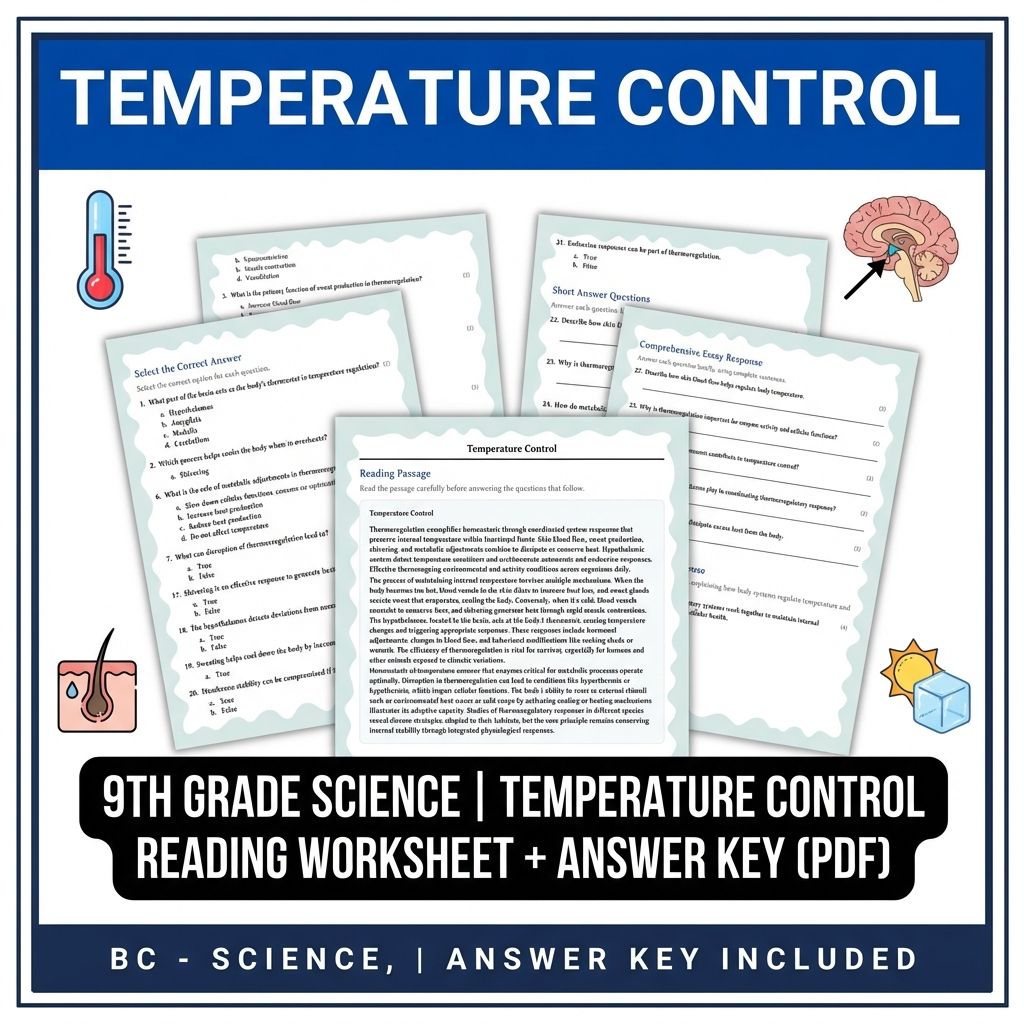
9th Grade Science | Temperature Control Reading Worksheet + Answer Key (PDF)
JCreated byJ.S SheetsLearning Objectives
- Explain how thermoregulation maintains internal body temperature within limits.
- Identify key physiological responses involved in thermoregulation.
- Describe the role of the hypothalamus in temperature regulation.
Instant download

Mechanical Advantage Worksheet | Science Practice and Standards-Aligned Grade 9
JCreated byJ.S SheetsLearning Objectives
- Understand the concept of mechanical advantage and how it is expressed as a ratio.
- Calculate mechanical advantage for different machine types such as levers, pulleys, and wheel systems.
- Analyze how mechanical advantage influences design choices and safety in equipment like bale lifters and scaffold hoists.
Also included in: Grade 9 Newtonian Motion & Energy Science Lesson Bundle | Alberta
Instant download

Grade 9 Science – Organelles Specialization Worksheet (PDF) for BC Standards
Created byEvergreen Desk EducationLearning Objectives
- Explain how membrane-bound organelles compartmentalize cellular activities in eukaryotic cells.
- Match specific organelles to their primary functions (energy production, protein synthesis, processing, sorting, and waste breakdown).
- Describe how functional specialization improves efficiency and coordination of metabolic pathways.
Instant download
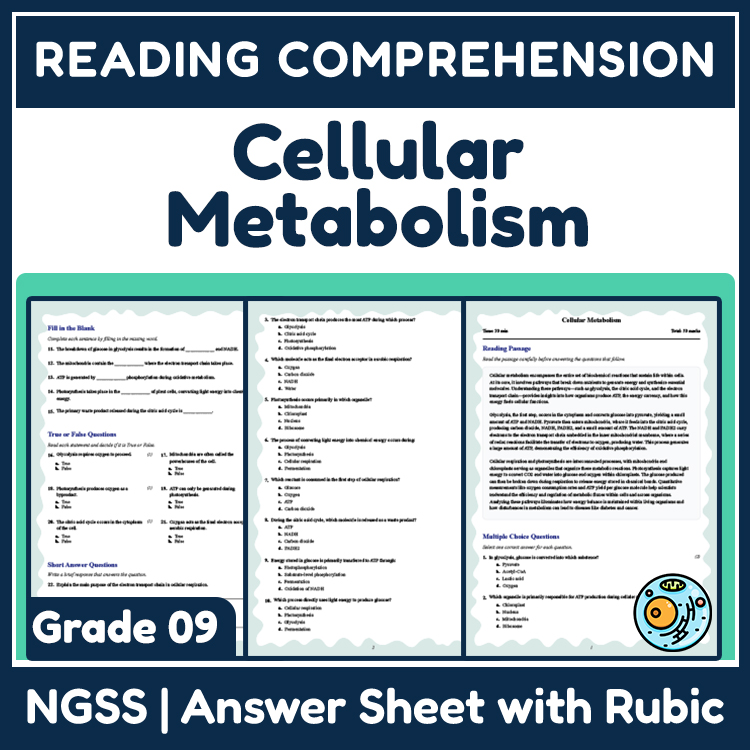
9th Grade Science | Cellular Metabolism Reading Worksheet (PDF + Rubric)
JCreated byJ.S SheetsLearning Objectives
- Explain the biochemical pathways involved in cellular respiration, including glycolysis, the citric acid cycle, and electron transport chain.
- Describe the role of ATP in energy transfer within cells.
- Relate mitochondrial and chloroplast functions to metabolic processes such as respiration and photosynthesis.
Instant download

Computational Modeling Worksheet | NGSS Grade 9 Science Assessment
 Created bySkylark Worksheets
Learning Objectives
- Explain how computational models use equations, functions, and simulation to predict system performance.
- Develop and interpret performance objective functions for design decision-making.
- Describe how parameter estimation and sensitivity analysis support model tuning and uncertainty awareness.
Also included in: Grade 9 Engineering Design Prototyping & Modeling Lesson Bundle | NGSS +1 more
Instant download
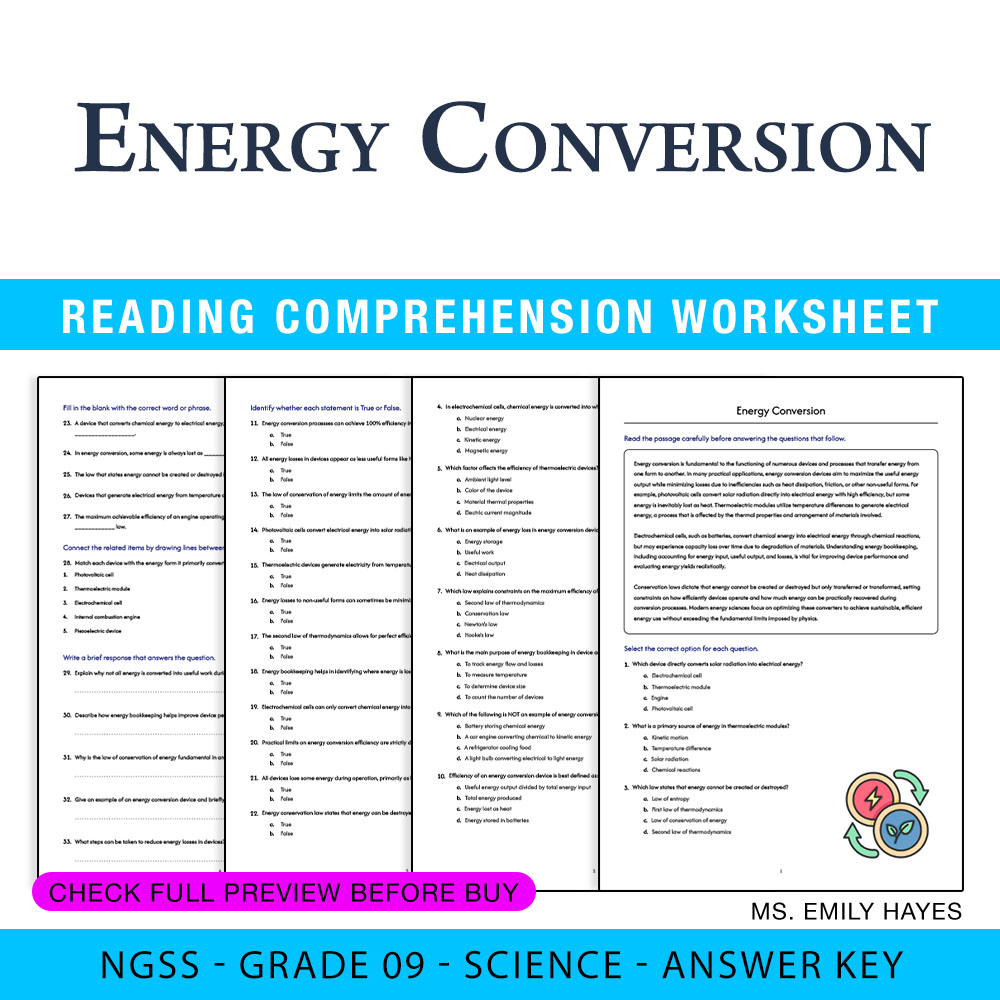
9th Grade Science | Energy Conversion Worksheet (PDF+ Answer Key)
 Created byCopper Leaf Classroom
Learning Objectives
- Explain the process of energy conversion in different devices
- Identify the forms of energy involved in energy conversion processes
- Analyze the efficiency and energy losses during device operation
Instant download
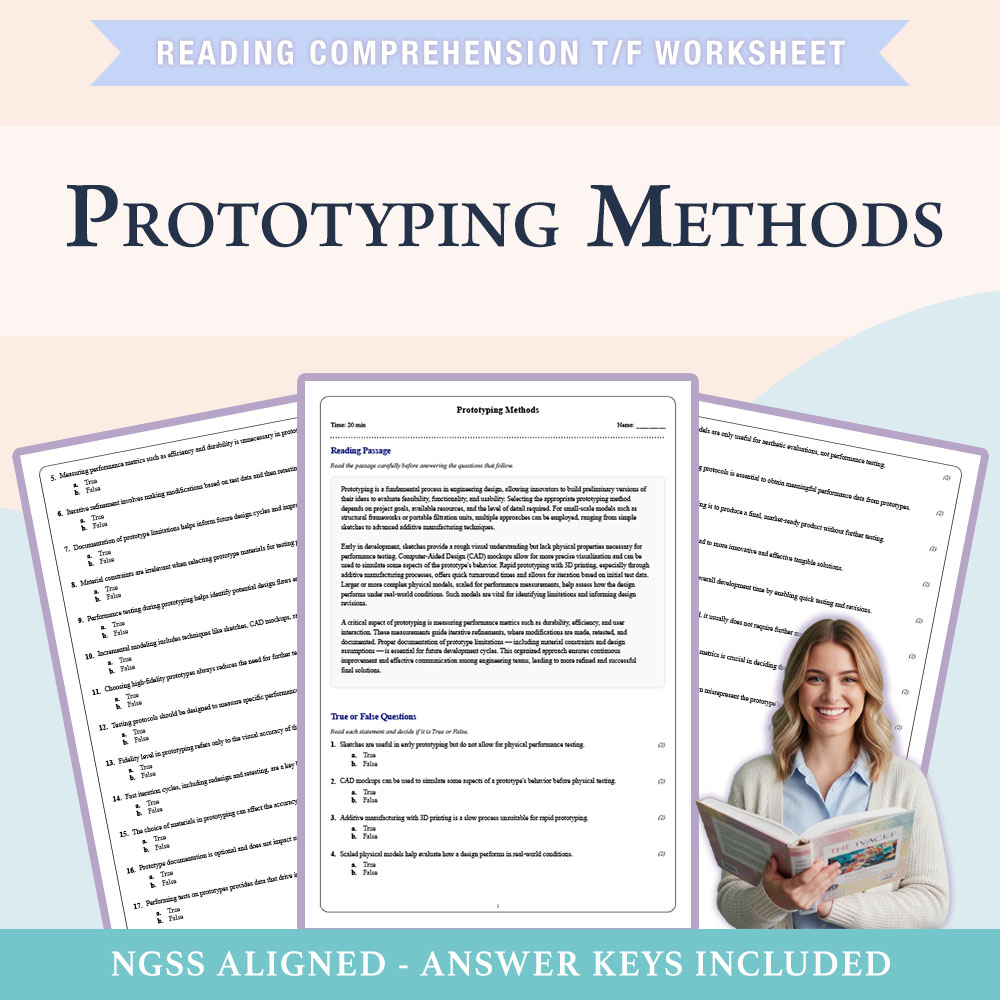
Grade 9 Science | Prototyping Methods Worksheet (PDF + Answer Key)
Created byCopper Leaf ClassroomLearning Objectives
- Understand different prototyping methods and their appropriate use cases.
- Recognize the importance of measurement, iteration, and documentation in prototyping.
- Identify criteria for selecting materials and fidelity levels in prototype development.
Also included in: Grade 9 Science | Engineering Design & Modeling Bundle (PDF + Answer Key) +1 more
Instant download
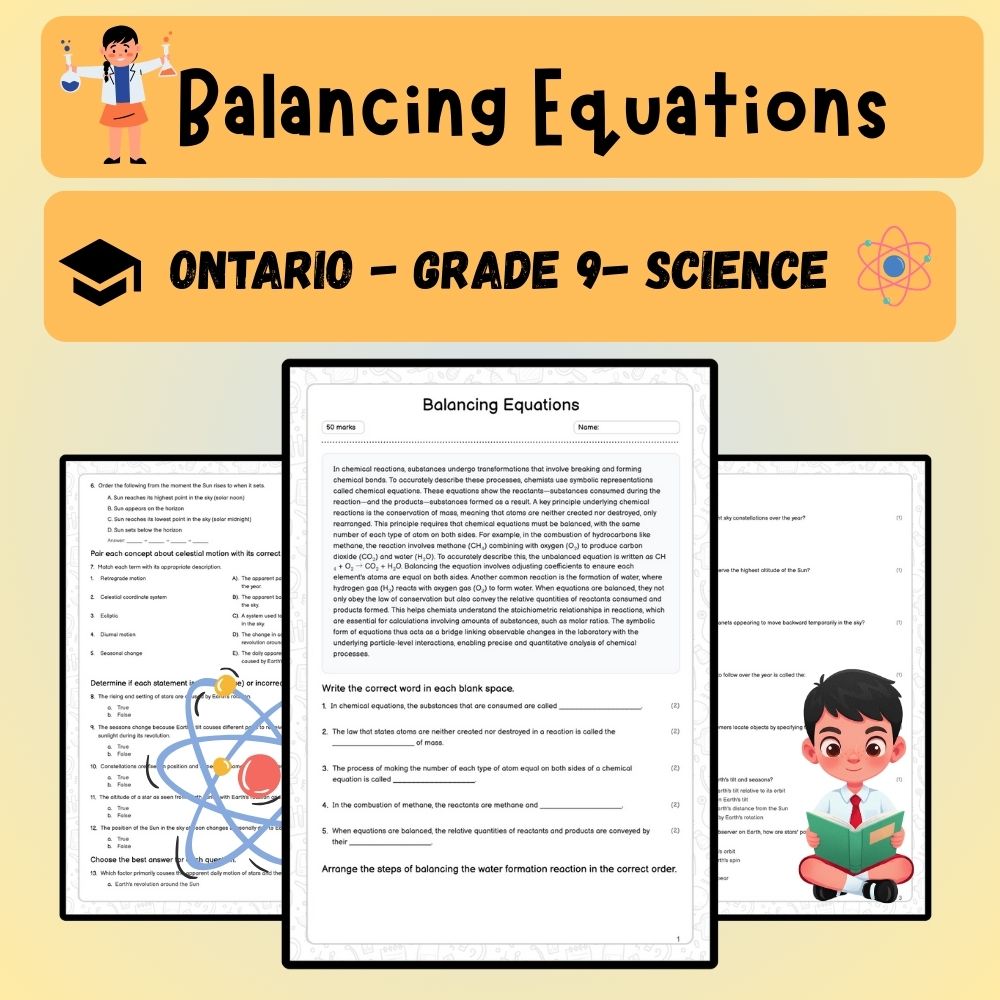
Grade 9 Science | Balancing Equations Worksheet (PDF) – Ontario Standards
 Created byPrism Point Learning
Learning Objectives
- Understand the purpose of chemical equations and the conservation of atoms.
- Learn how to represent reactions symbolically with correct formulas.
- Practice balancing chemical equations to reflect mass conservation.
Also included in: Grade 9 Science UNIT Worksheet Pack | Chemical Properties, Energy & Reactions +1 more
Instant download
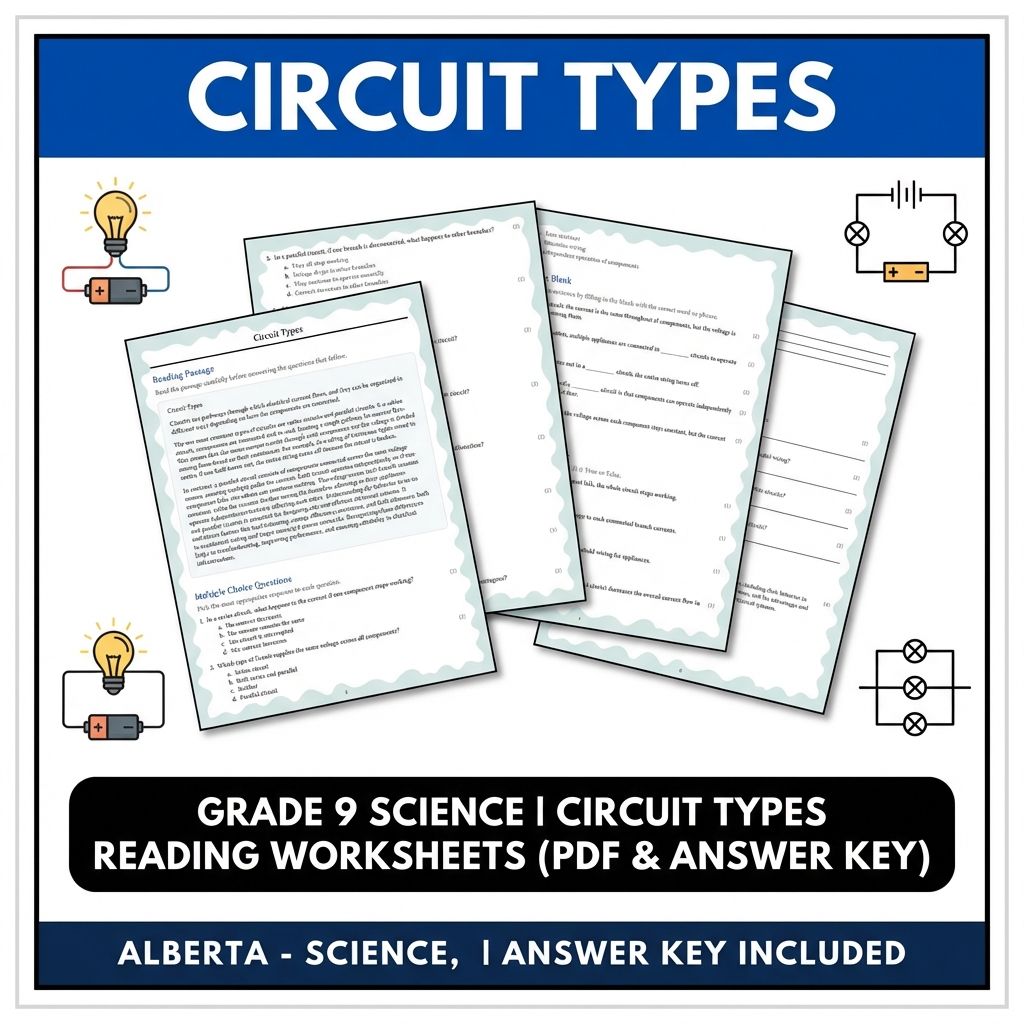
Grade 9 Science | Circuit Types Reading Worksheets (PDF & Answer Key)
JCreated byJ.S SheetsLearning Objectives
- Understand the differences between series and parallel circuits in terms of current and voltage
- Identify examples of series and parallel circuits in real-world applications
- Analyze how circuit arrangements affect brightness, load sharing, and reliability
Also included in: Grade 9 Science Bundle | Electricity, Energy & Magnetism (PDF + Answer Keys) +1 more
Instant download
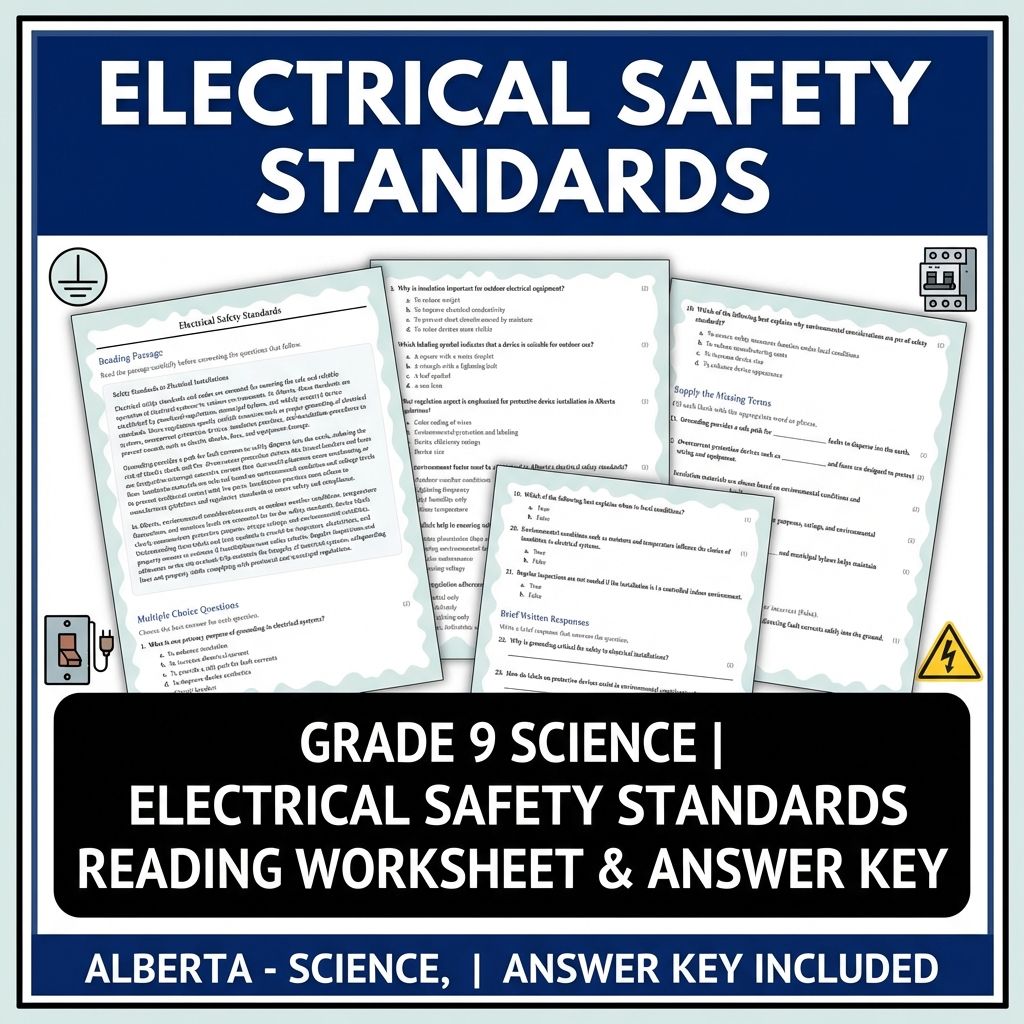
Grade 9 Science | Electrical Safety Standards Reading Worksheet & Answer Key
JCreated byJ.S SheetsLearning Objectives
- Understand key safety standards related to electrical installations and devices.
- Identify the purpose of various protective devices and safety labels.
- Interpret environmental considerations influencing electrical safety requirements.
Also included in: Grade 9 Science Bundle | Electricity, Energy & Magnetism (PDF + Answer Keys) +1 more
Instant download
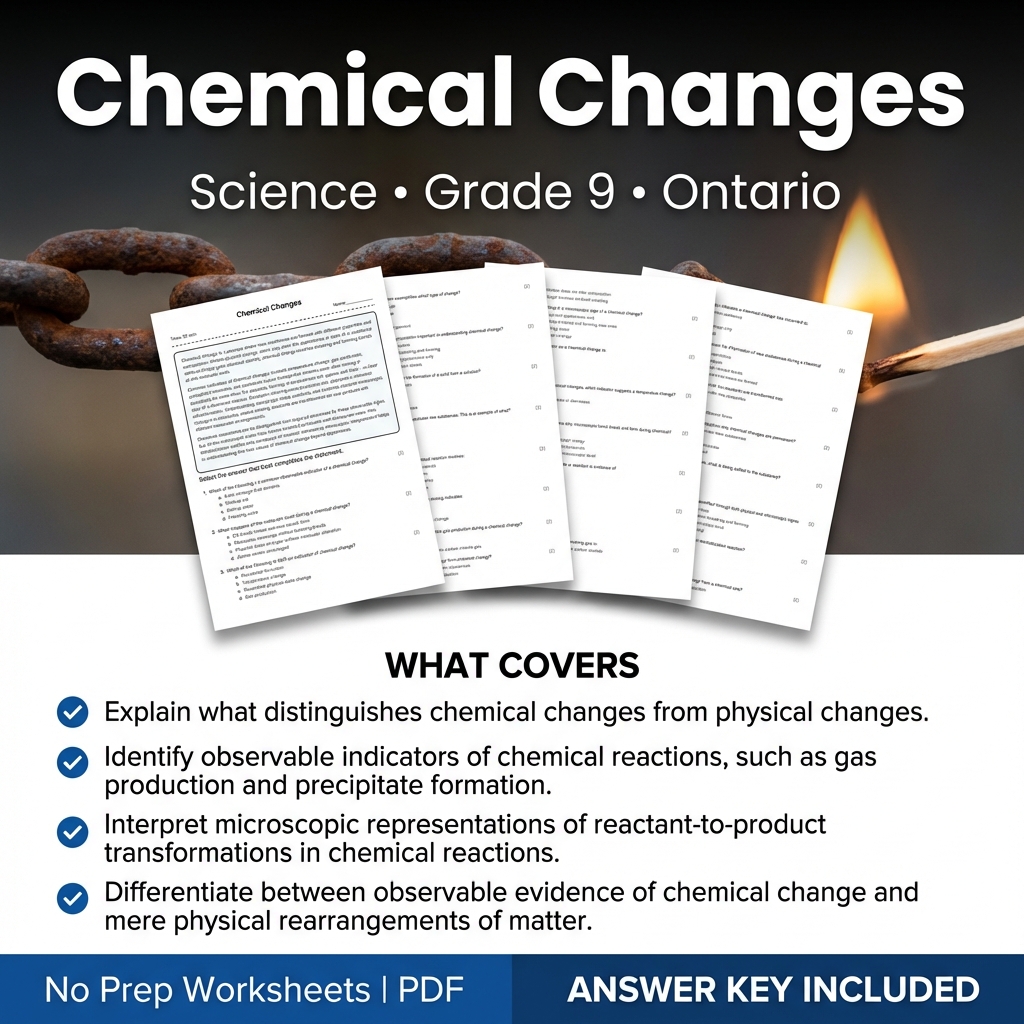
Chemical Changes Worksheet for Grade 9 Science | Ontario Standards
 Created byCoral Reef Learning
Learning Objectives
- Explain what distinguishes chemical changes from physical changes.
- Identify observable indicators of chemical reactions, such as gas production and precipitate formation.
- Interpret microscopic representations of reactant-to-product transformations in chemical reactions.
Instant download

Investigation Controls and Safety Grade 9 Science Worksheet
 Created byBRIGHT PATH RESOURCES
Learning Objectives
- Explain how controlling variables helps link a cause to an observed effect in an investigation.
- Identify which variable is independent, dependent, and controlled in a given scenario.
- Describe measurement practices that improve reliability and accuracy of data.
Also included in: Grade 9 Science Worksheets Bundle | Models, Evidence & Uncertainty +1 more
Instant download

Interpreting Graphs, Tables, and Trends Science Worksheets Grade 9
Created byBRIGHT PATH RESOURCESLearning Objectives
- Identify how graph axes, labels, and scales affect interpretation of data patterns.
- Interpret qualitative trends and quantitative relationships from graphs and tables.
- Distinguish likely outliers from typical values using spread and overall direction.
Also included in: Grade 9 Science Worksheets Bundle | Models, Evidence & Uncertainty +1 more
Instant download

Measurement Accuracy and Significant Figures Grade 9 Science Worksheet
Created byBRIGHT PATH RESOURCESLearning Objectives
- Explain how instrument scales, calibration, and consistent units improve measurement accuracy.
- Identify how significant figures represent precision and justified measurement limits.
- Convert between units and apply appropriate rounding rules to recorded data.
Also included in: Grade 9 Science Worksheets Bundle | Models, Evidence & Uncertainty +1 more
Instant download

Grade 9 Science | Component Behavior in Electrical Circuits - Daily Reading Practice
Created byCoral Reef LearningLearning Objectives
- Understand the concept of resistance in electrical components
- Identify characteristics of linear resistance in circuit elements
- Differentiate between linear and nonlinear component behaviors
Also included in: Electricity and Magnetism Lesson Bundle – Grade 9 Science Alberta +1 more
Instant download
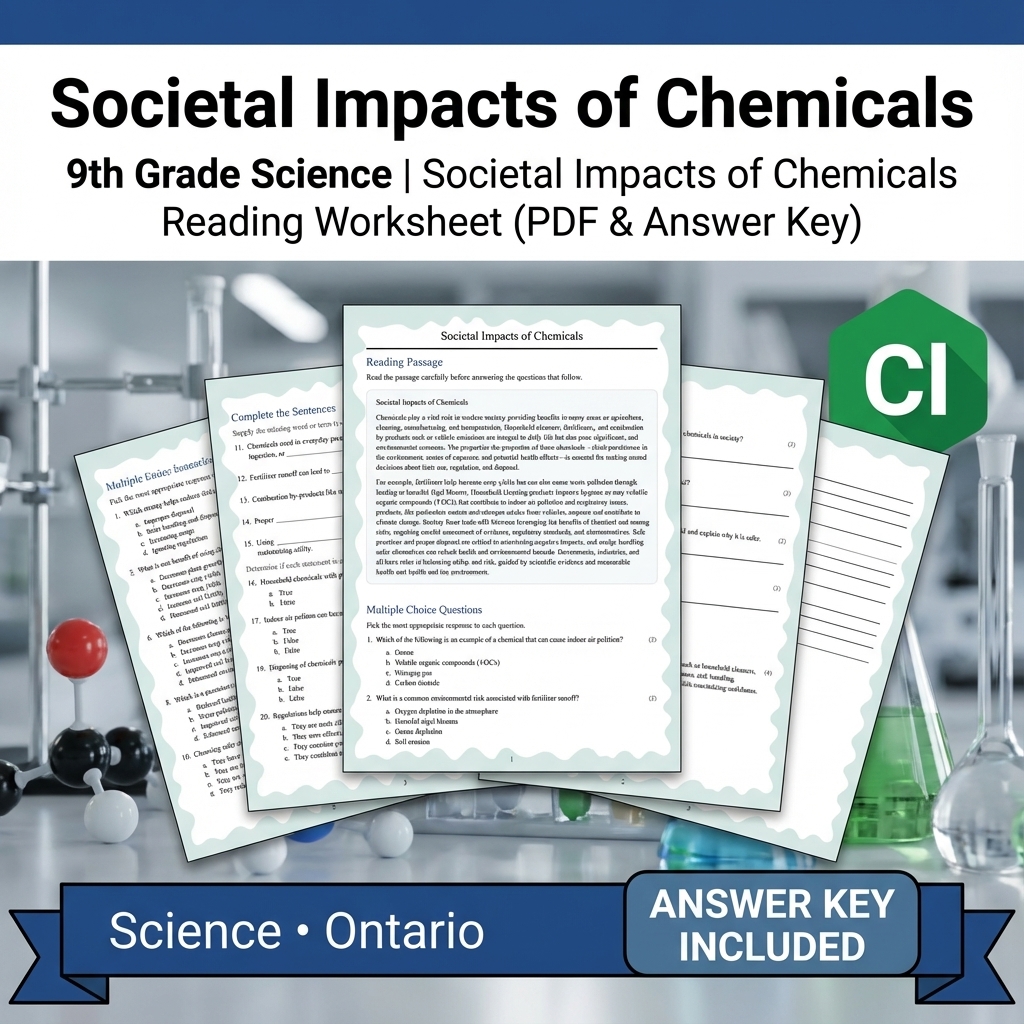
9th Grade Science | Societal Impacts of Chemicals Reading (PDF & Answer Key)
JCreated byJ.S SheetsLearning Objectives
- Understand how chemicals are used in everyday life and their societal benefits.
- Identify potential risks and environmental or health impacts associated with chemical use.
- Evaluate considerations for safe handling, disposal, and regulation of chemicals.
Also included in: Grade 9 Science Unit Bundle | Essential Concepts & Skills (Answer Keys Included) +1 more
Instant download
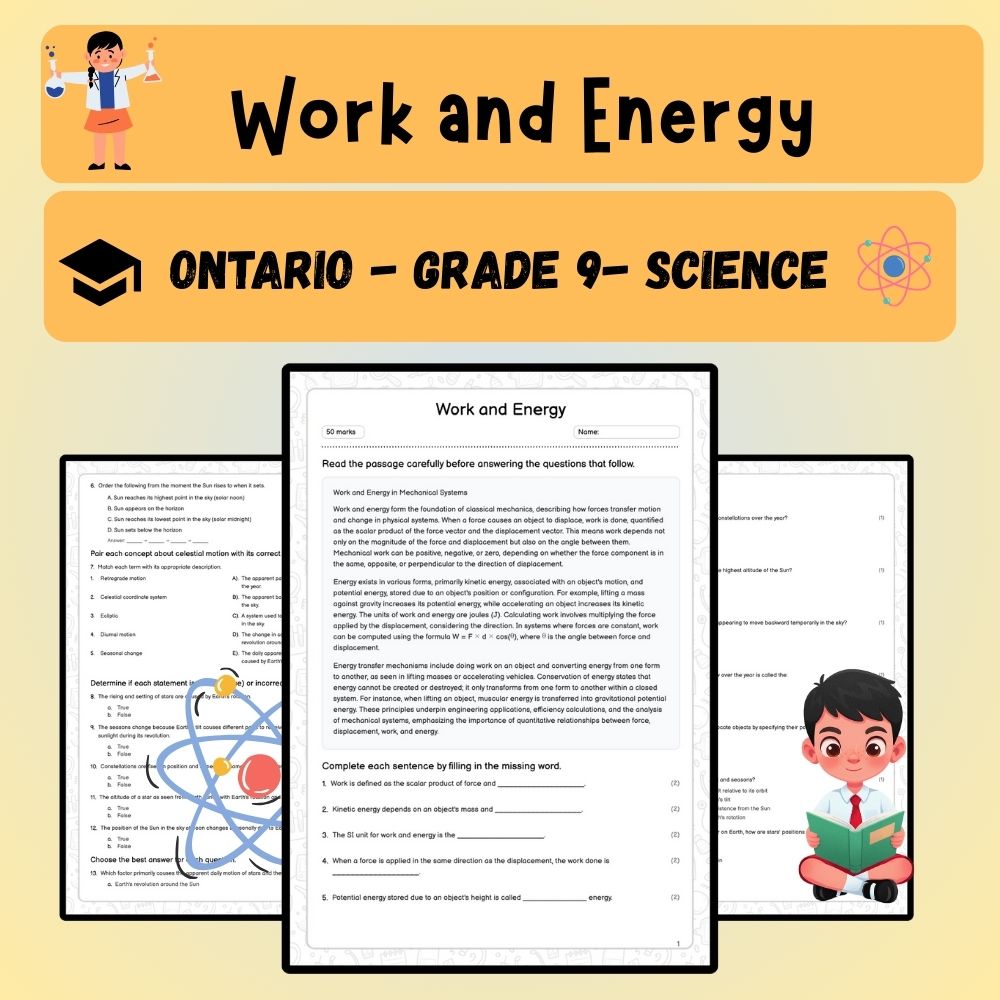
Grade 9 Science | Work and Energy Worksheet (Answer Key) – Ontario Standard
Created byPrism Point LearningLearning Objectives
- Define mechanical work as the scalar product of force and displacement.
- Identify and distinguish between kinetic and potential energy.
- Calculate work done by a constant force in different contexts.
Also included in: Grade 9 Science Unit | Forces, Motion & Energy Worksheets (Ontario Standards) +1 more
Instant download

Circulatory Transport Worksheet Grade 9 Science Ontario Biology + Answer Key
Created byClear Sky ClassroomLearning Objectives
- Explain how the cardiovascular system functions as a transport network for oxygen, nutrients, and waste removal
- Describe the roles of the heart, valves, and blood vessel hierarchy in blood flow
- Model how haemodynamics (pressure, flow, and resistance) helps regulate tissue oxygen delivery
Instant download
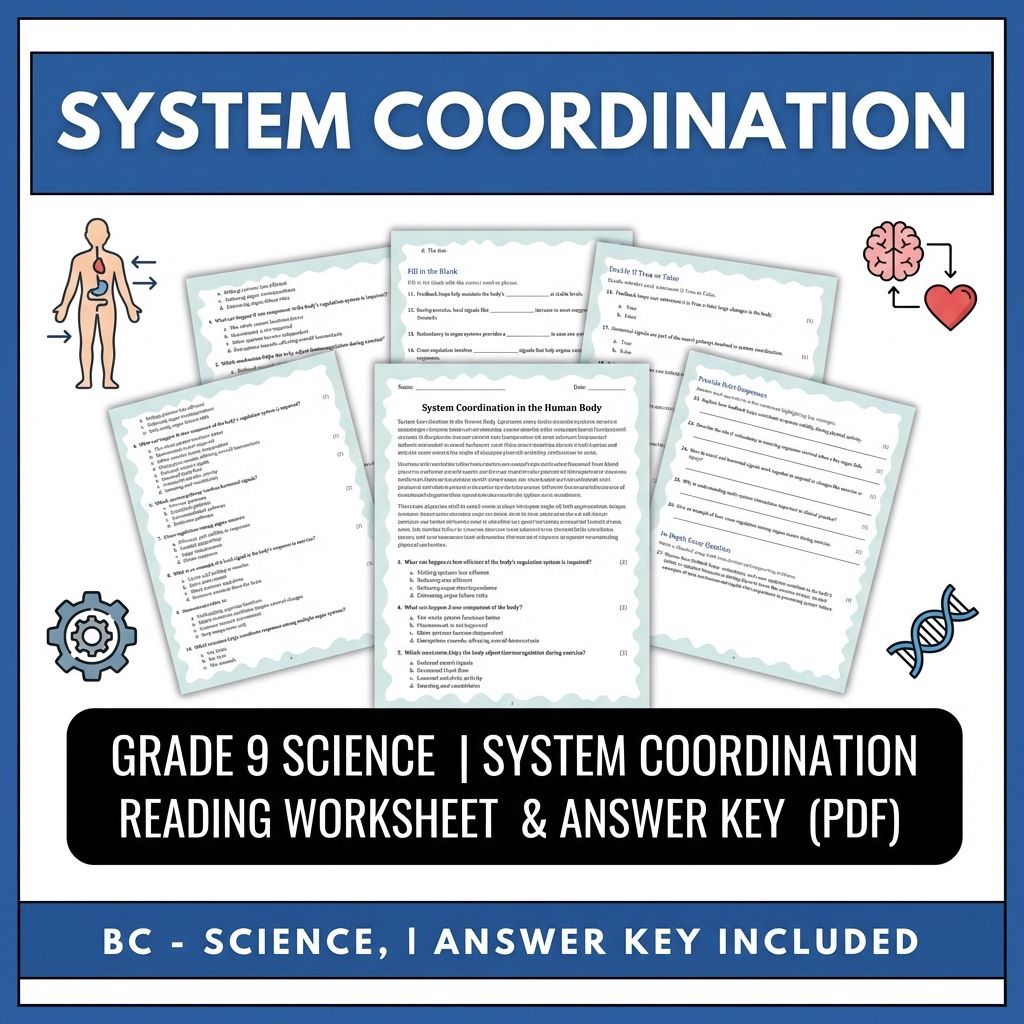
Grade 9 Science | System Coordination Reading Worksheet & Answer Key (PDF)
JCreated byJ.S SheetsLearning Objectives
- Understand how feedback loops, redundancy, and cross-regulation contribute to multi-system coordination in the body.
- Explain how exercise triggers responses across respiratory, cardiovascular, and metabolic pathways.
- Identify the mechanisms by which disruptions in one component can affect overall homeostasis and clinical outcomes.
Instant download

Ocean–Atmosphere Coupling Worksheet Pack | Grade 9 AP Science Practice
 Created byBright Quill Resources
Learning Objectives
- Explain how sea surface temperature (SST) anomalies can change atmospheric convection and circulation
- Describe the ENSO mechanism as a canonical example of ocean–atmosphere coupling
- Use ideas from time-series and lag correlation to connect ocean heat content changes to atmospheric responses
Instant download

Atmospheric Weather Processes Worksheet Grade 9 Science NGSSS Activity
Created byEvergreen Desk EducationLearning Objectives
- Explain how temperature, pressure, moisture, and wind interact to produce weather patterns
- Describe how phase changes of water vapor contribute to cloud formation and precipitation
- Analyze how heat transfer methods (radiation, conduction, convection) drive large-scale atmospheric circulation
Instant download
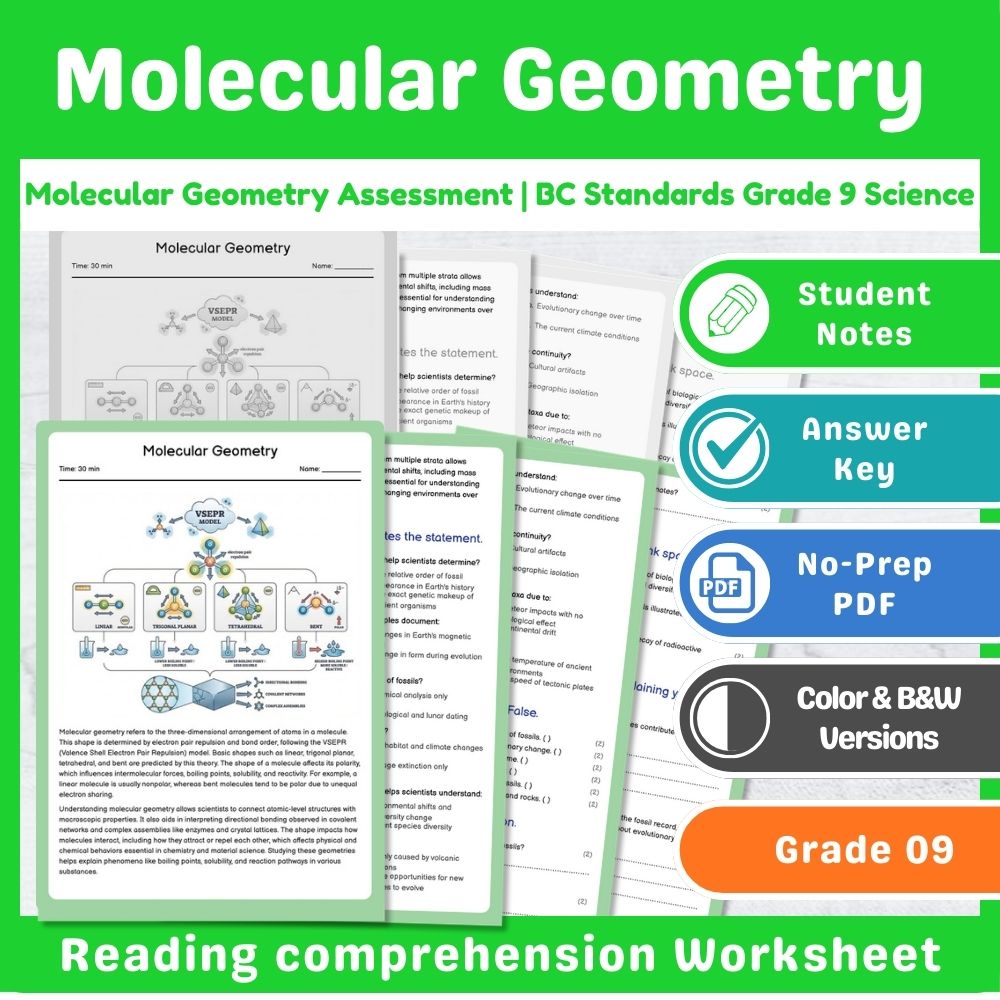
Molecular Geometry Assessment | BC Standards Grade 9 Science
Created byPrism Point LearningLearning Objectives
- Describe the basic principles of molecular geometry and VSEPR theory.
- Identify common molecular shapes such as linear, trigonal planar, tetrahedral, and bent.
- Understand how molecular shapes influence polarity and intermolecular forces.
Instant download
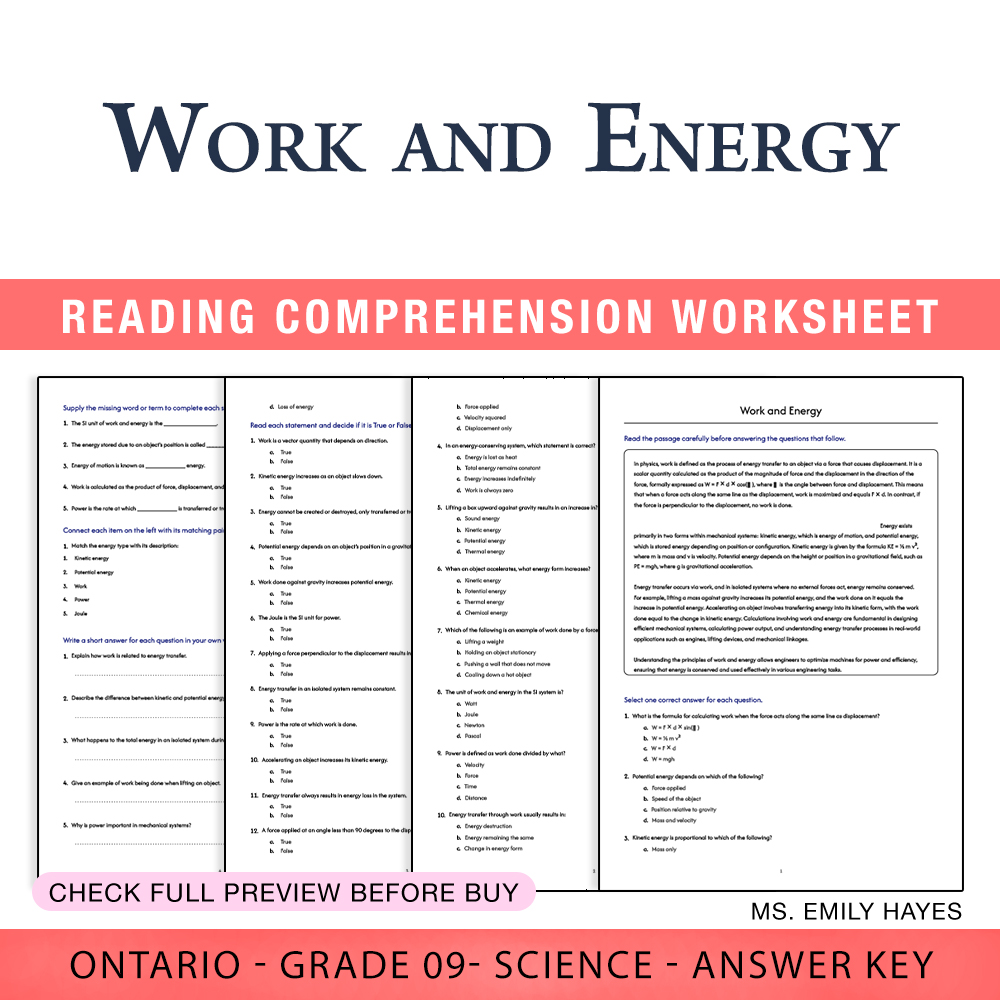
Grade 9 Science | Work and Energy Worksheet (PDF + Answer Key)
Created byCopper Leaf ClassroomLearning Objectives
- Understand and define mechanical work, including the calculation for constant forces.
- Identify and distinguish between kinetic energy and potential energy.
- Explain energy transfer mechanisms in simple systems such as lifting and acceleration.
Instant download
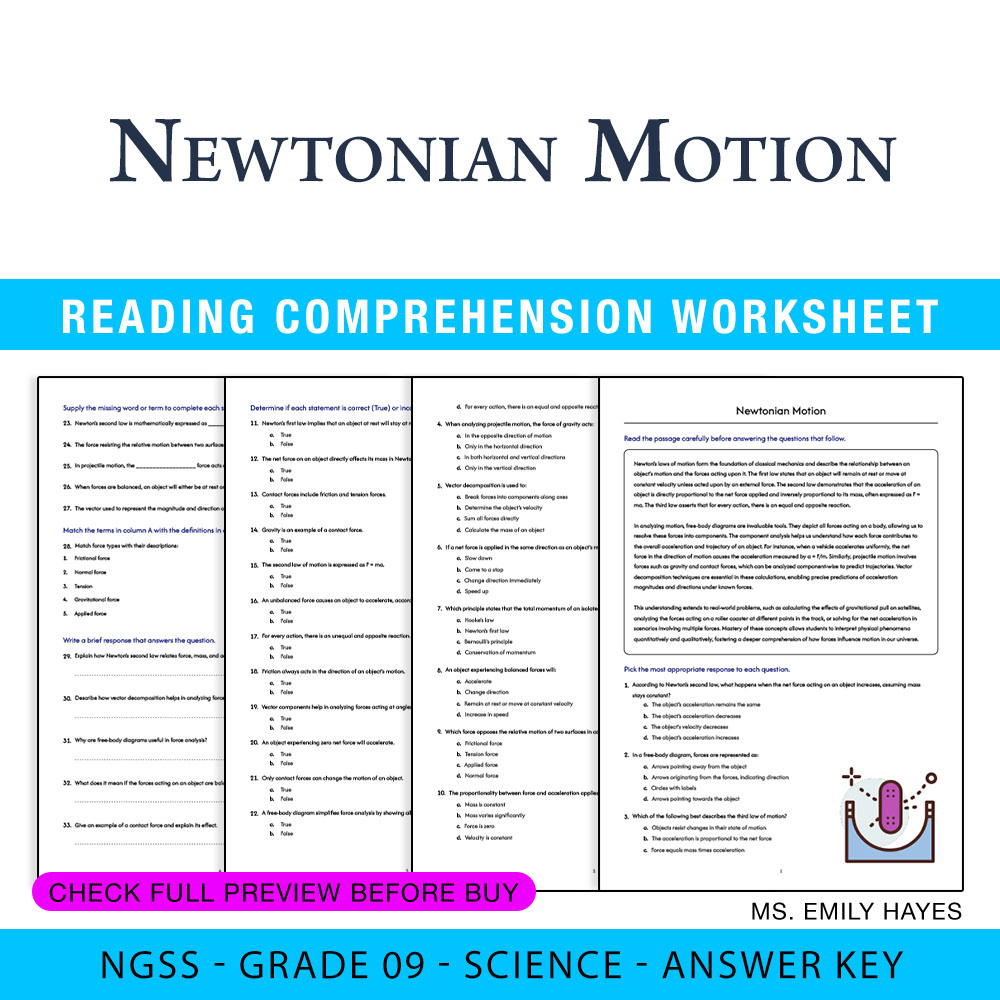
9th Grade Science | Newtonian Motion Practice Worksheet (PDF+ Answer Key)
Created byCopper Leaf ClassroomLearning Objectives
- Understand Newton's three laws of motion and their applications.
- Analyze force diagrams and components in different physical scenarios.
- Apply proportionality between net force and acceleration to predict motion in systems with constant mass.
Instant download
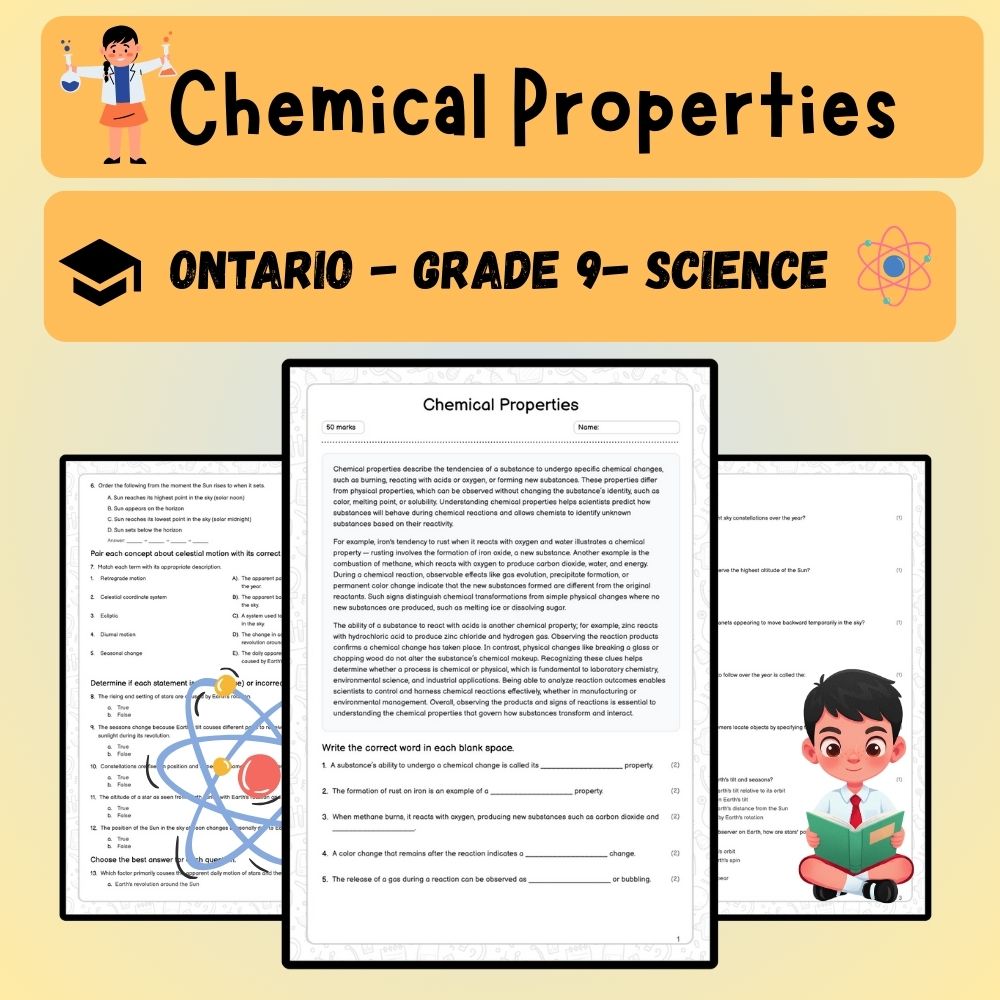
Grade 9 Science | Understanding Chemical Properties Worksheet (PDF)
Created byPrism Point LearningLearning Objectives
- Define and describe chemical properties and distinguish them from physical properties.
- Identify examples of chemical reactions such as rusting and combustion.
- Explain how indicators like gas evolution, precipitate formation, and color change signify chemical changes.
Also included in: Grade 9 Science UNIT Worksheet Pack | Chemical Properties, Energy & Reactions +1 more
Instant download

Grade 9 Plate Boundaries Worksheet | AP Practice PDF
Created byClear Sky ClassroomLearning Objectives
- Explain how plate motions produce different types of plate boundaries and surface features.
- Interpret evidence for plate tectonics, including seafloor age patterns and paleomagnetic stripes.
- Connect patterns of earthquakes and volcano locations to divergent, convergent, and transform margins.
Also included in: Grade 9 Earth and Space Sciences Science lesson bundle (AP framework) +1 more
Instant download
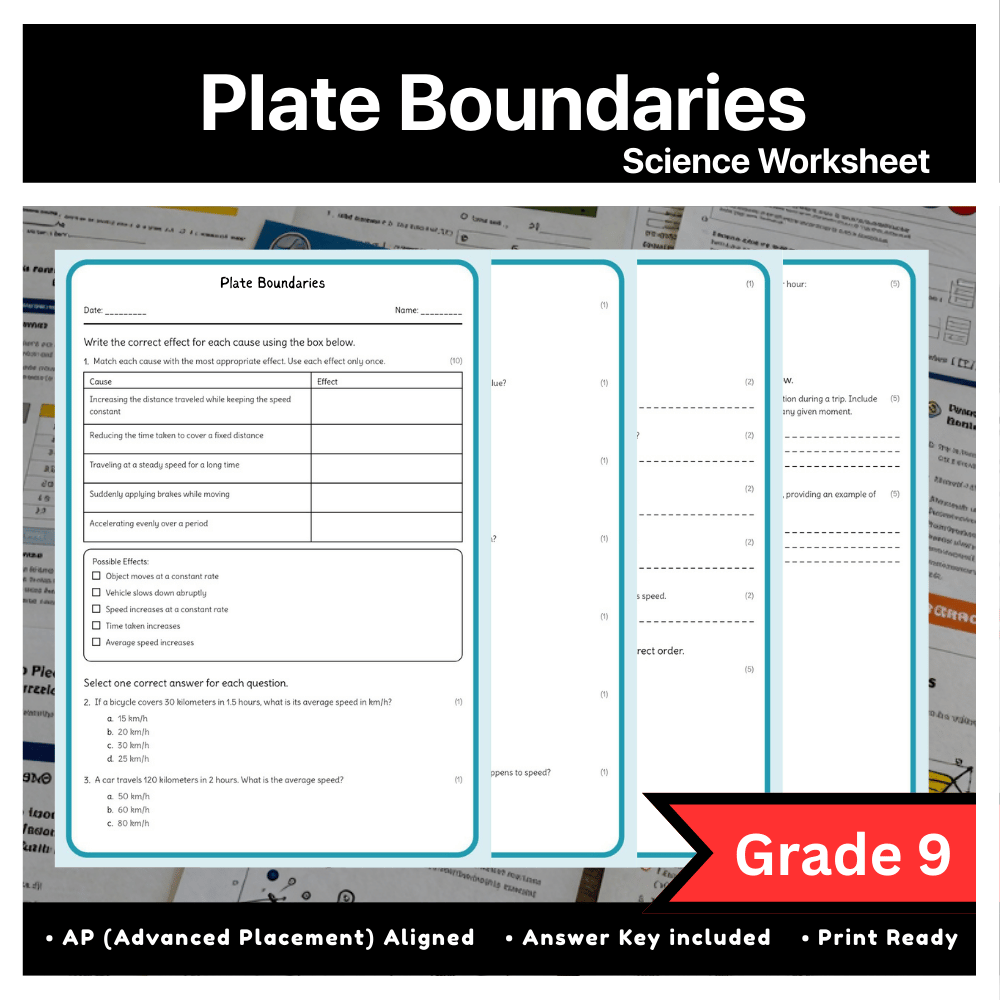
Grade 9 Science | Plate Boundaries Worksheet + Answer Key (AP Standard PDF)
 Created byBright Mind Resources
Learning Objectives
- Explain the mechanisms behind divergent, convergent, and transform plate boundaries.
- Identify surface expressions of different types of plate margins.
- Connect evidence such as seafloor age, paleomagnetic stripes, and seismic distributions to plate tectonic processes.
Instant download
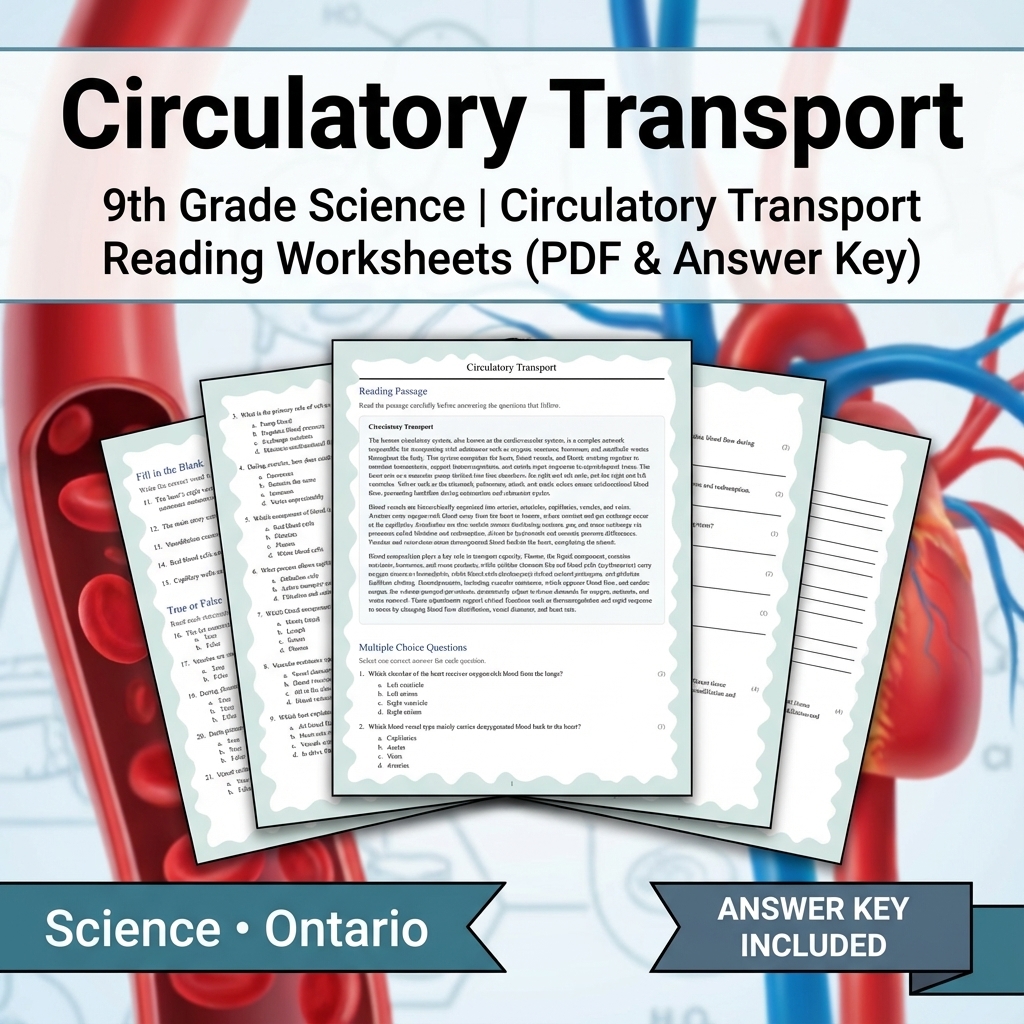
9th Grade Science | Circulatory Transport Reading Worksheets (PDF & Answer Key)
JCreated byJ.S SheetsLearning Objectives
- Understand the structure and function of the cardiovascular system in transporting oxygen, nutrients, and wastes.
- Identify the roles of the heart chambers, valves, and blood vessels in circulation.
- Explain the mechanisms of blood flow regulation, including vascular resistance and cardiac output.
Also included in: Grade 9 Science Unit Bundle | Human Body Systems & Cell Functions +1 more
Instant download
About Grade 9 Science Worksheets
Find Science worksheets built for Grade 9. All 6,926 cover core skills, practice, and review, each an instant PDF download.
Every worksheet on MyTeachingSheets is created by independent teacher-authors and reviewed before publication. All resources download as printable PDFs for classroom, homework, or at-home practice, and many include answer keys. Preview any worksheet free before buying.