
Grade 9 Science Worksheets
6,926 worksheets
Speciation Introduction Assessment for Grade 9 Science TEKS
 Created byPrism Point Learning
Learning Objectives
- Define speciation and understand its role in biodiversity.
- Differentiate between allopatric and sympatric speciation.
- Identify reproductive barriers that contribute to speciation.
Instant download

Natural Selection Assessment for Grade 9 Science TEKS Standards
Created byPrism Point LearningLearning Objectives
- Understand the concept of natural selection and its role in evolution.
- Identify examples of natural selection in real-world scenarios.
- Differentiate between types of selection: directional, stabilizing, and disruptive.
Instant download

Evidence Overview Assessment for Grade 9 Science TEKS Standards
Created byPrism Point LearningLearning Objectives
- Understand different lines of evidence supporting evolutionary relationships.
- Identify how fossil, anatomical, and molecular data contribute to understanding biodiversity over time.
- Compare and evaluate various types of evidence used in evolutionary studies.
Instant download

Fossil Records Assessment | TEKS Grade 9 Science Standards
Created byPrism Point LearningLearning Objectives
- Describe how fossils provide evidence for past life and evolutionary history.
- Identify types of fossils and their significance in stratigraphy.
- Explain how stratigraphic context and dating methods determine fossil ages.
Instant download

Grade 9 Science Worksheet | Structure Function Connections (PDF)
 Created byEvergreen Desk Education
Learning Objectives
- Explain how cellular structures support specific functions (information storage, energy conversion, and selective exchange).
- Connect organism-level body structures and tissues to their functional needs (protection, movement, support).
- Use models to justify how a feature’s physical properties enable biological tasks.
Also included in: Grade 9 Ecology, Inheritance, and Cell Functions Science Lesson Bundle (General) +1 more
Instant download

Grade 9 Science | Trait Prediction Across Generations Worksheet (PDF)
Created byEvergreen Desk EducationLearning Objectives
- Explain how allele combinations in parents determine genotype outcomes in offspring using probability.
- Predict expected phenotype frequencies across multiple generations, accounting for dominant and recessive alleles.
- Use evidence from family patterns and cross results to justify trait-frequency predictions.
Also included in: Grade 9 Ecology, Inheritance, and Cell Functions Science Lesson Bundle (General) +1 more
Instant download

Grade 9 Reaction Design in Chemistry Worksheet | NGSS Science Activity
 Created byBRIGHT PATH RESOURCES
Learning Objectives
- Understand the factors affecting chemical reaction rates and equilibrium.
- Identify how temperature, pressure, concentration, and catalysts influence reaction outcomes.
- Apply principles of kinetics and equilibrium to real-world chemical processes.
Also included in: Atomic Structure & Chemical Reactions Lesson Bundle | Grade 9 Science | NGSS +1 more
Instant download
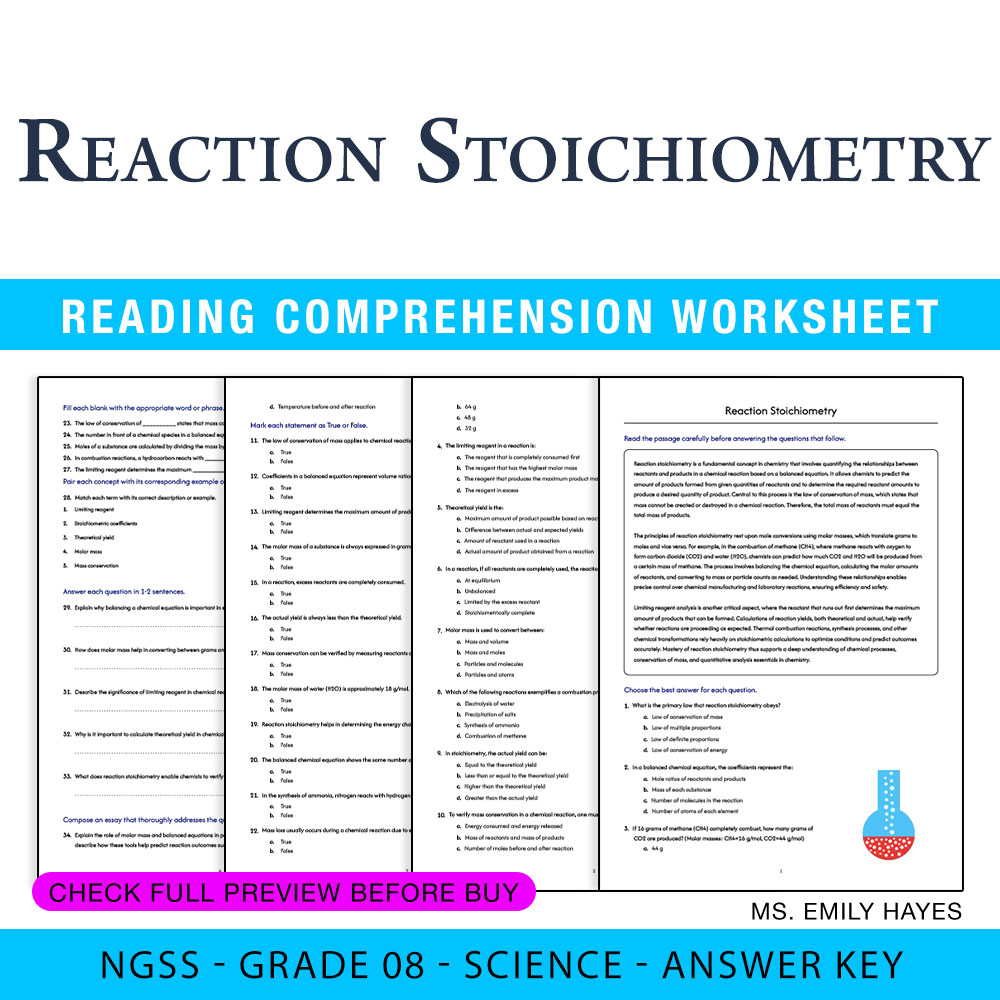
9th Grade Science | Reaction Stoichiometry Worksheet (PDF+ Answer Key)
 Created byCopper Leaf Classroom
Learning Objectives
- Understand the concept of reaction stoichiometry and how it relates quantities of reactants and products in chemical reactions.
- Apply molar mass conversions to relate moles, mass, and particle counts in balanced chemical equations.
- Analyze limiting reagents and calculate theoretical yields in chemical reactions.
Instant download
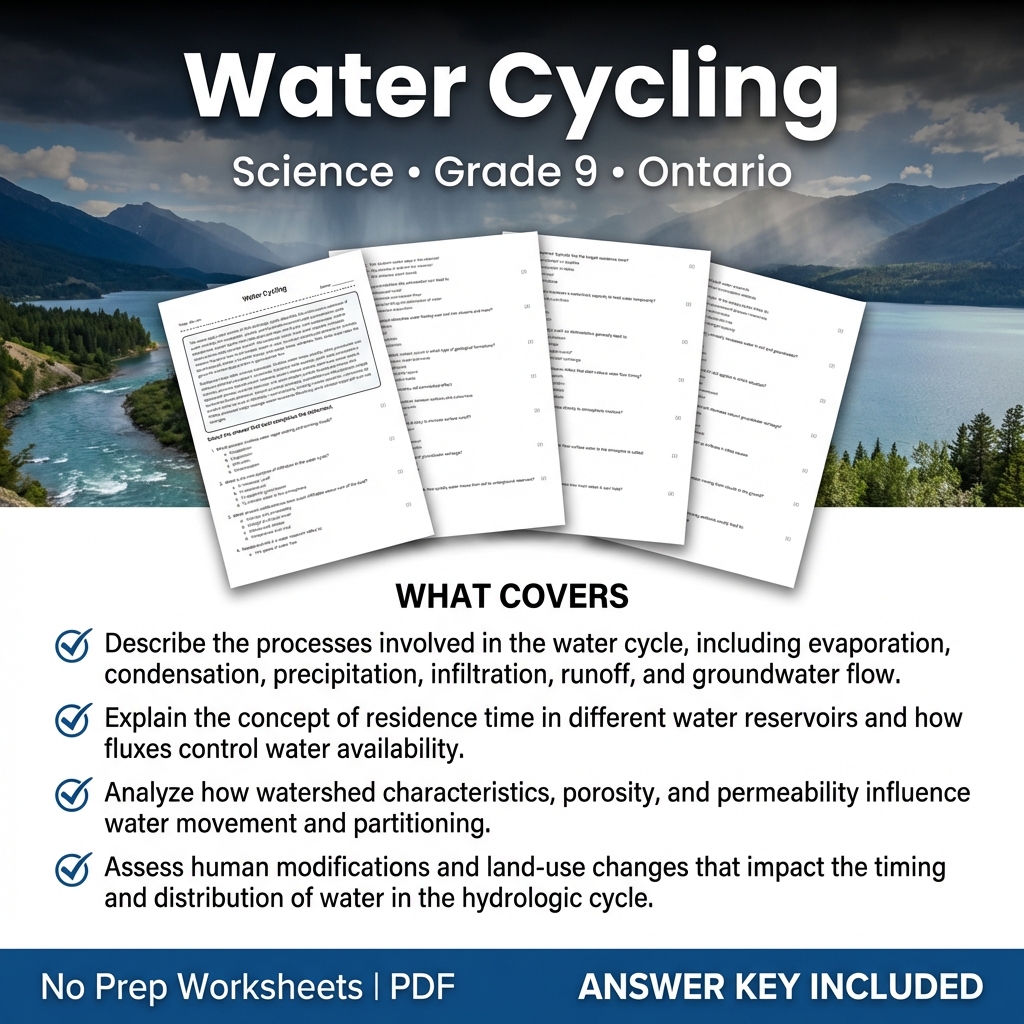
Water Cycling Science Worksheet Grade 9 | Ontario Standards Practice
 Created byCoral Reef Learning
Learning Objectives
- Describe the processes involved in the water cycle, including evaporation, condensation, precipitation, infiltration, runoff, and groundwater flow.
- Explain the concept of residence time in different water reservoirs and how fluxes control water availability.
- Analyze how watershed characteristics, porosity, and permeability influence water movement and partitioning.
Instant download
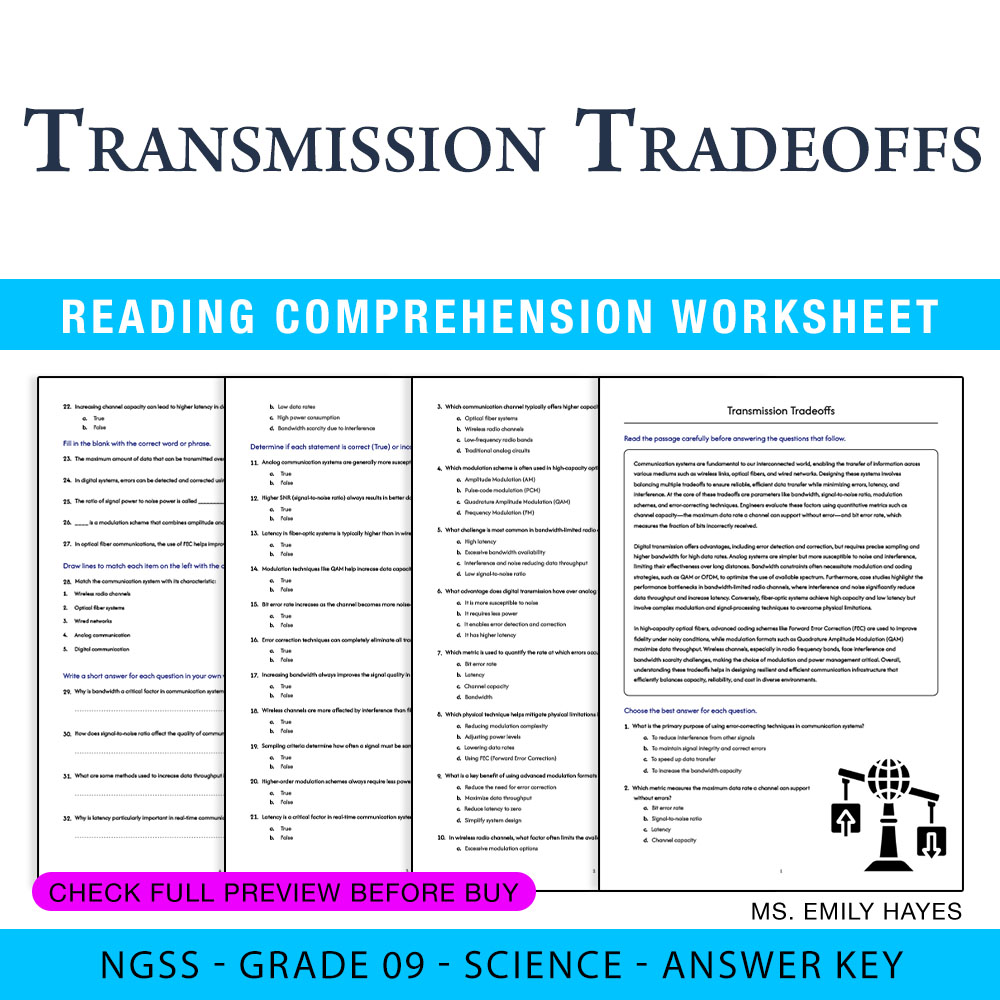
9th Grade Science | Transmission Tradeoffs Worksheet (PDF+ Answer Key)
Created byCopper Leaf ClassroomLearning Objectives
- Understand the key tradeoffs involved in digital and analog communication systems.
- Analyze the impact of bandwidth constraints, signal-to-noise ratio, and sampling criteria on system performance.
- Evaluate the role of error-correcting techniques, modulation, and coding in maintaining signal fidelity under noise.
Instant download
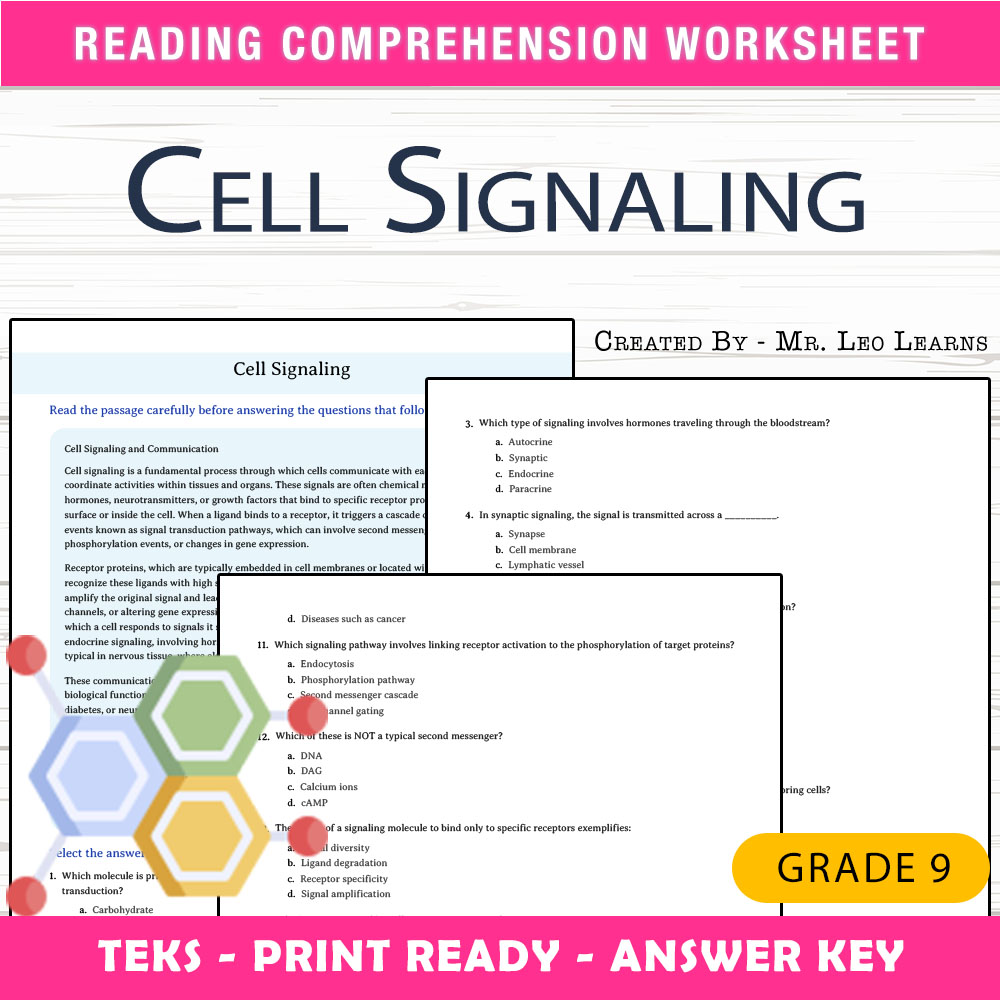
Grade 9 Science – Cell Signaling Worksheet for Mastery | PDF + Answer Key
 Created byThe Resource Hub
Learning Objectives
- Describe how cells communicate using chemical and electrical signals.
- Identify key components of signal transduction pathways.
- Explain the different types of cellular signaling (autocrine, paracrine, endocrine, synaptic).
Also included in: Grade 9 Science Unit | Human Body Systems & Homeostasis Worksheet Bundle +1 more
Instant download
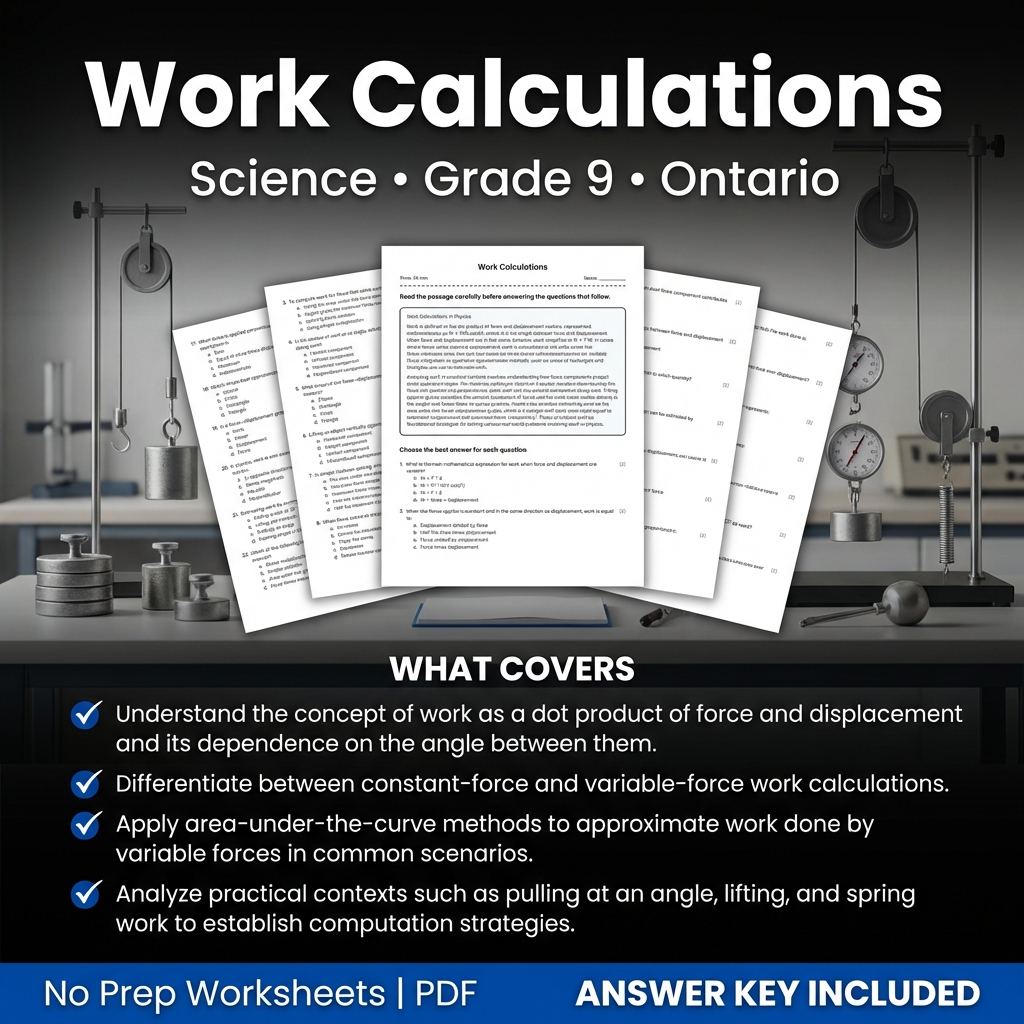
Work Calculations Worksheet for Grade 9 Science – Printable PDF & Answer Key
Created byCoral Reef LearningLearning Objectives
- Understand the concept of work as a dot product of force and displacement and its dependence on the angle between them.
- Differentiate between constant-force and variable-force work calculations.
- Apply area-under-the-curve methods to approximate work done by variable forces in common scenarios.
Instant download

Reaction Stoichiometry Worksheet | NGSS Grade 9 Science Assessment
 Created byCedar Grove Learning
Learning Objectives
- Understand how conservation of mass applies to balanced chemical equations.
- Relate moles, mass, and particle counts through molar mass conversions.
- Perform limiting reagent analysis and calculate theoretical yields.
Instant download

Grade 9 Reaction Stoichiometry Worksheet | NGSS Chemistry Science Activity
Created byBRIGHT PATH RESOURCESLearning Objectives
- Understand the concept of reaction stoichiometry and its basis in conservation of mass.
- Learn to interpret and balance chemical equations correctly.
- Apply mole conversions between mass, moles, and particle counts.
Also included in: Atomic Structure & Chemical Reactions Lesson Bundle | Grade 9 Science | NGSS +1 more
Instant download
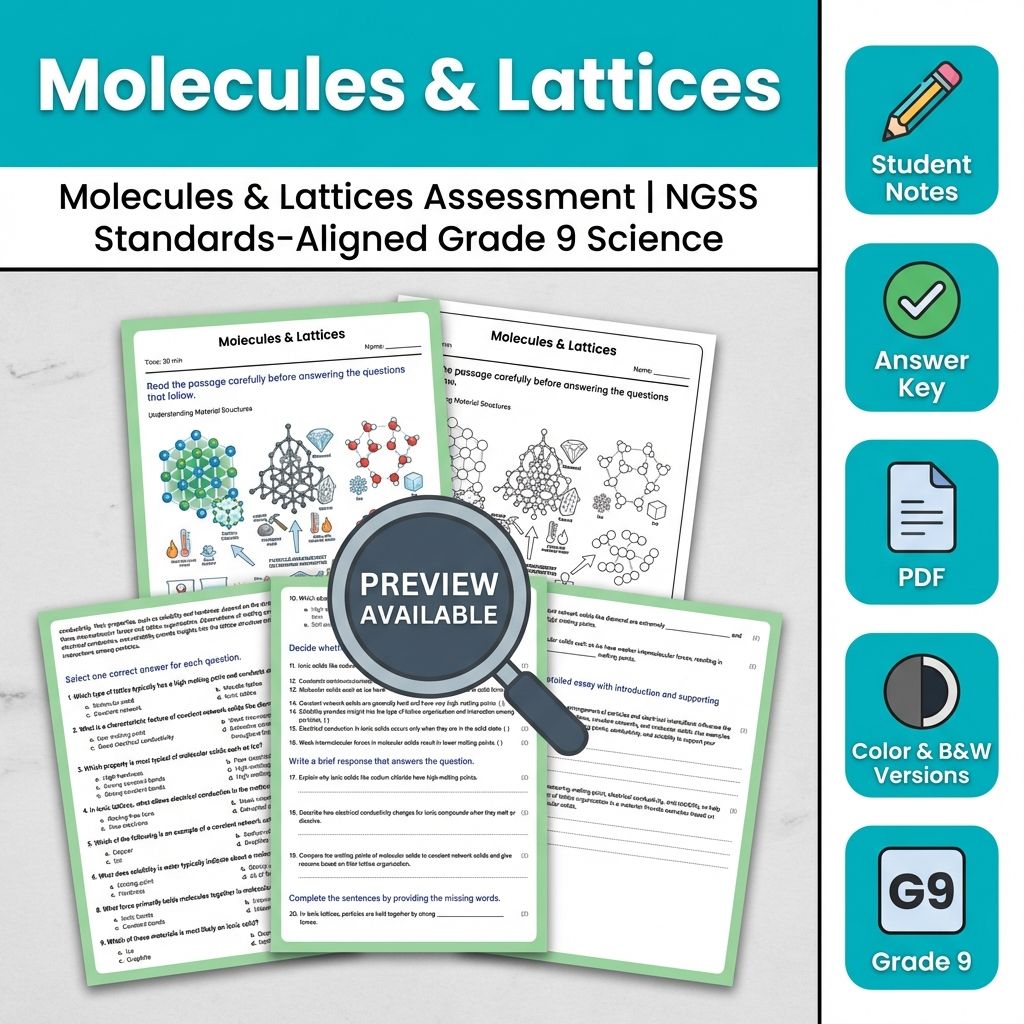
Molecules & Lattices Assessment | NGSS Standards-Aligned Grade 9 Science
Created byPrism Point LearningLearning Objectives
- Understand the relationship between particle arrangement and material properties in different lattice types.
- Identify characteristics of ionic, covalent network, and molecular solids based on their structure and observed physical properties.
- Analyze how melting point, electrical conductivity, hardness, and solubility reflect lattice organization and interparticle forces.
Instant download

Grade 9 Science | Temperature Control Worksheet | BC Aligned
 Created byLumora Learning
Learning Objectives
- Understand the mechanisms involved in thermoregulation and homeostasis.
- Identify how the hypothalamus detects and orchestrates responses to temperature changes.
- Describe the roles of skin blood flow, sweat production, shivering, and metabolic adjustments in temperature regulation.
Instant download

Grade 9 Science | Organ Structures Worksheet | BC Aligned
Created byLumora LearningLearning Objectives
- Explain the composition and function of various organ tissues.
- Describe how organs and organ systems work together to sustain life.
- Identify examples of organ systems and their key organs.
Instant download

Grade 9 Science | Cell Type Differences Worksheet Elena | BC Standards
Created byLumora LearningLearning Objectives
- Describe key structural differences between prokaryotic and eukaryotic cells.
- Identify components found in eukaryotic cells but absent in prokaryotes.
- Explain how these differences influence cell function and organism complexity.
Instant download
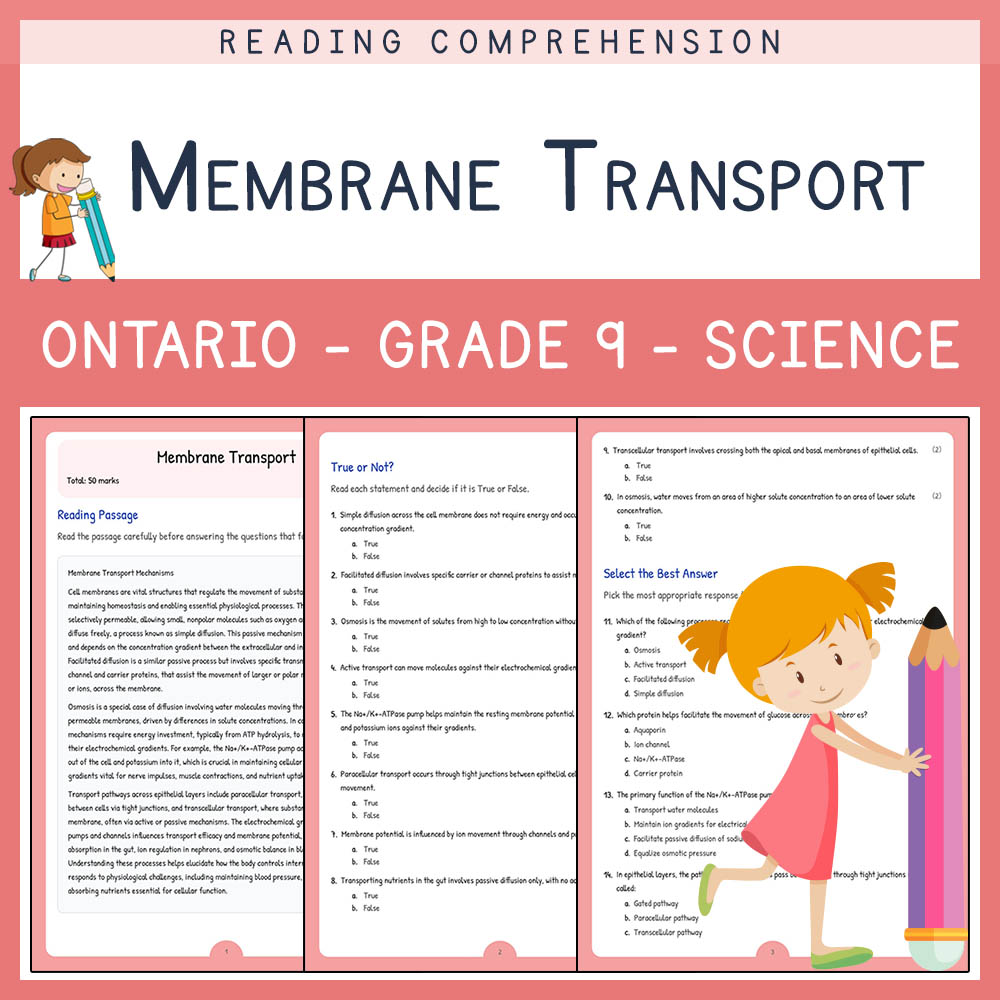
Grade 9 Science | Membrane Transport Worksheet Elena | Ontario Standard
Created byLumora LearningLearning Objectives
- Explain the mechanisms of molecular movement across cellular membranes, including diffusion, facilitated diffusion, osmosis, and active transport.
- Describe how electrochemical gradients and membrane potentials influence transport processes.
- Differentiate between paracellular and transcellular pathways in epithelial layers.
Also included in: Grade 9 Science | Life Systems Lesson Bundle | Ontario Framework
Instant download

Grade 9 Science | Friction & Drag - Daily Reading Comprehension
Created byCoral Reef LearningLearning Objectives
- Understand the concept of friction and its types
- Identify factors that affect friction and drag
- Apply knowledge of friction and drag to real-world scenarios
Also included in: Forces and Motion Mechanical Systems Lesson Bundle | Grade 9 Science Alberta +1 more
Instant download

Grade 9 Science: Reproductive Modes Worksheet – Alberta Standards (PDF)
Created byEvergreen Desk EducationLearning Objectives
- Compare sexual and asexual reproduction in terms of genetic variation
- Identify examples of reproductive strategies found in Alberta ecosystems
- Explain ecological trade-offs between population growth and genetic diversity
Instant download

Grade 9 Science – States & Energy Daily Reading Worksheet | Ontario
 Created byQuiet Forest Education
Learning Objectives
- Understand how phase changes involve energy transfer and particle motion.
- Identify different phase changes such as melting, vaporization, sublimation, and condensation.
- Explain how latent heat relates to energy transfer during phase transitions.
Also included in: Matter and Chemical Change Grade 9 Science Daily Worksheets Bundle | Ontario +1 more
Instant download

Grade 9 Science – Classification & Substances | Daily Reading Worksheet
Created byQuiet Forest EducationLearning Objectives
- Understand the difference between elements, compounds, and mixtures
- Identify examples of pure substances and mixtures
- Use chemical symbols and formulas to represent elements and compounds
Also included in: Matter and Chemical Change Grade 9 Science Daily Worksheets Bundle | Ontario +1 more
Instant download

Grade 9 Science – Reaction Types & Classifications | Daily Reading Worksheet
Created byQuiet Forest EducationLearning Objectives
- Identify different types of chemical reactions based on given examples.
- Recognize observable features of synthesis, decomposition, single and double displacement, and combustion reactions.
- Predict products of various reaction types based on reactant patterns.
Also included in: Matter and Chemical Change Grade 9 Science Daily Worksheets Bundle | Ontario +1 more
Instant download

Grade 9 Science – Solution Behaviour & Solubility | Daily Reading Worksheet
Created byQuiet Forest EducationLearning Objectives
- Understand the process of dissolution and factors affecting solubility.
- Identify differences between saturated, unsaturated, and supersaturated solutions.
- Explain how temperature and agitation influence solubility.
Also included in: Matter and Chemical Change Grade 9 Science Daily Worksheets Bundle | Ontario +1 more
Instant download

Grade 9 Science – Chemical Changes & Reactions | Daily Reading Worksheet
Created byQuiet Forest EducationLearning Objectives
- Identify signs of chemical reactions such as temperature change, gas production, precipitate formation, and color change.
- Understand microscopic processes that occur during chemical changes.
- Differentiate between chemical and physical changes based on observable evidence.
Also included in: Matter and Chemical Change Grade 9 Science Daily Worksheets Bundle | Ontario +1 more
Instant download

Grade 9 Science – Balancing Chemical Equations & Conservation | Daily Worksheet
Created byQuiet Forest EducationLearning Objectives
- Understand the symbolic representation of chemical reactions
- Identify reactants and products in simple chemical equations
- Learn the importance of balancing equations to reflect conservation of atoms and mass
Also included in: Matter and Chemical Change Grade 9 Science Daily Worksheets Bundle | Ontario +1 more
Instant download
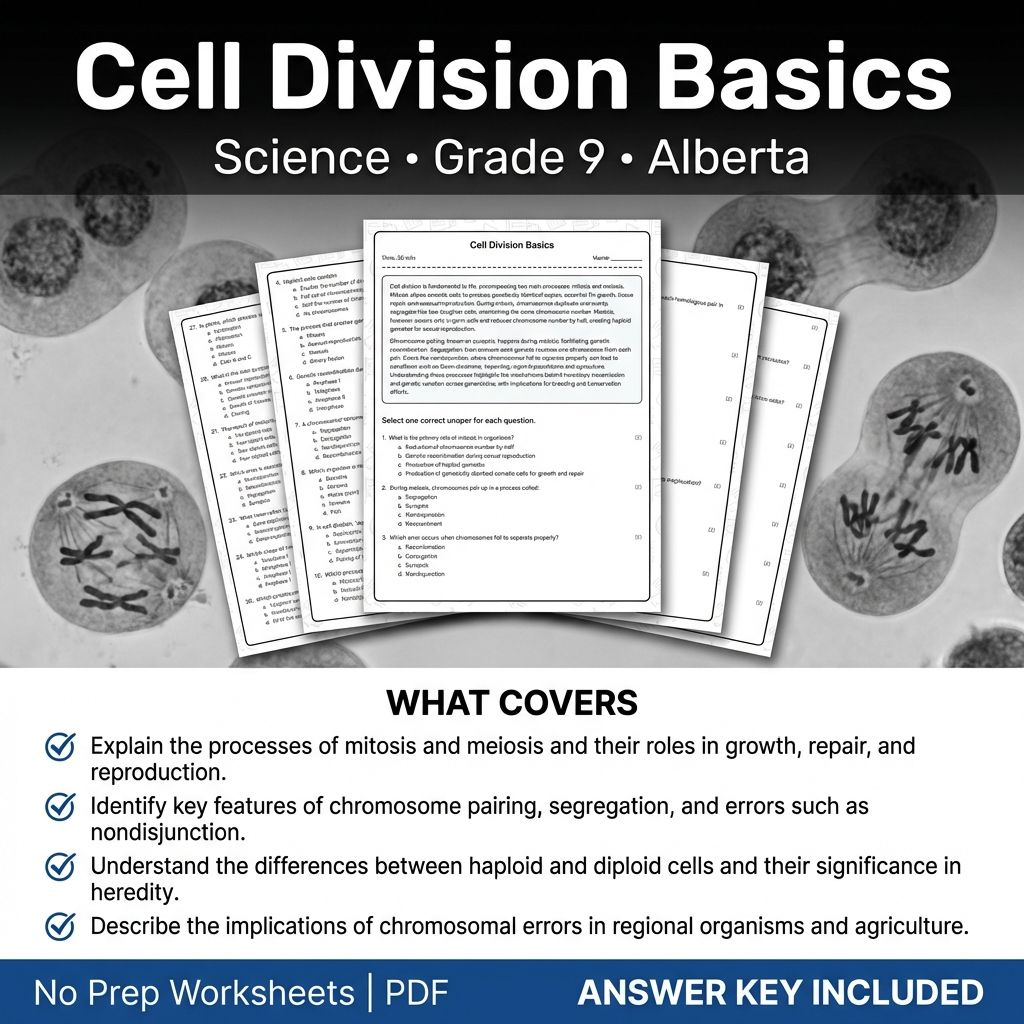
Cell Division Basics Worksheet | Grade 9 Science Alberta Standards
Created byCoral Reef LearningLearning Objectives
- Explain the processes of mitosis and meiosis and their roles in growth, repair, and reproduction.
- Identify key features of chromosome pairing, segregation, and errors such as nondisjunction.
- Understand the differences between haploid and diploid cells and their significance in heredity.
Instant download
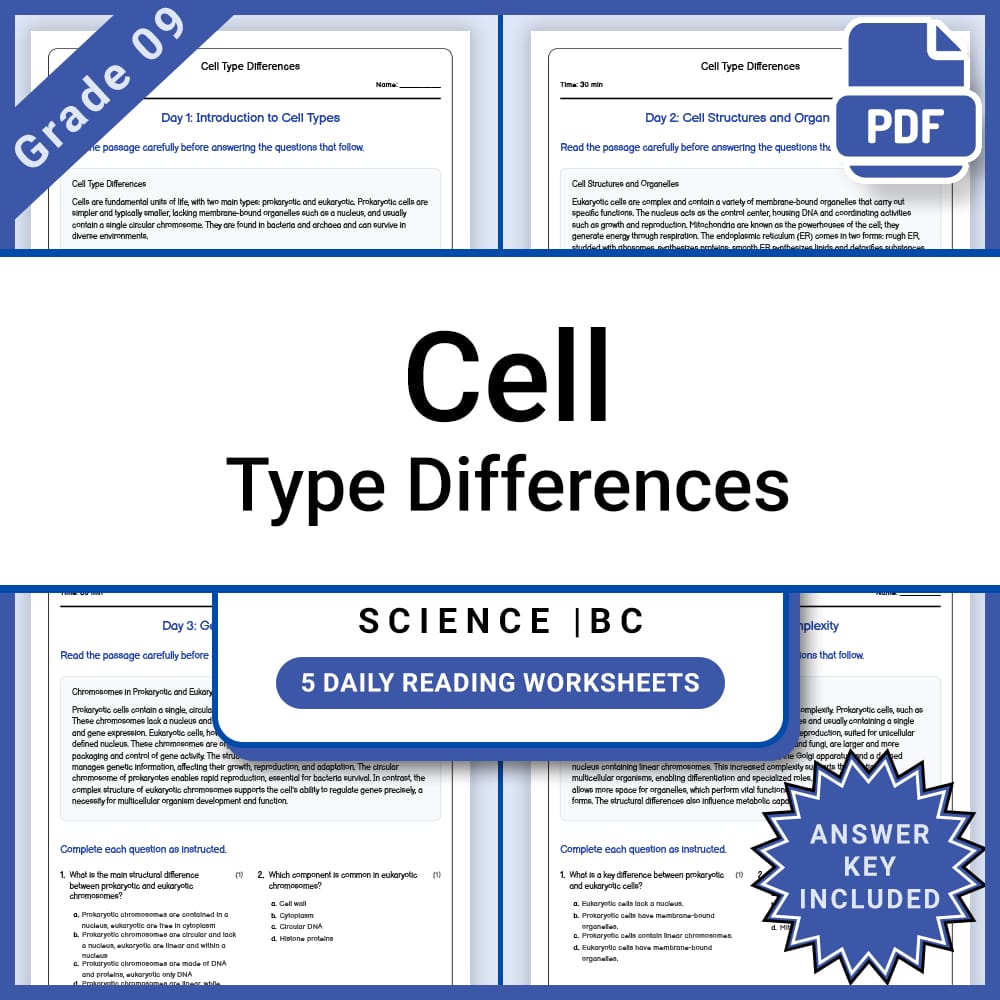
Grade 9 Science – Cell Type Differences Daily Reading Worksheet + Answer Key
JCreated byJ.S SheetsLearning Objectives
- Understand key concepts related to Science
- Apply knowledge through practice questions
- Demonstrate comprehension of the material
Also included in: Grade 9 Science Lesson Group Bundle | BC Framework Activities & Worksheets +1 more
Instant download
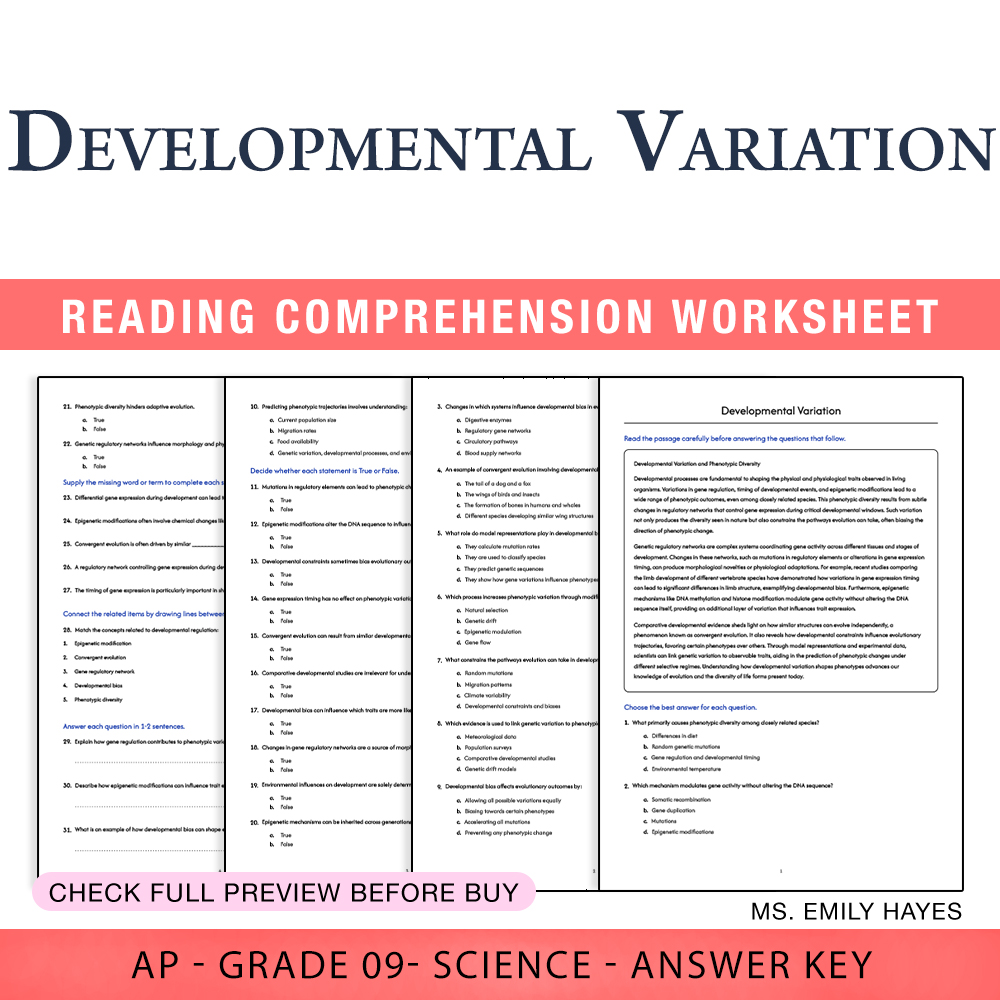
9th Grade Science | Developmental Variation Worksheet (PDF+ Answer Key)
Created byCopper Leaf ClassroomLearning Objectives
- Understand how gene regulation and developmental processes contribute to phenotypic diversity.
- Analyze the role of regulatory networks, timing, and epigenetics in morphological and physiological differences.
- Use comparative developmental evidence to explain convergent evolution and developmental bias.
Also included in: Grade 9 Science | Biology & Ecosystems AP Worksheet Bundle (PDF+ Answer Key) +1 more
Instant download
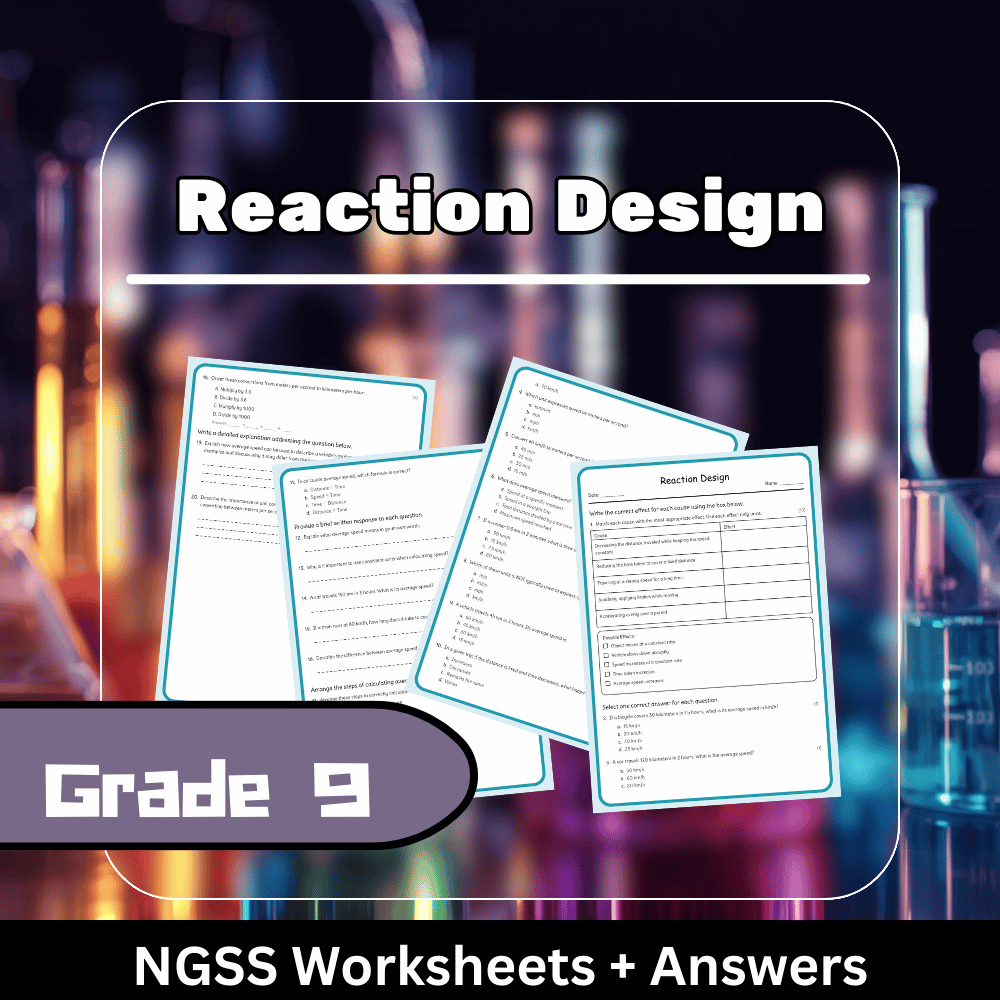
Grade 9 Science | Reaction Design Worksheet (Answer Key) – NGSS Aligned
 Created byBright Mind Resources
Learning Objectives
- Understand how temperature, pressure, concentration, and catalysts influence chemical reactions.
- Apply principles of chemical equilibrium and kinetics to optimize reaction conditions.
- Evaluate safety, efficiency, and selectivity in designing chemical processes like Haber synthesis and esterification.
Instant download

Reaction Design Worksheet | NGSS Grade 9 Science Practice PDF
Created byCedar Grove LearningLearning Objectives
- Understand how temperature, pressure, concentration, and catalysts influence chemical reactions.
- Apply principles of equilibrium and kinetics to predict reaction outcomes.
- Analyze how reaction conditions affect yield, selectivity, and side reactions.
Instant download
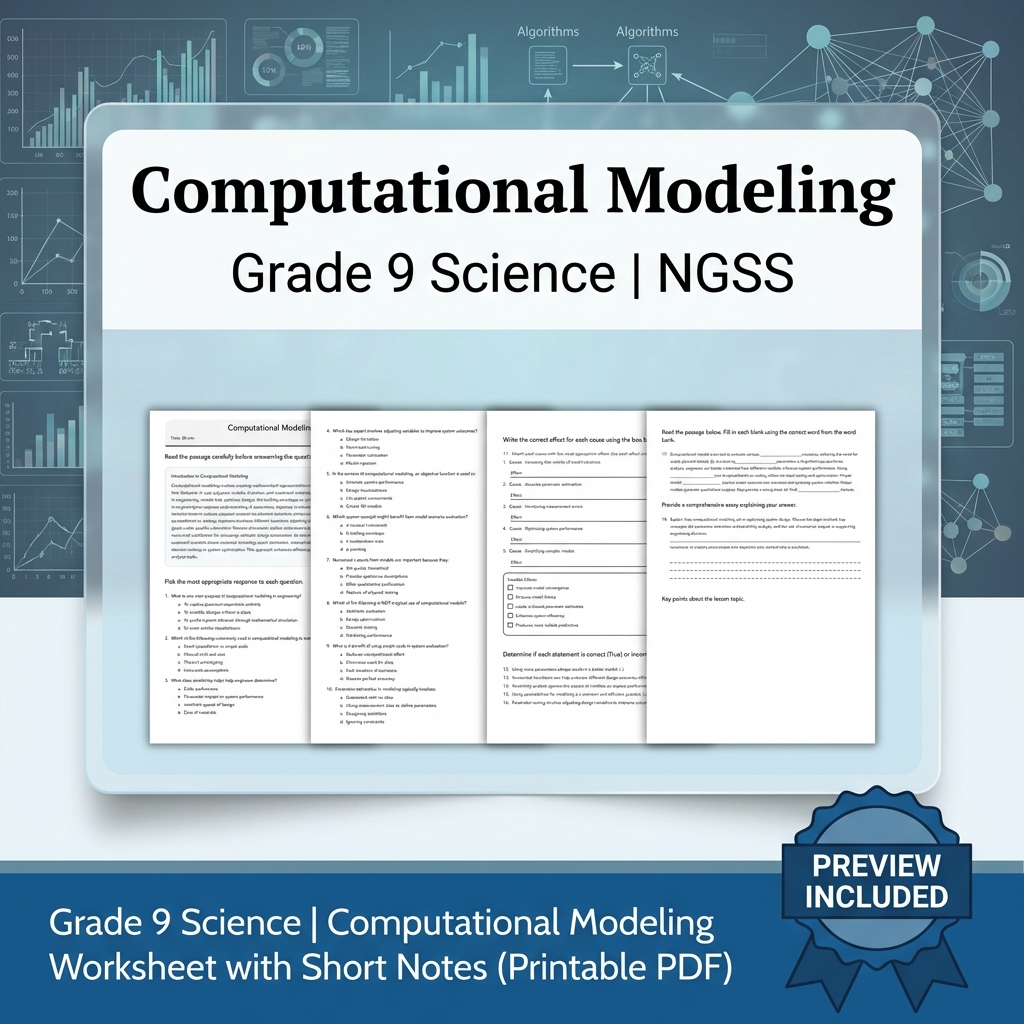
Grade 9 Science | Computational Modeling Worksheet with Short Notes (PDF)
 Created byMeadowlark Worksheets
Learning Objectives
- Understand the fundamental concepts of computational modeling in engineering and system design.
- Learn to formulate and analyze mathematical and algebraic models for real systems.
- Apply parameter estimation and numerical techniques to evaluate system performance.
Also included in: Grade 9 Science NGSS Engineering Design Bundle Prototyping & Evaluation +1 more
Instant download
9th Grade Science | Energy Conservation Reading Worksheet (PDF + Rubric)
JCreated byJ.S SheetsLearning Objectives
- Understand the principle of conservation of energy in isolated systems.
- Explain how potential and kinetic energy interchange during motion.
- Describe the effects of nonconservative forces like friction on mechanical energy.
Instant download
9th Grade Science | Classification Foundations Reading Worksheet & Answer Key
JCreated byJ.S SheetsLearning Objectives
- Understand the hierarchical levels used in biological classification systems.
- Distinguish between traditional and modern classification approaches based on evolutionary relationships.
- Identify key traits used to classify living organisms, including morphological, developmental, and genetic data.
Instant download

Stellar Evolution Worksheet for Grade 9 Science – NGSS Aligned Practice
JCreated byJ.S SheetsLearning Objectives
- Describe the main stages of stellar evolution from star formation to end states.
- Interpret Hertzsprung-Russell diagrams and spectral classifications of stars.
- Explain how supernova remnants contribute to element synthesis and enrichment of the interstellar medium.
Also included in: Grade 9 Origins, Motion, and Evolution Space Science Lesson Bundle – NGSS +1 more
Instant download
9th Grade Science | Physical Changes Worksheet (PDF + Answer Key)
Created byCopper Leaf ClassroomLearning Objectives
- Describe the characteristics of physical changes and distinguish them from chemical changes.
- Identify examples of physical changes such as melting, freezing, evaporation, condensation, and dissolution.
- Explain the role of energy transfer during phase changes.
Instant download

Framing Constraints Worksheet | NGSS Grade 9 Science Assessment
Created byCedar Grove LearningLearning Objectives
- Understand the importance of identifying and prioritizing functional requirements, social impacts, economic limits, and environmental constraints in engineering design.
- Analyze stakeholder criteria, material availability, regulatory restrictions, and safety margins within problem framing.
- Evaluate interactions among competing constraints both qualitatively and within basic quantitative bounds to select feasible solutions.
Instant download
Grade 9 Science – Comparative Evaluation in Engineering Design(PDF + Answer Key)
Created byCopper Leaf ClassroomLearning Objectives
- Understand key concepts related to Science
- Apply knowledge through practice questions
- Demonstrate comprehension of the material
Instant download
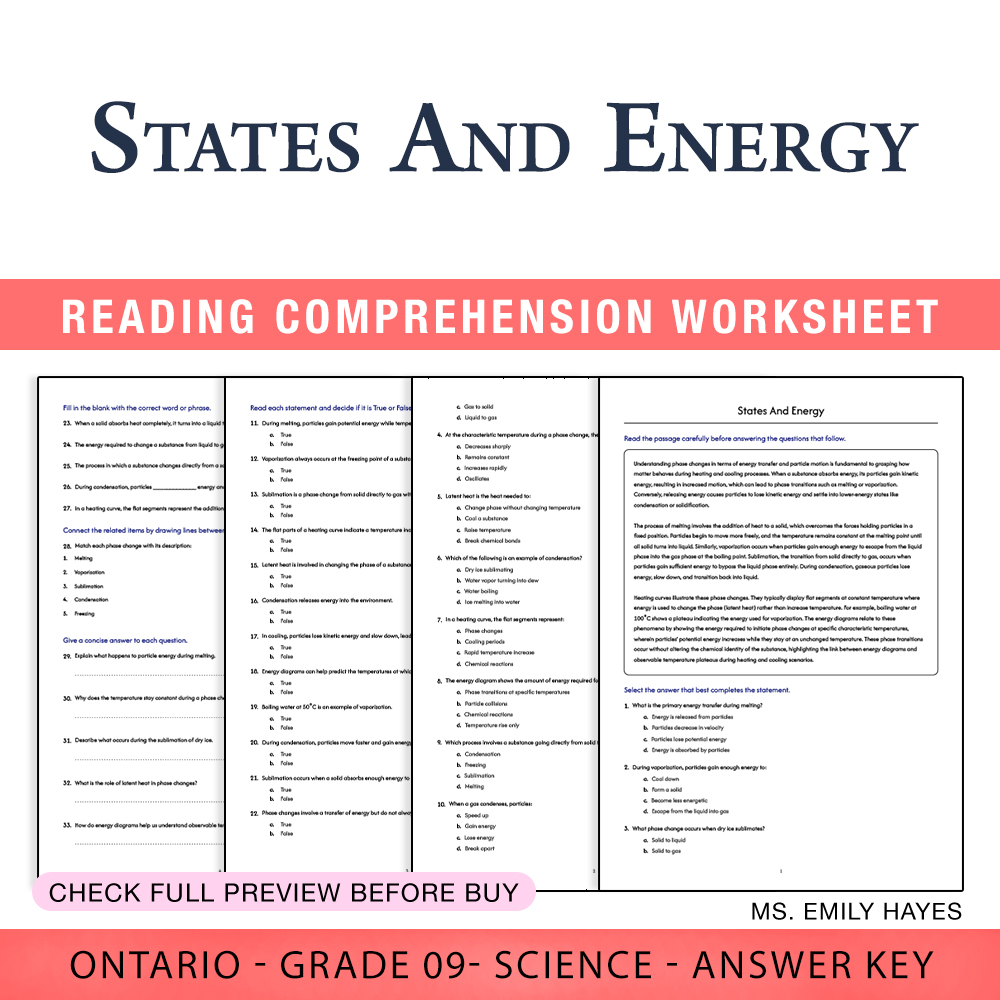
9th Grade Science | States And Energy Worksheet (PDF + Answer Key)
Created byCopper Leaf ClassroomLearning Objectives
- Explain how phase changes involve energy transfer and modifications in particle motion and potential energy.
- Describe the processes of melting, vaporization, sublimation, and condensation, including the conditions at which they occur.
- Interpret heating and cooling curves with respect to particle energy and phase transitions.
Instant download
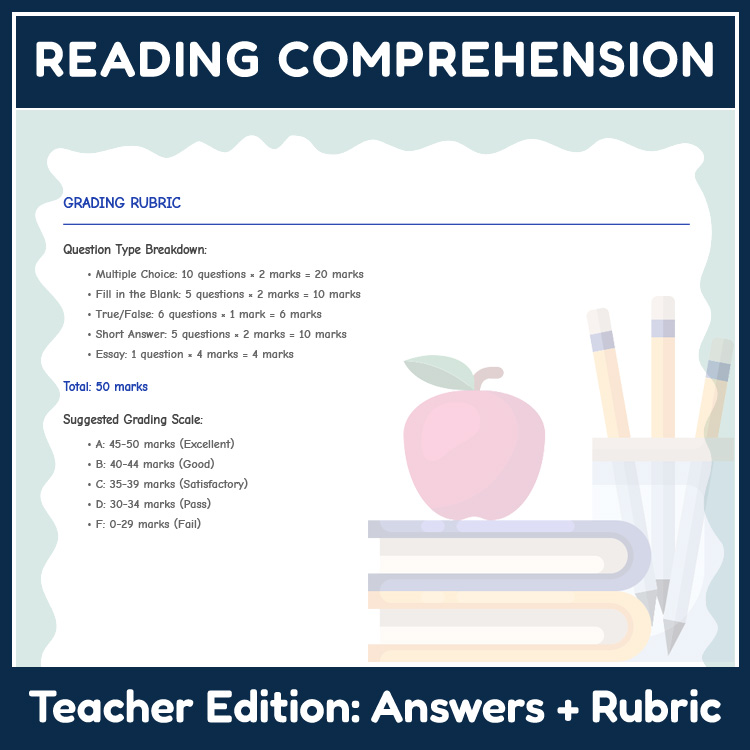
9th Grade Science | Prototyping Methods Reading Worksheet (PDF & Answer Key)
JCreated byJ.S SheetsLearning Objectives
- Understand different prototyping methods and their appropriate application contexts.
- Identify key materials and fidelity levels used in prototyping.
- Analyze iterative testing processes and how test data informs design refinement.
Also included in: Grade 9 Science Unit | Engineering Prototyping & Modeling Worksheets
Instant download
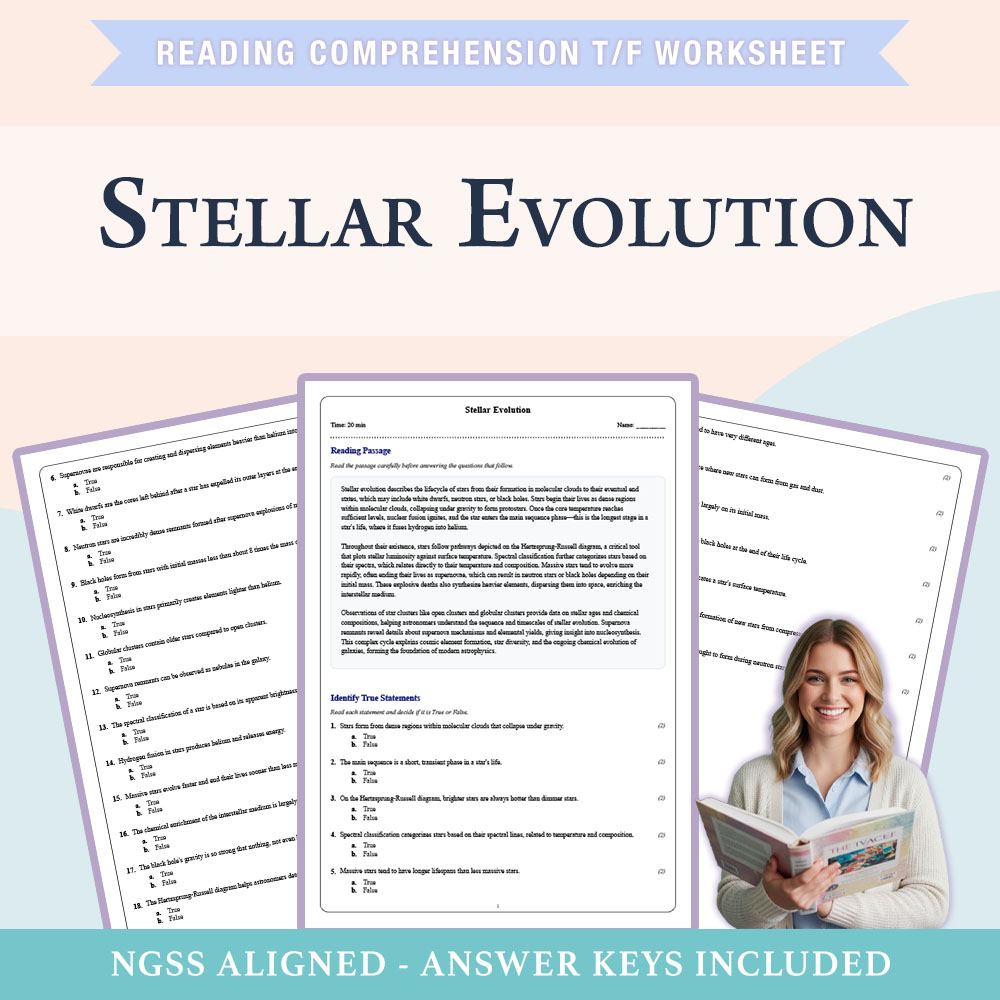
9th Grade Science | Stellar Evolution Worksheet (PDF + Answer Key)
Created byCopper Leaf ClassroomLearning Objectives
- Understand the main stages of stellar evolution and their characteristics.
- Identify different end states of stars such as white dwarfs, neutron stars, and black holes.
- Describe how nucleosynthesis contributes to elemental formation in stars.
Also included in: Grade 9 Science | Space, Motion & Cosmology Worksheet Bundle (PDF + Answer Key) +1 more
Instant download

Grade 9 Science | Food Web Energy Worksheet | NGSSS Aligned
Created byLumora LearningLearning Objectives
- Explain how energy flows through an ecosystem from producers to primary, secondary, and higher-level consumers.
- Describe how trophic levels represent an organism’s position in energy transfer.
- Compare linear energy chains with interconnected food webs and explain why food webs matter.
Instant download
Grade 9 Science – Element Identity Worksheet (Ontario) – Science (PDF)
Created byBright Mind ResourcesLearning Objectives
- Define elements as specific types of atoms characterized by proton count and symbols.
- Explain how atomic models help represent atomic identity.
- Identify representative elements and understand the roles of atomic mass and symbols in classification.
Instant download

Grade 9 Science | Balancing Equations in Chemistry - Daily Reading Comprehension
Created byCoral Reef LearningLearning Objectives
- Understand the purpose of chemical equations and how they represent reactions
- Identify symbols and formulas used in chemical equations
- Learn why and how to balance chemical equations to reflect conservation of atoms
Instant download

Grade 9 Energy Transformations Worksheet | NGSS Practice PDF
 Created byClear Sky Classroom
Learning Objectives
- Explain how energy transforms between mechanical, thermal, sound, and electrical forms in real systems while tracking overall energy conservation.
- Describe how friction and air resistance increase thermal energy and reduce mechanical energy in moving objects.
- Use temperature-dependent material behavior to predict how heating or cooling can change motion or system performance.
Instant download

Science Worksheet Limiting Factors and Carrying Capacity Grade 9
JCreated byJ.S SheetsLearning Objectives
- Explain how limiting factors constrain population growth in an ecosystem.
- Differentiate between resource availability, predation, disease, and environmental conditions as limiting factors.
- Describe how changes in limiting factors can affect community interactions and biodiversity over time.
Also included in: Grade 9 Evolution, Genetics, and Ecosystems Science Lesson Bundle +1 more
Instant download

Chromosomes and DNA Worksheet | Science Practice for Grade 9 Alberta Standards
JCreated byJ.S SheetsLearning Objectives
- Describe the structure of DNA and its role in heredity.
- Explain how chromosomes organize genetic material within cells.
- Differentiate between nuclear and organelle genomes and their significance.
Also included in: Grade 9 Genetics & Inheritance Science Lesson Bundle – Alberta Framework
Instant download
About Grade 9 Science Worksheets
Find Science worksheets built for Grade 9. All 6,926 cover core skills, practice, and review, each an instant PDF download.
Every worksheet on MyTeachingSheets is created by independent teacher-authors and reviewed before publication. All resources download as printable PDFs for classroom, homework, or at-home practice, and many include answer keys. Preview any worksheet free before buying.