
Grade 9 Science Worksheets
6,926 worksheets
Grade 9 Science Grade Worksheet: Mendelian Patterns Practice | NGSS PDF
 Created byClear Sky Classroom
Learning Objectives
- Explain how segregation and independent assortment contribute to Mendelian inheritance patterns.
- Use Punnett square logic to predict genotype and phenotype ratios for monohybrid and dihybrid crosses.
- Interpret pedigrees to determine whether a trait most likely follows dominant or recessive inheritance.
Also included in: Grade 9 Heredity Inheritance & Variation of Traits Science Lesson Bundle NGSS +1 more
Instant download
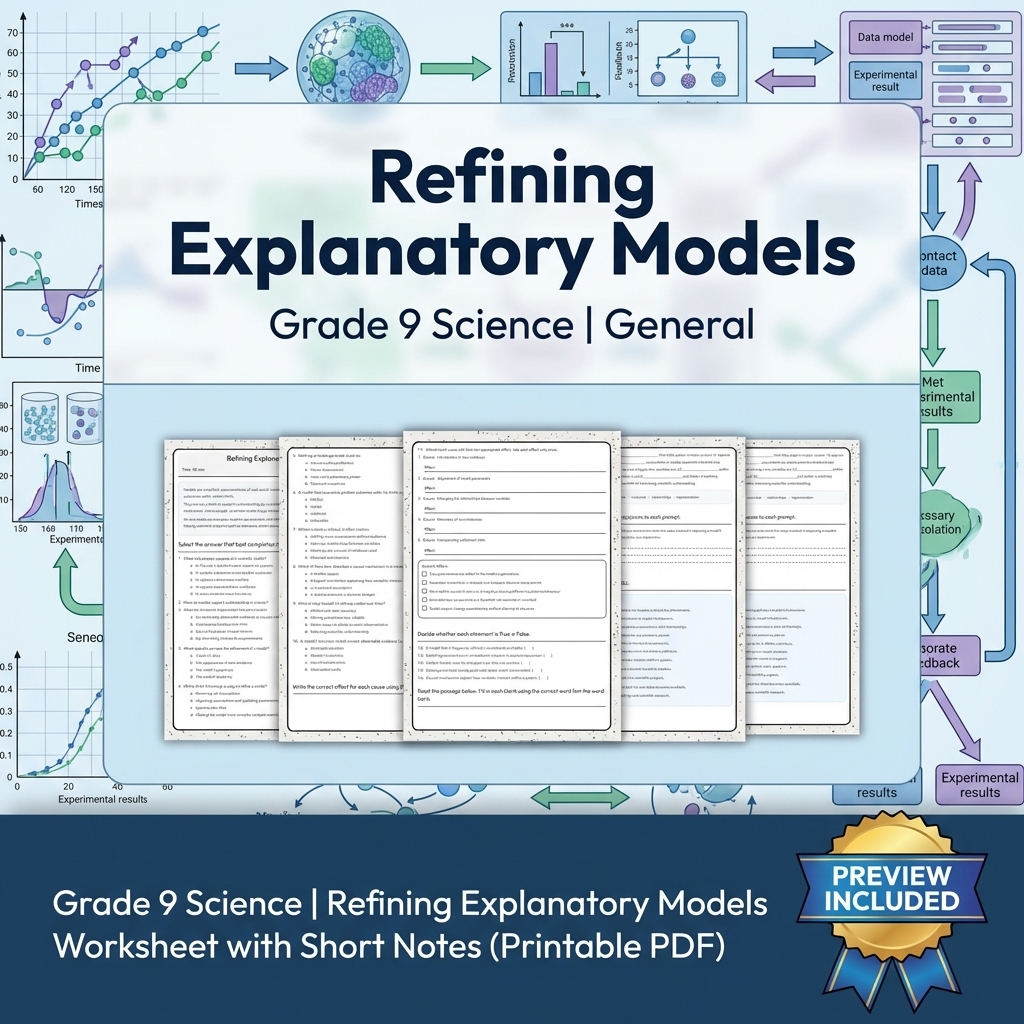
Grade 9 Science | Refining Explanatory Models Worksheet with Short Notes
 Created byMeadowlark Worksheets
Learning Objectives
- Understand how models are used to explain phenomena and predict outcomes.
- Learn how models are refined based on new evidence.
- Identify the connection between observable evidence and causal mechanisms in models.
Also included in: Grade 9 Science Uncertainty & Measurement Lesson Bundle: General Framework +1 more
Instant download

Grade 9 Science | Introduction to Elements - Daily Reading Comprehension
 Created byCoral Reef Learning
Learning Objectives
- Understand that elements are made up of atoms with specific numbers of protons.
- Learn how to identify elements using atomic numbers and chemical symbols.
- Recognize the difference between natural and extracted forms of elements.
Instant download

Wave Energy Information Worksheet for Grade 9 Science
JCreated byJ.S SheetsLearning Objectives
- Explain how waves transfer energy and, in many cases, information without transporting matter overall
- Describe how frequency, wavelength, and amplitude relate to observable features of a wave
- Connect wave properties to the idea of energy carried by waves
Also included in: Grade 9 Energy, Waves, and Motion Science Lesson Bundle: General Framework +1 more
Instant download

Grade 9 Science | Communicating Uncertainty Worksheet | AP Alignment
 Created byLumora Learning
Learning Objectives
- Understand conventions for conveying quantitative uncertainty in scientific reports.
- Identify different methods such as interval estimates, effect sizes, and likelihood statements.
- Recognize visualizations that portray variability and their interpretation.
Also included in: Grade 9 Science | Practices in Science Custom Bundle | AP Standards
Instant download

Grade 9 Science | Control Criteria in Causal Inference Worksheet | AP Science
Created byLumora LearningLearning Objectives
- Define the key criteria used to establish control and comparability in causal inference.
- Explain how variable isolation, replication, baseline characterization, and appropriate reference conditions influence interpretation of causal claims.
- Assess how residual confounding and uncontrolled variation affect the strength of causal inferences.
Also included in: Grade 9 Science | Practices in Science Custom Bundle | AP Standards
Instant download

Grade 9 Science | Graphical Literacy Worksheet | AP Data Analysis Practice
Created byLumora LearningLearning Objectives
- Understand how to interpret various types of graphs including scatterplots, histograms, line graphs, and residual displays.
- Learn how to evaluate axis scaling, labeling, and binning choices to accurately interpret data patterns.
- Identify how visual features such as outliers, trends, and correlation inform model selection and analysis.
Also included in: Grade 9 Science | Practices in Science Custom Bundle | AP Standards
Instant download

Grade 9 Science | Evidence Chains Worksheet | AP Practice
Created byLumora LearningLearning Objectives
- Understand the structure of evidence-based reasoning linking observations, analyses, and claims.
- Describe standards for evidence sufficiency, consistency, and evaluation of competing explanations.
- Learn to use multiple representations—graphs, summaries, diagrams—to support inferences.
Also included in: Grade 9 Science | Practices in Science Custom Bundle | AP Standards
Instant download

Grade 9 Science | Scale and Proportion Worksheet | AP Alignment
Created byLumora LearningLearning Objectives
- Understand the principles of scaling laws and dimensional similarity.
- Explore proportional reasoning in constructing models and interpreting data.
- Analyze how nonlinearity and scale-dependent effects influence extrapolation.
Also included in: Grade 9 Science | Practices in Science Custom Bundle | AP Standards
Instant download

Grade 9 Science | Simulated Predictions Worksheet | AP Aligned
Created byLumora LearningLearning Objectives
- Explain how simple computational simulations generate predictions based on hypothesized mechanisms.
- Describe the role of parameter sensitivity and scenario comparison in modeling.
- Understand how ensembles and visualizations represent uncertainty in forecasts.
Also included in: Grade 9 Science | Practices in Science Custom Bundle | AP Standards
Instant download

Grade 9 Science – Matter & Ecosystem Cycles | Daily Reading Worksheet
 Created byBright Mind Resources
Learning Objectives
- Understand how matter moves through ecosystems
- Identify the roles of producers, consumers, and decomposers
- Explain the conservation of matter across trophic levels
Also included in: Evolution Grade 9 Science Daily Reading Worksheets Lesson Bundle | CA Standards +1 more
Instant download

Trophic Dynamics Worksheet | Grade 9 Science Printable PDF Assessment
Learning Objectives
- Explain energy transfer across trophic levels in ecosystems.
- Describe the structure of food webs and their ecological significance.
- Quantify energy loss using trophic pyramids and understand ecological efficiency.
Also included in: Grade 9 Ecosystems Lesson Bundle: Interactions, Energy & Dynamics NGSS +1 more
Instant download
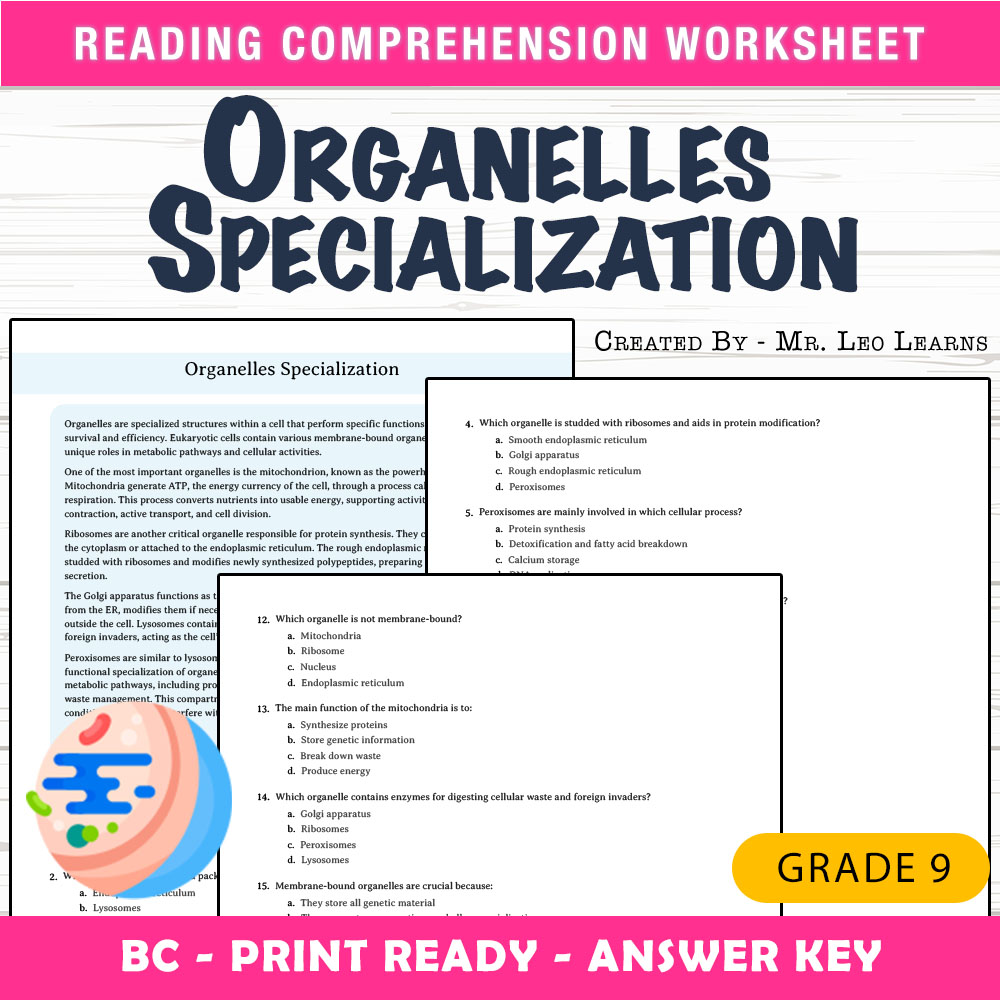
Grade 9 Science — Organelles Specialization Worksheet for Mastery
 Created byThe Resource Hub
Learning Objectives
- Identify the key functions of various eukaryotic cell organelles.
- Understand how organelle specialization contributes to cellular efficiency.
- Recognize the importance of compartmentalization in cell processes.
Also included in: Grade 9 Science Cells & Body Systems Worksheet Bundle | BC Curriculum Resources +1 more
Instant download
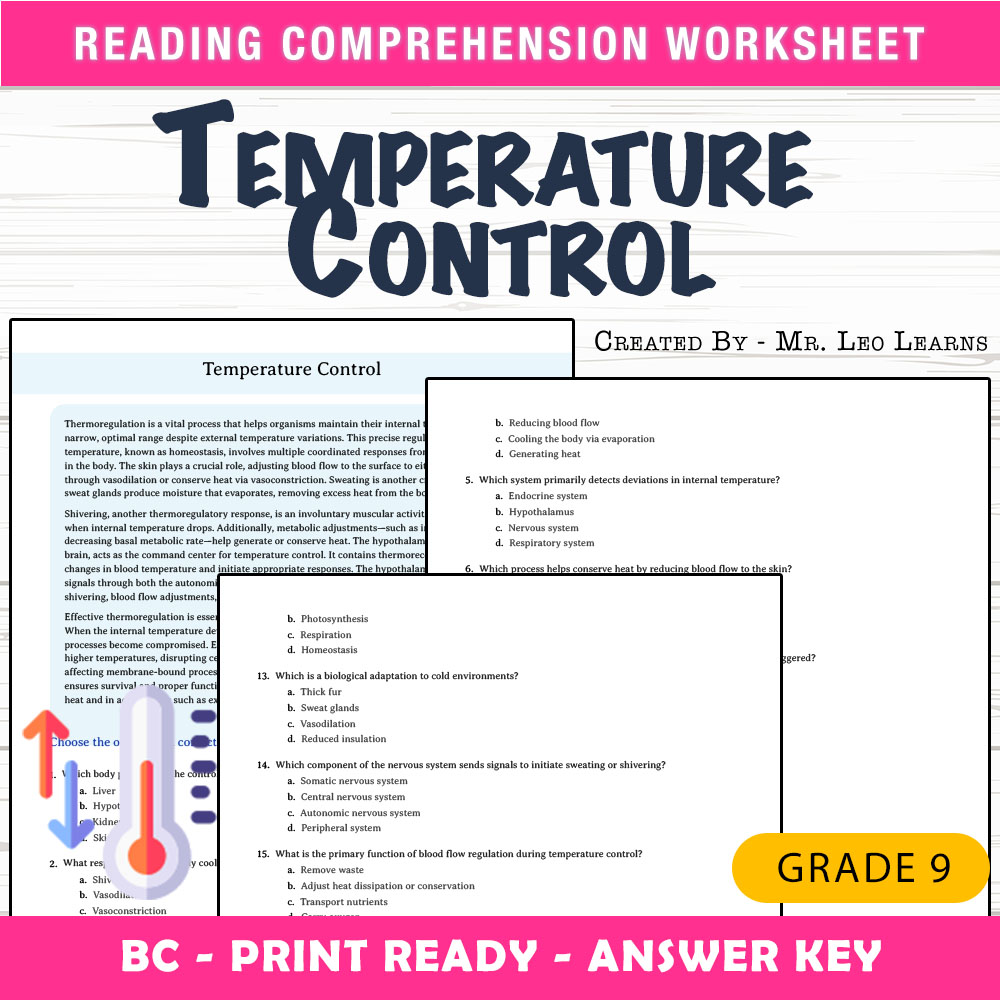
Grade 9 Science — Worksheet MCQ Paper for Mastering Temperature Control
Created byThe Resource HubLearning Objectives
- Understand the mechanisms of thermoregulation and homeostasis.
- Identify responses of the body to temperature deviations.
- Explain the role of hypothalamic centers in temperature regulation.
Also included in: Grade 9 Science Cells & Body Systems Worksheet Bundle | BC Curriculum Resources +1 more
Instant download
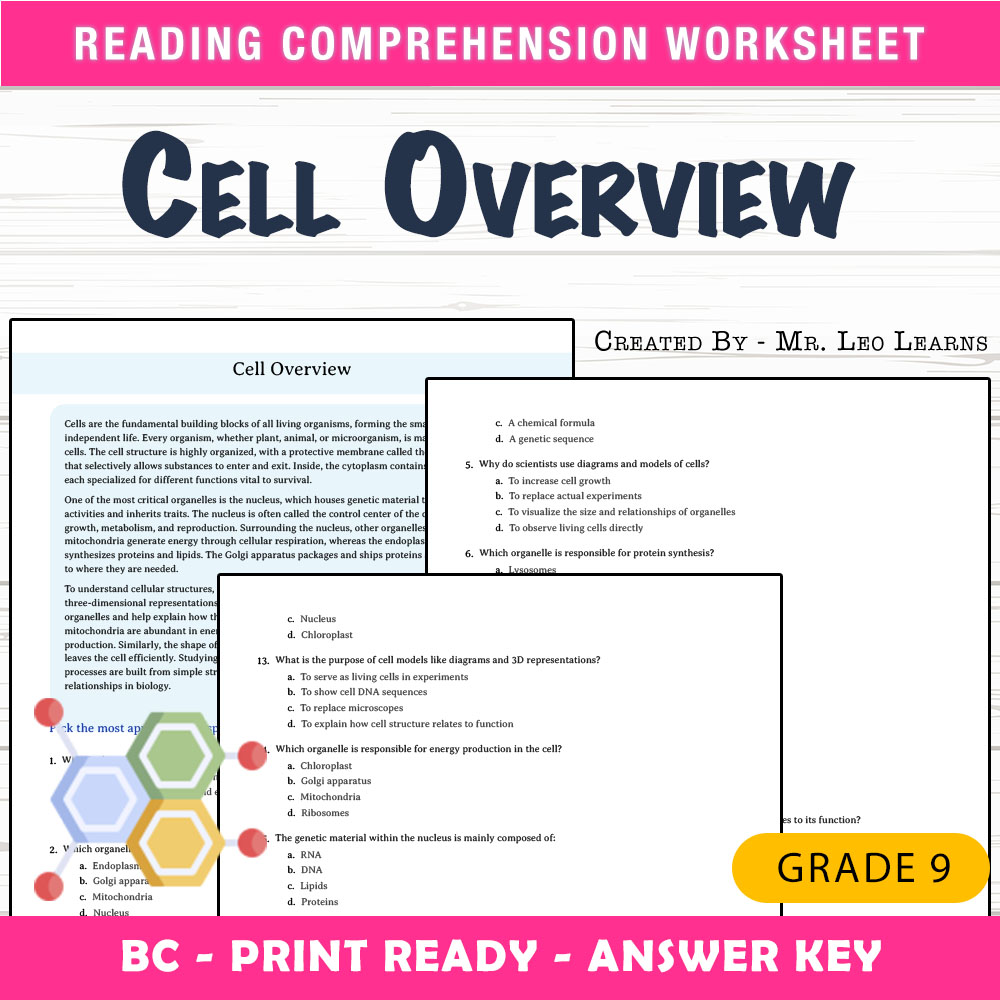
Grade 9 Science — Worksheet MCQ Paper for Mastering Cell Overview
Created byThe Resource HubLearning Objectives
- Understand the basic structure and function of a cell
- Identify main organelles and their roles
- Recognize the relationship between cell structure and function
Also included in: Grade 9 Science Cells & Body Systems Worksheet Bundle | BC Curriculum Resources +1 more
Instant download
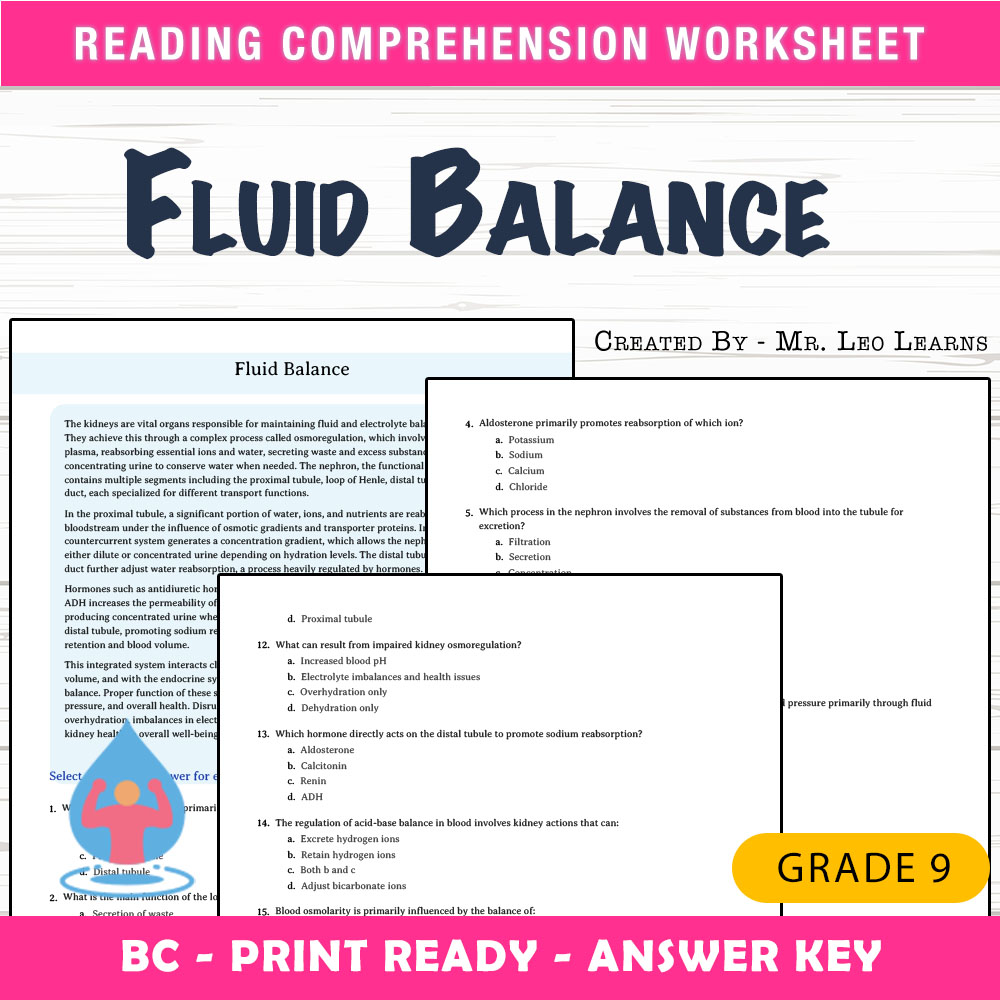
Grade 9 Science — Worksheet MCQ Paper for Mastering Fluid Balance
Created byThe Resource HubLearning Objectives
- Understand the role of kidneys in osmoregulation and fluid balance.
- Identify processes of filtration, reabsorption, secretion, and concentration in nephron segments.
- Describe hormonal control of water and ion regulation, including antidiuretic hormone and aldosterone.
Also included in: Grade 9 Science Cells & Body Systems Worksheet Bundle | BC Curriculum Resources +1 more
Instant download
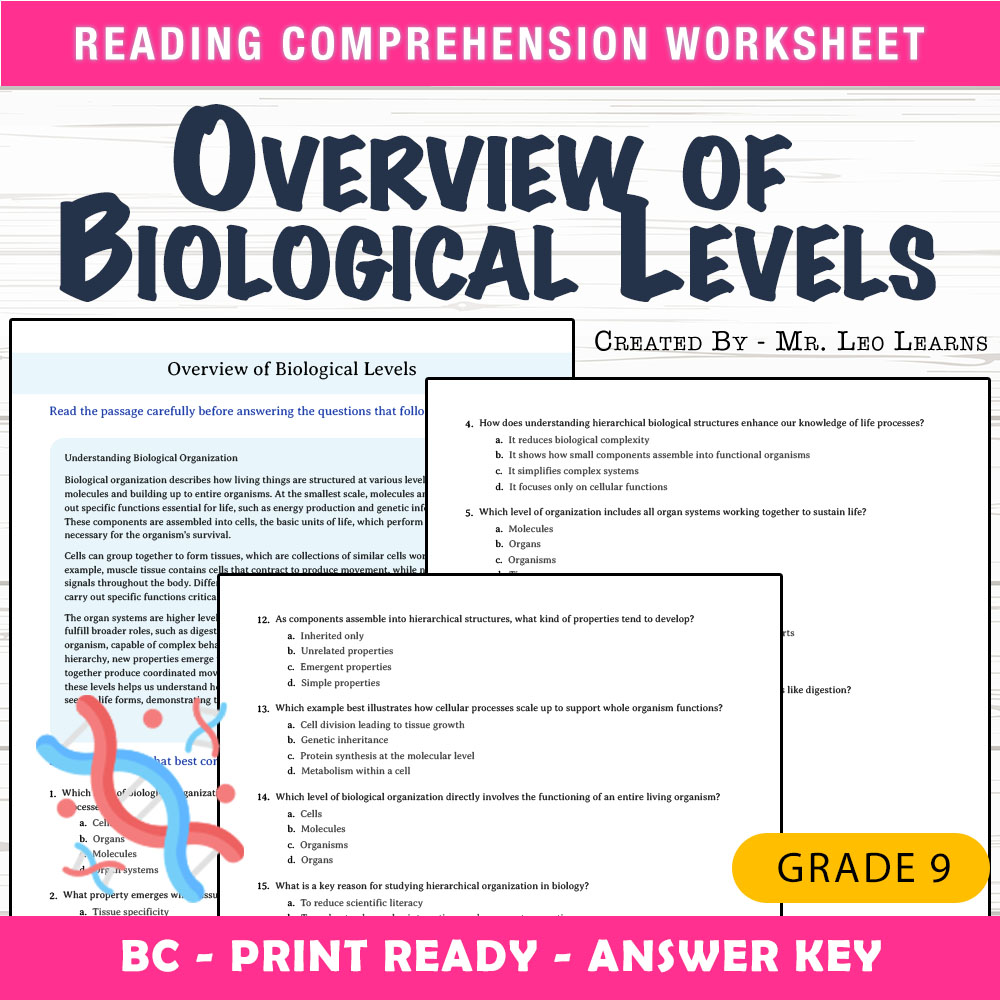
Grade 9 Science — Worksheet MCQ Paper for Mastering Biological Levels
Created byThe Resource HubLearning Objectives
- Identify the hierarchy of biological organization from molecules to organisms.
- Understand the concept of emergent properties at each biological level.
- Explain how small-scale cellular processes contribute to overall organism function.
Also included in: Grade 9 Science Cells & Body Systems Worksheet Bundle | BC Curriculum Resources +1 more
Instant download
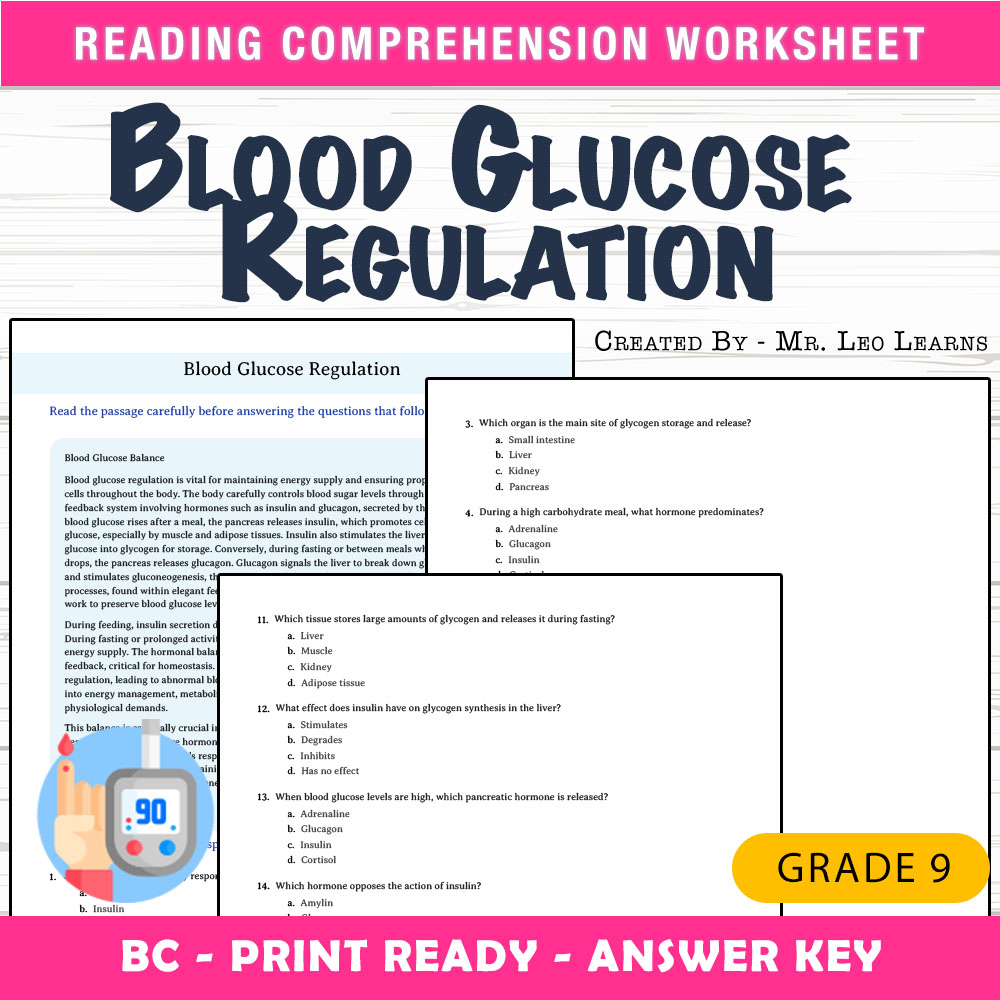
Grade 9 Science — Blood Glucose Regulation Worksheet MCQ Paper
Created byThe Resource HubLearning Objectives
- Understand how insulin and glucagon regulate blood glucose levels.
- Identify key organs and tissues involved in glucose homeostasis.
- Explain the feedback mechanisms maintaining metabolic balance during fasting and feeding.
Also included in: Grade 9 Science Cells & Body Systems Worksheet Bundle | BC Curriculum Resources +1 more
Instant download
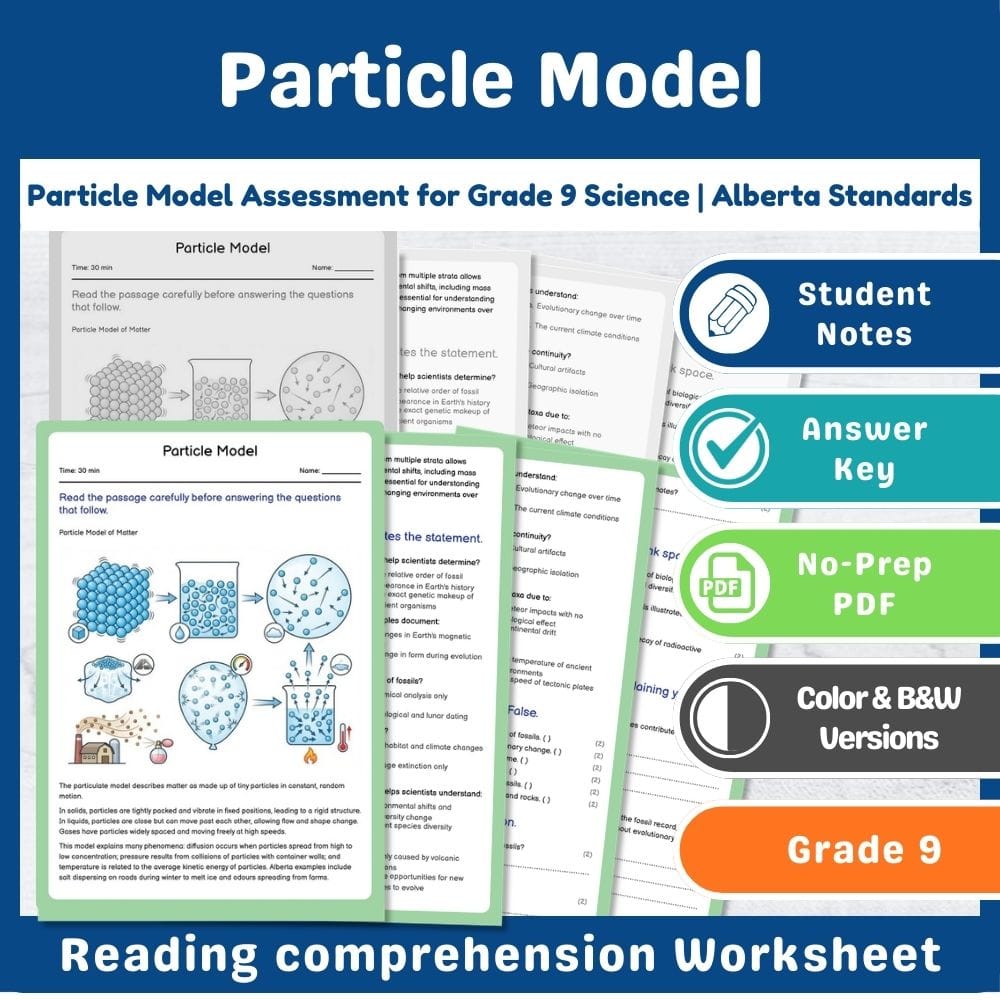
Particle Model Assessment for Grade 9 Science | Alberta Standards
 Created byPrism Point Learning
Learning Objectives
- Understand the basic principles of the particle model of matter.
- Explain how particle behavior affects macroscopic phenomena such as diffusion and pressure.
- Relate the particle model to real-world examples like salt dispersal on roads and odour spread.
Also included in: Grade 9 Matter and Chemical Change Science Lesson Bundle | Alberta +1 more
Instant download

Grade 9 Science – Water Cycle & Water Management | Daily Reading Worksheet
 Created byQuiet Forest Education
Learning Objectives
- Understand key concepts related to Science
- Apply knowledge through practice questions
- Demonstrate comprehension of the material
Also included in: Earth and Space Systems Grade 9 Science Daily Worksheets Bundle | Ontario +1 more
Instant download
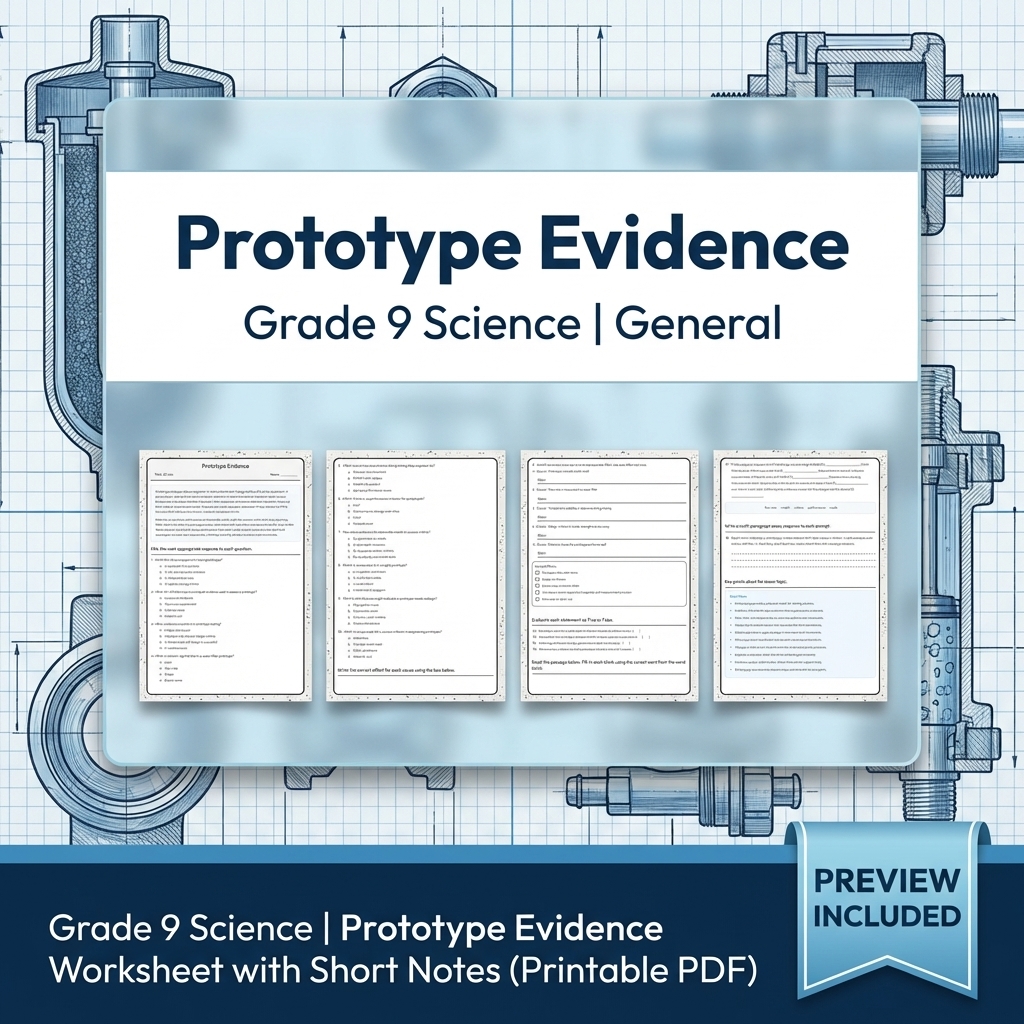
Grade 9 Science | Prototype Evidence Worksheet with Short Notes (Printable PDF)
Created byMeadowlark WorksheetsLearning Objectives
- Understand how modeling or prototyping creates tangible representations of solutions.
- Identify types of evidence used to evaluate prototypes, such as performance metrics.
- Explain how evidence links observable results to success criteria in engineering design.
Also included in: Grade 9 Engineering Design Science Lesson Bundle: General Framework +1 more
Instant download
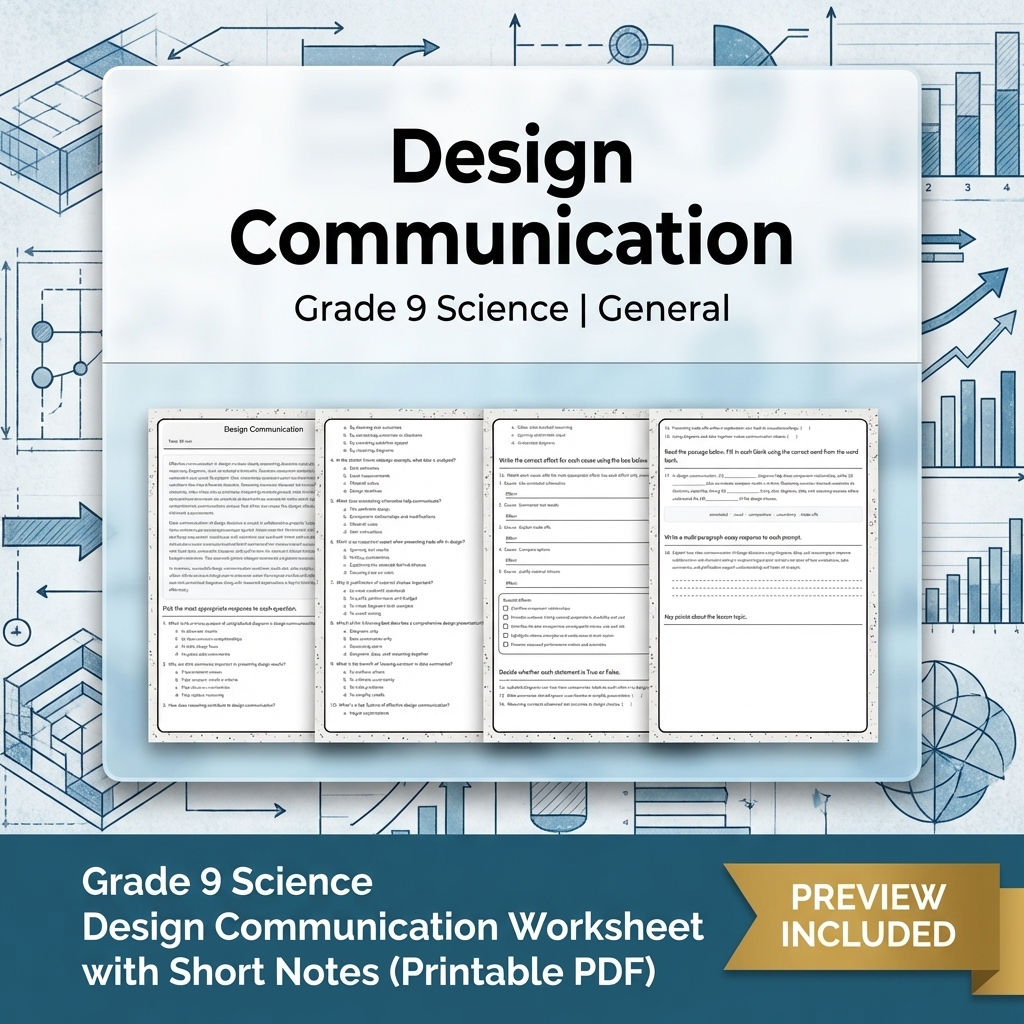
Grade 9 Science Design Communication Worksheet with Short Notes (Printable PDF)
Created byMeadowlark WorksheetsLearning Objectives
- Understand how data, diagrams, and reasoning are used to communicate design decisions.
- Identify the purpose of labeled diagrams and data summaries in design presentations.
- Explain how reasoning connects test outcomes to design choices, especially during trade-offs.
Also included in: Grade 9 Engineering Design Science Lesson Bundle: General Framework +1 more
Instant download
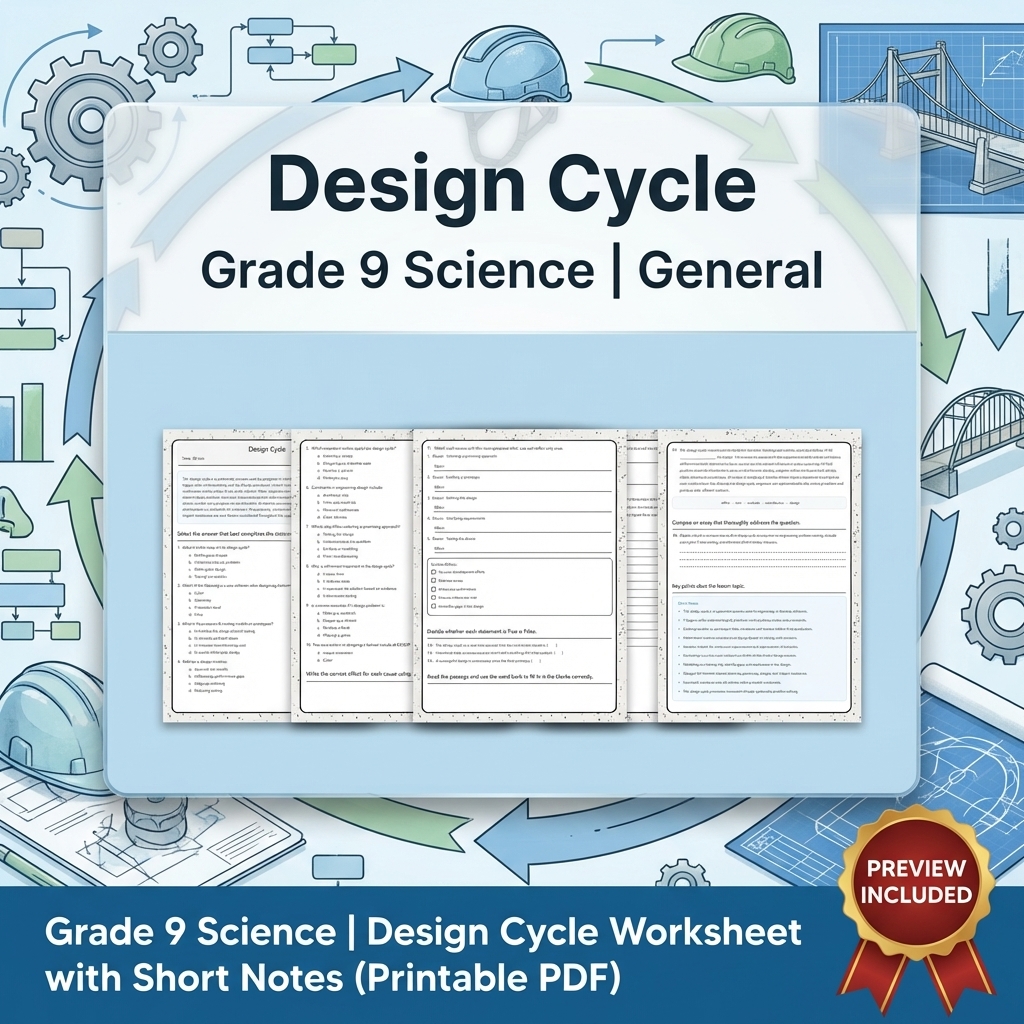
Grade 9 Science | Design Cycle Worksheet with Short Notes (Printable PDF)
Created byMeadowlark WorksheetsLearning Objectives
- Understand the steps involved in the design cycle process.
- Identify key criteria and constraints in engineering design.
- Analyze different approaches to solving engineering problems.
Also included in: Grade 9 Engineering Design Science Lesson Bundle: General Framework +1 more
Instant download

Resilience and Resistance Assessment | TEKS Standards Grade 9 Science
Created byPrism Point LearningLearning Objectives
- Define and differentiate between resilience and resistance in ecosystems.
- Explain how ecological thresholds influence regime shifts and community functions.
- Identify factors such as feedback loops, variability, and connectivity that affect ecosystem resilience.
Also included in: Grade 9 Ecology & Environmental Interactions Science lesson bundle: TEKS
Instant download
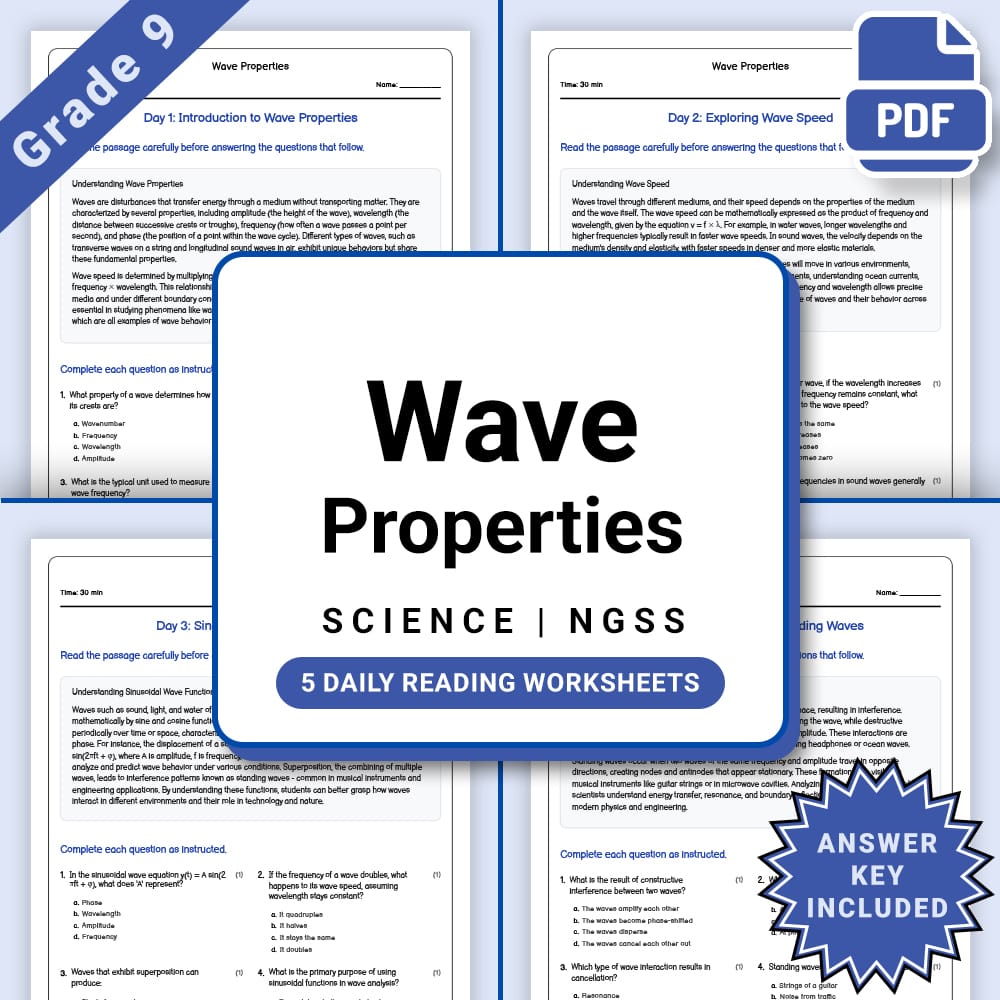
Grade 9 Science – Wave Properties Daily Reading Worksheet(PDF + Answer Key)
 Created byCopper Leaf Classroom
Learning Objectives
- Identify and describe the main components of waves: amplitude, frequency, wavelength, and phase.
- Understand the basic behavior of different types of waves including transverse and longitudinal waves.
- Calculate wave speed using the formula: wave speed = frequency × wavelength.
Instant download
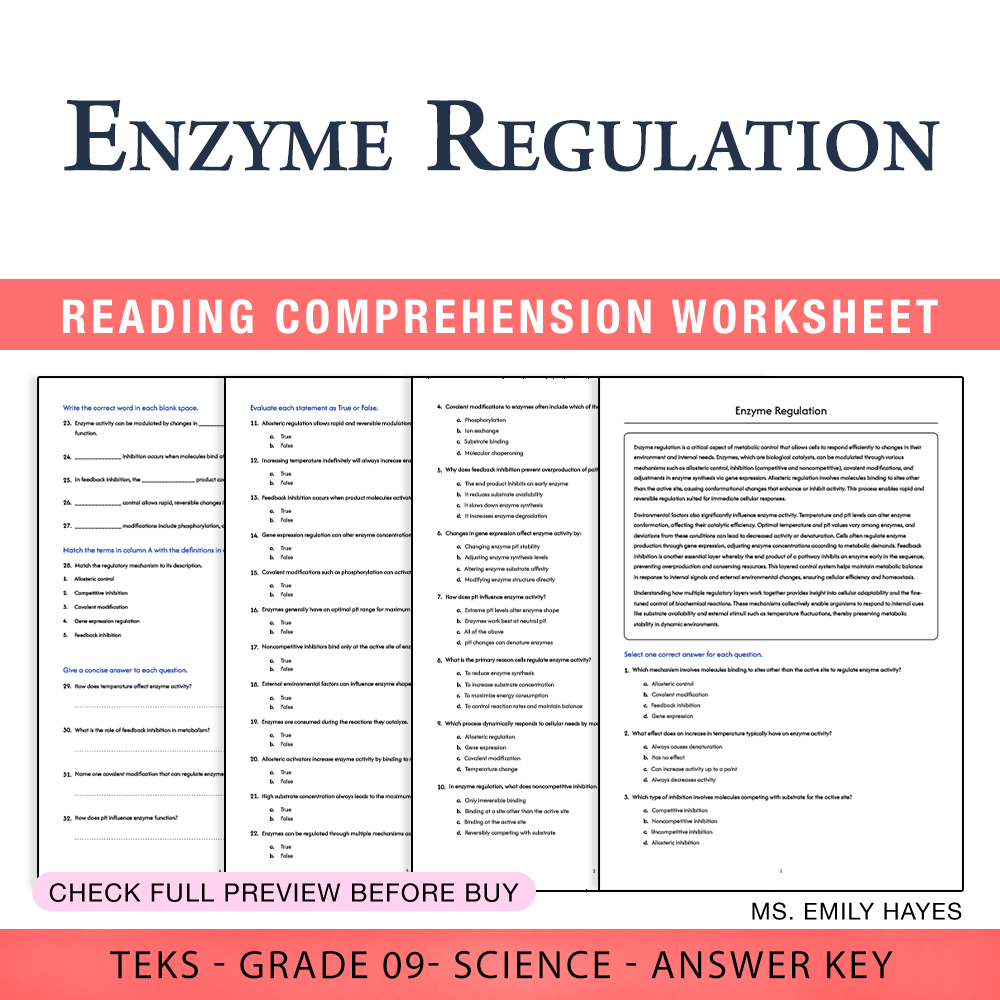
Grade 9 Science | Enzyme Regulation Worksheet (PDF+ Answer Key)
Created byCopper Leaf ClassroomLearning Objectives
- Understand the different mechanisms of enzyme regulation including allosteric control, inhibition, covalent modification, and gene expression.
- Identify how environmental factors like temperature and pH influence enzyme activity.
- Explain the role of feedback inhibition in metabolic pathways.
Instant download
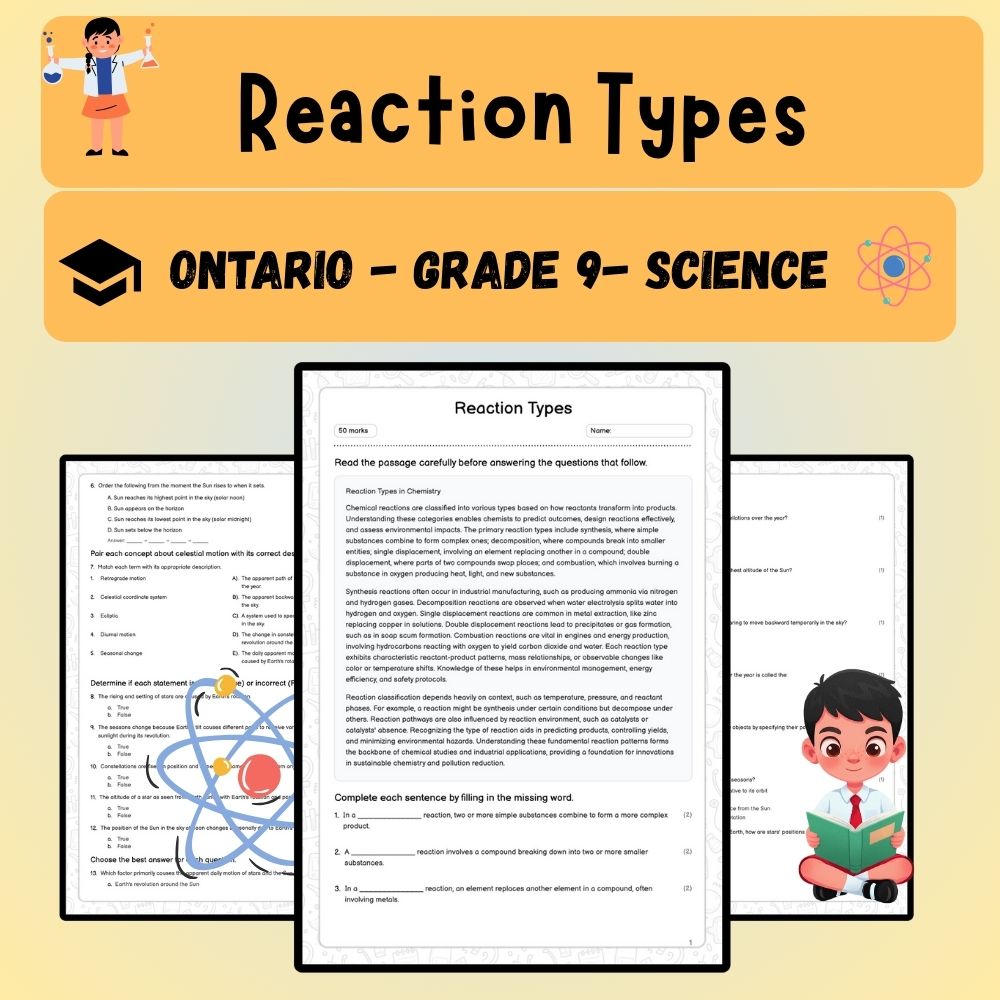
Grade 9 Science | Reaction Types Worksheet – Standard Ontario (PDF)
Created byPrism Point LearningLearning Objectives
- Identify and describe the main types of chemical reactions: synthesis, decomposition, single displacement, double displacement, and combustion.
- Recognize practical examples of each reaction type and their observable outcomes.
- Understand how reaction classifications assist in predicting products and maintaining mass conservation.
Also included in: Grade 9 Science UNIT Worksheet Pack | Chemical Properties, Energy & Reactions +1 more
Instant download

Climate Drivers Worksheet | Grade 9 Science Activities
Created byPrism Point LearningLearning Objectives
- Explain how Earth’s climate is shaped by interactions among the atmosphere, hydrosphere, cryosphere, lithosphere, and biosphere.
- Describe how solar energy and internal heat create an energy balance that influences long-term climate averages.
- Identify how external forcings and natural variability (aerosols, greenhouse gases, ocean circulation, and land surface properties) affect temperature, precipitation, and extremes.
Also included in: Earth and Space Systems Lesson Bundle | Grade 9 Science | BC Framework +1 more
Instant download

Ocean Circulation Worksheet | Grade 9 Science Practice
Created byPrism Point LearningLearning Objectives
- Explain how surface currents and deeper thermohaline circulation redistribute heat in the ocean.
- Describe how features like gyres and upwelling influence coastal conditions and carbon uptake.
- Evaluate how changes in ocean circulation can affect regional climates and extreme weather through feedbacks.
Also included in: Earth and Space Systems Lesson Bundle | Grade 9 Science | BC Framework +1 more
Instant download

Newtonian Motion Worksheet | NGSS Grade 9 Science Assessment PDF
 Created byCedar Grove Learning
Learning Objectives
- Understand how Newton's laws relate net force, mass, and acceleration in motion.
- Analyze free-body diagrams and force components to predict motion.
- Apply proportional relationships between net force and acceleration for constant mass systems.
Instant download
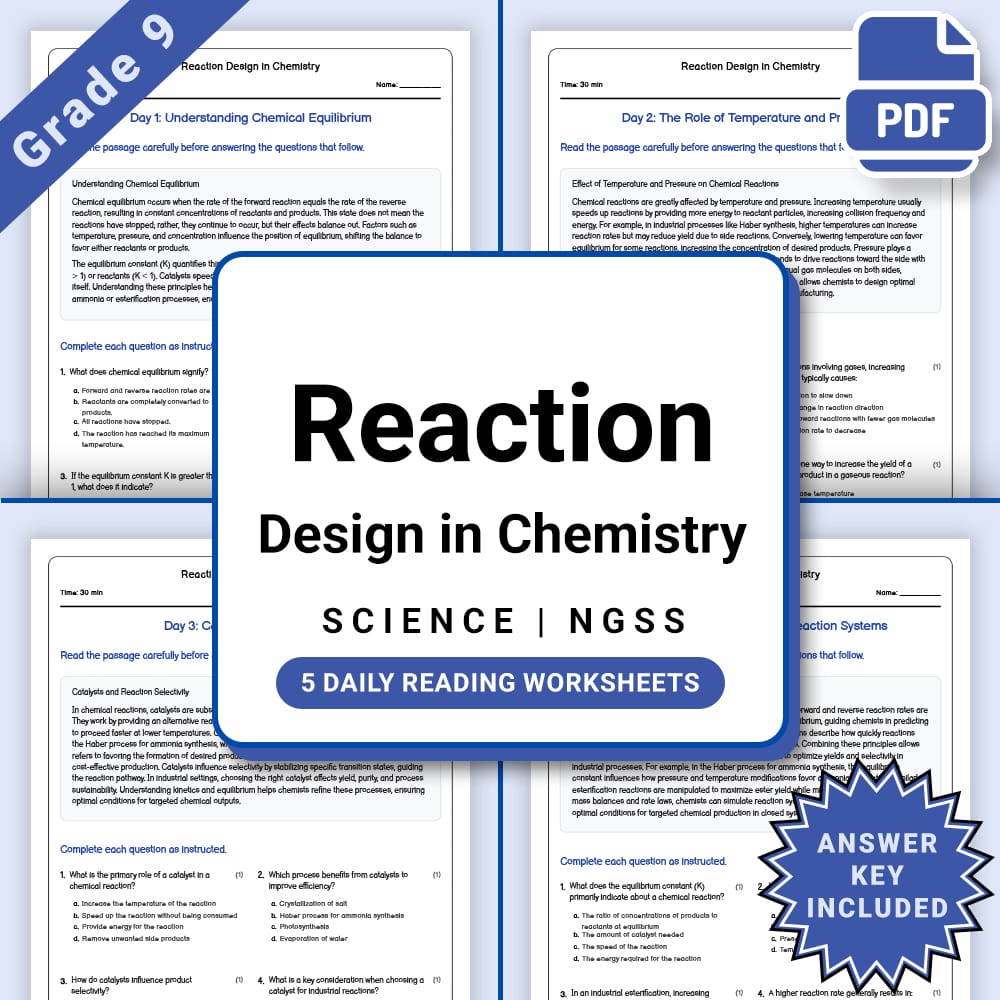
Grade 9 Science – Reaction Design in Chemistry Worksheet(PDF + Answer Key)
Created byCopper Leaf ClassroomLearning Objectives
- Understand the concept of chemical equilibrium and how it influences reaction outcomes.
- Identify factors that affect the equilibrium position, such as temperature, pressure, and concentration.
- Explain the role of catalysts in reaction rates without shifting equilibrium.
Instant download

Grade 9 Science | Ecosystem Services & Benefits - Daily Reading Comprehension
Created byCoral Reef LearningLearning Objectives
- Define ecosystem services and identify their types.
- Understand how biodiversity supports ecosystem functions.
- Recognize human activities that impact ecosystem services.
Instant download
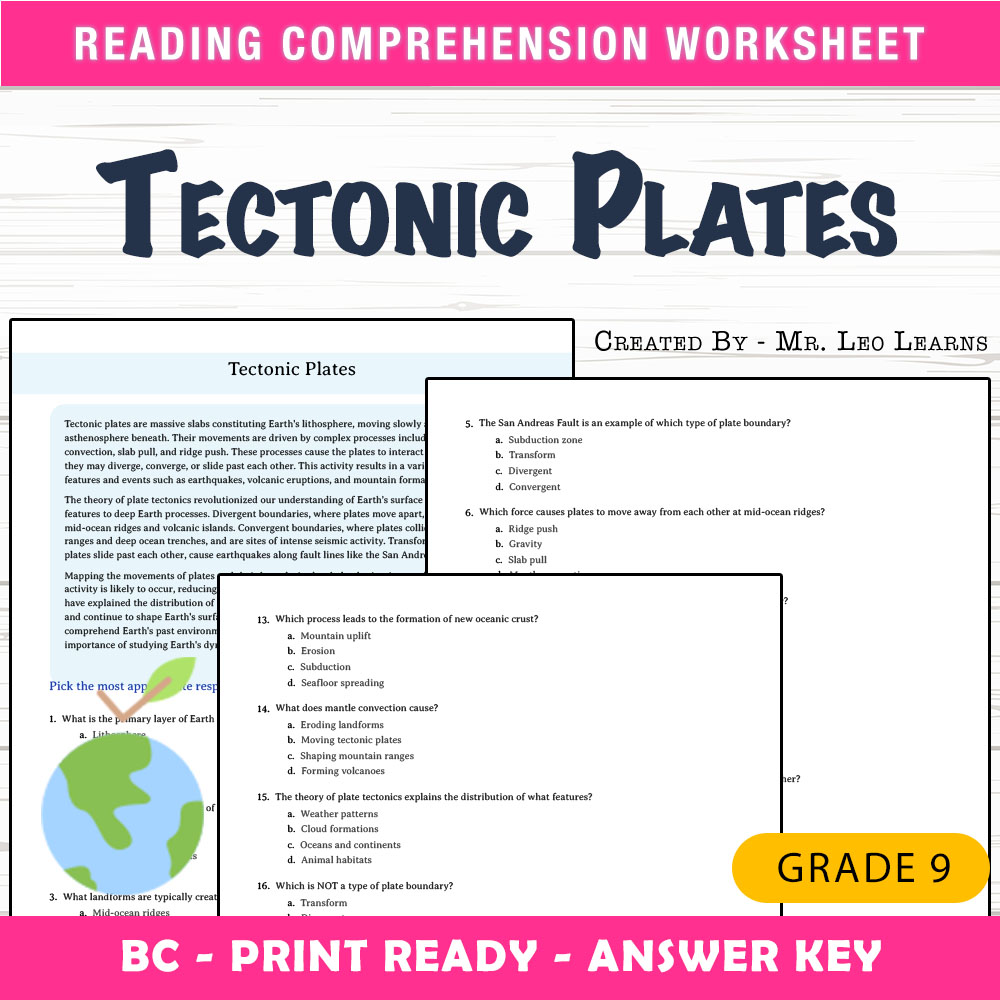
Grade 9 Science — Tectonic Plates Worksheet MCQ Paper for Mastery
Created byThe Resource HubLearning Objectives
- Understand the concept of tectonic plates and their role in Earth's surface.
- Identify the types of plate boundaries and their associated landforms and phenomena.
- Explain the forces that cause plate movements such as mantle convection, slab pull, and ridge push.
Also included in: Grade 9 Science | Earth and Space Systems Unit Worksheet Bundle (BC Framework) +1 more
Instant download
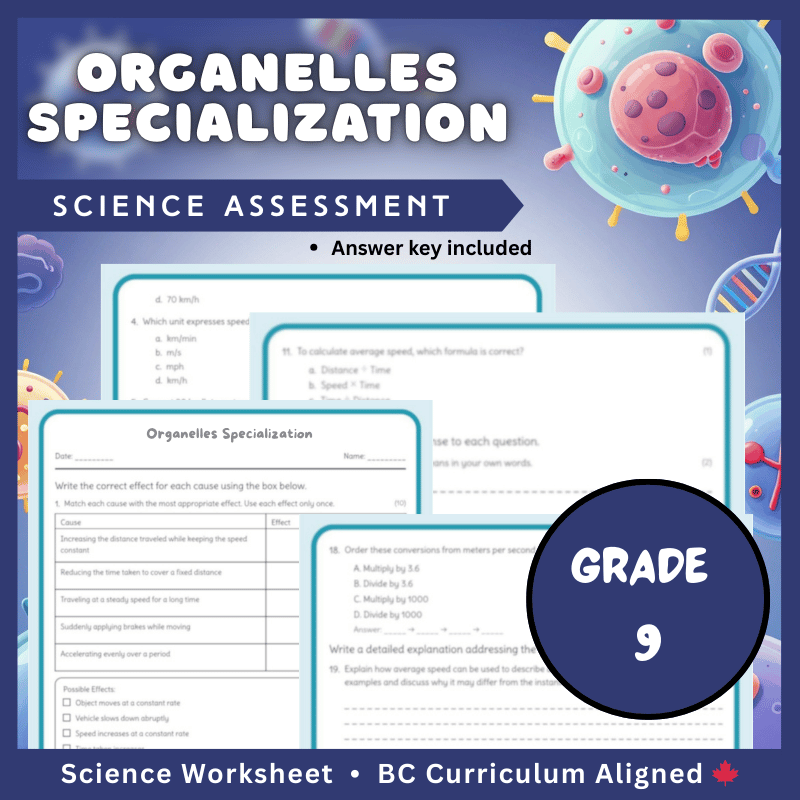
Grade 9 Science | Organelles Specialization Worksheet (PDF) for BC Standards
Created byBright Mind ResourcesLearning Objectives
- Understand the functions and importance of different organelles in eukaryotic cells.
- Identify the specific roles of mitochondria, ribosomes, endoplasmic reticulum, Golgi apparatus, lysosomes, and peroxisomes.
- Explain how organelle specialization supports cellular efficiency and coordination of metabolic pathways.
Instant download

Wave Energy Information Worksheet | Grade 9 Science Practice
Created byPrism Point LearningLearning Objectives
- Explain how waves transfer energy and, in some cases, information without transporting matter overall
- Relate frequency, wavelength, and amplitude to observable wave behavior
- Use wave properties to predict how changes affect wave patterns and energy carried
Instant download
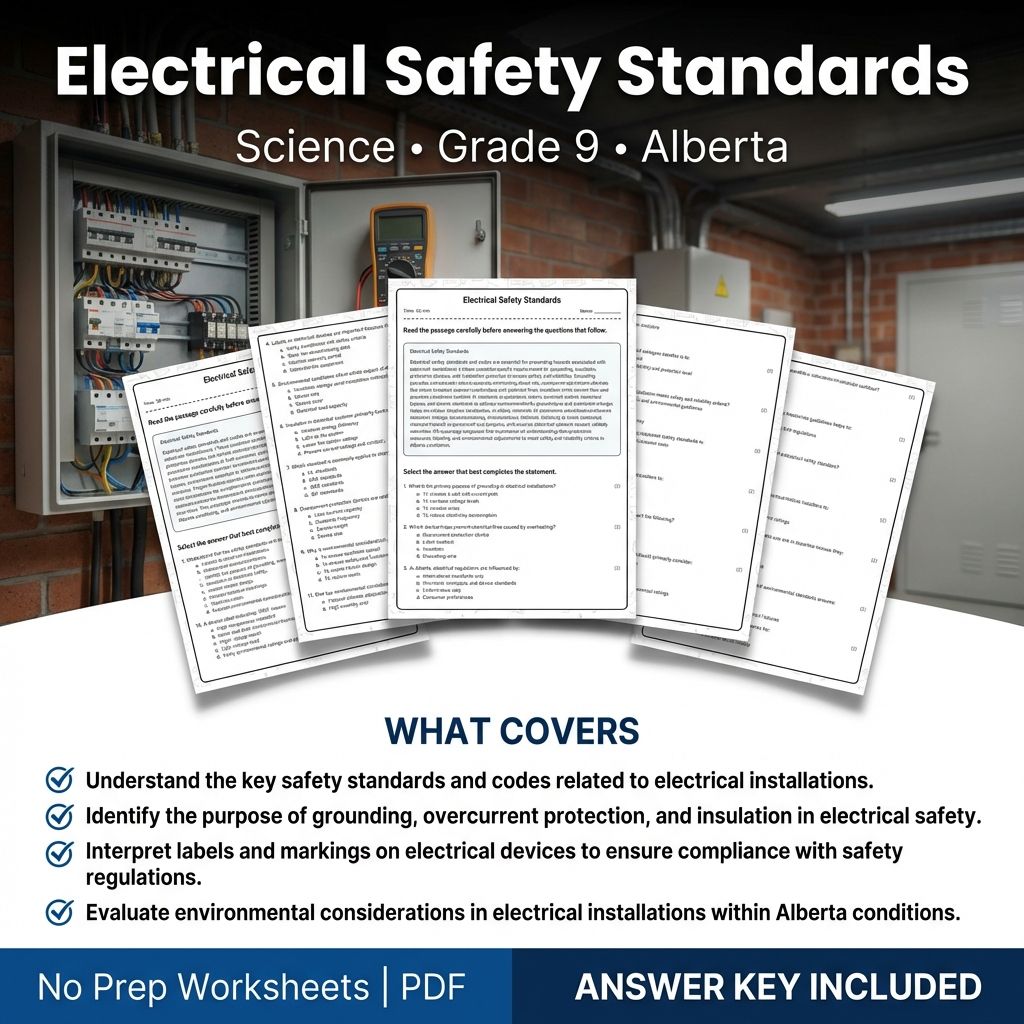
Electrical Safety Standards Worksheet for Grade 9 Science Alberta
Created byCoral Reef LearningLearning Objectives
- Understand the key safety standards and codes related to electrical installations.
- Identify the purpose of grounding, overcurrent protection, and insulation in electrical safety.
- Interpret labels and markings on electrical devices to ensure compliance with safety regulations.
Instant download

Grade 9 Science | Motors and Generators Worksheet (Alberta Standard) (PDF)
 Created bySilver Birch Teaching
Learning Objectives
- Explain how electric motors convert electrical energy into mechanical work using electromagnetic forces.
- Describe how generators use electromagnetic induction to convert mechanical work into electrical energy.
- Match motor/generator performance characteristics (voltage, current, torque, speed, flux) to typical load requirements.
Also included in: Grade 9 Electrical Circuits and Energy Science Lesson Bundle (Alberta) +1 more
Instant download

Grade 9 Science – Electromagnetic Induction & Magnetic Flux | Reading Worksheet
Created byBright Mind ResourcesLearning Objectives
- Understand the basic concepts of electromagnetic induction
- Identify how changing magnetic flux induces voltage
- Recognize practical applications such as generators and transformers
Also included in: Grade 9 Electrical Circuits & Electromagnetism Science Lesson Bundle | Alberta +1 more
Instant download

Grade 9 Science – Component Behavior in Electrical Circuits | Reading Worksheet
Created byBright Mind ResourcesLearning Objectives
- Understand how resistors exhibit linear behavior in circuits
- Identify the characteristics of nonlinear components like diodes
- Describe how temperature affects the performance of electrical components
Also included in: Grade 9 Electrical Circuits & Electromagnetism Science Lesson Bundle | Alberta +1 more
Instant download

Grade 9 Science – System Efficiency & Energy Losses | Reading Worksheet
Created byBright Mind ResourcesLearning Objectives
- Understand common energy loss mechanisms in electrical systems
- Identify techniques to reduce resistive and thermal losses
- Analyze the impact of system design choices on energy efficiency
Also included in: Grade 9 Electrical Circuits & Electromagnetism Science Lesson Bundle | Alberta +1 more
Instant download

Grade 9 Science – Circuit Diagrams & Symbols | Daily Reading Worksheet
Created byBright Mind ResourcesLearning Objectives
- Understand key concepts related to Science
- Apply knowledge through practice questions
- Demonstrate comprehension of the material
Also included in: Grade 9 Electrical Circuits & Electromagnetism Science Lesson Bundle | Alberta +1 more
Instant download
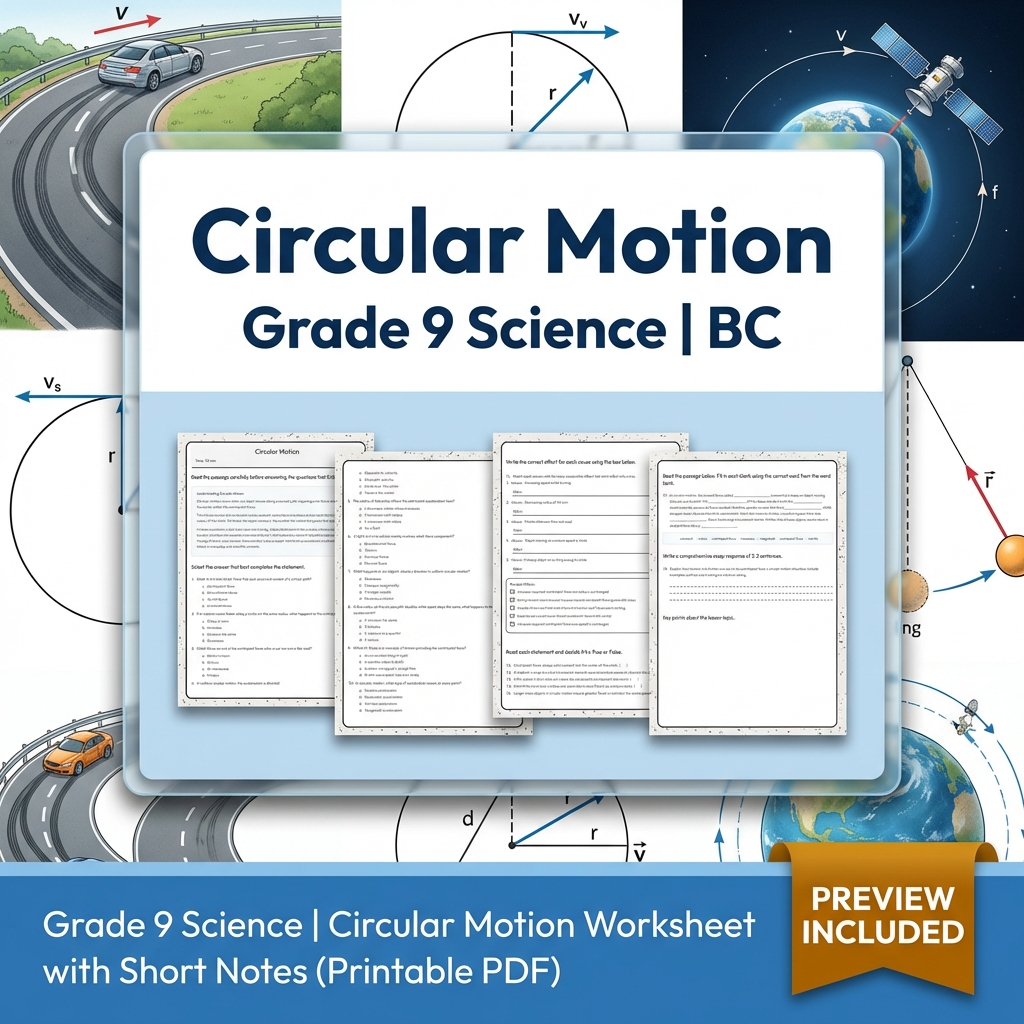
Grade 9 Science | Circular Motion Worksheet with Short Notes (Printable PDF)
Created byMeadowlark WorksheetsLearning Objectives
- Explain the concept of centripetal force and its role in circular motion.
- Understand how speed and radius affect centripetal acceleration.
- Identify forces such as tension, friction, and normal force that maintain curved trajectories.
Also included in: Grade 9 Science Lesson Bundle | Energy, Forces & Motion Worksheets +1 more
Instant download
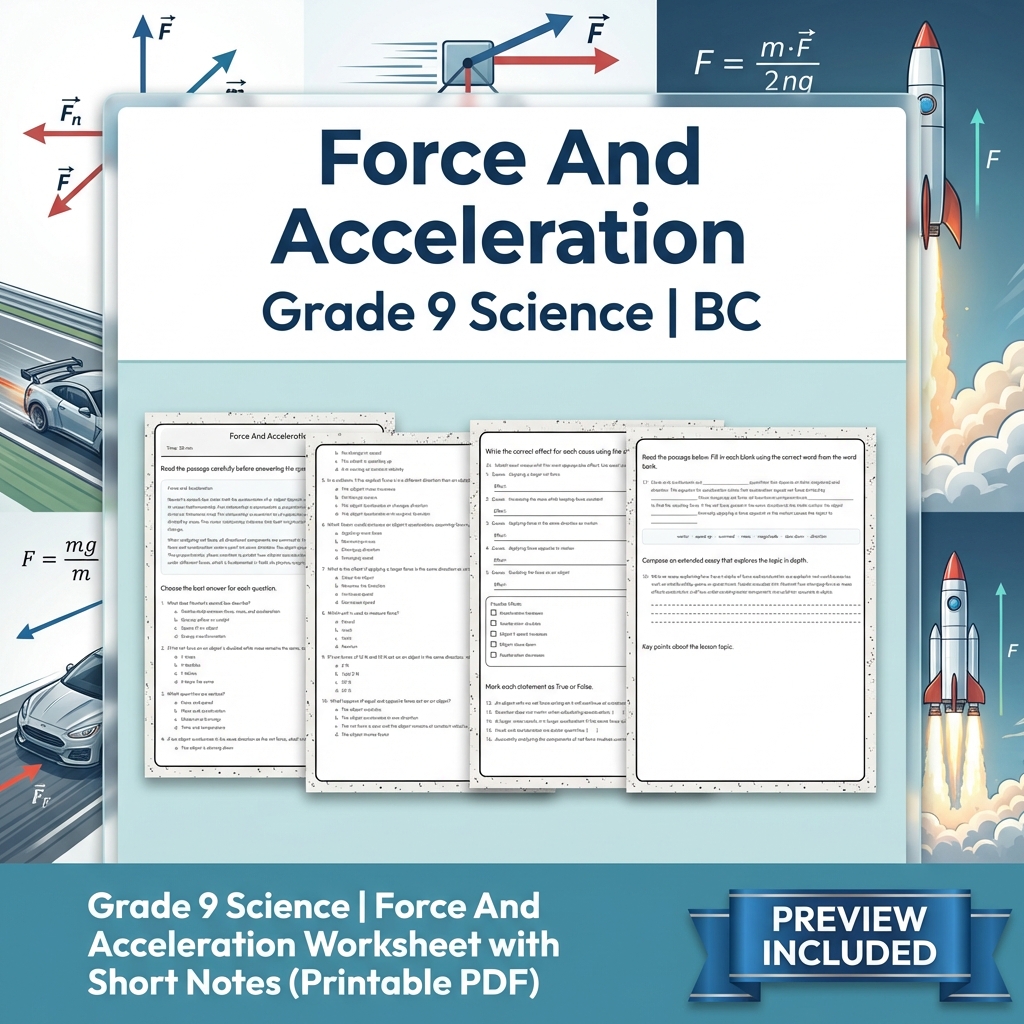
Grade 9 Science | Force And Acceleration Worksheet with Short Notes (PDF)
Created byMeadowlark WorksheetsLearning Objectives
- Understand the relationship between net force, mass, and acceleration as described by Newton's second law.
- Analyze how direction affects force and acceleration vectors.
- Apply the concept of net force to predict changes in an object's motion.
Also included in: Grade 9 Science Lesson Bundle | Energy, Forces & Motion Worksheets +1 more
Instant download
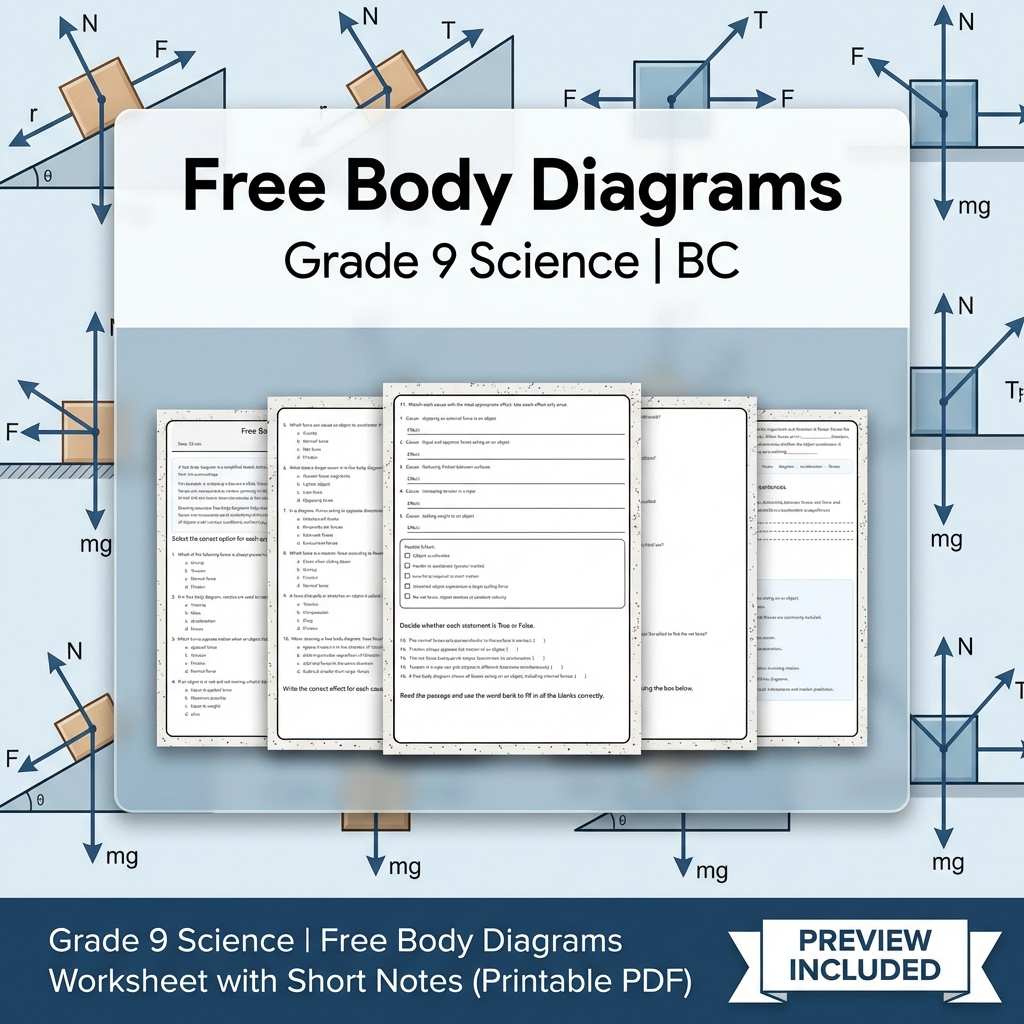
Grade 9 Science | Free Body Diagrams Worksheet with Short Notes (Printable PDF)
Created byMeadowlark WorksheetsLearning Objectives
- Understand the purpose and components of free body diagrams.
- Learn how to sketch and interpret vectors for forces acting on objects.
- Calculate net force and analyze how forces contribute to motion.
Also included in: Grade 9 Science Lesson Bundle | Energy, Forces & Motion Worksheets +1 more
Instant download
Grade 9 Science | Inertia Explained Worksheet with Short Notes (Printable PDF)
Created byMeadowlark WorksheetsLearning Objectives
- Understand the concept of inertia and how it relates to an object's mass.
- Explain real-world examples of inertia to demonstrate understanding.
- Analyze how forces overcome inertia to change an object's motion.
Also included in: Grade 9 Science Lesson Bundle | Energy, Forces & Motion Worksheets +1 more
Instant download
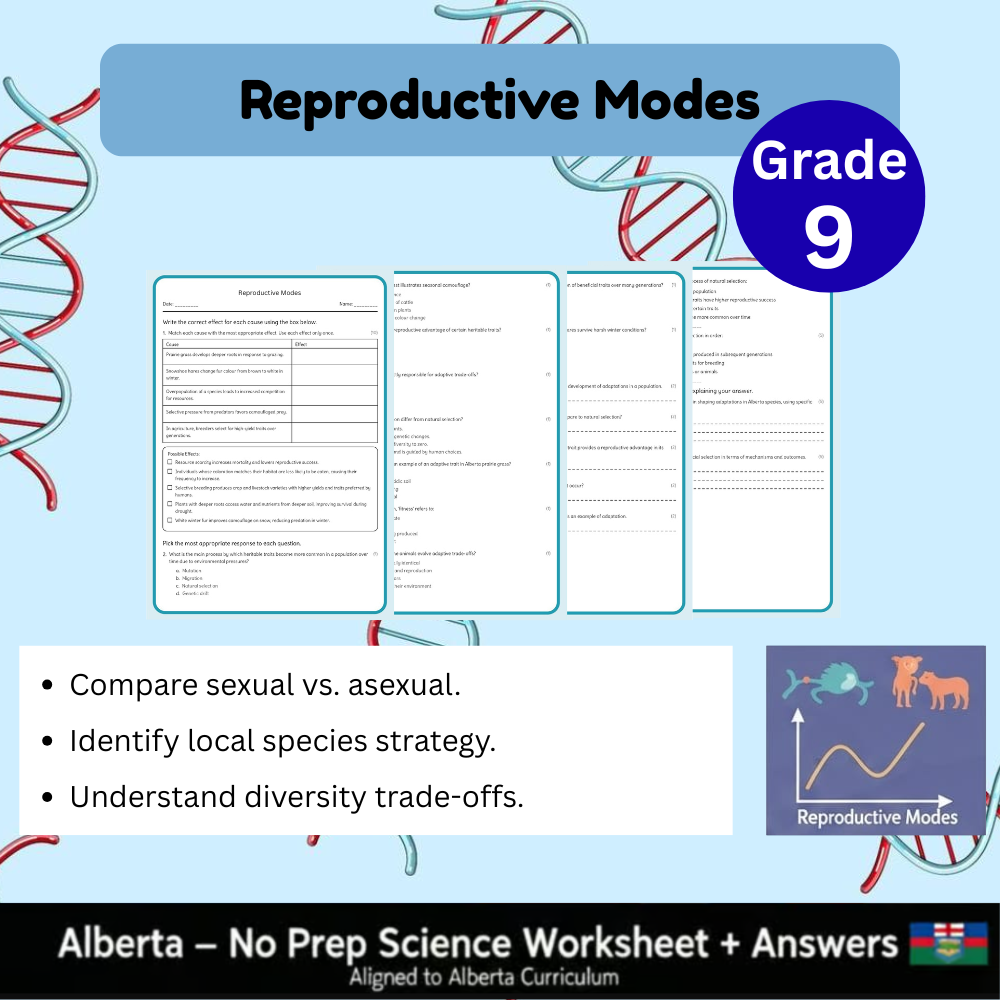
Grade 9 Science | Reproductive Modes Worksheet (PDF) - Alberta Standards
Created byBright Mind ResourcesLearning Objectives
- Compare and contrast sexual and asexual reproduction strategies.
- Identify examples of reproductive strategies in Alberta species.
- Understand ecological trade-offs between genetic diversity and population growth.
Instant download

Grade 9 Science Worksheet on Physical Changes (Alberta Standards) (PDF)
Created bySilver Birch TeachingLearning Objectives
- Explain what a physical change is and how it differs from a chemical change
- Identify examples of physical changes in everyday and engineered processes
- Use particle/identity reasoning to describe how matter can change phase or form without forming new substances
Also included in: Grade 9 Chemical Reactions Science Lesson Bundle: Alberta Framework +1 more
Instant download
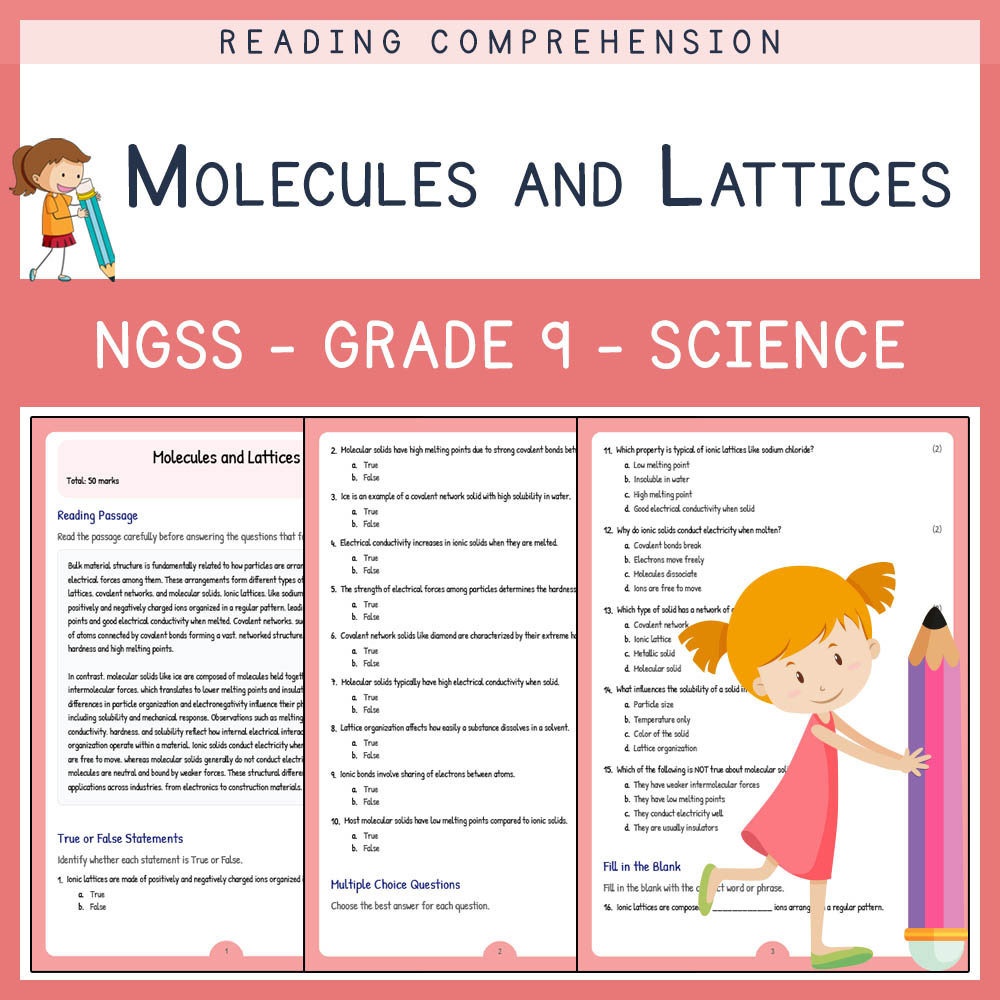
Grade 9 Science | Molecules and Lattices Worksheet & Answer Key (NGSS Standards)
Created byLumora LearningLearning Objectives
- Understand the different types of particle arrangements in solids, including ionic and covalent lattices.
- Explain how the structure of molecules and lattices influences properties such as melting point, electrical conductivity, and solubility.
- Describe the distinctions between ionic solids and molecular solids based on their organization and electrical forces.
Instant download
About Grade 9 Science Worksheets
Find Science worksheets built for Grade 9. All 6,926 cover core skills, practice, and review, each an instant PDF download.
Every worksheet on MyTeachingSheets is created by independent teacher-authors and reviewed before publication. All resources download as printable PDFs for classroom, homework, or at-home practice, and many include answer keys. Preview any worksheet free before buying.