
Grade 9 Science Worksheets
6,926 worksheets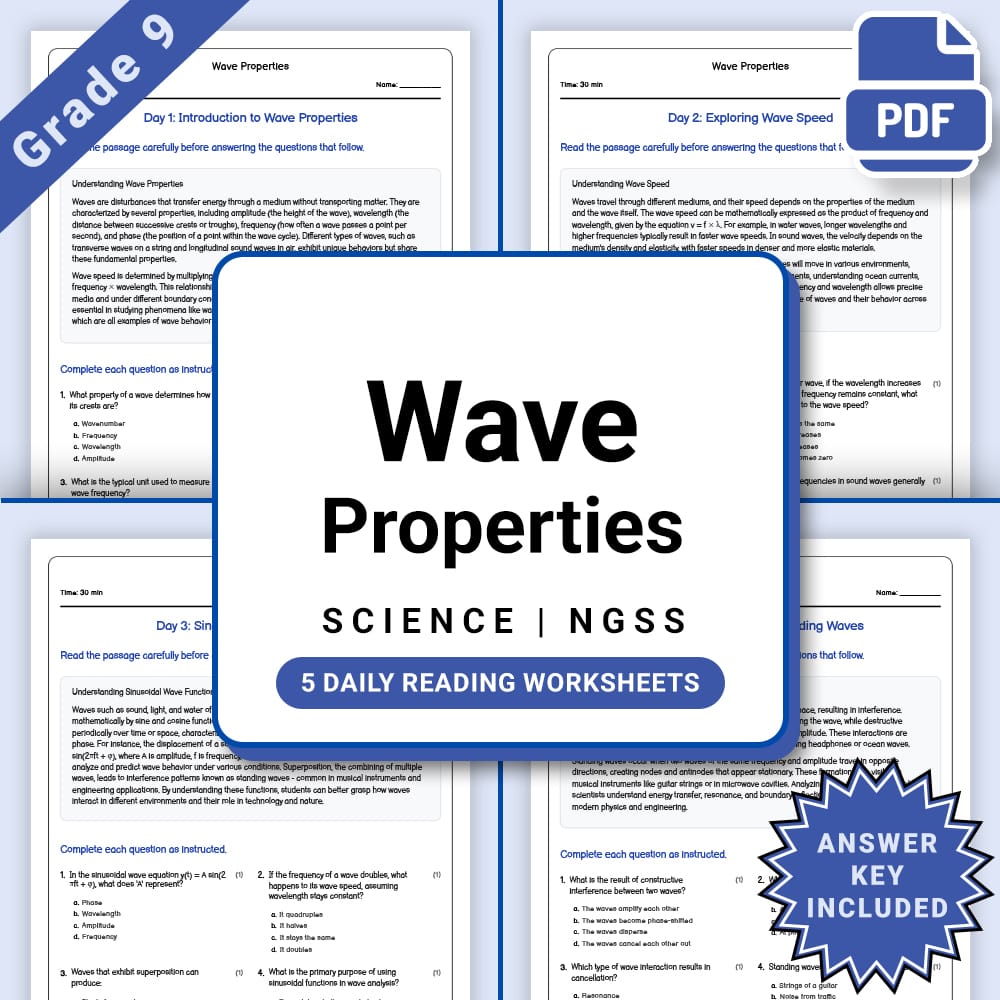
Grade 9 Science – Wave Properties Daily Reading Worksheet(PDF + Answer Key)
 Created byCopper Leaf Classroom
Learning Objectives
- Identify and describe the main components of waves: amplitude, frequency, wavelength, and phase.
- Understand the basic behavior of different types of waves including transverse and longitudinal waves.
- Calculate wave speed using the formula: wave speed = frequency × wavelength.
Instant download
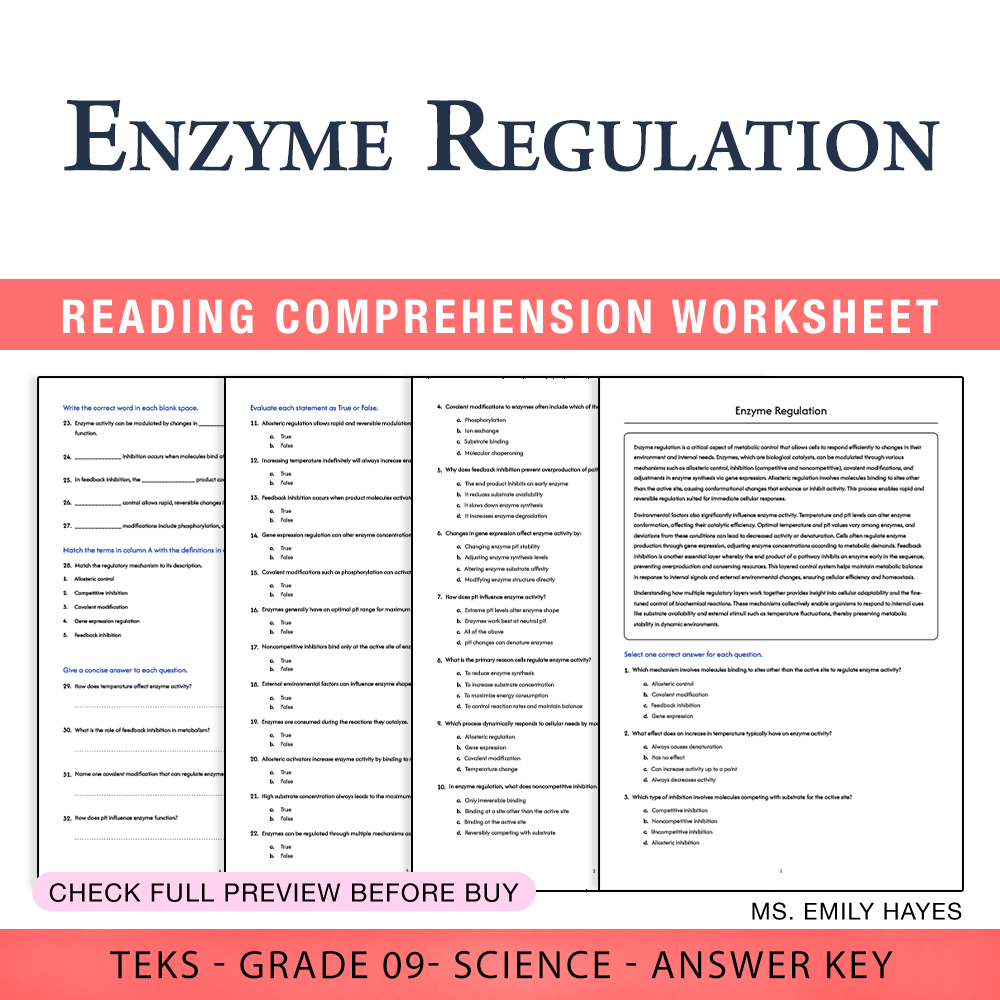
Grade 9 Science | Enzyme Regulation Worksheet (PDF+ Answer Key)
Created byCopper Leaf ClassroomLearning Objectives
- Understand the different mechanisms of enzyme regulation including allosteric control, inhibition, covalent modification, and gene expression.
- Identify how environmental factors like temperature and pH influence enzyme activity.
- Explain the role of feedback inhibition in metabolic pathways.
Instant download
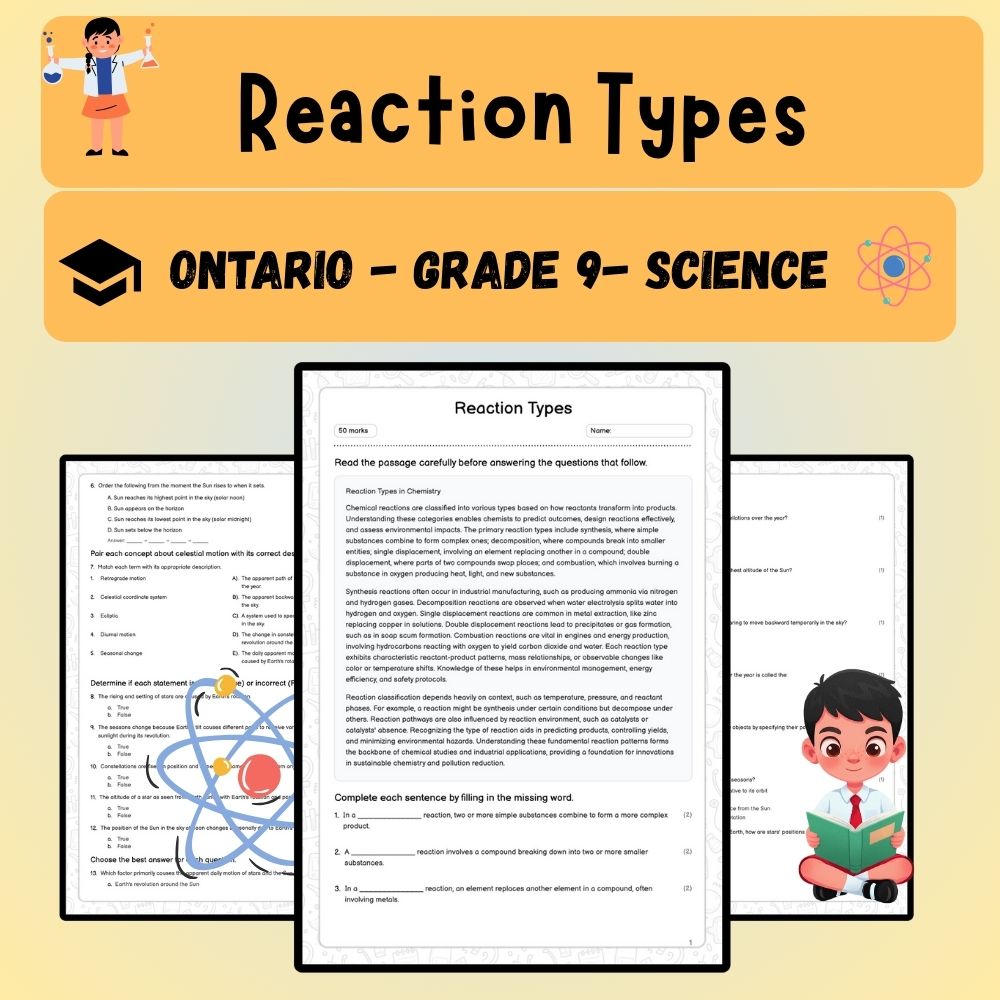
Grade 9 Science | Reaction Types Worksheet – Standard Ontario (PDF)
 Created byPrism Point Learning
Learning Objectives
- Identify and describe the main types of chemical reactions: synthesis, decomposition, single displacement, double displacement, and combustion.
- Recognize practical examples of each reaction type and their observable outcomes.
- Understand how reaction classifications assist in predicting products and maintaining mass conservation.
Also included in: Grade 9 Science UNIT Worksheet Pack | Chemical Properties, Energy & Reactions +1 more
Instant download

Climate Drivers Worksheet | Grade 9 Science Activities
Created byPrism Point LearningLearning Objectives
- Explain how Earth’s climate is shaped by interactions among the atmosphere, hydrosphere, cryosphere, lithosphere, and biosphere.
- Describe how solar energy and internal heat create an energy balance that influences long-term climate averages.
- Identify how external forcings and natural variability (aerosols, greenhouse gases, ocean circulation, and land surface properties) affect temperature, precipitation, and extremes.
Also included in: Earth and Space Systems Lesson Bundle | Grade 9 Science | BC Framework +1 more
Instant download

Ocean Circulation Worksheet | Grade 9 Science Practice
Created byPrism Point LearningLearning Objectives
- Explain how surface currents and deeper thermohaline circulation redistribute heat in the ocean.
- Describe how features like gyres and upwelling influence coastal conditions and carbon uptake.
- Evaluate how changes in ocean circulation can affect regional climates and extreme weather through feedbacks.
Also included in: Earth and Space Systems Lesson Bundle | Grade 9 Science | BC Framework +1 more
Instant download

Newtonian Motion Worksheet | NGSS Grade 9 Science Assessment PDF
 Created byCedar Grove Learning
Learning Objectives
- Understand how Newton's laws relate net force, mass, and acceleration in motion.
- Analyze free-body diagrams and force components to predict motion.
- Apply proportional relationships between net force and acceleration for constant mass systems.
Instant download
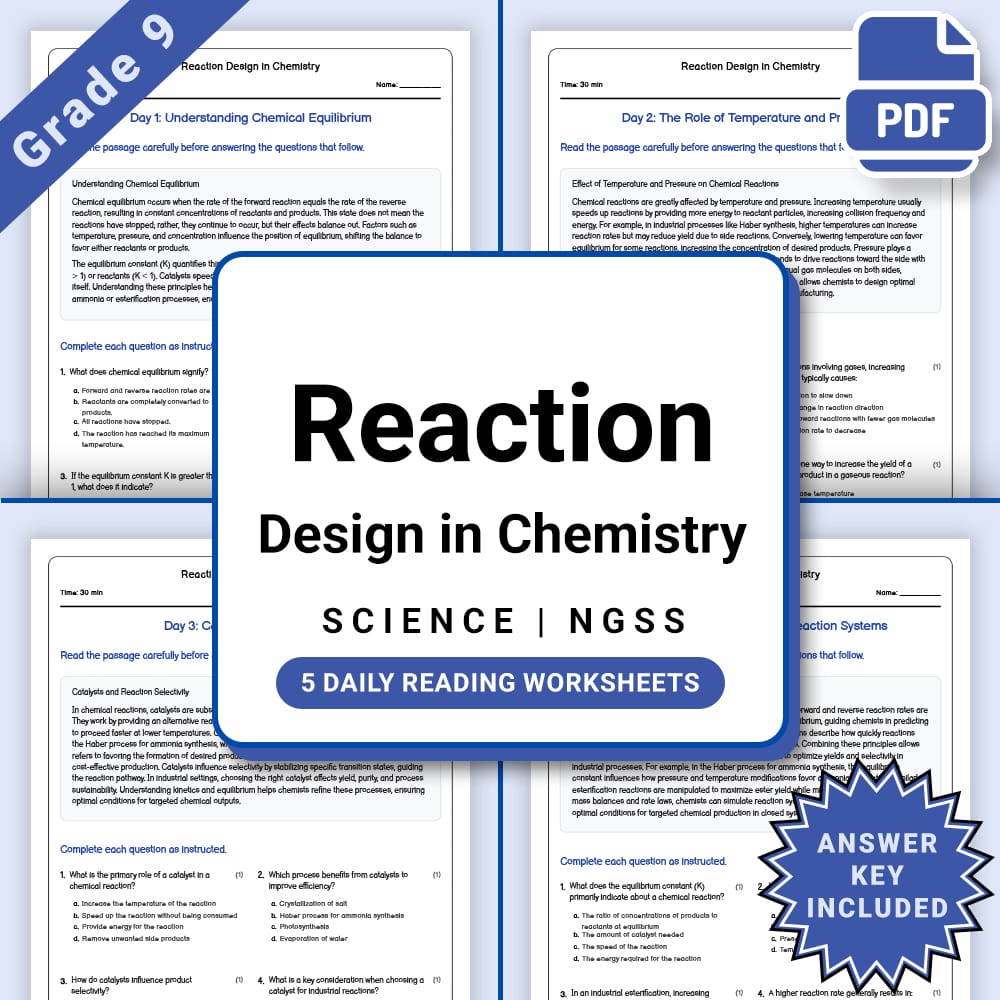
Grade 9 Science – Reaction Design in Chemistry Worksheet(PDF + Answer Key)
Created byCopper Leaf ClassroomLearning Objectives
- Understand the concept of chemical equilibrium and how it influences reaction outcomes.
- Identify factors that affect the equilibrium position, such as temperature, pressure, and concentration.
- Explain the role of catalysts in reaction rates without shifting equilibrium.
Instant download

Grade 9 Science | Ecosystem Services & Benefits - Daily Reading Comprehension
 Created byCoral Reef Learning
Learning Objectives
- Define ecosystem services and identify their types.
- Understand how biodiversity supports ecosystem functions.
- Recognize human activities that impact ecosystem services.
Instant download
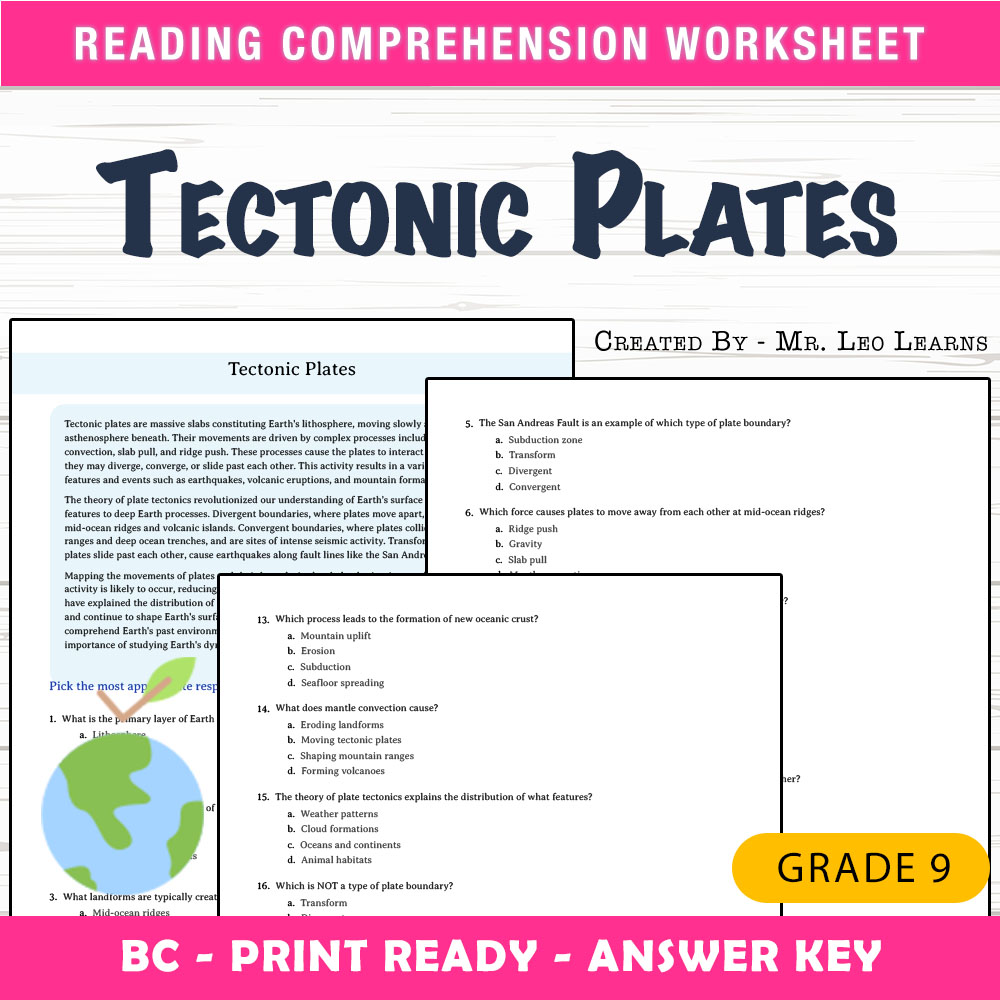
Grade 9 Science — Tectonic Plates Worksheet MCQ Paper for Mastery
 Created byThe Resource Hub
Learning Objectives
- Understand the concept of tectonic plates and their role in Earth's surface.
- Identify the types of plate boundaries and their associated landforms and phenomena.
- Explain the forces that cause plate movements such as mantle convection, slab pull, and ridge push.
Also included in: Grade 9 Science | Earth and Space Systems Unit Worksheet Bundle (BC Framework) +1 more
Instant download
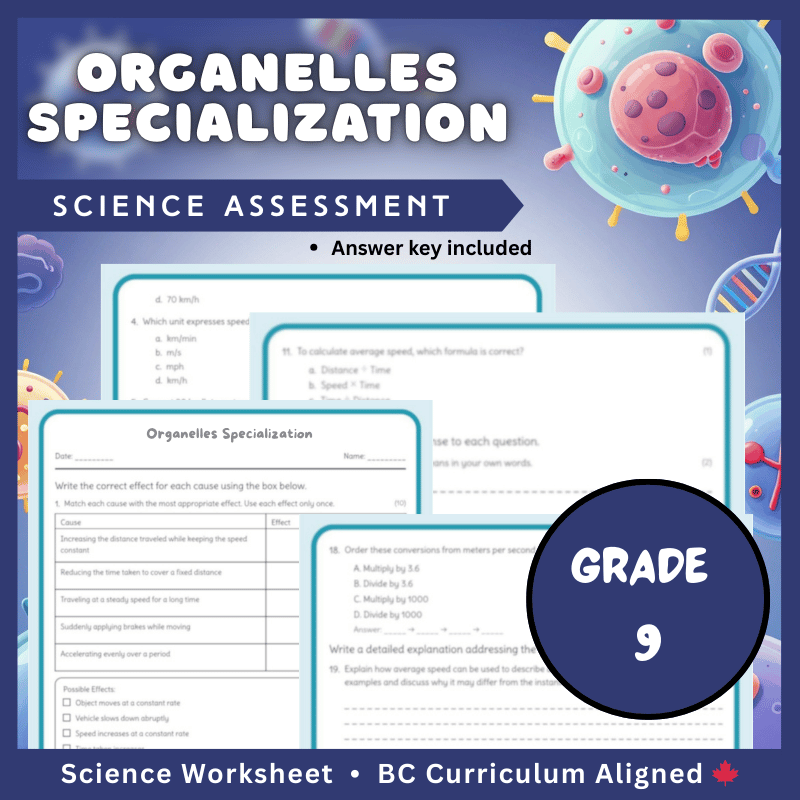
Grade 9 Science | Organelles Specialization Worksheet (PDF) for BC Standards
 Created byBright Mind Resources
Learning Objectives
- Understand the functions and importance of different organelles in eukaryotic cells.
- Identify the specific roles of mitochondria, ribosomes, endoplasmic reticulum, Golgi apparatus, lysosomes, and peroxisomes.
- Explain how organelle specialization supports cellular efficiency and coordination of metabolic pathways.
Instant download

Wave Energy Information Worksheet | Grade 9 Science Practice
Created byPrism Point LearningLearning Objectives
- Explain how waves transfer energy and, in some cases, information without transporting matter overall
- Relate frequency, wavelength, and amplitude to observable wave behavior
- Use wave properties to predict how changes affect wave patterns and energy carried
Instant download
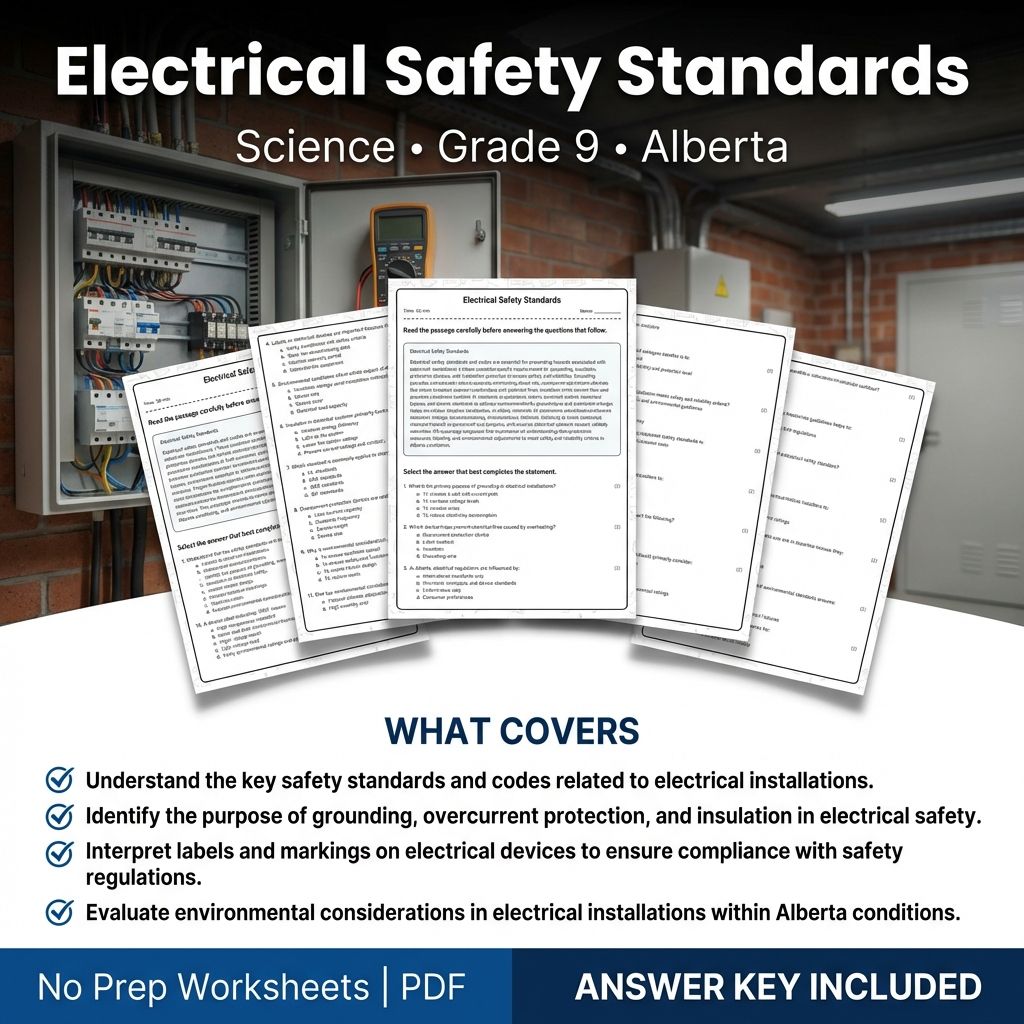
Electrical Safety Standards Worksheet for Grade 9 Science Alberta
Created byCoral Reef LearningLearning Objectives
- Understand the key safety standards and codes related to electrical installations.
- Identify the purpose of grounding, overcurrent protection, and insulation in electrical safety.
- Interpret labels and markings on electrical devices to ensure compliance with safety regulations.
Instant download

Grade 9 Science | Motors and Generators Worksheet (Alberta Standard) (PDF)
 Created bySilver Birch Teaching
Learning Objectives
- Explain how electric motors convert electrical energy into mechanical work using electromagnetic forces.
- Describe how generators use electromagnetic induction to convert mechanical work into electrical energy.
- Match motor/generator performance characteristics (voltage, current, torque, speed, flux) to typical load requirements.
Also included in: Grade 9 Electrical Circuits and Energy Science Lesson Bundle (Alberta) +1 more
Instant download

Grade 9 Science – Electromagnetic Induction & Magnetic Flux | Reading Worksheet
Created byBright Mind ResourcesLearning Objectives
- Understand the basic concepts of electromagnetic induction
- Identify how changing magnetic flux induces voltage
- Recognize practical applications such as generators and transformers
Also included in: Grade 9 Electrical Circuits & Electromagnetism Science Lesson Bundle | Alberta +1 more
Instant download

Grade 9 Science – Component Behavior in Electrical Circuits | Reading Worksheet
Created byBright Mind ResourcesLearning Objectives
- Understand how resistors exhibit linear behavior in circuits
- Identify the characteristics of nonlinear components like diodes
- Describe how temperature affects the performance of electrical components
Also included in: Grade 9 Electrical Circuits & Electromagnetism Science Lesson Bundle | Alberta +1 more
Instant download

Grade 9 Science – System Efficiency & Energy Losses | Reading Worksheet
Created byBright Mind ResourcesLearning Objectives
- Understand common energy loss mechanisms in electrical systems
- Identify techniques to reduce resistive and thermal losses
- Analyze the impact of system design choices on energy efficiency
Also included in: Grade 9 Electrical Circuits & Electromagnetism Science Lesson Bundle | Alberta +1 more
Instant download

Grade 9 Science – Circuit Diagrams & Symbols | Daily Reading Worksheet
Created byBright Mind ResourcesLearning Objectives
- Understand key concepts related to Science
- Apply knowledge through practice questions
- Demonstrate comprehension of the material
Also included in: Grade 9 Electrical Circuits & Electromagnetism Science Lesson Bundle | Alberta +1 more
Instant download
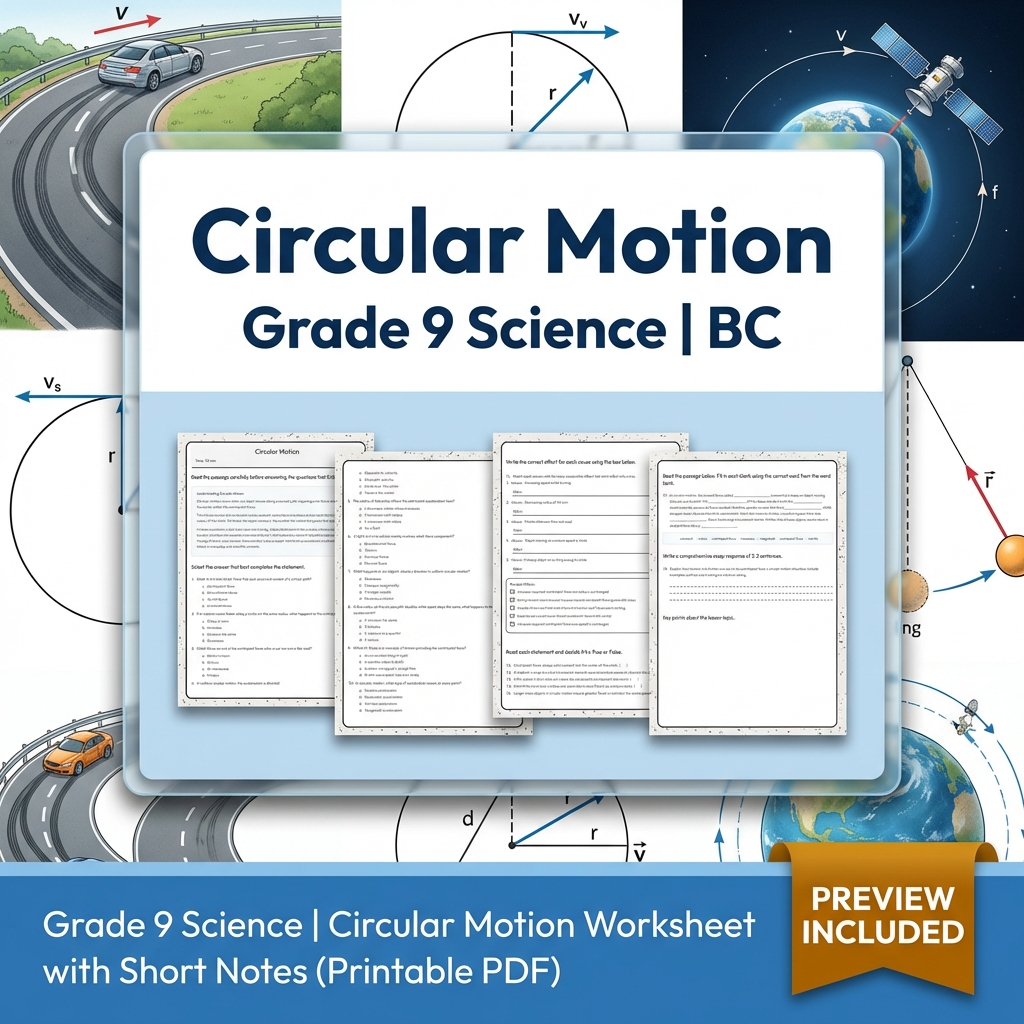
Grade 9 Science | Circular Motion Worksheet with Short Notes (Printable PDF)
 Created byMeadowlark Worksheets
Learning Objectives
- Explain the concept of centripetal force and its role in circular motion.
- Understand how speed and radius affect centripetal acceleration.
- Identify forces such as tension, friction, and normal force that maintain curved trajectories.
Also included in: Grade 9 Science Lesson Bundle | Energy, Forces & Motion Worksheets +1 more
Instant download
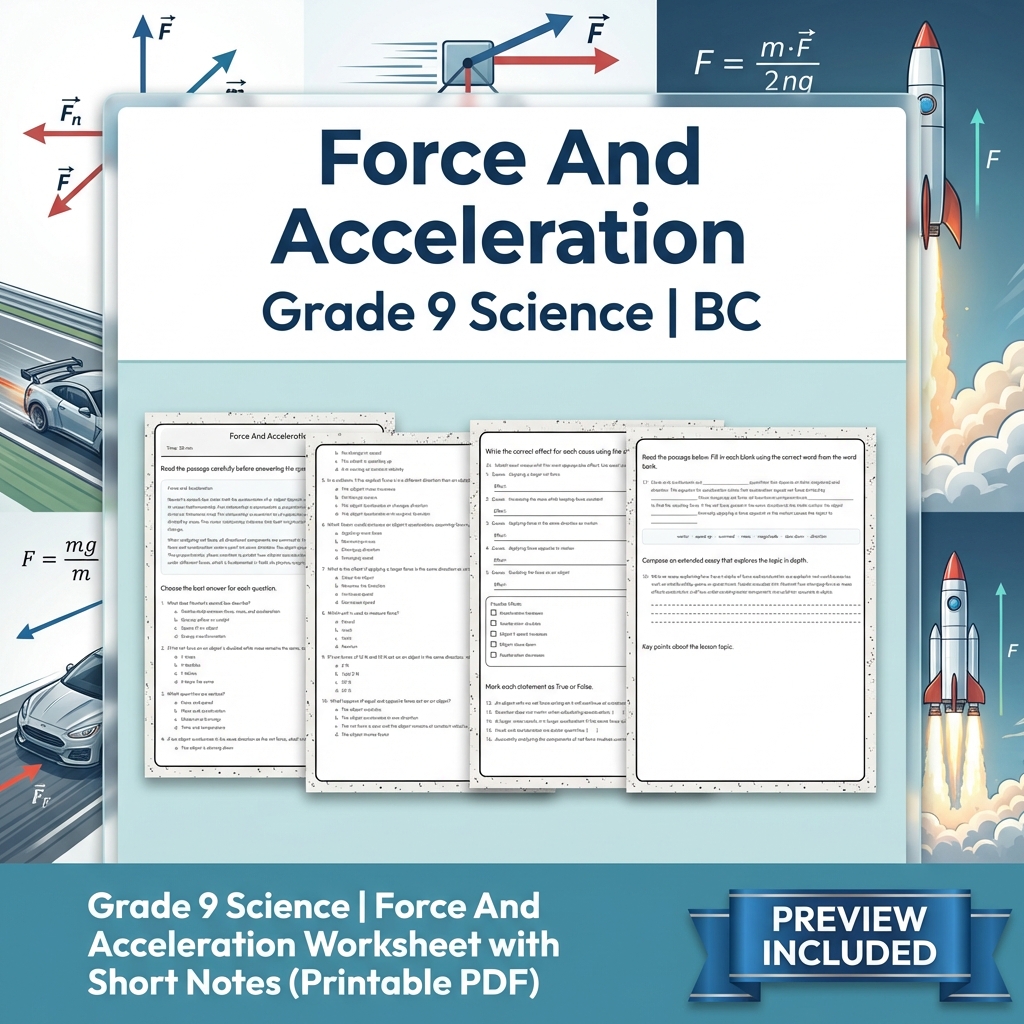
Grade 9 Science | Force And Acceleration Worksheet with Short Notes (PDF)
Created byMeadowlark WorksheetsLearning Objectives
- Understand the relationship between net force, mass, and acceleration as described by Newton's second law.
- Analyze how direction affects force and acceleration vectors.
- Apply the concept of net force to predict changes in an object's motion.
Also included in: Grade 9 Science Lesson Bundle | Energy, Forces & Motion Worksheets +1 more
Instant download
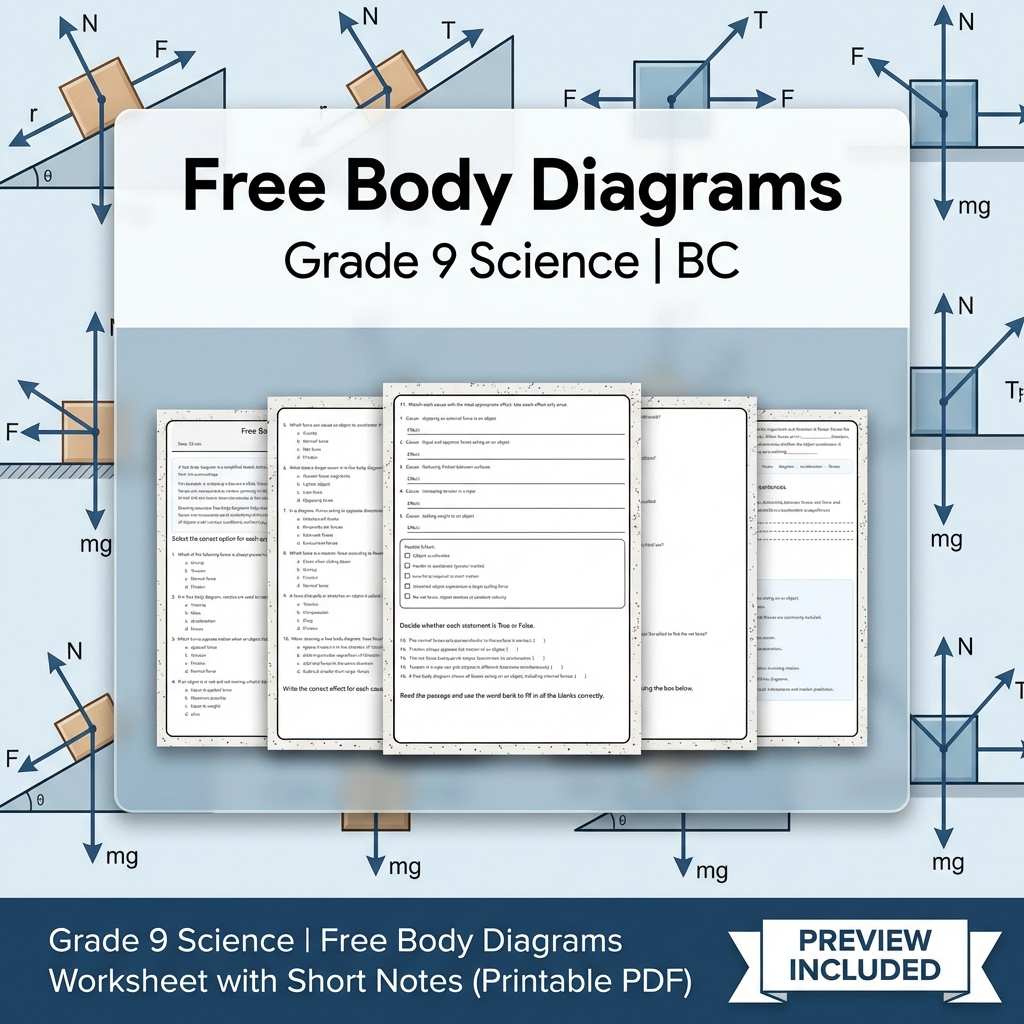
Grade 9 Science | Free Body Diagrams Worksheet with Short Notes (Printable PDF)
Created byMeadowlark WorksheetsLearning Objectives
- Understand the purpose and components of free body diagrams.
- Learn how to sketch and interpret vectors for forces acting on objects.
- Calculate net force and analyze how forces contribute to motion.
Also included in: Grade 9 Science Lesson Bundle | Energy, Forces & Motion Worksheets +1 more
Instant download
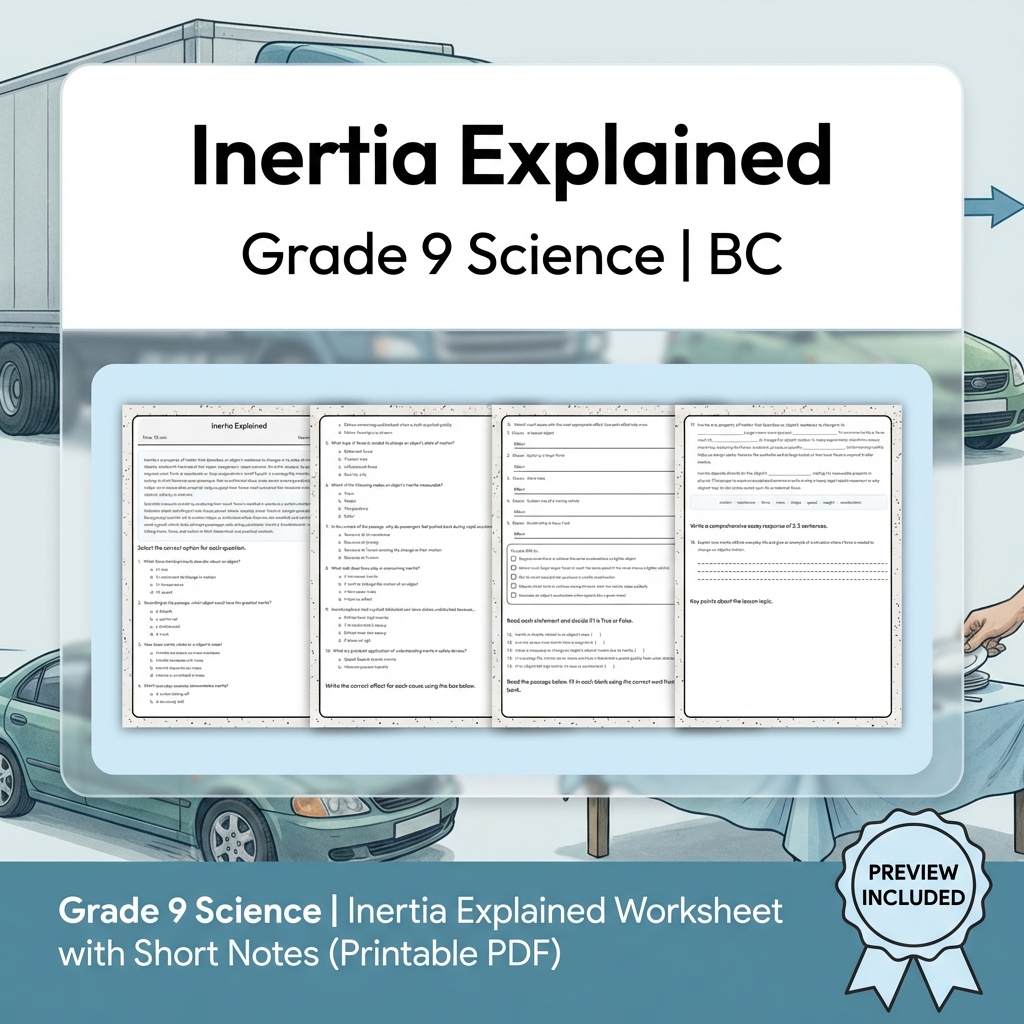
Grade 9 Science | Inertia Explained Worksheet with Short Notes (Printable PDF)
Created byMeadowlark WorksheetsLearning Objectives
- Understand the concept of inertia and how it relates to an object's mass.
- Explain real-world examples of inertia to demonstrate understanding.
- Analyze how forces overcome inertia to change an object's motion.
Also included in: Grade 9 Science Lesson Bundle | Energy, Forces & Motion Worksheets +1 more
Instant download
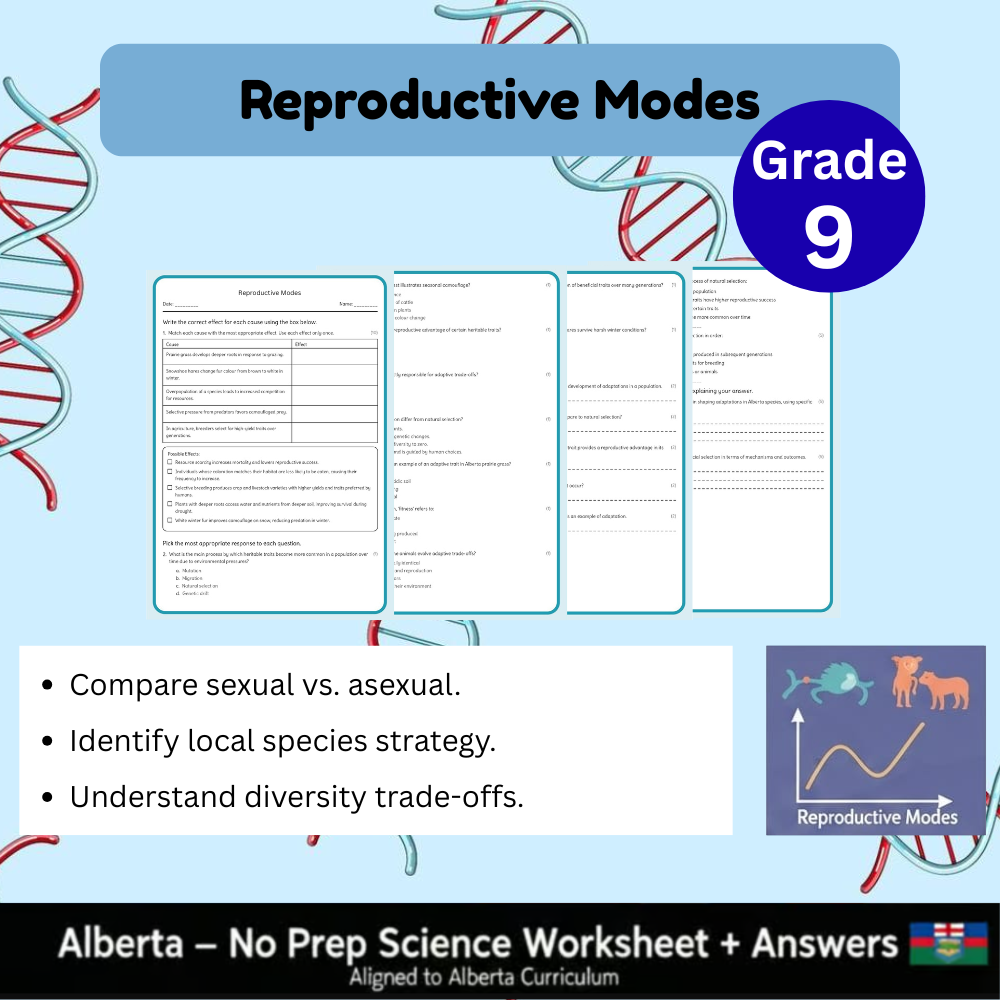
Grade 9 Science | Reproductive Modes Worksheet (PDF) - Alberta Standards
Created byBright Mind ResourcesLearning Objectives
- Compare and contrast sexual and asexual reproduction strategies.
- Identify examples of reproductive strategies in Alberta species.
- Understand ecological trade-offs between genetic diversity and population growth.
Instant download

Grade 9 Science Worksheet on Physical Changes (Alberta Standards) (PDF)
Created bySilver Birch TeachingLearning Objectives
- Explain what a physical change is and how it differs from a chemical change
- Identify examples of physical changes in everyday and engineered processes
- Use particle/identity reasoning to describe how matter can change phase or form without forming new substances
Also included in: Grade 9 Chemical Reactions Science Lesson Bundle: Alberta Framework +1 more
Instant download
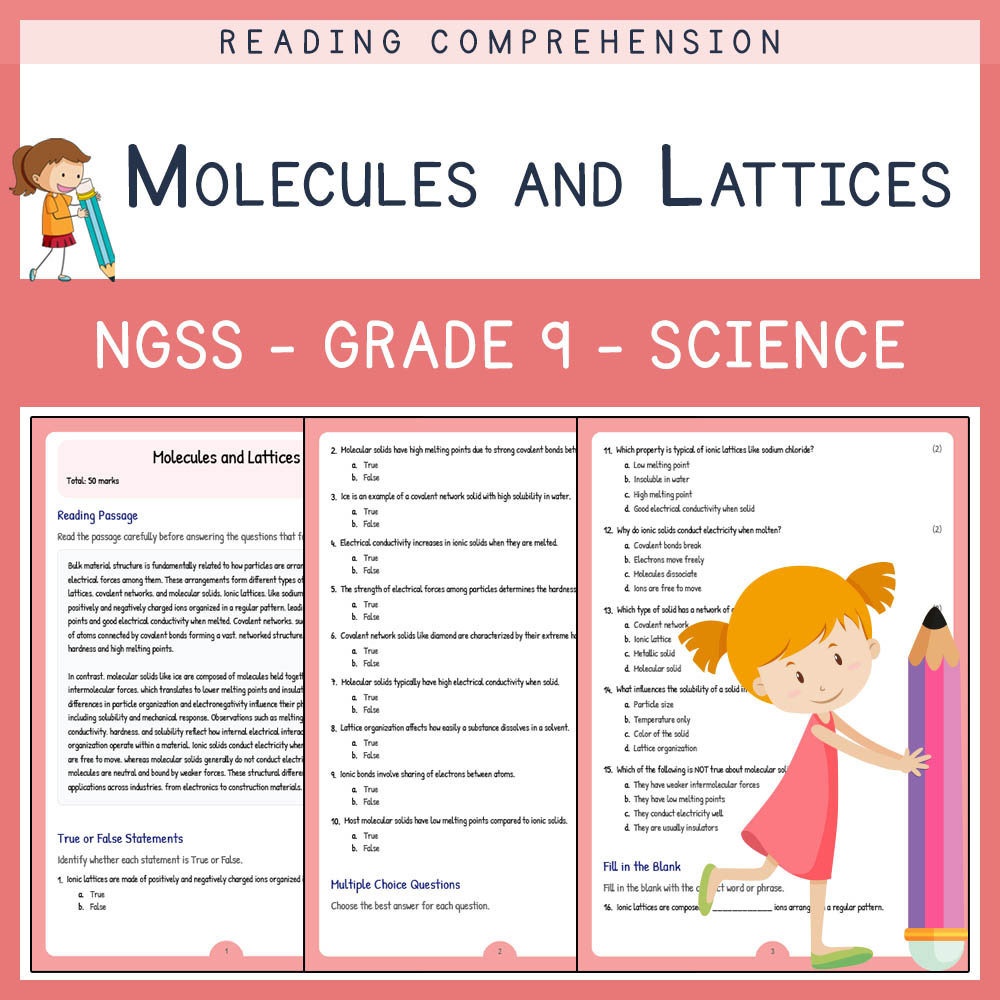
Grade 9 Science | Molecules and Lattices Worksheet & Answer Key (NGSS Standards)
 Created byLumora Learning
Learning Objectives
- Understand the different types of particle arrangements in solids, including ionic and covalent lattices.
- Explain how the structure of molecules and lattices influences properties such as melting point, electrical conductivity, and solubility.
- Describe the distinctions between ionic solids and molecular solids based on their organization and electrical forces.
Instant download

Forces Overview Worksheet Grade 9 Science NGSSS Physics Bundle
 Created byEvergreen Desk Education
Learning Objectives
- Explain how forces affect an object’s motion by changing acceleration and/or velocity
- Differentiate contact forces from field forces and give examples of each
- Use vector ideas (magnitude and direction) to describe forces and combine multiple forces conceptually
Instant download

Model-Data Fit Worksheet | Residual Analysis & AP Science Modeling
Created byPrism Point LearningLearning Objectives
- Use residuals and diagnostic graphical patterns to judge whether a model matches empirical data.
- Apply goodness-of-fit ideas to decide when a model is acceptable versus when it should be revised.
- Explain how heteroscedasticity and missing-variable clues motivate alternate hypotheses.
Instant download
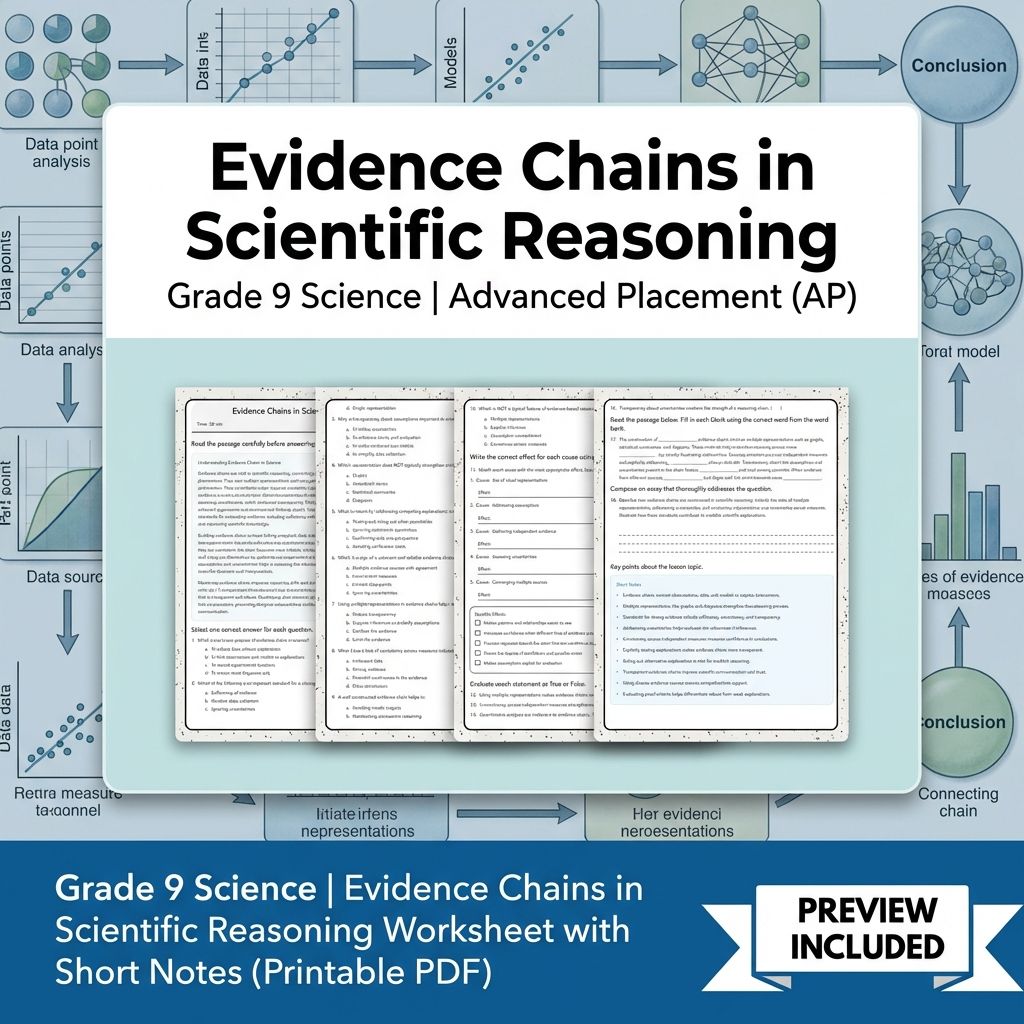
Grade 9 Science | Evidence Chains in Scientific Reasoning Worksheet (PDF)
Created byMeadowlark WorksheetsLearning Objectives
- Understand the structure of evidence-based reasoning in science.
- Identify different types of evidence and their roles in supporting claims.
- Analyze how multiple representations strengthen inference chains.
Also included in: Grade 9 Science | Critical Thinking & Data Analysis Unit Bundle (Worksheets) +1 more
Instant download

Chemical Changes Test Prep Printables | Grade 9 Science
Created byPrism Point LearningLearning Objectives
- Explain how a chemical change forms new substances with different properties and composition.
- Identify observable evidence of chemical changes such as temperature change, gas formation, and precipitate formation.
- Distinguish chemical evidence from physical rearrangement of matter using the particle-level (microscopic) viewpoint.
Also included in: Grade 9 Chemistry Test Prep Science Lesson Bundle: Ontario Framework
Instant download

Reaction Types Practice Worksheet | Grade 9 Science Review Assessment
Created byPrism Point LearningLearning Objectives
- Identify and distinguish common reaction types: synthesis, decomposition, single/double displacement, and combustion.
- Predict likely products from reactants by using particle and bonding patterns.
- Explain how conservation of mass constrains reaction outcomes and evidence from observations.
Also included in: Grade 9 Chemistry Test Prep Science Lesson Bundle: Ontario Framework
Instant download

Element Identity Test Prep Printables | Grade 9 Science
Created byPrism Point LearningLearning Objectives
- Explain how the number of protons and the chemical symbol identify an element.
- Describe how atomic models help represent the identity of atoms and elements.
- Classify elements as metals or nonmetals and use examples (iron, carbon, oxygen).
Also included in: Grade 9 Chemistry Test Prep Science Lesson Bundle: Ontario Framework
Instant download

Chemical Properties Worksheet Practice and Review | Grade 9 Science
Created byPrism Point LearningLearning Objectives
- Define chemical properties as the tendencies of substances to undergo specific chemical changes.
- Identify evidence of chemical change, such as new substances, gas evolution, precipitate formation, and permanent colour change.
- Distinguish chemical change from physical change using observable reaction outcomes.
Also included in: Grade 9 Chemistry Test Prep Science Lesson Bundle: Ontario Framework
Instant download

Physical Properties Test Prep Printables | Grade 9 Science
Created byPrism Point LearningLearning Objectives
- Define physical properties as observable or measurable characteristics that do not change a substance’s chemical identity.
- Identify and distinguish common intensive and extensive physical properties in everyday materials.
- Explain how physical properties can be used to classify materials and choose separation or testing methods.
Also included in: Grade 9 Chemistry Test Prep Science Lesson Bundle: Ontario Framework
Instant download

Physical Changes Test Prep Worksheets | Grade 9 Science
Created byPrism Point LearningLearning Objectives
- Describe physical changes as changes in state or form that keep the same chemical identity.
- Differentiate reversible and irreversible physical transformations using everyday examples.
- Explain how energy transfer is involved in melting, freezing, evaporation, and condensation.
Also included in: Grade 9 Chemistry Test Prep Science Lesson Bundle: Ontario Framework
Instant download

Compound Formulas Practice Worksheet | Grade 9 Science Review
Created byPrism Point LearningLearning Objectives
- Explain how chemical formulas represent compounds as fixed combinations of elements and relate to the law of definite composition
- Differentiate covalent and ionic bonding and predict how bonding type can affect observable properties
- Use chemical formulas to describe elemental ratios and to distinguish compounds from mixtures
Also included in: Grade 9 Chemistry Test Prep Science Lesson Bundle: Ontario Framework
Instant download

Societal Impacts Test Prep Worksheet | Grade 9 Science
Created byPrism Point LearningLearning Objectives
- Evaluate how everyday chemicals provide benefits while creating risks to health and the environment.
- Use chemical properties and exposure routes to explain why some substances persist or spread.
- Apply evidence-based reasoning to compare safe handling, disposal, and regulatory options.
Also included in: Grade 9 Chemistry Test Prep Science Lesson Bundle: Ontario Framework
Instant download

Mixtures And Separation Test Prep Worksheet | Grade 9 Science
Created byPrism Point LearningLearning Objectives
- Distinguish between homogeneous and heterogeneous mixtures using evidence such as visible phases
- Identify physical methods of separation and match them to differences in particle size, solubility, boiling point, and density
- Explain why physical separation preserves the chemical identity of mixture components
Also included in: Grade 9 Chemistry Test Prep Science Lesson Bundle: Ontario Framework
Instant download

Control Criteria Worksheet | Experimental Design AP Science Grade 9
Created byPrism Point LearningLearning Objectives
- Explain how isolating variables and using reference conditions support causal interpretation.
- Describe why replication and baseline characterization increase the credibility of results.
- Identify how residual confounding and uncontrolled variation weaken causal claims, even when patterns appear.
Instant download
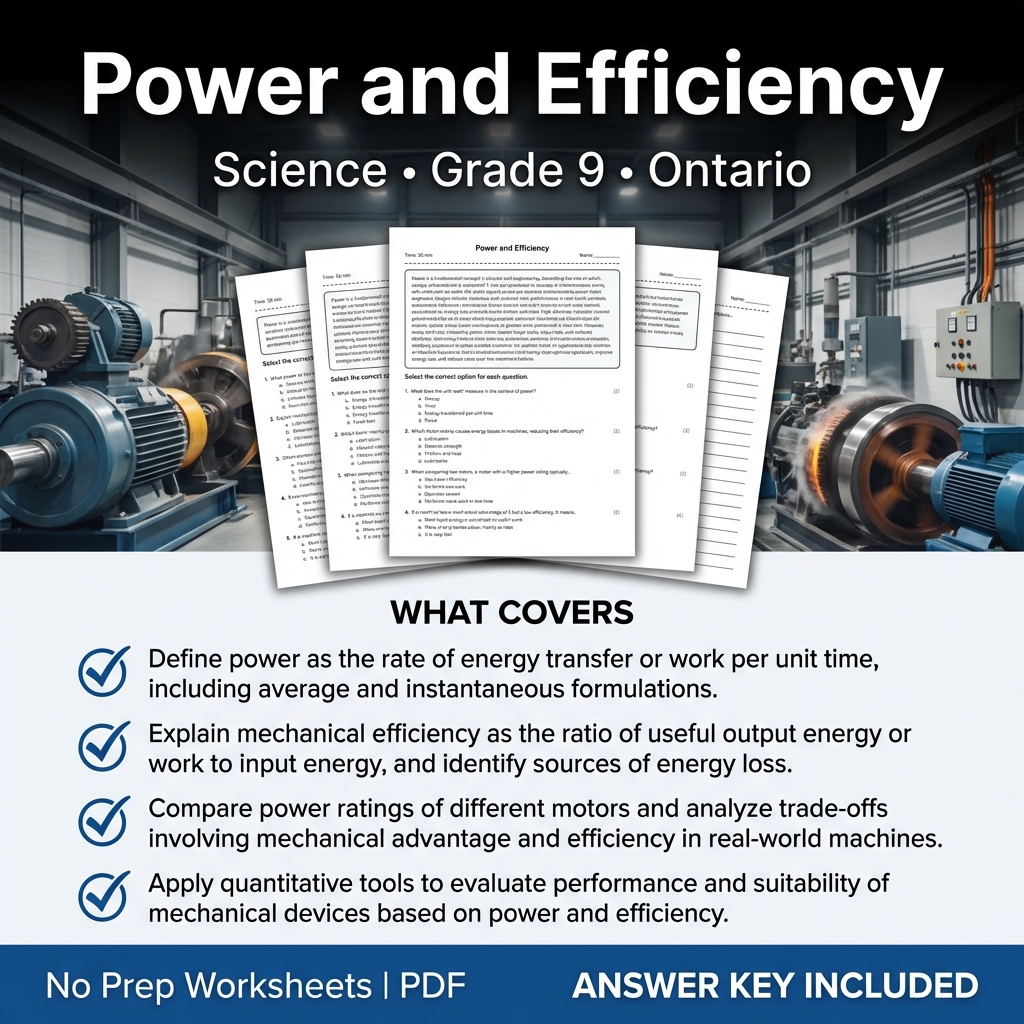
Power and Efficiency Worksheet for Grade 9 Science | Ontario Standards
Created byCoral Reef LearningLearning Objectives
- Define power as the rate of energy transfer or work per unit time, including average and instantaneous formulations.
- Explain mechanical efficiency as the ratio of useful output energy or work to input energy, and identify sources of energy loss.
- Compare power ratings of different motors and analyze trade-offs involving mechanical advantage and efficiency in real-world machines.
Instant download
Grade 9 Science | Power and Efficiency Worksheet (PDF) Aligned with Ontario Standards
Created byPrism Point LearningLearning Objectives
- Define power as the rate of energy transfer or work per unit time and understand its units.
- Explain mechanical efficiency and how it quantifies useful output relative to input energy.
- Identify factors such as friction and heat that cause energy losses in machines.
Also included in: Grade 9 Science Unit | Forces, Motion & Energy Worksheets (Ontario Standards) +1 more
Instant download

Trophic Dynamics & Energy Transfer in Food Webs Worksheets Grade 9
 Created byTeachers Club
Learning Objectives
- Explain why energy decreases across successive trophic levels
- Interpret trophic pyramids and patterns in biomass
- Calculate or interpret ecological efficiency and production-to-biomass ratios
Also included in: Grade 9 Ecosystems Science Worksheets Bundle | NGSS Ecosystems Unit +1 more
Instant download
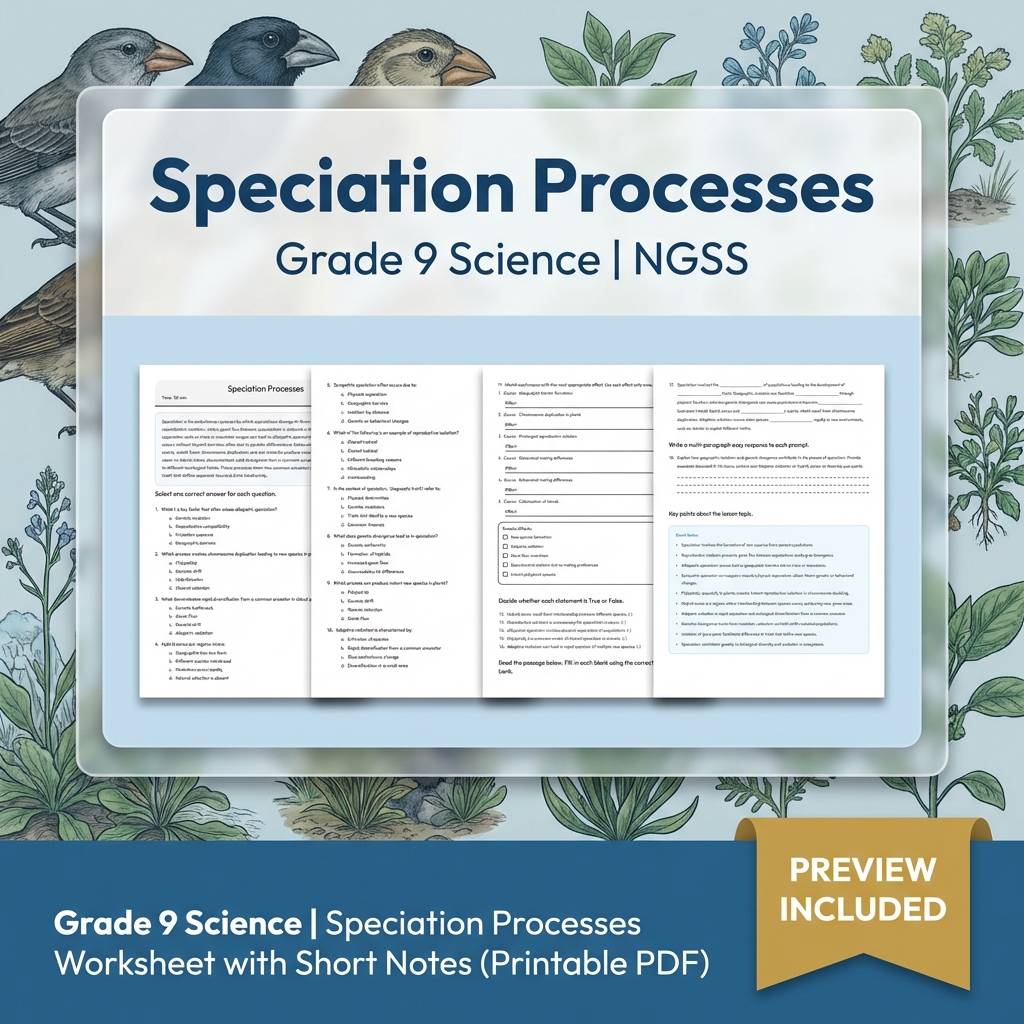
Grade 9 Science | Speciation Processes Worksheet with Short Notes (PDF)
Created byMeadowlark WorksheetsLearning Objectives
- Understand the mechanisms that lead to the formation of new species.
- Identify different models of speciation such as allopatric and sympatric.
- Explain the role of geographic separation and genetic divergence in speciation.
Also included in: Grade 9 Science | Biological Evolution: Unity and Diversity NGSS Unit Bundle +1 more
Instant download
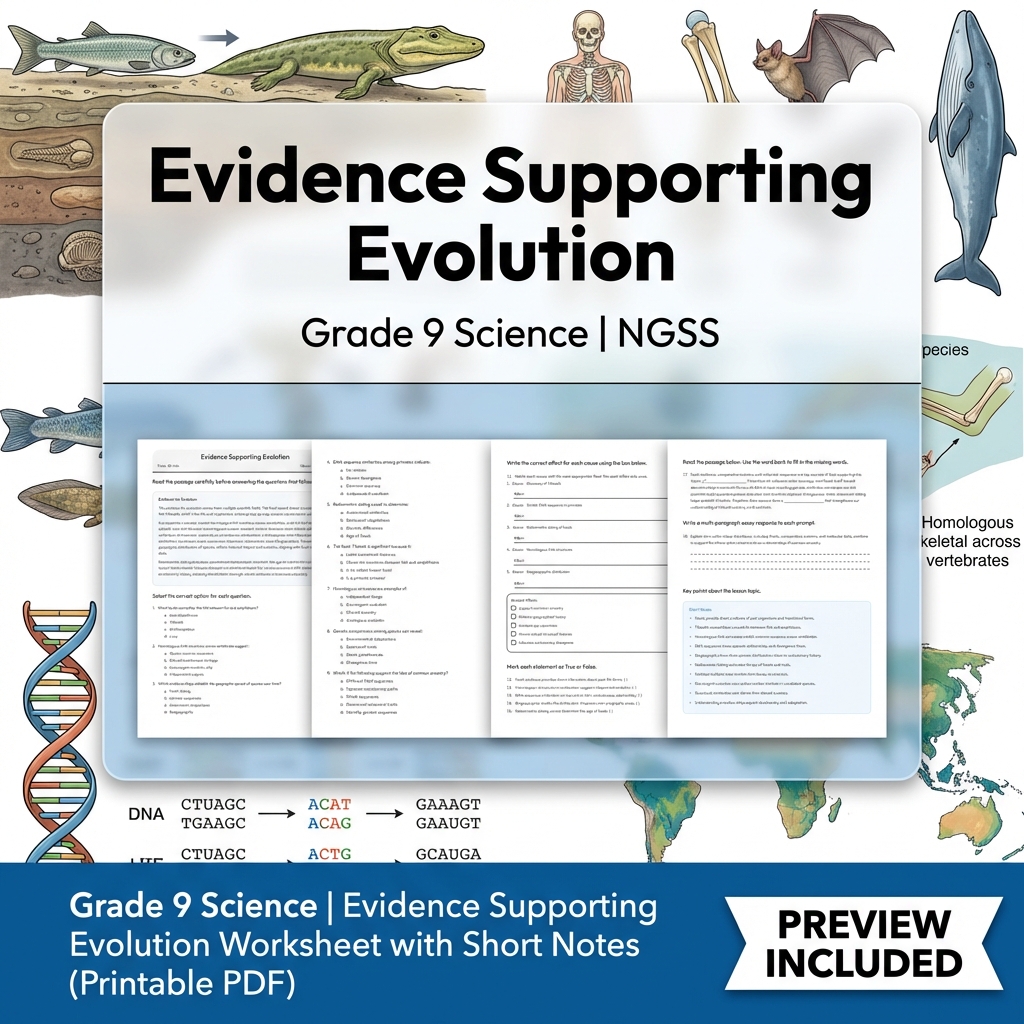
Grade 9 Science | Evidence Supporting Evolution Worksheet with Short Notes (PDF)
Created byMeadowlark WorksheetsLearning Objectives
- Identify different types of empirical evidence that support the theory of evolution.
- Explain how fossils, anatomy, and genetic data provide insights into common ancestry.
- Describe examples of transitional fossils and homologous structures across species.
Also included in: Grade 9 Science | Biological Evolution: Unity and Diversity NGSS Unit Bundle +1 more
Instant download
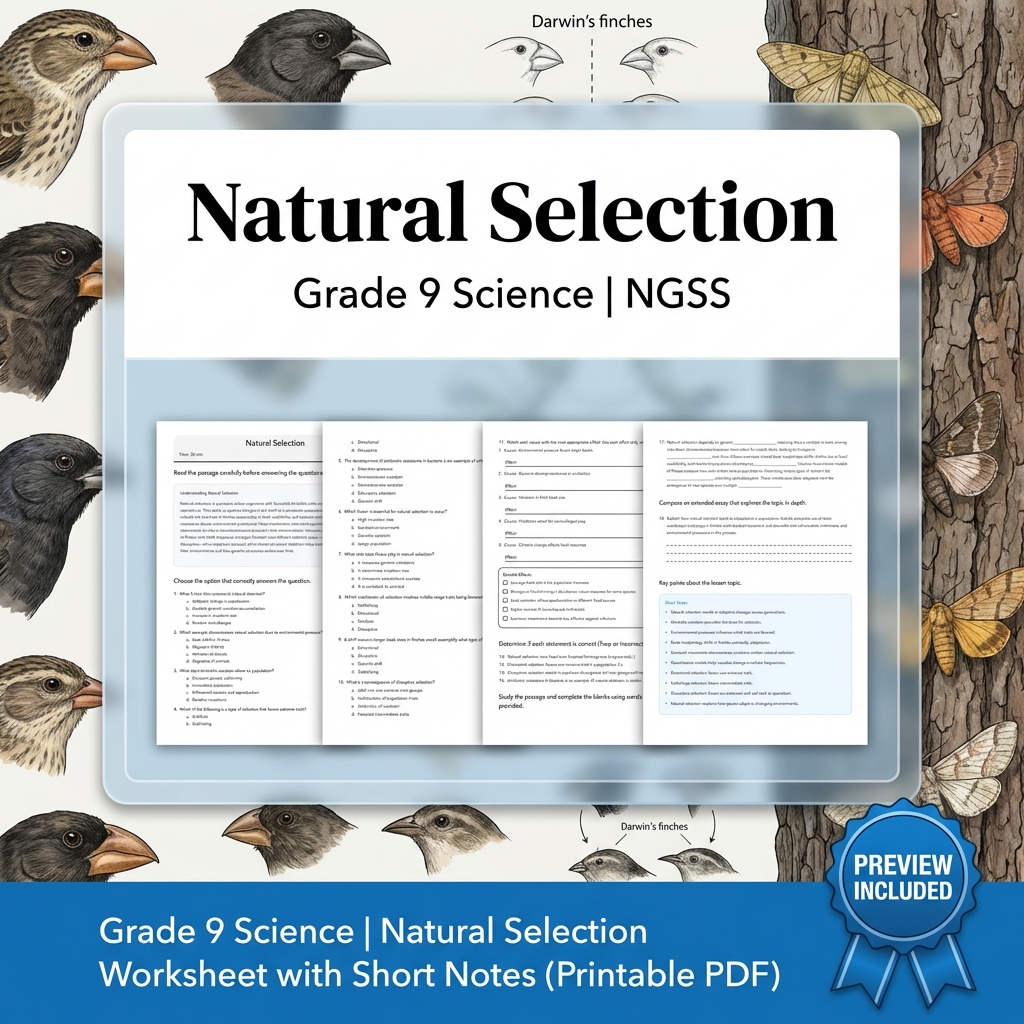
Grade 9 Science | Natural Selection Worksheet with Short Notes (Printable PDF)
Created byMeadowlark WorksheetsLearning Objectives
- Understand the mechanisms of differential survival and reproduction based on heritable variation.
- Identify examples of natural selection such as beak morphology shifts in finches and bacterial resistance.
- Explain how quantitative models illustrate different types of selection.
Also included in: Grade 9 Science | Biological Evolution: Unity and Diversity NGSS Unit Bundle +1 more
Instant download

Pedigree Analysis Worksheet | TEKS Aligned Grade 9 Science Practice
JCreated byJ.S SheetsLearning Objectives
- Interpret pedigrees using standardized symbols and relationship patterns across generations
- Differentiate autosomal dominant, autosomal recessive, X-linked, and mitochondrial inheritance using affected and carrier information
- Apply probability reasoning from pedigrees to estimate risk for relatives
Instant download

Grade 9 Science | Intermolecular Forces Worksheet | BC Aligned
Created byLumora LearningLearning Objectives
- Explain the different types of intermolecular forces and how they influence physical properties.
- Compare the strengths of London dispersion forces, dipole–dipole interactions, and hydrogen bonds.
- Relate molecular structure to the behavior and physical properties of substances.
Instant download

Cellular Metabolism Worksheet | NGSS Grade 9 Science Assessment
Created byCedar Grove LearningLearning Objectives
- Explain the biochemical pathways involved in cellular respiration and energy production.
- Describe the roles of mitochondria and chloroplasts in metabolism.
- Analyze the relationship between energy flow, ATP synthesis, and organismal energy balance.
Instant download

Moon Phases and Eclipses Assessment | General Standards | Grade 9 Science
Created byPrism Point LearningLearning Objectives
- Understand the relative motions of the Moon, Earth, and Sun that produce different Moon phases.
- Explain how the geometry of the Earth-Moon-Sun system causes eclipses.
- Describe the reasons why eclipses do not happen every month.
Instant download
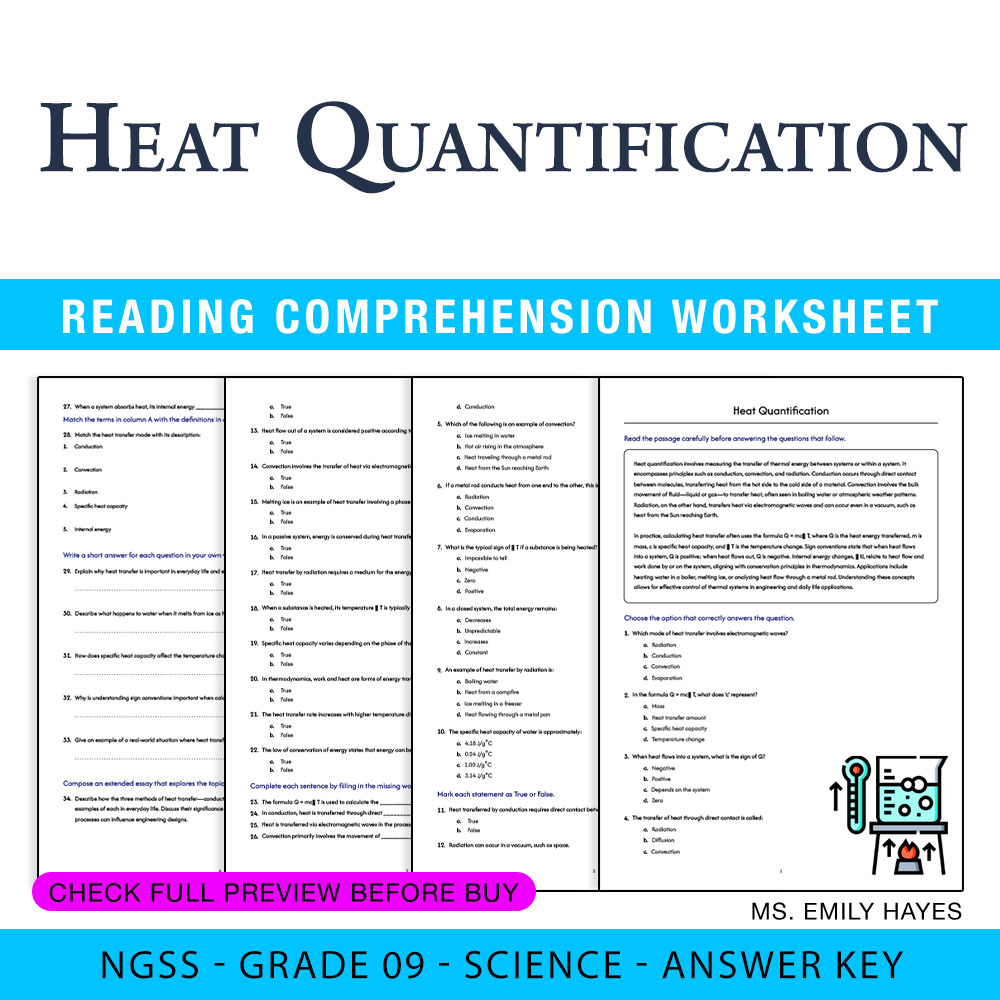
9th Grade Science | Heat Quantification Worksheet (PDF + Answer Key)
Created byCopper Leaf ClassroomLearning Objectives
- Understand and explain the different modes of heat transfer: conduction, convection, and radiation.
- Perform calculations involving specific heat capacity, mass, and temperature change to determine heat transfer and energy changes.
- Interpret sign conventions for heat flow and internal energy changes in closed systems.
Instant download
About Grade 9 Science Worksheets
Find Science worksheets built for Grade 9. All 6,926 cover core skills, practice, and review, each an instant PDF download.
Every worksheet on MyTeachingSheets is created by independent teacher-authors and reviewed before publication. All resources download as printable PDFs for classroom, homework, or at-home practice, and many include answer keys. Preview any worksheet free before buying.