
Grade 9 Science Worksheets
6,926 worksheets
Environmental Quality Worksheets: Science 9 Environmental Chemistry
 Created byMTS Academic Studio
Learning Objectives
- Compare chemical measurements with biological observations
- Explain what pH reveals about an environment
- Interpret dissolved oxygen as environmental evidence
Also included in: Grade 9 Environmental Chemistry Lesson Bundle | Alberta Science
Instant download

Electrical Choices and Impacts Learning Stations | Grade 9 Alberta Science
Created byMTS Academic StudioLearning Objectives
- Compare electrical generation technologies using environmental and economic evidence.
- Identify resource demands associated with electrical storage technologies.
- Investigate benefits and unintended consequences of electrical technology projects.
Also included in: Grade 9 Alberta Science Electrical Principles Learning Stations Bundle
Instant download

Environmental Chemistry: Evidence and Decisions Grade 9 Learning Stations
Created byMTS Academic StudioLearning Objectives
- Explain environmental chemistry problems using relevant evidence
- Identify uncertainty in environmental investigations
- Interpret alternative explanations of environmental evidence
Also included in: Grade 9 Environmental Chemistry Lesson Bundle | Alberta Science
Instant download

Grade 9 Electrical Principles and Technologies Learning Stations Activity
Created byMTS Academic StudioLearning Objectives
- Explain how predictions guide investigations of electrical technologies.
- Analyze observations and measurements used as scientific evidence.
- Compare testing methods used to improve electrical designs.
Also included in: Grade 9 Alberta Science Electrical Principles Learning Stations Bundle
Instant download

Chemical Reactions Learning Stations | Evidence, Rates & Mass Grade 9
Created byMTS Academic StudioLearning Objectives
- Identify evidence of chemical change in documented reaction examples.
- Explain chemical changes involving combustion and corrosion.
- Compare factors that influence chemical reaction rates.
Also included in: Grade 9 Alberta Science Chemical Changes & Atomic Models Bundle
Instant download

Biodiversity Conservation Learning Stations Activity | Grade 9 Science
Created byMTS Academic StudioLearning Objectives
- Analyze how habitat changes affect biodiversity and population abundance.
- Explain how human activities influence genetic variation.
- Distinguish global extinction from regional disappearance.
Also included in: Alberta Grade 9 Science Biological Diversity & Evolution Bundle
Instant download

Telescopes, Satellites and Remote Sensing Learning Stations Grade 9
Created byMTS Academic StudioLearning Objectives
- Compare the information collected by optical and radio telescopes.
- Explain how satellites collect scientific information about Earth.
- Describe how geometric models support position determination.
Also included in: Alberta Grade 9 Science Space Exploration Lesson Bundle
Instant download

Electric Circuits & Resistance Learning Stations | Grade 9 Science
Created byMTS Academic StudioLearning Objectives
- Compare static electric charge with sustained electric current.
- Interpret documented historical examples of electrical principles.
- Explain how conductors affect the movement of electric charge.
Also included in: Grade 9 Alberta Science Electrical Principles Learning Stations Bundle
Instant download

Reproduction and Inheritance Learning Stations Activity | Grade 9 Science
Created byMTS Academic StudioLearning Objectives
- Compare sexual and asexual reproduction using documented scientific examples.
- Explain how inherited characteristics are transmitted between generations.
- Distinguish inherited variation from environmentally influenced characteristics.
Also included in: Alberta Grade 9 Science Biological Diversity & Evolution Bundle
Instant download

Variation, Niches and Relationships Learning Stations | Grade 9 Science
Created byMTS Academic StudioLearning Objectives
- Identify inherited variation within species using ecological examples.
- Explain how inherited differences influence survival during environmental change.
- Analyze ecological niches and relationships between organisms.
Also included in: Alberta Grade 9 Science Biological Diversity & Evolution Bundle
Instant download

Space Exploration Learning Stations Activity | Grade 9 Alberta Science
Created byMTS Academic StudioLearning Objectives
- Identify scientific questions investigated in real space exploration projects.
- Examine predictions, investigation methods and scientific observations.
- Interpret scientific evidence and recognize uncertainty in conclusions.
Also included in: Alberta Grade 9 Science Space Exploration Lesson Bundle
Instant download

Genes, Cell Division and Natural Selection Learning Stations Grade 9
Created byMTS Academic StudioLearning Objectives
- Explain how genes and chromosomes contribute to inheritance.
- Distinguish mitosis from meiosis by their biological outcomes.
- Explain how cell division contributes to genetic variation.
Also included in: Alberta Grade 9 Science Biological Diversity & Evolution Bundle
Instant download

Position, Distance and Motion Learning Stations | Grade 9 Alberta Science
Created byMTS Academic StudioLearning Objectives
- Explain how altitude and azimuth describe observed celestial positions.
- Interpret parallax observations as evidence of astronomical distance.
- Explain how Doppler observations reveal celestial motion.
Also included in: Alberta Grade 9 Science Space Exploration Lesson Bundle
Instant download

Space Exploration Learning Stations | Canadian Contributions Grade 9
Created byMTS Academic StudioLearning Objectives
- Describe Canadian contributions to space technology and scientific research.
- Explain Canada's involvement in international space cooperation.
- Compare scientific and economic benefits of real space projects.
Also included in: Alberta Grade 9 Science Space Exploration Lesson Bundle
Instant download

Atomic Models and Periodic Table Patterns Grade 9 Science Stations Activity
Created byMTS Academic StudioLearning Objectives
- Explain how scientific evidence contributed to changes in atomic models.
- Identify relationships between atomic number and electron arrangement.
- Connect periodic table position with chemical properties.
Also included in: Grade 9 Alberta Science Chemical Changes & Atomic Models Bundle
Instant download

Biological Diversity Learning Stations Activity | Alberta Grade 9 Science
Created byMTS Academic StudioLearning Objectives
- Identify research questions related to real biological diversity problems.
- Formulate predictions and examine scientific investigation methods.
- Interpret observations and data to develop evidence-based explanations.
Also included in: Alberta Grade 9 Science Biological Diversity & Evolution Bundle
Instant download

9th Grade Science | Risks and Benefits of Genetic Technologies (Printable PDF)
JCreated byJ.S SheetsLearning Objectives
- Understand ecological, economic, and health risks associated with genetic technologies.
- Evaluate trade-offs in adopting novel genetic approaches.
- Identify mitigation strategies and long-term monitoring methods.
Also included in: Grade 9 Science Unit Bundle | Genetics, Cell Biology & Biotechnology Worksheets +1 more
Instant download

Land Sustainability Worksheet | NGSS Grade 9 Science Practice PDF
JCreated byJ.S SheetsLearning Objectives
- Understand the interactions between land and water in ecosystem sustainability.
- Identify indicators of ecosystem resilience, nutrient cycling, and productivity.
- Evaluate land-use practices such as irrigation, terracing, and urban development on ecosystems.
Also included in: Grade 9 Resource Choices & Sustainability Science Lesson Bundle NGSS +1 more
Instant download
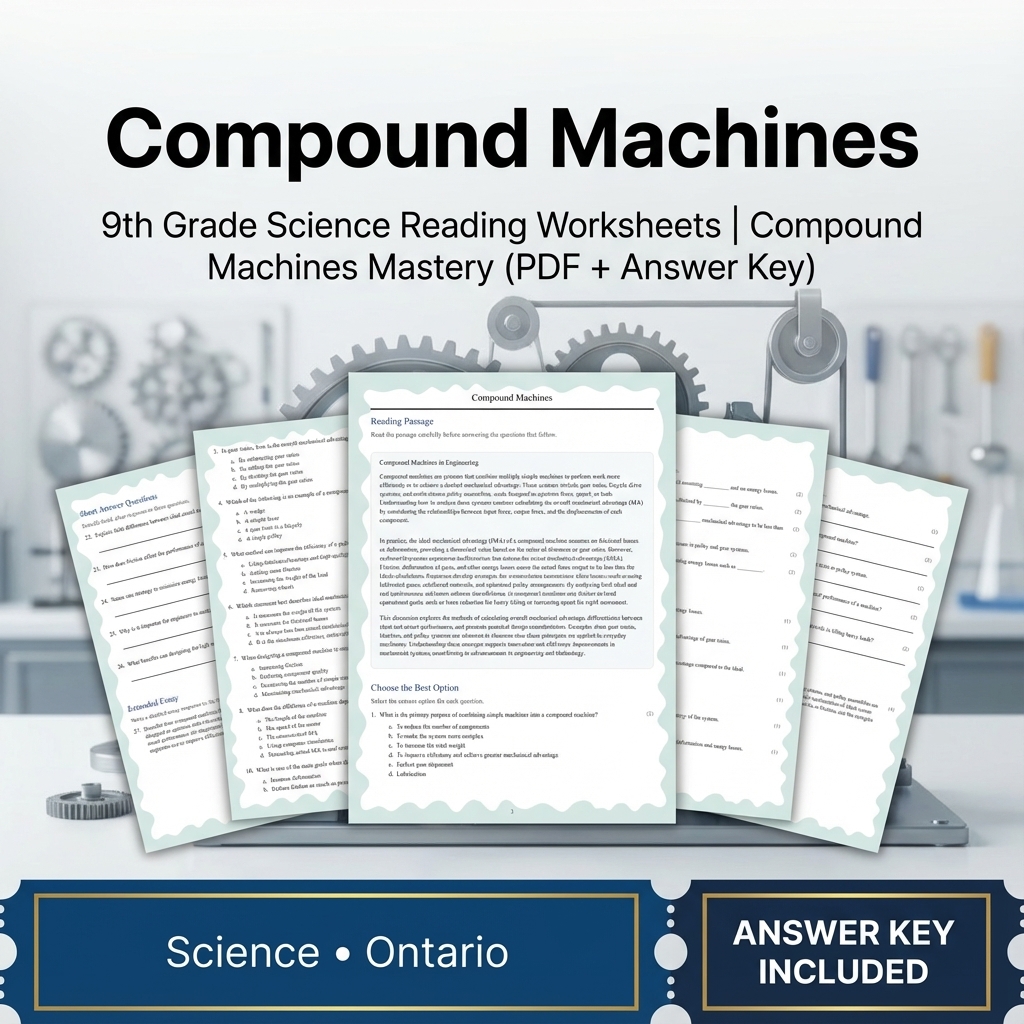
9th Grade Science Reading | Compound Machines Mastery (PDF + Answer Key)
JCreated byJ.S SheetsLearning Objectives
- Understand how simple machines combine to form compound machines
- Learn methods to calculate overall mechanical advantage using force and displacement
- Differentiate between ideal and actual mechanical advantage
Also included in: Grade 9 Science Unit | Force, Motion & Energy Worksheets & Answer Keys Bundle +1 more
Instant download
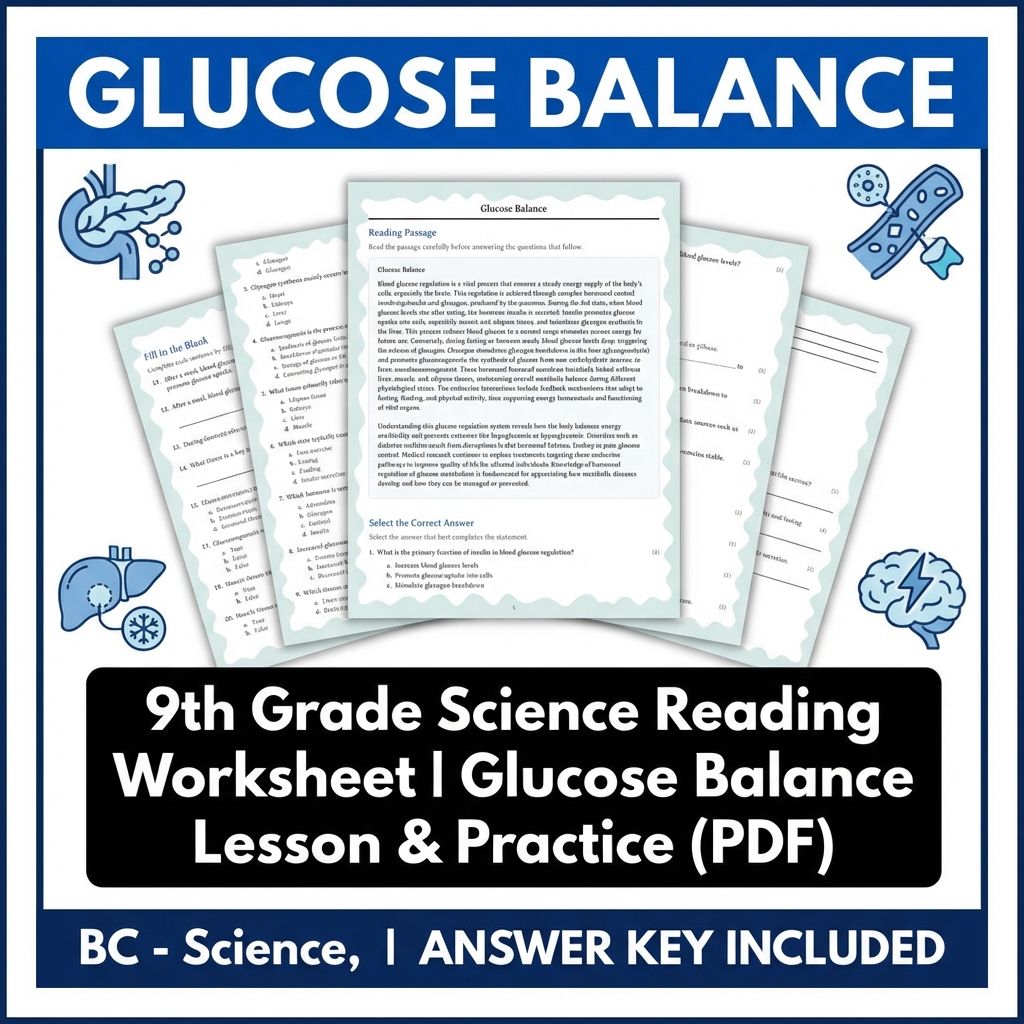
9th Grade Science Reading Worksheet | Glucose Balance Lesson & Practice (PDF)
JCreated byJ.S SheetsLearning Objectives
- Understand the roles of insulin and glucagon in blood glucose regulation.
- Describe how endocrine feedback loops maintain metabolic homeostasis.
- Identify tissues involved in glucose uptake and release.
Instant download

Grade 9 Science | Fossil Records Worksheet (TEKS) Practice Set (PDF)
 Created byEvergreen Desk Education
Learning Objectives
- Explain how fossil records provide evidence of past life using preservation, stratigraphy, and dating methods.
- Distinguish between relative age and absolute age and describe how radiometric dating supports timelines.
- Evaluate how taphonomy and preservation bias affect what organisms appear in the fossil record.
Instant download
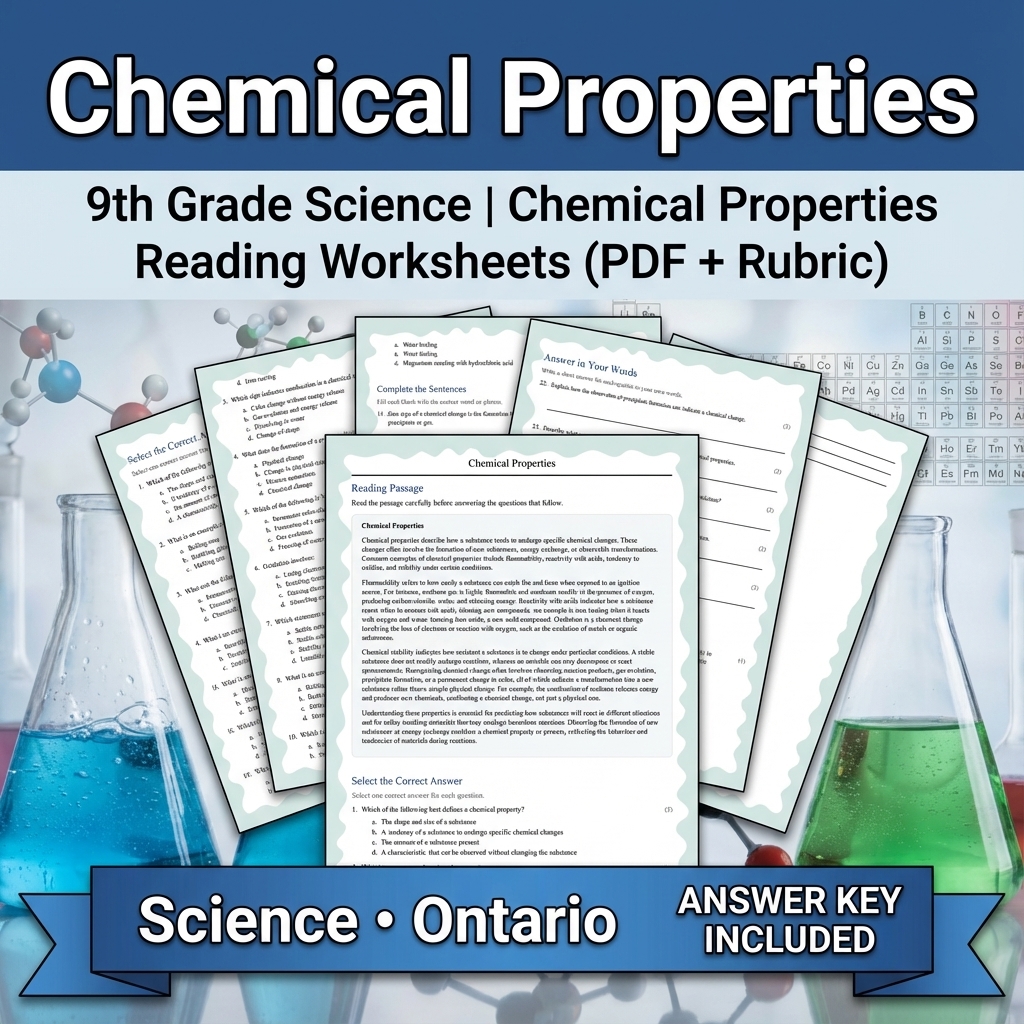
9th Grade Science | Chemical Properties Reading Worksheets (PDF + Rubric)
JCreated byJ.S SheetsLearning Objectives
- Define chemical properties and identify common examples.
- Explain signs that indicate a chemical change has occurred.
- Differentiate between physical and chemical changes based on reaction evidence.
Also included in: Grade 9 Science Unit Bundle | Essential Concepts & Skills (Answer Keys Included) +1 more
Instant download
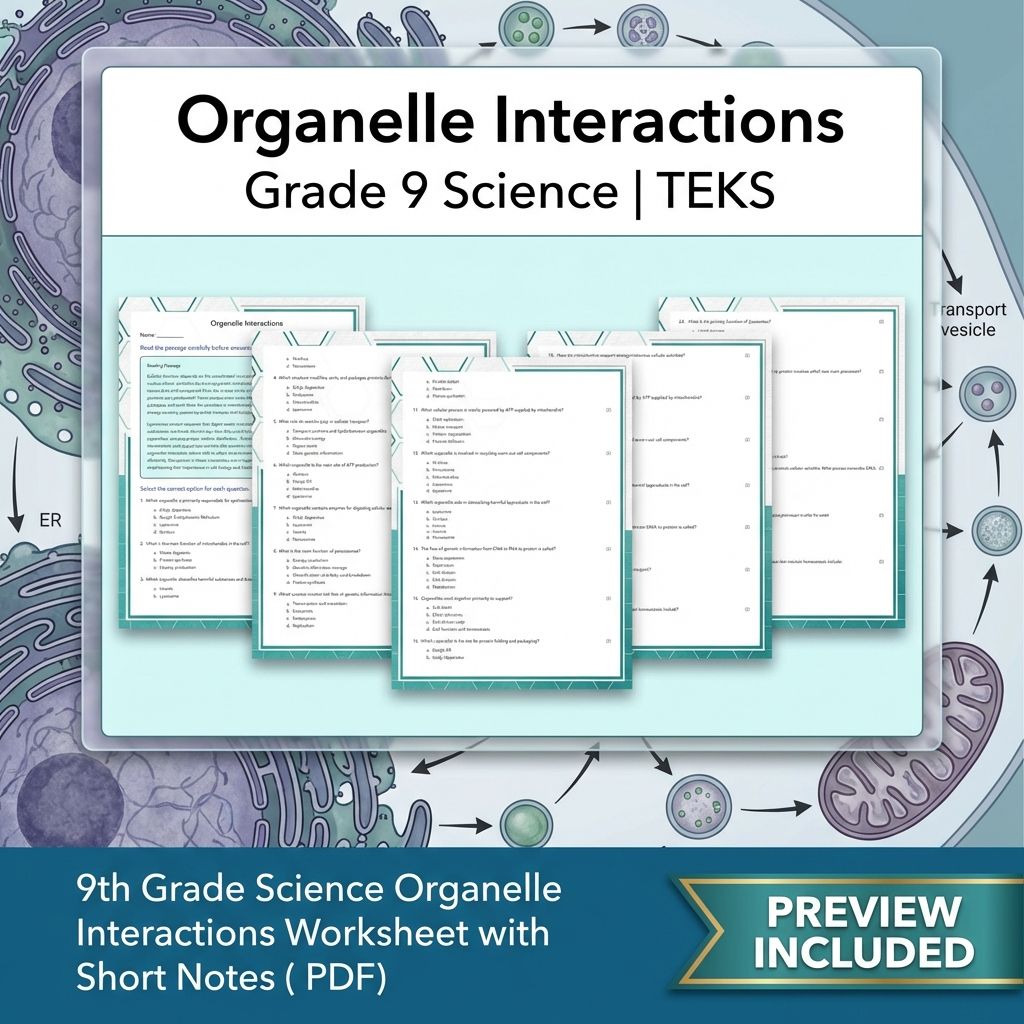
9th Grade Science Organelle Interactions Worksheet with Short Notes ( PDF)
 Created byMeadowlark Worksheets
Learning Objectives
- Explain how different organelles coordinate to support cellular functions.
- Describe the flow of genetic information from nucleus to protein secretion.
- Identify the roles of mitochondria, lysosomes, and peroxisomes in maintaining homeostasis.
Instant download
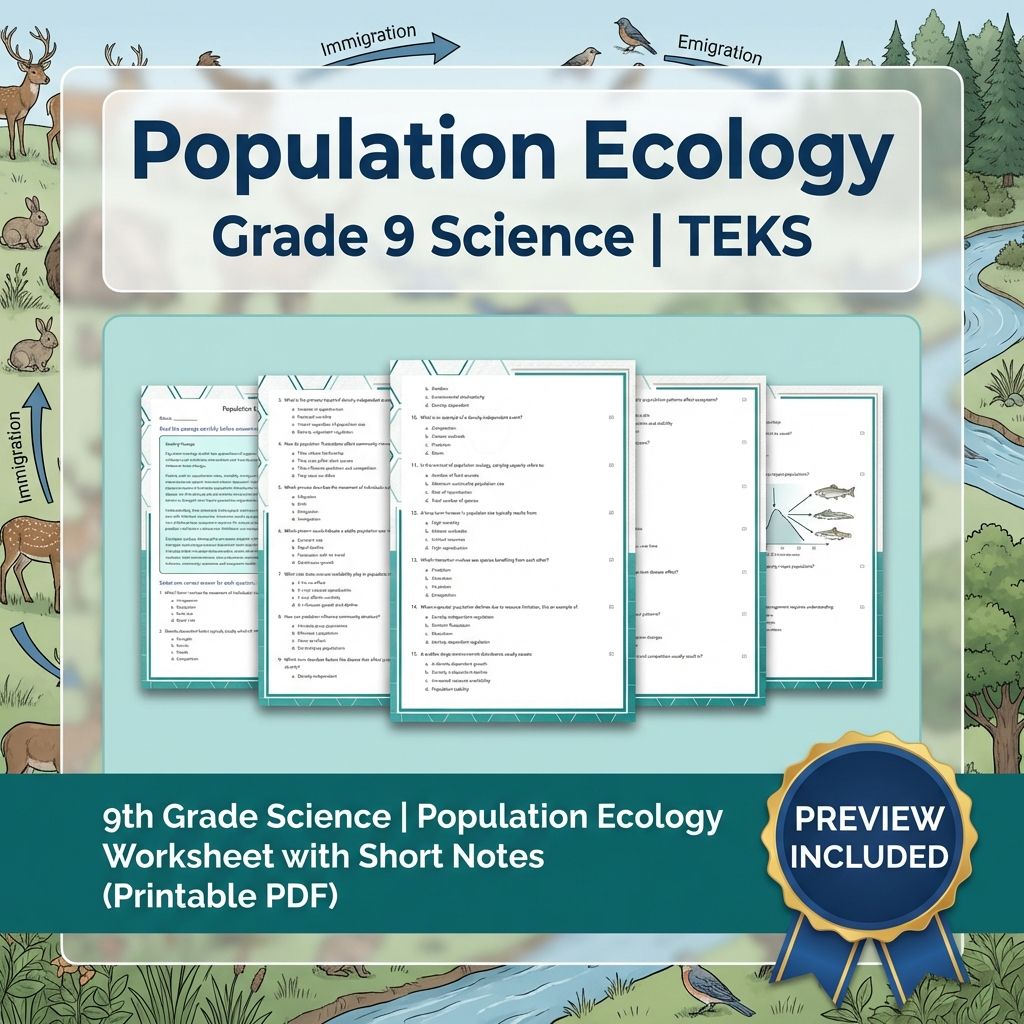
9th Grade Science | Population Ecology Worksheet with Short Notes (PDF)
Created byMeadowlark WorksheetsLearning Objectives
- Understand the factors that influence population growth and decline.
- Identify density-dependent and density-independent factors affecting populations.
- Analyze how population patterns impact community structure and ecosystem dynamics.
Instant download
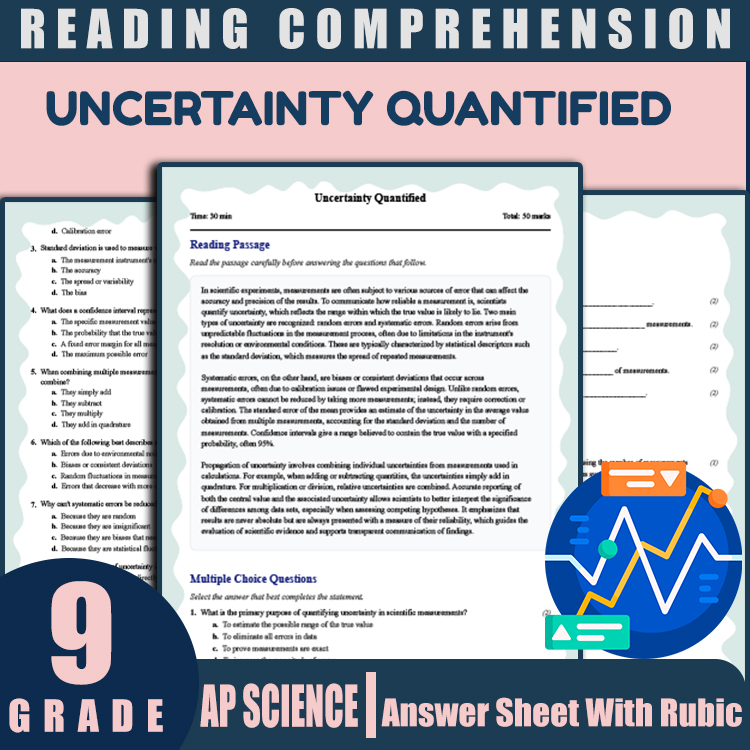
9th Grade Science | Uncertainty Quantified Reading Worksheet (PDF + Rubric)
JCreated byJ.S SheetsLearning Objectives
- Understand the concepts of random and systematic uncertainty in measurements.
- Learn how to quantify uncertainty using statistical descriptors such as standard deviation and standard error.
- Apply basic error propagation methods to combined quantities.
Instant download

Grade 9 Collision Safety Worksheet | Peak Force & Acceleration | NGSS
 Created byAmber Owl Education
Learning Objectives
- Explain how impulse relates to changes in force and collision time in collision safety design.
- Interpret a force-time idea to describe how longer stopping time can reduce peak force and acceleration.
- Describe how energy dissipation and staged deformation help protect people in high-impact events.
Also included in: Grade 9 Science Forces, Motion, Momentum & Fields Lesson Bundle – NGSS +1 more
Instant download
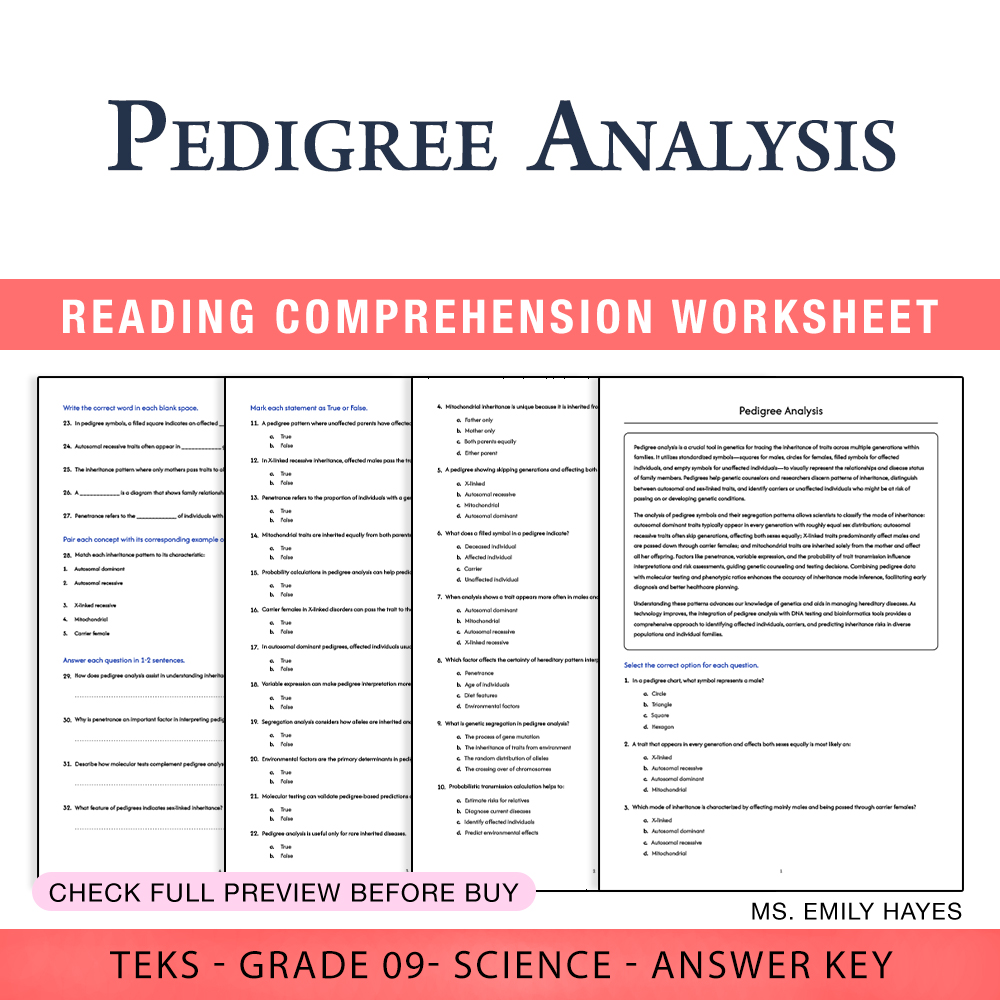
9th Grade Science | Pedigree Analysis Worksheet (PDF+ Answer Key)
 Created byCopper Leaf Classroom
Learning Objectives
- Understand the symbols and conventions used in pedigree charts.
- Identify inheritance patterns such as autosomal dominant, autosomal recessive, X-linked, and mitochondrial.
- Analyze pedigree data to determine likely modes of inheritance.
Instant download

Grade 9 Science – Simple Machines & Tools -Daily Worksheet | Ontario Standards
 Created byQuiet Forest Education
Learning Objectives
- Understand the structure and function of different classes of levers
- Identify the components and principles of levers
- Explain how levers modify force and displacement to achieve mechanical advantage
Also included in: Forces and Energy Grade 9 Science Daily Reading Worksheets Bundle | Ontario +1 more
Instant download

Grade 9 Science – Kinematic Equations & Motion | Daily Reading Worksheet
Created byQuiet Forest EducationLearning Objectives
- Understand key concepts related to Science
- Apply knowledge through practice questions
- Demonstrate comprehension of the material
Also included in: Forces and Energy Grade 9 Science Daily Reading Worksheets Bundle | Ontario +1 more
Instant download

Grade 9 Science – Force Basics | Daily Reading Worksheet
Created byQuiet Forest EducationLearning Objectives
- Distinguish between contact forces and non-contact forces
- Identify examples of different types of forces
- Understand how forces act on objects in different scenarios
Also included in: Forces and Energy Grade 9 Science Daily Reading Worksheets Bundle | Ontario +1 more
Instant download

Grade 9 Science – Understanding Compound Machines | Daily Reading Worksheet
Created byQuiet Forest EducationLearning Objectives
- Define what compound machines are and identify examples
- Explain how simple machines combine to form compound machines
- Calculate overall mechanical advantage considering force and distance
Also included in: Forces and Energy Grade 9 Science Daily Reading Worksheets Bundle | Ontario +1 more
Instant download
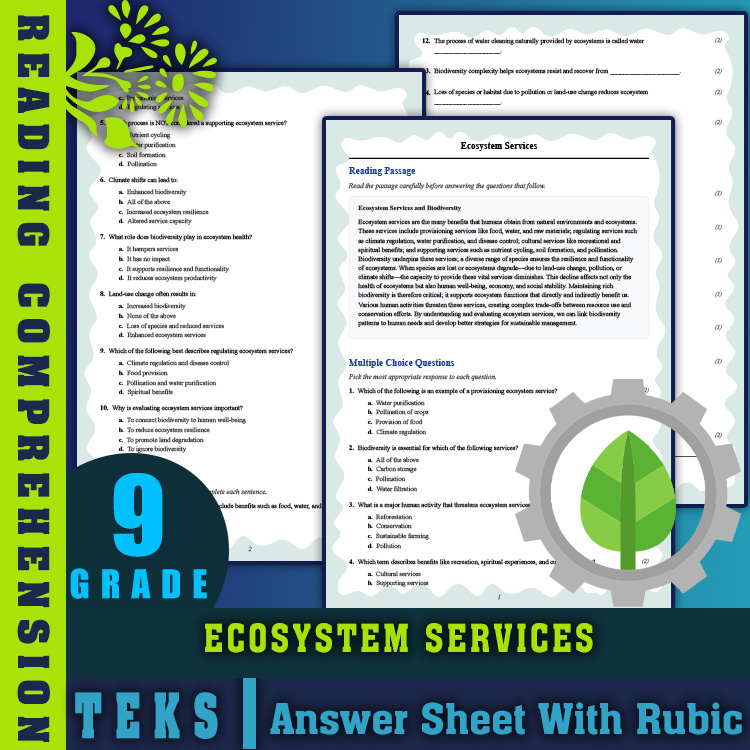
9th Grade Science | Ecosystem Services Reading Worksheets (PDF & Rubric)
JCreated byJ.S SheetsLearning Objectives
- Understand the concept of ecosystem services and their importance to human well-being.
- Identify different types of ecosystem services and how biodiversity supports them.
- Evaluate human impacts on ecosystem services and the resulting trade-offs.
Instant download

Grade 9 Science — Worksheet MCQ Paper for Mastering Plate Boundaries
 Created byThe Resource Hub
Learning Objectives
- Understand the different types of plate boundaries and their surface expressions.
- Identify characteristic features associated with divergent, convergent, and transform margins.
- Interpret geologic evidence such as seafloor age patterns and paleomagnetic stripes.
Also included in: Grade 9 Earth and Space Sciences AP Bundle | Science Worksheets and Activities +1 more
Instant download
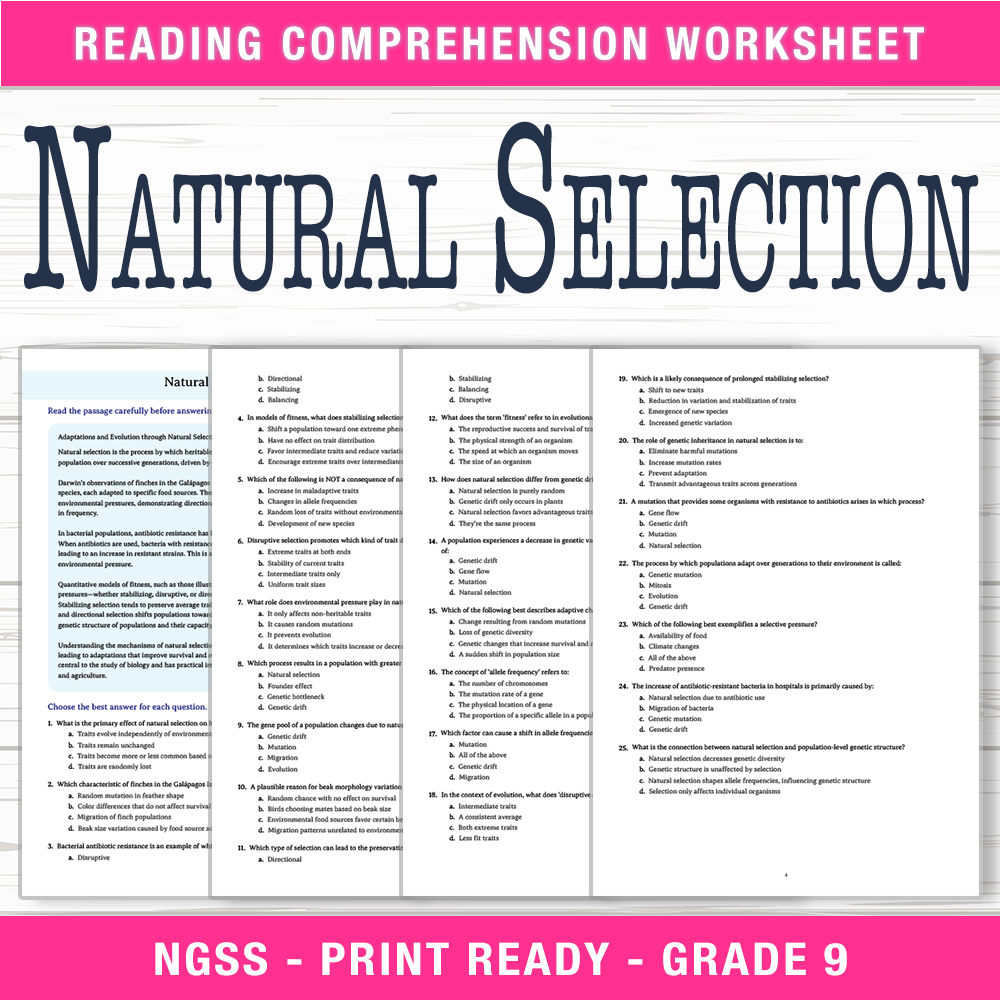
Grade 9 Science | Natural Selection Worksheet (PDF + Answer Key)
 Created byRiverstone Classroom
Learning Objectives
- Understand the mechanisms by which heritable variation contributes to differential survival and reproduction
- Identify and explain examples of natural selection, such as beak morphology shifts and bacterial resistance
- Analyze models of fitness and allele frequency changes related to different types of selection
Also included in: Grade 9 Science Unit | Evolution & Phylogenetics Worksheet Pack
Instant download

Grade 9 Science | Design Criteria Worksheet | California Standards
 Created byLumora Learning
Learning Objectives
- Explain how engineering design criteria and constraints guide the development of solutions
- Identify how scientific principles, models, and evidence connect design features to expected performance
- Use measurable requirements to justify whether a design meets safety and performance goals
Instant download
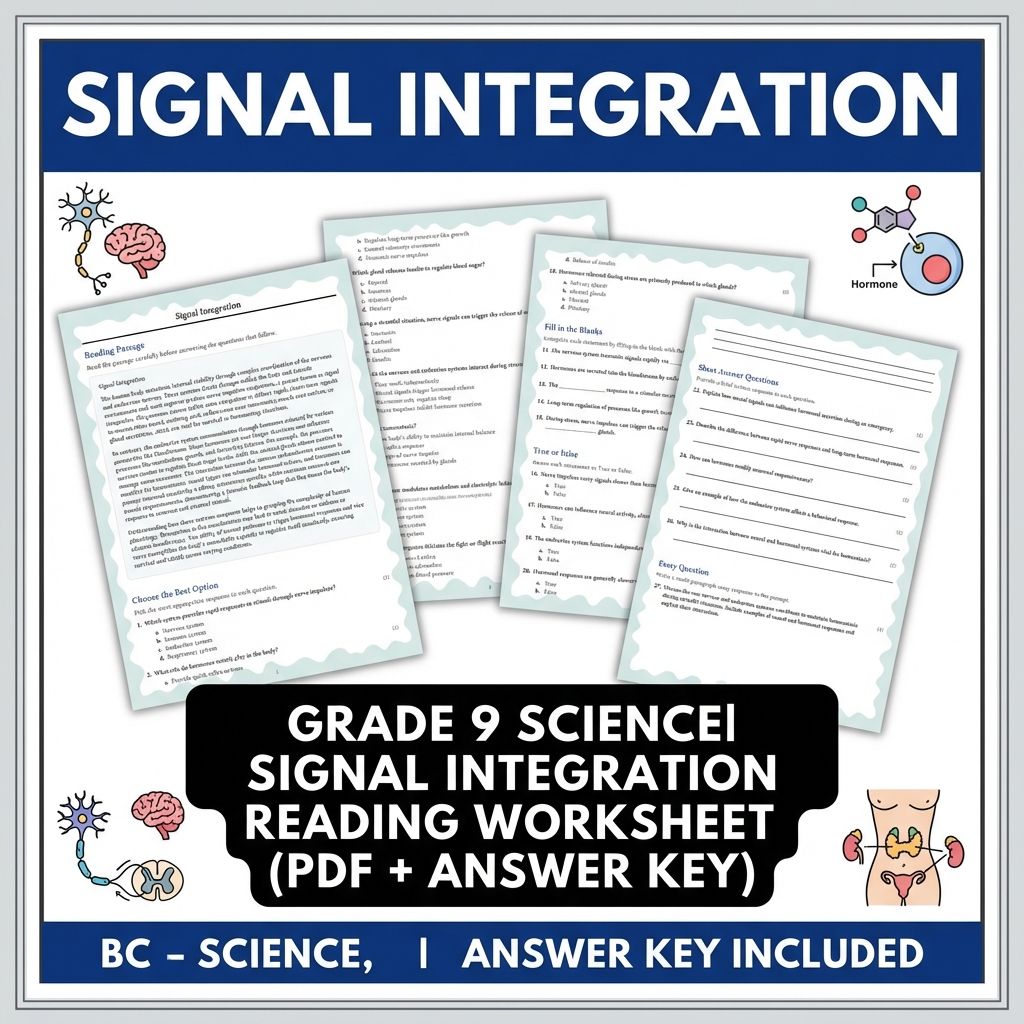
Grade 9 Science | Signal Integration Reading Worksheet (PDF + Answer Key)
JCreated byJ.S SheetsLearning Objectives
- Understand how the nervous and endocrine systems coordinate responses to stimuli.
- Describe the roles of nerve impulses and hormones in maintaining homeostasis.
- Explain the interaction between neural and hormonal pathways in response regulation.
Instant download

Grade 9 Momentum Conservation Worksheet | Practice & Standards PDF
 Created byClear Sky Classroom
Learning Objectives
- Explain how momentum depends on mass and velocity using p = mv
- Use conservation of momentum to predict motion in collisions and explosions
- Compare elastic and inelastic collisions in terms of momentum and kinetic energy
Instant download
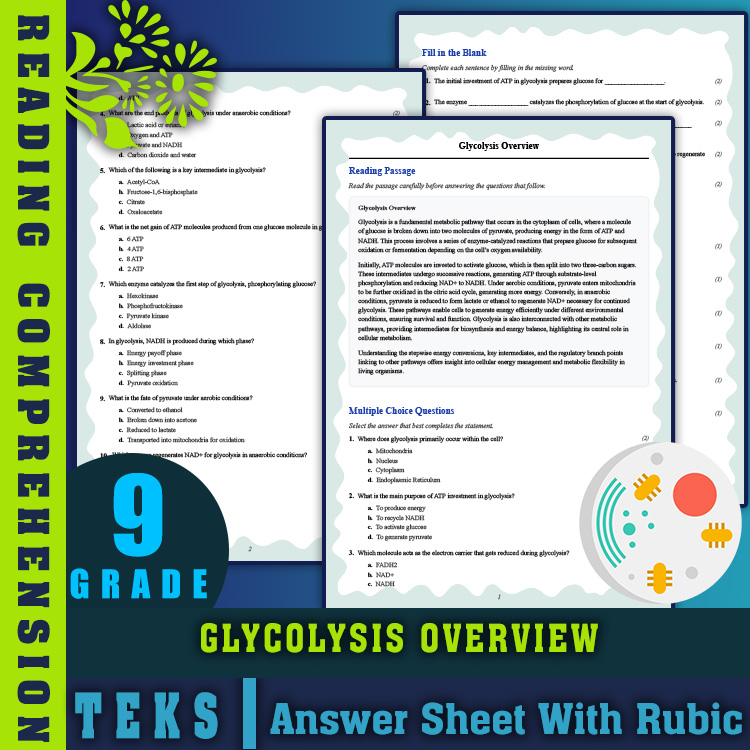
9th Grade Science | Glycolysis Overview Reading Worksheet (PDF + Rubric)
JCreated byJ.S SheetsLearning Objectives
- Describe the main steps involved in glycolysis.
- Identify key intermediates and energy changes during glycolysis.
- Explain the difference between aerobic and anaerobic pathways after glycolysis.
Instant download

Paleoclimate Proxies Worksheet | AP Science Grade 9 Practice Assessment
JCreated byJ.S SheetsLearning Objectives
- Interpret paleoclimate evidence from various proxy records such as ice cores, tree rings, marine sediments, and speleothems.
- Understand proxy indicators like isotopic ratios, growth increments, and microfossil assemblages.
- Relate proxy records to past climate variability, including glacial-interglacial cycles and abrupt climate events.
Instant download

Comparative Evaluation Worksheet | Grade 9 Science Review and Practice
 Created byPrism Point Learning
Learning Objectives
- Use quantitative and qualitative criteria to compare competing engineering design solutions.
- Explain how life-cycle cost, manufacturability, and environmental impact affect design choices.
- Apply uncertainty and sensitivity reasoning when ranking alternatives using documented assumptions.
Also included in: Grade 9 Engineering Design Test Prep Science Lesson Bundle (NGSS)
Instant download

Grade 9 Natural Selection Patterns Worksheet | Practice & PDF
Created byClear Sky ClassroomLearning Objectives
- Explain how heritable traits can change in frequency due to differential survival and reproduction.
- Identify how environmental conditions determine which traits are advantageous.
- Use models to connect trait variation, reproduction, and changing phenotype proportions over generations.
Instant download

Hazard Assessment Worksheet | NGSS Grade 9 Science Assessment
 Created bySkylark Worksheets
Learning Objectives
- Explain how hazard risk is evaluated using occurrence, frequency, and consequences for earthquakes, volcanoes, tsunamis, hurricanes, and floods.
- Use ideas from probabilistic models and historical records to interpret return-period information and its limits.
- Describe how exposure, vulnerability, and cascading system effects influence community and infrastructure susceptibility.
Also included in: Grade 9 Science Full-Year Bundle | NGSS Worksheets & Assessments
Instant download
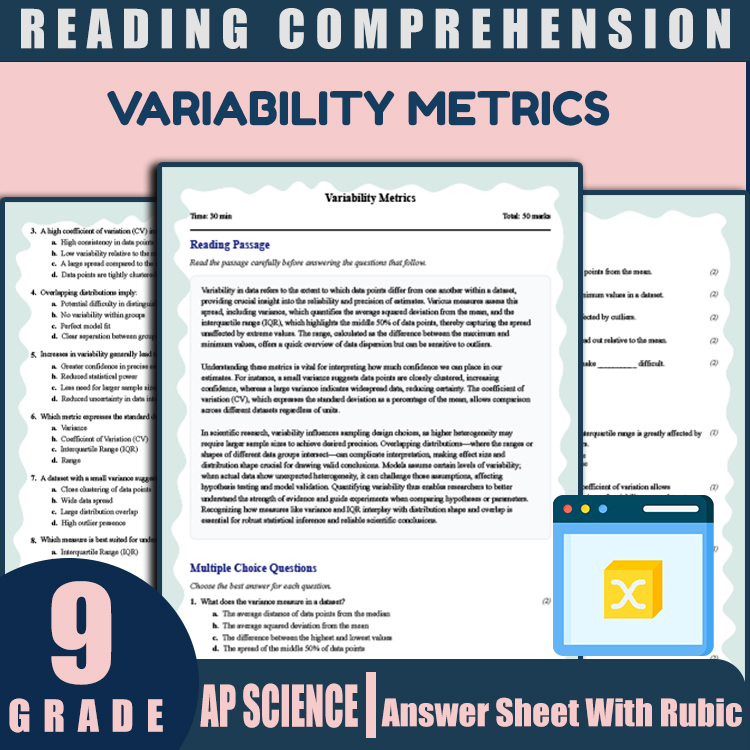
9th Grade Science | Variability Metrics Reading Worksheet & Answer Key (PDF)
JCreated byJ.S SheetsLearning Objectives
- Understand measures of dispersion such as variance, interquartile range, and range.
- Explain how variability influences confidence in statistical estimates.
- Interpret overlaps in distribution shapes and effects on hypothesis testing.
Instant download
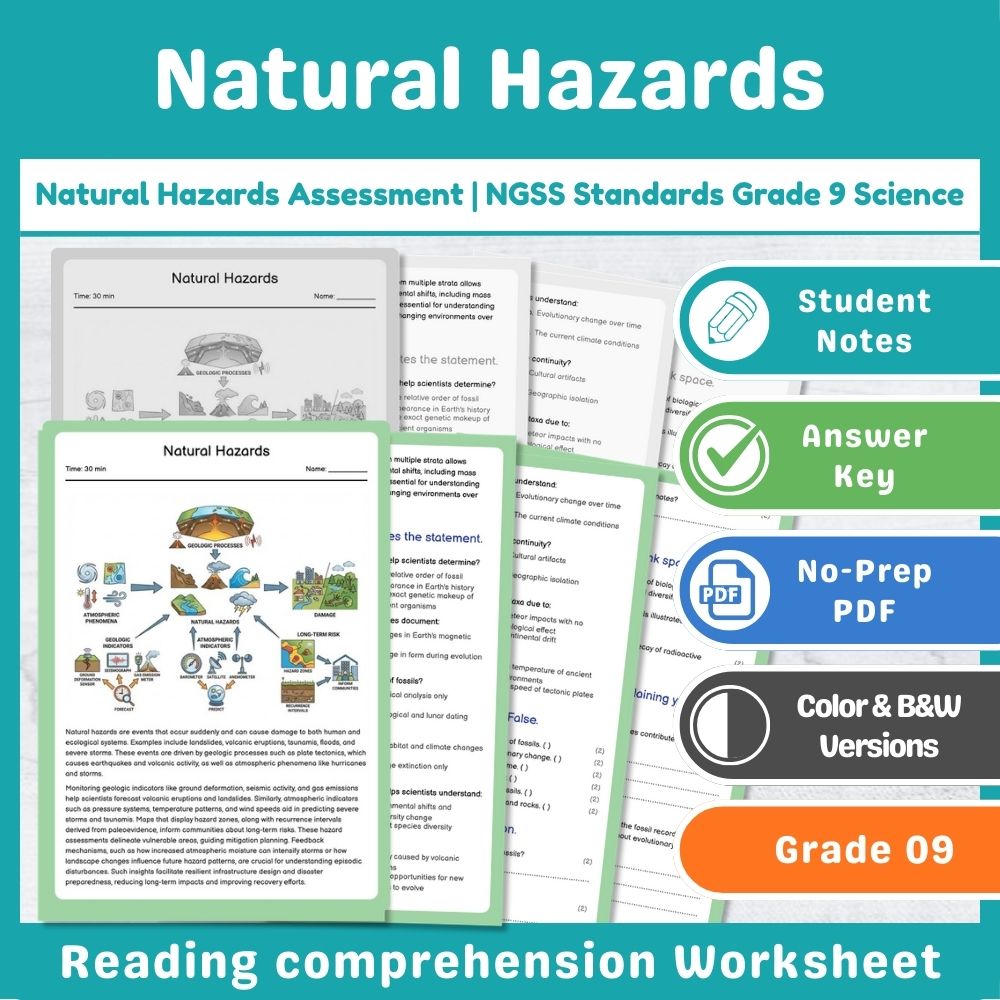
Natural Hazards Assessment | NGSS Standards Grade 9 Science
Created byPrism Point LearningLearning Objectives
- Describe the various types of natural hazards and their causes.
- Identify geologic and atmospheric indicators used to assess hazard risk.
- Interpret hazard maps and recurrence intervals to evaluate potential impacts.
Instant download
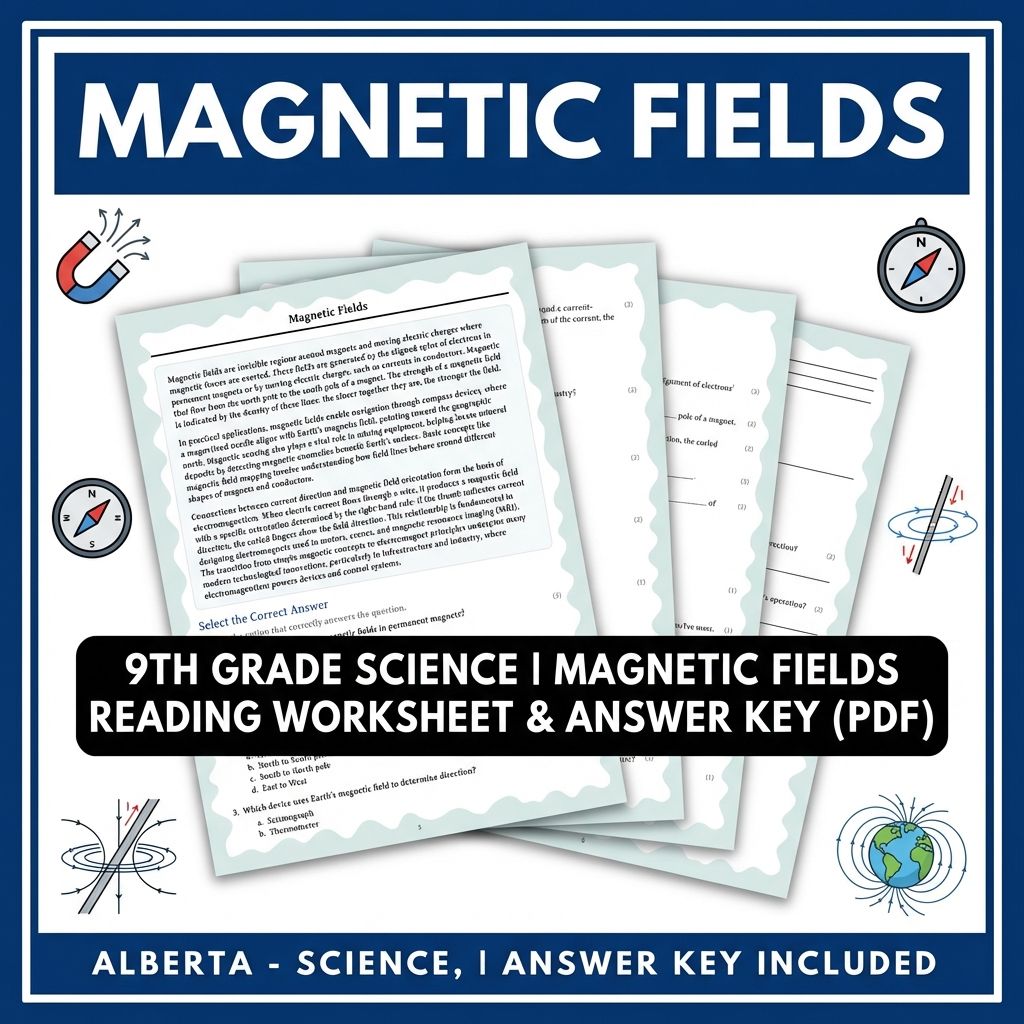
9th Grade Science | Magnetic Fields Reading Worksheet & Answer Key (PDF)
JCreated byJ.S SheetsLearning Objectives
- Explain the origin and characteristics of magnetic fields from permanent magnets and moving electric charges.
- Understand how magnetic field lines indicate direction and strength of magnetic fields.
- Describe real-world applications of magnetic fields, including compass navigation and industrial sensing.
Also included in: Grade 9 Science Bundle | Electricity, Energy & Magnetism (PDF + Answer Keys) +1 more
Instant download

Grade 9 Science – Kinematic Equations Worksheet (Ontario Standard) (PDF)
Created byEvergreen Desk EducationLearning Objectives
- Use the constant-acceleration kinematic equations to relate displacement, time, velocities, and acceleration
- Apply sign conventions correctly when analyzing vertical free-fall and horizontal/vertical components of projectile motion
- Select and rearrange the appropriate equation to predict motion from given initial conditions
Also included in: Grade 9 Forces, Motion & Energy Science Lesson Bundle (Ontario) +1 more
Instant download
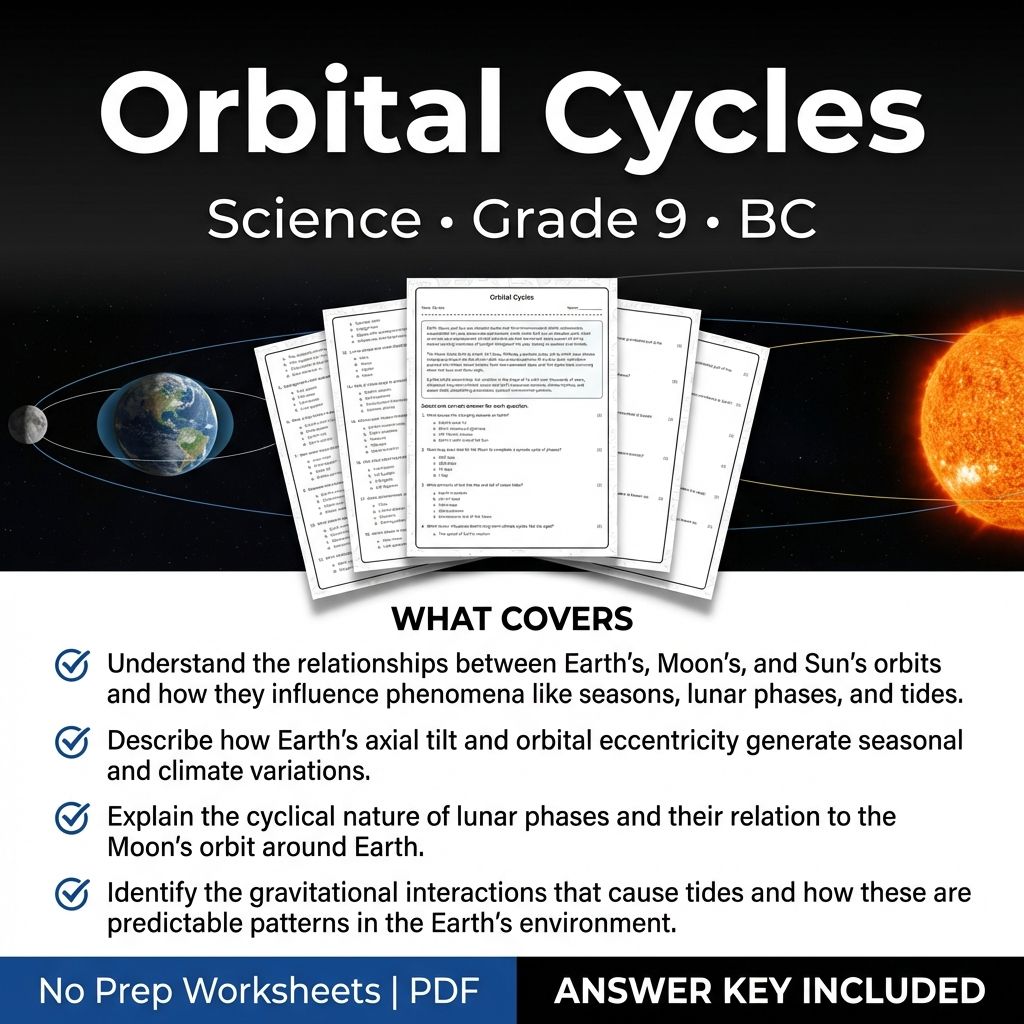
9th Grade Science | Orbital Cycles Worksheet & Answer Key – Classroom PDF
 Created byCoral Reef Learning
Learning Objectives
- Understand the relationships between Earth's, Moon's, and Sun's orbits and how they influence phenomena like seasons, lunar phases, and tides.
- Describe how Earth's axial tilt and orbital eccentricity generate seasonal and climate variations.
- Explain the cyclical nature of lunar phases and their relation to the Moon's orbit around Earth.
Instant download
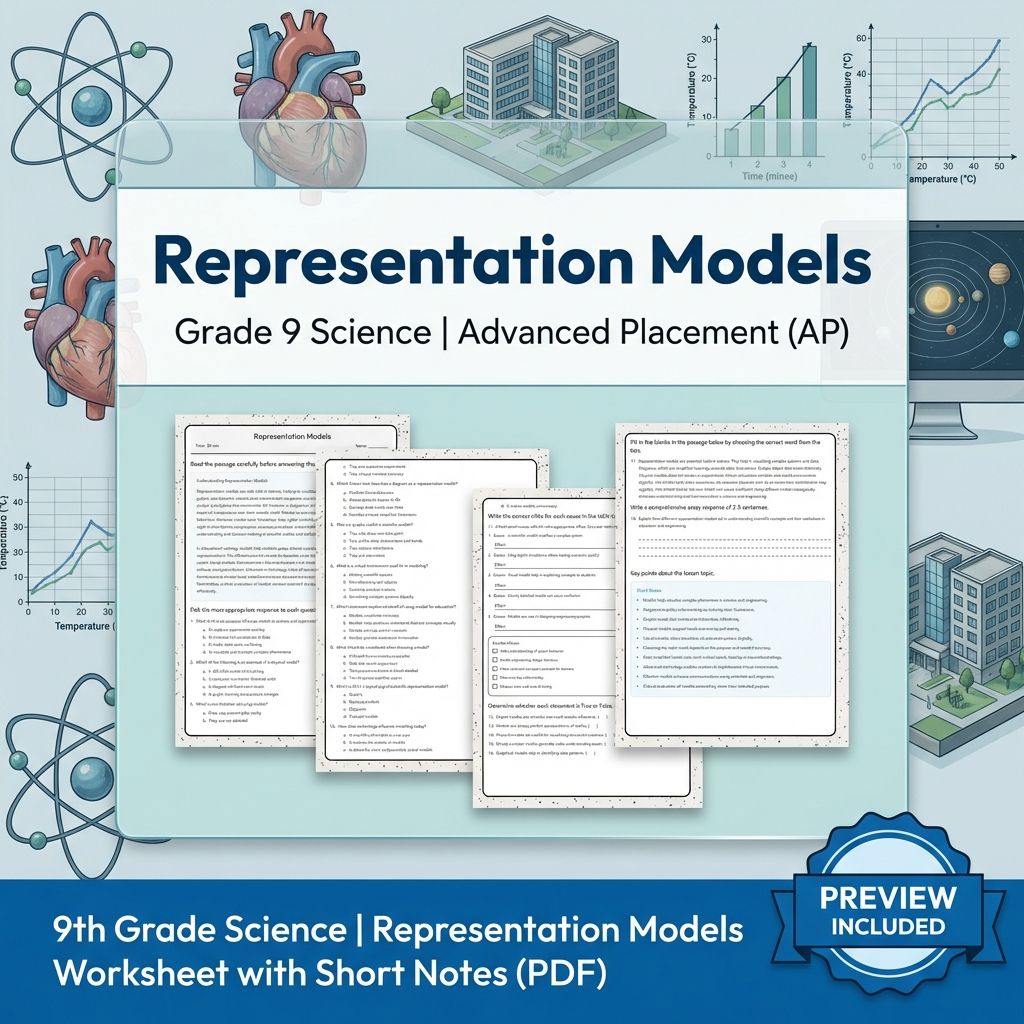
9th Grade Science | Representation Models Worksheet with Short Notes (PDF)
Created byMeadowlark WorksheetsLearning Objectives
- Understand different types of representation models used in science and engineering.
- Identify the purpose and features of various models like diagrams, graphs, and physical models.
- Explain how models simplify complex systems for understanding and analysis.
Also included in: Grade 9 Science | Critical Thinking & Data Analysis Unit Bundle (Worksheets) +1 more
Instant download
About Grade 9 Science Worksheets
Find Science worksheets built for Grade 9. All 6,926 cover core skills, practice, and review, each an instant PDF download.
Every worksheet on MyTeachingSheets is created by independent teacher-authors and reviewed before publication. All resources download as printable PDFs for classroom, homework, or at-home practice, and many include answer keys. Preview any worksheet free before buying.