
Grade 9 Science Worksheets
6,926 worksheets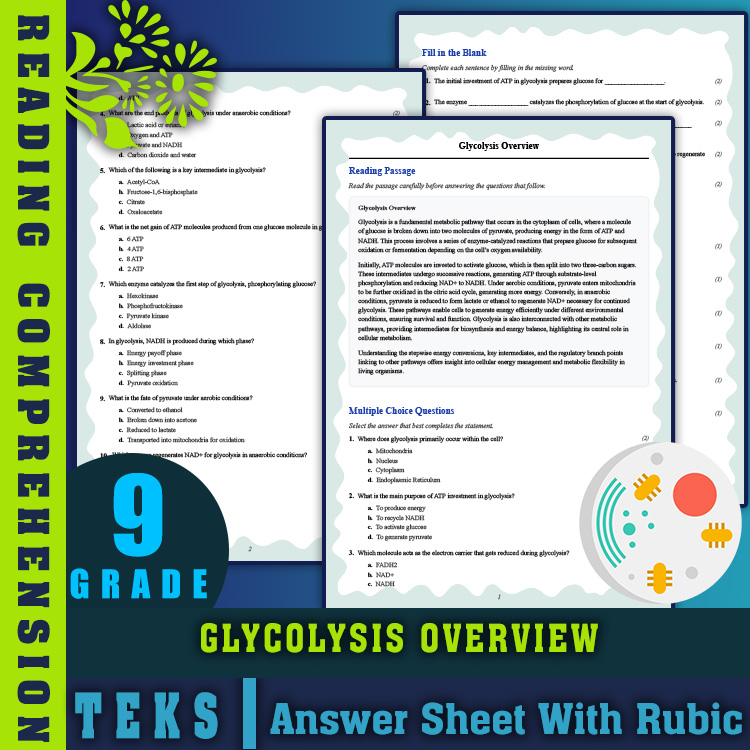
9th Grade Science | Glycolysis Overview Reading Worksheet (PDF + Rubric)
JCreated byJ.S SheetsLearning Objectives
- Describe the main steps involved in glycolysis.
- Identify key intermediates and energy changes during glycolysis.
- Explain the difference between aerobic and anaerobic pathways after glycolysis.
Instant download

Paleoclimate Proxies Worksheet | AP Science Grade 9 Practice Assessment
JCreated byJ.S SheetsLearning Objectives
- Interpret paleoclimate evidence from various proxy records such as ice cores, tree rings, marine sediments, and speleothems.
- Understand proxy indicators like isotopic ratios, growth increments, and microfossil assemblages.
- Relate proxy records to past climate variability, including glacial-interglacial cycles and abrupt climate events.
Instant download

Comparative Evaluation Worksheet | Grade 9 Science Review and Practice
 Created byPrism Point Learning
Learning Objectives
- Use quantitative and qualitative criteria to compare competing engineering design solutions.
- Explain how life-cycle cost, manufacturability, and environmental impact affect design choices.
- Apply uncertainty and sensitivity reasoning when ranking alternatives using documented assumptions.
Also included in: Grade 9 Engineering Design Test Prep Science Lesson Bundle (NGSS)
Instant download

Grade 9 Natural Selection Patterns Worksheet | Practice & PDF
 Created byClear Sky Classroom
Learning Objectives
- Explain how heritable traits can change in frequency due to differential survival and reproduction.
- Identify how environmental conditions determine which traits are advantageous.
- Use models to connect trait variation, reproduction, and changing phenotype proportions over generations.
Instant download

Hazard Assessment Worksheet | NGSS Grade 9 Science Assessment
 Created bySkylark Worksheets
Learning Objectives
- Explain how hazard risk is evaluated using occurrence, frequency, and consequences for earthquakes, volcanoes, tsunamis, hurricanes, and floods.
- Use ideas from probabilistic models and historical records to interpret return-period information and its limits.
- Describe how exposure, vulnerability, and cascading system effects influence community and infrastructure susceptibility.
Also included in: Grade 9 Science Full-Year Bundle | NGSS Worksheets & Assessments
Instant download
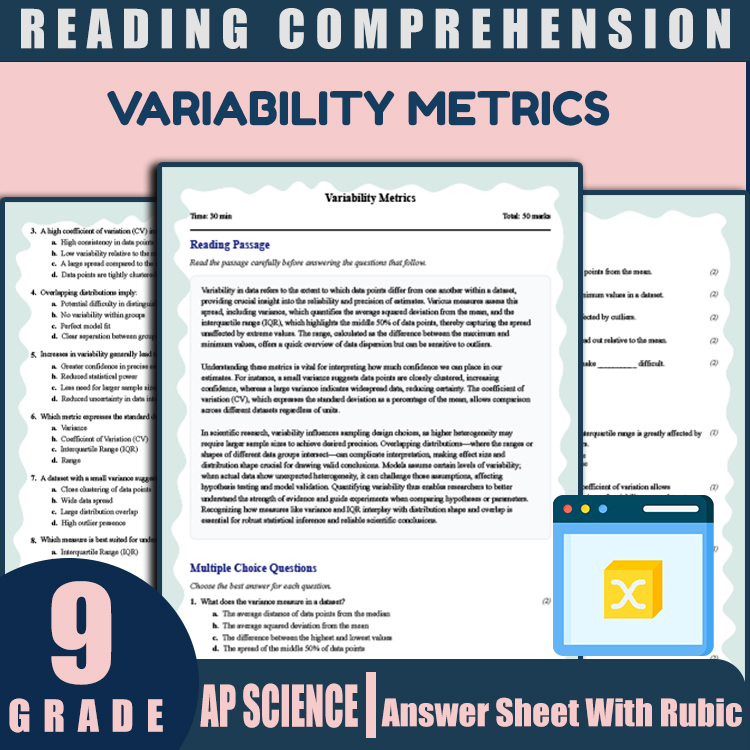
9th Grade Science | Variability Metrics Reading Worksheet & Answer Key (PDF)
JCreated byJ.S SheetsLearning Objectives
- Understand measures of dispersion such as variance, interquartile range, and range.
- Explain how variability influences confidence in statistical estimates.
- Interpret overlaps in distribution shapes and effects on hypothesis testing.
Instant download
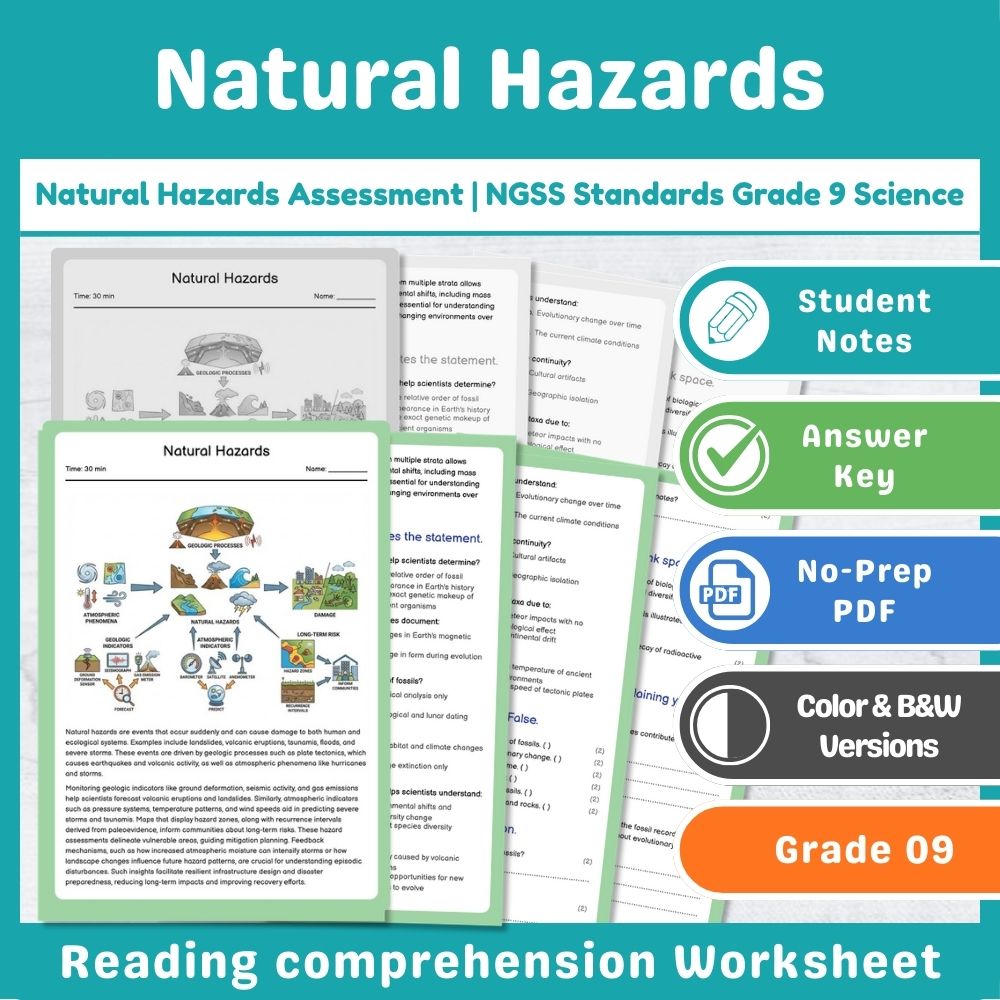
Natural Hazards Assessment | NGSS Standards Grade 9 Science
Created byPrism Point LearningLearning Objectives
- Describe the various types of natural hazards and their causes.
- Identify geologic and atmospheric indicators used to assess hazard risk.
- Interpret hazard maps and recurrence intervals to evaluate potential impacts.
Instant download
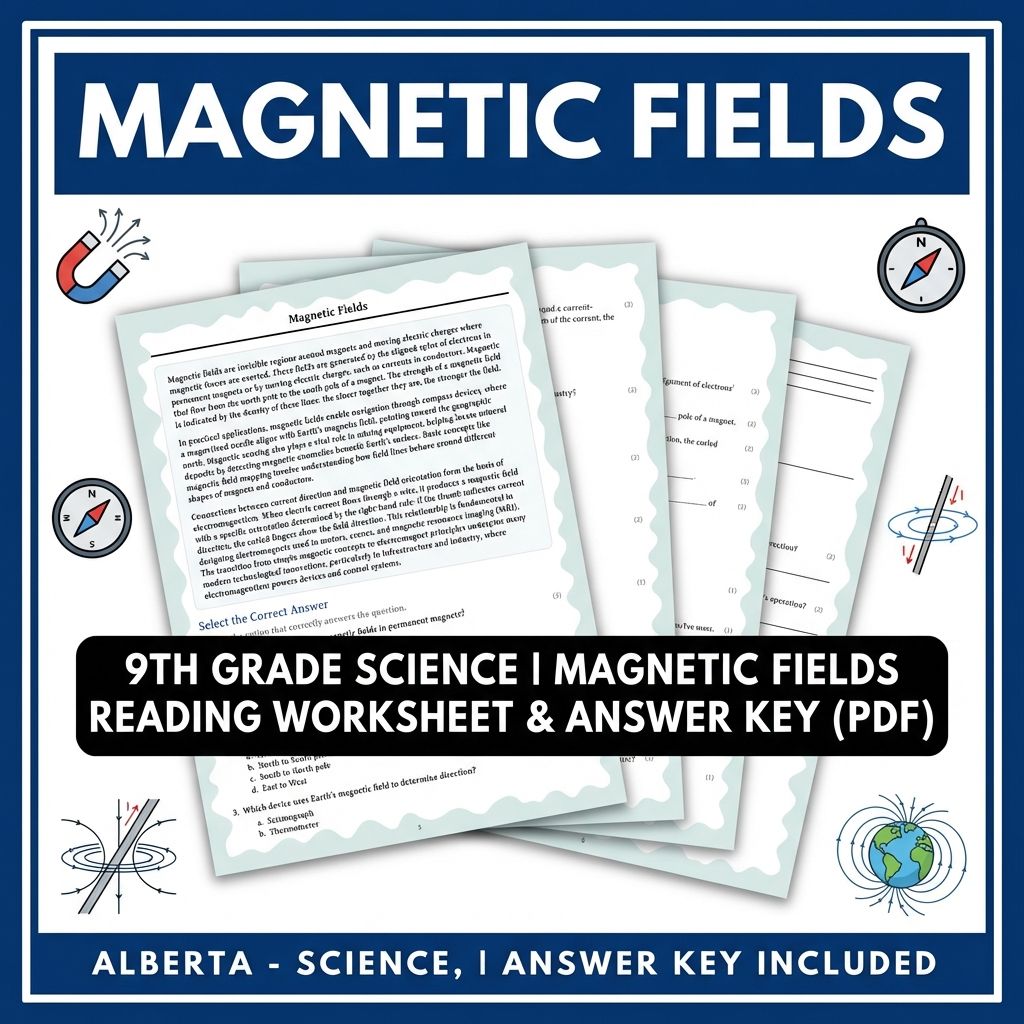
9th Grade Science | Magnetic Fields Reading Worksheet & Answer Key (PDF)
JCreated byJ.S SheetsLearning Objectives
- Explain the origin and characteristics of magnetic fields from permanent magnets and moving electric charges.
- Understand how magnetic field lines indicate direction and strength of magnetic fields.
- Describe real-world applications of magnetic fields, including compass navigation and industrial sensing.
Also included in: Grade 9 Science Bundle | Electricity, Energy & Magnetism (PDF + Answer Keys) +1 more
Instant download

Grade 9 Science – Kinematic Equations Worksheet (Ontario Standard) (PDF)
 Created byEvergreen Desk Education
Learning Objectives
- Use the constant-acceleration kinematic equations to relate displacement, time, velocities, and acceleration
- Apply sign conventions correctly when analyzing vertical free-fall and horizontal/vertical components of projectile motion
- Select and rearrange the appropriate equation to predict motion from given initial conditions
Also included in: Grade 9 Forces, Motion & Energy Science Lesson Bundle (Ontario) +1 more
Instant download
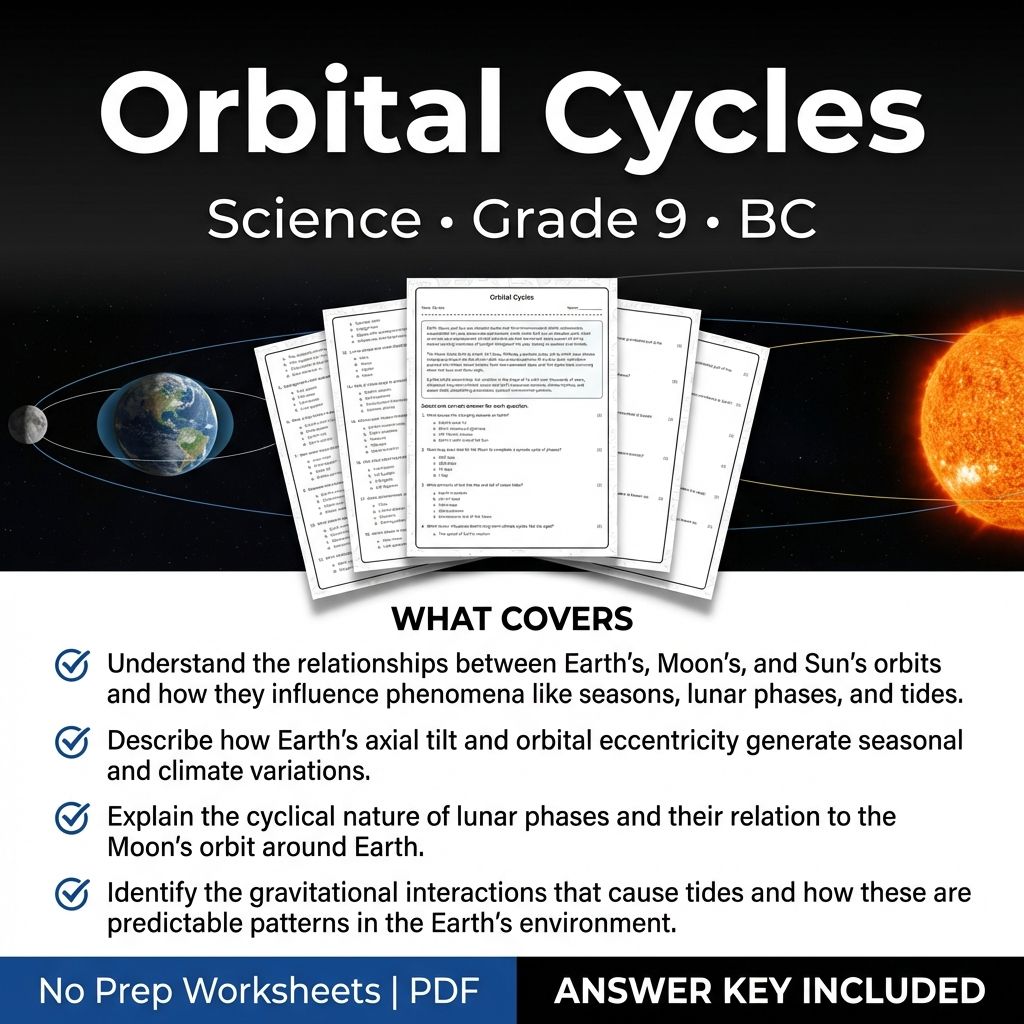
9th Grade Science | Orbital Cycles Worksheet & Answer Key – Classroom PDF
 Created byCoral Reef Learning
Learning Objectives
- Understand the relationships between Earth's, Moon's, and Sun's orbits and how they influence phenomena like seasons, lunar phases, and tides.
- Describe how Earth's axial tilt and orbital eccentricity generate seasonal and climate variations.
- Explain the cyclical nature of lunar phases and their relation to the Moon's orbit around Earth.
Instant download
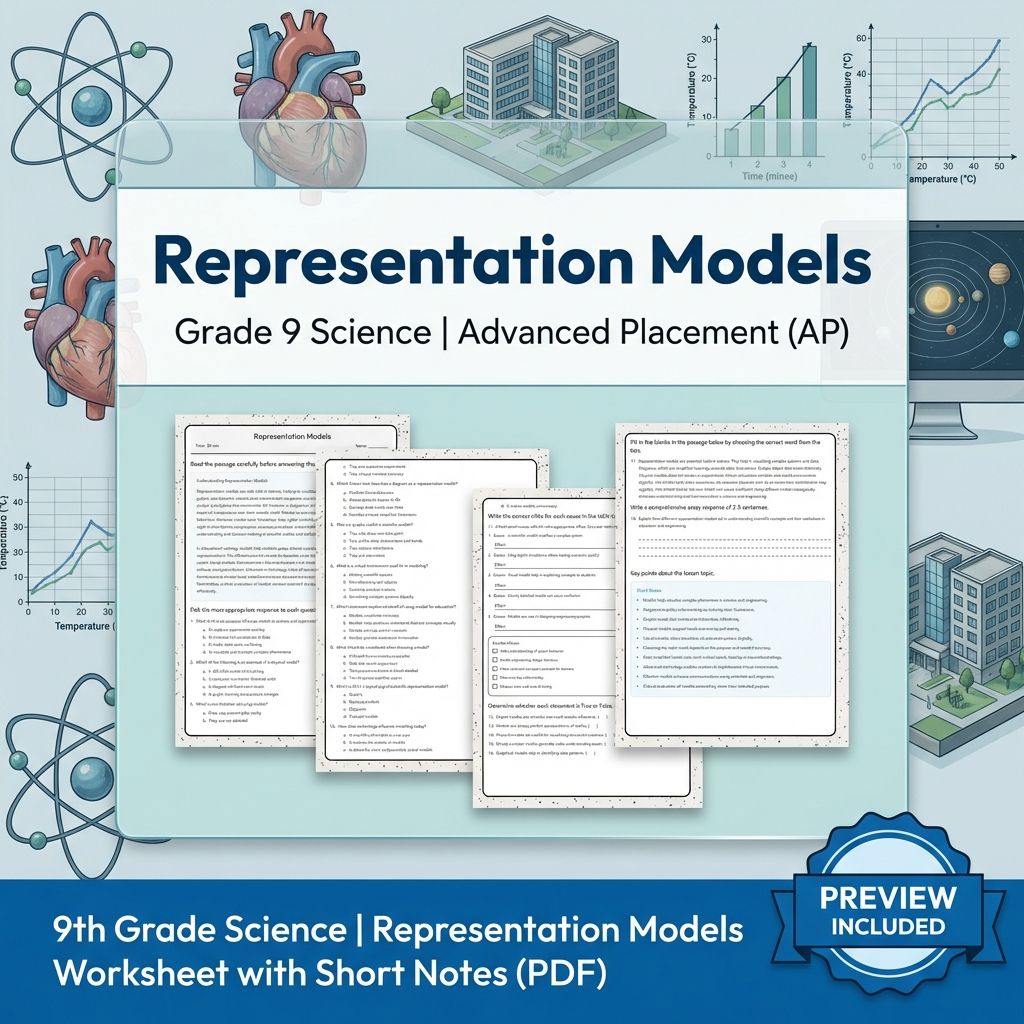
9th Grade Science | Representation Models Worksheet with Short Notes (PDF)
 Created byMeadowlark Worksheets
Learning Objectives
- Understand different types of representation models used in science and engineering.
- Identify the purpose and features of various models like diagrams, graphs, and physical models.
- Explain how models simplify complex systems for understanding and analysis.
Also included in: Grade 9 Science | Critical Thinking & Data Analysis Unit Bundle (Worksheets) +1 more
Instant download
Grade 9 Science | Cell Architecture Worksheet (PDF) – NGSS Aligned
 Created byBright Mind Resources
Learning Objectives
- Explain how nucleic acid sequences determine amino acid chains and protein structures.
- Connect molecular code and folding to organelle architecture such as ribosomes, endoplasmic reticulum, and mitochondria.
- Identify examples of proteins like hemoglobin and membrane transport proteins and their structures-function relationships.
Instant download
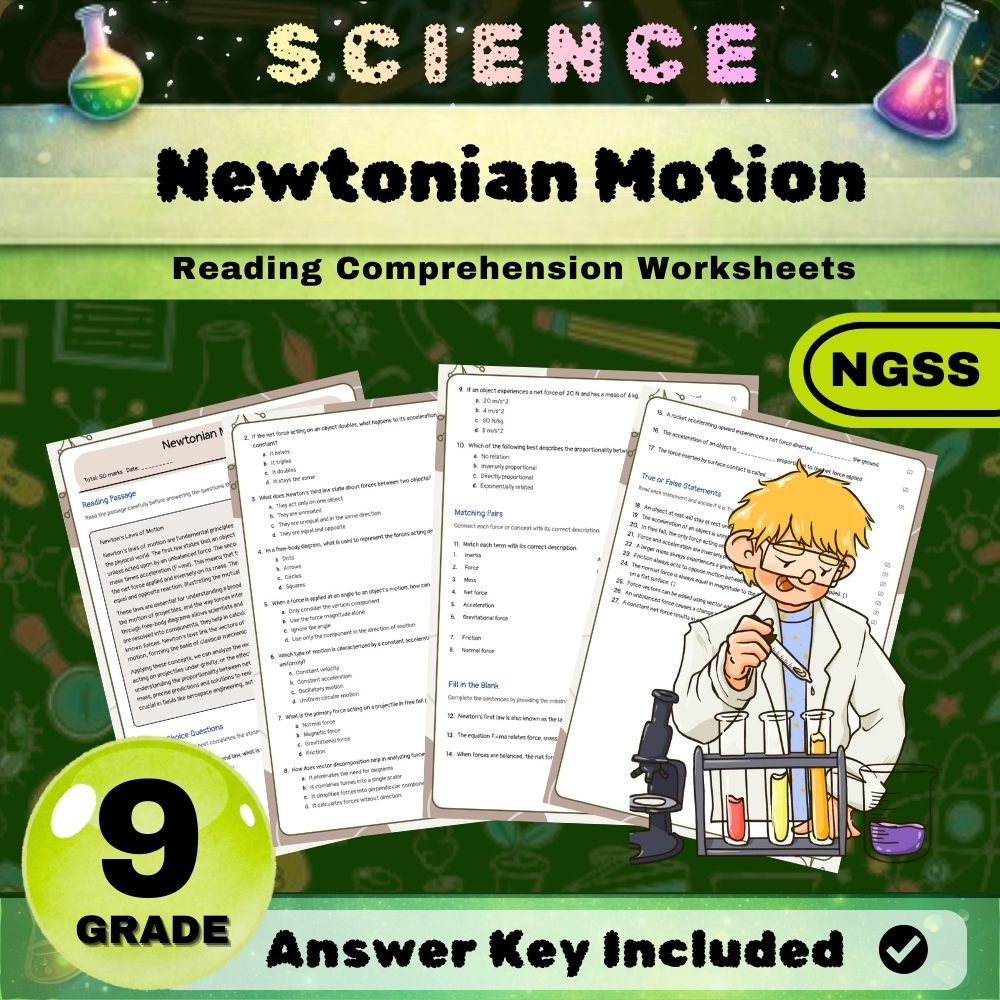
Grade 9 Science | Newtonian Motion Worksheet (NGSS Standards) PDF
 Created byMaple Path Learning
Learning Objectives
- Explain Newton's three laws of motion and how they relate to force, mass, and acceleration.
- Analyze free-body diagrams to identify forces acting on objects.
- Use vector components to resolve forces and predict object trajectories.
Also included in: Grade 9 Science | Motion and Stability Forces & Interactions NGSS Unit Bundle +1 more
Instant download
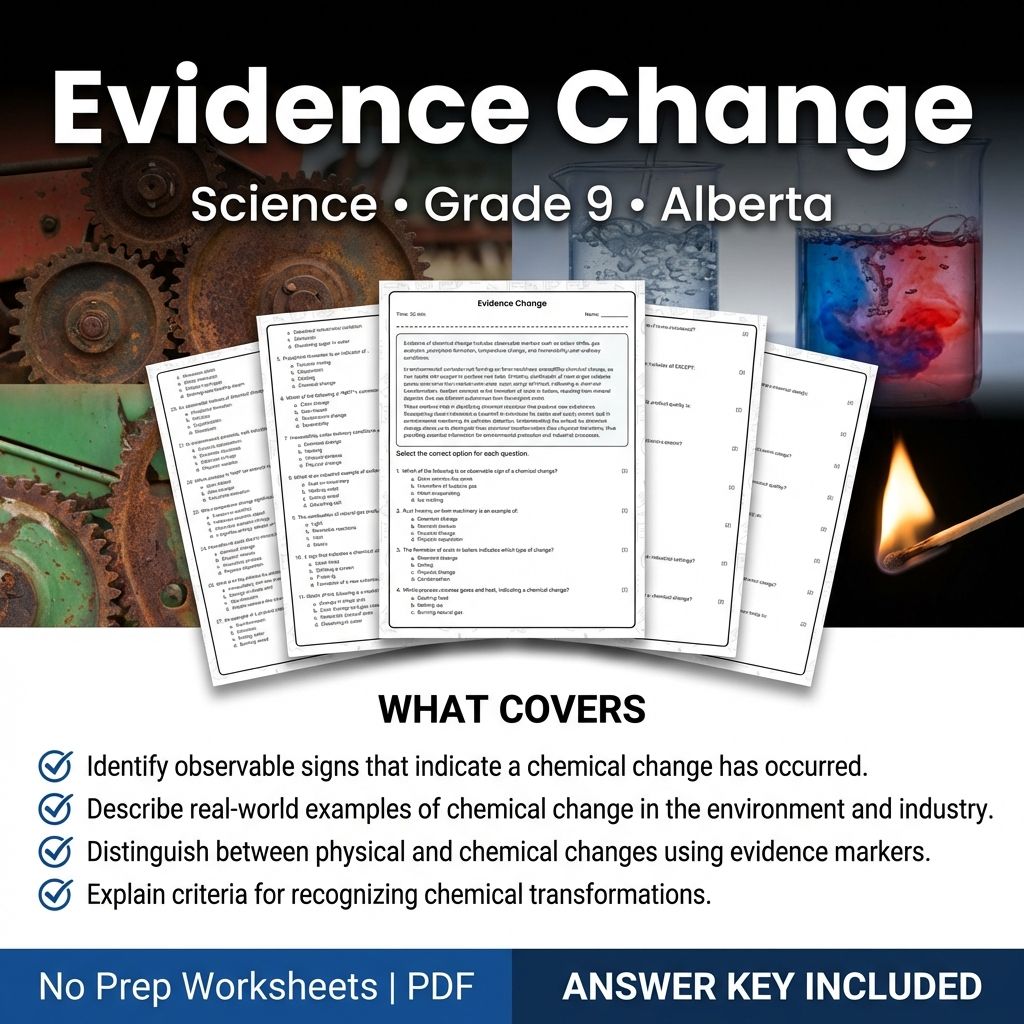
Evidence Change Science Worksheet Grade 9 | Alberta Standard Practice
Created byCoral Reef LearningLearning Objectives
- Identify observable signs that indicate a chemical change has occurred.
- Describe real-world examples of chemical change in the environment and industry.
- Distinguish between physical and chemical changes using evidence markers.
Instant download

Energy Conservation and Energy Accounting Grade 9 Science Worksheet
 Created bythe curious pencil
Learning Objectives
- Explain how energy is conserved during transfers within a system
- Distinguish energy reservoirs, transfers, and system boundaries
- Compare closed and isolated systems
Also included in: Grade 9 Power and Energy Science Lesson Bundle | NGSS +2 more
Instant download

Gravitational and Electrostatic Force Laws Worksheets | Grade 9 Science
Created bythe curious pencilLearning Objectives
- Explain how mass, charge, and separation affect force magnitude
- Calculate gravitational and electrostatic force magnitudes using quantitative models
- Apply inverse-square relationships to predict changes in force
Also included in: Newton's Laws, Forces & Motion Lesson Bundle | Grade 9 Science NGSS +2 more
Instant download

Climate Decision Models & Strategies Worksheet Grade 9 Science
Created bythe curious pencilLearning Objectives
- Compare mitigation and adaptation strategies using multiple variables
- Interpret economic, environmental, and social trade-offs
- Explain how scenario analysis supports climate decision making
Also included in: Resource Choices, Climate & Community Risk Lesson Bundle | Grade 9 Science | NGSS +2 more
Instant download

Computational Modeling for System Design Worksheets | Grade 9 Science
Created bythe curious pencilLearning Objectives
- Explain relationships among model inputs, design variables, and outputs
- Describe how parameters support computational model development
- Explain how objective functions help compare design performance
Also included in: Grade 9 Engineering Design Process Lesson Bundle | NGSS +2 more
Instant download

Cosmic Timescales and Expanding Universe Worksheets Grade 9
Created bythe curious pencilLearning Objectives
- Explain how redshift supports evidence for an expanding universe
- Interpret how Hubble’s law relates distance to recession speed
- Describe how cosmic microwave background measurements constrain cosmic history
Also included in: Grade 9 Space Science Stars, Orbits & Expanding Universe Lesson Bundle | NGSS +2 more
Instant download

Wave Properties and Wave Behavior Worksheets | Grade 9 Science
Created bythe curious pencilLearning Objectives
- Define amplitude, frequency, wavelength, phase, and wave speed
- Calculate wave speed, frequency, and wavelength using v = f × λ
- Compare transverse and longitudinal wave examples
Also included in: Grade 9 Science Lesson Bundle: Waves, Communication & Photon Energy (NGSS) +2 more
Instant download

Carbon, Nitrogen & Phosphorus Cycling Worksheets Grade 9 Science
Created bythe curious pencilLearning Objectives
- Explain how carbon, nitrogen, and phosphorus move among ecosystem reservoirs
- Identify decomposition, fixation, mineralization, and sedimentation in nutrient cycling
- Apply mass-balance ideas to nutrient reservoirs and fluxes
Also included in: Grade 9 Ecosystem Dynamics & Nutrient Cycling Lesson Bundle | NGSS +2 more
Instant download

Engineering Design Constraints Worksheets | Grade 9 Science NGSS
Created bythe curious pencilLearning Objectives
- Identify functional, social, economic, environmental, and regulatory constraints
- Explain how stakeholder needs affect engineering design choices
- Compare conceptual designs using requirements and trade-offs
Also included in: Grade 9 Engineering Design Process Lesson Bundle | NGSS +2 more
Instant download

Mechanical Energy and Energy Transfers Worksheets Grade 9 Science
Created bythe curious pencilLearning Objectives
- Calculate kinetic energy using mass and speed
- Calculate gravitational potential energy using mass, gravity, and height
- Explain mechanical energy transfers between kinetic and potential energy
Also included in: Grade 9 Power and Energy Science Lesson Bundle | NGSS +2 more
Instant download

Communication Systems Tradeoffs: Waves and Information Transfer Worksheets
Created bythe curious pencilLearning Objectives
- Compare digital and analog transmission methods.
- Explain how bandwidth affects communication channels.
- Interpret signal-to-noise ratio and bit error rate.
Also included in: Grade 9 Science Lesson Bundle: Waves, Communication & Photon Energy (NGSS) +2 more
Instant download

Trophic Dynamics and Energy Transfer Grade 9 Science Worksheets
Created bythe curious pencilLearning Objectives
- Explain why energy decreases between successive trophic levels
- Interpret food webs and trophic pyramids as ecosystem models
- Describe ecological efficiency and production-to-biomass ratios
Also included in: Grade 9 Ecosystem Dynamics & Nutrient Cycling Lesson Bundle | NGSS +2 more
Instant download

Collision Safety and Force Reduction Worksheets | Grade 9 Science
Created bythe curious pencilLearning Objectives
- Explain how interaction time affects average collision force
- Describe how deformation can absorb energy during collisions
- Interpret force-time graphs to compare safety designs
Also included in: Newton's Laws, Forces & Motion Lesson Bundle | Grade 9 Science NGSS +2 more
Instant download

Electric and Magnetic Fields: Forces & Motion Grade 9 Worksheets
Created bythe curious pencilLearning Objectives
- Interpret field lines as representations of direction and relative magnitude.
- Explain how superposition combines overlapping field effects as vectors.
- Describe magnetic forces acting on moving charged particles.
Also included in: Newton's Laws, Forces & Motion Lesson Bundle | Grade 9 Science NGSS +2 more
Instant download

Hazard Assessment and Community Risk Worksheets | Grade 9 Science
Created bythe curious pencilLearning Objectives
- Explain how occurrence and frequency contribute to hazard risk assessment
- Distinguish exposure from vulnerability in community hazard assessments
- Interpret return-period information and historical hazard records
Also included in: Resource Choices, Climate & Community Risk Lesson Bundle | Grade 9 Science | NGSS +2 more
Instant download

Natural Hazards & Resilience Worksheets | Grade 9 Earth Science
Created bythe curious pencilLearning Objectives
- Identify geological and atmospheric processes that produce natural hazards
- Interpret hazard maps and recurrence intervals
- Explain how paleoevidence reveals past hazardous events
Also included in: Earth Systems: Tectonics & Climate Lesson Bundle | Grade 9 Science NGSS +2 more
Instant download

Net Primary Productivity & Carbon Cycling Worksheets Grade 9 Science
Created bythe curious pencilLearning Objectives
- Explain how photosynthesis stores energy and cycles carbon and oxygen
- Describe how cellular respiration affects producer biomass and consumer energy
- Calculate net primary productivity from production and respiration values
Also included in: Grade 9 Ecosystem Dynamics & Nutrient Cycling Lesson Bundle | NGSS +2 more
Instant download

Newton's Laws, Forces and Acceleration Worksheets | Grade 9 Science
Created bythe curious pencilLearning Objectives
- Explain how net force, mass, and acceleration are related
- Interpret free-body diagrams showing balanced and unbalanced forces
- Calculate acceleration using net force and mass
Also included in: Newton's Laws, Forces & Motion Lesson Bundle | Grade 9 Science NGSS +2 more
Instant download

Climate Drivers and Earth's Energy Budget Worksheets Grade 9
Created bythe curious pencilLearning Objectives
- Explain how solar flux and albedo affect Earth's energy balance
- Describe how greenhouse gases transfer and re-emit infrared energy
- Explain how ocean heat transport influences regional climate patterns
Also included in: Earth Systems: Tectonics & Climate Lesson Bundle | Grade 9 Science NGSS +2 more
Instant download

Evolutionary Evidence and Common Ancestry Worksheets | Grade 9 Science
Created bythe curious pencilLearning Objectives
- Explain how fossils provide evidence for evolutionary change.
- Compare homologous structures as evidence of common ancestry.
- Interpret DNA similarities to investigate evolutionary relationships.
Also included in: Speciation & Evolutionary Evidence Lesson Bundle | Grade 9 Science | NGSS +2 more
Instant download

Plate Tectonics & Tectonic Forces Worksheet Grade 9 Earth Science
Created bythe curious pencilLearning Objectives
- Explain how tectonic forces shape continental and ocean-floor features
- Describe how seafloor spreading changes Earth's surface
- Explain how subduction contributes to volcanic arc formation
Also included in: Earth Systems: Tectonics & Climate Lesson Bundle | Grade 9 Science NGSS +2 more
Instant download

Engineering Design Evaluation Grade 9 Science Worksheets
Created bythe curious pencilLearning Objectives
- Compare design solutions using measurable performance criteria
- Explain how life-cycle costs affect design evaluations
- Analyze uncertainty and sensitivity in design decisions
Also included in: Grade 9 Engineering Design Process Lesson Bundle | NGSS +2 more
Instant download

Surface Processes & Landscape Change Worksheets Grade 9 Science
Created bythe curious pencilLearning Objectives
- Distinguish physical and chemical weathering processes.
- Explain how gravity drives mass wasting on hillslopes.
- Describe how flowing water transports and deposits sediment.
Also included in: Earth Systems: Tectonics & Climate Lesson Bundle | Grade 9 Science NGSS +2 more
Instant download

Energy Systems and Emissions Grade 9 Science Worksheets
Created bythe curious pencilLearning Objectives
- Explain how renewable energy, storage, and grid capacity interact
- Describe how life-cycle accounting compares emissions across energy stages
- Explain how carbon capture can reduce some facility emissions
Also included in: Resource Choices, Climate & Community Risk Lesson Bundle | Grade 9 Science | NGSS +2 more
Instant download

Natural Selection Worksheets: Population Change & Evolution Grade 9
Created bythe curious pencilLearning Objectives
- Explain how heritable variation affects survival and reproduction.
- Interpret how selection changes trait frequencies across generations.
- Compare directional, stabilizing, and disruptive selection patterns.
Also included in: Speciation & Evolutionary Evidence Lesson Bundle | Grade 9 Science | NGSS +2 more
Instant download

Earth Interior Layers & Heat Transfer Worksheets Grade 9 Science
Created bythe curious pencilLearning Objectives
- Interpret P-wave and S-wave behavior as evidence for Earth’s layers
- Explain how density and composition distinguish Earth’s internal layers
- Describe how mantle convection redistributes thermal energy
Also included in: Earth Systems: Tectonics & Climate Lesson Bundle | Grade 9 Science NGSS +2 more
Instant download

Signal Encoding Worksheets: Communication Channels Grade 9 Science
Created bythe curious pencilLearning Objectives
- Explain how amplitude, frequency, and phase encode information.
- Compare analog amplitude modulation with pulse-code modulation.
- Describe how multiplexing allows signals to share channels.
Also included in: Grade 9 Science Lesson Bundle: Waves, Communication & Photon Energy (NGSS) +2 more
Instant download

Electromagnetic Radiation and Photon Energy Worksheets | Grade 9
Created bythe curious pencilLearning Objectives
- Explain electromagnetic radiation using wave and photon descriptions.
- Relate frequency, wavelength, and photon energy using Planck’s relation.
- Describe how materials affect electromagnetic signals through absorption and attenuation.
Also included in: Grade 9 Science Lesson Bundle: Waves, Communication & Photon Energy (NGSS) +2 more
Instant download

Human Influence on Climate and Ecosystems Worksheets | Grade 9 Science
Created bythe curious pencilLearning Objectives
- Interpret long-term atmospheric carbon dioxide records
- Explain how fossil fuel combustion alters Earth systems
- Describe how deforestation can influence atmospheric carbon dioxide
Also included in: Resource Choices, Climate & Community Risk Lesson Bundle | Grade 9 Science | NGSS +2 more
Instant download

Stellar Evolution & Star Life Cycles Worksheets Grade 9 Science
Created bythe curious pencilLearning Objectives
- Explain how stars form and produce energy during the main sequence.
- Describe how stellar mass affects lifetime and final outcome.
- Interpret the Hertzsprung-Russell diagram using brightness and temperature.
Also included in: Grade 9 Space Science Stars, Orbits & Expanding Universe Lesson Bundle | NGSS +2 more
Instant download

Linear Momentum and Collisions Grade 9 Science Worksheets
Created bythe curious pencilLearning Objectives
- Calculate linear momentum from mass, velocity, and direction.
- Determine total momentum before and after an interaction.
- Apply momentum conservation to isolated systems and recoil.
Also included in: Newton's Laws, Forces & Motion Lesson Bundle | Grade 9 Science NGSS +2 more
Instant download

Thermal Energy and Heat Transfer Quantification Worksheets Grade 9
Created bythe curious pencilLearning Objectives
- Explain how conduction, convection, and radiation transfer thermal energy
- Calculate thermal energy transferred using Q = mcΔT
- Interpret positive and negative Q values for energy changes
Also included in: Grade 9 Power and Energy Science Lesson Bundle | NGSS +2 more
Instant download

Hydrologic Change and Landscape Evolution Worksheets Grade 9
Created bythe curious pencilLearning Objectives
- Explain how runoff affects river discharge and sediment transport
- Analyze how erosion and deposition reshape Earth's surface
- Interpret hydrologic data as evidence of landscape change
Also included in: Earth Systems: Tectonics & Climate Lesson Bundle | Grade 9 Science NGSS +2 more
Instant download

Resource Choices and Trade-Offs Grade 9 Science Worksheets
Created bythe curious pencilLearning Objectives
- Compare resource choices using environmental and economic criteria
- Evaluate resource trade-offs involving water, land, and emissions
- Explain how extraction and remediation affect life-cycle impacts
Also included in: Resource Choices, Climate & Community Risk Lesson Bundle | Grade 9 Science | NGSS +2 more
Instant download

Solar System Formation Worksheets: Planetary Origins Grade 9 Science
Created bythe curious pencilLearning Objectives
- Explain how a protoplanetary disk contributed to planet formation
- Compare inner rocky planets with outer gas giants
- Describe evidence scientists use to study planetary origins
Also included in: Grade 9 Space Science Stars, Orbits & Expanding Universe Lesson Bundle | NGSS +2 more
Instant download
About Grade 9 Science Worksheets
Find Science worksheets built for Grade 9. All 6,926 cover core skills, practice, and review, each an instant PDF download.
Every worksheet on MyTeachingSheets is created by independent teacher-authors and reviewed before publication. All resources download as printable PDFs for classroom, homework, or at-home practice, and many include answer keys. Preview any worksheet free before buying.