
Grade 9 Science Worksheets
6,926 worksheets
Grade 9 Science | Reaction Rates Worksheet & Answer Key (Printable PDF)
 Created byCoral Reef Learning
Learning Objectives
- Understand the kinetic factors affecting reaction rates such as temperature, concentration, and catalysts.
- Explain the relationship between rate laws, reaction order, and molecular collision theory.
- Analyze energy profiles and transition states to connect molecular events with macroscopic reaction speed.
Also included in: Grade 9 Science Worksheet Bundle | Reaction, Molecules & Energy Topics +1 more
Instant download

Grade 9 Wave Boundary Behavior Worksheet | Practice & Standard PDF
 Created byClear Sky Classroom
Learning Objectives
- Explain how reflection, refraction, transmission, and absorption affect wave direction and energy at boundaries
- Use wave models to predict changes in wavelength when waves enter a new medium
- Describe how diffraction and interference patterns form when waves pass through openings or overlap
Instant download
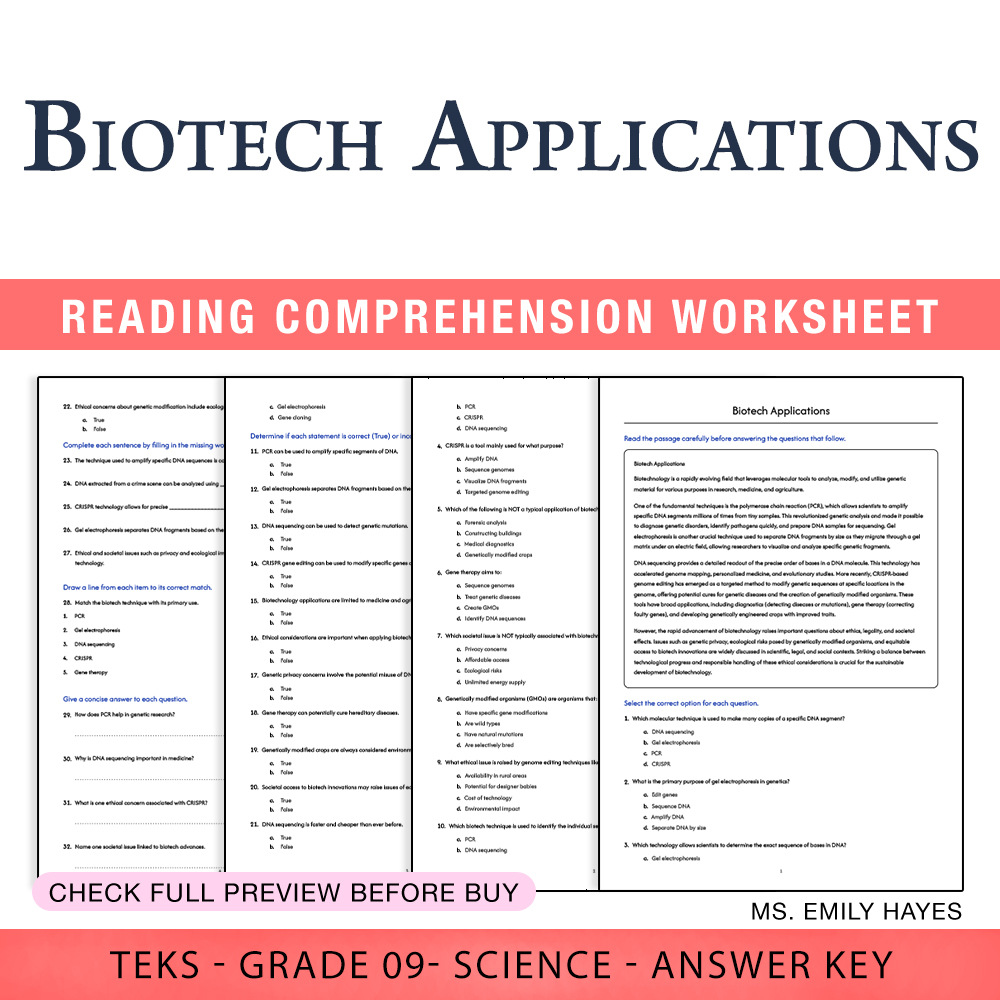
9th Grade Science | Biotech Applications Worksheet (PDF+ Answer Key)
 Created byCopper Leaf Classroom
Learning Objectives
- Understand key molecular techniques used in biotechnology such as PCR, gel electrophoresis, DNA sequencing, and CRISPR.
- Identify various applications of biotechnology including diagnostic, therapeutic, agricultural, and forensic uses.
- Discuss ethical, legal, and societal considerations related to biotech advances such as privacy, ecological risks, and access issues.
Instant download
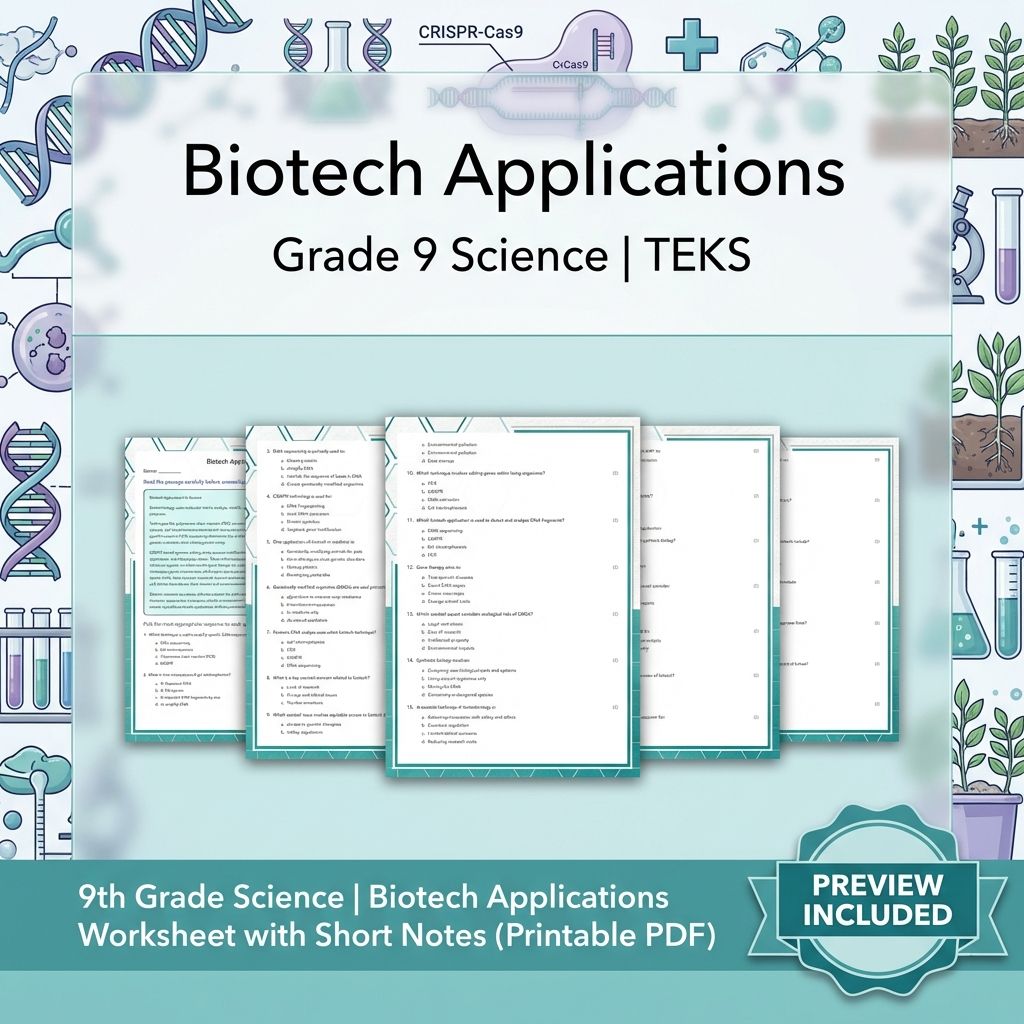
9th Grade Science | Biotech Applications Worksheet with Short Notes (PDF)
 Created byMeadowlark Worksheets
Learning Objectives
- Understand common genetic techniques used in biotechnology.
- Identify various applications of biotechnology in medicine, agriculture, and forensics.
- Recognize ethical and societal considerations related to biotech advancements.
Instant download

Human Impacts on Biodiversity and Ecosystems Worksheet | Grade 9 NGSS
 Created byBRIGHT PATH RESOURCES
Learning Objectives
- Understand how deforestation affects biodiversity.
- Analyze case studies of human impacts on ecosystems.
- Interpret empirical data related to land-use change and habitat loss.
Also included in: Ecosystems Grade 9 Science Daily Reading Worksheets Lesson Bundle | NGSS +1 more
Instant download

Grade 9 Science | Redox Concepts Worksheet (PDF) Aligned BC Standards
 Created byEvergreen Desk Education
Learning Objectives
- Distinguish oxidation from reduction using electron transfer and oxidation-number changes.
- Interpret oxidation states to identify oxidizing agents and reducing agents in simple reactions.
- Use oxidation-state tracking to help predict products and support balancing redox equations.
Instant download
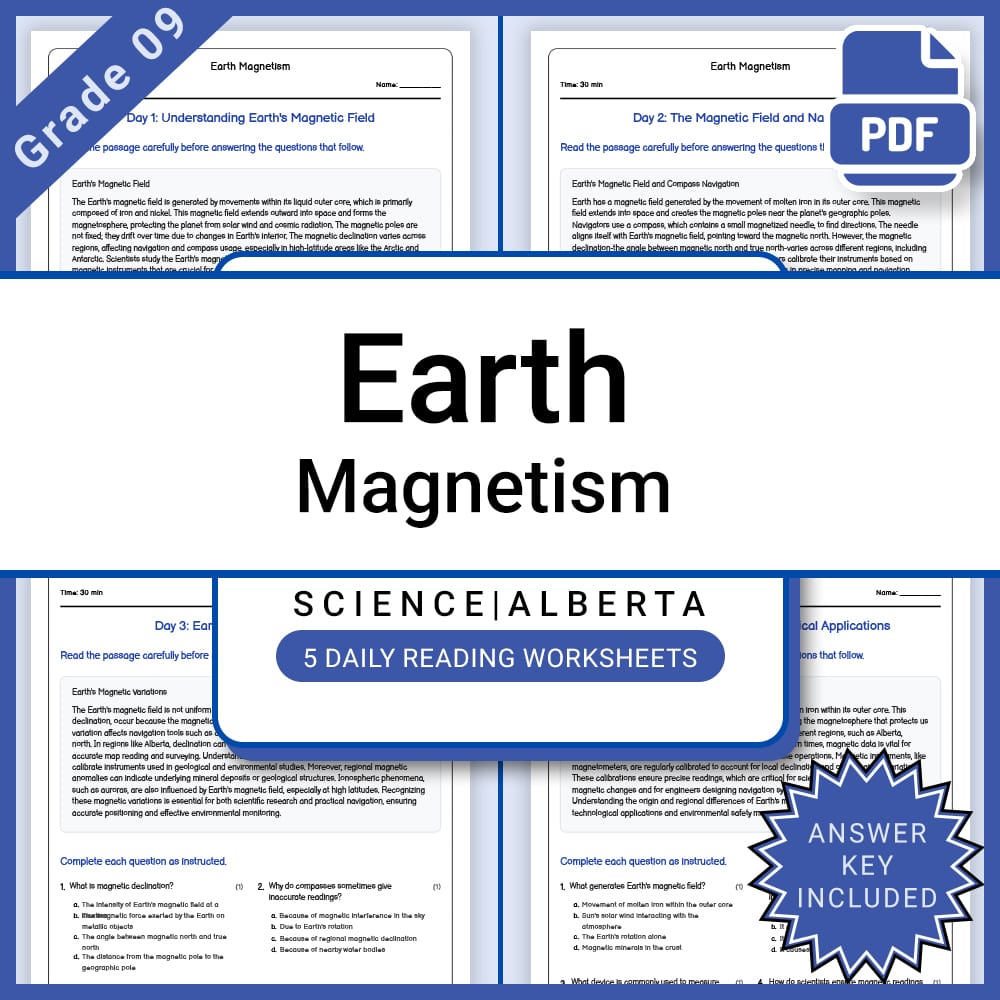
Grade 9 Science – Earth Magnetism Daily Reading Worksheet with Answer Key
JCreated byJ.S SheetsLearning Objectives
- Understand the fundamental concepts of Earth's magnetic field.
- Identify the magnetic poles and how they influence navigation.
- Recognize regional variations in magnetic declination and their implications.
Also included in: Grade 9 Science Lesson Bundle: Electrical Systems and Energy Concepts +1 more
Instant download

Grade 9 Science – Circular Motion & Forces | Daily Reading Worksheet
 Created byBright Mind Resources
Learning Objectives
- Explain the concept of centripetal force in circular motion.
- Identify the role of tension, friction, and normal forces in maintaining curved paths.
- Calculate acceleration and force components involved in circular motion.
Also included in: Grade 9 Forces, Motion & Energy Science Lesson Bundle for Daily Reading | BC +1 more
Instant download

Grade 9 Science – Eclipses & Shadow Geometry | Daily Reading Worksheet
Created byBright Mind ResourcesLearning Objectives
- Identify different types of eclipses and their causes.
- Understand the geometry of eclipse formation.
- Describe the roles of the Sun, Earth, and Moon during eclipses.
Also included in: Grade 9 Earth Systems Science Daily Reading Worksheets Lesson Bundle | BC +1 more
Instant download
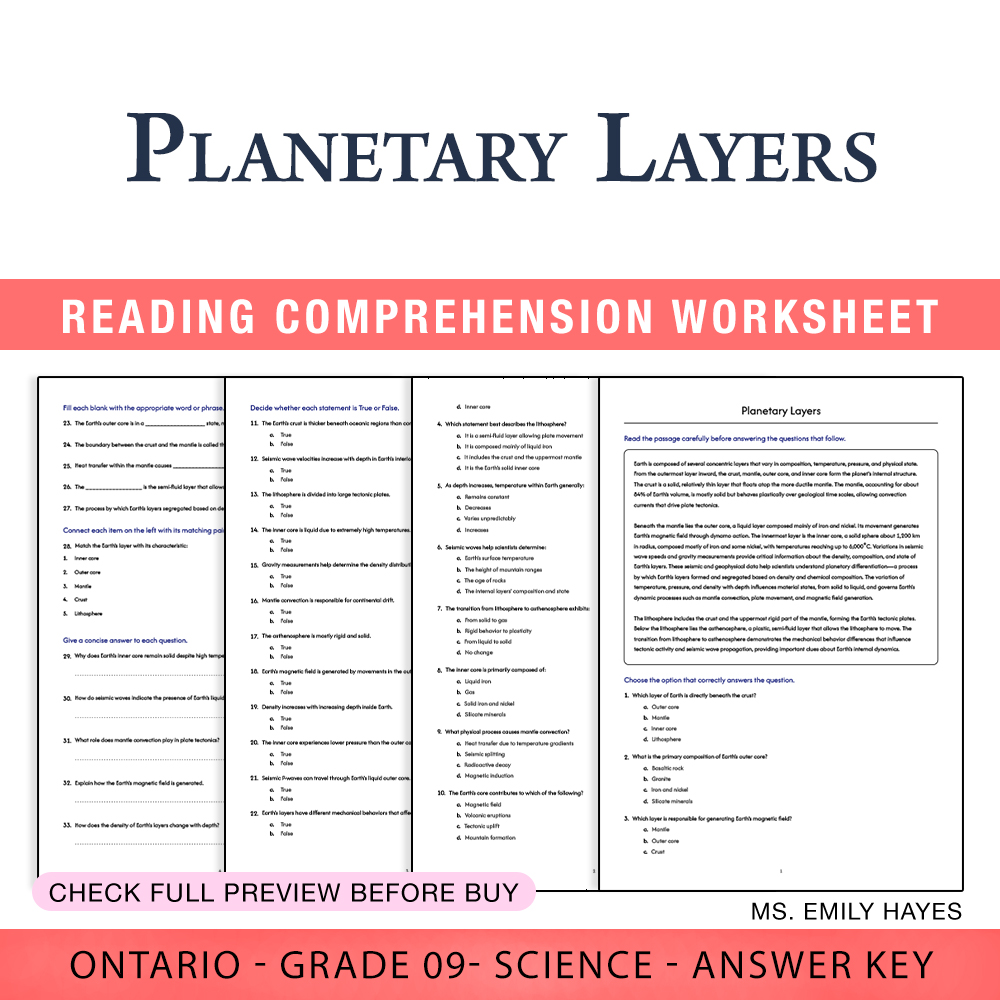
Grade 9 Science | Planetary Layers Worksheet (PDF + Answer Key)
Created byCopper Leaf ClassroomLearning Objectives
- Describe Earth's concentric layers including crust, mantle, and core.
- Differentiate between lithosphere and asthenosphere in mechanical behavior.
- Explain how density, temperature, and pressure vary with depth in Earth.
Instant download

Grade 9 Science | Conservation of Matter - Daily Reading Comprehension
Created byCoral Reef LearningLearning Objectives
- Understand that atoms are neither created nor destroyed in chemical reactions
- Recognize that mass is conserved in a closed system
- Explain particle-level changes during chemical reactions
Instant download
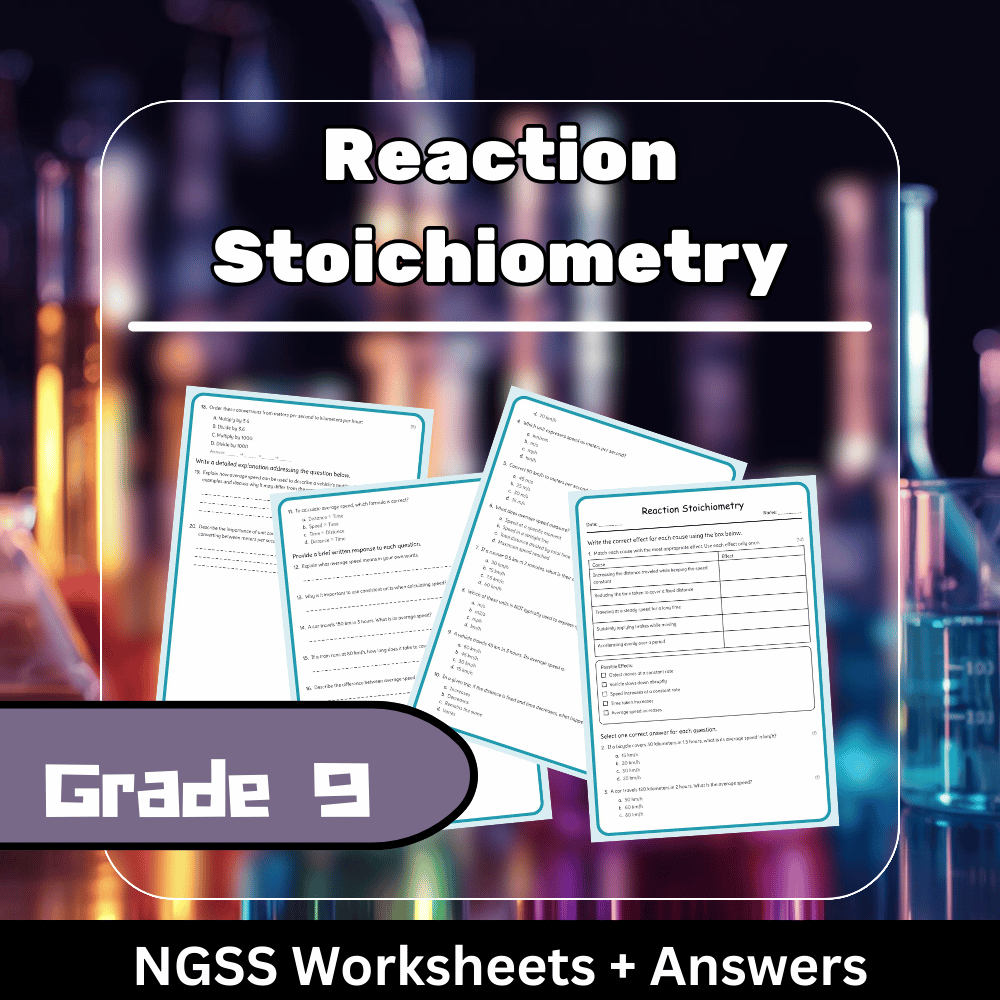
Grade 9 Science | Reaction Stoichiometry Worksheet + Answer Key (NGSS PDF)
Created byBright Mind ResourcesLearning Objectives
- Understand and apply the conservation of mass in balanced chemical equations.
- Calculate molar relationships, masses, and particle counts in chemical reactions.
- Identify limiting reagents and compute theoretical yields.
Instant download
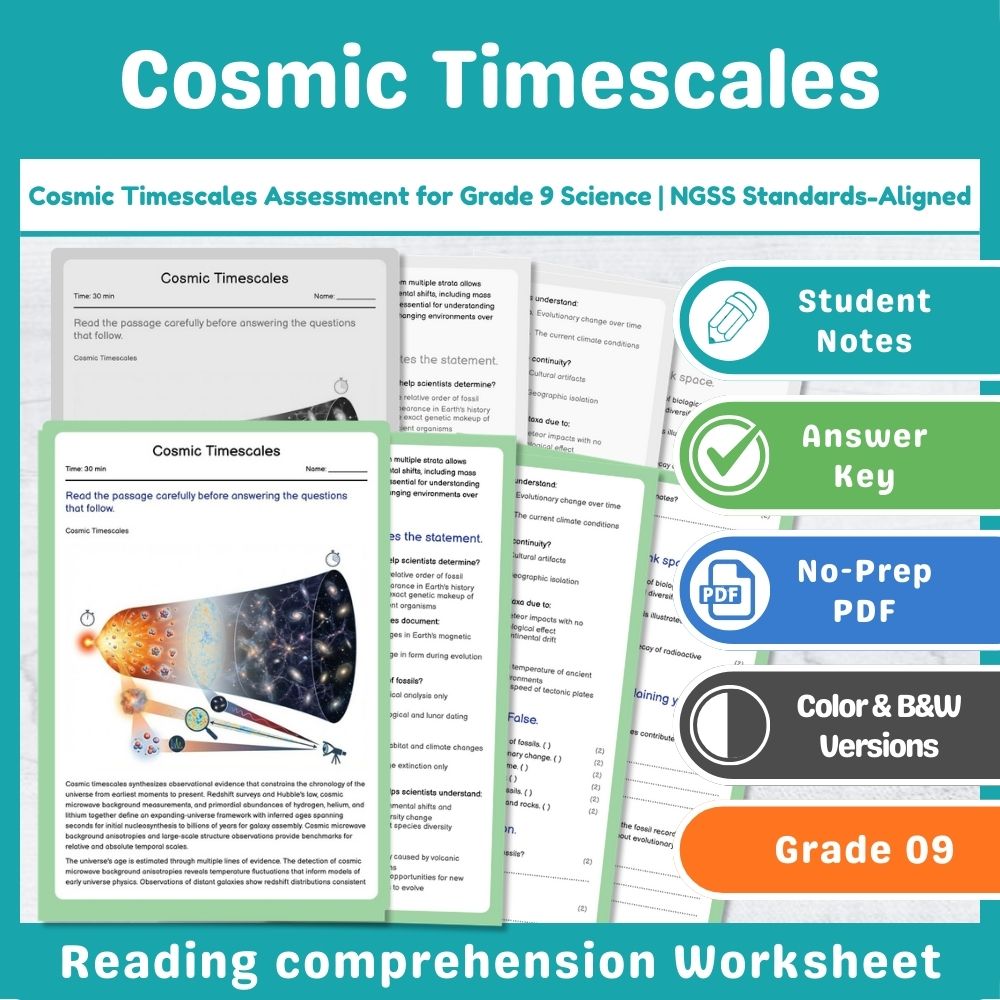
Cosmic Timescales Assessment for Grade 9 Science | NGSS Standards-Aligned
 Created byPrism Point Learning
Learning Objectives
- Understand key observational evidence constraining the age and expansion of the universe
- Identify the significance of redshift surveys, Hubble's law, and cosmic microwave background measurements
- Describe processes related to primordial element abundances and their role in cosmic chronology
Instant download

Grade 9 Science | Inheritance Basics Worksheet & Answer Key (NGSS-Aligned)
 Created byLumora Learning
Learning Objectives
- Understand the structure of DNA and its role in inheritance.
- Describe the process of chromosomal segregation during meiosis.
- Explain how hereditary information is transmitted from parents to offspring.
Instant download
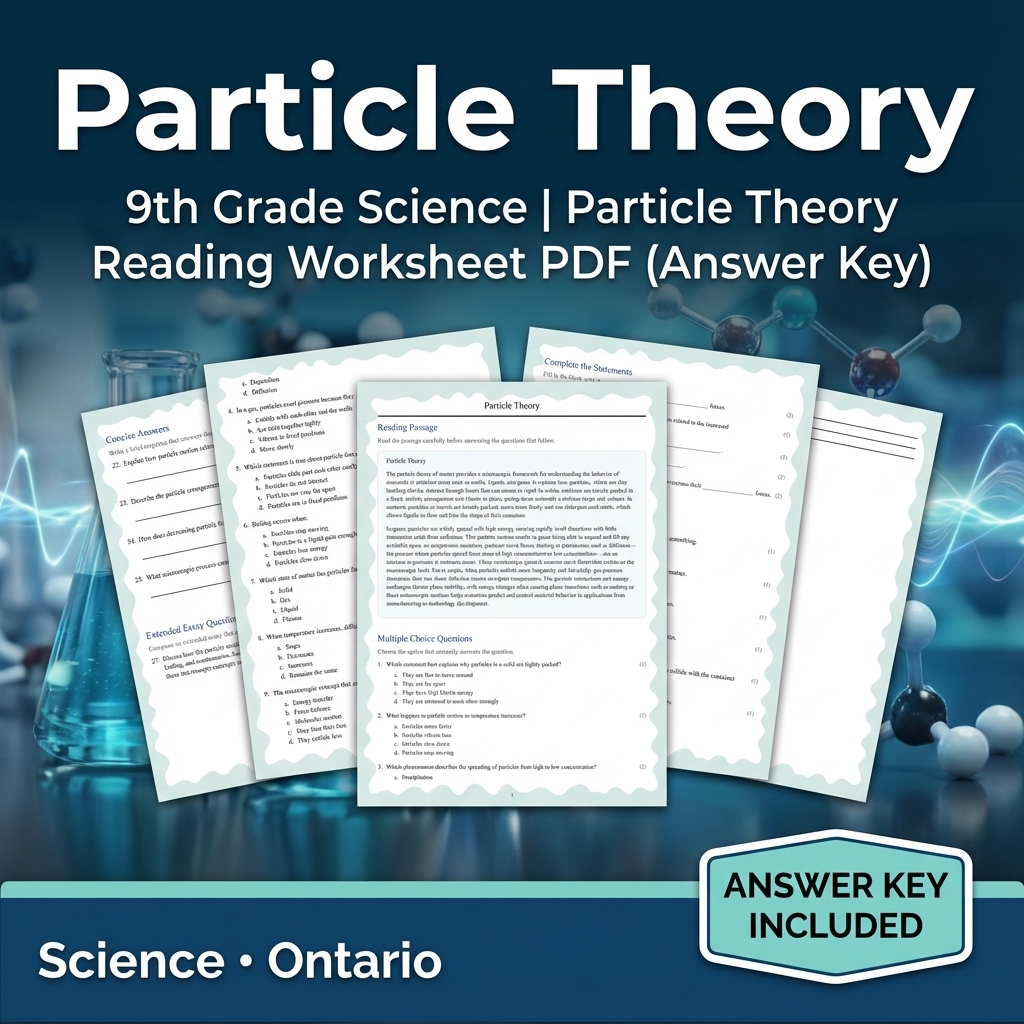
9th Grade Science | Particle Theory Reading Worksheet PDF (Answer Key)
JCreated byJ.S SheetsLearning Objectives
- Explain the microscopic particle model and how it relates to states of matter, diffusion, and temperature-dependent behaviors.
- Describe particle arrangements in solids, liquids, and gases and relate these arrangements to particle motion and forces.
- Connect the concept of kinetic energy to temperature and observe how particle motion influences observable phenomena such as pressure and diffusion rates.
Also included in: Grade 9 Science Unit Bundle | Essential Concepts & Skills (Answer Keys Included) +1 more
Instant download
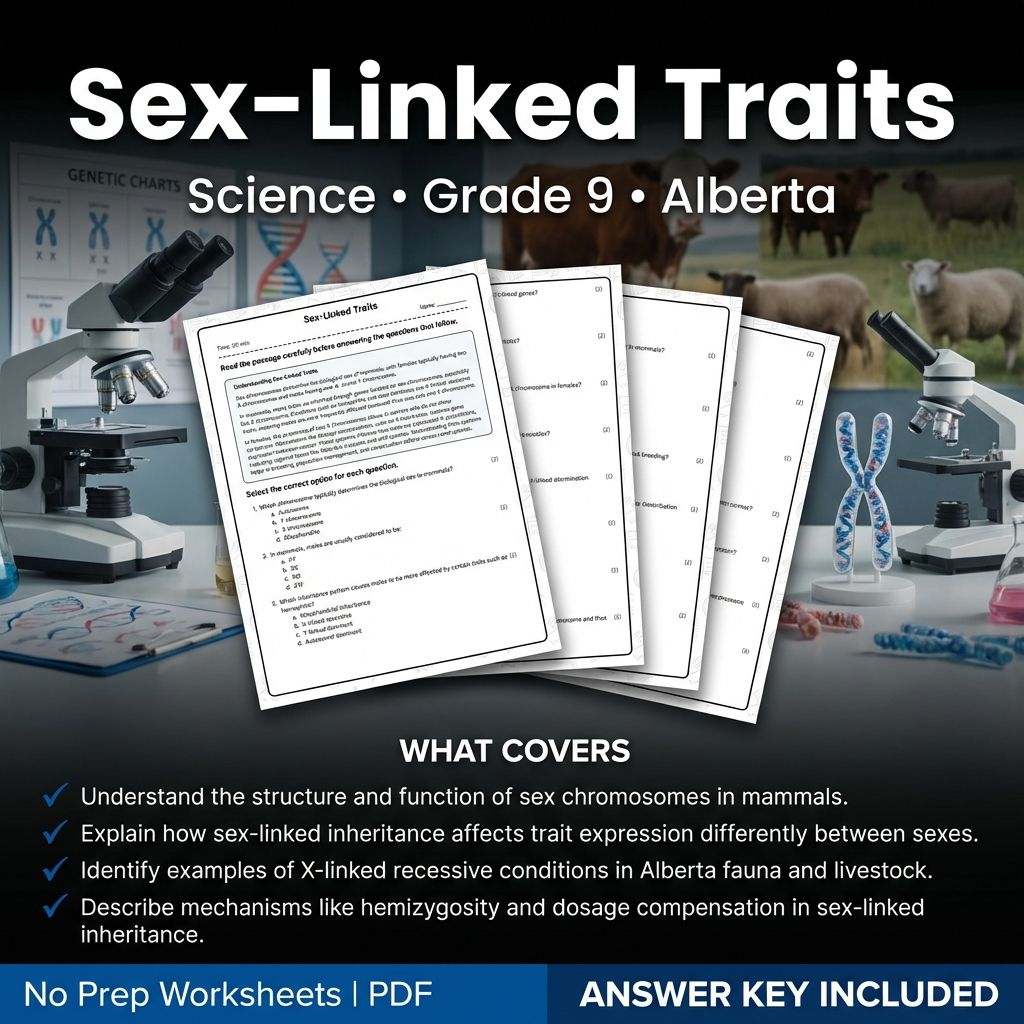
Sex-Linked Traits Worksheet for Grade 9 Science | Alberta Standard
Created byCoral Reef LearningLearning Objectives
- Understand the structure and function of sex chromosomes in mammals.
- Explain how sex-linked inheritance affects trait expression differently between sexes.
- Identify examples of X-linked recessive conditions in Alberta fauna and livestock.
Instant download
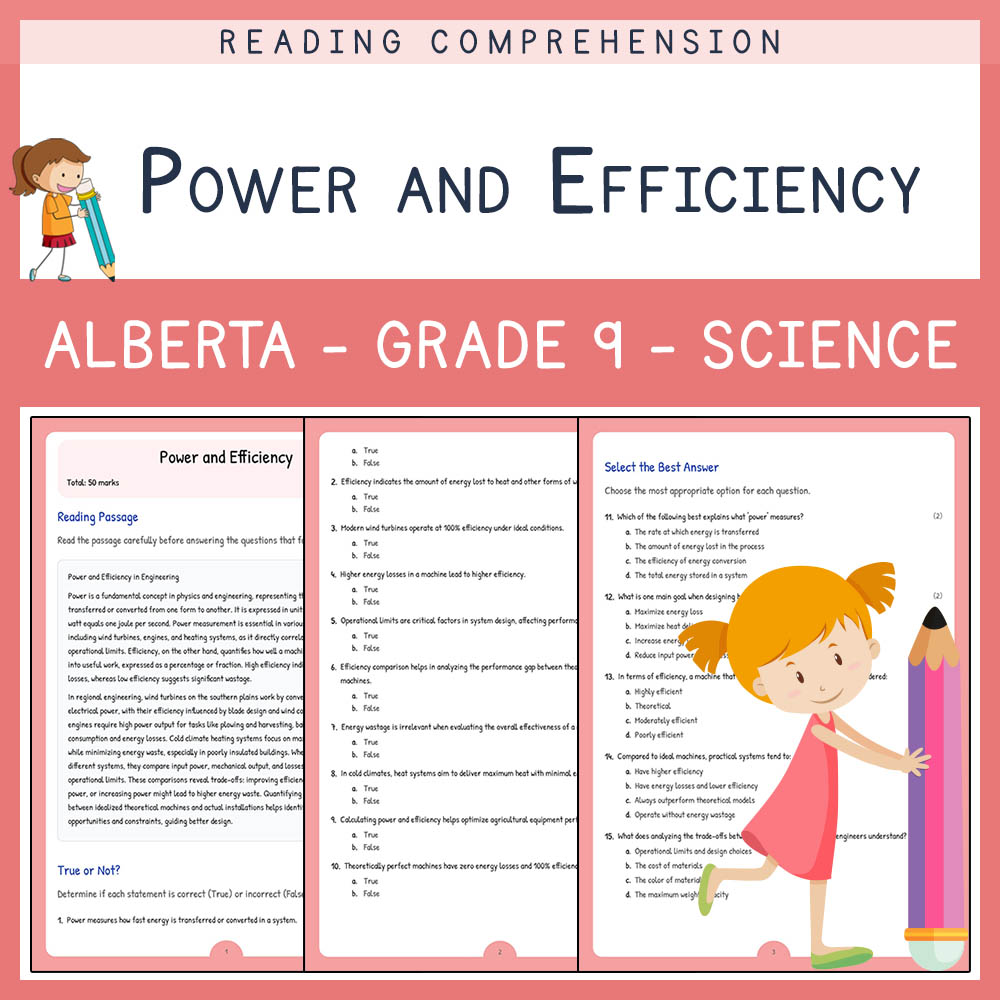
Grade 9 Science | Power and Efficiency Worksheet | Alberta Standards
Created byLumora LearningLearning Objectives
- Understand the definitions of power and efficiency in energy transfer systems.
- Analyze regional engineering examples related to power output and energy losses.
- Compare input power, mechanical output, and energy wastage in various machines.
Instant download
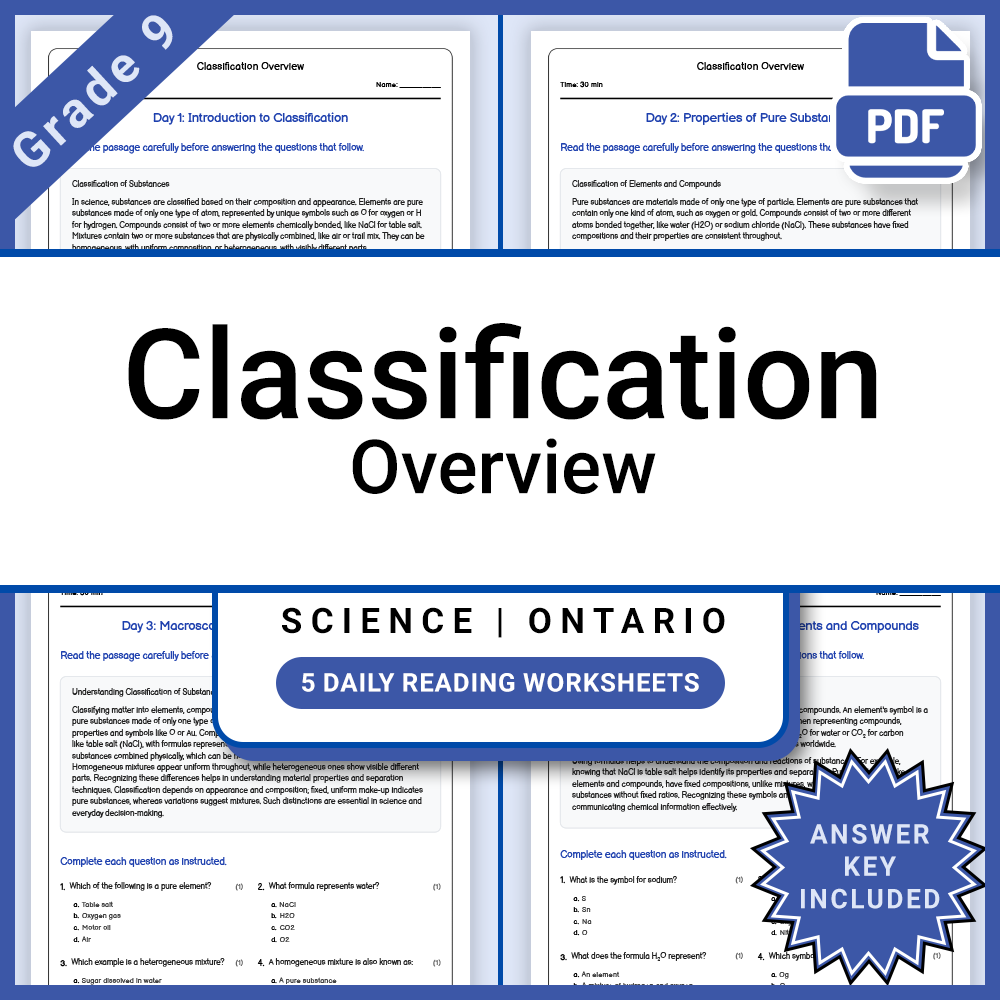
Grade 9 Science Classification Overview Daily Reading Worksheet with Answer Key
JCreated byJ.S SheetsLearning Objectives
- Define and distinguish between elements, compounds, and mixtures.
- Understand the criteria for classifying substances as pure or impure.
- Identify examples of elements, compounds, and mixtures.
Also included in: Grade 9 Science Lesson Group: Ontario Curriculum Daily Reading Worksheets +1 more
Instant download
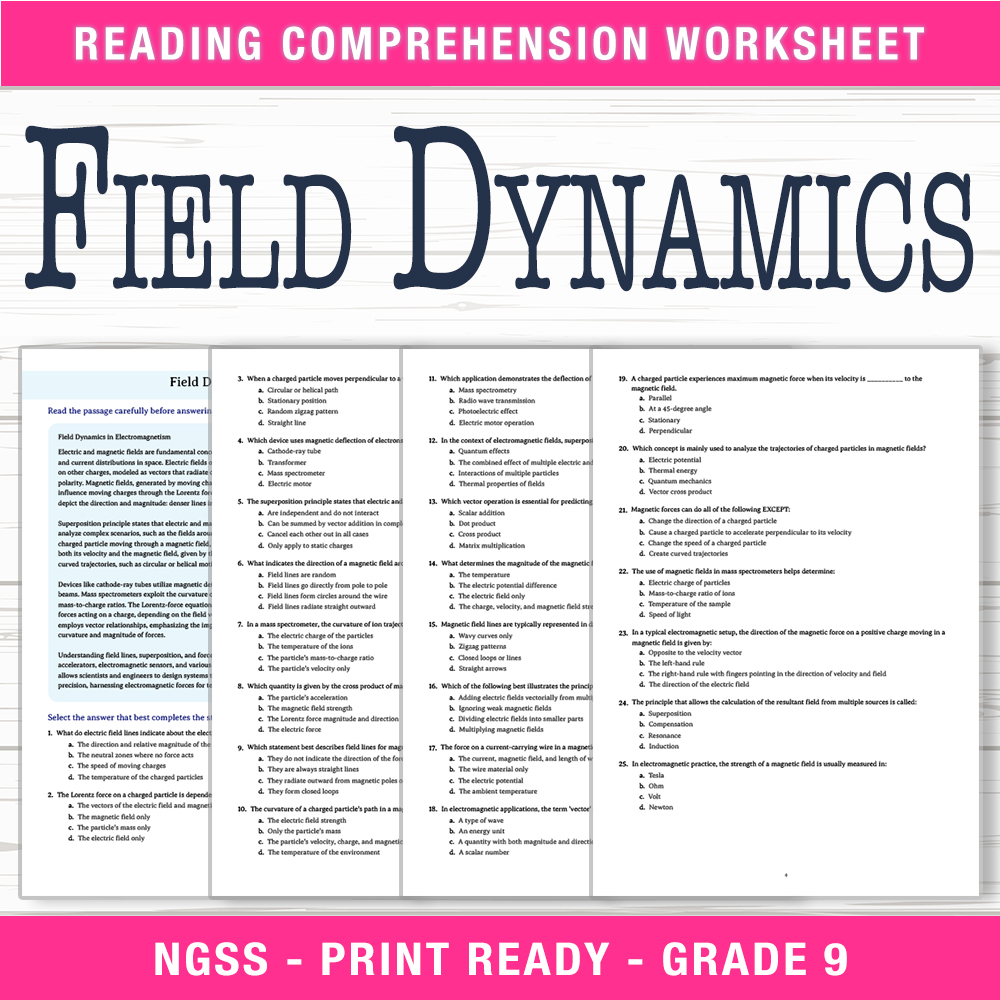
Grade 9 Science | Field Dynamics Worksheet (PDF + Answer Key)
 Created byRiverstone Classroom
Learning Objectives
- Describe the characteristics of electric and magnetic fields using field vectors and field lines.
- Explain the concept of superposition of electric and magnetic fields and how they affect moving charges.
- Analyze forces on charged particles in magnetic fields, including curvature of trajectories and deflection phenomena.
Instant download
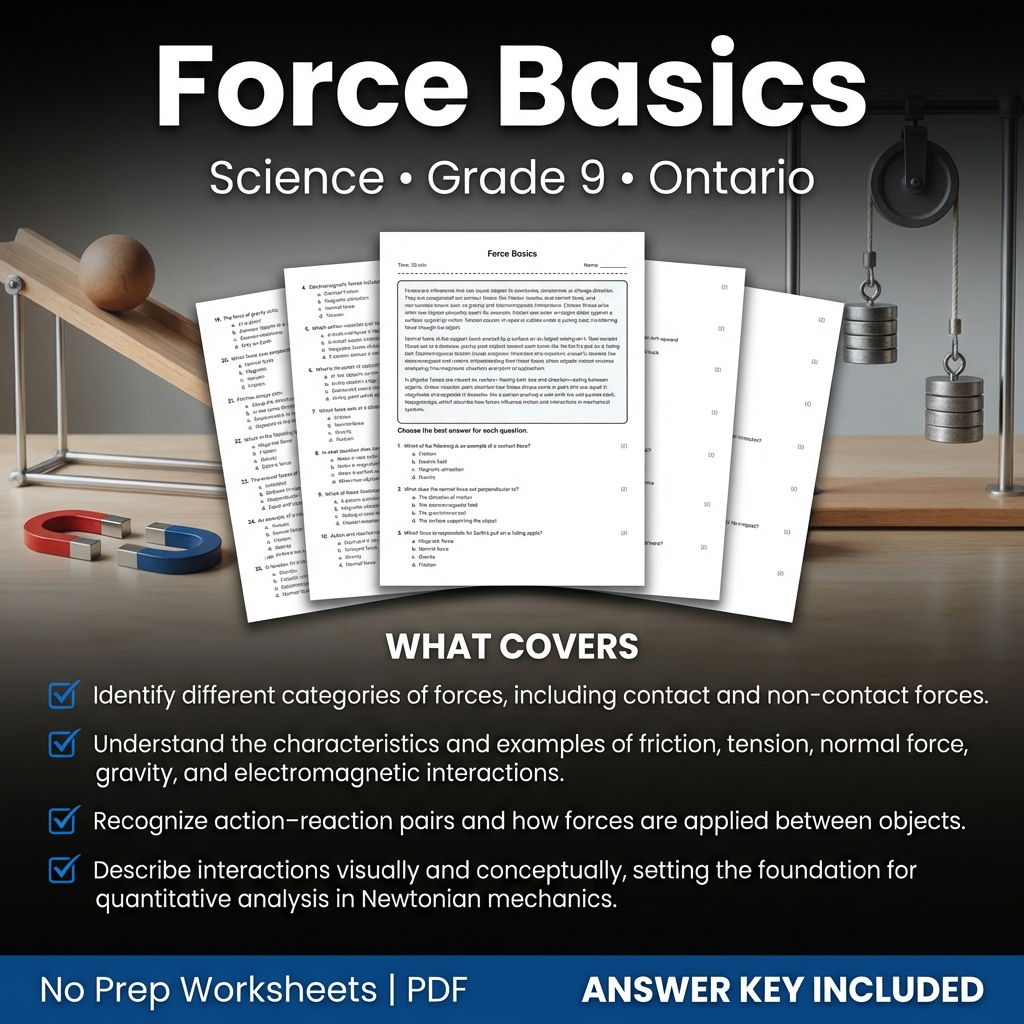
Force Basics Science Worksheet Grade 9 | Ontario Standards Practice
Created byCoral Reef LearningLearning Objectives
- Identify different categories of forces, including contact and non-contact forces.
- Understand the characteristics and examples of friction, tension, normal force, gravity, and electromagnetic interactions.
- Recognize action–reaction pairs and how forces are applied between objects.
Instant download
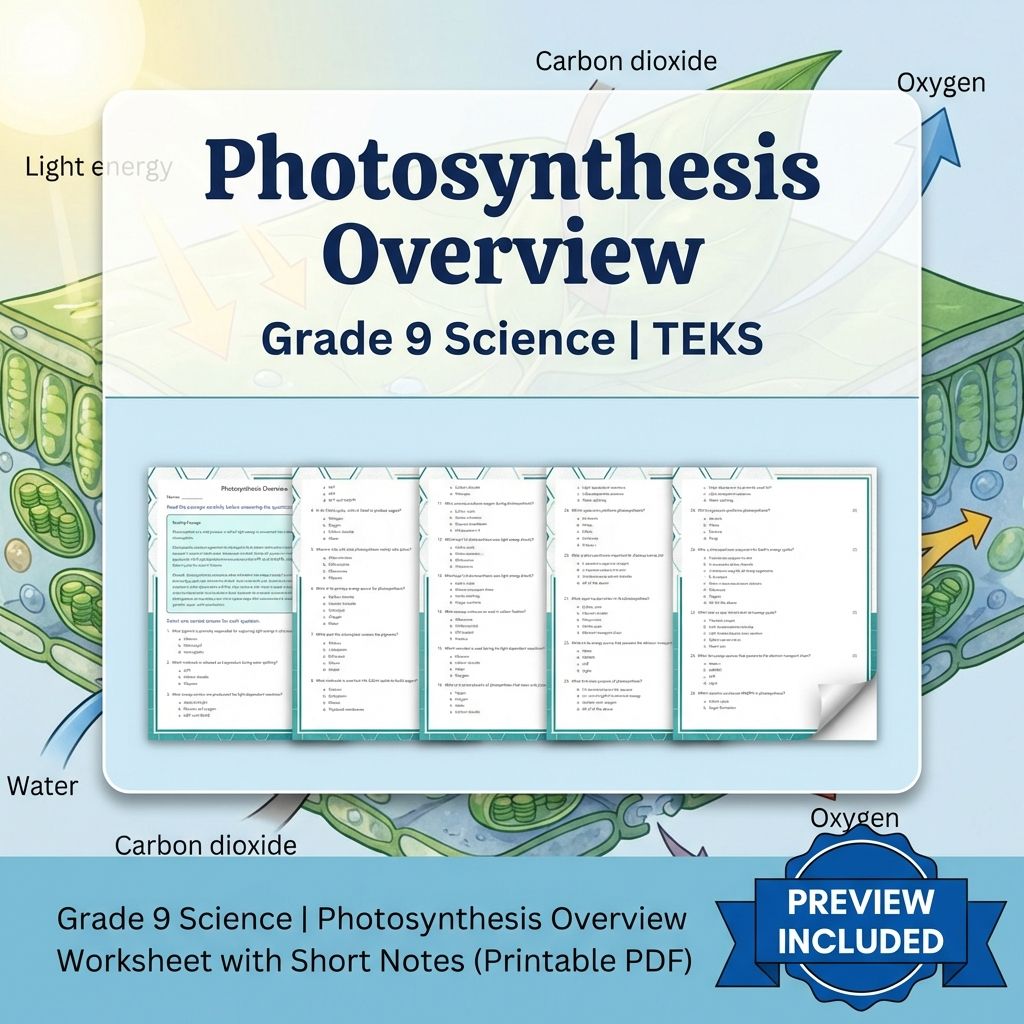
Grade 9 Science | Photosynthesis Overview Worksheet with Short Notes (PDF)
Created byMeadowlark WorksheetsLearning Objectives
- Describe the main inputs, outputs, and steps involved in photosynthesis.
- Identify the role of pigments in capturing light energy.
- Explain how water oxidation releases oxygen during photosynthesis.
Instant download
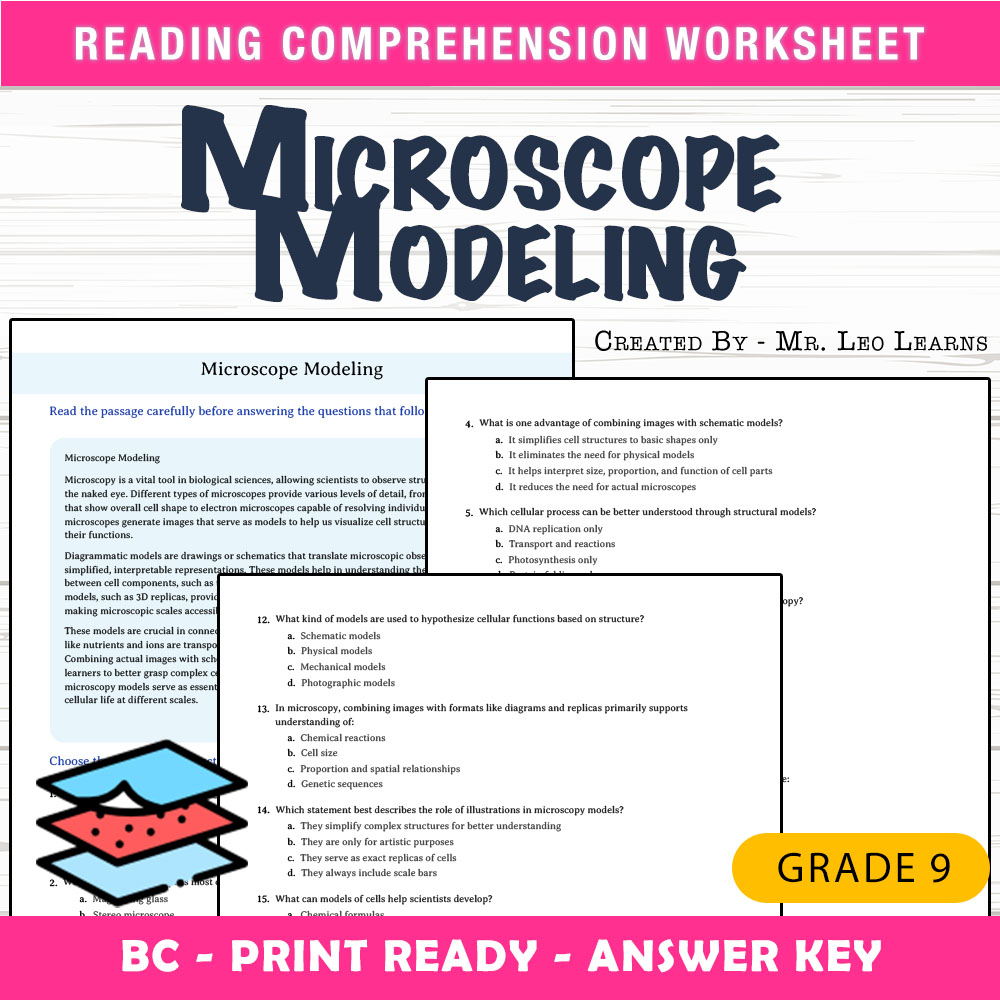
Grade 9 Science — Microscope Modeling Worksheet for Mastery
 Created byThe Resource Hub
Learning Objectives
- Understand how different microscope models represent cell structures and scales.
- Identify the purpose of diagrammatic and physical models in microscopy.
- Explain how visual models help interpret cellular functions and spatial relationships.
Also included in: Grade 9 Science Cells & Body Systems Worksheet Bundle | BC Curriculum Resources +1 more
Instant download

Energy Pathways Worksheet Pack for Grade 9 Science | AP Biology Activities
Created byPrism Point LearningLearning Objectives
- Explain how ATP production is linked to both catabolic and anabolic reactions through energy coupling
- Compare electron transport in photosynthesis and cellular respiration and describe its role in ATP formation
- Use simplified quantitative ideas (energy budgets and stoichiometry) to predict how pathway changes affect cell performance
Instant download
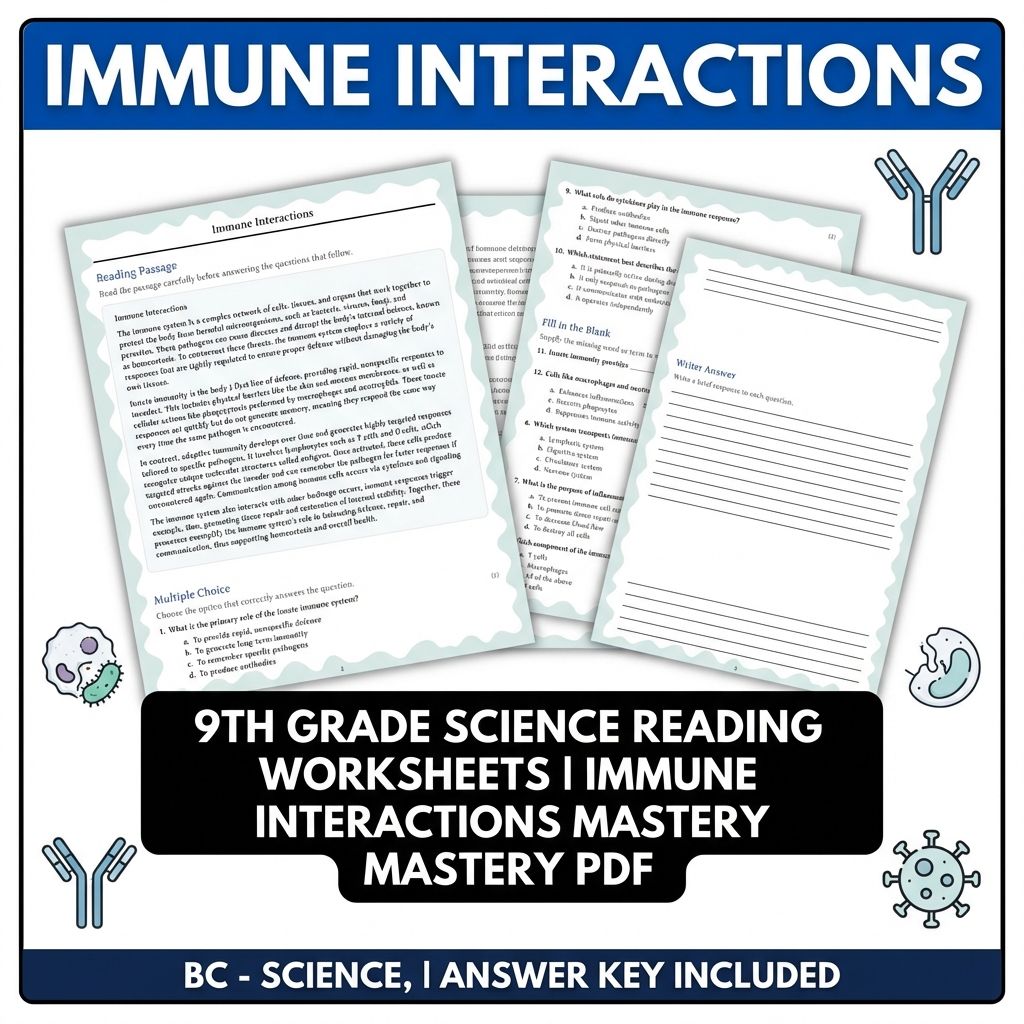
9th Grade Science Reading Worksheets | Immune Interactions Mastery PDF
JCreated byJ.S SheetsLearning Objectives
- Explain how the immune system defends against pathogens and maintains homeostasis.
- Differentiate between innate and adaptive immune responses.
- Describe how immune cells communicate with other systems like endocrine and circulatory pathways.
Instant download

Grade 9 Science | Homeostasis Basics Worksheet | BC Aligned
Created byLumora LearningLearning Objectives
- Understand the concept of homeostasis and its importance in body regulation.
- Identify different body systems involved in maintaining internal stability.
- Describe feedback mechanisms used in homeostasis.
Instant download

Grade 9 Science | Immune Interactions Worksheet | BC Standards
Created byLumora LearningLearning Objectives
- Describe how the innate and adaptive immune responses work to protect the body.
- Explain the communication between immune cells and other systems like endocrine and circulatory pathways.
- Identify the roles of different immune responses in maintaining homeostasis after injury.
Instant download

Grade 9 Science | Levels Overview Worksheet | BC Standards
Created byLumora LearningLearning Objectives
- Explain the hierarchy of biological organization from molecules to organisms.
- Describe the concept of emergent properties at different levels of biological complexity.
- Understand how cellular processes contribute to the function of tissues, organs, and systems.
Instant download
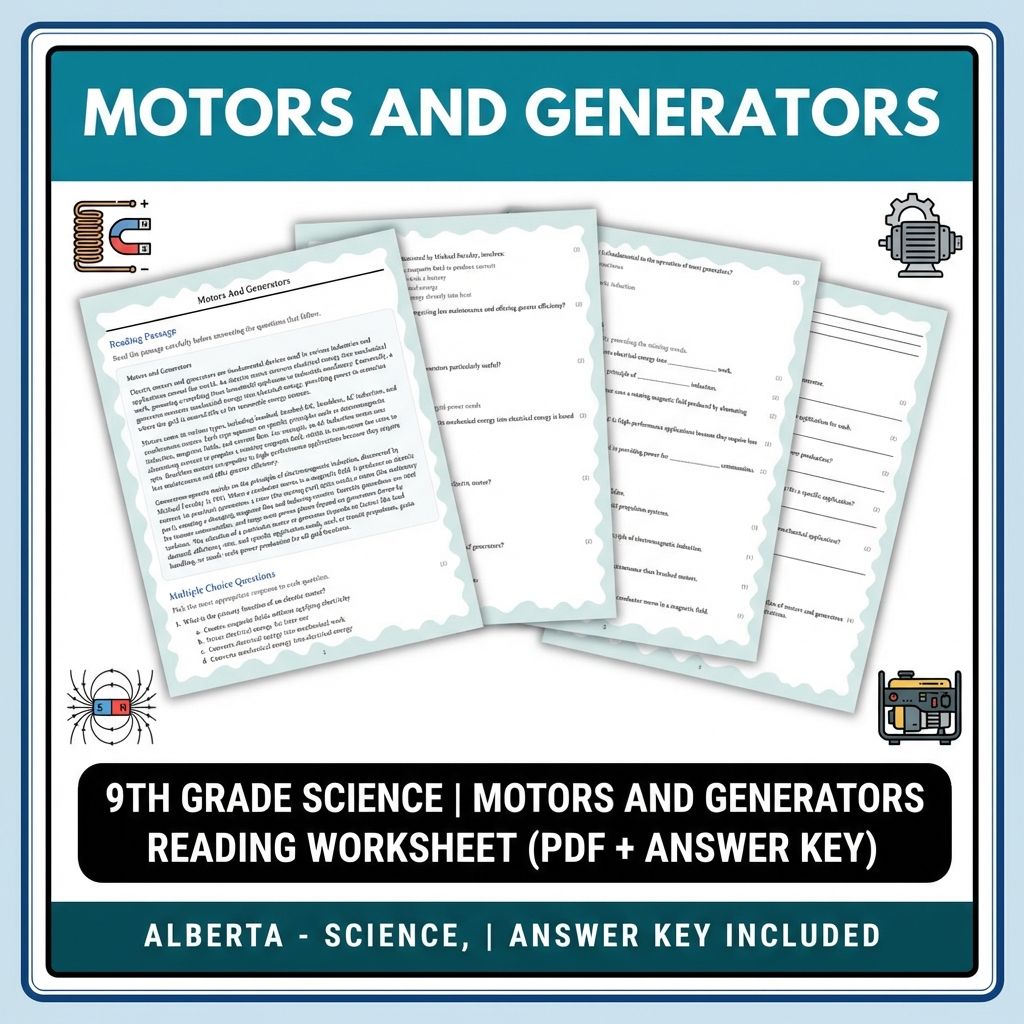
9th Grade Science | Motors and Generators Reading Worksheet (PDF + Answer Key)
JCreated byJ.S SheetsLearning Objectives
- Understand the basic principles of electric motors and generators.
- Identify different types of motors and their applications.
- Explain the electromagnetic induction process used in generators.
Also included in: Grade 9 Science Bundle | Electricity, Energy & Magnetism (PDF + Answer Keys) +1 more
Instant download
Grade 9 Science | Immune Barriers Worksheet (Ontario Standard) (PDF)
Created byBright Mind ResourcesLearning Objectives
- Describe the different physical barriers, such as skin and mucosa, that defend against pathogens.
- Explain the role of cellular mediators like macrophages and lymphocytes in immune defense.
- Understand the mechanisms of inflammation, memory formation, and immune response modulation by environmental factors.
Instant download

Grade 9 Science | Physical Changes & States of Matter - Reading Comprehension
Created byCoral Reef LearningLearning Objectives
- Understand the concept of physical changes and how they differ from chemical changes.
- Identify examples of physical changes such as melting and freezing.
- Describe the processes of melting and freezing in everyday life.
Also included in: Matter and Chemical Change Lesson Bundle – Grade 9 Science Alberta +1 more
Instant download
9th Grade Science | Force Laws Worksheet (PDF+ Answer Key)
Created byCopper Leaf ClassroomLearning Objectives
- Understand the mathematical forms of gravitational and electrostatic force equations.
- Predict magnitudes and directions of forces between masses and charged objects using inverse-square laws.
- Apply vector concepts to analyze net forces in various scenarios.
Instant download
9th Grade Science | Organelle Systems Worksheet with Short Notes ( PDF)
Created byMeadowlark WorksheetsLearning Objectives
- Understand the function and coordination of organelle systems within cells.
- Identify the roles of chloroplasts, mitochondria, and the endoplasmic reticulum.
- Explain how transport vesicles and the cytoskeleton contribute to cell maintenance.
Instant download
Grade 9 Science Momentum and Collisions Worksheet(PDF + Answer Key)
Created byCopper Leaf ClassroomLearning Objectives
- Understand the basic concept of linear momentum.
- Identify types of collisions: elastic and inelastic.
- Calculate total momentum before and after collisions.
Instant download
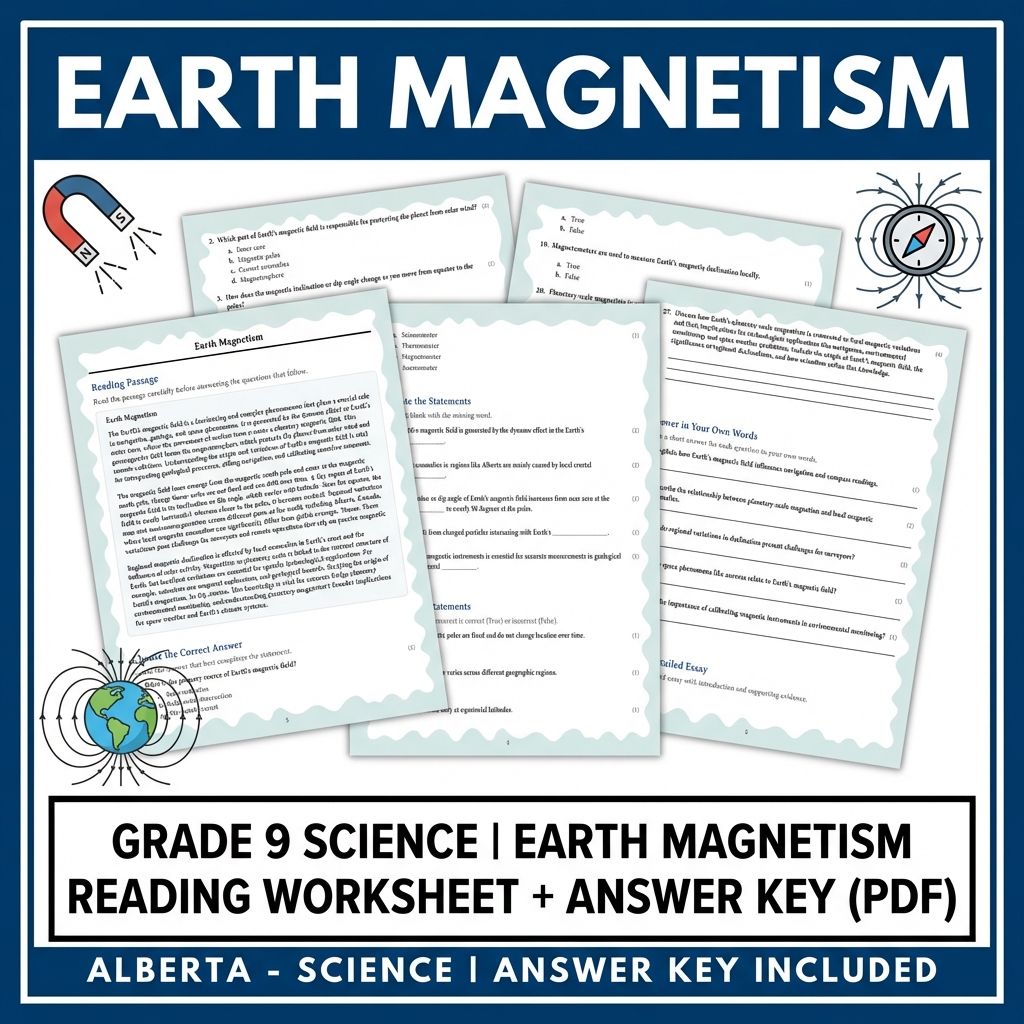
Grade 9 Science | Earth Magnetism Reading Worksheet + Answer Key (PDF)
JCreated byJ.S SheetsLearning Objectives
- Understand the origin and nature of Earth's magnetic field.
- Explore regional variations in magnetic declination and their implications.
- Learn how magnetic instruments are calibrated for geological and environmental monitoring.
Also included in: Grade 9 Science Bundle | Electricity, Energy & Magnetism (PDF + Answer Keys) +1 more
Instant download
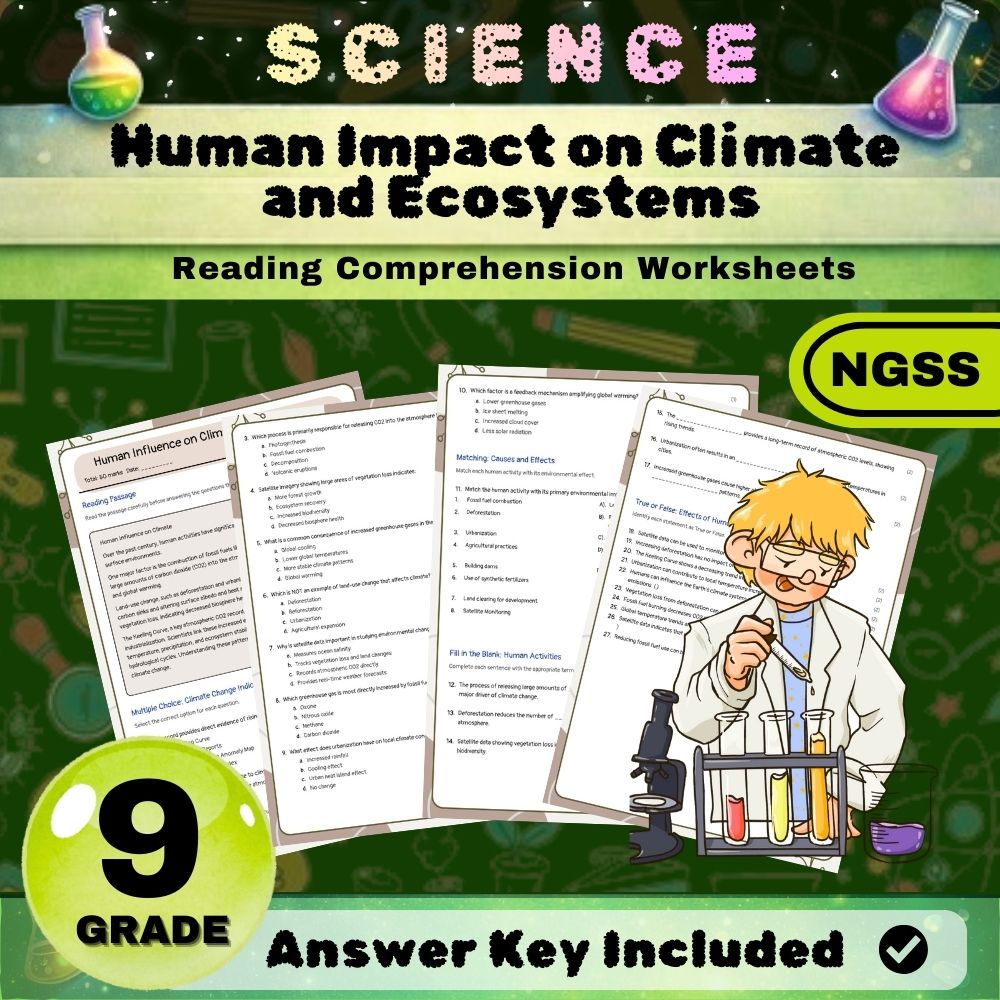
Grade 9 Science – Human Impact on Climate and Ecosystems (NGSS Worksheet PDF)
 Created byMaple Path Learning
Learning Objectives
- Understand the key human activities that influence atmospheric carbon dioxide levels.
- Analyze how land-use change and fossil fuel combustion affect climate variables.
- Interpret data from indicators like the Keeling Curve and satellite imagery to assess environmental changes.
Also included in: Grade 9 Science NGSS Lesson Bundle | Earth and Human Activity Unit +1 more
Instant download
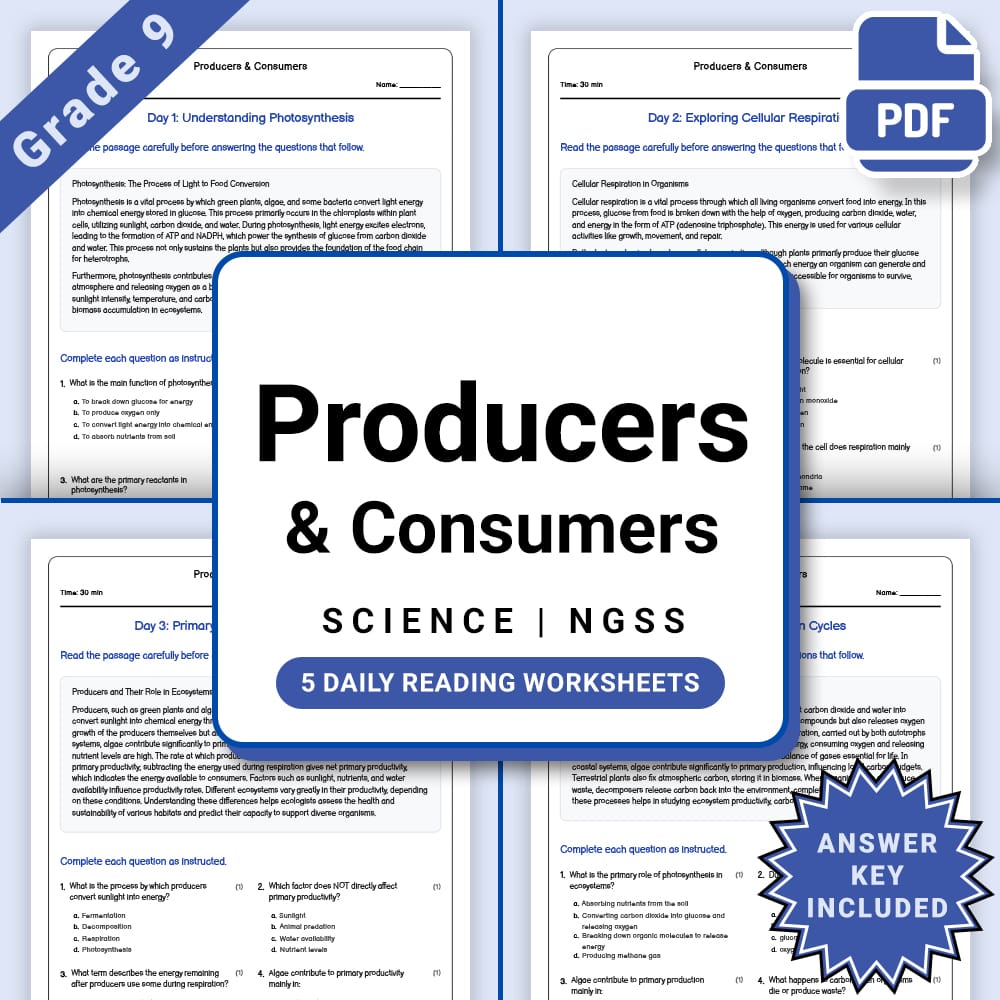
Grade 9 Science – Producers & Consumers Worksheet(PDF + Answer Key)
Created byCopper Leaf ClassroomLearning Objectives
- Explain the process of photosynthesis and its importance in energy transfer.
- Identify the roles of autotrophs and heterotrophs in ecosystems.
- Analyze how photosynthesis and respiration contribute to the carbon and oxygen cycles.
Instant download

Grade 9 Science – Inertia Explained Worksheet (PDF) BC Standards
Created byEvergreen Desk EducationLearning Objectives
- Explain inertia as an object’s resistance to changes in motion
- Relate inertia to mass and describe how net force and acceleration are connected
- Use real-world examples to predict and justify motion outcomes
Instant download

Reaction Design Worksheet | Grade 9 Science NGSS Review & Practice
Created byPrism Point LearningLearning Objectives
- Explain how reaction conditions (temperature, pressure, concentration, and catalysts) can change reaction rates and product outcomes.
- Connect equilibrium and kinetics to predict how a chemical system can be refined for a desired product.
- Use basic reasoning about selectivity, yield, and side reactions to design reaction conditions in closed systems.
Also included in: Grade 9 Reaction Stoichiometry and Rates Science Lesson Bundle | NGSS
Instant download
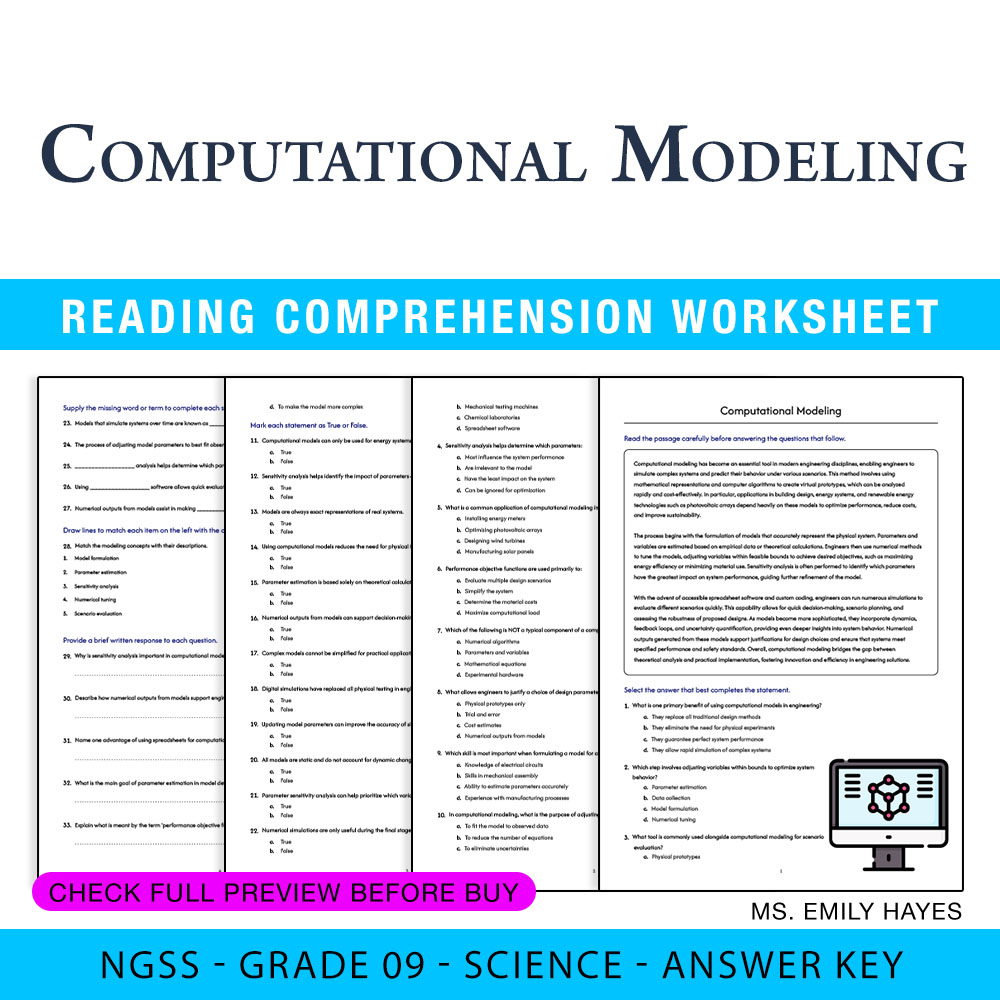
Grade 9 Science | Computational Modeling Worksheet (PDF+ Answer Key)
Created byCopper Leaf ClassroomLearning Objectives
- Understand the application of mathematical and computational methods in system modeling.
- Develop skills to formulate, analyze, and tune models for systems such as building envelopes and photovoltaic arrays.
- Use spreadsheets or basic code to evaluate scenarios and interpret numerical outputs for design decisions.
Instant download

Grade 9 Science | Classification Foundations Worksheet (TEKS) (PDF)
Created byEvergreen Desk EducationLearning Objectives
- Explain why biological classification uses hierarchical ranks and how organisms are grouped based on shared characteristics.
- Compare traditional classification (taxonomic ranks and morphology) with modern classification (evolutionary relationships and clades).
- Use binomial nomenclature concepts to interpret and communicate scientific names for species.
Instant download

Mountain Building Worksheet | AP Science 9th Grade Practice
JCreated byJ.S SheetsLearning Objectives
- Understand the processes involved in mountain-building, including crustal shortening, thickening, and metamorphism.
- Analyze how plate convergence influences surface topography and erosion patterns.
- Evaluate the impact of mountain-building episodes on regional climate and sediment delivery.
Instant download
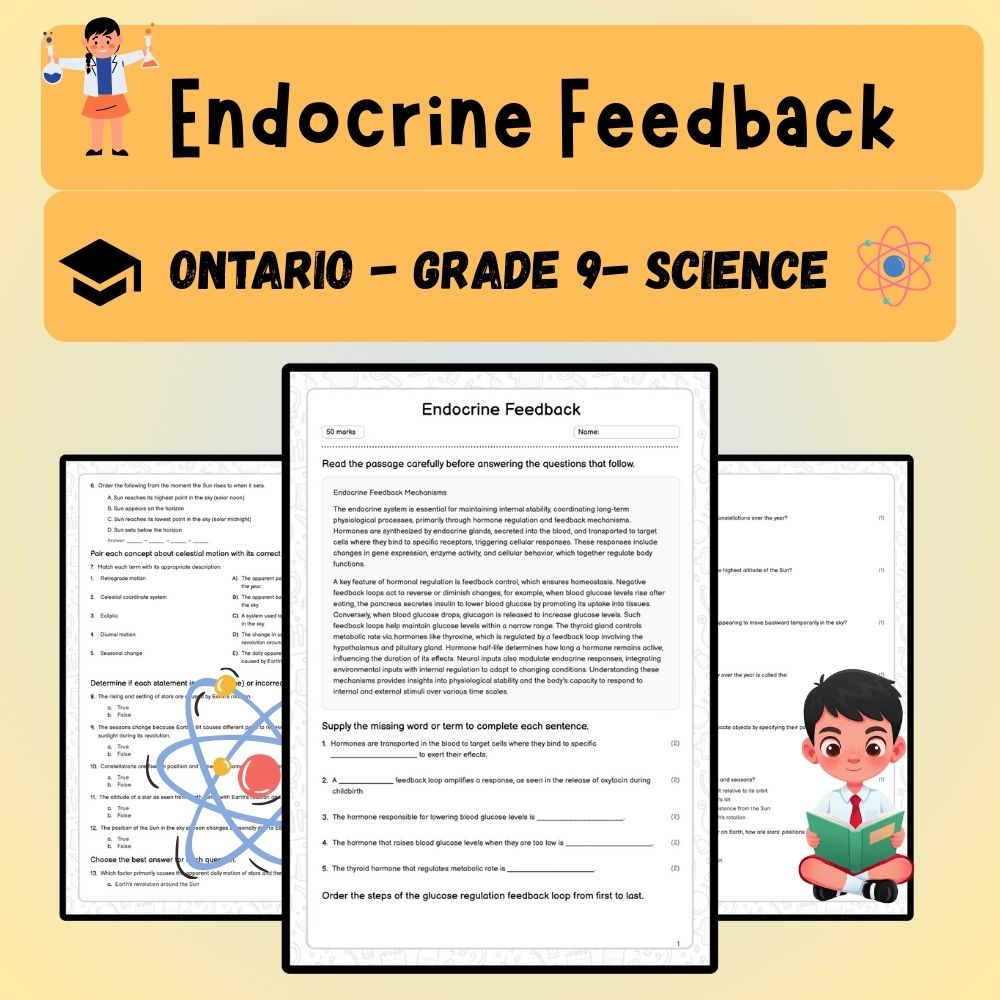
Grade 9 Science – Endocrine Feedback Worksheet (Answer Key) | Ontario Standards
Created byPrism Point LearningLearning Objectives
- Understand how hormones regulate physiological processes through feedback loops.
- Identify components of hormonal pathways involved in glucose homeostasis and thyroid control.
- Explain cellular hormone actions including gene expression and enzyme activity changes.
Also included in: Grade 9 Science Unit Bundle | Human Body Systems & Cell Functions +1 more
Instant download

9th Grade Science | Cell Components Reading Worksheet (PDF + Rubric)
JCreated byJ.S SheetsLearning Objectives
- Describe the major structural features of cells, including membranes, organelles, and the cytoskeleton.
- Explain how cellular structures are related to their specific functions such as transport, metabolism, and support.
- Analyze how changes in membrane composition or organelle integrity affect cell processes like diffusion and metabolic efficiency.
Instant download
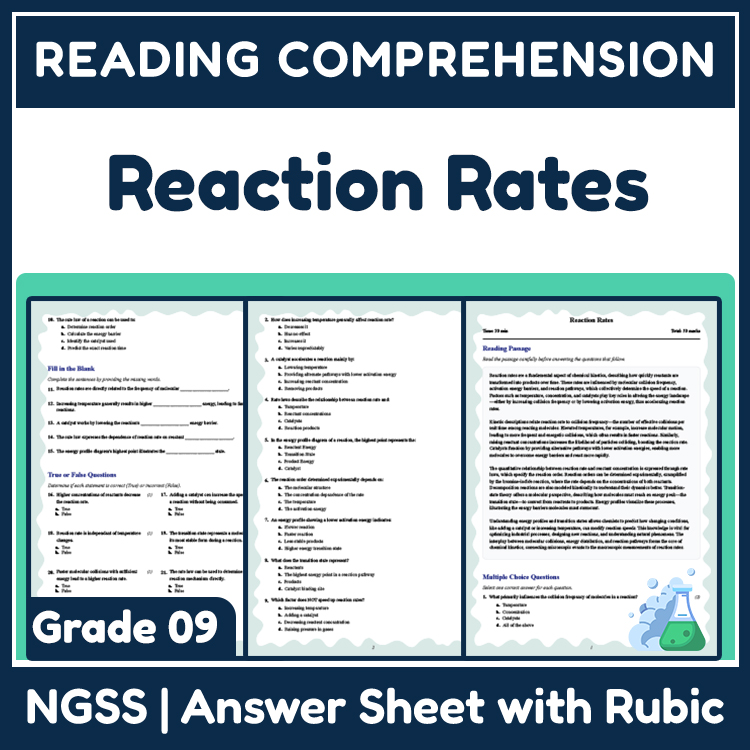
9th Grade Science | Reaction Rates Reading Worksheet (PDF & Rubric)
JCreated byJ.S SheetsLearning Objectives
- Understand the kinetic principles that relate reaction rate to collision frequency, activation energy, and pathways.
- Explain how temperature, concentration, and catalysts influence accessible energy distributions and reaction speeds.
- Describe the concepts of rate laws and reaction order, and interpret kinetic data such as bromine-iodide reactions.
Instant download

Grade 9 Feedback Mechanisms in Physiology Worksheet | NGSS Science Activity
Created byBRIGHT PATH RESOURCESLearning Objectives
- Understand the concept of negative and positive feedback in physiological processes.
- Identify examples of feedback mechanisms involved in thermoregulation, blood glucose control, and osmoregulation.
- Explain the roles of sensors, effectors, and set points in maintaining internal stability.
Also included in: Cell Signaling Grade 9 Science Daily Reading Worksheets Lesson Bundle | NGSS +1 more
Instant download

9th Grade Science | Respiratory Pathways Worksheet with Short Notes (PDF)
Created byMeadowlark WorksheetsLearning Objectives
- Describe the pathways of cellular respiration, including glycolysis, the TCA cycle, and electron transport chain.
- Connect substrate-level phosphorylation and oxidative phosphorylation to ATP production.
- Compare aerobic and anaerobic respiration outcomes in cells.
Also included in: Grade 9 Science Unit | Cellular Processes & Ecosystems Worksheet Pack (PDF) +1 more
Instant download

Grade 9 Science | Conserved Energy Worksheet Elena | California Standards
Created byLumora LearningLearning Objectives
- Explain the law of conservation of energy for a closed system using kinetic, potential, internal, and radiation-related energy.
- Interpret energy changes in real scenarios by tracking how energy transfers and converts between forms.
- Use energy diagrams and total-energy accounting to predict what must remain constant (or change) during motion and interactions.
Instant download
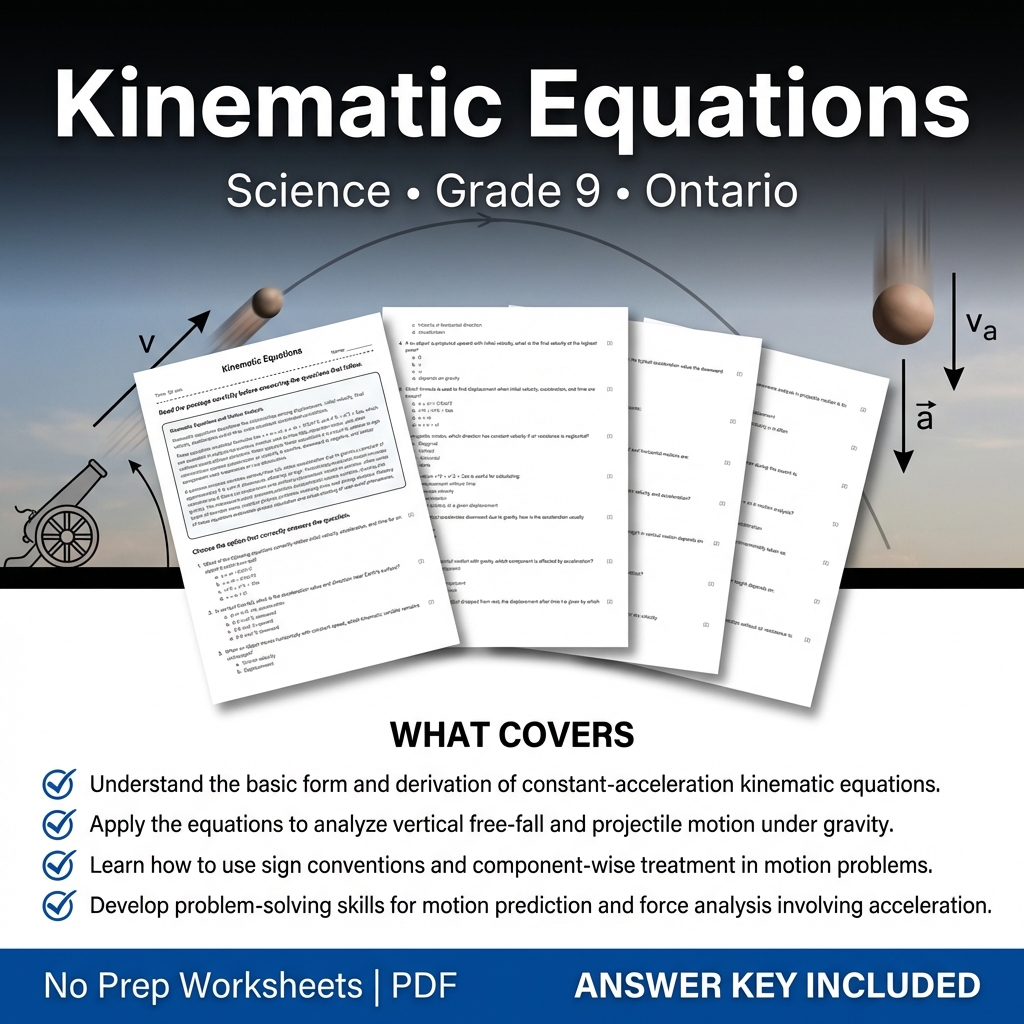
Kinematic Equations Worksheet for Grade 9 Science | Ontario Standards
Created byCoral Reef LearningLearning Objectives
- Understand the basic form and derivation of constant-acceleration kinematic equations.
- Apply the equations to analyze vertical free-fall and projectile motion under gravity.
- Learn how to use sign conventions and component-wise treatment in motion problems.
Instant download
About Grade 9 Science Worksheets
Find Science worksheets built for Grade 9. All 6,926 cover core skills, practice, and review, each an instant PDF download.
Every worksheet on MyTeachingSheets is created by independent teacher-authors and reviewed before publication. All resources download as printable PDFs for classroom, homework, or at-home practice, and many include answer keys. Preview any worksheet free before buying.