
Grade 9 Science Worksheets
6,926 worksheets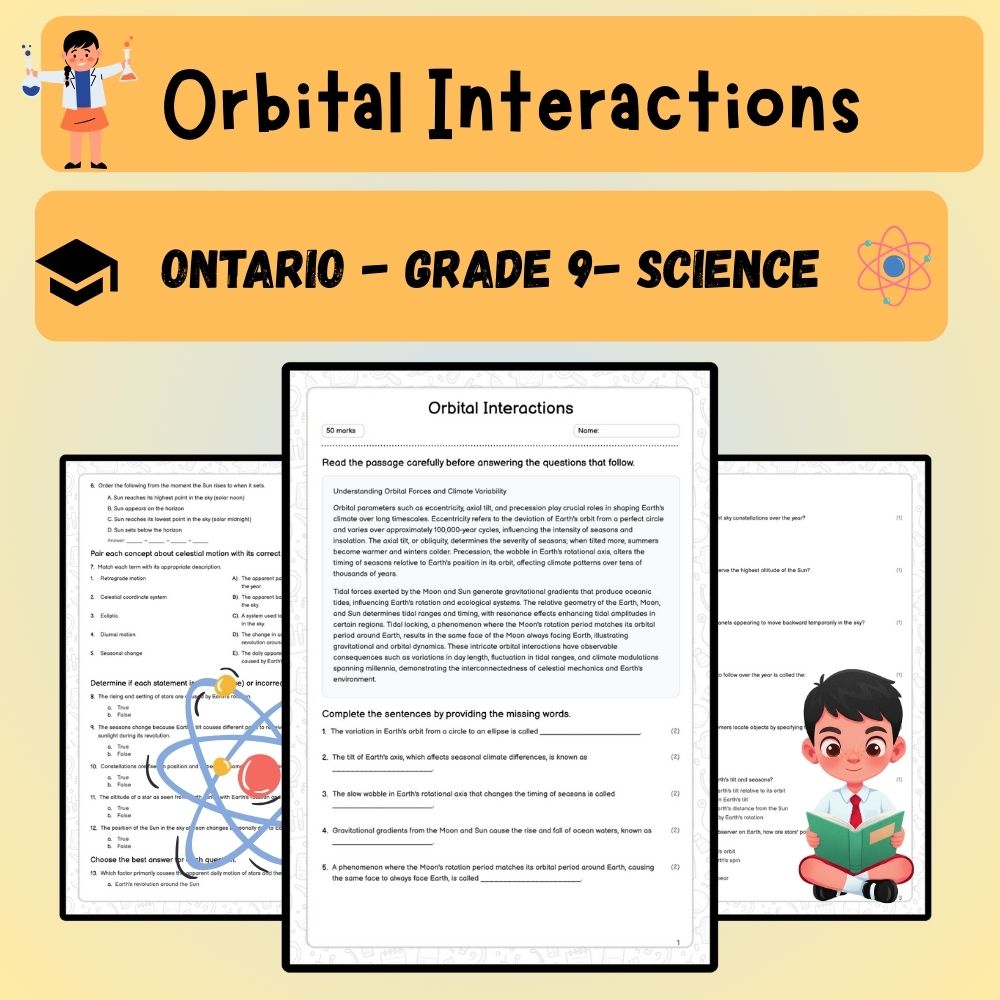
Grade 9 Science | Orbital Interactions Worksheet (Ontario Standard) – PDF
 Created byPrism Point Learning
Learning Objectives
- Understand how orbital parameters such as eccentricity, axial tilt, and precession affect seasonal insolation and climate patterns.
- Explain tidal forces caused by the Moon and Sun through gravitational gradients and relative geometry.
- Describe resonance effects and tidal locking phenomena in celestial mechanics.
Also included in: Grade 9 Science Unit Bundle | Earth, Weather, Energy & Tectonics +1 more
Instant download
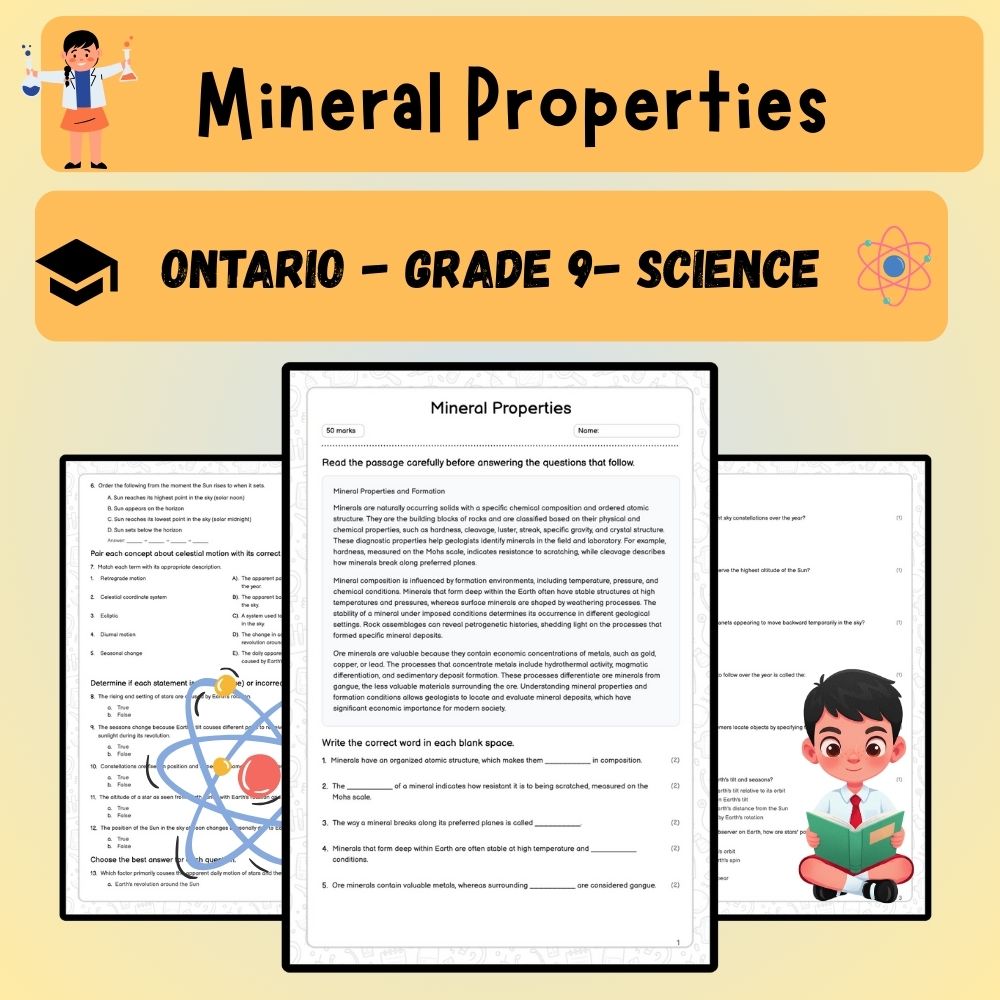
Grade 9 Science | Mineral Properties Worksheet (PDF) – Ontario Standards
Created byPrism Point LearningLearning Objectives
- Identify and describe diagnostic physical and chemical properties of common rock-forming minerals.
- Explain how mineral composition relates to formation environments and stability under various conditions.
- Connect mineral assemblages to petrogenetic histories and distinguish ore minerals from gangue in economic contexts.
Also included in: Grade 9 Science Unit Bundle | Earth, Weather, Energy & Tectonics +1 more
Instant download

Grade 9 Science | Planetary Layers Worksheet (PDF) – Ontario Standard
Created byPrism Point LearningLearning Objectives
- Understand the structure and composition of Earth's concentric layers: crust, mantle, and core.
- Explain the differences between the lithosphere and asthenosphere in mechanical behavior.
- Describe how variations in density, temperature, and pressure with depth influence material phases and planetary processes.
Also included in: Grade 9 Science Unit Bundle | Earth, Weather, Energy & Tectonics +1 more
Instant download
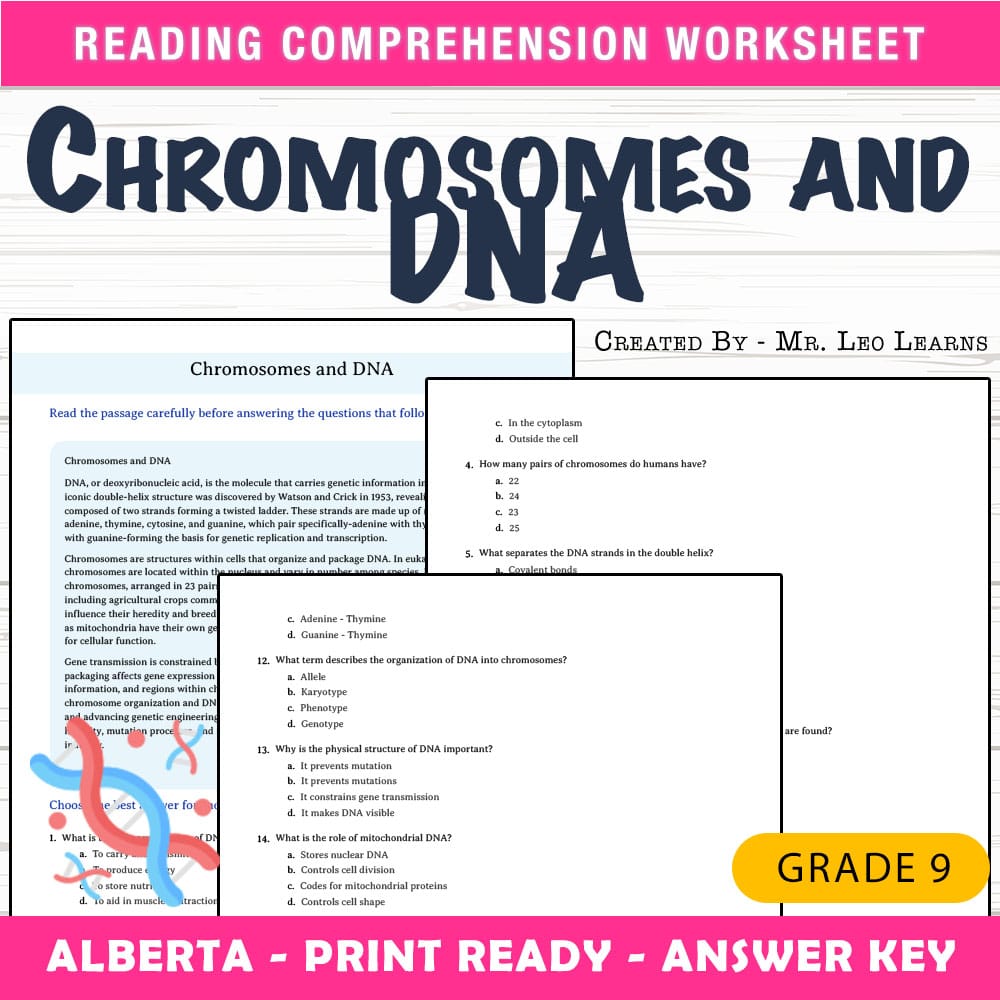
Grade 9 Science — Worksheet MCQ Paper for Mastering Chromosomes and DNA
 Created byThe Resource Hub
Learning Objectives
- Understand the structure of DNA and its double-helix composition.
- Identify how chromosomes organize genetic information within the cell.
- Differentiate between nuclear and organelle genomes and their roles.
Also included in: Grade 9 Science Lesson Bundle | Reproduction and Heredity Worksheets +1 more
Instant download
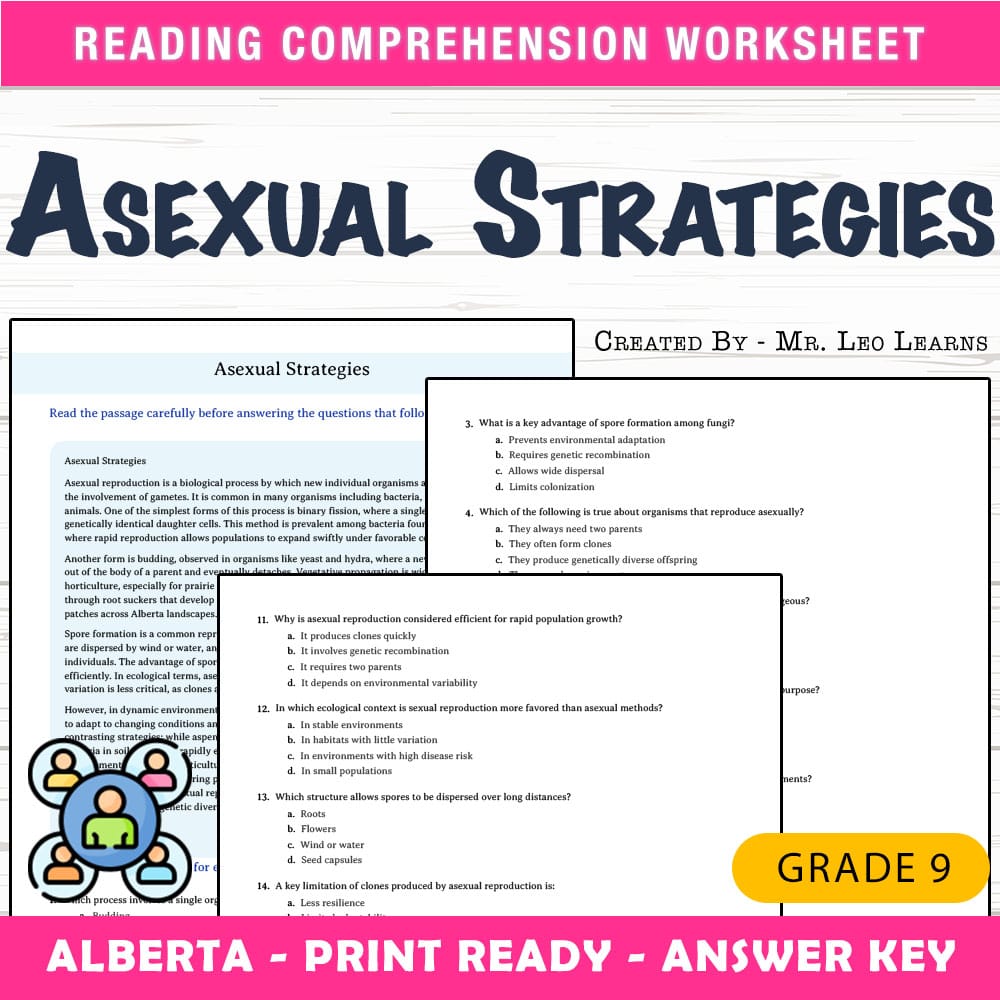
Grade 9 Science — Worksheet MCQ Paper for Mastering Asexual Strategies
Created byThe Resource HubLearning Objectives
- Understand different mechanisms of asexual reproduction such as binary fission, budding, spore formation, and vegetative propagation.
- Identify ecological advantages and disadvantages of asexual reproduction methods.
- Recognize Alberta-specific examples of asexual reproduction like aspen root suckers and horticultural practices.
Also included in: Grade 9 Science Lesson Bundle | Reproduction and Heredity Worksheets +1 more
Instant download
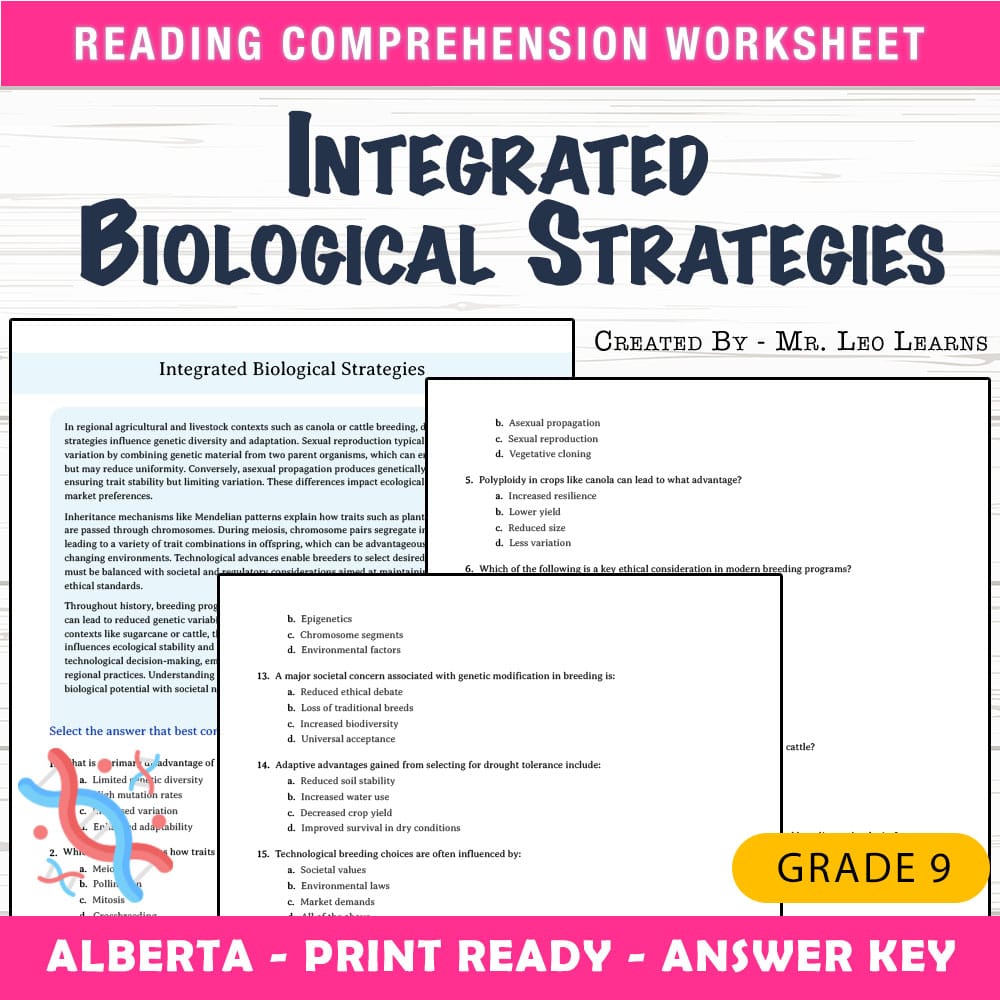
Grade 9 Science — Worksheet MCQ Paper for Mastering Biological Strategies
Created byThe Resource HubLearning Objectives
- Understand the differences between sexual and asexual propagation and their effects on genetic diversity.
- Trace inheritance patterns of traits through chromosomes and Mendelian principles.
- Examine the ecological and societal implications of selection and breeding practices.
Also included in: Grade 9 Science Lesson Bundle | Reproduction and Heredity Worksheets +1 more
Instant download
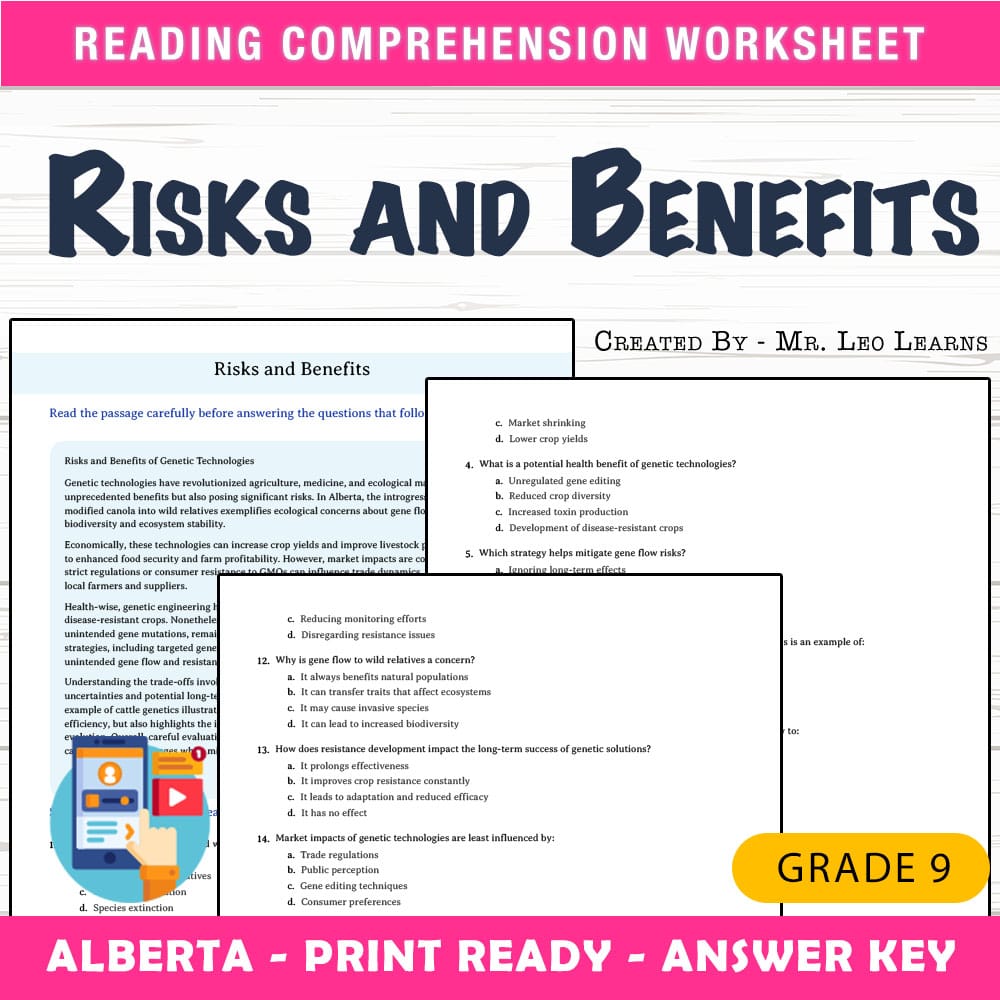
Grade 9 Science — Risks and Benefits Worksheet MCQ Paper
Created byThe Resource HubLearning Objectives
- Understand the ecological, economic, and health risks associated with genetic technologies.
- Evaluate potential consequences such as gene flow, resistance development, and market impacts.
- Identify mitigation strategies, long-term monitoring needs, and the uncertainties involved in risk assessment.
Also included in: Grade 9 Science Lesson Bundle | Reproduction and Heredity Worksheets +1 more
Instant download
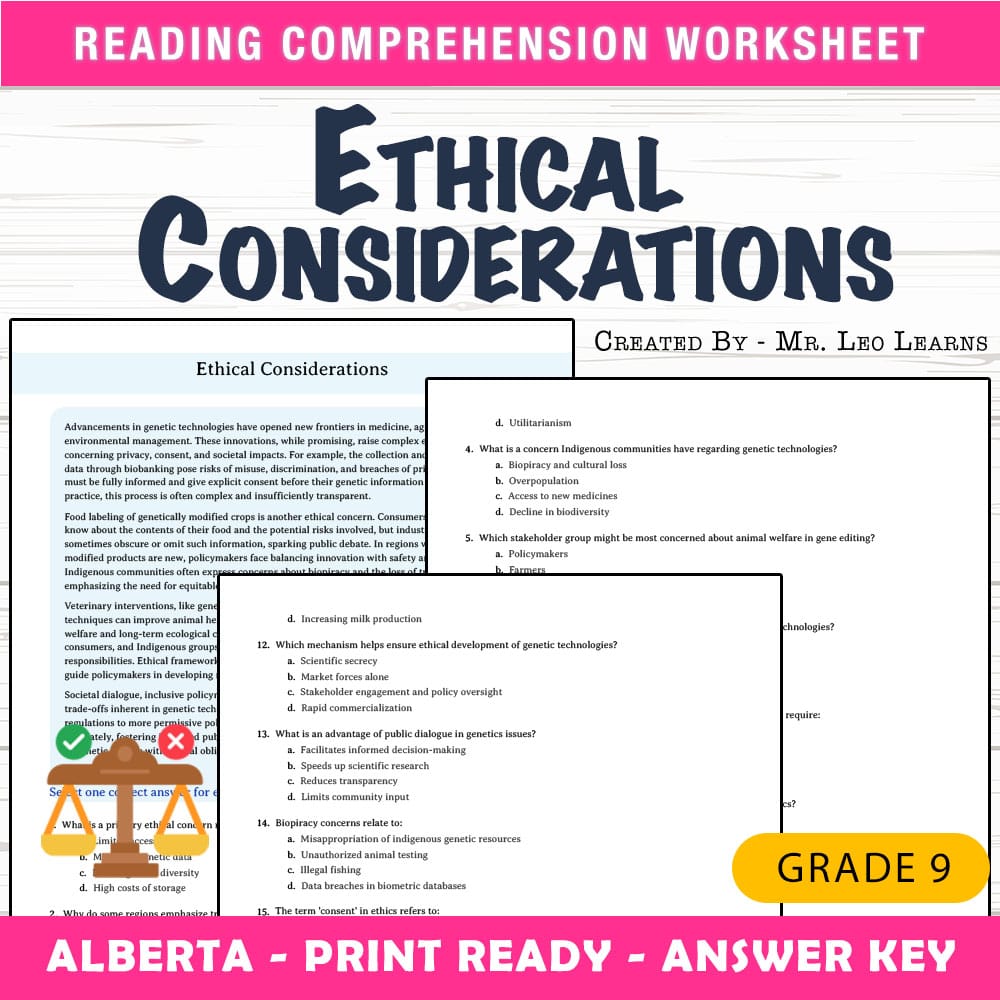
Grade 9 Science — Worksheet MCQ Paper for Ethical Considerations
Created byThe Resource HubLearning Objectives
- Understand key ethical issues in the application of genetic technologies.
- Analyze societal impacts of genetic science on different stakeholders.
- Evaluate the role of policy, consent, and public dialogue in responsible genetics development.
Also included in: Grade 9 Science Lesson Bundle | Reproduction and Heredity Worksheets +1 more
Instant download

Grade 9 Science | Seismic Records Worksheet | AP Aligned
 Created byLumora Learning
Learning Objectives
- Interpret earthquake waveforms, travel-time curves, and epicenter maps to analyze subsurface structures.
- Distinguish between P- and S-wave arrivals, waveform amplitudes, and frequency content to identify shallow versus deep seismic events.
- Connect seismicity patterns to tectonic environments and surface hazard phenomena such as tsunamis using instrument-based records.
Also included in: Grade 9 Science | Earth and Space Science Custom Bundle | AP Aligned
Instant download
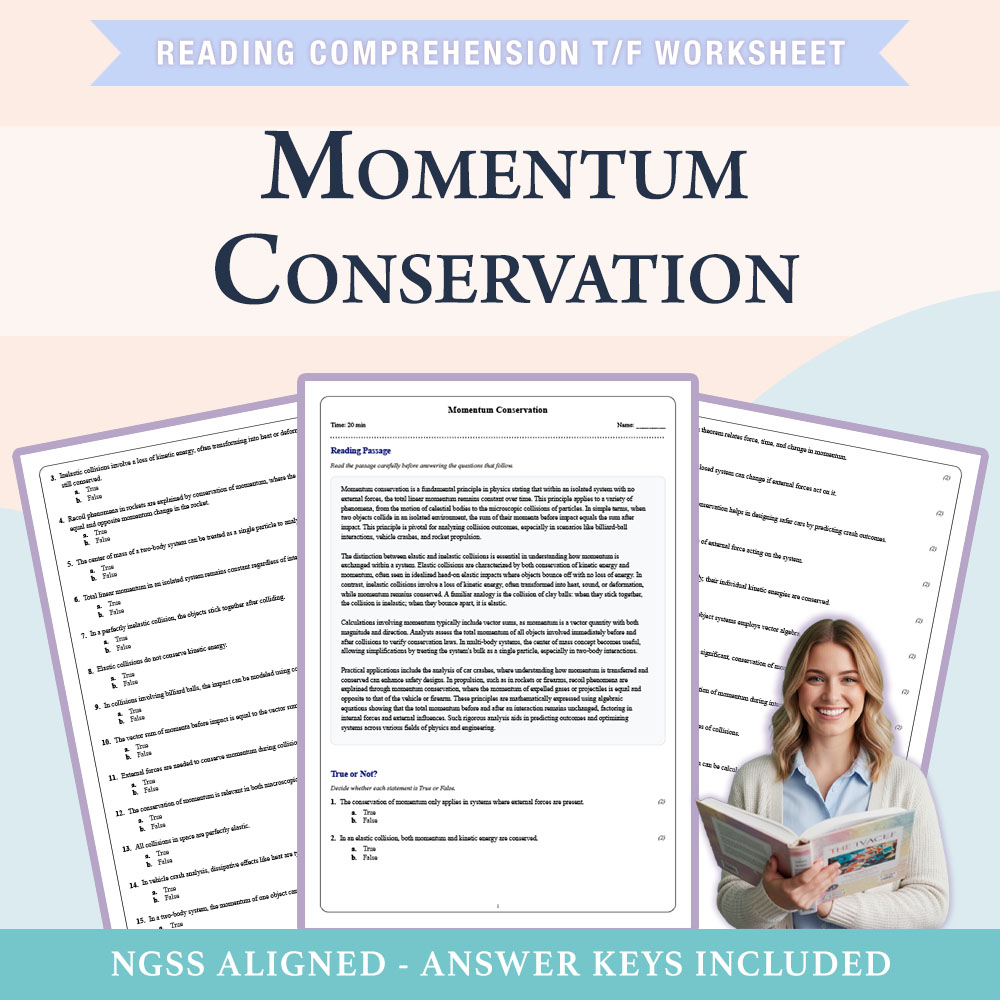
Grade 9 Science | Momentum Conservation Worksheet (PDF + Answer Key)
 Created byCopper Leaf Classroom
Learning Objectives
- Understand the principle of conservation of linear momentum within isolated systems.
- Distinguish between elastic and inelastic collisions using quantitative analysis.
- Apply vector sum calculations to determine total momentum before and after interactions.
Also included in: Grade 9 Science Bundle | Motion, Forces & Magnetism Worksheets (PDF +Answer Key) +1 more
Instant download

Grade 9 Science – Understanding Solar Energy & Climate | Daily Reading Worksheet
 Created byBright Mind Resources
Learning Objectives
- Explain how the Sun influences Earth's climate.
- Identify key factors like solar flux, albedo, and greenhouse gases.
- Describe the Earth's energy budget and surface-atmosphere interactions.
Also included in: Grade 9 Earth Processes Science Daily Reading Worksheets lesson bundle | NGSS +2 more
Instant download
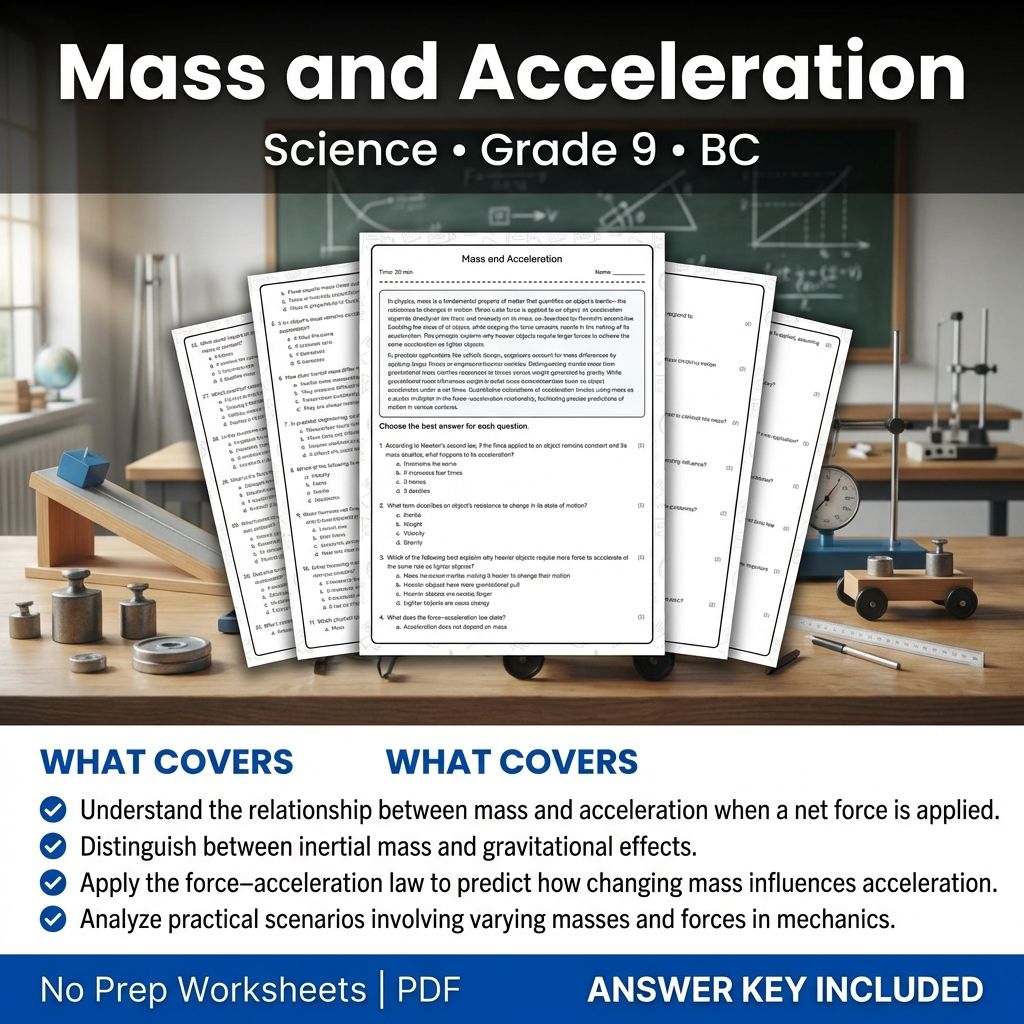
Mass and Acceleration Grade 9 Science Worksheet | BC Standards
 Created byCoral Reef Learning
Learning Objectives
- Understand the relationship between mass and acceleration when a net force is applied.
- Distinguish between inertial mass and gravitational effects.
- Apply the force–acceleration law to predict how changing mass influences acceleration.
Instant download

Measurement Accuracy Worksheet Pack | Grade 9 Science Activities
Created byPrism Point LearningLearning Objectives
- Explain how accurate measurements depend on appropriate scales, calibrated instruments, and consistent units.
- Use significant figures to represent the precision justified by a measuring device.
- Convert between units and record data consistently to reduce misinterpretation.
Instant download
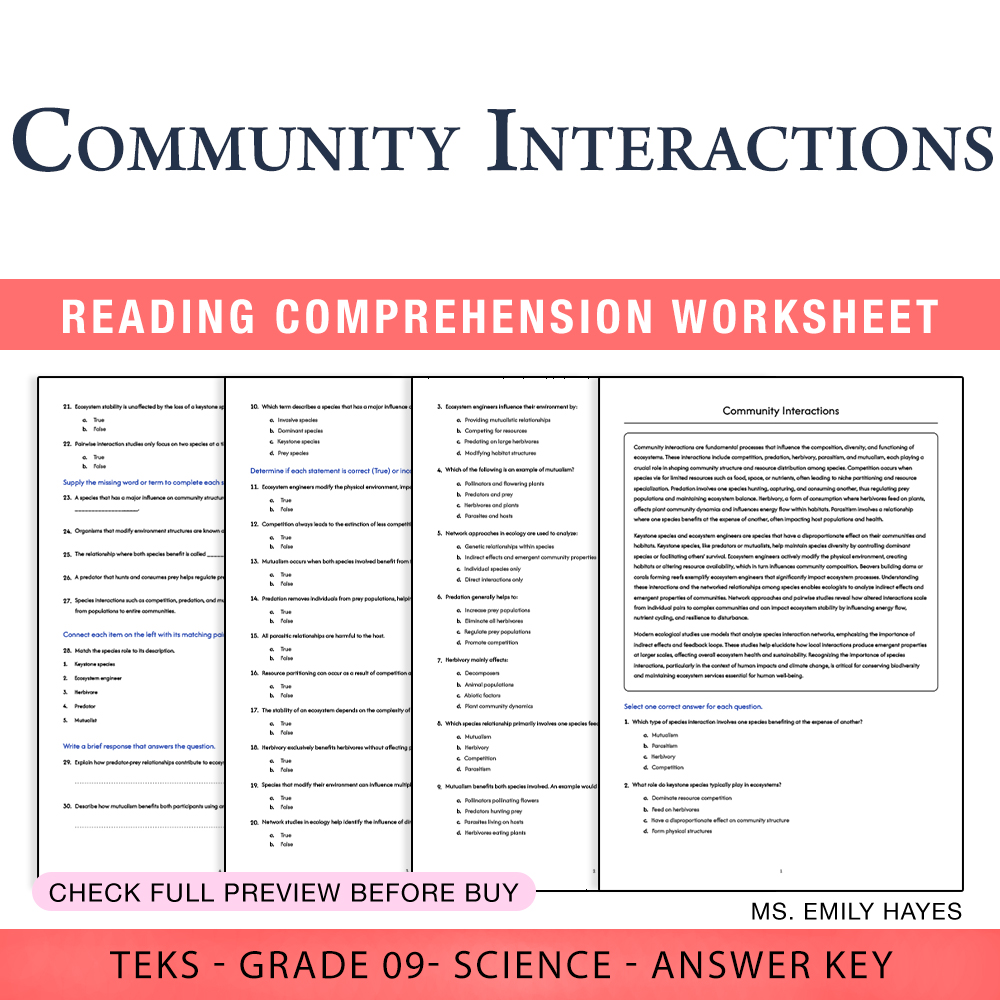
9th Grade Science | Community Interactions Worksheet (PDF+ Answer Key)
Created byCopper Leaf ClassroomLearning Objectives
- Understand the types of species interactions that shape community structure.
- Explain the roles of keystone species and ecosystem engineers.
- Analyze how species interactions influence energy flow and matter cycling.
Instant download
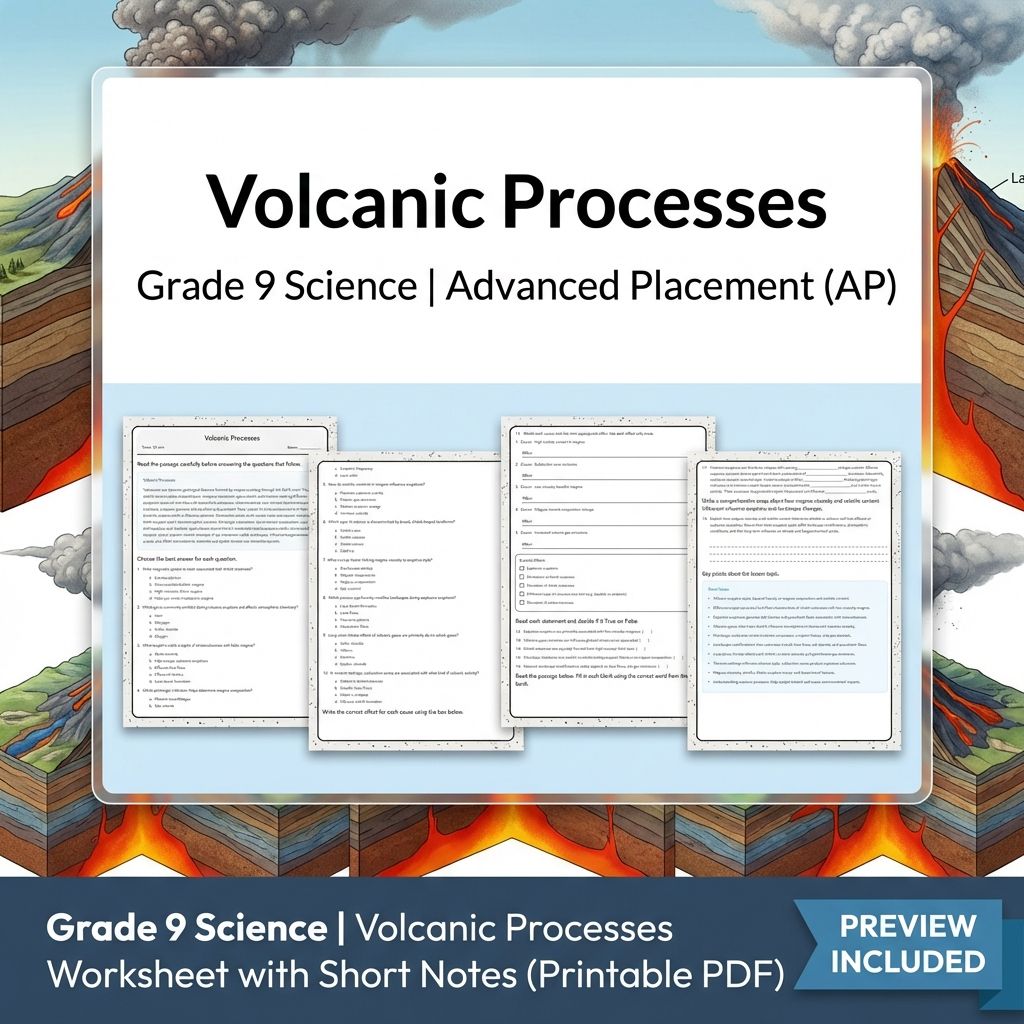
Grade 9 Science | Volcanic Processes Worksheet with Short Notes (Printable PDF)
 Created byMeadowlark Worksheets
Learning Objectives
- Describe magmatic systems, eruptive styles, and volcanic gas emissions based on compositional controls and tectonic settings.
- Compare effusive shield volcanism and explosive stratovolcano behavior, linking magma viscosity and volatile content to eruptive energy.
- Identify petrologic indicators, eruption chronologies, and volcanic gas data to explain landscape modifications and climate influences.
Also included in: Grade 9 Science | Earth Systems & Geology Unit Worksheet Bundle (Printable PDFs) +1 more
Instant download
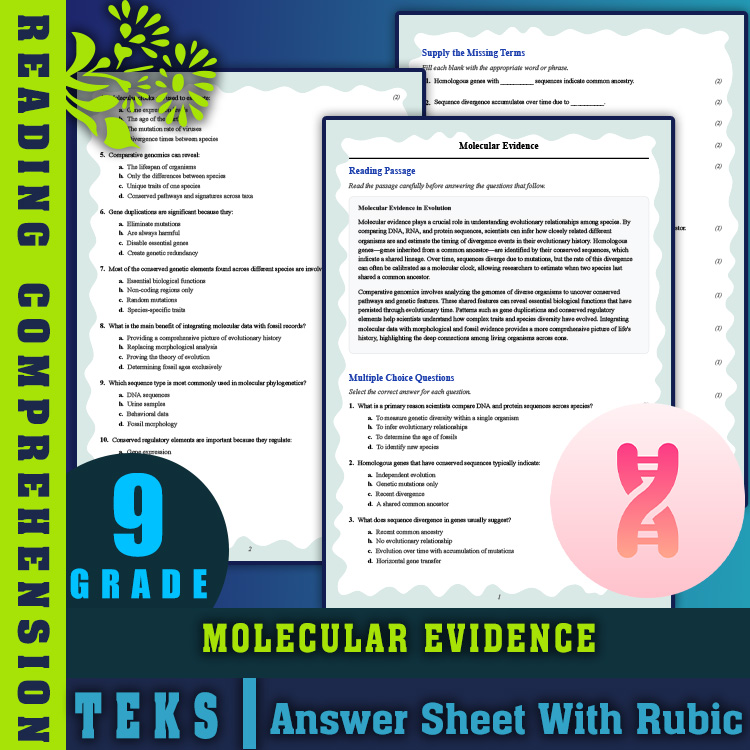
9th Grade Science | Molecular Evidence Reading Worksheet (PDF + Answer Key)
JCreated byJ.S SheetsLearning Objectives
- Understand how molecular data such as DNA, RNA, and protein sequences are used to infer evolutionary relationships.
- Identify the significance of conserved gene sequences and molecular clocks in determining divergence times.
- Explain how comparative genomics helps clarify lineage relationships and evolutionary processes.
Instant download
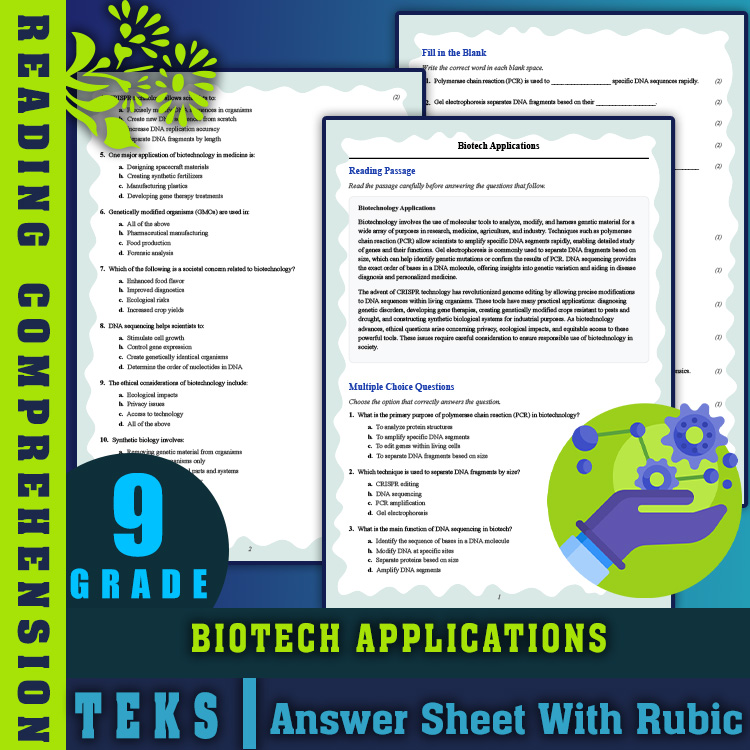
9th Grade Science | Biotech Applications Reading Worksheets (PDF & Answer Key)
JCreated byJ.S SheetsLearning Objectives
- Explain common techniques used in biotechnology such as PCR, gel electrophoresis, DNA sequencing, and CRISPR.
- Identify various applications of biotechnology in medicine, agriculture, and forensic science.
- Assess ethical, legal, and societal implications associated with biotechnological advancements.
Instant download

Grade 9 Plate Boundaries Worksheet | BC Practice PDF
 Created byClear Sky Classroom
Learning Objectives
- Compare divergent, convergent, and transform plate boundaries and the key geological processes at each.
- Explain how plate boundary type influences earthquakes, volcanism, and crustal deformation.
- Identify major landforms associated with plate boundary interactions and interpret regional patterns over geologic time.
Instant download
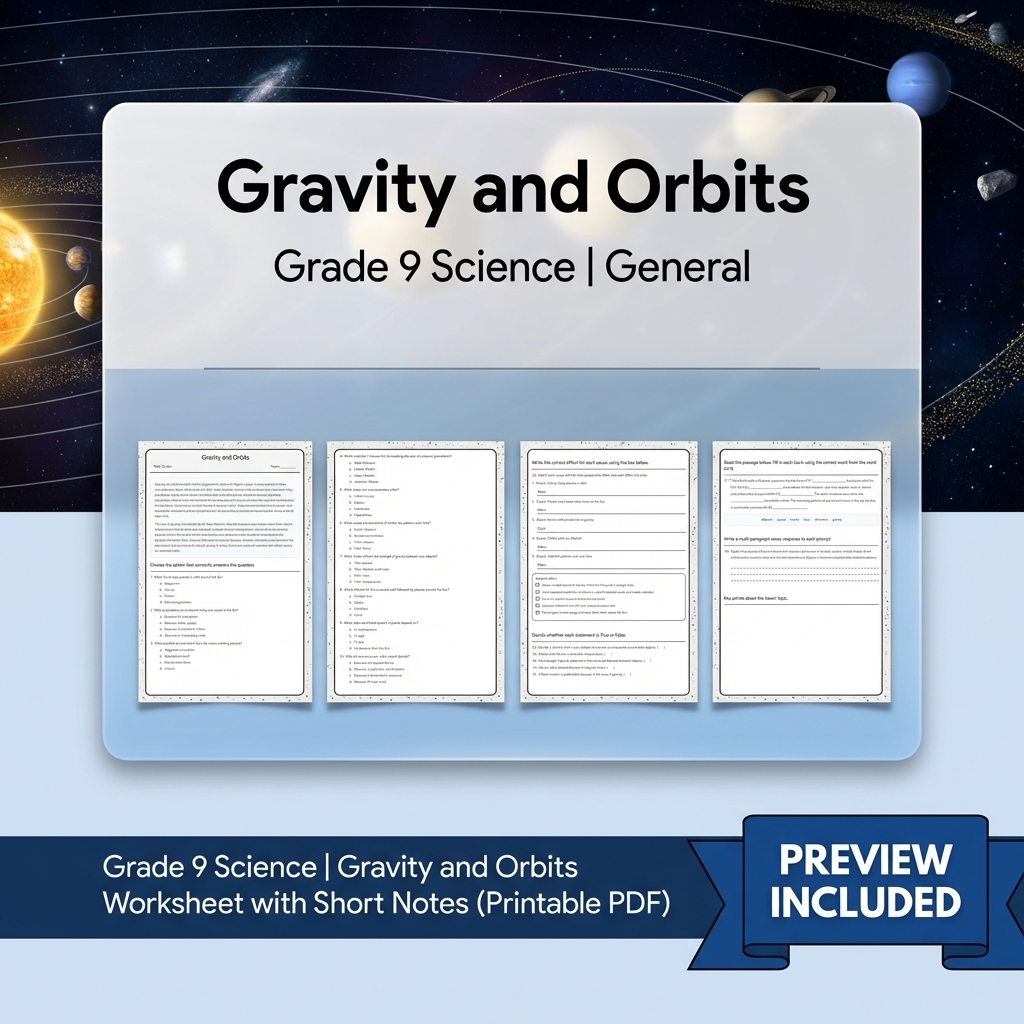
Grade 9 Science | Gravity and Orbits Worksheet with Short Notes (Printable PDF)
Created byMeadowlark WorksheetsLearning Objectives
- Understand how gravity influences the motion of planets and moons in the solar system.
- Describe the relationship between gravitational force and orbital motion.
- Explain why planetary patterns recur predictably over time.
Also included in: Grade 9 Earth Systems Reservoirs & Feedback Science Lesson Bundle: General +1 more
Instant download
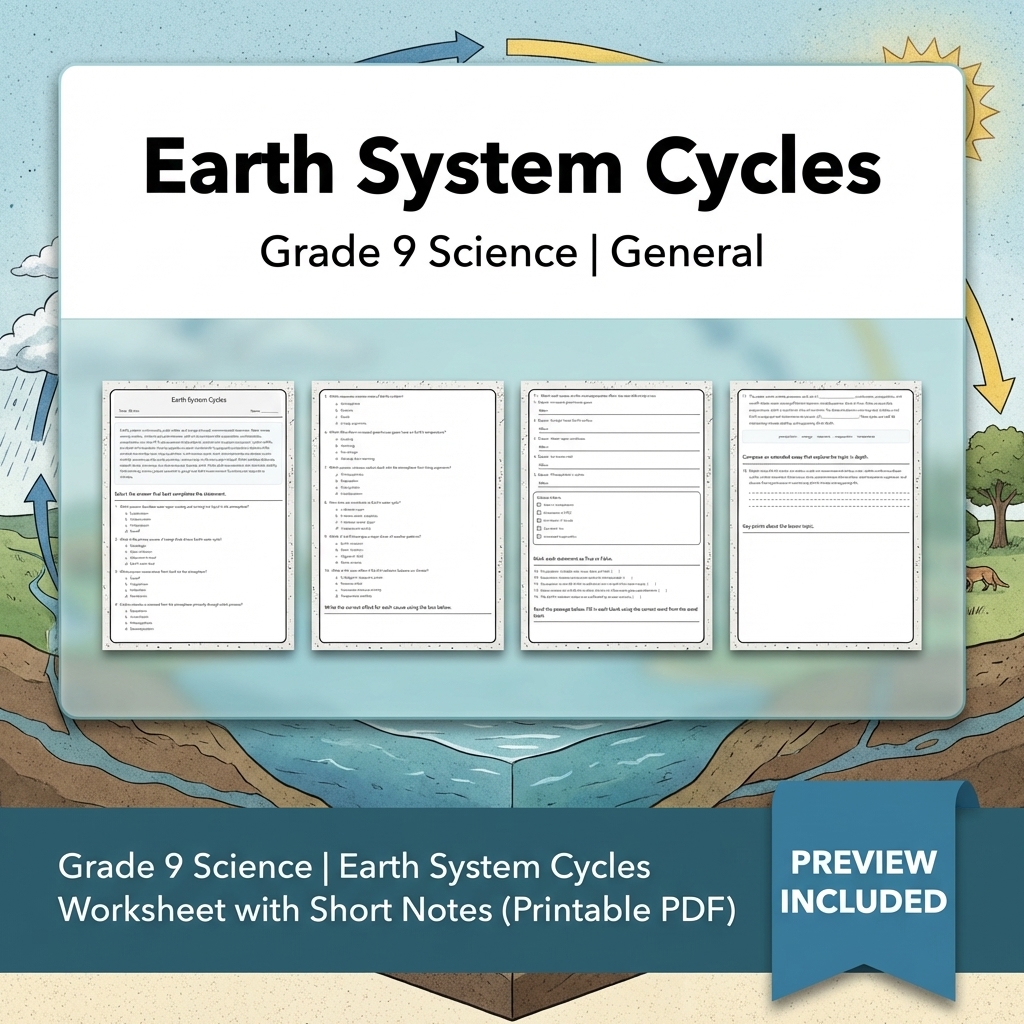
Grade 9 Science | Earth System Cycles Worksheet with Short Notes (Printable PDF)
Created byMeadowlark WorksheetsLearning Objectives
- Understand the interconnected reservoirs involved in Earth's water and carbon cycles.
- Identify processes such as evaporation, condensation, and chemical exchange in Earth's systems.
- Explain how solar radiation influences weather and temperature regulation.
Also included in: Grade 9 Earth Systems Reservoirs & Feedback Science Lesson Bundle: General +1 more
Instant download
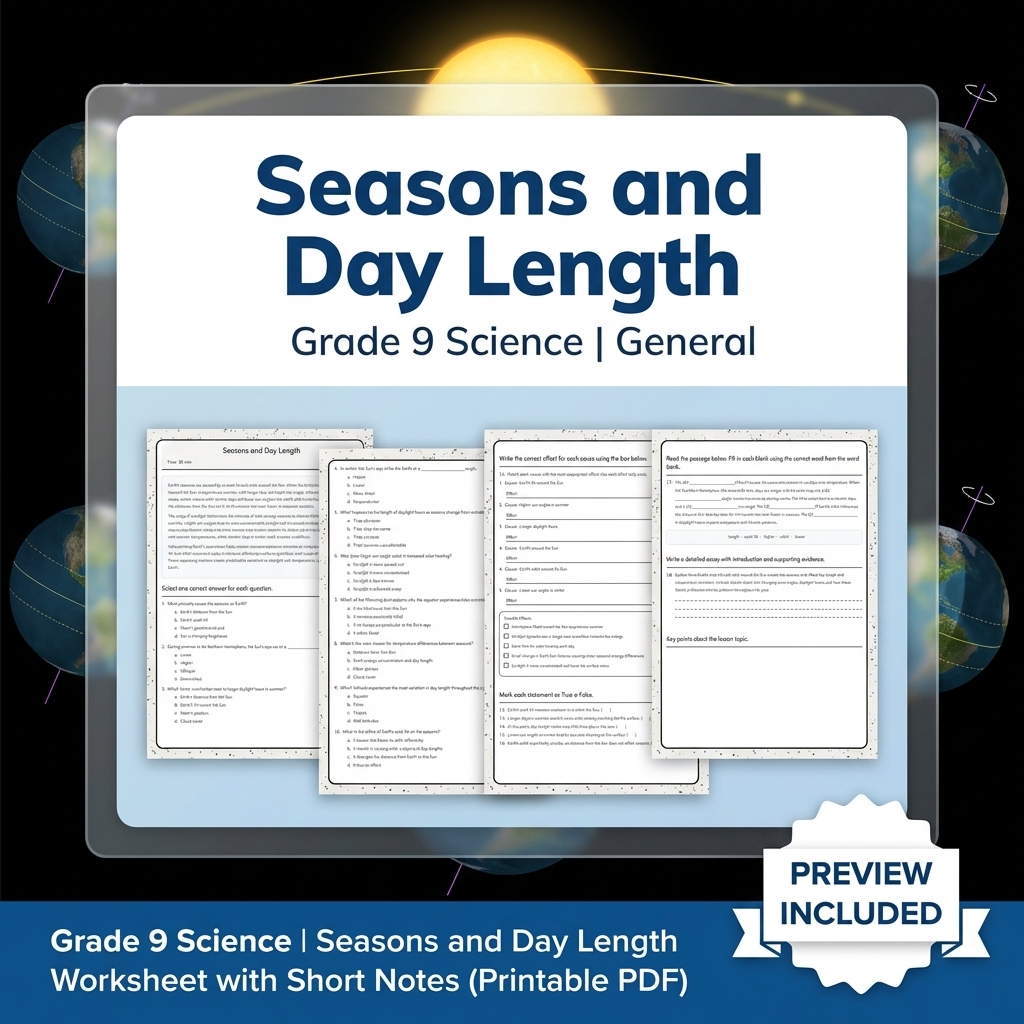
Grade 9 Science | Seasons and Day Length Worksheet with Short Notes
Created byMeadowlark WorksheetsLearning Objectives
- Explain how Earth's axial tilt and orbit around the Sun cause seasonal changes.
- Describe how the angle of sunlight and daylight hours vary at different times of the year.
- Understand the relationship between Earth's position in orbit and temperature changes at various latitudes.
Also included in: Grade 9 Earth Systems Reservoirs & Feedback Science Lesson Bundle: General +1 more
Instant download
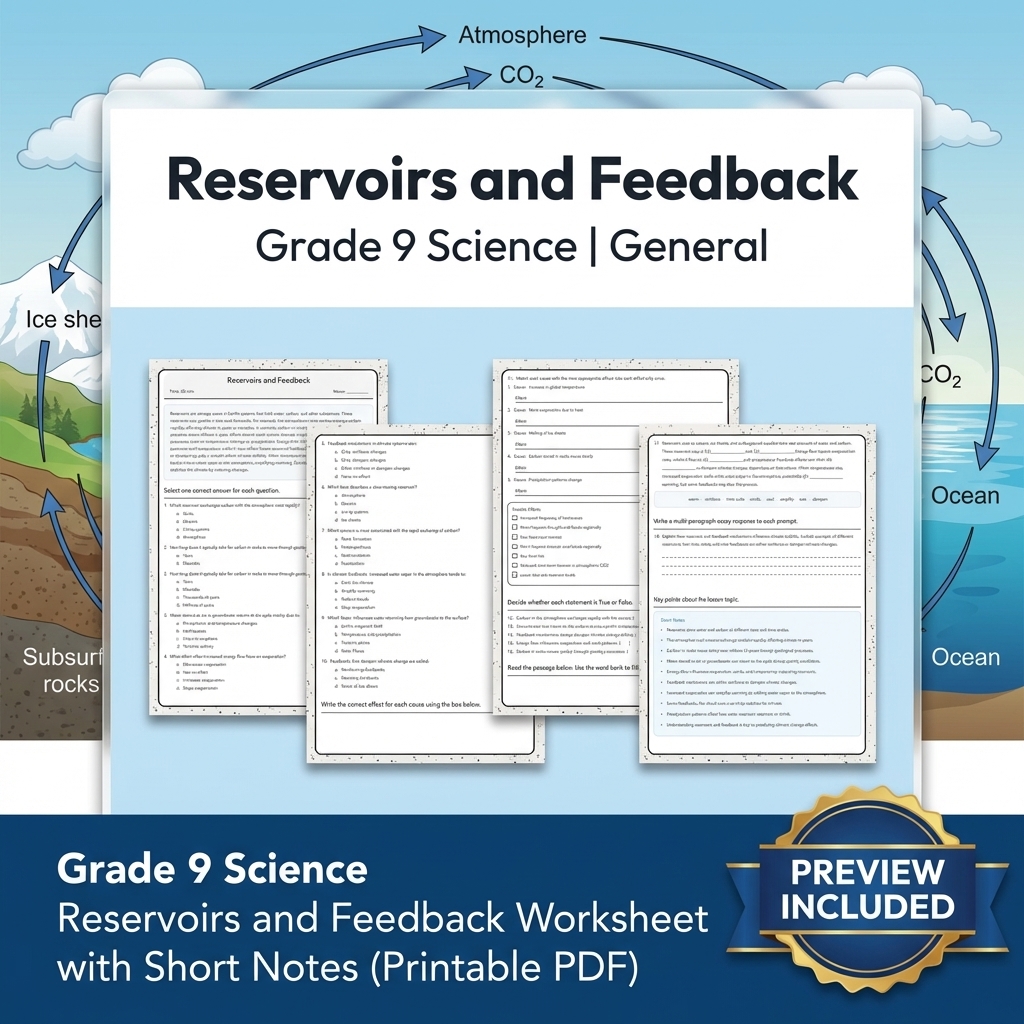
Grade 9 Science Reservoirs and Feedback Worksheet with Short Notes
Created byMeadowlark WorksheetsLearning Objectives
- Understand the role of reservoirs in environmental cycles.
- Explain how feedback mechanisms influence climate change.
- Identify different types of reservoirs and their time scales.
Also included in: Grade 9 Earth Systems Reservoirs & Feedback Science Lesson Bundle: General +1 more
Instant download
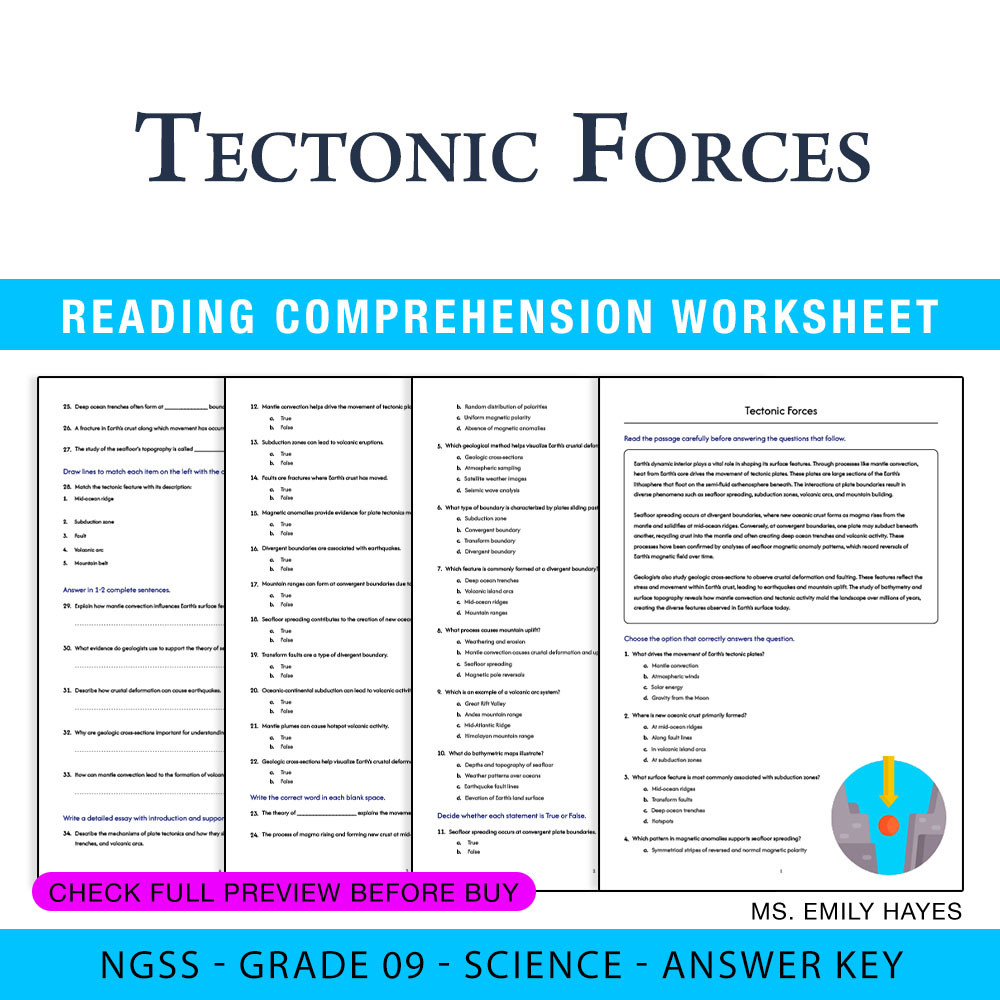
9th Grade Science | Tectonic Forces Worksheet (PDF+ Answer Key)
Created byCopper Leaf ClassroomLearning Objectives
- Describe the main types of tectonic plate boundaries and their surface features.
- Explain the processes of seafloor spreading and subduction zones using geologic evidence.
- Identify how mantle convection influences surface topography including mountain ranges and ocean basins.
Instant download
Grade 9 Science – Comparative Cell Structures Worksheet (Teacher & Student Edition) (PDF)
Created byBright Mind ResourcesLearning Objectives
- Understand how organelle form and abundance vary across different cell types and taxa.
- Identify examples of structural adaptations in cells and their functions.
- Relate cellular morphology to physiological roles and ecological strategies.
Also included in: Grade 9 Science Unit | Cell Structures & Transport Mechanisms Pack(TEKS-Aligned) +3 more
Instant download

Grade 9 Science Worksheet on Respiratory Pathways (AP Standards) PDF
 Created byEvergreen Desk Education
Learning Objectives
- Explain how glycolysis, the TCA cycle, and electron transport drive cellular respiration and ATP production.
- Compare aerobic and anaerobic outcomes using ATP yields and redox (NADH/FADH2) considerations.
- Use stoichiometry and pathway flux ideas to predict how substrate availability and enzyme regulation change cellular energy currency.
Also included in: Grade 9 Cell, Genetics & Ecology Science Lesson Bundle: AP Standards +1 more
Instant download
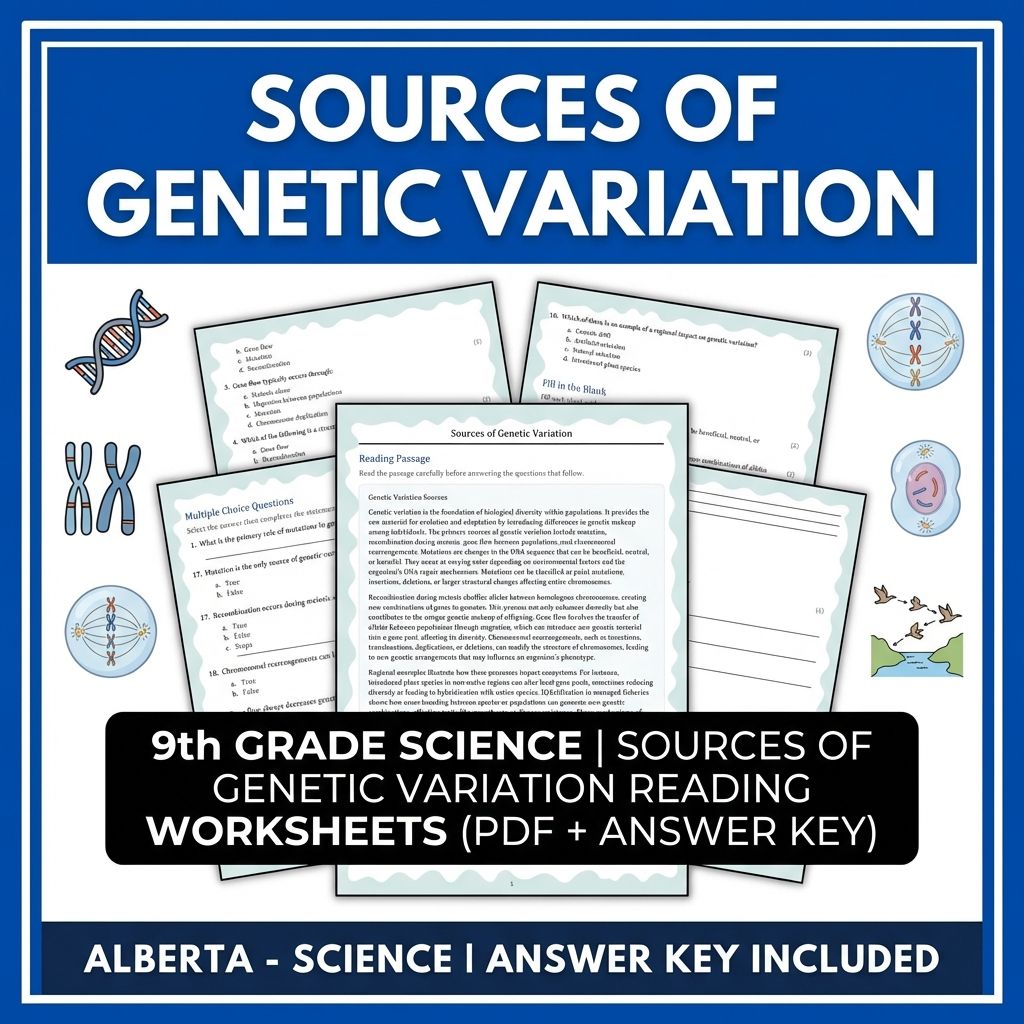
9th Grade Science | Sources of Genetic Variation Worksheets (PDF + Answer Key)
JCreated byJ.S SheetsLearning Objectives
- Identify and define the main sources of genetic variation including mutation, recombination, gene flow, and chromosomal rearrangements.
- Describe mechanisms that increase or decrease genetic diversity in populations.
- Analyze examples of genetic variation impacts, such as introduced species and hybridization.
Also included in: Grade 9 Science Unit Bundle | Genetics, Cell Biology & Biotechnology Worksheets +1 more
Instant download
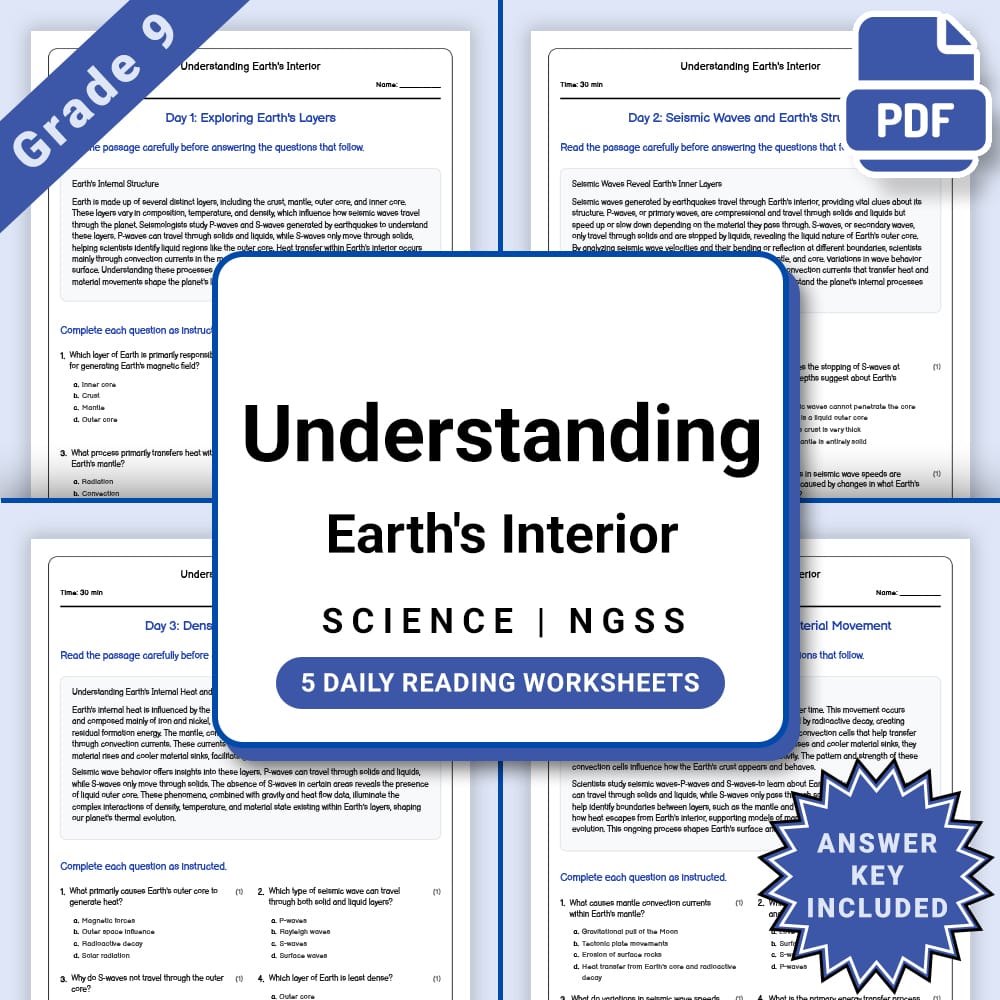
Grade 9 Science – Earth's Interior Worksheet(PDF + Answer Key)
Created byCopper Leaf ClassroomLearning Objectives
- Identify and describe the different layers of Earth's interior.
- Explain how seismic waves reveal information about Earth's internal structure.
- Understand the transfer of heat within Earth's layers and how it influences planetary processes.
Instant download

Feedback Mechanisms Science Worksheet | Grade 9 NGSS assessment printable PDF
Learning Objectives
- Explain the concept of negative and positive feedback in physiological regulation.
- Describe how feedback loops maintain internal stability within narrow limits.
- Identify mechanisms of thermoregulation and blood glucose control involving hormonal feedback.
Also included in: Grade 9 Science Lesson Bundle: From Molecules to Organisms NGSS Structures +1 more
Instant download

Grade 9 Science – Molecular Geometry & VSEPR Model | Daily Reading Worksheet
Created byBright Mind ResourcesLearning Objectives
- Identify basic molecular shapes based on descriptions
- Understand the principles of VSEPR theory
- Relate molecular shapes to properties like polarity and reactivity
Also included in: Grade 9 Chemical Reactions Science Lesson Bundle: Daily Reading (BC) +1 more
Instant download
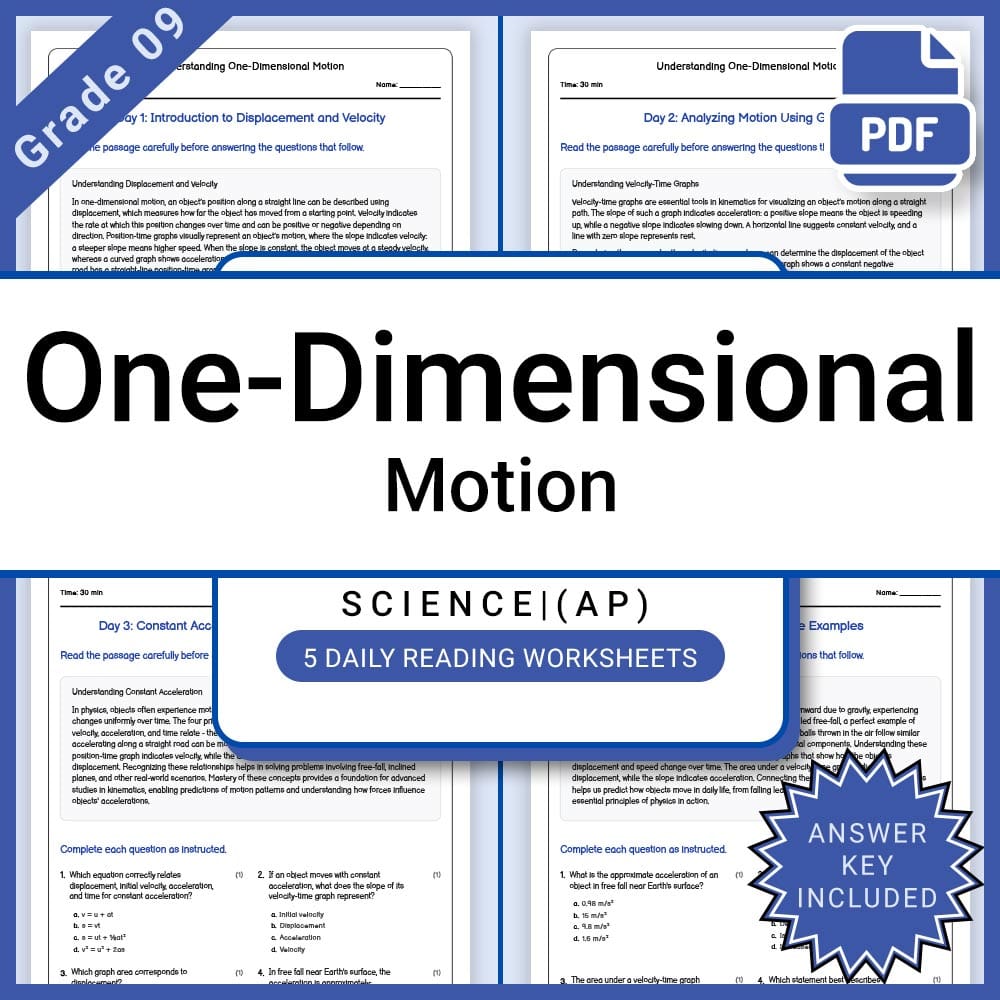
Grade 9 Science – One-Dimensional Motion Daily Reading Worksheet + Answer Key
JCreated byJ.S SheetsLearning Objectives
- Interpret position-time graphs to analyze motion along a straight line.
- Understand the basic concepts of displacement, velocity, and acceleration.
- Connect algebraic equations with graphical representations of motion.
Also included in: Grade 9 Science Lesson Group: AP Motion & Force Daily Reading Worksheets +1 more
Instant download
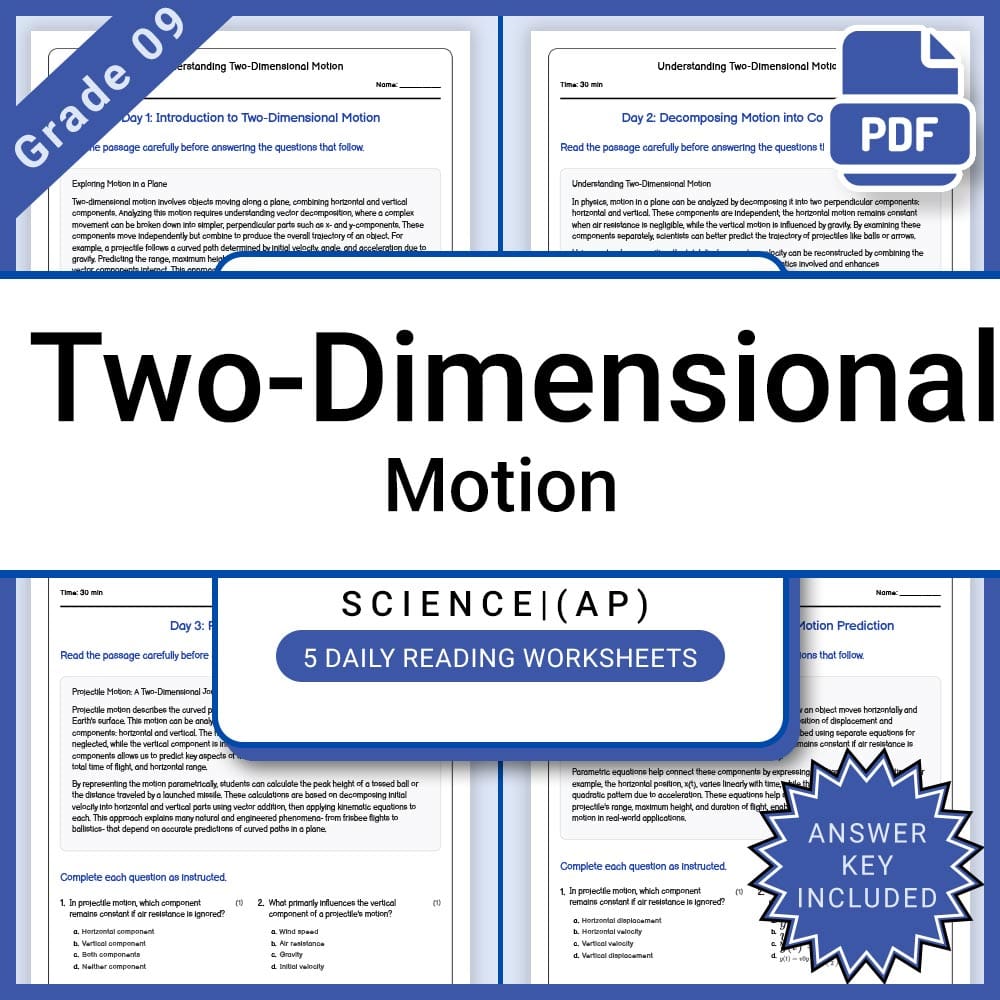
Grade 9 Science – Two-Dimensional Motion Daily Reading Worksheet + Answer Key
JCreated byJ.S SheetsLearning Objectives
- Understand key concepts related to Science
- Apply knowledge through practice questions
- Demonstrate comprehension of the material
Also included in: Grade 9 Science Lesson Group: AP Motion & Force Daily Reading Worksheets +1 more
Instant download

Grade 9 Science | Cell Components - Daily Reading Comprehension
Created byCoral Reef LearningLearning Objectives
- Understand key concepts related to Science
- Apply knowledge through practice questions
- Demonstrate comprehension of the material
Instant download

Grade 9 Science – Energy Profiles Worksheet (PDF) BC Standards
Created byEvergreen Desk EducationLearning Objectives
- Explain how energy profiles show activation energy (Ea), transition states, and enthalpy change (ΔH) for chemical reactions.
- Differentiate exothermic and endothermic reactions using the sign of ΔH and the relative energy levels of reactants and products.
- Interpret reaction-coordinate graphs to infer energy flow and predict how changing Ea affects reaction speed.
Instant download
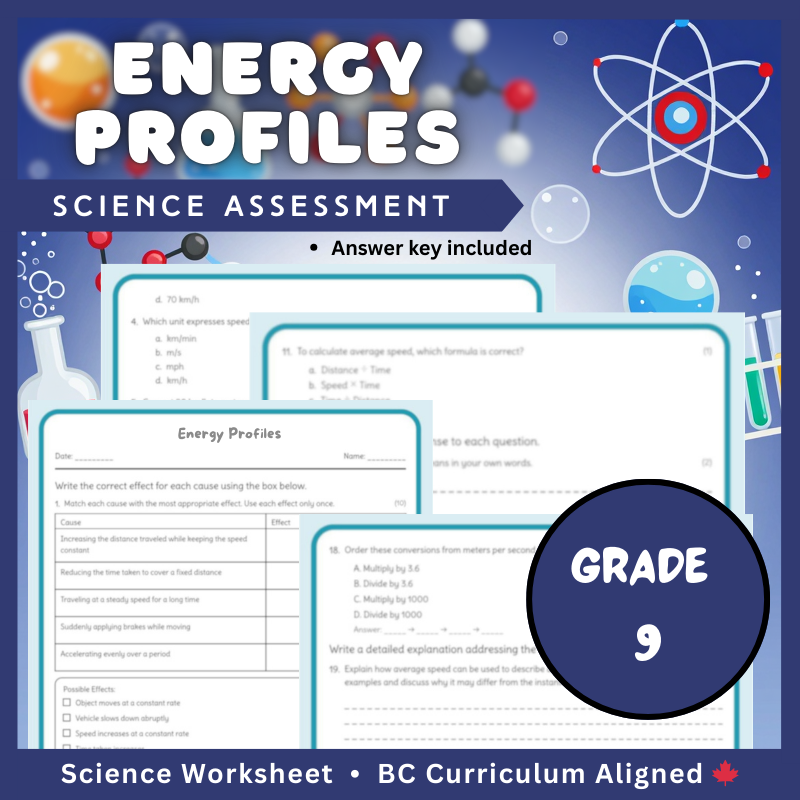
Grade 9 Science | Energy Profiles Worksheet + Answer Key (PDF) for BC Standards
Created byBright Mind ResourcesLearning Objectives
- Understand what energy profiles depict in relation to chemical reactions.
- Identify the differences between exothermic and endothermic reactions based on energy diagrams.
- Interpret the significance of transition states and activation energy barriers.
Instant download
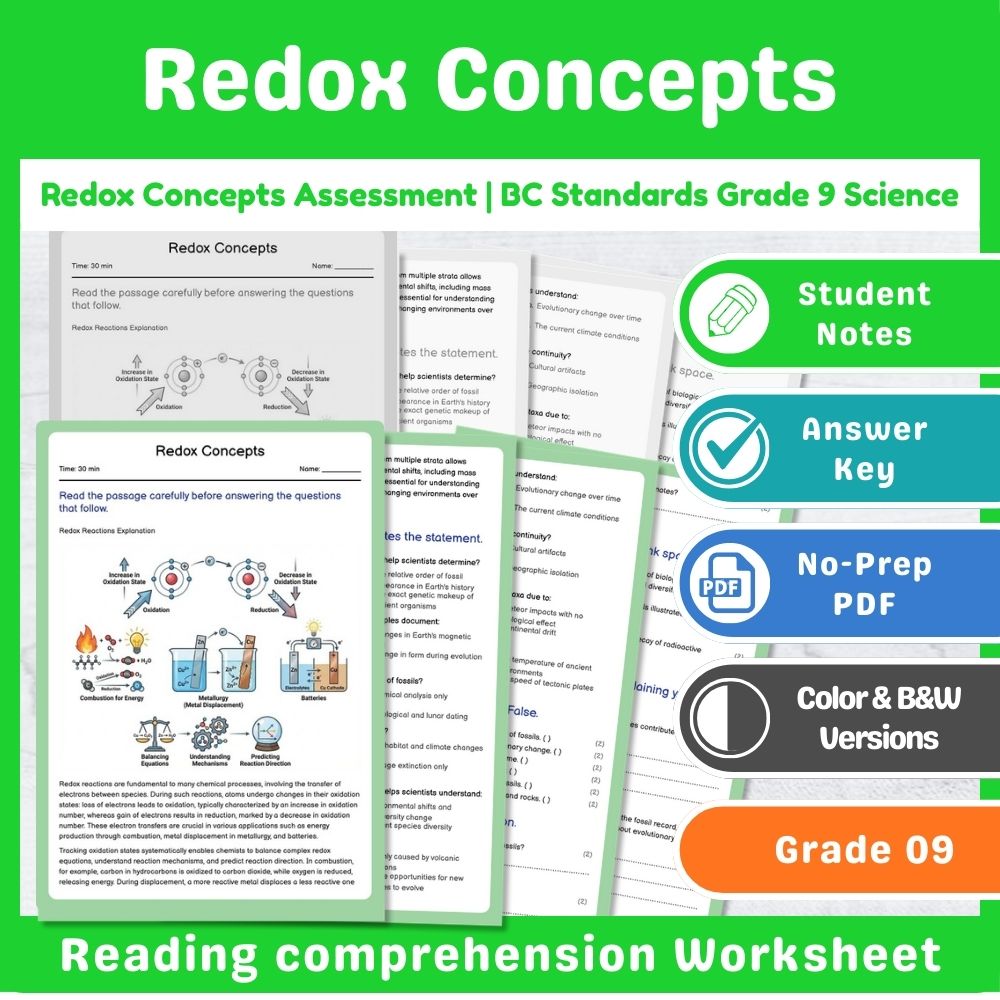
Redox Concepts Assessment | BC Standards Grade 9 Science
Created byPrism Point LearningLearning Objectives
- Explain the fundamental principles of oxidation and reduction in chemical reactions.
- Track changes in oxidation states to identify oxidizing and reducing agents.
- Balance redox equations involved in combustion and displacement reactions.
Instant download

Grade 9 Redox Concepts Worksheet | Practice & Assessment PDF
Created byClear Sky ClassroomLearning Objectives
- Explain oxidation and reduction in terms of electron transfer and oxidation-number change.
- Determine which species is oxidized or reduced and identify oxidizing and reducing agents.
- Track oxidation-state changes to help balance and interpret redox reactions, including combustion and displacement.
Instant download
Grade 9 Science – Redox Concepts Worksheet (PDF) | BC Standard & Practice
Created byBright Mind ResourcesLearning Objectives
- Understand the electron transfer process in redox reactions.
- Identify oxidation and reduction by tracking oxidation states.
- Recognize oxidizing and reducing agents in various reactions.
Instant download
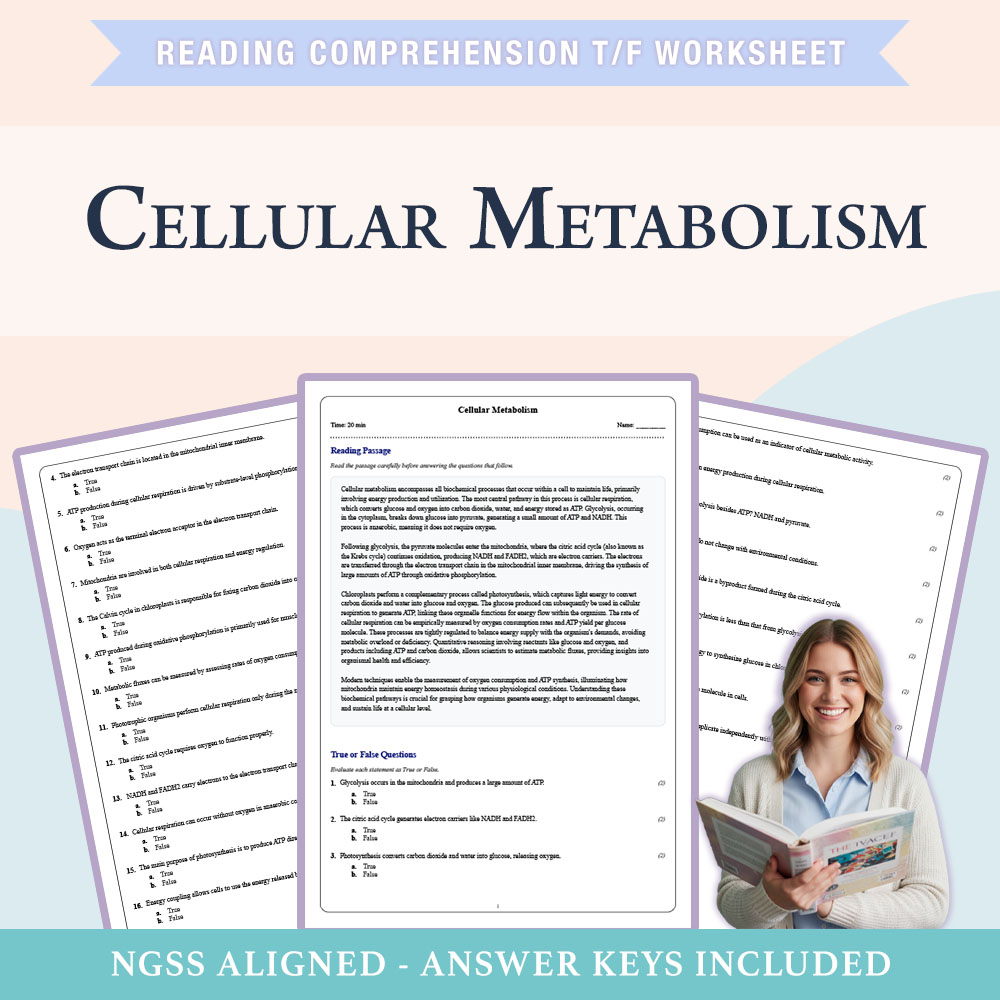
Grade 9 Science | Cellular Metabolism Worksheet (PDF + Answer Key)
Created byCopper Leaf ClassroomLearning Objectives
- Understand the biochemical pathways involved in cellular respiration, including glycolysis, citric acid cycle, and electron transport chain.
- Explain how ATP is produced through energy coupling and the significance of ATP in cellular activities.
- Relate mitochondrial and chloroplast functions to overall organismal energy balance and metabolism.
Also included in: Grade 9 Science | Cellular Functions & Physiology Bundle (PDF + Answer Key) +1 more
Instant download
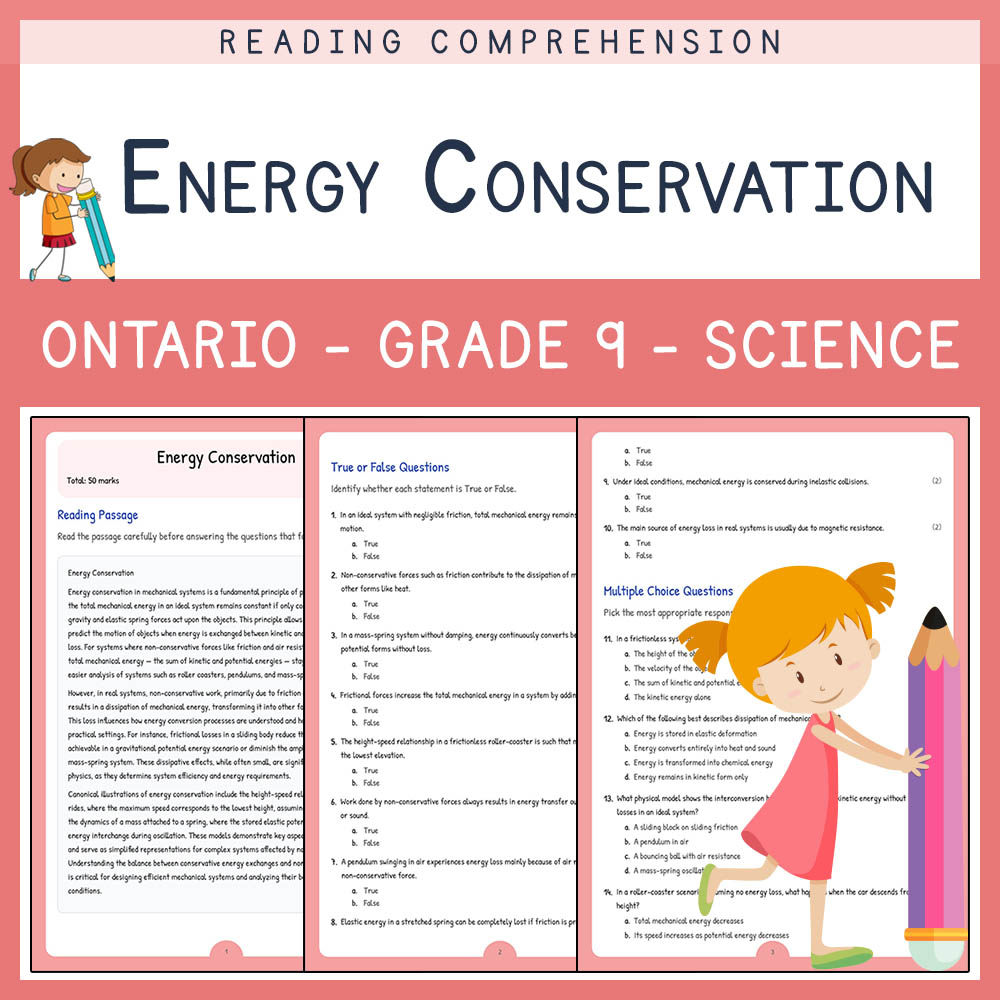
Grade 9 Science Assessment | Energy Conservation Worksheet Elena | Ontario
Created byLumora LearningLearning Objectives
- Understand the principles of conservation of mechanical energy in ideal systems.
- Identify how non-conservative forces affect energy transfer and dissipation.
- Analyze height–speed relationships in roller-coaster models under gravity.
Instant download
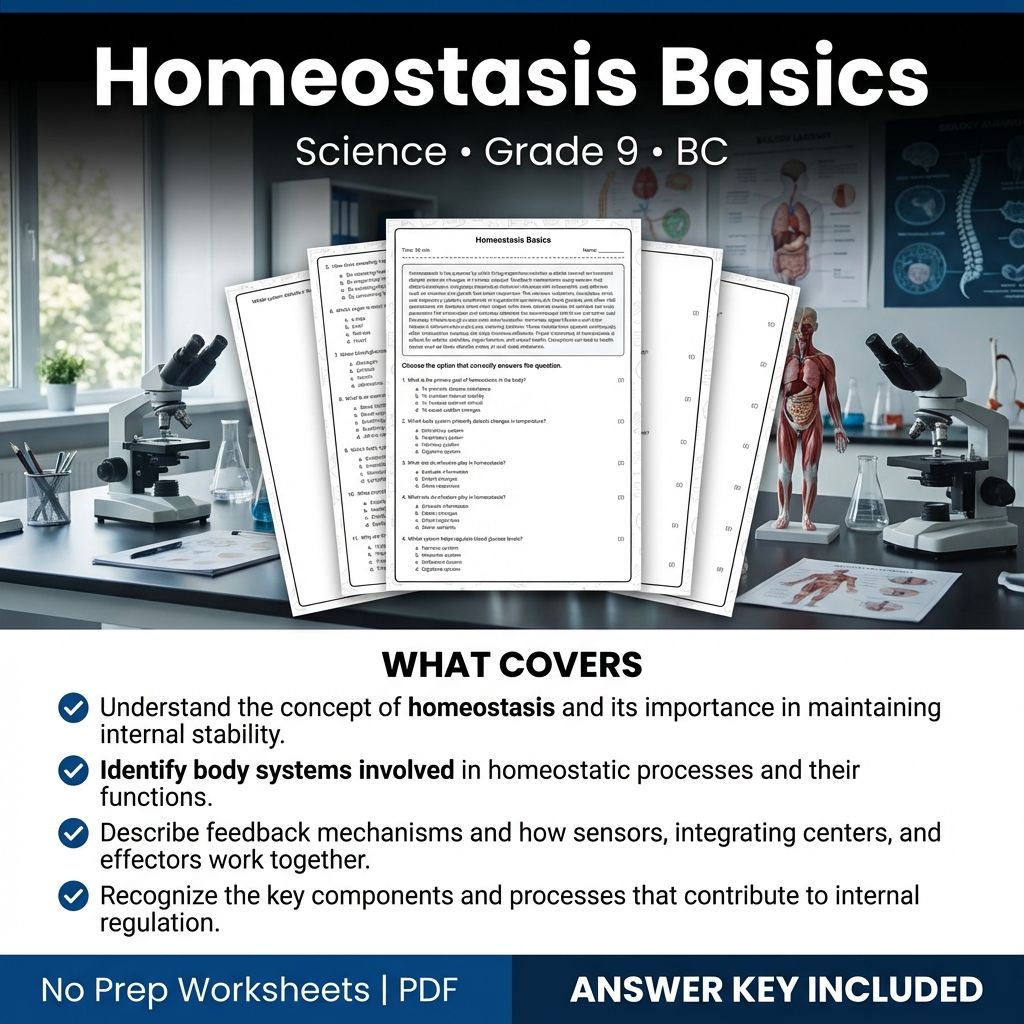
Homeostasis Basics Worksheet for Grade 9 Science | BC Standards
Created byCoral Reef LearningLearning Objectives
- Understand the concept of homeostasis and its importance in maintaining internal stability.
- Identify body systems involved in homeostatic processes and their functions.
- Describe feedback mechanisms and how sensors, integrating centers, and effectors work together.
Instant download

One-Dimensional Motion Worksheet Practice | Grade 9 AP Science
 Created byBright Quill Resources
Learning Objectives
- Interpret position–time and velocity–time graphs to determine slope, direction, and acceleration
- Use constant-acceleration equations to predict velocity and displacement from given initial conditions
- Connect graphical reasoning (slopes and areas) to algebraic models of displacement, velocity, and acceleration
Instant download
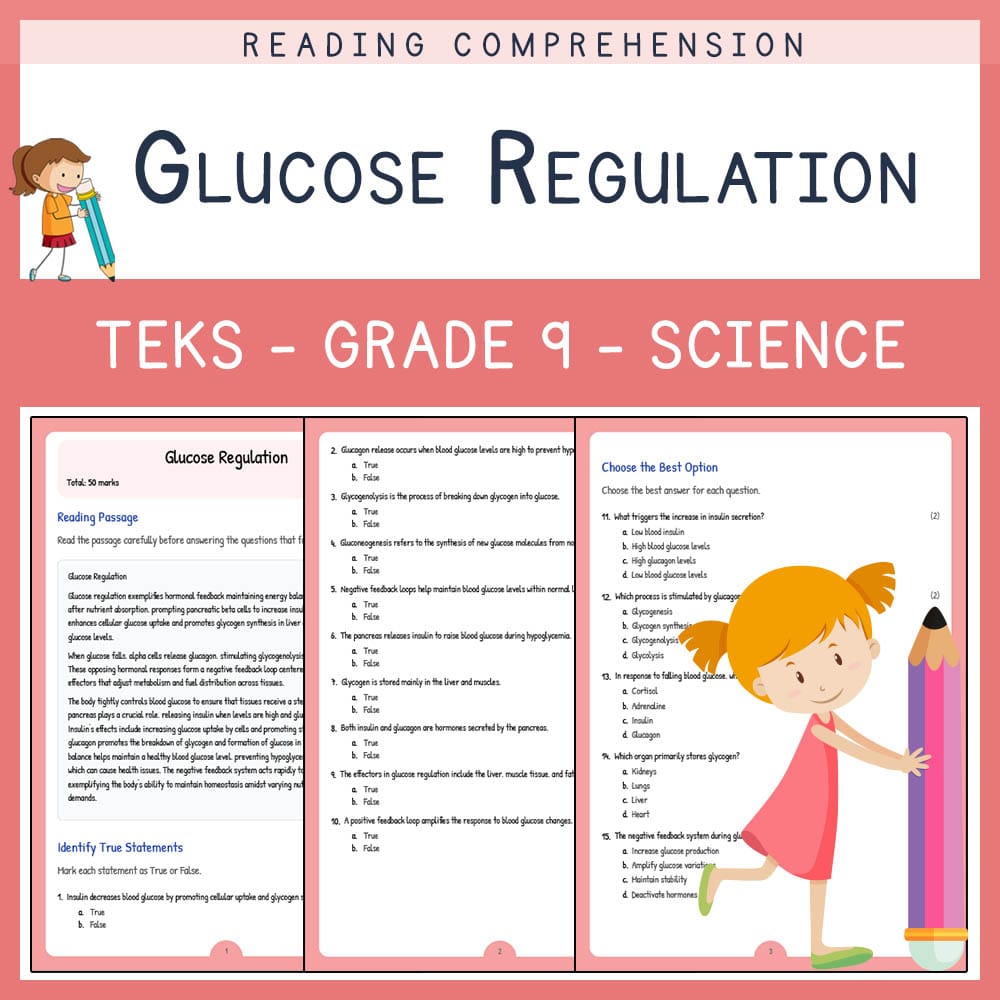
Grade 9 Science | Glucose Regulation Worksheet | TEKS-Aligned
Created byLumora LearningLearning Objectives
- Understand the hormonal feedback mechanisms involved in glucose regulation.
- Describe how insulin and glucagon maintain blood glucose levels.
- Explain the process of glycogenolysis and gluconeogenesis in energy balance.
Instant download

Science Worksheet: Transmission Tradeoffs | Grade 9 NGSS Signal Systems
 Created byAmber Owl Education
Learning Objectives
- Explain how bandwidth limits affect data rates in communication systems
- Compare digital and analog transmission using signal-to-noise ratio and error behavior
- Use channel capacity and bit error rate ideas to evaluate reliability
Also included in: Grade 9 Science Waves & Signal Systems Lesson Bundle | NGSS +1 more
Instant download

Signal Encoding Worksheet | NGSS Grade 9 Science + Doodle Note
Created byAmber Owl EducationLearning Objectives
- Explain how modulation and multiplexing encode signals onto carriers using amplitude, frequency, and phase changes
- Compare pulse-code modulation and analog amplitude modulation in terms of bandwidth and noise effects
- Use signal-encoding vocabulary to reason about fidelity and channel capacity
Also included in: Grade 9 Science Waves & Signal Systems Lesson Bundle | NGSS +1 more
Instant download

Grade 9 Electromagnetic Radiation Worksheet | Waves, Photons & Matter
Created byAmber Owl EducationLearning Objectives
- Explain how electromagnetic radiation can be described as both waves and photons.
- Relate photon energy to frequency using Planck’s relation and interpret how this affects interactions with matter.
- Interpret how absorption and emission produce spectral lines and identify what changes in a spectrum mean physically.
Also included in: Grade 9 Science Waves & Signal Systems Lesson Bundle | NGSS +1 more
Instant download

Unbalanced Forces Assessment | General Standard Grade 9 Science
Created byPrism Point LearningLearning Objectives
- Understand how forces combine to produce net force and affect motion.
- Identify when forces are balanced or unbalanced and how this influences acceleration.
- Explain the effect of net force direction on the movement of objects.
Instant download
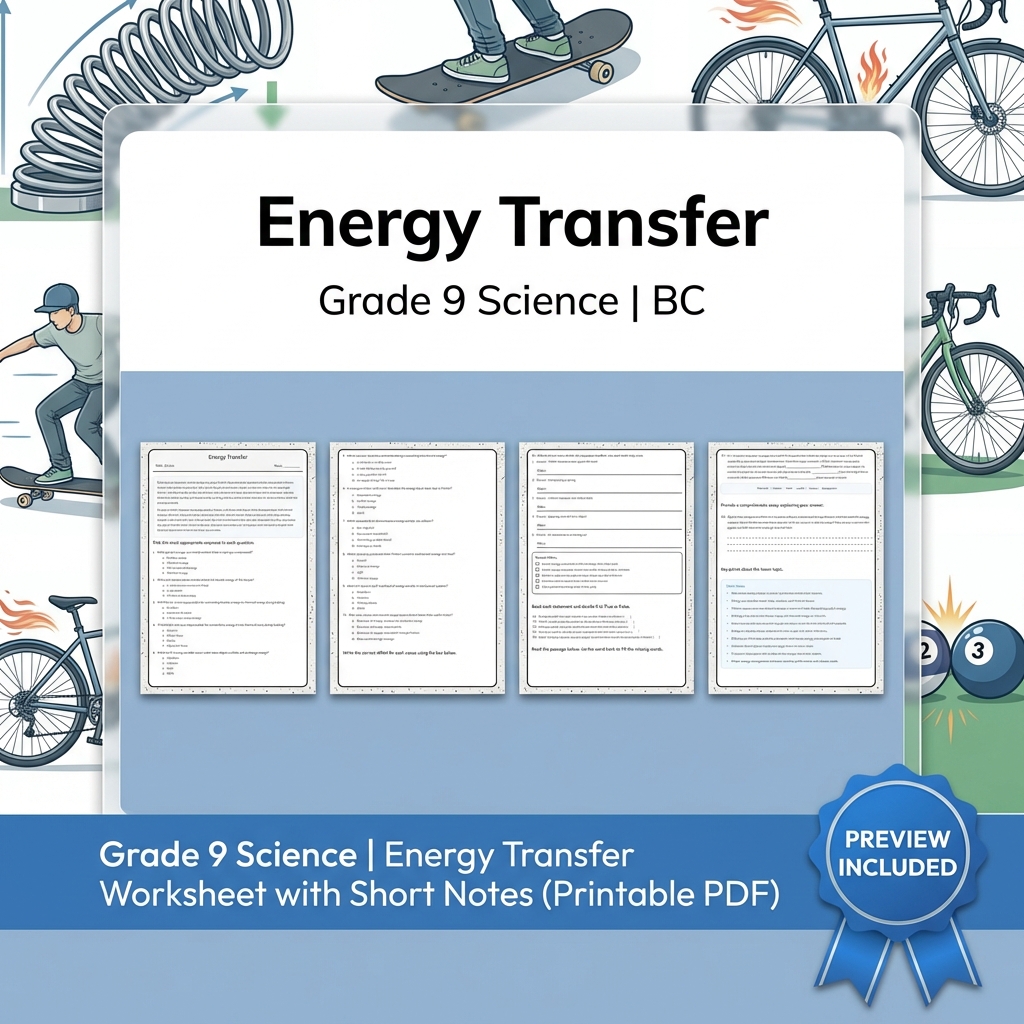
Grade 9 Science | Energy Transfer Worksheet with Short Notes (Printable PDF)
Created byMeadowlark WorksheetsLearning Objectives
- Explain how mechanical systems transfer energy as kinetic or potential energy.
- Identify examples of energy transfer such as braking a bicycle or compressing a spring.
- Describe how work, collisions, and friction relate to energy transfer and thermal energy.
Also included in: Grade 9 Science Lesson Bundle | Energy, Forces & Motion Worksheets +1 more
Instant download

Grade 9 Science Worksheet: Kinematic Equations Practice | Ontario
JCreated byJ.S SheetsLearning Objectives
- Use constant-acceleration kinematic equations to relate displacement, time, velocity, and acceleration
- Apply sign conventions correctly for one-dimensional motion, including vertical free fall
- Use component-wise reasoning to analyze horizontally projected motion under uniform gravity
Instant download
About Grade 9 Science Worksheets
Find Science worksheets built for Grade 9. All 6,926 cover core skills, practice, and review, each an instant PDF download.
Every worksheet on MyTeachingSheets is created by independent teacher-authors and reviewed before publication. All resources download as printable PDFs for classroom, homework, or at-home practice, and many include answer keys. Preview any worksheet free before buying.