
Grade 9 Science Worksheets
6,926 worksheets
Grade 9 Science – Energy Profiles Worksheet (PDF) BC Standards
 Created byEvergreen Desk Education
Learning Objectives
- Explain how energy profiles show activation energy (Ea), transition states, and enthalpy change (ΔH) for chemical reactions.
- Differentiate exothermic and endothermic reactions using the sign of ΔH and the relative energy levels of reactants and products.
- Interpret reaction-coordinate graphs to infer energy flow and predict how changing Ea affects reaction speed.
Instant download
Grade 9 Science | Energy Profiles Worksheet + Answer Key (PDF) for BC Standards
 Created byBright Mind Resources
Learning Objectives
- Understand what energy profiles depict in relation to chemical reactions.
- Identify the differences between exothermic and endothermic reactions based on energy diagrams.
- Interpret the significance of transition states and activation energy barriers.
Instant download
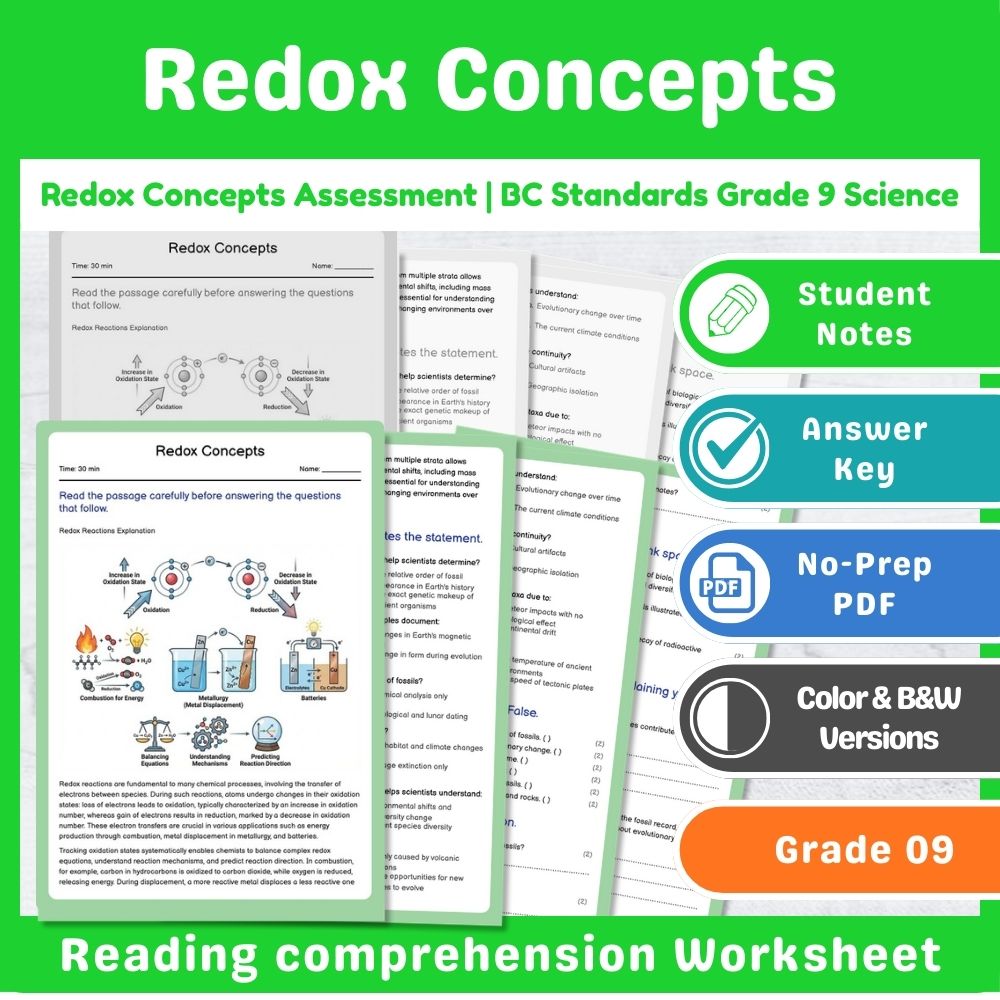
Redox Concepts Assessment | BC Standards Grade 9 Science
 Created byPrism Point Learning
Learning Objectives
- Explain the fundamental principles of oxidation and reduction in chemical reactions.
- Track changes in oxidation states to identify oxidizing and reducing agents.
- Balance redox equations involved in combustion and displacement reactions.
Instant download

Grade 9 Redox Concepts Worksheet | Practice & Assessment PDF
 Created byClear Sky Classroom
Learning Objectives
- Explain oxidation and reduction in terms of electron transfer and oxidation-number change.
- Determine which species is oxidized or reduced and identify oxidizing and reducing agents.
- Track oxidation-state changes to help balance and interpret redox reactions, including combustion and displacement.
Instant download
Grade 9 Science – Redox Concepts Worksheet (PDF) | BC Standard & Practice
Created byBright Mind ResourcesLearning Objectives
- Understand the electron transfer process in redox reactions.
- Identify oxidation and reduction by tracking oxidation states.
- Recognize oxidizing and reducing agents in various reactions.
Instant download
Grade 9 Science | Cellular Metabolism Worksheet (PDF + Answer Key)
 Created byCopper Leaf Classroom
Learning Objectives
- Understand the biochemical pathways involved in cellular respiration, including glycolysis, citric acid cycle, and electron transport chain.
- Explain how ATP is produced through energy coupling and the significance of ATP in cellular activities.
- Relate mitochondrial and chloroplast functions to overall organismal energy balance and metabolism.
Also included in: Grade 9 Science | Cellular Functions & Physiology Bundle (PDF + Answer Key) +1 more
Instant download
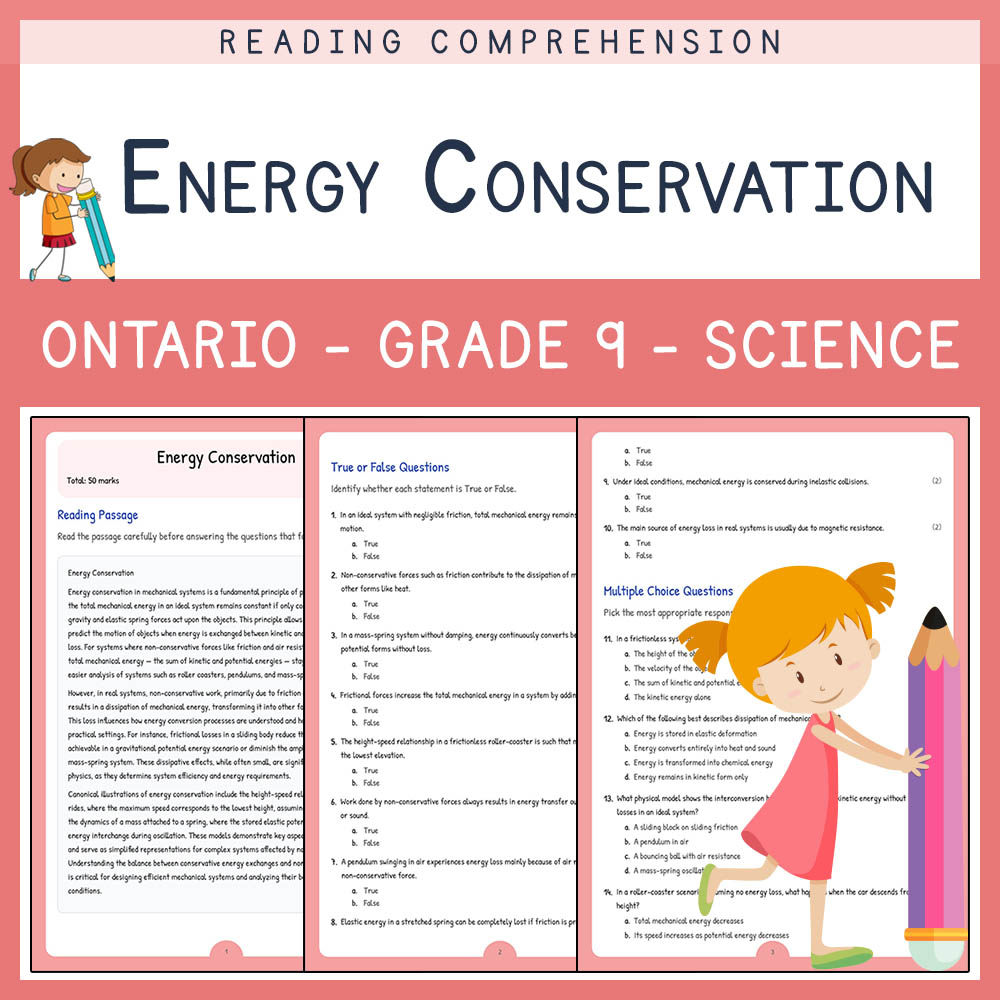
Grade 9 Science Assessment | Energy Conservation Worksheet Elena | Ontario
 Created byLumora Learning
Learning Objectives
- Understand the principles of conservation of mechanical energy in ideal systems.
- Identify how non-conservative forces affect energy transfer and dissipation.
- Analyze height–speed relationships in roller-coaster models under gravity.
Instant download
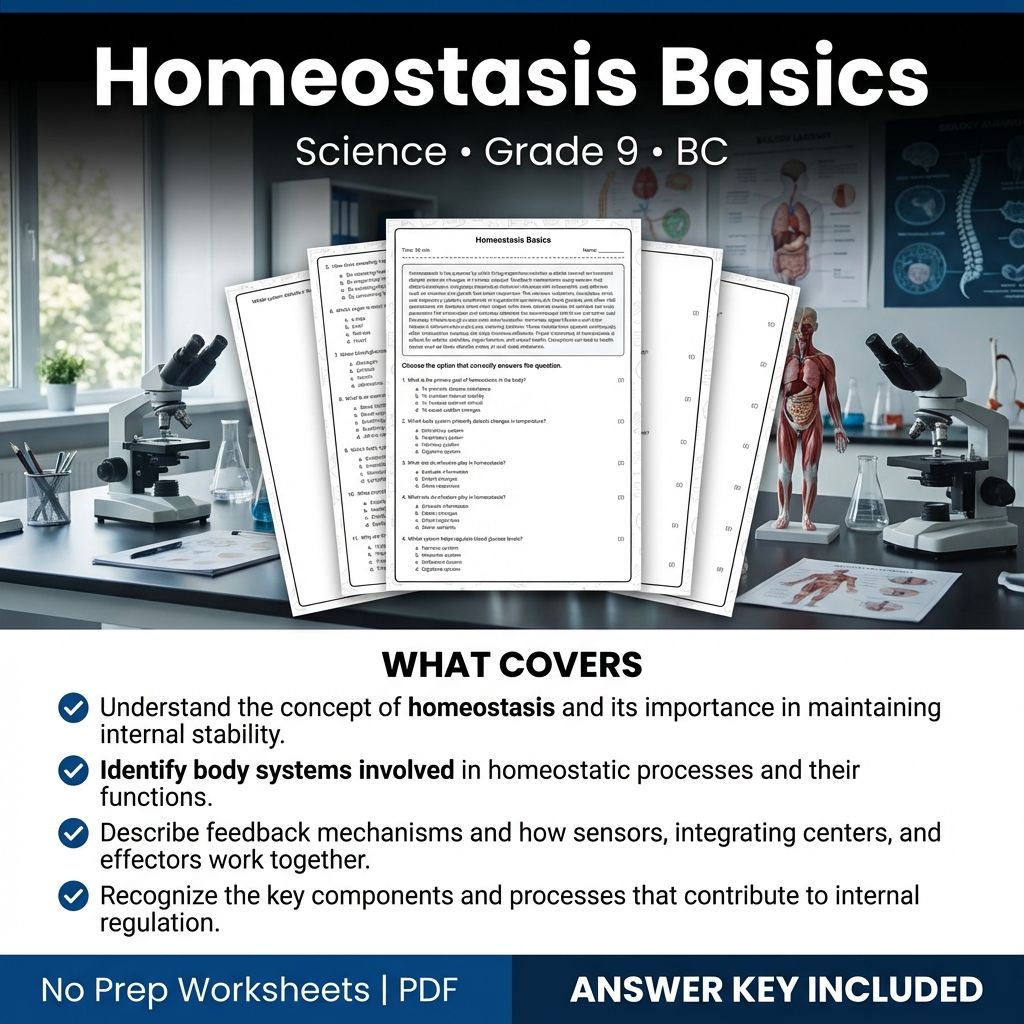
Homeostasis Basics Worksheet for Grade 9 Science | BC Standards
 Created byCoral Reef Learning
Learning Objectives
- Understand the concept of homeostasis and its importance in maintaining internal stability.
- Identify body systems involved in homeostatic processes and their functions.
- Describe feedback mechanisms and how sensors, integrating centers, and effectors work together.
Instant download

One-Dimensional Motion Worksheet Practice | Grade 9 AP Science
 Created byBright Quill Resources
Learning Objectives
- Interpret position–time and velocity–time graphs to determine slope, direction, and acceleration
- Use constant-acceleration equations to predict velocity and displacement from given initial conditions
- Connect graphical reasoning (slopes and areas) to algebraic models of displacement, velocity, and acceleration
Instant download
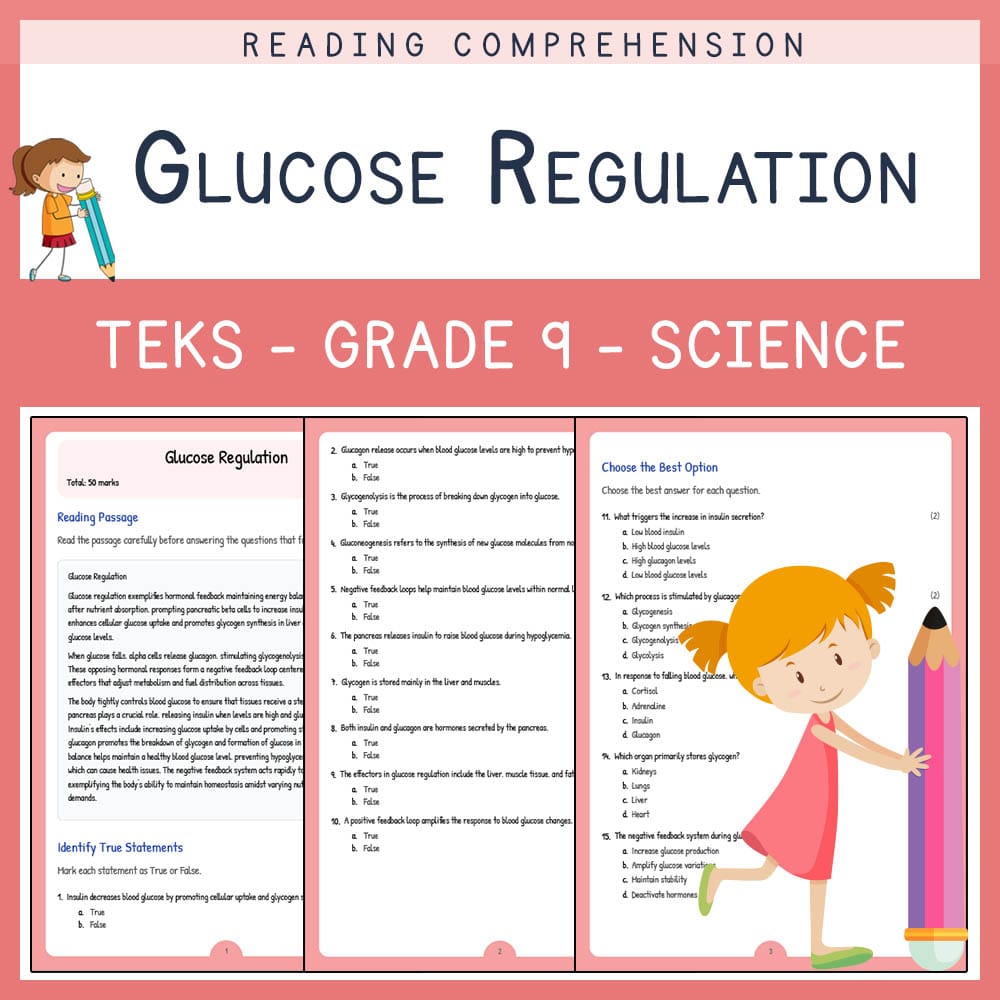
Grade 9 Science | Glucose Regulation Worksheet | TEKS-Aligned
Created byLumora LearningLearning Objectives
- Understand the hormonal feedback mechanisms involved in glucose regulation.
- Describe how insulin and glucagon maintain blood glucose levels.
- Explain the process of glycogenolysis and gluconeogenesis in energy balance.
Instant download

Science Worksheet: Transmission Tradeoffs | Grade 9 NGSS Signal Systems
 Created byAmber Owl Education
Learning Objectives
- Explain how bandwidth limits affect data rates in communication systems
- Compare digital and analog transmission using signal-to-noise ratio and error behavior
- Use channel capacity and bit error rate ideas to evaluate reliability
Also included in: Grade 9 Science Waves & Signal Systems Lesson Bundle | NGSS +1 more
Instant download

Signal Encoding Worksheet | NGSS Grade 9 Science + Doodle Note
Created byAmber Owl EducationLearning Objectives
- Explain how modulation and multiplexing encode signals onto carriers using amplitude, frequency, and phase changes
- Compare pulse-code modulation and analog amplitude modulation in terms of bandwidth and noise effects
- Use signal-encoding vocabulary to reason about fidelity and channel capacity
Also included in: Grade 9 Science Waves & Signal Systems Lesson Bundle | NGSS +1 more
Instant download

Grade 9 Electromagnetic Radiation Worksheet | Waves, Photons & Matter
Created byAmber Owl EducationLearning Objectives
- Explain how electromagnetic radiation can be described as both waves and photons.
- Relate photon energy to frequency using Planck’s relation and interpret how this affects interactions with matter.
- Interpret how absorption and emission produce spectral lines and identify what changes in a spectrum mean physically.
Also included in: Grade 9 Science Waves & Signal Systems Lesson Bundle | NGSS +1 more
Instant download

Unbalanced Forces Assessment | General Standard Grade 9 Science
Created byPrism Point LearningLearning Objectives
- Understand how forces combine to produce net force and affect motion.
- Identify when forces are balanced or unbalanced and how this influences acceleration.
- Explain the effect of net force direction on the movement of objects.
Instant download
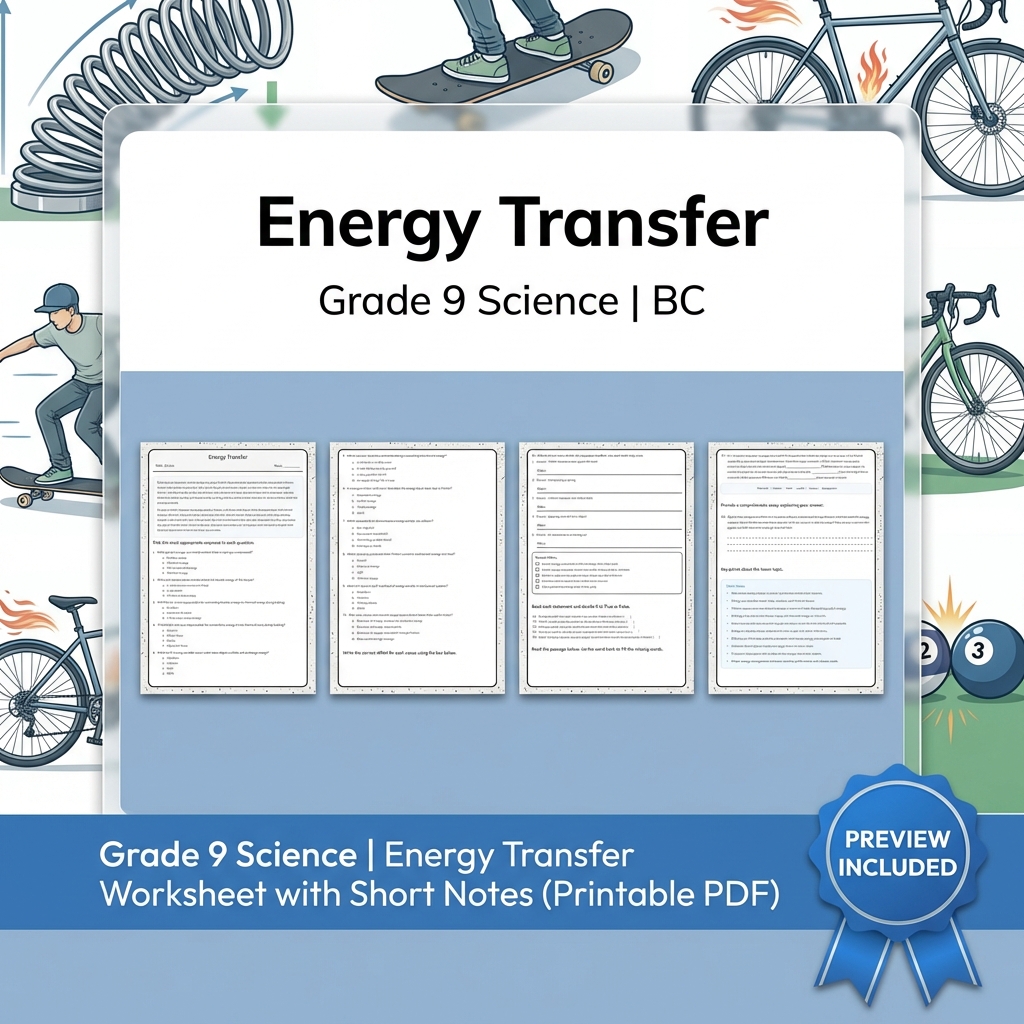
Grade 9 Science | Energy Transfer Worksheet with Short Notes (Printable PDF)
 Created byMeadowlark Worksheets
Learning Objectives
- Explain how mechanical systems transfer energy as kinetic or potential energy.
- Identify examples of energy transfer such as braking a bicycle or compressing a spring.
- Describe how work, collisions, and friction relate to energy transfer and thermal energy.
Also included in: Grade 9 Science Lesson Bundle | Energy, Forces & Motion Worksheets +1 more
Instant download

Grade 9 Science Worksheet: Kinematic Equations Practice | Ontario
JCreated byJ.S SheetsLearning Objectives
- Use constant-acceleration kinematic equations to relate displacement, time, velocity, and acceleration
- Apply sign conventions correctly for one-dimensional motion, including vertical free fall
- Use component-wise reasoning to analyze horizontally projected motion under uniform gravity
Instant download
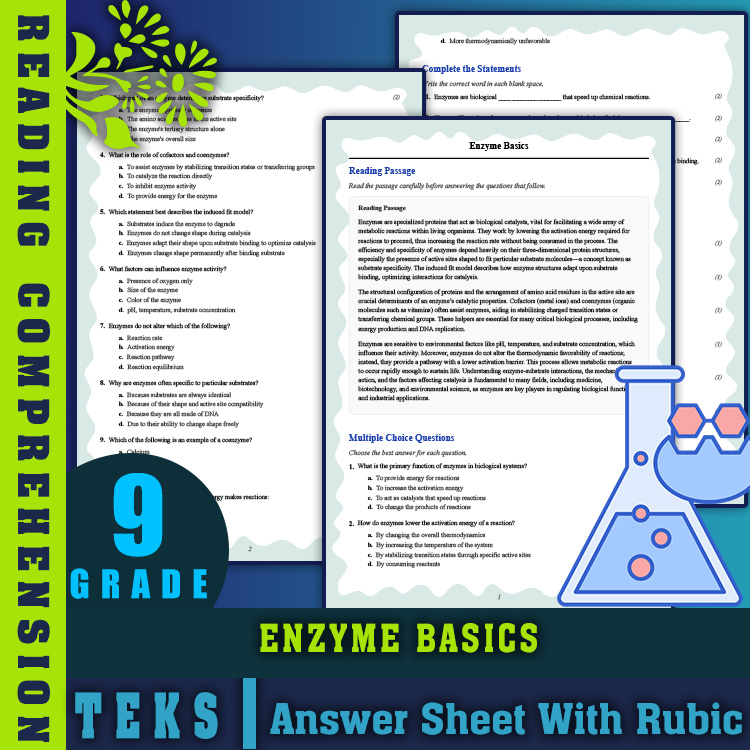
Grade 9 Science | Enzyme Basics Reading Worksheet (PDF & Answer Key)
JCreated byJ.S SheetsLearning Objectives
- Understand the role of enzymes as biological catalysts that speed up chemical reactions.
- Identify how enzyme structure and active sites determine substrate specificity and catalytic efficiency.
- Explain the importance of cofactors and coenzymes in enzyme activity.
Instant download

9th Grade Science | Resilience and Resistance Worksheet with Short Notes (PDF)
Created byMeadowlark WorksheetsLearning Objectives
- Define and differentiate between resilience and resistance in ecosystems.
- Describe the factors that influence ecological resilience and resistance.
- Understand how crossing ecological thresholds can lead to regime shifts.
Instant download
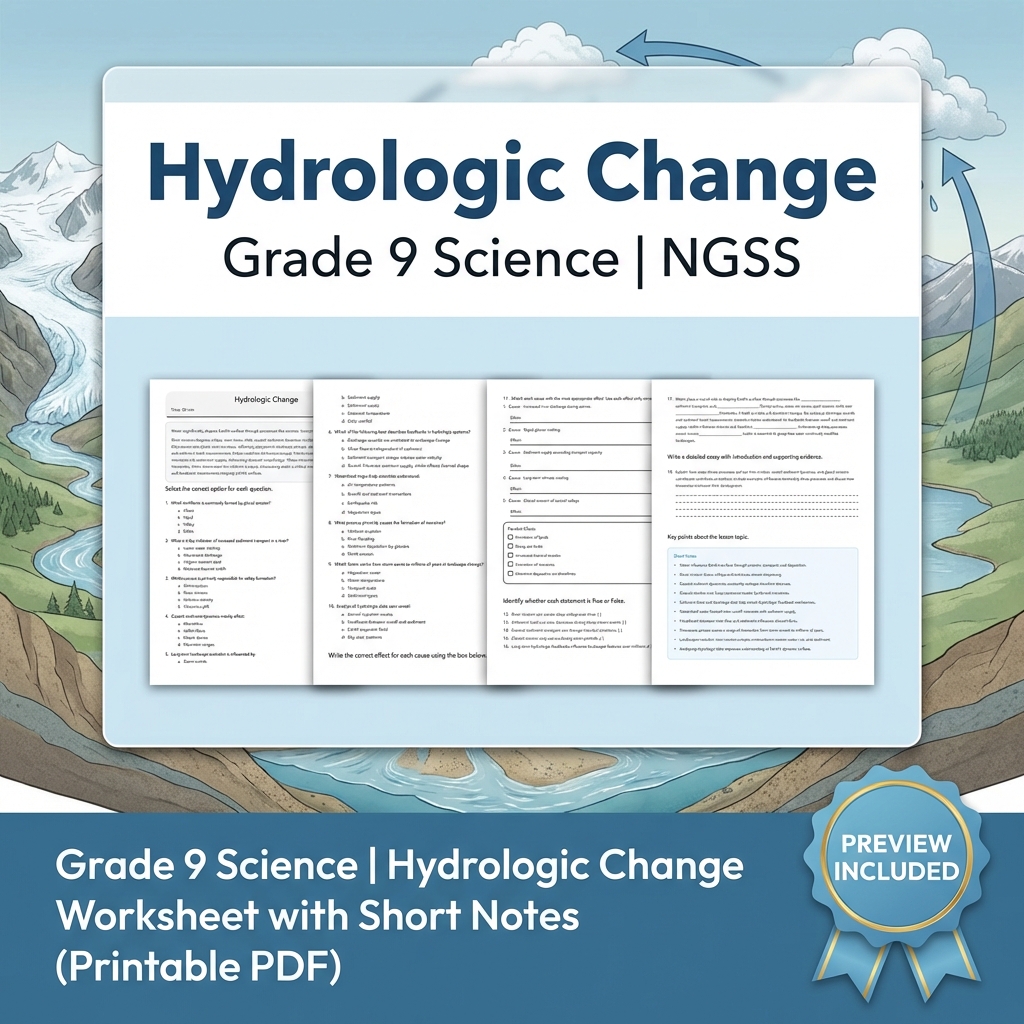
Grade 9 Science | Hydrologic Change Worksheet with Short Notes (Printable PDF)
Created byMeadowlark WorksheetsLearning Objectives
- Analyze hydrologic data to understand water's role in Earth's surface processes.
- Identify examples of landscape change caused by water erosion, transport, and deposition.
- Interpret discharge records, sediment measurements, and watershed maps to assess hydrologic feedbacks.
Also included in: Grade 9 Science | Earth's Systems Unit Bundle NGSS 7 Worksheets (Resource Pack) +1 more
Instant download
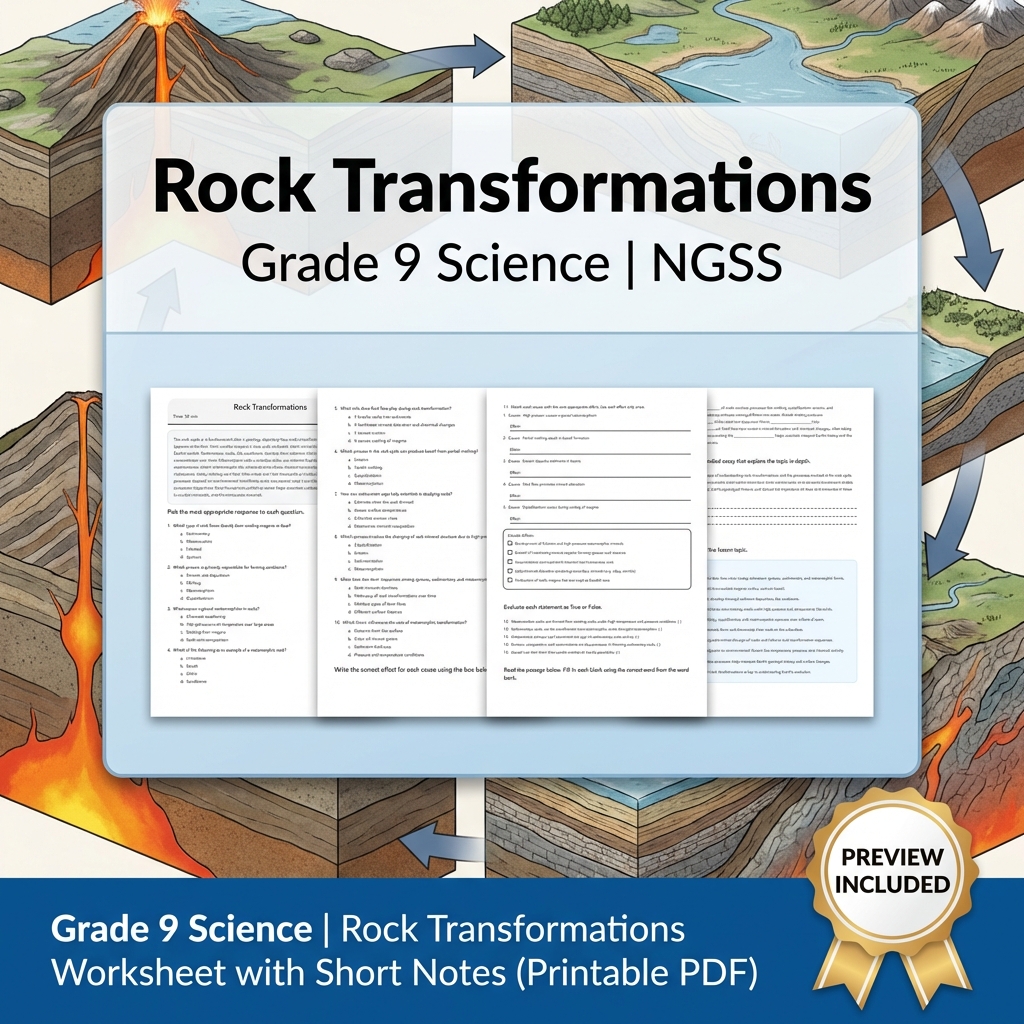
Grade 9 Science | Rock Transformations Worksheet with Short Notes (PDF)
Created byMeadowlark WorksheetsLearning Objectives
- Describe the processes involved in the rock cycle, including melting, crystallization, erosion, and metamorphism.
- Identify examples of rock transformations, such as basalt from partial melting and sandstone from sediment deposition.
- Explain how rates, pressure, temperature, and radiometric ages affect the sequencing of rock cycle events.
Also included in: Grade 9 Science | Earth's Systems Unit Bundle NGSS 7 Worksheets (Resource Pack) +1 more
Instant download
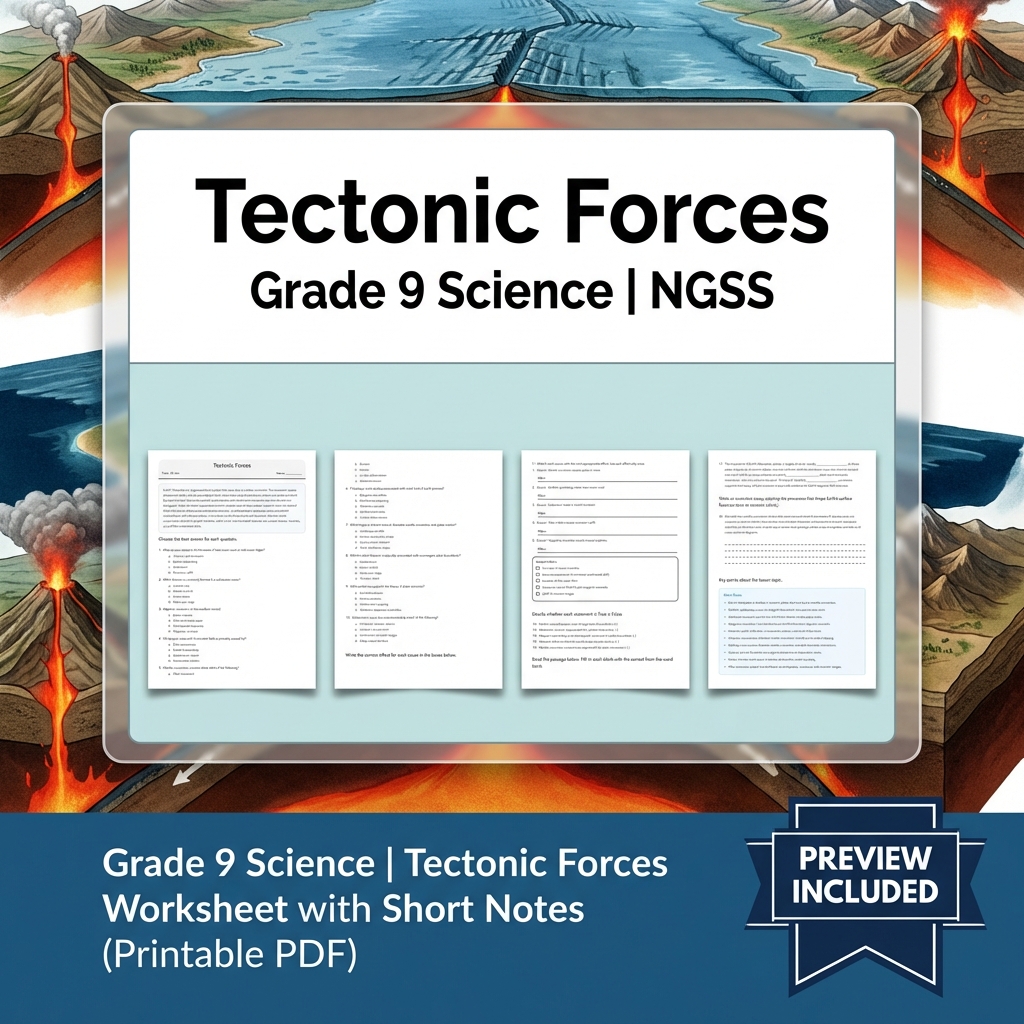
Grade 9 Science | Tectonic Forces Worksheet with Short Notes (Printable PDF)
Created byMeadowlark WorksheetsLearning Objectives
- Explain the processes of seafloor spreading, subduction zones, volcanic arcs, and mountain uplift.
- Connect mantle convection, crustal deformation, and faulting to surface features.
- Use geologic cross-sections and magnetic anomaly patterns as evidence for plate tectonics.
Also included in: Grade 9 Science | Earth's Systems Unit Bundle NGSS 7 Worksheets (Resource Pack) +1 more
Instant download
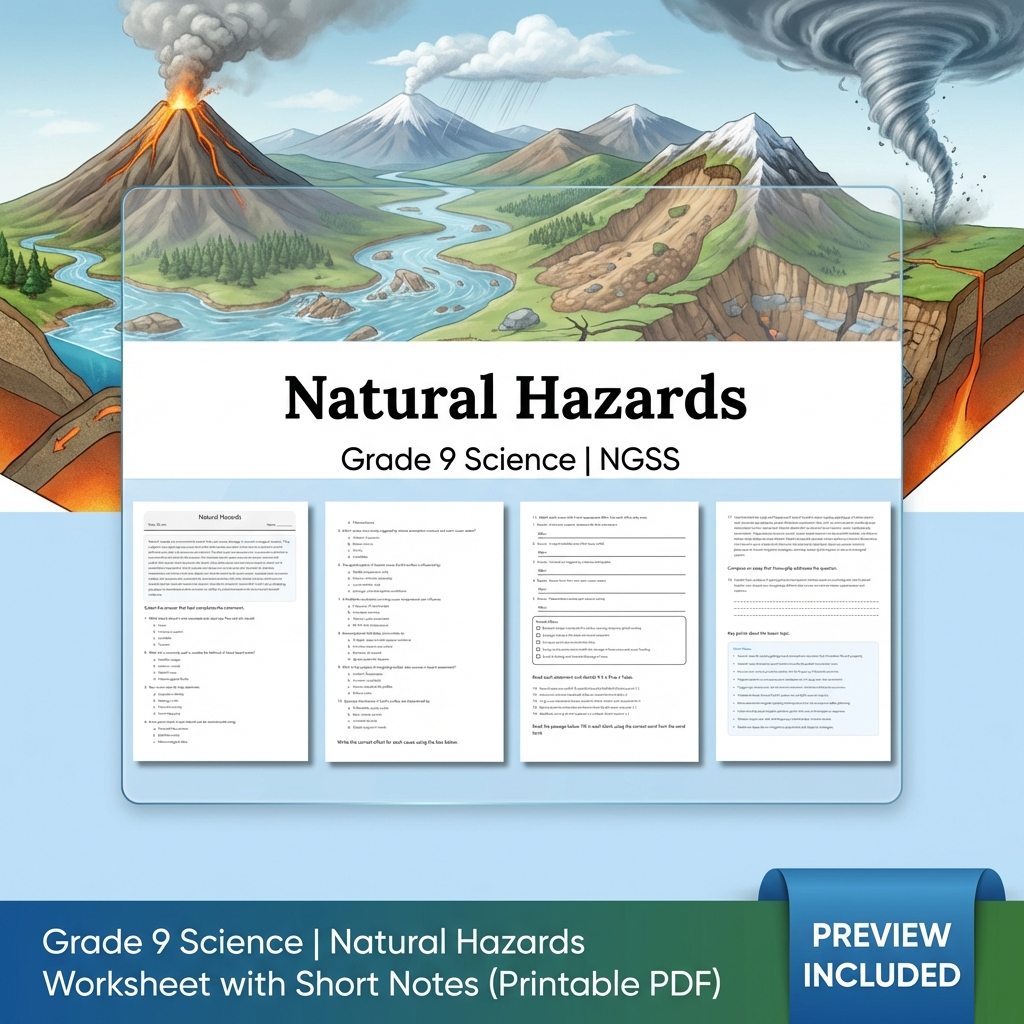
Grade 9 Science | Natural Hazards Worksheet with Short Notes (Printable PDF)
Created byMeadowlark WorksheetsLearning Objectives
- Understand how geologic and atmospheric indicators are used to assess natural hazards.
- Identify different types of natural hazards, their triggers, and impacts.
- Learn how hazard maps, recurrence intervals, and paleoevidence inform risk assessment.
Also included in: Grade 9 Science | Earth's Systems Unit Bundle NGSS 7 Worksheets (Resource Pack) +1 more
Instant download
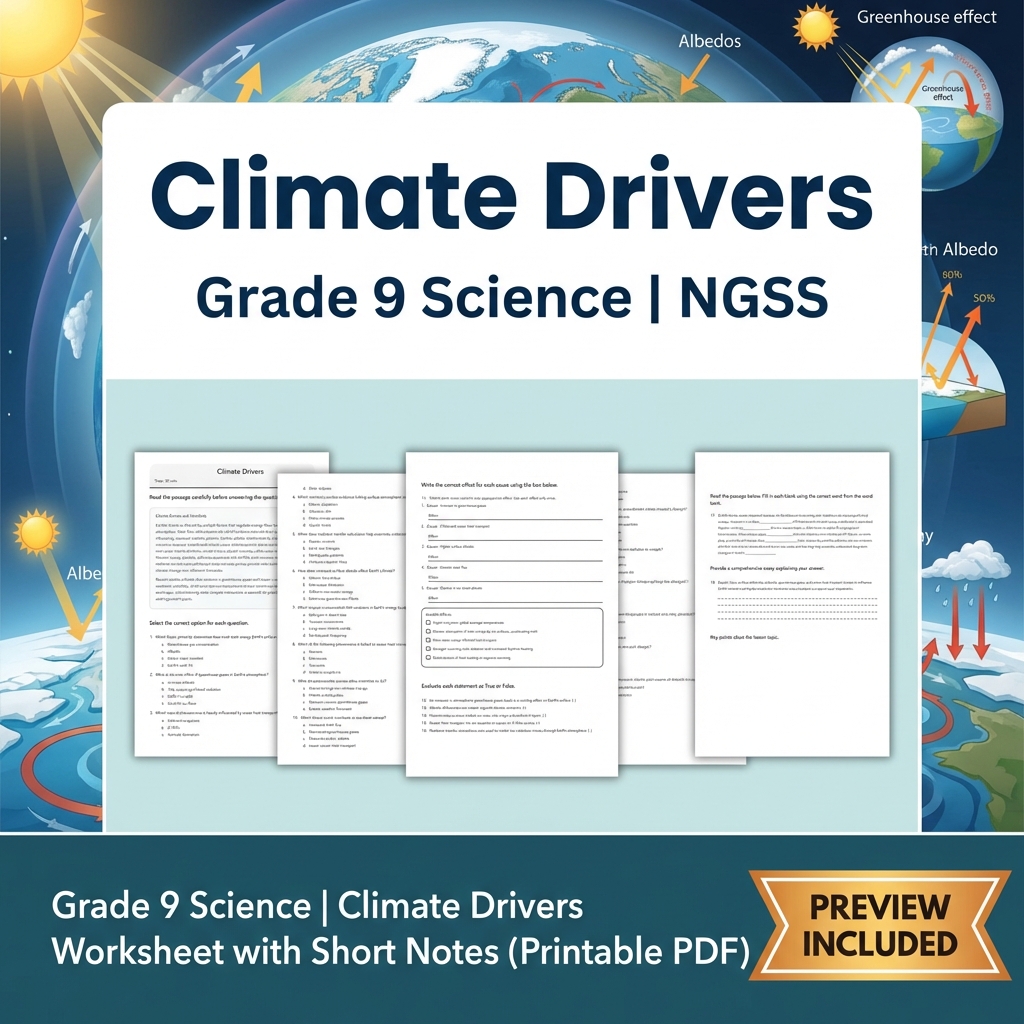
Grade 9 Science | Climate Drivers Worksheet with Short Notes (Printable PDF)
Created byMeadowlark WorksheetsLearning Objectives
- Understand the key factors influencing Earth's climate and weather patterns.
- Interpret quantitative models related to Earth's energy budget and surface-atmosphere interactions.
- Analyze how solar flux, albedo, greenhouse gases, and ocean heat transport affect climate variability.
Also included in: Grade 9 Science | Earth's Systems Unit Bundle NGSS 7 Worksheets (Resource Pack) +1 more
Instant download
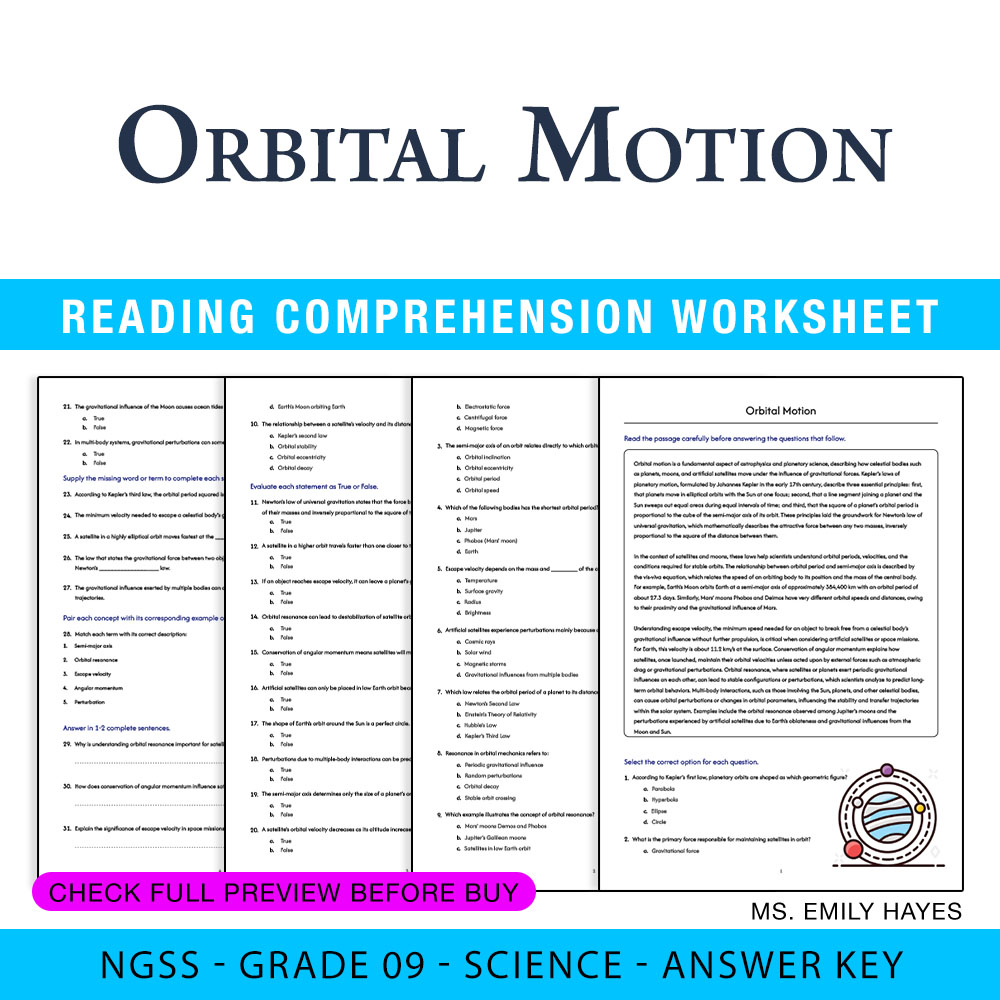
9th Grade Science | Orbital Motion Worksheet (PDF+ Answer Key)
Created byCopper Leaf ClassroomLearning Objectives
- Explain the principles of Kepler's laws and Newton's law of universal gravitation as they relate to orbital motion.
- Describe how orbital period relates to semi-major axis, and explain concepts like escape velocity and angular momentum in planetary and satellite contexts.
- Analyze examples such as Earth's Moon, Mars' moons, and artificial satellites to understand orbital stability, resonance, and perturbations.
Instant download

Grade 9 Science | Third Law Pairs Worksheet | NGSSS Assessment
Created byLumora LearningLearning Objectives
- Explain Newton’s Third Law using the idea of action–reaction force pairs that act on different objects.
- Identify whether two forces form a Third Law pair by checking the interacting objects and direction.
- Use Third Law pairs to analyze everyday situations such as rockets, walking, and pushing against walls.
Instant download

Moon Phases & Eclipse Geometry Worksheets Grade 9 Science
 Created byBRIGHT PATH RESOURCES
Learning Objectives
- Explain how Earth, the Moon, and the Sun create a predictable cycle of Moon phases.
- Describe why eclipses do not happen every month even though the Moon orbits Earth regularly.
- Identify alignment conditions needed for solar and lunar eclipses.
Also included in: Grade 9 Earth Science Worksheets Bundle: Climate, Cycles & Space +1 more
Instant download
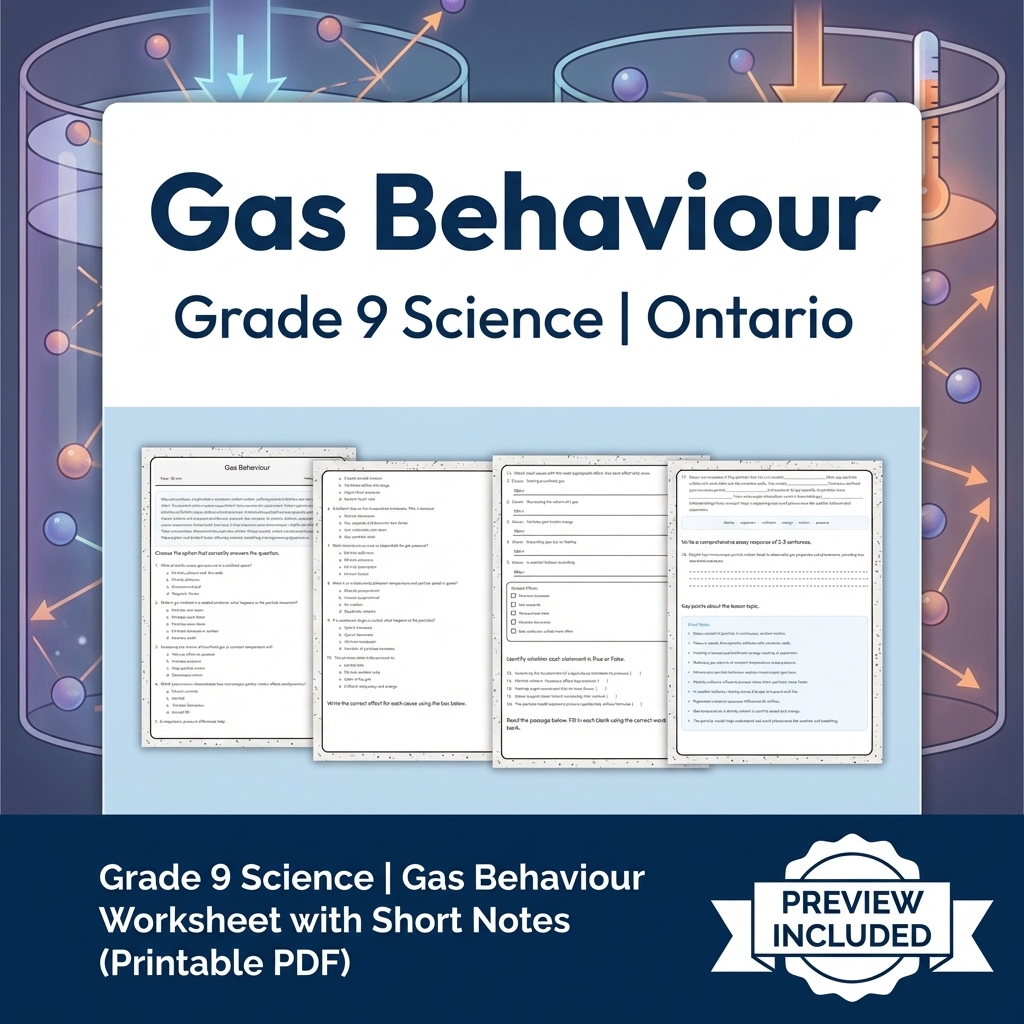
Grade 9 Science | Gas Behaviour Worksheet with Short Notes (Printable PDF)
Created byMeadowlark WorksheetsLearning Objectives
- Explain the particle model of gases and how it relates to pressure, volume, and temperature.
- Describe how microscopic particle collisions lead to observable macroscopic gas laws.
- Analyze real-world phenomena such as weather balloons and respiration through the concept of gas behaviour.
Also included in: Grade 9 Science Lesson Group Bundle | Ontario Curriculum Worksheets
Instant download

Grade 9 Volcanic Processes Worksheet | NGSS Practice PDF
Created byClear Sky ClassroomLearning Objectives
- Explain how magma viscosity and volatile (gas) content influence eruptive style and energy
- Compare effusive shield volcanism and explosive stratovolcano behavior using tectonic setting and magma composition
- Use petrologic indicators and eruption chronologies to interpret past volcanic activity and landscape change
Also included in: Grade 9 Earth and Space Sciences Science lesson bundle (AP framework) +1 more
Instant download

Grade 9 Organelle Function Worksheet | Practice & Assessment PDF
Created byClear Sky ClassroomLearning Objectives
- Explain how mitochondria, chloroplasts, endoplasmic reticulum, and lysosomes contribute to cellular maintenance and metabolism
- Connect organelle structure (cristae, thylakoid stacks, folded membranes) to specific functional outcomes such as ATP synthesis and light capture
- Use compartmentation and energy-flow ideas to describe how pathways are organized to optimize reaction rates and coordination of anabolic and catabolic processes
Also included in: Grade 9 Biology and Ecosystems Science Lesson Bundle for Advanced Placement (AP) +1 more
Instant download

Grade 9 Developmental Variation Worksheet | Practice & Assessment PDF
Created byClear Sky ClassroomLearning Objectives
- Explain how variation in developmental timing and gene regulation can produce different phenotypes from the same basic genetic toolkit
- Describe how regulatory networks and epigenetic modulation influence trait expression during development
- Use comparative developmental evidence to link genetic variation to morphological and physiological differences
Also included in: Grade 9 Biology and Ecosystems Science Lesson Bundle for Advanced Placement (AP) +1 more
Instant download

Grade 9 Control Criteria Worksheet | AP Practice & PDF
Created byClear Sky ClassroomLearning Objectives
- Define control criteria in causal inference and explain why comparability matters
- Identify how variable isolation, replication, baseline characterization, and reference conditions strengthen causal claims
- Analyze how residual confounding and uncontrolled variation weaken causal interpretation
Also included in: Grade 9 Science Practices Science Lesson Bundle | Advanced Placement (AP) +1 more
Instant download

Grade 9 Genetic Transmission Worksheet | Practice & Assessment PDF
Created byClear Sky ClassroomLearning Objectives
- Explain how chromosomal behavior during meiosis leads to Mendelian inheritance patterns.
- Use Punnett frameworks and probability to predict genotypic and phenotypic ratios.
- Analyze inheritance deviations such as incomplete dominance, codominance, linkage, and penetrance.
Also included in: Grade 9 Biology and Ecosystems Science Lesson Bundle for Advanced Placement (AP) +1 more
Instant download

Grade 9 Model-Data Fit Worksheet | Practice & Assessment PDF
Created byClear Sky ClassroomLearning Objectives
- Use residuals and graphical comparisons to judge whether a model is consistent with experimental data.
- Explain diagnostic patterns (such as systematic residual trends and unequal spread) that suggest model problems or missing variables.
- Apply goodness-of-fit ideas to decide when to accept, modify, or reject a model based on predictive performance and independent benchmarks.
Also included in: Grade 9 Science Practices Science Lesson Bundle | Advanced Placement (AP) +1 more
Instant download
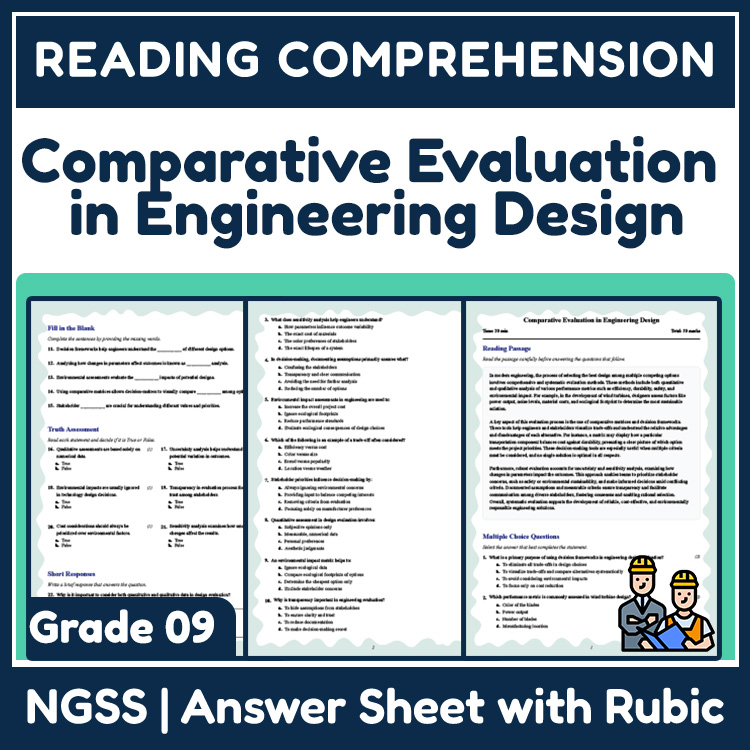
9th Grade Science | Evaluation in Engineering Design (PDF + Answer Key)
JCreated byJ.S SheetsLearning Objectives
- Understand the principles and importance of comparative evaluation in engineering design solutions.
- Identify performance metrics, lifecycle costs, and environmental impacts in decision-making.
- Apply decision frameworks and matrices to compare alternative systems such as wind turbines and transportation components.
Also included in: Grade 9 Science Unit | Engineering Prototyping & Modeling Worksheets
Instant download

Grade 9 Vectors and Forces Worksheet | Magnitude, Components & Resultants
 Created byChalk and Compass
Learning Objectives
- Represent forces as vectors with magnitude and direction in two dimensions
- Resolve a force into perpendicular components and describe what each component means
- Calculate a net/resultant force using analytical methods (components) and explain the role of direction
Also included in: Grade 9 Science Work, Energy & Forces Lesson Bundle | Ontario +1 more
Instant download
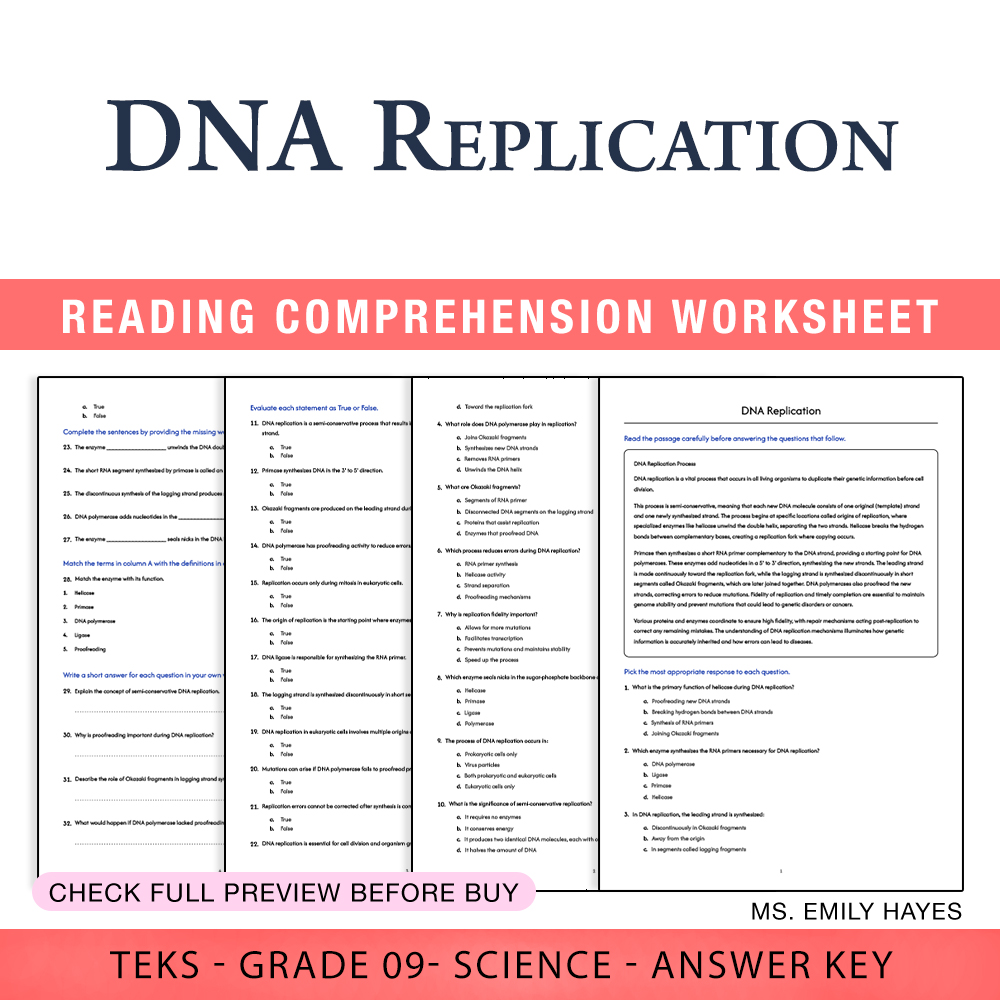
9th Grade Science | DNA Replication Worksheet (PDF+ Answer Key)
Created byCopper Leaf ClassroomLearning Objectives
- Describe the semi-conservative nature of DNA replication.
- Identify the roles of key enzymes such as helicase, primase, and DNA polymerase.
- Explain the processes of leading and lagging strand synthesis, including Okazaki fragments.
Instant download
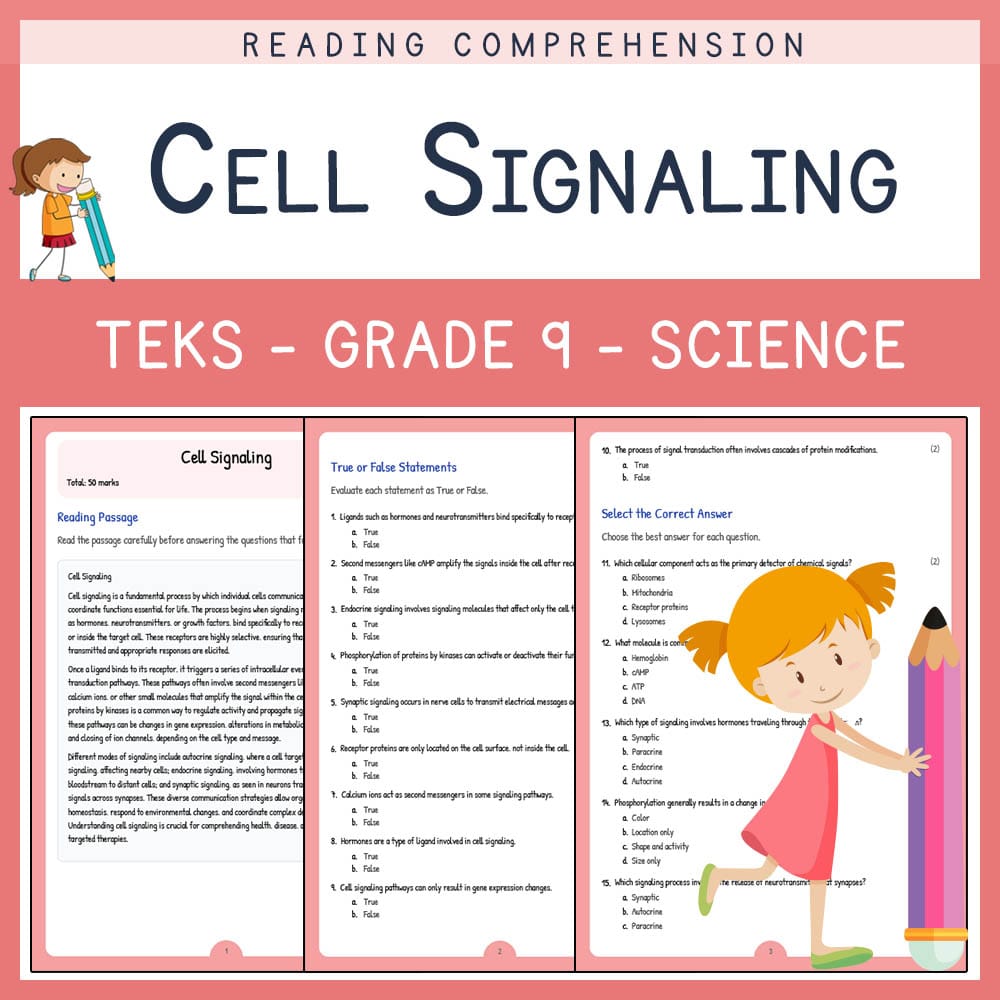
Grade 9 Science | Cell Signaling Worksheet | TEKS-Aligned
Created byLumora LearningLearning Objectives
- Describe the mechanisms of cell signaling, including ligand binding and signal transduction pathways.
- Identify different types of cell signaling such as autocrine, paracrine, endocrine, and synaptic.
- Explain how signal transduction pathways influence gene expression and cellular responses.
Instant download

Grade 9 Newton’s First Law Worksheet | Inertia & Balanced Forces Ontario
Created byChalk and CompassLearning Objectives
- Explain Newton’s first law using the relationship between net external force and changes in motion
- Distinguish between rest and constant velocity as cases of zero net external force
- Use examples involving friction and low-friction surfaces to predict how motion changes
Also included in: Grade 9 Science Work, Energy & Forces Lesson Bundle | Ontario +1 more
Instant download

Grade 9 Science | Stellar Evolution Worksheet & Answer Key (NGSS Aligned)
Created byLumora LearningLearning Objectives
- Describe the main stages of stellar evolution from star formation to terminal outcomes.
- Understand how Hertzsprung-Russell diagrams depict star properties and evolution.
- Explain the processes of nucleosynthesis contributing to element formation in stars.
Instant download

Science Worksheet Meiosis Variation Grade 9 | Standards-Aligned Practice
JCreated byJ.S SheetsLearning Objectives
- Explain how crossing over during meiosis increases genetic variation.
- Describe how independent assortment changes which chromosomes end up in gametes.
- Connect meiosis and fertilization to why siblings can show different observable traits.
Also included in: Grade 9 Evolution, Genetics, and Ecosystems Science Lesson Bundle +1 more
Instant download

Humidity and Clouds Worksheet | Science Assessment for Grade 9 NGSSS
JCreated byJ.S SheetsLearning Objectives
- Explain how rising air and cooling lead to cloud formation through condensation of water vapor.
- Interpret relative humidity as a measure of how close air is to saturation and predict when condensation will occur.
- Describe how latent heat release influences atmospheric stability and affects vertical cloud development.
Also included in: Grade 9 Earth Systems Weather & Climate Science Lesson Bundle: Florida NGSSS +1 more
Instant download

DNA Genes Chromosomes Worksheet | Science Florida NGSSS Grade 9
JCreated byJ.S SheetsLearning Objectives
- Explain how DNA stores genetic information and how genes are organized within chromosomes
- Describe how chromosomes are copied and passed to daughter cells during cell division
- Relate mutations in DNA to differences in inherited traits among individuals
Also included in: Grade 9 Evolution, Genetics, and Ecosystems Science Lesson Bundle +1 more
Instant download

Science Worksheet Third Law Pairs Grade 9 | NGSSS-Aligned Science Practice
JCreated byJ.S SheetsLearning Objectives
- Explain Newton’s Third Law using the idea of action–reaction force pairs
- Identify the two interacting objects and determine force directions in third-law situations
- Distinguish why action–reaction forces do not cancel on a single body
Also included in: Grade 9 Forces, Energy, and Matter Transformations Science lesson bundle +1 more
Instant download

Grade 9 Science Worksheet on Evolution Evidence | Standards-Aligned Practice
JCreated byJ.S SheetsLearning Objectives
- Explain how the fossil record supports gradual evolution over time
- Describe how homologous structures provide evidence of shared ancestry
- Use genetic (DNA) comparisons to justify relatedness among species
Also included in: Grade 9 Evolution, Genetics, and Ecosystems Science Lesson Bundle +1 more
Instant download

Grade 9 Science Worksheet on The Greenhouse Effect and Energy Balance | NGSSS
JCreated byJ.S SheetsLearning Objectives
- Explain how greenhouse gases affect the flow of energy in Earth’s atmosphere by absorbing and re-emitting infrared radiation
- Describe how energy balance depends on absorption, re-emission, and the altitude where infrared escapes to space
- Predict how changes in greenhouse gas concentrations can change the amount of energy retained by the Earth system
Also included in: Grade 9 Earth Systems Weather & Climate Science Lesson Bundle: Florida NGSSS +1 more
Instant download

Science Grade 9 Food Web Energy Worksheet | Standards-Aligned Practice
JCreated byJ.S SheetsLearning Objectives
- Explain how energy flows through trophic levels in an ecosystem from producers to higher-level consumers.
- Describe why energy decreases at each trophic transfer due to respiration and heat loss.
- Interpret food webs as interconnected pathways rather than a single linear chain.
Also included in: Grade 9 Evolution, Genetics, and Ecosystems Science Lesson Bundle +1 more
Instant download
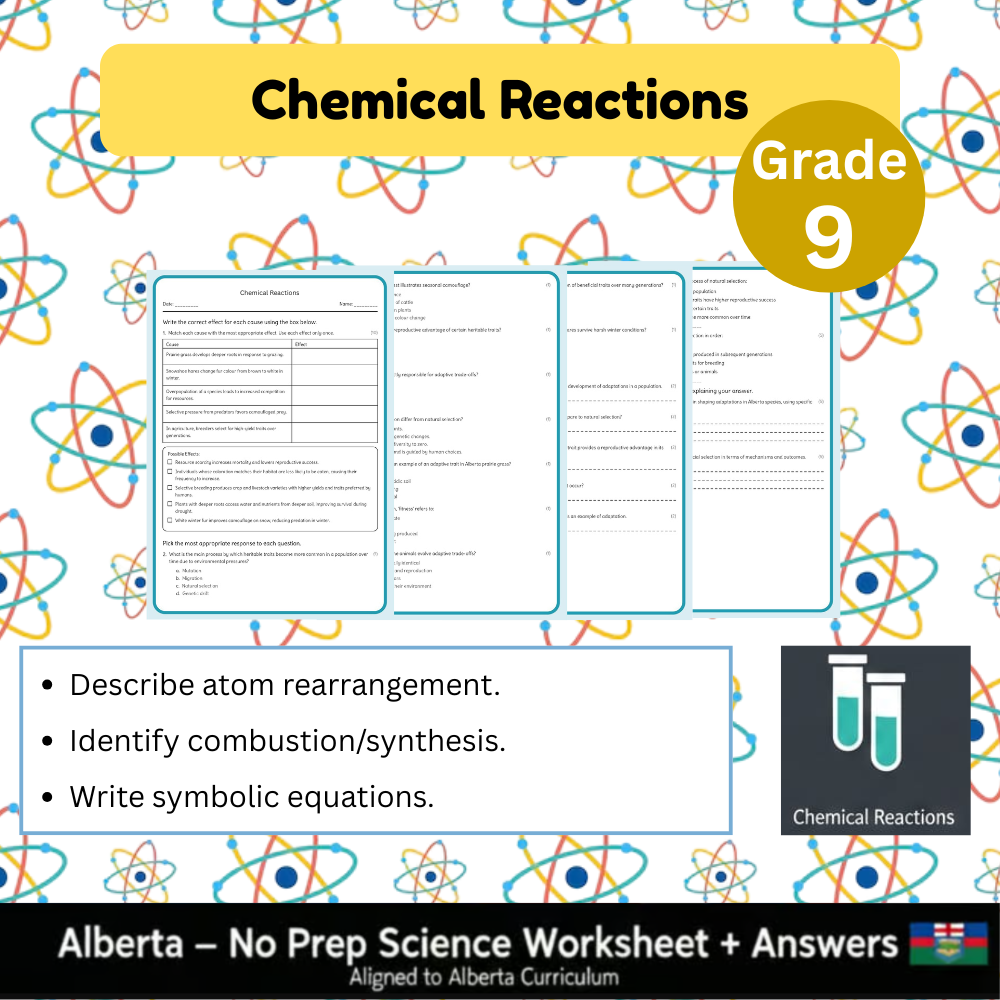
Grade 9 Science – Chemical Reactions Worksheet (PDF) – Alberta Standards
Created byBright Mind ResourcesLearning Objectives
- Describe the process of chemical reactions and how atoms rearrange to form new products.
- Identify common types of chemical reactions such as combustion, synthesis, and decomposition.
- Write and interpret symbolic chemical equations for various reactions.
Instant download
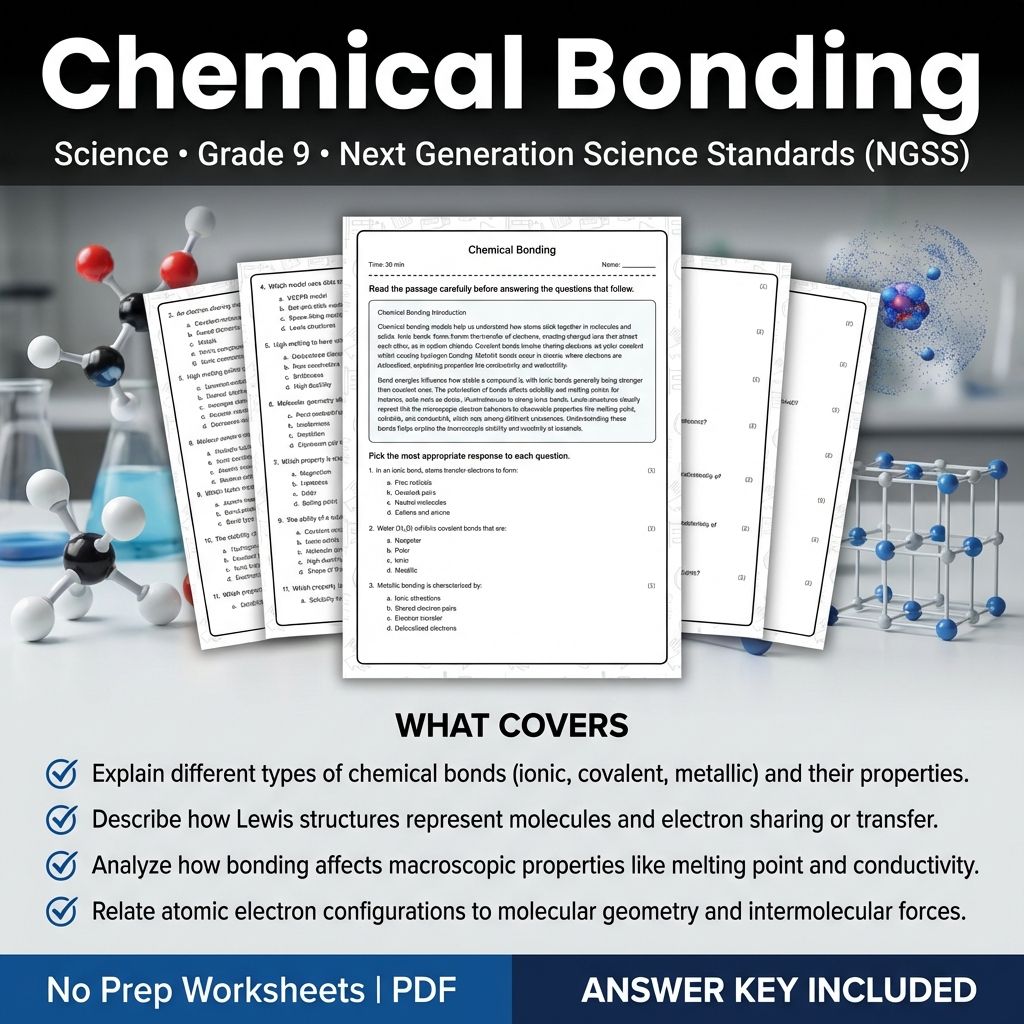
9th Grade Science | Chemical Bonding Worksheet & Answer Key (Printable PDF)
Created byCoral Reef LearningLearning Objectives
- Explain different types of chemical bonds (ionic, covalent, metallic) and their properties.
- Describe how Lewis structures represent molecules and electron sharing or transfer.
- Analyze how bonding affects macroscopic properties like melting point and conductivity.
Also included in: Grade 9 Science Worksheet Bundle | Reaction, Molecules & Energy Topics +1 more
Instant download
About Grade 9 Science Worksheets
Find Science worksheets built for Grade 9. All 6,926 cover core skills, practice, and review, each an instant PDF download.
Every worksheet on MyTeachingSheets is created by independent teacher-authors and reviewed before publication. All resources download as printable PDFs for classroom, homework, or at-home practice, and many include answer keys. Preview any worksheet free before buying.