
Grade 9 Science Worksheets
6,986 worksheets
Grade 9 TEKS Microscopy Basics Worksheet | Magnification and Resolution
 Created byBRIGHT PATH RESOURCES
Learning Objectives
- Explain what magnification means in a microscope image
- Describe resolution and why it matters for seeing fine details
- Identify how contrast and staining affect how specimens look
Also included in: Grade 9 Cell Structure and Function Biology Worksheets Bundle | TEKS +1 more
Instant download

Grade 9 Phospholipid Bilayer Structure & Selective Permeability Worksheet
Created byBRIGHT PATH RESOURCESLearning Objectives
- Explain how hydrophilic and hydrophobic parts of phospholipids form a bilayer
- Describe how membrane structure supports selective permeability
- Identify how the bilayer acts as a barrier to some substances and allows others to pass
Also included in: Grade 9 Cell Structure and Function Biology Worksheets Bundle | TEKS +1 more
Instant download

Grade 9 TEKS Energy Exchange Between Chloroplasts and Mitochondria
Created byBRIGHT PATH RESOURCESLearning Objectives
- Identify the main idea of a passage about organelle energy exchange
- Use supporting details to explain how chloroplasts and mitochondria cooperate
- Distinguish key organelle structures and roles in cellular energy transfer
Also included in: Grade 9 Cell Structure and Function Biology Worksheets Bundle | TEKS +1 more
Instant download

Grade 9 Cell Theory Three Core Ideas TEKS Biology Science Worksheet
Created byBRIGHT PATH RESOURCESLearning Objectives
- Identify the three core claims of cell theory from a text
- Use evidence from a passage to explain why cells are the basic unit of structure and function
- Explain how cell division supports the idea that new cells come from existing cells
Also included in: Grade 9 Cell Structure and Function Biology Worksheets Bundle | TEKS +1 more
Instant download
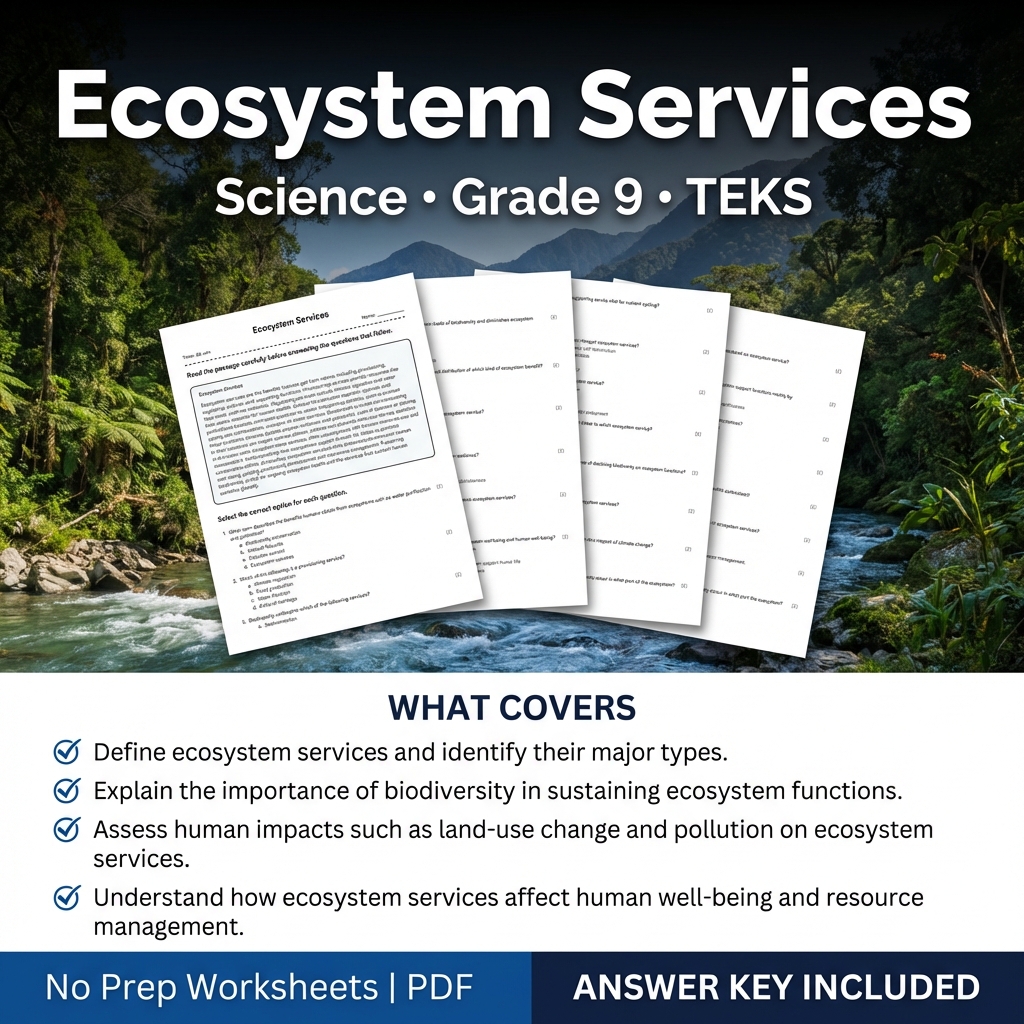
Ecosystem Services Worksheet for Grade 9 Science TEKS Practice PDF
 Created byCoral Reef Learning
Learning Objectives
- Define ecosystem services and identify their major types.
- Explain the importance of biodiversity in sustaining ecosystem functions.
- Assess human impacts such as land-use change and pollution on ecosystem services.
Instant download
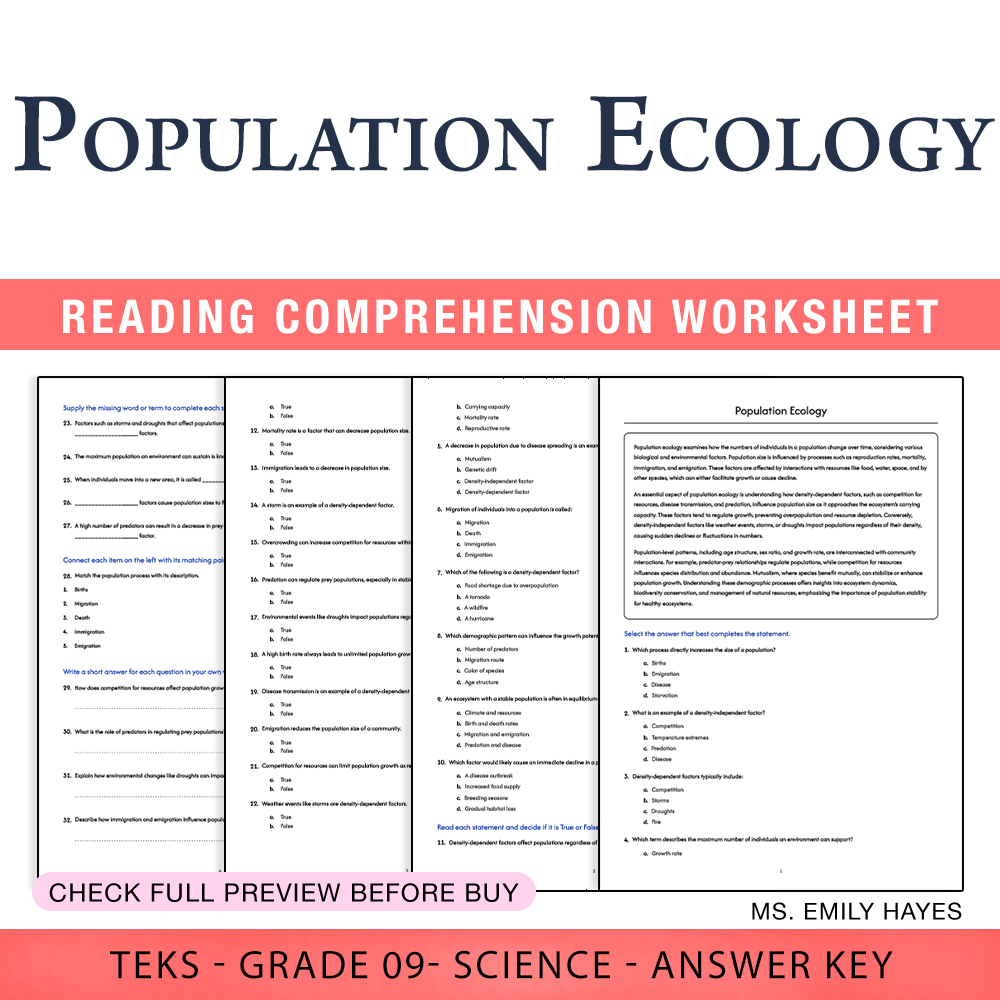
Grade 9 Science | Population Ecology Worksheet (PDF+ Answer Key)
 Created byCopper Leaf Classroom
Learning Objectives
- Understand key concepts of population growth, decline, and regulation.
- Identify factors influencing population dynamics such as birth rates, death rates, immigration, and emigration.
- Differentiate between density-dependent and density-independent factors affecting populations.
Instant download
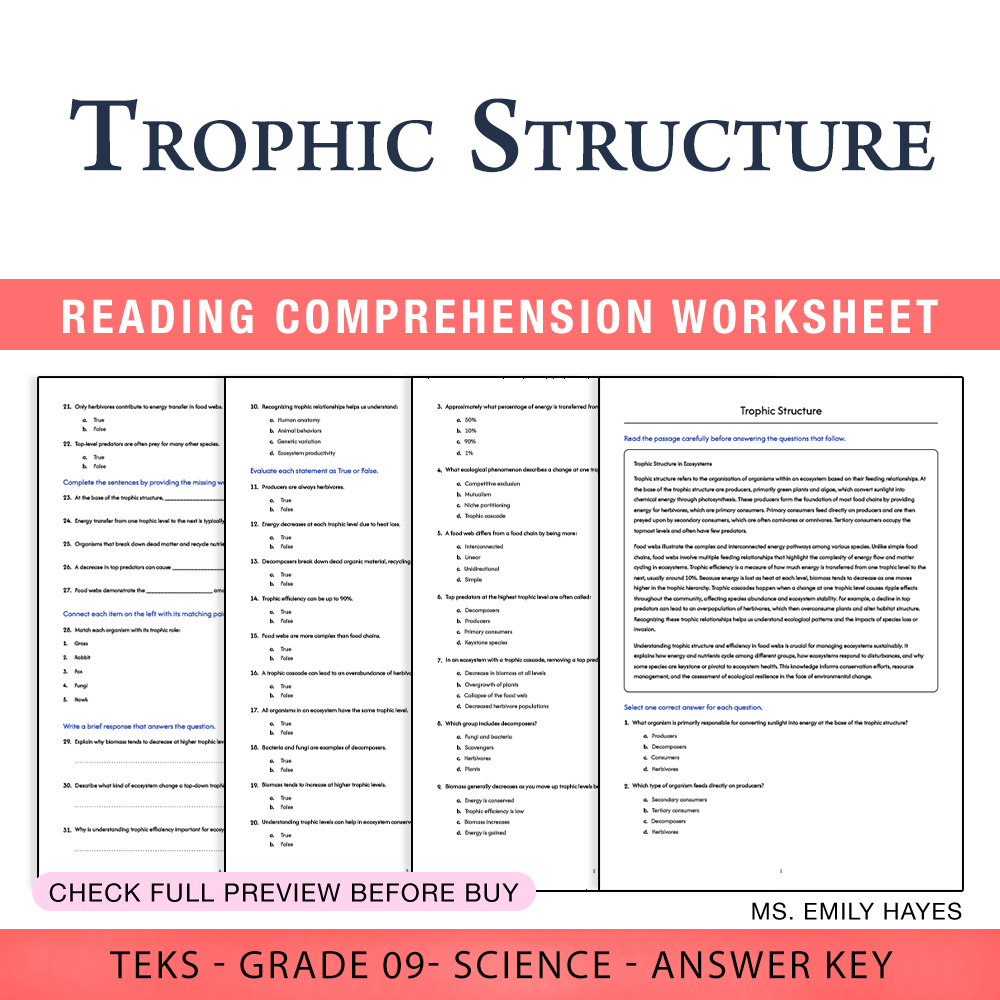
9th Grade Science | Trophic Structure Worksheet (PDF+ Answer Key)
Created byCopper Leaf ClassroomLearning Objectives
- Explain the roles of producers, consumers, and decomposers in food chains and webs.
- Describe how energy flows through trophic levels and what trophic efficiency means.
- Analyze how trophic cascades impact ecosystems and community stability.
Instant download

Grade 9 Unit Analysis Worksheet | Practice & Assessment PDF
 Created byClear Sky Classroom
Learning Objectives
- Apply dimensional analysis to verify that equations are unit-consistent when multiplying or dividing quantities.
- Use unit checking to detect algebraic and model-form errors when deriving relationships and scaling laws.
- Compute derived measurement units (such as density and rate) and evaluate whether numerical results are plausible.
Also included in: Grade 9 Science Practices Science Lesson Bundle | Advanced Placement (AP) +1 more
Instant download

Grade 9 Science | Integrated Analysis in Motion - Daily Reading Comprehension
Created byCoral Reef LearningLearning Objectives
- Understand how forces influence motion through graphs and equations
- Analyze complex motion scenarios using kinematics, forces, and energy principles
- Interpret graphs and equations to predict physical behavior in real-world contexts
Also included in: Forces and Motion Mechanical Systems Lesson Bundle | Grade 9 Science Alberta +1 more
Instant download
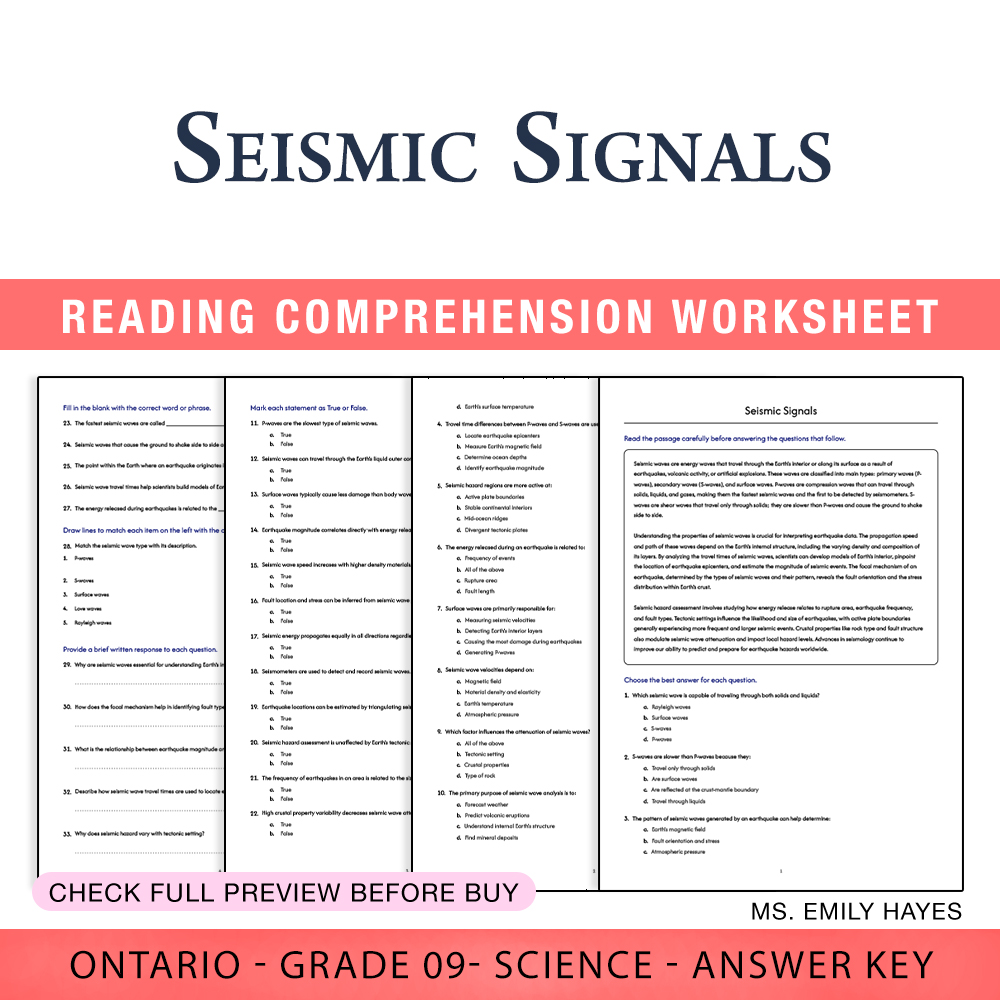
9th Grade Science | Seismic Signals Worksheet (PDF + Answer Key)
Created byCopper Leaf ClassroomLearning Objectives
- Describe different types of seismic waves and their propagation characteristics
- Explain how earthquake focal mechanisms reveal fault types and stress orientations
- Relate seismic wave travel times to Earth’s interior models and methods for locating epicentres
Instant download

Grade 9 Science – Energy Conservation & Mechanical Systems | Reading Worksheet
 Created byBright Mind Resources
Learning Objectives
- Understand the concepts of kinetic and potential energy.
- Explain how mechanical energy interconverts between kinetic and potential forms.
- Identify conditions for total mechanical energy conservation in systems.
Also included in: Grade 9 Work, Energy & Forces Science Daily Reading Lesson Bundle | Ontario +1 more
Instant download

9th Grade Science | Renal Regulation Reading Worksheet & Answer Key (PDF)
JCreated byJ.S SheetsLearning Objectives
- Understand the basic functions of the nephron in renal regulation.
- Identify the hormonal systems involved in kidney function and blood pressure regulation.
- Explain the mechanisms of fluid and electrolyte homeostasis in the kidneys.
Instant download
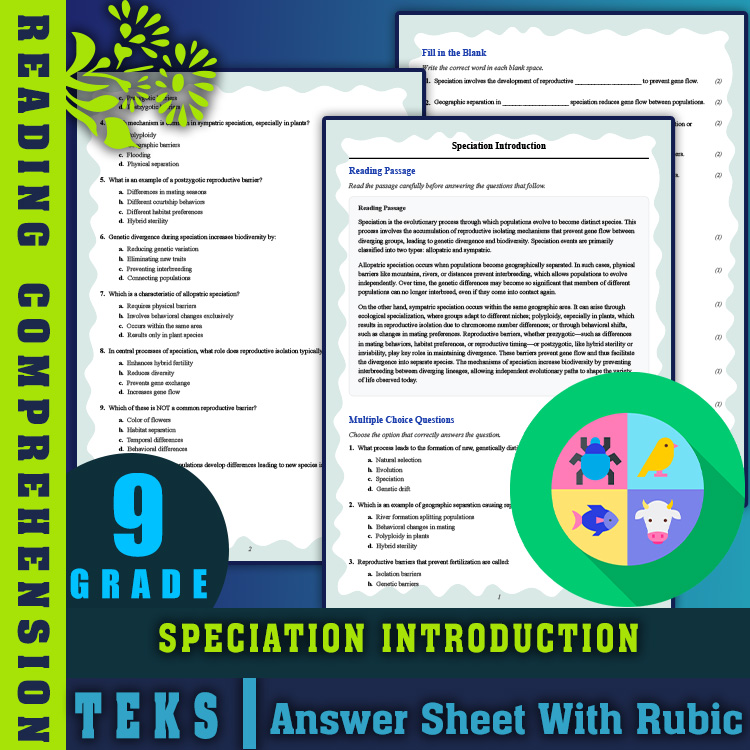
9th Grade Science | Speciation Introduction Reading Worksheet & Answer Key (PDF)
JCreated byJ.S SheetsLearning Objectives
- Understand the concept of speciation and the mechanisms that lead to the formation of new species.
- Identify reproductive barriers and their roles in speciation.
- Distinguish between allopatric and sympatric speciation processes.
Instant download
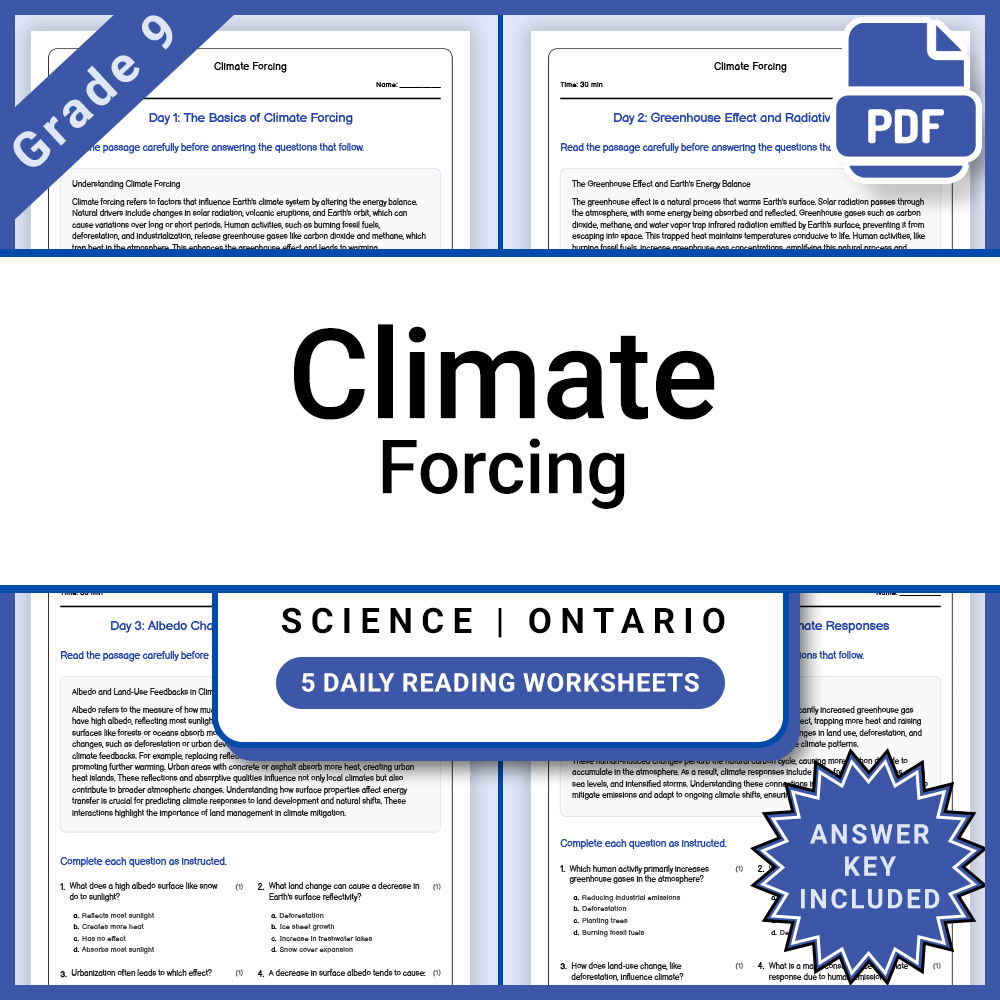
Grade 9 Science – Climate Forcing Daily Reading Worksheet + Answer Key
JCreated byJ.S SheetsLearning Objectives
- Define various types of climate drivers including greenhouse gases, albedo changes, aerosols, and land-use feedbacks.
- Explain basic concepts of radiative transfer and how they relate to Earth's energy budget.
- Describe the influence of atmospheric composition on surface temperature.
Also included in: Grade 9 Science Lesson Group Bundle – Earth Systems & Planetary Concepts +1 more
Instant download
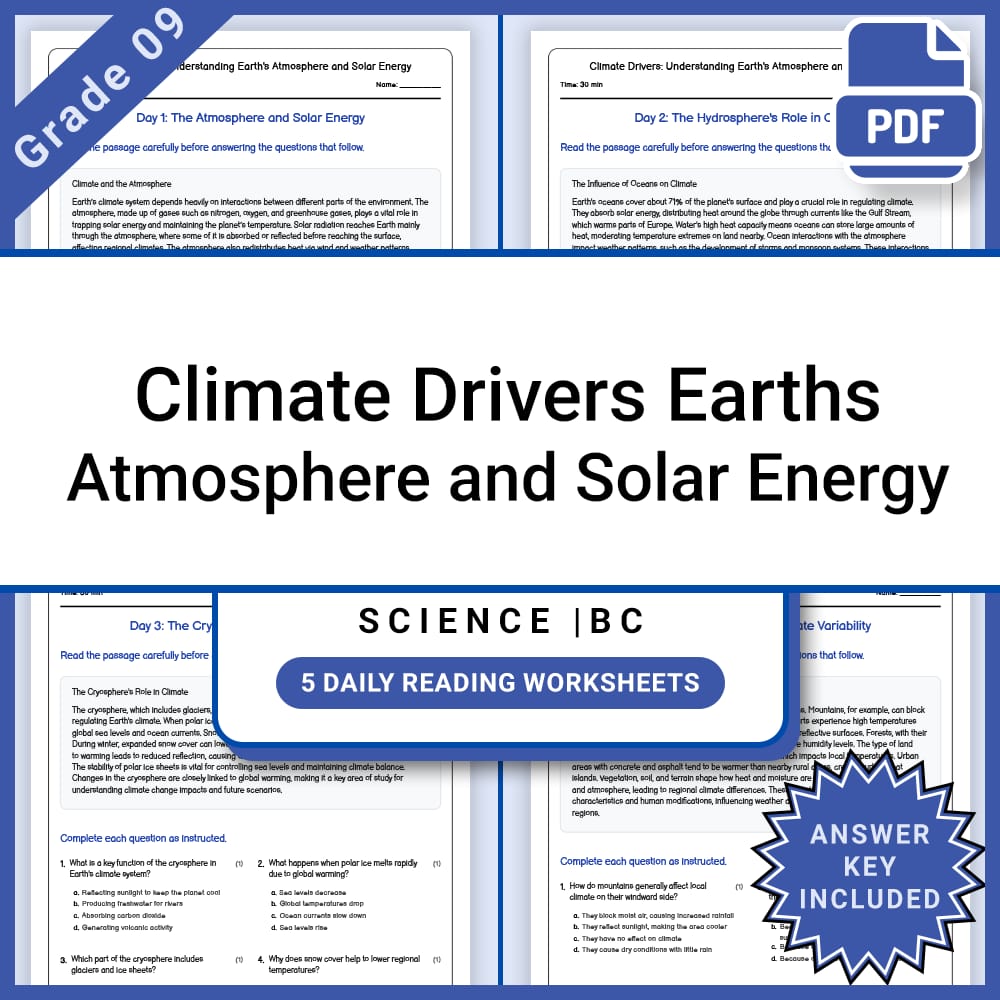
Grade 9 Science – Climate Drivers Daily Reading Worksheet + Answer Key
JCreated byJ.S SheetsLearning Objectives
- Describe how the atmosphere interacts with solar energy to influence climate.
- Explain the role of the atmosphere in regulating Earth's temperature.
- Identify key factors that drive climate variability and change.
Also included in: Grade 9 Science Lesson Bundle: Tidal Forces, Tectonic Plates & Climate Physics +1 more
Instant download
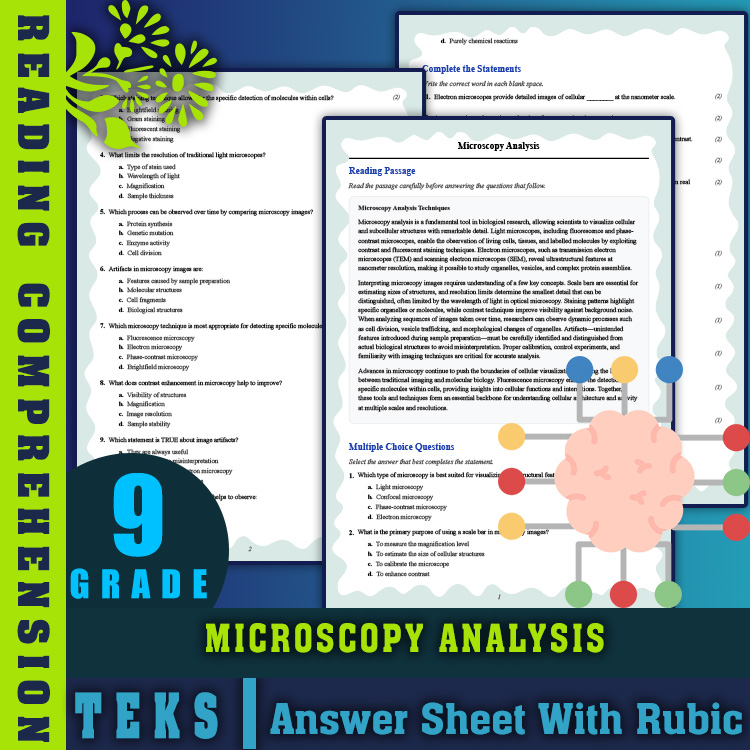
9th Grade Science | Microscopy Analysis Reading Worksheets (PDF + Rubric)
JCreated byJ.S SheetsLearning Objectives
- Interpret visual data from microscopy images, including scale bars and resolution limits.
- Identify cellular structures and processes using staining and contrast techniques.
- Differentiate between effects of artifacts and real biological features in microscopy images.
Instant download

Grade 9 Science – Law of Conservation & Reactions | Daily Reading Worksheet
Created byBright Mind ResourcesLearning Objectives
- Define the law of conservation of mass
- Explain how mass is conserved during chemical reactions
- Identify balanced chemical equations that demonstrate mass conservation
Also included in: Grade 9 Chemical Reactions Science Lesson Bundle: Daily Reading (BC) +1 more
Instant download
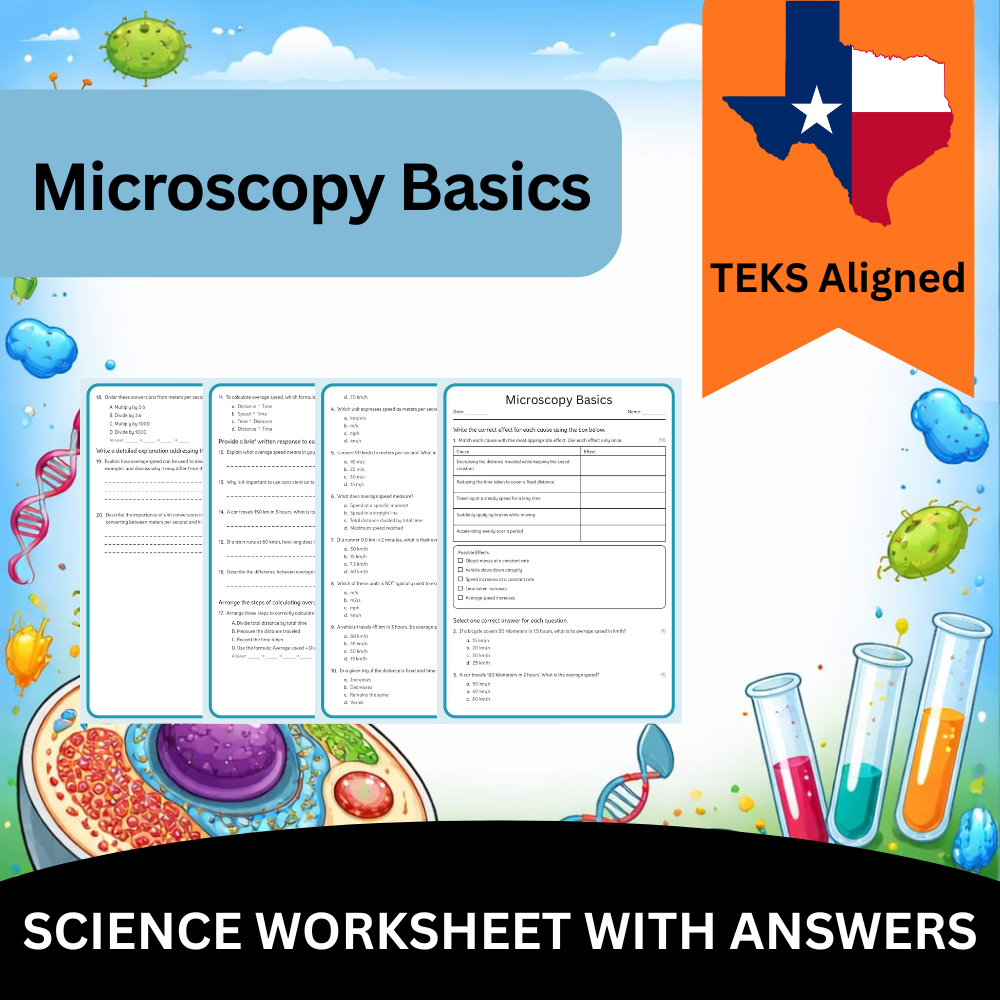
Grade 9 Science | Microscopy Basics Worksheet – TEKS Standards (PDF)
Created byBright Mind ResourcesLearning Objectives
- Understand the principles of optical and electron microscopy.
- Identify the differences between magnification, resolution, and contrast.
- Learn how to interpret microscope images with scale bars and artifacts.
Also included in: Grade 9 Science Unit | Cell Structures & Transport Mechanisms Pack(TEKS-Aligned) +3 more
Instant download
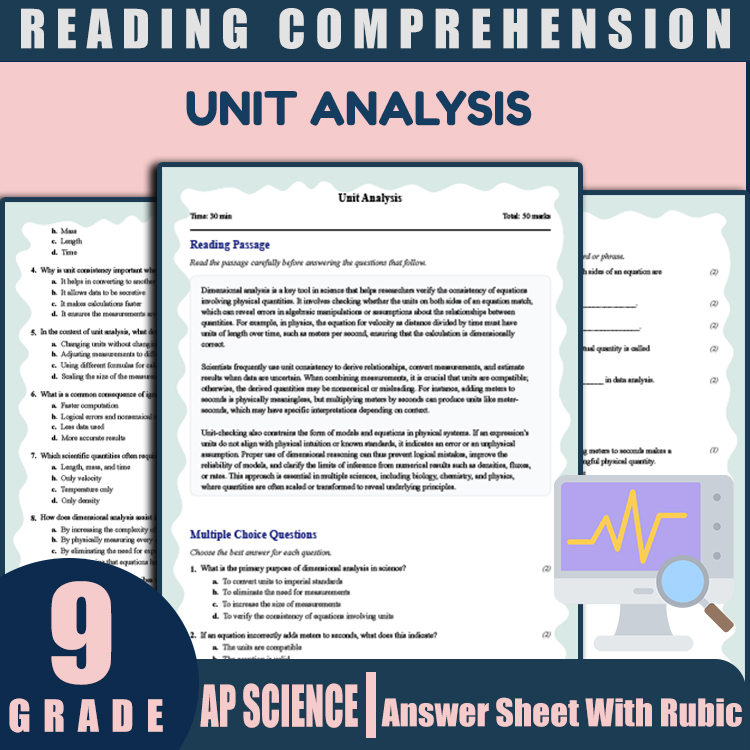
9th Grade Science | Unit Analysis Reading Worksheet (PDF + Answer Key)
JCreated byJ.S SheetsLearning Objectives
- Understand the principles of dimensional analysis and how to apply units to verify physical equations.
- Learn to identify and correct unit inconsistencies in calculations involving measurements and derived quantities.
- Explore the role of unit-checking in detecting algebraic errors and constraining plausible models in scientific analysis.
Instant download

Grade 9 Science | Wave Speed Relations Worksheet | General Standards
 Created byLumora Learning
Learning Objectives
- Explain the relationship between wave speed, frequency, and wavelength for waves traveling in the same medium
- Use the equation v = fλ to calculate wavelength or frequency from given values
- Interpret how changes in frequency correspond to compensating changes in wavelength when wave speed stays constant
Instant download
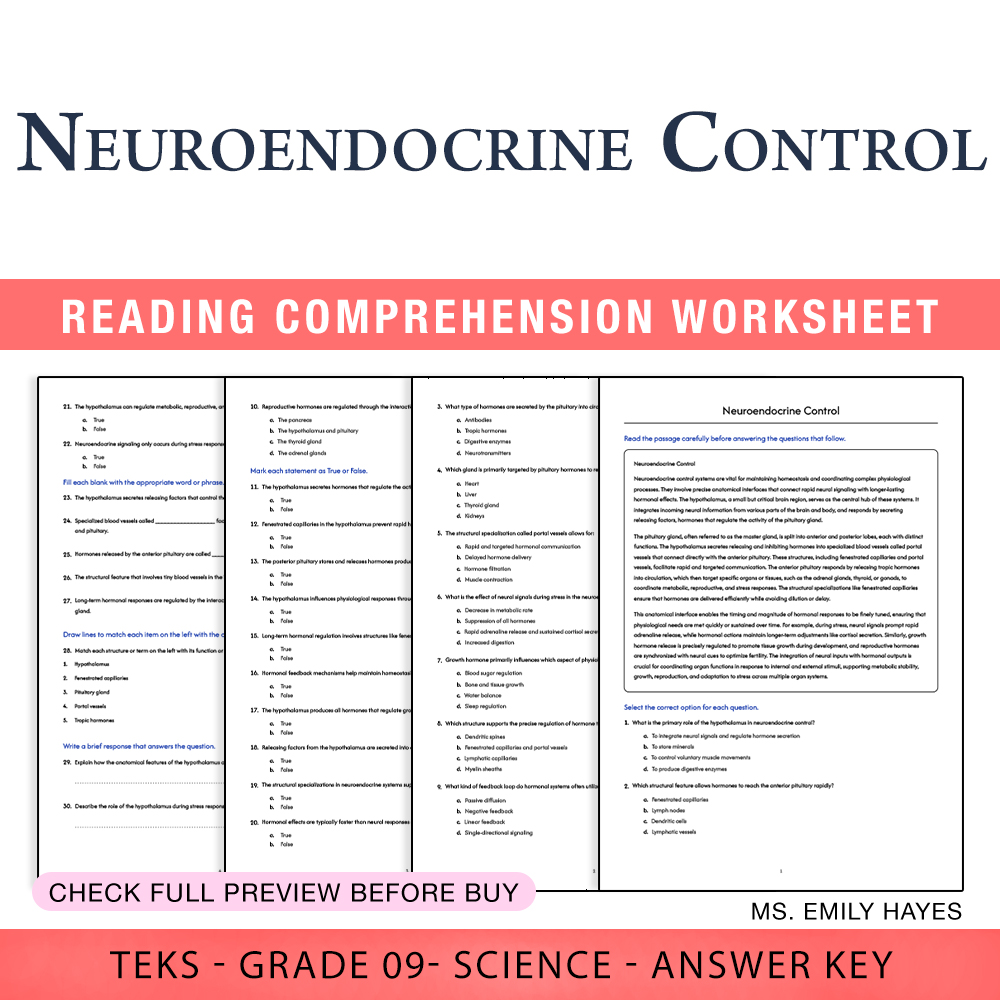
9th Grade Science | Neuroendocrine Control Worksheet (PDF+ Answer Key)
Created byCopper Leaf ClassroomLearning Objectives
- Understand how the hypothalamus interacts with the pituitary gland to regulate hormones.
- Identify key structural features that support neuroendocrine signaling.
- Describe the effects of neuroendocrine responses on body systems such as metabolism, growth, and stress.
Instant download

Grade 9 Interactions & Community Structure Daily Reading | TEKS Science
Created byBRIGHT PATH RESOURCESLearning Objectives
- Identify the main idea of a scientific passage about community interactions.
- Use details from the text to explain how species interactions shape community structure.
Also included in: Grade 9 Ecology Environmental Science Reading Worksheets Bundle | TEKS +1 more
Instant download

Wave Property Links Worksheet | Grade 9 Science Practice
 Created byPrism Point Learning
Learning Objectives
- Explain how frequency, wavelength, and amplitude describe different features of a wave
- Predict how changing one wave parameter changes a wave’s observable pattern or signal description
- Relate wave properties to energy and to different representations of the same wave
Instant download

Grade 9 Science | Wave Property Links Worksheet | General Standards
Created byLumora LearningLearning Objectives
- Explain how frequency, wavelength, and amplitude affect a wave’s observable characteristics
- Use the relationship between wave speed, frequency, and wavelength to predict how one parameter changes when another changes
- Interpret wave “signatures” by connecting amplitude, frequency, and wavelength to different features of a signal
Instant download

Grade 9 Science | Glycolysis Overview - Daily Reading Comprehension
Created byCoral Reef LearningLearning Objectives
- Understand the basic process of glycolysis and its significance in energy production.
- Identify key intermediates and steps involved in glycolysis.
- Explain the differences between aerobic and anaerobic conditions in cellular respiration.
Instant download

Chemical Names and Formulas Learning Stations | Grade 9 Alberta Science
 Created byMTS Academic Studio
Learning Objectives
- Interpret chemical names and formulas to identify elements and compounds.
- Identify elements and compounds using particle models.
- Predict combining ratios using the charges of ions.
Also included in: Grade 9 Alberta Science Chemical Changes & Atomic Models Bundle
Instant download

Cells, Motors and Generators Learning Stations Activity | Grade 9 Science
Created byMTS Academic StudioLearning Objectives
- Identify energy transformations in chemical cells, motors and generators.
- Compare energy inputs and useful outputs in electrical technologies.
- Explain unwanted energy transfers using evidence from technological examples.
Also included in: Grade 9 Alberta Science Electrical Principles Learning Stations Bundle
Instant download

Environmental Chemistry Learning Stations: Exposure & Nutrients Grade 9
Created byMTS Academic StudioLearning Objectives
- Trace substance movement through environments, organisms and food webs
- Explain how amount, pathway and context affect exposure and harm
- Compare scientific and community responses to environmental contamination
Also included in: Grade 9 Environmental Chemistry Lesson Bundle | Alberta Science
Instant download

Electrical Power and Efficiency Learning Stations Activity | Grade 9 Science
Created byMTS Academic StudioLearning Objectives
- Calculate electrical power using voltage and current.
- Calculate energy transfer using power and operating time.
- Explain relationships between electrical power, time, and energy.
Also included in: Grade 9 Alberta Science Electrical Principles Learning Stations Bundle
Instant download

Environmental Chemistry: Evidence and Decisions Grade 9 Learning Stations
Created byMTS Academic StudioLearning Objectives
- Explain environmental chemistry problems using relevant evidence
- Identify uncertainty in environmental investigations
- Interpret alternative explanations of environmental evidence
Also included in: Grade 9 Environmental Chemistry Lesson Bundle | Alberta Science
Instant download

Changing Models of Space Learning Stations Activity | Grade 9 Science
Created byMTS Academic StudioLearning Objectives
- Compare historical explanations of celestial motion using scientific evidence.
- Identify observations that supported or challenged historical space models.
- Distinguish scientific observations from interpretations of celestial phenomena.
Also included in: Alberta Grade 9 Science Space Exploration Lesson Bundle
Instant download

Classifying Matter and Chemical Changes Grade 9 Science Stations Activity
Created byMTS Academic StudioLearning Objectives
- Classify materials using composition and measurable properties.
- Distinguish mixtures from pure substances using scientific evidence.
- Differentiate elements, compounds, metals and non-metals.
Also included in: Grade 9 Alberta Science Chemical Changes & Atomic Models Bundle
Instant download

Space Exploration Learning Stations Activity | Grade 9 Alberta Science
Created byMTS Academic StudioLearning Objectives
- Identify environmental challenges associated with surviving in space
- Explain how space technologies address pressure and temperature challenges
- Compare engineering solutions using evidence from documented space missions
Also included in: Alberta Grade 9 Science Space Exploration Lesson Bundle
Instant download

Chemical Change Worksheets: Evidence & Decisions | Grade 9 Science
Created byMTS Academic StudioLearning Objectives
- Identify predictions and safe methods for investigating chemical problems
- Interpret evidence while recognizing uncertainty and alternative explanations
- Communicate conclusions using evidence and reliable sources
Also included in: Grade 9 Alberta Science Chemical Changes & Atomic Models Bundle
Instant download

Chemical Reactions Learning Stations | Evidence, Rates & Mass Grade 9
Created byMTS Academic StudioLearning Objectives
- Identify evidence of chemical change in documented reaction examples.
- Explain chemical changes involving combustion and corrosion.
- Compare factors that influence chemical reaction rates.
Also included in: Grade 9 Alberta Science Chemical Changes & Atomic Models Bundle
Instant download

Grade 9 Electrical Principles and Technologies Learning Stations Activity
Created byMTS Academic StudioLearning Objectives
- Explain how predictions guide investigations of electrical technologies.
- Analyze observations and measurements used as scientific evidence.
- Compare testing methods used to improve electrical designs.
Also included in: Grade 9 Alberta Science Electrical Principles Learning Stations Bundle
Instant download

Environmental Quality Worksheets: Science 9 Environmental Chemistry
Created byMTS Academic StudioLearning Objectives
- Compare chemical measurements with biological observations
- Explain what pH reveals about an environment
- Interpret dissolved oxygen as environmental evidence
Also included in: Grade 9 Environmental Chemistry Lesson Bundle | Alberta Science
Instant download

Environmental Chemistry Learning Stations: Transport, Persistence & Risk
Created byMTS Academic StudioLearning Objectives
- Identify how substances move through air, water, soil, and food webs
- Explain how persistence affects environmental risk
- Explain how toxicity and exposure affect environmental risk
Also included in: Grade 9 Environmental Chemistry Lesson Bundle | Alberta Science
Instant download

Electrical Choices and Impacts Learning Stations | Grade 9 Alberta Science
Created byMTS Academic StudioLearning Objectives
- Compare electrical generation technologies using environmental and economic evidence.
- Identify resource demands associated with electrical storage technologies.
- Investigate benefits and unintended consequences of electrical technology projects.
Also included in: Grade 9 Alberta Science Electrical Principles Learning Stations Bundle
Instant download

Position, Distance and Motion Learning Stations | Grade 9 Alberta Science
Created byMTS Academic StudioLearning Objectives
- Explain how altitude and azimuth describe observed celestial positions.
- Interpret parallax observations as evidence of astronomical distance.
- Explain how Doppler observations reveal celestial motion.
Also included in: Alberta Grade 9 Science Space Exploration Lesson Bundle
Instant download

Variation, Niches and Relationships Learning Stations | Grade 9 Science
Created byMTS Academic StudioLearning Objectives
- Identify inherited variation within species using ecological examples.
- Explain how inherited differences influence survival during environmental change.
- Analyze ecological niches and relationships between organisms.
Also included in: Alberta Grade 9 Science Biological Diversity & Evolution Bundle
Instant download

Reproduction and Inheritance Learning Stations Activity | Grade 9 Science
Created byMTS Academic StudioLearning Objectives
- Compare sexual and asexual reproduction using documented scientific examples.
- Explain how inherited characteristics are transmitted between generations.
- Distinguish inherited variation from environmentally influenced characteristics.
Also included in: Alberta Grade 9 Science Biological Diversity & Evolution Bundle
Instant download

Space Exploration Learning Stations Activity | Grade 9 Alberta Science
Created byMTS Academic StudioLearning Objectives
- Identify scientific questions investigated in real space exploration projects.
- Examine predictions, investigation methods and scientific observations.
- Interpret scientific evidence and recognize uncertainty in conclusions.
Also included in: Alberta Grade 9 Science Space Exploration Lesson Bundle
Instant download

Electric Circuits & Resistance Learning Stations | Grade 9 Science
Created byMTS Academic StudioLearning Objectives
- Compare static electric charge with sustained electric current.
- Interpret documented historical examples of electrical principles.
- Explain how conductors affect the movement of electric charge.
Also included in: Grade 9 Alberta Science Electrical Principles Learning Stations Bundle
Instant download

Telescopes, Satellites and Remote Sensing Learning Stations Grade 9
Created byMTS Academic StudioLearning Objectives
- Compare the information collected by optical and radio telescopes.
- Explain how satellites collect scientific information about Earth.
- Describe how geometric models support position determination.
Also included in: Alberta Grade 9 Science Space Exploration Lesson Bundle
Instant download

Space Exploration Learning Stations | Canadian Contributions Grade 9
Created byMTS Academic StudioLearning Objectives
- Describe Canadian contributions to space technology and scientific research.
- Explain Canada's involvement in international space cooperation.
- Compare scientific and economic benefits of real space projects.
Also included in: Alberta Grade 9 Science Space Exploration Lesson Bundle
Instant download

Genes, Cell Division and Natural Selection Learning Stations Grade 9
Created byMTS Academic StudioLearning Objectives
- Explain how genes and chromosomes contribute to inheritance.
- Distinguish mitosis from meiosis by their biological outcomes.
- Explain how cell division contributes to genetic variation.
Also included in: Alberta Grade 9 Science Biological Diversity & Evolution Bundle
Instant download

Biodiversity Conservation Learning Stations Activity | Grade 9 Science
Created byMTS Academic StudioLearning Objectives
- Analyze how habitat changes affect biodiversity and population abundance.
- Explain how human activities influence genetic variation.
- Distinguish global extinction from regional disappearance.
Also included in: Alberta Grade 9 Science Biological Diversity & Evolution Bundle
Instant download
About Grade 9 Science Worksheets
Find Science worksheets built for Grade 9. All 6,986 cover core skills, practice, and review, each an instant PDF download.
Every worksheet on MyTeachingSheets is created by independent teacher-authors and reviewed before publication. All resources download as printable PDFs for classroom, homework, or at-home practice, and many include answer keys. Preview any worksheet free before buying.