
Science Worksheets
44,295 subject resources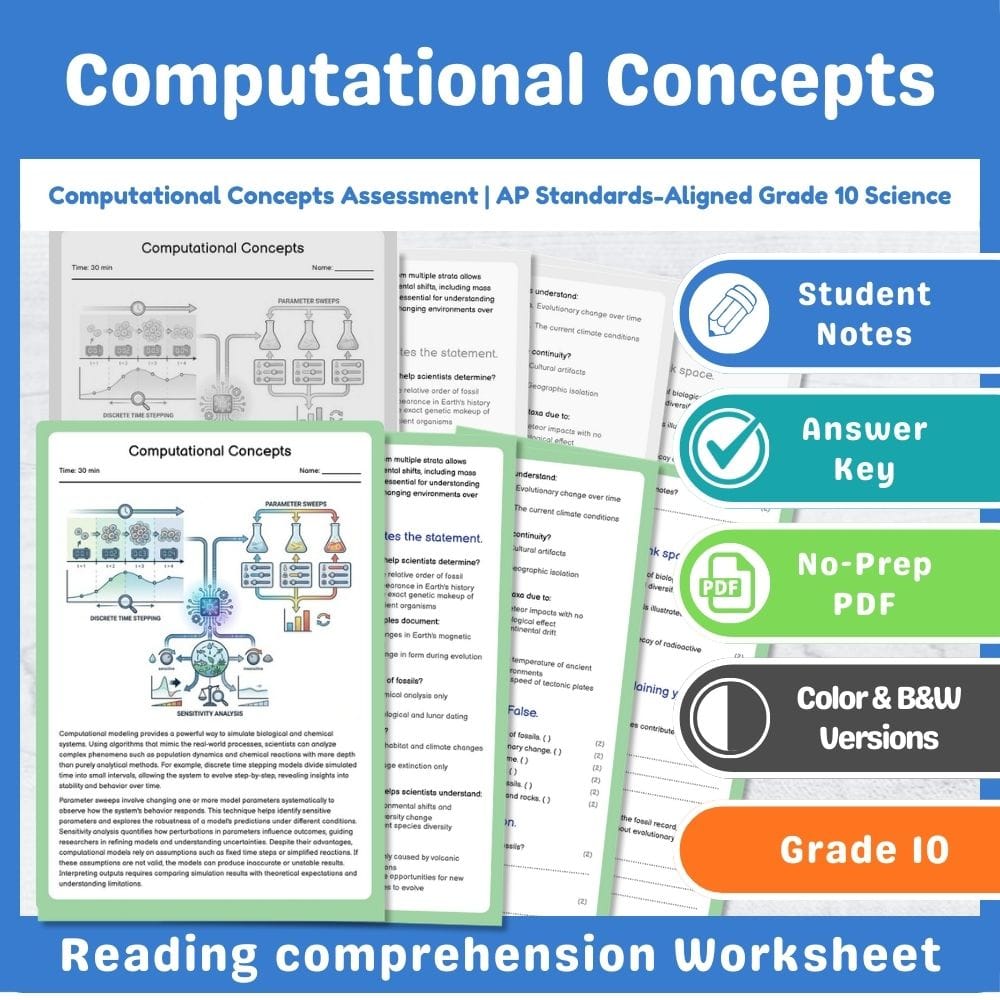
Computational Concepts Assessment | AP Standards-Aligned Grade 10 Science
 Created byPrism Point Learning
Learning Objectives
- Understand basic computational approaches used in modeling dynamic systems.
- Identify methods such as discrete time stepping, parameter sweeps, and sensitivity analysis.
- Recognize assumptions, stability concerns, and interpretation of simulation outputs.
Instant download
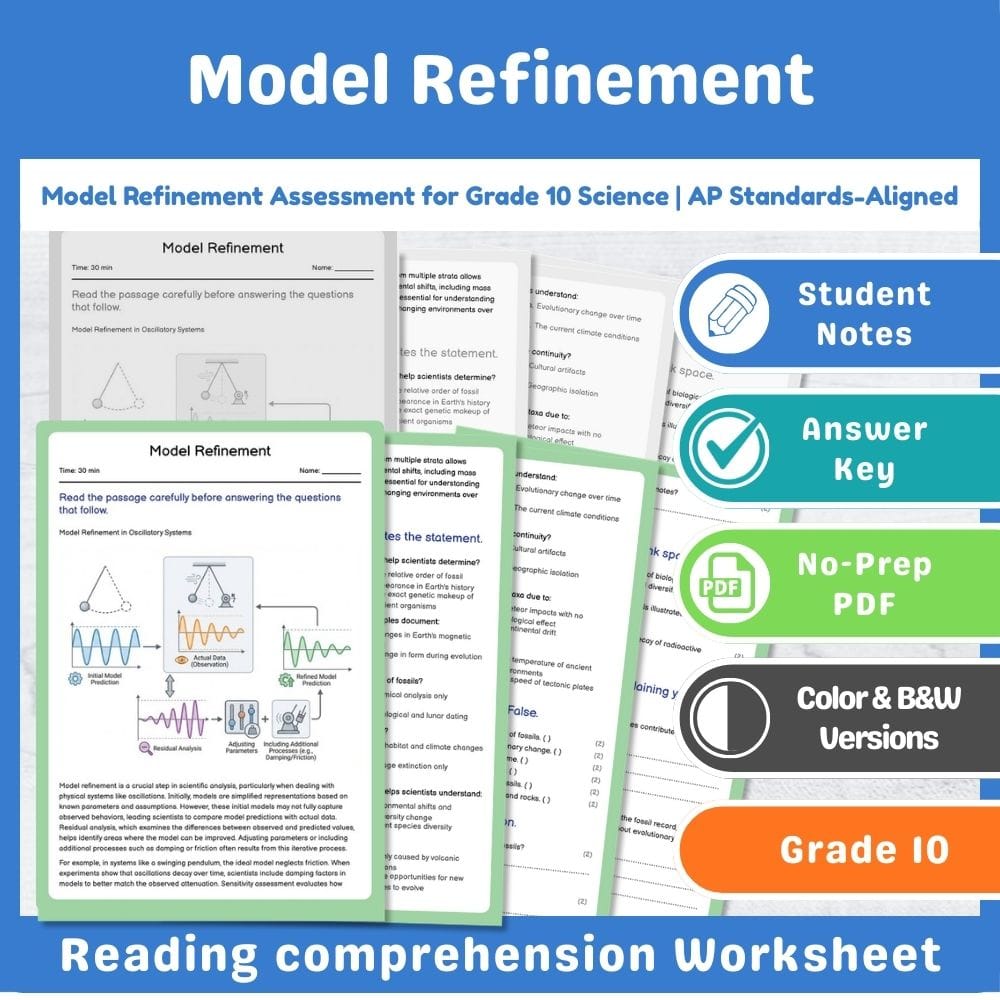
Model Refinement Assessment for Grade 10 Science | AP Standards-Aligned
Created byPrism Point LearningLearning Objectives
- Understand how iterative comparisons and residual analysis guide model improvements.
- Explain the role of parameter estimation and inclusion of additional processes like damping in refining models.
- Evaluate the criteria for choosing between simpler and more complex models based on their explanatory power and predictive accuracy.
Instant download
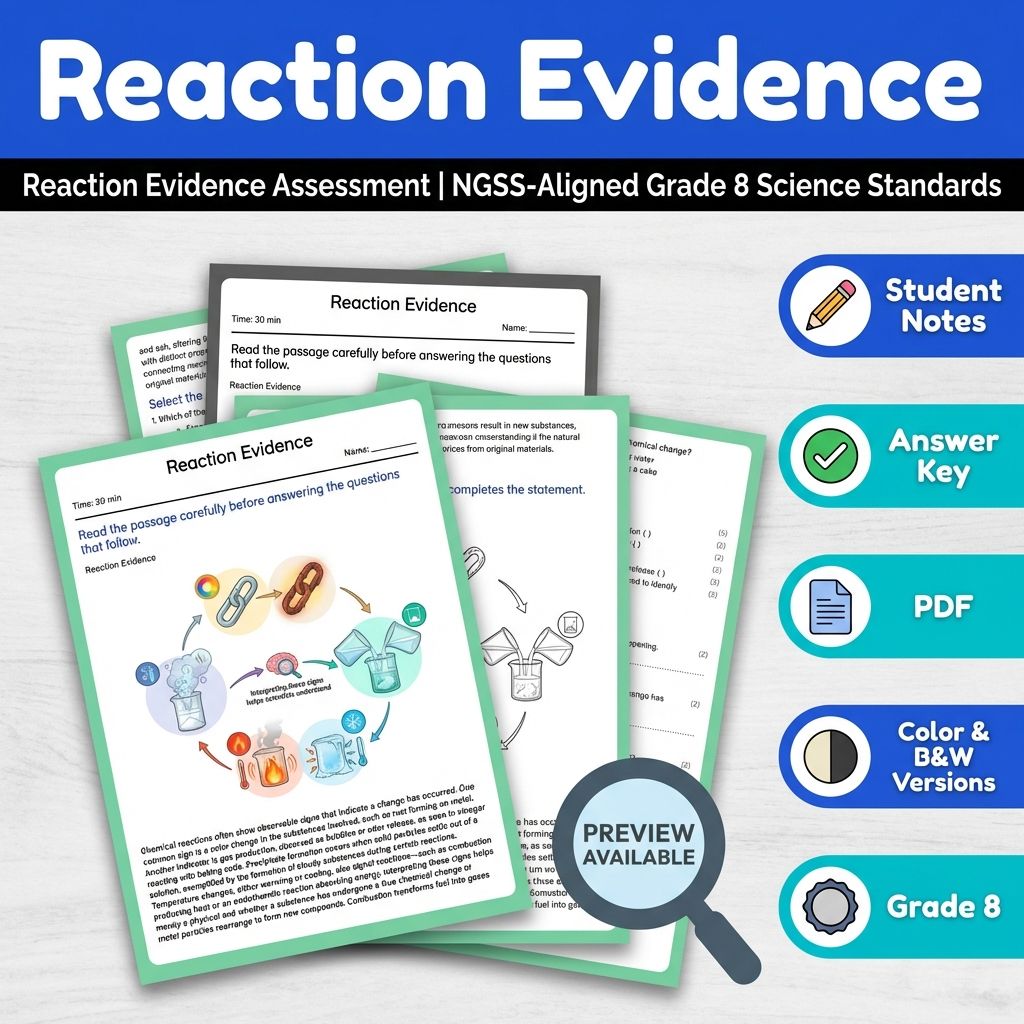
Reaction Evidence Assessment | NGSS-Aligned Grade 8 Science Standards
Created byPrism Point LearningLearning Objectives
- Identify observable indicators of chemical change such as color change, gas production, precipitate formation, and temperature change.
- Interpret qualitative and quantitative data to distinguish between chemical and physical reactions.
- Analyze reaction processes like corrosion, combustion, and acid-base interactions to understand particle rearrangements and formation of new substances.
Also included in: Grade 8 Science Mini Bundle | Matter and Its Interactions NGSS Not specified +1 more
Instant download

Microscopy Analysis Assessment | TEKS Grade 9 Science Standards
Created byPrism Point LearningLearning Objectives
- Interpret visual data from microscopy images to identify cellular structures.
- Understand the principles of resolution, contrast, and staining in microscopy.
- Compare electron and fluorescence microscopy techniques and their applications.
Instant download
Grade 12 Science – Bond Polarity Worksheet (PDF) | Alberta Standards
 Created byBright Mind Resources
Learning Objectives
- Explain how differences in electronegativity create bond polarity.
- Identify and classify molecules as polar or nonpolar based on their structure and bond polarity.
- Describe how polarity influences solubility, intermolecular forces, and industrial applications.
Instant download
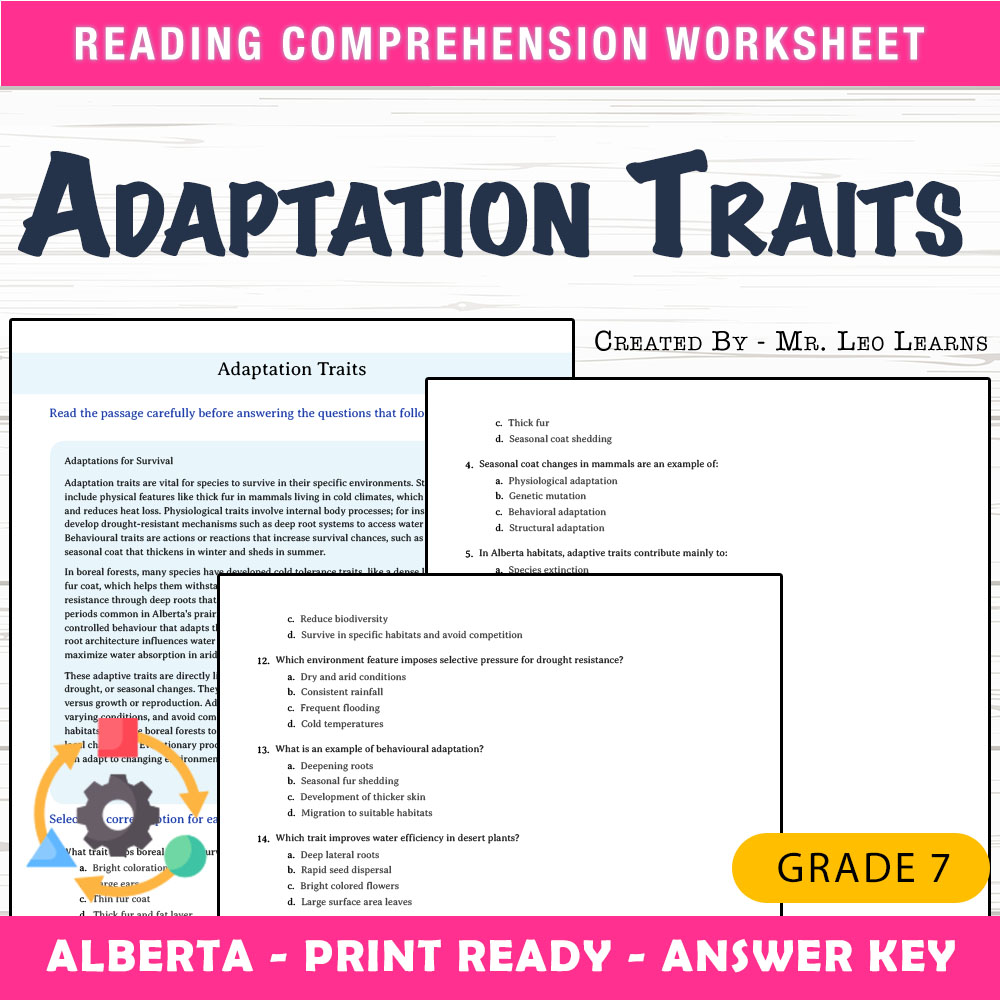
Grade 7 Science — Adaptation Traits Worksheet MCQ Paper
 Created byThe Resource Hub
Learning Objectives
- Understand different types of adaptive traits in various species.
- Identify how environmental pressures influence trait development.
- Explain the role of traits in niche occupation and species survival.
Also included in: Grade 7 Science Alberta Ecosystems & Interactions Worksheet Collection +1 more
Instant download
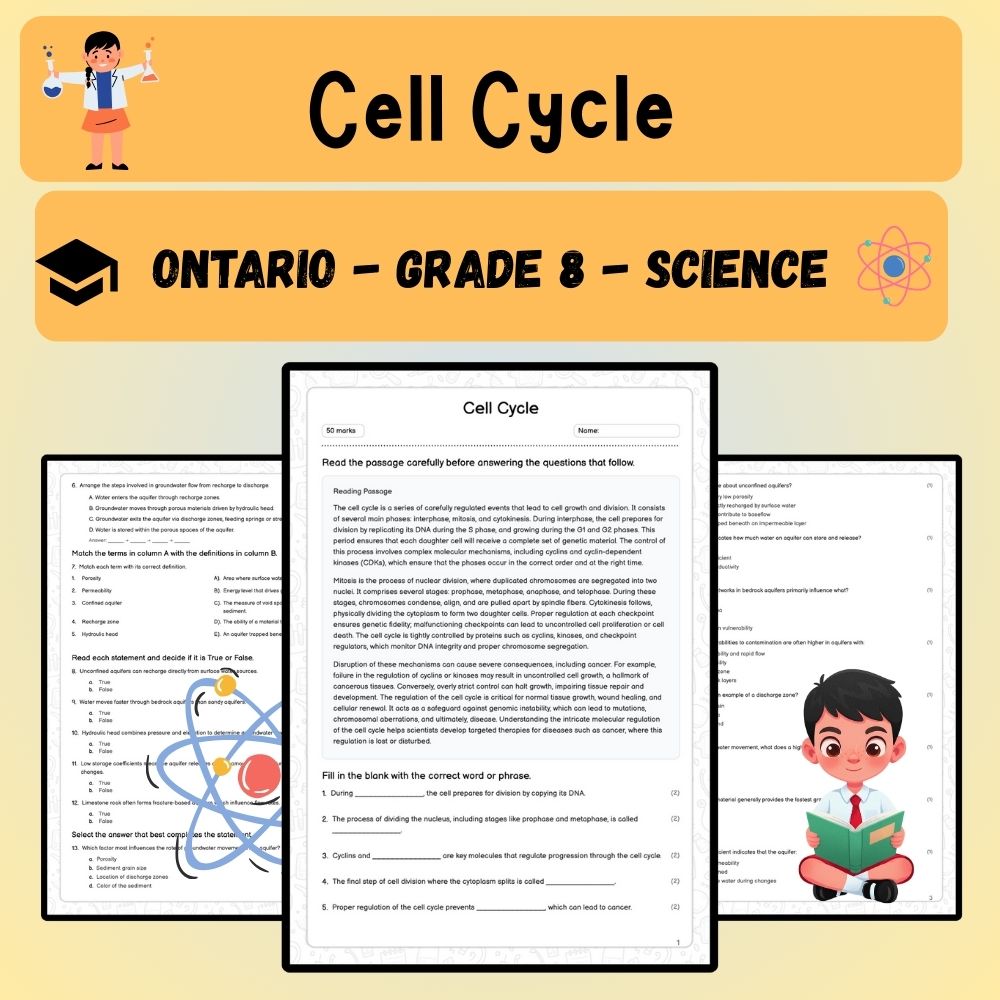
Grade 8 Science | Cell Cycle Worksheet (PDF ) – Ontario Standards
Created byPrism Point LearningLearning Objectives
- Describe the main phases of the cell cycle, including interphase, mitosis, and cytokinesis.
- Identify the roles of cyclins, kinases, and checkpoint mechanisms in cell division.
- Explain how proper regulation of the cell cycle maintains organismal development and prevents genomic instability.
Also included in: Grade 8 Science Unit Bundle | Cell Structure & Function Worksheets +1 more
Instant download
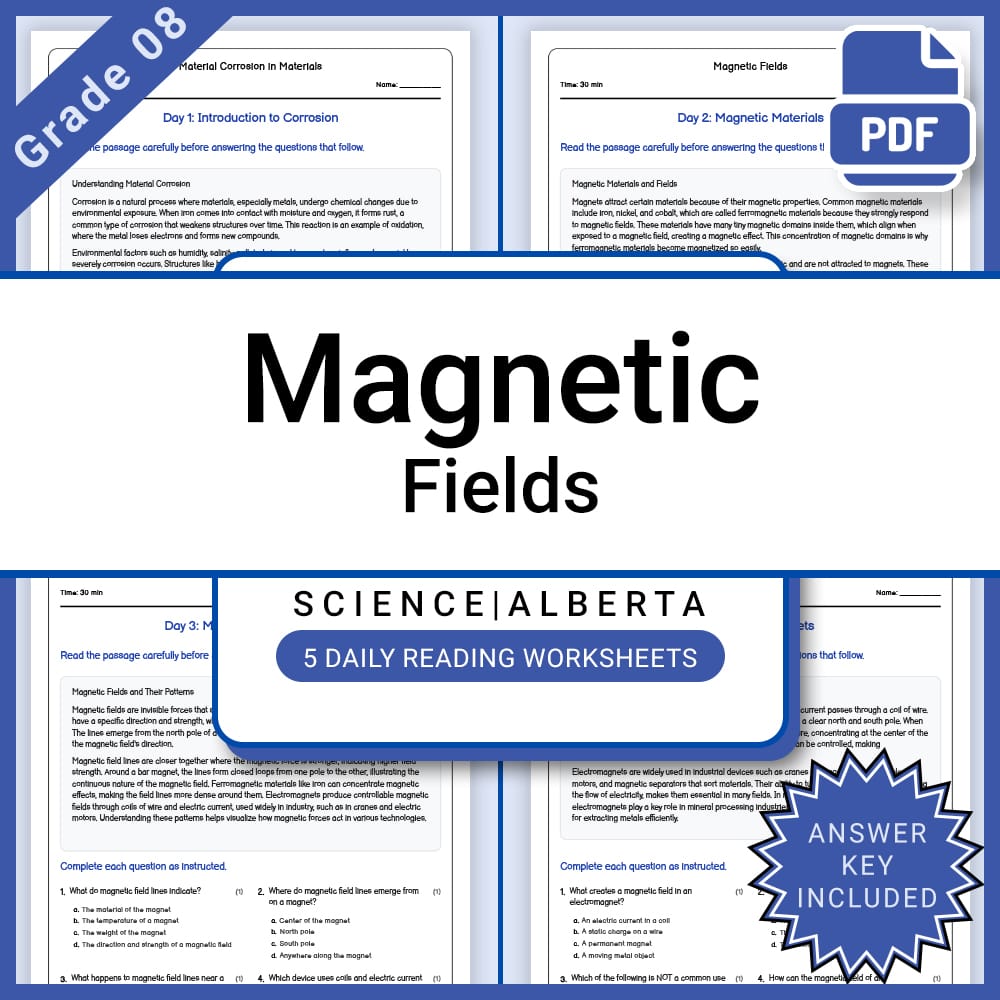
Grade 8 Science – Magnetic Fields Daily Reading Worksheet + Answer Key
JCreated byJ.S SheetsLearning Objectives
- Understand the concept of magnetic fields and how they are visualized
- Identify materials that produce magnetic fields and their applications
- Explain how electromagnets work and their uses in industry
Also included in: Grade 8 Science Lesson Bundle — Electricity, Circuits & Energy +1 more
Instant download

Energy Flow Worksheet for Grade 8 Science | Standards-Aligned Practice
JCreated byJ.S SheetsLearning Objectives
- Explain how energy enters ecosystems through photosynthesis.
- Describe how energy is transferred through food chains and webs.
- Understand why energy diminishes at higher trophic levels and how this affects ecosystem productivity.
Instant download
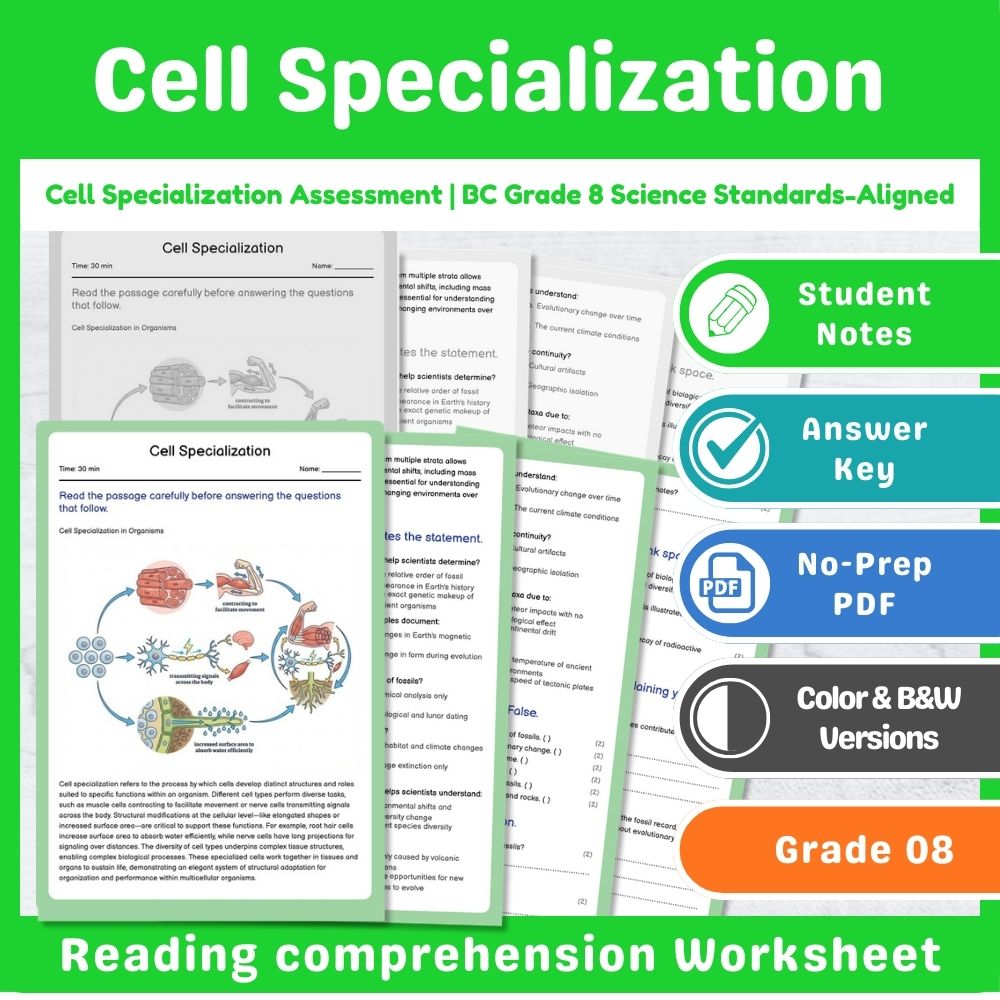
Cell Specialization Assessment | BC Grade 8 Science Standards-Aligned
Created byPrism Point LearningLearning Objectives
- Explain how cells develop unique structures suited for specific functions.
- Identify examples of specialized cells in the human body and plants.
- Describe how cellular modifications support tissue and organism functions.
Instant download

Grade 8 Science | Plate Motions Worksheet with Short Notes (Printable PDF)
 Created byMeadowlark Worksheets
Learning Objectives
- Understand the mechanisms of plate tectonics, including subduction, rifting, collision, and uplift.
- Identify evidence supporting seafloor spreading, magnetic striping, and paleomagnetic records.
- Analyze how landforms such as mountains, ocean basins, and volcanic arcs are created by plate movements.
Also included in: Grade 8 Science | Earth's Systems NGSS Worksheet Unit Bundle +1 more
Instant download
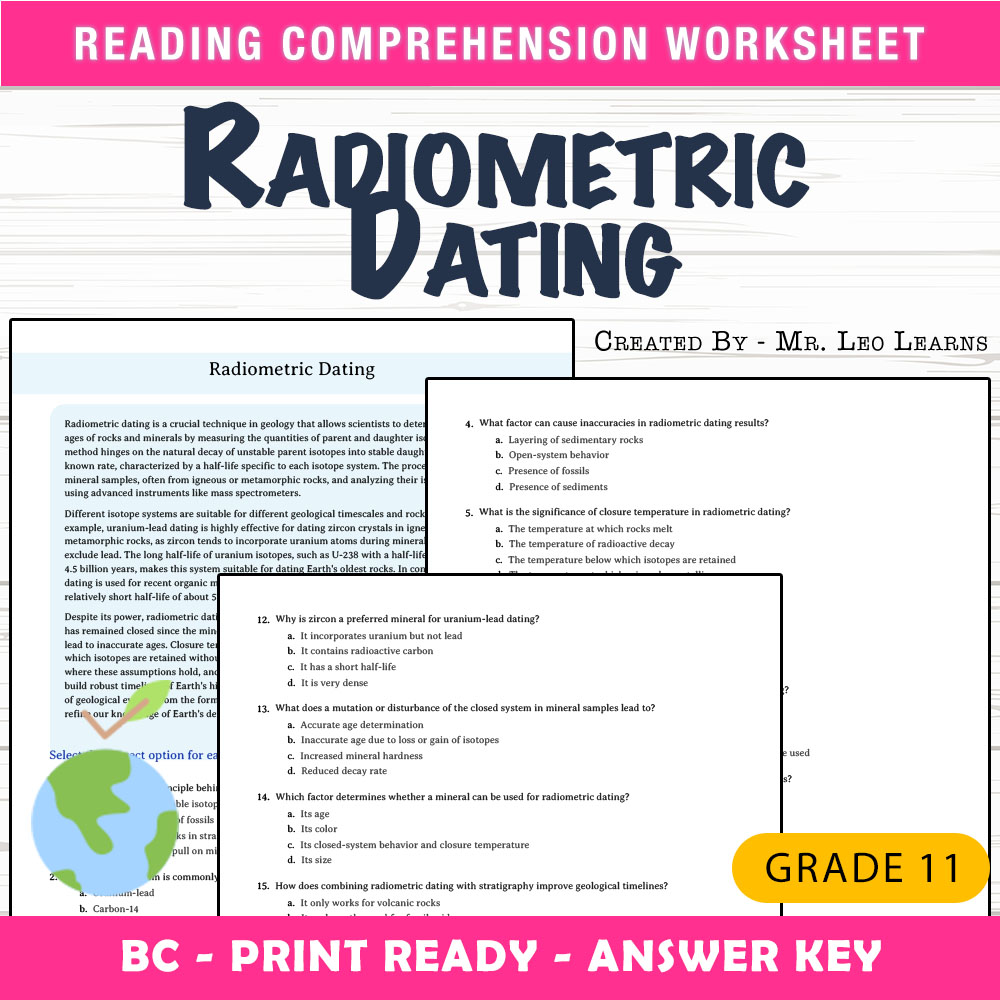
Grade 11 Science — Radiometric Dating Worksheet MCQ Paper for Mastery
Created byThe Resource HubLearning Objectives
- Understand the principles and methods of radiometric dating techniques.
- Identify different isotope systems used for dating various rocks and materials.
- Explain factors affecting the accuracy and reliability of radiometric ages.
Also included in: Grade 11 Science Earth Science Unit | BC Curriculum MCQ Worksheet Pack +1 more
Instant download
Grade 11 Science | Energy Conversion Worksheet with Short Notes (Printable PDF)
Created byMeadowlark WorksheetsLearning Objectives
- Understand different forms of energy and how they are converted from one form to another.
- Design devices that efficiently convert energy between mechanical, electrical, chemical, and thermal forms.
- Analyze the performance and losses in energy conversion devices.
Also included in: Grade 11 Science Energy UNIT Bundle | NGSS-Aligned Instructional Worksheets +1 more
Instant download

Grade 9 Atmospheric Energy Worksheet | California Standards Practice PDF
 Created byClear Sky Classroom
Learning Objectives
- Explain how unequal heating by the Sun creates temperature and pressure differences that drive atmospheric circulation.
- Describe how energy transfer between Earth’s surface and the atmosphere influences humidity, clouds, and precipitation.
- Connect local weather patterns to interactions among temperature, humidity, and Earth–atmosphere energy balance.
Instant download

Orbital Motion Assessment for Grade 9 Science NGSS Standards
Created byPrism Point LearningLearning Objectives
- Explain the fundamental principles of orbital motion, including Kepler's laws and Newton's law of gravitation.
- Analyze relationships between orbital period, semi-major axis, and escape velocity.
- Apply concepts of conservation of angular momentum to planetary and satellite motion.
Instant download
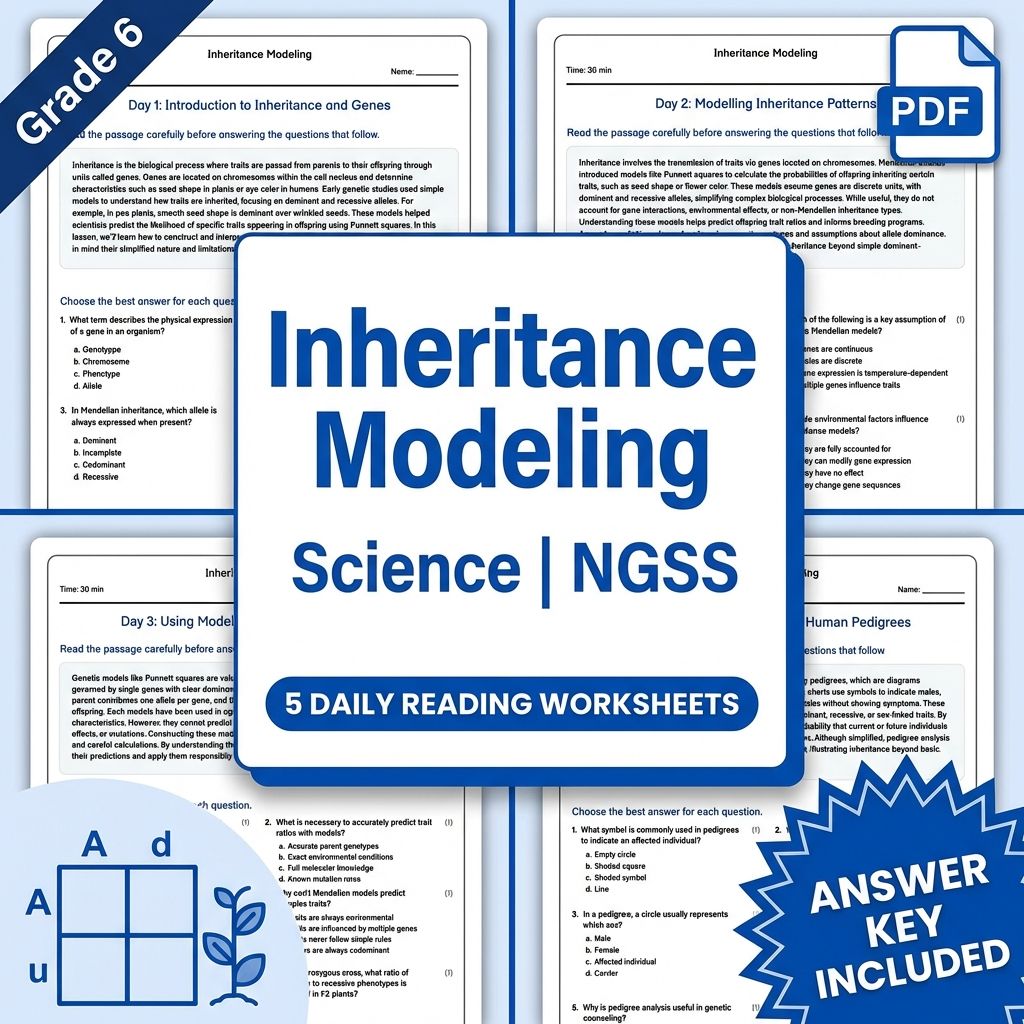
6th Grade Science | Inheritance Modeling Worksheet (PDF+ Answer Key)
 Created byCopper Leaf Classroom
Learning Objectives
- Understand the basic concept of inheritance and genes as units of trait transmission
- Learn how Mendelian crosses model dominant and recessive inheritance patterns
- Interpret Punnett squares to predict the ratios of traits in offspring
Instant download
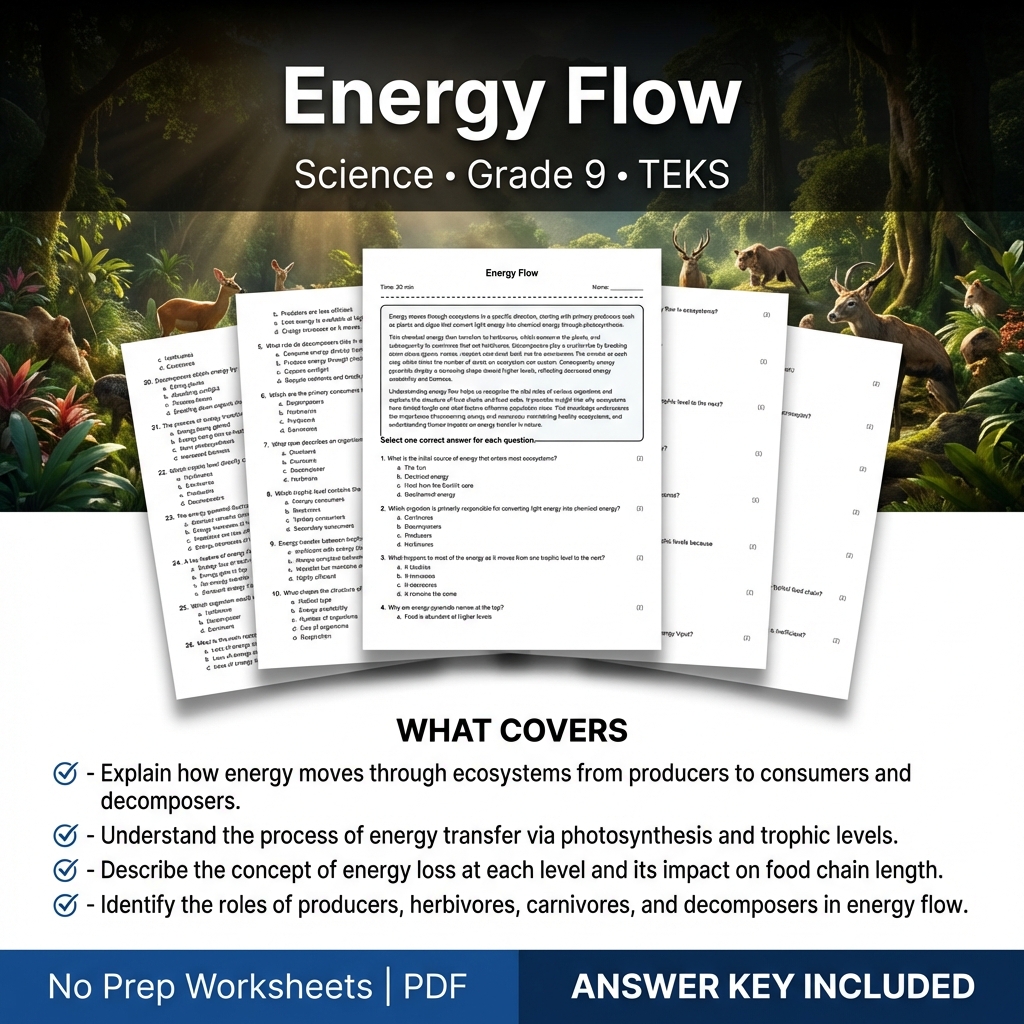
Energy Flow Worksheet for Grade 9 Science | Standard Practice and Assessment
 Created byCoral Reef Learning
Learning Objectives
- Explain how energy moves through ecosystems from producers to consumers and decomposers.
- Understand the process of energy transfer via photosynthesis and trophic levels.
- Describe the concept of energy loss at each level and its impact on food chain length.
Instant download
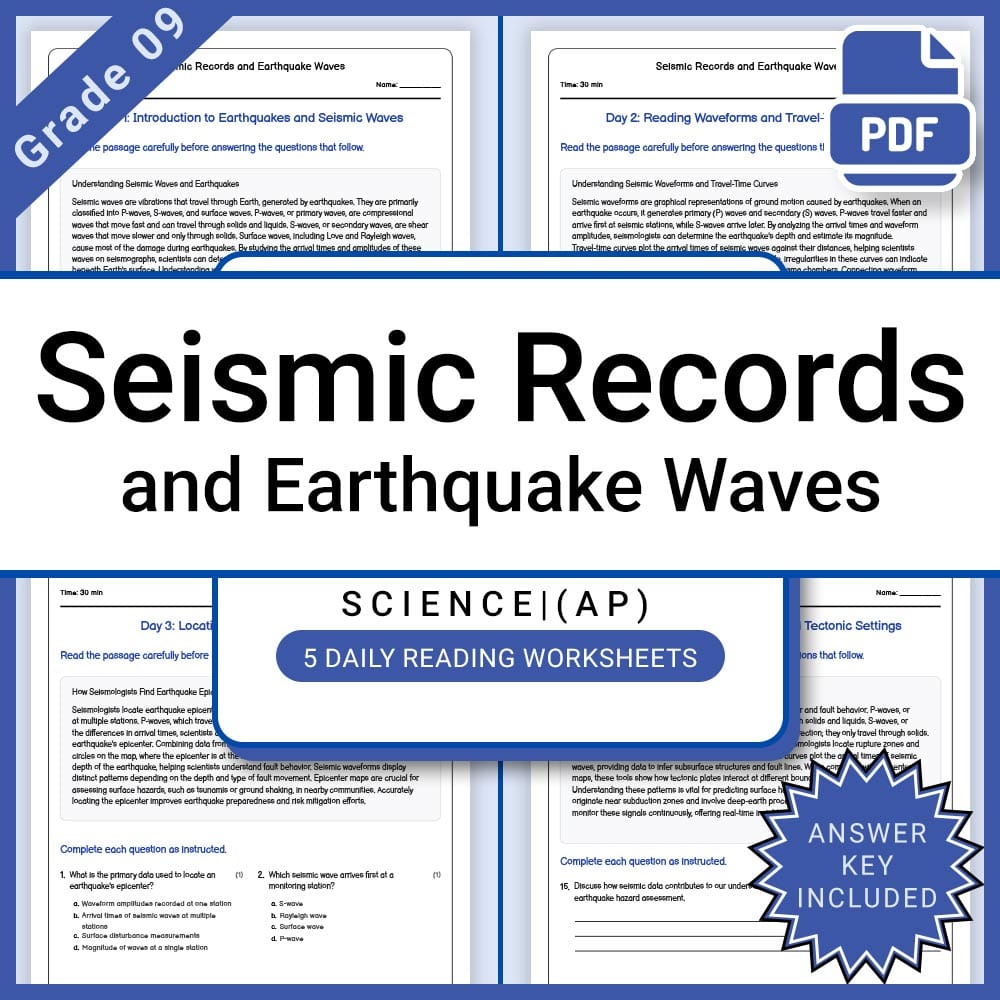
Grade 9 Science – Seismic Records and Earthquake Waves | Worksheet + Answer Key
JCreated byJ.S SheetsLearning Objectives
- Identify different types of seismic waves and their features
- Understand how seismic waveforms and travel-time curves are used to infer Earth's subsurface structure
- Compare P- and S-wave characteristics to determine earthquake depth and fault behavior
Also included in: Grade 9 Science Lesson Bundle – AP Framework Daily Reading Worksheets +1 more
Instant download

Grade 6 Science – Atoms & Particles Reading Worksheet | California Standards
Created byBright Mind ResourcesLearning Objectives
- Understand that matter is made up of tiny particles called atoms.
- Recognize that atoms are the basic units of elements.
- Learn how different substances have distinct combinations of atoms.
Also included in: Grade 6 Matter Science Daily Reading Worksheets Lesson Bundle | CA Standards +1 more
Instant download
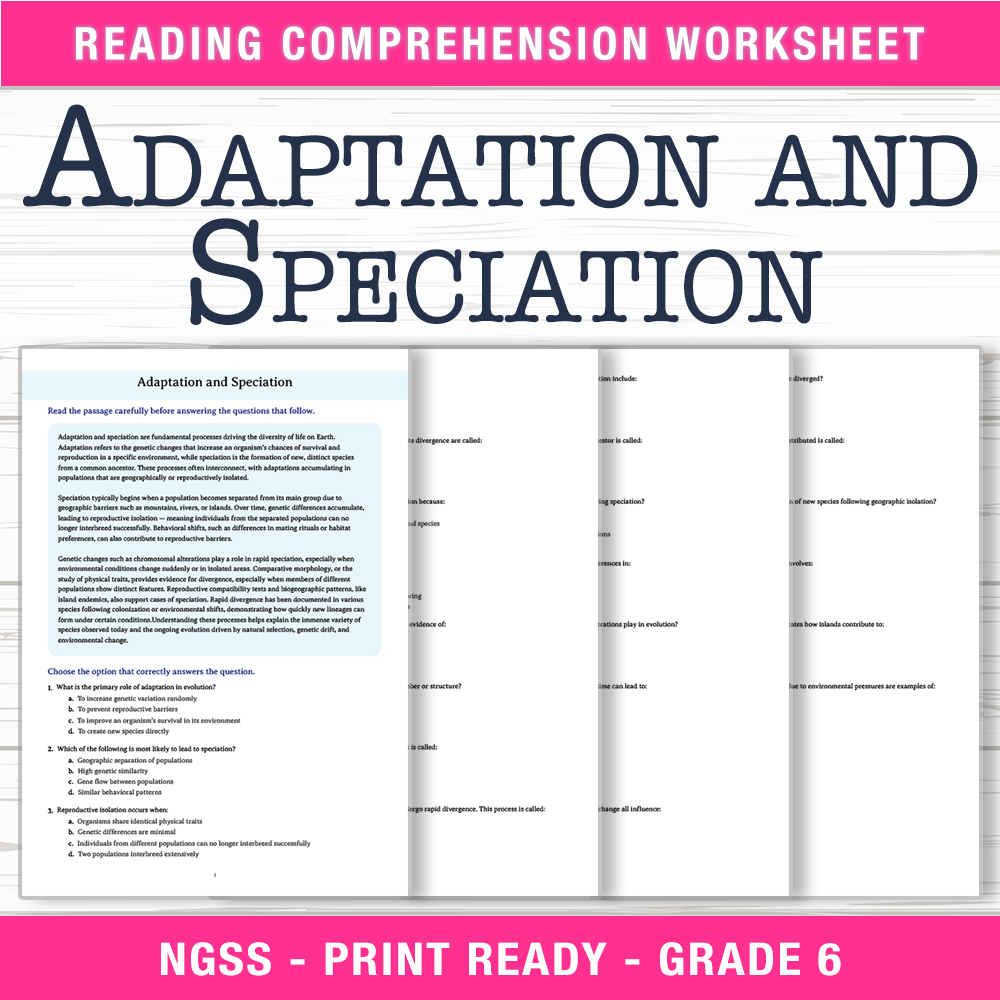
6th Grade Science – Adaptation and Speciation Worksheet (PDF + ANSWER KEY)
 Created byRiverstone Classroom
Learning Objectives
- Describe how populations diverge into distinct lineages through heritable differences and reproductive isolation.
- Identify the environmental, behavioral, and genetic factors that contribute to speciation.
- Analyze evidence such as morphological differences, reproductive compatibility, and biogeographic patterns to understand speciation events.
Instant download

Grade 10 Enzymes And Transport Worksheet | Practice & PDF
Created byClear Sky ClassroomLearning Objectives
- Explain how enzymes act as catalysts by lowering activation energy and increasing reaction rate
- Describe how membrane structure affects diffusion, osmosis, and selective transport
- Compare passive transport with active transport and identify roles of channels and pumps
Instant download
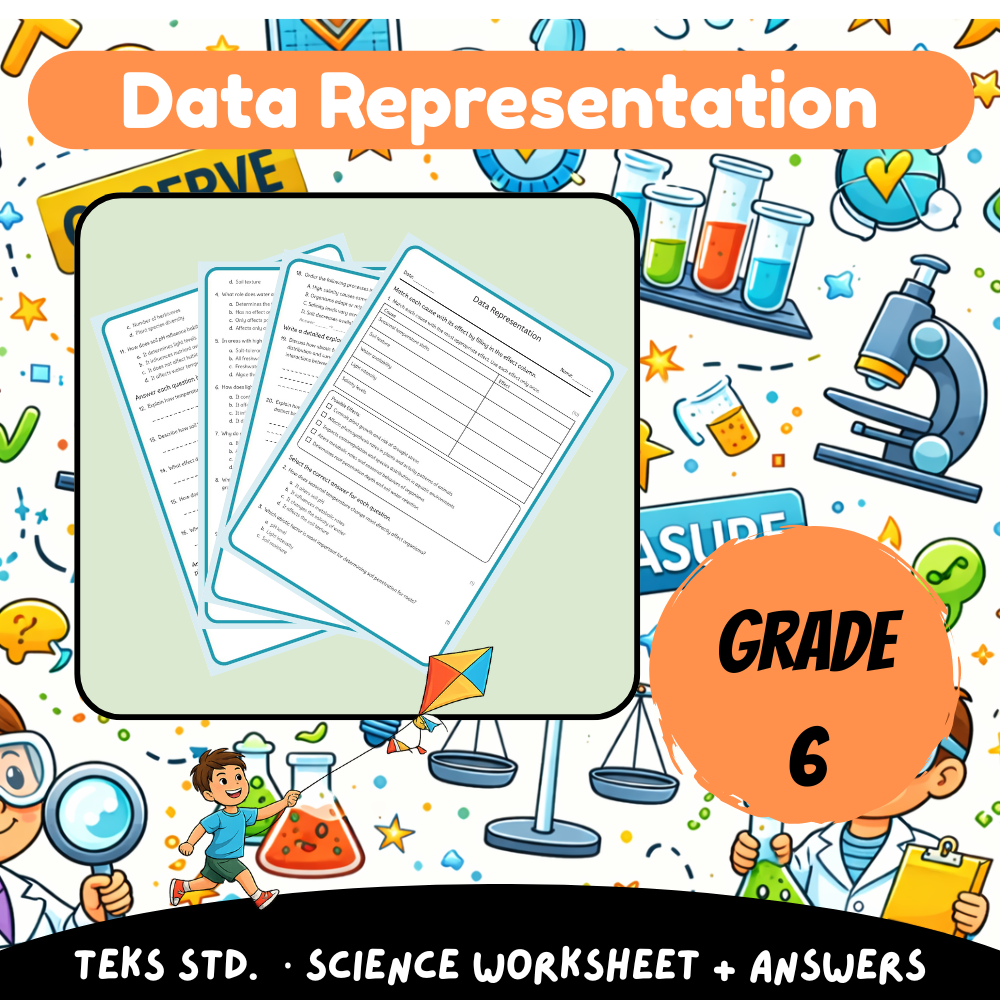
6th Grade Science | Data Representation Worksheet (PDF) – TEKS Standards
Created byBright Mind ResourcesLearning Objectives
- Understand different methods of data organization such as tables, line graphs, bar graphs, and scatter plots
- Learn proper axis labeling, scale selection, and interpretation of graphs
- Apply data representation techniques to real-world examples like mass change over time and distance over time
Instant download
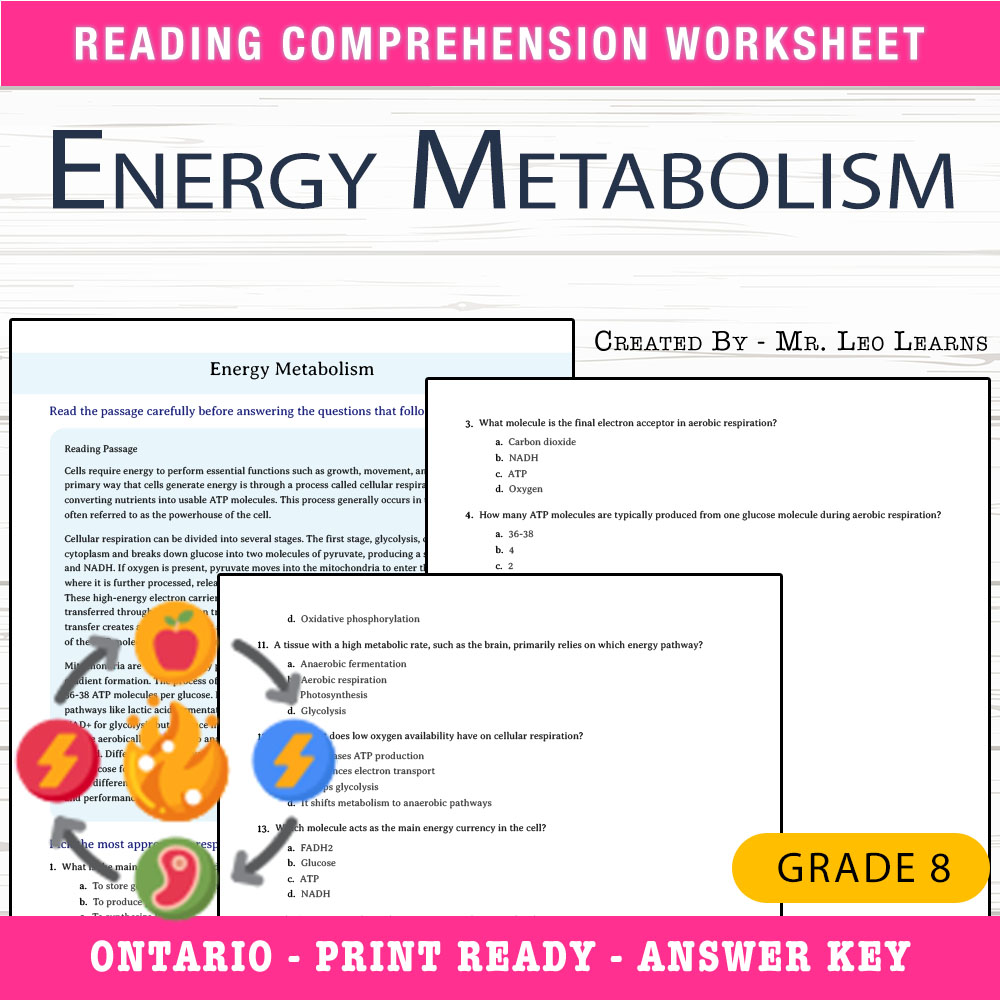
Grade 8 Science — Energy Metabolism Worksheet for Mastery
Created byThe Resource HubLearning Objectives
- Understand the stages of aerobic respiration, including glycolysis, Krebs cycle, and oxidative phosphorylation.
- Describe the role of mitochondria and membrane proton gradients in ATP production.
- Contrast aerobic and anaerobic energy pathways and their efficiencies.
Also included in: Grade 8 Science | Cell Biology & Systems Unit Worksheet Bundle (Unlock Mastery) +1 more
Instant download

Biotech Applications Worksheet | TEKS-Aligned Science Practice for Grade 9
JCreated byJ.S SheetsLearning Objectives
- Explain how common biotechnology tools (PCR, gel electrophoresis, DNA sequencing, and CRISPR) are used to analyze and modify genetic material.
- Describe real-world applications of biotechnology in medicine, agriculture, and forensics.
- Evaluate ethical, legal, and societal implications of biotechnology, including privacy, ecological risk, and equitable access.
Instant download
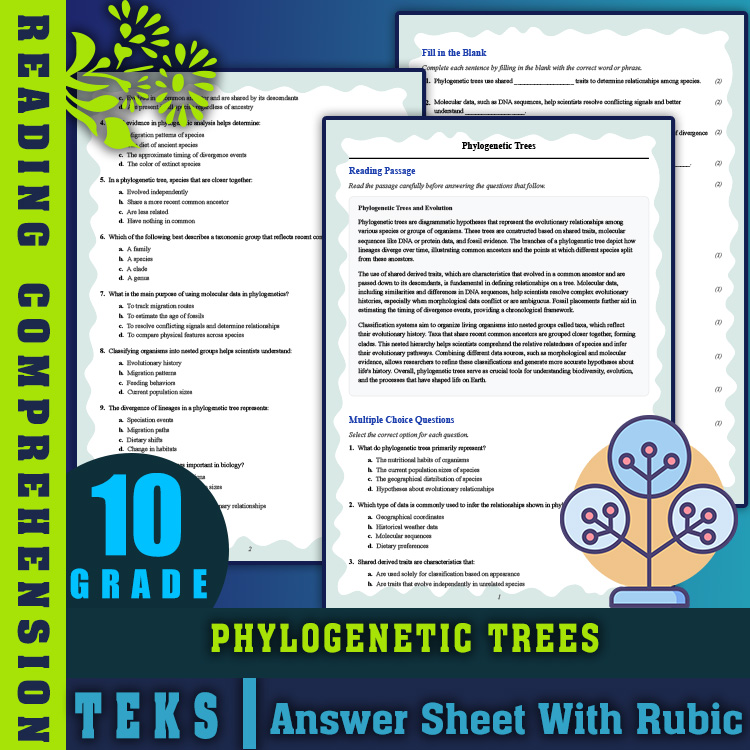
Grade 10 Science | Phylogenetic Trees Reading Worksheet (PDF & Answer Key)
JCreated byJ.S SheetsLearning Objectives
- Understand the purpose and structure of phylogenetic trees in illustrating evolutionary relationships.
- Identify shared derived traits, molecular data, and fossil evidence used to construct phylogenetic trees.
- Explain how classification reflects evolutionary history through nested groups and common ancestors.
Instant download

Grade 9 Science Worksheet: Physical Changes | Standards-Aligned Practice
JCreated byJ.S SheetsLearning Objectives
- Characterize physical changes as alterations in state or form that do not change a substance’s chemical identity.
- Differentiate reversible and seemingly irreversible physical transformations using examples.
- Explain how energy transfer accompanies phase changes such as melting, freezing, evaporation, condensation, and dissolution.
Instant download

Grade 6 Forces Basics Daily Reading Worksheet | TEKS Science Activity
 Created byBRIGHT PATH RESOURCES
Learning Objectives
- Identify forces as contact or noncontact
- Sort examples of forces using key definitions
- Explain how forces can change motion in everyday situations
Also included in: Energy, Matter & Change Grade 6 Science Lesson Bundle | TEKS Daily Reading +1 more
Instant download

Grade 11 Science | Phylogenetic Trees - Daily Reading Comprehension
Created byCoral Reef LearningLearning Objectives
- Describe how phylogenetic trees depict evolutionary relationships among organisms.
- Identify shared derived traits that indicate common ancestors in phylogenetic trees.
- Differentiate between rooted and unrooted trees and their purposes.
Instant download
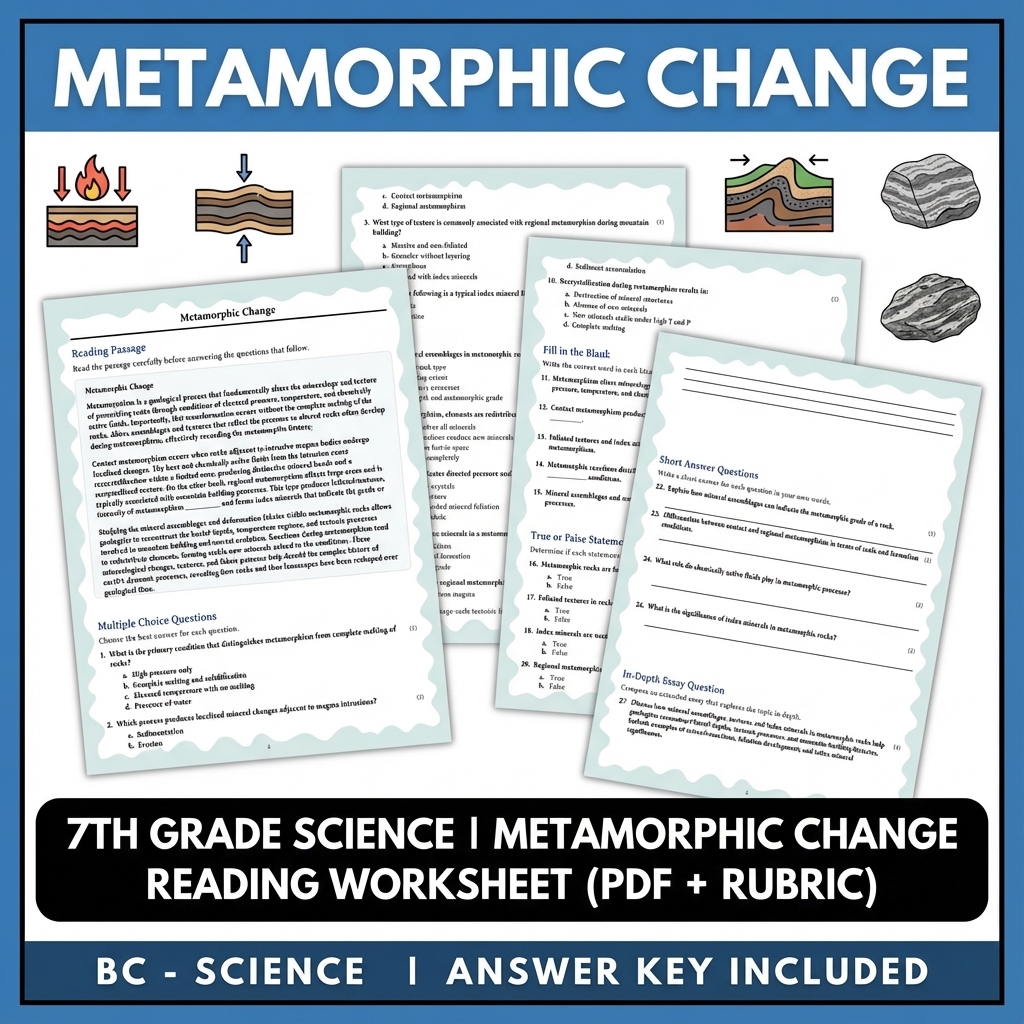
7th Grade Science | Metamorphic Change Reading Worksheet (PDF + Rubric)
JCreated byJ.S SheetsLearning Objectives
- Describe the processes and conditions involved in metamorphism of rocks.
- Differentiate between contact and regional metamorphism.
- Identify mineral clues that indicate metamorphic grade and history.
Instant download
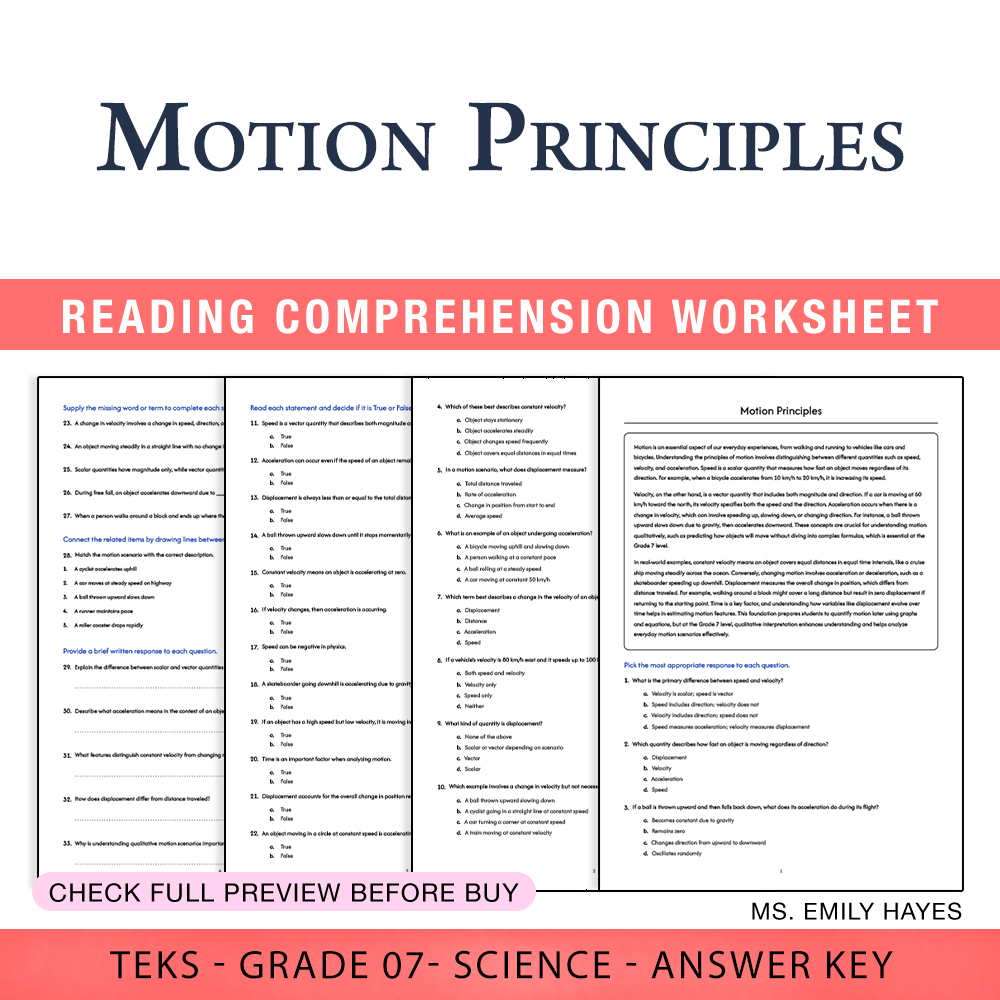
7th Grade Science | Motion Principles Worksheet (PDF+ Answer Key)
Created byCopper Leaf ClassroomLearning Objectives
- Explain the difference between speed, velocity, and acceleration with examples.
- Identify scalar versus vector quantities in motion scenarios.
- Describe how displacement, time, and rate of change relate in motion.
Instant download
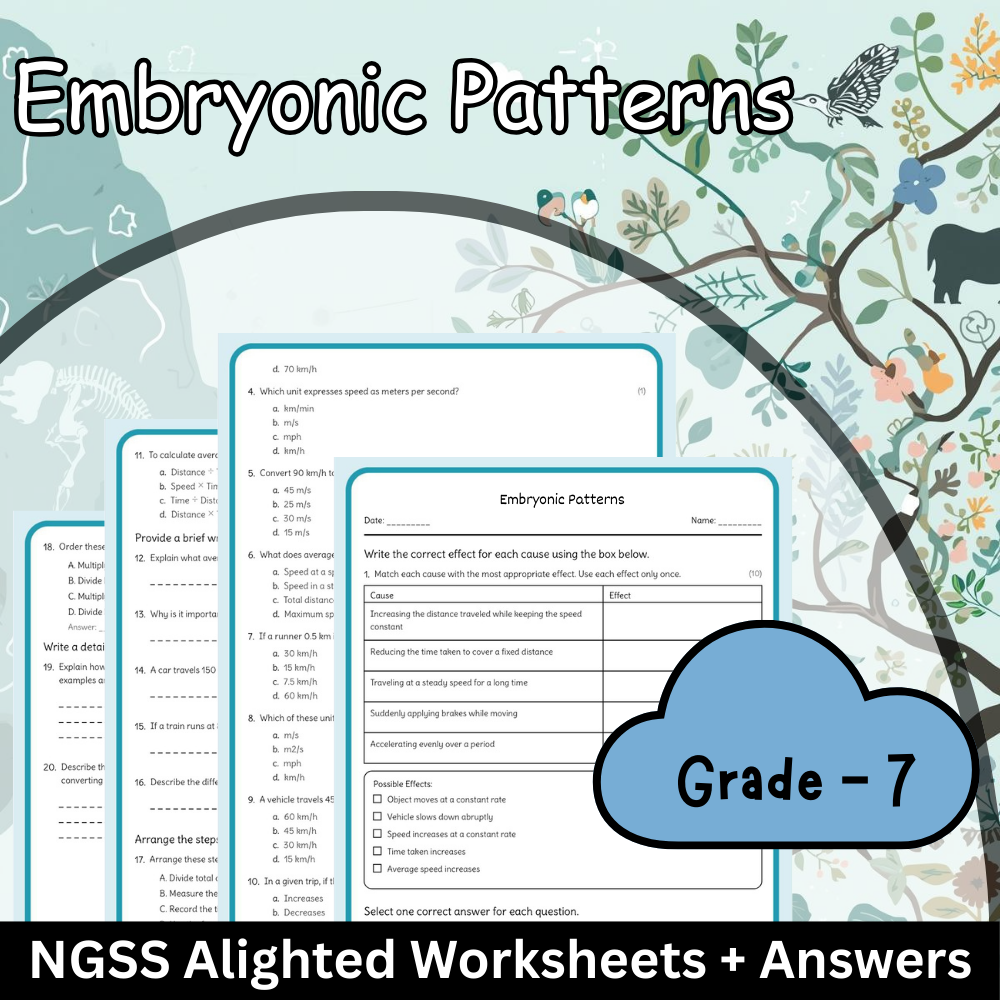
7th Grade Science | Embryonic Patterns Worksheet (Answer Key) NGSS Aligned
Created byBright Mind ResourcesLearning Objectives
- Compare embryonic development stages across different animal taxa.
- Identify conserved structures such as pharyngeal pouches and limb buds during development.
- Understand how developmental timing and patterning inform evolutionary relationships.
Instant download
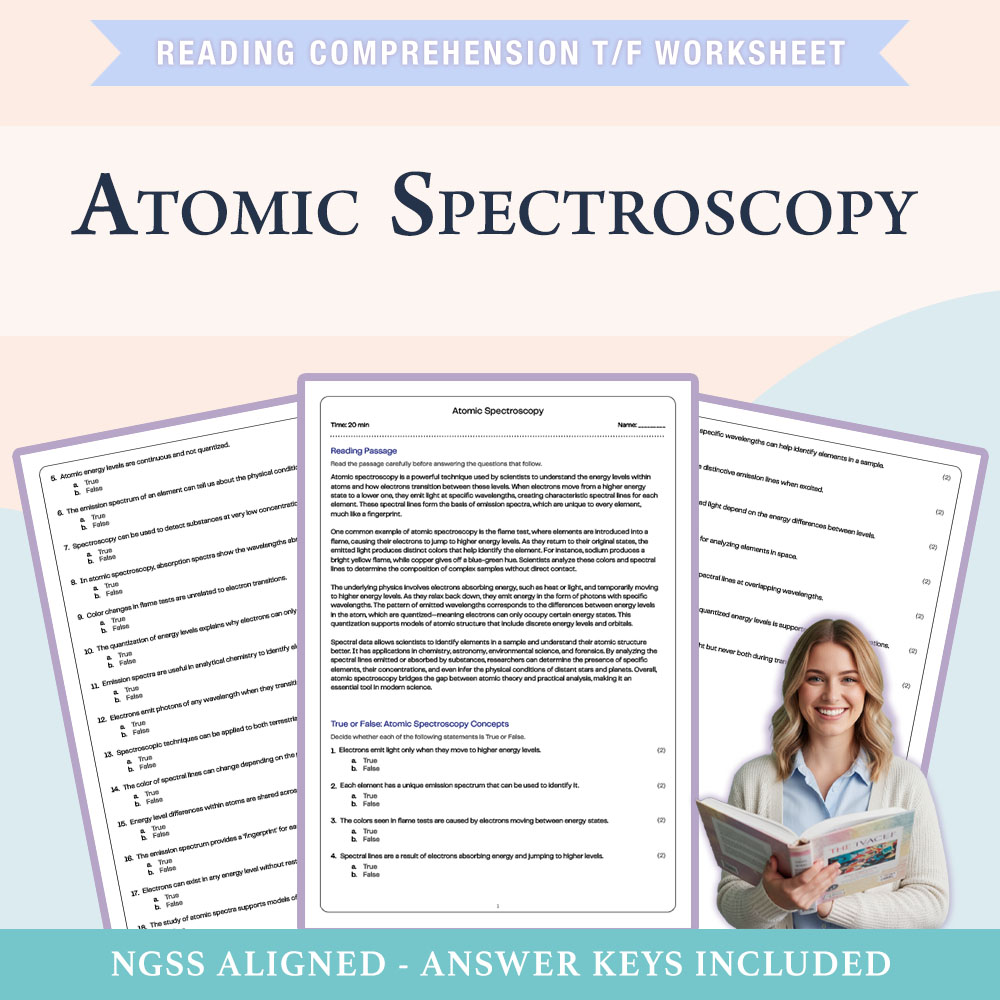
7th Grade Science | Atomic Spectroscopy Worksheet (PDF +Answer Key)
Created byCopper Leaf ClassroomLearning Objectives
- Understand how atomic spectra reveal energy level differences within atoms
- Learn how electromagnetic transitions produce emission spectra
- Connect spectral data to the structure of atoms and electrons
Instant download
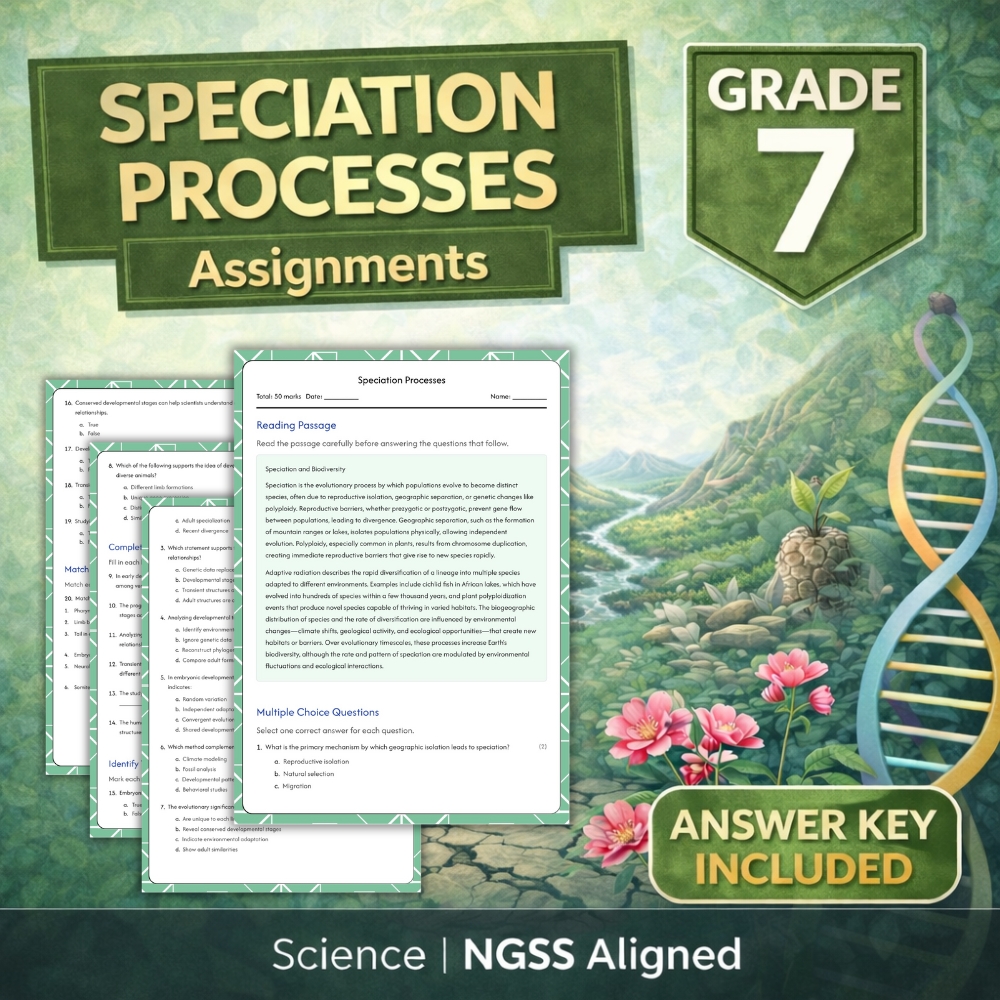
Grade 7 Science | Speciation Processes Worksheet (Answer Key) – NGSS Standards
 Created byCedar Grove Learning
Learning Objectives
- Describe the processes that lead to the formation of new species, including reproductive isolation and geographic separation.
- Explain how polyploidy and adaptive radiation contribute to biodiversity.
- Analyze examples of speciation such as cichlid radiations in African lakes and plant polyploidization.
Instant download
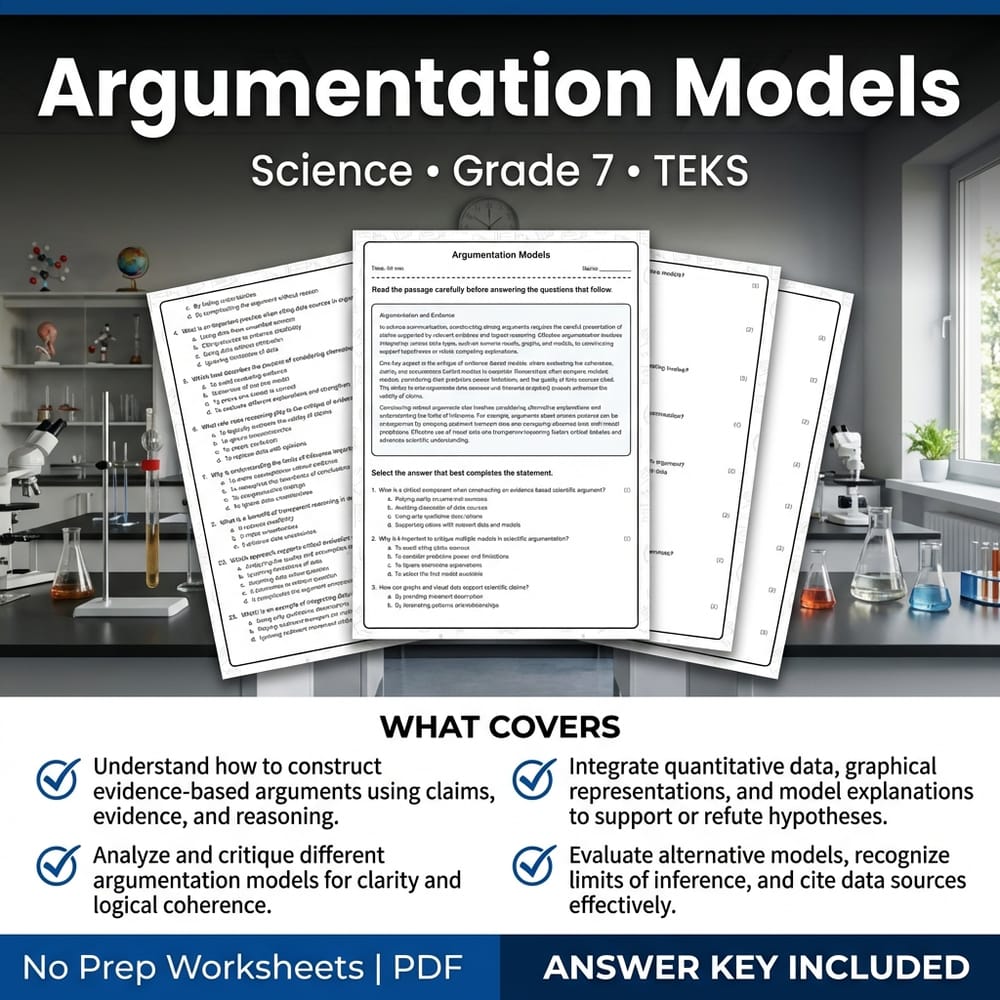
Grade 7 Science Worksheet on Argumentation Models | TEKS Alignment
Created byCoral Reef LearningLearning Objectives
- Understand how to construct evidence-based arguments using claims, evidence, and reasoning.
- Analyze and critique different argumentation models for clarity and logical coherence.
- Integrate quantitative data, graphical representations, and model explanations to support or refute hypotheses.
Instant download

Grade 8 Intermolecular Forces Worksheet | Practice & Assessment PDF
Created byClear Sky ClassroomLearning Objectives
- Explain how intermolecular forces affect melting point, boiling point, and vapour pressure
- Connect molecular attraction strength to properties like volatility and solubility
- Interpret real-world examples (road salt in freeze–thaw cycles, hydrocarbons in oil sands, humidity and evaporation) using particle-level reasoning
Instant download

Musculoskeletal System Review Worksheets Grade 6 Science | Test Prep
Created byPrism Point LearningLearning Objectives
- Identify the major parts of the musculoskeletal system (bones, joints, and muscles) and describe what each does.
- Explain how muscles, joints, and bones work together to produce movement and provide protection.
- Describe how the nervous system and circulation support coordinated movement and sustained activity.
Also included in: Multicellular Systems & Functions Lesson Bundle | Grade 6 Science | BC +1 more
Instant download
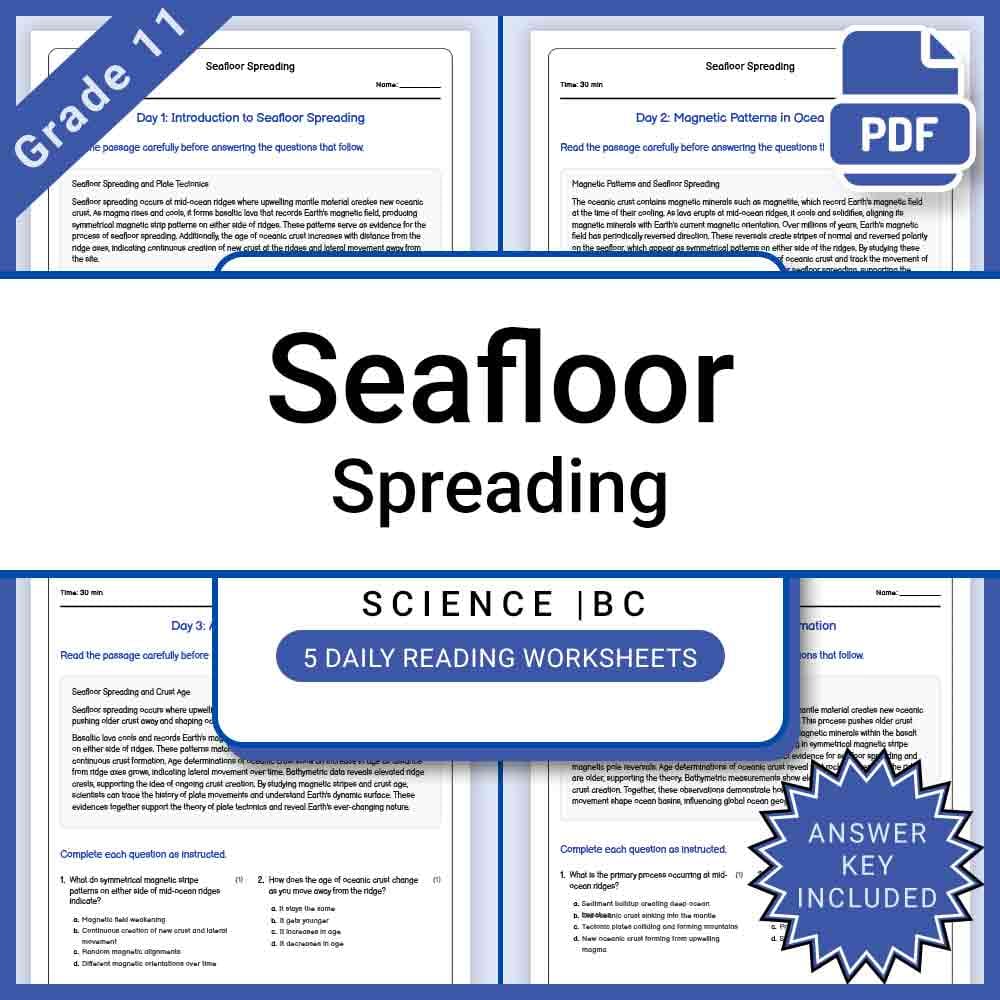
Grade 11 Science – Seafloor Spreading Daily Reading Worksheet + Answer Key
JCreated byJ.S SheetsLearning Objectives
- Understand the process of seafloor spreading and its role in plate tectonics.
- Identify key evidence supporting seafloor spreading, including magnetic stripes and age patterns.
- Explain how oceanic crust is formed and moves away from mid-ocean ridges.
Also included in: Grade 11 Science Lesson Bundle | Earth Science and Plate Tectonics +1 more
Instant download

Grade 10 Science | Radiometric Dating - Daily Reading Comprehension
Created byCoral Reef LearningLearning Objectives
- Understand the concept of radioactive isotopes and their decay.
- Define half-life and explain its significance in radiometric dating.
- Identify key vocabulary related to radiometric dating.
Instant download
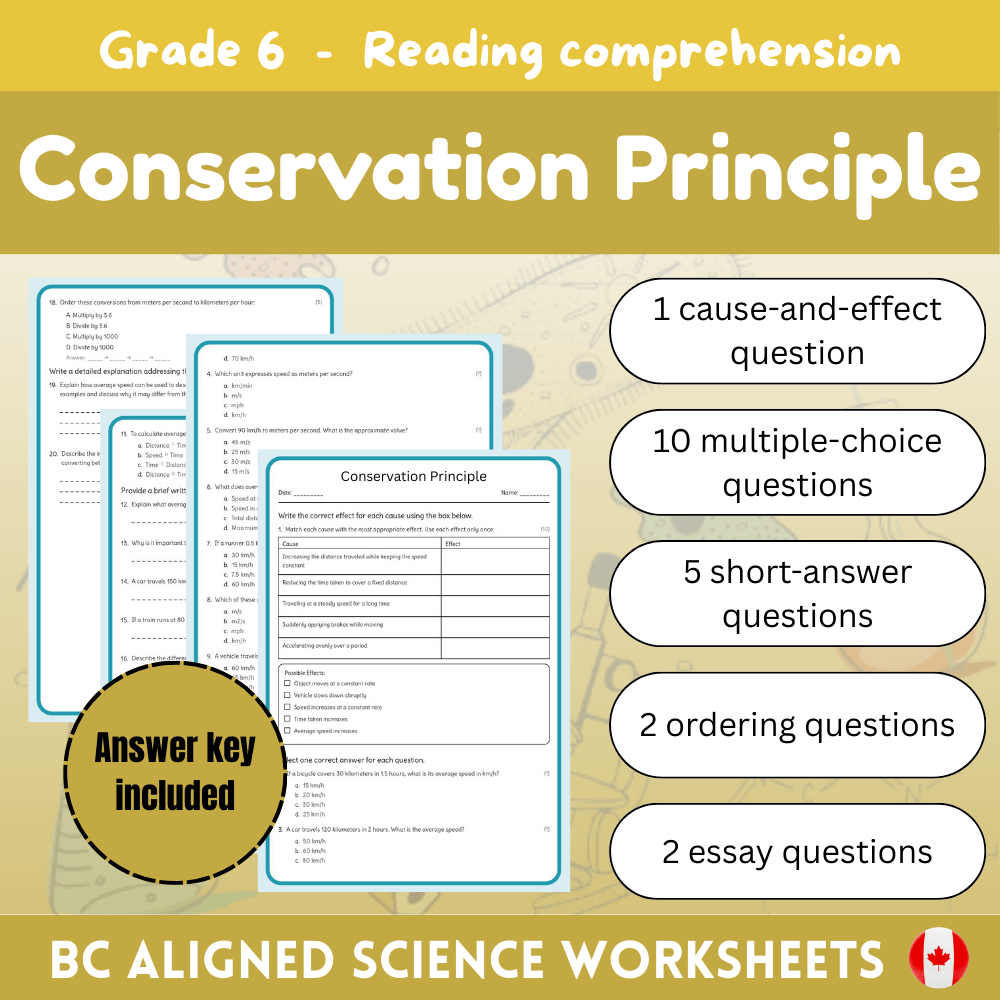
Grade 6 Science | Conservation Principle Worksheet (Answer Key) – BC Standards
Created byBright Mind ResourcesLearning Objectives
- Understand the concept of energy conservation within closed systems.
- Identify different forms of energy and how they transform or transfer during physical processes.
- Apply the conservation principle to evaluate system behavior and efficiency in various contexts.
Instant download
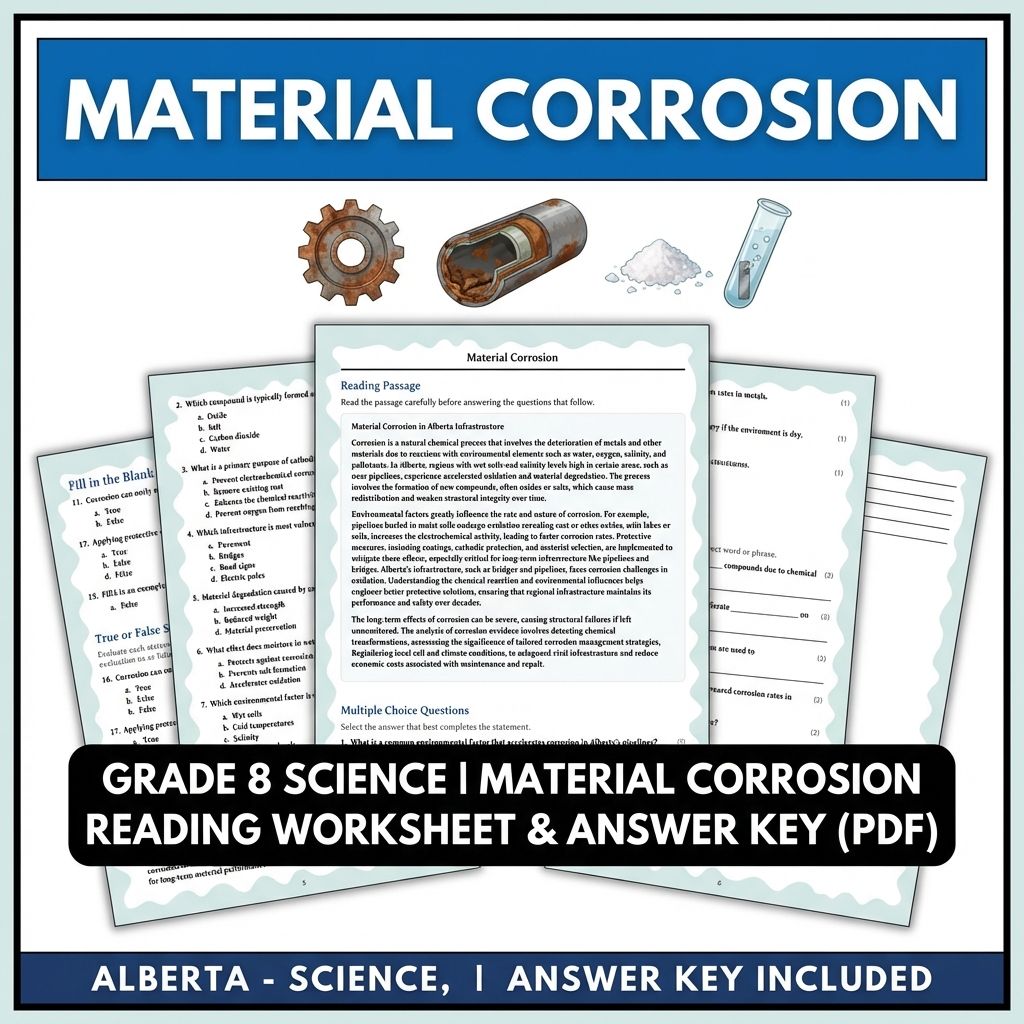
Grade 8 Science | Material Corrosion Reading Worksheet & Answer Key (PDF)
JCreated byJ.S SheetsLearning Objectives
- Understand the chemical processes and environmental factors contributing to material corrosion.
- Identify evidence of corrosion and how environmental conditions influence degradation.
- Analyze regional examples of corrosion effects on infrastructure.
Also included in: Grade 8 Science | Essential Concepts & Processes Pack (Answer Key Included) +1 more
Instant download
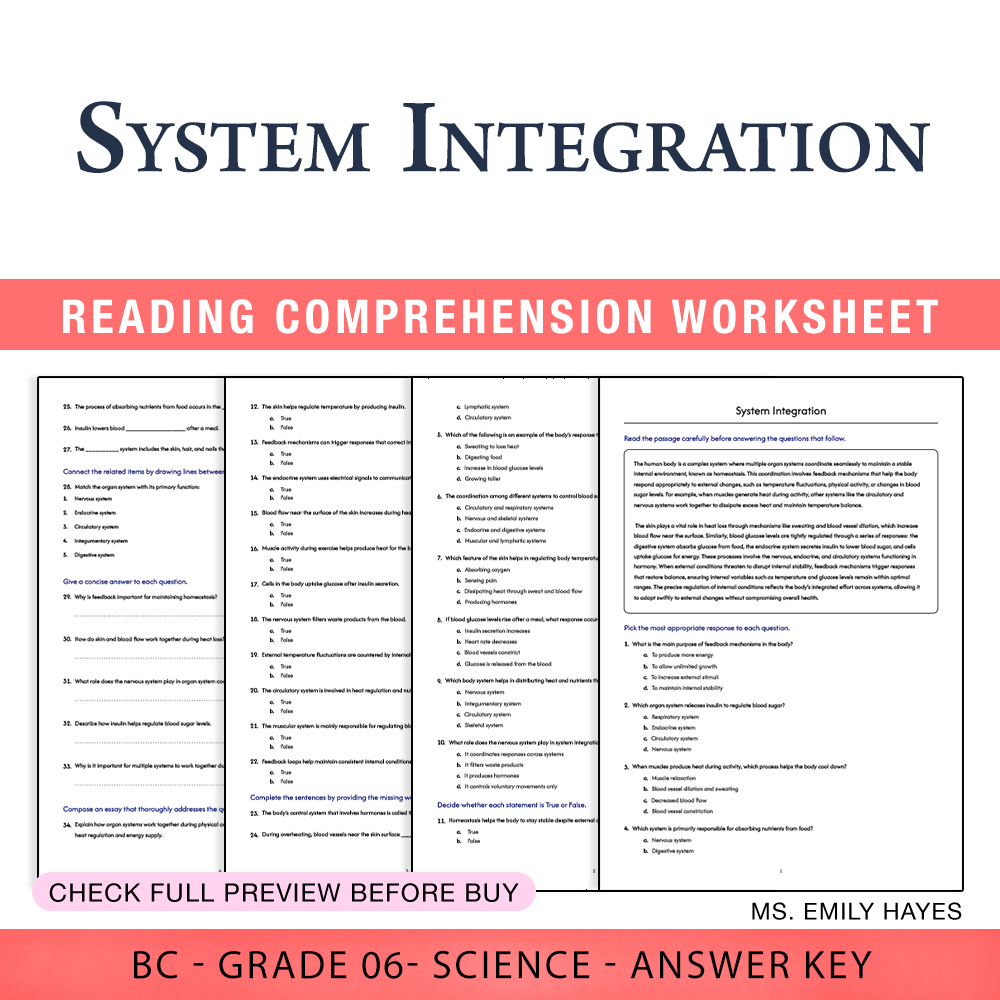
6th Grade Science | System Integration Worksheet (PDF+ Answer Key)
Created byCopper Leaf ClassroomLearning Objectives
- Describe how different organ systems work together to maintain homeostasis.
- Explain feedback mechanisms involved in regulating internal body conditions.
- Identify examples of system coordination in the human body.
Also included in: Grade 6 Science BC | Human Body Systems & Adaptations (PDF+ Answer Keys) +1 more
Instant download
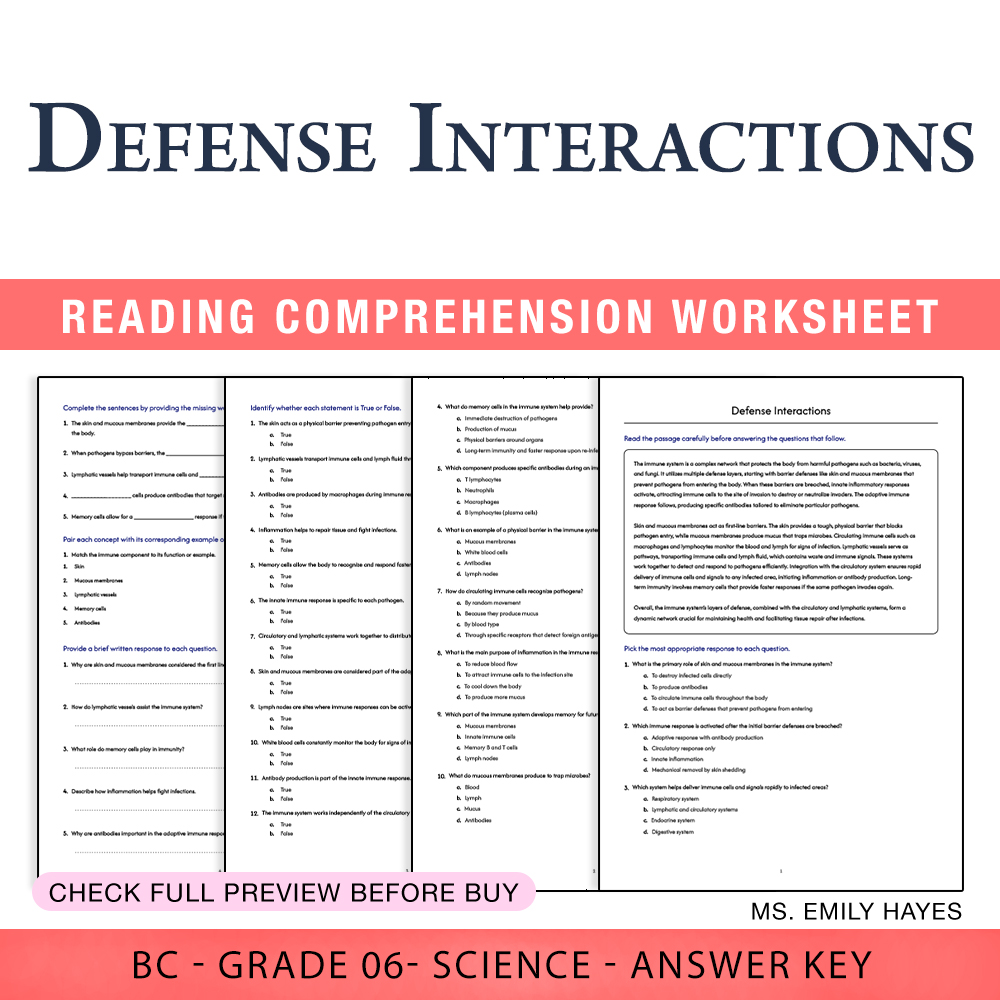
Grade 6 Science | Defense Interactions Worksheet (PDF+ Answer Key)
Created byCopper Leaf ClassroomLearning Objectives
- Explain how the immune system defends organisms through barrier defenses, innate inflammation, and adaptive responses.
- Identify the roles of skin, mucous membranes, circulating immune cells, and lymphatic vessels in immune defense.
- Describe how immune activity interacts with circulatory and lymphatic systems to maintain health and memory.
Also included in: Grade 6 Science BC | Human Body Systems & Adaptations (PDF+ Answer Keys) +1 more
Instant download
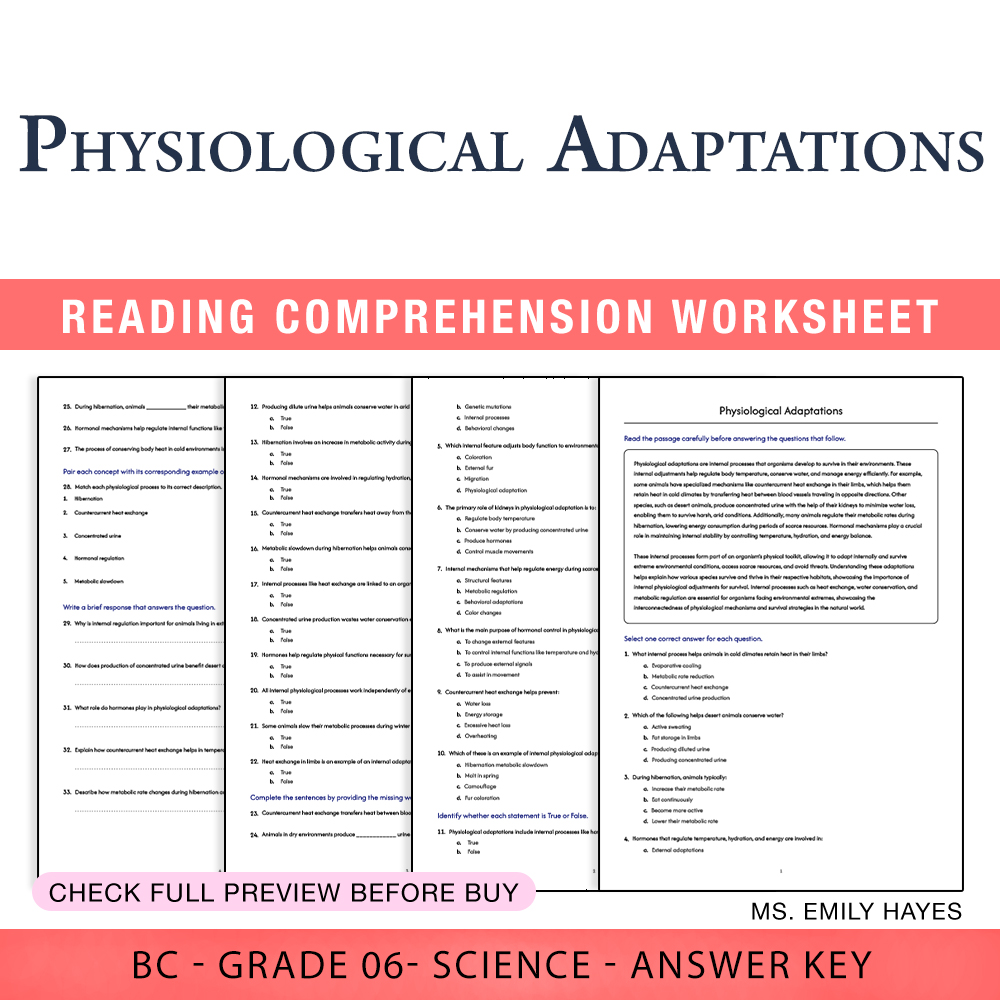
6th Grade Science | Physiological Adaptations Worksheet (PDF+ Answer Key)
Created byCopper Leaf ClassroomLearning Objectives
- Explain the concept of physiological adaptations and their importance for survival.
- Identify different internal processes that help organisms survive environmental challenges.
- Describe specific physiological mechanisms such as heat exchange, water conservation, and metabolic regulation.
Also included in: Grade 6 Science BC | Human Body Systems & Adaptations (PDF+ Answer Keys) +1 more
Instant download
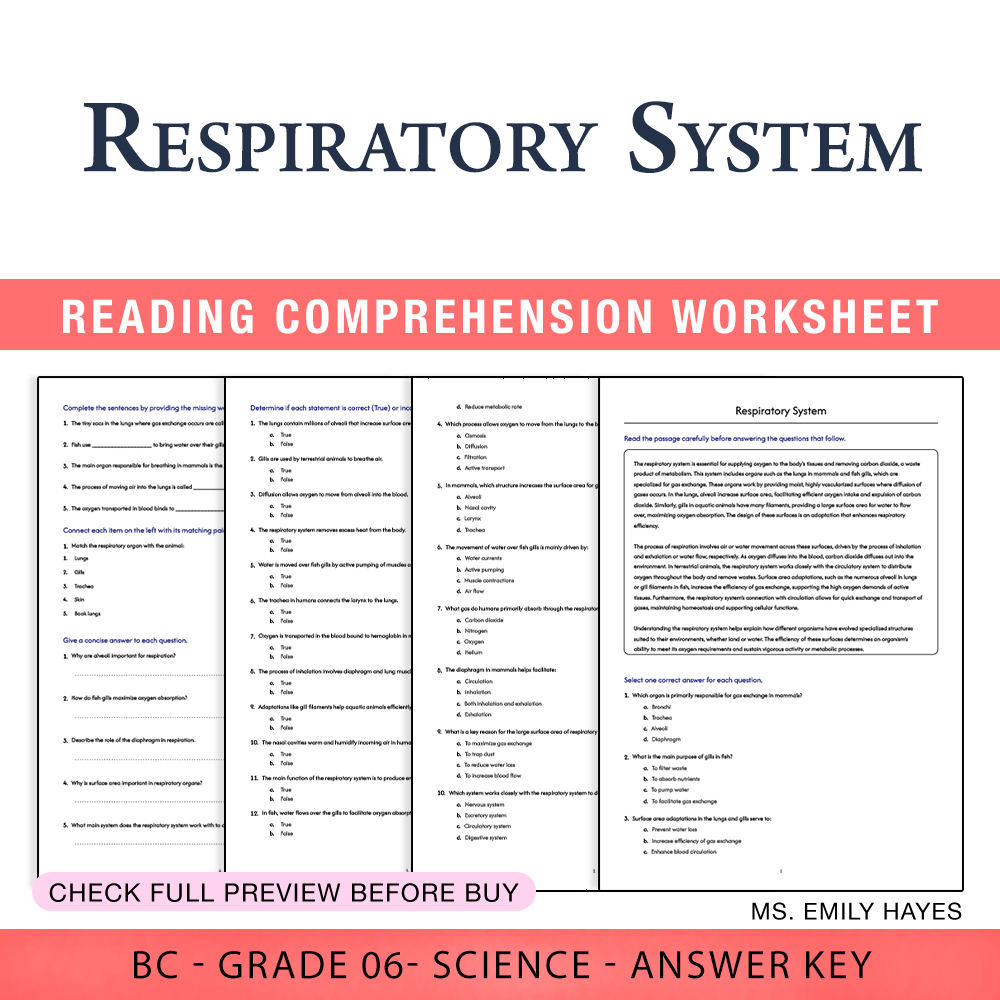
6th Grade Science | Respiratory System Worksheet (PDF+ Answer Key)
Created byCopper Leaf ClassroomLearning Objectives
- Describe the structure and function of the respiratory system.
- Explain how gas exchange occurs in the lungs and gills.
- Identify adaptations that increase respiratory surface area.
Also included in: Grade 6 Science BC | Human Body Systems & Adaptations (PDF+ Answer Keys) +1 more
Instant download
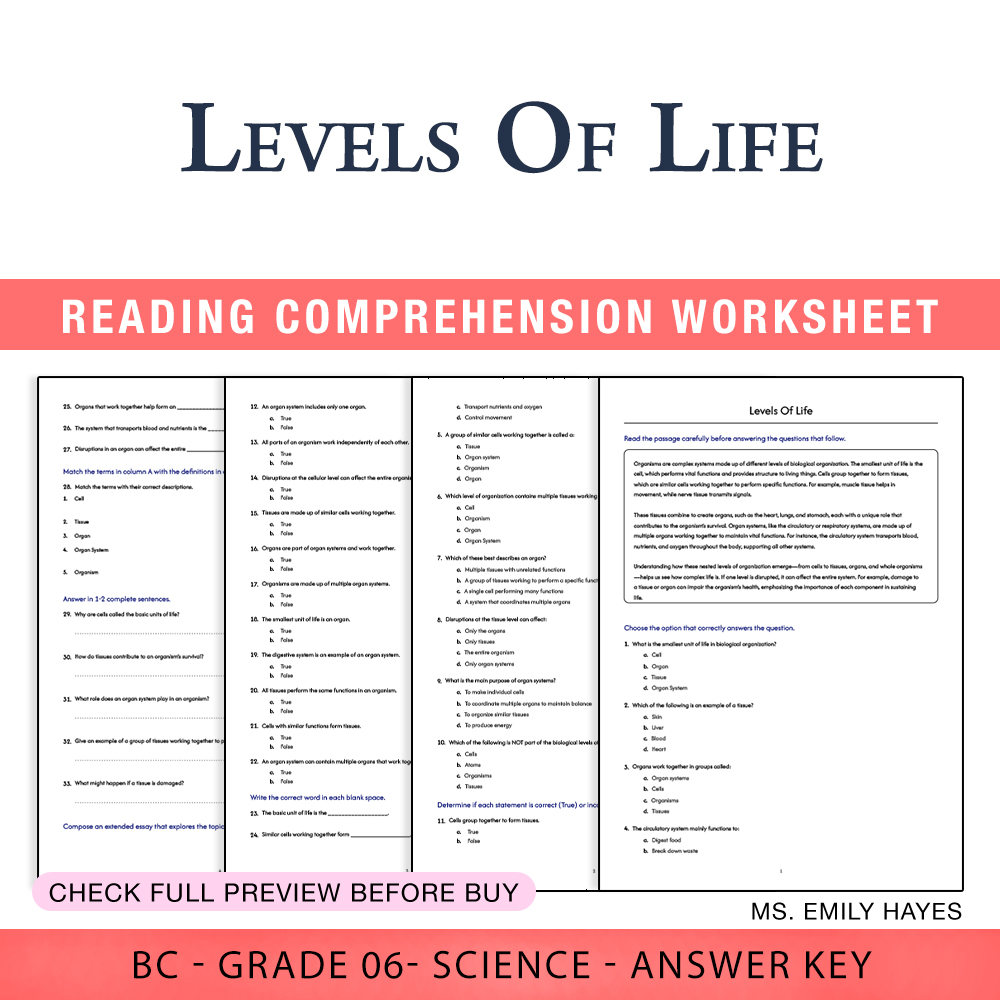
6th Grade Science | Levels Of Life Worksheet (PDF+ Answer Key)
Created byCopper Leaf ClassroomLearning Objectives
- Understand the hierarchical organization of biological levels from cells to organisms
- Describe how cells form tissues, tissues form organs, and organs work together in organ systems
- Recognize the importance of organization in maintaining life processes
Also included in: Grade 6 Science BC | Human Body Systems & Adaptations (PDF+ Answer Keys) +1 more
Instant download
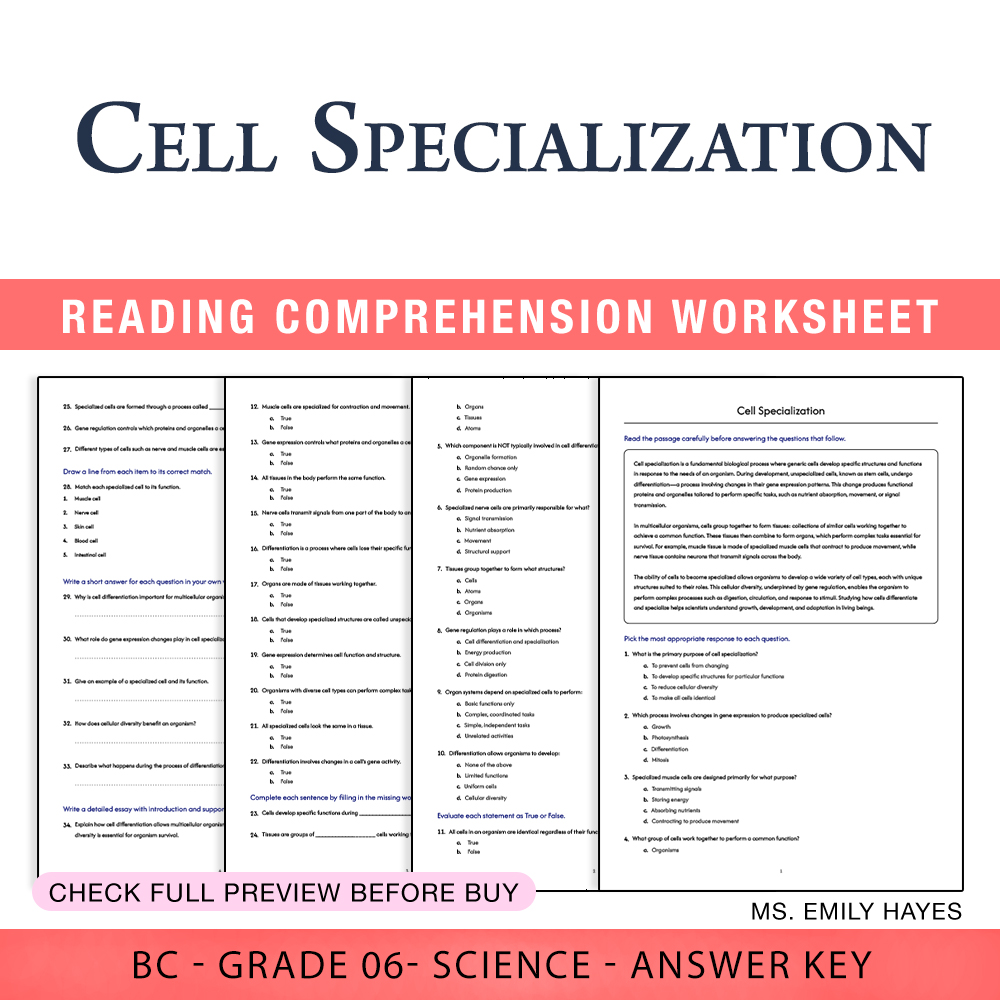
6th Grade Science | Cell Specialization Worksheet (PDF+ Answer Key)
Created byCopper Leaf ClassroomLearning Objectives
- Understand the concept of cell specialization and how cells develop specific structures for particular functions.
- Identify different types of specialized cells and their roles within tissues and organs.
- Describe the process of differentiation and how gene expression leads to functional cellular differences.
Also included in: Grade 6 Science BC | Human Body Systems & Adaptations (PDF+ Answer Keys) +1 more
Instant download
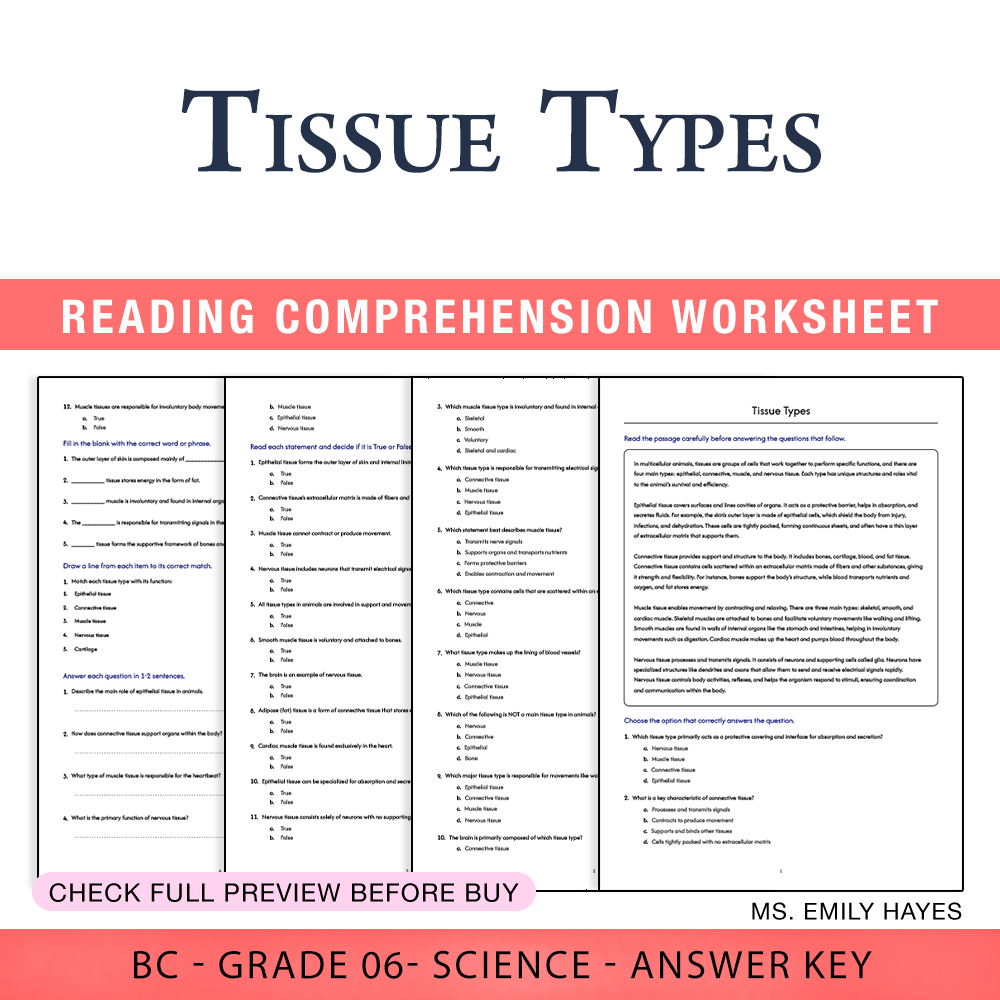
6th Grade Science | Tissue Types Worksheet (PDF+ Answer Key)
Created byCopper Leaf ClassroomLearning Objectives
- Identify and describe the four main tissue types in multicellular animals.
- Explain the functions of epithelial, connective, muscle, and nervous tissues.
- Recognize characteristic structures and extracellular components of each tissue type.
Also included in: Grade 6 Science BC | Human Body Systems & Adaptations (PDF+ Answer Keys) +1 more
Instant download
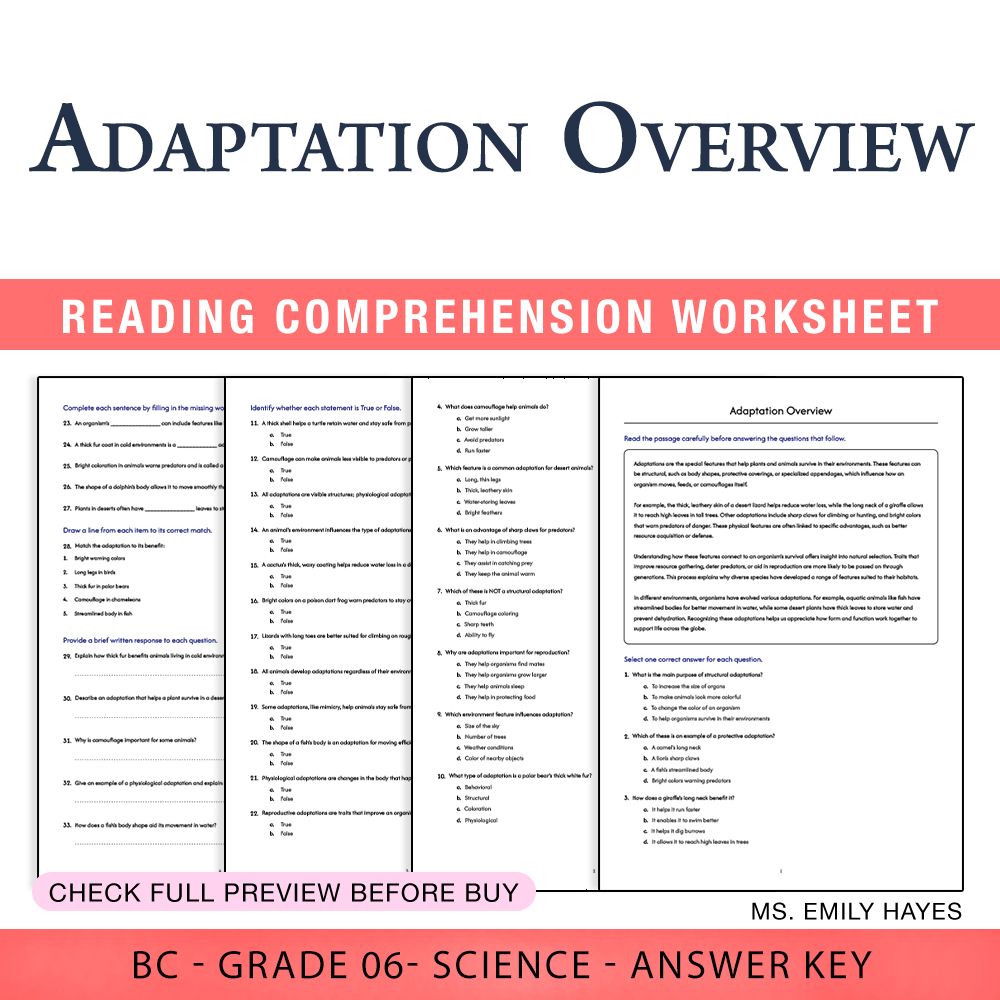
6th Grade Science | Adaptation Overview Worksheet (PDF+ Answer Key)
Created byCopper Leaf ClassroomLearning Objectives
- Identify different types of structural adaptations and understand their functions.
- Explain how adaptations help organisms survive and thrive in their environments.
- Describe relationships between specific features and their advantages for species.
Also included in: Grade 6 Science BC | Human Body Systems & Adaptations (PDF+ Answer Keys) +1 more
Instant download
Browse more categories
About Science Worksheets
Find Science worksheets spanning core skills, practice, and review. All 44,295 resources are instant PDF downloads for the classroom or home.
Every worksheet on MyTeachingSheets is created by independent teacher-authors and reviewed before publication. All resources download as printable PDFs for classroom, homework, or at-home practice, and many include answer keys. Preview any worksheet free before buying.