
Science Worksheets
44,295 subject resources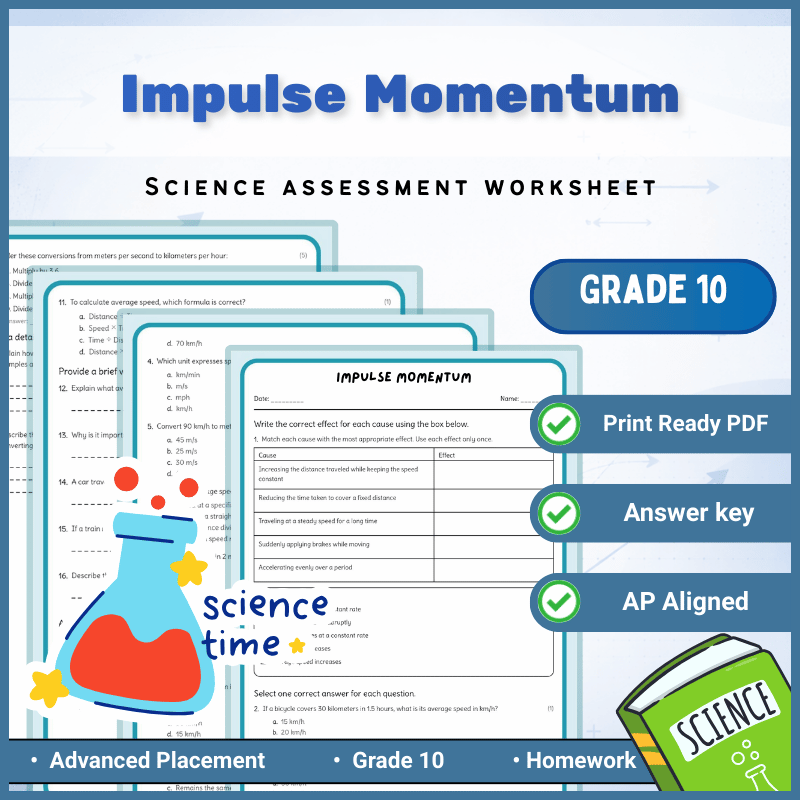
Grade 10 Science | Impulse and Momentum Practice Worksheet (Answer Key)
 Created byBright Mind Resources
Learning Objectives
- Explain the concept of impulse and how it relates to change in momentum.
- Analyze collision events using conservation of momentum in isolated systems.
- Differentiate between elastic, inelastic, and perfectly inelastic collisions and describe energy transformations.
Instant download
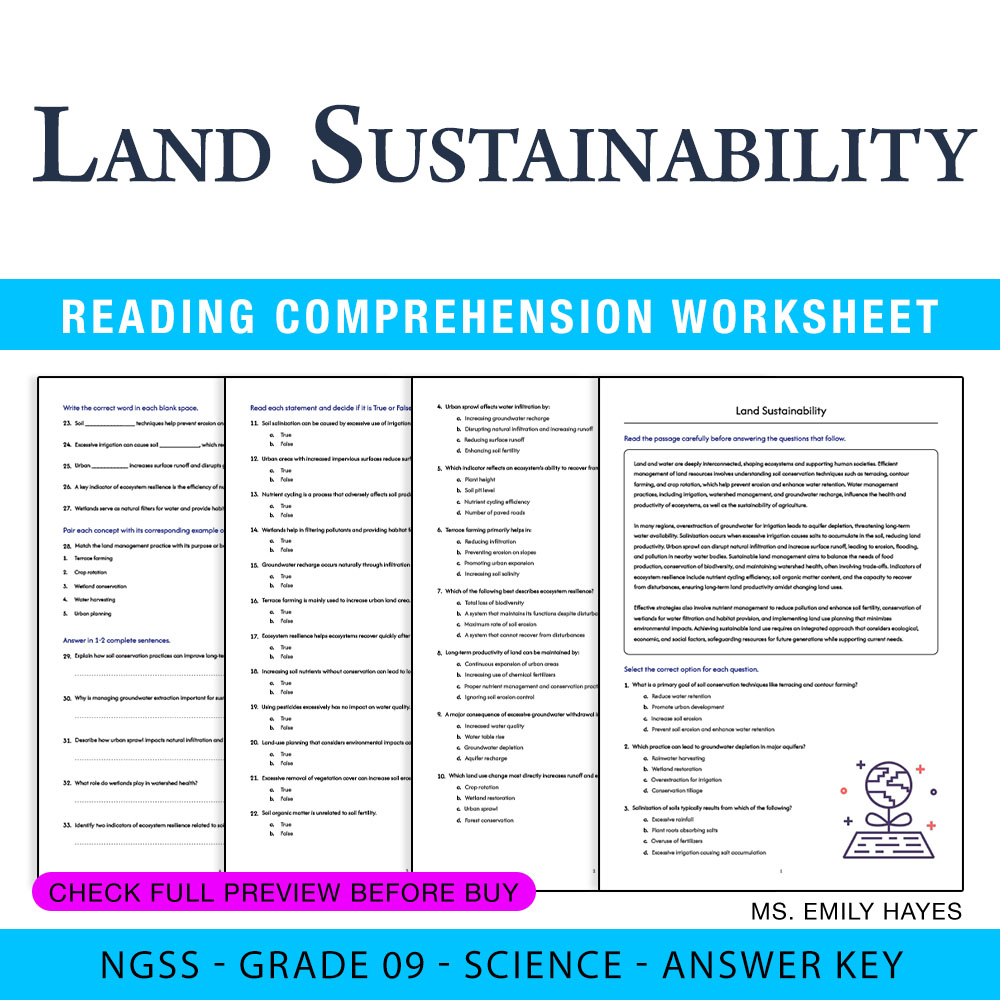
Grade 9 Science | Land Sustainability Worksheet (PDF+ Answer Key)
 Created byCopper Leaf Classroom
Learning Objectives
- Understand the interactions between land use and water resources, including conservation and irrigation practices.
- Evaluate the impact of land management on ecosystem resilience, nutrient cycling, and long-term productivity.
- Analyze the trade-offs between agricultural productivity, biodiversity, and watershed health under different land-use scenarios.
Instant download
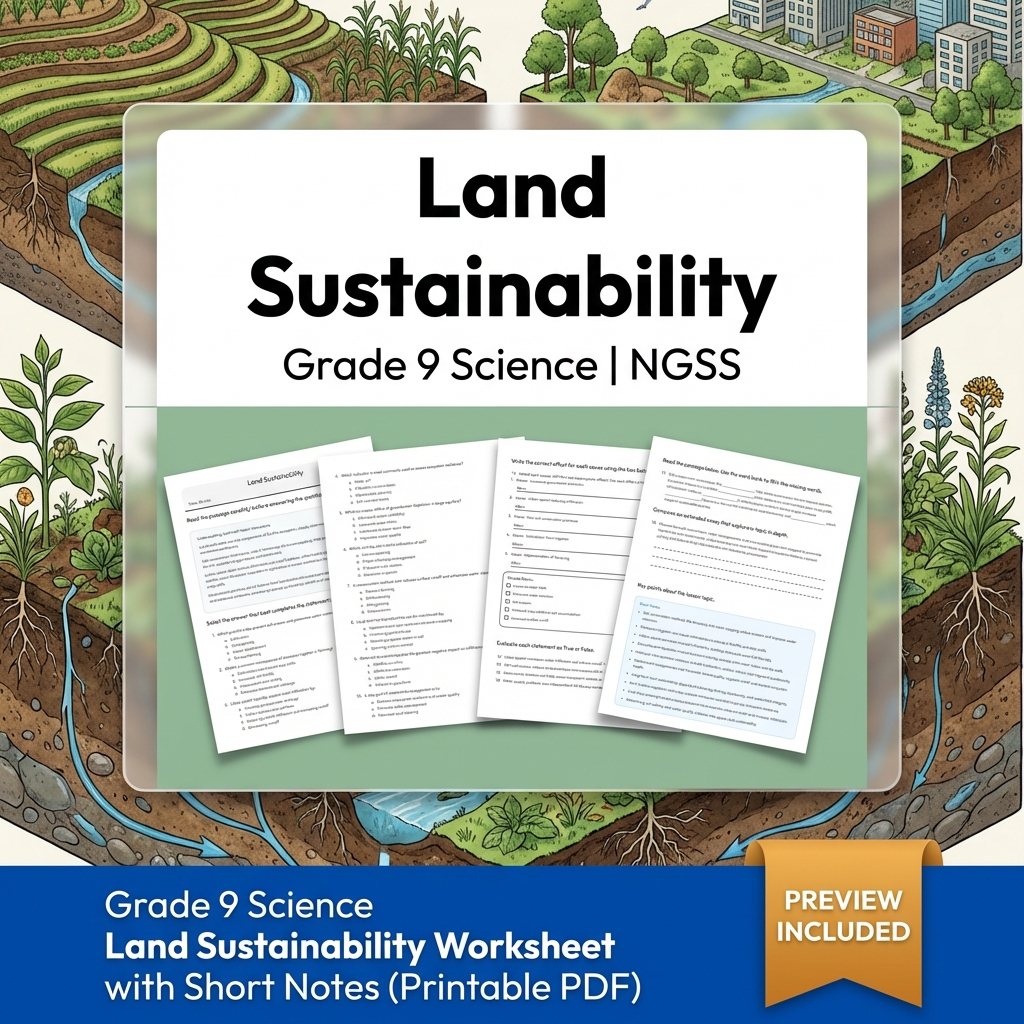
Grade 9 Science Land Sustainability Worksheet with Short Notes (Printable PDF)
 Created byMeadowlark Worksheets
Learning Objectives
- Understand the interactions between land and water in ecosystem sustainability.
- Identify practices for soil conservation and sustainable water management.
- Analyze impacts of land-use changes such as urban sprawl and irrigation salinization.
Also included in: Grade 9 Science NGSS UNIT Bundle – Earth & Human Activity Resources Pack +1 more
Instant download
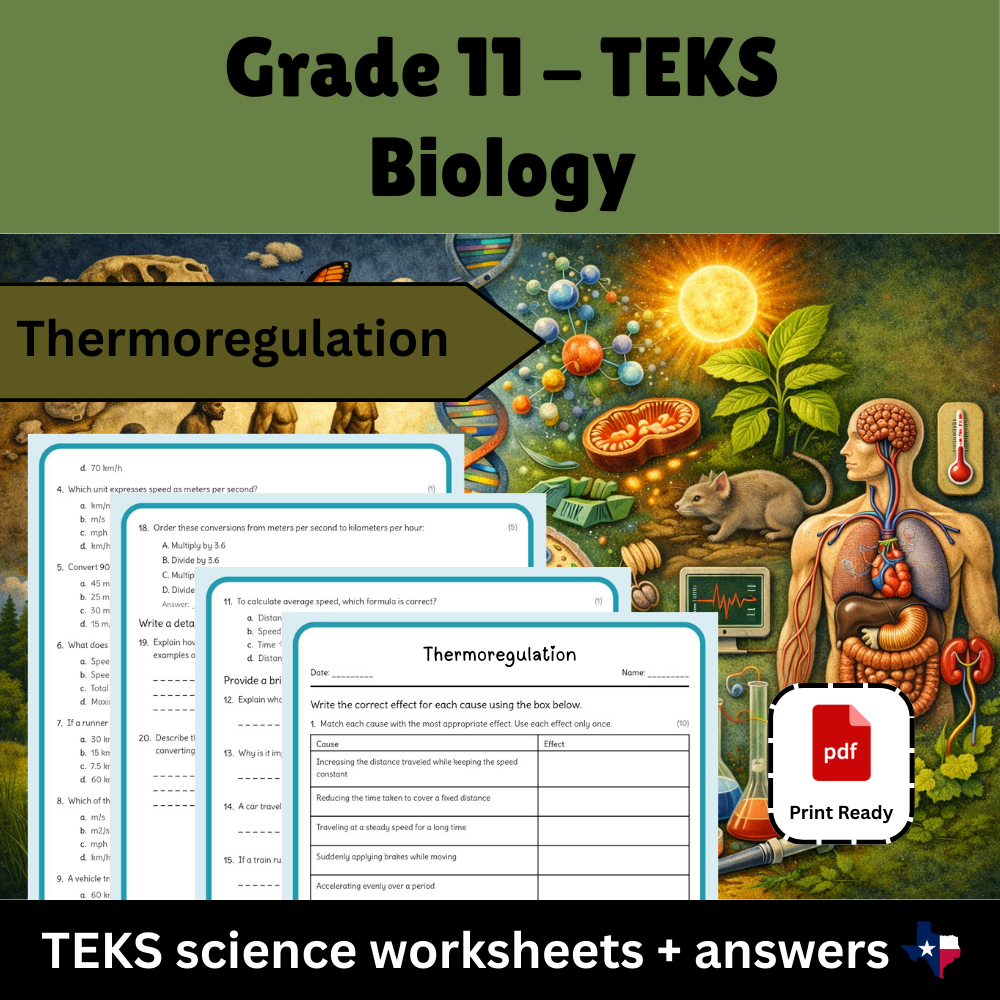
Grade 11 Science – Thermoregulation Worksheet+ Answer Key – TEKS Aligned
Created byBright Mind ResourcesLearning Objectives
- Describe the mechanisms involved in temperature homeostasis.
- Identify the roles of different body systems in thermoregulation.
- Explain how environmental factors and fever influence thermoregulatory responses.
Also included in: Grade 11 Science: Human Body & Homeostasis Unit Worksheet Bundle (TEKS Aligned) +2 more
Instant download
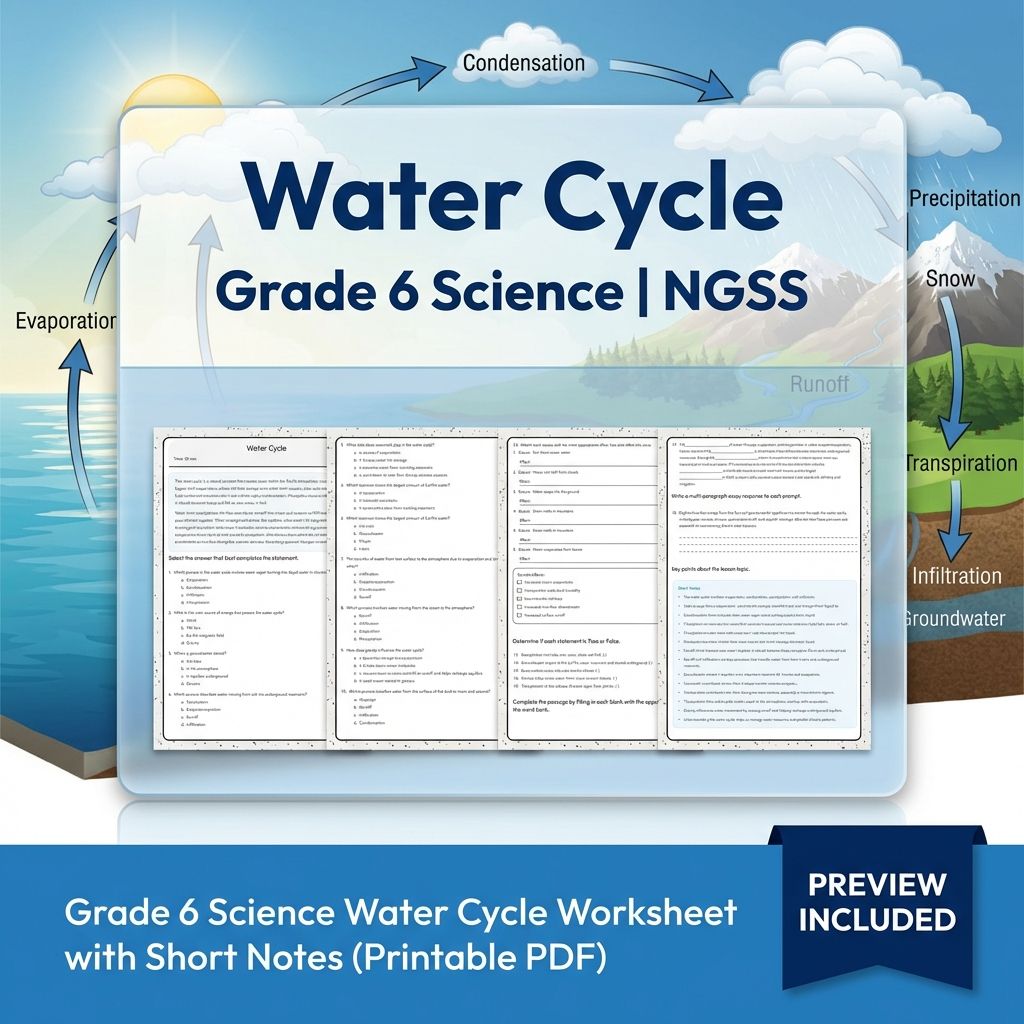
Grade 6 Science Water Cycle Worksheet with Short Notes (Printable PDF)
Created byMeadowlark WorksheetsLearning Objectives
- Describe the processes involved in the water cycle, including evaporation, condensation, and precipitation.
- Explain how energy from the sun and gravity drive water movement across the hydrosphere.
- Identify different reservoirs of water such as oceans, ice, and groundwater, and understand how water transfers occur between them.
Also included in: Grade 6 Science | Earth's Systems Unit Bundle NGSS-Aligned Worksheets +1 more
Instant download

Thermoregulation Assessment for Grade 11 Science TEKS Standards
 Created byPrism Point Learning
Learning Objectives
- Understand the mechanisms of temperature homeostasis involving heat production, conservation, and dissipation.
- Identify the roles of the hypothalamus and other systems in thermoregulation.
- Explain how environmental factors and fever influence thermoregulatory responses.
Also included in: Grade 11 Homeostasis & Human Body Systems Science: Lesson Bundle TEKS
Instant download

Grade 12 Science | Genomic Applications - Daily Reading Comprehension
 Created byCoral Reef Learning
Learning Objectives
- Understand the basic concepts of genomic sequencing and its role in modern science.
- Identify key applications of genomics such as personalized medicine and conservation genetics.
- Recognize ethical, ecological, and societal considerations associated with genomic technologies.
Instant download

Grade 6 Random Error & Measurement Analysis Worksheet | Alberta Science
 Created byBRIGHT PATH RESOURCES
Learning Objectives
- Identify random error by recognizing scatter in data
- Explain how random error affects the reliability of a conclusion
- Differentiate random error from systematic shifts using evidence from measurements
Also included in: Inquiry Data Grade 6 Science Daily Reading Worksheets Lesson Bundle | Alberta +1 more
Instant download
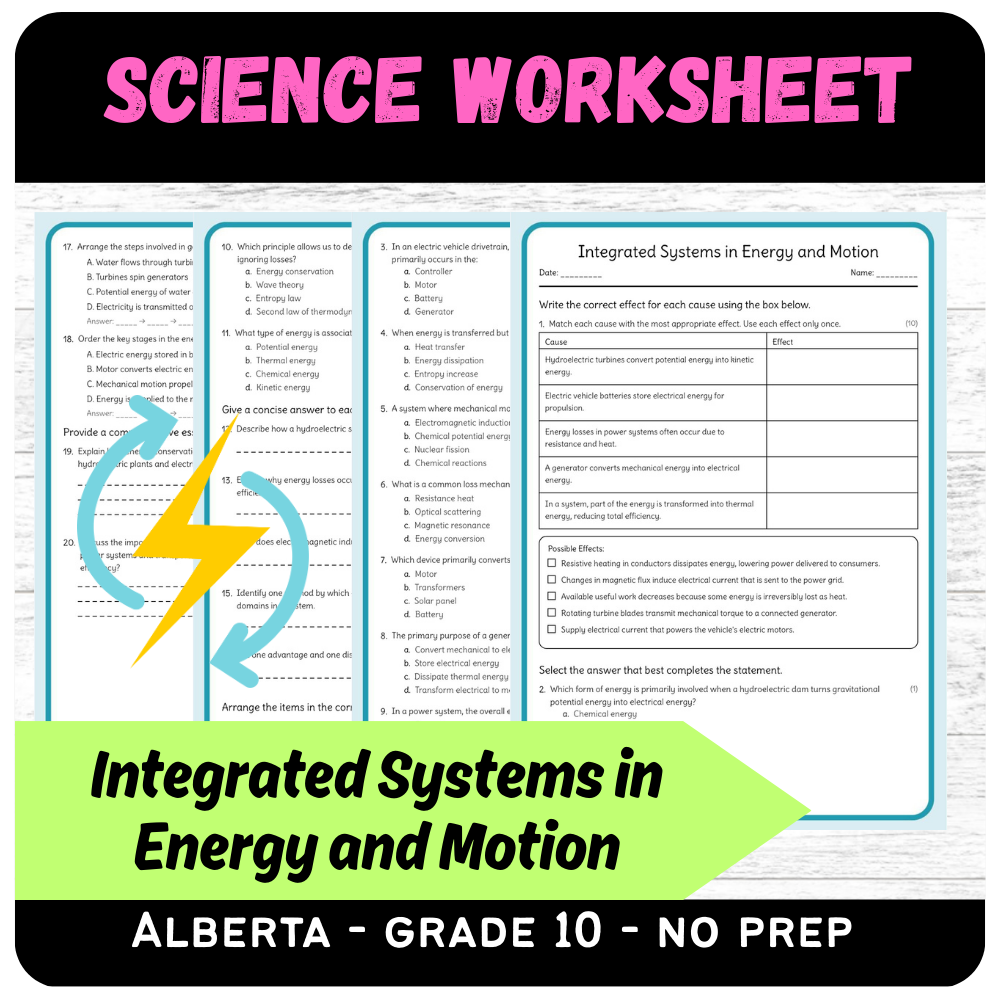
Grade 10 Science | Integrated Energy Systems Worksheet (PDF)
Created byBright Mind ResourcesLearning Objectives
- Explain the energy transformations involved in mechanical and electrical systems
- Analyze how energy losses and conservation principles affect system performance
- Apply concepts of work, energy, and electromagnetic conversion to real-world integrated systems
Instant download
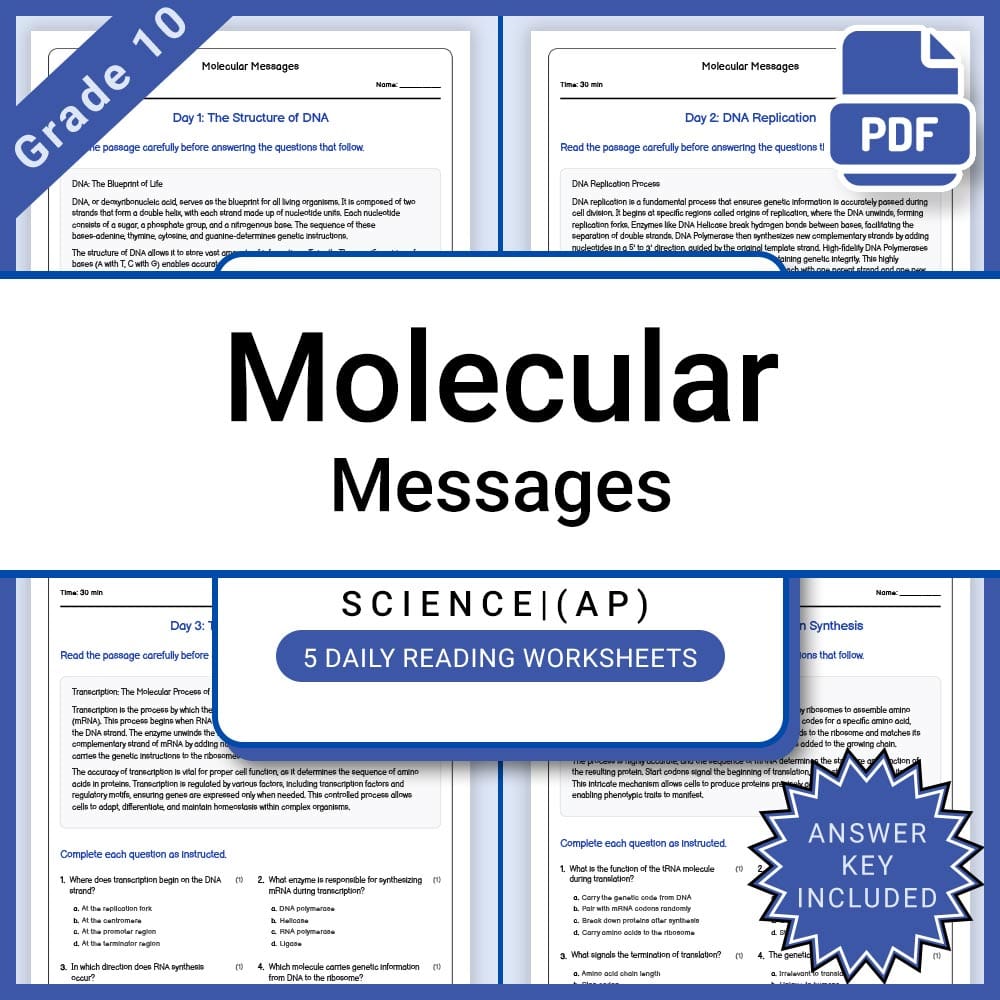
Grade 10 Science – Molecular Messages Daily Reading Worksheet + Answer Key
JCreated byJ.S SheetsLearning Objectives
- Understand the structure of DNA and its components.
- Explain how DNA stores genetic information.
- Describe the processes of transcription and translation.
Also included in: Grade 10 Science Lesson Group Bundle | AP Framework & Daily Worksheets
Instant download
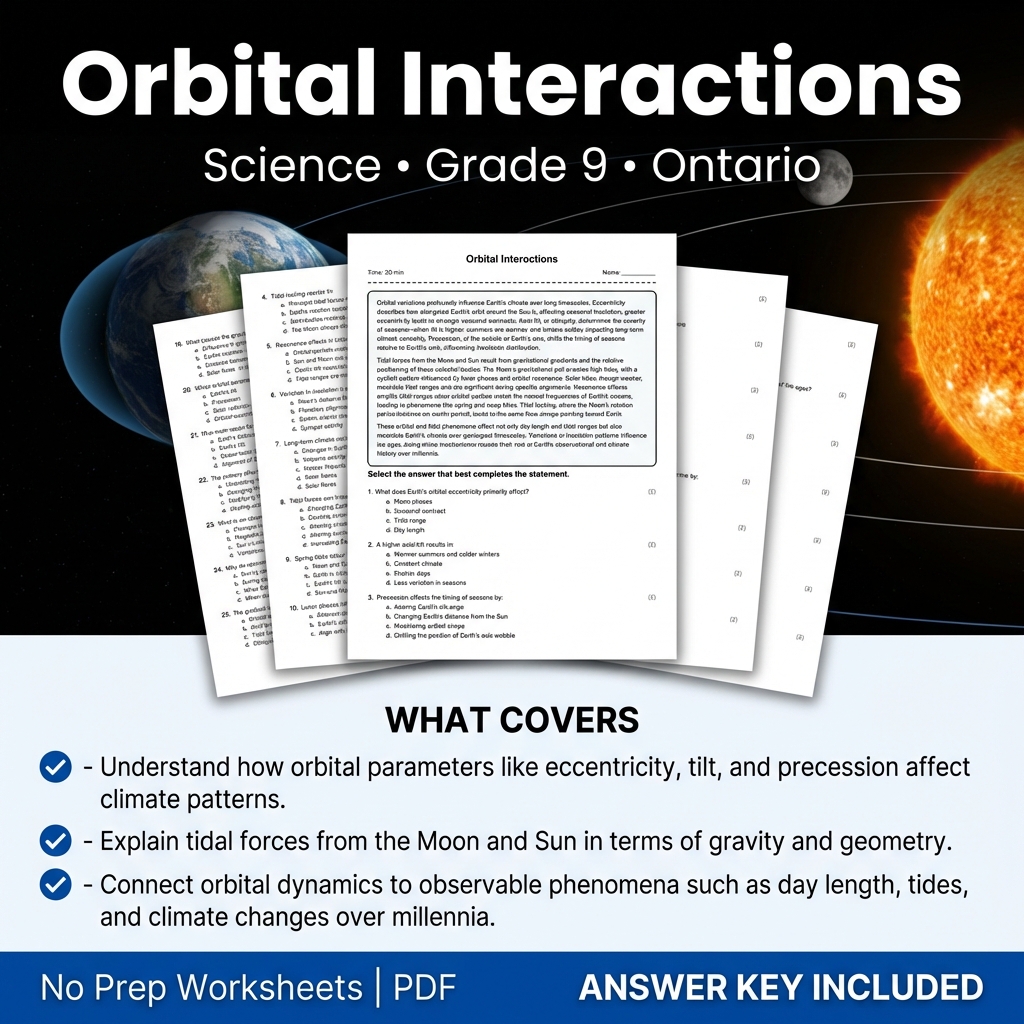
Orbital Interactions Worksheet for Grade 9 Science – Ontario Standards
Created byCoral Reef LearningLearning Objectives
- Understand how orbital parameters like eccentricity, tilt, and precession affect climate patterns.
- Explain tidal forces from the Moon and Sun in terms of gravity and geometry.
- Connect orbital dynamics to observable phenomena such as day length, tides, and climate changes over millennia.
Instant download
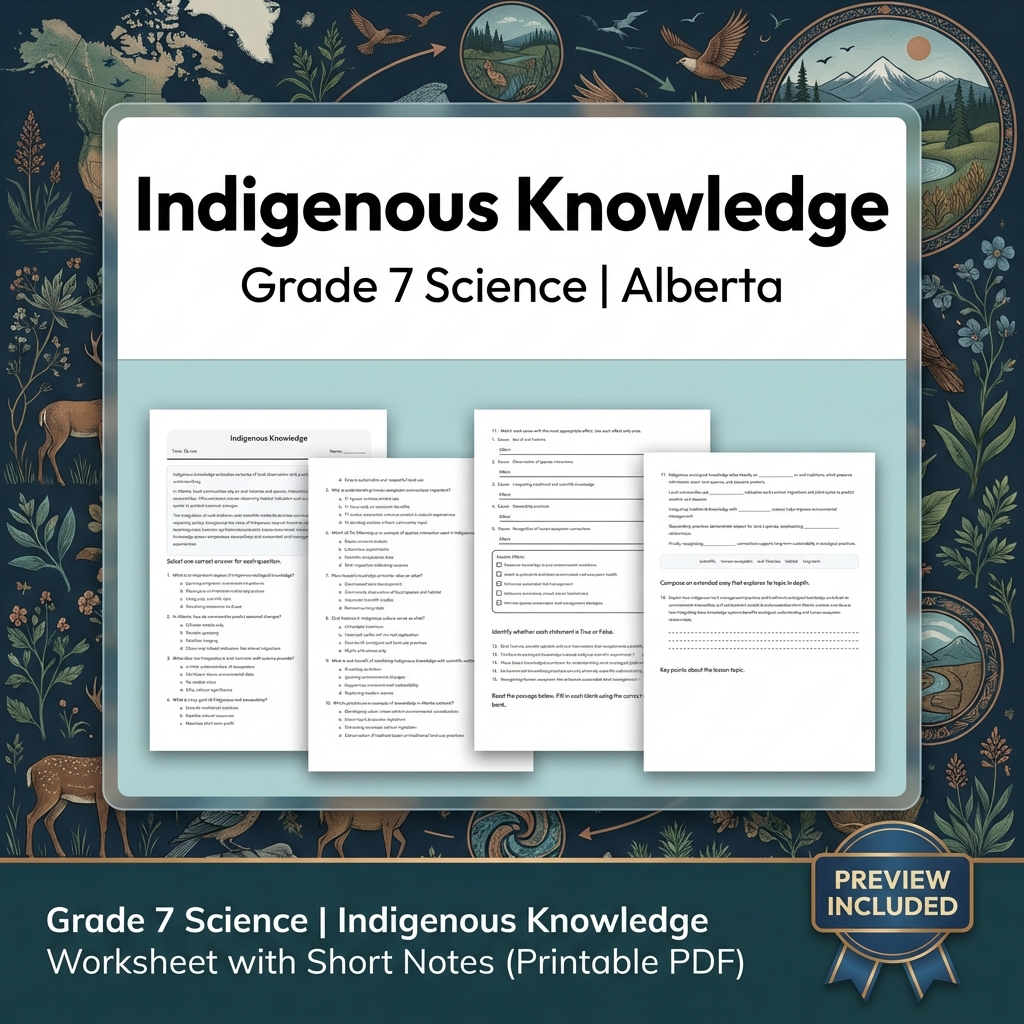
Grade 7 Science | Indigenous Knowledge Worksheet with Short Notes (Printable PDF)
Created byMeadowlark WorksheetsLearning Objectives
- Understand the role of oral histories and place-based knowledge in ecological understanding.
- Identify examples of stewardship practices within Indigenous communities in Alberta.
- Explain how different knowledge systems contribute to interpreting environmental patterns.
Instant download
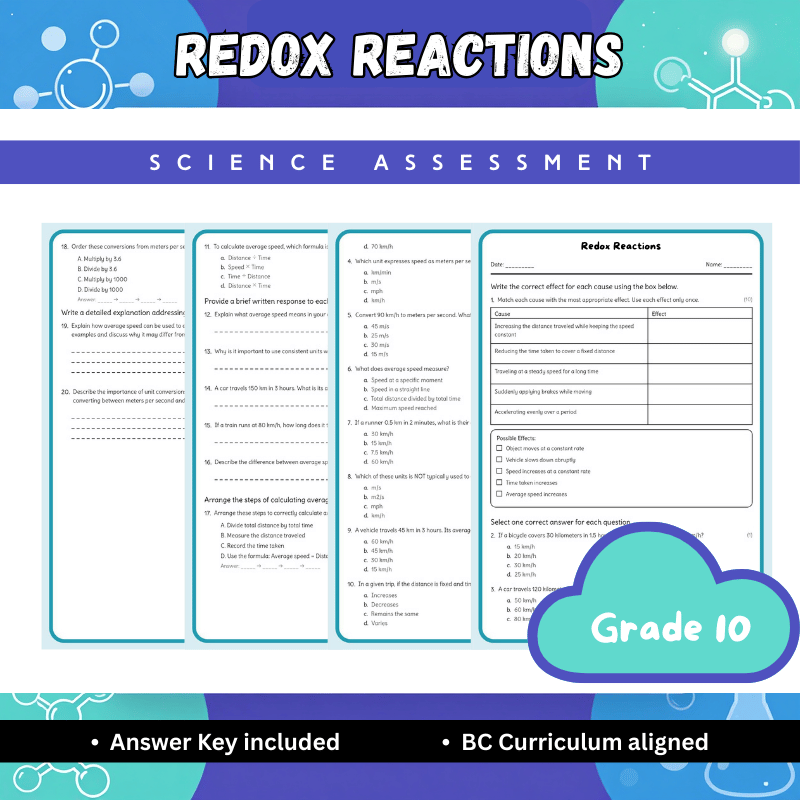
Grade 10 Science | Redox Reactions Worksheet (Answer Key) for BC Standards
Created byBright Mind ResourcesLearning Objectives
- Understand the concept of oxidation and reduction in chemical reactions.
- Identify changes in oxidation states during redox processes.
- Explain how electron transfer links microscopic processes to macroscopic phenomena.
Instant download
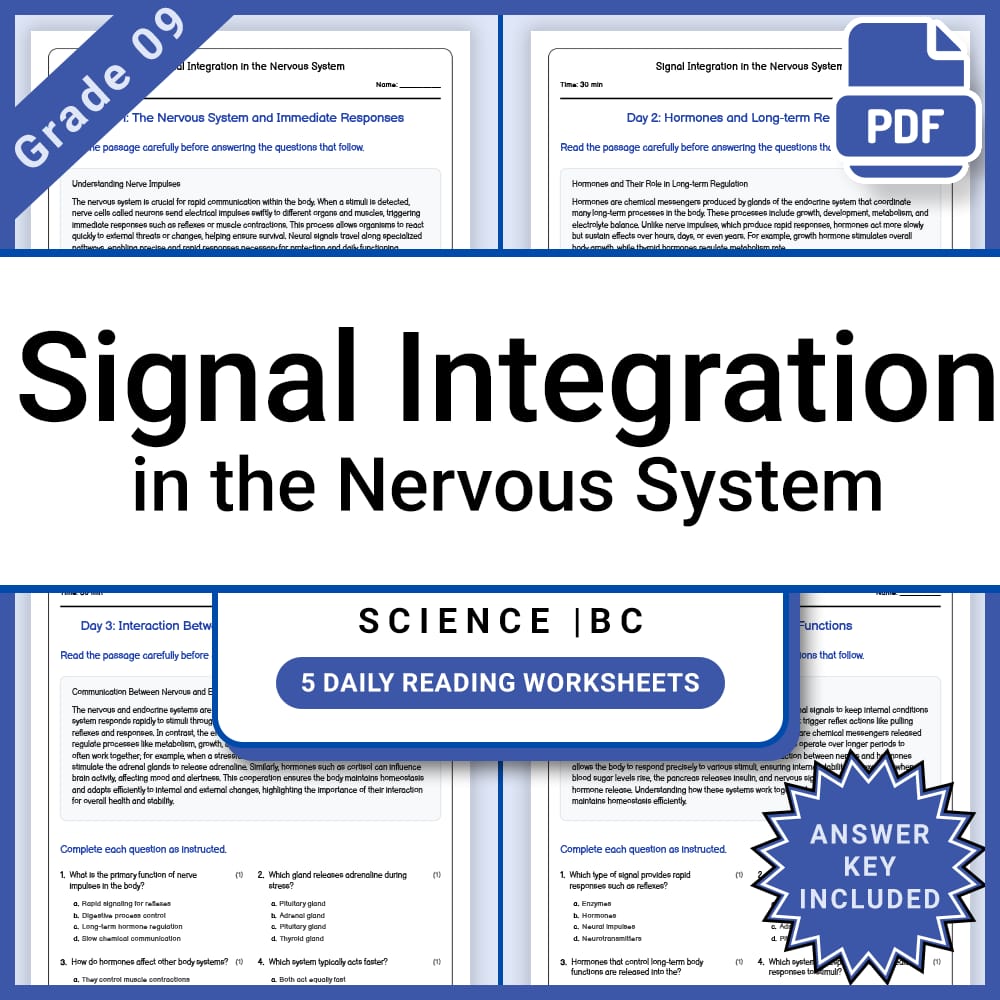
Grade 9 – Signal Integration in the Nervous System Worksheet with Answer Key
JCreated byJ.S SheetsLearning Objectives
- Understand how nerve impulses provide quick responses to stimuli
- Identify the role of the nervous system in maintaining homeostasis
- Explain the interaction between neural responses and hormonal regulation
Also included in: Grade 9 Science Lesson Group Bundle | BC Framework Activities & Worksheets +1 more
Instant download

Efficiency and Constraints Worksheet | California Standards Grade 12 Science
JCreated byJ.S SheetsLearning Objectives
- Understand the concept of energy transfer and losses in energy conversion processes.
- Analyze how constraints affect the efficiency of real-world devices and systems.
- Explain why no energy conversion process can be 100% efficient.
Also included in: Grade 12 Energy, Forces, and Waves Science Lesson Bundle | California Standards +1 more
Instant download
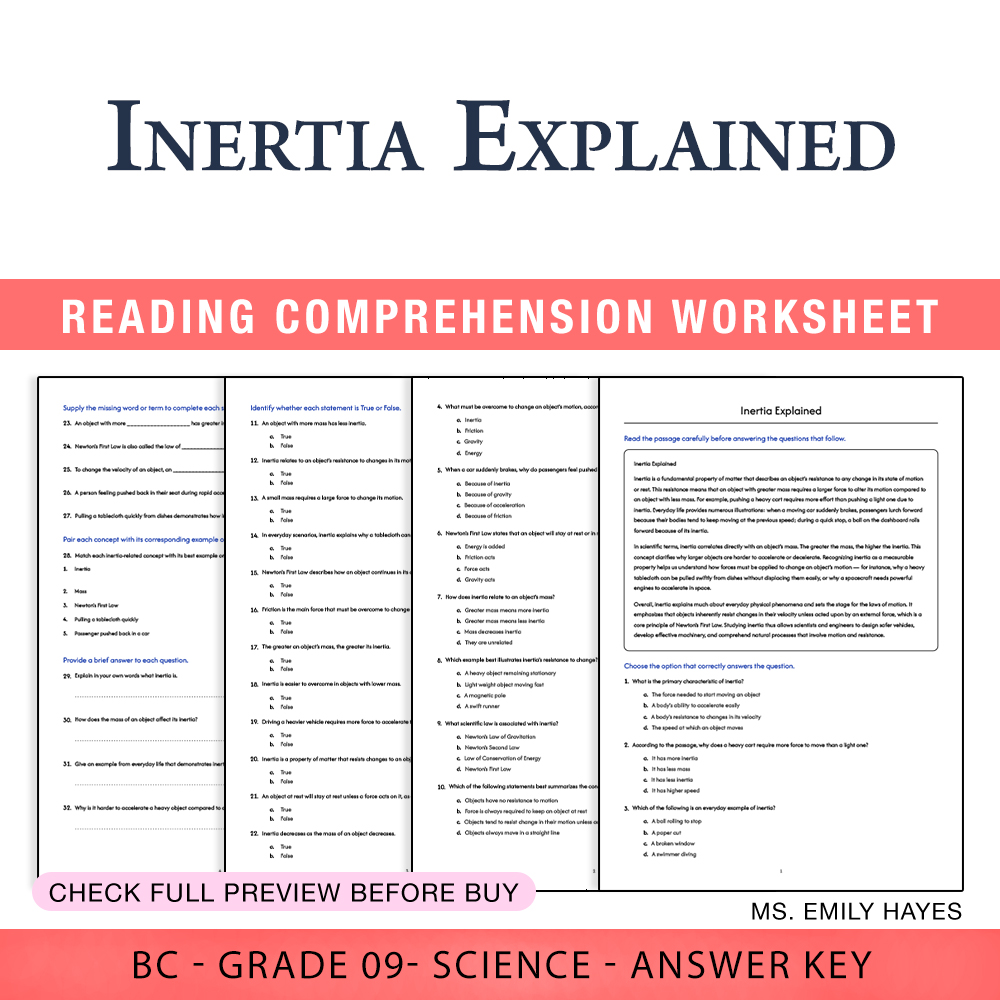
9th Grade Science | Inertia Explained Worksheet (PDF+ Answer Key)
Created byCopper Leaf ClassroomLearning Objectives
- Understand the concept of inertia and its relation to mass.
- Identify real-world examples that demonstrate inertia.
- Explain how force overcomes inertia to change an object's motion.
Also included in: Grade 9 Science Worksheet Bundle | Forces, Energy & Motion (PDF + Answer Key) +1 more
Instant download
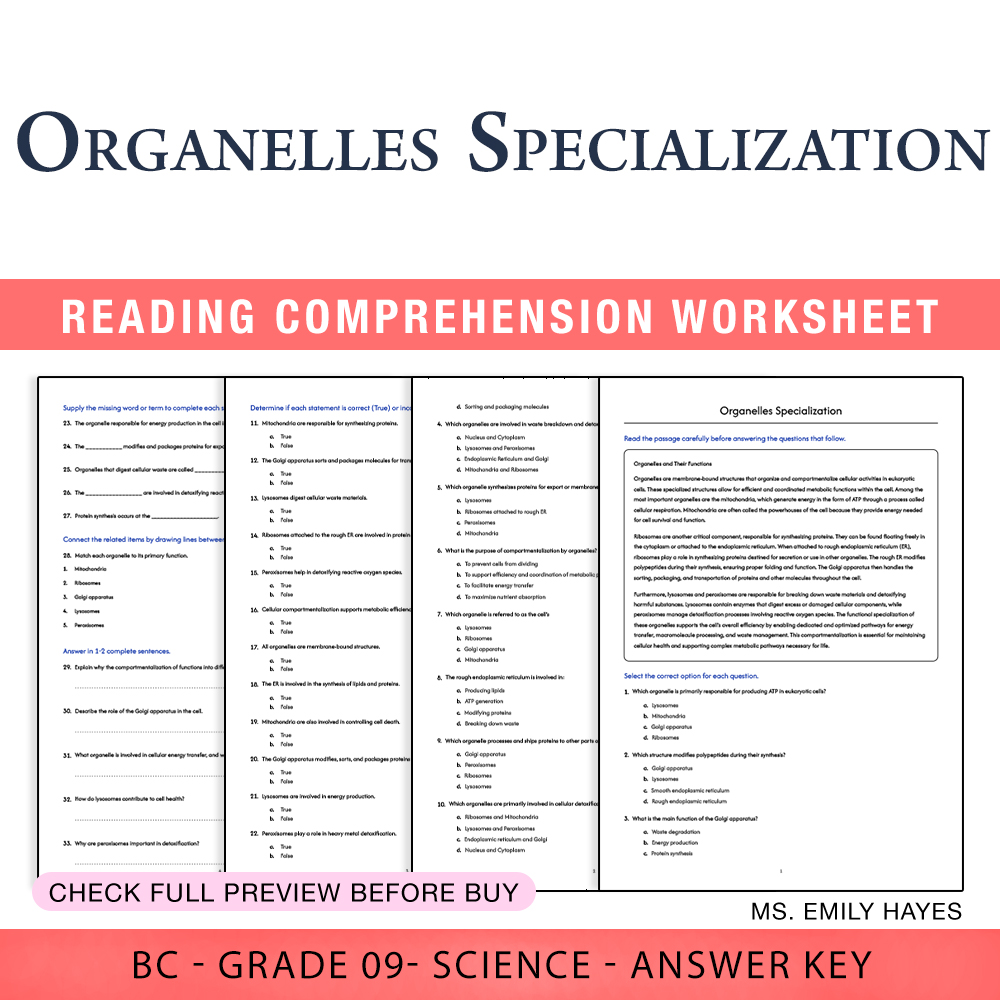
9th Grade Science | Organelles Specialization Worksheet (PDF+ Answer Key)
Created byCopper Leaf ClassroomLearning Objectives
- Describe the functions of key cellular organelles involved in specialization.
- Explain how structural differences among organelles support cellular efficiency.
- Identify the roles of mitochondria, ribosomes, rough endoplasmic reticulum, Golgi apparatus, lysosomes, and peroxisomes.
Also included in: Grade 9 Science Worksheet Pack | Biology & Cell Structures (PDF+ Answer Keys) +1 more
Instant download
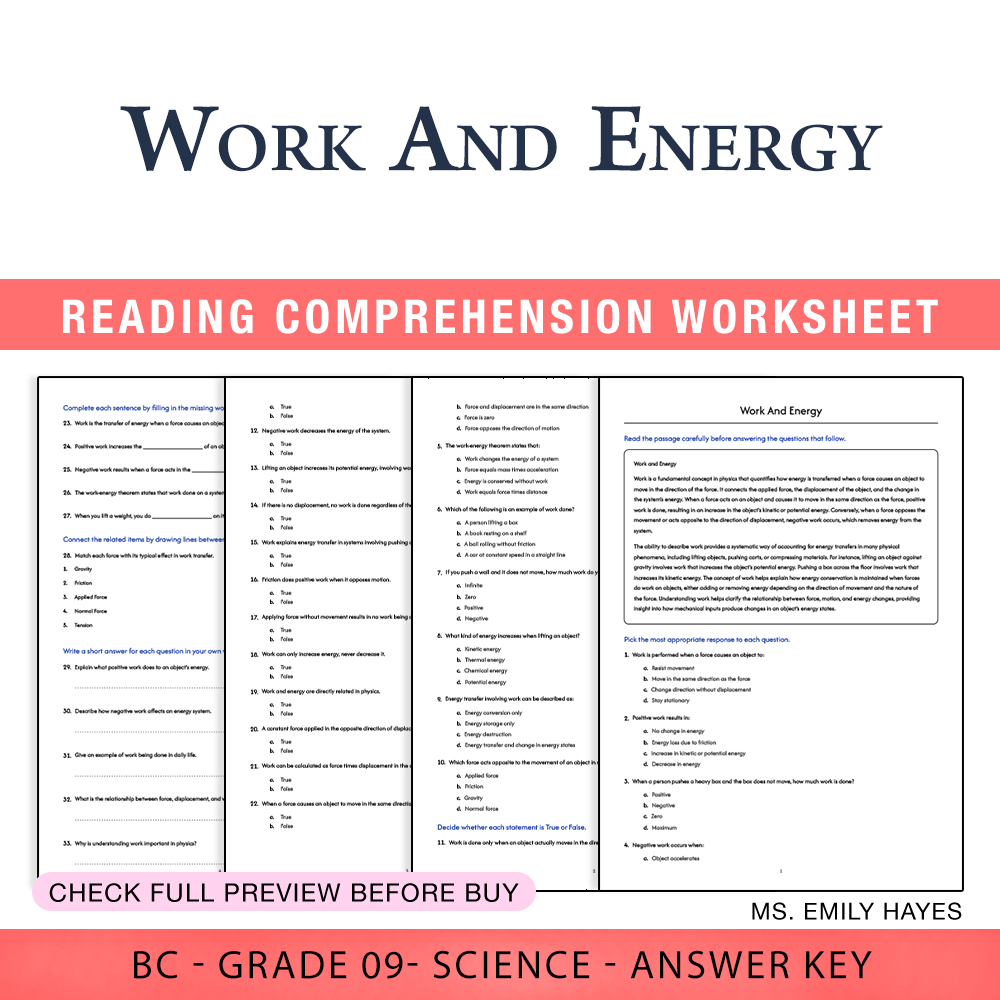
9th Grade Science | Work & Energy Worksheet (PDF+ Answer Key)
Created byCopper Leaf ClassroomLearning Objectives
- Understand the concept of work in relation to force, displacement, and energy transfer.
- Distinguish between positive and negative work and their effects on energy.
- Apply the work-energy theorem to simple physics problems.
Also included in: Grade 9 Science Worksheet Bundle | Forces, Energy & Motion (PDF + Answer Key) +1 more
Instant download
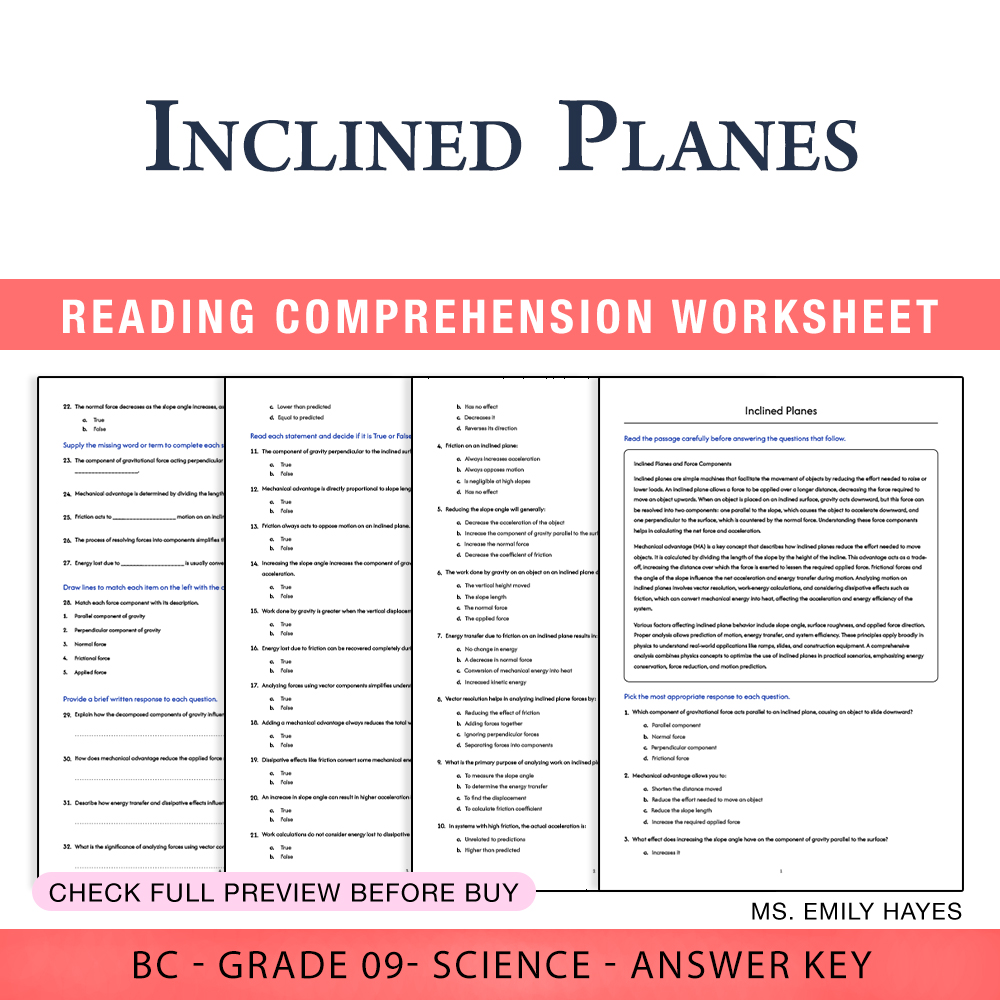
9th Grade Science | Inclined Planes Worksheet (PDF+ Answer Key)
Created byCopper Leaf ClassroomLearning Objectives
- Explain how inclined planes decompose gravitational force into components parallel and perpendicular to the surface.
- Describe the concept of mechanical advantage and how it reduces applied force at the expense of distance.
- Analyze the effects of slope angle and friction on the motion, acceleration, and energy transfer of objects on inclined planes.
Also included in: Grade 9 Science Worksheet Bundle | Forces, Energy & Motion (PDF + Answer Key) +1 more
Instant download
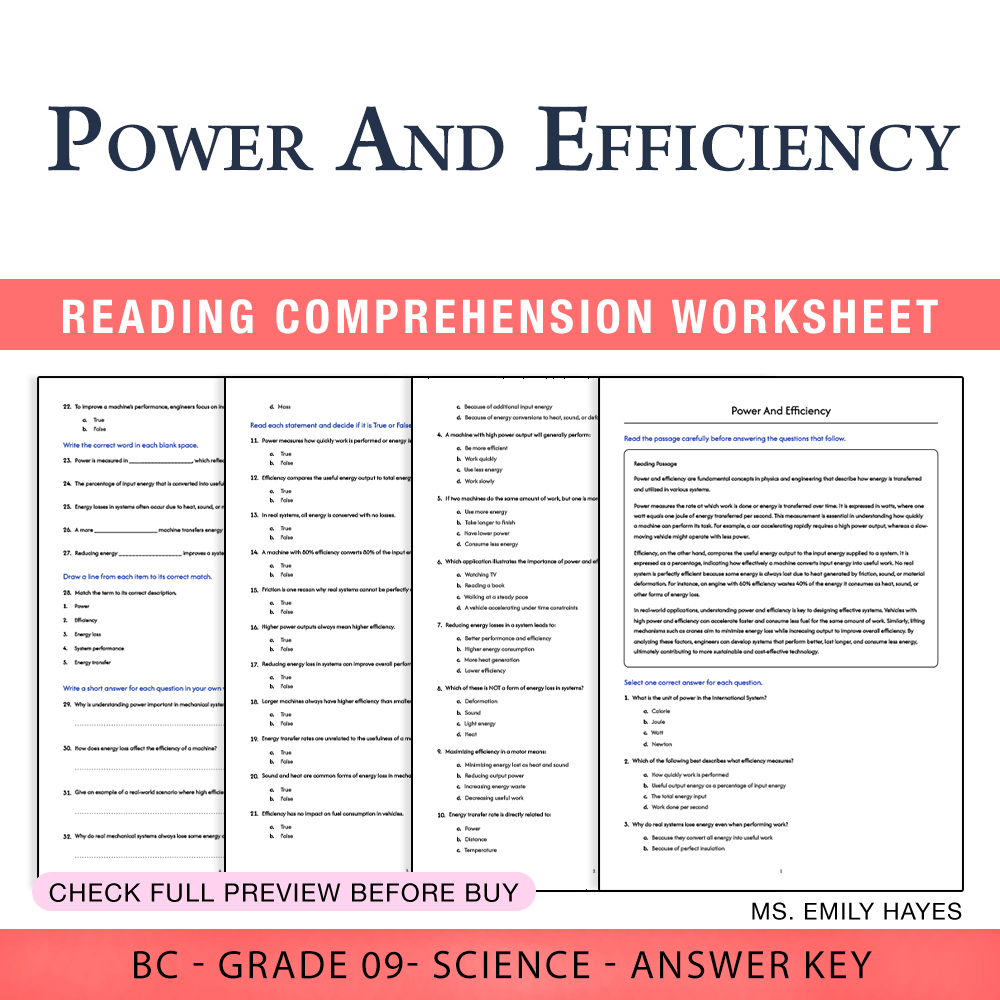
9th Grade Science | Power and Efficiency Worksheet (PDF+ Answer Key)
Created byCopper Leaf ClassroomLearning Objectives
- Understand the concepts of power and how it measures the rate of energy transfer in systems.
- Explain the meaning of efficiency and how it compares useful output energy to input energy.
- Recognize factors that cause energy loss in real systems and how they reduce efficiency.
Also included in: Grade 9 Science Worksheet Bundle | Forces, Energy & Motion (PDF + Answer Key) +1 more
Instant download
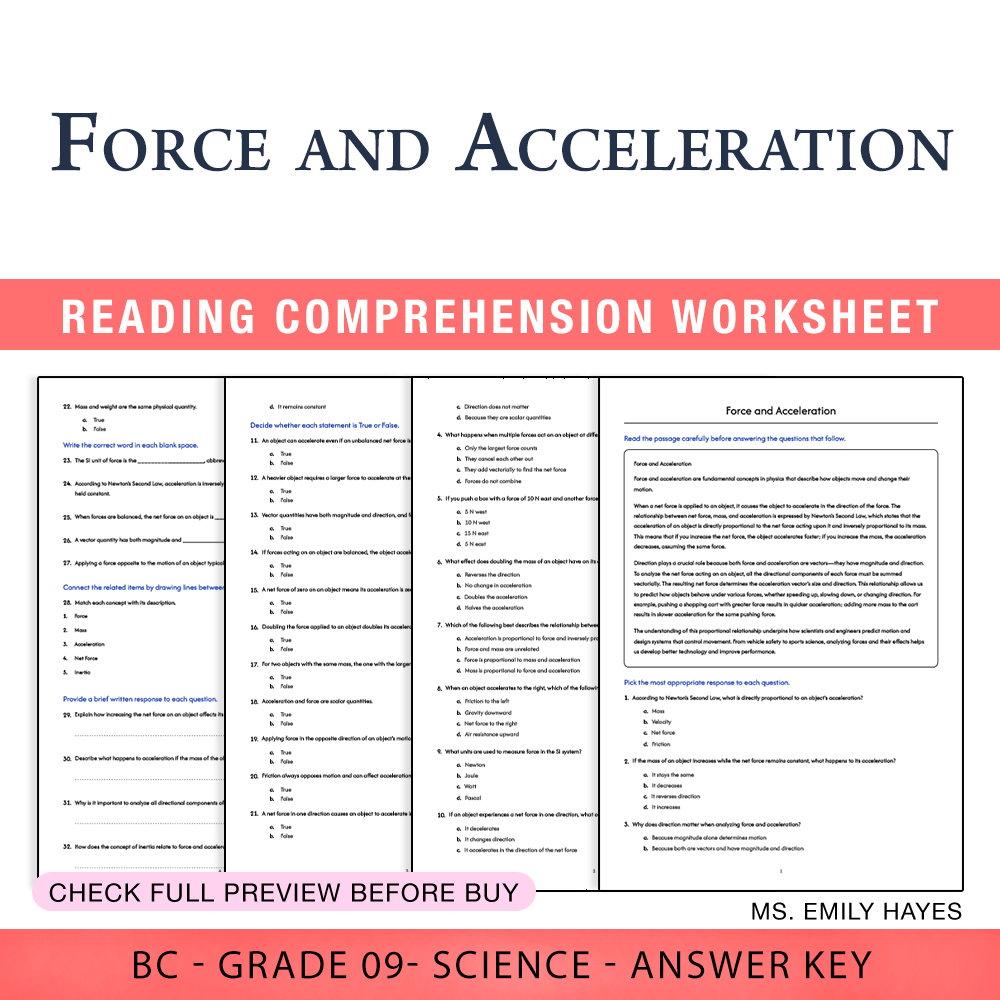
Grade 9 Science | Force and Acceleration Worksheet (PDF+ Answer Key)
Created byCopper Leaf ClassroomLearning Objectives
- Understand the relationship between net force, mass, and acceleration.
- Analyze how changes in force or mass affect acceleration.
- Apply vector concepts to force and acceleration in different directions.
Also included in: Grade 9 Science Worksheet Bundle | Forces, Energy & Motion (PDF + Answer Key) +1 more
Instant download
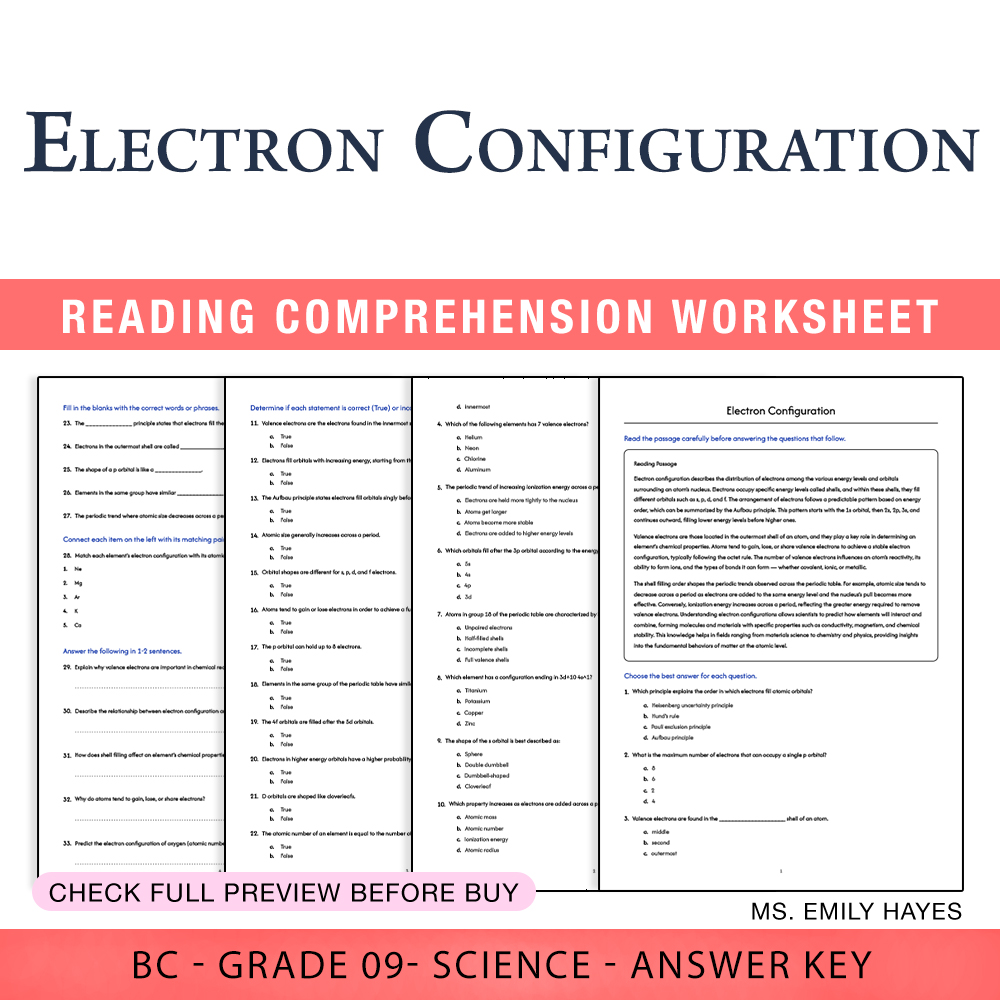
9th Grade Science | Electron Configuration Worksheet (PDF+ Answer Key)
Created byCopper Leaf ClassroomLearning Objectives
- Describe how electrons are distributed among energy levels and orbitals.
- Explain the importance of valence electrons in chemical reactivity and bonding.
- Identify the order in which electron shells are filled.
Also included in: Grade 9 Science Bundle | Chemistry, Physics & Atomic Concepts (PDF + Answer Key) +1 more
Instant download
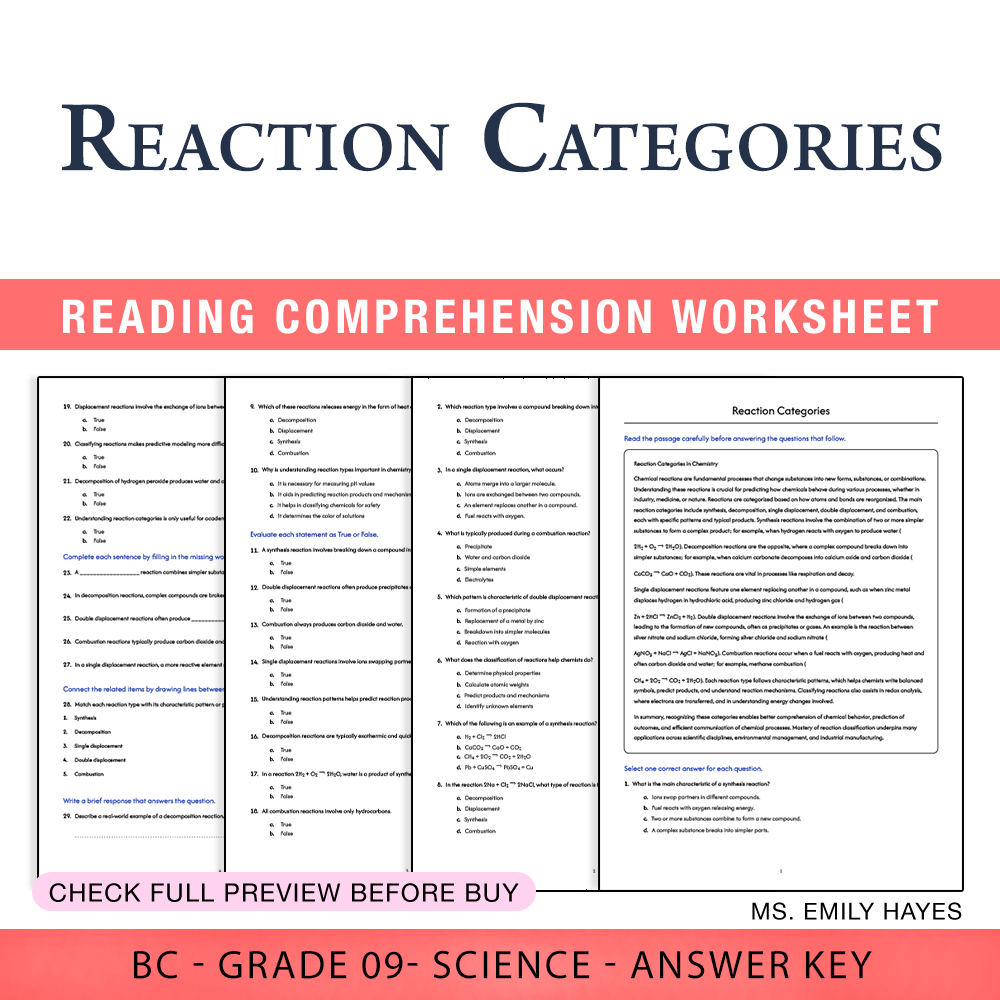
Grade 9 Science | Reaction Categories Worksheet (PDF+ Answer Key)
Created byCopper Leaf ClassroomLearning Objectives
- Identify and classify different types of chemical reactions based on reactant patterns and products.
- Understand the processes and characteristics of synthesis, decomposition, displacement, and combustion reactions.
- Predict products of various reaction types using chemical knowledge and symbolic representation.
Also included in: Grade 9 Science Bundle | Chemistry, Physics & Atomic Concepts (PDF + Answer Key) +1 more
Instant download
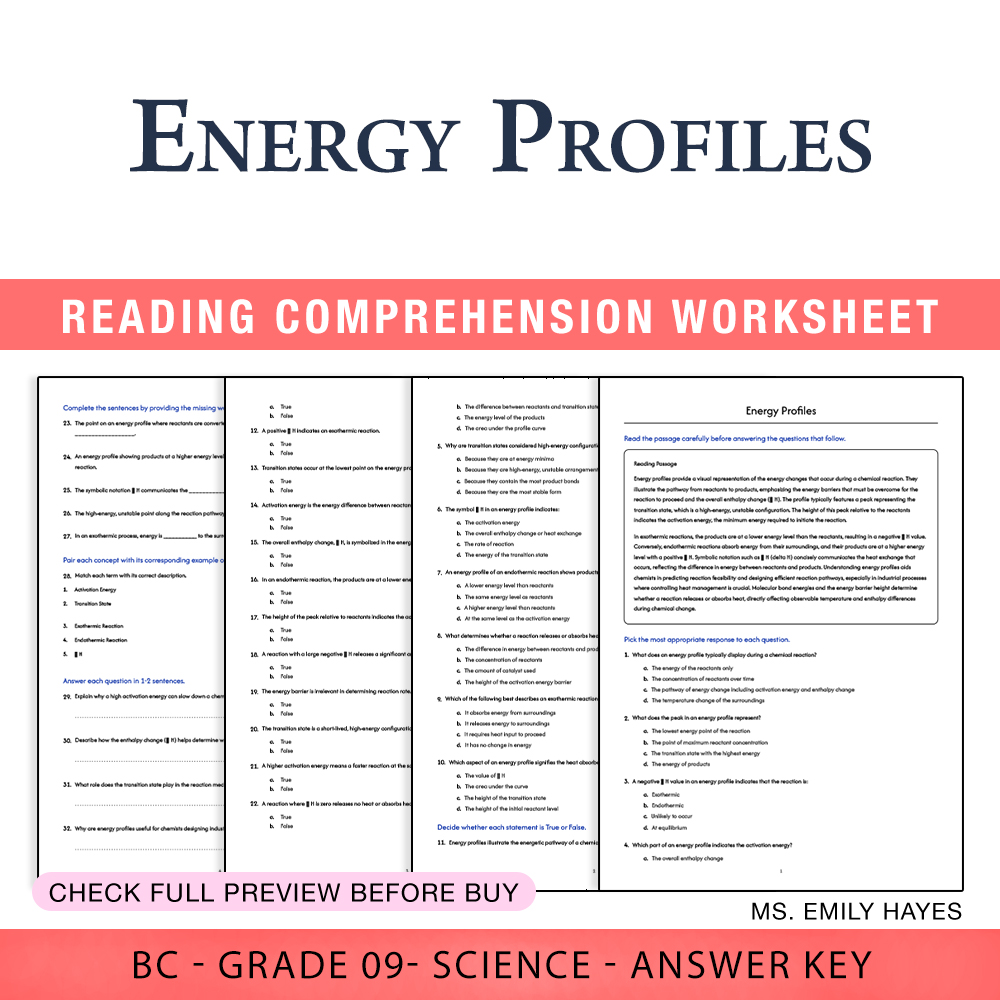
Grade 9 Science | Energy Profiles Worksheet (PDF+ Answer Key)
Created byCopper Leaf ClassroomLearning Objectives
- Describe the concept of energy profiles and their purpose in analyzing chemical reactions.
- Distinguish between exothermic and endothermic reactions based on enthalpy changes.
- Identify the significance of activation energy and transition states in reaction pathways.
Also included in: Grade 9 Science Bundle | Chemistry, Physics & Atomic Concepts (PDF + Answer Key) +1 more
Instant download
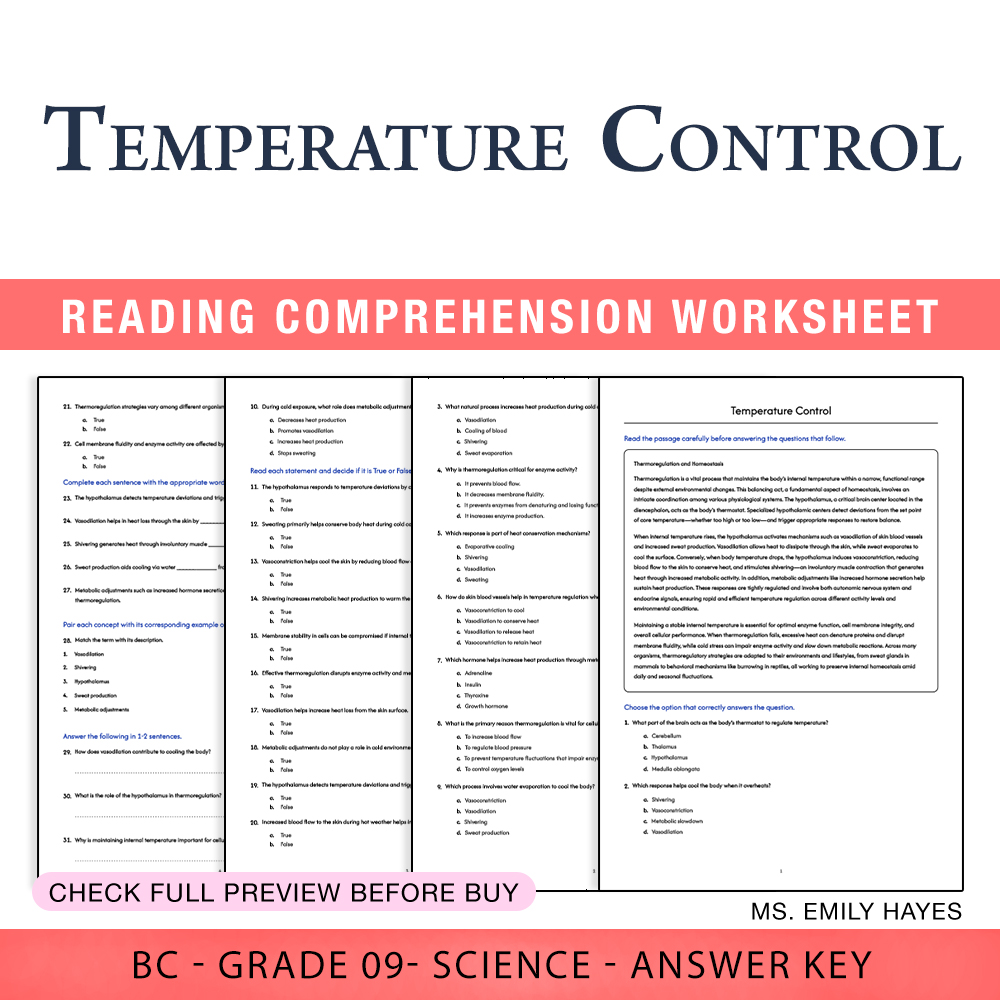
Grade 9 Science | Temperature Control Worksheet (PDF+ Answer Key)
Created byCopper Leaf ClassroomLearning Objectives
- Explain how hypothalamic centers regulate internal body temperature.
- Describe the physiological responses involved in thermoregulation.
- Identify the roles of skin blood flow, sweat production, shivering, and metabolic adjustments.
Also included in: Grade 9 Science Worksheet Pack | Biology & Cell Structures (PDF+ Answer Keys) +1 more
Instant download
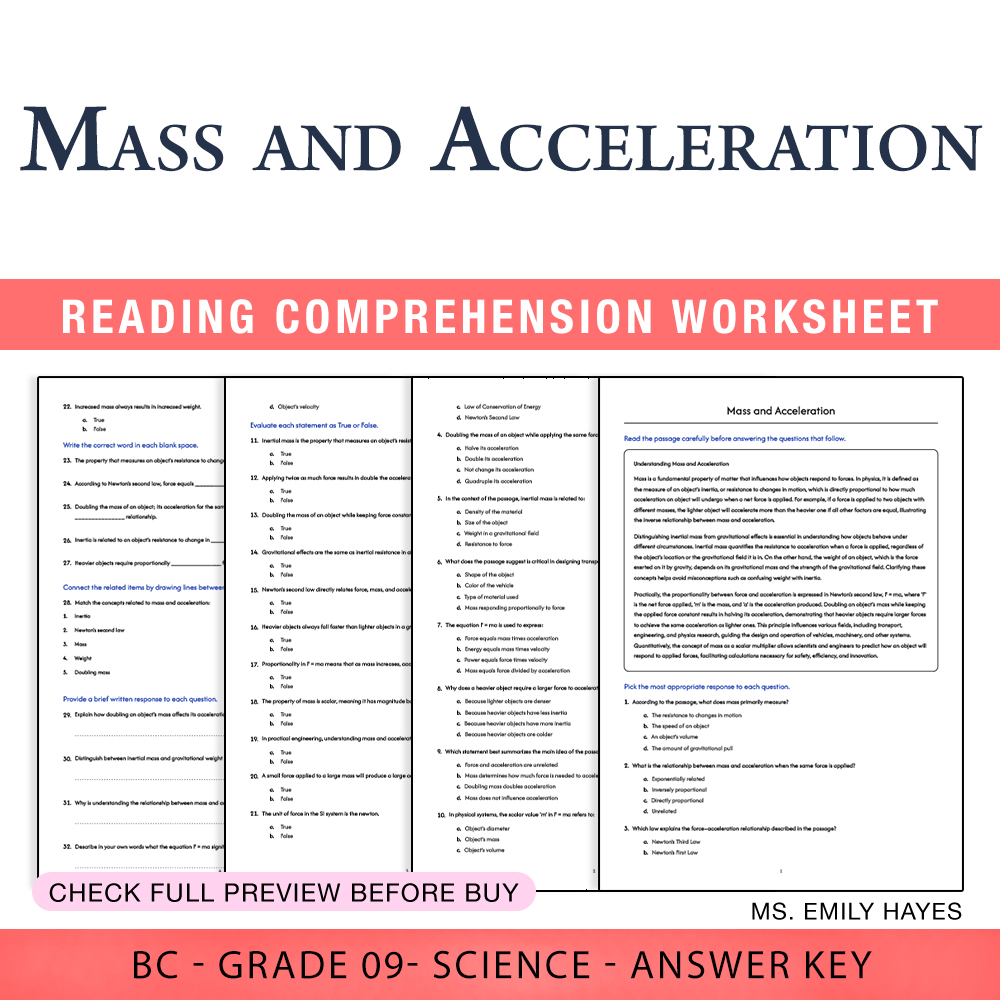
9th Grade Science | Mass and Acceleration Worksheet (PDF + Answer Key)
Created byCopper Leaf ClassroomLearning Objectives
- Explain how mass influences acceleration under a given net force.
- Distinguish between inertial mass and gravitational effects in response to forces.
- Apply the force–acceleration relationship in practical problems involving mass.
Also included in: Grade 9 Science Worksheet Bundle | Forces, Energy & Motion (PDF + Answer Key) +1 more
Instant download
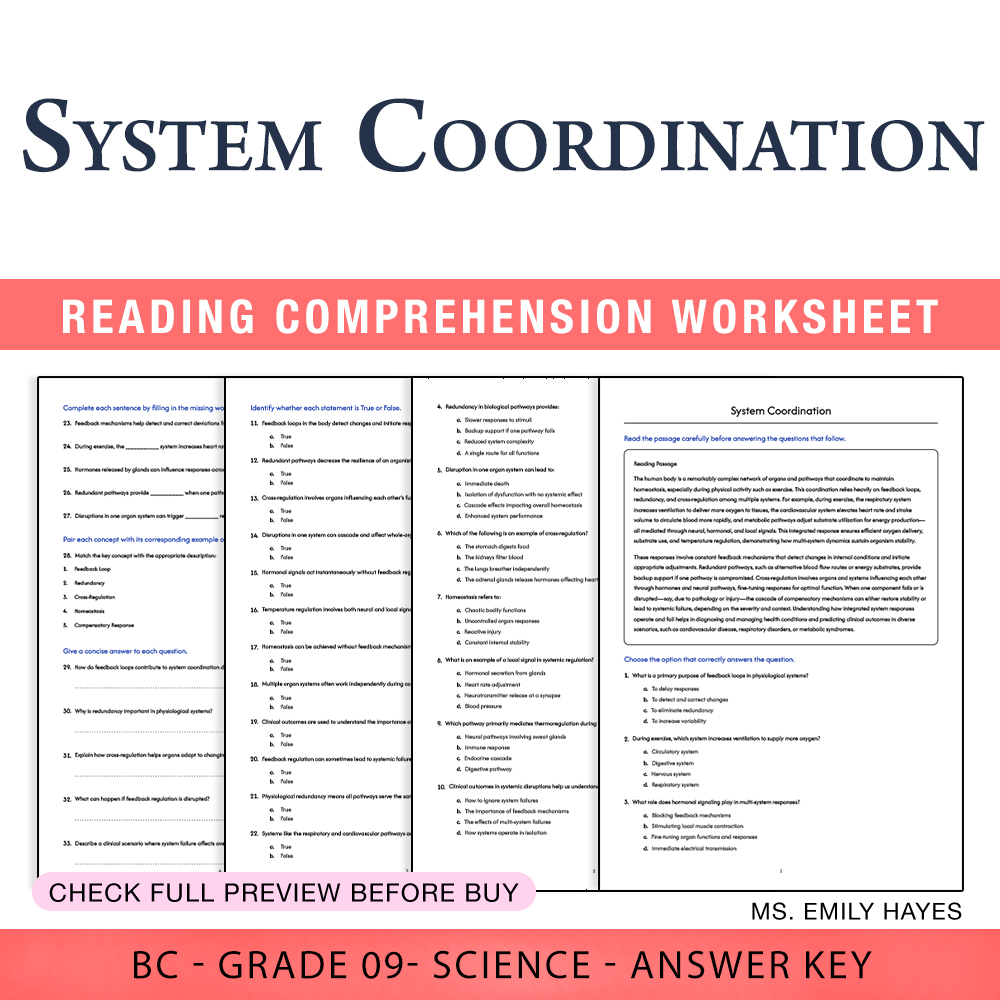
Grade 9 Science | System Coordination Worksheet (PDF+ Answer Key)
Created byCopper Leaf ClassroomLearning Objectives
- Explain how feedback loops, redundancy, and cross-regulation coordinate multiple organ systems.
- Describe how responses to exercise involve respiratory, cardiovascular, and metabolic pathways.
- Identify the mechanisms by which disruptions in one system affect overall homeostasis.
Also included in: Grade 9 Science Worksheet Pack | Biology & Cell Structures (PDF+ Answer Keys) +1 more
Instant download
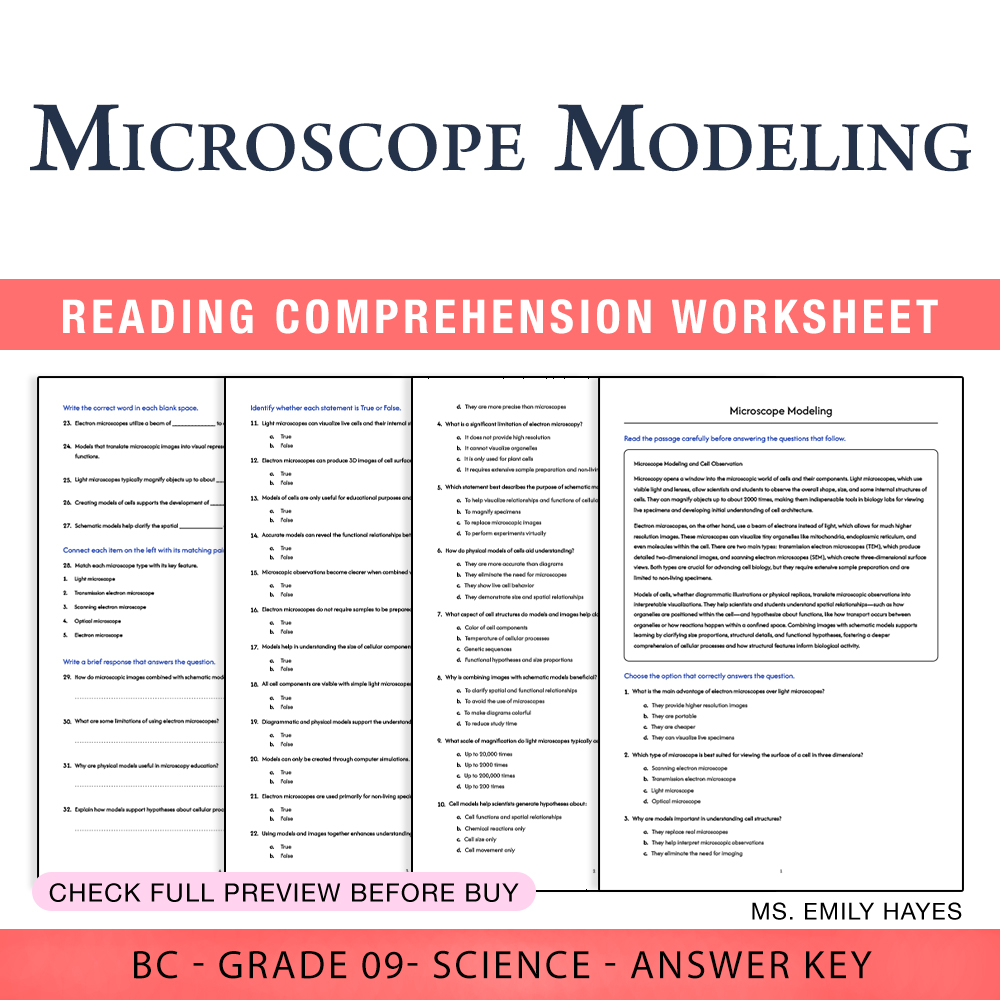
Grade 9 Science | Microscope Modeling Worksheet (PDF+ Answer Key)
Created byCopper Leaf ClassroomLearning Objectives
- Understand how microscopes reveal details of cell structures.
- Learn the differences between various types of microscopy.
- Interpret diagrammatic and physical models of cells.
Also included in: Grade 9 Science Worksheet Pack | Biology & Cell Structures (PDF+ Answer Keys) +1 more
Instant download
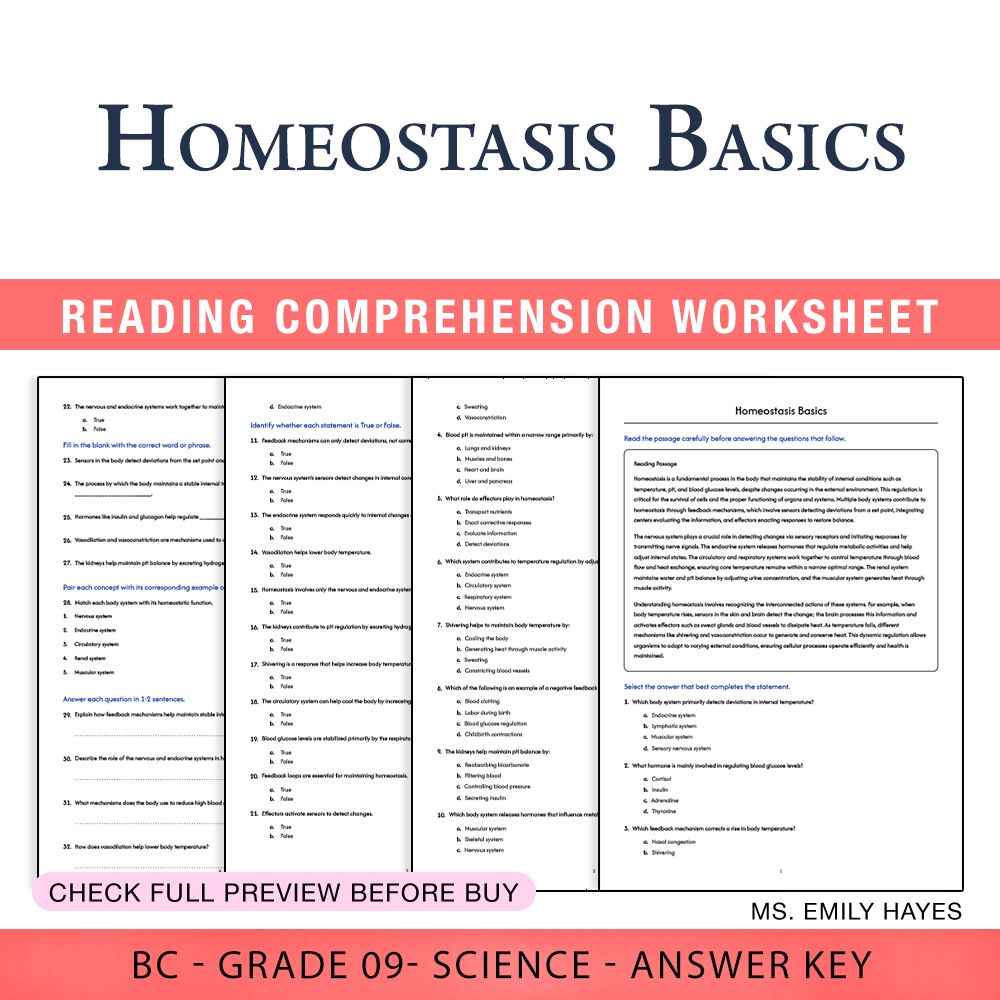
9th Grade Science | Homeostasis Basics Worksheet (PDF+ Answer Key)
Created byCopper Leaf ClassroomLearning Objectives
- Explain the concept of homeostasis and its importance in maintaining internal body conditions.
- Identify and describe the key body systems involved in homeostasis.
- Understand feedback mechanisms that regulate temperature, pH, and blood glucose levels.
Also included in: Grade 9 Science Worksheet Pack | Biology & Cell Structures (PDF+ Answer Keys) +1 more
Instant download
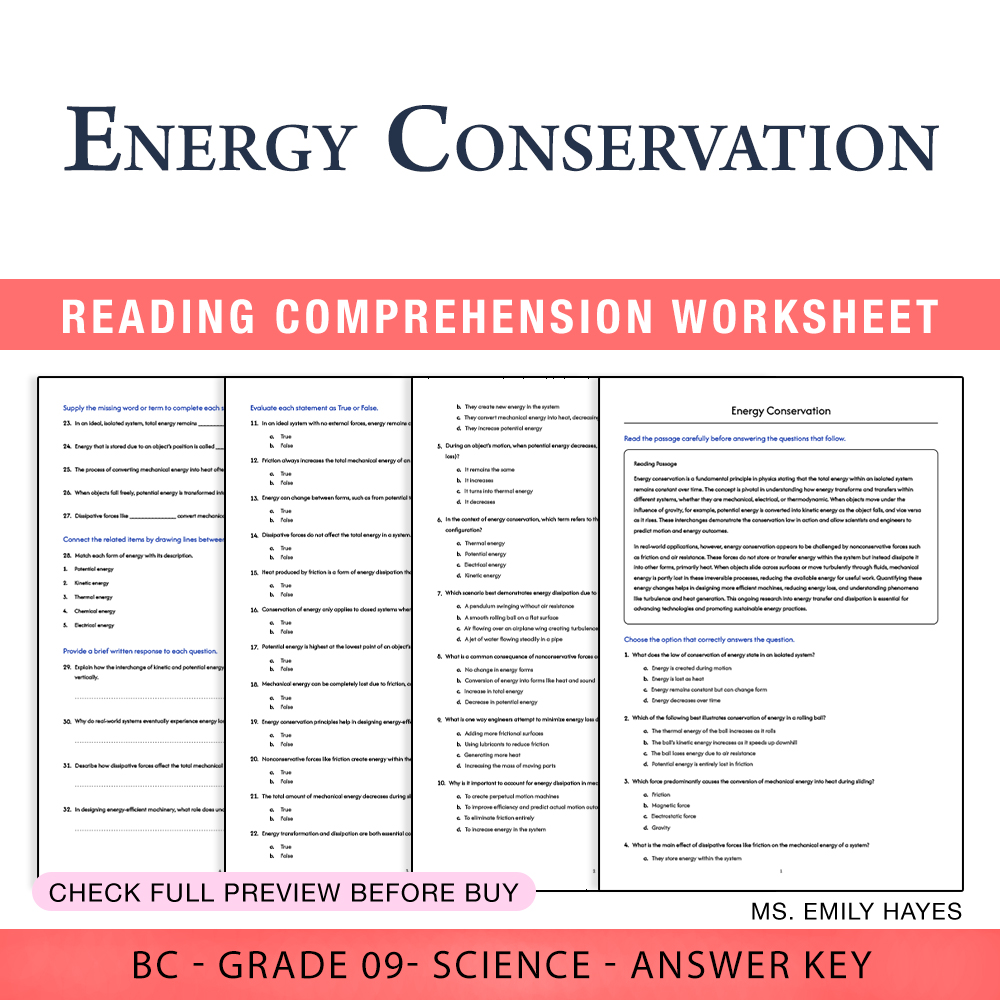
Grade 9 Science | Energy Conservation Worksheet (PDF+ Answer Key)
Created byCopper Leaf ClassroomLearning Objectives
- Understand the principle of energy conservation in isolated systems.
- Identify different forms of energy involved in mechanical and non-mechanical processes.
- Explain how energy shifts between kinetic and potential forms during motion.
Also included in: Grade 9 Science Worksheet Bundle | Forces, Energy & Motion (PDF + Answer Key) +1 more
Instant download
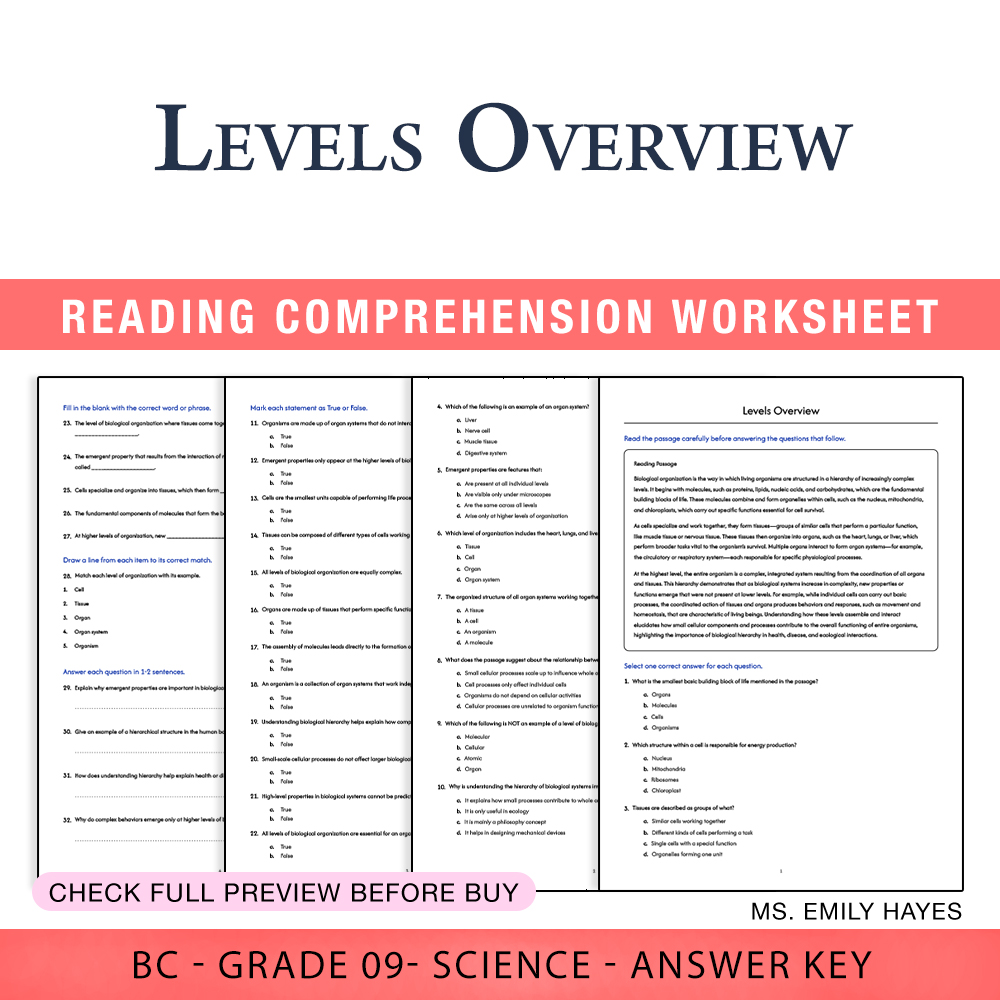
9th Grade Science | Levels of Biological Organization Worksheet(PDF+ Answer Key)
Created byCopper Leaf ClassroomLearning Objectives
- Describe the hierarchical levels of biological organization from molecules to organisms.
- Explain the concept of emergent properties at each level of biological organization.
- Understand how components assemble into complex biological systems to maintain function.
Also included in: Grade 9 Science Worksheet Pack | Biology & Cell Structures (PDF+ Answer Keys) +1 more
Instant download
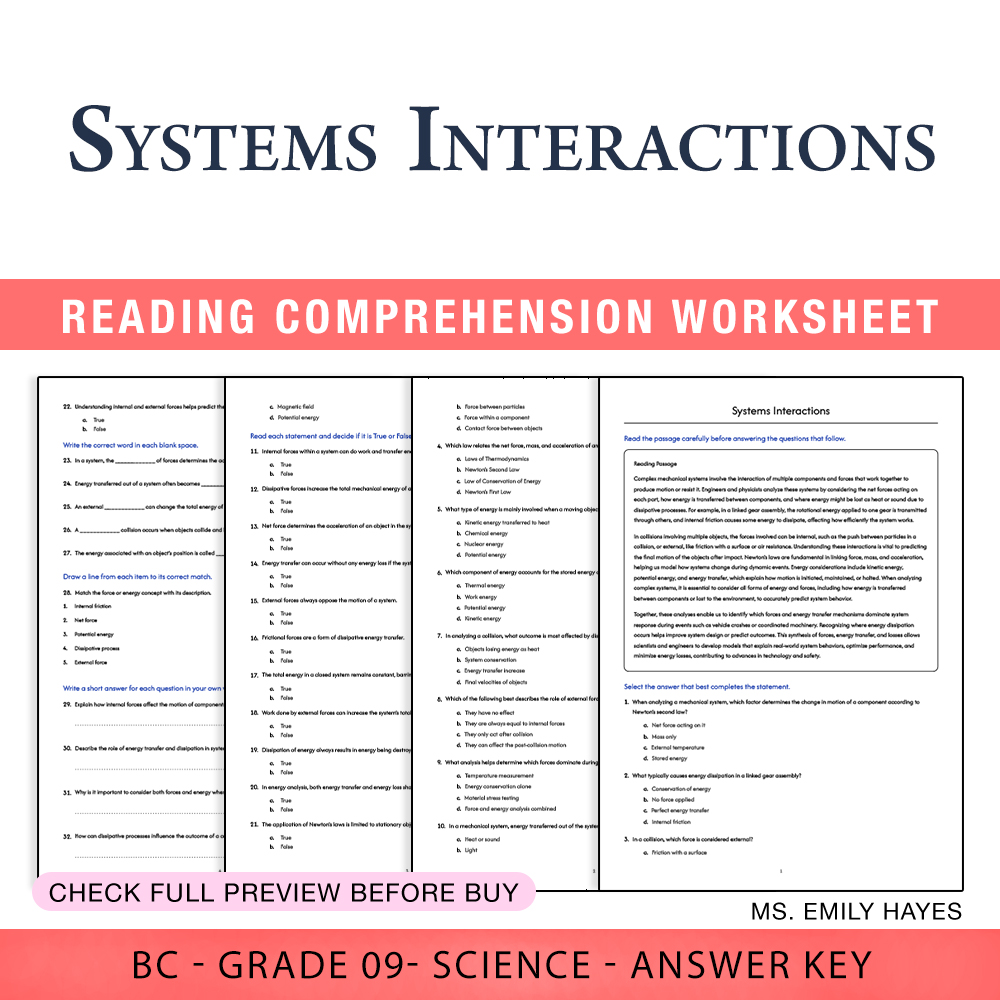
Grade 9 Science | Systems Interactions Worksheet (PDF+ Answer Key)
Created byCopper Leaf ClassroomLearning Objectives
- Understand how multiple bodies and forces interact within complex mechanical systems.
- Apply Newton’s laws, net force analysis, and energy accounting to predict system motion.
- Analyze internal and external forces, energy transfer, and energy loss in systems during events like collisions.
Also included in: Grade 9 Science Worksheet Bundle | Forces, Energy & Motion (PDF + Answer Key) +1 more
Instant download
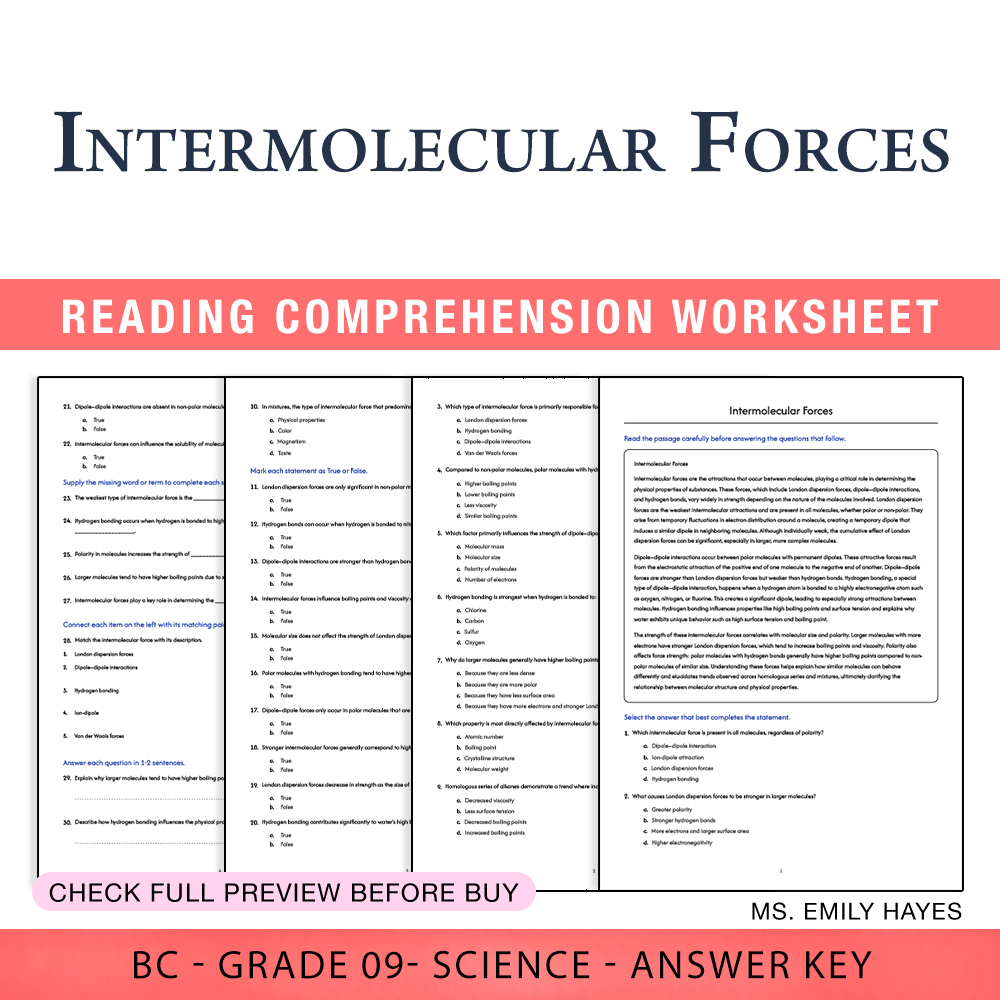
9th Grade Science | Intermolecular Forces Worksheet (PDF+ Answer Key)
Created byCopper Leaf ClassroomLearning Objectives
- Explain the types of intermolecular forces and how they affect physical properties of molecules.
- Compare London dispersion, dipole–dipole, and hydrogen bonding in terms of strength and molecular influence.
- Relate molecular structure and polarity to the strength of intermolecular forces and properties like boiling point and viscosity.
Also included in: Grade 9 Science Bundle | Chemistry, Physics & Atomic Concepts (PDF + Answer Key) +1 more
Instant download
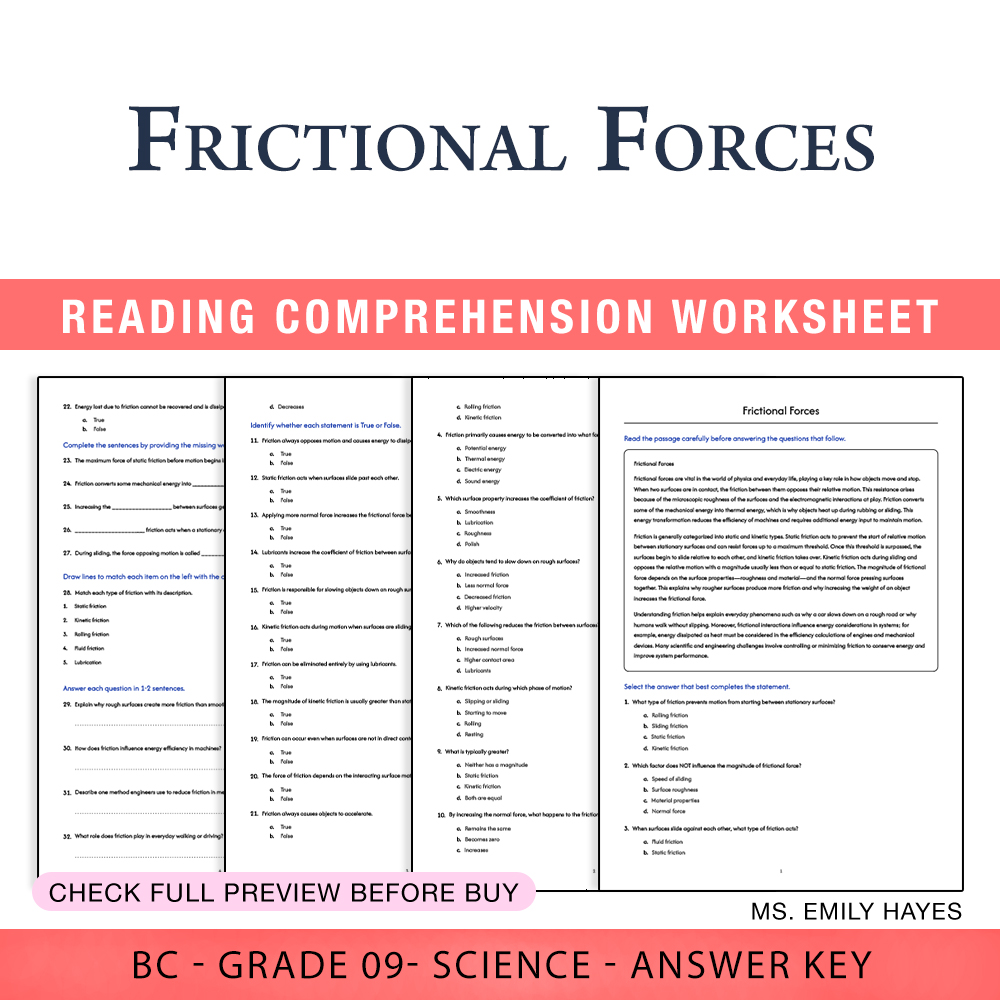
Grade 9 Science | Frictional Forces Worksheet (PDF+ Answer Key)
Created byCopper Leaf ClassroomLearning Objectives
- Explain how friction opposes motion between surfaces and converts kinetic energy to heat.
- Differentiate between static and kinetic friction and understand their roles.
- Describe factors affecting the magnitude of frictional forces.
Also included in: Grade 9 Science Worksheet Bundle | Forces, Energy & Motion (PDF + Answer Key) +1 more
Instant download
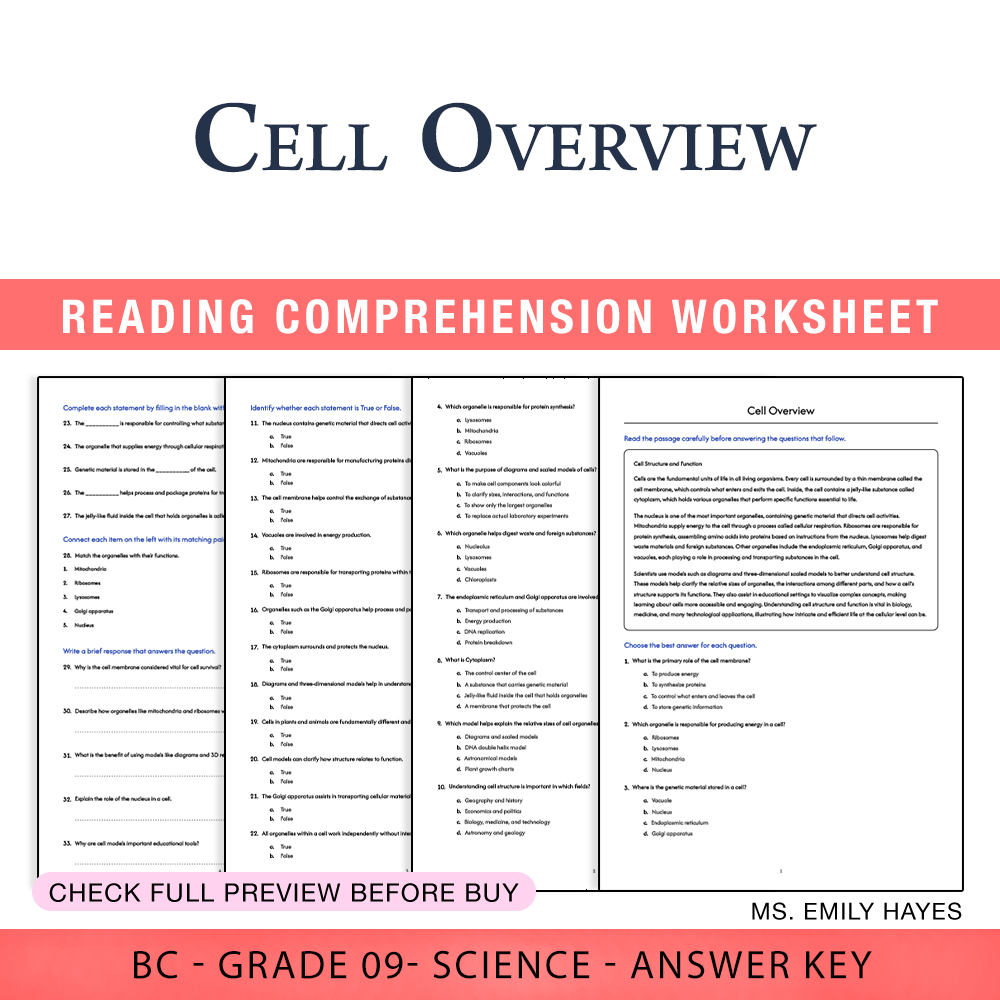
Grade 9 Science | Cell Overview Worksheet (PDF+ Answer Key)
Created byCopper Leaf ClassroomLearning Objectives
- Identify the main structures and functions of a cell and its organelles.
- Describe how cellular structures relate to their functions.
- Understand different models used to illustrate cell components and their relative sizes.
Also included in: Grade 9 Science Worksheet Pack | Biology & Cell Structures (PDF+ Answer Keys) +1 more
Instant download
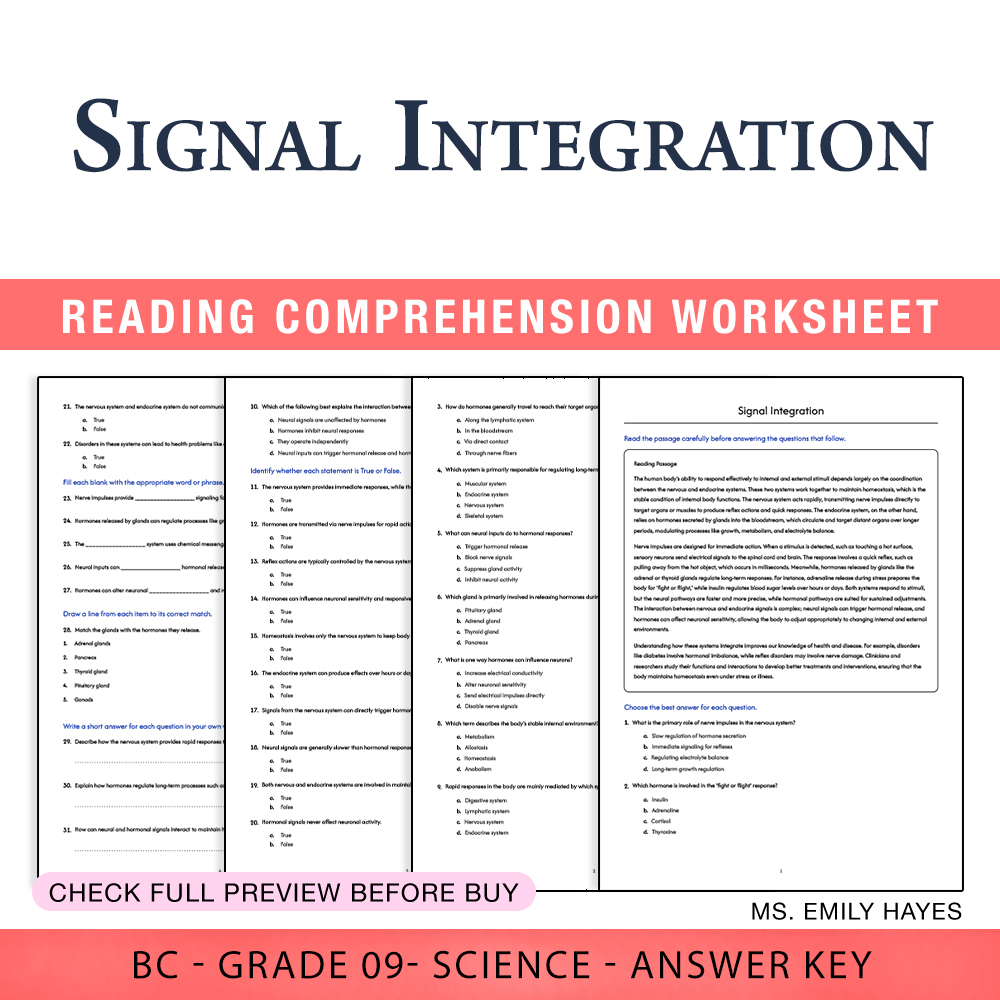
Grade 9 Science | Signal Integration Worksheet (PDF+ Answer Key)
Created byCopper Leaf ClassroomLearning Objectives
- Understand how the nervous and endocrine systems coordinate responses to stimuli.
- Identify different signals and their roles in maintaining homeostasis.
- Compare rapid nerve responses with slower hormonal responses.
Also included in: Grade 9 Science Worksheet Pack | Biology & Cell Structures (PDF+ Answer Keys) +1 more
Instant download
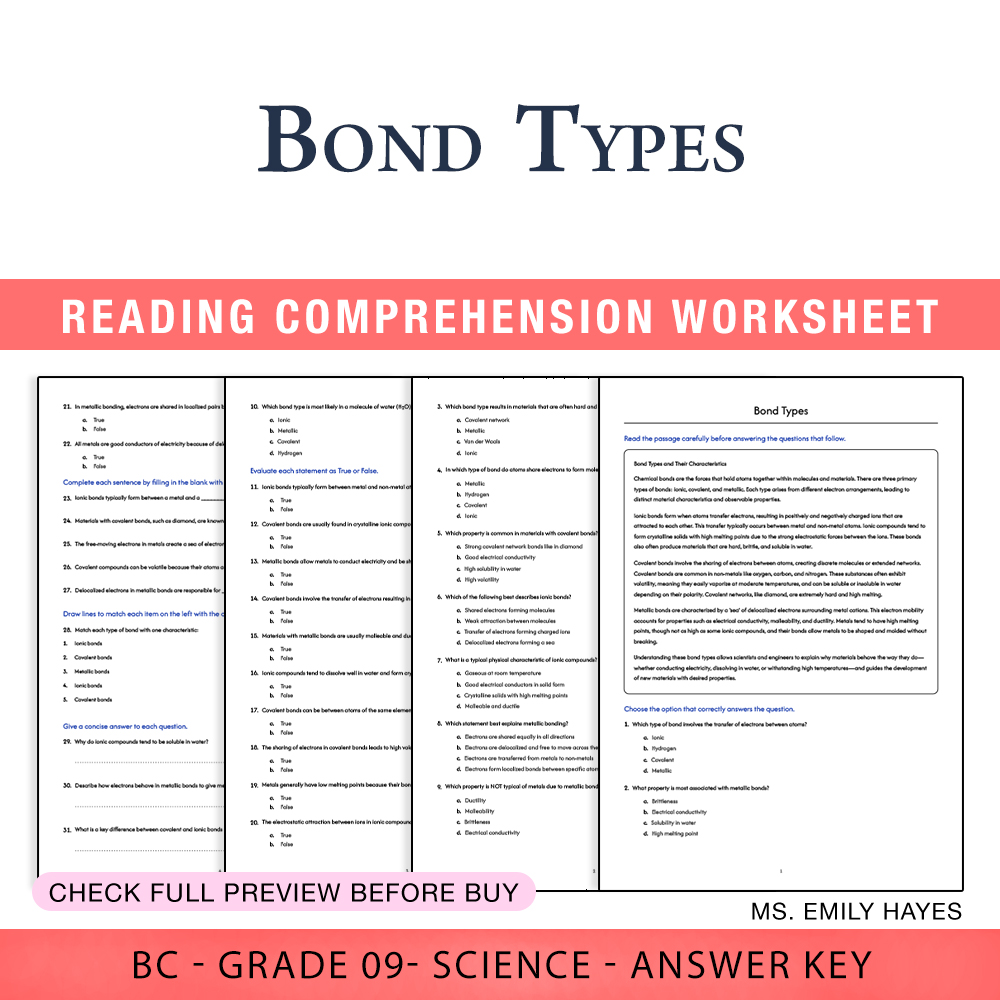
9th Grade Science | Bond Types Worksheet (PDF+ Answer Key)
Created byCopper Leaf ClassroomLearning Objectives
- Identify different types of chemical bonds: ionic, covalent, and metallic.
- Explain how electron arrangements influence bond formation and material properties.
- Distinguish between ionic, covalent, and metallic bonds based on their characteristics.
Also included in: Grade 9 Science Bundle | Chemistry, Physics & Atomic Concepts (PDF + Answer Key) +1 more
Instant download
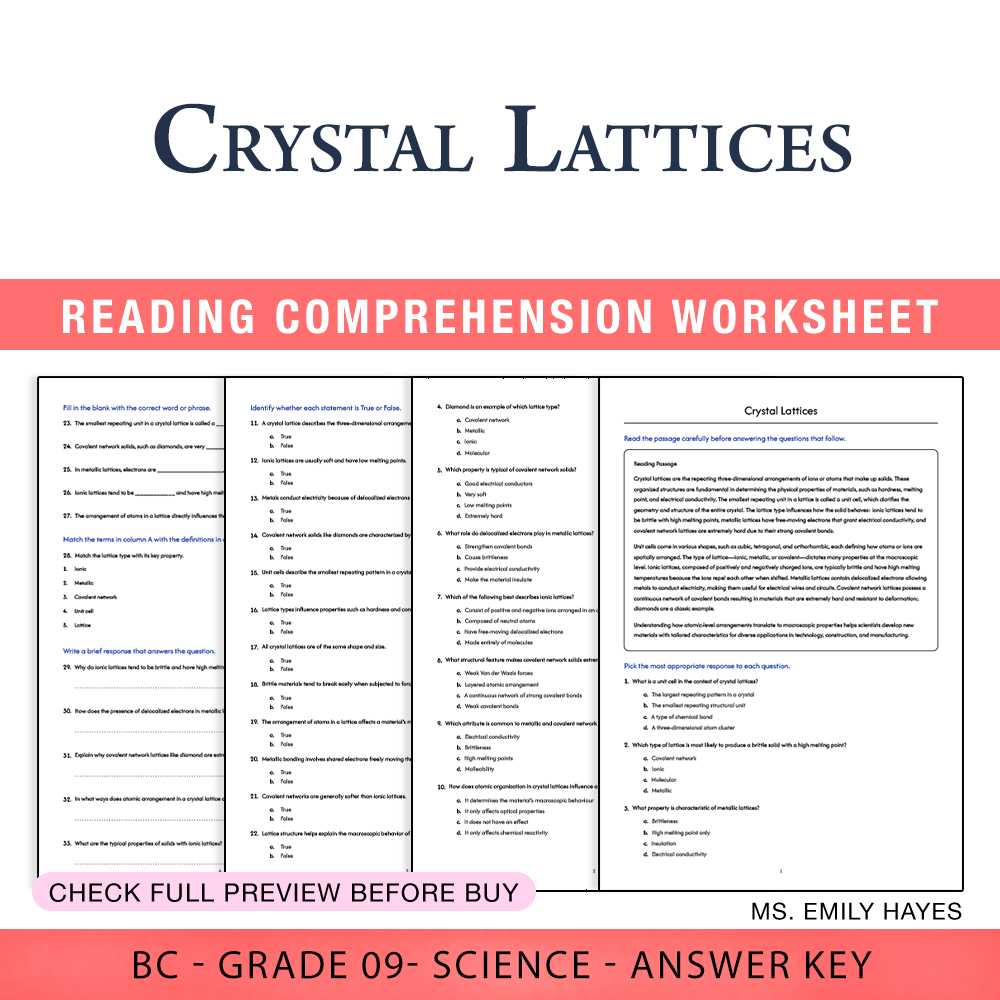
9th Grade Science | Crystal Lattices Worksheet (PDF+ Answer Key)
Created byCopper Leaf ClassroomLearning Objectives
- Understand the structure and function of different types of crystal lattices.
- Identify the characteristics and properties associated with ionic, metallic, and covalent network lattices.
- Explain how atomic arrangements influence the macroscopic properties of solids.
Also included in: Grade 9 Science Bundle | Chemistry, Physics & Atomic Concepts (PDF + Answer Key) +1 more
Instant download
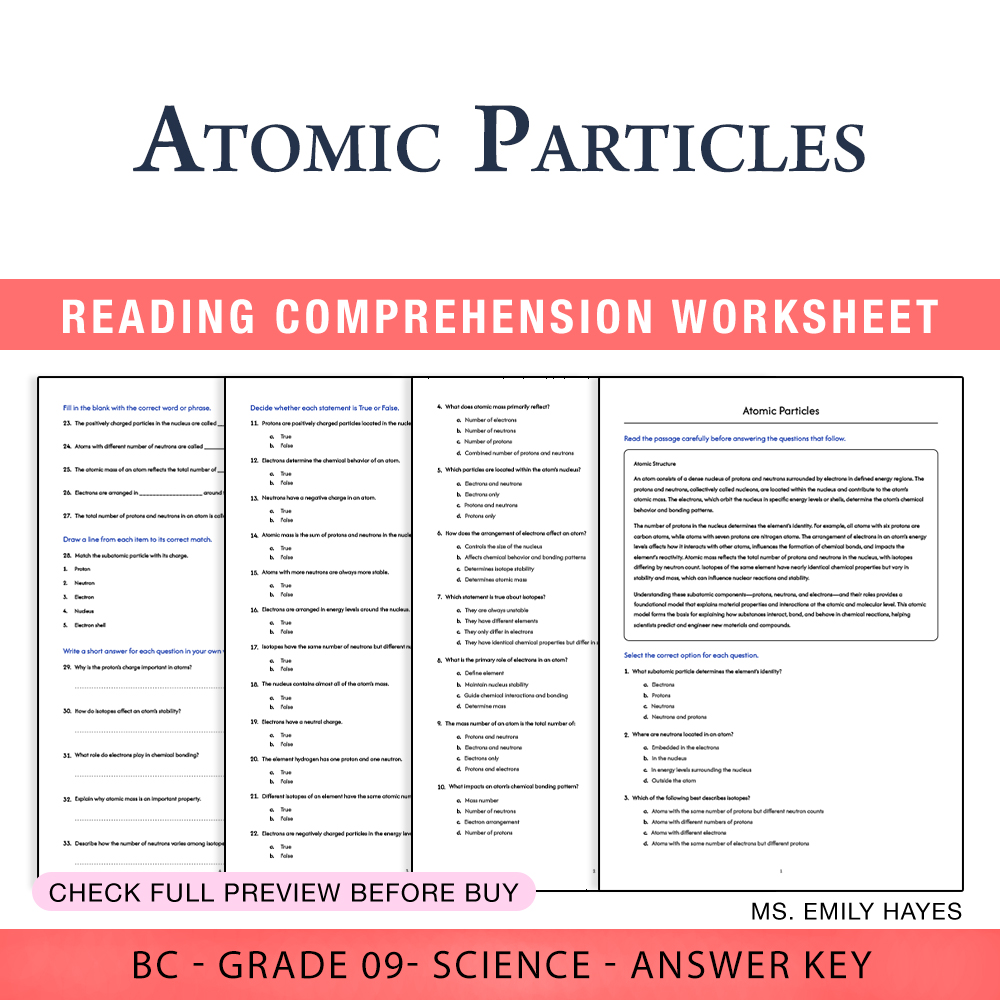
9th Grade Science | Atomic Particles Worksheet (PDF+ Answer Key)
Created byCopper Leaf ClassroomLearning Objectives
- Describe the structure of an atom, including protons, neutrons, and electrons.
- Explain how the number of protons determines the element identity.
- Understand the concept of isotopes and their effect on atomic mass and stability.
Also included in: Grade 9 Science Bundle | Chemistry, Physics & Atomic Concepts (PDF + Answer Key) +1 more
Instant download
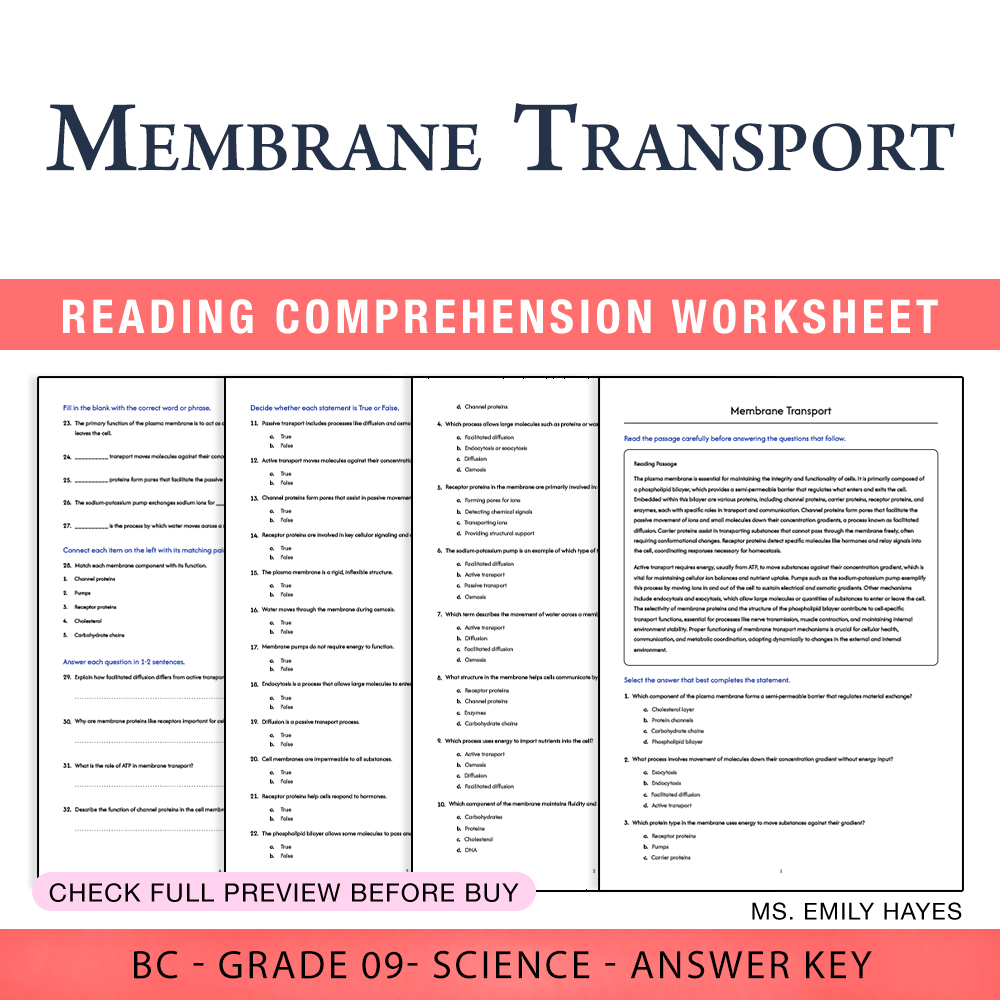
9th Grade Science | Membrane Transport Worksheet (PDF+ Answer Key)
Created byCopper Leaf ClassroomLearning Objectives
- Describe the structure of the plasma membrane and its components involved in transport.
- Differentiate between passive and active transport mechanisms.
- Explain how membrane proteins like channels, pumps, and receptors facilitate cellular functions.
Also included in: Grade 9 Science Worksheet Pack | Biology & Cell Structures (PDF+ Answer Keys) +1 more
Instant download
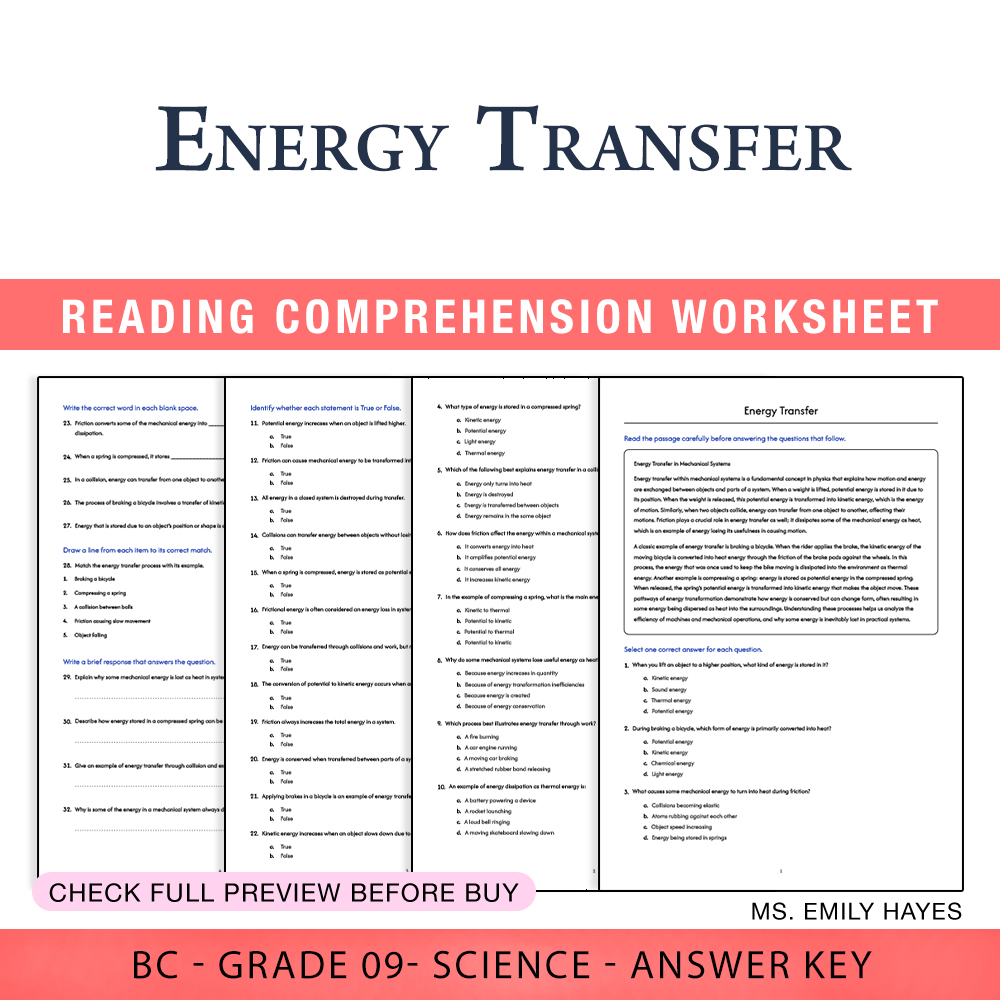
9th Grade Science | Energy Transfer Worksheet (PDF+ Answer Key)
Created byCopper Leaf ClassroomLearning Objectives
- Understand how mechanical systems transfer energy through work, collisions, and friction.
- Explain the transformation of energy from kinetic and potential forms to thermal energy.
- Analyze real-world examples like braking a bicycle or compressing a spring to describe energy conversion pathways.
Also included in: Grade 9 Science Worksheet Bundle | Forces, Energy & Motion (PDF + Answer Key) +1 more
Instant download
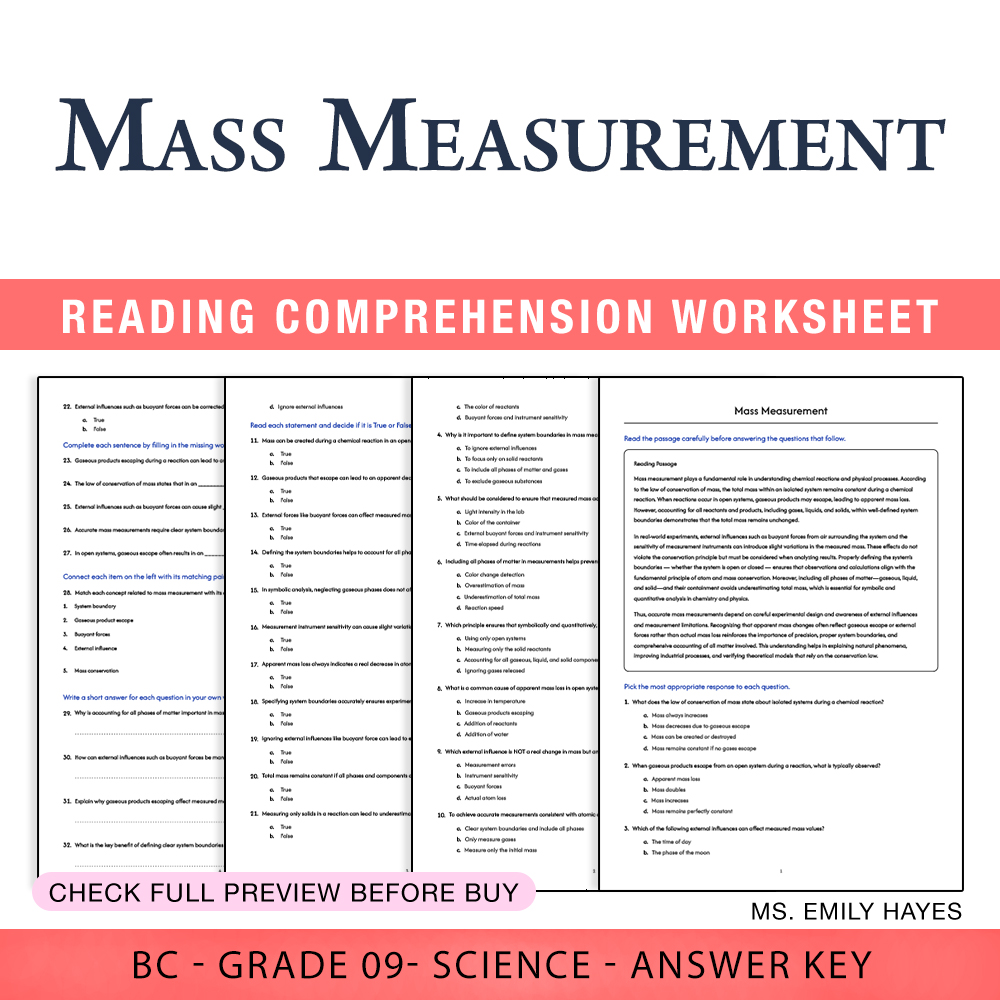
9th Grade Science | Mass Measurement Worksheet (PDF+ Answer Key)
Created byCopper Leaf ClassroomLearning Objectives
- Understand the principle of conservation of mass in chemical reactions.
- Identify factors affecting measured mass during experiments.
- Explain the importance of system boundaries in mass measurements.
Also included in: Grade 9 Science Bundle | Chemistry, Physics & Atomic Concepts (PDF + Answer Key) +1 more
Instant download
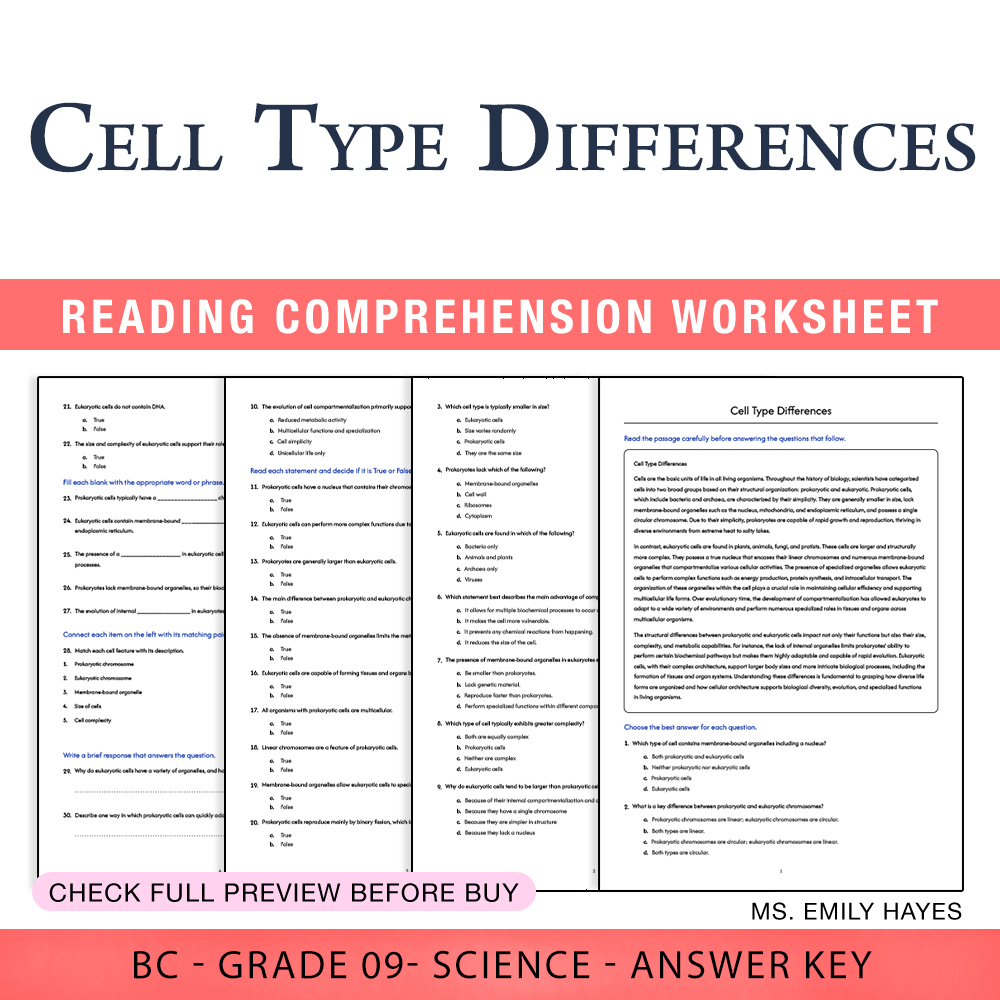
Grade 9 Science | Cell Type Differences Worksheet (PDF+ Answer Key)
Created byCopper Leaf ClassroomLearning Objectives
- Compare the structural differences between prokaryotic and eukaryotic cells.
- Identify key features of prokaryotic cells and how they differ from eukaryotic cells.
- Describe the roles of membrane-bound organelles in eukaryotic cells.
Also included in: Grade 9 Science Worksheet Pack | Biology & Cell Structures (PDF+ Answer Keys) +1 more
Instant download
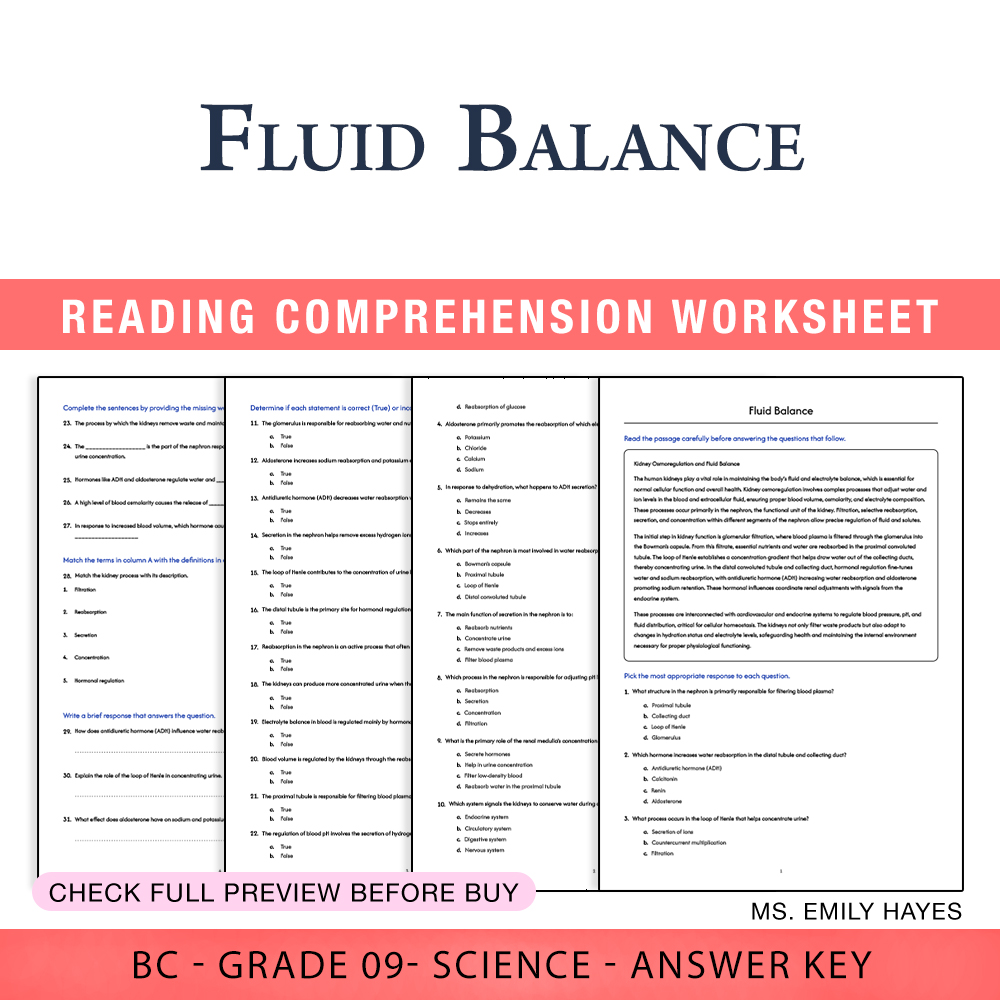
9th Grade Science | Fluid Balance Worksheet (PDF+ Answer Key)
Created byCopper Leaf ClassroomLearning Objectives
- Describe the role of kidneys in regulating water and ion balance through osmoregulation.
- Identify processes such as filtration, reabsorption, secretion, and concentration in the nephron segments.
- Explain how hormones like antidiuretic hormone and aldosterone influence kidney function.
Also included in: Grade 9 Science Worksheet Pack | Biology & Cell Structures (PDF+ Answer Keys) +1 more
Instant download
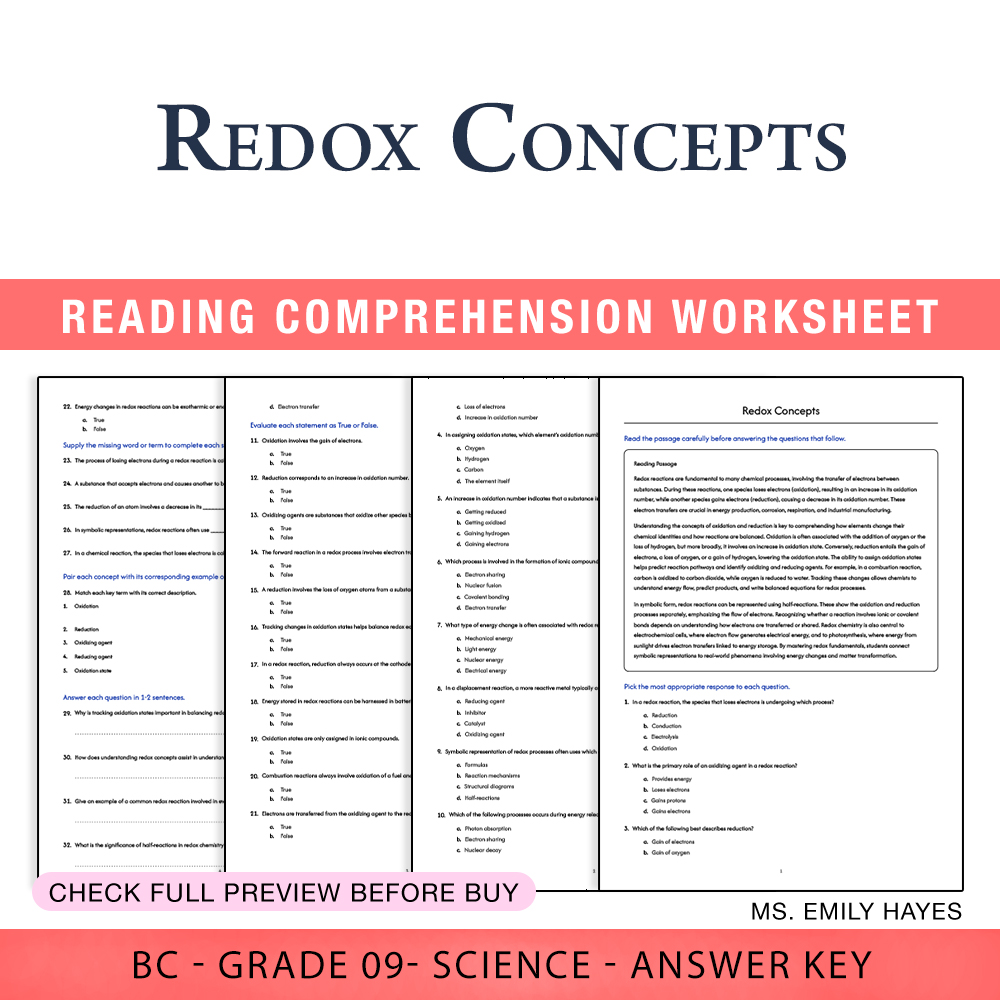
Grade 9 Science | Redox Concepts Worksheet (PDF+ Answer Key)
Created byCopper Leaf ClassroomLearning Objectives
- Explain the basic principles of oxidation and reduction in redox reactions.
- Identify oxidation states of elements in chemical equations.
- Track electron transfer to determine oxidizing and reducing agents.
Also included in: Grade 9 Science Bundle | Chemistry, Physics & Atomic Concepts (PDF + Answer Key) +1 more
Instant download
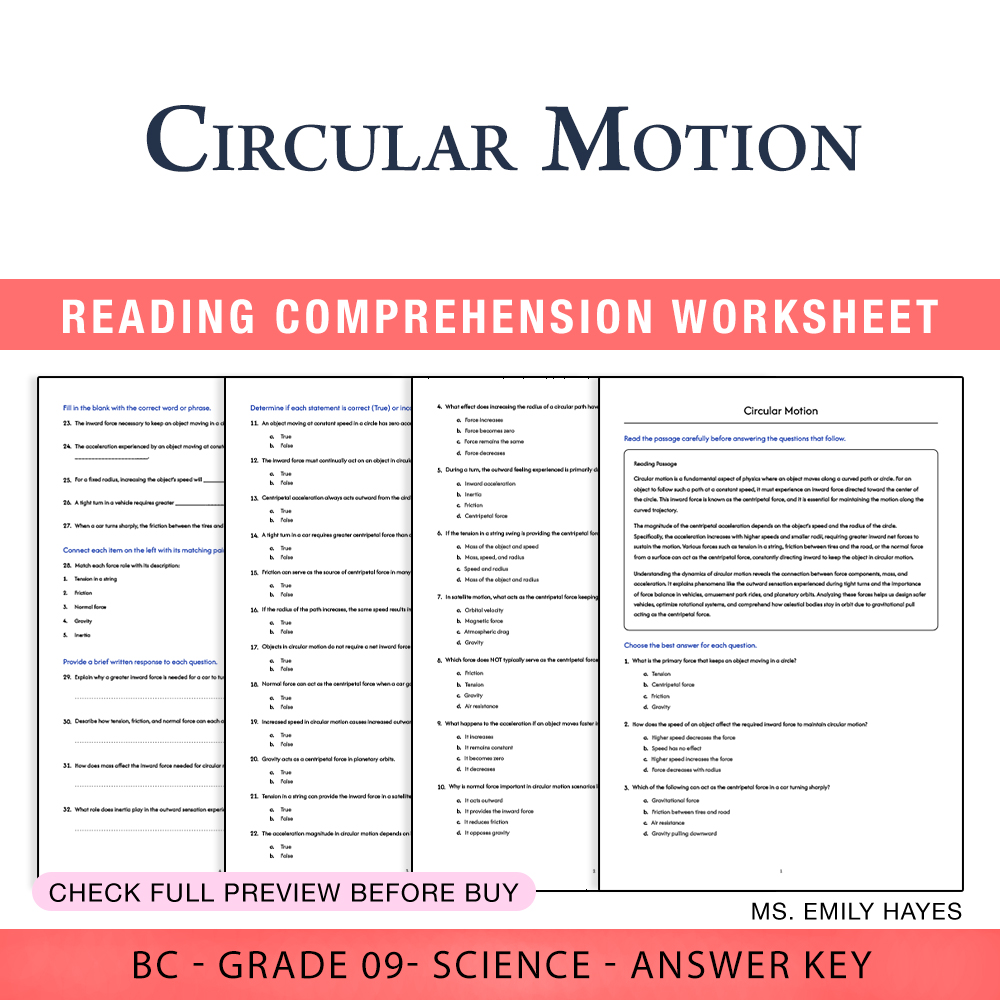
Grade 9 Science | Circular Motion Worksheet (PDF+ Answer Key)
Created byCopper Leaf ClassroomLearning Objectives
- Understand the role of centripetal force in circular motion.
- Identify the effects of inward acceleration on moving objects.
- Connect force components, mass, and acceleration in analyzing circular motion.
Also included in: Grade 9 Science Worksheet Bundle | Forces, Energy & Motion (PDF + Answer Key) +1 more
Instant download
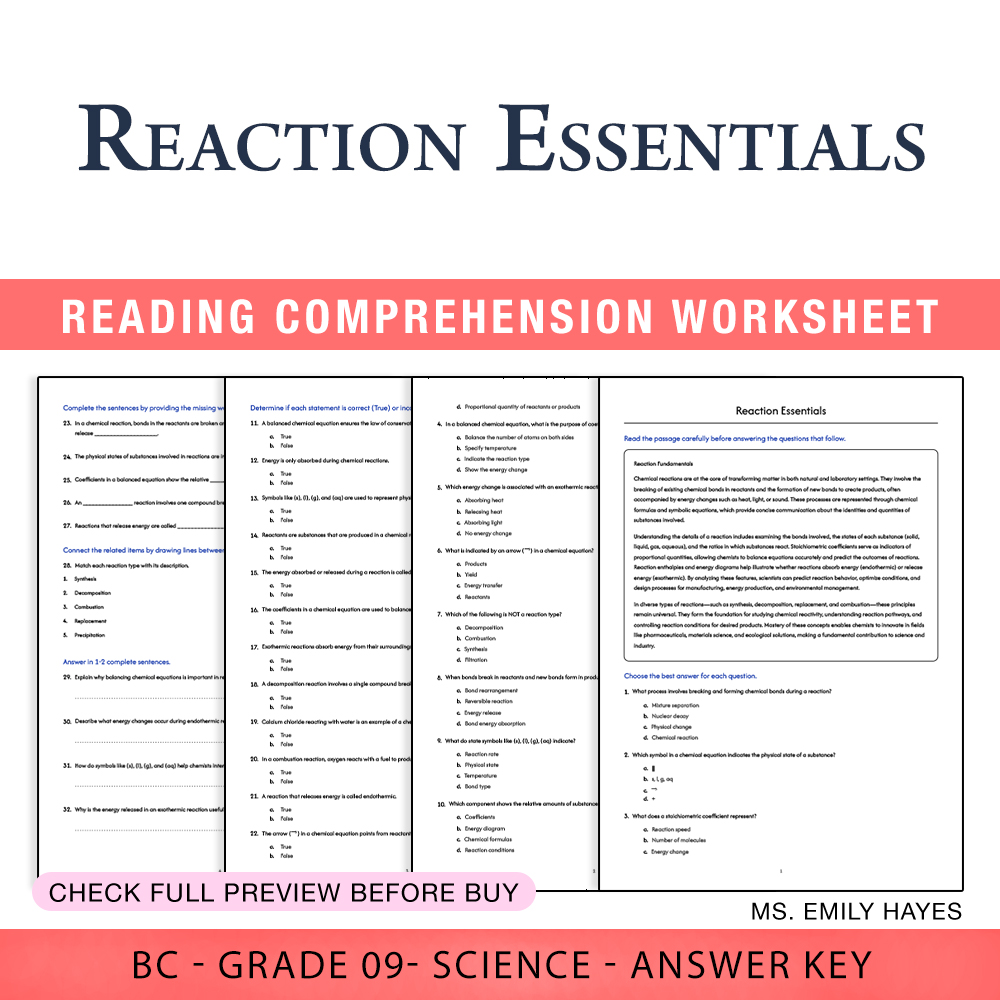
Grade 9 Science | Reaction Essentials Worksheet (PDF+ Answer Key)
Created byCopper Leaf ClassroomLearning Objectives
- Describe the components involved in chemical reactions and their transformations.
- Interpret chemical formulas and symbolic equations to understand reactions.
- Explain how bonds break and form, releasing or absorbing energy.
Also included in: Grade 9 Science Bundle | Chemistry, Physics & Atomic Concepts (PDF + Answer Key) +1 more
Instant download
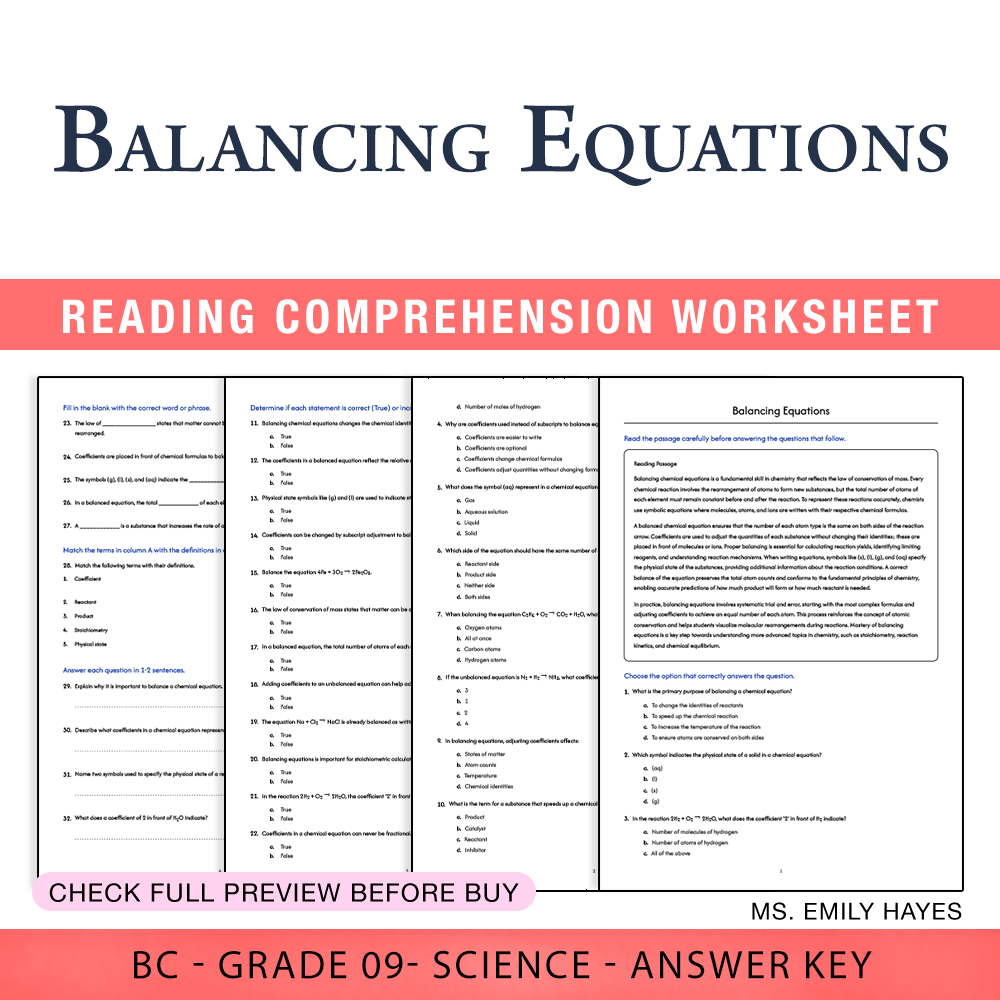
9th Grade Science | Balancing Equations Worksheet (PDF+ Answer Key)
Created byCopper Leaf ClassroomLearning Objectives
- Understand the purpose and importance of balancing chemical equations.
- Learn how to correctly balance chemical equations using coefficients.
- Identify the roles of coefficients and state symbols in chemical equations.
Also included in: Grade 9 Science Bundle | Chemistry, Physics & Atomic Concepts (PDF + Answer Key) +1 more
Instant download
Browse more categories
About Science Worksheets
Find Science worksheets spanning core skills, practice, and review. All 44,295 resources are instant PDF downloads for the classroom or home.
Every worksheet on MyTeachingSheets is created by independent teacher-authors and reviewed before publication. All resources download as printable PDFs for classroom, homework, or at-home practice, and many include answer keys. Preview any worksheet free before buying.