
Science Worksheets
44,295 subject resources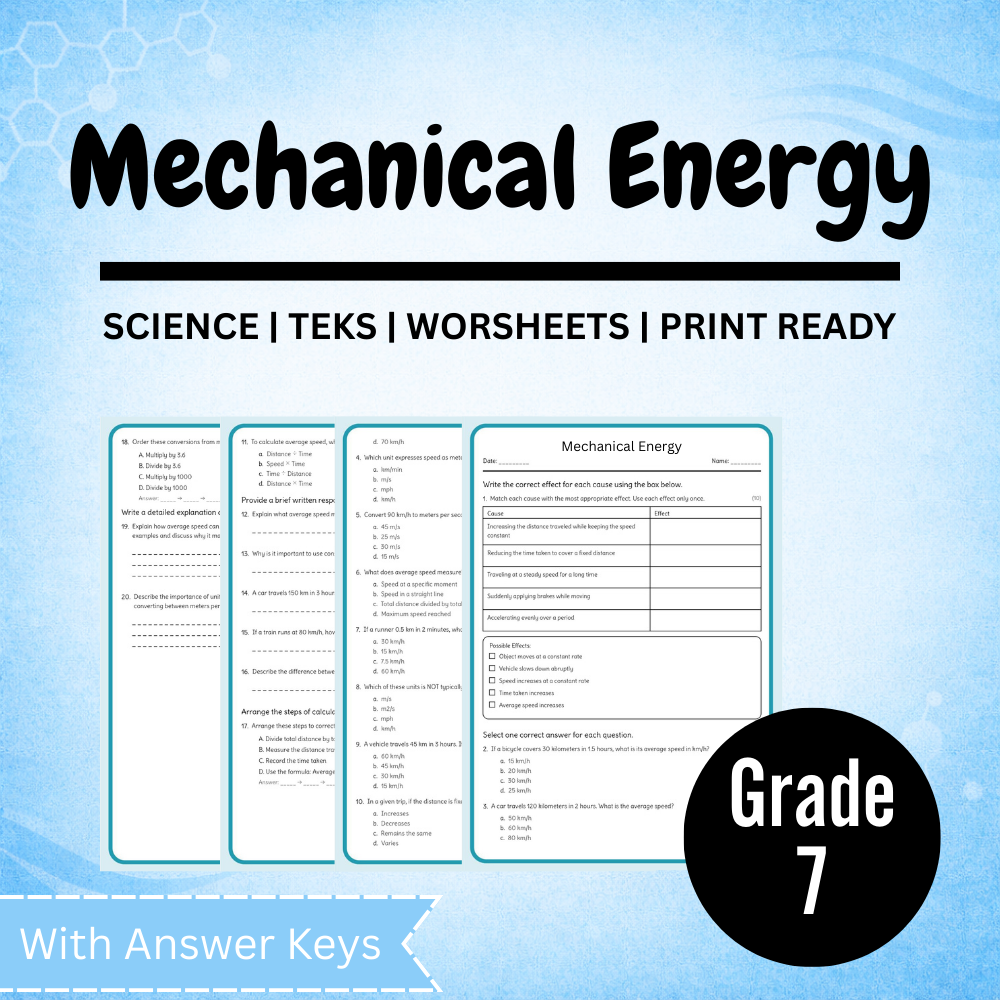
Grade 7 Science | Mechanical Energy TEKS Worksheet (Answer Key) | Fun & Interactive
 Created byBright Mind Resources
Learning Objectives
- Explain the concept of mechanical energy conservation in ideal and real systems.
- Describe how energy is transferred and redistributed among system components during motion such as swinging pendulums and springs.
- Identify factors that lead to energy loss and understand the limits of energy conservation in real systems.
Also included in: Grade 7 Science Unit Workbook | Motion, Forces & Energy TEKS-Aligned Worksheets +2 more
Instant download
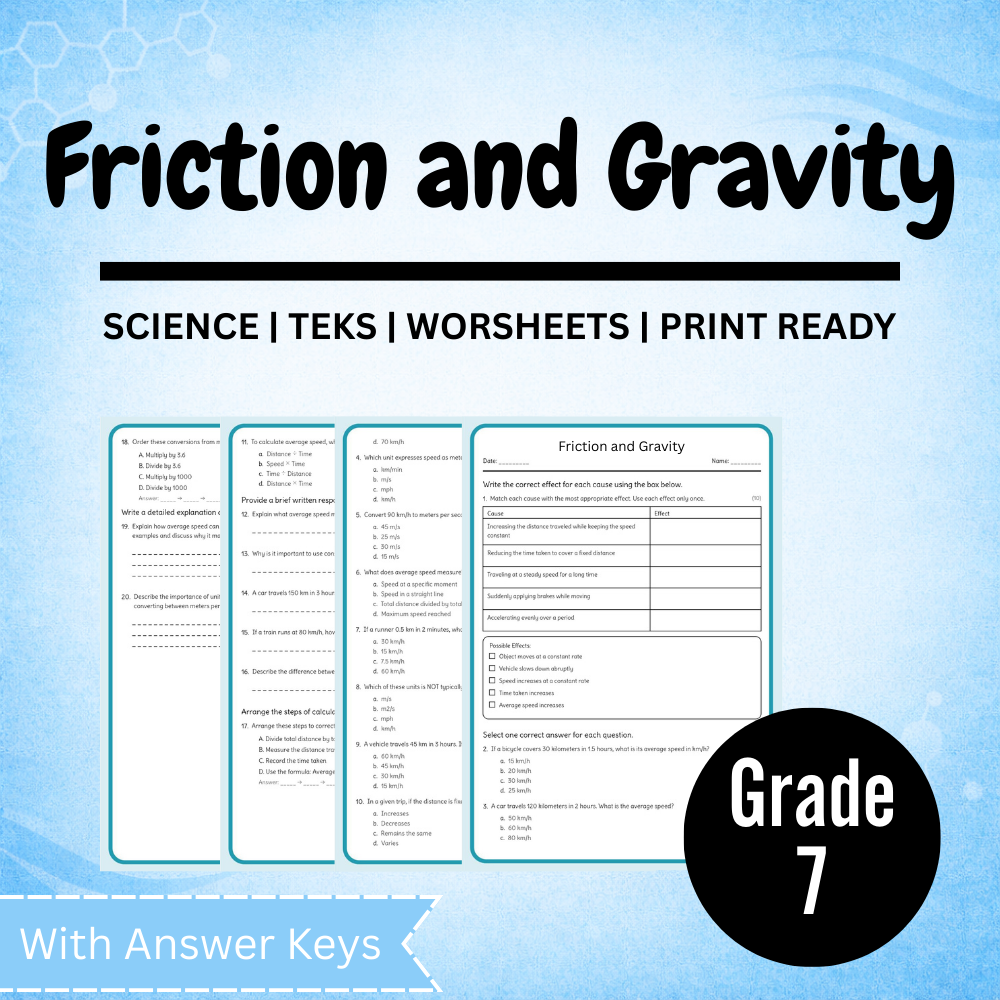
Grade 7 Science | Friction & Gravity Concept Worksheet (PDF) – TEKS Aligned
Created byBright Mind ResourcesLearning Objectives
- Understand how friction acts as a force opposing motion and how surface roughness affects resistance.
- Explain how gravity causes acceleration and influences objects in free fall or on inclines.
- Differentiate between contact forces like friction and long-range forces such as gravity.
Also included in: Grade 7 Science Unit Workbook | Motion, Forces & Energy TEKS-Aligned Worksheets +2 more
Instant download
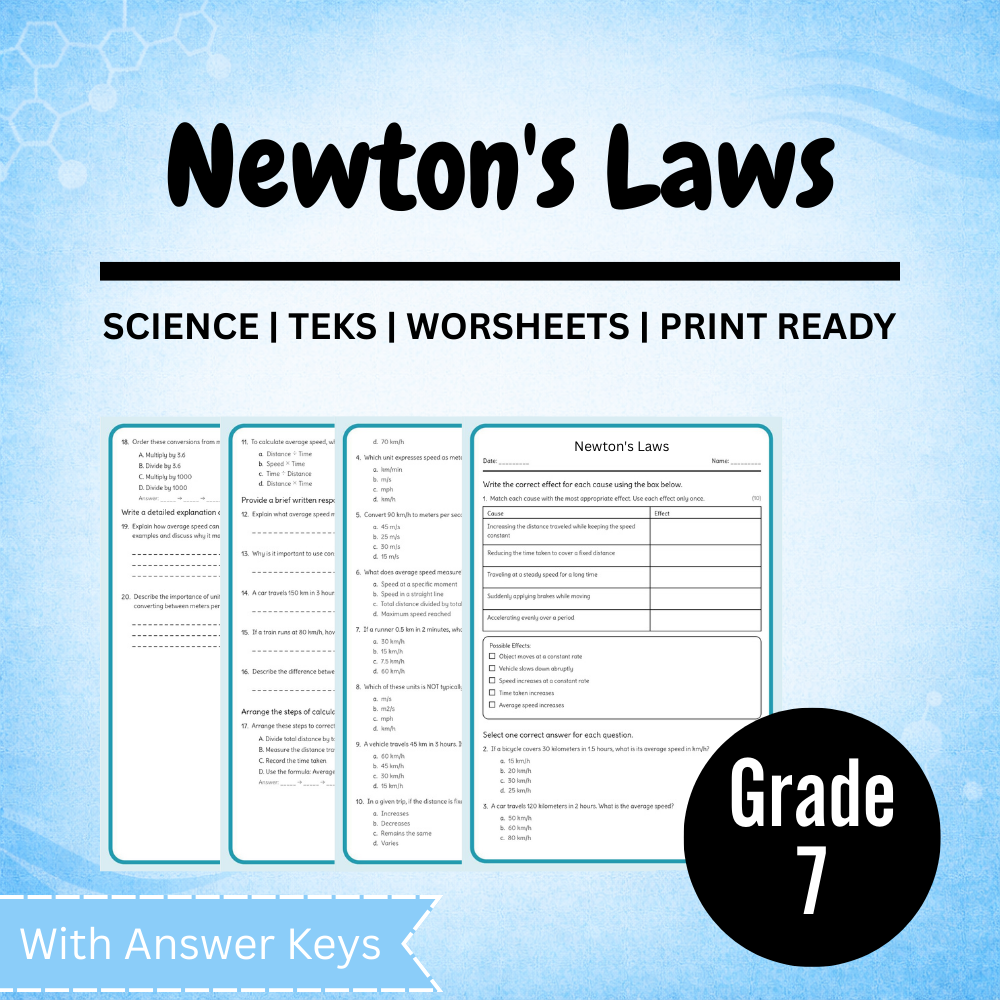
Grade 7 Science | Newton's Laws Worksheet (Answer Key) - TEKS Aligned
Created byBright Mind ResourcesLearning Objectives
- Understand the core principles of Newton's three laws of motion.
- Explain how force and mass affect motion using real-world examples.
- Identify examples of inertia, acceleration, and action–reaction pairs in everyday systems.
Also included in: Grade 7 Science Unit Workbook | Motion, Forces & Energy TEKS-Aligned Worksheets +2 more
Instant download
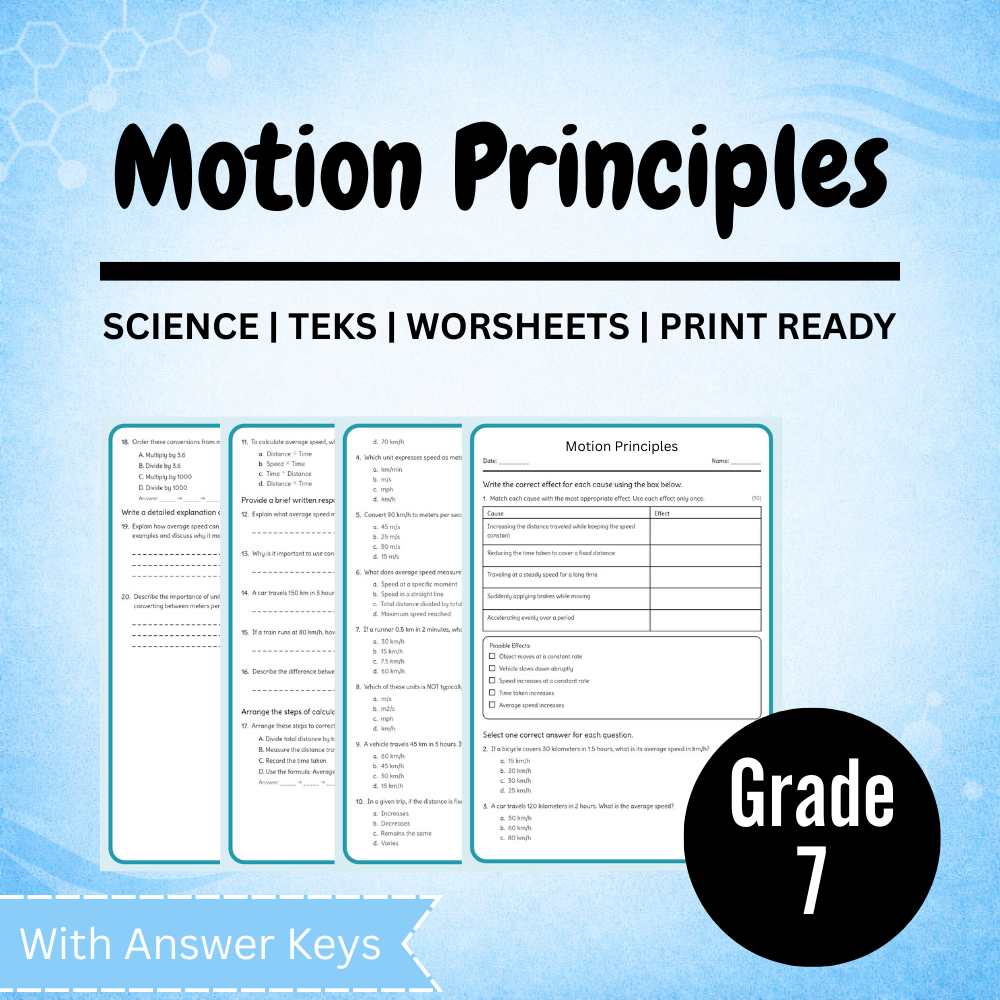
Grade 7 Science | Motion Principles Worksheet (Worksheet + Answer Key) – TEKS Aligned
Created byBright Mind ResourcesLearning Objectives
- Understand the basic concepts of speed, velocity, and acceleration through examples.
- Distinguish between scalar and vector quantities in motion scenarios.
- Analyze motion cases such as a bicycle accelerating, a car braking, and a ball thrown upward.
Also included in: Grade 7 Science Unit Workbook | Motion, Forces & Energy TEKS-Aligned Worksheets +2 more
Instant download
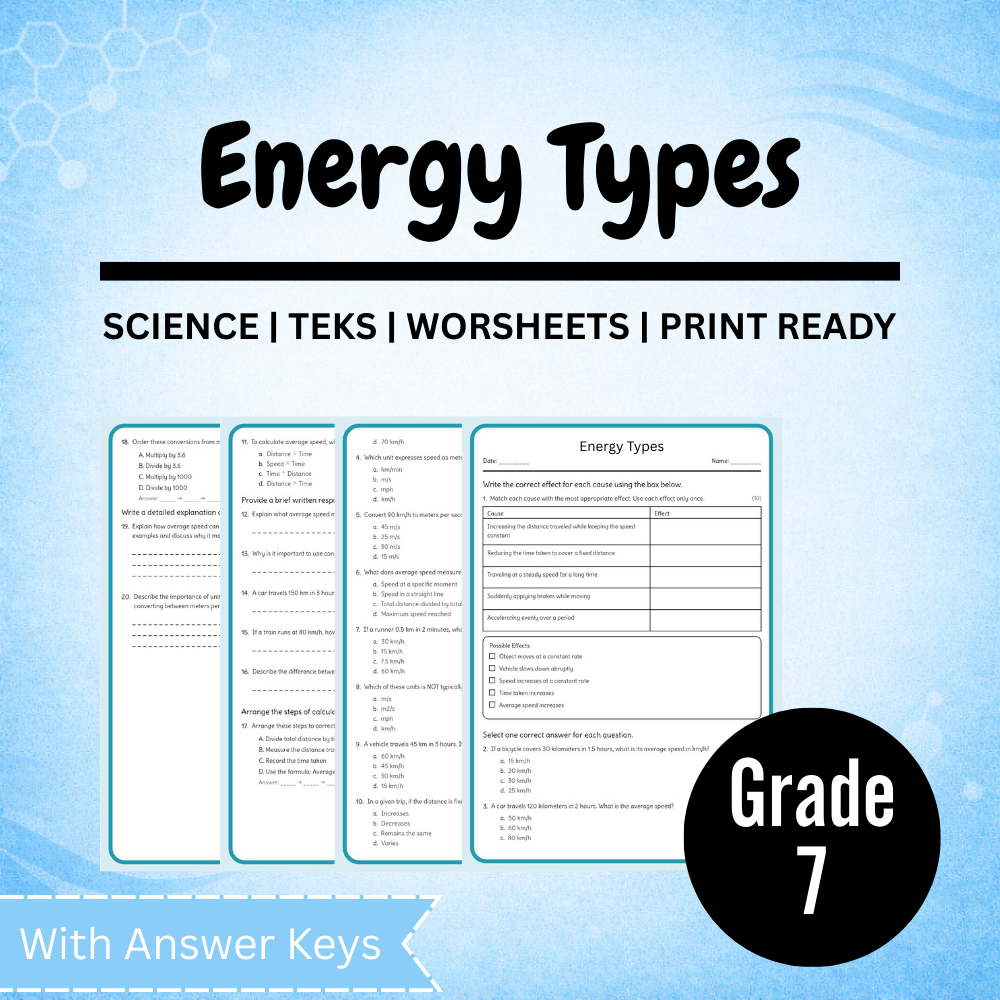
Grade 7 Science | Types of Energy Worksheet (Answer Key) – TEKS Aligned
Created byBright Mind ResourcesLearning Objectives
- Define kinetic energy as the energy of motion in objects.
- Explain potential energy as stored energy based on height or position.
- Describe how energy transfers between potential and kinetic forms in familiar phenomena.
Also included in: Grade 7 Science Unit Workbook | Motion, Forces & Energy TEKS-Aligned Worksheets +2 more
Instant download
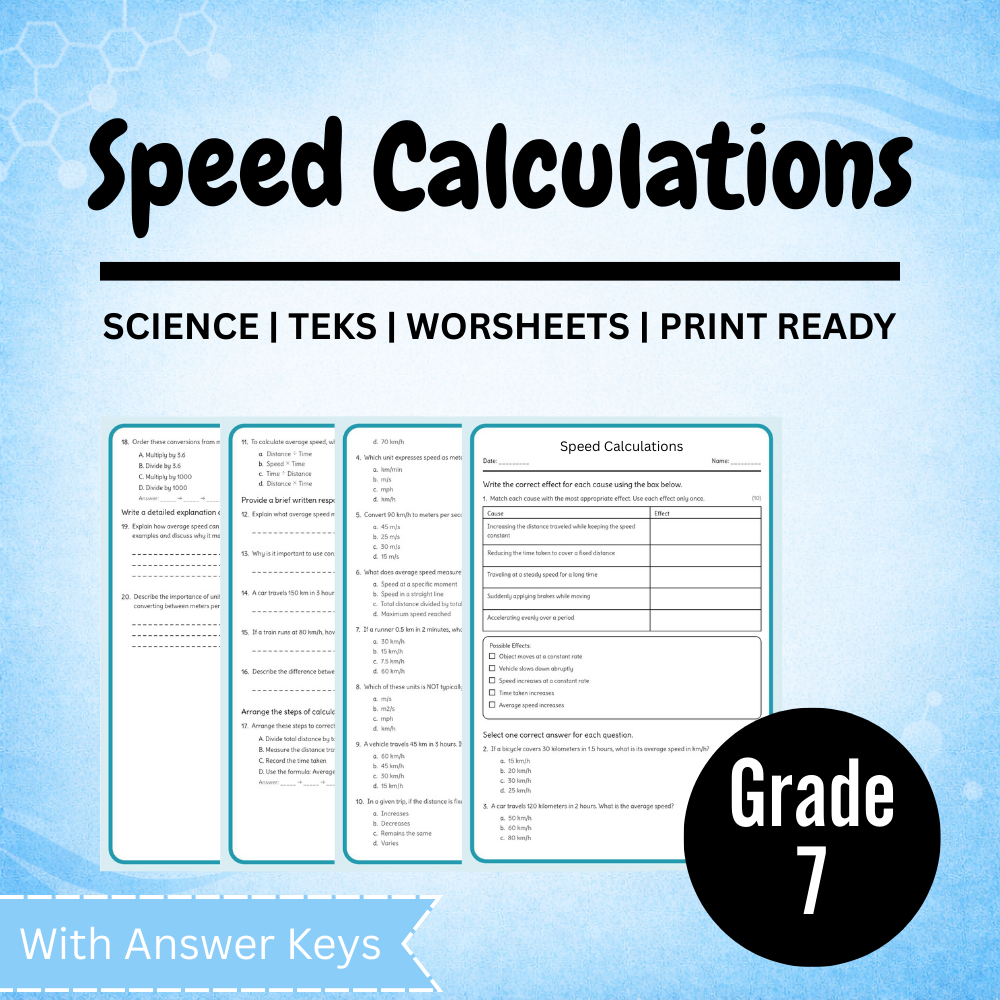
7th Grade Science | Speed Calculations Worksheet (PDF) - TEKS Standard
Created byBright Mind ResourcesLearning Objectives
- Understand how to calculate average speed using distance and time data.
- Distinguish between average speed and instantaneous speed through numerical examples.
- Convert between meters per second and kilometers per hour units.
Also included in: Grade 7 Science Unit Workbook | Motion, Forces & Energy TEKS-Aligned Worksheets +2 more
Instant download
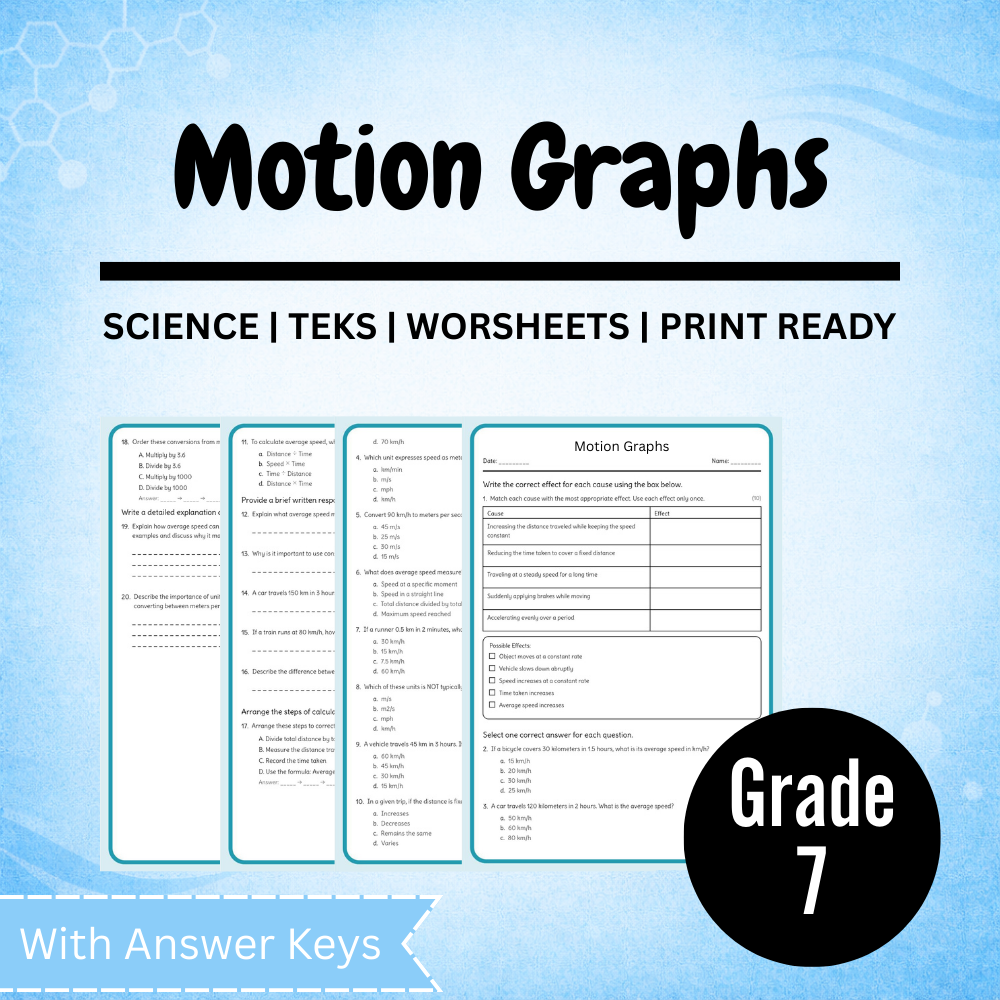
Grade 7 Science | Motion Graphs Worksheet (Worksheet + Answer Key) TEKS-Aligned
Created byBright Mind ResourcesLearning Objectives
- Interpret and describe patterns of motion from distance–time and velocity–time graphs.
- Relate slopes to speed and understand areas under velocity curves as displacement.
- Compare different types of motion graphs qualitatively using real-world examples.
Also included in: Grade 7 Science Unit Workbook | Motion, Forces & Energy TEKS-Aligned Worksheets +2 more
Instant download
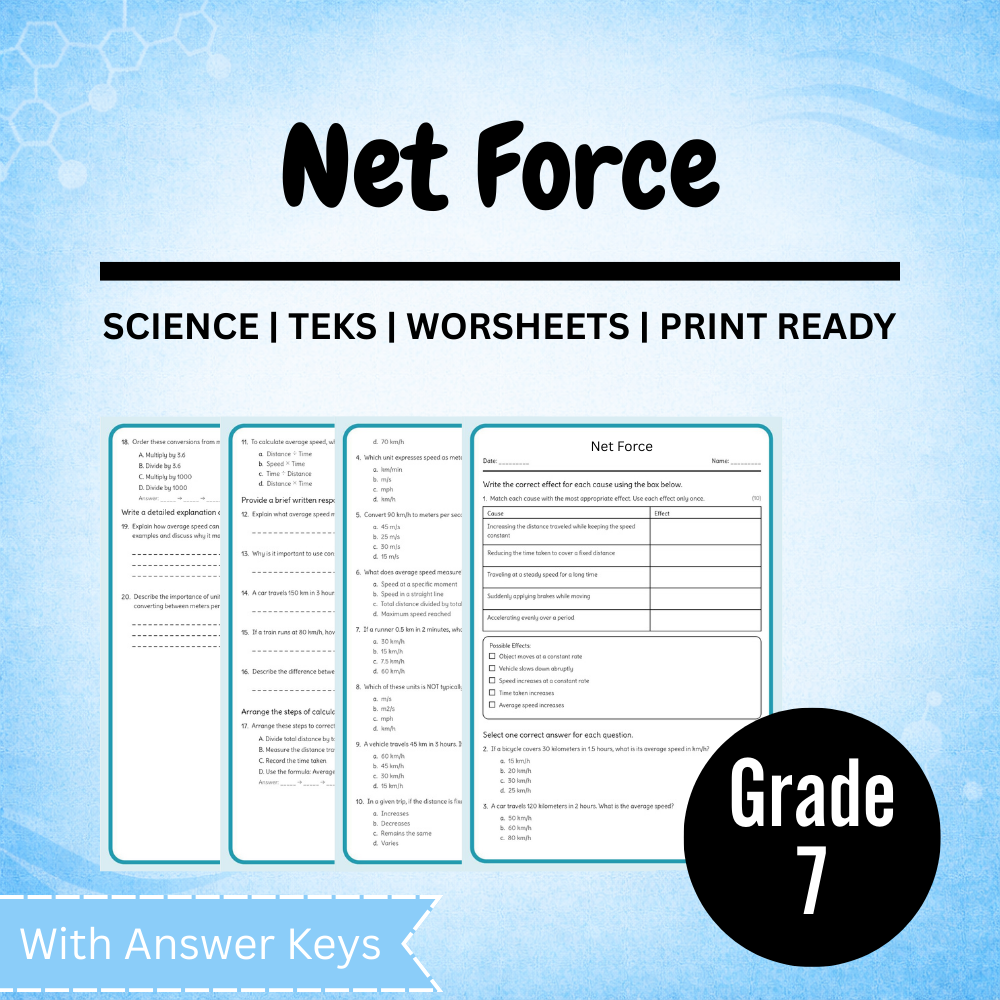
Grade 7 Science | Net Force Worksheet (Worksheet + Answer Key) – TEKS Aligned
Created byBright Mind ResourcesLearning Objectives
- Understand the concept of net force and how vectors are combined in various systems.
- Analyze forces acting on objects using free-body diagrams and vector addition.
- Explain how net force influences the motion of objects, including equilibrium scenarios.
Also included in: Grade 7 Science Unit Workbook | Motion, Forces & Energy TEKS-Aligned Worksheets +2 more
Instant download
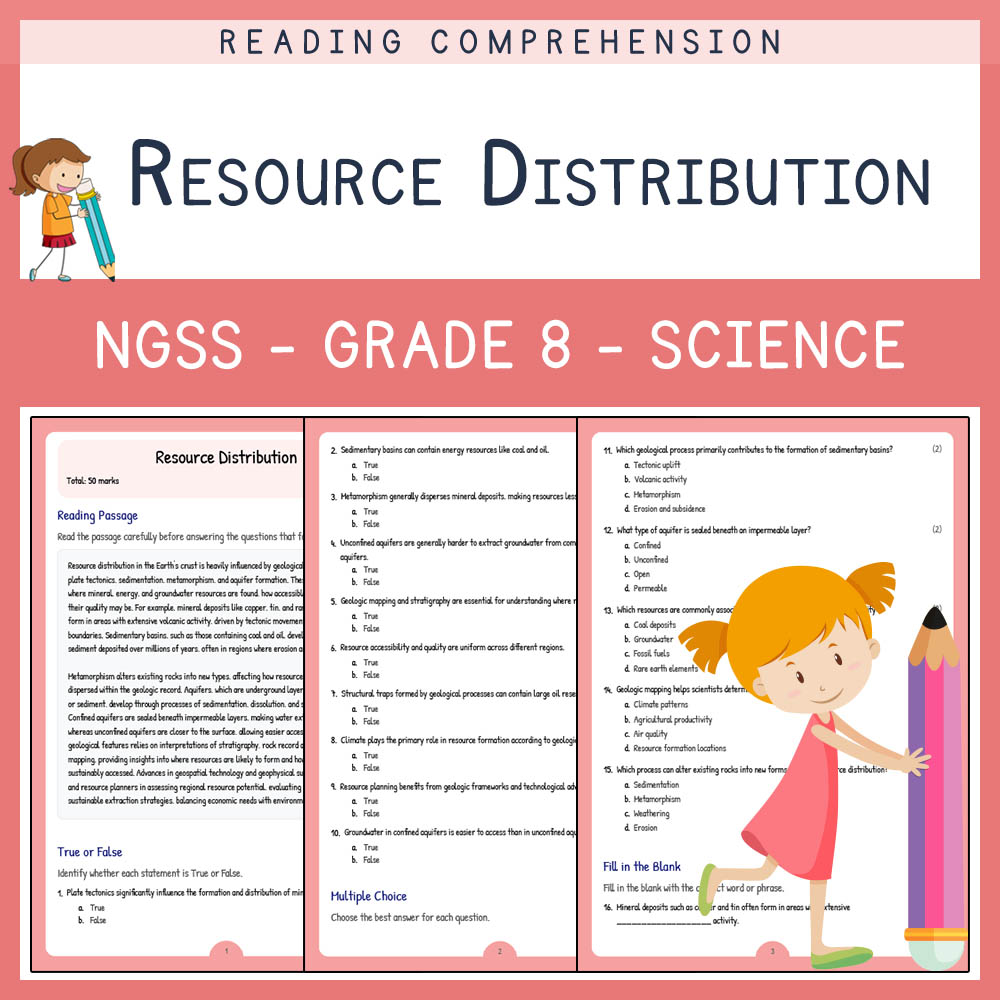
Grade 8 Science | Resource Distribution Worksheet (NGSS-Aligned)
 Created byLumora Learning
Learning Objectives
- Understand geological processes such as plate tectonics, sedimentation, metamorphism, and aquifer formation.
- Analyze how mineral, energy, and groundwater resources are distributed unevenly across regions.
- Identify geological evidence used to determine resource formation and accessibility.
Instant download
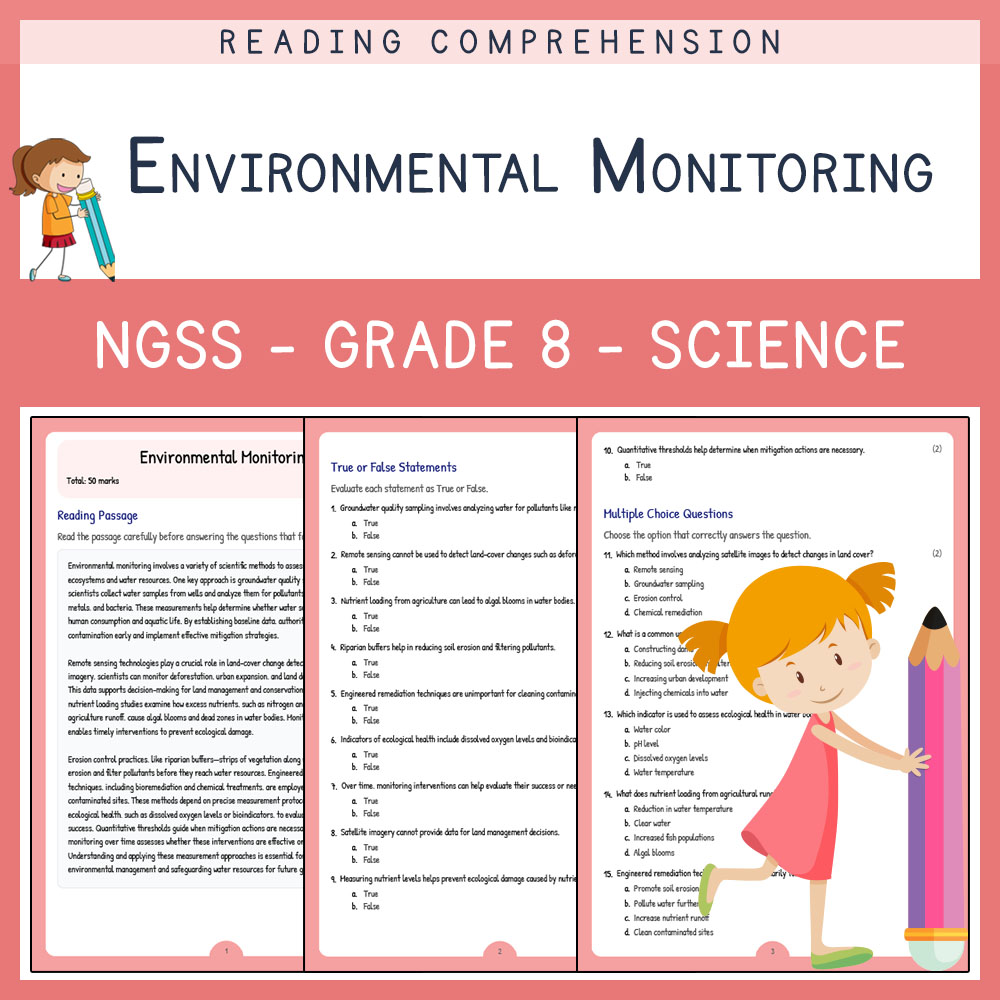
Grade 8 Science | Environmental Monitoring Worksheet & Answer Key (NGSS Aligned)
Created byLumora LearningLearning Objectives
- Understand different methods used for monitoring ecosystems and water resources.
- Identify indicators of ecological health and appropriate mitigation strategies.
- Analyze measurement protocols and evaluate the effectiveness of interventions.
Instant download
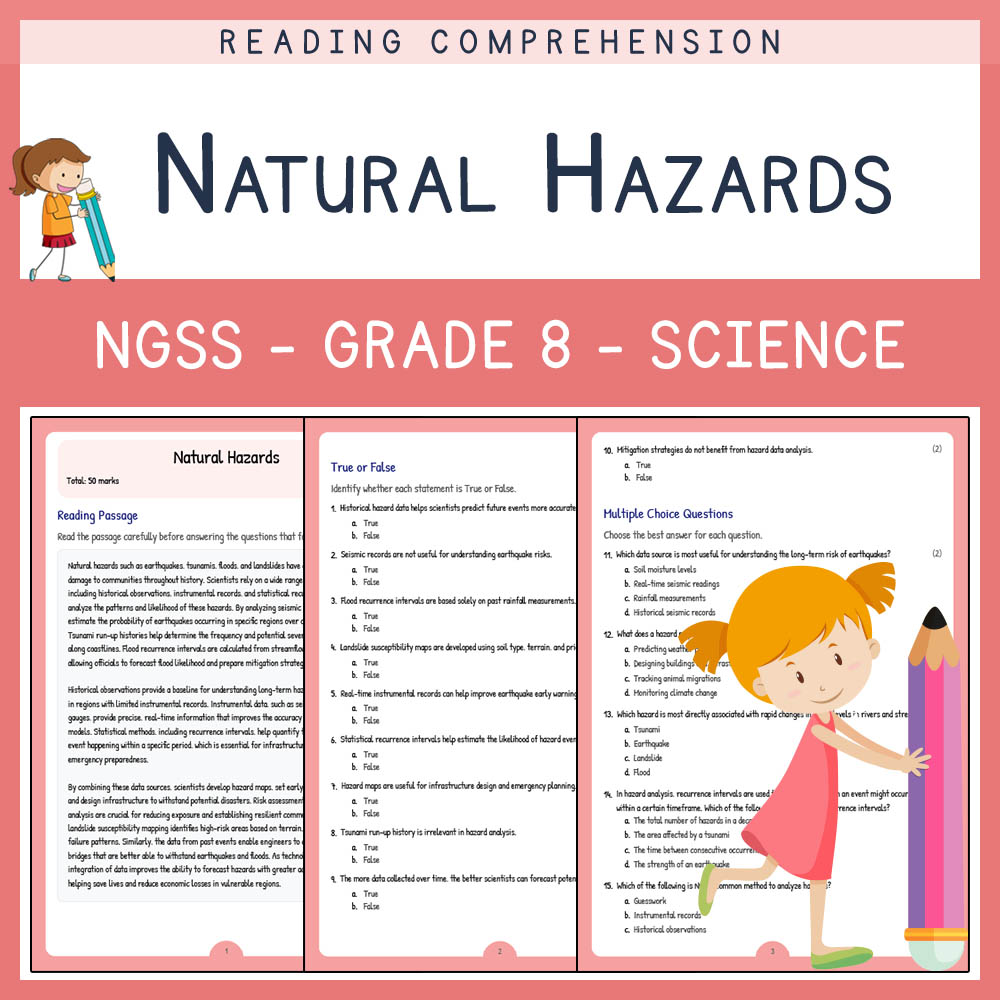
Grade 8 Science | Natural Hazards Worksheet (Answer Key) | NGSS Standards
Created byLumora LearningLearning Objectives
- Understand how historical data informs risk assessment for natural hazards.
- Interpret patterns in natural hazard frequency and magnitude.
- Analyze data from seismic, flood, tsunami, and landslide records.
Instant download
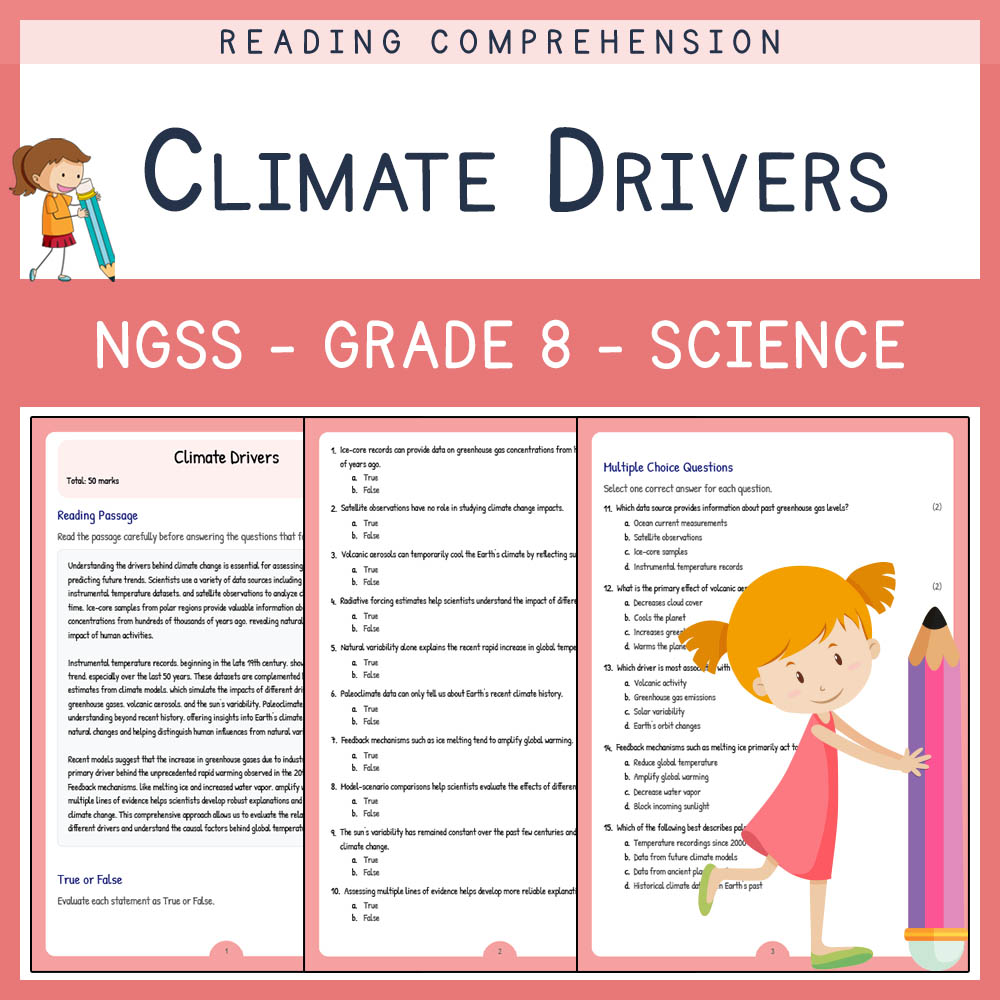
Grade 8 Science | Climate Drivers Worksheet (PDF + Answer Key) – NGSS aligned
Created byLumora LearningLearning Objectives
- Understand the main factors influencing recent climate change, including greenhouse gases, volcanic aerosols, solar variability, and feedback mechanisms.
- Evaluate multiple lines of scientific evidence, such as ice-core data and temperature records, to analyze climate trends.
- Differentiate between natural and anthropogenic drivers of climate change using paleoclimate and observational records.
Instant download
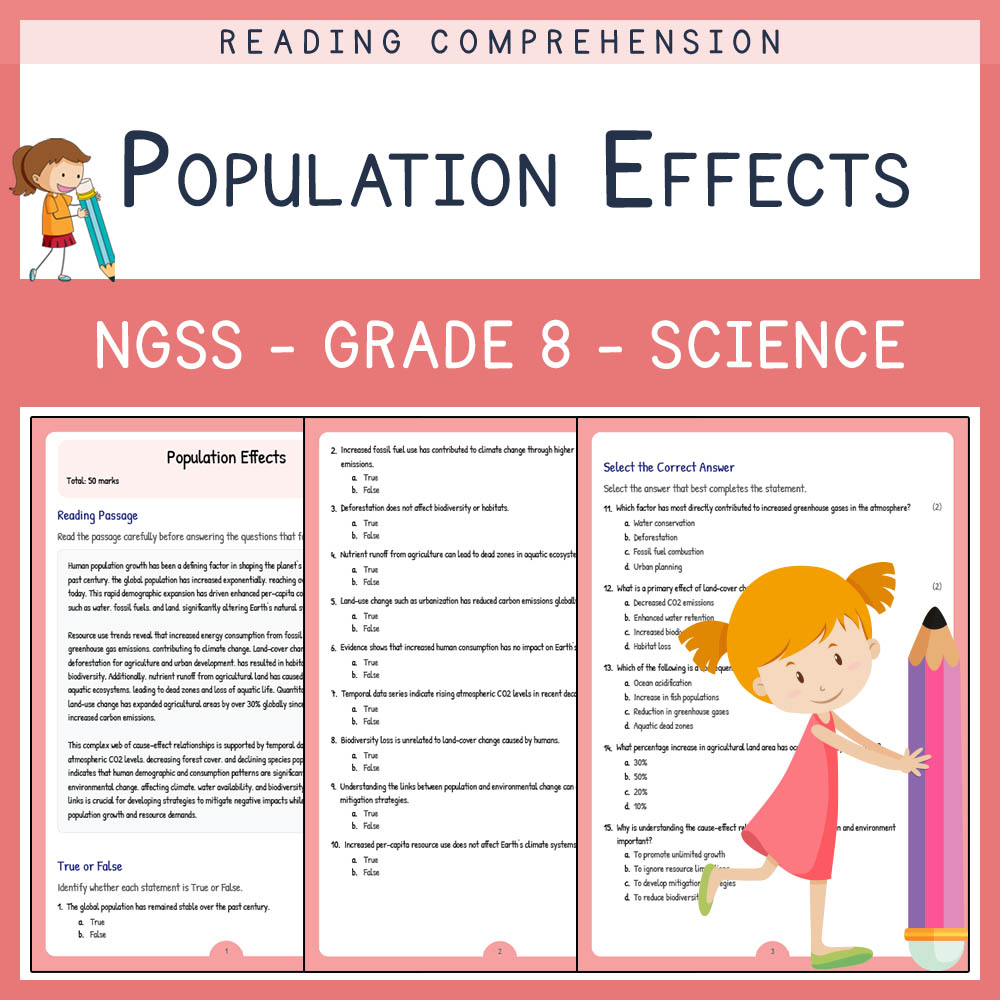
Grade 8 Science | Population Effects Worksheet (PDF + Answer Key)
Created byLumora LearningLearning Objectives
- Analyze the links between population growth, resource consumption, and environmental changes.
- Evaluate evidence related to human activities' impacts on Earth systems using quantitative data.
- Develop argumentation skills to connect demographic patterns with ecological consequences.
Instant download
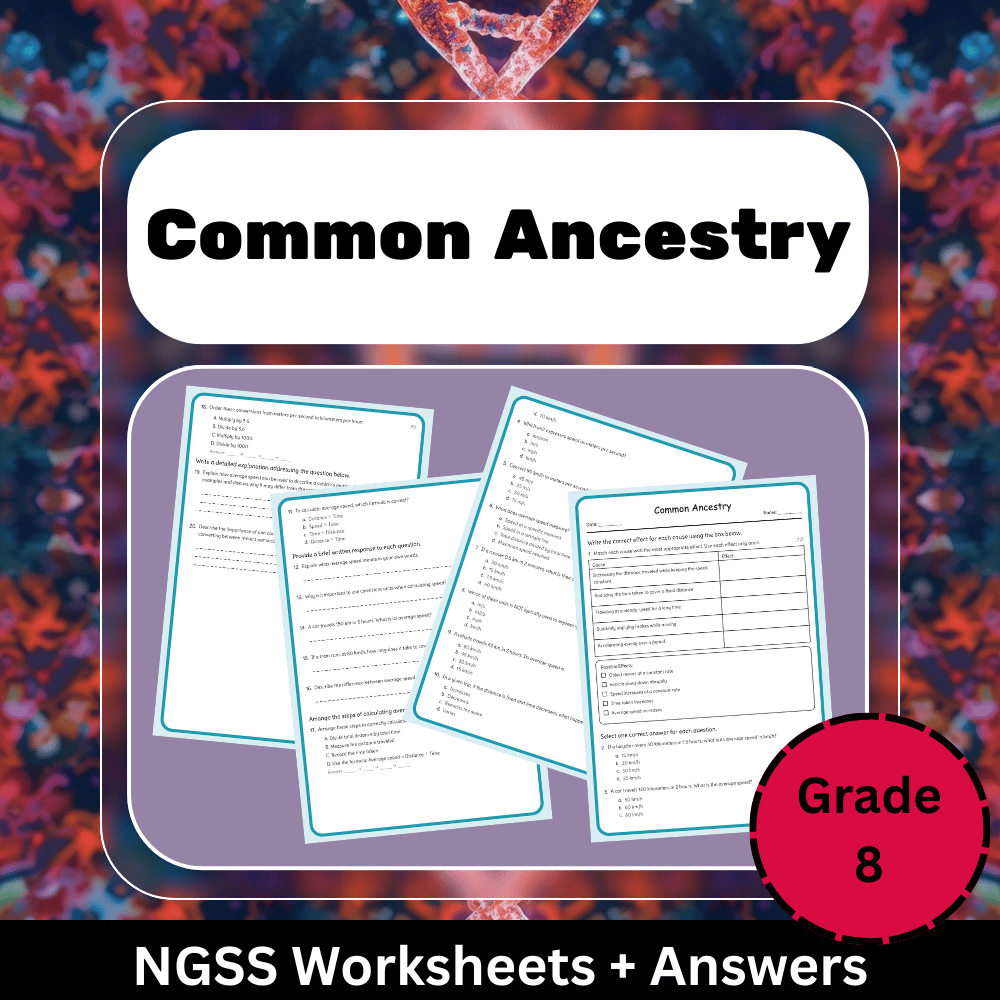
Grade 8 Science – Common Ancestry Worksheet (NGSS Aligned + Answer Key) (PDF)
Created byBright Mind ResourcesLearning Objectives
- Understand how fossil, anatomical, embryological, and molecular evidence support hypotheses of shared ancestry.
- Analyze patterns of unity and diversity in evolutionary relationships through data interpretation.
- Identify transitional fossils, homologous structures, conserved developmental stages, and DNA similarities.
Also included in: Grade 8 Science | Evolution & Speciation Unit Bundle (NGSS-Aligned Worksheets) +2 more
Instant download

Grade 3 Structural Forms Worksheet | Ontario Practice & PDF
 Created byClear Sky Classroom
Learning Objectives
- Identify common structural forms (arches, beams, frames) and describe how their shapes help them support loads.
- Explain how compressive and bending forces affect different structures in real-world examples.
- Compare span, curvature, and connection types to predict strength and stability.
Instant download
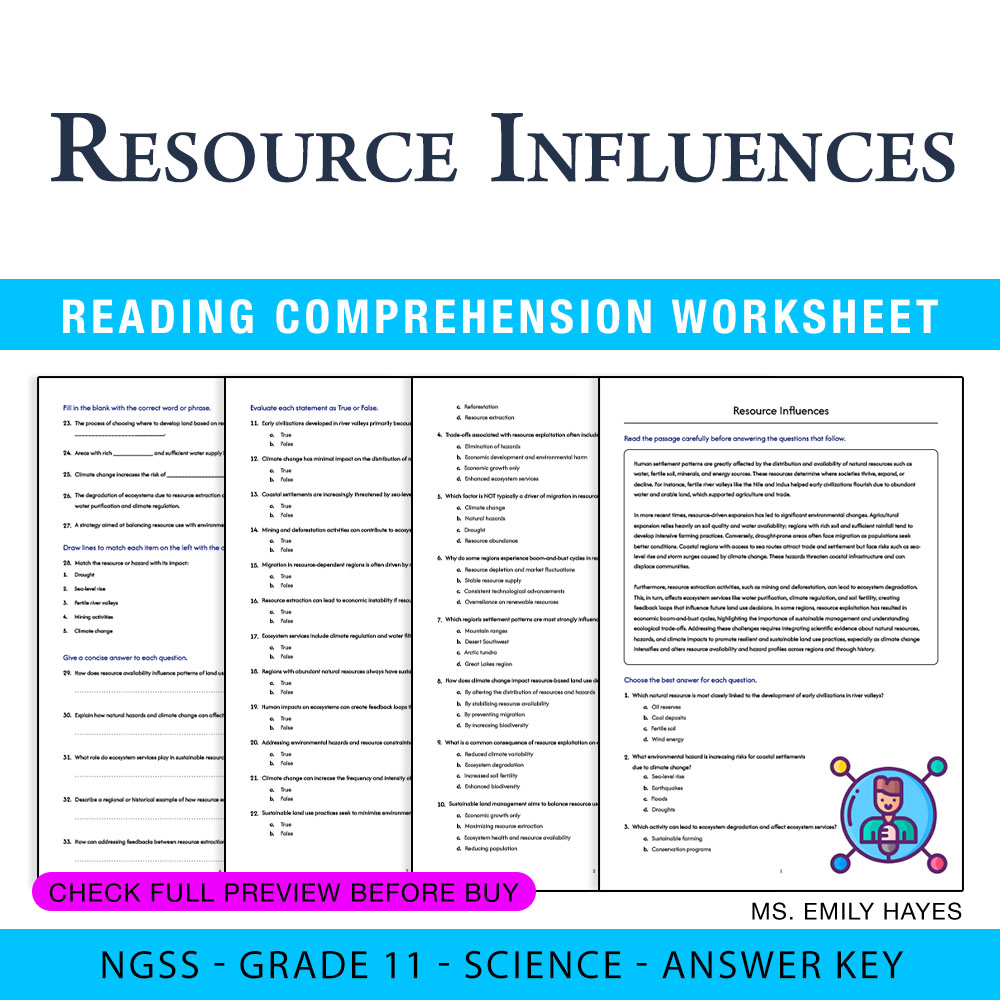
Grade 11 Science | Resource Influences Worksheet (PDF+ Answer Key)
 Created byCopper Leaf Classroom
Learning Objectives
- Analyze how natural resource availability influences patterns of human settlement and land use.
- Evaluate the impacts of natural hazards and climate change on economic development and migration.
- Examine trade-offs between resource extraction, ecosystem services, and sustainability using regional case studies.
Instant download
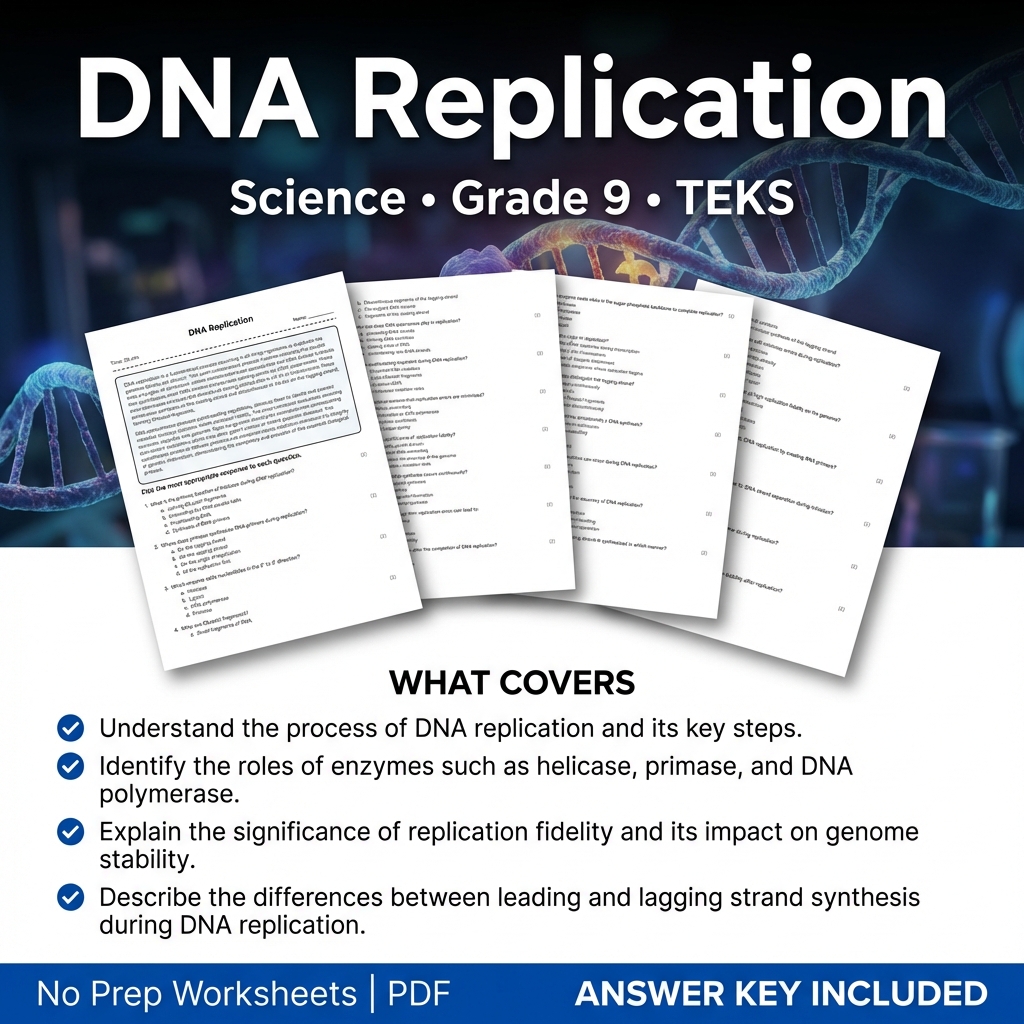
DNA Replication Worksheet for Grade 9 Science | TEKS Aligned Practice
 Created byCoral Reef Learning
Learning Objectives
- Understand the process of DNA replication and its key steps.
- Identify the roles of enzymes such as helicase, primase, and DNA polymerase.
- Explain the significance of replication fidelity and its impact on genome stability.
Instant download

Force Interactions Worksheet Pack | Grade 9 AP Science Practice
 Created byBright Quill Resources
Learning Objectives
- Explain how net external force determines changes in motion using Newton’s Second Law.
- Represent forces on objects with free-body reasoning and conceptual force diagrams.
- Calculate net force and predict acceleration for contact and field forces in simple systems.
Instant download
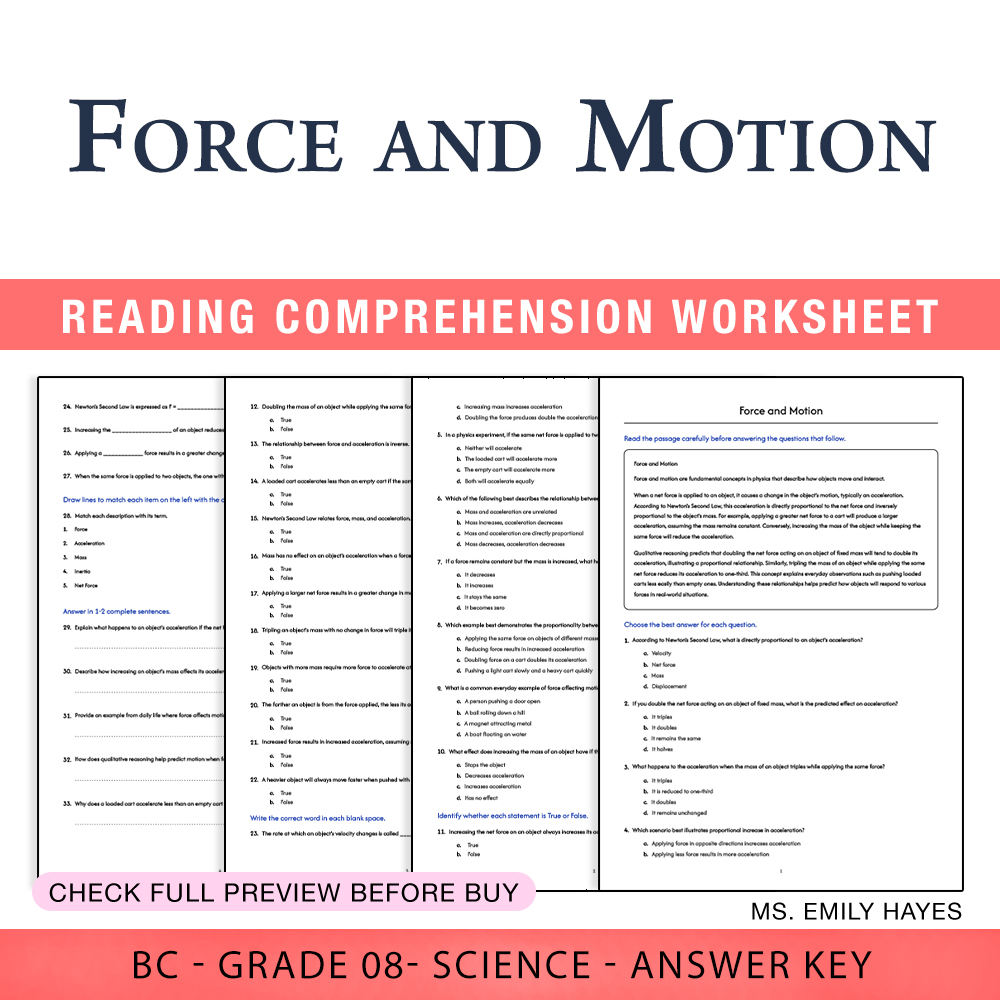
8th Grade Science | Force and Motion Worksheet (PDF+ Answer Key)
Created byCopper Leaf ClassroomLearning Objectives
- Understand how net force influences the acceleration of an object.
- Explain the relationship between mass and acceleration when a force is applied.
- Predict how changes in force and mass affect motion using qualitative reasoning.
Also included in: Grade 8 Science Worksheets Bundle | Forces, Motion & Energy (PDF + Answer Keys) +1 more
Instant download
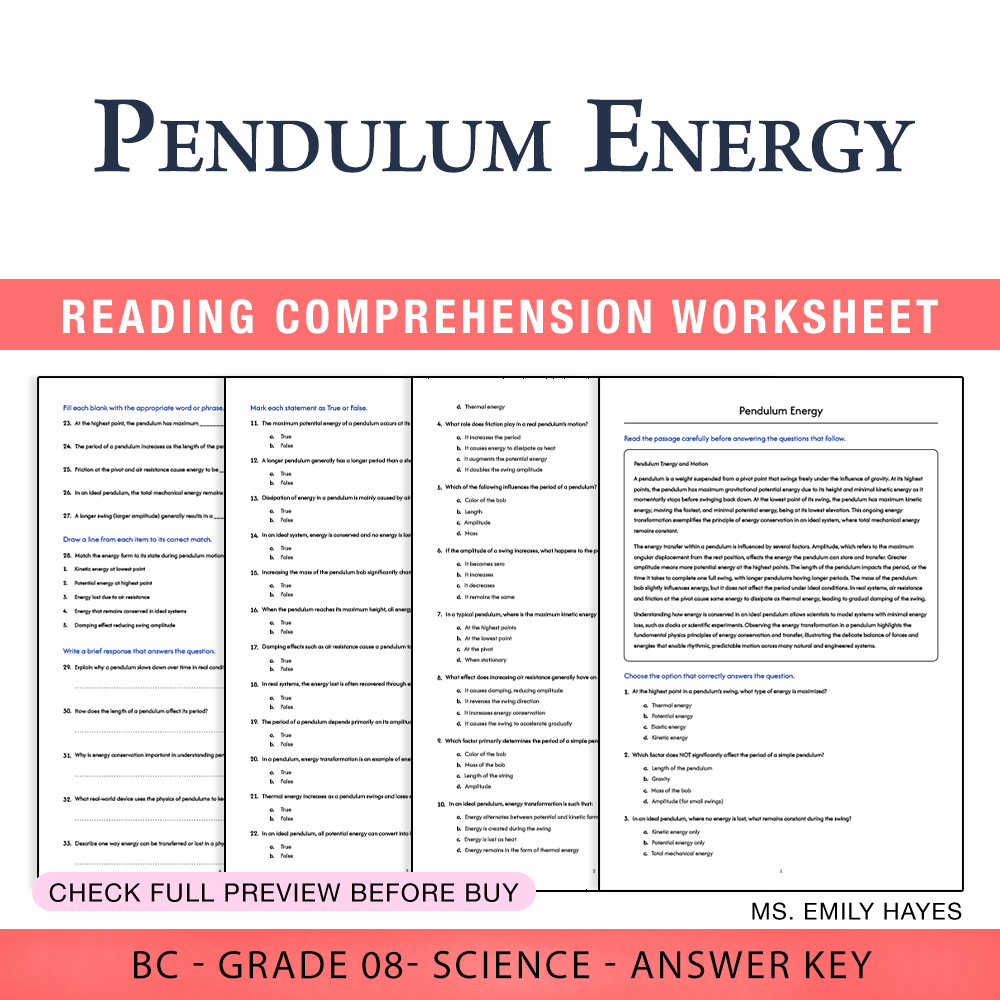
Grade 8 Science | Pendulum Energy Worksheet (PDF+ Answer Key)
Created byCopper Leaf ClassroomLearning Objectives
- Understand the energy transformations occurring in a pendulum swing.
- Identify factors influencing the period and energy distribution of a pendulum.
- Explain conservation of mechanical energy in ideal systems without dissipation.
Also included in: Grade 8 Science Worksheets Bundle | Forces, Motion & Energy (PDF + Answer Keys) +1 more
Instant download
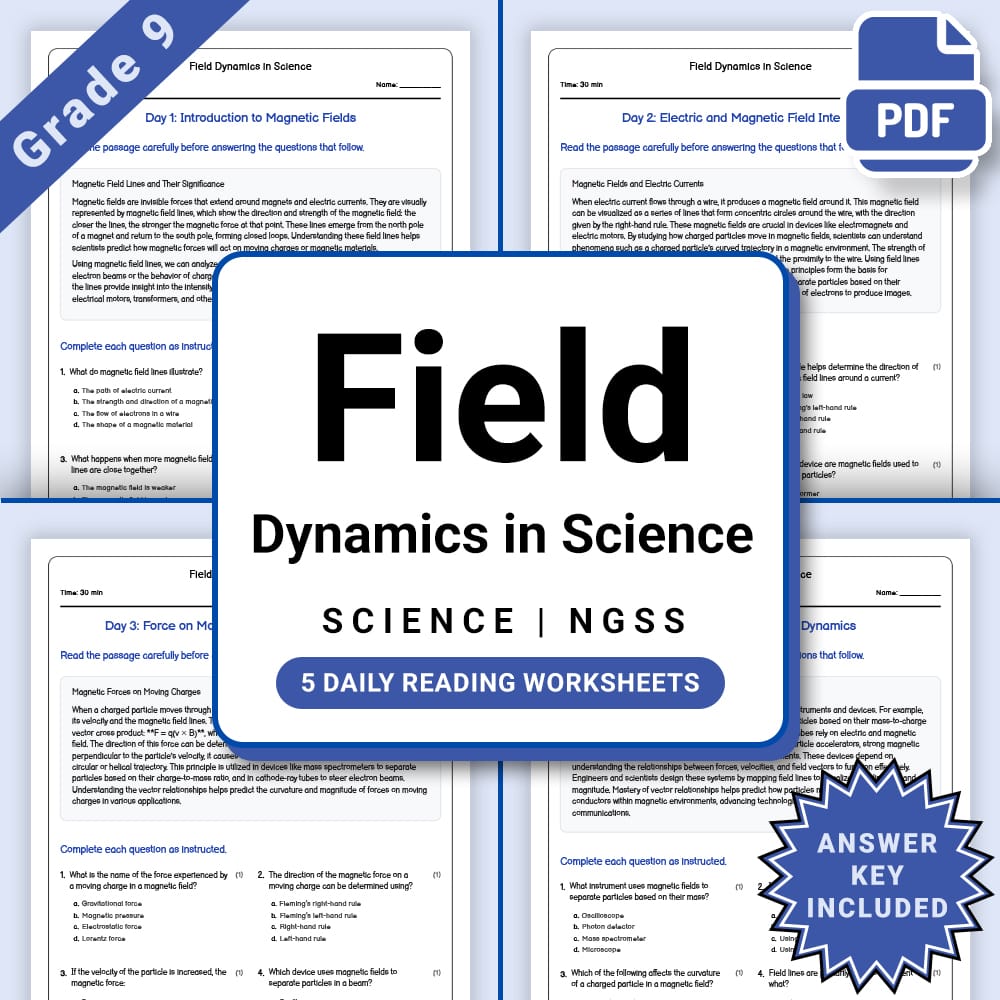
Grade 9 Science – Field Dynamics Worksheet(PDF + Answer Key)
Created byCopper Leaf ClassroomLearning Objectives
- Understand the concept of magnetic field lines and how they represent magnetic fields
- Learn about forces on moving charges in magnetic fields and how to visualize them
- Explore applications such as cathode-ray deflection and mass spectrometry
Instant download

Grade 12 Science | Activation Energy Pathways Worksheet | General Standards
Created byLumora LearningLearning Objectives
- Explain how reaction energy profiles represent pathways, reactants, products, and the highest-energy transition state.
- Describe activation energy as the energy difference between reactants and the transition state configuration.
- Evaluate how catalysts provide alternative pathways with lower activation energy and increased reaction rate.
Instant download
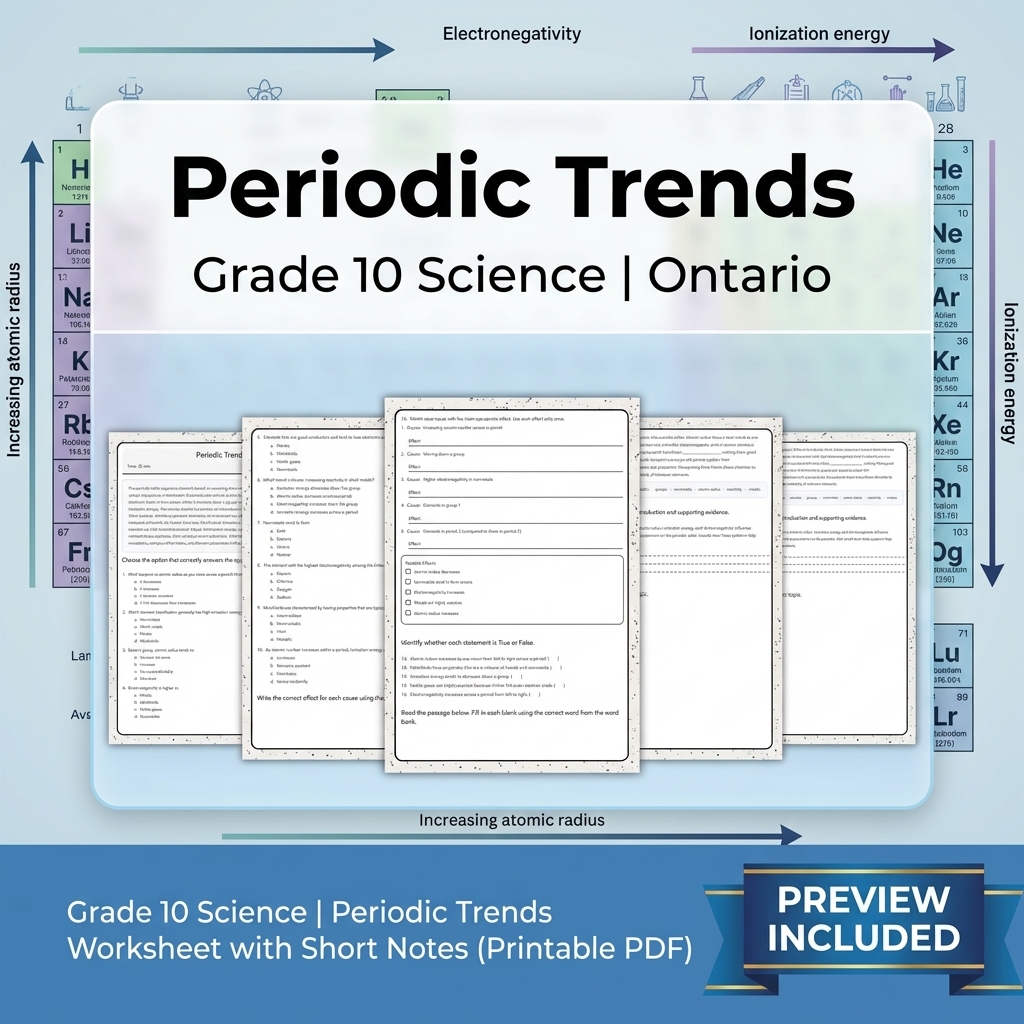
Grade 10 Science | Periodic Trends Worksheet with Short Notes (Printable PDF)
 Created byMeadowlark Worksheets
Learning Objectives
- Understand the patterns of atomic radius, ionization energy, and electronegativity across the periodic table.
- Describe the classification of elements into metals, nonmetals, and metalloids based on shared properties.
- Explain how group and period relationships influence valence electrons and reactivity.
Also included in: Grade 10 Science Lesson Group Bundle with Ontario Framework +1 more
Instant download
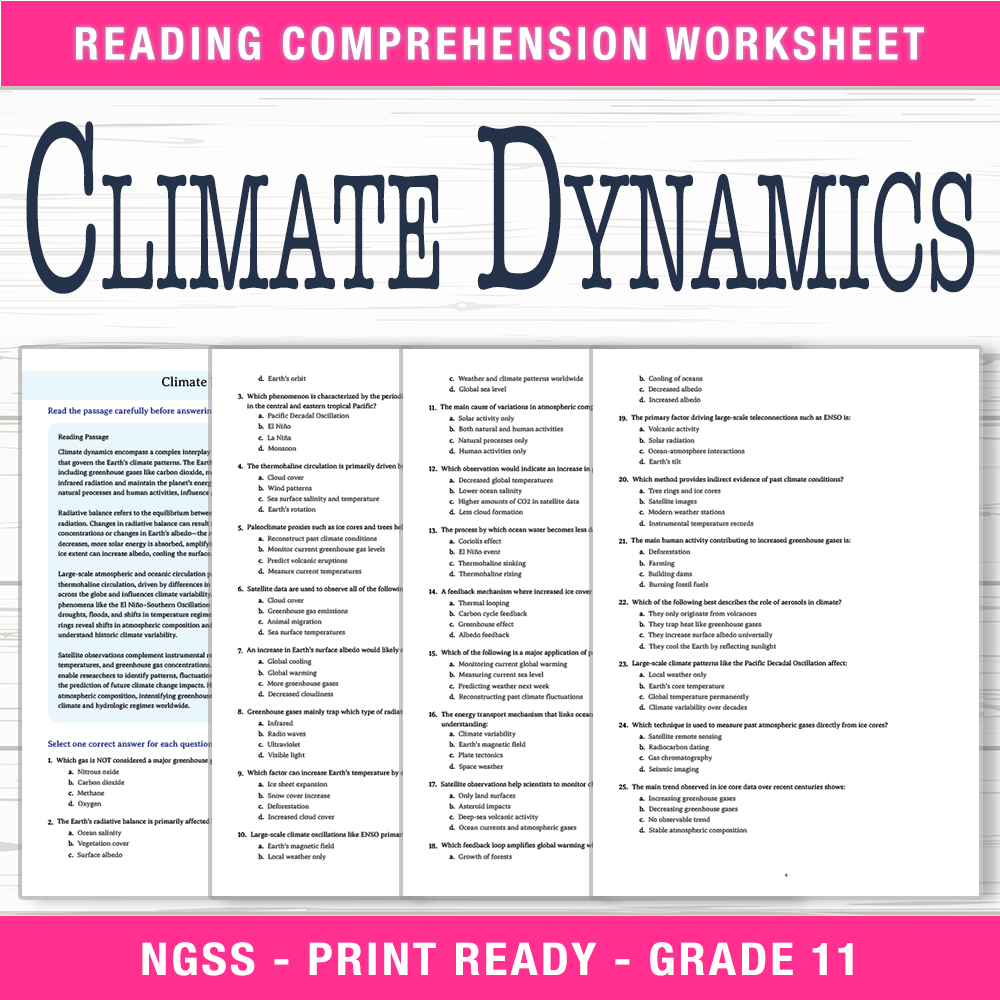
Grade 11 Science | Climate Dynamics Worksheet (PDF + Answer Key)
 Created byRiverstone Classroom
Learning Objectives
- Understand the mechanisms driving climate variability such as greenhouse gas forcing and albedo feedbacks.
- Analyze how ocean-atmosphere interactions influence large-scale climate patterns like El Niño and thermohaline circulation.
- Interpret instrumental, satellite, and paleoclimate proxy data to assess shifts in temperature and hydrologic regimes.
Instant download

Grade 9 Celestial Motions Worksheet | Ontario Science | Earth & Space
Created byClear Sky ClassroomLearning Objectives
- Explain how Earth’s rotation and orbital motion produce observable daily and yearly cycles.
- Differentiate sidereal and solar periods and describe how they affect apparent motion of the Sun and stars.
- Describe how relative geometry between Earth, the Moon, and the Sun leads to repeating observational patterns (eclipses, tides).
Instant download
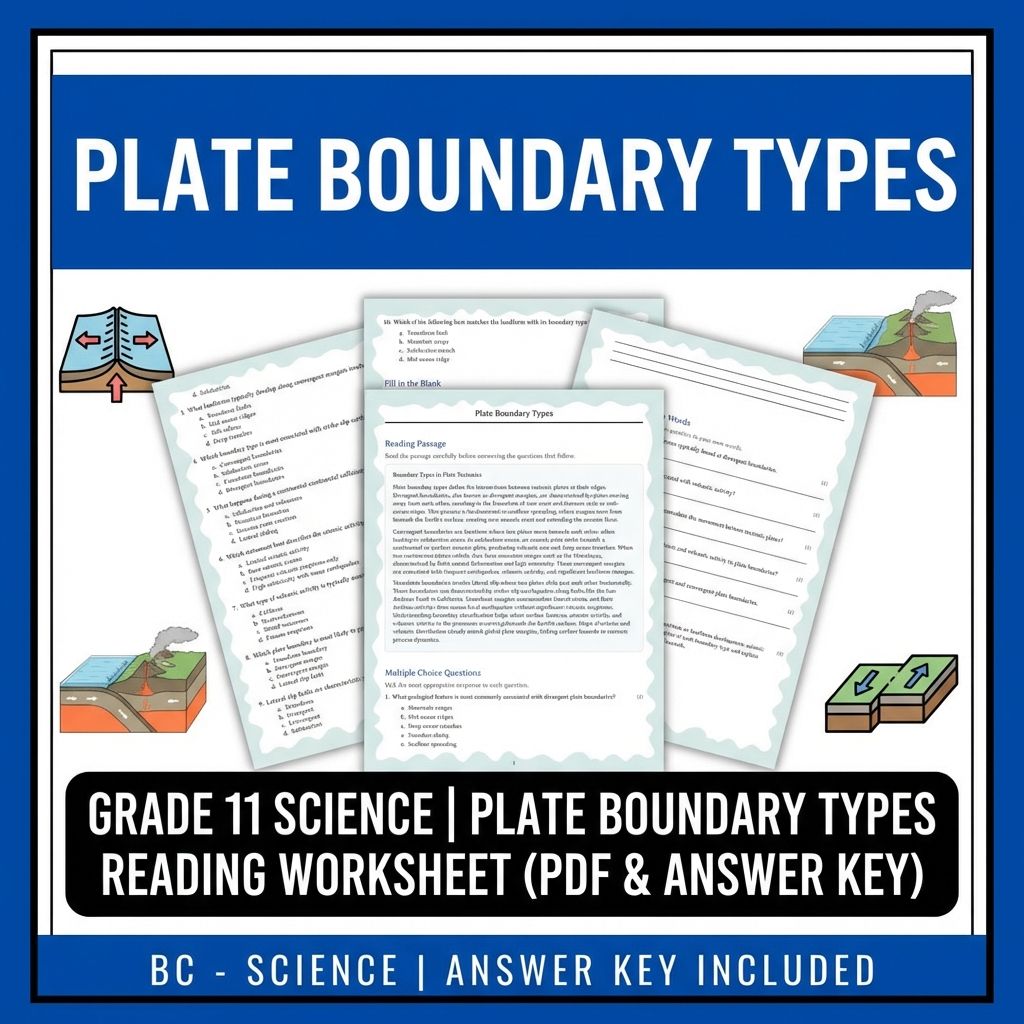
Grade 11 Science | Plate Boundary Types Reading Worksheet (PDF & Answer Key)
JCreated byJ.S SheetsLearning Objectives
- Understand the different types of plate boundaries and their characteristics.
- Identify landforms, seismic activity, and volcanic activity associated with boundary types.
- Explain the link between surface observations and tectonic processes.
Instant download
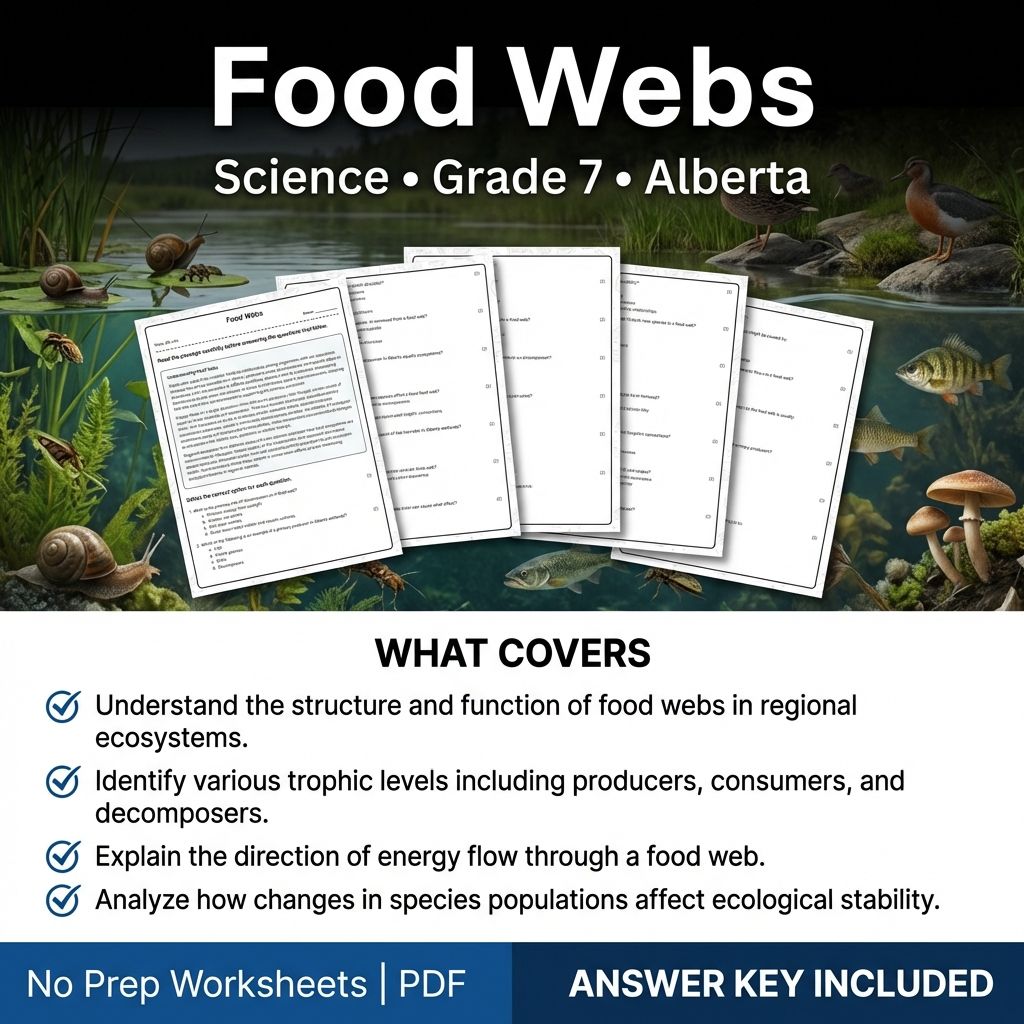
Food Webs Worksheet for Grade 7 Science | Alberta Standards Practice
Created byCoral Reef LearningLearning Objectives
- Understand the structure and function of food webs in regional ecosystems.
- Identify various trophic levels including producers, consumers, and decomposers.
- Explain the direction of energy flow through a food web.
Instant download
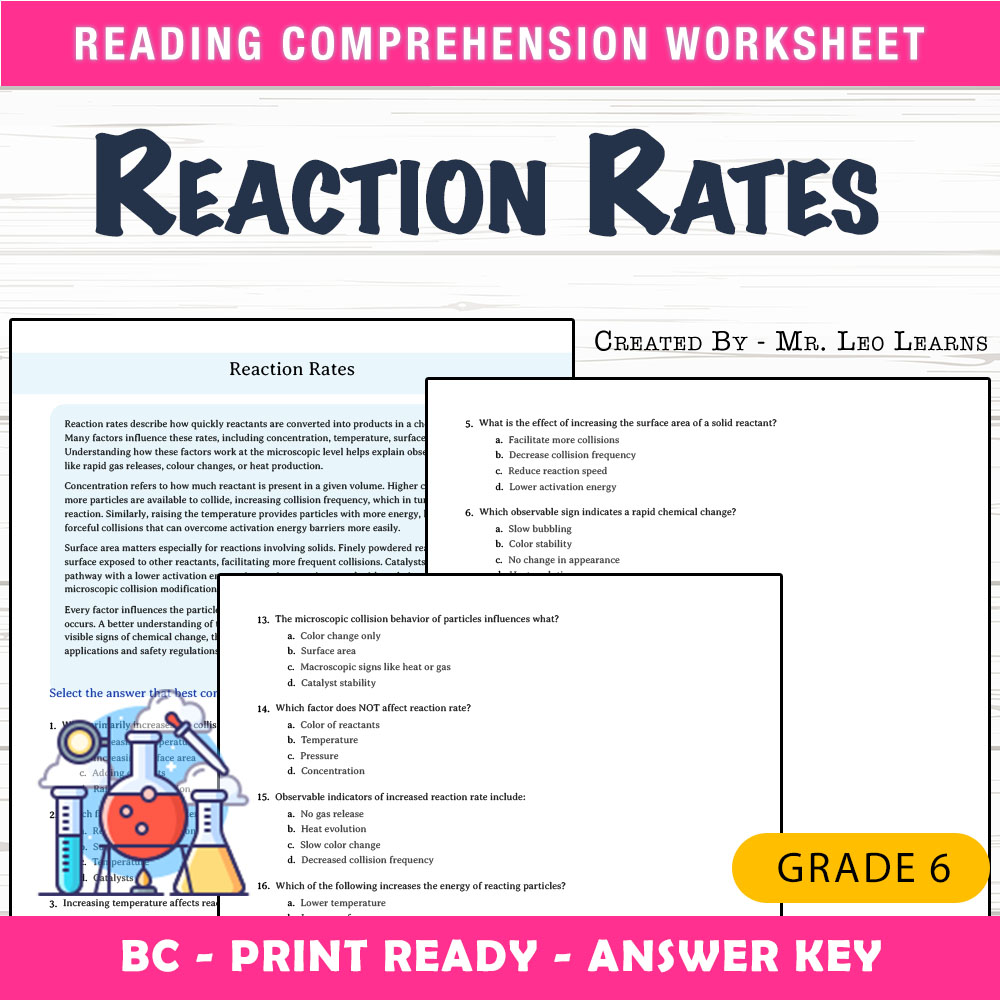
Grade 6 Science — Reaction Rates Worksheet for Mastery
 Created byThe Resource Hub
Learning Objectives
- Understand the factors that influence the speed of chemical reactions.
- Identify how concentration, temperature, surface area, and catalysts affect reaction rates.
- Link microscopic collision behaviors to observable changes during reactions.
Also included in: Grade 6 Science | Matter, Properties & Change Worksheet Bundle (BC Framework) +1 more
Instant download
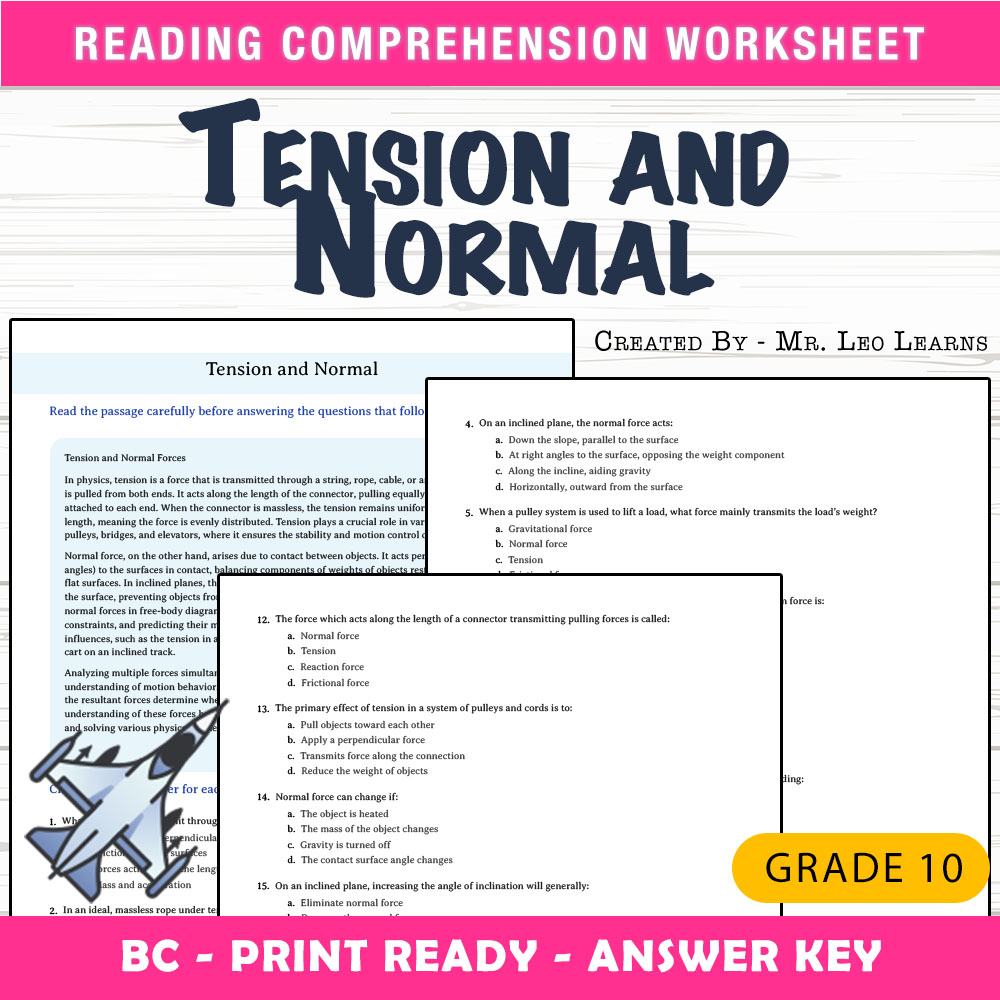
Grade 10 Science — Worksheet MCQ Paper for Mastering Tension and Normal
Created byThe Resource HubLearning Objectives
- Understand how tension transmits forces through connectors and acts along their length.
- Identify the role of normal force in contact situations and on inclines.
- Analyze how combined forces influence the motion and equilibrium of objects.
Also included in: Grade 10 Science | Forces, Motion & Fields UNIT Worksheet Bundle +1 more
Instant download
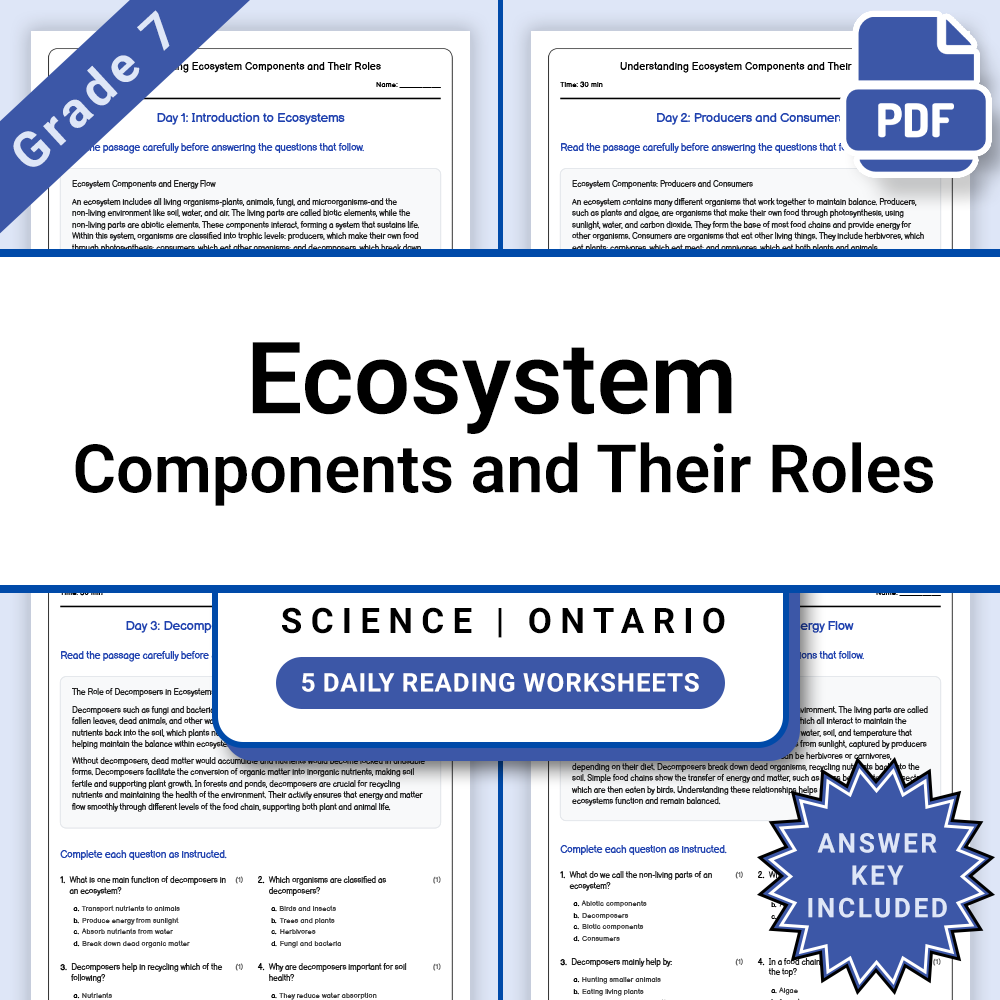
Grade 7 Science – Understanding Ecosystem Components Worksheet + Answer Key
JCreated byJ.S SheetsLearning Objectives
- Define biotic and abiotic components of ecosystems.
- Identify trophic categories: producers, consumers, decomposers.
- Explain how energy flows from sunlight to organic matter.
Also included in: Grade 7 Science Lesson Group Bundle | Ecology & Ecosystems Framework +1 more
Instant download
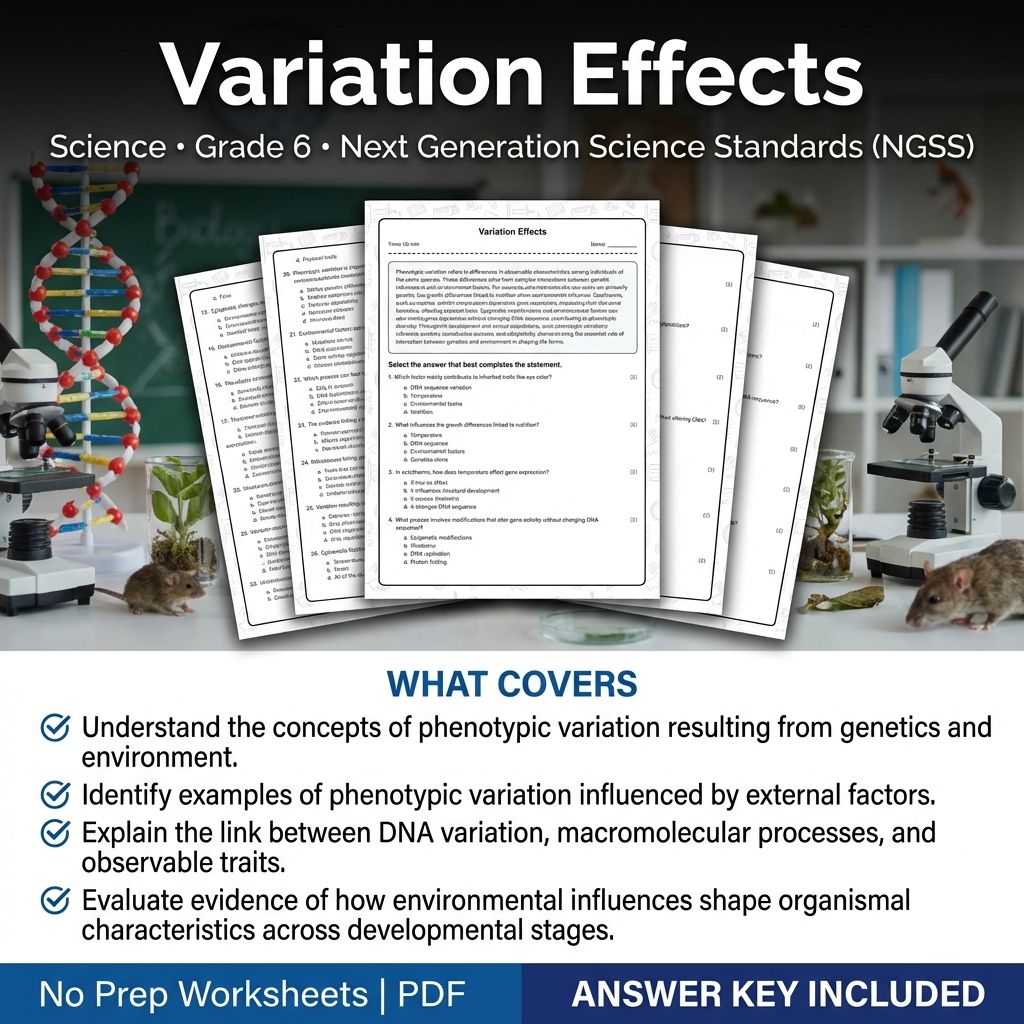
6th Grade Science | Variation Effects Worksheet + Answer Key (Printable PDF)
Created byCoral Reef LearningLearning Objectives
- Understand the concepts of phenotypic variation resulting from genetics and environment.
- Identify examples of phenotypic variation influenced by external factors.
- Explain the link between DNA variation, macromolecular processes, and observable traits.
Instant download
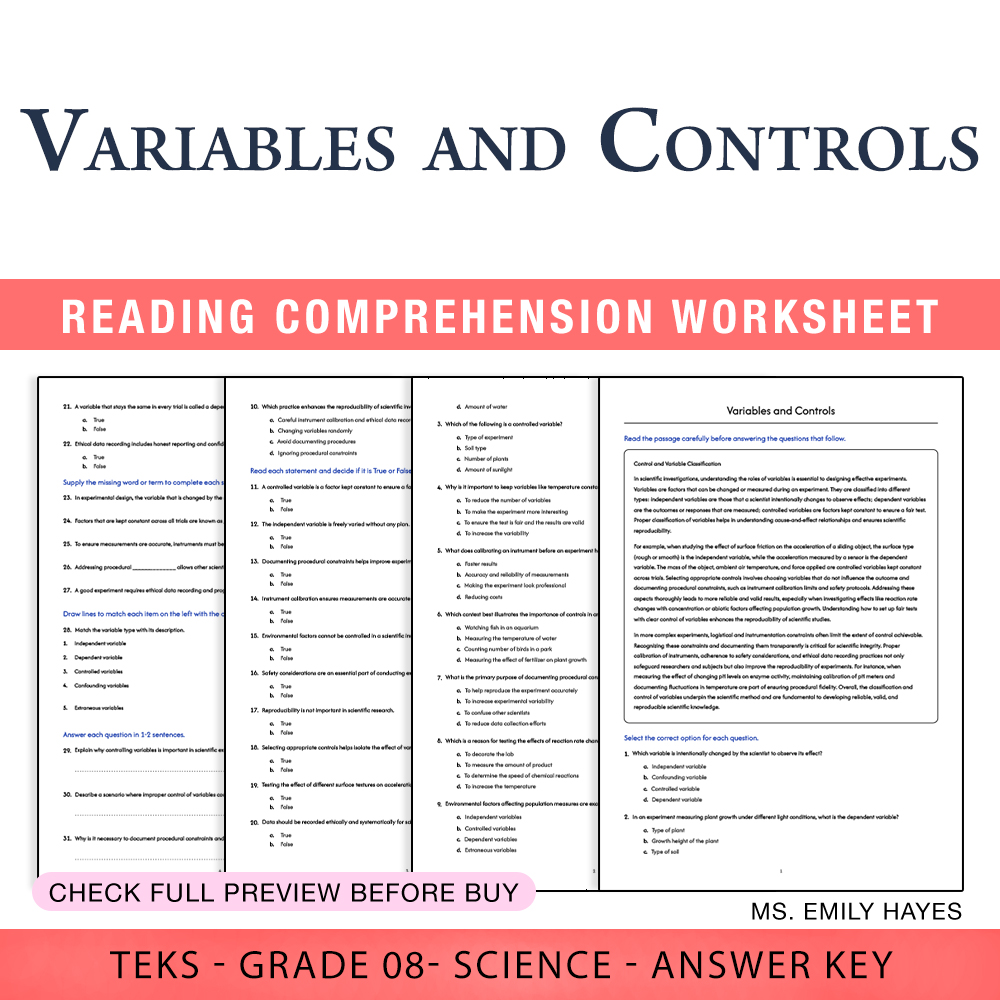
8th Grade Science | Variables and Controls Worksheet (PDF+ Answer Key)
Created byCopper Leaf ClassroomLearning Objectives
- Understand the differences between independent, dependent, and controlled variables in scientific investigations.
- Learn how to establish fair tests by selecting appropriate controls and documenting procedural constraints.
- Identify examples of variables and controls in real-world experiments involving friction, reaction rates, and environmental factors.
Instant download

Pressure Effects and Gas Solubility Assessment for Grade 11 Science | Alberta
 Created byPrism Point Learning
Learning Objectives
- Understand how pressure influences gas solubility based on Henry's law.
- Explain proportionality concepts between pressure and dissolved gas concentration.
- Analyze practical effects of pressure changes on aquatic oxygen levels and gas release.
Also included in: Grade 11 Solutions and Solubility Science Lesson Bundle | Alberta Framework +1 more
Instant download

Saturation States Assessment for Grade 11 Science – Alberta Standards
Created byPrism Point LearningLearning Objectives
- Define and distinguish between unsaturated, saturated, and supersaturated solutions.
- Explain the dynamic equilibrium between dissolved ions and solid phases in solutions.
- Identify natural and industrial examples of saturation states and their effects.
Also included in: Grade 11 Solutions and Solubility Science Lesson Bundle | Alberta Framework +1 more
Instant download

Percent Concentrations Assessment | Alberta Standards Grade 11 Science
Created byPrism Point LearningLearning Objectives
- Understand different units of percent concentration and their calculations.
- Interpret and convert between mass percent, volume percent, and parts per million.
- Apply concentration concepts to real-world examples such as salt solutions and trace metals.
Also included in: Grade 11 Solutions and Solubility Science Lesson Bundle | Alberta Framework +1 more
Instant download

Solubility Factors Assessment | Alberta Grade 11 Science Standards
Created byPrism Point LearningLearning Objectives
- Understand how intermolecular forces influence solubility.
- Analyze the effects of temperature and pressure on solubility.
- Differentiate between polar and nonpolar interactions in dissolution processes.
Also included in: Grade 11 Solutions and Solubility Science Lesson Bundle | Alberta Framework +1 more
Instant download

Industrial Impacts Assessment | Alberta Standards Grade 11 Science
Created byPrism Point LearningLearning Objectives
- Understand how dissolved ions, temperature changes, and organic contaminants influence solubility and scale formation in industrial water systems.
- Explain the conceptual pathways linking water chemistry to operational challenges in Alberta's industrial and municipal contexts.
- Interpret chemical data to predict environmental and infrastructure consequences related to impurities and solubility equilibria.
Also included in: Grade 11 Solutions and Solubility Science Lesson Bundle | Alberta Framework +1 more
Instant download

Energy Concepts Assessment | Advanced Placement Standards-Based Assessment Grade 11 Science
Created byPrism Point LearningLearning Objectives
- Define and distinguish between work, kinetic energy, and potential energy.
- Explain the principle of energy conservation in closed systems.
- Identify conservative and nonconservative forces with examples.
Instant download
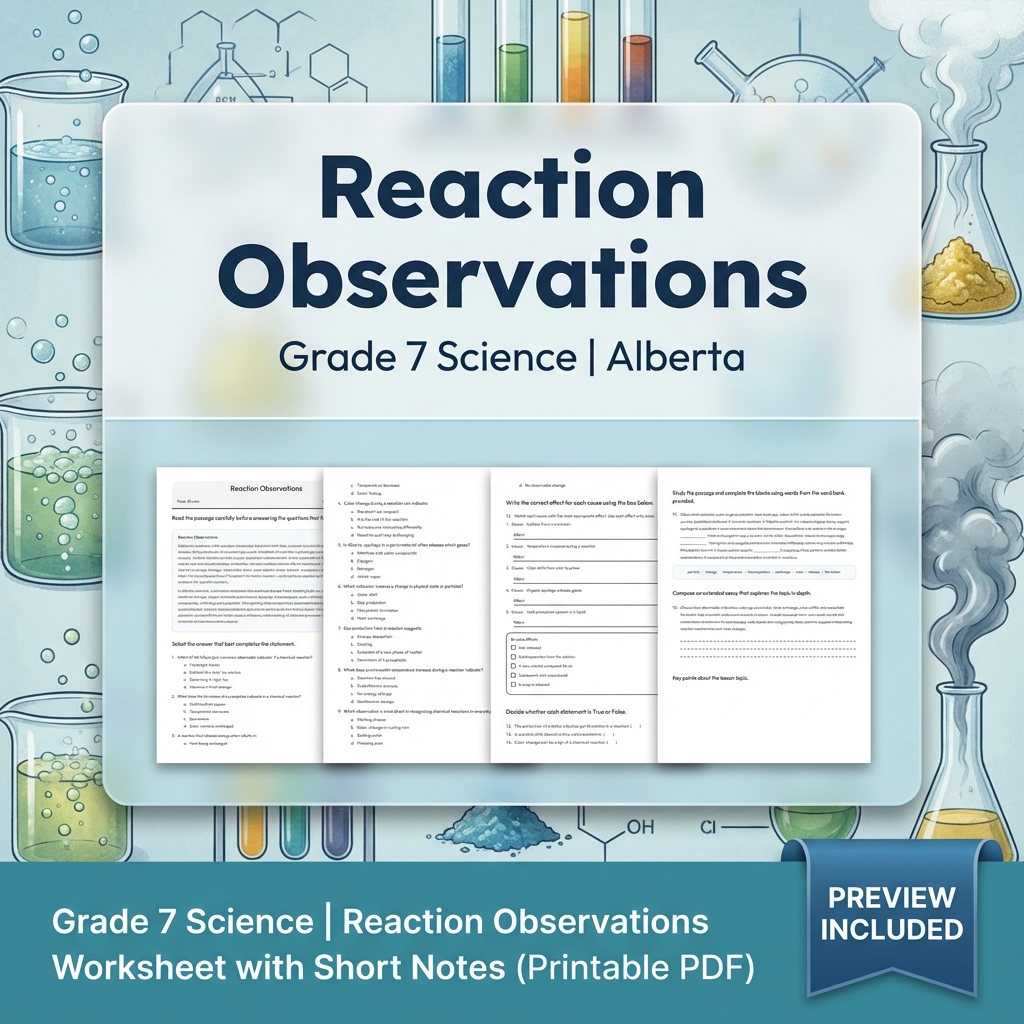
Grade 7 Science | Reaction Observations Worksheet with Short Notes (PDF)
Created byMeadowlark WorksheetsLearning Objectives
- Identify observable indicators of chemical reactions such as gas production, heat exchange, colour shifts, and precipitate formation.
- Explain how qualitative evidence supports understanding of reaction types and extents.
- Connect observational patterns to reaction pathways and particle interactions.
Also included in: Grade 7 Science | Matter & Chemical Change UNIT Worksheet Bundle
Instant download
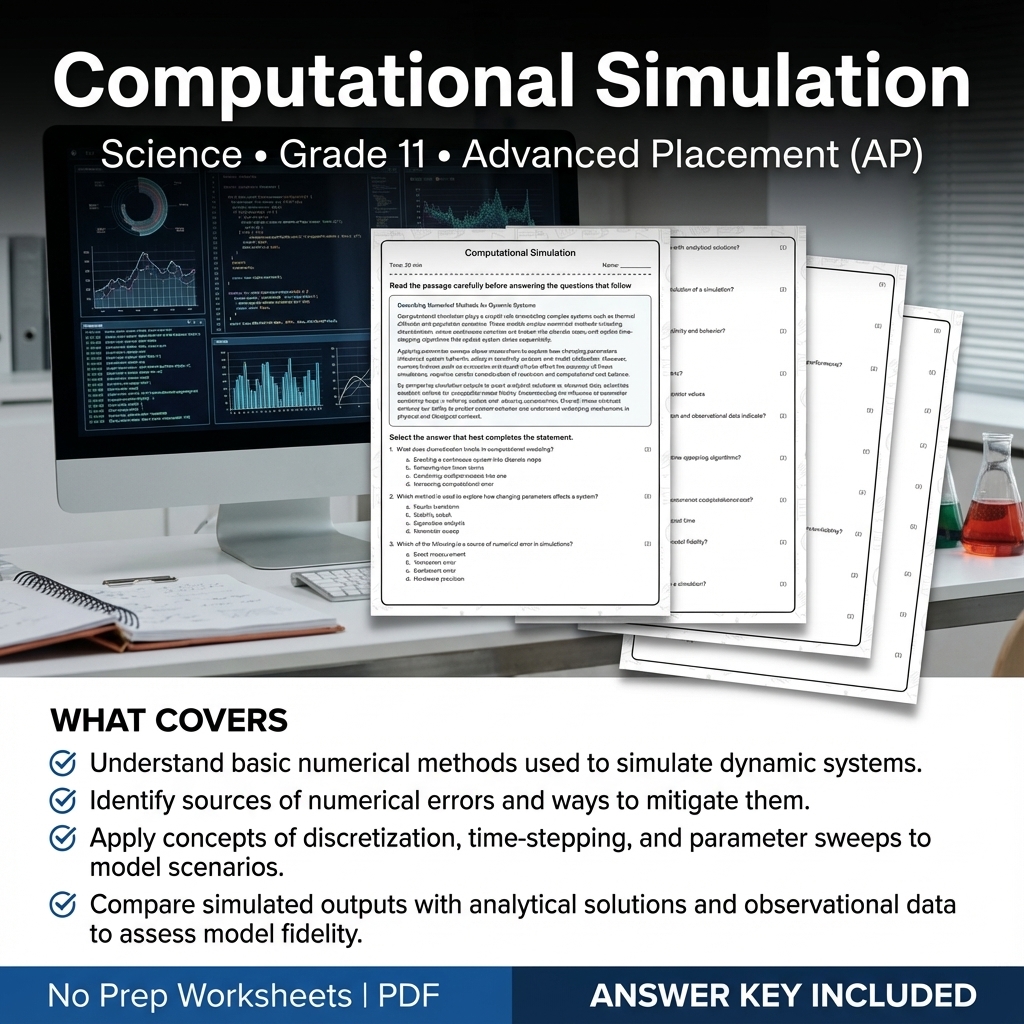
Grade 11 Science | Computational Simulation Worksheet (Printable PDF + Answer Key)
Created byCoral Reef LearningLearning Objectives
- Understand basic numerical methods used to simulate dynamic systems.
- Identify sources of numerical errors and ways to mitigate them.
- Apply concepts of discretization, time-stepping, and parameter sweeps to model scenarios.
Also included in: Grade 11 Science Unit | Scientific Analysis & Data Skills Worksheet Pack +1 more
Instant download

Grade 11 Science | Mineral Deposits Worksheet (BC Standards) (PDF)
 Created byEvergreen Desk Education
Learning Objectives
- Explain how different geological processes form major types of mineral deposits.
- Compare deposit types using factors such as host rock, depth, and accessibility.
- Evaluate how extraction methods can influence environmental impacts and post-extraction landscapes.
Instant download

Relative Motion Worksheet | Science Practice for Grade 9 | Alberta Standards
JCreated byJ.S SheetsLearning Objectives
- Understand how different frames of reference affect observed velocity and displacement.
- Describe vector addition of velocities in various scenarios.
- Explain how choice of reference frame influences apparent motion and acceleration.
Also included in: Grade 9 Newtonian Motion & Energy Science Lesson Bundle | Alberta
Instant download

Polyprotic Systems Worksheet | Alberta Grade 11 Science Assessment
JCreated byJ.S SheetsLearning Objectives
- Understand the dissociation steps and constants of polyprotic acids.
- Interpret titration curves involving polyprotic acids and buffers.
- Calculate stepwise dissociation, cumulative acidity, and analyze environmental relevance of carbonate and phosphate systems.
Instant download
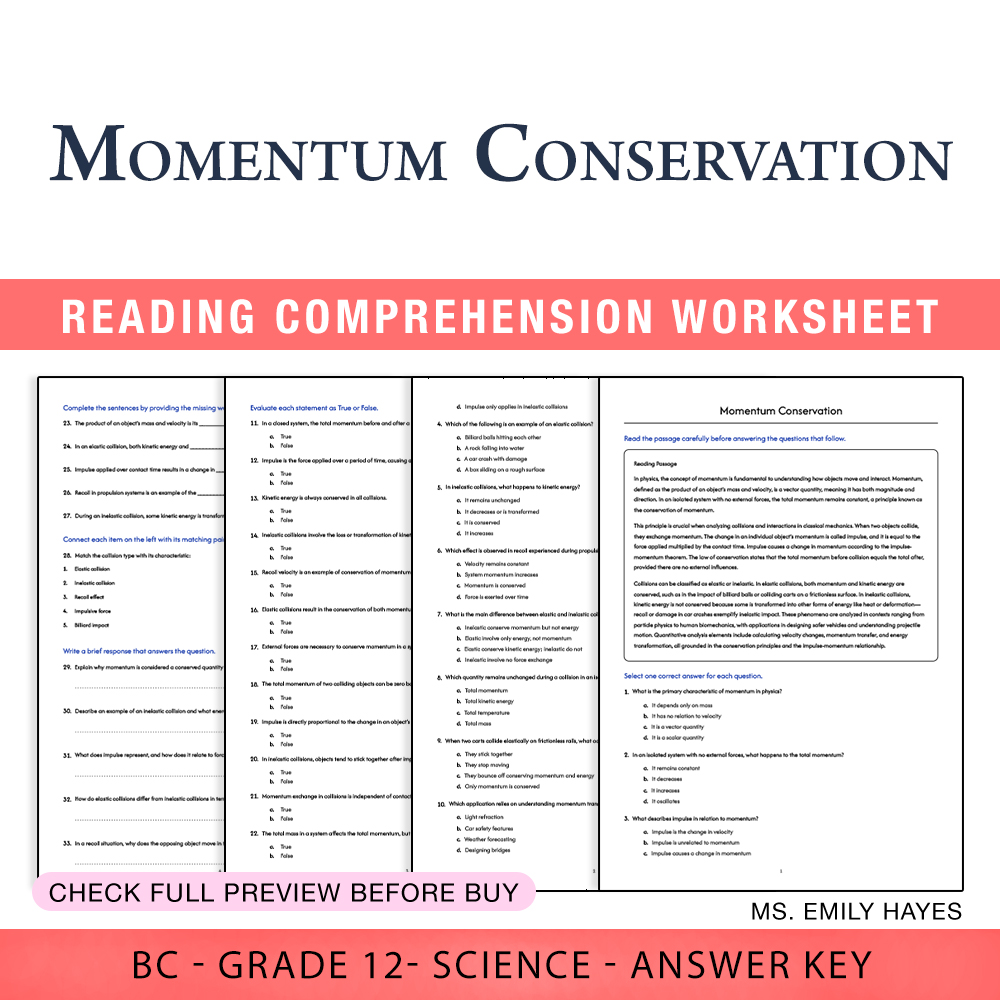
Grade 12 Science | Momentum Conservation Worksheet (PDF+ Answer Key)
Created byCopper Leaf ClassroomLearning Objectives
- Explain the principle of conservation of linear momentum in isolated systems.
- Define momentum and impulse, and describe their relationship.
- Differentiate between elastic and inelastic collisions through momentum and energy analysis.
Also included in: Grade 12 Science BC– Physics, Quantum, and Energy Concepts (PDF+ Answer Keys) +1 more
Instant download

Adaptation Strategies Worksheet for AP Science Grade 10 with Answer Key
Created byBright Quill ResourcesLearning Objectives
- Evaluate trade-offs among carbon management, engineered resilience, conservation, and land-use policy in Earth systems
- Use systems thinking and scenario comparisons to predict potential effectiveness and unintended consequences of adaptation strategies
- Apply cost-benefit reasoning and uncertainty analysis to judge scalable interventions and monitoring needs
Instant download
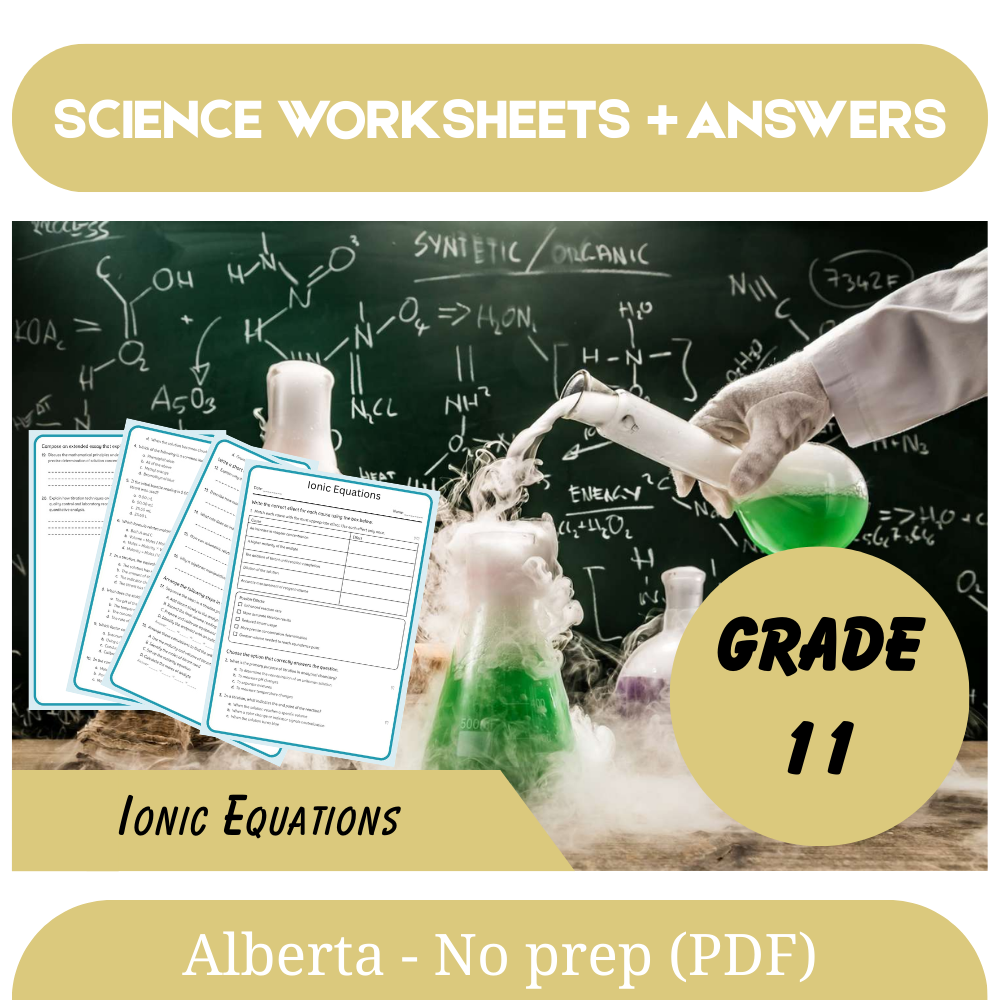
Grade 11 Science – Ionic Equations Worksheet (PDF) – Alberta Standards
Created byBright Mind ResourcesLearning Objectives
- Understand the concept of ionic equations and how they represent chemical reactions in aqueous solutions.
- Identify and distinguish between complete and net ionic equations, recognizing spectator ions.
- Apply solubility rules and charge balance principles to write and simplify ionic equations.
Instant download
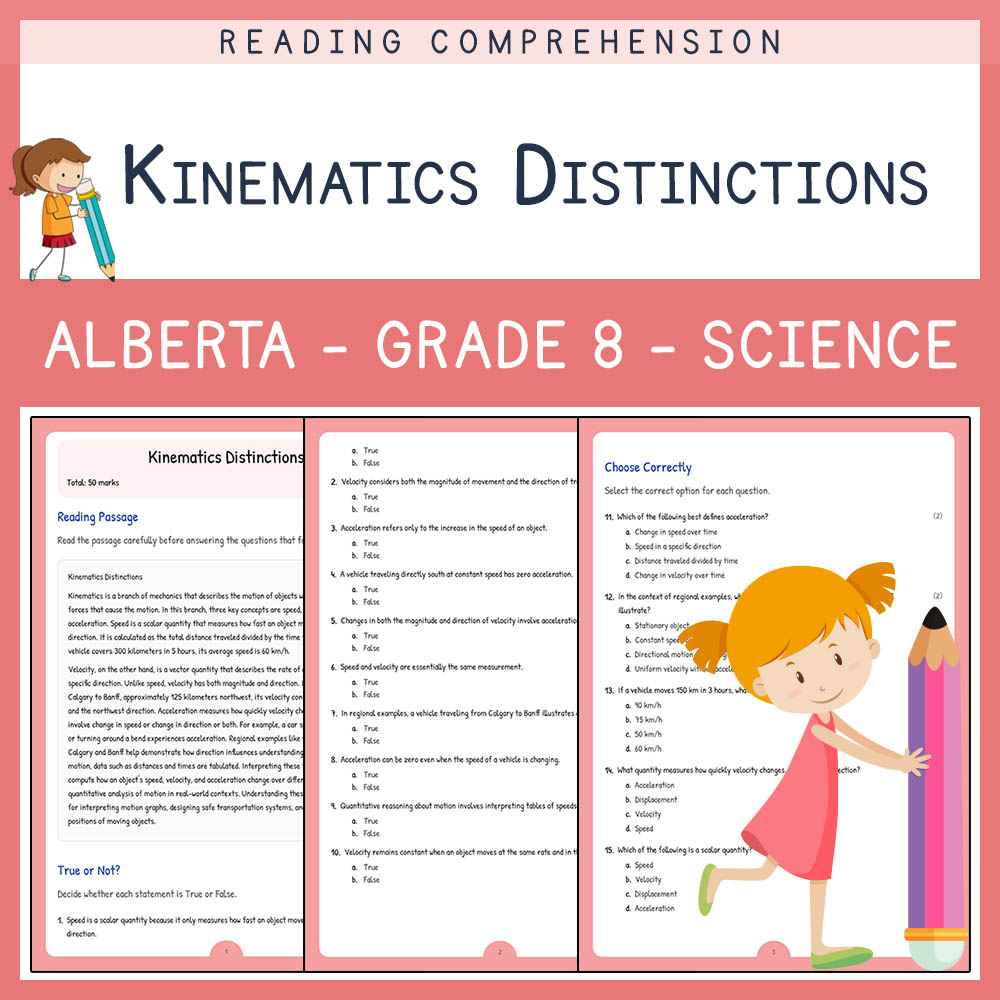
Grade 8 Science | Kinematics Distinctions Worksheet | Alberta Standard
Created byLumora LearningLearning Objectives
- Define speed, velocity, and acceleration with precision and differentiate their characteristics.
- Illustrate examples of motion, such as vehicle travel between regions, to understand directional and non-directional movement.
- Interpret data from tables of distances and times to analyze changing magnitudes and directions of motion.
Instant download
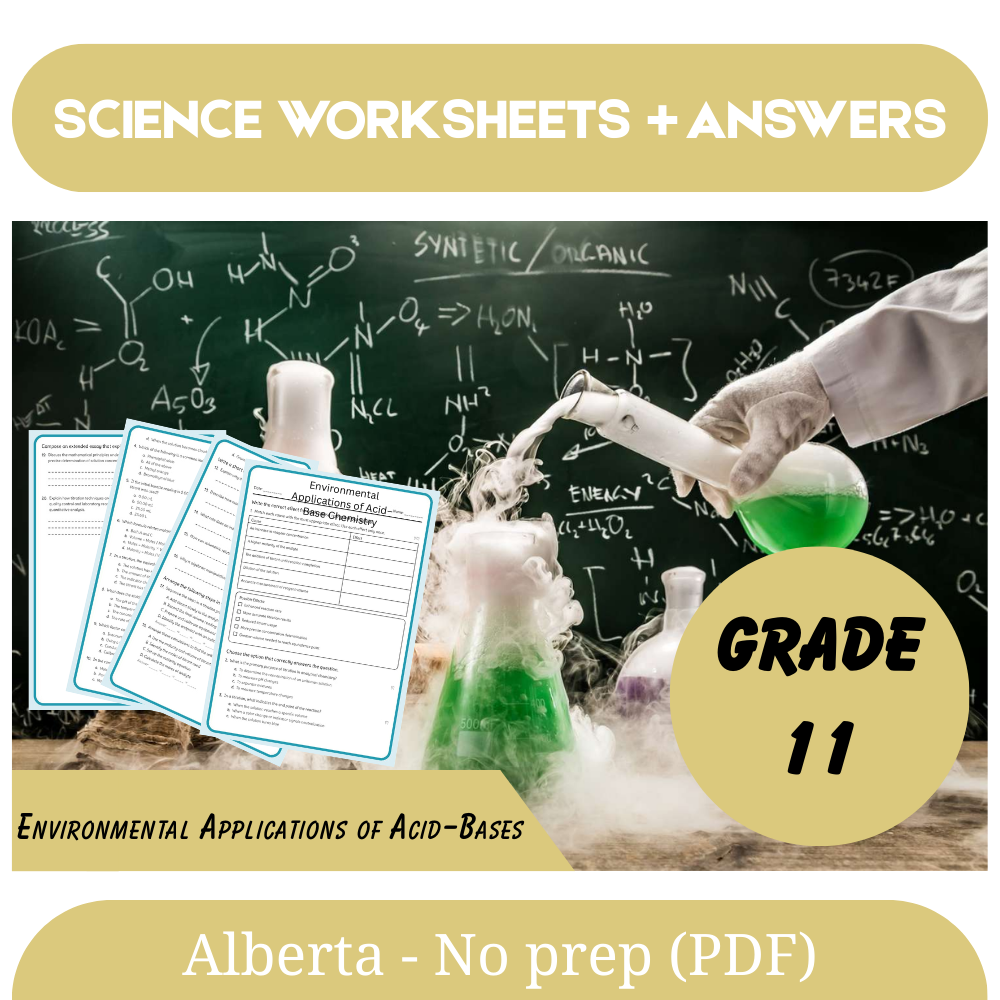
Grade 11 Science | Environmental Applications of Acid–Base Chemistry Worksheet (PDF)
Created byBright Mind ResourcesLearning Objectives
- Understand how acid–base reactions are applied in environmental management practices.
- Analyze pH data and stoichiometric calculations related to neutralization processes.
- Evaluate buffer systems and their roles in maintaining environmental stability.
Instant download
Browse more categories
About Science Worksheets
Find Science worksheets spanning core skills, practice, and review. All 44,295 resources are instant PDF downloads for the classroom or home.
Every worksheet on MyTeachingSheets is created by independent teacher-authors and reviewed before publication. All resources download as printable PDFs for classroom, homework, or at-home practice, and many include answer keys. Preview any worksheet free before buying.