
Science Worksheets
42,859 subject resources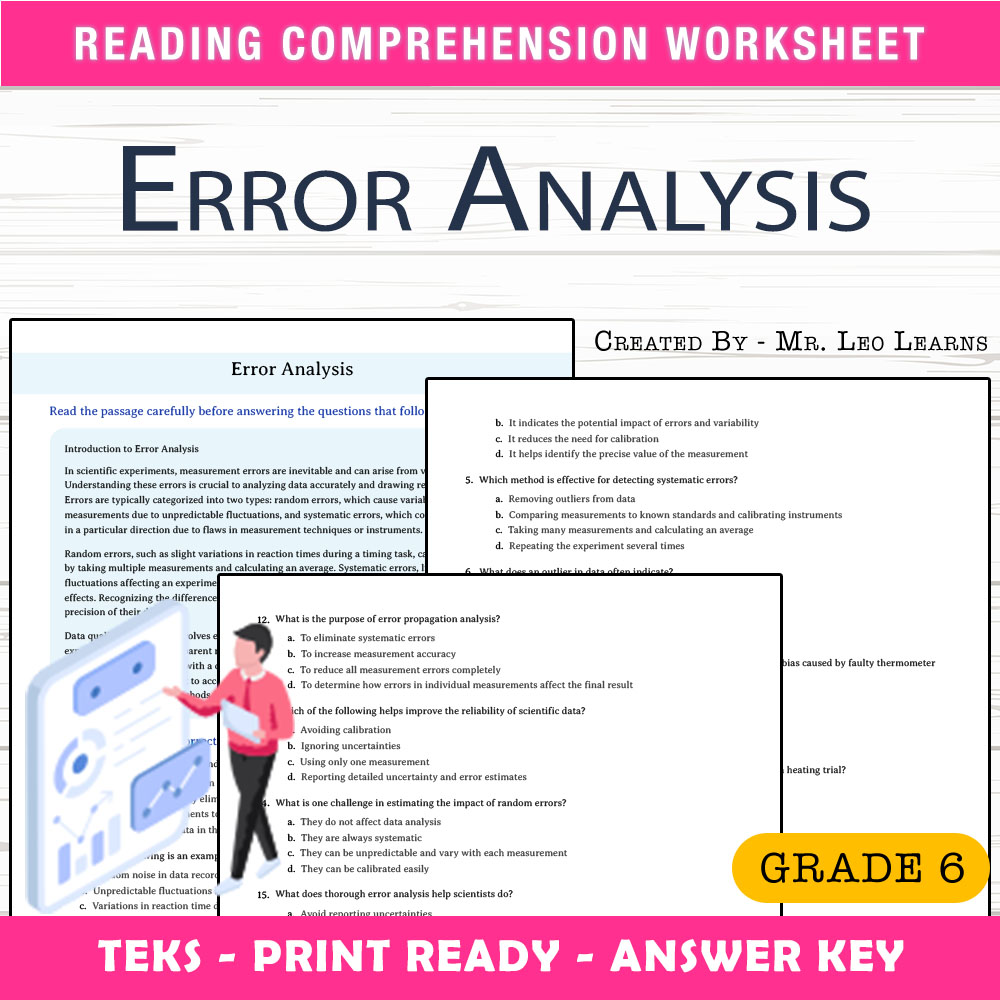
Grade 6 Science – Error Analysis Worksheet for Mastery
 Created byThe Resource Hub
Learning Objectives
- Understand the different types of measurement errors and their sources.
- Learn to distinguish between random and systematic errors in data collection.
- Develop skills to evaluate the impact of measurement errors on scientific conclusions.
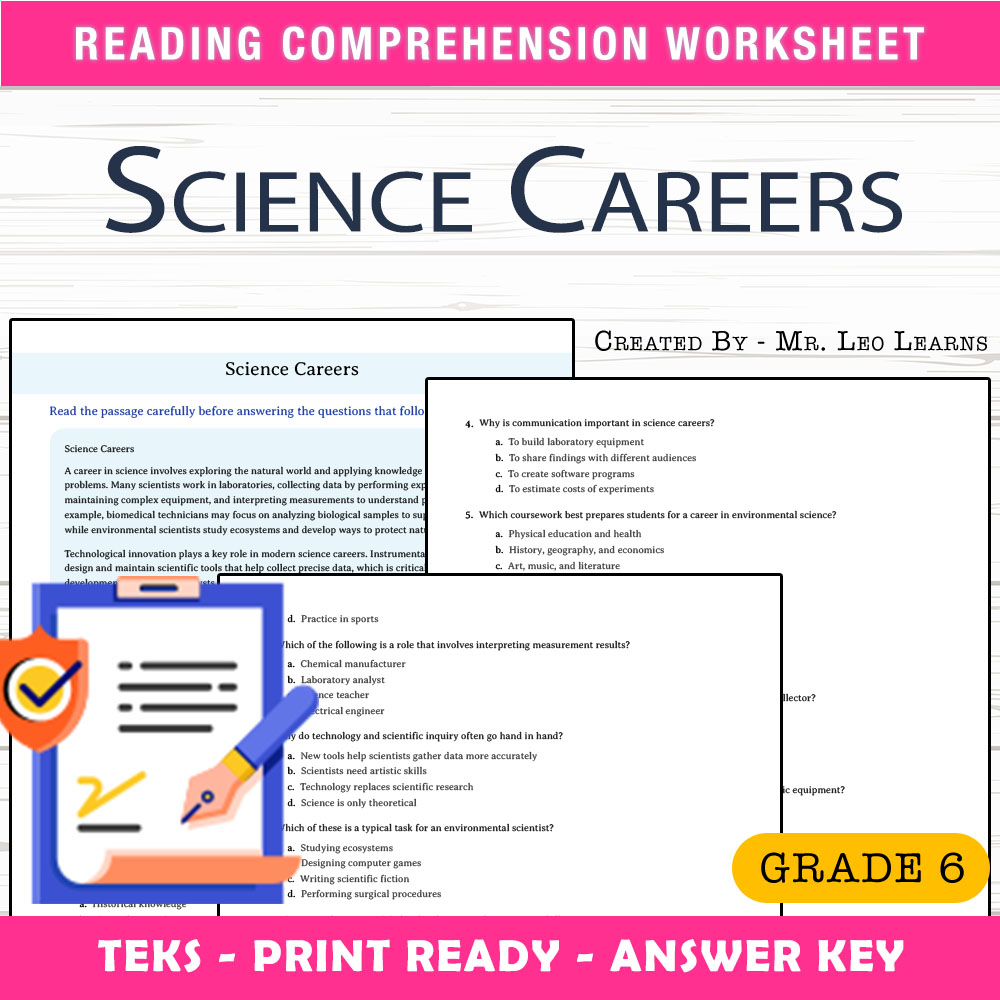
Grade 6 Science — Science Careers Worksheet for Mastery
Created byThe Resource HubLearning Objectives
- Identify various science-related occupations and their primary tasks.
- Understand the skills and coursework necessary for careers in science.
- Explore how scientific inquiry leads to technological innovations.
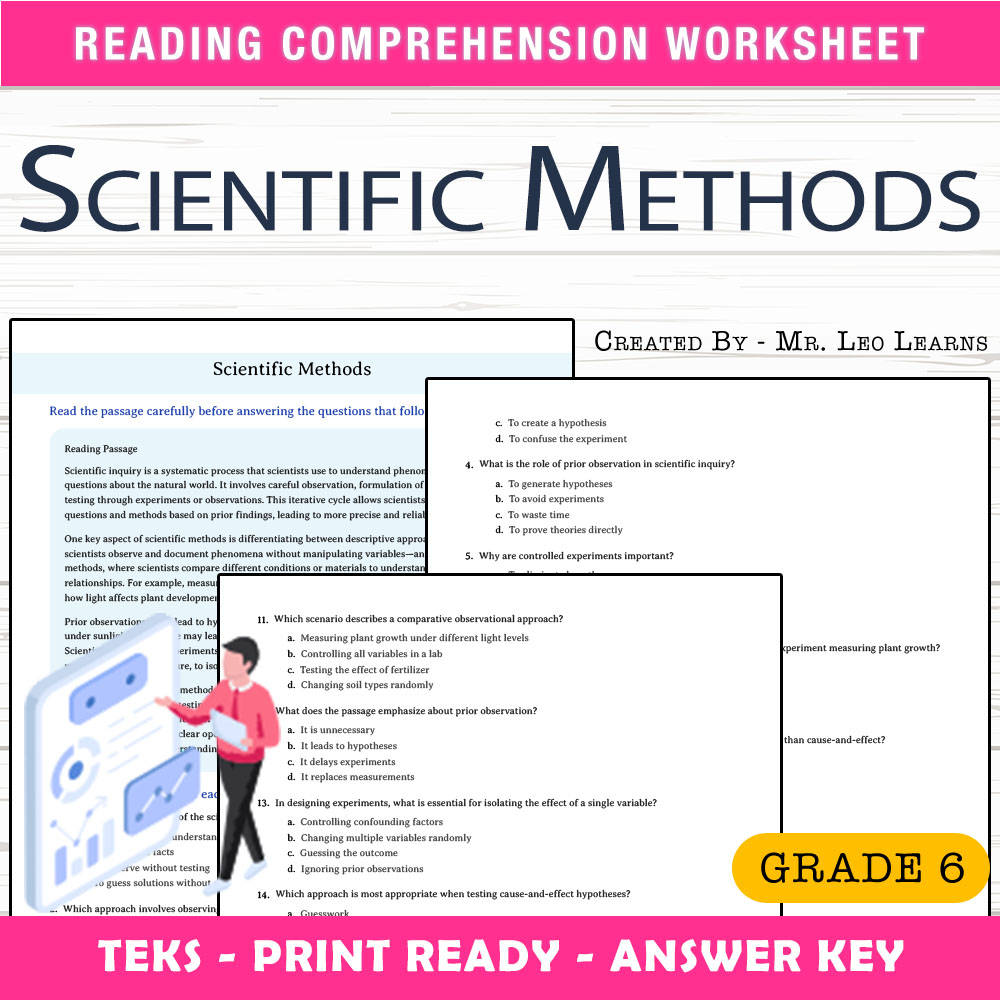
Grade 6 Science – Scientific Methods Worksheet for Mastering Inquiry Skills
Created byThe Resource HubLearning Objectives
- Understand the iterative process of scientific inquiry and how to formulate testable questions.
- Differentiate between descriptive and comparative approaches in scientific experiments.
- Identify the relationship between prior observations, hypotheses, and methodological choices.
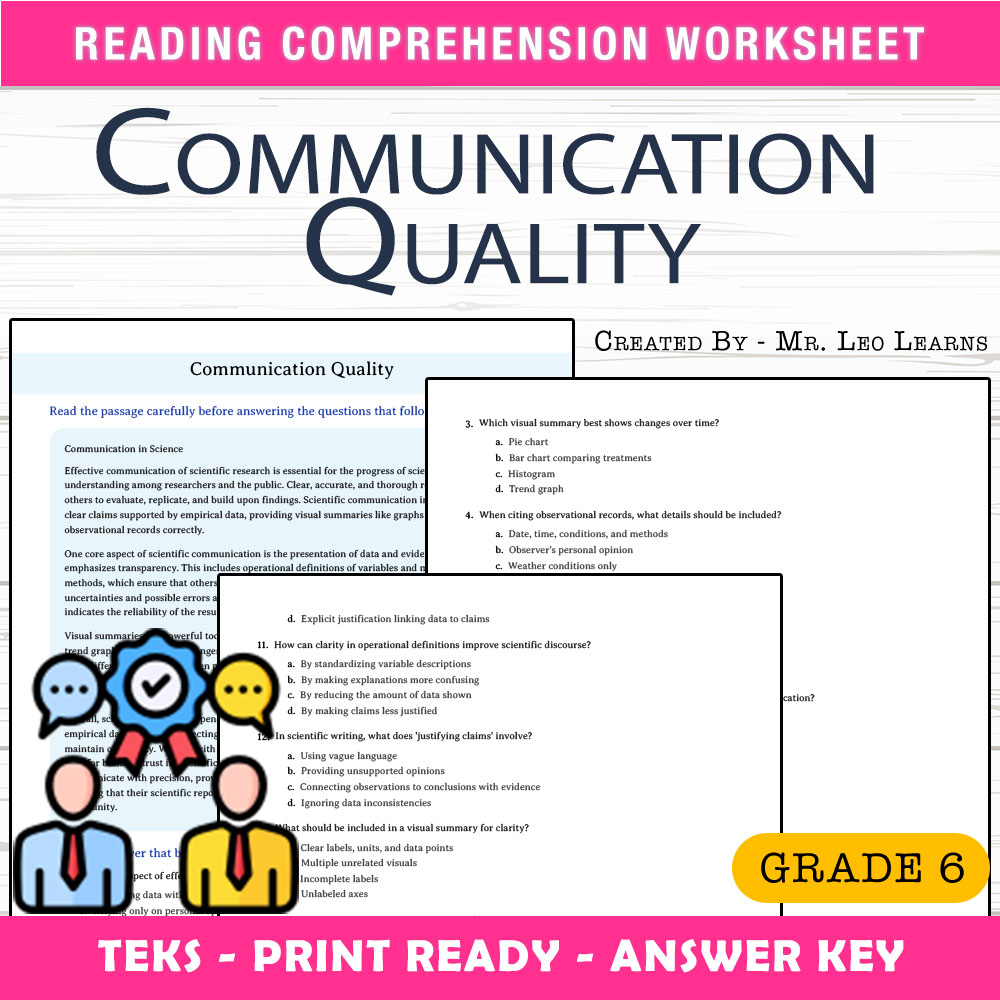
Grade 6 Science – Communication Quality Worksheet for Mastery
Created byThe Resource HubLearning Objectives
- Understand the standards for accurately communicating scientific findings including claims, evidence, and reasoning.
- Learn to create clear visual summaries, cite observational records, and justify conclusions linking data and explanations.
- Develop skills to present relationships from data trends and compare measurements across different treatments.
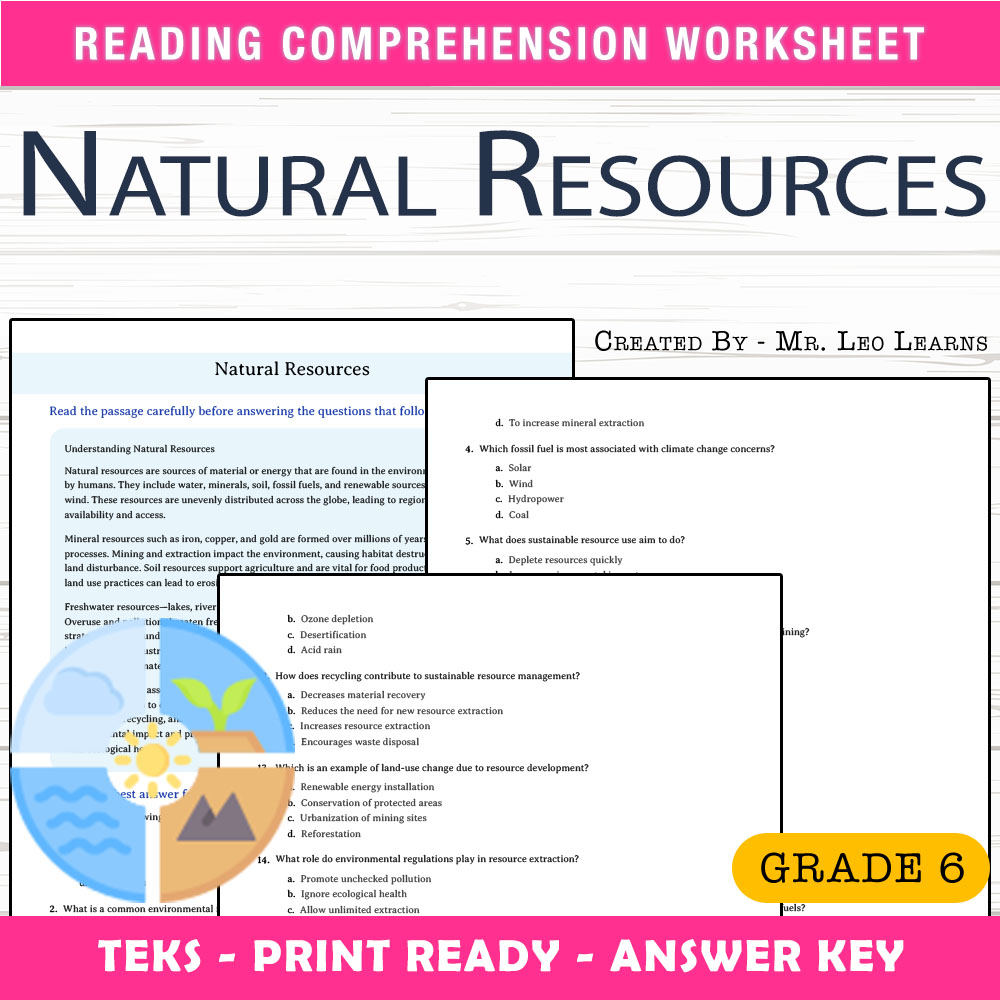
Grade 6 Science – Natural Resources Worksheet for Mastery
Created byThe Resource HubLearning Objectives
- Understand different types of natural resources and their formation.
- Analyze the economic, environmental, and regional implications of resource use.
- Evaluate sustainable practices and trade-offs in resource management.
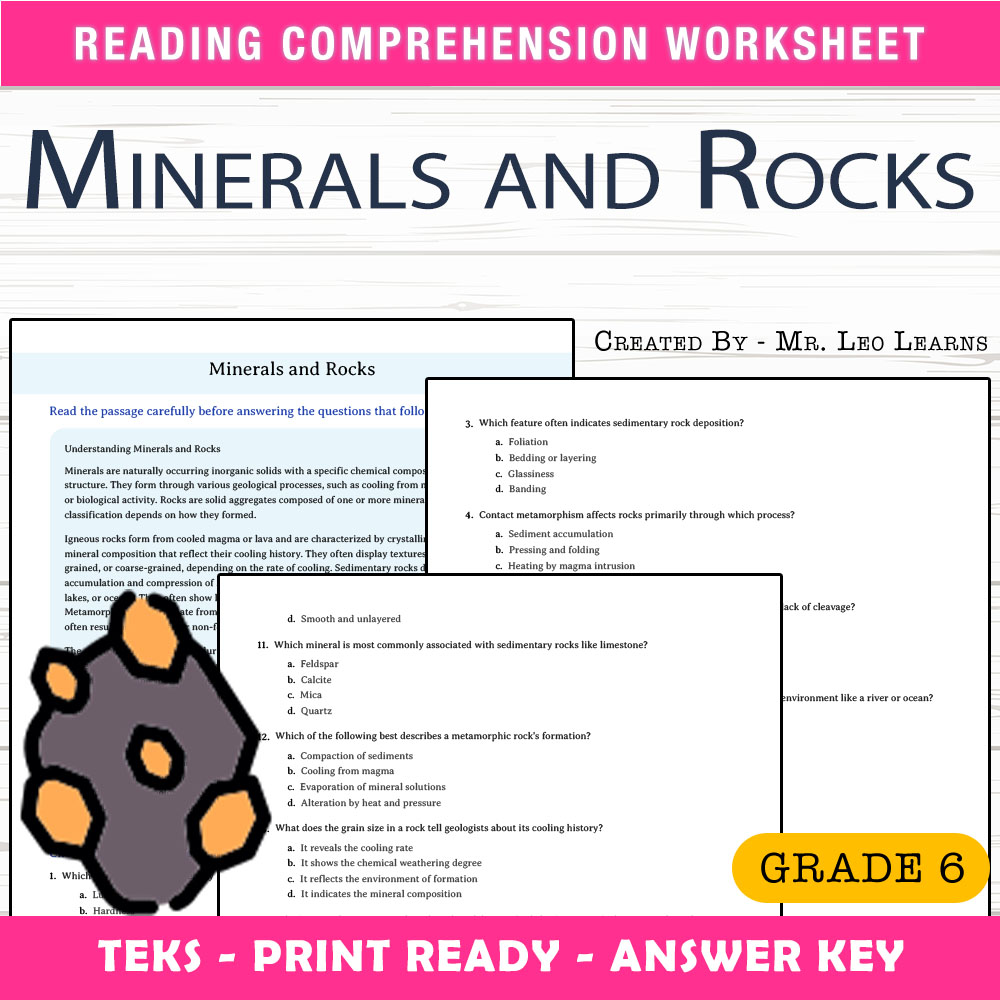
Grade 6 Science — Minerals and Rocks Worksheet for Mastery
Created byThe Resource HubLearning Objectives
- Identify common minerals and rocks based on physical and chemical properties.
- Classify rocks into igneous, sedimentary, and metamorphic categories using textural and compositional criteria.
- Describe the formation environments of different rock types and their features.
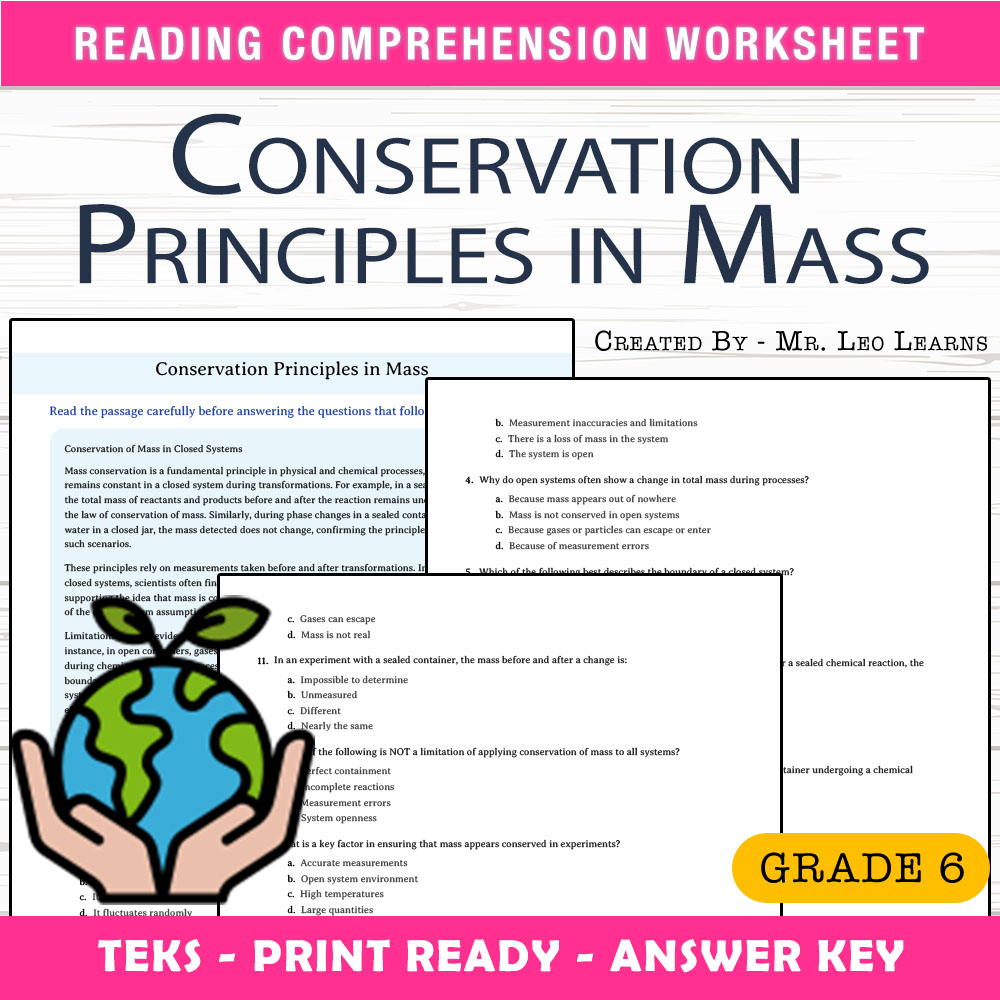
Grade 6 Science – Conservation Principles in Mass Worksheet for Mastery
Created byThe Resource HubLearning Objectives
- Understand the concept of mass conservation in closed systems during physical and chemical changes.
- Identify examples of processes where mass is conserved and recognize limitations in open systems.
- Interpret measurements before and after transformations to draw conclusions about conservation.
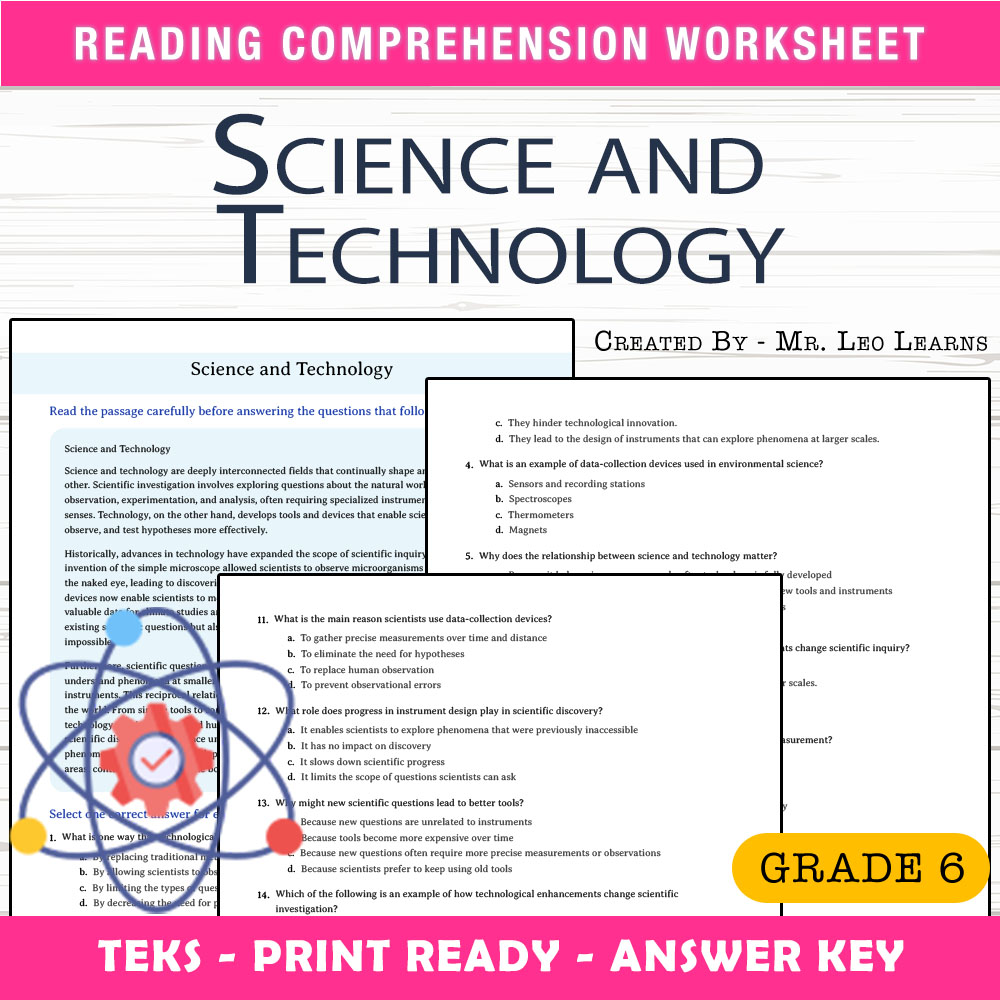
Grade 6 Science — Science and Technology Worksheet for Mastery
Created byThe Resource HubLearning Objectives
- Understand the reciprocal relationship between scientific investigation and technological development.
- Learn how instruments and tools extend observation and measurement in science.
- Identify examples of scientific instruments such as microscopes, sensors, and data collection devices.
Grade 6 Science – Societal Impacts Worksheet for Mastery
Created byThe Resource HubLearning Objectives
- Analyze how scientific findings influence societal change through public health, environment, and resource management.
- Evaluate evidence and trade-offs in societal decision-making based on scientific data.
- Identify indicators used to assess the effectiveness of societal measures related to science.
Grade 6 Science — Atmospheric Patterns Worksheet for Mastery
Created byThe Resource HubLearning Objectives
- Understand the components and structure of Earth's atmosphere.
- Recognize how air masses and pressure systems influence regional weather.
- Explain the concepts of fronts, prevailing winds, and climate classification.
Grade 8 Science — Energy Metabolism Worksheet for Mastery
Created byThe Resource HubLearning Objectives
- Understand the stages of aerobic respiration, including glycolysis, Krebs cycle, and oxidative phosphorylation.
- Describe the role of mitochondria and membrane proton gradients in ATP production.
- Contrast aerobic and anaerobic energy pathways and their efficiencies.
Grade 8 Science — Energy Forms in Mechanical Systems Worksheet
Created byThe Resource HubLearning Objectives
- Describe different types of energy present in mechanical systems, specifically kinetic and potential energy.
- Explain how energy transforms between potential and kinetic forms during movement.
- Identify common sinks of energy such as thermal and acoustic energy and their effects on systems.
Grade 6 Science – Communicating Evidence Worksheet for Mastery
Created byThe Resource HubLearning Objectives
- Understand core strategies for effectively communicating scientific evidence.
- Learn how to select relevant data and construct logical arguments.
- Recognize different formats for presenting scientific information, including oral, written, and visual methods.
Grade 6 Science – Community Stewardship & Scientific Engagement Worksheet
Created byThe Resource HubLearning Objectives
- Understand the role of scientific methods in addressing local community issues.
- Identify best practices for respectful and ethical data collection from communities.
- Learn strategies for effective communication of scientific findings to non-expert audiences.
Grade 6 Science — Quantitative Circuits Worksheet for Mastery
Created byThe Resource HubLearning Objectives
- Understand the relationship between voltage, current, and resistance in electrical circuits.
- Apply proportional reasoning to predict how changes in resistance affect current in a circuit.
- Calculate unknown circuit parameters using measured values and basic formulas.
Grade 8 Science – Aquifer Dynamics Worksheet for Mastery
Created byThe Resource HubLearning Objectives
- Understand the structure and function of aquifers and groundwater flow systems.
- Identify key properties such as porosity, permeability, and hydraulic head.
- Describe the differences between confined and unconfined aquifers, recharge, and discharge zones.
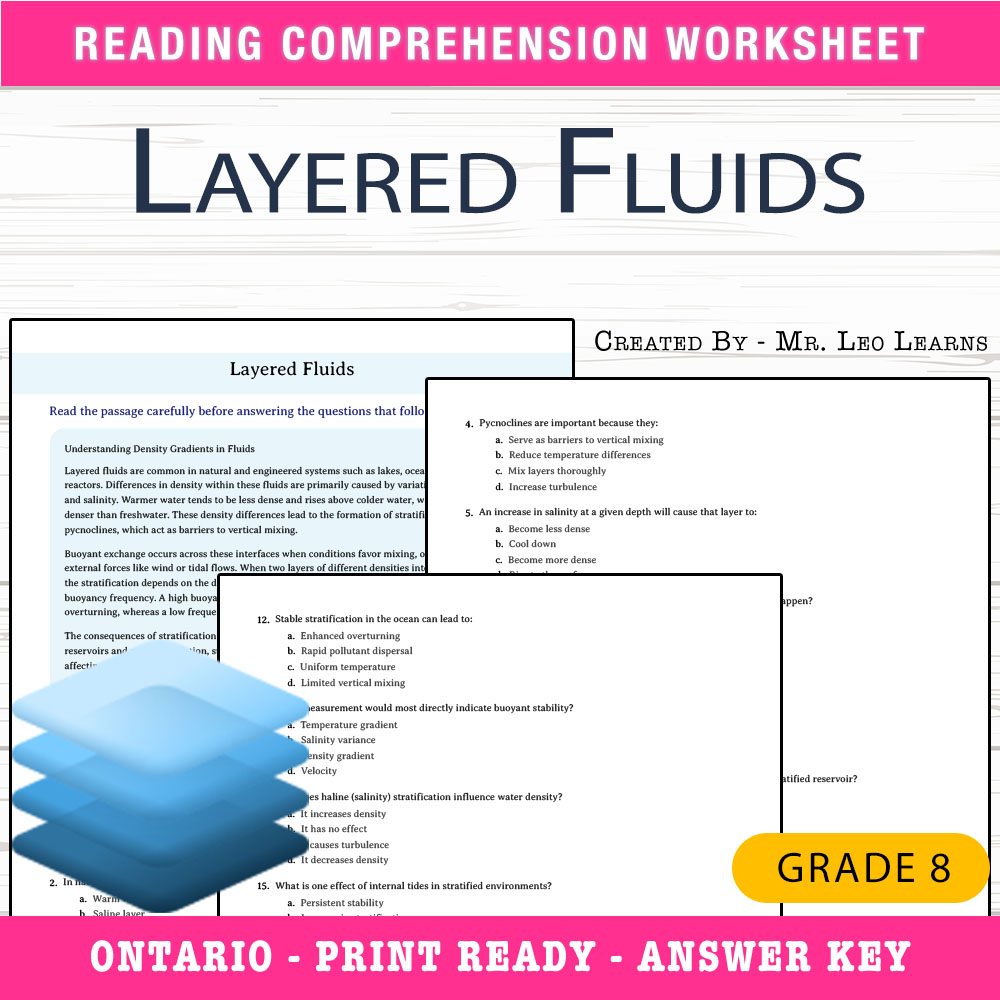
Grade 8 Science — Layered Fluids Worksheet for Mastering Fluid Stratification
Created byThe Resource HubLearning Objectives
- Understand how temperature and salinity influence fluid density and create stratification in natural and engineered environments.
- Analyze the stability regimes resulting from density differences and their effects on vertical mixing and pollutant dispersion.
- Interpret density profiles and buoyancy frequency to evaluate conditions promoting or suppressing overturning in stratified fluids.
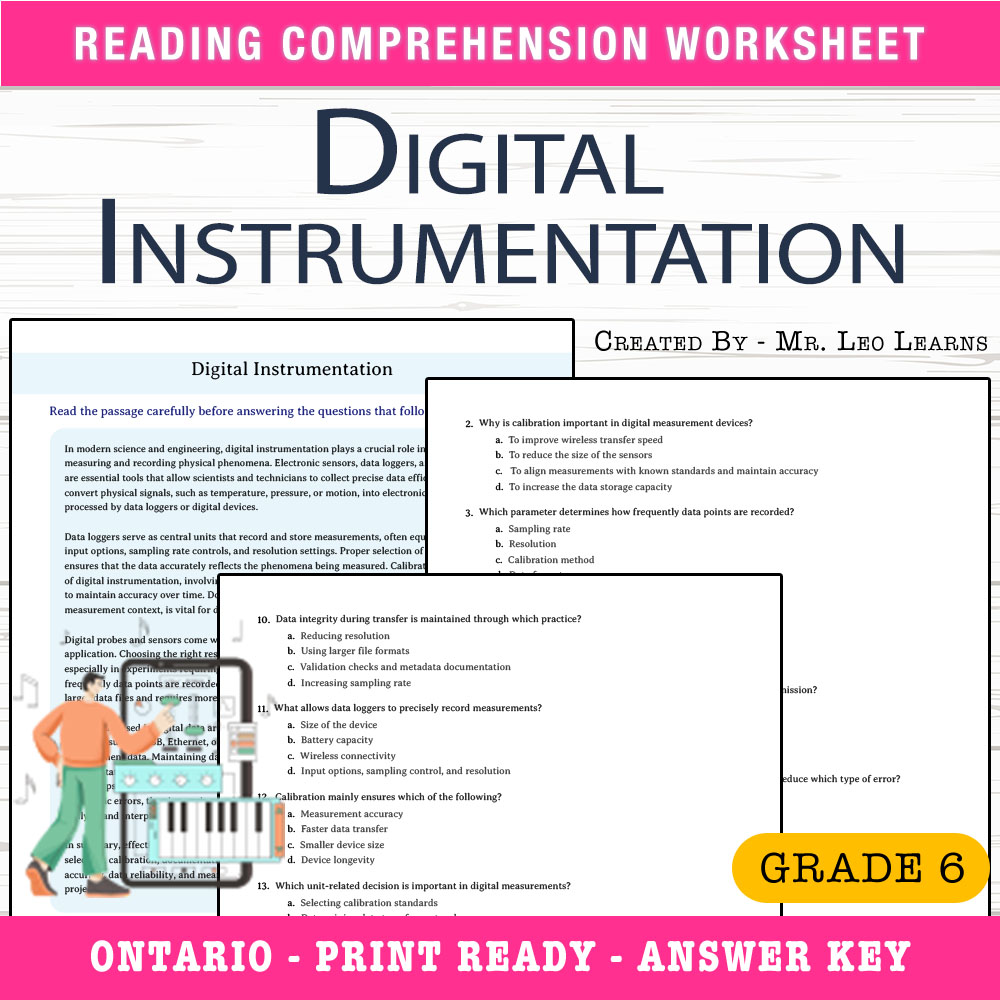
Grade 6 Science — Digital Instrumentation Worksheet for Mastery
Created byThe Resource HubLearning Objectives
- Understand the components and functions of electronic sensors, data loggers, and digital probes.
- Learn proper calibration procedures and importance of metadata documentation for accurate measurements.
- Recognize the significance of sampling rate, resolution, units, and data transfer protocols in data collection.
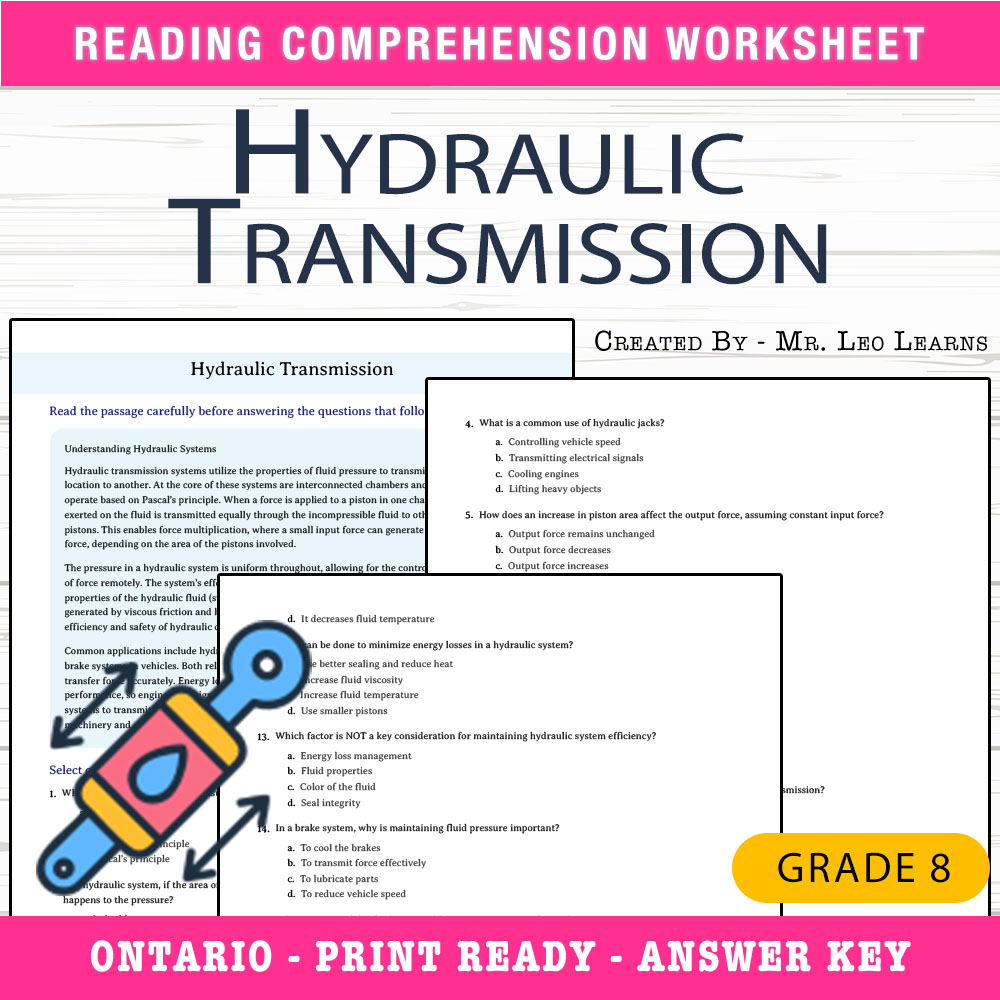
Grade 8 Science | Hydraulic Transmission Worksheet for Mastery
Created byThe Resource HubLearning Objectives
- Understand the principles of fluid-force transmission using Pascal's law.
- Explain how input force and piston area influence output force in hydraulic systems.
- Identify applications of hydraulic systems such as jacks and brake mechanisms.
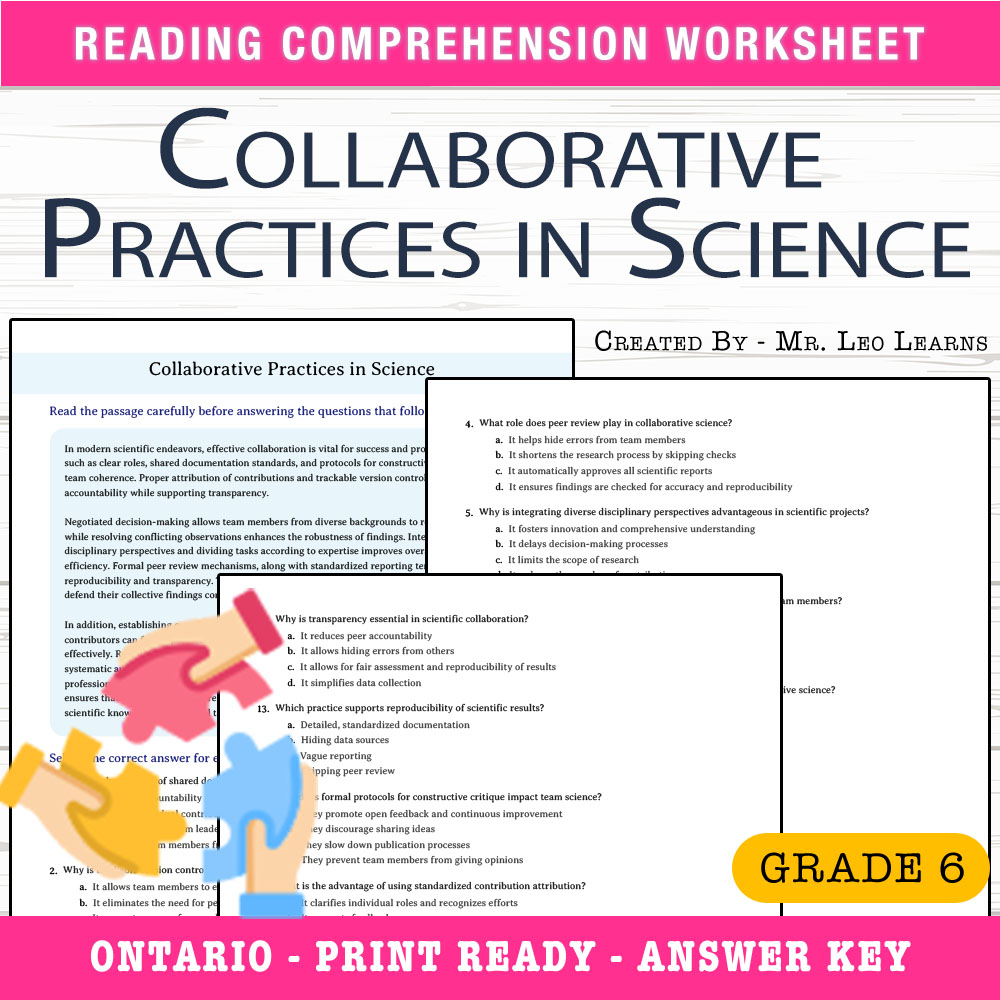
Grade 6 Science – Collaborative Practices in Science Worksheet for Mastery
Created byThe Resource HubLearning Objectives
- Understand key principles of team-based scientific work, including roles, documentation, and communication protocols.
- Recognize mechanisms for peer review, standardized reporting, and transparency in collaborative projects.
- Identify the benefits of integrating diverse disciplinary perspectives and division of labor in scientific teamwork.
Grade 6 Science – Inquiry Foundations Worksheet for Mastery
Created byThe Resource HubLearning Objectives
- Understand the importance of operational definitions in scientific inquiry.
- Distinguish between independent and dependent variables in experiments.
- Learn to design fair tests by controlling variables.
Grade 8 Science — Pulley Systems Worksheet for Mastering Mechanical Advantage
Created byThe Resource HubLearning Objectives
- Explain the different types of pulley arrangements, including fixed, movable, and compound pulleys.
- Calculate the mechanical advantage in pulley systems considering ideal and real-world conditions.
- Analyze force distribution and support reactions in pulley configurations for lifting loads.
Grade 6 Science — Insulator Comparisons Worksheet for Mastery
Created byThe Resource HubLearning Objectives
- Describe the properties of insulating materials and how they prevent electrical charge flow.
- Identify common insulating materials such as rubber, glass, and dry wood.
- Explain how insulators support electrical safety through isolation.
Grade 8 Science – Membrane Transport Worksheet for Mastery
Created byThe Resource HubLearning Objectives
- Understand the differences between passive and active transport mechanisms across cell membranes.
- Identify key processes such as diffusion, osmosis, facilitated diffusion, and active transport, including their functions and characteristics.
- Describe vesicular transport processes like endocytosis and exocytosis in cellular activity.
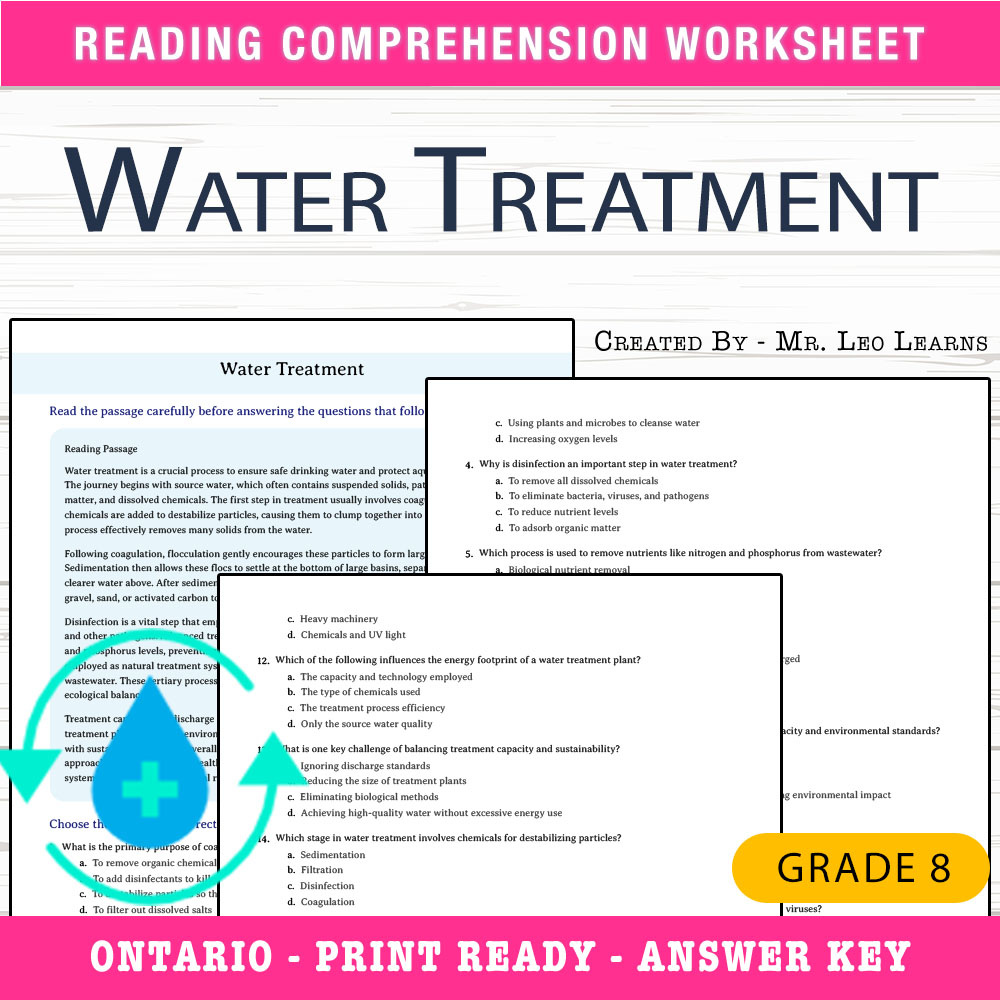
Grade 8 Science – Water Treatment Worksheet for Mastery
Created byThe Resource HubLearning Objectives
- Understand the principles and stages involved in drinking-water and wastewater treatment processes.
- Identify mechanisms for removing suspended solids, pathogens, and dissolved contaminants.
- Recognize tertiary treatment methods like biological nutrient removal and engineered wetlands.
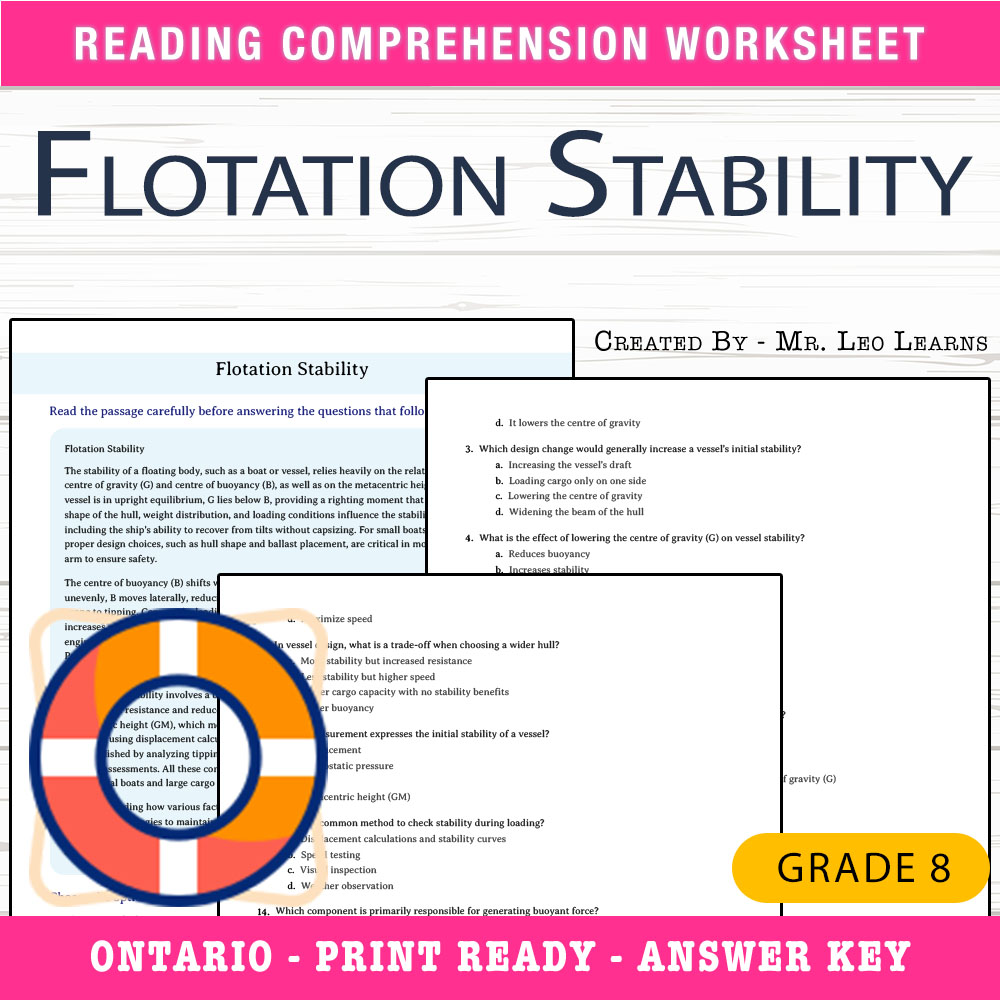
Grade 8 Science – Flotation Stability Worksheet for Mastering Buoyancy
Created byThe Resource HubLearning Objectives
- Understand how the position of the centre of gravity and buoyancy affect the stability of floating bodies
- Recognize the factors like hull shape and loading that influence upright equilibrium and tipping moments
- Learn how to calculate stability margins and buoyancy shifts during vessel loading and unloading
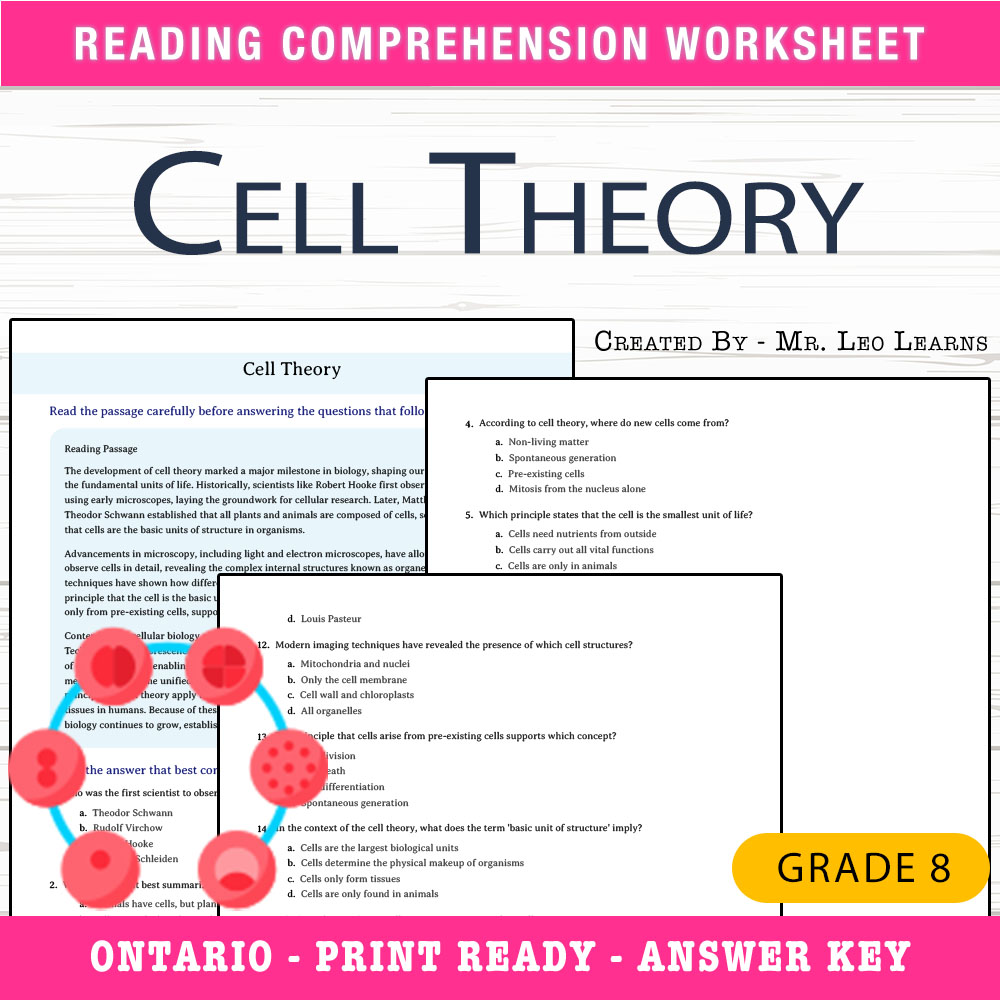
Grade 8 Science — Cell Theory Worksheet for Mastery
Created byThe Resource HubLearning Objectives
- Understand the historical development of cell theory
- Identify the core principles of cellular biology
- Explain how microscopy and imaging techniques support cell theory
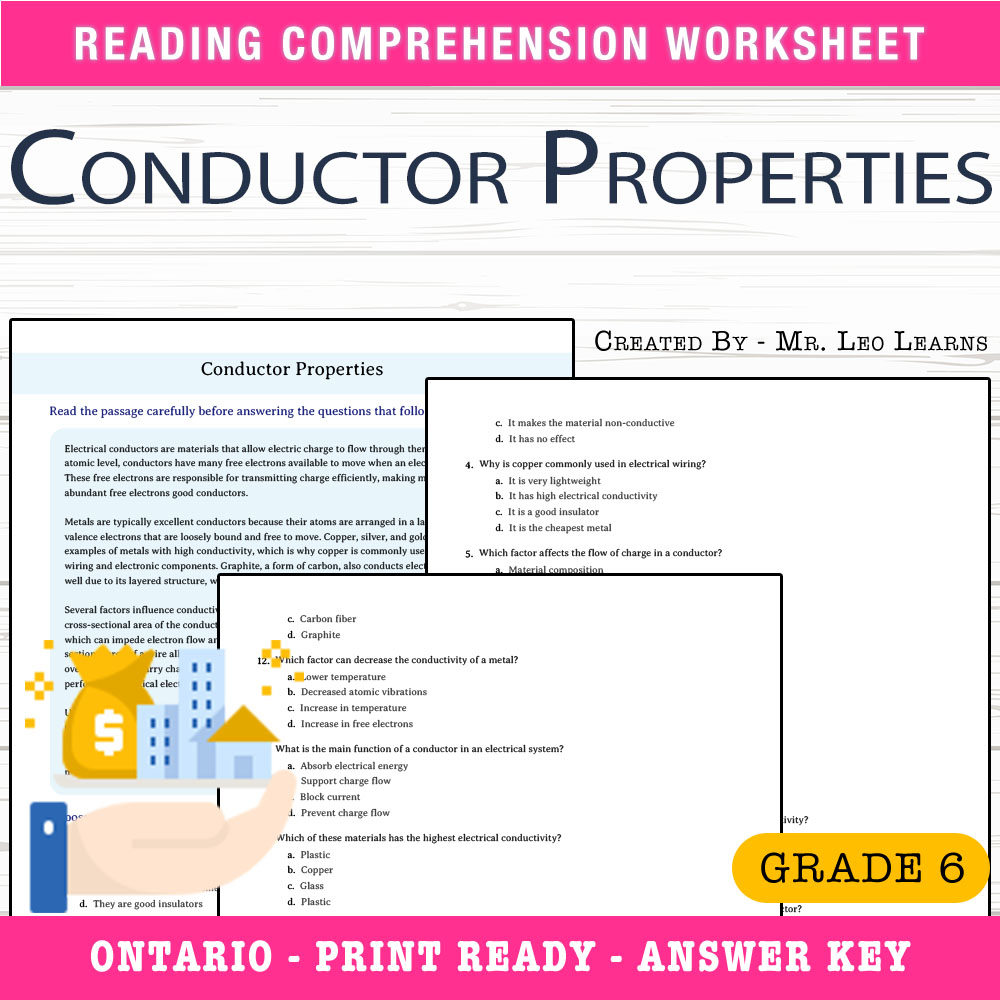
Grade 6 Science – Conductors Properties Worksheet for Mastery
Created byThe Resource HubLearning Objectives
- Explain the concept of electrical conductivity and the role of free electrons in conductors.
- Identify common materials that are good conductors and describe how their physical properties influence conductivity.
- Analyze factors such as material composition, temperature, and cross-sectional area that affect the electrical conductivity of materials.
Grade 6 Science — Electrostatic Phenomena Worksheet for Mastery
Created byThe Resource HubLearning Objectives
- Explain how charge transfer occurs between materials during triboelectric effects.
- Describe the concept of electrostatic discharge and how it differs from current flow.
- Identify the materials in the triboelectric series and predict their charge tendencies.
Grade 8 Science — Homeostatic Control Worksheet for Mastery
Created byThe Resource HubLearning Objectives
- Explain the mechanisms of negative and positive feedback in biological systems.
- Identify cellular sensors and effectors involved in homeostasis.
- Describe examples of homeostatic regulation such as blood glucose, temperature, and osmoregulation.
Grade 8 Science – Density Concept Worksheet for Mastering Density
Created byThe Resource HubLearning Objectives
- Understand the definition of density as mass per unit volume.
- Explain the relationship between mass, volume, and density using SI units.
- Compare the densities of different materials such as metals, liquids, and gases.
Grade 8 Science — Conservation Strategies Worksheet for Mastery
Created byThe Resource HubLearning Objectives
- Understand key principles and methods for freshwater resource stewardship.
- Identify trade-offs between water supply, ecological health, and economic use.
- Analyze community and household measures that influence freshwater sustainability.
Grade 8 Science – Momentum Transfer Worksheet for Mastery
Created byThe Resource HubLearning Objectives
- Understand the concept of linear momentum and how it is conserved in closed systems.
- Distinguish between elastic and inelastic collisions and predict post-interaction velocities.
- Relate impulse to change in momentum and analyze force–time relationships.
Grade 8 Science — Membrane Structure Worksheet for Mastering Cell Biology
Created byThe Resource HubLearning Objectives
- Understand the components that make up cell membranes, including phospholipids, proteins, cholesterol, and carbohydrates.
- Describe how membrane proteins contribute to transport, signalling, and structural support in cells.
- Compare structural variations in cell membranes across different cell types and their functional implications.
Grade 8 Science — Hydraulic Systems Worksheet for Mastery
Created byThe Resource HubLearning Objectives
- Describe how hydraulic systems convert input forces into larger output forces through fluid pressure.
- Calculate the mechanical advantage provided by piston assemblies in hydraulic devices.
- Evaluate design constraints affecting hydraulic system efficiency, including seal integrity and fluid viscosity.
Grade 10 Science – Homeostasis Basics Worksheet for Mastery
Created byThe Resource HubLearning Objectives
- Understand the concept of homeostasis and its importance in maintaining internal body stability.
- Identify the roles of sensors, set points, and effectors in the feedback mechanisms.
- Describe how different organ systems collaborate to regulate temperature, fluid balance, and chemical composition.
Grade 8 Science – Contaminant Transport Worksheet for Mastery
Created byThe Resource HubLearning Objectives
- Understand the processes governing the movement and fate of contaminants in surface and subsurface waters.
- Identify key mechanisms such as advection, dispersion, diffusion, sorption, and biodegradation involved in contaminant transport.
- Describe how contaminant plumes form and migrate in aquifers and the factors influencing their behavior.
Grade 8 Science — Gear Trains Worksheet for Understanding Mechanical Transmission
Created byThe Resource HubLearning Objectives
- Understand the concept of gear ratios and how they affect mechanical advantage
- Calculate overall gear ratios in simple and compound gear trains
- Explain the roles of spur gears and idler gears in gear systems
Grade 8 Science – Power Rates Worksheet for Mastering Energy Concepts
Created byThe Resource HubLearning Objectives
- Understand the concept of power as the rate of doing work and its SI units.
- Apply the relationship between torque, rotational speed, and power in mechanical systems.
- Analyze how motor specifications relate to actual output power after accounting for efficiency.
Grade 8 Science — Pressure Basics Worksheet for Practice
Created byThe Resource HubLearning Objectives
- Define fluid pressure and understand its SI units.
- Differentiate between surface contact pressure and internal fluid pressure.
- Understand the mathematical relation between pressure and force.
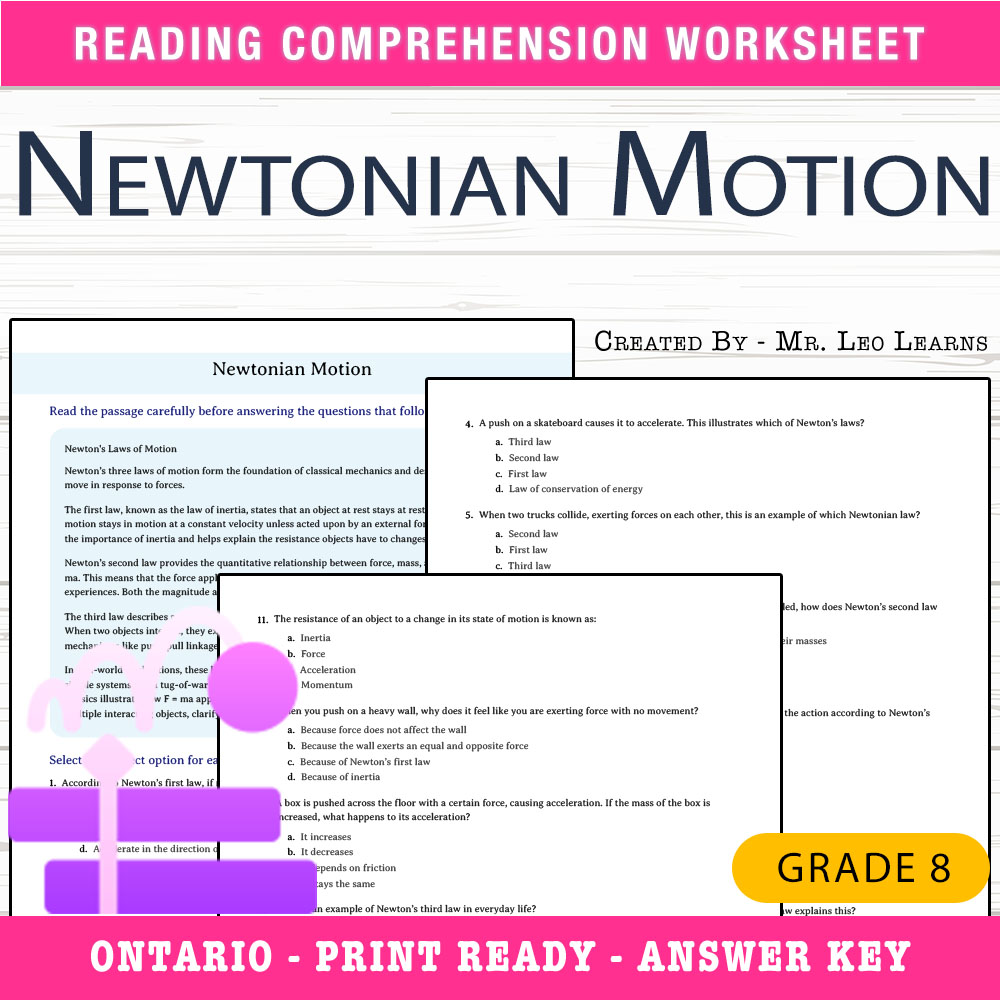
Grade 8 Science – Newtonian Motion Worksheet for Mastery
Created byThe Resource HubLearning Objectives
- Understand Newton's three laws of motion and their application to mechanical systems.
- Quantitatively relate force, mass, and acceleration using the equation F = ma.
- Identify cause-and-effect relationships in situations involving inertia and action–reaction pairs.
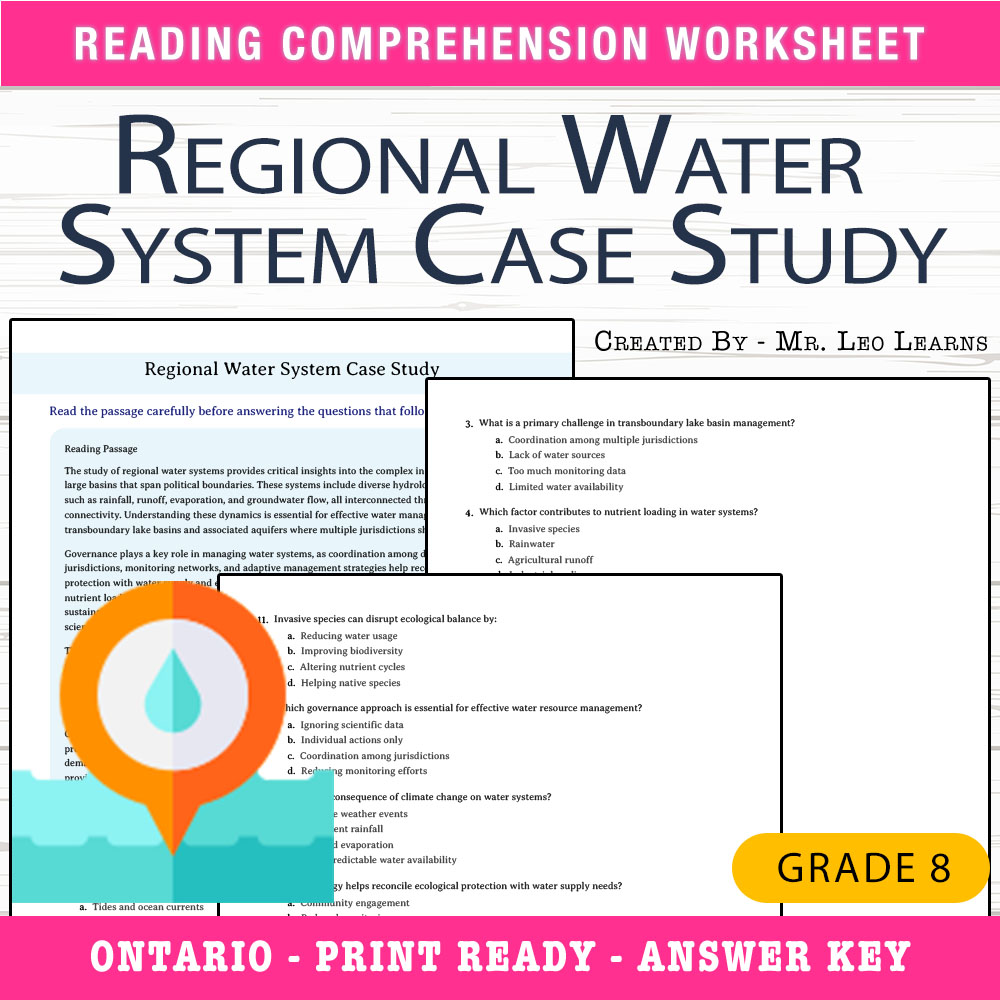
Grade 8 Science – Regional Water System Case Study Worksheet
Created byThe Resource HubLearning Objectives
- Analyze the components and processes of a regional water system, including hydrologic cycle dynamics and watershed connectivity.
- Evaluate governance challenges and strategies in managing large basin water resources.
- Understand the impacts of contaminant sources, nutrient loading, invasive species, and climate shifts on water balance.
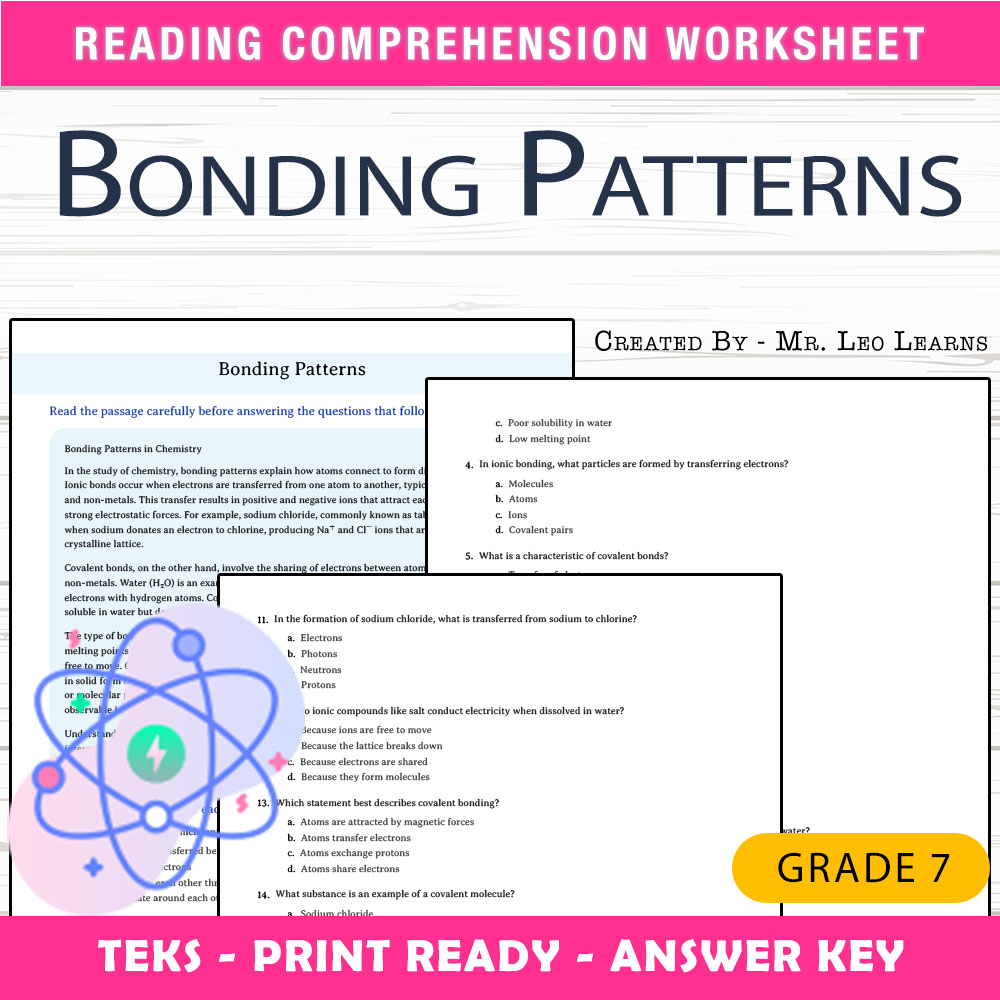
Grade 7 Science – Bonding Patterns Worksheet for Mastery
Created byThe Resource HubLearning Objectives
- Explain the differences between ionic and covalent bonding based on atomic interactions.
- Relate bonding types to properties like melting point, solubility, and electrical conductivity.
- Describe simple formation processes of binary ionic salts and molecular compounds.
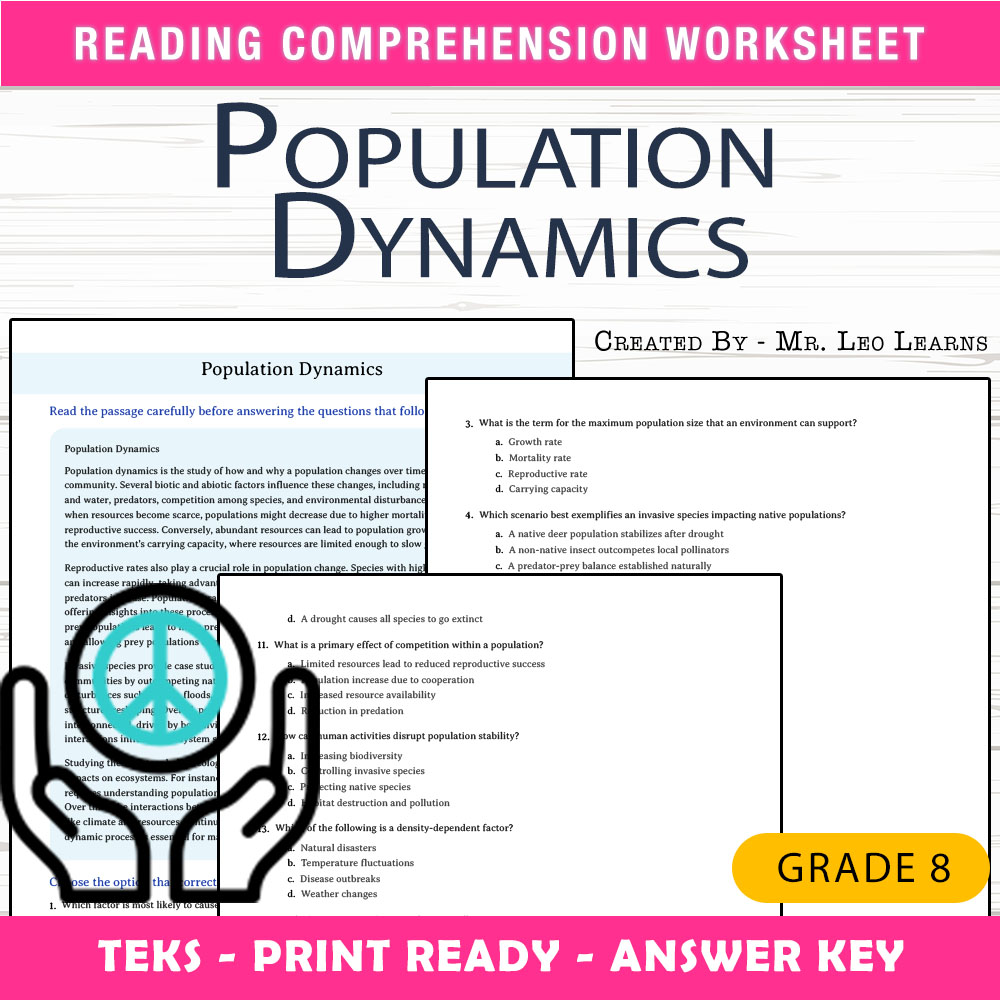
Grade 8 Science — Population Dynamics Worksheet for Mastery | PDF + Answer Key
Created byThe Resource HubLearning Objectives
- Understand the factors that influence population size and distribution.
- Analyze growth patterns and oscillations in populations using graphs.
- Explain the impact of limiting resources, competition, predation, and succession.
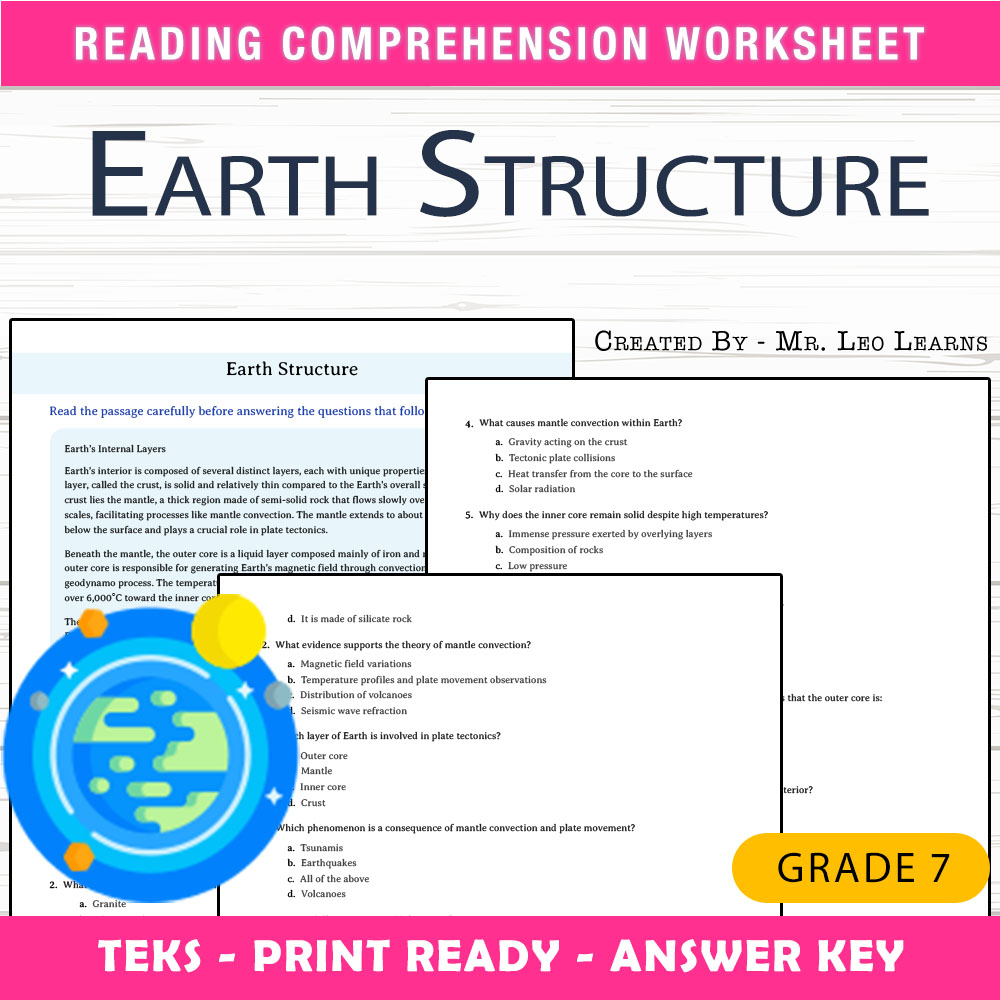
Grade 7 Science — Earth Structure Worksheet for Mastering Earth's Layers
Created byThe Resource HubLearning Objectives
- Describe Earth's internal layering, including crust, mantle, outer core, and inner core.
- Explain how seismic waves and geothermal profiles provide evidence of Earth's interior structure.
- Understand the processes of mantle convection and their role in plate motion.
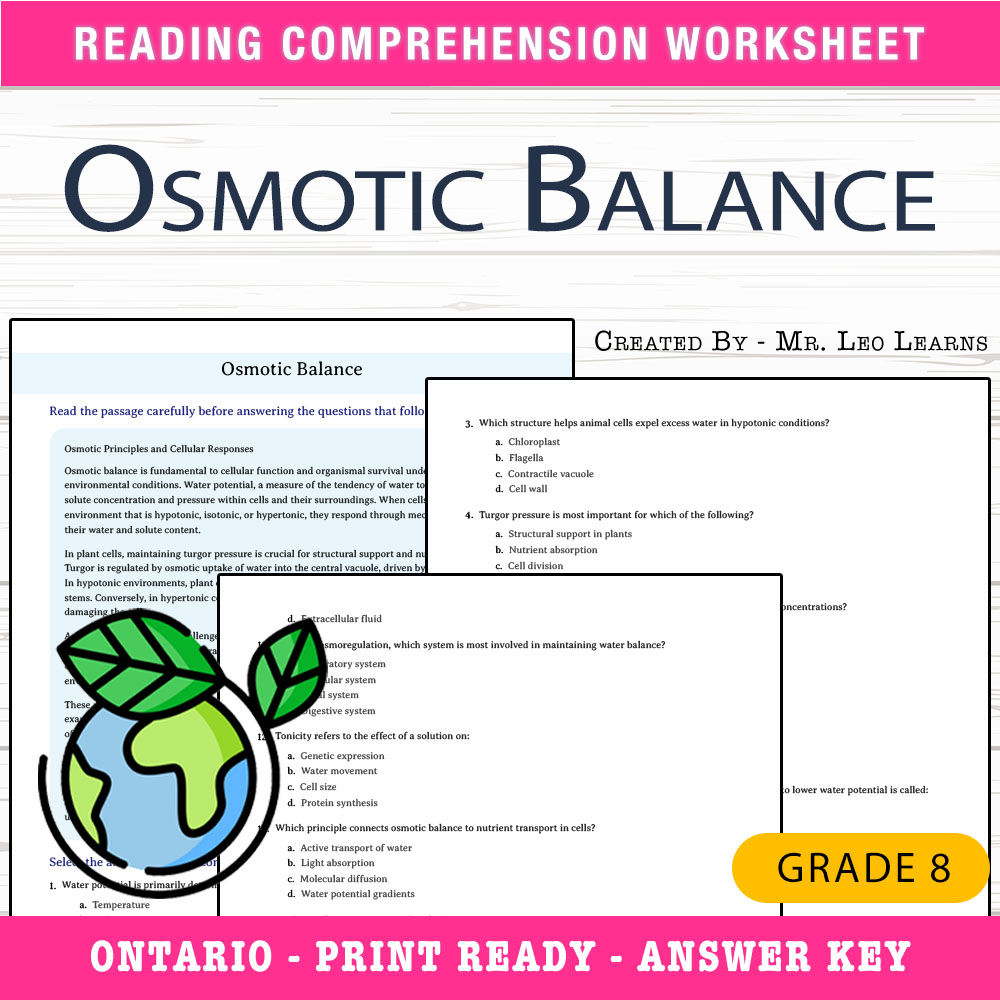
Grade 8 Science – Osmotic Balance Worksheet for Mastery
Created byThe Resource HubLearning Objectives
- Explain key concepts of water potential, tonicity, and cellular responses to different environmental conditions.
- Describe mechanisms that regulate cell volume and turgor pressure in plants and animals.
- Identify osmoresponsive adaptations such as contractile vacuoles, membrane pumps, and extracellular buffering in physiological contexts.
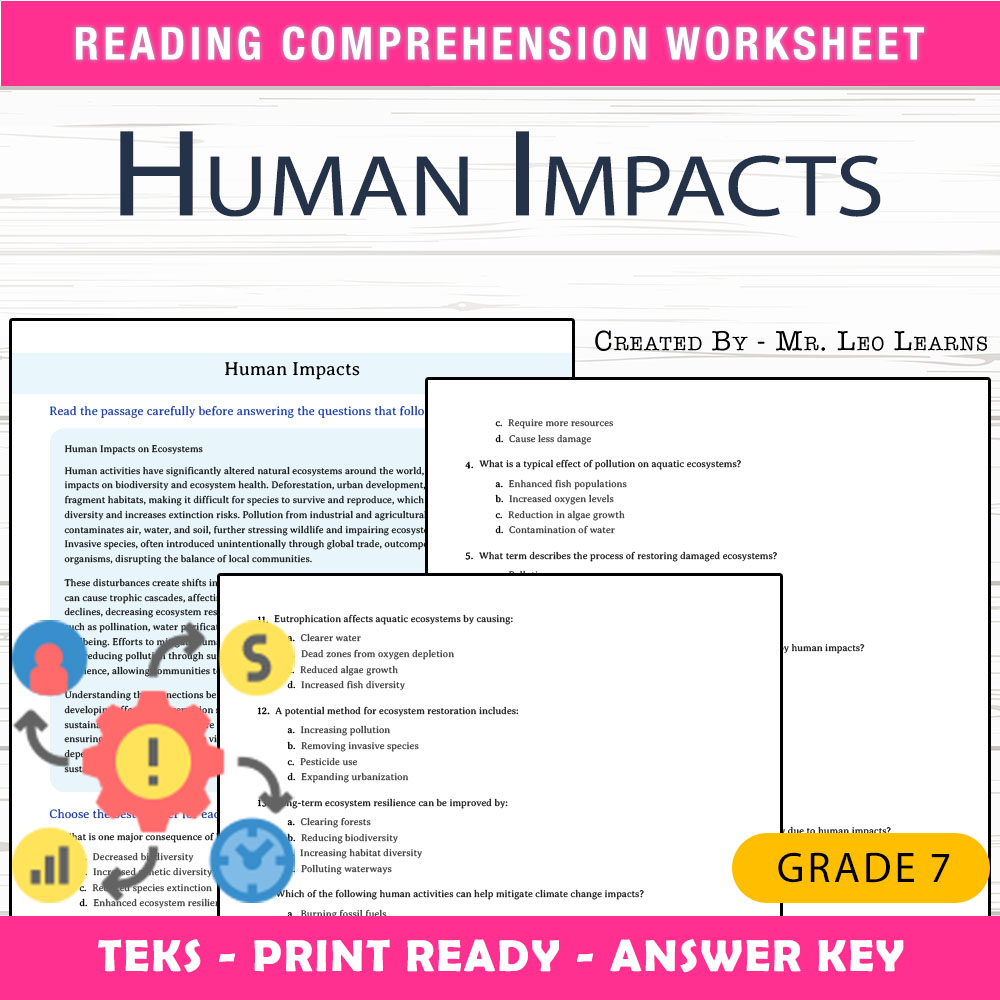
Grade 7 Science — Human Impacts Worksheet for Mastery
Created byThe Resource HubLearning Objectives
- Identify major human-induced environmental changes such as habitat fragmentation, pollution, and invasive species.
- Explain the effects of human impacts on biodiversity, ecosystem services, and trophic structures.
- Describe approaches to mitigate and restore ecosystems affected by human activities.
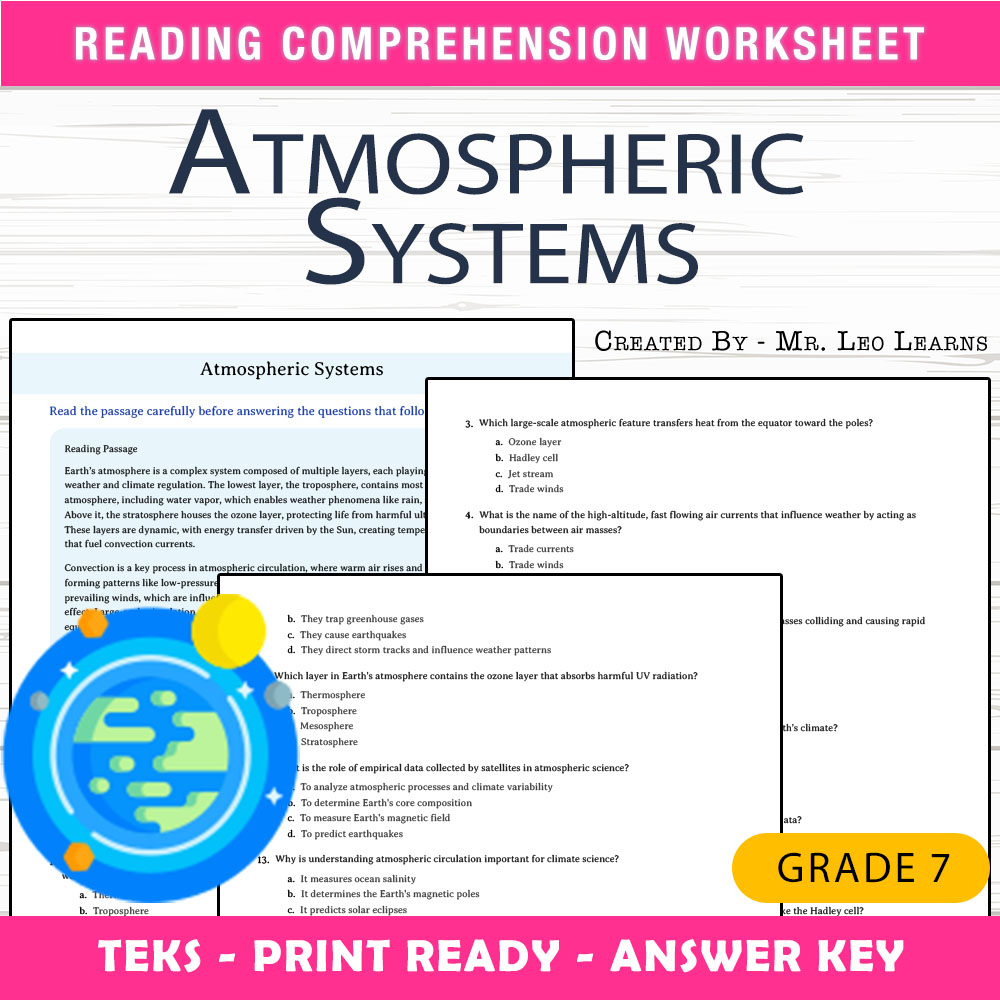
Grade 7 Science — Atmospheric Systems Worksheet for Mastery
Created byThe Resource HubLearning Objectives
- Describe the major components and processes of Earth's atmosphere, including energy transfer, convection, and wind patterns.
- Explain large-scale atmospheric circulation features such as pressure systems, cells, fronts, and jet streams, and their impact on weather and climate.
- Analyze how atmospheric phenomena like greenhouse gases and observational data influence climate variability and radiative balance.
Browse more categories
About Science Worksheets
Find Science worksheets spanning core skills, practice, and review. All 42,859 resources are instant PDF downloads for the classroom or home.
Every worksheet on MyTeachingSheets is created by independent teacher-authors and reviewed before publication. All resources download as printable PDFs for classroom, homework, or at-home practice, and many include answer keys. Preview any worksheet free before buying.