
Grade 10 Worksheets
9,385 grade resources
Grade 10 Science | Comparative Design Worksheet (AP) PDF
 Created byEvergreen Desk Education
Learning Objectives
- Distinguish observational comparisons from controlled trials and identify what designs allow in terms of causal claims.
- Identify independent and dependent variables in comparative experiments and explain why controls, replication, and bias-mitigation matter.
- Compare matching and randomization strategies and justify when each is appropriate under constraints (ethics or limited resources).
Also included in: Grade 10 Scientific Modeling & Quantitative Reasoning Science Lesson Bundle (AP) +1 more
Instant download

Grade 10 Social Studies – Charter Era Worksheet (PDF) – Ontario Standards
 Created bySunny Desk Resources
Learning Objectives
- Explain how the 1982 Charter of Rights and Freedoms reshaped legal and political debates in Canada
- Analyze how constitutional patriation, judicial activism, and legislative responses affected rights protection
- Evaluate continuity and change in equality, language rights, and civil liberties since 1982
Also included in: Grade 10 Modern Canadian History Social Studies Lesson Bundle (Ontario) +1 more
Instant download

Ecosystem Structure Practice Test Prep | Grade 10 Science NGSS
 Created byPrism Point Learning
Learning Objectives
- Differentiate biotic and abiotic components of terrestrial and aquatic ecosystems.
- Explain energy flow through trophic levels and describe how decomposers recycle matter.
- Use examples to interpret food webs, ecological niches, and habitat heterogeneity.
Also included in: Grade 10 Ecosystems & Biodiversity Science Lesson Bundle Practice: NGSS
Instant download

Grade 10 Science | Force Concepts Worksheet | AP Aligned
 Created byLumora Learning
Learning Objectives
- Explain the vector nature of forces and how to determine the net force acting on an object.
- Describe Newton's three laws of motion and their application to various physical scenarios.
- Interpret free-body diagrams to analyze forces and predict object motion.
Instant download

Grade 10 Science | Particle Interactions in Materials - Reading Comprehension
 Created byCoral Reef Learning
Learning Objectives
- Understand the relationship between crystal structures and material properties
- Distinguish between different types of atomic and molecular interactions
- Analyze how atomic arrangements influence melting points, solubility, and conductivity
Instant download

Grade 10 Science | Periodic Trends Worksheet | BC Aligned
Created byLumora LearningLearning Objectives
- Understand the concept of periodic trends such as atomic radius, ionization energy, and electronegativity.
- Identify how nuclear charge and electron shielding influence these trends across periods and down groups.
- Predict element behavior based on periodic trend patterns.
Instant download

Grade 10 Force Concepts Worksheet | Practice & PDF Standard Alignment
 Created byClear Sky Classroom
Learning Objectives
- Explain how forces act as interactions that can be described with vectors and represented using free-body diagrams
- Determine the net force on an object and predict motion using Newton’s three laws
- Distinguish between contact forces and field-mediated forces and connect forces to acceleration using algebraic relationships
Also included in: Grade 10 Physics Concepts Science Lesson Bundle: Advanced Placement (AP) +1 more
Instant download

Geologic Mapping Practice Worksheet | Grade 10 Science NGSS Review
Created byPrism Point LearningLearning Objectives
- Describe how geologic mapping combines different geoscience datasets to interpret Earth structures.
- Use stratigraphic contacts, faults, and basin geometry to infer subsurface relationships from maps and cross-sections.
- Explain how dated strata and geochronology help constrain landscape evolution and timing of tectonic events.
Also included in: Grade 10 Earth Systems Science lesson bundle: NGSS practice worksheets
Instant download

Grade 10 Science | Adaptation Strategies Worksheet | AP Standards
Created byLumora LearningLearning Objectives
- Understand different adaptation strategies and their roles in Earth systems.
- Evaluate trade-offs and potential consequences of mitigation and adaptation approaches.
- Apply systems thinking and scenario analysis to climate and Earth system management.
Instant download

Transport Mechanisms Worksheet | Grade 10 Science Practice
Created byPrism Point LearningLearning Objectives
- Differentiate passive transport (diffusion and osmosis) from active transport and bulk transport
- Explain how concentration gradients and electrochemical gradients affect movement of ions and molecules across membranes
- Describe how ATP-powered pumps and carrier proteins help substances cross cellular boundaries
Instant download

Atomic Models Assessment | Alberta Standards Grade 10 Science
Created byPrism Point LearningLearning Objectives
- Explain different atomic models and their key features.
- Describe how microscopic particle arrangements relate to observable properties like density and conductivity.
- Analyze real-world examples of particle interactions in soil and air to understand atomic behavior.
Also included in: Grade 10 Matter and Chemical Change Science Lesson Bundle: Alberta +1 more
Instant download

Grade 10 Science | Bonding Types in Chemistry - Daily Reading Comprehension
Created byCoral Reef LearningLearning Objectives
- Identify the three main types of chemical bonds: ionic, covalent, and metallic.
- Explain the basic features of each bonding type.
- Relate bonding types to physical properties such as melting point, conductivity, and hardness.
Instant download

Mining Impacts Worksheet | Grade 10 Science | Ontario Standards
JCreated byJ.S SheetsLearning Objectives
- Explain how mining can alter landscapes and affect water, soil, air, and ecosystems.
- Describe key long-term risks such as tailings leakage and acid rock drainage (ARD).
- Identify how impact assessment and reclamation plans reduce environmental and social harm.
Instant download

Energy Changes Worksheet | Grade 10 Science Activities
Created byPrism Point LearningLearning Objectives
- Distinguish endothermic and exothermic chemical changes using temperature and energy flow
- Explain how enthalpy changes relate to bond breaking and bond formation
- Interpret calorimetry results to predict whether heat is absorbed or released
Also included in: Grade 10 Chemistry & Dynamic Equilibrium Lesson Bundle | Alberta Science
Instant download

Grade 10 Science | Carrying Capacity in Ecosystems - Daily Reading Comprehension
Created byCoral Reef LearningLearning Objectives
- Define carrying capacity and understand its significance in ecology.
- Identify factors that influence an environment's carrying capacity.
- Analyze how resource availability and environmental changes affect populations.
Instant download

Recommendation Systems Worksheet | Grade 10 Computer Science AI
 Created byBright Mind Resources
Learning Objectives
- Explain how user behavior influences personalized recommendations
- Identify user-based and item-based recommendation strategies
- Describe how feedback can change future recommendations
Instant download

Net Force Worksheets: Forces, Friction & Acceleration Grade 10
 Created byBRIGHT PATH RESOURCES
Learning Objectives
- Explain how net force direction determines acceleration direction
- Predict acceleration changes when forces align
- Predict acceleration changes when forces oppose
Also included in: Grade 10 Physical Science Worksheets Bundle | Forces, Energy & More +1 more
Instant download

Grade 10 Social Studies | Great Depression Worksheet (Ontario Standards)
Created bySunny Desk ResourcesLearning Objectives
- Describe key causes and major consequences of the Great Depression in Canada, including unemployment and economic collapse.
- Explain how regional differences shaped experiences of the Depression across urban and rural communities.
- Analyze how social responses and political protest influenced expectations of government responsibility.
Also included in: Grade 10 Modern Canadian History Social Studies Lesson Bundle (Ontario) +1 more
Instant download

Trait Origins Test Prep Printables | Grade 10 Science
Created byPrism Point LearningLearning Objectives
- Explain how mutation, recombination, gene flow, and chromosomal changes can create new heritable variation.
- Describe how allele frequencies can change at the population level through genetic drift and nonrandom mating.
- Connect molecular genetic changes to shifts in developmental pathways and observable traits.
Also included in: Grade 10 Evolution & Speciation Science Lesson Bundle (NGSS)
Instant download

Origins Of War Grade 10 Social Studies Worksheet | Standards-Aligned
JCreated byJ.S SheetsLearning Objectives
- Explain long-term and short-term causes of the First World War, including alliances and militarism
- Analyze how the assassination of Archduke Franz Ferdinand interacted with diplomacy and mobilization plans to trigger escalation
- Evaluate primary and secondary evidence about causation and identify unintended consequences across Europe and colonial territories
Instant download

Cell Organization Worksheet for Grade 10 Science | NGSS aligned assessment
JCreated byJ.S SheetsLearning Objectives
- Describe the structure and function of membrane-bound organelles in eukaryotic cells.
- Compare cellular components in prokaryotic and eukaryotic cells and their roles.
- Explain how cellular specialization contributes to tissue and organ functions.
Instant download

Grade 10 Engineering Design Optimization Trade-Offs Worksheet | NGSS
 Created byAmber Owl Education
Learning Objectives
- Quantify trade-offs by comparing objectives using cost-benefit reasoning and constraints (mass, cost, and impact).
- Use Pareto-front thinking to identify design options that are not dominated by others.
- Apply objective weighting and sensitivity ideas to choose an optimal compromise under limits.
Instant download

Grade 10 Science | Technology Society Impacts Worksheet | General Standard
Created byLumora LearningLearning Objectives
- Explain how technology and engineering can change communication, work, travel, and access to services.
- Use cause-and-effect reasoning to connect engineering design choices to social and environmental impacts.
- Evaluate benefits and risks of a technology by considering equity, public health, and sustainability.
Instant download

Grade 10 Science | Work and Power Worksheet Elena | Alberta Standards
Created byLumora LearningLearning Objectives
- Explain the concepts of work and power in terms of energy transfer.
- Calculate work done based on force and displacement models.
- Relate power output to energy transfer over time in real-world scenarios.
Instant download

Grammar Mechanics Worksheet for Grade 10 ELA | TEKS Grammar Practice
 Created byGolden Apple Studio
Learning Objectives
- Use correct parts of speech and word forms to improve clarity in Grade 10 writing
- Maintain consistent verb tense and correct agreement to strengthen sentence meaning
- Apply conventional capitalization and spelling rules in formal writing
Also included in: Grade 10 ELA Writing, Grammar & Figurative Language Lesson Bundle | TEKS +1 more
Instant download

Grade 10 Electromagnetic Forces Worksheet | NGSS Physics Science Activity
Created byBRIGHT PATH RESOURCESLearning Objectives
- Understand the concepts of electric and magnetic fields.
- Identify how charges and magnets create invisible forces.
- Describe the behavior of charged particles in uniform electric and magnetic fields.
Also included in: Forces & Motion Grade 10 Science Daily Reading Worksheets Lesson Bundle | NGSS +1 more
Instant download

Grade 10 Writing in Forms Worksheet | Ontario ELA Writing Activity
Created byLumora LearningLearning Objectives
- Identify how purpose and genre shape an author’s structure and tone in different writing forms.
- Apply form-specific organization choices, such as headings, quotations, and concluding statements, to improve coherence.
- Distinguish between a measured, evidence-driven analytical voice and a more sensory, personal narrative voice.
Instant download

Evolution Basics Worksheet | Grade 10 Science Practice
Created byPrism Point LearningLearning Objectives
- Explain how evolution describes change in populations over generations through inherited traits
- Identify key evidence for evolution, including fossils, biogeography, and comparative anatomy and molecules
- Distinguish between common ancestry and adaptation as outcomes of descent with modification
Also included in: Grade 10 Evolution, Speciation & Biodiversity Lesson Bundle | BC Science +1 more
Instant download

Feedback Control Worksheet | Science Grade 10 NGSS Assessment
Learning Objectives
- Explain how homeostasis uses feedback control to maintain internal stability despite external changes.
- Differentiate negative feedback loops from positive feedback loops and predict their outcomes.
- Identify the roles of sensors, control centers, and effectors in physiological regulation.
Also included in: From Molecules to Organisms Lesson Bundle | Grade 10 Science | NGSS
Instant download

Variables & Constraints Worksheet Grade 10 AP Science Inquiry Skills
Created byPrism Point LearningLearning Objectives
- Distinguish independent, dependent, and controlled factors in real experimental scenarios
- Explain how constraints and boundary conditions limit what can be observed and measured
- Justify which variables to change and which to hold constant to produce interpretable comparisons
Also included in: AP Science Inquiry Skills Lesson Bundle | Grade 10 | Modeling & CER
Instant download

Grade 10 ELA Revision for Impact Worksheet | Standards-Aligned Practice
JCreated byJ.S SheetsLearning Objectives
- Identify how revision improves clarity, relevance, and overall impact by refining ideas, structure, and wording.
- Evaluate whether evidence directly supports claims and revise when evidence or reasoning is missing.
- Improve draft organization by adjusting paragraph order, transitions, and topic sentence alignment.
Instant download

Grade 10 ELA – Revision for Clarity & Response Practice | Daily Worksheet
 Created byQuiet Forest Education
Learning Objectives
- Refine sentence clarity and word choice
- Identify and correct vague or imprecise language
- Enhance sentence structure for better clarity
Also included in: Writing Grade 10 ELA Daily Reading Worksheets Lesson Bundle | teks +1 more
Instant download
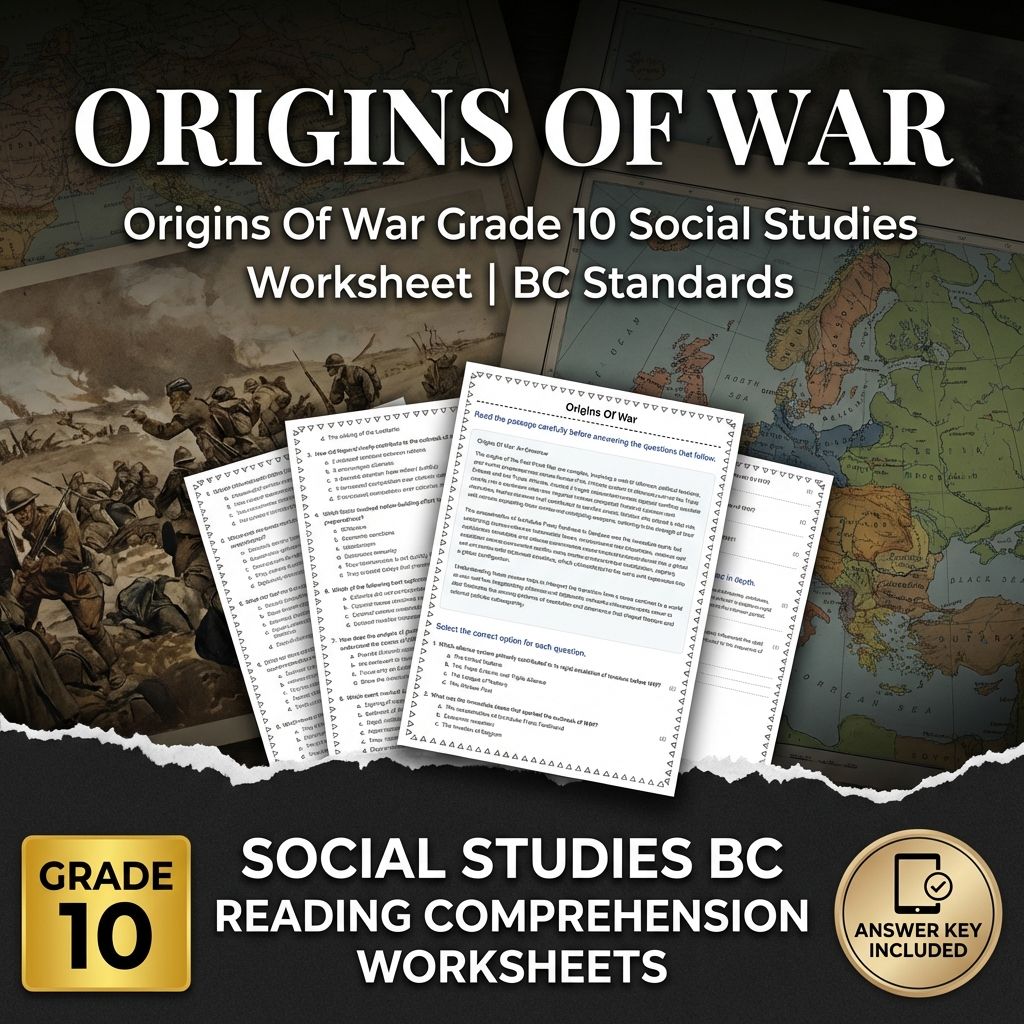
Origins Of War Grade 10 Social Studies Worksheet | BC Standards
JCreated byJ.S SheetsLearning Objectives
- Analyze the long-term and short-term causes of the First World War, including alliances, imperial competition, militarism, and assassination.
- Evaluate primary and secondary sources to understand causation and unintended consequences in Europe and colonies.
- Interpret how diplomatic networks and mobilization schedules led to rapid escalation and analyze changes in state behavior leading to the interwar period.
Instant download
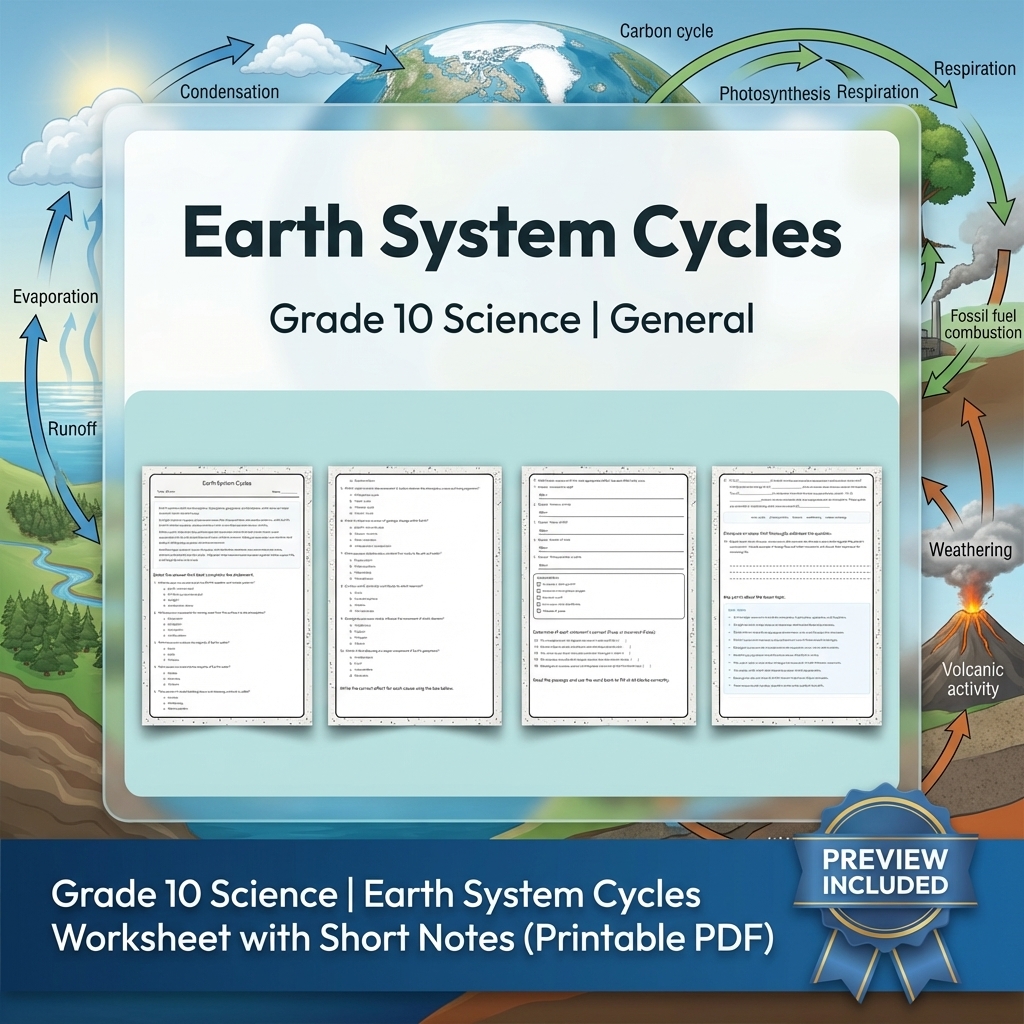
Grade 10 Science | Earth System Cycles Worksheet with Short Notes
 Created byMeadowlark Worksheets
Learning Objectives
- Describe the major reservoirs in Earth's system including atmosphere, hydrosphere, geosphere, and biosphere.
- Explain how energy from the Sun and Earth's internal heat drive various Earth cycles.
- Identify the processes involved in matter cycling through evaporation, precipitation, runoff, and chemical exchange.
Also included in: Grade 10 Earth Systems Science Lesson Bundle: General Framework Worksheets +1 more
Instant download

Bubble, Selection, and Insertion Sort Algorithms Worksheet | Grade 10
Created byBright Mind ResourcesLearning Objectives
- Trace bubble sort passes on a small list
- Trace selection sort by locating each minimum value
- Trace insertion sort using shifts and insertions
Instant download

Grade 10 Science – Collision Conservation Worksheet (NGSS - PDF)
 Created bySilver Birch Teaching
Learning Objectives
- Understand the principles of conservation of momentum and energy in multi-body collisions.
- Analyze two-dimensional collisions using vector components and system bookkeeping.
- Differentiate between elastic and inelastic collisions based on post-collision outcomes.
Also included in: Grade 10 Forces, Motion, and Fields Science Lesson Bundle for NGSS +1 more
Instant download

World Teachers Day Teaching as a Legacy Worksheet Grade 10
 Created byShaNova Worksheets
Learning Objectives
- Analyze how teachers influence values, identity, and future choices in a text.
- Use evidence from a passage to explain the lasting impact of mentorship.
- Apply key vocabulary related to teaching, legacy, and social-emotional learning.
Instant download

Impact of Exploration Worksheet | Grade 10 Social Studies TEKS
 Created byThe Resource Hub
Learning Objectives
- Explain key causes that motivated European exploration and voyages between the 15th and 17th centuries
- Analyze how European exploration affected indigenous societies through contact, disease, trade, and forced labor
- Evaluate how colonization and global trade reshaped power structures and cultural landscapes worldwide
Also included in: Global Conflicts & Decolonization Lesson Bundle | Grade 10 Social Studies TEKS +1 more
Instant download

Grade 10 Science | Population Dynamics Worksheet | BC Aligned
Created byLumora LearningLearning Objectives
- Understand the principles of population genetics and how they relate to evolution.
- Identify the factors that influence changes in allele frequencies over time.
- Explain models such as Hardy-Weinberg equilibrium and what deviations indicate.
Also included in: Grade 10 Science | Evolution & Biodiversity Lesson Bundle | BC Framework
Instant download

Succession Processes Worksheet | Grade 10 Science Activities
Created byPrism Point LearningLearning Objectives
- Differentiate primary and secondary ecological succession based on substrate and soil conditions.
- Explain how species colonization, competition, and facilitation change community structure over time.
- Analyze how disturbance frequency and intensity can redirect successional pathways and affect biodiversity.
Instant download

Decomposition and Abstraction Worksheet | Grade 10 Computer Science
Created byBright Mind ResourcesLearning Objectives
- Explain how decomposition breaks complex problems into manageable parts
- Identify abstraction in algorithms, data models, and system designs
- Apply decomposition to outline a real-world computing task
Instant download

Recursion and Repeated Patterns Worksheet | Grade 10 Computer Science
Created byBright Mind ResourcesLearning Objectives
- Identify the base case in a recursive description
- Explain the role of the recursive step
- Trace recursive calls across decreasing input values
Instant download

Grade 10 DNA Structure and Complementary Replication NGSS Worksheet
Created byAmber Owl EducationLearning Objectives
- Explain how DNA’s double helix structure supports complementary base pairing and DNA replication.
- Describe semi-conservative DNA replication and the roles of helicase and DNA polymerase.
- Connect replication fidelity mechanisms (proofreading and repair) to how heritable information is maintained.
Instant download

Grade 10 Science | Energy in Reactions - Daily Reading Comprehension
Created byCoral Reef LearningLearning Objectives
- Understand how energy changes occur during chemical reactions.
- Identify the difference between endothermic and exothermic reactions.
- Use particle-level reasoning to explain energy transfer in reactions.
Instant download

Grade 10 Science – Ecosystem Basics Daily Reading Worksheet with Answer Key
JCreated byJ.S SheetsLearning Objectives
- Describe the main components of an ecosystem
- Explain the roles of producers, consumers, and decomposers
- Understand how energy flows and matter cycles within ecosystems
Also included in: Grade 10 Science Lesson Group – Ecosystems and Environmental Impact Worksheets +1 more
Instant download

DNA Structure Worksheet | Grade 10 Science Activities
Created byPrism Point LearningLearning Objectives
- Describe the double-helix structure of DNA, including sugar-phosphate backbones and nitrogenous bases.
- Explain how complementary base pairing supports genetic information storage and faithful replication.
- Identify the role of hydrogen bonds and antiparallel strand orientation in DNA stability.
Also included in: Genetics & Molecular Biology Lesson Bundle | Grade 10 Science | TEKS
Instant download

Nephrons & Fluid Balance Worksheet | Kidney Function TEKS Grade 10
Created byBRIGHT PATH RESOURCESLearning Objectives
- Describe the main steps of urine formation in a nephron
- Explain how filtration, reabsorption, and secretion affect fluid balance
- Identify how feedback supports maintaining blood osmolarity and pressure
Also included in: Grade 10 Homeostasis & Body Systems Science Worksheets Bundle | TEKS +1 more
Instant download

Grade 10 Science — Worksheet MCQ Paper for Climate Drivers
Created byThe Resource HubLearning Objectives
- Understand the main factors that influence Earth's climate, including radiative forcing and greenhouse gases.
- Analyze how albedo variations and ocean-atmosphere coupling affect regional and long-term climate change.
- Interpret data from energy-balance models and proxy records to assess climate trends.
Also included in: Grade 10 Earth and Space Sciences Lesson Bundle | AP Curriculum +1 more
Instant download
Browse more categories
About Grade 10 Worksheets
Find Grade 10 worksheets covering algebra, biology, literature, and history. All 9,385 resources download instantly as PDFs for classwork, homework, or review.
MyTeachingSheets worksheets are made by real teacher-authors and checked before they go live. Download any as a print-ready PDF for lessons, homework, or independent practice — most include answer keys, and previews are always free.