
Grade 10 Worksheets
9,388 grade resources
Grade 10 Microbe Diversity Worksheet | Cells, Genetics & Ecological Roles
 Created byChalk and Compass
Learning Objectives
- Compare major microorganism groups by cellular organization and genetic material.
- Explain how different microbes reproduce and how viruses depend on host cellular machinery.
- Describe how microbes occupy different ecological niches and contribute to ecosystems.
Also included in: Cells, Photosynthesis, Respiration & Microbes Lesson Bundle – Grade 10 Science +1 more
Instant download

Grade 10 Social Studies | Decolonization Effects Worksheet (PDF)
 Created bySunny Desk Resources
Learning Objectives
- Explain how global decolonization reshaped Canada’s foreign policy priorities and diplomatic relationships.
- Analyze how shifts in Commonwealth ties and imperial connections influenced Canada’s trade and immigration links.
- Evaluate continuity and change in cultural connections and economic dependency after decolonization.
Also included in: Grade 10 Modern Canadian History Social Studies Lesson Bundle (Ontario) +1 more
Instant download

Grade 10 Math – Completing the Square Worksheet (Ontario Standard) (PDF)
 Created byClear Sky Classroom
Learning Objectives
- Understand the algebraic process of completing the square to solve quadratic equations.
- Apply completing the square to find the vertex and solutions of a parabola.
- Compare the completing the square method with factoring and the quadratic formula in terms of applicability and efficiency.
Also included in: Grade 10 Maths Lesson Group - Solving Quadratics and Transformations +1 more
Instant download

Grade 10 Science – Population Dynamics & Evolution | Daily Reading Worksheet
 Created byBright Mind Resources
Learning Objectives
- Understand basic concepts of population size and variation
- Recognize factors affecting population change
- Interpret models such as Hardy-Weinberg equilibrium
Also included in: Grade 10 Evolution & Genetics Science Daily Reading Lesson Bundle | BC +1 more
Instant download

Grade 10 Science – Population Dynamics Daily Reading Worksheet with Answer Key
JCreated byJ.S SheetsLearning Objectives
- Understand the concepts of birth, death, immigration, and emigration in population change.
- Identify how interactions like competition, predation, and resource availability influence populations.
- Explain mathematical models of population growth, including exponential and logistic growth.
Also included in: Grade 10 Science Lesson Group – Ecosystems and Environmental Impact Worksheets +1 more
Instant download
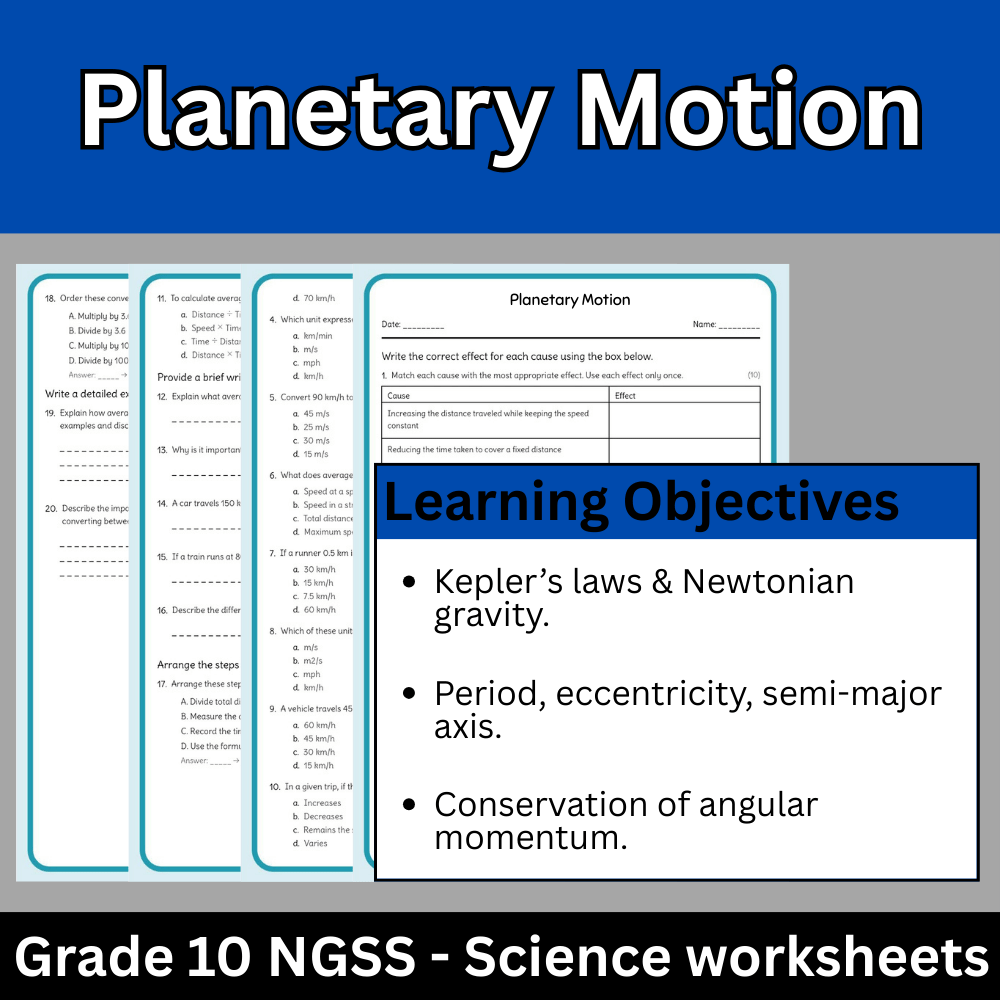
Grade 10 Science | Planetary Motion Worksheet (NGSS) – Science PDF
Created byBright Mind ResourcesLearning Objectives
- Understand the principles of Kepler's laws and Newtonian gravitation in planetary motion
- Relate orbital parameters such as period, eccentricity, and semi-major axis
- Explain how conservation of angular momentum affects orbital speed
Instant download
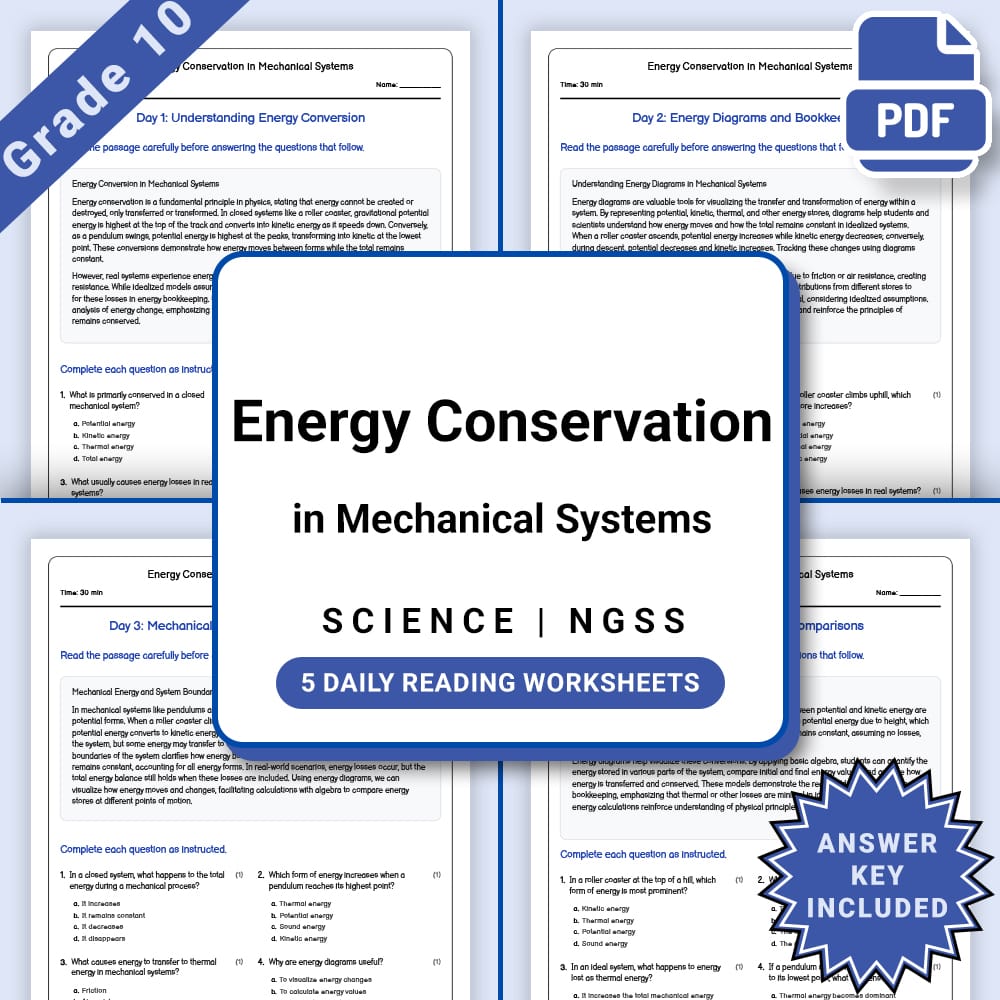
Grade 10 Science – Energy Conservation in Mechanical Systems (PDF +Answer Key)
 Created byCopper Leaf Classroom
Learning Objectives
- Understand the principles of energy conservation in closed systems
- Identify different forms of energy transfer, such as potential to kinetic energy
- Describe how energy is conserved even with energy losses such as thermal energy
Instant download
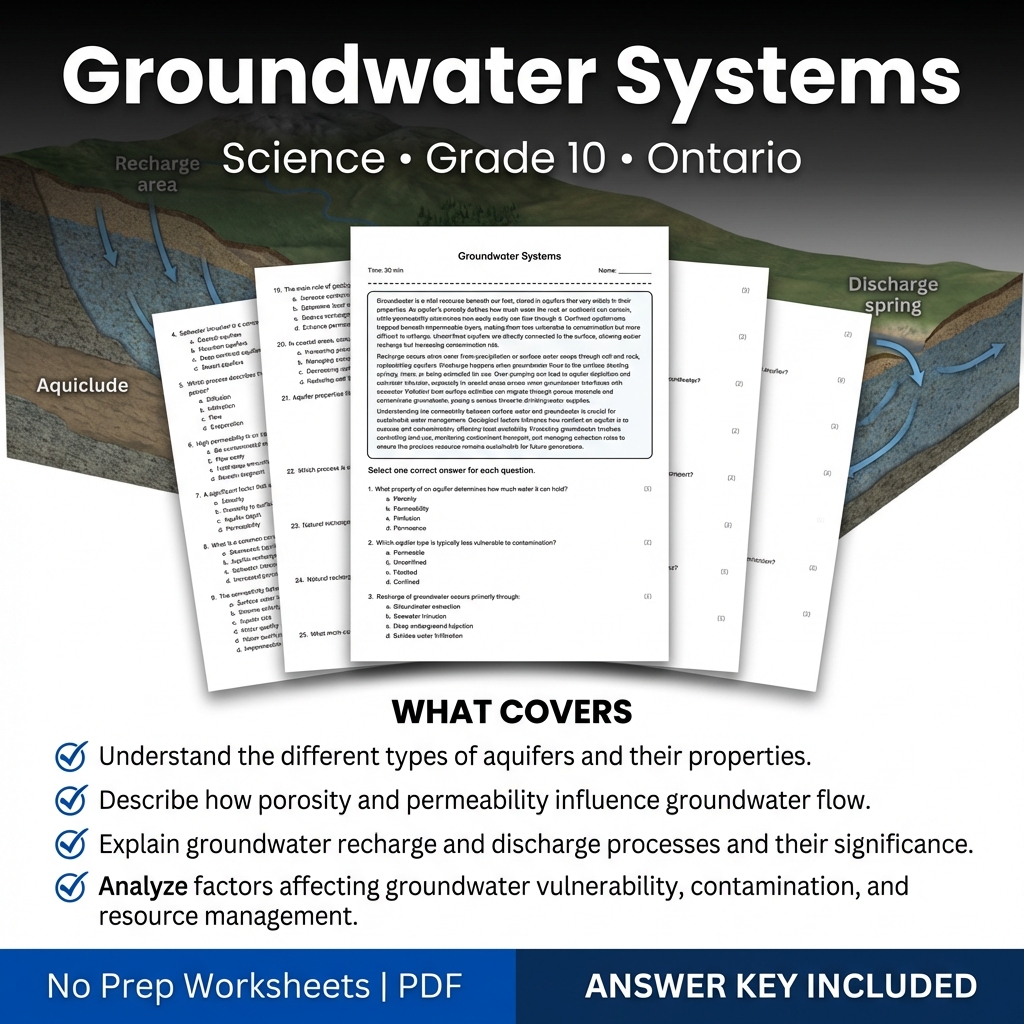
Groundwater Systems Worksheet for Grade 10 Science | Ontario Standards
 Created byCoral Reef Learning
Learning Objectives
- Understand the different types of aquifers and their properties.
- Describe how porosity and permeability influence groundwater flow.
- Explain groundwater recharge and discharge processes and their significance.
Instant download

Earth-Sun Geometry and Seasonal Climate Worksheets | Grade 10 Science
Created bySunny Desk ResourcesLearning Objectives
- Describe how Earth’s tilt and orbit affect daily and seasonal solar energy inputs
- Explain how solar angle differences influence heating of Earth’s surface and air
- Connect changes in solar forcing to atmospheric circulation and regional climate patterns
Also included in: Earth Systems, Climate, and Sustainability Lesson Bundle | Grade 10 Science | Alberta +1 more
Instant download

Functions, Parameters & Return Values Worksheet | Grade 10 Computer Science
Created byBright Mind ResourcesLearning Objectives
- Explain how functions group reusable instructions in a program
- Differentiate parameters from arguments used in function calls
- Describe how return values send results back to a caller
Instant download

Force Relations Worksheet for Grade 10 Science | Alberta Standards-Aligned
JCreated byJ.S SheetsLearning Objectives
- Understand how forces relate to mass and acceleration through Newton's second law.
- Identify the effects of varying mass and applied forces on motion outcomes.
- Analyze real-world examples involving forces in Alberta's agricultural, transportation, and towing contexts.
Also included in: Grade 10 Science Practice Worksheets: Alberta Science Full-Year Bundle
Instant download

Grade 10 Comma and Semicolon Use Worksheet | Ontario ELA with Answer Key
JCreated byJ.S SheetsLearning Objectives
- Use commas correctly to separate clauses, introductory elements, and nonessential information
- Use semicolons to connect closely related independent clauses without creating fragments or comma splices
- Revise sentences to improve clarity and readability by choosing punctuation that supports meaning and tone
Instant download

Grade 10 Comma and Semicolon Use Worksheet | Ontario ELA Punctuation Activity
 Created byLumora Learning
Learning Objectives
- Use commas correctly to separate introductory elements, clauses, and nonessential information.
- Use semicolons to connect closely related independent clauses without creating run-on sentences.
- Choose correct punctuation to prevent ambiguity in sentences with multiple ideas.
Instant download

Grade 10 Plant Systems Worksheet | Alberta Biology Curriculum PDF
 Created byEvergreen Desk Education
Learning Objectives
- Explain how plant root architecture, xylem, phloem, and stomata work together as an integrated system.
- Connect plant organ function to environmental responses such as water stress and changing light conditions.
- Relate plant system understanding to crop health decisions relevant to Alberta grasslands and foothill forests.
Instant download

Health Refusal Skills Worksheet Grade 10 NHES Decision Making Activity
 Created byPrism Point Learning
Learning Objectives
- Explain why clear, respectful refusal helps protect health and safety.
- Use refusal strategies such as stating a boundary, giving a brief reason, and offering an alternative.
- Recognize common pressure tactics and choose an appropriate response.
Instant download

Bonding Types Worksheet – Grade 10 Science Assessment for Alberta Standards
JCreated byJ.S SheetsLearning Objectives
- Describe the differences between ionic, covalent, and metallic bonding at the particle level.
- Explain how bonding types influence macroscopic properties such as conductivity, melting point, and solubility.
- Identify examples of each bonding type in real-world materials and predict their observable behaviors based on atomic interactions.
Also included in: Grade 10 Science Practice Worksheets: Alberta Science Full-Year Bundle
Instant download

Tissue Organization and Organ Function Worksheets Grade 10 Science
Created bySunny Desk ResourcesLearning Objectives
- Explain how cells differentiate and organize into tissues with specific functions
- Compare plant xylem and phloem roles to animal epithelial and connective tissue roles
- Describe how tissue architecture and properties affect organ-level performance in different environments
Also included in: Cell Structure, Homeostasis & Energy Lesson Bundle: Grade 10 Science Alberta +1 more
Instant download

Grade 10 Science | Specialized Cells - Daily Reading Comprehension
Created byCoral Reef LearningLearning Objectives
- Understand the concept of cellular specialization and tissue organization.
- Identify different morphological adaptations of specialized cells.
- Explain how form relates to function in muscle, nerve, root hair, and xylem cells.
Instant download
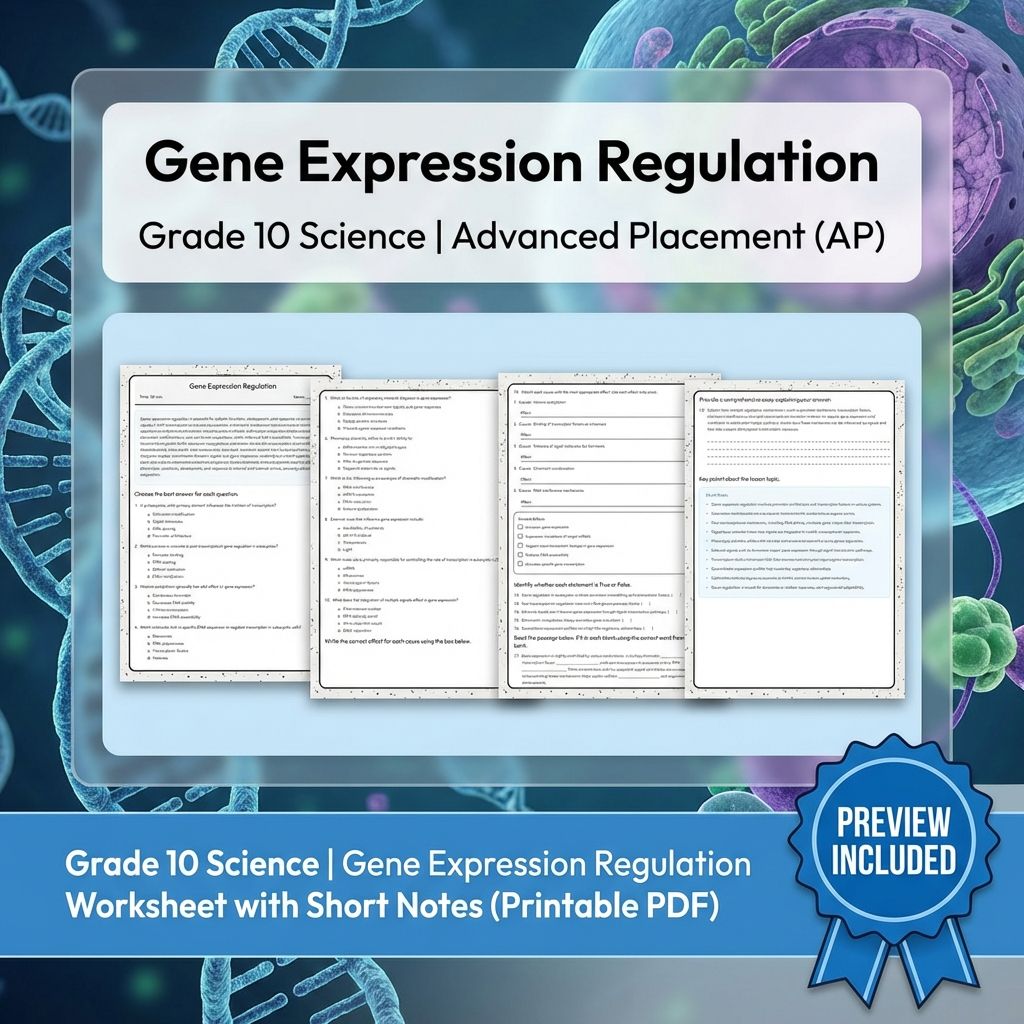
Grade 10 Science | Gene Expression Regulation Worksheet with Short Notes (PDF)
 Created byMeadowlark Worksheets
Learning Objectives
- Understand mechanisms that control gene expression in prokaryotic and eukaryotic cells.
- Identify key components such as promoters, transcription factors, and chromatin modifiers.
- Explain how regulatory networks influence cellular responses and phenotypic plasticity.
Instant download

Grade 10 Science | Microbe Diversity - Daily Reading Comprehension
Created byCoral Reef LearningLearning Objectives
- Identify the major groups of microorganisms: bacteria, archaea, viruses, fungi, and protists.
- Describe the cellular organization, genetic material, and reproduction strategies of different microbes.
- Explain the ecological roles and niches occupied by various microbial groups.
Instant download
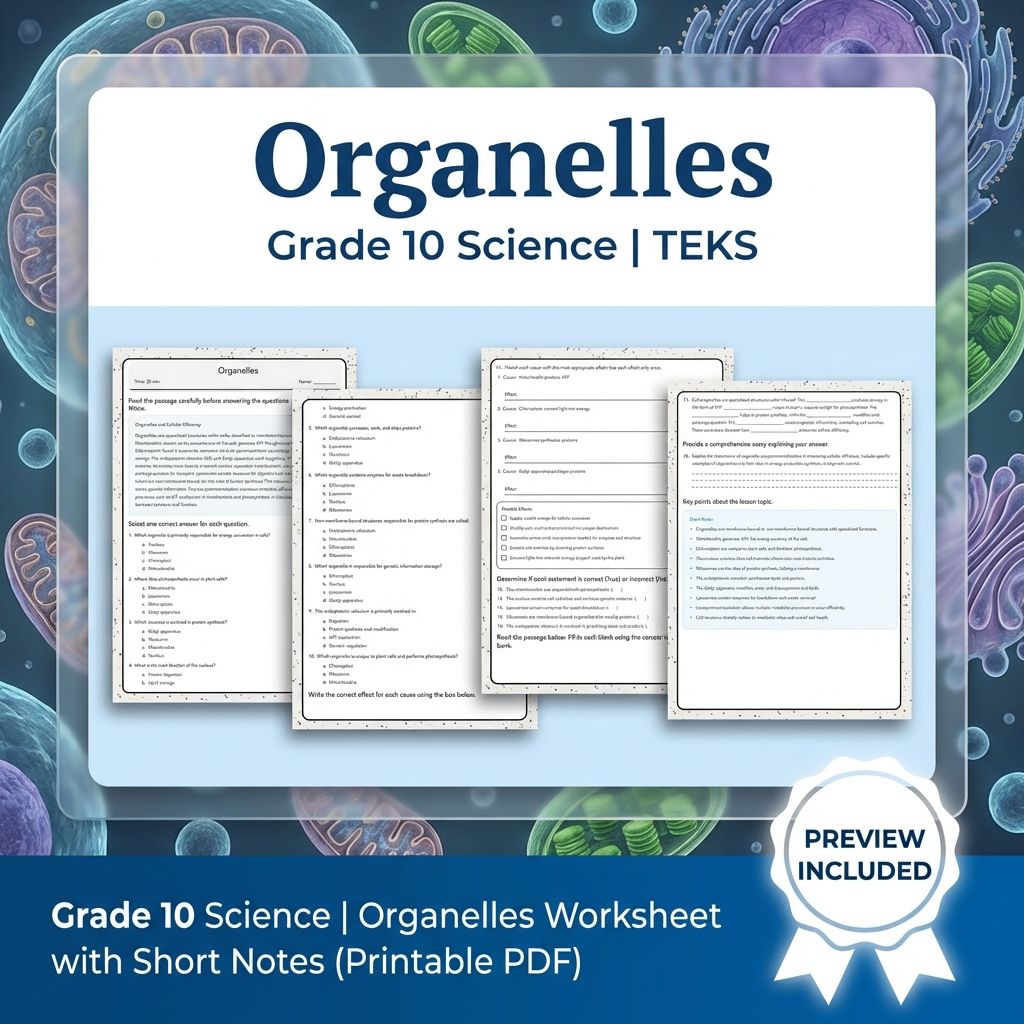
Grade 10 Science | Organelles Worksheet with Short Notes (Printable PDF)
Created byMeadowlark WorksheetsLearning Objectives
- Describe the functions of different cell organelles and their role in cellular efficiency.
- Compare membrane-bound and non-membrane-bound organelles in terms of structure and function.
- Explain how compartmentalization enhances metabolic processes within a cell.
Instant download

Grade 10 Sustainability Assessment Worksheet | Practice & PDF
Created byClear Sky ClassroomLearning Objectives
- Explain how sustainability assessments use environmental, economic, and social indicators to evaluate long-term viability.
- Describe how metrics such as renewal rates, pollutant loads, and ecosystem service trends support sustainability decisions.
- Interpret and communicate results from comparative assessments that balance extraction, conservation, and restoration.
Instant download

Grade 10 Cell Organization Worksheet | Cell Structure & Function NGSS
 Created byBRIGHT PATH RESOURCES
Learning Objectives
- Identify key cellular organelles and describe their functions
- Understand the structural differences between eukaryotic and prokaryotic cells
- Explain how cellular organization contributes to tissue and organ functions
Also included in: Human Physiology Grade 10 Science Daily Reading Worksheets Lesson Bundle | Ngss +1 more
Instant download

Cultural Movements Worksheet | Grade 10 Social Studies TEKS Activity
 Created byThe Resource Hub
Learning Objectives
- Explain how the Renaissance influenced societal values, art, and learning
- Describe how the Scientific Revolution changed methods of inquiry into nature
- Analyze how cultural movements can lead to innovation and broader social change
Also included in: Global Conflicts & Decolonization Lesson Bundle | Grade 10 Social Studies TEKS +1 more
Instant download

Battle Narratives Worksheet | Standard-Aligned Grade 10 Social Studies
JCreated byJ.S SheetsLearning Objectives
- Analyze how battle narratives (from Vimy Ridge to Normandy) shape national remembrance and identity.
- Evaluate causes and consequences of strategic decisions and battlefield outcomes.
- Compare continuity and change in military technology and veteran care across major engagements.
Instant download
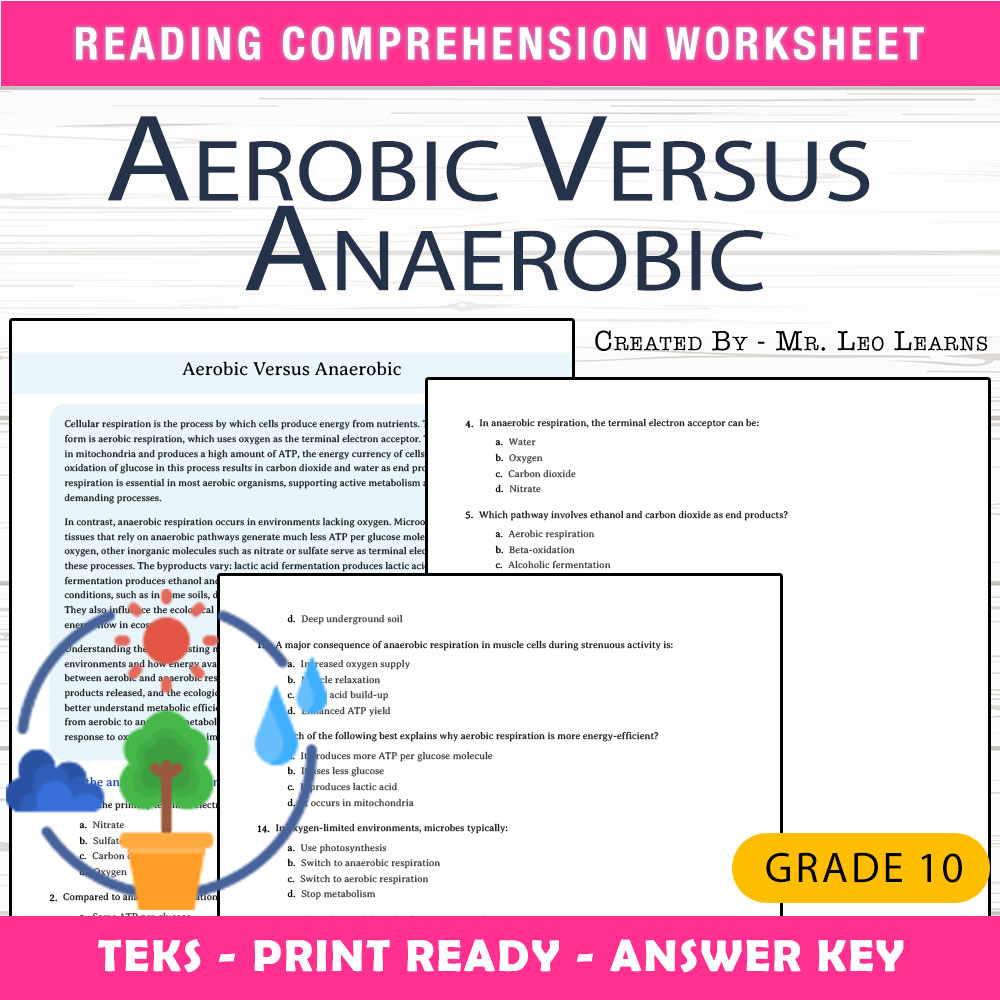
Grade 10 Science – Aerobic vs. Anaerobic Worksheet for Mastery
Created byThe Resource HubLearning Objectives
- Understand the differences between aerobic and anaerobic respiration pathways.
- Identify the distinct end products and ATP yields of each process.
- Explain how oxygen availability influences metabolic pathways in microbes and tissues.
Also included in: Grade 10 Science Unit Bundle | Energy, Photosynthesis & Cellular Respiration +1 more
Instant download

Science Worksheet: Health Impacts of Pathogens and Immunity Grade 10
JCreated byJ.S SheetsLearning Objectives
- Differentiate bacterial, viral, and fungal disease processes at a conceptual level
- Explain key ideas in innate and adaptive immunity, including antibody-mediated recognition
- Describe how pathogens spread and how vaccination supports an induced adaptive response
Instant download
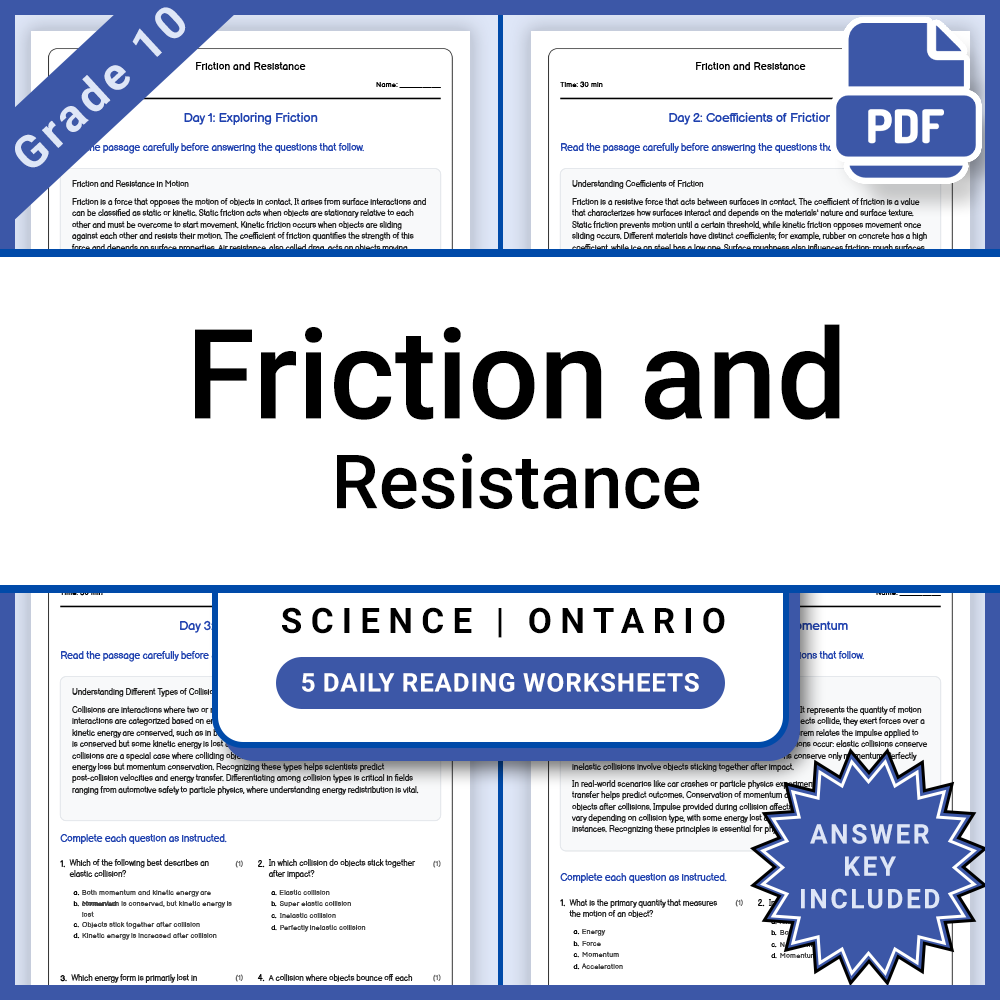
Grade 10 Science – Friction and Resistance Daily Reading Worksheet + Answer Key
JCreated byJ.S SheetsLearning Objectives
- Understand the difference between static and kinetic friction
- Identify factors affecting the coefficients of friction
- Explain the concepts of air resistance and viscous drag
Also included in: Grade 10 Science Lesson Bundle | Physics and Motion Ontario Framework +1 more
Instant download

Grade 10 Math | Complex Triangle Problems Worksheet (Ontario Standards) (PDF)
Created byClear Sky ClassroomLearning Objectives
- Develop problem-solving skills involving oblique triangles using trigonometry.
- Interpret and analyze real-world measurement problems involving multiple angles and sides.
- Apply the Law of Cosines and Law of Sines accurately in complex scenarios.
Also included in: Grade 10 Math Lesson Group: Trigonometry Worksheets for Ontario Students +1 more
Instant download

Grade 10 Science – Ecosystem Modeling Worksheet (NGSS 10-302) (PDF)
 Created bySilver Birch Teaching
Learning Objectives
- Understand how conceptual and quantitative models represent energy and matter flows in ecosystems.
- Interpret model predictions of system responses to perturbations such as species loss or flux alterations.
- Explore approaches like Lotka–Volterra equations, mass-balance nutrient models, and carbon budget estimations in ecosystem analysis.
Also included in: Grade 10 Ecosystem Stability and Biodiversity Science Lesson Bundle NGSS +1 more
Instant download
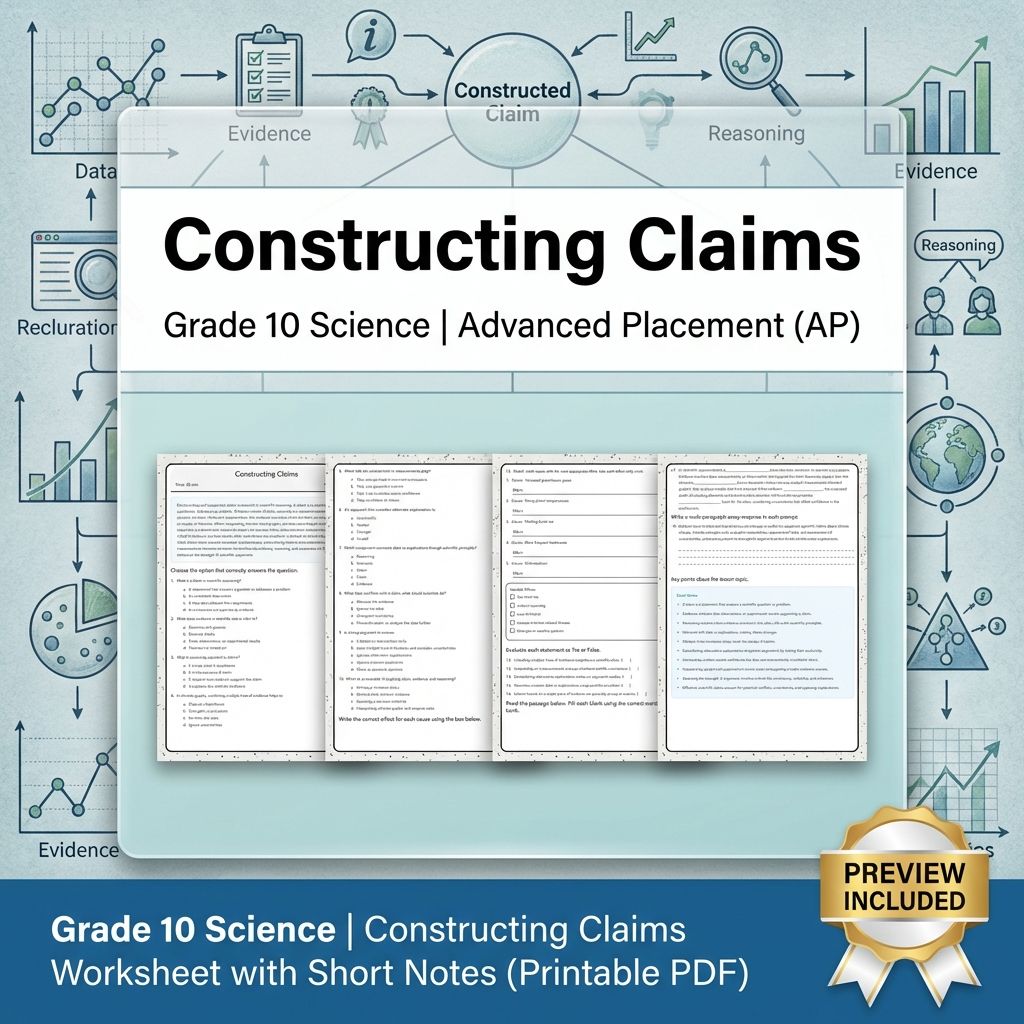
Grade 10 Science | Constructing Claims Worksheet with Short Notes (PDF)
Created byMeadowlark WorksheetsLearning Objectives
- Understand the structure and components of evidence-based claims: claim, evidence, and reasoning.
- Distinguish between claim, evidence, reasoning, and warrants in scientific arguments.
- Apply the claims-evidence-reasoning framework to interpret graphs and experimental data.
Also included in: Grade 10 Science Unit | Data Analysis, Modelling Worksheet Pack
Instant download
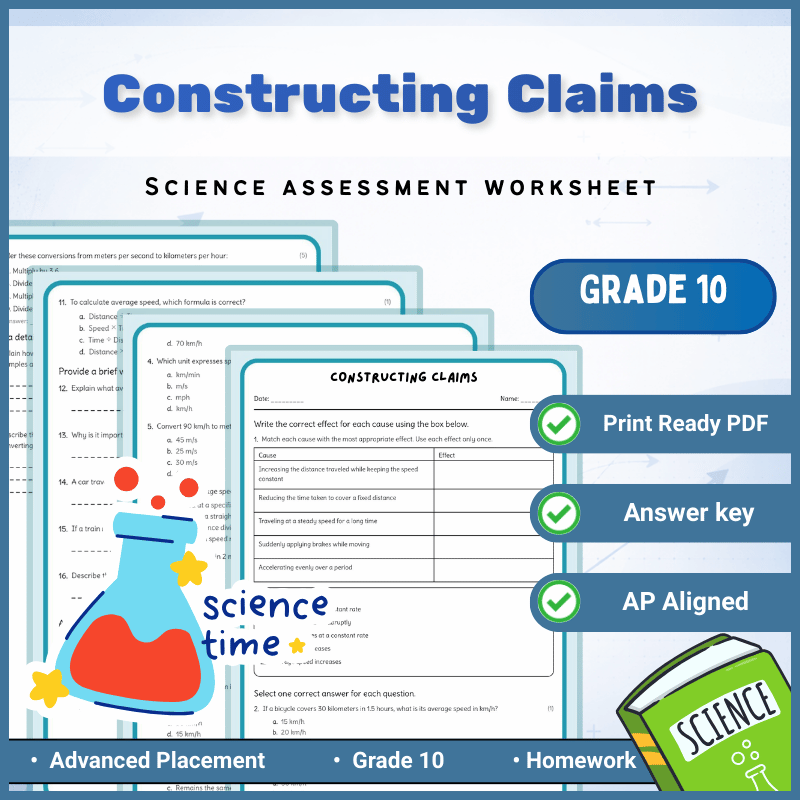
Grade 10 Science | Constructing Scientific Claims Worksheet (AP Standards) (PDF)
Created byBright Mind ResourcesLearning Objectives
- Understand the structure and components of evidence-based claims, including claim, evidence, reasoning, and warrants.
- Distinguish between claims, evidence, and reasoning in scientific arguments.
- Apply criteria for evaluating the strength of scientific arguments by analyzing multiple lines of evidence.
Instant download

Grade 10 Science | Reaction Classification Worksheet | BC Aligned
Created byLumora LearningLearning Objectives
- Understand different types of chemical reactions and their characteristic features.
- Identify reaction types based on reactant and product relationships.
- Relate reaction classes to periodic properties and energy changes.
Instant download
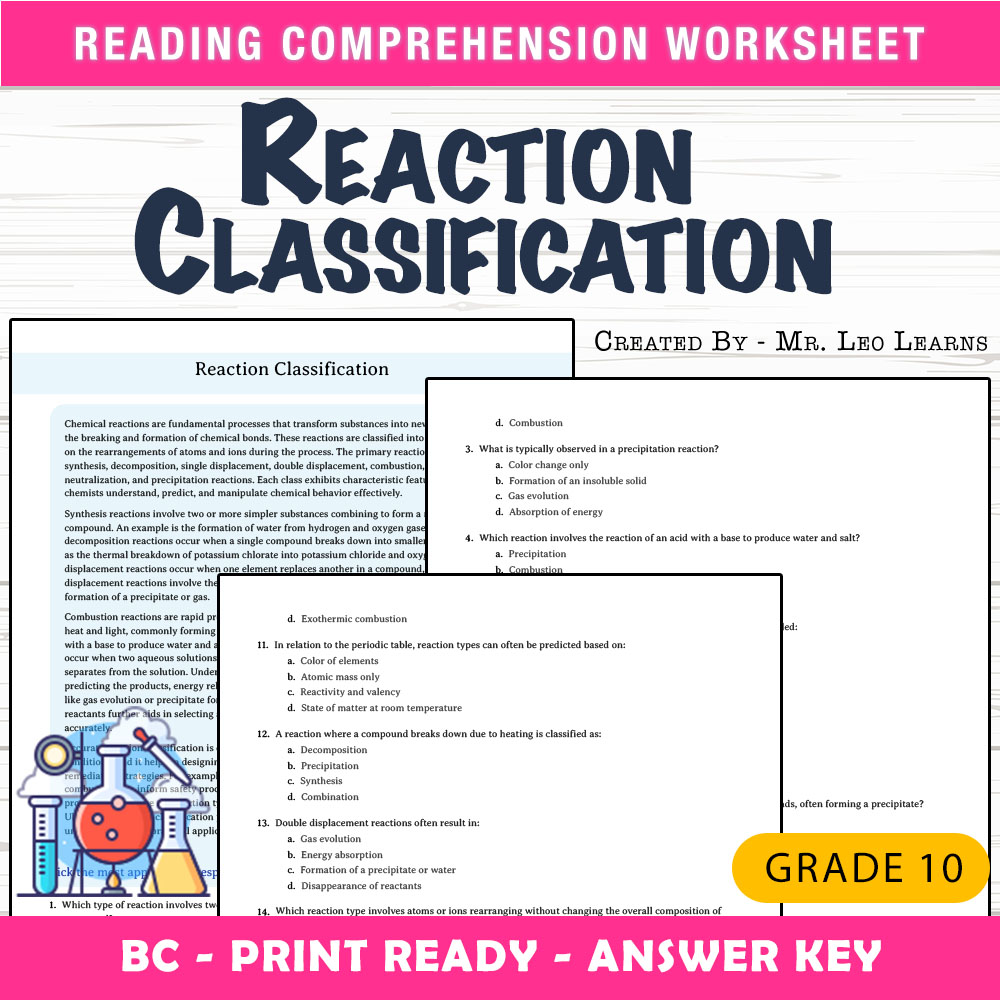
Grade 10 Science — Worksheet MCQ Paper for Mastering Reaction Classification
Created byThe Resource HubLearning Objectives
- Understand the different types of chemical reactions and their characteristic features.
- Identify reaction types based on reactant and product relationships.
- Predict products and energy changes for various reaction classes.
Also included in: Grade 10 Science | Matter & Chemical Change UNIT Worksheet Pack (BC Framework) +1 more
Instant download
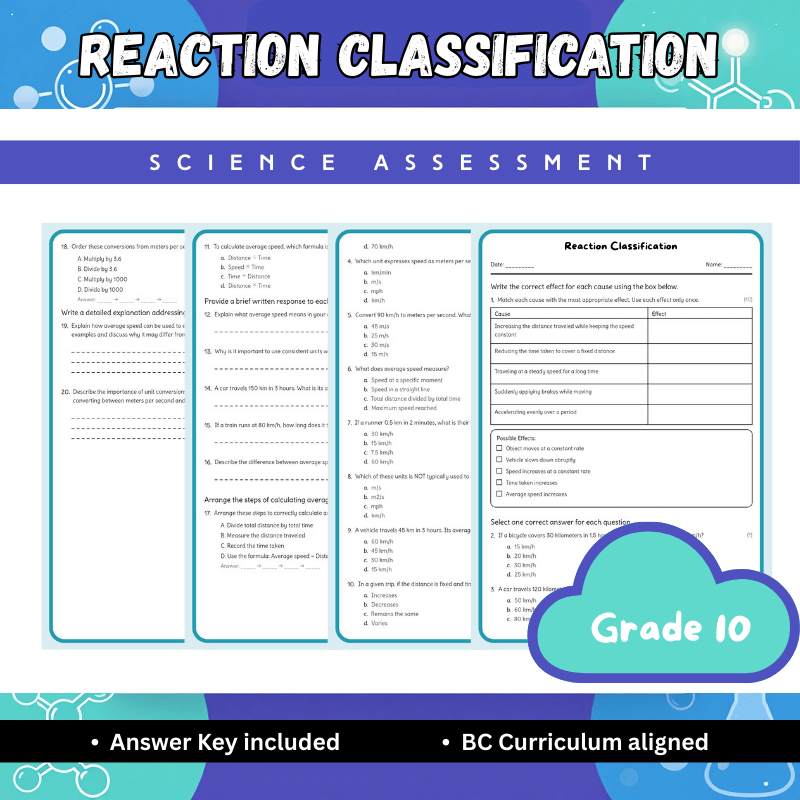
Grade 10 Science – Reaction Classification Worksheet + Answer Key | BC Standards
Created byBright Mind ResourcesLearning Objectives
- Understand the main types of chemical reactions and their characteristics.
- Identify different reaction classes based on reactant arrangements and observable evidence.
- Relate reaction types to reactant identities and periodic properties.
Instant download
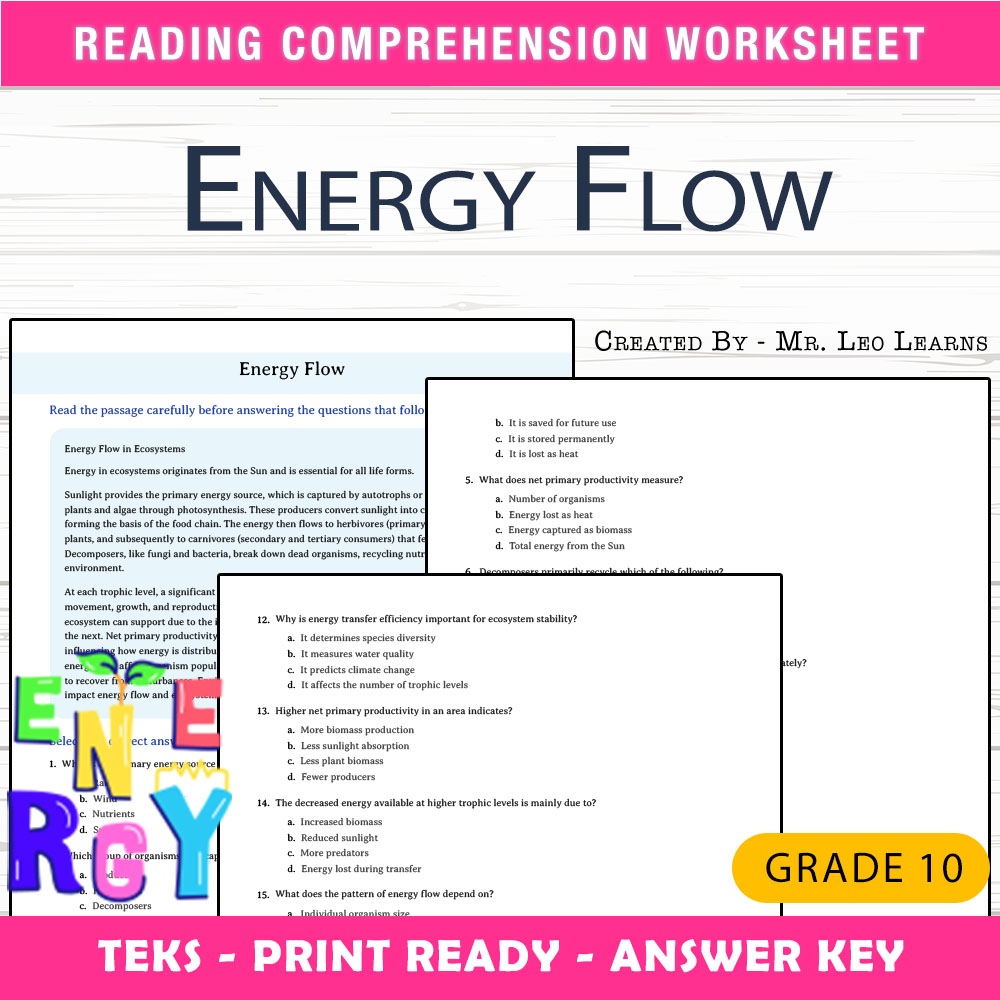
Grade 10 Science – Energy Flow Worksheet for Mastery
Created byThe Resource HubLearning Objectives
- Describe how energy flows through ecosystems from sunlight to producers, consumers, and decomposers.
- Explain the concept of energy transfer efficiency and how energy is lost as heat at each trophic level.
- Define net primary productivity and its significance in ecosystems.
Also included in: Grade 10 Science Unit Bundle | Energy, Photosynthesis & Cellular Respiration +1 more
Instant download
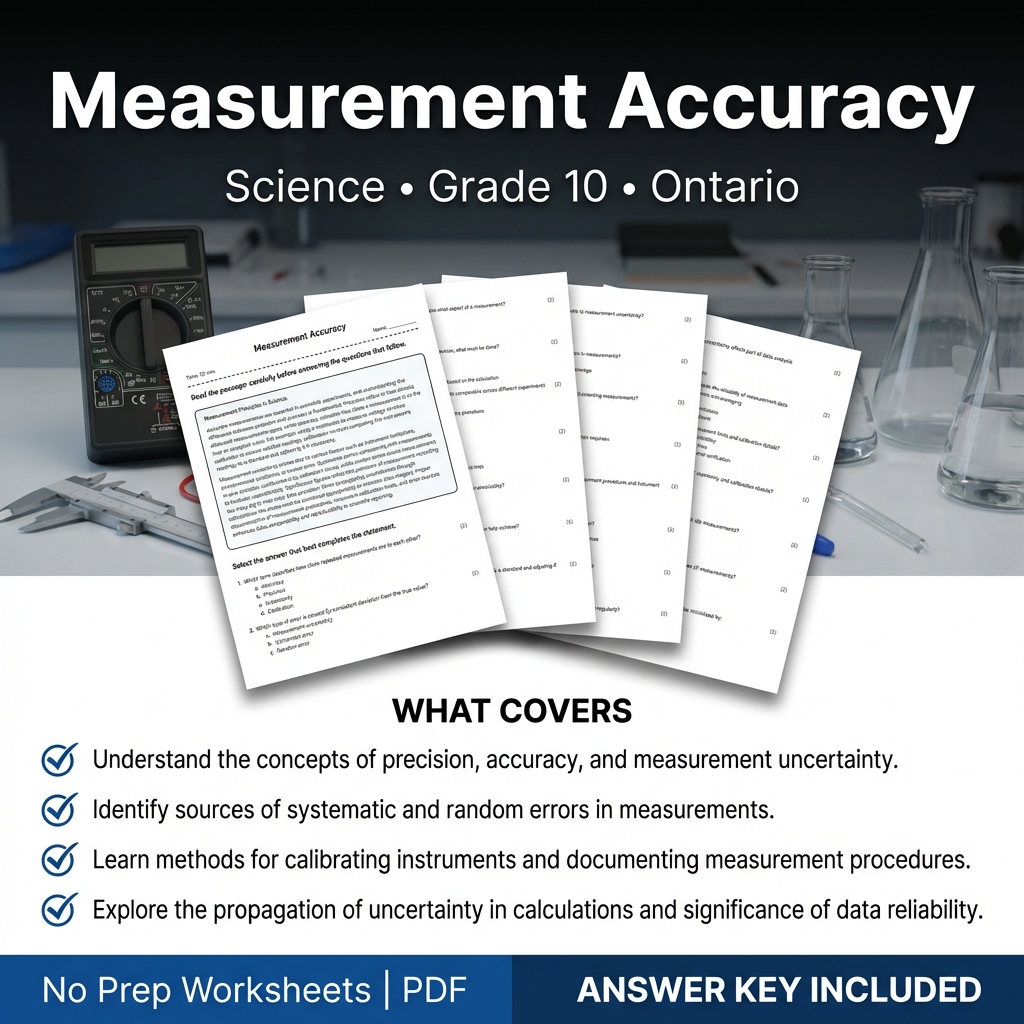
Measurement Accuracy Worksheet for Grade 10 Science – Ontario Standards
Created byCoral Reef LearningLearning Objectives
- Understand the concepts of precision, accuracy, and measurement uncertainty.
- Identify sources of systematic and random errors in measurements.
- Learn methods for calibrating instruments and documenting measurement procedures.
Instant download

Grade 10 Plot and Structure Worksheet | Ontario ELA with Answer Key
JCreated byJ.S SheetsLearning Objectives
- Identify how exposition, rising action, turning points, and resolution shape plot meaning
- Analyze how sequencing and delayed revelation change the interpretation of earlier events
- Explain how transitions signal cause and consequence to support theme
Instant download

Plate Tectonics Worksheet | Standards-Aligned Grade 10 Science Practice
JCreated byJ.S SheetsLearning Objectives
- Describe the three main types of plate boundaries (divergent, convergent, transform) and the crustal processes associated with each.
- Explain how mantle convection and slab pull can drive plate motion.
- Connect empirical evidence (continental fit, palaeomagnetism, and earthquake distribution) to support plate tectonic theory.
Instant download

Grade 10 Science Measurement Accuracy Worksheet | Ontario Science
Created byClear Sky ClassroomLearning Objectives
- Differentiate accuracy, precision, and measurement uncertainty and identify sources of systematic and random error.
- Apply rules for significant figures and use uncertainty to report measurements appropriately.
- Use calibration, instrument limits, and documented procedures to improve data reliability and comparability.
Instant download

Grade 10 ELA – Daily Reading Worksheet & Standards-Aligned Practice
 Created byQuiet Forest Education
Learning Objectives
- Understand key concepts related to ELA
- Apply knowledge through practice questions
- Demonstrate comprehension of the material
Also included in: Grade 10 Vocabulary in ELA Daily Reading Worksheets lesson bundle | General ELA +2 more
Instant download
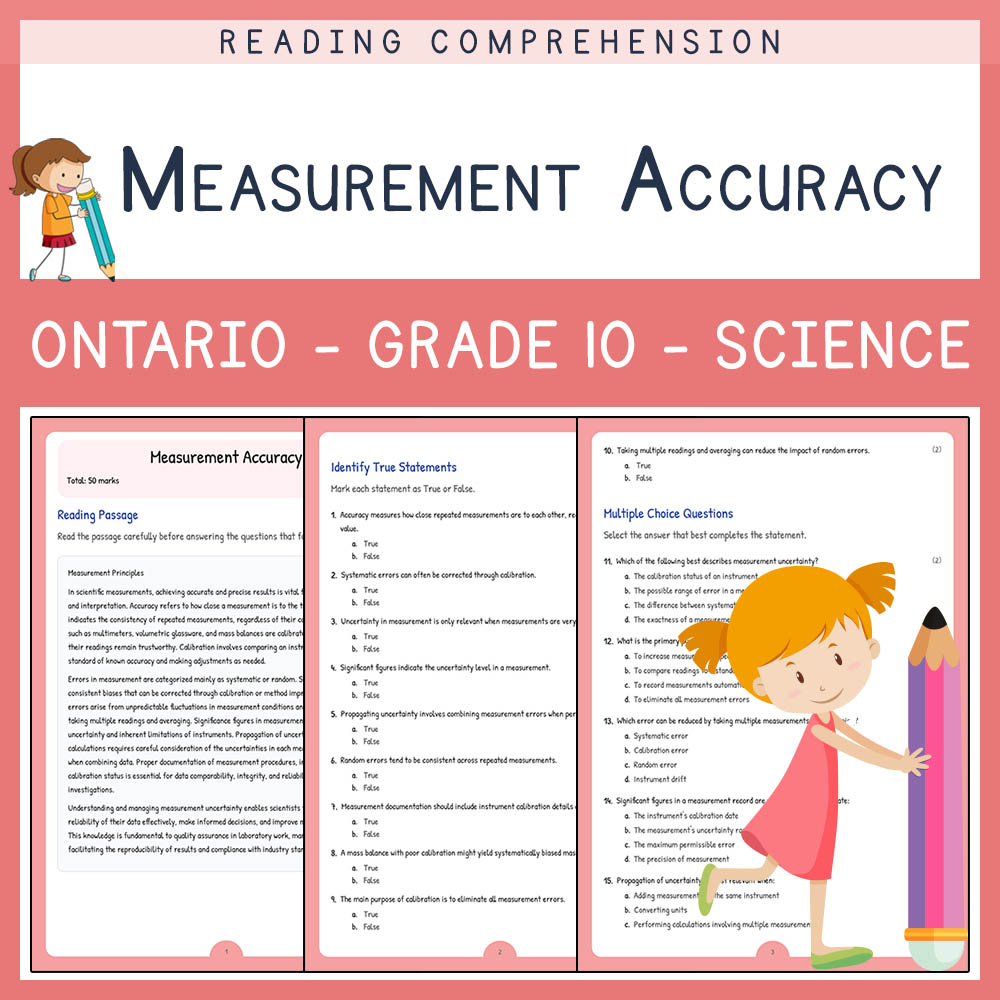
Grade 10 Science | Measurement Accuracy Worksheet Elena | Ontario Standard
Created byLumora LearningLearning Objectives
- Understand the concepts of precision, accuracy, and measurement uncertainty.
- Identify systematic and random errors in measurements.
- Learn methods for calibration and documenting measurement procedures.
Instant download

Evidence Quality Worksheets for Grade 10 ELA | Standards-Aligned Practice
JCreated byJ.S SheetsLearning Objectives
- Evaluate how well specific details support a claim by judging relevance and strength of evidence.
- Assess reliability by checking specificity, completeness, and contextual information.
- Explain why some pieces of evidence carry more interpretive weight than others.
Instant download

Grade 10 Reaction Types Worksheet | Alberta Practice PDF
Created byClear Sky ClassroomLearning Objectives
- Classify chemical reactions as synthesis, decomposition, single displacement, double displacement, or combustion based on particle/species changes.
- Predict likely products by applying typical reaction patterns and balancing equations (where needed).
- Interpret evidence of chemical change (temperature change, gas formation, precipitates, pH change) using reaction-type reasoning.
Instant download

Wave Properties Worksheet Grade 10 Science Activity | Waves & Energy
Created byPrism Point LearningLearning Objectives
- Explain how amplitude, wavelength, frequency, and wave speed describe repeating wave behavior
- Relate frequency and wavelength for waves traveling at the same speed
- Describe how reflection, refraction, and superposition affect what we observe
Also included in: Grade 10 Physical Science Lesson Bundle | Florida NGSSS
Instant download

Source Evaluation Worksheet for Grade 10 ELA | Common Core Standards
JCreated byJ.S SheetsLearning Objectives
- Evaluate the credibility of sources by analyzing authorship, purpose, and methods.
- Determine how relevant and useful a source is for answering a specific research question.
- Distinguish between primary and secondary sources and choose evidence that best supports a central claim.
Instant download

Grade 10 Social Studies – Proxy Conflicts Worksheet (BC Standards) (PDF)
Created bySunny Desk ResourcesLearning Objectives
- Explain how superpower rivalry can turn regional wars into proxy conflicts using military, political, and economic dimensions.
- Compare proxy conflicts in Korea and Vietnam by identifying key causes, turning points, and outcomes for local populations.
- Evaluate how external intervention can reshape governance, social structures, and international alignments.
Also included in: Grade 10 Conflict, Justice & Rights Social Studies Lesson Bundle (BC) +1 more
Instant download

Proxy Conflicts Worksheet | Standards-Aligned Social Studies Practice Grade 10
JCreated byJ.S SheetsLearning Objectives
- Explain how superpower rivalry can shape regional wars through proxy conflicts rather than direct military confrontation.
- Compare Korea and Vietnam by identifying key causes, continuity, and changes in political and revolutionary movements.
- Analyze how military, political, and economic factors interact to affect outcomes for local populations.
Instant download
Browse more categories
About Grade 10 Worksheets
Find Grade 10 worksheets covering algebra, biology, literature, and history. All 9,388 resources download instantly as PDFs for classwork, homework, or review.
MyTeachingSheets worksheets are made by real teacher-authors and checked before they go live. Download any as a print-ready PDF for lessons, homework, or independent practice — most include answer keys, and previews are always free.