
Grade 10 Worksheets
9,388 grade resources
Grade 10 Health Worksheet | Preventive Behaviors Aligned to NHES (PDF)
 Created bySunny Desk Resources
Learning Objectives
- Explain how preventive behaviors reduce the risk of illness and injury.
- Analyze how hygiene, vaccinations, and check-ups support long-term health.
- Apply preventive strategies to real-life situations using evidence-based reasoning.
Also included in: Grade 10 Health Self-Management & Advocacy Lesson Bundle | NHES +1 more
Instant download

Grade 10 Registers and Tone Worksheet | Ontario ELA with Answer Key
JCreated byJ.S SheetsLearning Objectives
- Define and distinguish register and tone in writing by analyzing word choice, sentence style, and audience awareness.
- Identify how figurative language, hedging, and direct evaluation shape tone while maintaining grammatical correctness.
- Revise writing to sustain consistent register and clarify audience-appropriate formality.
Instant download
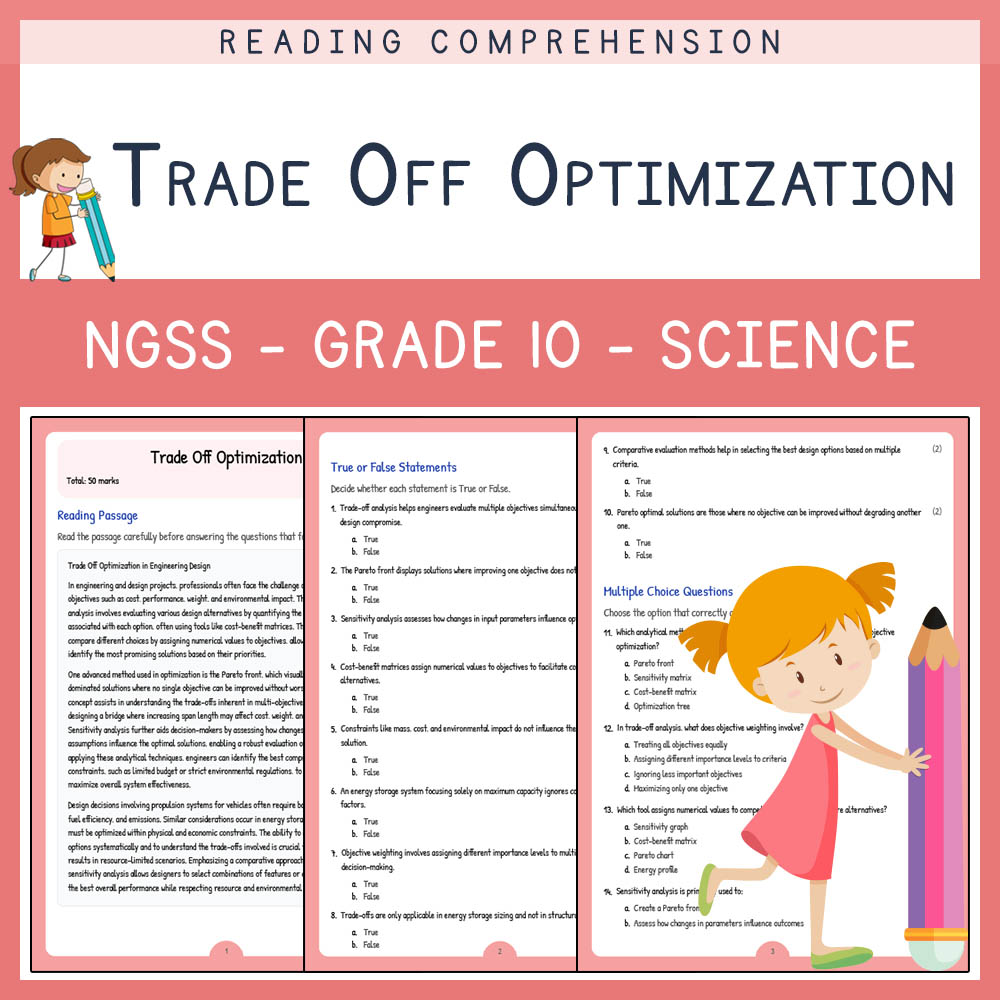
Grade 10 Science | Trade-Off Optimization Worksheet & Answer Key (NGSS Aligned)
 Created byLumora Learning
Learning Objectives
- Understand how to analyze trade-offs between competing objectives in engineering design.
- Apply cost-benefit matrices, Pareto fronts, and sensitivity analysis to optimize system performance.
- Evaluate the impact of constraints such as mass, cost, and environmental impact on decision-making.
Instant download
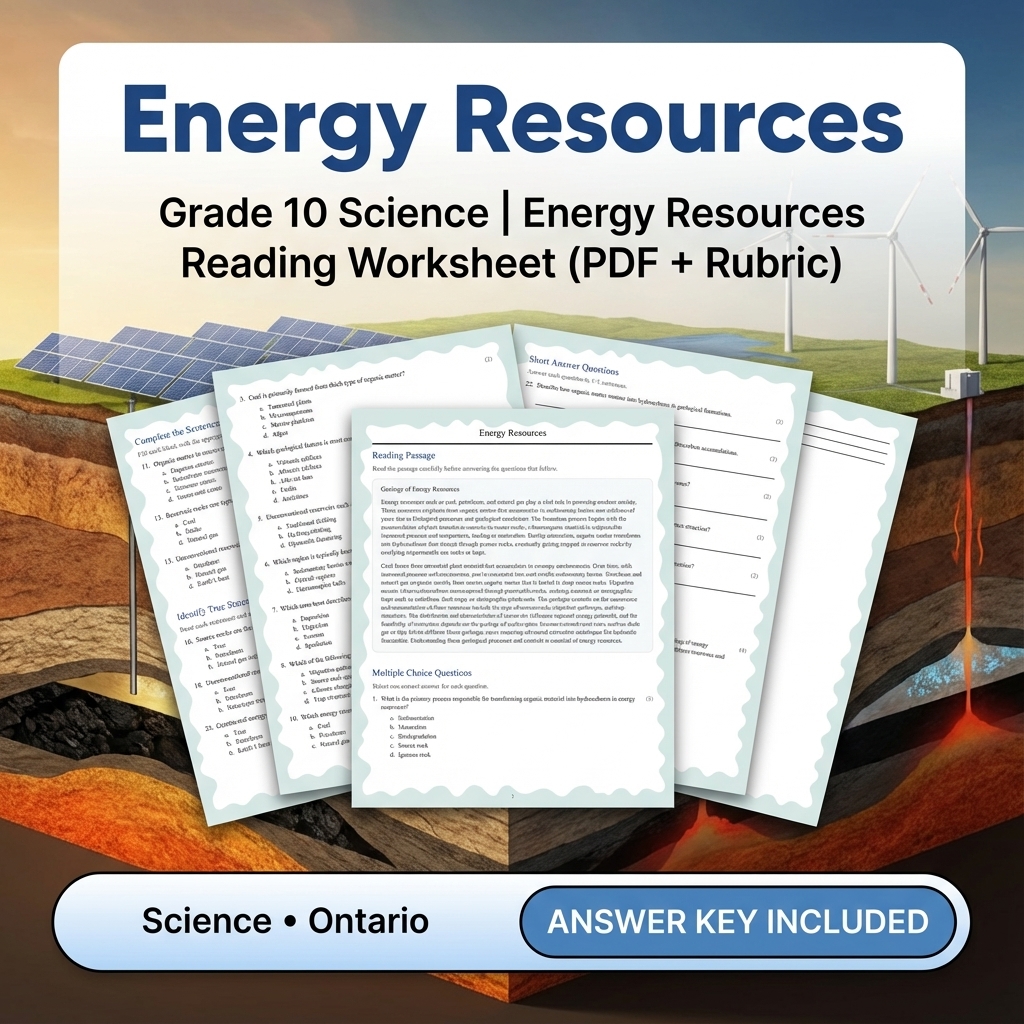
Grade 10 Science | Energy Resources Reading Worksheet (PDF + Rubric)
JCreated byJ.S SheetsLearning Objectives
- Understand the geological formation and distribution of coal, petroleum, and natural gas.
- Explain the processes of organic matter maturation, source rock formation, migration, and trapping of energy resources.
- Differentiate between conventional and unconventional reservoirs of energy resources.
Also included in: Grade 10 Science Unit Bundle – Earth Dynamics & Resources (PDF + Rubrics) +1 more
Instant download

Grade 10 Math – Midpoint Estimation Worksheet (Ontario Standards) (PDF)
 Created byClear Sky Classroom
Learning Objectives
- Understand the concept of midpoint in a coordinate plane and apply it to real-world scenarios.
- Calculate the distance between points using the coordinate system and interpret the results.
- Solve practical problems involving resource division, location planning, and data interpretation using midpoint and distance concepts.
Also included in: Grade 10 Maths | Analytic Geometry Applied Lesson Bundle for Ontario +1 more
Instant download
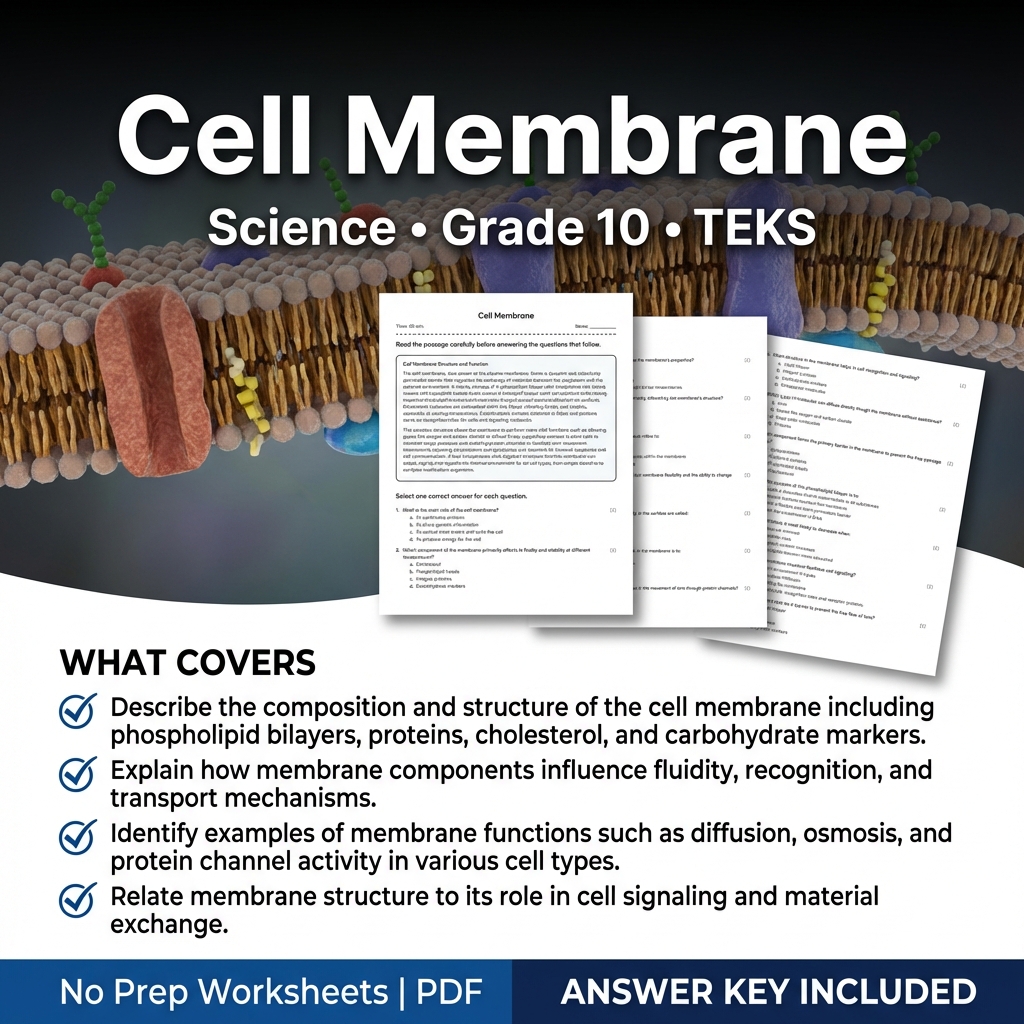
Cell Membrane Worksheet for Grade 10 Science – TEKS Aligned Practice
 Created byCoral Reef Learning
Learning Objectives
- Describe the composition and structure of the cell membrane including phospholipid bilayers, proteins, cholesterol, and carbohydrate markers.
- Explain how membrane components influence fluidity, recognition, and transport mechanisms.
- Identify examples of membrane functions such as diffusion, osmosis, and protein channel activity in various cell types.
Instant download

Recommendation Systems Worksheet | Grade 10 Computer Science Activity
 Created byPrism Point Learning
Learning Objectives
- Explain how recommendation systems use data and patterns to suggest content.
- Compare common recommendation approaches and describe their strengths and limits.
- Evaluate how recommendations can differ for users and affect choices.
Instant download
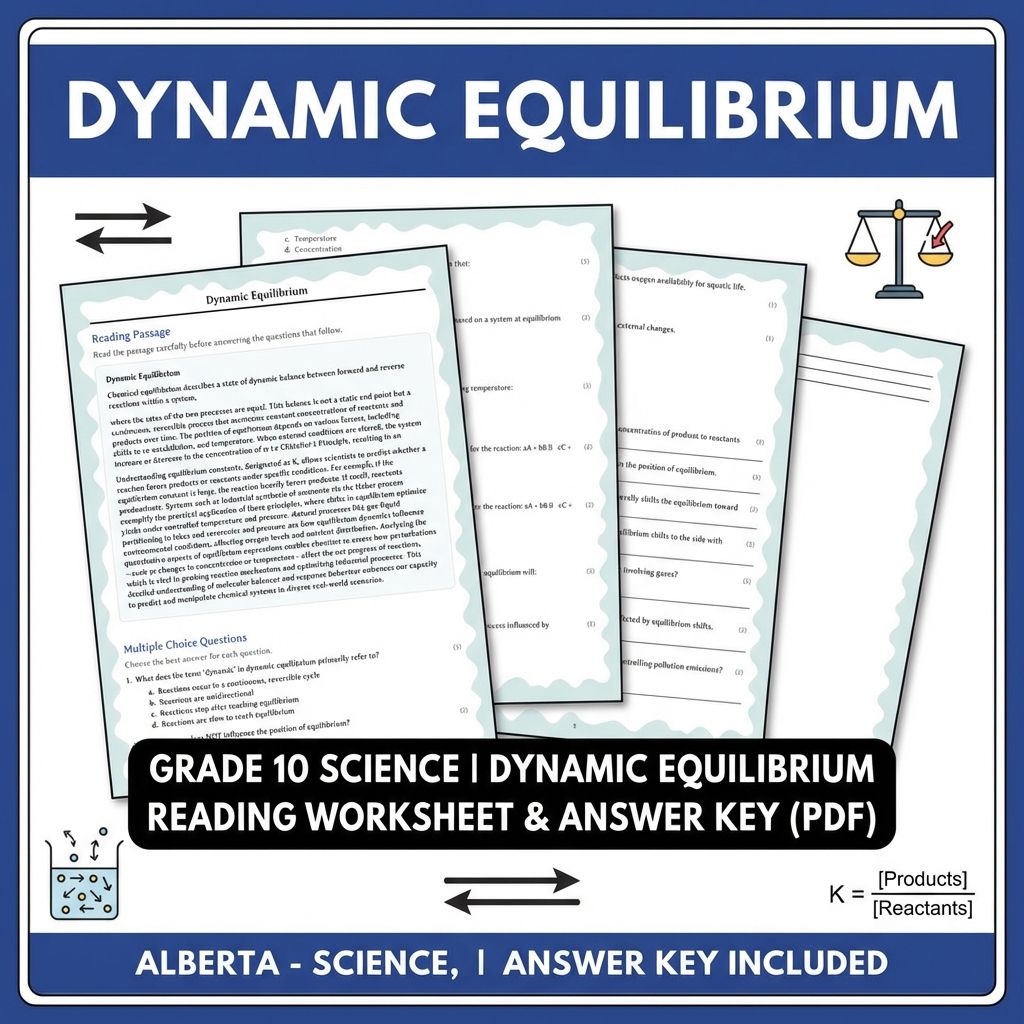
Grade 10 Science | Dynamic Equilibrium Reading Worksheet & Answer Key (PDF)
JCreated byJ.S SheetsLearning Objectives
- Understand the concept of chemical dynamic equilibrium and the factors affecting it.
- Interpret equilibrium constants and predict system shifts due to stressors.
- Analyze real-world examples like industrial synthesis and environmental processes.
Also included in: Grade 10 Science Unit Bundle | Chemical Reactions & Properties Worksheets +1 more
Instant download
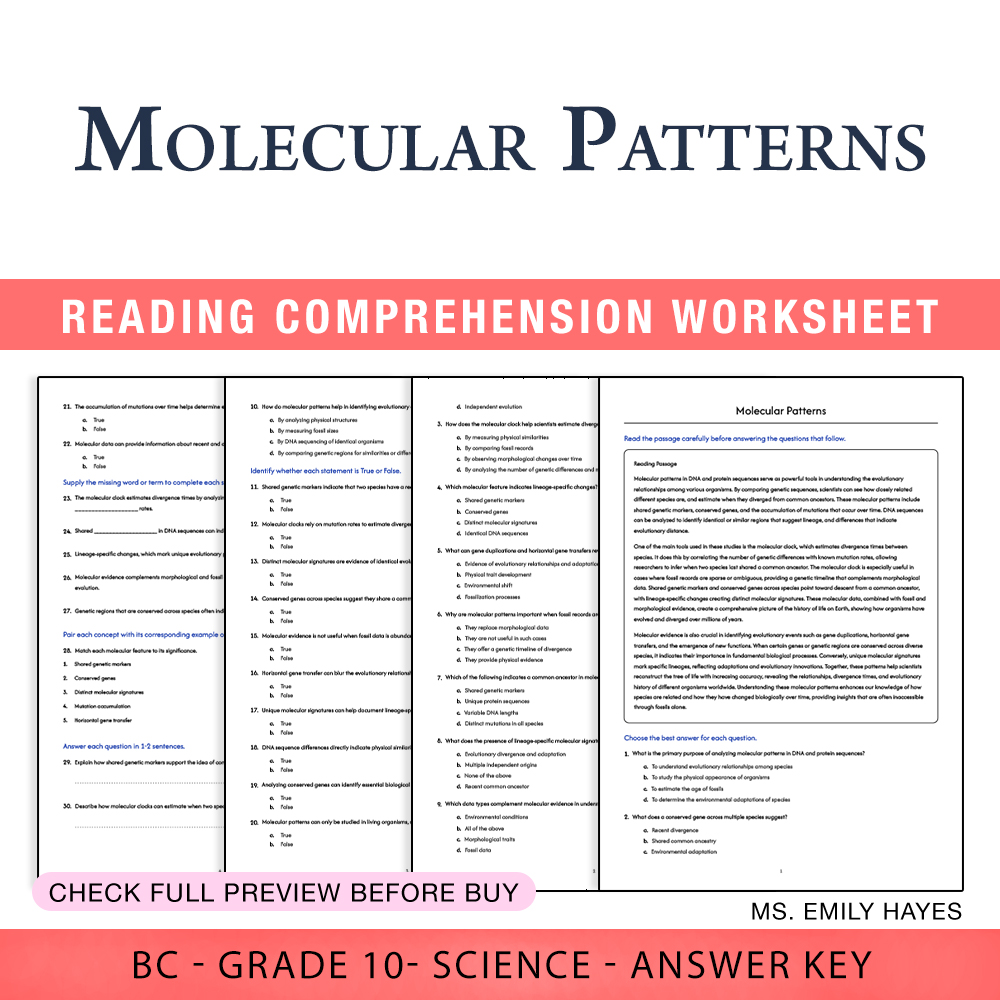
Grade 10 Science | Molecular Patterns Worksheet (PDF+ Answer Key)
 Created byCopper Leaf Classroom
Learning Objectives
- Explain how molecular patterns in DNA and protein sequences reveal relatedness among organisms
- Describe how molecular clocks estimate divergence times based on mutation rates
- Identify shared genetic markers and conserved genes as evidence of common ancestry
Also included in: Grade 10 Science BC | Evolution, Biodiversity & Ecology (PDF + Answer Key) +1 more
Instant download

Input and Output in Computer Systems Worksheet | Grade 10 Computer Science
Created byPrism Point LearningLearning Objectives
- Explain how input devices collect data and how programs process that data.
- Differentiate between input and output in a computer system using examples.
- Evaluate statements about signals, devices, and the flow of information.
Also included in: Coding Fundamentals Lesson Bundle | Grade 10 Computer Science | General
Instant download
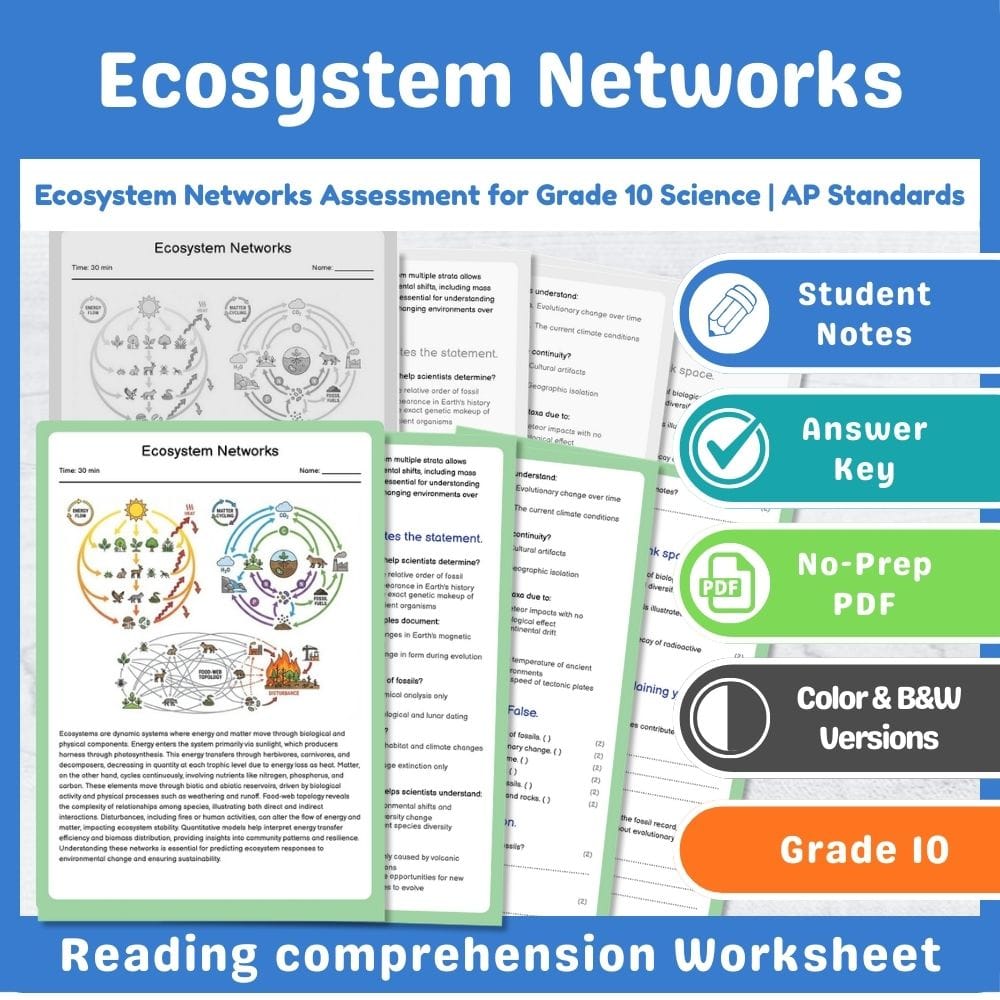
Ecosystem Networks Assessment for Grade 10 Science | AP Standards
Created byPrism Point LearningLearning Objectives
- Describe how energy flows through different levels of an ecosystem.
- Explain the cycling of matter and nutrients within ecosystems.
- Analyze the roles of species interactions and disturbances in ecosystem stability.
Also included in: Lesson Grade 10 Science Assessment Bundle | AP Standards-Aligned
Instant download
Grade 10 Science – Metabolic Regulation Worksheet (Worksheet + Answer Key) (TEKS Aligned)
 Created byBright Mind Resources
Learning Objectives
- Understand how enzyme activity is modulated through allosteric regulation and feedback inhibition.
- Describe cellular signaling mechanisms that coordinate metabolic pathways.
- Explain how covalent modifications alter enzyme activity in response to cellular conditions.
Also included in: Grade 10 Science Unit Bundle – Photosynthesis, Respiration & Energy TEKS +5 more
Instant download

Stellar Lifecycles Worksheet | NGSS Grade 10 Science Practice PDF
JCreated byJ.S SheetsLearning Objectives
- Describe the stages of stellar evolution and the processes involved in each phase.
- Explain how nuclear fusion, energy transport, and changes in luminosity and temperature relate to stellar development.
- Interpret the Hertzsprung-Russell diagram and understand its significance in stellar classification.
Also included in: Grade 10 Cosmic Origins Space Science lesson bundle – NGSS worksheet set
Instant download

Grade 10 Science – Aerobic & Anaerobic Respiration | Daily Reading Worksheet
Created byBright Mind ResourcesLearning Objectives
- Identify the key features of aerobic respiration.
- Differentiate between aerobic and anaerobic pathways.
- Recognize the products and energy yields of each pathway.
Also included in: Grade 10 Energy in Biological Systems Science Daily Reading Lesson Bundle | TEKS +2 more
Instant download

Grade 10 Science – Multi-Criteria Optimization | Daily Reading Worksheet
Created byBright Mind ResourcesLearning Objectives
- Understand the concept of multi-criteria optimization
- Learn how to prioritize multiple goals in design
- Recognize the importance of constraints and measurement trends
Also included in: Grade 10 Science Trade-Off Design Daily Reading Worksheet Lesson Bundle-General +1 more
Instant download
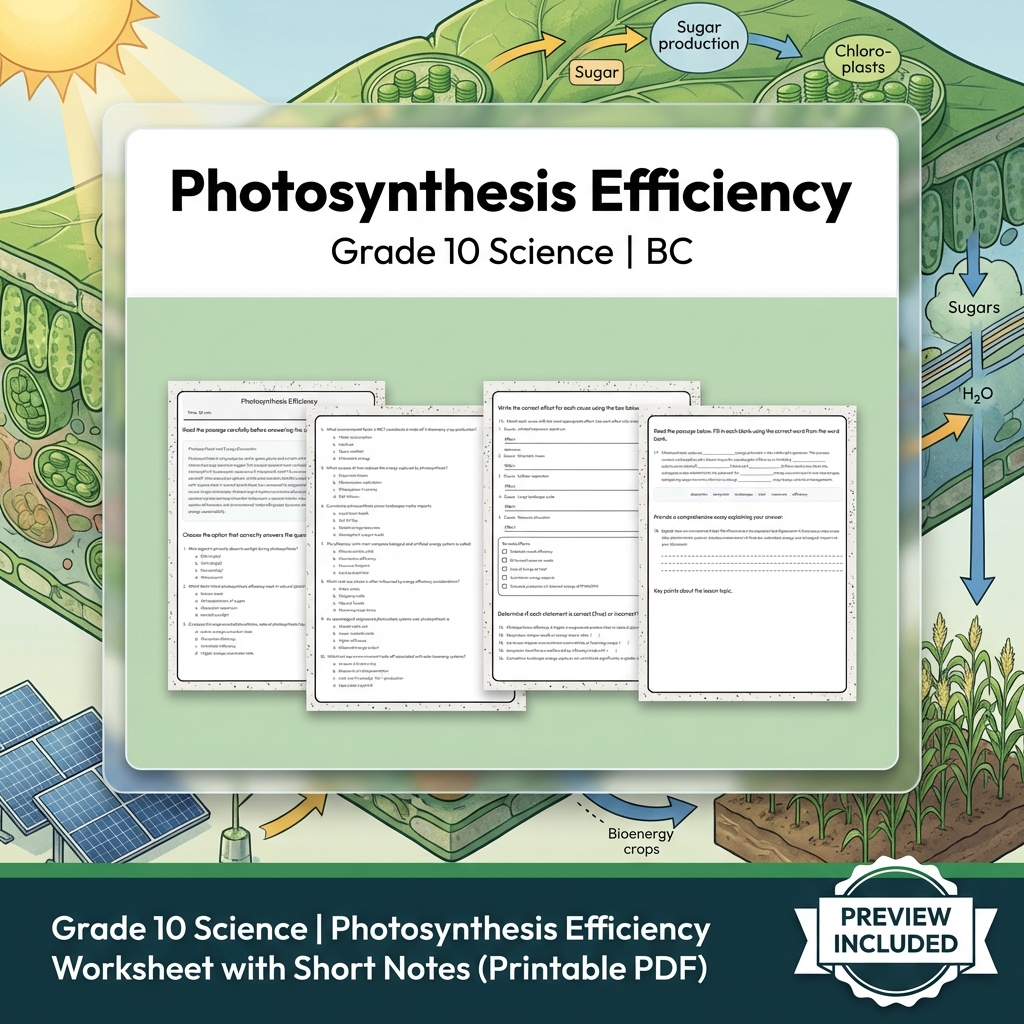
Grade 10 Science | Photosynthesis Efficiency Worksheet with Short Notes (PDF)
 Created byMeadowlark Worksheets
Learning Objectives
- Understand how photosynthesis converts radiant energy into chemical energy.
- Identify factors limiting the efficiency of photosynthesis in plants.
- Compare natural and engineered energy conversion systems.
Also included in: Grade 10 Science Lesson Bundle | Energy & Thermodynamics Worksheets +1 more
Instant download

Grade 10 Worksheet B: Electromagnetic Behavior Practice | NGSS PDF
Created byClear Sky ClassroomLearning Objectives
- Use Planck’s relation E = hf to explain how photon energy changes with frequency across the electromagnetic spectrum
- Interpret continuous and line spectra from thermal sources and discrete atomic transitions
- Relate absorption/emission spectral features to energy transfer processes
Also included in: Grade 10 Wave Properties & Communication Science Lesson Bundle | NGSS +1 more
Instant download

Gas Behavior Worksheet for Grade 10 Science | Standards-Aligned Practice
JCreated byJ.S SheetsLearning Objectives
- Understand the molecular basis of gas laws through kinetic theory.
- Explain how pressure, volume, and temperature relate in gases, including deviations from ideality.
- Describe the concept of partial pressures and their significance in gas mixtures.
Also included in: Grade 10 Science Practice Worksheets: Alberta Science Full-Year Bundle
Instant download

Rock Cycle Energy Flow Worksheet | California Standards Grade 10 Science
JCreated byJ.S SheetsLearning Objectives
- Understand how Earth's internal heat and energy flow drive processes in the rock cycle.
- Identify evidence from geological features that connect material changes over time.
- Explain how energy availability influences the rates and outcomes of geologic processes.
Also included in: Grade 10 Climate and Earth Systems Science Lesson Bundle – California Standards +1 more
Instant download
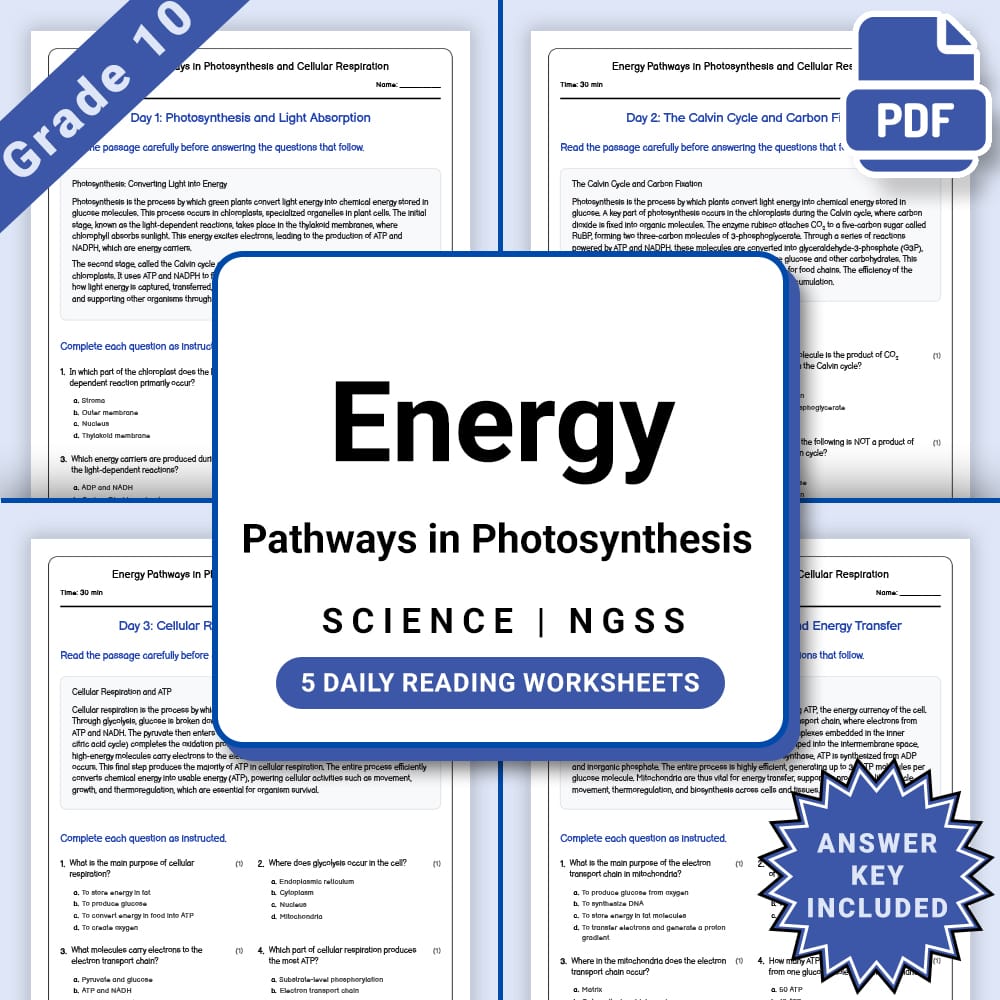
Grade 10 Science – Energy Pathways in Photosynthesis Worksheet (PDF +Answer Key)
Created byCopper Leaf ClassroomLearning Objectives
- Understand how light energy is captured by chloroplasts during photosynthesis.
- Describe the processes involved in the light-dependent and light-independent reactions.
- Explain how energy is transferred through cellular respiration stages to produce ATP.
Instant download

Grade 10 Science | Population Dynamics - Daily Reading Comprehension
Created byCoral Reef LearningLearning Objectives
- Understand basic terms related to population, such as growth and density
- Identify factors influencing population changes
- Recognize different patterns of population growth, including exponential and logistic
Instant download

Grade 10 Uncertainty Interpretation Worksheet | Practice & PDF
Created byClear Sky ClassroomLearning Objectives
- Explain what measurement uncertainty means and why measurements are reported as ranges
- Interpret results by comparing uncertainty ranges and judging whether differences are meaningful
- Use uncertainty reasoning to justify conclusions about experiments and real-world relationships
Instant download
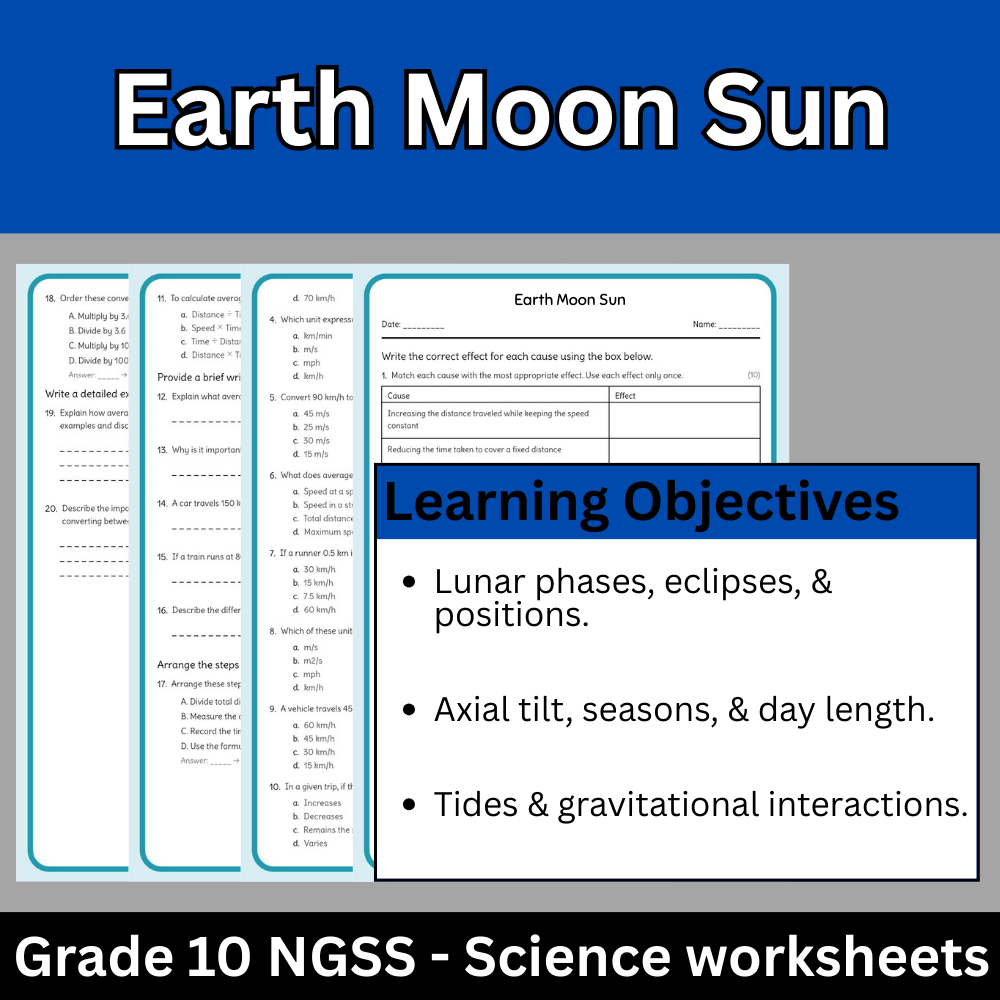
Grade 10 Science | Earth Moon Sun NGSS Practice Worksheet (PDF)
Created byBright Mind ResourcesLearning Objectives
- Understand how the relative positions and motions of Earth, Moon, and Sun produce lunar phases and eclipses.
- Explain how axial tilt and orbital inclination result in seasonal changes and variations in day length.
- Describe the gravitational interactions that generate tides and their periodicity.
Instant download

Grade 10 Science | Groundwater Systems Worksheet (Ontario Standards PDF)
 Created byEvergreen Desk Education
Learning Objectives
- Explain how aquifer types and properties (porosity and permeability) influence groundwater flow
- Describe recharge and discharge processes and how they affect groundwater availability
- Evaluate how surface water and groundwater are connected and how this connectivity can spread contamination
Also included in: Grade 10 Earth Systems Geology Science Lesson Bundle: Ontario Worksheets +1 more
Instant download

Grade 10 Worksheet B: Climate Projections Worksheet | NGSS Practice PDF
Created byClear Sky ClassroomLearning Objectives
- Interpret trends in temperature, precipitation, and sea level using instrumental, proxy, and satellite records
- Explain how radiative forcing contributes to observed climate change and influences future projections
- Evaluate uncertainty in climate projections by comparing scenarios and interpreting ensemble spread
Also included in: Grade 10 Climate & Natural Hazards Science Lesson Bundle (NGSS) +1 more
Instant download
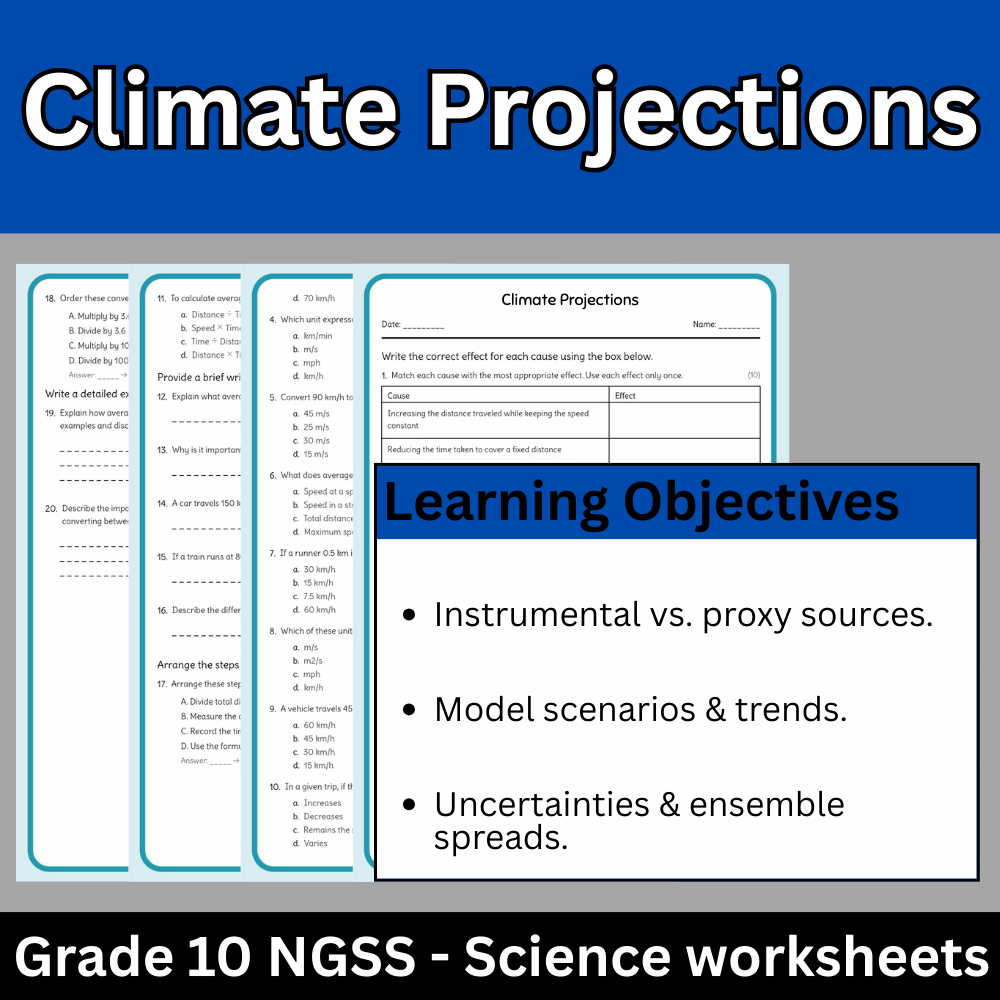
Grade 10 Science | Climate Projections Worksheet (PDF) & NGSS Standards
Created byBright Mind ResourcesLearning Objectives
- Understand the different sources of climate data, including instrumental and proxy records.
- Interpret model scenario outputs and their implications for future climate trends.
- Assess the uncertainties associated with climate projections and interpret ensemble spreads.
Instant download
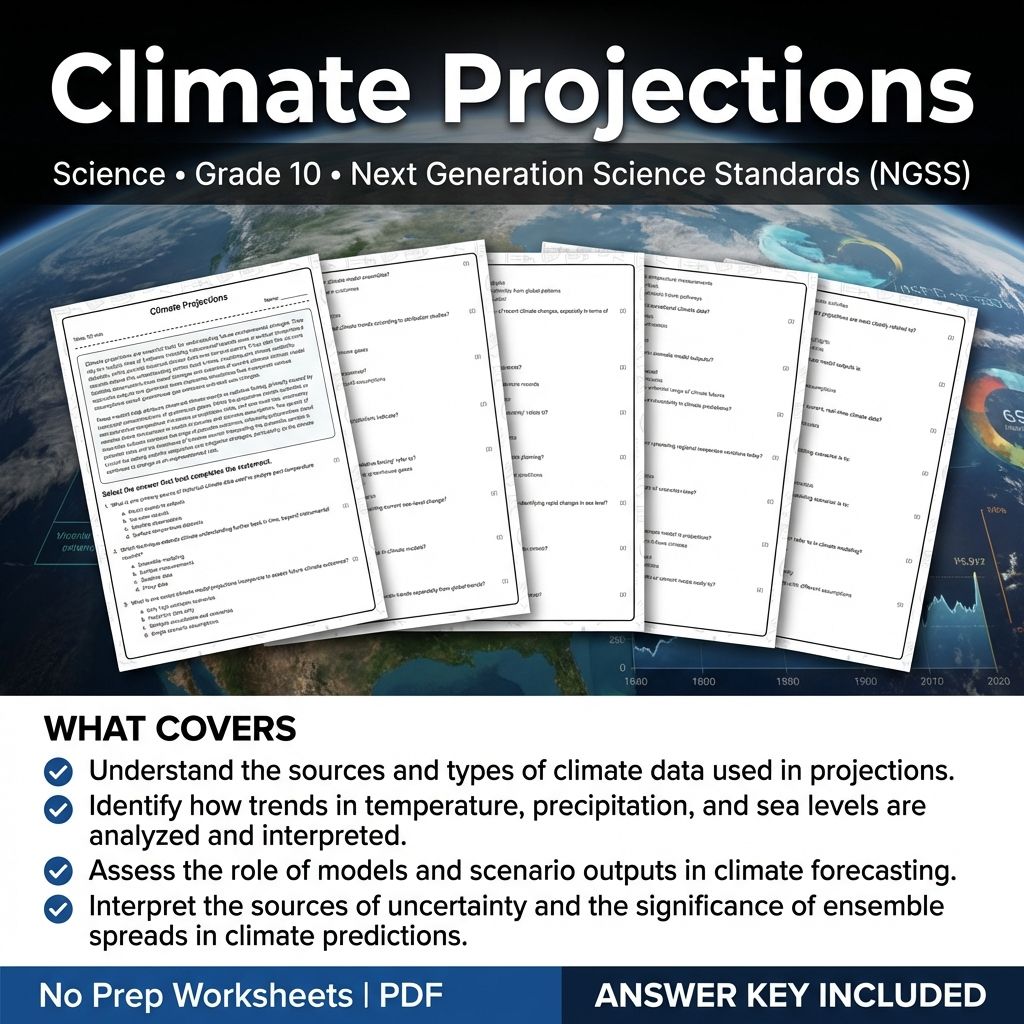
Grade 10 Science | Climate Projections Worksheet & Answer Key (Printable PDF)
Created byCoral Reef LearningLearning Objectives
- Understand the sources and types of climate data used in projections.
- Identify how trends in temperature, precipitation, and sea levels are analyzed and interpreted.
- Assess the role of models and scenario outputs in climate forecasting.
Also included in: Grade 10 Science Unit Bundle | Environmental Impact & Climate Strategies +1 more
Instant download

Modeling Evidence Science Worksheet Grade 10 Ontario Curriculum Resource
Created byClear Sky ClassroomLearning Objectives
- Construct conceptual and quantitative models that represent observed phenomena using evidence from data.
- Estimate parameters of a model and assess goodness of fit using residual analysis.
- Evaluate model validity by checking predictions against independent data and communicating uncertainty.
Instant download

Grade 10 Signal Transmission Worksheet | NGSS Science Communication Systems
 Created byBRIGHT PATH RESOURCES
Learning Objectives
- Understand the basic concepts of signals and modulations
- Identify different modulation schemes such as amplitude, frequency, and phase
- Recognize the challenges in signal transmission like noise and attenuation
Also included in: Wave & Communication Grade 10 Science Daily Reading Lesson Bundle | NGSS +1 more
Instant download

Grade 10 Health – Communication Skills & Daily Reading Worksheet | Ontario
 Created byQuiet Forest Education
Learning Objectives
- Understand the importance of active listening in effective communication.
- Identify key components of respectful and clear interpersonal interactions.
- Practice applying active listening techniques and providing constructive feedback.
Also included in: Social-Emotional Learning Grade 10 Health Daily Worksheets Bundle | Ontario +2 more
Instant download

Grade 10 Resource Tradeoffs in Energy & Mineral Management | NGSS Worksheet
Created byBRIGHT PATH RESOURCESLearning Objectives
- Understand the environmental impacts of fossil fuels
- Analyze economic versus ecological trade-offs of resource development
- Evaluate sustainability and long-term resource management strategies
Also included in: Env Hazards Grade 10 Sci Daily Reading Worksheets Lesson Bundle | NGSS +1 more
Instant download

Quantitative Uncertainty Worksheet for Grade 10 Science | AP Standards Practice
JCreated byJ.S SheetsLearning Objectives
- Understand the sources and significance of measurement uncertainty in scientific experiments.
- Learn methods for propagating uncertainties through calculations.
- Apply significant figures and dimensional analysis to report and interpret data accurately.
Instant download

Grade 10 Science | Membrane Dynamics Worksheet | AP Aligned
Created byLumora LearningLearning Objectives
- Explain the composition and function of cellular membranes in establishing electrochemical gradients.
- Describe transport mechanisms such as diffusion, carrier-mediated transport, and vesicular trafficking.
- Apply quantitative concepts like Nernst potential and flux-rate comparisons to membrane processes.
Also included in: Grade 10 Science | Biology and Ecosystems Custom Bundle | AP
Instant download

Grade 10 Science Worksheet – Metabolic Pathways (AP) (PDF)
Created byEvergreen Desk EducationLearning Objectives
- Explain how glycolysis, the citric acid (TCA) cycle, and oxidative phosphorylation work together to conserve free energy in ATP.
- Trace electron flow from NADH and FADH2 through the electron transport chain and describe how it generates an electrochemical proton gradient.
- Identify regulatory checkpoints and pathway branching that adjust flux under changing oxygen, energy, and substrate conditions.
Also included in: Grade 10 Genetics & Cell Systems Science Lesson Bundle – Advanced Placement (AP) +1 more
Instant download

Solar Conversion Worksheet | Grade 10 Science Activities
Created byPrism Point LearningLearning Objectives
- Explain how solar conversion turns radiant energy into electrical or chemical energy using photon-driven processes
- Describe the roles of semiconductor bandgaps, quantum efficiency, and loss pathways in determining conversion output
- Compare physical (photovoltaic/photoelectrochemical) and biological (photosynthesis) conversion in terms of mechanisms and integration into energy systems
Also included in: Grade 10 Energy, Efficiency & Conservation Science Lesson Bundle | BC +1 more
Instant download

Grade 10 Science | Heat Transfer Worksheet | BC Aligned
Created byLumora LearningLearning Objectives
- Understand the mechanisms of heat transfer: conduction, convection, and radiation.
- Explain how material properties influence heat transfer rates.
- Identify real-world examples of heat transfer processes.
Instant download
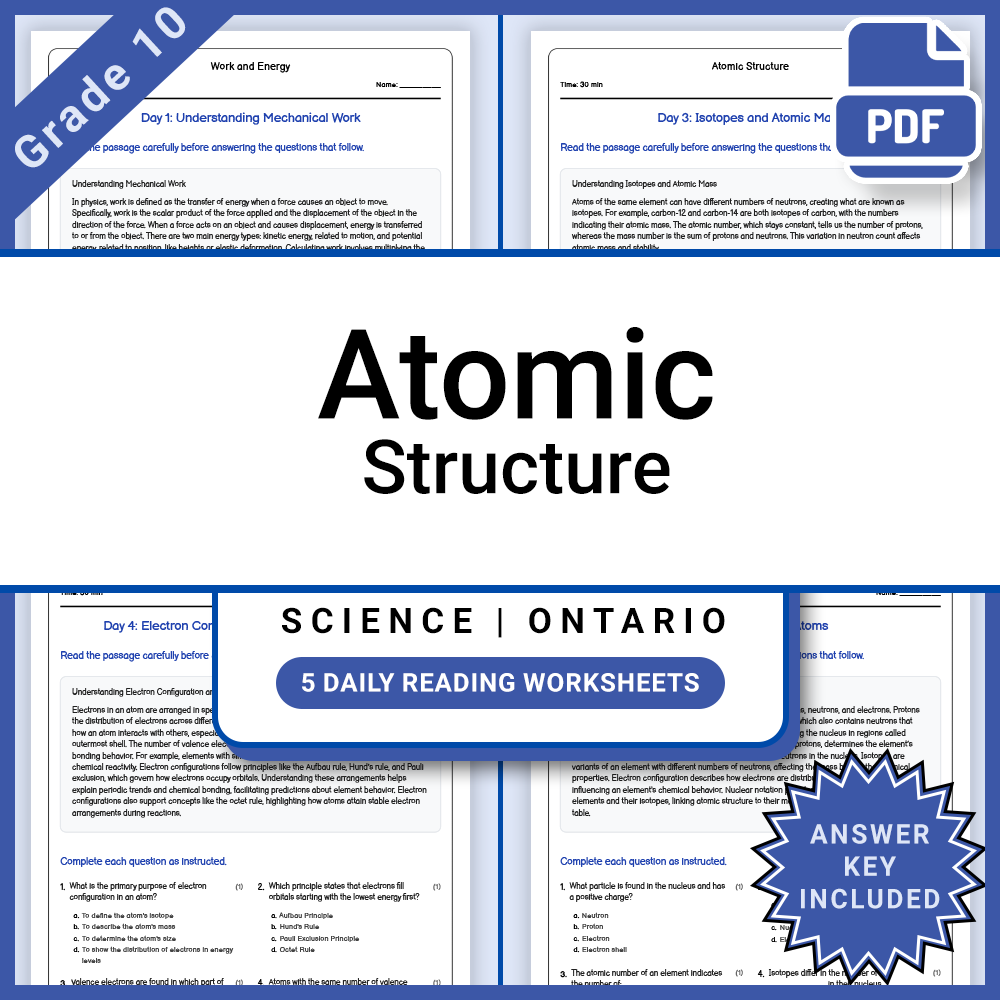
Grade 10 Science – Atomic Structure Daily Reading Worksheet + Answer Key
JCreated byJ.S SheetsLearning Objectives
- Identify the basic subatomic particles: protons, neutrons, electrons
- Understand the significance of atomic number and mass number
- Explain isotopes and provide examples
Also included in: Grade 10 Science Lesson Group Bundle | Ontario Framework +1 more
Instant download
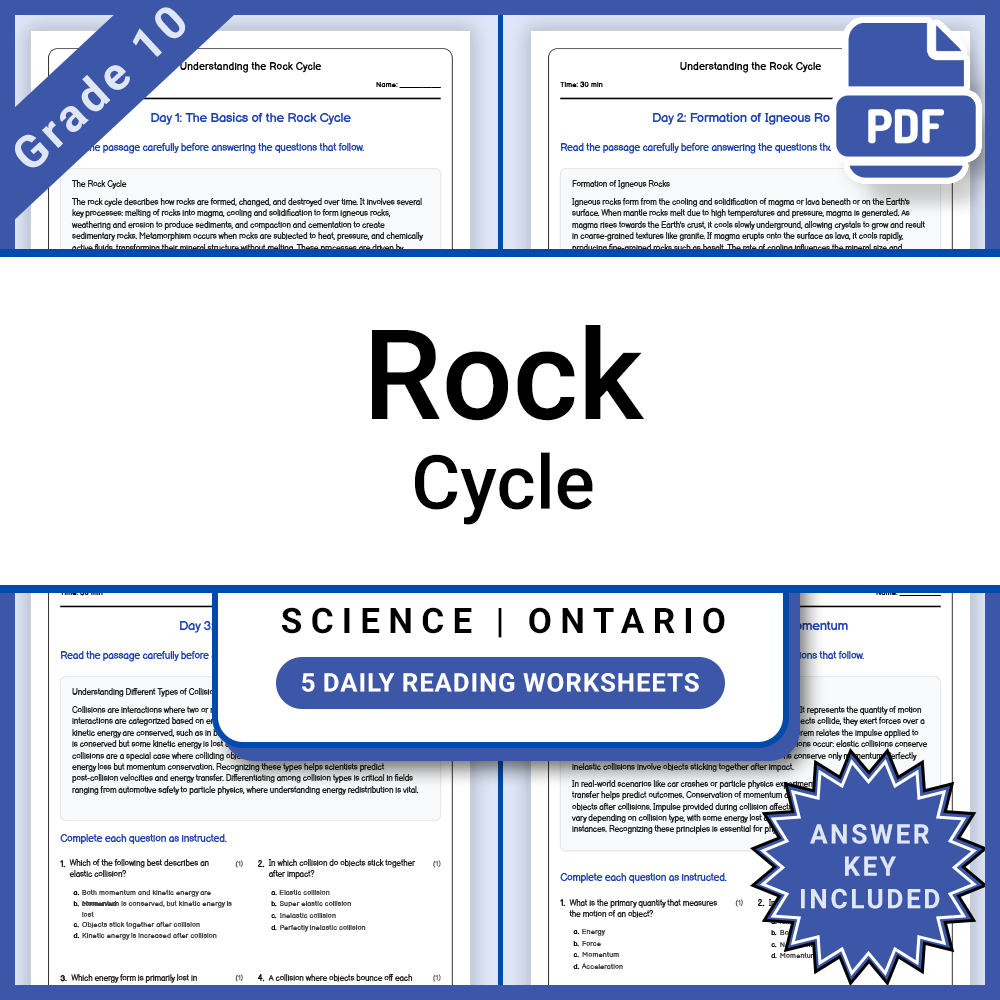
Grade 10 Science – Rock Cycle Daily Reading Worksheet with Answer Key
JCreated byJ.S SheetsLearning Objectives
- Identify the main processes involved in the rock cycle.
- Describe the physical and chemical drivers of rock transformation.
- Explain the link between plate tectonics and changes in rocks.
Also included in: Grade 10 Science Lesson Bundle | Earth and Resource Management +1 more
Instant download
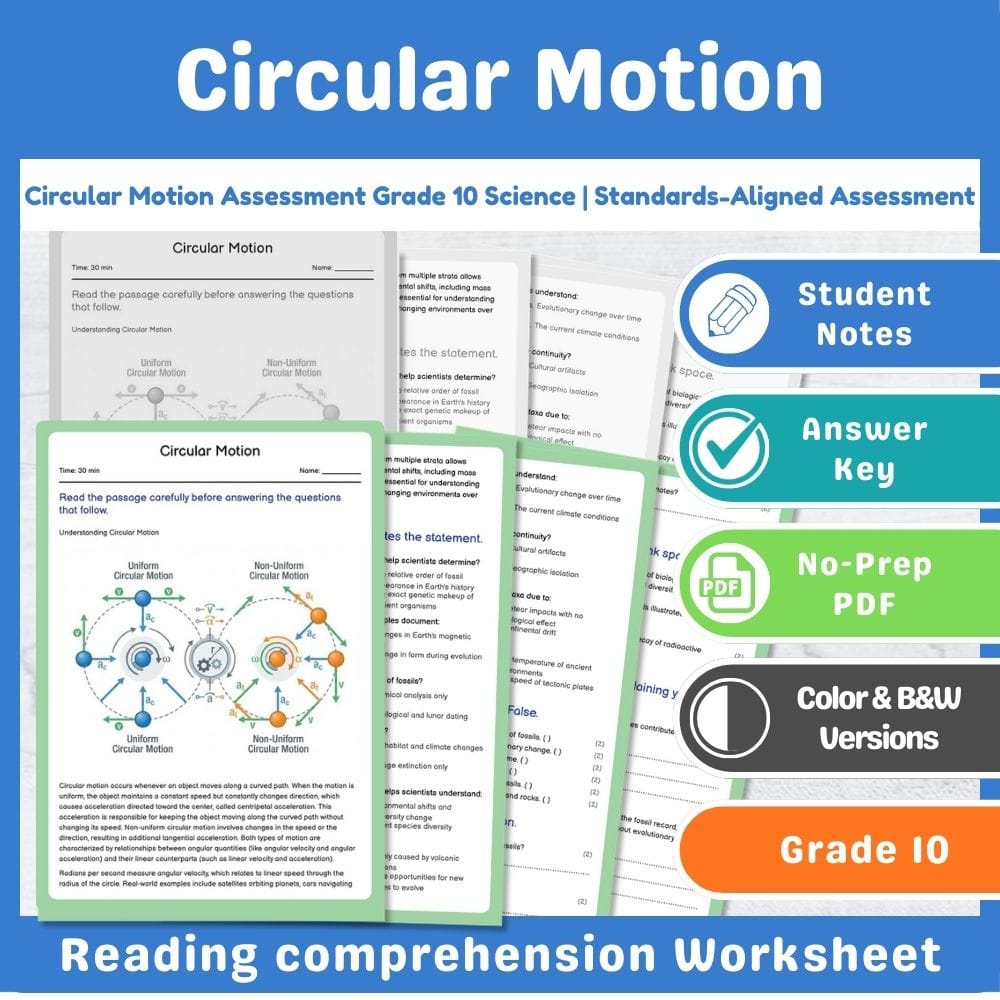
Circular Motion Assessment Grade 10 Science | Standards-Aligned Assessment
Created byPrism Point LearningLearning Objectives
- Understand the concepts of uniform and non-uniform circular motion.
- Relate angular and linear quantities such as speed, velocity, and acceleration.
- Explain the origin of centripetal acceleration and the forces involved in circular trajectories.
Also included in: Lesson Grade 10 Science Assessment Bundle | AP Standards-Aligned
Instant download

Blood Glucose Assessment | TEKS Grade 10 Science Standards-Aligned
Created byPrism Point LearningLearning Objectives
- Understand how insulin and glucagon regulate blood glucose levels.
- Describe the feedback mechanisms involved in maintaining energy homeostasis.
- Identify the roles of the pancreas, liver, adipose tissue, and muscles in glucose regulation.
Also included in: Grade 10 Homeostasis and Feedback Science Lesson Bundle | TEKS
Instant download

Grade 10 Maths Worksheet | Mastering Vertex Form (Ontario) (PDF)
Created byClear Sky ClassroomLearning Objectives
- Understand the structure and features of quadratic functions in vertex form.
- Convert quadratic equations from standard form to vertex form.
- Interpret the vertex and transformations of quadratic graphs algebraically and graphically.
Also included in: Grade 10 Maths Lesson Group - Solving Quadratics and Transformations +1 more
Instant download

DNA Sequencing, PCR & Targeted Gene Editing Worksheet | TEKS Grade 10
Created byBRIGHT PATH RESOURCESLearning Objectives
- Define key genomic technology terms in context (DNA, nucleotide sequence, PCR, DNA sequencing, genome editing).
- Identify how genomic tools generate information about DNA and genes.
- Explain, in a simple way, why amplification, reading order, and targeted edits matter for genetics.
Also included in: Grade 10 Genetics & Molecular Biology Science Worksheets Bundle | TEKS +1 more
Instant download
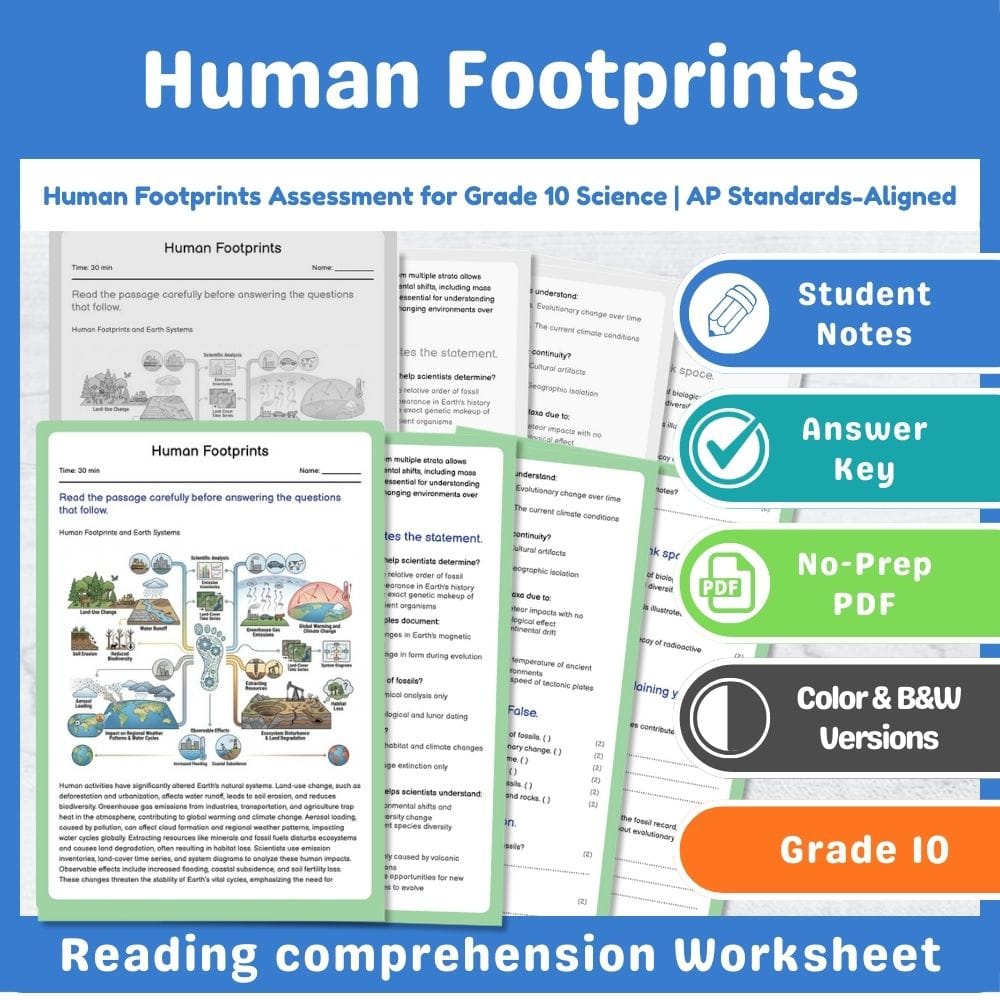
Human Footprints Assessment for Grade 10 Science | AP Standards-Aligned
Created byPrism Point LearningLearning Objectives
- Understand how human activities alter Earth's land, water, and air systems.
- Identify indicators and signs of environmental change caused by human actions.
- Analyze data and diagrams to evaluate human impact on ecosystems.
Also included in: Lesson Bundle | Grade 10 Science Earth and Space Standards-Aligned
Instant download

Grade 10 Social Studies | Industrial Growth Worksheet (TEKS) (PDF)
Created bySunny Desk ResourcesLearning Objectives
- Explain how industrialization and technological innovation reshaped economies and daily life.
- Analyze how urbanization changed labor, living conditions, and social class structures.
- Describe how global capitalism expanded trade and created economic interdependence.
Also included in: Grade 10 Global Conflicts Social Studies Full-Year Worksheet Bundle – TEKS +1 more
Instant download

Grade 10 Science – Land Use Effects Worksheet (NGSS - PDF)
 Created bySilver Birch Teaching
Learning Objectives
- Understand how human land use changes impact ecosystems, water cycles, and biodiversity.
- Identify indicators of ecological and biogeochemical consequences due to land-cover change.
- Analyze empirical data from land-use maps, remote sensing, and biotic surveys.
Also included in: Grade 10 Climate Change & Land Use Science Lesson Bundle Worksheets – NGSS +1 more
Instant download

Grade 10 Science | Computational Concepts Worksheet | AP Aligned
Created byLumora LearningLearning Objectives
- Understand basic computational approaches for modeling dynamic systems.
- Explain the concepts of discrete time stepping, parameter sweeps, and sensitivity analysis.
- Recognize assumptions and limitations inherent in numerical simulations.
Instant download

Paleoclimate Evidence Worksheet for Grade 10 Science NGSS aligned
JCreated byJ.S SheetsLearning Objectives
- Understand the types of proxy records used in paleoclimate reconstruction.
- Identify key indicators and methods for analyzing paleoclimate data.
- Compare paleoclimate records with instrumental data to assess climate change trends.
Instant download

Collision Theory Worksheet Pack | Grade 10 Science Activities
Created byPrism Point LearningLearning Objectives
- Explain how collision frequency and collision energy affect reaction rates using collision theory.
- Describe activation energy and the role of energy barriers in determining whether collisions lead to reactions.
- Connect temperature and concentration changes to particle-level behavior and observed chemical rates.
Also included in: Grade 10 Chemistry & Dynamic Equilibrium Lesson Bundle | Alberta Science
Instant download
Browse more categories
About Grade 10 Worksheets
Find Grade 10 worksheets covering algebra, biology, literature, and history. All 9,388 resources download instantly as PDFs for classwork, homework, or review.
MyTeachingSheets worksheets are made by real teacher-authors and checked before they go live. Download any as a print-ready PDF for lessons, homework, or independent practice — most include answer keys, and previews are always free.