
Grade 10 Science Worksheets
7,038 worksheets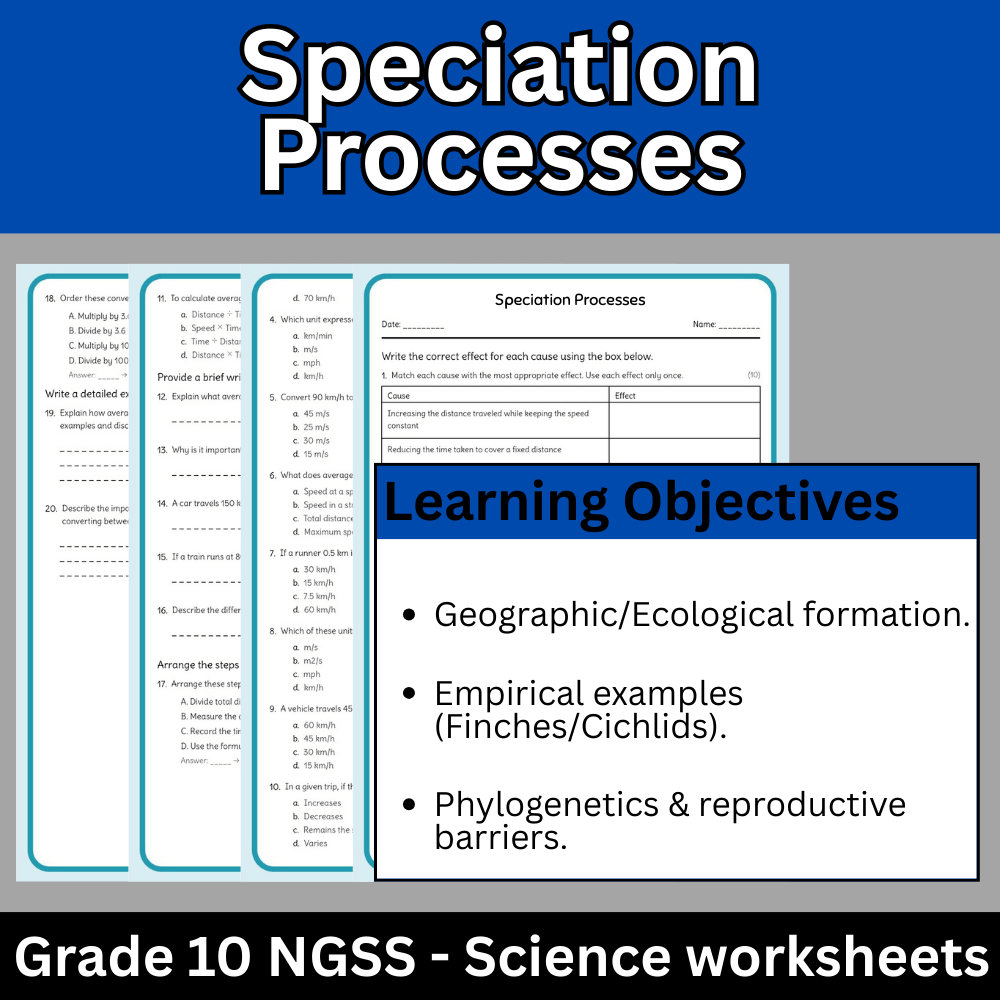
Grade 10 Science | Speciation Processes Worksheet (Answer Key) – NGSS Aligned
 Created byBright Mind Resources
Learning Objectives
- Understand the mechanisms that lead to the formation of new species, including geographic, ecological, polyploidy, and behavioral factors.
- Analyze empirical examples of speciation such as island finches, cichlid fishes, and plant chromosomal doubling.
- Interpret phylogenetic patterns and reproductive barriers that clarify lineage splitting and biodiversity development.
Instant download
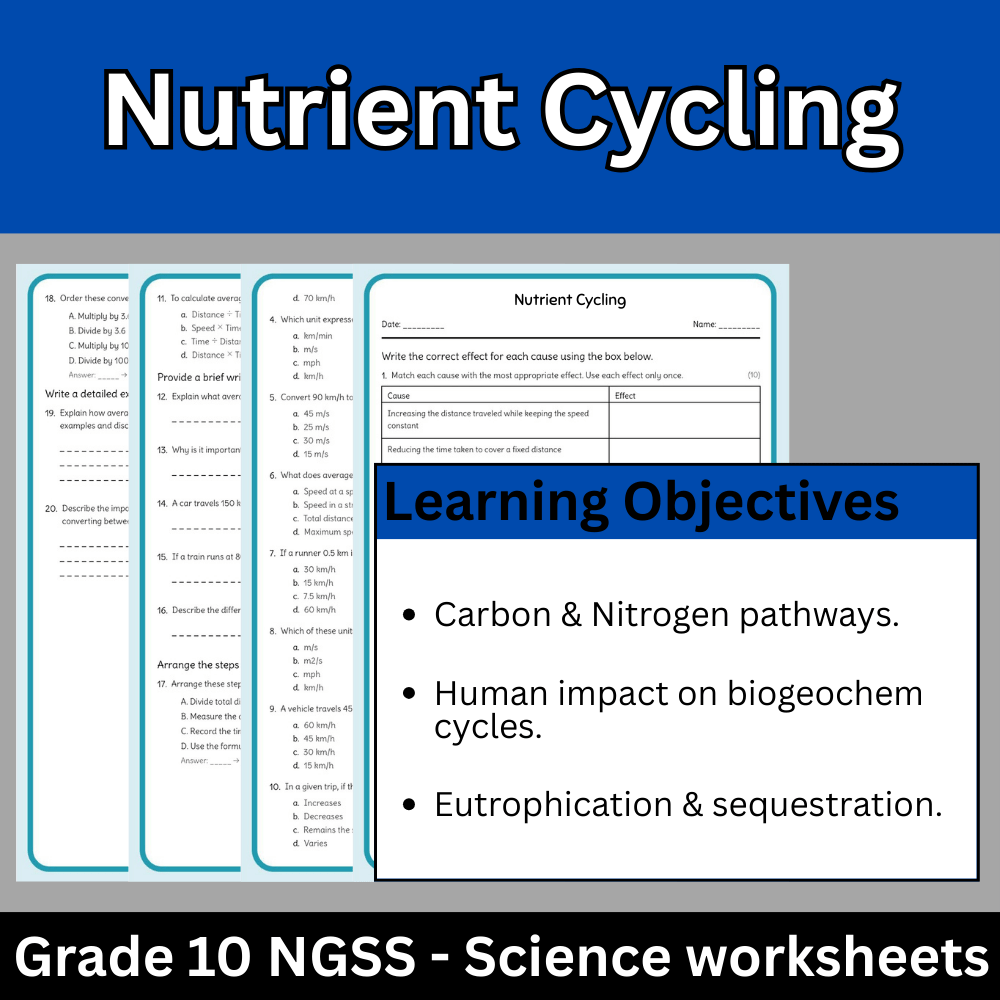
Grade 10 Science | Nutrient Cycling Worksheet (NGSS Aligned) – Answer Key PDF
Created byBright Mind ResourcesLearning Objectives
- Understand the major pathways and processes involved in nutrient cycling, including carbon and nitrogen fluxes.
- Identify human activities that alter natural biogeochemical cycles and their environmental impacts.
- Analyze the consequences of nutrient flux disruptions such as eutrophication and carbon sequestration.
Instant download
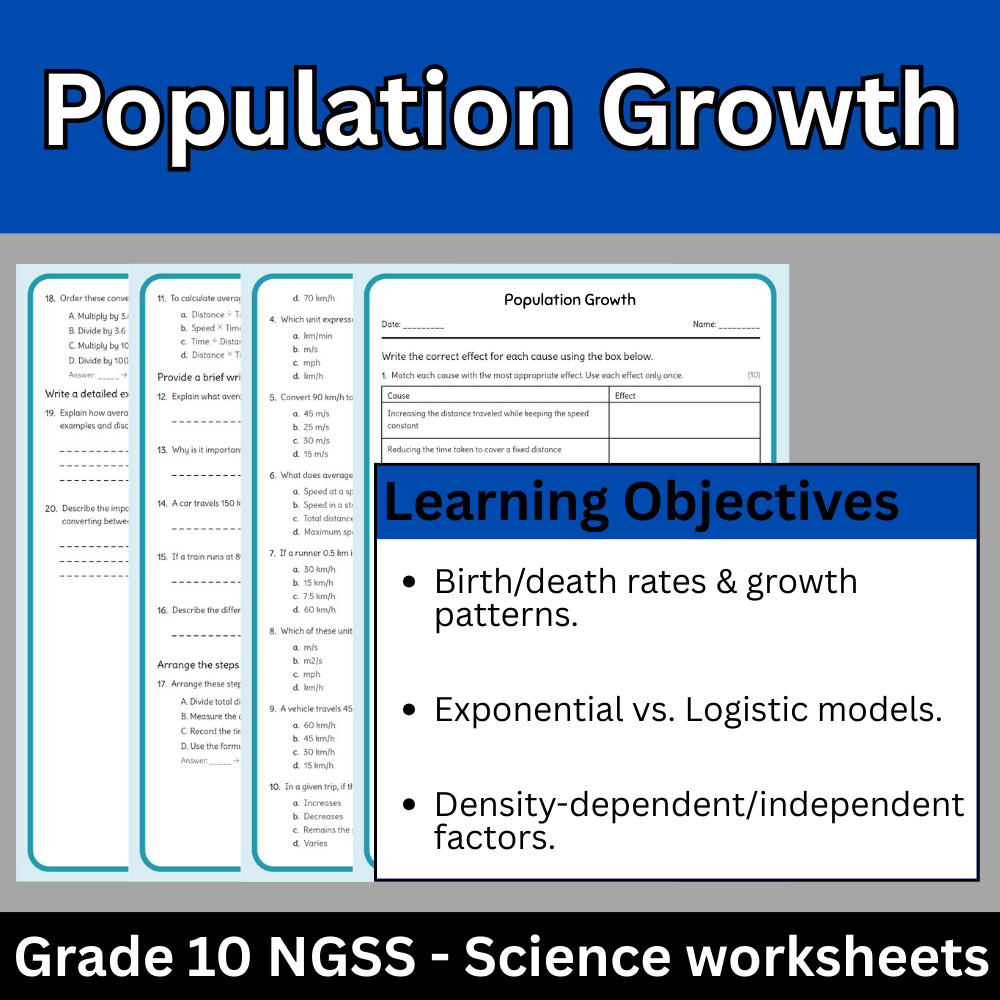
Grade 10 Science | Population Growth NGSS Worksheet (Answer Key, PDF)
Created byBright Mind ResourcesLearning Objectives
- Analyze birth rates, death rates, and growth patterns in populations.
- Differentiate between exponential and logistic population models.
- Identify factors affecting population dynamics, including density-dependent and density-independent factors.
Instant download
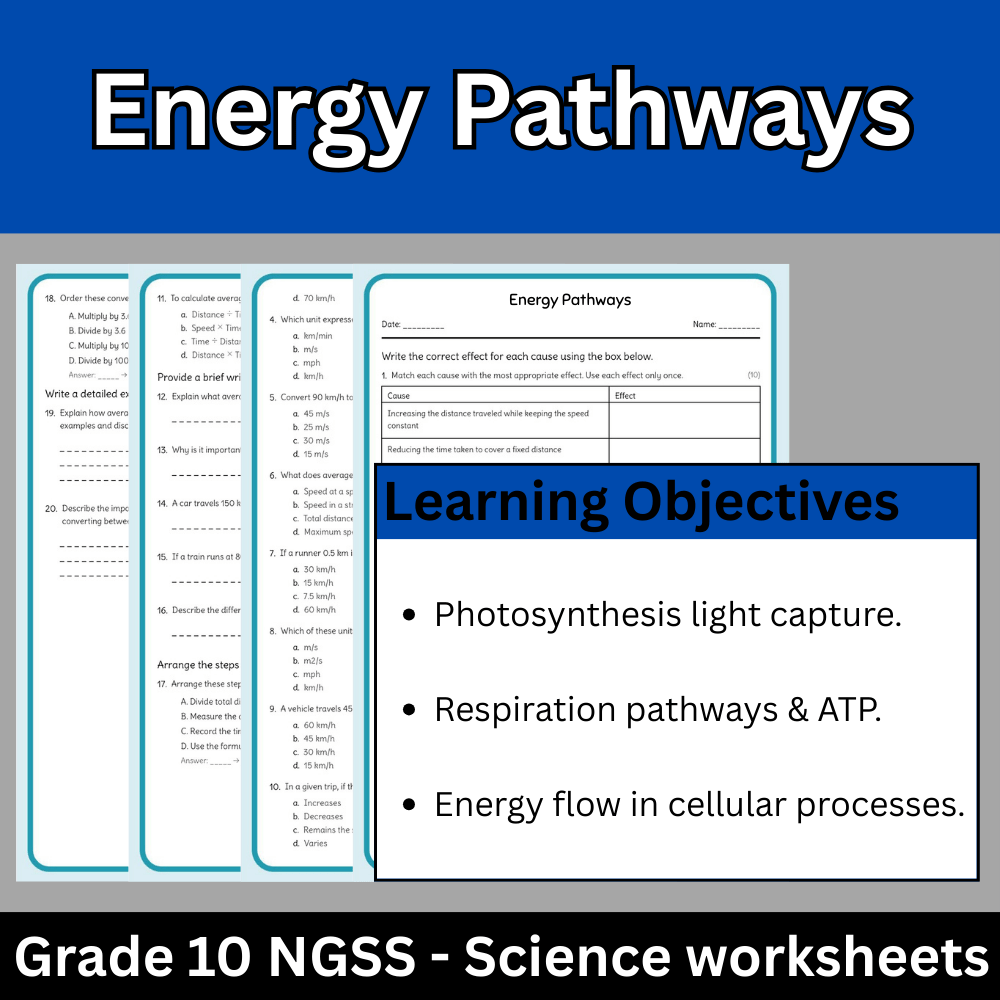
Grade 10 Science | Energy Pathways Worksheet + Answer Key – NGSS Aligned
Created byBright Mind ResourcesLearning Objectives
- Explain how photosynthesis captures light energy and converts it into chemical energy.
- Describe the biochemical pathways involved in cellular respiration and how they produce ATP.
- Analyze the flow of energy and matter in cellular processes related to energy transfer.
Instant download
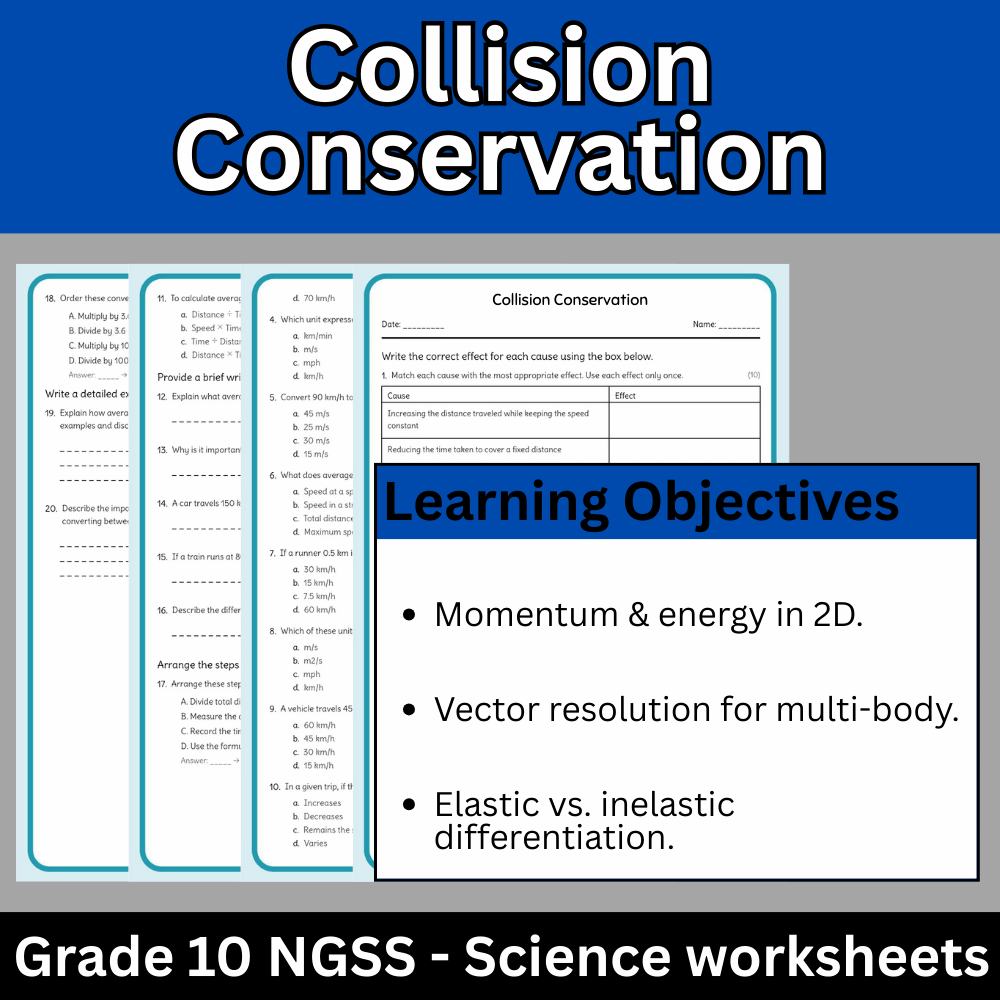
Grade 10 Science | Collision Conservation Worksheet (Answer Key) – NGSS Aligned
Created byBright Mind ResourcesLearning Objectives
- Understand the principles of conservation of momentum and energy in two-dimensional collisions.
- Apply vector resolution techniques to analyze multi-body collisions.
- Distinguish between elastic and inelastic collisions based on energy and speed distribution.
Instant download
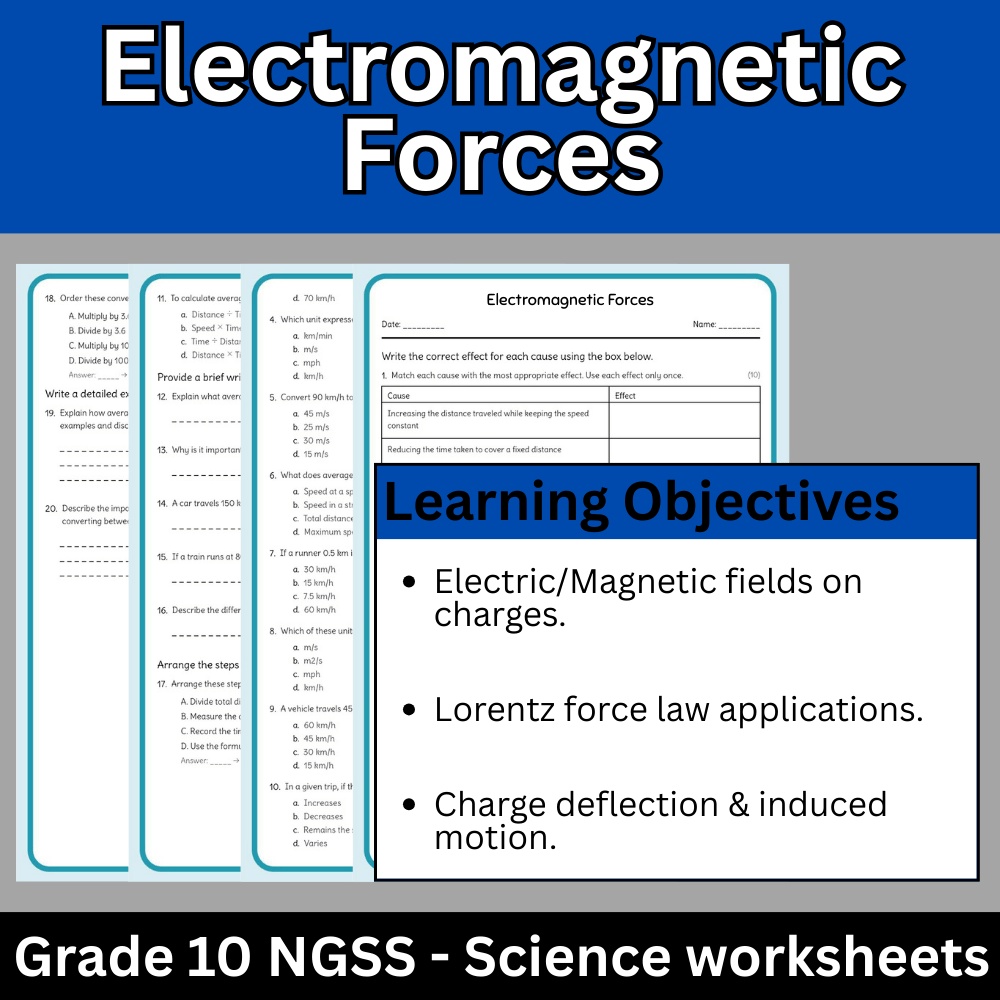
Grade 10 Science – Electromagnetic Forces Worksheet (Answer Key) | NGSS Aligned
Created byBright Mind ResourcesLearning Objectives
- Describe the role of electric and magnetic fields in forces on charges and currents.
- Explain the Lorentz force law and how it applies in simple contexts.
- Identify phenomena involving charge deflection, magnetic interactions, and electromagnet-induced motion.
Instant download
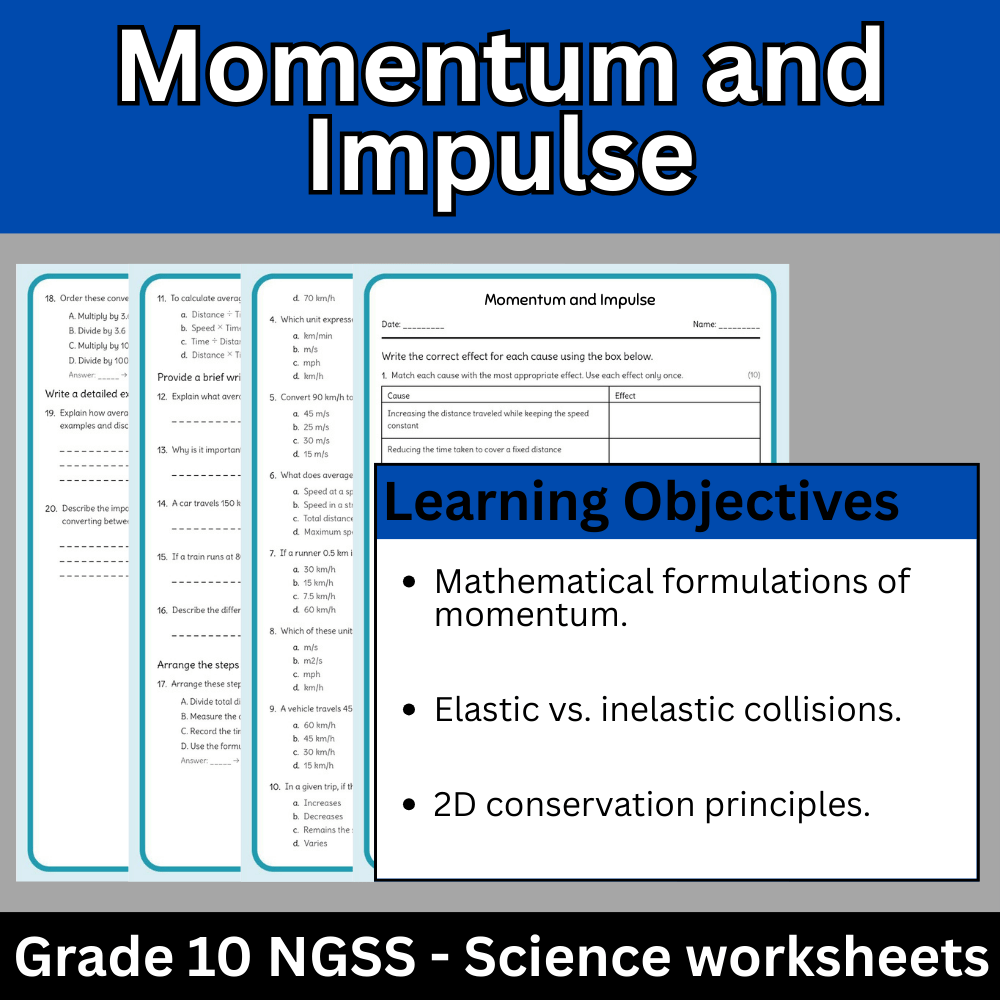
Grade 10 Science | Momentum and Impulse Concepts Worksheet (Answer Key) | NGSS
Created byBright Mind ResourcesLearning Objectives
- Understand the concepts of momentum and impulse and their mathematical formulations.
- Analyze elastic and inelastic collisions using the impulse-momentum theorem.
- Apply conservation of momentum principles to two-dimensional interactions.
Instant download
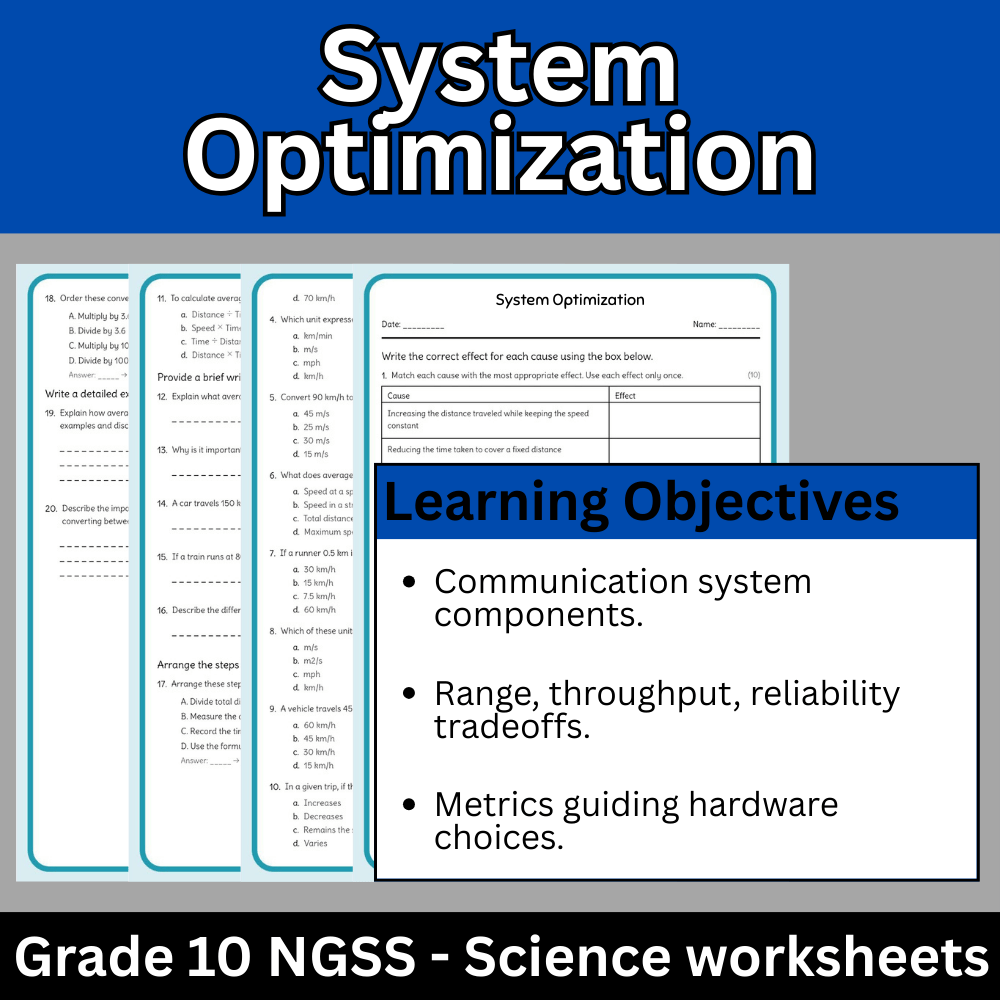
Grade 10 Science | System Optimization Worksheet (NGSS) – Answer Key PDF
Created byBright Mind ResourcesLearning Objectives
- Understand the components involved in optimizing communication systems.
- Analyze trade-offs in system design focusing on range, throughput, and reliability.
- Evaluate performance metrics and how they guide hardware and protocol choices.
Instant download
Grade 10 Science – Gravitational Fields Worksheet (PDF) | BC Standards
Created byBright Mind ResourcesLearning Objectives
- Understand the concept of gravitational fields and their influence on space.
- Describe how field strength decreases with distance according to an inverse-square law.
- Explain the effects of gravitational fields on orbital motion.
Instant download
Grade 10 Science | Isotopes and Ions Worksheet (Answer Key) – BC Standards
Created byBright Mind ResourcesLearning Objectives
- Understand the concept of isotopes and how they differ from each other
- Recognize how ions are formed and how they differ from neutral atoms
- Explain the significance of isotopic variation in atomic mass and spectral signatures
Instant download
Grade 10 Science | Battery Storage Concepts Worksheet (Worksheet + Answer Key)
Created byBright Mind ResourcesLearning Objectives
- Understand how battery storage converts chemical energy to electrical energy and vice versa.
- Explain factors affecting battery efficiency and capacity over charge–discharge cycles.
- Analyze the impact of internal resistance, heat, and side reactions on battery performance.
Instant download
Grade 10 Science | Earth’s Spheres Interactions Worksheet – AP Standard
Created byBright Mind ResourcesLearning Objectives
- Explain the interactions among the geosphere, hydrosphere, atmosphere, and biosphere through coupled processes.
- Analyze how perturbations in one sphere can propagate and affect other spheres using flow diagrams and mass-balance reasoning.
- Apply systems thinking to interpret flow diagrams, box-and-arrow models, and indicators like streamflow and soil moisture.
Instant download
Grade 10 Science | Biodiversity Overview Worksheet + Answer Key (PDF)
Created byBright Mind ResourcesLearning Objectives
- Understand the different levels of biodiversity, including genetic, species, and ecosystem diversity.
- Identify factors that influence and shape patterns of biodiversity across regions.
- Analyze how environmental gradients, habitat availability, and evolutionary history affect biodiversity.
Instant download
Grade 10 Science | Constraint-Based Design Worksheet (AP Standards) PDF
Created byBright Mind ResourcesLearning Objectives
- Understand the implications of constraints in designing scientific studies.
- Identify trade-offs among replication, measurement precision, and scope.
- Evaluate the use of proxy measures and sensitivity analysis under constraints.
Instant download
Grade 10 Science – Ecosystem Structure Worksheet (NGSS Aligned) PDF
Created byBright Mind ResourcesLearning Objectives
- Identify biotic and abiotic components within ecosystems
- Explain energy flow and trophic levels in food webs
- Analyze ecosystem stability and feedback mechanisms
Instant download
Grade 10 Science – Stoichiometric Analysis Worksheet (AP Standard) PDF
Created byBright Mind ResourcesLearning Objectives
- Develop algebraic and unit-based strategies for complex stoichiometric relationships.
- Apply mole ratios and identify limiting reagents in multi-step reactions.
- Calculate percent yields, solution concentrations, and relate measured quantities to theoretical values.
Instant download
Grade 10 Science – Projectile Motion Worksheet + Answer Key (AP Standard)
Created byBright Mind ResourcesLearning Objectives
- Understand the independence of horizontal and vertical components in projectile motion.
- Apply vector decomposition to analyze projectile trajectories.
- Predict range, maximum height, and time of flight for projectiles under ideal conditions.
Instant download
Grade 10 Science | Solar Conversion Worksheet (Answer Key) BC Standards
Created byBright Mind ResourcesLearning Objectives
- Understand the processes involved in solar energy conversion, including photovoltaic and photoelectrochemical mechanisms.
- Identify key material properties such as bandgaps and quantum efficiency that influence energy conversion efficiency.
- Compare physical and biological solar conversion mechanisms in terms of rate, spectral response, and integration into larger systems.
Instant download
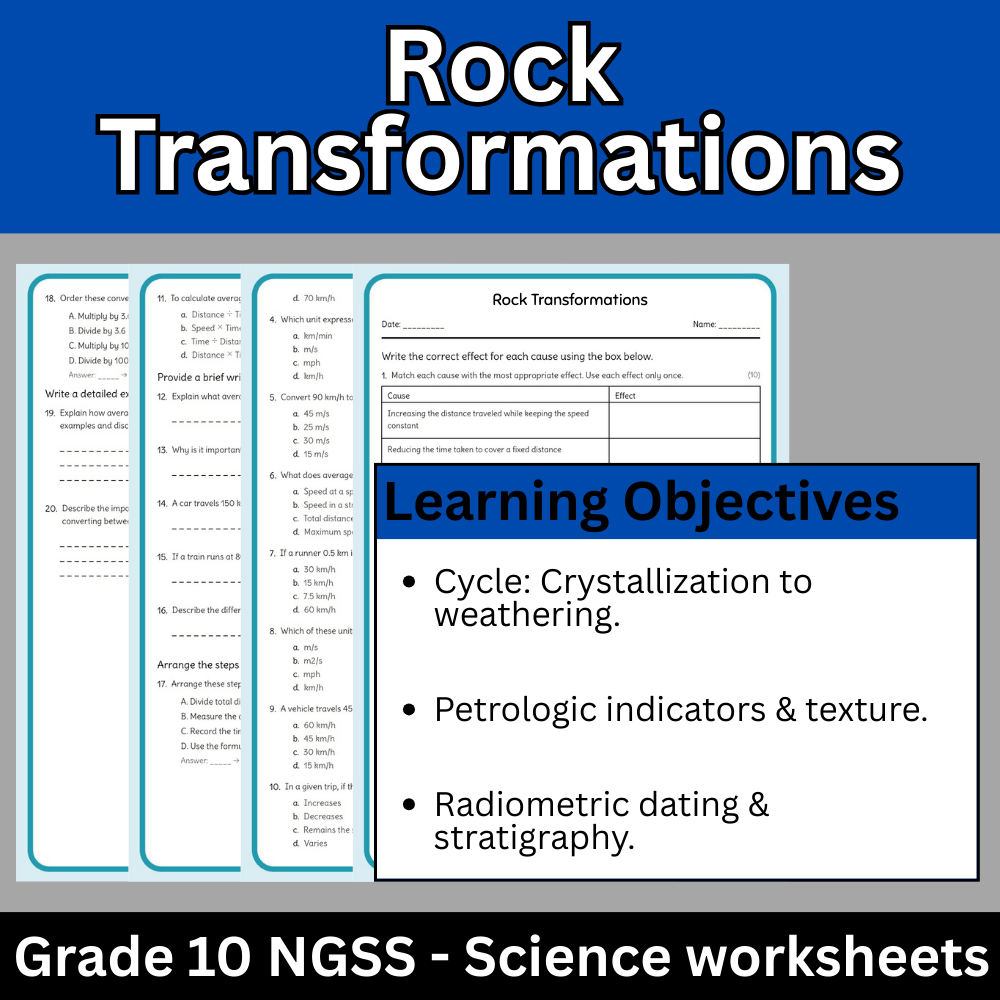
Grade 10 Science | Rock Transformations Worksheet (Answer Key) – NGSS Aligned
Created byBright Mind ResourcesLearning Objectives
- Explain the processes involved in the rock cycle including crystallization, lithification, metamorphism, and weathering.
- Identify petrologic indicators such as mineral assemblages, texture, and geochemical signatures used to interpret geological histories.
- Understand how radiometric dating and stratigraphic correlation are used to order and interpret igneous, sedimentary, and metamorphic events.
Instant download
Grade 10 Science – Evolutionary Synthesis Worksheet (PDF) | BC Standards
Created byBright Mind ResourcesLearning Objectives
- Explain how fossil, anatomical, developmental, and molecular evidence are integrated to understand biodiversity.
- Describe mechanisms such as natural selection, genetic drift, and gene flow in evolution.
- Analyze case studies like island finch radiations and transitional fossils to illustrate evolutionary processes.
Instant download
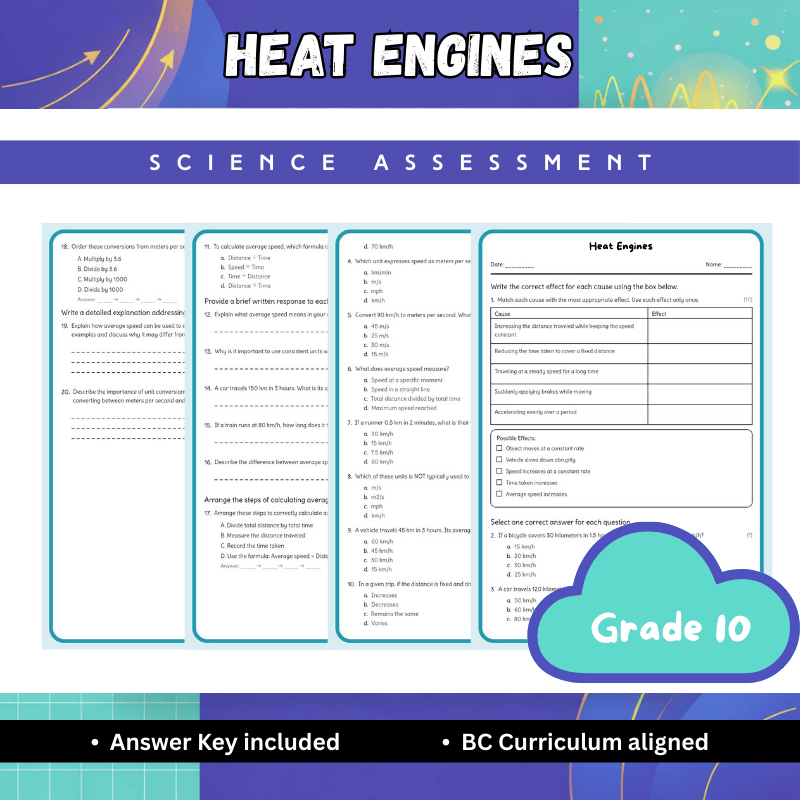
Grade 10 Science | Heat Engines Explanation Worksheet (PDF) – BC Standards
Created byBright Mind ResourcesLearning Objectives
- Understand the basic principles of heat engines and how they convert thermal energy into mechanical work.
- Identify types of heat engines such as internal combustion engines, gas turbines, and steam turbines.
- Explain factors affecting the efficiency of heat engines, including temperature differences and cycle design.
Instant download
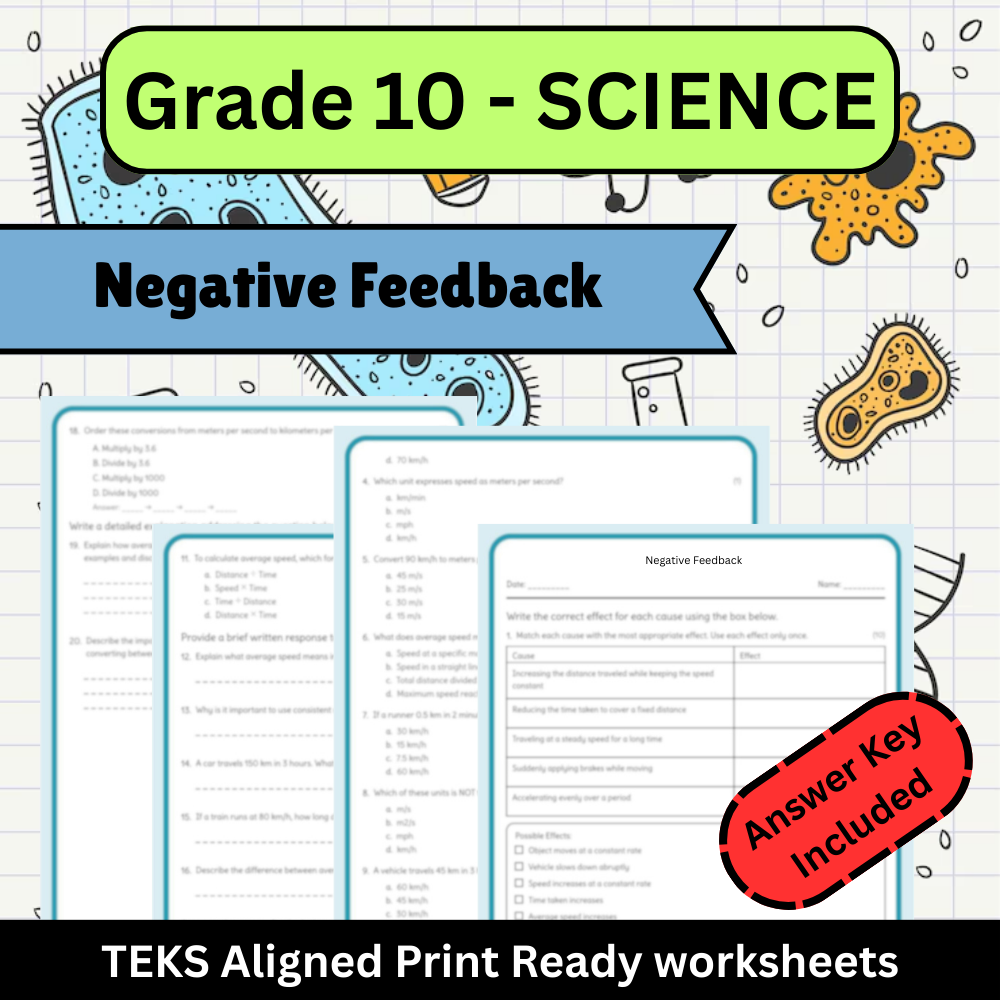
Grade 10 Science | Negative Feedback Mechanisms Worksheet (Answer Key) - TEKS Aligned
Created byBright Mind ResourcesLearning Objectives
- Understand the concept of negative feedback in physiological regulation.
- Identify the components involved in the negative feedback mechanism.
- Explain how negative feedback maintains internal stability in the body.
Also included in: Grade 10 Science | Body Systems & Homeostasis Worksheet Bundle (TEKS Aligned) +5 more
Instant download
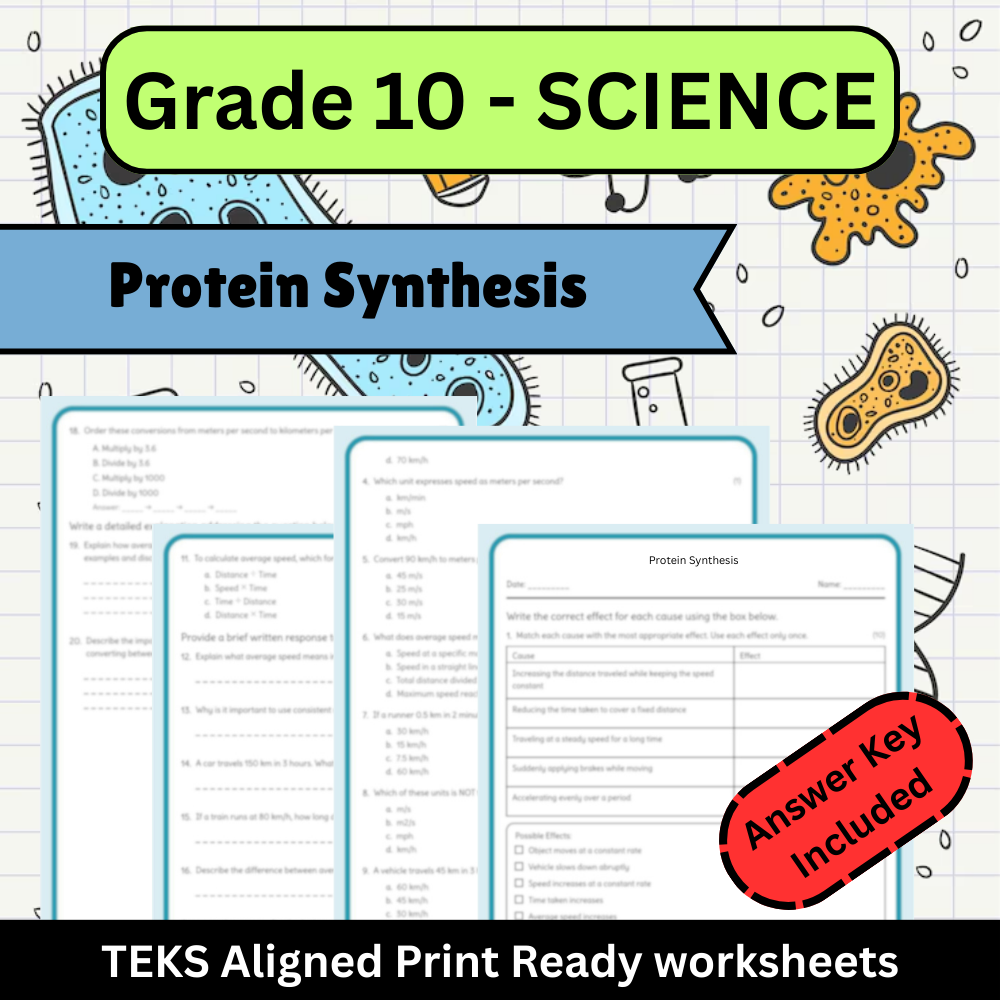
Grade 10 Science – Protein Synthesis Worksheet (Worksheet + Answer Key) PDF
Created byBright Mind ResourcesLearning Objectives
- Describe the overall process of protein synthesis from DNA to functional proteins.
- Explain the stages of transcription and translation, including key enzymes and molecules involved.
- Identify the roles of mRNA, tRNA, ribosomes, and amino acids in protein assembly.
Also included in: Grade 10 Science | Genetics & DNA Unit Worksheet Pack (TEKS Aligned) +5 more
Instant download
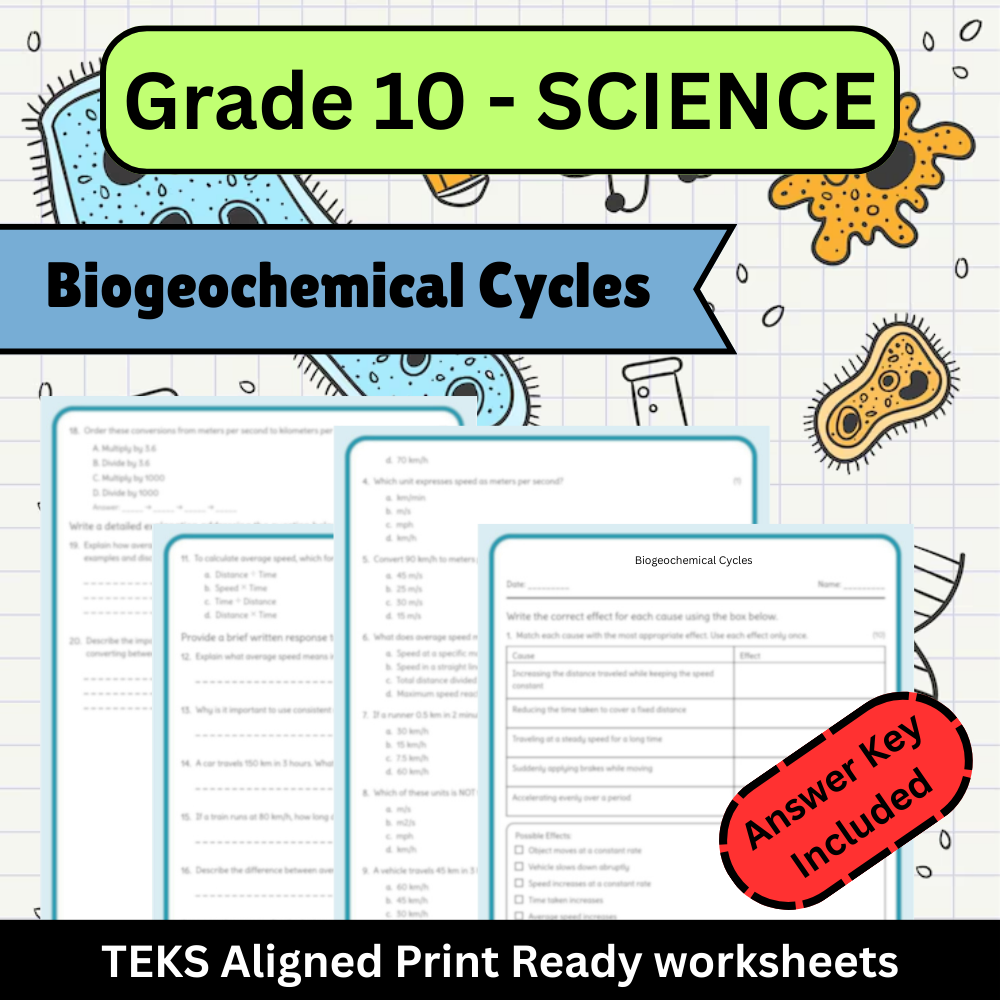
Grade 10 Science | Biogeochemical Cycles Worksheet (PDF) – TEKS-Aligned
Created byBright Mind ResourcesLearning Objectives
- Describe the main biogeochemical cycles and their pathway processes.
- Explain how biological, physical, and chemical interactions cycle nutrients through ecosystems.
- Assess human impacts on biogeochemical cycles and ecosystem health.
Also included in: Grade 10 Science | Ecosystems & Biodiversity Unit Worksheet Bundle(TEKS-Aligned) +5 more
Instant download
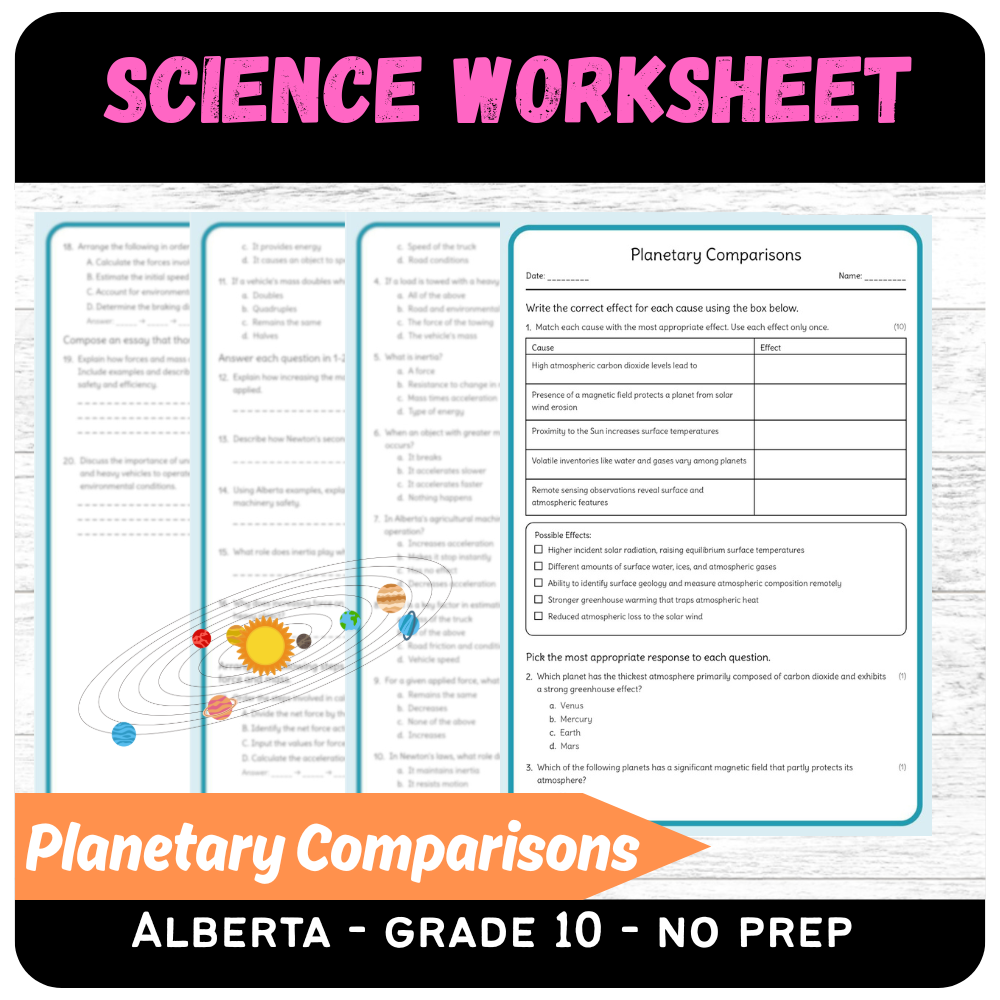
Grade 10 Science | Planetary Comparisons (Worksheet + Answer Key) – Alberta Standards
Created byBright Mind ResourcesLearning Objectives
- Compare and contrast the atmospheres of Earth, Mars, and Venus and understand how these differences influence surface conditions.
- Explain the role of magnetic fields and volatile inventories in planetary habitability.
- Analyze remote sensing observations that reveal planetary surface and atmospheric features.
Instant download
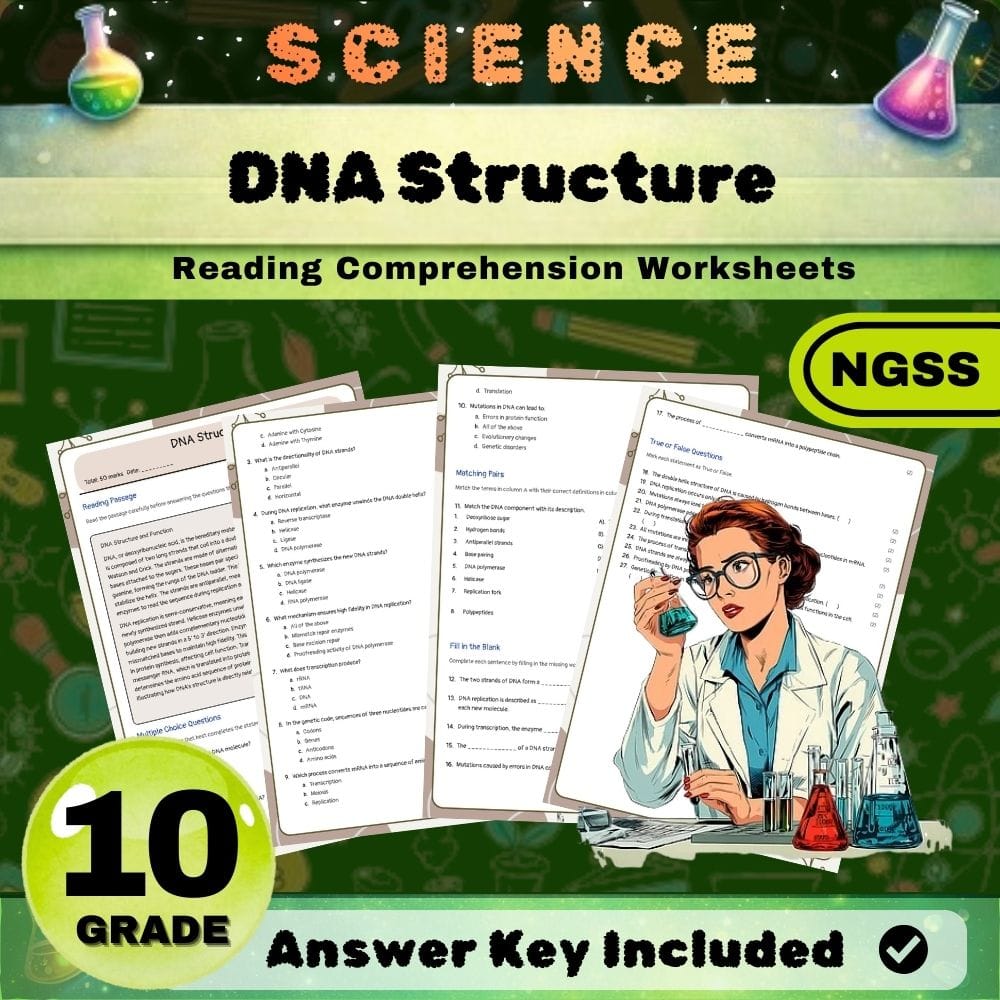
Grade 10 Science – DNA Structure Worksheet (NGSS) PDF
 Created byMaple Path Learning
Learning Objectives
- Describe the structural features of DNA, including the double helix, base pairing, and antiparallel strands.
- Explain the mechanisms of DNA replication, including the roles of DNA polymerase and helicase.
- Understand how DNA sequences encode polypeptides and how replication errors can influence gene expression.
Instant download
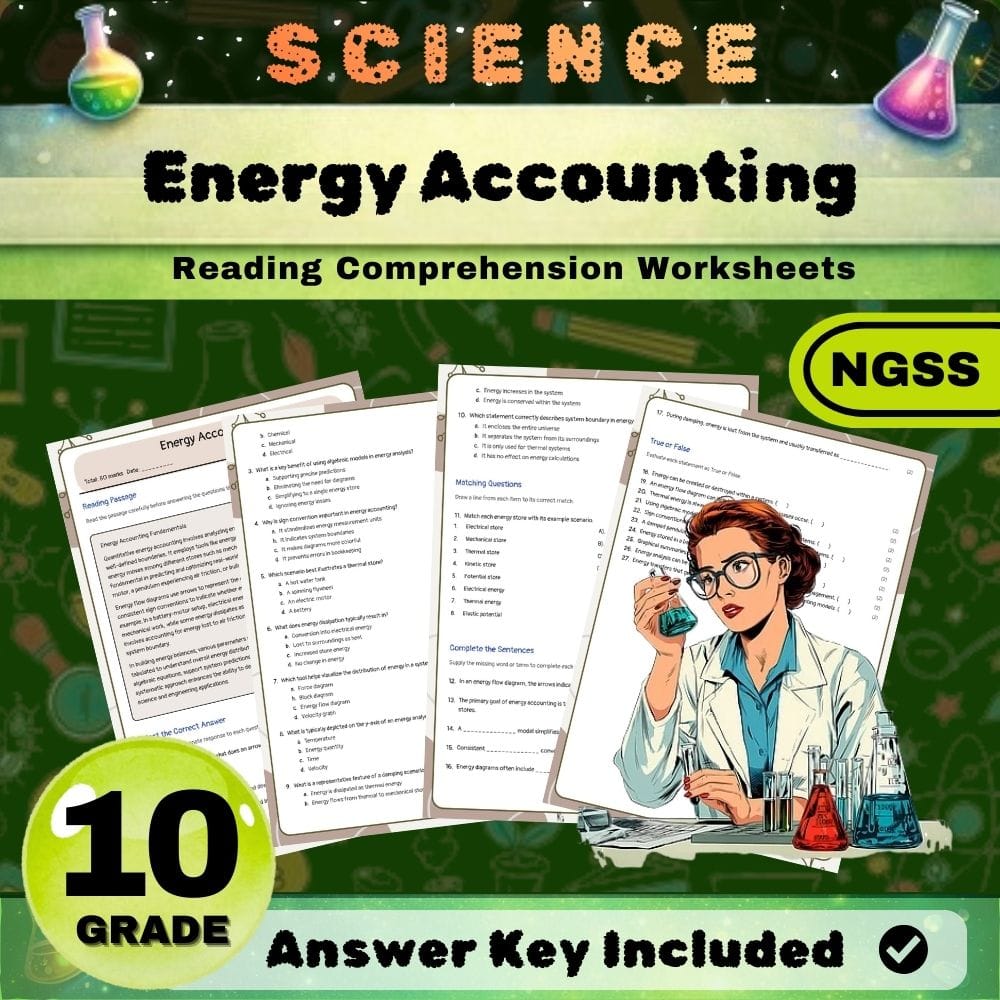
Grade 10 Science Energy Accounting Worksheet (NGSS) – PDF
Created byMaple Path LearningLearning Objectives
- Understand the principles of energy flow and transfer within physical systems.
- Interpret energy flow diagrams and apply system boundary concepts.
- Use algebraic and graphical methods to analyze energy distributions in mechanical, electrical, and thermal stores.
Also included in: Grade 10 Energy Science Worksheets Bundle | NGSS Lesson Resources +1 more
Instant download
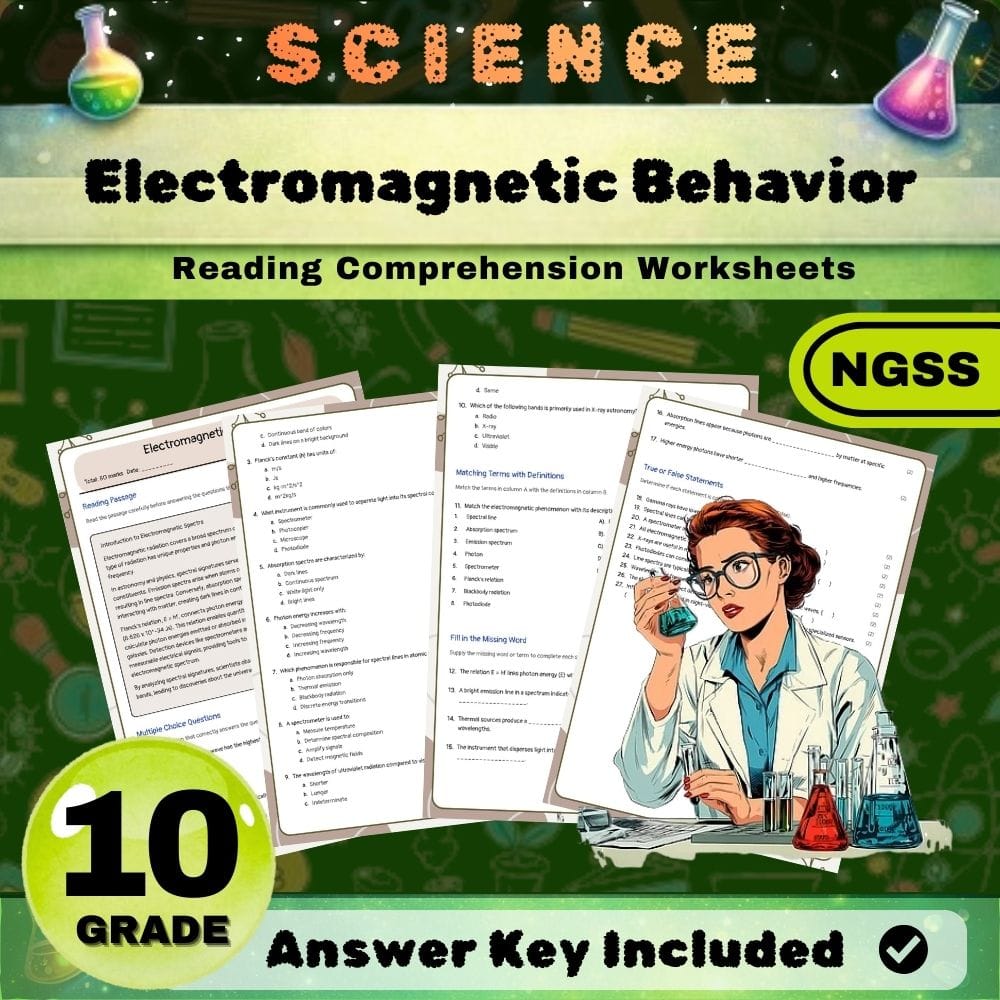
Grade 10 Science – Electromagnetic Behavior Worksheet (NGSS PDF)
Created byMaple Path LearningLearning Objectives
- Explain how photon energy relates to electromagnetic emission and absorption.
- Interpret spectral signatures to identify sources across different electromagnetic bands.
- Apply Planck’s relation E = hf to calculate photon energies.
Instant download
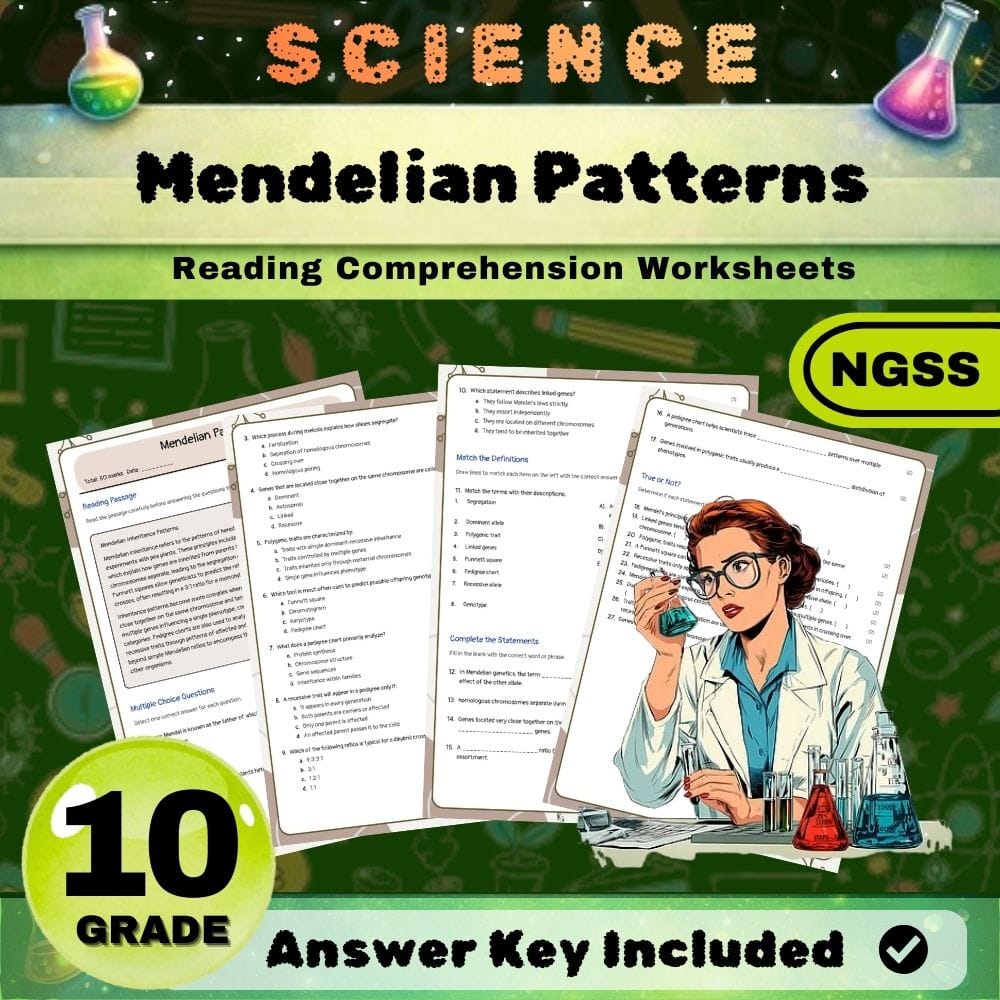
Grade 10 Science | Mendelian Patterns Worksheet (NGSS) Practice Set
Created byMaple Path LearningLearning Objectives
- Explain the principles of dominant and recessive inheritance patterns.
- Use Punnett squares and pedigree analysis to predict offspring phenotypes and genotypes.
- Describe the process of meiosis and how it relates to Mendelian inheritance.
Also included in: Grade 10 Heredity Inheritance and Variation of Traits Science Bundle | NGSS +1 more
Instant download
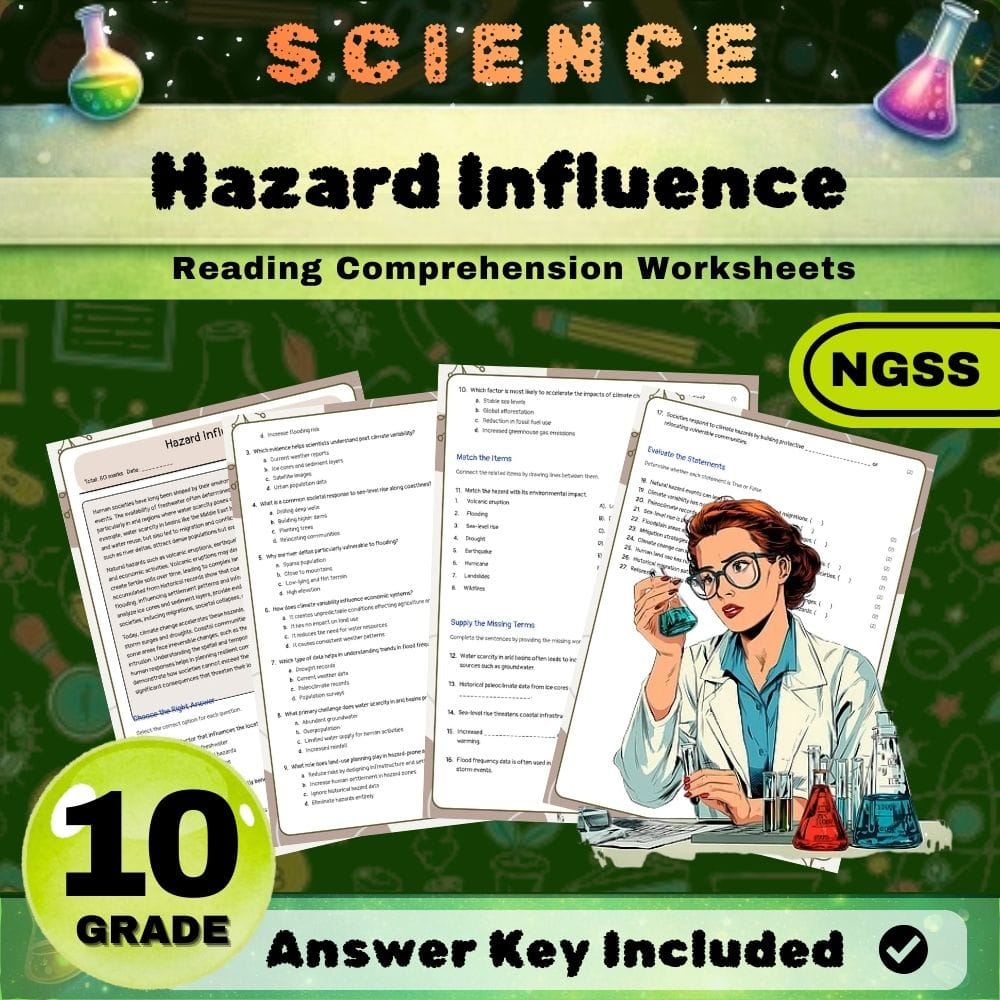
Grade 10 Science | Hazard Influence Worksheet (NGSS) Practice Set (PDF)
Created byMaple Path LearningLearning Objectives
- Understand how freshwater availability and natural hazards influence human settlement patterns.
- Analyze the effects of climate variability on land use and economic systems.
- Interpret evidence from paleoclimate records, flood data, and migration patterns related to environmental hazards.
Also included in: Grade 10 Science Earth and Human Activity Lesson Bundle | NGSS +1 more
Instant download
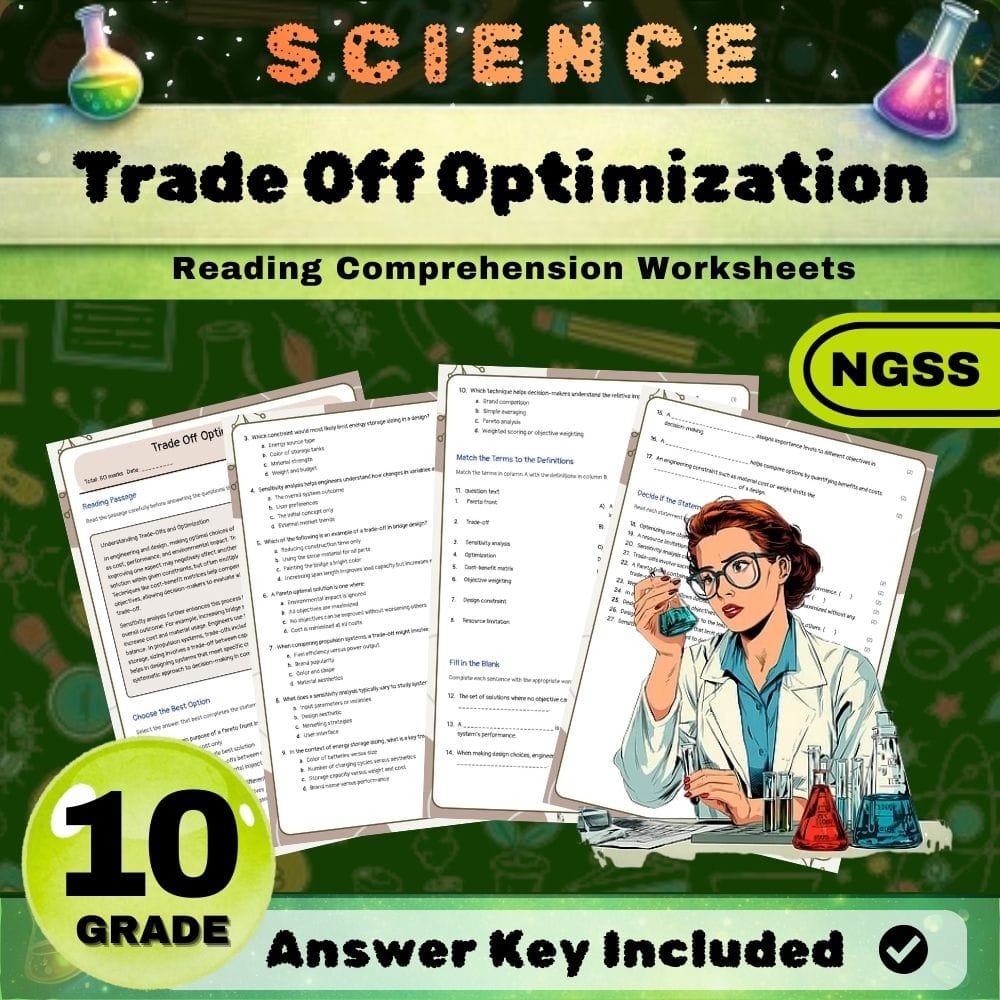
Grade 10 Science – Trade Off Optimization Worksheet (NGSS) PDF
Created byMaple Path LearningLearning Objectives
- Understand the concept of trade-offs and how to quantify competing objectives.
- Analyze different optimization methods such as cost-benefit matrices and Pareto fronts.
- Apply comparison techniques to evaluate design choices like bridge spans, propulsion, and energy storage.
Also included in: Grade 10 Science Engineering Design Worksheets NGSS Lesson Bundle | STEM Skills +1 more
Instant download
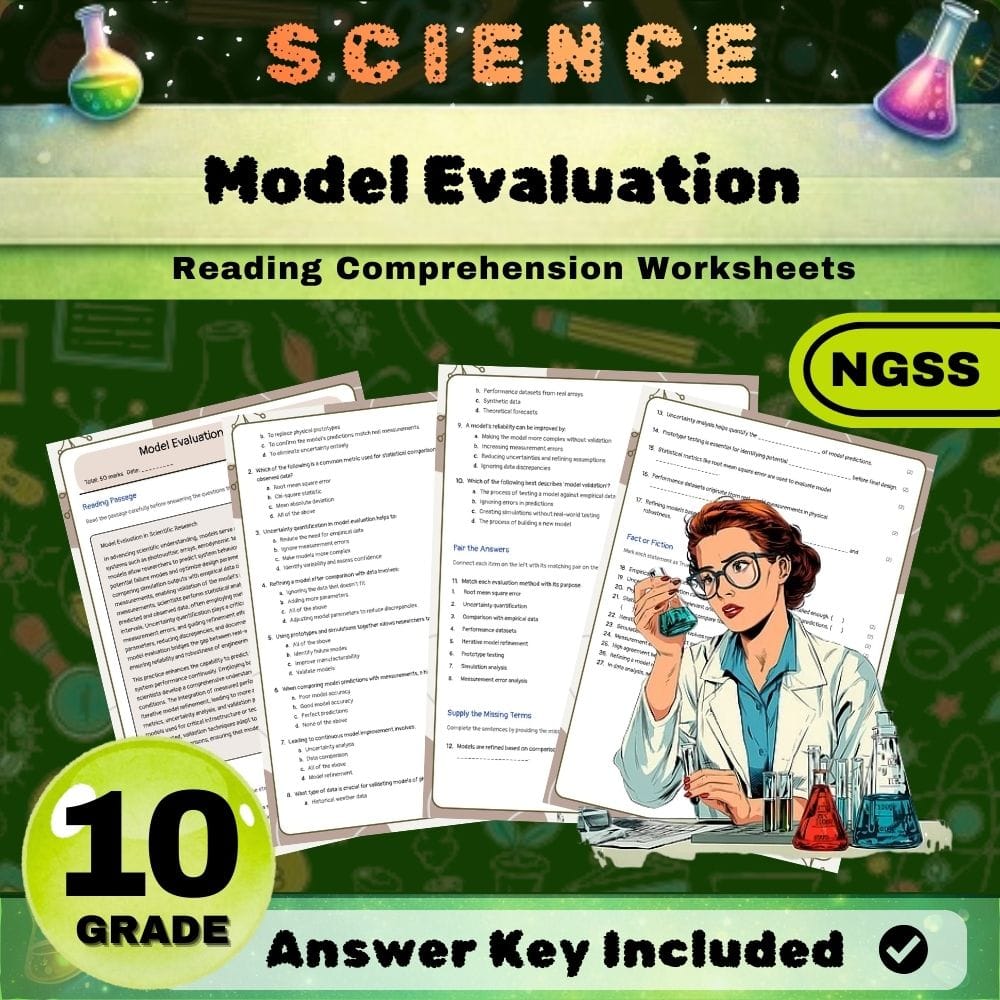
Grade 10 Science | Model Evaluation NGSS Worksheet (PDF)
Created byMaple Path LearningLearning Objectives
- Understand the process of evaluating scientific models through data comparison and validation.
- Analyze prototype data and simulations to assess accuracy and reliability.
- Apply statistical methods to compare predicted and observed outcomes.
Also included in: Grade 10 Science Engineering Design Worksheets NGSS Lesson Bundle | STEM Skills +1 more
Instant download
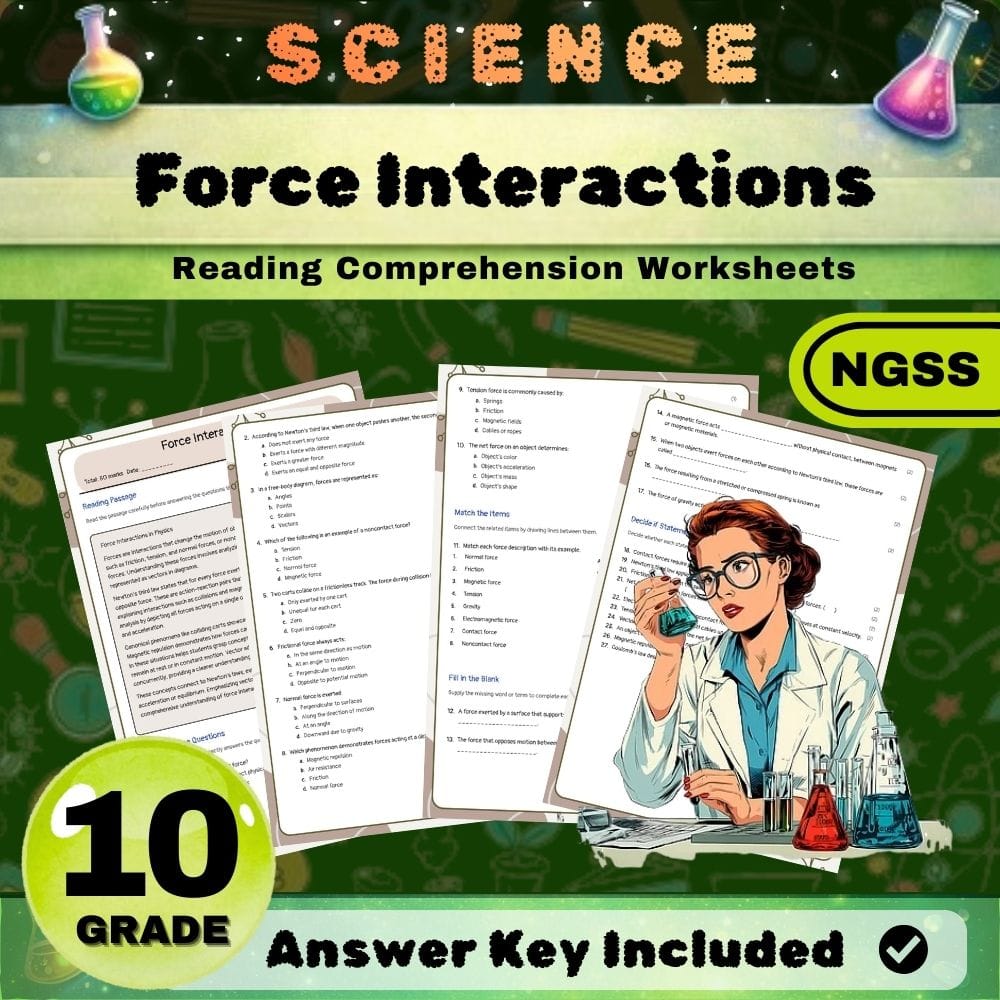
Grade 10 Science – Force Interactions Worksheet (NGSS) (PDF)
Created byMaple Path LearningLearning Objectives
- Classify contact and noncontact forces and understand their vector representations.
- Explain Newton's third law and identify action-reaction force pairs.
- Analyze free-body diagrams to determine net force and equilibrium conditions.
Instant download
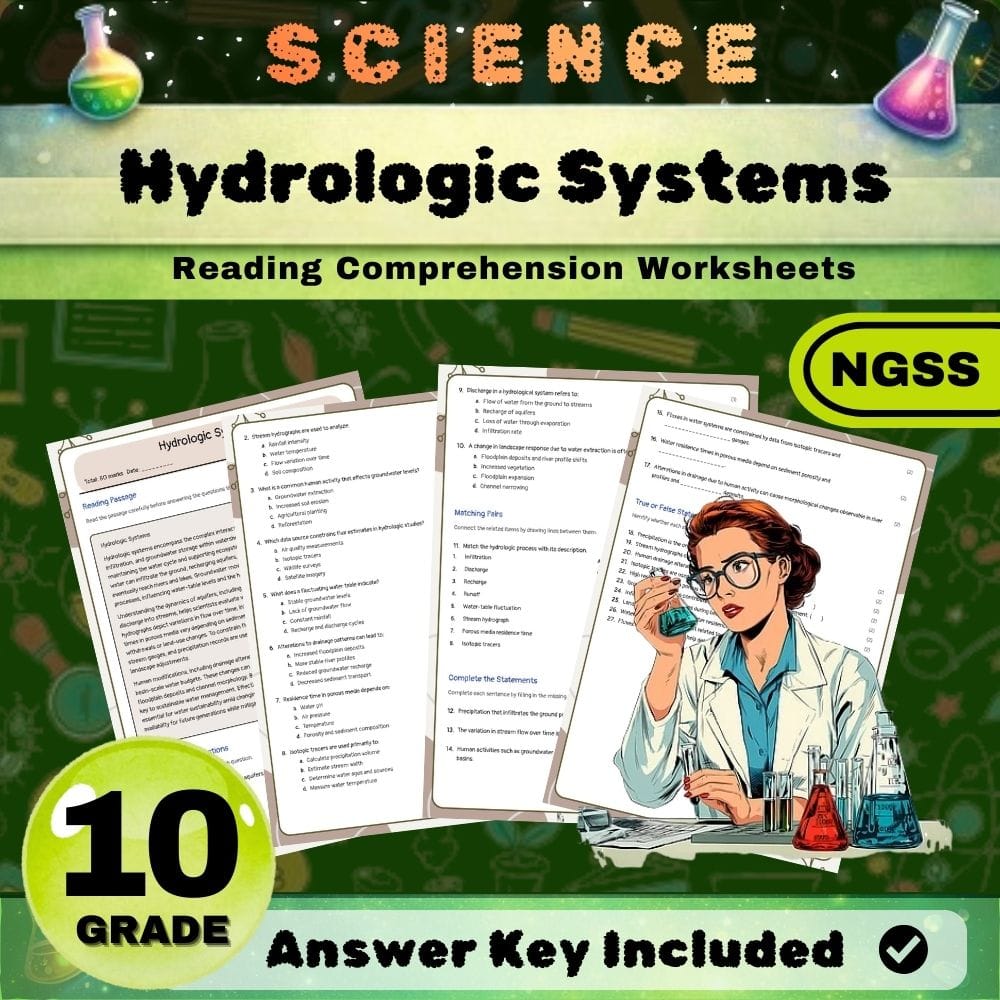
Grade 10 Science – Hydrologic Systems Worksheet (NGSS) (PDF)
Created byMaple Path LearningLearning Objectives
- Describe the processes involved in hydrologic systems, including precipitation, infiltration, runoff, and groundwater movement.
- Explain concepts such as aquifer recharge, water-table fluctuations, and stream hydrographs.
- Analyze how human activities alter watershed water budgets and landscape features.
Also included in: Grade 10 Earth’s Systems Science Worksheets Bundle | NGSS +1 more
Instant download
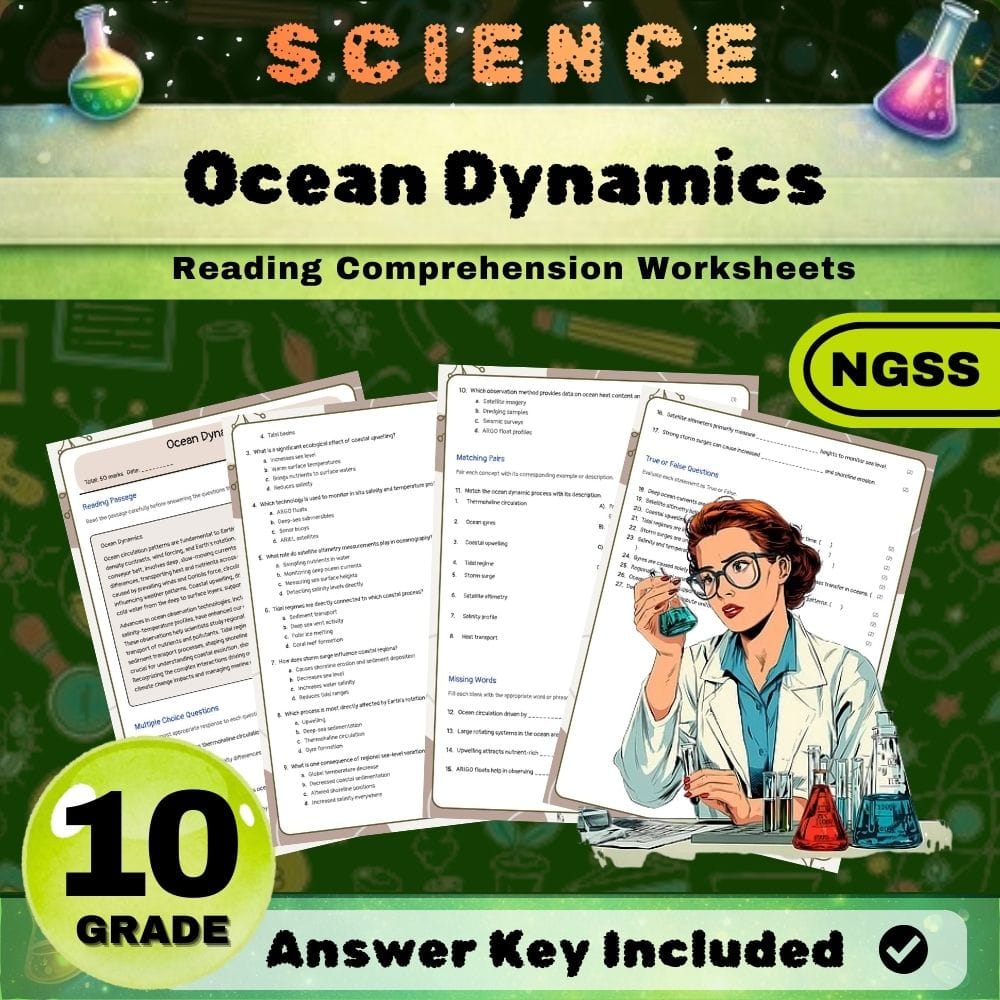
Grade 10 Science – Ocean Dynamics Worksheet (NGSS) (PDF)
Created byMaple Path LearningLearning Objectives
- Explain the key circulation patterns driven by density contrasts, wind, and Earth's rotation, including thermohaline circulation, gyres, and coastal upwelling.
- Describe how observations from ARGO floats, satellite altimetry, and salinity-temperature profiles inform our understanding of heat and mass transport in oceans.
- Analyze the impact of tidal regimes and storm surges on coastal sediment transport and shoreline morphology.
Also included in: Grade 10 Earth’s Systems Science Worksheets Bundle | NGSS +1 more
Instant download
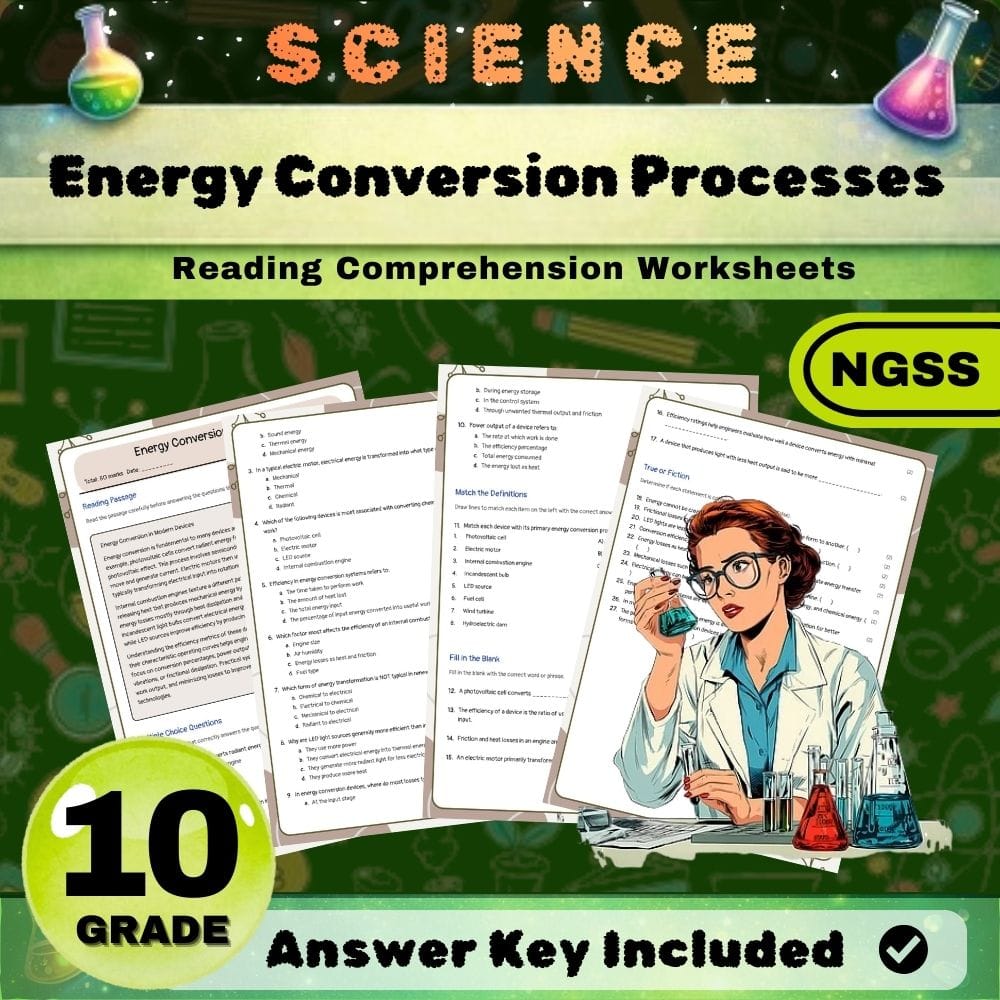
Grade 10 Science | Energy Conversion Processes Worksheet (NGSS PDF)
Created byMaple Path LearningLearning Objectives
- Understand how energy changes form in different devices such as photovoltaic cells, motors, and engines.
- Identify the pathways and efficiencies involved in energy conversion systems.
- Analyze how energy losses occur as heat or friction in practical applications.
Instant download
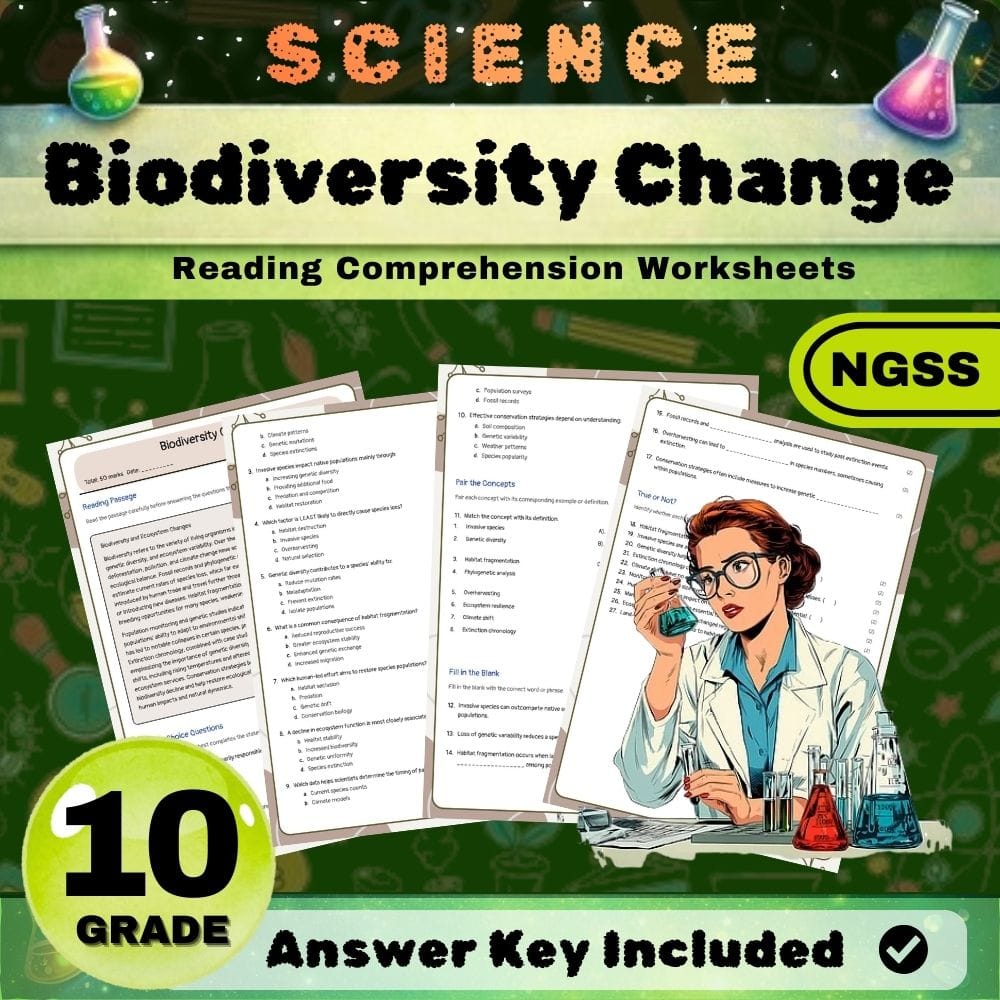
Grade 10 Science – Biodiversity Change Worksheet (NGSS PDF)
Created byMaple Path LearningLearning Objectives
- Understand factors that contribute to changes in biodiversity, including habitat loss and invasive species.
- Analyze evidence from phylogenetic studies and population monitoring related to species decline and recovery.
- Evaluate human impacts on ecosystems through case studies of land-use change and overharvesting.
Also included in: Grade 10 Science | Biological Evolution Unity and Diversity Lesson Bundle | NGSS +1 more
Instant download
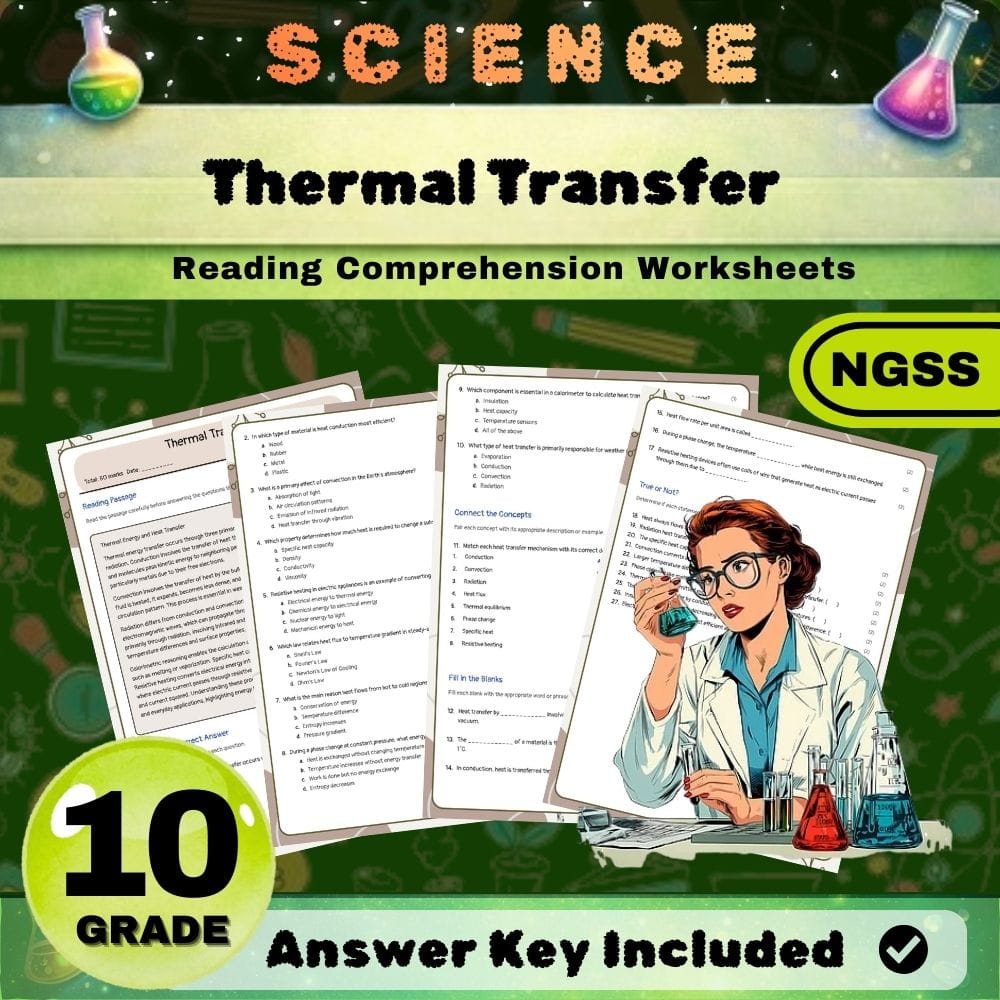
Grade 10 Science | Thermal Transfer Worksheet (NGSS) PDF
Created byMaple Path LearningLearning Objectives
- Describe the mechanisms of heat transfer: conduction, convection, and radiation.
- Explain the concepts of heat flux and temperature gradients in thermal energy transfer.
- Connect calorimetric reasoning to phase change phenomena and specific heat calculations.
Also included in: Grade 10 Energy Science Worksheets Bundle | NGSS Lesson Resources +1 more
Instant download
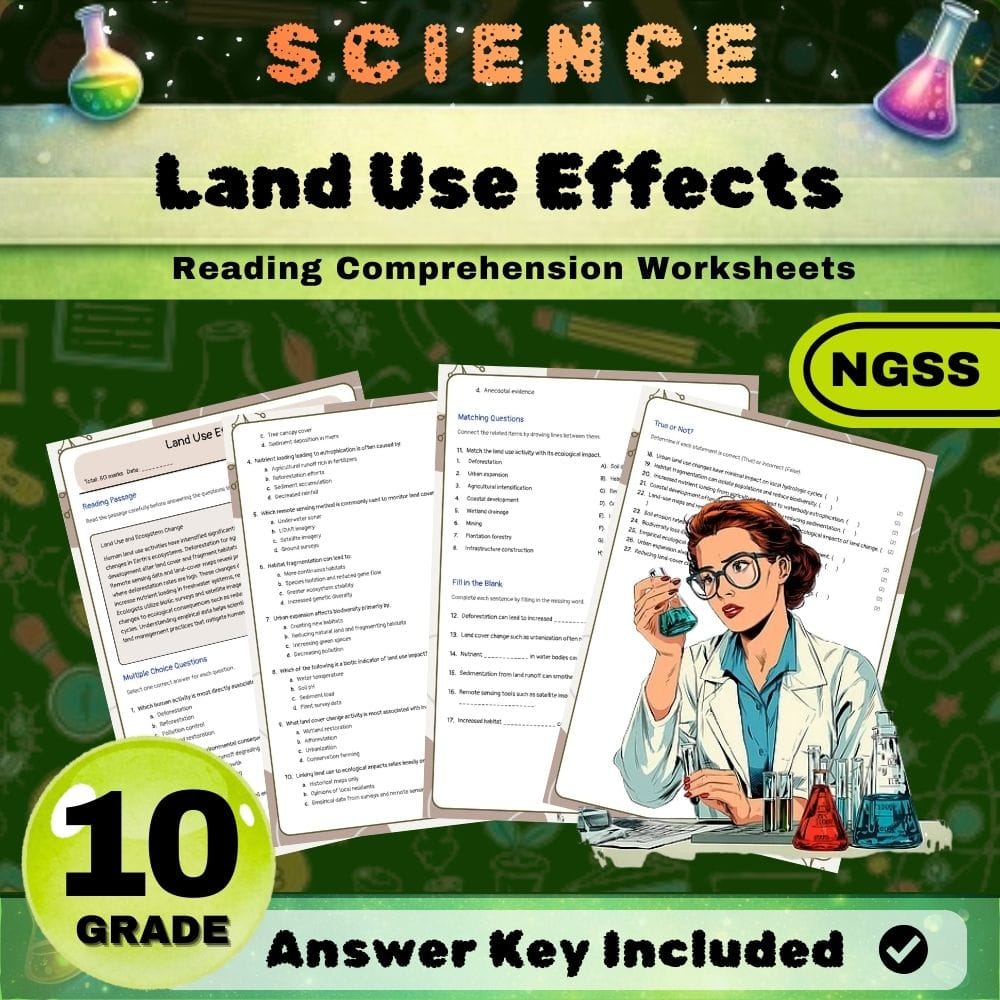
Grade 10 Science | Land Use Effects Worksheet (NGSS) (PDF)
Created byMaple Path LearningLearning Objectives
- Analyze how human land use activities affect ecosystems and Earth systems.
- Interpret empirical data from land-cover maps and biotic surveys regarding land change impacts.
- Identify mechanisms like deforestation, urban expansion, and agriculture that alter biodiversity and biogeochemical cycles.
Also included in: Grade 10 Science Earth and Human Activity Lesson Bundle | NGSS +1 more
Instant download

Grade 10 Science | Orbital Geometry Worksheet | General Standard
 Created byLumora Learning
Learning Objectives
- Explain how Earth’s axial tilt and yearly revolution influence sunlight angle and day length, causing seasons.
- Describe how the Moon’s orbit around Earth and its changing position relative to the Sun produce moon phases.
- Connect Earth’s rotation and relative orbital motion to apparent movements of stars and planets.
Instant download

Grade 10 Science | Graphical Statistics Worksheet | General Standards
Created byLumora LearningLearning Objectives
- Select appropriate graph types for quantitative and categorical data and justify the choice.
- Interpret key features of graphs (axes, spread, clusters, trends, and outliers) using statistical reasoning.
- Use graphical evidence to support or question claims about relationships and patterns in data.
Instant download

Grade 10 Science | Motion Graphs Worksheet | NGSSS Aligned
Created byLumora LearningLearning Objectives
- Interpret slopes on position–time and velocity–time graphs to determine velocity and acceleration
- Use changes in curvature, sign, and flat sections in motion graphs to infer changing direction or changing acceleration
- Connect forces to changes in acceleration and explain how those changes affect velocity and position over time
Instant download

Grade 10 Science | Systems Trade Interactions Worksheet | General Standards
Created byLumora LearningLearning Objectives
- Explain how system components interact through dependencies, feedback, and failure pathways
- Identify trade-offs that occur when changing one part of a design affects other outcomes
- Use systems thinking to map constraints and predict how design choices propagate through a system
Instant download

Grade 10 Science | Valence Patterns Worksheet | California Standards
Created byLumora LearningLearning Objectives
- Explain how valence electron patterns connect to chemical properties such as reactivity and bonding tendencies.
- Use electron configurations and atomic number trends to predict typical ion formation.
- Describe how metallic versus nonmetallic character relates to valence electrons and energy-level behavior.
Instant download

Grade 10 Science | Organelles Functions Worksheet | NGSSS Aligned
Created byLumora LearningLearning Objectives
- Explain how membrane-bound organelles contribute to overall cell function
- Describe the roles of the nucleus, mitochondria, and (in photosynthetic organisms) chloroplasts
- Compare how the ER, Golgi apparatus, and ribosomes work together to process and transport molecules
Instant download
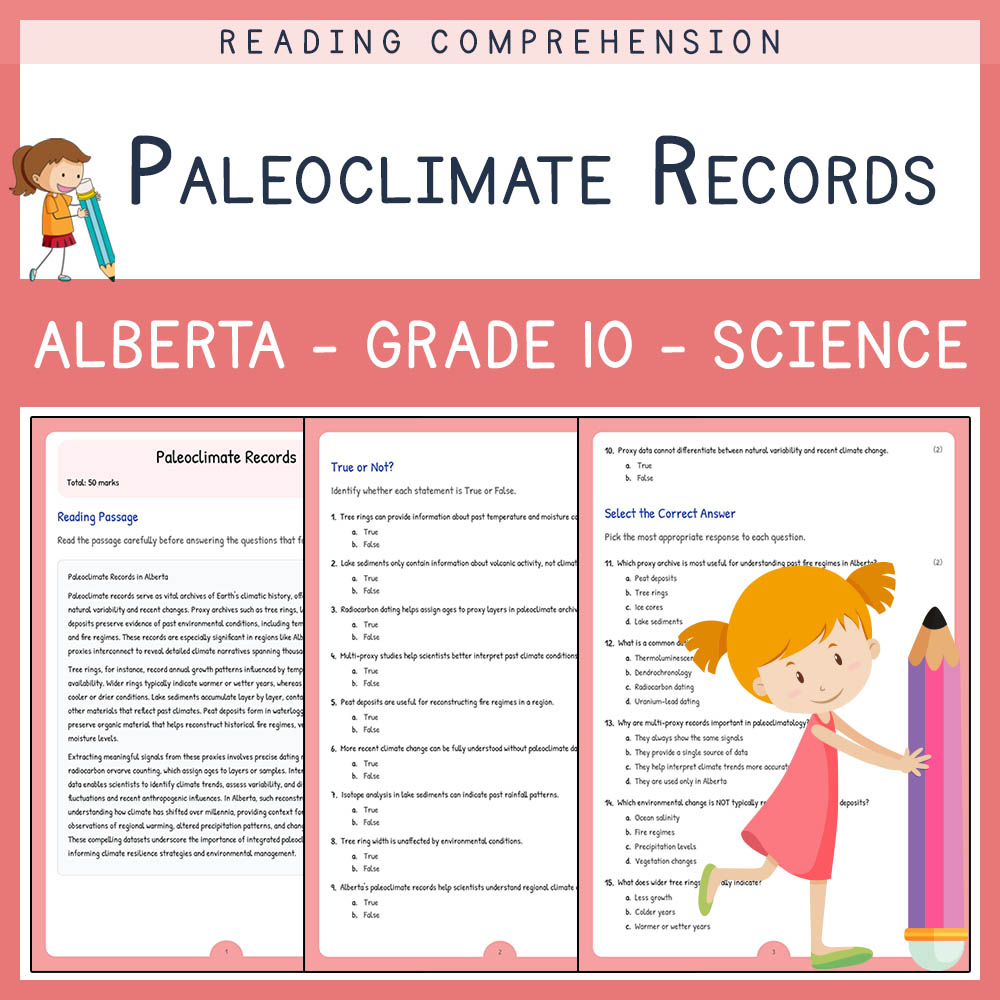
Grade 10 Science | Paleoclimate Records Worksheet | Alberta Standards
Created byLumora LearningLearning Objectives
- Understand the use of proxy archives such as tree rings, lake sediments, and peat deposits in reconstructing past climates.
- Identify methods used to extract and interpret temporal climate signals from proxies.
- Learn how multi-proxy records help differentiate natural variability from recent climate changes.
Also included in: Grade 10 Science | Earth and Space Systems Unit Bundle | Alberta
Instant download

Grade 10 Science | Immune System Assessment Worksheet | TEKS Aligned
Created byLumora LearningLearning Objectives
- Explain how the immune system contributes to maintaining homeostasis in the human body.
- Identify the roles of inflammatory responses and fever as coordinated signaling mechanisms.
- Describe how immune activation can impact physiological regulation and health outcomes.
Also included in: Grade 10 Science | Homeostasis & Body Systems Lesson Bundle | TEKS Aligned +1 more
Instant download
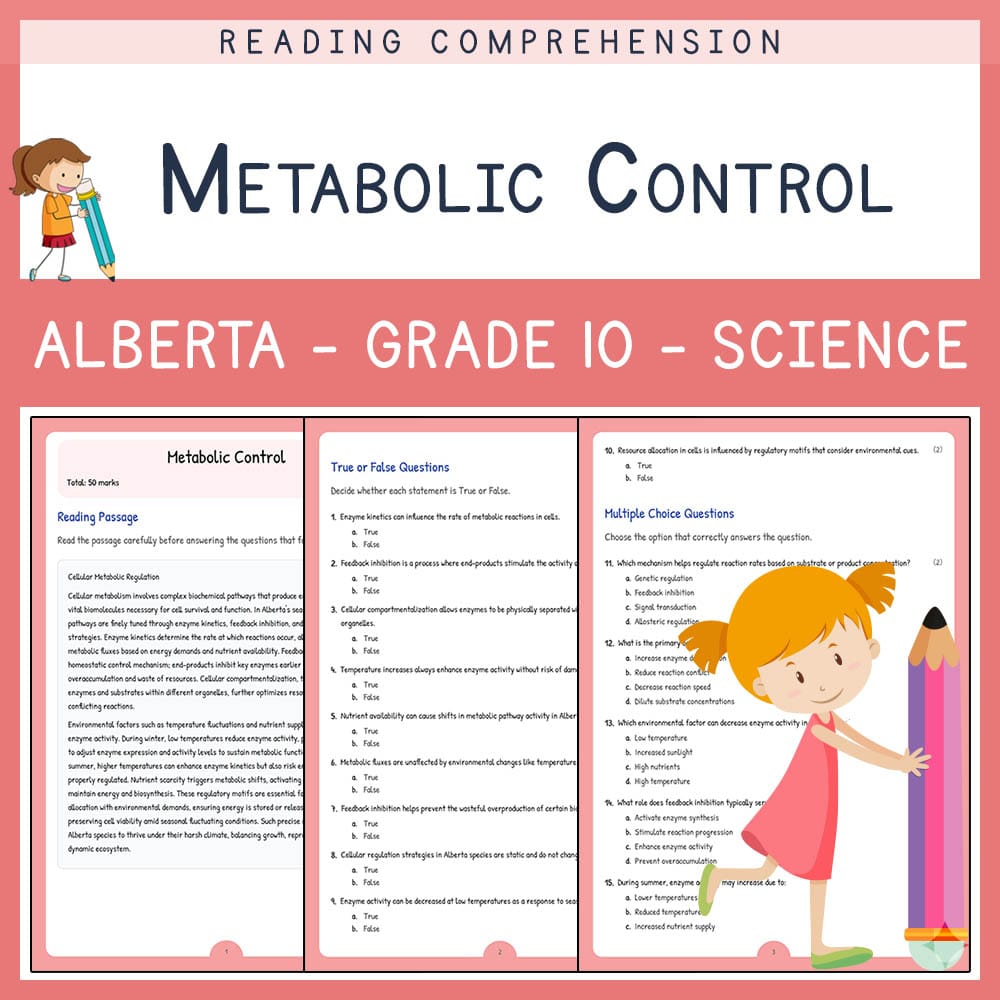
Grade 10 Science | Metabolic Control Worksheet | Alberta Standards
Created byLumora LearningLearning Objectives
- Understand how enzyme kinetics regulate cellular metabolism in Alberta species.
- Identify mechanisms like feedback inhibition and compartmentalization in metabolic pathways.
- Explain how environmental factors influence enzyme activity and metabolic fluxes.
Also included in: Grade 10 Science | Cells and Systems Custom Bundle Worksheets | Alberta
Instant download
About Grade 10 Science Worksheets
Find Science worksheets built for Grade 10. All 7,038 cover core skills, practice, and review, each an instant PDF download.
Every worksheet on MyTeachingSheets is created by independent teacher-authors and reviewed before publication. All resources download as printable PDFs for classroom, homework, or at-home practice, and many include answer keys. Preview any worksheet free before buying.