
Grade 10 Science Worksheets
7,038 worksheets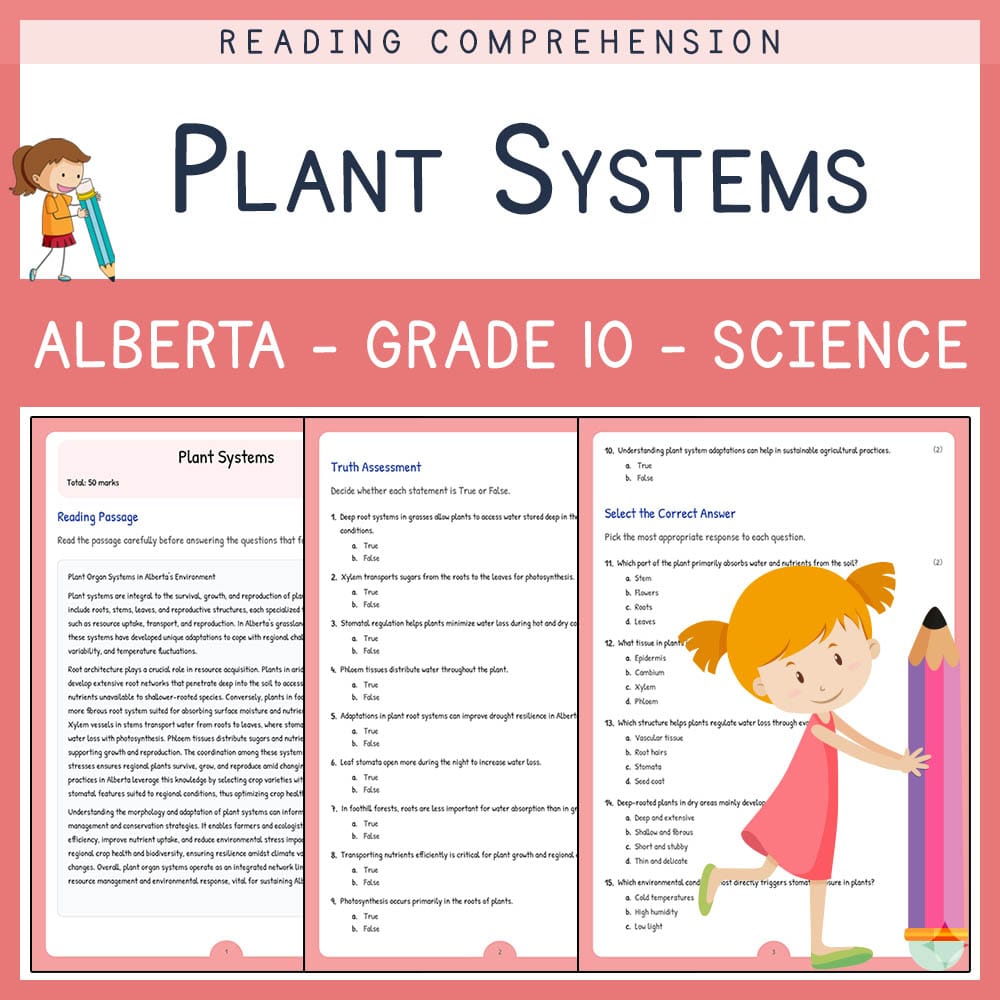
Grade 10 Science | Plant Systems Worksheet | Alberta Standards
 Created byLumora Learning
Learning Objectives
- Describe the structure and function of plant organ systems involved in resource acquisition, transport, and reproduction.
- Explain how adaptations in plant organ systems help regional plants survive in Alberta’s grasslands and foothill forests.
- Connect the morphology of root architecture, xylem, phloem, and stomata to environmental responses and agricultural management.
Also included in: Grade 10 Science | Cells and Systems Custom Bundle Worksheets | Alberta
Instant download
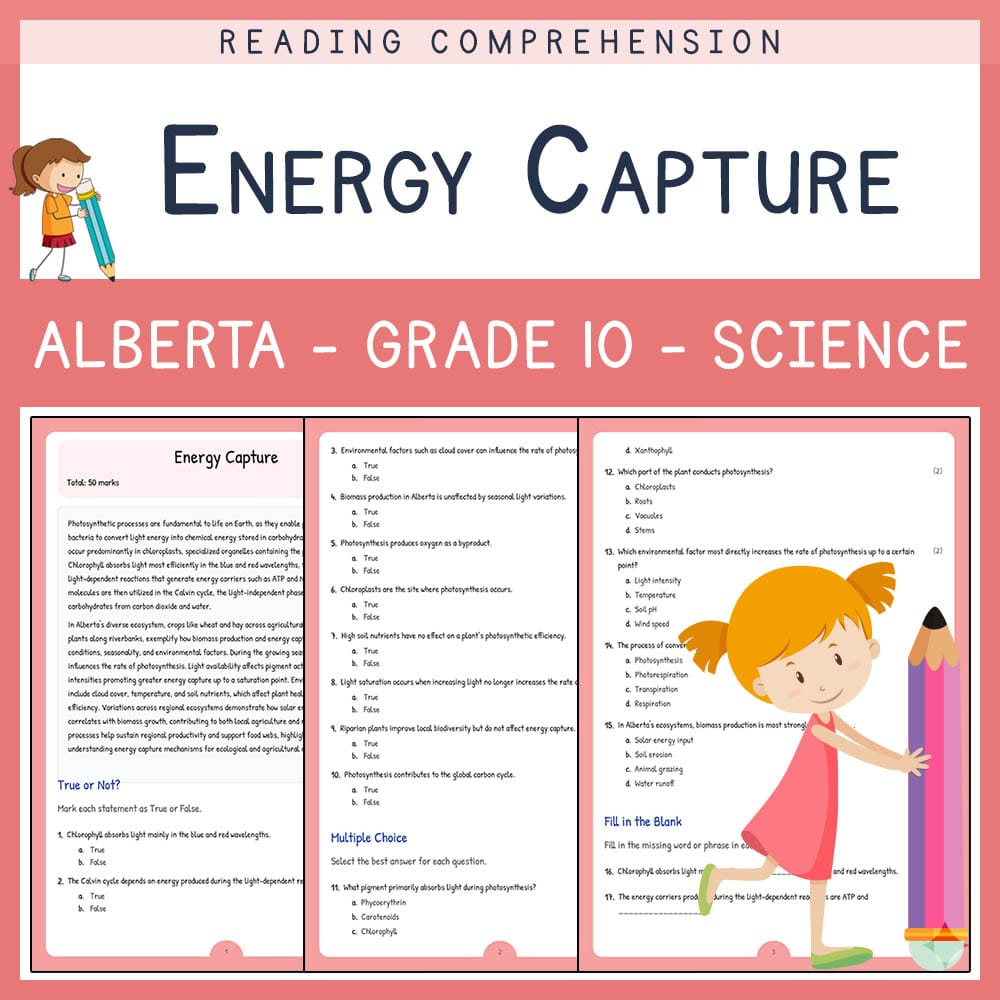
Grade 10 Science | Energy Capture Worksheet | Alberta Standards
Created byLumora LearningLearning Objectives
- Understand the process of photosynthesis and energy conversion.
- Identify the roles of chlorophyll and light-dependent reactions in energy capture.
- Analyze environmental factors affecting energy input in plants.
Also included in: Grade 10 Science | Cells and Systems Custom Bundle Worksheets | Alberta
Instant download
Grade 10 Science Sustainability Worksheet | Alberta Standards
Created byLumora LearningLearning Objectives
- Understand key indicators used to evaluate resource sustainability.
- Analyze frameworks for assessing water, land, and development impacts.
- Interpret environmental, economic, and social metrics in sustainability.
Also included in: Grade 10 Science | Earth and Space Systems Unit Bundle | Alberta
Instant download

Grade 10 Science | Carrying Capacity Worksheet Elena | TEKS Aligned
Created byLumora LearningLearning Objectives
- Define carrying capacity and understand its significance in ecosystems.
- Identify factors that influence population limits within environments.
- Analyze how resource availability and environmental changes affect carrying capacity.
Instant download

Grade 10 Science | Work and Energy Worksheet | BC Aligned
Created byLumora LearningLearning Objectives
- Explain the relationship between work and energy and how work transfers energy into or out of a system.
- Describe the work–energy principle and how it relates net work to changes in kinetic energy.
- Define power as the rate of energy transfer and calculate it in different contexts.
Instant download

Grade 10 Science | Negative Feedback Worksheet | TEKS-Aligned
Created byLumora LearningLearning Objectives
- Understand the concept of negative feedback and its role in physiological regulation.
- Identify the components involved in negative feedback mechanisms, including sensors, control centers, and effectors.
- Explain how negative feedback maintains stability in systems like temperature, blood glucose, and blood pressure.
Also included in: Grade 10 Science | Homeostasis & Body Systems Lesson Bundle | TEKS Aligned +1 more
Instant download
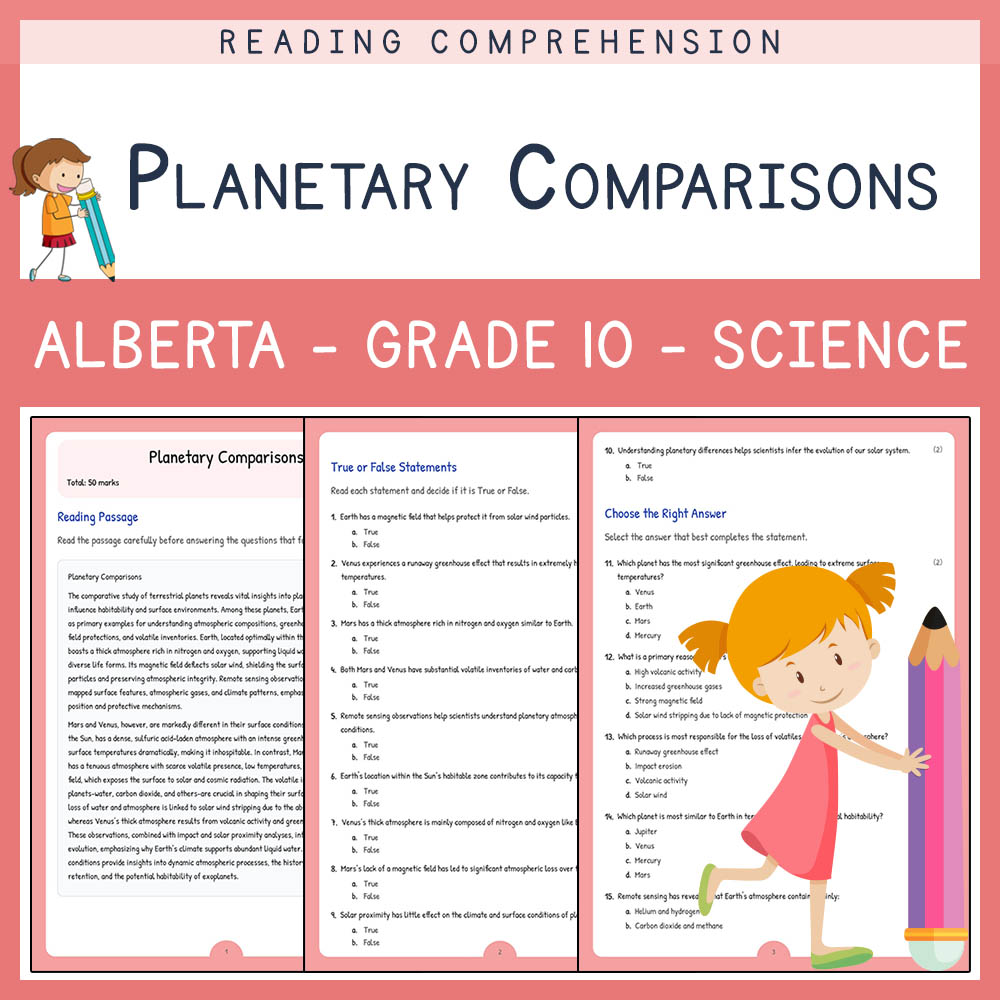
Grade 10 Science | Planetary Comparisons Worksheet | Alberta Standards
Created byLumora LearningLearning Objectives
- Compare Earth's surface conditions with Mars and Venus in terms of atmosphere, greenhouse effects, magnetic fields, and volatile inventories.
- Understand how remote sensing observations and solar proximity influence planetary climates and habitability.
- Analyze the implications of planetary differences for surface environments and potential for supporting liquid water and life.
Also included in: Grade 10 Science | Earth and Space Systems Unit Bundle | Alberta
Instant download
Grade 10 Science | Organ Systems Worksheet | Alberta Standards
Created byLumora LearningLearning Objectives
- Understand the structure and function of various organ systems in mammals and plants.
- Identify tissue types and their roles within different organs.
- Describe how organ design supports survival in Alberta's environment.
Also included in: Grade 10 Science | Cells and Systems Custom Bundle Worksheets | Alberta
Instant download
Grade 10 Science | Human Footprint Worksheet | Alberta Standards
Created byLumora LearningLearning Objectives
- Understand how human activities impact Earth's land, water, and atmosphere.
- Identify regional examples of land-use change and resource extraction.
- Analyze the effects of urban expansion and environmental indicators on ecosystems.
Also included in: Grade 10 Science | Earth and Space Systems Unit Bundle | Alberta
Instant download

Grade 10 Science | Circular Motion Worksheet Elena | AP Aligned
Created byLumora LearningLearning Objectives
- Explain the difference between uniform and non-uniform circular motion.
- Relate angular quantities to linear quantities such as velocity and acceleration.
- Describe the concept of centripetal acceleration and the forces involved.
Instant download
Grade 10 Science | Integrated Systems Worksheet | Alberta Standard
Created byLumora LearningLearning Objectives
- Trace energy transformations across mechanical and electrical domains.
- Apply conservation principles to analyze system performance and losses.
- Understand the interaction between mechanical motion and electrical energy flows.
Instant download

Grade 10 Science | Efficiency Metrics Worksheet | BC Aligned
Created byLumora LearningLearning Objectives
- Understand various efficiency metrics used to evaluate energy systems.
- Interpret and compare efficiency indicators like percent efficiency, EROI, COP, and LCOE.
- Analyze the importance of boundaries, time scales, and ancillary impacts in efficiency assessment.
Instant download

Grade 10 Science | Impulse and Momentum Worksheet | AP Aligned
Created byLumora LearningLearning Objectives
- Explain the relationship between impulse and change in momentum.
- Analyze collision events using conservation of momentum in isolated systems.
- Differentiate between elastic, inelastic, and perfectly inelastic collisions.
Instant download

Grade 10 Science | Galactic Structure Worksheet | NGSSS Aligned
Created byLumora LearningLearning Objectives
- Describe how galaxy structure (especially barred spiral galaxies) is shaped and maintained by gravity and dynamics.
- Explain how spectral redshift and spectral lines are used to infer galaxy motion and relate it to expanding space.
- Apply brightness, distance, and intrinsic luminosity reasoning to interpret why galaxies appear different at different ranges.
Instant download

Grade 10 Science | Motion Graphs Worksheet | AP Aligned
Created byLumora LearningLearning Objectives
- Understand how slopes of position, velocity, and acceleration graphs relate to rates of change.
- Interpret areas under velocity and acceleration graphs as measures of displacement and change in velocity.
- Extract kinematic quantities from experimental data using graphical techniques and error analysis.
Instant download

Grade 10 Science | Evolutionary Relationships Worksheet | California Standards
Created byLumora LearningLearning Objectives
- Explain how phylogenetic trees organize evolutionary history using shared characteristics
- Distinguish shared derived traits from ancestral traits when interpreting evolutionary relationships
- Use genetic and trait-based evidence to justify how lineages split over time
Instant download

Grade 10 Science | Shared Genetic Mechanisms Worksheet | California Standards
Created byLumora LearningLearning Objectives
- Explain how conserved DNA sequences and regulatory systems support the idea of common ancestry
- Describe how protein and metabolic pathway similarities suggest evolution modifies existing genetic material
- Interpret how evidence from comparative genomics and biochemical function strengthens evolutionary conclusions
Instant download

Grade 10 Science | Electric Fields Worksheet | BC-Aligned
Created byLumora LearningLearning Objectives
- Understand the concept of electric fields and how they influence charges in space.
- Identify how field lines represent the direction and strength of electric fields.
- Explain the principle of superposition in combining multiple electric fields.
Instant download

Grade 10 Science | Particle Accounting Worksheet | California Standards
Created byLumora LearningLearning Objectives
- Use particle accounting to track conservation of atoms during chemical reactions.
- Connect atomic diagrams to conservation by comparing atom totals before and after a reaction.
- Explain which bonds break and which bonds form using particulate (atomic-level) representations.
Instant download

Grade 10 Science | Relative Velocity Worksheet | BC Aligned
Created byLumora LearningLearning Objectives
- Explain the concept of relative velocity and how it depends on the observer's frame of reference.
- Determine the relative velocity of objects moving in different directions using vector subtraction.
- Apply classical velocity addition and subtraction rules for objects moving at speeds much less than light.
Instant download

Grade 10 Science | Radiometric Dating Worksheet | NGSSS Aligned
Created byLumora LearningLearning Objectives
- Explain how radiometric dating estimates absolute geologic time using radioactive decay in minerals
- Describe the role of half-life in connecting isotope decay to the fraction of parent and daughter products remaining
- Evaluate how assumptions (starting conditions and closed-system behavior) affect the reliability of radiometric dates
Instant download

Grade 10 Science | Orbits and Energy Worksheet | BC Standards
Created byLumora LearningLearning Objectives
- Explain how gravitational attraction provides the centripetal force for orbital motion.
- Describe how orbital speed depends on central mass and orbital radius.
- Differentiate between circular and elliptical orbits and their energy characteristics.
Instant download

Grade 10 Science | DNA Protein Pathway Worksheet | California Standards
Created byLumora LearningLearning Objectives
- Explain how transcription converts DNA information into messenger RNA (mRNA).
- Describe how translation uses mRNA codons to build a specific polypeptide chain.
- Analyze how DNA sequence changes (mutations) can affect protein function and cell behavior.
Instant download

Grade 10 Science | Biogeochemical Cycles Worksheet | TEKS-Aligned
Created byLumora LearningLearning Objectives
- Understand the processes involved in biogeochemical cycles such as water, carbon, nitrogen, and phosphorus cycles.
- Explain how biological and physical processes contribute to nutrient cycling in ecosystems.
- Analyze the impact of human activities on the natural flow of biogeochemical elements.
Instant download

Grade 10 Science | Surface Change Climate Links Worksheet | California Standards
Created byLumora LearningLearning Objectives
- Explain how changes in Earth’s surface can alter climate through physical mechanisms such as energy balance and atmospheric circulation
- Interpret evidence from long-term records (ice cores and sediments) to make and evaluate climate-related claims
- Connect land-cover, volcanic aerosols, and topographic changes to expected shifts in temperature and precipitation
Instant download

Grade 10 Science | Population Dynamics Worksheet | TEKS Aligned
Created byLumora LearningLearning Objectives
- Understand the factors influencing population size and distribution over time.
- Identify the patterns of exponential and logistic growth in populations.
- Explain how interactions like predation and resource availability affect population stability.
Instant download

Grade 10 Science | Selection and Adaptation Worksheet | California Standards
Created byLumora LearningLearning Objectives
- Explain how natural selection changes allele frequencies over generations
- Describe how heritable variation and fitness lead to adaptation at the population level
- Use scientific terms (variation, heritability, fitness, selective pressures, adaptation) to interpret examples
Instant download

Grade 10 Science | Engineering Problem Worksheet Elena | California Standards
Created byLumora LearningLearning Objectives
- Identify the criteria for success in an engineering problem and explain why they matter
- Distinguish engineering constraints from criteria and describe how constraints limit solutions
- Use a problem statement to guide tradeoffs and iterative design decisions
Instant download

Grade 10 Science | Vectors and Components Worksheet | BC Aligned
Created byLumora LearningLearning Objectives
- Understand vector decomposition into perpendicular components.
- Apply trigonometric functions to relate components to magnitude and direction.
- Resolve velocity and acceleration into horizontal and vertical components for motion analysis.
Instant download

Grade 10 Science | Reference Frames Worksheet | AP Standards
Created byLumora LearningLearning Objectives
- Understand the concept of reference frames and their importance in describing motion.
- Differentiate between position, displacement, velocity, and acceleration in various reference frames.
- Interpret position-time and velocity-time graphs for uniform and accelerated motion.
Instant download

Grade 10 Science | Mutation Driven Change Worksheet | California Standards
Created byLumora LearningLearning Objectives
- Explain how mutations create heritable variation in DNA and how that variation can affect alleles in a population
- Describe how mutations may or may not influence traits or survival depending on their effect on proteins and gene regulation
- Connect mutation and natural selection to predict how allele frequencies can change over generations
Instant download
Grade 10 Science | Cell Types Worksheet | Alberta Standards
Created byLumora LearningLearning Objectives
- Differentiate between prokaryotic and eukaryotic cell structures.
- Identify examples of prokaryotic and eukaryotic cells in various environments.
- Compare the organizational complexity and functions of cell types.
Also included in: Grade 10 Science | Cells and Systems Custom Bundle Worksheets | Alberta
Instant download

Grade 10 Science | Data Visualization Worksheet | AP Aligned
Created byLumora LearningLearning Objectives
- Understand principles and conventions for graphical and tabular data representation.
- Identify appropriate visualization techniques for different data types and contexts.
- Interpret patterns, variability, outliers, and uncertainty in data visualizations.
Instant download

Grade 10 Science | Solar Conversion Worksheet | BC Standards
Created byLumora LearningLearning Objectives
- Understand the processes involved in converting radiant energy into electrical and chemical energy.
- Identify the roles of semiconductors, bandgaps, and quantum efficiency in solar energy systems.
- Compare physical and biological energy conversion mechanisms, including their rates and spectral responses.
Instant download
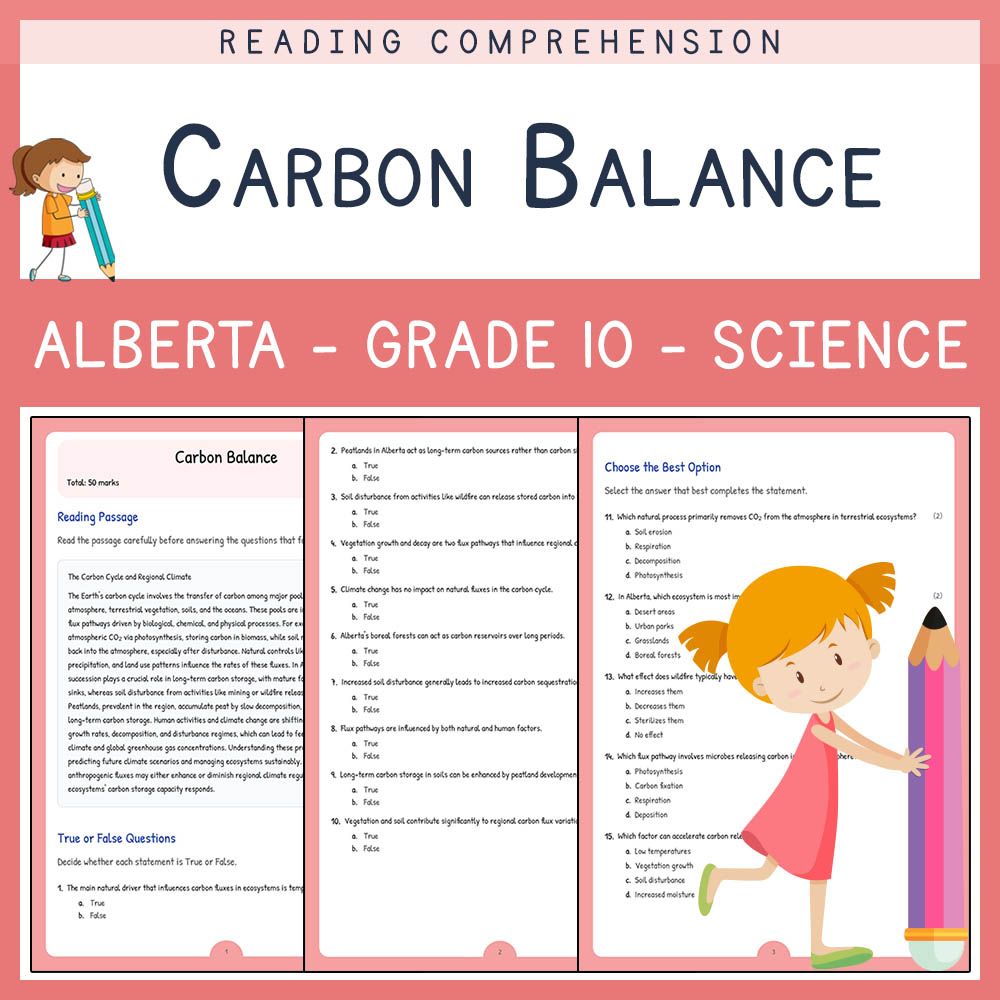
Grade 10 Science | Carbon Balance Worksheet | Alberta Standards
Created byLumora LearningLearning Objectives
- Understand the major pools and flux pathways of carbon in natural ecosystems.
- Identify regional drivers and impacts of changes in the carbon cycle.
- Analyze how shifts in carbon fluxes can affect climate feedbacks and long-term storage.
Also included in: Grade 10 Science | Earth and Space Systems Unit Bundle | Alberta
Instant download

Grade 10 Science | Mass Conservation Worksheet | BC Assessment
Created byLumora LearningLearning Objectives
- Understand the principle of conservation of mass in chemical reactions.
- Identify how mass is conserved in various chemical processes, including gases and solutions.
- Apply the law of mass conservation to balance chemical equations and perform stoichiometric calculations.
Instant download
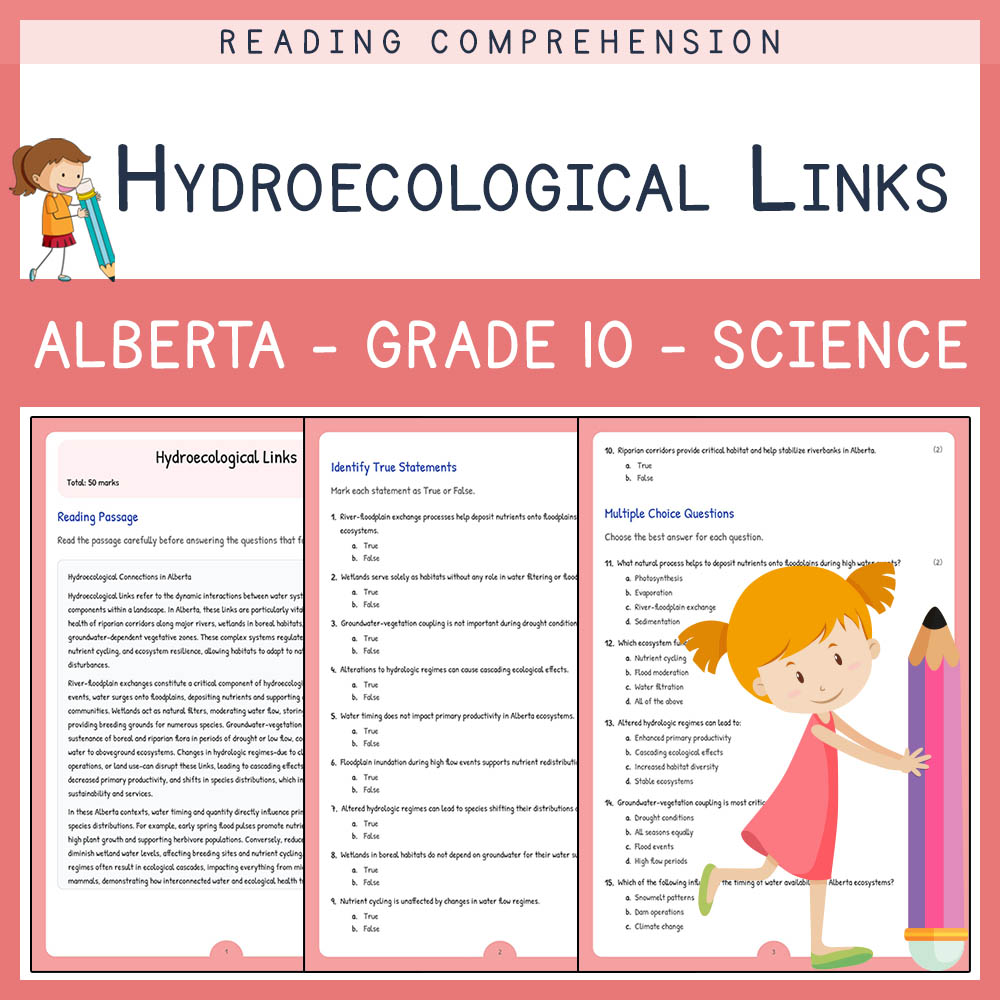
Grade 10 Science | Hydroecological Links Worksheet | Alberta Standards
Created byLumora LearningLearning Objectives
- Understand the interactions between hydrology and ecosystems in Alberta contexts.
- Identify how water availability influences habitat, productivity, and species distribution.
- Evaluate the ecological effects of altered hydrologic regimes on ecosystems.
Also included in: Grade 10 Science | Earth and Space Systems Unit Bundle | Alberta
Instant download

Grade 10 Science | Mechanical Systems Worksheet | BC Standards
Created byLumora LearningLearning Objectives
- Understand how mechanical systems transfer and transform energy through gears, pulleys, levers, and engines.
- Analyze energy paths, transfer efficiencies, and the effects of constraints like bearings and lubrication.
- Visualize work flow between system components to predict performance changes under different loads.
Instant download
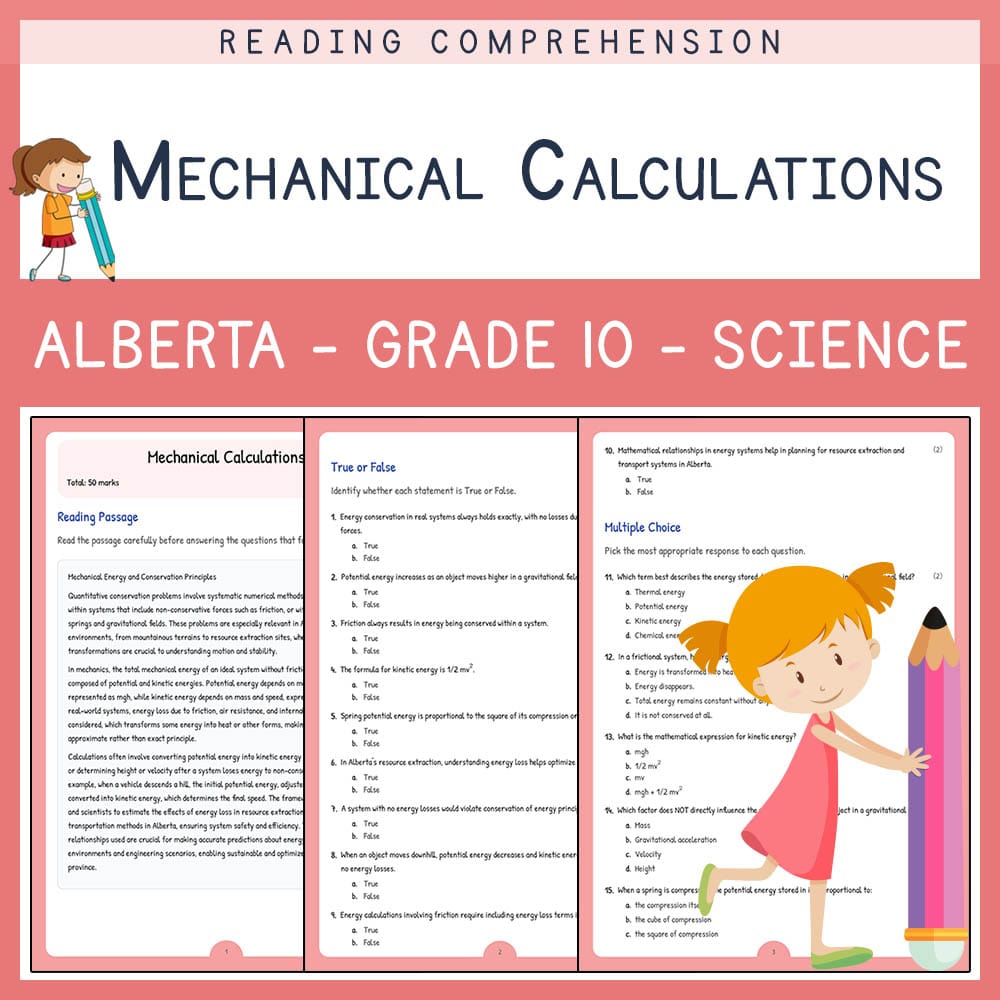
Grade 10 Science | Mechanical Calculations Worksheet | Alberta Standards
Created byLumora LearningLearning Objectives
- Understand the principles of energy conservation in mechanical systems.
- Apply quantitative methods to solve problems involving energy transfer and losses.
- Use mathematical relationships to connect energy, height, speed, and mass in real-world contexts.
Instant download
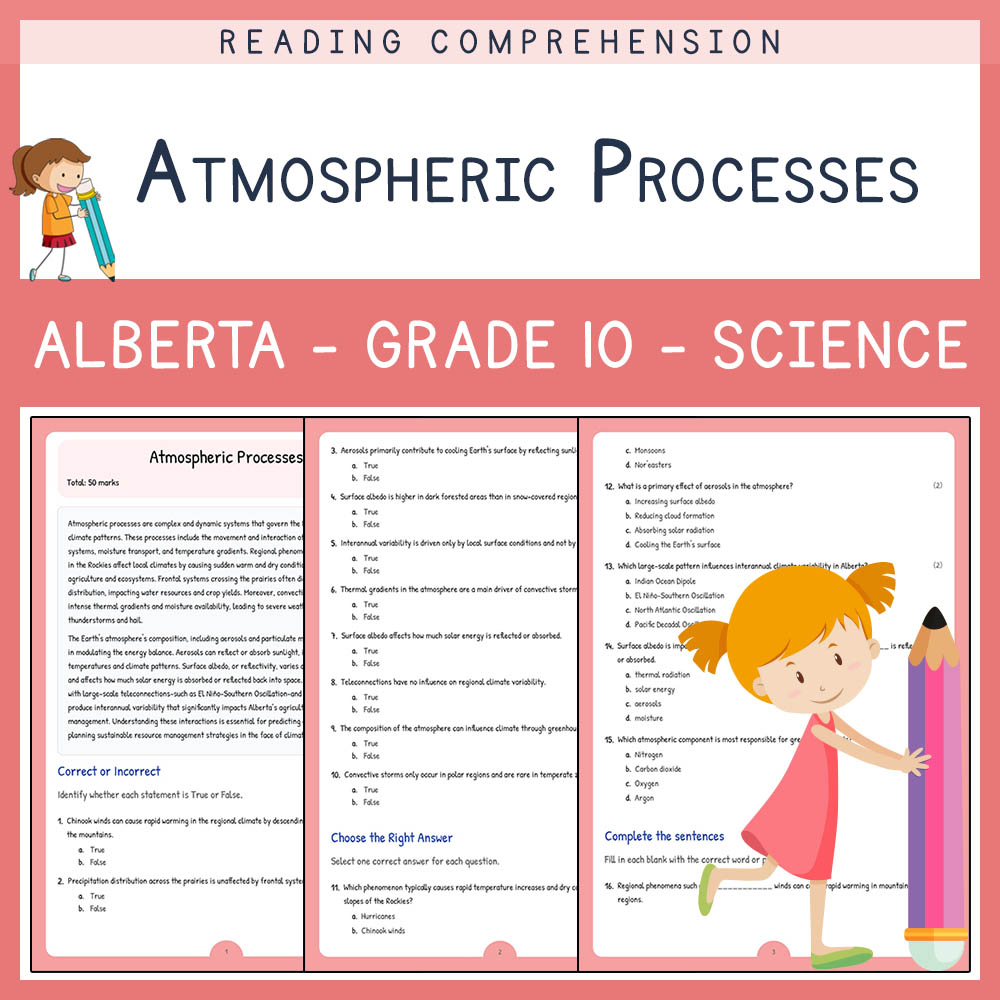
Grade 10 Science | Atmospheric Processes Worksheet | Alberta Standards
Created byLumora LearningLearning Objectives
- Understand how atmospheric pressure, moisture transport, and thermal gradients influence weather and climate.
- Identify regional phenomena like Chinook winds, frontal systems, and convective storms and their effects.
- Explain the role of atmospheric composition, aerosols, and surface albedo in energy balance modulation.
Also included in: Grade 10 Science | Earth and Space Systems Unit Bundle | Alberta
Instant download
Grade 10 Science | System Interactions Worksheet | Alberta Standards
Created byLumora LearningLearning Objectives
- Understand how biological systems exchange materials and information to create emergent properties.
- Identify examples of system coupling in ecosystems and organismal responses.
- Explain how resource flows and system interactions influence resilience and function in Alberta landscapes.
Also included in: Grade 10 Science | Cells and Systems Custom Bundle Worksheets | Alberta
Instant download

Grade 10 Science | Energy Changes Worksheet | AP Aligned
Created byLumora LearningLearning Objectives
- Explain the difference between endothermic and exothermic processes in chemical reactions.
- Describe basic enthalpy concepts and how bond breaking and formation relate to reaction heat.
- Interpret potential energy diagrams and understand their significance in reaction energetics.
Instant download

Grade 10 Science | Evolutionary Synthesis Worksheet | BC Aligned
Created byLumora LearningLearning Objectives
- Understand how fossil, anatomical, developmental, and molecular evidence contribute to evolutionary explanations.
- Identify mechanisms like natural selection, genetic drift, and gene flow in shaping biodiversity.
- Analyze case studies such as island finch radiations and transitional fossils to interpret evolutionary processes.
Also included in: Grade 10 Science | Evolution & Biodiversity Lesson Bundle | BC Framework
Instant download
Grade 10 Science | Chemical Properties Worksheet Elena | Ontario Standard
Created byLumora LearningLearning Objectives
- Understand the characteristics that define chemical properties of substances.
- Identify indicators signaling chemical changes such as pH and gas evolution.
- Explain reaction mechanisms and how bonding patterns change during reactions.
Instant download

Grade 10 Science | Homeostasis Basics Worksheet | TEKS-Aligned
Created byLumora LearningLearning Objectives
- Define homeostasis and understand its importance in human physiology.
- Identify the key components involved in maintaining internal stability, including set points, sensors, and effectors.
- Explain how feedback mechanisms regulate temperature, fluid balance, and chemical composition.
Also included in: Grade 10 Science | Homeostasis & Body Systems Lesson Bundle | TEKS Aligned +1 more
Instant download
Grade 10 Science | Resource Policy Worksheet Elena | Ontario Standard
Created byLumora LearningLearning Objectives
- Understand governance instruments and economic mechanisms that influence resource use.
- Analyze the roles of permitting, land-use planning, and environmental assessment.
- Evaluate the importance of Indigenous rights, international markets, and monitoring in resource management.
Instant download
Grade 10 | Rock Cycle Worksheet Elena | Ontario Standards
Created byLumora LearningLearning Objectives
- Describe the processes involved in the rock cycle, including melting, crystallization, weathering, transport, deposition, lithification, and metamorphism.
- Explain the physical and chemical drivers that cause rocks to transform from one type to another.
- Discuss the linkages between the rock cycle, plate tectonics, and surface processes.
Instant download
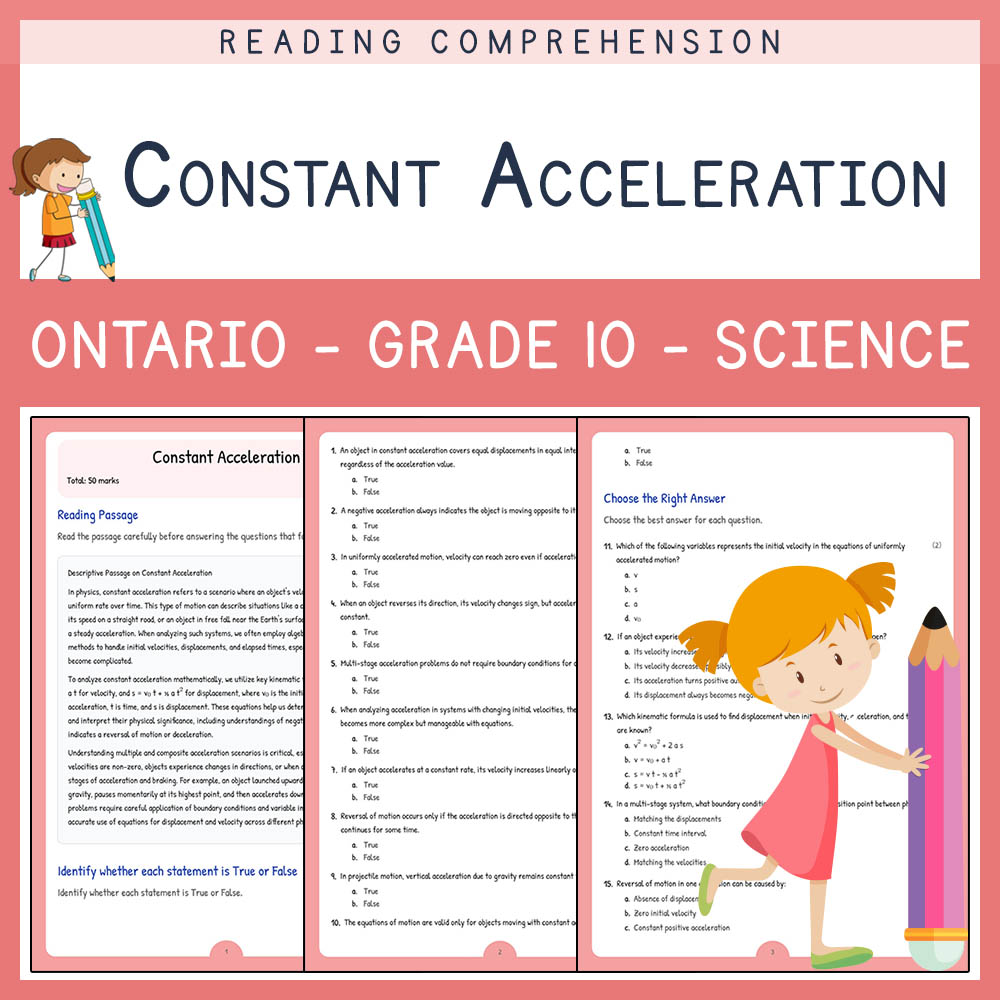
Grade 10 Science | Constant Acceleration Worksheet Elena | Ontario Standard
Created byLumora LearningLearning Objectives
- Understand the principles of uniform acceleration and their mathematical descriptions.
- Apply kinematic formulas to analyze systems with varying initial velocities, displacements, and times.
- Interpret negative acceleration and motion reversal situations in one-dimensional motion.
Also included in: Grade 10 Science | Motion & Forces Lesson Bundle | Ontario Standards
Instant download
About Grade 10 Science Worksheets
Find Science worksheets built for Grade 10. All 7,038 cover core skills, practice, and review, each an instant PDF download.
Every worksheet on MyTeachingSheets is created by independent teacher-authors and reviewed before publication. All resources download as printable PDFs for classroom, homework, or at-home practice, and many include answer keys. Preview any worksheet free before buying.