
Grade 10 Science Worksheets
7,038 worksheets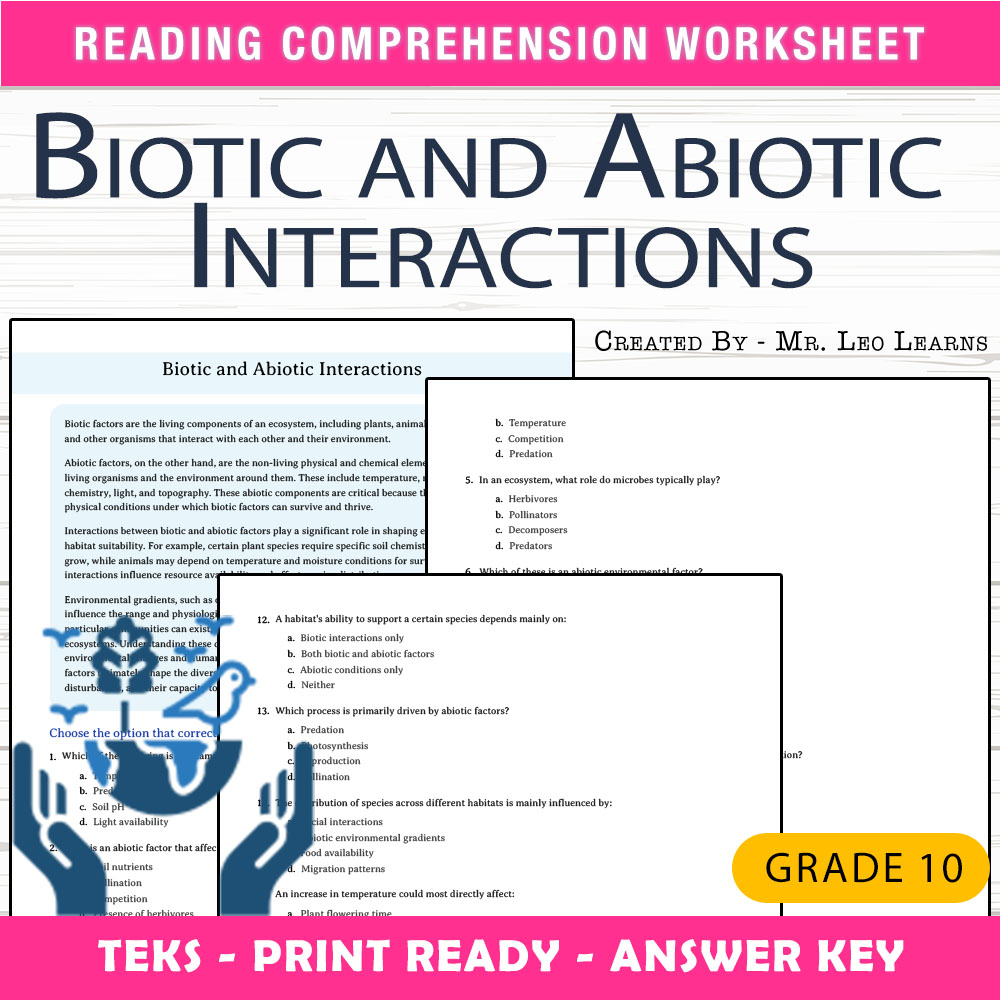
Grade 10 Science — Biotic and Abiotic Interactions Worksheet for Mastery
 Created byThe Resource Hub
Learning Objectives
- Define biotic and abiotic factors and identify examples of each
- Explain how biotic and abiotic factors influence ecosystems
- Describe the interactions between biotic and abiotic components in shaping habitats
Also included in: Grade 10 Science Unit Bundle | Ecosystems & Ecology Worksheets +1 more
Instant download
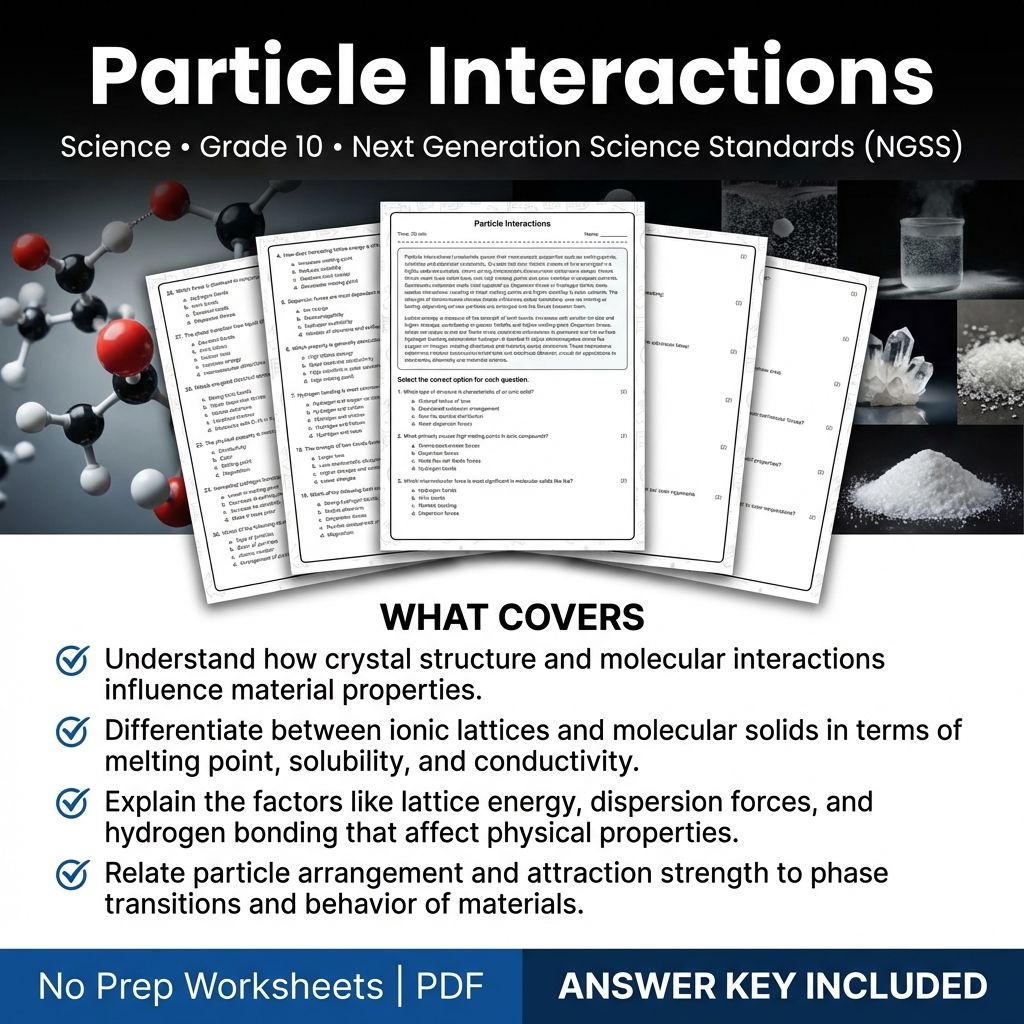
10th Grade Science Worksheet | Particle Interactions NGSS Practice PDF
 Created byCoral Reef Learning
Learning Objectives
- Understand how crystal structure and molecular interactions influence material properties.
- Differentiate between ionic lattices and molecular solids in terms of melting point, solubility, and conductivity.
- Explain the factors like lattice energy, dispersion forces, and hydrogen bonding that affect physical properties.
Also included in: Grade 10 Science UNIT Worksheet Pack| Reaction Rates, Equilibrium & Interactions +1 more
Instant download
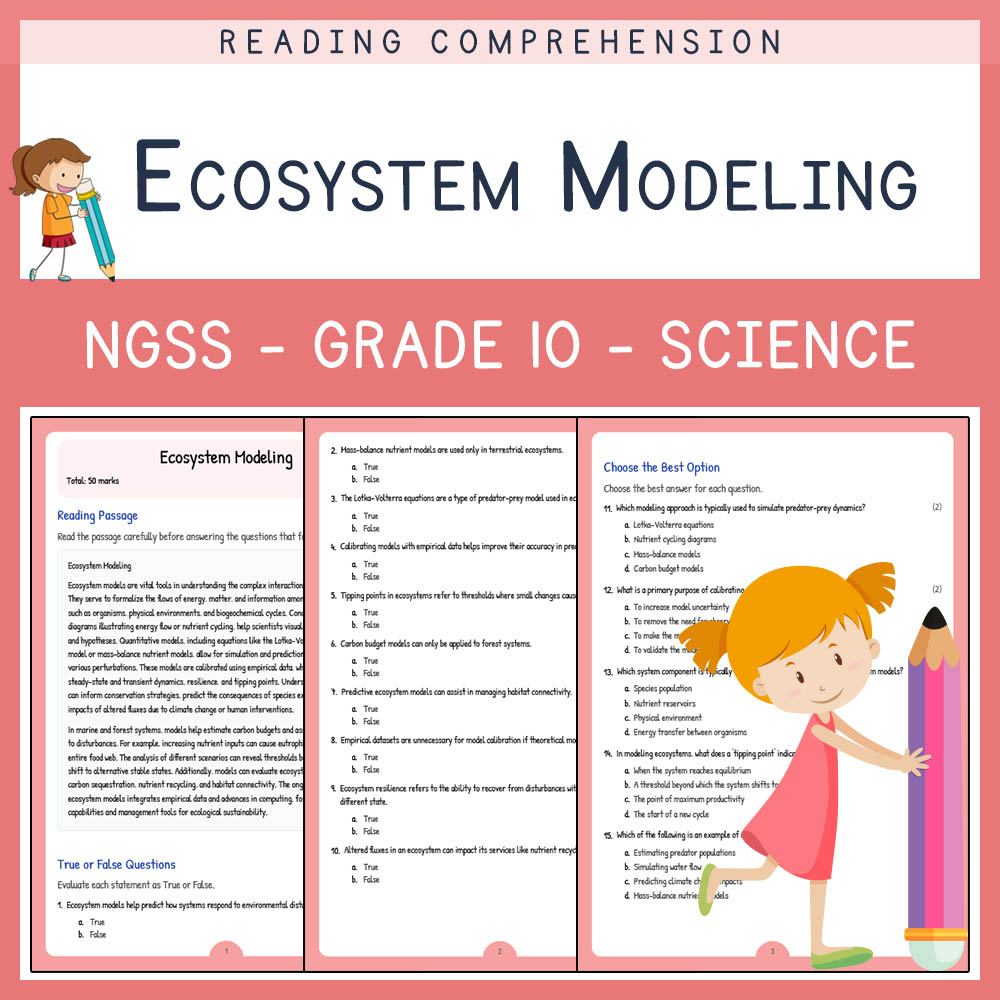
Grade 10 Science | Ecosystem Modeling Worksheet & Answer Key (NGSS-Aligned)
 Created byLumora Learning
Learning Objectives
- Understand the concepts of system flows of energy and matter in ecosystems.
- Interpret and develop models such as Lotka–Volterra equations, nutrient budgets, and carbon flux estimations.
- Analyze scenario-based responses and predict ecosystem behavior following perturbations.
Instant download
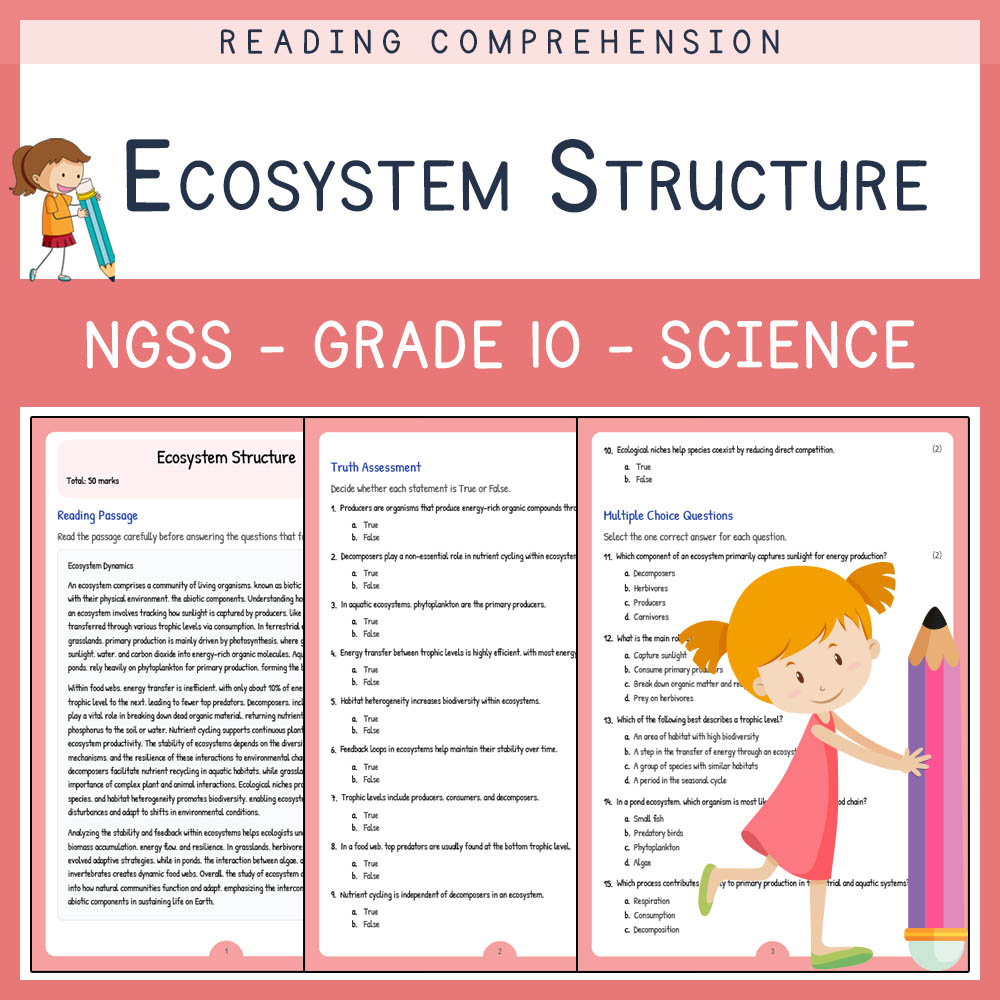
Grade 10 Science | Ecosystem Structure Worksheet & Answer Key (NGSS-Aligned)
Created byLumora LearningLearning Objectives
- Understand the components and interactions within terrestrial and aquatic ecosystems.
- Analyze energy flow, trophic levels, and food web dynamics in different habitats.
- Explain the roles of producers, consumers, and decomposers in ecosystem stability.
Instant download
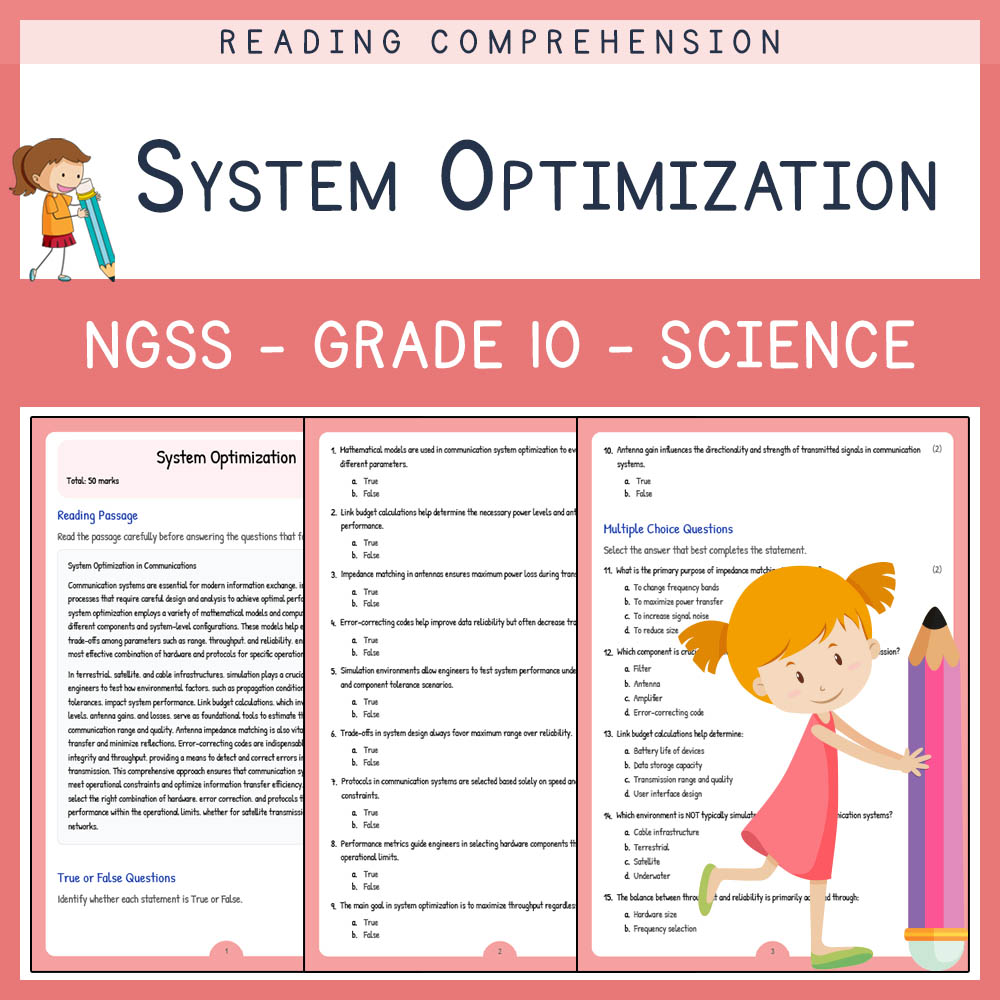
Grade 10 Science | System Optimization Worksheet (PDF + Answer Key) NGSS Aligned
Created byLumora LearningLearning Objectives
- Understand the principles of communication system optimization, including models and analysis techniques.
- Evaluate trade-offs in system components such as antenna gain, impedance matching, and error-correcting codes.
- Apply simulation and performance metrics to assess communication system designs.
Instant download
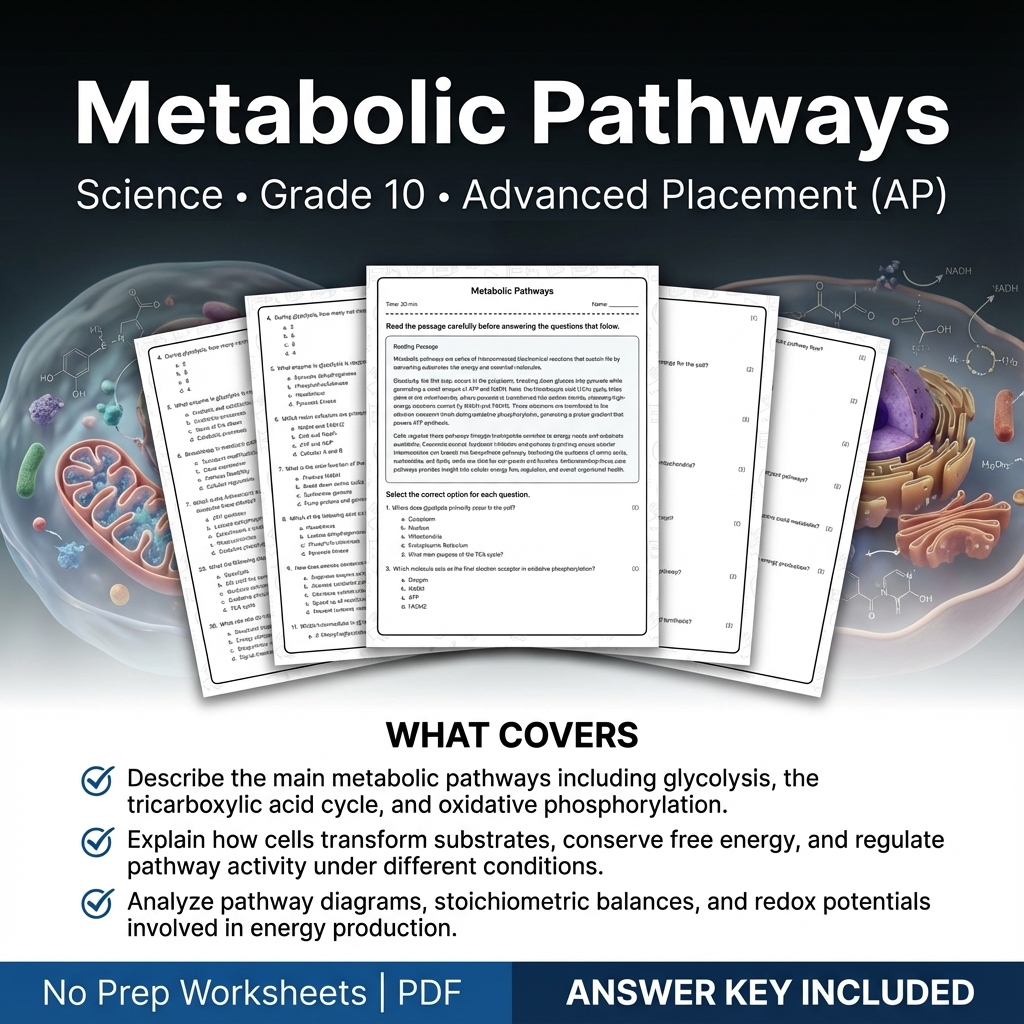
Grade 10 Science | Metabolic Pathways Worksheet (Printable PDF + Answer Key)
Created byCoral Reef LearningLearning Objectives
- Describe the main metabolic pathways including glycolysis, the tricarboxylic acid cycle, and oxidative phosphorylation.
- Explain how cells transform substrates, conserve free energy, and regulate pathway activity under different conditions.
- Analyze pathway diagrams, stoichiometric balances, and redox potentials involved in energy production.
Also included in: Grade 10 Science UNIT Worksheet Bundle – Genetics, Ecosystems & Cell Biology +1 more
Instant download
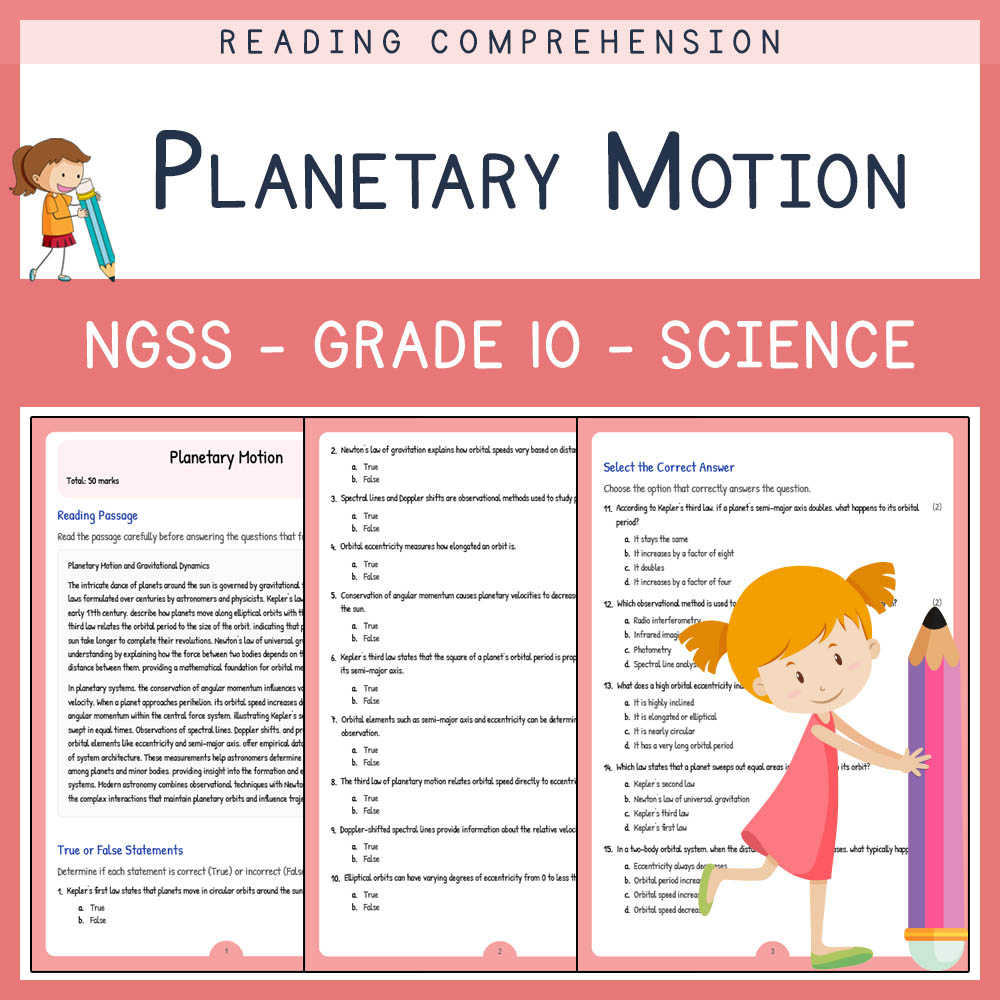
Grade 10 Science | Planetary Motion Worksheet (Answer Key) – NGSS Aligned
Created byLumora LearningLearning Objectives
- Understand the principles of Kepler's laws and Newtonian gravitation in planetary orbits.
- Apply conservation of angular momentum to explain variations in planetary orbital speeds.
- Utilize observational data such as orbital elements and spectral lines to analyze planetary motion.
Instant download
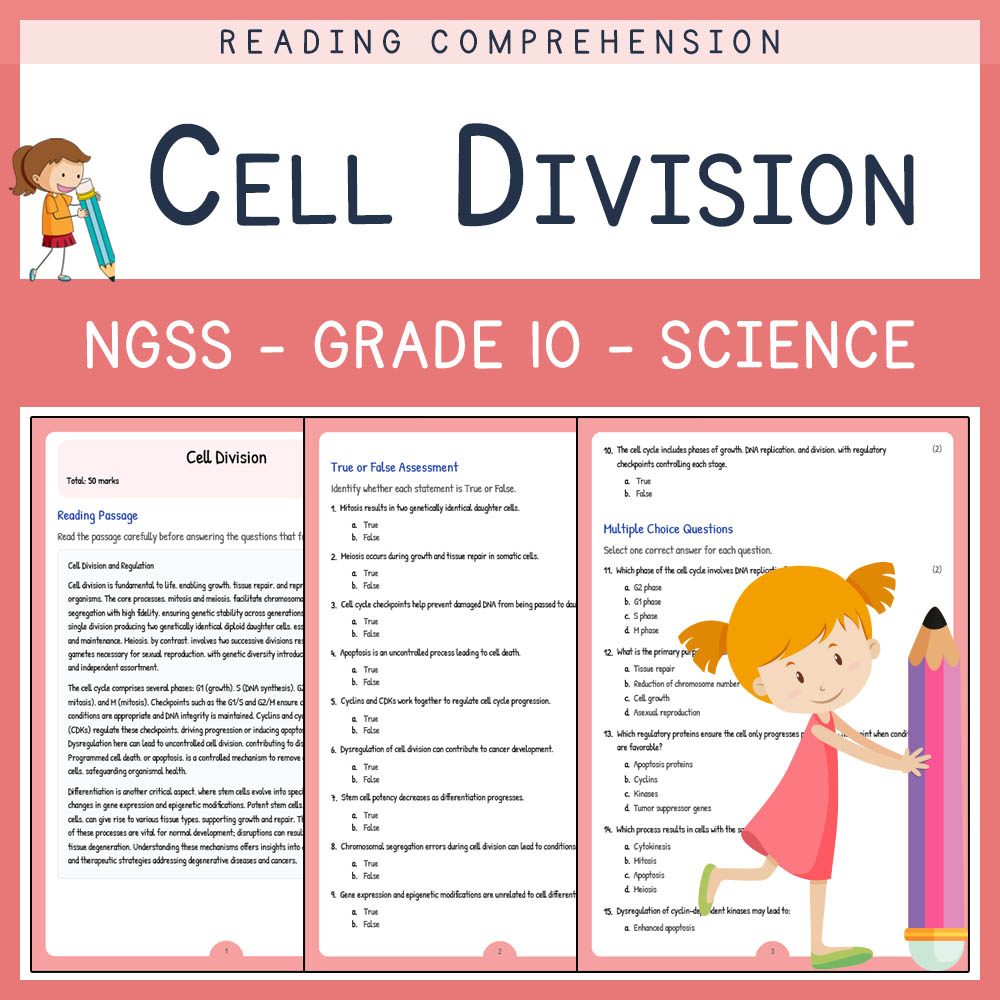
Grade 10 Science | Cell Division Worksheet with Answer Key (NGSS Aligned)
Created byLumora LearningLearning Objectives
- Understand the processes of mitosis and meiosis in cellular replication.
- Describe the cell cycle, checkpoints, and mechanisms of cell regulation.
- Explain the significance of chromosomal segregation and consequences of dysregulation such as cancer.
Instant download
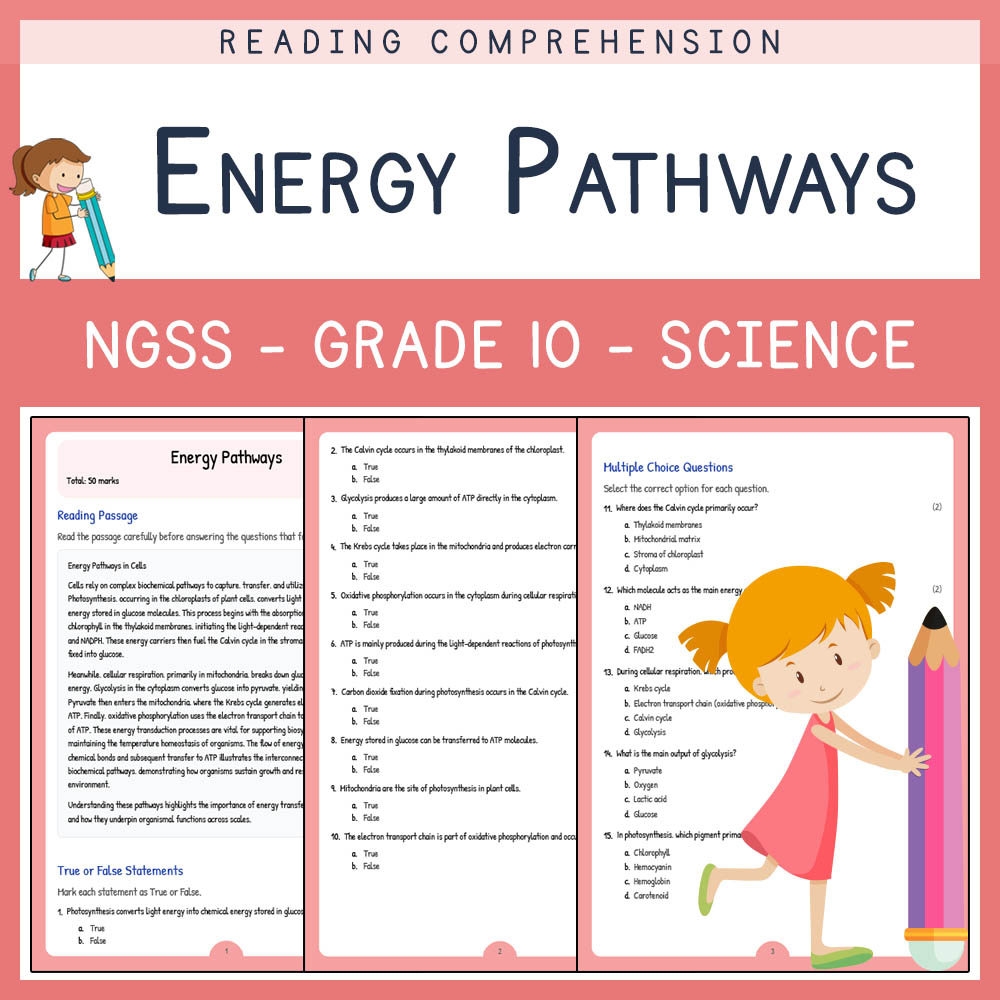
Grade 10 Science | Energy Pathways Worksheet – NGSS-Aligned PDF with Answer Key
Created byLumora LearningLearning Objectives
- Understand the biochemical pathways involved in energy capture and transfer, including photosynthesis and cellular respiration.
- Explain how ATP is produced through various cellular processes and relate energy flow to organismal functions.
Instant download
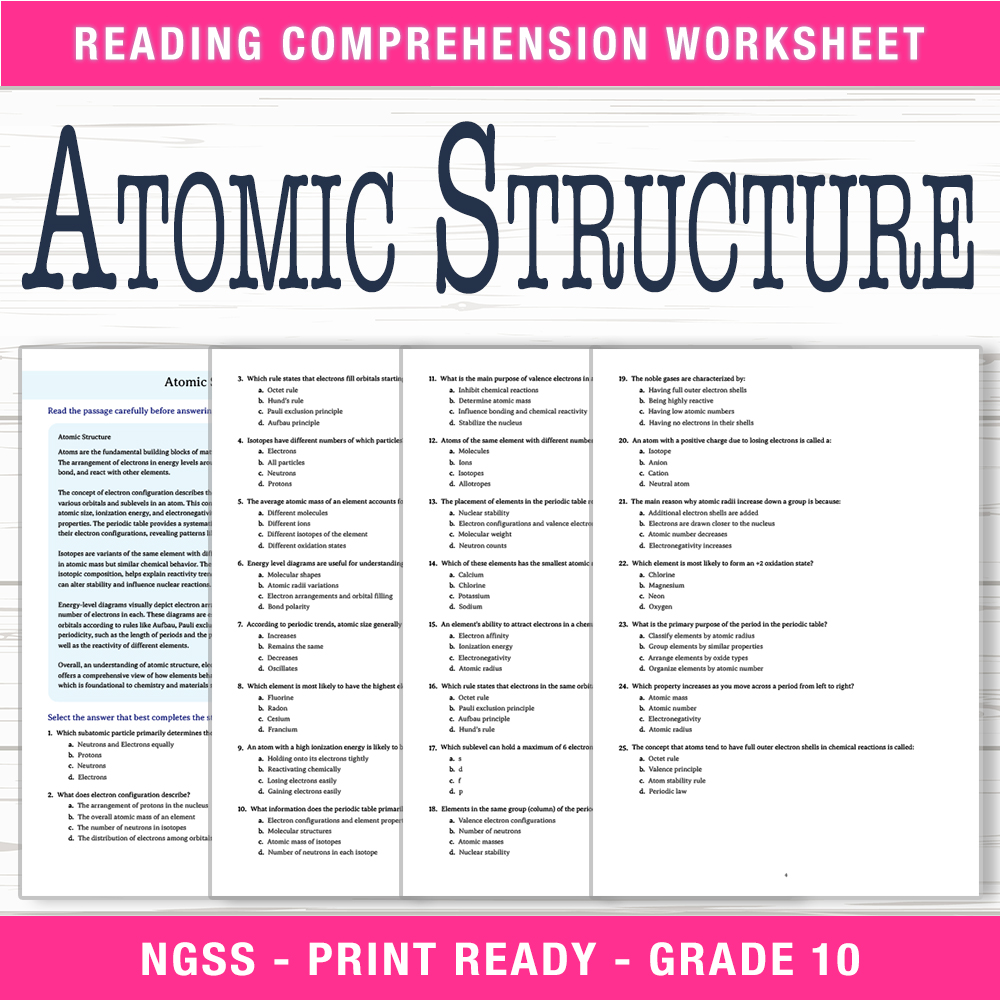
Grade 10 Science | Atomic Structure Worksheet (PDF + Answer Key)
 Created byRiverstone Classroom
Learning Objectives
- Understand how electron configuration relates to periodic trends and elemental properties.
- Interpret energy level diagrams, sublevel occupancy, and atomic orbital arrangements.
- Explain isotopes, atomic mass, and their effects on reactivity and oxidation states.
Instant download
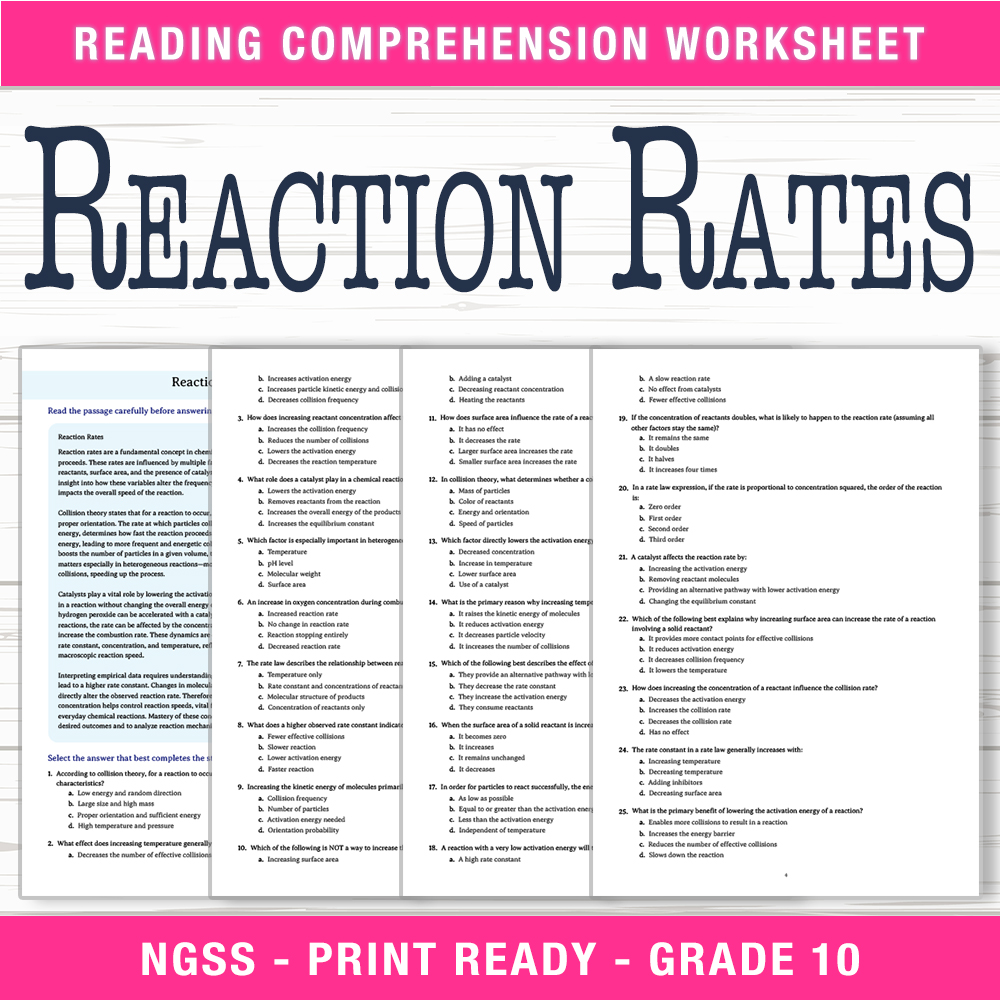
Grade 10 Science | Reaction Rates Worksheet (PDF + Answer Key)
Created byRiverstone ClassroomLearning Objectives
- Describe how collision theory explains reaction rates
- Analyze the effects of temperature, concentration, surface area, and catalysts on reaction speed
- Interpret experimental rate data using rate laws and molecular collision concepts
Instant download
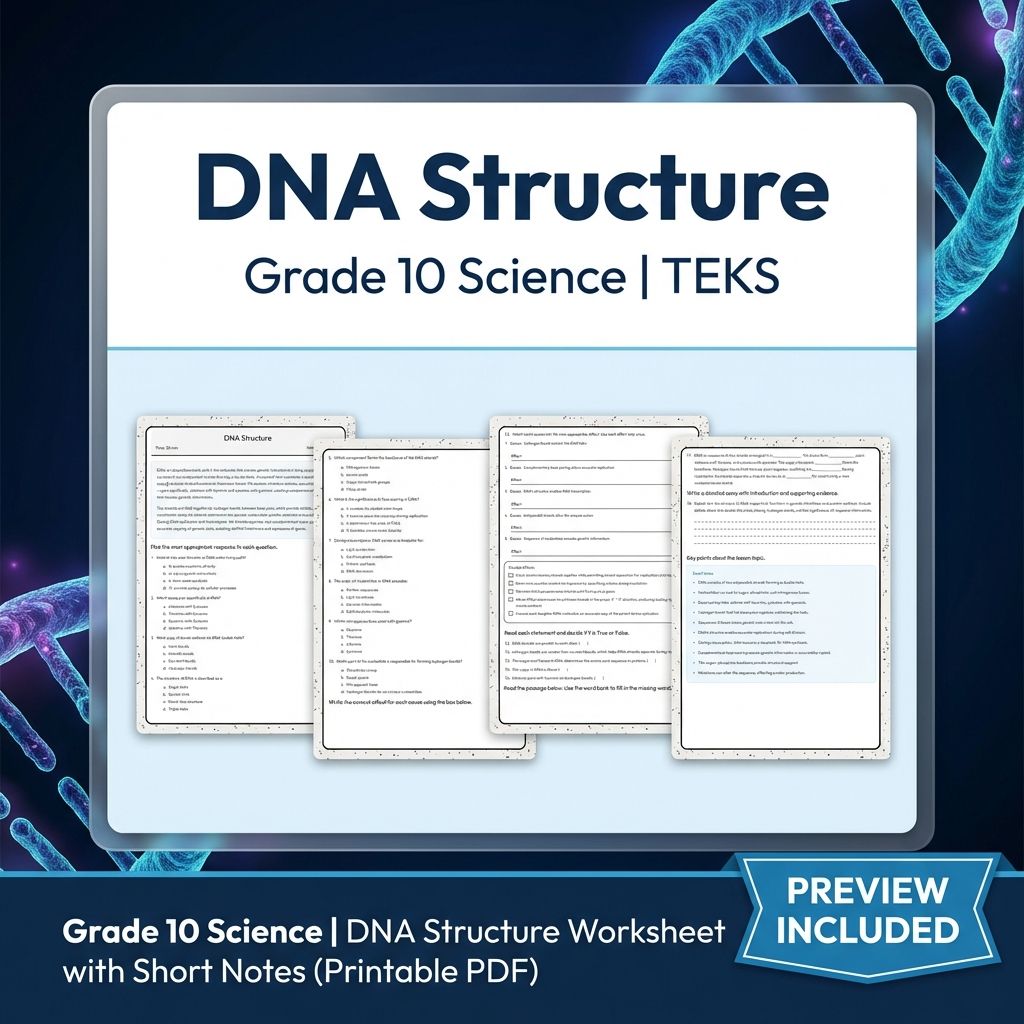
Grade 10 Science | DNA Structure Worksheet with Short Notes (Printable PDF)
 Created byMeadowlark Worksheets
Learning Objectives
- Describe the double helix structure of DNA and its components.
- Explain base pairing rules and their importance in genetic information storage.
- Identify how DNA's structure facilitates replication and transcription processes.
Instant download
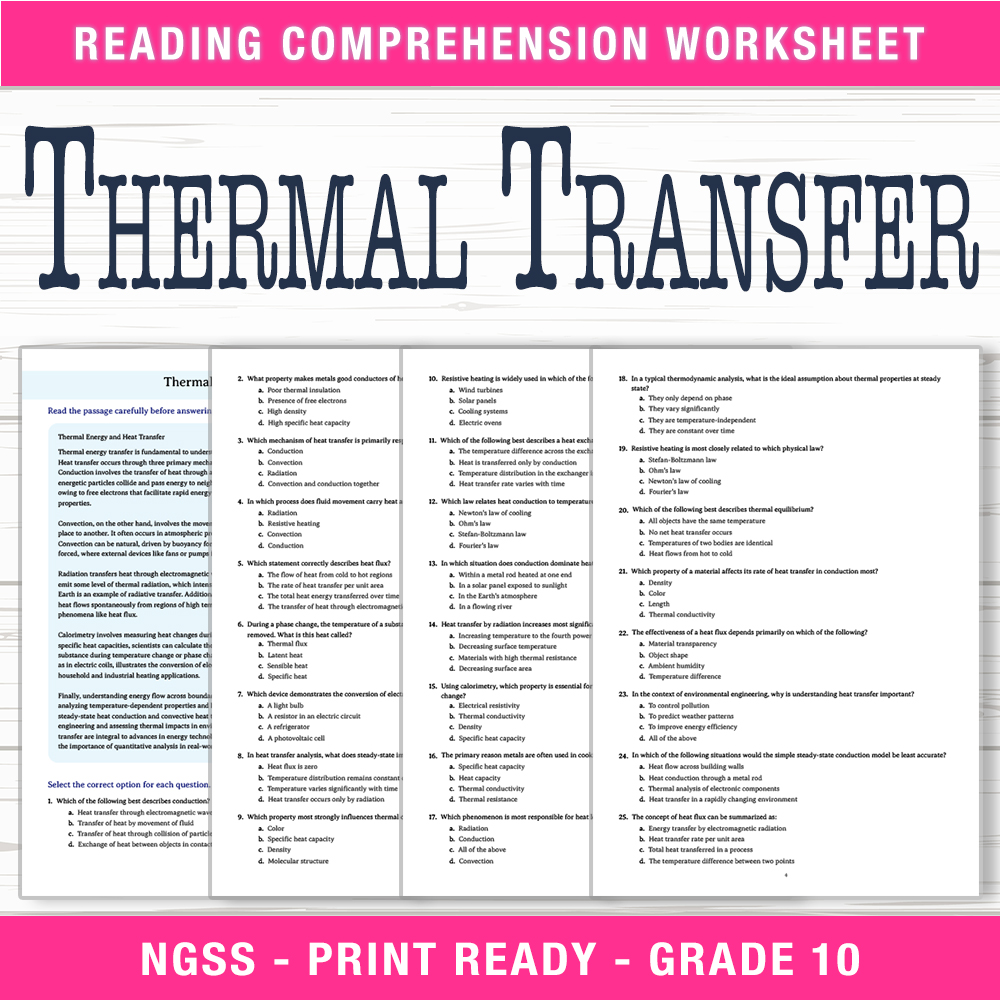
Grade 10 Science | Thermal Transfer Worksheet (PDF + Answer Key)
Created byRiverstone ClassroomLearning Objectives
- Describe the mechanisms of heat transfer: conduction, convection, and radiation.
- Apply calorimetric reasoning to relate thermal energy change to specific heat and phase changes.
- Explain resistive heating and how electrical energy converts to thermal energy.
Instant download
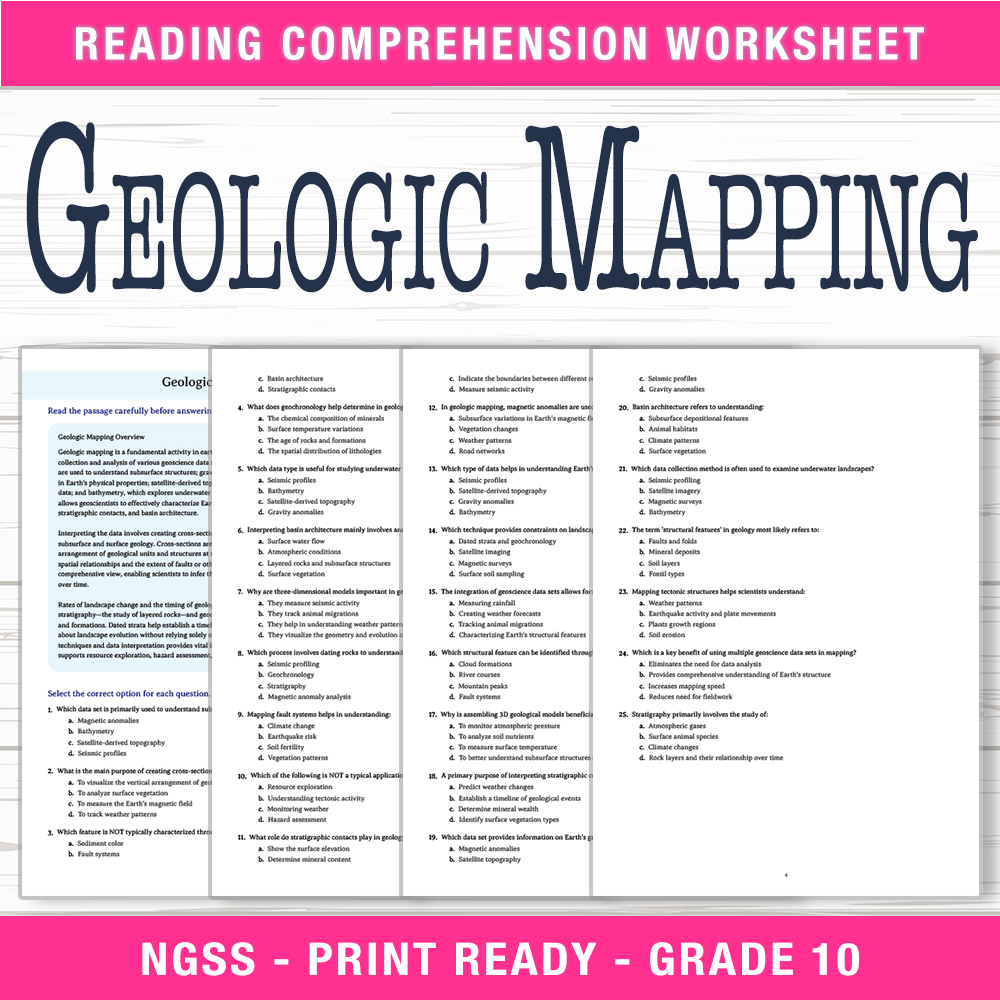
Grade 10 Science | Geologic Mapping Worksheet (PDF + Answer Key)
Created byRiverstone ClassroomLearning Objectives
- Understand the basic concepts and purpose of geologic mapping in earth sciences.
- Identify the various geoscience data sets used in constructing geologic maps.
- Explain how cross-sections and three-dimensional models assist in interpreting Earth's structural features.
Instant download
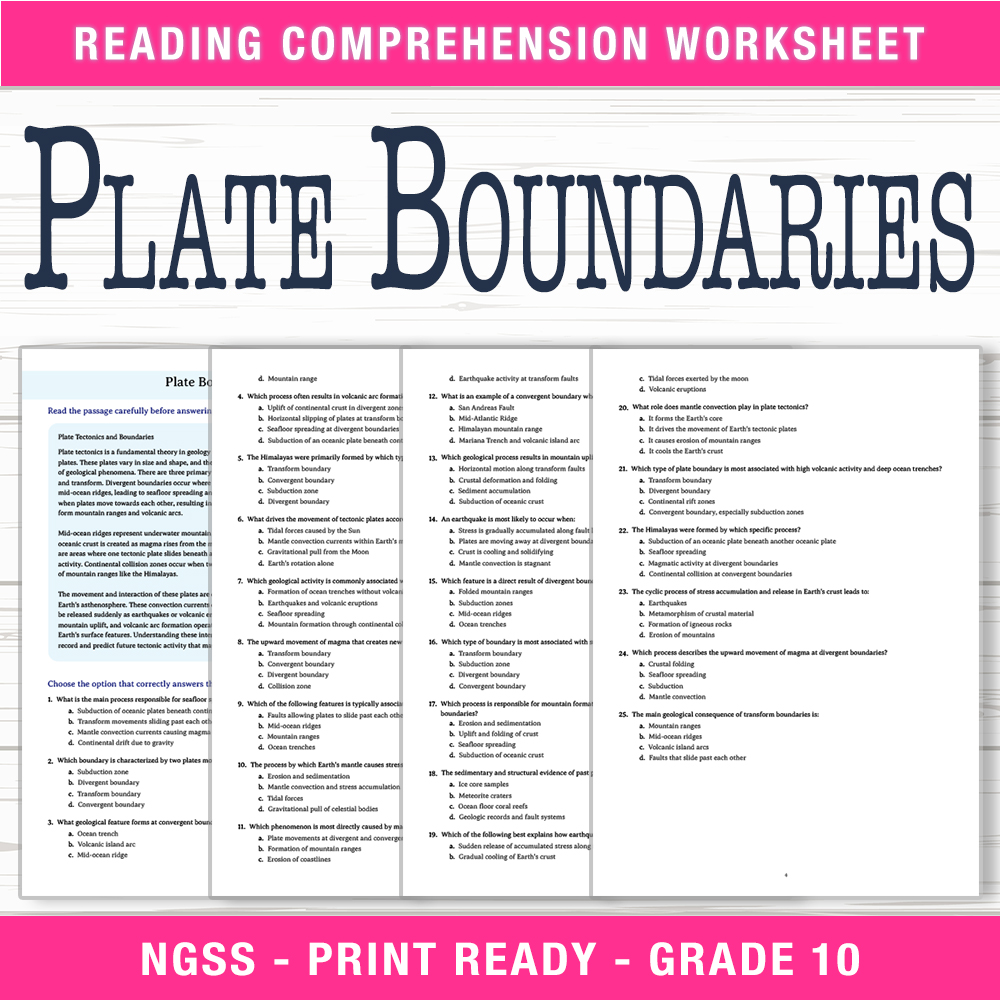
Grade 10 Science – Plate Boundaries Worksheet (PDF + Answer Key)
Created byRiverstone ClassroomLearning Objectives
- Understand the different types of plate boundaries and their geologic features.
- Identify canonical phenomena such as mid-ocean ridges, subduction zones, and continental collision.
- Explain processes like seafloor spreading, volcanic arc formation, and mountain uplift.
Instant download
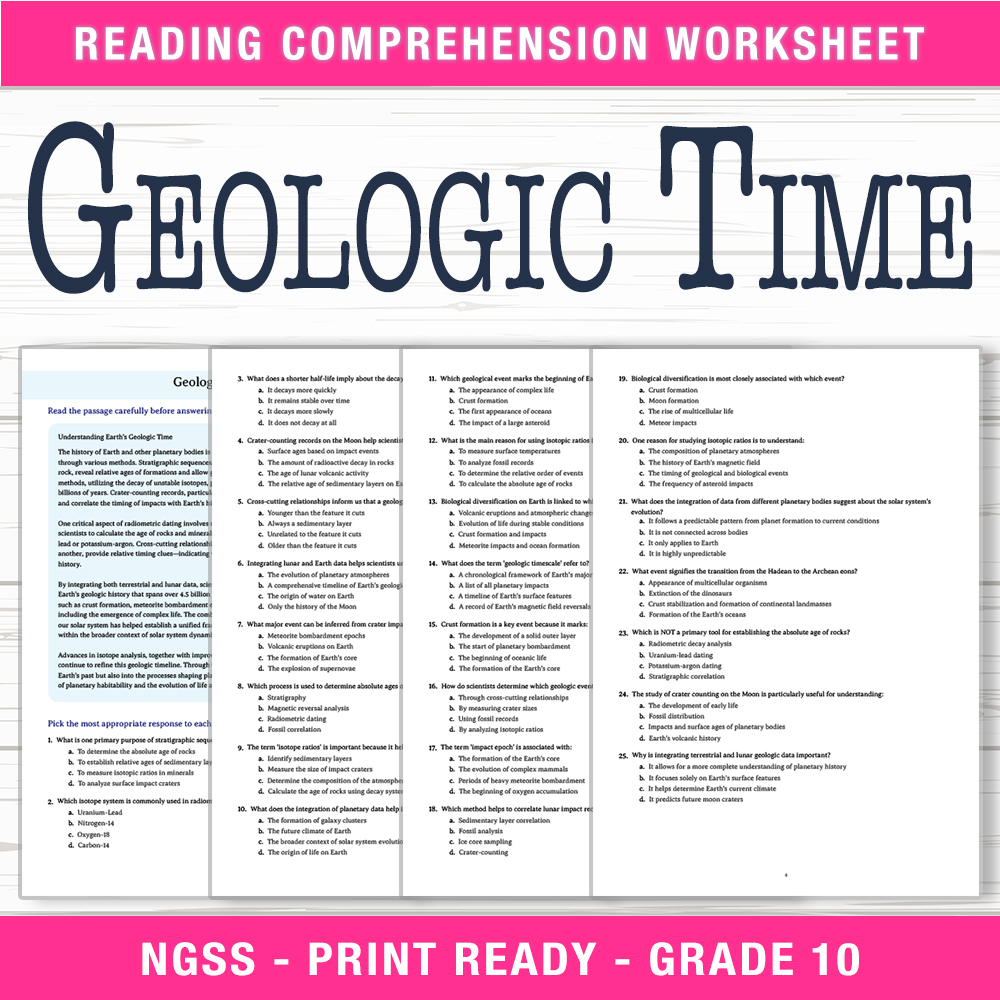
Grade 10 Science | Geologic Time Worksheet (PDF + Answer Key)
Created byRiverstone ClassroomLearning Objectives
- Understand the methods used to reconstruct Earth's and planetary bodies' chronologies, including stratigraphy and radiometric dating.
- Explain how isotopic ratios, half-life decay systems, and cross-cutting relationships help determine the timing of major geologic events.
- Describe the significance of integrating terrestrial and lunar time scales to develop a comprehensive history of Earth's geologic evolution.
Also included in: Grade 10 Science Unit | Stellar, Planetary & Geologic Worksheets bundle
Instant download
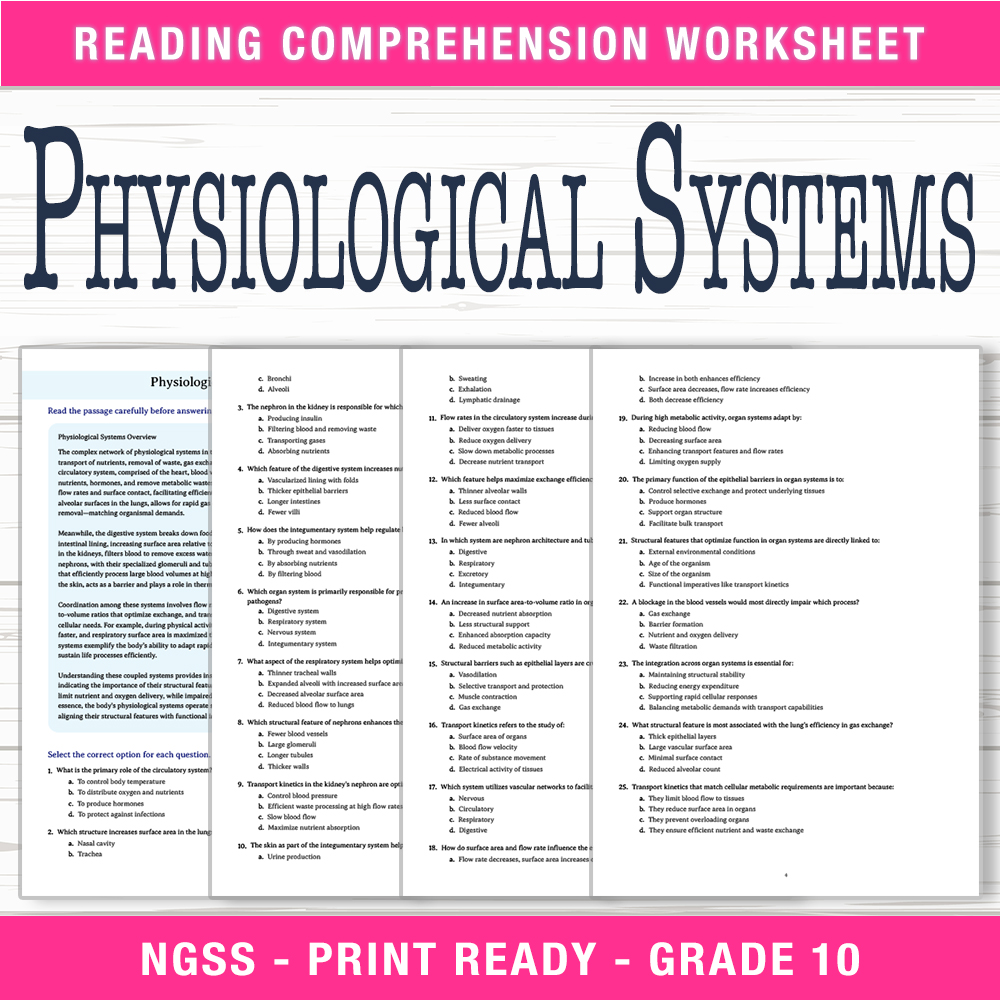
Grade 10 Science | Physiological Systems Worksheet (PDF + Answer Key)
Created byRiverstone ClassroomLearning Objectives
- Understand the structure and function of circulatory, respiratory, digestive, excretory, and integumentary systems.
- Analyze how organ systems coordinate to maintain homeostasis through transport, gas exchange, and waste removal.
- Explain how structural features like vascular networks, alveoli, nephron architecture, and epithelial barriers relate to their functions.
Instant download
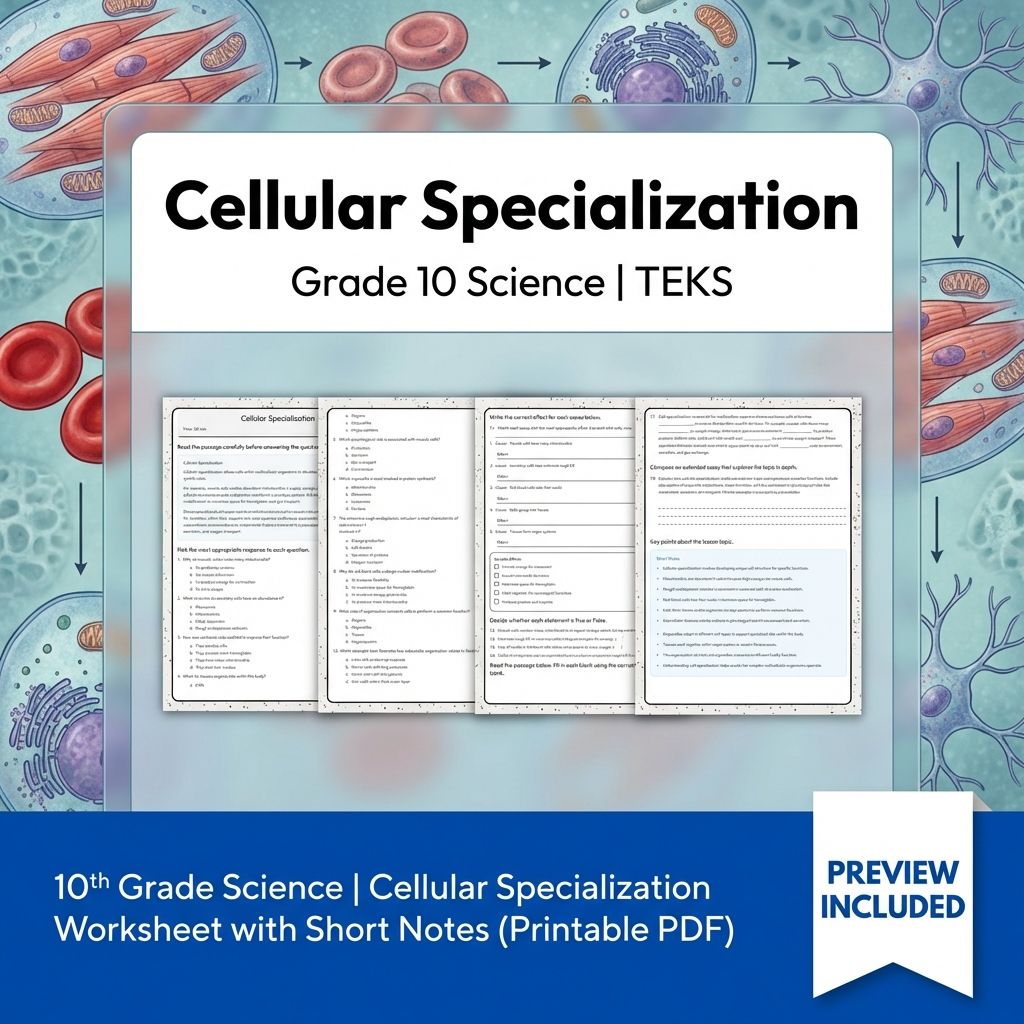
10th Grade Science | Cellular Specialization Worksheet with Short Notes (PDF)
Created byMeadowlark WorksheetsLearning Objectives
- Explain how cellular organelles adapt in different cell types to perform specific functions.
- Describe how specialized cells form tissues and organ systems in multicellular organisms.
- Connect subcellular structures with their physiological roles like contraction, secretion, and gas transport.
Instant download
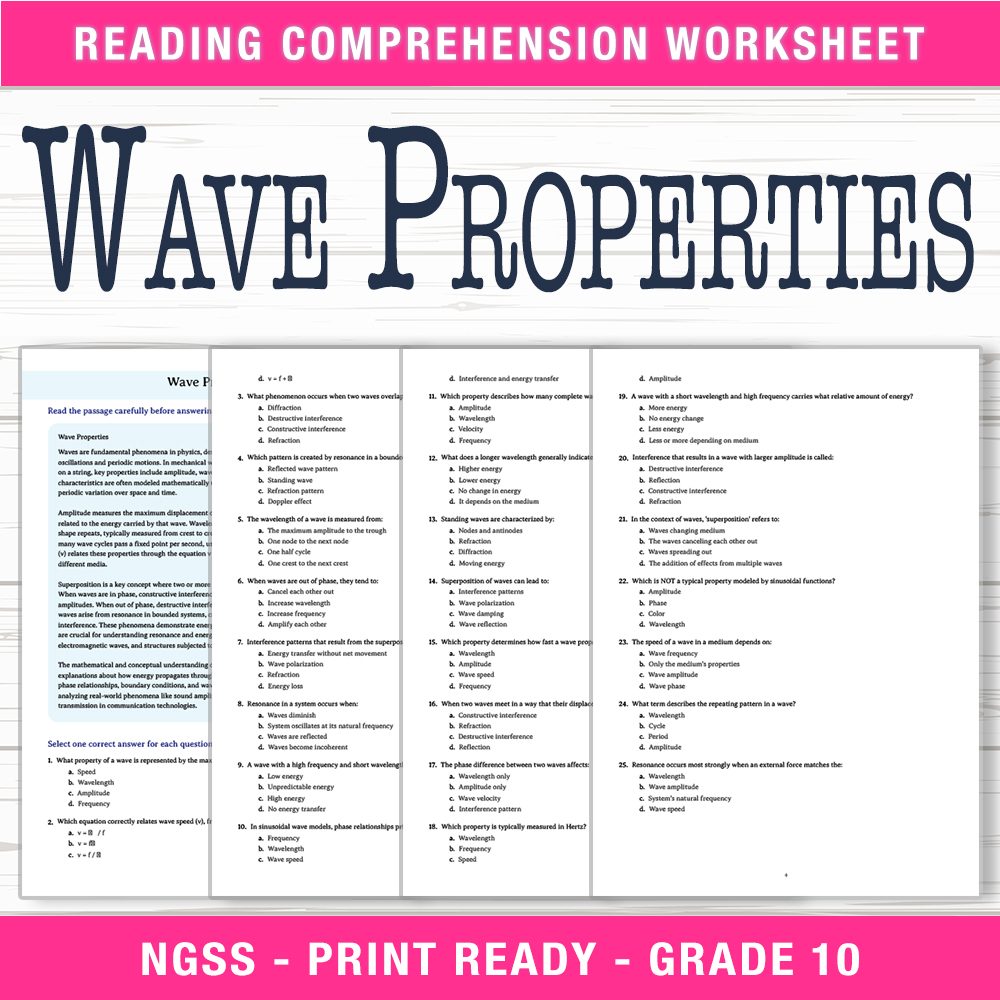
Grade 10 Science | Wave Properties Worksheet (PDF + Answer Key)
Created byRiverstone ClassroomLearning Objectives
- Understand the mathematical relationships describing wave properties such as amplitude, wavelength, frequency, and propagation speed.
- Apply the equation v = fλ to solve problems involving wave speed, frequency, and wavelength in various wave phenomena.
- Interpret superposition and interference patterns, including standing waves, using trigonometric and phase relationships.
Also included in: Grade 10 Science Unit | Wave & Signal Transmission Worksheets
Instant download
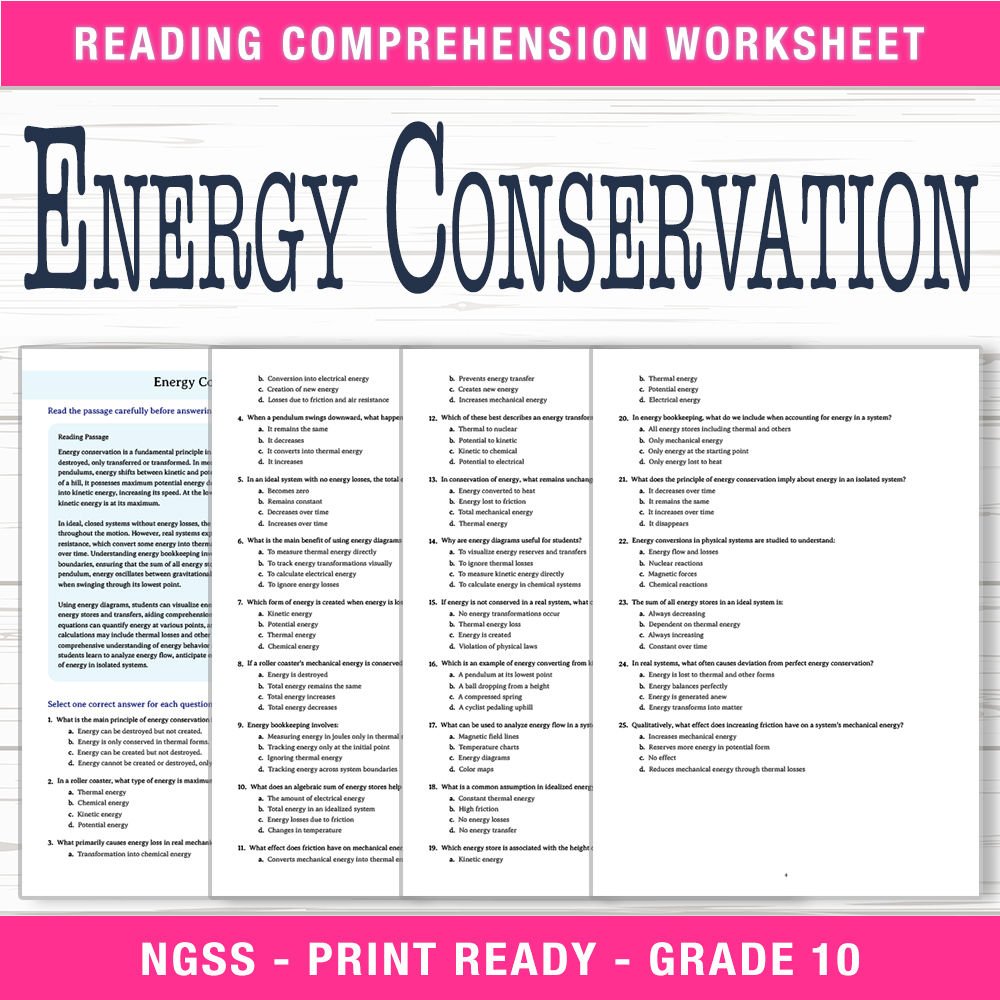
Grade 10 Science | Energy Conservation Worksheet (PDF + Answer Key)
Created byRiverstone ClassroomLearning Objectives
- Understand the principles of energy conservation in mechanical systems.
- Identify and describe energy transformations between kinetic and potential energy.
- Apply energy bookkeeping concepts to analyze energy transfer and losses in closed systems.
Instant download
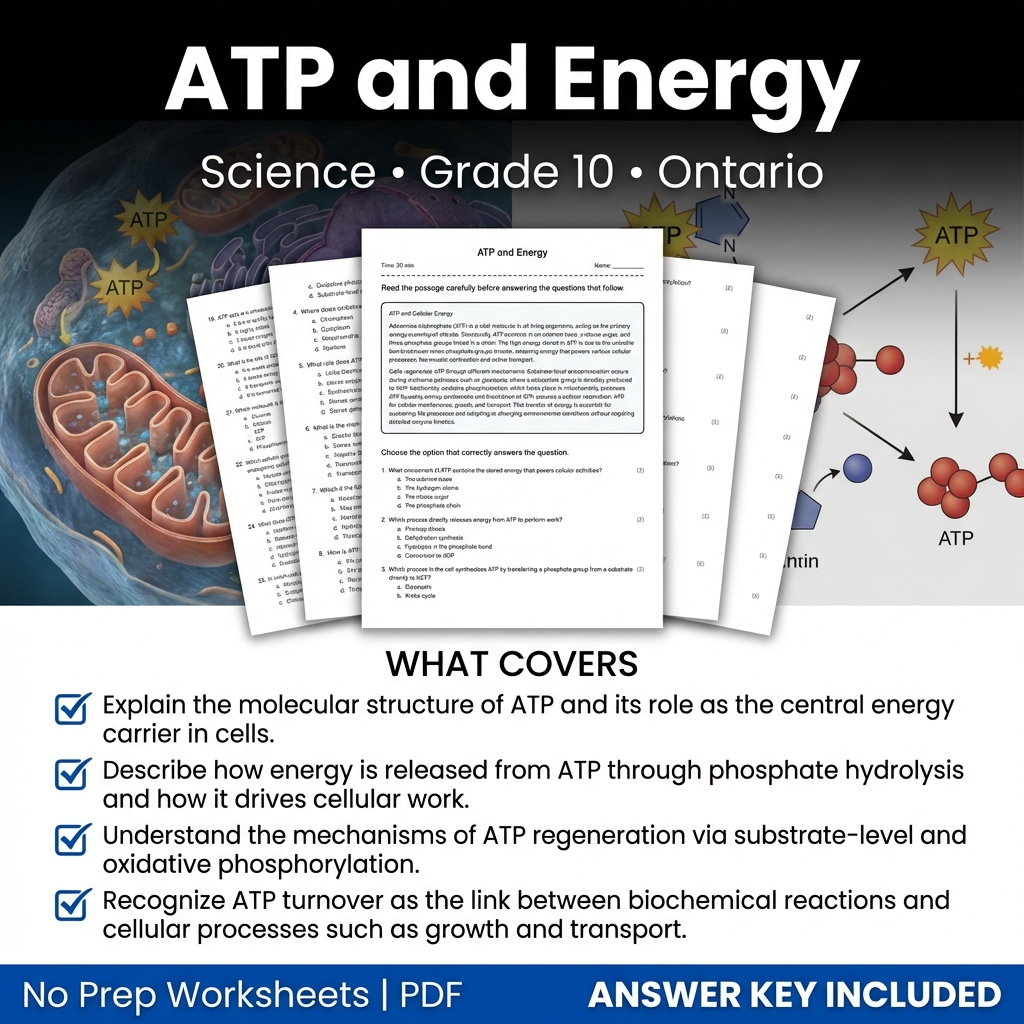
ATP and Energy Worksheet for Grade 10 Science | Ontario Standards Practice
Created byCoral Reef LearningLearning Objectives
- Explain the molecular structure of ATP and its role as the central energy carrier in cells.
- Describe how energy is released from ATP through phosphate hydrolysis and how it drives cellular work.
- Understand the mechanisms of ATP regeneration via substrate-level and oxidative phosphorylation.
Instant download
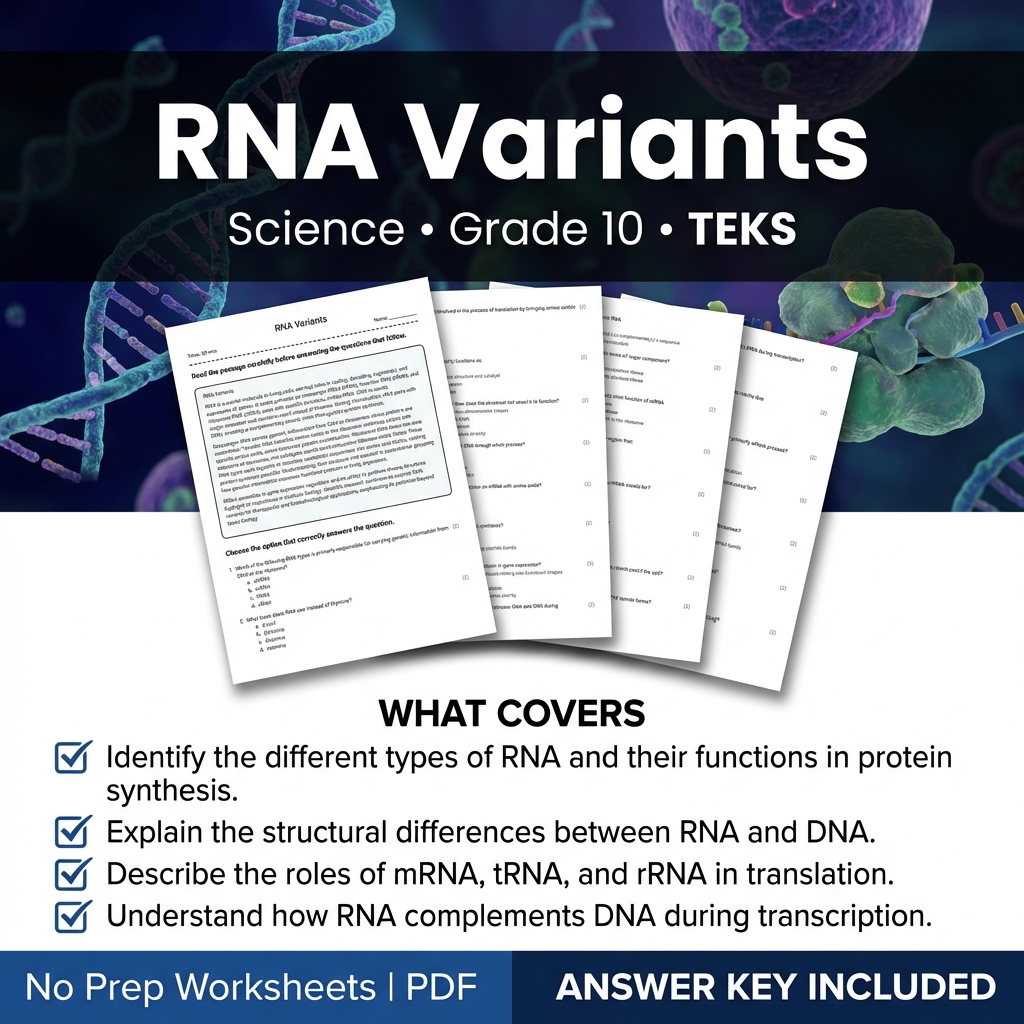
RNA Variants Worksheet for Grade 10 Science | TEKS Aligned Practice
Created byCoral Reef LearningLearning Objectives
- Identify the different types of RNA and their functions in protein synthesis.
- Explain the structural differences between RNA and DNA.
- Describe the roles of mRNA, tRNA, and rRNA in translation.
Instant download
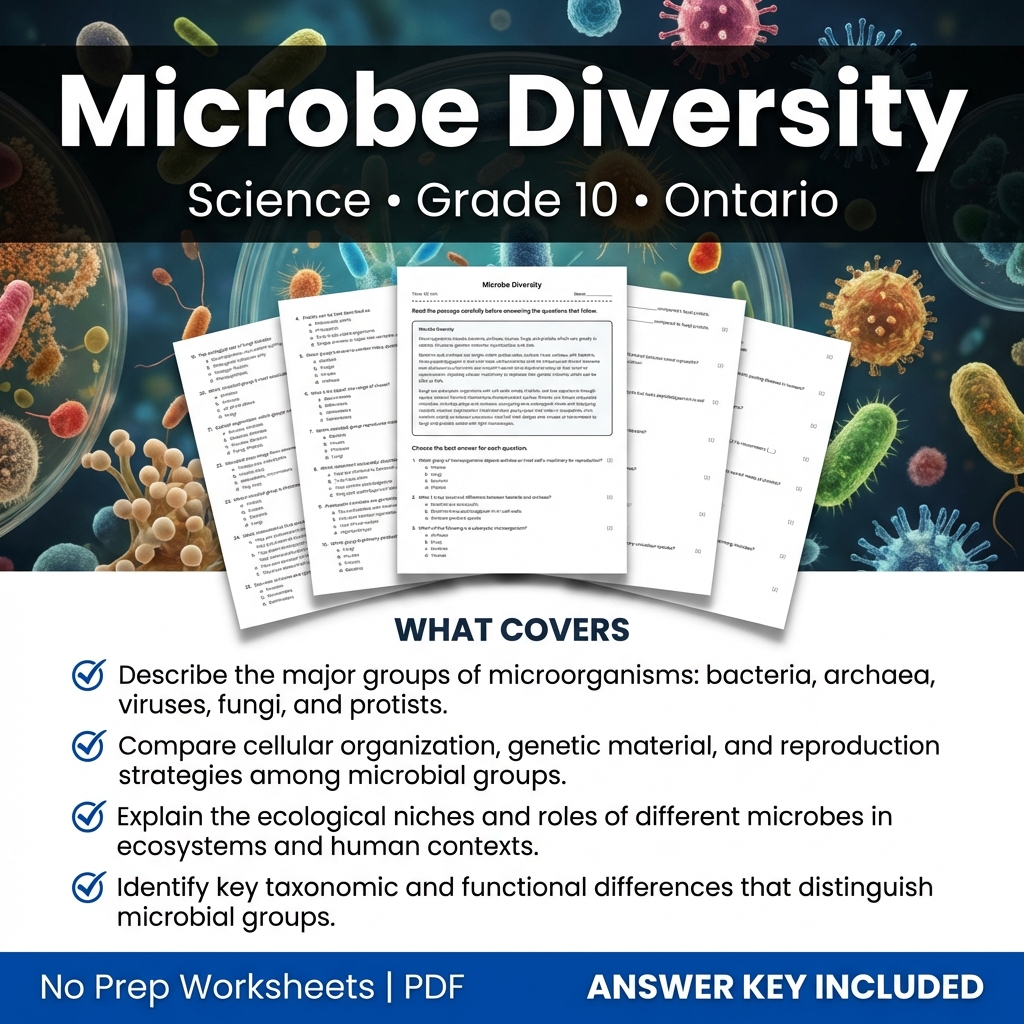
Microbe Diversity Worksheet for Grade 10 Science | Ontario Standards
Created byCoral Reef LearningLearning Objectives
- Describe the major groups of microorganisms: bacteria, archaea, viruses, fungi, and protists.
- Compare cellular organization, genetic material, and reproduction strategies among microbial groups.
- Explain the ecological niches and roles of different microbes in ecosystems and human contexts.
Instant download
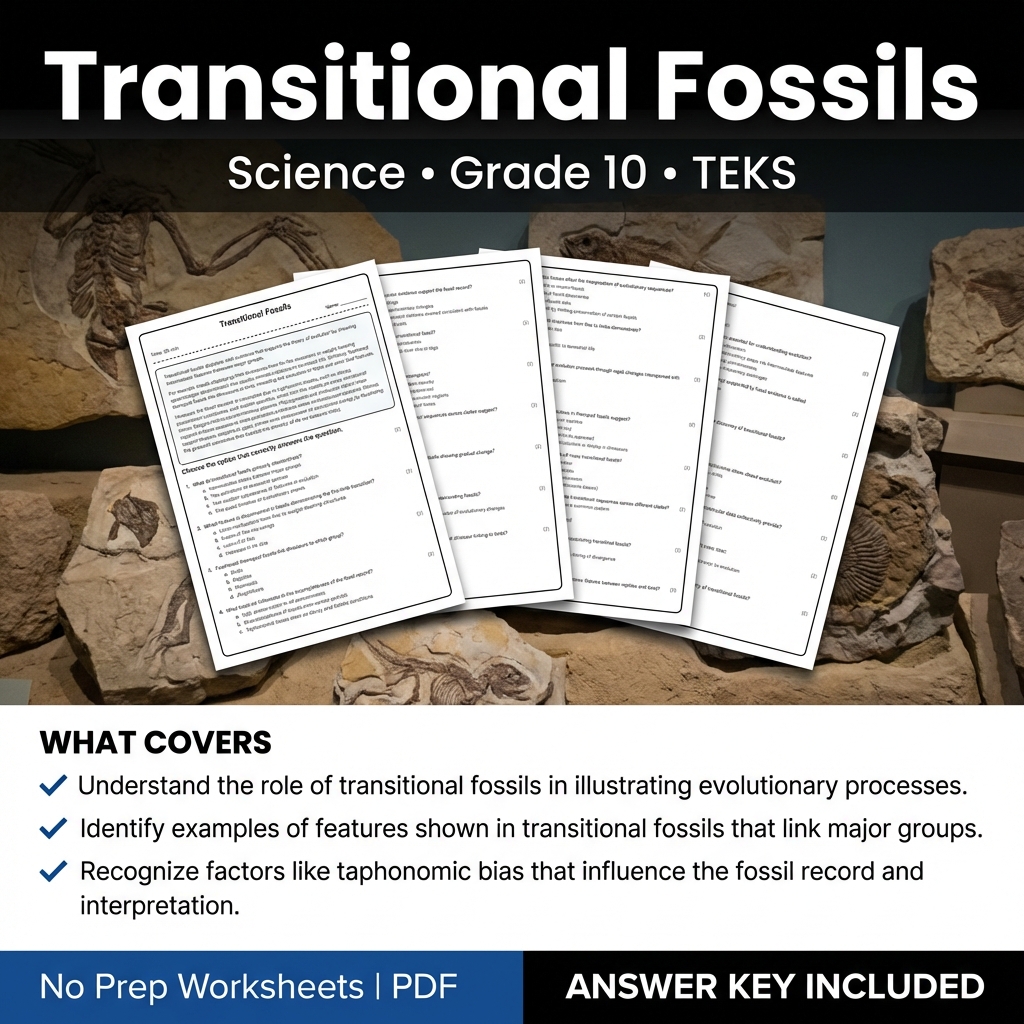
Transitional Fossils Worksheet – Grade 10 Science TEKS Practice PDF
Created byCoral Reef LearningLearning Objectives
- Understand the role of transitional fossils in illustrating evolutionary processes.
- Identify examples of features shown in transitional fossils that link major groups.
- Recognize factors like taphonomic bias that influence the fossil record and interpretation.
Instant download
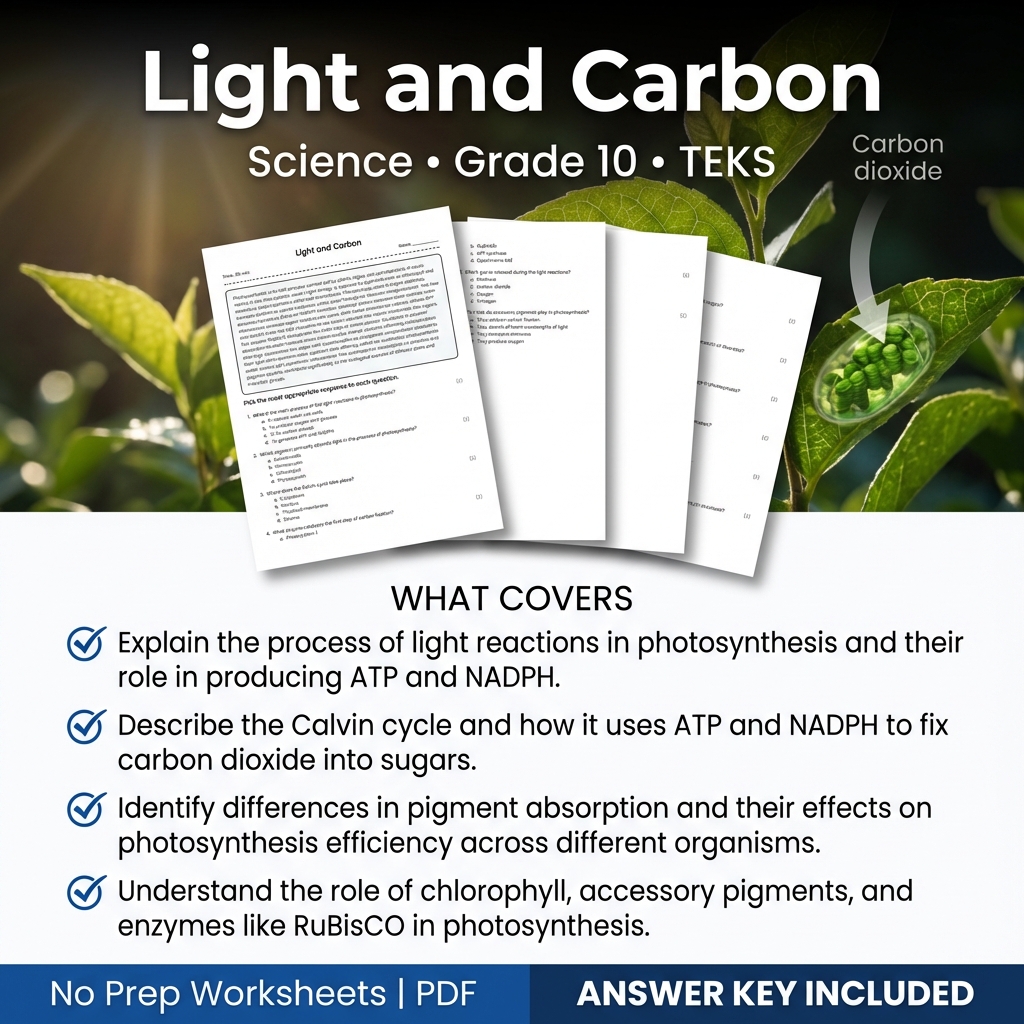
Light and Carbon Science Worksheet | TEKS Grade 10 Practice
Created byCoral Reef LearningLearning Objectives
- Explain the process of light reactions in photosynthesis and their role in producing ATP and NADPH.
- Describe the Calvin cycle and how it uses ATP and NADPH to fix carbon dioxide into sugars.
- Identify differences in pigment absorption and their effects on photosynthesis efficiency across different organisms.
Instant download
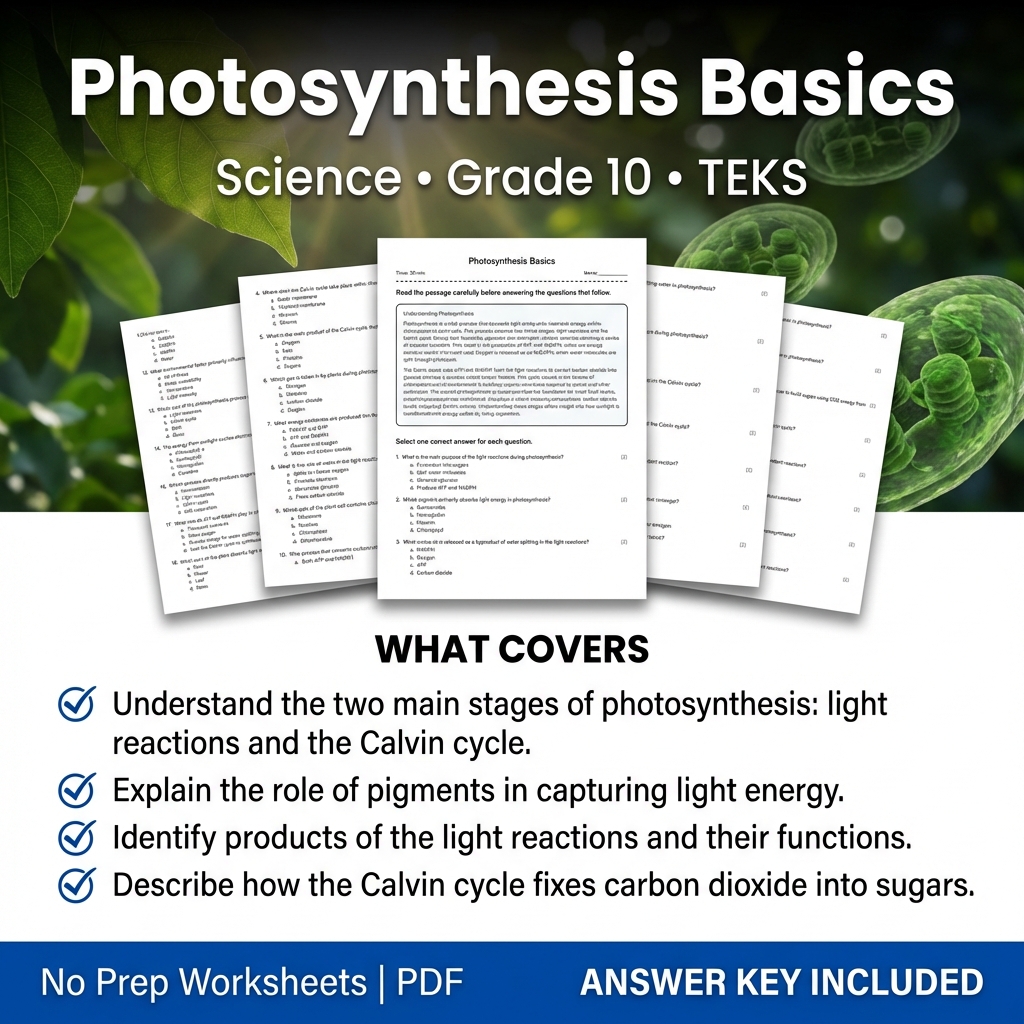
Photosynthesis Basics Worksheet for Grade 10 Science TEKS Practice
Created byCoral Reef LearningLearning Objectives
- Understand the two main stages of photosynthesis: light reactions and the Calvin cycle.
- Explain the role of pigments in capturing light energy.
- Identify products of the light reactions and their functions.
Instant download
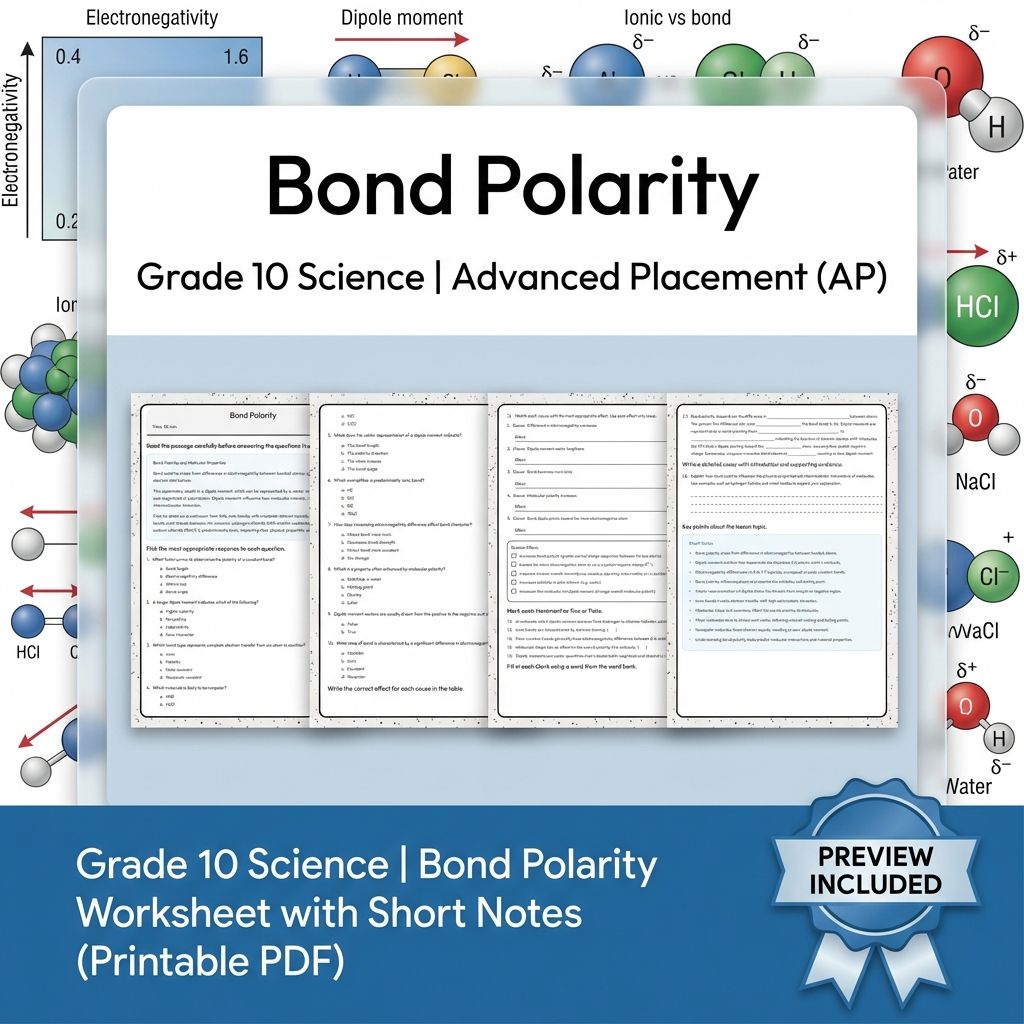
Grade 10 Science | Bond Polarity Worksheet with Short Notes (Printable PDF)
Created byMeadowlark WorksheetsLearning Objectives
- Understand how electronegativity differences influence bond polarity.
- Interpret dipole moment vectors and their relation to molecular polarity.
- Compare polar covalent and ionic bonds on a continuum.
Also included in: Grade 10 Science | Comprehensive Unit Bundle on Atomic Structure
Instant download
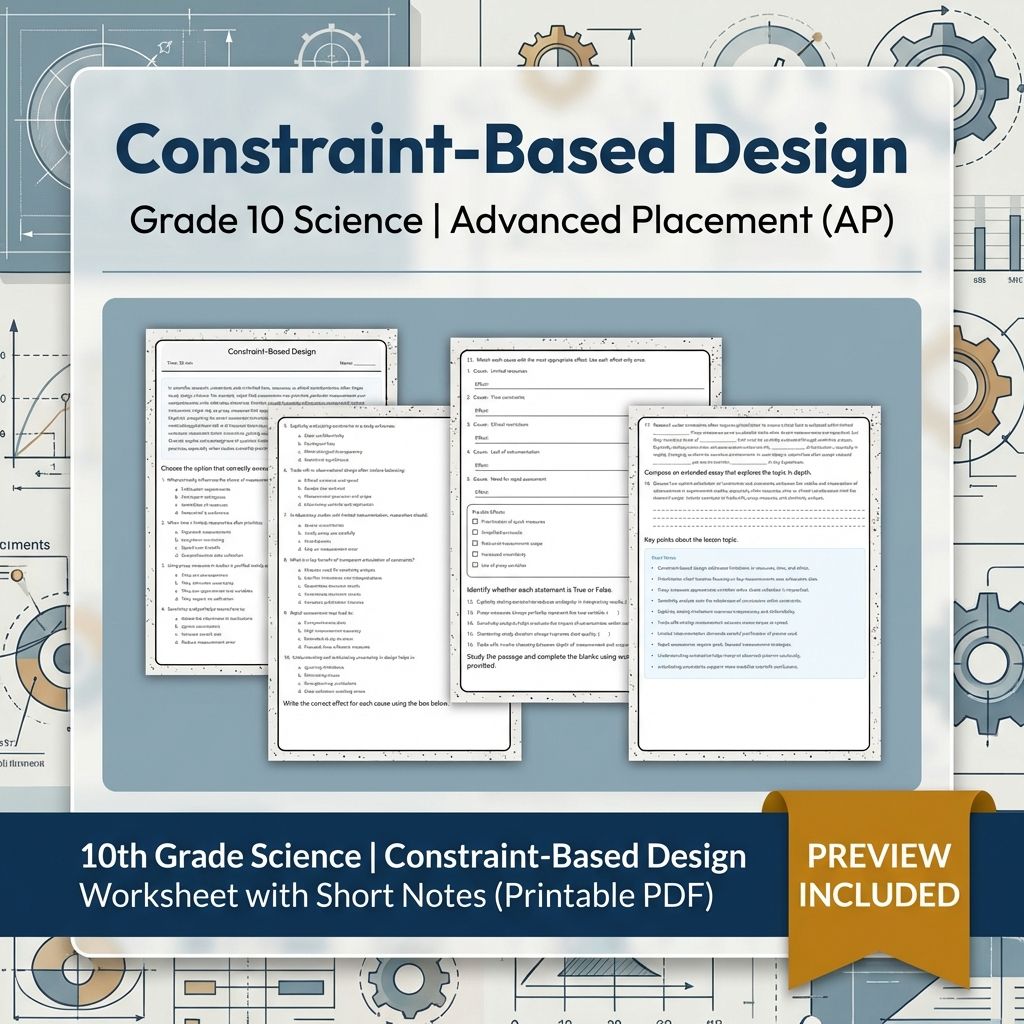
10th Grade Science | Constraint-Based Design Worksheet with Short Notes (PDF)
Created byMeadowlark WorksheetsLearning Objectives
- Understand how practical and ethical constraints influence experimental design.
- Identify trade-offs among replication, measurement precision, and scope in observational studies.
- Analyze scenarios where limitations lead to prioritizing certain design choices and proxies.
Also included in: Grade 10 Science Unit | Data Analysis, Modelling Worksheet Pack
Instant download
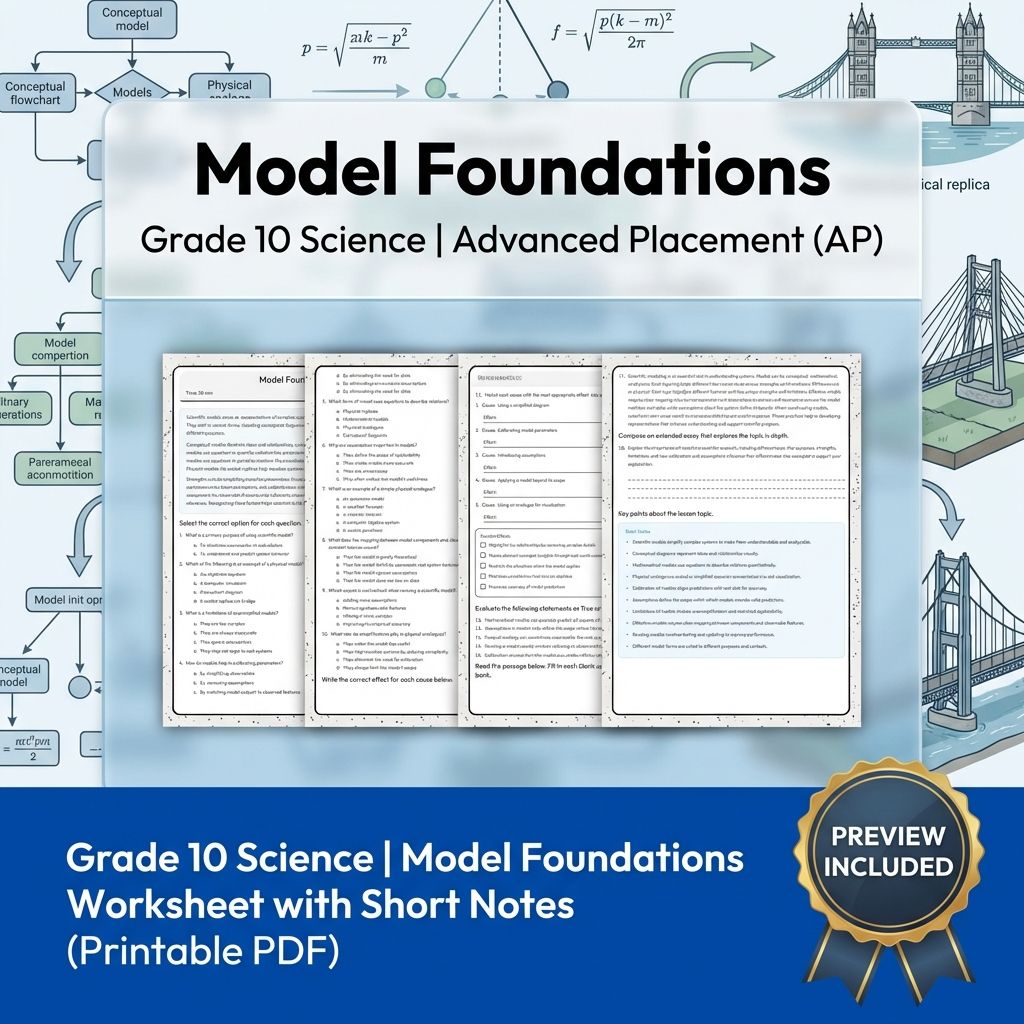
Grade 10 Science | Model Foundations Worksheet with Short Notes (Printable PDF)
Created byMeadowlark WorksheetsLearning Objectives
- Define core purposes and forms of scientific models, including conceptual diagrams, mathematical relations, and physical analogues.
- Compare strengths and limitations of different types of models with real-world examples.
- Explain how model components map to observable features and the importance of calibration and assumptions.
Also included in: Grade 10 Science Unit | Data Analysis, Modelling Worksheet Pack
Instant download
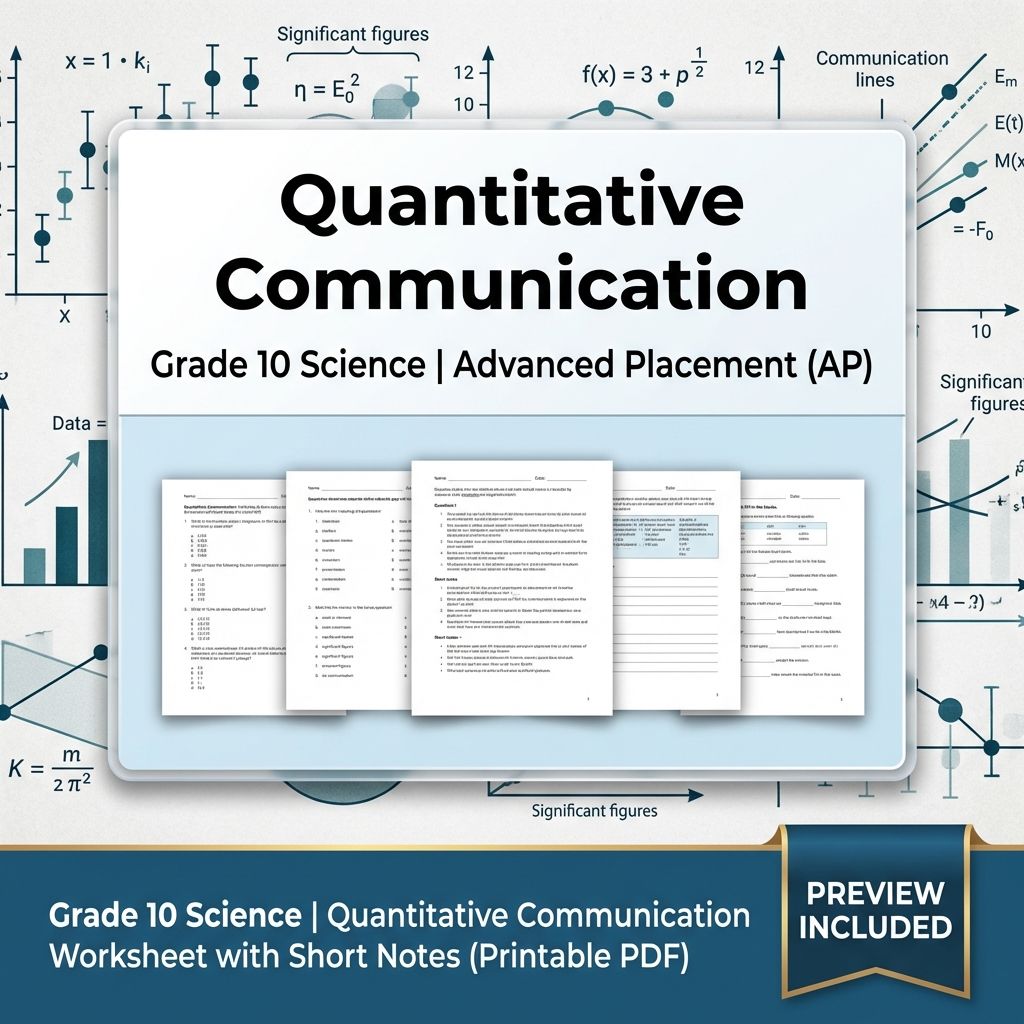
Grade 10 Science | Quantitative Communication Worksheet with Short Notes (PDF)
Created byMeadowlark WorksheetsLearning Objectives
- Understand conventions for reporting and interpreting quantitative results
- Apply uncertainty notation and significant digits accurately
- Use graphical annotations effectively to communicate data
Also included in: Grade 10 Science Unit | Data Analysis, Modelling Worksheet Pack
Instant download
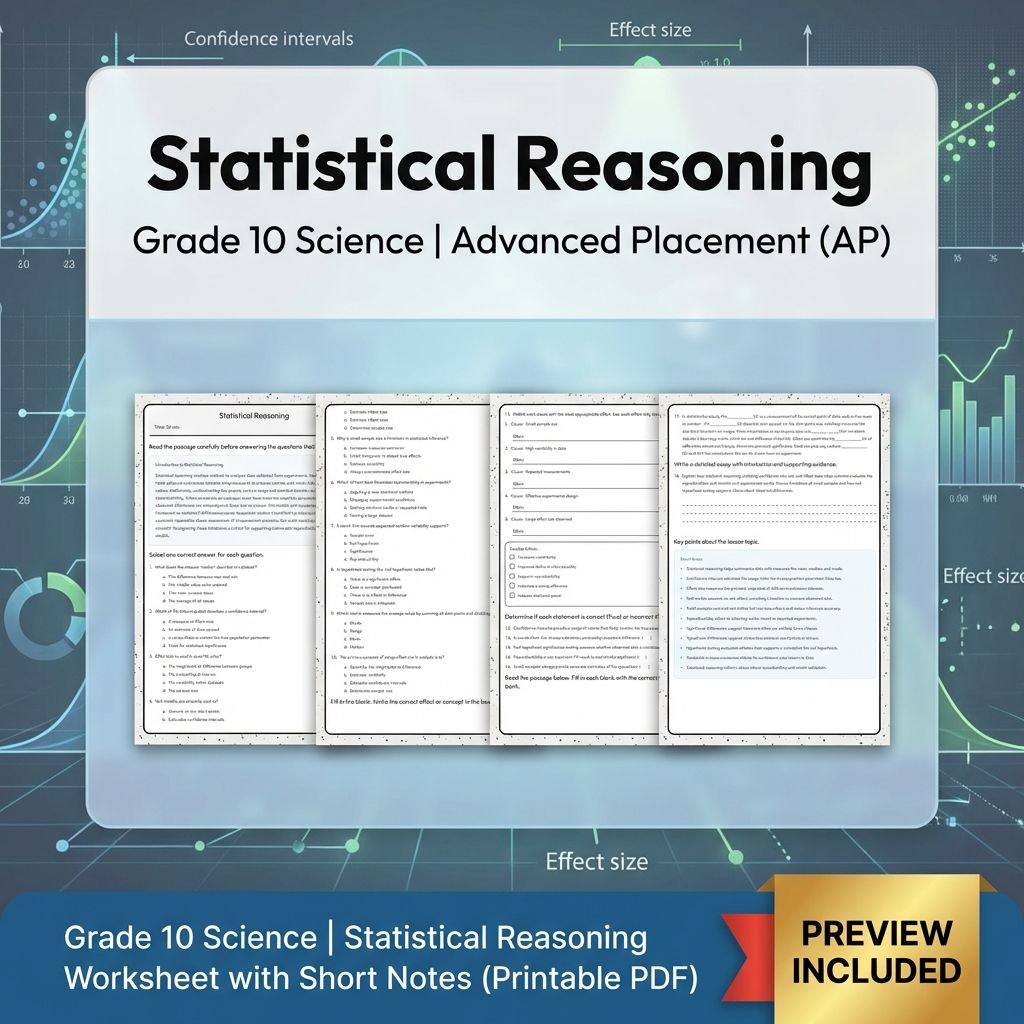
Grade 10 Science | Statistical Reasoning Worksheet with Short Notes (PDF)
Created byMeadowlark WorksheetsLearning Objectives
- Understand how to summarize and compare datasets using measures of central tendency and variability.
- Learn to interpret confidence intervals and effect sizes in research contexts.
- Apply basic hypothesis testing principles to evaluate observed differences.
Also included in: Grade 10 Science Unit | Data Analysis, Modelling Worksheet Pack
Instant download
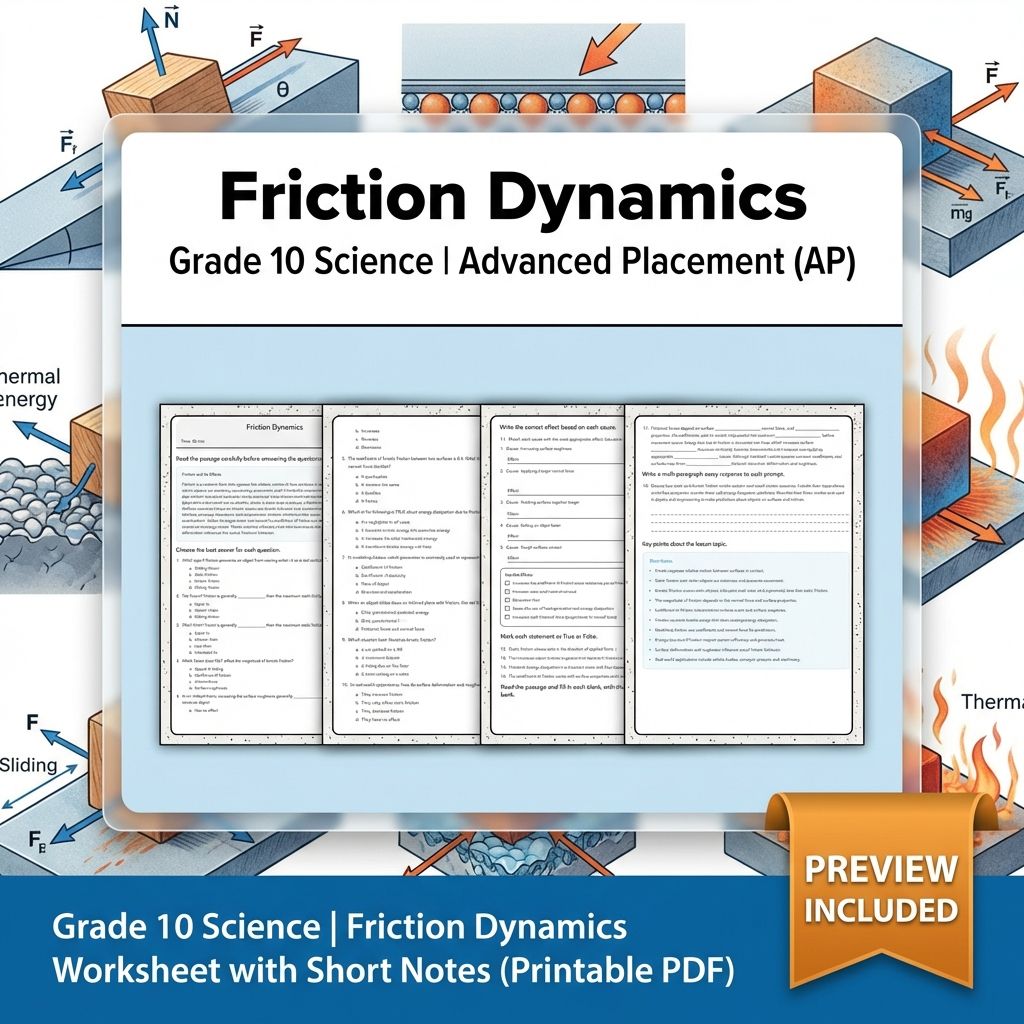
Grade 10 Science | Friction Dynamics Worksheet with Short Notes (Printable PDF)
Created byMeadowlark WorksheetsLearning Objectives
- Differentiate between static and kinetic friction models.
- Understand how normal force and surface properties influence friction.
- Apply coefficient-based models to real-world friction scenarios.
Instant download
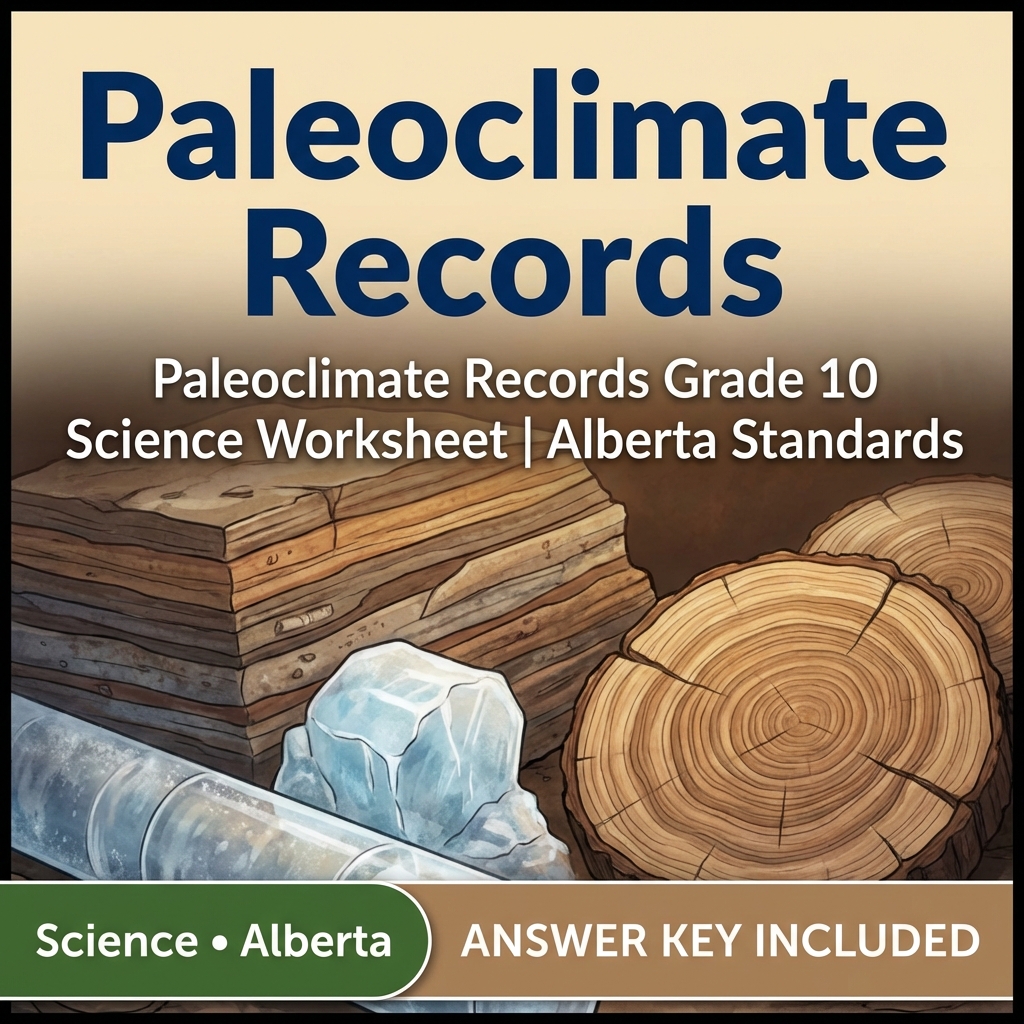
Paleoclimate Records Grade 10 Science Worksheet | Alberta Standards
Created byCoral Reef LearningLearning Objectives
- Understand the role of proxy archives in reconstructing past climate variability.
- Identify different types of paleoclimate proxies used in Alberta.
- Learn methods for extracting and interpreting climate signals from proxies.
Instant download
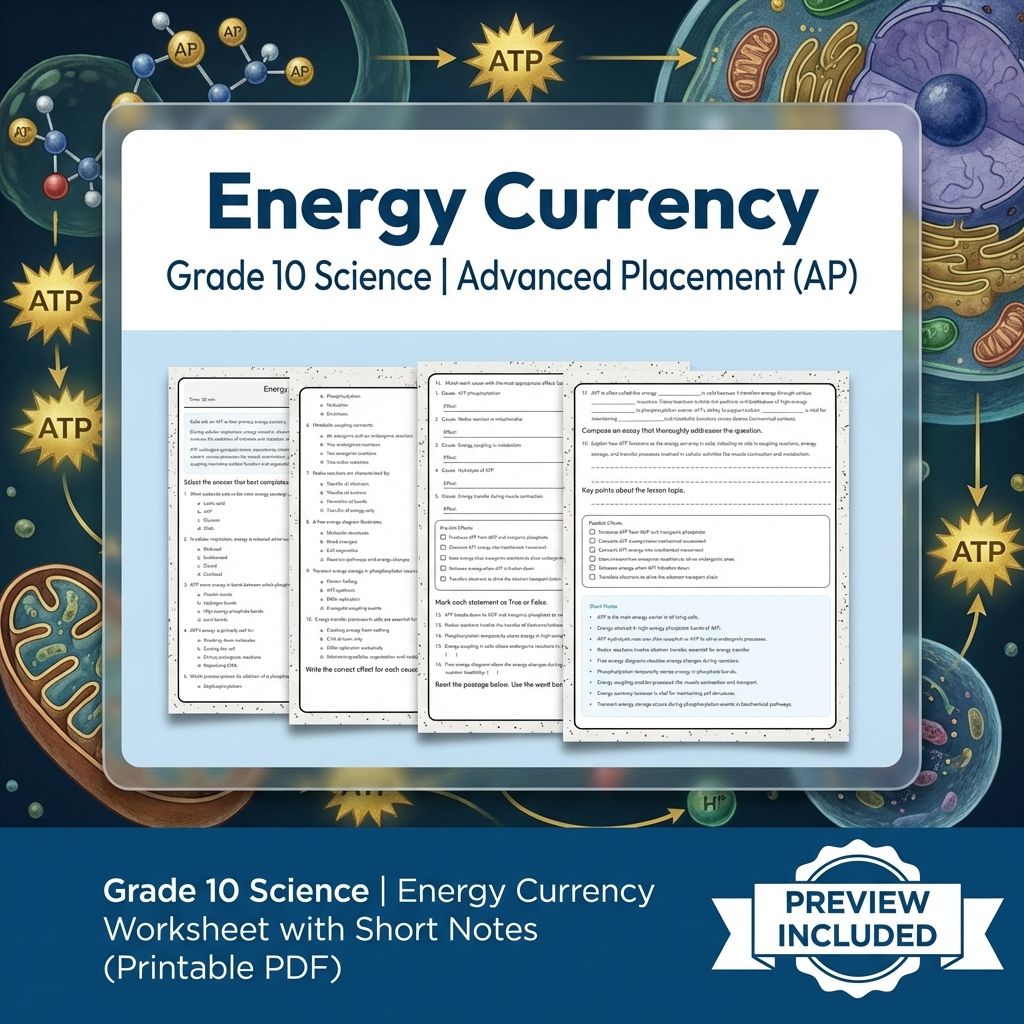
Grade 10 Science | Energy Currency Worksheet with Short Notes (Printable PDF)
Created byMeadowlark WorksheetsLearning Objectives
- Understand the role of adenosine triphosphate (ATP) as the energy currency in biological systems.
- Explain the coupling of exergonic and endergonic reactions in energy transfer.
- Interpret comparative representations of redox reactions, bond energy changes, and free energy diagrams.
Instant download
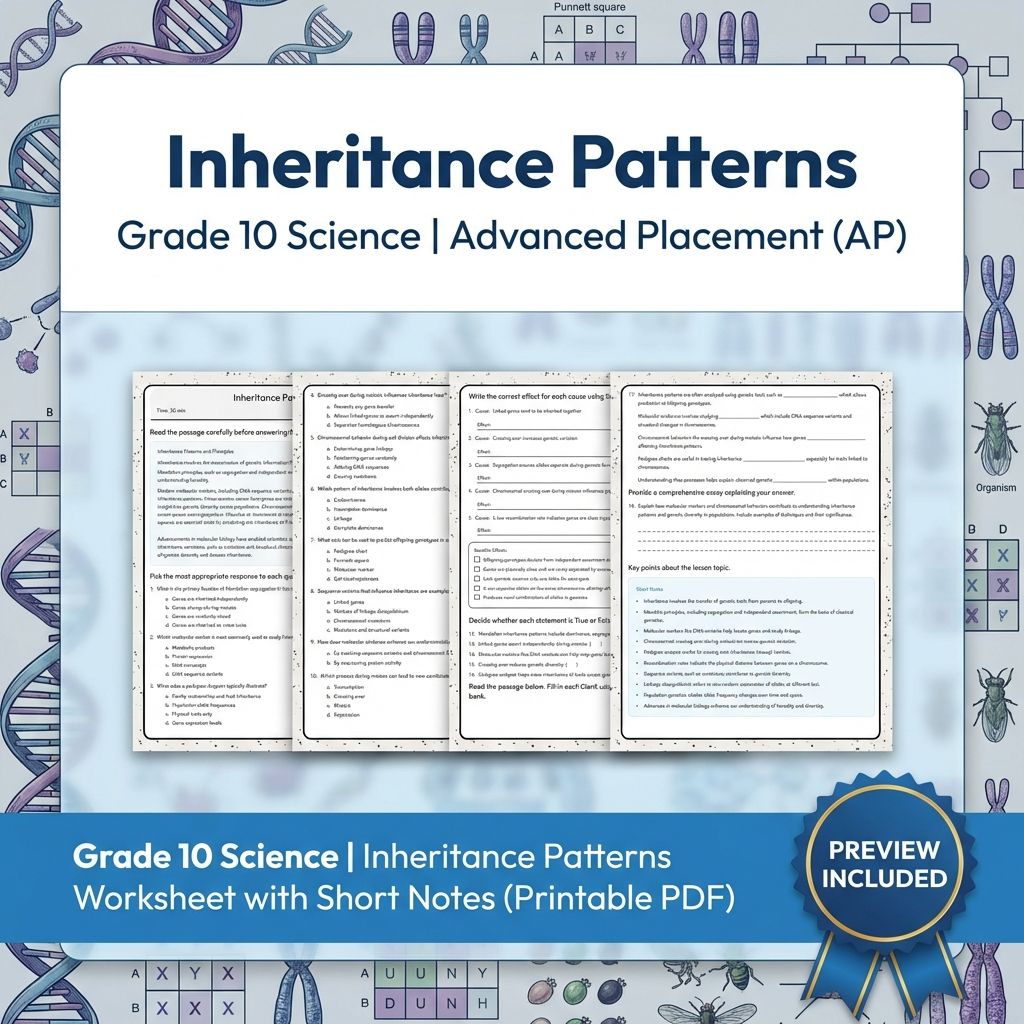
Grade 10 Science | Inheritance Patterns Worksheet with Short Notes (PDF)
Created byMeadowlark WorksheetsLearning Objectives
- Understand the principles of heredity from Mendelian segregation.
- Identify different inheritance patterns including dominance, linkage, and chromosomal inheritance.
- Interpret pedigree diagrams, Punnett squares, and allele frequency data to predict trait transmission.
Instant download
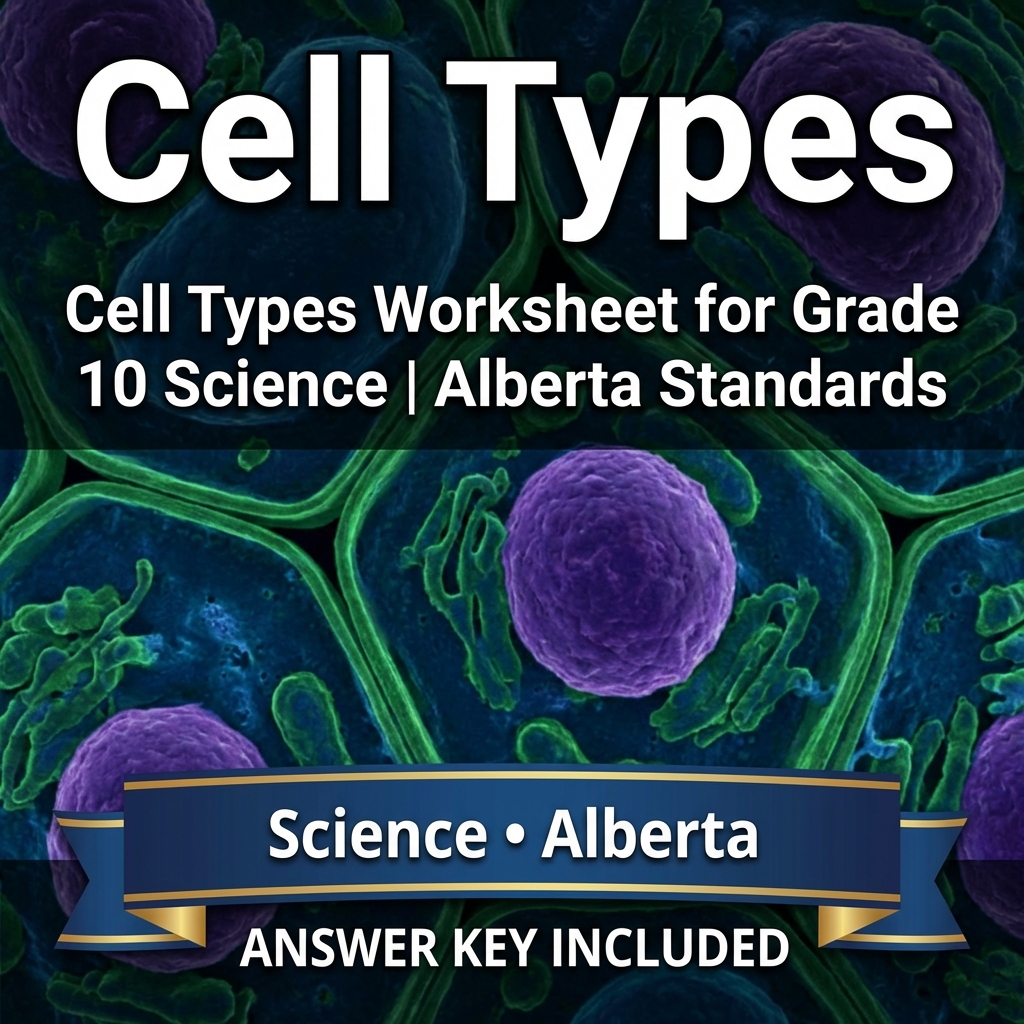
Cell Types Worksheet for Grade 10 Science | Alberta Standards
Created byCoral Reef LearningLearning Objectives
- Compare structural differences between prokaryotic and eukaryotic cells.
- Identify examples of prokaryotic and eukaryotic organisms in regional ecological contexts.
- Understand how cell structure influences functions like replication and genetic control.
Instant download
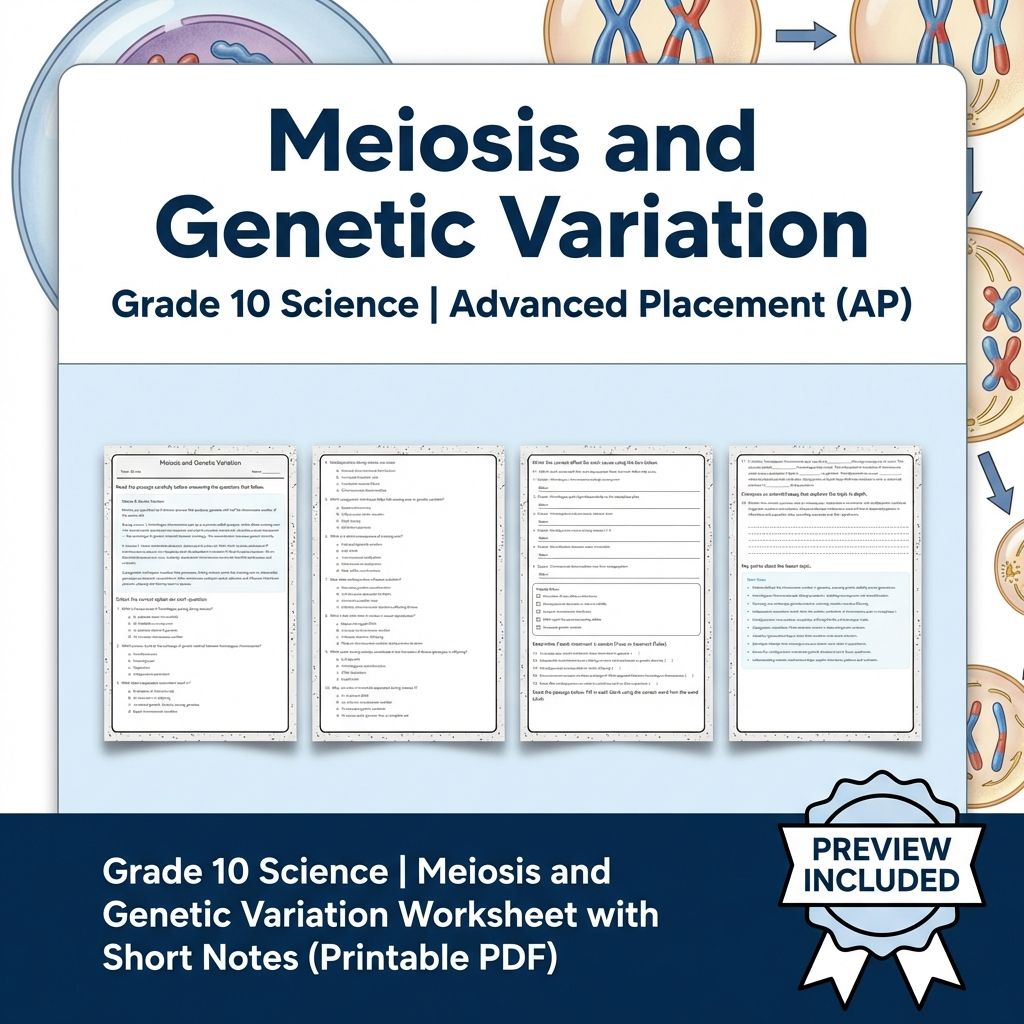
Grade 10 Science | Meiosis and Genetic Variation Worksheet with Short Notes(PDF)
Created byMeadowlark WorksheetsLearning Objectives
- Explain how homologous pairing, recombination, and independent assortment generate genetic variation during meiosis.
- Describe the processes of crossing-over and nondisjunction and their effects on genetic outputs.
- Relate mechanisms of variation to evolutionary patterns and inheritance studies.
Instant download
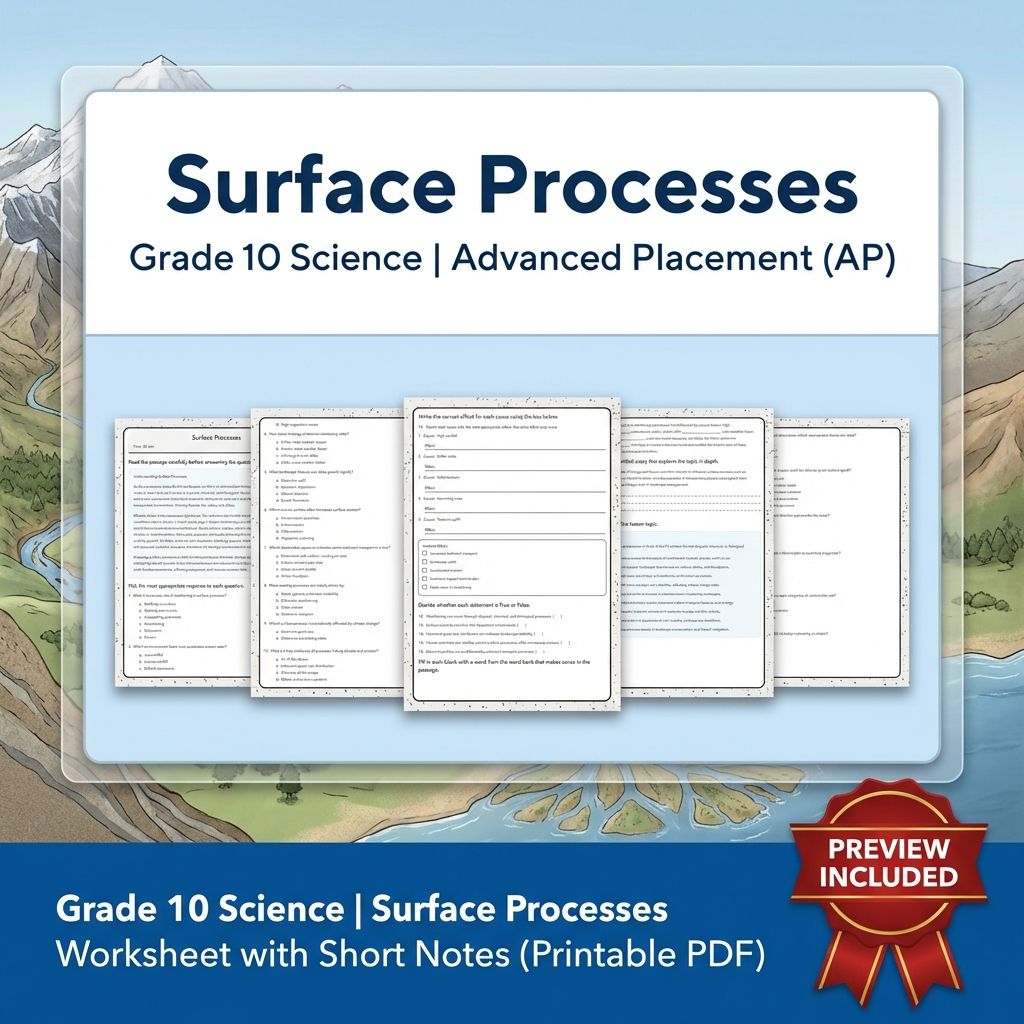
Grade 10 Science | Surface Processes Worksheet with Short Notes (Printable PDF)
Created byMeadowlark WorksheetsLearning Objectives
- Understand the key mechanisms of weathering, erosion, and sediment transport.
- Identify how climate and human activities influence landscape changes.
- Interpret geological evidence such as sediment grain sizes and channel profiles.
Instant download
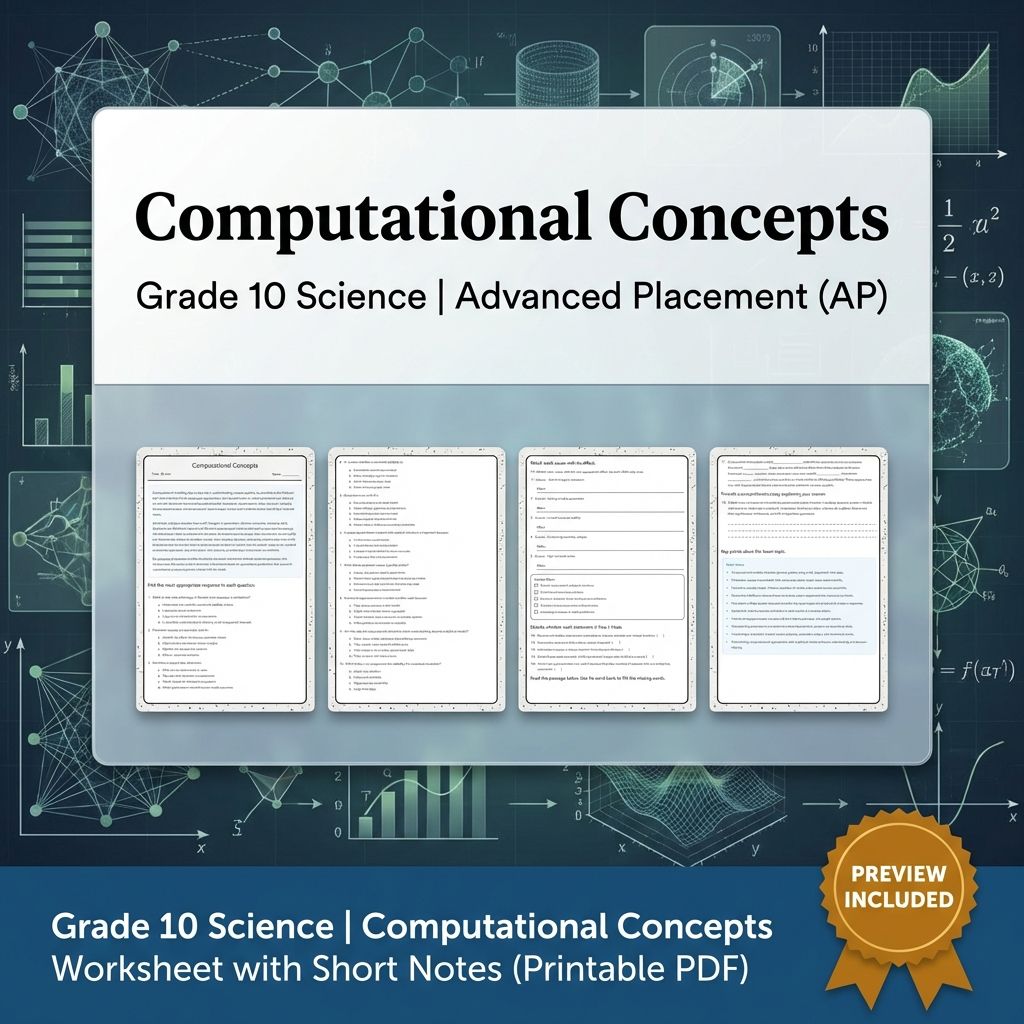
Grade 10 Science | Computational Concepts Worksheet with Short Notes (PDF)
Created byMeadowlark WorksheetsLearning Objectives
- Understand basic computational approaches such as discrete time stepping, parameter sweeps, and sensitivity analysis.
- Identify assumptions and limitations of numerical simulations in population or reaction models.
- Interpret computational outputs in relation to analytical expectations.
Also included in: Grade 10 Science Unit | Data Analysis, Modelling Worksheet Pack
Instant download
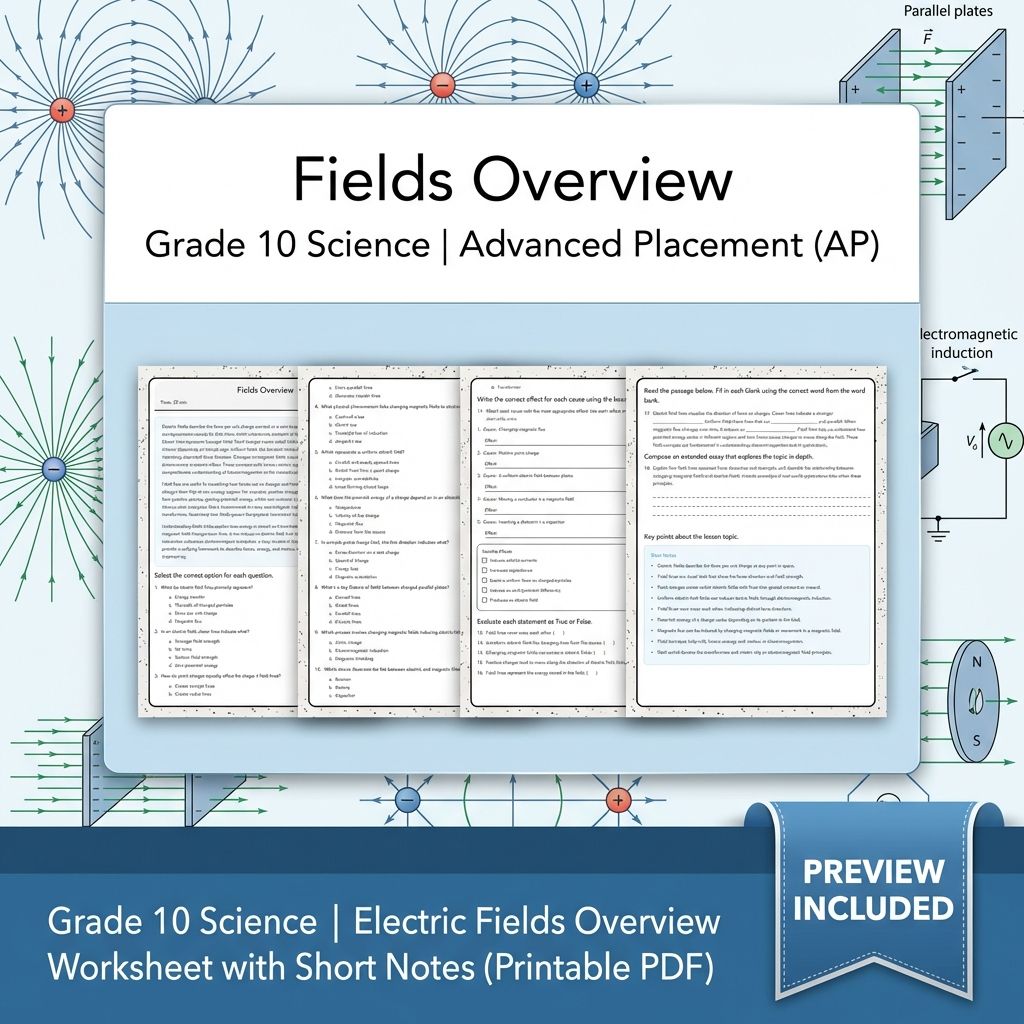
Grade 10 Science | Electric Fields Overview Worksheet with Short Notes (PDF)
Created byMeadowlark WorksheetsLearning Objectives
- Understand the basic concepts of electric and magnetic fields.
- Describe how field lines represent force directions and magnitudes.
- Relate field-based concepts to forces, potential energy, and induced effects.
Instant download
Grade 10 Science | Planetary Motion Worksheet (PDF + Answer Key)
Created byRiverstone ClassroomLearning Objectives
- Understand Kepler's laws and their application to planetary orbits.
- Explain the role of Newtonian gravity in planetary motion.
- Describe how orbital elements relate to observed planetary behavior.
Also included in: Grade 10 Science Unit | Stellar, Planetary & Geologic Worksheets bundle
Instant download
Grade 10 Science | Cell Membrane Worksheet with Short Notes (Printable PDF)
Created byMeadowlark WorksheetsLearning Objectives
- Understand the composition and structure of the cell membrane, including phospholipid bilayers, proteins, cholesterol, and carbohydrate markers.
- Explain how the components of the cell membrane influence its fluidity and ability to recognize substances.
- Describe different transport mechanisms such as diffusion, osmosis, and protein channels and their roles in cell function.
Instant download
Grade 10 Science | Endocrine System Worksheet with Short Notes (Printable PDF)
Created byMeadowlark WorksheetsLearning Objectives
- Understand the endocrine system's role in regulating body functions.
- Identify how hormones communicate and control physiological processes.
- Describe feedback mechanisms involving the hypothalamus and pituitary gland.
Instant download
Grade 10 Science | Ecosystem Management Worksheet with Short Notes (PDF)
Created byMeadowlark WorksheetsLearning Objectives
- Understand the key principles and strategies of ecosystem management.
- Identify different approaches to conserving and restoring ecosystems.
- Analyze the importance of ecological indicators in adaptive management.
Instant download
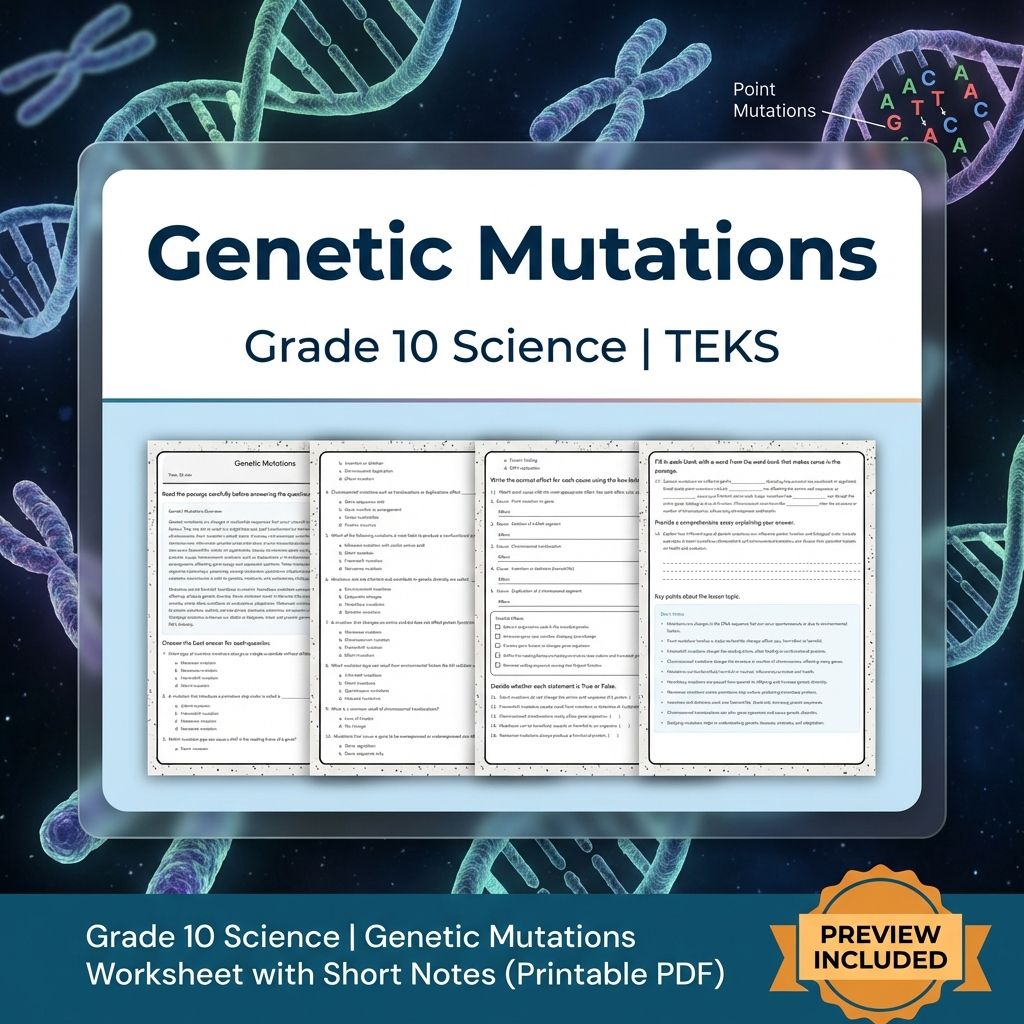
Grade 10 Science | Genetic Mutations Worksheet with Short Notes (Printable PDF)
Created byMeadowlark WorksheetsLearning Objectives
- Understand different types of genetic mutations and their effects on gene expression.
- Identify examples of point mutations, insertions, deletions, and chromosomal alterations.
- Describe how mutations can lead to phenotypic changes, disorders, or fitness variations.
Instant download
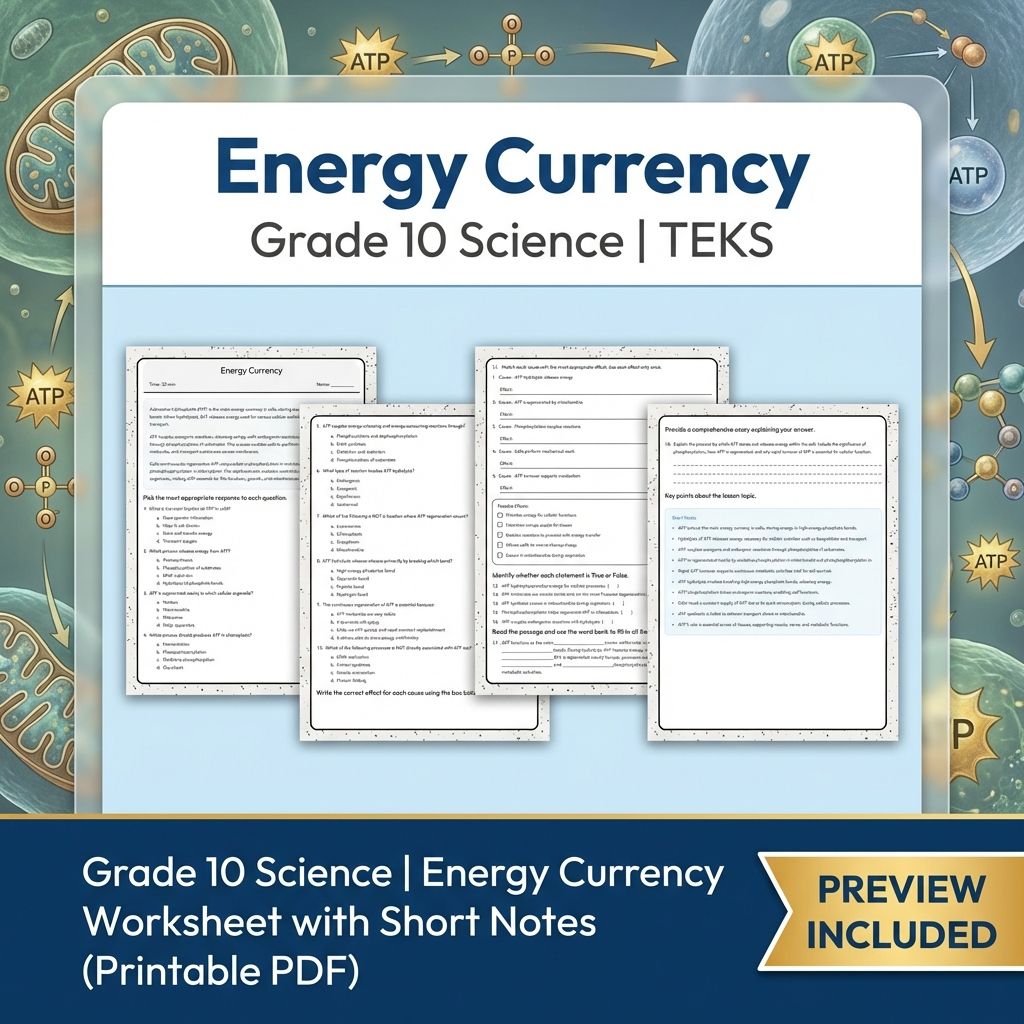
Grade 10 Science | Energy Currency Worksheet with Short Notes (Printable PDF)
Created byMeadowlark WorksheetsLearning Objectives
- Understand the role of ATP as the primary energy carrier in cells.
- Describe how ATP couples exergonic and endergonic reactions through phosphorylation.
- Explain the processes of ATP synthesis via oxidative phosphorylation and photophosphorylation.
Instant download
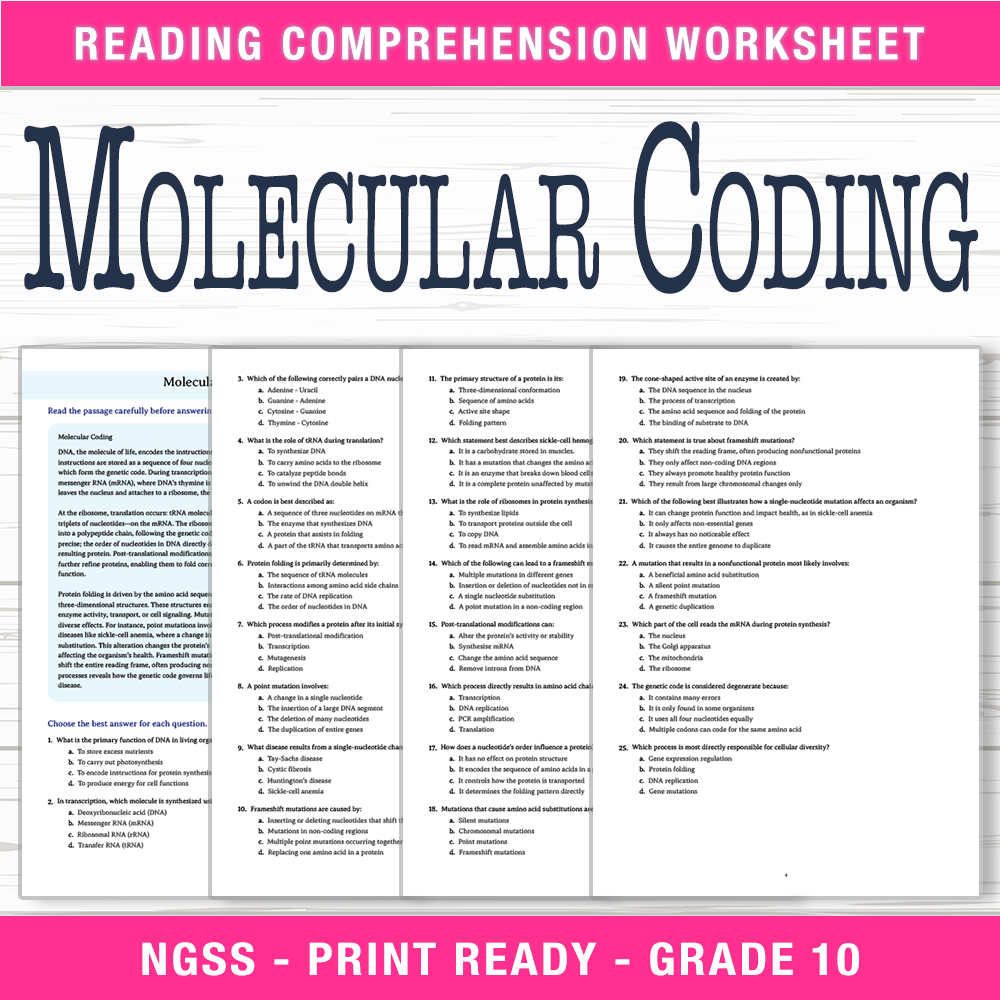
Grade 10 Science | Molecular Coding Worksheet (PDF + Answer Key)
Created byRiverstone ClassroomLearning Objectives
- Explain the process of transcription and translation and how DNA nucleotide sequences determine amino acid chains.
- Describe codon usage, ribosomal function, and how protein folding creates functional active sites.
- Identify how point mutations and frameshifts, such as in sickle-cell anemia, alter protein structure and organismal physiology.
Instant download
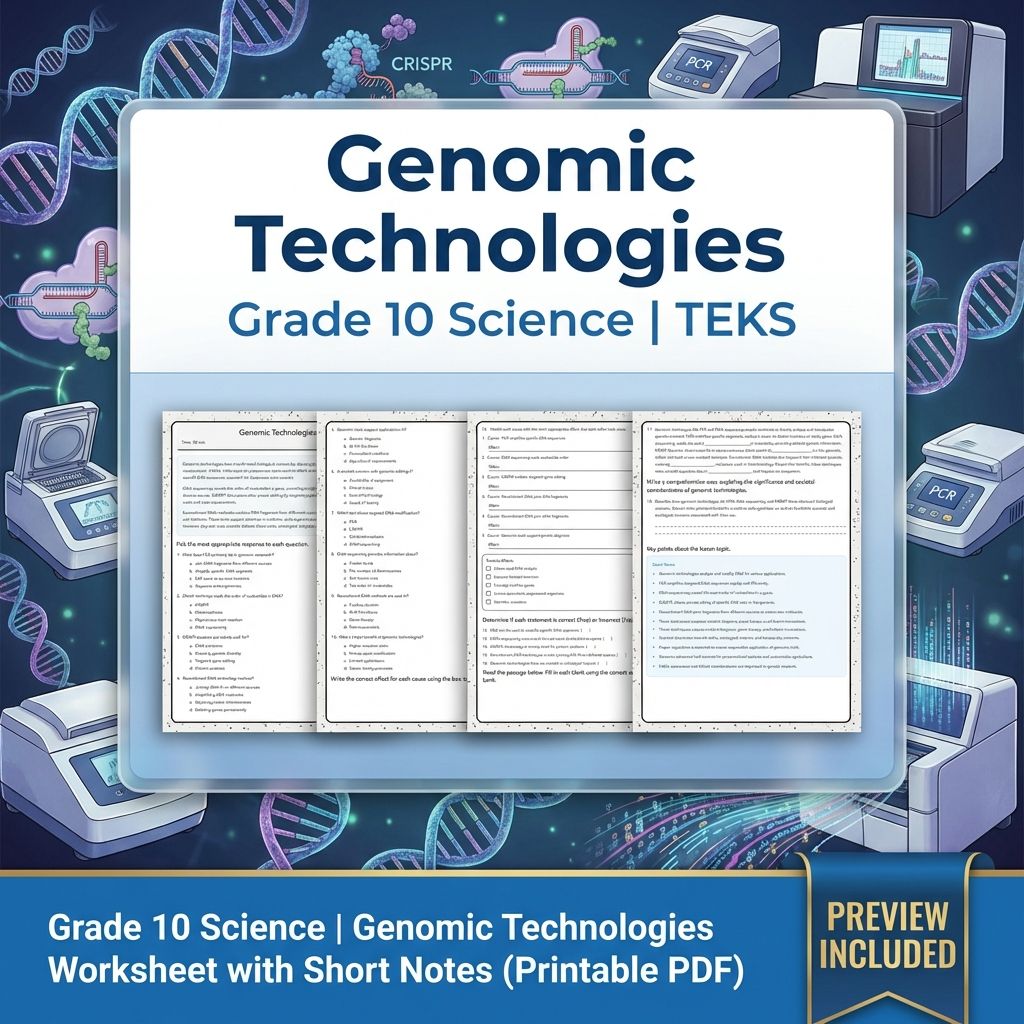
Grade 10 Science | Genomic Technologies Worksheet with Short Notes (PDF)
Created byMeadowlark WorksheetsLearning Objectives
- Understand key techniques used in genomic technologies such as PCR, DNA sequencing, and CRISPR.
- Identify applications and implications of genomic tools in medicine, research, and biotechnology.
- Analyze societal and ecological considerations related to genetic manipulation.
Instant download
About Grade 10 Science Worksheets
Find Science worksheets built for Grade 10. All 7,038 cover core skills, practice, and review, each an instant PDF download.
Every worksheet on MyTeachingSheets is created by independent teacher-authors and reviewed before publication. All resources download as printable PDFs for classroom, homework, or at-home practice, and many include answer keys. Preview any worksheet free before buying.