
Grade 10 Science Worksheets
7,038 worksheets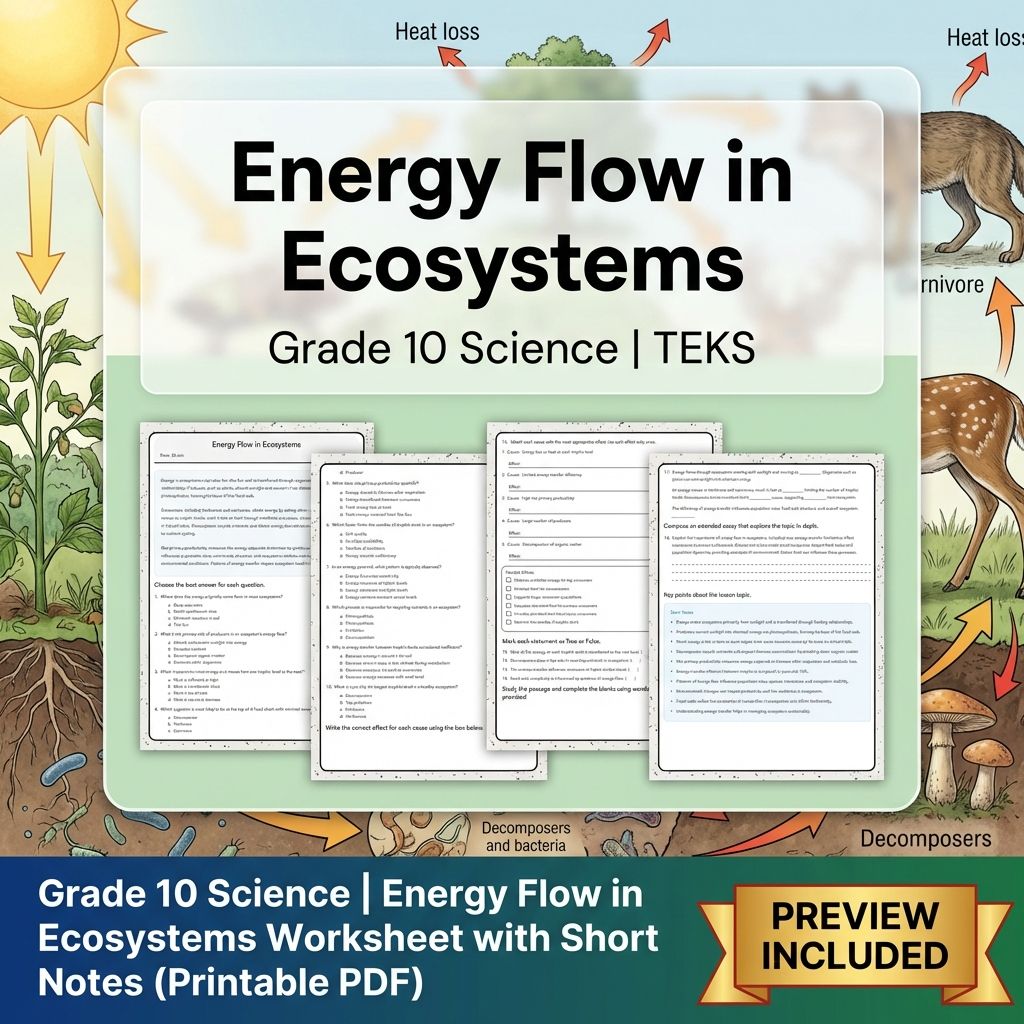
Grade 10 Science | Energy Flow in Ecosystems Worksheet with Short Notes (PDF)
 Created byMeadowlark Worksheets
Learning Objectives
- Describe how energy flows through different trophic levels in an ecosystem.
- Explain the concept of energy transfer efficiency and its effects on biomass.
Instant download
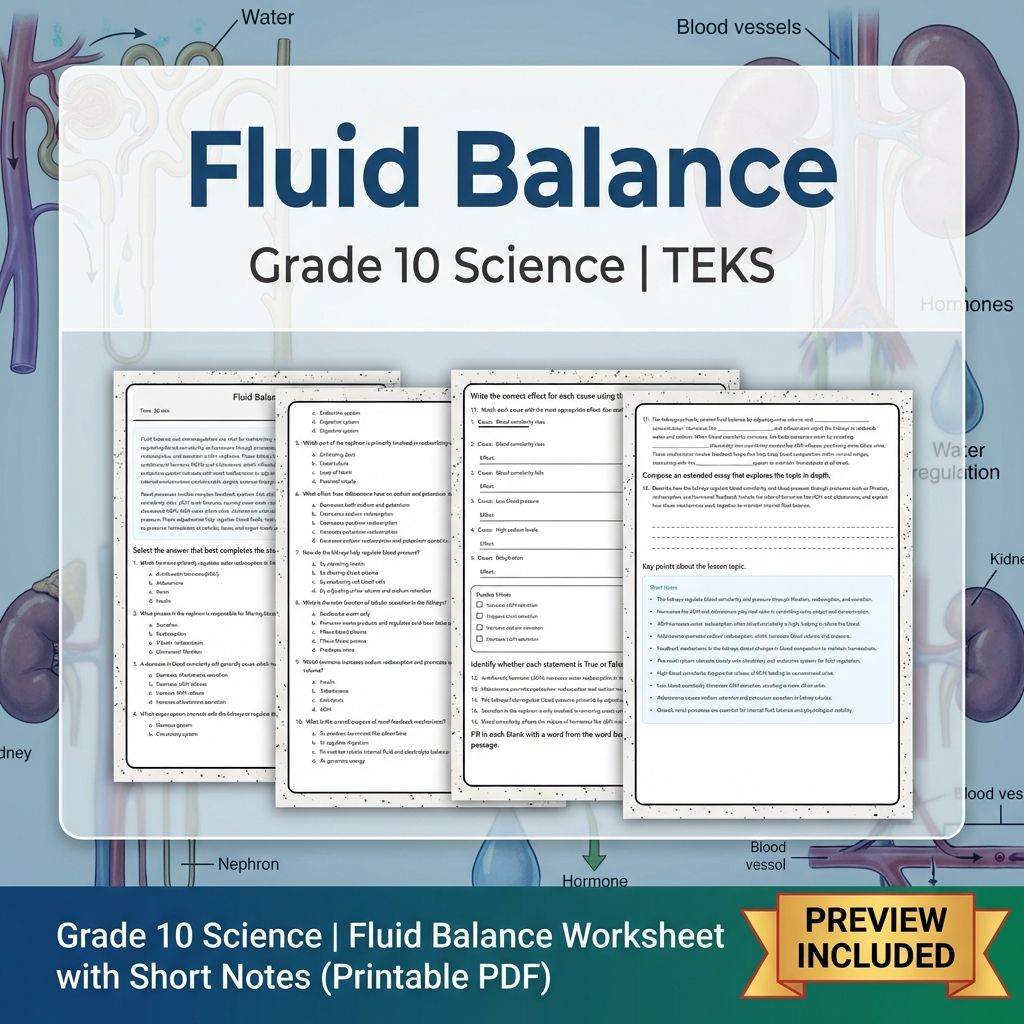
Grade 10 Science | Fluid Balance Worksheet with Short Notes (Printable PDF)
Created byMeadowlark WorksheetsLearning Objectives
- Understand the renal processes involved in fluid balance and osmoregulation.
- Identify hormones that regulate kidney function and blood osmolarity.
- Describe how kidneys adjust urine volume and solute concentration.
Instant download
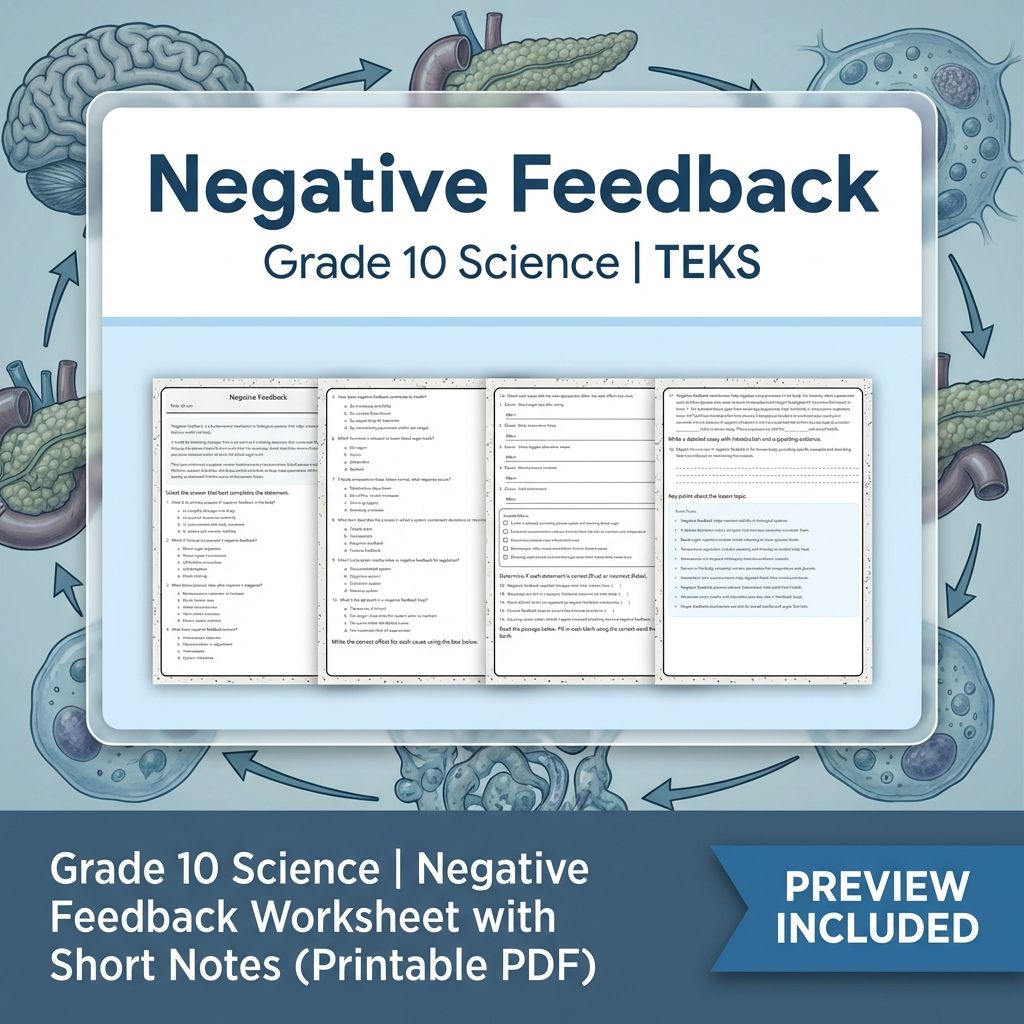
Grade 10 Science | Negative Feedback Worksheet with Short Notes (Printable PDF)
Created byMeadowlark WorksheetsLearning Objectives
- Understand the concept of negative feedback in biological systems.
- Identify examples of negative feedback mechanisms in the human body.
- Explain how negative feedback maintains homeostasis.
Instant download
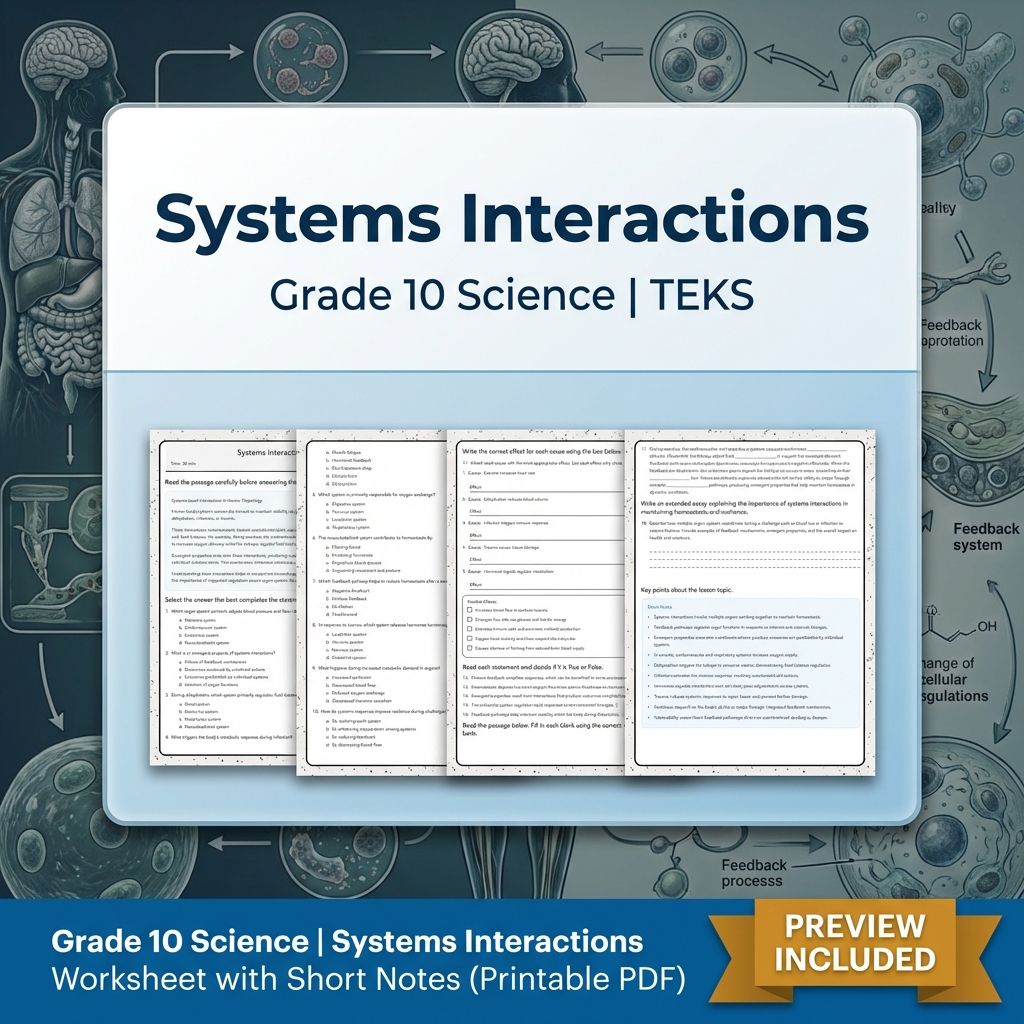
Grade 10 Science | Systems Interactions Worksheet with Short Notes (PDF)
Created byMeadowlark WorksheetsLearning Objectives
- Understand how multiple organ systems coordinate to maintain homeostasis.
- Identify responses of cardiovascular, respiratory, renal, endocrine, and musculoskeletal systems during challenges.
- Analyze how feedback pathways produce emergent properties in human physiology.
Instant download

Grade 10 Uncertainty and Error Worksheet | Florida NGSSS Physical Science
 Created byEvergreen Desk Education
Learning Objectives
- Distinguish random error from systematic error and explain how each affects repeatability and results.
- Interpret uncertainty using precision, accuracy, and margin of error to judge whether differences are meaningful.
- Evaluate evidence by considering whether patterns persist across measurements and uncertainty bounds overlap appropriately.
Instant download

Energy Flow Worksheet Pack | Grade 10 Science Activities
 Created byPrism Point Learning
Learning Objectives
- Explain how sunlight drives energy flow through an ecosystem using trophic levels and food chains or webs.
- Describe why energy decreases at higher trophic levels due to metabolic processes and heat loss.
- Interpret how energy constraints limit biomass and population sizes across trophic levels.
Instant download

Earth Layers Practice Worksheet | Grade 10 Science | Review and Assessment
Created byPrism Point LearningLearning Objectives
- Explain how Earth’s internal layers differ by composition, physical state, and mechanical behavior.
- Connect seismic wave patterns and mineral properties to models of the crust, mantle, and core.
- Describe temperature and density gradients and relate them to lithosphere, asthenosphere, and mantle convection.
Also included in: Grade 10 Earth Systems Science Lesson Bundle: Ontario Review Worksheets
Instant download

Uniform Circular Motion Test Prep Printable | Grade 10 Science
Created byPrism Point LearningLearning Objectives
- Use the relations v = rω and a_c = v^2/r to connect angular motion to linear speed and centripetal acceleration.
- Explain how a net inward (centripetal) force is required to keep an object moving on a curved path.
- Analyze common situations (e.g., turning vehicles and conical pendulums) using Newton’s laws and uniform circular motion ideas.
Also included in: Grade 10 Motion & Forces Kinematics Science Lesson Bundle for Ontario
Instant download

Ecosystem Management Worksheet | Grade 10 Science Activities
Created byPrism Point LearningLearning Objectives
- Explain how ecosystem management uses ecological principles to maintain or restore ecosystem structure and function
- Describe key strategies such as habitat restoration, invasive species control, and reducing pollution and fragmentation
- Interpret how monitoring indicators supports adaptive management and improves resilience and long-term ecosystem services
Instant download

Stellar Evolution Worksheet Grade 10 Science Activity | NGSSS Aligned
Created byPrism Point LearningLearning Objectives
- Explain how a star’s mass influences its lifecycle and final outcome.
- Describe the main-sequence phase and the role of fusion in star stability.
- Connect late-stage stellar changes to elements produced and returned to space.
Also included in: Space & Earth Systems Lesson Bundle | Grade 10 Science | Florida NGSSS
Instant download

Sphere Interactions Models Worksheet Grade 10 Earth Science Practice
Created byPrism Point LearningLearning Objectives
- Explain how transfers of energy and matter can link Earth’s spheres in cause-and-effect chains.
- Use models and data to predict how changes in one reservoir can affect precipitation, runoff, and groundwater.
- Describe how land cover and erosion can move sediment into rivers and coastal ecosystems.
Instant download

Space Scale Motion Worksheet Grade 10 Astronomy & Earth Science Activity
Created byPrism Point LearningLearning Objectives
- Explain how gravity and orbital motion determine how objects move in space.
- Use angular size and apparent motion/brightness changes to interpret what is observable in the sky.
- Connect Earth’s rotation and revolution to changes in what we see across nights and seasons.
Instant download

Periodic Trends Worksheet Grade 10 Chemistry Practice & Activities NGSSS
Created byPrism Point LearningLearning Objectives
- Explain how effective nuclear charge and shielding affect atomic size across periods and groups.
- Predict how ion formation and ionization energy trends change for main-group elements.
- Use valence electrons to infer typical bonding tendencies and common ion charges.
Also included in: Grade 10 Physical Science Lesson Bundle | Florida NGSSS
Instant download

Biodiversity Value Worksheet | Grade 10 Science Practice TEKS Standards
Created byPrism Point LearningLearning Objectives
- Explain how biodiversity supports ecosystem resilience and productivity.
- Describe how loss of species can reduce ecological interactions and adaptive capacity.
- Identify ecosystem services provided by diverse species and habitats.
Instant download

Mitigation Strategies Test Prep Worksheet | Grade 10 Science
Created byPrism Point LearningLearning Objectives
- Explain how different mitigation approaches reduce greenhouse gas emissions and negative environmental impacts.
- Evaluate mitigation options by comparing effectiveness, co-benefits, unintended consequences, and trade-offs.
- Connect mitigation strategies to sector-specific and policy constraints, including economic and societal factors.
Instant download

Hazard Influence Test Prep Printable | Grade 10 Science Assessment
Created byPrism Point LearningLearning Objectives
- Explain how freshwater availability influences where people settle and how they use land
- Analyze how natural hazards such as floods, droughts, and volcanic eruptions change economic activities and infrastructure
- Evaluate how climate variability and sea-level rise affect hazard risk over time and space
Instant download

Metabolic Control Worksheet | Grade 10 Science Activities
Created byPrism Point LearningLearning Objectives
- Explain how enzymes and feedback inhibition regulate metabolic pathways to maintain balance in cells.
- Describe how compartmentalization helps control metabolic flux and protect cellular viability.
- Analyze how environmental factors such as temperature and nutrient availability can change enzyme activity.
Also included in: Cell Organization & Homeostasis Grade 10 Science Lesson Bundle | Alberta
Instant download

Multiple Evidence Worksheet Pack | Grade 10 Science Assessment Bundle
Created byPrism Point LearningLearning Objectives
- Explain how different kinds of evidence support claims about biological change over time
- Describe how evidence from multiple sources can converge on a common evolutionary explanation
- Evaluate why conclusions are stronger when patterns are consistent across datasets
Instant download

Grade 10 AP Science Metabolic Pathways Worksheet | Practice Pack
Created byPrism Point LearningLearning Objectives
- Explain how glycolysis, the TCA cycle, and oxidative phosphorylation connect to transform substrates into ATP and electron carriers.
- Describe electron flow through the electron transport chain and how proton gradients enable ATP synthesis.
- Use redox concepts and regulatory checkpoints to predict how cells respond to changing oxygen and energy availability.
Also included in: Grade 10 AP Science Life Systems Lesson Bundle | Worksheet Pack
Instant download

Energy Resources Test Prep Worksheet | Grade 10 Science Ontario
Created byPrism Point LearningLearning Objectives
- Explain how coal, petroleum, and natural gas form from organic matter and how source rock, migration, and trapping work together
- Describe geothermal energy as a result of Earth’s internal heat and understand why it is distributed unevenly
- Compare conventional and unconventional reservoirs and predict how geology affects extraction feasibility and regional energy potential
Also included in: Grade 10 Earth Systems Science Lesson Bundle: Ontario Review Worksheets
Instant download

Energy Currency Worksheet | Grade 10 Science Activities
Created byPrism Point LearningLearning Objectives
- Explain how ATP acts as an energy currency that links catabolism to processes that require energy.
- Describe ATP synthesis and ATP hydrolysis and how phosphorylation fits into metabolic networks.
- Compare how ATP turnover can vary between tissues and environmental conditions.
Also included in: Cell Organization & Homeostasis Grade 10 Science Lesson Bundle | Alberta
Instant download

Systems Trade Interactions Worksheet Grade 10 Science STEM Activities
Created byPrism Point LearningLearning Objectives
- Explain how interacting system components can change outcomes when one part is modified.
- Identify examples of feedback, dependencies, and failure pathways in real-world designs.
- Describe trade-offs and constraints using systems thinking vocabulary.
Instant download

Galactic Structure Worksheet Grade 10 Science Astronomy NGSSS Activity
Created byPrism Point LearningLearning Objectives
- Explain how galaxy structure (including spiral arms and a central bar) relates to gravity and motion.
- Use redshift and spectral lines to connect observed light to galaxy movement and distance.
- Interpret how brightness depends on distance and intrinsic luminosity when comparing galaxies.
Also included in: Space & Earth Systems Lesson Bundle | Grade 10 Science | Florida NGSSS
Instant download

Two-Dimensional Motion Test Prep Printable | Grade 10 Science
Created byPrism Point LearningLearning Objectives
- Decompose projectile motion into independent horizontal and vertical components and relate them to kinematics.
- Use trigonometric resolution of initial velocity to compute time of flight, range, and maximum height under uniform gravity.
- Explain two-dimensional motion using vectors and relative displacement in perpendicular directions.
Also included in: Grade 10 Motion & Forces Kinematics Science Lesson Bundle for Ontario
Instant download

Cell Structure Worksheet Grade 10 Biology Activity | Cell Organelles
Created byPrism Point LearningLearning Objectives
- Compare eukaryotic and prokaryotic cell structures and explain how those differences affect cell roles
- Identify major cell structures (membrane, cytoplasm, nucleus, and genetic material) and describe their functions
- Use cell structure and function ideas to predict how specialized cells support growth, maintenance, and reproduction
Instant download

Thermodynamics Worksheet Pack | Grade 10 Science Activities
Created byPrism Point LearningLearning Objectives
- Explain how the first and second laws of thermodynamics apply to cellular metabolism and energy transformations.
- Describe how entropy increase relates to irreversible energy loss as heat in biological systems.
- Use Gibbs free energy ideas to predict whether a biochemical reaction is spontaneous and why coupling to ATP may be required.
Also included in: Metabolism & Energy Processes Lesson Bundle — Grade 10 Science TEKS
Instant download

One-Dimensional Motion Practice Worksheet | Grade 10 Science Review
Created byPrism Point LearningLearning Objectives
- Define displacement, speed, velocity, and acceleration for motion along a single axis using clear sign conventions.
- Use average and instantaneous ideas to interpret motion graphs and numerical values.
- Apply constant-acceleration (kinematic) equations to solve free-fall and uniformly accelerated vehicle problems.
Also included in: Grade 10 Motion & Forces Kinematics Science Lesson Bundle for Ontario
Instant download

Respiration Pathways Worksheet | Grade 10 Science Activities
Created byPrism Point LearningLearning Objectives
- Describe the main steps of cellular respiration and where they occur in the cell (cytosol vs. mitochondria).
- Explain how glycolysis, the citric acid cycle, and the electron transport chain help produce ATP.
- Identify the roles of electron carriers (such as NADH/FADH2) and oxygen as the final electron acceptor in aerobic respiration.
Also included in: Metabolism & Energy Processes Lesson Bundle — Grade 10 Science TEKS
Instant download

Mechanics Applications Test Prep Printable | Grade 10 Science
Created byPrism Point LearningLearning Objectives
- Apply kinematic relations and Newton’s laws to predict motion on inclines, in pulley systems, and during vehicle braking.
- Connect net force, acceleration, work, and momentum to interpret practical design and safety trade-offs.
Also included in: Grade 10 Motion & Forces Kinematics Science Lesson Bundle for Ontario
Instant download

Grade 10 AP Science Friction Dynamics Worksheet | Practice Pack
Created byPrism Point LearningLearning Objectives
- Explain the difference between static and kinetic friction and how each depends on normal force and surface properties.
- Use coefficient-based friction models to predict forces on blocks on horizontal and inclined surfaces.
- Relate frictional work to energy dissipation and interpret how changing net force affects motion.
Instant download

Organelle Functions Worksheet Grade 10 Biology Activity & Assessment
Created byPrism Point LearningLearning Objectives
- Explain how membrane-bound and non-membrane-bound organelles contribute to cell survival and homeostasis.
- Describe the roles of the nucleus, mitochondria, chloroplasts, endoplasmic reticulum, Golgi apparatus, and ribosomes.
- Connect organelle functions to energy transformation, protein synthesis, and molecule transport.
Instant download

Mining Impacts Test Prep Worksheet | Grade 10 Science
Created byPrism Point LearningLearning Objectives
- Explain how mineral extraction can alter landscapes and affect water, soil, air, and ecosystems.
- Identify key contamination processes such as tailings leakage and acid rock drainage and describe likely environmental outcomes.
- Describe how impact assessment and reclamation plus long-term monitoring help reduce legacy risks.
Also included in: Grade 10 Earth Systems Science Lesson Bundle: Ontario Review Worksheets
Instant download

Resource Policy Test Prep Worksheet | Grade 10 Science Ontario
Created byPrism Point LearningLearning Objectives
- Explain how governance instruments (permitting, land-use planning, and environmental assessment) shape natural resource use
- Describe how regulatory standards, economic valuation, and commodity markets influence resource decisions
- Evaluate how monitoring, compliance, and adaptive management can reduce environmental damage while balancing development and conservation
Also included in: Grade 10 Earth Systems Science Lesson Bundle: Ontario Review Worksheets
Instant download

Cell Division Practice worksheet | Grade 10 Science NGSS Review
Created byPrism Point LearningLearning Objectives
- Explain how the cell cycle proceeds and how checkpoints help ensure correct chromosomal segregation.
- Compare mitosis and meiosis in terms of chromosome number changes and reproductive cell formation.
- Describe how dysregulation of cell division can contribute to diseases such as cancer.
Also included in: Grade 10 Cellular Regulation and Energy Science Lesson Bundle (NGSS)
Instant download

Metabolic Regulation Worksheet | Grade 10 Science Activities
Created byPrism Point LearningLearning Objectives
- Explain how allosteric regulation and feedback inhibition control metabolic pathway flux.
- Describe how substrate availability and cellular signaling coordinate enzyme activity.
- Compare how covalent modification and hormonal signals (insulin and glucagon) shift metabolism.
Also included in: Metabolism & Energy Processes Lesson Bundle — Grade 10 Science TEKS
Instant download

Molecular Evidence Worksheet | Grade 10 Science Activities
Created byPrism Point LearningLearning Objectives
- Explain how DNA, RNA, and protein sequences can provide evidence for evolutionary relationships.
- Describe how sequence similarity, conserved genes, and molecular clocks are used in phylogeny and divergence-time estimates.
- Identify challenges like horizontal gene transfer and convergent molecular evolution and why using multiple genes improves conclusions.
Instant download

Paleoclimate Records Worksheet | Grade 10 Science Activities
Created byPrism Point LearningLearning Objectives
- Explain how proxy archives (tree rings, lake sediments, peat) record past climate variability.
- Describe how scientists extract a time signal from proxy data and interpret it as temperature, precipitation, and fire history.
- Evaluate why multi-proxy comparisons help distinguish natural variability from recent climate change.
Instant download

Molecules And Lattices Worksheet | Grade 10 Science Practice
Created byPrism Point LearningLearning Objectives
- Explain how ionic, covalent molecular, and metallic lattices differ in structure
- Predict how bonding and lattice structure affect macroscopic properties like melting point, conductivity, and brittleness
- Connect periodic table positions to trends in bond strength and material behavior
Also included in: Grade 10 Science Chemical Reactions & Atomic Structure Lesson Bundle | Bc +1 more
Instant download

Cell Organization Test Prep Printable | Grade 10 Science
Created byPrism Point LearningLearning Objectives
- Explain how membrane-bound organelles and compartmentalization support specialized functions in eukaryotic cells
- Compare structural differences between prokaryotic and eukaryotic cells and connect those differences to metabolic and genetic roles
- Describe how groups of cells form tissues and how tissue architecture supports organ-level function
Also included in: Grade 10 Cellular Regulation and Energy Science Lesson Bundle (NGSS)
Instant download

Population Dynamics Worksheet | Grade 10 Science Activities
Created byPrism Point LearningLearning Objectives
- Explain how allele frequencies and demographic parameters change over time in population dynamics.
- Connect evolutionary forces (selection, drift, gene flow, mutation) to observable patterns in populations.
- Use Hardy-Weinberg equilibrium as a baseline to identify when evolutionary forces may be acting.
Also included in: Grade 10 Evolution, Speciation & Biodiversity Lesson Bundle | BC Science +1 more
Instant download

Friction and Resistance Worksheet | Grade 10 Science Review and Practice
Created byPrism Point LearningLearning Objectives
- Distinguish static friction from kinetic friction and explain why each depends on the normal force and surface properties.
- Relate air resistance and viscous drag to velocity, including the idea of terminal speed.
- Describe how friction and fluid resistance affect motion along inclines and through fluids.
Also included in: Grade 10 Motion & Forces Kinematics Science Lesson Bundle for Ontario
Instant download

Shared Genetic Mechanisms Worksheet | Grade 10 Evolution Evidence
Created byPrism Point LearningLearning Objectives
- Explain how conserved genes and regulatory systems can indicate shared ancestry.
- Describe how DNA sequence similarity and shared protein functions support evolutionary relationships.
- Connect conserved metabolic pathways to the idea that evolution modifies existing genetic material.
Also included in: Grade 10 Life Science Lesson Bundle | California Standards Framework
Instant download

Evidence-Based Communication Worksheet for Grade 10 Science Skills
Created byPrism Point LearningLearning Objectives
- Connect scientific claims to supporting evidence using logical reasoning and clear scientific language.
- Use appropriate representations (like graphs or models) to trace conclusions back to data.
- Recognize alternative interpretations and explain why evidence supports a conclusion.
Instant download

Predator Prey Dynamics Worksheet | Grade 10 Ecology Science Practice
Created byPrism Point LearningLearning Objectives
- Explain how predator and prey populations affect one another over time.
- Describe how predator-prey interactions can influence ecosystem carrying capacity and stability.
- Use cause-and-effect reasoning to predict changes in population sizes.
Also included in: Grade 10 Life Science Lesson Bundle | California Standards Framework
Instant download

Reaction Particles Worksheet for Grade 10 Chemistry Science Activities
Created byPrism Point LearningLearning Objectives
- Explain reaction rates using the particle-collision model
- Describe how particle energy, activation barriers, temperature, and concentration affect the chance of reaction
- Use energy-based ideas to predict how catalysts change reaction probability
Instant download

Molecular Patterns Worksheet | Grade 10 Science Practice
Created byPrism Point LearningLearning Objectives
- Explain how DNA and protein sequence similarities can indicate relatedness among organisms.
- Describe how molecular clocks use mutation rates to estimate divergence times.
- Interpret how conserved genes and shared genetic markers support common ancestry.
Also included in: Grade 10 Evolution, Speciation & Biodiversity Lesson Bundle | BC Science +1 more
Instant download

Expression Control Worksheet Grade 10 AP Science Practice Activities
Created byPrism Point LearningLearning Objectives
- Explain how promoter architecture and transcription factors regulate gene transcription in prokaryotes and eukaryotes
- Describe how chromatin modifications and post-transcriptional mechanisms can change gene expression output
- Interpret how regulatory networks and signal integration affect phenotype-related changes in cells
Also included in: Grade 10 AP Science Life Systems Lesson Bundle | Worksheet Pack
Instant download

Human Impacts Worksheet | Grade 10 Science Activities
Created byPrism Point LearningLearning Objectives
- Explain how habitat fragmentation, pollution, overexploitation, invasive species, and land-use change affect biodiversity.
- Describe how climate change shifts species ranges and phenology, and how these pressures can interact.
- Evaluate how human actions influence population size, species interactions, and genetic diversity.
Also included in: Grade 10 Evolution, Speciation & Biodiversity Lesson Bundle | BC Science +1 more
Instant download
About Grade 10 Science Worksheets
Find Science worksheets built for Grade 10. All 7,038 cover core skills, practice, and review, each an instant PDF download.
Every worksheet on MyTeachingSheets is created by independent teacher-authors and reviewed before publication. All resources download as printable PDFs for classroom, homework, or at-home practice, and many include answer keys. Preview any worksheet free before buying.