
Grade 10 Science Worksheets
7,069 worksheets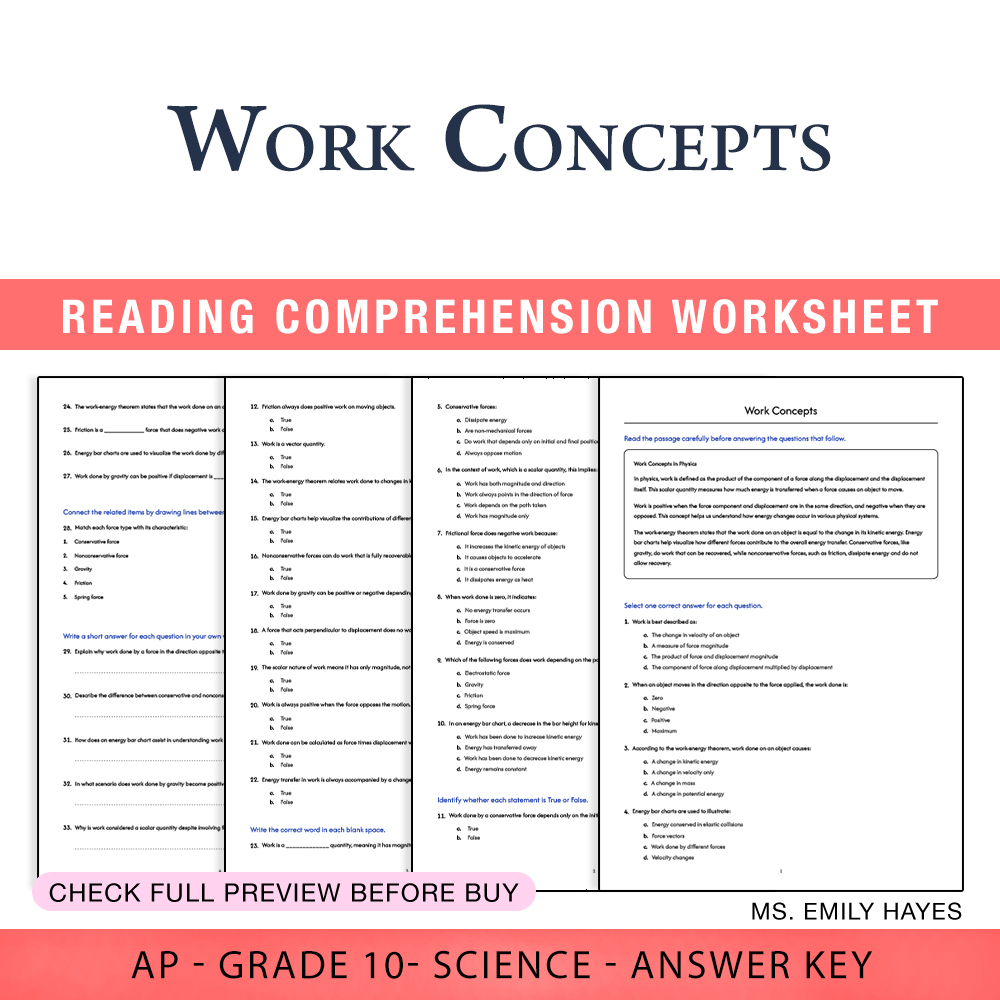
10th Grade Science | Work Concepts Worksheet (PDF+ Answer Key)
 Created byCopper Leaf Classroom
Learning Objectives
- Define work as the product of force component along displacement.
- Explain the scalar nature of work in various contexts.
- Connect work to changes in kinetic energy via the work-energy relationship.
Also included in: Grade 10 Science AP | Physics & Energy Concepts (PDF+ Answer Key) +1 more
Instant download
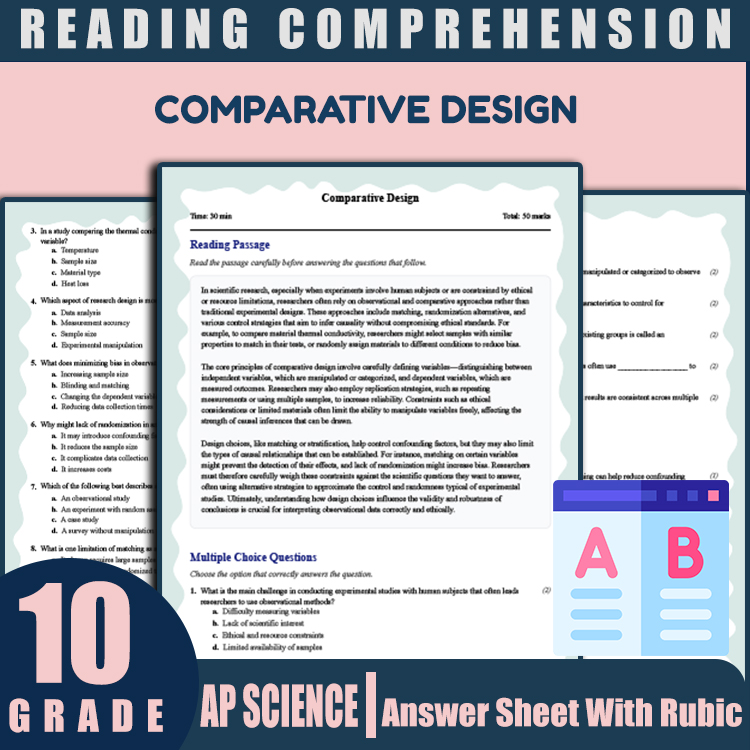
10th Grade Science | Comparative Design Reading Worksheet + Answer Key (PDF)
JCreated byJ.S SheetsLearning Objectives
- Understand principles of observational and controlled trial designs in scientific research.
- Identify and differentiate independent and dependent variables in experiments.
- Evaluate strategies for minimizing bias and ensuring validity in research design.
Also included in: Grade 10 Science Unit Worksheet Pack – Data Analysis & Scientific Reasoning +1 more
Instant download
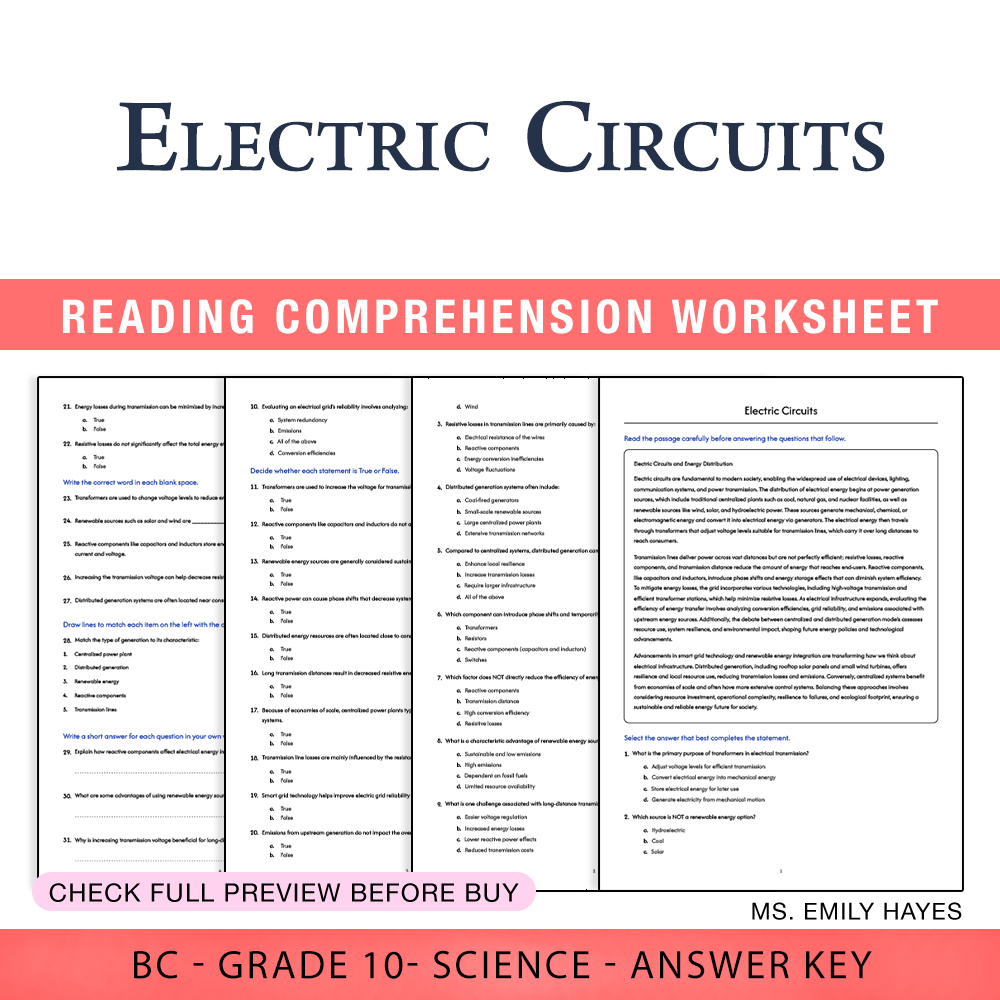
Grade 10 Science | Electric Circuits Worksheet (PDF + Answer Key)
Created byCopper Leaf ClassroomLearning Objectives
- Explain the basic components and functions of electrical circuits.
- Describe how energy is distributed and transformed in electrical systems.
- Evaluate factors affecting the efficiency of electrical transmission.
Also included in: Grade 10 Science BC – Energy, Thermodynamics & Ecosystems (PDF + Answer Key) +1 more
Instant download
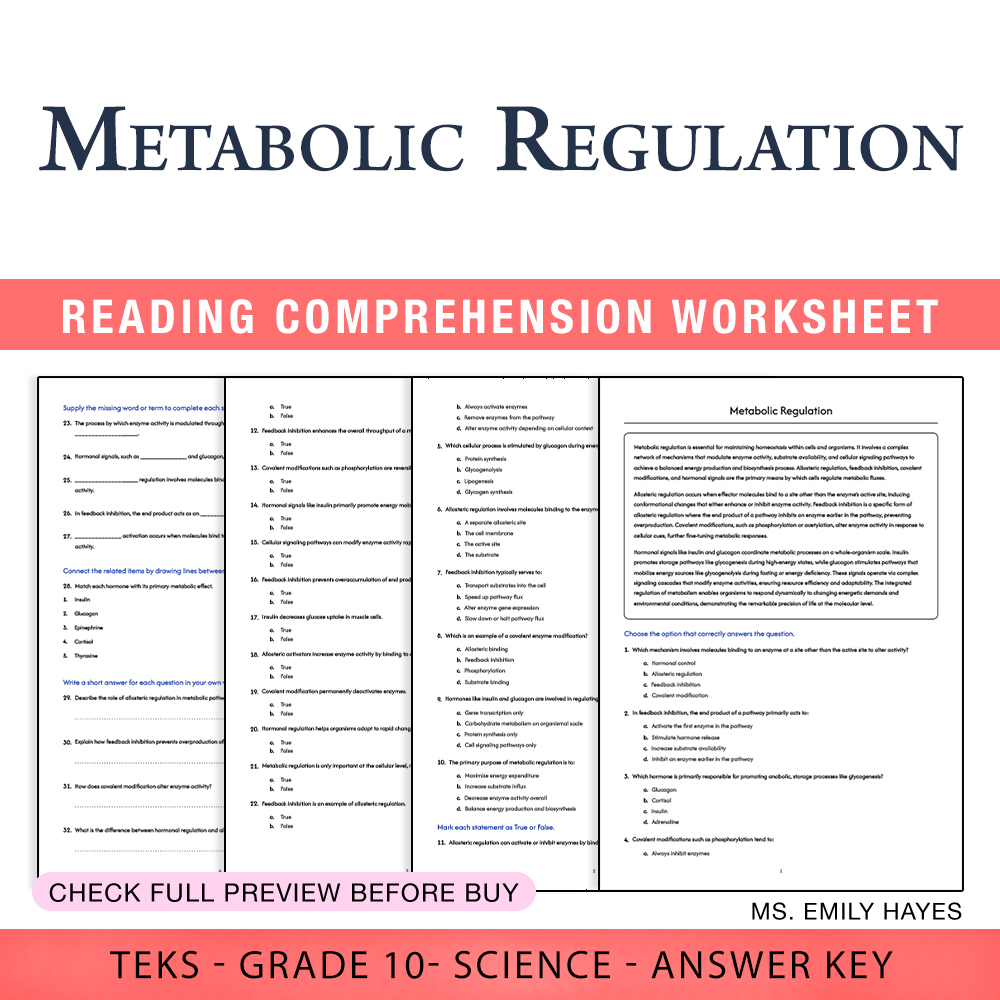
10th Grade Science | Metabolic Regulation Worksheet (PDF+ Answer Key)
Created byCopper Leaf ClassroomLearning Objectives
- Describe mechanisms of enzyme regulation in metabolic pathways.
- Explain the roles of allosteric control and feedback inhibition.
- Identify how cellular signals influence enzyme activity and metabolism.
Instant download
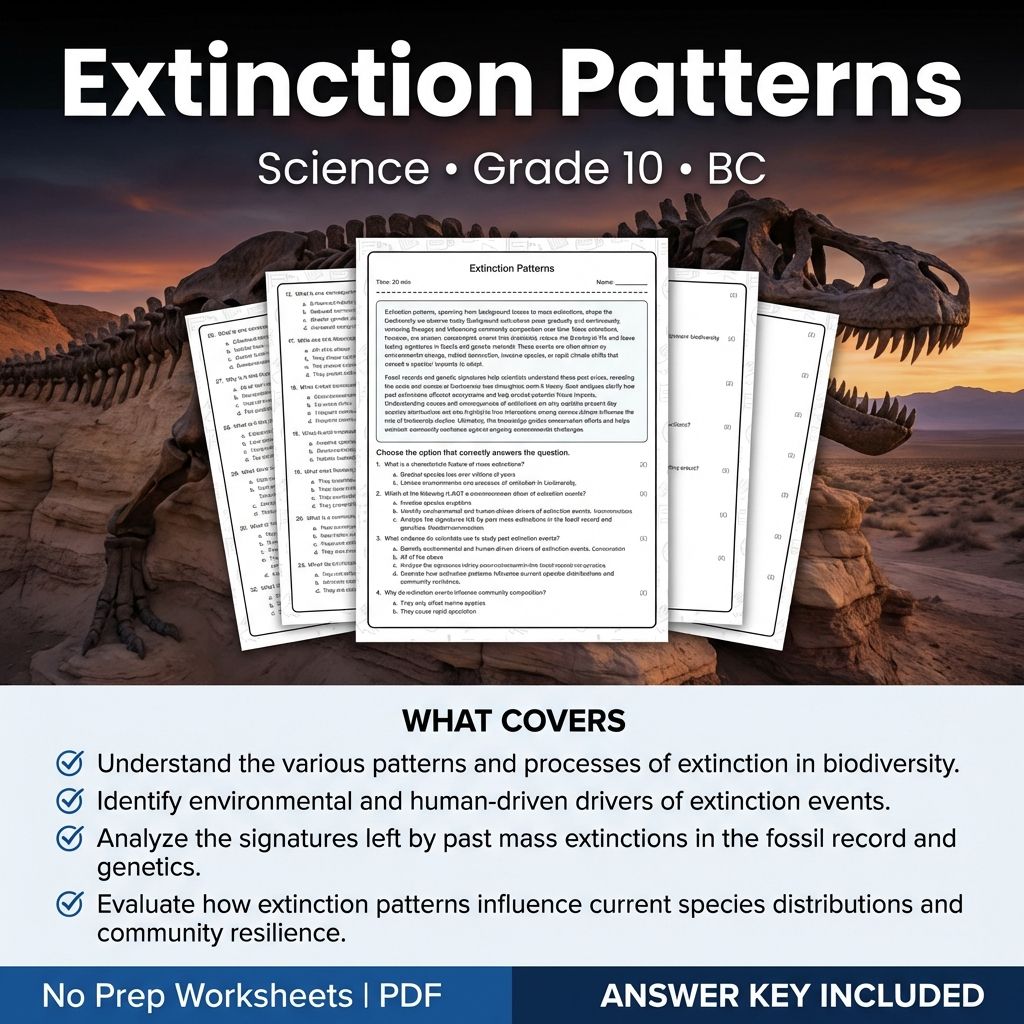
10th Grade Science | Extinction Patterns Worksheet & PDF Answer Key
 Created byCoral Reef Learning
Learning Objectives
- Understand the various patterns and processes of extinction in biodiversity.
- Identify environmental and human-driven drivers of extinction events.
- Analyze the signatures left by past mass extinctions in the fossil record and genetics.
Instant download
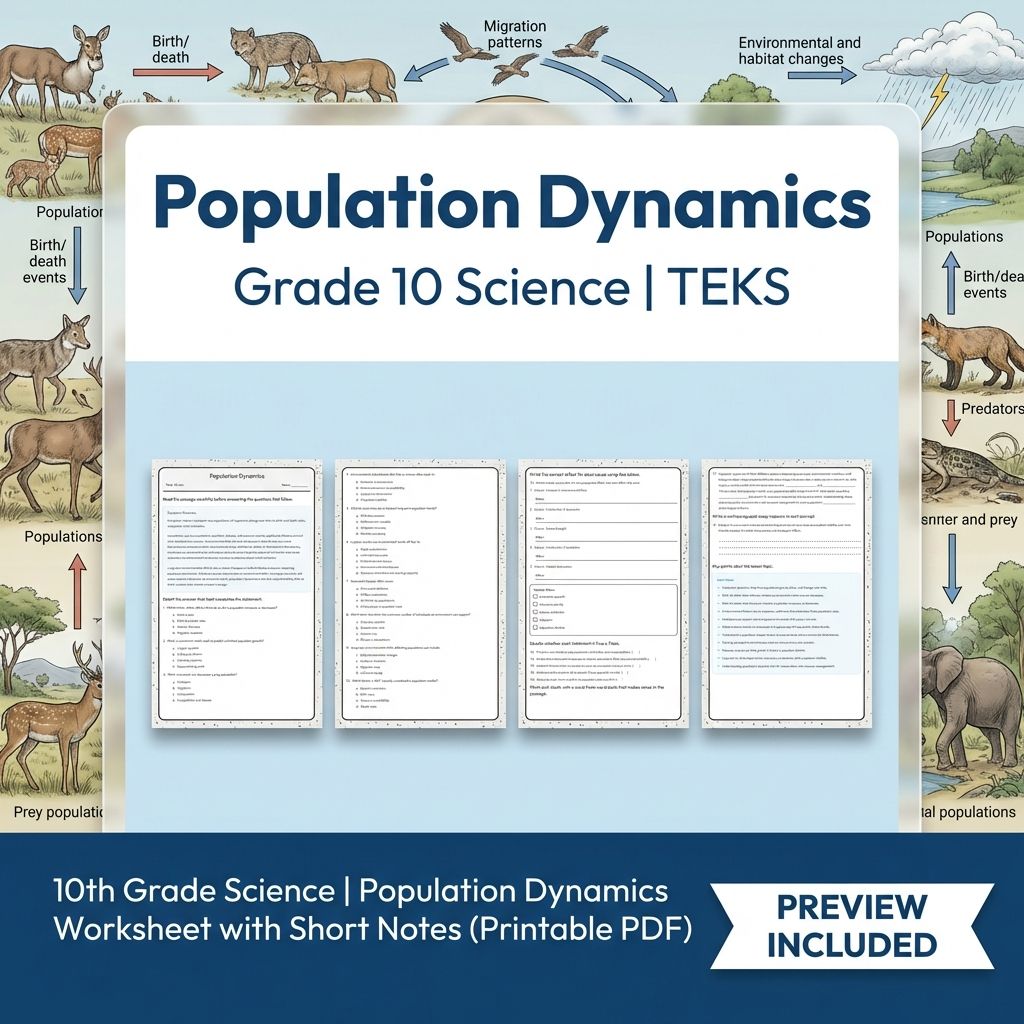
10th Grade Science | Population Dynamics Worksheet with Short Notes (PDF)
 Created byMeadowlark Worksheets
Learning Objectives
- Understand the factors that influence population growth and change.
- Learn about different models used to predict population trends.
- Identify the types of fluctuations that affect populations over time.
Instant download
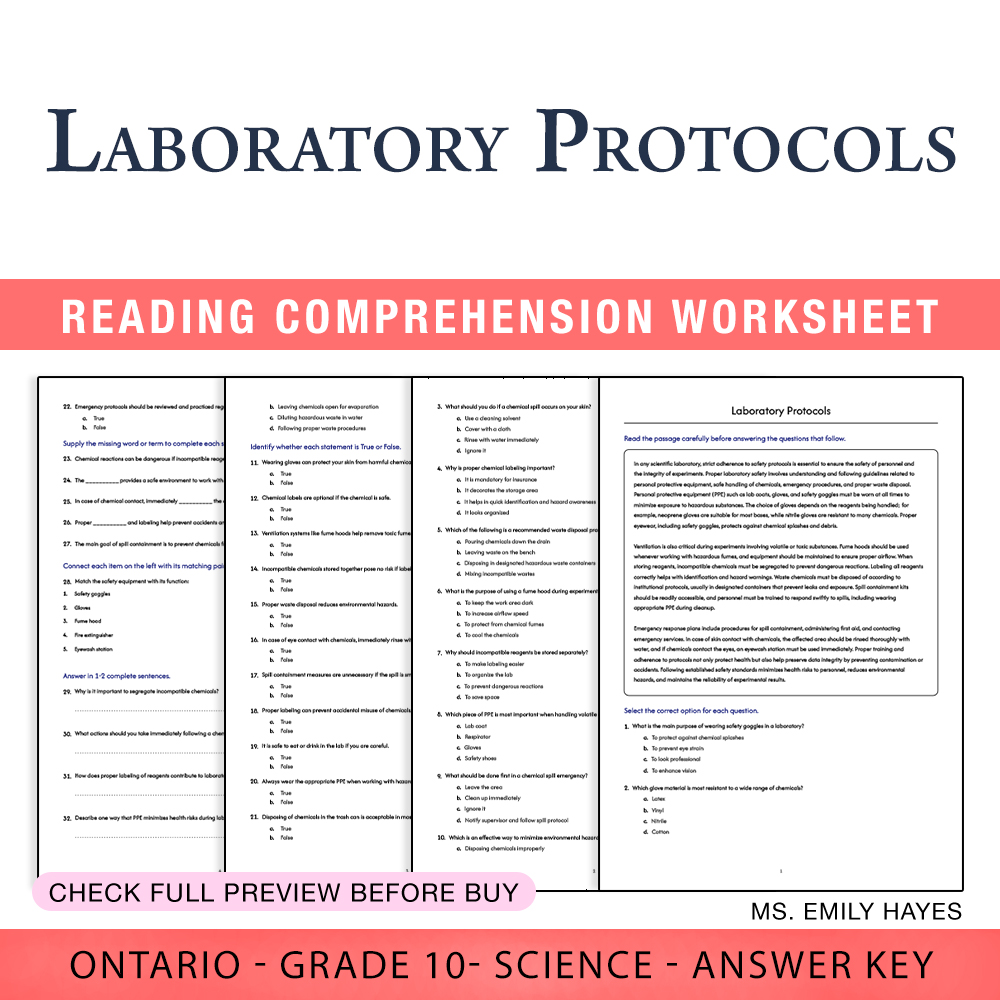
10th Grade Science | Laboratory Protocols Worksheet (PDF + Answer Key)
Created byCopper Leaf ClassroomLearning Objectives
- Identify essential safety protocols for laboratory work.
- Recognize appropriate use of personal protective equipment (PPE).
- Understand proper storage, labeling, and waste handling procedures.
Instant download
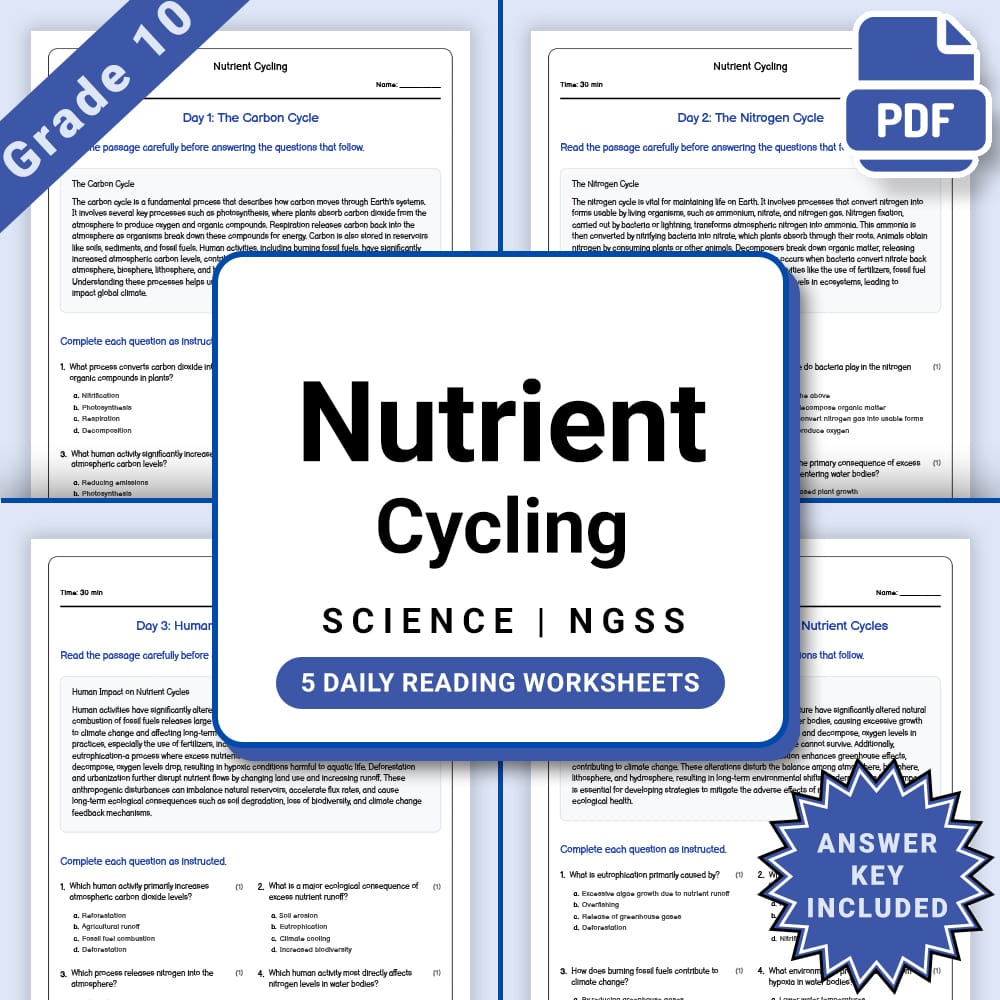
Grade 10 Science – Nutrient Cycling Worksheet (PDF +Answer Key)
Created byCopper Leaf ClassroomLearning Objectives
- Identify major components and processes of the carbon cycle.
- Understand the movement of carbon among Earth's systems.
- Analyze the impact of human activities on nutrient fluxes.
Instant download
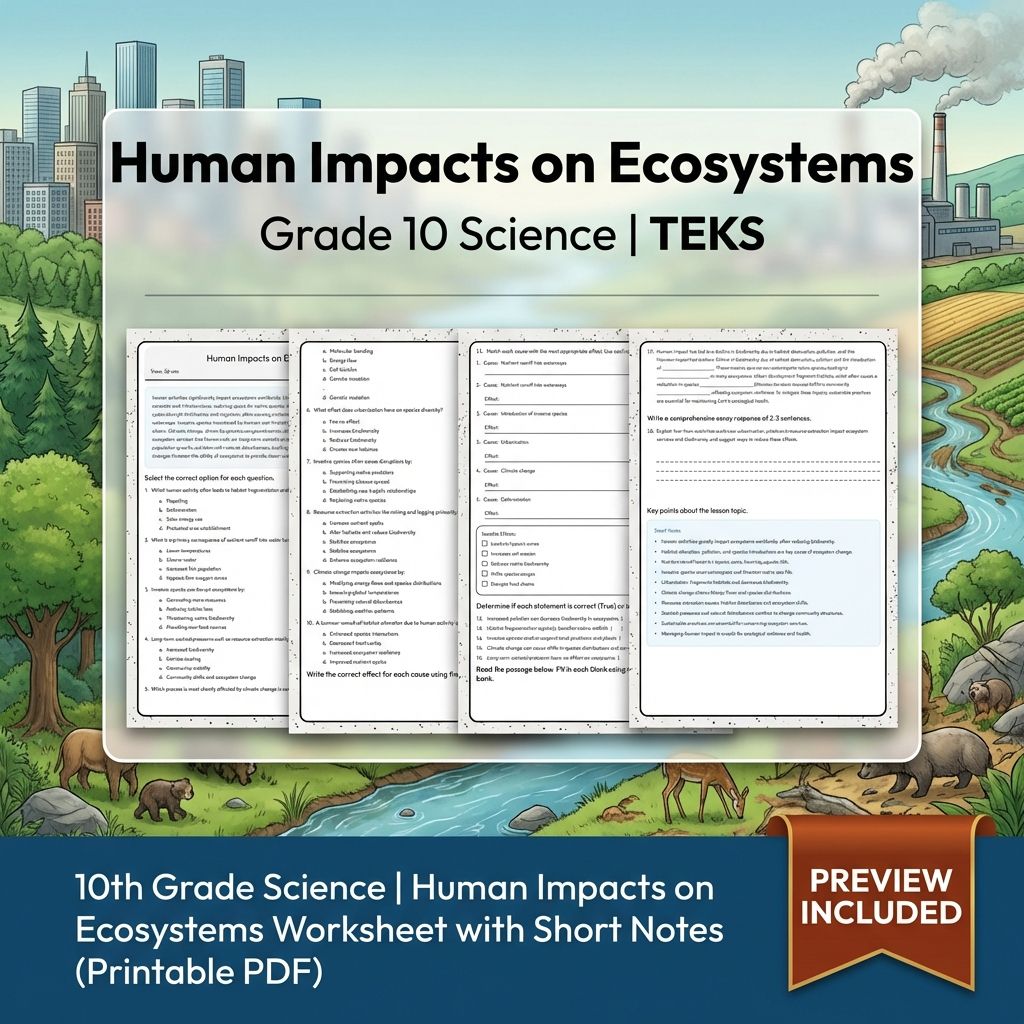
10th Grade Science Human Impacts on Ecosystems Worksheet with Short Notes (PDF)
Created byMeadowlark WorksheetsLearning Objectives
- Identify ways human activities modify ecosystems, including habitat alteration, pollution, and species introductions.
- Understand the effects of urbanization and agriculture on biodiversity and population dynamics.
- Explain the processes leading to hypoxic zones and disruptions in trophic relationships caused by invasive species.
Instant download
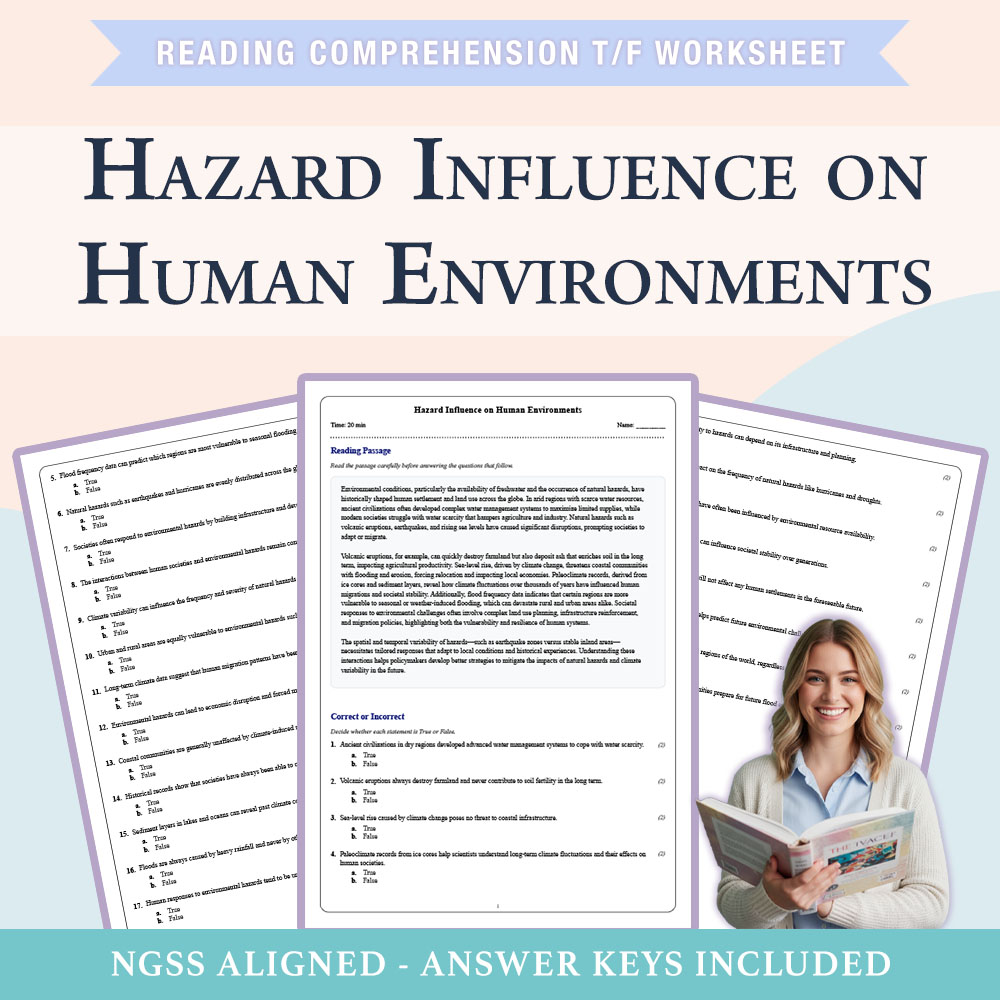
Grade 10 Science|Hazard Influence on Human Environments Worksheet(PDF + Answers)
Created byCopper Leaf ClassroomLearning Objectives
- Understand how natural hazards and climate variability influence human settlement patterns and land use decisions.
- Analyze examples of resource scarcity and environmental hazards affecting societies historically and today.
- Evaluate evidence from paleoclimate records and historical data to understand societal responses to environmental challenges.
Also included in: Grade 10 Science | Environmental Management & Climate Change (PDF + Answer Key) +1 more
Instant download

Grade 10 Science | Stellar Lifecycles & Evolution - Daily Reading Comprehension
Created byCoral Reef LearningLearning Objectives
- Identify the main stages in the lifecycle of a star
- Understand the processes driving stellar evolution such as nuclear fusion
- Interpret the Hertzsprung-Russell diagram and its significance
Instant download
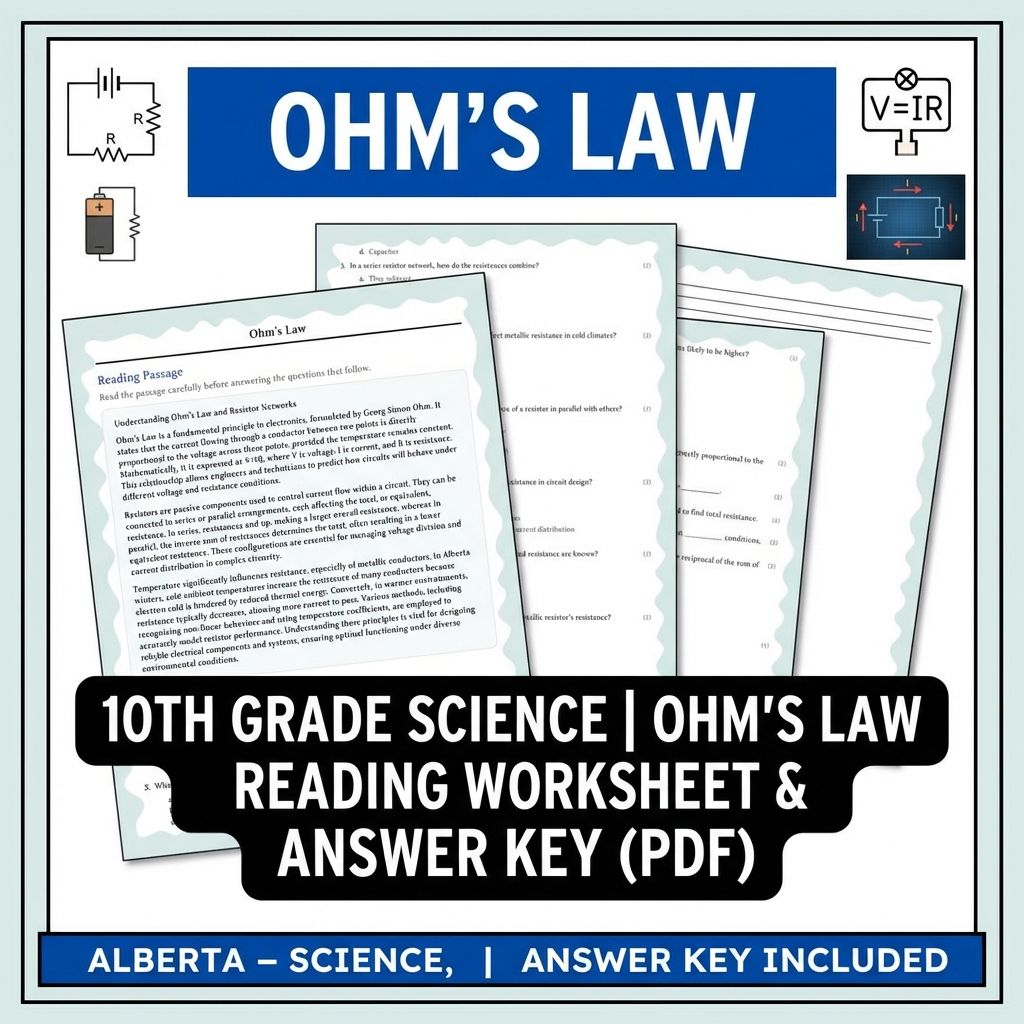
10th Grade Science | Ohm's Law Reading Worksheet & Answer Key (PDF)
JCreated byJ.S SheetsLearning Objectives
- Understand the principles of Ohm's Law and its applications in electric circuits.
- Explain how resistor networks affect circuit behavior.
- Analyze the influence of temperature on conductor resistance, especially in cold environments.
Also included in: Grade 10 Science Bundle | Energy, Circuits & Mechanics (Answer Keys Included) +1 more
Instant download
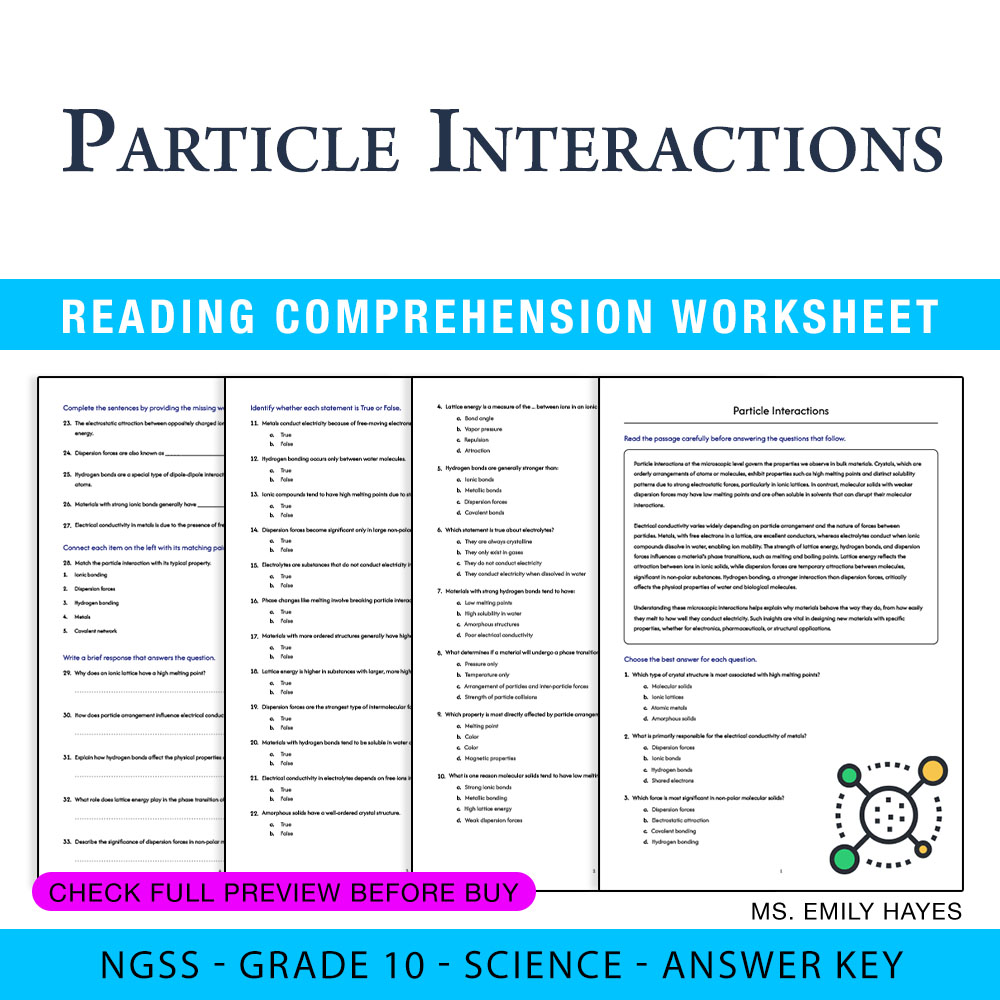
10th Grade Science | Particle Interactions Worksheet (PDF+ Answer Key)
Created byCopper Leaf ClassroomLearning Objectives
- Understand how crystal structure influences material properties such as melting point and solubility.
- Explain molecular interactions like hydrogen bonding, dispersion forces, and lattice energy.
- Describe how particle arrangement affects electrical conductivity and phase changes.
Instant download
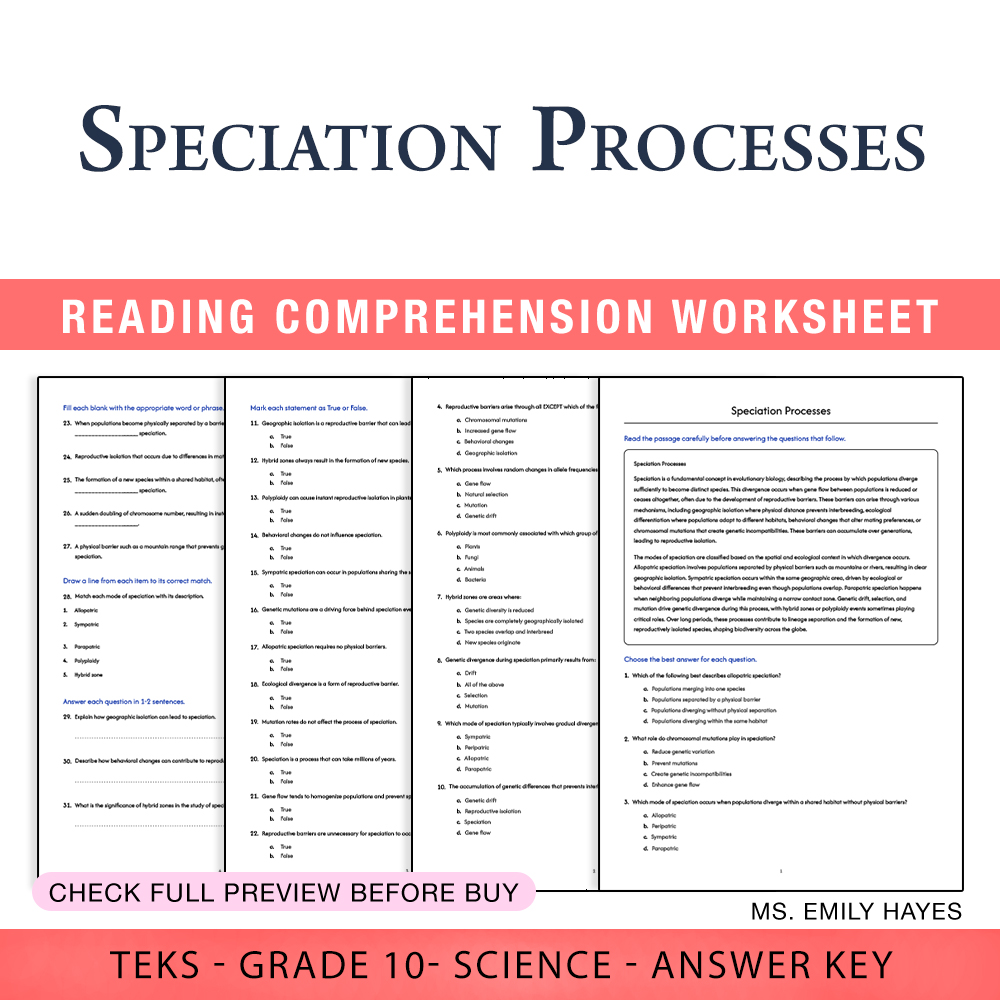
10th Grade Science | Speciation Processes Worksheet (PDF + Answer Key)
Created byCopper Leaf ClassroomLearning Objectives
- Understand the mechanisms that lead to the formation of new species.
- Identify reproductive barriers and their roles in speciation.
- Differentiate between allopatric, sympatric, and parapatric modes of speciation.
Instant download
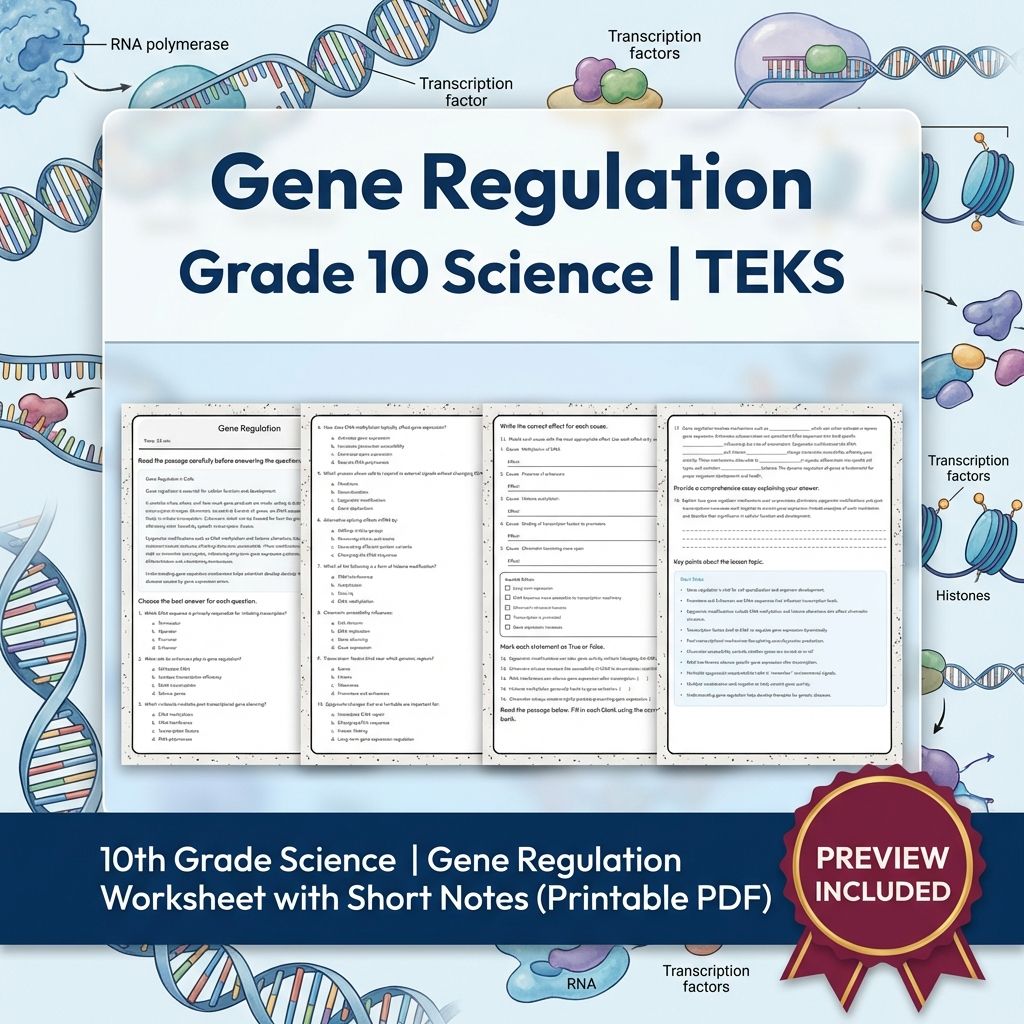
10th Grade Science | Gene Regulation Worksheet with Short Notes (Printable PDF)
Created byMeadowlark WorksheetsLearning Objectives
- Understand the mechanisms involved in gene regulation at transcriptional and post-transcriptional levels.
- Identify the roles of promoters, enhancers, and transcription factors in gene expression.
- Explain how epigenetic modifications influence gene activity.
Instant download
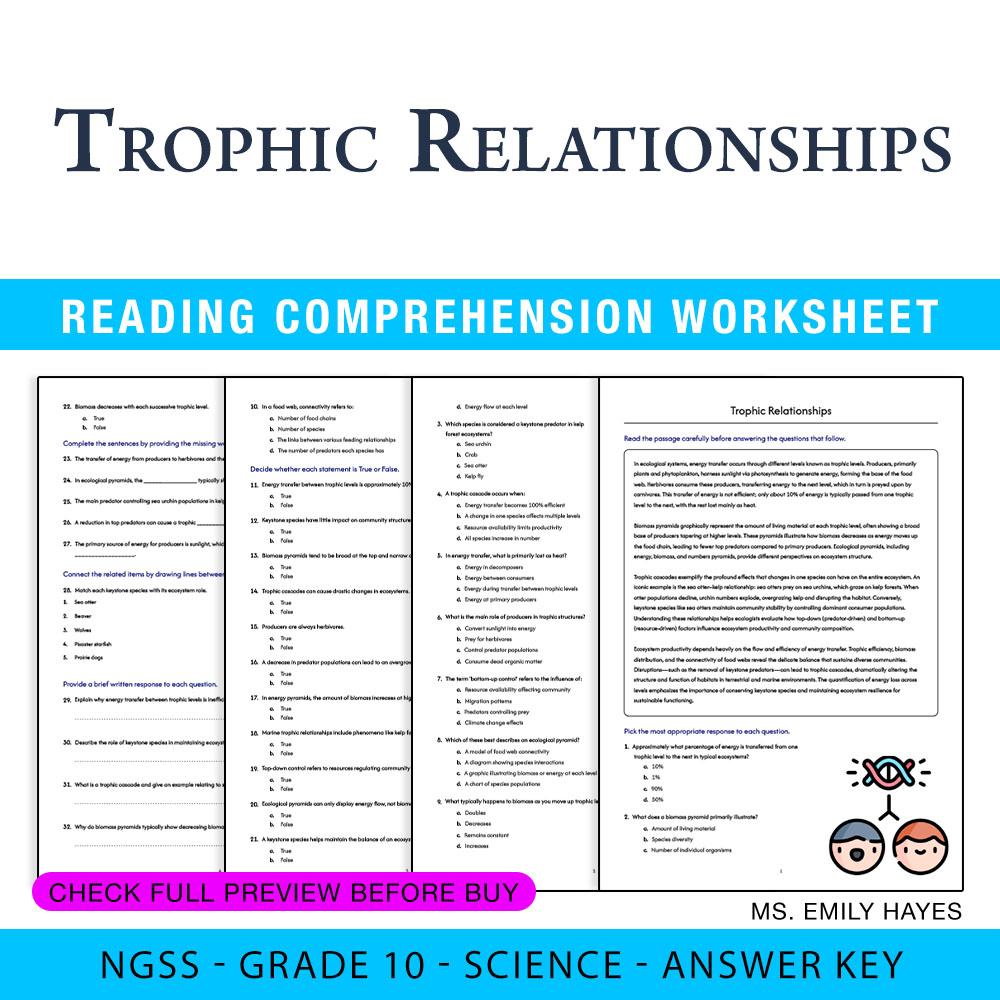
10th Grade Science | Trophic Relationships Worksheet (PDF + Answer Key)
Created byCopper Leaf ClassroomLearning Objectives
- Understand energy transfer and biomass pyramids in ecosystems.
- Analyze the role of keystone species and trophic cascades in community structure.
- Interpret ecological pyramids and evaluate top-down and bottom-up controls.
Instant download

Grade 10 Science – Periodic Trends & Atomic Properties | Daily Reading Worksheet
 Created byBright Mind Resources
Learning Objectives
- Identify basic periodic trends of atomic radius and ionization energy
- Understand the relationship between element placement and reactivity
- Explain how atomic size and energy levels influence element properties
Also included in: Grade 10 Chemistry Science Daily Reading Worksheets Lesson Bundle | Ontario +1 more
Instant download
10th Grade Science | Variables and Constraints Worksheet with Short Notes (PDF)
Created byMeadowlark WorksheetsLearning Objectives
- Classify variables into independent, dependent, and controlled factors in experiments.
- Understand the importance of boundary conditions and operational definitions in scientific measurements.
- Analyze the criteria used to select variables that isolate causal relationships.
Also included in: Grade 10 Science Unit | Data Analysis, Modelling Worksheet Pack
Instant download

Grade 10 Worksheet B: Reaction Rates (Collision Theory & Rate Laws) | NGSS
 Created byClear Sky Classroom
Learning Objectives
- Explain how collision theory and activation energy affect reaction rate.
- Predict how changes in temperature, concentration, surface area, and catalysts influence reaction speed.
- Connect molecular collision frequency to observed rate constants using quantitative reasoning.
Also included in: Grade 10 Reaction Rates & Chemical Change Science Lesson Bundle – NGSS +1 more
Instant download
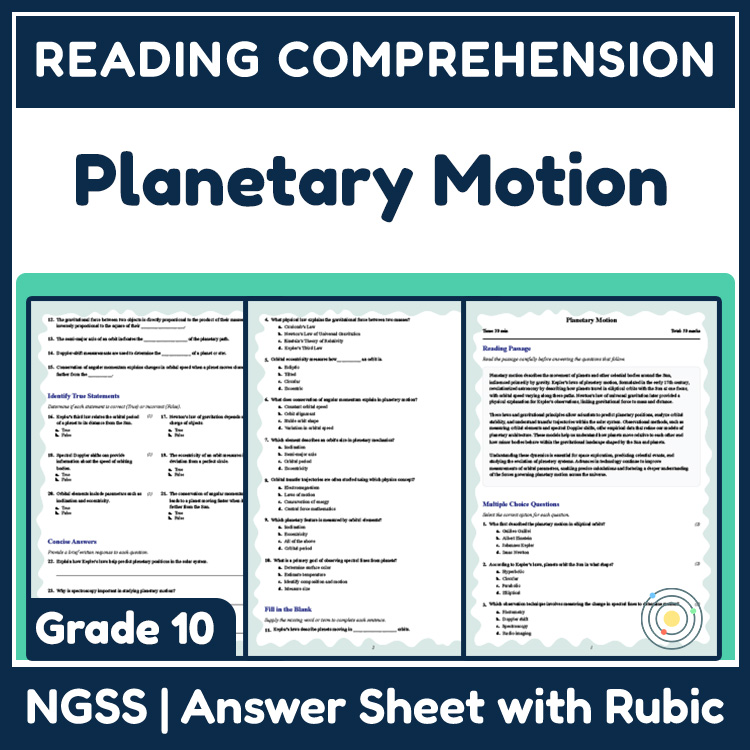
10th Grade Science | Planetary Motion Reading Worksheet with Answer Key (PDF)
JCreated byJ.S SheetsLearning Objectives
- Understand the principles of gravitational dynamics governing planetary orbits
- Explain Kepler's laws and their application to planetary motion
- Relate orbital elements such as eccentricity and semi-major axis to planetary trajectories
Instant download
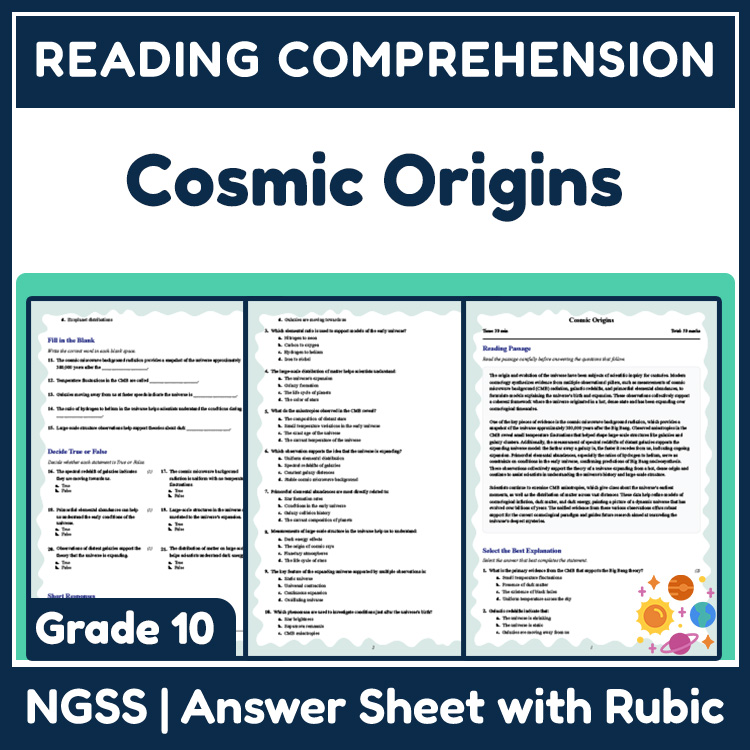
10th Grade Science | Cosmic Origins Reading Worksheets (PDF + Answer Key)
JCreated byJ.S SheetsLearning Objectives
- Understand the evidence supporting models of cosmic origin such as CMB radiation, galactic redshifts, and elemental abundances.
- Explain how measurements like spectral redshift and large-scale structures support the expanding universe theory.
- Describe what CMB anisotropies and hydrogen-to-helium ratios reveal about conditions in the early universe.
Instant download

Grade 10 Atomic Structure Worksheet | NGSS Chemistry Science Activity
 Created byBRIGHT PATH RESOURCES
Learning Objectives
- Identify the basic subatomic particles of an atom: protons, neutrons, and electrons.
- Understand how electrons are arranged in energy levels and sublevels.
- Describe the composition of the nucleus and its relationship to atomic number and mass.
Also included in: Matter and Its Interactions Grade 10 Science Lesson Bundle | NGSS +1 more
Instant download

Grade 10 Reaction Evidence in Chemistry Worksheet | NGSS Science Activity
Created byBRIGHT PATH RESOURCESLearning Objectives
- Understand the evidence that indicates a chemical reaction has occurred.
- Identify observable changes such as gas evolution, color change, temperature change, and precipitate formation.
- Relate reactant properties to the products formed in chemical reactions.
Also included in: Matter and Its Interactions Grade 10 Science Lesson Bundle | NGSS +1 more
Instant download

Grade 10 Chemical Equilibrium Worksheet | NGSS Chemistry Activity & Notes
Created byBRIGHT PATH RESOURCESLearning Objectives
- Understand the concept of chemical equilibrium and how it is achieved in reactions.
- Identify features of chemical equilibrium in various reactions.
- Recognize how changes in pressure, concentration, and temperature affect equilibrium.
Also included in: Matter and Its Interactions Grade 10 Science Lesson Bundle | NGSS +1 more
Instant download
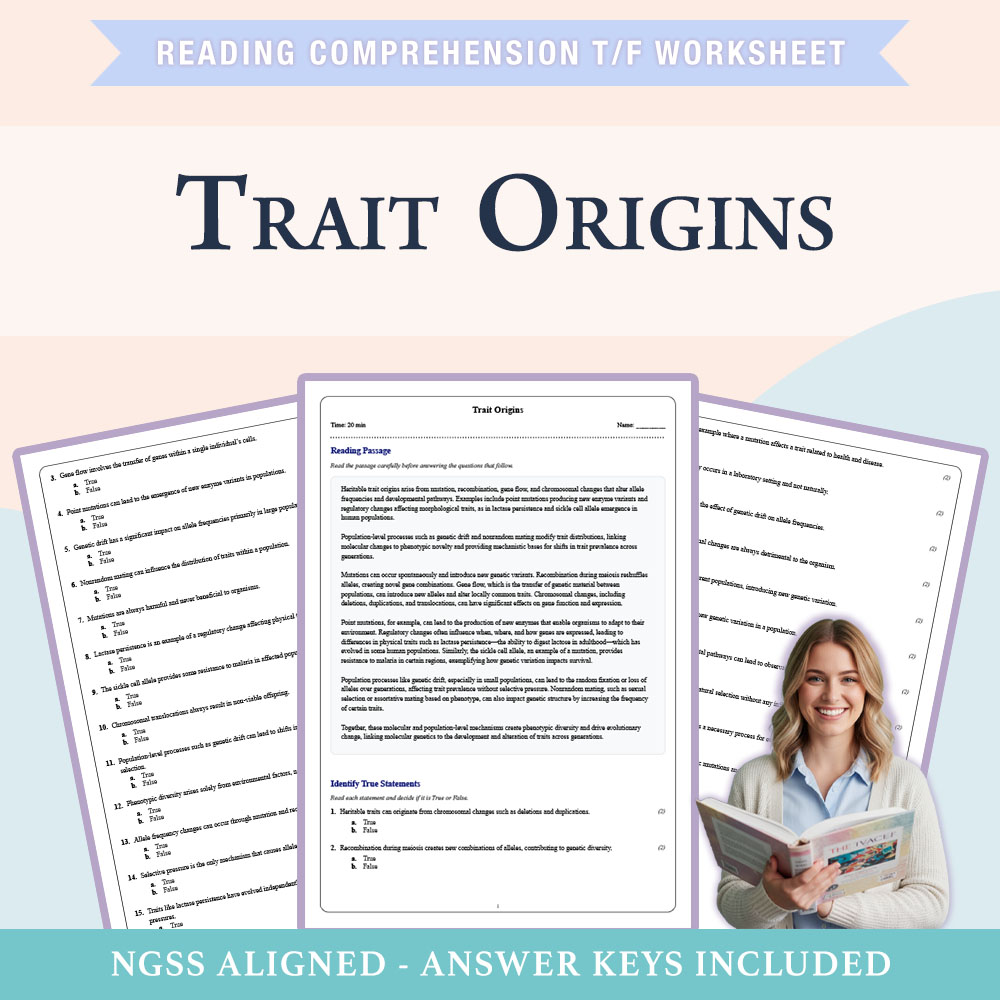
10th Grade Science | Trait Origins Worksheet (PDF + Answer Key)
Created byCopper Leaf ClassroomLearning Objectives
- Understand the molecular and population-level processes that produce heritable traits.
- Identify examples of genetic mutations and population dynamics affecting trait distribution.
- Explain how genetic changes contribute to phenotypic variation and evolution.
Also included in: Grade 10 Science | Evolution & Biodiversity Unit Bundle (PDF + Answer Key) +1 more
Instant download
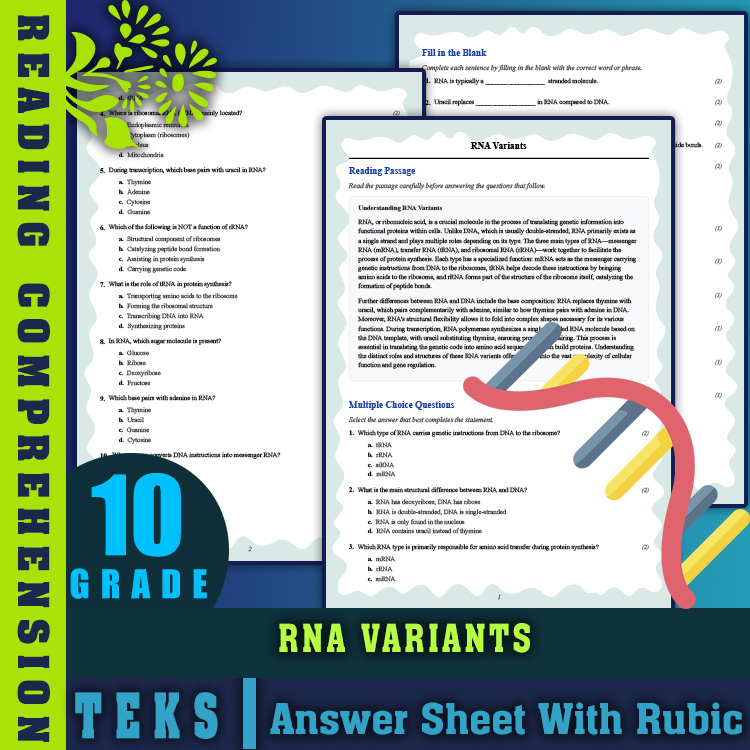
10th Grade Science | RNA Variants Reading Worksheet & Answer Key (PDF)
JCreated byJ.S SheetsLearning Objectives
- Identify the different types of RNA and their functions.
- Explain the structural differences between RNA and DNA.
- Describe the roles of messenger RNA, transfer RNA, and ribosomal RNA in protein synthesis.
Instant download

Grade 10 Particle Interactions and Macroscopic Properties Worksheet | NGSS
 Created byAmber Owl Education
Learning Objectives
- Explain how particle attractions relate to bulk properties such as melting point and conductivity
- Compare ionic, molecular, and metallic solids using ideas about lattice structure and forces
- Use particle-interaction vocabulary (dispersion forces, hydrogen bonding, lattice energy) to predict phase-change behavior
Instant download

10th Grade Science | Succession Processes Reading Worksheets PDF & Answer Key
JCreated byJ.S SheetsLearning Objectives
- Understand the steps and types of ecological succession
- Describe primary and secondary succession processes
- Identify factors influencing succession and biodiversity
Instant download
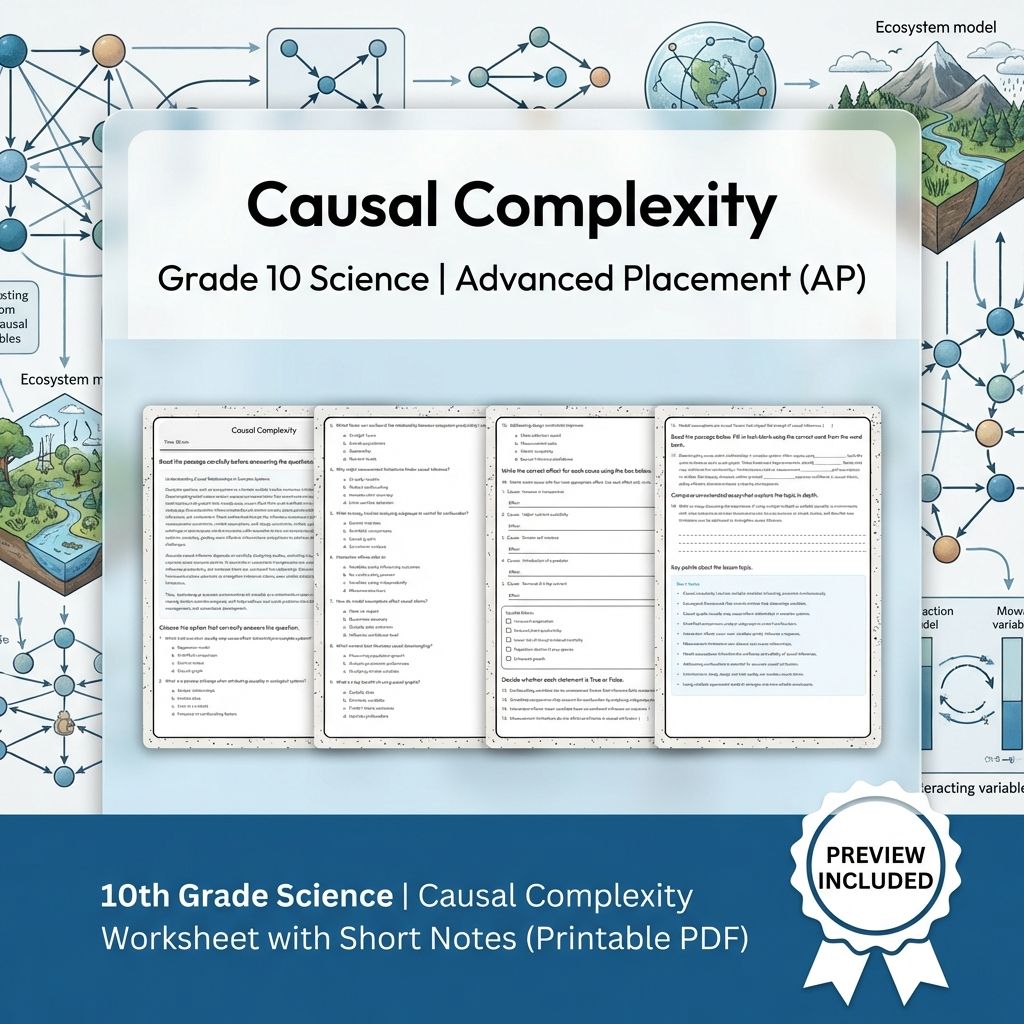
10th Grade Science | Causal Complexity Worksheet with Short Notes (PDF)
Created byMeadowlark WorksheetsLearning Objectives
- Understand how to analyze multivariable causal relationships using conceptual frameworks.
- Identify confounding factors, interaction effects, and limitations in complex systems.
- Apply strategies like control matrices, causal graphs, and stratified comparisons to real-world contexts.
Also included in: Grade 10 Science Unit | Data Analysis, Modelling Worksheet Pack
Instant download
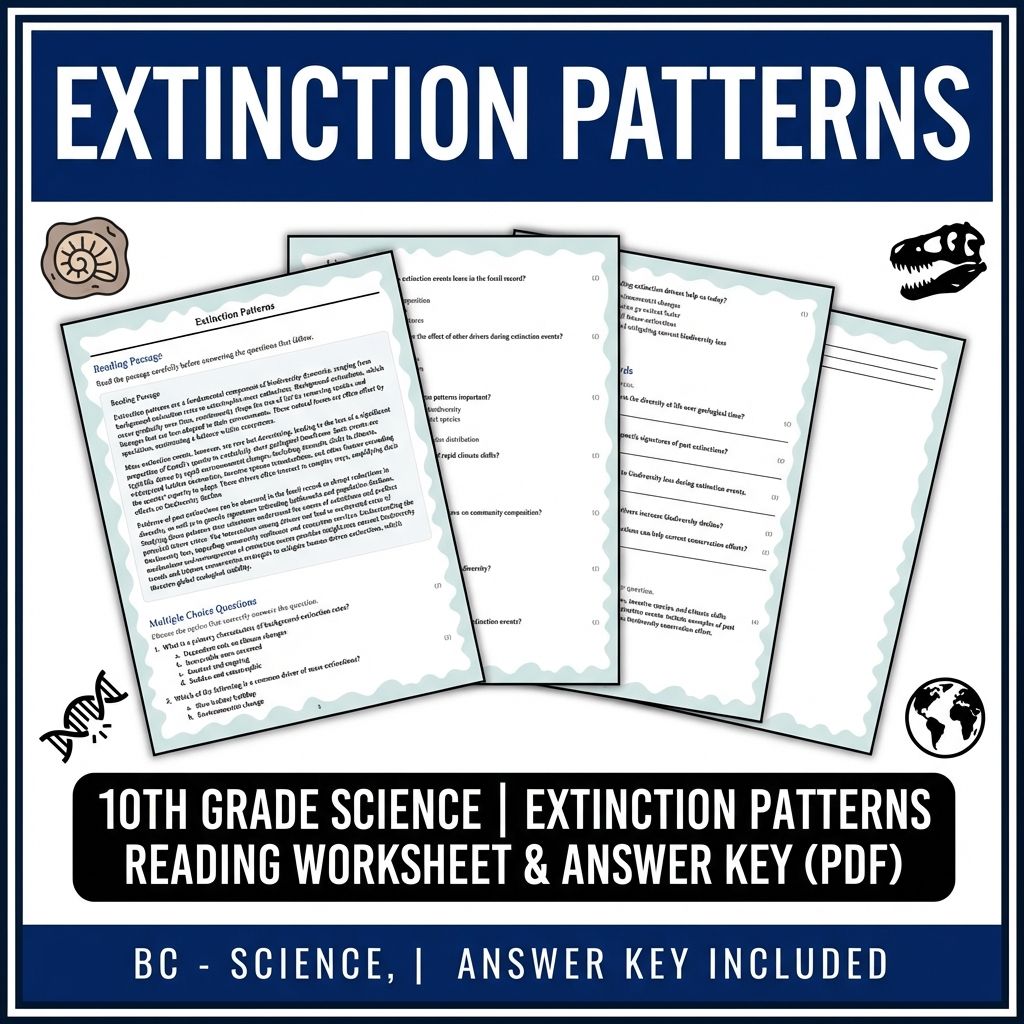
10th Grade Science | Extinction Patterns Reading Worksheet & Answer Key (PDF)
JCreated byJ.S SheetsLearning Objectives
- Understand the different types of extinction patterns in biodiversity.
- Identify causes and drivers of extinction events.
- Explain how extinction leaves fossil and genetic signatures.
Instant download
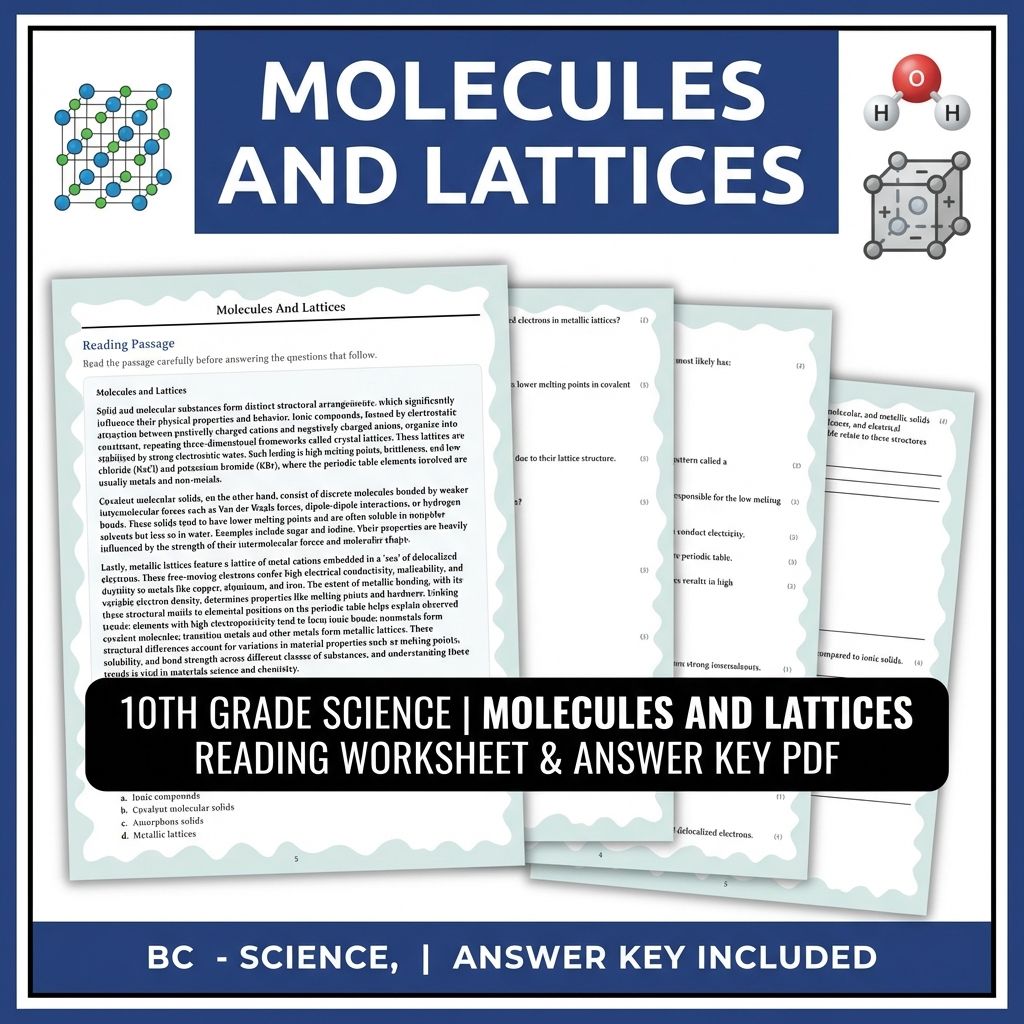
10th Grade Science | Molecules and Lattices Reading Worksheet & Answer Key PDF
JCreated byJ.S SheetsLearning Objectives
- Explain the different structural arrangements of solid and molecular substances.
- Describe the properties of ionic, covalent molecular, and metallic solids based on their structures.
- Relate lattice structures to element positions on the periodic table and understand their impact on material properties.
Instant download
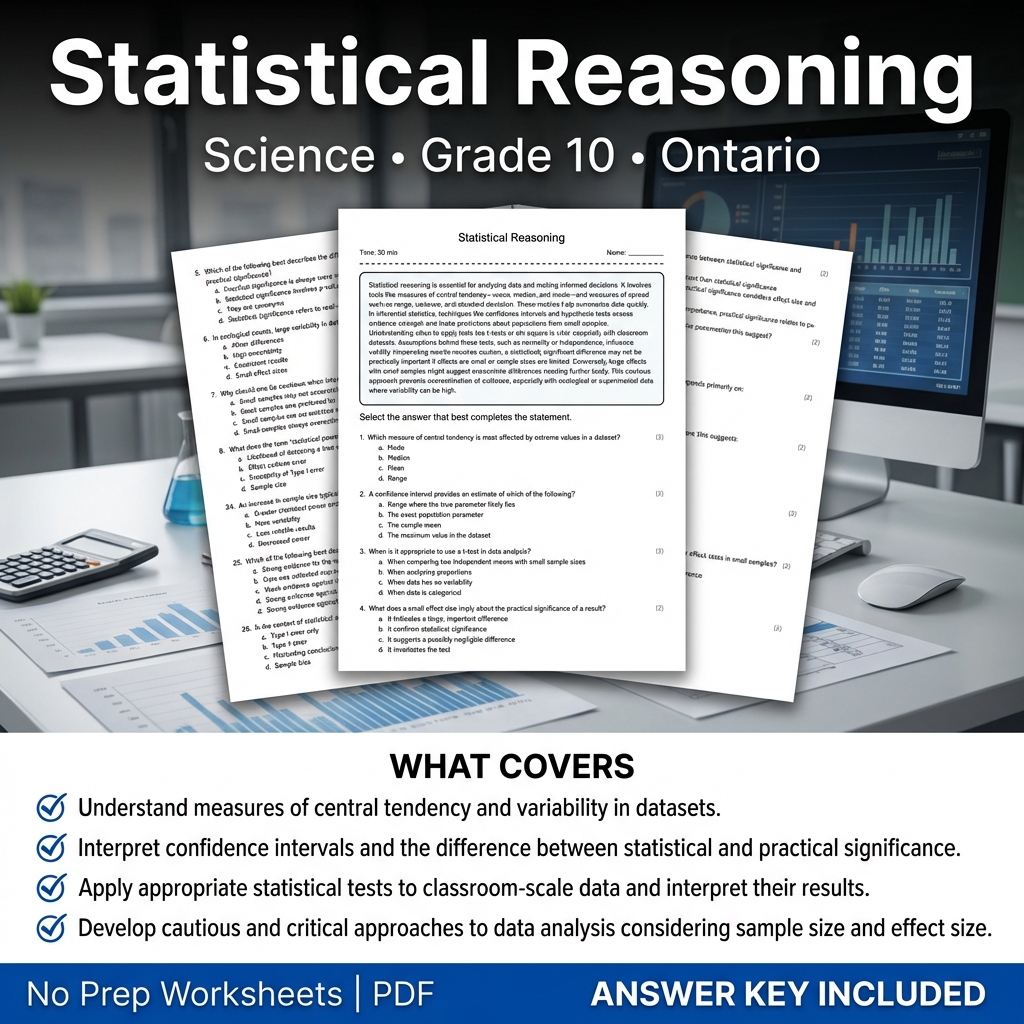
Statistical Reasoning Worksheet for Grade 10 Science | Ontario Standards
Created byCoral Reef LearningLearning Objectives
- Understand measures of central tendency and variability in datasets.
- Interpret confidence intervals and the difference between statistical and practical significance.
- Apply appropriate statistical tests to classroom-scale data and interpret their results.
Instant download
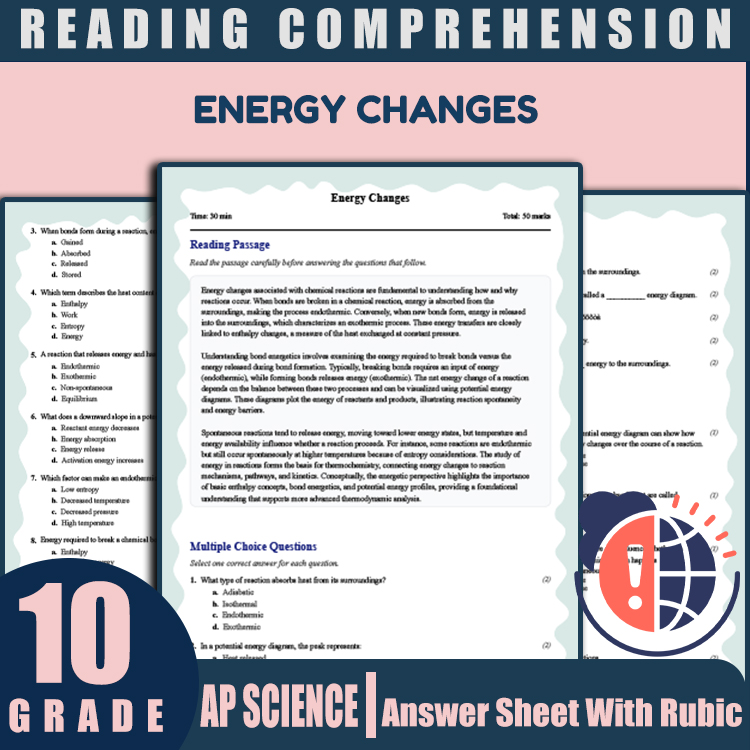
Grade 10 Science | Energy Changes Reading Worksheet (PDF + Answer Key)
JCreated byJ.S SheetsLearning Objectives
- Describe the differences between endothermic and exothermic processes.
- Explain basic concepts of enthalpy and how bond breaking and formation influence reaction heat.
- Relate energy changes to potential energy diagrams and reaction pathways.
Also included in: Grade 10 Science Unit Worksheet Bundle | Chemical Reactions & Atomic Structure +1 more
Instant download

10th Grade Science | Orbital Forcing Reading Worksheet (PDF + Answer Key)
JCreated byJ.S SheetsLearning Objectives
- Describe how variations in Earth's orbit influence insolation and climate cycles.
- Explain the mechanisms by which orbital parameters impact seasonal contrast and glacial rhythms.
- Distinguish between orbital drivers of climate and shorter-term atmospheric or human influences.
Also included in: Grade 10 Science Unit Bundle – Earth Systems, Climate & Remote Sensing Worksheets +1 more
Instant download

Effects of Acceleration Grade 10 Assessment | General Standards
 Created byPrism Point Learning
Learning Objectives
- Understand how acceleration affects velocity over time.
- Interpret graph features such as curvature and slope changes to analyze motion.
- Differentiate between positive and negative acceleration and their effects on speed and direction.
Also included in: Grade 10 Physical Science Science Lesson Bundle: General Framework
Instant download

Conservation of Energy Assessment | General Grade 10 Science Standards
Created byPrism Point LearningLearning Objectives
- Understand the principle that energy is neither created nor destroyed but transferred and transformed.
- Describe qualitative energy accounting and how energy forms shift within a closed system.
- Explain how nonconservative forces, such as friction, affect mechanical energy in a system.
Also included in: Grade 10 Physical Science Science Lesson Bundle: General Framework
Instant download

Energy Transfer Assessment for Grade 10 Science | Standards-Aligned
Created byPrism Point LearningLearning Objectives
- Explain how energy moves between systems and changes form during various processes.
- Identify different types of energy transfer pathways such as heating, work, and radiation.
- Describe the relationship between energy transfer and observable changes like temperature, speed, and height.
Also included in: Grade 10 Physical Science Science Lesson Bundle: General Framework
Instant download

Matter Conservation Assessment for Grade 10 Science | Standards-Aligned
Created byPrism Point LearningLearning Objectives
- Understand that matter is neither created nor destroyed in physical and chemical changes.
- Explain how particle and atom models demonstrate matter conservation.
- Identify phase changes as examples of matter conservation through particle count.
Also included in: Grade 10 Physical Science Science Lesson Bundle: General Framework
Instant download

Kinematics Graphs Assessment | Standards-Aligned Grade 10 Science Worksheet
Created byPrism Point LearningLearning Objectives
- Understand how displacement, velocity, and acceleration are represented on different types of graphs.
- Interpret the slopes of displacement-time and velocity-time graphs to determine motion characteristics.
- Analyze acceleration-time patterns to identify constant, changing, or reversing acceleration.
Also included in: Grade 10 Physical Science Science Lesson Bundle: General Framework
Instant download

Net Force Outcomes Assessment for Grade 10 Science – Standards-Aligned
Created byPrism Point LearningLearning Objectives
- Understand how multiple forces interact to produce net force and acceleration.
- Predict motion changes when forces oppose or align with each other.
- Connect concepts of force, opposition, and acceleration to everyday situations like pushing and sliding.
Also included in: Grade 10 Physical Science Science Lesson Bundle: General Framework
Instant download

Reaction Particles Assessment | NGSS-aligned Grade 10 Science Worksheet
Created byPrism Point LearningLearning Objectives
- Explain how particle collisions influence reaction rates.
- Describe energy barriers and how they affect chemical reactions.
- Analyze how temperature, concentration, and catalysts alter reaction behavior.
Also included in: Grade 10 Physical Science Science Lesson Bundle: General Framework
Instant download
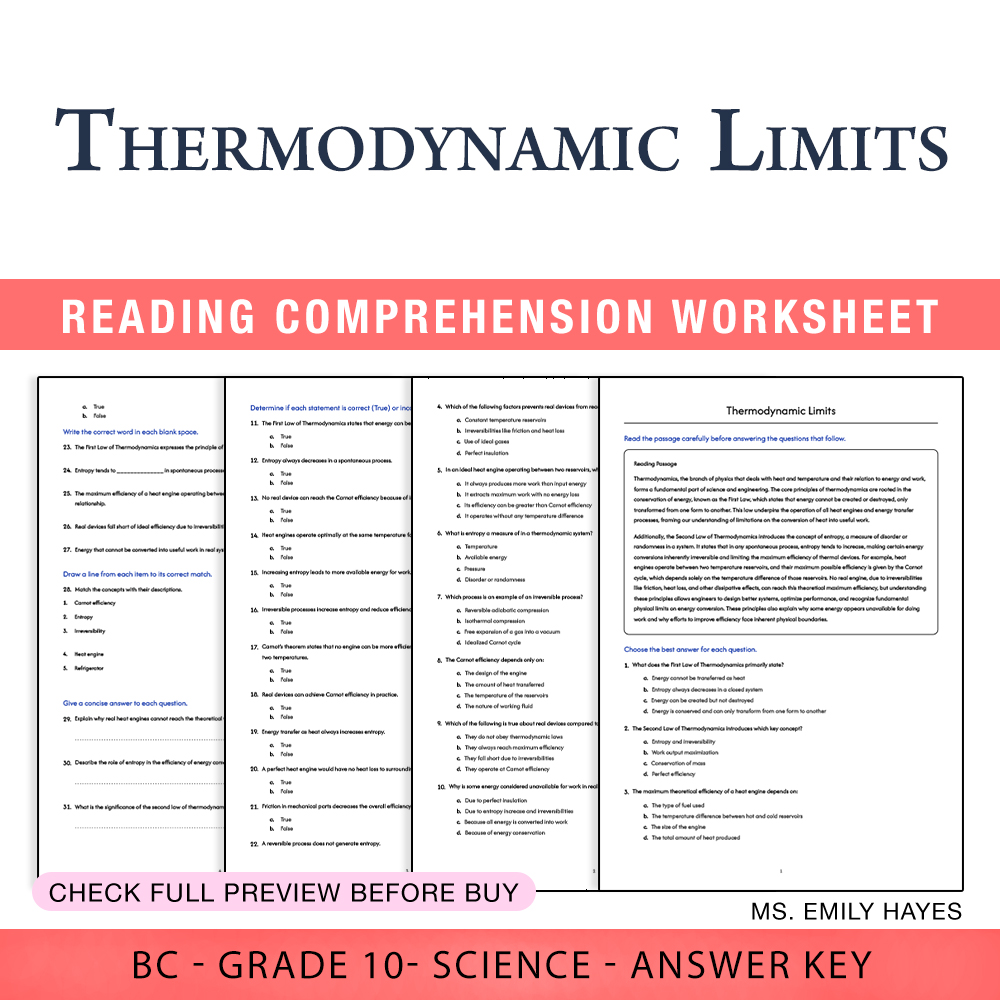
10th Grade Science | Thermodynamic Limits Worksheet (PDF + Answer Key)
Created byCopper Leaf ClassroomLearning Objectives
- Explain the principles of energy conservation and entropy in thermodynamics.
- Describe how heat engines and refrigerators operate between temperature reservoirs.
- Calculate theoretical maximum efficiencies using Carnot relationships.
Also included in: Grade 10 Science BC – Energy, Thermodynamics & Ecosystems (PDF + Answer Key) +1 more
Instant download
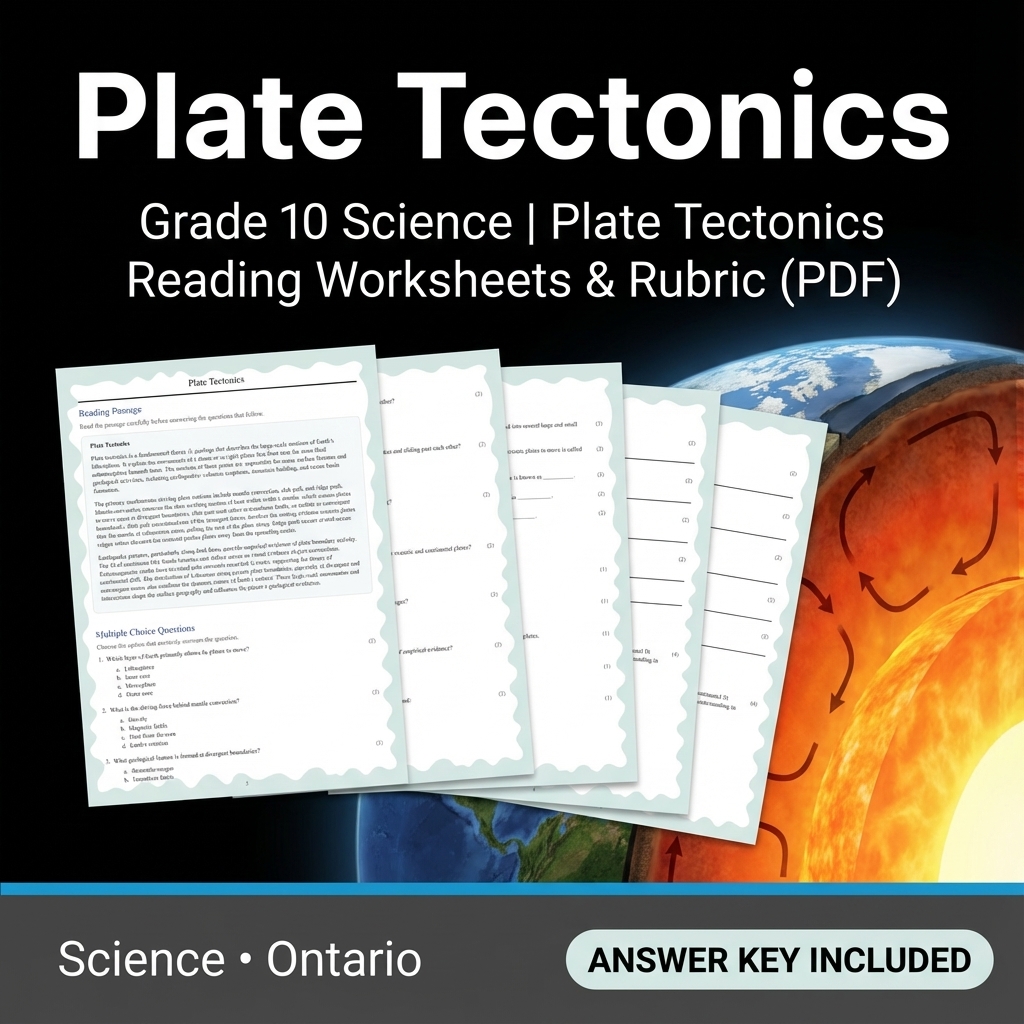
Grade 10 Science | Plate Tectonics Reading Worksheets & Rubric (PDF)
JCreated byJ.S SheetsLearning Objectives
- Understand the different types of plate boundaries and their movements.
- Identify the geological features and phenomena associated with plate interactions.
- Explain the mechanisms driving plate motions such as mantle convection and slab pull.
Also included in: Grade 10 Science Unit Bundle – Earth Dynamics & Resources (PDF + Rubrics) +1 more
Instant download
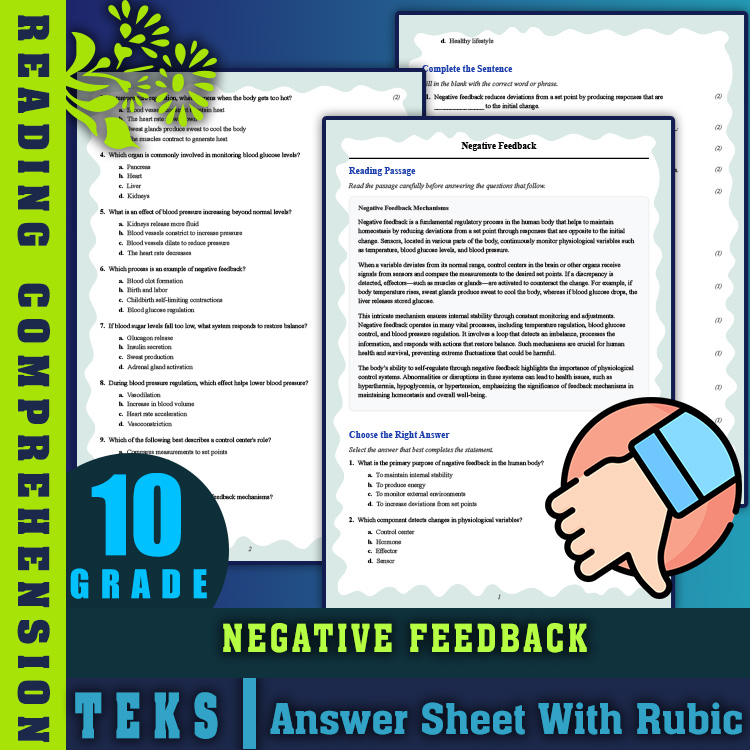
10th Grade Science | Negative Feedback Reading Worksheet with PDF Answer Key
JCreated byJ.S SheetsLearning Objectives
- Understand the concept of negative feedback and its role in physiological regulation.
- Identify key components involved in negative feedback mechanisms such as sensors, control centers, and effectors.
- Explain how negative feedback maintains stability in internal body variables like temperature, blood glucose, and blood pressure.
Instant download

Climate Evidence Learning Stations Activity | Grade 10 Science Alberta
 Created byMTS Academic Studio
Learning Objectives
- Compare evidence from monitoring, research collaborations, and climate models
- Distinguish observations from model projections and exact predictions
- Identify assumptions and uncertainty within climate evidence
Also included in: Grade 10 Alberta Science Energy Flow & Climate Evidence Bundle
Instant download

Cell Membrane Transport Learning Stations Activity | Grade 10 Science
Created byMTS Academic StudioLearning Objectives
- Explain movement using concentration gradients and membrane properties
- Compare passive, protein-assisted, and active transport processes
- Interpret evidence from biological and technological membrane examples
Also included in: Plant Responses & Cell Transport Bundle | Grade 10 Alberta Science
Instant download

Thermal Devices and Efficiency Learning Stations Activity | Grade 10 Science
Created byMTS Academic StudioLearning Objectives
- Trace energy transfers through real thermal devices
- Distinguish useful output from other energy transfers
- Compare device efficiency using consistent input and output quantities
Also included in: Grade 10 Alberta Science Energy Transformations & Efficiency Bundle
Instant download

Plant Growth Responses Learning Stations Activity | Grade 10 Science
Created byMTS Academic StudioLearning Objectives
- Compare evidence from historical and modern plant response investigations
- Explain how controlled comparisons support models of directional growth
- Interpret measurements and observations from plant response investigations
Also included in: Plant Responses & Cell Transport Bundle | Grade 10 Alberta Science
Instant download
About Grade 10 Science Worksheets
Find Science worksheets built for Grade 10. All 7,069 cover core skills, practice, and review, each an instant PDF download.
Every worksheet on MyTeachingSheets is created by independent teacher-authors and reviewed before publication. All resources download as printable PDFs for classroom, homework, or at-home practice, and many include answer keys. Preview any worksheet free before buying.