
Grade 10 Science Worksheets
7,069 worksheets
Cell Membrane Transport Learning Stations Activity | Grade 10 Science
 Created byMTS Academic Studio
Learning Objectives
- Explain movement using concentration gradients and membrane properties
- Compare passive, protein-assisted, and active transport processes
- Interpret evidence from biological and technological membrane examples
Also included in: Plant Responses & Cell Transport Bundle | Grade 10 Alberta Science
Instant download

Chemical Reaction Types and Balancing Equations | Grade 10 Science Activity
Created byMTS Academic StudioLearning Objectives
- Identify five major chemical reaction types using real-world examples.
- Compare reaction patterns using reactants and products.
- Construct word equations from descriptions of chemical reactions.
Also included in: Chemical Investigations Bundle | Grade 10 Alberta Science Lessons
Instant download

Biomes and Climate Records Learning Stations Activity | Grade 10 Science
Created byMTS Academic StudioLearning Objectives
- Compare temperature and precipitation patterns across major biomes
- Interpret climate records to identify regional environmental patterns
- Explain how latitude influences regional climate and biome conditions
Also included in: Grade 10 Alberta Science Energy Flow & Climate Evidence Bundle
Instant download

Moles and Conservation of Mass Learning Stations | Grade 10 Chemistry
Created byMTS Academic StudioLearning Objectives
- Calculate amounts in moles using molar mass.
- Convert mole quantities into numbers of chemical entities.
- Interpret coefficients in balanced equations as mole ratios.
Also included in: Chemical Investigations Bundle | Grade 10 Alberta Science Lessons
Instant download

Uneven Heating and Global Circulation Learning Stations | Grade 10 Science
Created byMTS Academic StudioLearning Objectives
- Explain how uneven solar heating creates temperature and pressure differences
- Connect atmospheric and ocean circulation with thermal energy redistribution
- Compare factors that influence regional climate patterns
Also included in: Grade 10 Alberta Science Energy Flow & Climate Evidence Bundle
Instant download

Motion Graphs and Calculations Learning Stations | Grade 10 Science
Created byMTS Academic StudioLearning Objectives
- Distinguish distance from displacement using documented motion examples.
- Compare speed and velocity using magnitude and direction.
- Calculate average velocity using motion measurements and appropriate units.
Also included in: Grade 10 Alberta Science Energy Transformations & Efficiency Bundle
Instant download

Climate Change Evidence Learning Stations Activity | Grade 10 Science
Created byMTS Academic StudioLearning Objectives
- Compare direct and indirect climate evidence across different timescales
- Evaluate factors that influence Earth's energy balance
- Explain how greenhouse gases can affect climate conditions
Also included in: Grade 10 Alberta Science Energy Flow & Climate Evidence Bundle
Instant download

Atomic Structure and Models Learning Stations Activity | Grade 10 Science
Created byMTS Academic StudioLearning Objectives
- Explain how experimental evidence leads to revisions of atomic models.
- Distinguish protons, neutrons and electrons using particle representations.
- Connect atomic structure to material properties and practical applications.
Also included in: Chemical Investigations Bundle | Grade 10 Alberta Science Lessons
Instant download

Chemistry Properties, Solubility and Safety Learning Stations Grade 10
Created byMTS Academic StudioLearning Objectives
- Compare conductivity, pH, solubility and physical state using evidence.
- Apply solubility rules to predict the behaviour of selected substances.
- Explain chemical properties using molecular structure.
Also included in: Chemical Investigations Bundle | Grade 10 Alberta Science Lessons
Instant download

Chemical Investigations Learning Stations | Grade 10 Alberta Science
Created byMTS Academic StudioLearning Objectives
- Identify research questions in real chemical investigations
- Distinguish experimental variables and controls in scientific comparisons
- Evaluate measurement methods and sources of experimental uncertainty
Also included in: Chemical Investigations Bundle | Grade 10 Alberta Science Lessons
Instant download

Energy Design Learning Stations | Efficiency & Trade-Offs Grade 10
Created byMTS Academic StudioLearning Objectives
- Compare energy designs using measurable performance evidence
- Interpret efficiency data under controlled operating conditions
- Recognize uncertainty and limits in energy design comparisons
Also included in: Grade 10 Alberta Science Energy Transformations & Efficiency Bundle
Instant download

Microscopy and Cell Theory Learning Stations Activity | Grade 10 Science
Created byMTS Academic StudioLearning Objectives
- Compare evidence produced by different cell imaging technologies
- Distinguish magnification from resolution in microscopic imaging
- Identify limitations when interpreting microscopic images
Also included in: Plant Responses & Cell Transport Bundle | Grade 10 Alberta Science
Instant download

Water Thermal Energy Calculations Learning Stations | Grade 10 Science
Created byMTS Academic StudioLearning Objectives
- Calculate thermal energy transfers using the specific heat relationship
- Apply molar phase-change energy with appropriate matching units
- Distinguish temperature changes from phase changes in water
Also included in: Grade 10 Alberta Science Energy Flow & Climate Evidence Bundle
Instant download

Chemical Change and Energy Learning Stations | Grade 10 Science
Created byMTS Academic StudioLearning Objectives
- Identify observable evidence that supports the occurrence of chemical reactions.
- Distinguish chemical changes from physical changes using scientific reasoning.
- Compare energy transfers in endothermic and exothermic processes.
Also included in: Chemical Investigations Bundle | Grade 10 Alberta Science Lessons
Instant download

Earth's Energy Balance Learning Stations Activity | Grade 10 Science
Created byMTS Academic StudioLearning Objectives
- Analyze incoming, reflected, and outgoing radiation in Earth's energy budget
- Calculate and interpret percentages in radiation transfer examples
- Explain how radiation changes can influence climate conditions
Also included in: Grade 10 Alberta Science Energy Flow & Climate Evidence Bundle
Instant download

Cells as Open Systems Learning Stations Activity | Grade 10 Biology
Created byMTS Academic StudioLearning Objectives
- Explain how cells exchange matter and energy with their surroundings
- Connect organelle structures to their roles in processing materials
- Compare evidence from real biological examples
Also included in: Plant Responses & Cell Transport Bundle | Grade 10 Alberta Science
Instant download

Cell Size and Shape Learning Stations Activity | Grade 10 Biology
Created byMTS Academic StudioLearning Objectives
- Explain how cell growth changes surface area-to-volume ratio
- Predict how cell size affects the efficiency of exchange
- Compare cell shapes adapted to specialized functional demands
Also included in: Plant Responses & Cell Transport Bundle | Grade 10 Alberta Science
Instant download

Energy Transformations Learning Stations | Grade 10 Alberta Science
Created byMTS Academic StudioLearning Objectives
- Identify energy transformations in historical and modern technologies.
- Compare useful energy outputs with unintended energy transfers.
- Explain how observations and testing influence technological development.
Also included in: Grade 10 Alberta Science Energy Transformations & Efficiency Bundle
Instant download

Chemical Bonding and Naming Compounds Learning Stations Grade 10
Created byMTS Academic StudioLearning Objectives
- Predict ionic compound formulas using ion charges and reference tables.
- Construct systematic names for ionic and molecular compounds.
- Identify formulas and names of common acids.
Also included in: Chemical Investigations Bundle | Grade 10 Alberta Science Lessons
Instant download

Work and Mechanical Energy Learning Stations | Grade 10 Science
Created byMTS Academic StudioLearning Objectives
- Explain how forces transfer energy through displacement.
- Calculate mechanical work using appropriate equations and units.
- Calculate changes in gravitational potential energy.
Also included in: Grade 10 Alberta Science Energy Transformations & Efficiency Bundle
Instant download

Plant Transport and Gas Exchange Learning Stations Activity Grade 10
Created byMTS Academic StudioLearning Objectives
- Explain how xylem and phloem transport materials through plants
- Explain how stomata contribute to plant gas exchange
- Interpret evidence about transpiration and water movement
Also included in: Plant Responses & Cell Transport Bundle | Grade 10 Alberta Science
Instant download

Energy Conservation Learning Stations Activity | Grade 10 Science
Created byMTS Academic StudioLearning Objectives
- Trace kinetic energy changes in real moving systems
- Trace gravitational potential energy through changes in position
- Identify thermal energy transfers caused by resistive forces
Also included in: Grade 10 Alberta Science Energy Transformations & Efficiency Bundle
Instant download
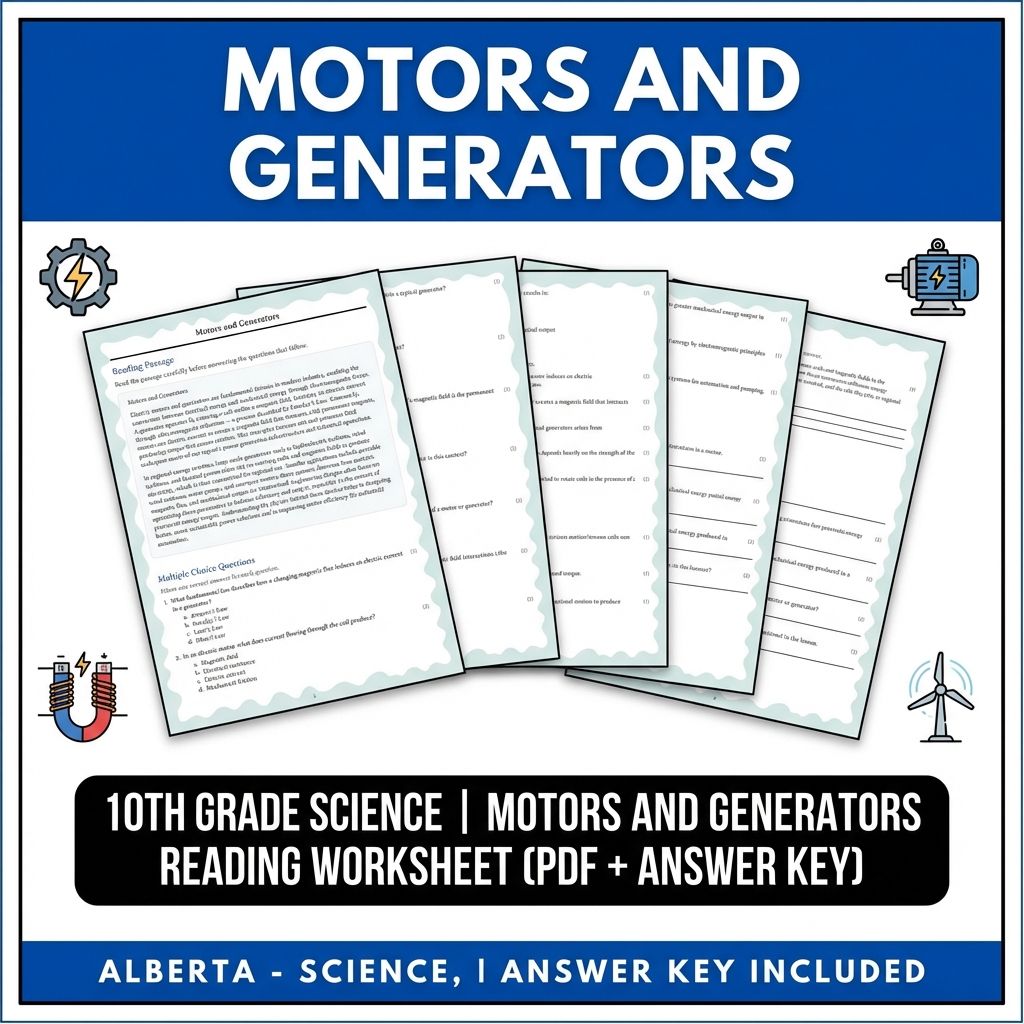
10th Grade Science | Motors and Generators Reading Worksheet (PDF + Answer Key)
JCreated byJ.S SheetsLearning Objectives
- Explain how motors and generators convert between electrical and mechanical energy.
- Describe the interaction between coils and magnetic fields that create torque and rotation.
- Compare the operation of electrical generators and motors in different applications.
Also included in: Grade 10 Science Bundle | Energy, Circuits & Mechanics (Answer Keys Included) +1 more
Instant download
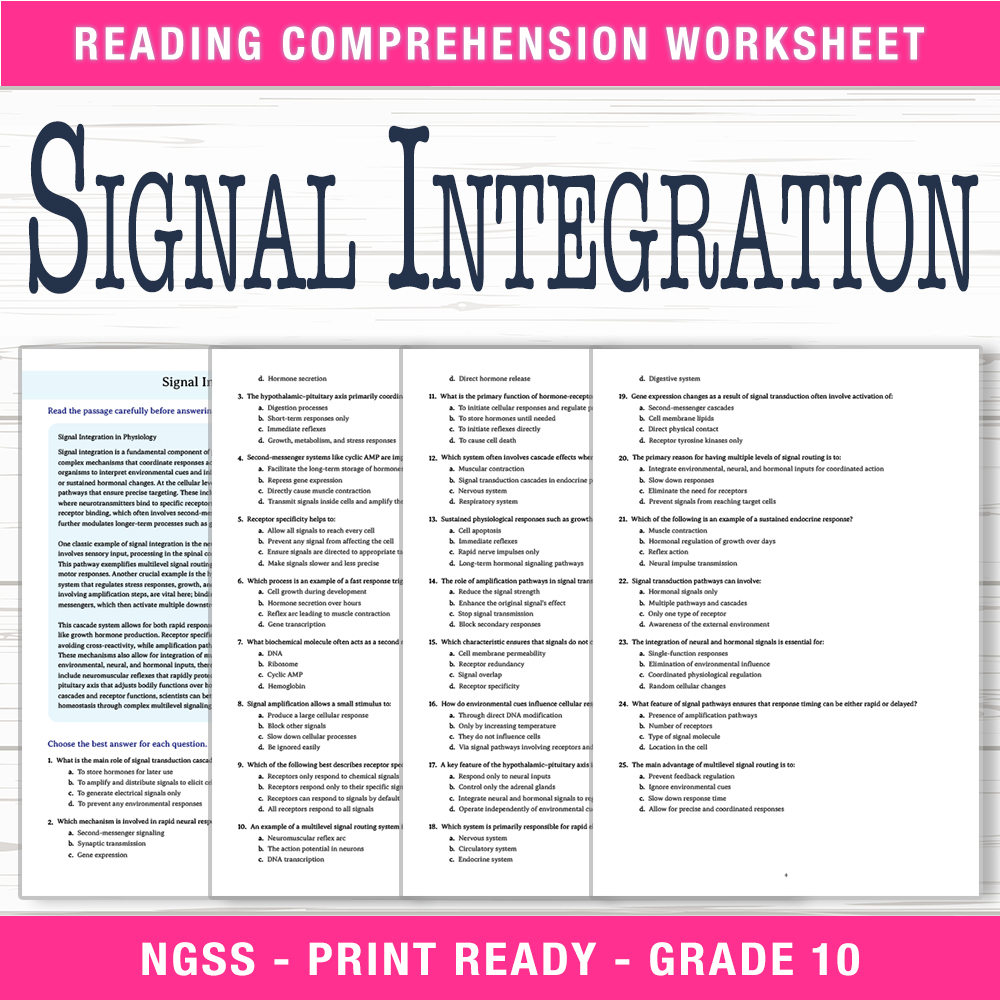
Grade 10 Science | Signal Integration Worksheet (PDF + Answer Key)
 Created byRiverstone Classroom
Learning Objectives
- Understand the mechanisms of signal transduction pathways involved in nervous and endocrine coordination.
- Identify key examples of signal integration such as reflex arcs and hypothalamic-pituitary communication.
- Explain how receptor specificity and amplification pathways regulate physiological responses.
Instant download

10th Grade Science | Positive Feedback TEKS-Aligned (PDF & Answer Key)
JCreated byJ.S SheetsLearning Objectives
- Understand the concept of positive feedback and how it amplifies physiological processes.
- Identify examples of positive feedback mechanisms in human biology.
- Differentiate between positive feedback and negative feedback in biological systems.
Instant download
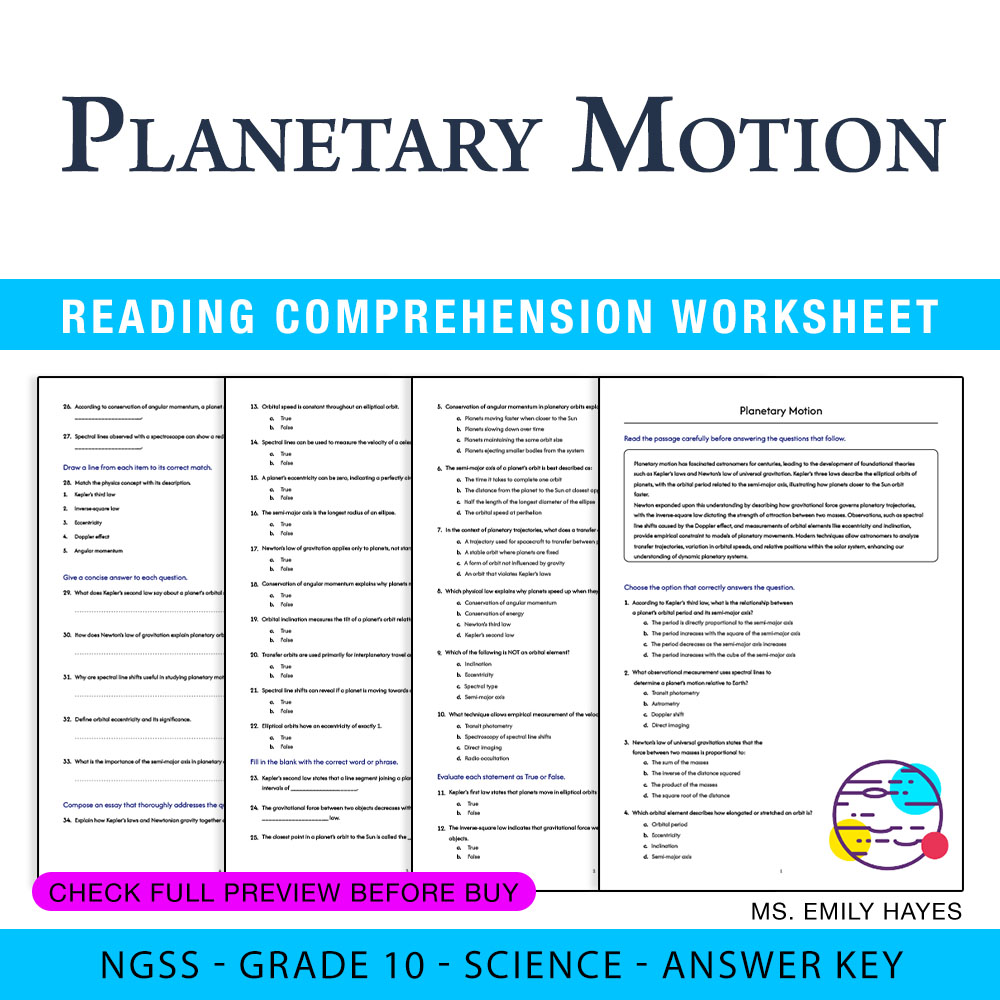
10th Grade Science | Planetary Motion Worksheet (PDF + Answer Key)
 Created byCopper Leaf Classroom
Learning Objectives
- Explain Kepler's laws of planetary motion and their significance in understanding orbits.
- Describe how Newtonian gravitation applies to the movement of planets and other celestial bodies.
- Analyze how conservation of angular momentum affects planetary velocities.
Instant download
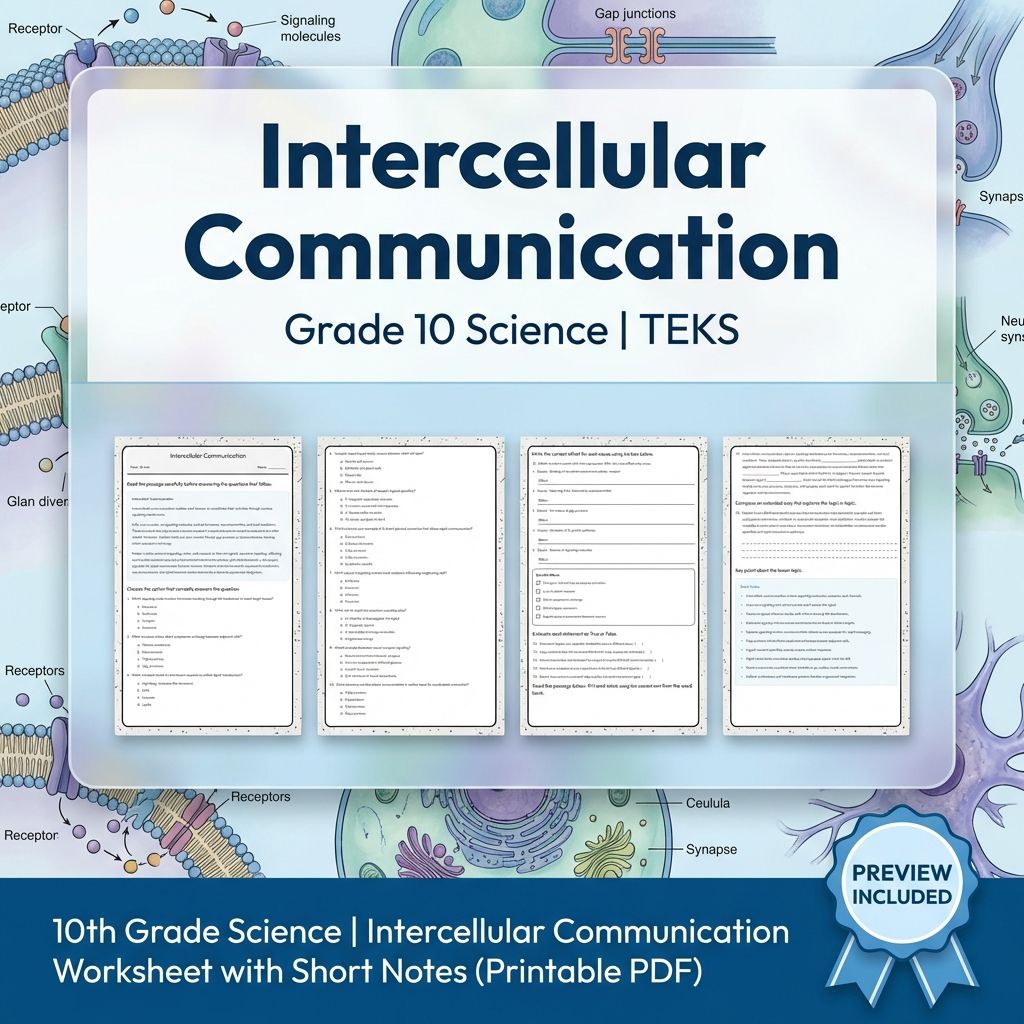
10th Grade Science Intercellular Communication Worksheet with Short Notes (PDF)
 Created byMeadowlark Worksheets
Learning Objectives
- Describe different modes of intercellular signaling including autocrine, paracrine, endocrine, and synaptic mechanisms.
- Explain the role of membrane receptors and specific ligand binding in signal transduction.
- Identify types of direct cytoplasmic connections such as gap junctions and plasmodesmata.
Instant download
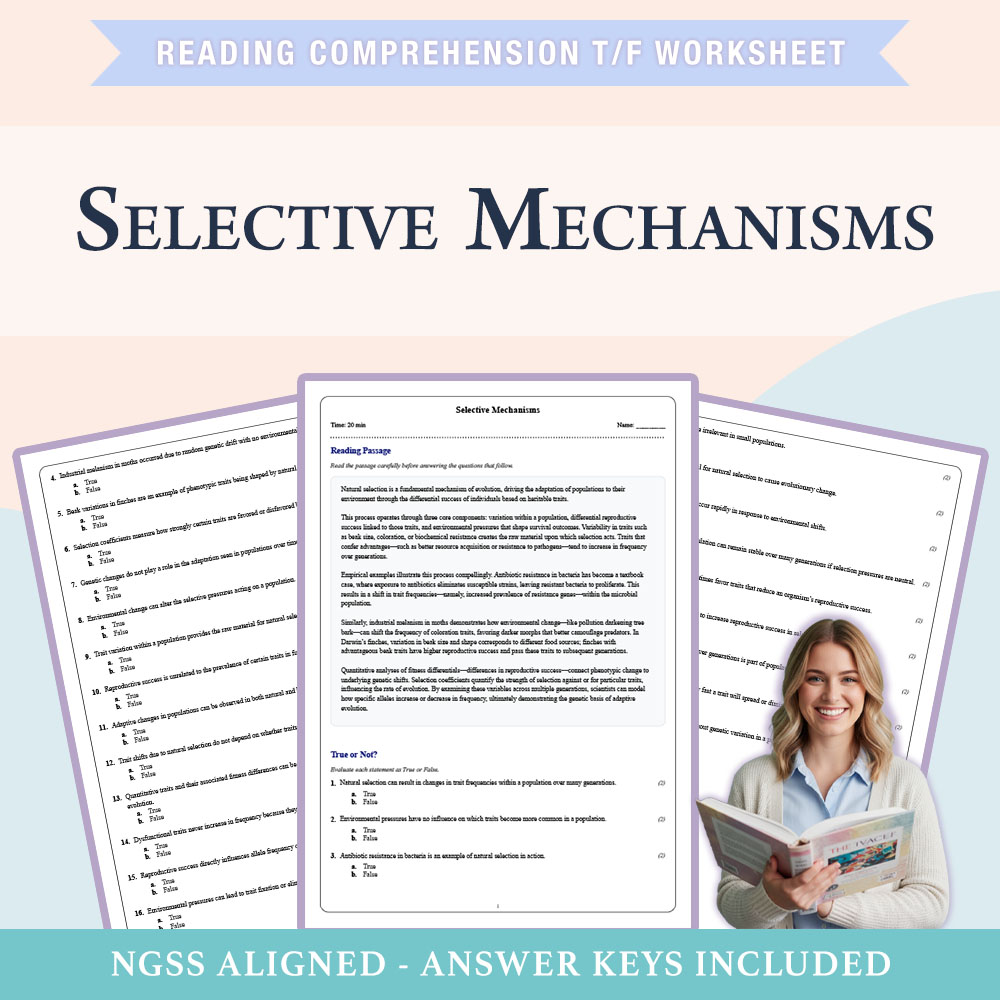
10th Grade Science | Selective Mechanisms Worksheet (PDF + Answer Key)
Created byCopper Leaf ClassroomLearning Objectives
- Understand how natural selection operates through variation, differential reproductive success, and environmental pressures.
- Identify examples of adaptive changes in populations such as antibiotic resistance, melanism, and beak variation.
- Explain the relationship between observable phenotypic changes and allele frequency dynamics within populations.
Also included in: Grade 10 Science | Evolution & Biodiversity Unit Bundle (PDF + Answer Key) +1 more
Instant download
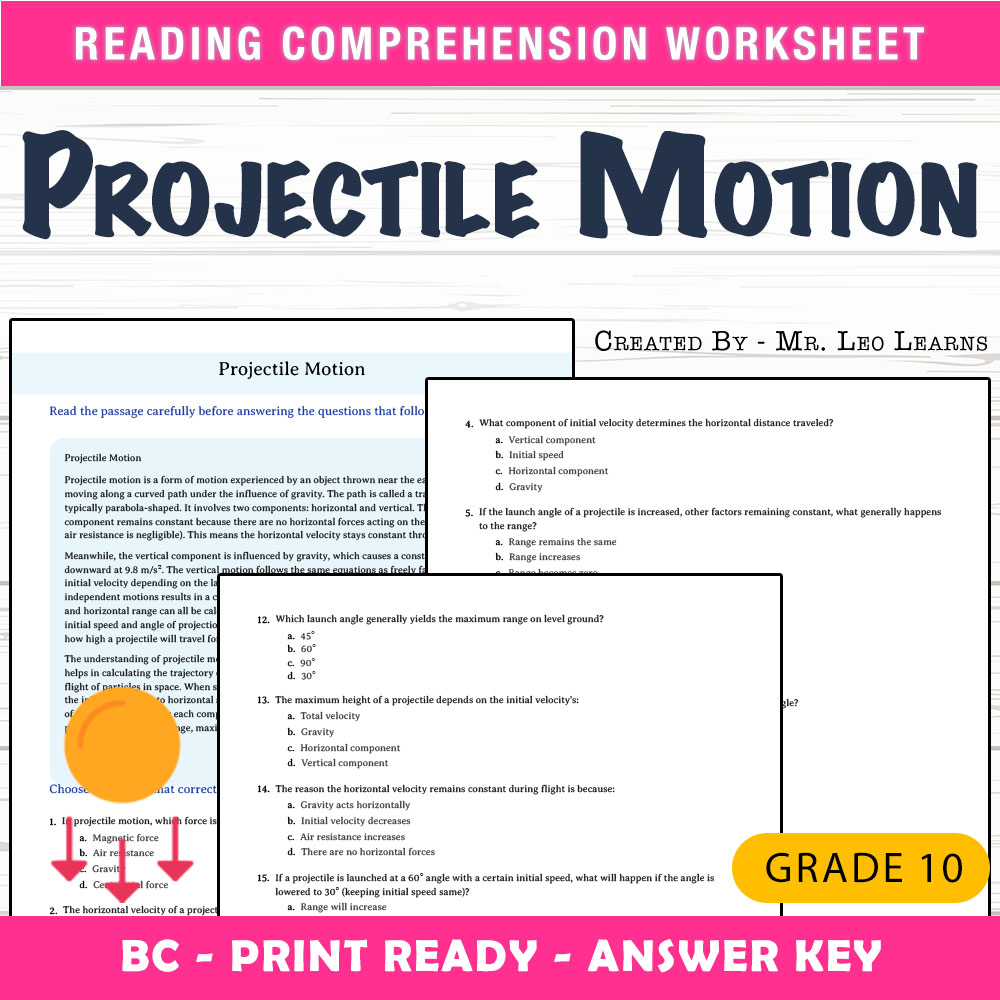
Grade 10 Science — Worksheet MCQ Paper for Mastering Projectile Motion
 Created byThe Resource Hub
Learning Objectives
- Understand the components of projectile motion and their independence.
- Calculate the time of flight, range, and maximum height using kinematic equations.
- Explain how initial velocity and launch angle affect projectile trajectory.
Also included in: Grade 10 Science | Forces, Motion & Fields UNIT Worksheet Bundle +1 more
Instant download
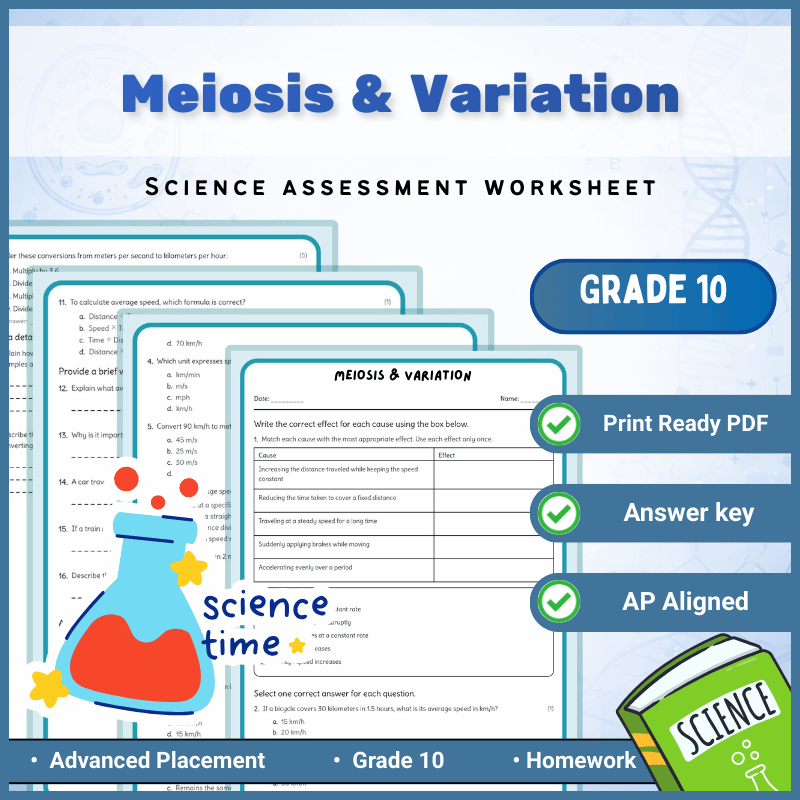
10th Grade Science | Meiosis & Genetic Variation Worksheet(Answers)(AP Standard)
 Created byBright Mind Resources
Learning Objectives
- Explain the processes of homologous pairing, recombination, and chromosomal segregation in meiosis.
- Describe how crossing-over and nondisjunction contribute to genetic variation.
- Relate mechanisms of variation to evolutionary changes and inheritance patterns.
Instant download

Science Worksheet Conservation In Reactions Grade 10
JCreated byJ.S SheetsLearning Objectives
- Explain how balanced chemical equations model the conservation of atoms in chemical reactions.
- Describe how conservation of mass relates to what is included within the system boundary.
- Interpret experimental mass changes by accounting for matter that enters or leaves a system.
Also included in: Grade 10 Matter, Energy, and Waves Science Lesson Bundle – Florida (NGSSS) +1 more
Instant download
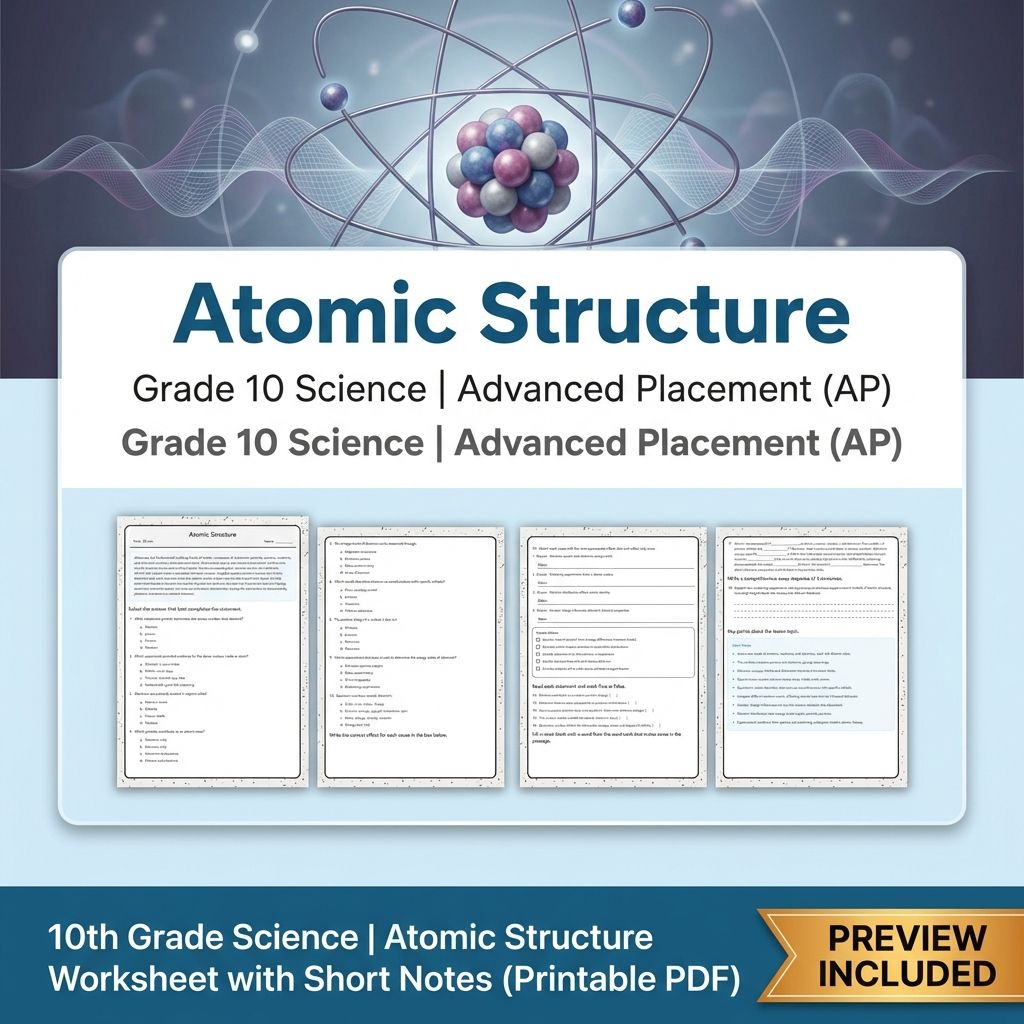
10th Grade Science | Atomic Structure Worksheet with Short Notes (Printable PDF)
Created byMeadowlark WorksheetsLearning Objectives
- Describe the subatomic components of atoms and their roles, including protons, neutrons, and electrons.
- Explain how nuclear charge and electron distribution influence elemental identity and isotopic variation.
- Connect evidence from emission spectra and scattering experiments to atomic models and quantum numbers.
Also included in: Grade 10 Science | Comprehensive Unit Bundle on Atomic Structure
Instant download
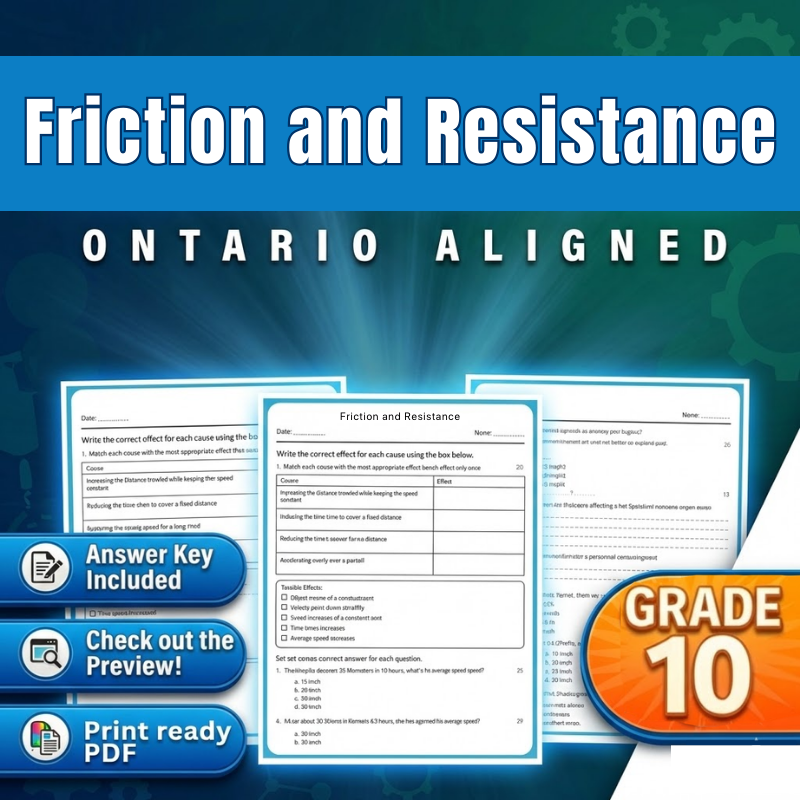
Grade 10 Science – Friction and Resistance Worksheet (PDF) | Ontario Standards
Created byBright Mind ResourcesLearning Objectives
- Understand the differences between static and kinetic friction and how coefficients of friction are characterized.
- Describe how normal force and surface properties influence frictional forces.
- Qualitatively analyze air resistance and viscous drag, including their velocity dependence and effects on motion.
Instant download
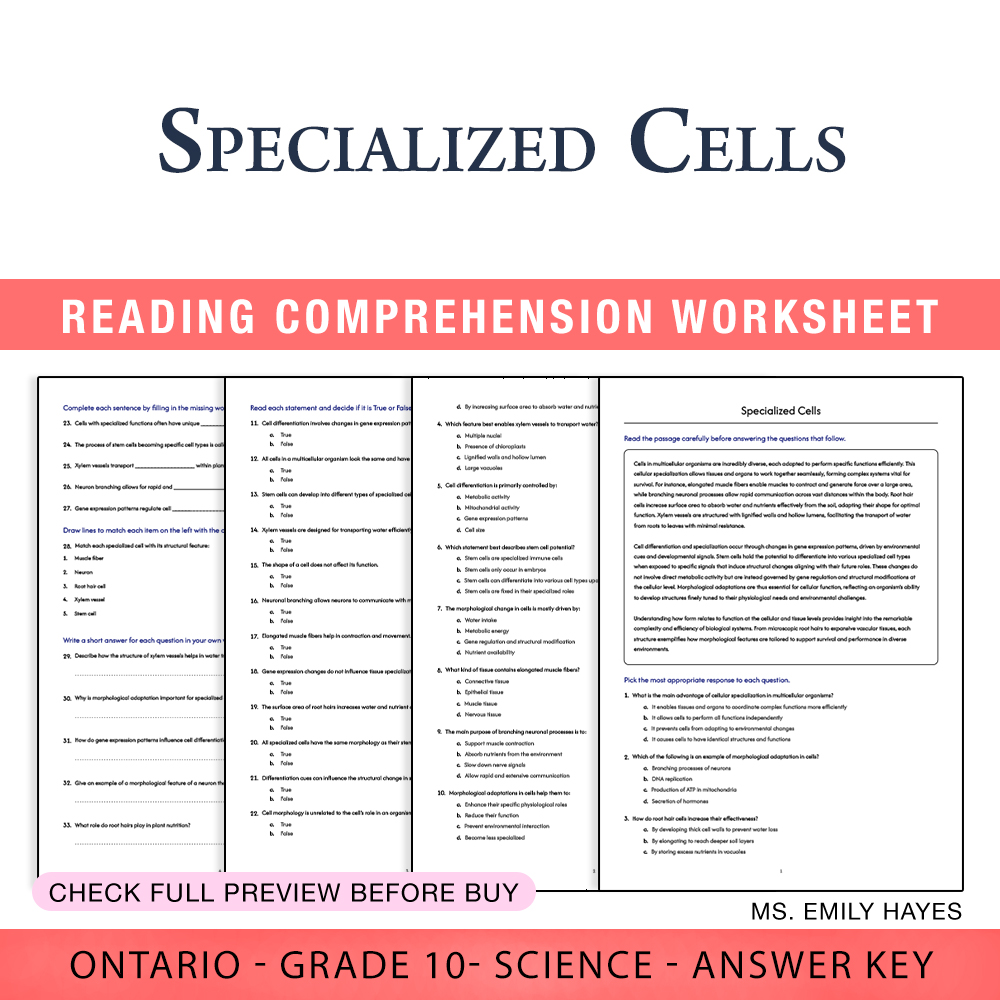
10th Grade Science | Specialized Cells Worksheet (PDF + Answer Key)
Created byCopper Leaf ClassroomLearning Objectives
- Understand the concept of cellular specialization and how tissue organization relates to function.
- Identify morphological adaptations in cells that enhance their specific physiological roles.
- Describe examples of specialized cells such as muscle fibers, neurons, root hairs, and xylem vessels.
Instant download

Grade 10 Science | Wave Behavior Worksheet | AP-Aligned
 Created byLumora Learning
Learning Objectives
- Describe the characteristics of transverse and longitudinal waves using parameters such as wavelength, frequency, amplitude, and wave speed.
- Explain the concepts of reflection, refraction, interference, superposition, and standing waves with graphical and mathematical descriptions.
- Analyze examples like string waves and sound pulses to understand boundary effects and spectral representations.
Instant download
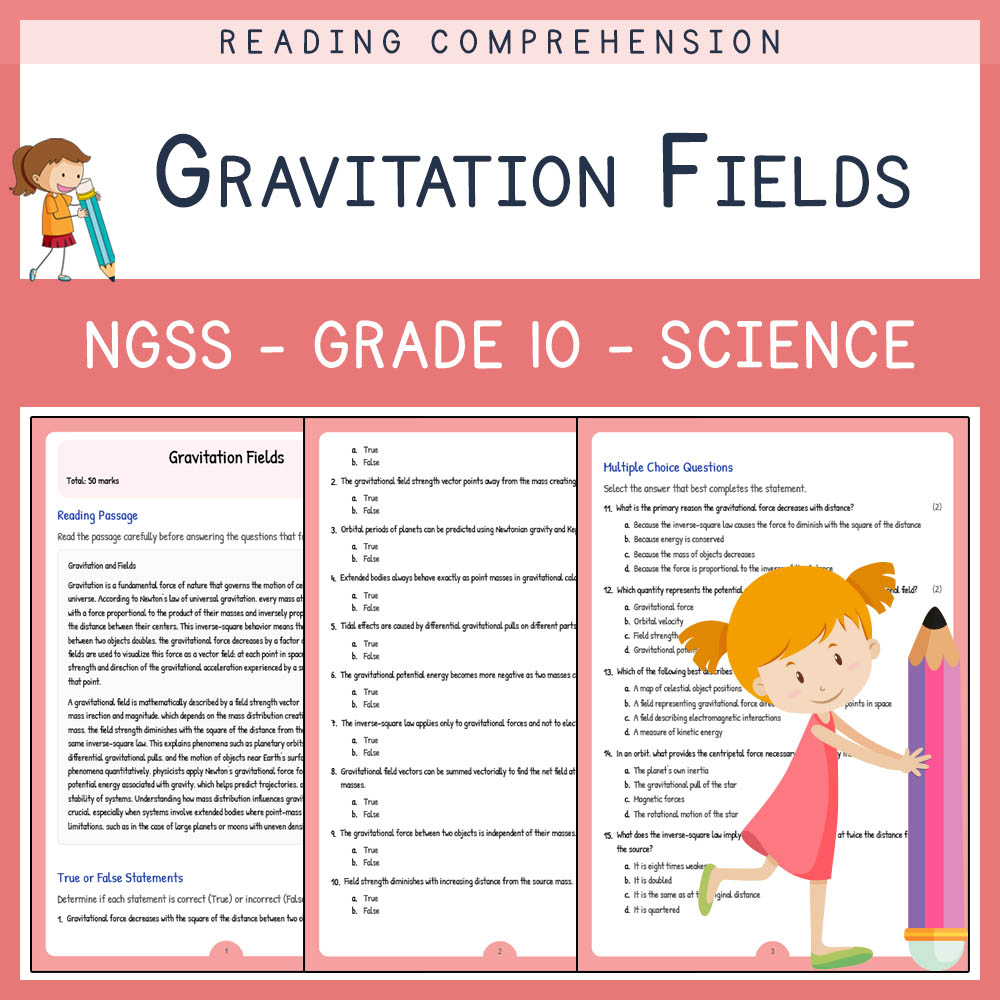
Grade 10 Science | Gravitation Fields Worksheet & Answer Key (PDF)
Created byLumora LearningLearning Objectives
- Understand the inverse-square law behavior of gravitational fields.
- Explain how gravitational fields are represented vectorially and with potential.
- Apply Newtonian gravity to predict planetary orbits and analyze orbital dynamics.
Instant download
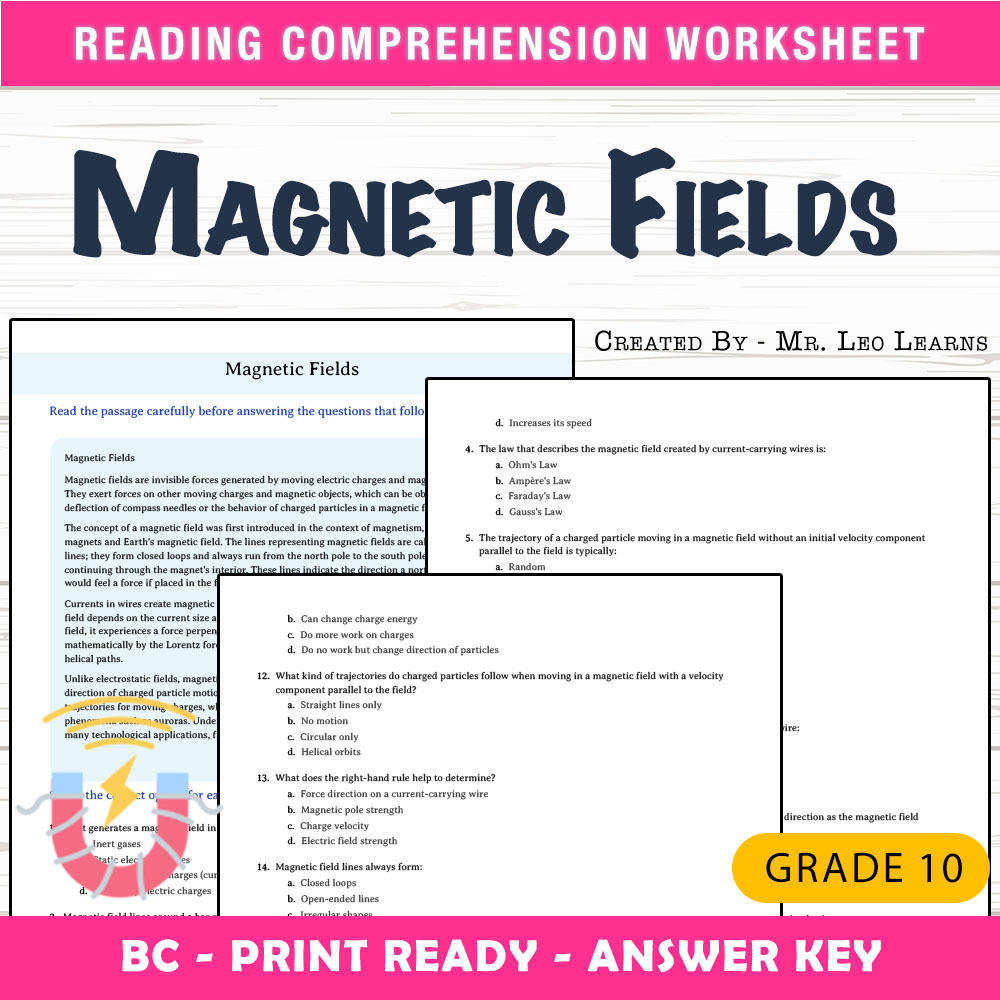
Grade 10 Science — Worksheet MCQ Paper for Mastering Magnetic Fields
Created byThe Resource HubLearning Objectives
- Understand the origin of magnetic fields from moving charges and currents.
- Interpret magnetic field line patterns and their direction.
- Explain how magnetic forces act on moving charges without doing work, and how this affects charge trajectories.
Also included in: Grade 10 Science | Forces, Motion & Fields UNIT Worksheet Bundle +1 more
Instant download
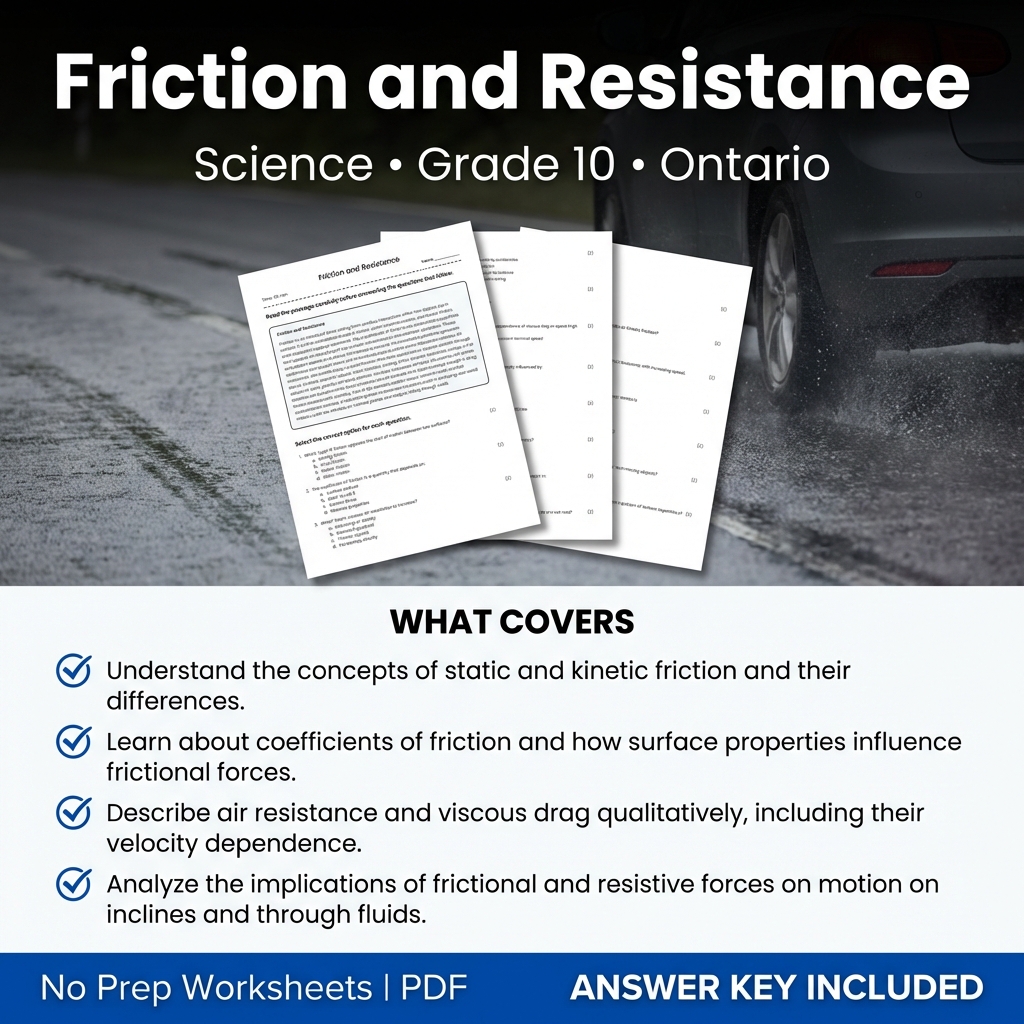
Friction and Resistance Worksheet for Grade 10 Science – Ontario Standards
 Created byCoral Reef Learning
Learning Objectives
- Understand the concepts of static and kinetic friction and their differences.
- Learn about coefficients of friction and how surface properties influence frictional forces.
- Describe air resistance and viscous drag qualitatively, including their velocity dependence.
Instant download
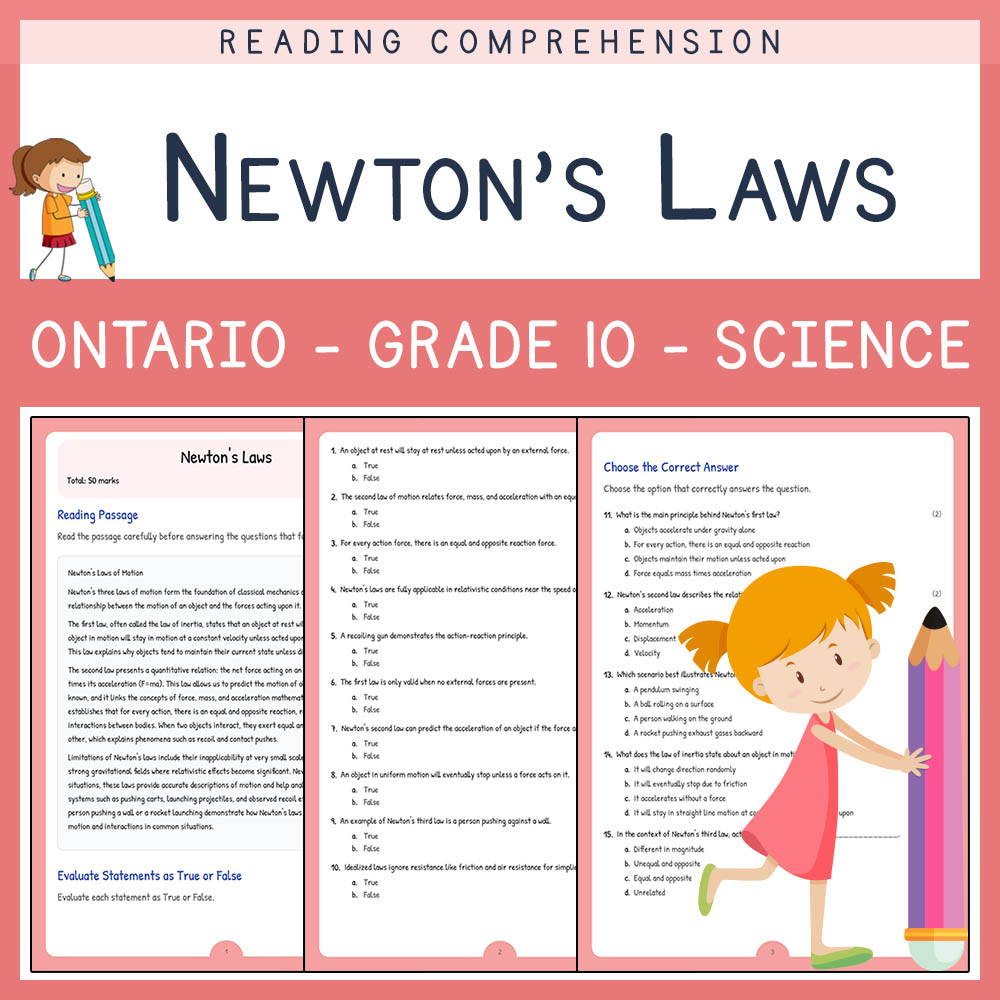
Grade 10 Science Assessment | Newton's Laws Worksheet Elena | Ontario
Created byLumora LearningLearning Objectives
- Understand and describe the three laws of motion articulated by Newton.
- Connect concepts of inertia, force, and acceleration in practical examples.
- Analyze action-reaction pairs and conservation laws in mechanics.
Also included in: Grade 10 Science | Motion & Forces Lesson Bundle | Ontario Standards
Instant download
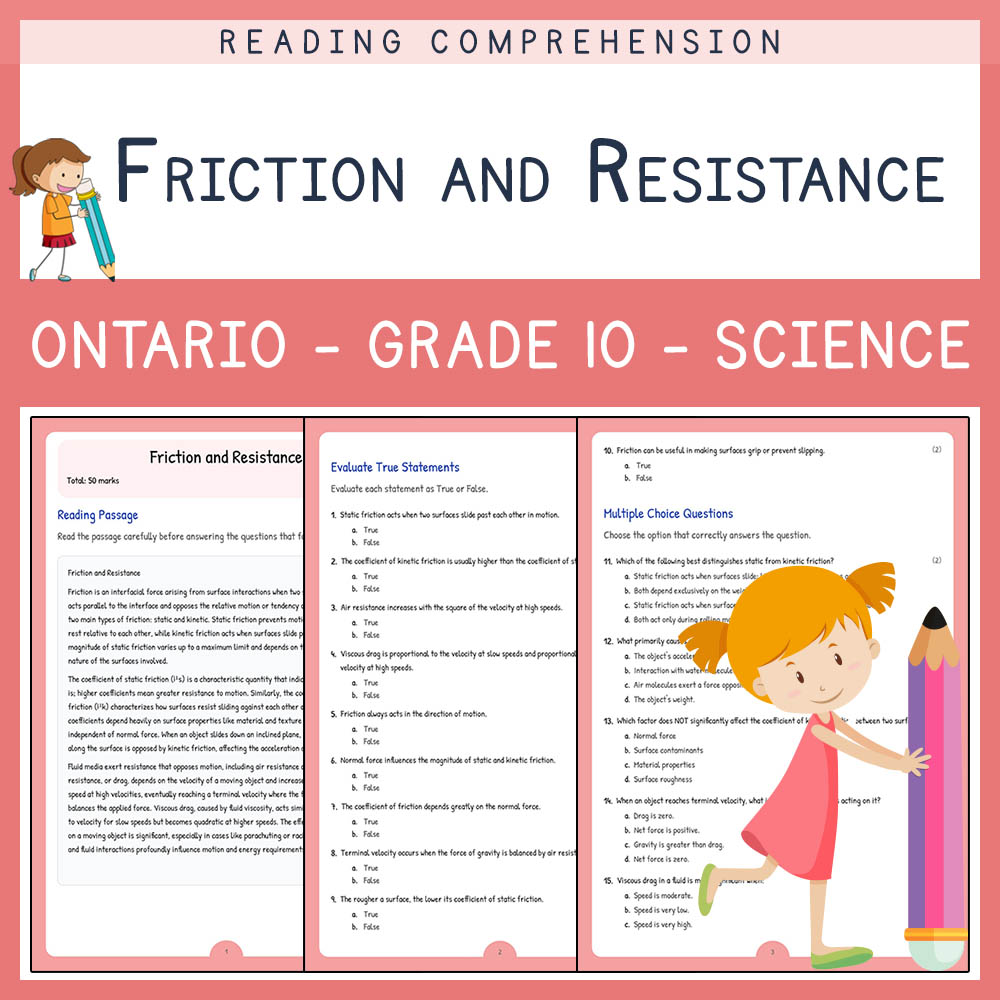
Grade 10 Science | Friction and Resistance Worksheet | Ontario Standard
Created byLumora LearningLearning Objectives
- Understand the concepts of static and kinetic friction and their differences.
- Describe how coefficients of friction depend on surface properties and normal force.
- Explain air resistance and viscous drag, including their velocity dependence.
Also included in: Grade 10 Science | Motion & Forces Lesson Bundle | Ontario Standards
Instant download
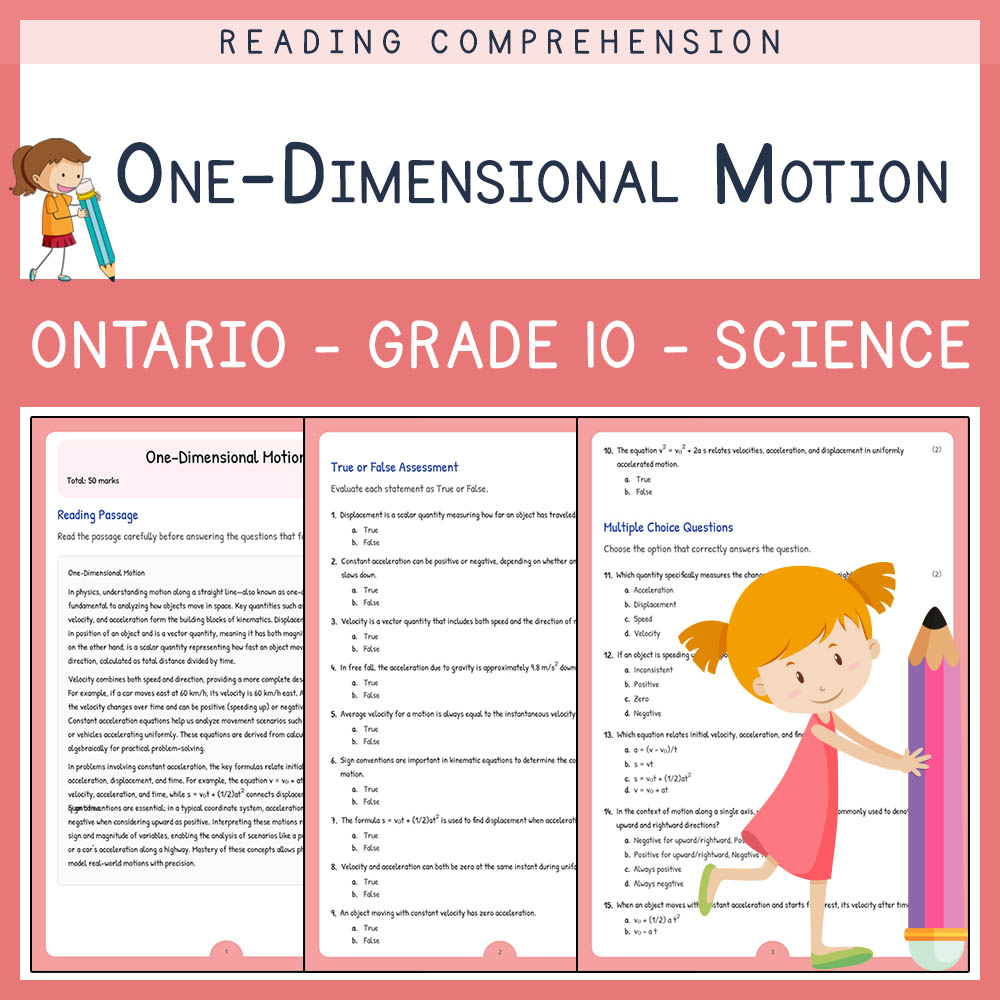
Grade 10 Science | One-Dimensional Motion Worksheet | Ontario Standards
Created byLumora LearningLearning Objectives
- Define and distinguish between displacement, speed, velocity, and acceleration.
- Apply algebraic equations to solve problems involving uniform acceleration.
- Interpret motion scenarios along a single axis using numerical and symbolic representations.
Also included in: Grade 10 Science | Motion & Forces Lesson Bundle | Ontario Standards
Instant download
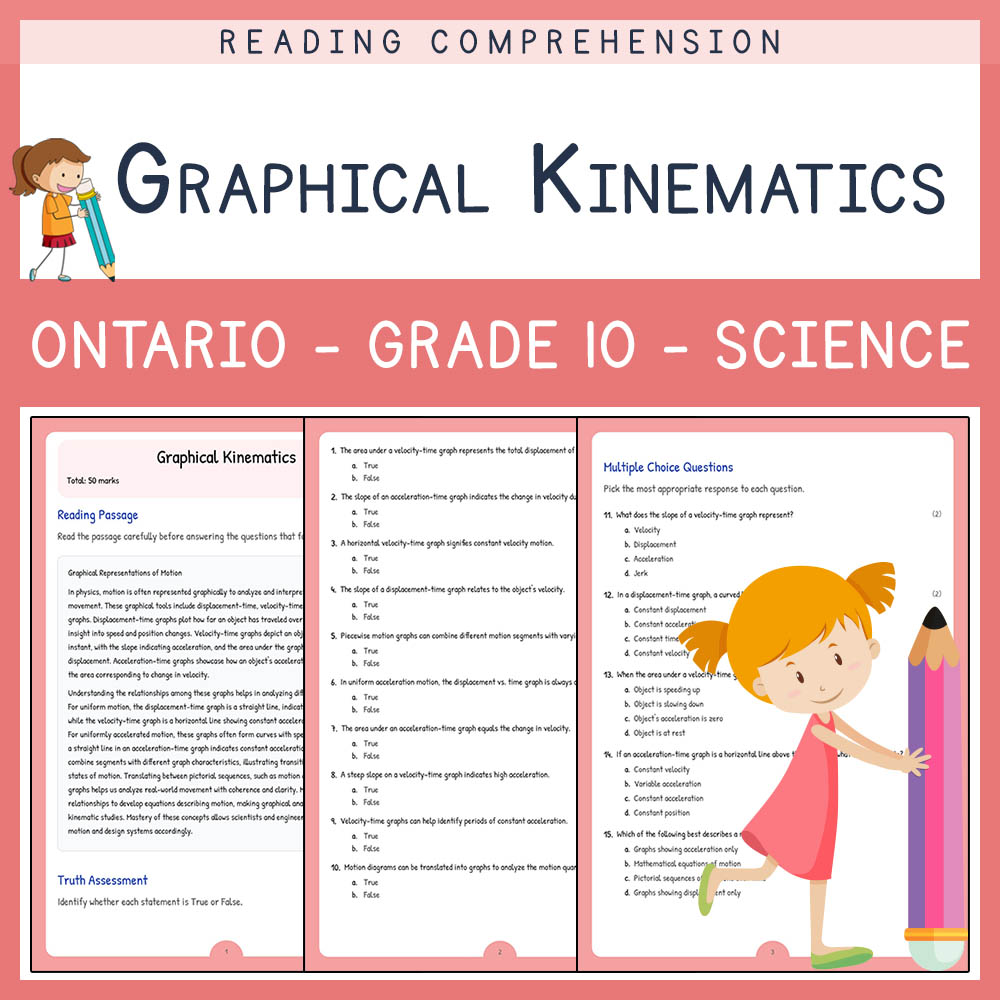
Grade 10 Science | Graphical Kinematics Worksheet | Ontario Standard
Created byLumora LearningLearning Objectives
- Understand and interpret displacement–time, velocity–time, and acceleration–time graphs.
- Explain the relationships among slope, area, and kinematic quantities in motion graphs.
- Differentiate between piecewise and uniformly accelerating motion through graphical analysis.
Also included in: Grade 10 Science | Motion & Forces Lesson Bundle | Ontario Standards
Instant download
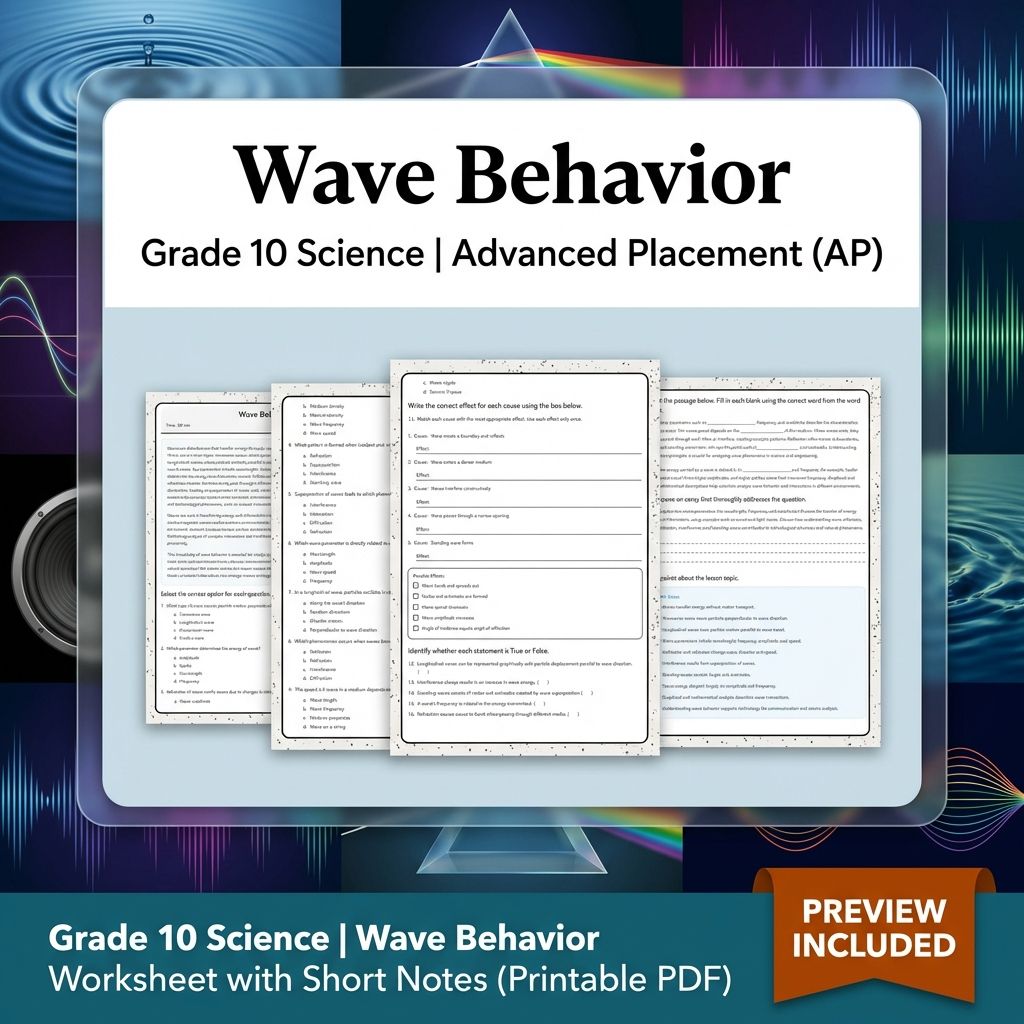
Grade 10 Science | Wave Behavior Worksheet with Short Notes (Printable PDF)
Created byMeadowlark WorksheetsLearning Objectives
- Describe transverse and longitudinal wave characteristics using parameters such as wavelength, frequency, amplitude, and wave speed.
- Explain the relationship between wave parameters and energy transfer.
- Analyze wave phenomena including reflection, refraction, interference, superposition, and standing waves.
Instant download
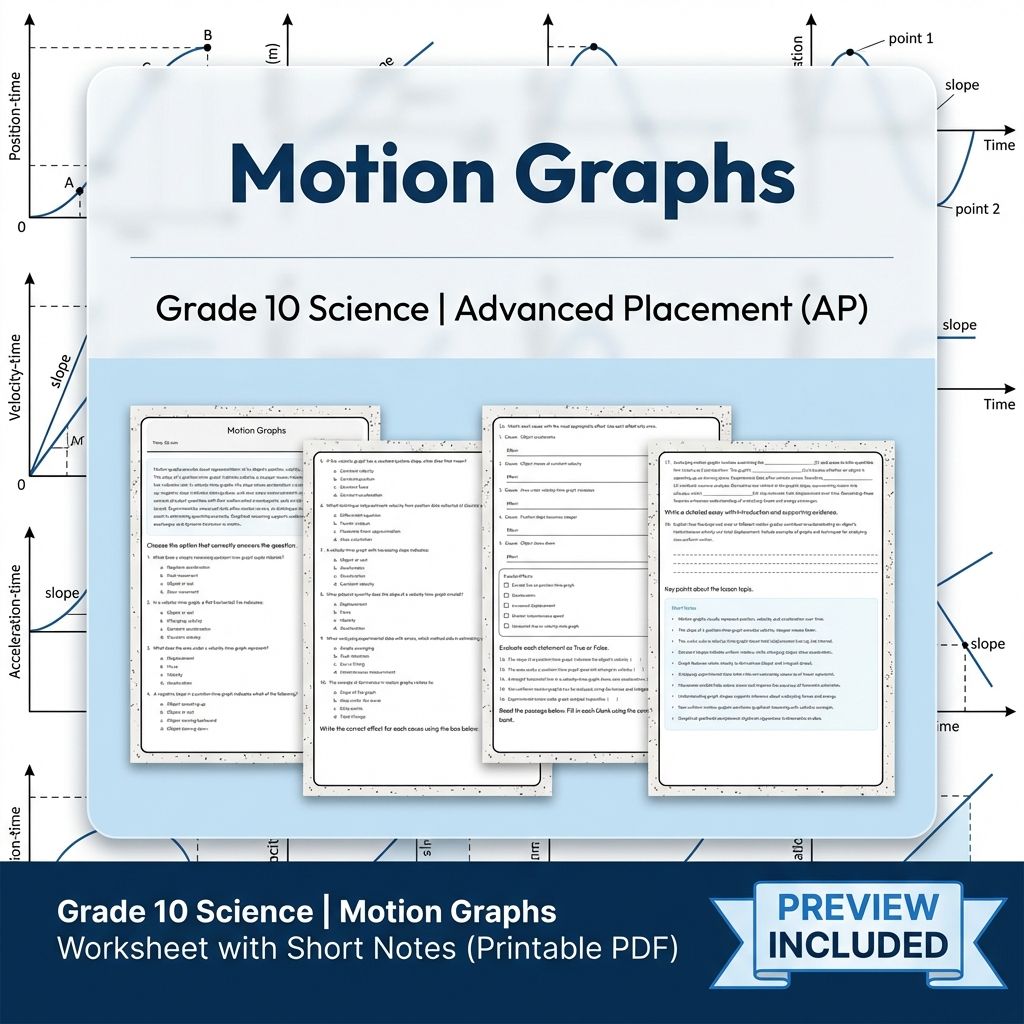
Grade 10 Science | Motion Graphs Worksheet with Short Notes (Printable PDF)
Created byMeadowlark WorksheetsLearning Objectives
- Analyze how slopes encode velocity and acceleration in motion graphs.
- Understand how area under graphs relates to change in position and speed.
- Extract kinematic quantities from graphical data in non-uniform motion.
Instant download
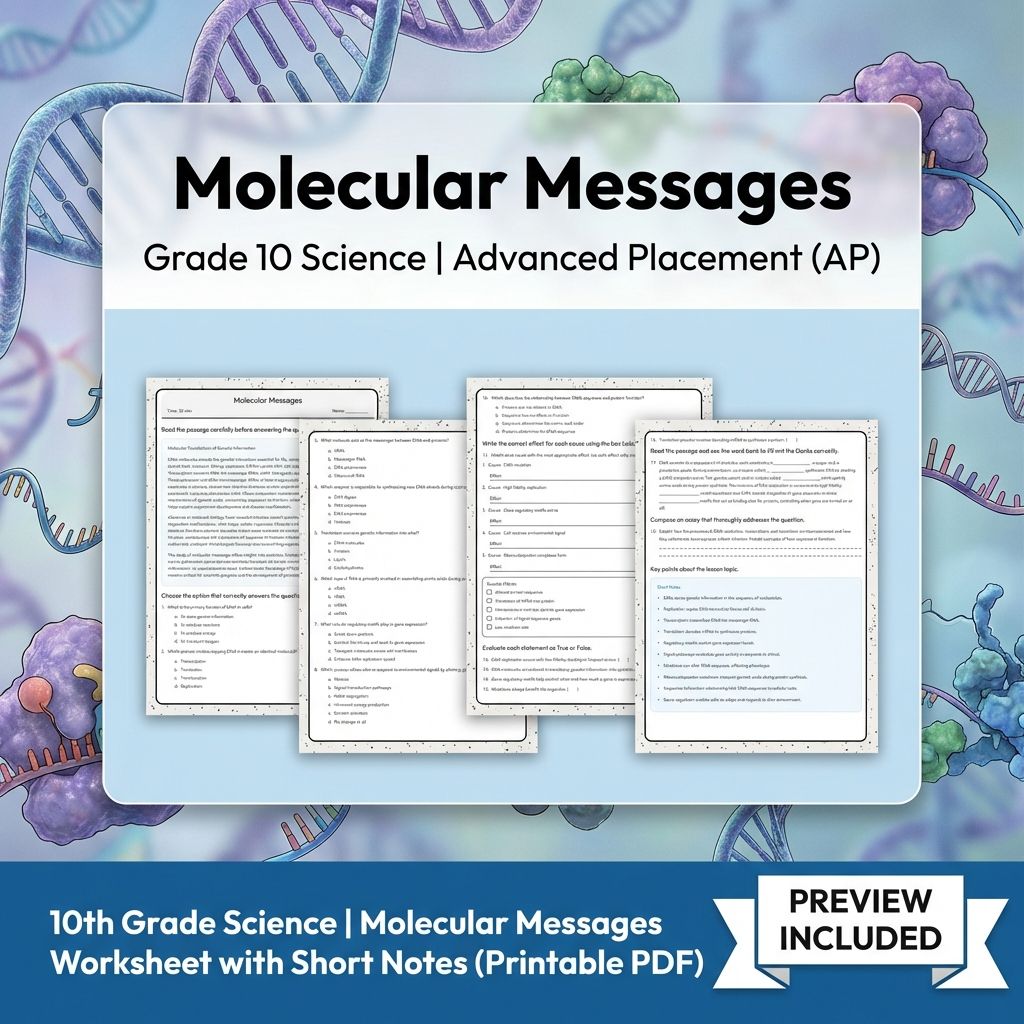
10th Grade Science | Molecular Messages Worksheet with Short Notes (PDF)
Created byMeadowlark WorksheetsLearning Objectives
- Understand the structure and function of DNA and how genetic information is stored and transmitted.
- Describe the processes of DNA replication, transcription, and translation at the molecular level.
- Explain how sequence-to-function relationships influence cellular phenotypes within biological systems.
Instant download
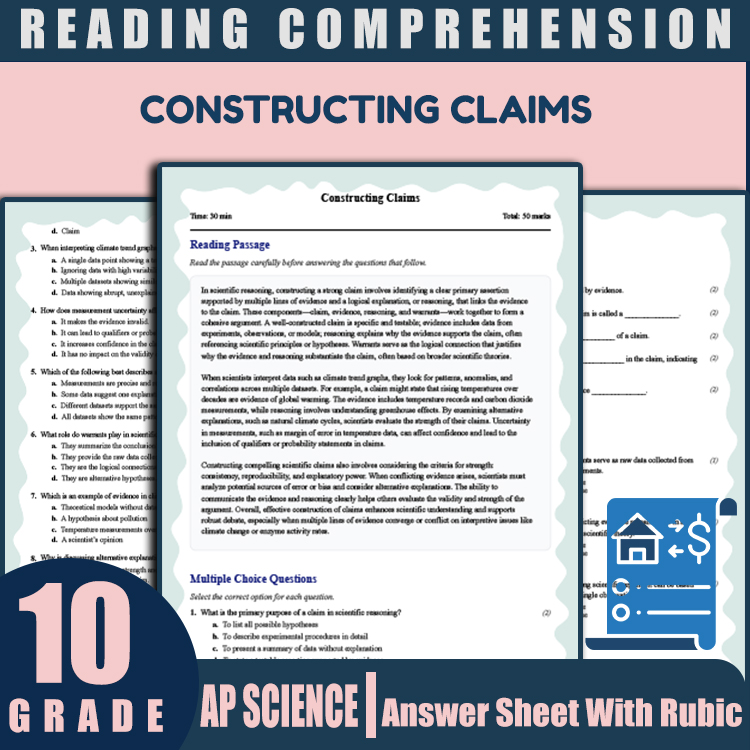
10th Grade Science | Constructing Claims Reading Worksheet & Answer Key (PDF)
JCreated byJ.S SheetsLearning Objectives
- Understand the components of evidence-based claims, including claim, evidence, and reasoning.
- Distinguish between different parts of an argument and how they connect logically.
- Apply criteria for evaluating the strength of a scientific argument based on evidence and warrants.
Also included in: Grade 10 Science Unit Worksheet Pack – Data Analysis & Scientific Reasoning +1 more
Instant download

Groundwater Systems Worksheet for Grade 10 Science | Standards-Aligned Practice
JCreated byJ.S SheetsLearning Objectives
- Describe how aquifer properties such as porosity and permeability influence groundwater storage and flow.
- Explain how recharge and discharge control groundwater levels and support connected surface-water systems.
- Evaluate how groundwater vulnerability affects contaminant transport, including risks to ecosystems and communities.
Instant download
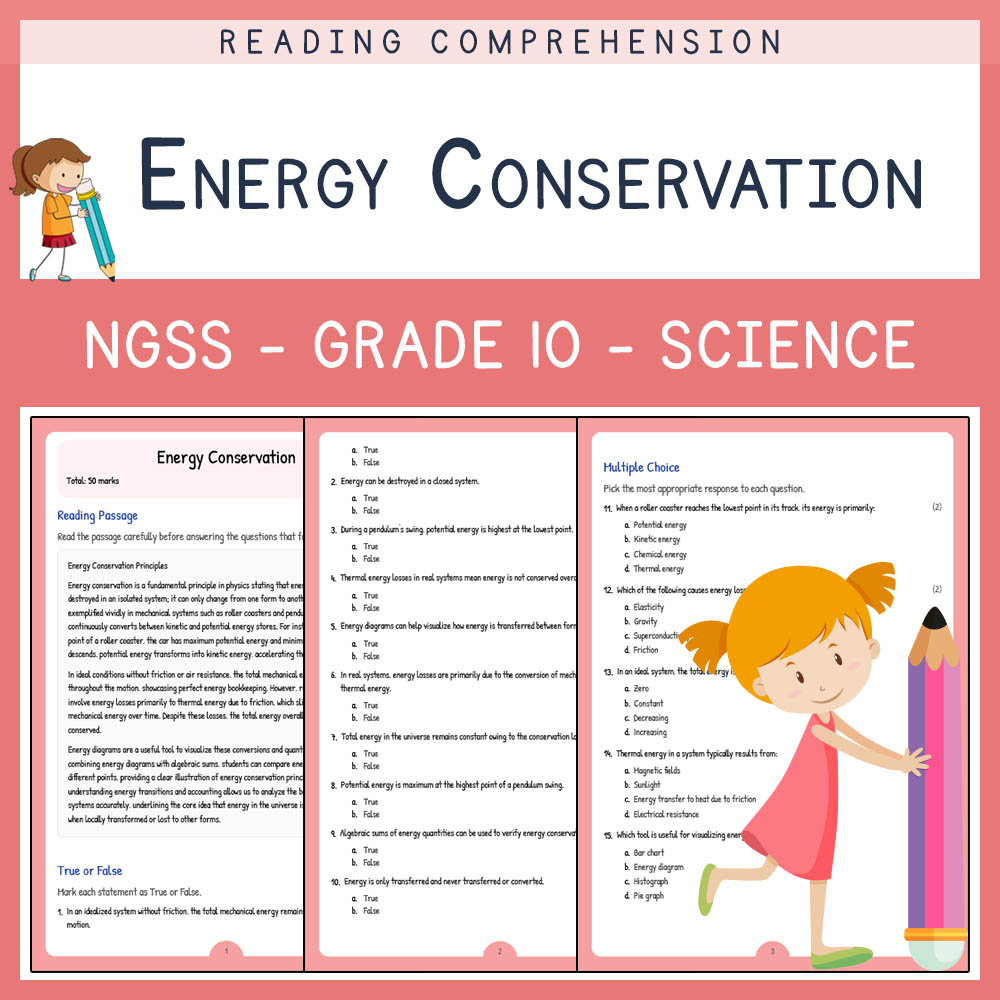
Grade 10 Science | Energy Conservation Worksheet (PDF + Answer Key)
Created byLumora LearningLearning Objectives
- Understand the principle of energy conservation in mechanical systems such as roller coasters and pendulums.
- Analyze energy transfers between kinetic, potential, and thermal stores during physical processes.
- Apply energy bookkeeping methods to quantify energy stores and transfers in idealized systems.
Instant download
About Grade 10 Science Worksheets
Find Science worksheets built for Grade 10. All 7,069 cover core skills, practice, and review, each an instant PDF download.
Every worksheet on MyTeachingSheets is created by independent teacher-authors and reviewed before publication. All resources download as printable PDFs for classroom, homework, or at-home practice, and many include answer keys. Preview any worksheet free before buying.