
Grade 10 Science Worksheets
7,069 worksheets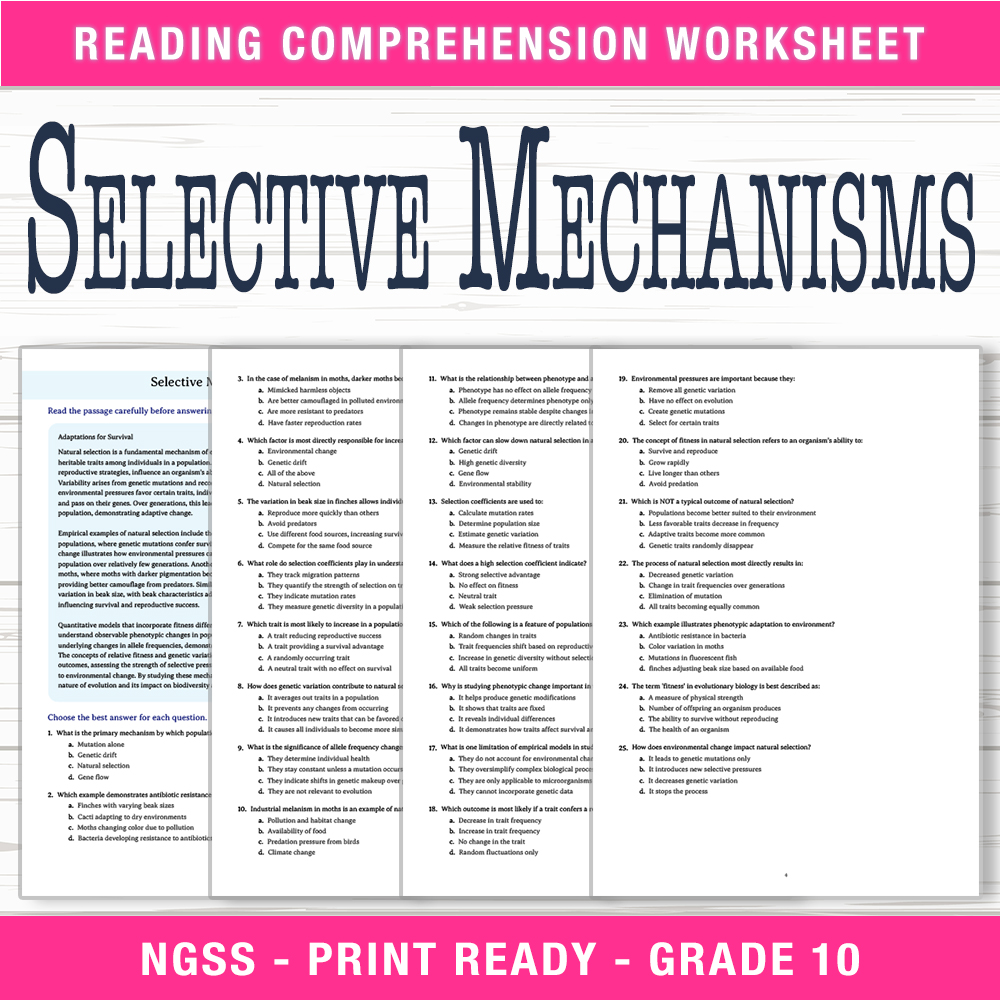
Grade 10 Science | Selective Mechanisms Worksheet (PDF + Answer Key)
 Created byRiverstone Classroom
Learning Objectives
- Understand the principles of natural selection and how it drives evolution
- Identify examples of selective mechanisms such as antibiotic resistance, industrial melanism, and beak variation
- Analyze how environmental pressures influence trait frequencies in populations
Also included in: Grade 10 Science | Evolution & Biodiversity Unit Worksheet Bundle
Instant download
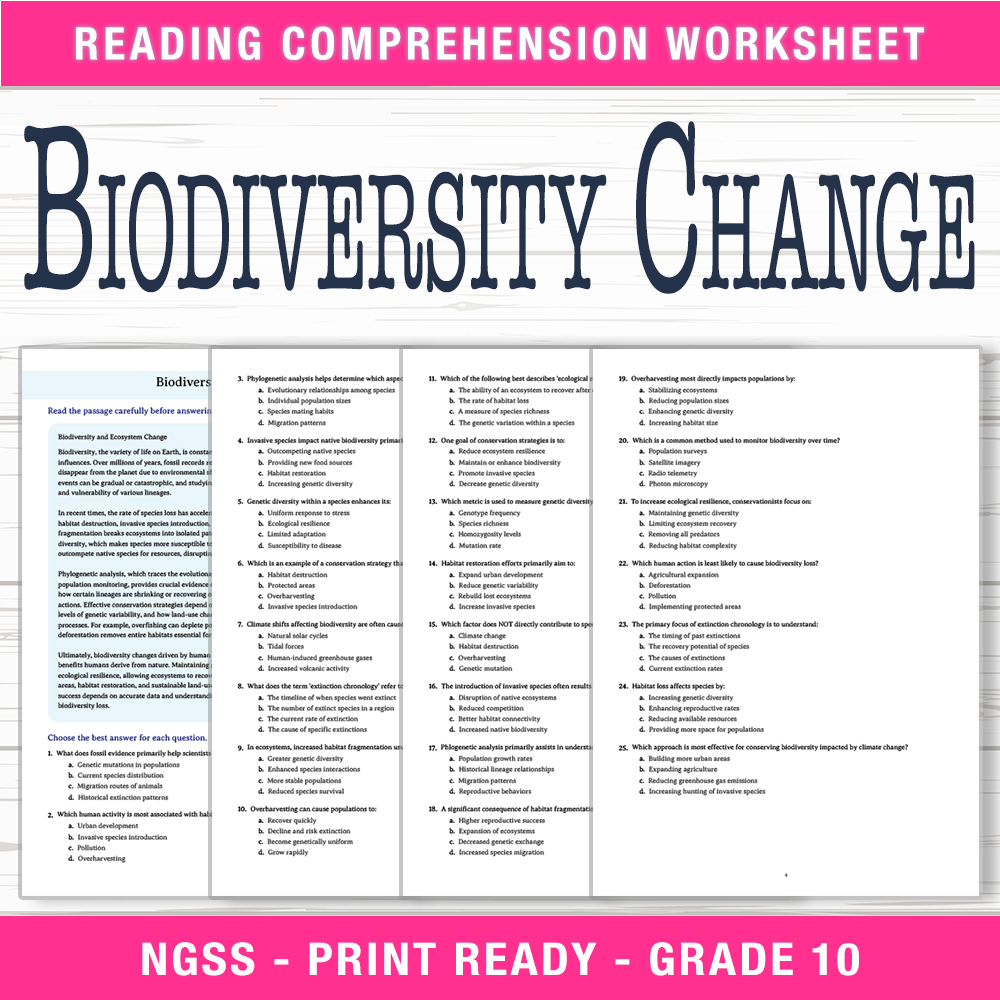
Grade 10 Science – Biodiversity Change Worksheet (PDF + Answer Key)
Created byRiverstone ClassroomLearning Objectives
- Understand the factors contributing to changes in biological diversity, including fossil extinction records and habitat fragmentation.
- Analyze evidence from phylogenetic analysis and population monitoring to assess biodiversity trends.
- Evaluate the impact of human activities on genetic diversity and ecological resilience.
Also included in: Grade 10 Science | Evolution & Biodiversity Unit Worksheet Bundle
Instant download

Energy Accounting Worksheet | Standards-Aligned Science Practice for Grade 10
JCreated byJ.S SheetsLearning Objectives
- Understand the principles of energy flow and transfer within systems.
- Apply system boundary concepts and energy flow diagrams to real-world scenarios.
- Use algebraic and graphical methods to analyze energy distribution and predict system behavior.
Also included in: Grade 10 Energy Conservation and Conversion Science Lesson Bundle: NGSS
Instant download
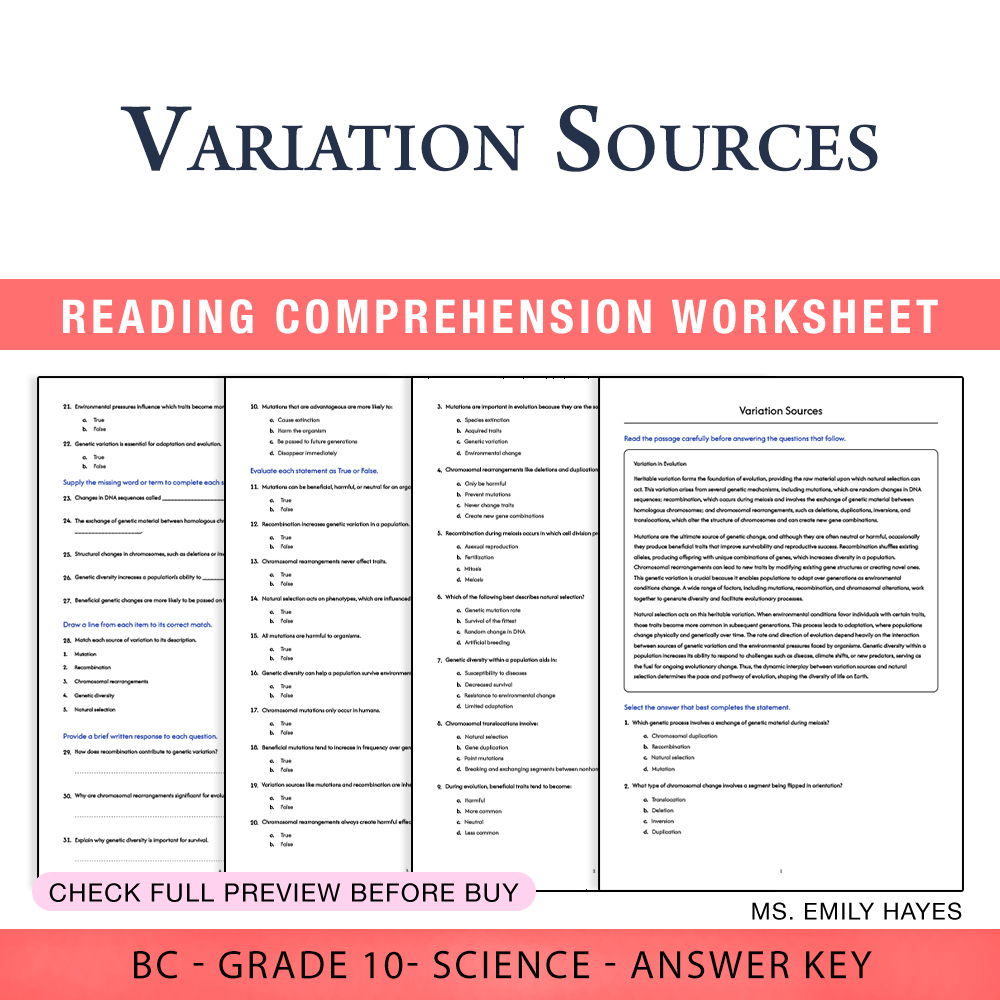
10th Grade Science | Variation Sources Worksheet (PDF + Answer Key)
 Created byCopper Leaf Classroom
Learning Objectives
- Identify sources of heritable variation such as mutations, recombination, and chromosomal rearrangements.
- Explain how natural selection acts on genetic variation to influence traits in populations.
- Describe the role of genetic diversity in adaptation and evolution.
Also included in: Grade 10 Science BC | Evolution, Biodiversity & Ecology (PDF + Answer Key) +1 more
Instant download

Grade 10 Science | Genetic Variation in Populations - Reading Comprehension
 Created byCoral Reef Learning
Learning Objectives
- Understand the sources of genetic variation in populations
- Identify mechanisms such as meiosis, crossing over, mutation, and gene flow
- Recognize how these mechanisms contribute to genetic diversity
Instant download

Grade 10 Science – Carbon Cycling & Climate Change | Daily Reading Worksheet
 Created byBright Mind Resources
Learning Objectives
- Identify the major components of the carbon cycle
- Understand the roles of atmosphere, biosphere, ocean, and lithosphere in carbon fluxes
- Explain how human activities influence carbon cycling and climate change
Also included in: Grade 10 Daily Reading Science: Environmental Systems Lesson Bundle | NGSS +2 more
Instant download

Grade 10 Science – Environmental Management & Strategies | Reading Worksheet
Created byBright Mind ResourcesLearning Objectives
- Understand key concepts of environmental mitigation
- Identify common mitigation strategies and their purposes
- Evaluate the effectiveness and trade-offs of mitigation options
Also included in: Grade 10 Daily Reading Science: Environmental Systems Lesson Bundle | NGSS +2 more
Instant download
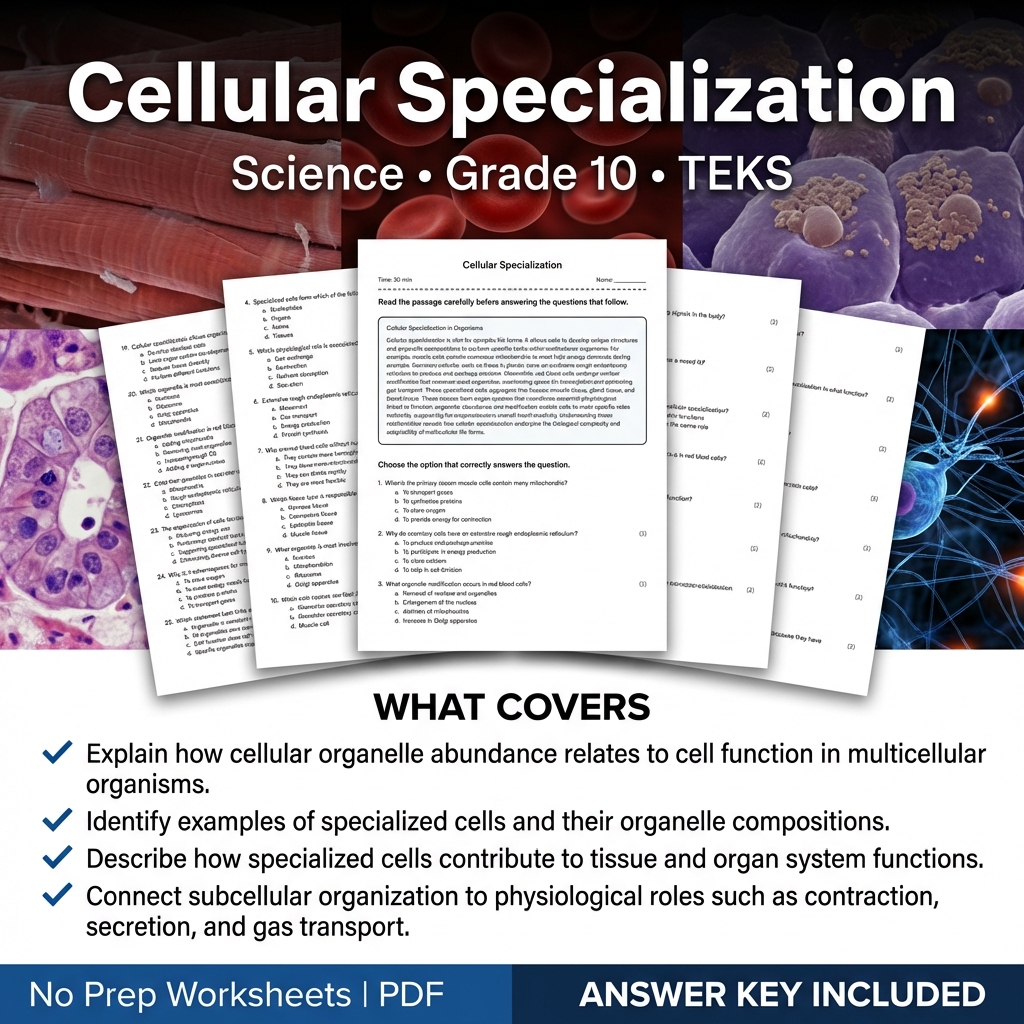
Cellular Specialization Worksheet for Grade 10 Science | TEKS Aligned
Created byCoral Reef LearningLearning Objectives
- Explain how cellular organelle abundance relates to cell function in multicellular organisms.
- Identify examples of specialized cells and their organelle compositions.
- Describe how specialized cells contribute to tissue and organ system functions.
Instant download
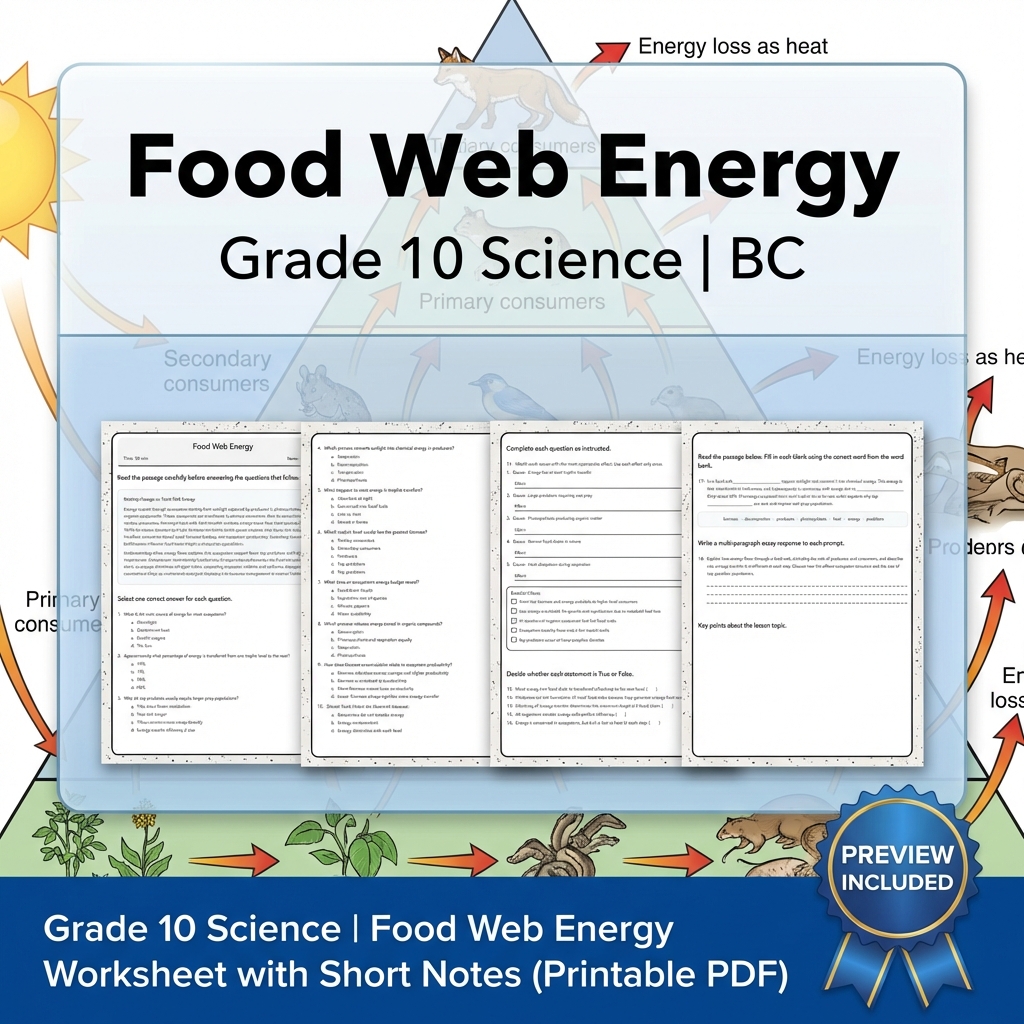
Grade 10 Science | Food Web Energy Worksheet with Short Notes (Printable PDF)
 Created byMeadowlark Worksheets
Learning Objectives
- Understand how energy flows through ecosystems via food webs.
- Identify the steps and efficiency of energy transfer between trophic levels.
- Explain the relationship between photosynthesis, respiration, and biomass in ecosystems.
Also included in: Grade 10 Science Lesson Bundle | Energy & Thermodynamics Worksheets +1 more
Instant download
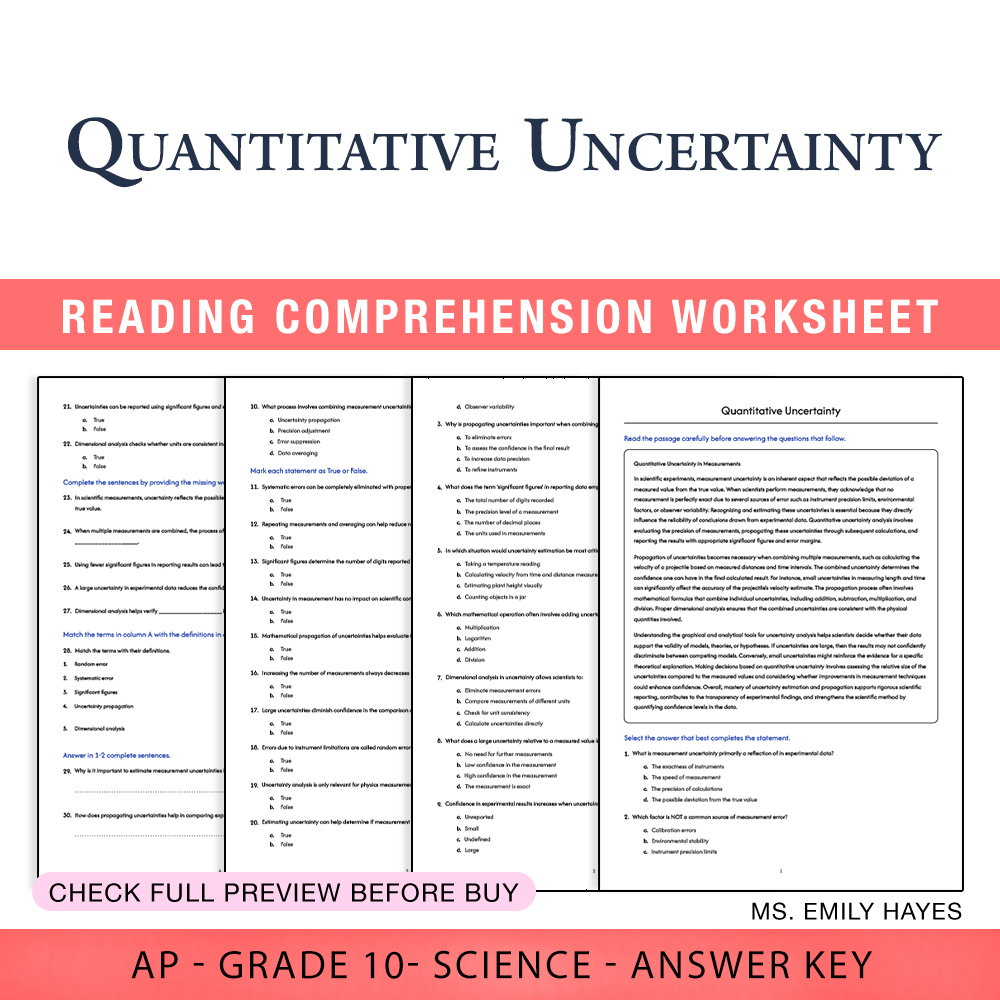
10th Grade Science | Quantitative Uncertainty Worksheet (PDF+ Answer Key)
Created byCopper Leaf ClassroomLearning Objectives
- Understand measurement uncertainties and their sources.
- Learn methods for propagating uncertainties in calculations.
- Apply significant figures correctly in data reporting.
Also included in: Grade 10 Science AP | Data Analysis & Modeling Skills (PDF + Answer Key) +1 more
Instant download

Grade 10 Science | Argument Critique Worksheet | AP Standards
 Created byLumora Learning
Learning Objectives
- Evaluate explanatory claims systematically by examining evidence quality and reasoning consistency.
- Identify criteria for refutation, corroboration, and confidence levels in arguments.
- Analyze how statistical strength, representational choices, and methodological constraints influence argument persuasiveness.
Instant download
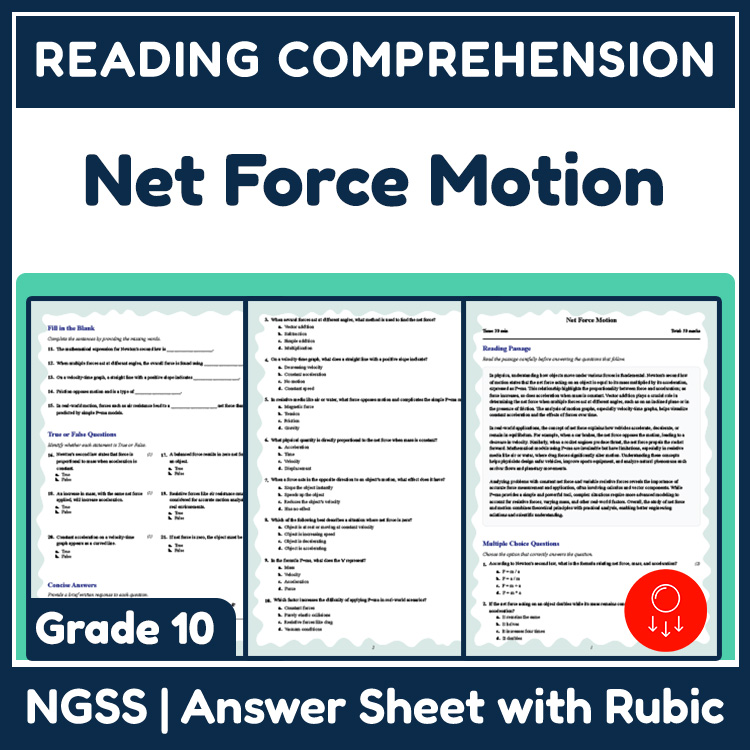
10th Grade Science | Net Force & Motion Reading Worksheet (PDF + Answer Key)
JCreated byJ.S SheetsLearning Objectives
- Understand the relationship between net force, mass, and acceleration through Newton's second law.
- Analyze how vector addition affects net force in different scenarios.
- Interpret motion graphs to determine constant acceleration and force effects.
Instant download
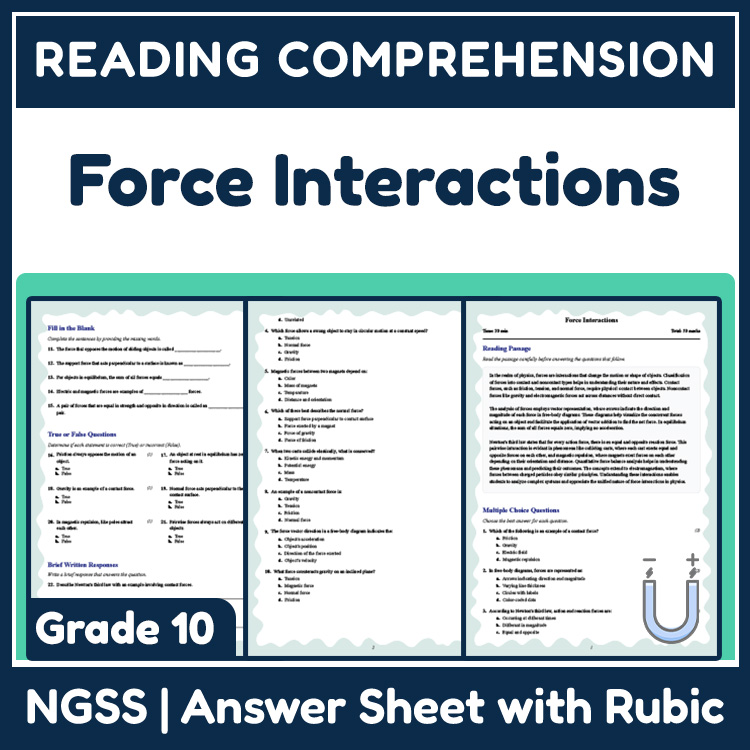
10th Grade Science | Force Interactions Reading Worksheet (PDF + Rubric)
JCreated byJ.S SheetsLearning Objectives
- Understand and classify contact and noncontact forces, including examples like friction, normal force, tension, and electromagnetism.
- Represent forces graphically using vectors and free-body diagrams to analyze contact and pairwise interactions.
- Explain Newton's third law and recognize action-reaction pairs in various physical scenarios.
Instant download

Grade 10 Science – Statistical Reasoning & Data Interpretation | Worksheet
Created byBright Mind ResourcesLearning Objectives
- Understand and calculate measures of central tendency: mean, median, and mode.
- Interpret how measures of central tendency summarize data.
- Recognize the importance of variability and evidence strength in scientific data.
Also included in: Inquiry Grade 10 Science Daily Reading Worksheets Lesson Bundle | Ontario +1 more
Instant download
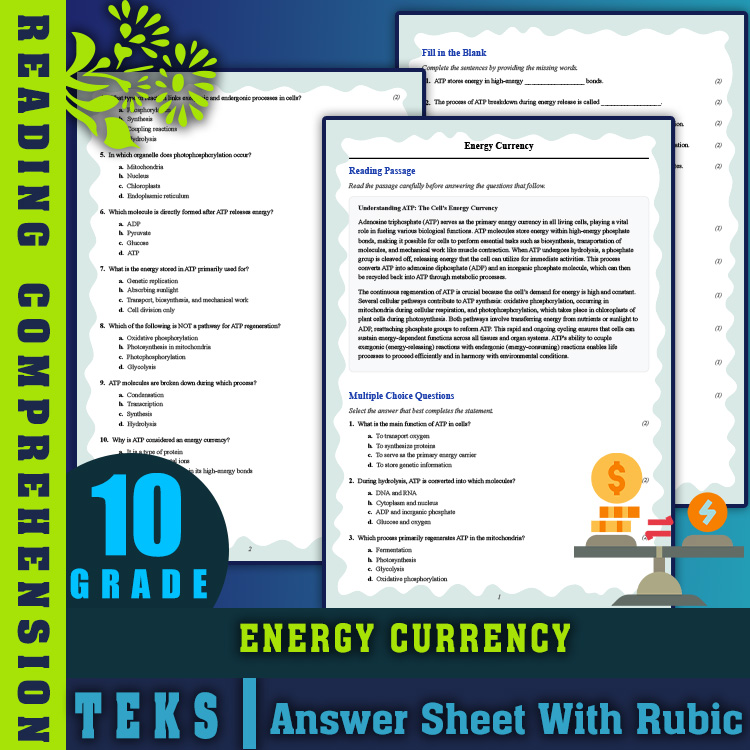
Grade 10 Science | Energy Currency Reading Worksheets (PDF + Answer Key)
JCreated byJ.S SheetsLearning Objectives
- Understand the role of ATP as the primary energy carrier in cells.
- Describe how ATP stores and releases energy during cellular processes.
- Explain how ATP is regenerated in cells through metabolic pathways.
Instant download
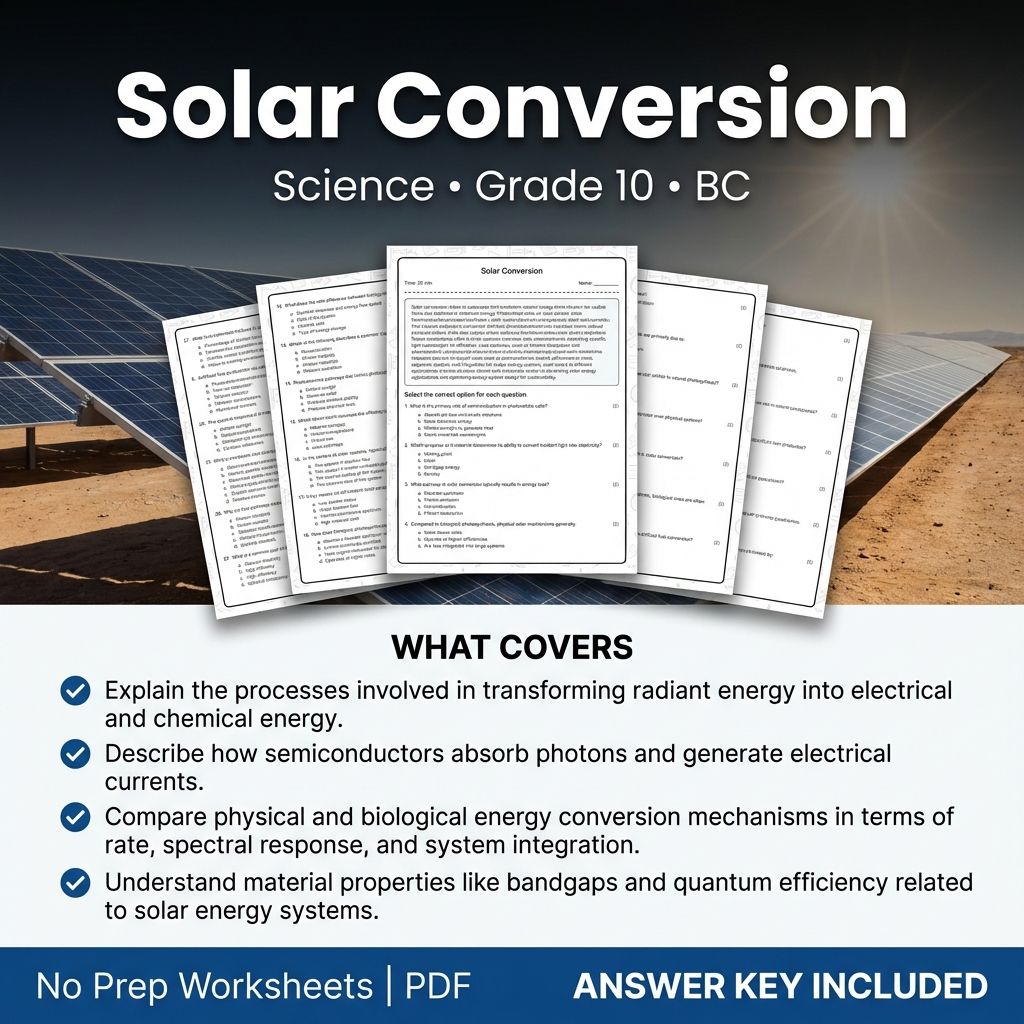
10th Grade Science | Solar Conversion Worksheet & Answer Key (PDF)
Created byCoral Reef LearningLearning Objectives
- Explain the processes involved in transforming radiant energy into electrical and chemical energy.
- Describe how semiconductors absorb photons and generate electrical currents.
- Compare physical and biological energy conversion mechanisms in terms of rate, spectral response, and system integration.
Instant download
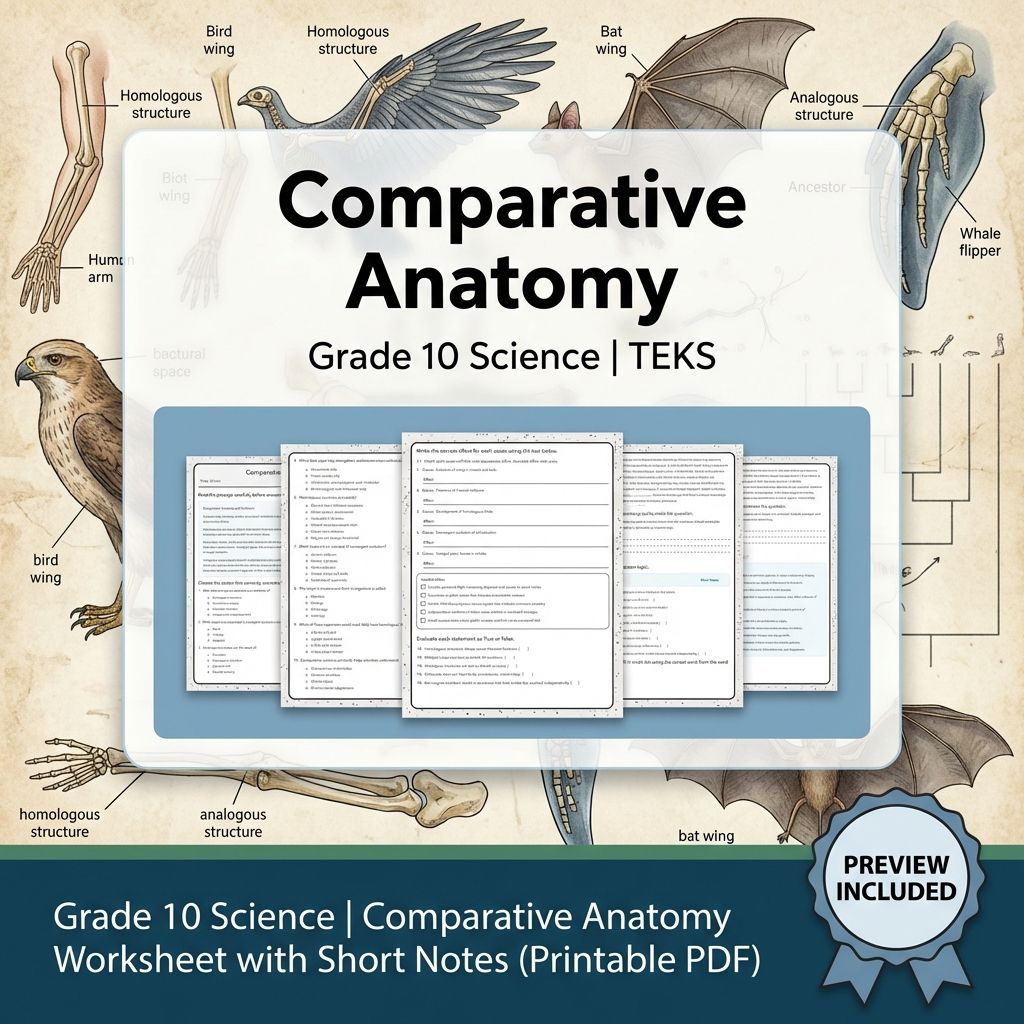
10th Grade Science | Comparative Anatomy Worksheet with Short Notes ( PDF)
Created byMeadowlark WorksheetsLearning Objectives
- Understand the concept of homologous and analogous structures in organisms.
- Identify vestigial organs and their significance in evolution.
- Explain how anatomical, embryological, and molecular data contribute to understanding evolutionary relationships.
Instant download

Adaptation Planning Test Prep Worksheet | Grade 10 Science NGSS Review
 Created byPrism Point Learning
Learning Objectives
- Evaluate adaptation options using risk maps and hazard-frequency information
- Compare economic, social, and ecological trade-offs in infrastructure and policy decisions
- Use governance and equity considerations to assess feasibility and long-term resilience
Instant download

Grade 10 Science – Homology & Commonality | Daily Reading Worksheet
Created byBright Mind ResourcesLearning Objectives
- Understand the concept of homologous structures in different species
- Identify shared features that indicate common ancestry
- Explain how internal body plans and developmental pathways reveal evolutionary relationships
Also included in: Grade 10 Genetics & Evolution Science Lesson Bundle | California Standards +1 more
Instant download

Grade 10 Science – Engineering Problems & Design | Daily Reading Worksheet
Created byBright Mind ResourcesLearning Objectives
- Identify the criteria that define a successful engineering solution.
- Recognize constraints that limit engineering design options.
- Explain how clear problem definition guides effective engineering solutions.
Also included in: Design Grade 10 Science Daily Reading Worksheets Bundle | California Standards +1 more
Instant download
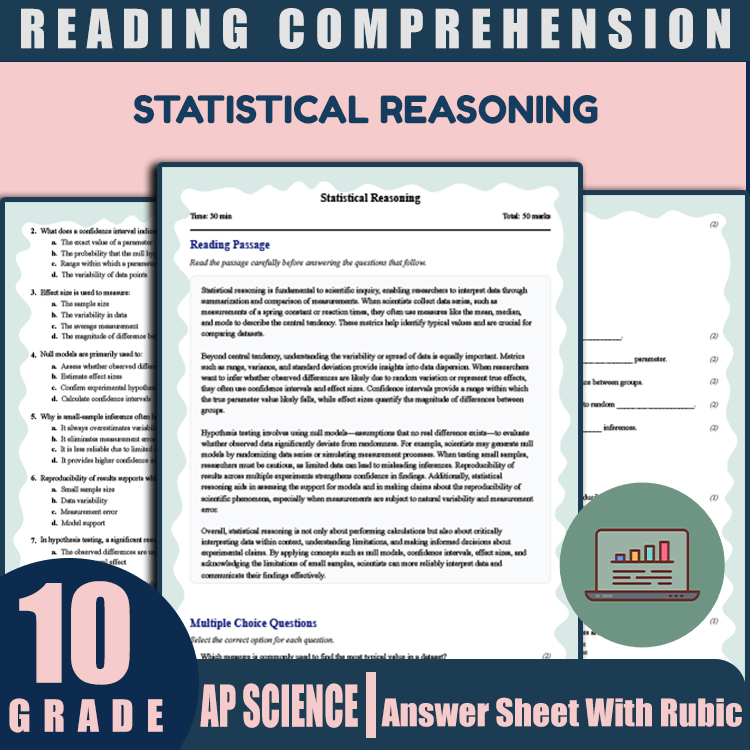
10th Grade Science | Statistical Reasoning Reading Worksheet & Answer Key (PDF)
JCreated byJ.S SheetsLearning Objectives
- Understand methods for summarizing and comparing quantitative datasets using measures of central tendency and spread.
- Interpret confidence intervals and effect sizes in the context of scientific measurement series.
- Evaluate the use of null models and hypothesis testing to assess whether observed differences are significant.
Also included in: Grade 10 Science Unit Worksheet Pack – Data Analysis & Scientific Reasoning +1 more
Instant download
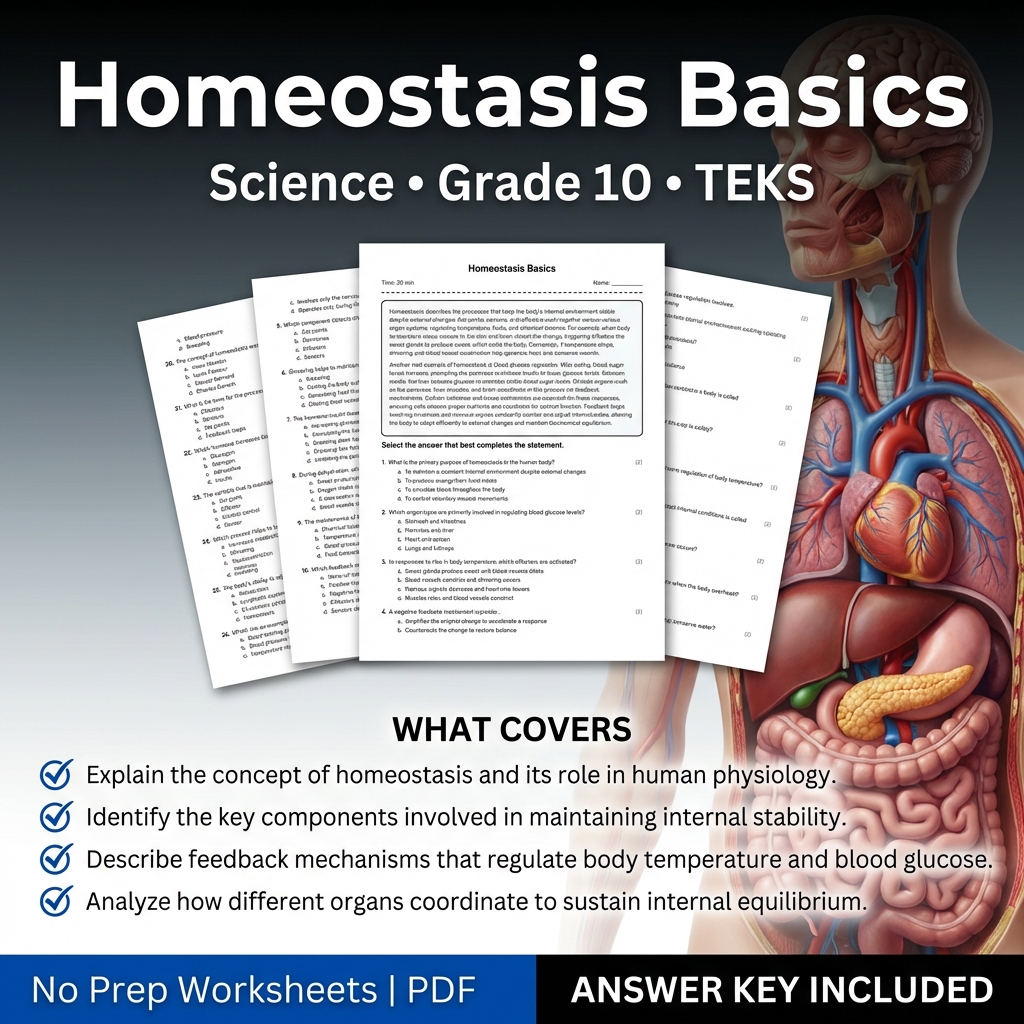
Homeostasis Basics Worksheet for Grade 10 Science | TEKS Aligned
Created byCoral Reef LearningLearning Objectives
- Explain the concept of homeostasis and its role in human physiology.
- Identify the key components involved in maintaining internal stability.
- Describe feedback mechanisms that regulate body temperature and blood glucose.
Instant download

Gravity and Orbits Worksheet for Grade 10 Science | Florida NGSSS PDF
 Created byEvergreen Desk Education
Learning Objectives
- Explain how gravity and motion combine to produce stable orbital paths
- Interpret how distance and speed change in elliptical orbits
- Use gravitational interactions to describe real-world effects such as tides
Instant download
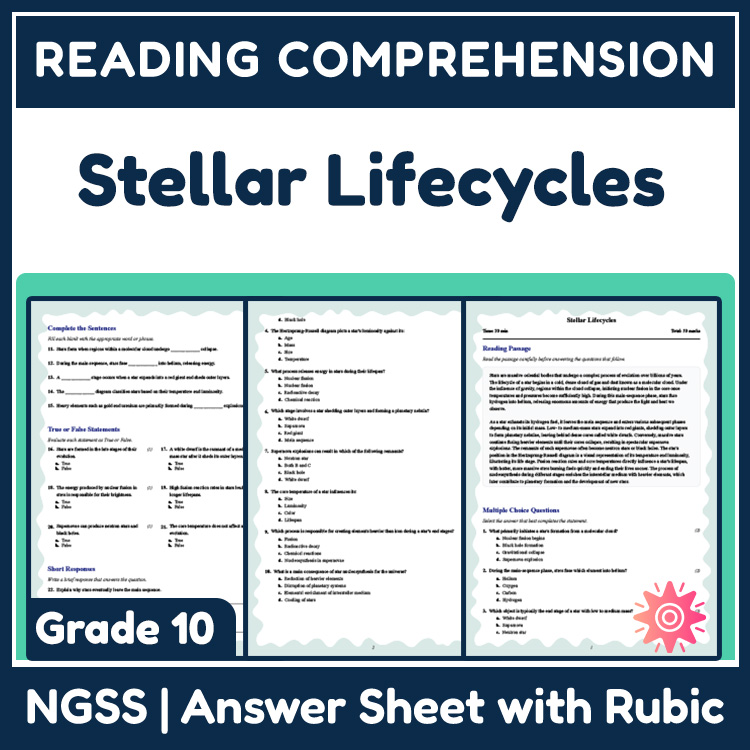
10th Grade Science | Stellar Lifecycles Reading Worksheet (PDF + Rubric)
JCreated byJ.S SheetsLearning Objectives
- Explain the key processes involved in stellar evolution, including nuclear fusion and energy transport.
- Identify the stages of a star's lifecycle as depicted on the Hertzsprung-Russell diagram.
- Describe the various end-stage objects like white dwarfs, neutron stars, and supernovae.
Instant download
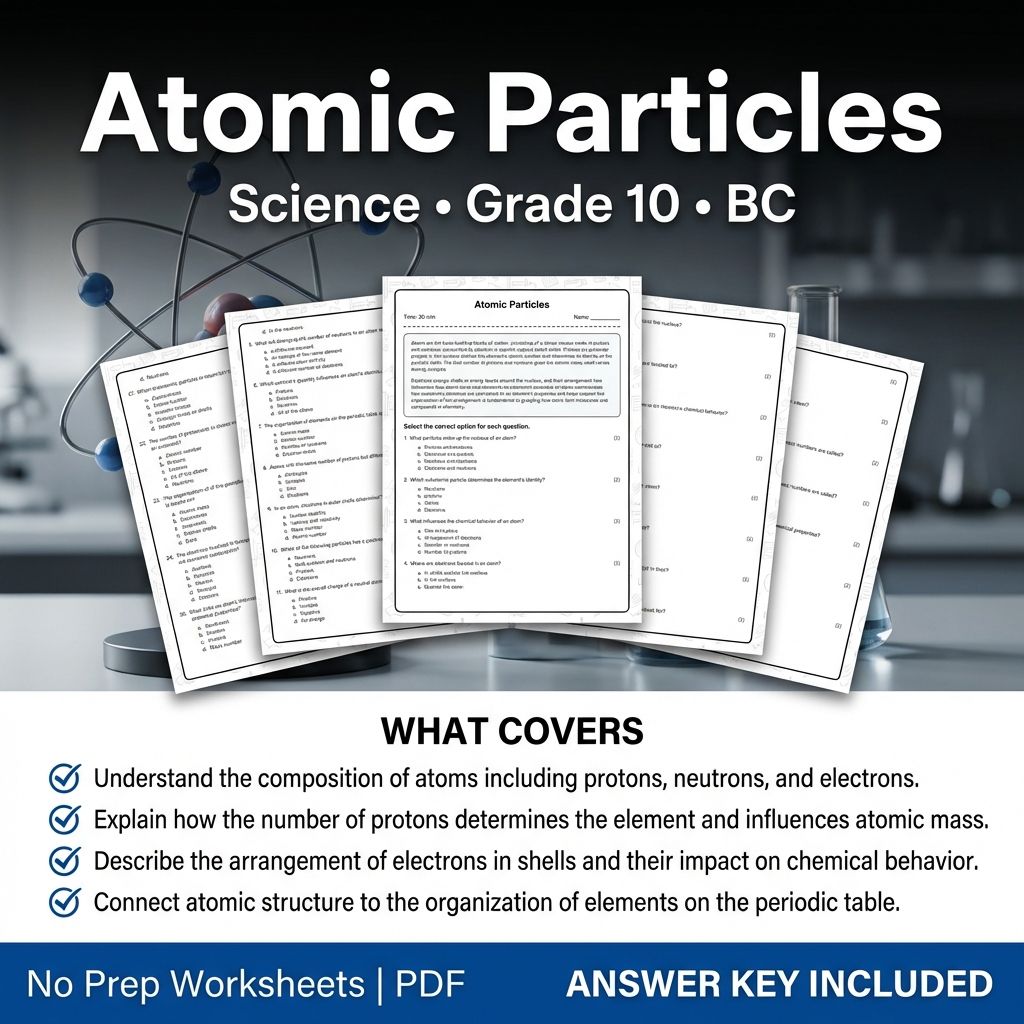
10th Grade Science Worksheet | Atomic Particles – Practice & Answer Key (PDF)
Created byCoral Reef LearningLearning Objectives
- Understand the composition of atoms including protons, neutrons, and electrons.
- Explain how the number of protons determines the element and influences atomic mass.
- Describe the arrangement of electrons in shells and their impact on chemical behavior.
Instant download
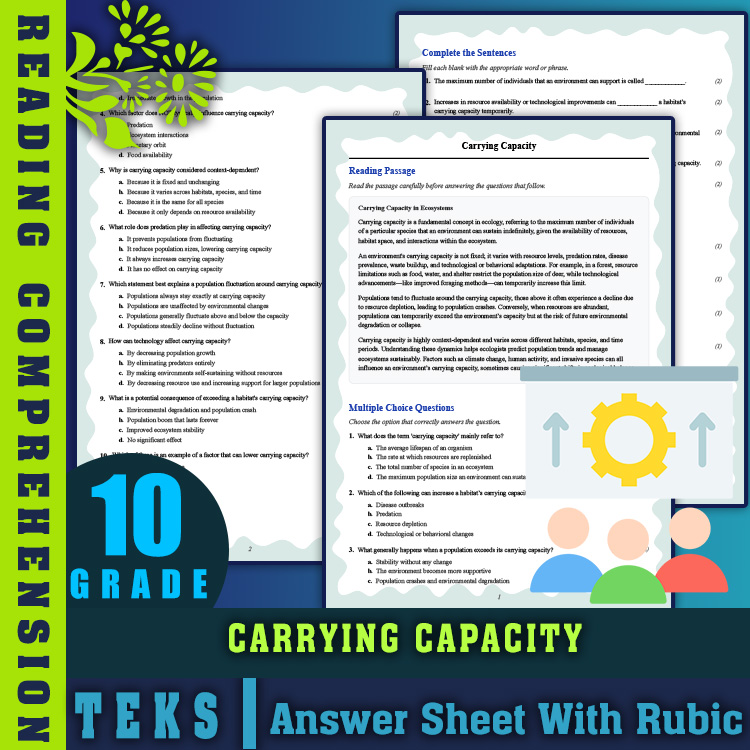
10th Grade Science | Carrying Capacity Reading Worksheet & Answer Key (PDF)
JCreated byJ.S SheetsLearning Objectives
- Understand the concept of carrying capacity and factors that influence it.
- Analyze how resource limitations and ecosystem interactions affect population sizes.
- Evaluate the effects of exceeding carrying capacity on environments and populations.
Instant download

Grade 10 Science | Newtonian Forces Worksheet | Florida NGSSS Aligned
Created byLumora LearningLearning Objectives
- Explain how net force causes changes in motion, including constant velocity when net force is zero
- Connect equilibrium to balanced forces and predict motion outcomes from force descriptions and free-body diagrams
- Use proportional reasoning between net force, acceleration, and inverse proportionality between mass and acceleration
Instant download
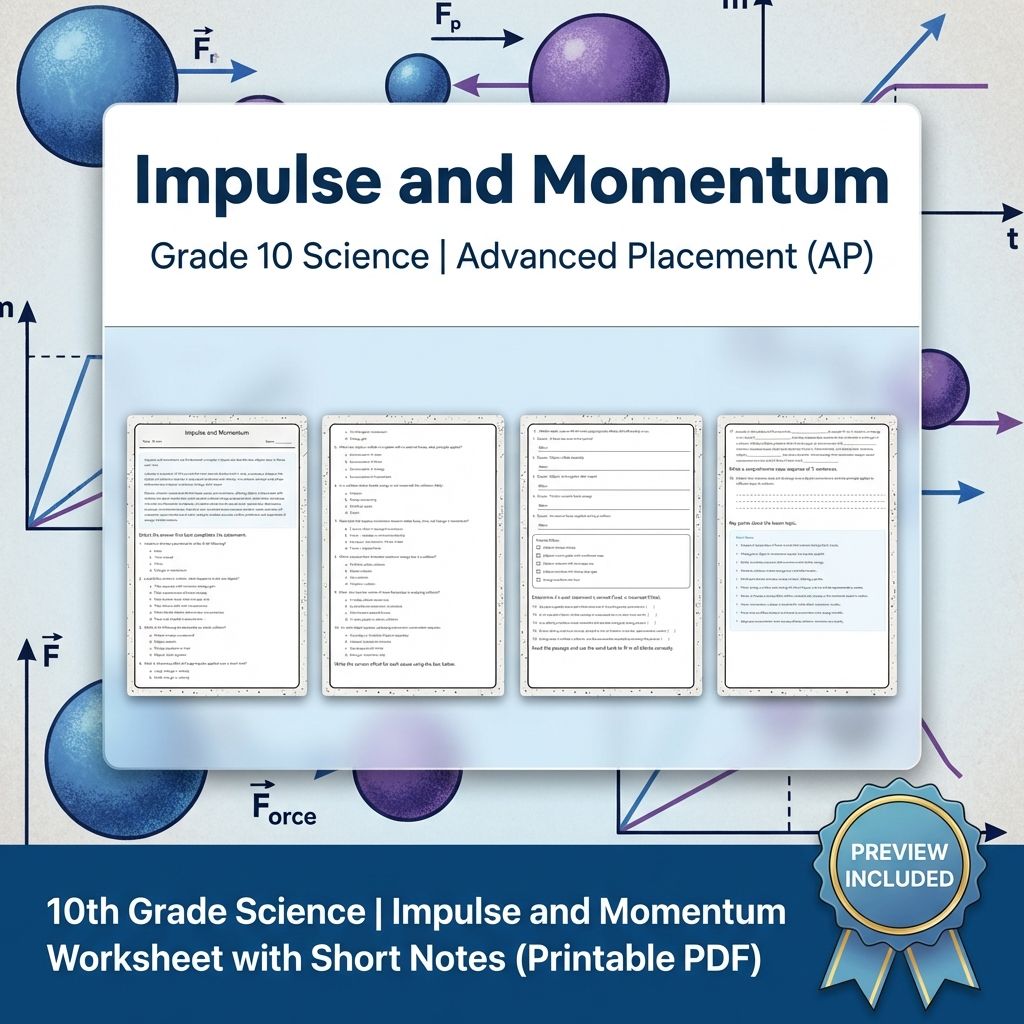
10th Grade Science | Impulse and Momentum Worksheet with Short Notes (PDF)
Created byMeadowlark WorksheetsLearning Objectives
- Explain the concept of impulse and how it relates to changes in momentum.
- Analyze collision types—elastic, inelastic, perfectly inelastic—using momentum conservation.
- Understand how force-time profiles affect the outcome of collisions in transient events.
Instant download
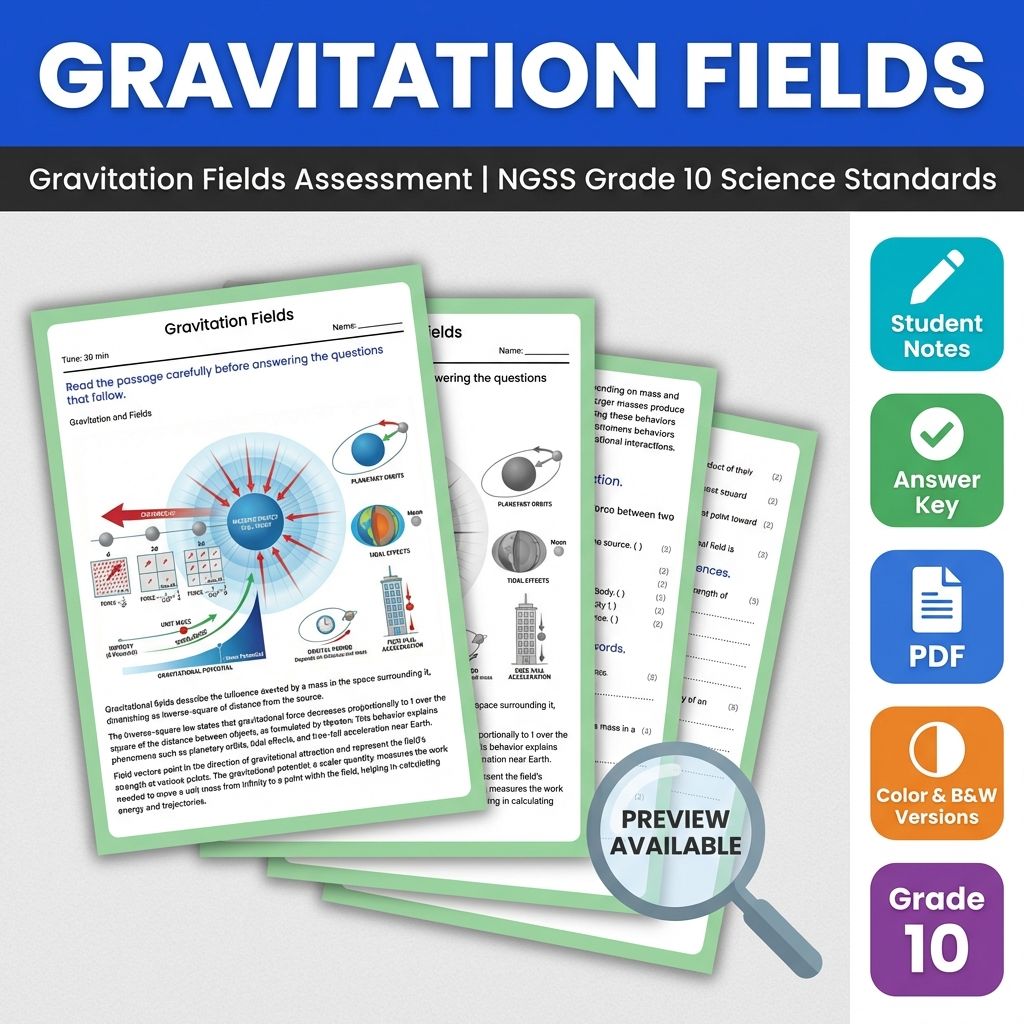
Gravitation Fields Assessment | NGSS Grade 10 Science Standards
Created byPrism Point LearningLearning Objectives
- Understand the inverse-square law behavior of gravitational fields from point sources.
- Learn how to represent gravitational fields using vectors and potential concepts.
- Apply Newtonian gravity to predict orbital motion and calculate orbital periods.
Instant download
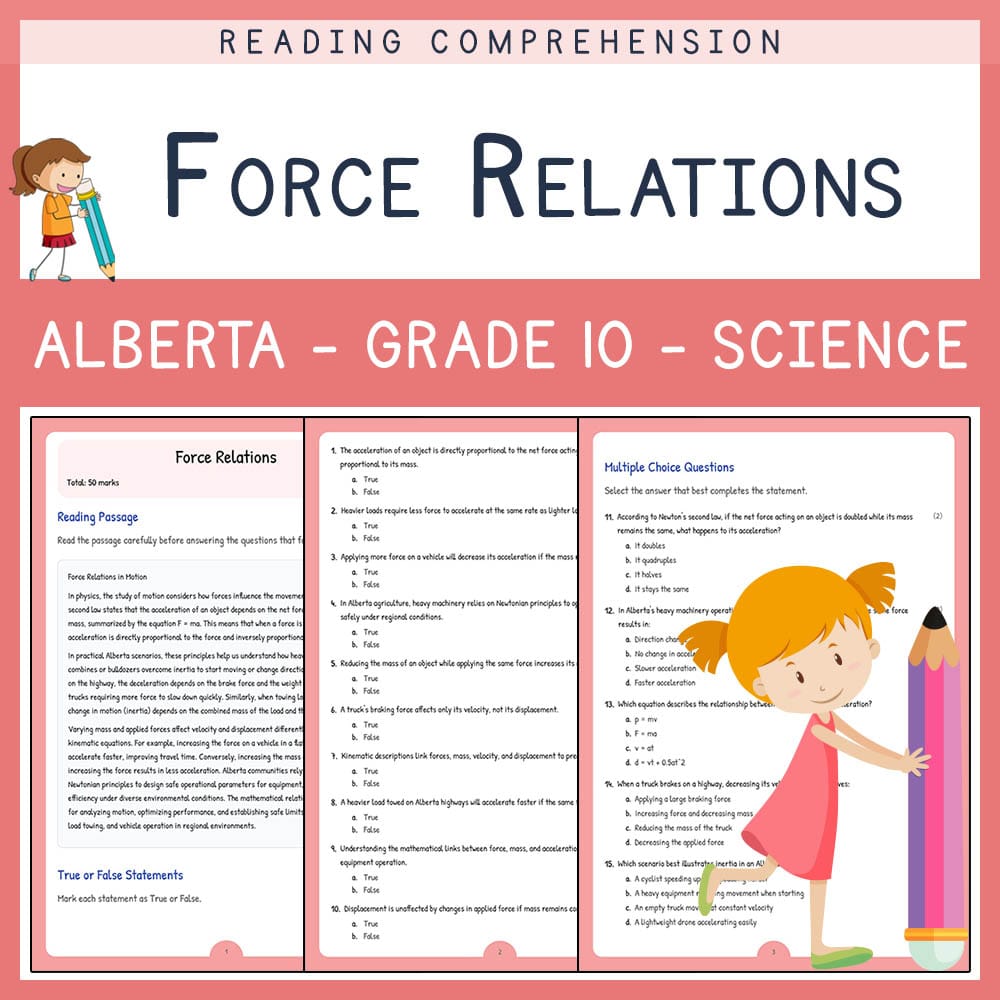
Grade 10 Science | Force Relations Worksheet | Alberta Standards
Created byLumora LearningLearning Objectives
- Explain the relationship between net force, mass, and acceleration using Newton's laws.
- Describe how varying mass and applied forces affect motion outcomes in real-world Alberta examples.
- Analyze and interpret mathematical links between force, mass, and acceleration to predict kinematic behavior.
Instant download
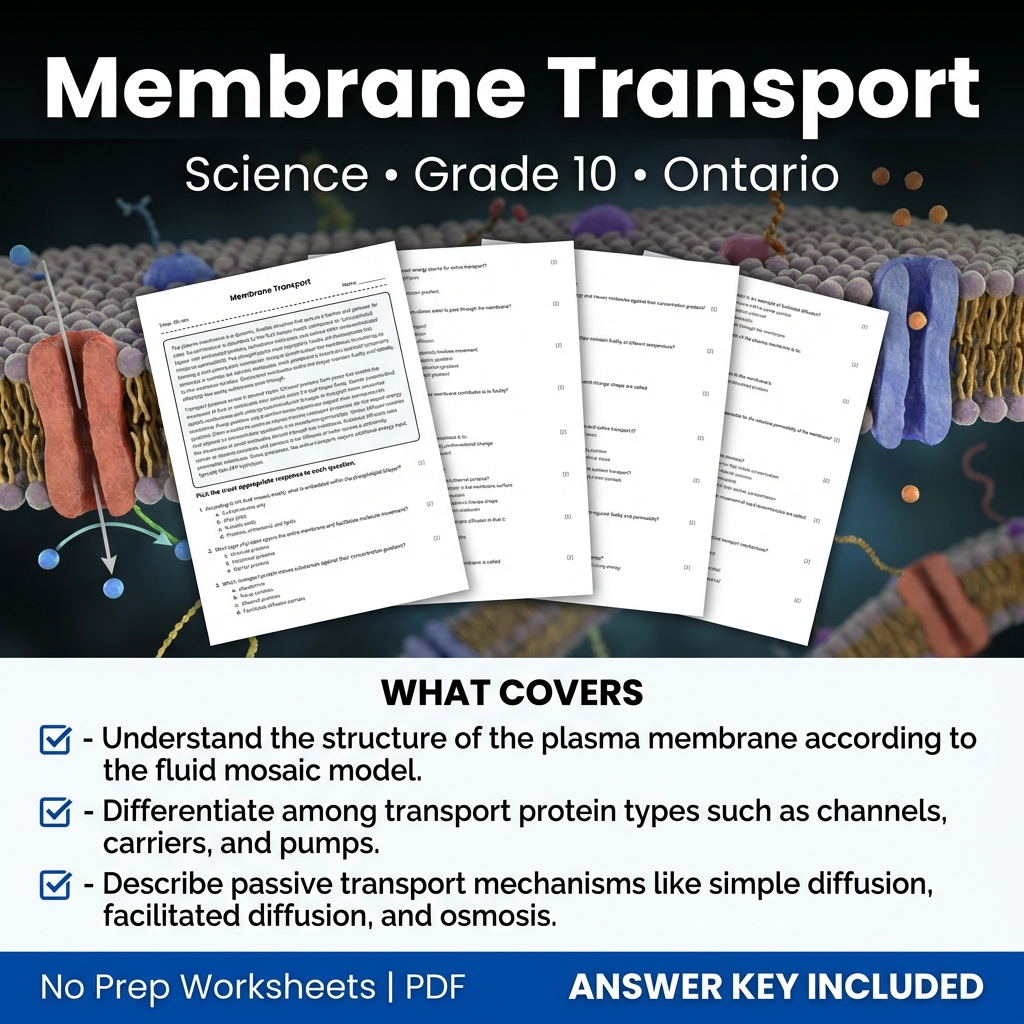
Membrane Transport Worksheet | Science Grade 10 | Ontario Standards
Created byCoral Reef LearningLearning Objectives
- Understand the structure of the plasma membrane according to the fluid mosaic model.
- Differentiate among transport protein types such as channels, carriers, and pumps.
- Describe passive transport mechanisms like simple diffusion, facilitated diffusion, and osmosis.
Instant download
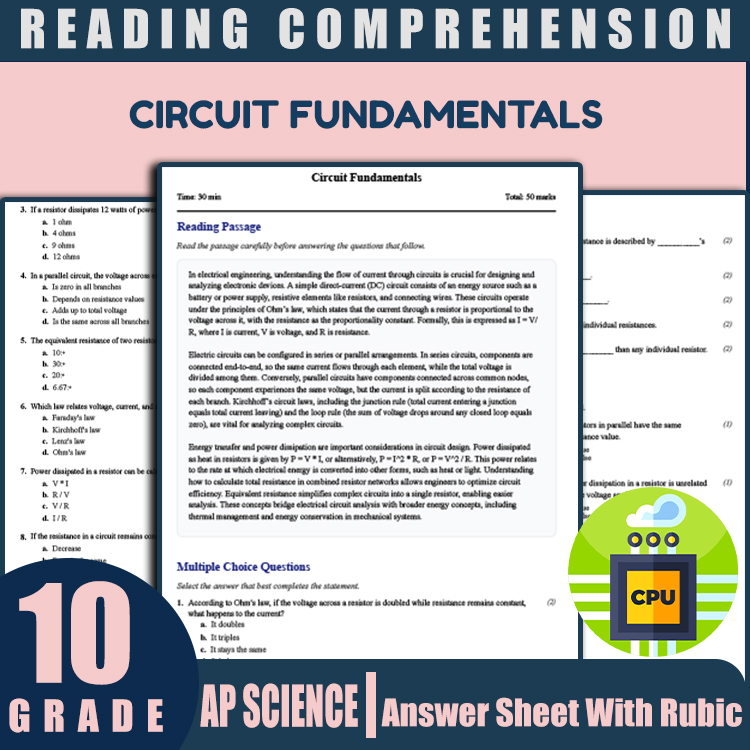
10th Grade Science | Circuit Fundamentals Reading Worksheets (PDF & Rubric)
JCreated byJ.S SheetsLearning Objectives
- Understand the basic principles of direct-current circuits, including voltage, current, and resistance.
- Apply Ohm's law and Kirchhoff's rules to analyze series and parallel resistor networks.
- Relate circuit behaviors to energy transfer, power dissipation, and equivalent resistance concepts.
Also included in: Grade 10 Science Unit Bundle | Motion, Forces & Energy Worksheets (PDF) +1 more
Instant download

Momentum and Impulse Test Prep Worksheet | Grade 10 Science
Created byPrism Point LearningLearning Objectives
- Use the impulse–momentum theorem to calculate how velocity changes due to a net force over time
- Explain how conservation of momentum applies to closed systems and collisions
- Interpret impulse using force–time ideas and apply vector reasoning for 2D motion
Also included in: Grade 10 Forces and Conservation Science Lesson Bundle – NGSS
Instant download

Grade 10 Science – Speciation & Evolution | Daily Reading Worksheet
Created byBright Mind ResourcesLearning Objectives
- Understand the concept of speciation and its importance in biology.
- Differentiate between allopatric and sympatric speciation.
- Learn about mechanisms such as reinforcement, hybrid zones, and polyploidy.
Also included in: Grade 10 Evolution & Genetics Science Daily Reading Lesson Bundle | BC +1 more
Instant download
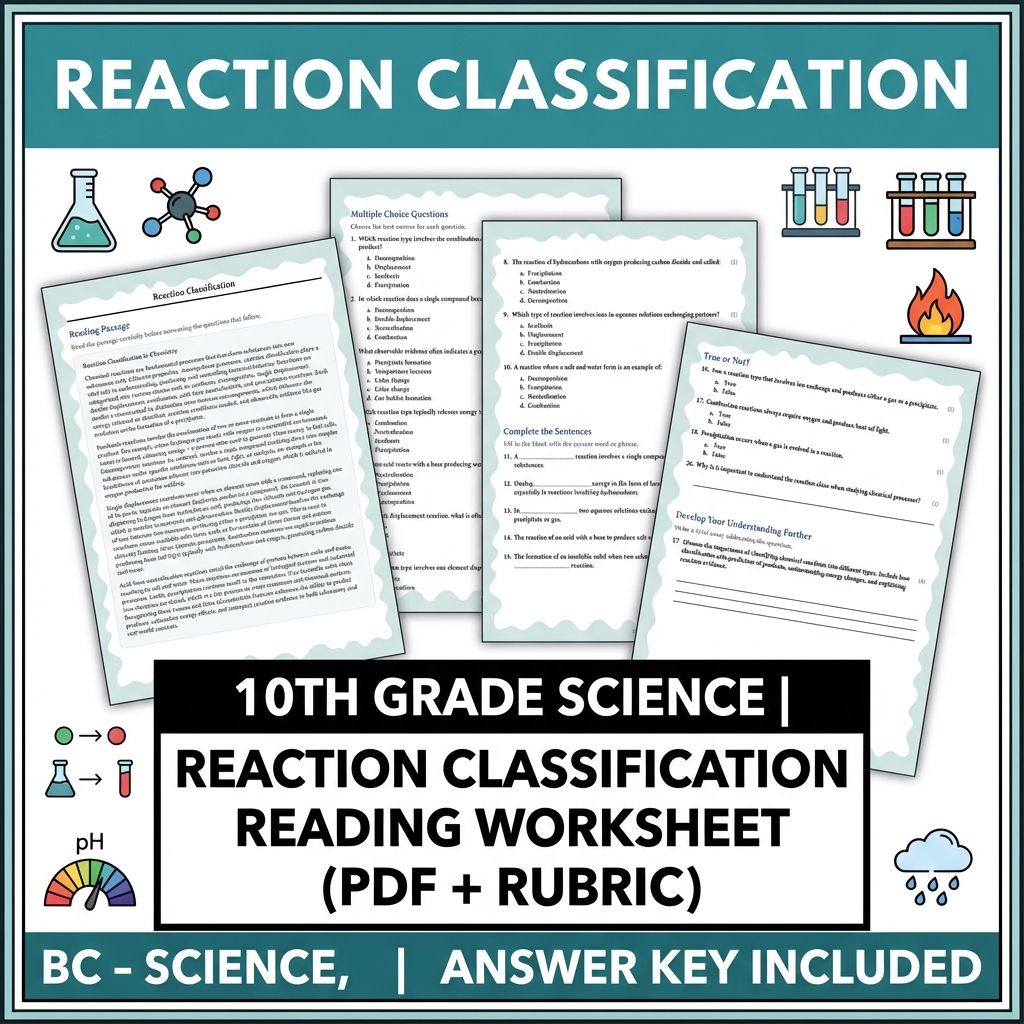
10th Grade Science | Reaction Classification Reading Worksheet (PDF + Rubric)
JCreated byJ.S SheetsLearning Objectives
- Understand the different types of chemical reactions and their characteristic features.
- Identify reaction types based on reactant and product relationships.
- Relate reaction classes to energy changes and observable evidence.
Instant download
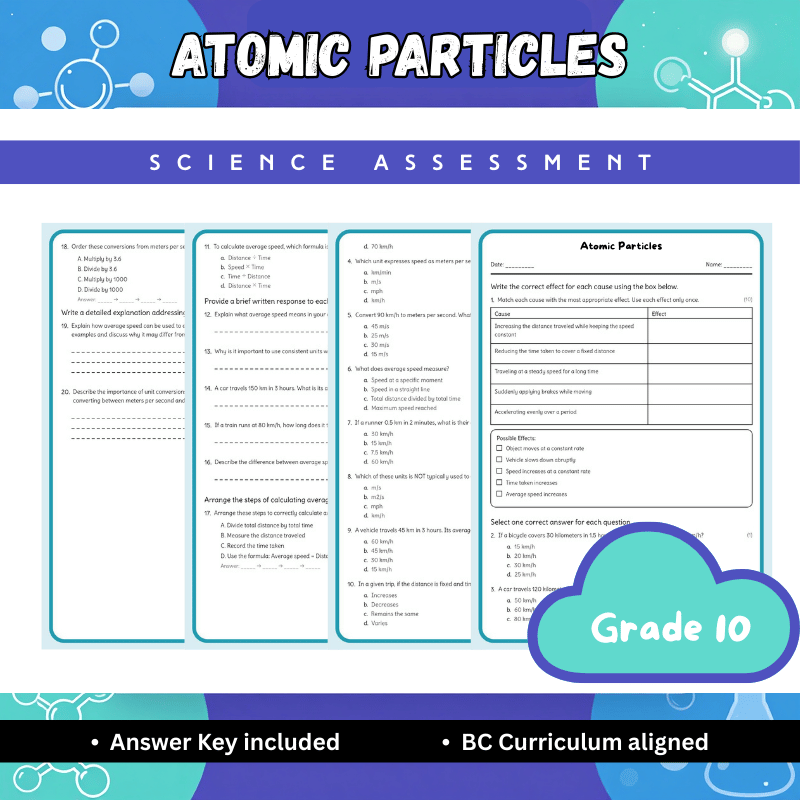
Grade 10 Science | Atomic Particles Worksheet + Answer Key (BC Standards)
Created byBright Mind ResourcesLearning Objectives
- Describe the basic structure of an atom, including protons, neutrons, and electrons.
- Explain how the number of protons determines the element and the number of neutrons affects atomic mass.
- Identify how electrons occupy shells and influence chemical behavior.
Instant download
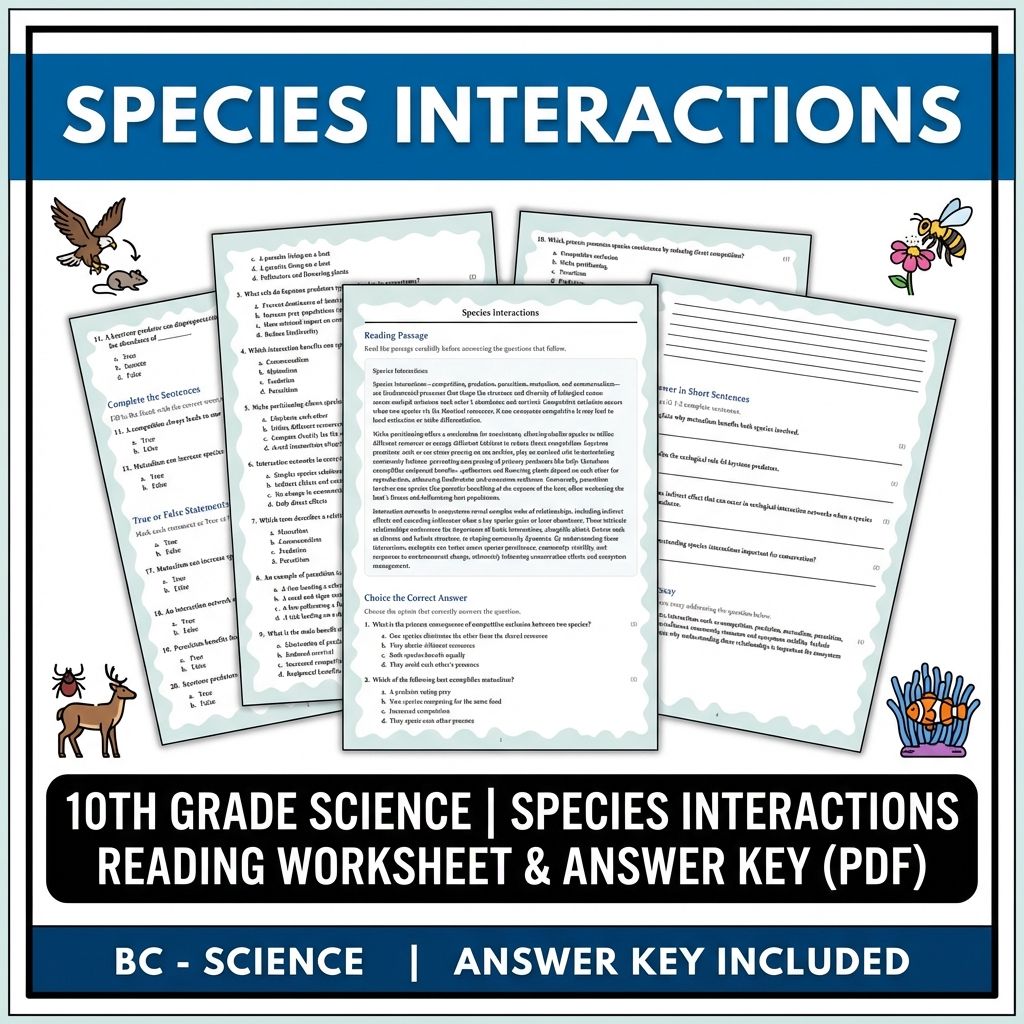
10th Grade Science | Species Interactions Reading Worksheet & Answer Key (PDF)
JCreated byJ.S SheetsLearning Objectives
- Understand various types of species interactions and their roles in ecosystems.
- Identify examples of competition, predation, parasitism, mutualism, and commensalism.
- Explain how species coexistence is maintained through niche partitioning and competitive exclusion.
Instant download
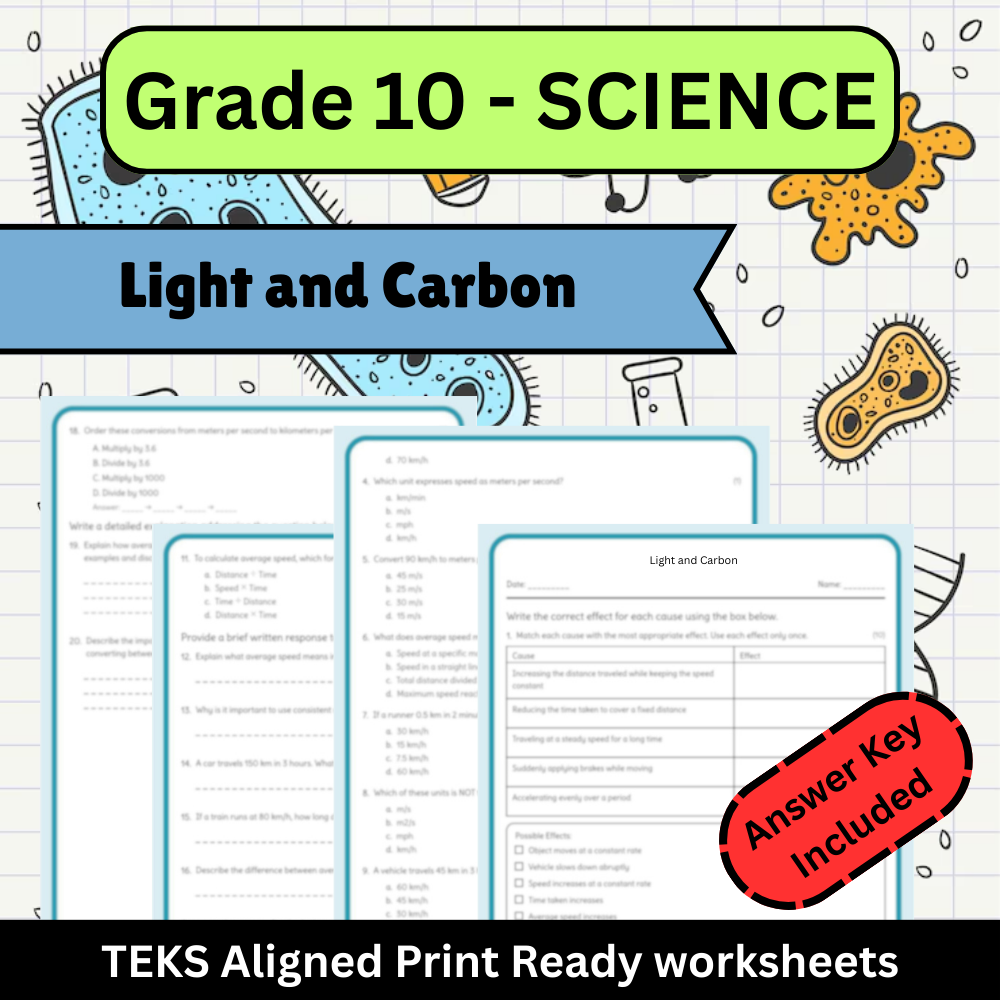
10th Grade Science | Light and Carbon Concepts Worksheet (PDF) – TEKS Aligned
Created byBright Mind ResourcesLearning Objectives
- Explain the process of light reactions in photosynthesis and how water splitting releases oxygen.
- Describe the Calvin cycle and how it fixes carbon dioxide into sugars using ATP and NADPH.
- Identify differences in pigment absorption spectra among plants, algae, and cyanobacteria.
Also included in: Grade 10 Science Unit Bundle – Photosynthesis, Respiration & Energy TEKS +5 more
Instant download
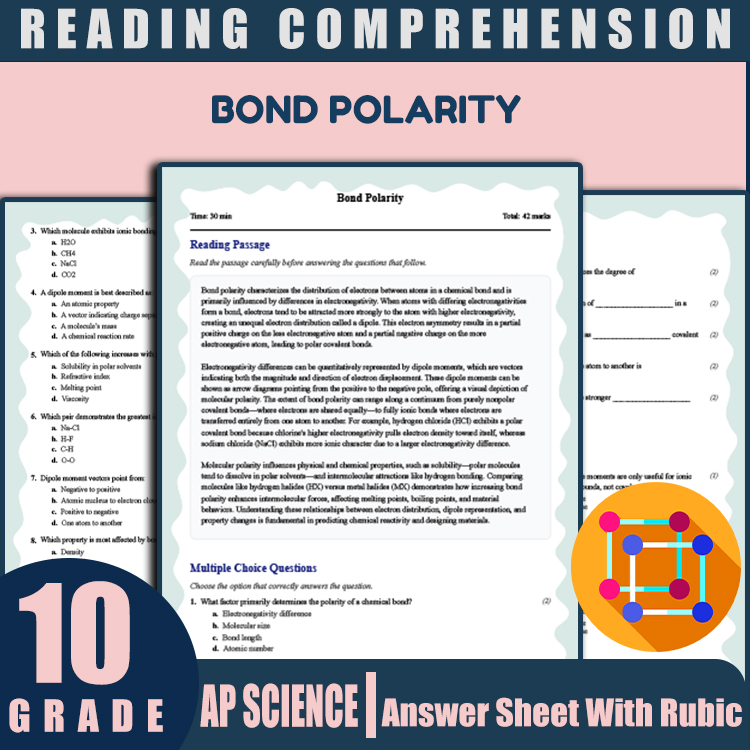
10th Grade Science | Bond Polarity Reading Worksheet & Answer Key (PDF)
JCreated byJ.S SheetsLearning Objectives
- Understand how electronegativity differences influence bond polarity.
- Interpret vector representations of dipole moments in molecules.
- Distinguish between polar covalent and ionic bonds on a continuum.
Also included in: Grade 10 Science Unit Worksheet Bundle | Chemical Reactions & Atomic Structure +1 more
Instant download
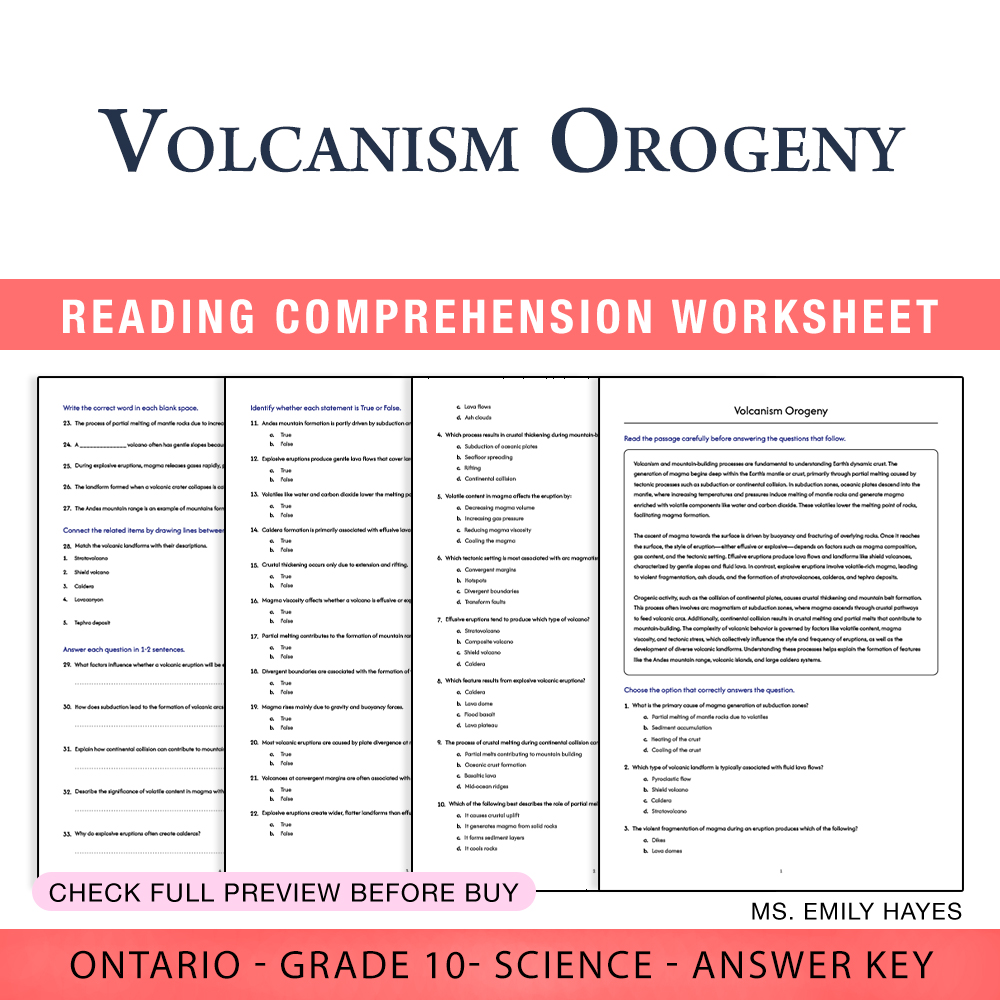
10th Grade Science | Volcanism Orogeny Worksheet (PDF + Answer Key)
Created byCopper Leaf ClassroomLearning Objectives
- Explain the processes of magma generation, ascent, and eruption styles in volcanic activity.
- Compare effusive and explosive volcanism and describe the volcanic landforms produced.
- Understand the role of tectonic settings such as convergent margins and continental collisions in volcanism and mountain building.
Instant download

Grade 10 Science – Comparative Anatomy & Evolution | Daily Reading Worksheet
Created byBright Mind ResourcesLearning Objectives
- Understand the concept of homologous structures and their significance in evolution
- Distinguish between homologous, analogous, and vestigial structures
- Interpret evidence supporting common ancestry from anatomical features
Also included in: Grade 10 Evolution Science Daily Reading Worksheets Lesson Bundle | TEKS +2 more
Instant download
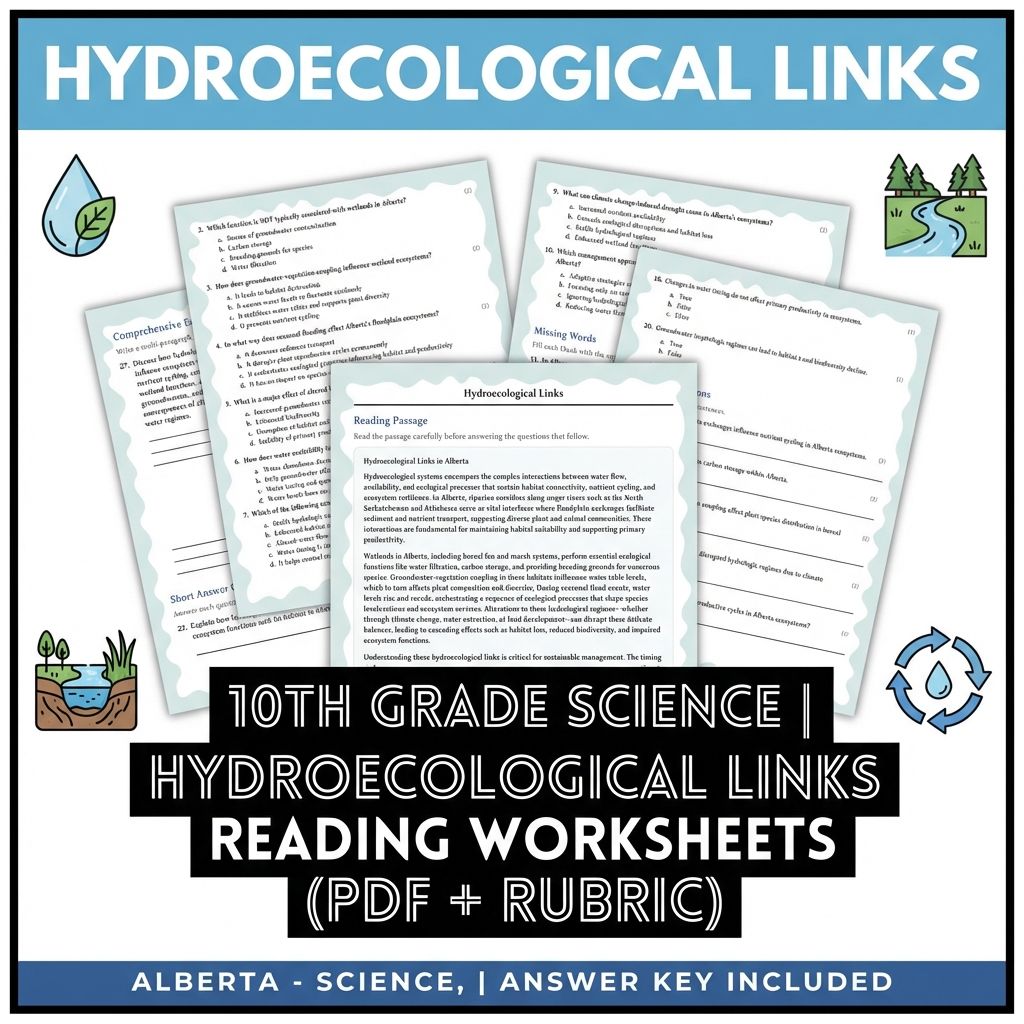
10th Grade Science | Hydroecological Links Reading Worksheets (PDF + Rubric)
JCreated byJ.S SheetsLearning Objectives
- Understand the interactions between hydrology and ecosystems and their impact on habitat and nutrient cycling.
- Describe river-floodplain exchanges, wetland functions, and groundwater-vegetation coupling in Alberta contexts.
- Analyze how water availability and timing influence primary productivity, species distributions, and ecosystem services.
Also included in: Grade 10 Science Unit Bundle – Earth Systems, Climate & Remote Sensing Worksheets +1 more
Instant download
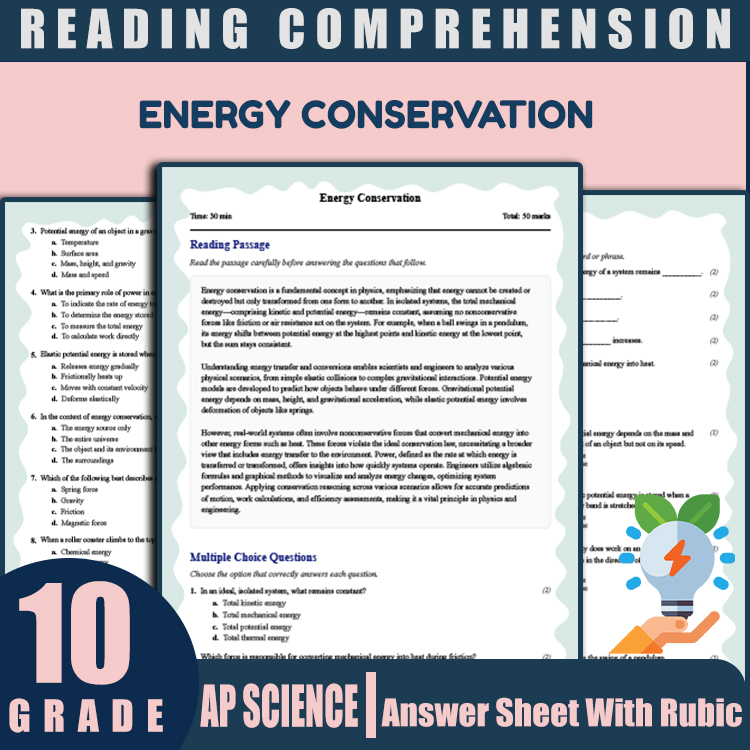
Grade 10 Science | Energy Conservation Reading Worksheet + Answer Key (PDF)
JCreated byJ.S SheetsLearning Objectives
- Develop and analyze potential energy models for gravitational and elastic systems.
- Explain the principles of total mechanical energy conservation and how nonconservative forces influence energy transfer.
- Describe energy transfer and conversions during different physical scenarios.
Also included in: Grade 10 Science Unit Bundle | Motion, Forces & Energy Worksheets (PDF) +1 more
Instant download

Grade 10 Science | Yield & Purity - Daily Reading Comprehension
Created byCoral Reef LearningLearning Objectives
- Understand the concept of percent yield in chemical reactions.
- Explain the significance of purity in samples of chemical compounds.
- Relate measured masses to atomic conservation principles.
Instant download
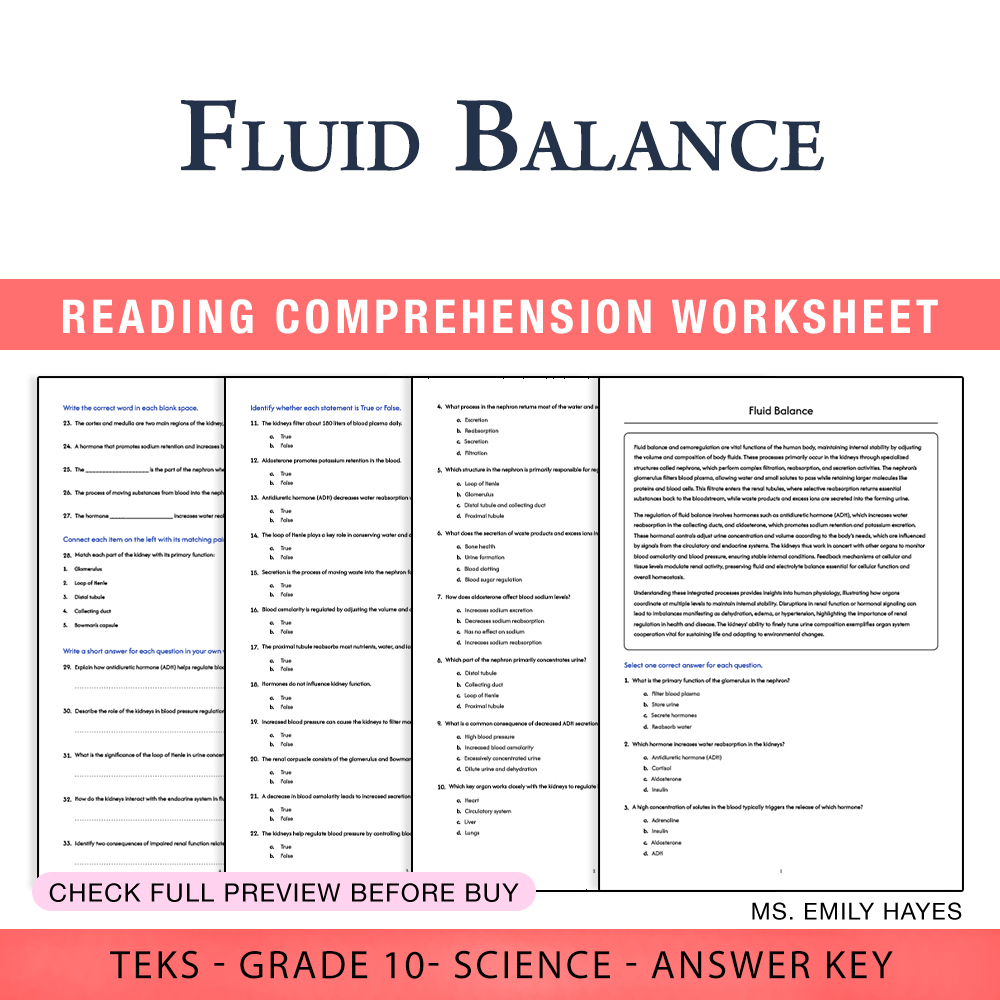
10th Grade Science | Fluid Balance Worksheet (PDF+ Answer Key)
Created byCopper Leaf ClassroomLearning Objectives
- Describe the process of glomerular filtration, tubular reabsorption, and secretion within nephrons.
- Explain how hormones such as antidiuretic hormone and aldosterone regulate fluid balance.
- Analyze how kidney functions contribute to blood osmolarity and blood pressure regulation.
Instant download

Grade 10 Science Control Strategies Worksheet (Ontario) | PDF
Created byEvergreen Desk EducationLearning Objectives
- Explain how control groups, randomization, blocking, and replication help isolate causal effects in experiments.
- Identify common sources of bias and confounding, including equipment variability and environmental fluctuations.
- Apply control strategies to real-world scenarios such as temperature-controlled reactions and standardized circuit components.
Also included in: Grade 10 Scientific Inquiry & Data Reasoning Science Lesson Bundle: Ontario +1 more
Instant download
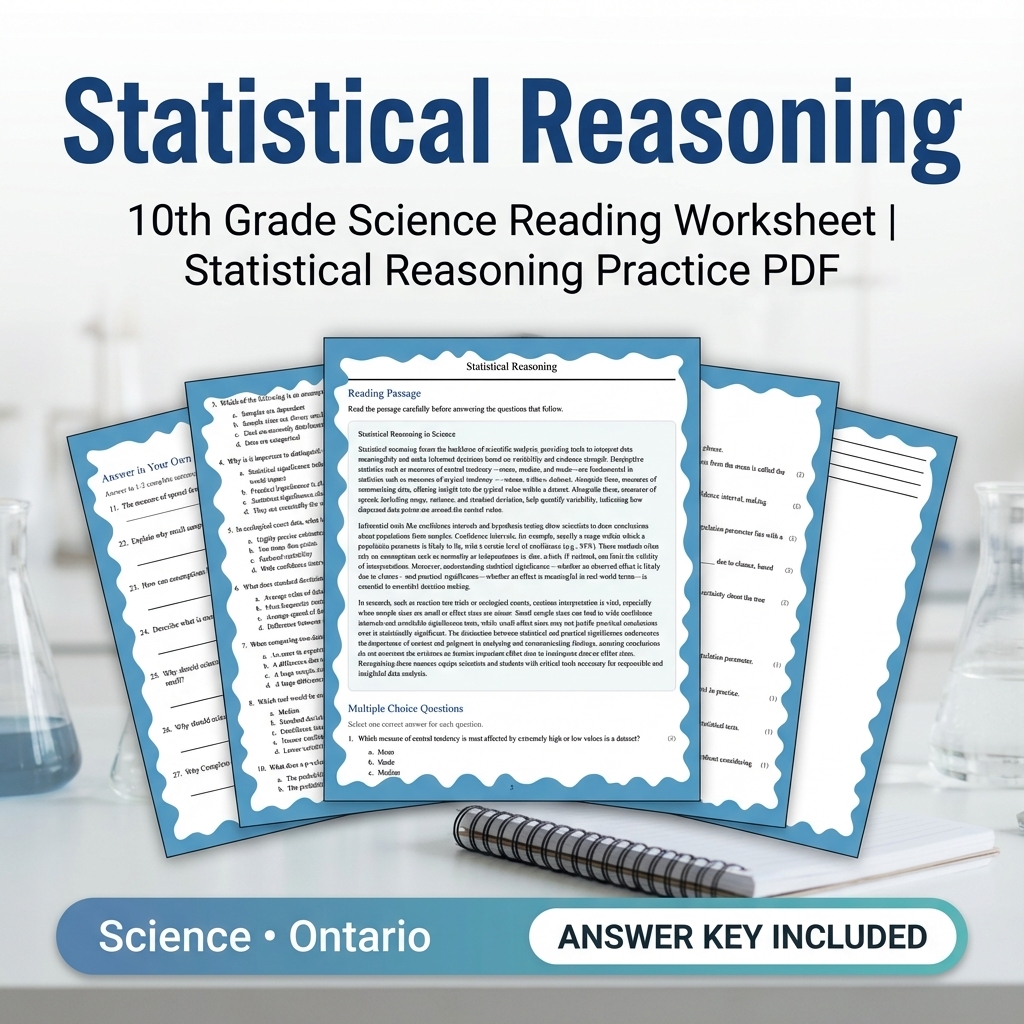
10th Grade Science Reading Worksheet | Statistical Reasoning Practice PDF
JCreated byJ.S SheetsLearning Objectives
- Understand and interpret measures of central tendency and spread in datasets.
- Differentiate between statistical significance and practical significance.
- Interpret confidence intervals and their implications for data analysis.
Also included in: Grade 10 Science UNIT Bundle – Data Representation, Safety & Research Skills +1 more
Instant download
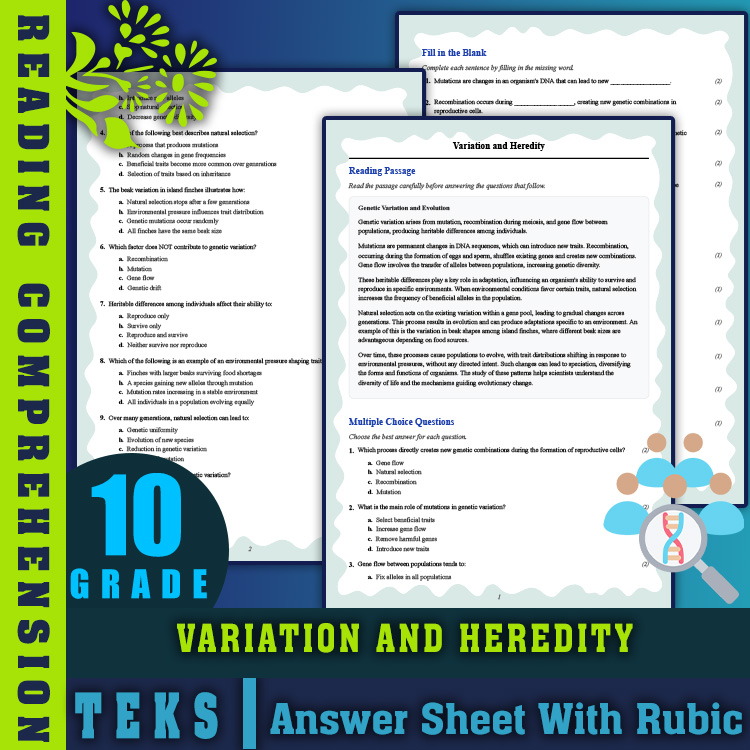
10th Grade Science | Variation and Heredity Reading Worksheet (PDF + Rubric)
JCreated byJ.S SheetsLearning Objectives
- Understand how genetic variation originates through mutation, recombination, and gene flow.
- Explain how heritable differences influence survival and reproduction in different environments.
- Describe the process of natural selection and how it changes allele frequencies over generations.
Instant download
About Grade 10 Science Worksheets
Find Science worksheets built for Grade 10. All 7,069 cover core skills, practice, and review, each an instant PDF download.
Every worksheet on MyTeachingSheets is created by independent teacher-authors and reviewed before publication. All resources download as printable PDFs for classroom, homework, or at-home practice, and many include answer keys. Preview any worksheet free before buying.