
Grade 10 Science Worksheets
7,069 worksheets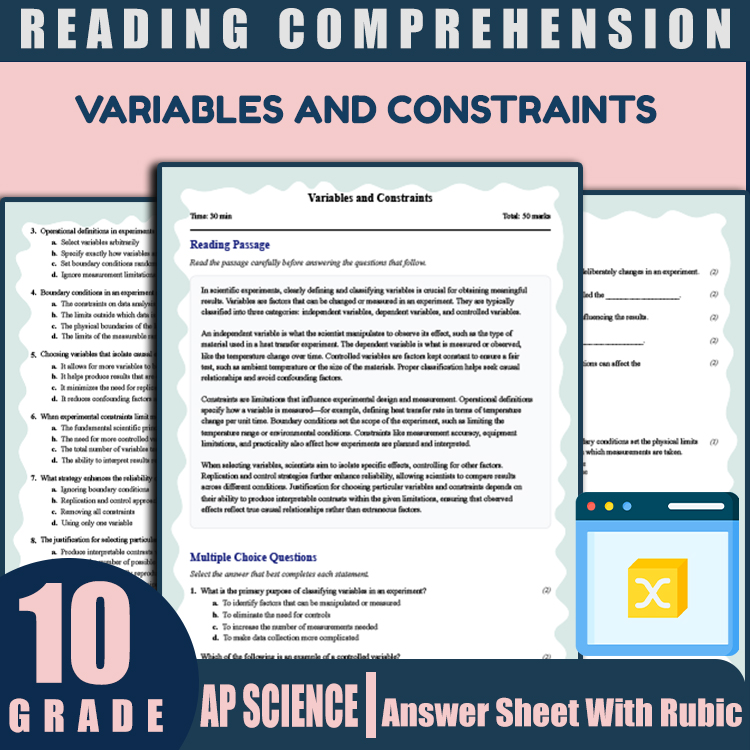
10th Grade Science Reading Worksheet | Variables and Constraints – PDF
JCreated byJ.S SheetsLearning Objectives
- Explain the classification of variables as independent, dependent, and controlled factors in scientific experiments.
- Describe how constraints influence the design and interpretation of measurements and observations.
- Identify strategies for selecting variables that isolate causal relationships in experimental setups.
Also included in: Grade 10 Science Unit Worksheet Pack – Data Analysis & Scientific Reasoning +1 more
Instant download
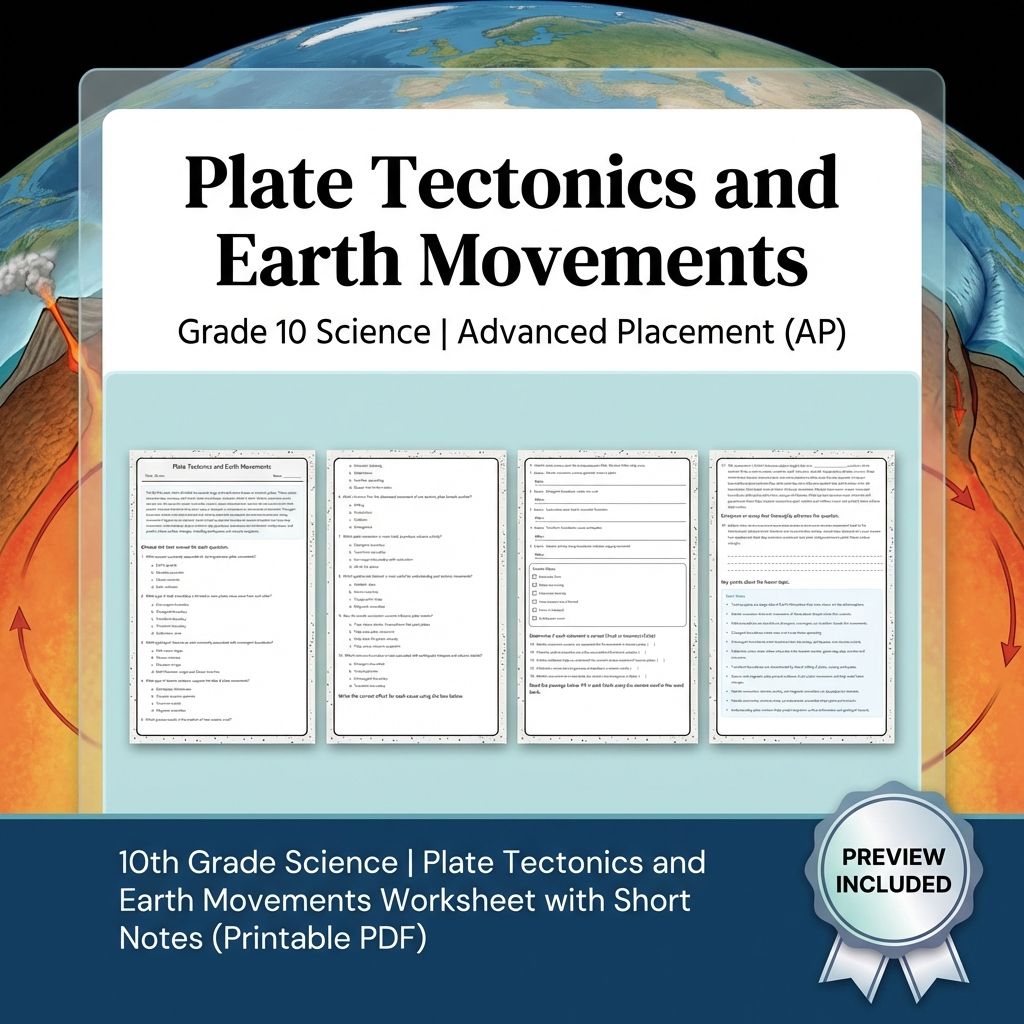
10th Grade Science | Plate Tectonics and Earth Movements Worksheet (PDF)
 Created byMeadowlark Worksheets
Learning Objectives
- Understand the mechanisms of plate motion and mantle convection.
- Interpret tectonic settings using various geophysical datasets.
- Connect plate interactions to geological phenomena like mountain building, volcanism, and earthquakes.
Instant download

Reaction Stoichiometry Worksheet | AP Standards Grade 10 Science Practice
JCreated byJ.S SheetsLearning Objectives
- Understand the mole concept and how it relates to chemical reactions.
- Perform mass-to-mass and mole-to-mole calculations using balanced equations.
- Identify limiting reagents and calculate theoretical yields.
Also included in: Grade 10 Chemistry Lesson Bundle – AP Chemistry Concepts & Practice
Instant download
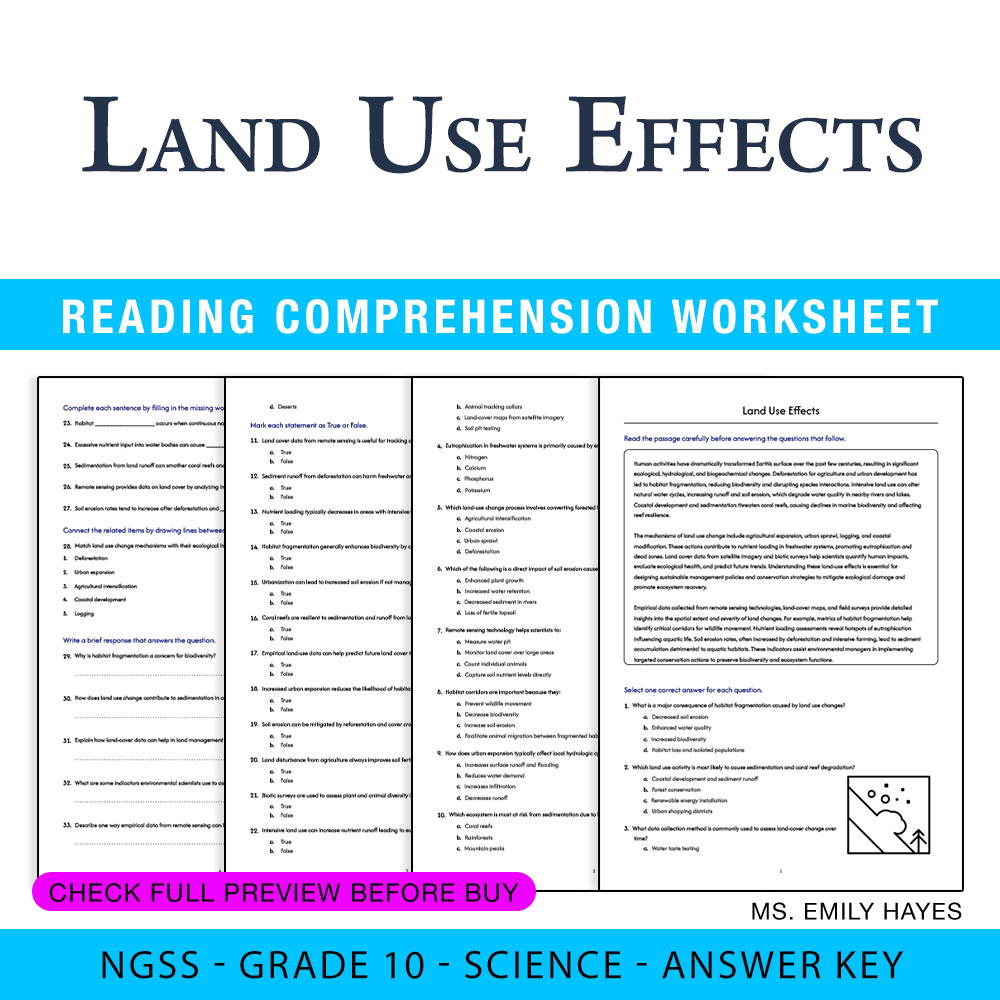
10th Grade Science | Land Use Effects Worksheet (PDF+ Answer Key)
 Created byCopper Leaf Classroom
Learning Objectives
- Understand how human land-use activities alter ecosystems and biogeochemical cycles.
- Analyze empirical land-cover data and remote sensing images to assess ecological impacts.
- Evaluate the consequences of land-change mechanisms such as deforestation and urban expansion.
Instant download
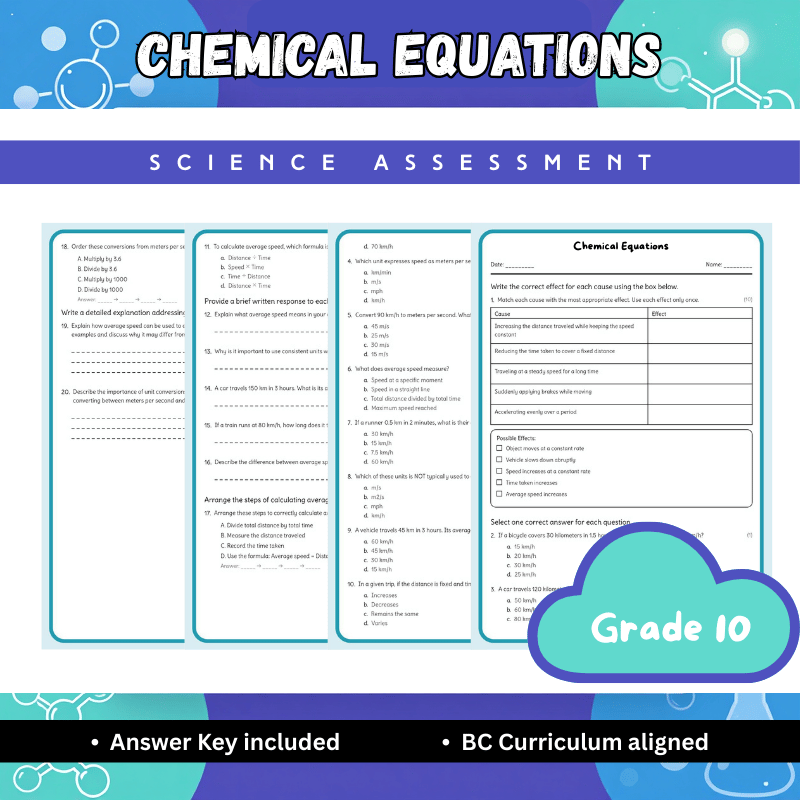
Grade 10 Science | Chemical Equations Worksheet (Answer Key) – BC Standards
 Created byBright Mind Resources
Learning Objectives
- Understand the components and structure of chemical equations.
- Learn how to balance chemical equations to obey conservation of mass.
- Identify states of matter in chemical reactions using symbols.
Instant download
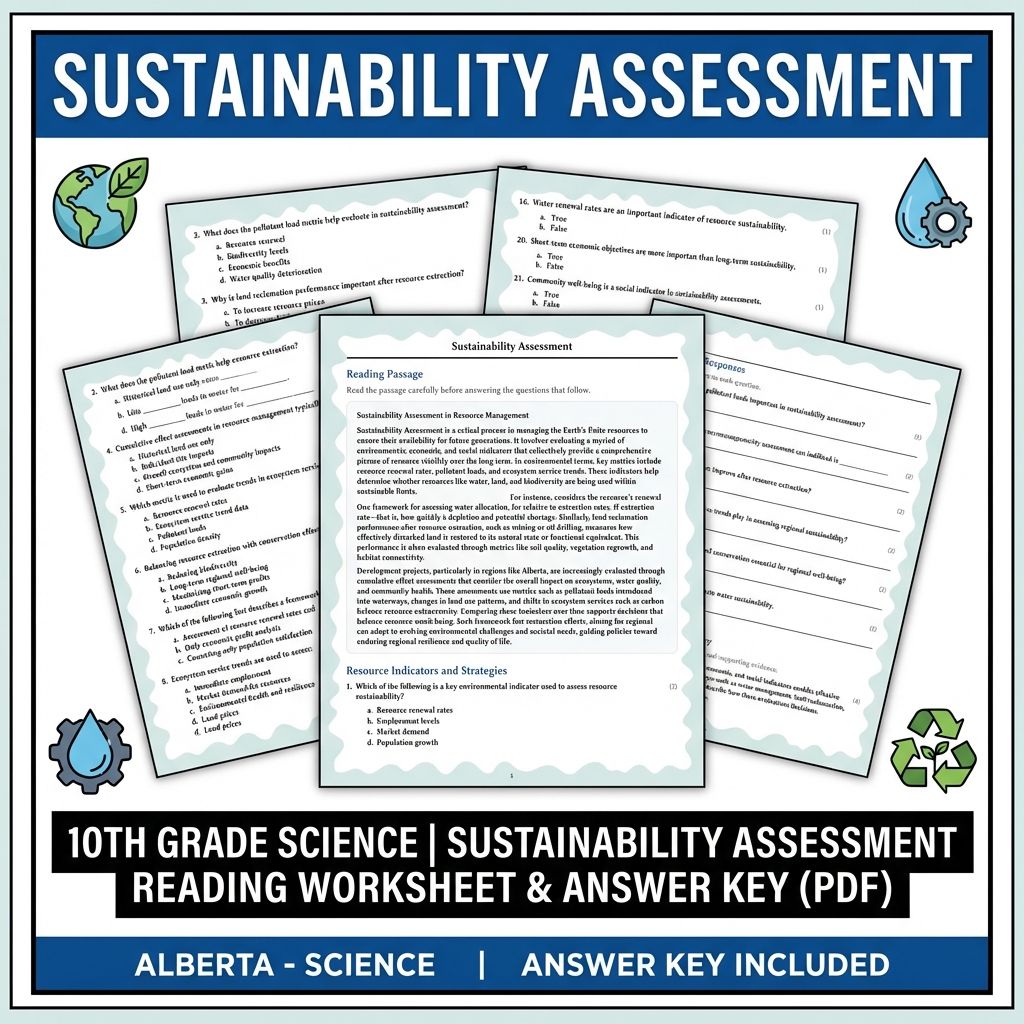
10th Grade | Sustainability Assessment Reading Worksheet & Answer Key (PDF)
JCreated byJ.S SheetsLearning Objectives
- Understand the frameworks used to assess resource sustainability in environmental, economic, and social contexts.
- Identify key indicators such as resource renewal rates, pollutant loads, and ecosystem service trends.
- Analyze how sustainability metrics inform decisions on balancing resource extraction, conservation, and restoration.
Also included in: Grade 10 Science Unit Bundle – Earth Systems, Climate & Remote Sensing Worksheets +1 more
Instant download
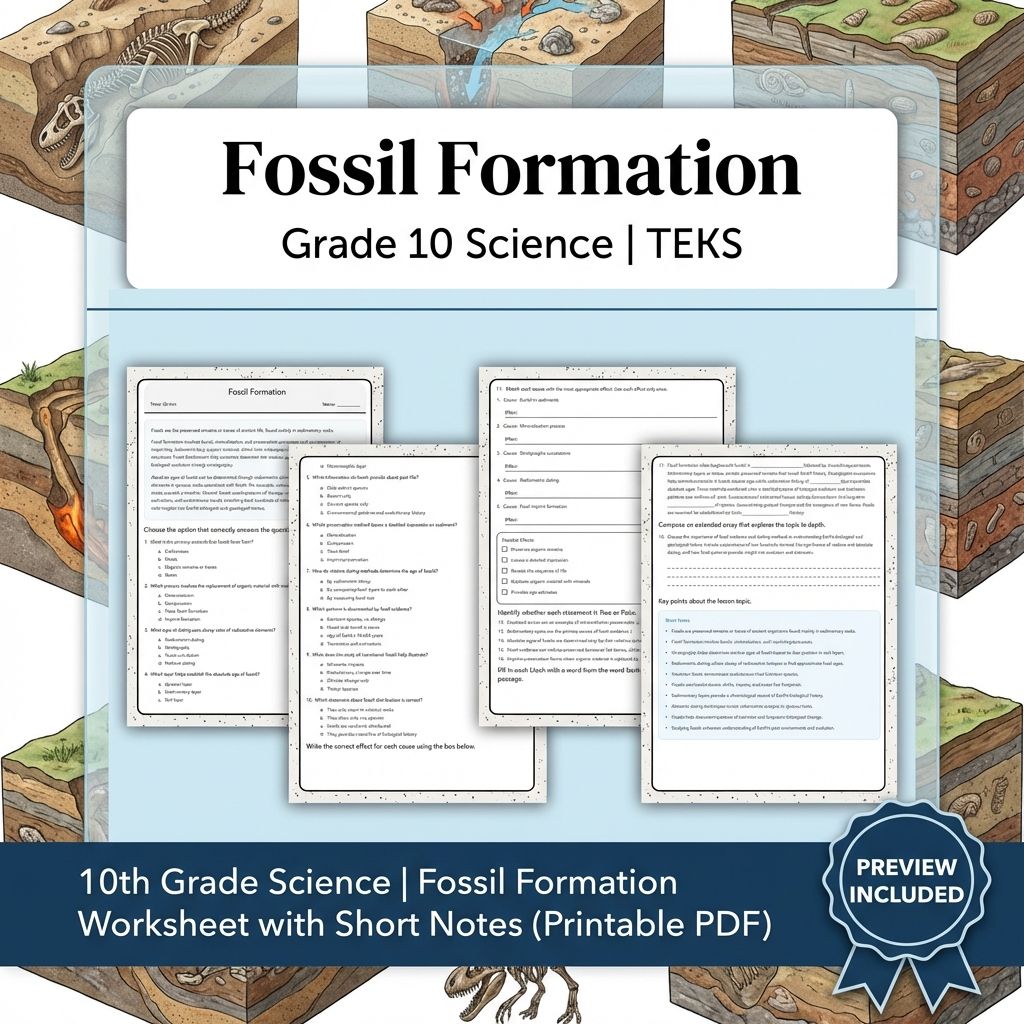
10th Grade Science | Fossil Formation Worksheet with Short Notes (Printable PDF)
Created byMeadowlark WorksheetsLearning Objectives
- Understand the processes involved in fossil formation and preservation.
- Identify different methods used to date fossils and their significance.
- Analyze fossil evidence to interpret patterns of evolution and extinction.
Instant download
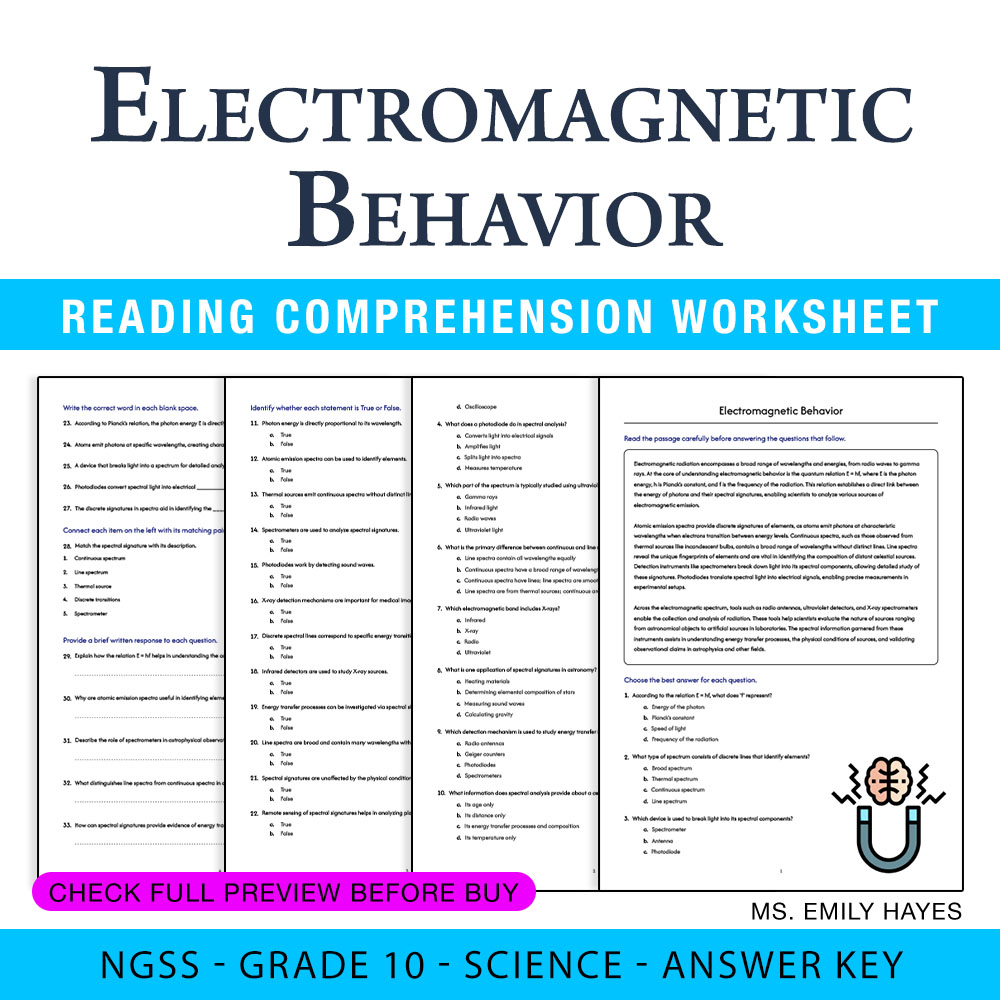
Grade 10 Science | Electromagnetic Behavior Worksheet (PDF+ Answer Key)
Created byCopper Leaf ClassroomLearning Objectives
- Describe the relation between photon energy and electromagnetic wavelength using Planck's relation E = hf.
- Explain how atomic emission spectra provide insights into energy transfer in electromagnetic sources.
- Identify detection mechanisms such as spectrometers and photodiodes used for spectral analysis across different electromagnetic bands.
Instant download
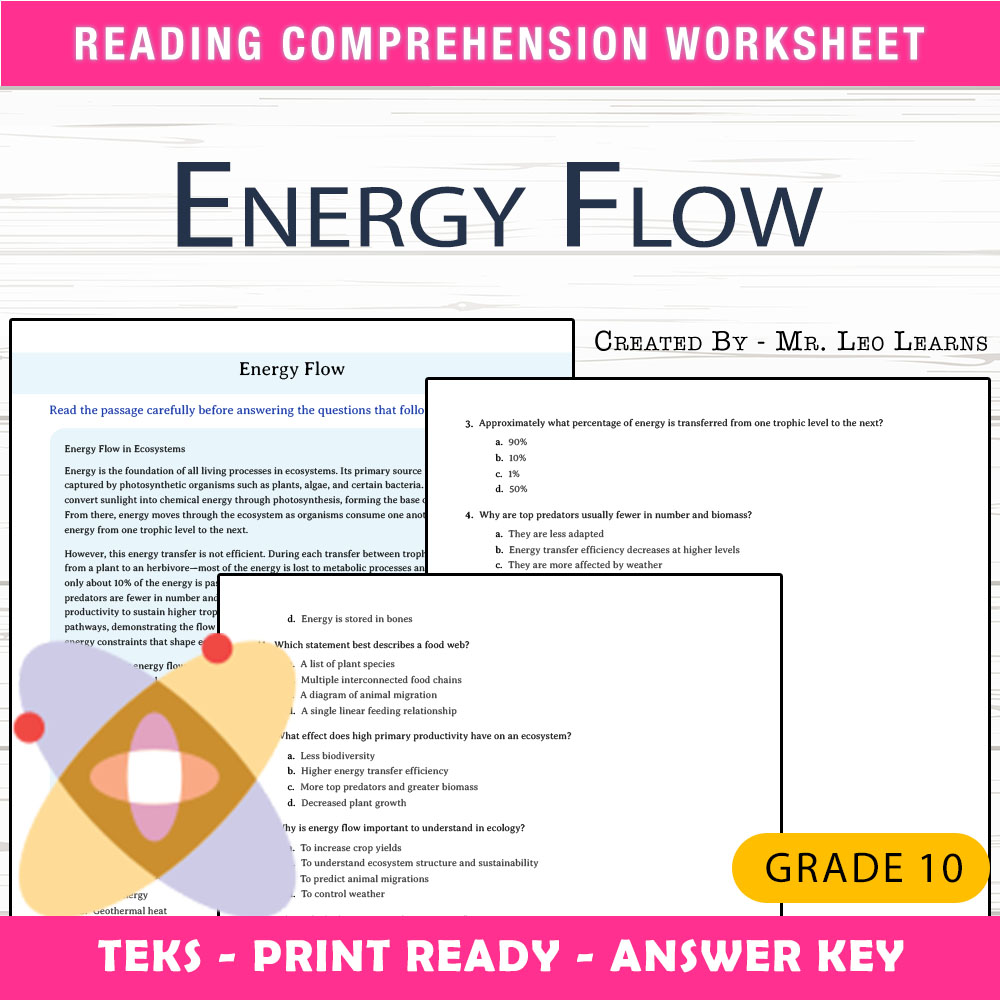
Grade 10 Science – Energy Flow Worksheet for Mastering Ecosystems
 Created byThe Resource Hub
Learning Objectives
- Understand how energy enters ecosystems through sunlight and is transferred across trophic levels.
- Explain the concept of energy loss during transfers and its effect on biomass and population sizes.
- Identify and interpret various pathways of energy flow using food chains and webs.
Also included in: Grade 10 Science Unit Bundle | Ecosystems & Ecology Worksheets +1 more
Instant download

Grade 10 Projectile Motion Worksheet | NGSS Practice PDF
 Created byClear Sky Classroom
Learning Objectives
- Explain projectile motion in terms of independent horizontal and vertical components under uniform gravitational acceleration
- Use kinematic relationships to predict time of flight, range, and maximum height from initial conditions
- Apply vector decomposition and trajectory equations to relate starting conditions to motion outcomes
Also included in: Grade 10 Physics Concepts Science Lesson Bundle: Advanced Placement (AP) +1 more
Instant download
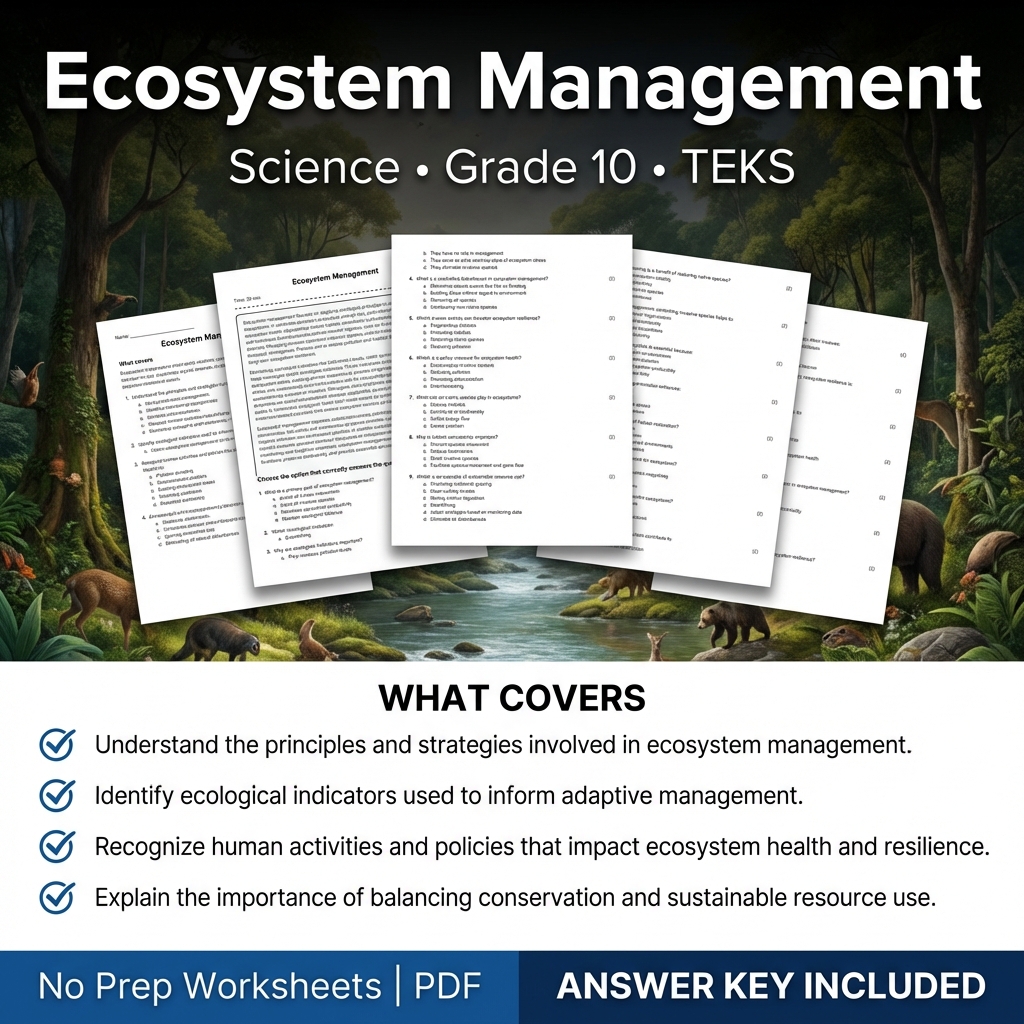
Ecosystem Management Worksheet with Answer Key | TEKS Grade 10 Science
 Created byCoral Reef Learning
Learning Objectives
- Understand the principles and strategies involved in ecosystem management.
- Identify ecological indicators used to inform adaptive management.
- Recognize human activities and policies that impact ecosystem health and resilience.
Instant download

Grade 10 Science | Speciation Processes in Evolution - Reading Comprehension
Created byCoral Reef LearningLearning Objectives
- Understand how geographic barriers can lead to reproductive isolation.
- Identify different mechanisms that contribute to speciation.
- Analyze examples of speciation observed in nature.
Instant download

Grade 10 Gene Regulation Switches Worksheet | Practice & Standards PDF
Created byClear Sky ClassroomLearning Objectives
- Explain how regulatory DNA segments and transcription factors control when and where genes are expressed.
- Differentiate between promoters, enhancers, and silencers in regulating transcription.
- Use molecular signals and feedback to predict how gene expression patterns change in different conditions.
Instant download
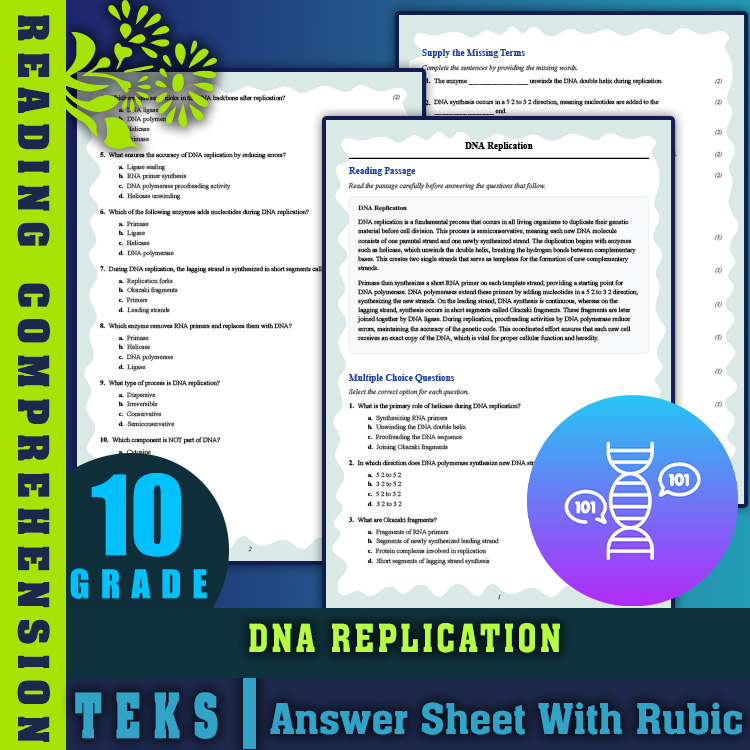
Grade 10 Science | DNA Replication Reading Worksheet & Answer Key (PDF)
JCreated byJ.S SheetsLearning Objectives
- Understand the process of DNA replication and its semiconservative nature.
- Identify key enzymes involved in DNA replication and their functions.
- Explain the differences between leading and lagging strands during replication.
Instant download

Vectors And Components Worksheet | Standards-Aligned Grade 10 Science Practice
JCreated byJ.S SheetsLearning Objectives
- Understand how to decompose a vector into orthogonal components along perpendicular axes.
- Apply trigonometric functions to relate component magnitudes to overall vector direction.
- Use vector components to analyze two-dimensional motion such as velocity and acceleration.
Instant download

Evolution Basics Worksheet for Grade 10 Science | Standards-Aligned Practice
JCreated byJ.S SheetsLearning Objectives
- Understand the fundamental concepts of evolution and how populations change over time.
- Identify different types of evidence supporting evolution, including fossils, biogeography, and molecular similarities.
- Explain how descent with modification leads to biological diversity and common ancestry.
Instant download

Science Statistical Reasoning Worksheet | Standards-Aligned Grade 10 Science
JCreated byJ.S SheetsLearning Objectives
- Use descriptive statistics (center and spread) to interpret variability in classroom-scale scientific data.
- Interpret confidence intervals and p-values while distinguishing statistical significance from practical significance.
- Apply basic comparative-test reasoning (e.g., difference in means, count differences) while noting common assumptions and limits.
Instant download

Grade 10 Evolutionary Relationships Worksheet | California Science Standards
 Created byEvergreen Desk Education
Learning Objectives
- Explain how shared traits and genetic similarities can provide evidence for common ancestry.
- Interpret phylogenetic trees as hypotheses about evolutionary branching over time.
- Compare how different types of data (morphological and genetic) support or challenge evolutionary relationships.
Instant download

Grade 10 Science Representing Data Worksheet | Graphs, Charts & Axes | Ontario
 Created byChalk and Compass
Learning Objectives
- Choose an appropriate graph type for a given set of data and explain why it fits the pattern being measured.
- Use correct axis scaling and labels to avoid misleading conclusions from graphs.
- Interpret error bars and distinguish data variation from real trends using best-fit ideas.
Also included in: Grade 10 Science Variables & Control Data Analysis Lesson Bundle | Ontario +1 more
Instant download

Grade 10 Science | Cellular Respiration - Daily Reading Comprehension
Created byCoral Reef LearningLearning Objectives
- Identify the main stages of cellular respiration
- Describe the sequence of glycolysis, citric acid cycle, and electron transport chain
- Understand the role of mitochondria in energy production
Instant download

Grade 10 Science | Biodiversity Value Worksheet | TEKS Aligned
 Created byLumora Learning
Learning Objectives
- Understand the components and importance of biodiversity in ecosystems.
- Identify how biodiversity contributes to ecosystem resilience and services.
- Explain the consequences of species loss on ecological interactions and adaptability.
Instant download

Grade 10 Science | Science Career Pathways - Daily Reading Comprehension
Created byCoral Reef LearningLearning Objectives
- Identify various science-related job roles such as laboratory technician, quality assurance analyst, environmental technologist, and research assistant.
- Understand the credential pathways, workplace certifications, and transferable skills associated with each career.
- Recognize the typical responsibilities in these roles, including data collection, instrument calibration, and regulatory compliance.
Instant download
Grade 10 Science – Organelle Architecture Worksheet (PDF) – Ontario Standards
Created byBright Mind ResourcesLearning Objectives
- Describe the major cellular organelles and their structural characteristics.
- Compare the architecture and ultrastructure of different organelles observed by electron microscopy.
- Explain the differences in internal organization between prokaryotic and eukaryotic cells.
Instant download
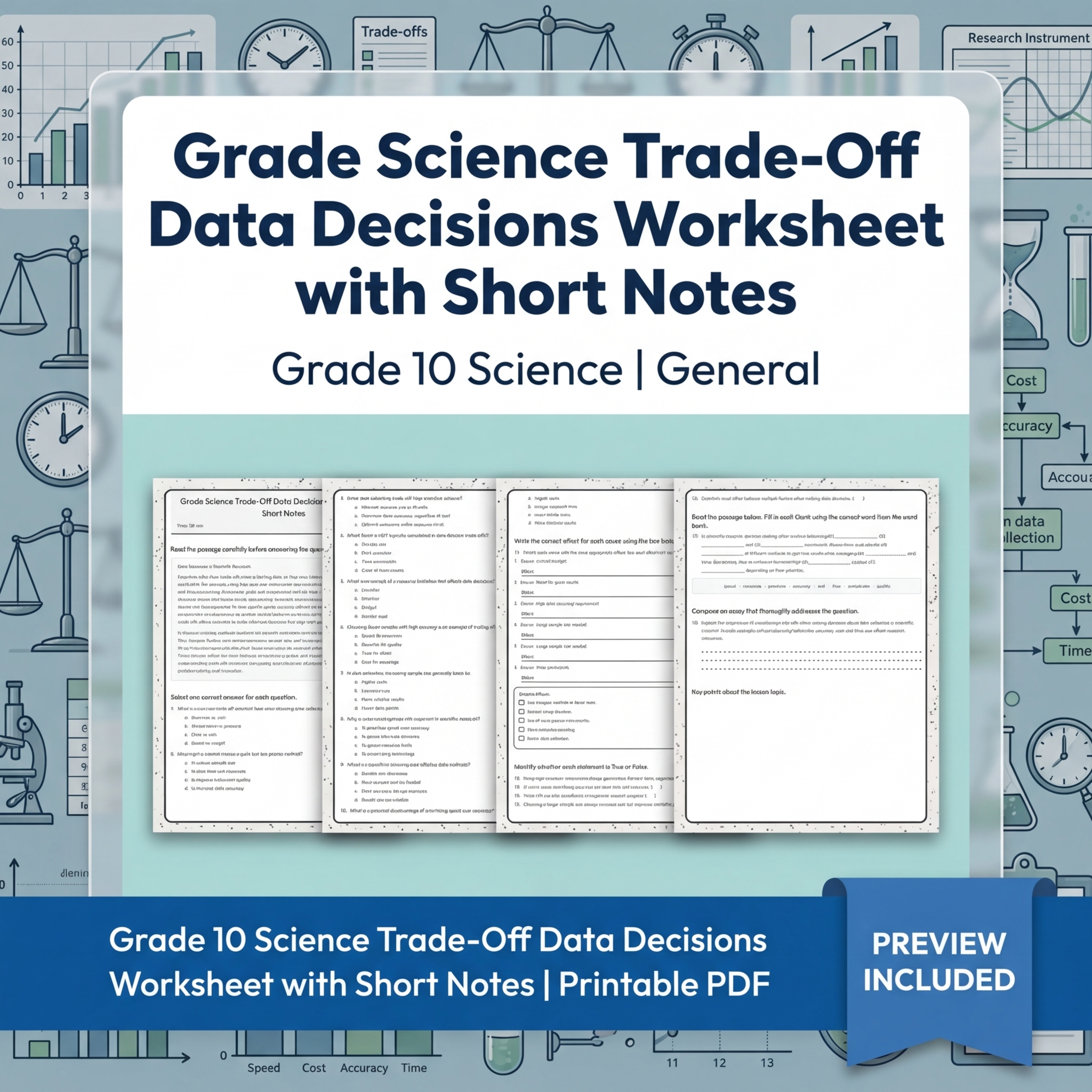
Grade 10 Science Trade-Off Data Decisions Worksheet with Short Notes
Created byMeadowlark WorksheetsLearning Objectives
- Understand how trade-offs influence data-driven decisions in science.
- Analyze the importance of choosing appropriate data collection methods.
- Evaluate the impact of decision trade-offs on scientific outcomes.
Also included in: Grade 10 Design Tradeoffs in Science Lesson Bundle: Systems & Optimization +1 more
Instant download

Trophic Efficiency Assessment for Grade 10 Science TEKS | Science Worksheet
 Created byPrism Point Learning
Learning Objectives
- Understand the concept of trophic efficiency and its significance in ecosystems.
- Analyze how energy transfer affects biomass pyramids and food web structures.
- Evaluate factors influencing variations in trophic efficiency among different ecosystems.
Also included in: Grade 10 Ecosystems Science Lesson Bundle for TEKS Assessment Worksheets
Instant download
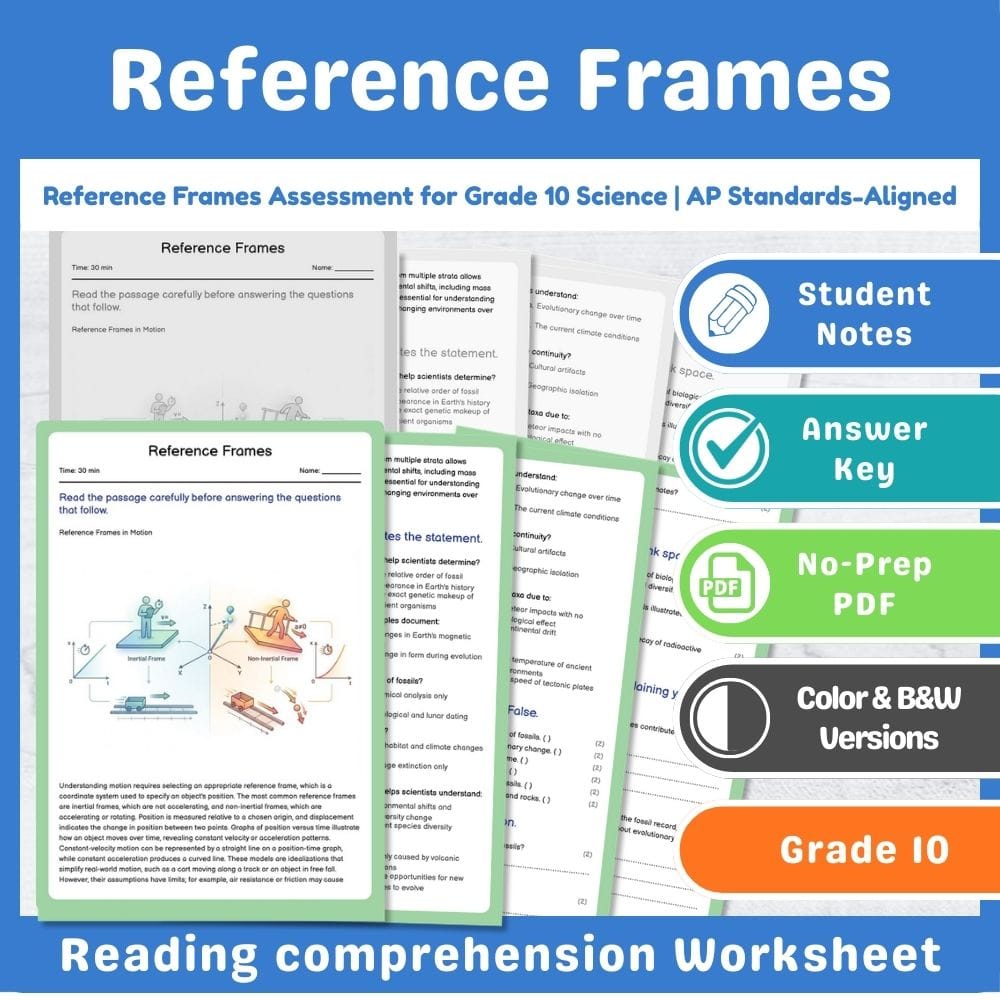
Reference Frames Assessment for Grade 10 Science | AP Standards-Aligned
Created byPrism Point LearningLearning Objectives
- Understand the concept of reference frames and their importance in describing motion.
- Distinguish between different coordinate systems used in kinematics.
- Relate position, displacement, velocity, and acceleration through algebraic expressions and graphs.
Also included in: Lesson Grade 10 Science Assessment Bundle | AP Standards-Aligned
Instant download

Grade 10 Science | Particle Accounting in Chemical Reactions - Reading Practice
Created byCoral Reef LearningLearning Objectives
- Explain the principle of atom conservation during chemical reactions.
- Identify atoms before and after reactions using diagrams or formulas.
- Describe how bonds break and form at the atomic level.
Instant download

Energy in Reactions Worksheet | Standards-Aligned Science Practice for Grade 10
JCreated byJ.S SheetsLearning Objectives
- Describe how energy changes occur during chemical reactions at the particle level.
- Interpret energy profiles of reactions in terms of energy differences between reactants and products.
- Explain why some reactions release energy while others absorb energy based on atom restructuring.
Also included in: Grade 10 Energy, Forces, and Reactions Science Lesson Bundle +1 more
Instant download

Phase Change Energy Worksheet | Standards-Aligned Science Practice for Grade 10
JCreated byJ.S SheetsLearning Objectives
- Understand how energy is stored and transferred during phase changes.
- Differentiate between temperature change and energy used for particle rearrangement.
- Explain why temperature remains constant during phase changes like melting and boiling.
Also included in: Grade 10 Energy, Forces, and Reactions Science Lesson Bundle +1 more
Instant download
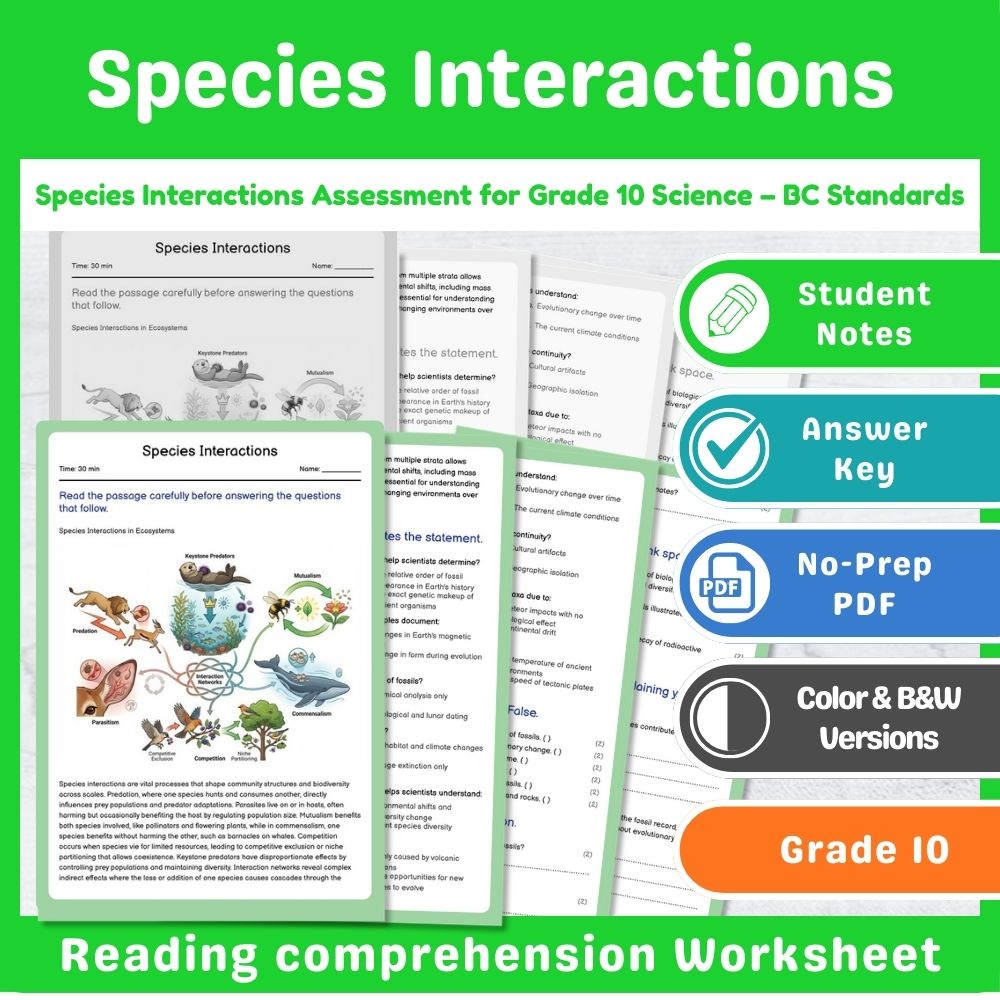
Species Interactions Assessment for Grade 10 Science – BC Standards
Created byPrism Point LearningLearning Objectives
- Describe different types of species interactions such as competition, predation, parasitism, mutualism, and commensalism.
- Explain how interactions like keystone predators and mutualists influence community composition.
- Analyze interaction networks to understand indirect effects and cascading changes in ecosystems.
Instant download

Body Temperature Worksheet | Grade 10 Science TEKS Practice
Created byPrism Point LearningLearning Objectives
- Explain how the hypothalamus compares core temperature to a set point and initiates responses.
- Describe how vasodilation, vasoconstriction, sweating, and shivering help maintain thermal equilibrium.
- Connect feedback and organ system cooperation to body temperature regulation.
Instant download

Bonding Types Worksheet Grade 10 Science Practice for Alberta Standards
Created byPrism Point LearningLearning Objectives
- Compare ionic, covalent, and metallic bonding using particle-level explanations.
- Relate bonding type to observable properties such as conductivity and melting point.
- Use electron transfer, sharing, and electron delocalization to predict physical behavior.
Also included in: Grade 10 Chemistry & Dynamic Equilibrium Lesson Bundle | Alberta Science
Instant download

Grade 10 Earth Layers Worksheet | Composition, Density & Seismic Evidence
Created byChalk and CompassLearning Objectives
- Describe Earth’s internal structure using both chemical layers and mechanical (rheological) layers.
- Explain how density and temperature gradients relate to crust, mantle, and core properties.
- Use seismic wave behavior to support models of Earth’s internal structure.
Also included in: Grade 10 Science Earth Processes & Resource Use Lesson Bundle | Ontario +1 more
Instant download

Grade 10 Science | Systems Analysis Worksheet (NGSS10 PDF)
 Created bySilver Birch Teaching
Learning Objectives
- Understand how to identify subsystem interactions within complex systems.
- Apply systems thinking concepts to analyze flows of energy, material, and information.
- Evaluate the impact of constraints such as bandwidth, mass, and maintenance on system integration.
Also included in: Grade 10 NGSS Science: Models, Systems, and Trade-Off Design Lesson Bundle +1 more
Instant download
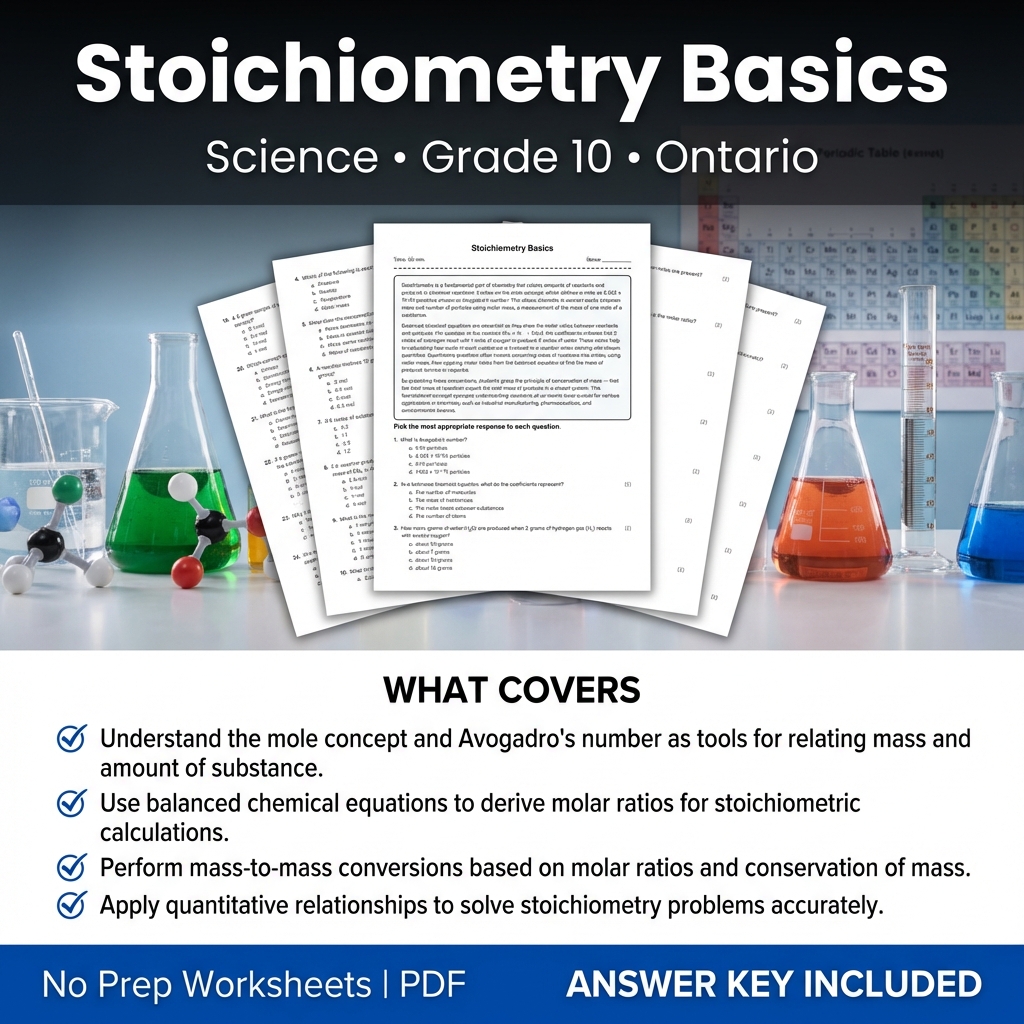
Grade 10 Science Worksheet on Stoichiometry Basics | Ontario Standards
Created byCoral Reef LearningLearning Objectives
- Understand the mole concept and Avogadro's number as tools for relating mass and amount of substance.
- Use balanced chemical equations to derive molar ratios for stoichiometric calculations.
- Perform mass-to-mass conversions based on molar ratios and conservation of mass.
Instant download

Grade 10 Science | Reaction Types in Chemistry - Daily Reading Comprehension
Created byCoral Reef LearningLearning Objectives
- Understand the basic classification of chemical reactions.
- Identify synthesis and decomposition reactions from equations.
- Learn to recognize reactant-product patterns characteristic of each reaction type.
Instant download

Speciation Processes & Reproductive Isolation Worksheets Grade 10
 Created byTeachers Club
Learning Objectives
- Explain how geographic separation can reduce gene flow
- Compare allopatric and sympatric speciation mechanisms
- Interpret evidence of reproductive isolation between populations
Also included in: Grade 10 Science Evolution Worksheets | NGSS Unit Bundle +1 more
Instant download

Grade 10 Worksheet B: System Optimization in Communication Systems | NGSS
Created byClear Sky ClassroomLearning Objectives
- Use link budget ideas to relate transmit power, antenna gain, and receiver constraints to communication range.
- Explain how antenna gain and impedance matching affect signal transfer and system efficiency.
- Evaluate trade-offs among range, throughput, and reliability when selecting modulation/coding and engineering parameters.
Also included in: Grade 10 Wave Properties & Communication Science Lesson Bundle | NGSS +1 more
Instant download

Grade 10 Science Worksheet B: Signal Transmission Practice | NGSS PDF
Created byClear Sky ClassroomLearning Objectives
- Explain how modulation encodes information on carrier signals using amplitude, frequency, and phase
- Analyze how channel constraints (bandwidth, noise, attenuation, dispersion) affect fidelity and capacity
- Compare RF and optical fiber signal transmission by linking physical limits to communication trade-offs
Also included in: Grade 10 Wave Properties & Communication Science Lesson Bundle | NGSS +1 more
Instant download
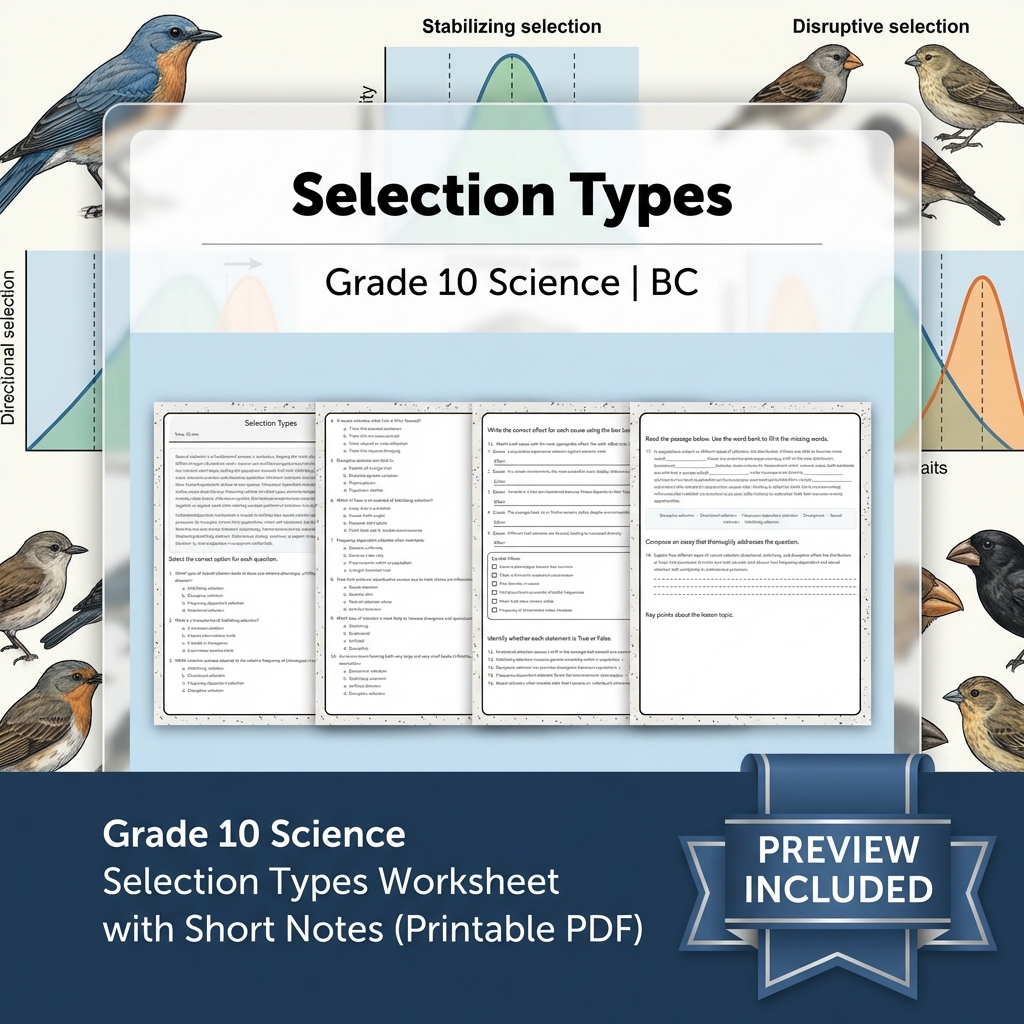
Grade 10 Science Selection Types Worksheet with Short Notes (Printable PDF)
Created byMeadowlark WorksheetsLearning Objectives
- Understand the three main types of natural selection: directional, stabilizing, and disruptive.
- Identify how frequency-dependent and sexual selection influence evolution.
- Distinguish between different selection processes and their effects on populations.
Also included in: Grade 10 Science | BC Framework Lesson Group Worksheet Pack +1 more
Instant download
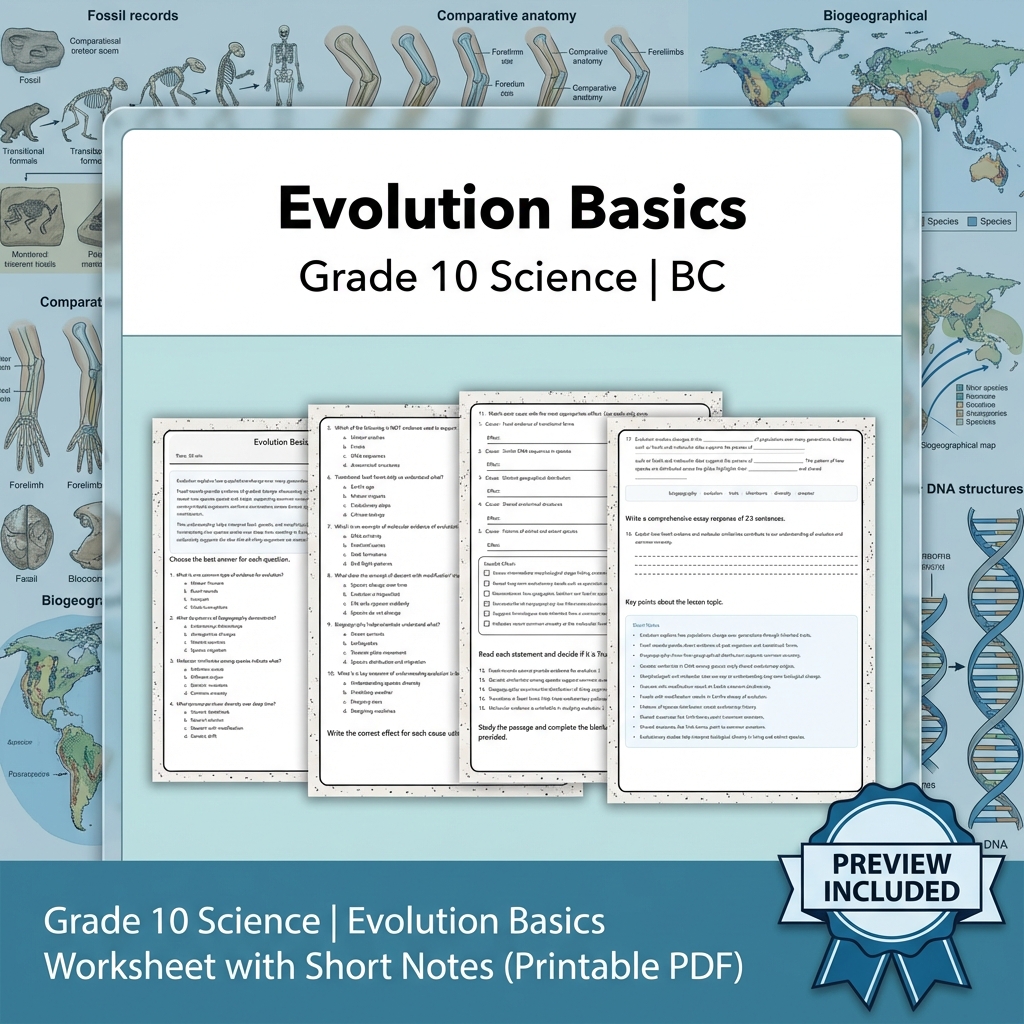
Grade 10 Science | Evolution Basics Worksheet with Short Notes (Printable PDF)
Created byMeadowlark WorksheetsLearning Objectives
- Understand the fundamental concepts of evolution and how populations change over generations.
- Identify various types of evidence supporting the theory of evolution.
- Analyze how biological data indicate common ancestry among species.
Also included in: Grade 10 Science | BC Framework Lesson Group Worksheet Pack +1 more
Instant download
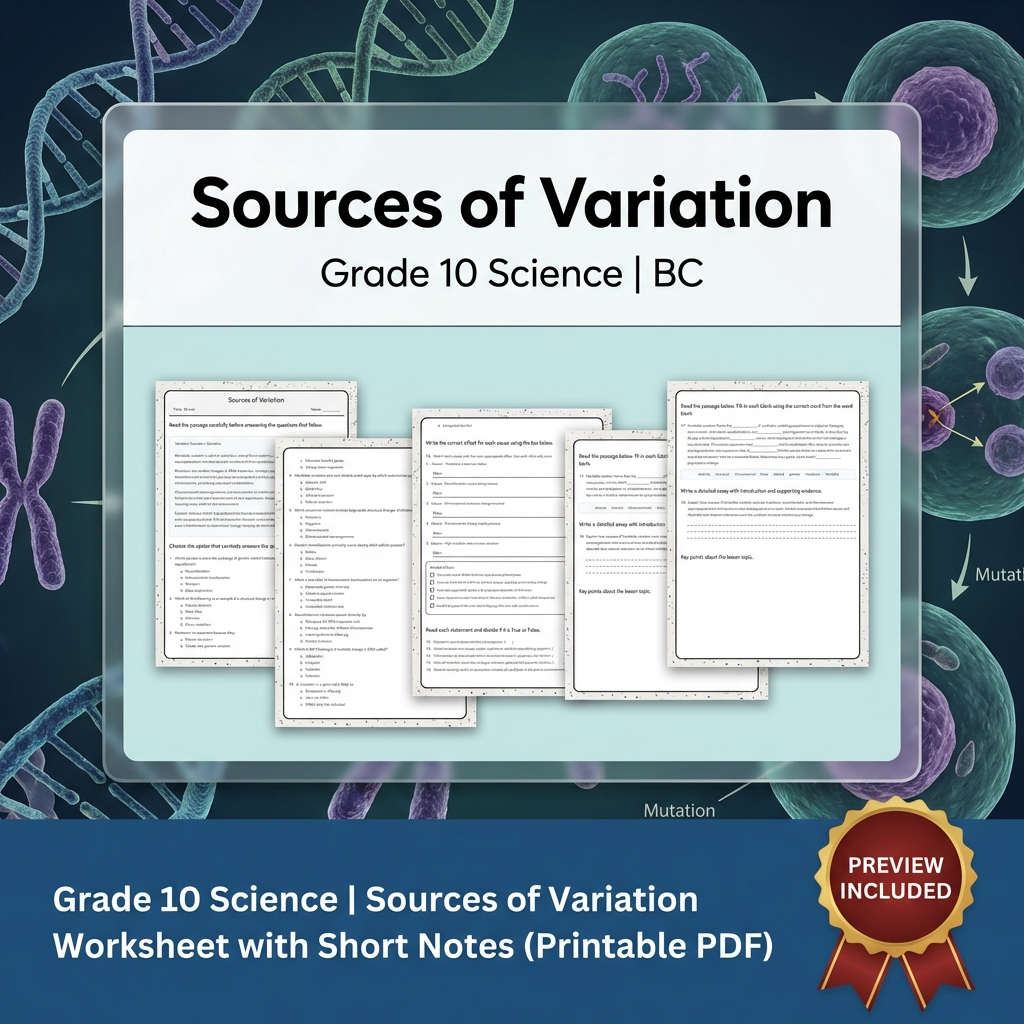
Grade 10 Science | Sources of Variation Worksheet with Short Notes (PDF)
Created byMeadowlark WorksheetsLearning Objectives
- Understand the different sources of heritable variation such as mutations, recombination, and chromosomal rearrangements.
- Explain how natural selection acts on variation to influence evolution.
- Describe the role of genetic diversity within populations for adaptation and survival.
Also included in: Grade 10 Science | BC Framework Lesson Group Worksheet Pack +1 more
Instant download
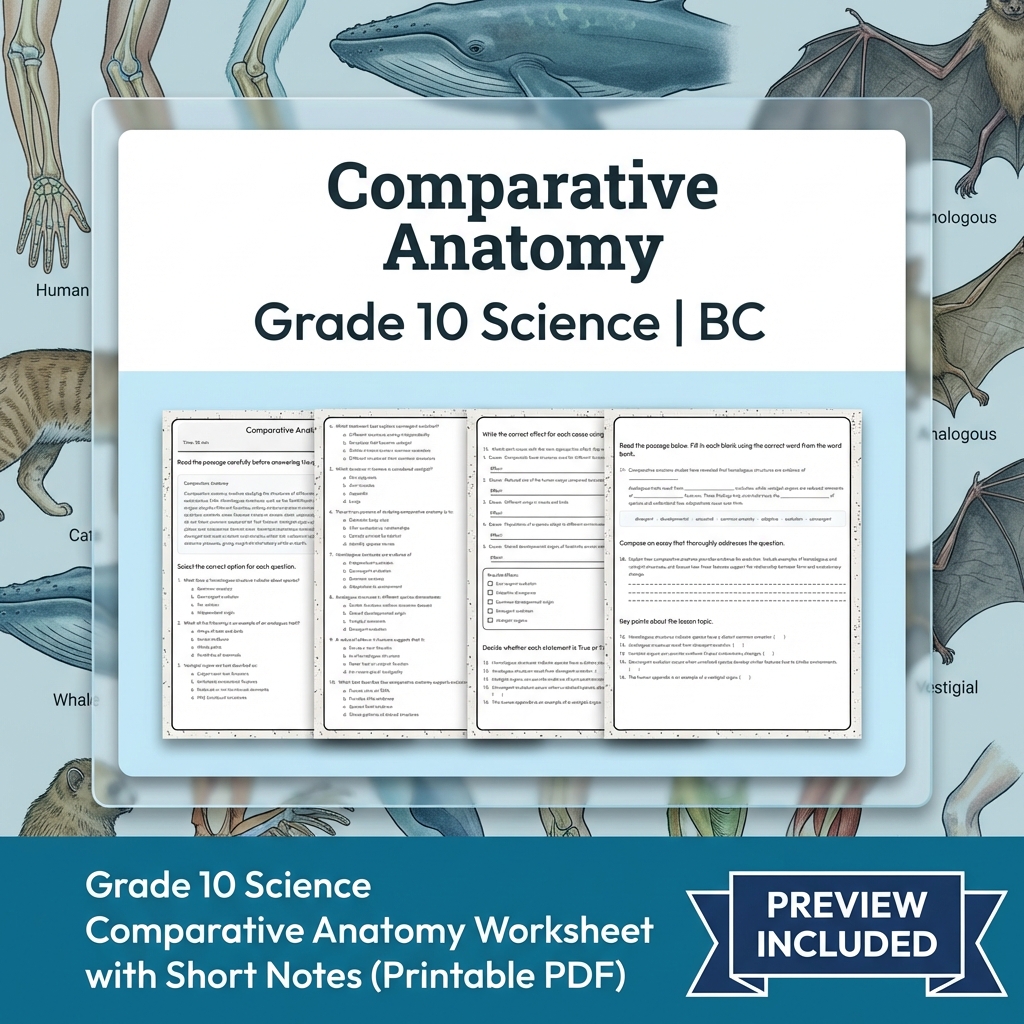
Grade 10 Science Comparative Anatomy Worksheet with Short Notes (Printable PDF)
Created byMeadowlark WorksheetsLearning Objectives
- Understand the concept of homologous and analogous structures and their role in evolution.
- Identify different types of anatomical features such as vestigial organs and their significance.
- Interpret how anatomical evidence can be used to reconstruct evolutionary relationships.
Also included in: Grade 10 Science | BC Framework Lesson Group Worksheet Pack +1 more
Instant download
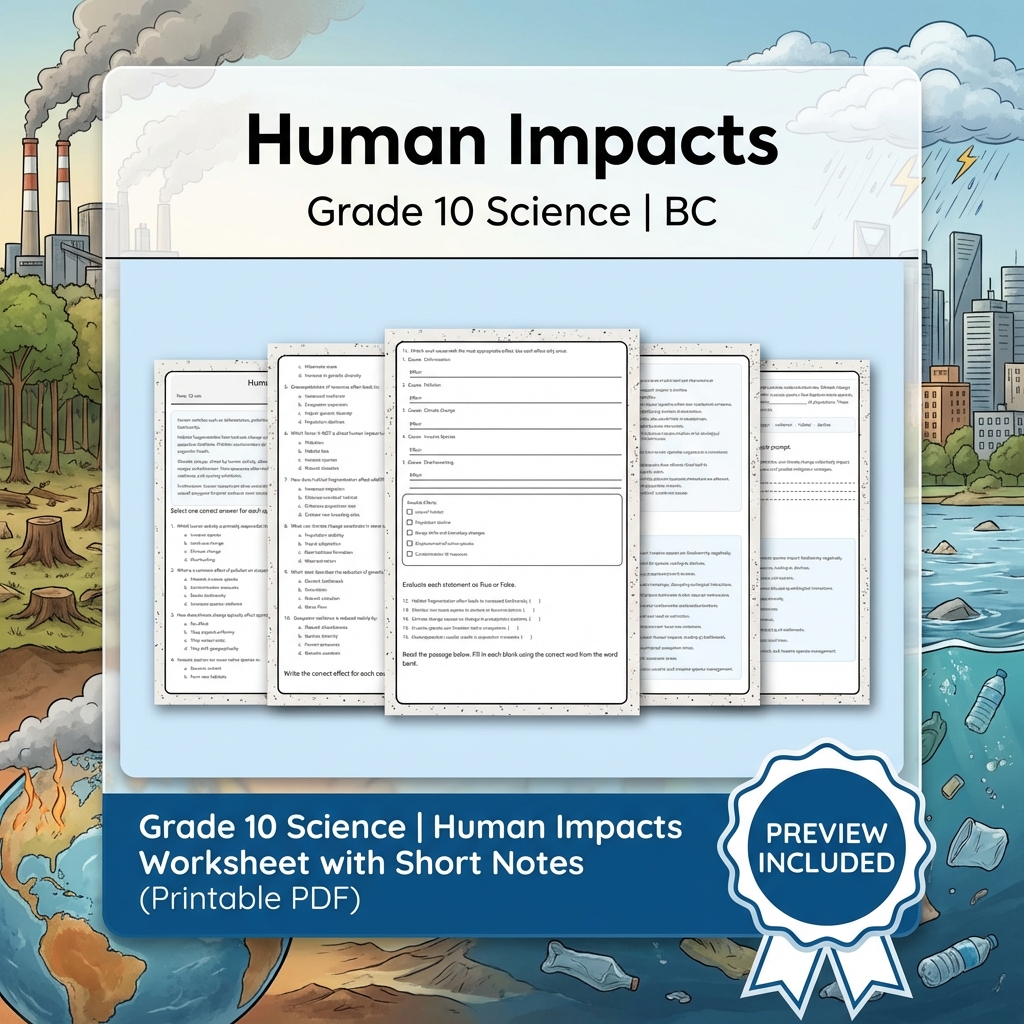
Grade 10 Science | Human Impacts Worksheet with Short Notes (Printable PDF)
Created byMeadowlark WorksheetsLearning Objectives
- Understand how human activities affect biodiversity and ecosystems.
- Identify various factors like habitat fragmentation, pollution, and invasive species.
- Explain the effects of climate change on species and ecosystems.
Also included in: Grade 10 Science | BC Framework Lesson Group Worksheet Pack +1 more
Instant download
Grade 10 Science | Molecular Patterns Worksheet with Short Notes (Printable PDF)
Created byMeadowlark WorksheetsLearning Objectives
- Understand how molecular sequences reveal evolutionary relationships among organisms.
- Identify the concept of molecular clocks and how they estimate divergence times.
- Explain how shared genetic markers support common ancestry and lineage-specific changes.
Also included in: Grade 10 Science | BC Framework Lesson Group Worksheet Pack +1 more
Instant download
Grade 10 Science | Speciation Processes Worksheet with Short Notes (PDF)
Created byMeadowlark WorksheetsLearning Objectives
- Describe how populations diverge genetically to form new species.
- Differentiate between allopatric and sympatric speciation.
- Explain the roles of reinforcement, hybrid zones, and polyploidy in speciation.
Also included in: Grade 10 Science | BC Framework Lesson Group Worksheet Pack +1 more
Instant download
Grade 10 Science | Biodiversity Overview Worksheet with Short Notes (PDF)
Created byMeadowlark WorksheetsLearning Objectives
- Understand the concept of biodiversity and its different levels.
- Identify factors affecting biodiversity across regions.
- Analyze patterns of species richness and evenness.
Also included in: Grade 10 Science | BC Framework Lesson Group Worksheet Pack +1 more
Instant download

Grade 10 Science – Electric Fields & Concepts | Daily Reading Worksheet
Created byBright Mind ResourcesLearning Objectives
- Understand the concept of an electric field and how it influences space around charged objects.
- Identify the direction and significance of electric field lines between positive and negative charges.
- Explain how multiple charge fields superimpose to create complex electric field patterns.
Also included in: Grade 10 Forces & Motion Science Daily Reading Worksheets Lesson Bundle | BC +1 more
Instant download
About Grade 10 Science Worksheets
Find Science worksheets built for Grade 10. All 7,069 cover core skills, practice, and review, each an instant PDF download.
Every worksheet on MyTeachingSheets is created by independent teacher-authors and reviewed before publication. All resources download as printable PDFs for classroom, homework, or at-home practice, and many include answer keys. Preview any worksheet free before buying.