
Grade 10 Science Worksheets
7,038 worksheets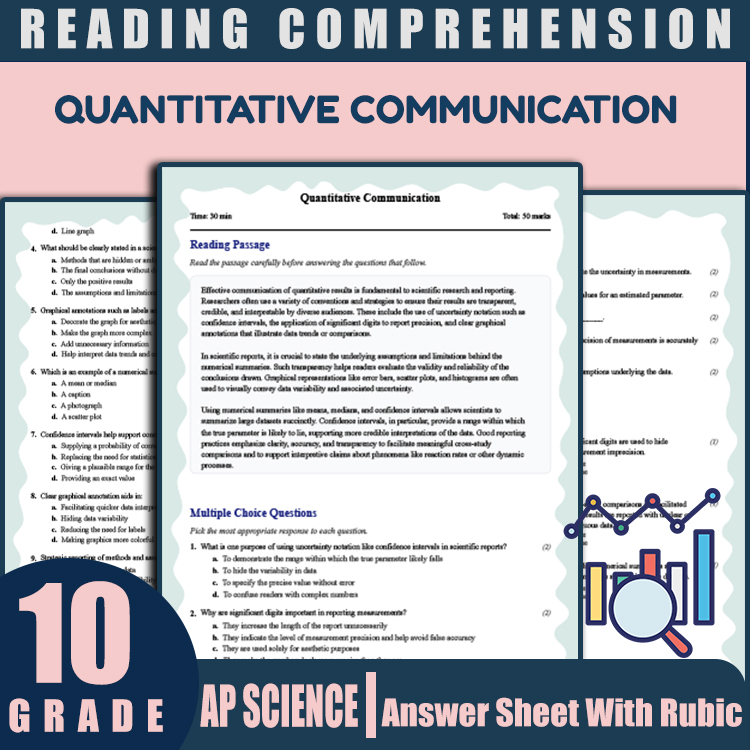
10th Grade Science | Quantitative Communication Reading Worksheets
JCreated byJ.S SheetsLearning Objectives
- Understand and interpret conventions for communicating quantitative results, including uncertainty notation and significant digits.
- Apply graphical annotation techniques to effectively present quantitative data.
- Evaluate the clarity of statements regarding assumptions and limitations in reports.
Also included in: Grade 10 Science Unit Worksheet Pack – Data Analysis & Scientific Reasoning +1 more
Instant download
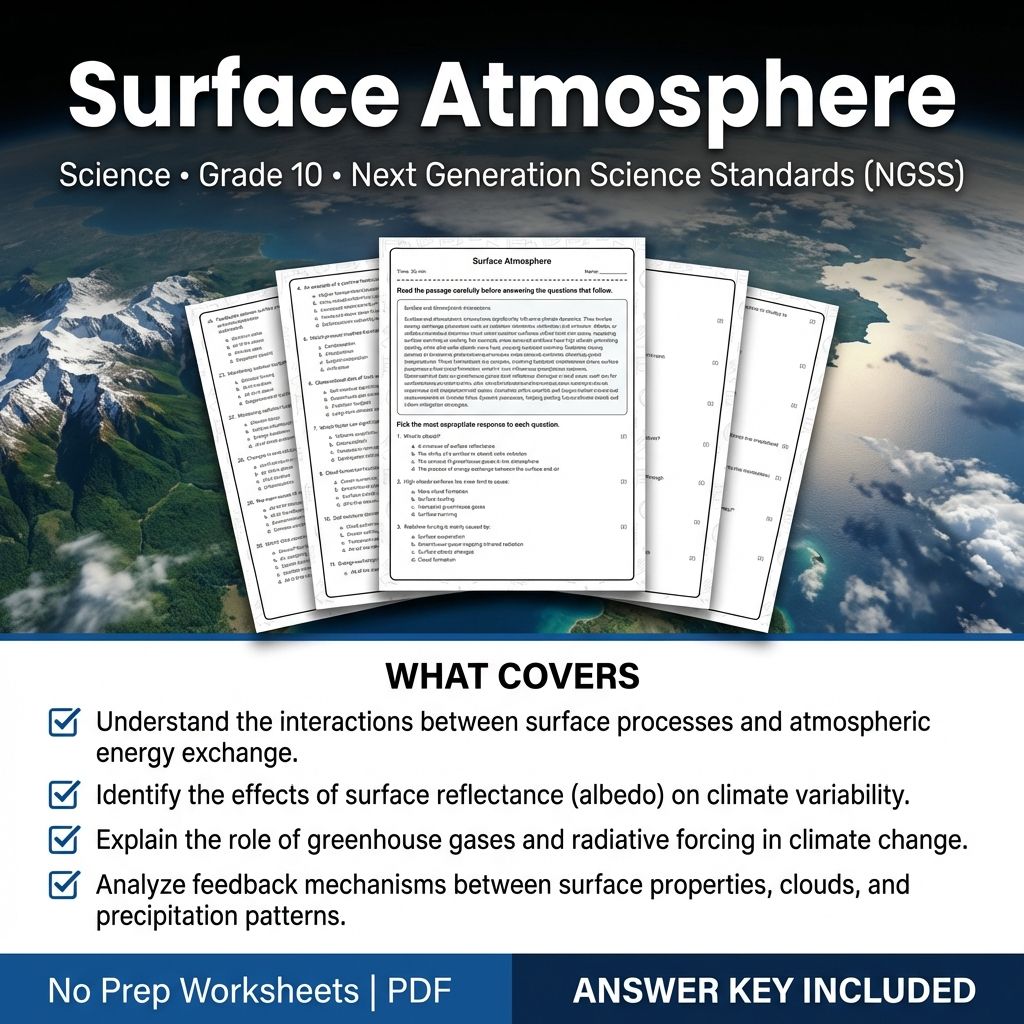
10th Grade Science | Surface Atmosphere Worksheet & Answer Key (Printable PDF)
 Created byCoral Reef Learning
Learning Objectives
- Understand the interactions between surface processes and atmospheric energy exchange.
- Identify the effects of surface reflectance (albedo) on climate variability.
- Explain the role of greenhouse gases and radiative forcing in climate change.
Also included in: Grade 10 Science Unit Bundle – Earth's Surface Atmosphere & Geology Worksheets +1 more
Instant download
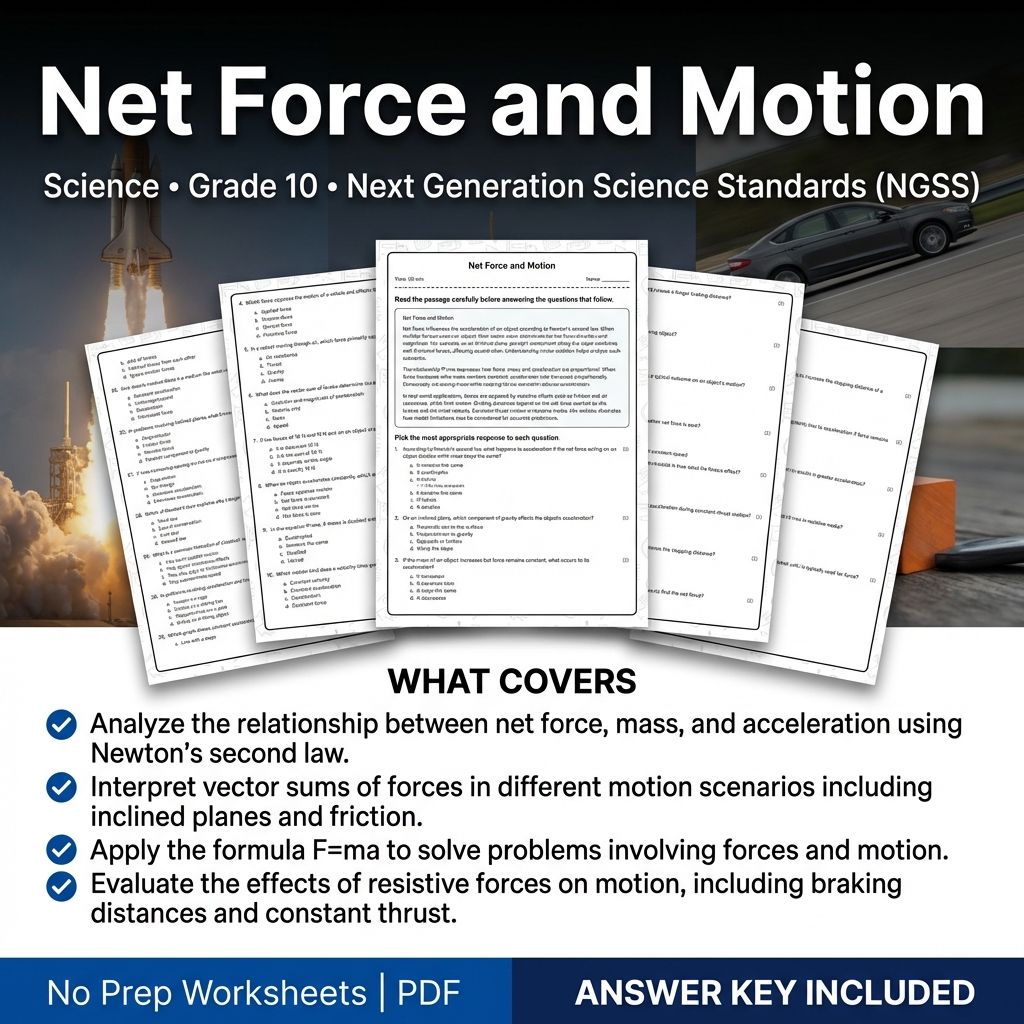
10th Grade Science | Net Force and Motion Worksheet with Answer Key (PDF)
Created byCoral Reef LearningLearning Objectives
- Analyze the relationship between net force, mass, and acceleration using Newton's second law.
- Interpret vector sums of forces in different motion scenarios including inclined planes and friction.
- Apply the formula F=ma to solve problems involving forces and motion.
Also included in: Grade 10 Science Unit Worksheet Bundle | Forces,Motion & Space NGSS(Answer Keys) +1 more
Instant download
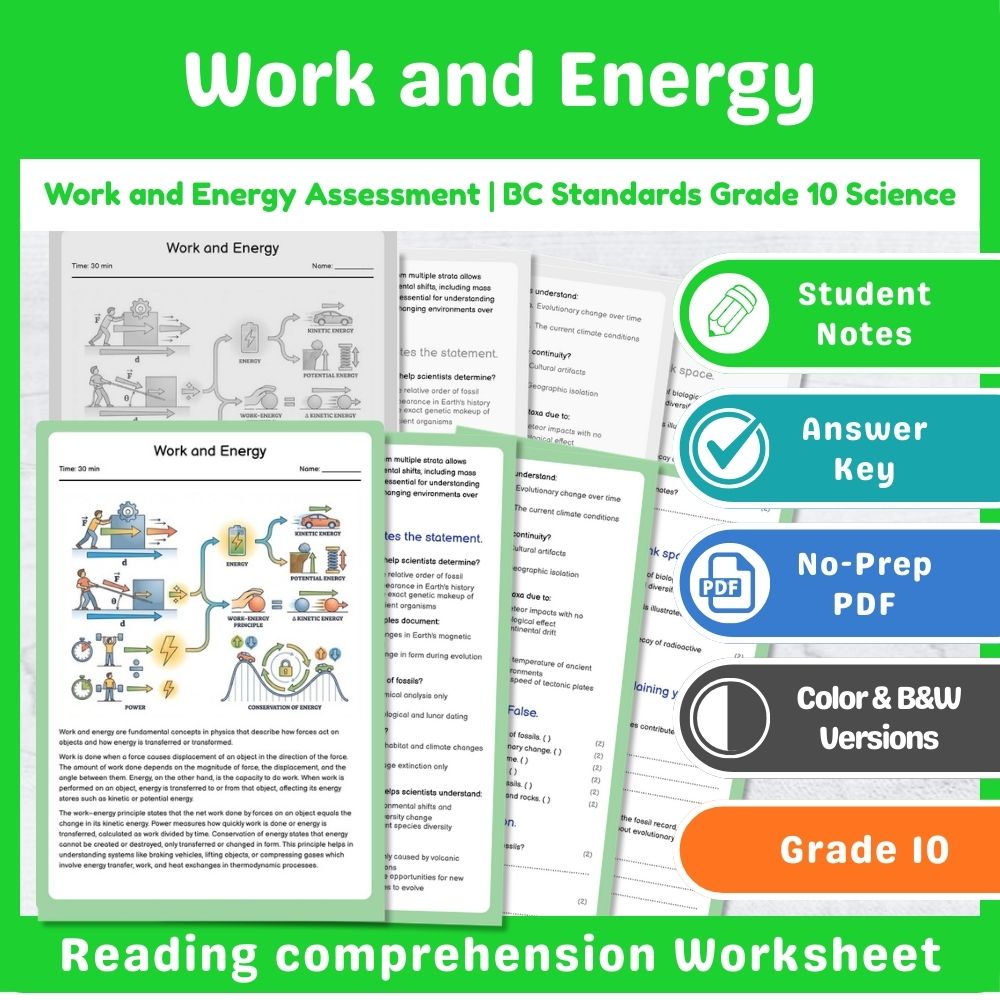
Work and Energy Assessment | BC Standards Grade 10 Science
 Created byPrism Point Learning
Learning Objectives
- Understand how work transfers energy between systems.
- Learn the relationship between work, energy, and power.
- Apply the work–energy principle to real-world scenarios.
Also included in: Grade 10 Science | Energy Assessment - BC Standards-Aligned Mini Bundle
Instant download

Grade 10 Worksheet B: Bond Energetics Worksheet | NGSS Practice PDF
 Created byClear Sky Classroom
Learning Objectives
- Explain how bond formation and bond breaking relate to energy changes in chemical reactions.
- Distinguish exothermic and endothermic processes using bond enthalpy and potential energy ideas.
- Use qualitative bond strength trends (single < double < triple) to predict relative energy flow and temperature/phase changes.
Also included in: Grade 10 Reaction Rates & Chemical Change Science Lesson Bundle – NGSS +1 more
Instant download
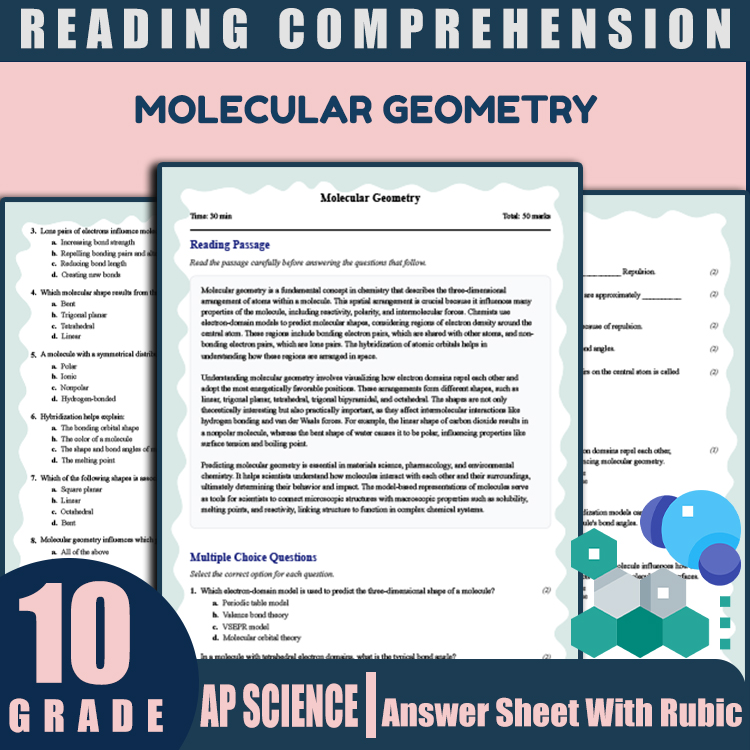
10th Grade Science | Molecular Geometry Reading Worksheet (PDF + Rubric)
JCreated byJ.S SheetsLearning Objectives
- Define molecular geometry using electron-domain models and orbital hybridization concepts.
- Explain how the spatial distribution of electron domains influences molecular shape and polarity.
- Connect molecular structure to intermolecular forces, surface interactions, and macroscopic properties.
Also included in: Grade 10 Science Unit Worksheet Bundle | Chemical Reactions & Atomic Structure +1 more
Instant download
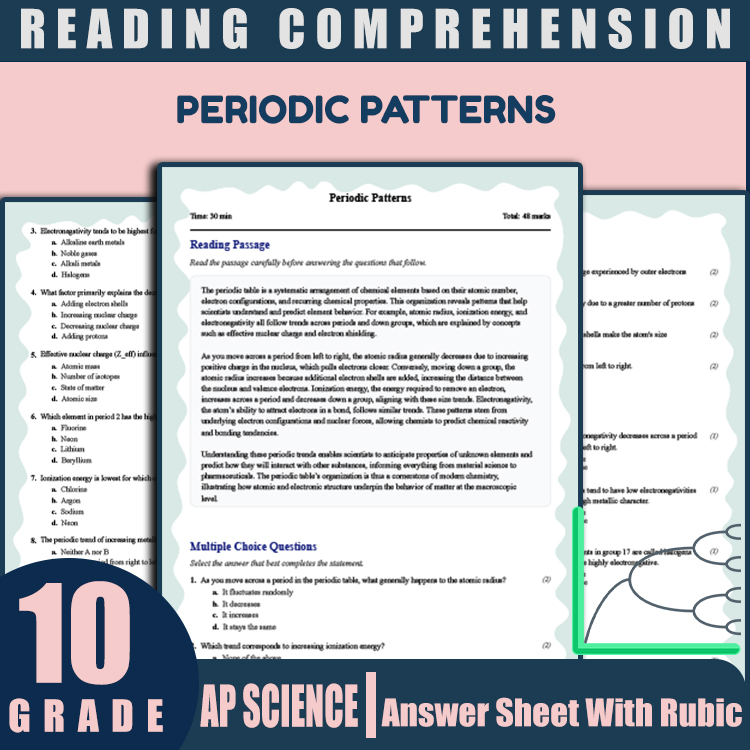
Grade 10 Science | Periodic Patterns Reading Worksheet & Answer Key (PDF)
JCreated byJ.S SheetsLearning Objectives
- Understand the organization of the periodic table and how element properties vary predictably across periods and groups.
- Interpret trends such as atomic radius, ionization energy, and electronegativity through concepts of effective nuclear charge and shielding.
- Relate electron configurations and nuclear effects to periodic patterns and chemical behavior.
Also included in: Grade 10 Science Unit Worksheet Bundle | Chemical Reactions & Atomic Structure +1 more
Instant download
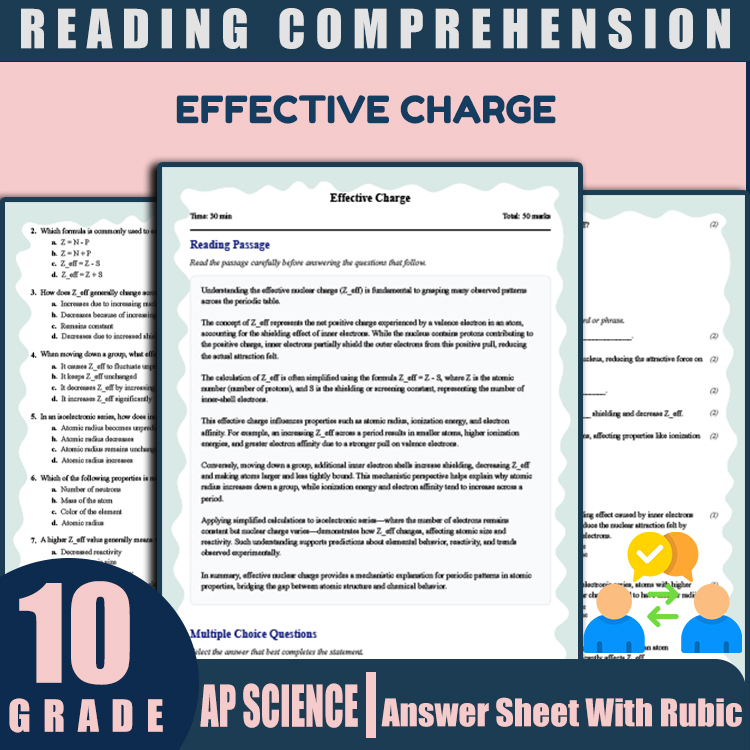
10th Grade Science | Effective Charge Reading Worksheet with Answer Key (PDF)
JCreated byJ.S SheetsLearning Objectives
- Understand the concept of effective nuclear charge (Z_eff) and how it influences atomic properties.
- Analyze periodic trends such as atomic radius, ionization energy, and electron affinity in relation to Z_eff.
- Apply simplified calculations and comparative examples to explain shielding and effective nuclear charge across isoelectronic series.
Also included in: Grade 10 Science Unit Worksheet Bundle | Chemical Reactions & Atomic Structure +1 more
Instant download
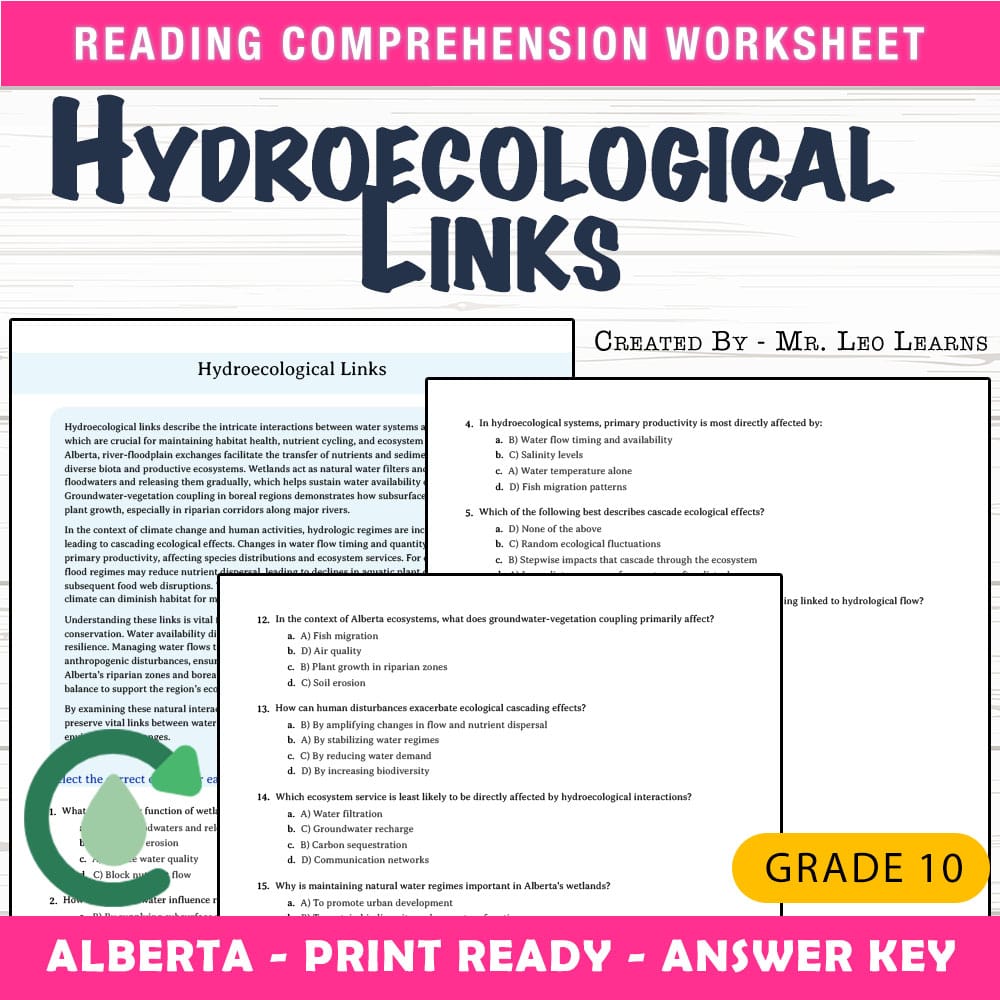
Grade 10 Science — Worksheet MCQ Paper for Hydroecological Links
 Created byThe Resource Hub
Learning Objectives
- Understand the interactions between hydrology and ecosystems and how they influence habitat and nutrient cycling.
- Identify the role of river-floodplain exchanges, wetlands, and groundwater in alpine ecosystems.
- Explain how water availability affects primary productivity and species distribution.
Also included in: Grade 10 Science Bundle | Earth and Space Systems Worksheets +1 more
Instant download
Grade 10 Science — Organ Systems Worksheet MCQ Paper for Mastery
Created byThe Resource HubLearning Objectives
- Understand the structure-function relationship of different organ systems in animals and plants.
- Identify how vascularization and tissue integration support organ functions in diverse environments.
- Explain the role of organ-specific design in survival and reproduction within Alberta’s environmental gradients.
Also included in: Grade 10 Science Cells and Systems Lesson Bundle | Alberta Curriculum +1 more
Instant download
Grade 10 Science — Worksheet MCQ Paper for Mastering Analytical Techniques
Created byThe Resource HubLearning Objectives
- Understand various analytical chemistry methods used for substance identification and quantification.
- Interpret data obtained from spectroscopic, chromatographic, and titrimetric techniques.
- Recognize the importance of detection limits and mass calculations in environmental and industrial settings.
Also included in: Grade 10 Science Lesson Bundle | Matter and Chemical Change Worksheets +1 more
Instant download
Grade 10 Science — Worksheet MCQ Paper for Mastering Induction Principles
Created byThe Resource HubLearning Objectives
- Explain the concept of electromagnetic induction and its significance in energy conversion devices.
- Describe Faraday’s law and how flux change induces voltage.
- Understand the directionality of induced currents according to Lenz’s law.
Also included in: Grade 10 Science | Energy, Motion & Electricity Worksheet Bundle | Alberta +1 more
Instant download
Grade 10 Science — Worksheet MCQ Paper for Mastering Transmission Losses
Created byThe Resource HubLearning Objectives
- Understand how current, resistance, and voltage influence power transmission losses.
- Explain the role of transformers in voltage regulation and energy efficiency.
- Analyze practical examples from Alberta's power grid to illustrate transmission strategies.
Also included in: Grade 10 Science | Energy, Motion & Electricity Worksheet Bundle | Alberta +1 more
Instant download
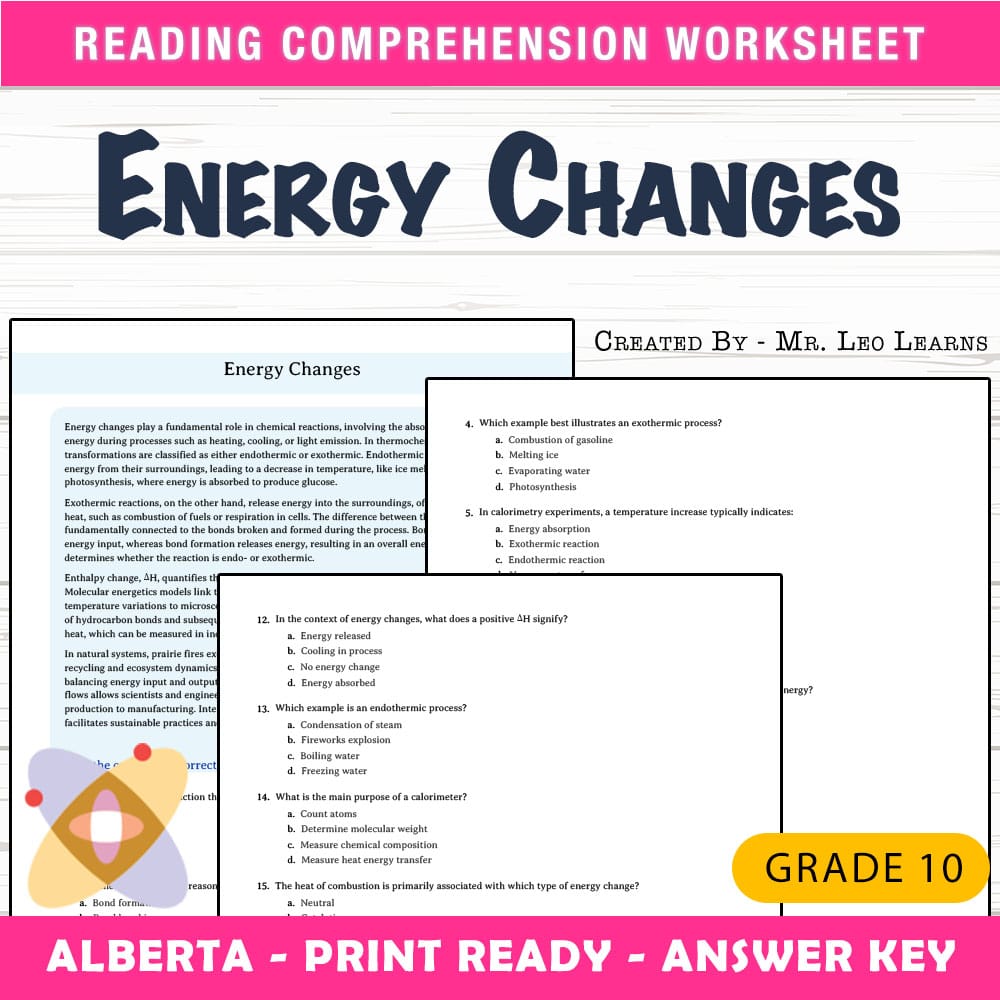
Grade 10 Science — Worksheet MCQ Paper for Mastering Energy Changes
Created byThe Resource HubLearning Objectives
- Understand the concepts of endothermic and exothermic energy changes in chemical reactions.
- Relate enthalpy changes to bond breaking and formation at the molecular level.
- Interpret macroscopic temperature changes and calorimetric data in terms of energy flow.
Also included in: Grade 10 Science Lesson Bundle | Matter and Chemical Change Worksheets +1 more
Instant download
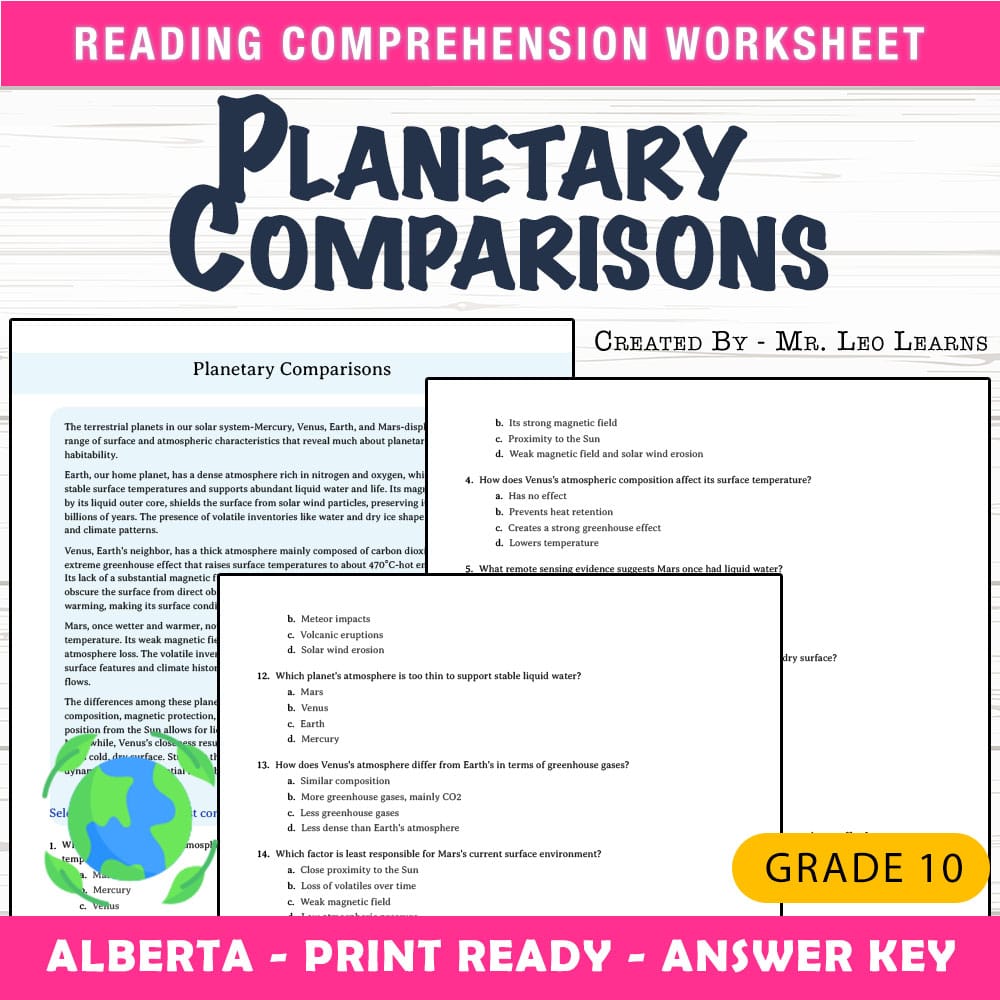
Grade 10 Science — Worksheet MCQ Paper for Mastering Planetary Comparisons
Created byThe Resource HubLearning Objectives
- Understand differences in atmospheres among terrestrial planets.
- Compare greenhouse effects on Earth, Mars, and Venus.
- Recognize the role of magnetic fields and volatile inventories in planetary surface conditions.
Also included in: Grade 10 Science Bundle | Earth and Space Systems Worksheets +1 more
Instant download
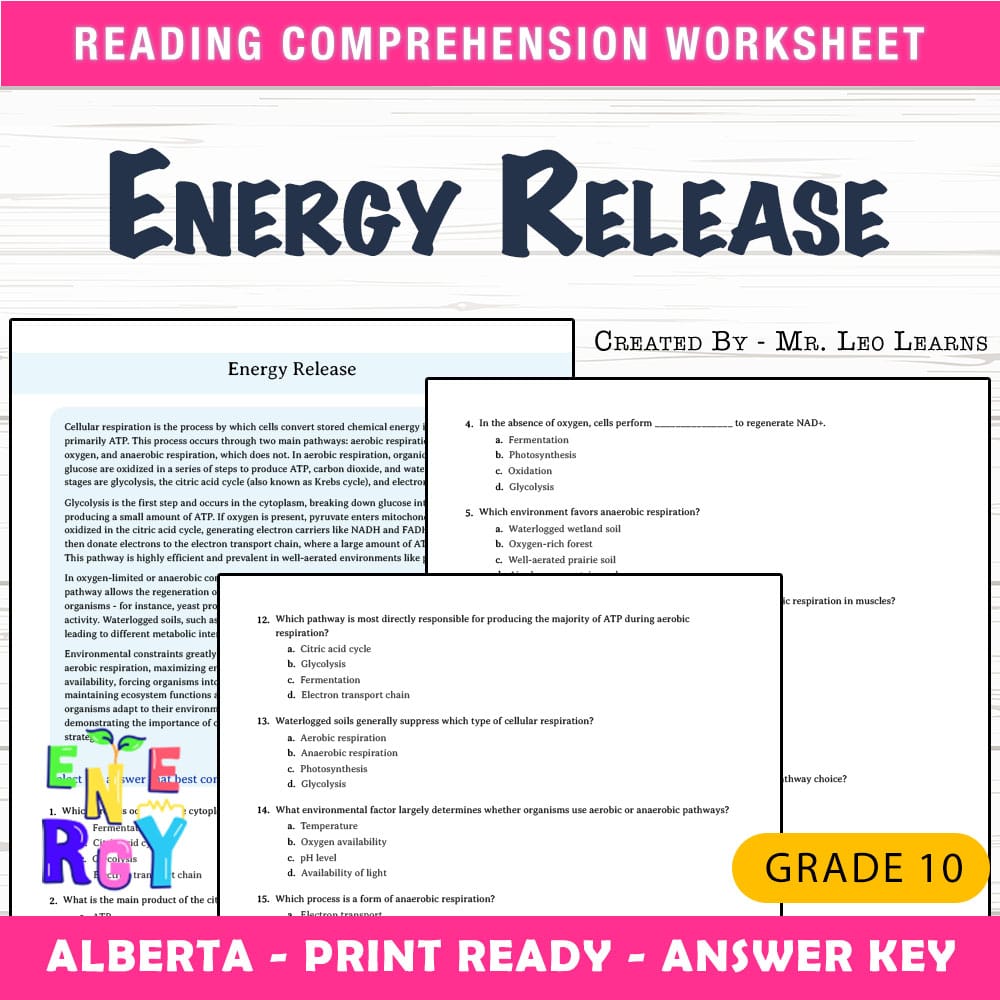
Grade 10 Science — Worksheet MCQ Paper for Mastering Energy Release
Created byThe Resource HubLearning Objectives
- Understand the processes of aerobic and anaerobic respiration and their environmental significance.
- Identify the pathways involved in cellular energy production, including glycolysis, the citric acid cycle, and electron transport.
- Explain how oxygen availability influences the dominance of different respiration pathways in various environments.
Also included in: Grade 10 Science Cells and Systems Lesson Bundle | Alberta Curriculum +1 more
Instant download
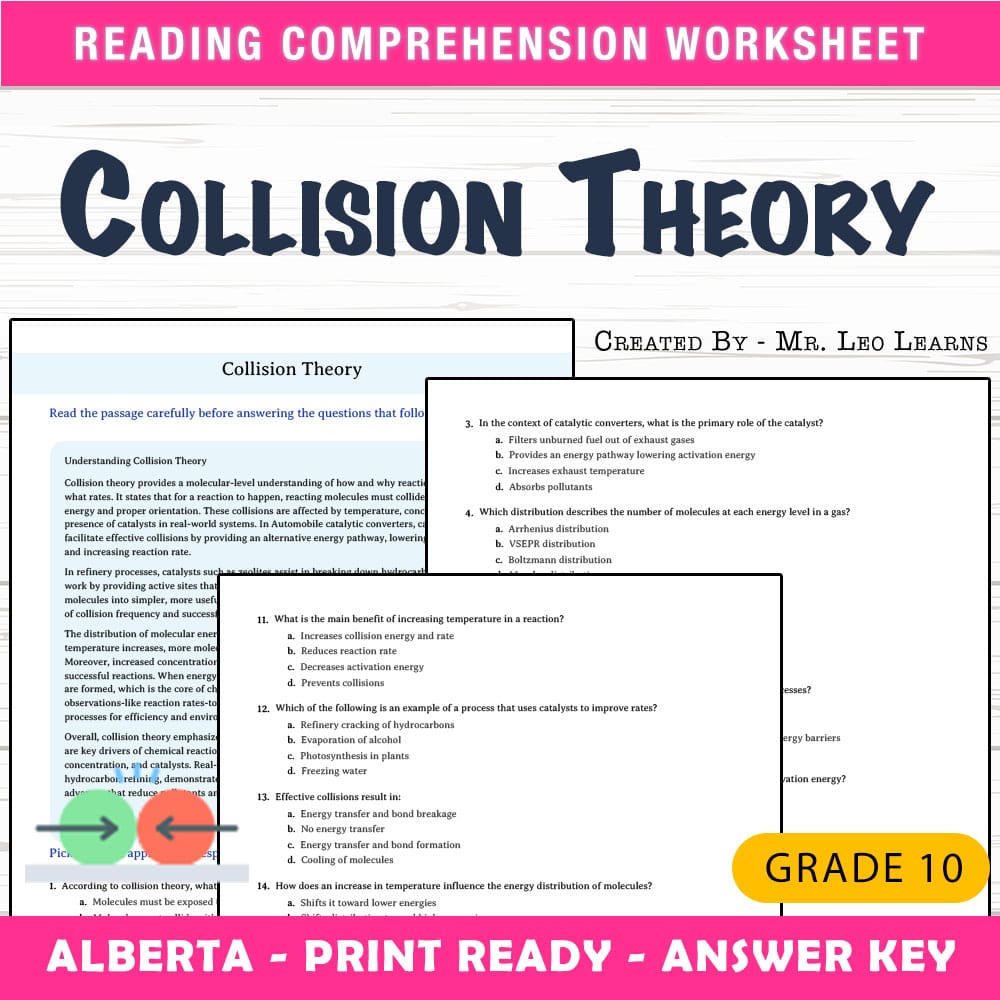
Grade 10 Science — Collision Theory Worksheet MCQ for Mastery
Created byThe Resource HubLearning Objectives
- Understand how molecular collisions influence reaction rates
- Explain the role of activation energy and energy barriers in chemical reactions
- Analyze the effects of temperature and concentration on collision frequency and reaction rate
Also included in: Grade 10 Science Lesson Bundle | Matter and Chemical Change Worksheets +1 more
Instant download
Grade 10 Science — Worksheet MCQ Paper for Mastering Metabolic Control
Created byThe Resource HubLearning Objectives
- Understand how enzyme kinetics regulate cellular metabolism.
- Identify mechanisms of feedback inhibition and compartmentalization.
- Analyze how environmental factors influence enzyme activity in Alberta species.
Also included in: Grade 10 Science Cells and Systems Lesson Bundle | Alberta Curriculum +1 more
Instant download
Grade 10 Science — Worksheet MCQ Paper for Mastering System Responses
Created byThe Resource HubLearning Objectives
- Understand how cellular processes coordinate organ functions in response to environmental signals.
- Examine how resource reallocation and signaling networks produce adaptive outcomes.
- Analyze the limits of plasticity and the trade-offs between short-term responses and long-term fitness.
Also included in: Grade 10 Science Cells and Systems Lesson Bundle | Alberta Curriculum +1 more
Instant download
Grade 10 Science — Worksheet MCQ Paper for Momentum Transfer
Created byThe Resource HubLearning Objectives
- Understand the principles of linear momentum and impulse during collisions.
- Analyze how momentum is conserved in closed systems and how it redistributes during interactions.
- Explore the relationships between energy and momentum, especially during dissipative and elastic collisions.
Also included in: Grade 10 Science | Energy, Motion & Electricity Worksheet Bundle | Alberta +1 more
Instant download
Grade 10 Science — Membrane Transport Worksheet MCQ Paper
Created byThe Resource HubLearning Objectives
- Understand the primary mechanisms of membrane transport such as diffusion, osmosis, and facilitated transport.
- Describe how membrane proteins and lipid composition influence permeability and cell signaling.
- Explain the role of membrane transport in maintaining cellular homeostasis, nutrient uptake, and waste removal in different environments.
Also included in: Grade 10 Science Cells and Systems Lesson Bundle | Alberta Curriculum +1 more
Instant download
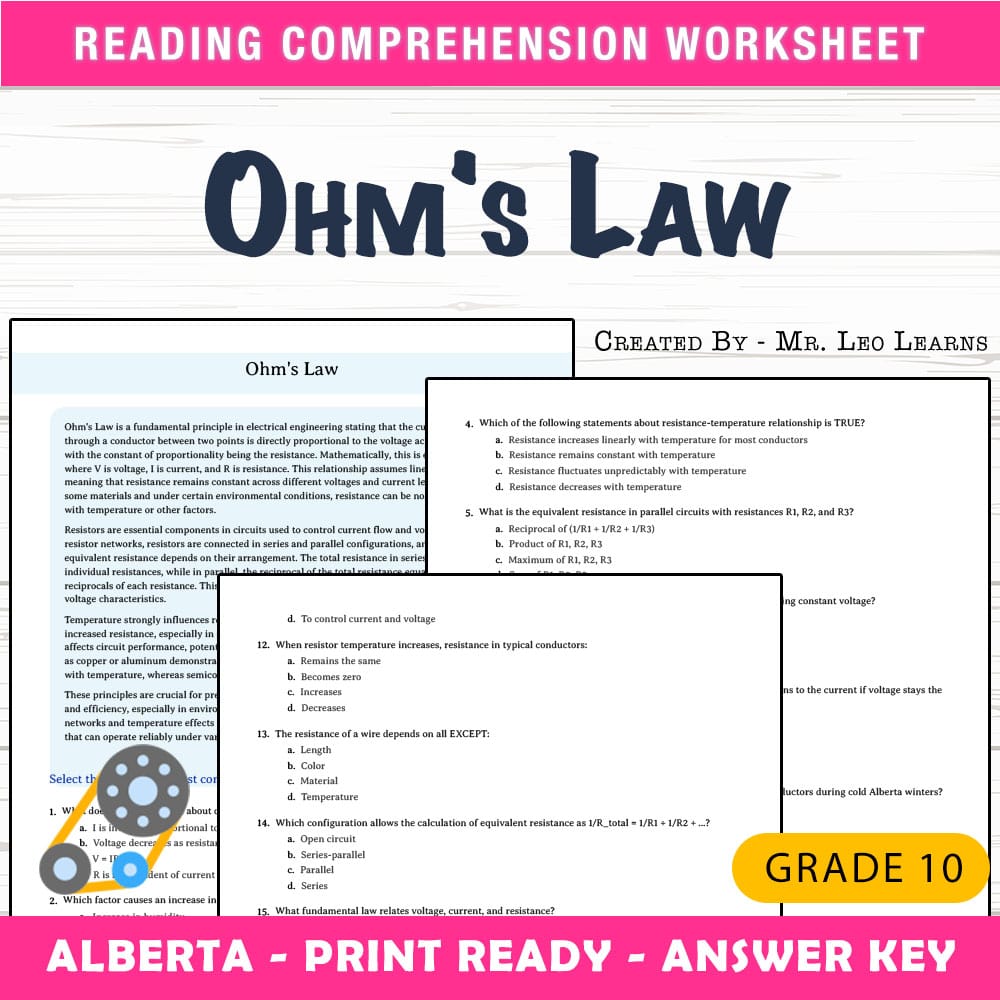
Grade 10 Science — Ohm's Law Worksheet MCQ Paper for Mastery
Created byThe Resource HubLearning Objectives
- Understand the principles of Ohm's Law and how voltage, current, and resistance are related.
- Calculate equivalent resistance in series and parallel circuits.
- Analyze the temperature dependence of resistance in conductors and its impact on circuit performance.
Also included in: Grade 10 Science | Energy, Motion & Electricity Worksheet Bundle | Alberta +1 more
Instant download
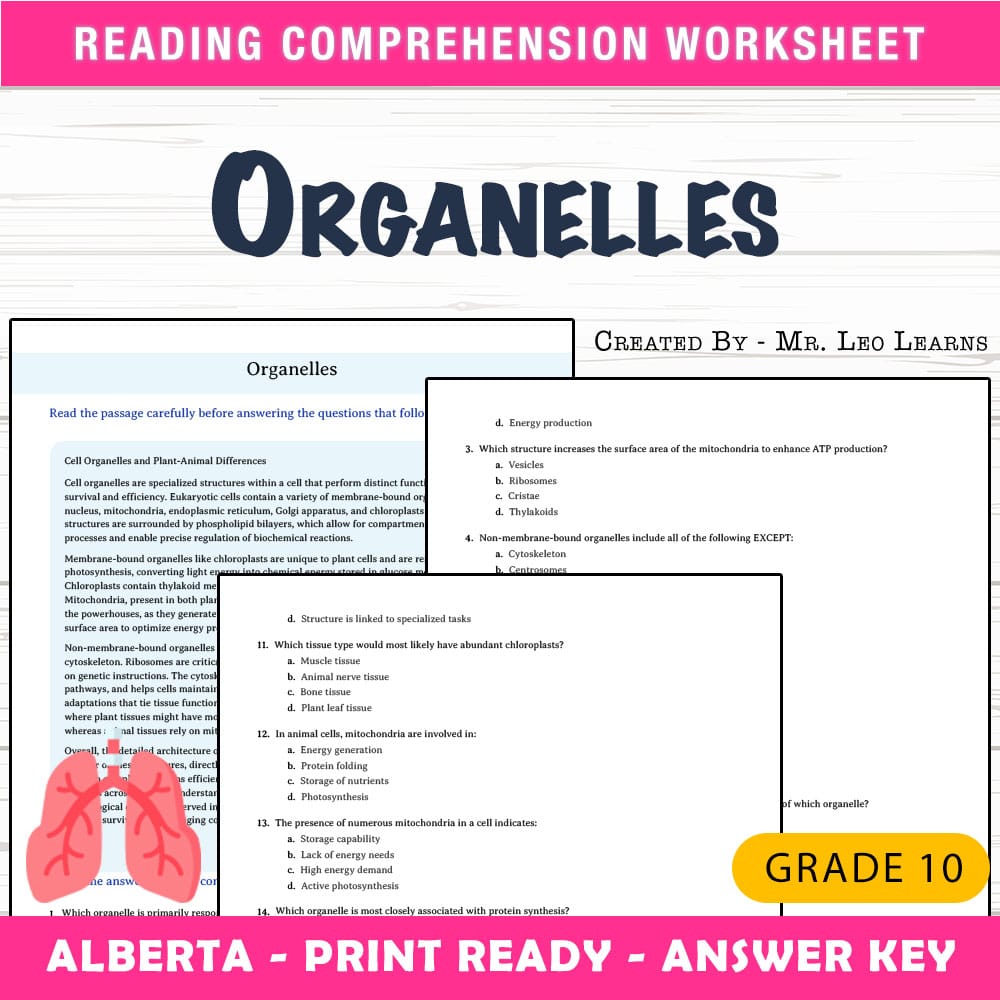
Grade 10 Science — Worksheet MCQ Paper for Mastering Organelles
Created byThe Resource HubLearning Objectives
- Identify the types and functions of membrane-bound and non-membrane-bound organelles in eukaryotic cells.
- Describe how organelle structure relates to its function within different tissue types.
- Explain the roles of chloroplasts and mitochondria in plant and animal cells and how their abundance varies with environmental conditions.
Also included in: Grade 10 Science Cells and Systems Lesson Bundle | Alberta Curriculum +1 more
Instant download
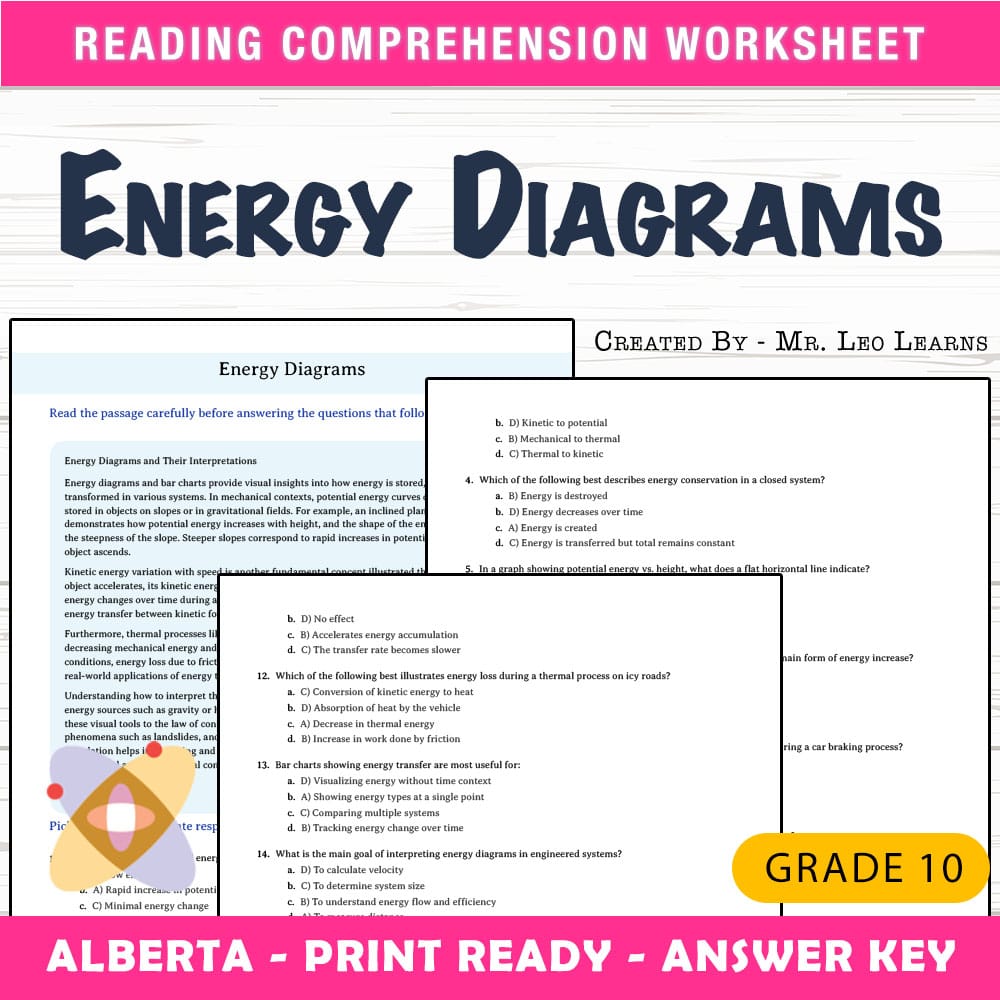
Grade 10 Science — Worksheet MCQ Paper for Mastering Energy Diagrams
Created byThe Resource HubLearning Objectives
- Interpret energy diagrams and bar charts to analyze energy transfer and distribution.
- Identify sources and sinks of energy in mechanical and thermal processes.
- Apply conservation principles to interpret visual representations of energy flow.
Also included in: Grade 10 Science | Energy, Motion & Electricity Worksheet Bundle | Alberta +1 more
Instant download
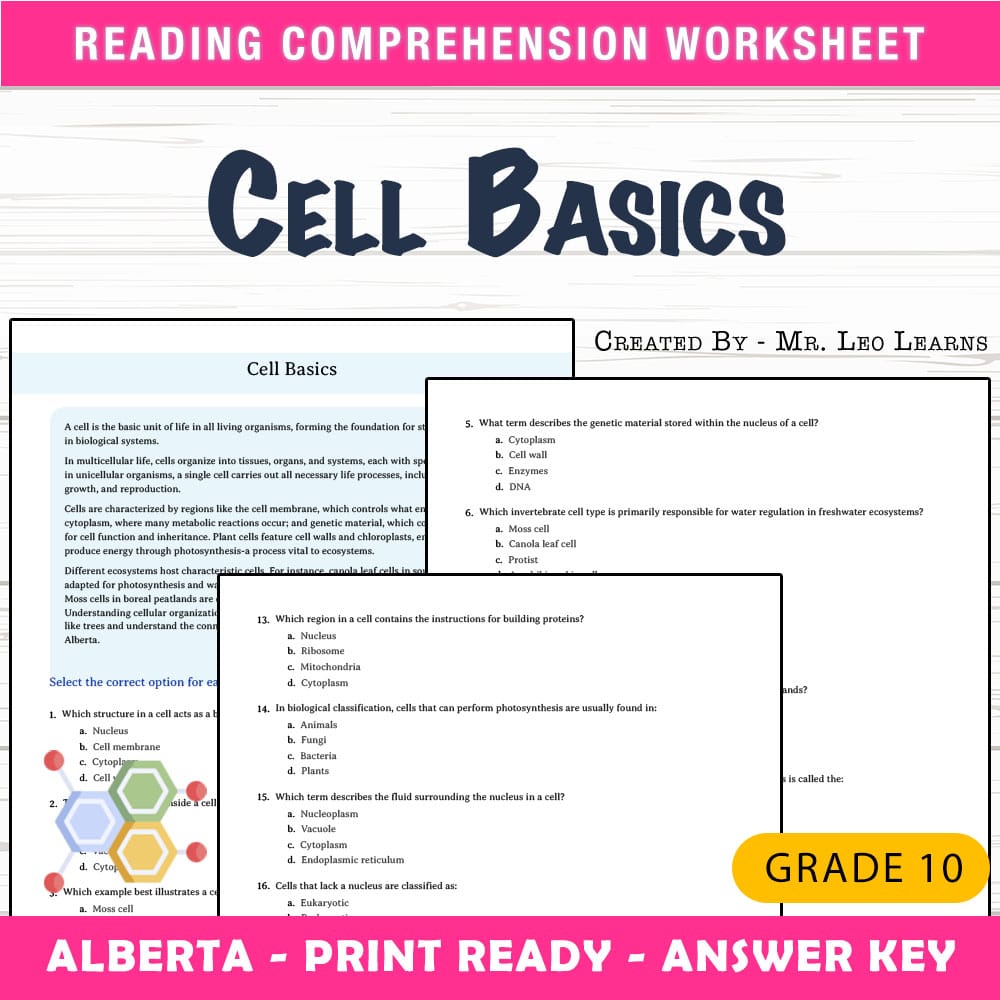
Grade 10 Science — Cell Basics Worksheet MCQ Paper for Mastery
Created byThe Resource HubLearning Objectives
- Understand the fundamental features of a cell, including membrane boundaries, cytoplasm, and genetic material.
- Recognize examples of different cell types from Alberta ecosystems.
- Connect microscopic cell structures to their functions and larger biological systems.
Also included in: Grade 10 Science Cells and Systems Lesson Bundle | Alberta Curriculum +1 more
Instant download
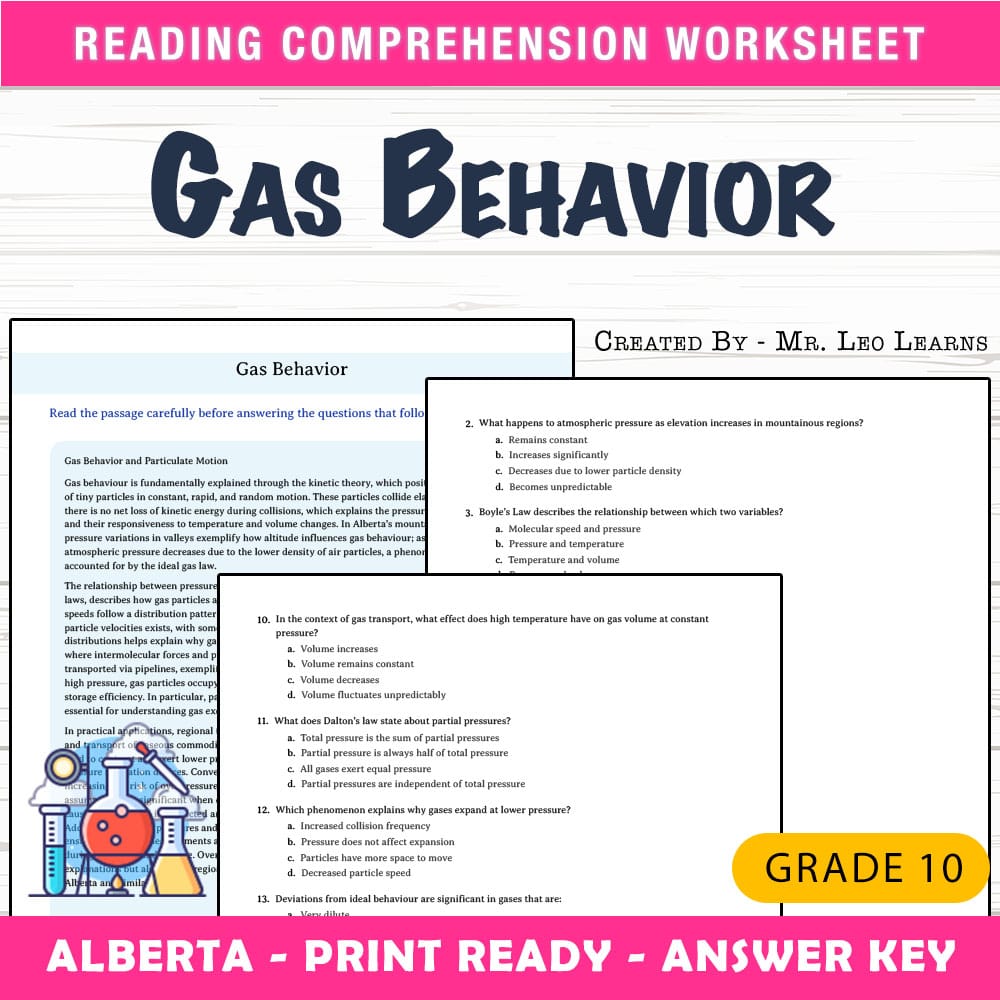
Grade 10 Science — Gas Behavior Worksheet MCQ Paper for Mastery
Created byThe Resource HubLearning Objectives
- Understand how particulate motion relates to gas laws and pressure changes in regional environments.
- Explain the principles of kinetic theory and how they influence gas pressure, temperature, and volume.
- Evaluate deviations from ideal gas behavior and the concept of partial pressures in mixtures.
Also included in: Grade 10 Science Lesson Bundle | Matter and Chemical Change Worksheets +1 more
Instant download
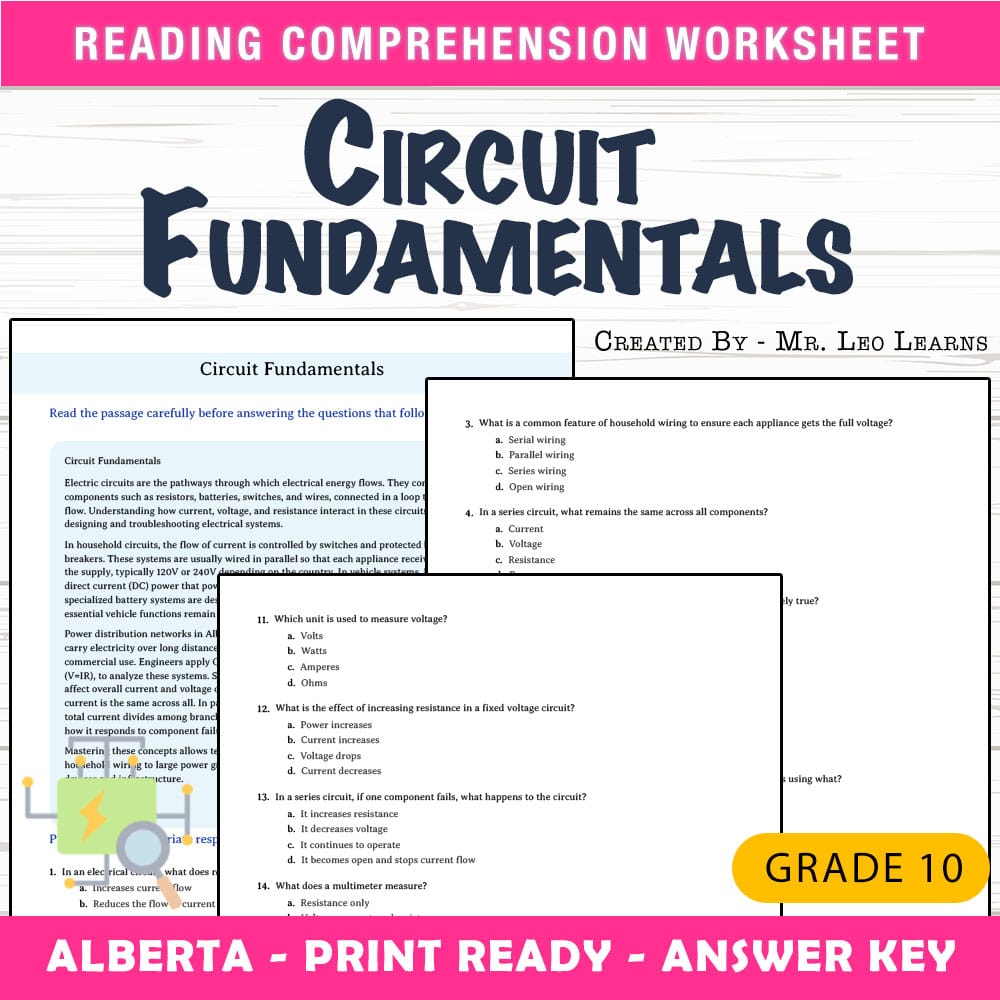
Grade 10 Science — Worksheet MCQ Paper for Circuit Fundamentals
Created byThe Resource HubLearning Objectives
- Understand the basic concepts of current, voltage, and resistance in electrical circuits.
- Describe how series and parallel configurations affect current and voltage drops.
- Apply Ohm's Law to solve simple circuit problems.
Also included in: Grade 10 Science | Energy, Motion & Electricity Worksheet Bundle | Alberta +1 more
Instant download
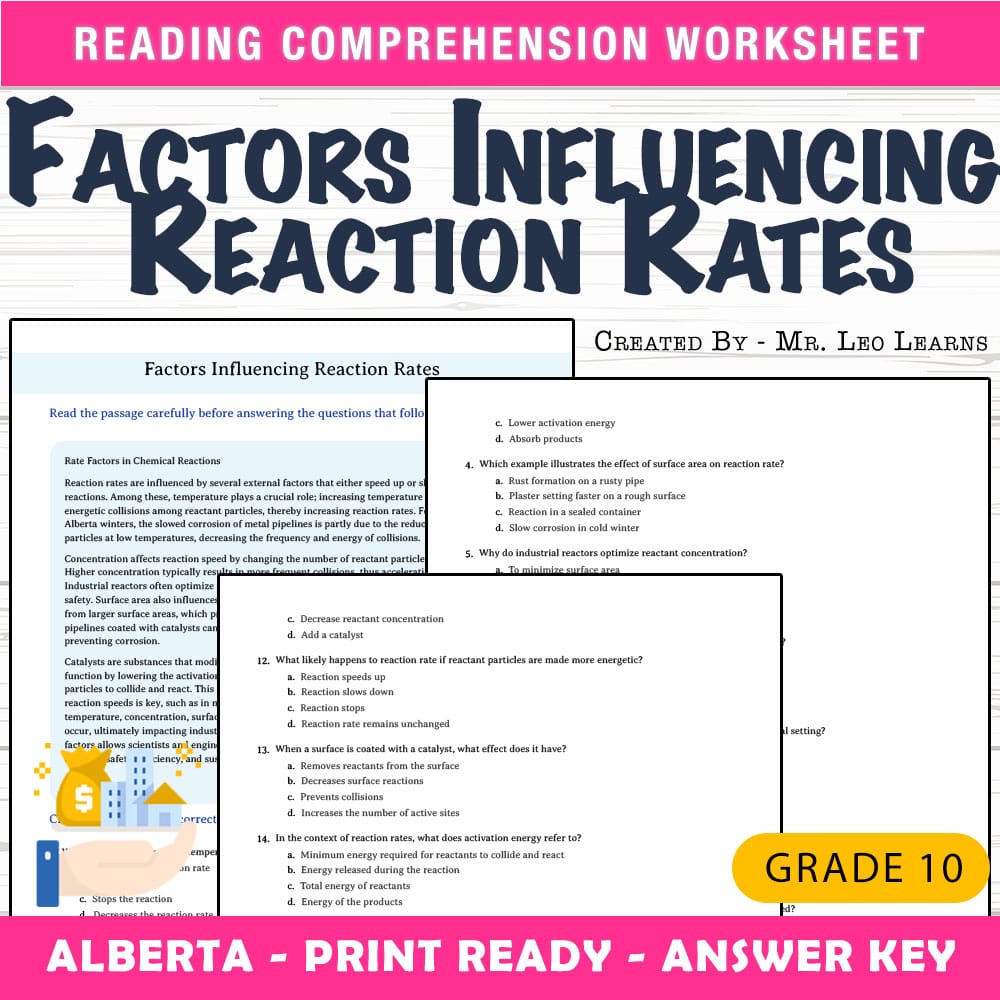
Clear layout optimized for photocopying and classroom distribution
Created byThe Resource HubLearning Objectives
- Understand how temperature affects reaction speed.
- Identify the impact of concentration, surface area, and catalysts on reaction rates.
- Analyze real-world examples of rate modifications in industrial and environmental contexts.
Also included in: Grade 10 Science Lesson Bundle | Matter and Chemical Change Worksheets +1 more
Instant download
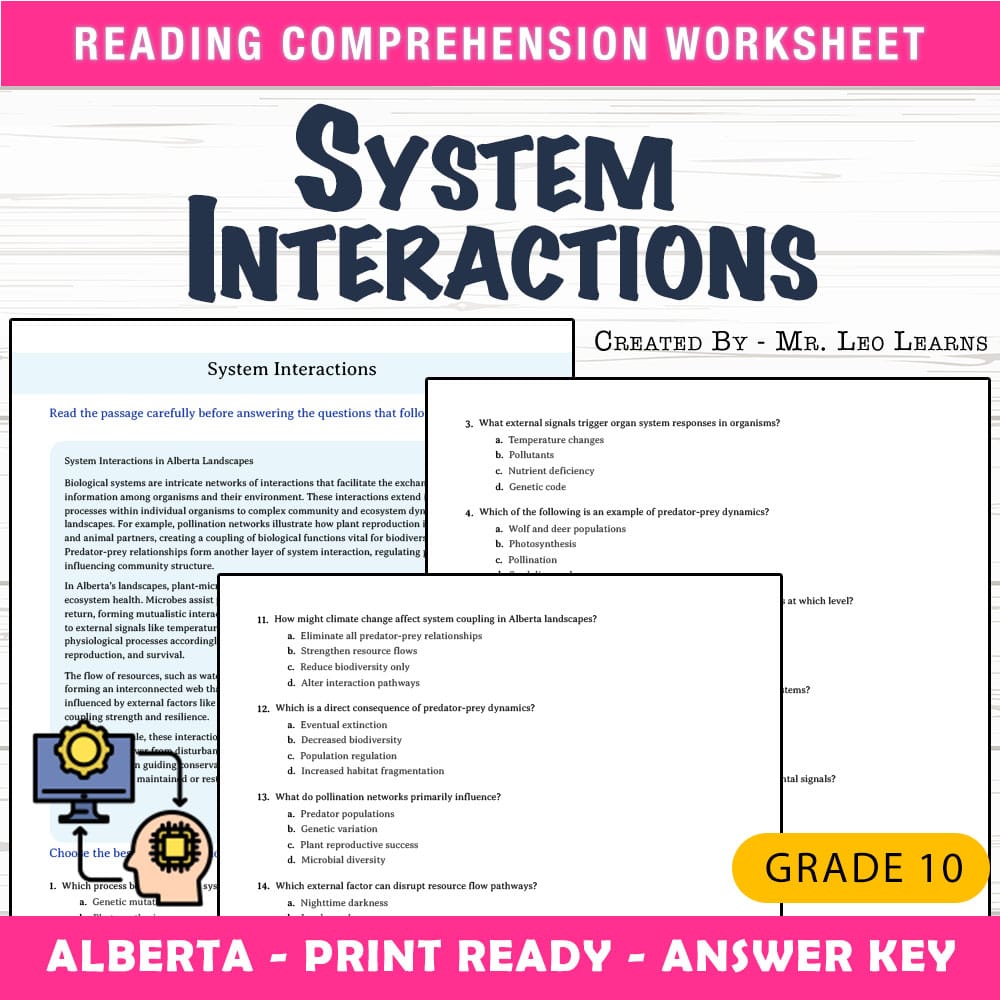
Grade 10 Science — Worksheet MCQ Paper for Mastering System Interactions
Created byThe Resource HubLearning Objectives
- Understand how biological systems interact through material and information exchange.
- Identify examples of system coupling like pollination networks and predator-prey dynamics.
- Explain how organ systems respond to external signals and how resource flows connect organisms.
Also included in: Grade 10 Science Cells and Systems Lesson Bundle | Alberta Curriculum +1 more
Instant download
10th Grade Science | Genetic Drift Worksheet (PDF+ Answer Key)
 Created byCopper Leaf Classroom
Learning Objectives
- Understand the concept of genetic drift and its mechanisms in small populations.
- Identify how genetic drift differs from natural selection.
- Explain the effects of genetic drift such as loss of genetic variation and fixation of alleles.
Instant download

Genetic Drift Worksheet for Grade 10 Science | Standards-Aligned Practice
JCreated byJ.S SheetsLearning Objectives
- Explain how genetic drift causes allele frequencies to change due to chance events rather than natural selection.
- Describe why genetic drift has a stronger effect in small populations.
- Analyze how genetic drift can reduce genetic diversity and lead to divergence among populations.
Also included in: Grade 10 Life Science Evolution, Genetics & Cells Lesson Bundle – Florida NGSSS +1 more
Instant download

Grade 10 Science | Phylogenetic Trees Worksheet | TEKS-Aligned
 Created byLumora Learning
Learning Objectives
- Understand the purpose and construction of phylogenetic trees.
- Identify shared derived traits, molecular sequences, and fossil data used in determining relationships.
- Explain how classification reflects evolutionary history and common ancestry.
Also included in: Grade 10 Science | Evolution & Classification Lesson Bundle | TEKS Aligned +1 more
Instant download

Grade 10 Extinction Patterns Worksheet | Practice & Assessment PDF
Created byClear Sky ClassroomLearning Objectives
- Explain how extinction patterns range from background losses to mass extinctions and how they influence biodiversity
- Identify major drivers of extinction, including environmental change, habitat loss, invasive species, and rapid climate shifts
- Describe how extinction events can leave fossil and genetic signatures that reveal past biodiversity crises
Instant download

Feedback Loops During Exercise Worksheet | Homeostasis TEKS Grade 10
 Created byBRIGHT PATH RESOURCES
Learning Objectives
- Explain how feedback loops help maintain homeostasis during exercise.
- Identify cause-and-effect links between organ systems during increased demand.
- Use evidence from a text to support claims about physiological regulation.
Also included in: Grade 10 Homeostasis & Body Systems Science Worksheets Bundle | TEKS +1 more
Instant download
10th Grade Science | Momentum and Impulse Worksheet (PDF + Answer Key)
Created byCopper Leaf ClassroomLearning Objectives
- Understand the quantitative definitions of momentum and impulse.
- Apply the impulse-momentum theorem to various collision scenarios.
- Analyze the effects of external forces on momentum in closed and open systems.
Instant download

Grade 10 Science | Design Foundations - Daily Reading Comprehension
Created byCoral Reef LearningLearning Objectives
- Understand the importance of identifying stakeholders in engineering problems.
- Learn how constraints influence the design process.
- Develop skills to analyze problem scopes and define success criteria.
Instant download

Grade 10 Science | Stratigraphic Record Worksheet (AP Standards) (PDF)
 Created byEvergreen Desk Education
Learning Objectives
- Use superposition, correlation, and unconformities to interpret relative timing in a stratigraphic sequence.
- Explain how fossil assemblages and biostratigraphic ranges support environmental and chronological reconstructions.
- Apply radiometric dating concepts (half-life/decay) and age-depth reasoning to estimate absolute ages and evaluate sources of uncertainty.
Also included in: Grade 10 Earth and Climate Systems Science Lesson Bundle Worksheets (AP) +1 more
Instant download

Grade 10 Science | Climate Drivers Worksheet (AP Standards) PDF
Created byEvergreen Desk EducationLearning Objectives
- Explain how radiative forcing, greenhouse gases, and albedo changes influence Earth’s energy balance and temperature over time.
- Use simplified cause-and-effect reasoning to describe feedbacks and distinguish external forcing from internal climate variability.
- Interpret how ocean-atmosphere coupling and paleoclimate proxies can inform regional and long-term climate change.
Also included in: Grade 10 Earth and Climate Systems Science Lesson Bundle Worksheets (AP) +1 more
Instant download

Grade 10 Science Worksheet – Plate Tectonics & Plate Narratives (AP Standard)
Created byEvergreen Desk EducationLearning Objectives
- Explain how mantle convection and subduction drive plate motion and affect Earth’s surface features.
- Interpret tectonic settings using maps, cross-sections, and seismic evidence.
- Quantify and compare relative plate velocities and boundary kinematics from simple scenarios.
Also included in: Grade 10 Earth and Climate Systems Science Lesson Bundle Worksheets (AP) +1 more
Instant download

Grade 10 Science – Sphere Connections Worksheet (AP Standards) (PDF)
Created byEvergreen Desk EducationLearning Objectives
- Explain how the geosphere, hydrosphere, atmosphere, and biosphere interact through coupled Earth-system processes.
- Use box-and-arrow models and flow diagrams to predict how changes in one sphere propagate to measurable outcomes.
- Apply mass-balance reasoning to interpret observable indicators such as streamflow, soil moisture, and primary productivity.
Also included in: Grade 10 Earth and Climate Systems Science Lesson Bundle Worksheets (AP) +1 more
Instant download
Grade 10 Science – Photosynthesis Efficiency Daily Reading Worksheet + Answer Key
JCreated byJ.S SheetsLearning Objectives
- Understand the basic process of photosynthesis
- Identify factors affecting photosynthesis efficiency
- Compare natural photosynthesis with solar energy technologies
Also included in: Grade 10 Science Lesson Group BC Framework – Daily Reading Worksheets Bundle +1 more
Instant download
Grade 10 Science – Thermodynamic Limits Daily Reading Worksheet + Answer Key
JCreated byJ.S SheetsLearning Objectives
- Understand the basic principles of the first law of thermodynamics.
- Learn about energy conservation in thermodynamic systems.
- Explore the concept of entropy and its implications on energy quality.
Also included in: Grade 10 Science Lesson Group BC Framework – Daily Reading Worksheets Bundle +1 more
Instant download
Grade 10 Science – Lifecycle Analysis Daily Reading Worksheet + Answer Key
JCreated byJ.S SheetsLearning Objectives
- Understand key concepts related to Science
- Apply knowledge through practice questions
- Demonstrate comprehension of the material
Also included in: Grade 10 Science Lesson Group BC Framework – Daily Reading Worksheets Bundle +1 more
Instant download
Grade 10 Science – Mechanical Systems Daily Reading Worksheet + Answer Key
JCreated byJ.S SheetsLearning Objectives
- Understand basic mechanical components such as gears, pulleys, and levers.
- Describe how energy transfers and transforms within mechanical systems.
- Analyze how forces, motion, and mechanical advantage work together.
Also included in: Grade 10 Science Lesson Group BC Framework – Daily Reading Worksheets Bundle +1 more
Instant download
Grade 10 Science – Heat Transfer Daily Reading Worksheet with Answer Key
JCreated byJ.S SheetsLearning Objectives
- Identify different methods of heat transfer
- Understand the role of thermal properties in heat transfer
- Recognize the importance of heat transfer in everyday life
Also included in: Grade 10 Science Lesson Group BC Framework – Daily Reading Worksheets Bundle +1 more
Instant download
Grade 10 Science – Energy Systems Daily Reading Worksheet + Answer Key
JCreated byJ.S SheetsLearning Objectives
- Understand the basic concepts of efficiency in energy systems
- Identify common efficiency measures such as percent efficiency and EROI
- Interpret different efficiency metrics and their significance
Also included in: Grade 10 Science Lesson Group BC Framework – Daily Reading Worksheets Bundle +1 more
Instant download
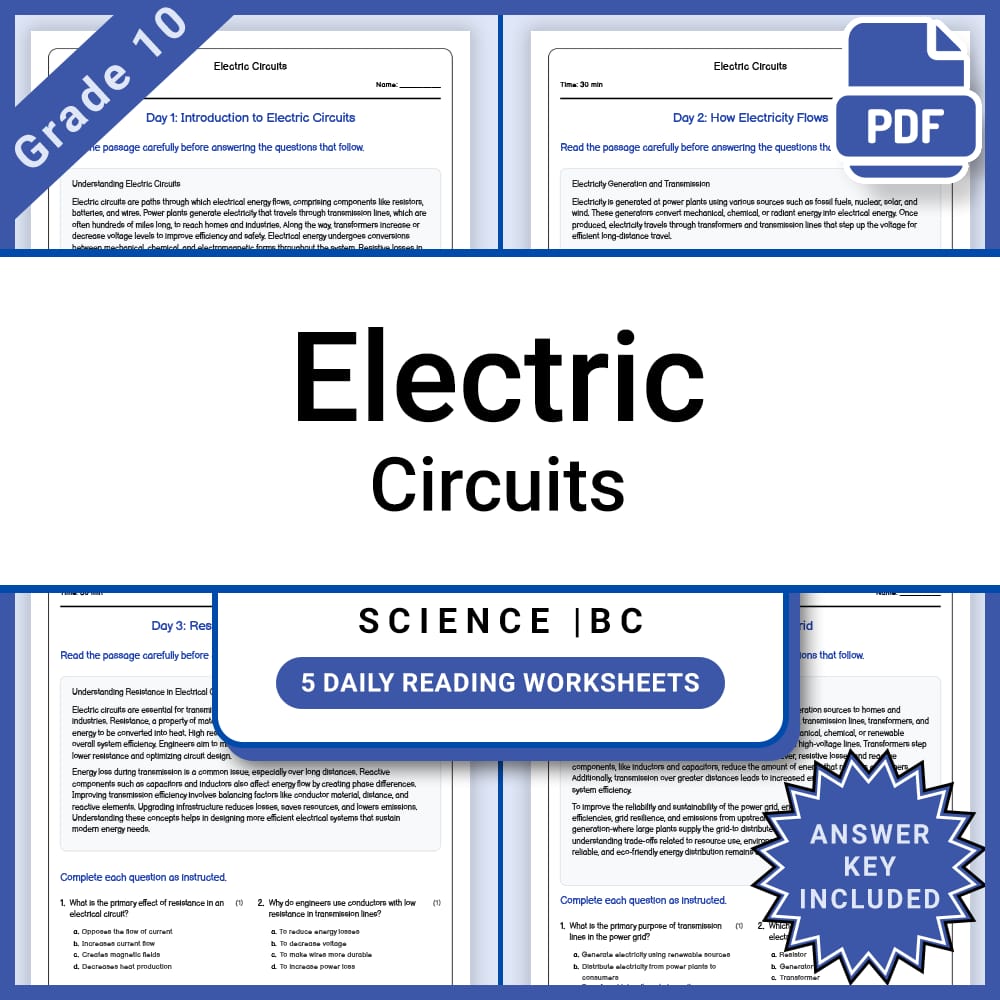
Grade 10 Science – Electric Circuits Daily Reading Worksheet + Answer Key
JCreated byJ.S SheetsLearning Objectives
- Understand the basic components and functioning of electric circuits.
- Explain how electrical energy is transmitted and converted in power systems.
- Evaluate factors affecting the efficiency of electrical energy transmission.
Also included in: Grade 10 Science Lesson Group BC Framework – Daily Reading Worksheets Bundle +1 more
Instant download
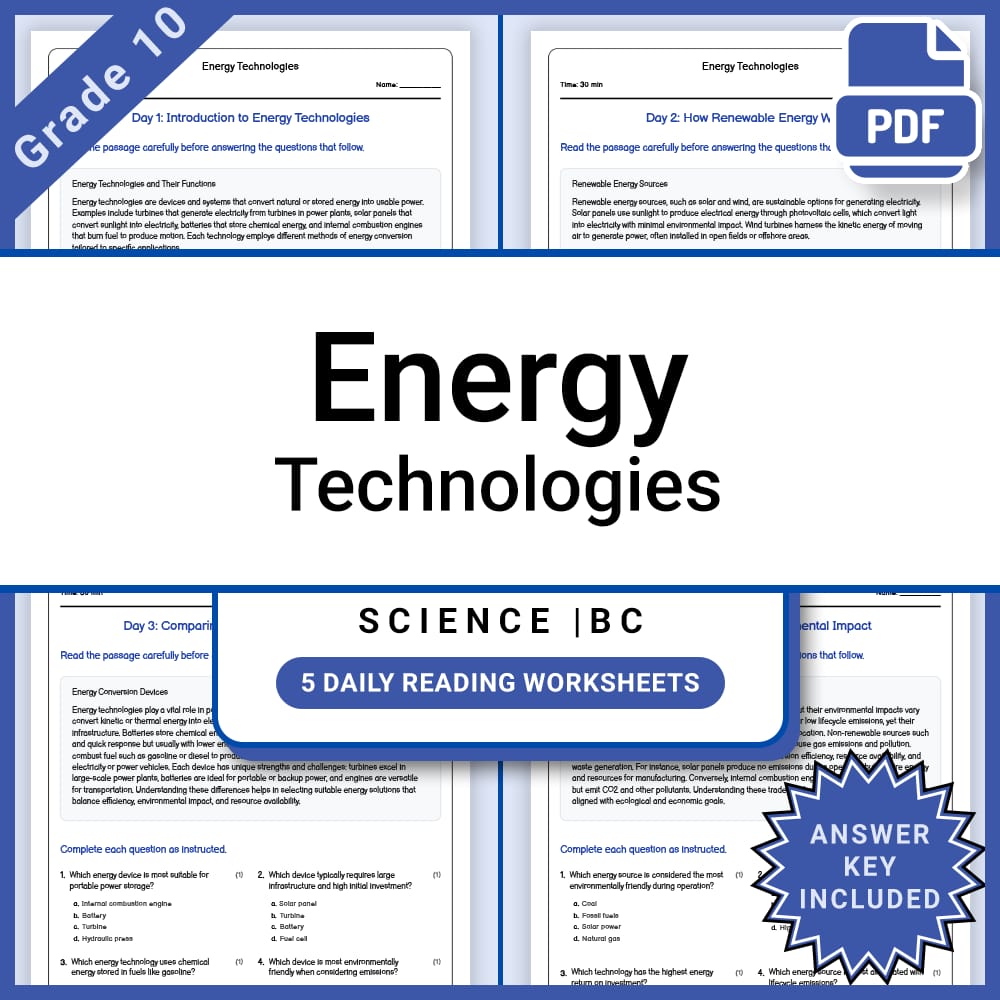
Grade 10 Science – Energy Technologies Daily Reading Worksheet with Answer Key
JCreated byJ.S SheetsLearning Objectives
- Identify different energy technologies and their basic functions
- Understand how energy is converted using various devices
- Evaluate the efficiency and environmental impact of energy technologies
Also included in: Grade 10 Science Lesson Group BC Framework – Daily Reading Worksheets Bundle +1 more
Instant download
About Grade 10 Science Worksheets
Find Science worksheets built for Grade 10. All 7,038 cover core skills, practice, and review, each an instant PDF download.
Every worksheet on MyTeachingSheets is created by independent teacher-authors and reviewed before publication. All resources download as printable PDFs for classroom, homework, or at-home practice, and many include answer keys. Preview any worksheet free before buying.