
Grade 10 Science Worksheets
7,038 worksheets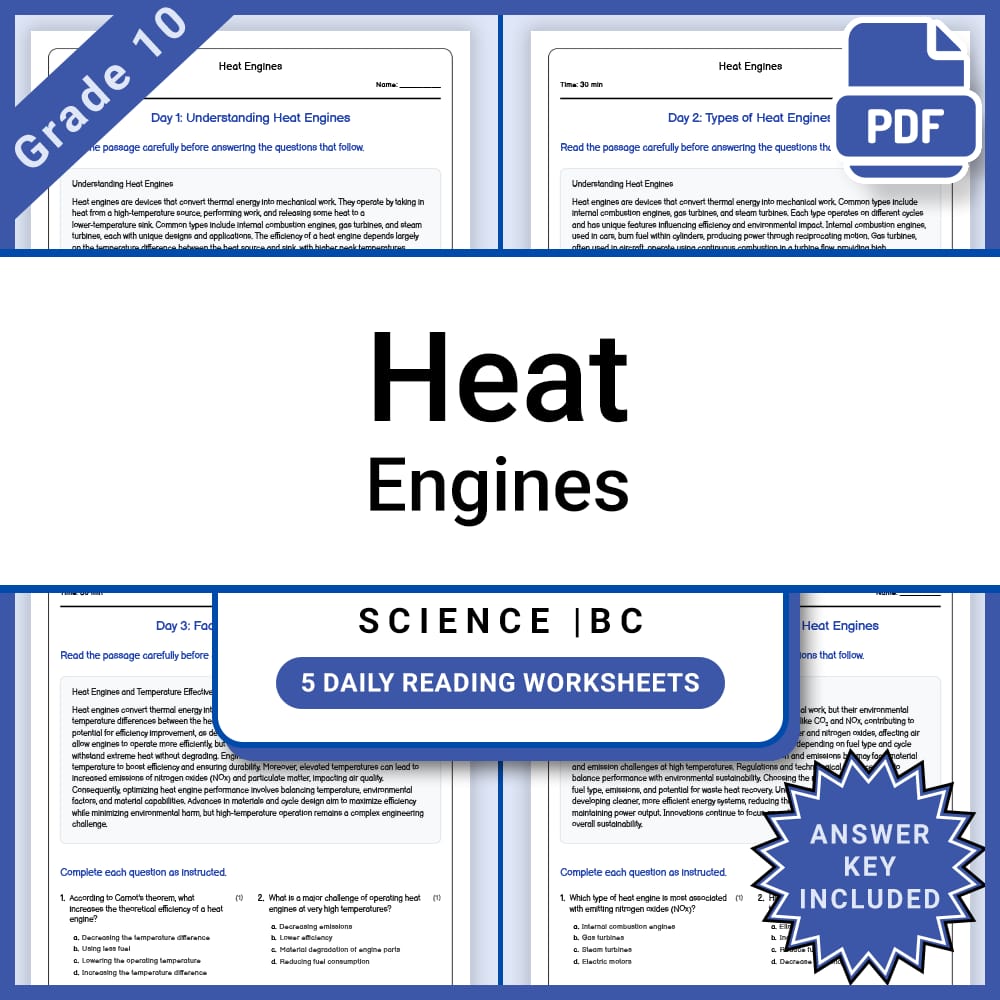
Grade 10 Science – Heat Engines Daily Reading Worksheet with Answer Key
JCreated byJ.S SheetsLearning Objectives
- Understand key concepts related to Science
- Apply knowledge through practice questions
- Demonstrate comprehension of the material
Also included in: Grade 10 Science Lesson Group BC Framework – Daily Reading Worksheets Bundle +1 more
Instant download

Grade 10 Science Net Force Worksheet | General Standards Practice (PDF)
 Created byEvergreen Desk Education
Learning Objectives
- Determine the net force direction and qualitative magnitude when multiple forces act on an object.
- Predict acceleration outcomes when forces oppose or align, including the effect of friction.
- Explain how changing friction can shift an object from speeding up to slowing down.
Also included in: Grade 10 Conservation Laws in Science Lesson Bundle – General Framework +1 more
Instant download
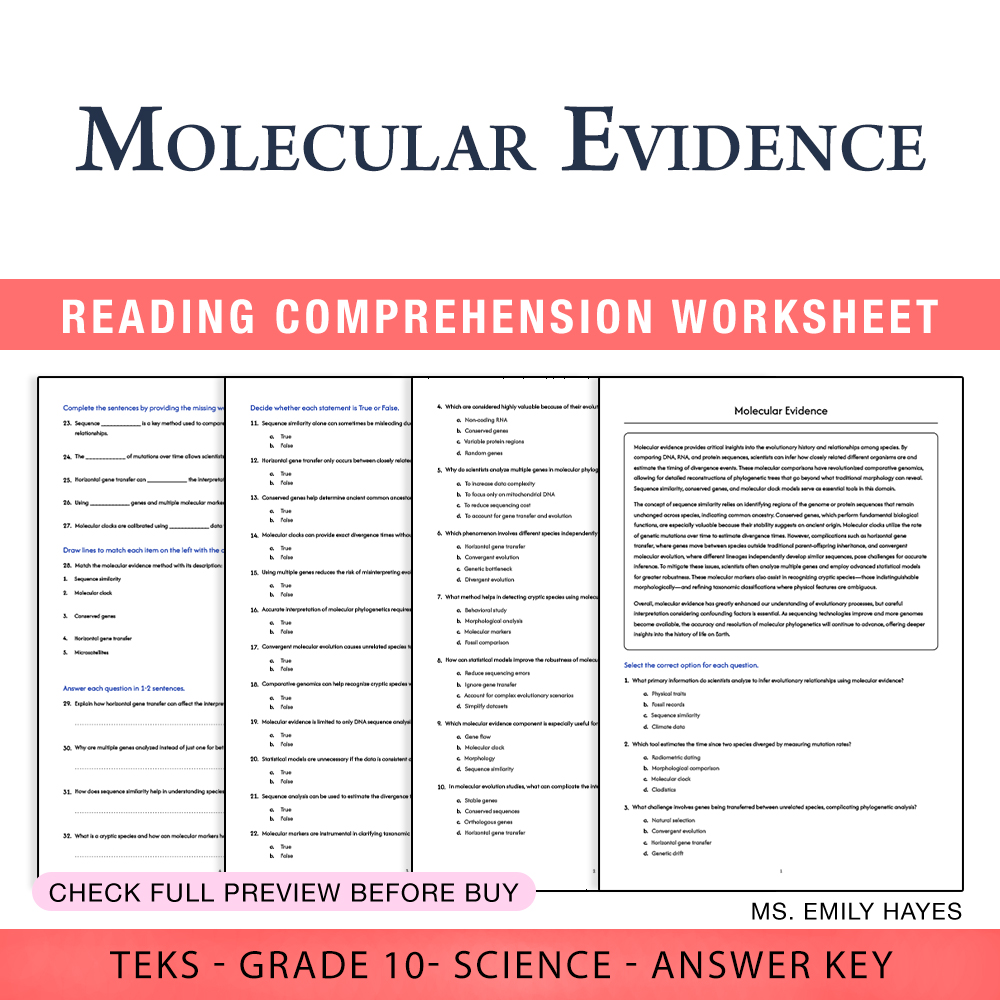
10th Grade Science | Molecular Evidence Worksheet (PDF+ Answer Key)
 Created byCopper Leaf Classroom
Learning Objectives
- Understand how DNA, RNA, and protein sequences inform evolutionary relationships.
- Explain methods such as sequence similarity and molecular clocks used in phylogenetics.
- Identify challenges like horizontal gene transfer and convergent evolution in molecular analyses.
Instant download
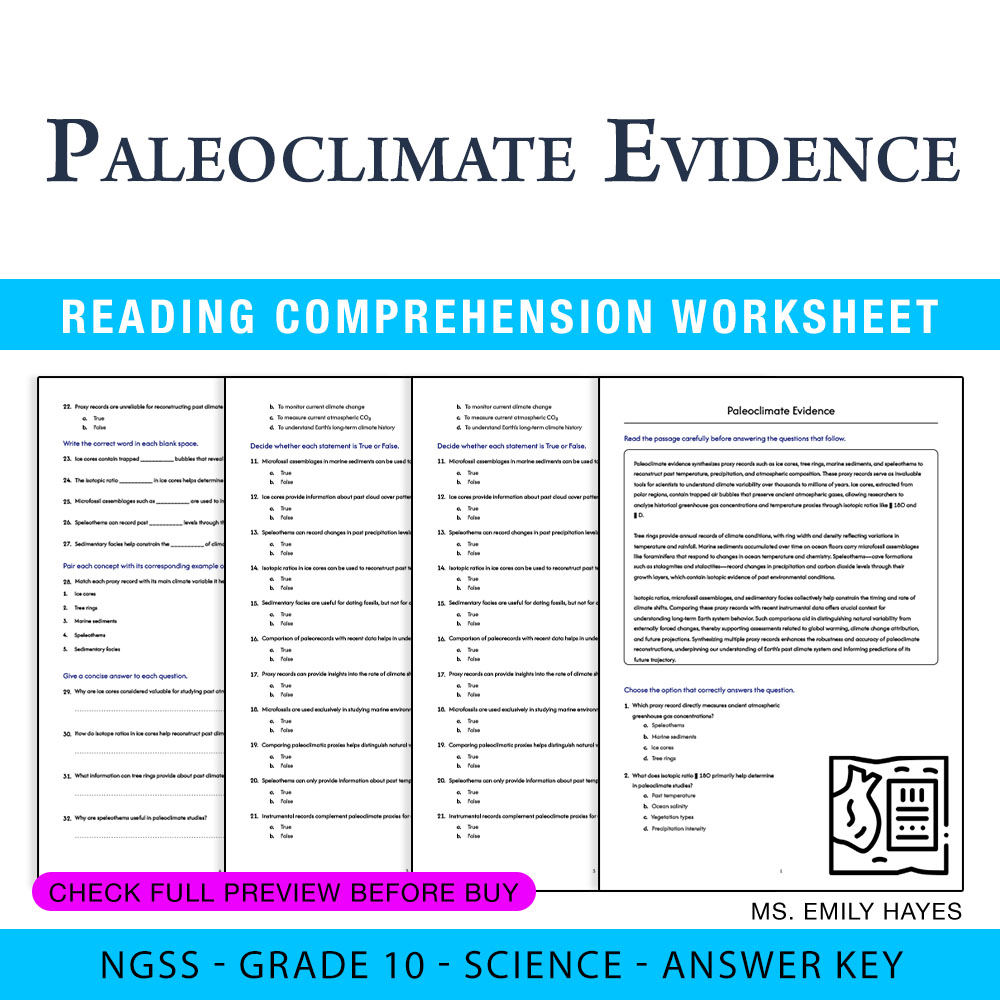
10th Grade Science | Paleoclimate Evidence Worksheet (PDF+ Answer Key)
Created byCopper Leaf ClassroomLearning Objectives
- Understand the types of proxy records used in paleoclimate reconstruction
- Analyze how isotopic ratios and microfossil assemblages provide insights into past climates
- Evaluate the importance of comparing paleorecords with instrumental data to assess climate trends
Instant download
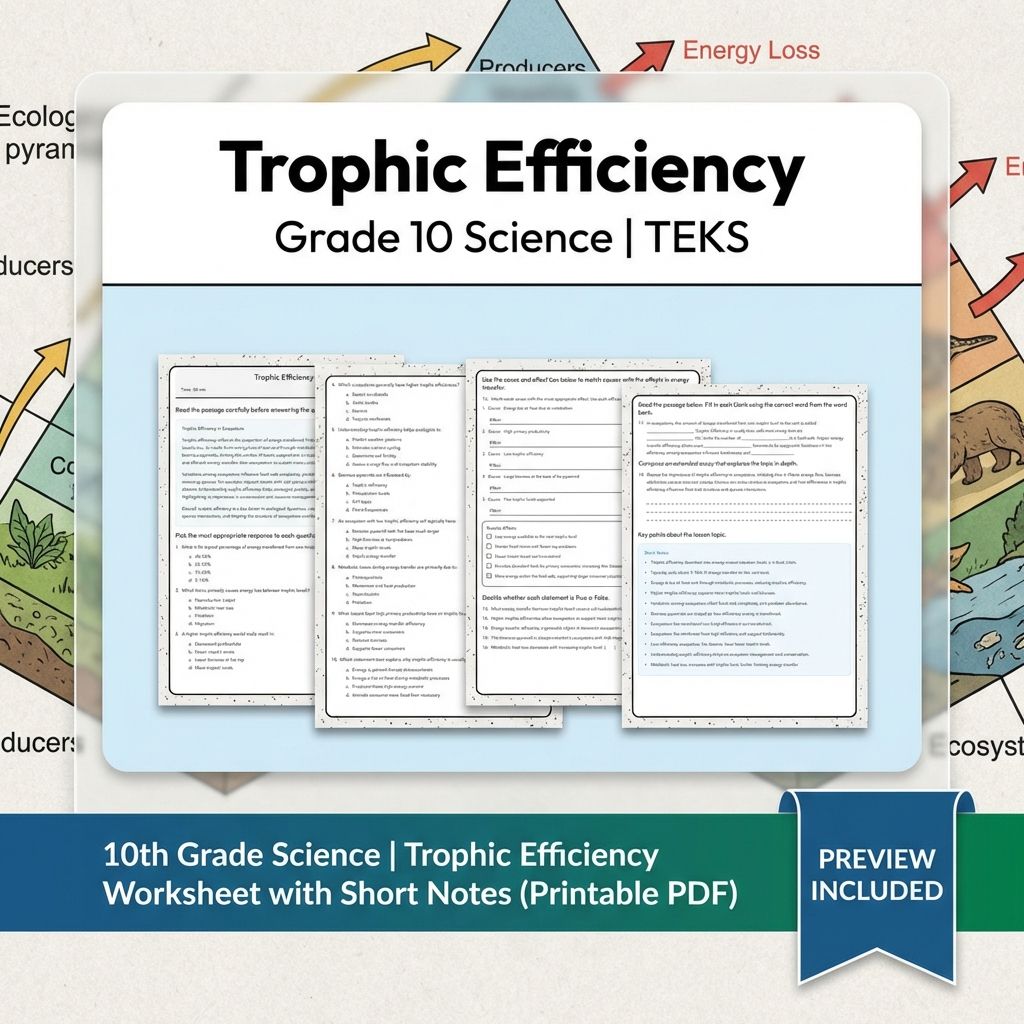
10th Grade Science | Trophic Efficiency Worksheet with Short Notes (PDF)
 Created byMeadowlark Worksheets
Learning Objectives
- Explain the concept of trophic efficiency and its significance in ecosystems.
- Identify factors that influence energy transfer between trophic levels.
- Analyze how trophic efficiency affects biomass pyramids and food web structure.
Instant download
10th Grade Science | Planetary Comparisons Reading Worksheet & Rubric (PDF)
JCreated byJ.S SheetsLearning Objectives
- Compare the atmospheric and surface conditions of Earth, Mars, and Venus to understand planetary habitability.
- Analyze the effects of greenhouse gases, magnetic fields, and volatile inventories on planetary climates.
- Interpret remote sensing observations to assess planetary environments and draw implications for surface conditions.
Also included in: Grade 10 Science Unit Bundle – Earth Systems, Climate & Remote Sensing Worksheets +1 more
Instant download
10th Grade Science | Hydrologic Systems Reading Worksheets (PDF + Rubric)
JCreated byJ.S SheetsLearning Objectives
- Understand the components and interactions within hydrologic systems, including processes like precipitation, infiltration, and groundwater flow.
- Analyze how human activities impact watershed water budgets and landscape features.
- Interpret stream hydrographs and isotope data to assess water movement and residence times.
Also included in: Grade 10 Science Unit | Earth Systems & Climate Change Worksheets Bundle
Instant download
Grade 10 Science | Transitional Fossils Reading Worksheet (PDF & Answer Key)
JCreated byJ.S SheetsLearning Objectives
- Understand the concept of transitional fossils and their significance in evolution.
- Identify examples of transitional fossils and the features they exhibit.
- Describe how fossils provide evidence for gradual changes across lineages.
Instant download
10th Grade Science | Signal Integration Reading Worksheet (PDF + Answer Key)
JCreated byJ.S SheetsLearning Objectives
- Understand the mechanisms of signal transduction in nervous and endocrine systems.
- Describe how receptor specificity influences physiological responses.
- Explain the pathways of signal amplification and their roles in rapid and sustained actions.
Also included in: Grade 10 Science Unit | Cellular & Physiological Systems Worksheets
Instant download
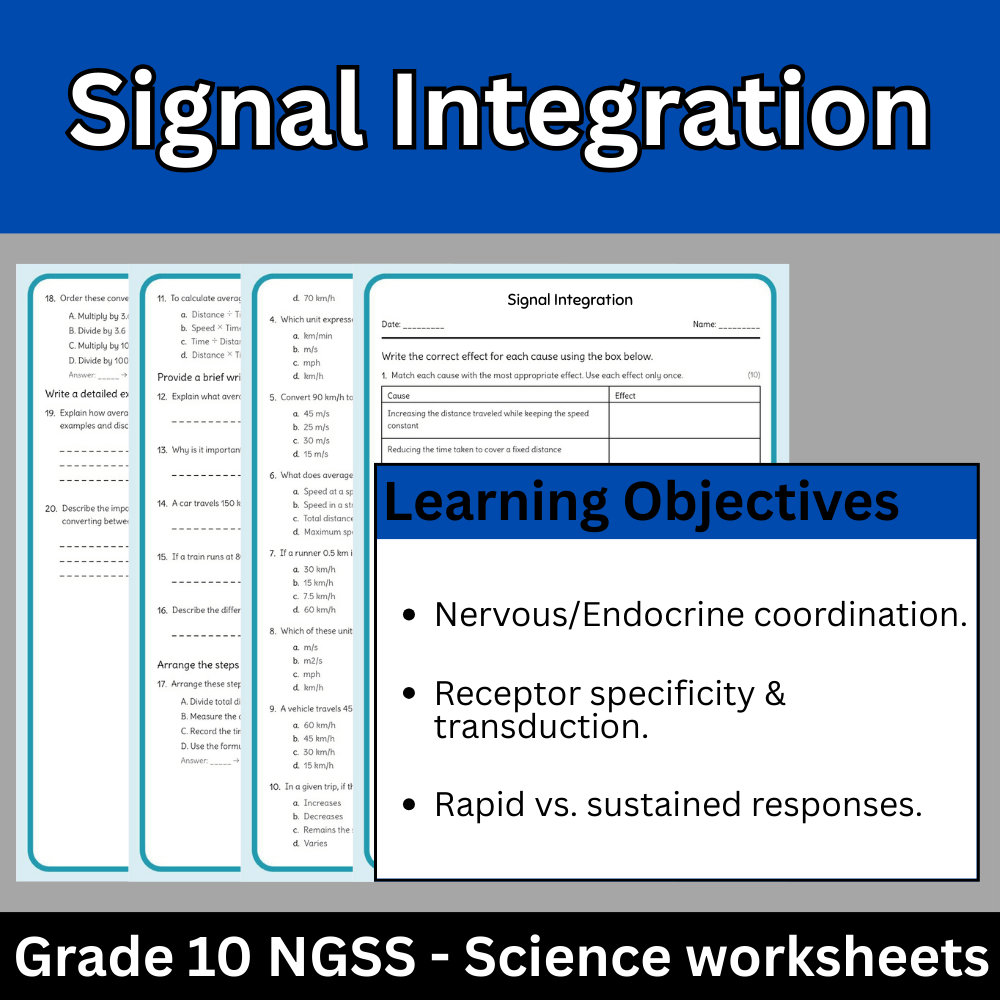
Grade 10 Science | Signal Integration Worksheet (NGSS Aligned + PDF)
 Created byBright Mind Resources
Learning Objectives
- Explain how nervous and endocrine systems coordinate responses through signal integration.
- Describe receptor specificity and the mechanisms of signal transduction cascades.
- Identify examples of rapid and sustained physiological responses linked to environmental cues.
Instant download
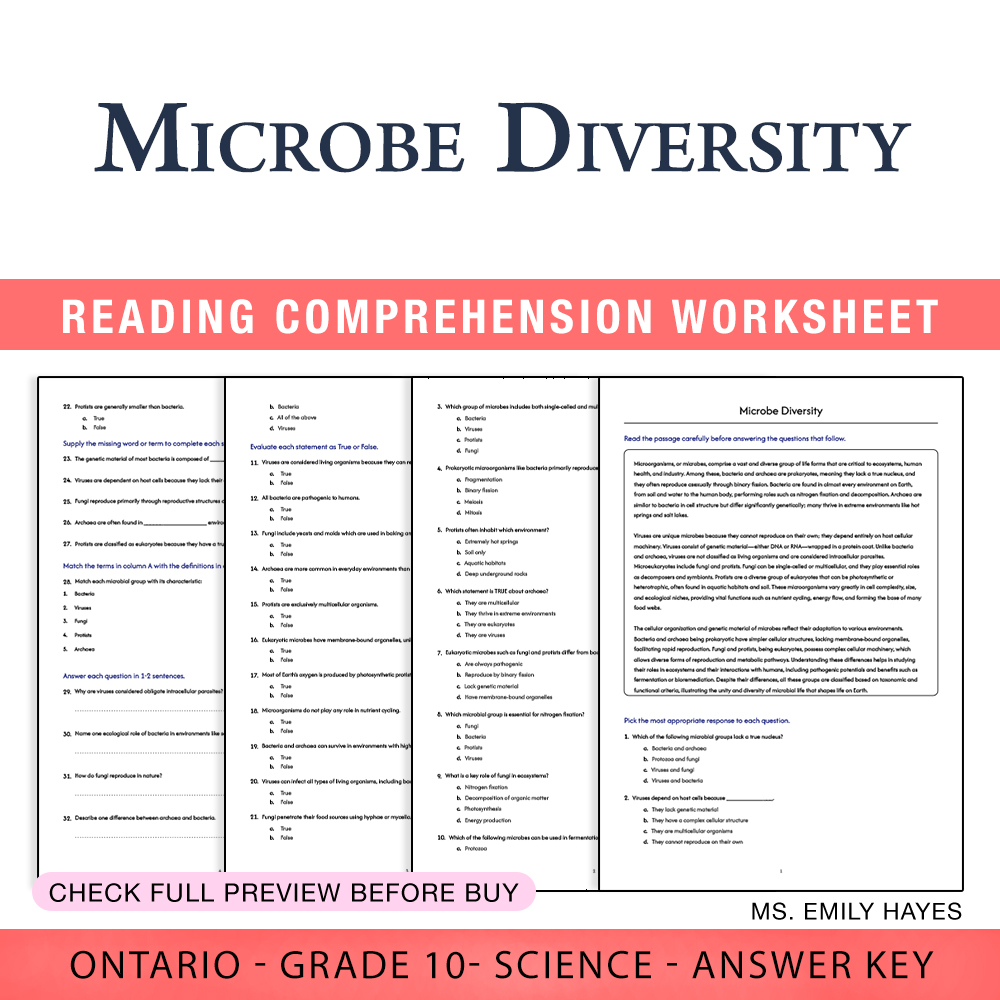
10th Grade Science | Microbe Diversity Worksheet (PDF + Answer Key)
Created byCopper Leaf ClassroomLearning Objectives
- Describe the major groups of microorganisms including bacteria, archaea, viruses, fungi, and protists.
- Compare cellular organization and genetic material among different microbial groups.
- Explain reproduction strategies and ecological roles of microbes.
Instant download

Mass Conservation Worksheet for Grade 10 Science | NGSS Practice PDF
JCreated byJ.S SheetsLearning Objectives
- Understand how to balance chemical equations to verify atom and mass conservation.
- Use molar relationships and coefficients to track atom counts across reactions.
- Apply the mole concept and molar masses to demonstrate invariant total mass in chemical processes.
Also included in: Grade 10 Chemical Reactions and Equilibrium Science – Lesson Bundle NGSS
Instant download
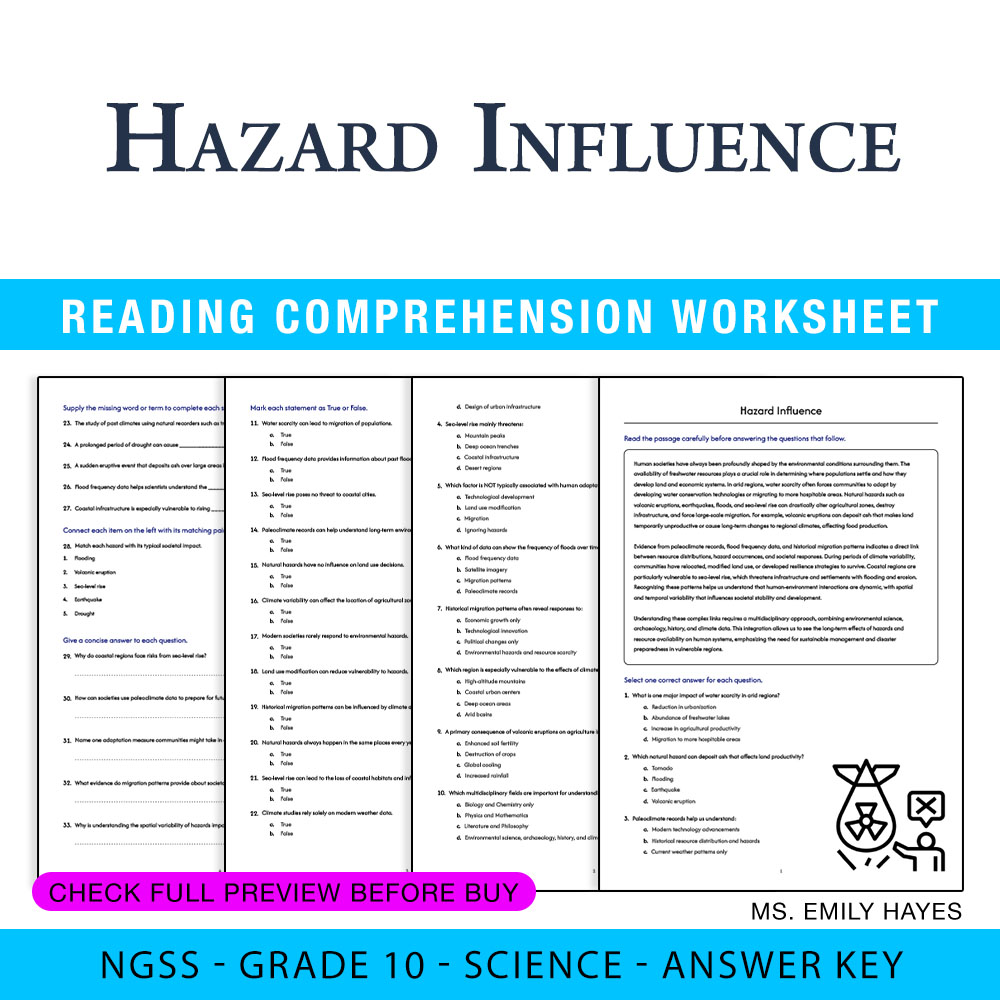
10th Grade Science | Hazard Influence Worksheet (PDF+ Answer Key)
Created byCopper Leaf ClassroomLearning Objectives
- Analyze how freshwater availability affects human settlement and land use.
- Describe how natural hazards influence societal and economic systems.
- Assess evidence from paleoclimate records, flood data, and migration patterns to understand environmental impacts.
Instant download

Ore Formation Processes Worksheets: Structural Controls Grade 10
 Created byPrism Point Learning
Learning Objectives
- Describe four geological processes that form or redistribute ore deposits
- Explain how permeability controls hydrothermal fluid movement and deposition
- Identify structural and chemical controls on ore mineral concentration
Also included in: Earth and Space Systems Grade 10 Science Ontario Bundle
Instant download
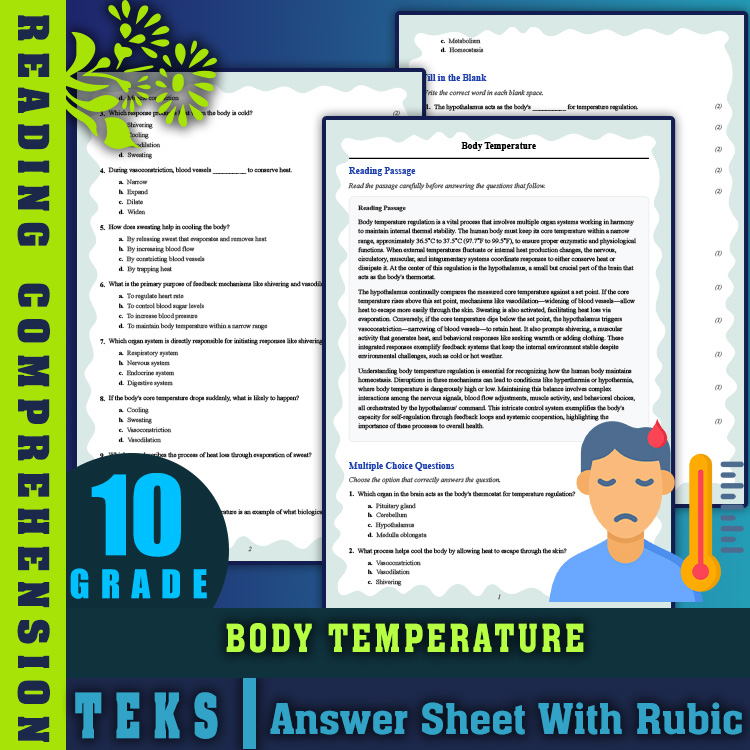
Grade 10 Science | Body Temperature Reading Worksheet with PDF Answer Key
JCreated byJ.S SheetsLearning Objectives
- Understand the mechanisms involved in body temperature regulation.
- Describe the roles of different organ systems in maintaining thermal equilibrium.
- Explain feedback processes like vasodilation, vasoconstriction, sweating, and shivering.
Instant download
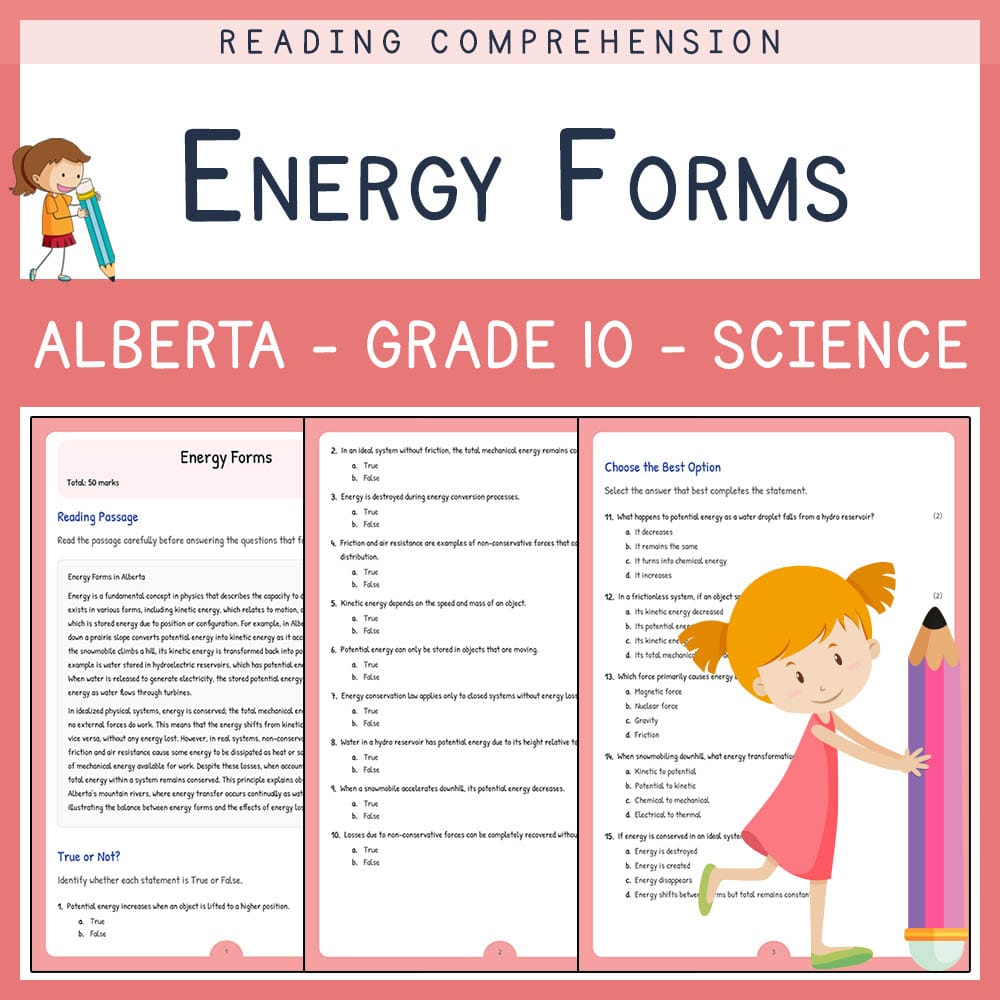
Grade 10 Science | Energy Forms Worksheet | Alberta Standards
 Created byLumora Learning
Learning Objectives
- Understand the concepts of kinetic and potential energy and how they relate to motion and stored work.
- Recognize examples of energy transformation in real-world Alberta scenarios such as snowmobiling and hydro reservoirs.
- Explain the principle of energy conservation in idealized systems and how non-conservative forces affect energy distribution.
Instant download

Force Concepts Worksheet | AP Physics Forces & Motion Activity
 Created byBright Quill Resources
Learning Objectives
- Explain how contact forces and field-mediated forces affect motion through net force and acceleration.
- Apply Newton’s three laws to predict outcomes for acceleration, equilibrium, and collisions.
- Use vectors and free-body diagrams to determine the net force in one-dimensional scenarios.
Instant download
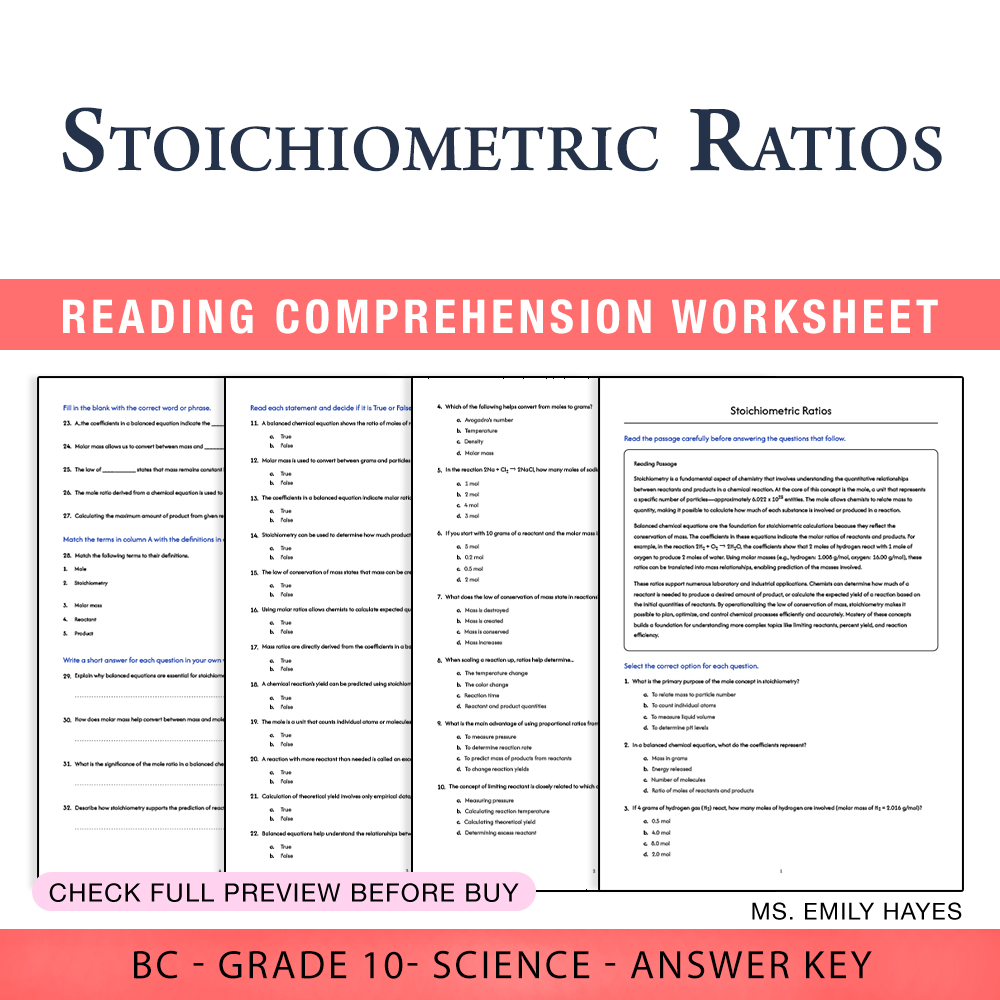
Grade 10 Science | Stoichiometric Ratios Worksheet (PDF + Answer Key)
Created byCopper Leaf ClassroomLearning Objectives
- Understand how to interpret and apply stoichiometric ratios from balanced chemical equations.
- Translate between mass of reactants/products and moles using molar mass calculations.
- Use coefficients from chemical equations to find proportional relationships for reaction yields and reactant requirements.
Also included in: Grade 10 Science BC| Chemistry, Reactions & Atomic Structure (PDF+ Answer Keys) +1 more
Instant download
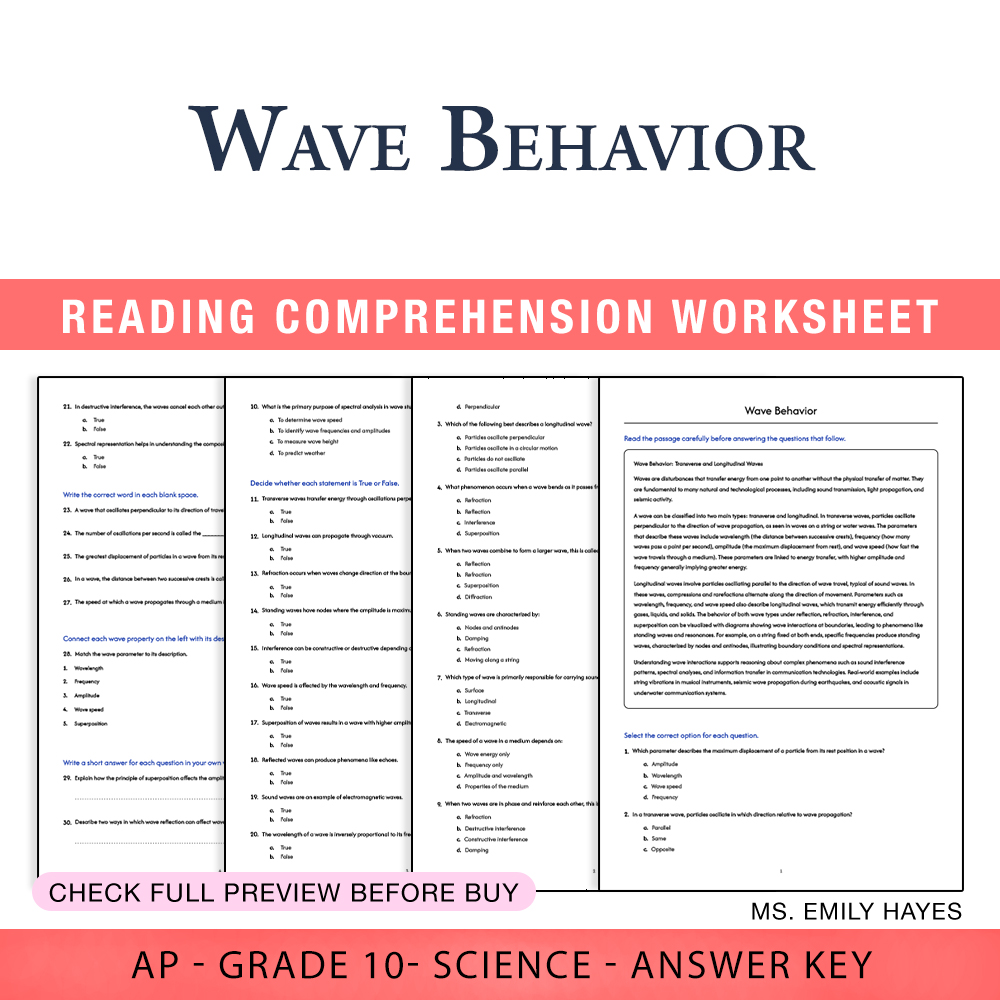
10th Grade Science | Wave Behavior Worksheet (PDF+ Answer Key)
Created byCopper Leaf ClassroomLearning Objectives
- Describe the different types of waves, including transverse and longitudinal waves, using parameters such as wavelength, frequency, amplitude, and wave speed.
- Explain how waves transfer energy and information through phenomena such as reflection, refraction, interference, and superposition.
- Illustrate and analyze the formation of standing waves and boundary effects using graphical and mathematical descriptions.
Also included in: Grade 10 Science AP | Physics & Energy Concepts (PDF+ Answer Key) +1 more
Instant download

Grade 10 Science | Work Concepts Worksheet (AP Standards) – Science 1 PDF
Created byBright Mind ResourcesLearning Objectives
- Define work as the product of force and displacement along the force.
- Understand the scalar nature of work in various physical contexts.
- Connect work to changes in kinetic energy through the work-energy theorem.
Instant download
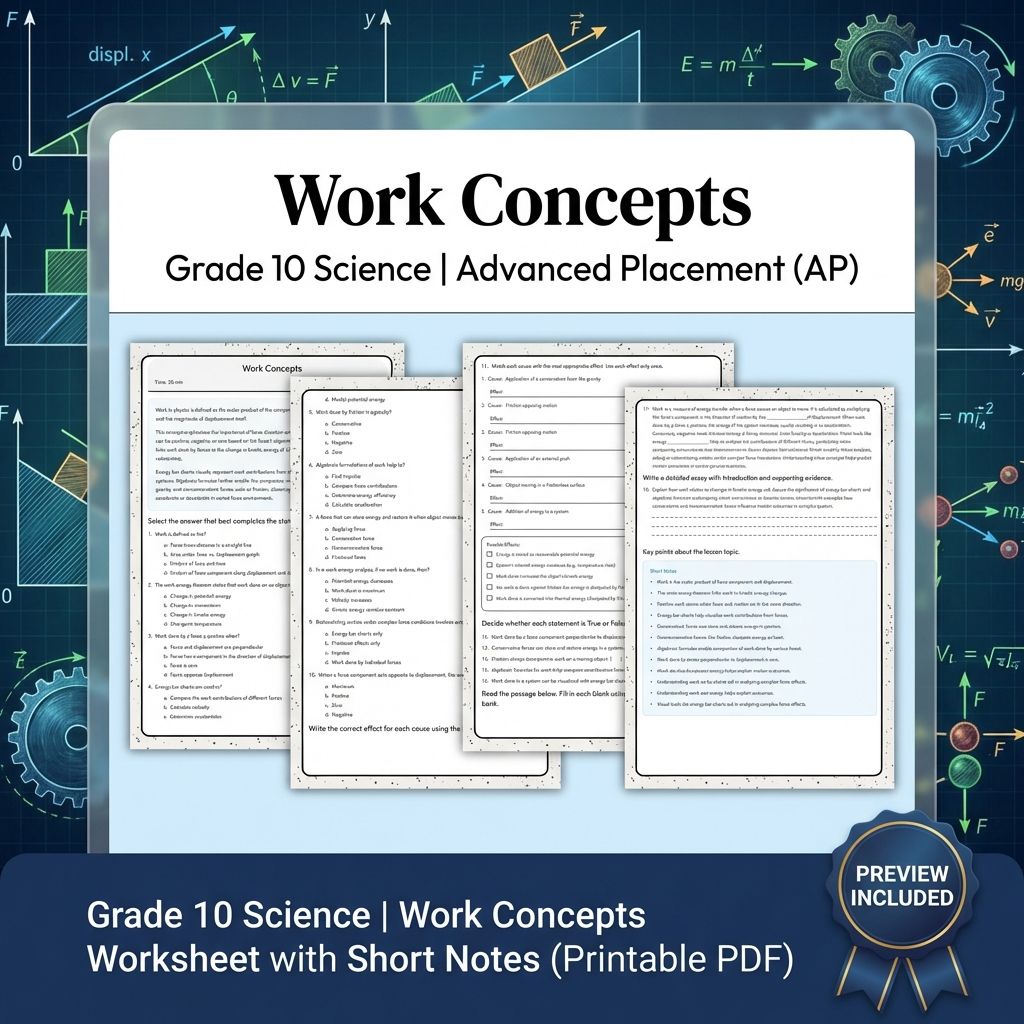
Grade 10 Science | Work Concepts Worksheet with Short Notes (Printable PDF)
Created byMeadowlark WorksheetsLearning Objectives
- Define work as the scalar product of force components along displacement in various contexts.
- Explain the relationship between work and changes in kinetic energy through the work-energy theorem.
- Differentiate work done by conservative and nonconservative forces using energy bar charts and algebraic formulas.
Instant download

Grade 10 Science – Ore Formation Daily Reading Worksheet | Ontario Standards
 Created byQuiet Forest Education
Learning Objectives
- Understand the principal processes involved in ore formation
- Identify different types of ore deposits and their characteristics
- Recognize the geological settings conducive to ore deposit formation
Also included in: Earth Science Grade 10 Daily Reading Worksheets Bundle | Ontario Framework +1 more
Instant download

Grade 10 Science | Work Concepts Worksheet | AP Aligned
Created byLumora LearningLearning Objectives
- Define work as the product of force component along displacement and understand its scalar nature.
- Connect work to changes in kinetic energy via the work-energy relationship.
- Differentiate between work done by conservative and nonconservative forces.
Instant download

Work Concepts Worksheet for Grade 10 Science | AP Standards Practice PDF
JCreated byJ.S SheetsLearning Objectives
- Define work as the product of force component along displacement.
- Explain the scalar nature of work in different contexts.
- Connect work to changes in kinetic energy via the work-energy relationship.
Also included in: Grade 10 Motion, Waves & Electricity Science Lesson Bundle
Instant download
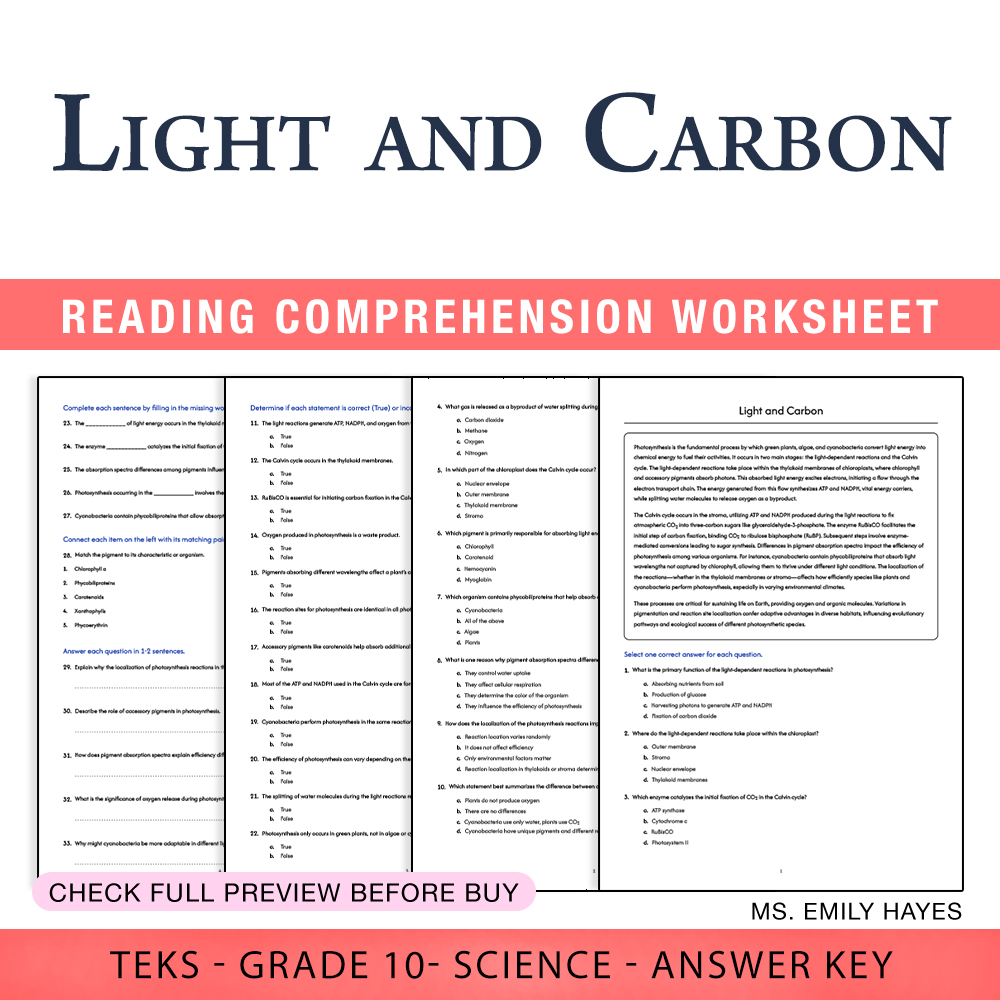
10th Grade Science | Light and Carbon Photosynthesis Worksheet (PDF+ Answer Key)
Created byCopper Leaf ClassroomLearning Objectives
- Describe the process of light reactions and how they produce ATP, NADPH, and oxygen.
- Explain the Calvin cycle and its role in fixing carbon dioxide into sugars.
- Compare pigment absorption spectra among different photosynthetic organisms.
Instant download
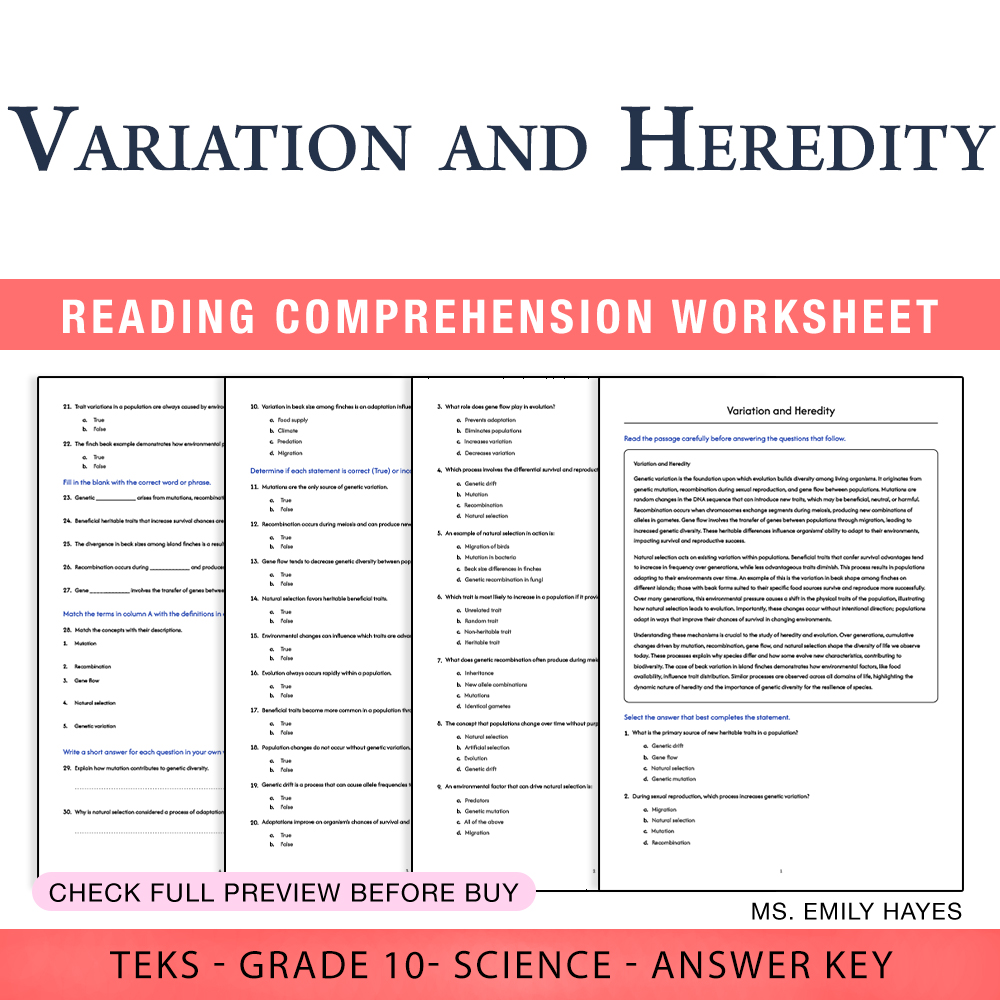
10th Grade Science | Variation and Heredity Worksheet (PDF+ Answer Key)
Created byCopper Leaf ClassroomLearning Objectives
- Understand how genetic variation arises through mutation, recombination, and gene flow.
- Explain how heritable traits influence survival and reproductive success in different environments.
- Describe natural selection and its role in changing allele frequencies over generations.
Instant download

Grade 10 Redox Reactions Worksheet | Practice & BC PDF
 Created byClear Sky Classroom
Learning Objectives
- Explain redox reactions as processes involving electron transfer and changes in oxidation states.
- Use oxidation numbers to identify which species is oxidized and which is reduced.
- Connect redox behavior to periodic trends and real-world examples such as corrosion and combustion.
Instant download

Safe Data Collection Science Worksheet Grade 10 Scientific Inquiry
 Created byBRIGHT PATH RESOURCES
Learning Objectives
- Identify independent, dependent, and controlled variables
- Explain how controls improve data reliability
- Explain why repeated measurements strengthen reliability
Also included in: Grade 10 Science Worksheets Bundle | Scientific Inquiry & Evidence +1 more
Instant download

Interpreting Uncertainty Ranges Science Worksheet Grade 10
Created byBRIGHT PATH RESOURCESLearning Objectives
- Explain variability shown by repeated scientific measurements
- Calculate and interpret uncertainty ranges from measurements
- Compare uncertainty ranges and describe what they show
Also included in: Grade 10 Science Worksheets Bundle | Scientific Inquiry & Evidence +1 more
Instant download

Interpreting Statistical Graphs Science Worksheets Grade 10
Created byBRIGHT PATH RESOURCESLearning Objectives
- Choose appropriate graphs for different data types and variables
- Interpret trends shown in statistical graphs
- Identify variability, clustering, and outliers in graphs
Also included in: Grade 10 Science Worksheets Bundle | Scientific Inquiry & Evidence +1 more
Instant download

Grade 10 Engineering Problem Worksheet | California Science Standards STEM
Created byEvergreen Desk EducationLearning Objectives
- Identify criteria for success and constraints in an engineering problem statement.
- Explain how specifications translate engineering needs into testable performance targets.
- Evaluate engineering trade-offs using evidence from prototypes or calculations.
Instant download

Grade 10 Evaluating Solutions Worksheet | California Science Standards STEM
Created byEvergreen Desk EducationLearning Objectives
- Explain how evaluation compares proposed solutions against criteria and constraints to judge overall performance.
- Identify safety and performance tradeoffs when multiple engineering requirements conflict.
- Use evidence from tests, assumptions, and failure modes to recommend refinements to a solution.
Instant download

Population Genomics Worksheet with Answer Key & AP Biology Guide
Created byBright Quill ResourcesLearning Objectives
- Explain how mutation, gene flow, selection, and genetic drift change allele frequencies over time.
- Interpret population structure and allele-frequency patterns using sequence-based evidence.
- Describe how phylogenetic inference uses molecular variation to reconstruct evolutionary relationships.
Instant download
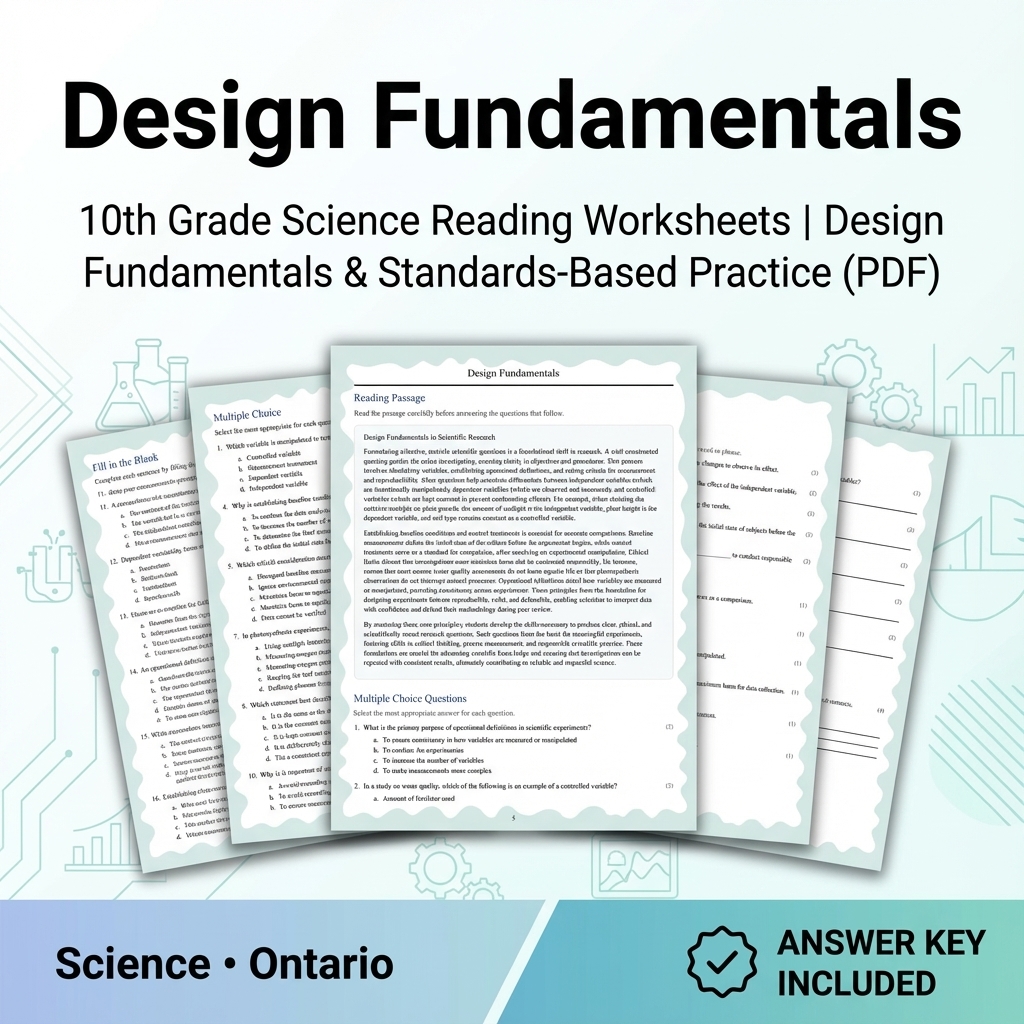
10th Grade Science | Design Fundamentals & Standards-Based Practice (PDF)
JCreated byJ.S SheetsLearning Objectives
- Understand the principles of formulating testable research questions.
- Identify and classify variables such as independent, dependent, and controlled factors.
- Establish criteria for reproducibility and measurement accuracy in experiments.
Also included in: Grade 10 Science UNIT Bundle – Data Representation, Safety & Research Skills +1 more
Instant download
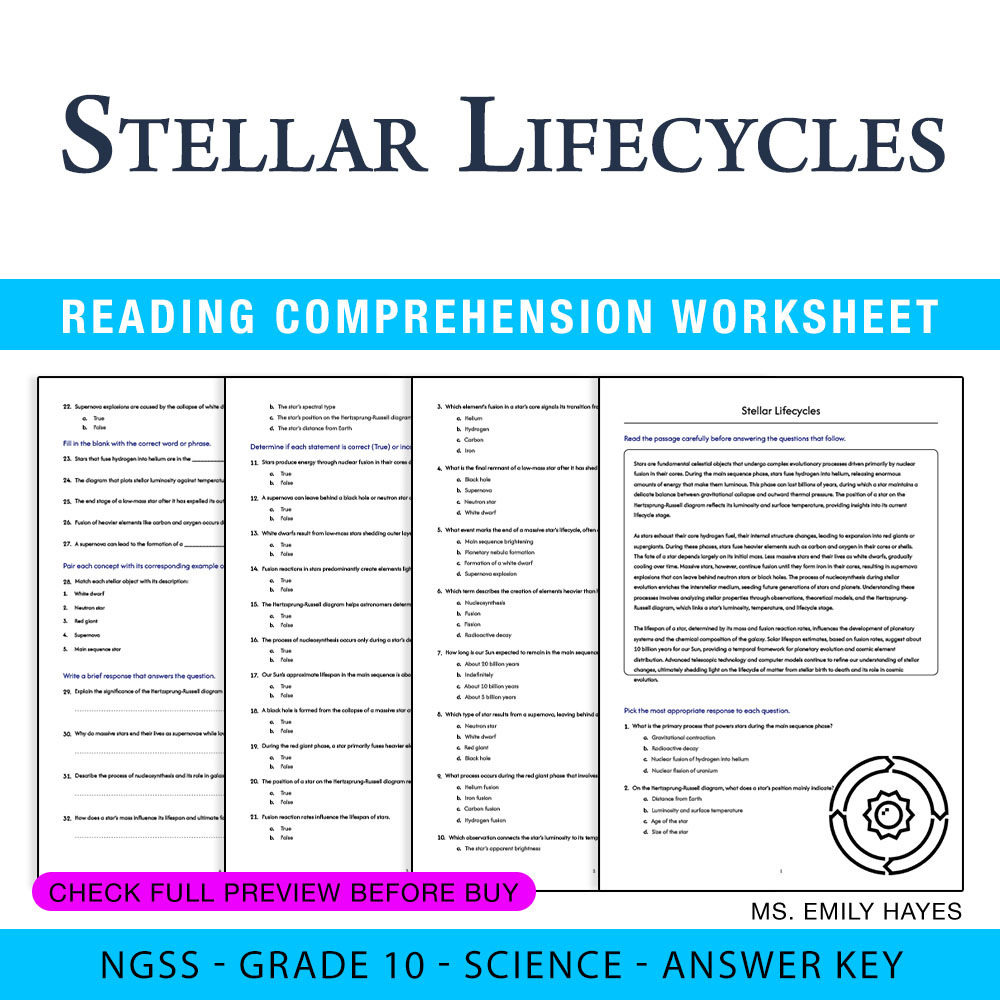
10th Grade Science | Stellar Lifecycles Worksheet (PDF+ Answer Key)
Created byCopper Leaf ClassroomLearning Objectives
- Describe the processes involved in stellar evolution from main sequence to final stages.
- Interpret the Hertzsprung-Russell diagram to determine stellar properties.
- Explain the nuclear fusion reactions occurring in different types of stars.
Instant download
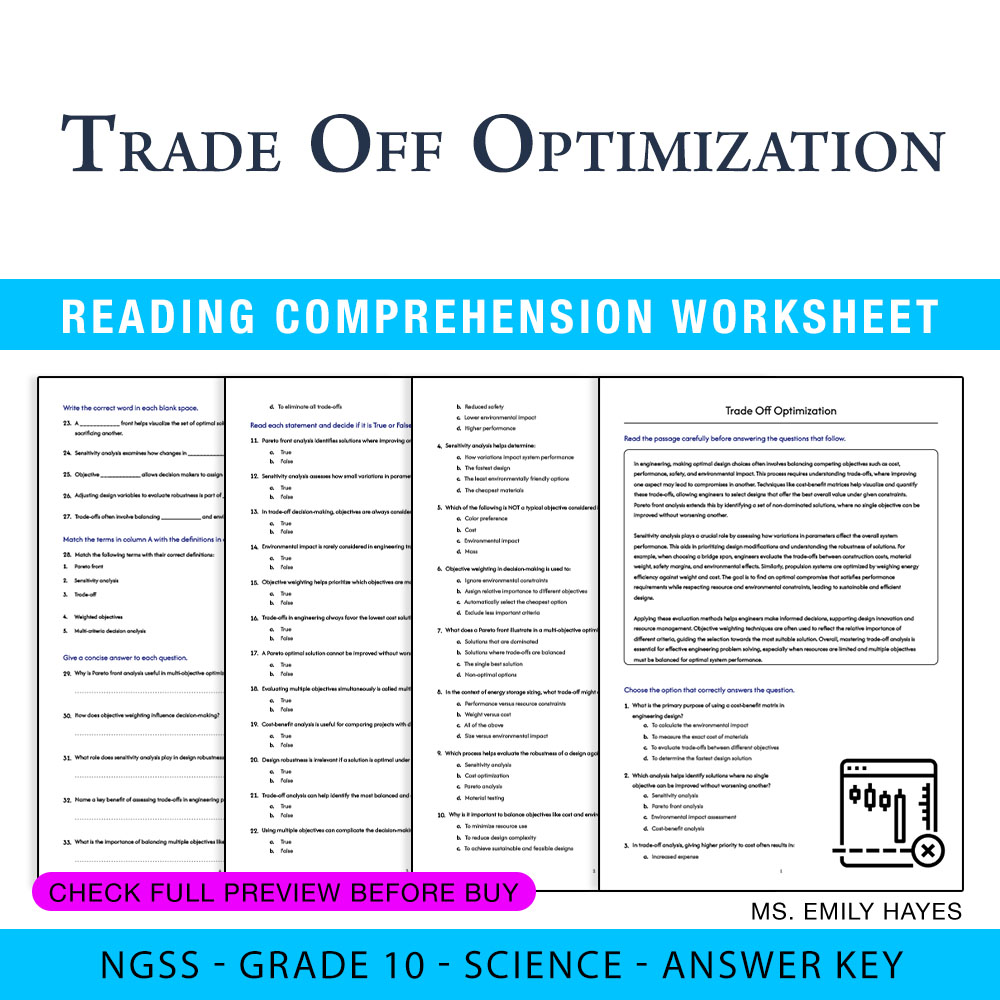
10th Grade Science | Trade-Off Optimization Practice Worksheet (PDF+ Answer Key)
Created byCopper Leaf ClassroomLearning Objectives
- Understand how to quantify and evaluate trade-offs in engineering design.
- Apply cost-benefit matrices and Pareto fronts to optimize design choices.
- Analyze sensitivity and perform comparative evaluations considering multiple objectives.
Instant download
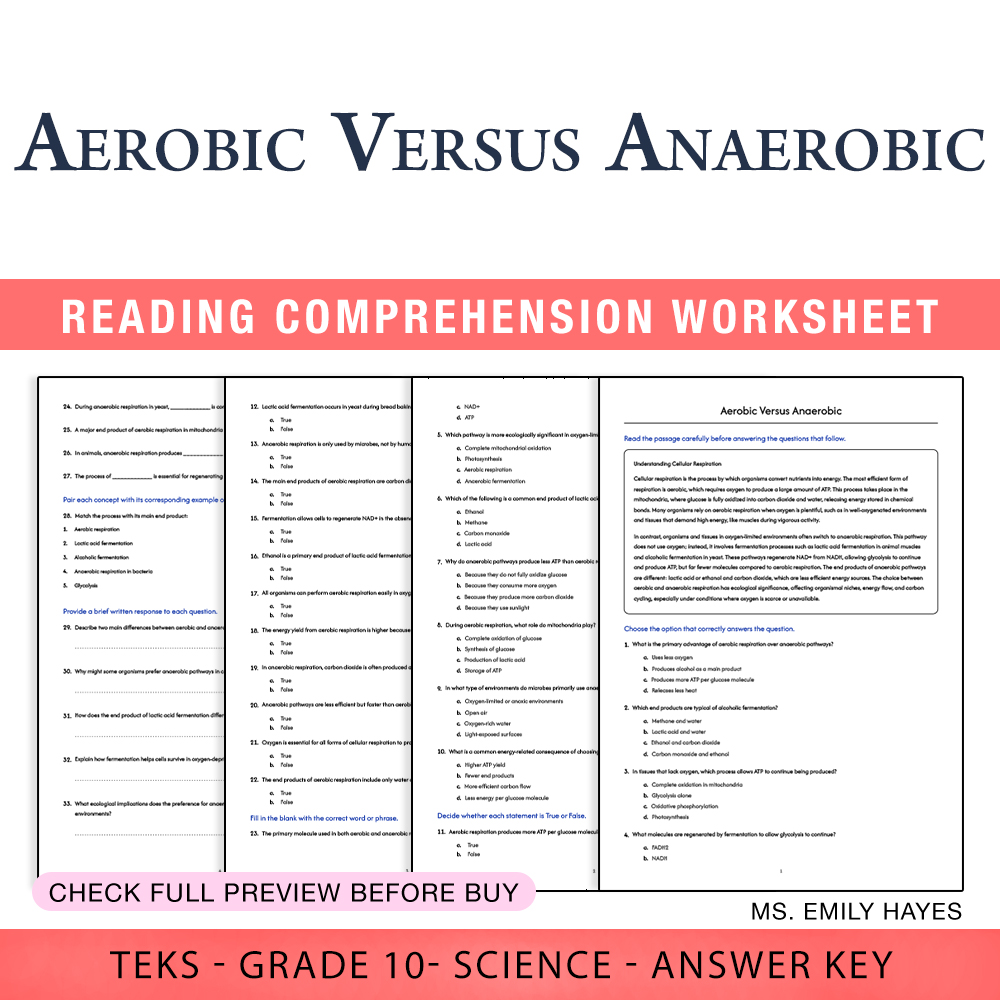
10th Grade Science |Aerobic vs Anaerobic Respiration Worksheet (PDF+ Answer Key)
Created byCopper Leaf ClassroomLearning Objectives
- Explain the difference between aerobic and anaerobic respiration in terms of oxygen use and ATP production.
- Identify the main end products of both aerobic and anaerobic pathways.
- Describe how these metabolic pathways influence ecological niches and energy flow in organisms.
Instant download
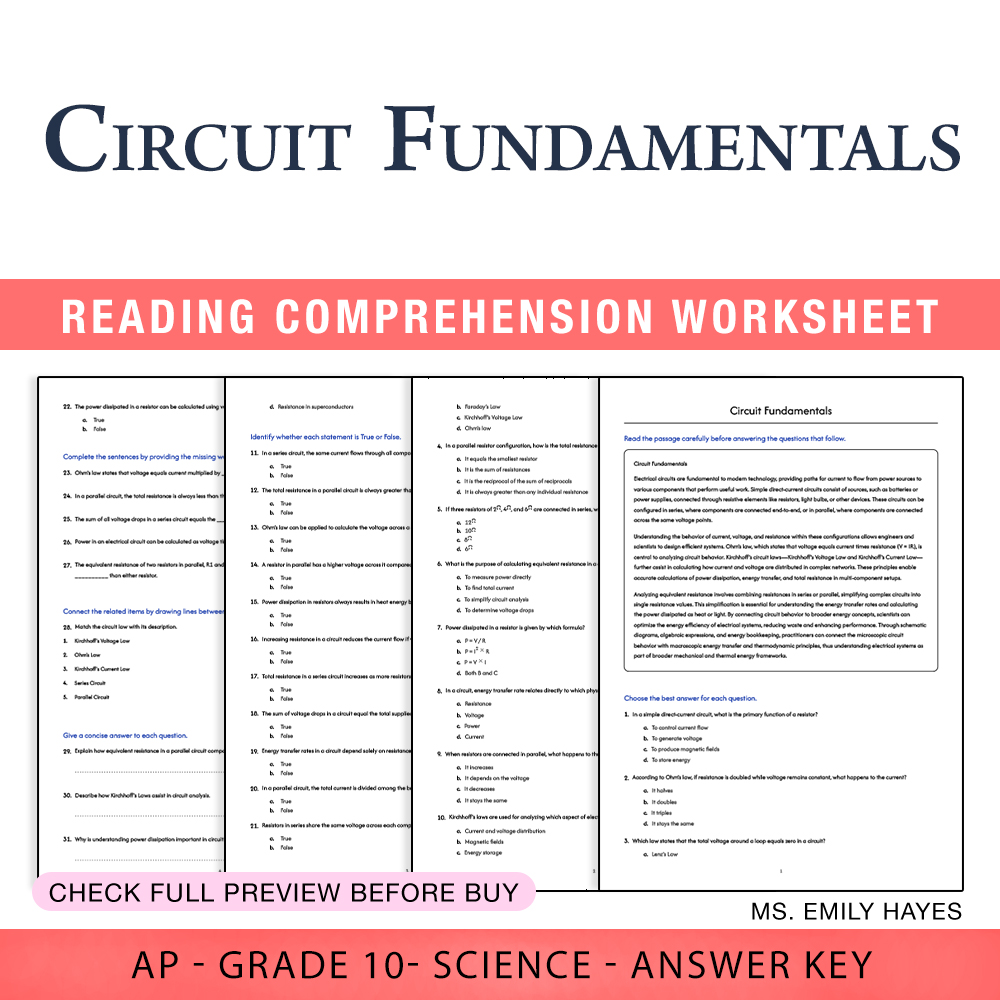
Grade 10 Science | Circuit Fundamentals Worksheet (PDF+ Answer Key)
Created byCopper Leaf ClassroomLearning Objectives
- Understand the basic components and functions of simple direct-current circuits.
- Apply Ohm's law and Kirchhoff's rules to analyze series and parallel resistor configurations.
- Calculate equivalent resistance and power dissipation in circuits.
Also included in: Grade 10 Science AP | Physics & Energy Concepts (PDF+ Answer Key) +1 more
Instant download
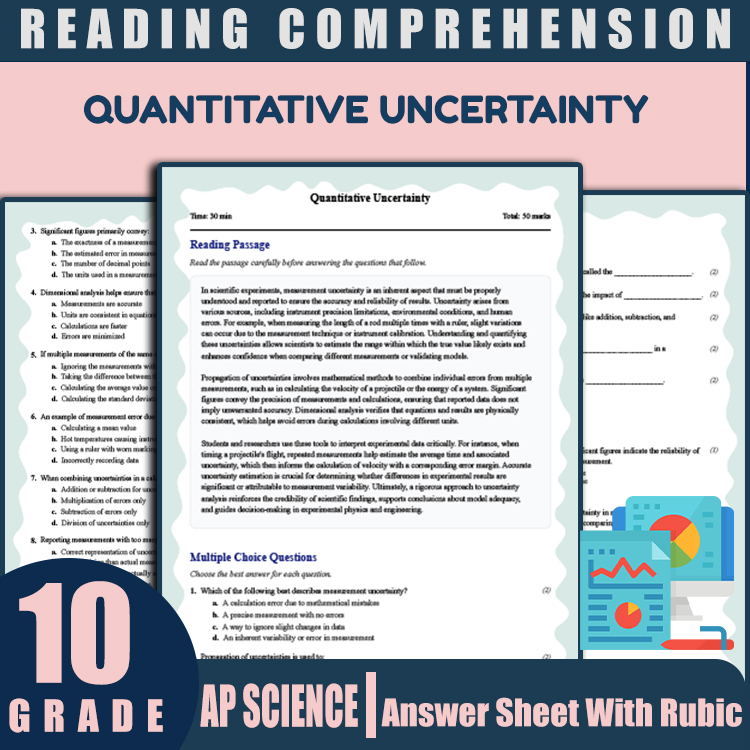
10th Grade Science | Quantitative Uncertainty Reading Worksheet & Answer Key
JCreated byJ.S SheetsLearning Objectives
- Understand measurement uncertainty and sources of error.
- Apply propagation methods to estimate combined uncertainties.
- Use significant figures and dimensional analysis to interpret numerical results.
Also included in: Grade 10 Science Unit Worksheet Pack – Data Analysis & Scientific Reasoning +1 more
Instant download
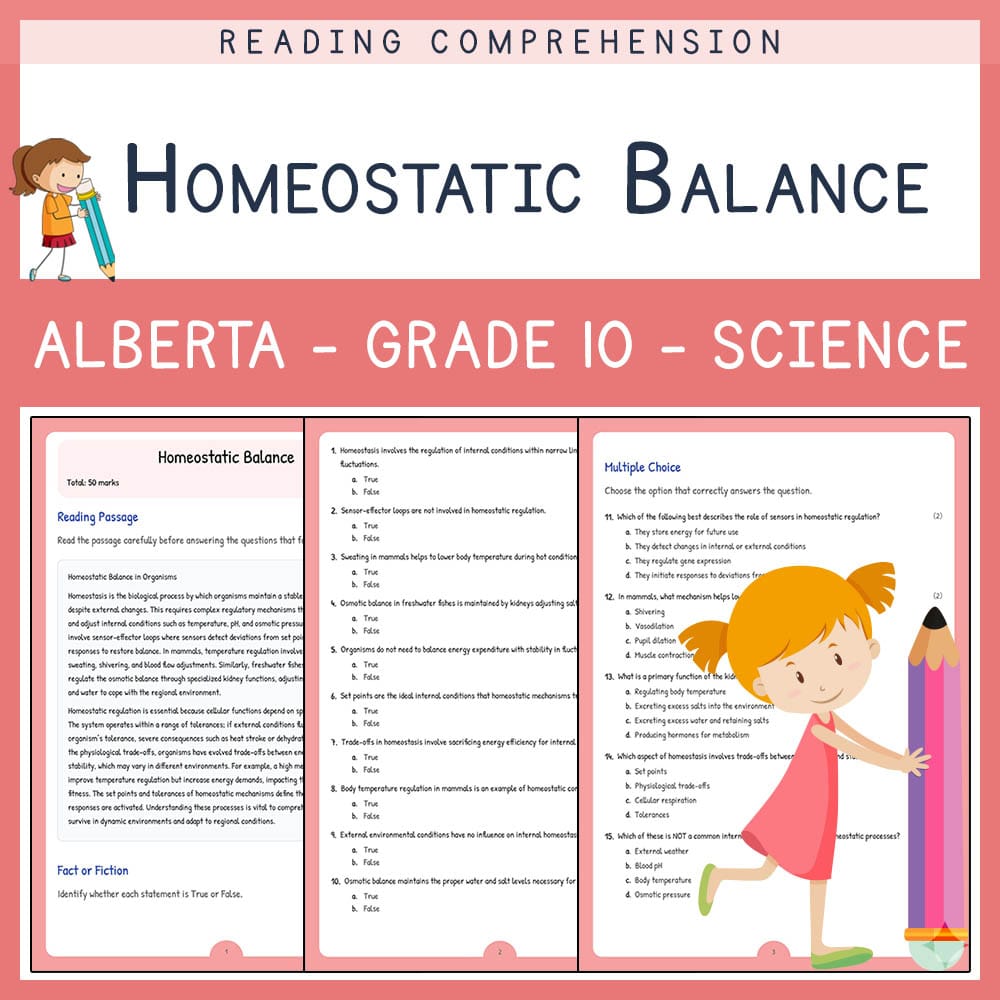
Grade 10 Science | Homeostatic Balance Worksheet | Alberta Standards
Created byLumora LearningLearning Objectives
- Define homeostasis and describe its importance in maintaining internal stability.
- Explain the mechanisms, including sensor-effector loops, responsible for homeostatic regulation.
- Identify examples of homeostasis such as temperature regulation and osmotic balance.
Also included in: Grade 10 Science | Cells and Systems Custom Bundle Worksheets | Alberta
Instant download
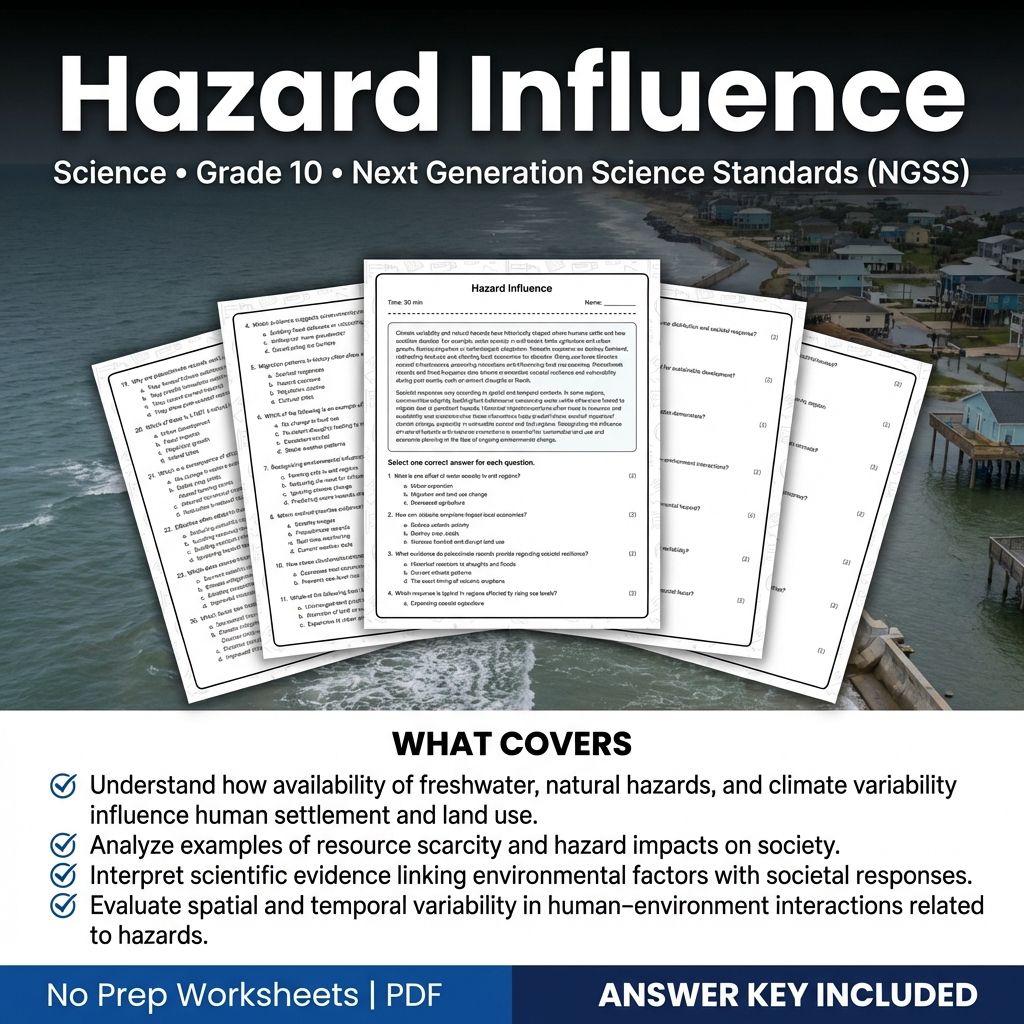
10th Grade Science | Hazard Influence Worksheet with Answer Key (Printable PDF)
 Created byCoral Reef Learning
Learning Objectives
- Understand how availability of freshwater, natural hazards, and climate variability influence human settlement and land use.
- Analyze examples of resource scarcity and hazard impacts on society.
- Interpret scientific evidence linking environmental factors with societal responses.
Also included in: Grade 10 Science Unit Bundle | Environmental Impact & Climate Strategies +1 more
Instant download

Mass Conservation Test Prep Worksheets | Grade 10 Science NGSS
Created byPrism Point LearningLearning Objectives
- Use balanced chemical equations to justify conservation of mass by tracking atom counts across reactants and products.
- Apply mole concept and molar masses to connect balanced coefficients with measurable mass changes in real reactions.
- Interpret quantitative representations to reconcile experimental mass measurements with theoretical stoichiometry.
Also included in: Grade 10 Reaction Rates and Equilibrium Science Lesson Bundle NGSS
Instant download

Energy Changes Worksheet for Grade 10 Science | Alberta Standards Practice
JCreated byJ.S SheetsLearning Objectives
- Understand the concepts of endothermic and exothermic energy changes during chemical reactions.
- Relate enthalpy changes to bond breaking and formation at the molecular level.
- Interpret calorimetric data to analyze energy flow in natural and industrial processes.
Also included in: Grade 10 Science Practice Worksheets: Alberta Science Full-Year Bundle
Instant download

Chemical Equilibrium Test Prep Printable | Grade 10 Science
Created byPrism Point LearningLearning Objectives
- Explain how changes in pressure, concentration, and temperature shift a dynamic chemical equilibrium
- Describe how catalysts affect the time to reach equilibrium without changing equilibrium composition
- Use equilibrium constants as quantitative indicators of how reactants and products relate at equilibrium
Also included in: Grade 10 Reaction Rates and Equilibrium Science Lesson Bundle NGSS
Instant download

Genetic Variation Assessment for Grade 10 Science | Standards-Aligned
Created byPrism Point LearningLearning Objectives
- Understand the sources of genetic variation within populations.
- Identify mechanisms such as meiosis, mutations, and gene flow that generate variation.
- Explain how genetic variation influences evolution and adaptation.
Also included in: Grade 10 Evolution and Genetics Science Lesson Bundle: General Unit
Instant download

Positive Feedback Worksheet for Grade 10 Science | TEKS-Aligned Practice
JCreated byJ.S SheetsLearning Objectives
- Explain how positive feedback amplifies an initial change in a system
- Compare positive feedback with negative feedback in human physiology
- Describe real-life examples of positive feedback, such as uterine contractions and blood clotting
Instant download

Atomic Models Worksheet | Standards-Aligned Grade 10 Science Practice
JCreated byJ.S SheetsLearning Objectives
- Describe the development of atomic models and their key features.
- Explain how microscopic particle arrangements influence macroscopic properties.
- Connect particulate matter concepts to observable properties like density and conductivity.
Also included in: Grade 10 Science Practice Worksheets: Alberta Science Full-Year Bundle
Instant download
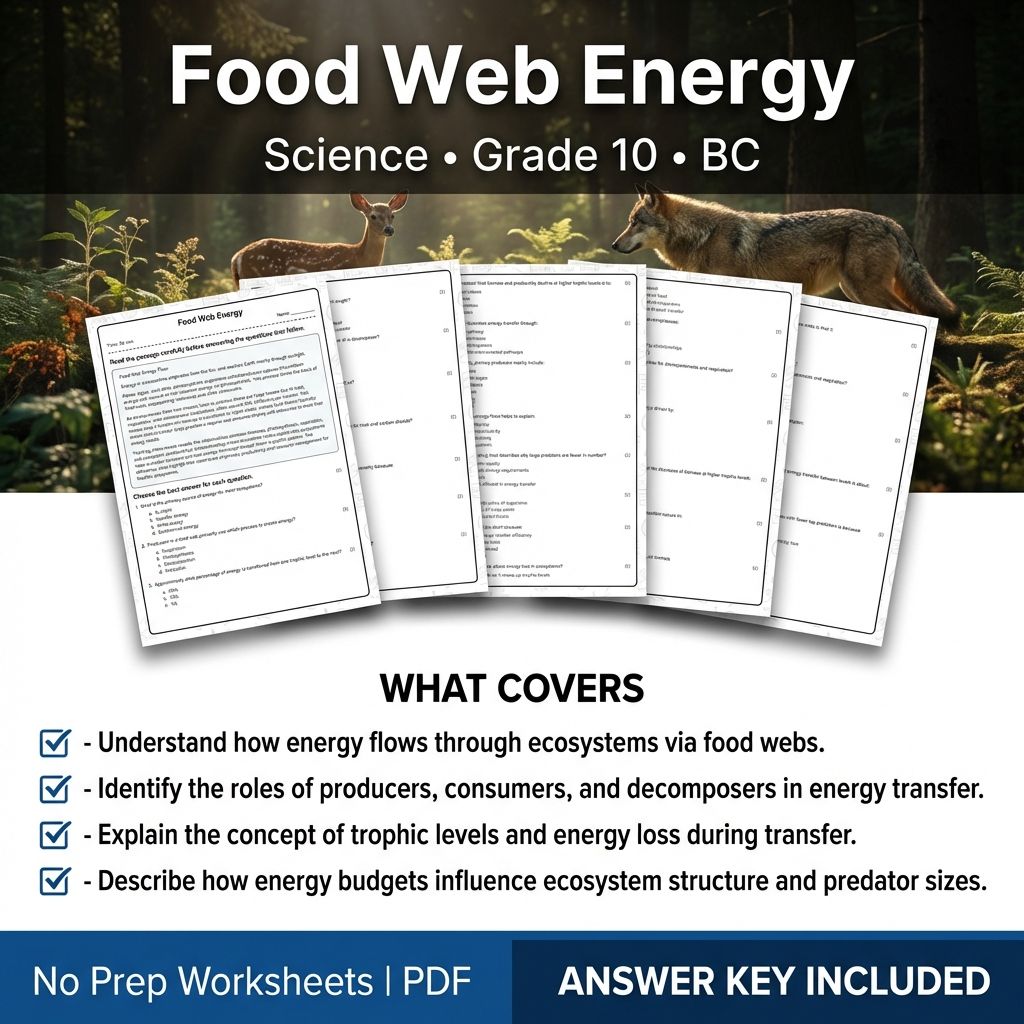
Grade 10 Science | Food Web Energy Practice Worksheet & Answer Key (PDF)
Created byCoral Reef LearningLearning Objectives
- Understand how energy flows through ecosystems via food webs.
- Identify the roles of producers, consumers, and decomposers in energy transfer.
- Explain the concept of trophic levels and energy loss during transfer.
Instant download
About Grade 10 Science Worksheets
Find Science worksheets built for Grade 10. All 7,038 cover core skills, practice, and review, each an instant PDF download.
Every worksheet on MyTeachingSheets is created by independent teacher-authors and reviewed before publication. All resources download as printable PDFs for classroom, homework, or at-home practice, and many include answer keys. Preview any worksheet free before buying.