
Grade 10 Science Worksheets
7,038 worksheets
Grade 10 Science Worksheet | Fluid Balance TEKS (PDF)
 Created byEvergreen Desk Education
Learning Objectives
- Explain how the nephron regulates fluid volume and blood osmolarity through glomerular filtration, tubular reabsorption, and secretion.
- Describe how antidiuretic hormone (ADH) and aldosterone coordinate with kidney tubules to adjust urine concentration and blood pressure.
- Use feedback reasoning to predict how changes in blood osmolarity affect water and solute handling by the kidneys.
Instant download
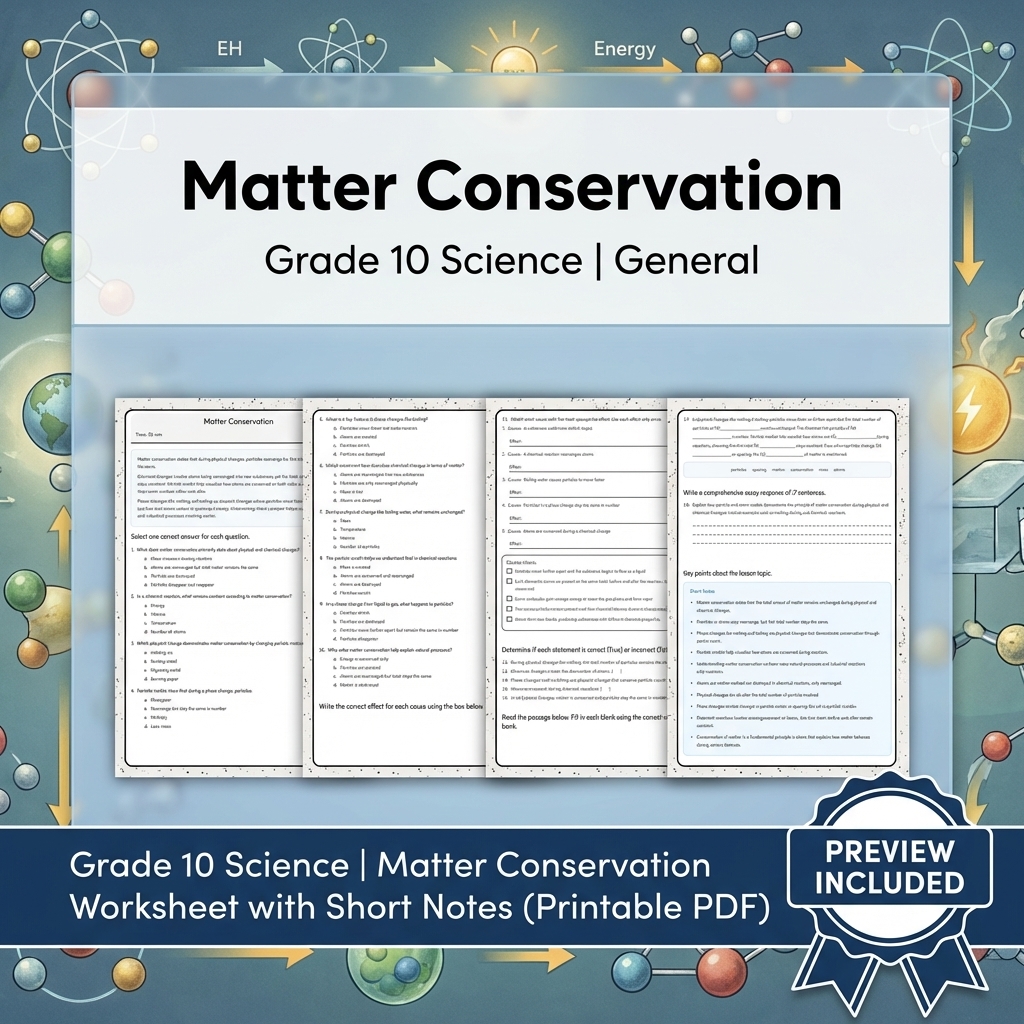
Grade 10 Science | Matter Conservation Worksheet with Short Notes
 Created byMeadowlark Worksheets
Learning Objectives
- Understand that matter conservation involves particles or atoms remaining constant during physical and chemical changes.
- Identify different types of changes (phase, chemical, physical) that demonstrate matter conservation.
- Track atoms in particle or atom models during reactions to observe conservation principles.
Also included in: Grade 10 Forces and Energy Science Lesson Bundle for General Framework +1 more
Instant download

Natural Selection and Genetic Change Worksheet | Grade 10 TEKS Science
 Created byBRIGHT PATH RESOURCES
Learning Objectives
- Identify the main claim in a passage about evolutionary change.
- Explain how natural selection and genetic variation interact.
- Distinguish mutation, genetic drift, and gene flow as sources of genetic change.
Also included in: Grade 10 Evolution & Classification Science Worksheets Bundle | TEKS Biology +1 more
Instant download
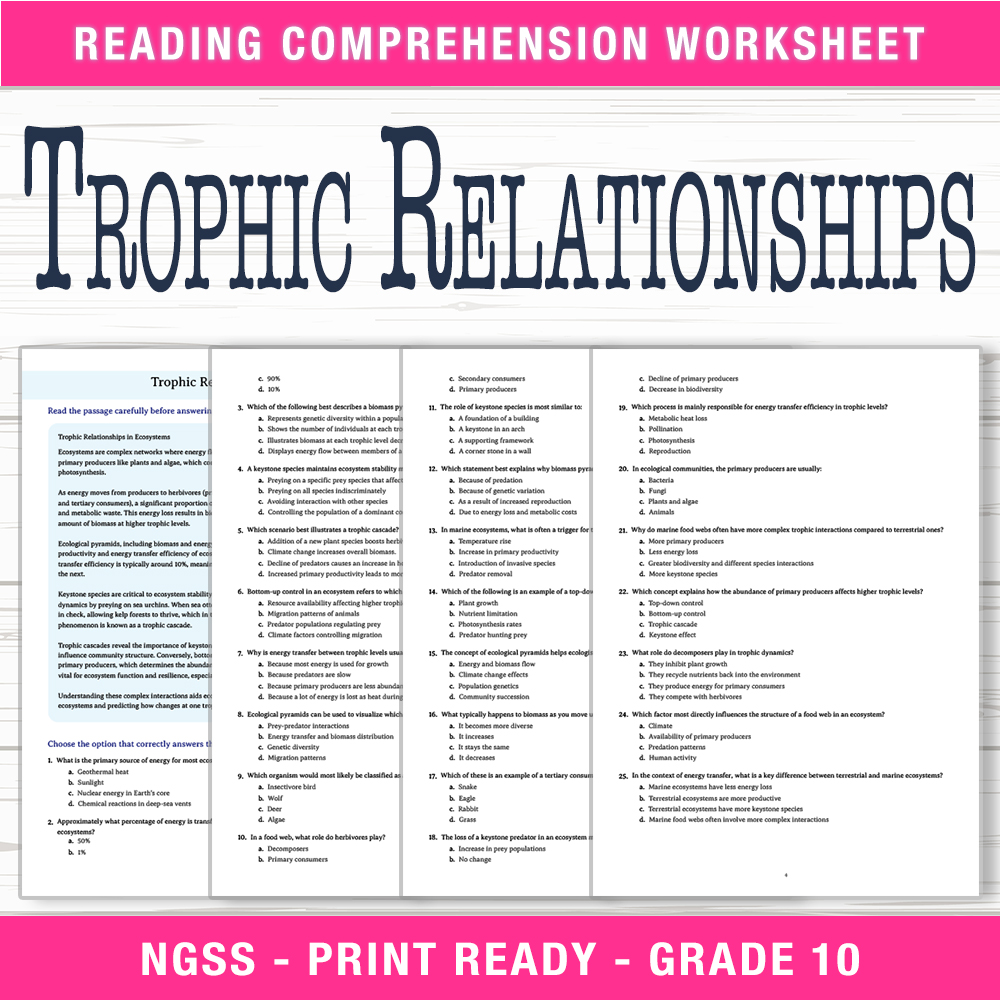
Grade 10 Science | Trophic Relationships Worksheet (PDF + Answer Key)
 Created byRiverstone Classroom
Learning Objectives
- Explain the concept of energy transfer in trophic levels within ecosystems.
- Describe the roles of keystone species and trophic cascades in maintaining ecological balance.
- Analyze biomass pyramids and ecological pyramids to understand productivity distribution.
Also included in: Grade 10 Science Ecosystems & Biodiversity UNIT Worksheet Bundle
Instant download
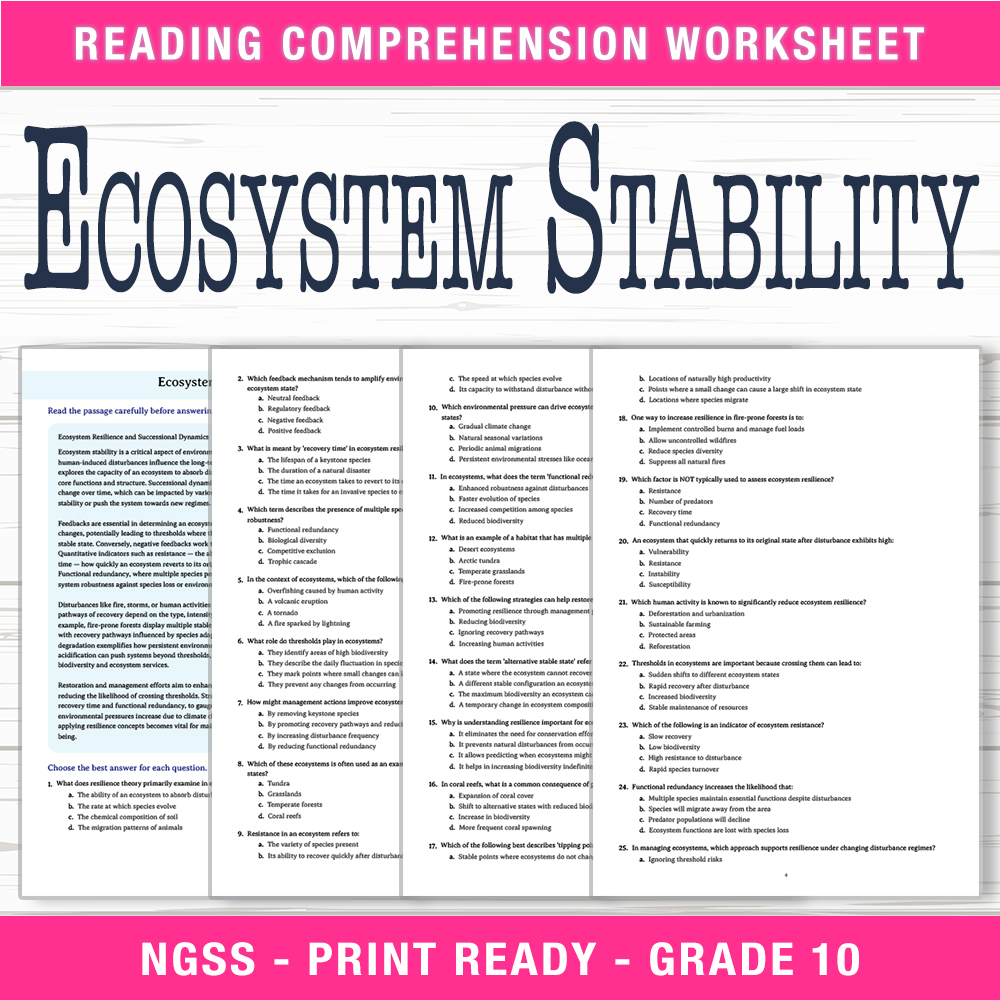
Grade 10 Science – Ecosystem Stability Worksheet (PDF + Answer Key)
Created byRiverstone ClassroomLearning Objectives
- Understand the concepts of resilience theory and successional dynamics in ecosystems.
- Analyze how disturbances impact ecosystem stability landscapes and thresholds.
- Evaluate recovery pathways, alternative stable states, and restoration outcomes in various ecosystems.
Also included in: Grade 10 Science Ecosystems & Biodiversity UNIT Worksheet Bundle
Instant download
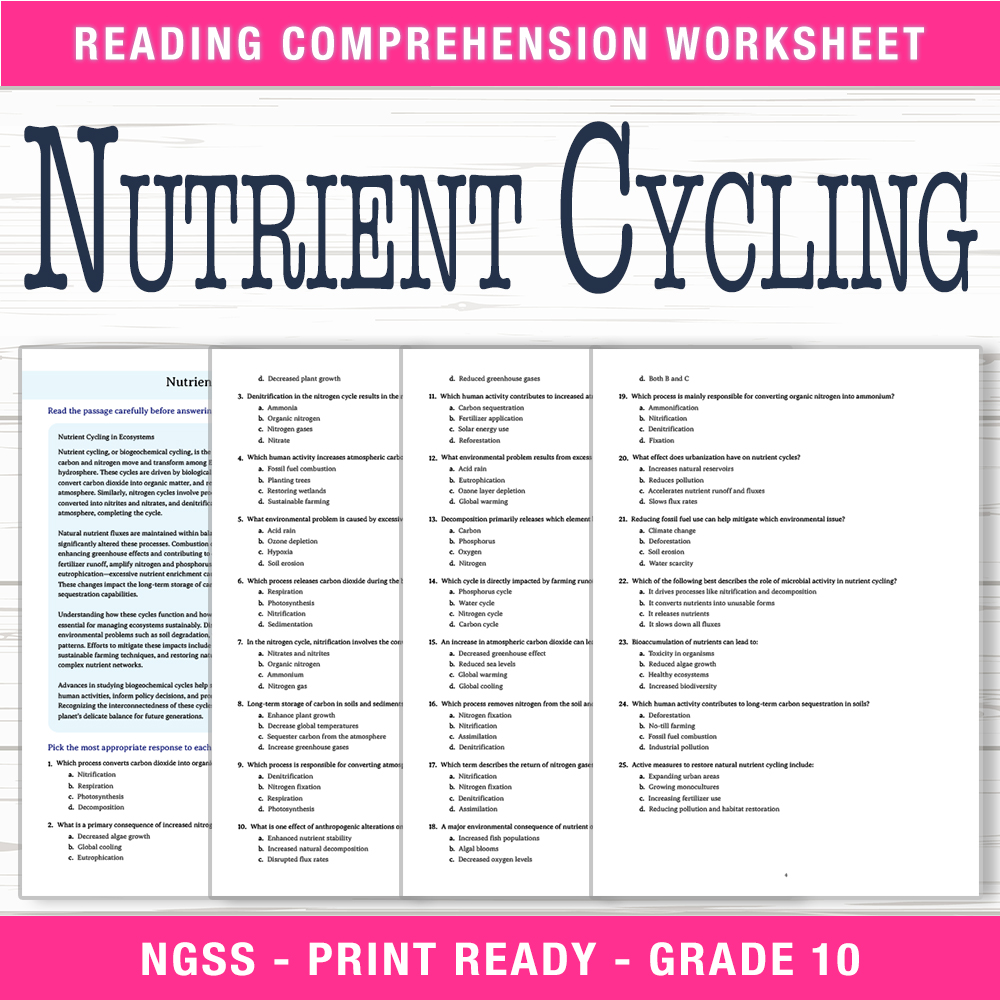
Grade 10 Science | Nutrient Cycling Worksheet (PDF + Answer Key)
Created byRiverstone ClassroomLearning Objectives
- Explain the processes involved in major biogeochemical cycles, including carbon and nitrogen fluxes among Earth's spheres.
- Analyze how human activities such as fossil fuel combustion and agricultural runoff affect nutrient reservoirs and flux rates.
- Evaluate the environmental consequences of altered nutrient cycling, such as eutrophication, hypoxia, and carbon sequestration.
Also included in: Grade 10 Science Ecosystems & Biodiversity UNIT Worksheet Bundle
Instant download
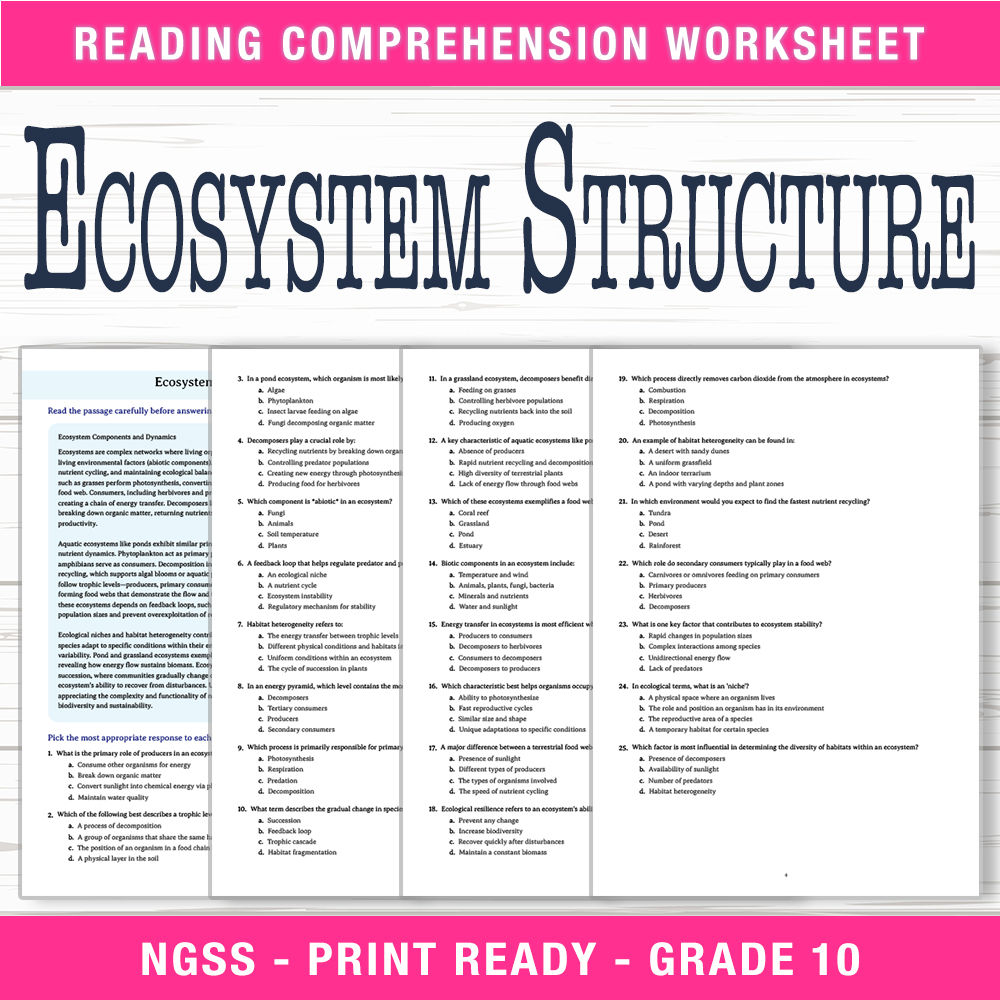
Grade 10 Science | Ecosystem Structure Worksheet (PDF + Answer Key)
Created byRiverstone ClassroomLearning Objectives
- Describe the roles of biotic and abiotic components in ecosystems.
- Explain energy flow and trophic levels within food webs.
- Analyze ecosystem stability and feedback mechanisms.
Also included in: Grade 10 Science Ecosystems & Biodiversity UNIT Worksheet Bundle
Instant download
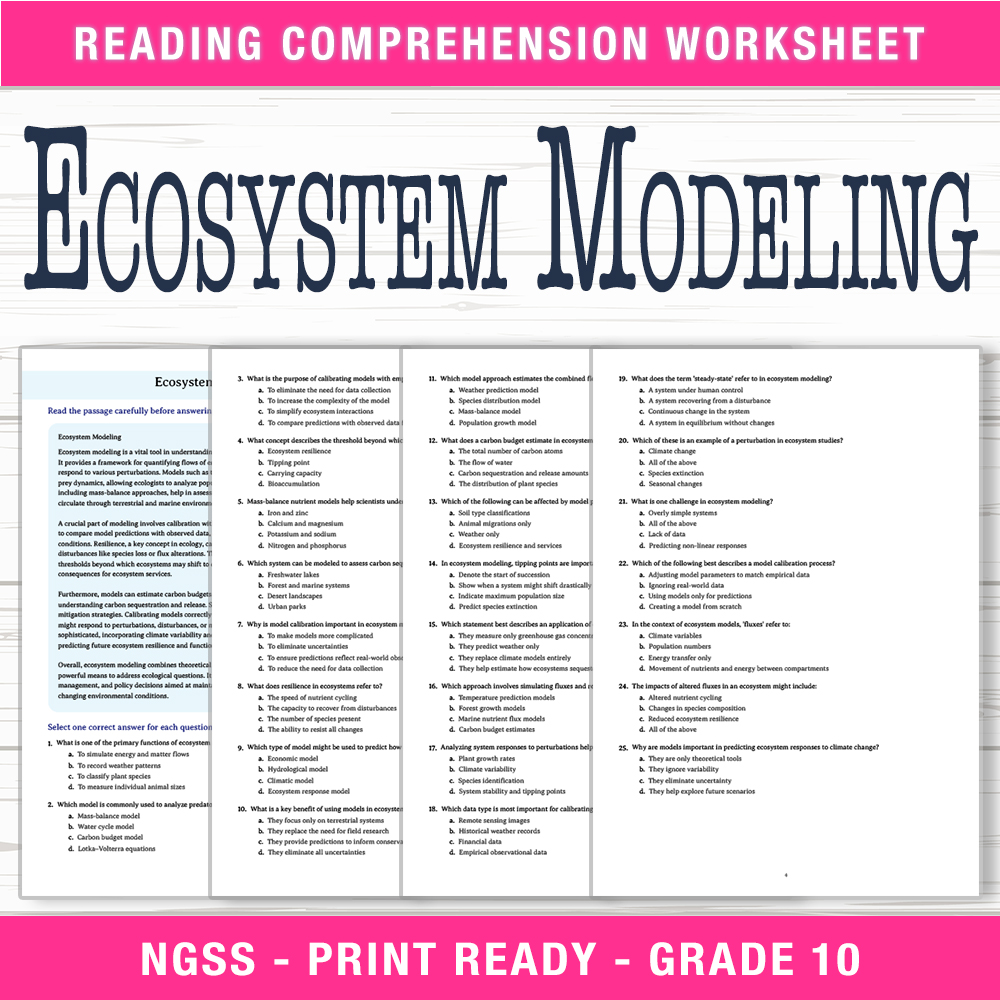
Grade 10 Science – Ecosystem Modeling Worksheet (PDF + Answer Key)
Created byRiverstone ClassroomLearning Objectives
- Understand the fundamental concepts of ecosystem modeling and how they represent energy and matter flows.
- Interpret different types of ecological models such as Lotka–Volterra equations and nutrient flux models.
- Analyze the role of empirical data in calibrating ecosystem models and predicting system responses.
Also included in: Grade 10 Science Ecosystems & Biodiversity UNIT Worksheet Bundle
Instant download

Hydrologic Cycle and Water Security Worksheets | Grade 10 Science
 Created bySunny Desk Resources
Learning Objectives
- Describe the main processes of the hydrologic cycle and the pathways water can take through a watershed
- Explain how seasonal storage in snow and groundwater affects streamflow over time
- Use watershed characteristics and climate variability to predict how water availability can change
Also included in: Earth Systems, Climate, and Sustainability Lesson Bundle | Grade 10 Science | Alberta +1 more
Instant download

Wave Behavior Worksheet for Grade 10 Science | AP Standards Practice
JCreated byJ.S SheetsLearning Objectives
- Describe the characteristics of transverse and longitudinal waves using parameters such as wavelength, frequency, amplitude, and wave speed.
- Explain how waves transfer energy and information through different media.
- Analyze phenomena such as reflection, refraction, interference, superposition, and standing waves with graphical and mathematical descriptions.
Also included in: Grade 10 Motion, Waves & Electricity Science Lesson Bundle
Instant download

Grade 10 Science | Statistical Reasoning in Science - Reading Comprehension
 Created byCoral Reef Learning
Learning Objectives
- Understand key concepts related to Science
- Apply knowledge through practice questions
- Demonstrate comprehension of the material
Also included in: Science Practices Reading Comprehension Lesson Bundle: Grade 10 Science AP +1 more
Instant download

Grade 10 Science | Hydroecological Links - Daily Reading Comprehension
Created byCoral Reef LearningLearning Objectives
- Understand how river flow influences floodplain ecosystems.
- Identify the interactions between hydrology and ecosystem productivity.
- Explore the effects of water timing and availability on species distribution.
Also included in: Earth and Space Systems Lesson Bundle – Grade 10 Science Alberta +1 more
Instant download

Grade 10 Science | Feedback Control in Physiological Systems - Reading Comp.
Created byCoral Reef LearningLearning Objectives
- Understand key concepts related to Science
- Apply knowledge through practice questions
- Demonstrate comprehension of the material
Also included in: Cells and Systems Lesson Bundle | Grade 10 Science | Alberta Framework +1 more
Instant download

Grade 10 Science | Resource Cycles - Daily Reading Comprehension
Created byCoral Reef LearningLearning Objectives
- Identify the components and pathways of the water cycle
- Understand how water moves through different Earth systems
- Recognize the importance of water cycling for ecosystems and resources
Also included in: Earth and Space Systems Lesson Bundle – Grade 10 Science Alberta +1 more
Instant download

Grade 10 Science | Dynamic Equilibrium in Chemistry - Reading Comprehension
Created byCoral Reef LearningLearning Objectives
- Define chemical equilibrium and explain the concept of dynamic balance in reactions.
- Describe how concentration, pressure, and temperature influence equilibrium positions.
- Interpret equilibrium constants and analyze shifts in response to external changes.
Also included in: Matter and Chemical Change Lesson Bundle: Grade 10 Science Alberta +1 more
Instant download
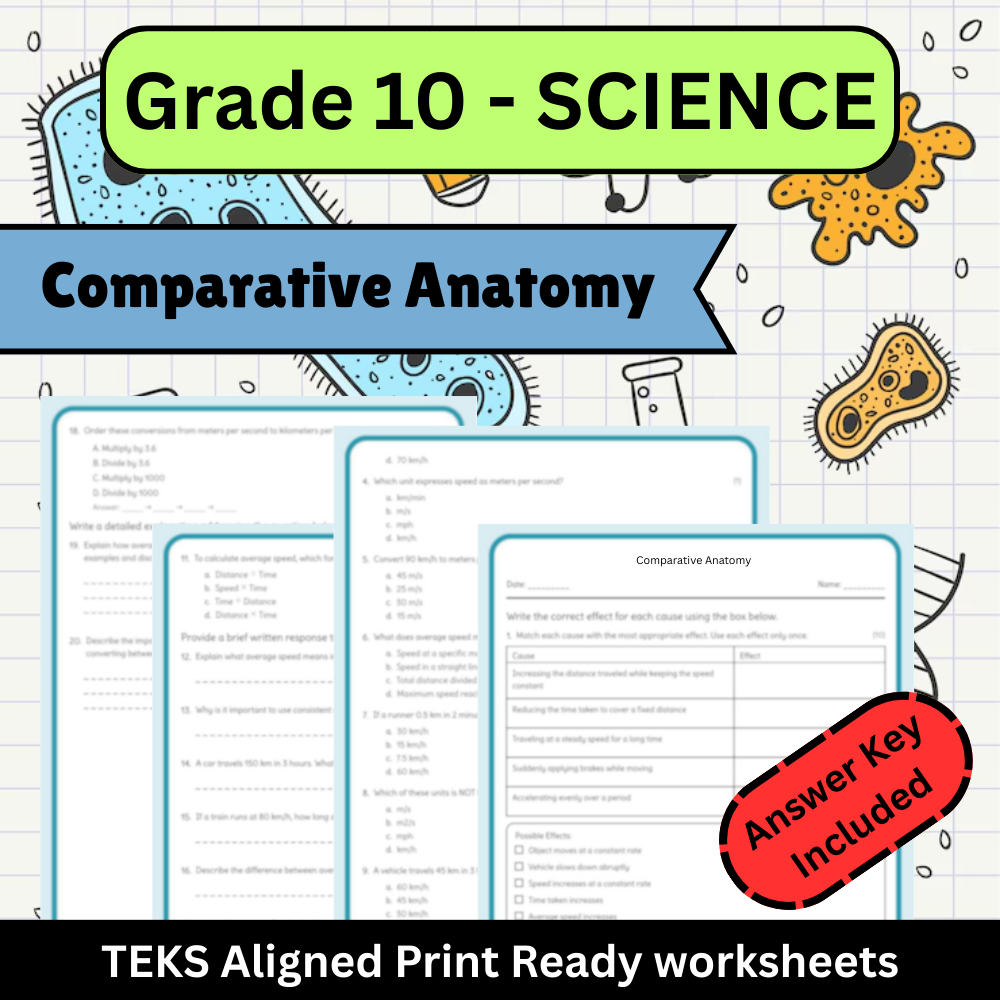
Grade 10 Science | Comparative Anatomy Worksheet (Worksheet + Answer Key) – TEKS Aligned
 Created byBright Mind Resources
Learning Objectives
- Understand the concepts of homologous, analogous, and vestigial structures in organisms.
- Identify examples of evolutionary adaptations based on anatomical comparisons.
- Explain how embryology and molecular data support evolutionary relationships.
Also included in: Grade 10 Science | Evolution & Heredity Unit Worksheet Bundle (TEKS Aligned) +5 more
Instant download

Grade 10 Electric Circuits Worksheet | BC Practice PDF
 Created byClear Sky Classroom
Learning Objectives
- Explain how electric circuits transmit and transform energy in power grids
- Analyze how resistance, reactance, and transmission distance affect delivered power and system efficiency
- Compare centralized and distributed generation using criteria such as reliability and environmental impact
Instant download

Grade 10 Science | Wave Properties in Science - Daily Reading Comprehension
Created byCoral Reef LearningLearning Objectives
- Identify and describe the basic properties of waves: amplitude, wavelength, frequency, and wave speed
- Understand how these properties relate to each other
- Recognize examples of wave behaviors such as reflection, refraction, and superposition
Instant download
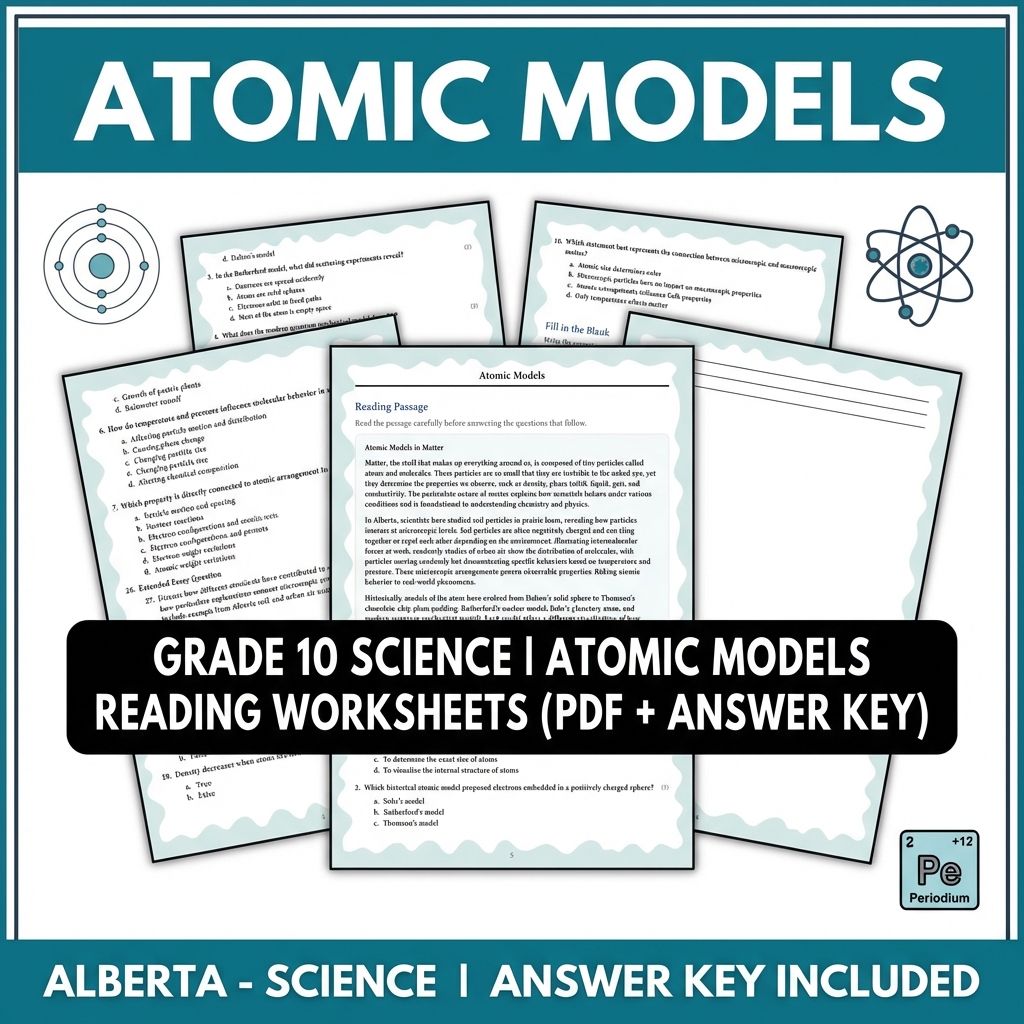
Grade 10 Science | Atomic Models Reading Worksheets (PDF + Answer Key)
JCreated byJ.S SheetsLearning Objectives
- Describe the particle nature of matter and how it explains observable properties.
- Understand different atomic models and their diagrams throughout history.
- Explain how particulate concepts relate to density, phase, and conductivity.
Also included in: Grade 10 Science Unit Bundle | Chemical Reactions & Properties Worksheets +1 more
Instant download

Grade 10 Science | Sustainability Assessment - Daily Reading Comprehension
Created byCoral Reef LearningLearning Objectives
- Understand the concept of water renewal rates
- Identify key pollutants associated with water resources
- Analyze how environmental indicators influence sustainability decisions
Also included in: Earth and Space Systems Lesson Bundle – Grade 10 Science Alberta +1 more
Instant download

Grade 10 Gene Regulation Switches Worksheet | California Science Standards
Created byEvergreen Desk EducationLearning Objectives
- Explain how gene regulation determines when and where genes are expressed.
- Identify DNA regulatory elements and molecular signals involved in transcription control.
- Compare different gene regulatory mechanisms and predict how expression changes affect protein production.
Instant download
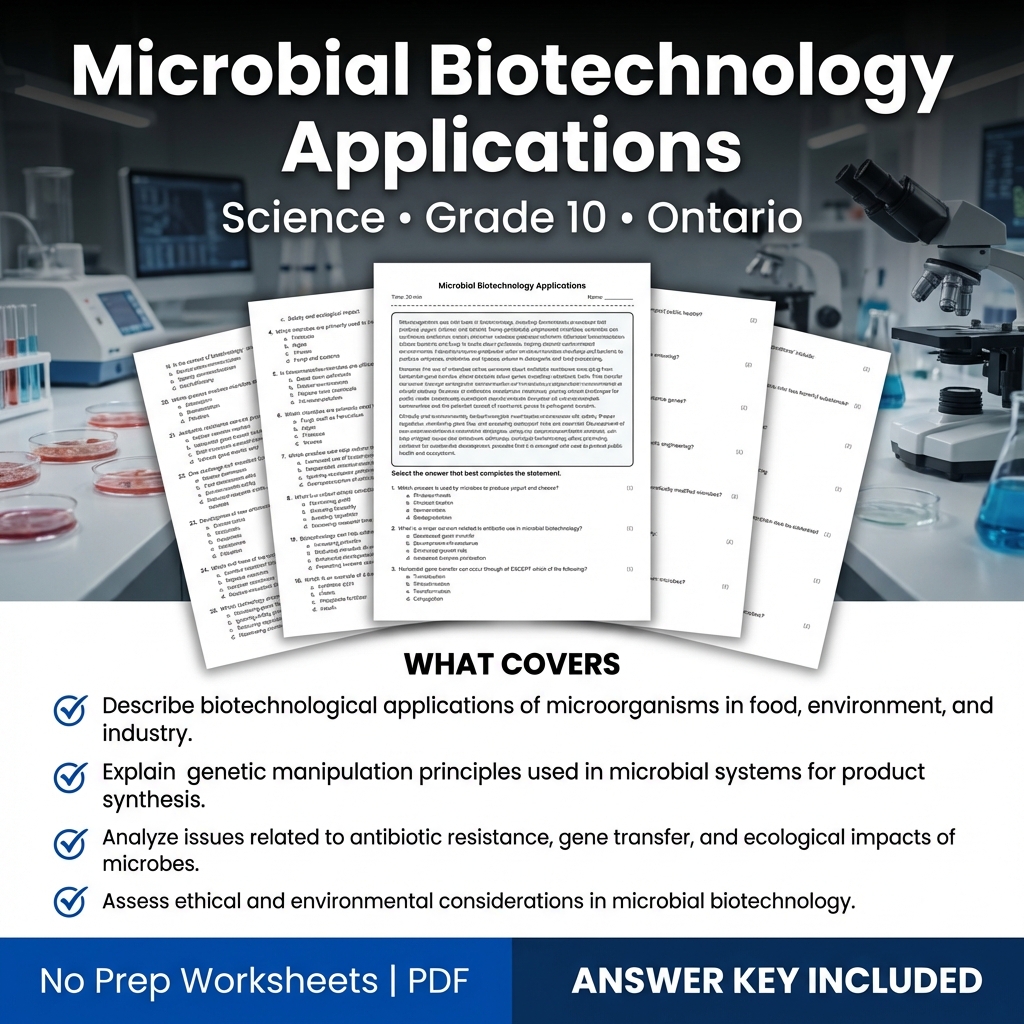
Grade 10 Science Worksheet on Microbial Biotechnology Applications | Ontario
Created byCoral Reef LearningLearning Objectives
- Describe biotechnological applications of microorganisms in food, environment, and industry.
- Explain genetic manipulation principles used in microbial systems for product synthesis.
- Analyze issues related to antibiotic resistance, gene transfer, and ecological impacts of microbes.
Instant download
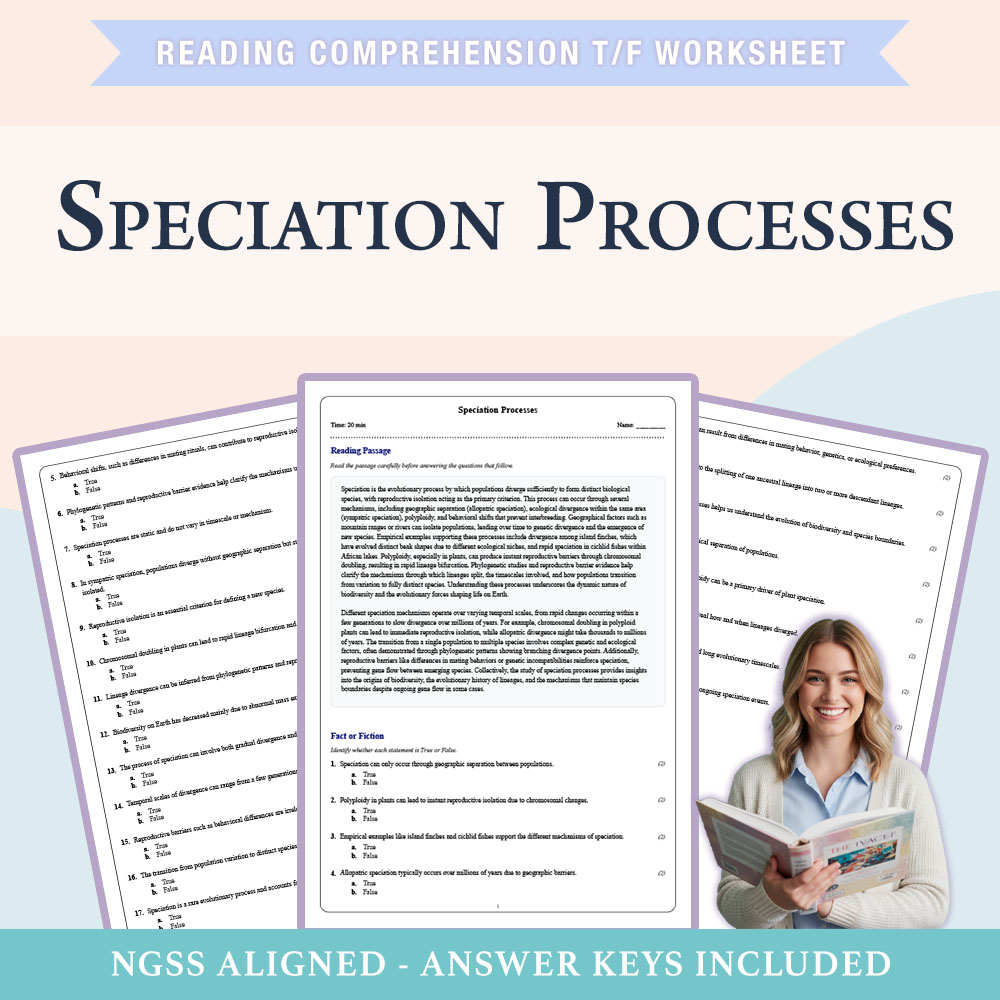
Grade 10 Science | Speciation Processes Worksheet (PDF + Answer Key)
 Created byCopper Leaf Classroom
Learning Objectives
- Understand the mechanisms that lead to speciation, including geographic, ecological, polyploidy, and behavioral factors.
- Identify examples of speciation phenomena in empirical case studies.
- Interpret phylogenetic patterns and reproductive barriers to elucidate lineages' divergence.
Also included in: Grade 10 Science | Evolution & Biodiversity Unit Bundle (PDF + Answer Key) +1 more
Instant download

Particle Accounting Worksheet | Grade 10 Chemistry Science CA Standards
Created byEvergreen Desk EducationLearning Objectives
- Use atomic/molecular particle accounting to justify conservation of atoms during chemical reactions
- Explain how a particle diagram shows which bonds break and which bonds form
- Interpret changes in observable properties (color, state, temperature) while maintaining consistent atom counts
Instant download

Energy Technologies Worksheet | Standards-Aligned Science Practice Grade 10
JCreated byJ.S SheetsLearning Objectives
- Understand different energy technologies and their conversion methods.
- Evaluate the efficiency, environmental impact, and scalability of various energy sources.
- Compare energy technologies using metrics like energy return on investment and efficiency.
Instant download

Multiple Lines of Evidence for Evolution Worksheets Grade 10 Science
Created byBRIGHT PATH RESOURCESLearning Objectives
- Explain how fossils provide evidence for biological change over time
- Compare how different evidence types support evolutionary claims
- Identify why converging evidence strengthens evolutionary conclusions
Also included in: Grade 10 Life Science Worksheets Bundle | Evolution & Genetics +4 more
Instant download

Surface Change Climate Links Worksheet | Standards-Aligned Grade 10 Science
JCreated byJ.S SheetsLearning Objectives
- Understand how Earth's surface changes influence climate and weather patterns.
- Identify evidence from geological records that connect surface modifications to climate shifts.
- Explain physical mechanisms linking surface events like volcanic emissions and land cover changes to atmospheric and energy distribution alterations.
Also included in: Grade 10 Climate and Earth Systems Science Lesson Bundle – California Standards +1 more
Instant download

Grade 10 Stellar Evolution & Hertzsprung-Russell Diagram Worksheet | NGSS
 Created byAmber Owl Education
Learning Objectives
- Explain how nuclear fusion powers stars during the main sequence and how energy transport affects stellar surface temperature
- Describe how stars change into red giants and connect these changes to shifts on the Hertzsprung-Russell diagram
- Compare likely end stages of stellar evolution for different initial star masses (white dwarfs, neutron stars, or supernovae)
Instant download

Grade 10 Science – Immune System Daily Reading Worksheet + Answer Key
JCreated byJ.S SheetsLearning Objectives
- Understand how the immune system detects and responds to pathogens
- Describe the role of inflammatory responses and fever in maintaining homeostasis
- Analyze how chronic immune activation can affect physiological balance
Also included in: Grade 10 Science Lesson Bundle | Human Physiology & Regulatory Systems +1 more
Instant download
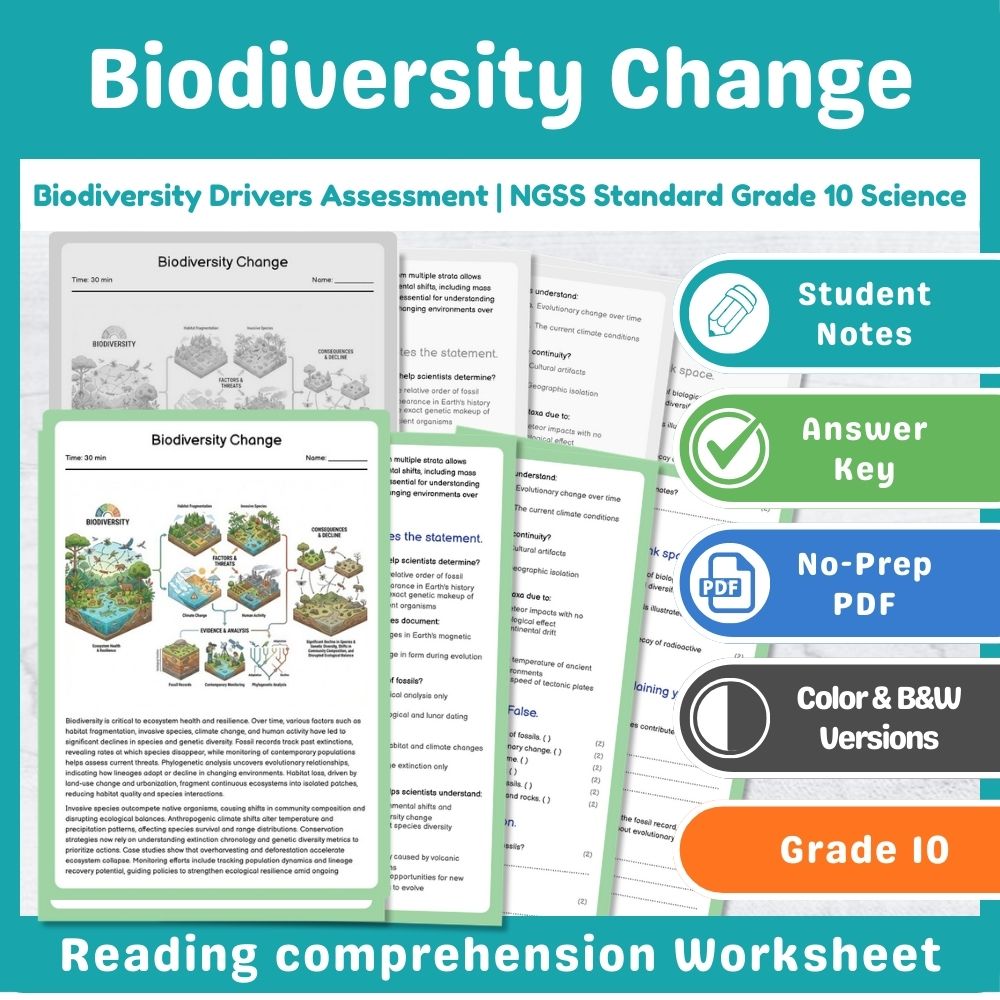
Reaction Rates Assessment for Grade 10 Science NGSS Standards
 Created byPrism Point Learning
Learning Objectives
- Understand how collision theory explains the factors affecting reaction rates.
- Interpret the relationships between temperature, concentration, surface area, catalysts, and reaction speed.
- Analyze empirical rate data to determine reaction mechanisms and rate laws.
Instant download
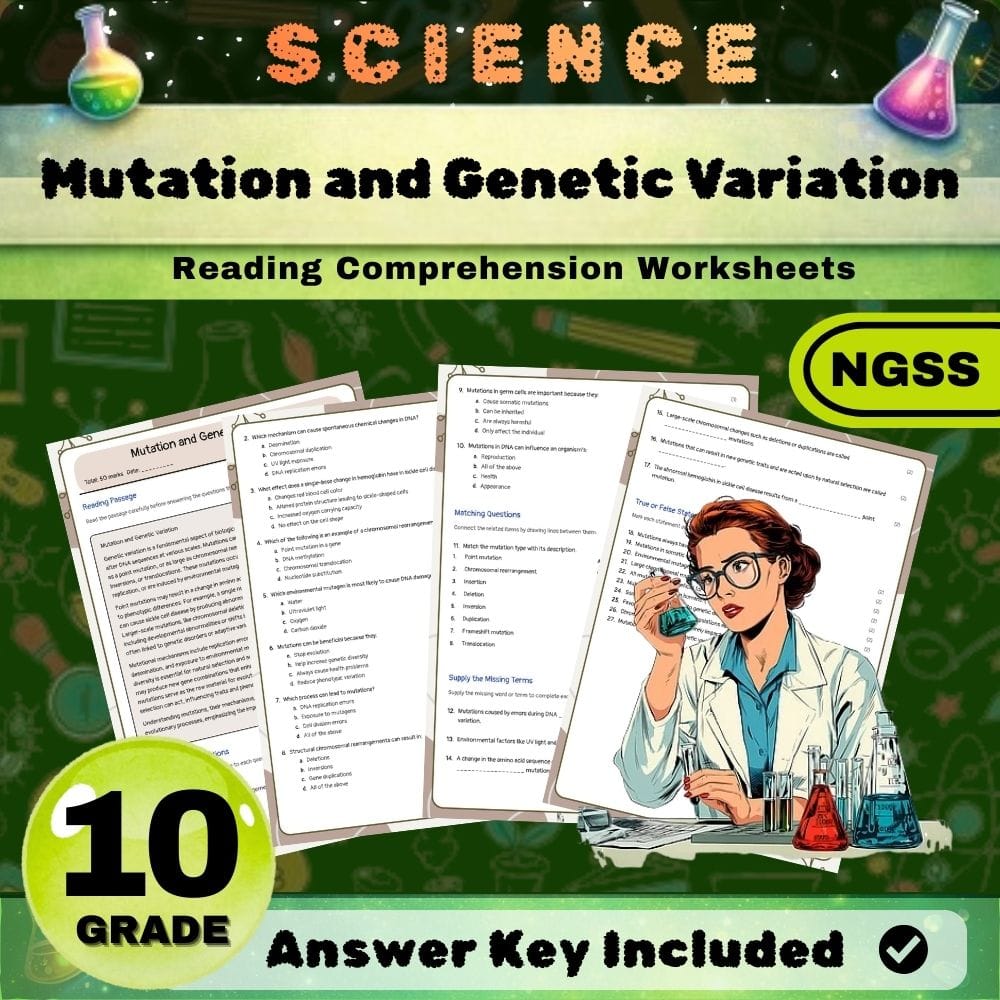
Grade 10 Science | Mutation and Genetic Variation Worksheet (NGSS)
 Created byMaple Path Learning
Learning Objectives
- Understand how mutations at nucleotide and chromosomal scales contribute to genetic variation.
- Identify different mechanisms of mutational changes and their effects on gene function.
- Explain the significance of mutations like point mutations and structural rearrangements in evolution and health.
Instant download

Grade 10 Science Worksheet | Model-Data Fit (AP Standard) PDF
Created byEvergreen Desk EducationLearning Objectives
- Use residuals to compare model predictions with observed data and interpret patterns in discrepancies.
- Apply goodness-of-fit ideas to judge whether a model component is adequate for a given dataset.
- Explain how parameter sensitivity and uncertainty affect the confidence in model selection.
Also included in: Grade 10 Scientific Modeling & Quantitative Reasoning Science Lesson Bundle (AP) +1 more
Instant download

Grade 10 Microbe Diversity Worksheet | Cells, Genetics & Ecological Roles
 Created byChalk and Compass
Learning Objectives
- Compare major microorganism groups by cellular organization and genetic material.
- Explain how different microbes reproduce and how viruses depend on host cellular machinery.
- Describe how microbes occupy different ecological niches and contribute to ecosystems.
Also included in: Cells, Photosynthesis, Respiration & Microbes Lesson Bundle – Grade 10 Science +1 more
Instant download

Grade 10 Science – Population Dynamics & Evolution | Daily Reading Worksheet
Created byBright Mind ResourcesLearning Objectives
- Understand basic concepts of population size and variation
- Recognize factors affecting population change
- Interpret models such as Hardy-Weinberg equilibrium
Also included in: Grade 10 Evolution & Genetics Science Daily Reading Lesson Bundle | BC +1 more
Instant download

Grade 10 Science – Population Dynamics Daily Reading Worksheet with Answer Key
JCreated byJ.S SheetsLearning Objectives
- Understand the concepts of birth, death, immigration, and emigration in population change.
- Identify how interactions like competition, predation, and resource availability influence populations.
- Explain mathematical models of population growth, including exponential and logistic growth.
Also included in: Grade 10 Science Lesson Group – Ecosystems and Environmental Impact Worksheets +1 more
Instant download
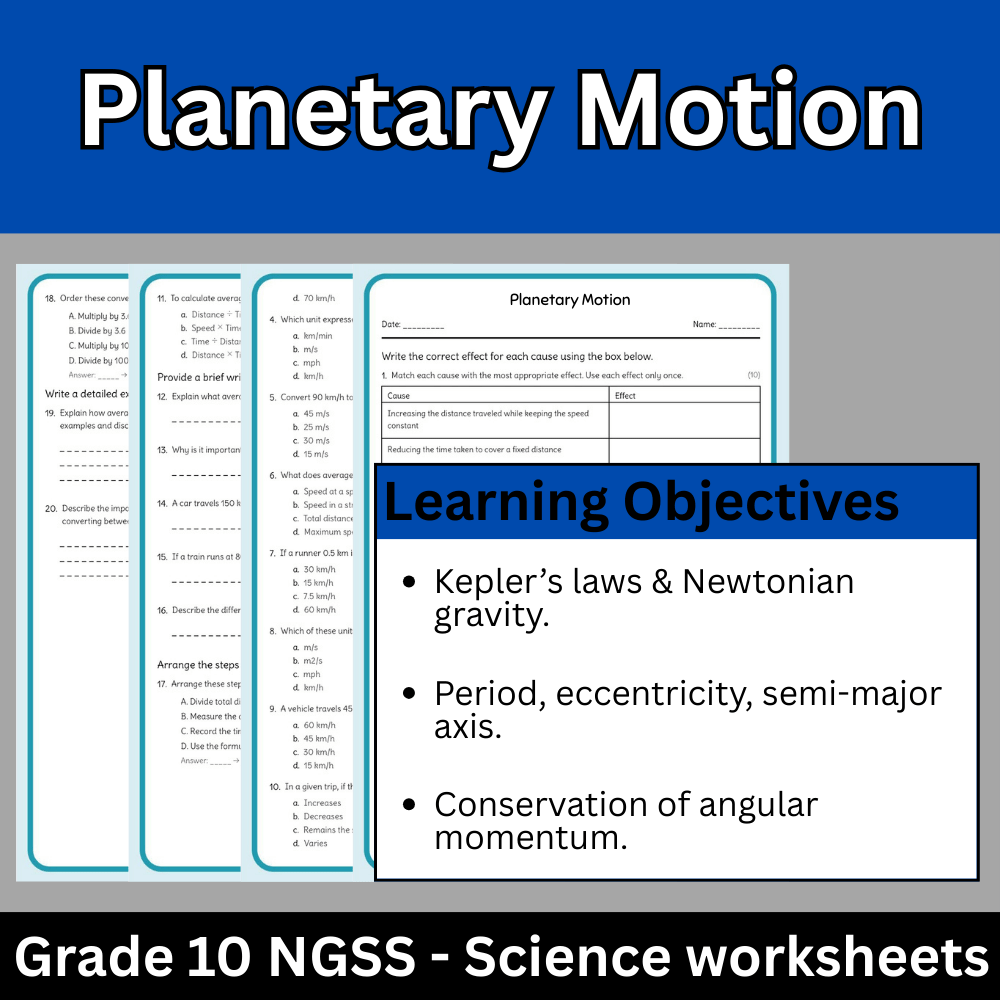
Grade 10 Science | Planetary Motion Worksheet (NGSS) – Science PDF
Created byBright Mind ResourcesLearning Objectives
- Understand the principles of Kepler's laws and Newtonian gravitation in planetary motion
- Relate orbital parameters such as period, eccentricity, and semi-major axis
- Explain how conservation of angular momentum affects orbital speed
Instant download
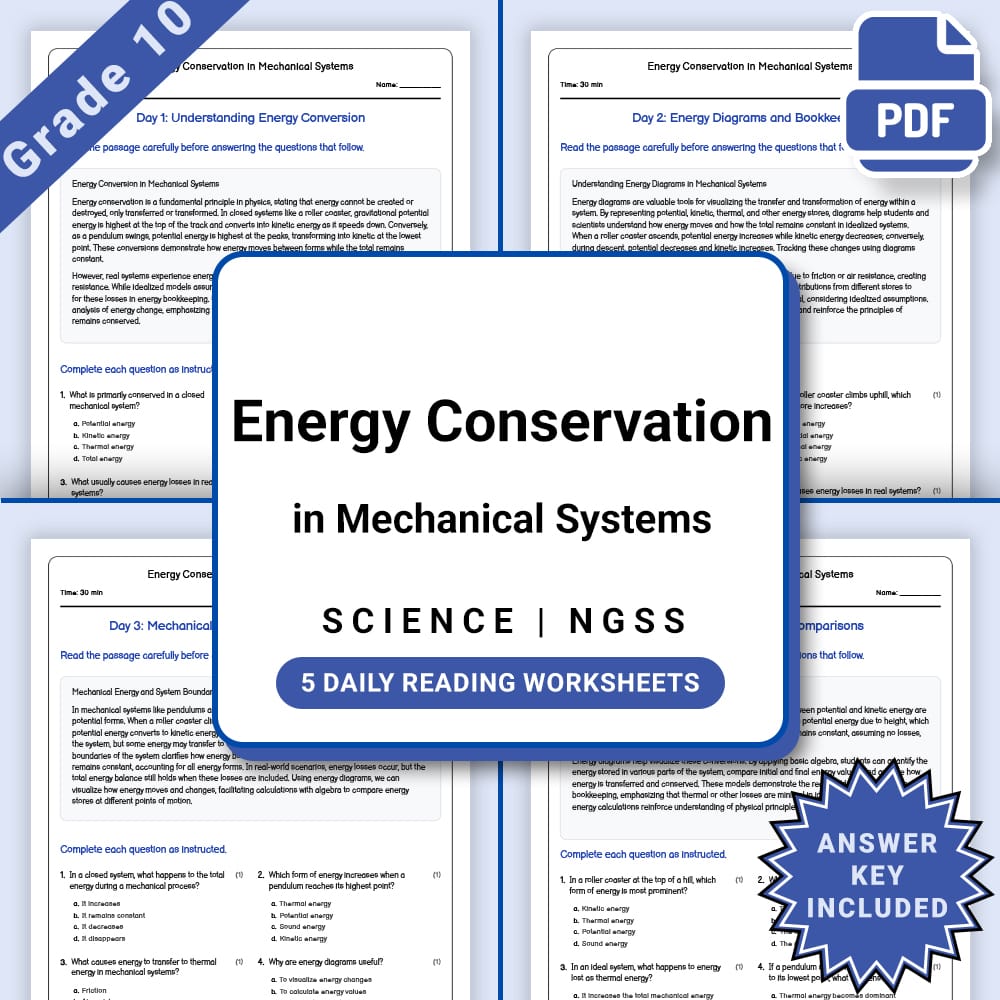
Grade 10 Science – Energy Conservation in Mechanical Systems (PDF +Answer Key)
Created byCopper Leaf ClassroomLearning Objectives
- Understand the principles of energy conservation in closed systems
- Identify different forms of energy transfer, such as potential to kinetic energy
- Describe how energy is conserved even with energy losses such as thermal energy
Instant download
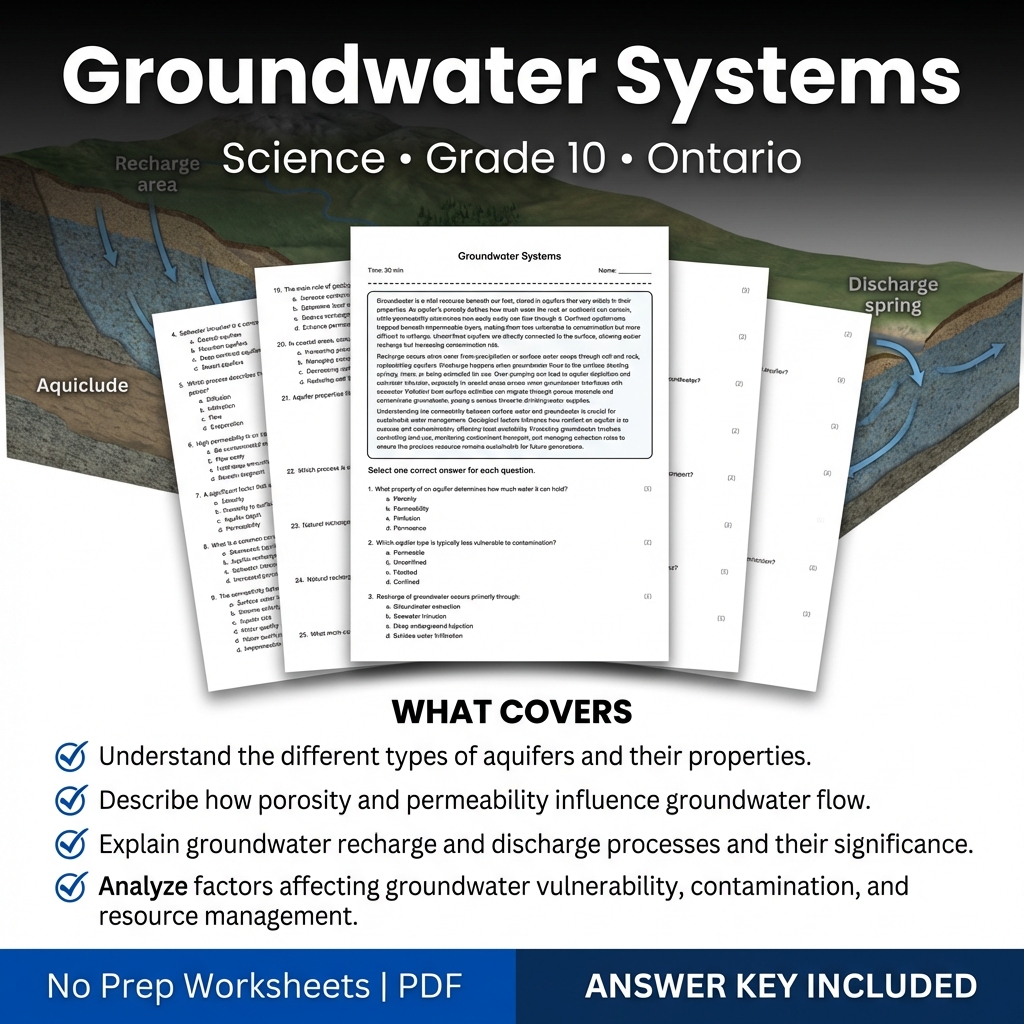
Groundwater Systems Worksheet for Grade 10 Science | Ontario Standards
Created byCoral Reef LearningLearning Objectives
- Understand the different types of aquifers and their properties.
- Describe how porosity and permeability influence groundwater flow.
- Explain groundwater recharge and discharge processes and their significance.
Instant download

Earth-Sun Geometry and Seasonal Climate Worksheets | Grade 10 Science
Created bySunny Desk ResourcesLearning Objectives
- Describe how Earth’s tilt and orbit affect daily and seasonal solar energy inputs
- Explain how solar angle differences influence heating of Earth’s surface and air
- Connect changes in solar forcing to atmospheric circulation and regional climate patterns
Also included in: Earth Systems, Climate, and Sustainability Lesson Bundle | Grade 10 Science | Alberta +1 more
Instant download

Force Relations Worksheet for Grade 10 Science | Alberta Standards-Aligned
JCreated byJ.S SheetsLearning Objectives
- Understand how forces relate to mass and acceleration through Newton's second law.
- Identify the effects of varying mass and applied forces on motion outcomes.
- Analyze real-world examples involving forces in Alberta's agricultural, transportation, and towing contexts.
Also included in: Grade 10 Science Practice Worksheets: Alberta Science Full-Year Bundle
Instant download

Grade 10 Plant Systems Worksheet | Alberta Biology Curriculum PDF
Created byEvergreen Desk EducationLearning Objectives
- Explain how plant root architecture, xylem, phloem, and stomata work together as an integrated system.
- Connect plant organ function to environmental responses such as water stress and changing light conditions.
- Relate plant system understanding to crop health decisions relevant to Alberta grasslands and foothill forests.
Instant download

Bonding Types Worksheet – Grade 10 Science Assessment for Alberta Standards
JCreated byJ.S SheetsLearning Objectives
- Describe the differences between ionic, covalent, and metallic bonding at the particle level.
- Explain how bonding types influence macroscopic properties such as conductivity, melting point, and solubility.
- Identify examples of each bonding type in real-world materials and predict their observable behaviors based on atomic interactions.
Also included in: Grade 10 Science Practice Worksheets: Alberta Science Full-Year Bundle
Instant download

Tissue Organization and Organ Function Worksheets Grade 10 Science
Created bySunny Desk ResourcesLearning Objectives
- Explain how cells differentiate and organize into tissues with specific functions
- Compare plant xylem and phloem roles to animal epithelial and connective tissue roles
- Describe how tissue architecture and properties affect organ-level performance in different environments
Also included in: Cell Structure, Homeostasis & Energy Lesson Bundle: Grade 10 Science Alberta +1 more
Instant download

Grade 10 Science | Specialized Cells - Daily Reading Comprehension
Created byCoral Reef LearningLearning Objectives
- Understand the concept of cellular specialization and tissue organization.
- Identify different morphological adaptations of specialized cells.
- Explain how form relates to function in muscle, nerve, root hair, and xylem cells.
Instant download
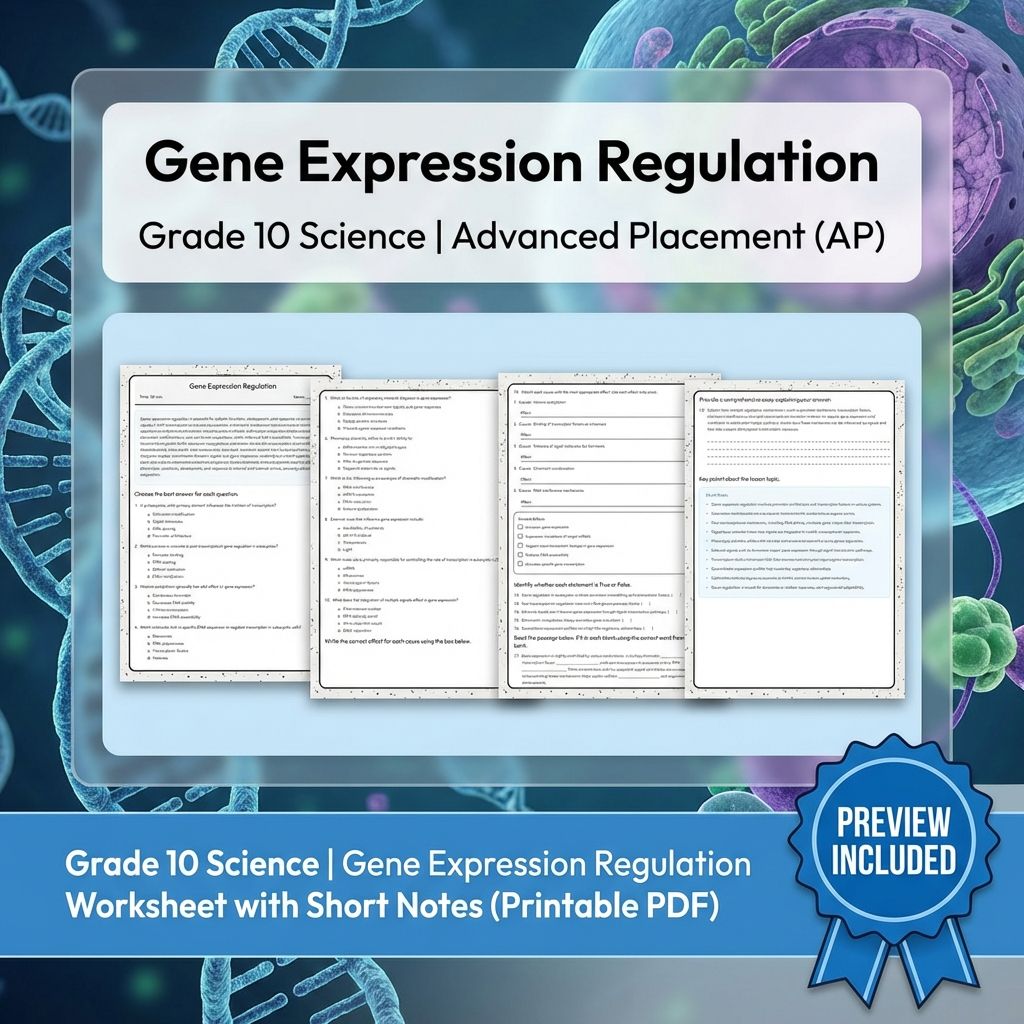
Grade 10 Science | Gene Expression Regulation Worksheet with Short Notes (PDF)
Created byMeadowlark WorksheetsLearning Objectives
- Understand mechanisms that control gene expression in prokaryotic and eukaryotic cells.
- Identify key components such as promoters, transcription factors, and chromatin modifiers.
- Explain how regulatory networks influence cellular responses and phenotypic plasticity.
Instant download

Grade 10 Science | Microbe Diversity - Daily Reading Comprehension
Created byCoral Reef LearningLearning Objectives
- Identify the major groups of microorganisms: bacteria, archaea, viruses, fungi, and protists.
- Describe the cellular organization, genetic material, and reproduction strategies of different microbes.
- Explain the ecological roles and niches occupied by various microbial groups.
Instant download
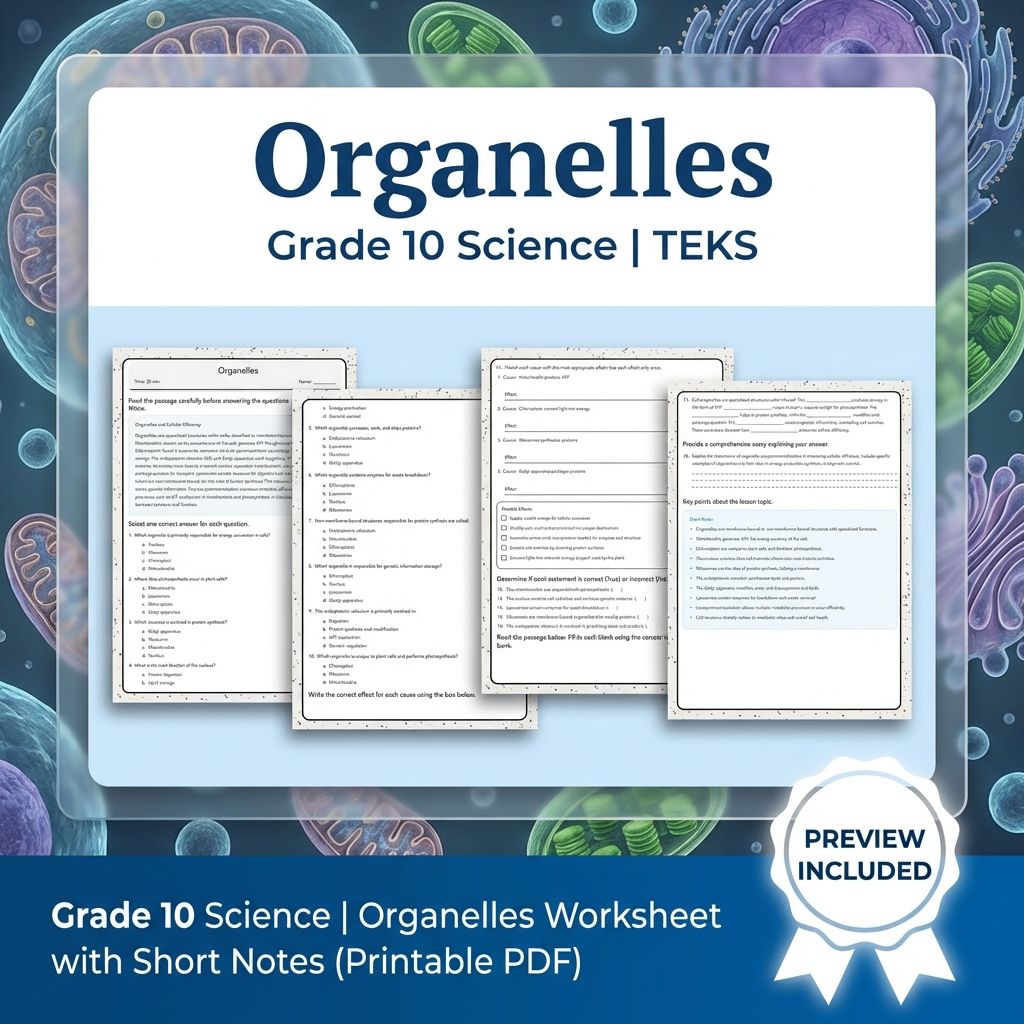
Grade 10 Science | Organelles Worksheet with Short Notes (Printable PDF)
Created byMeadowlark WorksheetsLearning Objectives
- Describe the functions of different cell organelles and their role in cellular efficiency.
- Compare membrane-bound and non-membrane-bound organelles in terms of structure and function.
- Explain how compartmentalization enhances metabolic processes within a cell.
Instant download

Grade 10 Sustainability Assessment Worksheet | Practice & PDF
Created byClear Sky ClassroomLearning Objectives
- Explain how sustainability assessments use environmental, economic, and social indicators to evaluate long-term viability.
- Describe how metrics such as renewal rates, pollutant loads, and ecosystem service trends support sustainability decisions.
- Interpret and communicate results from comparative assessments that balance extraction, conservation, and restoration.
Instant download
About Grade 10 Science Worksheets
Find Science worksheets built for Grade 10. All 7,038 cover core skills, practice, and review, each an instant PDF download.
Every worksheet on MyTeachingSheets is created by independent teacher-authors and reviewed before publication. All resources download as printable PDFs for classroom, homework, or at-home practice, and many include answer keys. Preview any worksheet free before buying.