
Grade 10 Science Worksheets
7,038 worksheets
Engineering Design Trade-Offs & Optimization Worksheets Grade 10
 Created byTeachers Club
Learning Objectives
- Compare design options using cost-benefit matrices and multiple objectives
- Identify non-dominated designs and interpret Pareto fronts
- Interpret sensitivity analysis results to evaluate design robustness
Also included in: Engineering Design Worksheets Grade 10 Science NGSS Bundle +1 more
Instant download
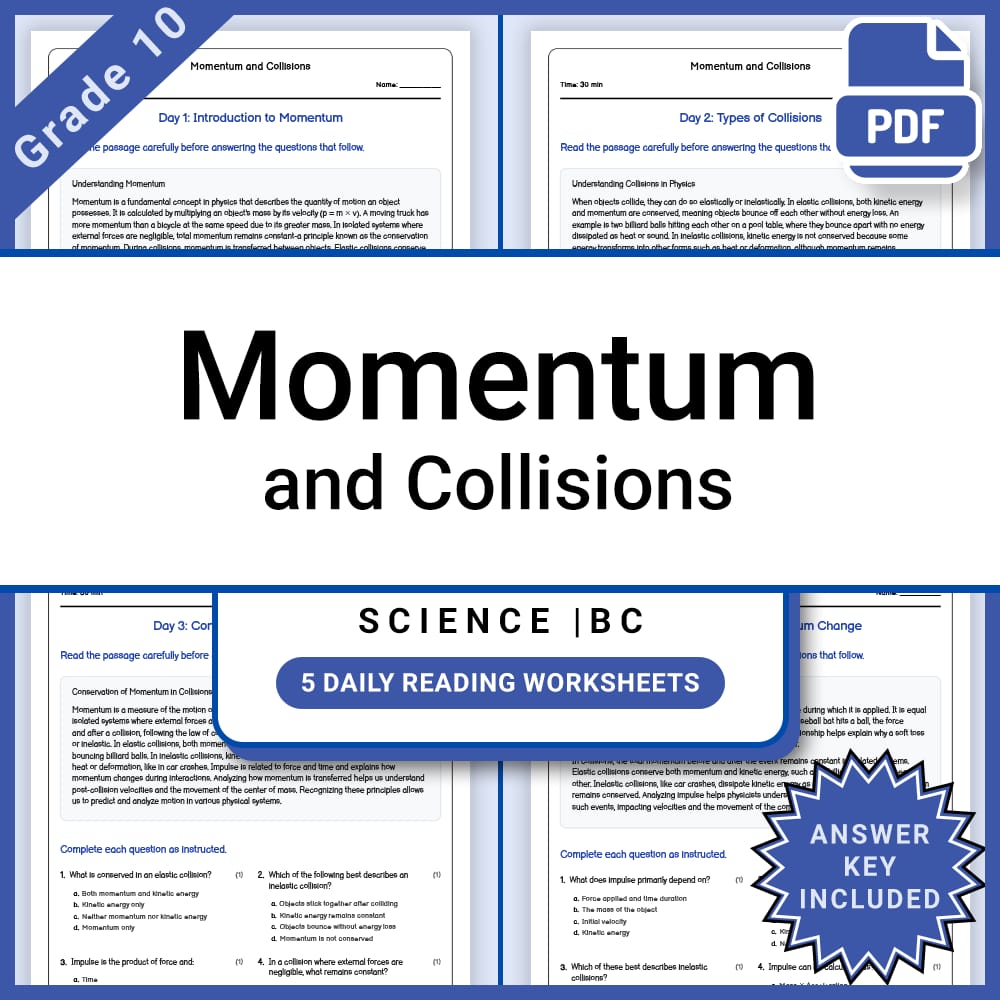
Grade 10 Science – Momentum and Collisions Daily Reading Worksheet + Answer Key
JCreated byJ.S SheetsLearning Objectives
- Understand the concept of linear momentum and how it is calculated.
- Learn about the principle of conservation of momentum in collisions.
- Differentiate between elastic and inelastic collisions.
Also included in: Grade 10 Science Lesson Group Bundle – Physics and Fields +1 more
Instant download
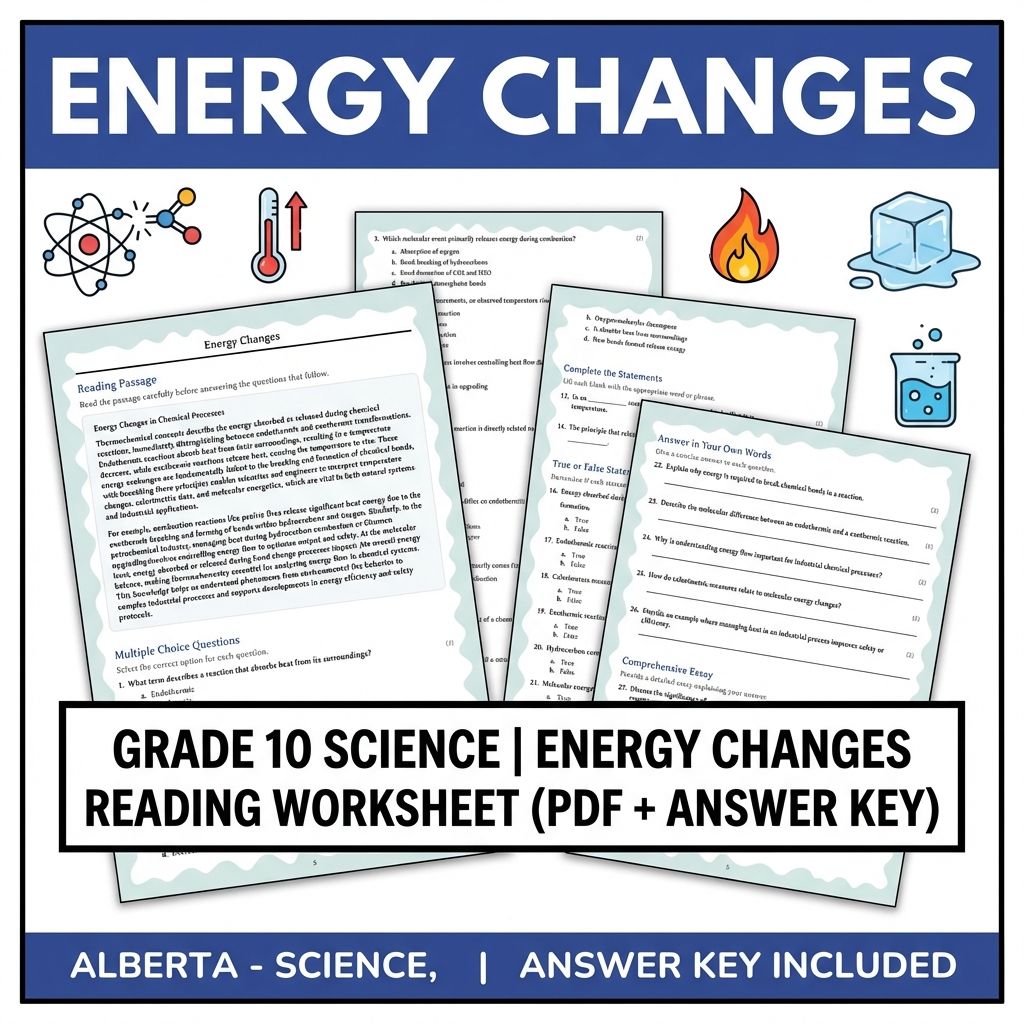
Grade 10 Science | Energy Changes Reading Worksheet (PDF + Answer Key)
JCreated byJ.S SheetsLearning Objectives
- Understand the principles of energy absorption and release during chemical changes.
- Distinguish between endothermic and exothermic transformations.
- Relate molecular energetics to macroscopic temperature changes and calorimetric measures.
Also included in: Grade 10 Science Unit Bundle | Chemical Reactions & Properties Worksheets +1 more
Instant download
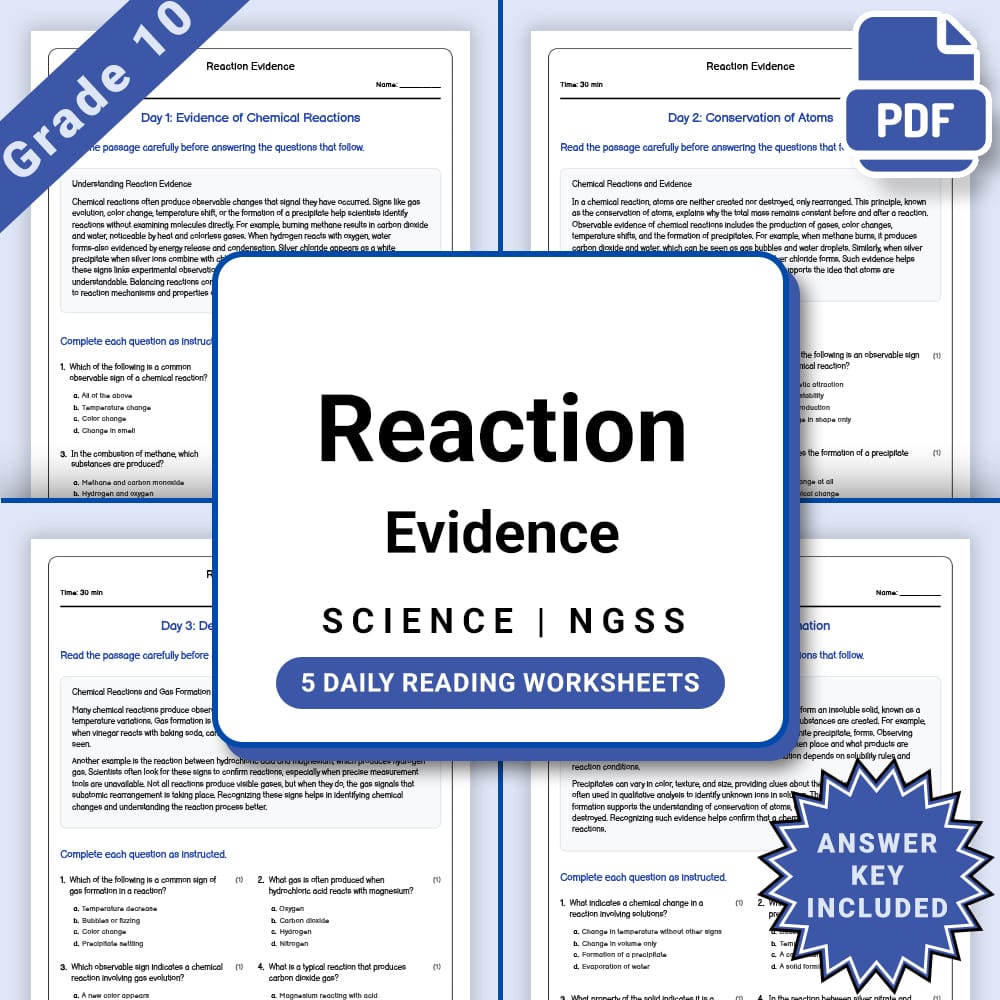
Grade 10 Science – Reaction Evidence Worksheet (PDF +Answer Key)
 Created byCopper Leaf Classroom
Learning Objectives
- Identify observable signs indicating a chemical reaction
- Understand how to connect reactant properties to products
- Use balanced chemical equations to explain reaction outcomes
Instant download

Grade 10 Science – One-Dimensional Motion Worksheet (Ontario Standards) (PDF)
 Created byEvergreen Desk Education
Learning Objectives
- Define displacement, speed, velocity, and acceleration for motion along one axis and interpret their signs.
- Use kinematic relationships to solve problems involving constant acceleration, including free fall and uniformly accelerated motion.
- Distinguish between average and instantaneous values of velocity and acceleration using correct mathematical notation.
Also included in: Grade 10 Kinematics Forces & Mechanics Science Lesson Bundle Ontario Worksheets +1 more
Instant download

Grade 10 Science | Succession Processes Worksheet (TEKS) (PDF)
Created byEvergreen Desk EducationLearning Objectives
- Differentiate primary and secondary ecological succession and describe how they start
- Explain how colonization, competition, facilitation, and resource availability shape successional pathways
- Evaluate how disturbance frequency and intensity can change successional direction and biodiversity
Instant download

Grade 10 Science | Climate Projections - Daily Reading Comprehension
 Created byCoral Reef Learning
Learning Objectives
- Understand the sources of climate data such as instrumental records, proxy data, and satellite observations.
- Analyze temperature, precipitation, and sea-level change data to identify trends.
- Learn how to attribute observed climate trends to radiative forcing.
Instant download
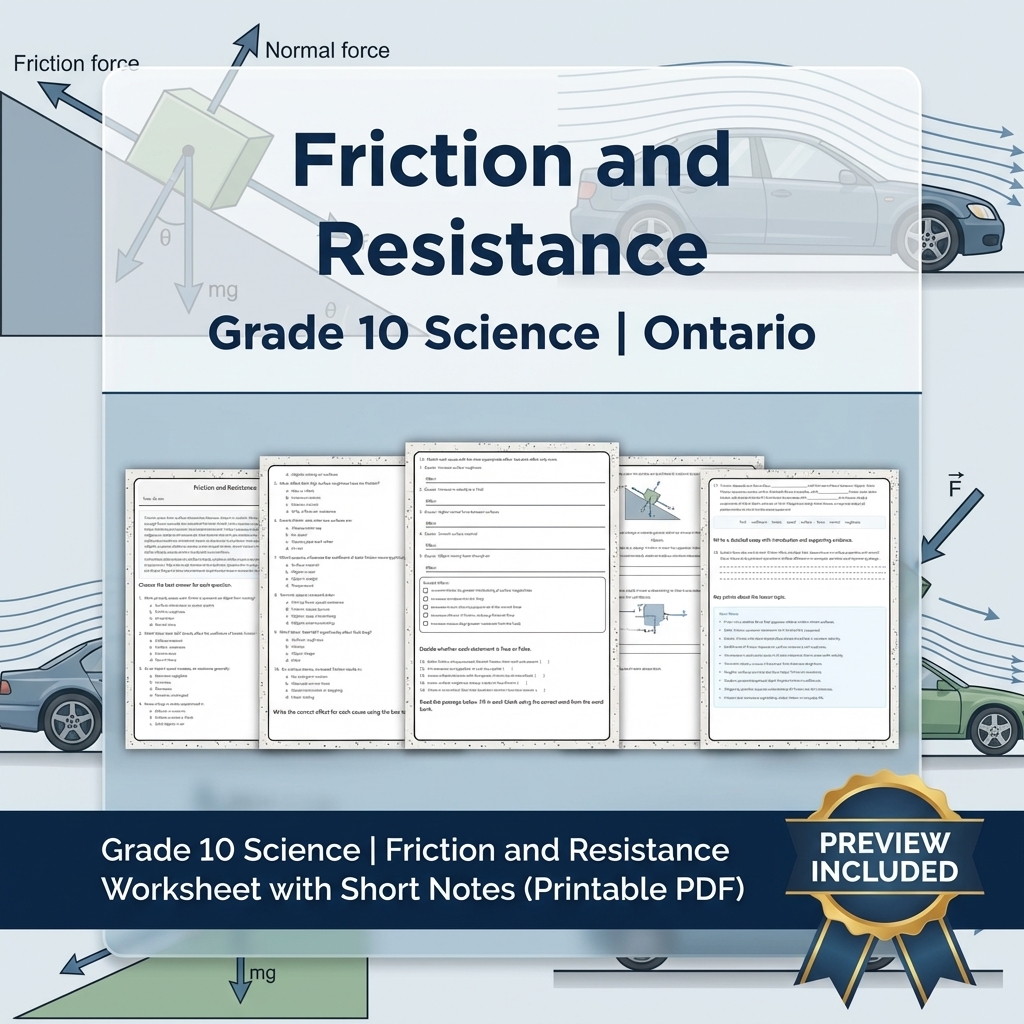
Grade 10 Science | Friction and Resistance Worksheet with Short Notes
 Created byMeadowlark Worksheets
Learning Objectives
- Explain the difference between static and kinetic friction.
- Describe how the coefficients of friction depend on surface properties.
- Understand the factors affecting air resistance and viscous drag.
Also included in: Grade 10 Science Lesson Group: Motion & Forces Ontario Curriculum Bundle +1 more
Instant download

Organ Systems Assessment | Alberta Standard Grade 10 Science
 Created byPrism Point Learning
Learning Objectives
- Describe how different organs integrate multiple tissue types to perform complex functions.
- Explain the relationship between organ structure and function in the context of survival within environmental gradients.
- Identify examples of organ systems like the digestive and root systems and their interactions with external environments.
Also included in: Grade 10 Cells and Systems Science Lesson Bundle for Alberta Standards +1 more
Instant download
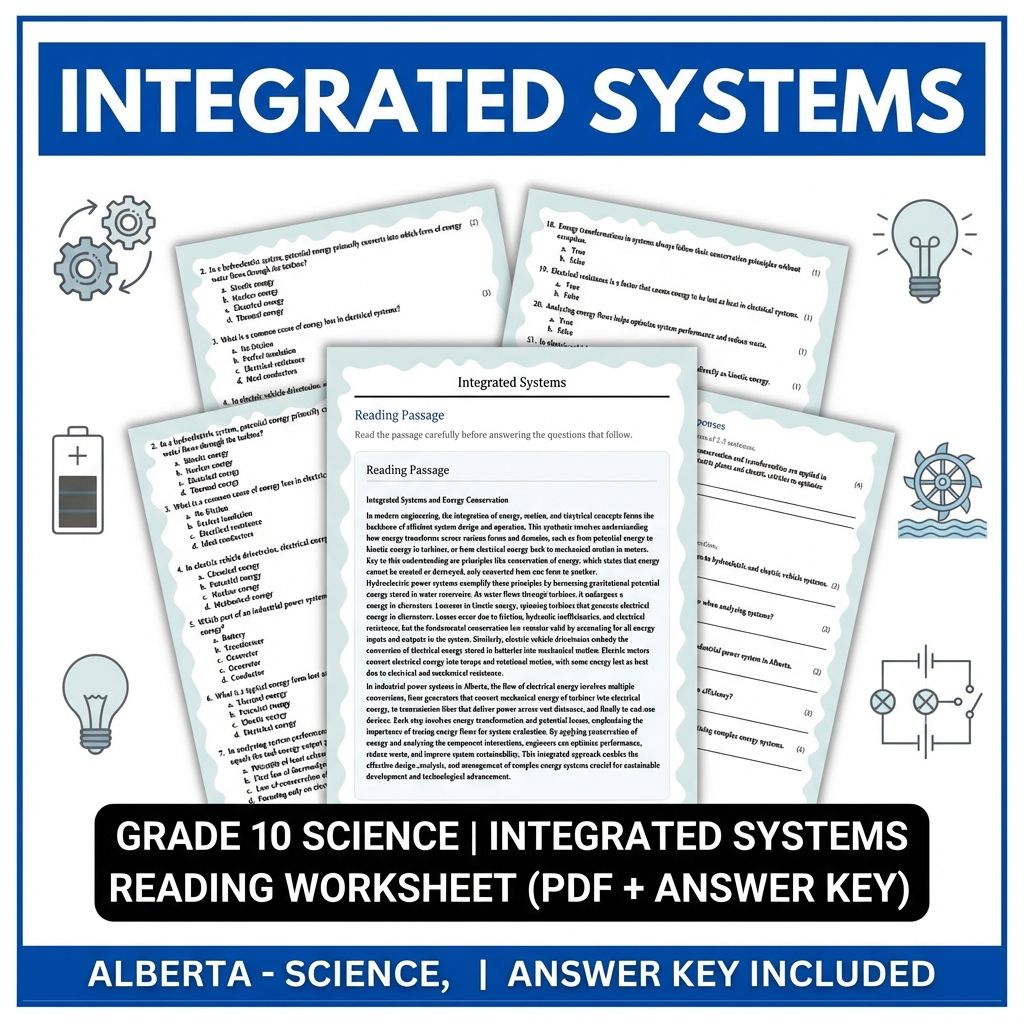
Grade 10 Science | Integrated Systems Reading Worksheet (PDF + Answer Key)
JCreated byJ.S SheetsLearning Objectives
- Analyze energy transformations in mechanical and electrical systems such as hydroelectric plants and electric vehicle drivetrains.
- Describe how conservation principles apply to multi-domain energy systems and account for energy losses.
- Evaluate system performance by tracing energy flows and conversions across mechanical and electrical components.
Also included in: Grade 10 Science Bundle | Energy, Circuits & Mechanics (Answer Keys Included) +1 more
Instant download

Grade 10 Science Worksheet: Cell Structure | Standards-Aligned Practice
JCreated byJ.S SheetsLearning Objectives
- Compare the major structures of eukaryotic and prokaryotic cells and explain how these structures support life processes.
- Describe how the cell membrane, cytoplasm, and genetic material coordinate cellular functions.
- Connect specialized cell structures to specialized roles in growth, maintenance, and reproduction.
Also included in: Grade 10 Life Science Evolution, Genetics & Cells Lesson Bundle – Florida NGSSS +1 more
Instant download
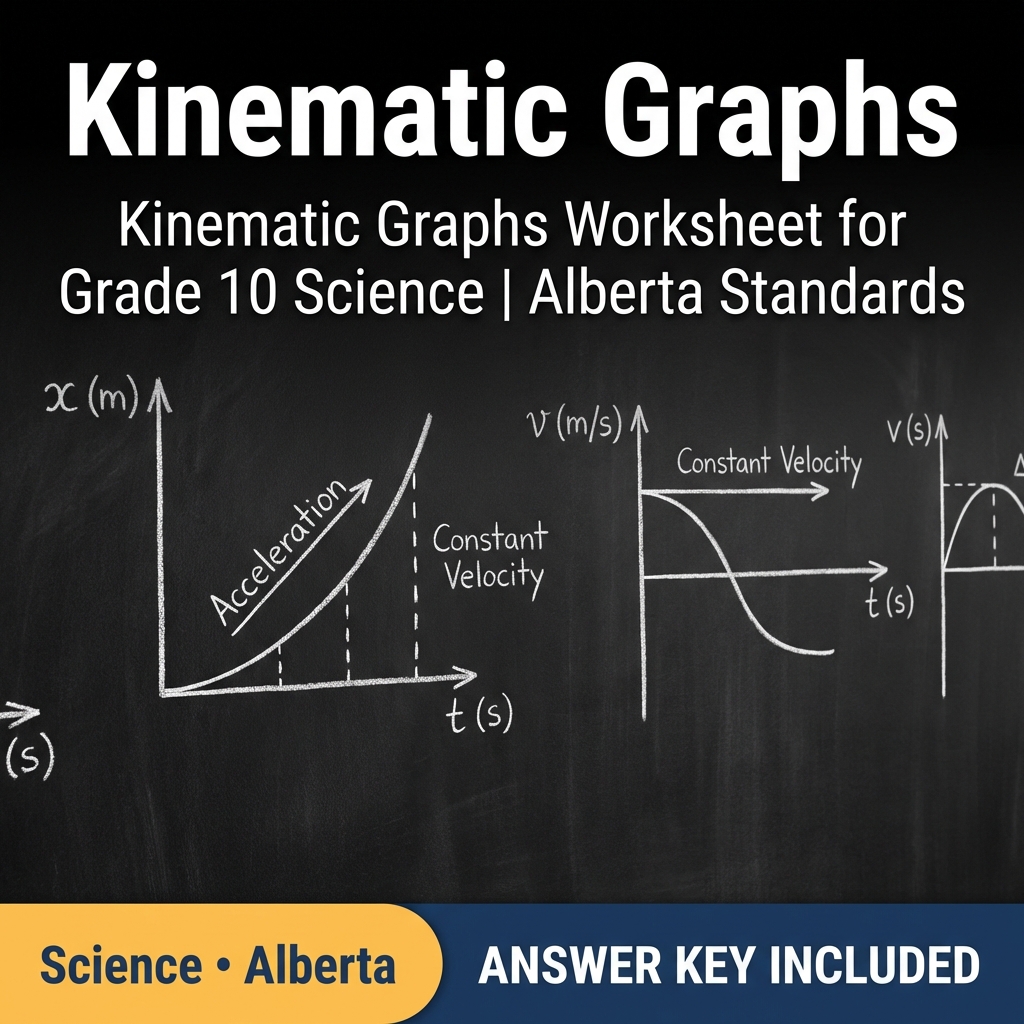
Kinematic Graphs Worksheet for Grade 10 Science | Alberta Standards
Created byCoral Reef LearningLearning Objectives
- Understand how position, velocity, and acceleration graphs represent motion.
- Interpret slopes and areas under curves to find instantaneous and average quantities.
- Apply graph analysis techniques to real-world vehicle motion on hilly roads and sled profiles.
Instant download
Grade 10 Science Worksheet on Molar Relationships | Alberta Standards
Created byCoral Reef LearningLearning Objectives
- Understand how the mole concept relates particle counts to measurable mass.
- Perform molar conversions between particles, moles, and mass.
- Identify limiting reagents and estimate yields in chemical reactions.
Instant download

Grade 10 Science | Action Reaction Worksheet (PDF) BC Standards
Created byEvergreen Desk EducationLearning Objectives
- Explain Newton’s third law using the idea of action-reaction force pairs (equal magnitude, opposite direction).
- Distinguish between forces on different objects in action-reaction pairs and predict resulting acceleration using Newton’s second law.
- Apply action-reaction reasoning to collisions, rocket thrust, and contact-force situations.
Instant download

Grade 10 Science – Forces And Motion Worksheet (PDF) | Standard Aligned
Created byEvergreen Desk EducationLearning Objectives
- Explain how net force affects an object's acceleration and changes in velocity
- Distinguish gravity, contact forces, friction, and inertia in everyday motion
- Use qualitative reasoning to connect the direction of net force to the direction of acceleration
Also included in: Grade 10 Conservation Laws in Science Lesson Bundle – General Framework +1 more
Instant download

Negative Feedback Worksheet | Grade 10 Science Activities
Created byPrism Point LearningLearning Objectives
- Explain how negative feedback reduces deviations from a set point in a regulation system.
- Identify the roles of sensors, control centers, and effectors in maintaining internal stability.
- Apply negative feedback concepts to real physiological examples such as temperature, blood glucose, and blood pressure.
Instant download

Ecosystem Modeling Worksheet | NGSS Grade 10 Science printable PDF
Learning Objectives
- Explain how ecosystem models represent flows of energy and matter and why they help with predictions
- Interpret the meaning of model parameters, steady states, and system responses to perturbations
- Use conceptual and quantitative reasoning to evaluate resilience, tipping points, and consequences of disturbances
Also included in: Grade 10 Ecosystem Dynamics Lesson Bundle | NGSS Science Ecology
Instant download

Aerobic Respiration and Oxygen Use Worksheet | Grade 10 TEKS Science
 Created byBRIGHT PATH RESOURCES
Learning Objectives
- Identify key details of aerobic respiration and where it occurs in cells
- Compare oxygen’s role in aerobic respiration with energy outcomes
- Explain how cellular location relates to energy production
Also included in: Grade 10 Metabolism & Energy Processes Science Worksheets Bundle | TEKS +1 more
Instant download
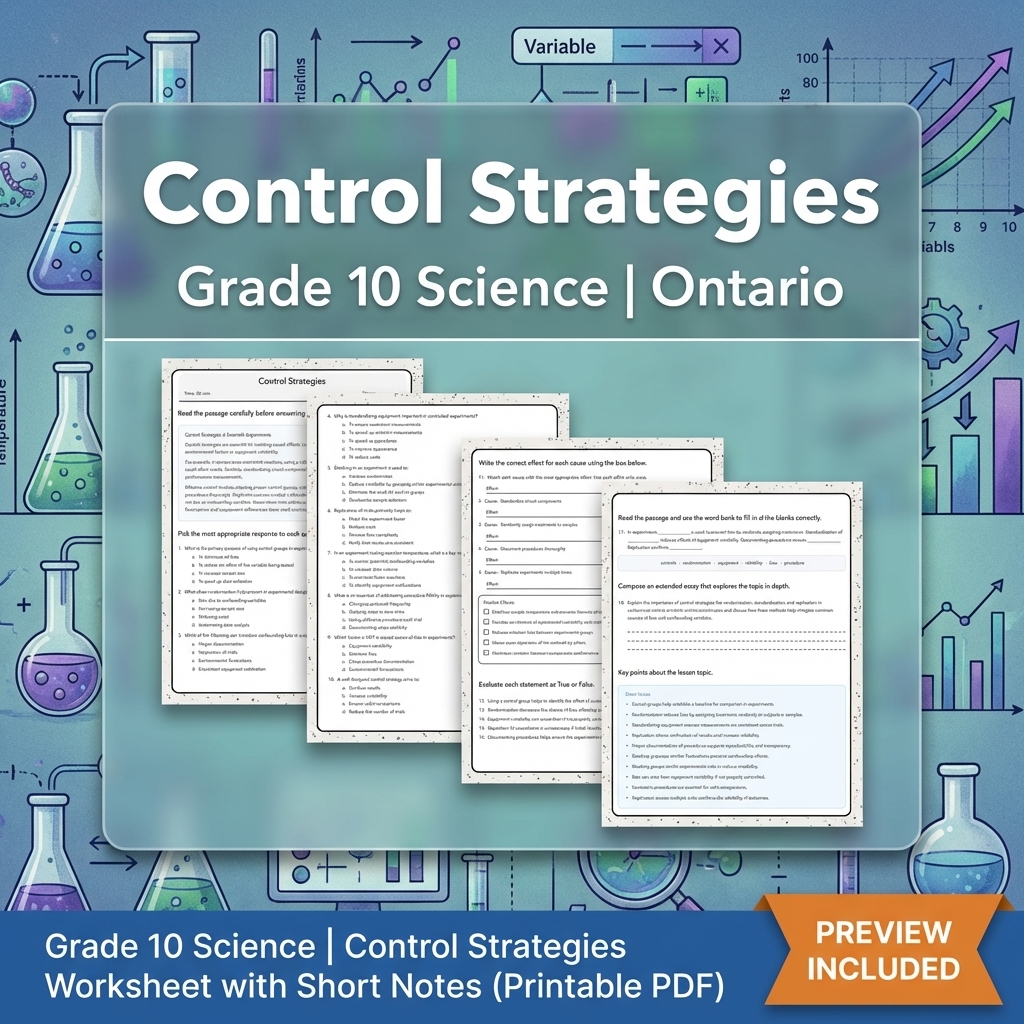
Grade 10 Science | Control Strategies Worksheet with Short Notes (Printable PDF)
Created byMeadowlark WorksheetsLearning Objectives
- Understand the purpose of control groups and randomization in experiments.
- Identify common sources of bias and confounding factors such as equipment variability and environmental fluctuations.
- Explain different levels of control and methods to document procedure fidelity for valid experimental comparisons.
Also included in: Grade 10 Science Lesson Group Bundle | Ontario Curriculum Worksheets +1 more
Instant download

Grade 10 Science – Shared Genetic Mechanisms & Evolution | Reading Worksheet
 Created byBright Mind Resources
Learning Objectives
- Understand the concept of genetic similarity across different organisms.
- Identify key concepts related to conserved genes and pathways.
- Analyze how genetic similarities support the theory of common ancestry.
Also included in: Grade 10 Genetics & Evolution Science Lesson Bundle | California Standards +1 more
Instant download
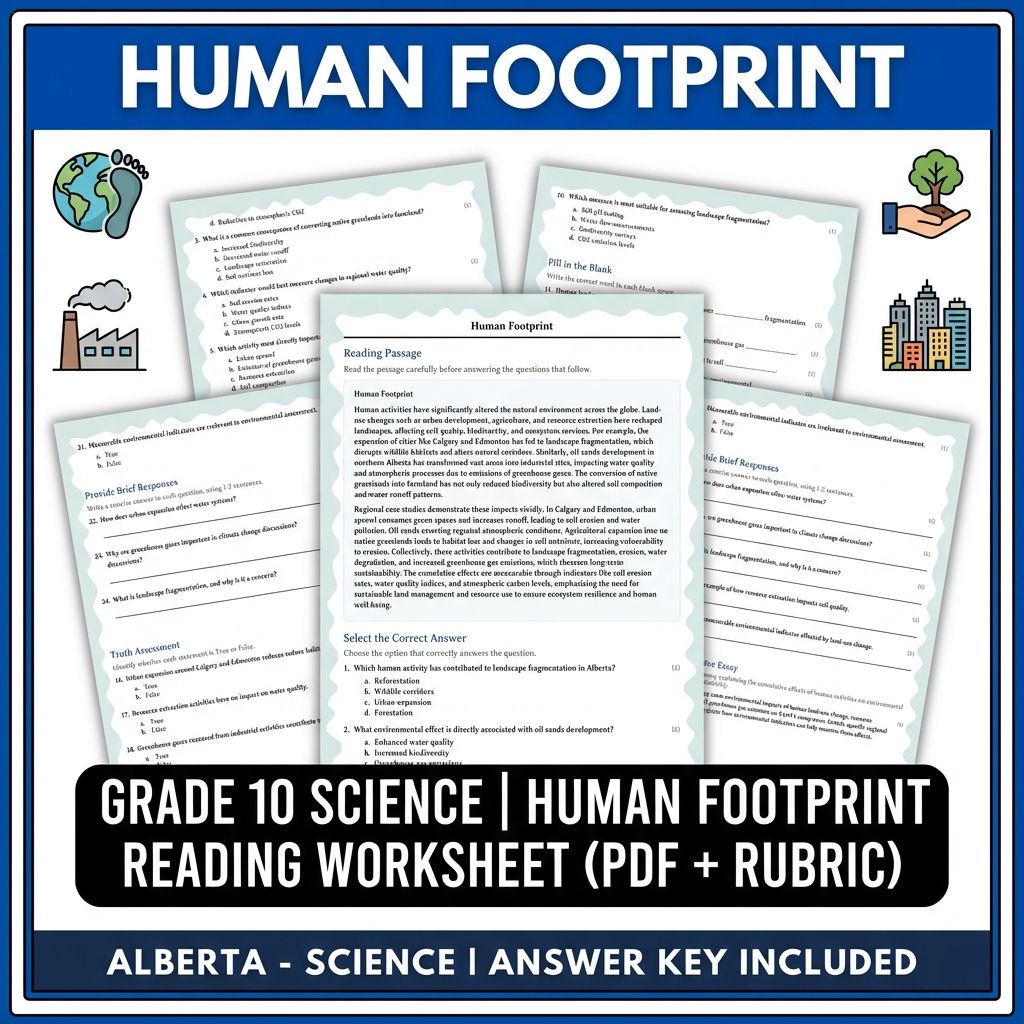
Grade 10 Science | Human Footprint Reading Worksheet (PDF + Rubric)
JCreated byJ.S SheetsLearning Objectives
- Understand how human activities impact Earth's land, water, and atmosphere.
- Identify regional examples of environmental change caused by human development.
- Analyze the long-term effects of land-use and resource extraction on ecosystems.
Also included in: Grade 10 Science Unit Bundle – Earth Systems, Climate & Remote Sensing Worksheets +1 more
Instant download
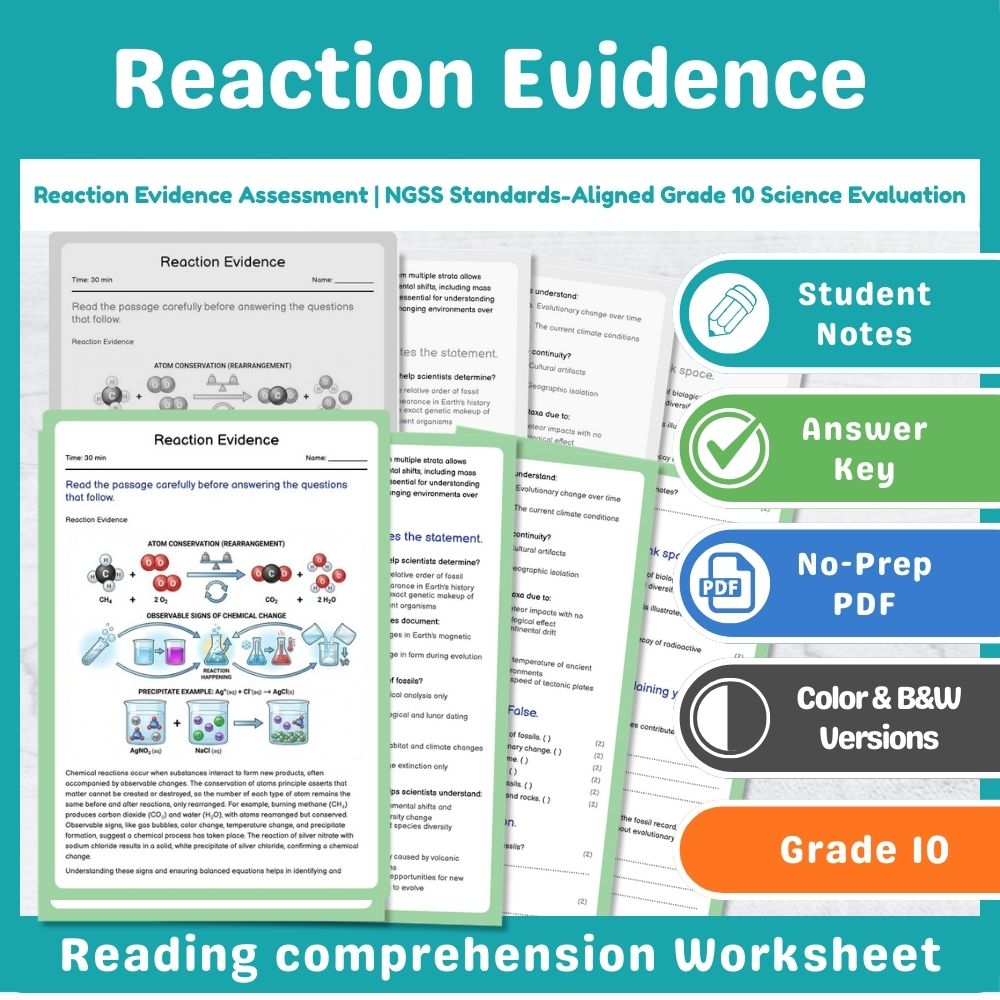
Reaction Evidence Assessment | NGSS Standards-Aligned Grade 10 Science Evaluation
Created byPrism Point LearningLearning Objectives
- Understand how conservation of atoms supports chemical reaction evidence.
- Identify observable signs indicating chemical reactions such as gas production, color change, and precipitate formation.
- Apply the principles of balanced equations to explain reaction outcomes.
Instant download

Grade 10 Trade Off Optimization in Engineering Worksheet | NGSS STEM Activity
Created byBRIGHT PATH RESOURCESLearning Objectives
- Understand the concept of trade-offs in engineering design
- Analyze cost-benefit relationships using matrices
- Identify Pareto optimal solutions
Also included in: Engineering Design Foundations Grade 10 Science Daily Reading Bundle | NGSS +1 more
Instant download
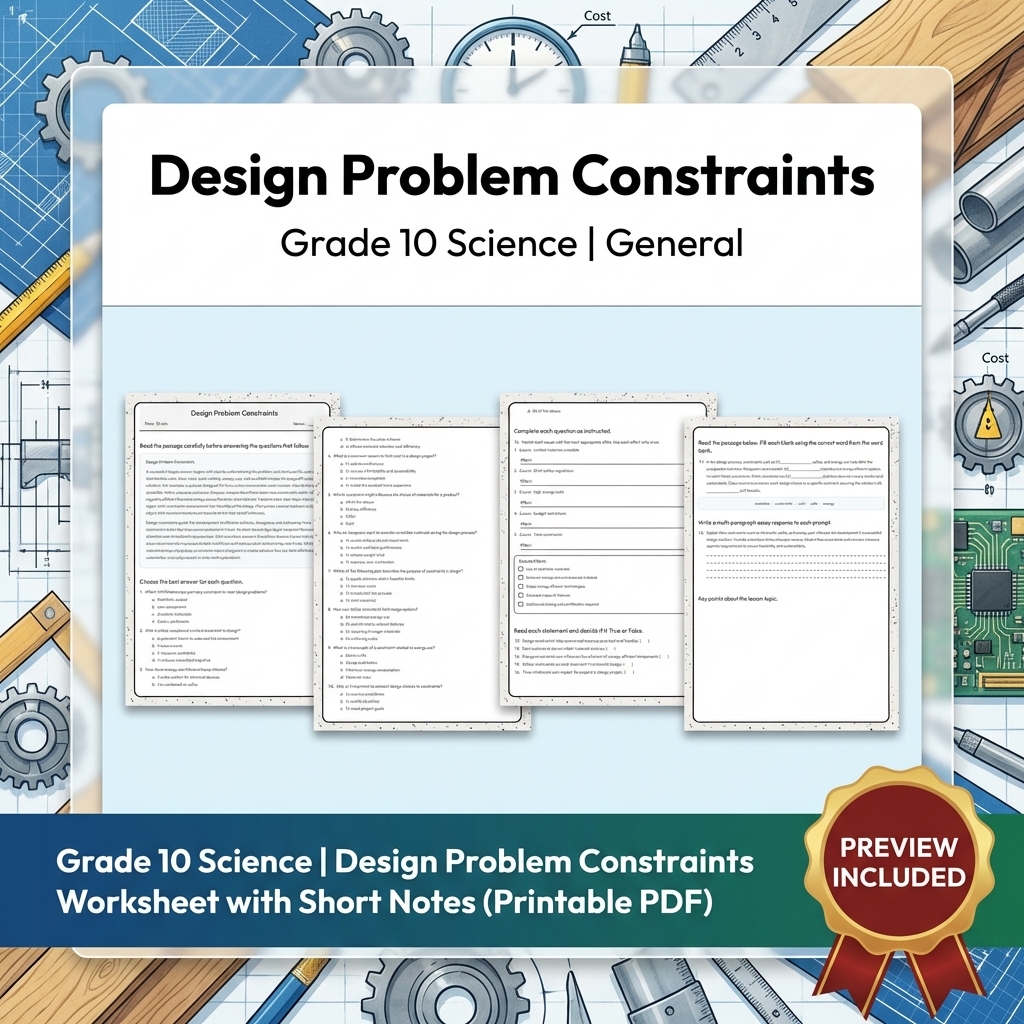
Grade 10 Science | Design Problem Constraints Worksheet with Short Notes
Created byMeadowlark WorksheetsLearning Objectives
- Understand how constraints influence design solutions.
- Identify different types of constraints such as time, cost, and safety.
- Explain how design choices meet constraints while limiting unwanted effects.
Also included in: Grade 10 Design Tradeoffs in Science Lesson Bundle: Systems & Optimization +1 more
Instant download

Grade 10 Science Models and Explanations Worksheet Pack | NGSSS
Created byPrism Point LearningLearning Objectives
- Explain how scientific models represent key features of a system to predict behavior.
- Use evidence to connect observations to mechanisms in a scientific explanation.
- Identify where a model works well and where it fails, including common limitations.
Instant download
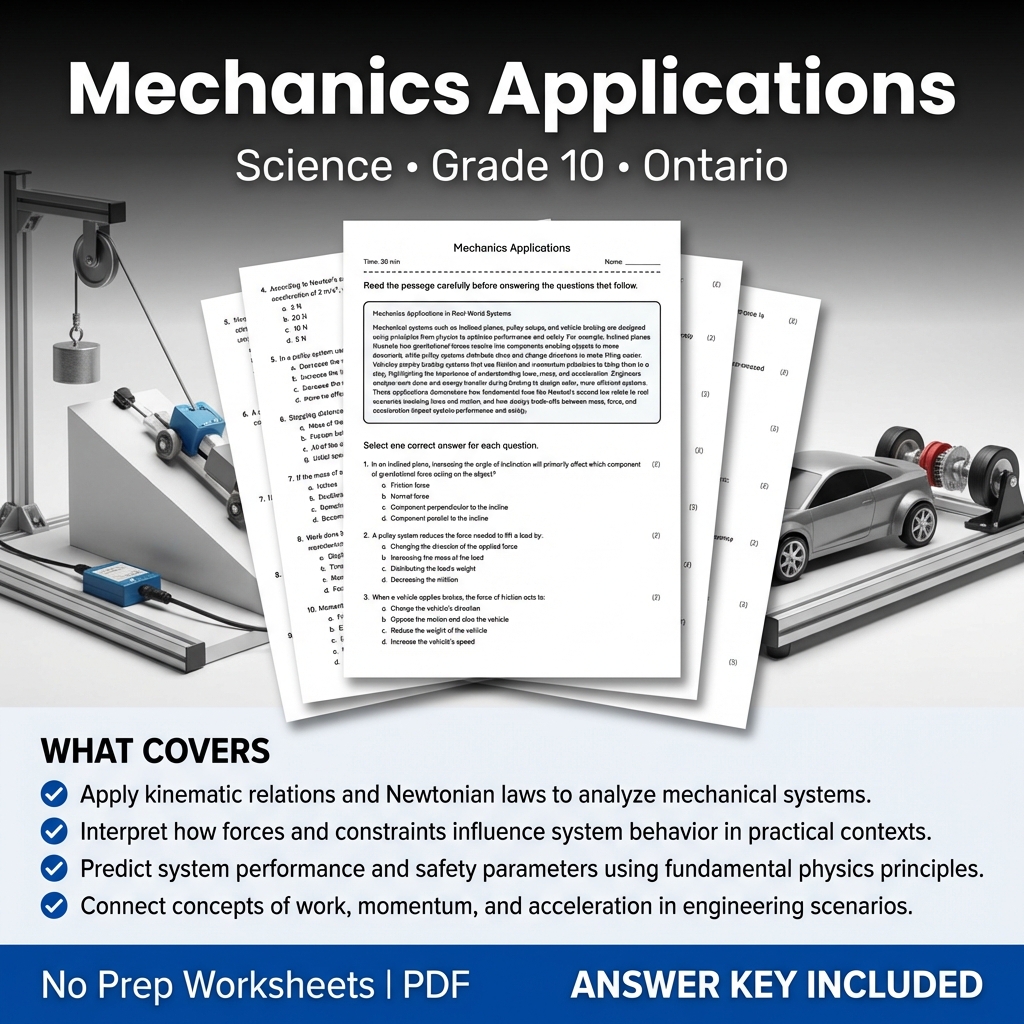
Mechanics Applications Worksheet for Grade 10 Science | Ontario Standards
Created byCoral Reef LearningLearning Objectives
- Apply kinematic relations and Newtonian laws to analyze mechanical systems.
- Interpret how forces and constraints influence system behavior in practical contexts.
- Predict system performance and safety parameters using fundamental physics principles.
Instant download
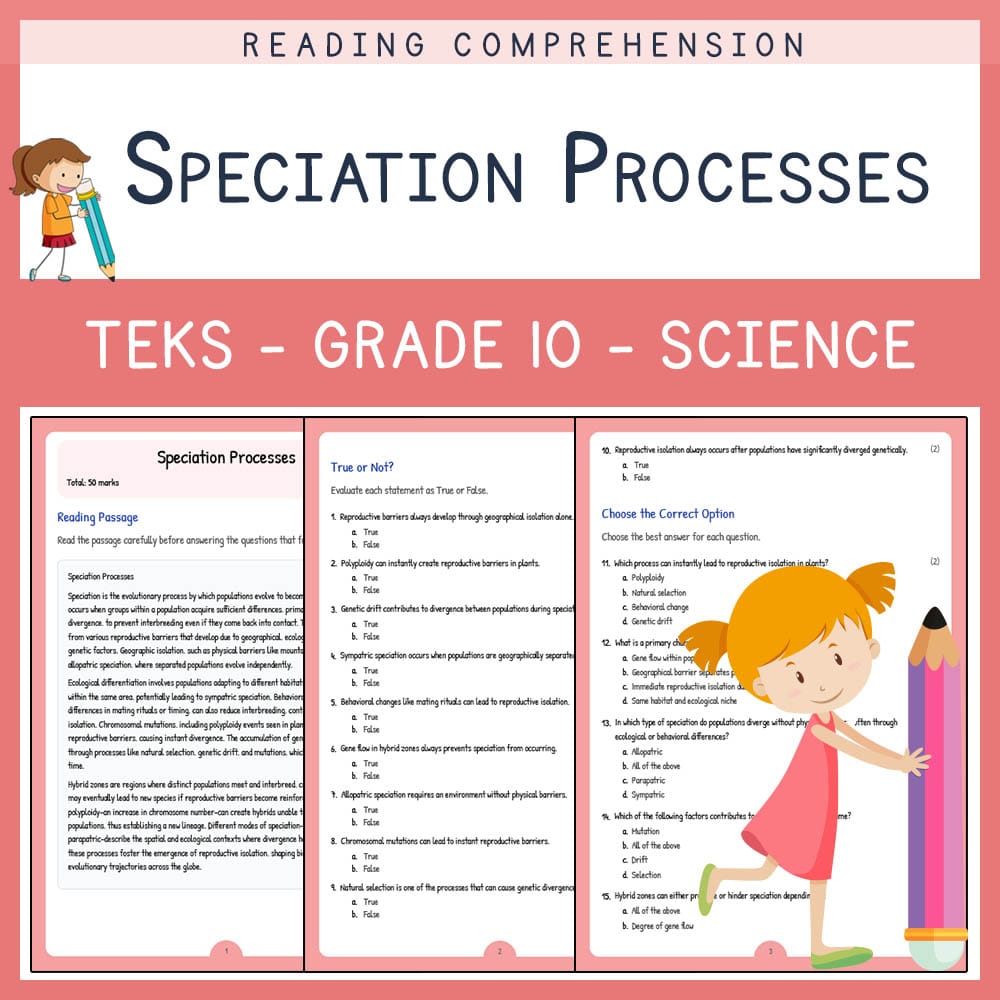
Grade 10 Science | Speciation Processes Worksheet | TEKS Aligned
 Created byLumora Learning
Learning Objectives
- Understand the mechanisms that lead to the formation of new species.
- Identify different types of reproductive barriers and their roles in speciation.
- Describe the spatial and ecological contexts in which speciation occurs.
Also included in: Grade 10 Science | Evolution & Classification Lesson Bundle | TEKS Aligned +1 more
Instant download

Grade 10 Science | Signal Transmission in Science - Daily Reading Comprehension
Created byCoral Reef LearningLearning Objectives
- Understand the basic concepts of signals and modulation techniques.
- Identify how amplitude, frequency, and phase modulation differ.
- Recognize the impact of channel constraints like bandwidth and noise.
Instant download
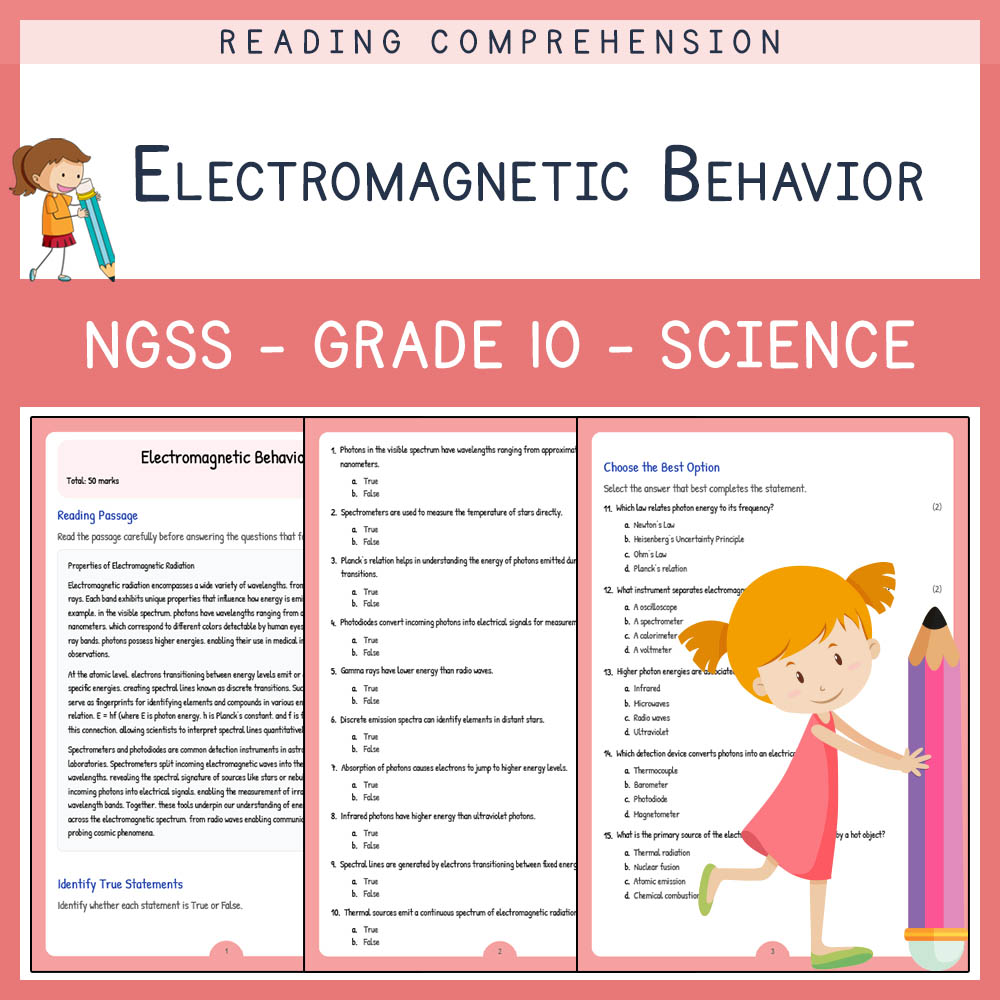
Grade 10 Science | Electromagnetic Behavior Worksheet & Answer Key |NGSS Aligned
Created byLumora LearningLearning Objectives
- Understand the relationship between photon energy and electromagnetic spectrum signatures.
- Interpret spectral emission and absorption processes in atomic and thermal sources.
- Explain how detection mechanisms like spectrometers and photodiodes analyze electromagnetic radiation across different bands.
Instant download

Science Worksheet: Gravity and Orbits for Grade 10 | Standards-Aligned Practice
JCreated byJ.S SheetsLearning Objectives
- Explain how gravity and motion interact to produce stable orbital motion
- Describe how orbital distance and speed vary along an elliptical orbit
- Connect gravitational interactions to tides and predictable astronomical events
Also included in: Grade 10 Earth and Space Systems Science Lesson Bundle – Florida NGSSS +1 more
Instant download

Magnetic Fields Worksheet | Grade 10 Science Activities
Created byPrism Point LearningLearning Objectives
- Explain how magnetic fields are produced by moving charges and electrical currents
- Describe how magnetic forces act on moving charges and how they affect particle motion
- Use magnetic field line diagrams to infer direction around magnets and currents
Also included in: Forces, Motion & Fields Lesson Bundle | Grade 10 Science | BC +1 more
Instant download
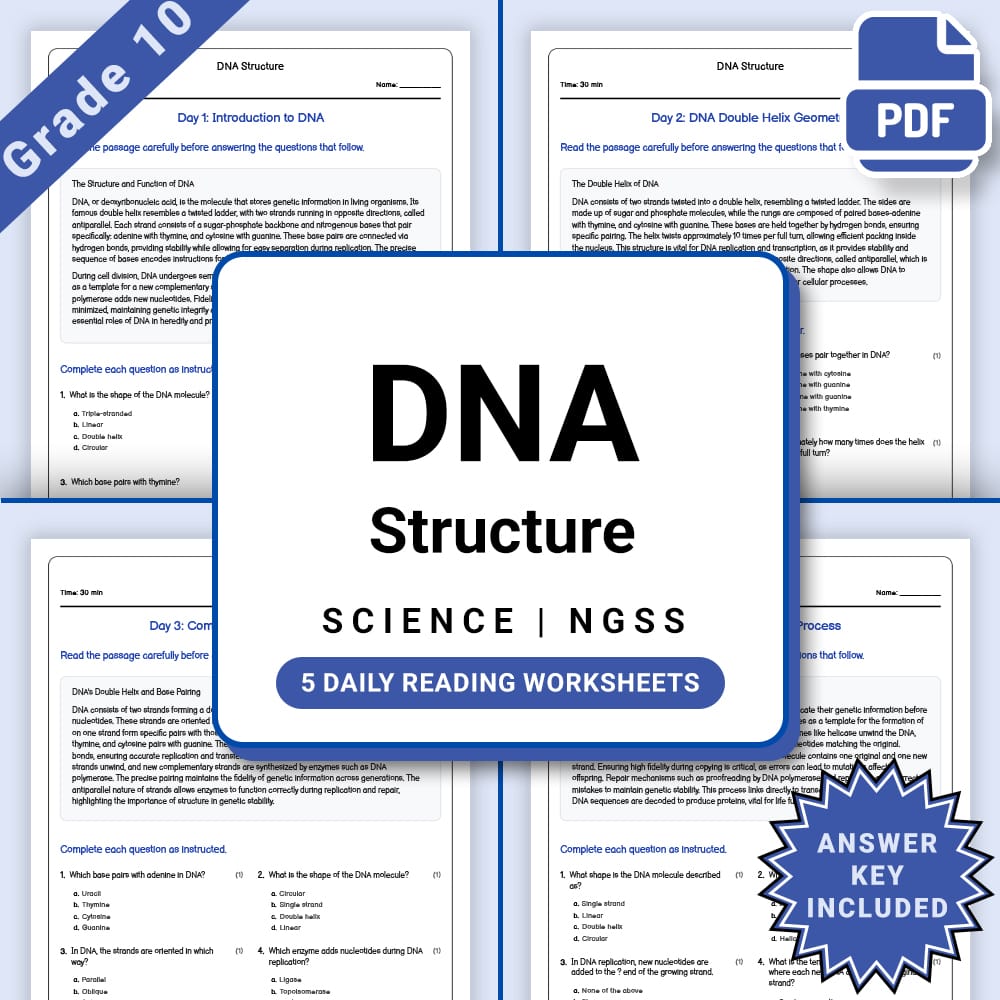
Grade 10 Science – DNA Structure Daily Reading Worksheet (PDF +Answer Key)
Created byCopper Leaf ClassroomLearning Objectives
- Understand the basic components of DNA, including nucleotides and the double helix structure.
- Identify the mechanisms of DNA replication, including the roles of key enzymes.
- Explain the connection between DNA sequences and protein synthesis through transcription and translation.
Instant download

Grade 10 AP Physics Projectile Motion Worksheet & Activities Pack
Created byPrism Point LearningLearning Objectives
- Decompose projectile motion into independent horizontal and vertical components under uniform gravitational acceleration.
- Use kinematic equations to predict time of flight, peak height, and range for a projectile launched and landing at the same height.
- Identify key model assumptions (no air resistance, uniform gravity) and explain how approximations affect predictions.
Instant download

Grade 10 Science Equilibrium Systems Worksheet (Ontario Standards) (PDF)
Created byEvergreen Desk EducationLearning Objectives
- Explain static equilibrium using the criteria ΣF = 0 and (when applicable) ΣM = 0, relating them to the absence of net acceleration
- Determine how forces such as tension and support reactions must balance in rigid bodies supported or suspended by multiple supports/strings
- Interpret equilibrium situations qualitatively, distinguishing equilibrium from having no individual forces
Also included in: Grade 10 Kinematics Forces & Mechanics Science Lesson Bundle Ontario Worksheets +1 more
Instant download
Grade 10 Science | Specialized Cells Worksheet (Ontario) Science (PDF)
Created byBright Mind ResourcesLearning Objectives
- Understand how cellular specialization leads to tissue and organ function.
- Identify morphological features that support specific physiological roles.
- Explain how gene expression influences cell differentiation.
Instant download

Grade 10 Science Worksheet – Adaptive Radiation (TEKS) | PDF
Created byEvergreen Desk EducationLearning Objectives
- Explain how adaptive radiation leads to rapid formation of multiple closely related species.
- Connect environmental pressures and resource availability to differences in morphology, behavior, and physiology.
- Interpret phylogenetic patterns to describe branching bursts and timing of ecological opportunity.
Instant download
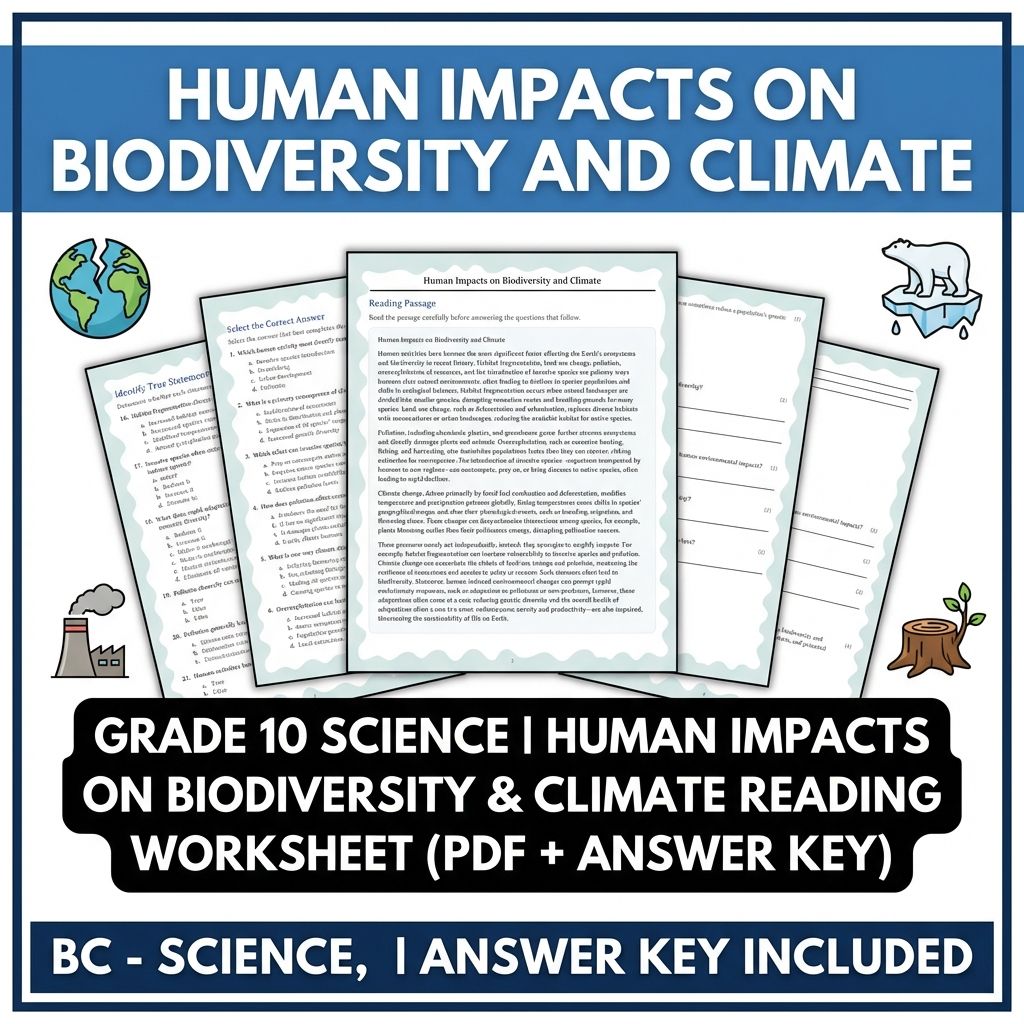
Grade 10 Science | Human Impacts on Biodiversity & Climate (PDF + Answer Key)
JCreated byJ.S SheetsLearning Objectives
- Understand the key human activities that threaten biodiversity.
- Describe how climate change impacts species distributions and phenology.
- Identify interactions between human activities and climate change effects.
Instant download

Grade 10 Science | Membrane Transport - Daily Reading Comprehension
Created byCoral Reef LearningLearning Objectives
- Understand the structure of the plasma membrane using the fluid mosaic model.
- Identify components of the membrane such as phospholipids, proteins, and cholesterol.
- Differentiate between transport protein types: channels, carriers, and pumps.
Instant download

Grade 10 Science – Species Interactions Worksheet (PDF) BC Standards
Created byEvergreen Desk EducationLearning Objectives
- Explain how competition, predation, parasitism, mutualism, and commensalism influence species abundance and community structure
- Describe how niche partitioning and competitive exclusion help determine whether similar species can coexist
- Analyze how keystone species and interaction networks can cause indirect and cascading effects in ecosystems
Instant download

Grade 10 Science | Specialized Cells Worksheet | NGSSS Aligned
Created byLumora LearningLearning Objectives
- Explain how specialized cell structures relate to specific cell functions in multicellular organisms
- Identify examples of specialized cells for transport, protection, absorption, and signaling and connect them to internal and surface features
- Describe how cell connections and communication pathways support tissue and system performance
Instant download

Grade 10 Science – Energy Flow in Ecosystems | Daily Reading Worksheet
Created byBright Mind ResourcesLearning Objectives
- Understand how sunlight is the primary energy source for ecosystems
- Identify the role of photosynthetic organisms in energy transfer
- Describe how energy moves through trophic levels
Also included in: Grade 10 Ecosystems Science Lesson Bundle Daily Reading | TEKS +2 more
Instant download

Grade 10 Science – Enzymes & Rates | Daily Reading Worksheet
Created byBright Mind ResourcesLearning Objectives
- Define enzymes and explain their role in biological reactions.
- Identify factors that influence enzyme activity, including temperature, pH, and substrate concentration.
- Describe different types of enzyme inhibitors and their effects.
Also included in: Grade 10 Cell Processes & Energy Science Daily Reading Lesson Bundle | Ontario +1 more
Instant download

Grade 10 Physics Electric Charge & Fields Worksheet | Alberta Science
Created byEvergreen Desk EducationLearning Objectives
- Describe how the sign and magnitude of electric charge determine attraction and repulsion
- Use Coulomb’s law to reason about the force between two charges at a distance
- Interpret electric field lines to predict the direction and relative strength of electric fields
Instant download

Chemical Properties and Evidence of Reactions Worksheets Grade 10
Created byPrism Point LearningLearning Objectives
- Explain how chemical properties describe reaction tendencies
- Identify pH shifts and gas formation as reaction evidence
- Relate bonding changes to observed chemical reaction outcomes
Also included in: Matter & Chemical Change Grade 10 Science Worksheets Ontario Bundle
Instant download

Grade 10 Science | Environmental Chemistry - Daily Reading Comprehension
Created byCoral Reef LearningLearning Objectives
- Understand the chemical pathways involved in atmospheric photochemistry.
- Identify the processes leading to ozone and smog formation in urban environments.
- Interpret mass flow and reaction rate influences on air pollution.
Also included in: Matter and Chemical Change Lesson Bundle: Grade 10 Science Alberta +1 more
Instant download

Carbon Cycling Assessment | TEKS Grade 10 Science Standards-Aligned
Created byPrism Point LearningLearning Objectives
- Explain the process of carbon cycling among different Earth reservoirs.
- Identify the roles of photosynthesis and respiration in carbon transfer.
- Describe human impacts on carbon fluxes and their effects on climate.
Instant download

Grade 10 Science | Energy Pathways Worksheet (AP Standards) (PDF)
Created byEvergreen Desk EducationLearning Objectives
- Explain how solar radiation is absorbed and redistributed through Earth system energy pathways.
- Connect sensible and latent heat fluxes to changes in surface temperature and phase of water.
- Use simplified energy-budget ideas to relate radiative inputs to temperature and seasonal cycles.
Also included in: Grade 10 Earth and Climate Systems Science Lesson Bundle Worksheets (AP) +1 more
Instant download

Comparing Photosynthesis Inputs and Outputs Worksheet | Grade 10 TEKS
Created byBRIGHT PATH RESOURCESLearning Objectives
- Identify inputs and outputs of photosynthesis in cells
- Compare photosynthesis reaction products with the needs of cellular respiration
- Use evidence statements to summarize how energy and matter move
Also included in: Grade 10 Metabolism & Energy Processes Science Worksheets Bundle | TEKS +1 more
Instant download
About Grade 10 Science Worksheets
Find Science worksheets built for Grade 10. All 7,038 cover core skills, practice, and review, each an instant PDF download.
Every worksheet on MyTeachingSheets is created by independent teacher-authors and reviewed before publication. All resources download as printable PDFs for classroom, homework, or at-home practice, and many include answer keys. Preview any worksheet free before buying.