
Grade 11 Science Worksheets
6,616 worksheets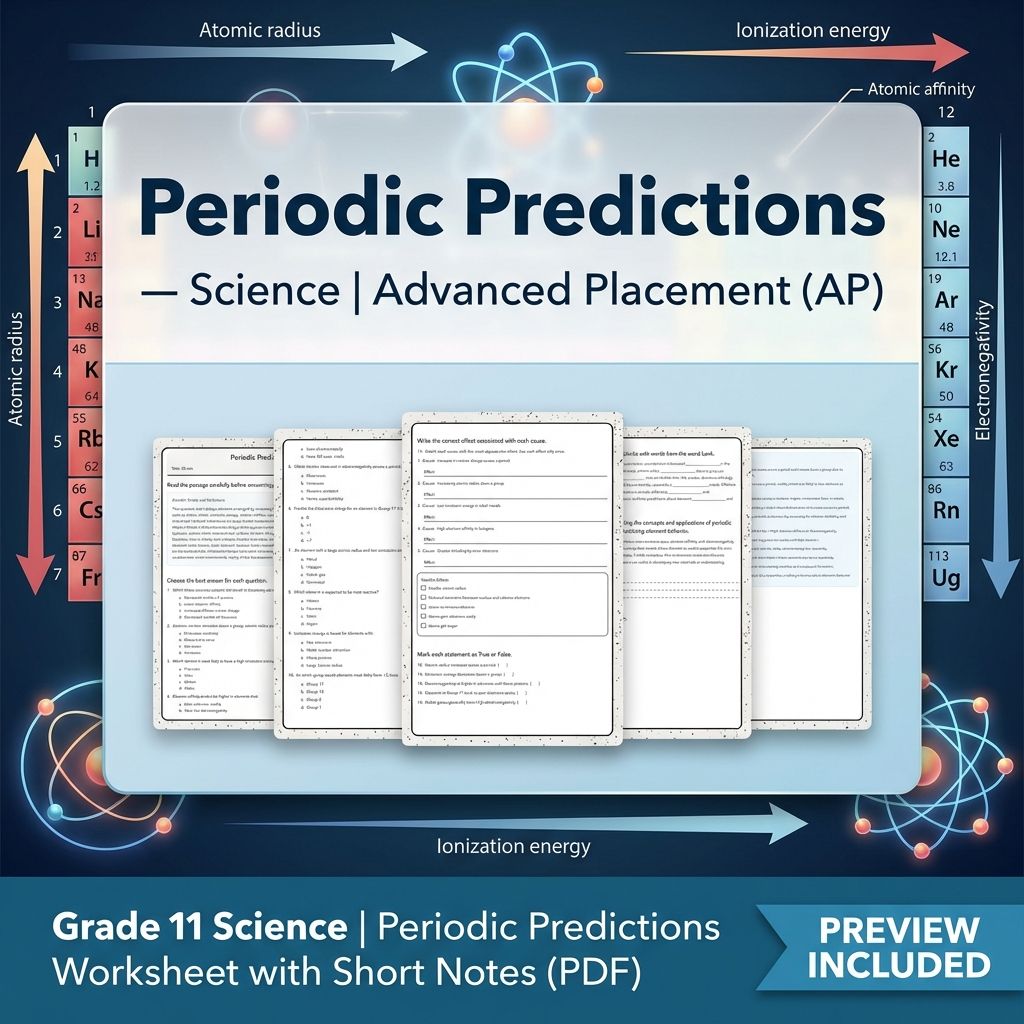
Grade 11 Science | Periodic Predictions Worksheet with Short Notes (PDF)
 Created byMeadowlark Worksheets
Learning Objectives
- Analyze systematic periodic trends in atomic radius, ionization energy, electron affinity, and electronegativity.
- Use comparative data and effective nuclear charge reasoning to predict chemical behaviors.
- Apply periodic patterns to predict ionic charges and compound formation.
Also included in: 11th Grade Science UNIT Worksheet Pack | Atomic Structure, Kinetics & More +1 more
Instant download
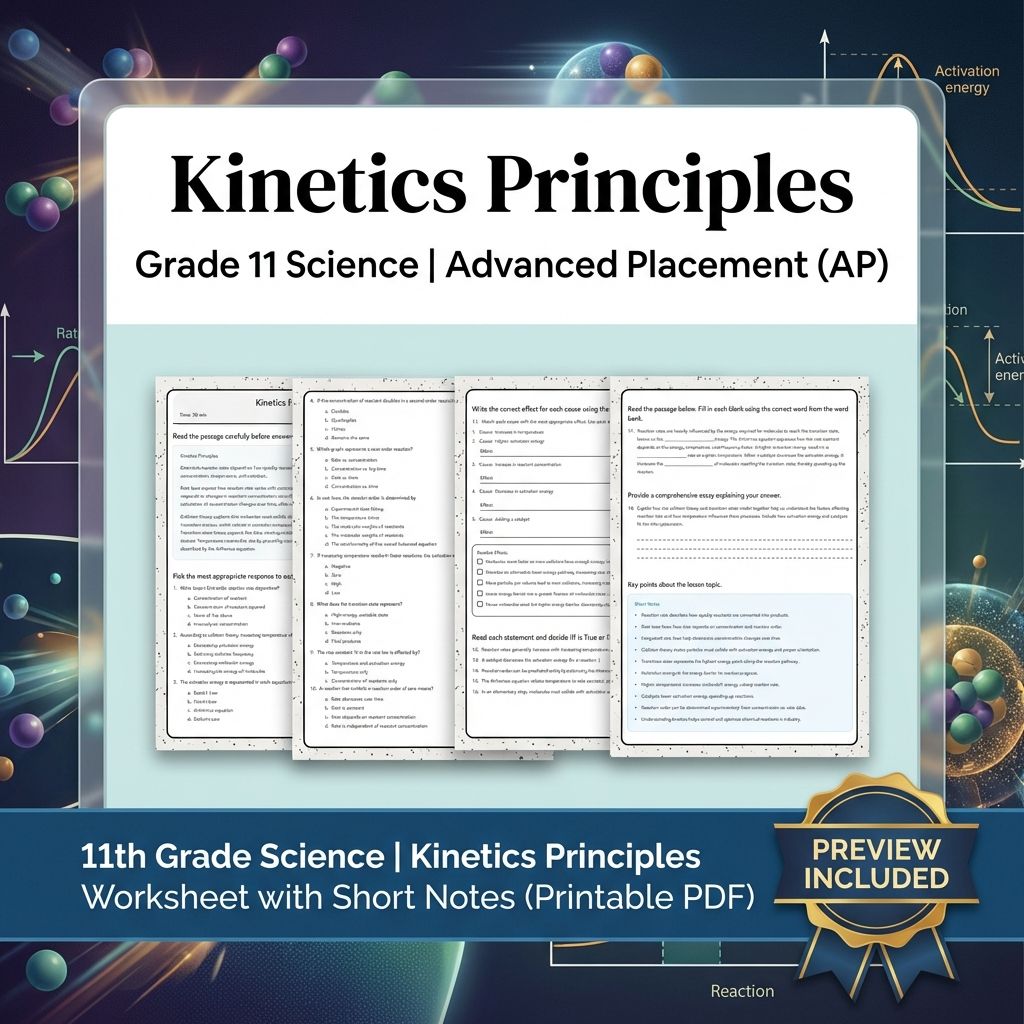
11th Grade Science | Kinetics Principles Worksheet with Short Notes (PDF)
Created byMeadowlark WorksheetsLearning Objectives
- Understand the concepts of rate laws and reaction order.
- Analyze how concentration and temperature influence reaction rate.
- Interpret integrated rate expressions from experimental data.
Also included in: 11th Grade Science UNIT Worksheet Pack | Atomic Structure, Kinetics & More +1 more
Instant download
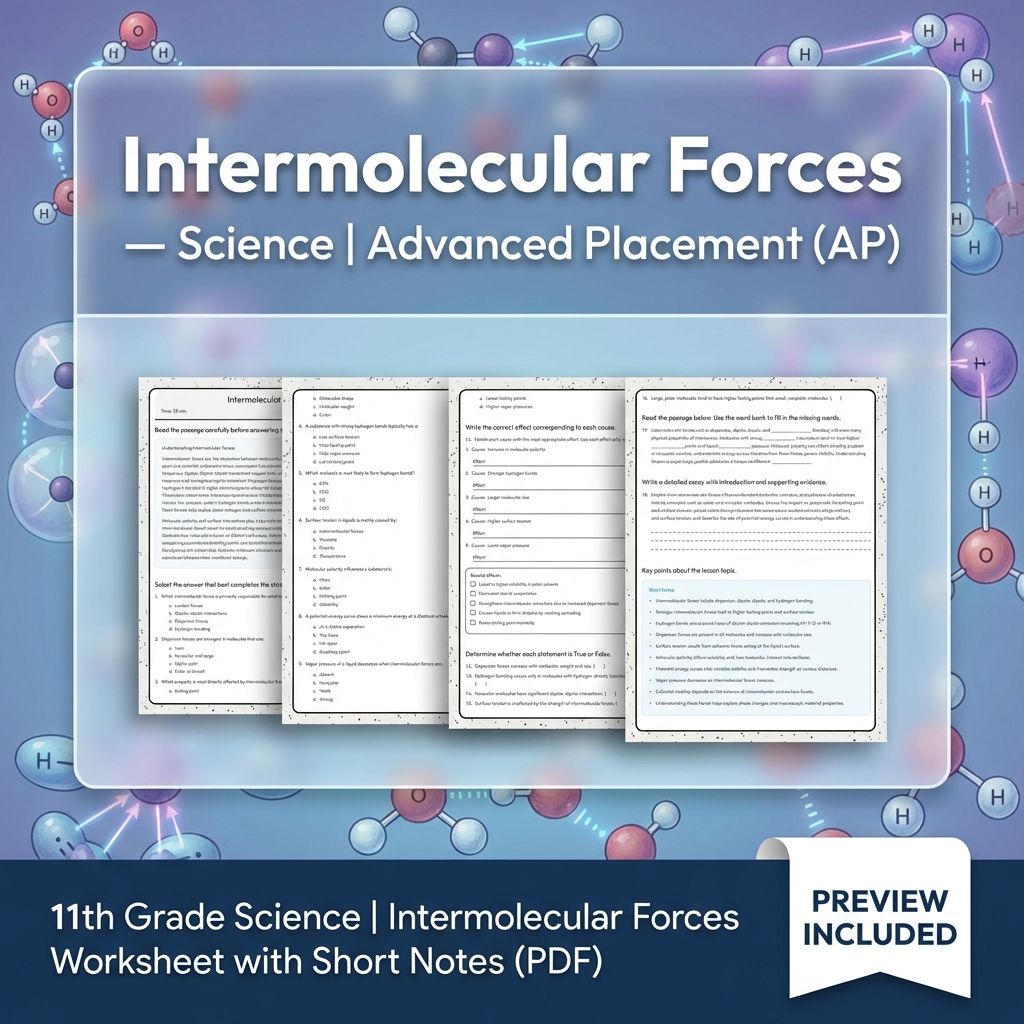
11th Grade Science | Intermolecular Forces Worksheet with Short Notes (PDF)
Created byMeadowlark WorksheetsLearning Objectives
- Describe the differences between dispersion, dipole–dipole, and hydrogen bonding interactions.
- Explain how intermolecular forces influence boiling point, vapor pressure, and solubility.
- Relate molecular polarity to surface interactions and phase behavior.
Also included in: 11th Grade Science UNIT Worksheet Pack | Atomic Structure, Kinetics & More +1 more
Instant download
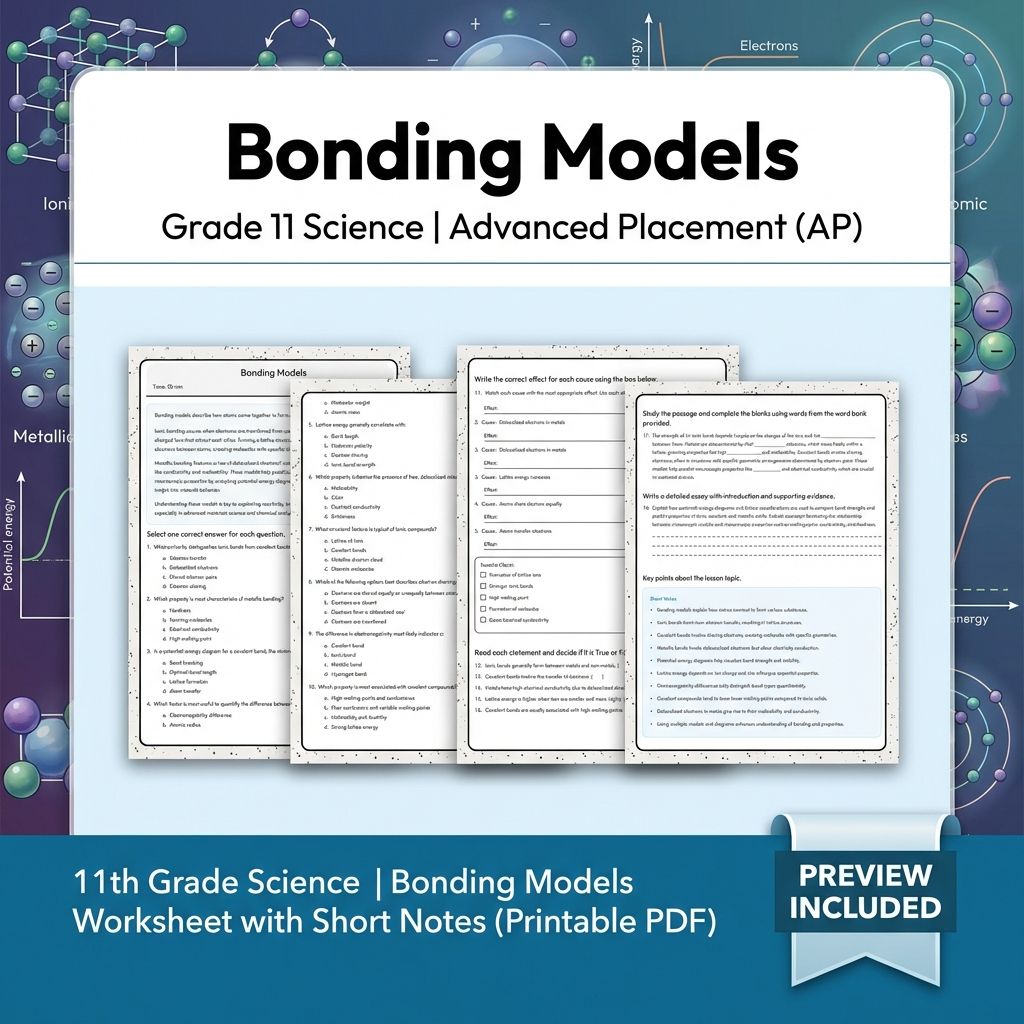
11th Grade Science | Bonding Models Worksheet with Short Notes (PDF)
Created byMeadowlark WorksheetsLearning Objectives
- Explain the differences between ionic, covalent, and metallic bonding using energy diagrams and electron-sharing concepts.
- Compare and analyze model predictions for bond strengths, lattice energies, and physical properties such as conductivity and melting point.
- Use electronegativity differences and formal charges to distinguish bonding types and justify structural models.
Also included in: 11th Grade Science UNIT Worksheet Pack | Atomic Structure, Kinetics & More +1 more
Instant download
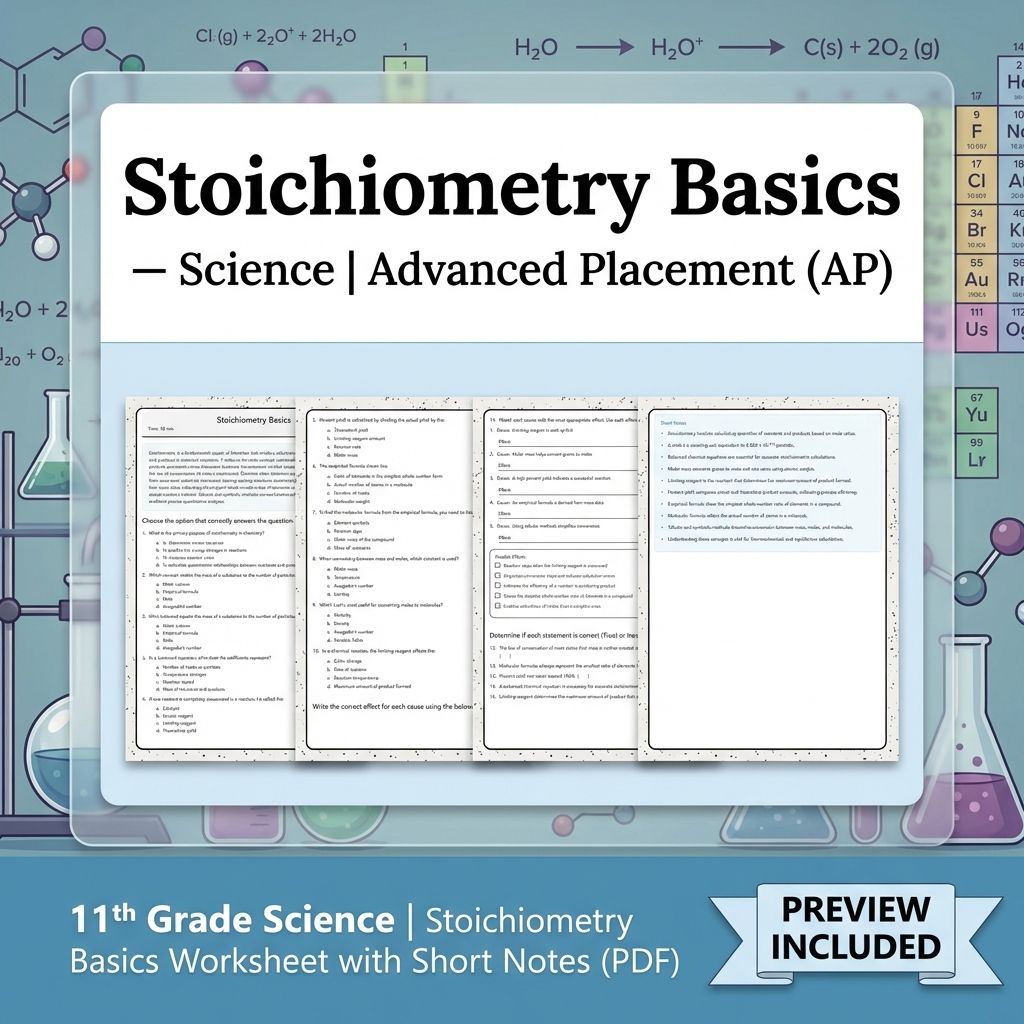
11th Grade Science | Stoichiometry Basics Worksheet with Short Notes (PDF)
Created byMeadowlark WorksheetsLearning Objectives
- Understand mole relationships and molar mass concepts.
- Interpret balanced chemical equations for quantitative analysis.
- Apply limiting reagent reasoning and calculate percent yields.
Also included in: 11th Grade Science UNIT Worksheet Pack | Atomic Structure, Kinetics & More +1 more
Instant download
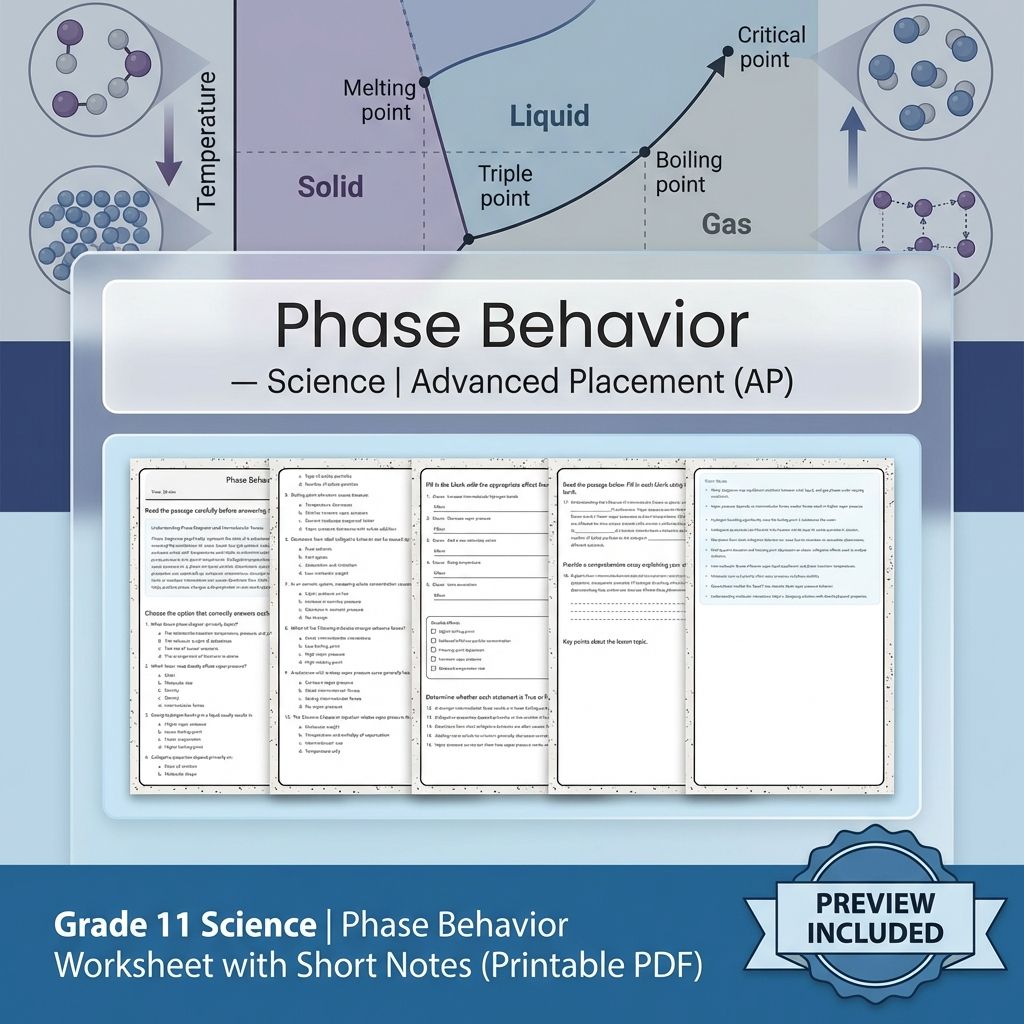
Grade 11 Science | Phase Behavior Worksheet with Short Notes (Printable PDF)
Created byMeadowlark WorksheetsLearning Objectives
- Interpret phase diagrams, vapor pressure curves, and colligative property trends based on intermolecular forces.
- Understand how molecular structure influences phase behavior and colligative properties.
- Connect solute–solvent interactions and vapor–liquid equilibria to cohesive forces.
Also included in: 11th Grade Science UNIT Worksheet Pack | Atomic Structure, Kinetics & More +1 more
Instant download
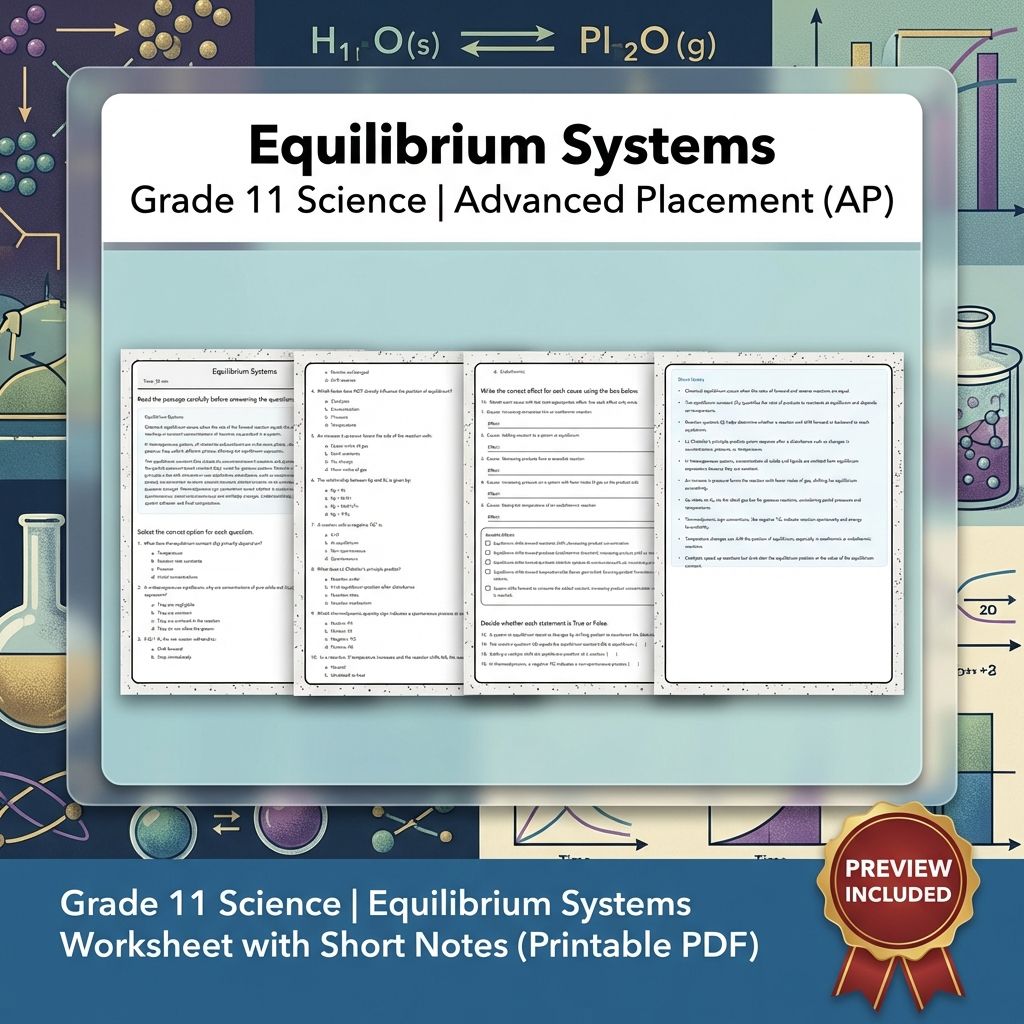
Grade 11 Science | Equilibrium Systems Worksheet with Short Notes (PDF)
Created byMeadowlark WorksheetsLearning Objectives
- Explain the concept of chemical equilibrium in homogeneous and heterogeneous systems.
- Calculate and compare equilibrium constants (Kc and Kp) and understand their relationship.
- Predict the direction of net reaction shifts using reaction quotient and Le Châtelier's principle.
Also included in: 11th Grade Science UNIT Worksheet Pack | Atomic Structure, Kinetics & More +1 more
Instant download
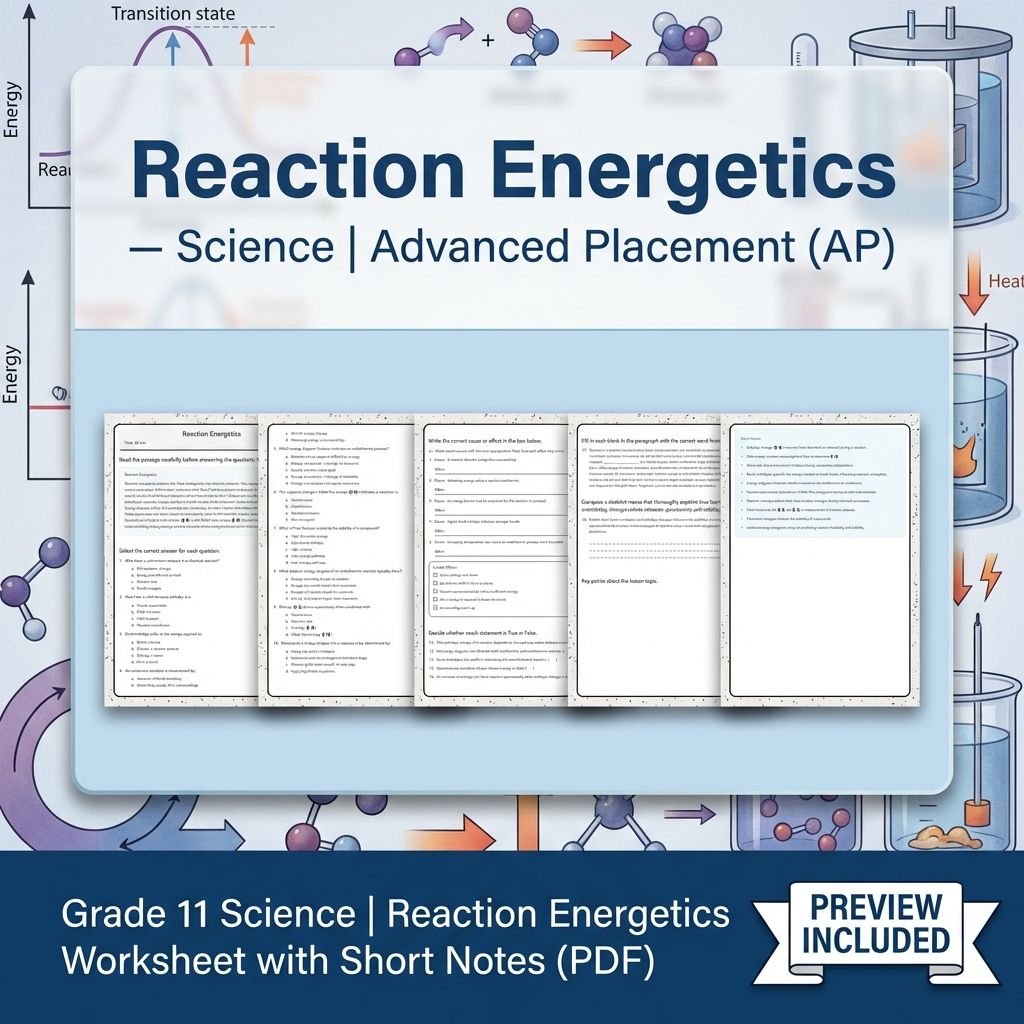
Grade 11 Science | Reaction Energetics Worksheet with Short Notes (PDF)
Created byMeadowlark WorksheetsLearning Objectives
- Understand the concepts of enthalpy change and calorimetry in chemical reactions.
- Apply Hess’s law to determine overall reaction heat from component steps.
- Relate bond enthalpies and formation energies to reaction stability and energy profiles.
Also included in: 11th Grade Science UNIT Worksheet Pack | Atomic Structure, Kinetics & More +1 more
Instant download
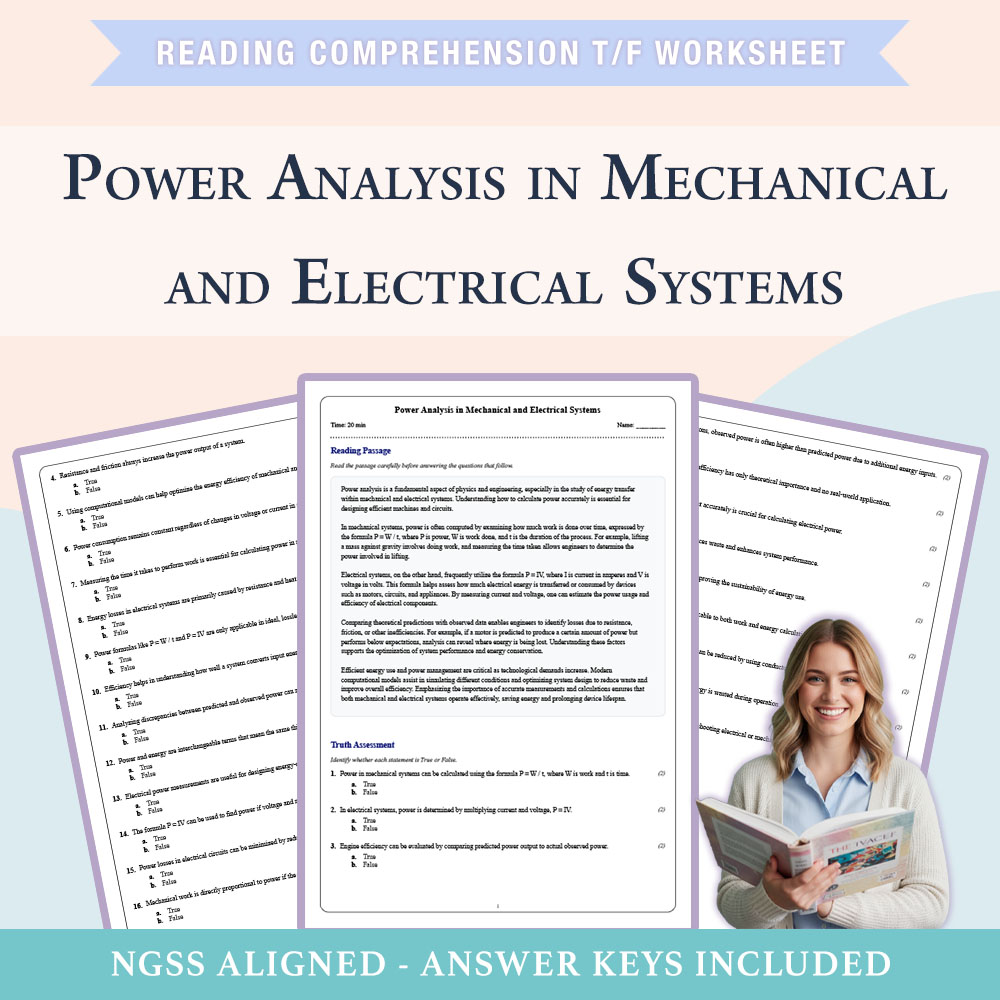
11th Grade Science|Power Analysis in Mechanical/Electrical Systems(PDF+ Answers)
 Created byCopper Leaf Classroom
Learning Objectives
- Understand the principles of calculating power in mechanical and electrical systems using P = W/t and P = IV.
- Analyze data to compare predicted and observed power outputs in real-world systems.
- Discuss factors affecting the efficiency of energy transfer in mechanical and electrical devices.
Also included in: Grade 11 Science | Energy Concepts & Applications Bundle (PDF + Answer Keys) +1 more
Instant download

Grade 11 Seafloor Spreading Worksheet | BC Practice & PDF
 Created byClear Sky Classroom
Learning Objectives
- Explain how mid-ocean ridges generate new oceanic crust through seafloor spreading.
- Describe how symmetrical magnetic stripe patterns support the idea of Earth’s magnetic field reversals recorded in basalt.
- Interpret evidence such as crust age patterns and ocean-basin bathymetry to support continuous plate movement.
Instant download

Grade 11 Center Of Mass Worksheet | BC Practice PDF
Created byClear Sky ClassroomLearning Objectives
- Explain what the center of mass (CM) means as a weighted average of a system’s mass distribution
- Use conservation of momentum and Newton’s laws to predict center-of-mass motion in multi-body situations
- Apply CM ideas to simplify recoil, explosion, and multi-particle trajectory problems
Instant download
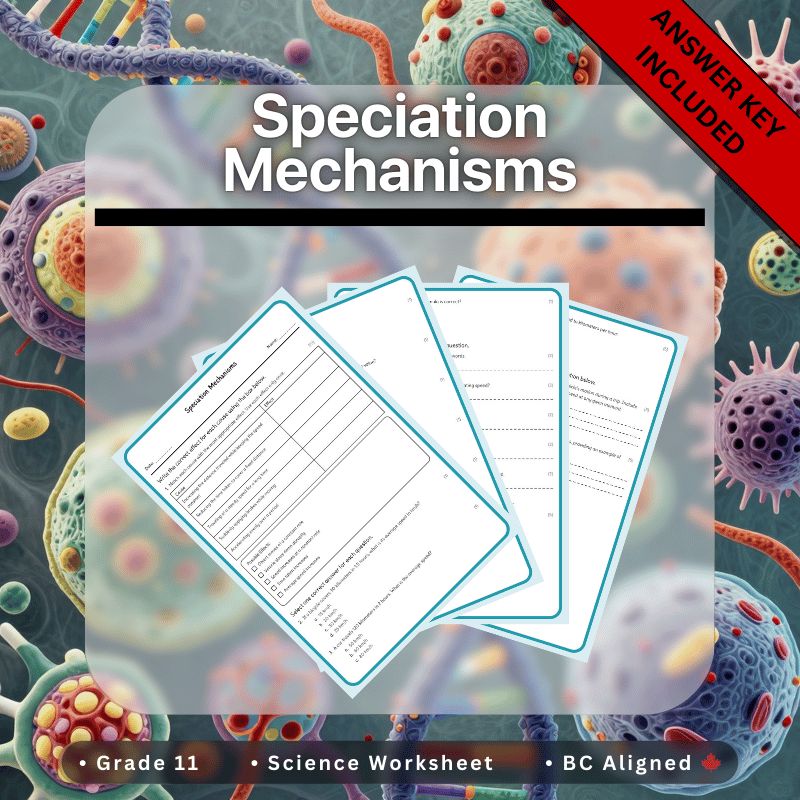
Grade 11 Science | Speciation Mechanisms Worksheet (Answer Key) – BC Standards
 Created byBright Mind Resources
Learning Objectives
- Understand how reproductive isolation leads to the formation of new species
- Identify the differences between allopatric and sympatric speciation
- Recognize barriers to interbreeding that promote speciation
Instant download
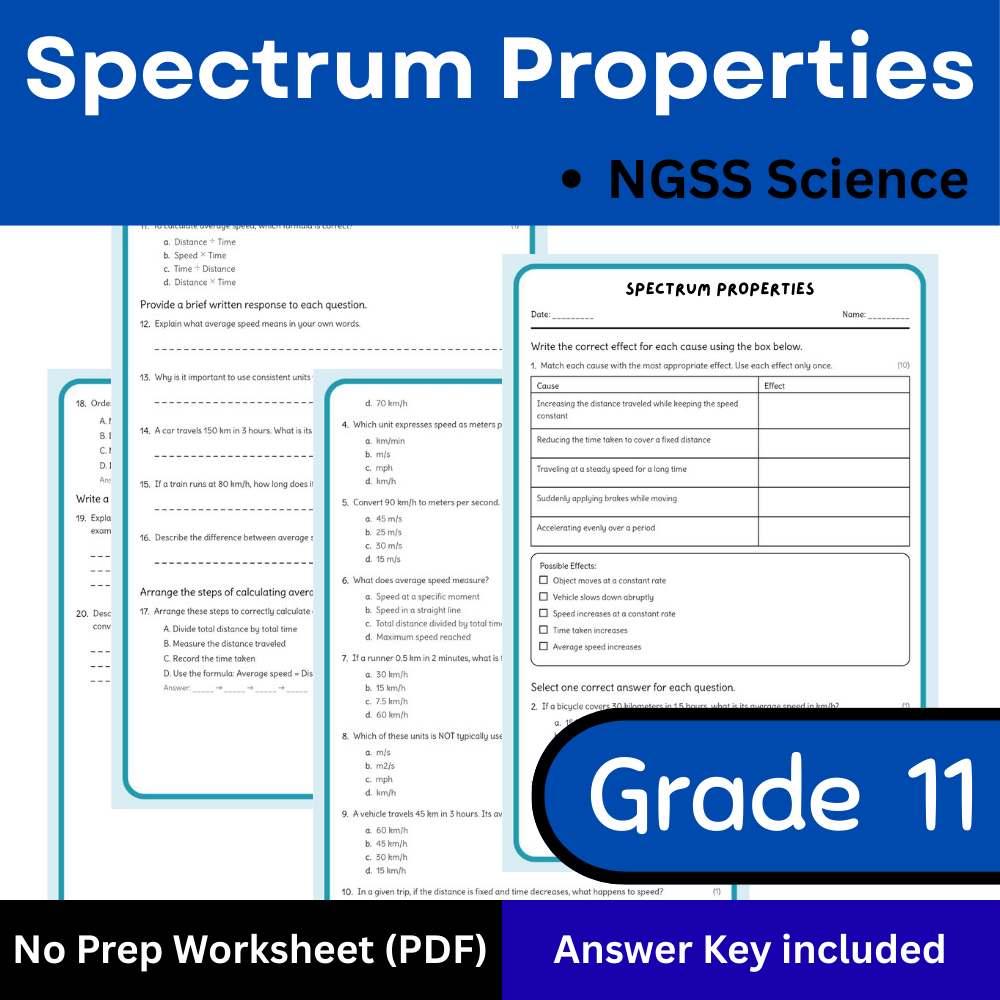
Grade 11 Science | Spectrum Properties Worksheet (Answer Key) NGSS-Aligned
Created byBright Mind ResourcesLearning Objectives
- Evaluate the evidence supporting wave and particle models of electromagnetic radiation.
- Describe phenomena such as interference, diffraction gratings, and the photoelectric effect.
- Explain where each model (wave or particle) is applicable and where it breaks down.
Instant download
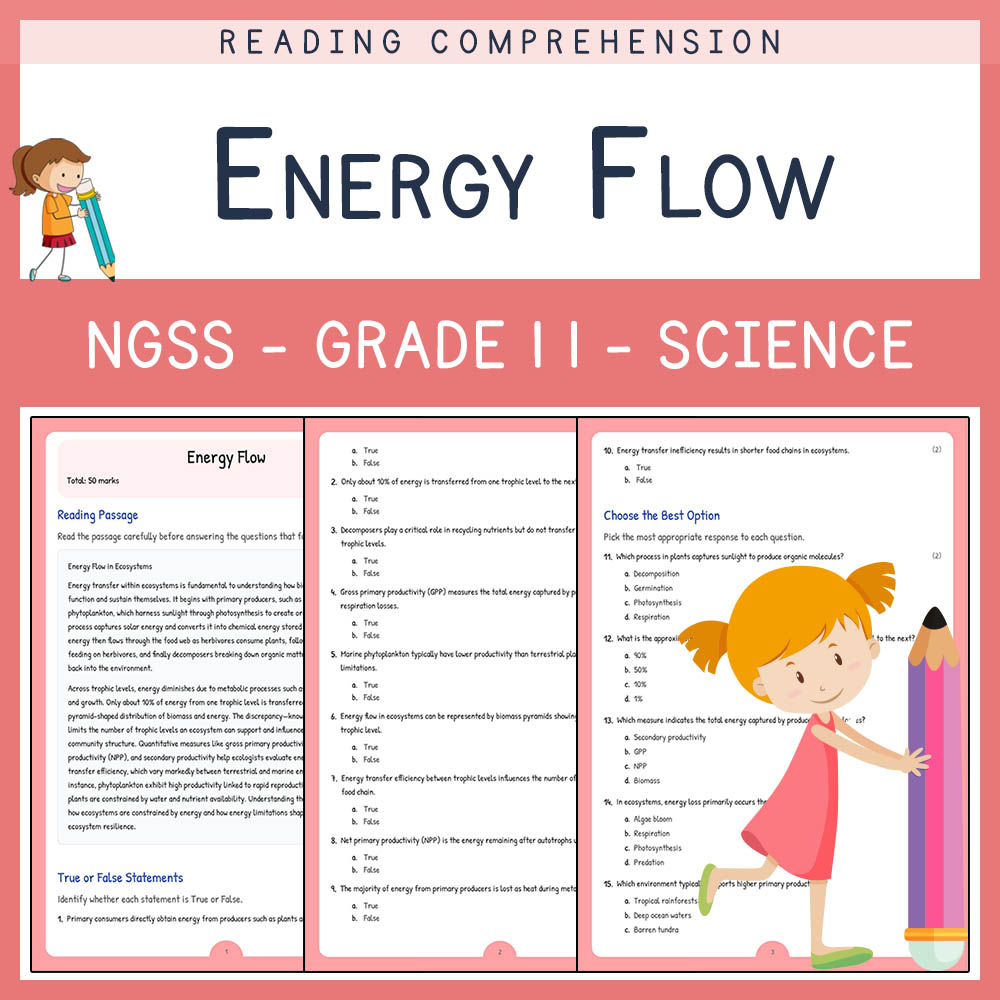
Grade 11 Science | Energy Flow Worksheet (NGSS-Aligned) with Answer Key
 Created byLumora Learning
Learning Objectives
- Understand the flow of energy through different levels of food webs, including producers, consumers, and decomposers.
- Analyze concepts of trophic levels, biomass pyramids, and energy transfer efficiency.
- Interpret quantitative data on primary productivity, gross and net production, and their implications for ecological communities.
Instant download
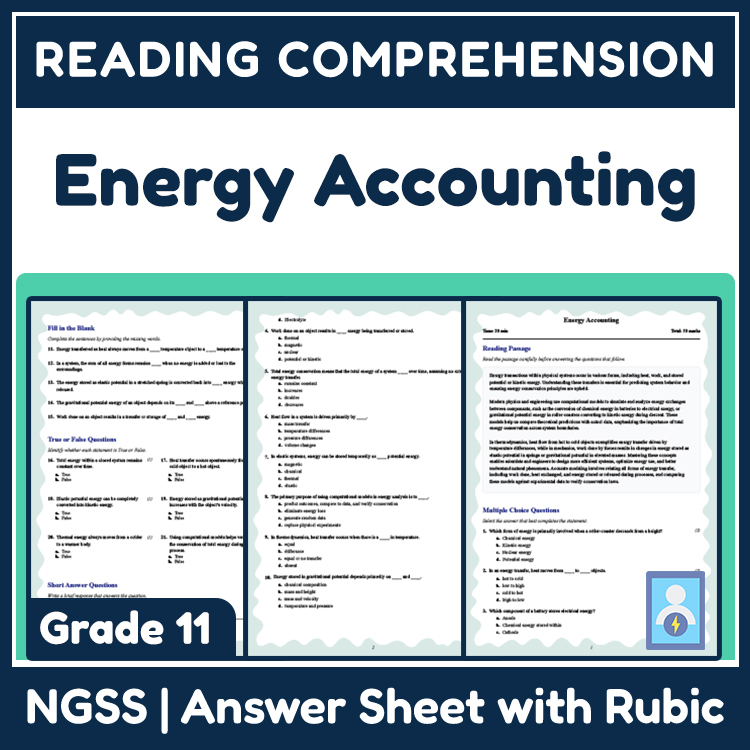
11th Grade Science | Energy Accounting Reading Worksheet (PDF + Rubric)
JCreated byJ.S SheetsLearning Objectives
- Understand the principles of energy transfer among components within systems.
- Apply computational models to quantify heat, work, and stored energy in different scenarios.
- Relate energy exchanges to real-world situations such as roller-coasters, batteries, and heat flow.
Instant download
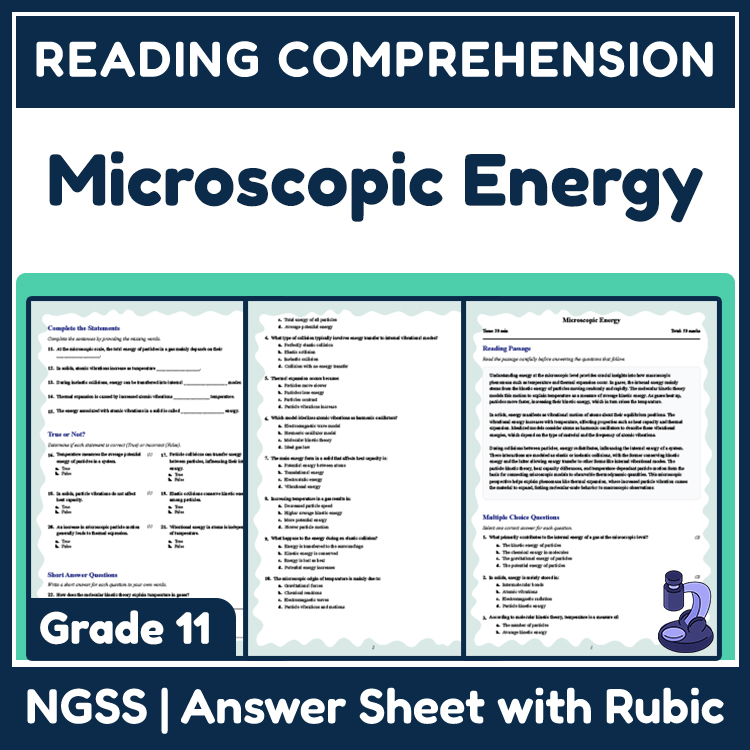
11th Grade Science | Microscopic Energy Reading Worksheet (PDF + Rubric)
JCreated byJ.S SheetsLearning Objectives
- Understand how energy at the microscopic level relates to macroscopic thermal and mechanical phenomena.
- Describe models that address energy changes in gases, solids, and during collisions.
- Explain the connection between molecular-scale descriptions and observable quantities like temperature and thermal expansion.
Instant download
Lewis Structures Worksheet for Grade 11 Science | Alberta Standards
 Created byCoral Reef Learning
Learning Objectives
- Describe how Lewis structures represent valence electrons, lone pairs, and bonding pairs in molecules.
- Explain the importance of formal charge minimization and resonance structures in Lewis diagrams.
- Identify exceptions to the octet rule, including molecules such as CO2, SO2, and certain hydrocarbons.
Instant download
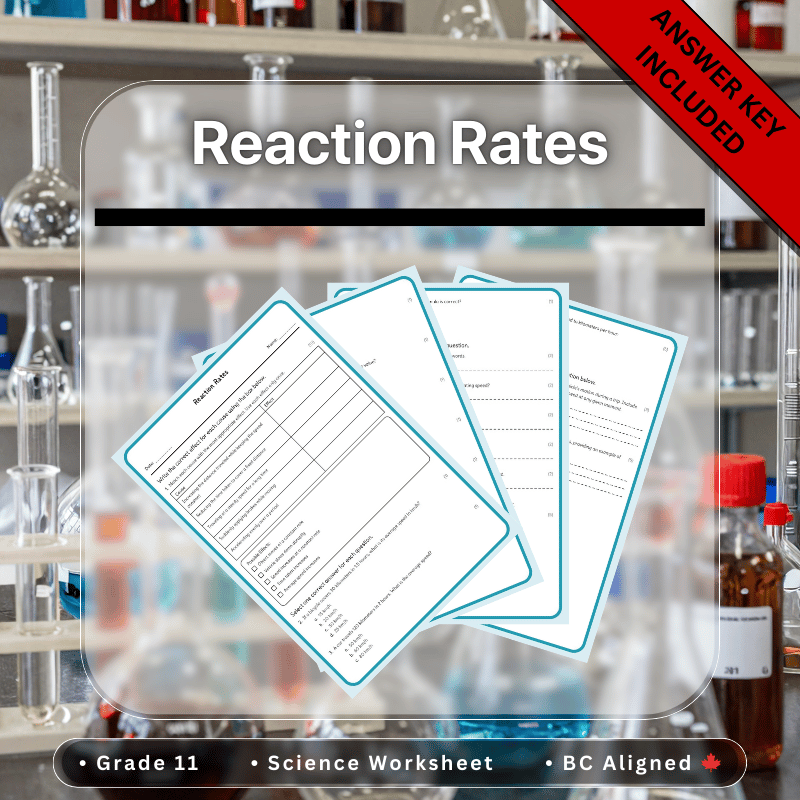
Grade 11 Science | Reaction Rates Worksheet (Answer Key) for BC Standards
Created byBright Mind ResourcesLearning Objectives
- Explain the factors that influence reaction rates, including collision frequency, molecular orientation, and activation energy.
- Describe how rate laws express the dependence of reaction speed on reactant concentrations.
- Understand the relationship between temperature, rate constants, and activation energy through the Arrhenius equation.
Instant download

Grade 11 Reproductive Isolation and Gene Flow Worksheet | TEKS Biology
 Created byBRIGHT PATH RESOURCES
Learning Objectives
- Explain how reproductive isolation prevents gene flow between populations
- Identify prezygotic and postzygotic barriers as mechanisms of speciation
- Use key terms (gene flow, hybrid viability, fertility) to describe how new species form
Instant download
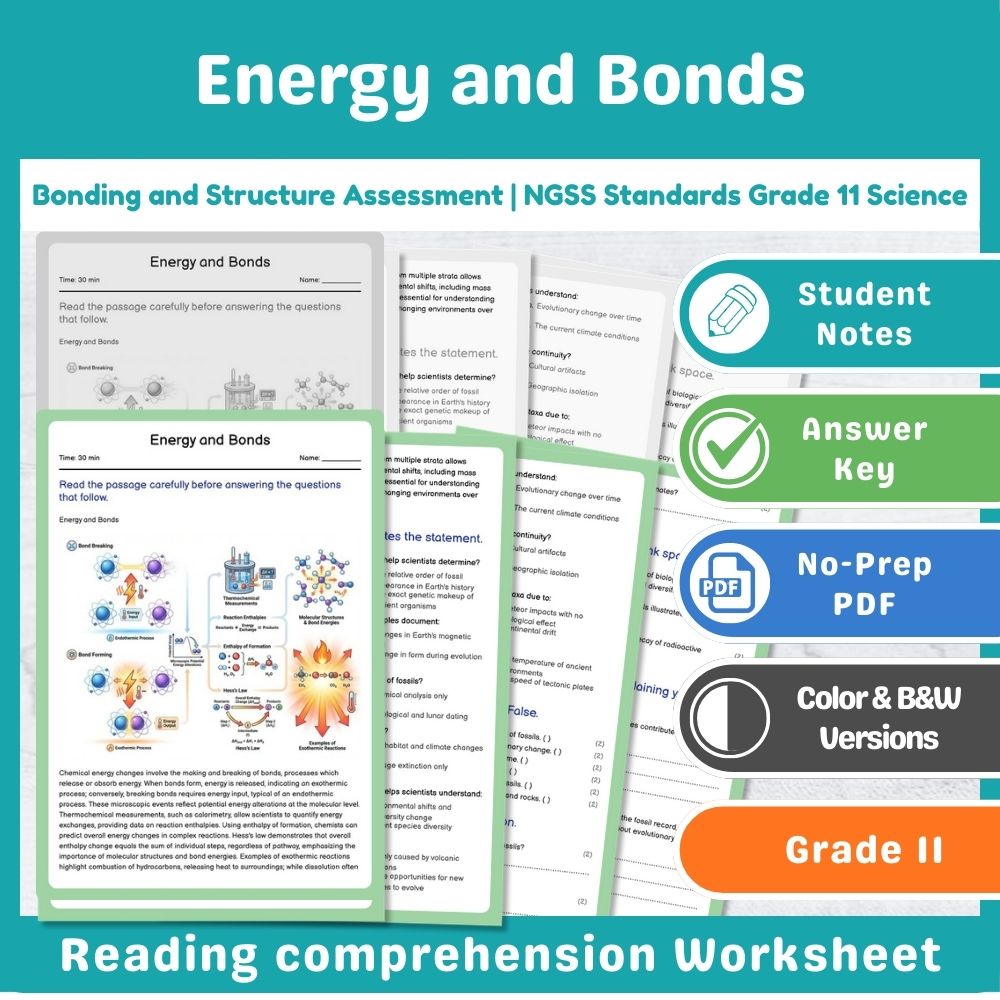
Energy and Bonds Assessment – NGSS Aligned Evaluation for Grade 11 Science
 Created byPrism Point Learning
Learning Objectives
- Understand the representation of chemical energy changes through bond formation and breaking.
- Explain how net enthalpy change relates to bond energies and molecular structure.
- Interpret thermochemical data, including calorimetry, formation enthalpies, and Hess's law.
Also included in: Grade 11 Science Mini Bundle – Matter and Its Interactions NGSS Unit
Instant download
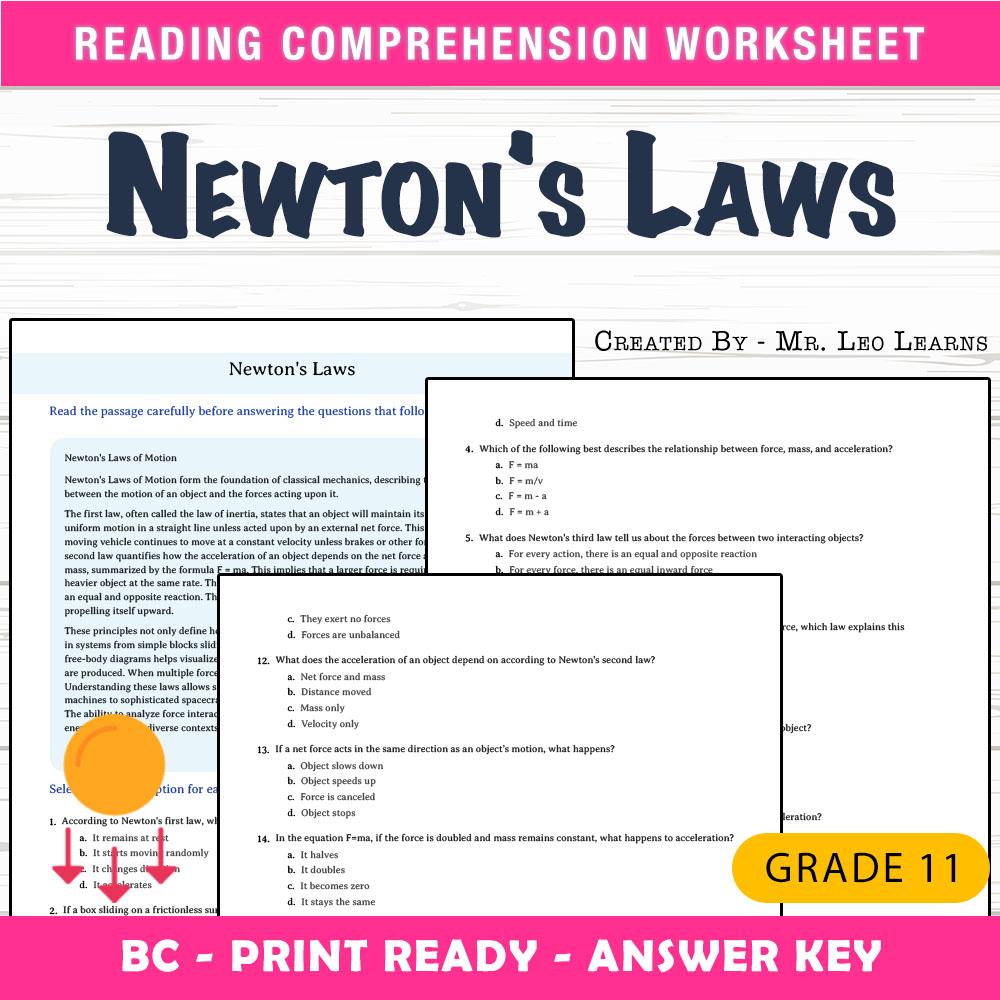
Grade 11 Science — Worksheet MCQ Paper for Mastering Newton's Laws
 Created byThe Resource Hub
Learning Objectives
- Understand and explain the three fundamental laws of motion described by Newton.
- Analyze how forces, mass, and acceleration are related in different physical systems.
- Apply Newton's Laws to predict motion outcomes in various scenarios involving contact and contactless forces.
Also included in: Grade 11 Science BC Physics Unit Bundle | Motion, Energy & Forces Worksheets +1 more
Instant download
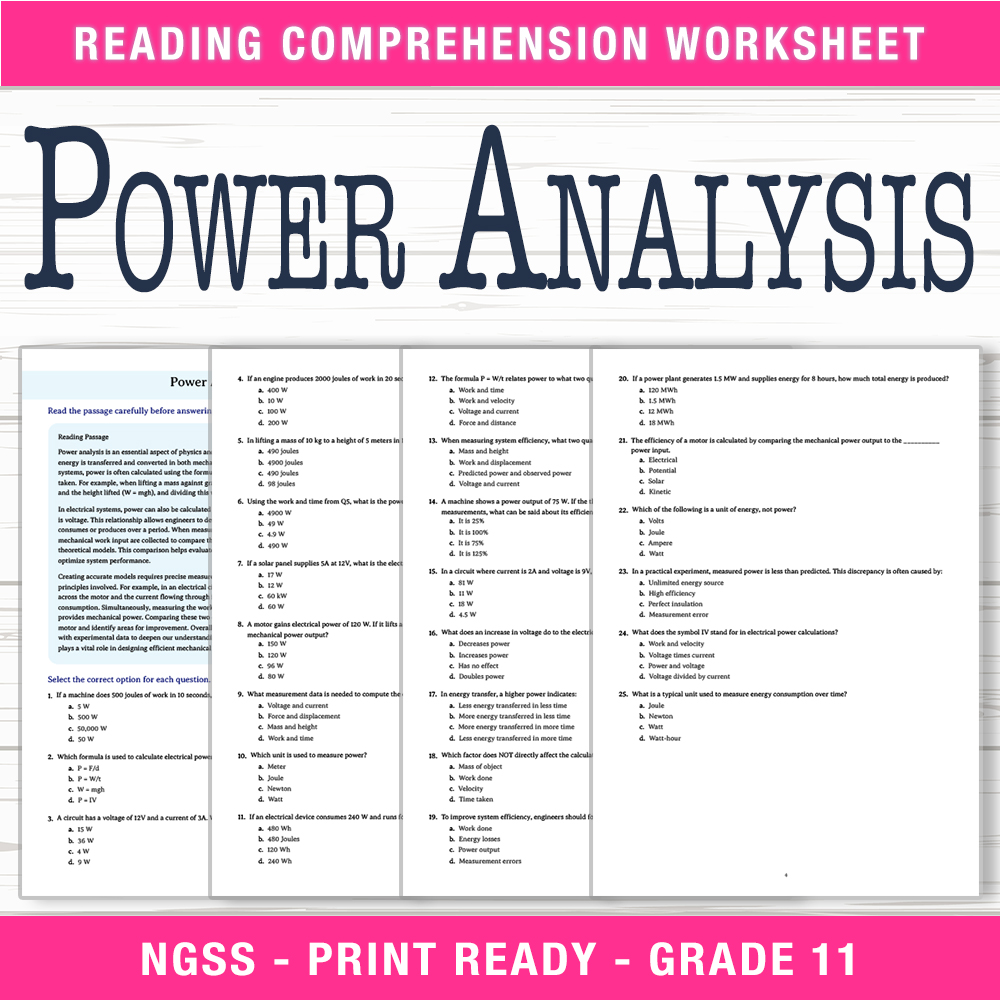
Grade 11 Science | Power Analysis Worksheet (PDF + Answer Key)
 Created byRiverstone Classroom
Learning Objectives
- Understand and apply the formulas P = W/t and P = IV to calculate power in mechanical and electrical systems.
- Create and interpret computational models of energy changes and power predictions.
- Analyze data from experiments to compare predicted and observed power outputs.
Instant download
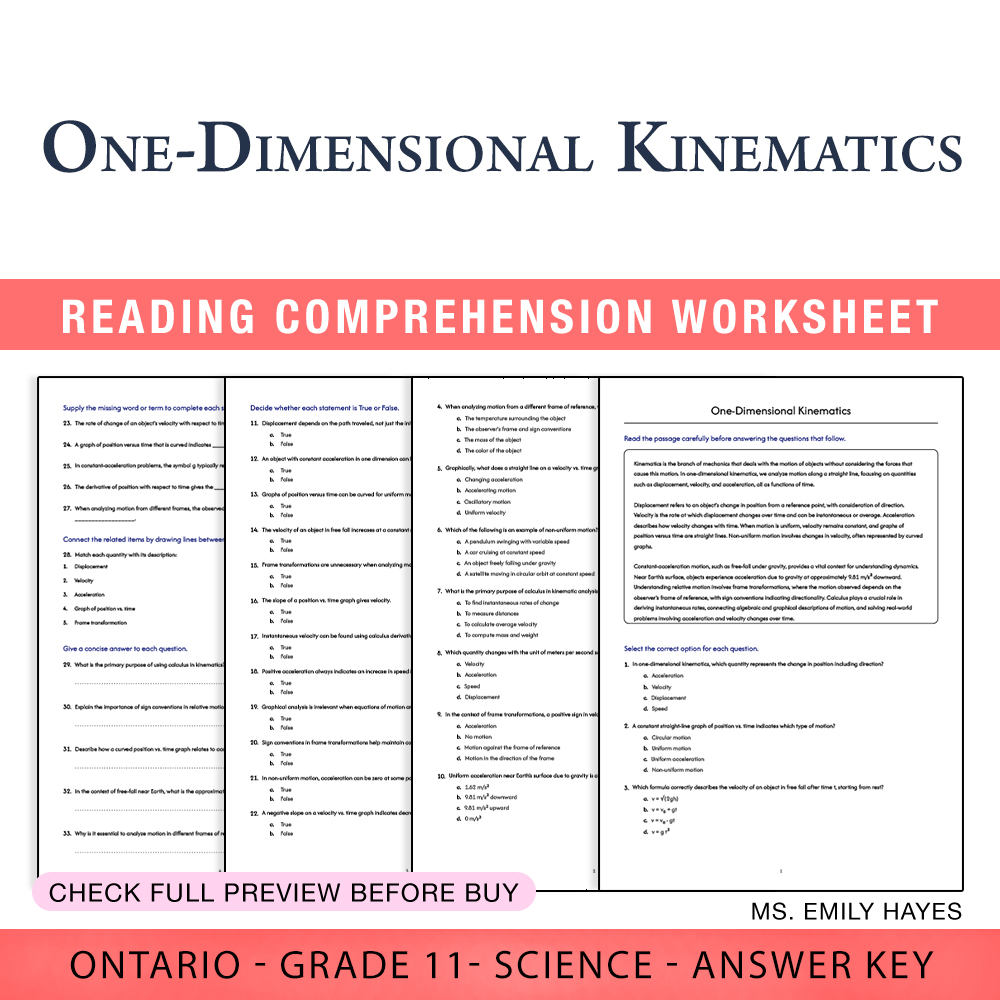
Grade 11 Science | One-Dimensional Kinematics Worksheet (PDF + Answer Key)
Created byCopper Leaf ClassroomLearning Objectives
- Describe the fundamental concepts of displacement, velocity, and acceleration as functions of time.
- Differentiate between uniform and non-uniform motion using algebraic and graphical methods.
- Apply constant-acceleration formulas to free-fall and relative motion scenarios, including frame transformations.
Instant download

Wave Superposition Practice Worksheet | Grade 11 Science Ontario
Created byPrism Point LearningLearning Objectives
- Explain how the superposition principle leads to interference patterns and standing waves.
- Identify nodes and antinodes and relate them to standing-wave mode structures.
- Predict resonant frequencies of strings or air columns using harmonic relationships and boundary conditions.
Also included in: Grade 11 Science Review & Test Prep Lesson Bundle for Ontario
Instant download

Combustion Reactions Worksheet for Grade 11 Science | Alberta Standards
JCreated byJ.S SheetsLearning Objectives
- Understand the processes involved in combustion reactions, including oxidation of fuels and pollutant formation.
- Calculate oxygen demand and interpret emission data related to combustion.
- Identify pollutants such as carbon dioxide, carbon monoxide, and nitrogen oxides produced during combustion.
Instant download
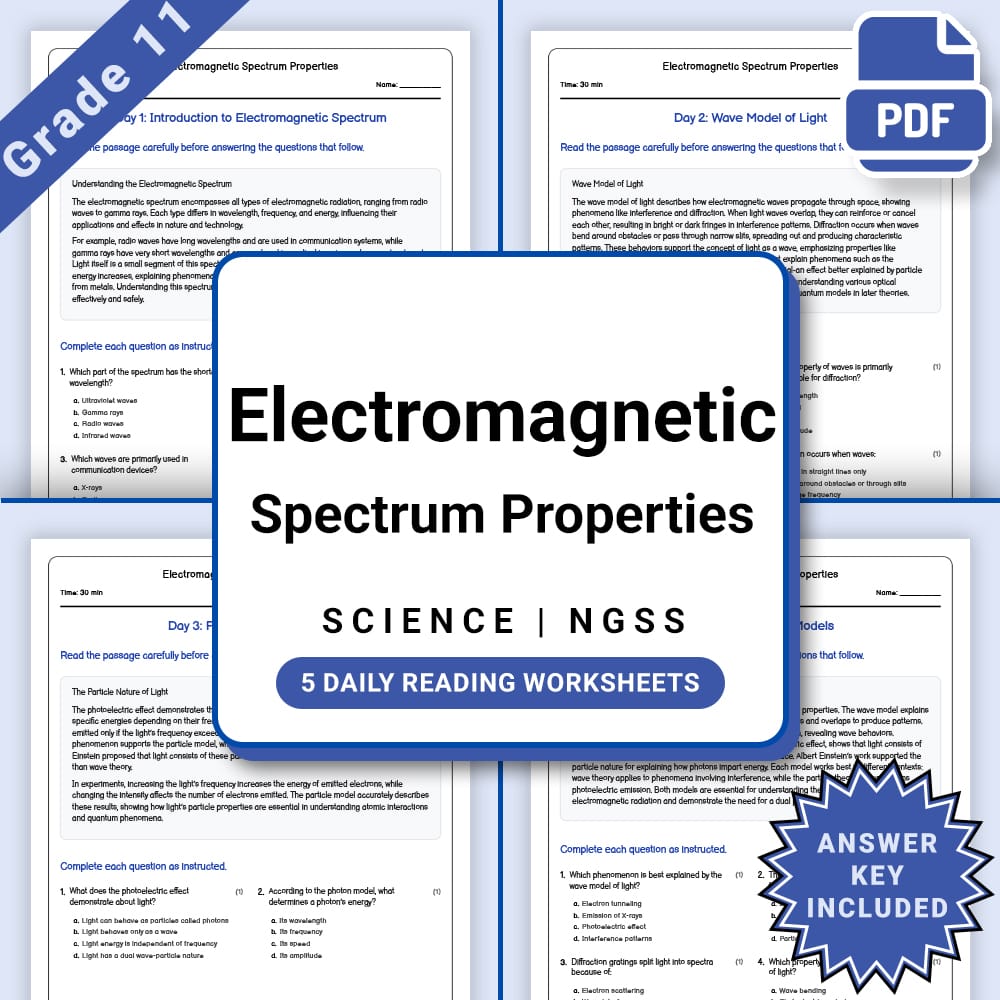
Grade 11 Science – Electromagnetic Spectrum Properties Worksheet(PDF +Answers)
Created byCopper Leaf ClassroomLearning Objectives
- Identify and describe the different parts of the electromagnetic spectrum.
- Understand the properties of waves, including interference and diffraction phenomena.
- Explain the photoelectric effect and how it supports the particle model of light.
Instant download

Plate Tectonics Worksheet for Grade 11 Science | Standards-Aligned Practice
JCreated byJ.S SheetsLearning Objectives
- Understand the key evidence supporting the theory of plate tectonics.
- Describe how surface features relate to processes within Earth's interior.
- Identify different types of plate boundaries and associated geological activity.
Instant download
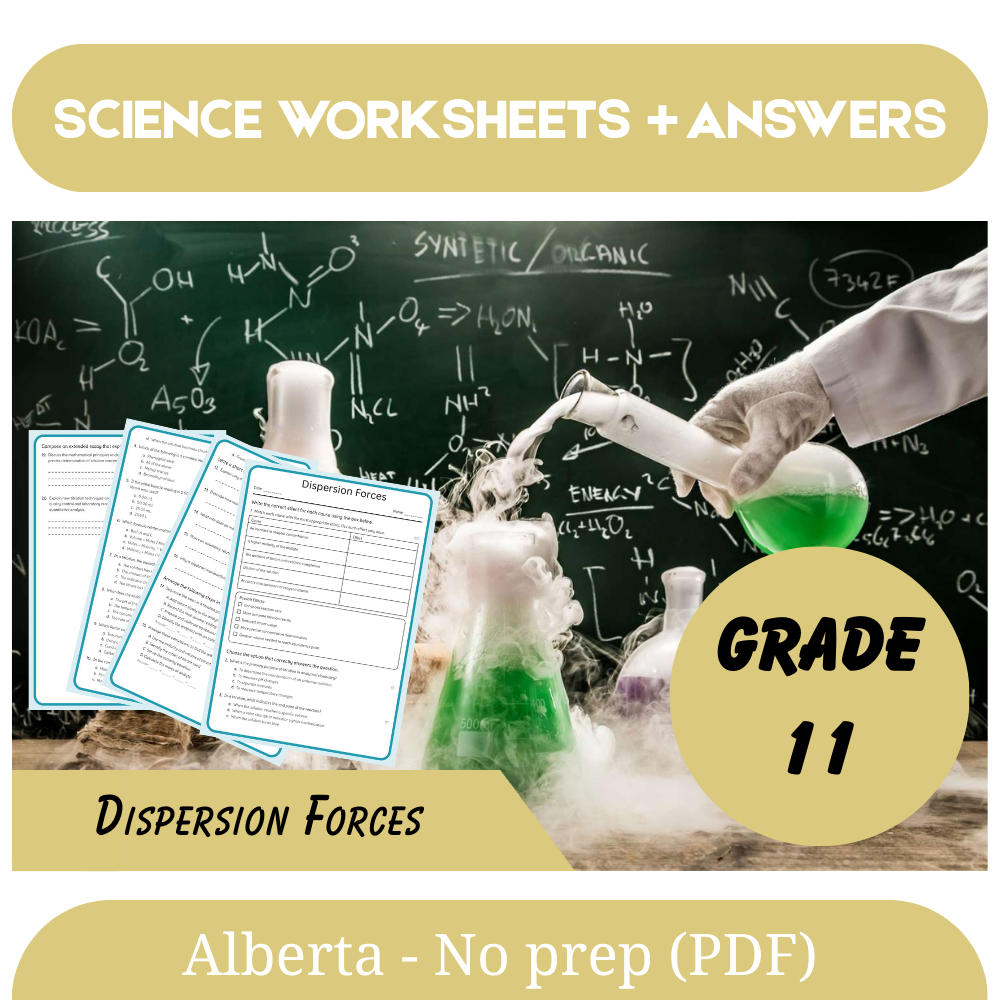
Grade 11 Science | Dispersion Forces Worksheet (PDF) – Alberta Standards
Created byBright Mind ResourcesLearning Objectives
- Describe the concept of London dispersion forces and how they arise from electron fluctuations.
- Explain how dispersion forces depend on molecular size and shape, influencing physical properties of nonpolar substances.
- Analyze the impact of dispersion forces on melting points, viscosities, and phase behavior of hydrocarbons and noble gases.
Instant download

Grade 11 Science Worksheet on Non-Mendelian Patterns| Classroom PDF & Answer Key
Created byCoral Reef LearningLearning Objectives
- Understand various non-Mendelian inheritance patterns such as incomplete dominance and codominance.
- Identify the roles of multiple alleles, polygenic inheritance, and pleiotropy in traits.
- Explain how environmental factors influence gene expression and phenotype variation.
Instant download
Grade 11 Science | Energy Currency Worksheet (AP Standard) - Science 1 PDF
Created byBright Mind ResourcesLearning Objectives
- Understand the principles of energy transfer and transformation at the molecular and cellular levels.
- Explain the roles of ATP synthesis, hydrolysis, and energetic coupling in biochemical pathways.
- Interpret free energy diagrams and reaction coordinate representations for metabolic reactions.
Instant download
Grade 11 Science – Bonding Models Worksheet (AP Standards) – PDF
Created byBright Mind ResourcesLearning Objectives
- Describe ionic, covalent, and metallic bonding using potential-energy diagrams, lattice considerations, and electron-sharing concepts.
- Compare model predictions for bond strengths, lattice energies, and properties such as conductivity and melting points.
- Use electronegativity differences and formal charge to distinguish bond types and justify structural models.
Instant download
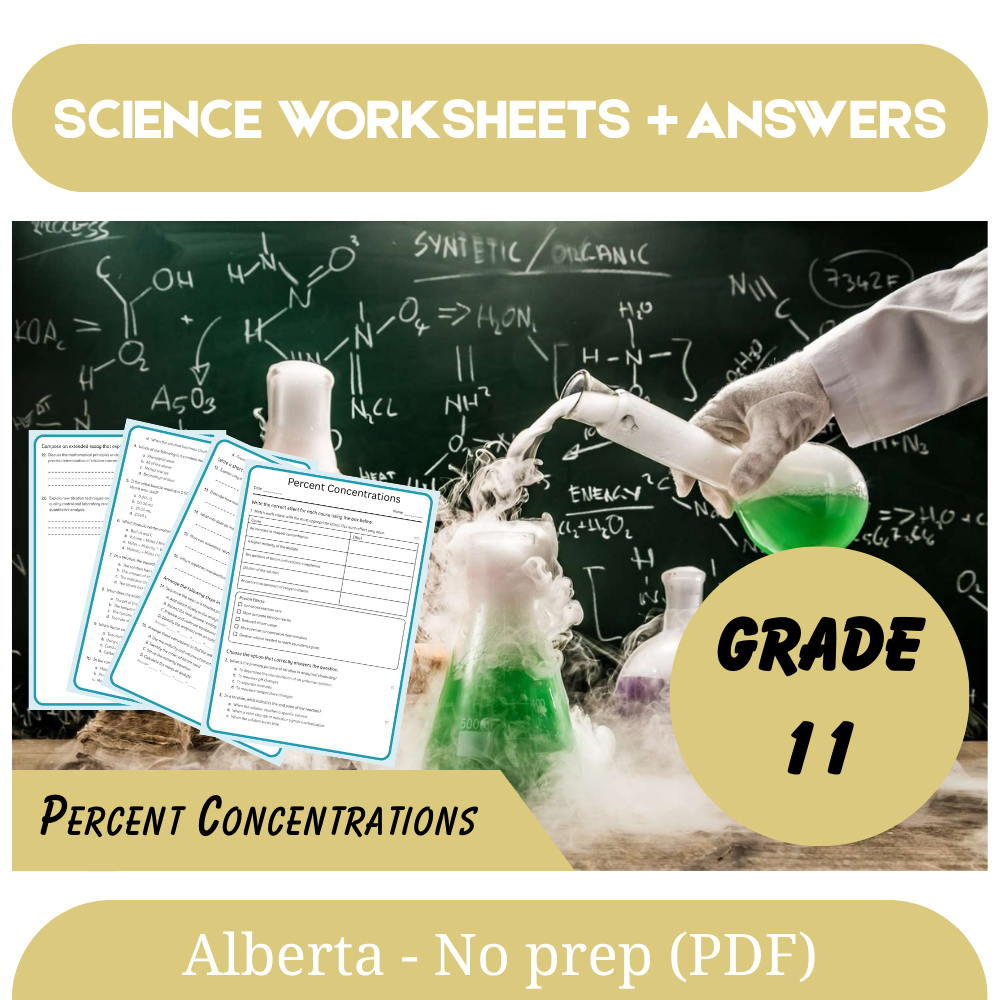
Grade 11 Science | Percent Concentrations Worksheet + Answer Key (PDF)
Created byBright Mind ResourcesLearning Objectives
- Understand the different units of percent concentration and parts per million.
- Convert between mass percent, volume percent, and parts per million.
- Interpret concentration data in practical examples such as salt in road brines and metal levels in water samples.
Instant download
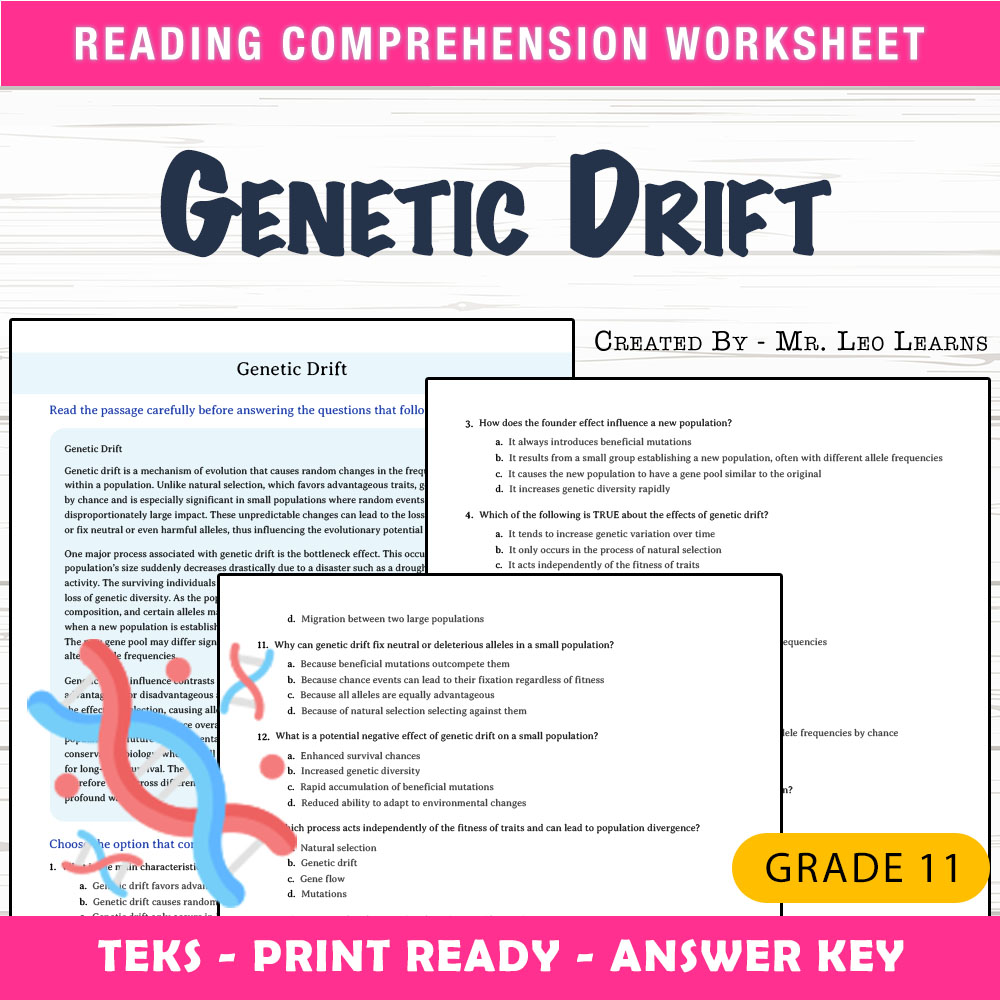
Grade 11 Science – Genetic Drift Worksheet for Mastery
Created byThe Resource HubLearning Objectives
- Explain the concept of genetic drift and how it differs from natural selection.
- Identify the processes of bottleneck and founder effects and their impact on populations.
- Describe how genetic drift influences genetic variation within small populations.
Also included in: Grade 11 Science Unit | Evolution & Phylogeny Worksheet Pack +1 more
Instant download

Grade 11 Science – Force & Models in Physics Daily Reading Worksheet
Created byBright Mind ResourcesLearning Objectives
- Identify different types of forces such as contact and long-range forces
- Understand how forces interact and influence motion
- Distinguish between static equilibrium and accelerated motion
Also included in: Grade 11 Physics Daily Reading Lesson Bundle | AP Science Framework +2 more
Instant download
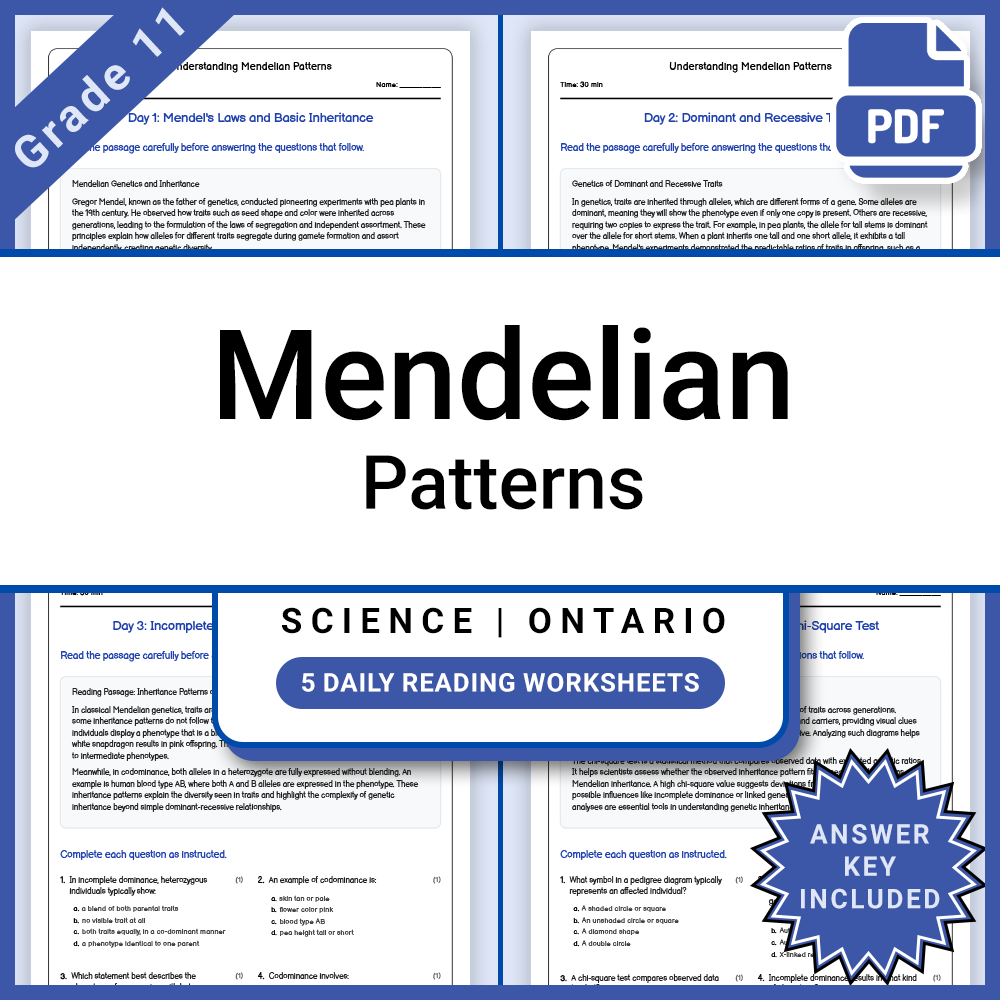
Grade 11 Science – Mendelian Patterns Daily Reading Worksheet + Answer Key
JCreated byJ.S SheetsLearning Objectives
- Describe Gregor Mendel's experiments and identify the basic laws of segregation and independent assortment.
- Differentiate between dominant, recessive, incomplete dominance, and codominance inheritance patterns.
- Interpret phenotypic ratios and use genetic notation to predict inheritance outcomes.
Also included in: Grade 11 Science Lesson Bundle | Ontario Standards for Biology and Chemistry +1 more
Instant download

Grade 11 Atomic Structure Worksheet | Practice & Assessment PDF
Created byClear Sky ClassroomLearning Objectives
- Explain the roles of protons, neutrons, and electrons in determining atomic identity and charge
- Use emission spectra and mass spectrometry evidence to support quantized electron energy levels and isotopic variation
- Calculate atomic mass from isotopic abundances and interpret ions formed by electron changes
Also included in: Grade 11 AP Chemistry Science Lesson Bundle: Foundations & Models +1 more
Instant download

Grade 11 Science | Model Revision Worksheet | NGSSS Aligned
Created byLumora LearningLearning Objectives
- Explain why scientific models are revised when new evidence or better methods reveal mismatches.
- Describe the steps of model revision using predictions, evidence, and identification of gaps.
- Distinguish model revision from “starting over” in science.
Instant download
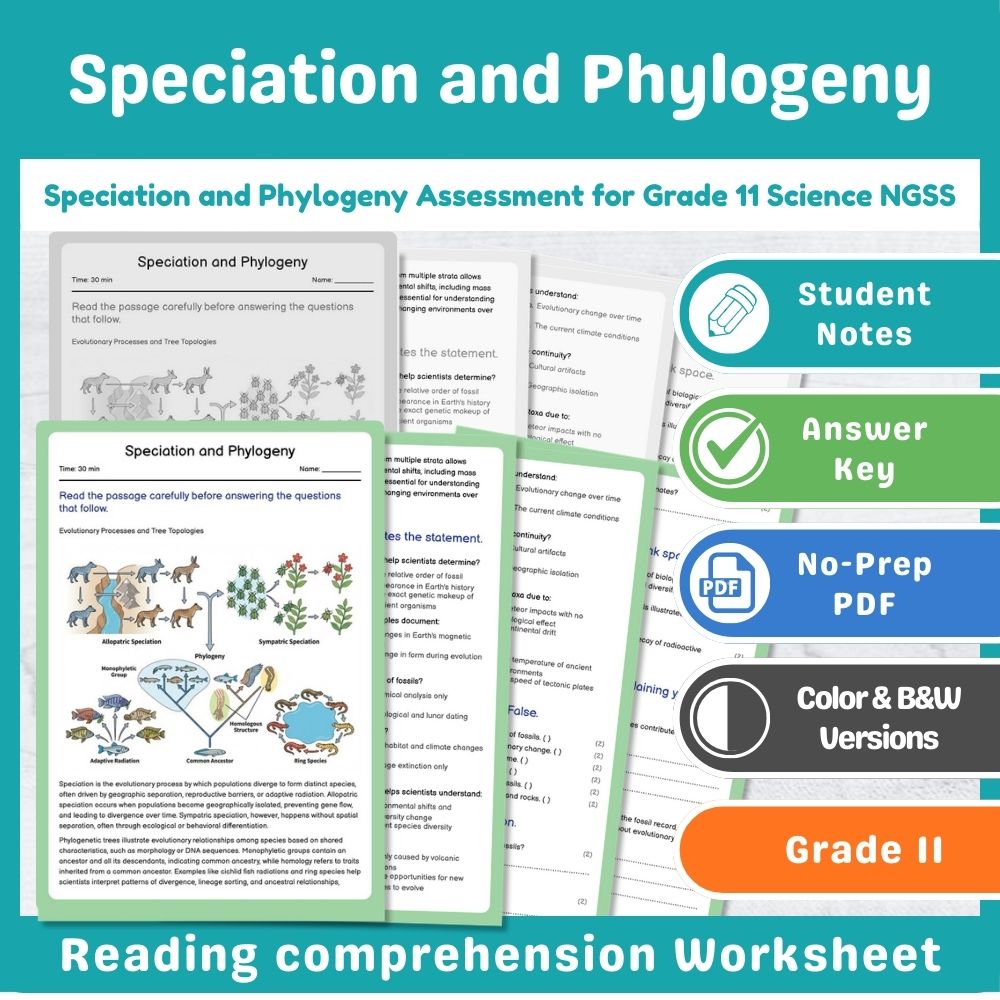
Speciation and Phylogeny Assessment for Grade 11 Science NGSS
Created byPrism Point LearningLearning Objectives
- Explain the mechanisms leading to the origin of new species, including geographic isolation and reproductive barriers.
- Describe different modes of speciation, such as allopatric and sympatric, and their implications.
- Interpret phylogenetic trees based on morphological and molecular data to understand evolutionary relationships.
Instant download

Grade 11 Evaluating Explanations Worksheet | Florida NGSSS Science Key
 Created byEvergreen Desk Education
Learning Objectives
- Evaluate scientific explanations by analyzing the quality and limits of evidence.
- Distinguish correlation from cause by looking for mechanisms and testable predictions.
- Compare alternative explanations using the same evidence and propose observations that could discriminate between them.
Instant download
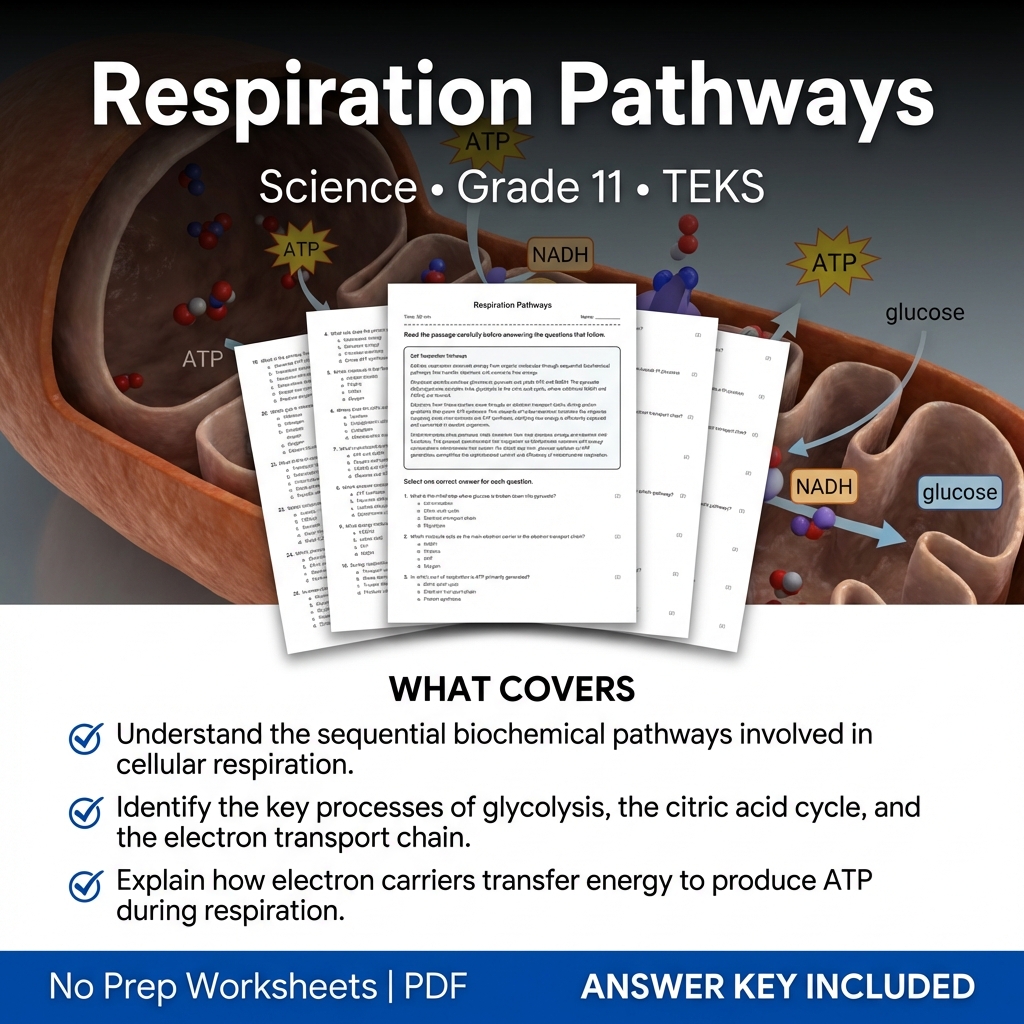
Respiration Pathways Worksheet for Grade 11 Science | TEKS-Aligned
Created byCoral Reef LearningLearning Objectives
- Understand the sequential biochemical pathways involved in cellular respiration.
- Identify the key processes of glycolysis, the citric acid cycle, and the electron transport chain.
- Explain how electron carriers transfer energy to produce ATP during respiration.
Instant download

Grade 11 Science | Phylogenetic Trees Worksheet | TEKS-Aligned
Created byLumora LearningLearning Objectives
- Explain how phylogenetic trees depict evolutionary relationships among organisms.
- Identify key features of rooted and unrooted trees.
- Interpret branching patterns, nodes, and clades in phylogenetic hypotheses.
Instant download

Grade 11 Photosynthesis Worksheet | BC Practice & PDF
Created byClear Sky ClassroomLearning Objectives
- Explain how light-dependent reactions in the thylakoid membranes convert light energy into ATP and NADPH
- Describe how the Calvin cycle in the stroma uses ATP and NADPH to fix CO2 and form carbohydrates
- Connect electron flow, proton gradient formation, and carbon flux to how photosynthesis supports plant growth and ecosystem energy flow
Instant download
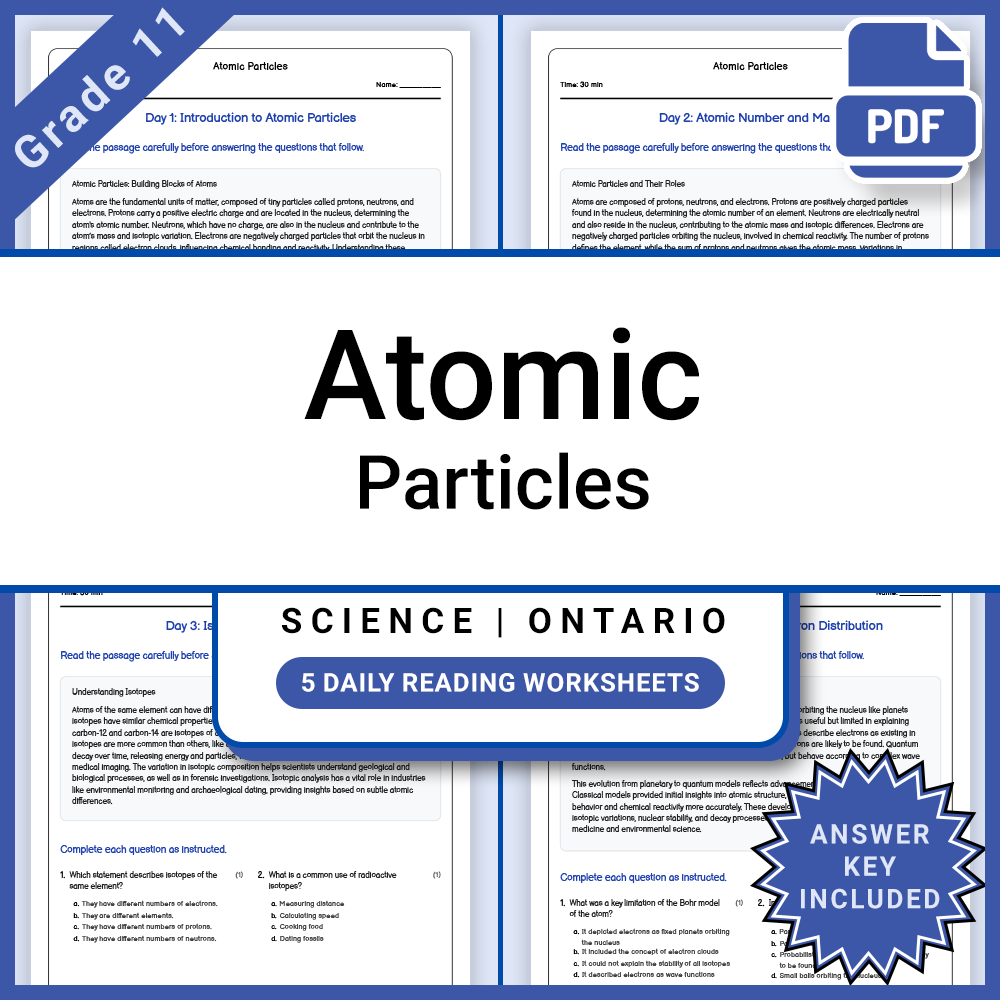
Grade 11 Science – Atomic Particles Daily Reading Worksheet + Answer Key
JCreated byJ.S SheetsLearning Objectives
- Identify protons, neutrons, and electrons and describe their roles in an atom.
- Explain the concepts of atomic number, mass number, and isotopic variation.
- Compare early models of atomic structure with modern quantum models.
Also included in: Grade 11 Science Lesson Bundle | Ontario Curriculum & Reading Worksheets +1 more
Instant download
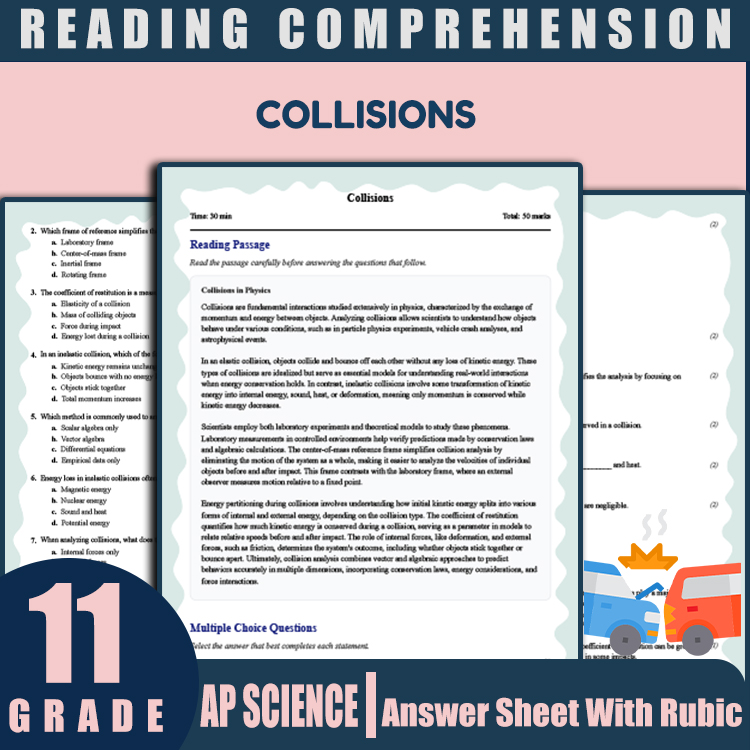
11th Grade Science | Collisions Reading Worksheet & Answer Key (PDF)
JCreated byJ.S SheetsLearning Objectives
- Understand the principles of elastic and inelastic collisions in one and two dimensions.
- Apply conservation of momentum and kinetic energy where applicable to analyze collision outcomes.
- Compare laboratory and center-of-mass reference frames in the context of collision analysis.
Also included in: Grade 11 Physics Unit | Motion, Waves & Energy Worksheets (PDF + Rubric Bundle) +1 more
Instant download

Grade 11 Science | Climate Systems Worksheet | NGSSS-Aligned
Created byLumora LearningLearning Objectives
- Distinguish climate from weather and explain why long-term patterns matter
- Describe how the Earth’s energy balance and greenhouse gas concentrations influence climate change
- Explain feedbacks and ocean circulation as mechanisms that can reshape temperature and precipitation patterns
Instant download

Grade 11 Science – One-Dimensional Kinematics Worksheet | Ontario Standards
Created byBright Mind ResourcesLearning Objectives
- Understand the concepts of displacement, velocity, and acceleration in uniform motion.
- Differentiate between instantaneous and average rates of change.
- Apply constant-acceleration formulas to real-world scenarios such as free-fall and relative motion.
Also included in: Grade 11 Motion & Forces Science Lesson Bundle for Daily Reading | Ontario +1 more
Instant download
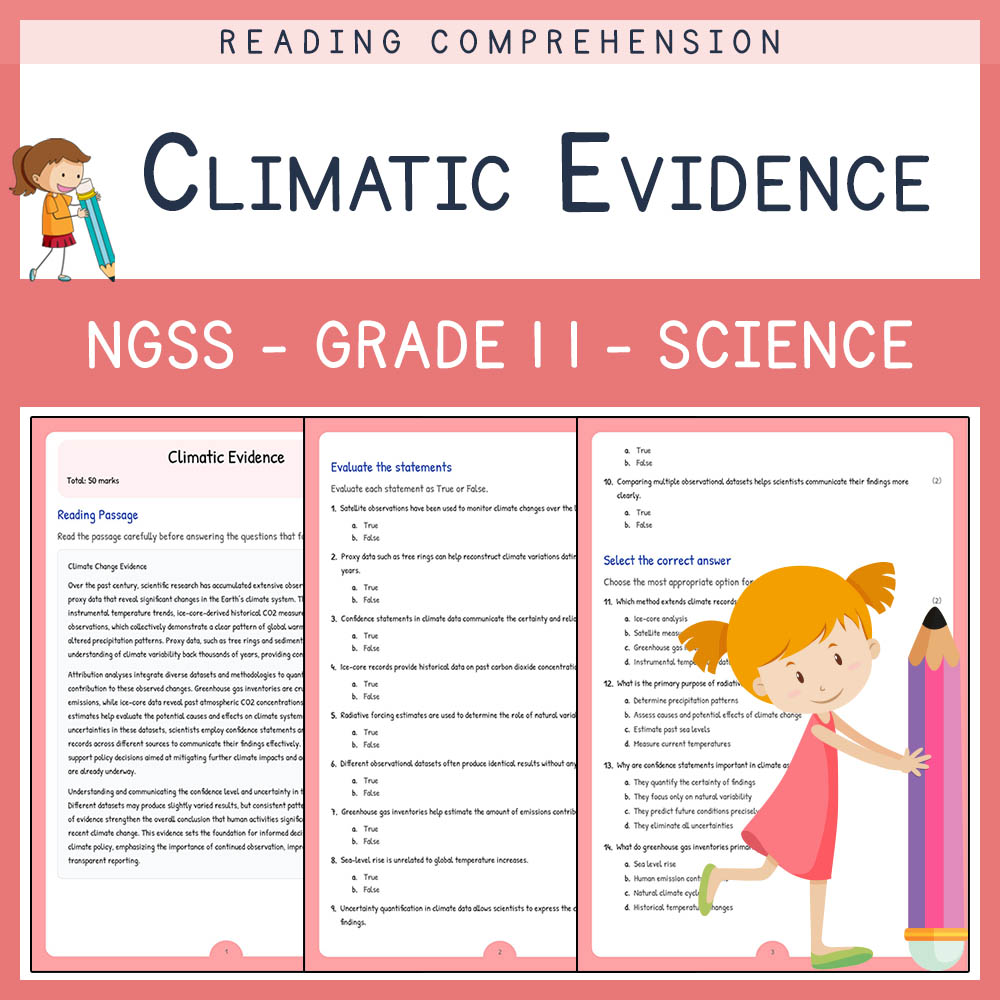
Grade 11 Science | Climatic Evidence Worksheet (NGSS-Aligned, PDF + Answer Key)
Created byLumora LearningLearning Objectives
- Analyze observational records, proxy data, and attribution analyses to understand human impacts on climate change.
- Identify and interpret various types of climate data, including greenhouse gas inventories and ice-core records.
- Evaluate uncertainty quantification and confidence statements in climate data assessments.
Instant download
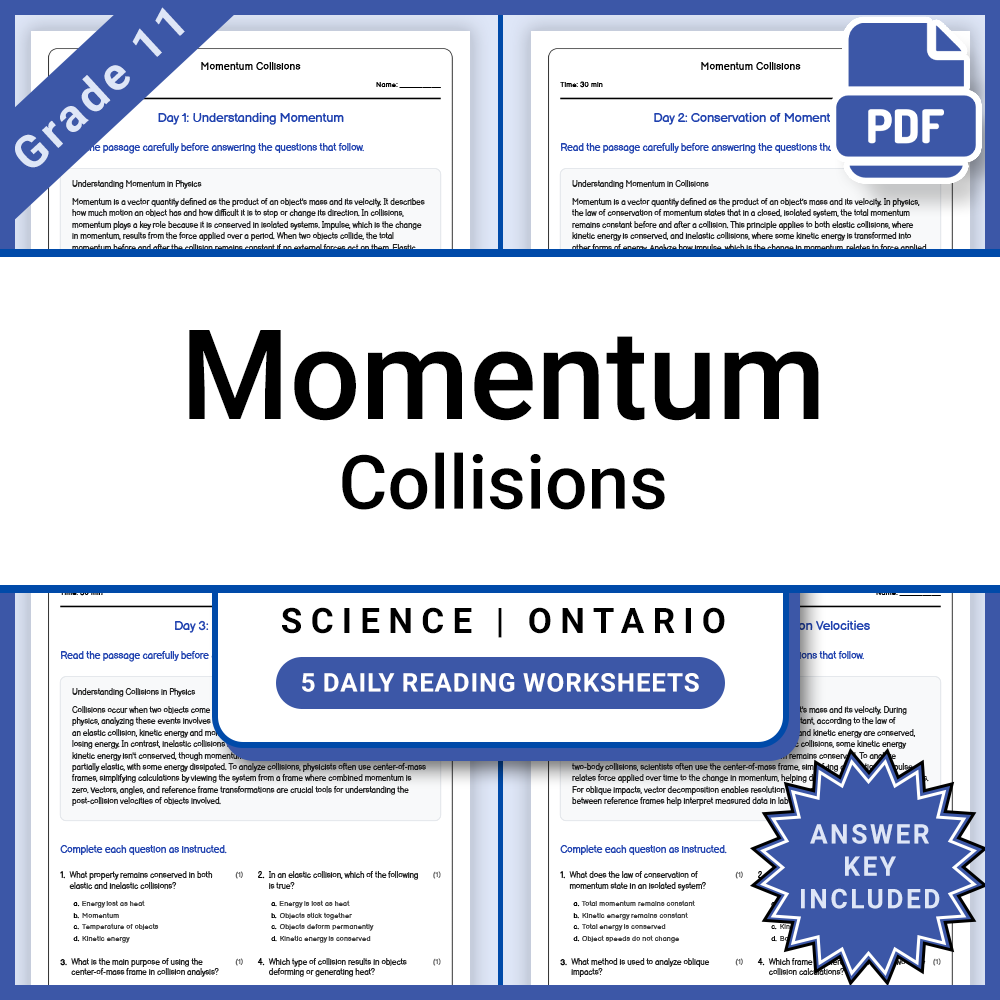
Grade 11 Science – Momentum Collisions Daily Reading Worksheet + Answer Key
JCreated byJ.S SheetsLearning Objectives
- Understand the concepts of linear momentum and impulse.
- Explain the principle of momentum conservation in collisions.
- Differentiate between elastic and inelastic collisions.
Also included in: Grade 11 Science Lesson Bundle for Ontario Curriculum +1 more
Instant download
About Grade 11 Science Worksheets
Browse 6,616 printable Grade 11 Science worksheets — ready-to-print PDFs with answer keys where available.
Each resource here is built by an independent educator and reviewed for quality. Worksheets print straight from PDF and suit classroom use, homework, or extra practice; most come with answer keys, and you can preview before purchasing.