
Grade 11 Science Worksheets
6,616 worksheets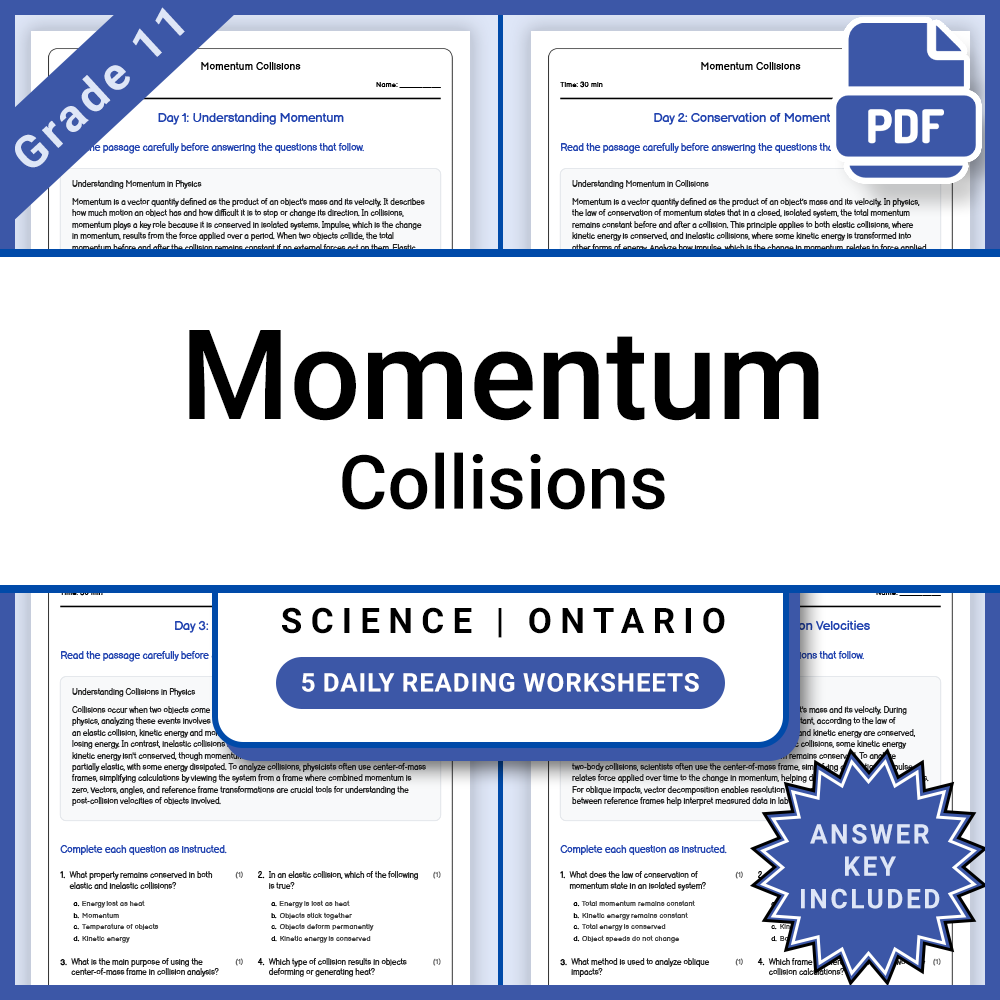
Grade 11 Science – Momentum Collisions Daily Reading Worksheet + Answer Key
JCreated byJ.S SheetsLearning Objectives
- Understand the concepts of linear momentum and impulse.
- Explain the principle of momentum conservation in collisions.
- Differentiate between elastic and inelastic collisions.
Also included in: Grade 11 Science Lesson Bundle for Ontario Curriculum +1 more
Instant download
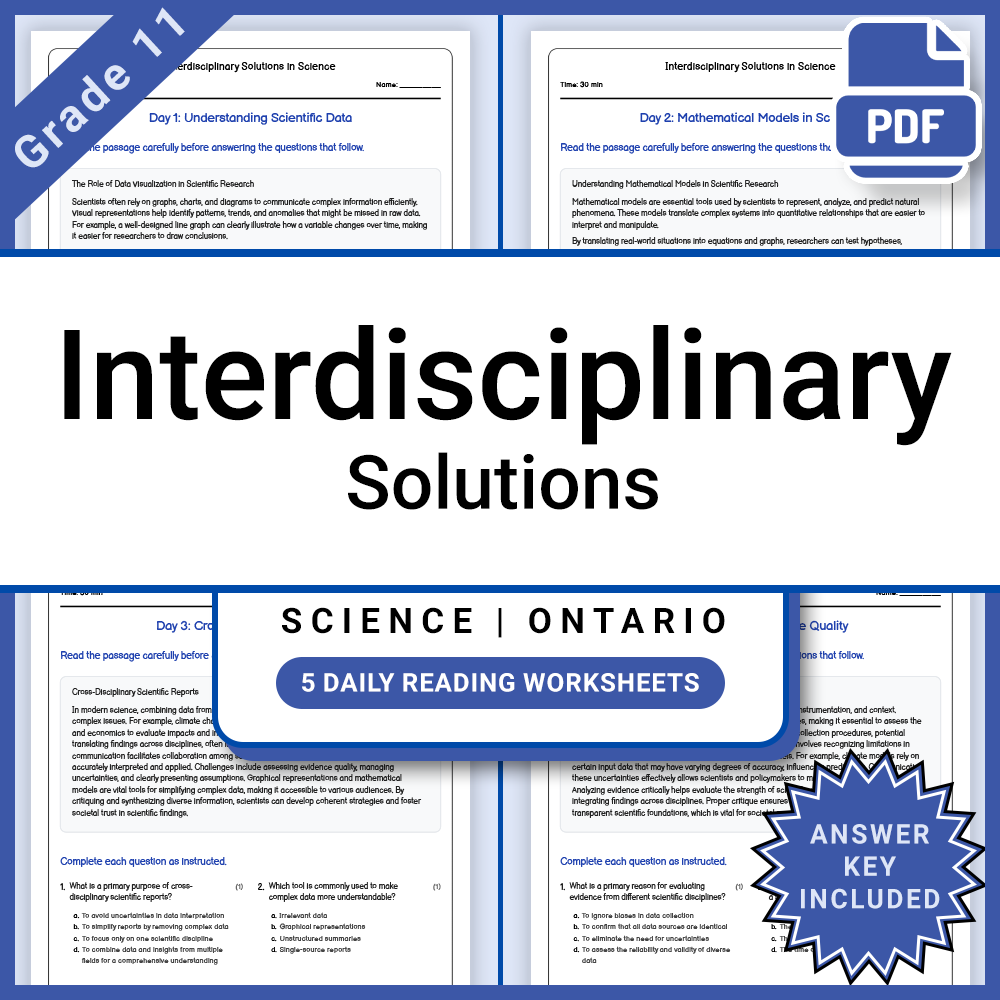
Grade 11 Science – Interdisciplinary Solutions Daily Worksheet + Answer Key
JCreated byJ.S SheetsLearning Objectives
- Interpret and analyze graphical representations of scientific data
- Translate quantitative findings into different disciplinary languages
- Critique the quality of scientific evidence
Also included in: Grade 11 Science Lesson Bundle: Comprehensive Ontario Curriculum Resources +1 more
Instant download

Biogeochemical Cycles Worksheet for Grade 11 Science
JCreated byJ.S SheetsLearning Objectives
- Explain how elements cycle among living organisms, soil, water, and the atmosphere using examples from the carbon, nitrogen, and phosphorus cycles.
- Describe key processes (e.g., photosynthesis, respiration, fixation, nitrification, assimilation, ammonification, denitrification).
- Interpret how residence time and pool size affect nutrient availability and ecosystem productivity.
Instant download
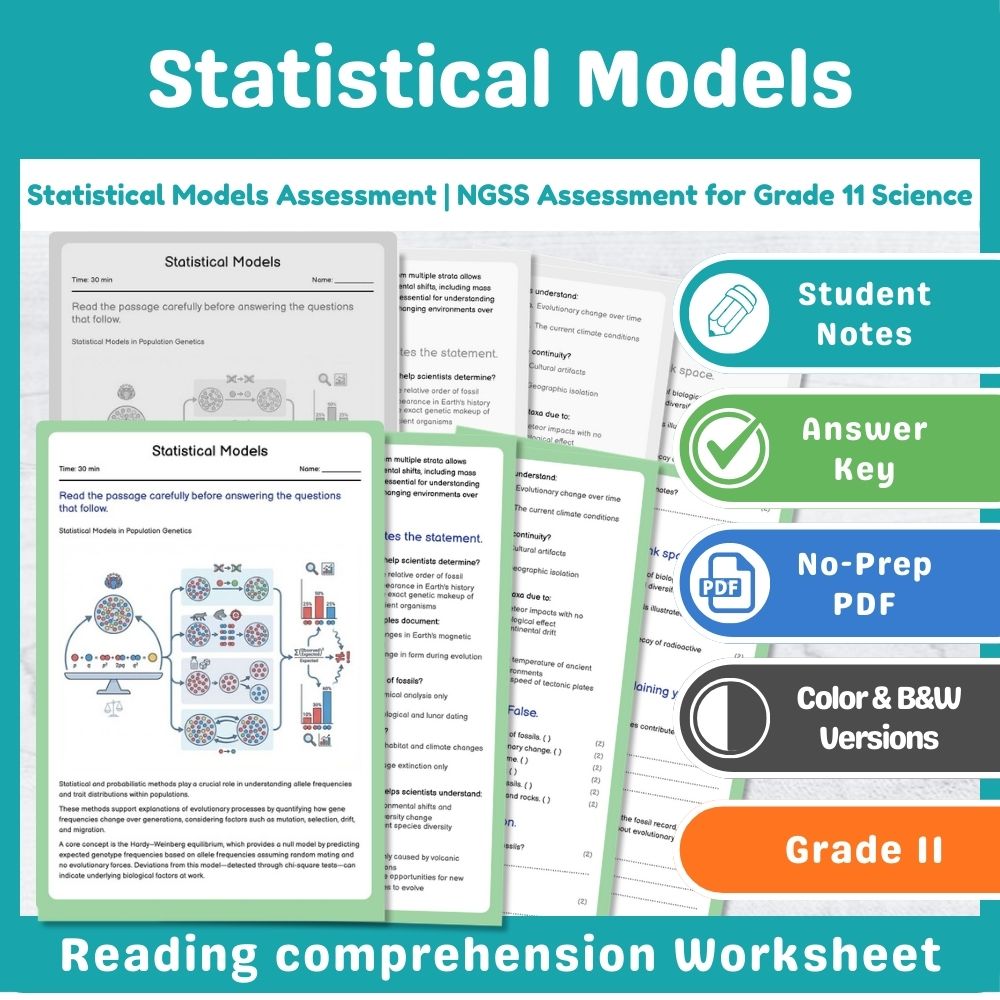
Statistical Models Assessment | NGSS Assessment for Grade 11 Science
 Created byPrism Point Learning
Learning Objectives
- Explain how Hardy–Weinberg equilibrium serves as a null model in population genetics.
- Calculate expected genotype frequencies using allele frequencies.
- Apply chi-square tests and confidence intervals to evaluate deviations from expected frequencies.
Instant download

Grade 11 Science | Oxidative Phosphorylation Worksheet Elena | Ontario
 Created byLumora Learning
Learning Objectives
- Describe the process of oxidative phosphorylation including electron transport and ATP synthesis.
- Explain the role of redox carriers, proton-motive force, and oxygen as the terminal electron acceptor.
- Compare aerobic respiration with anaerobic respiration and fermentation pathways.
Instant download

Grade 11 Science | Measurement & Uncertainty in Science - Reading Comprehension
 Created byCoral Reef Learning
Learning Objectives
- Identify and convert SI units accurately.
- Understand the significance of significant figures in measurements.
- Differentiate between precision and accuracy.
Instant download
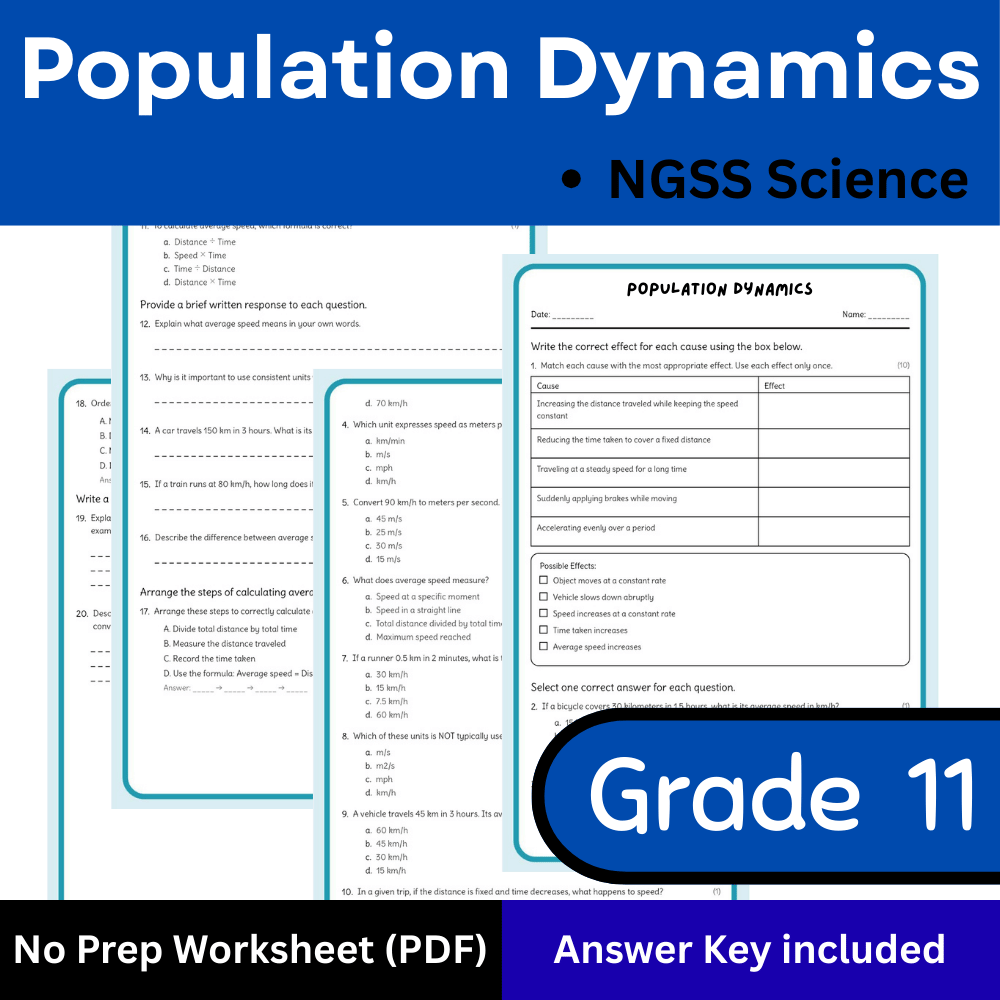
Grade 11 Science | Population Dynamics Worksheet (Answer Key) – NGSS Aligned
 Created byBright Mind Resources
Learning Objectives
- Describe the key factors influencing changes in population size, including birth/death rates and immigration/emigration.
- Identify different growth patterns such as exponential and logistic trajectories in populations.
- Explain predator-prey interactions and mechanisms of density regulation, including Allee effects and episodic disturbances.
Instant download

Grade 11 Worksheet B: Spectrum Properties—Wave vs. Particle Models | NGSS
 Created byClear Sky Classroom
Learning Objectives
- Evaluate evidence for wave and particle models of electromagnetic radiation using interference, diffraction, and the photoelectric effect.
- Explain where the wave model works best (e.g., polarization, interference, diffraction) and where it breaks down.
- Explain where the particle (photon) model works best (e.g., quantized energy transfer in the photoelectric effect) and where it breaks down.
Also included in: Grade 11 Wave and EM Signal Relationships Science Lesson Bundle for NGSS +1 more
Instant download
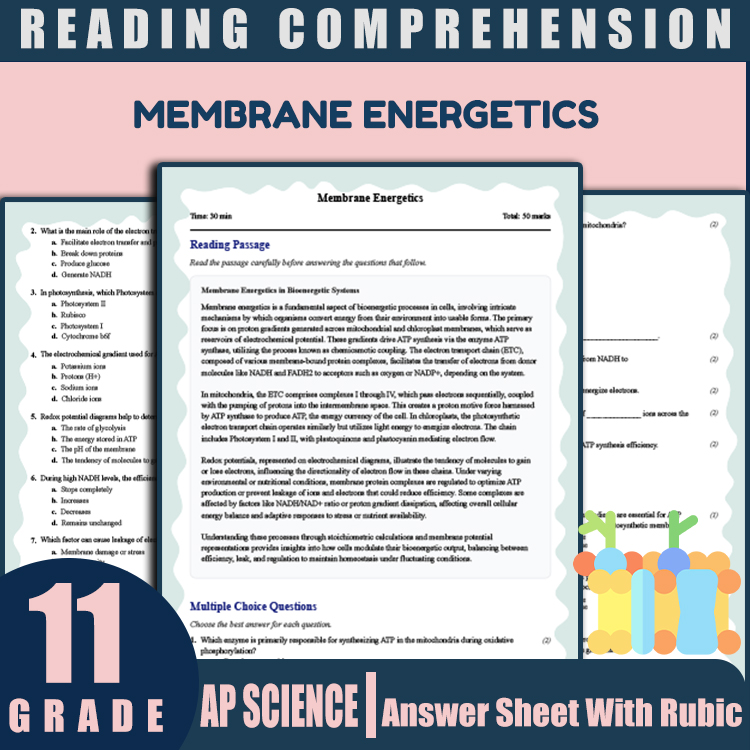
Grade 11 Science | Membrane Energetics Reading Worksheet (PDF + Answer Key)
JCreated byJ.S SheetsLearning Objectives
- Explain the principles of proton gradients and chemiosmotic coupling in membrane systems.
- Describe the structure and function of electron transport chains in aerobic and photosynthetic membranes.
- Analyze redox potential diagrams and electrochemical gradients related to ATP synthesis.
Also included in: Grade 11 Science Unit Bundle – Cellular Systems, Genetics Ecosystems Worksheets +1 more
Instant download

Grade 11 Science – Adaptive Radiation & Evolution | Daily Reading Worksheet
Created byBright Mind ResourcesLearning Objectives
- Understand the concept of adaptive radiation and its causes.
- Identify key features of species diversification and niche exploitation.
- Explain how adaptive radiation influences biodiversity and ecological interactions.
Also included in: Grade 11 Evolution Science Lesson Bundle Daily Reading Worksheets | TEKS +2 more
Instant download
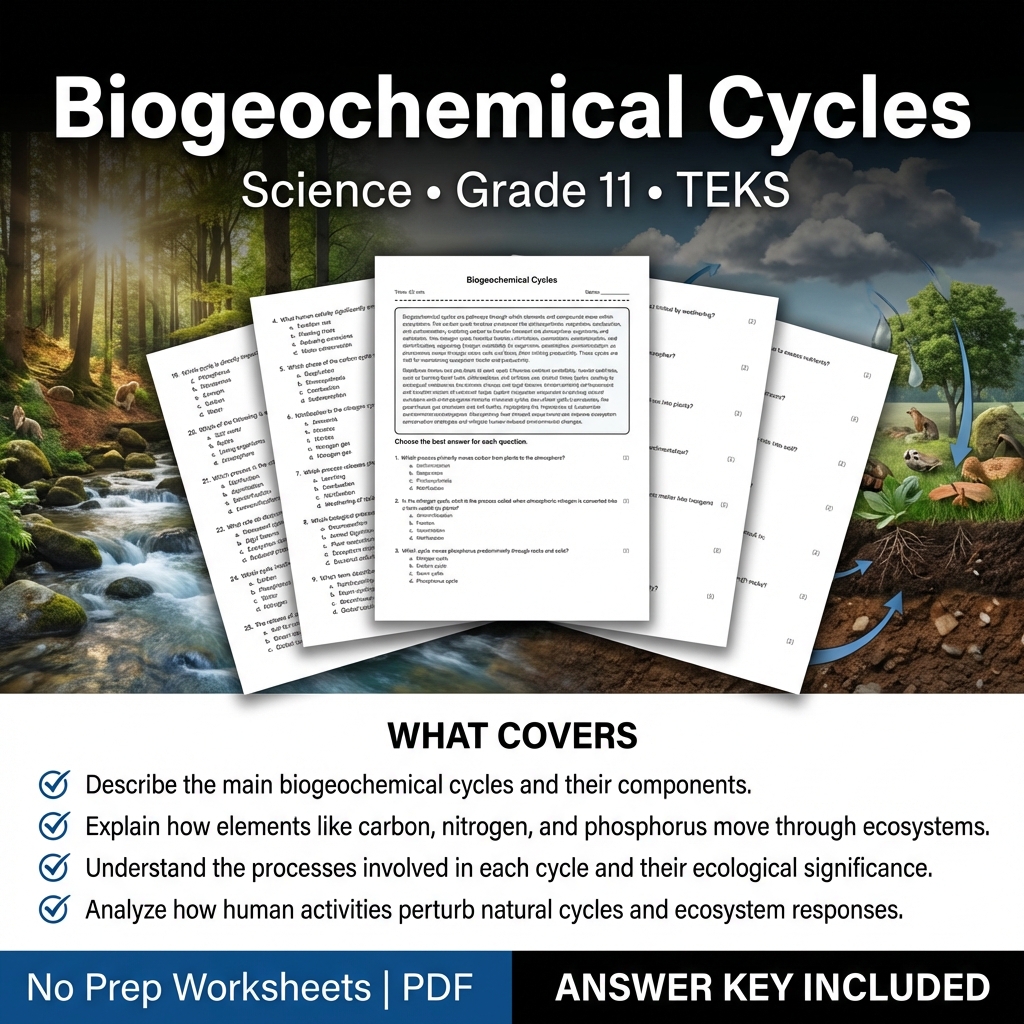
Biogeochemical Cycles Worksheet for Grade 11 Science | TEKS Standards
Created byCoral Reef LearningLearning Objectives
- Describe the main biogeochemical cycles and their components.
- Explain how elements like carbon, nitrogen, and phosphorus move through ecosystems.
- Understand the processes involved in each cycle and their ecological significance.
Instant download
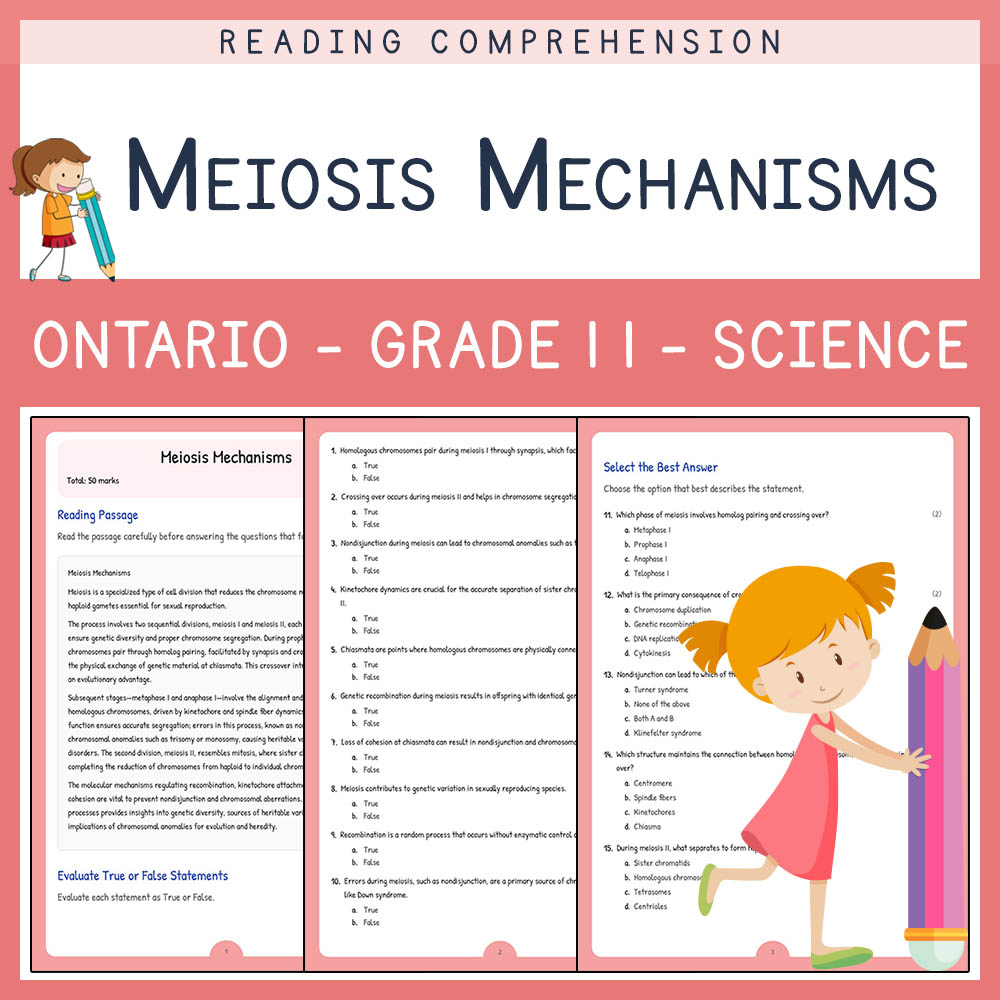
Grade 11 Science | Meiosis Mechanisms Worksheet Elena | Ontario Standards
Created byLumora LearningLearning Objectives
- Describe the stages and processes involved in meiosis, including homolog pairing, synapsis, and crossing over.
- Explain the molecular basis of recombination and how chiasmata formation influences genetic variation.
- Analyze the consequences of nondisjunction events and chromosomal anomalies for inheritance and evolution.
Instant download

Grade 11 Science | Mutation & Variation - Daily Reading Comprehension
Created byCoral Reef LearningLearning Objectives
- Understand the different types of genetic mutations
- Explain how mutations can affect DNA sequences and protein synthesis
- Identify the potential effects of mutations as neutral, harmful, or beneficial
Instant download

Grade 11 Science | Understanding pH & pOH - Daily Reading Comprehension
Created byCoral Reef LearningLearning Objectives
- Learn how to calculate hydrogen ion concentration ([H+]) from pH values.
- Learn how to determine hydroxide ion concentration ([OH-]) from pOH values.
- Understand the relationship between pH, pOH, and water acidity or basicity.
Also included in: Acids, Bases and pH Lesson Bundle – Grade 11 Science Alberta +1 more
Instant download

Grade 11 Science | Acid Strength Factors - Daily Reading Comprehension
Created byCoral Reef LearningLearning Objectives
- Understand the factors that influence acid strength
- Identify how molecular structure affects acidity
- Relate environmental examples to acid strength concepts
Also included in: Acids, Bases and pH Lesson Bundle – Grade 11 Science Alberta +1 more
Instant download

Grade 11 Science | Titration Calculations - Daily Reading Comprehension
Created byCoral Reef LearningLearning Objectives
- Understand the basic concepts of titration and stoichiometry.
- Learn how to perform titration calculations involving concentration and volume.
- Identify different types of titration reactions, including acid-base neutralizations.
Also included in: Acids, Bases and pH Lesson Bundle – Grade 11 Science Alberta +1 more
Instant download

Grade 11 Science | Degree Dissociation in Chemistry - Reading Comprehension
Created byCoral Reef LearningLearning Objectives
- Understand the concept of degree of dissociation and its significance in solution chemistry.
- Learn how dissociation depends on concentration and equilibrium constants.
- Explore factors such as common-ion effects and their influence on dissociation.
Also included in: Acids, Bases and pH Lesson Bundle – Grade 11 Science Alberta +1 more
Instant download
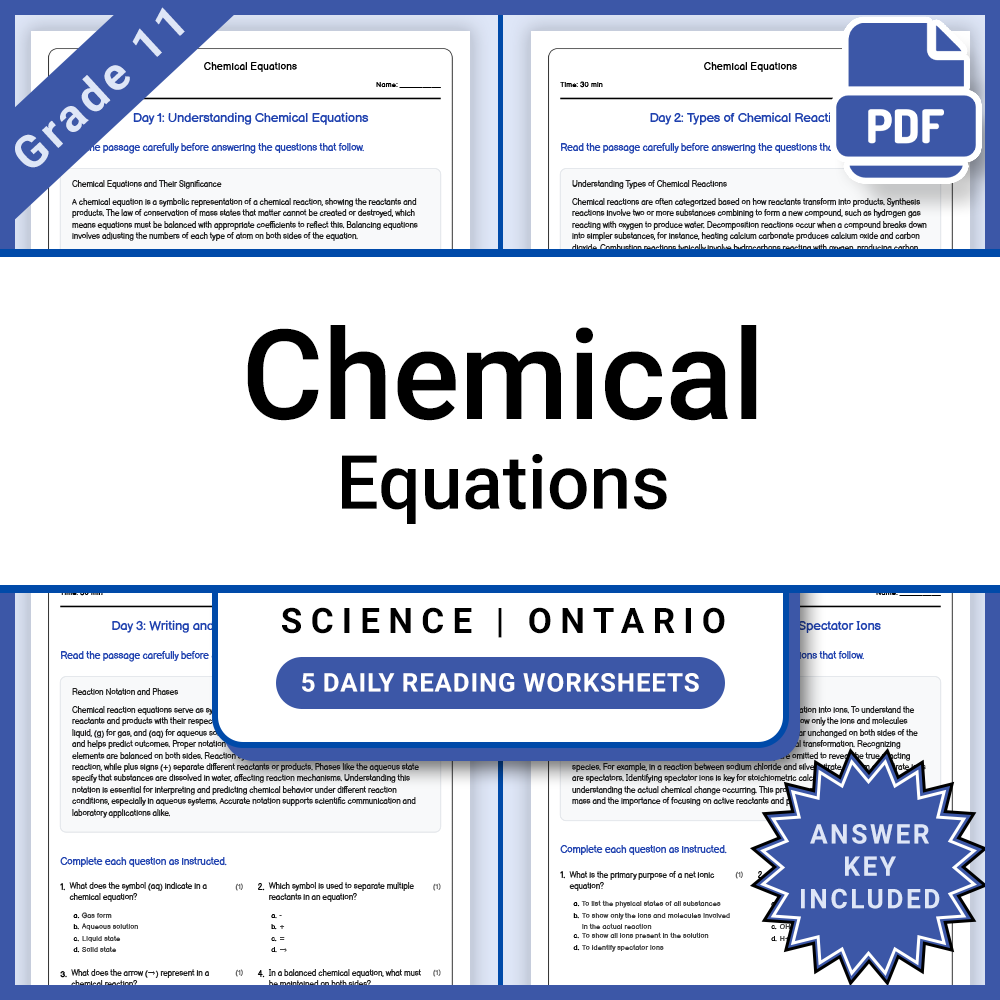
Grade 11 Science – Chemical Equations Daily Reading Worksheet with Answer Key
JCreated byJ.S SheetsLearning Objectives
- Understand the representation of chemical changes through balanced equations.
- Identify different reaction types such as synthesis, decomposition, and combustion.
- Learn to include states of matter and phase considerations in reaction notation.
Also included in: Grade 11 Science Lesson Bundle | Ontario Curriculum & Reading Worksheets +1 more
Instant download
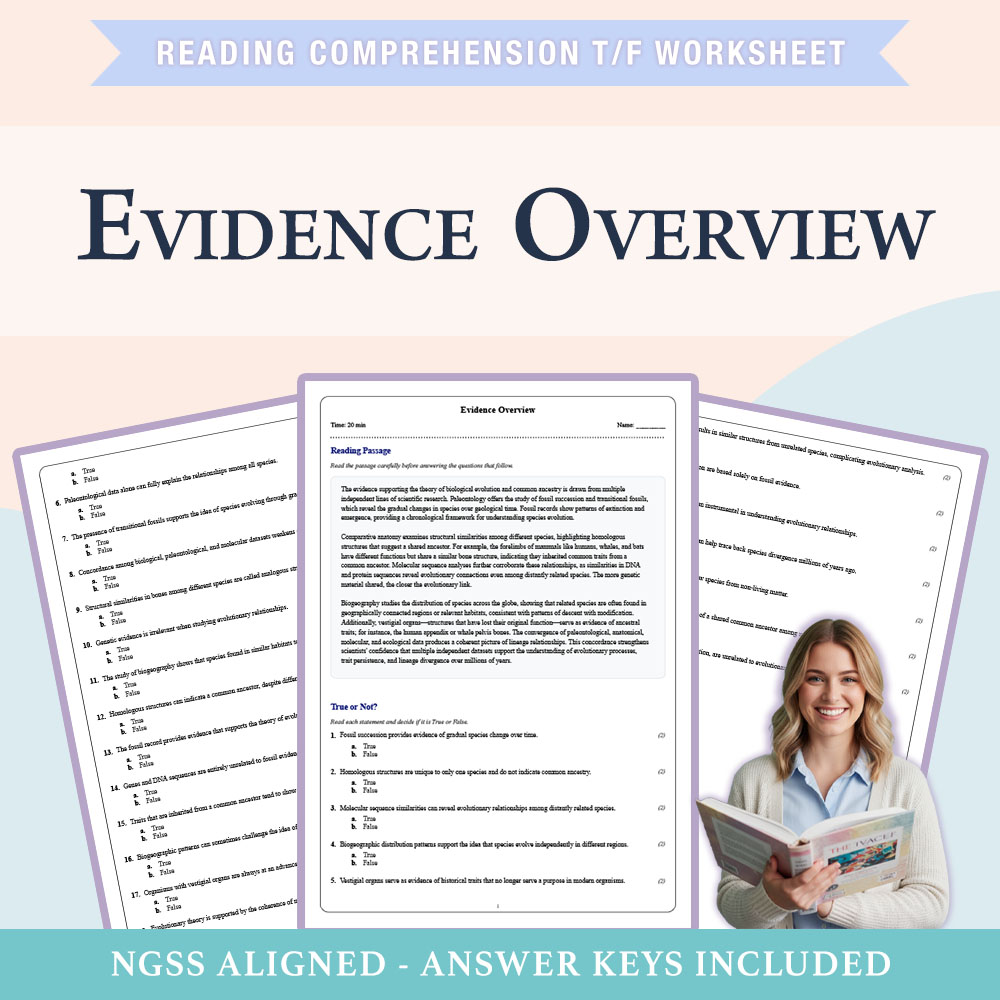
Grade 11 Science | Evidence Overview Worksheet (PDF + Answer Key)
 Created byCopper Leaf Classroom
Learning Objectives
- Understand how fossil evidence supports common ancestry and evolution.
- Identify various types of evidence such as comparative anatomy, molecular similarities, and biogeography.
- Recognize the importance of concordance among multiple scientific datasets in supporting evolutionary theory.
Also included in: Grade 11 Science | Evolutionary Biology & Genetics Bundle (PDF + Answers) +1 more
Instant download
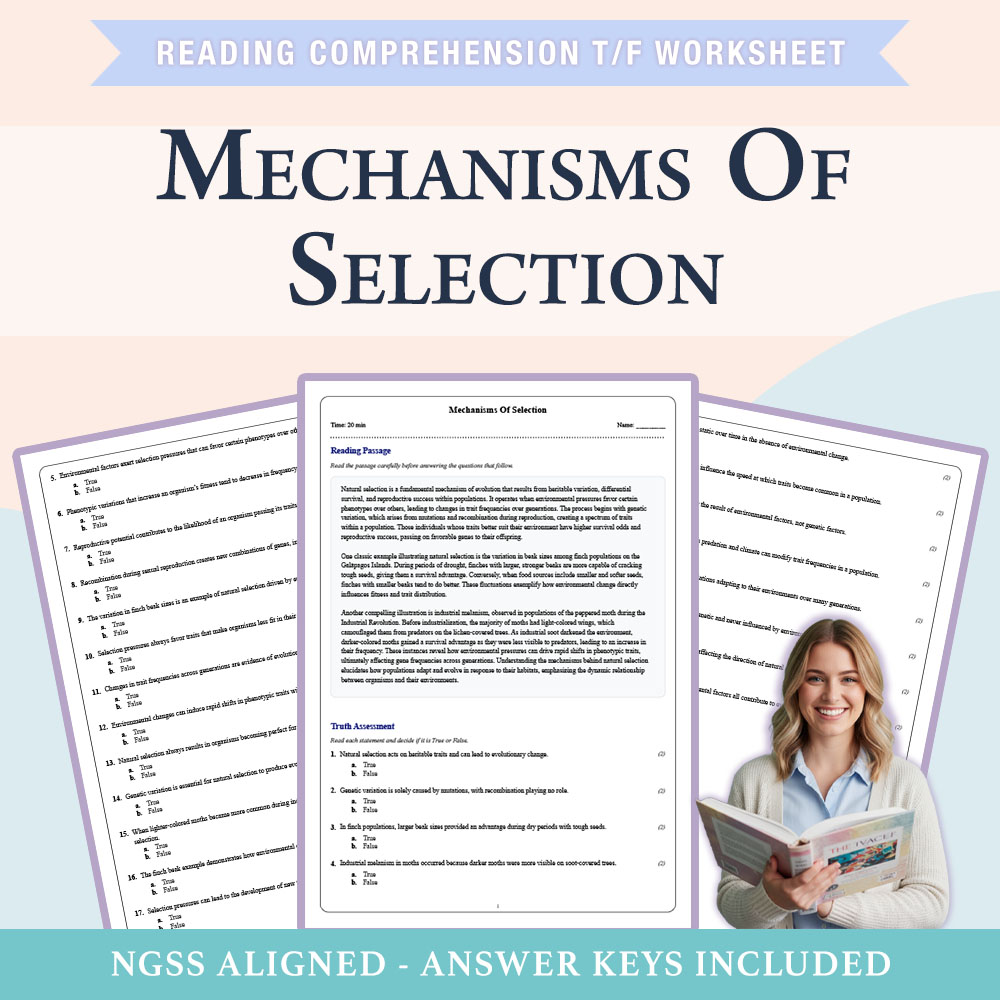
11th Grade Science | Mechanisms of Selection Worksheet (PDF + Answer Key)
Created byCopper Leaf ClassroomLearning Objectives
- Understand the concept of natural selection as a primary mechanism of evolutionary change.
- Identify factors influencing selection pressures, including genetic variation and environmental factors.
- Analyze examples such as finch beak variation and industrial melanism to comprehend how selection affects traits.
Also included in: Grade 11 Science | Evolutionary Biology & Genetics Bundle (PDF + Answers) +1 more
Instant download
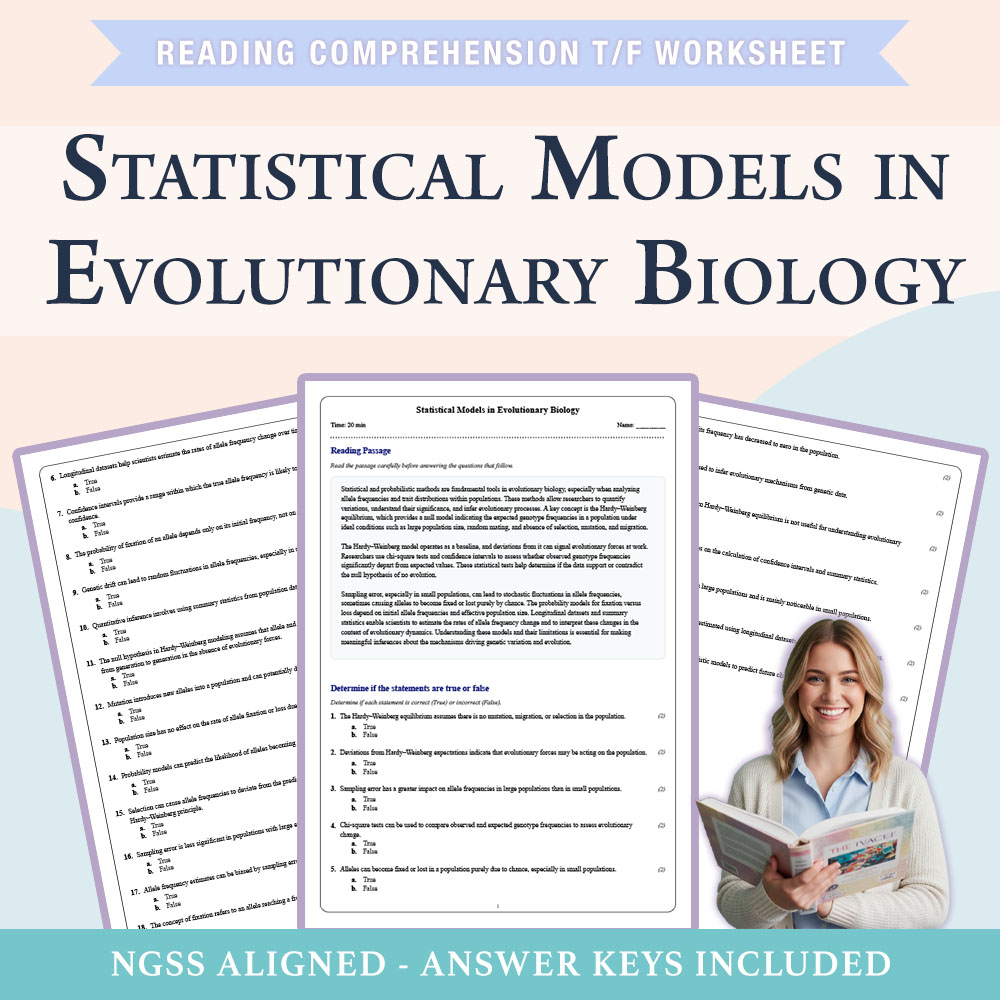
11th Grade Science | Statistical Models in Evolutionary Biology (PDF + Answers)
Created byCopper Leaf ClassroomLearning Objectives
- Understand how statistical models are applied to allele frequencies and trait distributions in populations.
- Describe the Hardy–Weinberg equilibrium as a null model for genetic variation.
- Evaluate departures from genetic expectations using chi-square tests and confidence intervals.
Also included in: Grade 11 Science | Evolutionary Biology & Genetics Bundle (PDF + Answers) +1 more
Instant download
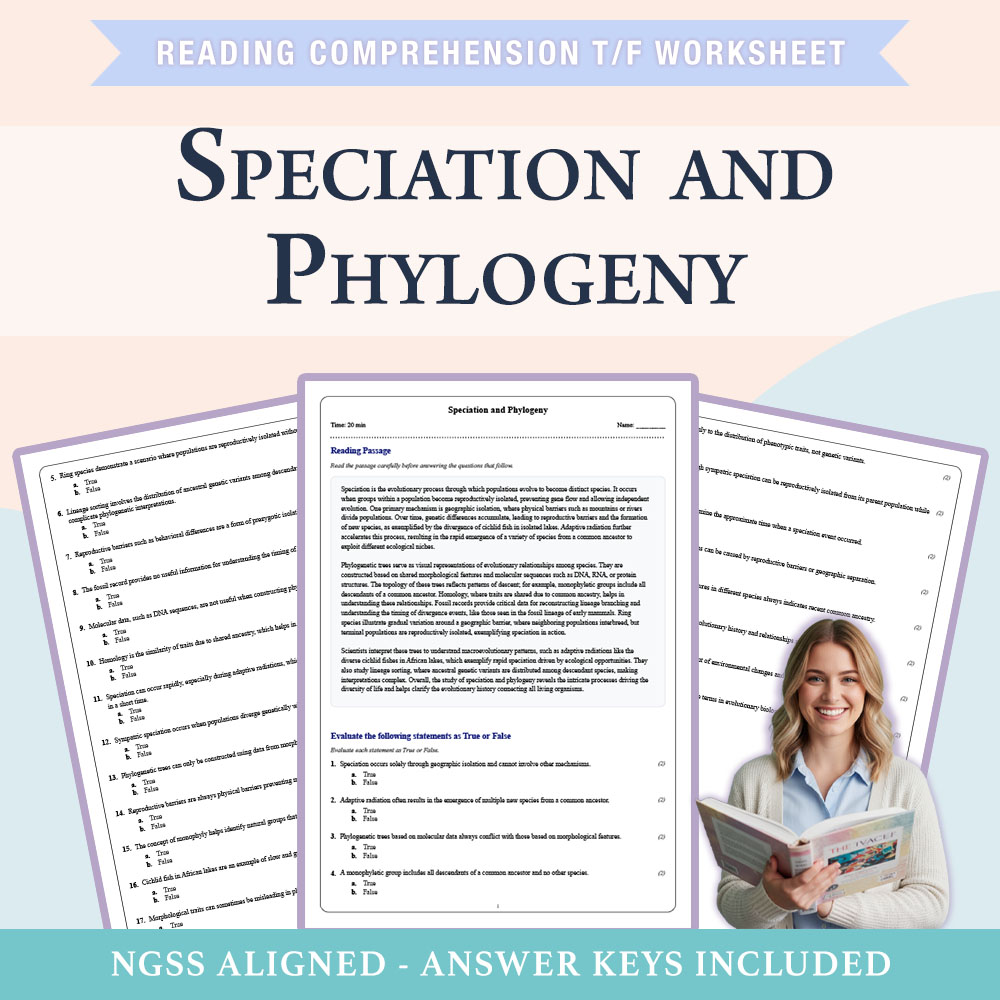
Grade 11 Science | Speciation & Phylogeny Worksheet (PDF + Answer Key)
Created byCopper Leaf ClassroomLearning Objectives
- Explain mechanisms contributing to the diversification and origin of new species, including geographic isolation, reproductive barriers, and adaptive radiation.
- Describe different modes of speciation, such as allopatric and sympatric, and understand population divergence.
- Interpret phylogenetic trees constructed from morphological and molecular data, understanding concepts like tree topology, monophyly, and homology.
Also included in: Grade 11 Science | Evolutionary Biology & Genetics Bundle (PDF + Answers) +1 more
Instant download

Gas Stoichiometry Worksheet | Grade 11 Science Practice
Created byPrism Point LearningLearning Objectives
- Apply the ideal gas law and gas stoichiometry to relate gas volume, pressure, temperature, and moles
- Convert between standard and nonstandard conditions using Gay-Lussac/combined gas-law reasoning
- Use balanced chemical equations to determine moles and gas volumes of reactants and products
Instant download

11th Grade Science | Biodiversity Metrics Practice Worksheet (PDF + Answer Key)
Created byCopper Leaf ClassroomLearning Objectives
- Define and differentiate various measures of biodiversity including species richness, evenness, and diversity indices.
- Explain sampling considerations such as effort and rarefaction to obtain accurate biodiversity estimates.
- Distinguish between alpha, beta, and gamma diversity across spatial scales.
Instant download

Grade 11 Gas Stoichiometry Worksheet | Alberta Chemistry PDF + Answer Key
 Created byEvergreen Desk Education
Learning Objectives
- Use the ideal gas law and mole ratios to relate gas volume, pressure, temperature, and amount for chemical reactions.
- Explain how standard and nonstandard conditions affect gas-volume calculations and conversions.
- Apply gas stoichiometry to real industrial gas scenarios, including emissions accounting and process monitoring.
Instant download
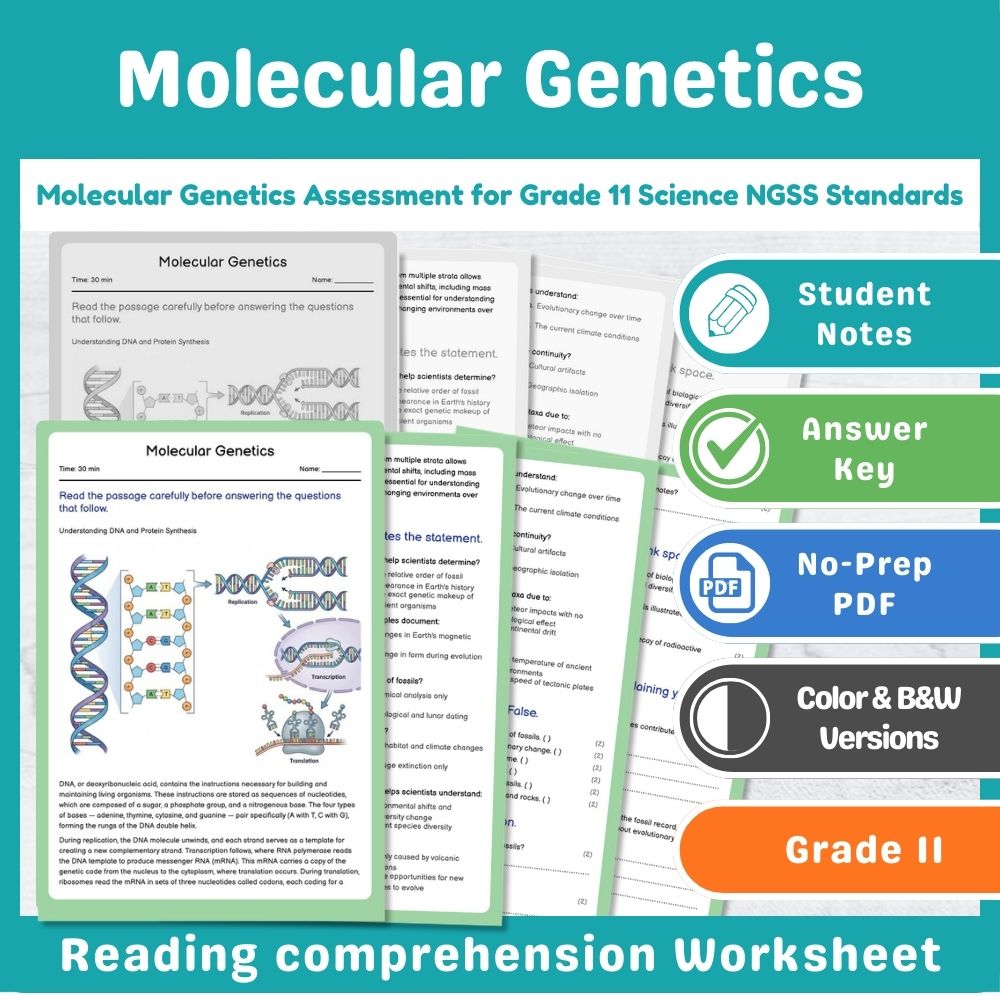
Molecular Genetics Assessment for Grade 11 Science NGSS Standards
Created byPrism Point LearningLearning Objectives
- Understand the relationship between DNA sequences and protein synthesis through replication, transcription, and translation.
- Describe the structure of DNA and the genetic code.
- Explain how chromosomal organization links molecular information to observable traits.
Also included in: Grade 11 Science Mini Bundle – Genetics & Mutation Assessment Pack
Instant download
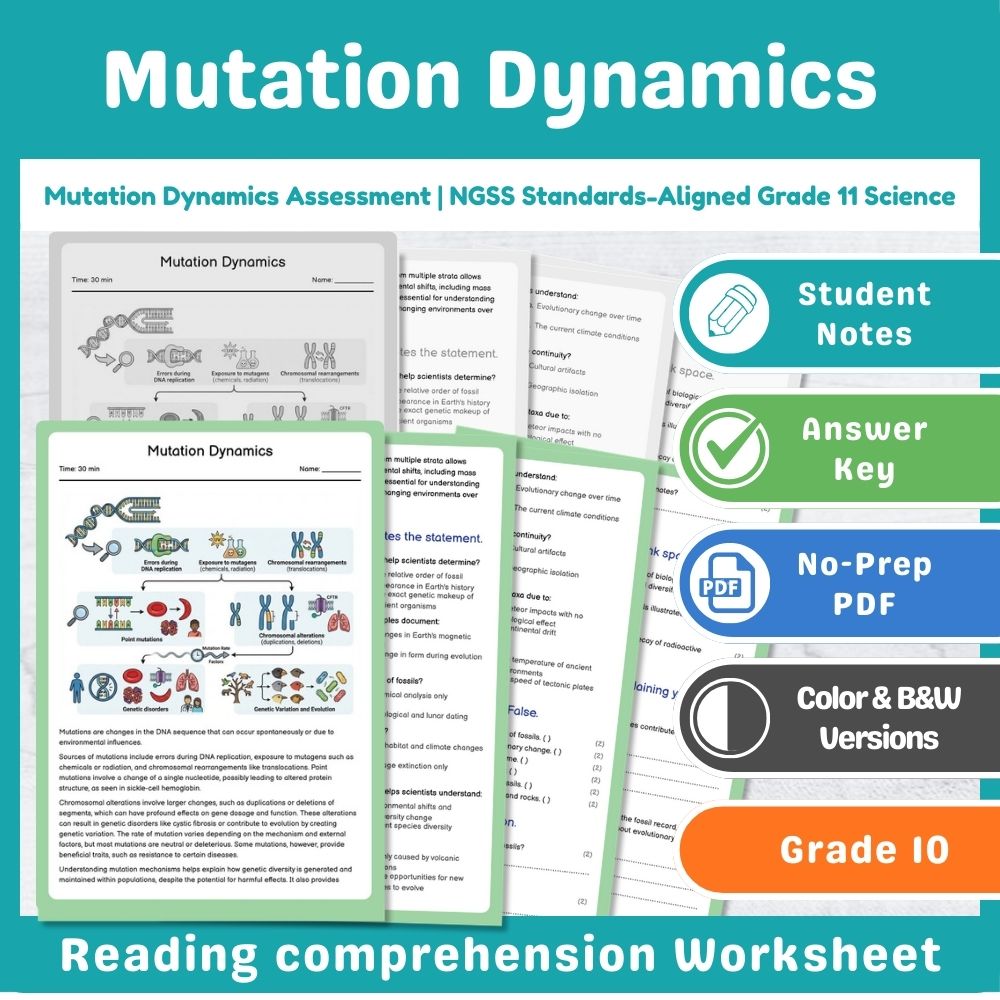
Mutation Dynamics Assessment | NGSS Standards-Aligned Grade 11 Science
Created byPrism Point LearningLearning Objectives
- Identify sources of genetic mutations and chromosomal alterations.
- Explain the mechanisms leading to mutations such as point mutations, frameshifts, duplications, deletions, and translocations.
- Evaluate the effects of mutations on protein function and trait variation.
Also included in: Grade 11 Science Mini Bundle – Genetics & Mutation Assessment Pack
Instant download
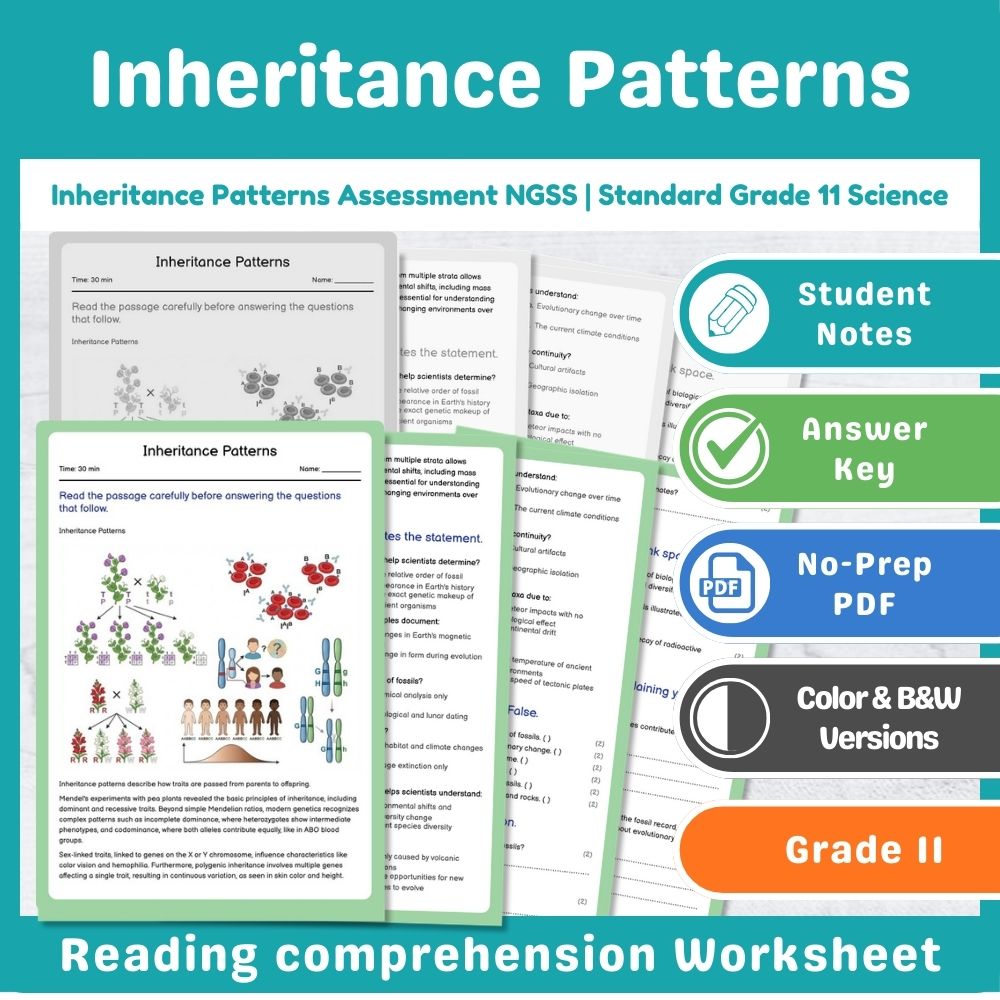
Inheritance Patterns Assessment NGSS | Standard Grade 11 Science
Created byPrism Point LearningLearning Objectives
- Understand the basic principles of Mendelian inheritance and how traits are passed through generations.
- Identify and describe various inheritance patterns beyond simple dominance, such as incomplete dominance, codominance, sex linkage, and polygenic inheritance.
- Interpret pedigrees and predict inheritance outcomes using probability and meiotic mechanisms.
Also included in: Grade 11 Science Mini Bundle – Genetics & Mutation Assessment Pack
Instant download
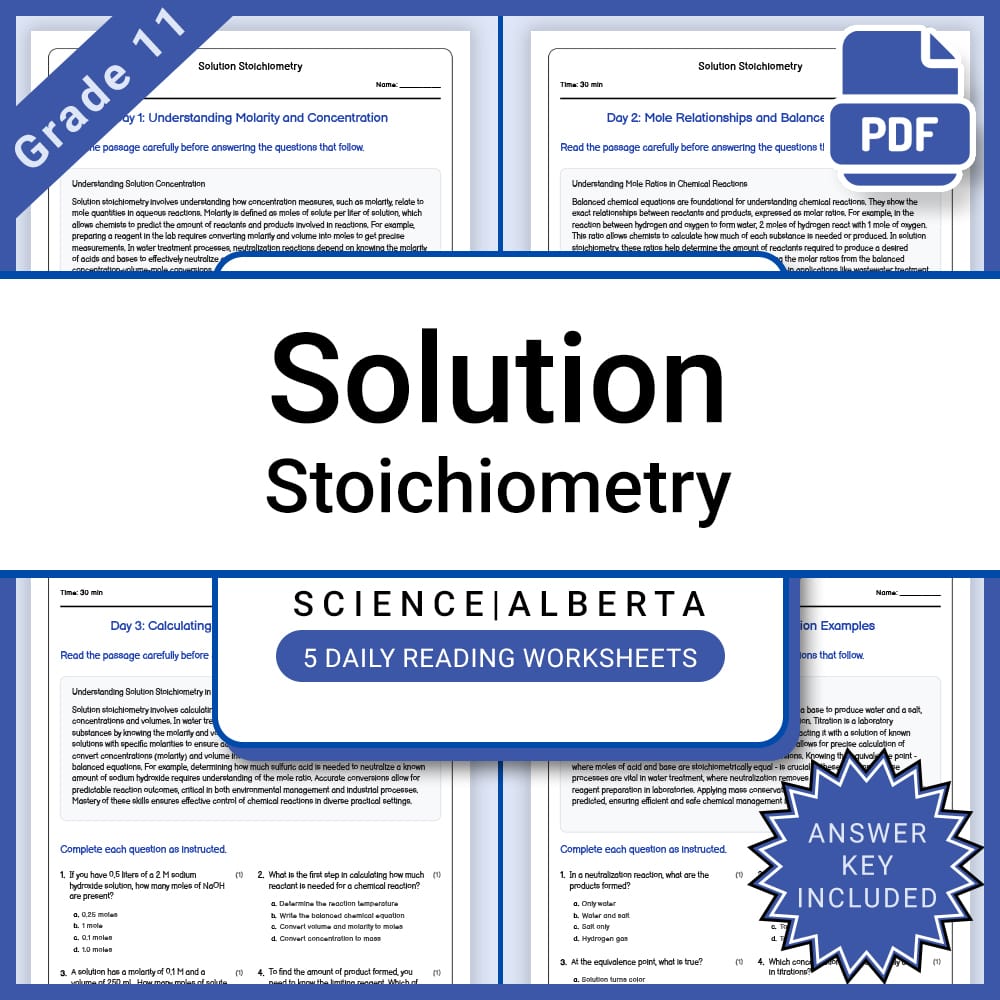
Grade 11 Science – Solution Stoichiometry Daily Reading Worksheet + Answer Key
JCreated byJ.S SheetsLearning Objectives
- Understand key concepts related to Science
- Apply knowledge through practice questions
- Demonstrate comprehension of the material
Also included in: Grade 11 Science Lesson Bundle | Core Concepts & Theories in Chemistry & Physics +1 more
Instant download
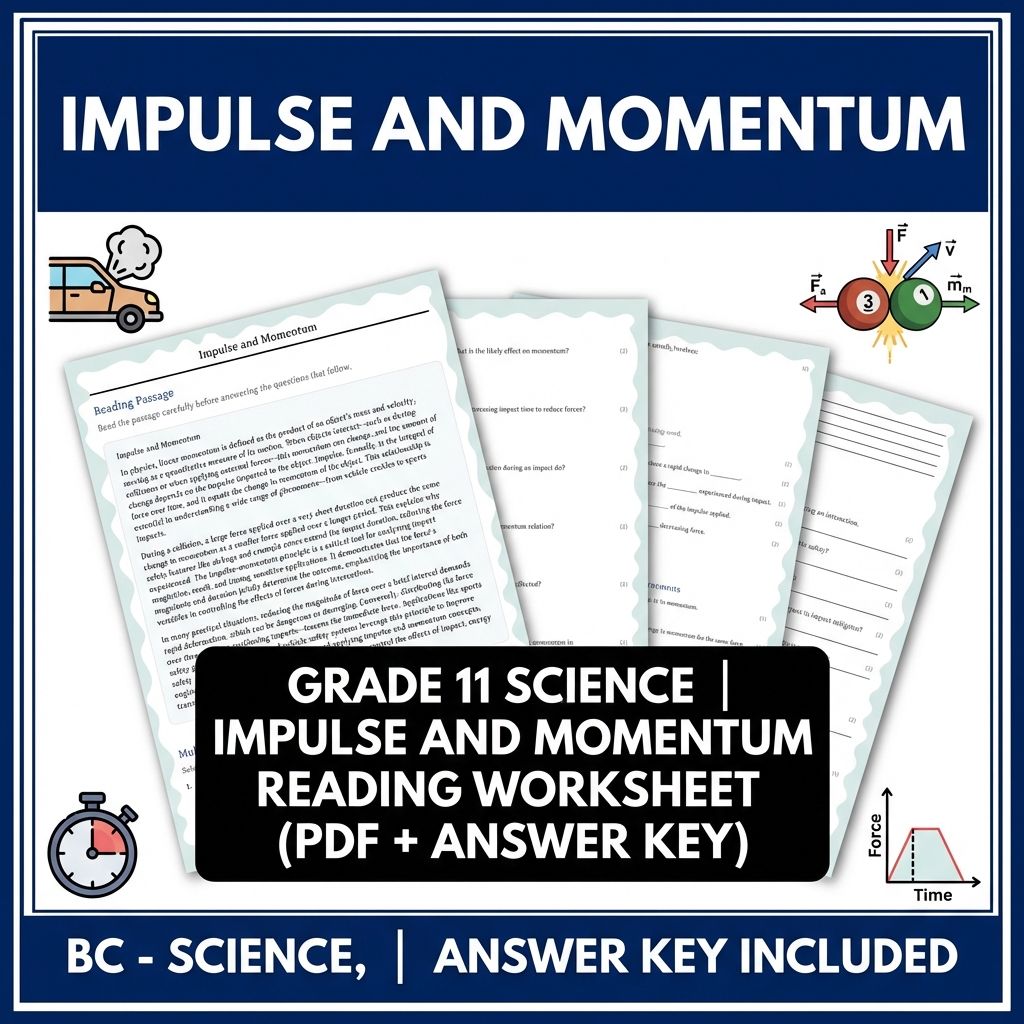
Grade 11 Science | Impulse and Momentum Reading Worksheet (PDF + Answer Key)
JCreated byJ.S SheetsLearning Objectives
- Understand the concepts of impulse and momentum in physics.
- Describe how force and time relate to changes in momentum.
- Analyze collision processes using impulse–momentum principles.
Instant download

Grade 11 Science | Membrane Energetics Worksheet | AP Aligned
Created byLumora LearningLearning Objectives
- Explain the principles of bioenergetic membrane processes including proton gradients and electron transport chains.
- Analyze how electrochemical gradients drive ATP synthesis in aerobic and photosynthetic systems.
- Interpret redox potential diagrams and stoichiometric calculations related to membrane energetics.
Also included in: Grade 11 Science | Biology and Ecosystems Custom Bundle | AP Framework
Instant download

Grade 11 Scientific Inquiry Worksheet | NGSS Practice PDF
Created byClear Sky ClassroomLearning Objectives
- Explain how scientific thinking connects observations to evidence-based explanations.
- Describe how scientific inquiry can proceed non-linearly and incorporate prior knowledge while remaining open to alternative interpretations.
- Identify characteristics of explanations that count as science, including testability and evaluation by others.
Instant download
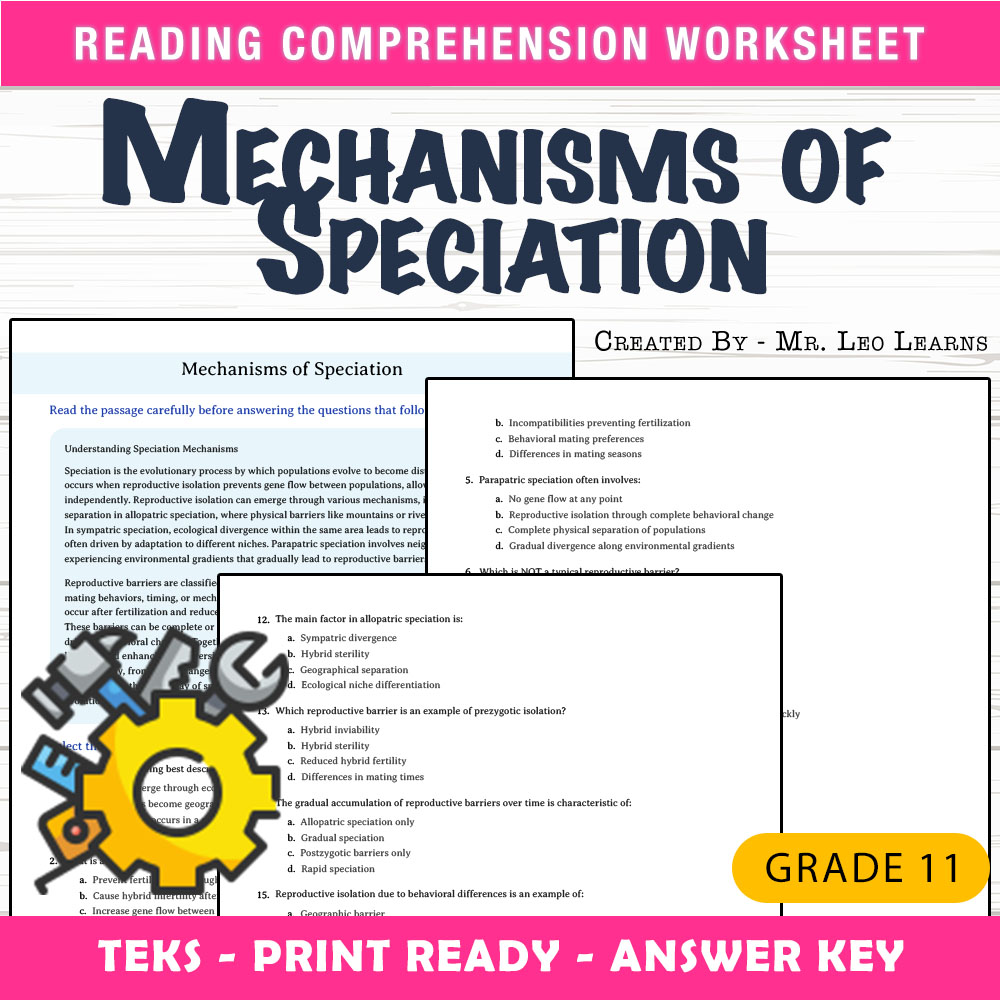
11th Grade Science | Mechanisms of Speciation Worksheet for Mastery
 Created byThe Resource Hub
Learning Objectives
- Understand the processes and mechanisms involved in speciation.
- Identify different reproductive barriers that contribute to speciation.
- Explain how geographic, ecological, and environmental factors lead to reproductive isolation.
Also included in: Grade 11 Science Unit | Evolution & Phylogeny Worksheet Pack +1 more
Instant download
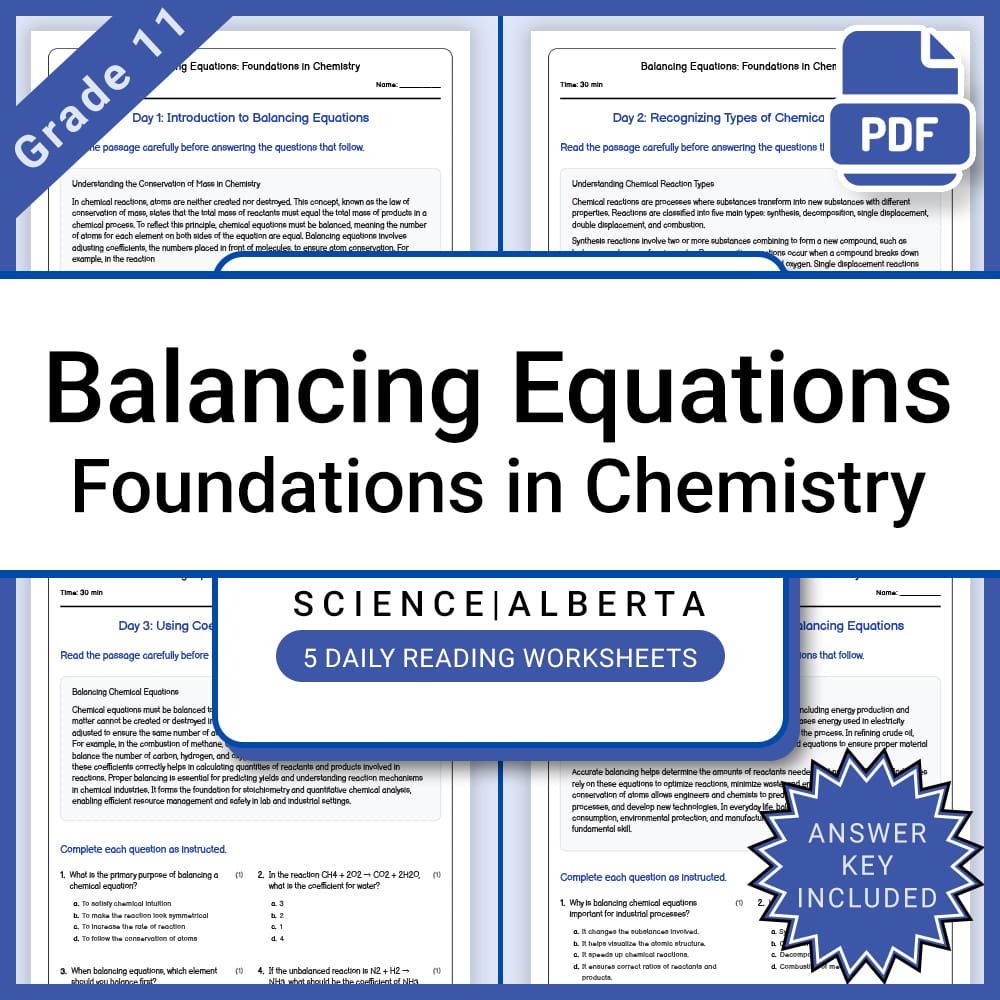
Grade 11 Science – Balancing Equations Daily Reading Worksheet + Answer Key
JCreated byJ.S SheetsLearning Objectives
- Understand the law of conservation of mass in chemical reactions
- Explain why chemical equations must be balanced
- Identify the different types of chemical reactions
Also included in: Grade 11 Science Lesson Bundle | Core Concepts & Theories in Chemistry & Physics +1 more
Instant download

11th Grade Science | Classification Methods Worksheet (PDF+ Answer Key)
Created byCopper Leaf ClassroomLearning Objectives
- Understand various classification methods used in biology to organize biodiversity.
- Differentiate between cladistic, phenetic, and phylogenomics approaches.
- Explain how hierarchical taxonomic systems represent evolutionary relationships.
Instant download

Grade 11 Science | Understanding Weathering & Erosion - Daily Reading
Created byCoral Reef LearningLearning Objectives
- Identify the processes of weathering and erosion.
- Explain how physical and chemical weathering contribute to landscape change.
- Describe the transport and deposition of sediments by natural agents.
Instant download
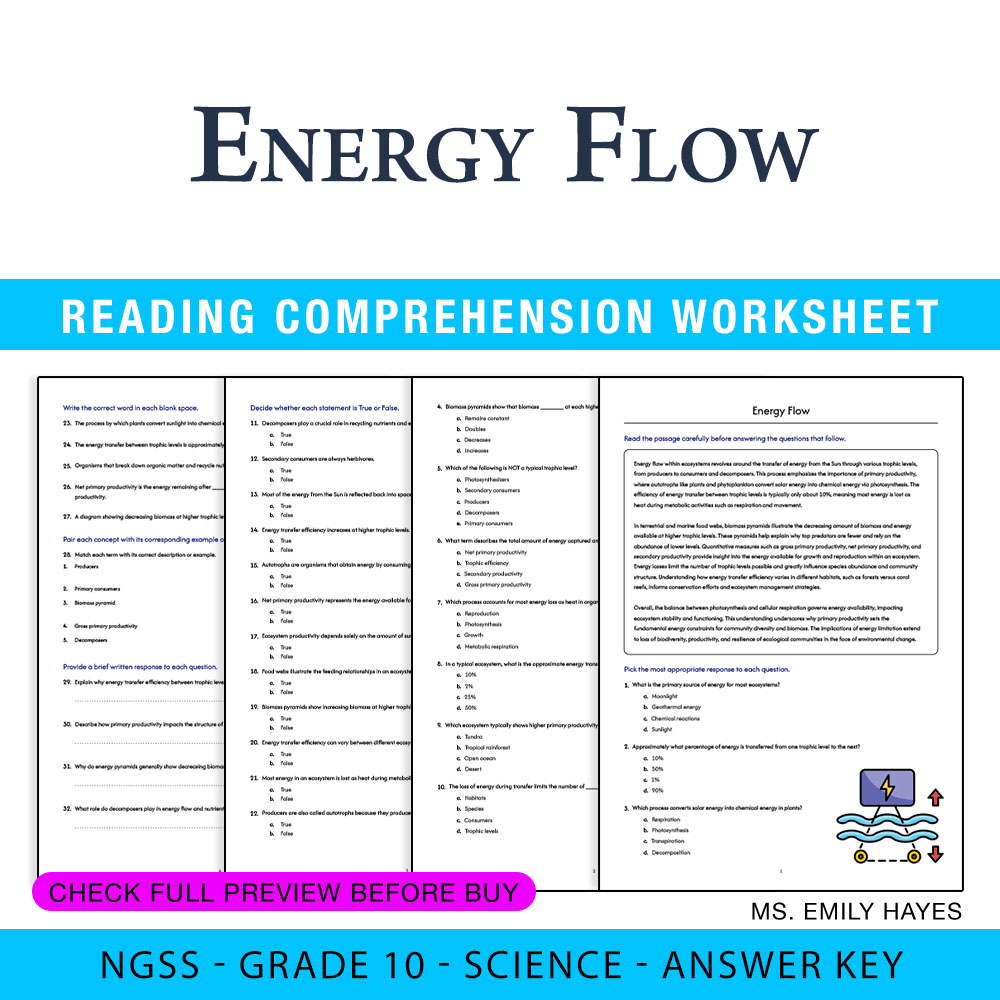
11th Grade Science | Energy Flow Worksheet (PDF+ Answer Key)
Created byCopper Leaf ClassroomLearning Objectives
- Understand the concept of energy transfer among producers, consumers, and decomposers within food webs.
- Analyze the roles of trophic levels, biomass pyramids, and energy loss through metabolic processes.
- Calculate and interpret efficiencies of trophic transfer and primary productivity in different ecosystems.
Instant download
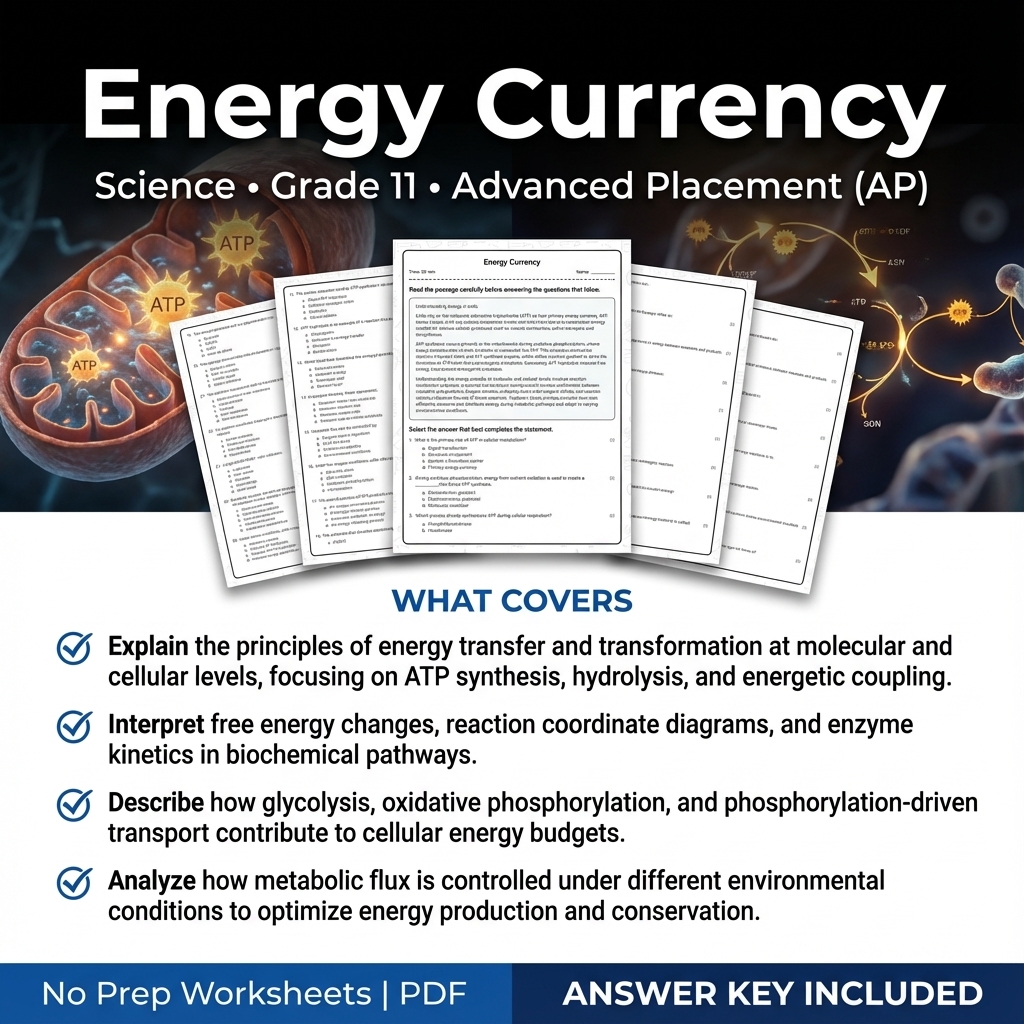
11th Grade Science | Energy Currency Worksheet (Printable PDF + Answer Key)
Created byCoral Reef LearningLearning Objectives
- Explain the principles of energy transfer and transformation at molecular and cellular levels, focusing on ATP synthesis, hydrolysis, and energetic coupling.
- Interpret free energy changes, reaction coordinate diagrams, and enzyme kinetics in biochemical pathways.
- Describe how glycolysis, oxidative phosphorylation, and phosphorylation-driven transport contribute to cellular energy budgets.
Also included in: Grade 11 Science Unit Worksheet Bundle – Biological Systems & Molecular Concepts +1 more
Instant download

Grade 11 Science | Human Alterations to Ecosystems - Daily Reading Comprehension
Created byCoral Reef LearningLearning Objectives
- Understand the concept of habitat fragmentation
- Identify effects of habitat fragmentation on biodiversity
- Analyze how habitat fragmentation impacts ecological processes
Instant download
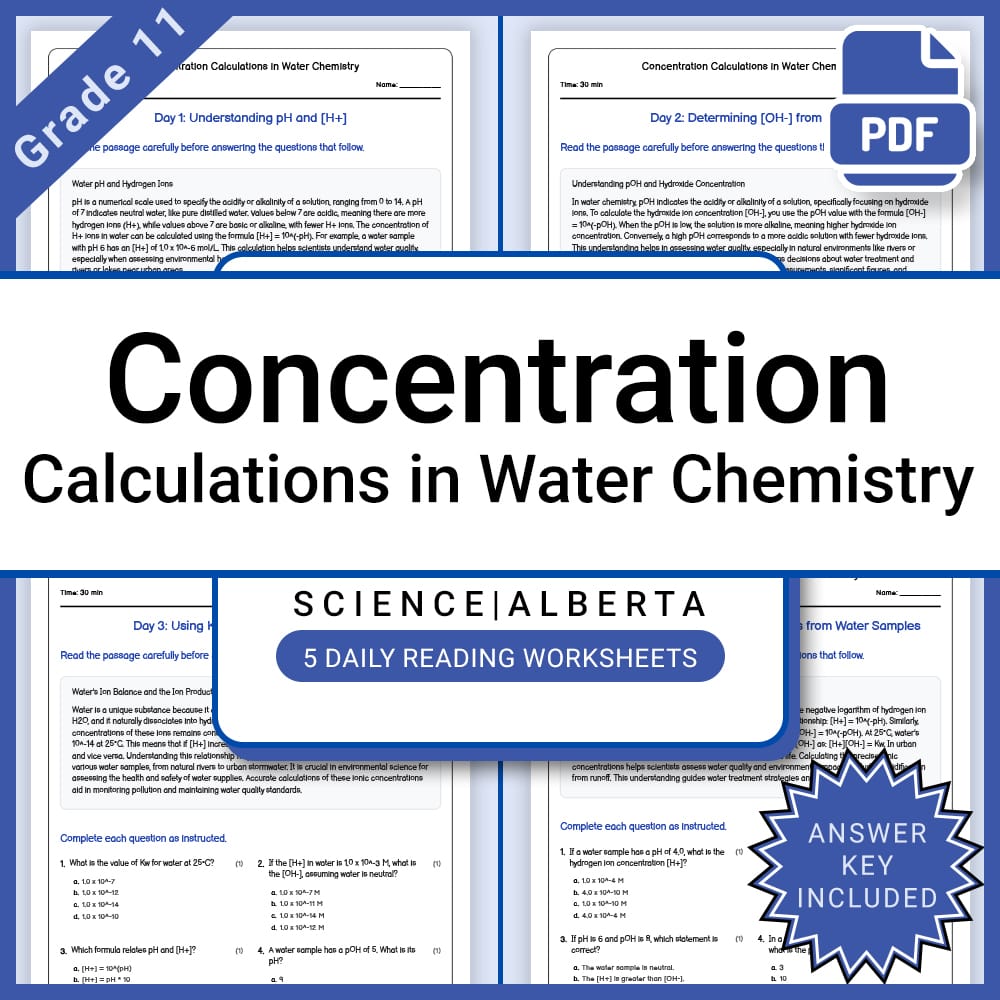
Grade 11 Science – Concentration Calculations Reading Worksheet + Answer Key
JCreated byJ.S SheetsLearning Objectives
- Understand how to calculate [H+] from pH values.
- Interpret the relationship between pOH and [OH-] concentration.
- Apply logarithmic and inverse logarithmic relationships to ionic concentrations.
Also included in: Grade 11 Science Lesson Bundle on Acids, Bases, and Titration | Alberta Framework +1 more
Instant download

Energy Pathways MCQ Worksheet | NGSS Grade 11 Science Practice
 Created byCedar Grove Learning
Learning Objectives
- Understand the sequence of cellular energy transformations including glycolysis, pyruvate oxidation, the citric acid cycle, and oxidative phosphorylation.
- Identify the role of electron transport chains and proton gradients in ATP production.
- Quantify energy yield from different substrates and relate it to organismal metabolic rates.
Instant download
Grade 11 Science | Molecular Geometry Worksheet – Ontario (PDF)
Created byBright Mind ResourcesLearning Objectives
- Understand how electron-domain considerations and VSEPR theory predict molecular shapes.
- Identify family geometries such as linear, trigonal planar, tetrahedral, trigonal bipyramidal, and octahedral.
- Analyze the effects of lone pairs and molecular symmetry on physical properties and polarity.
Instant download

Grade 11 Two-Dimensional Projectile Motion Worksheet | Ontario Science
 Created byChalk and Compass
Learning Objectives
- Decompose projectile motion into independent horizontal and vertical components.
- Use kinematic and trigonometric relationships to calculate time of flight, maximum height, and range.
- Recognize how air resistance changes ideal projectile motion as a non-ideal perturbation.
Also included in: Motion, Energy, Waves & DC Circuits Lesson Bundle – Grade 11 Science Ontario +1 more
Instant download

Grade 11 Motion Diagrams and Kinematic Graphs Worksheet | Ontario Science
Created byChalk and CompassLearning Objectives
- Interpret motion diagrams to determine changes in position and identify constant-acceleration patterns.
- Explain how position–time and velocity–time graphs relate to instantaneous and average velocity.
- Connect graph features (slope and area) to acceleration and displacement using SI units and standard notation.
Also included in: Motion, Energy, Waves & DC Circuits Lesson Bundle – Grade 11 Science Ontario +1 more
Instant download

Signal Encoding Worksheet | NGSS Grade 11 Science MCQ Practice
Created byCedar Grove LearningLearning Objectives
- Compare the advantages of digital versus analog transmission and storage in terms of bandwidth, noise, and fidelity.
- Understand the principles of encoding, modulation, and decoding and how they affect capacity and reliability.
- Use quantitative measures such as bit rate, signal-to-noise ratio, and spectral occupancy to evaluate transmission systems.
Instant download
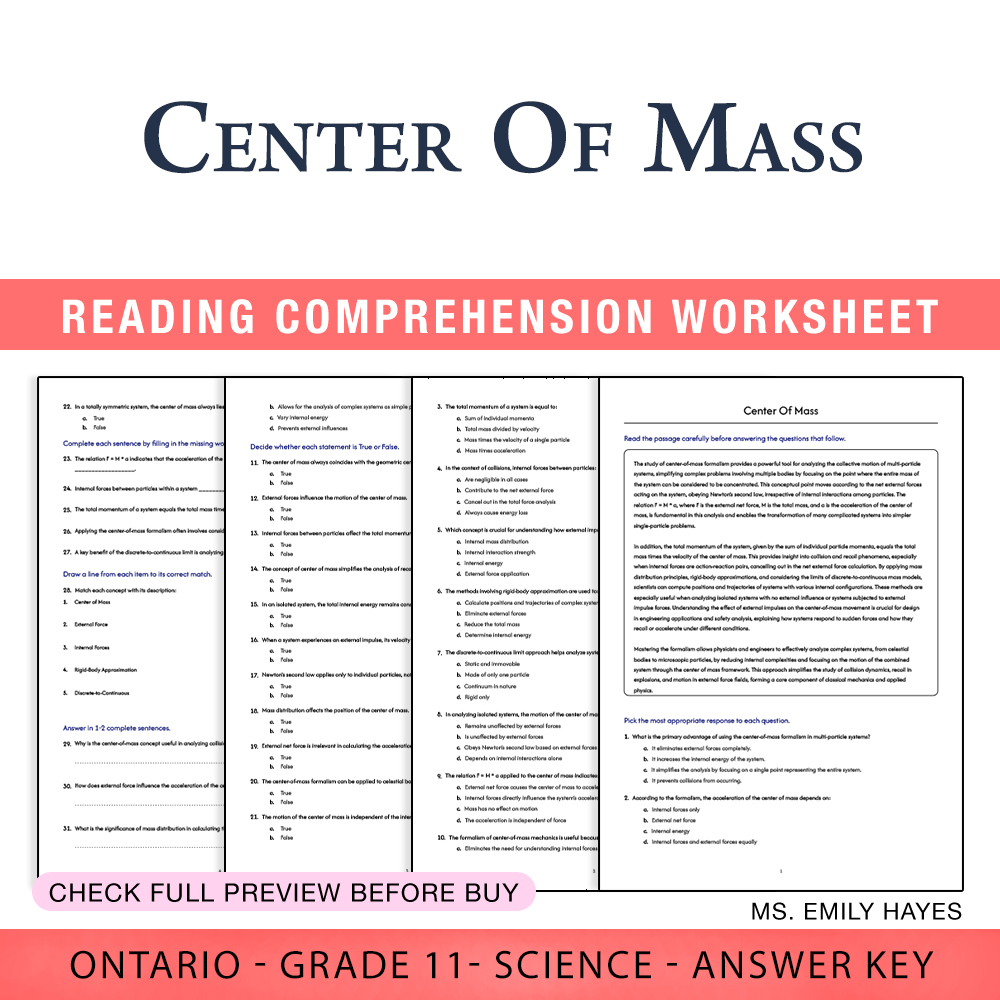
11th Grade Science | Center of Mass Worksheet (PDF + Answer Key)
Created byCopper Leaf ClassroomLearning Objectives
- Understand the formalism of center-of-mass and its relevance to collective motion in multi-particle systems.
- Apply the concept of external net force and its relation to center-of-mass acceleration in various physical scenarios.
- Explain the methods used to compute mass distribution, positions, and trajectories in systems with different internal interactions.
Instant download
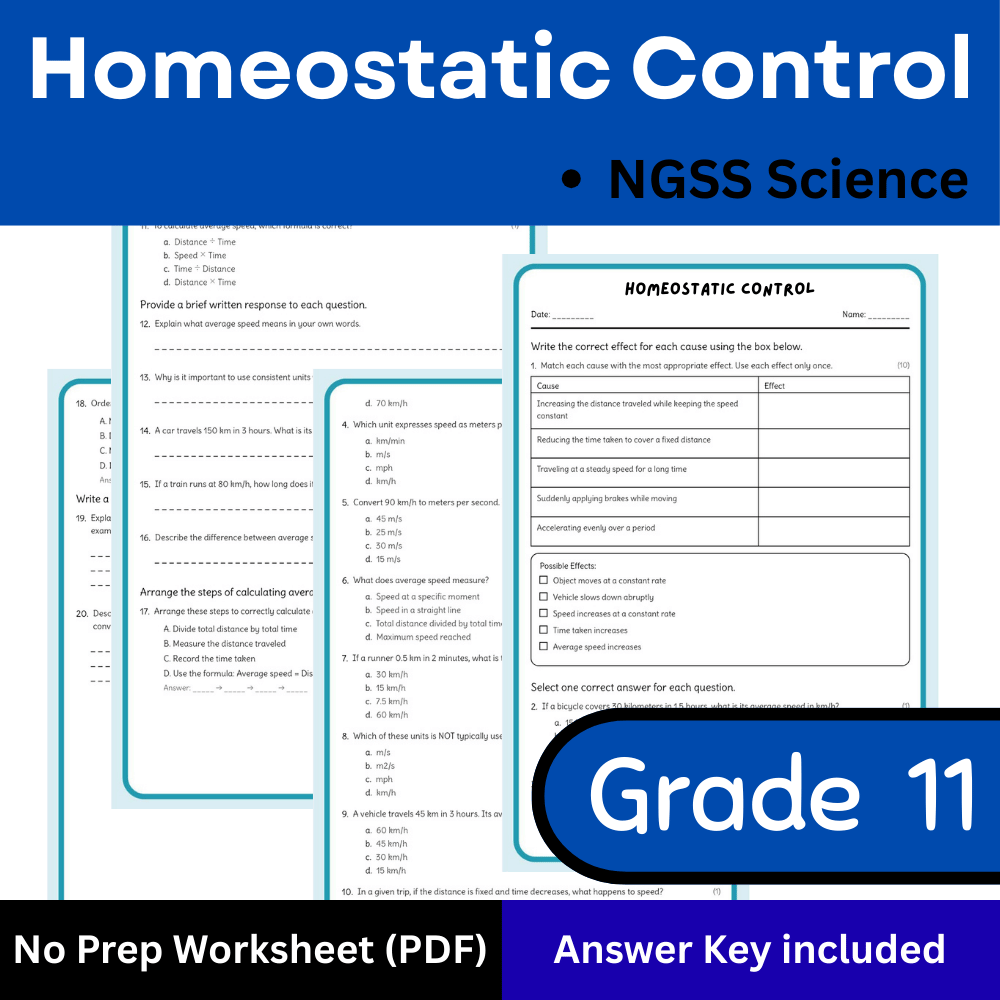
Grade 11 Science | Homeostatic Control Worksheet (Answer Key) – NGSS Aligned
Created byBright Mind ResourcesLearning Objectives
- Understand how feedback mechanisms regulate internal physiological variables.
- Identify examples of homeostasis such as blood glucose regulation and thermoregulation.
- Explain the role of cellular ion gradients and membrane pumps in maintaining internal stability.
Instant download
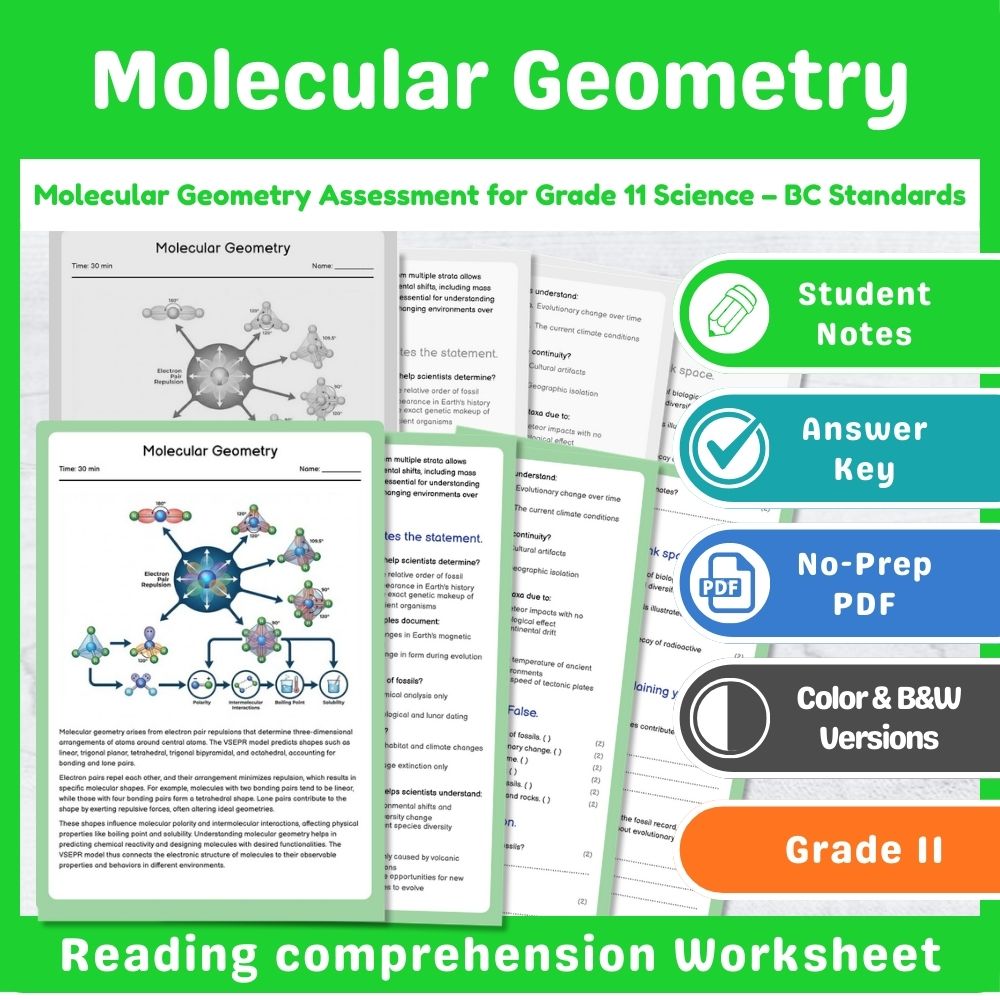
Molecular Geometry Assessment for Grade 11 Science – BC Standards
Created byPrism Point LearningLearning Objectives
- Explain the principles of VSEPR model and how electron pairs determine molecular shape.
- Identify and predict molecular geometries such as linear, trigonal planar, tetrahedral, trigonal bipyramidal, and octahedral.
- Understand how molecular shapes influence polarity, intermolecular forces, boiling points, and solubility.
Also included in: Grade 11 Science | Thermochemistry Assessment Bundle – Standards-Aligned
Instant download
About Grade 11 Science Worksheets
Browse 6,616 printable Grade 11 Science worksheets — ready-to-print PDFs with answer keys where available.
Each resource here is built by an independent educator and reviewed for quality. Worksheets print straight from PDF and suit classroom use, homework, or extra practice; most come with answer keys, and you can preview before purchasing.