
Grade 11 Science Worksheets
6,616 worksheets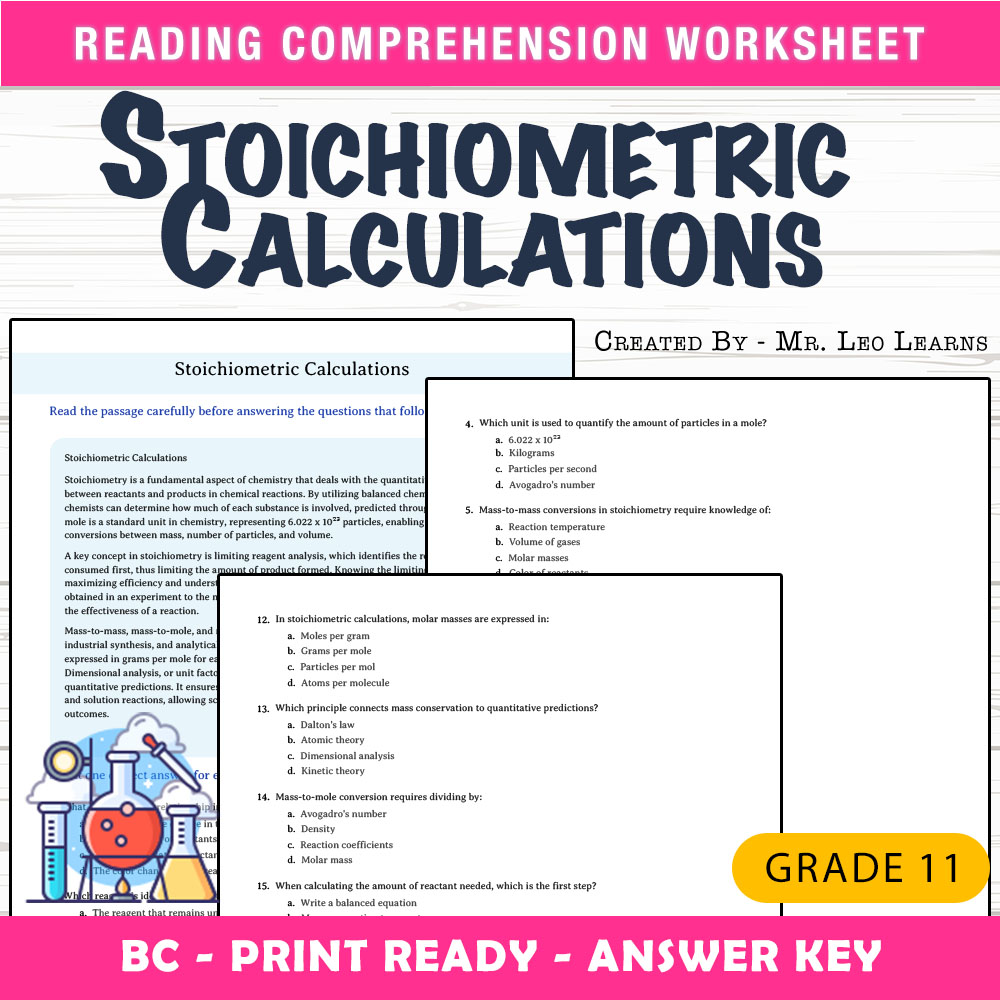
Grade 11 Science — Worksheet MCQ Paper for Mastering Stoichiometric Calculations
 Created byThe Resource Hub
Learning Objectives
- Understand mole relationships and their application in chemical equations.
- Identify limiting reagents and calculate percent yields.
- Perform mass-to-mass, mass-to-mole, and mole-to-mole conversions using molar masses.
Also included in: Grade 11 Science – Chemistry Unit Worksheet Bundle (BC) +1 more
Instant download
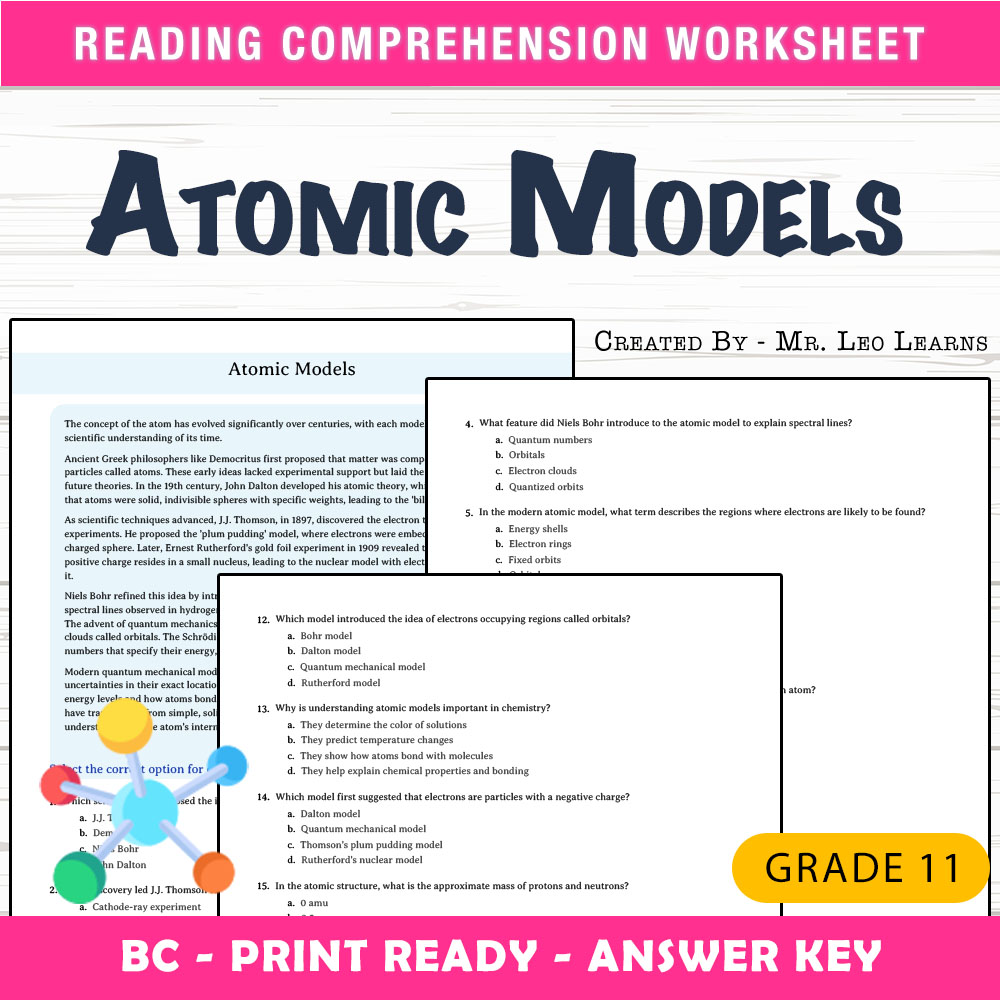
Grade 11 Science — Worksheet MCQ Paper for Mastering Atomic Models
Created byThe Resource HubLearning Objectives
- Explain the historical development of atomic models from Dalton to quantum mechanics.
- Identify the main features and differences of each atomic model.
- Understand the role of subatomic particles and quantum numbers in atomic structure.
Also included in: Grade 11 Science – Chemistry Unit Worksheet Bundle (BC) +1 more
Instant download
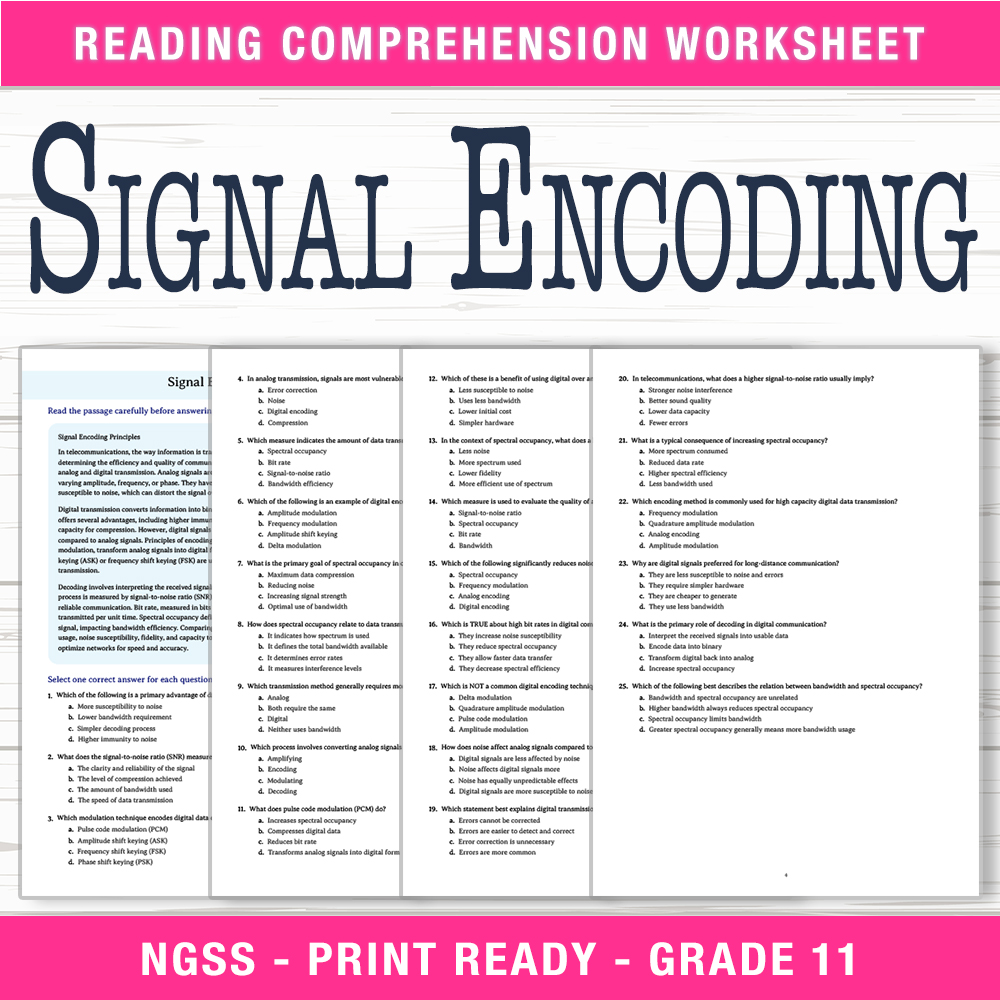
Grade 11 Science | Signal Encoding Worksheet (PDF + Answer Key)
 Created byRiverstone Classroom
Learning Objectives
- Understand the advantages and disadvantages of digital versus analog transmission and storage.
- Evaluate the principles of encoding, modulation, and decoding in terms of capacity and reliability.
- Interpret quantitative measures such as bit rate, signal-to-noise ratio, and spectral occupancy in communication systems.
Instant download
Grade 11 Science – Trophic Levels Worksheet (Worksheet + Answer Key) | TEKS Aligned
 Created byBright Mind Resources
Learning Objectives
- Understand the concept of trophic levels and their role in ecosystems.
- Identify different types of organisms within food chains and food webs.
- Explain energy transfer inefficiency between trophic levels and its ecological consequences.
Also included in: Grade 11 Science - Ecosystem & Biogeochemical Cycles Unit Worksheet Pack - TEKS +2 more
Instant download
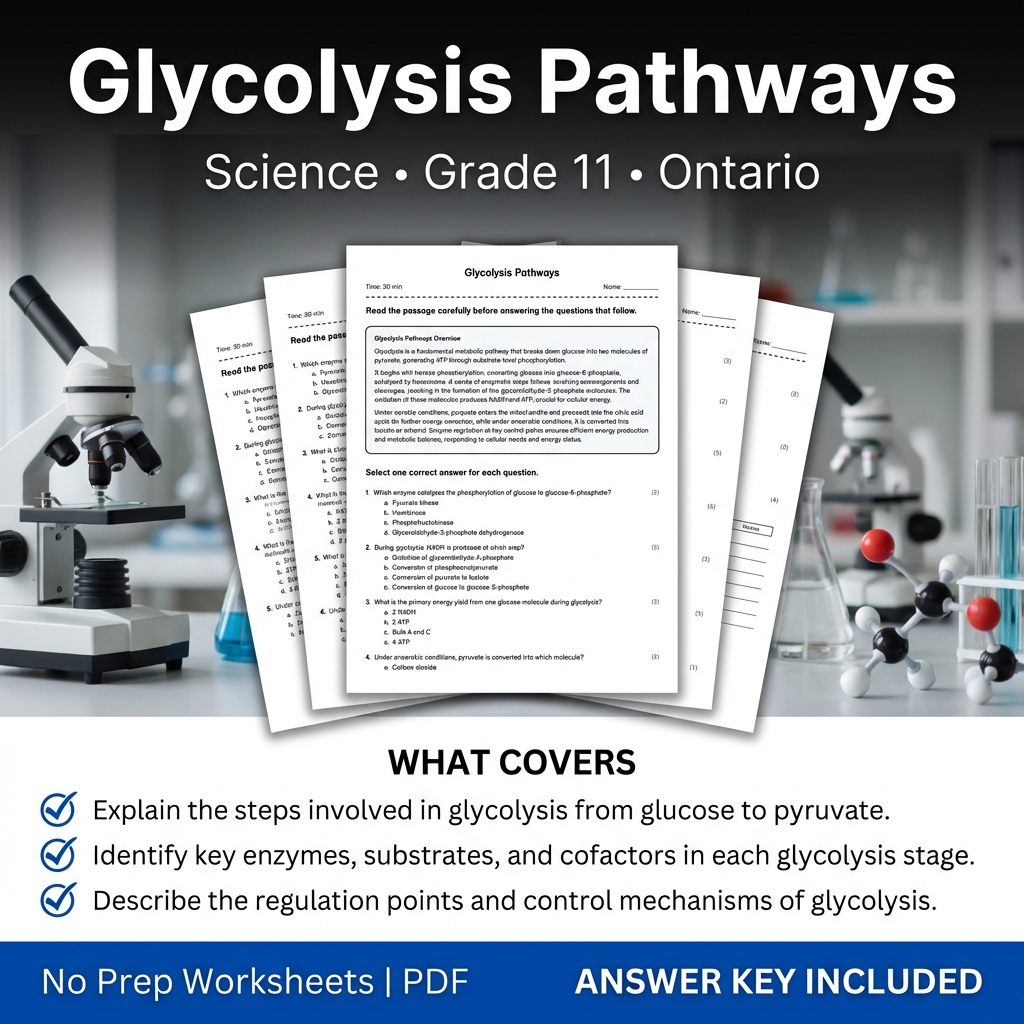
Glycolysis Pathways Grade 11 Science Worksheet | Ontario Standards
 Created byCoral Reef Learning
Learning Objectives
- Explain the steps involved in glycolysis from glucose to pyruvate.
- Identify key enzymes, substrates, and cofactors in each glycolysis stage.
- Describe the regulation points and control mechanisms of glycolysis.
Instant download
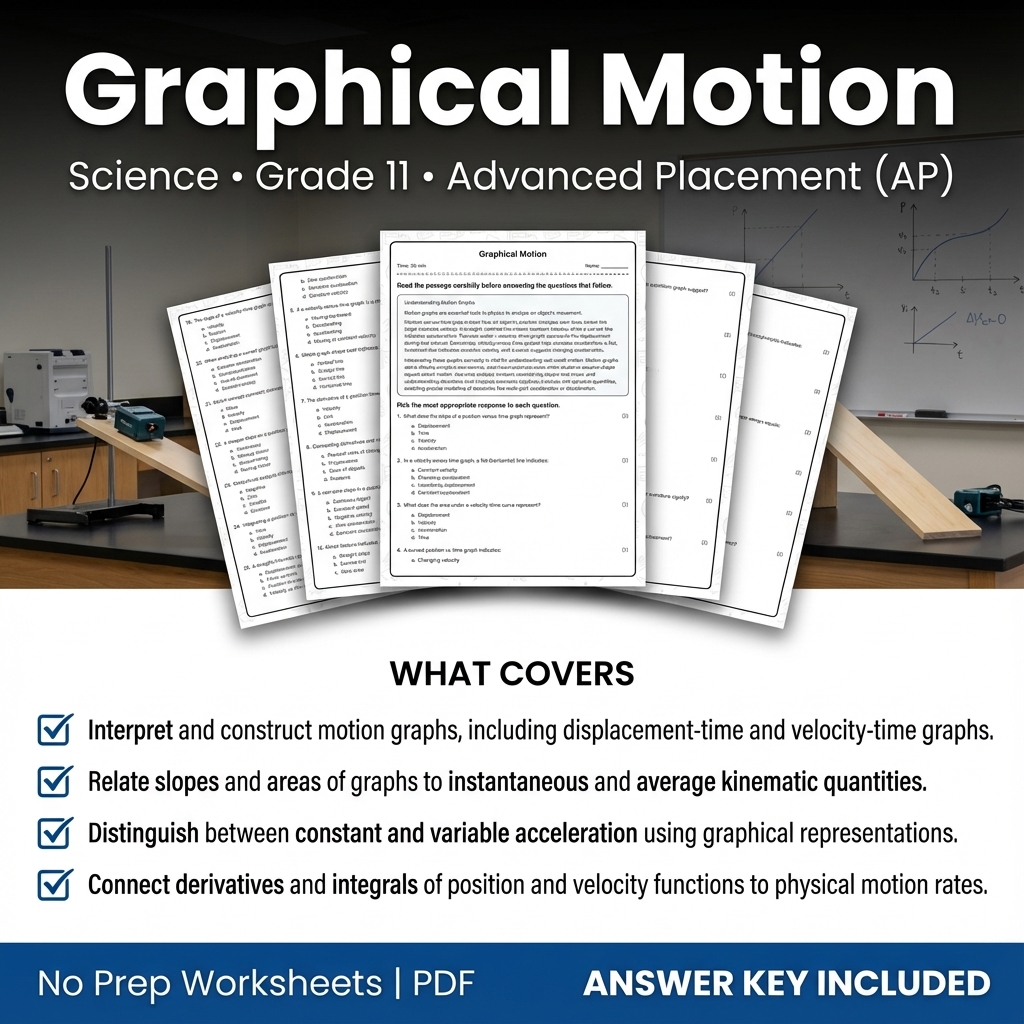
Grade 11 Science | Graphical Motion Worksheet (Printable PDF + Answer Key)
Created byCoral Reef LearningLearning Objectives
- Interpret and construct motion graphs, including displacement-time and velocity-time graphs.
- Relate slopes and areas of graphs to instantaneous and average kinematic quantities.
- Distinguish between constant and variable acceleration using graphical representations.
Also included in: Grade 11 Science Unit | Physics Worksheets on Work, Power & Motion PDF Bundle +1 more
Instant download
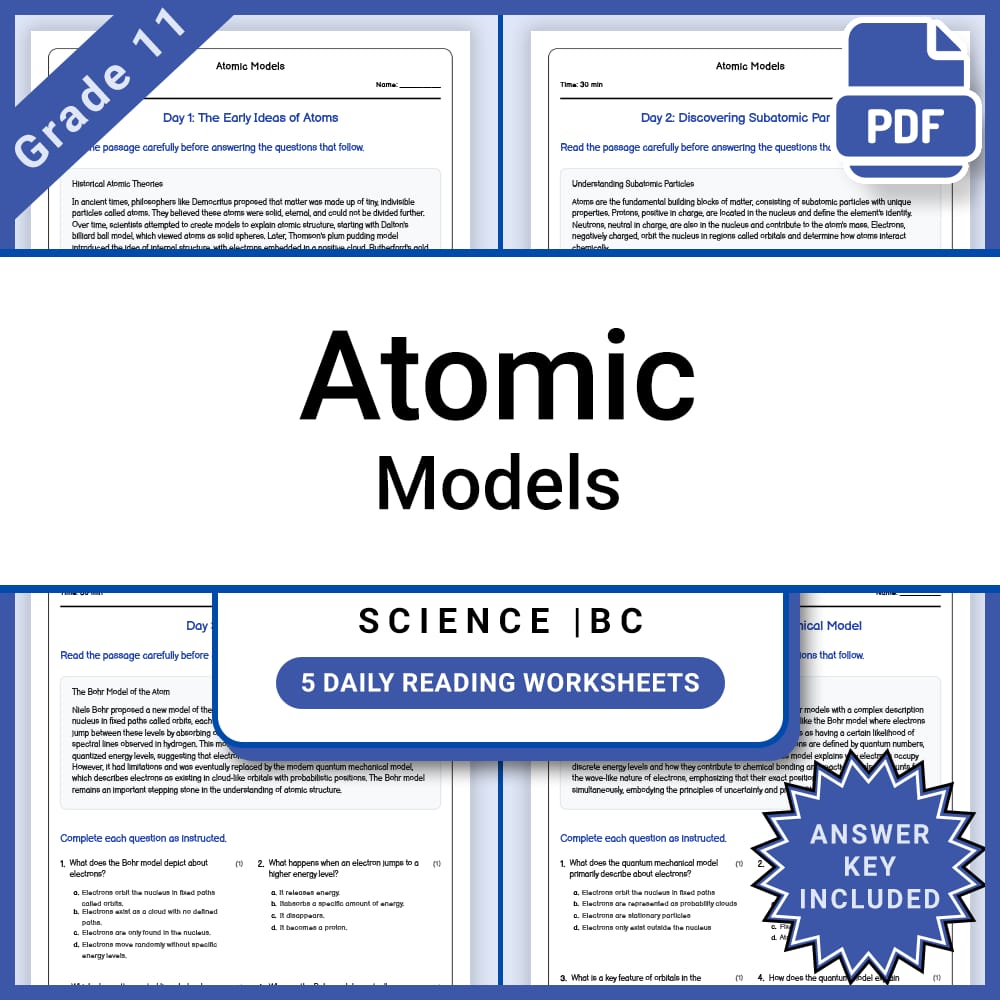
Grade 11 Science – Atomic Models Daily Reading Worksheet with Answer Key
JCreated byJ.S SheetsLearning Objectives
- Understand the progression of atomic models through history
- Identify key features of early atomic theories
- Explain how atomic models influence modern understanding of matter
Also included in: Grade 11 Science Lesson Group | BC Framework Daily Reading Worksheets +1 more
Instant download
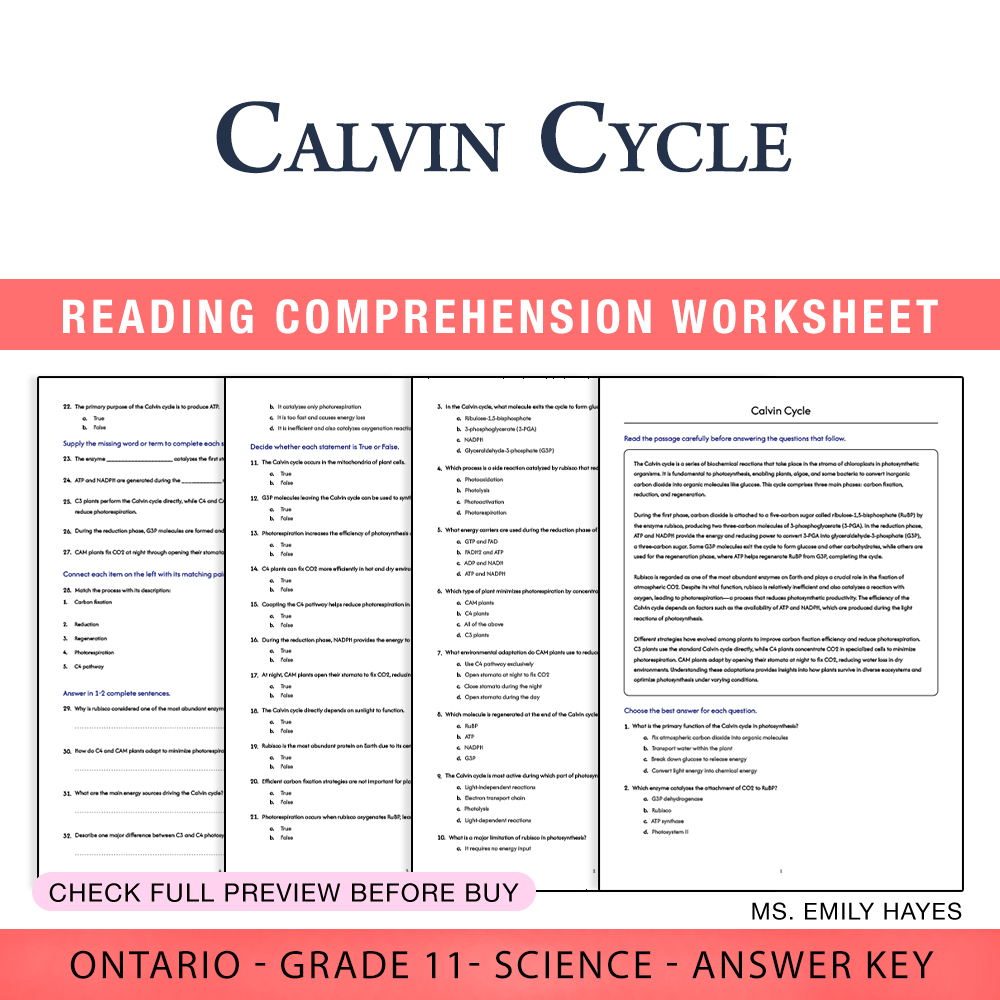
11th Grade Science | Calvin Cycle Worksheet (PDF + Answer Key)
 Created byCopper Leaf Classroom
Learning Objectives
- Describe the main phases of the Calvin cycle: carbon fixation, reduction, and regeneration.
- Explain the role of ribulose-1,5-bisphosphate carboxylase/oxygenase (Rubisco) in photosynthesis.
- Identify the intermediates and energetic requirements involved in the Calvin cycle.
Instant download

Bonding and Structure Worksheet for Grade 11 Science | NGSS Practice
JCreated byJ.S SheetsLearning Objectives
- Explain the different types of chemical bonding and their effects on material properties.
- Describe molecular geometry and how it influences physical characteristics like melting point and solubility.
- Compare ionic, covalent, and metallic bonds through examples and their observable bulk properties.
Also included in: Grade 11 Ecology and Ecosystem Dynamics Science Lesson Bundle – NGSS Framework +1 more
Instant download
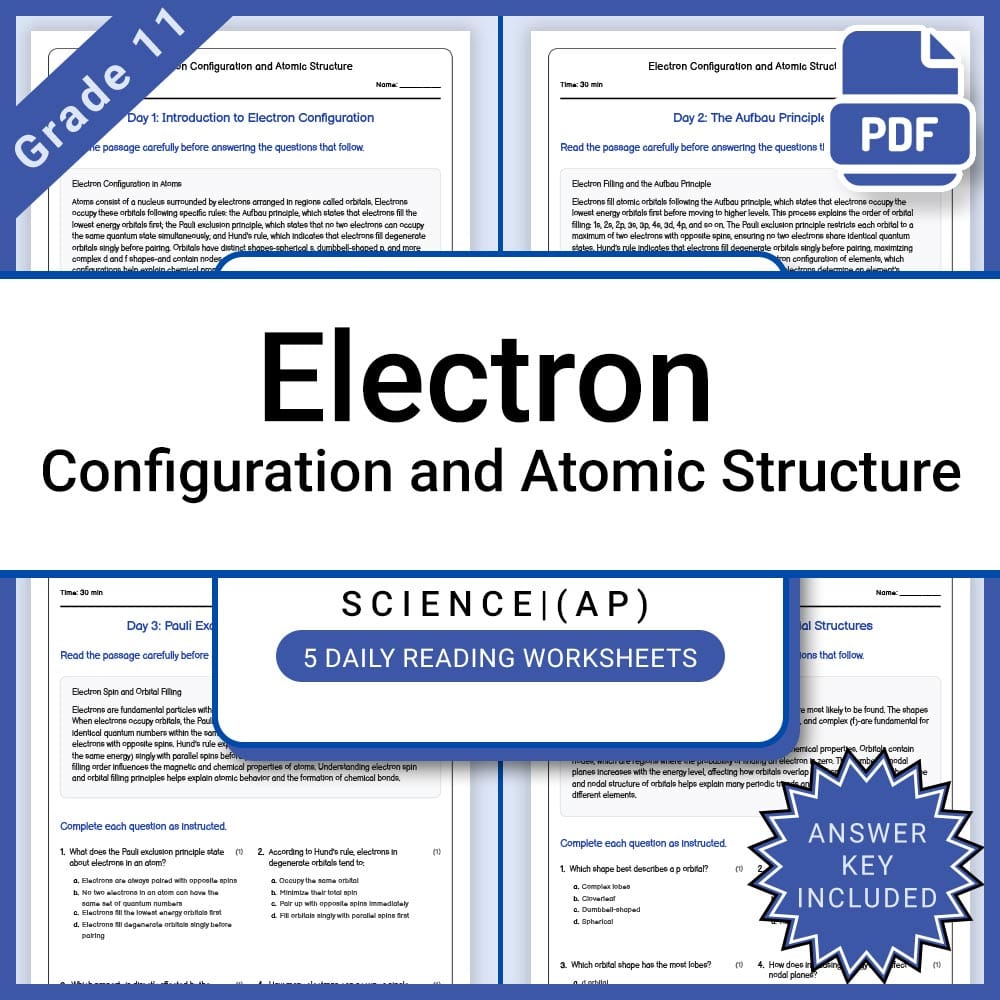
Grade 11 Science – Electron Configuration Daily Worksheet with Answer Key
JCreated byJ.S SheetsLearning Objectives
- Understand key concepts related to Science
- Apply knowledge through practice questions
- Demonstrate comprehension of the material
Also included in: AP Physics Principles Activities & Worksheets | Grade 11 Advanced Placement +1 more
Instant download
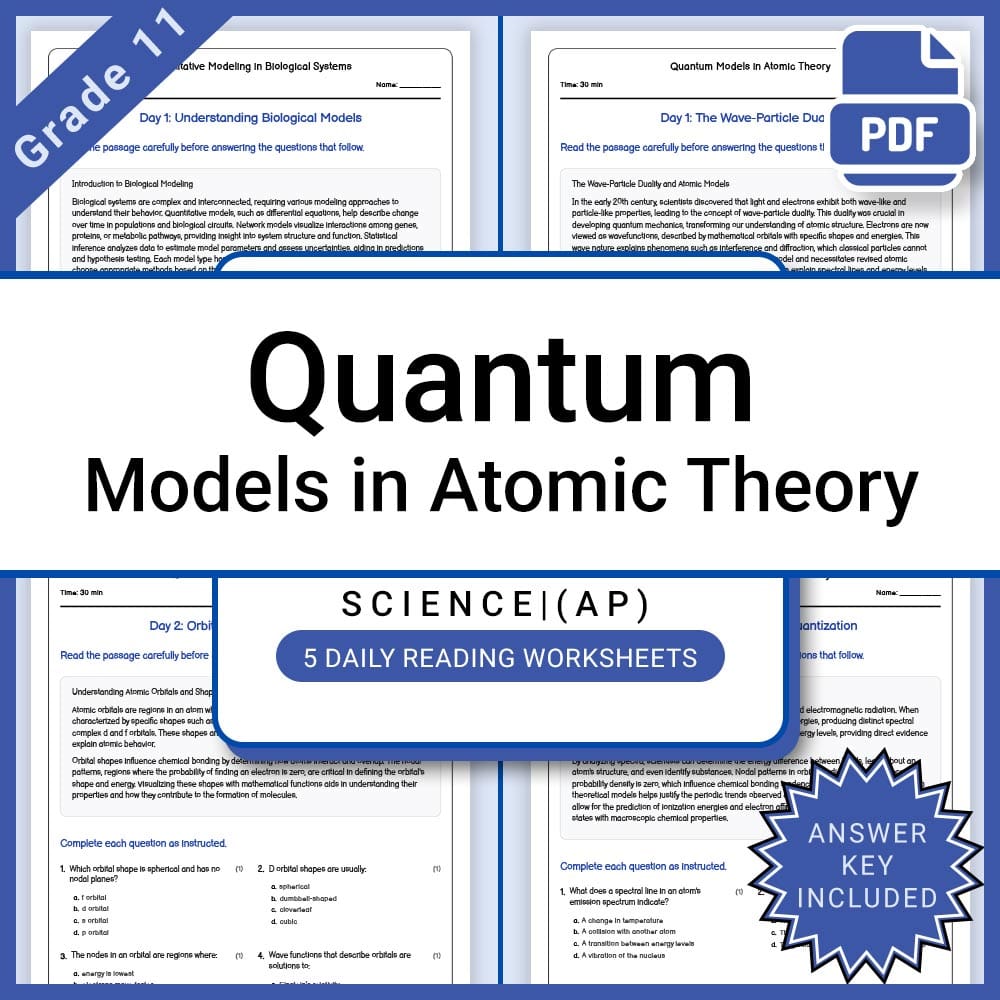
Grade 11 Science – Quantum Models Daily Reading Worksheet + Answer Key
JCreated byJ.S SheetsLearning Objectives
- Understand the concept of wave-particle duality and its significance in quantum physics.
- Describe how wave properties influence atomic models and electron behavior.
- Explain the relationship between orbital hybridization and chemical bonding.
Also included in: AP Physics Principles Activities & Worksheets | Grade 11 Advanced Placement +1 more
Instant download
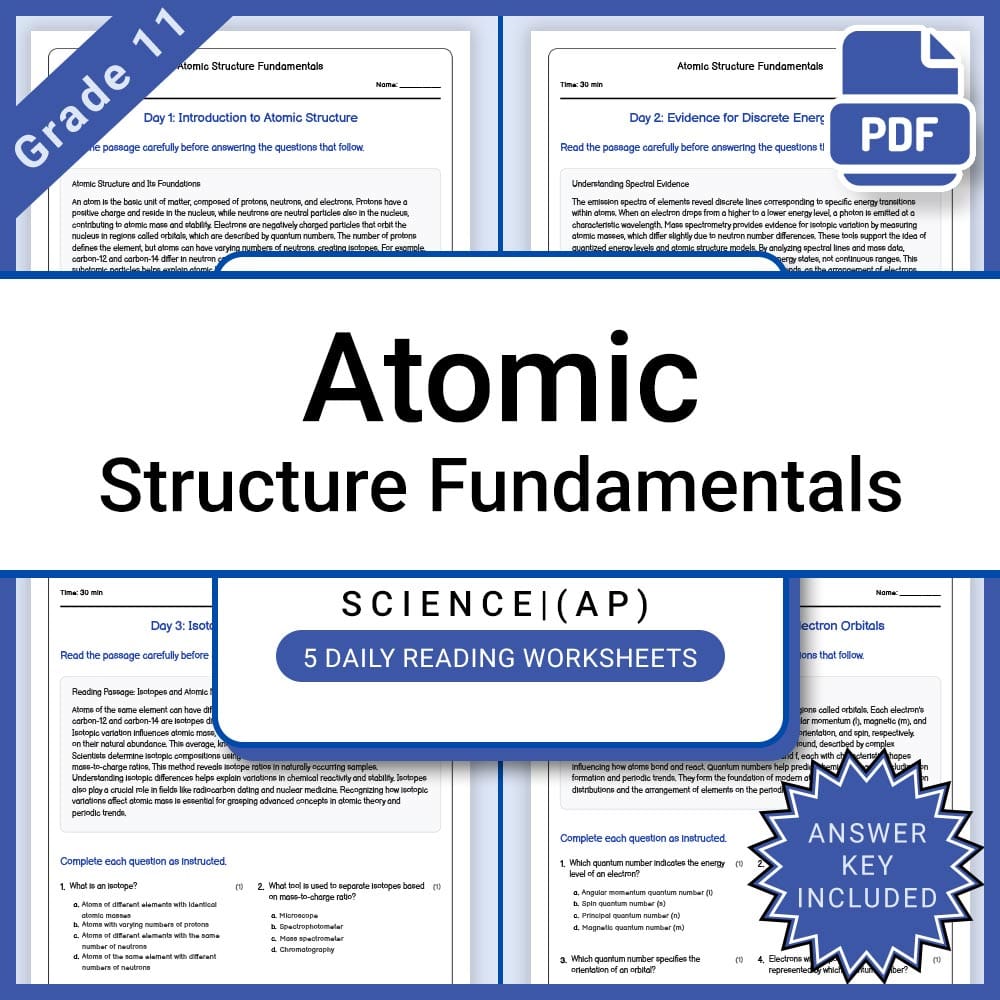
Grade 11 Science – Atomic Structure Daily Reading Worksheet with Answer Key
JCreated byJ.S SheetsLearning Objectives
- Identify and describe the roles of protons, neutrons, and electrons within an atom.
- Explain the concept of isotopes and how they result in atomic variation.
- Calculate atomic mass using isotopic abundance and mass.
Also included in: AP Physics Principles Activities & Worksheets | Grade 11 Advanced Placement +1 more
Instant download
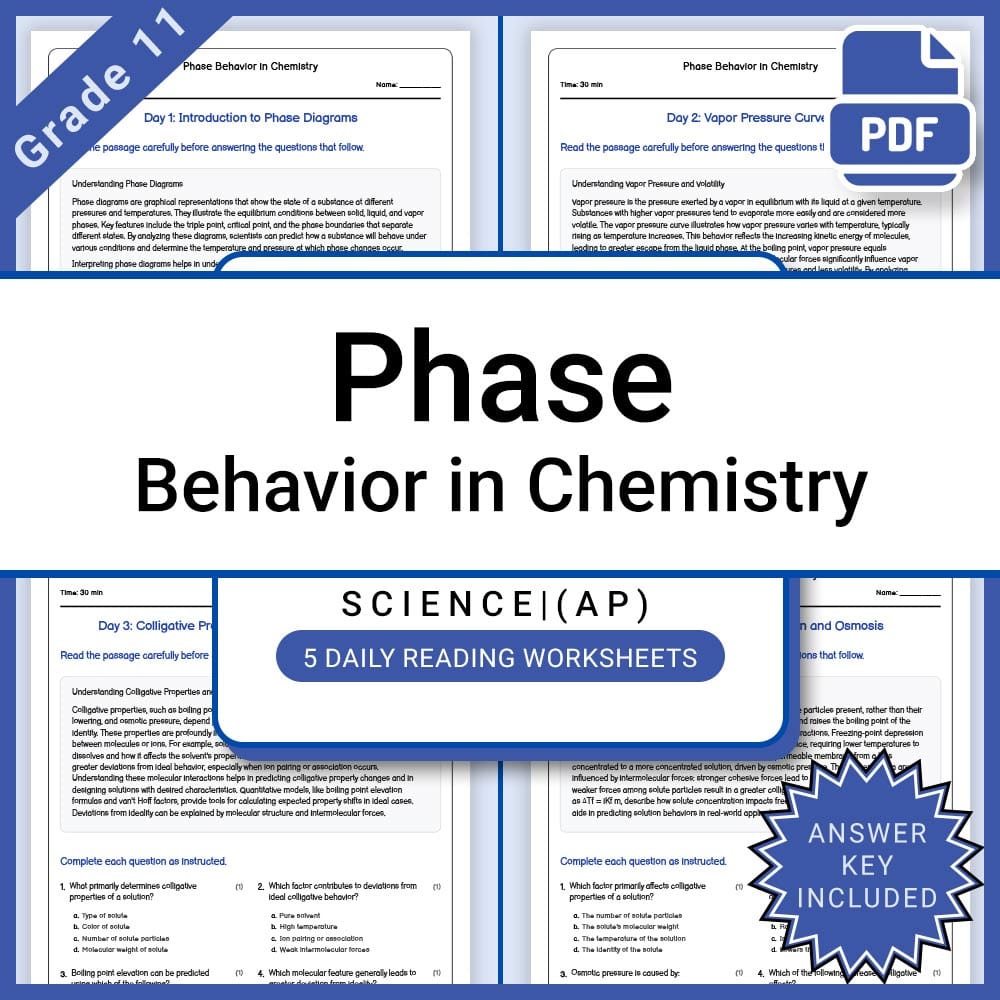
Grade 11 Science – Phase Behavior Daily Reading Worksheet with Answer Key
JCreated byJ.S SheetsLearning Objectives
- Interpret phase diagrams to understand different states of matter
- Describe vapor pressure curves and their significance
- Explain colligative properties such as freezing-point depression and boiling point elevation
Also included in: AP Physics Principles Activities & Worksheets | Grade 11 Advanced Placement +1 more
Instant download
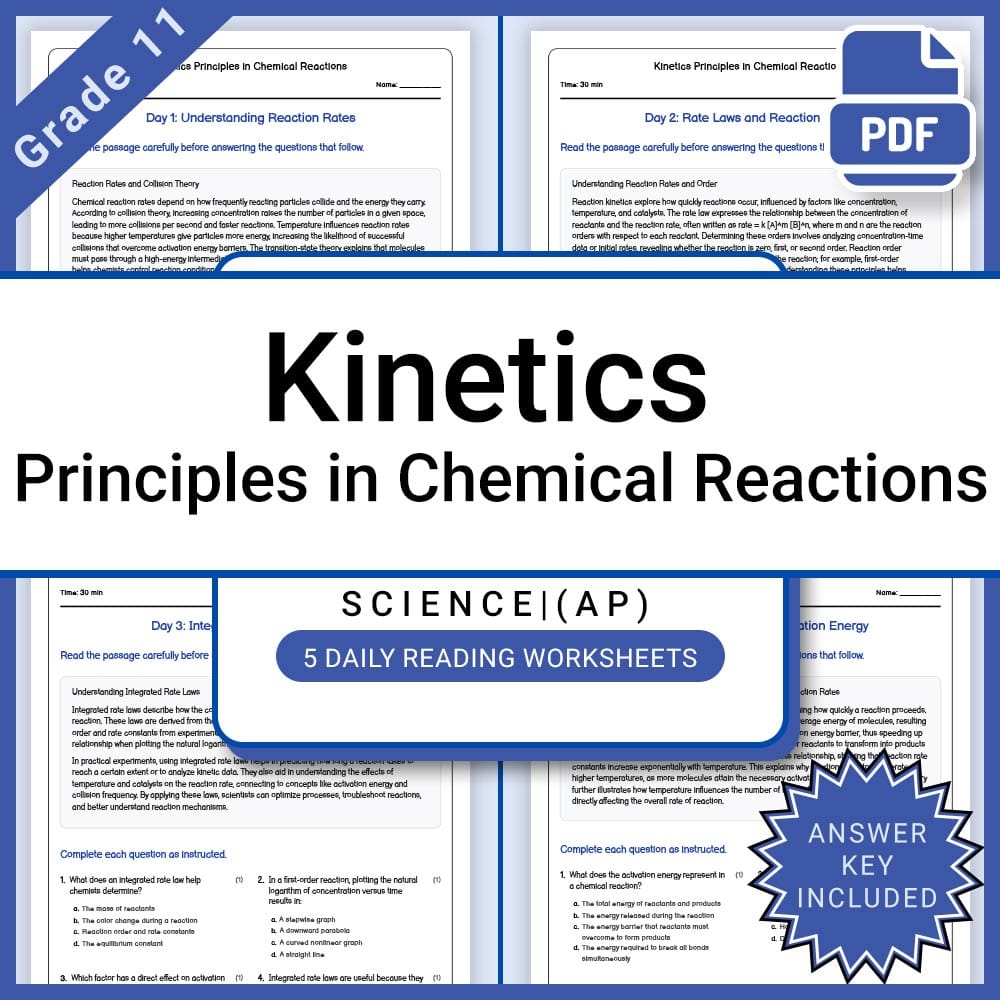
Grade 11 Science Kinetics Principles Daily Reading Worksheet + Answer Key
JCreated byJ.S SheetsLearning Objectives
- Understand how reaction rate depends on concentration and temperature.
- Interpret rate laws and reaction order from data.
- Connect collision theory and transition state hypotheses to reaction rates.
Also included in: AP Physics Principles Activities & Worksheets | Grade 11 Advanced Placement +1 more
Instant download
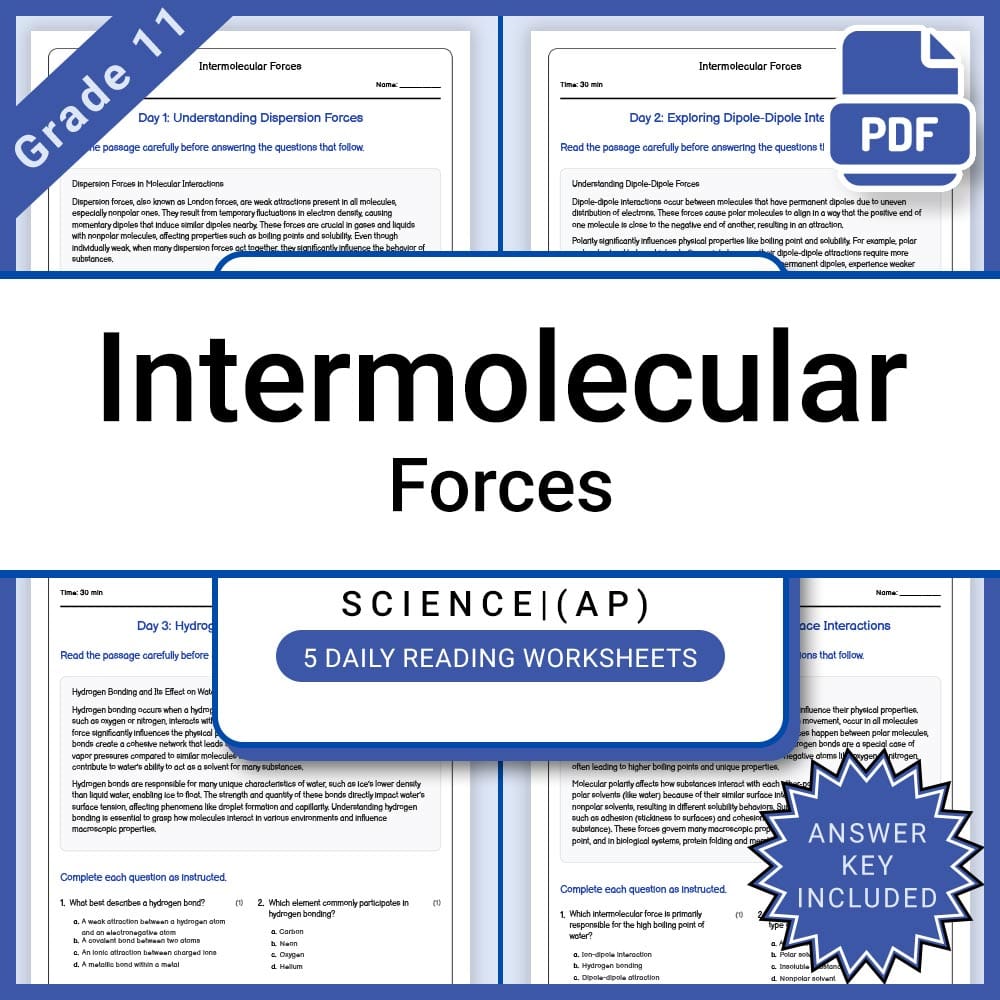
Grade 11 Science – Intermolecular Forces Daily Reading Worksheet + Answer Key
JCreated byJ.S SheetsLearning Objectives
- Understand dispersion forces and their role in molecular interactions.
- Identify different types of intermolecular forces including dipole–dipole and hydrogen bonding.
- Explain how intermolecular forces influence physical properties like boiling points and vapor pressure.
Also included in: AP Physics Principles Activities & Worksheets | Grade 11 Advanced Placement +1 more
Instant download

Genome Organization & Gene Expression in Prokaryotes vs Eukaryotes | TEKS
 Created byBRIGHT PATH RESOURCES
Learning Objectives
- Compare genome structure in prokaryotes and eukaryotes (circular vs linear, compact vs chromatin-packed).
- Explain how transcription and translation are coupled in prokaryotes but separated in eukaryotes.
- Describe how introns and RNA processing affect gene expression in eukaryotes.
Instant download
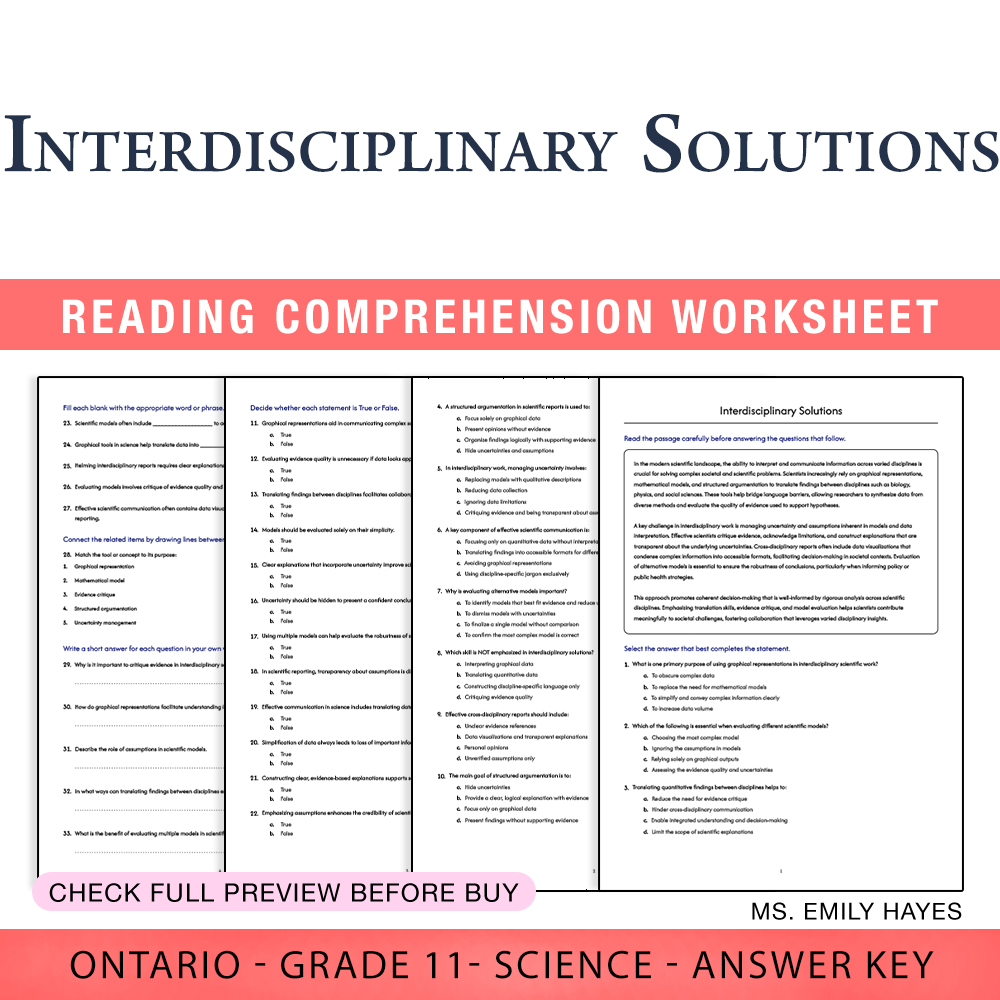
11th Grade Science | Interdisciplinary Solutions Worksheet (PDF + Answer Key)
Created byCopper Leaf ClassroomLearning Objectives
- Interpret and communicate scientific information across contexts through graphical representation and mathematical models.
- Critique evidence quality and construct clear, discipline-appropriate explanations that incorporate uncertainty and assumptions.
- Translate quantitative findings between disciplinary languages and evaluate alternative models for decision-making.
Instant download

Trade-Offs Analysis Worksheet | NGSS-Aligned 11th Grade Science Practice
JCreated byJ.S SheetsLearning Objectives
- Evaluate proposed solutions against multiple criteria and constraints using quantitative and qualitative methods.
- Apply systems thinking to analyze component interactions, emergent behavior, and unintended consequences in engineering and urban systems.
- Assess trade-offs among cost, safety, environmental impact, scalability, and maintainability using performance metrics.
Also included in: Grade 11 Engineering Design with Computational Modeling Science +1 more
Instant download
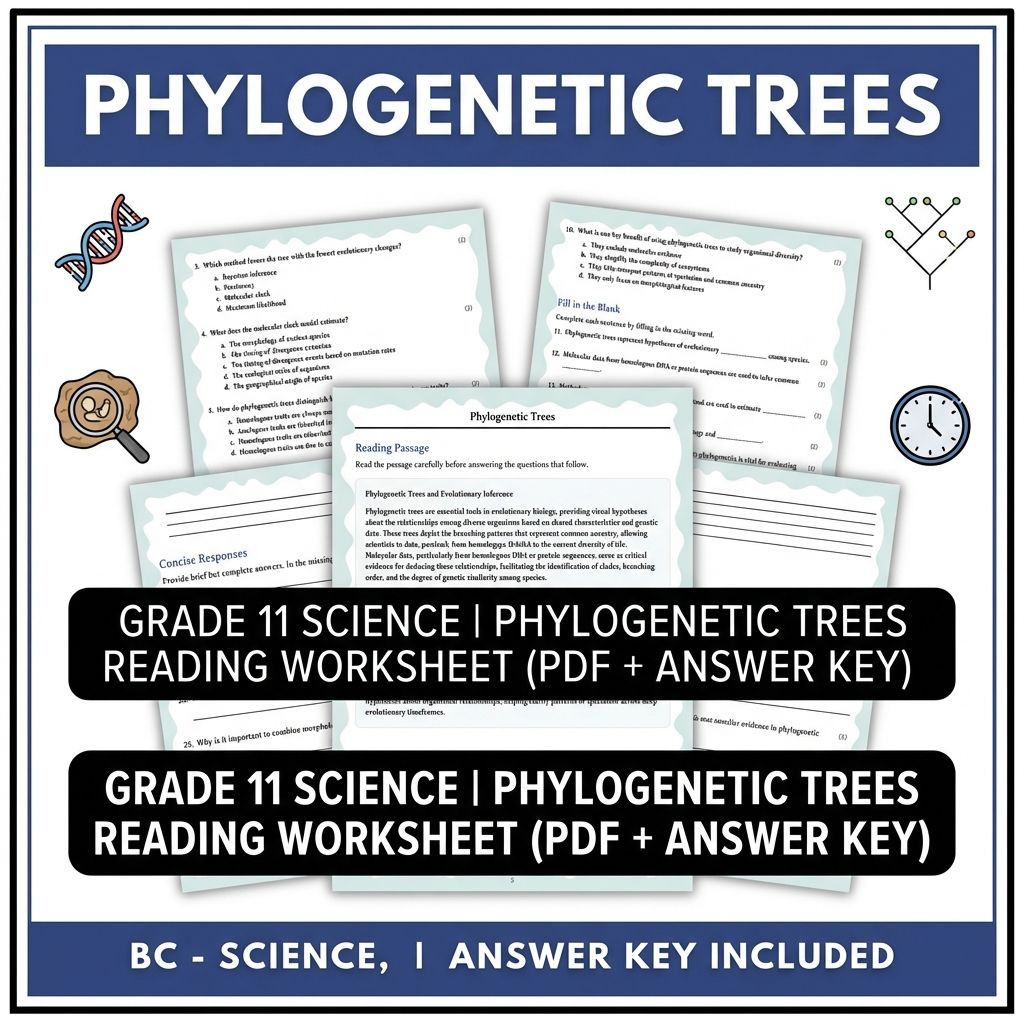
Grade 11 Science | Phylogenetic Trees Reading Worksheet (PDF + Answer Key)
JCreated byJ.S SheetsLearning Objectives
- Understand how phylogenetic trees depict hypotheses of evolutionary relationships.
- Identify the methods and data used to infer evolutionary histories.
- Distinguish between homology and analogy in organismal traits.
Instant download
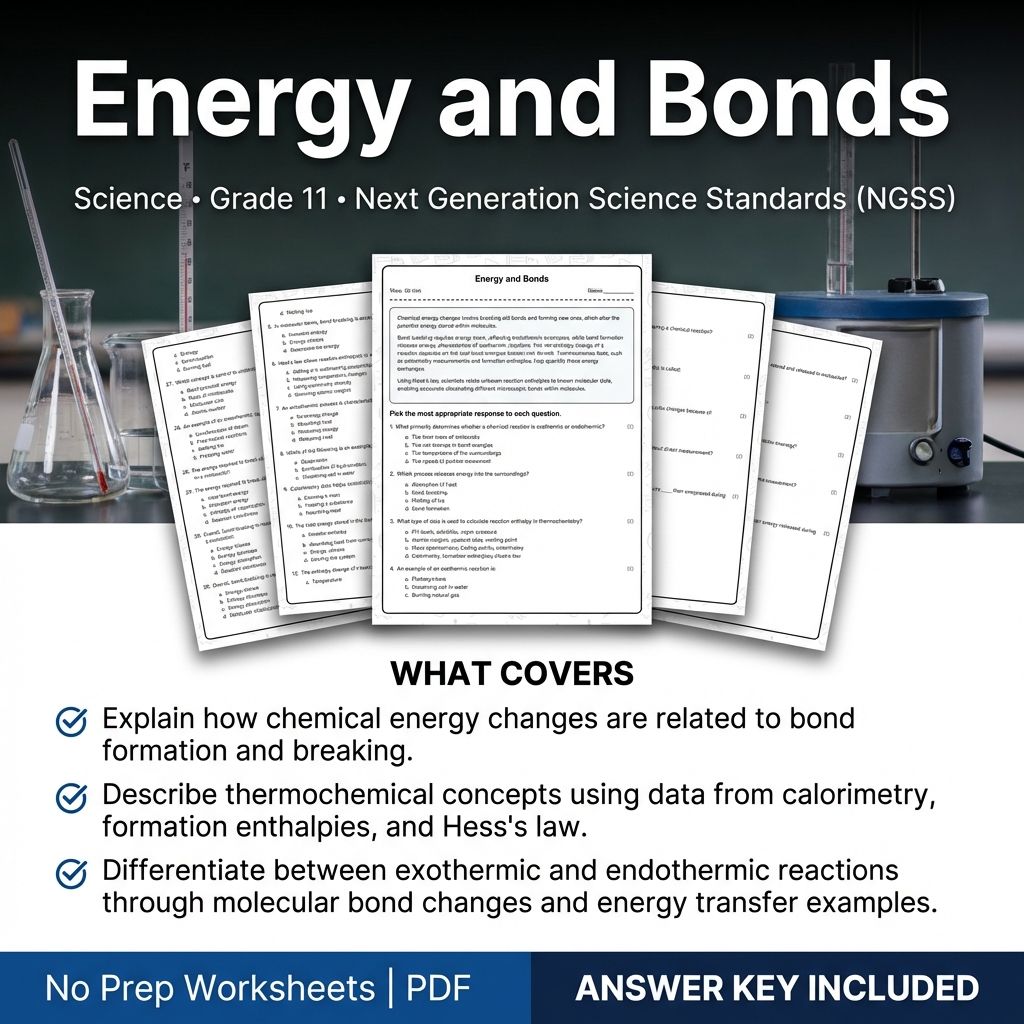
11th Grade Science | Energy and Bonds Worksheet & Answer Key (Printable PDF)
Created byCoral Reef LearningLearning Objectives
- Explain how chemical energy changes are related to bond formation and breaking.
- Describe thermochemical concepts using data from calorimetry, formation enthalpies, and Hess's law.
- Differentiate between exothermic and endothermic reactions through molecular bond changes and energy transfer examples.
Also included in: Grade 11 Science Unit Bundle – Chemical Reactions & Periodic Trends Worksheets +1 more
Instant download
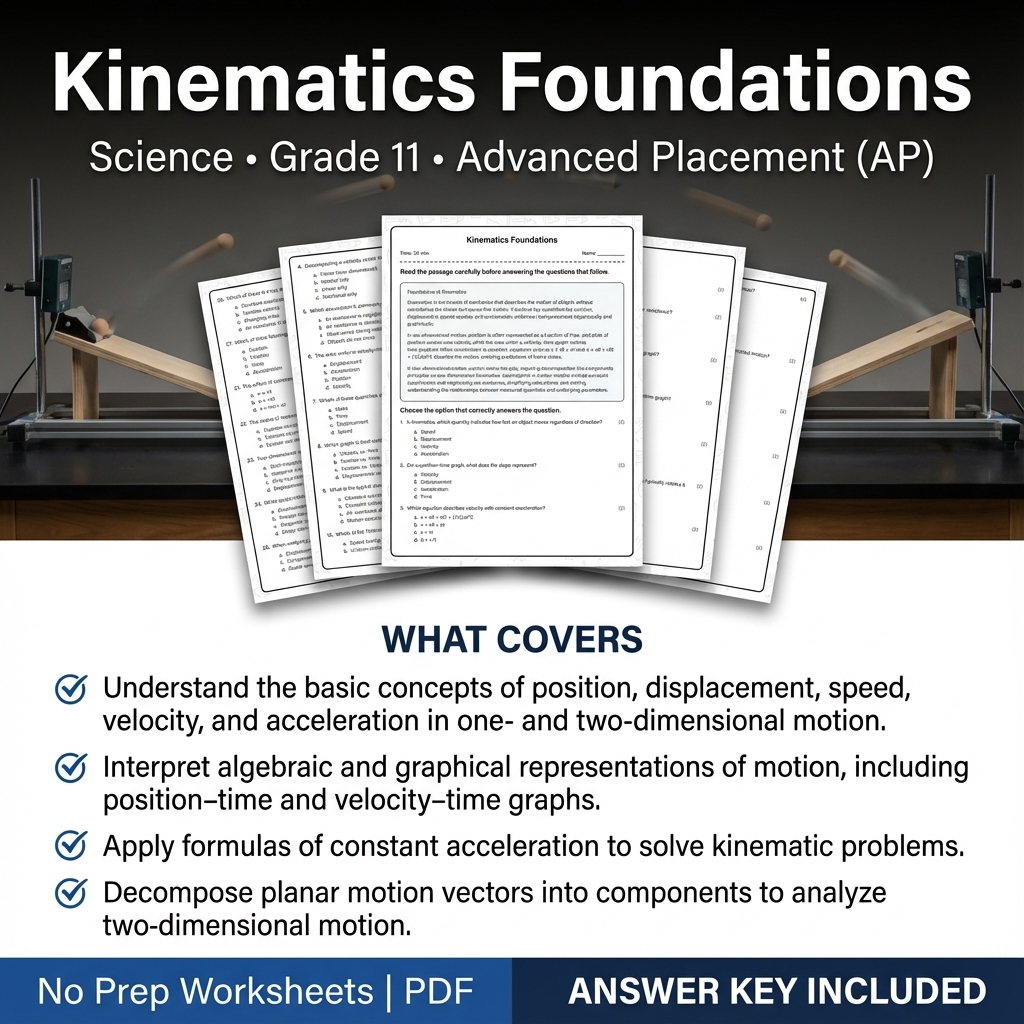
11th Grade Science | Kinematics Fundamentals Worksheet (Printable PDF + Answer Key)
Created byCoral Reef LearningLearning Objectives
- Understand the basic concepts of position, displacement, speed, velocity, and acceleration in one- and two-dimensional motion.
- Interpret algebraic and graphical representations of motion, including position–time and velocity–time graphs.
- Apply formulas of constant acceleration to solve kinematic problems.
Also included in: Grade 11 Science Unit | Physics Worksheets on Work, Power & Motion PDF Bundle +1 more
Instant download

Evidence Supporting Evolution Worksheet for Grade 11 Science | NGSS
JCreated byJ.S SheetsLearning Objectives
- Understand the various lines of evidence that support common ancestry and evolution.
- Describe how fossil records, comparative anatomy, molecular data, biogeography, and vestigial organs provide evidence for evolution.
- Explain the importance of concordance among different datasets in evolutionary biology.
Also included in: Grade 11 Evolutionary Models and Evidence Science lesson bundle: NGSS +1 more
Instant download

Statistical Models Worksheet for Grade 11 Science | NGSS Practice
JCreated byJ.S SheetsLearning Objectives
- Understand how allele frequencies are modeled using statistical and probabilistic methods.
- Apply Hardy–Weinberg principles to calculate expected genotype frequencies and assess deviations.
- Use chi-square tests and confidence intervals to evaluate population data and detect evolutionary changes.
Also included in: Grade 11 Evolutionary Models and Evidence Science lesson bundle: NGSS +1 more
Instant download
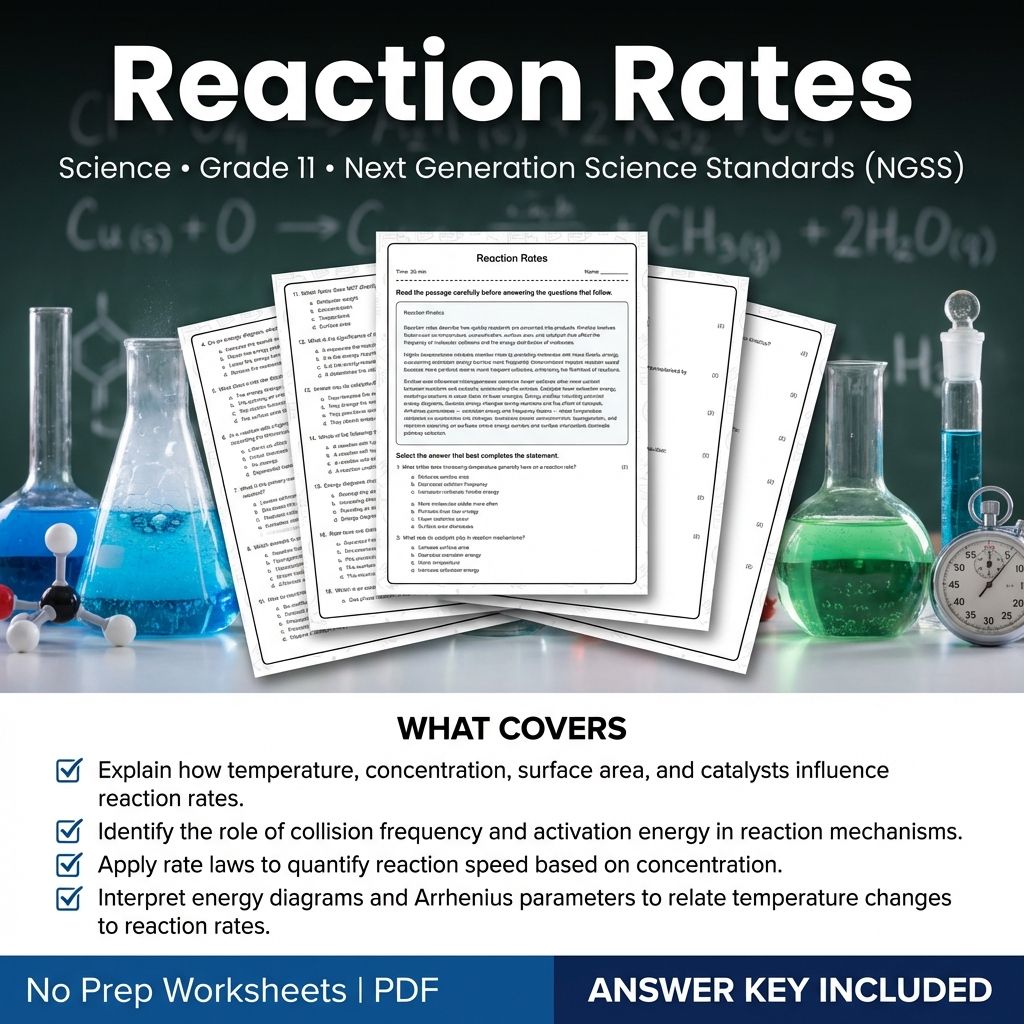
11th Grade Science | Reaction Rates Worksheet with Answer Key (Printable PDF)
Created byCoral Reef LearningLearning Objectives
- Explain how temperature, concentration, surface area, and catalysts influence reaction rates.
- Identify the role of collision frequency and activation energy in reaction mechanisms.
- Apply rate laws to quantify reaction speed based on concentration.
Also included in: Grade 11 Science Unit Bundle – Chemical Reactions & Periodic Trends Worksheets +1 more
Instant download
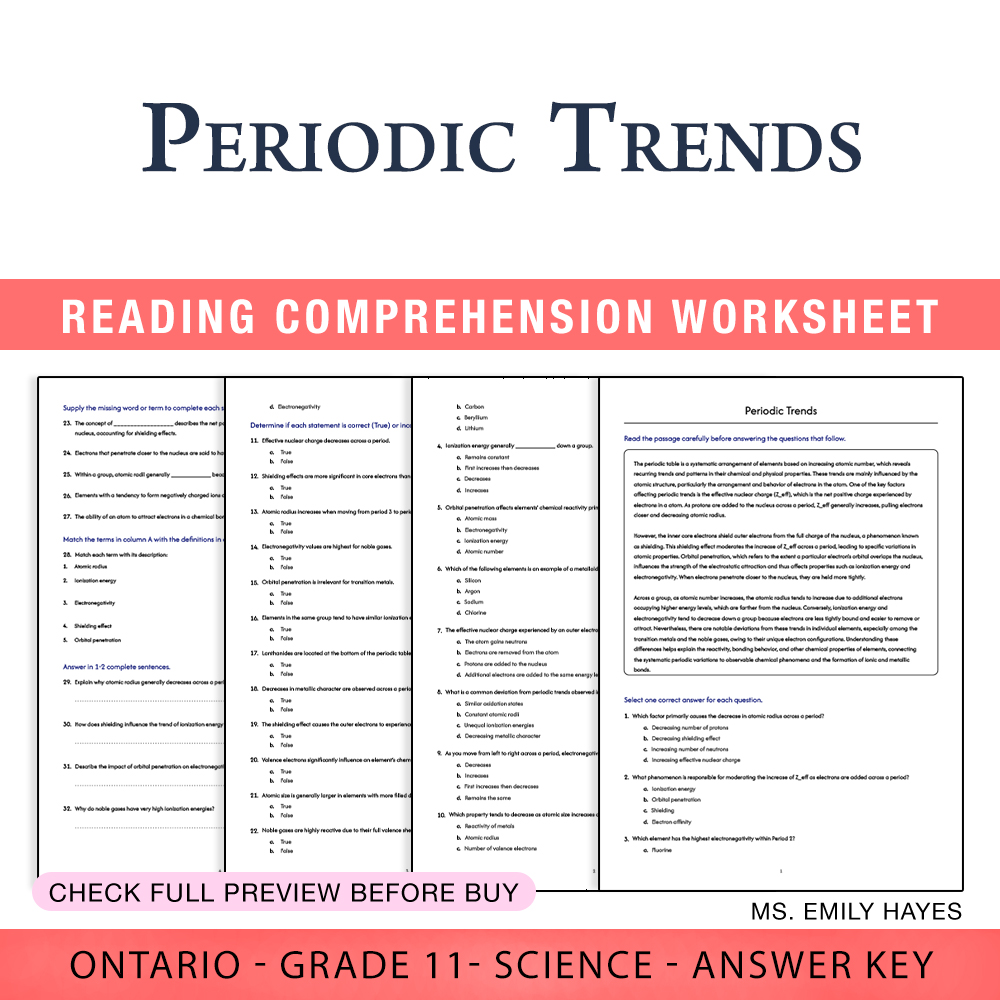
11th Grade Science | Periodic Trends Worksheet (PDF + Answer Key)
Created byCopper Leaf ClassroomLearning Objectives
- Explain the concepts of effective nuclear charge, shielding, and orbital penetration and their roles in periodic trends.
- Analyze how atomic radius, ionization energy, and electronegativity vary across periods and groups.
- Identify deviations from idealized periodic trends in representative elements and relate these to their chemical properties and behaviors.
Instant download
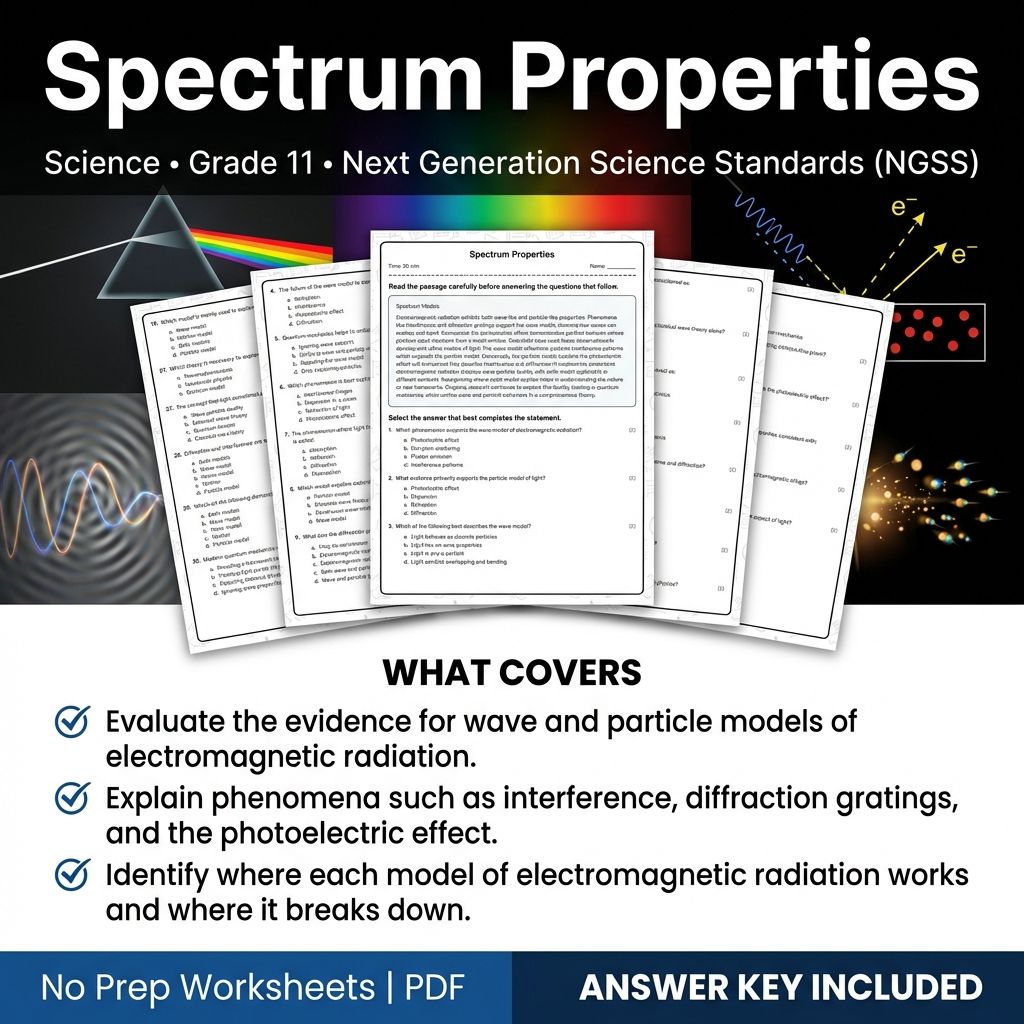
11th Grade Science Worksheet | Spectrum & Electromagnetic Radiation + Answer Key
Created byCoral Reef LearningLearning Objectives
- Evaluate the evidence for wave and particle models of electromagnetic radiation.
- Explain phenomena such as interference, diffraction gratings, and the photoelectric effect.
- Identify where each model of electromagnetic radiation works and where it breaks down.
Also included in: Grade 11 Science Unit Bundle | Wave, Spectrum & Signal Encoding Worksheets +1 more
Instant download
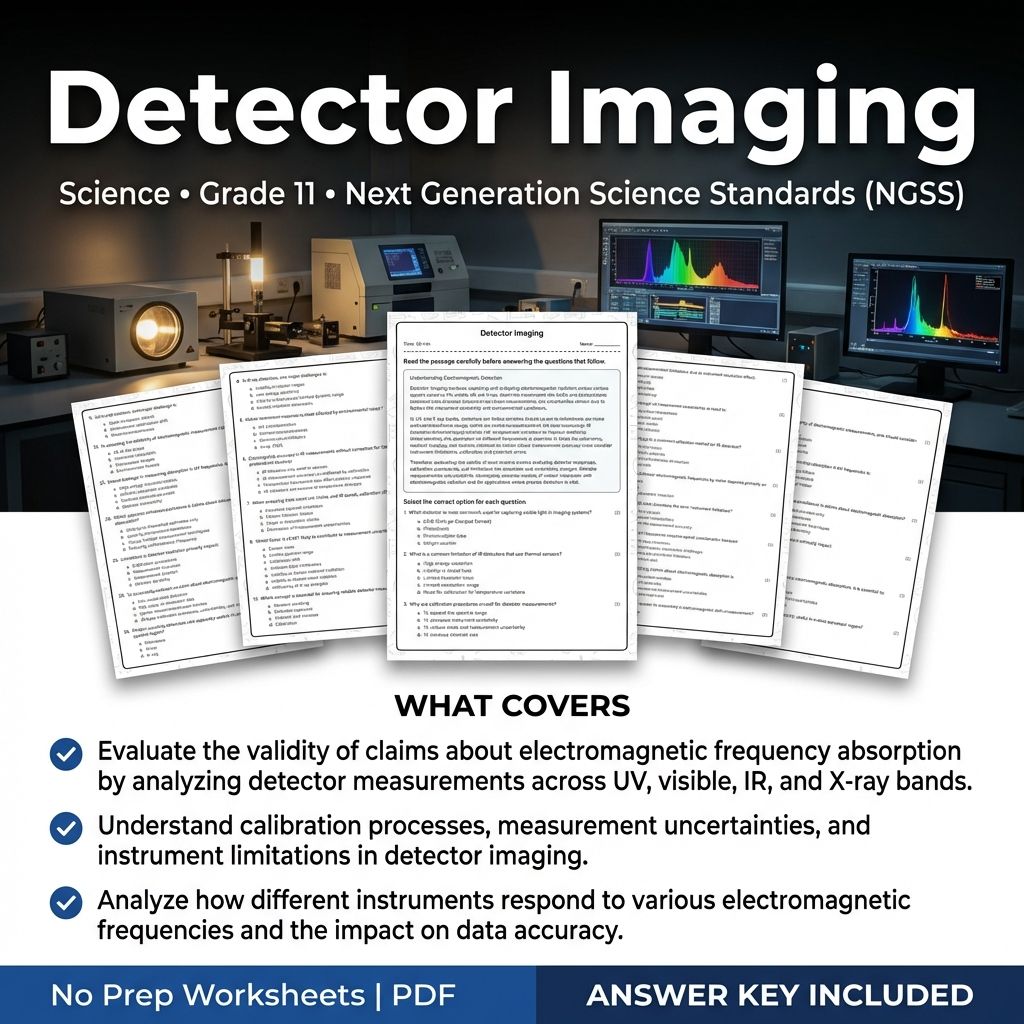
Grade 11 Science | Detector Imaging Worksheet & Answer Key (Printable PDF)
Created byCoral Reef LearningLearning Objectives
- Evaluate the validity of claims about electromagnetic frequency absorption by analyzing detector measurements across UV, visible, IR, and X-ray bands.
- Understand calibration processes, measurement uncertainties, and instrument limitations in detector imaging.
- Analyze how different instruments respond to various electromagnetic frequencies and the impact on data accuracy.
Also included in: Grade 11 Science Unit Bundle | Wave, Spectrum & Signal Encoding Worksheets +1 more
Instant download

Spectrum Properties Test Prep Worksheets | Grade 11 Science NGSS Review
 Created byPrism Point Learning
Learning Objectives
- Evaluate evidence for the wave and particle models of electromagnetic radiation using interference, diffraction, and the photoelectric effect.
- Explain where each model works well and where it breaks down for different observed phenomena.
- Connect spectral observations (wavelength, frequency, energy) to the underlying behavior of light.
Also included in: Grade 11 Wave, Spectrum & Imaging Science Test Prep Lesson Bundle | NGSS
Instant download

Detector Imaging Test Prep Worksheet | Grade 11 Science NGSS Review
Created byPrism Point LearningLearning Objectives
- Evaluate claims about how detector response changes across electromagnetic frequency bands using evidence from measurements.
- Explain how calibration, uncertainty, and instrument limitations affect the validity and reliability of detector imaging results.
Also included in: Grade 11 Wave, Spectrum & Imaging Science Test Prep Lesson Bundle | NGSS
Instant download
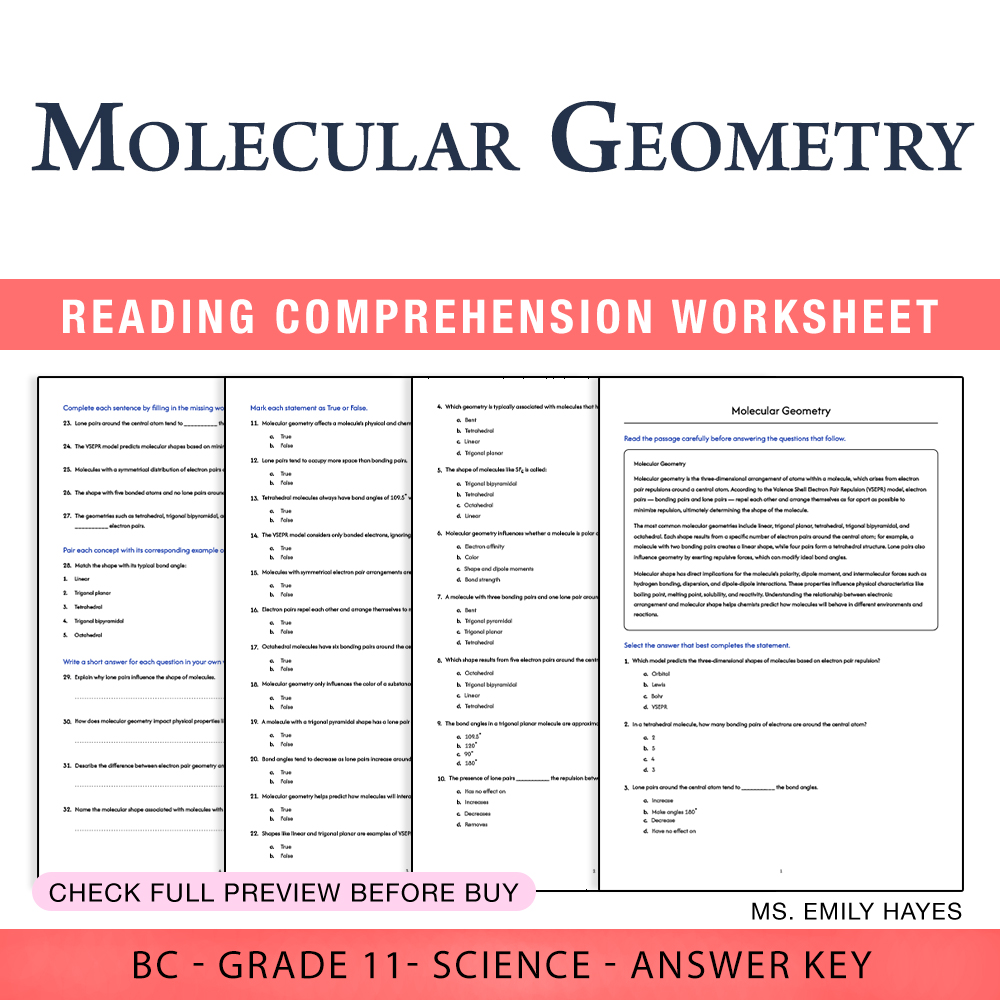
11th Grade Science | Molecular Geometry Worksheet (PDF + Answer Key)
Created byCopper Leaf ClassroomLearning Objectives
- Describe the VSEPR model and how electron pairs influence molecular shape.
- Identify common molecular geometries such as linear, trigonal planar, tetrahedral, trigonal bipyramidal, and octahedral.
- Explain how molecular geometry affects polarity, intermolecular forces, and physical properties.
Also included in: Grade 11 Science BC– Thermochemistry, Bonding & Reactions (PDF + Answer Key) +1 more
Instant download
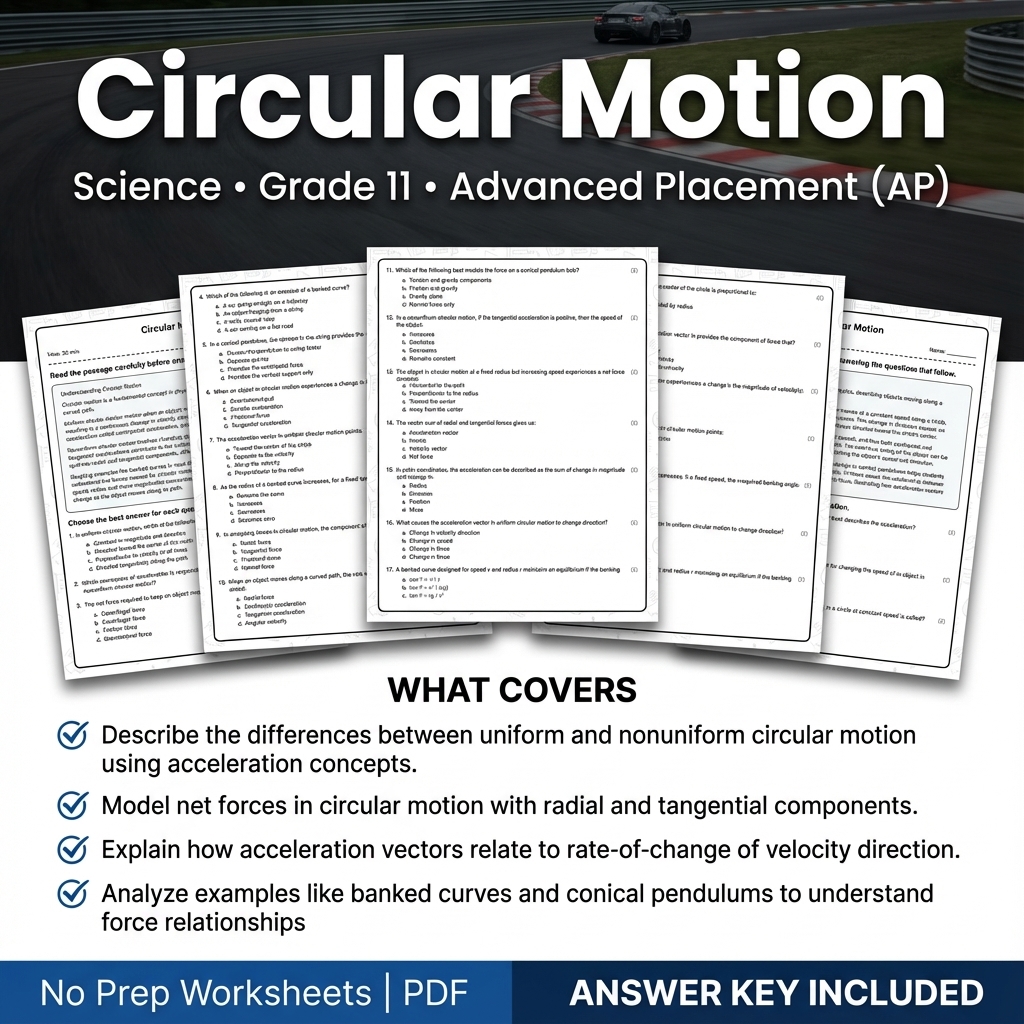
11th Grade Science | Circular Motion Worksheet (Printable PDF + Answer Key)
Created byCoral Reef LearningLearning Objectives
- Describe the differences between uniform and nonuniform circular motion using acceleration concepts.
- Model net forces in circular motion with radial and tangential components.
- Explain how acceleration vectors relate to rate-of-change of velocity direction.
Also included in: Grade 11 Science Unit | Physics Worksheets on Work, Power & Motion PDF Bundle +1 more
Instant download
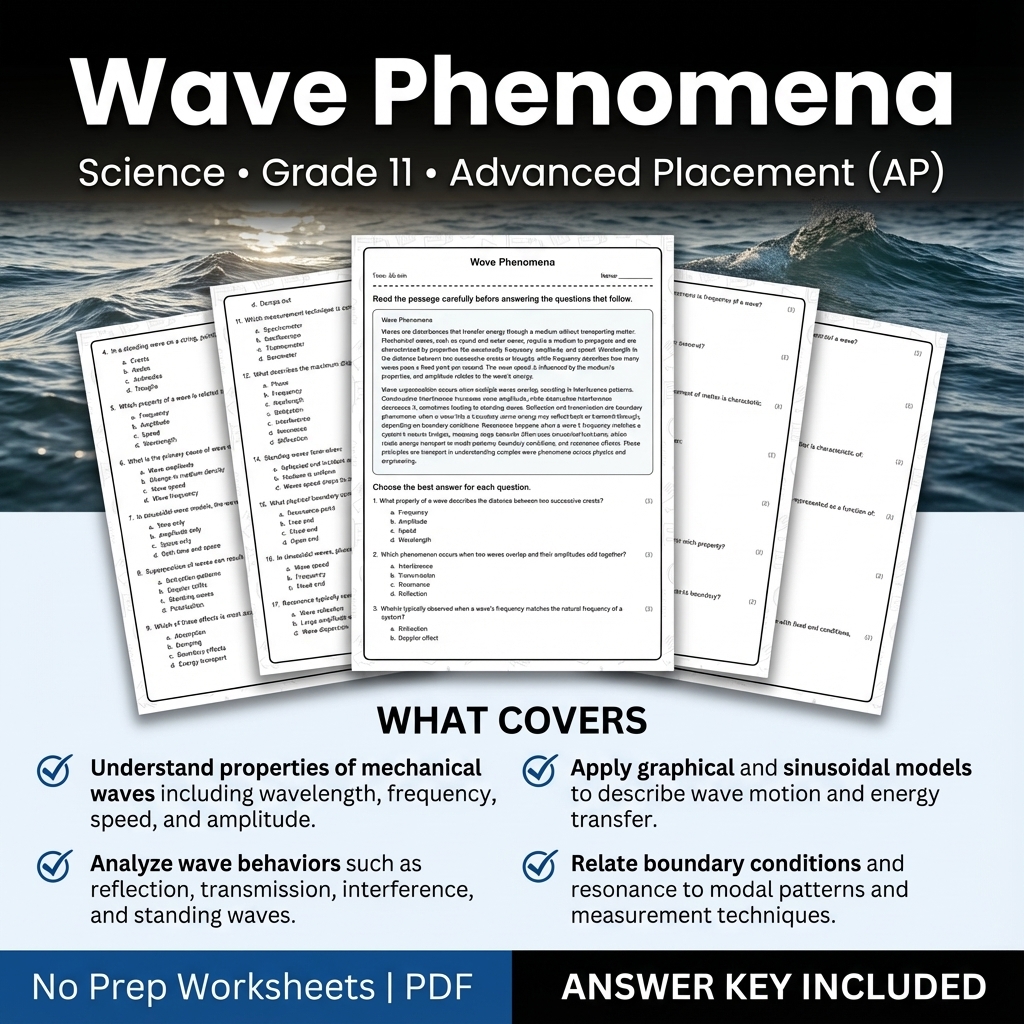
Grade 11 Science | Wave Phenomena Worksheet (Printable PDF + Answer Key)
Created byCoral Reef LearningLearning Objectives
- Understand properties of mechanical waves including wavelength, frequency, speed, and amplitude.
- Analyze wave behaviors such as reflection, transmission, interference, and standing waves.
- Apply graphical and sinusoidal models to describe wave motion and energy transfer.
Also included in: Grade 11 Science Unit | Physics Worksheets on Work, Power & Motion PDF Bundle +1 more
Instant download
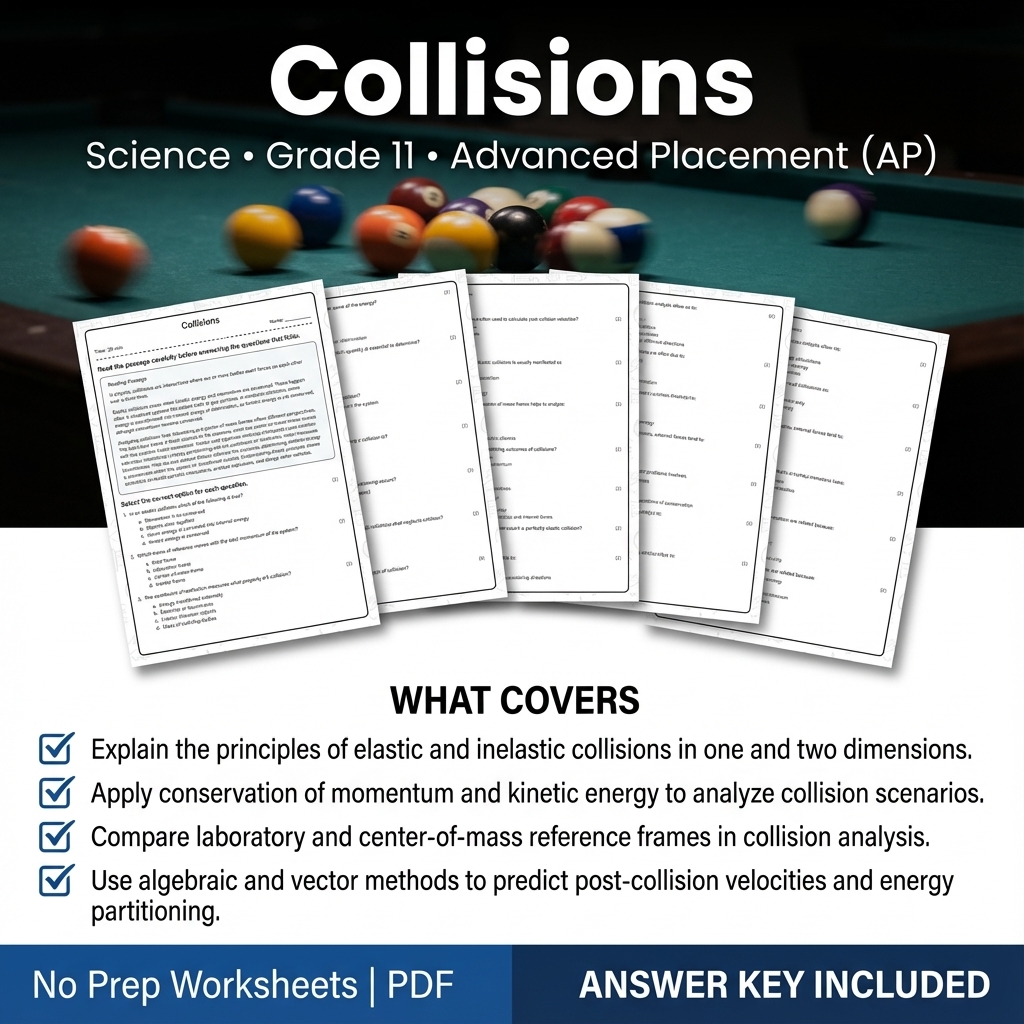
Grade 11 Science | Collisions Worksheet (Printable PDF + Answer Key)
Created byCoral Reef LearningLearning Objectives
- Explain the principles of elastic and inelastic collisions in one and two dimensions.
- Apply conservation of momentum and kinetic energy to analyze collision scenarios.
- Compare laboratory and center-of-mass reference frames in collision analysis.
Also included in: Grade 11 Science Unit | Physics Worksheets on Work, Power & Motion PDF Bundle +1 more
Instant download

Grade 11 Wave Phenomena Worksheet | Practice & Assessment PDF
 Created byClear Sky Classroom
Learning Objectives
- Explain how mechanical wave properties (wavelength, frequency, speed, and amplitude) relate mathematically and conceptually.
- Use superposition to predict patterns created by overlapping waves and identify constructive vs. destructive interference.
- Analyze reflection, transmission, and boundary conditions to describe standing-wave formation and resonance in strings and air columns.
Also included in: Grade 11 Physics Motion & Energy Science Lesson Bundle | Advanced Placement (AP) +1 more
Instant download

Grade 11 Science — Rock Cycle Worksheet MCQ Paper for Mastery
Created byThe Resource HubLearning Objectives
- Describe the processes involved in the formation, transformation, and destruction of rocks over geologic time.
- Explain the influence of plate tectonics on metamorphism, magma generation, and sedimentation.
- Identify the stratigraphic and geochemical tools used to study crustal material pathways and resource deposits.
Also included in: Grade 11 Science AP Custom Bundle | Core Concepts & Earth Systems +1 more
Instant download

Grade 11 Science | One-Dimensional Kinematics - Daily Reading Comprehension
Created byCoral Reef LearningLearning Objectives
- Understand and define displacement and velocity in one-dimensional motion.
- Calculate average displacement and velocity over a given time interval.
- Differentiate between displacement and total distance traveled.
Instant download
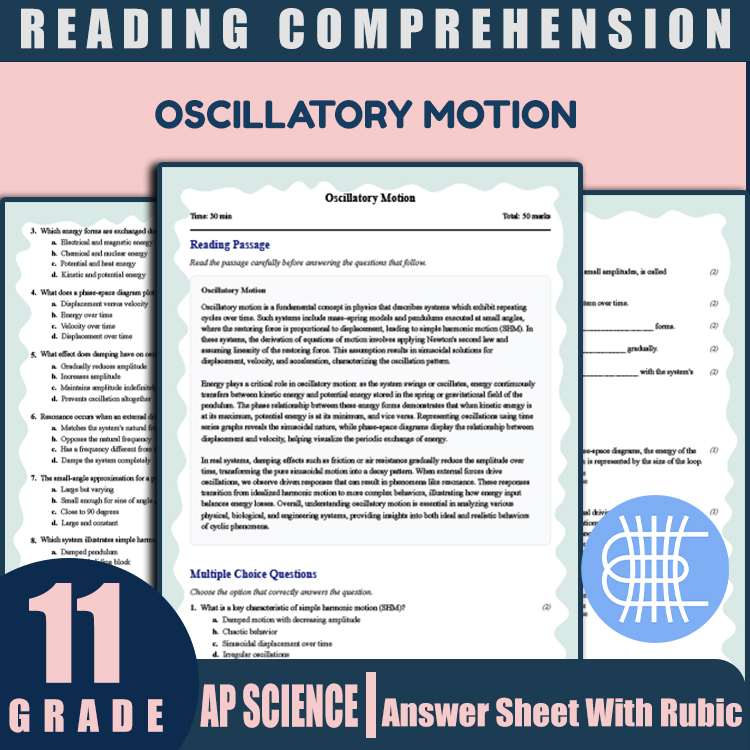
Grade 11 Science | Oscillatory Motion Reading Worksheet (PDF + Answer Key)
JCreated byJ.S SheetsLearning Objectives
- Understand the principles of simple harmonic motion and how it models mass–spring systems and small-angle pendula.
- Derive equations of motion for oscillatory systems and connect restoring force linearity to sinusoidal solutions.
- Analyze energy interchange between kinetic and potential forms during oscillations.
Also included in: Grade 11 Physics Unit | Motion, Waves & Energy Worksheets (PDF + Rubric Bundle) +1 more
Instant download
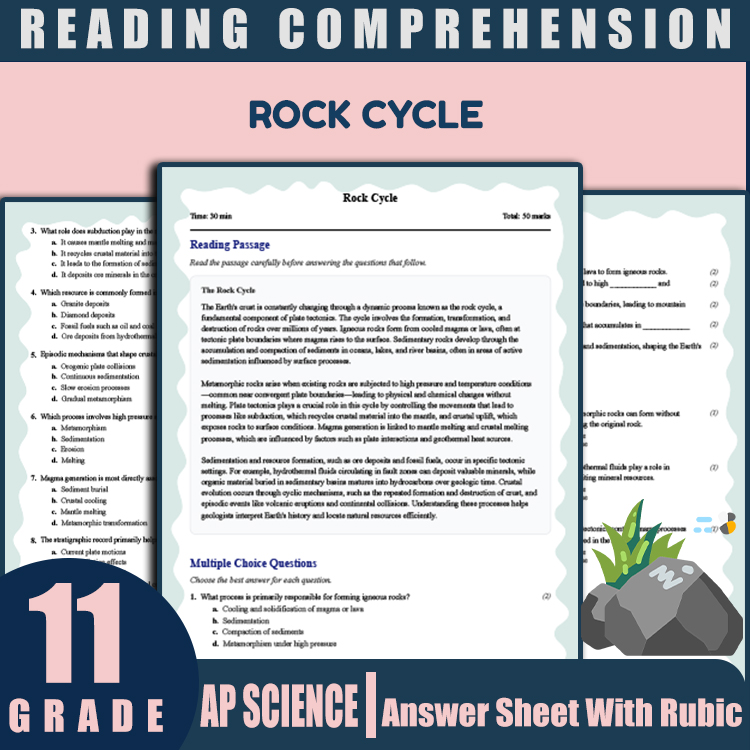
11th Grade Science | Rock Cycle Reading Worksheet & Answer Key (PDF)
JCreated byJ.S SheetsLearning Objectives
- Describe the processes involved in rock formation, transformation, and destruction over geologic time.
- Explain how plate tectonics influence metamorphism, magma generation, and sedimentation.
- Identify resources such as ore deposits and fossil fuels in the context of the rock cycle and crustal processes.
Also included in: Grade 11 Science Unit Bundle | Earth Systems & Climate Change Worksheets +1 more
Instant download
11th Grade Science | Carbon Pathways Reading Worksheet & Answer Key (PDF)
JCreated byJ.S SheetsLearning Objectives
- Describe the main components involved in carbon storage and flux among the atmosphere, oceans, terrestrial biosphere, and sediments.
- Explain the tools used to analyze carbon cycling, including flux diagrams, reservoir inventories, and isotopic tracers.
- Assess how natural and anthropogenic factors influence carbon pathways over different temporal scales.
Also included in: Grade 11 Science Unit Bundle | Earth Systems & Climate Change Worksheets +1 more
Instant download
11th Grade Science | Electromagnetic Waves Reading Worksheet & Answer Key (PDF)
JCreated byJ.S SheetsLearning Objectives
- Explain the oscillating electric and magnetic fields in electromagnetic waves.
- Describe the orthogonal structure of electric and magnetic fields in wave propagation.
- Understand the relationship between wave frequency, wavelength, and energy transport.
Also included in: Grade 11 Physics Unit | Motion, Waves & Energy Worksheets (PDF + Rubric Bundle) +1 more
Instant download
Grade 11 Science | Resource Distribution Reading Worksheet (PDF + Answer Key)
JCreated byJ.S SheetsLearning Objectives
- Understand the ways geologic maps, surveys, and basin models are used to map resource patterns.
- Differentiate between renewable and nonrenewable resources based on geologic and sedimentary processes.
- Assess the sustainability of resource extraction using quantitative measures such as reserve quality and extraction rates.
Also included in: Grade 11 Science Unit Bundle | Earth Systems & Climate Change Worksheets +1 more
Instant download
11th Grade Science | Atmospheric Structure Reading Worksheets (PDF & Rubric)
JCreated byJ.S SheetsLearning Objectives
- Understand the vertical and horizontal layers of Earth's atmosphere and their characteristics.
- Interpret different atmospheric representations such as sounding profiles, pressure maps, and radiative balance diagrams.
- Apply thermodynamic principles to explain phenomena like lapse rates and inversion layers.
Also included in: Grade 11 Science Unit Bundle | Earth Systems & Climate Change Worksheets +1 more
Instant download
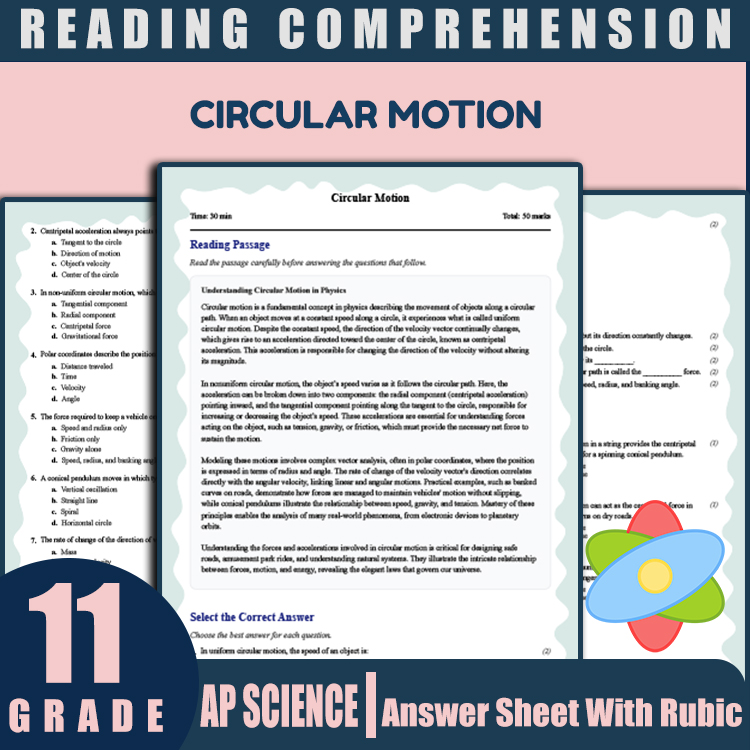
11th Grade Science | Circular Motion Reading Worksheet (PDF + Answer Key)
JCreated byJ.S SheetsLearning Objectives
- Explain the concepts of uniform and nonuniform circular motion, including centripetal and tangential accelerations.
- Model the forces involved in circular motion using radial and tangential components and understand their relationship.
- Describe motion in polar coordinates and connect acceleration vectors with the rate of change of velocity direction.
Also included in: Grade 11 Physics Unit | Motion, Waves & Energy Worksheets (PDF + Rubric Bundle) +1 more
Instant download
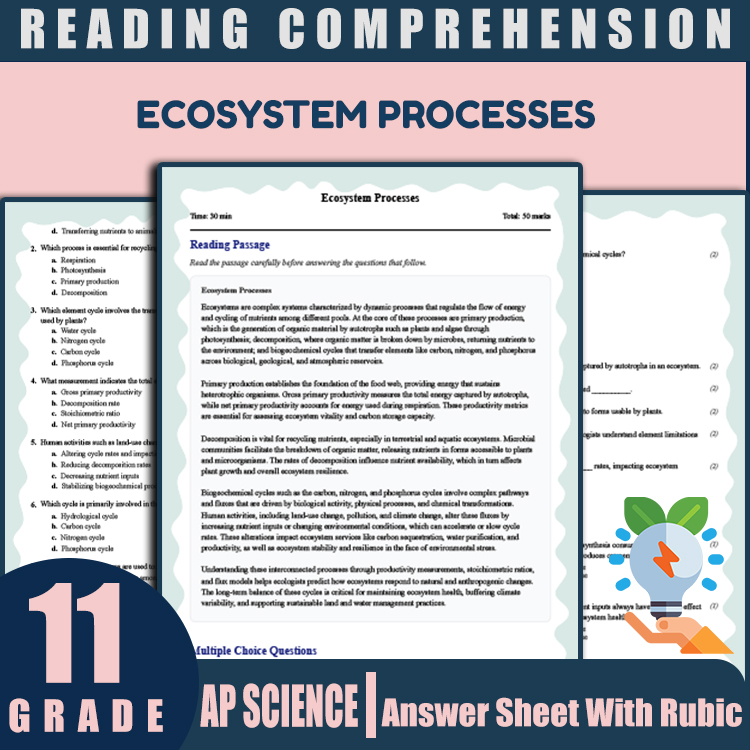
Grade 11 Science | Ecosystem Processes Reading Worksheet (PDF + Answer Key)
JCreated byJ.S SheetsLearning Objectives
- Understand the fundamental ecosystem-level processes that regulate energy flow and material cycling.
- Describe the roles of primary production, decomposition, and biogeochemical cycles of carbon, nitrogen, and phosphorus.
- Analyze how land-use change, nutrient inputs, and climate variability influence cycle rates and ecosystem functions.
Also included in: Grade 11 Science Unit Bundle – Cellular Systems, Genetics Ecosystems Worksheets +1 more
Instant download
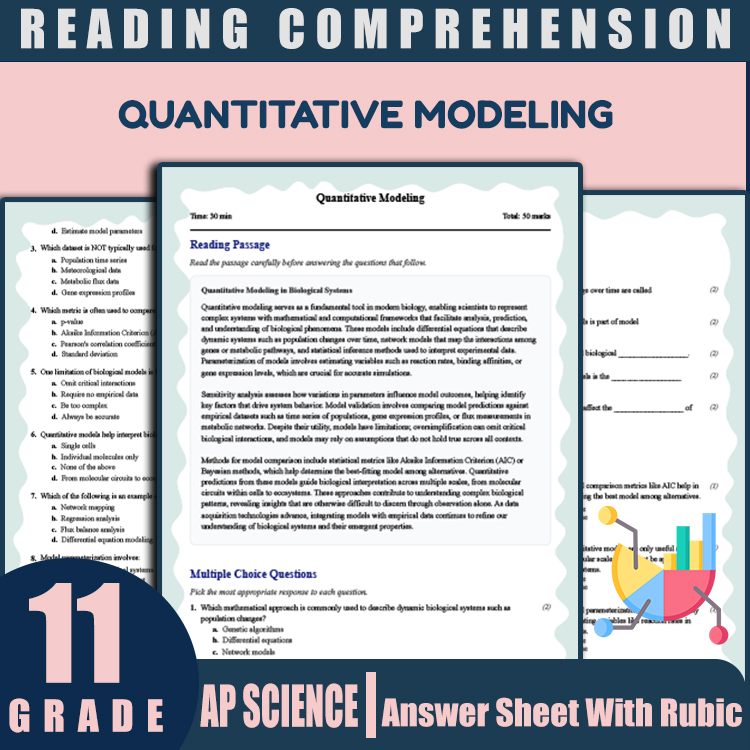
11th Grade Science | Population Patterns Reading Worksheet (PDF + Rubric)
JCreated byJ.S SheetsLearning Objectives
- Understand the principles of population dynamics, including exponential and logistic growth models.
- Interpret graphical models, life-history tables, and reproductive strategies to analyze population fluctuations.
- Examine case examples such as invasive species spread and predator-prey cycles to understand factors affecting population trajectories.
Also included in: Grade 11 Science Unit Bundle – Cellular Systems, Genetics Ecosystems Worksheets +1 more
Instant download

11th Grade Science | Equilibrium Systems Reading Worksheet & PDF Answer Key
JCreated byJ.S SheetsLearning Objectives
- Understand the concept of chemical equilibrium in homogeneous and heterogeneous systems.
- Learn to write and interpret equilibrium constants such as Kc and Kp.
- Apply reaction quotient (Q) calculations to predict the direction of shifts in equilibrium.
Also included in: Grade 11 Science Unit Worksheet Bundle – Chemical Bonding, Kinetics & More (PDF) +1 more
Instant download
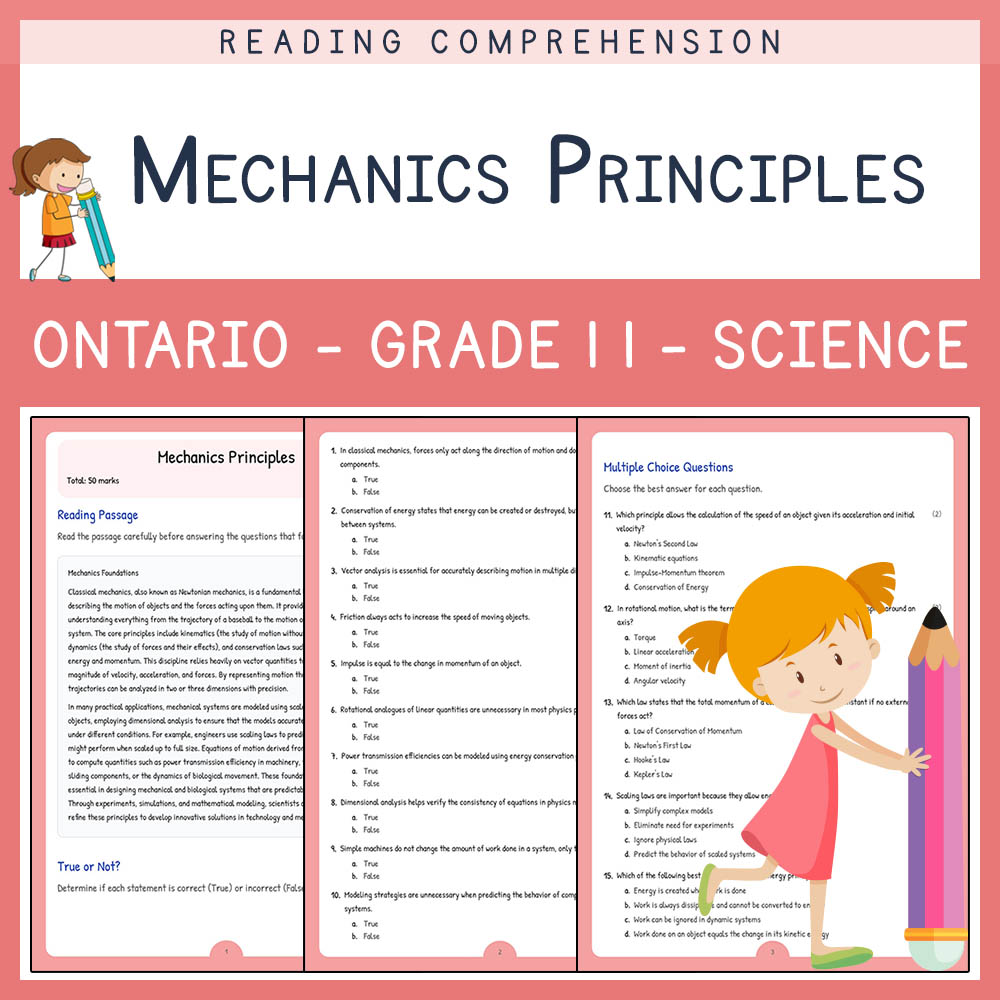
Grade 11 Science Assessment | Mechanics Principles Worksheet Elena | Ontario
 Created byLumora Learning
Learning Objectives
- Explain key concepts of classical mechanics including kinematics, dynamics, and conservation laws.
- Apply vector analysis to describe motion in physical systems.
- Solve problems related to forces, energy, impulse, and momentum in real-world contexts.
Instant download
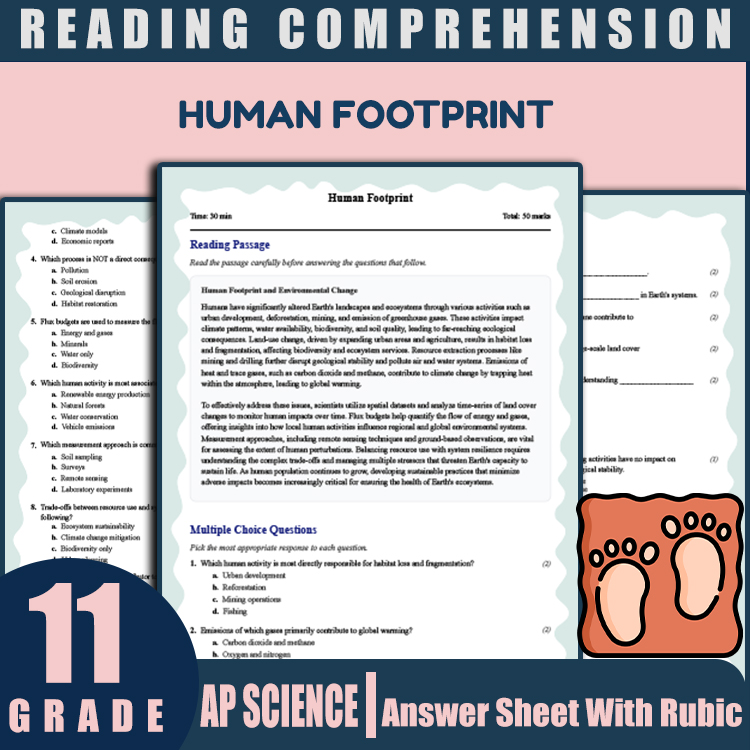
11th Grade Science | Human Footprint Reading Worksheet (PDF + Answer Key)
JCreated byJ.S SheetsLearning Objectives
- Understand the various ways human activities impact Earth's systems such as land use, resource extraction, and emissions.
- Analyze spatial data and time-series datasets to identify links between local human actions and regional environmental changes.
- Evaluate measurement approaches for quantifying human-induced perturbations and consider trade-offs between resource use and ecosystem resilience.
Also included in: Grade 11 Science Unit Bundle | Earth Systems & Climate Change Worksheets +1 more
Instant download
About Grade 11 Science Worksheets
Browse 6,616 printable Grade 11 Science worksheets — ready-to-print PDFs with answer keys where available.
Each resource here is built by an independent educator and reviewed for quality. Worksheets print straight from PDF and suit classroom use, homework, or extra practice; most come with answer keys, and you can preview before purchasing.