
Grade 11 Science Worksheets
6,616 worksheets
Grade 11 Energy Pathways in Cellular Respiration Worksheet | NGSS Biology
 Created byBRIGHT PATH RESOURCES
Learning Objectives
- Understand the steps and products of glycolysis
- Describe the process of pyruvate oxidation
- Explain the citric acid cycle and its significance
Also included in: From Molecules to Organisms: Structures and Processes Grade 11 Science Bundle +1 more
Instant download
Grade 11 Science | Mendelian Patterns Worksheet (Answer Key) – BC Standards
 Created byBright Mind Resources
Learning Objectives
- Explain how alleles segregate and assort to produce predictable ratios in simple genetic crosses.
- Identify dominant and recessive relationships between alleles and their influence on trait expression.
- Analyze pedigrees to trace inheritance patterns across generations.
Instant download

Grade 11 Science | Ionic & Covalent Bonding - Daily Reading Comprehension
 Created byCoral Reef Learning
Learning Objectives
- Understand key concepts related to Science
- Apply knowledge through practice questions
- Demonstrate comprehension of the material
Instant download
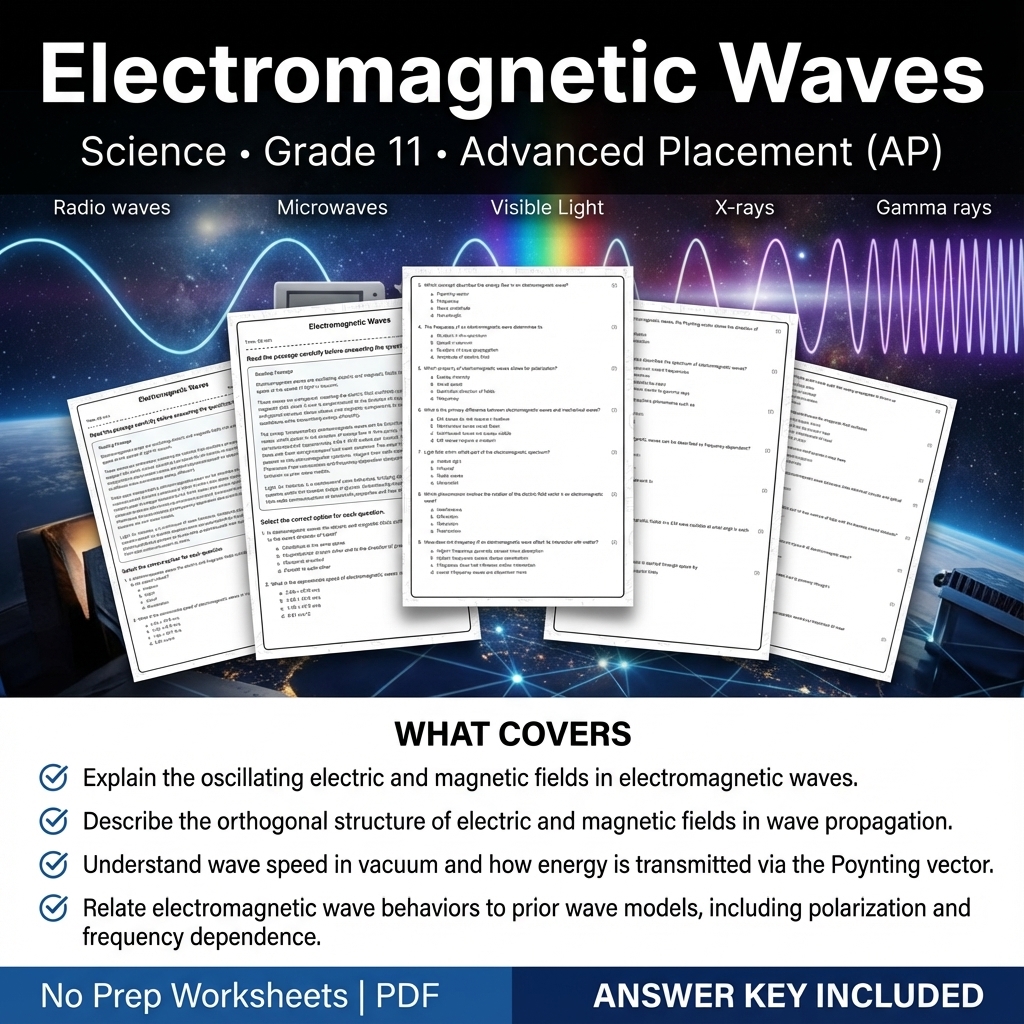
11th Grade Science | Electromagnetic Waves Worksheet (Printable PDF + Answer Key)
Created byCoral Reef LearningLearning Objectives
- Explain the oscillating electric and magnetic fields in electromagnetic waves.
- Describe the orthogonal structure of electric and magnetic fields in wave propagation.
- Understand wave speed in vacuum and how energy is transmitted via the Poynting vector.
Also included in: Grade 11 Science Unit | Physics Worksheets on Work, Power & Motion PDF Bundle +1 more
Instant download
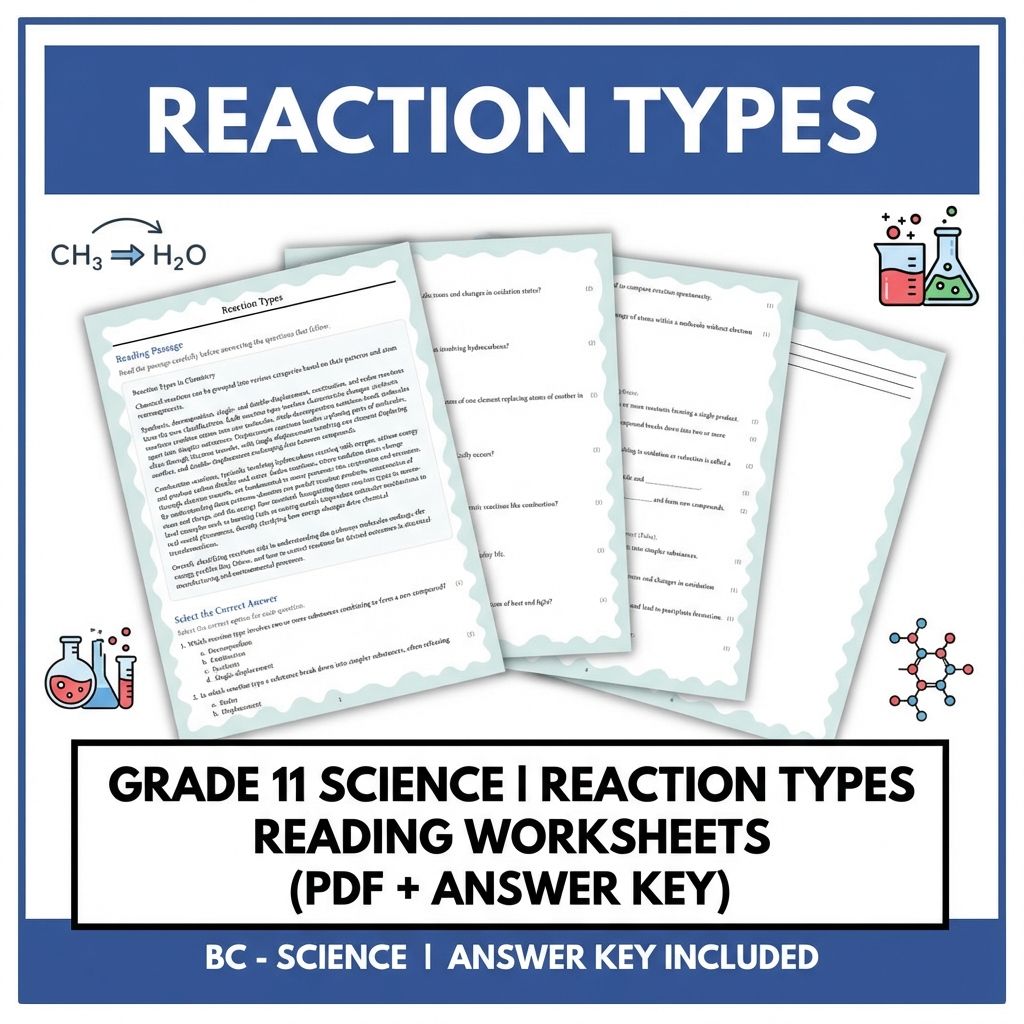
Grade 11 Science | Reaction Types Reading Worksheets (PDF + Answer Key)
JCreated byJ.S SheetsLearning Objectives
- Understand the different patterns of chemical reactions such as synthesis, decomposition, and redox transformations.
- Identify characteristic features of each reaction type based on atom rearrangements and energy profiles.
- Use reaction classification to predict products and conservation laws.
Instant download
Grade 11 Science – Seismic Profiles Worksheet (PDF) | Earth Interior Concepts
Created byBright Mind ResourcesLearning Objectives
- Explain how seismic profiles reveal Earth's internal structure.
- Identify differences between P-waves and S-waves in seismology.
- Describe the significance of shadow zones in understanding Earth's core.
Instant download
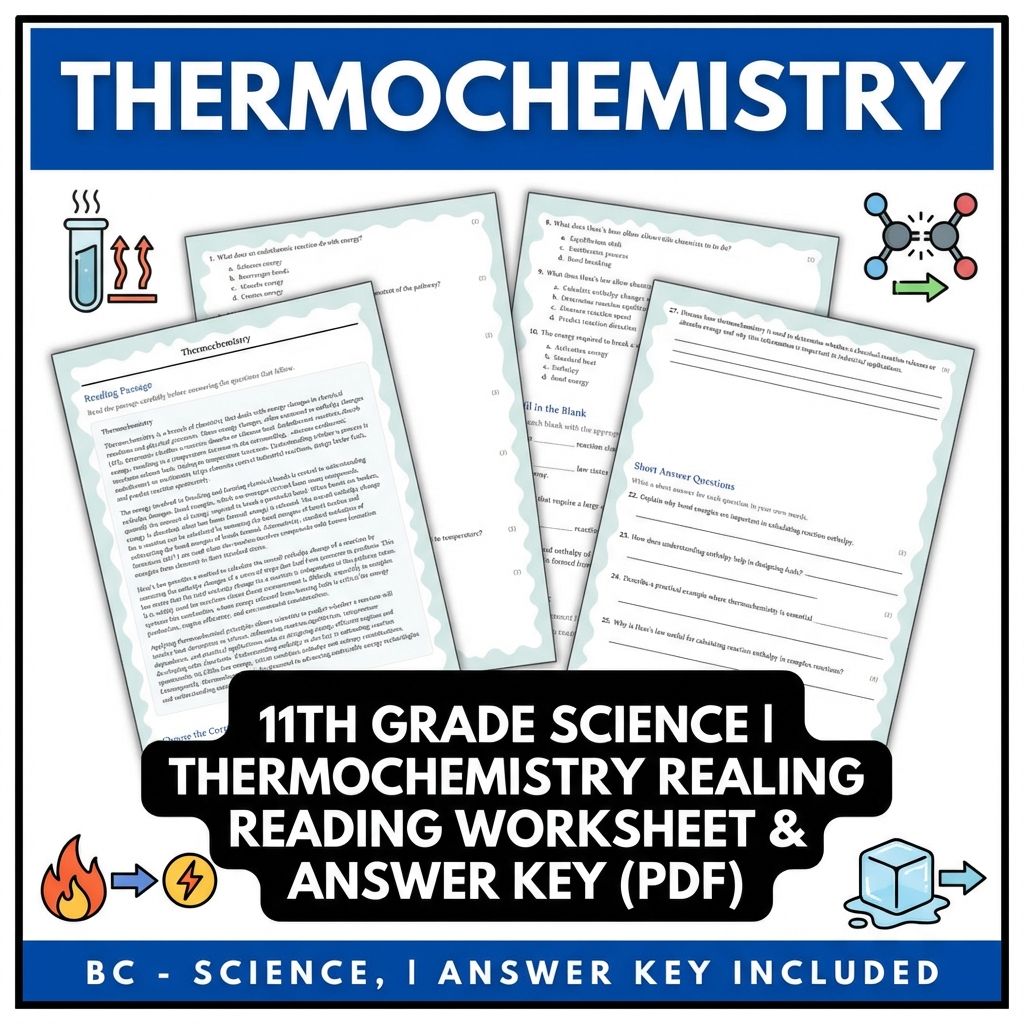
11th Grade Science | Thermochemistry Reading Worksheet & Answer Key (PDF)
JCreated byJ.S SheetsLearning Objectives
- Explain energy changes during chemical reactions in terms of enthalpy.
- Differentiate between endothermic and exothermic processes.
- Calculate reaction enthalpy changes using bond energies and standard enthalpies of formation.
Instant download
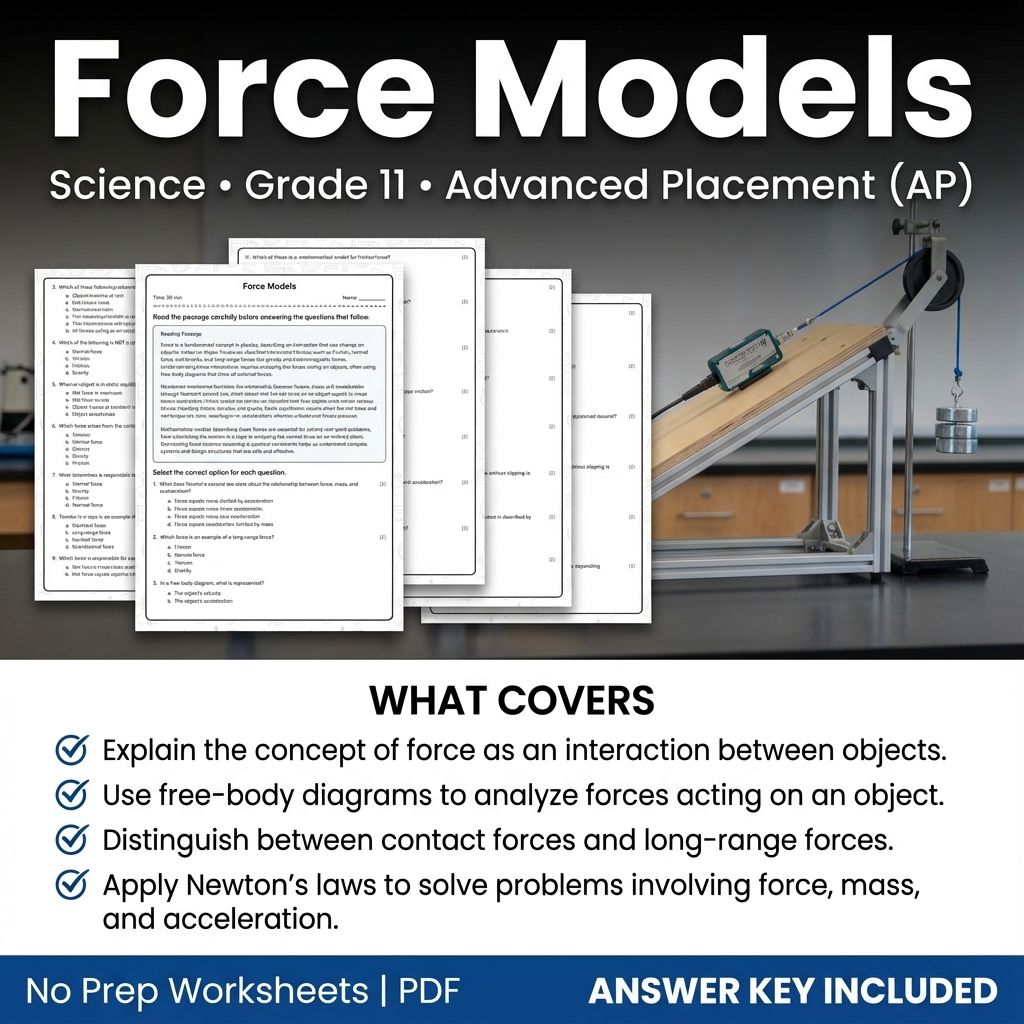
11th Grade Science | Force Models Worksheet (Printable PDF + Answer Key)
Created byCoral Reef LearningLearning Objectives
- Explain the concept of force as an interaction between objects.
- Use free-body diagrams to analyze forces acting on an object.
- Distinguish between contact forces and long-range forces.
Also included in: Grade 11 Science Unit | Physics Worksheets on Work, Power & Motion PDF Bundle +1 more
Instant download
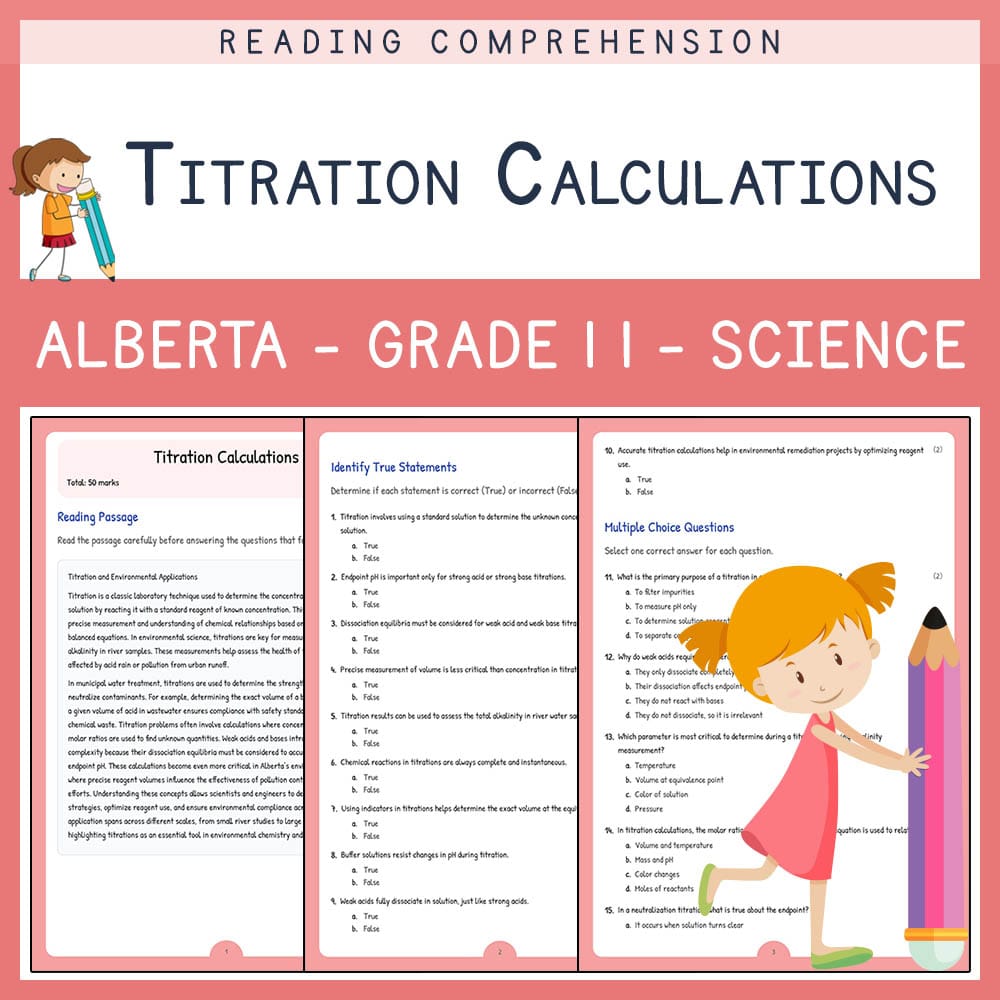
Grade 11 Science | Titration Calculations Worksheet | Alberta Standards
 Created byLumora Learning
Learning Objectives
- Understand how to perform stoichiometry calculations in titrations.
- Apply concentration relationships to determine unknown values in titration scenarios.
- Analyze endpoint pH variations for acids and bases with different strengths.
Instant download

Grade 11 Science | Thermochemistry Worksheet (PDF) – BC Standards
 Created byEvergreen Desk Education
Learning Objectives
- Explain endothermic and exothermic reactions using enthalpy (ΔH) and the idea of energy flow.
- Use bond energies, standard enthalpies of formation, and Hess’s law to calculate reaction enthalpy (ΔH) qualitatively and quantitatively.
- Connect thermochemistry to real-world applications such as fuels, combustion energetics, and chemical stability.
Instant download

Metabolic Regulation Assessment | TEKS Standards Grade 11 Science
 Created byPrism Point Learning
Learning Objectives
- Understand the mechanisms of enzyme regulation in metabolic pathways.
- Identify different types of enzyme modifications such as allosteric modulation and covalent changes.
- Explain how compartmentalization and membrane transport influence metabolic flux.
Also included in: Grade 11 Photosynthesis and Respiration Science Lesson Bundle | TEKS
Instant download
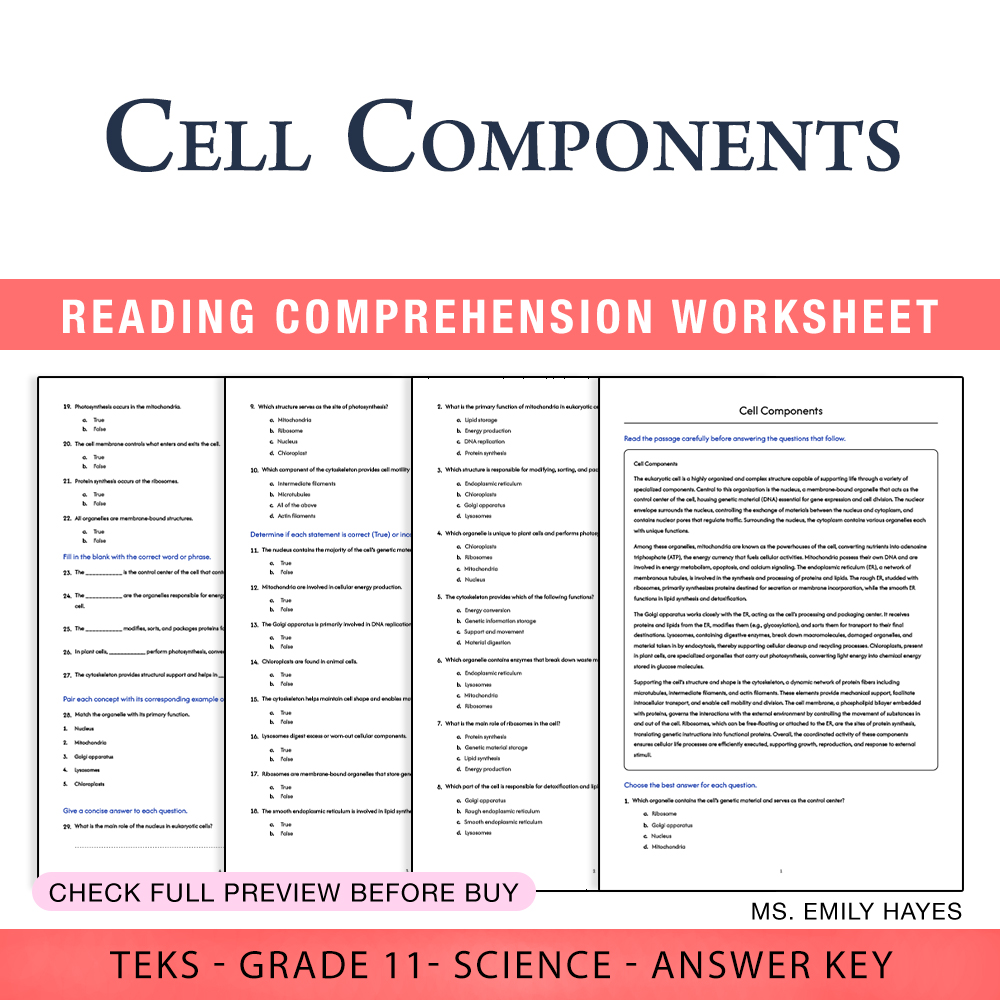
11th Grade Science | Cell Components Worksheet (PDF+ Answer Key)
 Created byCopper Leaf Classroom
Learning Objectives
- Identify and describe the functions of various organelles within eukaryotic cells.
- Differentiate between membrane-bound and non-membrane-bound cell structures.
- Understand how cellular structures coordinate to support cell metabolism, genetic control, and material transport.
Instant download

Solubility Curves Assessment for Grade 11 Science | Alberta Standards
Created byPrism Point LearningLearning Objectives
- Understand how to read and interpret solubility curves for different compounds.
- Identify regions of saturation, supersaturation, and unsaturation in solubility graphs.
- Connect graphical trends to molecular interactions in solutions.
Also included in: Grade 11 Solutions and Solubility Science Lesson Bundle | Alberta Framework +1 more
Instant download
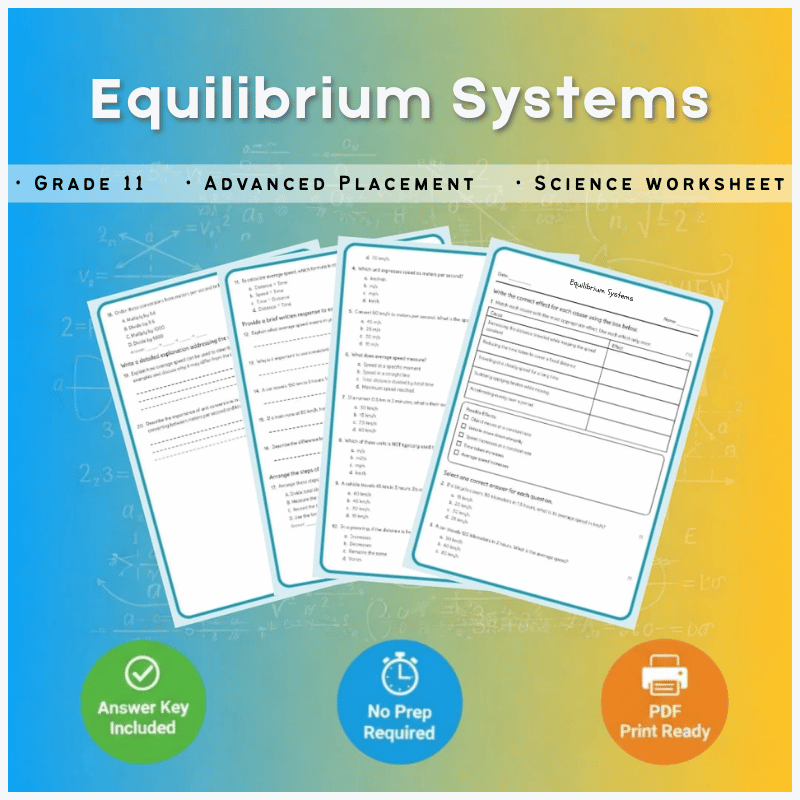
Grade 11 Science | Equilibrium Systems Worksheet + Answer Key (AP Standard)
Created byBright Mind ResourcesLearning Objectives
- Understand the principles of dynamic chemical equilibrium in homogeneous and heterogeneous systems.
- Apply equilibrium constants (Kc and Kp) to predict shifts in chemical equilibria.
- Use reaction quotient (Q) comparisons and Le Châtelier's principle to analyze perturbations.
Instant download

11th Grade Science | Evidence of Evolution Worksheet (PDF+ Answer Key)
Created byCopper Leaf ClassroomLearning Objectives
- Understand how fossil evidence, comparative anatomy, molecular data, biogeography, and vestigial organs support common ancestry and evolution.
- Analyze different lines of empirical evidence and how they concordantly explain lineage relationships.
- Interpret data from fossils, anatomical structures, molecular sequences, and biogeographic patterns to draw evolutionary conclusions.
Instant download

Grade 11 Stoichiometric Calculations Worksheet | Practice & PDF
 Created byClear Sky Classroom
Learning Objectives
- Use balanced chemical equations and mole ratios to convert between moles of reactants and products.
- Apply dimensional analysis to convert mass-to-mass, mass-to-mole, and mole-to-mole using molar masses and stoichiometric coefficients.
- Determine the limiting reagent and explain how it controls the maximum possible product formation.
Instant download
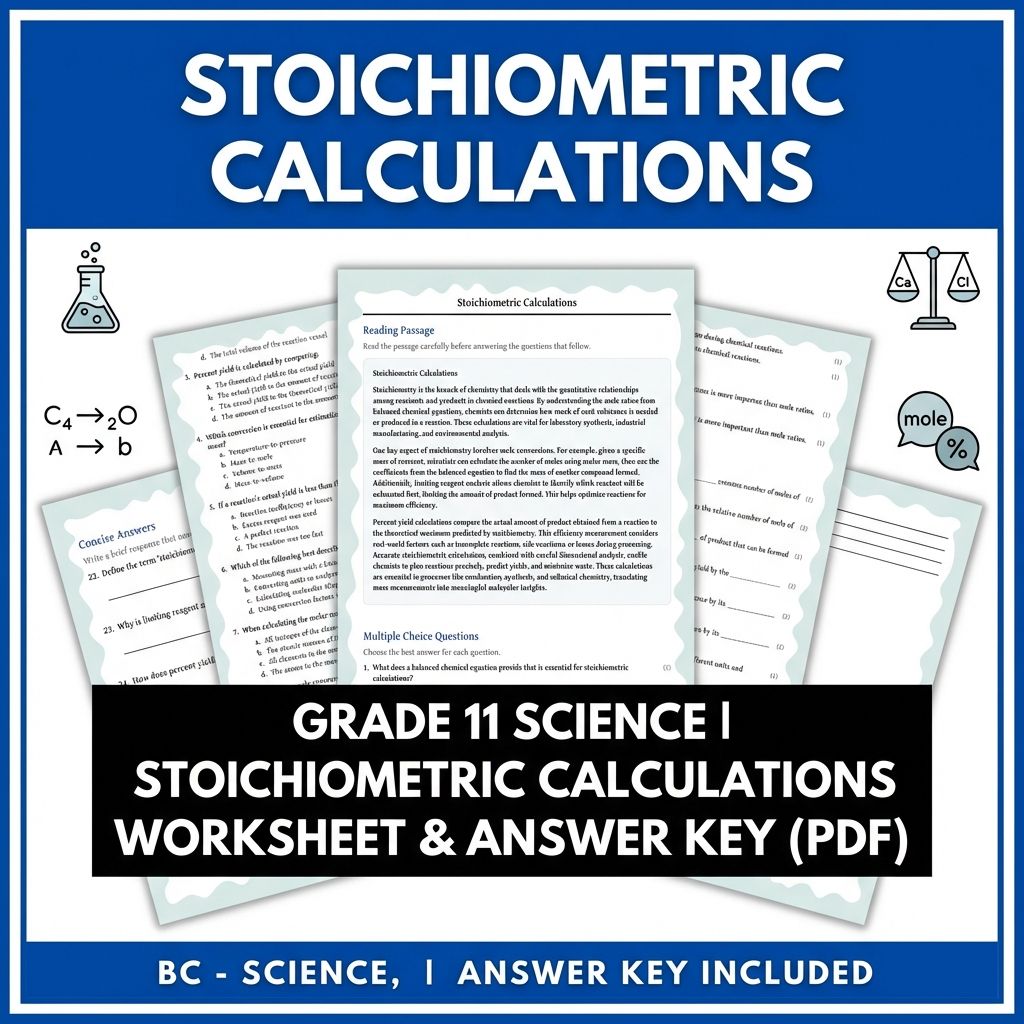
Grade 11 Science | Stoichiometric Calculations Worksheet & Answer Key (PDF)
JCreated byJ.S SheetsLearning Objectives
- Understand how mole relationships and balanced chemical equations are used in stoichiometric calculations.
- Identify limiting reagents and calculate percent yields in chemical reactions.
- Perform mass-to-mass, mass-to-mole, and mole-to-mole conversions using molar masses and stoichiometry.
Instant download
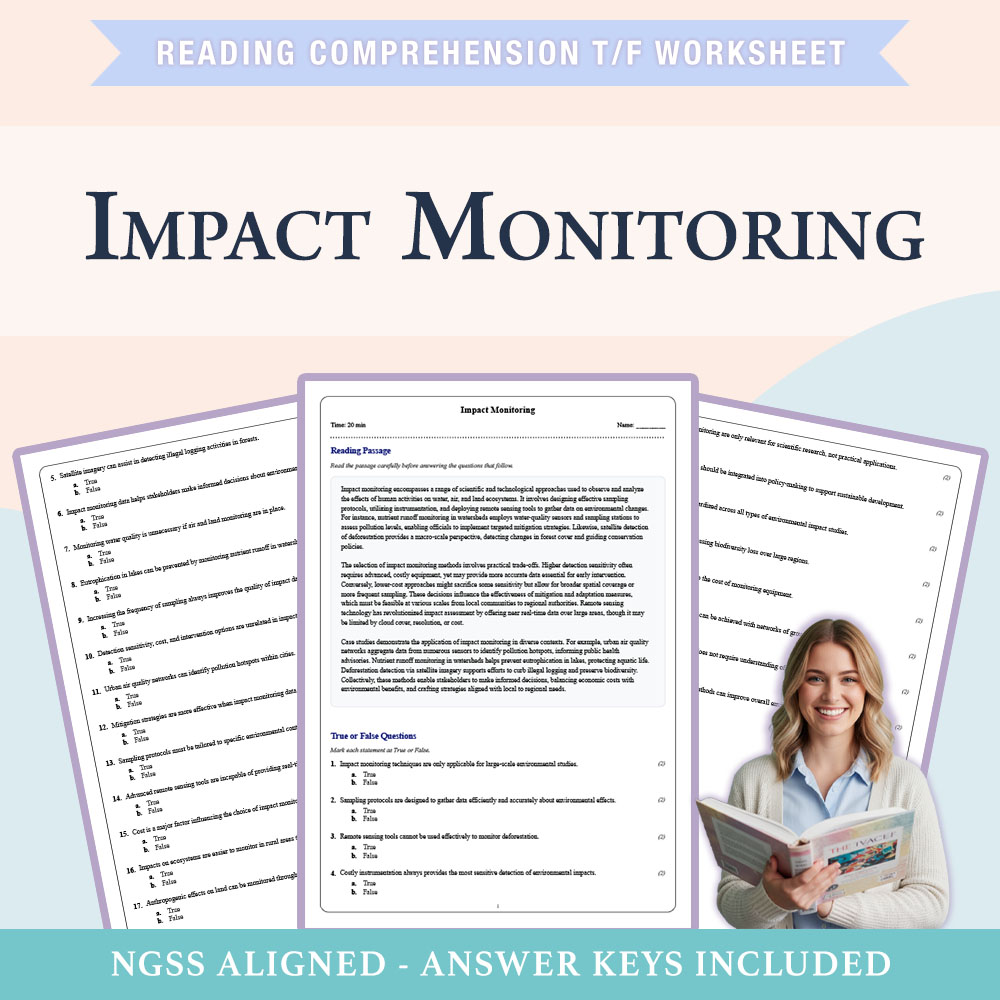
11th Grade Science | Impact Monitoring Worksheet (PDF + Answer Key)
Created byCopper Leaf ClassroomLearning Objectives
- Understand scientific principles applied in environmental impact monitoring methods.
- Analyze case studies related to water, air, and land system effects and their mitigation strategies.
- Evaluate the trade-offs among detection sensitivity, cost, and intervention options in impact monitoring.
Also included in: Grade 11 Science | Climate Change & Environmental Management (PDF + Answer Key) +1 more
Instant download

Grade 11 Science – Design Solutions & Modular Design | Daily Reading Worksheet
Created byBright Mind ResourcesLearning Objectives
- Understand the concept of problem decomposition in engineering design.
- Learn how modularity can improve the development of engineering solutions.
- Explore examples like prosthetics, building envelopes, and vehicle aerodynamics to see trade-offs in materials, cost, and performance.
Also included in: Trade-Offs Grade 11 Science Daily Reading Worksheets Lesson Bundle | NGSS +2 more
Instant download
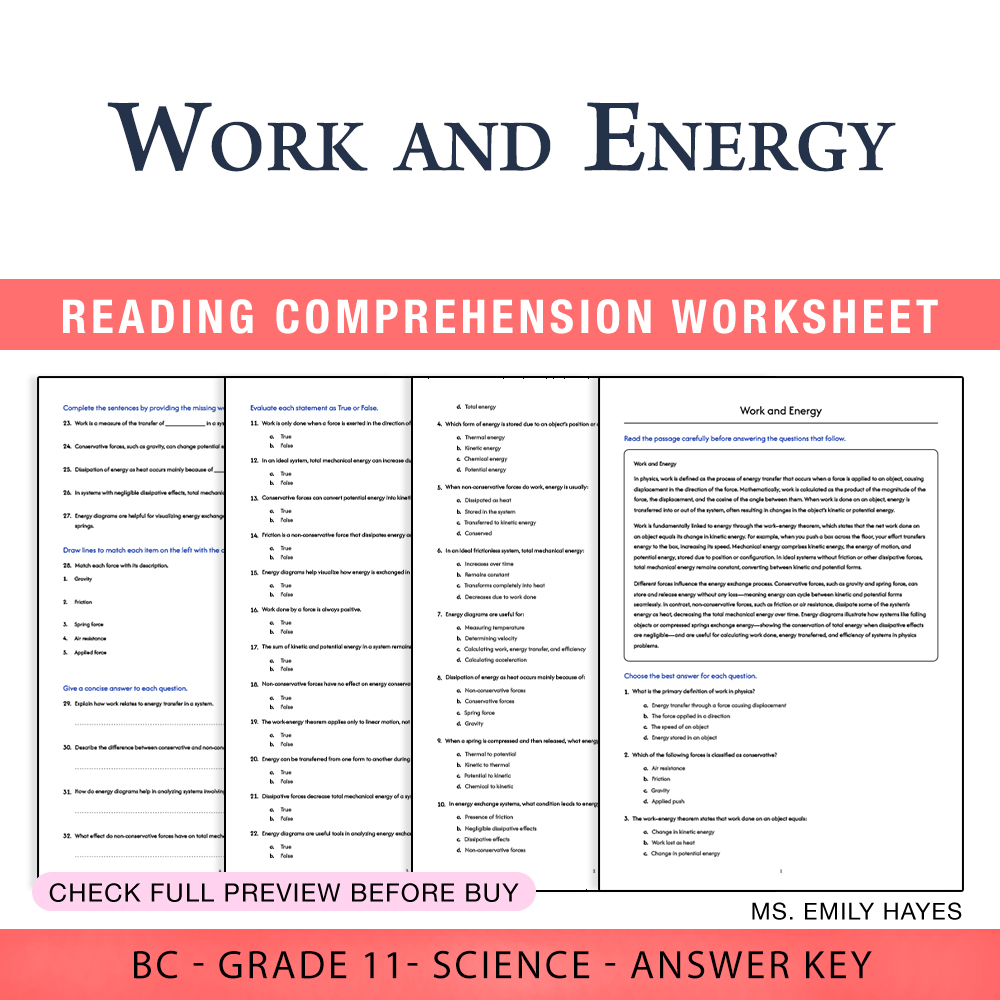
Grade 11 Science | Work and Energy Worksheet (PDF + Answer Key)
Created byCopper Leaf ClassroomLearning Objectives
- Explain the concept of work in terms of energy transfer.
- Describe how work relates to kinetic energy through the work–energy theorem.
- Differentiate between conservative and non-conservative forces and their effects on energy.
Also included in: Grade 11 Science BC | Motion, Energy & Force Concepts (PDF+ Answer Keys) +1 more
Instant download
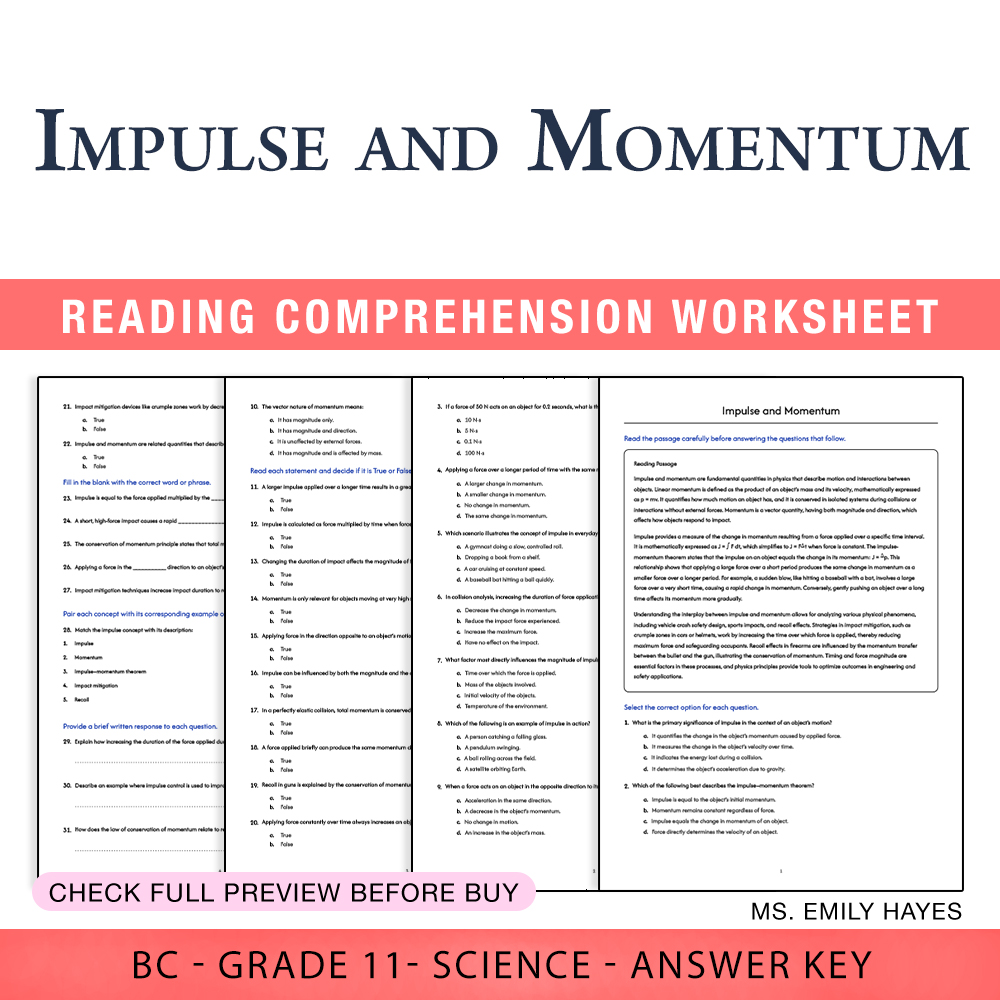
11th Grade Science | Impulse and Momentum Worksheet (PDF + Answer Key)
Created byCopper Leaf ClassroomLearning Objectives
- Understand the concepts of linear momentum and impulse.
- Analyze how force over time affects the change in momentum during collisions.
- Apply impulse-momentum relationships to real-world impact mitigation scenarios.
Also included in: Grade 11 Science BC | Motion, Energy & Force Concepts (PDF+ Answer Keys) +1 more
Instant download
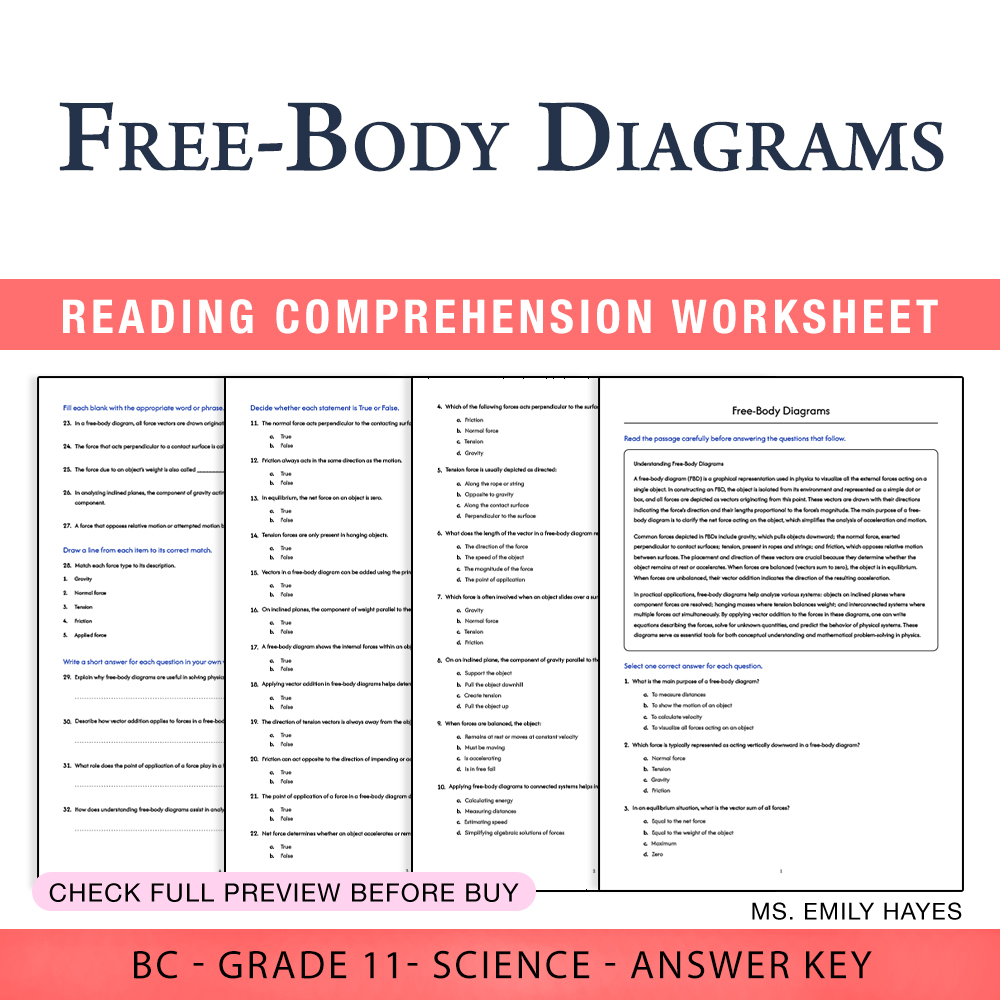
Grade 11 Science | Free-Body Diagrams Worksheet (PDF + Answer Key)
Created byCopper Leaf ClassroomLearning Objectives
- Understand how to represent all forces acting on an object using free-body diagrams.
- Identify the common force types involved in free-body diagrams and their directions.
- Apply vector addition to determine net force and predict motion or equilibrium.
Also included in: Grade 11 Science BC | Motion, Energy & Force Concepts (PDF+ Answer Keys) +1 more
Instant download
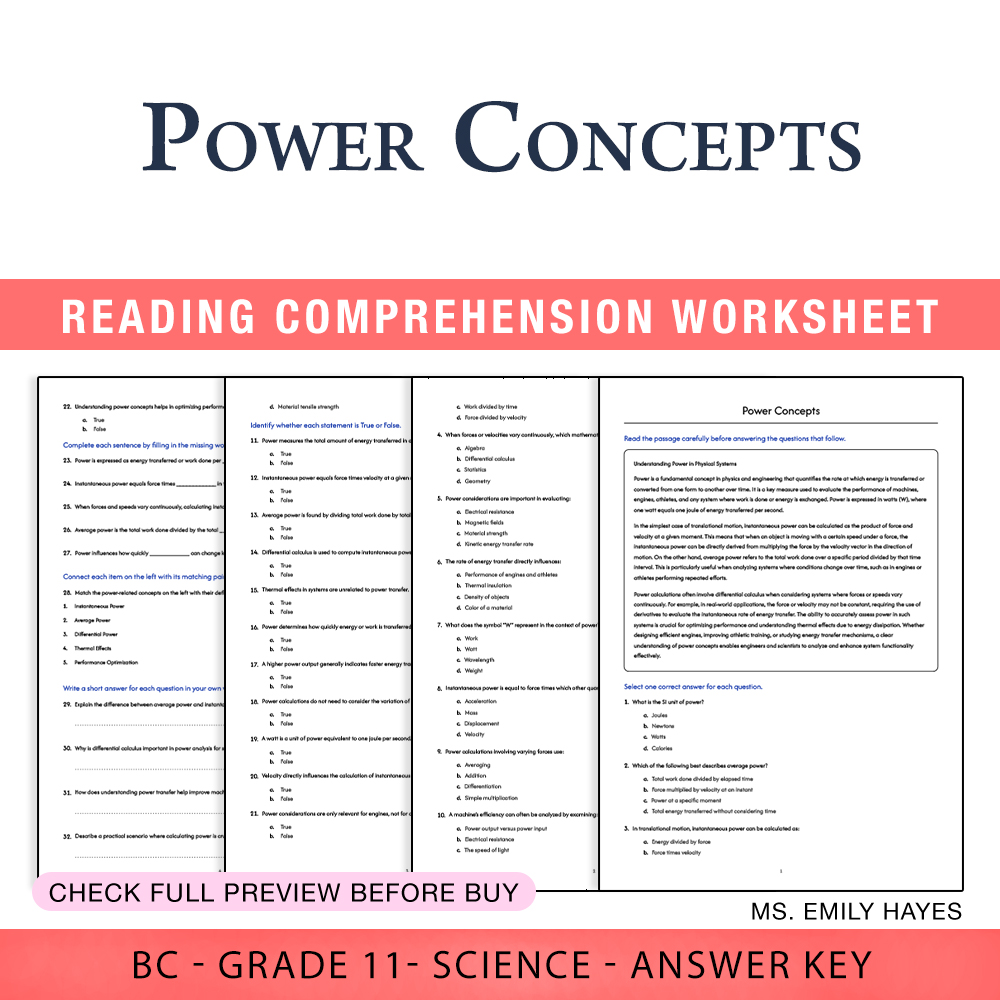
11th Grade Science | Power Concepts Worksheet (PDF + Answer Key)
Created byCopper Leaf ClassroomLearning Objectives
- Understand the definition and measurement of power in physical systems
- Differentiate between average power and instantaneous power
- Apply formulas to calculate power in various practical scenarios
Also included in: Grade 11 Science BC | Motion, Energy & Force Concepts (PDF+ Answer Keys) +1 more
Instant download
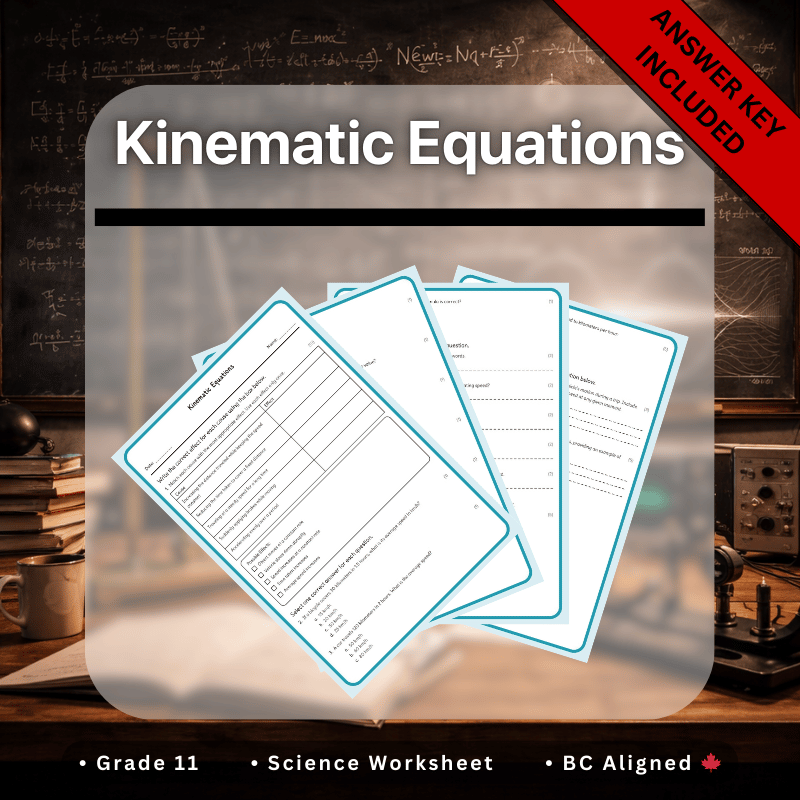
Grade 11 Science – Kinematic Equations Worksheet (PDF) – BC Standards
Created byBright Mind ResourcesLearning Objectives
- Understand the form and derivation of constant-acceleration kinematic equations.
- Apply kinematic equations to solve problems involving displacement, velocity, acceleration, and time.
- Analyze scenarios such as free fall, vehicle braking, and launch motion using these equations.
Instant download

Titration Calculations Worksheet | Grade 11 Science Practice
Created byPrism Point LearningLearning Objectives
- Use stoichiometry with balanced dissociation/neutralization relationships to calculate unknown titrant or analyte concentrations.
- Compute equivalence volume and relate it to reaction mole ratios for strong acid–base and weak acid–base titrations.
- Interpret titration data, including endpoint and pH considerations, to explain how weak systems affect calculations.
Instant download

Grade 11 Science | Phase Behaviour in Intermolecular Forces - Reading Comp.
Created byCoral Reef LearningLearning Objectives
- Understand the basic types of intermolecular forces and their influence on phase states
- Identify how intermolecular attractions affect vapor pressure and boiling points
- Relate molecular size and polarity to phase diagrams and phase transitions
Also included in: Matter and Chemical Bonding Lesson Bundle – Grade 11 Science Alberta +1 more
Instant download

Grade 11 Science | Periodic Trends in the Periodic Table - Reading Comprehension
Created byCoral Reef LearningLearning Objectives
- Explain how atomic radius varies across periods and down groups
- Understand the factors affecting atomic size
- Relate atomic radius trends to element properties and reactions
Also included in: Matter and Chemical Bonding Lesson Bundle – Grade 11 Science Alberta +1 more
Instant download

Grade 11 Science | Bond Polarity - Daily Reading Comprehension
Created byCoral Reef LearningLearning Objectives
- Understand the_vector nature of chemical bonds
- Identify partial charges in bonds
- Differentiate between polar and nonpolar bonds
Also included in: Matter and Chemical Bonding Lesson Bundle – Grade 11 Science Alberta +1 more
Instant download

Circulatory Function Science Worksheet | Standards-Aligned for Grade 11
JCreated byJ.S SheetsLearning Objectives
- Explain how cardiac output, vessel resistance, and blood composition influence tissue perfusion and homeostasis
- Describe the roles of plasma proteins and cellular elements in clotting and immune defense
- Connect circulatory function to respiratory gas exchange and renal fluid balance
Instant download

Kinematic Equations Worksheet | BC Standard Grade 11 Science Practice
JCreated byJ.S SheetsLearning Objectives
- Understand the fundamental kinematic equations used to describe motion with constant acceleration.
- Apply the equations v = v0 + at and x = x0 + v0t + ½at² to solve problems involving displacement, velocity, and time.
- Derive the kinematic equations using algebraic manipulation and calculus.
Instant download
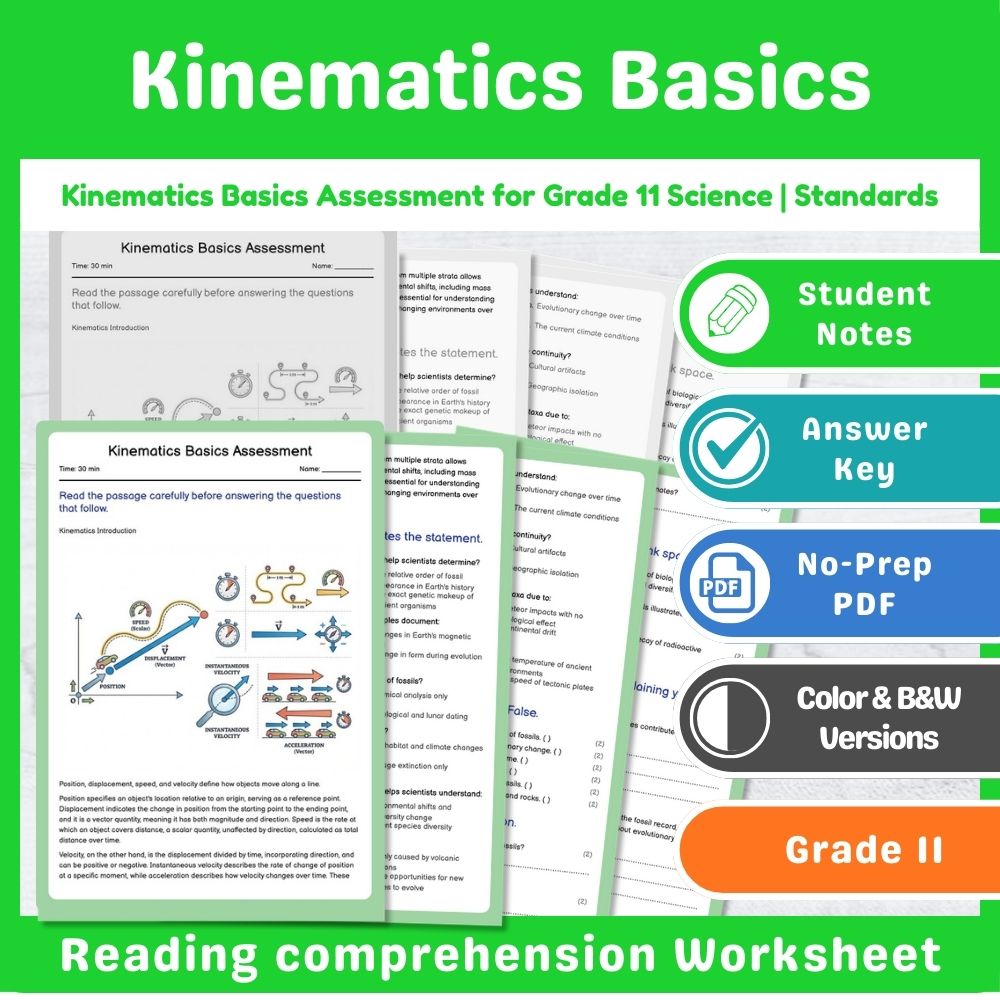
Kinematics Basics Assessment for Grade 11 Science | Standards-Aligned Assessment
Created byPrism Point LearningLearning Objectives
- Understand key concepts of position, displacement, speed, and velocity in one-dimensional motion.
- Differentiate between average and instantaneous measures of motion.
- Apply the formulas for displacement, velocity, and acceleration to problem situations.
Also included in: Grade 11 Science Assessment Bundle | Classical Mechanics & Motion Topics
Instant download
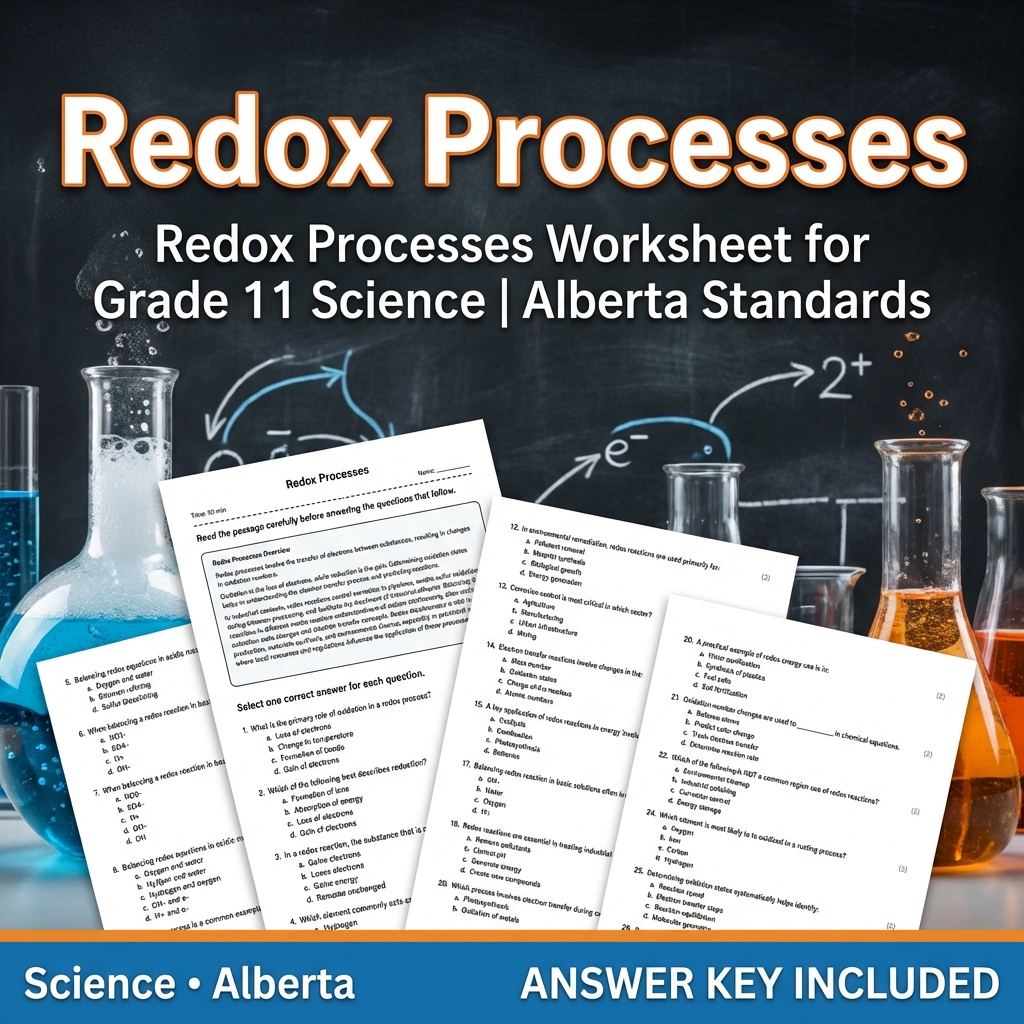
Redox Processes Worksheet for Grade 11 Science | Alberta Standards
Created byCoral Reef LearningLearning Objectives
- Explain the concept of oxidation states and their systematic determination.
- Balance redox equations in acidic and basic media accurately.
- Identify real-world applications of redox reactions in environmental and industrial contexts.
Instant download
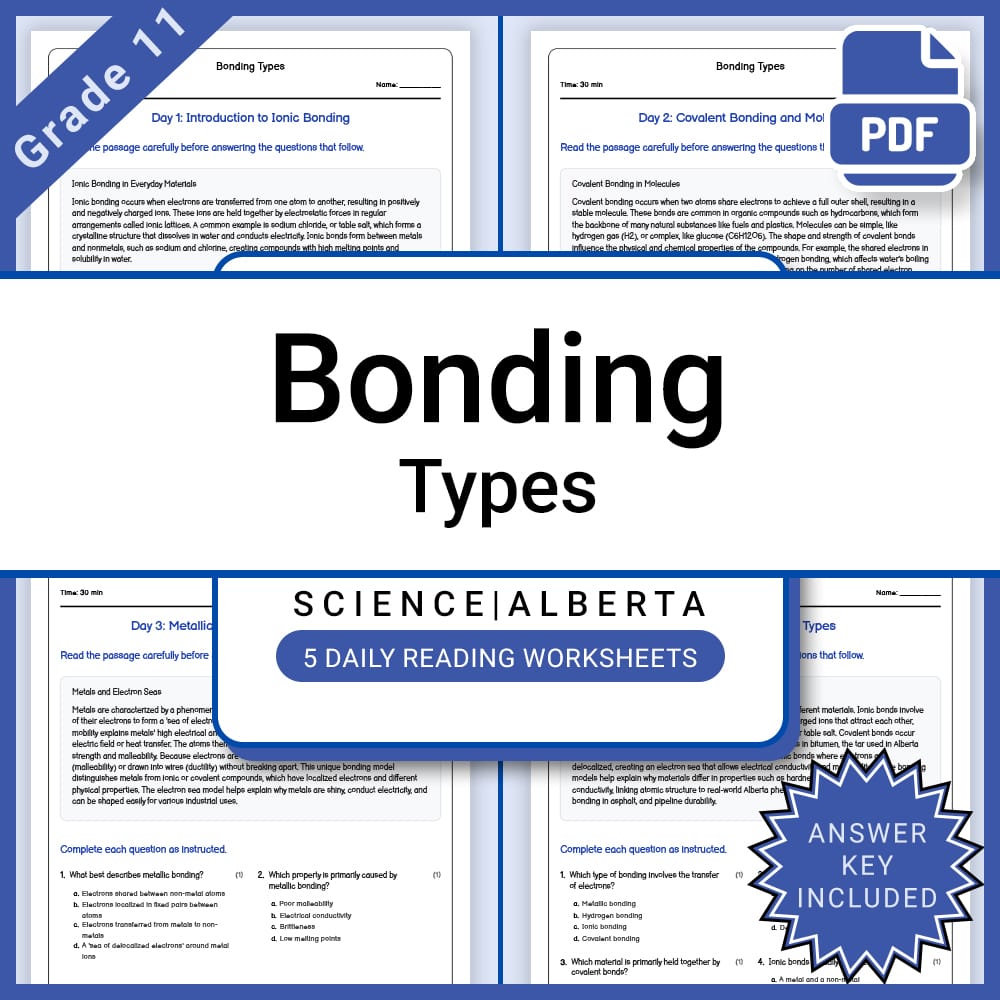
Grade 11 Science – Bonding Types Daily Reading Worksheet with Answer Key
JCreated byJ.S SheetsLearning Objectives
- Understand the differences between ionic, covalent, and metallic bonding.
- Identify characteristics of ionic bonds and their resulting structures.
- Relate bonding types to real-world materials and their properties.
Also included in: Grade 11 Science Lesson Bundle | Molecular Structure and Bonding +1 more
Instant download
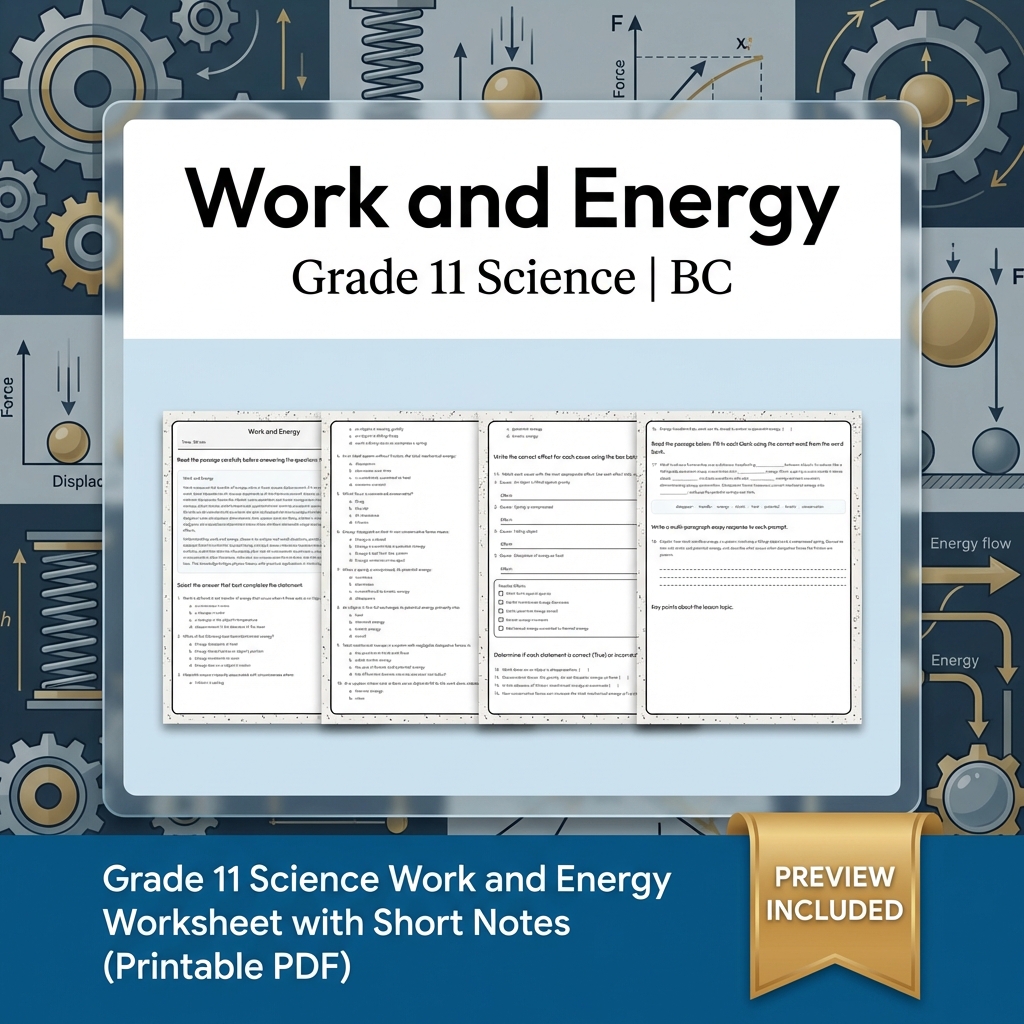
Grade 11 Science Work and Energy Worksheet with Short Notes (Printable PDF)
 Created byMeadowlark Worksheets
Learning Objectives
- Explain the concept of work as energy transfer by a force over a displacement.
- Describe different forms of mechanical energy, including kinetic and potential energy.
- Understand the role of conservative and non-conservative forces in energy conservation and dissipation.
Also included in: Grade 11 Science Lesson Bundle | Motion, Energy, and Forces Worksheets +1 more
Instant download

Grade 11 Science NGSS Climate Change Worksheet (PDF) | Evidence & Data Analysis
 Created byMaple Path Learning
Learning Objectives
- Understand observational records and proxy data used to analyze climate change.
- Describe how attribution analyses help identify human contributions to climate change.
- Interpret data related to greenhouse gases, ice-core records, and temperature trends.
Also included in: Grade 11 Resource Management & Climate Change Science Lesson Bundle: NGSS +1 more
Instant download

Grade 11 Science | Impact Monitoring Worksheet (NGSS PDF)
Created byMaple Path LearningLearning Objectives
- Understand scientific principles applied in environmental impact monitoring.
- Identify methods and instrumentation used for sampling and remote sensing.
- Evaluate trade-offs in detection sensitivity, cost, and intervention strategies.
Also included in: Grade 11 Resource Management & Climate Change Science Lesson Bundle: NGSS +1 more
Instant download

Grade 11 Science | Resource Influences Worksheet (NGSS) - PDF
Created byMaple Path LearningLearning Objectives
- Analyze how natural resource availability affects human settlement and land use.
- Evaluate the impact of natural hazards and climate change on migration and regional development.
- Explain feedback mechanisms between resource extraction and ecosystem services.
Also included in: Grade 11 Resource Management & Climate Change Science Lesson Bundle: NGSS +1 more
Instant download

Grade 11 Science | Predictive Models Worksheet (NGSS Practice Set)
Created byMaple Path LearningLearning Objectives
- Understand the role of models in simulating Earth's atmosphere, hydrosphere, biosphere, and human influences.
- Identify different types of climate and environmental models, such as carbon-cycle and coupled climate models.
- Explain the importance of model validation, sensitivity testing, and ensemble approaches in projecting future environmental changes.
Also included in: Grade 11 Resource Management & Climate Change Science Lesson Bundle: NGSS +1 more
Instant download

Science Worksheet Geologic Resources | Grade 11 Practice & Assessment
JCreated byJ.S SheetsLearning Objectives
- Explain how magmatic differentiation, hydrothermal circulation, and metamorphism contribute to mineral ore formation
- Analyze how weathering, permeability, and groundwater flow affect soil and water availability
- Connect fossil fuel formation to burial under low-oxygen conditions and later thermal/pressure changes
Also included in: Grade 11 Earth and Space Evidence Systems Science Lesson Bundle: General +1 more
Instant download

Grade 11 Population Dynamics Worksheet | Ontario Science + Answer Key
Created byClear Sky ClassroomLearning Objectives
- Explain exponential and logistic population growth and interpret growth curves using parameters like carrying capacity
- Analyze how demographic factors (birth rate, death rate, age structure, sex ratio) and density-dependent/independent factors influence population trajectories
- Apply metapopulation, dispersal, and source-sink ideas to predict persistence and extinction risk in fragmented habitats
Instant download

Grade 11 Science – Evidence of Evolution Worksheet (NGSS) (PDF)
Created byMaple Path LearningLearning Objectives
- Understand how multiple lines of empirical evidence support the theory of common ancestry and biological evolution.
- Identify key types of evidence such as fossil records, comparative anatomy, molecular data, biogeography, and vestigial organs.
- Analyze how different datasets converge to provide coherent explanations for lineage relationships over geological time.
Also included in: Grade 11 Biological Evolution Unity and Diversity Science Lesson Bundle (NGSS) +1 more
Instant download

Grade 11 Science | Long-Range Forces in Physics - Daily Reading Comprehension
Created byCoral Reef LearningLearning Objectives
- Define gravitational and electrostatic forces.
- Explain the inverse-square law relating to these forces.
- Apply Newton's law of universal gravitation.
Instant download
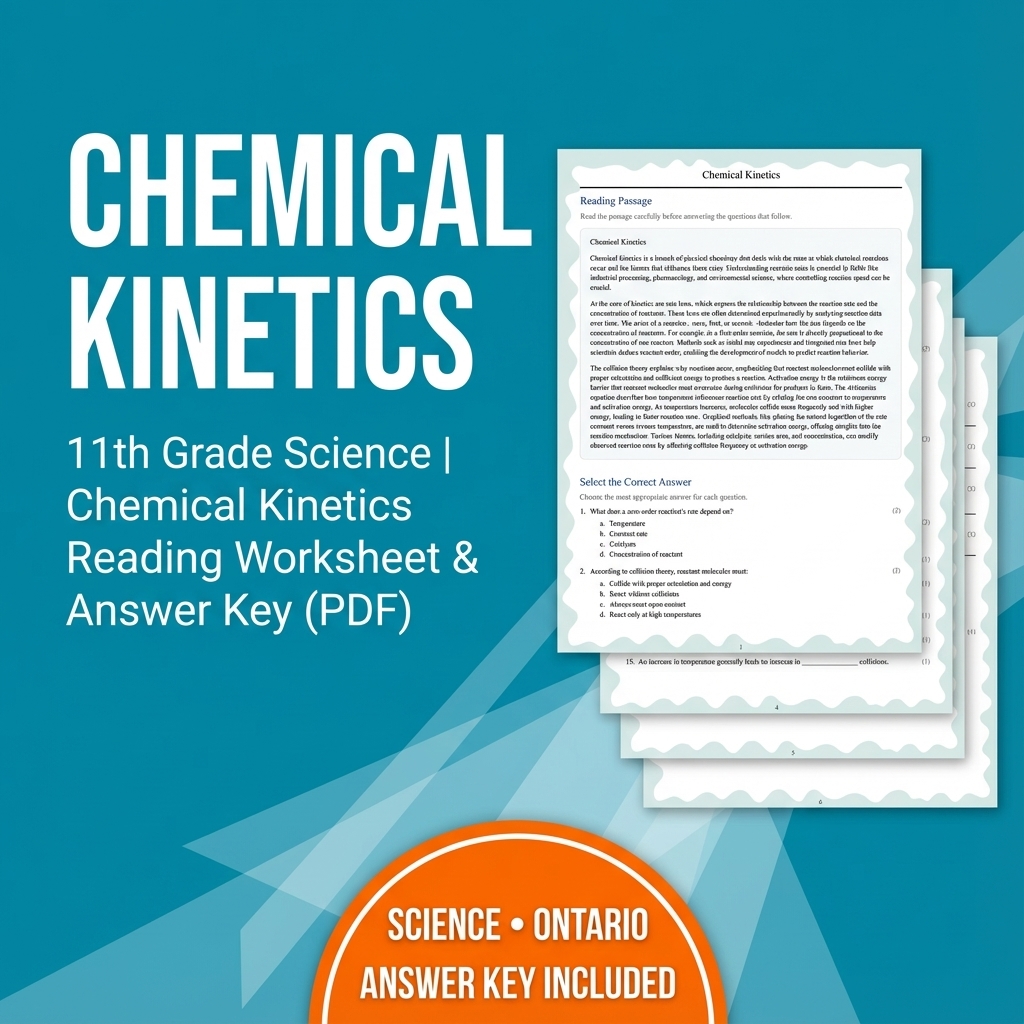
11th Grade Science | Chemical Kinetics Reading Worksheet & Answer Key (PDF)
JCreated byJ.S SheetsLearning Objectives
- Explain the concept of rate laws and how they characterize the speed of chemical reactions.
- Determine reaction order from experimental rate data.
- Describe the collision theory and the role of activation energy in reaction rates.
Also included in: Grade 11 Science Unit Bundle | Chemical Bonding & Reaction Energetics +1 more
Instant download

Projectile Motion Worksheet for Grade 11 Science | Ontario Standards
Created byCoral Reef LearningLearning Objectives
- Understand the independence of orthogonal components in two-dimensional projectile motion.
- Apply kinematic equations and trigonometric relations to solve problems involving launch angle and initial speed.
- Calculate time of flight, maximum height, and range for projectile trajectories.
Instant download

High School Biology | Genetic Code Worksheet (AP Standards) (PDF)
Created byEvergreen Desk EducationLearning Objectives
- Explain how the structure of nucleic acids and base-pairing rules encode hereditary information
- Describe how DNA information is copied (replication), transferred (transcription), and converted to protein (translation)
- Evaluate how mutations, recombination, and reading frames can change gene expression and phenotype
Also included in: Grade 11 Biology and Ecosystems Science Lesson Bundle (AP) +1 more
Instant download

Grade 11 Science – Integrated Cycles & Photosynthesis Daily Reading Worksheet
Created byBright Mind ResourcesLearning Objectives
- Describe the process of photosynthesis in plants
- Explain the biochemical cycles between photosynthesis and respiration
- Identify key factors influencing plant energy production and transfer
Also included in: Cell Processes Grade 11 Science Daily Reading Worksheets Lesson Bundle | TEKS +2 more
Instant download

Grade 11 Science – Metabolic Regulation & Enzyme Control | Reading Worksheet
Created byBright Mind ResourcesLearning Objectives
- Understand key mechanisms of enzyme regulation
- Identify different types of enzyme modulation
- Explain how structural changes affect metabolic pathways
Also included in: Cell Processes Grade 11 Science Daily Reading Worksheets Lesson Bundle | TEKS +2 more
Instant download

AP Science Systems Integration Worksheet | Grade 11 Integrated Practice
Created byPrism Point LearningLearning Objectives
- Explain how biological systems integrate across molecular, cellular, organismal, and ecosystem scales using feedback and regulatory networks.
- Model system behavior by identifying inputs, outputs, regulators, and feedback loops, and predict responses to perturbations.
- Evaluate the limits of reductionist models and describe how multi-scale representations improve predictions.
Also included in: AP Biology Systems Integration Lesson Bundle: Grade 11 Science | AP
Instant download
About Grade 11 Science Worksheets
Browse 6,616 printable Grade 11 Science worksheets — ready-to-print PDFs with answer keys where available.
Each resource here is built by an independent educator and reviewed for quality. Worksheets print straight from PDF and suit classroom use, homework, or extra practice; most come with answer keys, and you can preview before purchasing.