
Grade 11 Science Worksheets
6,616 worksheets
Human Organ Systems Assessment for Grade 11 Science TEKS Standards
 Created byPrism Point Learning
Learning Objectives
- Identify the major human organ systems and their primary functions.
- Explain how different organ systems interact to maintain homeostasis.
- Describe the structures involved in each core organ system.
Also included in: Grade 11 Homeostasis & Human Body Systems Science: Lesson Bundle TEKS
Instant download
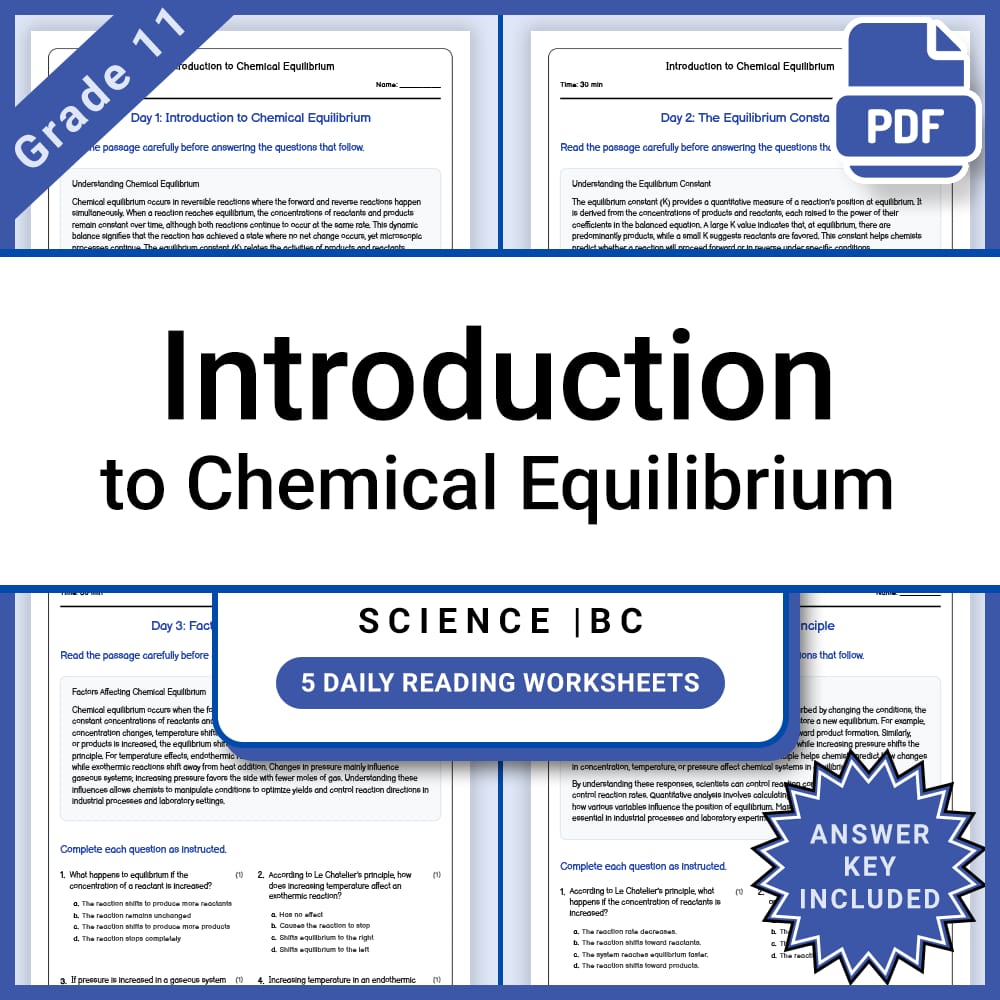
Grade 11 – Introduction to Chemical Equilibrium Daily Worksheet + Answer Key
JCreated byJ.S SheetsLearning Objectives
- Understand the concept of chemical equilibrium
- Learn how forward and reverse reactions balance each other
- Recognize factors that shift equilibrium
Also included in: Grade 11 Science Lesson Group | BC Framework Daily Reading Worksheets +1 more
Instant download
Grade 11 Science | Conservation Analysis Worksheet with Short Notes (PDF)
 Created byMeadowlark Worksheets
Learning Objectives
- Understand the principles of conservation laws in isolated systems.
- Apply algebraic balances and vector diagrams to analyze collisions.
- Extract and interpret center-of-mass motion from system contributions.
Also included in: Grade 11 Science NGSS Motion and Stability Forces & Interactions Unit Bundle +1 more
Instant download
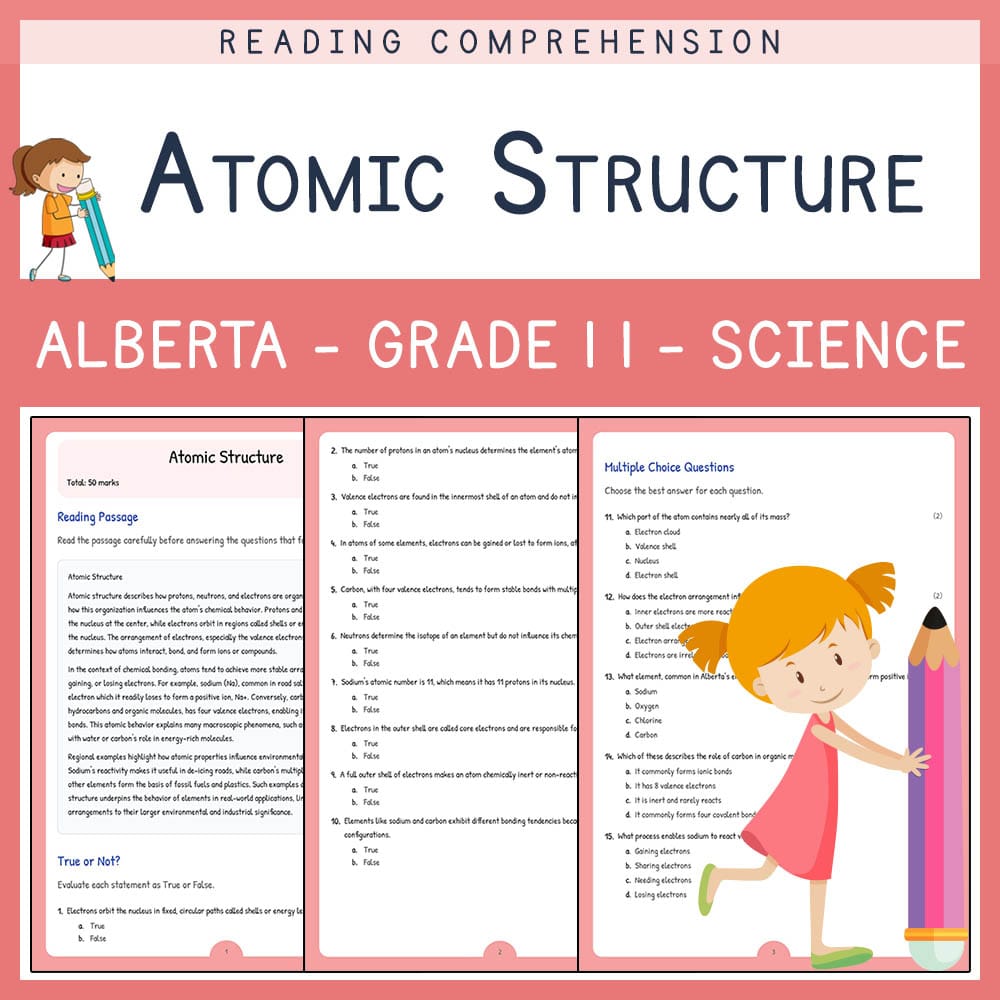
Grade 11 Science | Atomic Structure Worksheet | Alberta Standards
 Created byLumora Learning
Learning Objectives
- Describe the organization of protons, neutrons, and electrons within an atom.
- Explain how electron arrangements, including shells and valence electrons, influence chemical reactivity and bonding.
- Identify examples of elements used in industry and environment, such as sodium and carbon, and their atomic properties.
Also included in: Grade 11 Science | Matter and Chemical Bonding Custom Bundle | Alberta
Instant download

Grade 11 Science – Ecosystem Components Worksheet (Ontario) PDF
 Created byEvergreen Desk Education
Learning Objectives
- Differentiate biotic and abiotic ecosystem components and explain how they interact in terrestrial and aquatic habitats.
- Describe how boundary delineation and spatial scales help ecologists study ecosystem structure and processes.
- Explain how abiotic gradients and habitat heterogeneity influence species distributions, microhabitats, and community composition.
Also included in: Grade 11 Ecosystem Dynamics Science Lesson Bundle (Ontario) Worksheet Set +1 more
Instant download
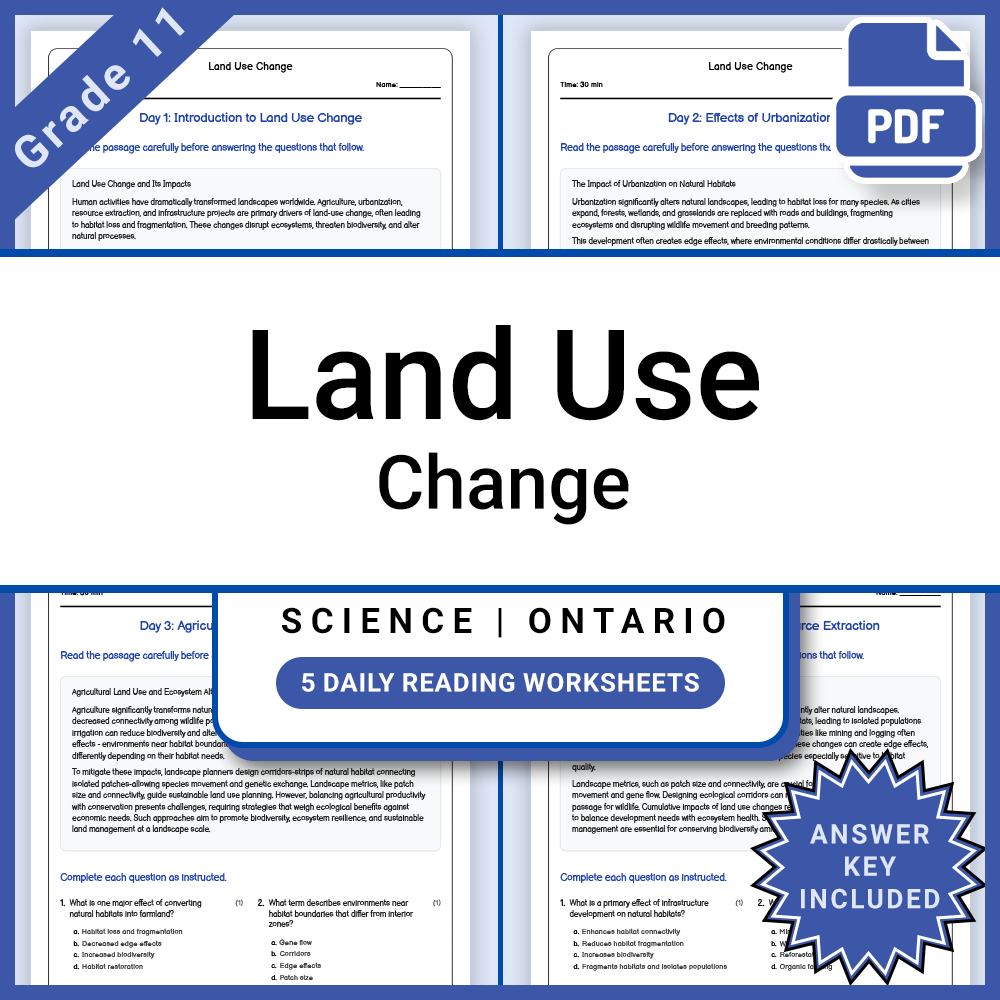
Grade 11 Science – Land Use Change Daily Reading Worksheet + Answer Key
JCreated byJ.S SheetsLearning Objectives
- Understand basic concepts of anthropogenic land-use transformations
- Identify causes and effects of land development such as urbanization and agriculture
- Recognize impacts on habitats, species movement, and gene flow
Also included in: Grade 11 Science Lesson Bundle | Ecosystem Dynamics and Sustainability +1 more
Instant download
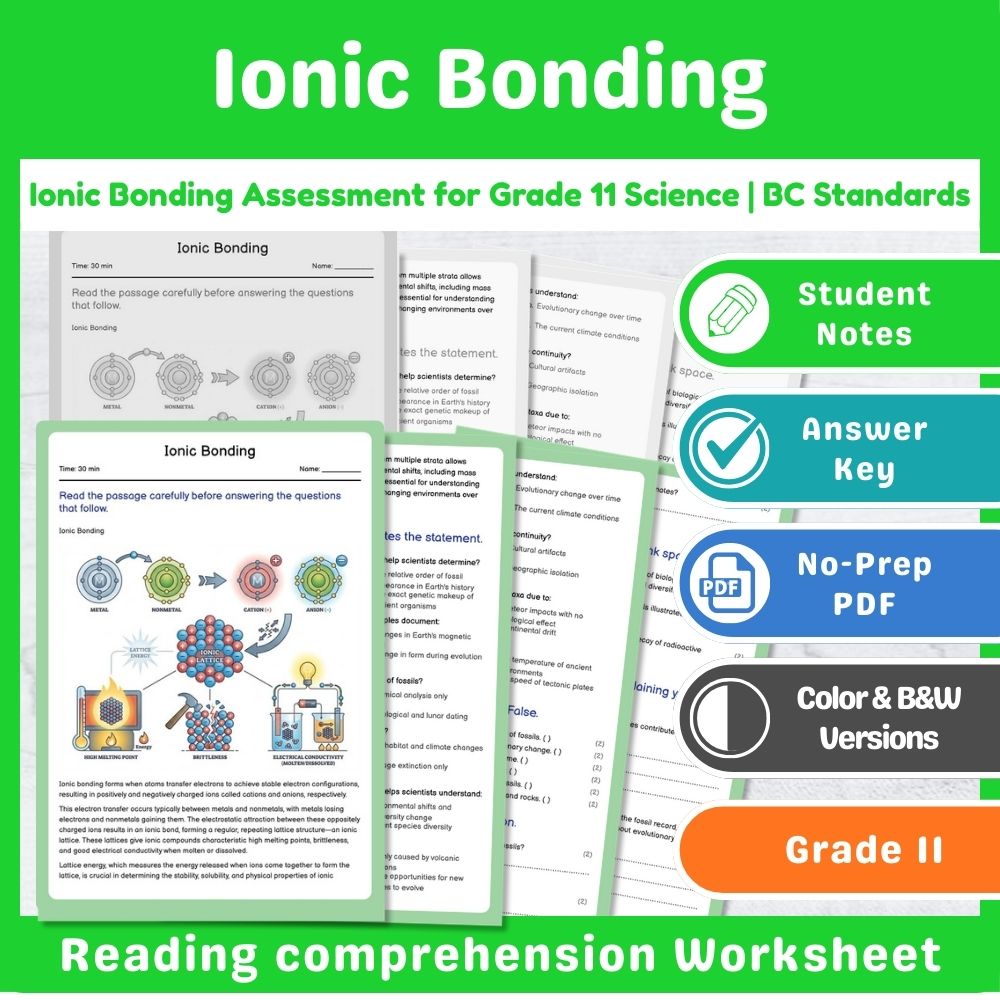
Ionic Bonding Assessment for Grade 11 Science | BC Standards
Created byPrism Point LearningLearning Objectives
- Understand how atoms transfer electrons to form ions in ionic bonding.
- Describe the physical properties of ionic compounds such as melting points and conductivity.
- Explain the concept of lattice energy and its influence on solubility and stability.
Also included in: Grade 11 Science | Thermochemistry Assessment Bundle – Standards-Aligned
Instant download

Oscillatory Motion Worksheet | AP Physics Grade 11 SHM Practice
Created byPrism Point LearningLearning Objectives
- Model mass–spring and small-angle pendulum motion using simple harmonic motion assumptions
- Explain how linear restoring forces lead to sinusoidal motion and describe energy transfer between kinetic and potential forms
- Interpret phase relationships and phase-space ideas qualitatively for oscillating systems
Also included in: Physics Principles - Grade 11 Bundle
Instant download

Respiration Pathways Assessment | TEKS Standards-Aligned Grade 11 Science
Created byPrism Point LearningLearning Objectives
- Describe the sequential biochemical pathways involved in cellular respiration.
- Explain how energy is transferred and conserved during glycolysis, the citric acid cycle, and electron transport chain.
- Identify the key molecules and carriers involved in energy transfer during respiration.
Also included in: Grade 11 Photosynthesis and Respiration Science Lesson Bundle | TEKS
Instant download

Grade 11 Science – Limiting Reactants & Reactions | Daily Reading Worksheet
 Created byBright Mind Resources
Learning Objectives
- Define what limiting reagents are in chemical reactions.
- Identify limiting and excess reagents using mole comparisons.
- Explain the significance of limiting reagents in industrial processes.
Also included in: Reaction Analysis Grade 11 Science Daily Reading Worksheets Bundle | Alberta +1 more
Instant download
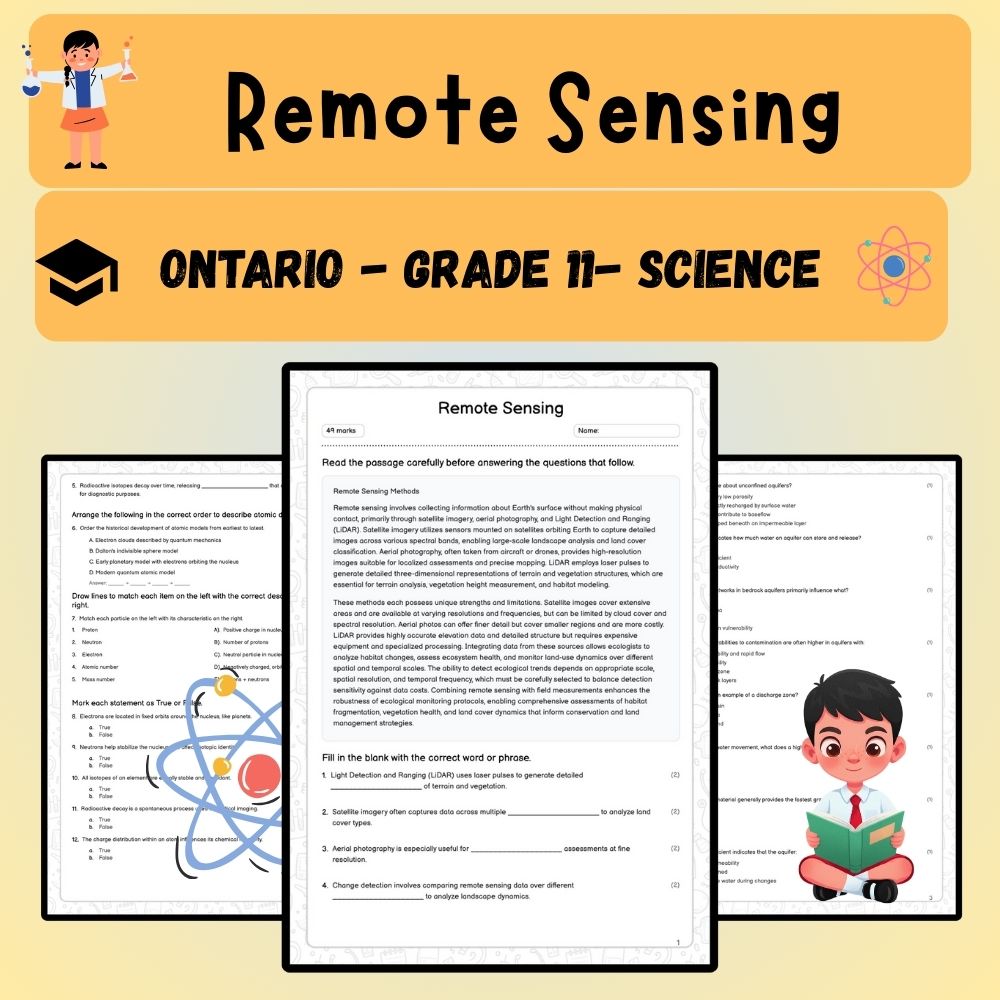
Grade 11 Science | Remote Sensing Worksheet (Worksheet + Answer Key) – Ontario Standards
Created byPrism Point LearningLearning Objectives
- Explain the main methods and technologies used in remote sensing, including satellite imagery, aerial photography, and LiDAR.
- Describe how land cover classification, vegetation indices, and change detection techniques are used for landscape monitoring.
- Evaluate the advantages and limitations of different scales, resolutions, and temporal frequencies in ecological remote sensing.
Also included in: Grade 11 Science Ecosystems & Sustainability UNIT Worksheet Pack +1 more
Instant download
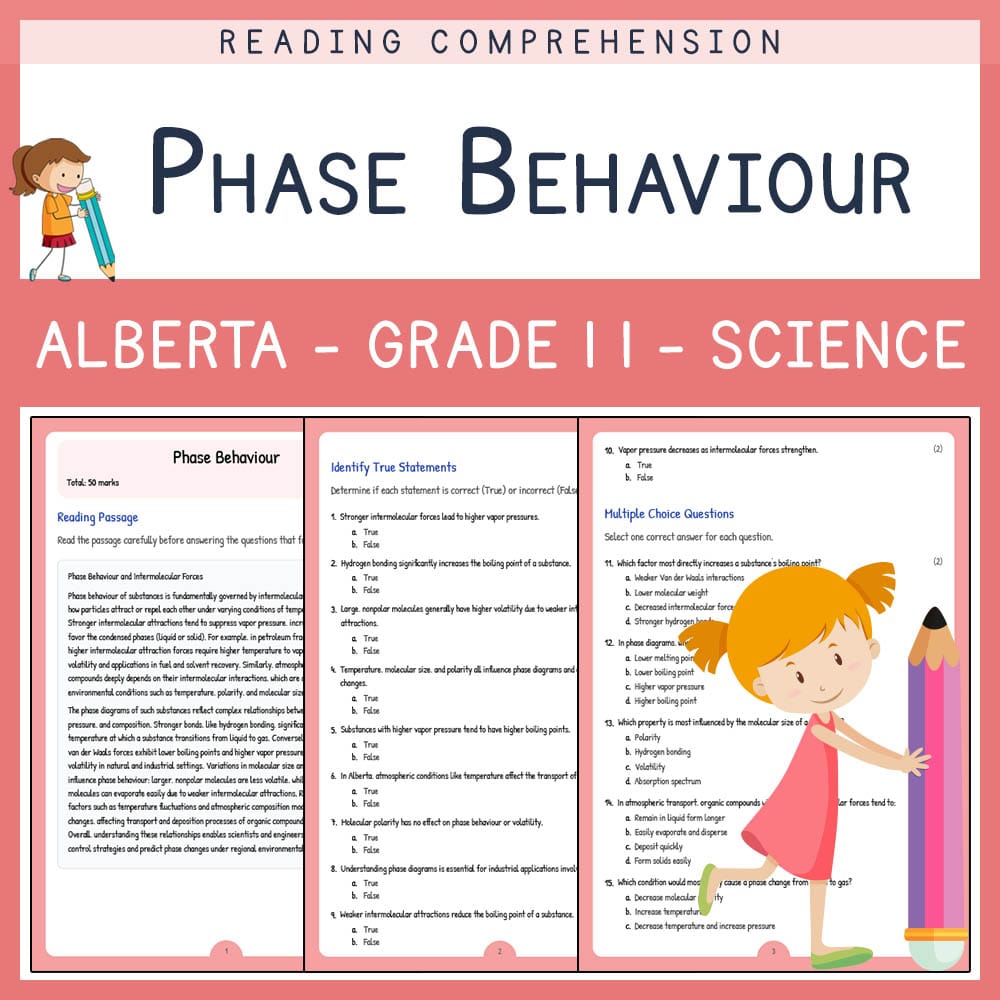
Grade 11 Science Worksheet | Phase Behaviour | Alberta Standards
Created byLumora LearningLearning Objectives
- Understand how intermolecular forces influence phase transitions, vapor pressure, and volatility.
- Explain the connection between intermolecular attractions and physical properties like boiling point and vapor pressure.
- Apply knowledge of phase diagrams considering temperature, molecular size, and polarity in regional environmental contexts.
Also included in: Grade 11 Science | Matter and Chemical Bonding Custom Bundle | Alberta
Instant download
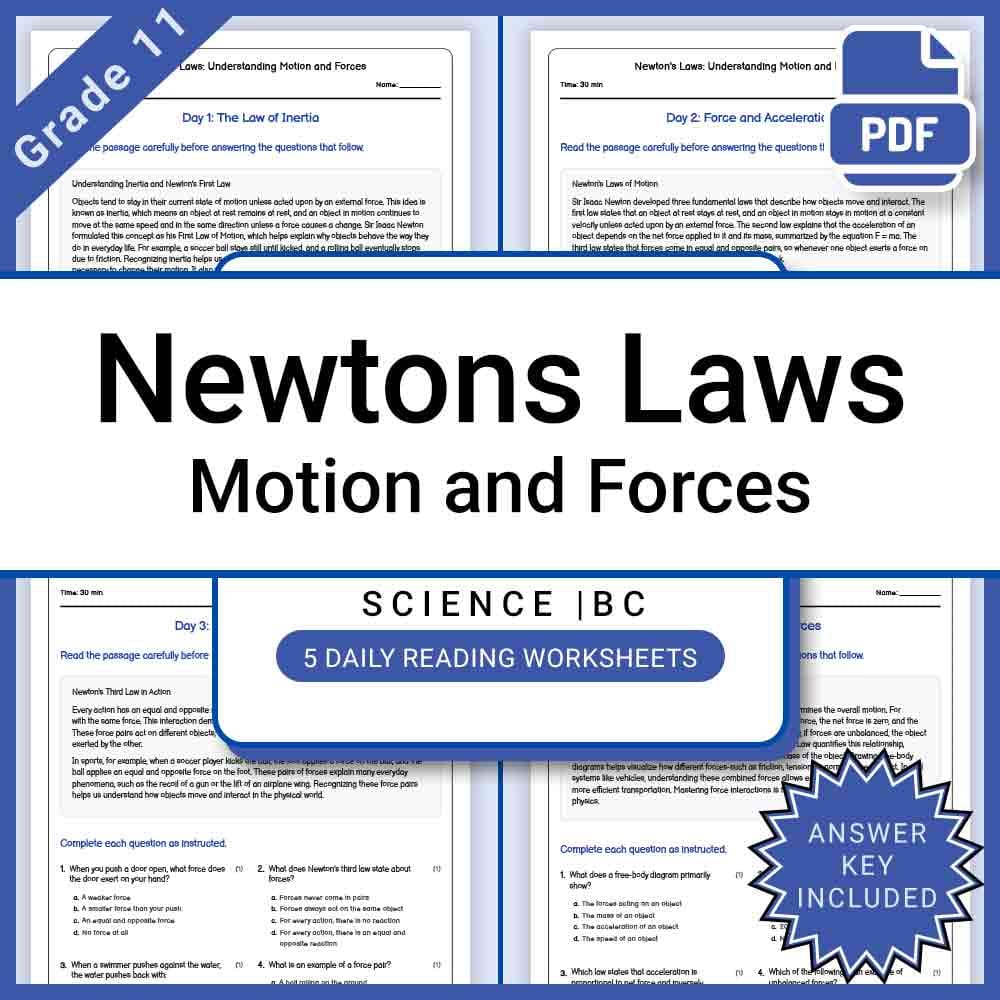
Grade 11 Science – Motion and Forces | Daily Reading Worksheet + Answer Key
JCreated byJ.S SheetsLearning Objectives
- Describe the principle of inertia and identify objects in motion and at rest.
- Explain Newton's First Law and how it relates to inertia.
- Understand how forces affect the motion of objects.
Also included in: Grade 11 Science Lesson Bundle BC Framework | Physics and Energy Concepts +1 more
Instant download

Collisions and Momentum Worksheet Grade 11 Physics | NGSSS Practice
Created byEvergreen Desk EducationLearning Objectives
- Explain how momentum depends on both mass and velocity and predict momentum changes in interactions.
- Apply the law of conservation of momentum to isolated systems during collisions and recoil events.
- Compare elastic and inelastic collisions in terms of momentum conservation and kinetic energy transfer.
Instant download
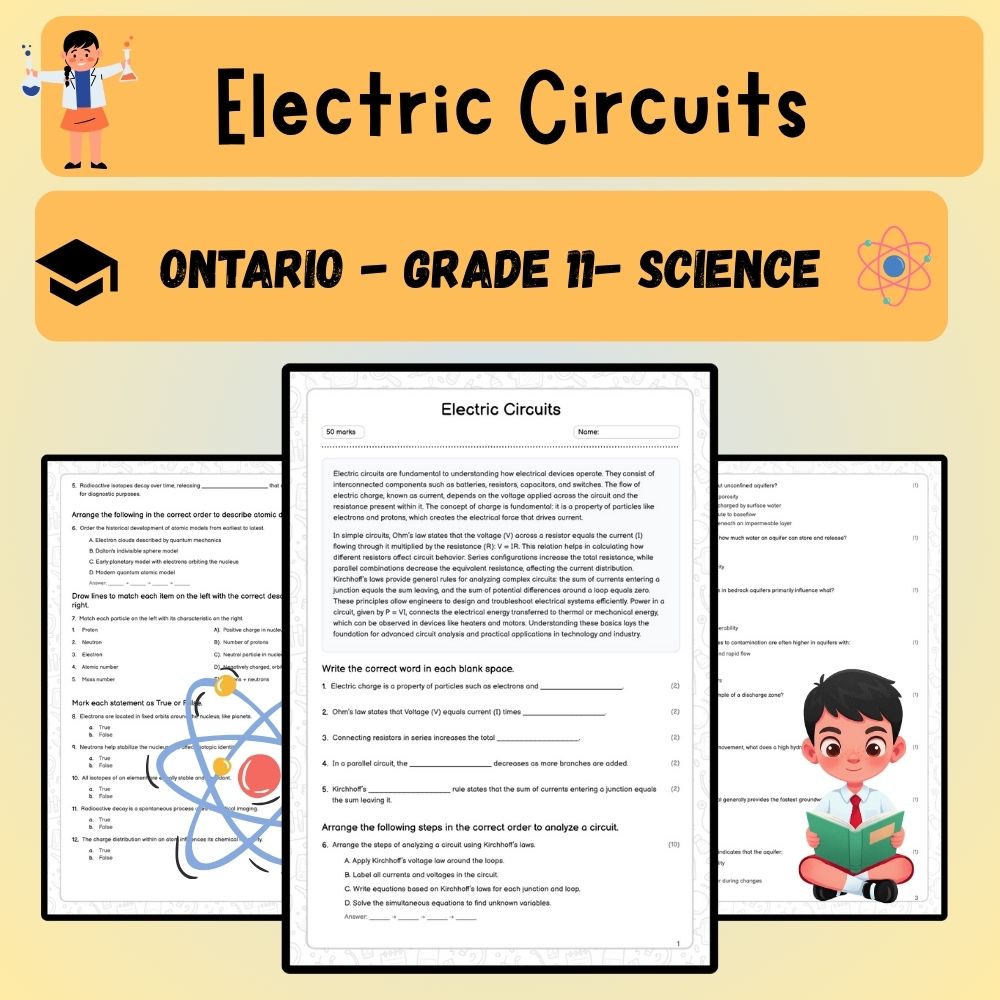
Grade 11 Science | Electric Circuits Worksheet (Answer Key) – Ontario Curriculum
Created byPrism Point LearningLearning Objectives
- Understand the basic concepts of charge, current, potential difference, and resistance in electrical circuits.
- Learn how Ohm's law relates voltage, current, and resistance for conductors.
- Identify the effects of series and parallel resistor combinations on circuit behavior.
Also included in: Grade 11 Science Unit Bundle | Motion, Energy & Waves Worksheets +1 more
Instant download
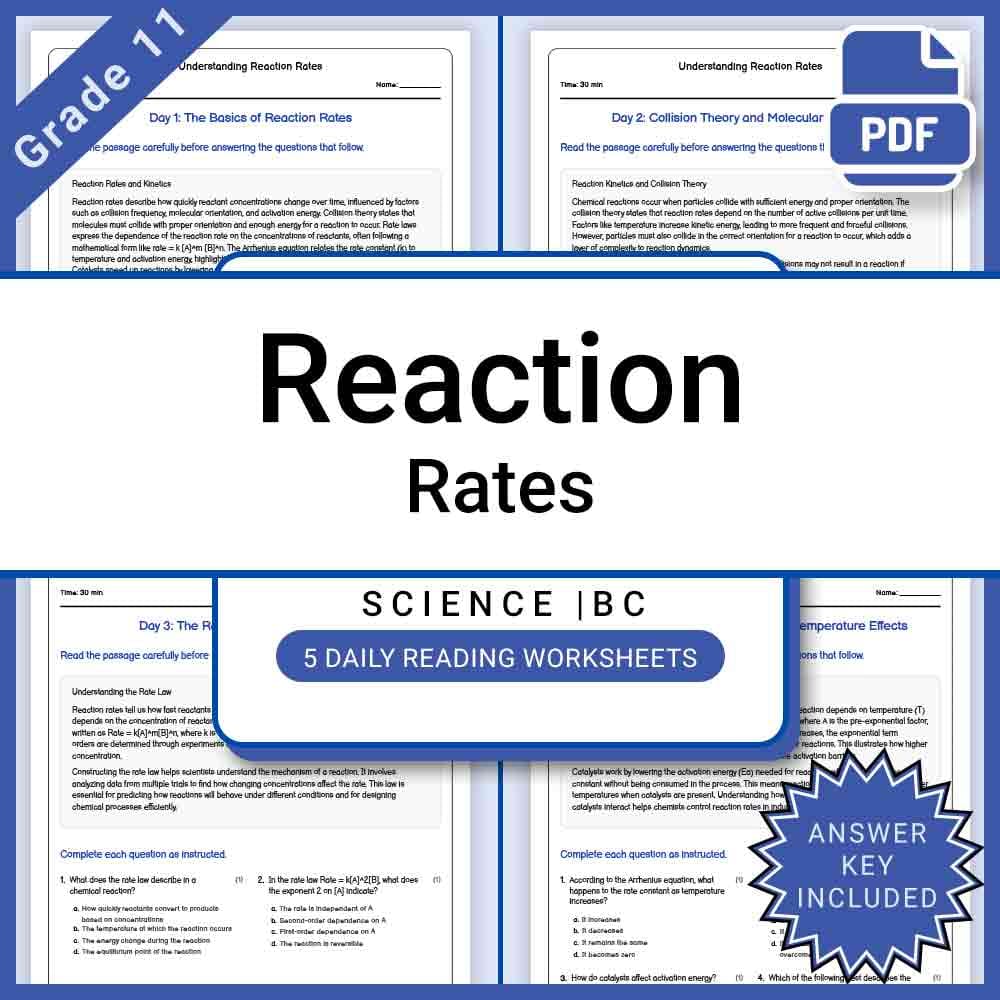
Grade 11 Science – Reaction Rates Daily Reading Worksheet + Answer Key
JCreated byJ.S SheetsLearning Objectives
- Understand key concepts related to Science
- Apply knowledge through practice questions
- Demonstrate comprehension of the material
Also included in: Grade 11 Science Lesson Group | BC Framework Daily Reading Worksheets +1 more
Instant download
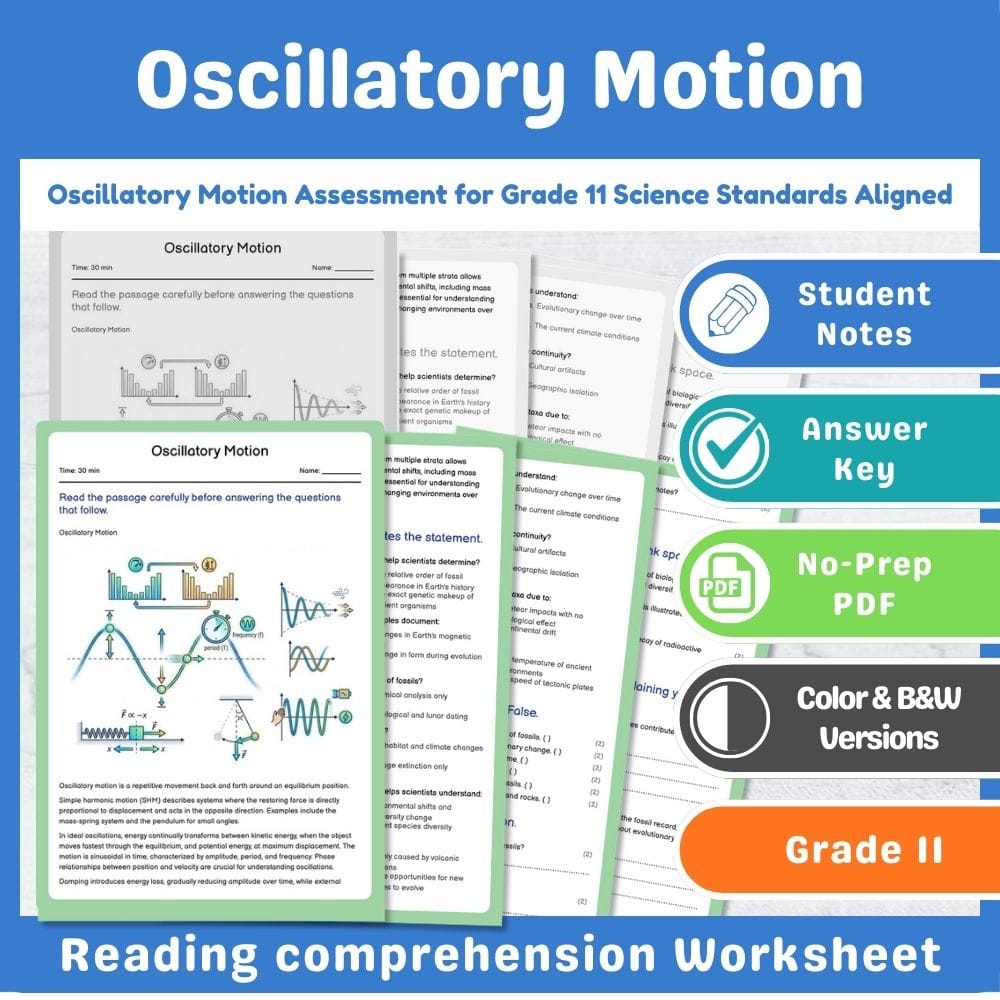
Oscillatory Motion Assessment for Grade 11 Science Standards Aligned
Created byPrism Point LearningLearning Objectives
- Understand the principles of simple harmonic motion in mass–spring systems and pendulums.
- Derive and analyze equations of motion related to oscillatory systems.
- Connect restoring force linearity to sinusoidal solutions and interpret phase relationships.
Instant download

Grade 11 Science – Circular Motion & Forces | Daily Reading Worksheet
 Created byQuiet Forest Education
Learning Objectives
- Understand the basic concepts of uniform and non-uniform circular motion.
- Identify components such as centripetal acceleration, tangential acceleration, and net radial forces.
- Express relationships involving speed, angular velocity, radius, and centripetal force.
Also included in: Wave & Motion Science Grade 11 Daily Reading Worksheets Bundle | Ontario +1 more
Instant download
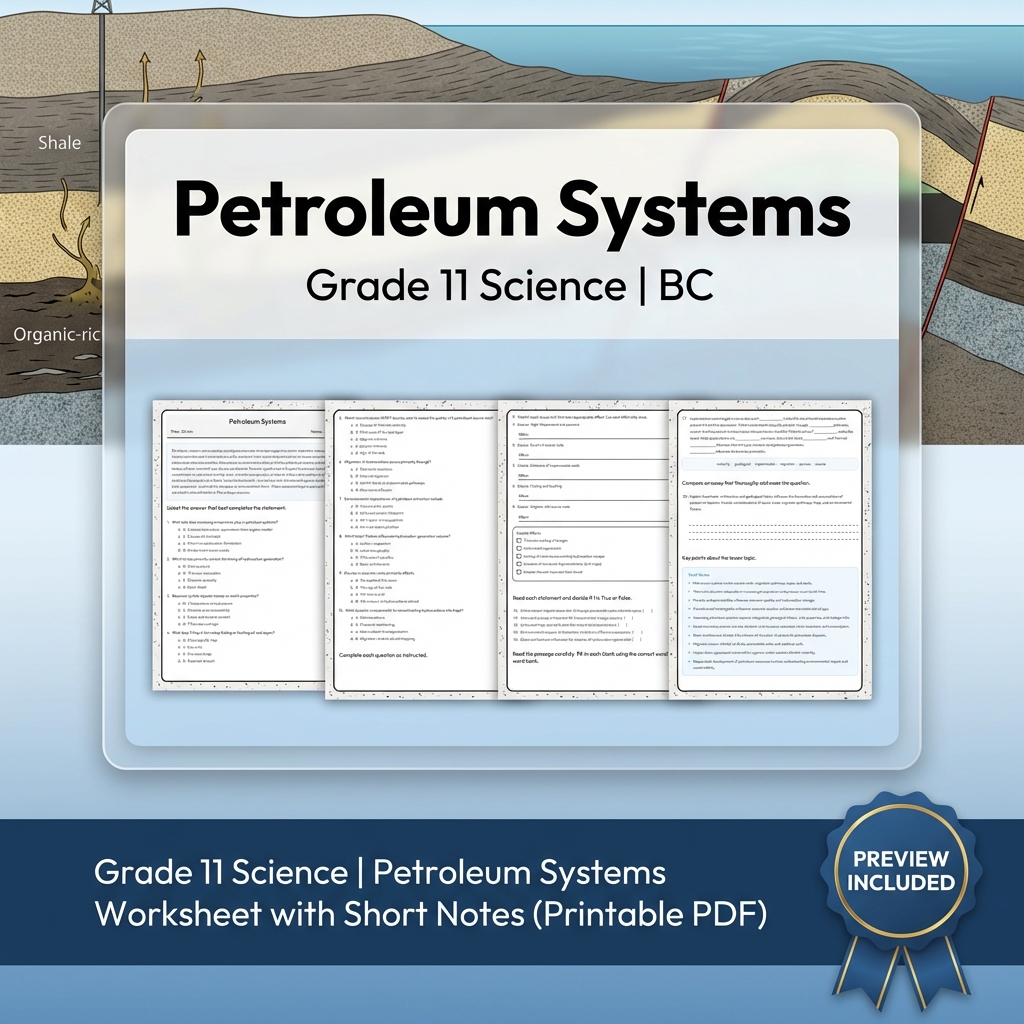
Grade 11 Science | Petroleum Systems Worksheet with Short Notes (Printable PDF)
Created byMeadowlark WorksheetsLearning Objectives
- Explain the processes involved in petroleum formation and accumulation.
- Identify factors that influence reservoir quality and trap formation.
- Describe methods for assessing petroleum system risks and environmental impacts.
Instant download
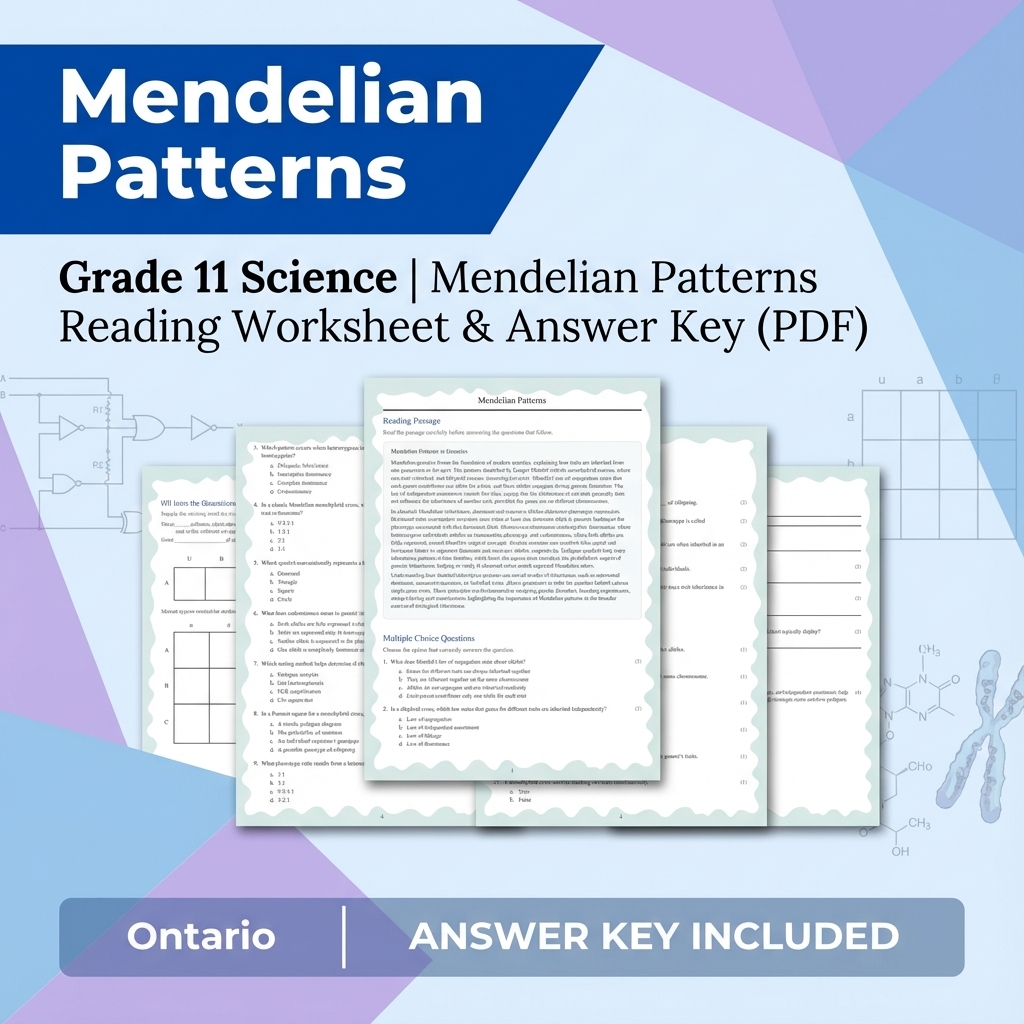
11th Grade Science | Mendelian Patterns Reading Worksheet & Answer Key PDF
JCreated byJ.S SheetsLearning Objectives
- Describe monohybrid and dihybrid inheritance patterns
- Understand segregation and independent assortment concepts
- Interpret Mendelian Punnett squares and phenotypic ratios
Also included in: Grade 11 Science UNIT Bundle | Cellular Processes & Metabolic Pathways +1 more
Instant download
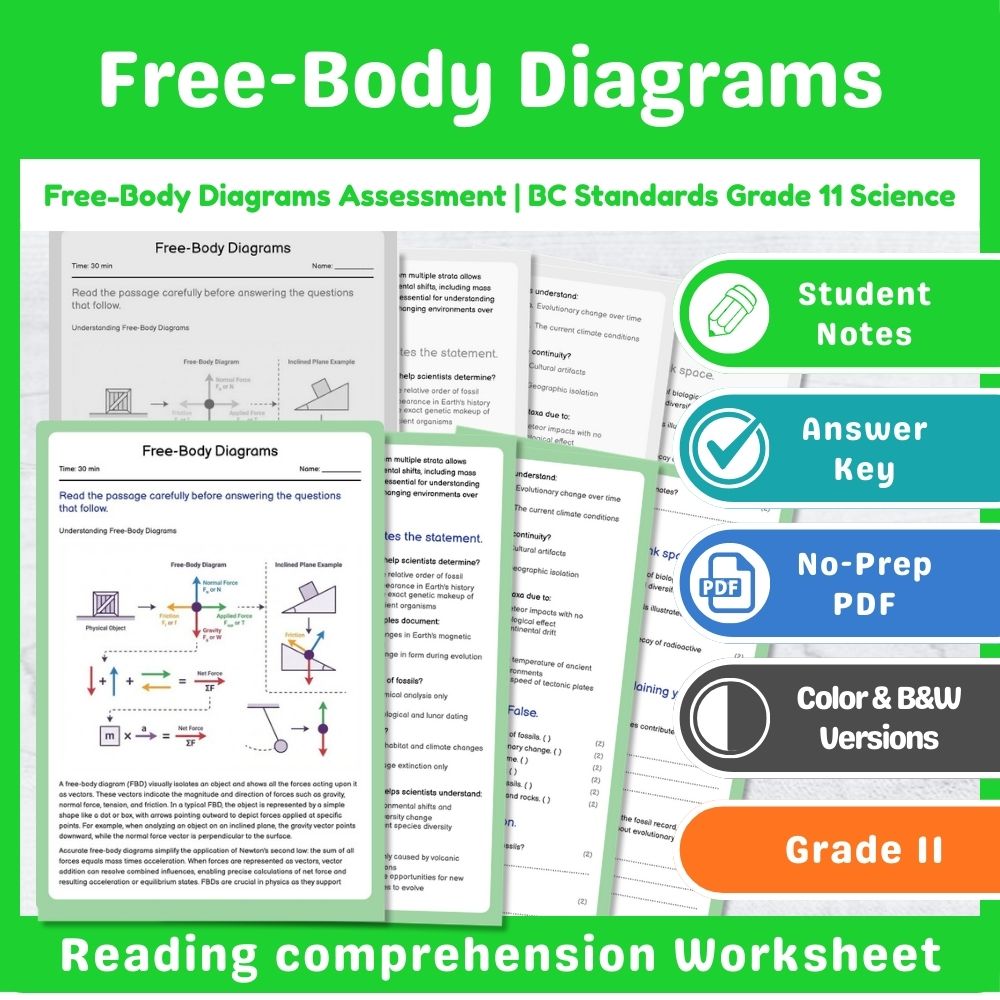
Free-Body Diagrams Assessment | BC Standards Grade 11 Science
Created byPrism Point LearningLearning Objectives
- Understand how to interpret and construct free-body diagrams to analyze forces acting on objects.
- Identify different force types such as gravity, normal force, tension, and friction in diagrams.
- Apply vector addition to determine net force and predict motion or equilibrium in systems.
Also included in: Grade 11 Science Assessment Bundle | Classical Mechanics & Motion Topics
Instant download
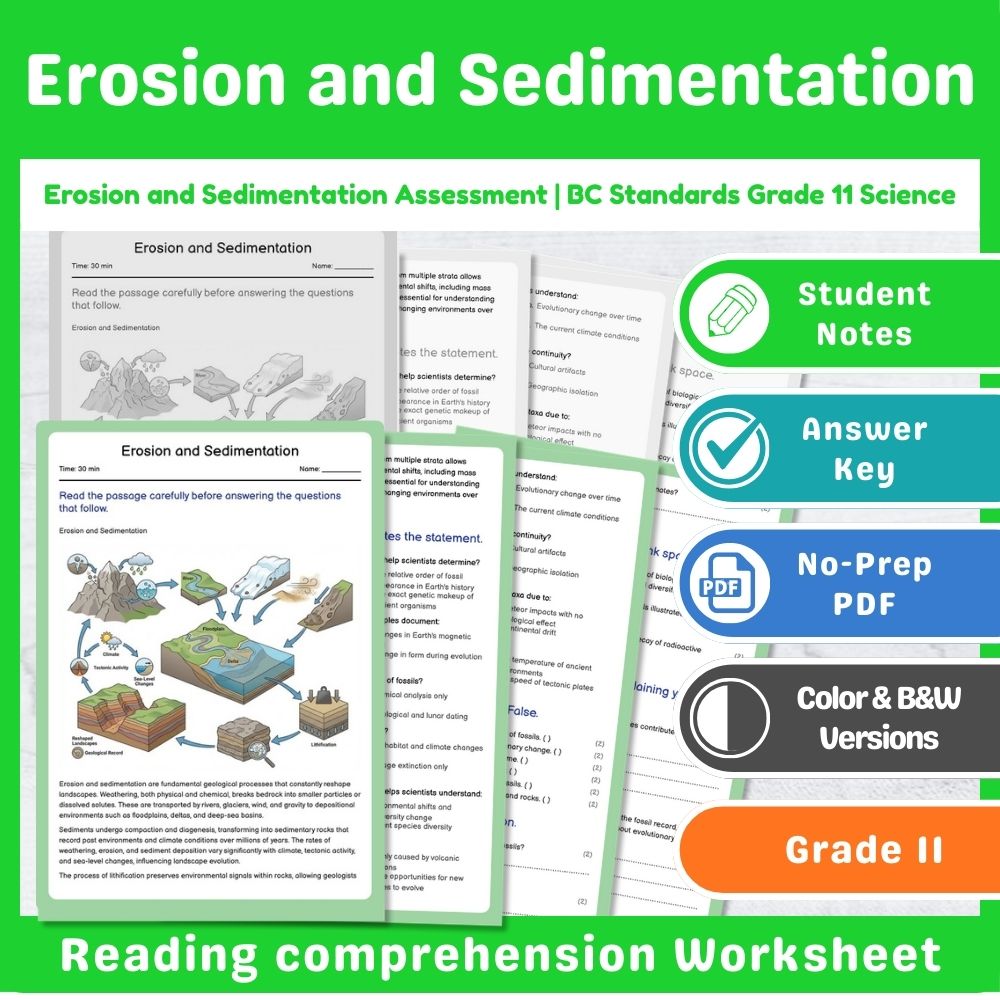
Erosion and Sedimentation Assessment | BC Standards Grade 11 Science
Created byPrism Point LearningLearning Objectives
- Explain the processes of weathering, erosion, transport, and deposition in landscape evolution.
- Identify factors that influence rates of erosion and sedimentation.
- Describe how sediment lithification preserves environmental and climatic signals.
Also included in: Grade 11 Science Assessment | Plate Tectonics BC Standards Mini Bundle
Instant download
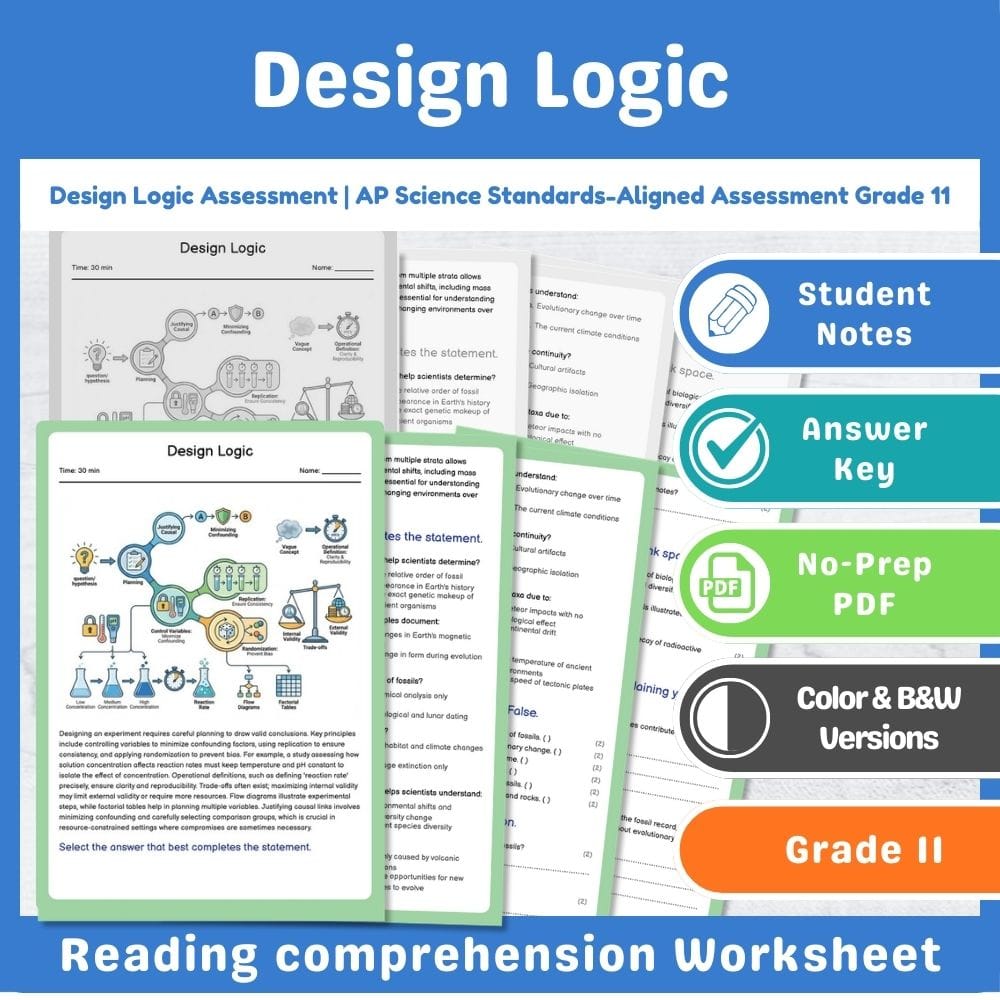
Design Logic Assessment | AP Science Standards-Aligned Assessment Grade 11
Created byPrism Point LearningLearning Objectives
- Understand the principles of experimental design, including variable control, replication, and randomization.
- Describe how operational definitions of variables enhance experimental clarity.
- Analyze examples such as solution concentration effects on reaction rates and growth chamber studies to identify design strategies.
Also included in: Grade 11 Science Mini Bundle | AP Science Practices & Skills
Instant download
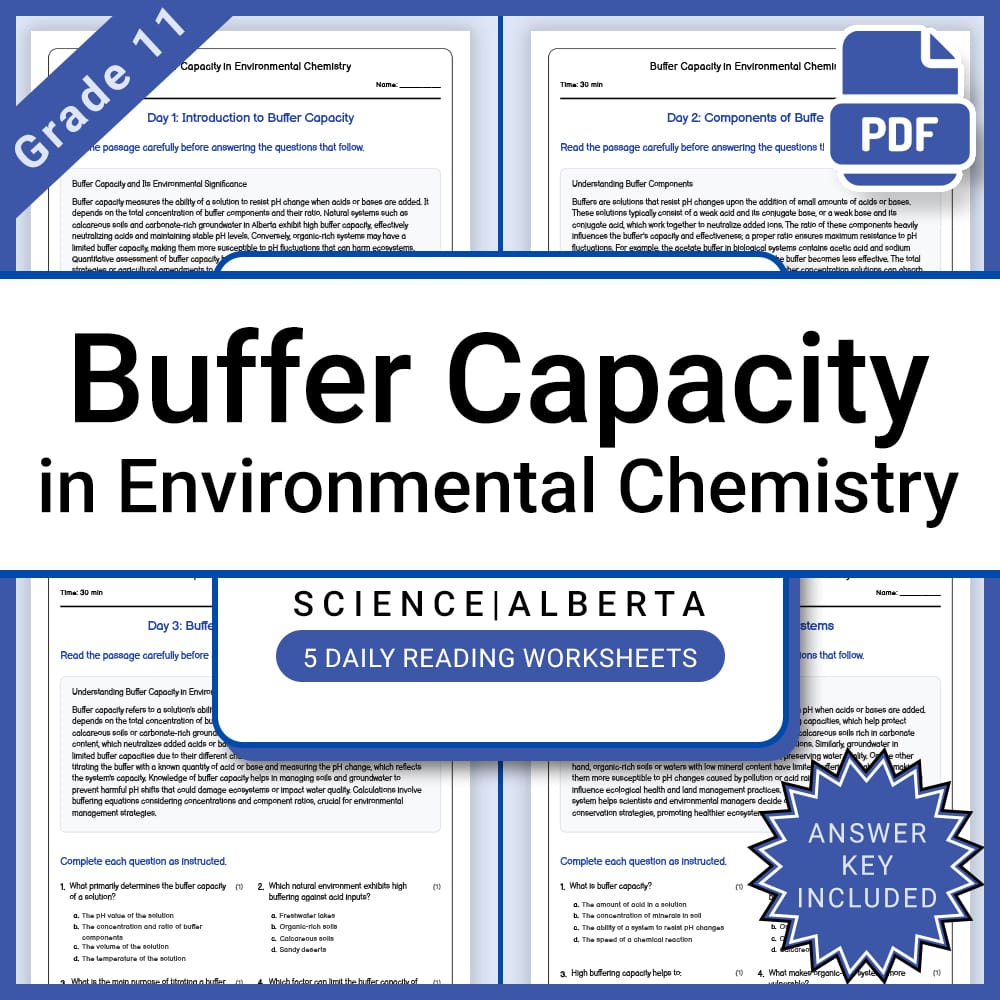
Grade 11 Science – Buffer Capacity | Daily Reading Worksheet + Answer Key
JCreated byJ.S SheetsLearning Objectives
- Understand the concept of buffer capacity and its significance in environmental systems.
- Identify factors that influence buffer capacity in natural waters and soils.
- Analyze the role of buffer systems in maintaining stable pH levels in ecosystems.
Also included in: Grade 11 Science Lesson Bundle on Acids, Bases, and Titration | Alberta Framework +1 more
Instant download
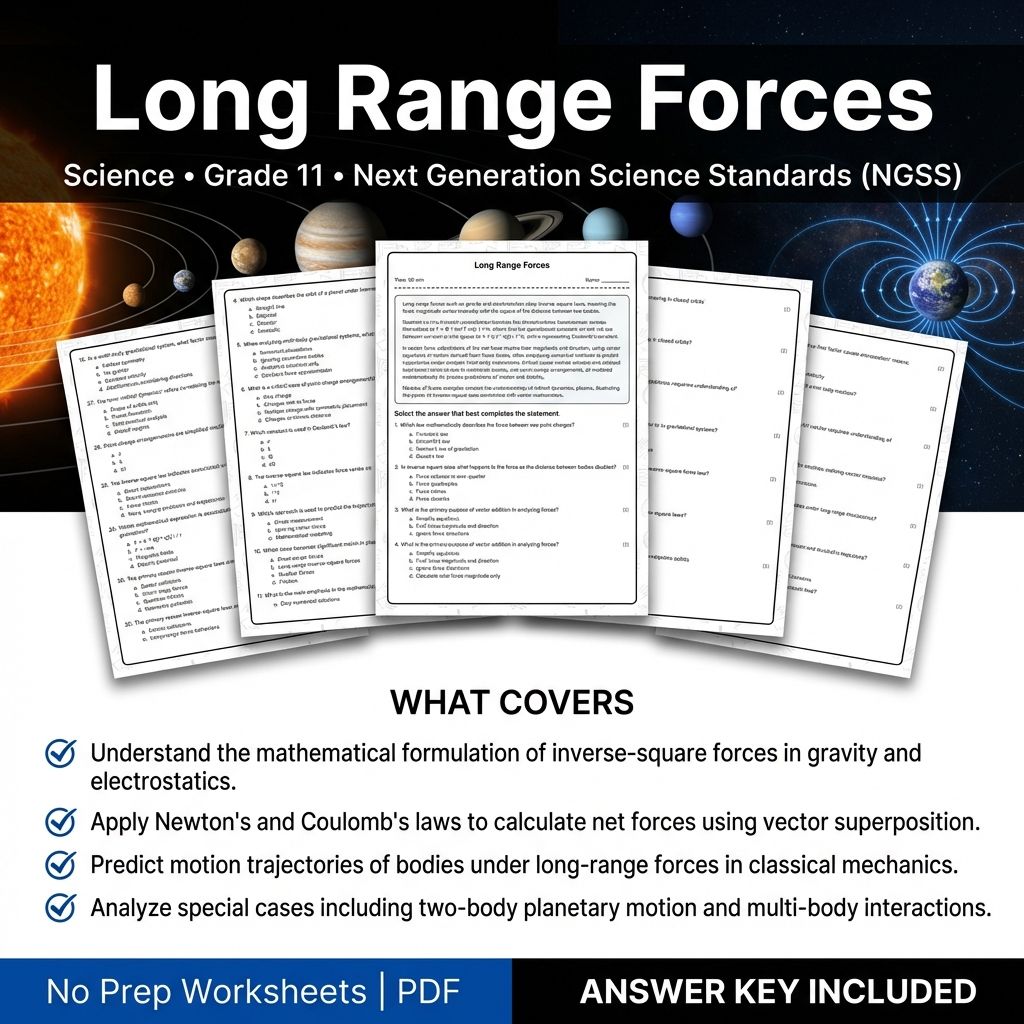
Grade 11 Science | Long Range Forces Worksheet & Answer Key (Printable PDF)
 Created byCoral Reef Learning
Learning Objectives
- Understand the mathematical formulation of inverse-square forces in gravity and electrostatics.
- Apply Newton's and Coulomb's laws to calculate net forces using vector superposition.
- Predict motion trajectories of bodies under long-range forces in classical mechanics.
Also included in: Grade 11 Science Unit Bundle – Forces, Impulse & Conservation Practice PDFs +1 more
Instant download
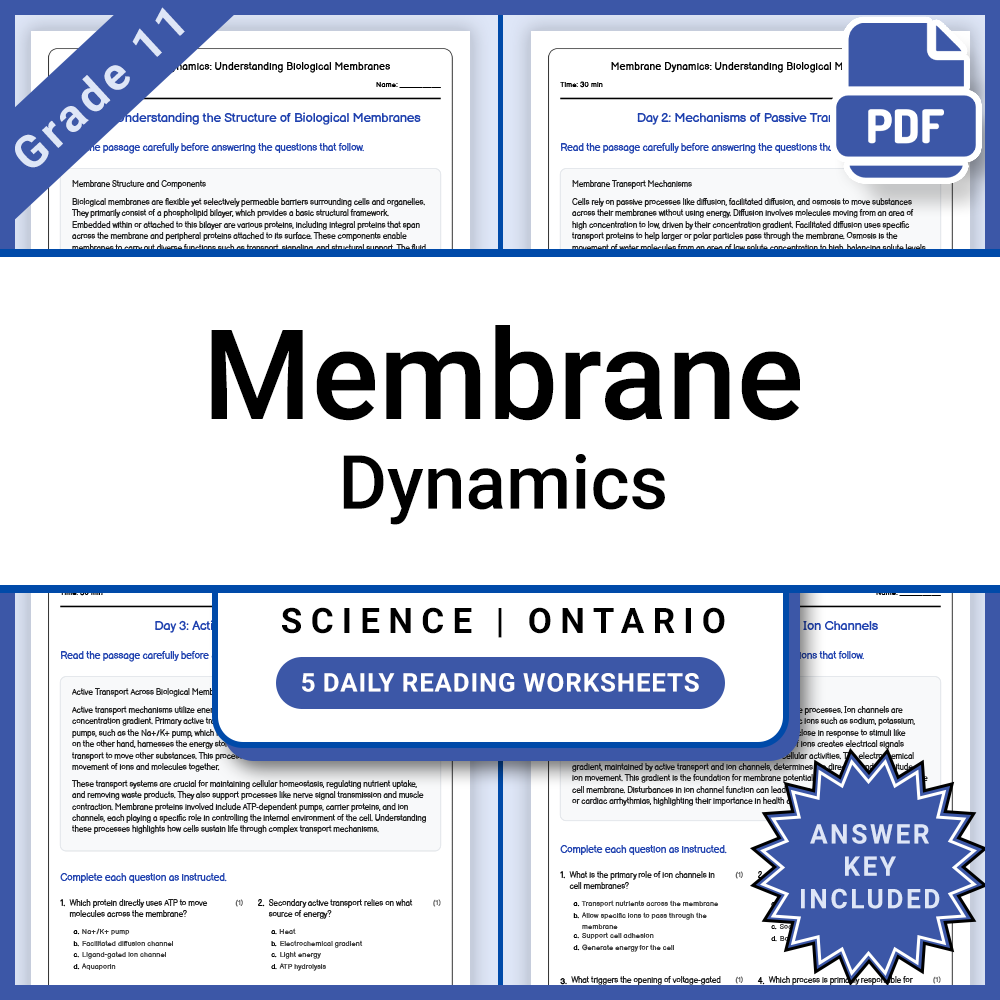
Grade 11 Science – Membrane Dynamics Daily Reading Worksheet + Answer Key
JCreated byJ.S SheetsLearning Objectives
- Understand key concepts related to Science
- Apply knowledge through practice questions
- Demonstrate comprehension of the material
Also included in: Grade 11 Science Lesson Bundle | Ontario Standards for Biology and Chemistry +1 more
Instant download
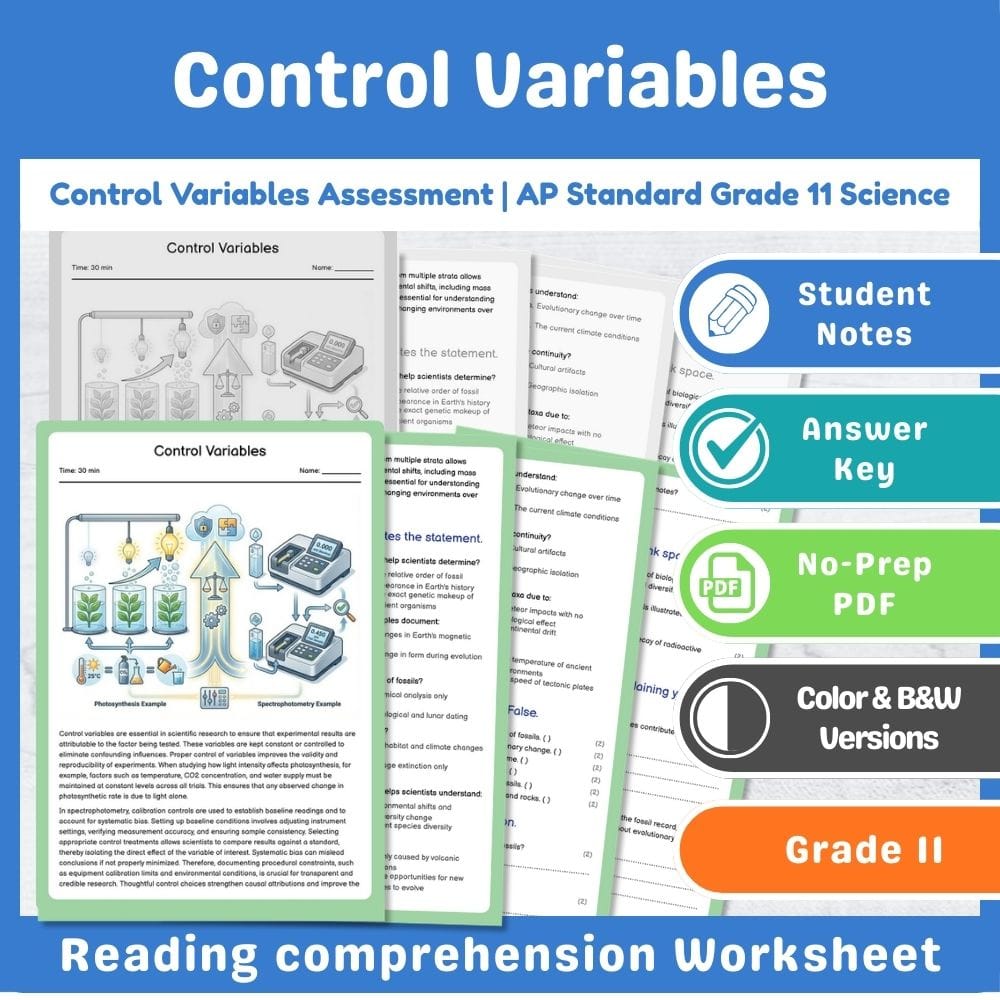
Control Variables Assessment | AP Standard Grade 11 Science
Created byPrism Point LearningLearning Objectives
- Understand the purpose and importance of control variables in scientific experiments.
- Identify strategies for selecting appropriate control conditions and baseline treatments.
- Analyze how control choices affect the strength and validity of experimental conclusions.
Also included in: Grade 11 Science Mini Bundle | AP Science Practices & Skills
Instant download
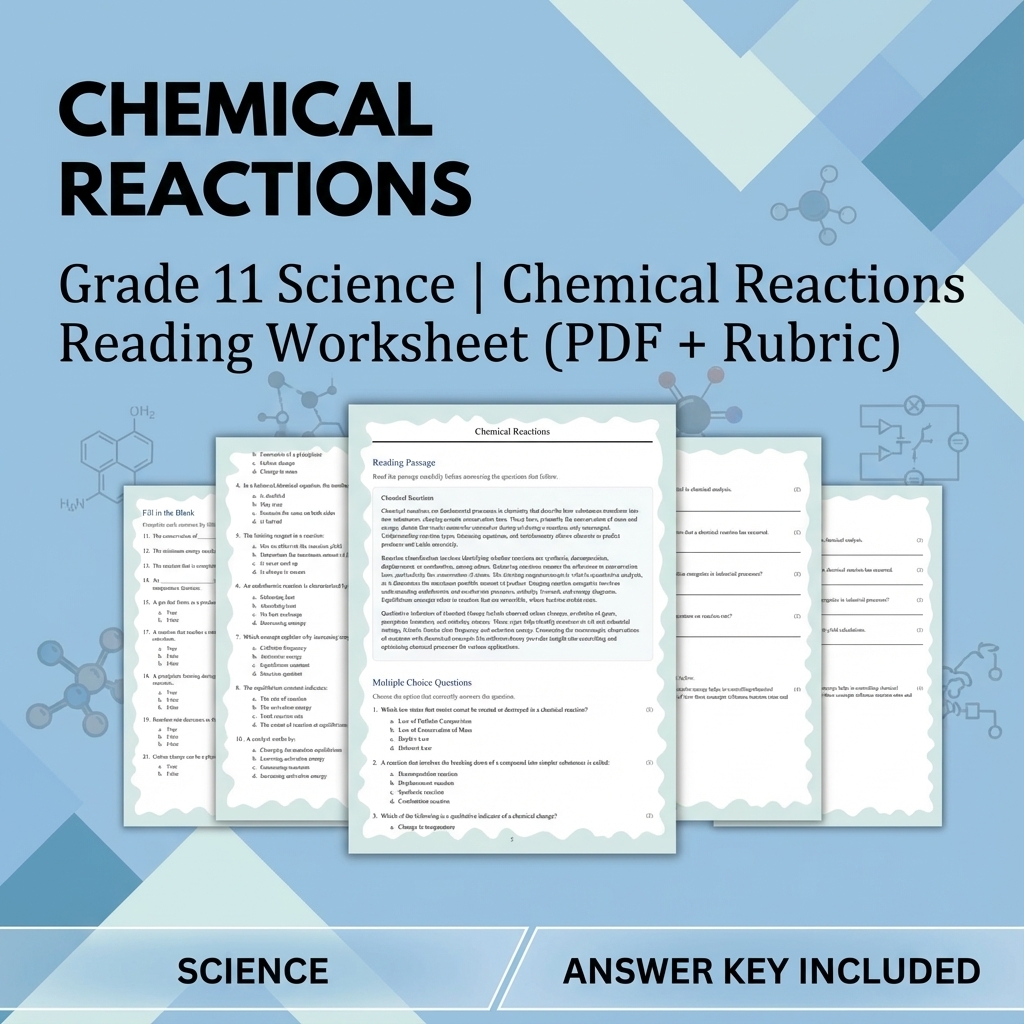
Grade 11 Science | Chemical Reactions Reading Worksheet (PDF + Rubric)
JCreated byJ.S SheetsLearning Objectives
- Describe the key features and types of chemical reactions, including conservation laws and reaction classification.
- Understand stoichiometry, balancing equations, limiting reagents, and quantitative yield calculations.
- Explain qualitative indicators of chemical change such as colour change, gas evolution, and enthalpy change.
Also included in: Grade 11 Science – Waves, Ecology, Energy & More (Answer Keys Included) +1 more
Instant download
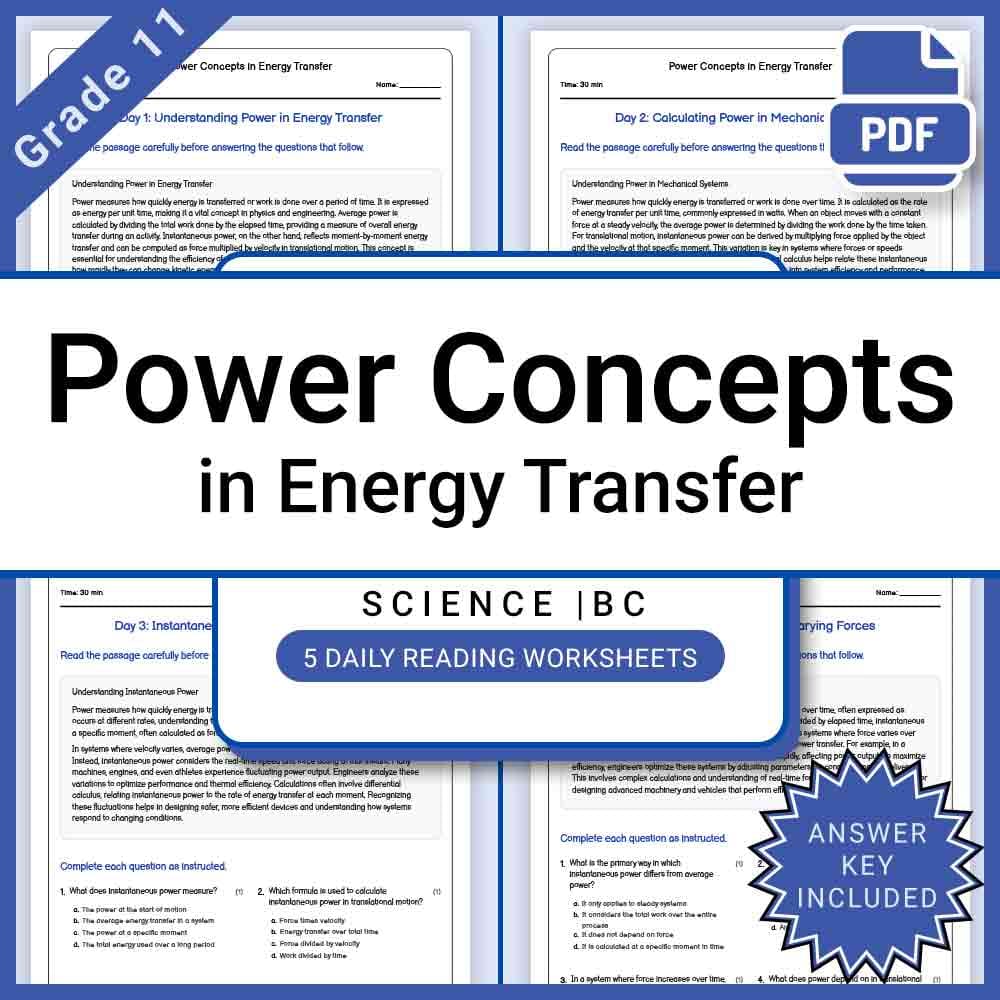
Grade 11 Science – Power Concepts in Energy Transfer Worksheet + Answer Key
JCreated byJ.S SheetsLearning Objectives
- Understand the definition of power as the rate of energy transfer or work over time.
- Differentiate between average power and instantaneous power.
- Apply basic formulas to calculate power in simple systems.
Also included in: Grade 11 Science Lesson Bundle BC Framework | Physics and Energy Concepts +1 more
Instant download

Force and Acceleration Test Prep Printables | Grade 11 Science
Created byPrism Point LearningLearning Objectives
- Use Newton’s second law (F = ma) to relate net force, mass, and acceleration in different situations.
- Interpret motion scenarios (free fall, projectiles, inclined planes, and uniform circular motion) to identify net force and direction of acceleration.
- Connect algebraic relationships and vector ideas of forces to real motion trajectories and graphs.
Instant download

Grade 11 Science – Anatomical Clues Daily Reading Worksheet with Answer Key
JCreated byJ.S SheetsLearning Objectives
- Understand the concept of homologous structures and their significance.
- Differentiate between homologous and analogous structures in animals.
- Recognize vestigial organs and their implications for evolutionary history.
Also included in: Grade 11 Science Lesson Group Bundle TEKS | Evolution & Classification +1 more
Instant download
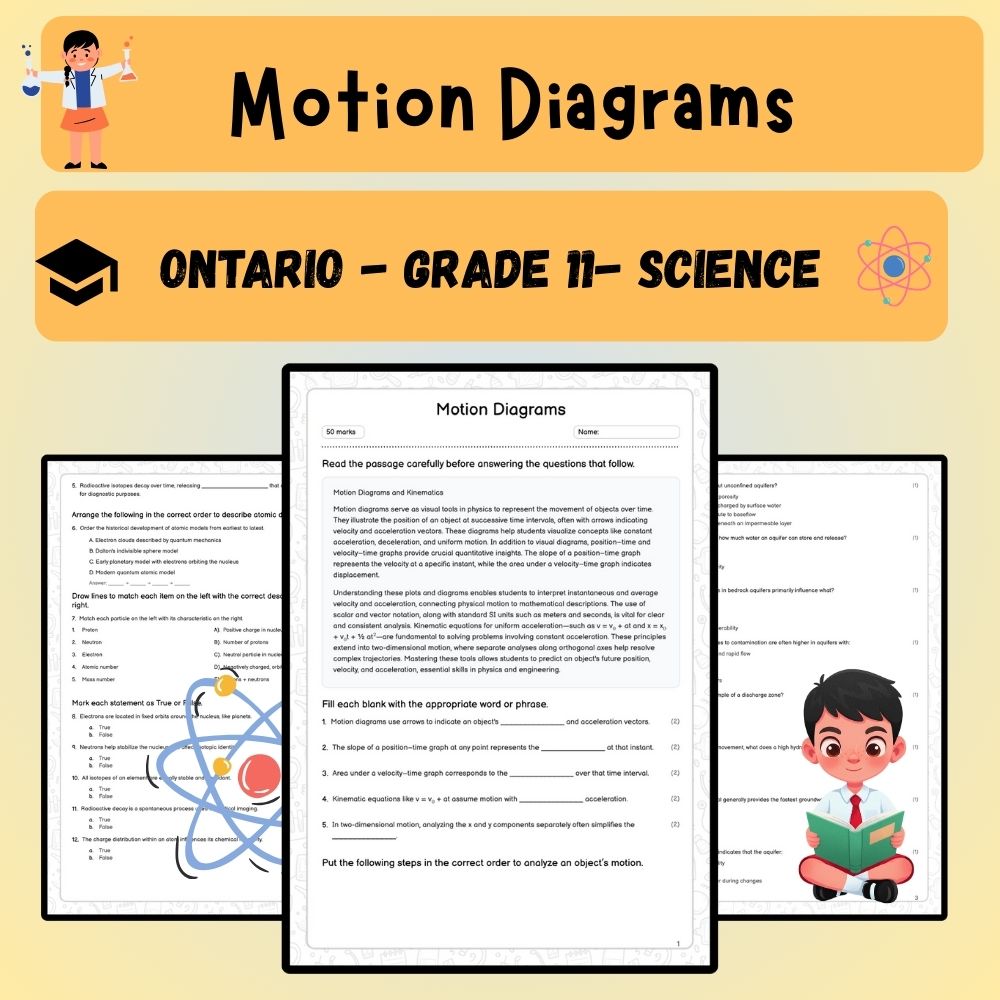
Grade 11 Science | Motion Diagrams Worksheet (PDF) – Ontario Standard Practice
Created byPrism Point LearningLearning Objectives
- Understand how to interpret position, velocity, and acceleration in motion diagrams.
- Analyze and construct velocity–time and position–time plots to determine instantaneous and average quantities.
- Apply kinematic equations for constant acceleration in straight-line motion.
Also included in: Grade 11 Science Unit Bundle | Motion, Energy & Waves Worksheets +1 more
Instant download
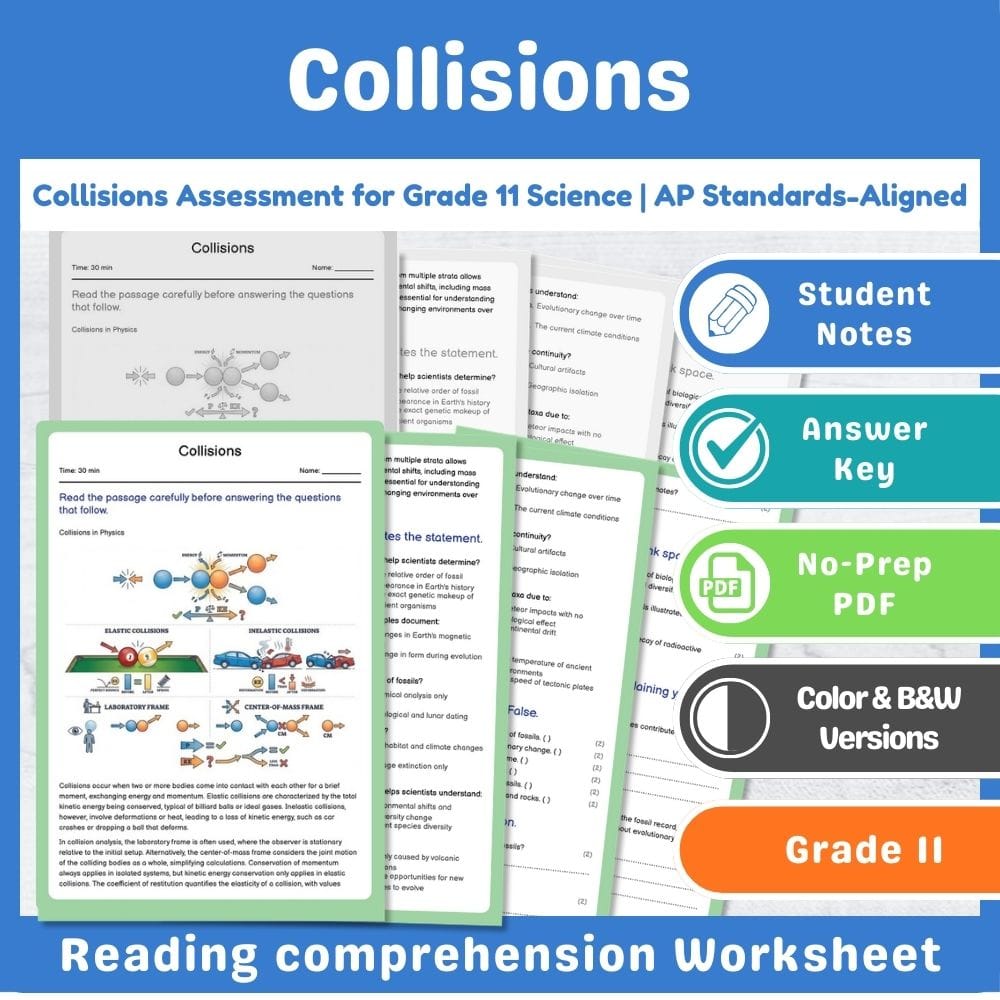
Collisions Assessment for Grade 11 Science | AP Standards-Aligned
Created byPrism Point LearningLearning Objectives
- Analyze elastic and inelastic collisions in one and two dimensions using conservation of momentum and kinetic energy.
- Compare laboratory and center-of-mass reference frames in collision analysis.
- Employ algebraic and vector methods to predict post-collision velocities.
Instant download
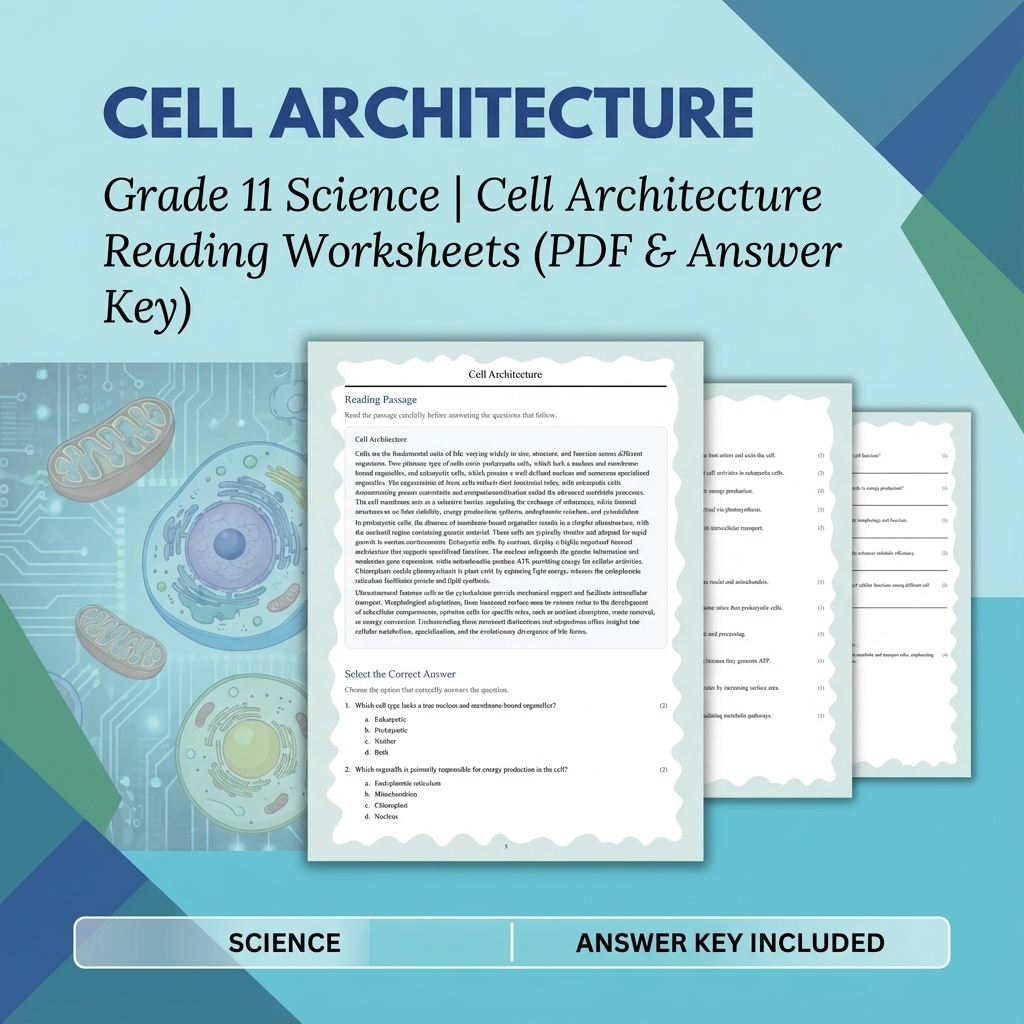
Grade 11 Science | Cell Architecture Reading Worksheets (PDF & Answer Key)
JCreated byJ.S SheetsLearning Objectives
- Compare and contrast prokaryotic and eukaryotic cell structures.
- Describe the functions of key organelles such as nucleus, mitochondrion, and chloroplast.
- Explain how ultrastructural features support cellular metabolic and transport roles.
Also included in: Grade 11 Science UNIT Bundle | Cellular Processes & Metabolic Pathways +1 more
Instant download

Wave Properties Worksheet | Grade 11 Physics Science Activity
Created byPrism Point LearningLearning Objectives
- Explain how amplitude, frequency, wavelength, and wave speed relate to energy transfer in waves
- Predict how reflection, refraction, and diffraction change a wave’s direction or pattern
- Use interference and resonance ideas to describe regions of constructive/destructive overlap and amplified oscillations
Instant download
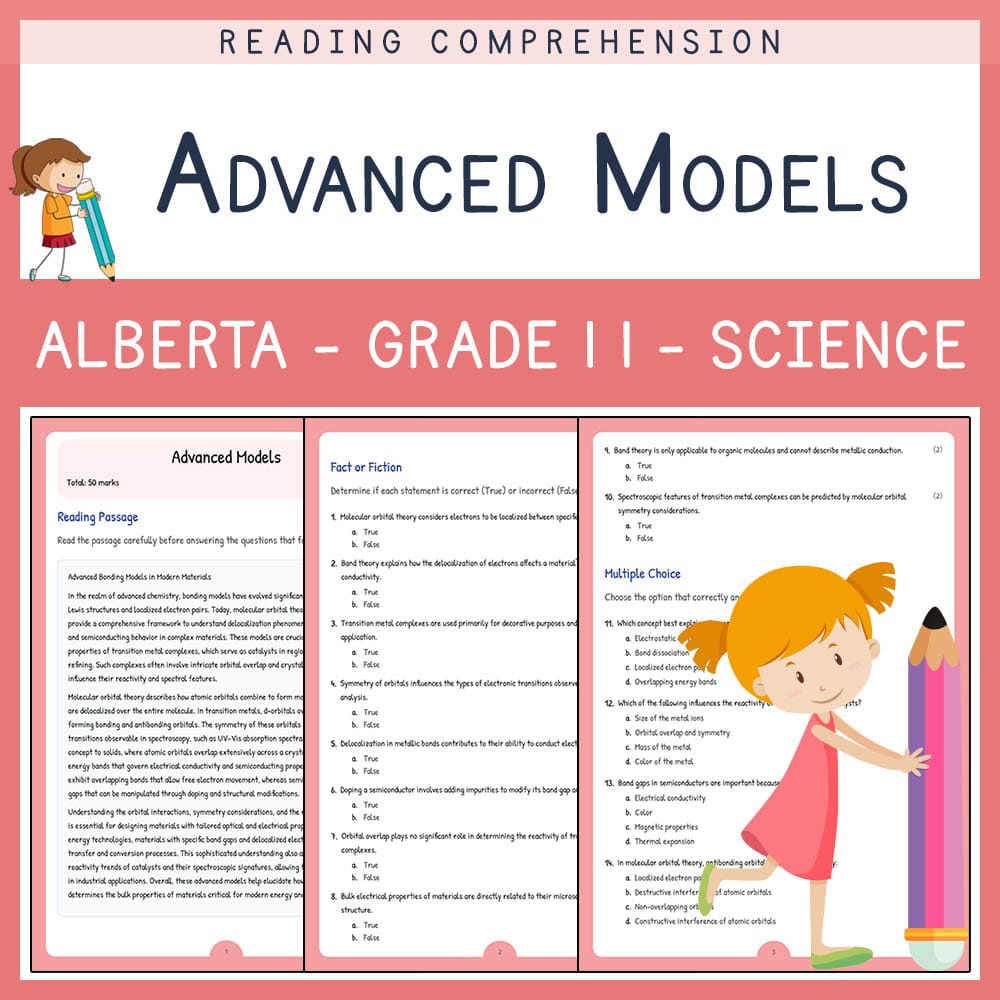
Grade 11 Science | Advanced Models Worksheet | Alberta Standards
Created byLumora LearningLearning Objectives
- Understand how molecular orbital and band theory explain complex bonding, delocalization, and electronic properties.
- Analyze how orbital overlap, symmetry, and band structure influence spectroscopic features and reactivity.
- Apply advanced bonding concepts to transition metal complexes in catalysis and materials used in energy applications.
Also included in: Grade 11 Science | Matter and Chemical Bonding Custom Bundle | Alberta
Instant download
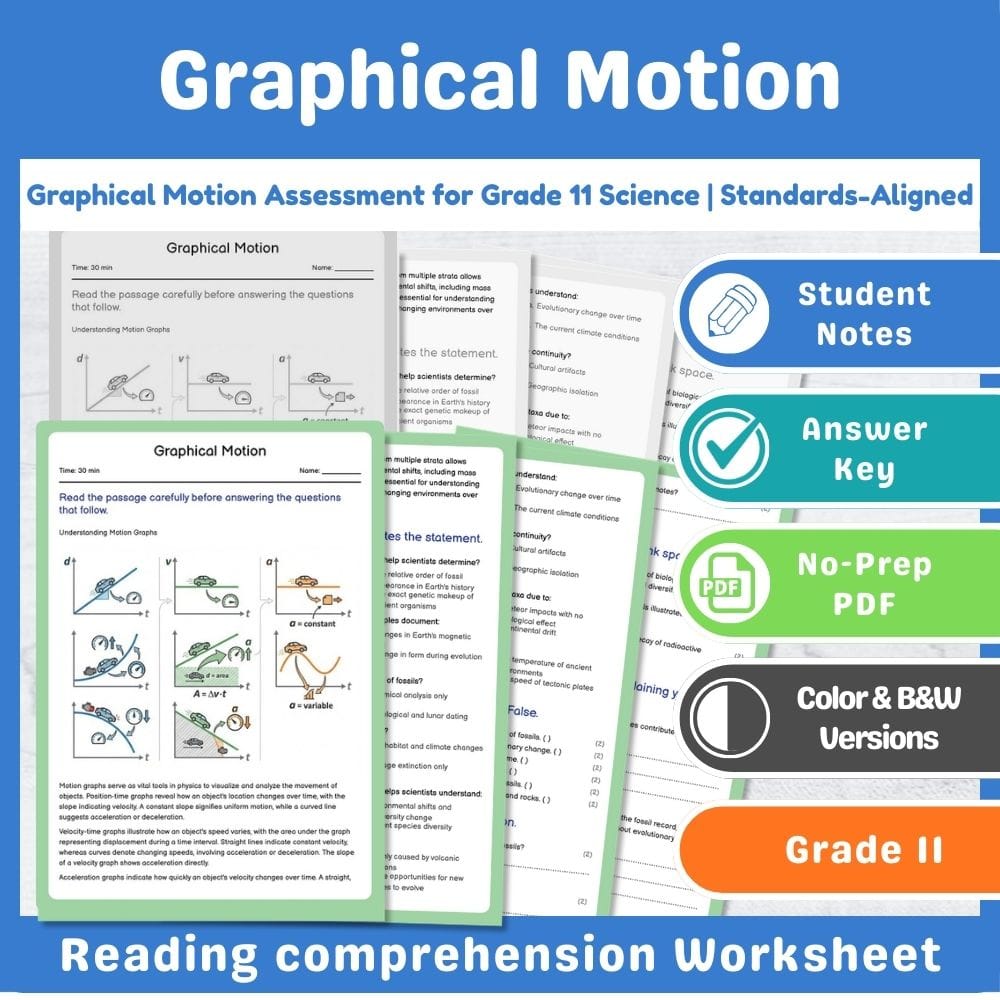
Graphical Motion Assessment for Grade 11 Science | Standards-Aligned
Created byPrism Point LearningLearning Objectives
- Interpret and analyze position, velocity, and acceleration graphs in various motion scenarios.
- Construct and interpret different types of motion graphs, including piecewise and curved plots.
- Understand the relationship between graph slopes, areas, and kinematic quantities like velocity and displacement.
Instant download

Grade 11 Science – Ecosystems & Biogeochemical Cycles | Daily Reading Worksheet
Created byBright Mind ResourcesLearning Objectives
- Identify components of ecological systems and their interactions
- Explain population dynamics and community interactions
- Discuss biogeochemical cycling and energy flow in ecosystems
Also included in: Grade 11 Daily Reading & Graphs Science lesson bundle Worksheets | Ontario +1 more
Instant download

Grade 11 Science | Molecular Evidence Worksheet (PDF+ Answer Key)
 Created byCopper Leaf Classroom
Learning Objectives
- Understand and describe the molecular techniques used in studying heredity and evolution.
- Identify different types of molecular markers and their applications in genetics.
- Analyze sequence data to infer evolutionary relationships and genetic variation.
Instant download
Grade 11 Science – Molecular Polarity Daily Reading Worksheet with Answer Key
JCreated byJ.S SheetsLearning Objectives
- Define and identify molecular polarity and dipole moments.
- Explain how dipole–dipole interactions occur between polar molecules.
- Describe the effects of molecular polarity on properties such as boiling point and solubility.
Also included in: Grade 11 Science Lesson Bundle | Molecular Structure and Bonding +1 more
Instant download
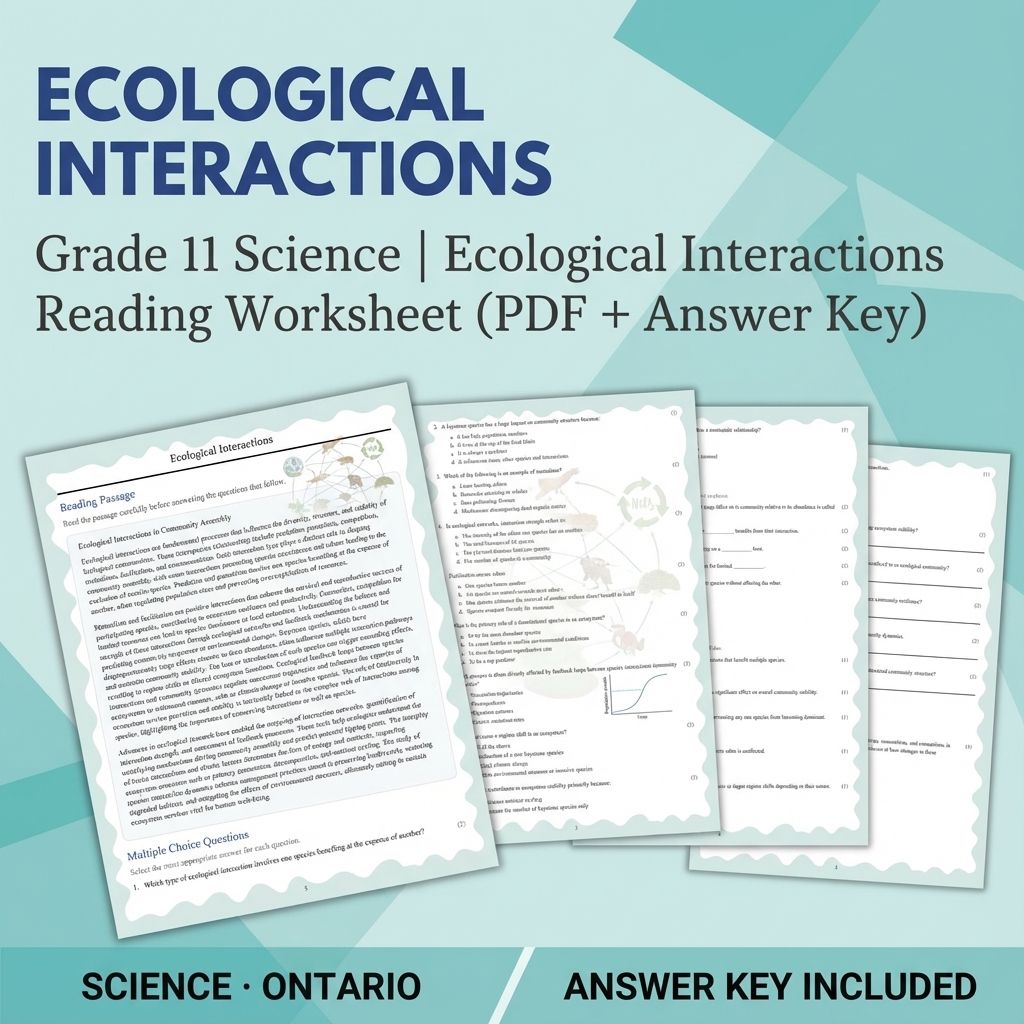
Grade 11 Science | Ecological Interactions Reading Worksheet (PDF + Answer Key)
JCreated byJ.S SheetsLearning Objectives
- Describe different types of ecological interactions such as predation, parasitism, competition, mutualism, facilitation, and commensalism.
- Explain the roles of keystone and foundational species in shaping community structure and ecosystem processes.
- Analyze ecological networks, including interaction strength and feedback loops, and their influence on community stability and succession.
Also included in: Grade 11 Science | Ecosystem Dynamics & Sustainability Bundle (PDF + Rubric) +1 more
Instant download
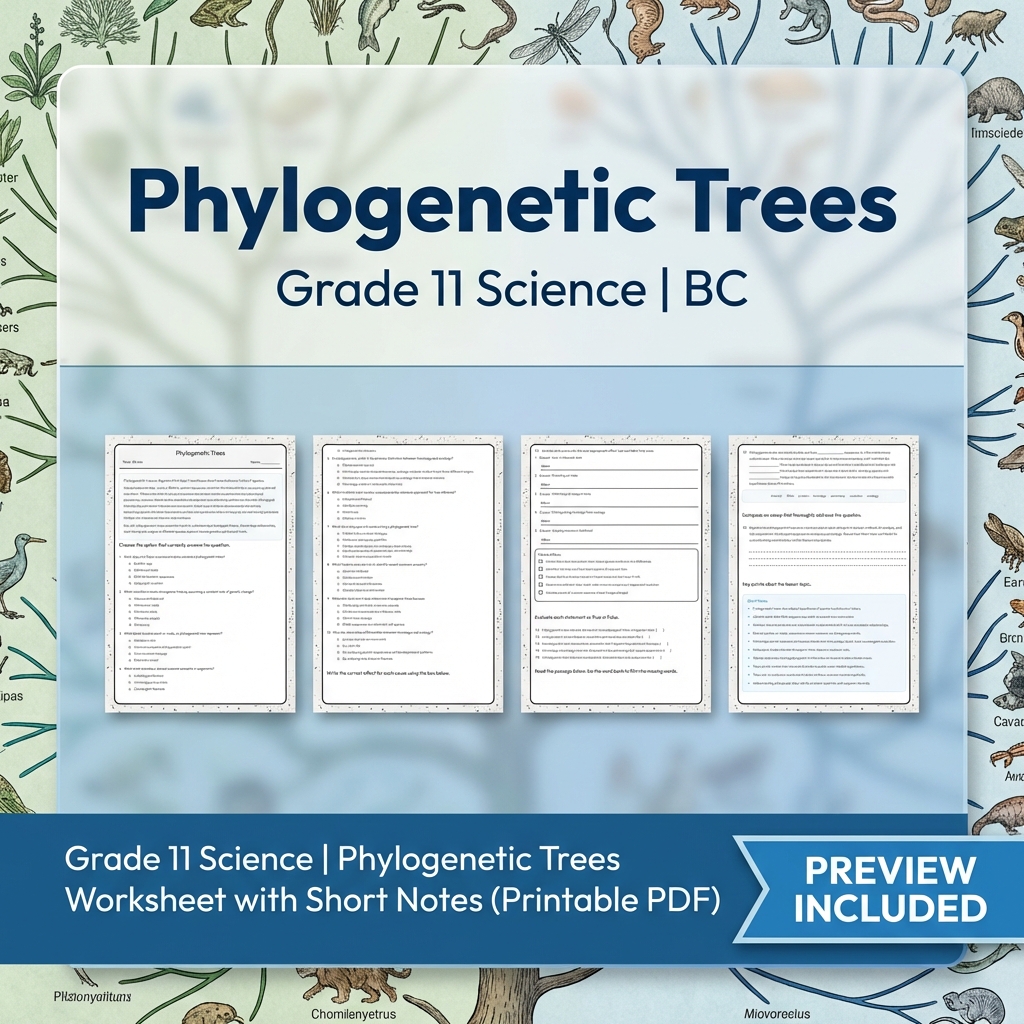
Grade 11 Science | Phylogenetic Trees Worksheet with Short Notes (Printable PDF)
Created byMeadowlark WorksheetsLearning Objectives
- Understand the concept and purpose of phylogenetic trees in evolutionary biology.
- Identify different methods used to infer evolutionary relationships.
- Interpret branching patterns and what they reveal about common ancestry.
Also included in: Grade 11 Science Lesson Bundle BC Framework Worksheets for Biology and Genetics +1 more
Instant download
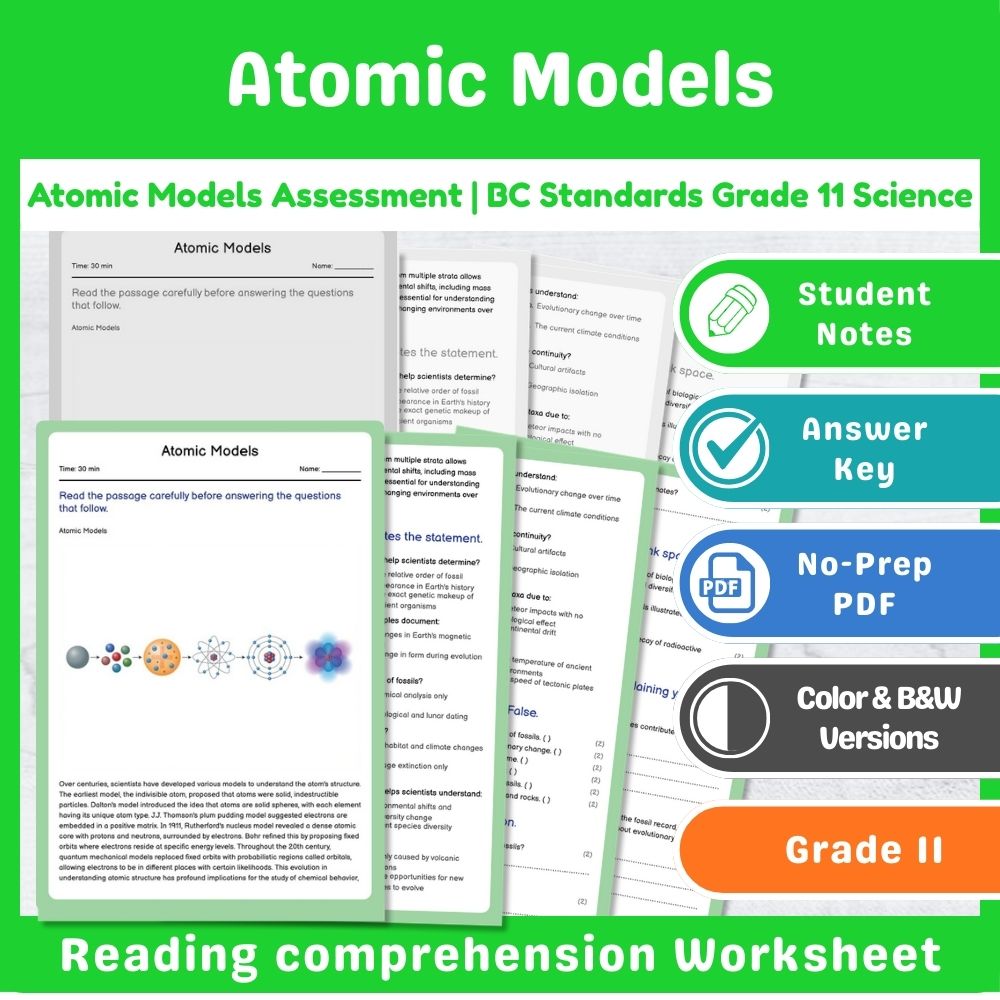
Atomic Models Assessment | BC Standards Grade 11 Science
Created byPrism Point LearningLearning Objectives
- Understand the progression of atomic models from ancient to modern theories.
- Identify key features, particles, and properties of different atomic models.
- Explain the principles of the quantum mechanical model and electron cloud concept.
Also included in: Grade 11 Science | Thermochemistry Assessment Bundle – Standards-Aligned
Instant download
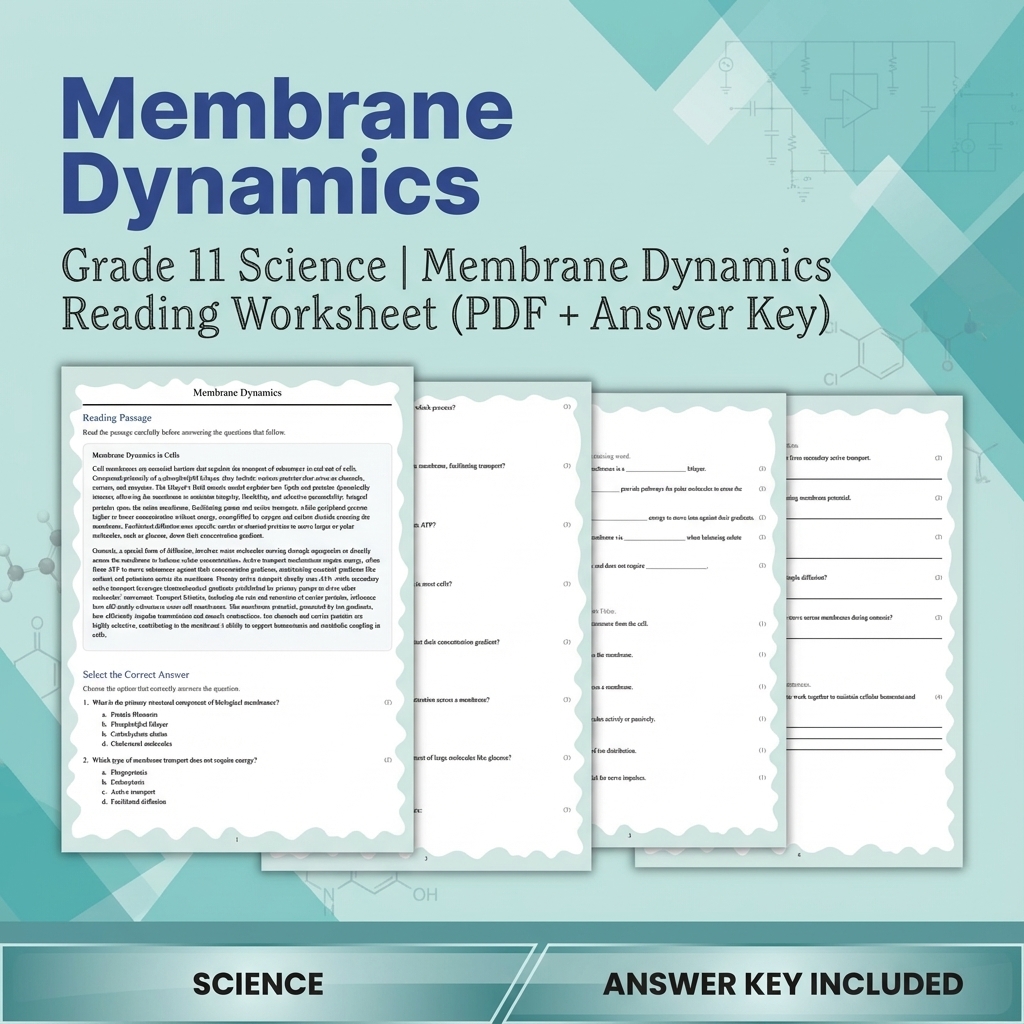
Grade 11 Science | Membrane Dynamics Reading Worksheet (PDF + Answer Key)
JCreated byJ.S SheetsLearning Objectives
- Explain the structural components and functions of biological membranes.
- Differentiate between passive and active transport mechanisms across membranes.
- Describe the processes of diffusion, facilitated diffusion, and osmosis.
Also included in: Grade 11 Science UNIT Bundle | Cellular Processes & Metabolic Pathways +1 more
Instant download

Grade 11 Introduction to the Periodic Table Worksheet | NGSS Chemistry
 Created byBRIGHT PATH RESOURCES
Learning Objectives
- Identify groups and periods in the periodic table.
- Describe the basic classification of elements.
- Understand how the periodic table is organized and its significance in chemistry.
Also included in: Matter and Its Interactions Grade 11 Science Lesson Bundle | NGSS +1 more
Instant download
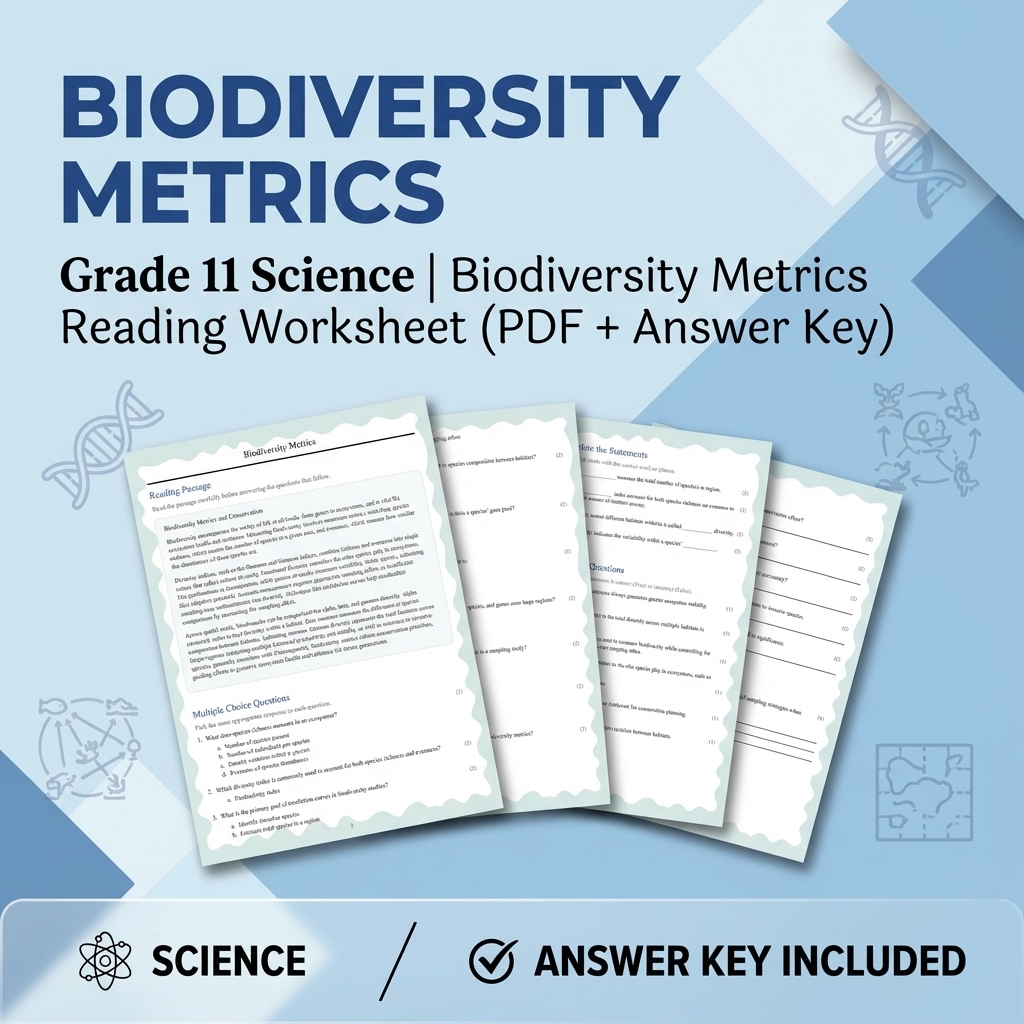
Grade 11 Science | Biodiversity Metrics Reading Worksheet (PDF + Answer Key)
JCreated byJ.S SheetsLearning Objectives
- Define and distinguish various measures of biodiversity, including species richness, evenness, and diversity indices.
- Explain sampling considerations such as sample effort and rarefaction for accurate biodiversity estimates.
- Differentiate between alpha, beta, and gamma diversity across spatial scales.
Also included in: Grade 11 Science | Ecosystem Dynamics & Sustainability Bundle (PDF + Rubric) +1 more
Instant download

Projectile Motion Worksheet | Grade 11 Science Activities
Created byPrism Point LearningLearning Objectives
- Decompose projectile motion into independent horizontal and vertical components and describe how each component evolves over time.
- Use kinematic relationships for the horizontal (constant velocity) and vertical (uniform acceleration) directions.
- Predict how changing launch angle and initial speed affects range, time of flight, and maximum height.
Also included in: Grade 11 Science Lesson Bundle — Work, Energy & Motion (BC)
Instant download
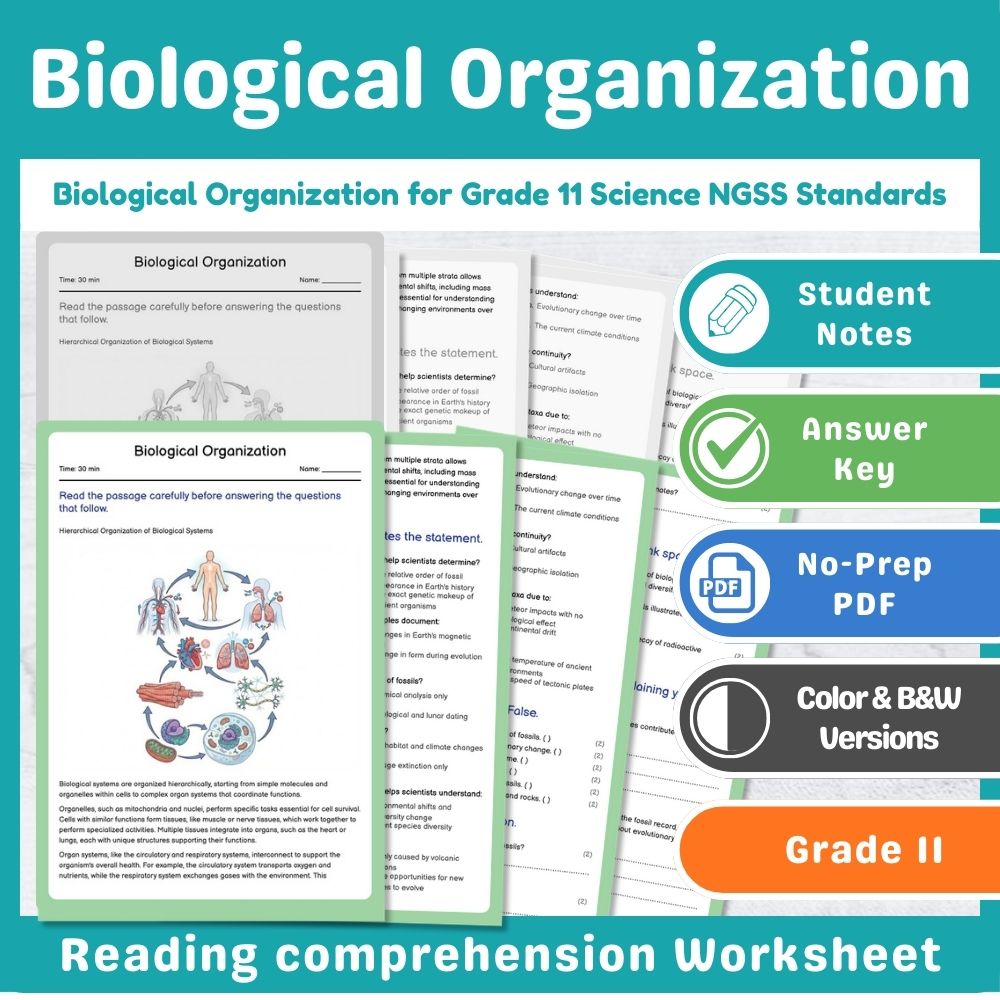
Biological Organization Assessment | NGSS Standards-Aligned Assessment Grade 11 Science
Created byPrism Point LearningLearning Objectives
- Describe the hierarchical levels of biological organization from organelles to organ systems.
- Explain how specialized cell types and tissue integration support organism functions.
- Analyze the structure of biological components and their role in system-level exchanges like nutrient transport.
Instant download
About Grade 11 Science Worksheets
Browse 6,616 printable Grade 11 Science worksheets — ready-to-print PDFs with answer keys where available.
Each resource here is built by an independent educator and reviewed for quality. Worksheets print straight from PDF and suit classroom use, homework, or extra practice; most come with answer keys, and you can preview before purchasing.