
Grade 12 Science Worksheets
4,240 worksheets
Grade 12 Science | Momentum Conservation Worksheet | BC-Aligned
 Created byLumora Learning
Learning Objectives
- Understand the principle of conservation of linear momentum in isolated systems.
- Define momentum and impulse, and explain their relationship.
- Describe center-of-mass motion and how external forces affect it.
Also included in: Grade 12 Science | Physics Custom Bundle | BC-Aligned Worksheet Set
Instant download
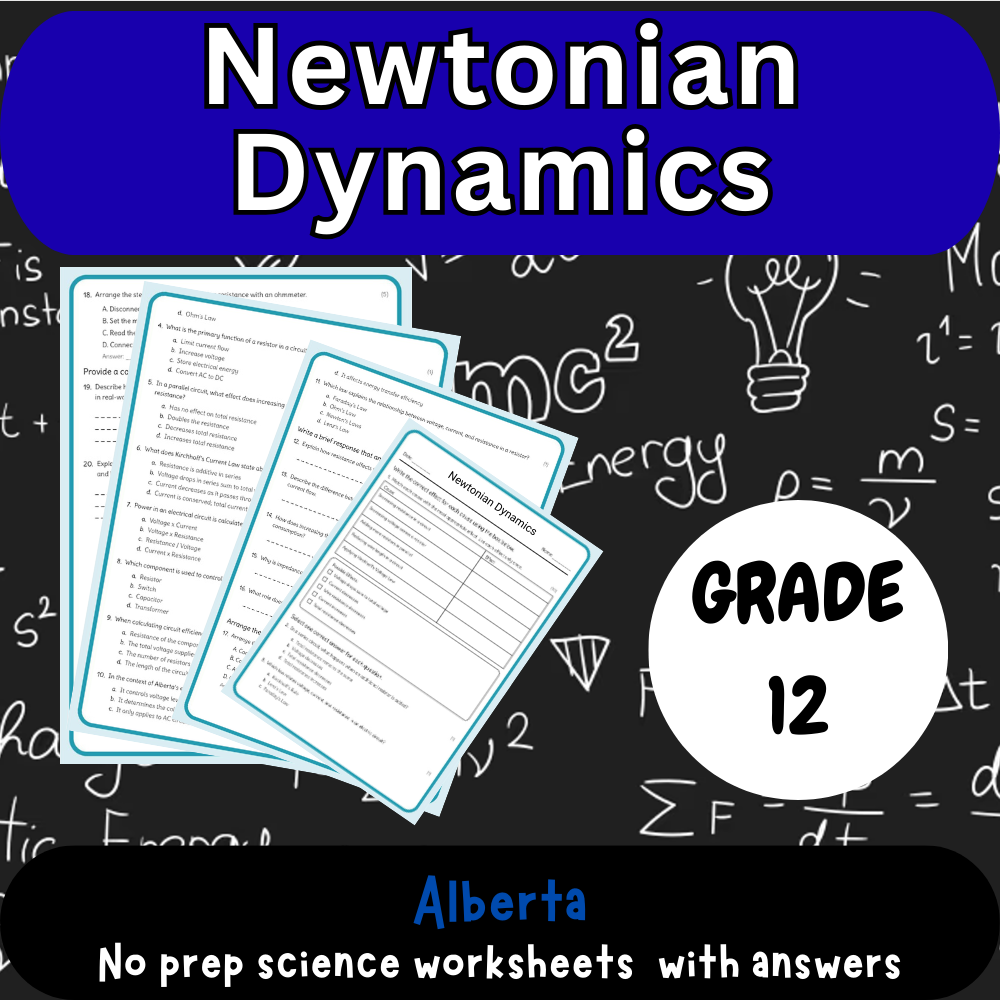
Grade 12 Science – Newtonian Dynamics Worksheet (PDF) – Alberta Standards
 Created byBright Mind Resources
Learning Objectives
- Understand and analyze the relationship between force, mass, and acceleration using Newton's second law.
- Apply free-body diagrams and net force calculations to real-world mechanical systems.
- Evaluate the effects of frictional and drag forces on motion, especially in terrestrial and industrial contexts.
Instant download

Grade 12 Science – Scientific Presentation Skills Worksheet with Answer Key
JCreated byJ.S SheetsLearning Objectives
- Understand the principles of effective oral scientific presentation.
- Identify key components of clear slide design and timing constraints.
- Recognize strategies for integrating visuals with spoken explanations.
Also included in: Grade 12 Science Lesson Group Bundle | TEKS Standards with Worksheets +1 more
Instant download

Chemical Equilibrium Worksheet | Grade 12 Science Practice
 Created byPrism Point Learning
Learning Objectives
- Explain how forward and reverse reaction rates relate to a system at chemical equilibrium.
- Use Le Chatelier’s principle to predict shifts in equilibrium when conditions change.
- Apply equilibrium-constant ideas qualitatively to compare product and reactant amounts.
Instant download

Molecular Structure Worksheet | Standards-Aligned Grade 12 Science Practice
JCreated byJ.S SheetsLearning Objectives
- Describe the double helix structure of DNA and its components.
- Explain how nucleotide bases pair through hydrogen bonds.
- Identify the role of phosphodiester bonds in DNA stability.
Also included in: Grade 12 Genetics & Evolution Science Lesson Bundle – Alberta Framework
Instant download

AC Circuits Worksheet for Grade 12 Science | Standards-Aligned Practice
JCreated byJ.S SheetsLearning Objectives
- Understand phasor representation and its application in analyzing AC circuits.
- Calculate impedance, reactance, and phase relationships in resistive, inductive, and capacitive networks.
- Evaluate power components, power factor, and energy transfer in RLC circuits.
Instant download

Grade 12 Science — Worksheet MCQ Paper for Mastering Circular Motion
 Created byThe Resource Hub
Learning Objectives
- Understand the concepts of vector change in velocity and centripetal acceleration in circular motion.
- Derive and apply equations relating speed, radius, and acceleration in uniform circular motion.
- Analyze nonuniform circular motion involving tangential acceleration.
Also included in: Grade 12 Physics Principles Bundle for AP Science Mastery +2 more
Instant download

Grade 12 Science – Resource Assessment & Geology | Daily Reading Worksheet
Created byBright Mind ResourcesLearning Objectives
- Understand the concepts of mineral reserves and resources.
- Analyze geological mapping and geophysical survey methods.
- Evaluate environmental considerations in resource extraction.
Also included in: Grade 12 Earth Systems Science Daily Reading Worksheets Lesson Bundle | BC +1 more
Instant download

Grade 12 Science — Worksheet MCQ Paper for Mastering Uncertainty Concepts
Created byThe Resource HubLearning Objectives
- Identify different sources and types of uncertainty in scientific measurements.
- Distinguish between systematic bias, random error, and conceptual model uncertainty.
- Apply exemplars like instrument drift and sampling variability to understanding uncertainty propagation.
Also included in: Grade 12 Science AP Math & Modeling MCQ Worksheets Bundle +1 more
Instant download
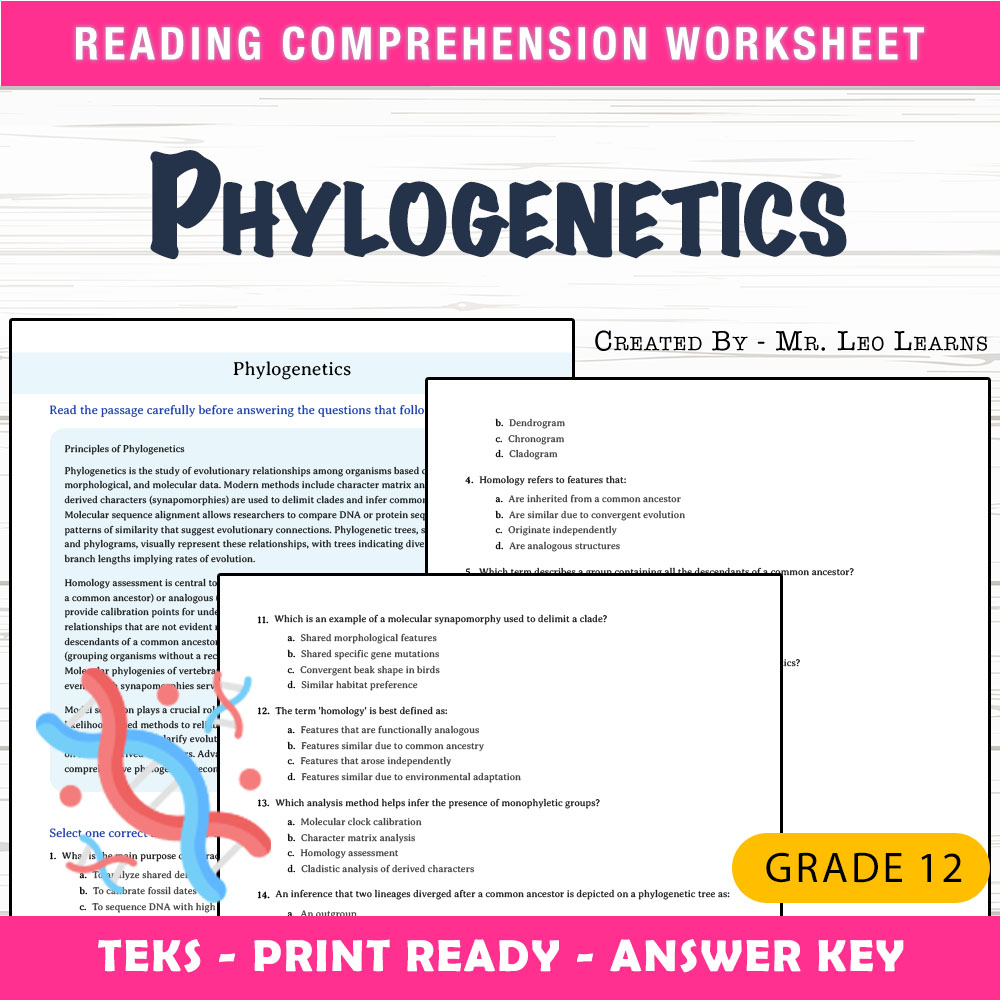
Grade 12 Science – Phylogenetics Worksheet for Mastering Evolutionary Relationships
Created byThe Resource HubLearning Objectives
- Understand the methods used for reconstructing evolutionary relationships, including character matrix analysis and molecular sequence alignment.
- Describe the concepts of homology, monophyly, paraphyly, and polyphyly in phylogenetic classification.
- Interpret phylogenetic trees such as cladograms and phylograms, and comprehend their significance in taxonomy.
Also included in: Grade 12 Science Worksheet Bundle – Genetics, Evolution & Biodiversity Mastery +1 more
Instant download

Grade 12 Science | Sea Level Change Worksheet Elena | AP Aligned
Created byLumora LearningLearning Objectives
- Understand the primary drivers of sea level variability, including thermal expansion, land-ice mass loss, and glacio-isostatic adjustment.
- Analyze how tide-gauge and satellite altimetry records are used to measure sea level changes.
- Explore methods for attributing spatial and temporal patterns of sea level change using fingerprinting techniques.
Also included in: Grade 12 Science | Earth Systems Science Custom Bundle | AP Aligned
Instant download

Evidence for Common Ancestry Worksheet | California Standards Grade 12 Science
JCreated byJ.S SheetsLearning Objectives
- Identify key types of evidence supporting common ancestry in biological evolution.
- Explain how homologous structures, fossil records, and molecular data indicate relatedness among species.
- Understand the concept of evolutionary trees and how they represent divergence from shared ancestors.
Also included in: Grade 12 Evolution and Speciation Science lesson bundle: California Standards +1 more
Instant download

Energy Flows Assessment | Alberta Standards Grade 12 Science
Created byPrism Point LearningLearning Objectives
- Understand the different forms of energy and their transformations in various systems.
- Explain the principles of energy conservation and efficiency in natural and industrial processes.
- Analyze the environmental and resource management implications of energy systems in Alberta.
Also included in: Grade 12 Science 30 Lesson Bundle: Alberta Science Assessment Pack +1 more
Instant download

Grade 12 Science – Solar System & Astronomy Overview | Daily Reading Worksheet
Created byBright Mind ResourcesLearning Objectives
- Understand the basic components of the solar system
- Describe the processes involved in the formation of planets
- Recognize the methods used to study planetary characteristics
Also included in: Grade 12 Earth & Space Science Daily Reading Worksheets Lesson Bundle | TEKS +2 more
Instant download
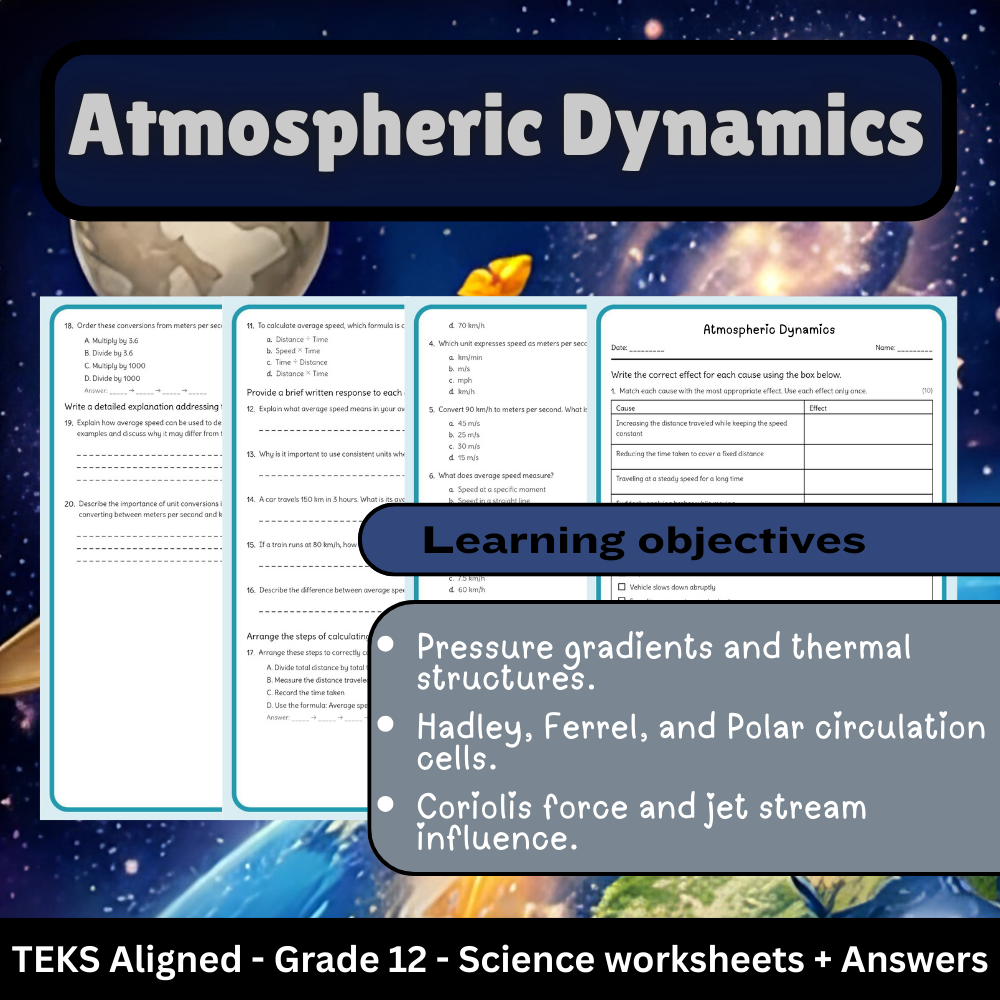
Grade 12 Science | Atmospheric Dynamics Worksheet + Answer Key (TEKS Standard)
Created byBright Mind ResourcesLearning Objectives
- Explain the causes and effects of pressure gradients and thermal structures in the atmosphere.
- Identify key atmospheric circulation patterns such as Hadley and Ferrel cells.
- Describe the influence of the Coriolis force and jet streams on weather systems.
Instant download

Grade 12 Science – Evolution Mechanisms & Biological Diversity | Worksheet
Created byBright Mind ResourcesLearning Objectives
- Understand key mechanisms driving evolution such as natural selection, genetic drift, gene flow, and mutation.
- Identify evidence supporting evolution from paleontology, anatomy, and molecular biology.
- Explain how processes like founder effects and bottlenecks influence genetic variation in populations.
Also included in: Biological Concepts Grade 12 Science Daily Reading Lesson Bundle | TEKS +2 more
Instant download

Grade 12 Science | Cell Architecture Worksheet | TEKS Aligned
Created byLumora LearningLearning Objectives
- Describe the structural features of prokaryotic and eukaryotic cells.
- Identify and explain the functions of major organelles and cytoskeletal elements.
- Compare cell sizes and the compartmentalization mechanisms in different cell types.
Also included in: Grade 12 Science | Biological Concepts Lesson Bundle | TEKS Aligned
Instant download
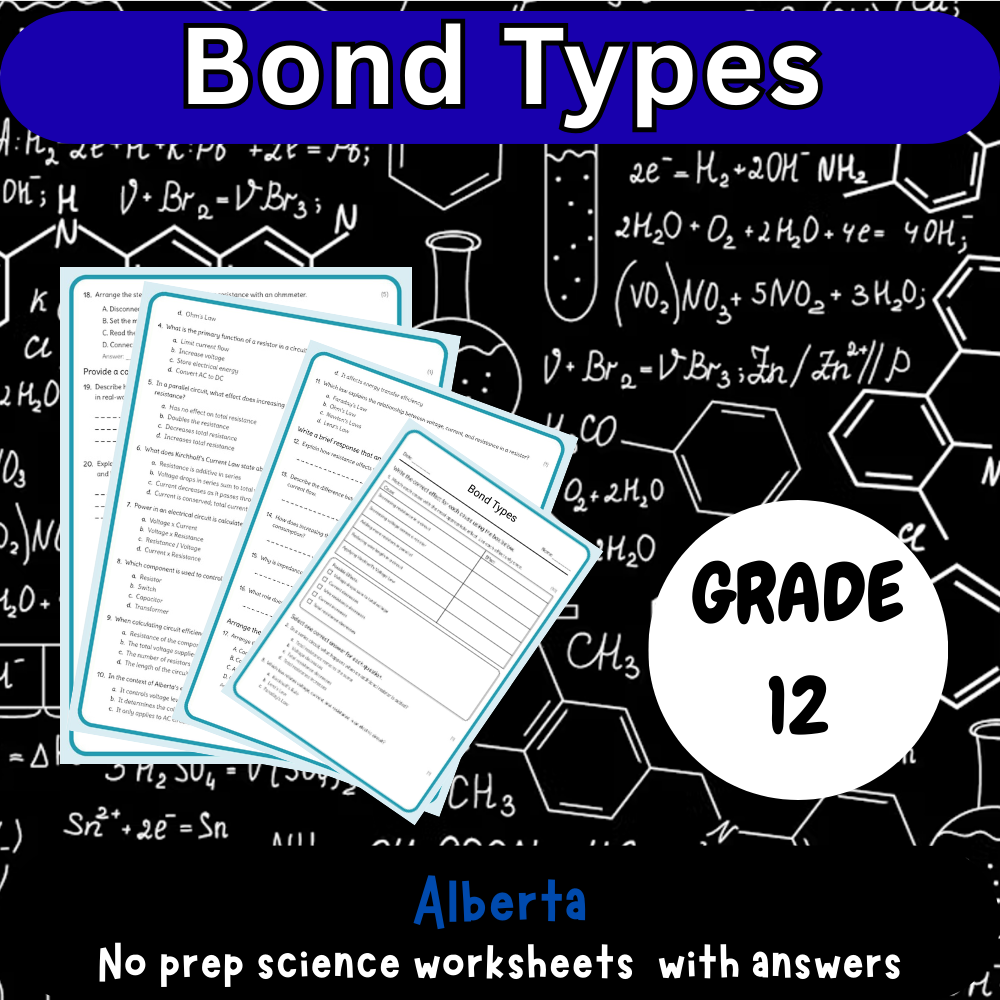
Grade 12 Science – Bond Types Worksheet (PDF) | Alberta Standards
Created byBright Mind ResourcesLearning Objectives
- Understand the differences between ionic, covalent, and metallic bonds
- Identify properties associated with each bond type
- Predict material behaviors based on bond types and bond energies
Instant download

Reasoned Claims Assessment | TEKS Grade 12 Science Standards PDF
Created byPrism Point LearningLearning Objectives
- Understand the principles of scientific reasoning and argumentation.
- Analyze evidence and formulate well-supported scientific claims.
- Evaluate competing hypotheses using logical frameworks and evidence strength.
Instant download

Tools and Instrumentation Assessment | TEKS Grade 12 Science Evaluation
Created byPrism Point LearningLearning Objectives
- Understand the role of various scientific tools and instruments in data collection and analysis.
- Compare measurement techniques such as PCR, DNA sequencing, and mass spectrometry.
- Evaluate the trade-offs involved in instrument sensitivity, specificity, and resource allocation.
Also included in: Grade 12 Science Technology and Society Science Lesson Bundle: TEKS
Instant download

Grade 12 Science – Variables & Controls in Experiments | Daily Reading Worksheet
Created byBright Mind ResourcesLearning Objectives
- Identify independent, dependent, and confounding variables in experiments.
- Understand strategies for controlling variables, including randomization and blinding.
- Interpret the role of variables control in reducing bias and improving experiment validity.
Also included in: Grade 12 Scientific Inquiry & Data Analysis Science Lesson Bundle | TEKS +2 more
Instant download

Grade 12 Science | Reaction Types in Chemistry - Daily Reading Comprehension
 Created byCoral Reef Learning
Learning Objectives
- Identify and describe synthesis reactions.
- Recognize characteristic patterns of synthesis reactions.
- Understand how synthesis reactions contribute to chemical change.
Also included in: Chemistry 30 Reading Comprehension Lesson Bundle – Grade 12 Science Alberta +1 more
Instant download

Grade 12 Science – Energy Transfer & Losses | Daily Reading Worksheet
Created byBright Mind ResourcesLearning Objectives
- Understand the concept of energy transfer and energy losses
- Identify different types of energy transformation in devices
- Explain why no energy conversion process is 100% efficient
Also included in: Energy Grade 12 Science Daily Reading Worksheets Lesson Bundle | CA Standards +1 more
Instant download

Grade 12 Science – Environmental Monitoring & Data Collection | Worksheet
Created byBright Mind ResourcesLearning Objectives
- Understand the fundamental principles of environmental monitoring network design
- Identify key indicators used in assessing watershed health and air quality
- Appreciate the importance of sampling strategies and data quality assurance
Also included in: Grade 12 Environmental & STSE Science Daily Reading Lesson Bundle | Alberta +1 more
Instant download

Grade 12 Science — Worksheet MCQ Paper for Mastering Energy Pathways
Created byThe Resource HubLearning Objectives
- Understand the mechanisms of energy transfer in Earth systems, including radiation, conduction, convection, and latent heat.
- Relate energy pathways to weather patterns, ocean currents, and geothermal heat flow.
- Apply quantitative reasoning to simple energy budgets, flux diagrams, and block models.
Also included in: Grade 12 Science AP Custom Bundle: Earth Systems, Climate, and Tectonics +1 more
Instant download

Grade 12 Science Inheritance Patterns Worksheet – General Standards (PDF)
 Created byEvergreen Desk Education
Learning Objectives
- Explain how chromosome segregation during meiosis leads to allele combinations in gametes and offspring.
- Use Punnett-square reasoning to predict genotype and phenotype probabilities from parental alleles.
- Differentiate dominance/recessiveness relationships between genotype and phenotype in inheritance patterns.
Also included in: Grade 12 Genetics & Evolution Science Lesson Bundle, General Framework +1 more
Instant download

Grade 12 Science – Cycle Dynamics & Nutrient Pathways | Daily Reading Worksheet
Created byBright Mind ResourcesLearning Objectives
- Understand the main pathways and reservoirs involved in the carbon and nitrogen cycles.
- Identify how these cycles interact with different environmental systems such as atmosphere, biosphere, hydrosphere, and lithosphere.
- Explore human impacts on nutrient fluxes, including fossil fuel combustion and fertilizer runoff.
Also included in: Sustainability Grade 12 Science Daily Reading Worksheets Bundle | TEKS +2 more
Instant download

Grade 12 Science – Understanding Atomic Models | Daily Reading Worksheet
Created byBright Mind ResourcesLearning Objectives
- Identify different atomic models from history and science.
- Describe features of Dalton's billiard ball model, Thompson's plum pudding model, Rutherford's nuclear model, and Bohr's planetary model.
- Understand how atomic models relate to atomic structure, isotopes, and real-world applications.
Also included in: Grade 12 Chemistry Daily Reading Worksheets Lesson Bundle | Alberta Science +1 more
Instant download

Radioactive Decay Dating Worksheet | Grade 12 Earth Science NGSSS
Created byPrism Point LearningLearning Objectives
- Explain how radioactive decay can be used to estimate absolute ages of rocks and other materials.
- Connect half-life, parent isotope remaining fraction, and daughter product amount to decay dating calculations.
- Evaluate the assumptions and limitations of radioactive dating compared with relative dating.
Also included in: Earth and Space Science Lesson Bundle | Grade 12 Science | Florida NGSSS
Instant download

Grade 12 Science – Electromagnetic Induction & Magnetic Fields | Worksheet
Created byBright Mind ResourcesLearning Objectives
- Understand the concept of electromagnetic induction and Faraday's law.
- Identify sources of magnetic fields and their properties.
- Explain the operation of generators, transformers, and inductors.
Also included in: Grade 12 Physics Energy & Fields Science Lesson Bundle: Daily Reading | BC +1 more
Instant download

Grade 12 Science — Worksheet MCQ Paper for Mastering Periodic Patterns
Created byThe Resource HubLearning Objectives
- Understand how effective nuclear charge, atomic radius, ionization energy, and electronegativity vary across the periodic table.
- Relate periodic trends to electronic structure and observable properties such as metallic character and reactivity.
- Use tabular and graphical data to predict element behavior and properties.
Also included in: Grade 12 Science AP Practice Worksheets Bundle for Mastering Core Concepts +2 more
Instant download
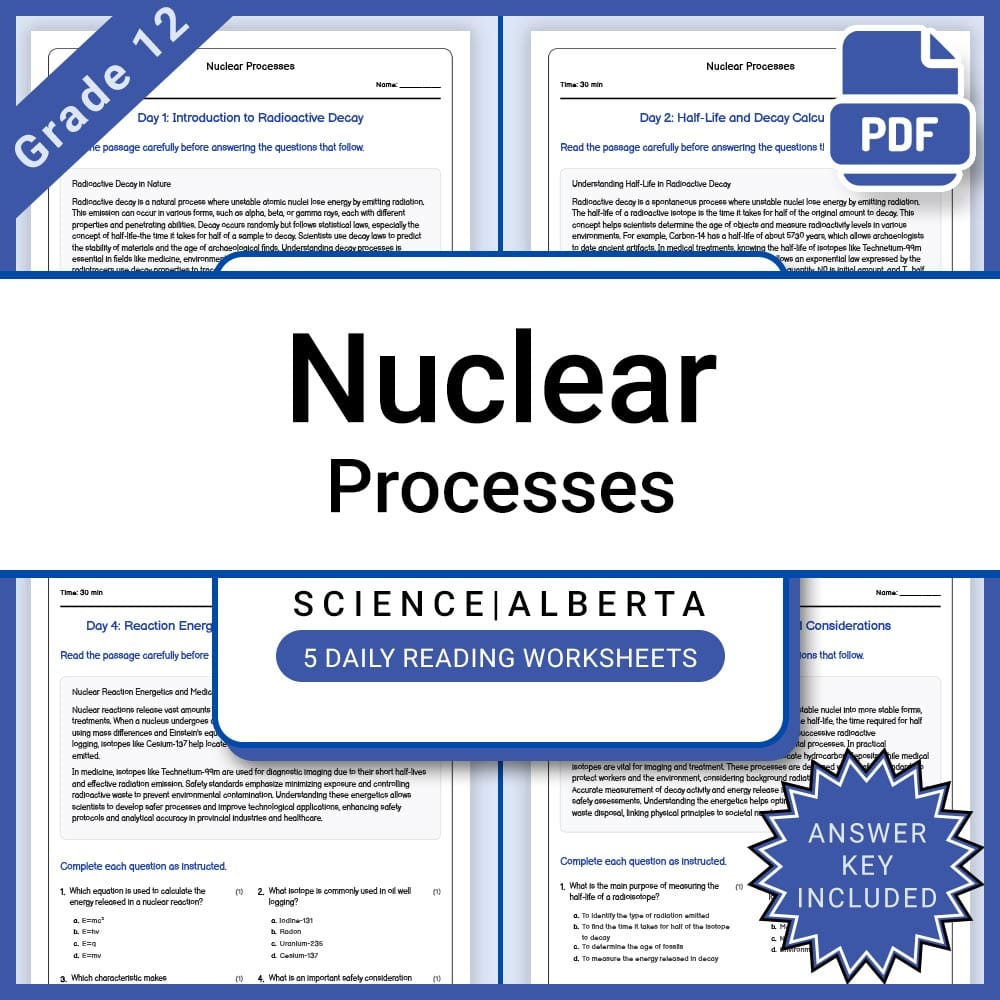
Grade 12 Science – Nuclear Processes Daily Reading Worksheet with Answer Key
JCreated byJ.S SheetsLearning Objectives
- Understand the principles of radioactive decay and decay laws
- Identify key concepts related to nuclear reactions and conservation of nucleon number
- Apply decay calculations to practical scenarios such as radiotracing and energy release
Also included in: Grade 12 Science Lesson Bundle | Physics, Nuclear, Waves & Circuits +1 more
Instant download

Matter and Energy Cycling in Ecosystems Worksheets Grade 12
 Created byBRIGHT PATH RESOURCES
Learning Objectives
- Explain how energy flows through ecosystems
- Describe how matter cycles through the biosphere
- Explain photosynthesis in carbon and nutrient cycling
Also included in: Grade 12 Science Genetics & Evolution Worksheets Lesson Bundle +4 more
Instant download

Grade 12 Science – Understanding Endothermic Processes | Daily Reading Worksheet
Created byBright Mind ResourcesLearning Objectives
- Define endothermic reactions and distinguish them from exothermic reactions.
- Explain how energy absorption affects reactants and products during chemical reactions.
- Interpret energy profiles to analyze whether products are more or less energetic than reactants.
Also included in: Physical Science Grade 12 Science Worksheets Lesson Bundle | Florida NGSSS +1 more
Instant download

Grade 12 Science Worksheet | Phase Change Heat (PDF) for Standards
Created byEvergreen Desk EducationLearning Objectives
- Explain why temperature can stay constant during a phase change even as energy is added or removed.
- Interpret a heating curve to identify melting and boiling plateaus and relate them to energy input.
- Use the particle model to describe how particle spacing and interactions change from solid to liquid to gas.
Also included in: Grade 12 General Science Worksheet Lesson Bundle: Models, Waves, Energy (General) +1 more
Instant download

Grade 12 Science – Tools & Instrumentation Daily Reading Worksheet + Answer Key
JCreated byJ.S SheetsLearning Objectives
- Understand the role of various scientific instruments such as PCR, DNA sequencers, mass spectrometers, remote sensing satellites, and medical imaging modalities.
- Learn how measurement precision, calibration, and data analysis influence scientific hypotheses and conclusions.
- Recognize the trade-offs between sensitivity, specificity, resource constraints, and their impact on scientific methodology.
Also included in: Grade 12 Science Lesson Group TEKS Bundle | Daily Reading Worksheets +1 more
Instant download

Grade 12 Science – Dynamics of Systems & AP Daily Reading Worksheet
Created byBright Mind ResourcesLearning Objectives
- Understand fundamental concepts of multi-body systems with constraints.
- Distinguish between different types of internal forces such as tension and normal force.
- Apply Newton’s laws to analyze interconnected components in pulley and rigid-body systems.
Also included in: AP Science Grade 12 Daily Reading Worksheets Lesson Bundle | AP +2 more
Instant download

Grade 12 Science | Environmental Policy Tradeoffs Worksheet | TEKS-Aligned
Created byLumora LearningLearning Objectives
- Understand the tradeoffs involved in policy decisions related to mitigation, adaptation, conservation, and socio-economic objectives.
- Apply cost-benefit reasoning, multi-criteria decision analysis, and scenario modeling in policy analysis.
- Evaluate case studies on emissions regulation, land-use planning, and water allocation to assess their environmental and social impacts.
Instant download

Replication Processes Worksheet | Standards-Aligned Science Practice Grade 12
JCreated byJ.S SheetsLearning Objectives
- Describe the semi-conservative mechanism of DNA replication.
- Identify the roles of enzymes such as helicase, primase, and DNA polymerase.
- Explain the importance of replication fidelity, proofreading, and repair mechanisms.
Also included in: Grade 12 Genetics & Evolution Science Lesson Bundle – Alberta Framework
Instant download

Grade 12 Science – Electron Configuration Daily Worksheet with Answer Key
JCreated byJ.S SheetsLearning Objectives
- Understand the concept of quantum numbers and their significance in electron distribution.
- Learn how electrons fill orbitals according to the Aufbau principle, Pauli exclusion principle, and Hund’s rule.
- Identify and interpret orbital diagrams and standard electron configurations for elements.
Also included in: Grade 12 Science Lesson Group Bundle | TEKS Standards +1 more
Instant download

Regulatory Networks Worksheet | Standard-Aligned Science Practice for Grade 12
JCreated byJ.S SheetsLearning Objectives
- Understand the components and functions of regulatory networks in gene expression.
- Describe how epigenetic modifications influence gene activity.
- Analyze examples of regulatory networks in Alberta's ecological and agricultural contexts.
Also included in: Grade 12 Genetics & Evolution Science Lesson Bundle – Alberta Framework
Instant download

Grade 12 Science | Orbital Mechanics Worksheet | TEKS-Aligned
Created byLumora LearningLearning Objectives
- Understand the fundamental principles of gravitational dynamics and Keplerian motion.
- Analyze how orbital parameters such as eccentricity, inclination, and semimajor axis influence planetary and satellite systems.
- Apply formulas for escape velocity, orbital energy, and perturbation effects through quantitative problems.
Also included in: Grade 12 Science | Earth and Space Science Lesson Bundle | TEKS Aligned
Instant download

Grade 12 Science | Wave Behaviour - Daily Reading Comprehension
Created byCoral Reef LearningLearning Objectives
- Identify different types of waves and their characteristics
- Understand properties such as wavelength, frequency, amplitude, and speed
- Apply quantitative models to describe wave propagation
Also included in: Physics 30 Lesson Bundle – Grade 12 Science Alberta Daily Reading Comprehension +1 more
Instant download

Grade 12 Science – Graphical Literacy Worksheet (AP Standards) (PDF)
Created byEvergreen Desk EducationLearning Objectives
- Interpret scatter plots, residual plots, histograms, and log–log axes to identify trends and anomalies in scientific data.
- Choose appropriate scales and transformations (including log scales) to improve linearity and interpret parameters correctly.
- Evaluate goodness of fit qualitatively and quantitatively and connect graphical evidence to model selection and uncertainty communication.
Also included in: Grade 12 Science Practices Science Lesson Bundle for AP +1 more
Instant download

Grade 12 Science — Worksheet MCQ Paper for Mastering Plate Tectonics
Created byThe Resource HubLearning Objectives
- Explain the mechanisms of lithospheric motion at divergent, convergent, and transform boundaries.
- Interpret seismicity, volcanic distributions, and mantle convection models to understand tectonic processes.
- Use plate reconstructions, bathymetric maps, and earthquake focal mechanisms to analyze past and present crustal configurations.
Also included in: Grade 12 Science AP Custom Bundle: Earth Systems, Climate, and Tectonics +2 more
Instant download

Communication Conventions Assessment | General Grade 12 Science Standards
Created byPrism Point LearningLearning Objectives
- Use significant figures appropriately when reporting experimental measurements.
- Apply correct scientific units and labeled diagrams to improve clarity and reproducibility.
- Present data using organized tables and graphs while using consistent scientific terminology.
Instant download

Grade 12 Science | Plate Tectonics Worksheet | TEKS-Aligned
Created byLumora LearningLearning Objectives
- Understand the mechanisms driving plate movements such as mantle convection and isostasy.
- Identify different types of plate boundaries and the geologic features they produce.
- Explain how geologic evidence, including radiometric dating, stratigraphy, and seismic tomography, reconstructs Earth's geologic history.
Also included in: Grade 12 Science | Earth and Space Science Lesson Bundle | TEKS Aligned
Instant download

Grade 12 Science | Electromagnetic Waves - Daily Reading Comprehension
Created byCoral Reef LearningLearning Objectives
- Identify different types of electromagnetic waves based on their properties
- Understand the spectrum of electromagnetic radiation
- Relate wavelength, frequency, and energy for various electromagnetic waves
Also included in: Physics 30 Lesson Bundle – Grade 12 Science Alberta Daily Reading Comprehension +1 more
Instant download
About Grade 12 Science Worksheets
Explore Grade 12 Science worksheets for classwork, homework, or review. Our 4,240 printables download instantly as PDFs.
MyTeachingSheets worksheets are made by real teacher-authors and checked before they go live. Download any as a print-ready PDF for lessons, homework, or independent practice — most include answer keys, and previews are always free.