
Grade 12 Science Worksheets
4,240 worksheets
Grade 12 Science | Field Concepts Worksheet | BC-Aligned
 Created byLumora Learning
Learning Objectives
- Understand the concept of fields as spatial distributions that exert forces.
- Describe how gravitational and electric fields are vector fields assigning force per unit mass or charge.
- Explain the significance of field lines and the superposition principle for multiple sources.
Also included in: Grade 12 Science | Physics Custom Bundle | BC-Aligned Worksheet Set
Instant download

Hierarchical Cell Systems Worksheet | Science Practice Grade 12
JCreated byJ.S SheetsLearning Objectives
- Understand the levels of organization in multicellular organisms from cells to organ systems.
- Describe the functions and structures at each level of biological organization.
- Explain how interactions between levels contribute to organism health and response.
Also included in: Grade 12 Evolution and Speciation Science lesson bundle: California Standards +1 more
Instant download

Grade 12 Science | Genomic Technologies - Daily Reading Comprehension
 Created byCoral Reef Learning
Learning Objectives
- Understand the basic molecular techniques used in genetics such as PCR, DNA sequencing, and recombinant DNA.
- Learn the mechanisms behind amplification and readout technologies.
- Identify different cloning vectors and their applications.
Also included in: Grade 12 Science Daily Reading Worksheets Full-Year Bundle | TEKS
Instant download

Grade 12 Science | Intermolecular Forces - Daily Reading Comprehension
Created byCoral Reef LearningLearning Objectives
- Define dispersion forces, dipole–dipole interactions, and hydrogen bonding.
- Explain how these forces influence molecular properties such as boiling point and vapor pressure.
- Identify factors like molecular size, shape, and polarity that affect intermolecular strength.
Also included in: Chemistry Foundations Lesson Bundle | Grade 12 Science AP +1 more
Instant download
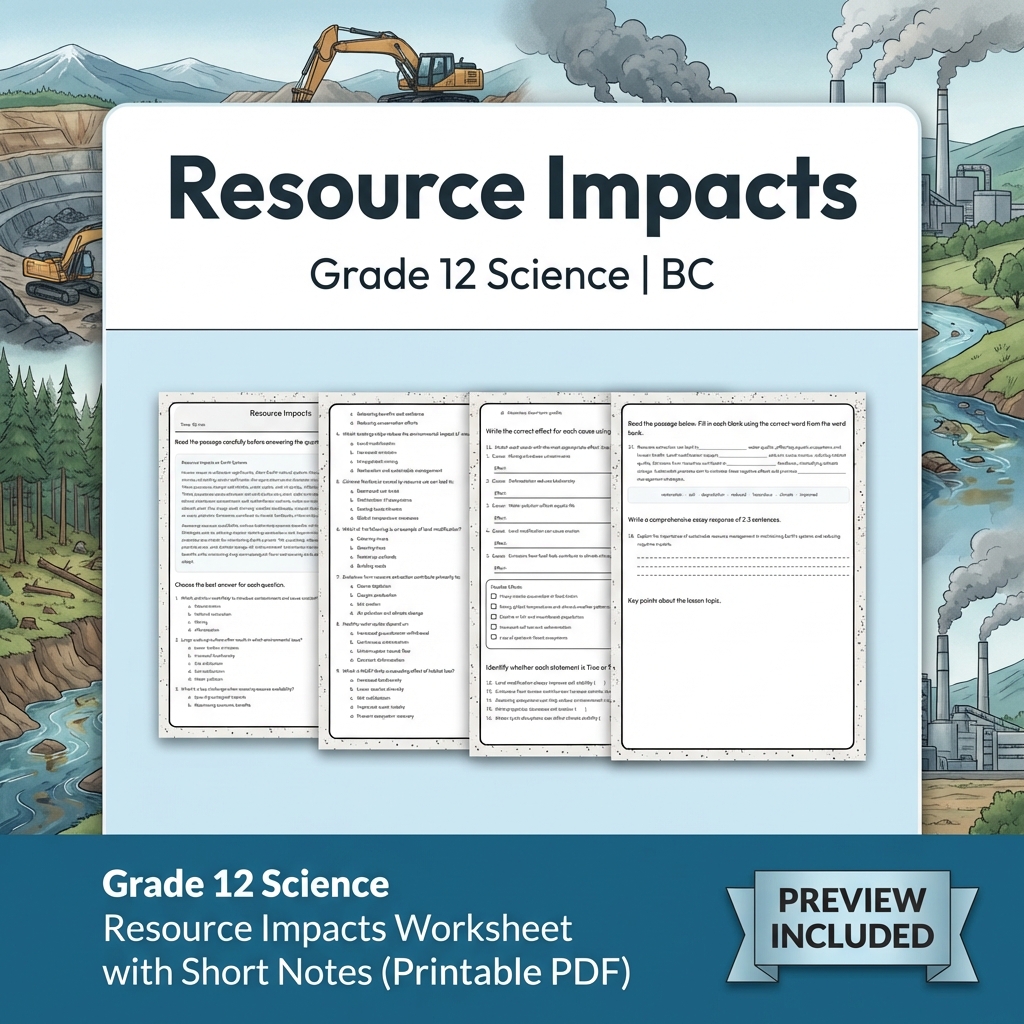
Grade 12 Science Resource Impacts Worksheet with Short Notes (Printable PDF)
 Created byMeadowlark Worksheets
Learning Objectives
- Understand how human resource use affects Earth's systems through extraction and land modification.
- Identify environmental impacts of mining, agriculture, and hydrocarbon production.
- Evaluate trade-offs between resource benefits and ecosystem resilience.
Also included in: Grade 12 Science Lesson Bundle | Earth Systems & Plate Tectonics Worksheets +1 more
Instant download

Activation Energy and Catalysts Worksheets for Grade 12 Science
 Created byBRIGHT PATH RESOURCES
Learning Objectives
- Explain activation energy using reactants and the transition state
- Describe how catalysts change activation energy pathways
- Compare catalyzed and uncatalyzed energy profiles
Also included in: Grade 12 Science Chemical Reactions, Waves & Energy Worksheets Bundle +4 more
Instant download

Grade 12 Science – Genetic Molecules & DNA Replication | Daily Reading Worksheet
 Created byBright Mind Resources
Learning Objectives
- Understand the structure of DNA and RNA molecules
- Identify the components and bonding patterns in nucleic acids
- Describe the significance of base pairing in genetic information
Also included in: Grade 12 Evolution & Population Change Science Daily Reading Lesson Bundle | AP +2 more
Instant download

Grade 12 Science | Public Messaging in Science - Daily Reading Comprehension
Created byCoral Reef LearningLearning Objectives
- Understand the importance of translating complex scientific data into accessible language
- Identify key elements of effective science communication to the general public
- Recognize ethical considerations in public scientific messaging
Also included in: Grade 12 Science Daily Reading Worksheets Full-Year Bundle | TEKS
Instant download

Grade 12 Science – Ecosystem Interactions & Food Webs Daily Reading Worksheet
Created byBright Mind ResourcesLearning Objectives
- Understand the components of food webs and their significance in ecosystems
- Analyze different types of species interactions such as predation, competition, and mutualism
- Evaluate how changes in one species can impact the entire ecosystem
Also included in: Genetics & Evolution Grade 12 Science Daily Reading Worksheets Bundle | General +1 more
Instant download
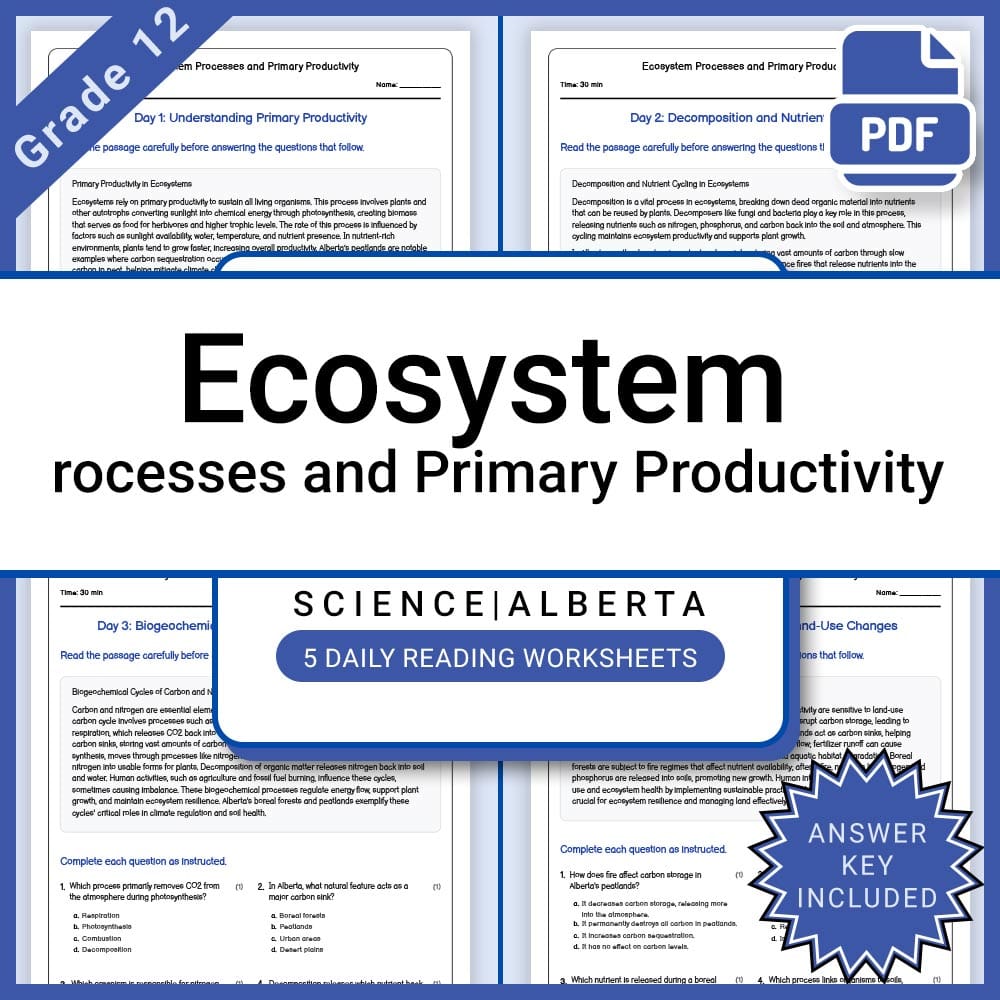
Grade 12 Science – Ecosystem Processes Daily Reading Worksheet + Answer Key
JCreated byJ.S SheetsLearning Objectives
- Understand the concept of primary productivity in ecosystems.
- Analyze how light and nutrients influence plant growth.
- Describe biogeochemical cycles of carbon, nitrogen, and phosphorus.
Also included in: Grade 12 Science Lesson Bundle | Daily Reading Worksheets +1 more
Instant download

Biotech Applications Worksheet | Standards-Aligned Grade 12 Science Practice
JCreated byJ.S SheetsLearning Objectives
- Understand key biotechnological methods used in agriculture, diagnostics, and environmental cleanup.
- Identify ethical, regulatory, and socioeconomic considerations in biotech deployment.
- Explain genetic improvement strategies for crop resilience.
Instant download

Biotechnology Overview Worksheet | Grade 12 Science Practice
 Created byPrism Point Learning
Learning Objectives
- Explain how biotechnology techniques such as recombinant DNA, PCR, DNA sequencing, and genome editing work at a high level.
- Describe real-world applications of biotechnology in medicine, agriculture, and industry.
- Evaluate benefits and risks of biotechnological advances using ethical and environmental considerations.
Also included in: Evolution, Speciation & Genetics Lesson Bundle | Grade 12 Science | BC
Instant download

Solar Energy Balance Assessment | NGSSS Standards Grade 12 Science
Created byPrism Point LearningLearning Objectives
- Explain how incoming solar radiation and outgoing infrared radiation determine Earth’s energy balance
- Describe how radiation, conduction, and convection redistribute energy within the Earth system
- Interpret how latitude and surface properties (including albedo) influence heating and temperature
Also included in: Grade 12 Science Assessment Lesson Bundle: Florida NGSSS Standards +1 more
Instant download
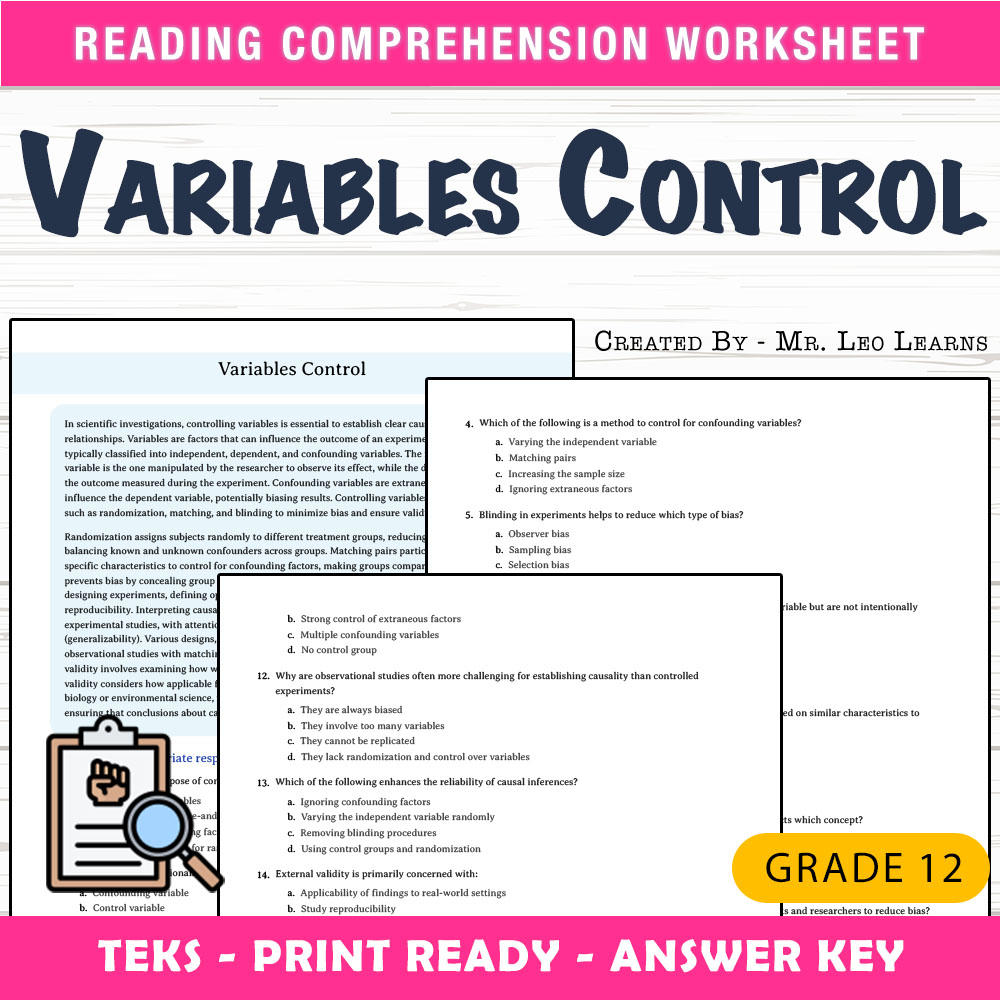
Grade 12 Science – Variables Control MCQ Worksheet for Mastery
 Created byThe Resource Hub
Learning Objectives
- Identify and differentiate between independent, dependent, and confounding variables in experimental design.
- Understand strategies for controlling variables, including randomization, matching, and blinding.
- Interpret causal inferences within observational and controlled contexts, evaluating internal and external validity.
Also included in: Grade 12 Science Worksheet Bundle | Scientific Inquiry & Data Analysis Mastery +1 more
Instant download

Grade 12 Science | Wave Reflection and Refraction Worksheet (PDF)
 Created byEvergreen Desk Education
Learning Objectives
- Explain how reflection and refraction occur when waves meet boundaries between media with different properties
- Use wave behavior principles to predict changes in direction, speed, wavelength, and frequency
- Interpret real-world examples (echoes and light bending) using reflection and refraction models
Also included in: Grade 12 General Science Worksheet Lesson Bundle: Models, Waves, Energy (General) +1 more
Instant download

Grade 12 Science – Materials Selection & Properties | Daily Reading Worksheet
Created byBright Mind ResourcesLearning Objectives
- Understand key material properties such as strength, toughness, and corrosion resistance.
- Learn how these properties influence material choices for different applications.
- Analyze the trade-offs involved in selecting materials like aluminum, steel, and polymers.
Also included in: Engineering Design Grade 12 Science Daily Reading Worksheets Bundle | General +1 more
Instant download
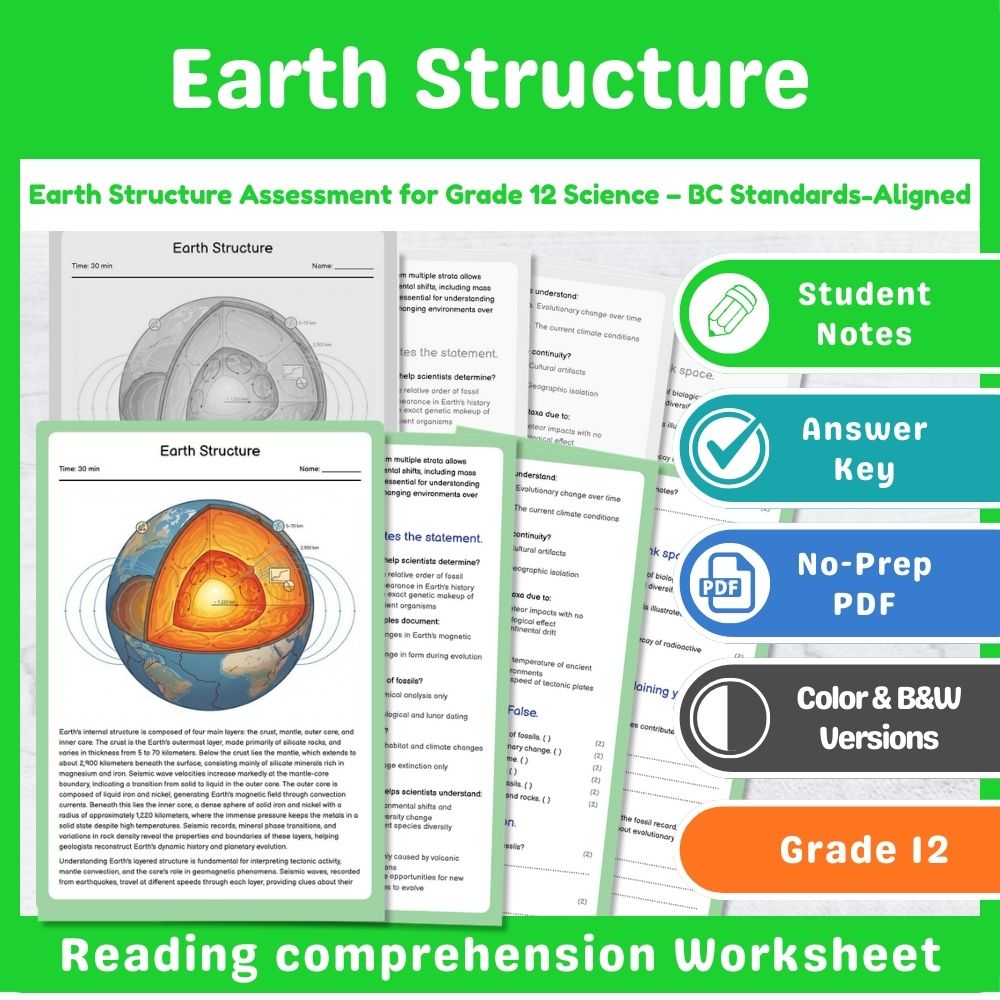
Earth Structure Assessment for Grade 12 Science – BC Standards-Aligned
Created byPrism Point LearningLearning Objectives
- Describe the main layers of Earth's internal structure and their characteristics.
- Interpret seismic data to identify boundaries between Earth's layers.
- Explain how seismic wave variations provide evidence for Earth's composition and movement.
Also included in: Grade 12 Science Mini Bundle – Plate Tectonics & Geoscience Assessment
Instant download

Grade 12 Science | Kinematics & Vectors - Daily Reading Comprehension
Created byCoral Reef LearningLearning Objectives
- Understand the concept of vectors and their components in kinematics.
- Learn how to represent displacement, velocity, and acceleration as vectors.
- Interpret vector diagrams and perform vector decomposition.
Also included in: Physics 30 Lesson Bundle – Grade 12 Science Alberta Daily Reading Comprehension +1 more
Instant download

Grade 12 Science | Wave Models & Properties - Daily Reading Comprehension
Created byCoral Reef LearningLearning Objectives
- Understand and define key wave parameters: wavelength, frequency, amplitude, period, and propagation speed.
- Distinguish between transverse and longitudinal waves.
- Explain the concepts of superposition, interference, and dispersion.
Instant download

Grade 12 Science | Atomic Spectra - Daily Reading Comprehension
Created byCoral Reef LearningLearning Objectives
- Understand the concept of atomic spectra and their significance in chemistry and physics.
- Recognize the different types of spectral lines produced by electronic transitions.
- Analyze spectral patterns for element identification and characterization.
Also included in: Chemistry 30 Reading Comprehension Lesson Bundle – Grade 12 Science Alberta +1 more
Instant download

Grade 12 Science | Speciation Modes - Daily Reading Comprehension
Created byCoral Reef LearningLearning Objectives
- Understand the concept of speciation and reproductive isolation
- Identify different mechanisms of speciation: allopatric, sympatric, and peripatric
- Recognize factors contributing to speciation such as barriers, divergence, and founder events
Also included in: Biology 30 Reading Comprehension Skills Lesson Bundle – Grade 12 Science Alberta +1 more
Instant download

Grade 12 Science | Projectile Motion in Science - Daily Reading Comprehension
Created byCoral Reef LearningLearning Objectives
- Understand the components of projectile motion using vectors
- Analyze the independence of horizontal and vertical motions
- Apply parametric equations to describe projectile trajectories
Also included in: Daily Reading Comprehension Skills Lesson Bundle | Grade 12 Science AP +1 more
Instant download

Grade 12 Phase Change Heat Worksheet | Practice & Review PDF
 Created byClear Sky Classroom
Learning Objectives
- Explain how heating during a phase change can increase particle spacing and interactions without changing temperature.
- Interpret heating curves to identify melting/boiling plateaus and relate them to latent heat.
- Use the particle model to describe particle behavior during solid–liquid–gas transitions.
Instant download

Grade 12 Science – Periodic Trends & Atomic Properties | Daily Reading Worksheet
Created byBright Mind ResourcesLearning Objectives
- Identify and describe key periodic properties such as atomic radius, ionization energy, electronegativity, and effective nuclear charge.
- Explain how electronic structure influences observable chemical behaviors across the periodic table.
- Interpret tabular and graphical data representing periodic trends.
Also included in: Grade 12 Chemistry Daily Reading Science Lesson Bundle | AP Standards +2 more
Instant download

Grade 12 Science | Resource Management in Science - Daily Reading Comprehension
Created byCoral Reef LearningLearning Objectives
- Identify common renewable resources and analyze their role in sustainability
- Evaluate the advantages and limitations of renewable energy sources
- Understand water budgeting and water resource management strategies
Also included in: Grade 12 Science Daily Reading Worksheets Full-Year Bundle | TEKS
Instant download

Momentum Collisions Worksheet | Grade 12 Science | Florida NGSSS
JCreated byJ.S SheetsLearning Objectives
- Explain momentum as a vector quantity and use direction in collision analysis
- Apply conservation of momentum to predict post-collision velocities when net external force is zero
- Differentiate elastic and inelastic collisions using kinetic energy changes while momentum remains conserved
Also included in: Grade 12 Energy, Motion, and Reaction Rates Science Lesson Bundle +1 more
Instant download
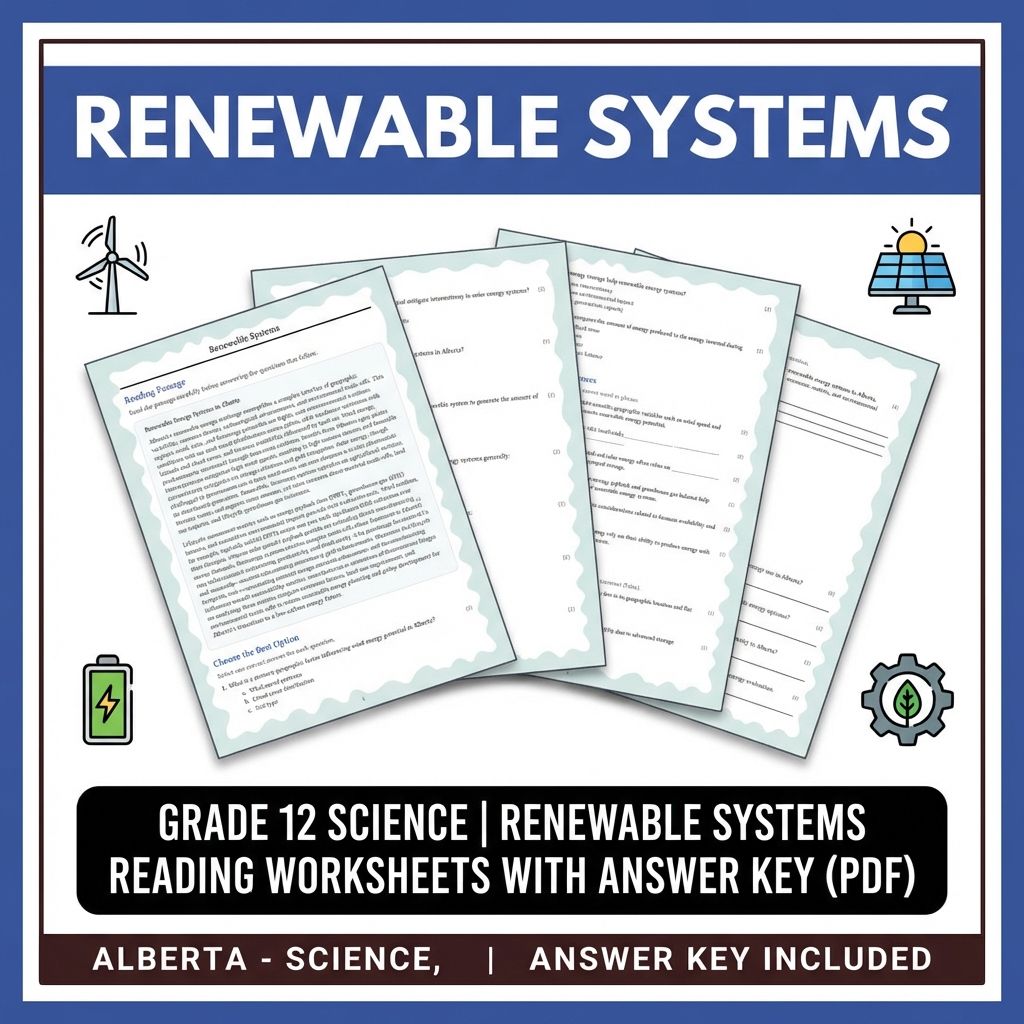
Grade 12 Science | Renewable Systems Reading Worksheets with Answer Key (PDF)
JCreated byJ.S SheetsLearning Objectives
- Understand geographic variability and resource assessment methods for renewable energy sources in Alberta.
- Identify conversion technologies and their integration challenges within renewable energy systems.
- Evaluate lifecycle considerations, environmental metrics, and trade-offs associated with wind, solar, and bioenergy options.
Also included in: Grade 12 Science Bundle | Environmental and Technical Concepts (Worksheet Pack) +1 more
Instant download

Grade 12 Science | Human Biodiversity Impacts Worksheet | California Standards
Created byLumora LearningLearning Objectives
- Understand how human actions influence biodiversity and ecosystem stability.
- Identify specific land use, pollution, and invasive species impacts on ecological communities.
- Explain cause-and-effect relationships between disturbances and ecological outcomes.
Instant download

Centripetal Motion Assessment | Florida NGSSS Grade 12 Science
Created byPrism Point LearningLearning Objectives
- Explain how centripetal acceleration arises from a net inward force even when speed is constant.
- Use the relationship among centripetal acceleration, speed, and radius to predict changes in motion.
- Interpret how forces such as gravity provide the centripetal force in orbits and rotating systems.
Also included in: Grade 12 Momentum, Energy, and Reactions Science Assessment Lesson Bundle – Florida NGSSS +1 more
Instant download

Instrumentation Use Worksheet | Grade 12 Science TEKS Practice
Created byPrism Point LearningLearning Objectives
- Select appropriate sensors and measurement systems by considering calibration needs, resolution limits, and interfacing requirements.
- Explain how sampling rate affects measured signals, including the role of aliasing in data acquisition.
- Apply calibration curves and quality-control procedures to estimate measurement uncertainty in laboratory instruments.
Instant download

Paleoclimate Evidence Worksheet | Grade 12 AP Science Climate History Activity
Created byPrism Point LearningLearning Objectives
- Interpret how different climate proxy records (ice cores, marine sediments, tree rings, speleothems) preserve past climate information.
- Explain how isotopic, chemical, and biological indicators are used to infer temperature and precipitation changes.
- Describe how age models and calibration connect proxy signals to known forcings and quantify uncertainty and resolution limits.
Instant download

Molecular Geometry Worksheet | Grade 12 Science Activities
Created byPrism Point LearningLearning Objectives
- Use VSEPR electron-pair repulsion to predict electron-domain geometry and molecular shape.
- Apply orbital hybridization concepts to connect molecular geometry with expected bond angles and polarity.
- Explain how steric effects from lone pairs and bulky groups influence reactivity and intermolecular interactions.
Instant download

Grade 12 Science | Quantitative Reasoning in Environmental Data - Reading Comp.
Created byCoral Reef LearningLearning Objectives
- Understand how to interpret confidence intervals in environmental data
- Learn the importance of statistical analysis in water quality assessment
- Apply hypothesis evaluation methods to real-world environmental problems
Also included in: Science 30 Reading Comprehension Skills Lesson Bundle | Grade 12 Science Alberta +1 more
Instant download

Grade 12 Science Ecosystem Networks Daily Reading Worksheet + Answer Key
JCreated byJ.S SheetsLearning Objectives
- Understand the flow of energy through trophic levels in ecosystems.
- Identify primary producers, consumers, and decomposers in food chains.
- Describe how matter cycles within ecosystems and how nutrient fluxes operate.
Also included in: Grade 12 Science Biology and Ecosystems Lesson Bundle | AP Framework +1 more
Instant download

Atmospheric Dynamics Assessment | TEKS Grade 12 Science Standards
Created byPrism Point LearningLearning Objectives
- Explain the key forces and processes driving large-scale atmospheric circulation patterns.
- Identify and describe the roles of the Coriolis force, Hadley and Ferrel cells, and jet streams.
- Analyze how pressure systems, wind patterns, and frontal systems influence weather regimes.
Instant download

Grade 12 Science – Scientific Laws & Theories | Daily Reading Worksheet
Created byBright Mind ResourcesLearning Objectives
- Distinguish between scientific laws and scientific theories.
- Identify examples of scientific laws and theories from descriptions.
- Explain the roles and limitations of scientific laws and theories.
Also included in: Scientific Inquiry , Models & Claims Grade 12 Science Bundle | Florida NGSSS +1 more
Instant download

Grade 12 Science – Natural Selection Daily Reading Worksheet | NGSSS
Created byBright Mind ResourcesLearning Objectives
- Understand the basic concepts of natural selection
- Identify how advantageous traits are inherited
- Explain how natural selection leads to adaptation
Also included in: Life Science Grade 12 Daily Reading Worksheets Lesson Bundle | Florida NGSSS +1 more
Instant download

Grade 12 Science – The Expanding Universe Daily Reading Worksheet
Created byBright Mind ResourcesLearning Objectives
- Understand the basic concept of cosmic expansion
- Interpret galaxy redshift observations
- Explain how models describe the universe's evolution
Also included in: Grade 12 Earth & Space Science Daily Reading Worksheets Lesson Bundle | General +1 more
Instant download

Chemical Equilibrium Worksheet | Grade 12 Science Standards-Aligned
JCreated byJ.S SheetsLearning Objectives
- Understand the concept of chemical equilibrium and how forward and reverse reactions balance.
- Analyze how changes in concentration, pressure, and temperature affect equilibrium positions.
- Apply equilibrium constants to predict reaction shifts and optimize yields.
Instant download

Newtonian Dynamics Worksheet for Grade 12 Science | Standards-Aligned Practice
JCreated byJ.S SheetsLearning Objectives
- Understand the fundamental principles of Newtonian mechanics and how forces influence motion.
- Apply Newton's three laws to solve real-world problems involving friction, drag, and complex force systems.
- Interpret free-body diagrams and perform net force calculations to predict acceleration and motion.
Instant download

Grade 12 Science – Public Messaging & Data Communication | Reading Worksheet
Created byBright Mind ResourcesLearning Objectives
- Understand different audience types and their information needs.
- Learn how to adapt scientific messages for clarity and accessibility.
- Recognize ethical considerations in science communication.
Also included in: Scientific Communication Grade 12 Science Daily Reading Worksheets Bundle | TEKS +2 more
Instant download

Grade 12 Science — Worksheet MCQ Paper for Mastering Graphical Literacy
Created byThe Resource HubLearning Objectives
- Understand various types of graphical representations used in data analysis.
- Interpret trends, patterns, and anomalies in scatter plots, residual plots, and histograms.
- Identify appropriate scales and transformations, including log–log axes, to accurately interpret data.
Also included in: Grade 12 Science AP Math & Modeling MCQ Worksheets Bundle +1 more
Instant download

Periodic Trends Worksheet | Grade 12 Science Practice
Created byPrism Point LearningLearning Objectives
- Explain how nuclear charge and electron shielding determine periodic trends in atomic and ionic properties.
- Predict how atomic radius, ionization energy, and electronegativity change across a period and down a group.
- Use effective nuclear charge (Zeff) to justify trends and anticipate element reactivity and bonding behavior.
Instant download

Grade 12 Science — Worksheet MCQ Paper for Mastering Hazard Resilience
Created byThe Resource HubLearning Objectives
- Understand the key processes involved in geologic and atmospheric hazards.
- Evaluate the role of risk assessment and resilience strategies in disaster management.
- Analyze how hazard frequency, magnitude, and landscape vulnerability influence impact.
Also included in: Grade 12 Science AP Custom Bundle: Earth Systems, Climate, and Tectonics +1 more
Instant download

Materials Selection Criteria Assessment | Standards-Aligned Grade 12 Science
Created byPrism Point LearningLearning Objectives
- Explain how material properties (strength, toughness, corrosion resistance, thermal conductivity, and environmental durability) map to functional engineering requirements.
- Evaluate how operating conditions and failure risks (fatigue, moisture, and chemical exposure) influence materials selection.
- Compare materials such as aluminum, steel, and polymer composites using life-cycle trade-offs and safety margins.
Instant download

Grade 12 Science | Molecular Geometry - Daily Reading Comprehension
Created byCoral Reef LearningLearning Objectives
- Understand the principles of VSEPR theory and how they are used to predict molecular shapes.
- Identify common molecular geometries such as linear, bent, trigonal planar, tetrahedral, trigonal bipyramidal, and octahedral.
- Recognize the relationship between electron pair repulsion, orbital hybridization, and molecular polarity.
Also included in: Chemistry 30 Reading Comprehension Lesson Bundle – Grade 12 Science Alberta +1 more
Instant download

Grade 12 Force Interactions Worksheet | Practice & Standard PDF
Created byClear Sky ClassroomLearning Objectives
- Describe contact (normal, tension, friction) and long-range (gravitational) interactions using formal force laws.
- Use free-body diagrams and vector addition to calculate net force and resulting acceleration for multi-force systems.
- Apply Newton’s laws to determine motion, including cases with friction and connected bodies.
Also included in: Grade 12 Physics Science Lesson Bundle: Motion, Energy (Advanced Placement (AP)) +1 more
Instant download

Common Ancestry Evidence Worksheet Evolution Biology Grade 12 Science
Created byPrism Point LearningLearning Objectives
- Explain how homologous structures and embryological similarities support common ancestry
- Describe how fossil record patterns provide evidence for evolutionary change over time
- Compare molecular evidence (DNA and protein similarities) with respect to relatedness
Instant download
About Grade 12 Science Worksheets
Explore Grade 12 Science worksheets for classwork, homework, or review. Our 4,240 printables download instantly as PDFs.
MyTeachingSheets worksheets are made by real teacher-authors and checked before they go live. Download any as a print-ready PDF for lessons, homework, or independent practice — most include answer keys, and previews are always free.