
Grade 12 Science Worksheets
4,240 worksheets
Grade 12 Science | Stoichiometry Basics - Daily Reading Comprehension
 Created byCoral Reef Learning
Learning Objectives
- Define the mole as a counting unit in chemistry.
- Understand molar mass and its importance in chemical calculations.
- Interpret and balance chemical equations to find relationships between reactants and products.
Also included in: Chemistry 30 Reading Comprehension Lesson Bundle – Grade 12 Science Alberta +1 more
Instant download

Grade 12 Science – Reaction Quantification Worksheet (AP) | PDF
 Created byEvergreen Desk Education
Learning Objectives
- Use dimensional analysis to convert between concentration, dilution, and mole quantities in stoichiometric problems
- Apply limiting reagent and reaction extent ideas to predict theoretical yields in multistep contexts
- Relate measured gas-phase data to moles using PV=nRT under both standard and nonstandard conditions
Also included in: Grade 12 Chemistry Foundations Science Lesson Bundle for Advanced Placement (AP) +1 more
Instant download

Grade 12 Bond Polarity Worksheet | Alberta Use Practice PDF
 Created byClear Sky Classroom
Learning Objectives
- Explain how electronegativity differences create bond polarity and partial charges.
- Predict whether a molecule is polar or nonpolar using molecular geometry and dipole cancellation.
- Relate polarity to intermolecular forces and macroscopic properties such as solubility, miscibility, and boiling point.
Instant download

Regulatory Networks Assessment | Alberta Standards Grade 12 Science
 Created byPrism Point Learning
Learning Objectives
- Understand the components and functions of gene regulatory networks in development and environmental responses.
- Identify how epigenetic modifications influence gene expression patterns.
- Analyze examples of regulatory networks in prairie grasses and cattle immune responses.
Also included in: Grade 12 Biology 30 Evolution Genetics Science Lesson Bundle – Alberta Framework +1 more
Instant download

Newtonian Dynamics Forces Friction and Drag Worksheets Grade 12
 Created bySunny Desk Resources
Learning Objectives
- Apply Newton’s three laws to predict motion under multiple forces
- Calculate net force from free-body diagram information
- Calculate acceleration using net force information
Also included in: Physics 30 - Grade 12 Bundle +1 more
Instant download

Grade 12 Science | Efficiency and Constraints Worksheet | California Standards
 Created byLumora Learning
Learning Objectives
- Understand the concept of energy efficiency and the limits imposed by energy constraints.
- Explain how energy transfer and losses affect the performance of energy conversion devices.
- Analyze real-world examples of energy transformations and their efficiency limitations.
Instant download

Grade 12 Science | The Rock Record & Earth's History - Daily Reading Practice
Created byCoral Reef LearningLearning Objectives
- Understand the significance of rock layers in Earth's history
- Identify different features within the geologic record
- Explain the concepts of stratigraphy and relative dating
Instant download

Wave Relationships Worksheet | Standard-Aligned Science Practice for Grade 12
JCreated byJ.S SheetsLearning Objectives
- Understand the relationship between wave frequency, wavelength, and speed.
- Explain how changes in frequency affect wavelength in wave phenomena.
- Apply wave concepts to compare different regions of the electromagnetic spectrum.
Also included in: Grade 12 Energy, Forces, and Waves Science Lesson Bundle | California Standards +1 more
Instant download
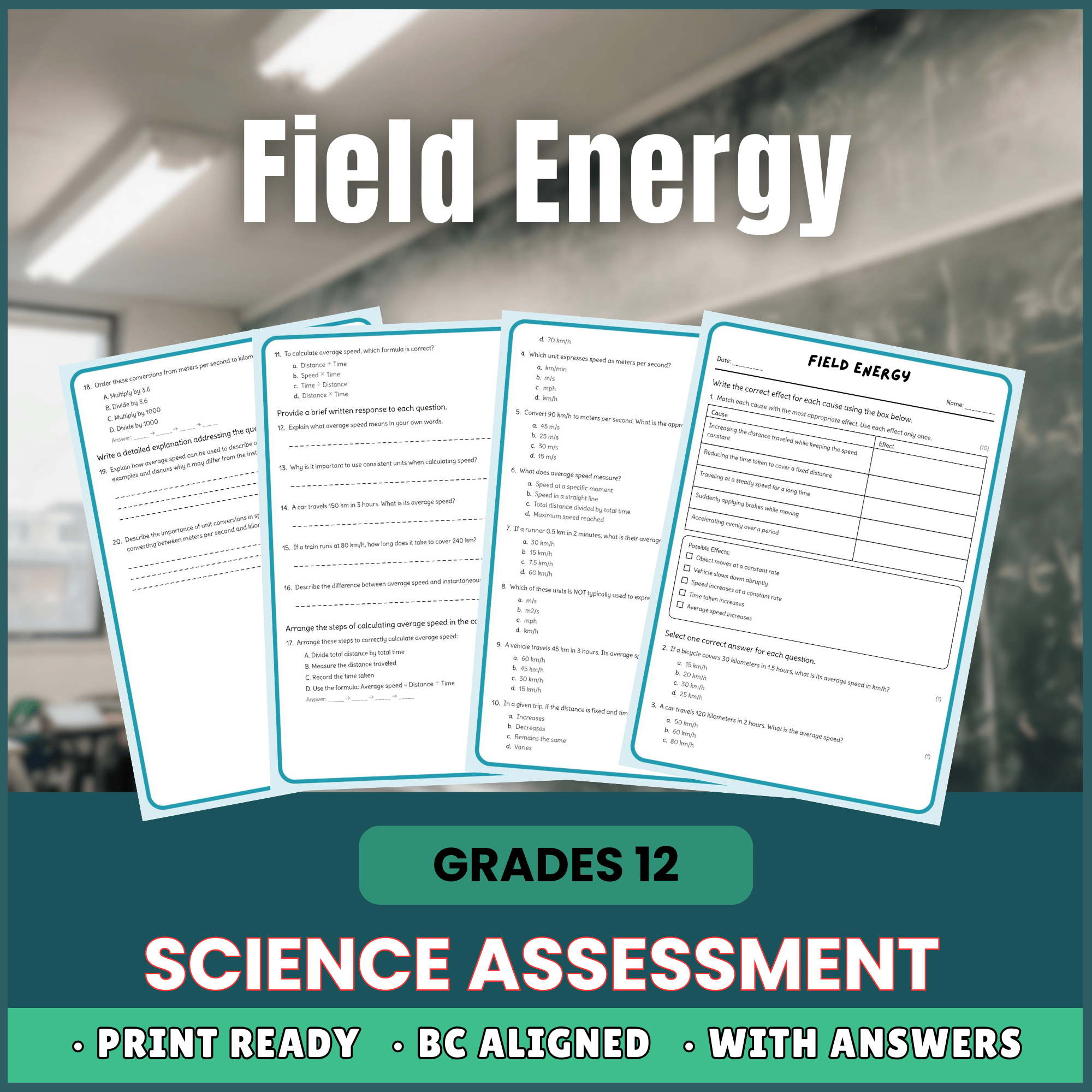
Grade 12 Science – Field Energy Worksheet with Answer Key (PDF) | BC Standards
 Created byBright Mind Resources
Learning Objectives
- Understand the concept of energy stored in fields such as electrostatic and magnetic fields.
- Explain how capacitors and inductors store and release energy in electrical circuits.
- Describe the distribution of field energy in space and its relation to work and energy transfer.
Instant download

Grade 12 Science | Bonding Structures in Chemistry - Daily Reading Comprehension
Created byCoral Reef LearningLearning Objectives
- Understand the concept of electrostatic interactions in ionic bonding
- Explain lattice energy and its significance in ionic compounds
- Identify differences between ionic, covalent, and metallic bonds
Also included in: Grade 12 Science Daily Reading Worksheets Full-Year Bundle | TEKS
Instant download

Grade 12 Science – Uncertainty & Data Analysis Daily Reading Worksheet
Created byBright Mind ResourcesLearning Objectives
- Identify different sources of uncertainty in scientific measurements and data.
- Distinguish between systematic bias, random error, and conceptual model uncertainty.
- Understand exemplars such as instrument drift and sampling variability.
Also included in: Grade 12 Science Data Analysis Daily Reading Worksheets Lesson Bundle | AP +2 more
Instant download

Genetic Variation Worksheet Grade 12 Biology DNA Inheritance Science
Created byPrism Point LearningLearning Objectives
- Explain how mutations generate new alleles within a population
- Describe how sexual reproduction reshuffles alleles to increase genetic diversity among offspring
- Connect changes in allele frequencies to evolutionary responses driven by selection
Instant download

DNA Double Helix Structure & Stability Worksheets | Grade 12 Biology
Created bySunny Desk ResourcesLearning Objectives
- Describe the molecular structure of DNA and nucleotide composition
- Explain DNA strand orientation within the double helix
- Explain how hydrogen bonding contributes to DNA structural stability
Also included in: Biology 30 - Grade 12 Bundle +1 more
Instant download

Grade 12 Science | Governance Futures Worksheet (PDF) - TEKS Standards
Created byEvergreen Desk EducationLearning Objectives
- Explain how governance and policy mechanisms influence the development and use of scientific and technological innovations.
- Apply risk assessment and environmental impact assessment ideas to evaluate future technology choices.
- Compare regulatory standards, international agreements, and adaptive governance approaches for accountability.
Instant download

Grade 12 Science Ecosystem Interactions Worksheet | Standards-Aligned Practice
JCreated byJ.S SheetsLearning Objectives
- Explain how predation, competition, mutualism, and parasitism shape ecosystem communities
- Describe how energy flows through trophic levels and why food webs are more realistic than single food chains
- Analyze how changes in one population can trigger trophic cascades and alter community structure
Also included in: Grade 12 Genetics and Evolution Science Lesson Bundle – General Framework +1 more
Instant download

Grade 12 Electric Circuits Worksheet | Alberta Physics with Answer Key
Created byEvergreen Desk EducationLearning Objectives
- Use Ohm’s law and power relationships to calculate voltage, current, resistance, and power in circuit elements.
- Analyze series and parallel circuits using quantitative relationships and compare their electrical behavior.
- Apply Kirchhoff’s rules to solve for unknown currents or voltages in multi-loop circuits.
Instant download

Ocean Circulation Assessment for Grade 12 Science | TEKS Standards
Created byPrism Point LearningLearning Objectives
- Explain the mechanisms of thermohaline and wind-driven ocean circulation.
- Describe how surface gyres, upwelling, and the meridional overturning circulation influence climate and nutrient transport.
- Connect oceanic heat capacity and circulation patterns to regional climate modulation and episodic phenomena like El Niño.
Instant download
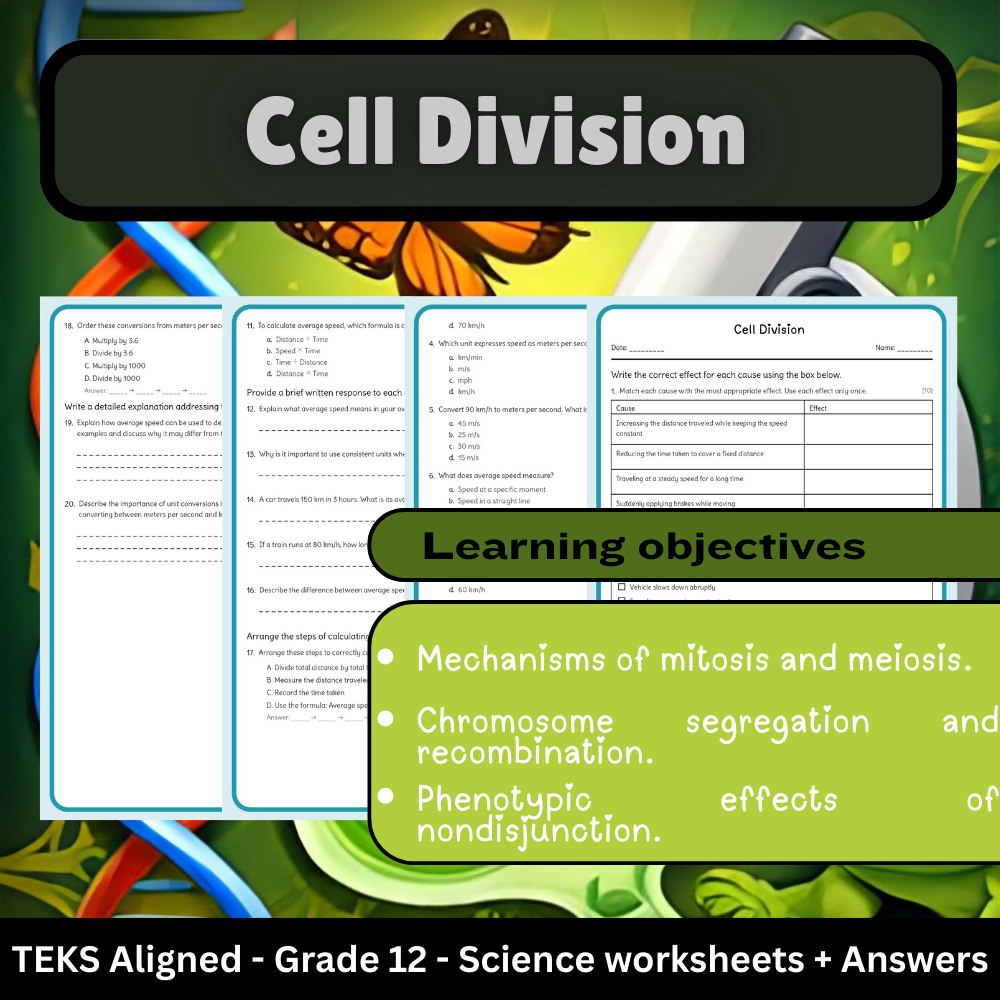
Grade 12 Science | Cell Division Worksheet (Answer Key) – TEKS Standards
Created byBright Mind ResourcesLearning Objectives
- Understand the phases and mechanisms of mitosis and meiosis.
- Identify components involved in chromosome segregation and recombination.
- Describe the consequences of nondisjunction and their phenotypic effects.
Instant download

Grade 12 Science – Ecological Interactions & Ecosystems | Reading Worksheet
Created byBright Mind ResourcesLearning Objectives
- Identify components of ecosystems
- Explain basic ecological interactions
- Understand how environmental factors influence communities
Also included in: Grade 12 Environmental & STSE Science Daily Reading Lesson Bundle | Alberta +1 more
Instant download
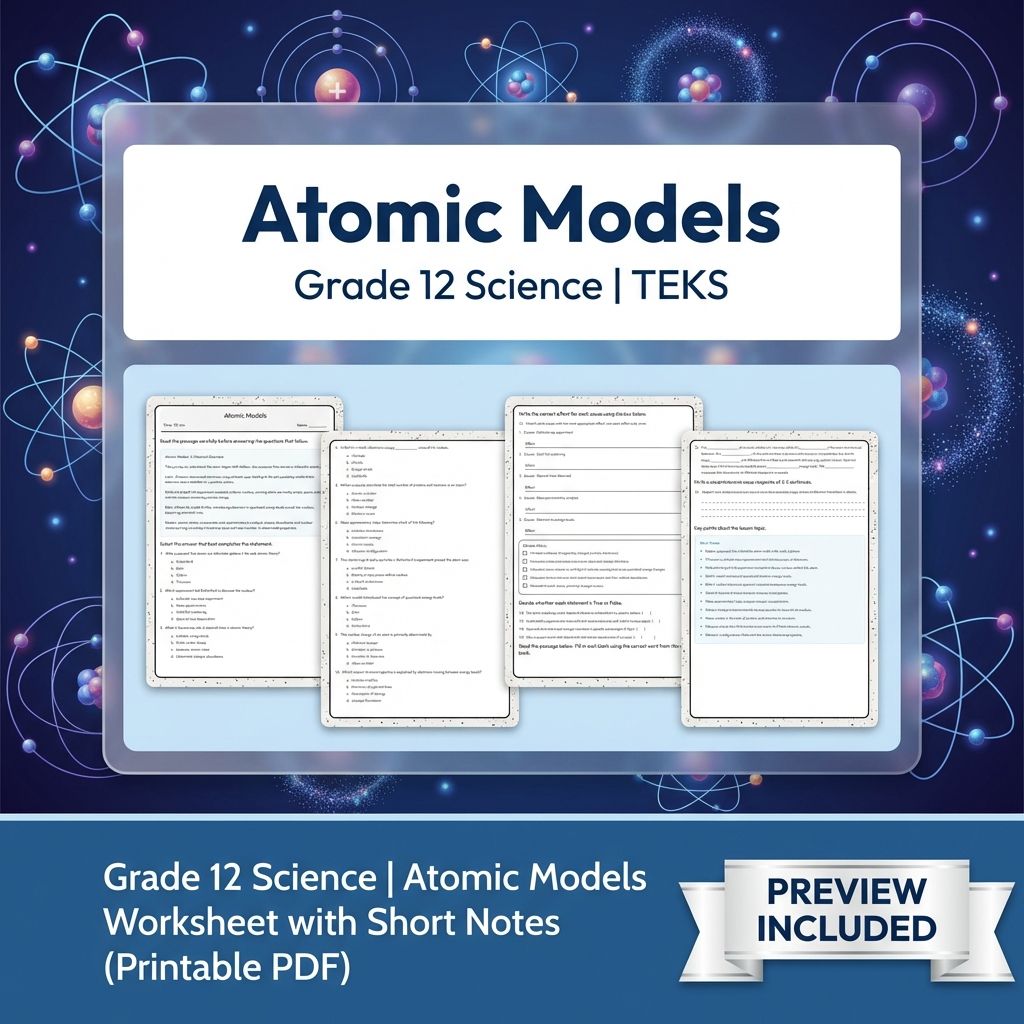
Grade 12 Science | Atomic Models Worksheet with Short Notes (Printable PDF)
 Created byMeadowlark Worksheets
Learning Objectives
- Explain the development of atomic models from Dalton to Rutherford and Bohr.
- Describe empirical evidence such as cathode ray experiments and gold foil scattering.
- Understand concepts of nuclear charge, mass number, and isotopic abundance.
Also included in: Grade 12 Science Unit Bundle | Atomic Structure, Thermochemistry & More +2 more
Instant download
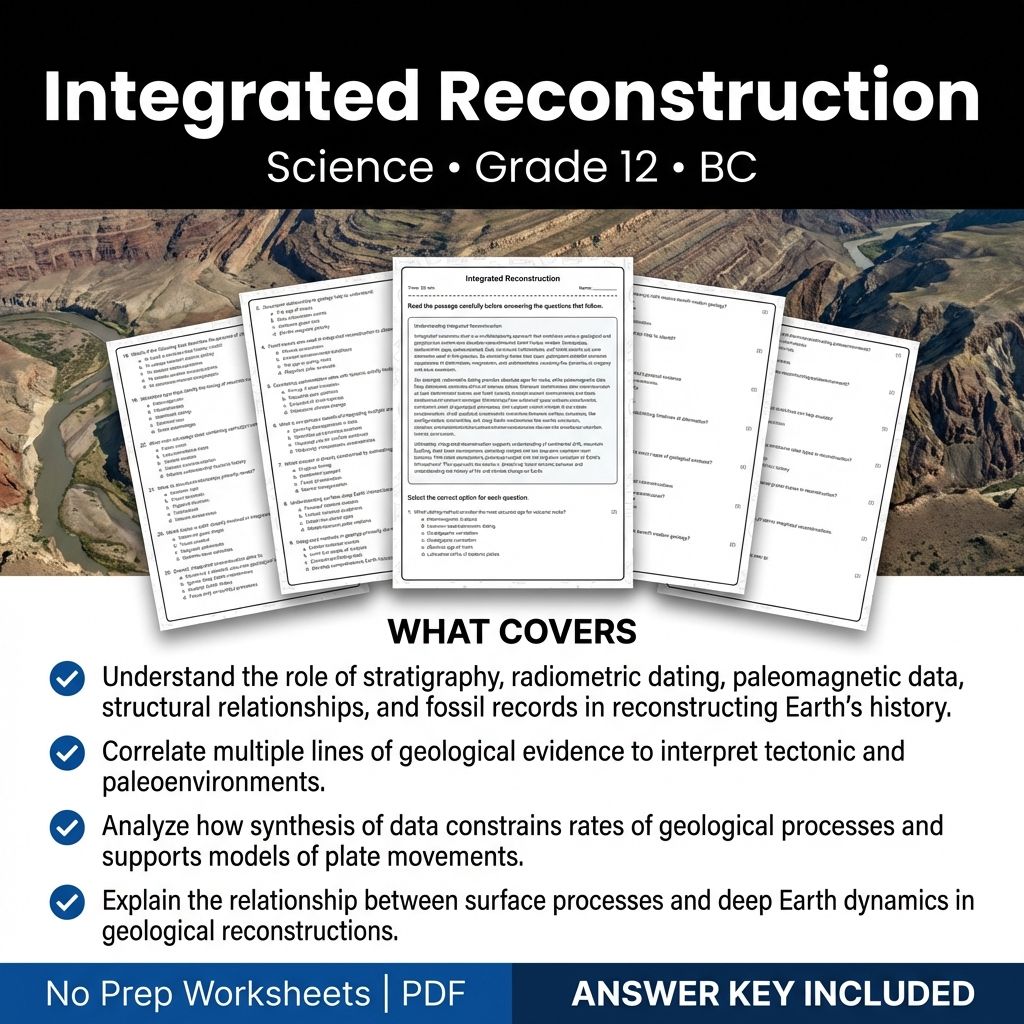
Grade 12 Science Worksheet | Integrated Reconstruction Practice & Assessment
Created byCoral Reef LearningLearning Objectives
- Understand the role of stratigraphy, radiometric dating, paleomagnetic data, structural relationships, and fossil records in reconstructing Earth's history.
- Correlate multiple lines of geological evidence to interpret tectonic and paleoenvironments.
- Analyze how synthesis of data constrains rates of geological processes and supports models of plate movements.
Instant download

Signal Transmission Electromagnetics Assessment for Grade 12 Science
Created byPrism Point LearningLearning Objectives
- Explain how electromagnetic signals propagate as coupled oscillating electric and magnetic fields.
- Use relationships among frequency, wavelength, and wave speed to predict changes in EM transmission.
- Describe how reflection and refraction occur at boundaries and how material properties affect EM waves.
Instant download

Grade 12 Science | Thermochemistry Basics Worksheet (PDF) BC Standards
Created byEvergreen Desk EducationLearning Objectives
- Explain how enthalpy changes describe heat transfer during chemical reactions.
- Differentiate exothermic and endothermic reactions using temperature and energy arguments.
- Use calorimetry relationships (including specific heat) to connect heat and temperature change.
Instant download

Bonding Basics Worksheet Practice | Grade 12 AP Science Chemistry Activity
Created byPrism Point LearningLearning Objectives
- Identify and compare ionic, covalent, and metallic bonding using charge distribution and electron models.
- Relate bond type to bulk properties such as electrical conductivity, melting point, and solubility.
- Use Lewis structures and formal charge to evaluate which bonding representation best fits observed bonding patterns.
Instant download

Recombinant DNA Methods & Trait Engineering Worksheets | Grade 12
Created bySunny Desk ResourcesLearning Objectives
- Explain how vectors assemble recombinant DNA constructs
- Describe the roles of restriction enzymes and DNA ligase
- Interpret restriction mapping to locate DNA restriction sites
Also included in: Biology 30 - Grade 12 Bundle +1 more
Instant download
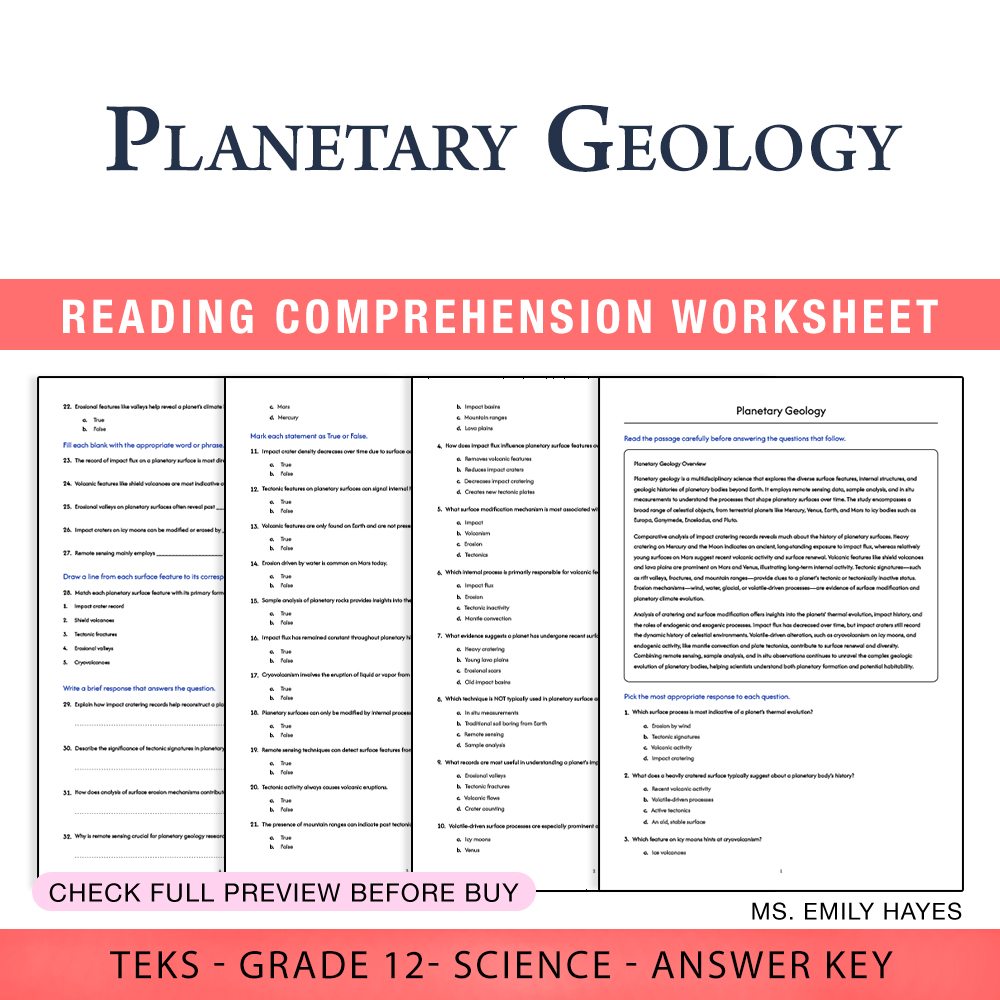
Grade 12 Science | Planetary Geology Worksheet (PDF+ Answer Key)
 Created byCopper Leaf Classroom
Learning Objectives
- Compare surface processes and geological features of terrestrial and icy planetary bodies.
- Analyze impact cratering records, volcanic activity, and tectonic signatures as indicators of planetary history.
- Evaluate the roles of internal structure, impact flux, and volatile-driven processes in shaping planetary surfaces.
Instant download

Genetic Variation Processes Worksheets | Grade 12 Life Science
 Created byBRIGHT PATH RESOURCES
Learning Objectives
- Explain how mutations create new genetic variants
- Describe how recombination reshuffles alleles during meiosis
- Interpret how survival changes allele frequencies over time
Also included in: Grade 12 Science Genetics & Evolution Worksheets Lesson Bundle +4 more
Instant download

Grade 12 Science | Meiosis and Diversity Worksheet | NGSSS Aligned
Created byLumora LearningLearning Objectives
- Explain how meiosis maintains chromosome number while producing haploid gametes
- Describe how crossing over and independent assortment generate genetic diversity
- Interpret how meiosis-driven variation supports inheritance patterns and evolutionary change
Instant download
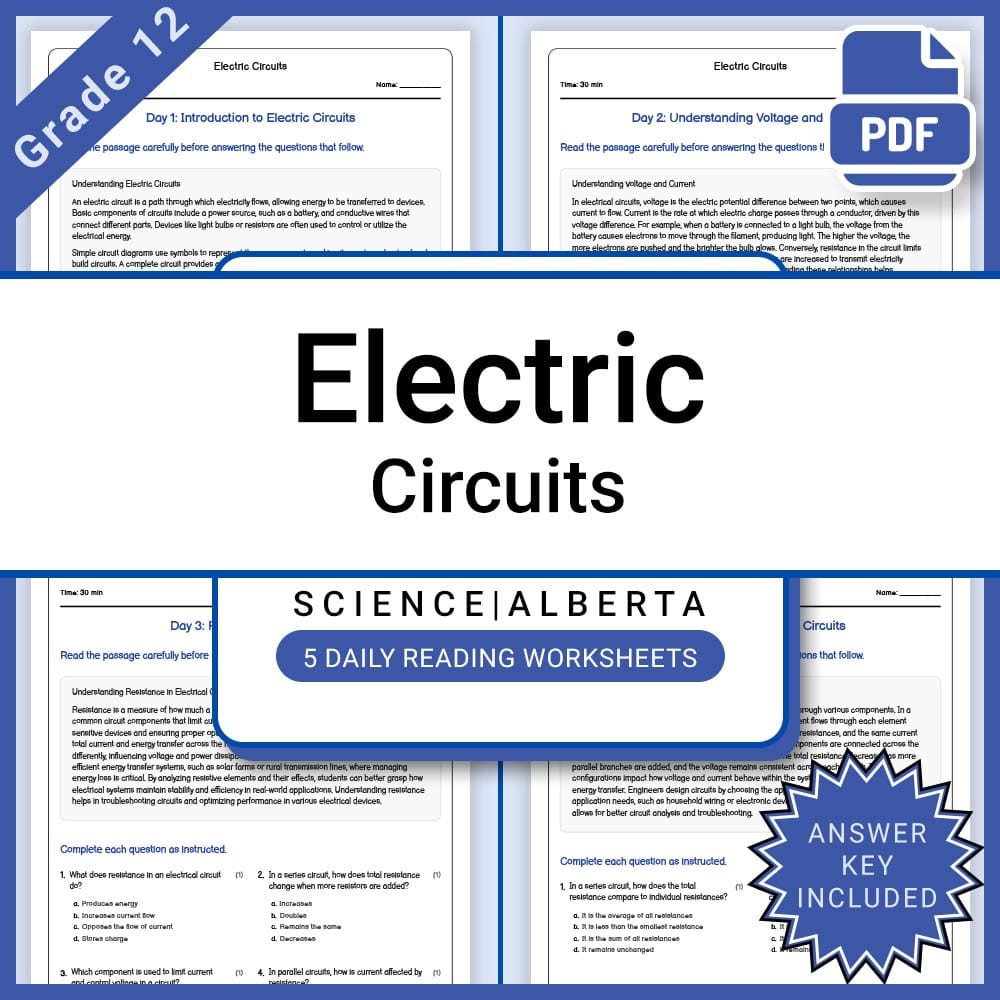
Grade 12 Science – Electric Circuits Daily Reading Worksheet + Answer Key
JCreated byJ.S SheetsLearning Objectives
- Identify and describe basic components of electric circuits
- Understand simple circuit diagrams and their symbols
- Explain the function of voltage, current, resistance, and power in circuits
Also included in: Grade 12 Science Lesson Bundle | Physics, Nuclear, Waves & Circuits +1 more
Instant download

Statistical Reasoning Assessment | TEKS Grade 12 Science Standards
Created byPrism Point LearningLearning Objectives
- Understand the principles of hypothesis testing, confidence intervals, and p-values.
- Interpret statistical metrics such as effect sizes and power in research.
- Differentiate between parametric and nonparametric tests and their assumptions.
Instant download
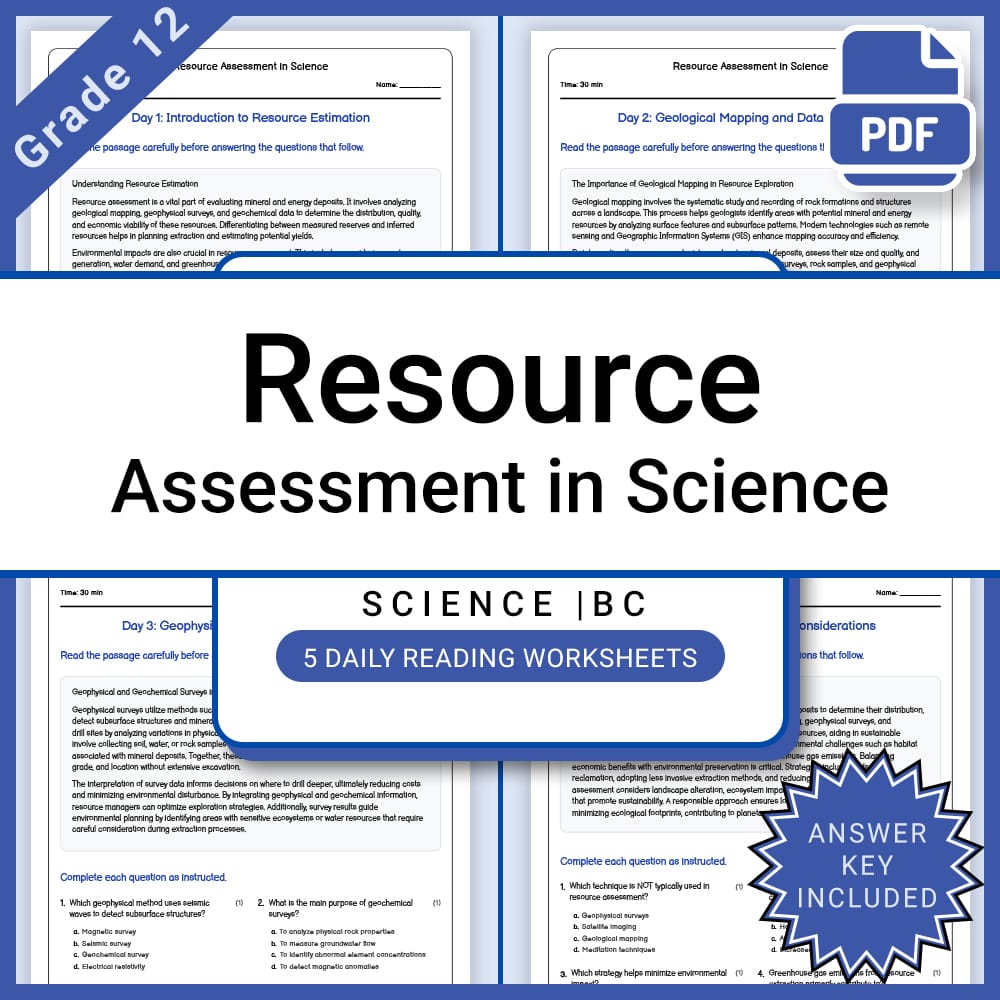
Grade 12 – Resource Impacts on Earth Systems Daily Worksheet + Answer Key
JCreated byJ.S SheetsLearning Objectives
- Understand how resource extraction and land modification affect earth systems.
- Identify environmental consequences of human resource activities such as mining and agriculture.
- Evaluate trade-offs between economic benefits and environmental sustainability.
Also included in: Grade 12 Science Lesson Group: Earth Systems and Geology BC Framework +1 more
Instant download

Grade 12 Science | Electron Configuration in Chemistry - Reading Comprehension
Created byCoral Reef LearningLearning Objectives
- Understand the principles of electron configuration using Aufbau, Pauli exclusion, and Hund’s rules.
- Identify electron arrangements in various elements.
- Predict valence electrons, oxidation states, and bonding tendencies based on electron configurations.
Also included in: Chemistry 30 Reading Comprehension Lesson Bundle – Grade 12 Science Alberta +1 more
Instant download
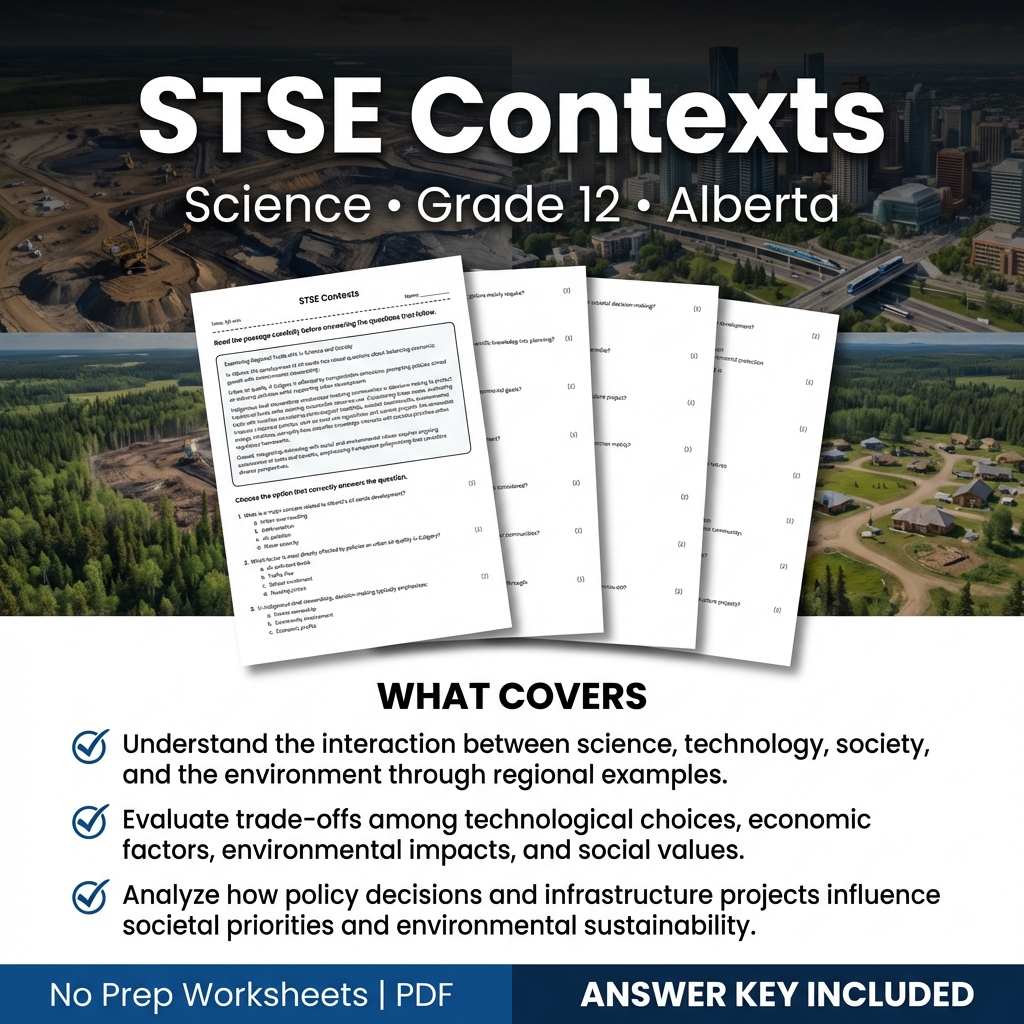
Grade 12 Science Worksheet on STSE Contexts | Alberta Standards
Created byCoral Reef LearningLearning Objectives
- Understand the interaction between science, technology, society, and the environment through regional examples.
- Evaluate trade-offs among technological choices, economic factors, environmental impacts, and social values.
- Analyze how policy decisions and infrastructure projects influence societal priorities and environmental sustainability.
Instant download

Grade 12 Science | Electric Forces - Daily Reading Comprehension
Created byCoral Reef LearningLearning Objectives
- Understand the basic concept of electric charges and Coulomb’s law
- Describe the magnitude and direction of electric forces between point charges
- Explain the inverse-square law dependence of electric force on distance
Instant download

Grade 12 Science | Criteria & Constraints in Engineering Design - Daily Reading
Created byCoral Reef LearningLearning Objectives
- Understand the concept of criteria and constraints in engineering
- Identify societal needs and how they influence engineering solutions
- Recognize measurable limits such as cost, safety, and environmental boundaries
Instant download
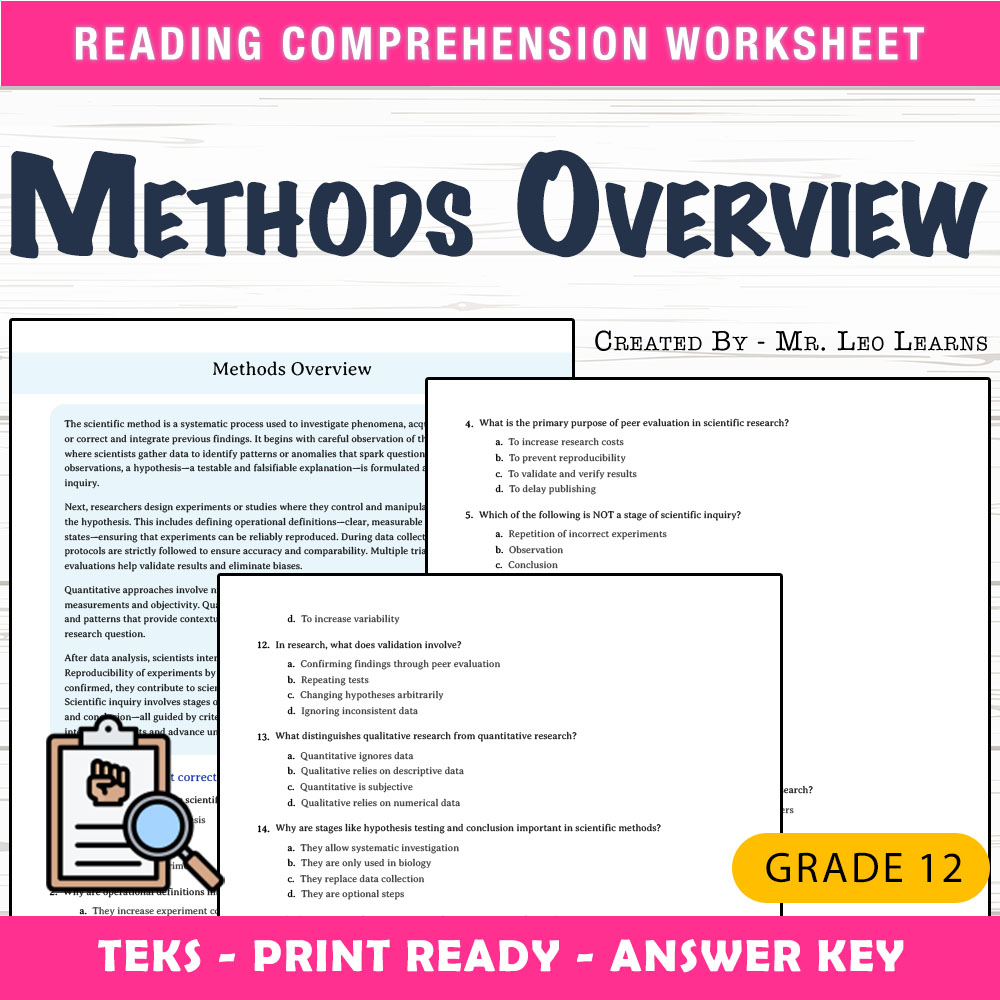
Grade 12 Science — Methods Overview MCQ Worksheet for Mastering Scientific Inquiry
 Created byThe Resource Hub
Learning Objectives
- Understand the stages of the scientific inquiry process from observation to conclusion.
- Identify key components such as hypothesis formulation, variable control, and operational definitions.
- Differentiate between qualitative and quantitative research approaches.
Also included in: Grade 12 Science Worksheet Bundle | Scientific Inquiry & Data Analysis Mastery +1 more
Instant download
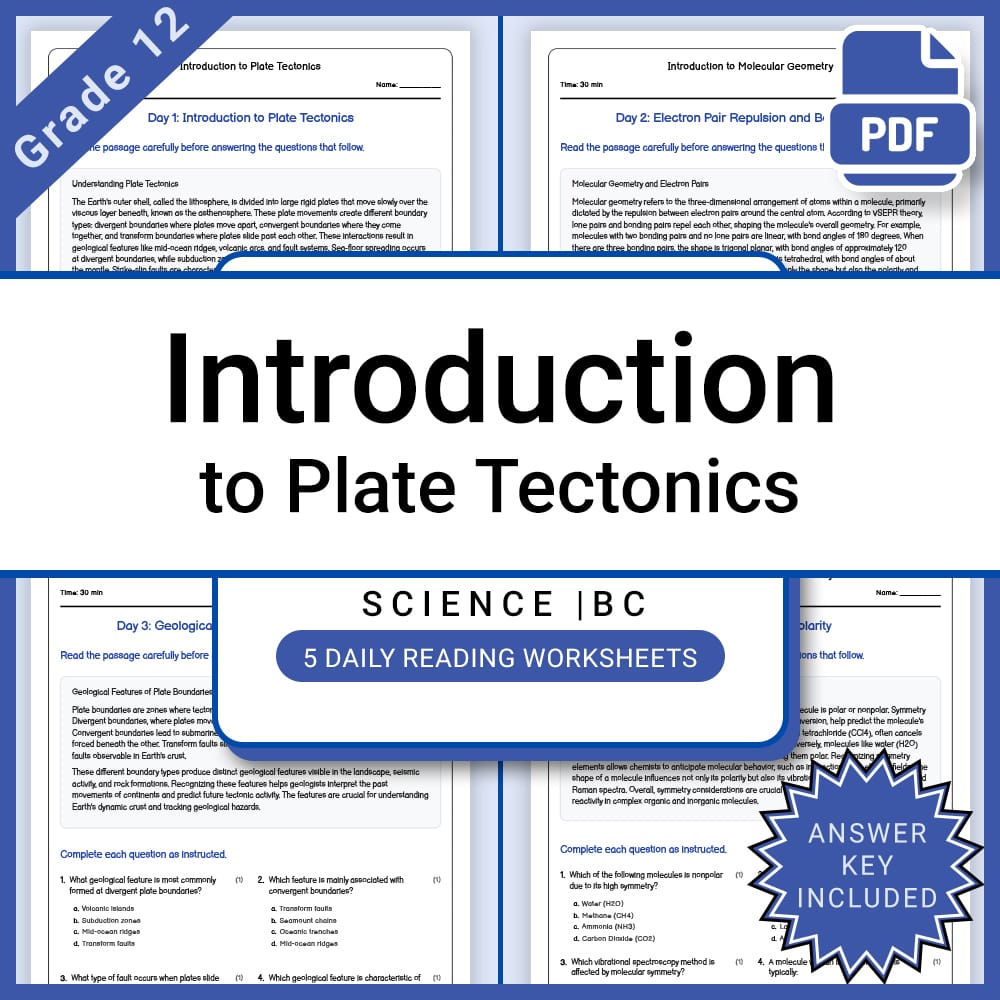
Grade 12 Science – Introduction to Plate Tectonics Daily Worksheet + Answer Key
JCreated byJ.S SheetsLearning Objectives
- Understand the basic movements of Earth's lithospheric plates
- Identify different types of plate boundaries and their features
- Explain geological phenomena such as sea-floor spreading and subduction
Also included in: Grade 12 Science Lesson Group: Earth Systems and Geology BC Framework +1 more
Instant download
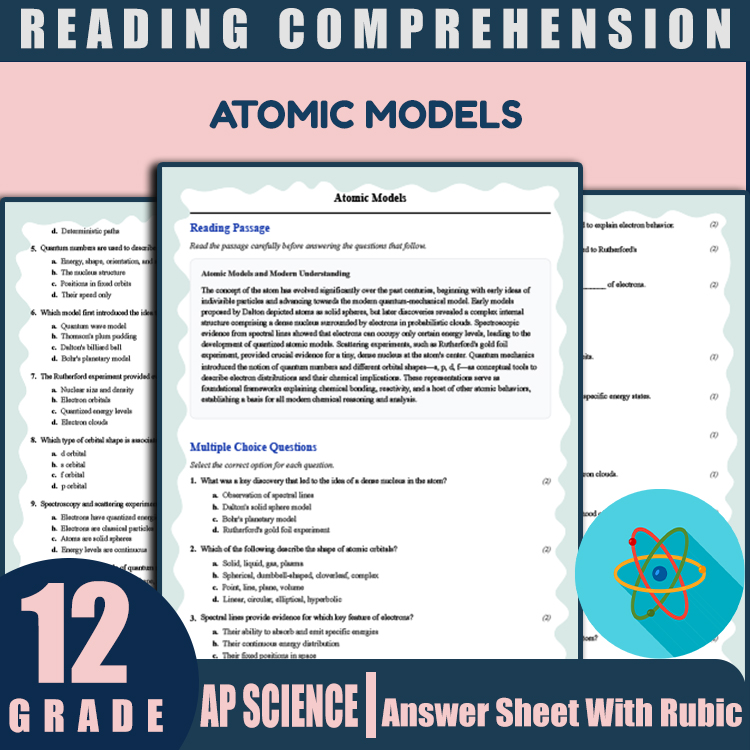
Grade 12 Science | Atomic Models Reading Worksheet (PDF + Answer Key)
JCreated byJ.S SheetsLearning Objectives
- Understand the historical development of atomic models and their key features.
- Describe modern atomic representations, including nuclear structure, electron clouds, and quantized energy levels.
- Explain how spectral lines and scattering experiments support the existence of discrete energy states.
Also included in: Grade 12 Science Unit Bundle | Atomic Structure & Chemical Reactions Worksheets +1 more
Instant download
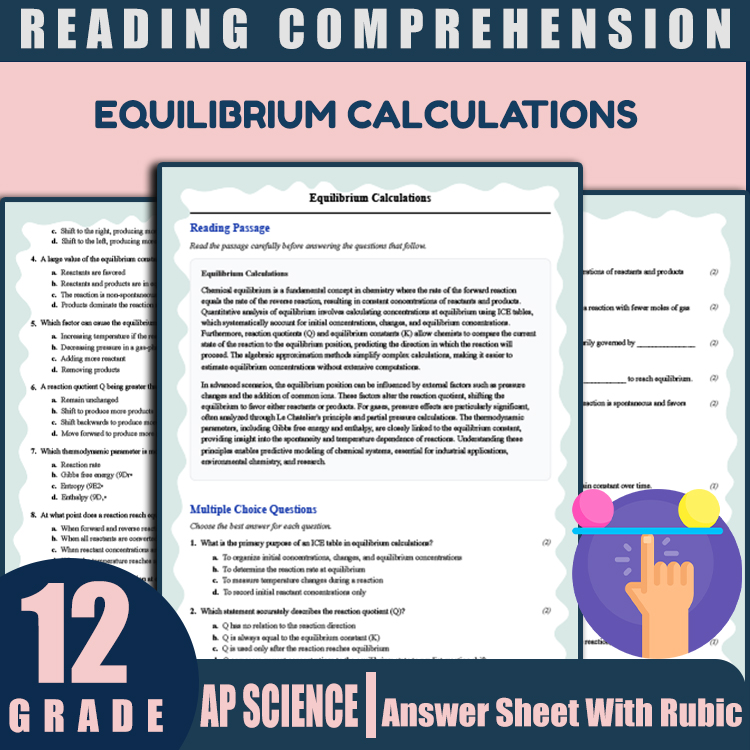
Grade 12 Science | Equilibrium Calculations Reading Worksheet (PDF + Answer Key)
JCreated byJ.S SheetsLearning Objectives
- Understand and apply ICE tables for equilibrium analysis.
- Interpret reaction quotients and equilibrium constants to evaluate the position of equilibrium.
- Utilize algebraic methods to estimate equilibrium concentrations.
Also included in: Grade 12 Science Unit Bundle | Atomic Structure & Chemical Reactions Worksheets +1 more
Instant download
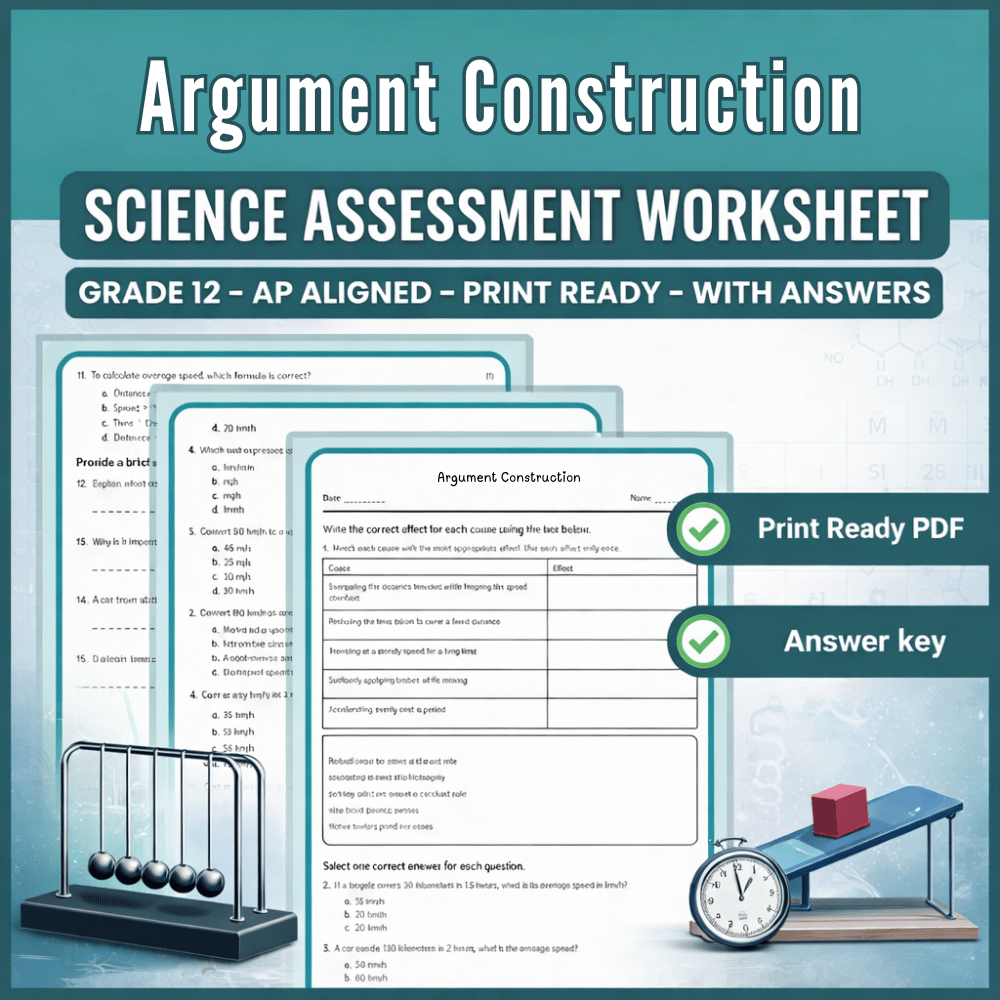
Grade 12 Science | Argument Construction AP Worksheet (PDF)
Created byBright Mind ResourcesLearning Objectives
- Understand how to construct evidence-based scientific arguments using claims, warrants, and backing.
- Analyze case studies involving species distribution and atmospheric CO2 trends to evaluate relevance and sufficiency of evidence.
- Learn how to incorporate theoretical models and empirical data into coherent scientific explanations.
Instant download
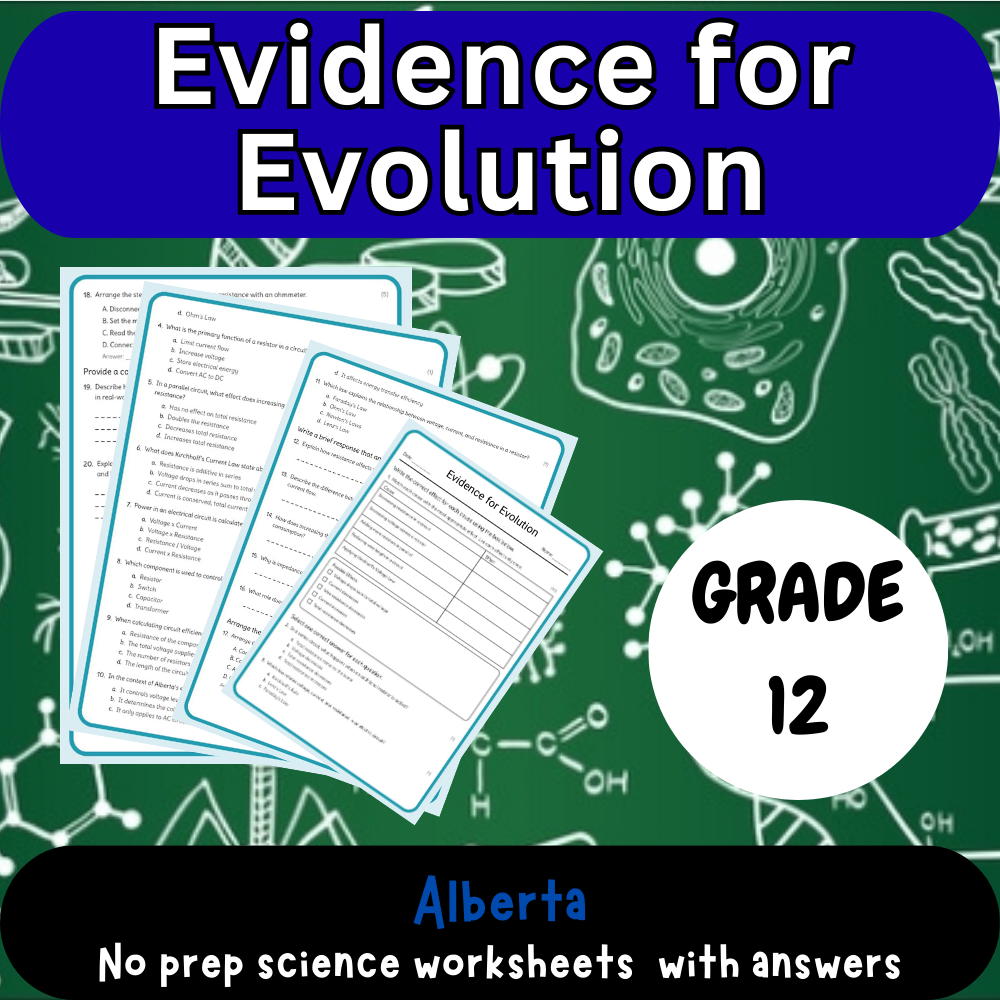
Grade 12 Science – Evidence for Evolution Worksheet (PDF) – Alberta Standards
Created byBright Mind ResourcesLearning Objectives
- Identify different types of evidence supporting the mechanisms of evolution.
- Explain how fossil records and molecular data contribute to understanding evolutionary history.
- Analyze patterns of homology, transitional forms, and molecular phylogenetics in evolution.
Instant download

Risk and Governance Worksheet | Grade 12 Science Practice
Created byPrism Point LearningLearning Objectives
- Explain the main steps of risk assessment (hazard identification, exposure assessment, and consequence evaluation) in socio-environmental decisions.
- Describe how governance frameworks in Alberta use laws, policies, and stakeholder processes to manage risk.
- Evaluate how transparent risk communication and evidence synthesis help support community trust and decision-making.
Also included in: Grade 12 Science Lesson Bundle | Alberta STSE, Systems & Design
Instant download
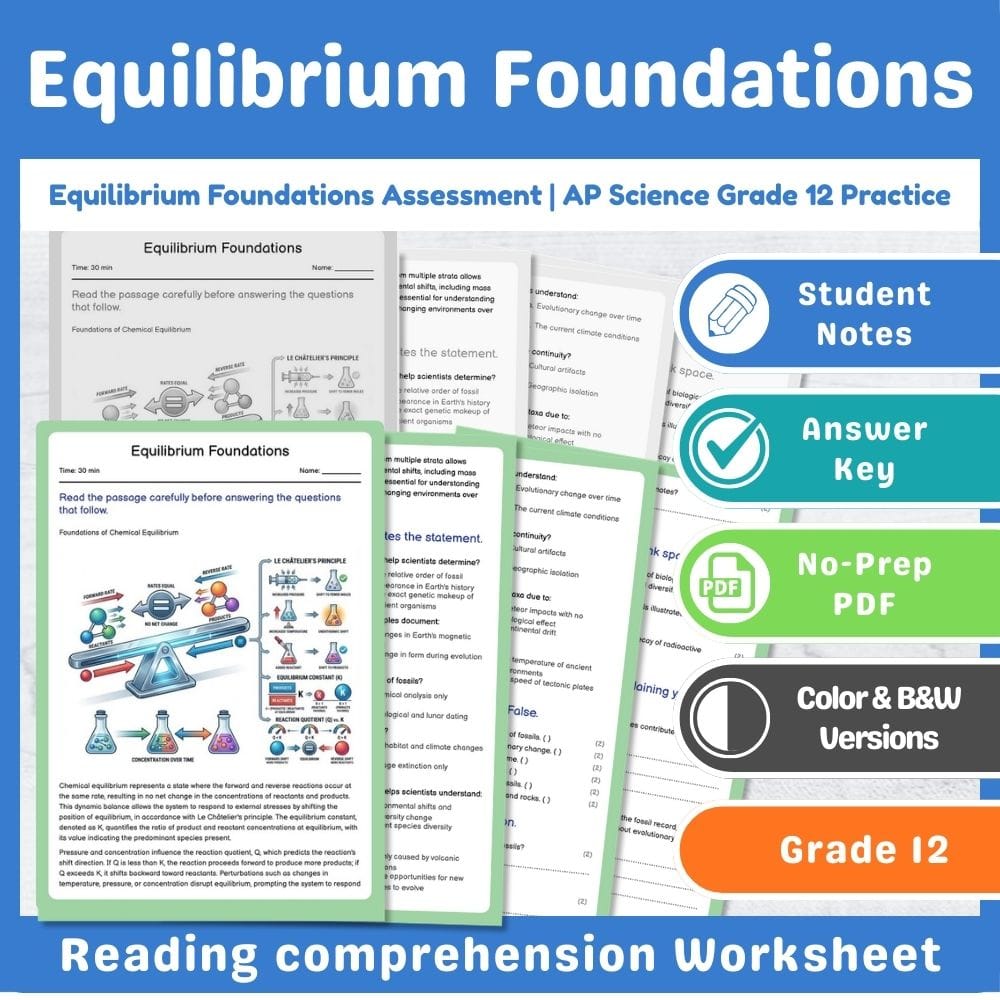
Equilibrium Foundations Assessment | AP Science Grade 12 Practice
Created byPrism Point LearningLearning Objectives
- Explain the concept of chemical equilibrium as a dynamic balance between forward and reverse reactions.
- Define and interpret the equilibrium constant (K) as a quantitative measure of reaction position.
- Relate concentration- and pressure-based expressions to reaction directionality and predict system responses to perturbations.
Instant download

Grade 12 Science | Signal Transmission Electromagnetics Worksheet (PDF)
Created byEvergreen Desk EducationLearning Objectives
- Explain how electromagnetic signals transfer energy through coupled electric and magnetic fields.
- Use frequency and wavelength relationships to predict signal behavior (reflection and refraction) at boundaries.
- Describe how attenuation and dispersion affect the strength and spread of transmitted signals over distance.
Also included in: Grade 12 General Science Worksheet Lesson Bundle: Models, Waves, Energy (General) +1 more
Instant download

Science Grade 12 Balanced Equations and Stoichiometry Worksheet | NGSSS
JCreated byJ.S SheetsLearning Objectives
- Explain how balancing a chemical equation enforces conservation of atoms.
- Interpret coefficients as relative amounts and connect them to mole ratios.
- Use balanced equations to support quantitative reasoning about reactants and products.
Also included in: Grade 12 Energy, Motion, and Reaction Rates Science Lesson Bundle +1 more
Instant download
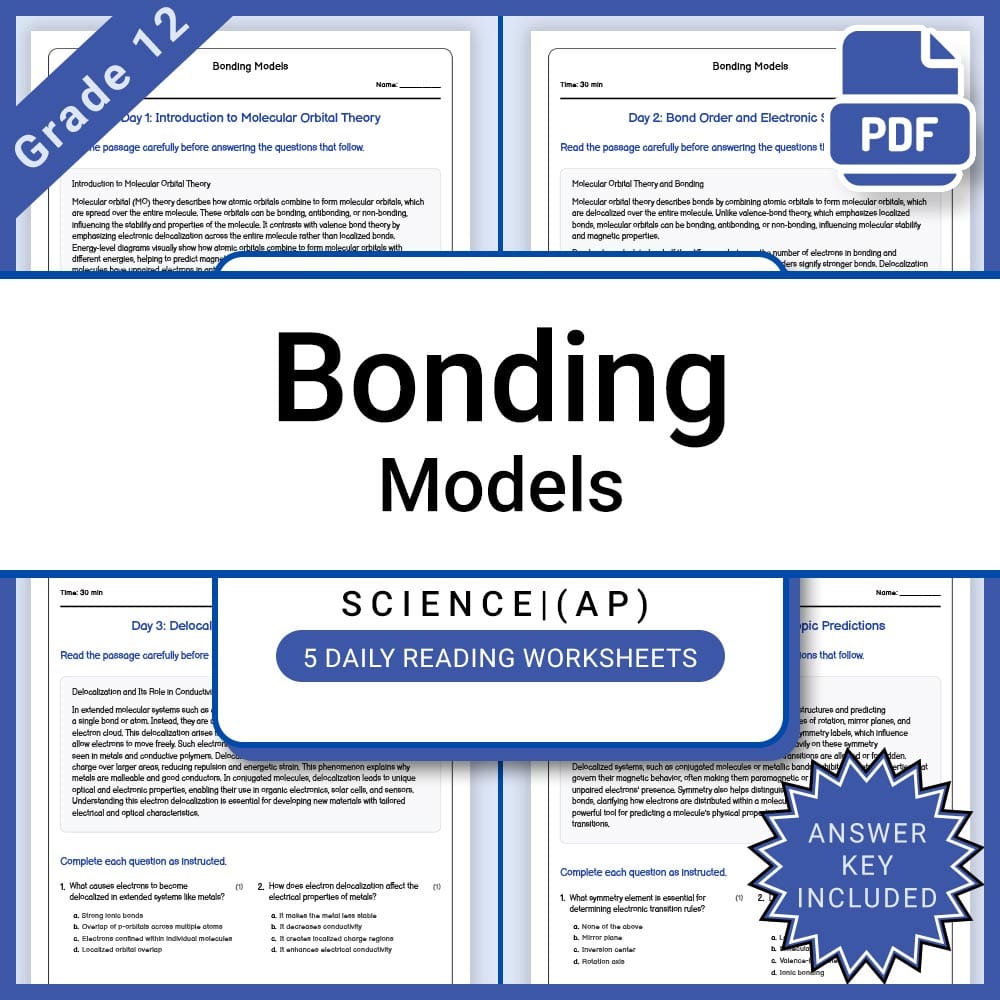
Grade 12 Science – Bonding Models Daily Reading Worksheet + Answer Key
JCreated byJ.S SheetsLearning Objectives
- Explain molecular orbital theory and how it extends valence bond descriptions.
- Interpret energy-level diagrams for diatomic molecules and extended systems.
- Differentiate between localized and delocalized bonding models.
Also included in: Grade 12 Chemistry Foundations Lesson Bundle – AP Science Activities +1 more
Instant download

Grade 12 Science Modeling Systems Daily Reading Worksheet with Answer Key
JCreated byJ.S SheetsLearning Objectives
- Understand the purpose and types of conceptual and quantitative models
- Identify the applications of different modeling approaches
- Compare deterministic and stochastic modeling frameworks
Also included in: Grade 12 Science Lesson Group Bundle – TEKS Standards-Based Worksheets +1 more
Instant download
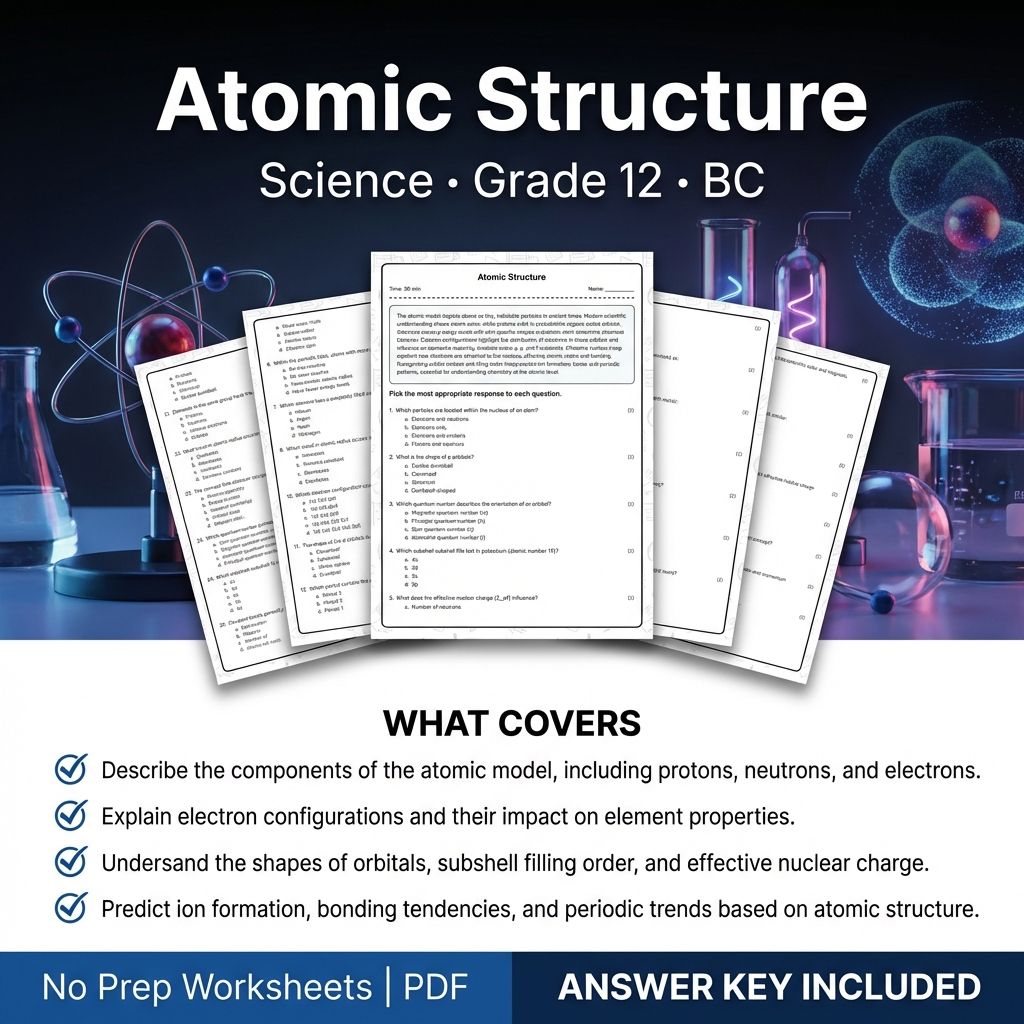
Grade 12 Science Atomic Structure Worksheet and Answer Key PDF
Created byCoral Reef LearningLearning Objectives
- Describe the components of the atomic model, including protons, neutrons, and electrons.
- Explain electron configurations and their impact on element properties.
- Understand the shapes of orbitals, subshell filling order, and effective nuclear charge.
Instant download
About Grade 12 Science Worksheets
Explore Grade 12 Science worksheets for classwork, homework, or review. Our 4,240 printables download instantly as PDFs.
MyTeachingSheets worksheets are made by real teacher-authors and checked before they go live. Download any as a print-ready PDF for lessons, homework, or independent practice — most include answer keys, and previews are always free.