
Grade 6 Worksheets
8,582 grade resources
Grade 6 Science | Stability & Balance - Daily Reading Comprehension
 Created byCoral Reef Learning
Learning Objectives
- Understand how center of mass and center of pressure influence stability.
- Identify design features that enhance aircraft stability, such as dihedral angles and tail volume.
- Explain how weight placement affects the static stability of flying objects.
Also included in: Air and Aerodynamics Lesson Bundle – Grade 6 Science Alberta Reading Comp. +1 more
Instant download

Grade 6 Social Studies — Scarcity and Choices Worksheet for Mastery
 Created byThe Resource Hub
Learning Objectives
- Explain how scarcity affects individual and societal decision-making
- Identify opportunity cost and describe how it influences choices
- Describe how trade and specialization increase available options and efficiency
Also included in: Grade 6 Social Studies Economic Decision-Making & Trade Networks Lesson Bundle +1 more
Instant download

Grade 6 Science | Energy Decreases Upward | California Standards
 Created byLumora Learning
Learning Objectives
- Explain how energy moves between trophic levels in an ecosystem.
- Identify why only part of the energy at one trophic level becomes biomass at the next.
- Describe how energy loss affects the number of consumers higher up in a food chain.
Instant download

Diffusion Rates Test Prep Worksheets | Grade 6 Science
 Created byPrism Point Learning
Learning Objectives
- Explain how diffusion is driven by particle motion from higher concentration to lower concentration
- Describe how temperature affects diffusion rates through changes in particle speed and collision frequency
- Identify how particle size and medium viscosity influence diffusion in gases and liquids
Also included in: Matter, Properties & Change Lesson Bundle — Grade 6 Science BC Framework +1 more
Instant download

Grade 6 Science – Food Webs & Energy Flow | Daily Reading Worksheet
 Created byBright Mind Resources
Learning Objectives
- Identify different species involved in food webs
- Describe the roles of producers, consumers, and decomposers
- Understand how species interactions create interconnected feeding relationships
Also included in: Grade 6 Ecosystem Relationships Science Daily Reading Lesson Bundle | BC +1 more
Instant download

6th Grade Math | Feedback and Improvement Worksheet (Ontario) (PDF)
 Created byClear Sky Classroom
Learning Objectives
- Understand how constructive feedback helps refine problem-solving strategies.
- Analyze errors in mathematical reasoning to improve solutions.
- Reflect on representations and procedures to deepen understanding.
Also included in: Grade 6 Maths Social-Emotional Skills and Mathematical Processes Lesson Bundle +1 more
Instant download

Grade 6 Holiday | Juneteenth Day for Mastering Reflection | PDF + Answer Key
 Created byShaNova Worksheets
Learning Objectives
- Explain the significance of Juneteenth and how it connects past freedom to ongoing equality.
- Use vocabulary related to justice, fairness, and activism to interpret a short text.
- Analyze statements about civil rights progress and make evidence-based choices.
Also included in: Grade 6 Juneteenth Day Holiday Lesson Bundle Worksheets for C3 Framework
Instant download

Grade 6 Science – Bernoulli's Principle & Airflow | Daily Reading Worksheet
Created byBright Mind ResourcesLearning Objectives
- Understand the basic concept of Bernoulli's principle
- Identify how fluid speed relates to pressure
- Recognize real-world examples of Bernoulli's principle
Also included in: Aerodynamics Grade 6 Science Daily Reading Worksheets Lesson Bundle | Alberta +2 more
Instant download

Grade 6 Water Reservoirs Worksheet | NGSS Practice & PDF
Created byClear Sky ClassroomLearning Objectives
- Explain how Earth’s water is stored in different reservoirs in different forms
- Describe how water moves between reservoirs when it changes state
- Use reservoir connections to predict how water availability changes over time
Instant download

Grade 6 Science | Experimental Design - Daily Reading Comprehension
Created byCoral Reef LearningLearning Objectives
- Understand the importance of variables and controls in scientific experiments.
- Learn how to identify independent, dependent, and controlled variables in environmental testing.
- Develop skills to establish fair tests through consistent measurement procedures.
Also included in: Evidence and Investigation Lesson Bundle | Grade 6 Science | Alberta +1 more
Instant download

Grade 6 Resource Distribution & Mineral Resources Worksheet | NGSS Science
 Created byBRIGHT PATH RESOURCES
Learning Objectives
- Understand how minerals form in the Earth's crust
- Identify locations and types of mineral deposits
- Learn about geological processes that influence resource distribution
Also included in: Earth & Human Activity Grade6 Science Daily Reading WorksheetsLesson Bundle|NGSS +2 more
Instant download

Grade 6 Synthetic Materials Worksheet | NGSS Practice PDF
Created byClear Sky ClassroomLearning Objectives
- Connect natural resources to their synthetic products.
- Compare properties of different materials used in manufacturing.
- Understand the processing steps and societal implications of synthetic materials.
Also included in: Grade 6 Matter & Chemical Reactions Science Lesson Bundle—NGSS Worksheets +1 more
Instant download

Organ Systems Practice Worksheet | Grade 6 Science NGSS Review
Created byPrism Point LearningLearning Objectives
- Explain how tissues and organs work together in the circulatory, respiratory, digestive, and nervous systems.
- Describe how organ systems interact to support movement of gases and nutrients in the body.
- Connect cellular processes (like diffusion and energy use) to system-level outcomes.
Also included in: Grade 6 Cellular Systems Science Lesson Bundle NGSS Worksheets
Instant download

User Interface Basics Worksheet | Menus, Buttons & Layout Grade 6
Created byBright Mind ResourcesLearning Objectives
- Define user interface and describe how it helps people interact with a program or website
- Identify common interface elements such as menus and buttons
- Explain how layout affects how easy it is to find information and complete tasks
Instant download

Settlement Patterns Worksheet for Grade 6 Social Studies | Ontario
JCreated byJ.S SheetsLearning Objectives
- Compare how transportation and resource availability shape settlement patterns in different regions.
- Explain how migration and urbanization influence economic activities over time.
- Identify continuity and change in economic roles across urban, prairie, coastal, and northern communities.
Instant download

Grade 6 Science | Understanding Recrystallization - Daily Reading Comprehension
Created byCoral Reef LearningLearning Objectives
- Understand the process of recrystallization and its purpose in science.
- Identify key concepts related to solubility and crystal formation.
- Learn how temperature affects solubility and crystal size.
Instant download
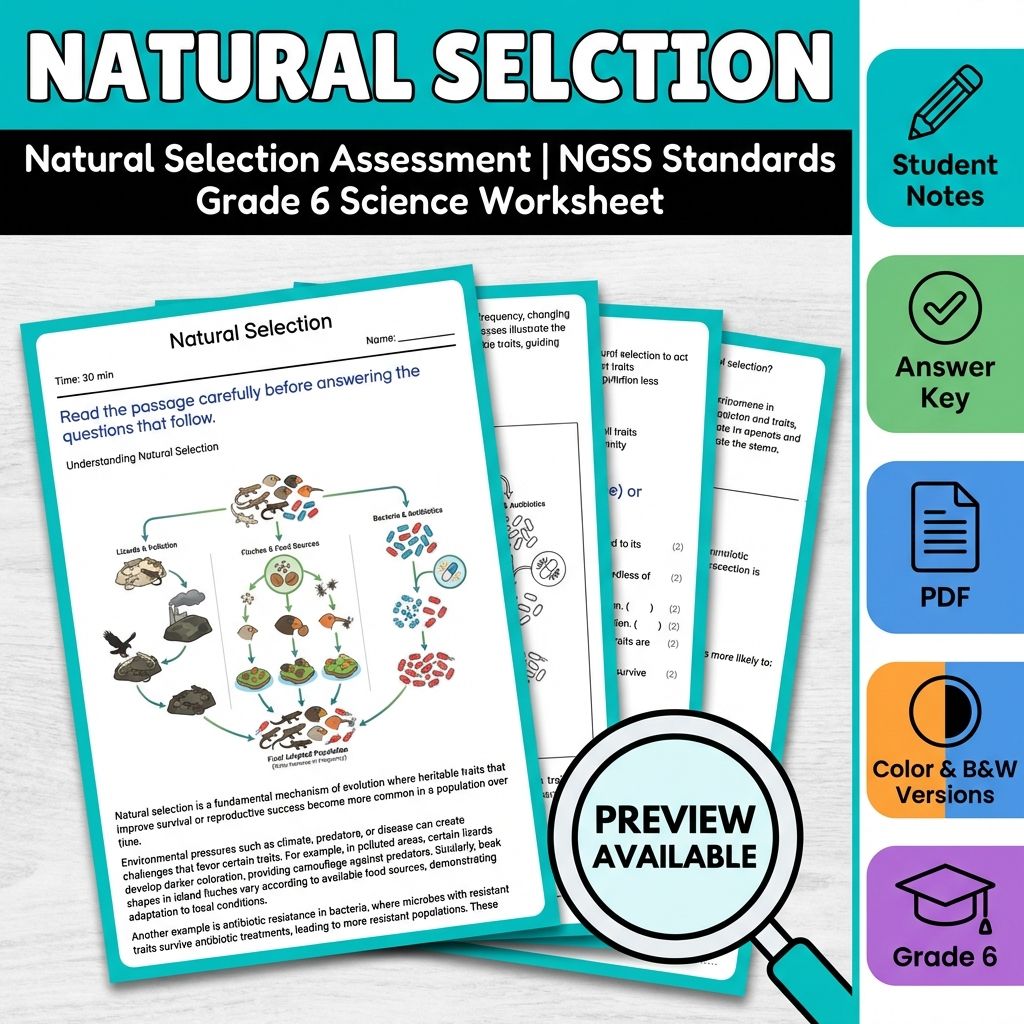
Natural Selection Assessment | NGSS Standards Grade 6 Science Worksheet
Created byPrism Point LearningLearning Objectives
- Describe the process of natural selection and how it leads to changes in trait frequencies within populations.
- Explain how environmental pressures influence the survival and reproduction of organisms with different heritable traits.
- Identify real-world examples of natural selection, such as pigmentation changes, beak variation, and antibiotic resistance.
Also included in: Grade 6 Science Mini Bundle – Biological Evolution: Unity & Diversity +1 more
Instant download

Grade 6 Defining Problems Worksheet | NGSS Practice & PDF
Created byClear Sky ClassroomLearning Objectives
- Understand how to define criteria and constraints for a design problem.
- Identify relevant scientific principles related to problem criteria.
- Use models and cause-effect relationships to relate design criteria to impacts.
Also included in: Grade 6 Engineering Design Science Lesson Bundle for NGSS +1 more
Instant download

Ecosystem Components Assessment for Grade 6 Science TEKS
Created byPrism Point LearningLearning Objectives
- Define ecosystems as interacting systems of populations, communities, and physical factors.
- Identify biotic and abiotic components and their roles in habitat structure.
- Describe examples such as pond, prairie, and forest to illustrate resource distribution and community interdependence.
Instant download

Grade 6 Science – Biodiversity Patterns & Ecosystem Health | Reading Worksheet
Created byBright Mind ResourcesLearning Objectives
- Understand the concept of species richness and how it varies across different ecosystems.
- Learn sampling methods like transects and quadrats used to measure biodiversity.
- Interpret regional biodiversity data and relate it to habitat heterogeneity.
Also included in: Grade 6 Ecology & Biodiversity Science Lesson Bundle | Ontario Daily Reading +1 more
Instant download

Chemical Indicators Test Prep Printables | Grade 6 Science
Created byPrism Point LearningLearning Objectives
- Describe how chemical indicators provide evidence that a chemical reaction has occurred
- Identify common indicator signs such as precipitate formation, persistent colour change, gas production, and energy or light changes
- Explain why combining multiple observations gives stronger evidence than using a single indicator
Also included in: Matter, Properties & Change Lesson Bundle — Grade 6 Science BC Framework +1 more
Instant download

Grade 6 Science – Body Organization & Systems | Daily Reading Worksheet
Created byBright Mind ResourcesLearning Objectives
- Understand the different levels of body organization: cells, tissues, organs, and systems.
- Identify the functions of each level in maintaining health and supporting bodily functions.
- Describe how small structures build larger systems and affect overall body performance.
Also included in: Life Processes Grade 6 Science Daily Reading Worksheets Lesson Bundle | General +1 more
Instant download

Grade 6 Social Studies — Knowledge and Change Worksheet MCQ Paper
Created byThe Resource HubLearning Objectives
- Explain how scientific knowledge contributed to major changes in transportation, communication, and production systems.
- Describe how inventions such as railroads, the telegraph, and industrial machinery affected economic growth and everyday life.
- Analyze cause-and-effect relationships between new scientific ideas and changes in societal organization.
Also included in: Innovations & Infrastructure Lesson Bundle: Grade 6 Social Studies TEKS +1 more
Instant download

Recycling and Waste Worksheet | Grade 6 Holiday Printable PDF
Learning Objectives
- Understand the importance of recycling and reusing materials to reduce waste.
- Identify common recycling practices and their environmental benefits.
- Explain how individual actions and community efforts contribute to sustainability.
Instant download
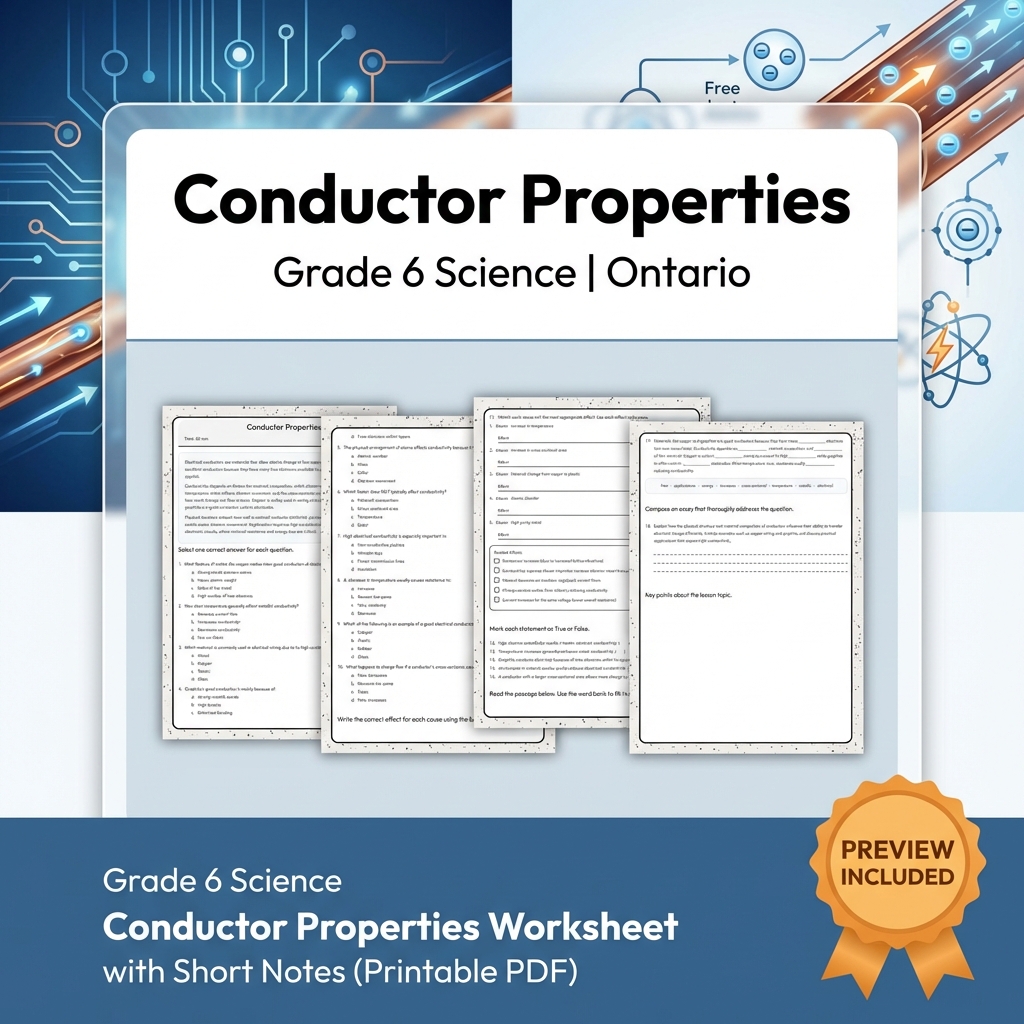
Grade 6 Science Conductor Properties Worksheet with Short Notes (Printable PDF)
 Created byMeadowlark Worksheets
Learning Objectives
- Understand the concept of electrical conductivity and its physical basis.
- Identify factors that influence conductive properties of materials.
- Compare common conductors like copper and graphite based on their electron availability and conductivity.
Also included in: Grade 6 Science Lesson Group on Energy, Circuits & Properties +1 more
Instant download

6th Grade Health Worksheet | Disease Prevention (PDF) Aligned to NHES
 Created bySunny Desk Resources
Learning Objectives
- Explain how infectious germs spread and why timing (before symptoms) matters for prevention
- Identify key disease prevention behaviors such as hand hygiene, covering coughs, sanitation, and staying home when sick
- Describe how vaccination and community responsibility help reduce outbreaks
Also included in: Grade 6 Health: Health Enhancing Practices and Behaviors Lesson Bundle (NHES) +1 more
Instant download

Grade 6 Science – Transport & Sediment | Daily Reading Worksheet
Created byBright Mind ResourcesLearning Objectives
- Understand how streams and wind move particles of different sizes based on energy
- Explain the process of sorting sediments during transportation
- Identify features formed by sorted sediments such as sandbars and deltas
Also included in: Earth Systems Grade 6 Science Daily Reading Worksheets Lesson Bundle | General +1 more
Instant download

Shadow Length and Direction Worksheets Grade 6 Science Sky Science
Created bySunny Desk ResourcesLearning Objectives
- Explain how the Sun’s apparent position changes through the day and over the seasons.
- Use observations of noon, shortest, and longest shadows to infer patterns in shadow length and direction.
- Describe how Earth’s axial tilt and daily rotation affect when and where shadows change.
Also included in: Sky Science Grade 6 Bundle | Alberta Science Worksheets & Activities +1 more
Instant download

Grade 6 Holiday Worksheet Elena | January Standard | World Education
Created byLumora LearningLearning Objectives
- Explain why accessible, quality education matters for individuals and communities
- Identify how different countries adapt schools to meet local needs while aiming for equity
- Use global education vocabulary (access, equity, quality, belonging, human rights) in short responses
Instant download
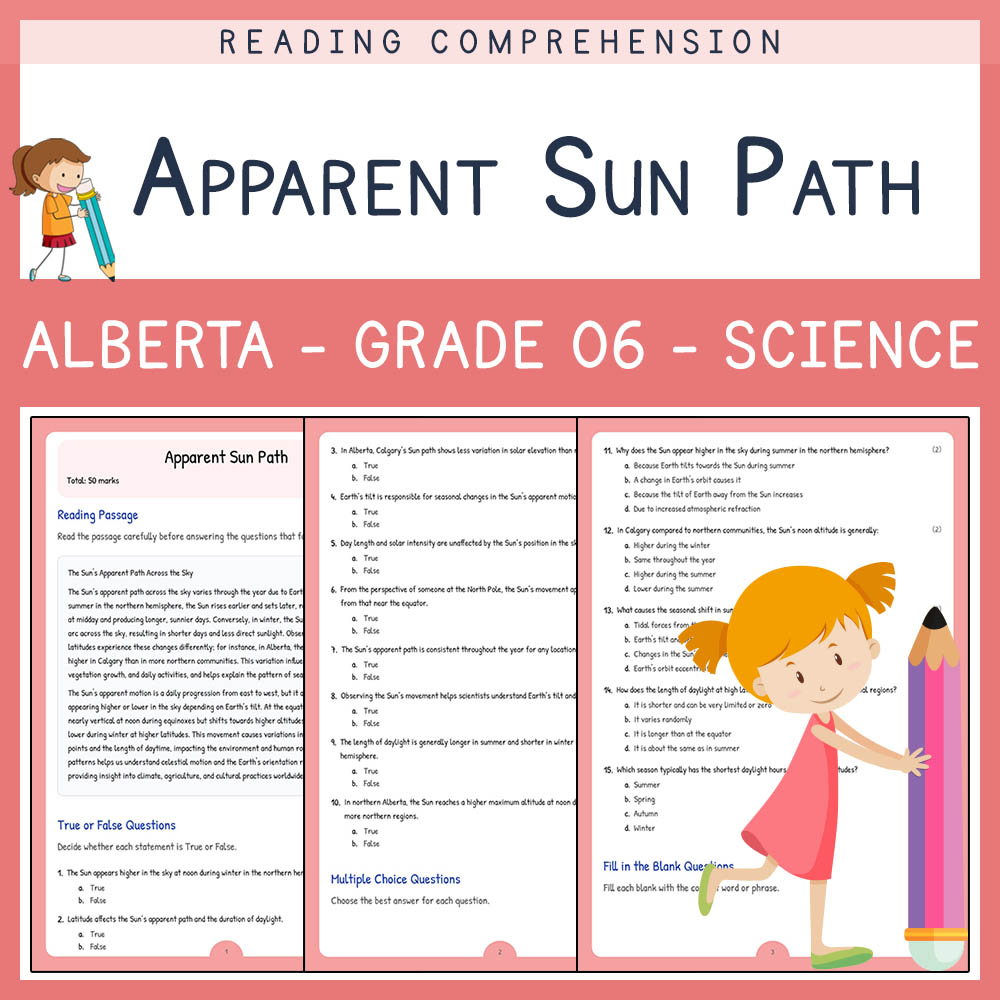
Grade 6 Science Worksheet | Apparent Sun Path | Alberta Standard Practice
Created byLumora LearningLearning Objectives
- Describe how the Sun's apparent path across the sky changes with seasons and latitude.
- Explain the effects of solar elevation at noon on day length and solar intensity.
- Compare the Sun's apparent motion in different geographic locations, such as Calgary and northern communities.
Instant download

Pure Mixtures Worksheet Pack | Grade 6 Science Activities
Created byPrism Point LearningLearning Objectives
- Define a pure substance versus a mixture and explain why mixtures contain more than one material
- Describe how mixture components can be uniform or nonuniform based on how evenly they are spread
- Match observed mixture features to an appropriate separation technique
Instant download

Grade 6 Science | Natural Selection & Evolution - Reading Comprehension Practice
Created byCoral Reef LearningLearning Objectives
- Understand the concept of natural selection.
- Identify factors that influence survival and reproduction.
- Recognize real-world examples of natural selection.
Instant download

Building on Peers Worksheet | Grade 6 ELA Practice and Assessment
Created bySunny Desk ResourcesLearning Objectives
- Use discussion moves to acknowledge a peer’s idea and connect new thinking to shared points.
- Paraphrase what a speaker says to improve clarity and continuity in a collaborative discussion.
- Disagree respectfully by using reasons and evidence instead of personal comments.
Also included in: Speaking and Listening Lesson Bundle | Grade 6 ELA | Alberta Framework +1 more
Instant download

Sentence Clarity Worksheet for Grade 6 ELA | Standards-Aligned Practice
JCreated byJ.S SheetsLearning Objectives
- Identify sentence fragments and run-on sentences and revise them for clarity.
- Apply subject-verb agreement and correct verb tense when writing complete sentences.
- Improve sentence structure so ideas are complete, well-formed, and unambiguous.
Instant download

Direct Evidence Worksheet Grade 6 ELA Text Evidence Practice + Answer Key
Created byLumora LearningLearning Objectives
- Identify the difference between direct evidence (exact wording) and paraphrased evidence while keeping meaning faithful.
- Select textual evidence that best matches a claim’s purpose and avoids irrelevant excerpts.
- Explain how context helps a quote or paraphrase make sense to a reader.
Instant download

Grade 6 Defense Interactions Worksheet | Practice & Assessment PDF
Created byClear Sky ClassroomLearning Objectives
- Explain how barrier defenses, innate inflammation, and adaptive immune responses work together
- Describe how the circulatory and lymphatic systems help immune cells respond to pathogens
- Use key vocabulary (antigens, lymph nodes, antibodies, memory cells) to support immune system explanations
Instant download

Laws and Norms Worksheet | Social Studies Practice for Grade 6 TEKS
JCreated byJ.S SheetsLearning Objectives
- Explain how laws and civic norms work together to maintain social order
- Identify examples of legal systems and civic norms across time and places
- Describe how laws and norms influence rights, responsibilities, and participation
Instant download

Balanced Forces Worksheet | Grade 6 Force and Motion Science Activity
Created byPrism Point LearningLearning Objectives
- Explain how balanced forces produce a net force of zero and can keep motion the same
- Describe how unbalanced forces create a net force that changes speed or direction
- Connect the direction of the net force to the direction of the resulting change in motion
Also included in: Grade 6 Energy, Matter & Motion Lesson Bundle | Florida NGSSS
Instant download

Leaf Functions Worksheet | Grade 6 Science | Alberta Standards
JCreated byJ.S SheetsLearning Objectives
- Understand the roles of leaf structures in gas exchange, photosynthesis, and transpiration.
- Identify variations in leaf structures between conifers and deciduous species.
- Explain how seasonal changes affect leaf functions and tree physiology.
Instant download

Grade 6 Science | Day and Night Cycle - Daily Reading Comprehension
Created byCoral Reef LearningLearning Objectives
- Recognize the role of Earth's rotation in creating day and night
- Understand how Earth's rotation causes changes in sunlight at different times
- Learn about Earth's tilting and how it influences daylight variation across seasons
Also included in: Sky Science Lesson Bundle | Grade 6 Science Daily Reading | Alberta +1 more
Instant download

Organ Systems Worksheet for Grade 6 Science – NGSS Aligned Assessment
JCreated byJ.S SheetsLearning Objectives
- Describe the main organs involved in the circulatory, respiratory, digestive, and nervous systems.
- Explain how different organ systems interact and depend on each other for proper body function.
- Connect cellular functions to system-level processes and understand how organ interactions lead to physiological outcomes.
Also included in: Grade 6 Cellular Processes and Feedback Science Lesson Bundle – NGSS +1 more
Instant download

Summarizing Ideas Practice Worksheet | Grade 6 ELA Review & Assessment
Created byMeadowlark WorksheetsLearning Objectives
- Identify key ideas in a text and leave out minor details when writing a summary.
- Differentiate factual information from opinions in a summary.
- Use logical transitions to keep ideas in a summary organized and coherent.
Also included in: Grade 6 Text Evidence and Inference ELA Lesson Bundle for Alberta +1 more
Instant download

6th Grade Social Studies – Constructing Accounts Worksheet (PDF) BC Standards
Created bySunny Desk ResourcesLearning Objectives
- Explain how historians use multiple sources to build a historical narrative with a clear timeline.
- Compare the reliability and bias of different types of evidence (primary and secondary).
- Evaluate how missing context or perspective can change the conclusions drawn from evidence.
Also included in: Grade 6 Historical Evidence & Chronology Social Studies Lesson Bundle - BC +1 more
Instant download

Grade 6 Social Studies — Laws and Norms Worksheet MCQ Paper
Created byThe Resource HubLearning Objectives
- Explain how laws and civic norms work together to maintain social order
- Describe how legal systems develop and why they change over time
- Connect laws and norms to rights, responsibilities, and civic participation
Also included in: Grade 6 Laws, Norms & Civic Engagement Lesson Bundle | TEKS Social Studies +1 more
Instant download

Privacy and Data Use Worksheet | Grade 6 Computer Science
Created byPrism Point LearningLearning Objectives
- Explain why privacy matters when using AI-powered apps and websites.
- Identify common types of data collection and describe how data can be used.
- Use the terms privacy, data, collection, and consent in accurate, responsible technology choices.
Also included in: Artificial Intelligence & Digital Ethics Lesson Bundle — Grade 6 Computer Science, General +1 more
Instant download

Grade 6 Science – Sampling Methods & Techniques | Daily Reading Worksheet
Created byBright Mind ResourcesLearning Objectives
- Understand different sampling methods used in ecological surveys
- Identify and explain the concept of random sampling
- Analyze the advantages and limitations of various sampling techniques
Also included in: Grade 6 Science Data & Inquiry Daily Reading Worksheets Lesson Bundle | Alberta +2 more
Instant download

Grade 6 Habitat Fragmentation Worksheet | BC Practice PDF
Created byClear Sky ClassroomLearning Objectives
- Describe how habitat fragmentation creates isolated habitat patches and reduces effective habitat area
- Explain how fragmentation can increase edge effects and limit movement between populations
- Identify ways corridors and habitat preservation can reduce negative impacts
Instant download

Water Systems Worksheet for Grade 6 Social Studies | Ontario Standards
JCreated byJ.S SheetsLearning Objectives
- Explain how freshwater systems and watersheds shape where people live and how they travel and trade.
- Describe how pollution and water diversion affect rivers, lakes, and coastal environments.
- Analyze how water-management practices can change over time while staying connected to underlying geographic factors.
Instant download
Browse more categories
About Grade 6 Worksheets
Browse 8,582 printable Grade 6 worksheets across math, ELA, science, and social studies — each a ready-to-print PDF with optional answer keys.
MyTeachingSheets worksheets are made by real teacher-authors and checked before they go live. Download any as a print-ready PDF for lessons, homework, or independent practice — most include answer keys, and previews are always free.